Emilia Fernández 1 , Juan Manuel Muñoz1, Francisco Martín1, Manuel Sierra1, Juan Fernández1, María Diez1, Armando Martínez2 & José Aguilar1*
1 Dpto. Edafología y Química Agrícola, Facultad de Ciencias, Universidad de Granada, Fuentenueva, s/n 18170 Granada, e-mail: efernand@ugr.es;
2 Área de Producción Agraria, IFAPA, Camino Purchil s/n,18080 Granada.
ABSTRACT
Several almond orchards have been studied in south-eastern Spain to characterize and evaluate the soils dedicated to the cultivation of different cultivars in order to identify the parameters that most affect yield. The percentage of gravels, high in several of the soils studied, correlated negatively with the clay content and Water Holding Capacity (WHC) as did the percentage of CaCO3 with available potassium. The greatest yield corresponded to soils with higher surface porosity and lower subsurface porosity, enaulic or gefuric related distribution in the surface horizons and porphyric related distribution in the subsurface horizons. Both for the Fertility Capability Classification as well as for the Agricultural Productivity Evaluation (FAO), the soils with the best characteristics for the crop did not coincide with those in which the greatest yield was found (Ferragnès registering the highest yield), due to the flowering period of the rest of the cultivars selected, which was more influenced by the climatic characteristics of the zone, especially temperature.
Key-words: Almond tree; soil characteristic and micromorphology; systems of land evaluation
]]> Caracterização dos parâmetros pedológicos que influenciam a produtividade da amendoeira
RESUMO
Estudaram-se vários pomares de amendoeira situados no Sudeste de Espanha com o objectivo de caracterizar e avaliar os solos dedicados à cultura de diferentes cultivares de forma a identificar os parâmetros que mais afectam a produtividade. A percentagem de cascalho, presente em quantidades elevadas, em alguns dos solos estudados, está negativamente correlacionada com o teor de argila e a capacidade máxima de retenção de água, bem como a percentagem de CaCO3 com o teor de potássio disponível no solo. As maiores produções corresponderam aos solos que apresentaram uma maior porosidade superficial e uma menor porosidade sub superficial, com uma distribuição enáulica ou gefúrica nos horizontes superficiais e uma distribuição porfírica nos horizontes sub superficiais. Os solos que melhores características apresentam para este tipo de cultura, quer no que se refere à sua fertilidade (Fertility Capability Classification), quer em termos da sua aptidão agrícola (FAO), não foram os que permitiram obter as maiores produções (tendo-se registado a maior produção para a cultivar Ferragnès), uma vez que o período de floração das restantes cultivares seleccionadas foi mais influenciado pelas condições climáticas da zona, nomeadamente pela temperatura, do que pelas características do solo.
Palavras-chave: amendoeira, características do solo e micromorfologia, sistemas de avaliação do solo.
INTRODUCTION
Spain, Italy, and the USA are the leading countries in almond cultivation. In Spain, this crop occupies some 700,000 ha (FAO, 2003) of which more than 195,000 are found in Andalusia, and 75,500 in the province of Granada (Junta de Andalucía, 2003). About 92% of the orchards are rainfed due fundamentally to the drought resistance of the tree, which constitutes a good crop even in situations of severe water deficit. Some works have considered irrigation as counterproductive in fine-textured soils, as the almond is prone to root rot and very sensitive to soil inundation (Barbera & Monastra, 1989).
Traditionally, the almond in Spain has been considered a rustic crop well adapted to most soil types, although Ibar (1985) pointed out that the best soils for this tree are light textured, loamy or slightly sandy, as they encourage water infiltration.
The low annual yields and their fluctuation have generally been associated with climatic conditions, such as frost and temperature. The almond is very sensitive to frost during flowering and fruit development. In temperate zones of the Mediterranean, the winter can be mild and favourable to early flowering, which is often interrupted by late frosts (Ibar, 1985). The breaking of dormancy and the onset flowering require mean temperatures higher than 7ºC during a variable time period, depending on the cultivar (Tabuenca et al., 1972;Ibar, 1985).
Egea et al. (2003) have studied the temperature requirements for several almond cultivars grown in Spain according to Richardson et al. (1974). The days of cold accumulation needed to break the dormancy period varied for the cultivar Desmayo (27 days), Marcona (34 days) and Ferragnès (41 days), and therefore the flowering data (when 50% of the flowers were open) fluctuated from 28 January for Desmayo to 8 and 15 February for Marcona and Ferragnès, respectively.
]]> Due to the economic importance of this crop and its involvement in environmental processes in arid as well as semiarid zones, it has drawn the attention of numerous researchers in recent years (Valverde, et al., 2006; Van Wesemael et al., 2006; Gomes-Laranjo, et al., 2006; Romero & Botía, 2006). However, most of these works are oriented towards the use of water resources and their influence on yield, while few works are available on the pedological characteristics that determine the crop, despite the influence that these parameters can have on the development of the crop.The rise in the number of orchards in the Mediterranean region and their repercussion in the protection of poorly productive land, vulnerable to strong erosion processes on being abandoned, makes studies necessary in order to identify the most suitable cultivar and soils.
The aim of the present paper is to characterize and evaluate the soils dedicated to the cultivation of different cultivars of almond in order to determine the parameters that most affect yield.
MATERIALS AND METHODS
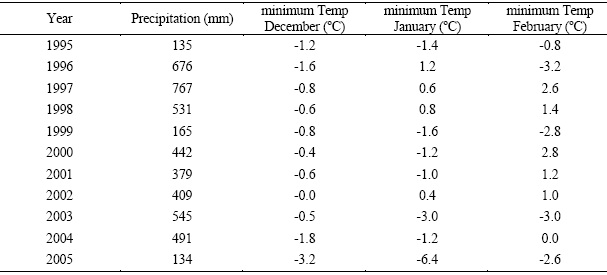
The study took place at six almond orchards in the Valle de Lecrín (Granada province, SE Spain), very close to each other and under the same system of management. These orchards include all the varieties of almond present in the region and the number of plots sampled was proportional to the surface area occupied in the region. Also the different soil types existing in the region were represented (Sierra et al., 1992). The mean annual precipitation is roughly 430 mm, with the absolute rainfall maximum in winter and two secondary peaks in spring and autumn. The mean annual temperature is about 16ºC, with the zone being protected from cold northern winds thanks to various mountain chains but being exposed to cold, wet winds from the west. Even so, the mean temperatures of December and January do not exceed 10ºC, and in both months frost is frequent and that is registered even in February (Table 1).
Table 1 -Climatic characteristics of the zone
]]> The soils were classified according to FAO (1998) as thapto-luvic petric Calcisol (P-1), hypercalcic Cambisol (P-2), calcic Luvisol (P-3), thapto-luvic calcic Regosol (P-4), haplic Calcisol (P-5) and humic Regosol (P-6).
For the analysis of the pedological parameters, samples were collected from each horizon, air dried, and screened (<2 mm). The textural analysis was made by the pipette method of Robinson (Soil Conservation Service, 1972). The exchangeable bases (Ca2+, Mg2+, Na+ and K+) were extracted with NH4OAc 1M and the cation exchange capacity was determined by saturation in sodium and, after to washing with alcohol, extraction of adsorbed sodium with NH4OAc 1M (Soil Conservation Service, 1972). The pH was measured in a soil suspension in distilled water (1: 2.5) using a Crison 2002 pH meter.
For the determination of the organic carbon, nitrogen, phosphorus, and CaCO3 equivalent, the sample was ground and screened again (0.125 mm pore size). The content of the organic carbon was determined using the method of Walkey & Black (1934) modified by Tyurin (1951); for the total nitrogen, the Kjeldahl method was used (Bremner, 1965); the available P was measured by the classical Olsen method (Olsen et al., 1954); and the CaCO3 equivalent was determined by a manometric method (Williams, 1948).
The WHCwas calculated using the following expression:
WHC (mm) = (FC – PWP) x DAHF x Cm x Depth (dm), where FC is the moisture content at field capacity extracted in a pressure plate at 33 kPa and PWP the moisture at the withering point, measured at 1500 kPa (Casel & Nielsen, 1986). DAHF is the bulk density of the fine earth. Cm (percentage of fine earth) was calculated using the fallowing expression:
Cm = (Dg (1-G/100)) / ((Dg (1-G/100) + DAHf x G/100), where G is the percentage of gravels and Dg the density (Soil Conservation Service, 1972).
The soils were micro morphologically characterized in thin sections prepared according to the method of Page & Richard (1990) and described in accordance with Bullock et al. (1985) and Brewer (1964). The porosity was quantified by an Ibas 2000 image analyser, examining 30 microscopic fields in each thin layer.
The cultivated varieties were Ferragnès (P-1; P-4; P-5), Desmayo largueta (P-2) and Marcona (P-3; P-6). The capacity of potential use of each soil was evaluated by the Fertility Capability Classification (FCC) proposed by Buol et al. (1975) and modified by Sánchez et al. (2003), as well as by the Agricultural Productivity Evaluation system FAO (Riquier, Bramao & Cornet 1970).
Yield was monitored for the period 19952005, although sometimes yield was null, especially in the varieties Desmayo and Marcona.
The statistical analysis was performed using the computer program SPSS 11.0.
]]>RESULTS AND DISCUSSION
Morphological and physico-chemical characteristics of the soils
The soils studied were more than 80 cm deep, except for soil P-2, which presented a calcareous crust at 25 cm that might be a physical limitation for root growth. The characteristics of these soils are presented in Table 2, which shows gravels to be abundant in all the profiles, although in some horizons, discontinuous with the rest of the profile, the gravels are scarcer, as in horizons Ap and 2Bt of profile P-1, and in horizon 3Btk of profile P-4. Their composition was quartzitic and schistose in most cases, and the degree of alteration varied in the different soils, being generally medium to high for the schists and lower (affecting exclusively the borders) in the quartzites.
Table 2-Main characteristics of the soils studied
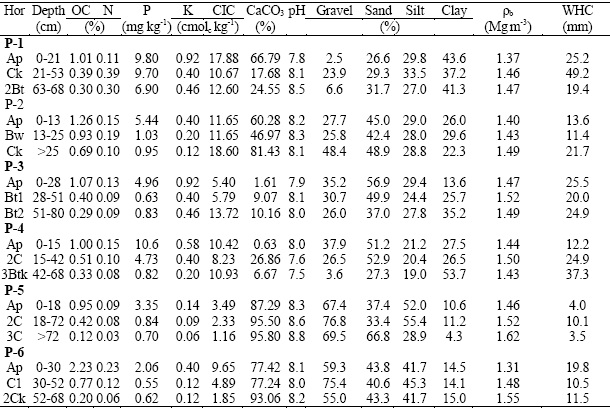
The textures varied in the different horizons, with the heavy-textured clays or loamy clays predominating, although some horizons, such as the profile P-6, have loamy textures. The content in calcium carbonate was very high in all the profiles, and generally increased in depth, frequently exceeding 40%. Despite these fine textures and the profile depth, the Water Holding Capacity was low due to the abundant gravels.
The organic-carbon content was low in all the horizons, conditioned by the crop traditional tillage without adding any organic debris, as was the phosphorus and potassium contents. Nitrogen was higher on the surface, being supplied by the fertilizer.
]]> To establish the influence of the pedological parameters in the productivity of the crop, we used a weighted mean of the pedological variables studied in the three uppermost horizons (Table 3).
Table 3 – Weighted mean of the parameters studied
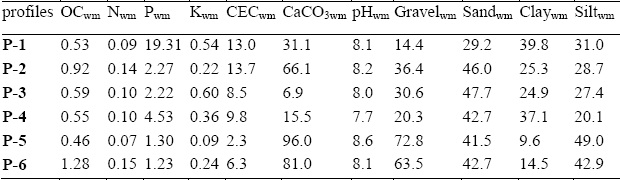
With the Pearson correlation coefficient (Table 4), the correlations between the percentage of gravels, clay, and Water Holding Capacity were bilateral, negative, and significant at the level of 0.01. There was a notable correlation, also negative, between the calcium carbonate content and available po tassium. One of the causes for the lower yield in the soils with high CaCO3 contents was presumably the low availability of potassium, although we cannot affirm this only with the data gathered in the present work, and further studies will be needed to verify this assumption.
Table 4 -Pearson’s correlation coefficient for the parameters studied.
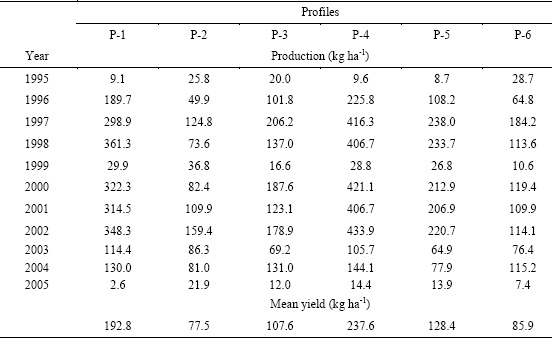
The mean productivity was correlated with the clay content, the WHC and available P. These correlations however, did not reach statistical significance. This lack of statistical correlation would be expected if we consider jointly all the varieties present in zone, and, as stated above, the climate exerts an extraordinary effect on the flowering date, depending on the cultivar. Thus, Desmayo and Marcona had years of null or practically null yield (Table 4 and Table 5).
]]>Table 5 -Yield values for the years 1995 to 2005.
The principal-components analysis reveals three components that explain 91.8% of the variance (Table 6). Almost 60% of the variance was explained by the first component, in which the variables with greater weight were WHC and clay (negative), and calcium carbonate and the percentage of gravels (with a positive relation). In the second component nitrogen and organic carbon had the greatest weight.
Table 6 -Principal-components analysis of the soils studied.
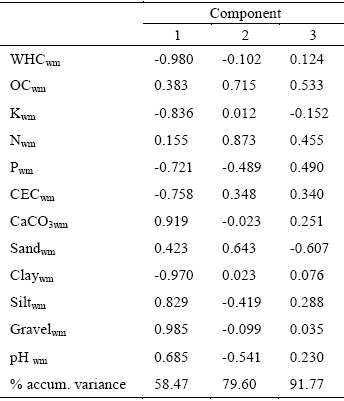
If instead of pooling all the samples, we grouped them by varieties we would find that the most productive cultivar was Ferragnès (clearly due to its late flowering period), followed by Marcona, and finally Desmayo. Within these, the preponderant role of clay and the negative correlation with CaCO3 becomes more apparent.
]]> Micromorphological characteristicsA complete micro morphological study was made though only the most important aspects are pointed out (Table 7).
Table 7 - Main morphological characteristics of the soils studied.
The study of the micromorphological characteristics of the soils served to establish the influence of the physical parameters on yield. The microstructure was not developed in some profiles, such as P-1 and P-3, while the rest had granular or crumbly structure on the surface to subangular blocks in the B horizons (Table 7). The c/f-related distribution was primarily enaulic or porphyric, though in some soils were gefuric or even monic.
The basal mass of the soil was abundant and carbonated, coinciding with the relatively high quantities of carbonates detected in the chemical analyses. The pores and nodules frequently appeared surrounded by a clayey or humus-clayey matrix, with lighter zones for the elimination of the matrix. The carbonate nodules constituted the most common micromorphological feature.
Diverse forms of the pedological features of calcite appeared, the most frequent were recrystallizations, needle-like crystals and coatings, occasionally associated with clay cutans. In the P-3 profile, there were also small ferruginous needle-like nodules. Clay cutans appear only in this profile. Presumably, in other soils these had disappeared due to agricultural practices. In agreement with Mack (1992), carbonates are retained in the soils when rainfall is less than 600 mm, as in the studied zone, where the analyses indicate a certain leaching of the carbonates from the upper horizons, although it is not sufficient to cause the mobilization of the clay. This mobilization and accumulation in the B horizons occurred in the profile with the lowest calcium carbonate content (Table 2). Nevertheless, the presence of calcium carbonate and crystallizations in the soil matrix could be due to subsequent recarbonation processes, so that numerous clay cutans were transformed into calcite deposits. Similar processes in decarbonated soils have been described by several authors (Aguilar et al., 1983; Delgado et al., 1994, Khormali et al., 2003).
The pores varied markedly in size and shape (Table 7), although those of simple and compound packing voids predominated, with occasional equidimensional and elongated vughs and relatively frequent planar voids. Also, the size varied widely, although macropores and mesopores predominated, with micropores being present in lesser quantities. The distribution was random in most of the horizons, although they also appeared horizontally and vertically. This abundant porosity allowed adequate circulation of water and gases in the soil, impeding hydromorphic processes, which, as mentioned above, are harmful to the crop. In fact, no signs of current hydromorphy appeared in any of the studied profiles.
The micromorphological study corroborated the data of the chemical analysis and provided another relationship—i.e. the highest productivity corresponded to the greatest surface porosity and lowest subsurface porosity. Also, the soils with the highest yield presented a porphyric-related distribution in the subsurface. Thus, we first need to consider the cultivar and on this basis we can state that the most favourable distribution with respect to yield is enaulic and then gefuric aboveground while the most favourable underground is porphyric. With respect to porosity, when we take into account the cultivar, we find that the greater the surface porosity and the lower the subsurface porosity, the greater the yield.
]]> Yield and evaluation systems by the FAO and FCCTo study the possible relationship of yield with some of the existing evaluation method, the systems of Riquier, Bramao & Cornet (1970) and Sanchez et al. (2003) were used.
The mean yield for the period 1995-2005 is shown in Table 5. The orchards varied to a greater or lesser degree, following the order: P-4>P-1>P-5>P-3>P-6>P-2. The most productive variety was Ferragnès, followed by Marcona and, finally, Desmayo largueta. The Agricultural Productivity Evaluation System of the FAO (Riquier, Bramao, & Cornet, 1970) enabled us to calculate the productivity and potentiality index, considering some management practices optimal and some conditions outside the disease-free soil environment and with excellent varieties.
The values of the productivity index are listed in Table 8. As can be seen, in accordance with the evaluation system, there were marginal soils for nonforest tree crops, and even in profiles P-2 and P5 the value of the index was even lower than the recommended for recreation, pasture, or special crops. The main limitations according to this classification system were the low organic-matter content, the low cation-exchange capacity, the high calcium carbonate content (except in profiles P-4 and P-3), and shallowness (in the case of profile P-2).
Table 8 -Evaluation systems of productivity FCC =Fertility Capability classification (2003) Riquier = Riquier, Bramao & Cornet method (1970)
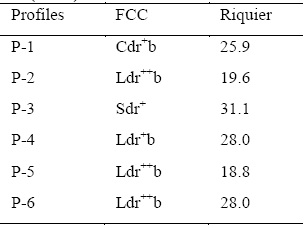
The order of suitability of the soil to the crop, according to this classification, was: P-3>P-4=P-6>P-1>P-2>P-5. These results do not coincide with the relationships established if we regard the average yield. The low value of the productivity index of profile P-5 is striking, as it does not coincide with the real yield obtained. This low value was the result primarily of the high calcium carbonate content in the profile, from the decomposition of parent material (dolomite). However, the cultivar used adapts well to the local climate and counteracts the negative effect of the carbonate, although with lower yield in the three soils in which the same cultivar is grown.
Something similar could be argued for profile P-3, with the highest productivity index according to this classification system but with low real yield, in this case the cultivar is Marcona. Probably, the flowering period in the first days of February (Egea et al., 2003) caused the low productivity, even lower than that in the most unfavourable soil, from the standpoint of the productivity index, for its shallowness, P-2.
]]> The results of applying the Fertility Capability Classification are presented in Table 8. The soils P-2, P-5, and P-6 fit into this system in the same category, on presenting a loamy surface texture (L), a very dry season (d), more than 35% gravels in the upper 50 cm of the soil (r++), and high carbonate content (b). These soils are differentiated from P-4 only in gravel content, which in this soil did not surpass 35% (r+). The soil P-1 can be distinguished from P-4 by the clayey surface texture (C). Finally, soil P-3 stands out from the rest by the sandy-loamy surface texture (S) and by the lower calcium carbonate content.Again, the soil P-3, as observed above on applying the FAO evaluation system, presented the lowest limitations for the crop, although the low real yield appears to be related to the poor adaptation of the cultivar chosen.
CONCLUSIONS
The main limiting factor on productivity in the almond tree in the study area is climate, which can be corrected for by using late-flowering varieties. These varieties can counteract the negative properties of the soils, such as the high calcium-carbonate content in the profile.
The differences observed between the FAO evaluation index and real yield is due to the greater suitability of the cultivar Ferragnès to the climate of the zone.
The presence of high clay contents are not advantageous on the surface, but it is a very important parameter in the subsurface, especially for the location of this crop primarily in arid zones, which gives rise to porosity above and greater Water Holding Capacity belowground.
In summary, the main parameters for almond production are: the cultivar, which determines the flowering period; the clay content, which governs porosity and water retention, especially in the subsurface, due to the existence of a porphyric related distribution; good surface porosity, which is due to the existence of a enaulic or gefuric related distribution; and finally the great quantities of CaCO3.
REFERENCES
]]> Aguilar, J., Guardiola, J.L. Barahona, E., Dorronsoro, C. & Santos, F., 1983. Clay illuviation in calcareous soils. In Bullock, P & Murphy (Eds) Soil Micromorphology Vol 2: Soil Genesis, pp. 541-550. Netherlands.Barbera, G. & Monastra, F. 1989. Aspetti agronomici e biologici della coltura del mandorlo. Rivista di Frutticoltura, 51 (4): 7-14. [ Links ]
Bremner J. M. 1965. Nitrogen availability indexes In: Black, C.A., Evans, D.D., Esminger, L. E. & Clark, F.E. (Eds) Methods of soil Analysis. Part. 2. Chimical and Microbiological Properties, pp. 1324-1345. American Society of Agronomy. Madison, Wisconsin.
Brewer, R. 1964. Fabric and Mineral Analysis of Soils. J. Wiley & Sons, New York.
Buol, S.W., Sanchez, P.A., Cate, R.B. & Granger, M.A. 1975. Soil fertility capability classification: a technical soil classification system for fertility management. In E. Bornemisza y A. Alvarado (eds) Soil management in tropical America, pp. 126-145. North Carolina State University, Raleigh.
Bullock, P., Fedoroff, N., Jongerius, A., Stoops, G., Tursina, T. & Babel, U. 1985. Handbook for soil thin section descrition. Waine Research Publications, Wolverhampton, UK.
Cassel, D.K. & Nielsen, D.R. 1986. Fields capacity and available water capacity. In Methods of Soil Analysis. Part. 1: Physical and Mineralogical Methods, 2nd E. A Klute (eds) ASA, SSSA Monograph Nº 9, pp 901-926. Soil Science Society of America, Madison, WI, USA.
Delgado, R., Aguilar, J. & Delgado, G. 1994. Use of numerical estimators and multivariate análisis to characterize the genesis and pedogenic evolution of xeralfs from southern Spain. Catena, 23: 309-325.
Egea, J., Ortega, E., Martínez-Gómez, P. & Dicenta, F. 2003. Chilling and heat requirements of almond cultivars for flowering. Environmental and Experimental Botany, 50: 79-85.
FAO-ISRIC. 1998. World Reference Base for Soil Resources. Rome.
]]> FAO, 2003. FAOSTAT Agricultural Database, Rome.Gomes-Laranjo, J.; Coutinho, J.P.; Galhano, V. & Cordeiro, V. 2006. Responses of five almond cultivars to irrigation: Photosynthesis and leaf water potential. Agricultural Water Management, 83:261265.
Ibar, L. 1985. El cultivo moderno del al mendro. Aedos, Barcelona, p. 171.
Junta de Andalucía, 2003.
http://www.juntadeandalucia.es/institutodeestadistica/anuario/anuario03/cap06/6_1_16.xls
Khormali, F., Abtahi, A., Mahmoodi, S. & Stoops, G. 2003. Argillic horizon development in calcareous soils of arid and semiarid regions of southern Iran. Catena, 53: 273-301.
Mack, G.H. 1992. Paleosols as an indicator of climate change at the early-late Cretaceous boundary, South-western New Mexico. J. Sediment. Petrol., 62: 483-494.
Olsen, S.R., Cole, V. & Watanabe, F.S. 1954. Estimation of available phosphorus in soils by extration with sodium bicarbonate. USDA Circ. 939.
Page, F. & Richards, G. 1990. A rapid method for making soil thin sections. In: Douglas, L.A. (eds) Soil Micromorphology: A basic and applied science. (Developments in Soil Science 19), pp 627-630. Amsterdam u.a.
Richardson, E.A., Seeley, S.D. & Walker, R.D. 1974. A model for estimating the completion of rest for Red Haven and Elberta peach. HortScience, 9: 331-332.
]]> Riquier, J., Bramao, D.L. & Cornet, I.L. 1970. A new system of soil appraisal in terms of actual and potencial productivity. FAO A.G.L. TERS 70/6.Romero, P. & Botía, P. 2006. Daily and seasonal patterns of leaf water relations and gas exchange of regulated deficit-irrigated almond trees under semiarid conditions. Environmental and Experimental Botany, 56:158-173.
Sanchez, P.A., Palm, C.A. & Buol, S.W. 2003. Fertility capability soil classification: a tool to help assess soil quality in the tropics. Geoderma, 114: 157-185.
Soil Conservation Service. 1972. Soil Survey laboratory. Methods and procedures for collecting soil samples. Soil Survey Report, 1. U.S.D.A. Washington DC. USA.
Sierra, C., Ortega, E., Roca, A., Saura, I. & Asensio, C. 1992. Mapa de Suelos Padul-1026. Ministerio de Agricultura Pesca y Alimentación. Madrid.
Tabuenca, M.C. 1972. Chilling requirements in almond (in Spanish). Anal. Estación Exp. Aula Dei. 11: 325-329.
Tyurin, I.V. 1951. Analytical procedure for a comparature study of soil humus. Trudy. Pochr. Inst. Dokuchaeva, 38.
Valverde, M., Madrid, R. & García, A.L. 2006. Effect of the irrigation regime, type of fertilization, and culture year on physical properties of almond (cv. Guara). Journal of Food Engineering, 76:584-593.
Van Wesemael, B., Rambaud, X., Poesen, J., Muligan, M., Cammeraat, E. & Stevens, A. 2006. Spatial patterns of land degradation and their impacts on the water balance of rainfed treecrops: A case study in South East Spain. Geoderma, 133:43-56.
Walkley A. & Black, I.A. 1934. An Examination of Degtjareff method for determining soil organic matter and a proposed modification of the cromic titration method. Soil. Sci., 34: 29-38.
]]> Williams D.E. 1948. A rapid manometric method for the determination of carbonate in soils. Soil Sci. Am. Proc., 13: 27-12. ]]>