Maria Cristina Simões-Costa1, Isabel Reis Moura1, Maria Teresa Barros2, Carlos José Rodrigues Jr.3
1Jardim Botânico Tropical/IICT, Largo dos Jerónimos, 1400-209 Lisboa, Portugal
2Instituto Superior de Agronomia, Tapada da Ajuda, 1349-017 Lisboa, Portugal
3Instituto de Investigação Cientifica Tropical, Quinta do Marquês, 2784-505 Oeiras, Portugal
ABSTRACT
Somatic embryogenesis was induced in leaf explants of Coffea arabica ‘Catuai’. A two steps procedure was followed: explants were first cultured in a callus induction medium containing 2,4-dichlorophenoxyacetic acid and 6-benzylaminopurine and later transferred to an auxin free embryo induction and conversion medium. The influence of three mineral salt formulations: Schenk & Hildebrandt (1972) full salt solution, Murashige & Skoog (1962) full and half salt solutions; two vitamin mixtures: Gamborg et al. (1968) and Schenk & Hildebrandt (1972) and two gelling agents: agar and gelrite, was assessed. Best embryogenic response was obtained in culture medium with Schenk & Hildebrandt (1972) mineral salts, Gamborg et al. (1968) vitamins and agar. In this medium, somatic embryos were observed after 18 weeks of culture and, six weeks later, 85% of the explants presented an average of 18 somatic embryos per explant.
Key words: Catuai, coffee trees, in vitro culture, plant regeneration, somatic embryos.
]]>Influência dos sais minerais, vitaminas e agentes gelificantes, na embriogénese somática de Coffea arabica L. ‘Catuai’
RESUMO
Foi induzida embriogénese somática em explantados foliares de Coffea arabica ‘Catuai’. A metodologia seguida incluiu duas fases: os explantados foram cultivados inicialmente em meio de indução de callus, suplementado com ácido 2,4-diclorofenoxiacético e 6-benzilaminopurina, tendo sido depois transferidos para meio sem auxina, com o objectivo de induzir a formação e o desenvolvimento de embriões. Testou-se a influência de três diferentes composições de sais minerais: sais minerais de Schenk & Hildebrandt (1972), sais minerais (concentração completa e ½ concentração) de Murashige & Skoog (1962); duas formulações vitamínicas: Gamborg et al. (1968) e Schenk & Hildebrandt (1972) e dois agentes gelificantes: agar e gelrite. A melhor resposta relativamente à embriogénese somática foi registada em meio de cultura com os sais minerais de Schenk & Hildebrandt (1972), as vitaminas de Gamborg et al. (1968) e agar. Neste meio de cultura verificou-se a presença de embriões somáticos após 18 semanas de cultura e, seis semanas mais tarde, 85% dos explantados apresentavam, em média, 18 embriões somáticos por explantado.
Palavras-chave: Cafeeiro, Catuai, cultura in vitro, embriões somáticos, regeneração de plantas.
Abbreviations
BAP – 6-benzylaminopurine
2,4-D – 2,4-dichlorophenoxyacetic acid
CIM – Callus induction medium
]]> EICM – Embryo induction and conversion mediumSE – Somatic embryogenesis
INTRODUCTION
Coffea arabica L. and C. canephora P. ex Fr. are the two most important commercial species of coffee, representing about 75% and 25% of the coffee world market, respectively. C. arabica L. is the “noble” species of coffee tree, which produces the best cup quality, aromatic and with low caffeine content. However, that species is very susceptible to major coffee diseases like the leaf rust or orange rust (Hemileia vastatrix Berkeley & Broome) and the coffee berry disease or CBD (Colletotrichum kahawae Bridge & Waller). This constraint has stimulated the development of genetic improvement programmes in order to obtain plants resistant to the referred diseases. The propagation of improved plant material depends on efficient clonal propagation and regeneration methods (Dehayes, 2000; Kumar et al., 2006). Coffee vegetative propagation by conventional techniques is generally slow, labour intensive and insufficient to farmers demands (Berthouly, 1999; Söndhal et al., 1999; Etienne, 2005). Coffee micropropagation, based on apical and axillary buds development, nodal cuttings and adventitious buds induction, has low efficiency due to difficult sterilisation of explants, high concentration of phenols, apical dominance and low multiplication rates (Raghramuhu et al., 1989; Ribeiro & Carneiro, 1989). Somatic embryogenesis (SE) is a suitable micropropagation technique for coffee since it allows large-scale clonal multiplication at lower production costs (Söndhal & Lauritis, 1992; Dehayes, 2000; Etienne, 2005; Kumar et al., 2006). The first study on Coffea SE was developed by Staritsky (1970) who induced somatic embryos in callus tissues derived from internode explants of young orthotropic shoots of C. canephora. Since then, SE was obtained in different Coffea species, on a great variety of explants: stems, leaves, roots, ovule walls, anthers, immature embryos, seed integument, hypocotyls, cotyledons and protoplasts (Berthouly & Etienne, 1999; De los Santos-Briones & Hernández-Sotomayor, 2006). SE can be achieved in a single step process (Dublin, 1981; Pierson et al., 1982; Yasuda et al., 1985) or in a two main steps process (Söndhal & Sharp, 1977; Dublin, 1984; Neuenschwander & Baumann, 1992).
Nearly all studies so far reported for somatic embryo production in coffee, involved very long periods of in vitro culture and their efficiency is highly genotype-dependent (De los Santos-Briones & Hernández-Sotomayor, 2006; Samson et al., 2006).
The present study concerns C. arabica cultivar ‘Catuai’ which results from an intraspecific cross of C. arabica cultivars ‘Mundo Novo’ and ‘Caturra’, benefiting from the broad adaptability and high yiel-ding capa-city of the former and the reduced size of the latter. ‘Catuai’ is one of the most widely cultivated varieties in some Latin America coffee producing countries. Information concerning SE induction in ‘Catuai’ reports the use of MS (Murashige & Skoog, 1962) medium or MS medium with modified mineral salts formulation, different plant growth regulators, vitamins, gelling agents, culture systems (semisolid vs. bioreactor), light conditions and the use of one growth promoter (triacontanol) (Söndahl & Sharp, 1977; Neuenschwander & Bauman, 1992; Noriega & Söndahl, 1993; Van Boxtel & Berthouly, 1996; Gatica-Arias et al., 2008; Gatica et al., 2008) The aim of this study was to improve SE response of ‘Catuai’ in terms of a more rapid and/or increased embryo yield.
MATERIALS AND METHODS
Plant material
]]> The ‘Catuai’ genotype 2482/20-568 from the Centro de Investigação das Ferrugens do Cafeeiro/Instituto de Investigação Científica Tropical (CIFC/IICT - Portugal) Coffea plants collection was used in the experiments. Young, fully expanded leaves, from greenhouse grown trees, were collected from the distal part of orthotropic branches. Leaves were washed under running water and surface sterilized by immersion and shaking for 20 min in a 7% (w/v) calcium hypochlorite solution, containing 0.5% (v/v) of teepol and rinsed three times with sterile distilled water. Leaf disc explants with 10 mm Ø were excised, excluding the middle vein, the margins and the apical and basal portions of the leaf blade.In vitro culture conditions
The leaf explants were pre-cultured in 10 cm Ø Petri dishes containing 20 ml MS half salt or SH (Schenk & Hildebrandt, 1972) half salt agarified media (7.0 g l-1 agar), with 30 g l-1 sucrose and devoid of plant growth regulators. The pH of the culture media was adjusted to 5.7 before addition of the gelling agent and autoclaving at 121 ºC for 20 minutes. Cultures were incubated for 2 to 3 days in a growth room, under dark conditions and a thermoperiod of 16 h at 28 ± 1 ºC and 8 h at 26 ± 1 ºC.
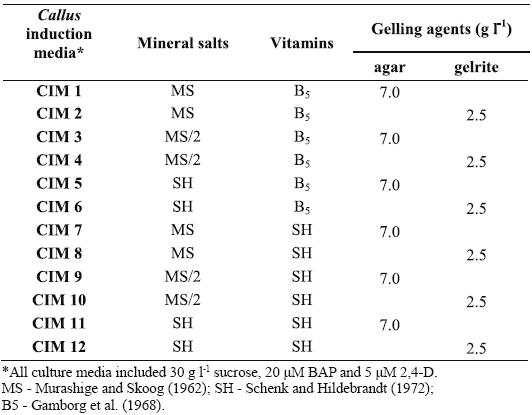
Explants with no visible contamination and/or browning were selected and placed in culture flasks (40 x 40 x 80 mm) containing 10 ml of callus induction medium (CIM). Twelve callus induction media (CIM 1 to CIM 12) were assayed, resulting from the factorial combination of three different salt formulations: SH full salts, MS full salts and MS half salts; two vitamin mixtures: B5 (Gamborg et al., 1968) and SH; two gelling agents agar (7.0 g l-1 ) and gelrite (2.5 g l-1 ) (Table 1). All these media contained 30 g l-1 sucrose, 5 µM of 2,4-dichlorophenoxyacetic acid (2,4-D) and 20 µM 6-benzylaminopurine (BAP). The explants pre-cultured on MS/2 medium were transferred to CIM media containing MS and MS/2 mineral salts and explants pre-cultured on SH/2 medium were transferred to CIM media containing SH salts. Eighteen culture flasks were used per treatment, each containing four explants.
Table 1 – Composition of the media used for callus induction in Coffea arabica ‘Catuai’ genotype 2482/20-568.
After four weeks of culture in CIM media, explants presenting calli were transferred to culture flasks with 10 ml of embryo induction and conversion media (EICM). The EICM media composition was identical to the CIM media composition, but devoid of 2,4-D. During this phase, the explants were subcultured every six weeks. The environmental growth conditions during culture in CIM and EICM media were the same as described above for pre-culture (dark, thermoperiod of 16 h at 28 ± 1 ºC and 8 h at 26 ± 1 ºC). The experiment was repeated twice.
Plantlets with primary root and shoot, resulting from the development of the somatic embryos, were transferred from EICM media to solid culture media with half mineral salts concentration of SH. These plantlets were cultured in a growth room under a 16 h photoperiod at 33 µmol m-2 s-1 , provided by cool-white fluorescent lamps and a day/night temperature of 28 ± 1 ºC / 26 ± 1 ºC. Green regenerated plantlets were transferred to an autoclaved turf:soil:perlite (1:1:1) potting mixture. Light and temperature conditions were the same of the previous phase and the relative humidity was gradually lowered. Eight weeks later, plants were transferred to a turf:soil:sand (4:1:1) mixture under ex vitro greenhouse conditions.
]]> Data collection and statistical analysisExplants were observed weekly. The pre-sence of embryos on each explant was analysed using Generalize Linear Models considering a binomial error distribution and the Wald test (p<0.05) was used for mean separation. The number of somatic embryos per explants with embryogenic callus was analysed by Linear Models after square root transformation and means were separated by Tukey´s HSD test (p<0.05). All analyses were performed using the Genstat package version 5.
RESULTS
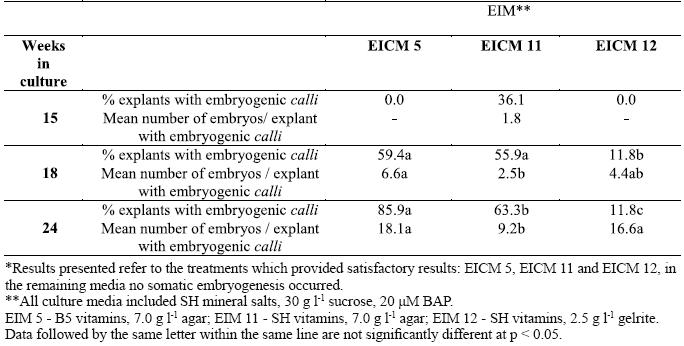
Callus initiation took place between the first and the second week of culture, on the cut edges of the leaves, mainly near vascular cross sections. By the end of the induction period, primary callus could be observed on all the CIM media assayed. Calli were homogeneous, translucent and cream-coloured (Fig. 1a). When transferred to EICM media calli started to brown and growth stopped. Secondary calli appeared on the primary callus surface in all the media tested, however, somatic embryos (isolated or in groups) developed only on those cultured in EICM 5, EICM 11 and EICM 12 media (Fig. 1b). Fifteen weeks after culture initiation (Table 2) somatic embryos were present on 36.1% of the explants cultured on medium EICM 11; at the 18th week and thereafter, somatic embryos were also observed on media EICM 5 and EICM 12. In the remaining EICM media tested, no embryogenic capacity was observed in the calli. Media EICM 5, EICM 11 and EICM 12 had in common SH mineral salts and differed in vitamins composition and gelling agents. The embryogenic response of the explants (i.e. explants with embryogenic callus) was significantly higher in media solidified with agar than in the gelrite medium (Table 2). In the last observation (24 weeks) the percentage of embryogenic explants was significantly higher in the medium with B5 vitamins and agar (85.9%) (EICM 5) than in the medium with SH vitamins and agar (63.3%) (EICM 11). In medium EICM 5, a mean of 18.1 somatic embryos per explant was observed.
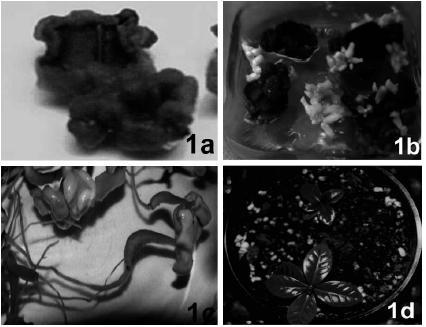
Figure 1 – Regenerattion of C. arabica ‘Catuai’ 2482/20-568 plants through somatic embryogenesis. a: leaf explant with primary callus, b: leaf explants with calli and somatic embryos in different developmental stages (18 weeks in culture), c: somatic embryos after conversion and maturation processes, d: plants in the acclimatization phase.
Table 2 – Percentage of leaf explants presenting embryogenic calli and mean number of embryos / explant with embryogenic calli, after 15, 18 and 24 weeks in culture - Coffea arabica ‘Catuai’ genotype 2482/20-568*.
]]>
Embryo maturation and conversion was achieved on the same media in which soma-tic embrygenesis was induced and under the same environmental conditions. In this phase plantlets with yellow cotyledonary leaves and one root were produced (Fig. 1c). Green plantlets with a well-developed root system were obtained after transfer to light conditions and potting mixture (Fig. 1d). Survival rate of green plantlets after transfer to ex vi-tro conditions was 100% successful.
DISCUSSION
In the present study SE on ‘Catuai’ 2482/20-568 genotype was achieved following friable embryogenic callus formation, according to indirect somatic embryogenesis sequence reported by Jiménez (2001) and Molina et al. (2002). The SE process comprised a sequence of two media and the auxin omission in the second medium aimed at embryo formation, which agrees with the results obtained in several studies and confirms the need to acquire embryogenic competence to subsequent somatic embryos differentiation. Often, an exogenous auxin, like 2,4-D, is required to induce embryogenic competent cells and their proliferation, however it may be inhibitory for their development into somatic embryos (Van Boxtel & Berthouly, 1996; Von Arnold et al., 2002; Jiménez, 2005; De los Santos-Briones & Hernández-Sotomayor, 2006). In this study, somatic embryos showed a spontaneous ability to germinate in EICM media without the need of a maturation step. This process is reported as self-controlled somatic embryogenesis by Neuenschwander & Baumann (1992) and Van Boxtel & Berthouly (1996). Somatic embryos were observed on leaf discs 15-16 weeks after culture initiation. This period of time is considerably shorter than the 6-7 months referred by Söndahl & Sharp (1977) and the 5 and a half months reported by Neuenschwander & Baumann (1992) also for ‘Catuai’. Etienne (2005), reported for C. arabica leaf explants a period of 9-10 months until embryo formation in a two steps procedure. Van Boxtel & Berthouly (1996) achieved low frequency somatic embryo formation in ‘Catuai’ after 15 weeks of culture using MS/2 medium, but only in 8% of the cultured leaf explants, which is lower that the percentage achieved in this study (36,1%, in culture medium EICM 11). Also, the period of time reported by those authors refers to the period from leaf explants to globular embryos formation, while in the present work, the period of time considered goes from leaf explants to heart/torpedo embryos formation. This reduction in the culture time is very advantageous, since long culture periods are often related with an increase in the frequency of somaclonal variations (Etienne & Bertrand, 2001; 2003). In the studied ‘Catuai’ genotype, somatic embryogenesis occurred only on SH medium. Neuenschwander & Baumann (1992), also with ‘Catuai’, used two media in succession: MS full salts medium followed by transfer to MS/2 with full KNO3 concentration, Söndhal & Sharp (1977) and Gatica-Arias et al. (2008) used the same sequence but doubled KNO3 concentration in the second medium, Van Boxtel & Berthouly (1996) and Gatica-Arias et al. (2008) obtained somatic embryos in MS/2 medium. One of the major differences between MS or MS/2 and SH salts media, is the nitrogen concentration. In SH medium both the ammonium ion and the nitrate ion concentration are lower than on MS and MS/2 mineral salts formulations and the NO3/NH4 or NO3/NO3+NH4 ratio is higher in SH medium. The concentration of inorganic nitrogen and the NO3/NH4 or NO3/NO3+NH4 ratios are important for SE induction (Samson et al., 2006; George et al., 2008). The decrease in the ammonium and/or nitrate concentration and the increase of the NO3/NO3+NH4 is referred to enhance the embryogenic response (Samson et al., 2006). This may be the reason for the different embryogenic response of 2482/20-568 genotype in the three mineral salts formulations tested.
Considering the gelling agent, best results were obtained on agar media. The gelling agent is a major component of the medium that can significantly affect the performance of tissue culture medium and physiological responses (Huang et al., 1995). Our results do not agree with those reported by Garcia & Menendez (1987) and Bieysse et al. (1993) for C. arabica. Those authors observed an increase in somatic embryogenesis frequency in a gelrite medium. Owens & Wozniak (1991) refer that water availability and nutrients uptake is affected by the nature and the concentration of the gelling agent and also by the interaction between the explants and the matrix. The results obtained in the present study, which contradict those obtained by other authors also working with coffee, indicate that somatic embryogenesis in C. arabica could be more dependent from the interaction between the genotype and the gelling agent than from the gelling agent itself, which agrees with the large variation in embryoge-nic response observed among C. arabica ge-notypes (Berthouly & Etienne 1999; Molina et al., 2002; Samson et al., 2006).
Considering the vitamin requirements, they vary according to the nature of the plant and the type of culture (George et al., 2008). Many vitamins are added to plant cell culture media formulations, but only myo-inositol and thiamine are considered to be essential to promote the calli growth or the induction of morphogenesis (Rayns & Fowler, 1993). However, myo-inositol is more related with cell proliferation and thiamine with the morphogenesis process. In some species, thiamine was found to be essential for embryogenic callus induction or to increase the frequency of somatic embryos (George et al., 2008). B5 and SH vitamins, used in this work, have the same composition (nicotinic acid, myo-inositol, pyridoxine-HCl and thiamine-HCl) but in different concentrations. The higher concentration of thiamine in B5 formulation (two times higher in B5 than in SH vitamins) may explain the higher embryogenic response obtained.
In this work the highest somatic embryo-production was obtained in the culture medium with SH salts, B5 vitamins and agar. This culture medium allowed a rapid production of somatic embryos from leaf explants of C. arabica ‘Catuai’: 16-18 weeks. This short period of culture, comparing to other reports, may contribute to a decrease in somaclonal variations frequency. The spontaneous germination of the somatic embryos observed in the EICM media may contribute to reduce costs of coffee micropropagation. In the near future it will be interesting to validate this protocol with other coffee genotypes and to establish the production of somatic embryos in liquid culture.
]]> REFERENCES
Berthouly, M. (1999) - Biotecnologias aplicadas al mejoramiento genetico del cafeto. In: IAPAR, IRD (Eds.) Proceedings of III International Seminar on Biotechnology in the Coffee Agroindustry. Londrina, Brasil, 24-28 May, pp. 9-22.
Berthouly, M. & Etienne, H. (1999) - Somatic embryogenesis of Coffee. In: IAPAR, IRD (Eds.) Proceedings of III International Seminar on Biotechnology in the Coffee Agroindustry. Londrina, Brasil, 24-28 May, pp. 23-36.
Bieysse, D.; Gofflot, A. & Michaux-Ferrière, N. (1993) - Effect of experimental conditions and genotypic variability on somatic embryogenesis in Coffea arabica. Canadian Journal of Botany 71: 1496-1502.
De los Santos-Briones, C. & Hernández-Sotomayor, S.M.T. (2006) - Coffee biotechnology. Brazilian Journal of Plant Physiology 18: 217-227.
Dehayes, A. (2000) - In vitro propagation in coffee and field performance of tissue culture plants. In: Prakash, N.S.; Raghuramulu, Y. & Devasia, J. (Eds.) Proceedings of International Scientific Symposium on Coffee. Baangalore, India, 4 December, pp. 47-52.
Dublin, P. (1981) - Embryogenèse somatique directe sur fragments de feuilles de caféier arabusta. Café Cacao Thé 25: 237-242. [ Links ]
Dublin, P. (1984) - Techniques de reproduction végétative in vitro et amelioration génétique chez les caféiers cultivés. Café Cacao Thé 28: 231-244.
Etienne, H. (2005) - Somatic embryogenesis protocol: coffee (Coffea arabica L. and C. canephora P.). In: Jain, S.M. & Gupta, P.K. (Eds.) Protocol for somatic embryogenesis in woody plants. Springer, Netherlands, pp. 167-179.
Etienne, H. & Bertrand, B. (2001) - Trueness-to-type and agronomic characteristics of Coffea arabica trees micropropagated by the embryogenic cell suspension technique. Tree Physiology 21: 1031-1038.
]]> Etienne, H. & Bertrand, B, (2003) - Somaclonal variation in Coffea arabica: effects of genotype and embryogenic cell suspension age on frequency and phenotype of variants. Tree Physiology 23: 419-426.Gamborg, O.L.; Miller, R.A. & Ojima, K. (1968) - Nutrient requirements of suspension cultures of soybean root cells. Experimental Cell Research 50: 148-151.
Garcia, E. & Menendez, A. (1987) - Embriogénesis somática a partir de explantes foliares del cafeto “Catimor”. Café Cacao Thé 31: 15-22.
Gatica, A.M.; Arrieta, G. & Espinoza, A.M. (2008) - Direct somatic embryogenesis in Coffea arabica L. cvs.Caturra and Catuai: effect of triacontanol, light condition and medium consistency. Agronomía Costarricense 32: 139-147.
Gatica-Arias, A.M.; Arrieta-Espinoza, G. & Esquivel, A.M.E. (2008) - Plant regeneration via indirect somatic embryogenesis and optimisation of genetic transformation in Coffea arabica L. cvs. Caturra and Catuaí. Electronic Journal of Biotechonology (on line), 11,1:1-12 ISSN 0717-3458. Available in <http://www.scielo.cl/pdf/ejb/v11n1/a10.pdf>.
George, E.; Hall, M.A. & Klerk, G.-J. (2008) - The components of plant tissue culture media I: macro- and micro-nutrients. In: George, E.; Hal, M.A. & Klerk, G.-J. (Eds.) Plant propagation by tissue culture. Springer, Netherlands, pp. 65-113.
Huang, L.-C.; Kohashi, C.; Vangundy, R. & Murashige, T. (1995) - Effects of common components on hardness of culture media prepared with gelrite. In vitro Cellular and Developmental Biology 31: 84-89.
Jiménez, V.M. (2001) - Regulation of in vitro somatic embryogenesis with emphasis on the role of endogenous hormones. Revista Brasileira de Fisiologia Vegetal 13: 196-223.
Jiménez, V.M. (2005) - Involvement of plant hormones and plant growth regulators on in vitro somatic embryogenesis. Plant Growth Regulation 47: 91-110.
Kumar, V.; Naidu, M.M. & Ravishankar, G.A. (2006) - Developments in coffee biotechnology - in vitro plant propagation and crop improvement. Plant Cell Tissue and Organ Culture 87: 49-65.
]]> Molina, D.M.; Aponte, M.E.; Cortina, H. & Moreno, G. (2002) - The effect of genotype and explant age on somatic embryogenesis of coffee. Plant Cell Tissue Organ and Culture 71: 117-123.Murashige, T. & Skoog, F. (1962) - A revised medium for rapid growth and bioassays with tobacco tissue cultures. Physiologia Plantarum 15: 473-497.
Neuenschwder, B. & Baumann, T.W. (1992) - A novel type of somatic embryogenesis in Coffea arabica. Plant Cell Reports 10: 608-612.
Noriega, C. & Söndahl, M.R. (1993) - Arabica coffee micropropagation through somatic embryogenesis via bioreactors. In: ASIC (Ed.) Proceedings of 15 th Colloquium of International Coffee Science Association. ASIC, Vevey, Switzerland, pp. 73-81.
Owens, L.D. & Wozniak, C.A. (1991) - Measurement and effects of gel matric potential and expressibility on production of morphogenic callus by cultured sugarbeet leaf discs. Plant Cell Tissue and Organ Culture 26: 127-133.
Pierson, E.; Van Lammeren, A.A.; Schell, J.H.N. & Staritsky, G. (1982) - In vitro development of embryoids from punched leaf discs of Coffea canephora. Protoplasma 115: 208-216.
Raghuramulu, Y.; Sreenath, H.L. & Ramaiah, P.K. (1989) - Regeneration of coffee plantlets through tissue culture techniques in India. Journal of Coffee Research 19: 30-38.
Rayns, F.W. & Fowler, M.R. (1993) - Media design and use. In: Hunter CF (Ed.) In vitro cultivation of plant cell. Butterworth-Heinemann, pp.43-46.
Ribeiro, T.O. & Carneiro, M.F. (1989) - Micropropagation by nodal culture of cultivars Caturra, Geisha and Catimor regenerated in vitro. In: ASIC Publishers (Eds.) 13th International Scientific Colloquium on Coffee. Paipa, Colombia, 21-25 August, pp. 757-765.
Samson, N.P.; Campa, C.; Le Gal, L.; Noirot, M.; Thomas, G.; Lokeswari, T.S. & De Kochko, A. (2006) - Effect of primary culture medium composition on high frequency somatic embryogenesis in different Coffea species. Plant Cell Tissue and Organ Culture 86: 37- 45.
]]> Schenk, R.H. & Hildebrandt, A.C. (1972) - Medium and techniques for induction and growth of monocotyledonous and dicotyledonous plant cell cultures. Canadian Journal of Botany 50: 199-204.Söndahl, M.R. & Laurutis, J.A. (1992) - Coffee. In: Hammerschlag, F.A. & Litz, R.E. (Eds.) Biotechnology of Perenial Fruit Crops, Vol 17. CAB International, Oxon, UK, pp. 401-417.
Söndahl, M.R. & Sharp, W.R. (1977) - High frequency induction of somatic embryos in cultured leaf explants of Coffea arabica L.. Zeitschrift für Pflanzenphysiologie 81: 395-408.
Söndahl, M.R.; Söndahl, C.N. & Gonçalves, W. (1999) - Custo comparativo de diferentes técnicas de clonagem. In: IAPAR, IRD (Eds.) Proceedings of III International Seminar on Biotechnology in the Coffee Agroindustry. Londrina, Brasil, 24-28 May, pp. 59-65.
Staritsky, G. (1970) - Embryoid formation in callus tissues of coffee. Acta Botanica Neerlandica 18: 509-514.
Van Boxtel, J. & Berthouly, M. (1996) - High frequency somatic embryogenesis from coffee leaves. Plant Cell Tissue and Organ Culture 44: 7-17.
Von Arnold, S.; Sabala, I.; Bozhkov, P.; Dyachok, J. & Filonova, L. (2002) - Developmental pathway of somatic embryogenesis. Plant Cell Tissue and Organ Culture 69: 233-249.
Yasuda, T.; Fujii, Y. & Yamaguchi, T. (1985) - Embryogenic callus induction from Coffea arabica leaf explants by benzyladenine. Plant Cell Physiologie 26: 595-597.
Recepção/Reception: 2009.08.14
]]> Aceitação/Acception: 2010.01.22 ]]>