<?xml version="1.0" encoding="ISO-8859-1"?><article xmlns:mml="http://www.w3.org/1998/Math/MathML" xmlns:xlink="http://www.w3.org/1999/xlink" xmlns:xsi="http://www.w3.org/2001/XMLSchema-instance">
<front>
<journal-meta>
<journal-id>0871-018X</journal-id>
<journal-title><![CDATA[Revista de Ciências Agrárias]]></journal-title>
<abbrev-journal-title><![CDATA[Rev. de Ciências Agrárias]]></abbrev-journal-title>
<issn>0871-018X</issn>
<publisher>
<publisher-name><![CDATA[Sociedade de Ciências Agrárias de Portugal]]></publisher-name>
</publisher>
</journal-meta>
<article-meta>
<article-id>S0871-018X2012000100004</article-id>
<title-group>
<article-title xml:lang="en"><![CDATA[Environmental impact of outdoor pig production: soil P forms evolution spatial distribution and P losses in drainage waters]]></article-title>
<article-title xml:lang="pt"><![CDATA[Efeitos ambientais da produção de suínos ao ar livre: evolução e distribuição espacial das formas de P no solo e perdas de P na água de drenagem]]></article-title>
</title-group>
<contrib-group>
<contrib contrib-type="author">
<name>
<surname><![CDATA[Horta]]></surname>
<given-names><![CDATA[Carmo]]></given-names>
</name>
<xref ref-type="aff" rid="A01"/>
</contrib>
<contrib contrib-type="author">
<name>
<surname><![CDATA[Batista]]></surname>
<given-names><![CDATA[Marta]]></given-names>
</name>
<xref ref-type="aff" rid="A01"/>
</contrib>
<contrib contrib-type="author">
<name>
<surname><![CDATA[Roque]]></surname>
<given-names><![CDATA[Natália]]></given-names>
</name>
<xref ref-type="aff" rid="A01"/>
</contrib>
<contrib contrib-type="author">
<name>
<surname><![CDATA[Almeida]]></surname>
<given-names><![CDATA[José]]></given-names>
</name>
<xref ref-type="aff" rid="A01"/>
</contrib>
</contrib-group>
<aff id="A01">
<institution><![CDATA[,Instituto Politécnico de Castelo Branco Escola Superior Agrária ]]></institution>
<addr-line><![CDATA[Castelo Branco ]]></addr-line>
<country>Portugal</country>
</aff>
<pub-date pub-type="pub">
<day>00</day>
<month>06</month>
<year>2012</year>
</pub-date>
<pub-date pub-type="epub">
<day>00</day>
<month>06</month>
<year>2012</year>
</pub-date>
<volume>35</volume>
<numero>1</numero>
<fpage>36</fpage>
<lpage>48</lpage>
<copyright-statement/>
<copyright-year/>
<self-uri xlink:href="http://scielo.pt/scielo.php?script=sci_arttext&amp;pid=S0871-018X2012000100004&amp;lng=en&amp;nrm=iso"></self-uri><self-uri xlink:href="http://scielo.pt/scielo.php?script=sci_abstract&amp;pid=S0871-018X2012000100004&amp;lng=en&amp;nrm=iso"></self-uri><self-uri xlink:href="http://scielo.pt/scielo.php?script=sci_pdf&amp;pid=S0871-018X2012000100004&amp;lng=en&amp;nrm=iso"></self-uri><abstract abstract-type="short" xml:lang="en"><p><![CDATA[When compared with intensive indoor production, outdoor pig production is considered by consumers as the production system that causes the least negative environmental effects and contributes to animal welfare. Nevertheless, the continuous input of nutrients in food or pig excretions, increases soil nutrients levels, as is the case with phosphorus (P). This continuous soil P input may exceed soil retention capacity for phosphate and could lead to loss/transfer of P from soil to drainage or runoff waters, contributing to non point source pollution of superficial waters. The main objective of this work was to evaluate the impact of outdoor pig production on soil P levels, its spatial and temporal distribution and also P loss from this area to drainage waters. Experimental outdoor pig production area has 2.8 ha, slope between 5 and 30%, with an animal charge of 9 adults/ha. An increase in soil P, evaluated by the Olsen procedure (P-Ol), and in P inorganic (Pi) and organic (Po) can be observed. In winter there are important P losses by rainfall but it was observed also a global increase in soil P levels with time. P lost in drainage waters is correlated with soil P-Olsen or Pi. Levels of soil P-Olsen above 20 mg kg-1 exceed soil P adsorbing capacity causing a significant increase in P transfer to drainage waters. Better management practices and a better choice of an area with less erosion risk are important, in order to prevent eutrophication of water bodies.]]></p></abstract>
<abstract abstract-type="short" xml:lang="pt"><p><![CDATA[A produção de suínos ao ar livre é considerada pelos consumidores como um modo de produção mais amigo do ambiente e do bem-estar animal. No entanto, os nutrientes contidos na ração e no "excreta" dos suínos são continuamente introduzidos no solo conduzindo a aumentos significativos desses nutrientes no solo, em especial do fósforo (P). Esta continua adição de P ao solo pode exceder a sua capacidade de retenção originando perdas significativas de P para as águas de drenagem e de escoamento superficial, contribuindo para a poluição difusa das águas superficiais. O principal objectivo deste trabalho foi avaliar o impacto da produção de suínos ao ar livre sobre o teor em P do solo avaliando a sua distribuição espacial e temporal, e avaliar também a perda de P através das águas de drenagem interna do solo. A unidade experimental de produção de suínos ao ar livre deste trabalho tem 2.8 ha, um declive entre 5 e 30% e uma carga animal de 9 adultos / ha. Observou-se um aumento do P do solo, quer do P biodisponível (P Olsen, P-Ol) quer do P inorgânico (Pi) ou orgânico (Po). No Inverno observaram-se elevadas perdas de P por erosão e escoamento superficial, mas ao longo do tempo observou-se um aumento global do P no solo. Um teor em P-Ol > 20 mg kg-1 originou um aumento significativo na perda de P para as águas de drenagem interna. Melhores práticas de maneio da unidade experimental, bem como uma escolha da área de produção menos susceptível à erosão, conduzirão a uma prevenção nos riscos de perda de P e na eutrofização das águas superficiais.]]></p></abstract>
<kwd-group>
<kwd lng="en"><![CDATA[Drainage]]></kwd>
<kwd lng="en"><![CDATA[eutrophication]]></kwd>
<kwd lng="en"><![CDATA[phosphorus]]></kwd>
<kwd lng="en"><![CDATA[pollution]]></kwd>
<kwd lng="en"><![CDATA[slurry]]></kwd>
<kwd lng="pt"><![CDATA[Chorume]]></kwd>
<kwd lng="pt"><![CDATA[drenagem]]></kwd>
<kwd lng="pt"><![CDATA[eutrofização]]></kwd>
<kwd lng="pt"><![CDATA[fósforo]]></kwd>
<kwd lng="pt"><![CDATA[poluição]]></kwd>
</kwd-group>
</article-meta>
</front><body><![CDATA[  	    <p><font face="verdana" size="2"><b>Environmental impact of outdoor pig production: soil P forms evolution spatial distribution and P losses in drainage waters</b></font></p>  	    <p><font face="verdana" size="2">&nbsp;</font></p> 	    <p><font face="verdana" size="2"><b>Efeitos Ambientais da produ&ccedil;&atilde;o de su&iacute;nos ao ar livre: evolu&ccedil;&atilde;o e distribui&ccedil;&atilde;o espacial das formas de P no solo e perdas de P na &aacute;gua de drenagem</b></font></p>    <p>&nbsp;</p> 	    <p><font face="verdana" size="2"><b>Carmo Horta<sup>1,2</sup>, Marta Batista<sup>1</sup>, Nat&aacute;lia Roque<sup>1</sup> and Jos&eacute; Almeida<sup>1</sup></b></font></p>  	    <p><font face="verdana" size="2"><sup>1</sup>Escola Superior Agr&aacute;ria, Quinta da Sra. de M&eacute;rcules, 6000&#45;909 Castelo Branco&#45;Portugal; e&#45;mail address: <a href="mailto:carmoh@ipcb.pt">carmoh@ipcb.pt</a></font></p> 	    <p><font face="verdana" size="2"><sup>2</sup>Autor para correspond&ecirc;ncia.</font></p>      <p><font face="verdana" size="2"><i>&nbsp;</i></font></p>  	    <p><font face="verdana" size="2"><b>ABSTRACT</b></font></p>  	    ]]></body>
<body><![CDATA[<p><font face="verdana" size="2">When compared with intensive indoor production, outdoor pig production is considered by consumers as the production system that causes the least negative environmental effects and contributes to animal welfare. Nevertheless, the continuous input of nutrients in food or pig excretions, increases soil nutrients levels, as is the case with phosphorus (P). This continuous soil P input may exceed soil retention capacity for phosphate and could lead to loss/transfer of P from soil to drainage or runoff waters, contributing to non point source pollution of superficial waters. The main objective of this work was to evaluate the impact of outdoor pig production on soil P levels, its spatial and temporal distribution and also P loss from this area to drainage waters. Experimental outdoor pig production area has 2.8 ha, slope between 5 and 30%, with an animal charge of 9 adults/ha. An increase in soil P, evaluated by the Olsen procedure (P&#45;Ol), and in P inorganic (Pi) and organic (Po) can be observed. In winter there are important P losses by rainfall but it was observed also a global increase in soil P levels with time. P lost in drainage waters is correlated with soil P&#45;Olsen or Pi. Levels of soil P&#45;Olsen above 20 mg kg<sup>&#45;1</sup> exceed soil P adsorbing capacity causing a significant increase in P transfer to drainage waters. Better management practices and a better choice of an area with less erosion risk are important, in order to prevent eutrophication of water bodies.</font></p>  	    <p><font face="verdana" size="2"><b>Keywords:</b> Drainage,eutrophication, phosphorus, pollution, slurry.</font></p>  	    <p><font face="verdana" size="2">&nbsp;</font></p>    	    <p><font face="verdana" size="2"><b>RESUMO</b></font></p>  	    <p><font face="verdana" size="2">A produ&ccedil;&atilde;o de su&iacute;nos ao ar livre &eacute; considerada pelos consumidores como um modo de produ&ccedil;&atilde;o mais amigo do ambiente e do bem&#45;estar animal. No entanto, os nutrientes contidos na ra&ccedil;&atilde;o e no "excreta" dos su&iacute;nos s&atilde;o continuamente introduzidos no solo conduzindo a aumentos significativos desses nutrientes no solo, em especial do f&oacute;sforo (P). Esta continua adi&ccedil;&atilde;o de P ao solo pode exceder a sua capacidade de reten&ccedil;&atilde;o originando perdas significativas de P para as &aacute;guas de drenagem e de escoamento superficial, contribuindo para a polui&ccedil;&atilde;o difusa das &aacute;guas superficiais. O principal objectivo deste trabalho foi avaliar o impacto da produ&ccedil;&atilde;o de su&iacute;nos ao ar livre sobre o teor em P do solo avaliando a sua distribui&ccedil;&atilde;o espacial e temporal, e avaliar tamb&eacute;m a perda de P atrav&eacute;s das &aacute;guas de drenagem interna do solo. A unidade experimental de produ&ccedil;&atilde;o de su&iacute;nos ao ar livre deste trabalho tem 2.8 ha, um declive entre 5 e 30% e uma carga animal de 9 adultos / ha. Observou&#45;se um aumento do P do solo, quer do P biodispon&iacute;vel (P Olsen, P&#45;Ol) quer do P inorg&acirc;nico (Pi) ou org&acirc;nico (Po). No Inverno observaram&#45;se elevadas perdas de P por eros&atilde;o e escoamento superficial, mas ao longo do tempo observou&#45;se um aumento global do P no solo. Um teor em P&#45;Ol &gt; 20 mg kg<sup>&#45;1</sup> originou um aumento significativo na perda de P para as &aacute;guas de drenagem interna. Melhores pr&aacute;ticas de maneio da unidade experimental, bem como uma escolha da &aacute;rea de produ&ccedil;&atilde;o menos suscept&iacute;vel &agrave; eros&atilde;o, conduzir&atilde;o a uma preven&ccedil;&atilde;o nos riscos de perda de P e na eutrofiza&ccedil;&atilde;o das &aacute;guas superficiais.</font></p>  	    <p><font face="verdana" size="2"><b>Palavras&#45;chave:</b> Chorume,drenagem, eutrofiza&ccedil;&atilde;o, f&oacute;sforo, polui&ccedil;&atilde;o.</font></p> 	    <p><font face="verdana" size="2">&nbsp;</font></p> 	    <p><font face="verdana" size="2"><b>Abbreviations:</b> EC, electrical conductivity; Co, organic carbon; P, phosphorus; P&#45;Ol, P&#45;Olsen; Pi, inorganic P; Po, organic P; Pt, total P; Pd, dissolved inorganic P; Pk, paddock.</font></p>  	    <p><font face="verdana" size="2">&nbsp;</font></p>  	    <p><font face="verdana" size="2"><b>Introduction</b></font></p>  	    ]]></body>
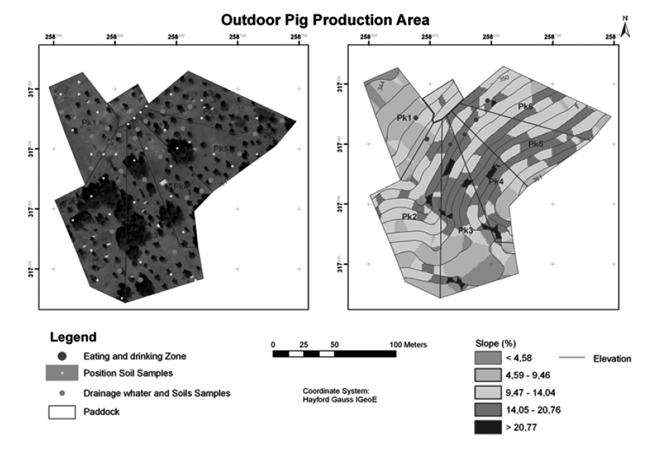
<body><![CDATA[<p><font face="verdana" size="2">Nowadays consumers are concerned not only about food safety, but also about environmental impact of animal husbandry and animal welfare. Therefore, outdoor extensive pig production is gaining acceptance when compared with industrial indoor systems. In respect to environment, outdoor extensive pig production is assumed to cause the least negative effects when compared to intensive indoor production. The assumption is based on lower socking rates, and smaller amount of bio&#45;solids produced per m<sup>2</sup> of outdoor pig production. However, the fact that these bio&#45;solids are deposited directly on the soil, instead of treated in stabilised pounds, as required by intensive pig production, leads to other environmental questions: soil has a limited capacity of depuration and the continuing addition of bio&#45;solids might exceed soil capacity for adsorbing some nutrients (Watson <i>et al.</i>, 2003; Torrent <i>et al</i>., 2007). Thus, in some areas, outdoor pig production might induce a decrease of drinking water quality (Eriksen, 2001) and the eutrophication of superficial waters (Shigaki F. <i>et al</i>., 2007), caused by the movement of nutrients, namely N and P, from soil to drainage or runoff waters. This non point source pollution depends, among other factors, on soil properties, number of animals per hectare and management practices. It is now well established that incorrect procedures in outdoor pig production lead to heavy environmental impacts (Quintern and Sundrum, 2006; Zeng <i>et al.,</i> 2006; Salomon <i>et al.,</i> 2007). In recent years, in Portugal, there was an increase in the number of new outdoor pig production units. For the next years, this strong growth is likely to continue because there are good market opportunities on the one hand, and because agricultural policy stimulates this sector, on the other hand. Therefore, one can expect that daily P inputs in these areas from pigs feed and excreta my lead to increases in soil P level above its retention capacity, causing increase on P transfer from soil to runoff or drainage waters. P transfer from soil to water bodies, from agricultural areas as non point source pollution, is considered nowadays as the main source of water bodies&rsquo; eutrophication.</font></p>  	    <p><font face="verdana" size="2">There are no available data from the Portuguese areas under outdoor pig production and also under particular ecological conditions of soils, climate and <i>Quercus</i> Mediterranean forests. Outdoor pig production areas are in general located in marginal areas in the farm with bad topographic location in terms of high slope and shallow soils having high risk of soil erosion. <i>&nbsp;</i>In addition pig behaviour and soil without cover makes soil erosion and loss of nutrients by runoff easier. In this work we tested the hypothesis that despite this high risk of P lost by erosion and runoff, soil P level will increase with time and this increase will cause continuous losses of P from soil to drainage waters.</font></p>  	    <p><font face="verdana" size="2"><b>&nbsp;</b></font></p>  	    <p><font face="verdana" size="2"><b>Materials and methods</b></font></p>  	    <p><font face="verdana" size="2">This experiment was carried out on an outdoor pig production, at the Polytechnic School of Agriculture at Castelo Branco (Portugal) farm, from January 2005 till February 2007. Climate is typically Mediterranean, with an average (1986&#45;2005) temperature of 15&ordm;C (33 &ordm;C and 3 &ordm;C monthly averages maximum and minimum temperatures respectively) and 734 mm annual rainfall (Horta and Nunes, 2006). The experimental unit has an area of 2.8 ha (Fig. 1), occupied by <i>Quercus suber</i> (mainly) and by <i>Olea europea</i>. This area was divided in 6 paddocks (Pk1 to Pk6) where pigs were distributed by breed (Alentejana and Bizara, both local breeds), sex and physiological state (Alentejana females (Pk5), Bizara females (Pk4), males (Pk1), pregnant/lactating Alentejana females (Pk2), pregnant/lactating Bizara females (Pk3) and the last for weaned piglets (Pk6). In all paddocks slopes vary between 5% and 30% (Fig. 1).</font></p>     <p>&nbsp;</p>    <p><a name="topf1"></a></p> 	    <p><font face="verdana" size="2"><img src="/img/revistas/rca/v35n1/35n1a04f1.jpg" width="650" height="457">&nbsp;</font>	</p> 	<a name="topf1"></a> 	    
<p><font face="verdana" size="2"><b><a href="#f1">Figure 1</a></b> &#150; Outdoor pig production area with the paddocks, feeders and wells points, soil and drainage water sample points, slope and altitude of the area.</font></p> 	    <p>&nbsp;</p> 	    ]]></body>
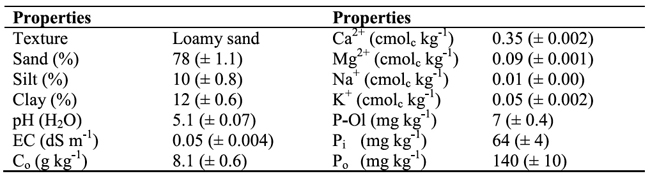
<body><![CDATA[<p><font face="verdana" size="2">Background soil properties were evaluated by sampling soil in January 2005 (Table 1).</font></p>  	    <p><font face="verdana" size="2">&nbsp;</font></p>  	    <p><font face="verdana" size="2"><b><a name="topq1"></a><a href="#q1">Table 1</a></b> &#45; Initial soil properties (January 2005).</font></p>      <p><img src="/img/revistas/rca/v35n1/35n1a04q1.jpg" width="650" height="183"></p> 	    
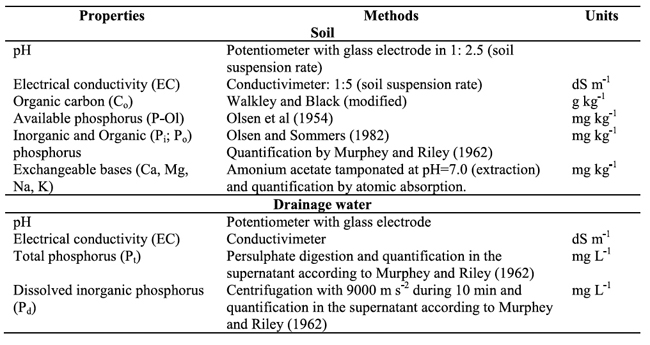
<p>&nbsp;</p>      <p><font face="verdana" size="2">After this initial characterization evolution on soil P forms with time and its spatial distribution were evaluated by sampling soil as follows:</font></p>  	    <p><font face="verdana" size="2">1&#45; Two composite soil samples were taken in each paddock. One was sampled in the area near the feeders and wells considered at the beginning of the experiment as a dirty sector (S1), and another composite soil sample of the remainder area (S2). At this time this last soil sample was considered to be taken from a clear sector. Soil sampling dates were 01/May/ 2005 (period 1), 01/Jul/2006 (period 2) and 01/Feb/2007 (period 3). Samples were denominated by paddock (Pk1 to Pk6), by sector (S1&#45;dirty; S2&#45;clear) and by date of sampling (period 1 to 3). In total 6 x 2 x 3 soil samples were taken. Soil samples were analysed for: organic carbon (Co) pH, electrical conductivity (EC) inorganic P (Pi), organic P (Po) and bioavailabe P quantified by Olsen procedure (P&#45;Ol)&nbsp;&nbsp; 2&#45; For the spatial distribution of soil P forms 60 positioned randomized soil samples were taken in all the area from a network of 5 x 5 m. Depth of soil sampling was always 0.20 m. In these soil samples P forms were evaluated by the quantification of bioavailable P (P&#45;Ol), inorganic P (Pi) and organic P (Po).</font></p>  	    <p><font face="verdana" size="2">To sample drainage water four ceramic suction cups (two cups by sector) were installed at 0.60 m depth in each paddock. Drainage water was collected in winter of 2005&#45;2006 and of 2006&#45;2007 after precipitation events more than 10 mm. Drainage waters were than analysed for pH, electrical conductivity (EC), total P (Pt) and dissolved inorganic P (Pd). At February 2007 simultaneous soil and drainage water samples were collected. Analytical methods used for soil and drainage water characterization are described in Table 2.</font></p>  	    <p><font face="verdana" size="2">&nbsp;</font></p>  	    <p><font face="verdana" size="2"><b>Table 2</b> &#45; Properties and analytical methods used on soil samples and drainage waters.</font></p>  	    ]]></body>
<body><![CDATA[<p><font face="verdana" size="2"><img src="/img/revistas/rca/v35n1/35n1a04q2.jpg" width="650" height="345">&nbsp;</font></p> 	    
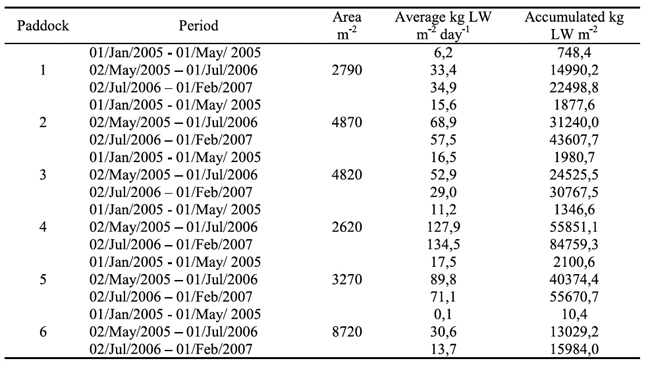
<p>&nbsp;</p>      <p><font face="verdana" size="2">Total rainfall in the period of the experiment was: 71.7 mm (01/Jan to 01/May 2005), 740.4 mm (01/May/2005 to 01/Jul/2006) and 702.1 mm (01/Jul/2006 to 01/Feb/2007).</font></p>  	    <p><font face="verdana" size="2">Average food intake per animal and day, was between 2.5 and 3.5 kg of commercial concentrates, with a total P concentration in dry matter of 0.4% and with 0.7% for pregnant/lactating females.</font></p>  	    <p><font face="verdana" size="2">All animals were weighted at intervals of 2&#45;4 weeks time. These data were used to estimate pig pressure (daily average live&#45;weight; accumulated live&#45;weight) &#45; Table 3 &#45; for the corresponding periods of soil measurements. Accumulated pig live&#45;weight per m<sup>&#45;2</sup> in the end of experimental period was 84759.3 kg (paddock 4), 55670.7 kg (paddock 5), 43607.7 kg (paddock 2), 30767.5 kg (paddock 3), 22498.8 kg (paddock 1) and 15984.0 kg (paddock 6).</font></p> 	    <p>&nbsp;</p> 	    <p><font face="verdana" size="2"><b><a name="topq3"></a><a href="#q3">Table 3</a></b> &#45; Daily average pig live&#45;weight (DLW) per m<sup>&#45;2</sup> accumulated pig live weight (DLW x number days) per m<sup>&#45;2</sup>, on each paddock.</font></p>     <p><img src="/img/revistas/rca/v35n1/35n1a04q3.jpg" width="650" height="367"></p> 	    
<p>&nbsp;</p>      <p><font face="verdana" size="2">Regression and correlation analysis were used to evaluate the effect of animal pressure on soil P contamination and on the relation between P levels in soil and in drainage water; ANOVA is used to evaluate soil P contamination between paddocks, between zones in the paddocks and with time, using SPSS15. In this work, the symbols *, **, and *** denote significance at the 0.05, 0.01, and 0.001 probability (<i>P</i>) levels, respectively. Geo&#45;statistics analysis was performed by ArcGIS 9.1. Kriging methodology was used to estimate P spatial distribution models.</font></p>  	    ]]></body>
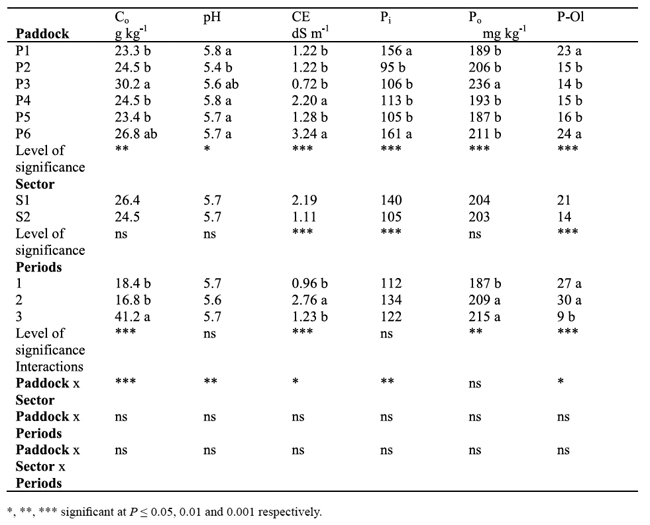
<body><![CDATA[<p><font face="verdana" size="2"><b>&nbsp;</b></font></p>  	    <p><font face="verdana" size="2"><b>Results and discussion</b></font></p>  	    <p><font face="verdana" size="2"><b>Soil properties</b></font></p>  	    <p><font face="verdana" size="2">The soil of the experimental area is a Dystric Cambisoil (IUSS, 2006), loamy sand, acid, poor in organic matter and with low level of nutrients. Compared to background values outdoor pig production leads to an increase of all soil properties (Tables <a name="q1"></a><a href="#topq1">1</a> and 4). Significant differences are observed between paddocks in all soil properties (Table 4). Significant high levels of Co and Po are found in Pk3, and of EC, Pi and P&#45;Ol in Pk6. In general terms it appears that piglets (Pk6) cause higher increases and soil accumulation of P and salts. This could be explained by the low performance of the digestion metabolism of the piglets. Fern&aacute;ndez <i>et al</i>. (1999) refers that growing pigs contribute with 59% to P excretion, sows with 26% and weanes with 15%. In general bioavailability of P in pig feed grain is low due to phosphate stored mainly in form of phytate and low level of phytase enzyme in monogastric causing poor P absortion and high P excretion. However it is possible to increase phosphate bioavailabilty by using grains with low phytate content, as some varieties of corn (Wienhold, 2005). In addition, animal pressure (accumulated pig LW m<sup>&#45;2</sup>) could only explain to some extent the increase in organic C (correlation coefficient 0.373, <i>P</i> &#8804; 0.001); all the other properties had no significant correlations with animal pressure (daily and accumulated LW). Electrical conductivity, inorganic P and P Olsen, shows significant increases on the paddock sector considered dirty, i.e., near de feeding and wells points which are located also in a zone with low altitude (<a name="f1"></a><a href="#topf1">Figure 1</a>); The evolution of soil properties with time suggests a different pattern between organic and inorganic forms. Organic carbon and organic P increases with time. Electrical conductivity and P Olsen show the opposite behaviour, these properties decrease significantly with time. These results suggest a high variability in soil accumulation of organic and inorganic forms during the year. In spring and summer (dry season) there is a general increase in soil accumulation both of organic and inorganic forms. However, in winter (rainy season) there is a high loss of soil by water erosion. So, in winter there is loss of nutrients not only by erosion (adsorbed onto soil particles) but also in soluble forms in runoff waters. This feature could explain the trend in the decrease in inorganic forms (EC and Pi) with time, correspondent to period 3 with sampling data in February 2007.</font></p>      <p><font face="verdana" size="2">&nbsp;</font></p>  	    <p><font face="verdana" size="2"><b>Table 4</b> &#45; Statistical analysis (ANOVA) of soil properties.</font></p> 	    <p><img src="/img/revistas/rca/v35n1/35n1a04q4.jpg" width="650" height="525"></p>    
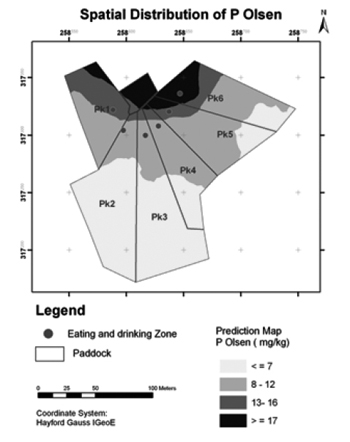
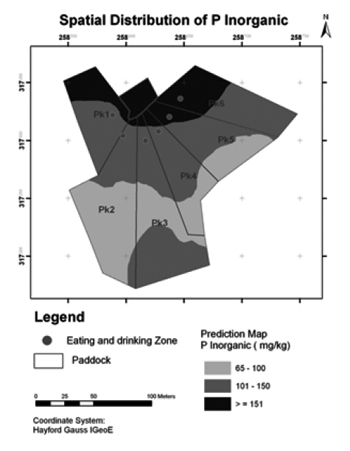
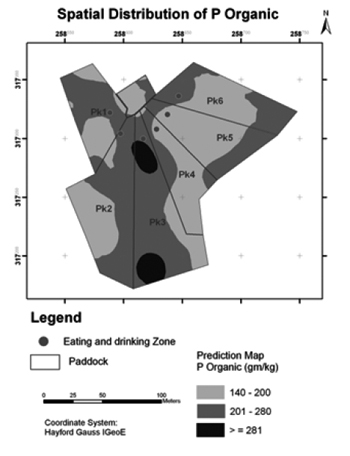
<p><font face="verdana" size="2">&nbsp;</font></p>  	  	    <p><font face="verdana" size="2">Positioned soil samples allow evaluation of the spatial distribution of soil P forms in February 2007 (Figures 2 to 4). The general findings formerly referred can be observed in these Figures: an overall soil P accumulation above background values at the experimental area with higher accumulation (by soil erosion) at lower altitude zones, corresponding also to proximity to feeders and wells. Depth of soil eroded during the time of the experiment was from 0.25 m to 0.05 m (Coutinho <i>et al.,</i> 2009).</font>	</p> 	    <p><a name="topf2"></a></p> 	    ]]></body>
<body><![CDATA[<p><img src="/img/revistas/rca/v35n1/35n1a04f2.jpg" width="350" height="442"></p>     
<p><font face="verdana" size="2"><b><a href="#f2">Figure 2</a></b> &#45; Spatial distribution model of P&#45;Olsen at February of 2007 (initial P&#45;Olsen value of 7 mg kg<sup>&#45;1</sup>).</font>    </p>     <p>&nbsp;</p>     <p><img src="/img/revistas/rca/v35n1/35n1a04f3.jpg" width="350" height="451"></p>         
<p><font face="verdana" size="2"><b>Figure 3</b> &#45; Spatial distribution model of Pi at February of 2007 (initial Pi value of 64 mg kg<sup>&#45;1</sup>).</font></p>     <p><font face="verdana" size="2">&nbsp;</font></p><a name="topf4"></a>     <p><img src="/img/revistas/rca/v35n1/35n1a04f4.jpg" width="350" height="456"></p>     
<p><font face="verdana" size="2"><b><a href="#f4">Figure 4</a></b> &#45; Spatial distribution model of Po at February of 2007 (initial Po value of 140 mg kg<sup>&#45;1</sup>).</font></p>     <p>&nbsp;</p>  	    <p><font face="verdana" size="2">It is difficult to discriminate between the effect of altitude/slope and the fixed location of feeding points on soil P accumulation, because in spatial terms they are coincident. Eriksen and Kristensen (2001) also found high correlation between N, P and K accumulation on soil and distance to feeders. Figures 2 to 4 clearly show the spatial heterogeneity of soil P accumulation. In addition to slope and daily feed inputs, pig behaviour has also high influence on spatial heterogeneity of P forms on soil. Watson <i>et al.</i> (2003) refers that preferred areas to excretion are out of the feeding zone and near the boundary of the paddocks. They observed in those preferred areas a P concentration on the top 0.05 m, on average six times greater than in the least preferred areas, and a large proportion of the increase in soil P seems to be associated to organic P forms. Salomon <i>et al.</i> (2007) pointed out that 43&#45;95 % of nutrients were found to be concentrated in preferred areas corresponding to 4&#45;24 % of the total pen area with increase of P on the top soil of preferred areas, more than four fold. According to Fern&aacute;ndez <i>et al.</i> (1999) pigs excrete 1.2 kg P for each 100 kg of live weight produced. Taking into account data from <a name="q3"></a><a href="#topq3">Table 3</a> and paddock 6 at February 2007 total P input m<sup>&#45;2</sup> will be around 190 kg P.</font></p>     ]]></body>
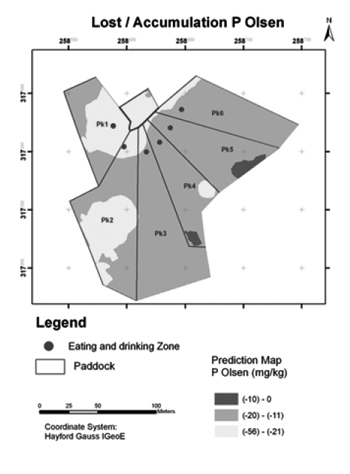
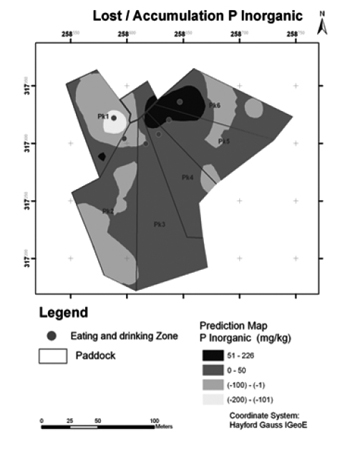
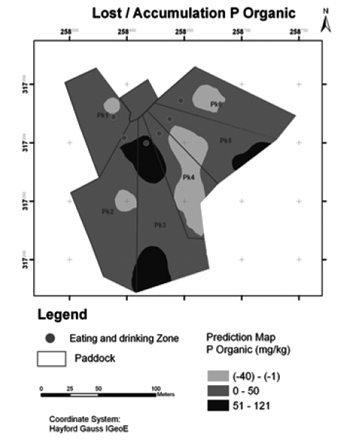
<body><![CDATA[<p><font face="verdana" size="2">Daily P inputs from feed and excreta are neither uniform nor random within the paddocks (Watson <i>et al</i>., 2003) and this heterogeneity is modelled by different factors, such as: pig behaviour, soil erosion, P loss by runoff and drainage waters and fixed location of feeders. As described earlier, these Figures (<a name="f2"></a><a href="#topf2">2</a> to <a name="f4"></a><a href="#topf4">4</a>) clearly show differences between inorganic and organic P forms. Spatial distribution of inorganic (Pi changed between 57 and 489 mg kg<sup>&#45;1</sup>) and availabe P (P&#45;Ol changed between 3 and 49 mg kg<sup>&#45;1</sup>) forms are strongly affected by slope and feeding points. Spatial distribution of organic P (Po changed between 139 and 406 mg kg<sup>&#45;1</sup>) forms exhibits an increase in all the area with higher values near the zones occupied by trees (<i>Quercus suber</i> and <i>Olea europea</i>). This spatial distribution pattern seems to be related on the one hand to pig behaviour, as these are zones where pigs can rest because of the shadow, the fruits and wind barrier, and on the other hand by the fact that organic forms seem to be more permanent (less mobile) in soil than inorganic P forms.</font></p>      <p><font face="verdana" size="2">Inter&#45;annual changes of soil P forms can be observed in Figures 5 to 7. These changes were estimated by the difference between soil P levels in February 2007 and in July 2006. A positive value indicates soil accumulation and a negative value means soil P loss as a result of erosion or transfer from soil to runoff or drainage waters. Between February 2007 and July 2006 soil P Olsen level decreases in the whole area (negative values, Figure 5). Losses in available P forms were more pronounced mainly in the area with higher slopes. Changes in P Olsen values can be from &#45;7 to &#45;39 mg kg<sup>&#45;1</sup>. Spatial distribution of P Olsen changes suggests loss of P to the outside area. Rainfall in this period was 740 mm. Slope and rainfall seems to be the main factors of these inter&#45;annual changes.</font></p>  	    <p><font face="verdana" size="2">&nbsp;</font></p> 	    <p><img src="/img/revistas/rca/v35n1/35n1a04f5.jpg" width="350" height="474"></p>  	    
<p><font face="verdana" size="2"><b>Figure 5</b> &#45; Loss or accumulation of P&#45;Olsen along time (between February of 2007 and July of 2006).</font></p> 	    <p>&nbsp;</p>     <p><img src="/img/revistas/rca/v35n1/35n1a04f6.jpg" width="350" height="451"></p> 	    
<p><font face="verdana" size="2"><b>Figure 6</b> &#45; Loss or accumulation of Pi along time (between February of 2007 and July of 2006).</font></p>         <p><font face="verdana" size="2">&nbsp;</font></p>         <p><img src="/img/revistas/rca/v35n1/35n1a04f7.jpg" width="350" height="445"></p>         
]]></body>
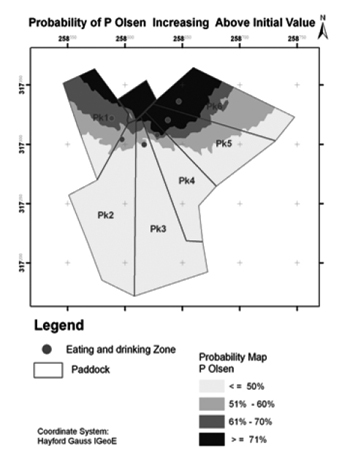
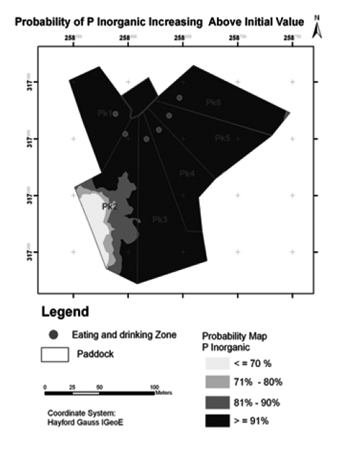
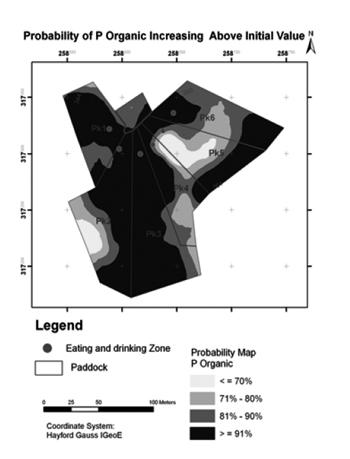
<body><![CDATA[<p><font face="verdana" size="2"><b>Figure 7</b> &#45; Spatial distribution model of Po along time (between February of 2007 and July of 2006).</font></p>     <p><font face="verdana" size="2">&nbsp;</font></p>  	    <p><font face="verdana" size="2">P in inorganic or in organic forms shows a distinct temporal behaviour from P&#45;Olsen. We can observe (Figures. 6 and 7) that they are less mobile than P Olsen forms, and they exhibit an accumulation at some areas in the paddocks. However, also slope seems to influence spatial distribution of these P forms. Results suggest that P forms quantified by the Olsen method are more labile than forms quantified as P<sub>i</sub> and P<sub>o</sub>.</font></p>     <p><font face="verdana" size="2">Nevertheless, two years after the beginning of the experiment and according to the hypothesis of this work, the probability of an increase in soil P levels above the background value during the winter (rainfall season) is higher than 50% for P&#45;Olsen and higher than 70% for P<sub>i</sub>&nbsp;and P<sub>o</sub>&nbsp;(Figures 8, 9 and 10). This indicates a high potential of outdoor pig production for the enrichment of soil with inorganic and organic P forms. The P variability between winter and summer (July of 2006 from February of 2007) shows a typical pattern of P dynamics: accumulation of soil P forms with time and high variability between seasons: accumulation at dry seasons and losses (erosion, runoff or drainage) with rainfall.</font></p>     <p><font face="verdana" size="2">&nbsp;</font></p>     <p><img src="/img/revistas/rca/v35n1/35n1a04f8.jpg" width="350" height="475"></p>      
<p><font face="verdana" size="2"><b>Figure 8</b> &#45; Probability model of P&#45;Olsen increasing at February above the initial value of 7 mg kg<sup>&#45;1</sup></font></p>  	    <p><font face="verdana" size="2">&nbsp;</font></p>  	    <p><img src="/img/revistas/rca/v35n1/35n1a04f9.jpg" width="350" height="457"></p> 	    
<p><font face="verdana" size="2"><b>Figure 9</b> &#45; Probability model of Pi increasing at February above the initial value of 64 mg kg<sup>&#45;1</sup>.</font></p>      ]]></body>
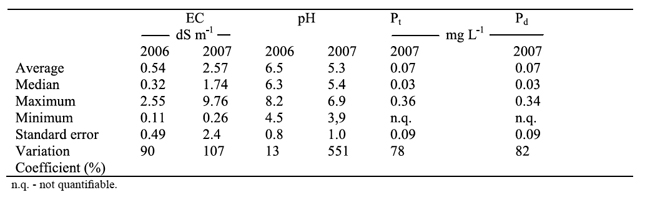
<body><![CDATA[<p><font face="verdana" size="2">&nbsp;</font></p>  	    <p><img src="/img/revistas/rca/v35n1/35n1a04f10.jpg" width="350" height="459"></p> 	    
<p><font face="verdana" size="2"><b>Figure 10</b> &#45; Probability model of Po increasing at February above the initial value of 140 mg kg<sup>&#45;1</sup>.</font></p>      <p><font face="verdana" size="2">&nbsp;</font></p>  	    <p><font face="verdana" size="2"><b>Drainage water quality</b></font></p>  	    <p><font face="verdana" size="2">Drainage water shows a high variability in EC with an increase from 2006 to 2007, while pH values shows a decrease (Table 5). This reflects soil accumulation of salts (nutrients) and organic matter and losses of ions from soil to drainage waters. Values of EC are in the range of those common observed in drainage waters (salinity low to moderate) and pH is in the neutrality range, but in some points it is alkaline or acidic, suggesting soil losses of different species of ions. Soil acidification can be explained also by the mineralization of organic matter added to soil by food and by pig excreta. Total and dissolved P (Pt and Pd) had also high variation coefficients with maximum values above 0.1 mg L<sup>&#45;1</sup>. This value is considered the upper limit of total P in drainage waters to prevent the quality of subterranean waters and the eutrophication of water bodies, as EU (2000). Drainage waters in this area are a non point source pollution for subterranean and superficial waters in terms of P content. We didn&rsquo;t find data from P concentration in drainage waters in other areas of outdoor pig production. However, Shigaki <i>et al.</i> (2007) refer total P concentration from 22.1 to 2.3 mg L<sup>&#45;1</sup> in runoff waters after swine manure application with different rainfall intensities and in the period after manure application. Higher levels are found with higher rainfall intensities and shorter time spent after application. In outdoor pig production there are daily soil inputs of inorganic and organic P. Mediterranean climate is characterized by extreme rainfall events, so high risk of P transfer from soil is to be expected, not only to runoff waters but also to drainage waters, as observed in this experiment.</font></p>  	    <p><font face="verdana" size="2">&nbsp;</font></p>  	    <p><font face="verdana" size="2"><b>Table 5</b> &#45; Characterization of drainage water in 2006 (n=6) and 2007 (n=3).</font></p> 	    <p><img src="/img/revistas/rca/v35n1/35n1a04q5.jpg" width="650" height="205"></p>      
<p><font face="verdana" size="2">&nbsp;</font></p>  	    ]]></body>
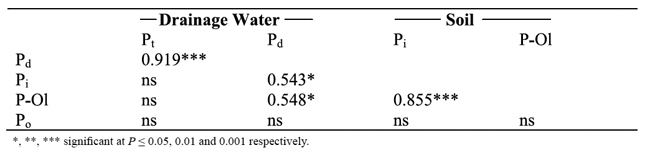
<body><![CDATA[<p><font face="verdana" size="2">In 2007 simultaneous soil and drainage water sampling allow for calculation of the correlation coefficients between soil P levels and P in drainage waters (Table 6).</font></p>  	    <p><font face="verdana" size="2">&nbsp;</font></p>     <p><font face="verdana" size="2"><b>Table 6</b> &#45; Pearson correlation coefficients between soil P levels and drainage water P content (February of 2007).</font></p>  	    <p><img src="/img/revistas/rca/v35n1/35n1a04q6.jpg" width="650" height="163"></p> 	    
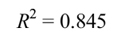
<p><font face="verdana" size="2">&nbsp;</font></p>      <p><font face="verdana" size="2">Dissolved P in drainage water is significantly correlated with inorganic P forms in soil evaluated as P&#45;Olsen and Pi. These correlations show that content of inorganic forms of P in soil affect significantly P content of drainage waters. Levels of soil P as P Olsen or Pi can be used as indexes to estimate risks of P lost from soil to drainage waters. This result obtained in field conditions agrees with the conclusions of Horta and Torrent (2007) who indicate a P&#45;Olsen value of 20 mg P kg<sup>&#45;1</sup> as the soil change point (Heckrath <i>et al.</i>, 1995; Zhang <i>et al.</i>, 2005) for a significant increase of transfer of P from soil to drainage waters in acid Portuguese soils, data obtained in a laboratory experiment. In this area P&#45;Olsen values around and above 20 mg kg<sup>&#45;1</sup> (from 17 to 49 mg kg<sup>&#45;1</sup>) are observed in the paddocks area with the lowest altitude and near the eating points. The highest levels of P in drainage waters (0.10 to 0.36 mg L<sup>&#45;1</sup>) are also found in these areas. This clearly shows that, at field conditions, P&#45;Olsen value of 20 mg P kg<sup>&#45;1</sup> could be considered as the threshold level of this soil. Sector 1 in the paddocks exhibits the highest potential to transfer P from soil to waters with high environmental impact. Therefore, P Olsen above 20 mg P kg<sup>&#45;1</sup> exceed soil P adsorbing capacity of this soil causing a significant increase of the transfer of P from soil to drainage waters.</font></p>     <p><font face="verdana" size="2">P loss from soil to drainage waters is mainly in dissolved form as shown by Eq. &#91;1&#93;. These dissolved forms of P have a high potential to eutrophication as they are highly and quickly available to phytoplankton.</font></p>     <p><font size="2" face="verdana"><img src="/img/revistas/rca/v35n1/35n1a04e1.jpg" width="360" height="46"></font><img src="/img/revistas/rca/v35n1/35n1a04e2.jpg" width="113" height="52"></p>      
<p><font face="verdana" size="2">&nbsp;</font></p>  	    <p><font face="verdana" size="2"><b>CONCLUSIONS</b></font></p>  	    ]]></body>
<body><![CDATA[<p><font face="verdana" size="2">Outdoor pig production done as mentioned in this experimental area originates high increase on soil P levels. P daily inputs by feed and by pig excreta are the P sources in this area. Slope, fixed eating points and pig behaviour are the main factors affecting P increase and spatial heterogeneity on the distribution of soil P. P content of food and metabolic features of P pig digestion are important for factors of P accumulation.&nbsp;</font></p>  	    <p><font face="verdana" size="2">Rainfall and slope have a great impact on soil P movement by erosion and runoff. Annual P dynamics in this area is characterized by P accumulation at dry seasons and P losses at rainfall. P forms show distinct behaviour in their mobility. Organic P forms seem to have the lowest mobility and tend to homogeneity in space and time although inorganic P forms quantified by Olsen procedure had the highest lability, with great variability in space and with time. The probability of increasing soil P&#45;Olsen above the background value is higher than 50% and higher than 70% for Pi or Po at rainfall season. Electrical conductivity and P content of drainage waters indicates high variability in transfer of ions (phosphate or other ions) from soil to drainage waters. The highest P levels of drainage water are obtained in the area with higher levels of soil P, i.e. above the predicted change point of P Olsen value of 20 mg kg<sup>&#45;1</sup>. Maximum values of P in drainage water are above threshold levels to prevent eutrophication of water bodies. Results indicate a significant and positive correlation between Pd in drainage water and P&#45;Olsen or Pi in soil. This work shows that, irrespective to the factors governing soil P dynamics, outdoor pig production causes soil P accumulation above its retention capacity, leading to high potential of P transfer from soil to drainage waters, increasing P non point source pollution of water bodies. Best management practices such as soil cultivation and grazing, moving huts and troughs at short intervals and little animal charge seem to be appropriate in order to diminish environmental impact. Also, the choice of an area with less erosion risk is strongly advisable.</font></p>  	    <p><font face="verdana" size="2">&nbsp;</font></p>  	    <p><font face="verdana" size="2"><b>REFERENCES</b></font>	</p>     <!-- ref --><p><font face="verdana" size="2">Coutinho, J.; Rodrigues, A.M. and Schnabel, S. (2009) &#45; Avalia&ccedil;&atilde;o da Degrada&ccedil;&atilde;o do solo em parques de cria&ccedil;&atilde;o intensiva de su&iacute;nos das ra&ccedil;as Alentejana e B&iacute;sara ao ar livre.&nbsp;<i>Actas do XVIII Congresso de Zootecnia</i>, 6&#45;9 de Maio de 2009, UTAD, Vila </font><font face="verdana" size="2">Real.    &nbsp;&nbsp;&nbsp;&nbsp;&nbsp;&nbsp;&nbsp;&nbsp;[&#160;<a href="javascript:void(0);" onclick="javascript: window.open('/scielo.php?script=sci_nlinks&ref=000117&pid=S0871-018X201200010000400001&lng=','','width=640,height=500,resizable=yes,scrollbars=1,menubar=yes,');">Links</a>&#160;]<!-- end-ref --></font></p>     <!-- ref --><p><font face="verdana" size="2">Eriksen, J. (2001) &#45; Implications of grazing by sows for nitrate leaching from grassland and the succeeding cereal crop. <i>Grass and Forage Science,</i> 56, 317&#45;322.    &nbsp;&nbsp;&nbsp;&nbsp;&nbsp;&nbsp;&nbsp;&nbsp;[&#160;<a href="javascript:void(0);" onclick="javascript: window.open('/scielo.php?script=sci_nlinks&ref=000119&pid=S0871-018X201200010000400002&lng=','','width=640,height=500,resizable=yes,scrollbars=1,menubar=yes,');">Links</a>&#160;]<!-- end-ref --></font></p>  	    <!-- ref --><p><font face="verdana" size="2">Eriksen, J. and Kristensen, K. (2001) &#45; Nutrient excretion by outdoor pigs: a case study of distribution, utilization and potential for environmental impact. <i>Soil Use and Management</i>, 17, 1: 21&#45;29.    &nbsp;&nbsp;&nbsp;&nbsp;&nbsp;&nbsp;&nbsp;&nbsp;[&#160;<a href="javascript:void(0);" onclick="javascript: window.open('/scielo.php?script=sci_nlinks&ref=000121&pid=S0871-018X201200010000400003&lng=','','width=640,height=500,resizable=yes,scrollbars=1,menubar=yes,');">Links</a>&#160;]<!-- end-ref --></font></p>  	    ]]></body>
<body><![CDATA[<p><font face="verdana" size="2">European Parliament and the Council of the European Union &#45; Directive 2000/60/EC of 23 October 2000. <i>Official Journal of the European Communities</i> L 327/1 22.12.2000 (on line). Avaiable at &lt; </font><font face="verdana" size="2"><a href="http://eur-lex.europa.eu/LexUriServ/LexUriServ.do?uri=OJ:L:2000:327:0001:0072:EN:PDF" target="_blank">http://eur-lex.europa.eu/LexUriServ/LexUriServ.do?uri=OJ:L:2000:327:0001:0072:EN:PDF</a> &gt;</font></p>     <!-- ref --><p><font face="verdana" size="2">Fern&aacute;ndez, J.A.; Poulsen, H.D.; Boisen, S. and Rom, H.B. (1999) &#45; Nitrogen and phosphorus consumption, utilisation and losses in pig production: Denmark. <i>Livestock Production Science,</i> 58, 225&#45;242.    &nbsp;&nbsp;&nbsp;&nbsp;&nbsp;&nbsp;&nbsp;&nbsp;[&#160;<a href="javascript:void(0);" onclick="javascript: window.open('/scielo.php?script=sci_nlinks&ref=000124&pid=S0871-018X201200010000400004&lng=','','width=640,height=500,resizable=yes,scrollbars=1,menubar=yes,');">Links</a>&#160;]<!-- end-ref --></font></p>  	    <!-- ref --><p><font face="verdana" size="2">Heckrath, G.; Brooks, P.C.; Poulton, P.R.; and Goulding, K.W.T. (1995) &#45; Phosphorus leaching from soils containing different phosphorus concentrations in the Broadbalk experiment. <i>Journal of Environmental Quality</i>, 24, 904&#45;910.    &nbsp;&nbsp;&nbsp;&nbsp;&nbsp;&nbsp;&nbsp;&nbsp;[&#160;<a href="javascript:void(0);" onclick="javascript: window.open('/scielo.php?script=sci_nlinks&ref=000126&pid=S0871-018X201200010000400005&lng=','','width=640,height=500,resizable=yes,scrollbars=1,menubar=yes,');">Links</a>&#160;]<!-- end-ref --></font></p>  	    <!-- ref --><p><font face="verdana" size="2">Horta, M.C. and Torrent, J. (2007) &#45; The Olsen P method as an agronomic and environmental test for predicting phosphate release from acid soils. <i>Nutrient Cycling in Agroecosystems</i>, 77, 283&#45;292.    &nbsp;&nbsp;&nbsp;&nbsp;&nbsp;&nbsp;&nbsp;&nbsp;[&#160;<a href="javascript:void(0);" onclick="javascript: window.open('/scielo.php?script=sci_nlinks&ref=000128&pid=S0871-018X201200010000400006&lng=','','width=640,height=500,resizable=yes,scrollbars=1,menubar=yes,');">Links</a>&#160;]<!-- end-ref --></font></p>  	    <!-- ref --><p><font face="verdana" size="2">Horta, M.C. and Nunes, J. (2006) &#45; <i>Dados clim&aacute;ticos referentes ao per&iacute;odo 1986&#45;2005</i>. Posto Meteorol&oacute;gico da Escola Supe<i>rior Agr&aacute;ria.</i> Castelo Branco, Instituto Polit&eacute;cnico de Castelo Branco, ESACB, 50 p.    &nbsp;&nbsp;&nbsp;&nbsp;&nbsp;&nbsp;&nbsp;&nbsp;[&#160;<a href="javascript:void(0);" onclick="javascript: window.open('/scielo.php?script=sci_nlinks&ref=000130&pid=S0871-018X201200010000400007&lng=','','width=640,height=500,resizable=yes,scrollbars=1,menubar=yes,');">Links</a>&#160;]<!-- end-ref --></font></p>  	    <!-- ref --><p><font face="verdana" size="2">IUSS Working Group WRB (2006) &#45; <i>World reference base for soil resources 2006</i>. World Soil Resources Reports No. 103. Rome, FAO, 128 p.    &nbsp;&nbsp;&nbsp;&nbsp;&nbsp;&nbsp;&nbsp;&nbsp;[&#160;<a href="javascript:void(0);" onclick="javascript: window.open('/scielo.php?script=sci_nlinks&ref=000132&pid=S0871-018X201200010000400008&lng=','','width=640,height=500,resizable=yes,scrollbars=1,menubar=yes,');">Links</a>&#160;]<!-- end-ref --></font></p>  	    <!-- ref --><p><font face="verdana" size="2">Murphy, J. and Riley, J.P. (1962) &#45; A modified single solution method for the determination of phosphate in natural waters. <i>Analytica Chimica. Acta</i>, 27, 31&#45; 36.    &nbsp;&nbsp;&nbsp;&nbsp;&nbsp;&nbsp;&nbsp;&nbsp;[&#160;<a href="javascript:void(0);" onclick="javascript: window.open('/scielo.php?script=sci_nlinks&ref=000134&pid=S0871-018X201200010000400009&lng=','','width=640,height=500,resizable=yes,scrollbars=1,menubar=yes,');">Links</a>&#160;]<!-- end-ref --></font></p>  	    <!-- ref --><p><font face="verdana" size="2">Olsen, S.R.; Cole, C.V.; Watanabe, F.S. and Dean, L.A. (1954) &#45; <i>Estimation of available phosphorus in soils by extraction with sodium bicarbonate</i>. Washington D.C., USDA United States Department of Agriculture. Circular Nr. 939.    &nbsp;&nbsp;&nbsp;&nbsp;&nbsp;&nbsp;&nbsp;&nbsp;[&#160;<a href="javascript:void(0);" onclick="javascript: window.open('/scielo.php?script=sci_nlinks&ref=000136&pid=S0871-018X201200010000400010&lng=','','width=640,height=500,resizable=yes,scrollbars=1,menubar=yes,');">Links</a>&#160;]<!-- end-ref --></font></p>  	    <!-- ref --><p><font face="verdana" size="2">Olsen, S.R. and Sommers, L.E. (1982) &#45; Phosphorus. In: Page, A.L. <i>et al</i>. (Eds.) &#45; <i>Methods of Soil Analysis.</i> Part 2, 2nd. Ed., Agron. Monogr. 9. Madison, WI, ASA and ASSA, p. 1035&#45;1049.    &nbsp;&nbsp;&nbsp;&nbsp;&nbsp;&nbsp;&nbsp;&nbsp;[&#160;<a href="javascript:void(0);" onclick="javascript: window.open('/scielo.php?script=sci_nlinks&ref=000138&pid=S0871-018X201200010000400011&lng=','','width=640,height=500,resizable=yes,scrollbars=1,menubar=yes,');">Links</a>&#160;]<!-- end-ref --></font></p>  	    <!-- ref --><p><font face="verdana" size="2">Quintern, M. and Sundrum, A. (2006) &#45; Ecological risks of outdoor pig fattening in organic farming and strategies for their reduction &#150; Results of a field experiment in the centre of Germany. <i>Agriculture, Ecosystems and Environment,</i> 117, 238&#45;250.    &nbsp;&nbsp;&nbsp;&nbsp;&nbsp;&nbsp;&nbsp;&nbsp;[&#160;<a href="javascript:void(0);" onclick="javascript: window.open('/scielo.php?script=sci_nlinks&ref=000140&pid=S0871-018X201200010000400012&lng=','','width=640,height=500,resizable=yes,scrollbars=1,menubar=yes,');">Links</a>&#160;]<!-- end-ref --></font></p>  	    <!-- ref --><p><font face="verdana" size="2">Salomon, E.; Akerhielm, H.; Lindahl, C. and Lindgren, K. (2007) &#45; Outdoor pig production fattening at two Swedish organic farms &#150; Spatial and temporal load of nutrients and potential environmental impact. <i>Agriculture, Ecosystems and Environment, </i></font><font face="verdana" size="2">121, 407&#45;418.    &nbsp;&nbsp;&nbsp;&nbsp;&nbsp;&nbsp;&nbsp;&nbsp;[&#160;<a href="javascript:void(0);" onclick="javascript: window.open('/scielo.php?script=sci_nlinks&ref=000142&pid=S0871-018X201200010000400013&lng=','','width=640,height=500,resizable=yes,scrollbars=1,menubar=yes,');">Links</a>&#160;]<!-- end-ref --></font></p>     <!-- ref --><p><font face="verdana" size="2">Shigaki, F.; Sharpley, A. and Prochnow, L. (2007) &#45; Rainfall intensity and phosphorus transport in surface runoff from soil trays. <i>Science of the Total Environment,</i> 373, 334&#45;343.    &nbsp;&nbsp;&nbsp;&nbsp;&nbsp;&nbsp;&nbsp;&nbsp;[&#160;<a href="javascript:void(0);" onclick="javascript: window.open('/scielo.php?script=sci_nlinks&ref=000144&pid=S0871-018X201200010000400014&lng=','','width=640,height=500,resizable=yes,scrollbars=1,menubar=yes,');">Links</a>&#160;]<!-- end-ref --></font></p>  	    <!-- ref --><p><font face="verdana" size="2">Torrent, J.; Barberis, E. and Gil&#45;Sotres, F. (2007) &#45; Agriculture as a source of phosphorus for eutrophication in southern Europe. <i>Soil Use and Management</i>, 23, 1: 25&#45;35.    &nbsp;&nbsp;&nbsp;&nbsp;&nbsp;&nbsp;&nbsp;&nbsp;[&#160;<a href="javascript:void(0);" onclick="javascript: window.open('/scielo.php?script=sci_nlinks&ref=000146&pid=S0871-018X201200010000400015&lng=','','width=640,height=500,resizable=yes,scrollbars=1,menubar=yes,');">Links</a>&#160;]<!-- end-ref --></font></p>  	    <!-- ref --><p><font face="verdana" size="2">Watson, C.; Atkins, T.; Bento, S.; Edwards, A. and Edwards, S. (2003) &#45; Appropriateness of nutrient budgets for environmental risk assessment: a case study of outdoor pig production. <i>European Journal of Agronomy,</i> 20, 117&#45;126.    &nbsp;&nbsp;&nbsp;&nbsp;&nbsp;&nbsp;&nbsp;&nbsp;[&#160;<a href="javascript:void(0);" onclick="javascript: window.open('/scielo.php?script=sci_nlinks&ref=000148&pid=S0871-018X201200010000400016&lng=','','width=640,height=500,resizable=yes,scrollbars=1,menubar=yes,');">Links</a>&#160;]<!-- end-ref --></font></p>  	    <!-- ref --><p><font face="verdana" size="2">Wienhold, B.J. (2005) &#45; Changes in soil attributes following low phosphorus swine slurry application to no&#45;tillage sorghum. <i>Soil Science Society America Journal</i>, 69, 2006&#45;2014.    &nbsp;&nbsp;&nbsp;&nbsp;&nbsp;&nbsp;&nbsp;&nbsp;[&#160;<a href="javascript:void(0);" onclick="javascript: window.open('/scielo.php?script=sci_nlinks&ref=000150&pid=S0871-018X201200010000400017&lng=','','width=640,height=500,resizable=yes,scrollbars=1,menubar=yes,');">Links</a>&#160;]<!-- end-ref --></font></p>  	    <!-- ref --><p><font face="verdana" size="2">Zahng, G.L.; Burghardt, W. and Yang, J.L. (2005) &#45; Chemical criteria to assess risk of phosphorus leaching from urban soils.<i>Pedosphere</i>, 15, 1: 72&#45;77.    &nbsp;&nbsp;&nbsp;&nbsp;&nbsp;&nbsp;&nbsp;&nbsp;[&#160;<a href="javascript:void(0);" onclick="javascript: window.open('/scielo.php?script=sci_nlinks&ref=000152&pid=S0871-018X201200010000400018&lng=','','width=640,height=500,resizable=yes,scrollbars=1,menubar=yes,');">Links</a>&#160;]<!-- end-ref --></font></p>  	    <!-- ref --><p><font face="verdana" size="2">Zeng, Y.; Hong, H.; Cao, W.; Chen, N.; Wang, W. and Zhang, L. (2006) &#45; Evaluation of nitrogen balance on pig/crop farm systems in Jiulong River watershed, China. <i>Aquatic Ecosystem Health &amp; Management</i>, 9, 1: 21&#45;26.    &nbsp;&nbsp;&nbsp;&nbsp;&nbsp;&nbsp;&nbsp;&nbsp;[&#160;<a href="javascript:void(0);" onclick="javascript: window.open('/scielo.php?script=sci_nlinks&ref=000154&pid=S0871-018X201200010000400019&lng=','','width=640,height=500,resizable=yes,scrollbars=1,menubar=yes,');">Links</a>&#160;]<!-- end-ref --></font></p>  	    <p><font face="verdana" size="2">&nbsp;</font></p>  	    <p><font face="verdana" size="2"><b>Recep&ccedil;&atilde;o/Reception: 2011.09.14    <br> 	Aceita&ccedil;&atilde;o/Acception: 2011.10.14</b></font></p> 	     ]]></body><back>
<ref-list>
<ref id="B1">
<nlm-citation citation-type="confpro">
<person-group person-group-type="author">
<name>
<surname><![CDATA[Coutinho]]></surname>
<given-names><![CDATA[J.]]></given-names>
</name>
<name>
<surname><![CDATA[Rodrigues]]></surname>
<given-names><![CDATA[A.M.]]></given-names>
</name>
<name>
<surname><![CDATA[Schnabel]]></surname>
<given-names><![CDATA[S.]]></given-names>
</name>
</person-group>
<source><![CDATA[Avaliação da Degradação do solo em parques de criação intensiva de suínos das raças Alentejana e Bísara ao ar livre]]></source>
<year>2009</year>
<conf-name><![CDATA[ Actas do XVIII Congresso de Zootecnia]]></conf-name>
<conf-date>6-9 de Maio de 2009</conf-date>
<conf-loc>Vila Real </conf-loc>
</nlm-citation>
</ref>
<ref id="B2">
<nlm-citation citation-type="journal">
<person-group person-group-type="author">
<name>
<surname><![CDATA[Eriksen]]></surname>
<given-names><![CDATA[J.]]></given-names>
</name>
</person-group>
<article-title xml:lang="en"><![CDATA[Implications of grazing by sows for nitrate leaching from grassland and the succeeding cereal crop]]></article-title>
<source><![CDATA[Grass and Forage Science]]></source>
<year>2001</year>
<volume>56</volume>
<page-range>317-322</page-range></nlm-citation>
</ref>
<ref id="B3">
<nlm-citation citation-type="journal">
<person-group person-group-type="author">
<name>
<surname><![CDATA[Eriksen]]></surname>
<given-names><![CDATA[J.]]></given-names>
</name>
<name>
<surname><![CDATA[Kristensen]]></surname>
<given-names><![CDATA[K.]]></given-names>
</name>
</person-group>
<article-title xml:lang="en"><![CDATA[Nutrient excretion by outdoor pigs: a case study of distribution, utilization and potential for environmental impact]]></article-title>
<source><![CDATA[Soil Use and Management]]></source>
<year>2001</year>
<volume>17</volume>
<numero>1</numero>
<issue>1</issue>
<page-range>21-29</page-range></nlm-citation>
</ref>
<ref id="B4">
<nlm-citation citation-type="journal">
<person-group person-group-type="author">
<name>
<surname><![CDATA[Fernández]]></surname>
<given-names><![CDATA[J.A.]]></given-names>
</name>
<name>
<surname><![CDATA[Poulsen]]></surname>
<given-names><![CDATA[H.D.]]></given-names>
</name>
<name>
<surname><![CDATA[Boisen]]></surname>
<given-names><![CDATA[S.]]></given-names>
</name>
<name>
<surname><![CDATA[Rom]]></surname>
<given-names><![CDATA[H.B.]]></given-names>
</name>
</person-group>
<article-title xml:lang="en"><![CDATA[Nitrogen and phosphorus consumption, utilisation and losses in pig production: Denmark]]></article-title>
<source><![CDATA[Livestock Production Science]]></source>
<year>1999</year>
<volume>58</volume>
<page-range>225-242</page-range></nlm-citation>
</ref>
<ref id="B5">
<nlm-citation citation-type="journal">
<person-group person-group-type="author">
<name>
<surname><![CDATA[Heckrath]]></surname>
<given-names><![CDATA[G.]]></given-names>
</name>
<name>
<surname><![CDATA[Brooks]]></surname>
<given-names><![CDATA[P.C.]]></given-names>
</name>
<name>
<surname><![CDATA[Poulton]]></surname>
<given-names><![CDATA[P.R.]]></given-names>
</name>
<name>
<surname><![CDATA[Goulding]]></surname>
<given-names><![CDATA[K.W.T.]]></given-names>
</name>
</person-group>
<article-title xml:lang="en"><![CDATA[Phosphorus leaching from soils containing different phosphorus concentrations in the Broadbalk experiment]]></article-title>
<source><![CDATA[Journal of Environmental Quality]]></source>
<year>1995</year>
<volume>24</volume>
<page-range>904-910</page-range></nlm-citation>
</ref>
<ref id="B6">
<nlm-citation citation-type="journal">
<person-group person-group-type="author">
<name>
<surname><![CDATA[Horta]]></surname>
<given-names><![CDATA[M.C.]]></given-names>
</name>
<name>
<surname><![CDATA[Torrent]]></surname>
<given-names><![CDATA[J.]]></given-names>
</name>
</person-group>
<article-title xml:lang="en"><![CDATA[The Olsen P method as an agronomic and environmental test for predicting phosphate release from acid soils]]></article-title>
<source><![CDATA[Nutrient Cycling in Agroecosystems]]></source>
<year>2007</year>
<volume>77</volume>
<page-range>283-292</page-range></nlm-citation>
</ref>
<ref id="B7">
<nlm-citation citation-type="book">
<person-group person-group-type="author">
<name>
<surname><![CDATA[Horta]]></surname>
<given-names><![CDATA[M.C.]]></given-names>
</name>
<name>
<surname><![CDATA[Nunes]]></surname>
<given-names><![CDATA[J.]]></given-names>
</name>
</person-group>
<source><![CDATA[Dados climáticos referentes ao período 1986-2005]]></source>
<year>2006</year>
<page-range>50</page-range><publisher-loc><![CDATA[Castelo Branco ]]></publisher-loc>
<publisher-name><![CDATA[Instituto Politécnico de Castelo Branco]]></publisher-name>
</nlm-citation>
</ref>
<ref id="B8">
<nlm-citation citation-type="book">
<collab>IUSS Working Group WRB</collab>
<source><![CDATA[World reference base for soil resources 2006]]></source>
<year>2006</year>
<page-range>128</page-range><publisher-loc><![CDATA[Rome ]]></publisher-loc>
<publisher-name><![CDATA[FAO]]></publisher-name>
</nlm-citation>
</ref>
<ref id="B9">
<nlm-citation citation-type="journal">
<person-group person-group-type="author">
<name>
<surname><![CDATA[Murphy]]></surname>
<given-names><![CDATA[J.]]></given-names>
</name>
<name>
<surname><![CDATA[Riley]]></surname>
<given-names><![CDATA[J.P.]]></given-names>
</name>
</person-group>
<article-title xml:lang="en"><![CDATA[A modified single solution method for the determination of phosphate in natural waters]]></article-title>
<source><![CDATA[Analytica Chimica Acta]]></source>
<year>1962</year>
<volume>27</volume>
<page-range>31- 36</page-range></nlm-citation>
</ref>
<ref id="B10">
<nlm-citation citation-type="book">
<person-group person-group-type="author">
<name>
<surname><![CDATA[Olsen]]></surname>
<given-names><![CDATA[S.R.]]></given-names>
</name>
<name>
<surname><![CDATA[Cole]]></surname>
<given-names><![CDATA[C.V.]]></given-names>
</name>
<name>
<surname><![CDATA[Watanabe]]></surname>
<given-names><![CDATA[F.S.]]></given-names>
</name>
<name>
<surname><![CDATA[Dean]]></surname>
<given-names><![CDATA[L.A.]]></given-names>
</name>
</person-group>
<source><![CDATA[Estimation of available phosphorus in soils by extraction with sodium bicarbonate]]></source>
<year>1954</year>
<publisher-loc><![CDATA[Washington D.C. ]]></publisher-loc>
<publisher-name><![CDATA[USDA United States Department of Agriculture]]></publisher-name>
</nlm-citation>
</ref>
<ref id="B11">
<nlm-citation citation-type="book">
<person-group person-group-type="author">
<name>
<surname><![CDATA[Olsen]]></surname>
<given-names><![CDATA[S.R.]]></given-names>
</name>
<name>
<surname><![CDATA[Sommers]]></surname>
<given-names><![CDATA[L.E.]]></given-names>
</name>
</person-group>
<article-title xml:lang="en"><![CDATA[Phosphorus]]></article-title>
<person-group person-group-type="editor">
<name>
<surname><![CDATA[Page]]></surname>
<given-names><![CDATA[A.L.]]></given-names>
</name>
</person-group>
<source><![CDATA[Methods of Soil Analysis: Part 2]]></source>
<year>1982</year>
<edition>2</edition>
<page-range>1035-1049</page-range><publisher-name><![CDATA[Madison, WI, ASA and ASSA]]></publisher-name>
</nlm-citation>
</ref>
<ref id="B12">
<nlm-citation citation-type="journal">
<person-group person-group-type="author">
<name>
<surname><![CDATA[Quintern]]></surname>
<given-names><![CDATA[M.]]></given-names>
</name>
<name>
<surname><![CDATA[Sundrum]]></surname>
<given-names><![CDATA[A.]]></given-names>
</name>
</person-group>
<article-title xml:lang="en"><![CDATA[Ecological risks of outdoor pig fattening in organic farming and strategies for their reduction: Results of a field experiment in the centre of Germany]]></article-title>
<source><![CDATA[Agriculture, Ecosystems and Environment]]></source>
<year>2006</year>
<volume>117</volume>
<page-range>238-250</page-range></nlm-citation>
</ref>
<ref id="B13">
<nlm-citation citation-type="journal">
<person-group person-group-type="author">
<name>
<surname><![CDATA[Salomon]]></surname>
<given-names><![CDATA[E.]]></given-names>
</name>
<name>
<surname><![CDATA[Akerhielm]]></surname>
<given-names><![CDATA[H.]]></given-names>
</name>
<name>
<surname><![CDATA[Lindahl]]></surname>
<given-names><![CDATA[C.]]></given-names>
</name>
<name>
<surname><![CDATA[Lindgren]]></surname>
<given-names><![CDATA[K.]]></given-names>
</name>
</person-group>
<article-title xml:lang="en"><![CDATA[Outdoor pig production fattening at two Swedish organic farms: Spatial and temporal load of nutrients and potential environmental impact]]></article-title>
<source><![CDATA[Agriculture, Ecosystems and Environment]]></source>
<year>2007</year>
<volume>121</volume>
<page-range>407-418</page-range></nlm-citation>
</ref>
<ref id="B14">
<nlm-citation citation-type="journal">
<person-group person-group-type="author">
<name>
<surname><![CDATA[Shigaki]]></surname>
<given-names><![CDATA[F.]]></given-names>
</name>
<name>
<surname><![CDATA[Sharpley]]></surname>
<given-names><![CDATA[A.]]></given-names>
</name>
<name>
<surname><![CDATA[Prochnow]]></surname>
<given-names><![CDATA[L.]]></given-names>
</name>
</person-group>
<article-title xml:lang="en"><![CDATA[Rainfall intensity and phosphorus transport in surface runoff from soil trays]]></article-title>
<source><![CDATA[Science of the Total Environment]]></source>
<year>2007</year>
<volume>373</volume>
<page-range>334-343</page-range></nlm-citation>
</ref>
<ref id="B15">
<nlm-citation citation-type="journal">
<person-group person-group-type="author">
<name>
<surname><![CDATA[Torrent]]></surname>
<given-names><![CDATA[J.]]></given-names>
</name>
<name>
<surname><![CDATA[Barberis]]></surname>
<given-names><![CDATA[E.]]></given-names>
</name>
<name>
<surname><![CDATA[Gil-Sotres]]></surname>
<given-names><![CDATA[F.]]></given-names>
</name>
</person-group>
<article-title xml:lang="en"><![CDATA[Agriculture as a source of phosphorus for eutrophication in southern Europe]]></article-title>
<source><![CDATA[Soil Use and Management]]></source>
<year>2007</year>
<volume>23</volume>
<numero>1</numero>
<issue>1</issue>
<page-range>25-35</page-range></nlm-citation>
</ref>
<ref id="B16">
<nlm-citation citation-type="journal">
<person-group person-group-type="author">
<name>
<surname><![CDATA[Watson]]></surname>
<given-names><![CDATA[C.]]></given-names>
</name>
<name>
<surname><![CDATA[Atkins]]></surname>
<given-names><![CDATA[T.]]></given-names>
</name>
<name>
<surname><![CDATA[Bento]]></surname>
<given-names><![CDATA[S.]]></given-names>
</name>
<name>
<surname><![CDATA[Edwards]]></surname>
<given-names><![CDATA[A.]]></given-names>
</name>
<name>
<surname><![CDATA[Edwards]]></surname>
<given-names><![CDATA[S.]]></given-names>
</name>
</person-group>
<article-title xml:lang="en"><![CDATA[Appropriateness of nutrient budgets for environmental risk assessment: a case study of outdoor pig production]]></article-title>
<source><![CDATA[European Journal of Agronomy]]></source>
<year>2003</year>
<volume>20</volume>
<page-range>117-126</page-range></nlm-citation>
</ref>
<ref id="B17">
<nlm-citation citation-type="journal">
<person-group person-group-type="author">
<name>
<surname><![CDATA[Wienhold]]></surname>
<given-names><![CDATA[B.J.]]></given-names>
</name>
</person-group>
<article-title xml:lang="en"><![CDATA[Changes in soil attributes following low phosphorus swine slurry application to no-tillage sorghum]]></article-title>
<source><![CDATA[Soil Science Society America Journal]]></source>
<year>2005</year>
<volume>69</volume>
<page-range>2006-2014</page-range></nlm-citation>
</ref>
<ref id="B18">
<nlm-citation citation-type="journal">
<person-group person-group-type="author">
<name>
<surname><![CDATA[Zahng]]></surname>
<given-names><![CDATA[G.L.]]></given-names>
</name>
<name>
<surname><![CDATA[Burghardt]]></surname>
<given-names><![CDATA[W.]]></given-names>
</name>
<name>
<surname><![CDATA[Yang]]></surname>
<given-names><![CDATA[J.L.]]></given-names>
</name>
</person-group>
<article-title xml:lang="en"><![CDATA[Chemical criteria to assess risk of phosphorus leaching from urban soils]]></article-title>
<source><![CDATA[Pedosphere]]></source>
<year>2005</year>
<volume>15</volume>
<numero>1</numero>
<issue>1</issue>
<page-range>72-77</page-range></nlm-citation>
</ref>
<ref id="B19">
<nlm-citation citation-type="journal">
<person-group person-group-type="author">
<name>
<surname><![CDATA[Zeng]]></surname>
<given-names><![CDATA[Y.]]></given-names>
</name>
<name>
<surname><![CDATA[Hong]]></surname>
<given-names><![CDATA[H.]]></given-names>
</name>
<name>
<surname><![CDATA[Cao]]></surname>
<given-names><![CDATA[W.]]></given-names>
</name>
<name>
<surname><![CDATA[Chen]]></surname>
<given-names><![CDATA[N.]]></given-names>
</name>
<name>
<surname><![CDATA[Wang]]></surname>
<given-names><![CDATA[W.]]></given-names>
</name>
<name>
<surname><![CDATA[Zhang]]></surname>
<given-names><![CDATA[L.]]></given-names>
</name>
</person-group>
<article-title xml:lang="en"><![CDATA[Evaluation of nitrogen balance on pig/crop farm systems in Jiulong River watershed, China]]></article-title>
<source><![CDATA[Aquatic Ecosystem Health & Management]]></source>
<year>2006</year>
<volume>9</volume>
<numero>1</numero>
<issue>1</issue>
<page-range>21-26</page-range></nlm-citation>
</ref>
</ref-list>
</back>
</article>