<?xml version="1.0" encoding="ISO-8859-1"?><article xmlns:mml="http://www.w3.org/1998/Math/MathML" xmlns:xlink="http://www.w3.org/1999/xlink" xmlns:xsi="http://www.w3.org/2001/XMLSchema-instance">
<front>
<journal-meta>
<journal-id>0871-018X</journal-id>
<journal-title><![CDATA[Revista de Ciências Agrárias]]></journal-title>
<abbrev-journal-title><![CDATA[Rev. de Ciências Agrárias]]></abbrev-journal-title>
<issn>0871-018X</issn>
<publisher>
<publisher-name><![CDATA[Sociedade de Ciências Agrárias de Portugal]]></publisher-name>
</publisher>
</journal-meta>
<article-meta>
<article-id>S0871-018X2012000200035</article-id>
<title-group>
<article-title xml:lang="pt"><![CDATA[2-Methyl-5-(1-Methylethenyl)-2-Cyclohexenone Insecticidal effect on Tribolium Confusum]]></article-title>
<article-title xml:lang="en"><![CDATA[Efeito insecticida de 2-Methyl-5-(1-Methylethenyl)-2-Cyclohexenone sobre Tribolium Confusum]]></article-title>
</title-group>
<contrib-group>
<contrib contrib-type="author">
<name>
<surname><![CDATA[Costa]]></surname>
<given-names><![CDATA[Marta]]></given-names>
</name>
<xref ref-type="aff" rid="A01"/>
</contrib>
<contrib contrib-type="author">
<name>
<surname><![CDATA[Martins]]></surname>
<given-names><![CDATA[Filipe]]></given-names>
</name>
<xref ref-type="aff" rid="A02"/>
</contrib>
<contrib contrib-type="author">
<name>
<surname><![CDATA[Silva]]></surname>
<given-names><![CDATA[Aida Moreira da]]></given-names>
</name>
<xref ref-type="aff" rid="A02"/>
<xref ref-type="aff" rid="A03"/>
</contrib>
<contrib contrib-type="author">
<name>
<surname><![CDATA[Galhano]]></surname>
<given-names><![CDATA[Cristina]]></given-names>
</name>
<xref ref-type="aff" rid="A04"/>
<xref ref-type="aff" rid="A05"/>
</contrib>
</contrib-group>
<aff id="A01">
<institution><![CDATA[,Polytechnical Institute of Coimbra Agricultural College ]]></institution>
<addr-line><![CDATA[Coimbra ]]></addr-line>
<country>Portugal</country>
</aff>
<aff id="A02">
<institution><![CDATA[,Polytechnical Institute of Coimbra Agricultural College Department of Food Science and Technology]]></institution>
<addr-line><![CDATA[Coimbra ]]></addr-line>
<country>Portugal</country>
</aff>
<aff id="A03">
<institution><![CDATA[,University of Coimbra Department of Chemistry Physical-Chemistry Research Unit]]></institution>
<addr-line><![CDATA[Coimbra ]]></addr-line>
<country>Portugal</country>
</aff>
<aff id="A04">
<institution><![CDATA[,Polytechnical Institute of Coimbra Department of Environmental Sciences ]]></institution>
<addr-line><![CDATA[Coimbra ]]></addr-line>
<country>Portugal</country>
</aff>
<aff id="A05">
<institution><![CDATA[,CERNAS Research Unit  ]]></institution>
<addr-line><![CDATA[Coimbra ]]></addr-line>
<country>Portugal</country>
</aff>
<pub-date pub-type="pub">
<day>00</day>
<month>07</month>
<year>2012</year>
</pub-date>
<pub-date pub-type="epub">
<day>00</day>
<month>07</month>
<year>2012</year>
</pub-date>
<volume>35</volume>
<numero>2</numero>
<fpage>316</fpage>
<lpage>321</lpage>
<copyright-statement/>
<copyright-year/>
<self-uri xlink:href="http://scielo.pt/scielo.php?script=sci_arttext&amp;pid=S0871-018X2012000200035&amp;lng=en&amp;nrm=iso"></self-uri><self-uri xlink:href="http://scielo.pt/scielo.php?script=sci_abstract&amp;pid=S0871-018X2012000200035&amp;lng=en&amp;nrm=iso"></self-uri><self-uri xlink:href="http://scielo.pt/scielo.php?script=sci_pdf&amp;pid=S0871-018X2012000200035&amp;lng=en&amp;nrm=iso"></self-uri><abstract abstract-type="short" xml:lang="en"><p><![CDATA[The insect Tribolium confusum is considered one of the most important storage pests due to the significant reductions either in quantity or quality of cereal grains. Alternatives to chemical synthesis insecticides should be found due to their obvious disadvantages. Those alternatives should be specific to target plant enemies, with no risks to the ecosystem. Hence, the aim of this work was to study the insecticidal effect of a monoterpene, 2-methyl-5-(1-methylethenyl)-2-cyclohexenone, on Tribolium confusum. Acute essays were performed with the following monoterpene concentrations: pure 2-methyl-5-(1-methylethenyl)-2-cyclohexenone, 10, 1, 0.1 and 0.01%. To compare the monoterpene insecticidal activity, tests with a standard insecticide, pirimiphos-methyl, were also conducted. Mortality was observed at one, two, three, six, 12, 24, 36, 48 and 96 hours. The obtained results showed that 2-methyl-5-(1-methylethenyl)-2cyclohexenone behaviour was comparable to that of the pirimiphos-methyl. Therefore, further studies should be conducted to confirm the bioinsecticidal potencial of this monoterpene.]]></p></abstract>
<abstract abstract-type="short" xml:lang="pt"><p><![CDATA[O insecto Tribolium confusum é uma das mais importantes pragas de produtos armazenados, causando prejuízos consideráveis na quantidade e qualidade dos cereais. Perante as desvantagens do uso de insecticidas químicos de síntese, procuram-se alternativas específicas para os organismos - alvo, que causem o mínimo de prejuízos no ecossistema. O objectivo deste trabalho foi estudar, em laboratório, o efeito insecticida de um monoterpeno, 2-methyl-5-(1-methylethenyl)-2-cyclohexenone, sobre Tribolium confusum. Foram realizados ensaios de toxicidade aguda com as seguintes concentrações: 2-methyl-5-(1-methylethenyl)-2-cyclohexenone puro, 10, 1, 0,1 e 0,01%. Foi ainda estudada a actividade do insecticida padrão, pirimifos-metilo, puro. A mortalidade foi registada uma, duas, três, seis, 12, 24, 36, 48 e 96 horas após o início da experiência. Os resultados mostraram que o monoterpeno, na sua forma pura, teve um comportamento comparável ao do pirimifos-metilo, justificando-se, por isso, a realização de mais estudos, tendo em conta as características bioinsecticidas reveladas neste estudo.]]></p></abstract>
<kwd-group>
<kwd lng="en"><![CDATA[Bioinsecticide]]></kwd>
<kwd lng="en"><![CDATA[2-Methyl-5-(1-methylethenyl)-2-cyclohexenone]]></kwd>
<kwd lng="en"><![CDATA[monoterpene, storage pest]]></kwd>
<kwd lng="en"><![CDATA[Tribolium confusum]]></kwd>
<kwd lng="pt"><![CDATA[Bioinsecticida]]></kwd>
<kwd lng="pt"><![CDATA[2-Metyl-5-(1-metylethenyl)-2-ciclohexanona]]></kwd>
<kwd lng="pt"><![CDATA[monoterpeno]]></kwd>
<kwd lng="pt"><![CDATA[praga de armazém]]></kwd>
<kwd lng="pt"><![CDATA[Tribolium confusum]]></kwd>
</kwd-group>
</article-meta>
</front><body><![CDATA[ <p><b>2-Methyl-5-(1-Methylethenyl)-2-Cyclohexenone Insecticidal effect on <i>Tribolium Confusum</i></b></p>     <p><b>Efeito insecticida de 2-Methyl-5-(1-Methylethenyl)-2-Cyclohexenone sobre <i>Tribolium Confusum</i></b></p>     <p><b>Marta Costa<sup><a href="#1">[1]</a><a name="top1"></a></sup>, Filipe Martins<sup><a href="#1">[1]</a></sup>, Aida Moreira da Silva<sup><a href="#2">[2]</a><a name="top2"></a>,<a href="#3">[3]</a></sup><a name="top3"></a> e Cristina Galhano<sup><a href="#4">[4]</a><a name="top4"></a>,<a href="#5">[5]</a></sup><a name="top5"></a></b></p>     <p>&nbsp;</p>     <p><Sup><a name="1"></a><a href="#top1">[1]</a></Sup> Agricultural College – Polytechnical Institute of Coimbra, Bencanta, 3040-316 Coimbra, Portugal. <i>E-mail</i>: <a href="mailto:marta_azz@hotmail.com">marta_azz@hotmail.com</a>, <a href="mailto:filipepois@hotmail.com">filipepois@hotmail.com</a>;</p>     <p><sup><a name="2"></a><a href="#top2">[2]</a></sup>Department of Food Science and Technology, Agricultural College – Polytechnical Institute of Coimbra, 3040-316 Coimbra, Portugal; <i>E-mail</i>: <a href="mailto:aidams@esac.pt">aidams@esac.pt</a>;</p>     <p><sup><a name="3"></a><a href="#top3">[3]</a></sup> Physical-Chemistry Research Unit, Department of Chemistry, University of Coimbra, 3030-535 Coimbra, Portugal;</p>     <p><Sup><a name="4"></a><a href="#top4">[4]</a></Sup> Department of Environmental Sciences, Agricultural College – Polytechnical Institute of Coimbra, 3040-16 Coimbra, Portugal; E-mail: <a href="mailto:cicgalhano@esac.pt">cicgalhano@esac.pt</a></p>     <p><Sup><a name="5"></a><a href="#top5">[5]</a></Sup> CERNAS Research Unit, 3040-316 Coimbra, Portugal.</p>     <p>&nbsp;</p>     ]]></body>
<body><![CDATA[<p><b>ABSTRACT</b></p>     <p>The insect <i>Tribolium confusum</i> is considered one of the most important storage pests due to the significant reductions either in quantity or quality of cereal grains. Alternatives to chemical synthesis insecticides should be found due to their obvious disadvantages. Those alternatives should be specific to target plant enemies, with no risks to the ecosystem. Hence, the aim of this work was to study the insecticidal effect of a monoterpene, 2-methyl-5-(1-methylethenyl)-2-cyclohexenone, on <i>Tribolium</i> <i>confusum</i>. Acute essays were performed with the following monoterpene concentrations: pure 2-methyl-5-(1-methylethenyl)-2-cyclohexenone, 10, 1, 0.1 and 0.01%. To compare the monoterpene insecticidal activity, tests with a standard insecticide, pirimiphos-methyl, were also conducted. Mortality was observed at one, two, three, six, 12, 24, 36, 48 and 96 hours. The obtained results showed that 2-methyl-5-(1-methylethenyl)-2cyclohexenone behaviour was comparable to that of the pirimiphos-methyl. Therefore, further studies should be conducted to confirm the bioinsecticidal potencial of this monoterpene.</p>     <p><b>Keywords:</b> Bioinsecticide, 2-Methyl-5-(1-methylethenyl)-2-cyclohexenone, monoterpene, storage pest, <i>Tribolium confusum</i>.</p>     <p>&nbsp;</p>     <p><b>RESUMO</b></p>     <p>O insecto <i>Tribolium confusum</i> é uma das mais importantes pragas de produtos armazenados, causando prejuízos consideráveis na quantidade e qualidade dos cereais. Perante as desvantagens do uso de insecticidas químicos de síntese, procuram-se alternativas específicas para os organismos - alvo, que causem o mínimo de prejuízos no ecossistema. O objectivo deste trabalho foi estudar, em laboratório, o efeito insecticida de um monoterpeno, 2-methyl-5-(1-methylethenyl)-2-cyclohexenone, sobre <i>Tribolium confusum</i>. Foram realizados  ensaios de toxicidade aguda com as seguintes concentrações: 2-methyl-5-(1-methylethenyl)-2-cyclohexenone puro, 10, 1, 0,1 e 0,01%. Foi ainda estudada a actividade do insecticida padrão, pirimifos-metilo, puro. A mortalidade foi registada uma, duas, três, seis, 12, 24, 36, 48 e 96 horas após o início da experiência. Os resultados mostraram que o monoterpeno, na sua forma pura, teve um comportamento comparável ao do pirimifos-metilo, justificando-se, por isso, a realização de mais estudos, tendo em conta as características bioinsecticidas reveladas neste estudo.</p>     <p><b>Palavras-chave: </b>Bioinsecticida, 2-Metyl-5-(1-metylethenyl)-2-ciclohexanona, monoterpeno, praga de armazém, <i>Tribolium confusum.</i></p>     <p>&nbsp;</p>     <p><b>INTRODUCTION</b></p>     <p><i>Tribolium confusum </i>Jacquelin du Val (Coleoptera: Tenebrionidae), the confused flour beetle, is considered a major pest of stored grains. Besides its classification as a secondary pest, it can infest grain kernels being often found in raw grain. This obvious grain decay and adverse changes in flavour, taste, appearance and nutrition value are responsible to post-harvest deterioration, leading to considerable economic losses (Aitken, 1975 in Athanassiou <i>et al</i>., 2008; Arlian <i>et al</i>., 1996 <i>in</i> Kumar <i>et al</i>., 2008).</p>     ]]></body>
<body><![CDATA[<p>In order to control these insects promoting a yield increase, protection of stored products is essentially based on the use of broad-spectrum synthetic insecticides. Even though their effectiveness, their continued applications and repeated use for several decades, has disrupted the natural enemy biological control system, thus leading to outbreaks of insect pests, widespread development of resistance, undesirable effects on non-target organisms, environmental concerns, and serious human health hazards (Pemonge <i>et al</i>., 1997; Zettler and Arthur, 1997; Lamiri <i>et al</i>., 2001; Ribeiro <i>et al</i>., 2003; Bughio and Wilkins, 2004; Jbilou <i>et al</i>., 2006; Çalmasur <i>et al</i>., 2006). Therefore, there is a prompted demand for developing safer, non-polluting and biologically specific alternatives to synthetic insecticides for an integrated approach to pest management (Pemonge <i>et al</i>., 1997; Mewis and Ulrichs, 2001; Mohan and Fields, 2002; Ramos-Rodríguez <i>et al</i>., 2006).</p>     <p>During recent years, there is a renewed interest in using natural products including plant derived materials to control insects in many agricultural environments, including storage facilities (Arthur <i>et al</i>., 2004; Jbilou <i>et al</i>., 2006; Kumar <i>et al</i>., 2008). In fact, higher plants are a rich source of novel natural substances that can be used to develop safe methods for insect control including stored-product control (Park <i>et al</i>., 2003; Jbilou <i>et al</i>., 2006) (b). Several formulations have been prepared as botanical pesticides for plant protection since they prevent the environment from the impact of toxic residues and have lower toxicity to organisms. Many of those secondary metabolites are also used as flavours (Duke, 1985 <i>in</i> Negahban <i>et al</i>., 2007). Lately, research on essential oils have attracted particular attention as a new alternative for pest control due to their specificity to pests, biodegradable nature and potential for commercialisation (Liu <i>et al</i>., 2006).</p>     <p>2-Methyl-5-(1-methylethenyl)-2-cyclohexenone, a monoterpene, which is the main compound of the essential oil of caraway (<i>Carum carvi</i> L.) fruits, was reported as an antimicrobial agent, as insecticide and as biochemical environmental indicator (Carvalho and Fonseca, 2006), as well as an antisprouting agent (Hartmans <i>et al</i>., 1995; Oosterhaven <i>et al.</i>, 1995; Costa e Silva <i>et al</i>., 2007, 2010). This compound was already registered by the European Commission for use as flavourings in foodstuffs, meaning that presents no risk to consumer’s health (OJEU, 2002). It also appears on the Everything Added to Food in the US’ (EAFUS) list as it was classified as Generally Recognised As Safe (GRAS) and approved food Additives by the United States Food and Drug Administration (FDA, 2011).</p>     <p>In this paper, we evaluated the insecticide effect of 2-methyl-5-(1-methylethenyl)-2-cyclohexenone on the confused flour beetle<i> Tribolium confusum</i>.</p>     <p>&nbsp;</p>     <p><b>MATERIAL AND METHODS </b></p>     <p><b>Insects</b></p>     <p>Insects were obtained from laboratory cultures maintained in the dark in incubators at 30 ± 1ºC and 70 ± 5% r. h. This culture was reared on wheat flour mixed with yeast (10:1, w/w) for at least two years. Two-week old adults were used for the study of 2-methyl-5-(1-methylethenyl)-2-cyclohexenone insecticidal effect.</p>     <p><b>Preparation of solutions </b></p>     <p>Pure 2-methyl-5-(1-methylethenyl)-2-cyclohexenone was obtained from the commercial Fluka<sup>®</sup>. The different concentrations solutions, 10000, 1000, 100 and 10ppm were prepared by sequential dilution using distilled water. Tween 20<sup>® </sup>at 5000 ppm was added to each solution.     ]]></body>
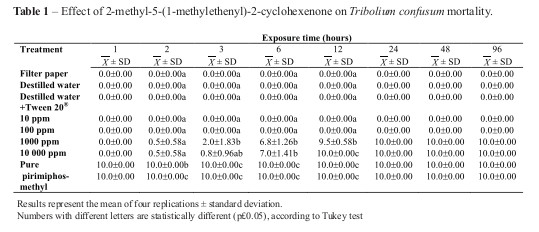
<body><![CDATA[<p><b>Insecticidal activity</b></p>     <p>One millilitre of either test solution was transferred separately to pre-sterilised 9 cm diameter Petri dishes containing sterilised filter paper (Whatman nº1). A standard insecticide, pirimiphos-methyl, was used as a standard. Petri dishes containing either filter paper, with distilled water or distilled water with Tween 20<sup>®</sup>, were used as controls. Ten insects were introduced in each Petri dish and placed in an incubator at with 30 ± 1ºC and 70 ± 5% r.h. All treatments were replicated four times and data were presented in terms of the mean ± S.D. Mortality of exposed insects was observed after one, two, three, six, 12, 24, 36, 48 and 96 hours in all solutions and control.</p>     <p><b>Data analysis</b></p>     <p>Control mortality was corrected by using Abbott’s formula (1925). Within each exposure interval, the data were submitted to one-way analysis of variance (ANOVA) using Statistica software, to determine differences among the monoterpene concentrations. Post hoc testing was carried out using Tukey test. A significance level of 0.05% was used for all statistical tests (Zar, 1996).</p>     <p>&nbsp;</p>     <p><b>RESULTS AND DISCUSSION</b></p>     <p>The results showed that the 2-methyl-5-(1-methylethenyl)-2-cyclohexenone has insecticidal activity on <i>Tribolium confusum </i>(<a href="#t1">Table 1</a>).On the whole, it was verified a dose-responsive mortality being firstly registered 100% mortality one hour after exposure in pure monoterpene. The same was observed in pure pirimiphos-methyl. In 10 and 1% 2-methyl-5-(1-methylethenyl)-2-cyclohexenone, 100% mortality was verified after 12 and 24 hours exposure in 10 and 1%, respectively. At 0.01 % and 0.1% exposure neither mortality nor mobility were affected.</p>     <p>&nbsp;</p> <a name="t1"> <img src="/img/revistas/rca/v35n2/35n2a35t1.jpg">     
<p>&nbsp;</p>     <p>Throughout experiment mortality was observed in any of the controls assuming that both filter paper and Tween 20<sup>®</sup> (5000ppm) are nontoxic to <i>T. confusum</i>. Based on these facts the percentage of cumulative mortality corresponds to the percentage of the corrected cumulative mortality.</p>     ]]></body>
<body><![CDATA[<p>According to ANOVA, at two hours, the behaviour of pure monoterpene and the standard insecticide was significantly different from the other treatments (F=1022.625; df=8; p&lt;0.05). At six hours, 10% and 1% monoterpene concentrations shown significantly different behaviour of pure monoterpene and standard insecticide as well as from the other treatments (F=210.977;df=8;p&lt;0.05). At 12 hours exposure, 10% concentration showed the same behavior of pure monoterpene and standard insecticide (F=2928.000; df=8; p&lt;0.05), and after 24 hours, monoterpene concentrations higher than 1% had the same behaviour, 100% mortality with no observed alterations until the end of the experiment.</p>      <p>These results showed that the 2-methyl-5-(1-methylethenyl)-2-cyclohexenone had similar insecticidal activity to that observed on the pirimiphos-methyl. This monoterpene effect was dose-responsive as in the case of residual insecticides used as grain protectants (Vayias and Athanassiou, 2004). In future bioassays, control can be carried out only with water, as mortality was observed in none of the controls; on the other hand, the acute bioassays could be conducted for 96 hours exposure as no mortality and no abnormal behaviour was observed in controls.</p>     <p>In our work the probit analysis could not be performed and hence, the LC<sub>50 </sub>value could not be determined for the different exposure times, since mortality values were either extreme, or similar, for the tested concentrations. Although, we can assume that LC<sub>50</sub> value relies between 1% (1000 ppm) and 0.01% (100 ppm) concentrations. Somehow these values could be comparable to those pointed out by Stamopoulos <i>et al</i>., 2007) who studied the effect of other caraway monoterpenes on <i>T. confusum</i>. The LC<sub>50</sub> intervals for limonene and linalool varied between 4 and 278 ppm, and between 8.6 and 183.5 ppm, respectively.</p>     <p>The studied monoterpene was already referred as a potential insecticide against other species (Carvalho and Fonseca, 2006; López <i>et al</i>., 2008). In fact, several studies conducted on plant derived materials as extracts, essential oils, and metabolites, have demonstrated their effectiveness against several insect species with varying potencies (García <i>et al</i>., 2007).</p>     <p>&nbsp;</p>     <p><b>CONCLUSIONS</b></p>     <p>This study showed that this monoterpene, 2-methyl-5-(1-methylethenyl)-2-cyclohexenone, has insecticidal effect against <i>T. confusum</i>. Although, further studies should be conducted either in vitro to accurate the LC<sub>50</sub> value, and in house storage conditions in order to confirm the viability of the monoterpene insecticidal effect. In fact, 2-methyl-5-(1-methylethenyl)-2-cyclohexenone could become an alternative to synthetic insecticides which could be an enormous advantage as higher plant volatiles could be less toxic to treatments of stored-products.</p>     <p>&nbsp;</p>      <p><b>ACKNOWLEDGEMENTS</b></p>     <p>We would like to thank Prof. António Portugal, from the Department of Life Sciences, University of Coimbra, Portugal, for providing <i>Tribolium confusum</i> insect culture and Prof. Noémia Bárbara for the linguistic revision of the paper.</p>    ]]></body>
<body><![CDATA[<p>&nbsp;</p>     <p><b>BIBLIOGRAPHICAL REFERENCES</b></p>     <!-- ref --><p>Abbott, W.S. (1925) - A method of computing the effectiveness of an insecticide<i>.</i> <i>Journal of Economic Entomology</i>, 18: 265-266.    &nbsp;&nbsp;&nbsp;&nbsp;&nbsp;&nbsp;&nbsp;&nbsp;[&#160;<a href="javascript:void(0);" onclick="javascript: window.open('/scielo.php?script=sci_nlinks&ref=000055&pid=S0871-018X201200020003500001&lng=','','width=640,height=500,resizable=yes,scrollbars=1,menubar=yes,');">Links</a>&#160;]<!-- end-ref --></p>     <!-- ref --><p>Arthur, F.H. (2004) – Evaluation of new insecticide formulation (F2) as a protectant of stored wheat, maize, and rice. <i>Journal Stored Products Research</i>, 40: 317-330.    &nbsp;&nbsp;&nbsp;&nbsp;&nbsp;&nbsp;&nbsp;&nbsp;[&#160;<a href="javascript:void(0);" onclick="javascript: window.open('/scielo.php?script=sci_nlinks&ref=000057&pid=S0871-018X201200020003500002&lng=','','width=640,height=500,resizable=yes,scrollbars=1,menubar=yes,');">Links</a>&#160;]<!-- end-ref --></p>     <!-- ref --><p>Athanassiou, C.G.; Kavallieratos, N.G.  and Chintzoglou, G.J. (2008) – Effectiveness of spinosad dust against different European populations of the confused flour beetle,  <i>Tribolium confusum</i> Jacquelin du Val. <i>Journal of Stored Products Research</i>, 44: 47-51.    &nbsp;&nbsp;&nbsp;&nbsp;&nbsp;&nbsp;&nbsp;&nbsp;[&#160;<a href="javascript:void(0);" onclick="javascript: window.open('/scielo.php?script=sci_nlinks&ref=000059&pid=S0871-018X201200020003500003&lng=','','width=640,height=500,resizable=yes,scrollbars=1,menubar=yes,');">Links</a>&#160;]<!-- end-ref --></p>     <!-- ref --><p>Bughio, F.M.  and Wilkins, R.M. (2004) – Influence of malathion resistence status on survival and growth of <i>Tribolium castaneum</i> (Coleoptera: Tenebrionidae), when fed on flour from insect-resistent and susceptible grain rice cultivars. <i>Journal Stored Products Research</i>, 40: 65-75.    &nbsp;&nbsp;&nbsp;&nbsp;&nbsp;&nbsp;&nbsp;&nbsp;[&#160;<a href="javascript:void(0);" onclick="javascript: window.open('/scielo.php?script=sci_nlinks&ref=000061&pid=S0871-018X201200020003500004&lng=','','width=640,height=500,resizable=yes,scrollbars=1,menubar=yes,');">Links</a>&#160;]<!-- end-ref --></p>     ]]></body>
<body><![CDATA[<!-- ref --><p>Çalmasur, Ö.; Aslan, I and  Sahin, F. (2006) – Insecticidal and acaricidal effect of three Lamiaceae plant essential oils against <i>Tetranychus urticae </i>Koch and <i>Bemisia tabaci </i>Genn. <i>Industrial Crops and Products</i>, 23: 149-146.    &nbsp;&nbsp;&nbsp;&nbsp;&nbsp;&nbsp;&nbsp;&nbsp;[&#160;<a href="javascript:void(0);" onclick="javascript: window.open('/scielo.php?script=sci_nlinks&ref=000063&pid=S0871-018X201200020003500005&lng=','','width=640,height=500,resizable=yes,scrollbars=1,menubar=yes,');">Links</a>&#160;]<!-- end-ref --></p>     <!-- ref --><p>Carvalho, C.C.C.R. e Fonseca, M.M.R. (2006) – Carvone: Why and how should one bother to produce this terpene. <i>Food Chemistry, </i>95: 413-422.    &nbsp;&nbsp;&nbsp;&nbsp;&nbsp;&nbsp;&nbsp;&nbsp;[&#160;<a href="javascript:void(0);" onclick="javascript: window.open('/scielo.php?script=sci_nlinks&ref=000065&pid=S0871-018X201200020003500006&lng=','','width=640,height=500,resizable=yes,scrollbars=1,menubar=yes,');">Links</a>&#160;]<!-- end-ref --></p>     <!-- ref --><p>Costa e Silva, M.; Galhano, C.I.C. and  Moreira da Silva, A.M.G. (2007) – A new sprout inhibitor of potato tuber based on carvone/ß-cyclodextrin inclusion compound. <i>Journal of Inclusion Phenomena and Macrocyclic Chemistry.  57</i>: 121-124.    &nbsp;&nbsp;&nbsp;&nbsp;&nbsp;&nbsp;&nbsp;&nbsp;[&#160;<a href="javascript:void(0);" onclick="javascript: window.open('/scielo.php?script=sci_nlinks&ref=000067&pid=S0871-018X201200020003500007&lng=','','width=640,height=500,resizable=yes,scrollbars=1,menubar=yes,');">Links</a>&#160;]<!-- end-ref --></p>     <!-- ref --><p>Costa e Silva, M.; Galhano, C.I.C. e Moreira da Silva, A. (2010) – A new sprouting inhibitor: n@NO-sprout<sup>®</sup>, b-cyclodextrin/S-carvone inclusion compound. In: Dániel W. Fitzpatrick and Henry J. Ulrich. (Eds.) - <i>Macrocyclic Chemistry: new research developments</i>. New York, NOVA publishers, ISBN: 978-1-60876-896-7.    &nbsp;&nbsp;&nbsp;&nbsp;&nbsp;&nbsp;&nbsp;&nbsp;[&#160;<a href="javascript:void(0);" onclick="javascript: window.open('/scielo.php?script=sci_nlinks&ref=000069&pid=S0871-018X201200020003500008&lng=','','width=640,height=500,resizable=yes,scrollbars=1,menubar=yes,');">Links</a>&#160;]<!-- end-ref --></p>     <!-- ref --><p>FDA (2011) –<i>Everything Added to Food in the United States</i> (EAFUS).U. S. Food and Drug Administration Available at <a href="http://www.accessdata.fda.gov/scripts/fcn/fcnDetailNavigation.cfm?rpt=eafusListing&amp;id=530" target="_blank">http://www.accessdata.fda.gov/scripts/fcn/fcnDetailNavigation.cfm?rpt=eafusListing&amp;id=530 </a>.    &nbsp;&nbsp;&nbsp;&nbsp;&nbsp;&nbsp;&nbsp;&nbsp;[&#160;<a href="javascript:void(0);" onclick="javascript: window.open('/scielo.php?script=sci_nlinks&ref=000071&pid=S0871-018X201200020003500009&lng=','','width=640,height=500,resizable=yes,scrollbars=1,menubar=yes,');">Links</a>&#160;]<!-- end-ref --></p>     ]]></body>
<body><![CDATA[<!-- ref --><p>García, M.; Gonzalez-Coloma, A.; Donadel, O.J.; Ardanaz, C.E.; Tonn, C.E. and   Sosa, M.E. (2007) – Insectidal effects of <i>Flourensia oolepis</i> Blake (Asteraceae) essential oil. <i>Biochemical Systematics and Ecology</i>, 35: 181-187.    &nbsp;&nbsp;&nbsp;&nbsp;&nbsp;&nbsp;&nbsp;&nbsp;[&#160;<a href="javascript:void(0);" onclick="javascript: window.open('/scielo.php?script=sci_nlinks&ref=000073&pid=S0871-018X201200020003500010&lng=','','width=640,height=500,resizable=yes,scrollbars=1,menubar=yes,');">Links</a>&#160;]<!-- end-ref --></p>     <!-- ref --><p>Hartmans, K.J.; Diepenhorst, P.; Bakker, W.  and Gorris, L.G.M. (1995) – The use of carvone in agriculture: sprout suppression of potatoes and antifungal activity against potato tuber and other plant diseases. <i>Industrial Crops and Products.</i> 4: 3-13.    &nbsp;&nbsp;&nbsp;&nbsp;&nbsp;&nbsp;&nbsp;&nbsp;[&#160;<a href="javascript:void(0);" onclick="javascript: window.open('/scielo.php?script=sci_nlinks&ref=000075&pid=S0871-018X201200020003500011&lng=','','width=640,height=500,resizable=yes,scrollbars=1,menubar=yes,');">Links</a>&#160;]<!-- end-ref --></p>     <!-- ref --><p>Jbilou, R.; Ennabili, A. and   Sayah, F. (2006) – Insecticidal activity of four medicinal plant extracts against <i>Tribolium castaneum</i> (Herbst) (Coleoptera: Tenebrionidae). <i>African Journal of Biotechnology</i>, 5, 10:936-940.    &nbsp;&nbsp;&nbsp;&nbsp;&nbsp;&nbsp;&nbsp;&nbsp;[&#160;<a href="javascript:void(0);" onclick="javascript: window.open('/scielo.php?script=sci_nlinks&ref=000077&pid=S0871-018X201200020003500012&lng=','','width=640,height=500,resizable=yes,scrollbars=1,menubar=yes,');">Links</a>&#160;]<!-- end-ref --></p>     <!-- ref --><p>Kumar, R.; Kumar, A.; Prasa, C.S.; Dubey, N.K.  and Samant, R. (2008) – Insecticidal activity <i>Aegle marmelos</i> (L.) Correa essential oil against four stored grain insect pests. <i>Food Safety Information Publishing</i>, 10: 39-49.    &nbsp;&nbsp;&nbsp;&nbsp;&nbsp;&nbsp;&nbsp;&nbsp;[&#160;<a href="javascript:void(0);" onclick="javascript: window.open('/scielo.php?script=sci_nlinks&ref=000079&pid=S0871-018X201200020003500013&lng=','','width=640,height=500,resizable=yes,scrollbars=1,menubar=yes,');">Links</a>&#160;]<!-- end-ref --></p>     <!-- ref --><p>Lamiri, A.; Lhaloui, S.; Benjilali, B. and Berrada, M. (2001) – Insecticidal effects of essential against Hessian fly, <i>Mayetiola destructor</i> (Say). <i>Field Crops Research,</i> 71: 9-15.    &nbsp;&nbsp;&nbsp;&nbsp;&nbsp;&nbsp;&nbsp;&nbsp;[&#160;<a href="javascript:void(0);" onclick="javascript: window.open('/scielo.php?script=sci_nlinks&ref=000081&pid=S0871-018X201200020003500014&lng=','','width=640,height=500,resizable=yes,scrollbars=1,menubar=yes,');">Links</a>&#160;]<!-- end-ref --></p>     ]]></body>
<body><![CDATA[<!-- ref --><p>Liu, C.H.; Mishra, A.K.; Tan, R.X.; Tang, C.; Yang, H. and  Shen, Y.F. (2006) – Repellent and insecticidal activities of essential oils from <i>Artemisia princeps </i>and <i>Cinnamomum camphora </i>and their effect on seed germination of wheat and broad bean. <i>Bioresource Technology</i>, 97: 1969-1973.    &nbsp;&nbsp;&nbsp;&nbsp;&nbsp;&nbsp;&nbsp;&nbsp;[&#160;<a href="javascript:void(0);" onclick="javascript: window.open('/scielo.php?script=sci_nlinks&ref=000083&pid=S0871-018X201200020003500015&lng=','','width=640,height=500,resizable=yes,scrollbars=1,menubar=yes,');">Links</a>&#160;]<!-- end-ref --></p>     <!-- ref --><p>Lopéz, M.D.; Jordán, M.J. and Pascual-Vellalobos, M.J. (2008) – Toxic compounds in essential oils of coriander, caraway and basil active against stored rice pests. <i>Journal of Stored Products Research</i>, 44: 273-278.    &nbsp;&nbsp;&nbsp;&nbsp;&nbsp;&nbsp;&nbsp;&nbsp;[&#160;<a href="javascript:void(0);" onclick="javascript: window.open('/scielo.php?script=sci_nlinks&ref=000085&pid=S0871-018X201200020003500016&lng=','','width=640,height=500,resizable=yes,scrollbars=1,menubar=yes,');">Links</a>&#160;]<!-- end-ref --></p>     <!-- ref --><p>Mewis, I. and Ulrichs, C. (2001) – Action of amorphous diatomaceous earth against different stages of the stored product pests <i>Tribolium confusum</i>, <i>Tenebrio molitor, Sitophilus granaries </i>and <i>Plodia interpunctella</i>. <i>Journal Stored Products Research</i>, 37: 153-164.    &nbsp;&nbsp;&nbsp;&nbsp;&nbsp;&nbsp;&nbsp;&nbsp;[&#160;<a href="javascript:void(0);" onclick="javascript: window.open('/scielo.php?script=sci_nlinks&ref=000087&pid=S0871-018X201200020003500017&lng=','','width=640,height=500,resizable=yes,scrollbars=1,menubar=yes,');">Links</a>&#160;]<!-- end-ref --></p>     <!-- ref --><p>Mohan, A.  and Fields, P.G. (2002) – A simple technique to assess compounds that are repellent or attractive to stored-product insects. <i>Journal Stored Products Research</i>, 38: 23-31.    &nbsp;&nbsp;&nbsp;&nbsp;&nbsp;&nbsp;&nbsp;&nbsp;[&#160;<a href="javascript:void(0);" onclick="javascript: window.open('/scielo.php?script=sci_nlinks&ref=000089&pid=S0871-018X201200020003500018&lng=','','width=640,height=500,resizable=yes,scrollbars=1,menubar=yes,');">Links</a>&#160;]<!-- end-ref --></p>     <!-- ref --><p>Negahban, M.; Moharramipour, S. and Sefidkon, F. (2007) – Fumigant toxicity of essential oil from <i>Artemisia sieberi</i> Basser against three stored-product insects. <i>Journal Stored Products Research</i>, 43: 123-128.    &nbsp;&nbsp;&nbsp;&nbsp;&nbsp;&nbsp;&nbsp;&nbsp;[&#160;<a href="javascript:void(0);" onclick="javascript: window.open('/scielo.php?script=sci_nlinks&ref=000091&pid=S0871-018X201200020003500019&lng=','','width=640,height=500,resizable=yes,scrollbars=1,menubar=yes,');">Links</a>&#160;]<!-- end-ref --></p>     ]]></body>
<body><![CDATA[<!-- ref --><p>OJEU (2002) – Official Journal of the European Communities. Comission decision of 23 January 2002. Available at <a href="http://ec.europa.eu/food/fs/sfp/addit_flavor/flav17_en.pdf"target="_blank">http://ec.europa.eu/food/fs/sfp/addit_flavor/flav17_en.pdf</a>.    &nbsp;&nbsp;&nbsp;&nbsp;&nbsp;&nbsp;&nbsp;&nbsp;[&#160;<a href="javascript:void(0);" onclick="javascript: window.open('/scielo.php?script=sci_nlinks&ref=000093&pid=S0871-018X201200020003500020&lng=','','width=640,height=500,resizable=yes,scrollbars=1,menubar=yes,');">Links</a>&#160;]<!-- end-ref --></p>     <!-- ref --><p>Oosterhaven, K.; Poolman, B.  and Smid, E.J. (1995) – S-carvone as a natural potato sprout inhibiting, fungistatic, and bacteristatic compound. <i>Industrial Crops and Products, 4</i>: 23-31.    &nbsp;&nbsp;&nbsp;&nbsp;&nbsp;&nbsp;&nbsp;&nbsp;[&#160;<a href="javascript:void(0);" onclick="javascript: window.open('/scielo.php?script=sci_nlinks&ref=000095&pid=S0871-018X201200020003500021&lng=','','width=640,height=500,resizable=yes,scrollbars=1,menubar=yes,');">Links</a>&#160;]<!-- end-ref --></p>     <!-- ref --><p>Park, C.; Kim, S. and  Ahn, Y.J. (2003) – Insecticidal activity of asarones identified in <i>Acorus gramineus </i>rhizome against three coleopteran stored-product insects. <i>Journal Stored Products Research</i>, 39: 333-342.    &nbsp;&nbsp;&nbsp;&nbsp;&nbsp;&nbsp;&nbsp;&nbsp;[&#160;<a href="javascript:void(0);" onclick="javascript: window.open('/scielo.php?script=sci_nlinks&ref=000097&pid=S0871-018X201200020003500022&lng=','','width=640,height=500,resizable=yes,scrollbars=1,menubar=yes,');">Links</a>&#160;]<!-- end-ref --></p>     <!-- ref --><p>Pemonge, J.; Pascual-Villalobos, M.J.  and Regnault-Roger, C. (1997) – Effects of material and extracts of <i>Trigonella foenum-graecum </i>L. against the stored product pests <i>Tribolium castaneum </i>(Herbst) (Coleoptera: Tenebrionidae) and <i>Acanthoscelides obtectus </i>(Say) (Coleoptera: Bruchidae). <i>Journal Stored Products Research</i>, 33 (3): 209-217.    &nbsp;&nbsp;&nbsp;&nbsp;&nbsp;&nbsp;&nbsp;&nbsp;[&#160;<a href="javascript:void(0);" onclick="javascript: window.open('/scielo.php?script=sci_nlinks&ref=000099&pid=S0871-018X201200020003500023&lng=','','width=640,height=500,resizable=yes,scrollbars=1,menubar=yes,');">Links</a>&#160;]<!-- end-ref --></p>     <!-- ref --><p>Ramos-Rodríguez, O.; Campbell, J.F. and Ramaswamy, S.B. (2006) – Pathogenicity of three species of entomopathogenic nematodes to some majorstored-product insect pests. <i>Journal Stored Products Research</i>, 42: 241-252.    &nbsp;&nbsp;&nbsp;&nbsp;&nbsp;&nbsp;&nbsp;&nbsp;[&#160;<a href="javascript:void(0);" onclick="javascript: window.open('/scielo.php?script=sci_nlinks&ref=000101&pid=S0871-018X201200020003500024&lng=','','width=640,height=500,resizable=yes,scrollbars=1,menubar=yes,');">Links</a>&#160;]<!-- end-ref --></p>     ]]></body>
<body><![CDATA[<!-- ref --><p>Ribeiro, B.M.; Guedes, R.N.C.; Oliveira, E.E. and Santos, J.P. (2003) – Insecticide resistence and synergism in Brasilian populations of <i>Sitophilus zeamais </i>(Coleoptera: Curculionidae). <i>Journal Stored Products Research</i>, 39:21-31.    &nbsp;&nbsp;&nbsp;&nbsp;&nbsp;&nbsp;&nbsp;&nbsp;[&#160;<a href="javascript:void(0);" onclick="javascript: window.open('/scielo.php?script=sci_nlinks&ref=000103&pid=S0871-018X201200020003500025&lng=','','width=640,height=500,resizable=yes,scrollbars=1,menubar=yes,');">Links</a>&#160;]<!-- end-ref --></p>     <!-- ref --><p>Stamopoulos, D.C., Damos, P. and Karagianidou, G. (2007) – Bioactivity of five monoterpenoid vapours to <i>Tribolium confusum</i> (du Val) (Coleoptera: Tenebrionidae). <i>Journal of stored Products Research</i>, 43: 571-577.    &nbsp;&nbsp;&nbsp;&nbsp;&nbsp;&nbsp;&nbsp;&nbsp;[&#160;<a href="javascript:void(0);" onclick="javascript: window.open('/scielo.php?script=sci_nlinks&ref=000105&pid=S0871-018X201200020003500026&lng=','','width=640,height=500,resizable=yes,scrollbars=1,menubar=yes,');">Links</a>&#160;]<!-- end-ref --></p>     <!-- ref --><p>Vayias, B.J. and Athanassiou, C.G. (2004) – Factors affecting the insecticidal efficacy of the diatomaceous earth formulation SilicoSec against adults and larvae of the confused flour beetle, <i>Tribolium confusum </i>DuVal (Coleoptera: Tenebrionidae). <i>Crop Protection</i>, 23: 565-573.    &nbsp;&nbsp;&nbsp;&nbsp;&nbsp;&nbsp;&nbsp;&nbsp;[&#160;<a href="javascript:void(0);" onclick="javascript: window.open('/scielo.php?script=sci_nlinks&ref=000107&pid=S0871-018X201200020003500027&lng=','','width=640,height=500,resizable=yes,scrollbars=1,menubar=yes,');">Links</a>&#160;]<!-- end-ref --></p>     <!-- ref --><p>Zar, J.H. (1996) – <i>Biostatistical Analysis.</i> New Jersey, USA, Prentice Hall International, 662 pp.    &nbsp;&nbsp;&nbsp;&nbsp;&nbsp;&nbsp;&nbsp;&nbsp;[&#160;<a href="javascript:void(0);" onclick="javascript: window.open('/scielo.php?script=sci_nlinks&ref=000109&pid=S0871-018X201200020003500028&lng=','','width=640,height=500,resizable=yes,scrollbars=1,menubar=yes,');">Links</a>&#160;]<!-- end-ref --></p>     <!-- ref --><p>Zettler, J.L. and Arthur, F.H. (1997) – Dose-response tests on red flour beetle and confused flour beetle (Coleoptera: Tenebrionidae) collected from flour mills in the United States. <i>Journal of Economic Entomology</i>, 90: 1157-1162.    &nbsp;&nbsp;&nbsp;&nbsp;&nbsp;&nbsp;&nbsp;&nbsp;[&#160;<a href="javascript:void(0);" onclick="javascript: window.open('/scielo.php?script=sci_nlinks&ref=000111&pid=S0871-018X201200020003500029&lng=','','width=640,height=500,resizable=yes,scrollbars=1,menubar=yes,');">Links</a>&#160;]<!-- end-ref --></p>      ]]></body>
<body><![CDATA[ ]]></body><back>
<ref-list>
<ref id="B1">
<nlm-citation citation-type="journal">
<person-group person-group-type="author">
<name>
<surname><![CDATA[Abbott]]></surname>
<given-names><![CDATA[W.S.]]></given-names>
</name>
</person-group>
<article-title xml:lang="en"><![CDATA[A method of computing the effectiveness of an insecticide]]></article-title>
<source><![CDATA[Journal of Economic Entomology]]></source>
<year>1925</year>
<numero>18</numero>
<issue>18</issue>
<page-range>265-266</page-range></nlm-citation>
</ref>
<ref id="B2">
<nlm-citation citation-type="journal">
<person-group person-group-type="author">
<name>
<surname><![CDATA[Arthur]]></surname>
<given-names><![CDATA[F.H.]]></given-names>
</name>
</person-group>
<article-title xml:lang="en"><![CDATA[Evaluation of new insecticide formulation (F2) as a protectant of stored wheat, maize, and rice]]></article-title>
<source><![CDATA[Journal Stored Products Research]]></source>
<year>2004</year>
<numero>40</numero>
<issue>40</issue>
<page-range>317-330</page-range></nlm-citation>
</ref>
<ref id="B3">
<nlm-citation citation-type="journal">
<person-group person-group-type="author">
<name>
<surname><![CDATA[Athanassiou]]></surname>
<given-names><![CDATA[C.G.]]></given-names>
</name>
<name>
<surname><![CDATA[Kavallieratos]]></surname>
<given-names><![CDATA[N.G.]]></given-names>
</name>
<name>
<surname><![CDATA[Chintzoglou]]></surname>
<given-names><![CDATA[G.J.]]></given-names>
</name>
</person-group>
<article-title xml:lang="en"><![CDATA[Effectiveness of spinosad dust against different European populations of the confused flour beetle, Tribolium confusum Jacquelin du Val]]></article-title>
<source><![CDATA[Journal of Stored Products Research]]></source>
<year>2008</year>
<numero>44</numero>
<issue>44</issue>
<page-range>47-51</page-range></nlm-citation>
</ref>
<ref id="B4">
<nlm-citation citation-type="journal">
<person-group person-group-type="author">
<name>
<surname><![CDATA[Bughio]]></surname>
<given-names><![CDATA[F.M.]]></given-names>
</name>
<name>
<surname><![CDATA[Wilkins]]></surname>
<given-names><![CDATA[R.M.]]></given-names>
</name>
</person-group>
<article-title xml:lang="en"><![CDATA[Influence of malathion resistence status on survival and growth of Tribolium castaneum (Coleoptera: Tenebrionidae), when fed on flour from insect-resistent and susceptible grain rice cultivars]]></article-title>
<source><![CDATA[Journal Stored Products Research]]></source>
<year>2004</year>
<numero>40</numero>
<issue>40</issue>
<page-range>65-75</page-range></nlm-citation>
</ref>
<ref id="B5">
<nlm-citation citation-type="journal">
<person-group person-group-type="author">
<name>
<surname><![CDATA[Çalmasur]]></surname>
<given-names><![CDATA[Ö.]]></given-names>
</name>
<name>
<surname><![CDATA[Aslan]]></surname>
<given-names><![CDATA[I]]></given-names>
</name>
<name>
<surname><![CDATA[Sahin]]></surname>
<given-names><![CDATA[F.]]></given-names>
</name>
</person-group>
<article-title xml:lang="en"><![CDATA[Insecticidal and acaricidal effect of three Lamiaceae plant essential oils against Tetranychus urticae Koch and Bemisia tabaci Genn]]></article-title>
<source><![CDATA[Industrial Crops and Products]]></source>
<year>2006</year>
<numero>23</numero>
<issue>23</issue>
<page-range>149-146</page-range></nlm-citation>
</ref>
<ref id="B6">
<nlm-citation citation-type="journal">
<person-group person-group-type="author">
<name>
<surname><![CDATA[Carvalho]]></surname>
<given-names><![CDATA[C.C.C.R.]]></given-names>
</name>
<name>
<surname><![CDATA[Fonseca]]></surname>
<given-names><![CDATA[M.M.R.]]></given-names>
</name>
</person-group>
<article-title xml:lang="en"><![CDATA[Carvone: Why and how should one bother to produce this terpene]]></article-title>
<source><![CDATA[Food Chemistry]]></source>
<year>2006</year>
<numero>95</numero>
<issue>95</issue>
<page-range>413-422</page-range></nlm-citation>
</ref>
<ref id="B7">
<nlm-citation citation-type="journal">
<person-group person-group-type="author">
<name>
<surname><![CDATA[Costa e Silva]]></surname>
<given-names><![CDATA[M.]]></given-names>
</name>
<name>
<surname><![CDATA[Galhano]]></surname>
<given-names><![CDATA[C.I.C.]]></given-names>
</name>
<name>
<surname><![CDATA[Moreira da Silva]]></surname>
<given-names><![CDATA[A.M.G.]]></given-names>
</name>
</person-group>
<article-title xml:lang="en"><![CDATA[A new sprout inhibitor of potato tuber based on carvone: ß-cyclodextrin inclusion compound]]></article-title>
<source><![CDATA[Journal of Inclusion Phenomena and Macrocyclic Chemistry]]></source>
<year>2007</year>
<page-range>57</page-range><page-range>121-124</page-range></nlm-citation>
</ref>
<ref id="B8">
<nlm-citation citation-type="book">
<person-group person-group-type="author">
<name>
<surname><![CDATA[Costa e Silva]]></surname>
<given-names><![CDATA[M.]]></given-names>
</name>
<name>
<surname><![CDATA[Galhano]]></surname>
<given-names><![CDATA[C.I.C.]]></given-names>
</name>
<name>
<surname><![CDATA[Moreira da Silva]]></surname>
<given-names><![CDATA[A.]]></given-names>
</name>
</person-group>
<article-title xml:lang="en"><![CDATA[A new sprouting inhibitor: n@NO-sprout®, b-cyclodextrin/S-carvone inclusion compound]]></article-title>
<person-group person-group-type="editor">
<name>
<surname><![CDATA[Fitzpatrick]]></surname>
<given-names><![CDATA[Dániel W.]]></given-names>
</name>
<name>
<surname><![CDATA[Ulrich]]></surname>
<given-names><![CDATA[Henry J.]]></given-names>
</name>
</person-group>
<source><![CDATA[Macrocyclic Chemistry: new research developments]]></source>
<year>2010</year>
<publisher-loc><![CDATA[New York ]]></publisher-loc>
<publisher-name><![CDATA[NOVA publishers]]></publisher-name>
</nlm-citation>
</ref>
<ref id="B9">
<nlm-citation citation-type="">
<collab>FDA</collab>
<source><![CDATA[Everything Added to Food in the United States (EAFUS).U. S. Food and Drug Administration Available]]></source>
<year>2011</year>
</nlm-citation>
</ref>
<ref id="B10">
<nlm-citation citation-type="journal">
<person-group person-group-type="author">
<name>
<surname><![CDATA[García]]></surname>
<given-names><![CDATA[M.]]></given-names>
</name>
<name>
<surname><![CDATA[Gonzalez-Coloma]]></surname>
<given-names><![CDATA[A.]]></given-names>
</name>
<name>
<surname><![CDATA[Donadel]]></surname>
<given-names><![CDATA[O.J.]]></given-names>
</name>
<name>
<surname><![CDATA[Ardanaz]]></surname>
<given-names><![CDATA[C.E.]]></given-names>
</name>
<name>
<surname><![CDATA[Tonn]]></surname>
<given-names><![CDATA[C.E.]]></given-names>
</name>
<name>
<surname><![CDATA[Sosa]]></surname>
<given-names><![CDATA[M.E.]]></given-names>
</name>
</person-group>
<article-title xml:lang="en"><![CDATA[Insectidal effects of Flourensia oolepis Blake (Asteraceae) essential oil]]></article-title>
<source><![CDATA[Biochemical Systematics and Ecology]]></source>
<year>2007</year>
<numero>35</numero>
<issue>35</issue>
<page-range>181-187</page-range></nlm-citation>
</ref>
<ref id="B11">
<nlm-citation citation-type="journal">
<person-group person-group-type="author">
<name>
<surname><![CDATA[Hartmans]]></surname>
<given-names><![CDATA[K.J.]]></given-names>
</name>
<name>
<surname><![CDATA[Diepenhorst]]></surname>
<given-names><![CDATA[P.]]></given-names>
</name>
<name>
<surname><![CDATA[Bakker]]></surname>
<given-names><![CDATA[W.]]></given-names>
</name>
<name>
<surname><![CDATA[Gorris]]></surname>
<given-names><![CDATA[L.G.M.]]></given-names>
</name>
</person-group>
<article-title xml:lang="en"><![CDATA[The use of carvone in agriculture: sprout suppression of potatoes and antifungal activity against potato tuber and other plant diseases]]></article-title>
<source><![CDATA[Industrial Crops and Products]]></source>
<year>1995</year>
<numero>4</numero>
<issue>4</issue>
<page-range>3-13</page-range></nlm-citation>
</ref>
<ref id="B12">
<nlm-citation citation-type="journal">
<person-group person-group-type="author">
<name>
<surname><![CDATA[Jbilou]]></surname>
<given-names><![CDATA[R.]]></given-names>
</name>
<name>
<surname><![CDATA[Ennabili]]></surname>
<given-names><![CDATA[A.]]></given-names>
</name>
<name>
<surname><![CDATA[Sayah]]></surname>
<given-names><![CDATA[F.]]></given-names>
</name>
</person-group>
<article-title xml:lang="en"><![CDATA[Insecticidal activity of four medicinal plant extracts against Tribolium castaneum (Herbst) (Coleoptera: Tenebrionidae)]]></article-title>
<source><![CDATA[African Journal of Biotechnology]]></source>
<year>2006</year>
<volume>5</volume>
<numero>10</numero>
<issue>10</issue>
<page-range>936-940</page-range></nlm-citation>
</ref>
<ref id="B13">
<nlm-citation citation-type="journal">
<person-group person-group-type="author">
<name>
<surname><![CDATA[Kumar]]></surname>
<given-names><![CDATA[R.]]></given-names>
</name>
<name>
<surname><![CDATA[Kumar]]></surname>
<given-names><![CDATA[A.]]></given-names>
</name>
<name>
<surname><![CDATA[Prasa]]></surname>
<given-names><![CDATA[C.S.]]></given-names>
</name>
<name>
<surname><![CDATA[Dubey]]></surname>
<given-names><![CDATA[N.K.]]></given-names>
</name>
<name>
<surname><![CDATA[Samant]]></surname>
<given-names><![CDATA[R.]]></given-names>
</name>
</person-group>
<article-title xml:lang="en"><![CDATA[Insecticidal activity Aegle marmelos (L.) Correa essential oil against four stored grain insect pests]]></article-title>
<source><![CDATA[Food Safety Information Publishing]]></source>
<year>2008</year>
<numero>10</numero>
<issue>10</issue>
<page-range>39-49</page-range></nlm-citation>
</ref>
<ref id="B14">
<nlm-citation citation-type="journal">
<person-group person-group-type="author">
<name>
<surname><![CDATA[Lamiri]]></surname>
<given-names><![CDATA[A.]]></given-names>
</name>
<name>
<surname><![CDATA[Lhaloui]]></surname>
<given-names><![CDATA[S.]]></given-names>
</name>
<name>
<surname><![CDATA[Benjilali]]></surname>
<given-names><![CDATA[B.]]></given-names>
</name>
<name>
<surname><![CDATA[Berrada]]></surname>
<given-names><![CDATA[M.]]></given-names>
</name>
</person-group>
<article-title xml:lang="en"><![CDATA[Insecticidal effects of essential against Hessian fly, Mayetiola destructor (Say)]]></article-title>
<source><![CDATA[Field Crops Research]]></source>
<year>2001</year>
<numero>71</numero>
<issue>71</issue>
<page-range>9-15</page-range></nlm-citation>
</ref>
<ref id="B15">
<nlm-citation citation-type="journal">
<person-group person-group-type="author">
<name>
<surname><![CDATA[Liu]]></surname>
<given-names><![CDATA[C.H.]]></given-names>
</name>
<name>
<surname><![CDATA[Mishra]]></surname>
<given-names><![CDATA[A.K.]]></given-names>
</name>
<name>
<surname><![CDATA[Tan]]></surname>
<given-names><![CDATA[R.X.]]></given-names>
</name>
<name>
<surname><![CDATA[Tang]]></surname>
<given-names><![CDATA[C.]]></given-names>
</name>
<name>
<surname><![CDATA[Yang]]></surname>
<given-names><![CDATA[H.]]></given-names>
</name>
<name>
<surname><![CDATA[Shen]]></surname>
<given-names><![CDATA[Y.F.]]></given-names>
</name>
</person-group>
<article-title xml:lang="en"><![CDATA[Repellent and insecticidal activities of essential oils from Artemisia princeps and Cinnamomum camphora and their effect on seed germination of wheat and broad bean]]></article-title>
<source><![CDATA[Bioresource Technology]]></source>
<year>2006</year>
<numero>97</numero>
<issue>97</issue>
<page-range>1969-1973</page-range></nlm-citation>
</ref>
<ref id="B16">
<nlm-citation citation-type="journal">
<person-group person-group-type="author">
<name>
<surname><![CDATA[Lopéz]]></surname>
<given-names><![CDATA[M.D.]]></given-names>
</name>
<name>
<surname><![CDATA[Jordán]]></surname>
<given-names><![CDATA[M.J.]]></given-names>
</name>
<name>
<surname><![CDATA[Pascual-Vellalobos]]></surname>
<given-names><![CDATA[M.J.]]></given-names>
</name>
</person-group>
<article-title xml:lang="en"><![CDATA[Toxic compounds in essential oils of coriander, caraway and basil active against stored rice pests]]></article-title>
<source><![CDATA[Journal of Stored Products Research]]></source>
<year>2008</year>
<numero>44</numero>
<issue>44</issue>
<page-range>273-278</page-range></nlm-citation>
</ref>
<ref id="B17">
<nlm-citation citation-type="journal">
<person-group person-group-type="author">
<name>
<surname><![CDATA[Mewis]]></surname>
<given-names><![CDATA[I.]]></given-names>
</name>
<name>
<surname><![CDATA[Ulrichs]]></surname>
<given-names><![CDATA[C.]]></given-names>
</name>
</person-group>
<article-title xml:lang="en"><![CDATA[Action of amorphous diatomaceous earth against different stages of the stored product pests Tribolium confusum, Tenebrio molitor, Sitophilus granaries and Plodia interpunctella]]></article-title>
<source><![CDATA[Journal Stored Products Research]]></source>
<year>2001</year>
<numero>37</numero>
<issue>37</issue>
<page-range>153-164</page-range></nlm-citation>
</ref>
<ref id="B18">
<nlm-citation citation-type="journal">
<person-group person-group-type="author">
<name>
<surname><![CDATA[Mohan]]></surname>
<given-names><![CDATA[A.]]></given-names>
</name>
<name>
<surname><![CDATA[Fields]]></surname>
<given-names><![CDATA[P.G.]]></given-names>
</name>
</person-group>
<article-title xml:lang="en"><![CDATA[A simple technique to assess compounds that are repellent or attractive to stored-product insects]]></article-title>
<source><![CDATA[Journal Stored Products Research]]></source>
<year>2002</year>
<numero>38</numero>
<issue>38</issue>
<page-range>23-31</page-range></nlm-citation>
</ref>
<ref id="B19">
<nlm-citation citation-type="journal">
<person-group person-group-type="author">
<name>
<surname><![CDATA[Negahban]]></surname>
<given-names><![CDATA[M.]]></given-names>
</name>
<name>
<surname><![CDATA[Moharramipour]]></surname>
<given-names><![CDATA[S.]]></given-names>
</name>
<name>
<surname><![CDATA[Sefidkon]]></surname>
<given-names><![CDATA[F.]]></given-names>
</name>
</person-group>
<article-title xml:lang="en"><![CDATA[Fumigant toxicity of essential oil from Artemisia sieberi Basser against three stored-product insects]]></article-title>
<source><![CDATA[Journal Stored Products Research]]></source>
<year>2007</year>
<numero>43</numero>
<issue>43</issue>
<page-range>123-128</page-range></nlm-citation>
</ref>
<ref id="B20">
<nlm-citation citation-type="book">
<collab>OJEU</collab>
<source><![CDATA[Comission decision of 23 January 2002]]></source>
<year>2002</year>
<publisher-name><![CDATA[Official Journal of the European Communities]]></publisher-name>
</nlm-citation>
</ref>
<ref id="B21">
<nlm-citation citation-type="journal">
<person-group person-group-type="author">
<name>
<surname><![CDATA[Oosterhaven]]></surname>
<given-names><![CDATA[K.]]></given-names>
</name>
<name>
<surname><![CDATA[Poolman]]></surname>
<given-names><![CDATA[B.]]></given-names>
</name>
<name>
<surname><![CDATA[Smid]]></surname>
<given-names><![CDATA[E.J.]]></given-names>
</name>
</person-group>
<article-title xml:lang="en"><![CDATA[S-carvone as a natural potato sprout inhibiting, fungistatic, and bacteristatic compound]]></article-title>
<source><![CDATA[Industrial Crops and Products]]></source>
<year>1995</year>
<numero>4</numero>
<issue>4</issue>
<page-range>23-31</page-range></nlm-citation>
</ref>
<ref id="B22">
<nlm-citation citation-type="journal">
<person-group person-group-type="author">
<name>
<surname><![CDATA[Park]]></surname>
<given-names><![CDATA[C.]]></given-names>
</name>
<name>
<surname><![CDATA[Kim]]></surname>
<given-names><![CDATA[S.]]></given-names>
</name>
<name>
<surname><![CDATA[Ahn]]></surname>
<given-names><![CDATA[Y.J.]]></given-names>
</name>
</person-group>
<article-title xml:lang="en"><![CDATA[Insecticidal activity of asarones identified in Acorus gramineus rhizome against three coleopteran stored-product insects]]></article-title>
<source><![CDATA[Journal Stored Products Research]]></source>
<year>2003</year>
<numero>39</numero>
<issue>39</issue>
<page-range>333-342</page-range></nlm-citation>
</ref>
<ref id="B23">
<nlm-citation citation-type="journal">
<person-group person-group-type="author">
<name>
<surname><![CDATA[Pemonge]]></surname>
<given-names><![CDATA[J.]]></given-names>
</name>
<name>
<surname><![CDATA[Pascual-Villalobos]]></surname>
<given-names><![CDATA[M.J.]]></given-names>
</name>
<name>
<surname><![CDATA[Regnault-Roger]]></surname>
<given-names><![CDATA[C.]]></given-names>
</name>
</person-group>
<article-title xml:lang="en"><![CDATA[Effects of material and extracts of Trigonella foenum-graecum L. against the stored product pests Tribolium castaneum (Herbst) (Coleoptera: Tenebrionidae) and Acanthoscelides obtectus (Say) (Coleoptera: Bruchidae)]]></article-title>
<source><![CDATA[Journal Stored Products Research]]></source>
<year>1997</year>
<volume>33</volume>
<numero>3</numero>
<issue>3</issue>
<page-range>209-217</page-range></nlm-citation>
</ref>
<ref id="B24">
<nlm-citation citation-type="journal">
<person-group person-group-type="author">
<name>
<surname><![CDATA[Ramos-Rodríguez]]></surname>
<given-names><![CDATA[O.]]></given-names>
</name>
<name>
<surname><![CDATA[Campbell]]></surname>
<given-names><![CDATA[J.F.]]></given-names>
</name>
<name>
<surname><![CDATA[Ramaswamy]]></surname>
<given-names><![CDATA[S.B.]]></given-names>
</name>
</person-group>
<article-title xml:lang="en"><![CDATA[Pathogenicity of three species of entomopathogenic nematodes to some majorstored-product insect pests]]></article-title>
<source><![CDATA[Journal Stored Products Research]]></source>
<year>2006</year>
<numero>42</numero>
<issue>42</issue>
<page-range>241-252</page-range></nlm-citation>
</ref>
<ref id="B25">
<nlm-citation citation-type="journal">
<person-group person-group-type="author">
<name>
<surname><![CDATA[Ribeiro]]></surname>
<given-names><![CDATA[B.M.]]></given-names>
</name>
<name>
<surname><![CDATA[Guedes]]></surname>
<given-names><![CDATA[R.N.C.]]></given-names>
</name>
<name>
<surname><![CDATA[Oliveira]]></surname>
<given-names><![CDATA[E.E.]]></given-names>
</name>
<name>
<surname><![CDATA[Santos]]></surname>
<given-names><![CDATA[J.P.]]></given-names>
</name>
</person-group>
<article-title xml:lang="en"><![CDATA[Insecticide resistence and synergism in Brasilian populations of Sitophilus zeamais (Coleoptera: Curculionidae)]]></article-title>
<source><![CDATA[Journal Stored Products Research]]></source>
<year>2003</year>
<numero>39</numero>
<issue>39</issue>
<page-range>21-31</page-range></nlm-citation>
</ref>
<ref id="B26">
<nlm-citation citation-type="journal">
<person-group person-group-type="author">
<name>
<surname><![CDATA[Stamopoulos]]></surname>
<given-names><![CDATA[D.C.]]></given-names>
</name>
<name>
<surname><![CDATA[Damos]]></surname>
<given-names><![CDATA[P.]]></given-names>
</name>
<name>
<surname><![CDATA[Karagianidou]]></surname>
<given-names><![CDATA[G.]]></given-names>
</name>
</person-group>
<article-title xml:lang="en"><![CDATA[Bioactivity of five monoterpenoid vapours to Tribolium confusum (du Val) (Coleoptera: Tenebrionidae)]]></article-title>
<source><![CDATA[Journal of stored Products Research]]></source>
<year>2007</year>
<numero>43</numero>
<issue>43</issue>
<page-range>571-577</page-range></nlm-citation>
</ref>
<ref id="B27">
<nlm-citation citation-type="journal">
<person-group person-group-type="author">
<name>
<surname><![CDATA[Vayias]]></surname>
<given-names><![CDATA[B.J.]]></given-names>
</name>
<name>
<surname><![CDATA[Athanassiou]]></surname>
<given-names><![CDATA[C.G.]]></given-names>
</name>
</person-group>
<article-title xml:lang="en"><![CDATA[Factors affecting the insecticidal efficacy of the diatomaceous earth formulation SilicoSec against adults and larvae of the confused flour beetle, Tribolium confusum DuVal (Coleoptera: Tenebrionidae)]]></article-title>
<source><![CDATA[Crop Protection]]></source>
<year>2004</year>
<numero>23</numero>
<issue>23</issue>
<page-range>565-573</page-range></nlm-citation>
</ref>
<ref id="B28">
<nlm-citation citation-type="book">
<person-group person-group-type="author">
<name>
<surname><![CDATA[Zar]]></surname>
<given-names><![CDATA[J.H.]]></given-names>
</name>
</person-group>
<source><![CDATA[Biostatistical Analysis]]></source>
<year>1996</year>
<publisher-loc><![CDATA[New Jersey ]]></publisher-loc>
<publisher-name><![CDATA[Prentice Hall International]]></publisher-name>
</nlm-citation>
</ref>
<ref id="B29">
<nlm-citation citation-type="journal">
<person-group person-group-type="author">
<name>
<surname><![CDATA[Zettler]]></surname>
<given-names><![CDATA[J.L.]]></given-names>
</name>
<name>
<surname><![CDATA[Arthur]]></surname>
<given-names><![CDATA[F.H.]]></given-names>
</name>
</person-group>
<article-title xml:lang="en"><![CDATA[Dose-response tests on red flour beetle and confused flour beetle (Coleoptera: Tenebrionidae) collected from flour mills in the United States.]]></article-title>
<source><![CDATA[Journal of Economic Entomology,]]></source>
<year>1997</year>
<numero>90</numero>
<issue>90</issue>
<page-range>1157-1162</page-range></nlm-citation>
</ref>
</ref-list>
</back>
</article>