<?xml version="1.0" encoding="ISO-8859-1"?><article xmlns:mml="http://www.w3.org/1998/Math/MathML" xmlns:xlink="http://www.w3.org/1999/xlink" xmlns:xsi="http://www.w3.org/2001/XMLSchema-instance">
<front>
<journal-meta>
<journal-id>0871-018X</journal-id>
<journal-title><![CDATA[Revista de Ciências Agrárias]]></journal-title>
<abbrev-journal-title><![CDATA[Rev. de Ciências Agrárias]]></abbrev-journal-title>
<issn>0871-018X</issn>
<publisher>
<publisher-name><![CDATA[Sociedade de Ciências Agrárias de Portugal]]></publisher-name>
</publisher>
</journal-meta>
<article-meta>
<article-id>S0871-018X2015000200003</article-id>
<title-group>
<article-title xml:lang="en"><![CDATA[Relationships between leaf anatomical features of Arundo donax and glyphosate efficacy]]></article-title>
<article-title xml:lang="pt"><![CDATA[Parâmetros morfoanatómicos foliares de Arundo donax e eficácia do glifosato]]></article-title>
</title-group>
<contrib-group>
<contrib contrib-type="author">
<name>
<surname><![CDATA[Monteiro]]></surname>
<given-names><![CDATA[Ana]]></given-names>
</name>
<xref ref-type="aff" rid="A01"/>
</contrib>
<contrib contrib-type="author">
<name>
<surname><![CDATA[Teixeira]]></surname>
<given-names><![CDATA[Generosa]]></given-names>
</name>
<xref ref-type="aff" rid="A02"/>
</contrib>
<contrib contrib-type="author">
<name>
<surname><![CDATA[Moreira]]></surname>
<given-names><![CDATA[Jorge Frazão]]></given-names>
</name>
<xref ref-type="aff" rid="A03"/>
</contrib>
</contrib-group>
<aff id="A01">
<institution><![CDATA[,Universidade de Lisboa Instituto Superior de Agronomia Linking Landscape, Environment, Agriculture and Food]]></institution>
<addr-line><![CDATA[Lisboa ]]></addr-line>
<country>Portugal</country>
</aff>
<aff id="A02">
<institution><![CDATA[,Universidade de Lisboa Faculdade de Farmácia Centre for Ecology, Evolution and Environmental Changes]]></institution>
<addr-line><![CDATA[Lisboa ]]></addr-line>
<country>Portugal</country>
</aff>
<aff id="A03">
<institution><![CDATA[,Direção Geral Agricultura e Veterinária  ]]></institution>
<addr-line><![CDATA[Oeiras ]]></addr-line>
<country>Portugal</country>
</aff>
<pub-date pub-type="pub">
<day>00</day>
<month>06</month>
<year>2015</year>
</pub-date>
<pub-date pub-type="epub">
<day>00</day>
<month>06</month>
<year>2015</year>
</pub-date>
<volume>38</volume>
<numero>2</numero>
<fpage>131</fpage>
<lpage>138</lpage>
<copyright-statement/>
<copyright-year/>
<self-uri xlink:href="http://scielo.pt/scielo.php?script=sci_arttext&amp;pid=S0871-018X2015000200003&amp;lng=en&amp;nrm=iso"></self-uri><self-uri xlink:href="http://scielo.pt/scielo.php?script=sci_abstract&amp;pid=S0871-018X2015000200003&amp;lng=en&amp;nrm=iso"></self-uri><self-uri xlink:href="http://scielo.pt/scielo.php?script=sci_pdf&amp;pid=S0871-018X2015000200003&amp;lng=en&amp;nrm=iso"></self-uri><abstract abstract-type="short" xml:lang="en"><p><![CDATA[Cuticle thickness is known to affect the amount of active ingredient that reaches the target site of a post emergence herbicide and consequently its efficacy. So, this work aimed to relate glyphosate efficacy with the thickness of leaf cuticle of young and mature leaves of Arundo donax. Glyphosate was applied at different development stages of the invasive species, in spring, summer and autumn at the concentrations of 0.675; 1.350 and 2.025 g L-1. Cuticle thickness of mature and young leaf blade and leaf sheath was measured on transverse sections by light microscopy. Despite the significant differences in the cuticle thickness between young and mature leaves, this did not seem affect the efficacy of glyphosate uptake since no significant differences were observed between young and mature leaves glyphosate treatments. But herbicide efficacy was dependent of the plant development stage. Higher efficacy of glyphosate was recorded when plots were sprayed at the end of October (flowering) compared to end April and mid June applications. Mortality of giant reed was higher than 90% one year after treatment only in autumn treatments. This result suggests that other mechanisms are involved, probably the reserves carrying over to rhizomes, on herbicide efficacy.]]></p></abstract>
<abstract abstract-type="short" xml:lang="pt"><p><![CDATA[É sabido que a espessura da cutícula afeta a quantidade dum herbicida de pós emergência que chega ao local de ação e consequentemente a sua eficácia. Assim, este trabalho teve por objetivo relacionar a eficácia do glifosato com a espessura da cutícula de folhas jovens e adultas da invasora ribeirinha Arundo donax. O glifosato foi aplicado em diferentes estágios de crescimento da invasora, na primavera, verão e outono nas concentrações de 0,675; 1,350 e 2,025 g L-1. A espessura da cutícula foi medida por recurso a microscopia ótica em cortes transversais de folhas adultas e jovens, limbo e bainha, de A. donax. Apesar de haver diferenças significativas na espessura da cutícula de folhas jovens e adultas da invasora, tal facto não afetou a eficácia do glifosato dado que não se registaram diferenças significativas nos tratamentos herbicidas quer nas plantas com folhas jovens quer nas com folhas adultas. Todavia a eficácia variou com o estado de crescimento. As eficácias mais elevadas e significativas foram observadas nos talhões tratados à floração, fim de outubro. Nestes, um ano após o tratamento químico a eficácia era superior a 90%. Estes resultados apontam para que outros mecanismos envolvidos na eficácia do glifosato, possivelmente devido a uma maior translocação para os órgãos de reserva, associada à translocação dos assimilados que ocorre neste período de crescimento.]]></p></abstract>
<kwd-group>
<kwd lng="en"><![CDATA[Poaceae]]></kwd>
<kwd lng="en"><![CDATA[invasive species]]></kwd>
<kwd lng="en"><![CDATA[cuticule]]></kwd>
<kwd lng="en"><![CDATA[leaf anatomy]]></kwd>
<kwd lng="pt"><![CDATA[Poaceae]]></kwd>
<kwd lng="pt"><![CDATA[invasoras]]></kwd>
<kwd lng="pt"><![CDATA[cutícula]]></kwd>
<kwd lng="pt"><![CDATA[anatomia da folha]]></kwd>
</kwd-group>
</article-meta>
</front><body><![CDATA[ <p align="right"><b>ARTIGO</b></p>     <p><b>Relationships between leaf anatomical features of Arundo donax and glyphosate efficacy </b></p>     <p><b>Parâmetros morfoanatómicos foliares de Arundo donax e eficácia do glifosato</b></p>     <p><b>Ana Monteiro<sup>1*</sup>, Generosa Teixeira<sup>2</sup> e Jorge Frazão Moreira<sup>3</sup></b></p>     <p>&nbsp;</p>     <p><sup>1,* </sup>LEAF, Instituto Superior de Agronomia, Universidade de Lisboa, Tapada da Ajuda, 1349-017 Lisboa, Portugal. <i>E-mail:</i> <a href="mailto:anamonteiro@isa.ulisboa.pt">anamonteiro@isa.ulisboa.pt</a>, author for correspondence</p>     <p><sup>2</sup> Centre for Ecology, Evolution and Environmental Changes (CE3C), Faculdade de Farmácia, Universidade de Lisboa, Av. Prof. Gama Pinto, 1649-003 Lisboa, Portugal. <i>E-mail:</i> <a href="mailto:gteixeira@ff.ulisboa.pt">gteixeira@ff.ulisboa.pt</a></p>     <p><sup>3</sup> Direção Geral Agricultura e Veterinária, Quinta do Marquês, 2780-155 Oeiras, Portugal. <i>E-mail:</i> <a href="mailto:jfmoreira@dgadr.pt">jfmoreira@dgadr.pt</a></p>     <p>&nbsp;</p>     <p><b>ABSTRACT</b></p>     ]]></body>
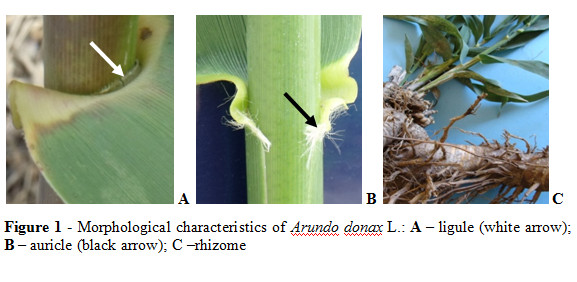
<body><![CDATA[<p>Cuticle thickness is known to affect the amount of active ingredient that reaches the target site of a post emergence herbicide and consequently its efficacy. So, this work aimed to relate glyphosate efficacy with the thickness of leaf cuticle of young and mature leaves of <i>Arundo donax.</i> Glyphosate was applied at different development stages of the invasive species, in spring, summer and autumn at the concentrations of 0.675; 1.350 and 2.025 g L<sup>-1</sup>. Cuticle thickness of mature and young leaf blade and leaf sheath was measured on transverse sections by light microscopy. Despite the significant differences in the cuticle thickness between young and mature leaves, this did not seem affect the efficacy of glyphosate uptake since no significant differences were observed between young and mature leaves glyphosate treatments. But herbicide efficacy was dependent of the plant development stage. Higher efficacy of glyphosate was recorded when plots were sprayed at the end of October (flowering) compared to end April and mid June applications. Mortality of giant reed was higher than 90% one year after treatment only in autumn treatments. This result suggests that other mechanisms are involved, probably the reserves carrying over to rhizomes, on herbicide efficacy.</p>     <p><b>Key-words</b>: <i>Poaceae</i>; invasive species; cuticule, leaf anatomy</p>     <p>&nbsp;</p>     <p><b>RESUMO </b></p>     <p>É sabido que a espessura da cutícula afeta a quantidade dum herbicida de pós emergência que chega ao local de ação e consequentemente a sua eficácia. Assim, este trabalho teve por objetivo relacionar a eficácia do glifosato com a espessura da cutícula de folhas jovens e adultas da invasora ribeirinha <i>Arundo donax.</i> O glifosato foi aplicado em diferentes estágios de crescimento da invasora, na primavera, verão e outono nas concentrações de 0,675; 1,350 e 2,025 g L<sup>-1</sup>. A espessura da cutícula foi medida por recurso a microscopia ótica em cortes transversais de folhas adultas e jovens, limbo e bainha, de <i>A. donax</i>. Apesar de haver diferenças significativas na espessura da cutícula de folhas jovens e adultas da invasora, tal facto não afetou a eficácia do glifosato dado que não se registaram diferenças significativas nos tratamentos herbicidas quer nas plantas com folhas jovens quer nas com folhas adultas. Todavia a eficácia variou com o estado de crescimento. As eficácias mais elevadas e significativas foram observadas nos talhões tratados à floração, fim de outubro. Nestes, um ano após o tratamento químico a eficácia era superior a 90%. Estes resultados apontam para que outros mecanismos envolvidos na eficácia do glifosato, possivelmente devido a uma maior translocação para os órgãos de reserva, associada à translocação dos assimilados que ocorre neste período de crescimento.</p>     <p><b>Palavras-chave:</b> <i>Poaceae</i>; invasoras; cutícula, anatomia da folha</p>     <p>&nbsp;</p>     <p><b>Introduction</b></p>     <p><i>Arundo donax </i>L., giant reed (cana, in Portuguese), is naturalized in Portugal and nowadays it is considered an invasive plant species. Another species<i> Arundo plinii </i>Turra is also found but only in the phytogeographic mainland Portugal regions of Center&#8209;East and Center-South (Franco and Rocha-Afonso, 1998). Giant reed is a tall perennial cane found in riparian areas with well-drained soil, high temperatures and low salinity, forming dense stands on disturbed sites, sand dunes, in wetlands and riparian habitats. Its density increases in open places with high photosynthetic active radiation where native vegetation has been recently removed or damage.</p>     <p><i>A. donax</i> generally grows to 6 m, in ideal conditions it can exceed 10 m, with hollow culms 2 to 3 cm diameter. The leaves are alternate, 30 to 60 cm long and 2 to 6 cm wide with a tapered tip, grey-green, and have a hairy tuft at the base <a href="#f1">Fig. 1A, B</a>). Overall, it resembles an outsize common reed (<i>Pragmites australis</i> (Cav.) Steudel) but it is taller and more vigorous (Franco and Rocha-Afonso, 1998). <i>A. donax</i> flowers in late summer, bearing upright, feathery plumes 40 to 60 cm long, but the seeds are rarely fertile (Lewandowski <i>et al.,</i> 2003). So, the reproduction is essentially asexual through vegetative propagation by underground vigorous rhizomes (<a href="#f1">Fig. 1C</a>). The rhizomes are tough and fibrous and form knotty, spreading mats that penetrate deep into the soil (Mackenzie, 2004; Wijte <i>et al</i>., 2005; Mariani <i>et al</i>., 2010). The success of giant reed lies in part in their morphology and growth processes, and in part in their physiological diversity. Giant reed is a C<sub>3</sub> plant, yet it displays the unsaturated photosynthetic potential of C<sub>4</sub> plants, and is capable of extremely high photosynthetic rates (Rossa <i>et al</i>., 1998; Papazoglou <i>et al.,</i> 2005), what gives the invasive species a high degree of effectiveness in the water use. </p>     ]]></body>
<body><![CDATA[<p>&nbsp;</p> <a name="f1"></a> <img src="/img/revistas/rca/v38n2/38n2a03f1.jpg">     
<p></p>     <p>&nbsp;</p>     <p>A waterside plant community dominated by <i>A. donax</i> may also reduce canopy shading of the in-stream habitat, which may result in increased water temperatures. This may lead to decreased oxygen concentrations and lower diversity of aquatic animals (Bell, 1997). The autochthones plant species diversity is also negatively affected. The culms and leaves have large amounts of toxic compounds like silica (Mackenzie, 2004), being an unpleasant food for insects and other animals (Miles <i>et al</i>., 1993).</p>     <p>Considering that <i>A. donax </i>affects<i> </i>the riparian structure (Herrera and Dudley, 2003), its ecological processes, namely the hydrological regime, erosion, sediments deposit and nutrients fluxes, this implies that its presence increases the risk of floods in the nearby areas. Its high water use and evapotranspiration also reduces the water availability and water stream. Abichandani (2007) estimated that the transpiration rate of giant reed could be 6 to 110 times higher than the one of the native species. Coffman <i>et al</i>. (2010) verified that after a fire giant reed density and biomass was 20 and 14-24 times, respectively, higher than the values observed for native plant species.</p>     <p>To remove giant reed, besides manual, there are mainly two methods, mechanical and/or chemical ones. Manual and mechanical control methods are very expensive and not effective since stem or rhizome pieces even containing a single node readily sprouted under a variety of conditions (Boose and Holt, 1999; Newhouser <i>et al</i>., 1999; Decruyenaere and Holt, 2001). Nevertheless these methods can be used any time (Oakins, 2001) being the best moment before plant flowering when the rhizomes reserves are low (Newhouser <i>et al</i>., 1999).</p>     <p>Giant reed chemical control trough ghyphosate foliar or stem applications is the mainly method used overall (Newhouser <i>et al</i>., 1999; Dudley (2005). Nevertheless, the uptake amount of foliar-applied herbicides usually varies with the morphological and anatomical traits of leaves, since an increase in the thickness of the cuticle layer may slower herbicide uptake (Wanamarta e Penner, 1989; Chachalis <i>et al., </i>2001; Ferreira <i>et al</i>., 2002; Hoss <i>et al., </i>2003; Huangfu <i>et al.,</i> 2009), that is, the leaf surface and leaf anatomy may affect the efficacy of glyphosate uptake in weeds. Sherrick <i>et al. </i>(1986) investigated the effects of adjuvants and the environment during plant development on the level of glyphosate absorption and translocation in <i>Convolvulus arvensis </i>L. and confirmed that the thickness of the cuticle of weed affects the herbicide's level of efficacy.</p>     <p>For riparian plant species control, glyphosate was selected as the most appropriate product after specific considerations on efficacy, environmental safety, no soil residual activity, operator safety, application timing, and cost-effectiveness (Jackson, 1998). Single late-season applications of 1.350 g L<sup>-1</sup> glyphosate onto the foliar mass showed efficacies varied between 50-95% one year after treatment (Newhouser <i>et al</i>., 1999). Previous stem cutting and thereafter glyphosate spraying 3-6 weeks later at the young leaves in order to reduce the amount of herbicide but to improve the spray distribution, was also recommended for large areas (Bell, 1997; Newhouser <i>et al</i>., 1999). Monteiro <i>et al</i>. (1999) observed that cutting common reed (<i>P. australis</i>) during flowering, in the year before herbicide treatment - doses of 2.9 and 3.24 kg a.i. ha-<sup>1</sup> of glyphosate, applied at spring and at flowering -, improved the efficacy of the herbicide. Considering the botanical proximity between giant reed and common reed a similar response to glyphosate treatment could be expected.</p>     <p>In order to kill a perennial plant such as <i>A. donax</i> using systemic herbicides it is necessary to achieve a lethal dose in the perennial organs, in this instance the rhizomes of the plant. So, the main objective of this work was to maximize weed control using appropriate rates of glyphosate applied at various growth stages of the weed and their relationship to the plant leaf cuticle thickness.</p>     <p>&nbsp;</p>     ]]></body>
<body><![CDATA[<p><b>Material and Methods</b></p>     <p><b><i>Morphological Studies</i></b></p>     <p>Leaves of <i>A. donax </i>were collected in South Portugal, Algarve, Silves, Algoz River. Samples of the blade and sheath median portions of mature and young leaves were studied by using light microscopy.</p>     <p><i>Light microscopy (LM):</i><b> </b>Small pieces of plant material were fixed in a 3% glutaraldehyde solution for 5 h at 4°C, followed by 0.1 M phosphate buffer wash, pH 7.0, during 24-h at 4 °C; three distilled water washes, of 30-min each and dehydrated in a graded series ethanol solutions (30%, 50%, 70% and 100%, 20 to 40-min each) (Hayat, 2000). Some fixed material was embedded in paraffin (Ruzin, 1999) and tissue blocks were sectioned at 10-12 &#956;m using a Leitz 1512 Minot microtome. Transverse sections could be clarified in Chloral Hydrate, stained with acidic Phloroglucin to highlight lignified plant tissues or instead with Sudan Red for total lipids (Johansen, 1940) to highlight the cuticle. Observations were carried out under a Nikon Eclipse E400 microscope equipped with a Nikon Coolpix MDC lens adapter. Images were obtained with a Nikon Coolpix 995 digital camera. Qualitative and quantitative characters are the average of 20 different observations.</p>     <p><b><i>Chemical control studies</i></b></p>     <p>Dense infestations of <i>A. donax</i> - 16 to 27 shoots per m<sup>-2</sup> - growing in Algarve, Portugal, Silves, Algoz River, were used for the study. <i>A. donax</i> plants were cut one month before spring and summer, and one year before autumn herbicide applications. Application dates were at end April, middle June and end October 2010.</p>     <p>The cut plots were cleared of vegetation to within 15 cm of the surface using a hand-held weed trimmer equipped with a saw blade. Glyphosate concentrations of 0.675, 1.350 and 2.015 g L<sup>-1</sup> (Roundup® Supra, 450 a.i. g L<sup>-1</sup>) were applied at 600 L ha<sup>-1</sup>. Applications were made using a hand held lance with an adjustable nozzle. The medium output, at the pressure of 10 bars, was 1.8 L/min. Plots 7 x 20 m were arranged end-to-end on the bank of the river in a split-plot design with three replications. Plant cutting was the main factor, glyphosate concentrations the subplot factor. Stand reduction was measured as percentage cover by three independent observers, 12 months after treatment. Percent <i>A. donax</i> control was rated visually, based on a scale of 0-100 (0 = no reduction in weed biomass and 100 = no living weeds present).</p>     <p><b><i>Data analysis</i></b></p>     <p>Cuticle thickness values were subjected to analysis of variance and separated using Fisher's Protected LSD test at the 5% level of significance.</p>     <p>Estimates of <i>A. donax</i> cover percentages were averaged before the data were subjected to analysis of variance. Cover percentages were subjected to angular transformation before analysis of variance. Means of percentage cover (transformed) were separated using Fisher's Protected LSD test at the 5% level of significance.</p>     ]]></body>
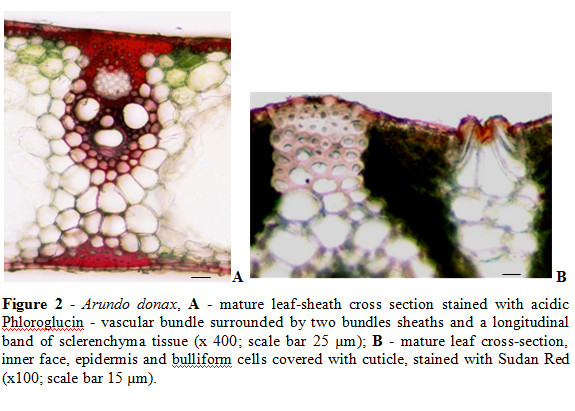
<body><![CDATA[<p>&nbsp;</p>     <p><b>Results and discussion</b></p>     <p><b><i>Leaf anatomy </i></b></p>     <p><i>A. donax</i> leaf blades cross sections show a typical monocot organization. The dermal system is represented by the epidermis of the inner face and the outer face. Between these the mesophyll is undifferentiated and the veins all appear parallel to each other. The vascular bundles are surrounded by two bundles sheaths, an inner one called the mestome sheath that shows thick walled cells, which also stained positive with acidic Phloroglucin. The mestome sheath is encircled by an outer sheath of non-photosynthetic larger thin walled cells which are surrounded by mesophyll cells (<a href="#f2">Fig. 2A</a>). This is the pattern anatomy characteristic in Poaceae and related with C<sub>4 </sub>photosynthesis, the called Kranz anatomy (Esau, 1997).</p>     <p>&nbsp;</p> <a name="f2"></a> <img src="/img/revistas/rca/v38n2/38n2a03f2.jpg">     
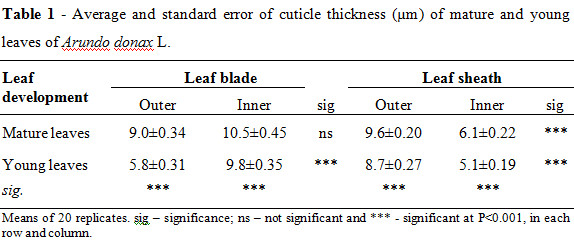
<p></p>     <p>&nbsp;</p>     <p>Associated with the vascular bundles, in addition to the double sheath, there are longitudinal bands of sclerenchyma tissue (<a href="#f2">Fig. 2A</a>). In mature leaf blades and in their leaf sheaths there is also a continuous band of sclerenchyma throughout the epidermis or, in the absence of this, involving the hypodermal cells. In young leaf blades and in their leaf sheaths there is no continuous band below the protection tissue but there are already cells with thickening in tangential cell walls.</p>     <p>In <i>A. donax</i> leaf blades and leaf sheaths cross sections it is also visible the presence of the cuticle, covering both faces epidermal tissues. <a href="#t1">Table 1</a> shows the cuticle thickness of <i>A. donax</i> mature and young leaf blades and leaf sheaths, external and internal surfaces. Significantly cuticle thickness differences were observed between mature and young blade and sheath leaves. The outer and inner cuticles, with exception for mature blade leaves, revealed also significant differences on their thickness.</p>     <p>&nbsp;</p> <a name="t1"></a> <img src="/img/revistas/rca/v38n2/38n2a03t1.jpg">     
]]></body>
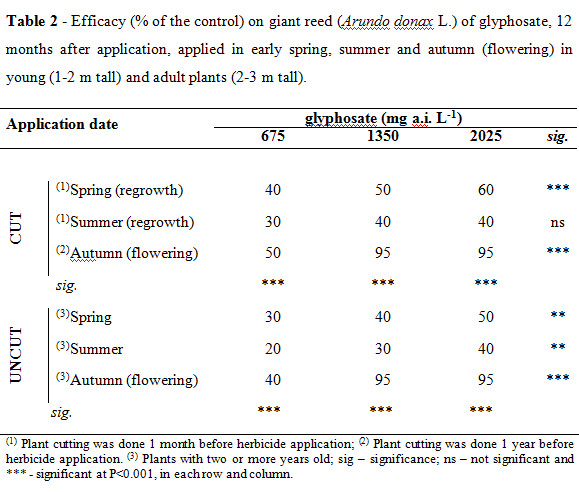
<body><![CDATA[<p></p>     <p>&nbsp;</p>     <p>The epidermis of the inner face can also include, besides the stomata, other enlarged cell types designated as motor or bulliform cells, also covered with a thick cuticle (<a href="#f2">Fig. 2B</a>). These cells are associated with the winding of the leaves in dry conditions.</p>     <p><b><i>Glyposate efficacy</i></b></p>     <p>One year after treatment, the efficiency of glyphosate over <i>A. donax </i>significantly<i> </i>increases with its concentration (<a href="#t2">Table 2</a>). Concentrations below 1.350 g a.i. L<sup>-1</sup> of glyphosate<sup> </sup>were inefficient in the chemical control of <i>A. donax</i> applied in young (cut plots) or adult plants (uncut plots), at any application date. But glyphosate efficacy was significantly increased when applied at giant reed flowering both in cut and uncut plots.</p>     <p>&nbsp;</p> <a name="t2"></a> <img src="/img/revistas/rca/v38n2/38n2a03t2.jpg">     
<p></p>     <p>&nbsp;</p>     <p>The lowest glyphosate efficacies were observed for all summer treatments. That is, higher efficacy of glyphosate was recorded when plots were sprayed at the end of October (flowering) compared to end April and mid June applications. Mortality of giant reed was higher than 95% one year after treatment only in autumn treatments, probably because during this phenological stage reserves are being carrying over to the rhizomes (Bell, 1997; Decruyenaere and Holt, 2001). These results were similar to the ones obtained by several authors (Newhouser <i>et al</i>., 1999; Spencer <i>et al.,</i> 2008) for giant reed where the spring and summer glyphosate treatments do not seem appropriate, but contrary to those obtained by Monteiro <i>et al</i>. (1999) for common reed,</p>     <p>According to several authors, the uptake amount of foliar-applied herbicides usually varies with the morphological and anatomical traits of leaves, since an increase in the thickness of the cuticle layer may slower herbicide uptake (Wanamarta e Penner, 1989; Chachalis <i>et al., </i>2001; Ferreira <i>et al</i>., 2002; Hoss <i>et al., </i>2003; Huangfu <i>et al.,</i> 2009), that is, the leaf surface and leaf anatomy may affect the efficacy of glyphosate uptake in weeds. Sherrick <i>et al. </i>(1986) investigated the effects of adjuvants and the environment during plant development on the level of glyphosate absorption and translocation in <i>Convolvulus arvensis </i>L. and confirmed that the thickness of the cuticle of weed affects the herbicide's level of efficacy. Our study clearly illustrates morphological disparities in the epidermal and anatomical features of young and mature leaves of <i>A. donax,</i> but the differences did not explain their susceptibility difference to glyphosate.</p>     ]]></body>
<body><![CDATA[<p>Furthermore, there might be other mechanisms that are responsible for herbicide response differences, namely differences in the translocation patterns that might affect the efficacy of glyphosate in giant reed (Sandberg<i> et al.,</i> 1980; Monquero <i>et al</i>., 2005). Glyphosate is amphimobile in plants and is highly translocate from the site of application through the phloem and xylem to shoot and root sinks tissues, following the plant carbon flow (Dewey and Appleby, 1983; Preston and Wakelin, 2008). This behaviour helps to explain the good activity of the herbicide at post flowering since, according to Soetaert <i>et</i> al. (2004) with common reed, at the onset of senescence, assimilates are allocated to belowground organs, that is the rhizomes. That behaviour probably explain giant reed response to glyphosate treatments.</p>     <p>&nbsp;</p>     <p><b>Conclusions</b></p>     <p>Overall, the present study did not give support to the concept that the morphological and anatomical characteristics, in particular the cuticle thickness, of giant reed leaf influence the behaviour of glyphosate. Indeed, these results suggest that the translocation of the reserves to the rhizomes during and pos- flowering could be the force that increases glyphosate activity. The discrepancy observed in spring and summer treatments is likely due to the difference in the time of year when the plant grown is affected by other unknown factors, probably an higher herbicide translocation to rhizomes associated with the assimilate translocation during the blooming season could explain the results.</p>     <p>The results also pointed out that for an effective giant reed control more than one glyphosate application (1.350 g L<sup>-1</sup>) is necessary and the previous stem cutting is recommended in order to reduce the amount of herbicide and to improve the spray distribution.</p>     <p>&nbsp;</p>     <p><b>Acknowledgments </b></p>     <p>The chemical studies were supported by the RICOVER Project SOE1/P2/P248 &#8220;River Recuperation in European SUDOE&#8221;.</p>     <p>&nbsp;</p>     <p><b>References</b></p>     ]]></body>
<body><![CDATA[<!-- ref --><p>Abichandani, S.L. (2007) - <i>The potential impact of the invasive species</i> <i>Arundo donax</i> <i>on water resources along the Santa Clara River: Seasonal and Diurnal Transpiration.</i> <i>Master's thesis.</i> Environmental Health Sciences, University of California, Los Angeles. 44 p.    &nbsp;&nbsp;&nbsp;&nbsp;&nbsp;&nbsp;&nbsp;&nbsp;[&#160;<a href="javascript:void(0);" onclick="javascript: window.open('/scielo.php?script=sci_nlinks&ref=000073&pid=S0871-018X201500020000300001&lng=','','width=640,height=500,resizable=yes,scrollbars=1,menubar=yes,');">Links</a>&#160;]<!-- end-ref --></p>     <!-- ref --><p>Bell, G.P. (1997) - Ecology and management of <i>Arundo donax</i>, and approaches to riparian habitat restoration in Southern California.<i> In</i>: J.H. Brock, M. Wade, P. Pysek and D. Green, (Eds.) - <i>Plant Invasion: Studies from North America and Europe</i>. Leiden, the Netherlands, p. 103-113.    &nbsp;&nbsp;&nbsp;&nbsp;&nbsp;&nbsp;&nbsp;&nbsp;[&#160;<a href="javascript:void(0);" onclick="javascript: window.open('/scielo.php?script=sci_nlinks&ref=000075&pid=S0871-018X201500020000300002&lng=','','width=640,height=500,resizable=yes,scrollbars=1,menubar=yes,');">Links</a>&#160;]<!-- end-ref --></p>     <!-- ref --><p>Boose, A.B. and Holt, J.S. (1999) - Environmental effects on asexual reproduction in <i>Arundo donax. Weed Research</i>, vol. 39, n. 2, p. 117-127.    &nbsp;&nbsp;&nbsp;&nbsp;&nbsp;&nbsp;&nbsp;&nbsp;[&#160;<a href="javascript:void(0);" onclick="javascript: window.open('/scielo.php?script=sci_nlinks&ref=000077&pid=S0871-018X201500020000300003&lng=','','width=640,height=500,resizable=yes,scrollbars=1,menubar=yes,');">Links</a>&#160;]<!-- end-ref --></p>     <!-- ref --><p>Chachalis D., Reddy, K.N. and Elmore, C.D. (2001) - Characterization of leaf surface, wax composition, and control of redvine and trumpet creeper with glyphosate. <i>Weed Science,</i> vol. 49, n. 2, p. 156&#8211;163.    &nbsp;&nbsp;&nbsp;&nbsp;&nbsp;&nbsp;&nbsp;&nbsp;[&#160;<a href="javascript:void(0);" onclick="javascript: window.open('/scielo.php?script=sci_nlinks&ref=000079&pid=S0871-018X201500020000300004&lng=','','width=640,height=500,resizable=yes,scrollbars=1,menubar=yes,');">Links</a>&#160;]<!-- end-ref --><b></b></p>     <!-- ref --><p>Coffman, G.C., Ambrose R.F. and Rundel, P.W. (2010) -Wildfire promotes dominance of invasive giant reed (<i>Arundo donax</i>) in riparian ecosystems. <i>Biological Invasions,</i> vol. 12, n. 8, p. 2723-2734.    &nbsp;&nbsp;&nbsp;&nbsp;&nbsp;&nbsp;&nbsp;&nbsp;[&#160;<a href="javascript:void(0);" onclick="javascript: window.open('/scielo.php?script=sci_nlinks&ref=000081&pid=S0871-018X201500020000300005&lng=','','width=640,height=500,resizable=yes,scrollbars=1,menubar=yes,');">Links</a>&#160;]<!-- end-ref --></p>     ]]></body>
<body><![CDATA[<!-- ref --><p>Decruyenaere, J.G. and Holt, J.S. (2001) - Seasonality of clonal propagation in giant reed. <i>Weed Science</i>, vol. 49, n. 6, p.<b> </b>760-767.    &nbsp;&nbsp;&nbsp;&nbsp;&nbsp;&nbsp;&nbsp;&nbsp;[&#160;<a href="javascript:void(0);" onclick="javascript: window.open('/scielo.php?script=sci_nlinks&ref=000083&pid=S0871-018X201500020000300006&lng=','','width=640,height=500,resizable=yes,scrollbars=1,menubar=yes,');">Links</a>&#160;]<!-- end-ref --></p>     <!-- ref --><p>Dudley, T. (2005) - Global Invasive Species Database: <i>Arundo donax</i>. Invasive Species Specialist Group (ISSG) of the World Conservation Union. Available online at 2014.12.18: <a href="http://www.issg.org/database/species/ecology.asp?si=112"target="_blank">http://www.issg.org/database/species/ecology.asp?si=112</a>&nbsp;&nbsp;&nbsp;&nbsp;&nbsp;&nbsp;&nbsp;&nbsp;[&#160;<a href="javascript:void(0);" onclick="javascript: window.open('/scielo.php?script=sci_nlinks&ref=000085&pid=S0871-018X201500020000300007&lng=','','width=640,height=500,resizable=yes,scrollbars=1,menubar=yes,');">Links</a>&#160;]<!-- end-ref --><!-- ref --><p>Dewey S.A. and Appleby A.P. (1983) - A comparison between glyphosate and assimilate translocation patterns in tall morning glory (<i>Ipomoea purpurea</i>). <i>Weed Science, </i>vol. 31, n. 3, p. 308-314.    &nbsp;&nbsp;&nbsp;&nbsp;&nbsp;&nbsp;&nbsp;&nbsp;[&#160;<a href="javascript:void(0);" onclick="javascript: window.open('/scielo.php?script=sci_nlinks&ref=000086&pid=S0871-018X201500020000300008&lng=','','width=640,height=500,resizable=yes,scrollbars=1,menubar=yes,');">Links</a>&#160;]<!-- end-ref --></p>     <!-- ref --><p>Esau, K. (1997) - <i>Anatomia das Plantas com Sementes</i>. Editora Edgard Blucher, Ltda, S. Paulo, Brasil. 293 p.    &nbsp;&nbsp;&nbsp;&nbsp;&nbsp;&nbsp;&nbsp;&nbsp;[&#160;<a href="javascript:void(0);" onclick="javascript: window.open('/scielo.php?script=sci_nlinks&ref=000088&pid=S0871-018X201500020000300009&lng=','','width=640,height=500,resizable=yes,scrollbars=1,menubar=yes,');">Links</a>&#160;]<!-- end-ref --></p>     <!-- ref --><p>Ferreira, E.A.; Procópio, S.O.; Silva, E.A.M.; Silva, A.A. and Rufino, R.J.N. (2002) - <i>Estudos anatômicos de folhas de plantas daninhas.</i> I - <i>Nicandra physaloides</i>,<i> Solanum viarum, Solanum americanum </i>e <i>Raphanus raphanistrum</i>. <i>Planta Daninha</i>, vol. 20, n. 2, p.159-167&nbsp;&nbsp;&nbsp;&nbsp;&nbsp;&nbsp;&nbsp;&nbsp;[&#160;<a href="javascript:void(0);" onclick="javascript: window.open('/scielo.php?script=sci_nlinks&ref=000090&pid=S0871-018X201500020000300010&lng=','','width=640,height=500,resizable=yes,scrollbars=1,menubar=yes,');">Links</a>&#160;]<!-- end-ref --><!-- ref --><p>Franco, J.A. and Rocha-Afonso, M.L. (1998<i>) - Nova Flora de Portugal (Continente e Açores). </i>Vol. III (Fascículo II). Gramineae. Escolar Editora. Lisboa. 283 p.    &nbsp;&nbsp;&nbsp;&nbsp;&nbsp;&nbsp;&nbsp;&nbsp;[&#160;<a href="javascript:void(0);" onclick="javascript: window.open('/scielo.php?script=sci_nlinks&ref=000091&pid=S0871-018X201500020000300011&lng=','','width=640,height=500,resizable=yes,scrollbars=1,menubar=yes,');">Links</a>&#160;]<!-- end-ref --></p>     ]]></body>
<body><![CDATA[<!-- ref --><p>Hayat M. (2000) - <i>Principles and techniques of electron microscopy: biological applications</i>. 4 Ed., Cambridge University Press. 543 p.    &nbsp;&nbsp;&nbsp;&nbsp;&nbsp;&nbsp;&nbsp;&nbsp;[&#160;<a href="javascript:void(0);" onclick="javascript: window.open('/scielo.php?script=sci_nlinks&ref=000093&pid=S0871-018X201500020000300012&lng=','','width=640,height=500,resizable=yes,scrollbars=1,menubar=yes,');">Links</a>&#160;]<!-- end-ref --></p>     <!-- ref --><p>Herrera, A. M. and Dudley, T.L. (2003) - Invertebrate community reduction in response to <i>Arundo donax</i> invasion at Sonoma Creek. <i>Biological Invasions, </i>vol. 5, n. 1, p. 167-177.    &nbsp;&nbsp;&nbsp;&nbsp;&nbsp;&nbsp;&nbsp;&nbsp;[&#160;<a href="javascript:void(0);" onclick="javascript: window.open('/scielo.php?script=sci_nlinks&ref=000095&pid=S0871-018X201500020000300013&lng=','','width=640,height=500,resizable=yes,scrollbars=1,menubar=yes,');">Links</a>&#160;]<!-- end-ref --></p>     <!-- ref --><p>Hoss, N.E.; Khatib, K.; Peterson D.E. and Loughin, T.M. (2003) - Efficacy of glyphosate, glufosinate, and imazethapyr on selected weed species. <i>Weed Science</i>, vol. 51, n. 1, p. 110&#8211;117.    &nbsp;&nbsp;&nbsp;&nbsp;&nbsp;&nbsp;&nbsp;&nbsp;[&#160;<a href="javascript:void(0);" onclick="javascript: window.open('/scielo.php?script=sci_nlinks&ref=000097&pid=S0871-018X201500020000300014&lng=','','width=640,height=500,resizable=yes,scrollbars=1,menubar=yes,');">Links</a>&#160;]<!-- end-ref --><b></b></p>     <!-- ref --><p>Huangfu, C.; Song, X. and Qiang, S. (2009) - Morphological disparities in the epidermal and anatomical features of the leaf among wild <i>Brassica juncea</i> populations. <i>Weed Biology and Management</i>, vol. 9, n. 3, p. 234&#8211;242.    &nbsp;&nbsp;&nbsp;&nbsp;&nbsp;&nbsp;&nbsp;&nbsp;[&#160;<a href="javascript:void(0);" onclick="javascript: window.open('/scielo.php?script=sci_nlinks&ref=000099&pid=S0871-018X201500020000300015&lng=','','width=640,height=500,resizable=yes,scrollbars=1,menubar=yes,');">Links</a>&#160;]<!-- end-ref --></p>     <!-- ref --><p>Jackson, N.E. (1998) - Chemical control of giant reed (<i>Arundo donax</i>) and saltcedar (<i>Tamarix ramosissima</i>). <i>In:</i> Bell, Carl E., (Ed.) - <i>Arundo and saltcedar: the deadly duo. </i>Proceedings of a workshop on combating the threat from arundo and saltcedar. 1998 June 17; Ontario, CA. Holtville, CA: University of California, Cooperative Extension: p. 33-42.    &nbsp;&nbsp;&nbsp;&nbsp;&nbsp;&nbsp;&nbsp;&nbsp;[&#160;<a href="javascript:void(0);" onclick="javascript: window.open('/scielo.php?script=sci_nlinks&ref=000101&pid=S0871-018X201500020000300016&lng=','','width=640,height=500,resizable=yes,scrollbars=1,menubar=yes,');">Links</a>&#160;]<!-- end-ref --></p>     ]]></body>
<body><![CDATA[<!-- ref --><p>Johansen, D.A. (1940) - <i>Plant microtechnique</i>. New York: McGraw-Hill. 523 p.    &nbsp;&nbsp;&nbsp;&nbsp;&nbsp;&nbsp;&nbsp;&nbsp;[&#160;<a href="javascript:void(0);" onclick="javascript: window.open('/scielo.php?script=sci_nlinks&ref=000103&pid=S0871-018X201500020000300017&lng=','','width=640,height=500,resizable=yes,scrollbars=1,menubar=yes,');">Links</a>&#160;]<!-- end-ref --></p>     <!-- ref --><p>Lewandowski, I. J.; Scurlock, M.O.; Lindvall, E. and Christou, M. (2003) - The development and current status of perennial rhizomatous grasses as energy crops in the US and Europe. <i>Biomass and Bioenergy</i>, vol. 25, n. 4, p. 335-361.    &nbsp;&nbsp;&nbsp;&nbsp;&nbsp;&nbsp;&nbsp;&nbsp;[&#160;<a href="javascript:void(0);" onclick="javascript: window.open('/scielo.php?script=sci_nlinks&ref=000105&pid=S0871-018X201500020000300018&lng=','','width=640,height=500,resizable=yes,scrollbars=1,menubar=yes,');">Links</a>&#160;]<!-- end-ref --></p>     <!-- ref --><p>Mackenzie, A. (2004) - Giant Reed. <i>In</i>: C. Harrington e A. Hayes (eds) - <i>The Weed Workers' Handbook.</i> The Watershed Project and California Invasive Plant Council, California. p. 92-93.    &nbsp;&nbsp;&nbsp;&nbsp;&nbsp;&nbsp;&nbsp;&nbsp;[&#160;<a href="javascript:void(0);" onclick="javascript: window.open('/scielo.php?script=sci_nlinks&ref=000107&pid=S0871-018X201500020000300019&lng=','','width=640,height=500,resizable=yes,scrollbars=1,menubar=yes,');">Links</a>&#160;]<!-- end-ref --></p>     <!-- ref --><p>Mariani, C.; Cabrini, R.; Danin, A.; Piffanelli, P.; Fricano, A.; Gomarasca, S.; Dicandilo, M.; Grassi F. and Soave, C. (2010) Origin, diffusion and reproduction of the giant reed (<i>Arundo donax</i> L.) a promising weedy energy crop. <i>Annals of Applied Biology</i>, vol. 157, n. 2, p. 191&#8211;202.    &nbsp;&nbsp;&nbsp;&nbsp;&nbsp;&nbsp;&nbsp;&nbsp;[&#160;<a href="javascript:void(0);" onclick="javascript: window.open('/scielo.php?script=sci_nlinks&ref=000109&pid=S0871-018X201500020000300020&lng=','','width=640,height=500,resizable=yes,scrollbars=1,menubar=yes,');">Links</a>&#160;]<!-- end-ref --></p>     <!-- ref --><p>Miles, D.H.; Tunsuwan, K.; Chittawong, V.; Kokpol, U.; Choudhary M.I. and Clardy J. (1993) - Boll weevil antifeedants from <i>Arundo donax. Phytochemistry</i>, vol. 34, n. 2, p. 1277-1279.    &nbsp;&nbsp;&nbsp;&nbsp;&nbsp;&nbsp;&nbsp;&nbsp;[&#160;<a href="javascript:void(0);" onclick="javascript: window.open('/scielo.php?script=sci_nlinks&ref=000111&pid=S0871-018X201500020000300021&lng=','','width=640,height=500,resizable=yes,scrollbars=1,menubar=yes,');">Links</a>&#160;]<!-- end-ref --></p>     ]]></body>
<body><![CDATA[<!-- ref --><p>Monquero, P.A.; Cury, J.C. and Christofoletti, P.J. (2005) - Controle pelo glyphosate e caracterização geral da superfície foliar de <i>Commelina benghalensis, Ipomoea hederifolia, Richardia brasiliensis</i> e <i>Galinsoga parviflora. Planta daninha</i>, vol. 23, n. 1, p. 123-132.    &nbsp;&nbsp;&nbsp;&nbsp;&nbsp;&nbsp;&nbsp;&nbsp;[&#160;<a href="javascript:void(0);" onclick="javascript: window.open('/scielo.php?script=sci_nlinks&ref=000113&pid=S0871-018X201500020000300022&lng=','','width=640,height=500,resizable=yes,scrollbars=1,menubar=yes,');">Links</a>&#160;]<!-- end-ref --></p>     <!-- ref --><p>Monteiro, A.; Moreira I. and Sousa, E. (1999) - Effect of prior common reed (<i>Phragmites australis</i>) cutting in herbicide efficacy. <i>Hydrobiologia</i>, vol. 415, n. 0, p. 305-308.    &nbsp;&nbsp;&nbsp;&nbsp;&nbsp;&nbsp;&nbsp;&nbsp;[&#160;<a href="javascript:void(0);" onclick="javascript: window.open('/scielo.php?script=sci_nlinks&ref=000115&pid=S0871-018X201500020000300023&lng=','','width=640,height=500,resizable=yes,scrollbars=1,menubar=yes,');">Links</a>&#160;]<!-- end-ref --></p>     <!-- ref --><p>Newhouser, M.; Cornwall C. and Dale R. (1999) - <i>Arundo</i>: <i>A Landowner Handbook.</i> Available online at 2014.12.18: <a href="http://teamarundo.org/education/landowner_handbook.pdf"target="_blank">http://teamarundo.org/education/landowner_handbook.pdf</a>&nbsp;&nbsp;&nbsp;&nbsp;&nbsp;&nbsp;&nbsp;&nbsp;[&#160;<a href="javascript:void(0);" onclick="javascript: window.open('/scielo.php?script=sci_nlinks&ref=000117&pid=S0871-018X201500020000300024&lng=','','width=640,height=500,resizable=yes,scrollbars=1,menubar=yes,');">Links</a>&#160;]<!-- end-ref --><!-- ref --><p>Oakins, A.J. (2001) - <i>An Assessment and Management Protocol for Arundo donax in the Salinas Valley Watershed</i>. Monterey Bay, CA: California State University. 51 p.    &nbsp;&nbsp;&nbsp;&nbsp;&nbsp;&nbsp;&nbsp;&nbsp;[&#160;<a href="javascript:void(0);" onclick="javascript: window.open('/scielo.php?script=sci_nlinks&ref=000118&pid=S0871-018X201500020000300025&lng=','','width=640,height=500,resizable=yes,scrollbars=1,menubar=yes,');">Links</a>&#160;]<!-- end-ref --></p>     <!-- ref --><p>Papazoglou, E.G.; Karantounias, G.A.; Vemmos S.N. and Bouranis, D.L. (2005) - Photosynthesis and growth responses of giant reed (<i>Arundo donax</i> L.) to the heavy metals Cd and Ni. <i>Environment International,</i> vol. 31, n. 2, p. 243-249.    &nbsp;&nbsp;&nbsp;&nbsp;&nbsp;&nbsp;&nbsp;&nbsp;[&#160;<a href="javascript:void(0);" onclick="javascript: window.open('/scielo.php?script=sci_nlinks&ref=000120&pid=S0871-018X201500020000300026&lng=','','width=640,height=500,resizable=yes,scrollbars=1,menubar=yes,');">Links</a>&#160;]<!-- end-ref --></p>     <!-- ref --><p>Preston, C. and Wakelin, A.M. (2008) - Resistance to glyphosate from altered herbicide translocation patterns. <i>Pest Management Science,</i> vol. 64, n. 4, p. 372-376.    &nbsp;&nbsp;&nbsp;&nbsp;&nbsp;&nbsp;&nbsp;&nbsp;[&#160;<a href="javascript:void(0);" onclick="javascript: window.open('/scielo.php?script=sci_nlinks&ref=000122&pid=S0871-018X201500020000300027&lng=','','width=640,height=500,resizable=yes,scrollbars=1,menubar=yes,');">Links</a>&#160;]<!-- end-ref --></p>     <!-- ref --><p>Rossa, B.; TuAers A.V.; Naidoo G. and Willert, von D. J. (1998) - <i>Arundo donax</i> L. (Poaceae) &#8212; a C<sub>3</sub> species with unusually high photosynthetic capacity. <i>Botanica Acta,</i> vol. 111, n. 3, p. 216&#8211;221.    &nbsp;&nbsp;&nbsp;&nbsp;&nbsp;&nbsp;&nbsp;&nbsp;[&#160;<a href="javascript:void(0);" onclick="javascript: window.open('/scielo.php?script=sci_nlinks&ref=000124&pid=S0871-018X201500020000300028&lng=','','width=640,height=500,resizable=yes,scrollbars=1,menubar=yes,');">Links</a>&#160;]<!-- end-ref --></p>     <!-- ref --><p>Ruzin, S. (1999) - <i>Plant microtechnique and microscopy</i>. London: Oxford University Press. 322 p.    &nbsp;&nbsp;&nbsp;&nbsp;&nbsp;&nbsp;&nbsp;&nbsp;[&#160;<a href="javascript:void(0);" onclick="javascript: window.open('/scielo.php?script=sci_nlinks&ref=000126&pid=S0871-018X201500020000300029&lng=','','width=640,height=500,resizable=yes,scrollbars=1,menubar=yes,');">Links</a>&#160;]<!-- end-ref --></p>     <!-- ref --><p>Sandberg, C.L.; Meggitt, W.F. and Penner, D. (1980) - Absorption, translocation and metabolism of <sup>14</sup>C-glyphosate in several weed species. <i>Weed Research, </i>vol. 20, n. 4, p. 195-200.    &nbsp;&nbsp;&nbsp;&nbsp;&nbsp;&nbsp;&nbsp;&nbsp;[&#160;<a href="javascript:void(0);" onclick="javascript: window.open('/scielo.php?script=sci_nlinks&ref=000128&pid=S0871-018X201500020000300030&lng=','','width=640,height=500,resizable=yes,scrollbars=1,menubar=yes,');">Links</a>&#160;]<!-- end-ref --></p>     <!-- ref --><p>Soetaert, K.; Hoffmann, M.; Meire, P.; Starink, M.; van Oevelen, D.; Van Regenmortel, S. and Cox, T. (2004) - Modeling growth and carbon allocation in two reed beds (<i>Phragmites australis</i>) in the Scheldt estuary (Belgium, The Netherlands). <i>Aquatic Botany,</i> vol 79, n. 3, p. 211-234.    &nbsp;&nbsp;&nbsp;&nbsp;&nbsp;&nbsp;&nbsp;&nbsp;[&#160;<a href="javascript:void(0);" onclick="javascript: window.open('/scielo.php?script=sci_nlinks&ref=000130&pid=S0871-018X201500020000300031&lng=','','width=640,height=500,resizable=yes,scrollbars=1,menubar=yes,');">Links</a>&#160;]<!-- end-ref --></p>     <!-- ref --><p>Spencer, D.F.; Tan, W.; Liow, P.; Ksander, G.; Whitehand, L.C.; Weaver, S.; Olson J. and Newhauser, M. (2008) - Evaluation of glyphosate for managing giant reed (<i>Arundo</i> <i>donax</i>). <i>Invasive Plant Science Management,</i> vol. 1, n. 3, p. 248&#8211;254.    &nbsp;&nbsp;&nbsp;&nbsp;&nbsp;&nbsp;&nbsp;&nbsp;[&#160;<a href="javascript:void(0);" onclick="javascript: window.open('/scielo.php?script=sci_nlinks&ref=000132&pid=S0871-018X201500020000300032&lng=','','width=640,height=500,resizable=yes,scrollbars=1,menubar=yes,');">Links</a>&#160;]<!-- end-ref --></p>     <!-- ref --><p>Sherrick, S.T.; Holt, H.A. and Hess, F.D. (1986) - Effects of adjuvants and environment during plant development on glyphosate absorption and translocation in field bindweed (<i>Convulvus arvensis</i>). <i>Weed Science,</i> vol. 34, n. 6, p. 811-816.    &nbsp;&nbsp;&nbsp;&nbsp;&nbsp;&nbsp;&nbsp;&nbsp;[&#160;<a href="javascript:void(0);" onclick="javascript: window.open('/scielo.php?script=sci_nlinks&ref=000134&pid=S0871-018X201500020000300033&lng=','','width=640,height=500,resizable=yes,scrollbars=1,menubar=yes,');">Links</a>&#160;]<!-- end-ref --></p>     <!-- ref --><p>Wanamarta, G. and Penner D. (1989) - Foliar absorption of herbicides. <i>Reviews of</i> <i>Weed Science</i>, vol. 4, p. 215&#8209;231.    &nbsp;&nbsp;&nbsp;&nbsp;&nbsp;&nbsp;&nbsp;&nbsp;[&#160;<a href="javascript:void(0);" onclick="javascript: window.open('/scielo.php?script=sci_nlinks&ref=000136&pid=S0871-018X201500020000300034&lng=','','width=640,height=500,resizable=yes,scrollbars=1,menubar=yes,');">Links</a>&#160;]<!-- end-ref --></p>     <!-- ref --><p>Wijte, A.H.B.M.; Mizutani, T.; Motamed, E.R.; Merryfield, M.L.; Miller, D.E. and Alexander, D.E. (2005) - Temperature and endogenous factors cause seasonal patterns in rooting by stem fragments of the invasive giant reed, <i>Arundo donax</i> (Poaceae). <i>International Journal of Plant Science</i>, vol. 166, n. 3, p. 507-517.    &nbsp;&nbsp;&nbsp;&nbsp;&nbsp;&nbsp;&nbsp;&nbsp;[&#160;<a href="javascript:void(0);" onclick="javascript: window.open('/scielo.php?script=sci_nlinks&ref=000138&pid=S0871-018X201500020000300035&lng=','','width=640,height=500,resizable=yes,scrollbars=1,menubar=yes,');">Links</a>&#160;]<!-- end-ref --></p>     <p>&nbsp;</p>     <p>Received/Recebido: 2014.12.08</p>     <p>Accepted/Aceite: 2015.02.09</p>     ]]></body>
<body><![CDATA[ ]]></body><back>
<ref-list>
<ref id="B1">
<nlm-citation citation-type="">
<person-group person-group-type="author">
<name>
<surname><![CDATA[Abichandani]]></surname>
<given-names><![CDATA[S.L.]]></given-names>
</name>
</person-group>
<source><![CDATA[The potential impact of the invasive species Arundo donax on water resources along the Santa Clara River: Seasonal and Diurnal Transpiration]]></source>
<year>2007</year>
</nlm-citation>
</ref>
<ref id="B2">
<nlm-citation citation-type="">
<person-group person-group-type="author">
<name>
<surname><![CDATA[Bell]]></surname>
<given-names><![CDATA[G.P.]]></given-names>
</name>
</person-group>
<article-title xml:lang="en"><![CDATA[Ecology and management of Arundo donax, and approaches to riparian habitat restoration in Southern California]]></article-title>
<person-group person-group-type="editor">
<name>
<surname><![CDATA[Brock]]></surname>
<given-names><![CDATA[J.H.]]></given-names>
</name>
<name>
<surname><![CDATA[Wade]]></surname>
<given-names><![CDATA[M.]]></given-names>
</name>
<name>
<surname><![CDATA[Pysek]]></surname>
<given-names><![CDATA[P.]]></given-names>
</name>
<name>
<surname><![CDATA[Green]]></surname>
<given-names><![CDATA[D.]]></given-names>
</name>
</person-group>
<source><![CDATA[Plant Invasion: Studies from North America and Europe]]></source>
<year>1997</year>
<page-range>103-113</page-range><publisher-loc><![CDATA[Leiden ]]></publisher-loc>
</nlm-citation>
</ref>
<ref id="B3">
<nlm-citation citation-type="journal">
<person-group person-group-type="author">
<name>
<surname><![CDATA[Boose]]></surname>
<given-names><![CDATA[A.B.]]></given-names>
</name>
<name>
<surname><![CDATA[Holt]]></surname>
<given-names><![CDATA[J.S.]]></given-names>
</name>
</person-group>
<article-title xml:lang="en"><![CDATA[Environmental effects on asexual reproduction in Arundo donax]]></article-title>
<source><![CDATA[Weed Research]]></source>
<year>1999</year>
<volume>39</volume>
<numero>2</numero>
<issue>2</issue>
<page-range>117-127</page-range></nlm-citation>
</ref>
<ref id="B4">
<nlm-citation citation-type="journal">
<person-group person-group-type="author">
<name>
<surname><![CDATA[Chachalis]]></surname>
<given-names><![CDATA[D.]]></given-names>
</name>
<name>
<surname><![CDATA[Reddy]]></surname>
<given-names><![CDATA[K.N.]]></given-names>
</name>
<name>
<surname><![CDATA[Elmore]]></surname>
<given-names><![CDATA[C.D.]]></given-names>
</name>
</person-group>
<article-title xml:lang="en"><![CDATA[Characterization of leaf surface, wax composition, and control of redvine and trumpet creeper with glyphosate]]></article-title>
<source><![CDATA[Weed Science]]></source>
<year>2001</year>
<volume>49</volume>
<numero>2</numero>
<issue>2</issue>
<page-range>156-163</page-range></nlm-citation>
</ref>
<ref id="B5">
<nlm-citation citation-type="journal">
<person-group person-group-type="author">
<name>
<surname><![CDATA[Coffman]]></surname>
<given-names><![CDATA[G.C.]]></given-names>
</name>
<name>
<surname><![CDATA[Ambrose]]></surname>
<given-names><![CDATA[R.F.]]></given-names>
</name>
<name>
<surname><![CDATA[Rundel]]></surname>
<given-names><![CDATA[P.W.]]></given-names>
</name>
</person-group>
<article-title xml:lang="en"><![CDATA[Wildfire promotes dominance of invasive giant reed (Arundo donax) in riparian ecosystems]]></article-title>
<source><![CDATA[Biological Invasions]]></source>
<year>2010</year>
<volume>12</volume>
<numero>8</numero>
<issue>8</issue>
<page-range>2723-2734</page-range></nlm-citation>
</ref>
<ref id="B6">
<nlm-citation citation-type="journal">
<person-group person-group-type="author">
<name>
<surname><![CDATA[Decruyenaere]]></surname>
<given-names><![CDATA[J.G.]]></given-names>
</name>
<name>
<surname><![CDATA[Holt]]></surname>
<given-names><![CDATA[J.S.]]></given-names>
</name>
</person-group>
<article-title xml:lang="en"><![CDATA[Seasonality of clonal propagation in giant reed]]></article-title>
<source><![CDATA[Weed Science]]></source>
<year>2001</year>
<volume>49</volume>
<numero>6</numero>
<issue>6</issue>
<page-range>760-767</page-range></nlm-citation>
</ref>
<ref id="B7">
<nlm-citation citation-type="">
<person-group person-group-type="author">
<name>
<surname><![CDATA[Dudley]]></surname>
<given-names><![CDATA[T.]]></given-names>
</name>
</person-group>
<source><![CDATA[Global Invasive Species Database: Arundo donax. Invasive Species Specialist Group (ISSG) of the World Conservation Union]]></source>
<year>2005</year>
</nlm-citation>
</ref>
<ref id="B8">
<nlm-citation citation-type="journal">
<person-group person-group-type="author">
<name>
<surname><![CDATA[Dewey]]></surname>
<given-names><![CDATA[S.A.]]></given-names>
</name>
<name>
<surname><![CDATA[Appleby]]></surname>
<given-names><![CDATA[A.P.]]></given-names>
</name>
</person-group>
<article-title xml:lang="en"><![CDATA[A comparison between glyphosate and assimilate translocation patterns in tall morning glory (Ipomoea purpurea)]]></article-title>
<source><![CDATA[Weed Science]]></source>
<year>1983</year>
<volume>31</volume>
<numero>3</numero>
<issue>3</issue>
<page-range>308-314</page-range></nlm-citation>
</ref>
<ref id="B9">
<nlm-citation citation-type="book">
<person-group person-group-type="author">
<name>
<surname><![CDATA[Esau]]></surname>
<given-names><![CDATA[K.]]></given-names>
</name>
</person-group>
<source><![CDATA[Anatomia das Plantas com Sementes]]></source>
<year>1997</year>
<publisher-loc><![CDATA[S. Paulo ]]></publisher-loc>
<publisher-name><![CDATA[Editora Edgard Blucher, Ltda]]></publisher-name>
</nlm-citation>
</ref>
<ref id="B10">
<nlm-citation citation-type="journal">
<person-group person-group-type="author">
<name>
<surname><![CDATA[Ferreira]]></surname>
<given-names><![CDATA[E.A.]]></given-names>
</name>
<name>
<surname><![CDATA[Procópio]]></surname>
<given-names><![CDATA[S.O.]]></given-names>
</name>
<name>
<surname><![CDATA[Silva]]></surname>
<given-names><![CDATA[E.A.M.]]></given-names>
</name>
<name>
<surname><![CDATA[Silva]]></surname>
<given-names><![CDATA[A.A.]]></given-names>
</name>
<name>
<surname><![CDATA[Rufino]]></surname>
<given-names><![CDATA[R.J.N.]]></given-names>
</name>
</person-group>
<article-title xml:lang="pt"><![CDATA[Estudos anatômicos de folhas de plantas daninhas. I: Nicandra physaloides, Solanum viarum, Solanum americanum e Raphanus raphanistrum]]></article-title>
<source><![CDATA[Planta Daninha]]></source>
<year>2002</year>
<volume>20</volume>
<numero>2</numero>
<issue>2</issue>
<page-range>159-167</page-range></nlm-citation>
</ref>
<ref id="B11">
<nlm-citation citation-type="book">
<person-group person-group-type="author">
<name>
<surname><![CDATA[Franco]]></surname>
<given-names><![CDATA[J.A.]]></given-names>
</name>
<name>
<surname><![CDATA[Rocha-Afonso]]></surname>
<given-names><![CDATA[M.L.]]></given-names>
</name>
</person-group>
<source><![CDATA[Nova Flora de Portugal (Continente e Açores)]]></source>
<year>1998</year>
<volume>III</volume>
<publisher-loc><![CDATA[Lisboa ]]></publisher-loc>
<publisher-name><![CDATA[Escolar Editora]]></publisher-name>
</nlm-citation>
</ref>
<ref id="B12">
<nlm-citation citation-type="book">
<person-group person-group-type="author">
<name>
<surname><![CDATA[Hayat]]></surname>
<given-names><![CDATA[M.]]></given-names>
</name>
</person-group>
<source><![CDATA[Principles and techniques of electron microscopy: biological applications]]></source>
<year>2000</year>
<edition>4</edition>
<publisher-name><![CDATA[Cambridge University Press]]></publisher-name>
</nlm-citation>
</ref>
<ref id="B13">
<nlm-citation citation-type="journal">
<person-group person-group-type="author">
<name>
<surname><![CDATA[Herrera]]></surname>
<given-names><![CDATA[A. M.]]></given-names>
</name>
<name>
<surname><![CDATA[Dudley]]></surname>
<given-names><![CDATA[T.]]></given-names>
</name>
</person-group>
<article-title xml:lang="en"><![CDATA[Invertebrate community reduction in response to Arundo donax invasion at Sonoma Creek]]></article-title>
<source><![CDATA[Biological Invasions]]></source>
<year>2003</year>
<volume>5</volume>
<numero>1</numero>
<issue>1</issue>
<page-range>167-177</page-range></nlm-citation>
</ref>
<ref id="B14">
<nlm-citation citation-type="journal">
<person-group person-group-type="author">
<name>
<surname><![CDATA[Hoss]]></surname>
<given-names><![CDATA[N.E.]]></given-names>
</name>
<name>
<surname><![CDATA[Khatib]]></surname>
<given-names><![CDATA[K.]]></given-names>
</name>
<name>
<surname><![CDATA[Peterson]]></surname>
<given-names><![CDATA[D.E.]]></given-names>
</name>
<name>
<surname><![CDATA[Loughin]]></surname>
<given-names><![CDATA[T.M.]]></given-names>
</name>
</person-group>
<article-title xml:lang="en"><![CDATA[Efficacy of glyphosate, glufosinate, and imazethapyr on selected weed species]]></article-title>
<source><![CDATA[Weed Science]]></source>
<year>2003</year>
<volume>51</volume>
<numero>1</numero>
<issue>1</issue>
<page-range>110-117</page-range></nlm-citation>
</ref>
<ref id="B15">
<nlm-citation citation-type="journal">
<person-group person-group-type="author">
<name>
<surname><![CDATA[Huangfu]]></surname>
<given-names><![CDATA[C.]]></given-names>
</name>
<name>
<surname><![CDATA[Song]]></surname>
<given-names><![CDATA[X.]]></given-names>
</name>
<name>
<surname><![CDATA[Qiang]]></surname>
<given-names><![CDATA[S.]]></given-names>
</name>
</person-group>
<article-title xml:lang="en"><![CDATA[Morphological disparities in the epidermal and anatomical features of the leaf among wild Brassica juncea populations]]></article-title>
<source><![CDATA[Weed Biology and Management]]></source>
<year>2009</year>
<volume>9</volume>
<numero>3</numero>
<issue>3</issue>
<page-range>234-242</page-range></nlm-citation>
</ref>
<ref id="B16">
<nlm-citation citation-type="confpro">
<person-group person-group-type="author">
<name>
<surname><![CDATA[Jackson]]></surname>
<given-names><![CDATA[N.E.]]></given-names>
</name>
</person-group>
<article-title xml:lang="en"><![CDATA[Chemical control of giant reed (Arundo donax) and saltcedar (Tamarix ramosissima)]]></article-title>
<person-group person-group-type="editor">
<name>
<surname><![CDATA[Bell]]></surname>
<given-names><![CDATA[Carl E.]]></given-names>
</name>
</person-group>
<source><![CDATA[Arundo and saltcedar: the deadly duo]]></source>
<year>1998</year>
<conf-name><![CDATA[ Proceedings of a workshop on combating the threat from arundo and saltcedar]]></conf-name>
<conf-date>1998 June 17</conf-date>
<conf-loc>OntarioHoltville CACA</conf-loc>
<page-range>33-42</page-range><publisher-name><![CDATA[Cooperative Extension]]></publisher-name>
</nlm-citation>
</ref>
<ref id="B17">
<nlm-citation citation-type="book">
<person-group person-group-type="author">
<name>
<surname><![CDATA[Johansen]]></surname>
<given-names><![CDATA[D.A.]]></given-names>
</name>
</person-group>
<source><![CDATA[Plant microtechnique]]></source>
<year>1940</year>
<publisher-loc><![CDATA[New York ]]></publisher-loc>
<publisher-name><![CDATA[McGraw-Hill]]></publisher-name>
</nlm-citation>
</ref>
<ref id="B18">
<nlm-citation citation-type="journal">
<person-group person-group-type="author">
<name>
<surname><![CDATA[Lewandowski]]></surname>
<given-names><![CDATA[I. J.]]></given-names>
</name>
<name>
<surname><![CDATA[Scurlock]]></surname>
<given-names><![CDATA[M.O.]]></given-names>
</name>
<name>
<surname><![CDATA[Lindvall]]></surname>
<given-names><![CDATA[E.]]></given-names>
</name>
<name>
<surname><![CDATA[Christou]]></surname>
<given-names><![CDATA[M.]]></given-names>
</name>
</person-group>
<article-title xml:lang="en"><![CDATA[The development and current status of perennial rhizomatous grasses as energy crops in the US and Europe]]></article-title>
<source><![CDATA[Biomass and Bioenergy]]></source>
<year>2003</year>
<volume>25</volume>
<numero>4</numero>
<issue>4</issue>
<page-range>335-361</page-range></nlm-citation>
</ref>
<ref id="B19">
<nlm-citation citation-type="book">
<person-group person-group-type="author">
<name>
<surname><![CDATA[Mackenzie]]></surname>
<given-names><![CDATA[A.]]></given-names>
</name>
</person-group>
<article-title xml:lang="en"><![CDATA[Giant Reed]]></article-title>
<person-group person-group-type="editor">
<name>
<surname><![CDATA[Harrington]]></surname>
<given-names><![CDATA[C.]]></given-names>
</name>
<name>
<surname><![CDATA[Hayes]]></surname>
<given-names><![CDATA[A.]]></given-names>
</name>
</person-group>
<source><![CDATA[The Weed Workers' Handbook. The Watershed Project and California Invasive Plant Council]]></source>
<year>2004</year>
<publisher-loc><![CDATA[California ]]></publisher-loc>
<publisher-name><![CDATA[92-93]]></publisher-name>
</nlm-citation>
</ref>
<ref id="B20">
<nlm-citation citation-type="journal">
<person-group person-group-type="author">
<name>
<surname><![CDATA[Mariani]]></surname>
<given-names><![CDATA[C.]]></given-names>
</name>
<name>
<surname><![CDATA[Cabrini]]></surname>
<given-names><![CDATA[R.]]></given-names>
</name>
<name>
<surname><![CDATA[Danin]]></surname>
<given-names><![CDATA[A.]]></given-names>
</name>
<name>
<surname><![CDATA[Piffanelli]]></surname>
<given-names><![CDATA[P.]]></given-names>
</name>
<name>
<surname><![CDATA[Fricano]]></surname>
<given-names><![CDATA[A.]]></given-names>
</name>
<name>
<surname><![CDATA[Gomarasca]]></surname>
<given-names><![CDATA[S.]]></given-names>
</name>
<name>
<surname><![CDATA[Dicandilo]]></surname>
<given-names><![CDATA[M.]]></given-names>
</name>
<name>
<surname><![CDATA[Grassi]]></surname>
<given-names><![CDATA[F.]]></given-names>
</name>
<name>
<surname><![CDATA[Soave]]></surname>
<given-names><![CDATA[C.]]></given-names>
</name>
</person-group>
<article-title xml:lang="en"><![CDATA[Origin, diffusion and reproduction of the giant reed (Arundo donax L.) a promising weedy energy crop]]></article-title>
<source><![CDATA[Annals of Applied Biology]]></source>
<year>2010</year>
<volume>157</volume>
<numero>2</numero>
<issue>2</issue>
<page-range>191-202</page-range></nlm-citation>
</ref>
<ref id="B21">
<nlm-citation citation-type="journal">
<person-group person-group-type="author">
<name>
<surname><![CDATA[Miles]]></surname>
<given-names><![CDATA[D.H.]]></given-names>
</name>
<name>
<surname><![CDATA[Tunsuwan]]></surname>
<given-names><![CDATA[K.]]></given-names>
</name>
<name>
<surname><![CDATA[Chittawong]]></surname>
<given-names><![CDATA[V.]]></given-names>
</name>
<name>
<surname><![CDATA[Kokpol]]></surname>
<given-names><![CDATA[U.]]></given-names>
</name>
<name>
<surname><![CDATA[Choudhary]]></surname>
<given-names><![CDATA[M.I.]]></given-names>
</name>
<name>
<surname><![CDATA[Clardy]]></surname>
<given-names><![CDATA[J.]]></given-names>
</name>
</person-group>
<article-title xml:lang="en"><![CDATA[Boll weevil antifeedants from Arundo donax]]></article-title>
<source><![CDATA[Phytochemistry]]></source>
<year>1993</year>
<volume>34</volume>
<numero>2</numero>
<issue>2</issue>
<page-range>1277-1279</page-range></nlm-citation>
</ref>
<ref id="B22">
<nlm-citation citation-type="journal">
<person-group person-group-type="author">
<name>
<surname><![CDATA[Monquero]]></surname>
<given-names><![CDATA[P.A.]]></given-names>
</name>
<name>
<surname><![CDATA[Cury]]></surname>
<given-names><![CDATA[J.C.]]></given-names>
</name>
<name>
<surname><![CDATA[Christofoletti]]></surname>
<given-names><![CDATA[P.J.]]></given-names>
</name>
</person-group>
<article-title xml:lang="pt"><![CDATA[Controle pelo glyphosate e caracterização geral da superfície foliar de Commelina benghalensis, Ipomoea hederifolia, Richardia brasiliensis e Galinsoga parviflora]]></article-title>
<source><![CDATA[Planta daninha]]></source>
<year>2005</year>
<volume>23</volume>
<numero>1</numero>
<issue>1</issue>
<page-range>123-132</page-range></nlm-citation>
</ref>
<ref id="B23">
<nlm-citation citation-type="journal">
<person-group person-group-type="author">
<name>
<surname><![CDATA[Monteiro]]></surname>
<given-names><![CDATA[A.]]></given-names>
</name>
<name>
<surname><![CDATA[Moreira]]></surname>
<given-names><![CDATA[I.]]></given-names>
</name>
<name>
<surname><![CDATA[Sousa]]></surname>
<given-names><![CDATA[E.]]></given-names>
</name>
</person-group>
<article-title xml:lang="en"><![CDATA[Effect of prior common reed (Phragmites australis) cutting in herbicide efficacy]]></article-title>
<source><![CDATA[Hydrobiologia]]></source>
<year>1999</year>
<volume>415</volume>
<numero>0</numero>
<issue>0</issue>
<page-range>305-308</page-range></nlm-citation>
</ref>
<ref id="B24">
<nlm-citation citation-type="">
<person-group person-group-type="author">
<name>
<surname><![CDATA[Newhouser]]></surname>
<given-names><![CDATA[M.]]></given-names>
</name>
<name>
<surname><![CDATA[Cornwall]]></surname>
<given-names><![CDATA[C]]></given-names>
</name>
<name>
<surname><![CDATA[Dale]]></surname>
<given-names><![CDATA[R.]]></given-names>
</name>
</person-group>
<source><![CDATA[Arundo: A Landowner Handbook]]></source>
<year>1999</year>
<month>20</month>
<day>14</day>
</nlm-citation>
</ref>
<ref id="B25">
<nlm-citation citation-type="book">
<person-group person-group-type="author">
<name>
<surname><![CDATA[Oakins]]></surname>
<given-names><![CDATA[A.J.]]></given-names>
</name>
</person-group>
<source><![CDATA[An Assessment and Management Protocol for Arundo donax in the Salinas Valley Watershed]]></source>
<year>2001</year>
<publisher-loc><![CDATA[Monterey Bay^eCA CA]]></publisher-loc>
<publisher-name><![CDATA[California State University]]></publisher-name>
</nlm-citation>
</ref>
<ref id="B26">
<nlm-citation citation-type="journal">
<person-group person-group-type="author">
<name>
<surname><![CDATA[Papazoglou]]></surname>
<given-names><![CDATA[E.G.]]></given-names>
</name>
<name>
<surname><![CDATA[Karantounias]]></surname>
<given-names><![CDATA[G.A.]]></given-names>
</name>
<name>
<surname><![CDATA[Vemmos]]></surname>
<given-names><![CDATA[S.N.]]></given-names>
</name>
<name>
<surname><![CDATA[Bouranis]]></surname>
<given-names><![CDATA[D.L.]]></given-names>
</name>
</person-group>
<article-title xml:lang="en"><![CDATA[Photosynthesis and growth responses of giant reed (Arundo donax L.) to the heavy metals Cd and Ni]]></article-title>
<source><![CDATA[Environment International]]></source>
<year>2005</year>
<volume>31</volume>
<numero>2</numero>
<issue>2</issue>
<page-range>243-249</page-range></nlm-citation>
</ref>
<ref id="B27">
<nlm-citation citation-type="journal">
<person-group person-group-type="author">
<name>
<surname><![CDATA[Preston]]></surname>
<given-names><![CDATA[C.]]></given-names>
</name>
<name>
<surname><![CDATA[Wakelin]]></surname>
<given-names><![CDATA[A.M.]]></given-names>
</name>
</person-group>
<article-title xml:lang="en"><![CDATA[Resistance to glyphosate from altered herbicide translocation patterns]]></article-title>
<source><![CDATA[Pest Management Science]]></source>
<year>2008</year>
<volume>64</volume>
<numero>4</numero>
<issue>4</issue>
<page-range>372-376</page-range></nlm-citation>
</ref>
<ref id="B28">
<nlm-citation citation-type="journal">
<person-group person-group-type="author">
<name>
<surname><![CDATA[Rossa]]></surname>
<given-names><![CDATA[B.]]></given-names>
</name>
<name>
<surname><![CDATA[TuAers]]></surname>
<given-names><![CDATA[A.V.]]></given-names>
</name>
<name>
<surname><![CDATA[Naidoo]]></surname>
<given-names><![CDATA[G]]></given-names>
</name>
<name>
<surname><![CDATA[Willert]]></surname>
<given-names><![CDATA[von D. J.]]></given-names>
</name>
</person-group>
<article-title xml:lang="en"><![CDATA[Arundo donax L. (Poaceae): a C3 species with unusually high photosynthetic capacity]]></article-title>
<source><![CDATA[Botanica Acta]]></source>
<year>1998</year>
<volume>111</volume>
<numero>3</numero>
<issue>3</issue>
<page-range>216-221</page-range></nlm-citation>
</ref>
<ref id="B29">
<nlm-citation citation-type="book">
<person-group person-group-type="author">
<name>
<surname><![CDATA[Ruzin]]></surname>
<given-names><![CDATA[S.]]></given-names>
</name>
</person-group>
<source><![CDATA[Plant microtechnique and microscopy]]></source>
<year>1999</year>
<publisher-loc><![CDATA[London ]]></publisher-loc>
<publisher-name><![CDATA[Oxford University Press]]></publisher-name>
</nlm-citation>
</ref>
<ref id="B30">
<nlm-citation citation-type="journal">
<person-group person-group-type="author">
<name>
<surname><![CDATA[Sandberg]]></surname>
<given-names><![CDATA[C.L.]]></given-names>
</name>
<name>
<surname><![CDATA[Meggitt]]></surname>
<given-names><![CDATA[W.F.]]></given-names>
</name>
<name>
<surname><![CDATA[Penner]]></surname>
<given-names><![CDATA[D.]]></given-names>
</name>
</person-group>
<article-title xml:lang="en"><![CDATA[Absorption, translocation and metabolism of 14C-glyphosate in several weed species]]></article-title>
<source><![CDATA[Weed Research]]></source>
<year>1980</year>
<volume>20</volume>
<numero>4</numero>
<issue>4</issue>
<page-range>195-200</page-range></nlm-citation>
</ref>
<ref id="B31">
<nlm-citation citation-type="journal">
<person-group person-group-type="author">
<name>
<surname><![CDATA[Soetaert]]></surname>
<given-names><![CDATA[K.]]></given-names>
</name>
<name>
<surname><![CDATA[Hoffmann]]></surname>
<given-names><![CDATA[M.]]></given-names>
</name>
<name>
<surname><![CDATA[Meire]]></surname>
<given-names><![CDATA[P.]]></given-names>
</name>
<name>
<surname><![CDATA[Starink]]></surname>
<given-names><![CDATA[M.]]></given-names>
</name>
<name>
<surname><![CDATA[van Oevelen]]></surname>
<given-names><![CDATA[D.]]></given-names>
</name>
<name>
<surname><![CDATA[Van Regenmortel]]></surname>
<given-names><![CDATA[S.]]></given-names>
</name>
<name>
<surname><![CDATA[Cox]]></surname>
<given-names><![CDATA[T.]]></given-names>
</name>
</person-group>
<article-title xml:lang="en"><![CDATA[Modeling growth and carbon allocation in two reed beds (Phragmites australis) in the Scheldt estuary (Belgium, The Netherlands)]]></article-title>
<source><![CDATA[Aquatic Botany]]></source>
<year>2004</year>
<volume>79</volume>
<numero>3</numero>
<issue>3</issue>
<page-range>211-234</page-range></nlm-citation>
</ref>
<ref id="B32">
<nlm-citation citation-type="journal">
<person-group person-group-type="author">
<name>
<surname><![CDATA[Spencer]]></surname>
<given-names><![CDATA[D.F.]]></given-names>
</name>
<name>
<surname><![CDATA[Tan]]></surname>
<given-names><![CDATA[W.]]></given-names>
</name>
<name>
<surname><![CDATA[Liow]]></surname>
<given-names><![CDATA[P.]]></given-names>
</name>
<name>
<surname><![CDATA[Ksander]]></surname>
<given-names><![CDATA[G.]]></given-names>
</name>
<name>
<surname><![CDATA[Whitehand]]></surname>
<given-names><![CDATA[L.C.]]></given-names>
</name>
<name>
<surname><![CDATA[Weaver]]></surname>
<given-names><![CDATA[S.]]></given-names>
</name>
<name>
<surname><![CDATA[Olson]]></surname>
<given-names><![CDATA[J.]]></given-names>
</name>
<name>
<surname><![CDATA[Newhauser]]></surname>
<given-names><![CDATA[M.]]></given-names>
</name>
</person-group>
<article-title xml:lang="en"><![CDATA[Evaluation of glyphosate for managing giant reed (Arundo donax)]]></article-title>
<source><![CDATA[Invasive Plant Science Management]]></source>
<year>2008</year>
<volume>1</volume>
<numero>3</numero>
<issue>3</issue>
<page-range>248-254</page-range></nlm-citation>
</ref>
<ref id="B33">
<nlm-citation citation-type="journal">
<person-group person-group-type="author">
<name>
<surname><![CDATA[Sherrick]]></surname>
<given-names><![CDATA[S.T.]]></given-names>
</name>
<name>
<surname><![CDATA[Holt]]></surname>
<given-names><![CDATA[H.A.]]></given-names>
</name>
<name>
<surname><![CDATA[Hess]]></surname>
<given-names><![CDATA[F.D.]]></given-names>
</name>
</person-group>
<article-title xml:lang="en"><![CDATA[Effects of adjuvants and environment during plant development on glyphosate absorption and translocation in field bindweed (Convulvus arvensis)]]></article-title>
<source><![CDATA[Weed Science]]></source>
<year>1986</year>
<volume>34</volume>
<numero>6</numero>
<issue>6</issue>
<page-range>811-816</page-range></nlm-citation>
</ref>
<ref id="B34">
<nlm-citation citation-type="journal">
<person-group person-group-type="author">
<name>
<surname><![CDATA[Wanamarta]]></surname>
<given-names><![CDATA[G.]]></given-names>
</name>
<name>
<surname><![CDATA[Penner]]></surname>
<given-names><![CDATA[D.]]></given-names>
</name>
</person-group>
<article-title xml:lang="en"><![CDATA[Foliar absorption of herbicides]]></article-title>
<source><![CDATA[Reviews of, Weed Science]]></source>
<year>1989</year>
<volume>4</volume>
<page-range>215-231</page-range></nlm-citation>
</ref>
<ref id="B35">
<nlm-citation citation-type="journal">
<person-group person-group-type="author">
<name>
<surname><![CDATA[Wijte]]></surname>
<given-names><![CDATA[A.H.B.M.]]></given-names>
</name>
<name>
<surname><![CDATA[Mizutani]]></surname>
<given-names><![CDATA[T.]]></given-names>
</name>
<name>
<surname><![CDATA[Motamed]]></surname>
<given-names><![CDATA[E.R.]]></given-names>
</name>
<name>
<surname><![CDATA[Merryfield]]></surname>
<given-names><![CDATA[M.L.]]></given-names>
</name>
<name>
<surname><![CDATA[Miller]]></surname>
<given-names><![CDATA[D.E.]]></given-names>
</name>
<name>
<surname><![CDATA[Alexander]]></surname>
<given-names><![CDATA[D.E.]]></given-names>
</name>
</person-group>
<article-title xml:lang="en"><![CDATA[Temperature and endogenous factors cause seasonal patterns in rooting by stem fragments of the invasive giant reed, Arundo donax (Poaceae)]]></article-title>
<source><![CDATA[International Journal of Plant Science]]></source>
<year>2005</year>
<volume>166</volume>
<numero>3</numero>
<issue>3</issue>
<page-range>507-517</page-range></nlm-citation>
</ref>
</ref-list>
</back>
</article>