<?xml version="1.0" encoding="ISO-8859-1"?><article xmlns:mml="http://www.w3.org/1998/Math/MathML" xmlns:xlink="http://www.w3.org/1999/xlink" xmlns:xsi="http://www.w3.org/2001/XMLSchema-instance">
<front>
<journal-meta>
<journal-id>0871-018X</journal-id>
<journal-title><![CDATA[Revista de Ciências Agrárias]]></journal-title>
<abbrev-journal-title><![CDATA[Rev. de Ciências Agrárias]]></abbrev-journal-title>
<issn>0871-018X</issn>
<publisher>
<publisher-name><![CDATA[Sociedade de Ciências Agrárias de Portugal]]></publisher-name>
</publisher>
</journal-meta>
<article-meta>
<article-id>S0871-018X2015000200006</article-id>
<title-group>
<article-title xml:lang="en"><![CDATA[Potential of Mentha pulegium for mosquito control]]></article-title>
<article-title xml:lang="pt"><![CDATA[Potencialidade da Menta pulegium no controlo de mosquitos]]></article-title>
</title-group>
<contrib-group>
<contrib contrib-type="author">
<name>
<surname><![CDATA[Rocha]]></surname>
<given-names><![CDATA[Diara]]></given-names>
</name>
<xref ref-type="aff" rid="A01"/>
<xref ref-type="aff" rid="A03"/>
</contrib>
<contrib contrib-type="author">
<name>
<surname><![CDATA[Novo]]></surname>
<given-names><![CDATA[Maria]]></given-names>
</name>
<xref ref-type="aff" rid="A01"/>
<xref ref-type="aff" rid="A03"/>
</contrib>
<contrib contrib-type="author">
<name>
<surname><![CDATA[Matos]]></surname>
<given-names><![CDATA[Olívia]]></given-names>
</name>
<xref ref-type="aff" rid="A02"/>
<xref ref-type="aff" rid="A03"/>
</contrib>
<contrib contrib-type="author">
<name>
<surname><![CDATA[Figueiredo]]></surname>
<given-names><![CDATA[Ana C.]]></given-names>
</name>
<xref ref-type="aff" rid="A04"/>
<xref ref-type="aff" rid="A05"/>
</contrib>
<contrib contrib-type="author">
<name>
<surname><![CDATA[Delgado]]></surname>
<given-names><![CDATA[Manuel]]></given-names>
</name>
<xref ref-type="aff" rid="A06"/>
</contrib>
<contrib contrib-type="author">
<name>
<surname><![CDATA[Cabral]]></surname>
<given-names><![CDATA[Marilene D.]]></given-names>
</name>
<xref ref-type="aff" rid="A07"/>
</contrib>
<contrib contrib-type="author">
<name>
<surname><![CDATA[Liberato]]></surname>
<given-names><![CDATA[Maria]]></given-names>
</name>
<xref ref-type="aff" rid="A08"/>
</contrib>
<contrib contrib-type="author">
<name>
<surname><![CDATA[Moiteiro]]></surname>
<given-names><![CDATA[Cristina]]></given-names>
</name>
<xref ref-type="aff" rid="A09"/>
</contrib>
</contrib-group>
<aff id="A01">
<institution><![CDATA[,Universidade Nova de Lisboa Instituto de Higiene e Medicina Tropical ]]></institution>
<addr-line><![CDATA[Lisboa ]]></addr-line>
<country>Portugal</country>
</aff>
<aff id="A">
<institution><![CDATA[,tenovo@ihmt.unl.pt  ]]></institution>
<addr-line><![CDATA[ ]]></addr-line>
</aff>
<aff id="A02">
<institution><![CDATA[,Instituto Nacional de Investigação Agrária e Veterinária  ]]></institution>
<addr-line><![CDATA[Oeiras ]]></addr-line>
<country>Portugal</country>
</aff>
<aff id="A03">
<institution><![CDATA[,Universidade Nova de Lisboa Instituto de Higiene e Medicina Tropical Unidade de Parasitologia e Microbiologia Médicas]]></institution>
<addr-line><![CDATA[Lisboa ]]></addr-line>
<country>Portugal</country>
</aff>
<aff id="A04">
<institution><![CDATA[,Universidade de Lisboa Faculdade de Ciências Departamento de Biologia Vegetal]]></institution>
<addr-line><![CDATA[ ]]></addr-line>
</aff>
<aff id="A05">
<institution><![CDATA[,Universidade de Aveiro Centro de estudos do ambiente e do mar Centro de Biotecnologia Vegetal]]></institution>
<addr-line><![CDATA[Lisboa ]]></addr-line>
<country>Portugal</country>
</aff>
<aff id="A06">
<institution><![CDATA[,Delegação do Ministério do Desenvolvimento Rural Ministério do Desenvolvimento Rural ]]></institution>
<addr-line><![CDATA[Santo Antão ]]></addr-line>
<country>Cabo Verde</country>
</aff>
<aff id="A07">
<institution><![CDATA[,Universidade de Cabo Verde  ]]></institution>
<addr-line><![CDATA[Praia ]]></addr-line>
<country>Cabo Verde</country>
</aff>
<aff id="A08">
<institution><![CDATA[,Instituto de Investigação Científica Tropical  ]]></institution>
<addr-line><![CDATA[Lisboa ]]></addr-line>
</aff>
<aff id="A09">
<institution><![CDATA[,Universidade de Lisboa Departamento de Química e Bioquímica Centro de Química e Bioquímica]]></institution>
<addr-line><![CDATA[Lisboa ]]></addr-line>
<country>Portugal</country>
</aff>
<pub-date pub-type="pub">
<day>00</day>
<month>06</month>
<year>2015</year>
</pub-date>
<pub-date pub-type="epub">
<day>00</day>
<month>06</month>
<year>2015</year>
</pub-date>
<volume>38</volume>
<numero>2</numero>
<fpage>155</fpage>
<lpage>165</lpage>
<copyright-statement/>
<copyright-year/>
<self-uri xlink:href="http://scielo.pt/scielo.php?script=sci_arttext&amp;pid=S0871-018X2015000200006&amp;lng=en&amp;nrm=iso"></self-uri><self-uri xlink:href="http://scielo.pt/scielo.php?script=sci_abstract&amp;pid=S0871-018X2015000200006&amp;lng=en&amp;nrm=iso"></self-uri><self-uri xlink:href="http://scielo.pt/scielo.php?script=sci_pdf&amp;pid=S0871-018X2015000200006&amp;lng=en&amp;nrm=iso"></self-uri><abstract abstract-type="short" xml:lang="en"><p><![CDATA[Vector control remains an important strategy to fight mosquito-borne diseases, like malaria and dengue. Anopheles species are responsible for vast distribution of malaria, mainly in tropical areas, with dramatic infant morbidity and mortality. Aedes aegypti, the main vector of dengue, has a wide and expanding geographical distribution. It was found in Madeira Island, Portugal, in 2005, and in 2012 the first local dengue outbreak occurred. Also, in the African archipelago of Cape Verde, the first dengue epidemic in 2009, demonstrated that dengue virus is expanding. Phytochemicals offer not only effective mosquito control products, but are also biorational alternatives to organic synthetic pesticides. These chemicals from natural sources, with a high degree of biodegradation, are environmentally sound control agents. In the present study, Mentha pulegium essential oils (EOs) were assessed for larvicidal effects on third instar larvae of Anopheles atroparvus, Anopheles gambiae, Anopheles stephensi and Aedes aegypti (from Madeira and Cape Verde). The EOs chemical composition of M. pulegium from Portugal and Cape Verde was determined by 13C NRM and GC, GC-MS analysis. Larvicidal effect was observed on all species assayed with the strongest effect on Ae. aegypti from Cape Verde Islands.]]></p></abstract>
<abstract abstract-type="short" xml:lang="pt"><p><![CDATA[O controlo vetorial continua preponderante no combate às doenças transmitidas por mosquitos, tais como malária e dengue. Anopheles spp. são responsáveis pela vasta distribuição de malária, sobretudo em áreas tropicais, causa de elevada morbilidade e mortalidade infantil. Aedes aegypti, o principal vetor da dengue, tem ampla distribuição geográfica, tendo sido encontrado na Ilha da Madeira, Portugal, em 2005 e em 2012 ocorreu o primeiro surto. Em Cabo Verde, a primeira epidemia de dengue ocorreu em 2009 demonstrando que o vírus da dengue continua em expansão. Fitoquímicos são potenciais alternativas aos pesticidas orgânicos sintéticos, sendo eficazes no controlo de mosquitos. Produtos químicos, obtidos a partir de fontes naturais, são agentes de controlo com elevado grau de biodegradabilidade, comportando menos riscos ambientais. Neste estudo, os óleos essenciais (OEs) de Mentha pulegium foram testados em larvas de terceiro estádio de Anopheles atroparvus, Anopheles gambiae, Anopheles stephensi e Aedes aegypti (da Madeira e Cabo Verde). A composição química dos OEs de M. pulegium de Portugal e Cabo Verde foi determinada por análise RMN de 13C, por CG e CG-EM. O efeito larvicida foi observado em todas as espécies, sendo maior nas larvas de Ae. aegypti de Cabo Verde.]]></p></abstract>
<kwd-group>
<kwd lng="en"><![CDATA[Aedes]]></kwd>
<kwd lng="en"><![CDATA[Anopheles]]></kwd>
<kwd lng="en"><![CDATA[vector control]]></kwd>
<kwd lng="en"><![CDATA[essential oils]]></kwd>
<kwd lng="pt"><![CDATA[Aedes]]></kwd>
<kwd lng="pt"><![CDATA[Anopheles]]></kwd>
<kwd lng="pt"><![CDATA[controlo vetorial]]></kwd>
<kwd lng="pt"><![CDATA[óleos essenciais]]></kwd>
</kwd-group>
</article-meta>
</front><body><![CDATA[ <p align="right"><b>ARTIGO</b></p>     <p><b>Potential of Mentha pulegium for mosquito control </b></p>     <p><b>Potencialidade da Menta pulegium no controlo de mosquitos</b></p>     <p><b>Diara Rocha<sup>1,3,*</sup>, Maria Novo<sup>1,3</sup>, Olívia Matos<sup>2,3</sup>, Ana C. Figueiredo<sup>4</sup>, Manuel Delgado<sup>5</sup>, Marilene D. Cabral<sup>6</sup>, Maria Liberato<sup>7</sup> and Cristina Moiteiro<sup>8,*</sup> </b></p>     <p>&nbsp;</p>     <p><sup>1 </sup>Instituto de Higiene e Medicina Tropical, UNL, Rua da Junqueira, 100, 1349-008 Lisboa, Portugal. <i>E-mails:</i> <a href="mailto:dkrocha@fc.ul.pt">dkrocha@fc.ul.pt</a>, <a href="mailto:tenovo@ihmt.unl.pt">tenovo@ihmt.unl.pt</a></p>     <p><sup>2 </sup>Instituto Nacional de Investigação Agrária e Veterinária, INIAV. Quinta do Marquês, Av. República, 2784-505 Oeiras, Portugal.<i> E-mail:</i> <a href="mailto:olivia.matos@iniav.pt">olivia.matos@iniav.pt</a></p>     <p><sup>3 </sup>Unidade de Parasitologia e Microbiologia Médicas, IHMT, Rua da Junqueira, 100, 1349-008 Lisboa, Portugal.</p>     <p><sup>4 </sup>Universidade de Lisboa, Faculdade de Ciências, Departamento de Biologia Vegetal-DBV, CESAM, Centro de Biotecnologia Vegetal, C2, Piso 1, Campo Grande, 1749-016 Lisboa, Portugal. <i>E-mail:</i> <a href="mailto:acfigueiredo@fc.ul.pt">acfigueiredo@fc.ul.pt</a></p>     <p><sup>5 </sup>Delegação do Ministério do Desenvolvimento Rural, MDR. Porto Novo, Santo Antão, Cabo Verde. <i>E-mail:</i> <a href="mailto:nayssdelgado.83@gmail.com">nayssdelgado.83@gmail.com</a></p>     ]]></body>
<body><![CDATA[<p><sup>6 </sup>Universidade de Cabo Verde-UniCV, Campus Palmarejo, Praia, Cabo Verde. E-mail: <a href="mailto:marilena.cabral@docente.unicv.edu.cv">marilena.cabral@docente.unicv.edu.cv</a>.</p>     <p><sup>7 </sup>Instituto de Investigação Científica Tropical, Jardim Botânico Tropical, Lg. dos Jerónimos, 1400- 209 Lisboa, Portugal Researcher emeritus. <i>E-mail:</i> <a href="mailto:m.c.liberato@sapo.pt">m.c.liberato@sapo.pt</a></p>     <p><sup>8 </sup>Universidade de Lisboa, Faculdade de Ciências, Departamento de Química e Bioquímica; Centro de Química e Bioquímica, Campo Grande, 1749-016 Lisboa, Portugal. <i>E-mail:</i> <sup>*</sup> <a href="mailto:cmoiteiro@fc.ul.pt">cmoiteiro@fc.ul.pt</a>, author for correspondence</p>     <p>&nbsp;</p>     <p><b>ABSTRACT</b></p>     <p>Vector control remains an important strategy to fight mosquito-borne diseases, like malaria and dengue. <i>Anopheles </i>species are responsible for vast distribution of malaria, mainly in tropical areas, with dramatic infant morbidity and mortality. <i>Aedes aegypti</i>, the main vector of dengue, has a wide and expanding geographical distribution. It was found in Madeira Island, Portugal, in 2005, and in 2012 the first local dengue outbreak occurred. Also, in the African archipelago of Cape Verde, the first dengue epidemic in 2009, demonstrated that dengue virus is expanding. Phytochemicals offer not only effective mosquito control products, but are also biorational alternatives to organic synthetic pesticides. These chemicals from natural sources, with a high degree of biodegradation, are environmentally sound control agents. In the present study, <i>Mentha pulegium</i> essential oils (EOs) were assessed for larvicidal effects on third instar larvae<i> </i>of <i>Anopheles atroparvus,</i> <i>Anopheles gambiae, Anopheles</i> <i>stephensi</i> and <i>Aedes aegypti</i> (from Madeira and Cape Verde). The EOs chemical composition of <i>M. pulegium</i> from Portugal and Cape Verde was determined by <sup>13</sup>C NRM and GC, GC-MS analysis. Larvicidal effect was observed on all species assayed with the strongest effect on <i>Ae. aegypti </i>from Cape Verde Islands.</p>     <p><b>Keywords: </b><i>Aedes, Anopheles,</i> vector control, essential oils.</p>     <p>&nbsp;</p>     <p><b>RESUMO</b></p>     <p>O controlo vetorial continua preponderante no combate às doenças transmitidas por mosquitos, tais como malária e dengue. <i>Anopheles</i> spp. são responsáveis pela vasta distribuição de malária, sobretudo em áreas tropicais, causa de elevada morbilidade e mortalidade infantil. <i>Aedes aegypti</i>, o principal vetor da dengue, tem ampla distribuição geográfica, tendo sido encontrado na Ilha da Madeira, Portugal, em 2005 e em 2012 ocorreu o primeiro surto. Em Cabo Verde, a primeira epidemia de dengue ocorreu em 2009 demonstrando que o vírus da dengue continua em expansão. Fitoquímicos são potenciais alternativas aos pesticidas orgânicos sintéticos, sendo eficazes no controlo de mosquitos. Produtos químicos, obtidos a partir de fontes naturais, são agentes de controlo com elevado grau de biodegradabilidade, comportando menos riscos ambientais. Neste estudo, os óleos essenciais (OEs) de <i>Mentha pulegium</i> foram testados em larvas de terceiro estádio de <i>Anopheles atroparvus</i>, <i>Anopheles gambiae</i>, <i>Anopheles stephensi</i> e <i>Aedes aegypti</i> (da Madeira e Cabo Verde). A composição química dos OEs de <i>M. pulegium</i> de Portugal e Cabo Verde foi determinada por análise RMN de <sup>13</sup>C, por CG e CG-EM. O efeito larvicida foi observado em todas as espécies, sendo maior nas larvas de <i>Ae. aegypti</i> de Cabo Verde.</p>     ]]></body>
<body><![CDATA[<p><b>Palavras Chave: </b><i>Aedes, Anopheles,</i> controlo vetorial, óleos essenciais. <b></b></p>     <p>&nbsp;</p>     <p><b>Introduction</b></p>     <p>Mosquitoes are vectors of diseases like malaria, dengue and yellow fevers, Japanese encephalitis and filariasis (Gubler, 1998). More than 2.5 million people die from malaria each year, over 75% of them are African children, dengue fever is a debilitating and possibly fatal disease affecting between 50,000 to 100,000 people, being responsible for 25,000deaths/year (WHO, 2012). As a consequence of the public health burden, mosquito-borne diseases have a negative economic impact with loss in commercial and labor outputs, particularly in countries with tropical and subtropical climates. However, no part of the world is free from vector-borne diseases (Fradin and Day, 2002).</p>     <p>The strategies regarding control of mosquito vector populations assume highest importance in fighting these diseases. Actually, the use of synthetic insecticides for the management of vector populations is questioned, due to factors such as chemoresistance of vectors to insecticides and environmental hazards (Power, 2010). Pyrethroids are the main insecticides used in public health and have been used for decades for impregnation of mosquito bednets. However, pyrethroid resistance is already present in several major vectors of malaria in Africa (Sina and Aultman, 2001). The lack of an effective vaccine and the multiple resistances of parasites to anti-malaric drugs, evidence the importance of the malaria vectors control in the attempt to decrease malaria transmission.</p>     <p>In Western Europe, <i>Anopheles atroparvus</i> van Thiel was the most widespread malaria vector, particularly in the coastal lowlands. This species is a member of the Maculipennis Subgroup, which also includes mosquito vectors like<i> Anopheles sacharovi</i> Favre (Harbach, 2004). <i>Anopheles atroparvus </i>is generally considered zoophilic (Ponçon<i> et al</i>., 2007) and described as &#8220;very zoophilic&#8221; by Cambournac (1994), who also stated that its hosts, in order of preference, are rabbit, horse, cow, pig, sheep, and suggested that a long association between rabbit and <i>An. atroparvus </i>(since approx. 1000 BC) may be responsible for this hierarchy of preference.</p>     <p>Malaria transmission in Africa is mainly due to <i>Anopheles gambiae</i> s.l. and <i>Anopheles funestus</i> Giles.<i> An. gambiae </i>s.l. is considered to include the most efficient vectors of malaria in the world. It is a complex of seven species with <i>Anopheles gambiae</i> Giles <i>s.s</i>. and <i>Anopheles arabiensis</i> Patton, highly anthropophilic, being the major vectors (Besansky <i>et al</i>., 1994). Malaria vectors in Africa are characterized by differences in their biology, ecology and insecticides resistance, with consequent heterogeneous disease transmission and distinct epidemiological patterns.</p>     <p><i>Anopheles stephensi</i> Liston is an important vector of human malaria throughout Middle East and South Asian regions, including the Indo-Pakistan sub-Continent, with a westward extension through Iran and Iraq into the Middle East and Arabian Peninsula. This species is considered to be the main malaria vector in the Persian Gulf area (Davidson, 1958). Behavioral studies of <i>An. stephensi</i> in the South of Iran have shown that it is highly zoophilic, although a wide range of anthropophilic indices (0.05&#8211;0.47) has been reported from the different geographical regions of Iran (Basseri <i>et al.,</i> 2005) and India (Bruce-Chwatt<i> et al.,</i> 1966).</p>     <p>According to the World Health Organization (WHO, 2012), <i>Aedes aegypti</i> Linnaeus is the primary vector of dengue. This mosquito is an invasive species, highly anthropophilic and adapted to human environments, promptly feeding on humans and breeding mainly in domestic or peridomestic recipients. A rapid rise in urban populations, without adequate urbanization, is placing a growing number of people in contact with the vector. Consequently, the number of dengue infections has increased worldwide over the last decades, with the occurrence of serious outbreaks with hemorrhagic fever. Dengue fever has become an important public health problem and about half of the world's population is now at risk (WHO, 2012).</p>     <p><i>Aedes aegypti</i> populations' effective control, has proven to be extremely difficult. Lacking an effective vaccine, vector control methods, directed at both immature and adult mosquito populations, remain the primary method for reducing the risk of dengue transmission (Polsomboon <i>et al.,</i> 2008). Control of adult mosquitoes using a variety of chemical means is fraught, with handicaps including high cost, slow operational response, low efficacy and development of insecticides resistance (Chuaycharoensuk <i>et al</i>., 2011).</p>     ]]></body>
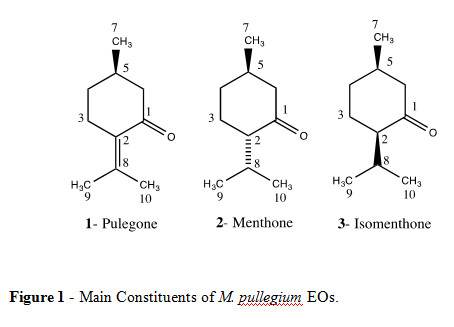
<body><![CDATA[<p>Phytochemicals with proven mosquito control activity can be highly helpful in integrated mosquito vector control programs (Sukumar <i>et al.,</i> 1991; Shaalan <i>et al.,</i> 2005). Recently, essential oils and their components, in particular, are subject of increasing interest, as they are relatively safe for the environment as well as to human health, have a wide acceptance by consumers and potential for multi-purpose use (Ormancey <i>et al.,</i> 2001). EOs have a broad spectrum of bioactivity due to the presence of several active constituents with different modes of action (Liu <i>et al</i>., 2006). Their lipophilic nature allows them to interfere with basic metabolic, biochemical, physiological and behavioral functions of insects.</p>     <p><i>Mentha</i> L. is a genus of aromatic perennial herbs belonging to the family Lamiaceae, distributed mostly in temperate and sub-temperate regions of the world. <i>Mentha pulegium</i> L. (pennyroyal) is native in N Africa, W Asia, Caucasus to the Kazakhstan and Turkmenistan, and Europe (GRIN 2010). The pennyroyal is a creeping plant smaller than other<i> Mentha</i> spp. and spreads rapidly through its underground root system (Bradley, 1992). Stems are red-purple and highly branched, leaves are scale-like and flowers have verticillasters arrangement (Morales <i>et al</i>., 2010). Besides medicinal applications, insecticidal properties of several <i>Mentha</i> spp. EOs are reported against ants, mosquitoes, wasps, hornets and cockroaches (Conceição <i>et al.,</i> 2010). Biological control of immature stages are thought to be the most powerful mean of reducing target population of dipteran and other agricultural pests (Rey <i>et al.,</i> 1999).</p>     <p>The monoterpene pulegone <b>1</b> (<a href="#f1">Figure 1</a>) is a common constituent of <i>Mentha</i> spp. EOs, being referred as one main compound also in <i>M. pulegium</i> where it occurs at percentages ranging from 25 to 92% (Pino <i>et al</i>., 1996; Franzios <i>et al.,</i> 1997; Lawrence, 1998; Aziz and Abbass, 2010).</p>     <p>&nbsp;</p> <a name="f1"></a> <img src="/img/revistas/rca/v38n2/38n2a06f1.jpg">     
<p></p>     <p>&nbsp;</p>     <p>This work intended to contribute to the evaluation of the potential use of pennyroyal EO in the control of malaria and dengue mosquito vector immatures, using plants from different geographical regions. Larvicidal effects of EOs of<i> M. pulegium</i> from Cape Verde and Portugal were assessed against mosquito vectors of malaria or dengue for the first time. Major compounds of these EOs were identified by <sup>13</sup>C NMR spectroscopy, GC and GC-MS.</p>     <p>&nbsp;</p>     <p><b>Material and methods</b></p>     <p><b><i>Plant material </i></b></p>     ]]></body>
<body><![CDATA[<p><i>Mentha pulegium</i> aerial parts from Portugal were collected in Évora and near Braga, during springtime. At Cape Verde, collections were made at the same season in Santo Antão Island. Taxonomic identification of the plant samples was performed using morphological external characters according to Franco (1984) and Morales <i>et al. </i>(2010) and they were compared with verified herbarium specimens. Voucher samples of <i>M. pulegium</i> were deposited at the Herbarium of the &#8220;Instituto de Investigação Científica Tropical (IICT)&#8221;, Lisbon, with identification, collection site, collectors name and collection numbers: <i>Mentha pulegium</i> L., Portugal, Évora, Joaquim Russo, nº 1 and<i> Mentha pulegium </i>L., Cabo Verde, Santo Antão, Manuel Delgado, nº 1.</p>     <p><b><i>Mosquito colonies</i></b></p>     <p>Mosquito colonies of the several species tested had been reared continuously for some generations in laboratory, free of exposure to insecticides. They were maintained at 27±1 ºC and 70±5% relative humidity under a photoperiod of 12:12-h (light/dark) in the insectarium of the Medical Parasitology Unit of the &#8220;Instituto de Higiene e Medicina Tropical&#8221; (IHMT) in Lisbon. Larvae were fed with Tetra Menu® fish food. The adults were reared in humidified cages and supplied with 10% sucrose solution. Mosquito females were weekly given the opportunity to blood fed on anesthetized rats to allow eggs development and oviposition, as neither of these species is autogenic.</p>     <p>Colonies of <i>Ae. aegypti</i> from Cape Verde, (Santiago) and Madeira Archipelagos (Funchal) were raised from eggs locally obtained from this species females. These colonies (pupae and adult forms) were maintained in security cameras for manipulation.</p>     <p><i>Anopheles atroparvus</i> colony was obtained from females collected in 1988 at Águas de Moura, Setúbal District (Portugal), after morphological observation of eggs to confirm species status. The colonies of <i>An. gambiae</i> strain Yaounde and <i>An. stephensi</i> strain SDA500 were both initiated with eggs from The Imperial College, and maintained at the insectarium of the &#8220;Centro de Malária e Outras Doenças Tropicais&#8221; (CMDT)/IHMT.<i> </i>Colonies of these two species were then installed in the Medical Parasitology Unit/IHMT from specimens gratefully provided by CMDT.</p>     <p><b><i>Essential oil isolation and chemical analysis </i></b></p>     <p>The EOs were isolated from <i>M. pulegium</i> aerial parts, by hydrodistillation for 3 h, using a modified Clevenger apparatus (EPCE 2010) and were stored in the dark at 4ºC until analysis. Pennyroyal EOs yield was calculated as the percentage of EO volume obtained by dry weight of plant used.</p>     <p>The most effective EOs samples were analyzed by <sup>13</sup>C NMR to identify their major compounds. <sup>13</sup>C NMR spectra were recorded on a Bruker Avance 400 spectrometer operating at 100.61 MHz, equipped with a 5 mm QNP probe at room temperature. Each EO sample (100 mg) was dissolved in deuterochloroform (0.5 mL) and all chemical shift values given in ppm (d) refer to tetramethylsilane (TMS) as internal standard Chemical shifts and peaks attribution of <sup>13</sup>C NMR spectra were made according to literature data (Kubeczka and Formá&#269;ek, 2002), and pulegone and menthone standards.</p>     <p>Essential oils were analyzed by Gas Chromatography (GC), for component quantification, and Gas Chromatography coupled to Mass Spectrometry (GC-MS) for component identification, as detailed in Rocha (2014).</p>     <p><b><i>Assay procedures</i></b></p>     ]]></body>
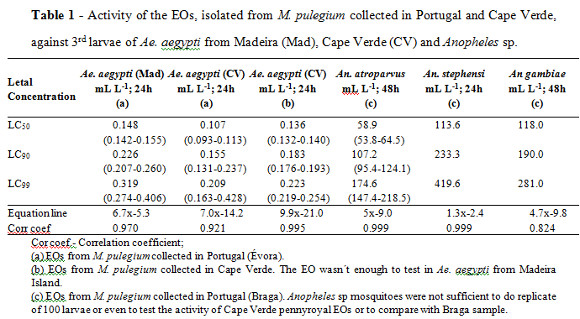
<body><![CDATA[<p>Larvicidal activity of <i>M. pulegium</i> EOs against <i>Anopheles </i>spp. and <i>Aedes aegypti</i> was assessed by using WHO standard method (WHO, 1981). For bioassays, sets of 25 third late instar larvae were exposed to at least four concentrations, in three replicates, of each homogeneous oil-water suspensions according to standard WHO procedure, at 27±1ºC and 70±5% relative humidity. Negative controls were conducted for each series by adding 1 ml of water and Tween® 20 per 249 mL of water. Mortality data were recorded 24h and 48h after exposure. Larvae unable to reach water surface when touched were considered dead. Larval mortality was reported as the average of three replicates; mortality percentage rates were corrected using Abbott's formula (Abbott, 1925), and they were used to calculate LC<sub>50</sub> and LC<sub>90</sub> values within a confidence interval of 95% (WHO, 1981).</p>     <p>Preliminary studies allowed selecting the concentrations of EO obtained from <i>M. pulegium</i> collected near Braga: 5.0, 10.0, 25.0 and 45.0 mL L<sup>-1</sup> for <i>An. atroparvus,</i> 10.0, 25.0, 50.0 and 80.0 mL L<sup>-1</sup> for <i>An. stephensi</i>, and 30.0, 35.0, 40.0 and 50.0 mL L<sup>-1</sup> for <i>An. gambiae. </i>Several concentration of<i> </i>EO from aerial parts of <i>M. pulegium</i> collected in<i> </i>Évora and Cape Verde (0.018, 0.020, 0.025, 0.030, 0.035 and 0.040 mL L<sup>-1</sup>) were evaluated against <i>Aedes aegypti</i> from Cape Verde and Madeira.</p>     <p><b><i>Statistical analysis</i></b></p>     <p>Data of EOs larvicidal effects were analyzed by computerized probit analysis, yielding a level of effectiveness of 50%, 90% and 99 % mortality at 95% confidence intervals (95% C.I.).</p>     <p>&nbsp;</p>     <p><b>Results</b></p>     <p>Hydrodistillation of <i>M. pulegium</i> aerial parts produced intense yellow EOs with a yield of 0.3% (v/dry wt) from Cape Verde and 0.6 % (v/dry wt) from Portugal.</p>     <p>Preliminary results of <i>M. pulegium</i> EOs larvicidal effects against <i>Ae. aegypti</i> larvae from Cape Verde and Madeira Island (<a href="#t1">Table 1</a>),<i> </i>showed that mosquitoes from Cape Verde, were more susceptible to pennyroyal EO (LC<sub>50</sub> and LC<sub>99</sub> of 0.107 mL L<sup>-1</sup> and 0.209 mL L<sup>-1</sup>) than those from Madeira (LC<sub>50</sub> and LC<sub>99</sub> of 0.148 mL L<sup>&#8209;1</sup> and 0.319 mL L<sup>-1</sup>).</p>     <p>&nbsp;</p> <a name="t1"></a> <img src="/img/revistas/rca/v38n2/38n2a06t1.jpg">     
<p></p>     ]]></body>
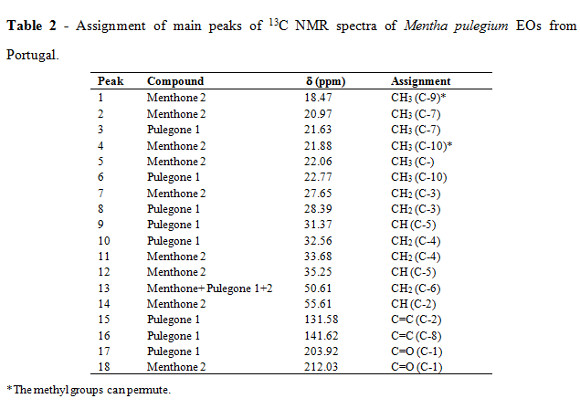
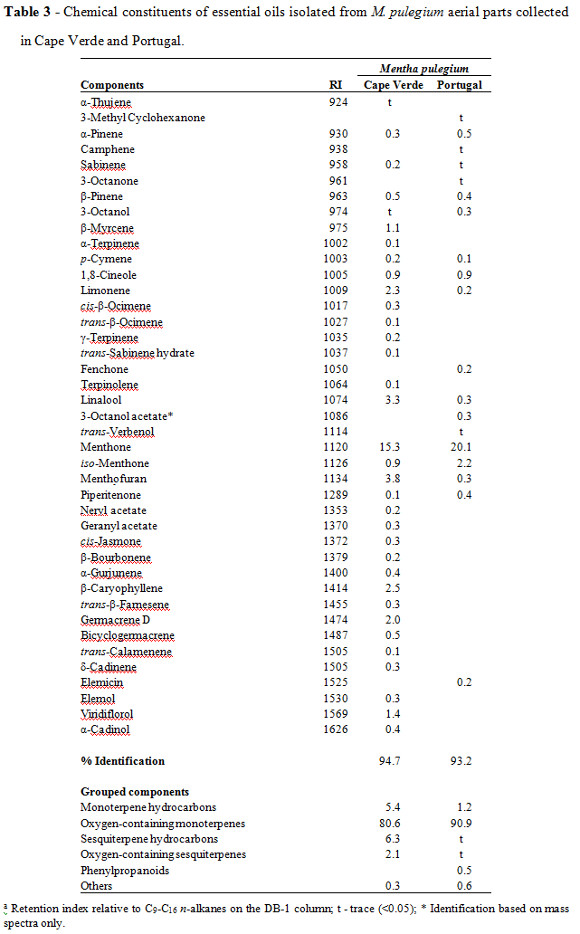
<body><![CDATA[<p>&nbsp;</p>     <p>Bioassays using EOs isolated from pennyroyal collected in Braga showed low mortality rates on <i>An. stephensi </i>and <i>An. gambiae </i>larvae. Although it was tested a range of greater dilution in those species and it was not possible to test comparable amounts due to a lack of material (either mosquitoes or enough volumes of essential oils) the LC50 and 90 were higher for theses species. However, the results obtained against <i>An. atroparvus</i> larvae 48h after treatment allow considering the use of <i>M. pulegium</i> promissory for this species (<a href="#t1">Table 1</a>).</p>     <p>The EOs of<i> M. pulegium </i>from Évora and Cape Verde exhibited high larvicidal activity against <i>Ae. aegypti</i> from Cape Verde, so chemical characterization by <sup>13</sup>C NMR, GC and GC-MS were performed.</p>     <p>Qualitative <sup>13</sup>C NMR analysis of this EO allowed the identification of the major compounds being pulegone <b>1 </b>the main constituent, followed by menthone <b>2 </b>and traces of its isomer, isomenthone <b>3 </b>(<a href="#t2">Table 2</a>, <a href="#f1">Figure 1</a>). These results confirmed the characterization performed by GC and GC-MS, where pulegone (61%) and menthone (20%) were the main EO constituents (<a href="#t3">Table 3</a>). The GC an GC-MS analyze of Cape Verde EO, revealed menthol (30%), menthone (15%), menthyl acetate (15%) as the main constituents, followed by pulegone (4%) (<a href="#t3">Table 3</a>).</p>     <p>&nbsp;</p> <a name="t2"></a> <img src="/img/revistas/rca/v38n2/38n2a06t2.jpg">     
<p></p>     <p>&nbsp;</p>     <p>&nbsp;</p> <a name="t3"></a> <img src="/img/revistas/rca/v38n2/38n2a06t3.jpg">     
<p></p>     <p>&nbsp;</p>     ]]></body>
<body><![CDATA[<p><b>Discussion</b></p>     <p><i>Mentha pulegium</i> EOs yield ranged between 0.3 and 0.6 % (v/dry wt.), which is in agreement with those reported by Kofidis <i>et al.</i> (2004), 0.1-2%, for the EO from wild <i>M. spicata </i>L., grown in Greece. Nevertheless, differences in the yield of <i>Mentha</i> EOs with respect to geographical regions were reported by Ijaz (2009).</p>     <p>Major differences were found between the evaluated <i>M. pulegium</i> EOs. Cape Verde <i>M. pulegium</i> EO main components were menthol (30%), menthone (15%) and menthyl acetate (15%), whereas Évora<i> M. pulegium</i> EO was mainly composed by pulegone (61%) and menthone (20%).</p>     <p>The data obtained from the analysis of <i>M. pulegium</i> EO from Portugal are in agreement with the results published by Lopes <i>et al</i>. (2010). In this study, the EOs from 18 <i>M. pulegium</i> samples from Portugal were evaluated, showing 96-97% of oxygenated monoterpenes, and the dominance of pulegone (66-87%), menthone (6-20%) and <i>iso</i>-menthone (0.4 to 17%). However, comparatively to <i>M. pulegium</i> EO from other populations also of Portugal, revealed different percentages of menthone and pulegone (Teixeira <i>et al</i>., 2012; Rodrigues <i>et al., </i>2013). The constituents of <i>M. pulegium</i> EO have been subjected to a number of studies which have presented a variance in its constituents depending on the region of cultivation and there have been some differences in the components from different countries. It has been found that <i>M. pulegium</i> EO from Bulgaria contains essentially pulegone (43-45%); from Uruguay: pulegone (73%), isomenthone (13%); from Egypt: pulegone (44%), piperitone (12%); from Tunisia: pulegone (42%), isomenthone (11%) Boukhebti et al. (2011).</p>     <p><i>Mentha pulegium</i> EOs from Portugal showed high larvicidal effects against <i>Ae. aegypti</i> from Cape Verde (LC<sub>50</sub> and LC<sub>99</sub> of 0.107 mL L<sup>-1</sup> and 0.209 mL L<sup>-1</sup>) and <i>Anopheles stephensi</i> (<a href="#t1">Table 1</a>) with registered mortality 24-h after contact and 100% mortality 48-h after treatment (result not presented in <a href="#t1">Table 1</a>).</p>     <p><i>Ae. aegypti</i> from Cape Verde seemed to be more susceptible to pennyroyal EOs than the same species introduced in Madeira from Venezuela (Seixas e<i>t al.</i>, 2013) which could be related to intrinsic genetics character of mosquito. The bioactivity of phytochemicals against mosquito larvae can vary significantly depending on plant species, plant part and age of plant part, solvent used in extraction and mosquito species (Sukumar <i>et al.,</i> 1991).</p>     <p>Pennyroyal EOs is reported as bioactive against fleas, ants, lice, mosquitoes, ticks and moths. Pulegone from <i>M. pulegium </i>is considered one of the most active constituents against insects. Nevertheless reports on menthone studies against insects are well known (Koul <i>et al.,</i> 2008). In this study menthone exhibited very low activity against 3<sup>rd</sup> instar larvae and pulegone high activity (results not shown). Although pulegone and menthone are reported as bioactive and useful to pest control (Verdian-Rivi, 2008) scarce references to their larvicidal effects on mosquito vectors of malaria and dengue were find.</p>     <p>Although the World Health Organization (WHO) does not specify any criteria for classifying the larvicidal potential of new products, some authors use the values of the minimum lethal concentration that eliminates 50% of the population (LC<sub>50</sub>) as a criterion for activity. Specifically, if LC<sub>50</sub>&lt;50 mg L<sup>-1</sup> the product is considered very active, if 50 &lt; LC<sub>50 </sub>&lt; 100 mg L<sup>&#8209;1</sup> the product is considered active, and when LC<sub>50 </sub>&gt; 750 mg L<sup>-1</sup> the product is considered inactive (Komalamisra <i>et al</i>., 2005; Magalhães <i>et al</i>., 2010; Dias<i> et al.,</i> 2014). Based on this norm the pennyroyal EOs from Cape Verde and Portugal are in the class of active. However, the highest larvicidal activity corresponds to the EO from Portugal pennyroyal (LC<sub>50</sub>= 0.107 mL L<sup>-1</sup>, which is equivalent to 20.1 mg L<sup>-1</sup>).</p>     <p>Mortality of larvae exposed to &#8220;insecticidal&#8221; compounds may be the result of several details, including structure, function, and biochemistry of the insect cuticle in relation to the molting cycle. It is well known that many EOs and their constituents affect biochemical processes, which specifically disrupt the endocrinologic balance of insects. They may be neurotoxic or may act as insect growth regulators, disrupting the normal process of morphogenesis (Balandrin and Klocke, 1988).<i> </i>According to Cantrell <i>et al</i>. (2010), larvicide compounds act by absorption through the cuticle, via the respiratory tract, and/or enter by ingestion via the gastrointestinal tract. Once in the interior of the larva, the substances can reach the site of action or can cause systemic effects by diffusion into different tissues (Souza e<i>t al.,</i> 2012).</p>     <p>&nbsp;</p>     ]]></body>
<body><![CDATA[<p><b>Conclusion</b></p>     <p>Present results are encouraging and clearly demonstrate the potential of <i>M. pulegium</i> essential oil as possible larvicidal against <i>Aedes aegypti</i> and <i>Anopheles</i> spp.. Further studies have to be focus on bioassay with isolates standing in phytochemical laboratories in that the mode of action of bio products will be evaluated and there are certainly many interesting activities yet to be discovered.</p>     <p>&nbsp;</p>     <p><b>Acknowledgements</b></p>     <p>This work was supported by Diara Rocha PhD Grant, Fundação Calouste Gulbenkian (Neglected Tropical Diseases for PALOP students) by UPMM/IHMT funds and National Funds through the FCT under Pest-OE/EQB/LA0023/2011 and Pest-OE/QUI/UI0612/2013.</p>     <p>&nbsp;</p>     <p><b>References</b></p>     <!-- ref --><p>Abbott, W.S. (1925) - A method of computing the effectiveness of an insecticide. <i>Journal of Economy Entomology,</i> vol.18, n. 1, p. 265-267.    &nbsp;&nbsp;&nbsp;&nbsp;&nbsp;&nbsp;&nbsp;&nbsp;[&#160;<a href="javascript:void(0);" onclick="javascript: window.open('/scielo.php?script=sci_nlinks&ref=000090&pid=S0871-018X201500020000600001&lng=','','width=640,height=500,resizable=yes,scrollbars=1,menubar=yes,');">Links</a>&#160;]<!-- end-ref --></p>     <!-- ref --><p>Aziz, E.E. and Abbass, M.H. (2010) - Chemical composition and efficiency of five essential oil against <i>Callosobruchus maculates</i> (F.) on <i>Vigina radiate</i> seeds. <i>American Eurasian Journal Agriculture Environmental Science,</i> vol. 8, n. 4, p. 411-419.    &nbsp;&nbsp;&nbsp;&nbsp;&nbsp;&nbsp;&nbsp;&nbsp;[&#160;<a href="javascript:void(0);" onclick="javascript: window.open('/scielo.php?script=sci_nlinks&ref=000092&pid=S0871-018X201500020000600002&lng=','','width=640,height=500,resizable=yes,scrollbars=1,menubar=yes,');">Links</a>&#160;]<!-- end-ref --></p>     <!-- ref --><p>Balandrin, M.F. and Klocke, J.A. (1988) - Medicinal, aromatic, and industrial materials from plants, <i>In</i>: Bajaj, Y.P.S. (Ed.). <i>Biotechnology in agriculture and forestry, medicinal and aromatic plants I</i>. Berlin, Heidelberg, Springer-Verlag, p. 3-36.    &nbsp;&nbsp;&nbsp;&nbsp;&nbsp;&nbsp;&nbsp;&nbsp;[&#160;<a href="javascript:void(0);" onclick="javascript: window.open('/scielo.php?script=sci_nlinks&ref=000094&pid=S0871-018X201500020000600003&lng=','','width=640,height=500,resizable=yes,scrollbars=1,menubar=yes,');">Links</a>&#160;]<!-- end-ref --></p>     <!-- ref --><p>Basseri, H.R.; Moosakazemi, S.H.; Yousefi, S.; Mohebali, M.; Hajaran H. and Jedari, M. (2005) - Anthropophly of malaria vectors in Kahnooj district, south of Kerman, Iran. <i>Iranian Journal Public Health</i>,<i> </i>vol. 34, n. 2, p. 27-35.    &nbsp;&nbsp;&nbsp;&nbsp;&nbsp;&nbsp;&nbsp;&nbsp;[&#160;<a href="javascript:void(0);" onclick="javascript: window.open('/scielo.php?script=sci_nlinks&ref=000096&pid=S0871-018X201500020000600004&lng=','','width=640,height=500,resizable=yes,scrollbars=1,menubar=yes,');">Links</a>&#160;]<!-- end-ref --></p>     <!-- ref --><p>Besansky, N.J.; Powell, J.R.; Caccone, A.; Hamm, D.M.; Scott, J.A. and Collins, F.H. (1994) - Molecular phylogeny of the <i>Anopheles gambiae</i> complex suggests genetic introgression between principal malaria vectors. <i>Proceedings of the National Academy of sciences of the United States of America,</i> vol. 91, n.15, p. 6885-6888.    &nbsp;&nbsp;&nbsp;&nbsp;&nbsp;&nbsp;&nbsp;&nbsp;[&#160;<a href="javascript:void(0);" onclick="javascript: window.open('/scielo.php?script=sci_nlinks&ref=000098&pid=S0871-018X201500020000600005&lng=','','width=640,height=500,resizable=yes,scrollbars=1,menubar=yes,');">Links</a>&#160;]<!-- end-ref --></p>     <!-- ref --><p>Boukhebti, H.; Chaker, A.N.; Belhadj H.; Sahli, F.; Ramdhani, M.; Laouer, H. and Harzallah, D. (2011) - Chemical composition and antibacterial activity of <i>Mentha pulegium</i> L. and <i>Mentha spicata</i> L. essential oils. <i>Der Pharmacia Lettre</i>, vol. 3, n. 4, p. 267-275.    &nbsp;&nbsp;&nbsp;&nbsp;&nbsp;&nbsp;&nbsp;&nbsp;[&#160;<a href="javascript:void(0);" onclick="javascript: window.open('/scielo.php?script=sci_nlinks&ref=000100&pid=S0871-018X201500020000600006&lng=','','width=640,height=500,resizable=yes,scrollbars=1,menubar=yes,');">Links</a>&#160;]<!-- end-ref --></p>     <!-- ref --><p>Bradley, P.R. (1992) - <i>British herbal compendium</i>, vol. 1. Bournemouth, British Herbal Medicine Association, 239 p.    &nbsp;&nbsp;&nbsp;&nbsp;&nbsp;&nbsp;&nbsp;&nbsp;[&#160;<a href="javascript:void(0);" onclick="javascript: window.open('/scielo.php?script=sci_nlinks&ref=000102&pid=S0871-018X201500020000600007&lng=','','width=640,height=500,resizable=yes,scrollbars=1,menubar=yes,');">Links</a>&#160;]<!-- end-ref --></p>     <!-- ref --><p>Bruce-Chwatt, J.L.; Garett-Jones, C. and Weitz, B. (1966) - Ten years study (1955-1964) of host selection by Anopheline mosquitoes. <i>Bulletin World Health Organization</i>, vol. 35, n. 2, p. 405-439.    &nbsp;&nbsp;&nbsp;&nbsp;&nbsp;&nbsp;&nbsp;&nbsp;[&#160;<a href="javascript:void(0);" onclick="javascript: window.open('/scielo.php?script=sci_nlinks&ref=000104&pid=S0871-018X201500020000600008&lng=','','width=640,height=500,resizable=yes,scrollbars=1,menubar=yes,');">Links</a>&#160;]<!-- end-ref --></p>     <!-- ref --><p>Cambournac, F.J. (1994) -<b> </b>Contribution to the history of malaria epidemiology and control in Portugal and some other places. <i>Parassitologia</i>, vol. 36, n 1-2, p.<b> </b>215-222.    &nbsp;&nbsp;&nbsp;&nbsp;&nbsp;&nbsp;&nbsp;&nbsp;[&#160;<a href="javascript:void(0);" onclick="javascript: window.open('/scielo.php?script=sci_nlinks&ref=000106&pid=S0871-018X201500020000600009&lng=','','width=640,height=500,resizable=yes,scrollbars=1,menubar=yes,');">Links</a>&#160;]<!-- end-ref --></p>     <!-- ref --><p>Cantrell, C.L.; Pridgeon, J.W.; Fronczek, F.R. and Becnel, J.J. (2010) - Structure activity relationship studies on derivatives of Eudesmanolides from <i>Inula helenium</i> as toxicants against Aedes aegypti larvae and adults. <i>Chemistry Biodivers</i>ity, vol. 7, n. 7, p. 1681&#8211;1697.    &nbsp;&nbsp;&nbsp;&nbsp;&nbsp;&nbsp;&nbsp;&nbsp;[&#160;<a href="javascript:void(0);" onclick="javascript: window.open('/scielo.php?script=sci_nlinks&ref=000108&pid=S0871-018X201500020000600010&lng=','','width=640,height=500,resizable=yes,scrollbars=1,menubar=yes,');">Links</a>&#160;]<!-- end-ref --></p>     <!-- ref --><p>Chuaycharoensuk, T.; Juntarajumnong, W.; Boonyuan, W.; Bangs M.J.; Akratanakul, P.; Thammapalo S.; Jirakanjanakit, N.; Tanasinchayakul, S. and Chareonviriyaphap T. (2011) - Frequency of pyrethroid resistance in <i>Aedes aegypti </i>and <i>Aedes albopictus </i>(Diptera: Culicidae) in Thailand.<i> Journal of Vector Ecology, </i>vol. 36, n. 1, p. 204-212.    &nbsp;&nbsp;&nbsp;&nbsp;&nbsp;&nbsp;&nbsp;&nbsp;[&#160;<a href="javascript:void(0);" onclick="javascript: window.open('/scielo.php?script=sci_nlinks&ref=000110&pid=S0871-018X201500020000600011&lng=','','width=640,height=500,resizable=yes,scrollbars=1,menubar=yes,');">Links</a>&#160;]<!-- end-ref --></p>     <!-- ref --><p>Conceição, C.; Matos, O.; Barbosa, A. and Mexia, A. (2010) - Potential of plant products as protectants of stored maize against <i>Sitophilus zeamais</i> Motschulsky (Coleoptera:Curculionidae). In: <i>Proceedings 20<sup>th</sup> IWCSPP</i>, 425, p. 618-624.    &nbsp;&nbsp;&nbsp;&nbsp;&nbsp;&nbsp;&nbsp;&nbsp;[&#160;<a href="javascript:void(0);" onclick="javascript: window.open('/scielo.php?script=sci_nlinks&ref=000112&pid=S0871-018X201500020000600012&lng=','','width=640,height=500,resizable=yes,scrollbars=1,menubar=yes,');">Links</a>&#160;]<!-- end-ref --><i> </i></p>     <!-- ref --><p>Davidson, G. (1958) - Studies on insecticide resistance in anopheline mosquitoes. <i>Bulletin World Health Organization</i>, vol. 18, n. 4, p. 579-621.    &nbsp;&nbsp;&nbsp;&nbsp;&nbsp;&nbsp;&nbsp;&nbsp;[&#160;<a href="javascript:void(0);" onclick="javascript: window.open('/scielo.php?script=sci_nlinks&ref=000114&pid=S0871-018X201500020000600013&lng=','','width=640,height=500,resizable=yes,scrollbars=1,menubar=yes,');">Links</a>&#160;]<!-- end-ref --></p>     <!-- ref --><p>Dias, C.N. and Moraes, D.F.C. (2014) - Essential oils and their compounds as <i>Aedes aegypti</i> L. (Diptera: Culicidae) larvicides: review. <i>Parasitology Resource </i>113, vol 2, p. 565-92.    &nbsp;&nbsp;&nbsp;&nbsp;&nbsp;&nbsp;&nbsp;&nbsp;[&#160;<a href="javascript:void(0);" onclick="javascript: window.open('/scielo.php?script=sci_nlinks&ref=000116&pid=S0871-018X201500020000600014&lng=','','width=640,height=500,resizable=yes,scrollbars=1,menubar=yes,');">Links</a>&#160;]<!-- end-ref --></p>     <!-- ref --><p>EPCE (2010) - European Pharmacopoeia by Council of Europe, European Pharmacopoeia Commission; European Directorate for the Quality of Medicines &amp; Healthcare, 7<sup>th</sup> Edition. Strasbourg. [Cited 1<sup>st</sup> July of 2013]. Available from <a href="http://www.worldcat.org/search?q=au%3AEuropean+Directorate+for+the+Quality+of+%20Medicines+%20%26+Healthcare.&amp;qt=hot_author%202010"target="_blank">http://www.worldcat.org/search?q=au%3AEuropean+Directorate+for+the+Quality+of+Medicines+%26+Healthcare.&amp;qt=hot_author2010</a>.    &nbsp;&nbsp;&nbsp;&nbsp;&nbsp;&nbsp;&nbsp;&nbsp;[&#160;<a href="javascript:void(0);" onclick="javascript: window.open('/scielo.php?script=sci_nlinks&ref=000118&pid=S0871-018X201500020000600015&lng=','','width=640,height=500,resizable=yes,scrollbars=1,menubar=yes,');">Links</a>&#160;]<!-- end-ref --></p>     <!-- ref --><p>Fradin, M.S. and Day, J.F. (2002) - Comparative efficacy of insect repellents against mosquitoes bites. <i>The New England Journal of Medicine</i>, vol. 347, n. 1, p. 13-18.    &nbsp;&nbsp;&nbsp;&nbsp;&nbsp;&nbsp;&nbsp;&nbsp;[&#160;<a href="javascript:void(0);" onclick="javascript: window.open('/scielo.php?script=sci_nlinks&ref=000120&pid=S0871-018X201500020000600016&lng=','','width=640,height=500,resizable=yes,scrollbars=1,menubar=yes,');">Links</a>&#160;]<!-- end-ref --></p>     <!-- ref --><p>Franco, J.A. (1984) -<i> Nova Flora de Portugal (Continente e Açores</i>), vol. 2. Lisboa, Soc. Astória Lda, 660 p.    &nbsp;&nbsp;&nbsp;&nbsp;&nbsp;&nbsp;&nbsp;&nbsp;[&#160;<a href="javascript:void(0);" onclick="javascript: window.open('/scielo.php?script=sci_nlinks&ref=000122&pid=S0871-018X201500020000600017&lng=','','width=640,height=500,resizable=yes,scrollbars=1,menubar=yes,');">Links</a>&#160;]<!-- end-ref --></p>     <!-- ref --><p>Franzios, G.; Mirotsou, M.; Hatziapostolou, E.; Kral, J.; Scouras, Z.G.; Mavragani-Tsipidou, P. (1997)- Insecticidal and genotoxic activities of pennyroyal essential oils. <i>Journal Agriculture Food Chemistry,</i> vol. 45, n. 7, p. 2690-2694.    &nbsp;&nbsp;&nbsp;&nbsp;&nbsp;&nbsp;&nbsp;&nbsp;[&#160;<a href="javascript:void(0);" onclick="javascript: window.open('/scielo.php?script=sci_nlinks&ref=000124&pid=S0871-018X201500020000600018&lng=','','width=640,height=500,resizable=yes,scrollbars=1,menubar=yes,');">Links</a>&#160;]<!-- end-ref --></p>     <!-- ref --><p>GRIN. Germplasm Resources Information Network (Online Database) (2010) - <i>National germplasm resources laborator</i> (on line)<i>. </i>Beltsville, Maryland.<i> </i>USDA, ARS, National Genetic Resources Program. [Cited 5<sup>th</sup> July of 2013].<i> </i>Available at: <a href="http://www.ars-grin.gov/cgi-bin/npgs/html/taxon.pl24079"target="_blank">http://www.ars-grin.gov/cgi-bin/npgs/html/taxon.pl24079</a>.    &nbsp;&nbsp;&nbsp;&nbsp;&nbsp;&nbsp;&nbsp;&nbsp;[&#160;<a href="javascript:void(0);" onclick="javascript: window.open('/scielo.php?script=sci_nlinks&ref=000126&pid=S0871-018X201500020000600019&lng=','','width=640,height=500,resizable=yes,scrollbars=1,menubar=yes,');">Links</a>&#160;]<!-- end-ref --></p>     <!-- ref --><p>Gubler, D.J. (1998) - Resurgent vector borne diseases as a global health problem. <i>Emerging Infecious Diseases Journal</i>, vol. 4, n. 3, p. 442-450.    &nbsp;&nbsp;&nbsp;&nbsp;&nbsp;&nbsp;&nbsp;&nbsp;[&#160;<a href="javascript:void(0);" onclick="javascript: window.open('/scielo.php?script=sci_nlinks&ref=000128&pid=S0871-018X201500020000600020&lng=','','width=640,height=500,resizable=yes,scrollbars=1,menubar=yes,');">Links</a>&#160;]<!-- end-ref --></p>     <!-- ref --><p>Harbach, R.E. (2004) - The classification of genus <i>Anopheles </i>(Diptera: Culicidae): a working hypothesis of phylogenetic relationships. <i>Bulletin of Entomological Research</i>, vol. 94, n. 6, p. 537-553.    &nbsp;&nbsp;&nbsp;&nbsp;&nbsp;&nbsp;&nbsp;&nbsp;[&#160;<a href="javascript:void(0);" onclick="javascript: window.open('/scielo.php?script=sci_nlinks&ref=000130&pid=S0871-018X201500020000600021&lng=','','width=640,height=500,resizable=yes,scrollbars=1,menubar=yes,');">Links</a>&#160;]<!-- end-ref --></p>     <!-- ref --><p>Ijaz, H.A. (2009) - <i>Characterization and biological activities of essential oils of some species of Lamiaceae.</i> (Phd Thesis). Faisalabad, Pakistan, University of Agriculture, 365 p.    &nbsp;&nbsp;&nbsp;&nbsp;&nbsp;&nbsp;&nbsp;&nbsp;[&#160;<a href="javascript:void(0);" onclick="javascript: window.open('/scielo.php?script=sci_nlinks&ref=000132&pid=S0871-018X201500020000600022&lng=','','width=640,height=500,resizable=yes,scrollbars=1,menubar=yes,');">Links</a>&#160;]<!-- end-ref --></p>     <!-- ref --><p>Kofidis, G.; Bosabalidis, A. and Kokkini S. (2004) - Seasonal variation of essential oils in a linalool rich chemotype of <i>Mentha spicata</i> grown wild in Greece. <i>Journal of Essential Oil Research</i>, vol. 16, n. 5, p. 469-472.    &nbsp;&nbsp;&nbsp;&nbsp;&nbsp;&nbsp;&nbsp;&nbsp;[&#160;<a href="javascript:void(0);" onclick="javascript: window.open('/scielo.php?script=sci_nlinks&ref=000134&pid=S0871-018X201500020000600023&lng=','','width=640,height=500,resizable=yes,scrollbars=1,menubar=yes,');">Links</a>&#160;]<!-- end-ref --></p>     <!-- ref --><p>Komalamisra, N., Trongtokit, Y., Rongsriyam, Y. and Apiwathnasorn, C. (2005) - Screening for larvicidal activity in some Thai plants against four mosquito vector species. Southeast <i>Asian</i>.<i> Journal of Tropical Medicine</i> Public Health Vol. 36, p. 1412-1422.    &nbsp;&nbsp;&nbsp;&nbsp;&nbsp;&nbsp;&nbsp;&nbsp;[&#160;<a href="javascript:void(0);" onclick="javascript: window.open('/scielo.php?script=sci_nlinks&ref=000136&pid=S0871-018X201500020000600024&lng=','','width=640,height=500,resizable=yes,scrollbars=1,menubar=yes,');">Links</a>&#160;]<!-- end-ref --></p>     <!-- ref --><p>Koul, O.; Walia, S. and Dhaliwal, G.S. (2008) - Essential oils as green pesticides: Potential and constraints.<b> </b><i>Biopesticide International, </i>vol. 4, n. 1, p. 63<b>&#8211;</b>84.    &nbsp;&nbsp;&nbsp;&nbsp;&nbsp;&nbsp;&nbsp;&nbsp;[&#160;<a href="javascript:void(0);" onclick="javascript: window.open('/scielo.php?script=sci_nlinks&ref=000138&pid=S0871-018X201500020000600025&lng=','','width=640,height=500,resizable=yes,scrollbars=1,menubar=yes,');">Links</a>&#160;]<!-- end-ref --></p>     <!-- ref --><p>Kubeczka, K.-H. and Formá&#269;ek, V. (2002) - <i>Essential Oils Analysis by Capillary Gas Chromatography and Carbon-13 NMR Spectroscopy</i>, 2nd Ed., New York, John Wiley &amp; Sons, Ltd., 480 p.    &nbsp;&nbsp;&nbsp;&nbsp;&nbsp;&nbsp;&nbsp;&nbsp;[&#160;<a href="javascript:void(0);" onclick="javascript: window.open('/scielo.php?script=sci_nlinks&ref=000140&pid=S0871-018X201500020000600026&lng=','','width=640,height=500,resizable=yes,scrollbars=1,menubar=yes,');">Links</a>&#160;]<!-- end-ref --></p>     <!-- ref --><p>Lawrence, B.M. (1998) - Progress in essential oils. <i>Perfumer and flavorist</i>, vol. 23, p. 63-68.    &nbsp;&nbsp;&nbsp;&nbsp;&nbsp;&nbsp;&nbsp;&nbsp;[&#160;<a href="javascript:void(0);" onclick="javascript: window.open('/scielo.php?script=sci_nlinks&ref=000142&pid=S0871-018X201500020000600027&lng=','','width=640,height=500,resizable=yes,scrollbars=1,menubar=yes,');">Links</a>&#160;]<!-- end-ref --></p>     <!-- ref --><p>Liu, C.H.; Mishra, A.K.; Tan, R.X.; Tang, C.; Yang, H. and Shen, Y.F. (2006) - Repellent and insecticidal activities of essential oils from <i>Artemisia princeps</i> and <i>Cinnamomum camphora</i> and their effect on seed germination of wheat and broad bean. <i>Bioresource Technology</i>, vol. 97, n. 15, p. 1969-1973.    &nbsp;&nbsp;&nbsp;&nbsp;&nbsp;&nbsp;&nbsp;&nbsp;[&#160;<a href="javascript:void(0);" onclick="javascript: window.open('/scielo.php?script=sci_nlinks&ref=000144&pid=S0871-018X201500020000600028&lng=','','width=640,height=500,resizable=yes,scrollbars=1,menubar=yes,');">Links</a>&#160;]<!-- end-ref --></p>     <!-- ref --><p>Lopes V.R; Barata A.M.; Rocha F., Pedro, L.G.; Barroso, J.G.; Figueiredo, A.C. (2010) &#8211; Morphological and Chemical variability assessment for Portuguese <i>Mentha pulegium</i> L (pennyroyal) accession. In: <i>Proceedings of the VIII International Ethnobotany Symposium</i>, Lisboa, Portugal, p. 573-583.    &nbsp;&nbsp;&nbsp;&nbsp;&nbsp;&nbsp;&nbsp;&nbsp;[&#160;<a href="javascript:void(0);" onclick="javascript: window.open('/scielo.php?script=sci_nlinks&ref=000146&pid=S0871-018X201500020000600029&lng=','','width=640,height=500,resizable=yes,scrollbars=1,menubar=yes,');">Links</a>&#160;]<!-- end-ref --></p>     <!-- ref --><p>Magalhães, L.A.M.; Lima, M.P.; Marques, M.O.M.; Facanali, R., Pinto, A.C.S. and Tadei, W.P. (2010) - Chemical composition and larvicidal activity against <i>Aedes aegypti</i> larvae of essential oils from four Guarea species. <i>Molecules. </i>Vol. 15, n.8, p 5734-5741.    &nbsp;&nbsp;&nbsp;&nbsp;&nbsp;&nbsp;&nbsp;&nbsp;[&#160;<a href="javascript:void(0);" onclick="javascript: window.open('/scielo.php?script=sci_nlinks&ref=000148&pid=S0871-018X201500020000600030&lng=','','width=640,height=500,resizable=yes,scrollbars=1,menubar=yes,');">Links</a>&#160;]<!-- end-ref --></p>     <!-- ref --><p>Morales, A.; Quintanar, A. and Cabezas, F. (2010) - <i>Labiatae. </i>In: Castroviejo, S. (ed.) -<b> </b><i>Flora Ibérica. Plantas vasculares de la Península Ibérica e Islas Baleares.</i>, vol. 12. Madrid, Real Jardín Botánico, C.S.I.C., p. 25-484. [Cited 10<sup>th </sup>June of 2013]. Available from: <a href="http://www.floraiberica.es/floraiberica/texto/pdfs/12_140_00_LABIATAE"target="_blank">http://www.floraiberica.es/floraiberica/texto/pdfs/12_140_00_LABIATAE</a> .    &nbsp;&nbsp;&nbsp;&nbsp;&nbsp;&nbsp;&nbsp;&nbsp;[&#160;<a href="javascript:void(0);" onclick="javascript: window.open('/scielo.php?script=sci_nlinks&ref=000150&pid=S0871-018X201500020000600031&lng=','','width=640,height=500,resizable=yes,scrollbars=1,menubar=yes,');">Links</a>&#160;]<!-- end-ref --></p>     <!-- ref --><p>Ormancey, X.; Sisalli, S. and Coutiere, P. (2001) - Formulation of essential oils in functional perfumery. <i>Parfums Cosmetiques Actualites</i>, vol. 157, p. 30-40.    &nbsp;&nbsp;&nbsp;&nbsp;&nbsp;&nbsp;&nbsp;&nbsp;[&#160;<a href="javascript:void(0);" onclick="javascript: window.open('/scielo.php?script=sci_nlinks&ref=000152&pid=S0871-018X201500020000600032&lng=','','width=640,height=500,resizable=yes,scrollbars=1,menubar=yes,');">Links</a>&#160;]<!-- end-ref --></p>     <!-- ref --><p>Pino, J.A.; Rosado, A. and Fuentes, V. (1996) - Chemical composition of the essential oil of <i>Mentha pulegium</i> L. from Cuba. <i>Journal Essential Oil Resource,</i> vol. 8, n. 3, p. 295-296.    &nbsp;&nbsp;&nbsp;&nbsp;&nbsp;&nbsp;&nbsp;&nbsp;[&#160;<a href="javascript:void(0);" onclick="javascript: window.open('/scielo.php?script=sci_nlinks&ref=000154&pid=S0871-018X201500020000600033&lng=','','width=640,height=500,resizable=yes,scrollbars=1,menubar=yes,');">Links</a>&#160;]<!-- end-ref --></p>     <!-- ref --><p>Polsomboon, S.; Grieco, J.P.; Achee, N.L.; Chauhan, A.R.; Tanasinchayakul, S.; Pothikasikorn, J. and Chareonviriyaphap T. (2008) - Behavioral responses of catnip (<i>Nepeta cataria</i>) by two species of mosquitoes, <i>Aedes aegypti </i>and <i>Anopheles harrisoni, </i>in Thailand. <i>Journal American Mosquito Control Association</i>, vol. 24, n. 4, p. 513-519.    &nbsp;&nbsp;&nbsp;&nbsp;&nbsp;&nbsp;&nbsp;&nbsp;[&#160;<a href="javascript:void(0);" onclick="javascript: window.open('/scielo.php?script=sci_nlinks&ref=000156&pid=S0871-018X201500020000600034&lng=','','width=640,height=500,resizable=yes,scrollbars=1,menubar=yes,');">Links</a>&#160;]<!-- end-ref --></p>     <!-- ref --><p>Ponçon, N.; Toty, C.; L'Ambert, G.; Le Goff, G.; Brengues, C.; Schaffner, F. and Fontenille, D. (2007) - Biology and dynamics of potential malaria vectors in Southern France. <i>Malaria Journal,</i> vol. 6,<b> </b>18 p.    &nbsp;&nbsp;&nbsp;&nbsp;&nbsp;&nbsp;&nbsp;&nbsp;[&#160;<a href="javascript:void(0);" onclick="javascript: window.open('/scielo.php?script=sci_nlinks&ref=000158&pid=S0871-018X201500020000600035&lng=','','width=640,height=500,resizable=yes,scrollbars=1,menubar=yes,');">Links</a>&#160;]<!-- end-ref --></p>     <!-- ref --><p>Power, A.G. (2010) - Ecosystem services and agriculture: trade-offs and synergies. <i>Philosophical Transaction Royal Society</i>, vol. 365, n. 1554, p. 2959-2971.    &nbsp;&nbsp;&nbsp;&nbsp;&nbsp;&nbsp;&nbsp;&nbsp;[&#160;<a href="javascript:void(0);" onclick="javascript: window.open('/scielo.php?script=sci_nlinks&ref=000160&pid=S0871-018X201500020000600036&lng=','','width=640,height=500,resizable=yes,scrollbars=1,menubar=yes,');">Links</a>&#160;]<!-- end-ref --></p>     <!-- ref --><p>Rey, D.; Pautou, M.P. and Meyran, J.C. (1999) - Hystopathological effects of tannic acid on the midgut epithelium of some aquatic Diptera larvae. <i>Journal Invertebrate Pathology.</i>, vol. 73, n. 2, p.173-181.    &nbsp;&nbsp;&nbsp;&nbsp;&nbsp;&nbsp;&nbsp;&nbsp;[&#160;<a href="javascript:void(0);" onclick="javascript: window.open('/scielo.php?script=sci_nlinks&ref=000162&pid=S0871-018X201500020000600037&lng=','','width=640,height=500,resizable=yes,scrollbars=1,menubar=yes,');">Links</a>&#160;]<!-- end-ref --></p>     <!-- ref --><p>Rocha, D.K., (2014) - <i>Plantas medicinais tropicais e mediterrânicas com propriedades biocidas no controlo de insetos vetores de agentes patogénicos</i>. Tese de Doutoramento, Universidade Nova de Lisboa, IHMT, Lisboa 181p.    &nbsp;&nbsp;&nbsp;&nbsp;&nbsp;&nbsp;&nbsp;&nbsp;[&#160;<a href="javascript:void(0);" onclick="javascript: window.open('/scielo.php?script=sci_nlinks&ref=000164&pid=S0871-018X201500020000600038&lng=','','width=640,height=500,resizable=yes,scrollbars=1,menubar=yes,');">Links</a>&#160;]<!-- end-ref --></p>     <!-- ref --><p>Rodrigues, L.; Póvoa, O.; Teixeira, G.; Figueiredo, A.C.; Moldão, M. Monteiro, A. (2013) - Trichomes micromorphology and essential oil variation at different developmental stages of cultivated and wild growing <i>Mentha pulegium</i> L. populations from Portugal. <i>Industrial Crops and Products</i>, vol. 43, p. 692&#8211; 700&nbsp;&nbsp;&nbsp;&nbsp;&nbsp;&nbsp;&nbsp;&nbsp;[&#160;<a href="javascript:void(0);" onclick="javascript: window.open('/scielo.php?script=sci_nlinks&ref=000166&pid=S0871-018X201500020000600039&lng=','','width=640,height=500,resizable=yes,scrollbars=1,menubar=yes,');">Links</a>&#160;]<!-- end-ref --><!-- ref --><p>Shaalan, E.; Canyon, D.V., Younes, M., Abdelwahab, H. and Mansour, A. (2005). A review of botanicals with mosquitocidal potential. <i>Environment International</i> vol. 31, n. 8, p. 1149-1166.    &nbsp;&nbsp;&nbsp;&nbsp;&nbsp;&nbsp;&nbsp;&nbsp;[&#160;<a href="javascript:void(0);" onclick="javascript: window.open('/scielo.php?script=sci_nlinks&ref=000167&pid=S0871-018X201500020000600040&lng=','','width=640,height=500,resizable=yes,scrollbars=1,menubar=yes,');">Links</a>&#160;]<!-- end-ref --></p>     <!-- ref --><p>Seixas, G., Salgueiro, P., Silva, A:C., Campos, M.,<sup> </sup>Spenassatto, C., Reyes-Lugo, M., Novo, M.T., Ribolla, P.E.M., Pinto, J.P.S.S.<sup> </sup>and Sousa, C.A. (2013). <i>Aedes aegypti</i> on Madeira Island (Portugal): genetic variation of a recently introduced dengue vector. <i>Memórias do Instituto Oswaldo Cruz </i>Dec; 108 (Suppl 1): 3&#8211;10&nbsp;&nbsp;&nbsp;&nbsp;&nbsp;&nbsp;&nbsp;&nbsp;[&#160;<a href="javascript:void(0);" onclick="javascript: window.open('/scielo.php?script=sci_nlinks&ref=000169&pid=S0871-018X201500020000600041&lng=','','width=640,height=500,resizable=yes,scrollbars=1,menubar=yes,');">Links</a>&#160;]<!-- end-ref --><!-- ref --><p>Sina, B.J. and Aultman, S.K. (2001) - Resisting resistance. <i>Trends Parasitology</i>, vol.<i> </i>17, n. 7, p. 305-306.    &nbsp;&nbsp;&nbsp;&nbsp;&nbsp;&nbsp;&nbsp;&nbsp;[&#160;<a href="javascript:void(0);" onclick="javascript: window.open('/scielo.php?script=sci_nlinks&ref=000170&pid=S0871-018X201500020000600042&lng=','','width=640,height=500,resizable=yes,scrollbars=1,menubar=yes,');">Links</a>&#160;]<!-- end-ref --></p>     <!-- ref --><p>Souza, T.M.; Cunha, A.P.; Farias D.F.; Machado L.K.; Morais S.M.; Ricardo N.M.P.S. and Carvalho A.F.U. (2012) - Insecticidal activity against <i>Aedes aegypti</i> of m-pentadecadienyl-phenol isolated from <i>Myracrodruon urundeuva</i> seeds<i>. Pest Managements Science</i>, vol. 68, n. 10, p. 1380-1384.    &nbsp;&nbsp;&nbsp;&nbsp;&nbsp;&nbsp;&nbsp;&nbsp;[&#160;<a href="javascript:void(0);" onclick="javascript: window.open('/scielo.php?script=sci_nlinks&ref=000172&pid=S0871-018X201500020000600043&lng=','','width=640,height=500,resizable=yes,scrollbars=1,menubar=yes,');">Links</a>&#160;]<!-- end-ref --></p>     <!-- ref --><p>Sukumar, K.; Perich, M.J. and Boobar, L.R. (1991) - Botanical derivatives in mosquito control: a review. <i>Journal American Mosquito Control Association.</i>, vol. 7, n. 2, p. 210-37.    &nbsp;&nbsp;&nbsp;&nbsp;&nbsp;&nbsp;&nbsp;&nbsp;[&#160;<a href="javascript:void(0);" onclick="javascript: window.open('/scielo.php?script=sci_nlinks&ref=000174&pid=S0871-018X201500020000600044&lng=','','width=640,height=500,resizable=yes,scrollbars=1,menubar=yes,');">Links</a>&#160;]<!-- end-ref --></p>     <!-- ref --><p>Teixeira, B.; Marques, A.; Ramos, C.; Batista, I. Serrano, C.; Matos, O.; Nerg, N.; Nogueira, J.M.F.; Saraiva, J.A. and Nunes, M.L. (2012). European pennyroyal (<i>Mentha pulegium</i>) from Portugal: Chemical composition of essential oil and antioxidant and anti-microbial properties of extracts and essential oil. <i>Industrial Crops and Products</i>, Vol. 36, p. 81-87.    &nbsp;&nbsp;&nbsp;&nbsp;&nbsp;&nbsp;&nbsp;&nbsp;[&#160;<a href="javascript:void(0);" onclick="javascript: window.open('/scielo.php?script=sci_nlinks&ref=000176&pid=S0871-018X201500020000600045&lng=','','width=640,height=500,resizable=yes,scrollbars=1,menubar=yes,');">Links</a>&#160;]<!-- end-ref --></p>     <!-- ref --><p>Verdian-Rivi M. (2008) - Effect of the essential oil composition and biological activity of <i>Ziziphora clinopodiodes </i>Lam. on the against <i>Anopheles Stephensi </i>and <i>Culex pipiens </i>Parva from <i>Iran. Saudi Journal of Biological Sciences</i>, vol. 15, n.1, p. 185-188.    &nbsp;&nbsp;&nbsp;&nbsp;&nbsp;&nbsp;&nbsp;&nbsp;[&#160;<a href="javascript:void(0);" onclick="javascript: window.open('/scielo.php?script=sci_nlinks&ref=000178&pid=S0871-018X201500020000600046&lng=','','width=640,height=500,resizable=yes,scrollbars=1,menubar=yes,');">Links</a>&#160;]<!-- end-ref --></p>     <!-- ref --><p>WHO-World Health Organization (1981) - Instructions for determining the susceptibility or resistance of mosquito larvae to insecticides. Geneva, WHO, 6 p.    &nbsp;&nbsp;&nbsp;&nbsp;&nbsp;&nbsp;&nbsp;&nbsp;[&#160;<a href="javascript:void(0);" onclick="javascript: window.open('/scielo.php?script=sci_nlinks&ref=000180&pid=S0871-018X201500020000600047&lng=','','width=640,height=500,resizable=yes,scrollbars=1,menubar=yes,');">Links</a>&#160;]<!-- end-ref --></p>     <!-- ref --><p>WHO-World Health Organization (2012) - <i>World Malaria Report 2012</i>. Geneva, WHO, 288 p.    &nbsp;&nbsp;&nbsp;&nbsp;&nbsp;&nbsp;&nbsp;&nbsp;[&#160;<a href="javascript:void(0);" onclick="javascript: window.open('/scielo.php?script=sci_nlinks&ref=000182&pid=S0871-018X201500020000600048&lng=','','width=640,height=500,resizable=yes,scrollbars=1,menubar=yes,');">Links</a>&#160;]<!-- end-ref --></p>     <p>&nbsp;</p>     <p>Received/Recebido: 2014.11.19</p>     <p>Accepted/Aceite: 2015.05.02</p>      ]]></body><back>
<ref-list>
<ref id="B1">
<nlm-citation citation-type="journal">
<person-group person-group-type="author">
<name>
<surname><![CDATA[Abbott]]></surname>
<given-names><![CDATA[W.S.]]></given-names>
</name>
</person-group>
<article-title xml:lang="en"><![CDATA[A method of computing the effectiveness of an insecticide]]></article-title>
<source><![CDATA[Journal of Economy Entomology]]></source>
<year>1925</year>
<volume>18</volume>
<numero>1</numero>
<issue>1</issue>
<page-range>265-267</page-range></nlm-citation>
</ref>
<ref id="B2">
<nlm-citation citation-type="journal">
<person-group person-group-type="author">
<name>
<surname><![CDATA[Aziz]]></surname>
<given-names><![CDATA[E.E.]]></given-names>
</name>
<name>
<surname><![CDATA[Abbass]]></surname>
<given-names><![CDATA[M.H.]]></given-names>
</name>
</person-group>
<article-title xml:lang="en"><![CDATA[Chemical composition and efficiency of five essential oil against Callosobruchus maculates (F.) on Vigina radiate seeds]]></article-title>
<source><![CDATA[American Eurasian Journal Agriculture Environmental Science]]></source>
<year>2010</year>
<volume>8</volume>
<numero>4</numero>
<issue>4</issue>
<page-range>411-419</page-range></nlm-citation>
</ref>
<ref id="B3">
<nlm-citation citation-type="book">
<person-group person-group-type="author">
<name>
<surname><![CDATA[Balandrin]]></surname>
<given-names><![CDATA[M.F]]></given-names>
</name>
<name>
<surname><![CDATA[Klocke]]></surname>
<given-names><![CDATA[J.A.]]></given-names>
</name>
</person-group>
<article-title xml:lang="en"><![CDATA[Medicinal, aromatic, and industrial materials from plants]]></article-title>
<person-group person-group-type="editor">
<name>
<surname><![CDATA[Bajaj]]></surname>
<given-names><![CDATA[Y.P.S.]]></given-names>
</name>
</person-group>
<source><![CDATA[Biotechnology in agriculture and forestry, medicinal and aromatic plants I]]></source>
<year>1988</year>
<page-range>3-36</page-range><publisher-loc><![CDATA[Berlin ]]></publisher-loc>
<publisher-name><![CDATA[Springer-Verlag]]></publisher-name>
</nlm-citation>
</ref>
<ref id="B4">
<nlm-citation citation-type="journal">
<person-group person-group-type="author">
<name>
<surname><![CDATA[Basseri]]></surname>
<given-names><![CDATA[H.R.]]></given-names>
</name>
<name>
<surname><![CDATA[Moosakazemi]]></surname>
<given-names><![CDATA[S.H.]]></given-names>
</name>
<name>
<surname><![CDATA[Yousefi]]></surname>
<given-names><![CDATA[S.]]></given-names>
</name>
<name>
<surname><![CDATA[Mohebali]]></surname>
<given-names><![CDATA[M.]]></given-names>
</name>
<name>
<surname><![CDATA[Hajaran]]></surname>
<given-names><![CDATA[H]]></given-names>
</name>
<name>
<surname><![CDATA[Jedari]]></surname>
<given-names><![CDATA[M.]]></given-names>
</name>
</person-group>
<article-title xml:lang="en"><![CDATA[Anthropophly of malaria vectors in Kahnooj district, south of Kerman, Iran]]></article-title>
<source><![CDATA[Iranian Journal Public Health]]></source>
<year>2005</year>
<volume>34</volume>
<numero>2</numero>
<issue>2</issue>
<page-range>27-35</page-range></nlm-citation>
</ref>
<ref id="B5">
<nlm-citation citation-type="journal">
<person-group person-group-type="author">
<name>
<surname><![CDATA[Besansky]]></surname>
<given-names><![CDATA[N.J.]]></given-names>
</name>
<name>
<surname><![CDATA[Powell]]></surname>
<given-names><![CDATA[J.R.]]></given-names>
</name>
<name>
<surname><![CDATA[Caccone]]></surname>
<given-names><![CDATA[A.]]></given-names>
</name>
<name>
<surname><![CDATA[Hamm]]></surname>
<given-names><![CDATA[D.M.]]></given-names>
</name>
<name>
<surname><![CDATA[Scott]]></surname>
<given-names><![CDATA[J.A.]]></given-names>
</name>
<name>
<surname><![CDATA[Collins]]></surname>
<given-names><![CDATA[F.H.]]></given-names>
</name>
</person-group>
<article-title xml:lang="en"><![CDATA[Molecular phylogeny of the Anopheles gambiae complex suggests genetic introgression between principal malaria vectors]]></article-title>
<source><![CDATA[Proceedings of the National Academy of sciences of the United States of America]]></source>
<year>1994</year>
<volume>91</volume>
<numero>15</numero>
<issue>15</issue>
<page-range>6885-6888</page-range></nlm-citation>
</ref>
<ref id="B6">
<nlm-citation citation-type="journal">
<person-group person-group-type="author">
<name>
<surname><![CDATA[Boukhebti]]></surname>
<given-names><![CDATA[H.]]></given-names>
</name>
<name>
<surname><![CDATA[Chaker]]></surname>
<given-names><![CDATA[A.N.]]></given-names>
</name>
<name>
<surname><![CDATA[Belhadj]]></surname>
<given-names><![CDATA[H.]]></given-names>
</name>
<name>
<surname><![CDATA[Sahli]]></surname>
<given-names><![CDATA[F.]]></given-names>
</name>
<name>
<surname><![CDATA[Ramdhani]]></surname>
<given-names><![CDATA[M.]]></given-names>
</name>
<name>
<surname><![CDATA[Laouer]]></surname>
<given-names><![CDATA[H.]]></given-names>
</name>
<name>
<surname><![CDATA[Harzallah]]></surname>
<given-names><![CDATA[D.]]></given-names>
</name>
</person-group>
<article-title xml:lang="en"><![CDATA[Chemical composition and antibacterial activity of Mentha pulegium L. and Mentha spicata L. essential oils]]></article-title>
<source><![CDATA[Der Pharmacia Lettre]]></source>
<year>2011</year>
<volume>3</volume>
<numero>4</numero>
<issue>4</issue>
<page-range>267-275</page-range></nlm-citation>
</ref>
<ref id="B7">
<nlm-citation citation-type="book">
<person-group person-group-type="author">
<name>
<surname><![CDATA[Bradley]]></surname>
<given-names><![CDATA[P.R.]]></given-names>
</name>
</person-group>
<source><![CDATA[British herbal compendium]]></source>
<year>1992</year>
<volume>1</volume>
<publisher-loc><![CDATA[Bournemouth ]]></publisher-loc>
<publisher-name><![CDATA[British Herbal Medicine Association]]></publisher-name>
</nlm-citation>
</ref>
<ref id="B8">
<nlm-citation citation-type="journal">
<person-group person-group-type="author">
<name>
<surname><![CDATA[Bruce-Chwatt]]></surname>
<given-names><![CDATA[J.L.]]></given-names>
</name>
<name>
<surname><![CDATA[Garett-Jones]]></surname>
<given-names><![CDATA[C.]]></given-names>
</name>
<name>
<surname><![CDATA[Weitz]]></surname>
<given-names><![CDATA[B.]]></given-names>
</name>
</person-group>
<article-title xml:lang="en"><![CDATA[Ten years study (1955-1964) of host selection by Anopheline mosquitoes]]></article-title>
<source><![CDATA[Bulletin World Health Organization]]></source>
<year>1966</year>
<volume>35</volume>
<numero>2</numero>
<issue>2</issue>
<page-range>405-439</page-range></nlm-citation>
</ref>
<ref id="B9">
<nlm-citation citation-type="journal">
<person-group person-group-type="author">
<name>
<surname><![CDATA[Cambournac]]></surname>
<given-names><![CDATA[F.J.]]></given-names>
</name>
</person-group>
<article-title xml:lang="en"><![CDATA[Contribution to the history of malaria epidemiology and control in Portugal and some other places]]></article-title>
<source><![CDATA[Parassitologia]]></source>
<year>1994</year>
<volume>36</volume>
<numero>1-2</numero>
<issue>1-2</issue>
<page-range>215-222</page-range></nlm-citation>
</ref>
<ref id="B10">
<nlm-citation citation-type="journal">
<person-group person-group-type="author">
<name>
<surname><![CDATA[Cantrell]]></surname>
<given-names><![CDATA[C.L.]]></given-names>
</name>
<name>
<surname><![CDATA[Pridgeon]]></surname>
<given-names><![CDATA[J.W.]]></given-names>
</name>
<name>
<surname><![CDATA[Fronczek]]></surname>
<given-names><![CDATA[F.R.]]></given-names>
</name>
<name>
<surname><![CDATA[Becnel]]></surname>
<given-names><![CDATA[J.J.]]></given-names>
</name>
</person-group>
<article-title xml:lang="en"><![CDATA[Structure activity relationship studies on derivatives of Eudesmanolides from Inula helenium as toxicants against Aedes aegypti larvae and adults]]></article-title>
<source><![CDATA[Chemistry Biodiversity]]></source>
<year>2010</year>
<volume>7</volume>
<numero>7</numero>
<issue>7</issue>
<page-range>1681-1697</page-range></nlm-citation>
</ref>
<ref id="B11">
<nlm-citation citation-type="journal">
<person-group person-group-type="author">
<name>
<surname><![CDATA[Chuaycharoensuk]]></surname>
<given-names><![CDATA[T.]]></given-names>
</name>
<name>
<surname><![CDATA[Juntarajumnong]]></surname>
<given-names><![CDATA[W.]]></given-names>
</name>
<name>
<surname><![CDATA[Boonyuan]]></surname>
<given-names><![CDATA[W.]]></given-names>
</name>
<name>
<surname><![CDATA[Bangs]]></surname>
<given-names><![CDATA[M.J.]]></given-names>
</name>
<name>
<surname><![CDATA[Akratanakul]]></surname>
<given-names><![CDATA[P.]]></given-names>
</name>
<name>
<surname><![CDATA[Thammapalo]]></surname>
<given-names><![CDATA[S.]]></given-names>
</name>
<name>
<surname><![CDATA[Jirakanjanakit]]></surname>
<given-names><![CDATA[N.]]></given-names>
</name>
<name>
<surname><![CDATA[Tanasinchayakul]]></surname>
<given-names><![CDATA[S.]]></given-names>
</name>
<name>
<surname><![CDATA[Chareonviriyaphap]]></surname>
<given-names><![CDATA[T.]]></given-names>
</name>
</person-group>
<article-title xml:lang="en"><![CDATA[Frequency of pyrethroid resistance in Aedes aegypti and Aedes albopictus (Diptera: Culicidae) in Thailand]]></article-title>
<source><![CDATA[Journal of Vector Ecology]]></source>
<year>2011</year>
<volume>36</volume>
<numero>1</numero>
<issue>1</issue>
<page-range>204-212</page-range></nlm-citation>
</ref>
<ref id="B12">
<nlm-citation citation-type="">
<person-group person-group-type="author">
<name>
<surname><![CDATA[Conceição]]></surname>
<given-names><![CDATA[C.]]></given-names>
</name>
<name>
<surname><![CDATA[Matos]]></surname>
<given-names><![CDATA[O.]]></given-names>
</name>
<name>
<surname><![CDATA[Barbosa]]></surname>
<given-names><![CDATA[A.]]></given-names>
</name>
<name>
<surname><![CDATA[Mexia]]></surname>
<given-names><![CDATA[A.]]></given-names>
</name>
</person-group>
<article-title xml:lang="en"><![CDATA[Potential of plant products as protectants of stored maize against Sitophilus zeamais Motschulsky (Coleoptera:Curculionidae)]]></article-title>
<source><![CDATA[Proceedings 20th IWCSPP]]></source>
<year>2010</year>
<volume>425</volume>
<page-range>618-624</page-range></nlm-citation>
</ref>
<ref id="B13">
<nlm-citation citation-type="journal">
<person-group person-group-type="author">
<name>
<surname><![CDATA[Davidson]]></surname>
<given-names><![CDATA[G.]]></given-names>
</name>
</person-group>
<article-title xml:lang="en"><![CDATA[Studies on insecticide resistance in anopheline mosquitoes]]></article-title>
<source><![CDATA[Bulletin World Health Organization]]></source>
<year>1958</year>
<volume>18</volume>
<numero>4</numero>
<issue>4</issue>
<page-range>579-621</page-range></nlm-citation>
</ref>
<ref id="B14">
<nlm-citation citation-type="journal">
<person-group person-group-type="author">
<name>
<surname><![CDATA[Dias]]></surname>
<given-names><![CDATA[C.N.]]></given-names>
</name>
<name>
<surname><![CDATA[Moraes]]></surname>
<given-names><![CDATA[D.F.C.]]></given-names>
</name>
</person-group>
<article-title xml:lang="en"><![CDATA[Essential oils and their compounds as Aedes aegypti L. (Diptera: Culicidae) larvicides]]></article-title>
<source><![CDATA[Parasitology Resource]]></source>
<year>2014</year>
<volume>113</volume>
<numero>2</numero>
<issue>2</issue>
<page-range>565-92</page-range></nlm-citation>
</ref>
<ref id="B15">
<nlm-citation citation-type="">
<collab>EPCE</collab>
<source><![CDATA[European Pharmacopoeia by Council of Europe, European Pharmacopoeia Commission; European Directorate for the Quality of Medicines & Healthcare]]></source>
<year>2010</year>
<edition>7</edition>
<publisher-loc><![CDATA[Strasbourg ]]></publisher-loc>
</nlm-citation>
</ref>
<ref id="B16">
<nlm-citation citation-type="journal">
<person-group person-group-type="author">
<name>
<surname><![CDATA[Fradin]]></surname>
<given-names><![CDATA[M.S.]]></given-names>
</name>
<name>
<surname><![CDATA[Day]]></surname>
<given-names><![CDATA[J.F.]]></given-names>
</name>
</person-group>
<article-title xml:lang="en"><![CDATA[Comparative efficacy of insect repellents against mosquitoes bites]]></article-title>
<source><![CDATA[The New England Journal of Medicine]]></source>
<year>2002</year>
<volume>347</volume>
<numero>1</numero>
<issue>1</issue>
<page-range>13-18</page-range></nlm-citation>
</ref>
<ref id="B17">
<nlm-citation citation-type="book">
<person-group person-group-type="author">
<name>
<surname><![CDATA[Franco]]></surname>
<given-names><![CDATA[J.A.]]></given-names>
</name>
</person-group>
<source><![CDATA[Nova Flora de Portugal (Continente e Açores)]]></source>
<year>1984</year>
<volume>2</volume>
<publisher-loc><![CDATA[Lisboa ]]></publisher-loc>
<publisher-name><![CDATA[Soc. Astória Lda]]></publisher-name>
</nlm-citation>
</ref>
<ref id="B18">
<nlm-citation citation-type="journal">
<person-group person-group-type="author">
<name>
<surname><![CDATA[Franzios]]></surname>
<given-names><![CDATA[G.]]></given-names>
</name>
<name>
<surname><![CDATA[Mirotsou]]></surname>
<given-names><![CDATA[M.]]></given-names>
</name>
<name>
<surname><![CDATA[Hatziapostolou]]></surname>
<given-names><![CDATA[E.]]></given-names>
</name>
<name>
<surname><![CDATA[Kral]]></surname>
<given-names><![CDATA[J.]]></given-names>
</name>
<name>
<surname><![CDATA[Scouras]]></surname>
<given-names><![CDATA[Z.G.]]></given-names>
</name>
<name>
<surname><![CDATA[Mavragani-Tsipidou]]></surname>
<given-names><![CDATA[P.]]></given-names>
</name>
</person-group>
<article-title xml:lang="en"><![CDATA[Insecticidal and genotoxic activities of pennyroyal essential oils]]></article-title>
<source><![CDATA[Journal Agriculture Food Chemistry]]></source>
<year>1997</year>
<volume>45</volume>
<numero>7</numero>
<issue>7</issue>
<page-range>2690-2694</page-range></nlm-citation>
</ref>
<ref id="B19">
<nlm-citation citation-type="book">
<collab>GRIN</collab>
<source><![CDATA[National germplasm resources laborator (on line)]]></source>
<year>2010</year>
<publisher-loc><![CDATA[Beltsville^eMaryland Maryland]]></publisher-loc>
<publisher-name><![CDATA[USDA, ARS, National Genetic Resources Program]]></publisher-name>
</nlm-citation>
</ref>
<ref id="B20">
<nlm-citation citation-type="journal">
<person-group person-group-type="author">
<name>
<surname><![CDATA[Gubler]]></surname>
<given-names><![CDATA[D.J.]]></given-names>
</name>
</person-group>
<article-title xml:lang="en"><![CDATA[Resurgent vector borne diseases as a global health problem]]></article-title>
<source><![CDATA[Emerging Infecious Diseases Journal]]></source>
<year>1998</year>
<volume>4</volume>
<numero>3</numero>
<issue>3</issue>
<page-range>442-450</page-range></nlm-citation>
</ref>
<ref id="B21">
<nlm-citation citation-type="journal">
<person-group person-group-type="author">
<name>
<surname><![CDATA[Harbach]]></surname>
<given-names><![CDATA[R.E.]]></given-names>
</name>
</person-group>
<article-title xml:lang="en"><![CDATA[The classification of genus Anopheles (Diptera: Culicidae): a working hypothesis of phylogenetic relationships]]></article-title>
<source><![CDATA[Bulletin of Entomological Research]]></source>
<year>2004</year>
<volume>94</volume>
<numero>6</numero>
<issue>6</issue>
<page-range>537-553</page-range></nlm-citation>
</ref>
<ref id="B22">
<nlm-citation citation-type="">
<person-group person-group-type="author">
<name>
<surname><![CDATA[Ijaz]]></surname>
<given-names><![CDATA[H.A.]]></given-names>
</name>
</person-group>
<source><![CDATA[Characterization and biological activities of essential oils of some species of Lamiaceae]]></source>
<year>2009</year>
</nlm-citation>
</ref>
<ref id="B23">
<nlm-citation citation-type="journal">
<person-group person-group-type="author">
<name>
<surname><![CDATA[Kofidis]]></surname>
<given-names><![CDATA[G.]]></given-names>
</name>
<name>
<surname><![CDATA[Bosabalidis]]></surname>
<given-names><![CDATA[A.]]></given-names>
</name>
<name>
<surname><![CDATA[Kokkini]]></surname>
<given-names><![CDATA[S.]]></given-names>
</name>
</person-group>
<article-title xml:lang="en"><![CDATA[Seasonal variation of essential oils in a linalool rich chemotype of Mentha spicata grown wild in Greece]]></article-title>
<source><![CDATA[Journal of Essential Oil Research]]></source>
<year>2004</year>
<volume>16</volume>
<numero>5</numero>
<issue>5</issue>
<page-range>469-472</page-range></nlm-citation>
</ref>
<ref id="B24">
<nlm-citation citation-type="journal">
<person-group person-group-type="author">
<name>
<surname><![CDATA[Komalamisra]]></surname>
<given-names><![CDATA[N.]]></given-names>
</name>
<name>
<surname><![CDATA[Trongtokit]]></surname>
<given-names><![CDATA[Y.]]></given-names>
</name>
<name>
<surname><![CDATA[Rongsriyam]]></surname>
<given-names><![CDATA[Y.]]></given-names>
</name>
<name>
<surname><![CDATA[Apiwathnasorn]]></surname>
<given-names><![CDATA[C.]]></given-names>
</name>
</person-group>
<article-title xml:lang="en"><![CDATA[Screening for larvicidal activity in some Thai plants against four mosquito vector species: Southeast Asian]]></article-title>
<source><![CDATA[Journal of Tropical Medicine Public Health]]></source>
<year>2005</year>
<volume>36</volume>
<page-range>1412-1422</page-range></nlm-citation>
</ref>
<ref id="B25">
<nlm-citation citation-type="journal">
<person-group person-group-type="author">
<name>
<surname><![CDATA[Koul]]></surname>
<given-names><![CDATA[O.]]></given-names>
</name>
<name>
<surname><![CDATA[Walia]]></surname>
<given-names><![CDATA[S.]]></given-names>
</name>
<name>
<surname><![CDATA[Dhaliwal]]></surname>
<given-names><![CDATA[G.S.]]></given-names>
</name>
</person-group>
<article-title xml:lang="en"><![CDATA[Essential oils as green pesticides: Potential and constraints]]></article-title>
<source><![CDATA[Biopesticide International]]></source>
<year>2008</year>
<volume>4</volume>
<numero>1</numero>
<issue>1</issue>
<page-range>63-84</page-range></nlm-citation>
</ref>
<ref id="B26">
<nlm-citation citation-type="book">
<person-group person-group-type="author">
<name>
<surname><![CDATA[Kubeczka]]></surname>
<given-names><![CDATA[K.-H.]]></given-names>
</name>
<name>
<surname><![CDATA[Formá&#269;ek]]></surname>
<given-names><![CDATA[V.]]></given-names>
</name>
</person-group>
<source><![CDATA[Essential Oils Analysis by Capillary Gas Chromatography and Carbon-13 NMR Spectroscopy]]></source>
<year>2002</year>
<edition>2</edition>
<publisher-loc><![CDATA[New York ]]></publisher-loc>
<publisher-name><![CDATA[John Wiley & Sons, Ltd.]]></publisher-name>
</nlm-citation>
</ref>
<ref id="B27">
<nlm-citation citation-type="journal">
<person-group person-group-type="author">
<name>
<surname><![CDATA[Lawrence]]></surname>
<given-names><![CDATA[B.M.]]></given-names>
</name>
</person-group>
<article-title xml:lang="en"><![CDATA[Progress in essential oils]]></article-title>
<source><![CDATA[Perfumer and flavorist]]></source>
<year>1998</year>
<volume>23</volume>
<page-range>63-68</page-range></nlm-citation>
</ref>
<ref id="B28">
<nlm-citation citation-type="journal">
<person-group person-group-type="author">
<name>
<surname><![CDATA[Liu]]></surname>
<given-names><![CDATA[C.H.]]></given-names>
</name>
<name>
<surname><![CDATA[Mishra]]></surname>
<given-names><![CDATA[A.K.]]></given-names>
</name>
<name>
<surname><![CDATA[Tan]]></surname>
<given-names><![CDATA[R.X.]]></given-names>
</name>
<name>
<surname><![CDATA[Tang]]></surname>
<given-names><![CDATA[C.]]></given-names>
</name>
<name>
<surname><![CDATA[Yang]]></surname>
<given-names><![CDATA[H.]]></given-names>
</name>
<name>
<surname><![CDATA[Shen]]></surname>
<given-names><![CDATA[Y.F.]]></given-names>
</name>
</person-group>
<article-title xml:lang="en"><![CDATA[Repellent and insecticidal activities of essential oils from Artemisia princeps and Cinnamomum camphora and their effect on seed germination of wheat and broad bean]]></article-title>
<source><![CDATA[Bioresource Technology]]></source>
<year>2006</year>
<volume>97</volume>
<numero>15</numero>
<issue>15</issue>
<page-range>1969-1973</page-range></nlm-citation>
</ref>
<ref id="B29">
<nlm-citation citation-type="">
<person-group person-group-type="author">
<name>
<surname><![CDATA[Lopes]]></surname>
<given-names><![CDATA[V.R]]></given-names>
</name>
<name>
<surname><![CDATA[Barata]]></surname>
<given-names><![CDATA[A.M.]]></given-names>
</name>
<name>
<surname><![CDATA[Rocha]]></surname>
<given-names><![CDATA[F.]]></given-names>
</name>
<name>
<surname><![CDATA[Pedro]]></surname>
<given-names><![CDATA[L.G.]]></given-names>
</name>
<name>
<surname><![CDATA[Barroso]]></surname>
<given-names><![CDATA[J.G.]]></given-names>
</name>
<name>
<surname><![CDATA[Figueiredo]]></surname>
<given-names><![CDATA[A.C.]]></given-names>
</name>
</person-group>
<article-title xml:lang="en"><![CDATA[Morphological and Chemical variability assessment for Portuguese Mentha pulegium L (pennyroyal) accession]]></article-title>
<source><![CDATA[Proceedings of the VIII International Ethnobotany Symposium]]></source>
<year>2010</year>
<page-range>573-583</page-range><publisher-loc><![CDATA[Lisboa ]]></publisher-loc>
</nlm-citation>
</ref>
<ref id="B30">
<nlm-citation citation-type="journal">
<person-group person-group-type="author">
<name>
<surname><![CDATA[Magalhães]]></surname>
<given-names><![CDATA[L.A.M.]]></given-names>
</name>
<name>
<surname><![CDATA[Lima]]></surname>
<given-names><![CDATA[M.P.]]></given-names>
</name>
<name>
<surname><![CDATA[Marques]]></surname>
<given-names><![CDATA[M.O.M.]]></given-names>
</name>
<name>
<surname><![CDATA[Facanali]]></surname>
<given-names><![CDATA[R.]]></given-names>
</name>
<name>
<surname><![CDATA[Pinto]]></surname>
<given-names><![CDATA[A.C.S.]]></given-names>
</name>
<name>
<surname><![CDATA[Tadei]]></surname>
<given-names><![CDATA[W.P.]]></given-names>
</name>
</person-group>
<article-title xml:lang="en"><![CDATA[Chemical composition and larvicidal activity against Aedes aegypti larvae of essential oils from four Guarea species]]></article-title>
<source><![CDATA[Molecules]]></source>
<year>2010</year>
<volume>15</volume>
<numero>8</numero>
<issue>8</issue>
<page-range>5734-5741</page-range></nlm-citation>
</ref>
<ref id="B31">
<nlm-citation citation-type="book">
<person-group person-group-type="author">
<name>
<surname><![CDATA[Morales]]></surname>
<given-names><![CDATA[A.]]></given-names>
</name>
<name>
<surname><![CDATA[Quintanar]]></surname>
<given-names><![CDATA[A.]]></given-names>
</name>
<name>
<surname><![CDATA[Cabezas]]></surname>
<given-names><![CDATA[F.]]></given-names>
</name>
</person-group>
<article-title xml:lang="en"><![CDATA[Labiatae]]></article-title>
<person-group person-group-type="editor">
<name>
<surname><![CDATA[Castroviejo]]></surname>
<given-names><![CDATA[S.]]></given-names>
</name>
</person-group>
<source><![CDATA[Flora Ibérica: Plantas vasculares de la Península Ibérica e Islas Baleares]]></source>
<year>2010</year>
<volume>12</volume>
<page-range>25-484</page-range><publisher-loc><![CDATA[Madrid ]]></publisher-loc>
<publisher-name><![CDATA[Real Jardín Botánico, C.S.I.C.]]></publisher-name>
</nlm-citation>
</ref>
<ref id="B32">
<nlm-citation citation-type="journal">
<person-group person-group-type="author">
<name>
<surname><![CDATA[Ormancey]]></surname>
<given-names><![CDATA[X.]]></given-names>
</name>
<name>
<surname><![CDATA[Sisalli]]></surname>
<given-names><![CDATA[S.]]></given-names>
</name>
<name>
<surname><![CDATA[Coutiere]]></surname>
<given-names><![CDATA[P.]]></given-names>
</name>
</person-group>
<article-title xml:lang="en"><![CDATA[Formulation of essential oils in functional perfumery]]></article-title>
<source><![CDATA[Parfums Cosmetiques Actualites]]></source>
<year>2001</year>
<volume>157</volume>
<page-range>30-40</page-range></nlm-citation>
</ref>
<ref id="B33">
<nlm-citation citation-type="journal">
<person-group person-group-type="author">
<name>
<surname><![CDATA[Pino]]></surname>
<given-names><![CDATA[J.A.]]></given-names>
</name>
<name>
<surname><![CDATA[Rosado]]></surname>
<given-names><![CDATA[A.]]></given-names>
</name>
<name>
<surname><![CDATA[Fuentes]]></surname>
<given-names><![CDATA[V.]]></given-names>
</name>
</person-group>
<article-title xml:lang="en"><![CDATA[Chemical composition of the essential oil of Mentha pulegium L. from Cuba]]></article-title>
<source><![CDATA[Journal Essential Oil Resource]]></source>
<year>1996</year>
<volume>8</volume>
<numero>3</numero>
<issue>3</issue>
<page-range>295-296</page-range></nlm-citation>
</ref>
<ref id="B34">
<nlm-citation citation-type="journal">
<person-group person-group-type="author">
<name>
<surname><![CDATA[Polsomboon]]></surname>
<given-names><![CDATA[S.]]></given-names>
</name>
<name>
<surname><![CDATA[Grieco]]></surname>
<given-names><![CDATA[J.P.]]></given-names>
</name>
<name>
<surname><![CDATA[Achee]]></surname>
<given-names><![CDATA[N.L.]]></given-names>
</name>
<name>
<surname><![CDATA[Chauhan]]></surname>
<given-names><![CDATA[A.R.]]></given-names>
</name>
<name>
<surname><![CDATA[Tanasinchayakul]]></surname>
<given-names><![CDATA[S.]]></given-names>
</name>
<name>
<surname><![CDATA[Pothikasikorn]]></surname>
<given-names><![CDATA[J.]]></given-names>
</name>
<name>
<surname><![CDATA[Chareonviriyaphap]]></surname>
<given-names><![CDATA[T.]]></given-names>
</name>
</person-group>
<article-title xml:lang="en"><![CDATA[Behavioral responses of catnip (Nepeta cataria) by two species of mosquitoes, Aedes aegypti and Anopheles harrisoni, in Thailan]]></article-title>
<source><![CDATA[Journal American Mosquito Control Association]]></source>
<year>2008</year>
<volume>24</volume>
<numero>4</numero>
<issue>4</issue>
<page-range>513-519</page-range></nlm-citation>
</ref>
<ref id="B35">
<nlm-citation citation-type="journal">
<person-group person-group-type="author">
<name>
<surname><![CDATA[Ponçon]]></surname>
<given-names><![CDATA[N.]]></given-names>
</name>
<name>
<surname><![CDATA[Toty]]></surname>
<given-names><![CDATA[C.]]></given-names>
</name>
<name>
<surname><![CDATA[L'Ambert]]></surname>
<given-names><![CDATA[G.]]></given-names>
</name>
<name>
<surname><![CDATA[Le Goff]]></surname>
<given-names><![CDATA[G.]]></given-names>
</name>
<name>
<surname><![CDATA[Brengues]]></surname>
<given-names><![CDATA[C.]]></given-names>
</name>
<name>
<surname><![CDATA[Schaffner]]></surname>
<given-names><![CDATA[F.]]></given-names>
</name>
<name>
<surname><![CDATA[Fontenille]]></surname>
<given-names><![CDATA[D.]]></given-names>
</name>
</person-group>
<article-title xml:lang="en"><![CDATA[Biology and dynamics of potential malaria vectors in Southern France]]></article-title>
<source><![CDATA[Malaria Journal]]></source>
<year>2007</year>
<volume>6</volume>
</nlm-citation>
</ref>
<ref id="B36">
<nlm-citation citation-type="journal">
<person-group person-group-type="author">
<name>
<surname><![CDATA[Power]]></surname>
<given-names><![CDATA[A.G.]]></given-names>
</name>
</person-group>
<article-title xml:lang="en"><![CDATA[Ecosystem services and agriculture: trade-offs and synergies]]></article-title>
<source><![CDATA[Philosophical Transaction Royal Society]]></source>
<year>2010</year>
<volume>365</volume>
<numero>1554</numero>
<issue>1554</issue>
<page-range>-2971</page-range></nlm-citation>
</ref>
<ref id="B37">
<nlm-citation citation-type="journal">
<person-group person-group-type="author">
<name>
<surname><![CDATA[Rey]]></surname>
<given-names><![CDATA[D.]]></given-names>
</name>
<name>
<surname><![CDATA[Pautou]]></surname>
<given-names><![CDATA[M.P.]]></given-names>
</name>
<name>
<surname><![CDATA[Meyran]]></surname>
<given-names><![CDATA[J.C.]]></given-names>
</name>
</person-group>
<article-title xml:lang="en"><![CDATA[Hystopathological effects of tannic acid on the midgut epithelium of some aquatic Diptera larvae]]></article-title>
<source><![CDATA[Journal Invertebrate Pathology]]></source>
<year>1999</year>
<volume>73</volume>
<numero>2</numero>
<issue>2</issue>
<page-range>173-181</page-range></nlm-citation>
</ref>
<ref id="B38">
<nlm-citation citation-type="">
<person-group person-group-type="author">
<name>
<surname><![CDATA[Rocha]]></surname>
<given-names><![CDATA[D.K.]]></given-names>
</name>
</person-group>
<source><![CDATA[Plantas medicinais tropicais e mediterrânicas com propriedades biocidas no controlo de insetos vetores de agentes patogénicos]]></source>
<year>2014</year>
</nlm-citation>
</ref>
<ref id="B39">
<nlm-citation citation-type="journal">
<person-group person-group-type="author">
<name>
<surname><![CDATA[Rodrigues]]></surname>
<given-names><![CDATA[L.]]></given-names>
</name>
<name>
<surname><![CDATA[Póvoa]]></surname>
<given-names><![CDATA[O.]]></given-names>
</name>
<name>
<surname><![CDATA[Teixeira]]></surname>
<given-names><![CDATA[G.]]></given-names>
</name>
<name>
<surname><![CDATA[Figueiredo]]></surname>
<given-names><![CDATA[A.C.]]></given-names>
</name>
<name>
<surname><![CDATA[Moldão]]></surname>
<given-names><![CDATA[M.]]></given-names>
</name>
<name>
<surname><![CDATA[Monteiro]]></surname>
<given-names><![CDATA[A.]]></given-names>
</name>
</person-group>
<article-title xml:lang="pt"><![CDATA[Trichomes micromorphology and essential oil variation at different developmental stages of cultivated and wild growing Mentha pulegium L. populations from Portugal]]></article-title>
<source><![CDATA[Industrial Crops and Products]]></source>
<year>2013</year>
<volume>43</volume>
<page-range>692- 700</page-range></nlm-citation>
</ref>
<ref id="B40">
<nlm-citation citation-type="journal">
<person-group person-group-type="author">
<name>
<surname><![CDATA[Shaalan]]></surname>
<given-names><![CDATA[E.]]></given-names>
</name>
<name>
<surname><![CDATA[Canyon]]></surname>
<given-names><![CDATA[D.V.]]></given-names>
</name>
<name>
<surname><![CDATA[Younes]]></surname>
<given-names><![CDATA[M.]]></given-names>
</name>
<name>
<surname><![CDATA[Abdelwahab]]></surname>
<given-names><![CDATA[H.]]></given-names>
</name>
<name>
<surname><![CDATA[Mansour]]></surname>
<given-names><![CDATA[A.]]></given-names>
</name>
</person-group>
<article-title xml:lang="pt"><![CDATA[A review of botanicals with mosquitocidal potential]]></article-title>
<source><![CDATA[Environment International]]></source>
<year>2005</year>
<volume>31</volume>
<numero>8</numero>
<issue>8</issue>
<page-range>1149-1166</page-range></nlm-citation>
</ref>
<ref id="B41">
<nlm-citation citation-type="journal">
<person-group person-group-type="author">
<name>
<surname><![CDATA[Seixas]]></surname>
<given-names><![CDATA[G.]]></given-names>
</name>
<name>
<surname><![CDATA[Salgueiro]]></surname>
<given-names><![CDATA[P.]]></given-names>
</name>
<name>
<surname><![CDATA[Silva]]></surname>
<given-names><![CDATA[A:C.]]></given-names>
</name>
<name>
<surname><![CDATA[Campos]]></surname>
<given-names><![CDATA[M.]]></given-names>
</name>
<name>
<surname><![CDATA[Spenassatto]]></surname>
<given-names><![CDATA[C.]]></given-names>
</name>
<name>
<surname><![CDATA[Reyes-Lugo]]></surname>
<given-names><![CDATA[M.]]></given-names>
</name>
<name>
<surname><![CDATA[Novo]]></surname>
<given-names><![CDATA[M.T.]]></given-names>
</name>
<name>
<surname><![CDATA[Ribolla]]></surname>
<given-names><![CDATA[P.E.M.]]></given-names>
</name>
<name>
<surname><![CDATA[Pinto]]></surname>
<given-names><![CDATA[J.P.S.S.]]></given-names>
</name>
<name>
<surname><![CDATA[Sousa]]></surname>
<given-names><![CDATA[C.A.]]></given-names>
</name>
</person-group>
<article-title xml:lang="en"><![CDATA[Aedes aegypti on Madeira Island (Portugal): genetic variation of a recently introduced dengue vector]]></article-title>
<source><![CDATA[Memórias do Instituto Oswaldo Cruz Dec]]></source>
<year>2013</year>
<volume>108</volume>
<numero>^s1</numero>
<issue>^s1</issue>
<supplement>1</supplement>
<page-range>3-10</page-range></nlm-citation>
</ref>
<ref id="B42">
<nlm-citation citation-type="journal">
<person-group person-group-type="author">
<name>
<surname><![CDATA[Sina]]></surname>
<given-names><![CDATA[B.J.]]></given-names>
</name>
<name>
<surname><![CDATA[Aultman]]></surname>
<given-names><![CDATA[S.K.]]></given-names>
</name>
</person-group>
<article-title xml:lang="en"><![CDATA[Resisting resistance]]></article-title>
<source><![CDATA[Trends Parasitology]]></source>
<year>2001</year>
<volume>17</volume>
<numero>7</numero>
<issue>7</issue>
<page-range>305-306</page-range></nlm-citation>
</ref>
<ref id="B43">
<nlm-citation citation-type="journal">
<person-group person-group-type="author">
<name>
<surname><![CDATA[Souza]]></surname>
<given-names><![CDATA[T.M.]]></given-names>
</name>
<name>
<surname><![CDATA[Cunha]]></surname>
<given-names><![CDATA[A.P.]]></given-names>
</name>
<name>
<surname><![CDATA[Farias]]></surname>
<given-names><![CDATA[D.F.]]></given-names>
</name>
<name>
<surname><![CDATA[Machado]]></surname>
<given-names><![CDATA[L.K.]]></given-names>
</name>
<name>
<surname><![CDATA[Morais]]></surname>
<given-names><![CDATA[S.M.]]></given-names>
</name>
<name>
<surname><![CDATA[Ricardo]]></surname>
<given-names><![CDATA[N.M.P.S.]]></given-names>
</name>
<name>
<surname><![CDATA[Carvalho]]></surname>
<given-names><![CDATA[A.F.U.]]></given-names>
</name>
</person-group>
<article-title xml:lang="pt"><![CDATA[Insecticidal activity against Aedes aegypti of m-pentadecadienyl-phenol isolated from Myracrodruon urundeuva seeds]]></article-title>
<source><![CDATA[Pest Managements Science]]></source>
<year>2012</year>
<volume>68</volume>
<numero>10</numero>
<issue>10</issue>
<page-range>1380-1384</page-range></nlm-citation>
</ref>
<ref id="B44">
<nlm-citation citation-type="journal">
<person-group person-group-type="author">
<name>
<surname><![CDATA[Sukumar]]></surname>
<given-names><![CDATA[K.]]></given-names>
</name>
<name>
<surname><![CDATA[Perich]]></surname>
<given-names><![CDATA[M.J.]]></given-names>
</name>
<name>
<surname><![CDATA[Boobar]]></surname>
<given-names><![CDATA[L.R.]]></given-names>
</name>
</person-group>
<article-title xml:lang="en"><![CDATA[Botanical derivatives in mosquito control: a review]]></article-title>
<source><![CDATA[Journal American Mosquito Control Association]]></source>
<year>1991</year>
<volume>7</volume>
<numero>2</numero>
<issue>2</issue>
<page-range>210-37</page-range></nlm-citation>
</ref>
<ref id="B45">
<nlm-citation citation-type="journal">
<person-group person-group-type="author">
<name>
<surname><![CDATA[Teixeira]]></surname>
<given-names><![CDATA[B.]]></given-names>
</name>
<name>
<surname><![CDATA[Marques]]></surname>
<given-names><![CDATA[A.]]></given-names>
</name>
<name>
<surname><![CDATA[Ramos]]></surname>
<given-names><![CDATA[C.]]></given-names>
</name>
<name>
<surname><![CDATA[Batista]]></surname>
<given-names><![CDATA[I.]]></given-names>
</name>
<name>
<surname><![CDATA[Serrano]]></surname>
<given-names><![CDATA[C.]]></given-names>
</name>
<name>
<surname><![CDATA[Matos]]></surname>
<given-names><![CDATA[O.]]></given-names>
</name>
<name>
<surname><![CDATA[Nerg]]></surname>
<given-names><![CDATA[N.]]></given-names>
</name>
<name>
<surname><![CDATA[Nogueira]]></surname>
<given-names><![CDATA[J.M.F.]]></given-names>
</name>
<name>
<surname><![CDATA[Saraiva]]></surname>
<given-names><![CDATA[J.A.]]></given-names>
</name>
<name>
<surname><![CDATA[Nunes]]></surname>
<given-names><![CDATA[M.L.]]></given-names>
</name>
</person-group>
<article-title xml:lang="en"><![CDATA[European pennyroyal (Mentha pulegium) from Portugal: Chemical composition of essential oil and antioxidant and anti-microbial properties of extracts and essential oil]]></article-title>
<source><![CDATA[Industrial Crops and Products]]></source>
<year>2012</year>
<volume>36</volume>
<page-range>81-87</page-range></nlm-citation>
</ref>
<ref id="B46">
<nlm-citation citation-type="journal">
<person-group person-group-type="author">
<name>
<surname><![CDATA[Verdian-Rivi]]></surname>
<given-names><![CDATA[M.]]></given-names>
</name>
</person-group>
<article-title xml:lang="en"><![CDATA[Effect of the essential oil composition and biological activity of Ziziphora clinopodiodes Lam. on the against Anopheles Stephensi and Culex pipiens Parva from Iran]]></article-title>
<source><![CDATA[Saudi Journal of Biological Sciences]]></source>
<year>2008</year>
<volume>15</volume>
<numero>1</numero>
<issue>1</issue>
<page-range>185-188</page-range></nlm-citation>
</ref>
<ref id="B47">
<nlm-citation citation-type="book">
<collab>WHO</collab>
<source><![CDATA[Instructions for determining the susceptibility or resistance of mosquito larvae to insecticides]]></source>
<year>1981</year>
<publisher-loc><![CDATA[Geneva ]]></publisher-loc>
<publisher-name><![CDATA[WHO]]></publisher-name>
</nlm-citation>
</ref>
<ref id="B48">
<nlm-citation citation-type="book">
<collab>WHO</collab>
<source><![CDATA[World Malaria Report 2012]]></source>
<year>2012</year>
<publisher-loc><![CDATA[Geneva ]]></publisher-loc>
<publisher-name><![CDATA[WHO]]></publisher-name>
</nlm-citation>
</ref>
</ref-list>
</back>
</article>