<?xml version="1.0" encoding="ISO-8859-1"?><article xmlns:mml="http://www.w3.org/1998/Math/MathML" xmlns:xlink="http://www.w3.org/1999/xlink" xmlns:xsi="http://www.w3.org/2001/XMLSchema-instance">
<front>
<journal-meta>
<journal-id>0871-018X</journal-id>
<journal-title><![CDATA[Revista de Ciências Agrárias]]></journal-title>
<abbrev-journal-title><![CDATA[Rev. de Ciências Agrárias]]></abbrev-journal-title>
<issn>0871-018X</issn>
<publisher>
<publisher-name><![CDATA[Sociedade de Ciências Agrárias de Portugal]]></publisher-name>
</publisher>
</journal-meta>
<article-meta>
<article-id>S0871-018X2016000400007</article-id>
<article-id pub-id-type="doi">10.19084/RCA16090</article-id>
<title-group>
<article-title xml:lang="en"><![CDATA[Comparative analysis of iron deficiency chlorosis responses in soybean (Glycine max) and barrel medic (Medicago truncatula)]]></article-title>
<article-title xml:lang="pt"><![CDATA[Análise comparativa das respostas à clorose por insuficiência de ferro em soja (Glycine max) e luzerna-cortada (Medicago truncatula)]]></article-title>
</title-group>
<contrib-group>
<contrib contrib-type="author">
<name>
<surname><![CDATA[Santos]]></surname>
<given-names><![CDATA[Carla S.]]></given-names>
</name>
<xref ref-type="aff" rid="A01"/>
</contrib>
<contrib contrib-type="author">
<name>
<surname><![CDATA[Serrão]]></surname>
<given-names><![CDATA[Inês]]></given-names>
</name>
</contrib>
<contrib contrib-type="author">
<name>
<surname><![CDATA[Vasconcelos]]></surname>
<given-names><![CDATA[Marta W.]]></given-names>
</name>
</contrib>
</contrib-group>
<aff id="A01">
<institution><![CDATA[,Universidade Católica Portuguesa Escola Superior de Biotecnologia Centro de Biotecnologia e Química Fina]]></institution>
<addr-line><![CDATA[Porto ]]></addr-line>
<country>Portugal</country>
</aff>
<pub-date pub-type="pub">
<day>00</day>
<month>12</month>
<year>2016</year>
</pub-date>
<pub-date pub-type="epub">
<day>00</day>
<month>12</month>
<year>2016</year>
</pub-date>
<volume>39</volume>
<numero>4</numero>
<fpage>538</fpage>
<lpage>549</lpage>
<copyright-statement/>
<copyright-year/>
<self-uri xlink:href="http://scielo.pt/scielo.php?script=sci_arttext&amp;pid=S0871-018X2016000400007&amp;lng=en&amp;nrm=iso"></self-uri><self-uri xlink:href="http://scielo.pt/scielo.php?script=sci_abstract&amp;pid=S0871-018X2016000400007&amp;lng=en&amp;nrm=iso"></self-uri><self-uri xlink:href="http://scielo.pt/scielo.php?script=sci_pdf&amp;pid=S0871-018X2016000400007&amp;lng=en&amp;nrm=iso"></self-uri><abstract abstract-type="short" xml:lang="en"><p><![CDATA[Legume grains have an important socio-economical role, being highly utilized in human and animal nutrition. Although iron (Fe) is abundant in the earth’s crust, its limited solubility makes it poorly bioavailable for plants, contributing to iron deficiency chlorosis (IDC). In this work the physiological and molecular mechanisms associated with IDC were studied, namely, the mechanisms involved on Fe deficiency response, as well as a new Fe metabolism related gene in two important legume crops, Glycine max and Medicago truncatula. Fe deficient plants developed: decreased root and shoot length, increased number of secondary roots and lower chlorophyll levels. Fe shoot content decreased six- and 11-fold for G. max and M truncatula in Fe-deficiency. Whilst in G. max roots no significant differences were detected, in M. truncatula roots Fe decreased nine-fold in Fe-deficiency. Genes involved in Fe uptake (FRO2-like and IRT1-like), were over-expressed in roots of Fe-sufficient G. max and in Fe-deficient M. truncatula. VIT1-like, YSL1-like and ferritin presented higher expression levels in Fe-sufficient shoots and roots, whereas NRAMP3-like and GCN2-like showed higher expression values in Fe-deficiency.]]></p></abstract>
<abstract abstract-type="short" xml:lang="pt"><p><![CDATA[As leguminosas têm um importante papel socio-económico, pela sua utilização na nutrição humana e animal. Apesar do ferro (Fe) ser um elemento abundante na crosta terrestre, a sua solubilidade limitada diminui a disponibilidade para as plantas, contribuindo para o desenvolvimento da Clorose por Insuficiência de Ferro (CIF). No presente trabalho, mecanismos fisiológicos e moleculares associados à CIF foram estudados, nomeadamente, os mecanismos de resposta à insuficiência de Fe e um novo gene associado ao metabolismo do Fe, em duas espécies cultivadas com relevância económica, Glycine max e Medicago truncatula. Plantas deficientes em Fe apresentaram: tamanho diminuído, maior número de raízes secundárias e baixos níveis de clorofila. Em insuficiência de Fe, o conteúdo de Fe na parte aérea diminuiu seis e onze vezes para G. max e M. truncatula, respetivamente; nas raízes de G. max não houve diferenças significativas e nas de M. truncatula o conteúdo de Fe diminuiu nove vezes. Genes envolvidos na absorção de Fe (FRO2-like e IRT1-like) foram sobre-expressos nas raízes de G. max em suficiência de Fe e, nas raízes de M. truncatula, quando em insuficiência. VIT1-like, YSL1-like e ferritina apresentaram níveis de expressão mais elevados em suficiência de Fe, ao contrário dos genes NRAMP3-like e GCN2-like, cuja expressão foi aumentada em insuficiência de Fe.]]></p></abstract>
<kwd-group>
<kwd lng="en"><![CDATA[Ferric reductase]]></kwd>
<kwd lng="en"><![CDATA[Glycine max]]></kwd>
<kwd lng="en"><![CDATA[Medicago truncatula]]></kwd>
<kwd lng="en"><![CDATA[qqmorphological analysis]]></kwd>
<kwd lng="en"><![CDATA[RT-PCR]]></kwd>
<kwd lng="pt"><![CDATA[Análise morfológica]]></kwd>
<kwd lng="pt"><![CDATA[luzerna-cortada]]></kwd>
<kwd lng="pt"><![CDATA[reductase férrica]]></kwd>
<kwd lng="pt"><![CDATA[RT-PCR]]></kwd>
<kwd lng="pt"><![CDATA[soja]]></kwd>
</kwd-group>
</article-meta>
</front><body><![CDATA[ <p align="right"><b>ARTIGO</b></p>     <p><b>Comparative analysis of iron deficiency chlorosis responses in soybean (<i>Glycine max</i>) and barrel medic (<i>Medicago truncatula</i>)</b></p>     <p><b>Análise comparativa das respostas à clorose por insuficiência de ferro em soja (<i>Glycine max</i>) e luzerna-cortada (<i>Medicago truncatula</i>)</b></p>     <p><b>Carla S. Santos<sup>1,*</sup>, Inês Serrão e Marta W. Vasconcelos</b></p>     <p>&nbsp;</p>     <p><sup>1</sup> Universidade Católica Portuguesa, Escola Superior de Biotecnologia, CBQF - Centro de Biotecnologia e Química Fina – Laboratório Associado, Rua Arquiteto Lobão Vital, Apartado 2511, 4202-401 Porto, Portugal. *E-mail: <a href="mailto:cssantos@porto.ucp.pt">cssantos@porto.ucp.pt</a></p>      <p>&nbsp;</p>     <p><b>ABSTRACT</b></p>     <p>Legume grains have an important socio-economical role, being highly utilized in human and animal nutrition. Although iron (Fe) is abundant in the earth’s crust, its limited solubility makes it poorly bioavailable for plants, contributing to iron deficiency chlorosis (IDC). In this work the physiological and molecular mechanisms associated with IDC were studied, namely, the mechanisms involved on Fe deficiency response, as well as a new Fe metabolism related gene in two important legume crops, <i>Glycine max</i> and <i>Medicago truncatula</i>. Fe deficient plants developed: decreased root and shoot length, increased number of secondary roots and lower chlorophyll levels. Fe shoot content decreased six- and 11-fold for <i>G. max</i> and <i>M truncatula</i> in Fe-deficiency. Whilst in <i>G. max</i> roots no significant differences were detected, in <i>M. truncatula</i> roots Fe decreased nine-fold in Fe-deficiency. Genes involved in Fe uptake (<i>FRO2</i>-like and <i>IRT1</i>-like), were over-expressed in roots of Fe-sufficient <i>G. max</i> and in Fe-deficient <i>M. truncatula</i>. <i>VIT1</i>-like, <i>YSL1</i>-like<i> </i>and <i>ferritin</i> presented higher expression levels in Fe-sufficient shoots and roots, whereas <i>NRAMP3</i>-like and <i>GCN2</i>-like<i> </i>showed higher expression values in Fe-deficiency.</p>     <p><b>Key Words</b>: Ferric reductase, Glycine max, Medicago truncatula, qqmorphological analysis, RT-PCR.</p>     ]]></body>
<body><![CDATA[<p>&nbsp;</p>     <p><b>RESUMO</b></p>     <p>As leguminosas têm um importante papel socio-económico, pela sua utilização na nutrição humana e animal. Apesar do ferro (Fe) ser um elemento abundante na crosta terrestre, a sua solubilidade limitada diminui a disponibilidade para as plantas, contribuindo para o desenvolvimento da Clorose por Insuficiência de Ferro (CIF). No presente trabalho, mecanismos fisiológicos e moleculares associados à CIF foram estudados, nomeadamente, os mecanismos de resposta à insuficiência de Fe e um novo gene associado ao metabolismo do Fe, em duas espécies cultivadas com relevância económica, <i>Glycine max</i> e <i>Medicago truncatula</i>. Plantas deficientes em Fe apresentaram: tamanho diminuído, maior número de raízes secundárias e baixos níveis de clorofila. Em insuficiência de Fe, o conteúdo de Fe na parte aérea diminuiu seis e onze vezes para <i>G. max</i> e <i>M. truncatula</i>, respetivamente; nas raízes de <i>G. max </i>não houve diferenças significativas e nas de <i>M. truncatula</i> o conteúdo de Fe diminuiu nove vezes. Genes envolvidos na absorção de Fe (<i>FRO2</i>-<i>like</i> e <i>IRT1</i>-<i>like</i>) foram sobre-expressos nas raízes de <i>G. max</i> em suficiência de Fe e, nas raízes de <i>M. truncatula</i>, quando em insuficiência. <i>VIT1</i>-<i>like</i>, <i>YSL1</i>-<i>like </i>e <i>ferritina</i> apresentaram níveis de expressão mais elevados em suficiência de Fe, ao contrário dos genes <i>NRAMP3</i>-<i>like</i> e <i>GCN2</i>-<i>like</i>, cuja expressão foi aumentada em insuficiência de Fe.</p>      <p><b>Palavras-chave</b>: Análise morfológica, luzerna-cortada, reductase férrica, RT-PCR, soja.</p>     <p>&nbsp;</p>     <p><b>Introduction</b></p>     <p>Legumes represent one of the most important foods, for both humans and animals (Vasconcelos and Grusak, 2006), providing an important source of protein and oil (Libault <i>et al</i>., 2010). One of the world’s top commodity production is soybean (<i>Glycine max</i> L.). In fact, much of the world’s protein and oil comes from soybean and this legume contains more protein (40%) and oil (20%) than any other ordinary food source, including meat, cheese and fish (Krishnan, 2005; Bolon <i>et al</i>., 2010). The appropriate addition of soy to different products, results in lower calorie alternative food products, with high content of protein, dietary fiber and minerals, preserving the physical and sensory characteristics of the product (Dhingra and Jood, 2001). The genome of soybean was sequenced, assembled and published (Schmutz <i>et al.</i>, 2010), making it a good model crop to study genetic and molecular mechanisms. Barrel medic (<i>Medicago truncatula</i>) has been chosen as a model species for molecular studies in view of its growth and genomic characteristics (Trieu <i>et al</i>., 2000). To be convenient as a model for legume genomics, it is also essential that <i>M. truncatula</i> exhibit genome conservation with other crop legumes. Detailed comparisons between <i>M. truncatula</i> and <i>M. sativa</i> – a high feeding value crop used in animal nutrition – have reported that marker relationships were uniformly syntonic and that genes from <i>M. truncatula</i> share very high sequence identity to their counterparts from <i>M. sativa</i>, so it serves as an excellent model organism for soybean and other economically important legumes (Bell <i>et al</i>., 2001; Choi <i>et al</i>., 2004).</p>     <p>Besides protein and oil, legumes are also an important source of micronutrients, such as iron (Fe) (Vasconcelos and Grusak, 2006). This mineral is involved in the production of chlorophyll, and is also a component of many enzymes associated with the antioxidant system, energy transfer and nitrogen reduction and fixation. Legumes are very susceptible to Fe deficiency, when grown in adverse conditions, like calcareous soils, due to the low solubility of the oxidized form of Fe (Fe<sup>3+</sup>) at near neutral and alkaline soil pH (Waters <i>et al.</i>, 2002; Andaluz <i>et al</i>., 2009). Insufficient Fe uptake leads to Fe-deficiency chlorosis (IDC) symptoms, such as yellowing of the younger leaves, interveinal chlorosis and stunted growth, as well as reduction of crop yields (Prasad, 2003; Kim and Guerinot, 2007). IDC lowers the concentrations of Fe in the seeds and other harvested tissues (Grusak, 1999), affecting both farmer profit and the nutritional value of plant products (Vasconcelos and Grusak, 2013).</p>     <p>In order to uptake Fe from the soil, dicotyledonous plants such as soybean and barrel medic, utilize Strategy I, where Fe<sup>3+</sup> is reduced to Fe<sup>2+</sup> through the action of a membrane-bound Fe<sup>3+</sup>-chelate reductase, like the ferric reduction oxidase (FRO). Fe<sup>2+</sup> is then transported into the plant by specific membrane transporters (Grotz and Guerinot, 2006), such as the Iron-Regulated Transporter 1 (IRT1) (Waters <i>et al</i>., 2002). A broad spectrum of transporters have been characterized, such as the Natural Resistance Associated Macrophage (NRAMP) proteins, involved in Fe import into the cytoplasm, the Vacuolar Iron Transporter (VIT), involved in the uptake of Fe<sup>2+</sup> into the vacuole for storage (Brear <i>et al</i>., 2013), and the Yellow Stripe 1-Like (YSL), involved in the transport of Fe<sup>2+</sup>-NA complexes (Kim <i>et al</i>., 2006). Free Fe is toxic since it facilitates the generation of highly reactive oxygen species (ROS). ROS can damage cellular constituents and, therefore, Fe homeostasis needs to be strictly controlled to avoid iron deficiency and toxicity (Liao <i>et al</i>., 2012). Therefore, storage proteins, such as Ferritin, play an important role in iron homeostasis, since they assure that ferric Fe is bio-available in case of cellular needs but yet nonreactive with oxygen (Briat <i>et al</i>., 2010).</p>     <p>Even though much has been learned about the physiology of Fe uptake in <i>Arabidopsis</i>, there is still a limited understanding of the physiology of tolerance to Fe deficiency in soybean and barrel medic, and this has hampered breeding programs (Vasconcelos and Grusak, 2013). There have been few works focusing in the comparative study between these two species (Yan <i>et al</i>., 2004), however more information is needed to understand the mechanisms at a molecular level, such as which genes have been selectively conserved or lost between both species. Since increasing the Fe uptake in the roots can augment Fe concentrations in the leaves, it is possible that some of this additional Fe may be remobilized to the grains, which would help in biofortification efforts that aim at enhancing Fe seed levels (Santos <i>et al.,</i> 2013, 2015). However, the increased Fe translocation from shoots to seeds still remains one of the major bottlenecks in most biofortification programs (White and Broadley, 2005), and the answer to this may be in the identification of new candidate genes. GCN2 is a protein kinase present in several organisms such as mammals and yeasts (Lageix <i>et al</i>., 2008) and is activated in plants by amino acid deprivation conditions (Zhang <i>et al.,</i> 2008), as well other stress stimuli, such as purine deprivation, UV light, cold shock and wounding (Lageix <i>et al</i>., 2008). To this date, there are no published studies on the role of <i>GCN2</i> on Fe uptake in plants growing in Fe deficiency, which makes the study of this gene an important innovation in Fe nutrition in plants. However, its regulation is still not well known (Liu <i>et al</i>., 2015), which makes it relevant to study this gene, in order to understand how its expression if affected by Fe deficiency and which mechanisms it may be associated with.</p>     ]]></body>
<body><![CDATA[<p>The present study describes the common mechanisms underlying the response to Fe deficiency at a physiological and molecular level, in <i>G. max</i> and <i>M. truncatula</i> grown hydroponically under Fe deficiency and Fe sufficiency. It also describes further analysis on the role of a novel candidate gene, <i>GCN2</i>, on Fe metabolism.</p>     <p>&nbsp;</p>     <p><b>Materials and methods</b></p>     <p><i>Plant material and growth conditions</i></p>     <p><i>Medicago truncatula</i> cultivar “Luzerna revilheira” and <i>Glycine max</i> cultivar “Williams 82” were grown in a growth chamber (Aralab Fitoclima 10000EHF) with 16 h day / 8 h night photoperiod. The temperature was kept at 20 ºC during the light period, with 350 µmol s<sup>-1</sup> m<sup>-2</sup> of photon flux density, and at 18 ºC during the dark period, with 75 % of relative humidity. Seeds of <i>M. truncatula</i> and of <i>G. max</i> were germinated for seven days in the dark and then transferred to hydroponic solutions with 20 mM FeEDDHA (Fe+) or with no FeEDDHA (Fe-) supply. The standard solution for hydroponic growth of <i>M. truncatula</i> contained as macronutrients: 3 mM KNO<sub>3</sub>, 1 mM Ca(NO<sub>3</sub>)<sub>2</sub>, 0.5 mM MgSO<sub>4</sub>.7H<sub>2</sub>O, 0.5 mM NH<sub>4</sub>H<sub>2</sub>PO<sub>4</sub>, 0.75 mM K<sub>2</sub>SO<sub>4</sub>, 25 mM CaCl<sub>2</sub>; and as micronutrients: 25 mM H<sub>3</sub>BO<sub>3</sub>, 2 mM MnSO<sub>4</sub>, 2 mM ZnSO<sub>4</sub>.H<sub>2</sub>O, 0.5 mM CuSO<sub>4</sub>.H<sub>2</sub>O, 0.5 mM MoO<sub>3</sub>, 0.5 mM NiSO<sub>4</sub>. The conditions used for <i>G. max</i> included as macronutrients: 1.2 mM KNO<sub>3</sub>, 0.8 mM Ca(NO<sub>3</sub>)<sub>2</sub>, 0.3 mM MgSO<sub>4</sub>.7H<sub>2</sub>O, 0.2 mM NH<sub>4</sub>H<sub>2</sub>PO<sub>4</sub>, 25 mM CaCl<sub>2</sub>;  and as micronutrients: 25 mM H<sub>3</sub>BO<sub>3</sub>, 0.5 mM MnSO<sub>4</sub>, 2 mM ZnSO<sub>4</sub>.H<sub>2</sub>O, 0.5 mM CuSO<sub>4</sub>.H<sub>2</sub>O, 0.5 mM MoO<sub>3, </sub>0.1 mM NiSO<sub>4</sub>. Both hydroponic solutions were buffered by the addition of 1mM MES, pH 5.5. The assay ended at the 14<sup>th</sup> day of hydroponic growth.  </p>      <p><i>Morphological and biochemical evaluations</i></p>     <p>At the end of the experimental time period, five plants of each species and treatment were harvested and the length and fresh weight of shoots and roots was measured. Also, the number of secondary roots was counted and the chlorophyll concentration was quantified accordingly to Abadía <i>et al</i>. (1984).</p>     <p>Fe reduction was measured in the roots of five intact plants via the spectrophotometric measurement of Fe<sup>2+</sup> chelated to BPDS, as described in Vasconcelos and Grusak (2006). Rates of reduction were determined using the molar extinction coefficient of 22.14 mM<sup>-1</sup> cm<sup>-1</sup>. Roots and shoots were dried at 70 ºC and 200 mg of each sample was analyzed for the determination of Fe content using the ICP-OES Optima 7000 DV (PerkinElmer, Massachusetss, USA) with radial configuration, according to Roriz <i>et al</i>. (2014).</p>     <p><i>Gene expression analysis</i></p>     <p>Additional five replicates of each species and treatments were pooled and the RNA from leaves and roots was extracted following manufacturer’s instructions, using the Qiagen RNeasy Plant Mini Kit (USA, #74904). cDNA was synthesized using First Strand cDNA Synthesis Kit (Fermentas).</p>     ]]></body>
<body><![CDATA[<p>Candidate genes were selected according to their established (<i>FRO2</i>-like, <i>IRT1</i>-like<i>, NRAMP3</i>-like<i>, VIT1</i>-like<i>, YSL1</i>-like<i>, ferritin</i>) or possible (<i>GCN2</i>-like) role on Fe metabolism. In order to identify orthologs for these genes, known sequences from <i>Arabidopsis</i> were blasted, and the most homologous sequence (E<sub>value</sub> &lt; 10<sup>-20</sup>) was selected (<a href="/img/revistas/rca/v39n4/39n4a07t1.jpg" target="_blank">Table 1</a>). Quantitative Real-Time PCR (qPCR) reactions were performed on a Chromo4 thermocycler (Bio-Rad). Amplifications were carried out using 1.25 µM of the specific primers and mixed to 12.5 µL of 2xPCR iQ SYBR Green Supermix (Bio-Rad) and 100 ng of cDNA in a final volume of 25 µl. Three technical replicates were performed for each gene tested in qPCR reactions, as well as for controls. The amplification of all genes was performed accordingly to Han <i>et al</i>. (2013). The comparative CT method (??CT) (Livak and Schmittgen, 2001) was utilized for the relative quantification of gene expression value of Fe stress related genes using the 18S rRNA gene as the housekeeping gene (Opticon Monitor 3 Software, Bio-Rad).</p>      
<p><b>Results and Discussion</b></p>     <p>For several organisms, Fe represents a cofactor in vital metabolic pathways such as the electron transport chain of respiration. Plants have an additional need for Fe because photosynthesis and chlorophyll biosynthesis both require this micronutrient (Jeong and Guerinot, 2009). Thus, how plants maintain Fe homeostasis and the anatomical modifications concerning Fe absence is a biologically relevant question. In the current work, when Fe was absent, both <i>G. max</i> and <i>M. truncatula </i>behaved similarly, developing characteristic IDC symptoms, such as impaired growth, observed by the reduction in plant weight and length (<a href="/img/revistas/rca/v39n4/39n4a07t2.jpg" target="_blank">Table 2</a>). More specifically, <i>G. max</i> had 2.2- and 2.1-fold lower fresh weight in shoots and roots, respectively, under Fe deficiency, which was more pronounced than <i>M. truncatula</i>, that had a reduction of 1.5- and 1.8-fold (<a href="/img/revistas/rca/v39n4/39n4a07t2.jpg" target="_blank">Table 2</a>).</p>      
<p>Another important characteristic associated with the absence of Fe is the development of secondary structures. Here, plants submitted to -Fe conditions showed swelling of root tips and increased number of secondary structures, namely, an average of 60 % more for <i>G. max</i> and 69 % more for <i>M. truncatula</i> (<a href="/img/revistas/rca/v39n4/39n4a07t2.jpg" target="_blank">Table 2</a>). The increased number of secondary structures helps the plant in augmenting the absorbable area for Fe uptake, and the scavenging of Fe in the rhizosphere (Schmidt, 1999). Since the surface of root hairs can represent up to 70% of the total root surface area (López-Bucio <i>et al</i>., 2003), the relevance of root hairs in nutrient uptake is crucial.</p>     
<p>At the shoot level, the absence of Fe is known to inhibit chloroplast biogenesis and chlorophyll biosynthesis, leading to the development of chlorosis, especially in younger leaves (Henriques <i>et al</i>., 2002). Also, Fe starved plants may be more prone to oxidative damage (Kumar <i>et al</i>., 2010), leading to the accumulation of ROS, to oxidative stress, and to lower chlorophyll levels and increased chlorosis symptoms (as seen in <a href="/img/revistas/rca/v39n4/39n4a07f1.jpg" target="_blank">Figure 1</a>).</p>      
<p>In this work, chlorosis symptoms appear to be more severe in <i>G. max </i>plants when compared to <i>M. truncatula </i>plants (<a href="/img/revistas/rca/v39n4/39n4a07f1.jpg" target="_blank">Figure 1A</a>), but the absolute values of chlorophyll concentration in <a href="/img/revistas/rca/v39n4/39n4a07f1.jpg" target="_blank">Figure 1B</a> seem to be contradictory. However, this is due to the fact that <i>G. max </i>plants, even under Fe sufficiency, weren’t as green as <i>M. truncatula </i>plants under the same treatment, leading to an acuter decrease in chlorophyll concentration.</p>     
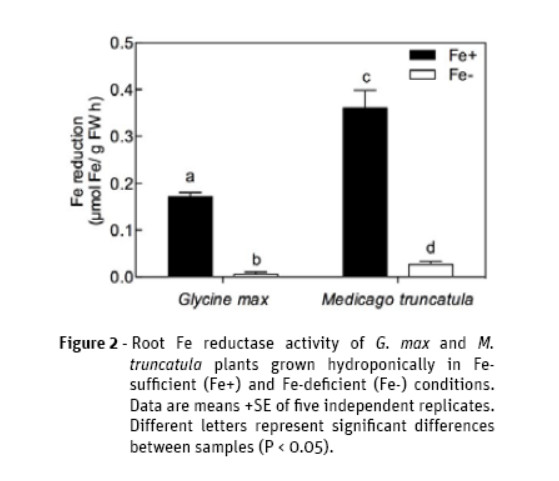
<p>Root Fe uptake capacity is linked with the solubilisation of Fe in the rhizosphere by the plant’s root Fe reductase activity, which is necessary to convert the less soluble Fe<sup>3+</sup> to the more soluble Fe<sup>2+</sup> (García <i>et al</i>., 2013). Here, for both species, the enzyme was more active in Fe+ conditions and was higher in <i>M. truncatula</i> plants (<a href="#f2">Figure 2</a>). It has been hypothesized that, for some genotypes, Fe is necessary for the functioning of the reductase enzyme itself (Blair <i>et al.</i>, 2010). Although most studies imply that Fe reduction is induced under Fe deficiency (Wang <i>et al</i>., 2013; Zha <i>et al</i>., 2014), it has already been described that this is not always this way (Vasconcelos and Grusak., 2006; Santos <i>et al</i>., 2015).</p>      <p>&nbsp;</p> <a name="f2"> <img src="/img/revistas/rca/v39n4/39n4a07f2.jpg"></p>     
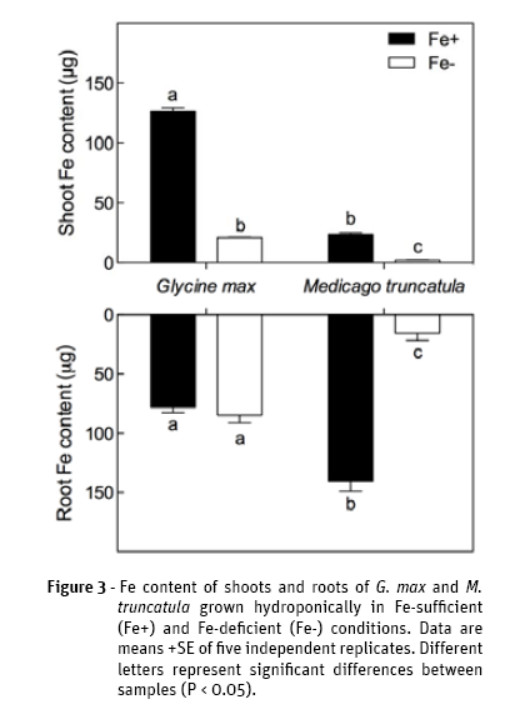
<p>&nbsp;</p>      <p>In order to understand how Fe deficiency affects the mineral composition of Fe in <i>G. max</i> and <i>M. truncatula</i>, root and shoot tissues were analyzed by ICP-OES. When <i>G. max</i> was faced with the lack of Fe, it appeared to accumulate its internal Fe storage in the roots and the shoot Fe content decreased six-fold (<a href="#f3">Figure 3</a>). It has been seen before that in response to shortage in mineral nutrition plants usually allocate more resources to the roots (Hermans <i>et al</i>., 2006; Santos <i>et al</i>., 2015). On the other hand, <i>M. truncatula</i> plants had a general reduction in Fe content in both tissues under Fe deficiency.</p>      ]]></body>
<body><![CDATA[<p>&nbsp;</p> <a name="f3"> <img src="/img/revistas/rca/v39n4/39n4a07f3.jpg"></p>     
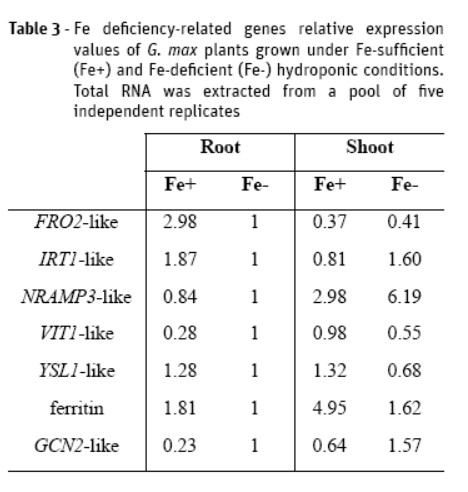
<p>&nbsp;</p>      <p>To further understand the mechanisms triggered by Fe shortage, it is crucial to comprehend the key conserved molecular players involved in nutrient uptake (e.g. <i>FRO2</i> and <i>IRT1</i>), transport (e.g. <i>NRAMP3</i>, <i>VIT1</i> and <i>YSL1</i>) and storage (e.g. <i>ferritin</i>), as well as identify novel candidate genes, that could have important roles in Fe metabolism (<i>GCN2</i>). When plants are faced with stress situations, the rate of nutrient uptake needs to increase, in order to compensate the lack of Fe. Thus, root Fe uptake related genes <i>FRO2</i> and <i>IRT1</i> are extremely important since they participate in this critical step concerning the plant response to Fe deficiency, and which control the efficiency of Fe uptake.</p>     <p>&nbsp;</p> <a name="t3"> <img src="/img/revistas/rca/v39n4/39n4a07t3.jpg"></p>     
<p>&nbsp;</p>     <p>&nbsp;</p> <a name="t4"> <img src="/img/revistas/rca/v39n4/39n4a07t4.jpg"></p>     
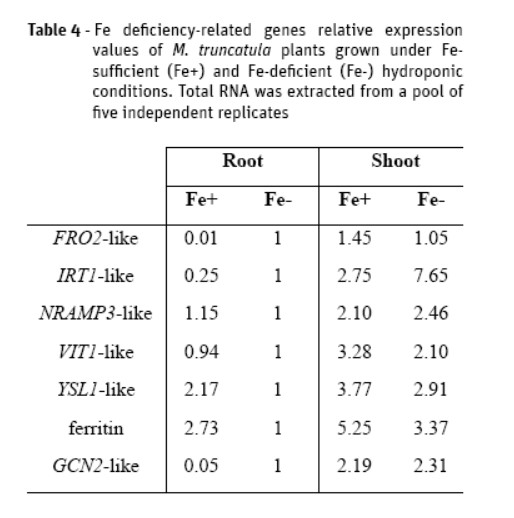
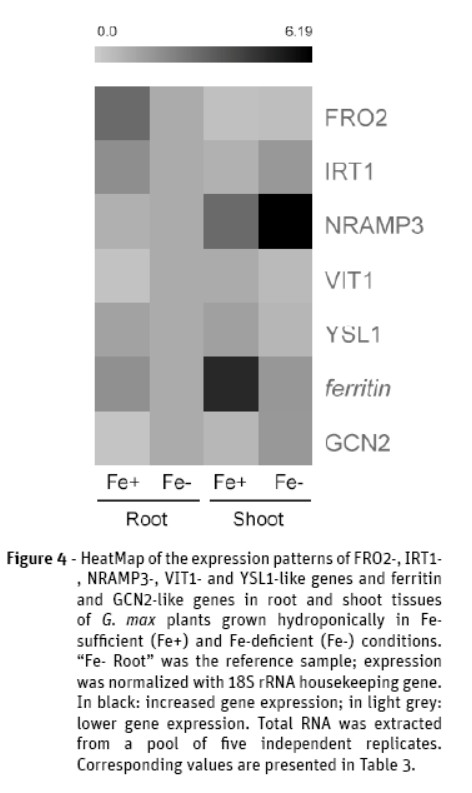
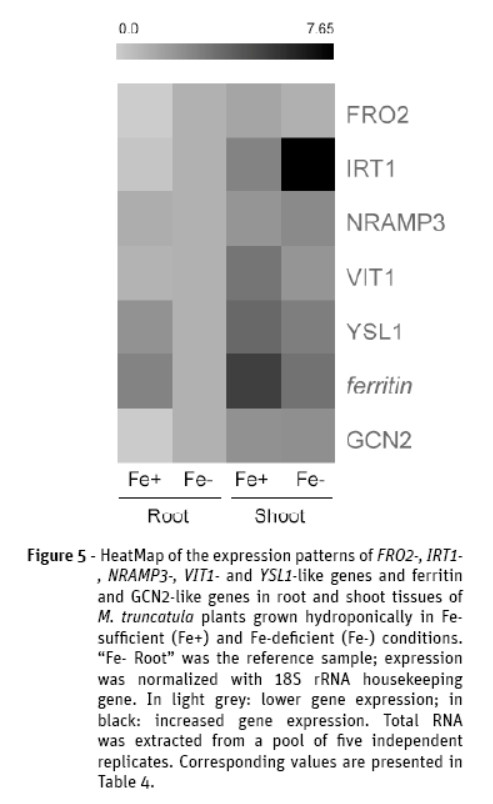
<p>&nbsp;</p>     <p>The results obtained for <i>G. max</i> plants show that in Fe- the expression of <i>FRO2</i>-like was decreased by three-fold (<a href="#f4">Figure 4</a>), accordingly to the Fe reductase activity previously described (<a href="#f2">Figure 2</a>). On the contrary, <i>M. truncatula </i>roots over-expressed <i>FRO2</i>-like gene under Fe deficiency (<a href="#f5">Figure 5</a>), as previously obtained in <i>A. thaliana</i> (Robinson <i>et al</i>., 1999), tomato (Li <i>et al</i>., 2004) and soybean (Santos <i>et al</i>., 2016). When Fe was present in sufficient amounts, <i>M. truncatula</i> had almost null <i>FRO2</i>-like expression (<a href="#f5">Figure 5</a>); since from the beginning of the trial, plants were in optimal conditions, they captured sufficient Fe to meet their daily requirements, thus inhibiting <i>FRO2</i>-like expression in order to avoid Fe toxicity. However, the Fe reductase activity was higher under Fe+ conditions (like in <i>G. max</i>). The Fe reduction is thought to be the rate-limiting step for Fe transport since Fe transporters, such as <i>IRT1</i>, do not reach saturation at normally achieved concentrations of Fe<sup>2+</sup> (Grusak <i>et al</i>., 1990). If there is no Fe being reduced, <i>IRT1</i>-like should consequently present lower activity, which was clearly observed in <i>G. max</i> Fe- roots (<a href="#f4">Figure 4</a>). In both species, the levels of <i>IRT1</i>-like expression were very similar to those obtained for <i>FRO2</i>-like (<a href="#f4">Figure 4</a> and <a href="#f5">5</a>), suggesting that <i>IRT1</i>-like is co-regulated with this gene, as previously seen in <i>Arabidopsis thaliana</i> (Vert, 2002; Kim and Guerinot, 2007).</p>     <p>After Fe is transported into the roots by IRT1, the transport of this nutrient across the plant is another crucial step that needs to be well known to efficiently develop an IDC mitigation or a biofortification strategy. Fe transporter families, such as VIT, NRAMP and YSL, are extremely important in Fe metabolism, as they assure that Fe is efficiently delivered to shoots, and other plant edible parts and storage organs. <i>NRAMP3</i> and <i>VIT1</i> have contrasting functions: while the first is responsible for the remobilization from the vacuole (Lanquar <i>et al</i>., 2005), the second is responsible for the Fe loading in the vacuole (Kim <i>et al</i>., 2006). Studies in <i>A. thaliana</i> demonstrate that <i>NRAMP3</i> is an H<sup>+</sup> metal symporter responsible for Fe and Mn remobilization from the vacuole, a crucial step during early seedling development (Lanquar <i>et al.</i>, 2010). Accordingly, under Fe deficiency, as plants need more remobilization of Fe to respond to their needs, <i>NRAMP3</i>-like was more expressed (<a href="#f4">Figures 4</a> and <a href="#f5">5</a>) and <i>VIT1</i>-like was repressed, because plants activate <i>VIT1</i>-like in Fe sufficient conditions to increase Fe<sup>2+</sup> uptake into the vacuole for storage purposes (Brear <i>et al</i>., 2013). Studies in <i>A. thaliana</i> (Kim and Guerinot, 2007) demonstrated that <i>AtNRAMP3</i> and <i>AtVIT1</i> mutants present arrested seedling growth when grown on Fe deficient soils. Moreover, Zhang <i>et al</i>. (2012) reported that the disruption of the rice <i>VIT</i> orthologues (<i>OsVIT1</i> and <i>OsVIT2</i>) increased Fe and Zn accumulation in rice seeds and decreased Fe and Zn in the leaves.</p>     <p>&nbsp;</p> <a name="f4"> <img src="/img/revistas/rca/v39n4/39n4a07f4.jpg"></p>     
]]></body>
<body><![CDATA[<p>&nbsp;</p>     <p>&nbsp;</p> <a name="f5"> <img src="/img/revistas/rca/v39n4/39n4a07f5.jpg"></p>     
<p>&nbsp;</p>      <p>As well as <i>NRAMP3</i>-like and <i>VIT1</i>-like, the <i>YSL1</i>-like transporter may also play a crucial role in the control of the amount of Fe translocated to the seeds of <i>G. max</i> and <i>M. truncatula</i>. Both species had similar expression patterns (<a href="#f4">Figures 4</a> and <a href="#f5">5</a>), where both tissues presented higher levels in Fe+ conditions, suggesting a role in Fe translocation at diverse plant organs, as seen before (Kim <i>et al.</i>, 2006). This gene is involved in the transport of the Fe<sup>2+</sup>-NA complexes (Kim <i>et al.</i>, 2006) that are hypothesized as the main transportable Fe form in the phloem (Jean <i>et al</i>., 2005; Waters <i>et al</i>., 2006; Chu <i>et al</i>., 2010). Jean et al. (2005) used <i>A. thaliana</i> lines with a knock out mutation in <i>AtYSL1</i>, and the levels of NA and Fe in leaves and seeds decreased, as well as germination rates, even when plants were grown in Fe excess, showing that Fe and NA levels in seeds rely in part on <i>YSL1</i> function.</p>     <p>Storage proteins such as ferritin play an important role in Fe homeostasis, assuring that Fe in excess is in a bio-available way in case of cellular needs but yet nonreactive with oxygen (Briat <i>et al</i>., 2010). Thus, the higher expression levels of this gene in Fe sufficient soybean and barrel medic plants are understandable (<a href="#f4">Figures 4</a> and <a href="#f5">5</a>) and are coherent with previous studies (Santos <i>et al</i>., 2016). This protein manages the insolubility and potential toxicity of Fe in the presence of oxygen, being involved in oxidative protection by sequestering free Fe (Lobreaux <i>et al.</i>, 1995).</p>     <p>Even though several gene families are known to be involved in the Fe uptake mechanism, transport and storage, there are still many undiscovered genes that may have important roles in these processes. Therefore, it is worthwhile to find candidate genes that could have an important role in Fe metabolism. To this end, a novel gene was studied in the current work: <i>GCN2</i>-like. Both <i>G. max</i> and <i>M. truncatula</i> plants over-expressed <i>GCN2</i>-like under Fe deficient conditions (<a href="#f4">Figures 4</a> and <a href="#f5">5</a>), particularly at the root level, and it seems to indicate a role for <i>GCN2</i>-like in alleviating Fe stress, for both legume species. Lageix <i>et al</i>. (2008) showed that <i>AtGCN2</i> was strongly activated following wounding and exposure to key hormones, and suggested that this enzyme plays a role in plant defense responses to insect pathogens, representing a key player linking biotic and abiotic stresses. Moreover, no studies have looked at the possible role of <i>GCN2</i> and Fe nutrition, which highlights the importance of the current work. Further studies to link its role on Fe metabolism are under way.</p>     <p>The current work compared the responses of two legume species, soybean and barrel medic, to Fe deficiency. Taken together, the results described above suggest a conservation of anatomical and biochemical responses in the two legume species. Also, it is apparent that for genes such as <i>FRO2</i>-like and <i>IRT1</i>-like the regulation differs between these two legumes and is not conserved with other plants such as <i>A. thaliana</i>. It shows that generalizations in Fe uptake processes should not be lightly done. Finally, a novel sequence showing up-regulation under Fe deficiency was identified, opening doors to future studies looking at the role of this gene under Fe deficiency.</p>      <p><b>Acknowledgments </b></p>     <p>The authors would like to thank Prof. C. Pinto Ricardo for providing the <i>Medicago truncatula</i> cultivar “Luzerna revilheira” seeds and Mariana Roriz for the ICP analysis. This work was supported by National Funds from FCT through projects PEst-OE/EQB/LA0016/2013 and PTDC/AGRPRO/3972/2014, and PhD scholarship SFRH/BD/78353/2011.</p>     <p>&nbsp;</p>     ]]></body>
<body><![CDATA[<p><b>References</b></p>     <!-- ref --><p>Abadía, J.; Monge, E.; Montañes, L. and Heras, L. (1984) - Extraction of iron from plant leaves by Fe(II) chelators. <i>Journal of Plant Nutrition</i>, vol. 7, n. 1-5, p. 777-784. <a href="http://dx.doi.org/10.1080/01904168409363241"target="_blank">http://dx.doi.org/10.1080/01904168409363241</a>&nbsp;&nbsp;&nbsp;&nbsp;&nbsp;&nbsp;&nbsp;&nbsp;[&#160;<a href="javascript:void(0);" onclick="javascript: window.open('/scielo.php?script=sci_nlinks&ref=656991&pid=S0871-018X201600040000700001&lng=','','width=640,height=500,resizable=yes,scrollbars=1,menubar=yes,');">Links</a>&#160;]<!-- end-ref --><!-- ref --><p>Andaluz, S.; Rodríguez-Celma, J.; Abadía, A.; Abadia, J. and López-Millán, A.F. (2009) - Time course induction of several key enzymes in <i>Medicago truncatula</i> roots in response to Fe deficiency. <i>Plant Physiology</i>, vol. 47, n. 11-12, p. 1082-1088. <a href="http://dx.doi.org/10.1016/j.plaphy.2009.07.009"target="_blank">http://dx.doi.org/10.1016/j.plaphy.2009.07.009</a>&nbsp;&nbsp;&nbsp;&nbsp;&nbsp;&nbsp;&nbsp;&nbsp;[&#160;<a href="javascript:void(0);" onclick="javascript: window.open('/scielo.php?script=sci_nlinks&ref=656992&pid=S0871-018X201600040000700002&lng=','','width=640,height=500,resizable=yes,scrollbars=1,menubar=yes,');">Links</a>&#160;]<!-- end-ref --><!-- ref --><p>Bell, C.J.; Dixon, R.A.; Farmer, A.D.; Flores, R.; Inman, J.; Gonzales, R.A.; Harrison, M.J.; Paiva, N.L.; Scott, A.D.; Weller, J.W.; and May, G.D. (2001) – The Medicago genome initiative: a model legume database. <i>Nucleic Acids Research</i>, vol. 29, n. 1, p. 114-117. <a href="http://dx.doi.org/10.1093/nar/29.1.114"target="_blank">http://dx.doi.org/10.1093/nar/29.1.114</a>&nbsp;&nbsp;&nbsp;&nbsp;&nbsp;&nbsp;&nbsp;&nbsp;[&#160;<a href="javascript:void(0);" onclick="javascript: window.open('/scielo.php?script=sci_nlinks&ref=656993&pid=S0871-018X201600040000700003&lng=','','width=640,height=500,resizable=yes,scrollbars=1,menubar=yes,');">Links</a>&#160;]<!-- end-ref --><!-- ref --><p>Blair, M.W.; Knewtson, S.J.B.; Astudillo, C.; Li, C.; Fernandez, A.C. and Grusak, M.A. (2010) - Variation and inheritance of iron reductase activity in the roots of common bean (<i>Phaseolus vulgaris</i> L.) and association with seed iron accumulation QTL. <i>BMC Plant Biology</i>, vol. 10, p. 215-2010. <a href="http://dx.doi.org/10.1186/1471-2229-10-215"target="_blank">http://dx.doi.org/10.1186/1471-2229-10-215</a>&nbsp;&nbsp;&nbsp;&nbsp;&nbsp;&nbsp;&nbsp;&nbsp;[&#160;<a href="javascript:void(0);" onclick="javascript: window.open('/scielo.php?script=sci_nlinks&ref=656994&pid=S0871-018X201600040000700004&lng=','','width=640,height=500,resizable=yes,scrollbars=1,menubar=yes,');">Links</a>&#160;]<!-- end-ref --><!-- ref --><p>Bolon, Y.; Joseph, B.; Cannon, S.B.; Graham, M.A.; Diers, B.W.; Farmer, A.D.; May, G.D.; Muehlbauer, G.J.; Specht, J.E.; Tu, J.T.; Weeks, N.; Xu, W.W.; Shoemaker, R.C. and Vance, C.P. (2010) - Complementary genetic and genomic approaches help characterize the linkage group I seed protein QTL in soybean. <i>BMC Plant Biology</i>, vol. 10, art. 41. <a href="http://dx.doi.org/10.1186/1471-2229-10-41"target="_blank">http://dx.doi.org/10.1186/1471-2229-10-41</a>&nbsp;&nbsp;&nbsp;&nbsp;&nbsp;&nbsp;&nbsp;&nbsp;[&#160;<a href="javascript:void(0);" onclick="javascript: window.open('/scielo.php?script=sci_nlinks&ref=656995&pid=S0871-018X201600040000700005&lng=','','width=640,height=500,resizable=yes,scrollbars=1,menubar=yes,');">Links</a>&#160;]<!-- end-ref --><!-- ref --><p>Brear, E.M.; Day, D.A. and Smith, P.M.C. (2013) - Iron: an essential micronutrient for the legume-rhizobium symbiosis<i>. Frontiers in Plant Science</i>, vol. 4, art. 359. <a href="http://dx.doi.org/10.3389/fpls.2013.00359"target="_blank">http://dx.doi.org/10.3389/fpls.2013.00359</a>&nbsp;&nbsp;&nbsp;&nbsp;&nbsp;&nbsp;&nbsp;&nbsp;[&#160;<a href="javascript:void(0);" onclick="javascript: window.open('/scielo.php?script=sci_nlinks&ref=656996&pid=S0871-018X201600040000700006&lng=','','width=640,height=500,resizable=yes,scrollbars=1,menubar=yes,');">Links</a>&#160;]<!-- end-ref --><!-- ref --><p>Briat, J.F.; Ravet, K.; Arnaud, N.; Duc, C.; Boucherez, J.; Tourain, B.; Cellier, F. and Gaymard, F. (2010) - New insights into ferritin synthesis and function highlight a link between iron homeostasis and oxidative stress in plants. <i>Annals of Botany</i>, vol. 105, n. 5, p. 811–822. <a href="http://dx.doi.org/10.1093/aob/mcp128"target="_blank">http://dx.doi.org/10.1093/aob/mcp128</a>&nbsp;&nbsp;&nbsp;&nbsp;&nbsp;&nbsp;&nbsp;&nbsp;[&#160;<a href="javascript:void(0);" onclick="javascript: window.open('/scielo.php?script=sci_nlinks&ref=656997&pid=S0871-018X201600040000700007&lng=','','width=640,height=500,resizable=yes,scrollbars=1,menubar=yes,');">Links</a>&#160;]<!-- end-ref --><!-- ref --><p>Choi, H.; Mun, J.; Kim, D.; Zhu, H.; Baek, J.; Mudge, J.; Roe, B.; Ellis, N.; Doyle, J.; Kiss, G.B.; Young, N.D.; and Cook, D.R. (2004) – Estimating genome conservation between crop and model species. <i>Proceedings of the National Academy of Science of the USA</i>, vol. 101, n. 43, p. 15289-15294. <a href="http://dx.doi.org/10.1073/pnas.0402251101"target="_blank">http://dx.doi.org/10.1073/pnas.0402251101</a>&nbsp;&nbsp;&nbsp;&nbsp;&nbsp;&nbsp;&nbsp;&nbsp;[&#160;<a href="javascript:void(0);" onclick="javascript: window.open('/scielo.php?script=sci_nlinks&ref=656998&pid=S0871-018X201600040000700008&lng=','','width=640,height=500,resizable=yes,scrollbars=1,menubar=yes,');">Links</a>&#160;]<!-- end-ref --><!-- ref --><p>Chu, H.H.; Chiecko, J.; Punshon, T.; Lanzirotti, A.; Lahner, B.; Salt, D.E. and Walker, E.L. (2010) - Successful reproduction requires the function of Arabidopsis Yellow Stripe-Like1 and Yellow Stripe-Like3 metal-nicotianamine transporters in both vegetative and reproductive structures. <i>Plant Physiology</i>, vol. 154, n. 1, p. 197–210. <a href="http://dx.doi.org/10.1104/pp.110.159103"target="_blank">http://dx.doi.org/10.1104/pp.110.159103</a>&nbsp;&nbsp;&nbsp;&nbsp;&nbsp;&nbsp;&nbsp;&nbsp;[&#160;<a href="javascript:void(0);" onclick="javascript: window.open('/scielo.php?script=sci_nlinks&ref=656999&pid=S0871-018X201600040000700009&lng=','','width=640,height=500,resizable=yes,scrollbars=1,menubar=yes,');">Links</a>&#160;]<!-- end-ref --><!-- ref --><p>Dhingra, S. and Jood, S. (2001) - Organoleptic and nutritional evaluation of wheat breads supplemented with soybean and barley flour. <i>Food Chemistry</i>, vol. 77, n. 4, p. 479-488. <a href="http://dx.doi.org/10.1016/s0308-8146(01)00387-9"target="_blank">http://dx.doi.org/10.1016/s0308-8146(01)00387-9</a>&nbsp;&nbsp;&nbsp;&nbsp;&nbsp;&nbsp;&nbsp;&nbsp;[&#160;<a href="javascript:void(0);" onclick="javascript: window.open('/scielo.php?script=sci_nlinks&ref=657000&pid=S0871-018X201600040000700010&lng=','','width=640,height=500,resizable=yes,scrollbars=1,menubar=yes,');">Links</a>&#160;]<!-- end-ref --><!-- ref --><p>García, M.J.; Romera, F.J.; Stacey, M.G.; Stacey, G.; Villar, E.; Alcántara, E. and Pérez-Vicente, R. (2013) - Shoot to root communication is necessary to control the expression of iron-acquisition genes in Strategy I plants. <i>Planta</i>, vol. 237, n. 1, p. 65-75. <a href="http://dx.doi.org/10.1007/s00425-012-1757-0"target="_blank">http://dx.doi.org/10.1007/s00425-012-1757-0</a>&nbsp;&nbsp;&nbsp;&nbsp;&nbsp;&nbsp;&nbsp;&nbsp;[&#160;<a href="javascript:void(0);" onclick="javascript: window.open('/scielo.php?script=sci_nlinks&ref=657001&pid=S0871-018X201600040000700011&lng=','','width=640,height=500,resizable=yes,scrollbars=1,menubar=yes,');">Links</a>&#160;]<!-- end-ref --><!-- ref --><p>Grotz, N. and Guerinot, M.L. (2006) - Molecular aspects of Cu, Fe and Zn homeostasis in plants. <i>Biochimica and Biophysica Acta</i>, vol. 1763, n. 7, p. 595–608. <a href="http://dx.doi.org/10.1016/j.bbamcr.2006.05.014"target="_blank">http://dx.doi.org/10.1016/j.bbamcr.2006.05.014</a>&nbsp;&nbsp;&nbsp;&nbsp;&nbsp;&nbsp;&nbsp;&nbsp;[&#160;<a href="javascript:void(0);" onclick="javascript: window.open('/scielo.php?script=sci_nlinks&ref=657002&pid=S0871-018X201600040000700012&lng=','','width=640,height=500,resizable=yes,scrollbars=1,menubar=yes,');">Links</a>&#160;]<!-- end-ref --><!-- ref --><p>Santos, C.S.; Silva, A.I.; Serrão, I.; Carvalho, A.L. and Vasconcelos, M.W. (2013) - Transcriptomic analysis of iron deficiency related genes in the legumes. <i>Food Research International</i>, vol. 54, n. 1, p. 1162-1171. <a href="http://dx.doi.org/10.1016/j.foodres.2013.06.024"target="_blank">http://dx.doi.org/10.1016/j.foodres.2013.06.024</a>&nbsp;&nbsp;&nbsp;&nbsp;&nbsp;&nbsp;&nbsp;&nbsp;[&#160;<a href="javascript:void(0);" onclick="javascript: window.open('/scielo.php?script=sci_nlinks&ref=657003&pid=S0871-018X201600040000700013&lng=','','width=640,height=500,resizable=yes,scrollbars=1,menubar=yes,');">Links</a>&#160;]<!-- end-ref --><!-- ref --><p>Santos, C.S.; Roriz, M.; Carvalho, S.M.P. and Vasconcelos, M.W. (2015) - Iron partitioning at an early growth stage impacts iron deficiency responses in soybean plants (<i>Glycine max </i>L.). <i>Frontiers in Plant Science</i>, vol. 6, art. 325. <a href="http://dx.doi.org/10.3389/fpls.2015.00325"target="_blank">http://dx.doi.org/10.3389/fpls.2015.00325</a>&nbsp;&nbsp;&nbsp;&nbsp;&nbsp;&nbsp;&nbsp;&nbsp;[&#160;<a href="javascript:void(0);" onclick="javascript: window.open('/scielo.php?script=sci_nlinks&ref=657004&pid=S0871-018X201600040000700014&lng=','','width=640,height=500,resizable=yes,scrollbars=1,menubar=yes,');">Links</a>&#160;]<!-- end-ref --><!-- ref --><p>Santos, C.S.; Carvalho, S.M.P.; Leite, A.; Moniz, T.; Roriz, M.; Rangel, A.O.S.S.; Rangel, M. and Vasconcelos, M.W. (2016) - Effect of tris(3-hydroxy-4-pyridinonate) iron(III) complexes on iron uptake and storage in soybean (<i>Glycine max </i>L.). <i>Plant Physiology and Biochemistry</i>, vol. 106, p. 91-100. <a href="http://dx.doi.org/10.1016/j.plaphy.2016.04.050"target="_blank">http://dx.doi.org/10.1016/j.plaphy.2016.04.050</a>&nbsp;&nbsp;&nbsp;&nbsp;&nbsp;&nbsp;&nbsp;&nbsp;[&#160;<a href="javascript:void(0);" onclick="javascript: window.open('/scielo.php?script=sci_nlinks&ref=657005&pid=S0871-018X201600040000700015&lng=','','width=640,height=500,resizable=yes,scrollbars=1,menubar=yes,');">Links</a>&#160;]<!-- end-ref --><!-- ref --><p>Zhang, Y.; Xu, Y.H.; Yi, H.Y. and Gong, J.M. (2012) - Vacuolar membrane transporters <i>OsVIT1</i> and <i>OsVIT2</i> modulate iron translocation between flag leaves and seeds in rice. <i>The Plant Journal</i>, vol. 72, n. 3, p. 400–410. <a href="http://dx.doi.org/10.1111/j.1365-313X.2012.05088.x"target="_blank">http://dx.doi.org/10.1111/j.1365-313X.2012.05088.x</a>&nbsp;&nbsp;&nbsp;&nbsp;&nbsp;&nbsp;&nbsp;&nbsp;[&#160;<a href="javascript:void(0);" onclick="javascript: window.open('/scielo.php?script=sci_nlinks&ref=657006&pid=S0871-018X201600040000700016&lng=','','width=640,height=500,resizable=yes,scrollbars=1,menubar=yes,');">Links</a>&#160;]<!-- end-ref --><p>&nbsp;</p>     <p> Received/recebido: 2016.07.13</p>     <p>Accepted/aceite: 2016.12.02</p>     ]]></body>
<body><![CDATA[ ]]></body><back>
<ref-list>
<ref id="B1">
<nlm-citation citation-type="journal">
<person-group person-group-type="author">
<name>
<surname><![CDATA[Abadía]]></surname>
<given-names><![CDATA[J.]]></given-names>
</name>
<name>
<surname><![CDATA[Monge]]></surname>
<given-names><![CDATA[E.]]></given-names>
</name>
<name>
<surname><![CDATA[Montañes]]></surname>
<given-names><![CDATA[L.]]></given-names>
</name>
<name>
<surname><![CDATA[Heras]]></surname>
<given-names><![CDATA[L.]]></given-names>
</name>
</person-group>
<article-title xml:lang="en"><![CDATA[Extraction of iron from plant leaves by Fe(II) chelators]]></article-title>
<source><![CDATA[Journal of Plant Nutrition]]></source>
<year>1984</year>
<volume>7</volume>
<numero>1-5</numero>
<issue>1-5</issue>
<page-range>777-784</page-range></nlm-citation>
</ref>
<ref id="B2">
<nlm-citation citation-type="journal">
<person-group person-group-type="author">
<name>
<surname><![CDATA[Andaluz]]></surname>
<given-names><![CDATA[S.]]></given-names>
</name>
<name>
<surname><![CDATA[Rodríguez-Celma]]></surname>
<given-names><![CDATA[J.]]></given-names>
</name>
<name>
<surname><![CDATA[Abadía]]></surname>
<given-names><![CDATA[A.]]></given-names>
</name>
<name>
<surname><![CDATA[Abadia]]></surname>
<given-names><![CDATA[J.]]></given-names>
</name>
<name>
<surname><![CDATA[López-Millán]]></surname>
<given-names><![CDATA[A.F.]]></given-names>
</name>
</person-group>
<article-title xml:lang="en"><![CDATA[Time course induction of several key enzymes in Medicago truncatula roots in response to Fe deficiency]]></article-title>
<source><![CDATA[Plant Physiology]]></source>
<year>2009</year>
<volume>47</volume>
<numero>11-12</numero>
<issue>11-12</issue>
<page-range>1082-1088</page-range></nlm-citation>
</ref>
<ref id="B3">
<nlm-citation citation-type="journal">
<person-group person-group-type="author">
<name>
<surname><![CDATA[Bell]]></surname>
<given-names><![CDATA[C.J.]]></given-names>
</name>
<name>
<surname><![CDATA[Dixon]]></surname>
<given-names><![CDATA[R.A.]]></given-names>
</name>
<name>
<surname><![CDATA[Farmer]]></surname>
<given-names><![CDATA[A.D.]]></given-names>
</name>
<name>
<surname><![CDATA[Flores]]></surname>
<given-names><![CDATA[R.]]></given-names>
</name>
<name>
<surname><![CDATA[Inman]]></surname>
<given-names><![CDATA[J.]]></given-names>
</name>
<name>
<surname><![CDATA[Gonzales]]></surname>
<given-names><![CDATA[R.A.]]></given-names>
</name>
<name>
<surname><![CDATA[Harrison]]></surname>
<given-names><![CDATA[M.J.]]></given-names>
</name>
<name>
<surname><![CDATA[Paiva]]></surname>
<given-names><![CDATA[N.L.]]></given-names>
</name>
<name>
<surname><![CDATA[Scott]]></surname>
<given-names><![CDATA[A.D.]]></given-names>
</name>
<name>
<surname><![CDATA[Weller]]></surname>
<given-names><![CDATA[J.W.]]></given-names>
</name>
<name>
<surname><![CDATA[May]]></surname>
<given-names><![CDATA[G.D.]]></given-names>
</name>
</person-group>
<article-title xml:lang="en"><![CDATA[The Medicago genome initiative: a model legume database]]></article-title>
<source><![CDATA[Nucleic Acids Research]]></source>
<year>2001</year>
<volume>29</volume>
<numero>1</numero>
<issue>1</issue>
<page-range>114-117</page-range></nlm-citation>
</ref>
<ref id="B4">
<nlm-citation citation-type="journal">
<person-group person-group-type="author">
<name>
<surname><![CDATA[Blair]]></surname>
<given-names><![CDATA[M.W.]]></given-names>
</name>
<name>
<surname><![CDATA[Knewtson]]></surname>
<given-names><![CDATA[S.J.B.]]></given-names>
</name>
<name>
<surname><![CDATA[Astudillo]]></surname>
<given-names><![CDATA[C.]]></given-names>
</name>
<name>
<surname><![CDATA[Li]]></surname>
<given-names><![CDATA[C.]]></given-names>
</name>
<name>
<surname><![CDATA[Fernandez]]></surname>
<given-names><![CDATA[A.C.]]></given-names>
</name>
<name>
<surname><![CDATA[Grusak]]></surname>
<given-names><![CDATA[M.A.]]></given-names>
</name>
</person-group>
<article-title xml:lang="en"><![CDATA[Variation and inheritance of iron reductase activity in the roots of common bean (Phaseolus vulgaris L.) and association with seed iron accumulation QTL]]></article-title>
<source><![CDATA[BMC Plant Biology]]></source>
<year>2010</year>
<volume>10</volume>
<page-range>215-2010</page-range></nlm-citation>
</ref>
<ref id="B5">
<nlm-citation citation-type="journal">
<person-group person-group-type="author">
<name>
<surname><![CDATA[Bolon]]></surname>
<given-names><![CDATA[Y.]]></given-names>
</name>
<name>
<surname><![CDATA[Joseph]]></surname>
<given-names><![CDATA[B.]]></given-names>
</name>
<name>
<surname><![CDATA[Cannon]]></surname>
<given-names><![CDATA[S.B.]]></given-names>
</name>
<name>
<surname><![CDATA[Graham]]></surname>
<given-names><![CDATA[M.A.]]></given-names>
</name>
<name>
<surname><![CDATA[Diers]]></surname>
<given-names><![CDATA[B.W.]]></given-names>
</name>
<name>
<surname><![CDATA[Farmer]]></surname>
<given-names><![CDATA[A.D.]]></given-names>
</name>
<name>
<surname><![CDATA[May]]></surname>
<given-names><![CDATA[G.D.]]></given-names>
</name>
<name>
<surname><![CDATA[Muehlbauer]]></surname>
<given-names><![CDATA[G.J.]]></given-names>
</name>
<name>
<surname><![CDATA[Specht]]></surname>
<given-names><![CDATA[J.E.]]></given-names>
</name>
<name>
<surname><![CDATA[Tu]]></surname>
<given-names><![CDATA[J.T.]]></given-names>
</name>
<name>
<surname><![CDATA[Weeks]]></surname>
<given-names><![CDATA[N.]]></given-names>
</name>
<name>
<surname><![CDATA[Xu]]></surname>
<given-names><![CDATA[W.W.]]></given-names>
</name>
<name>
<surname><![CDATA[Shoemaker]]></surname>
<given-names><![CDATA[R.C.]]></given-names>
</name>
<name>
<surname><![CDATA[Vance]]></surname>
<given-names><![CDATA[C.P.]]></given-names>
</name>
</person-group>
<article-title xml:lang="en"><![CDATA[Complementary genetic and genomic approaches help characterize the linkage group I seed protein QTL in soybean]]></article-title>
<source><![CDATA[BMC Plant Biology]]></source>
<year>2010</year>
<volume>10</volume>
</nlm-citation>
</ref>
<ref id="B6">
<nlm-citation citation-type="journal">
<person-group person-group-type="author">
<name>
<surname><![CDATA[Brear]]></surname>
<given-names><![CDATA[E.M.]]></given-names>
</name>
<name>
<surname><![CDATA[Day]]></surname>
<given-names><![CDATA[D.A.]]></given-names>
</name>
<name>
<surname><![CDATA[Smith]]></surname>
<given-names><![CDATA[P.M.C.]]></given-names>
</name>
</person-group>
<article-title xml:lang="en"><![CDATA[Iron: an essential micronutrient for the legume-rhizobium symbiosis]]></article-title>
<source><![CDATA[Frontiers in Plant Science]]></source>
<year>2013</year>
<volume>4</volume>
</nlm-citation>
</ref>
<ref id="B7">
<nlm-citation citation-type="journal">
<person-group person-group-type="author">
<name>
<surname><![CDATA[Briat]]></surname>
<given-names><![CDATA[J.F.]]></given-names>
</name>
<name>
<surname><![CDATA[Ravet]]></surname>
<given-names><![CDATA[K.]]></given-names>
</name>
<name>
<surname><![CDATA[Arnaud]]></surname>
<given-names><![CDATA[N.]]></given-names>
</name>
<name>
<surname><![CDATA[Duc]]></surname>
<given-names><![CDATA[C.]]></given-names>
</name>
<name>
<surname><![CDATA[Boucherez]]></surname>
<given-names><![CDATA[J.]]></given-names>
</name>
<name>
<surname><![CDATA[Tourain]]></surname>
<given-names><![CDATA[B.]]></given-names>
</name>
<name>
<surname><![CDATA[Cellier]]></surname>
<given-names><![CDATA[F.]]></given-names>
</name>
<name>
<surname><![CDATA[Gaymard]]></surname>
<given-names><![CDATA[F.]]></given-names>
</name>
</person-group>
<article-title xml:lang="en"><![CDATA[New insights into ferritin synthesis and function highlight a link between iron homeostasis and oxidative stress in plants]]></article-title>
<source><![CDATA[Annals of Botany]]></source>
<year>2010</year>
<volume>105</volume>
<numero>5</numero>
<issue>5</issue>
<page-range>811-822</page-range></nlm-citation>
</ref>
<ref id="B8">
<nlm-citation citation-type="journal">
<person-group person-group-type="author">
<name>
<surname><![CDATA[Choi]]></surname>
<given-names><![CDATA[H.]]></given-names>
</name>
<name>
<surname><![CDATA[Mun]]></surname>
<given-names><![CDATA[J.]]></given-names>
</name>
<name>
<surname><![CDATA[Kim]]></surname>
<given-names><![CDATA[D.]]></given-names>
</name>
<name>
<surname><![CDATA[Zhu]]></surname>
<given-names><![CDATA[H.]]></given-names>
</name>
<name>
<surname><![CDATA[Baek]]></surname>
<given-names><![CDATA[J.]]></given-names>
</name>
<name>
<surname><![CDATA[Mudge]]></surname>
<given-names><![CDATA[J.]]></given-names>
</name>
<name>
<surname><![CDATA[Roe]]></surname>
<given-names><![CDATA[B.]]></given-names>
</name>
<name>
<surname><![CDATA[Ellis]]></surname>
<given-names><![CDATA[N.]]></given-names>
</name>
<name>
<surname><![CDATA[Doyle]]></surname>
<given-names><![CDATA[J.]]></given-names>
</name>
<name>
<surname><![CDATA[Kiss]]></surname>
<given-names><![CDATA[G.B.]]></given-names>
</name>
<name>
<surname><![CDATA[Young]]></surname>
<given-names><![CDATA[N.D.]]></given-names>
</name>
<name>
<surname><![CDATA[Cook]]></surname>
<given-names><![CDATA[D.R.]]></given-names>
</name>
</person-group>
<article-title xml:lang="en"><![CDATA[Estimating genome conservation between crop and model species]]></article-title>
<source><![CDATA[Proceedings of the National Academy of Science of the USA]]></source>
<year>2004</year>
<volume>101</volume>
<numero>43</numero>
<issue>43</issue>
<page-range>15289-15294</page-range></nlm-citation>
</ref>
<ref id="B9">
<nlm-citation citation-type="journal">
<person-group person-group-type="author">
<name>
<surname><![CDATA[Chu]]></surname>
<given-names><![CDATA[H.H.]]></given-names>
</name>
<name>
<surname><![CDATA[Chiecko]]></surname>
<given-names><![CDATA[J.]]></given-names>
</name>
<name>
<surname><![CDATA[Punshon]]></surname>
<given-names><![CDATA[T.]]></given-names>
</name>
<name>
<surname><![CDATA[Lanzirotti]]></surname>
<given-names><![CDATA[A.]]></given-names>
</name>
<name>
<surname><![CDATA[Lahner]]></surname>
<given-names><![CDATA[B.]]></given-names>
</name>
<name>
<surname><![CDATA[Salt]]></surname>
<given-names><![CDATA[D.E.]]></given-names>
</name>
<name>
<surname><![CDATA[Walker]]></surname>
<given-names><![CDATA[E.L.]]></given-names>
</name>
</person-group>
<article-title xml:lang="en"><![CDATA[Successful reproduction requires the function of Arabidopsis Yellow Stripe-Like1 and Yellow Stripe-Like3 metal-nicotianamine transporters in both vegetative and reproductive structures]]></article-title>
<source><![CDATA[Plant Physiology]]></source>
<year>2010</year>
<volume>154</volume>
<numero>1</numero>
<issue>1</issue>
<page-range>197-210</page-range></nlm-citation>
</ref>
<ref id="B10">
<nlm-citation citation-type="journal">
<person-group person-group-type="author">
<name>
<surname><![CDATA[Dhingra]]></surname>
<given-names><![CDATA[S.]]></given-names>
</name>
<name>
<surname><![CDATA[Jood]]></surname>
<given-names><![CDATA[S.]]></given-names>
</name>
</person-group>
<article-title xml:lang="en"><![CDATA[Organoleptic and nutritional evaluation of wheat breads supplemented with soybean and barley flour]]></article-title>
<source><![CDATA[Food Chemistry]]></source>
<year>2001</year>
<volume>77</volume>
<numero>4</numero>
<issue>4</issue>
<page-range>479-488</page-range></nlm-citation>
</ref>
<ref id="B11">
<nlm-citation citation-type="journal">
<person-group person-group-type="author">
<name>
<surname><![CDATA[García]]></surname>
<given-names><![CDATA[M.J.]]></given-names>
</name>
<name>
<surname><![CDATA[Romera]]></surname>
<given-names><![CDATA[F.J.]]></given-names>
</name>
<name>
<surname><![CDATA[Stacey]]></surname>
<given-names><![CDATA[M.G.]]></given-names>
</name>
<name>
<surname><![CDATA[Stacey]]></surname>
<given-names><![CDATA[G.]]></given-names>
</name>
<name>
<surname><![CDATA[Villar]]></surname>
<given-names><![CDATA[E.]]></given-names>
</name>
<name>
<surname><![CDATA[Alcántara]]></surname>
<given-names><![CDATA[E.]]></given-names>
</name>
<name>
<surname><![CDATA[Pérez-Vicente]]></surname>
<given-names><![CDATA[R.]]></given-names>
</name>
</person-group>
<article-title xml:lang="en"><![CDATA[Shoot to root communication is necessary to control the expression of iron-acquisition genes in Strategy I plants]]></article-title>
<source><![CDATA[Planta]]></source>
<year>2013</year>
<volume>237</volume>
<numero>1</numero>
<issue>1</issue>
<page-range>65-75</page-range></nlm-citation>
</ref>
<ref id="B12">
<nlm-citation citation-type="journal">
<person-group person-group-type="author">
<name>
<surname><![CDATA[Grotz]]></surname>
<given-names><![CDATA[N.]]></given-names>
</name>
<name>
<surname><![CDATA[Guerinot]]></surname>
<given-names><![CDATA[M.L.]]></given-names>
</name>
</person-group>
<article-title xml:lang="en"><![CDATA[Molecular aspects of Cu, Fe and Zn homeostasis in plants]]></article-title>
<source><![CDATA[Biochimica and Biophysica Acta]]></source>
<year>2006</year>
<volume>1763</volume>
<numero>7</numero>
<issue>7</issue>
<page-range>595-608</page-range></nlm-citation>
</ref>
<ref id="B13">
<nlm-citation citation-type="journal">
<person-group person-group-type="author">
<name>
<surname><![CDATA[Santos]]></surname>
<given-names><![CDATA[C.S.]]></given-names>
</name>
<name>
<surname><![CDATA[Silva]]></surname>
<given-names><![CDATA[A.I.]]></given-names>
</name>
<name>
<surname><![CDATA[Serrão]]></surname>
<given-names><![CDATA[I.]]></given-names>
</name>
<name>
<surname><![CDATA[Carvalho]]></surname>
<given-names><![CDATA[A.L.]]></given-names>
</name>
<name>
<surname><![CDATA[Vasconcelos]]></surname>
<given-names><![CDATA[M.W.]]></given-names>
</name>
</person-group>
<article-title xml:lang="en"><![CDATA[Transcriptomic analysis of iron deficiency related genes in the legumes]]></article-title>
<source><![CDATA[Food Research International]]></source>
<year>2013</year>
<volume>54</volume>
<numero>1</numero>
<issue>1</issue>
<page-range>1162-1171</page-range></nlm-citation>
</ref>
<ref id="B14">
<nlm-citation citation-type="journal">
<person-group person-group-type="author">
<name>
<surname><![CDATA[Santos]]></surname>
<given-names><![CDATA[C.S.]]></given-names>
</name>
<name>
<surname><![CDATA[Roriz]]></surname>
<given-names><![CDATA[M.]]></given-names>
</name>
<name>
<surname><![CDATA[Carvalho]]></surname>
<given-names><![CDATA[S.M.P.]]></given-names>
</name>
<name>
<surname><![CDATA[Vasconcelos]]></surname>
<given-names><![CDATA[M.W.]]></given-names>
</name>
</person-group>
<article-title xml:lang="en"><![CDATA[Iron partitioning at an early growth stage impacts iron deficiency responses in soybean plants (Glycine max L.)]]></article-title>
<source><![CDATA[Frontiers in Plant Science]]></source>
<year>2015</year>
<volume>6</volume>
</nlm-citation>
</ref>
<ref id="B15">
<nlm-citation citation-type="journal">
<person-group person-group-type="author">
<name>
<surname><![CDATA[Santos]]></surname>
<given-names><![CDATA[C.S.]]></given-names>
</name>
<name>
<surname><![CDATA[Carvalho]]></surname>
<given-names><![CDATA[S.M.P.]]></given-names>
</name>
<name>
<surname><![CDATA[Leite]]></surname>
<given-names><![CDATA[A.]]></given-names>
</name>
<name>
<surname><![CDATA[Moniz]]></surname>
<given-names><![CDATA[T.]]></given-names>
</name>
<name>
<surname><![CDATA[Roriz]]></surname>
<given-names><![CDATA[M.]]></given-names>
</name>
<name>
<surname><![CDATA[Rangel]]></surname>
<given-names><![CDATA[A.O.S.S.]]></given-names>
</name>
<name>
<surname><![CDATA[Rangel]]></surname>
<given-names><![CDATA[M.]]></given-names>
</name>
<name>
<surname><![CDATA[Vasconcelos]]></surname>
<given-names><![CDATA[M.W.]]></given-names>
</name>
</person-group>
<article-title xml:lang="en"><![CDATA[Effect of tris(3-hydroxy-4-pyridinonate) iron(III) complexes on iron uptake and storage in soybean (Glycine max L.)]]></article-title>
<source><![CDATA[Plant Physiology and Biochemistry]]></source>
<year>2016</year>
<volume>106</volume>
<page-range>91-100</page-range></nlm-citation>
</ref>
<ref id="B16">
<nlm-citation citation-type="journal">
<person-group person-group-type="author">
<name>
<surname><![CDATA[Zhang]]></surname>
<given-names><![CDATA[Y.]]></given-names>
</name>
<name>
<surname><![CDATA[Xu]]></surname>
<given-names><![CDATA[Y.H.]]></given-names>
</name>
<name>
<surname><![CDATA[Yi]]></surname>
<given-names><![CDATA[H.Y.]]></given-names>
</name>
<name>
<surname><![CDATA[Gong]]></surname>
<given-names><![CDATA[J.M.]]></given-names>
</name>
</person-group>
<article-title xml:lang="en"><![CDATA[Vacuolar membrane transporters OsVIT1 and OsVIT2 modulate iron translocation between flag leaves and seeds in rice]]></article-title>
<source><![CDATA[The Plant Journal]]></source>
<year>2012</year>
<volume>72</volume>
<numero>3</numero>
<issue>3</issue>
<page-range>400-410</page-range></nlm-citation>
</ref>
</ref-list>
</back>
</article>