<?xml version="1.0" encoding="ISO-8859-1"?><article xmlns:mml="http://www.w3.org/1998/Math/MathML" xmlns:xlink="http://www.w3.org/1999/xlink" xmlns:xsi="http://www.w3.org/2001/XMLSchema-instance">
<front>
<journal-meta>
<journal-id>0871-018X</journal-id>
<journal-title><![CDATA[Revista de Ciências Agrárias]]></journal-title>
<abbrev-journal-title><![CDATA[Rev. de Ciências Agrárias]]></abbrev-journal-title>
<issn>0871-018X</issn>
<publisher>
<publisher-name><![CDATA[Sociedade de Ciências Agrárias de Portugal]]></publisher-name>
</publisher>
</journal-meta>
<article-meta>
<article-id>S0871-018X2017000300011</article-id>
<article-id pub-id-type="doi">10.19084/RCA16133</article-id>
<title-group>
<article-title xml:lang="en"><![CDATA[Rice growth under water stress levels imposed at distinct developmental stages]]></article-title>
<article-title xml:lang="pt"><![CDATA[Crescimento do arroz sob níveis de estresse hídrico impostos em diferentes estádios de desenvolvimento]]></article-title>
</title-group>
<contrib-group>
<contrib contrib-type="author">
<name>
<surname><![CDATA[Parfitt]]></surname>
<given-names><![CDATA[José Maria Barbat]]></given-names>
</name>
<xref ref-type="aff" rid="A1"/>
</contrib>
<contrib contrib-type="author">
<name>
<surname><![CDATA[Concenço]]></surname>
<given-names><![CDATA[Germani]]></given-names>
</name>
<xref ref-type="aff" rid="A1"/>
</contrib>
<contrib contrib-type="author">
<name>
<surname><![CDATA[Downing]]></surname>
<given-names><![CDATA[Kelly]]></given-names>
</name>
<xref ref-type="aff" rid="A2"/>
</contrib>
<contrib contrib-type="author">
<name>
<surname><![CDATA[Larue]]></surname>
<given-names><![CDATA[Jake]]></given-names>
</name>
<xref ref-type="aff" rid="A2"/>
</contrib>
<contrib contrib-type="author">
<name>
<surname><![CDATA[Silva]]></surname>
<given-names><![CDATA[Jaqueline Trombetta da]]></given-names>
</name>
<xref ref-type="aff" rid="A3"/>
</contrib>
</contrib-group>
<aff id="AA1">
<institution><![CDATA[,Empresa Brasileira de Pesquisa Agropecuária  ]]></institution>
<addr-line><![CDATA[Pelotas RS]]></addr-line>
<country>Brazil</country>
</aff>
<aff id="AA2">
<institution><![CDATA[,Valmont Industries Irrigation Division ]]></institution>
<addr-line><![CDATA[Valley NE]]></addr-line>
<country>USA</country>
</aff>
<aff id="AA3">
<institution><![CDATA[,Universidade Federal de Pelotas Department of Soil Science ]]></institution>
<addr-line><![CDATA[Pelotas RS]]></addr-line>
<country>Brazil</country>
</aff>
<pub-date pub-type="pub">
<day>00</day>
<month>09</month>
<year>2017</year>
</pub-date>
<pub-date pub-type="epub">
<day>00</day>
<month>09</month>
<year>2017</year>
</pub-date>
<volume>40</volume>
<numero>3</numero>
<fpage>587</fpage>
<lpage>596</lpage>
<copyright-statement/>
<copyright-year/>
<self-uri xlink:href="http://scielo.pt/scielo.php?script=sci_arttext&amp;pid=S0871-018X2017000300011&amp;lng=en&amp;nrm=iso"></self-uri><self-uri xlink:href="http://scielo.pt/scielo.php?script=sci_abstract&amp;pid=S0871-018X2017000300011&amp;lng=en&amp;nrm=iso"></self-uri><self-uri xlink:href="http://scielo.pt/scielo.php?script=sci_pdf&amp;pid=S0871-018X2017000300011&amp;lng=en&amp;nrm=iso"></self-uri><abstract abstract-type="short" xml:lang="en"><p><![CDATA[We aimed to assess rice growth as function of water stress at distinct crop stages, under greenhouse, using randomized block design and factorial scheme 3 × 4 + 1, with four replications. Factor “A” was the growth stage when water stress was imposed, being (1) vegetative, (2) reproductive 1, and (3) reproductive 2; factor “B” was four levels of water stress (0 - 200 kPa). The additional treatment consisted of a flooded check. Water was replenished to saturation every time the threshold stress was reached. Rice height is reduced when stress is applied either at vegetative or reproductive stages; tillering was affected only by water stress at the vegetative stage, and plants did not recover after the stress was withdrawn; surplus in leaf area is likely to help recovering plant performance from stress applied at the vegetative stage; water content was not affected by water stress, but shoot dry mass of culms was reduced with stress between tillering start and anthesis; root volume did not increase as function of water stress at the vegetative stage. Rice growth is little affected by the absence of waterlogging, but stress levels should be below 30 kPa throughout cropping cycle.]]></p></abstract>
<abstract abstract-type="short" xml:lang="pt"><p><![CDATA[Avaliou-se o crescimento do arroz em função do estresse hídrico em diferentes fases fenológicas, em casa-de-vegetação, em delineamento de blocos casualizados, esquema fatorial 3 × 4 + 1, com quatro repetições. O fator “A” representou a fase fenológica da planta com imposição de estresse, sendo (1) vegetativo, (2) reprodutivo 1, (3) reprodutivo 2; o fator “B” representou os níveis de estresse (0 - 200 kPa); o tratamento adicional foi composto por uma testemunha inundada. A água foi reposta ao alcançar o nível de estresse determinado para o tratamento. As plantas cresceram menos com estresse tanto nas fases vegetativa como reprodutiva; o perfilhamento foi afetado pelo estresse na fase vegetativa; a expansão de área foliar auxilia na posterior recuperação da planta quando o estresse foi imposto na fase vegetativa; o conteúdo de água não foi afetado pelo estresse, mas a massa seca de colmos foi reduzida quando o estresse ocorreu entre início do perfilhamento e antese; por fim, o volume de raízes não aumentou com imposição de estresse na fase vegetativa. O crescimento do arroz é pouco afetado pela falta de inundação, mas o estresse hídrico deve permanecer abaixo de 30 kPa durante todo o ciclo da cultura.]]></p></abstract>
<kwd-group>
<kwd lng="en"><![CDATA[Oryza sativa]]></kwd>
<kwd lng="en"><![CDATA[phenology]]></kwd>
<kwd lng="en"><![CDATA[water demand]]></kwd>
<kwd lng="pt"><![CDATA[Oryza sativa L.]]></kwd>
<kwd lng="pt"><![CDATA[fenologia]]></kwd>
<kwd lng="pt"><![CDATA[demanda hídrica]]></kwd>
</kwd-group>
</article-meta>
</front><body><![CDATA[ <p align = right><font face = Verdana size = 2><b>ARTIGO</b></font></p>      <p>&nbsp;</p>      <p><font face = Verdana size = 4><b>Rice growth under water stress levels imposed at distinct developmental stages</b></font></p>      <p><font face = Verdana size = 3><b>Crescimento do arroz sob níveis de estresse hídrico impostos em diferentes estádios de desenvolvimento</b></font></p>      <p><font face = Verdana size = 2><b>José Maria Barbat Parfitt</b><sup>1</sup>, <b>Germani Concenço</b><sup>1,*</sup>, <b>Kelly Downing</b><sup>2</sup>, <b>Jake Larue</b><sup>2</sup> e <b>Jaqueline Trombetta da Silva</b><sup>3</sup></font></p>      <p><font face = Verdana size = 2><i><sup>1</sup>Empresa Brasileira de Pesquisa Agropecuária, Embrapa Clima Temperado, Pelotas, RS, Brazil</i></font></p>      <p><font face = Verdana size = 2><i><sup>2</sup>Valmont Industries, Irrigation Division, Valley-NE, USA</i></font></p>      <p><font face = Verdana size = 2><i><sup>3</sup>Department of Soil Science, Graduate Program in Management and Conservation of Soil and Water, Universidade Federal de Pelotas [UFPEL], Pelotas, RS, Brazil</i></font></p>      <p><font face = Verdana size = 2><i>(*Email: <a href="mailto:germani.concenco@embrapa.br">germani.concenco@embrapa.br</a>)</i></font></p>  <hr noshade size = 1>      <p><font face = Verdana size = 3><b>SUMMARY</b></font></p>      ]]></body>
<body><![CDATA[<p><font face = Verdana size = 2>We aimed to assess rice growth as function of water stress at distinct crop stages, under greenhouse, using randomized block design and factorial scheme 3 × 4 + 1, with four replications. Factor “A” was the growth stage when water stress was imposed, being (1) vegetative, (2) reproductive 1, and (3) reproductive 2; factor “B” was four levels of water stress (0 &#8209; 200 kPa). The additional treatment consisted of a flooded check. Water was replenished to saturation every time the threshold stress was reached. Rice height is reduced when stress is applied either at vegetative or reproductive stages; tillering was affected only by water stress at the vegetative stage, and plants did not recover after the stress was withdrawn; surplus in leaf area is likely to help recovering plant performance from stress applied at the vegetative stage; water content was not affected by water stress, but shoot dry mass of culms was reduced with stress between tillering start and anthesis; root volume did not increase as function of water stress at the vegetative stage. Rice growth is little affected by the absence of waterlogging, but stress levels should be below 30 kPa throughout cropping cycle.</font></p>      <p><font face = Verdana size = 2><b>Keywords:</b> <i>Oryza sativa</i>, phenology, water demand.</font></p>  <hr noshade size = 1>      <p><font face = Verdana size = 3><b>RESUMO</b></font></p>      <p><font face = Verdana size = 2>Avaliou-se o crescimento do arroz em função do estresse hídrico em diferentes fases fenológicas, em casa&#8209;de&#8209;vegetação, em delineamento de blocos casualizados, esquema fatorial 3 × 4 + 1, com quatro repetições. O fator “A” representou a fase fenológica da planta com imposição de estresse, sendo (1) vegetativo, (2) reprodutivo 1, (3) reprodutivo 2; o fator “B” representou os níveis de estresse (0 &#8209; 200 kPa); o tratamento adicional foi composto por uma testemunha inundada. A água foi reposta ao alcançar o nível de estresse determinado para o tratamento. As plantas cresceram menos com estresse tanto nas fases vegetativa como reprodutiva; o perfilhamento foi afetado pelo estresse na fase vegetativa; a expansão de área foliar auxilia na posterior recuperação da planta quando o estresse foi imposto na fase vegetativa; o conteúdo de água não foi afetado pelo estresse, mas a massa seca de colmos foi reduzida quando o estresse ocorreu entre início do perfilhamento e antese; por fim, o volume de raízes não aumentou com imposição de estresse na fase vegetativa. O crescimento do arroz é pouco afetado pela falta de inundação, mas o estresse hídrico deve permanecer abaixo de 30 kPa durante todo o ciclo da cultura.</font></p>      <p><font face = Verdana size = 2><b>Palavras-chave:</b> <i >Oryza sativa </i>L., fenologia, demanda hídrica.</font></p>  <hr noshade size = 1>      <p><font face = Verdana size = 3><b>INTRODUCTION</b></font></p>      <p><font face = Verdana size = 2>Rice is a staple food for nearly half the world's population, being cultivated in 112 countries, with 90% of the world’s production concentrated in Asia. In Brazil, about 3 million hectares are cultivated every year and rice is traditionally present in Brazilian meals, regardless of social class. The southern region of the country supplies approximately 65% of Brazilian rice (Gomes and Magalhães Jr., 2004). The demand for water in flooded rice cultivation is considerably higher than the water requirement of crops traditionally sprinkler irrigated, such as soybeans and corn. This raises a series of questions, ranging from water use efficiency to environmental issues when growing rice. Physiologically, this species is a sub-aquatic plant adapted to a flooded environment (Correll and Correll, 1975), being thus possible to be grown in absence of waterlogging.</font></p>      <p><font face = Verdana size = 2>Sprinkler irrigation by pivot and linear system has been, and continues to be, tested for rice cultivation, and there are claims for 50% water savings when rice grown under pivot irrigation is compared to continuous flooding (Parfitt <i>et al.</i>, 2011). This seems to be the case mainly when the system is installed in uneven areas or in fields with significant slope, as well as, where water is scarce. Supposing this economy is confirmed, farmers who grow rice under pivots would have a surplus of water that could be used either to increase rice acreage or to irrigate crops on additional fields.</font></p>      <p><font face = Verdana size = 2>In order to support rice-growing systems which demand less water and help environmental conservation, there is a need to understand how rice plants are affected by, and respond to, distinct levels of water stress imposed at different crop phenological stages. This knowledge is the base, which paves the way for the planning of proper, low-cost and efficient rice production systems while reducing the environmental impact in its production.</font></p>      <p><font face = Verdana size = 2>Water content in plants is important for keeping hydration, maintaining cell turgidity for structure and growth; it is also greatly responsible for the transport of nutrients and organic compounds into the plant, and also serves as raw material for chemical processes and buffers the plant against temperature oscillations (Gurevitch <i>et al</i>., 2009). As rice is usually grown under waterlogged soils, there was little need in the past to understand the effects of drought in rice development. When rice passed to be grown under sprinkler irrigation in highland soils, water stress started to be significant.</font></p>      ]]></body>
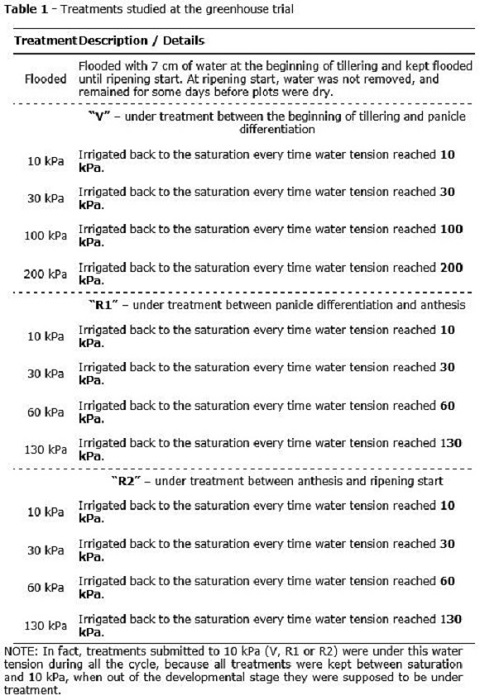
<body><![CDATA[<p><font face = Verdana size = 2>Besides water content, rice plant height, tillering vigor and leaf area are major factors responsible for its competitiveness against important weed species (Aldrich, 1984). For a crop to become successful, it should germinate and emerge fast after planting, and occupy the area as rapidly as possible to avoid the establishment of other competitor plants (Gurevitch <i>et al</i>., 2009).</font></p>      <p><font face = Verdana size = 2>This study aimed to assess rice growth parameters as function of water stress levels imposed at distinct stages of crop development.</font></p>      <p><font face = Verdana size = 3><b>MATERIALS AND METHODS</b></font></p>      <p><font face = Verdana size = 2>The experiment was installed in a greenhouse at Embrapa Clima Temperado, Pelotas-RS, Brazil, during the traditional rice-growing season. A randomized complete-block design with plots arranged in a factorial scheme, 3 × 4 + 1, with four replications was used. The rice variety was BRS-Querencia, with early cycle duration (Embrapa, 2005). Factor “A” comprised the growth stage when water stress was imposed on the treatments, being (1) vegetative (from the beginning of tillering to panicle differentiation), (2) reproductive 1 (from panicle differentiation to anthesis), and (3) reproductive 2 (from anthesis to the beginning of ripening). Factor “B” comprised the four levels of water stress imposed to the plants. The additional treatment consisted of a constantly flooded treatment (<a href="#t1">Table 1</a>).</font></p>     <p>&nbsp;</p> <a name ="t1"><img src="/img/revistas/rca/v40n3/v40n3a11t1.jpg"></a>      
<p>&nbsp;</p>     <p><font face = Verdana size = 2>Although the reproductive stage in rice starts at panicle initiation (SOSBAI, 2016), this stage is very difficult to identify; as a result, farmers generally use panicle differentiation as the start of the reproductive stage for nutrient management. As panicle initiation (PI) and panicle differentiation (PD) are spaced only in about four days (Carli <i>et al</i>., 2016), panicle differentiation was used in the present study.</font></p>      <p><font face = Verdana size = 2>From emergence to the beginning of tillering, all plots were maintained with soil water tension less than 10 kPa - including plots which would be flooded from tillering onward. Every time the treatment reached the threshold level of water deficit, it was irrigated back to saturation. Treatments that were not at the developmental stage when the stress was previewed to be applied were maintained under 10 kPa. Treatments are listed in <a href="#t1">Table 1</a>.</font></p>      <p><font face = Verdana size = 2>Experimental   units consisted of black plastic pots with a capacity of 12 L, filled with 10   kg of previously corrected and fertilized soil. The soil used at the experiment   was collected in agriculture-free natural areas near rice fields at Terras   Baixas Experimental Station, Capão do Leão, RS, Brazil. Soil was fertilized   with N-P-K and corrected for pH 6.0 with ground limestone. In rice fields, pH   is usually not corrected because the water layer is enough to correct the pH   after flooding is established, but as most plots of the trial were not going to   be submitted to flooding, a correction of soil pH was done in order to   guarantee equal soil pH conditions for all plots. Seven rice seeds were sown   into each experimental unit, and after emergence the five most homogeneous   plants were maintained.</font></p>     <p><font face = Verdana size = 2>Water stress was monitored by using sets of Watermark (model 200SS) electro-tensiometers (Irrometer Inc., Riverside, CA), with a single sensor installed in each experimental unit, at depth of 10 cm (from soil surface to the center of the sensor), at the radial center of the pot. All sensors were connected by wire to a nearby Watermark data logger, which was programmed to record water tension in kPa at one-hour intervals. The data logger automatically corrected sensor readings as a function of the mean temperature registered inside the plots, and for that, two Watermark temperature sensors were installed in each block of the experiment. Temperature data from these sensors were used by the data logger to correct soil water tension readings of the corresponding plots. Temperature sensors were also installed at a depth of 10 cm.</font></p>      ]]></body>
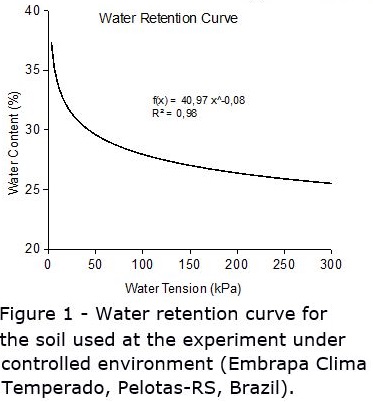
<body><![CDATA[<p><font face = Verdana size = 2>Soil water tension for all plots was read and recorded manually, twice a day (09:00 am and 04:00 pm), seven days a week. When it reached the threshold level, the water needed to adjust soil water tension back to saturation was added after reading. The amount of water to be added to each plot was determined by using a soil moisture retention curve, which relates water tension (kPa) with water content (%). The water tension curve was determined especially for the experiment (<a href="#f1">Figure 1</a>), after the soil was corrected and fertilized, so no error in the curve would be attributed to differential soil density or structure.</font></p>     <p>&nbsp;</p> <a name ="f1"><img src="/img/revistas/rca/v40n3/v40n3a11f1.jpg"></a>      
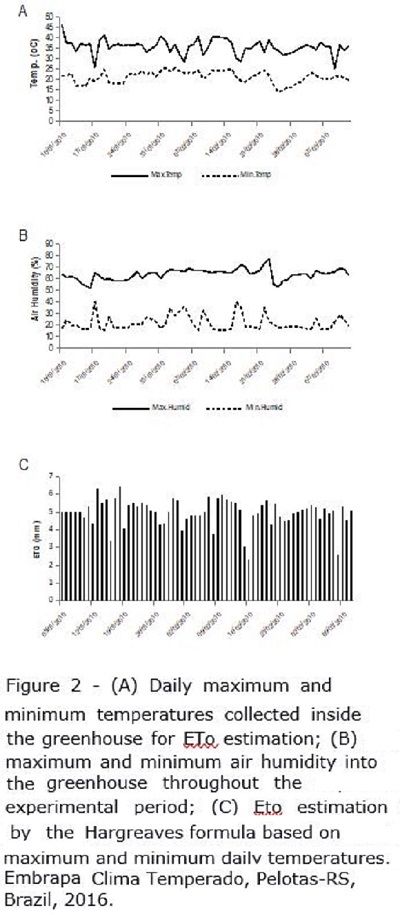
<p>&nbsp;</p>     <p><font face = Verdana size = 2>The daily   maximum and minimum temperature and air humidity into the greenhouse during the   application of the treatments are shown in <a href="#f2">Figure   2A</a> and 2B, respectively. The evapotranspiration (ET<sub>0</sub>) was   calculated as an auxiliary method to the sensors supporting estimation of when   plots would reach the threshold water stress level in order to avoid losing the   timing for water application. ET<sub>0</sub> was calculated using the   Hargreaves equation (<a href="#f2">Figure 2C</a>), based   on daily maximum and minimum temperatures (<a href="#f2">Figure   2A</a>).</font></p>     <p>&nbsp;</p> <a name ="f2"><img src="/img/revistas/rca/v40n3/v40n3a11f2.jpg"></a>      
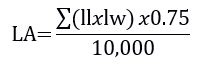
<p>&nbsp;</p>     <p><font face = Verdana size = 2>Weekly,   starting from seven days after treatment establishment to the “V” group, the   plant height, number of tillers per plant and leaf area were assessed. Plant   height was evaluated by using a graduated ruler measuring the distance from the   soil surface to the tip of the taller leaf; to access the number of tillers,   tillers were counted in all plants, being presented as mean number of tillers   per plant; the leaf area was not directly measured but estimated, as this is a   destructive parameter when directly read. For that, the length and width of all   leaves per plant were measured, being the estimated leaf area obtained by the   following formula (Carlesso <i>et al</i>., 1998):</font></p>     <p>&nbsp;</p>     <p><img src="/img/revistas/rca/v40n3/v40n3a11eq1.jpg">      </p>     
<p><font face = Verdana size = 2>where LA= (estimated) leaf area (m<sup>2</sup>); ll = leaf length (cm); lw = leaf width (cm).</font></p>      ]]></body>
<body><![CDATA[<p>&nbsp;</p>     <p><font face = Verdana size = 2>At the end   of the cycle, rice shoot water content (%), dry mass (g plant<sup>-1</sup>) and   root volume (cm<sup>3</sup> plant<sup>-1</sup>) were also assessed. Plants were   cut at soil level, immediately weighed for fresh mass being later dried in   air-circulated oven at 65 ºC for four days, when the dry mass was evaluated.   Shoot water content (%) was obtained by the following formula (Minshall, 1960):</font></p>     <p>&nbsp;</p> <img src="/img/revistas/rca/v40n3/v40n3a11eq1.jpg">      
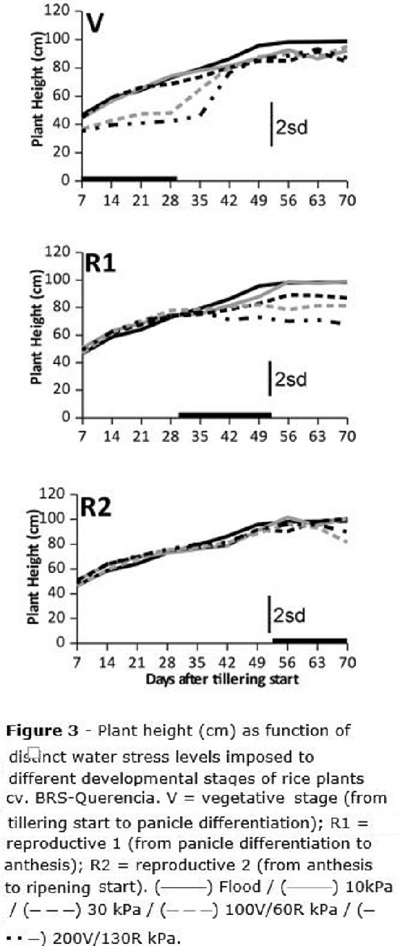
<p><font face = Verdana size = 2>where WC = water content (%); FW = fresh weight; DW = dry weight.</font></p>      <p>&nbsp;</p>     <p><font face = Verdana size = 2>After   collecting the plants, all the soil of each experimental plot was carefully   washed under running water for obtaining the bare roots; the excess of water in   roots was removed with absorptive paper towels by gently pressing and rubbing   them against the roots until towels were almost dry after used. Roots were put   into a graduated tube containing water, being root volume obtained by the   difference between the water level before and after root immersion.</font></p>     <p><font face = Verdana size = 2>Data were analyzed into the “R” statistical environment (R Core Team, 2016). Before any analysis, data sets were verified for normality and variance homogeneity of residuals by the tests of Shapiro-Wilk and Bartlett, respectively, being transformed by &#8730;(x+1)&nbsp;when needed. Data were then submitted to analysis of variance by the F-test at 5% probability. Data were explored according to significances of the interactions, being presented in graphical form. Data graphically presented are original; transformed data were used only for the parametric tests.</font></p>      <p><font face = Verdana size = 3><b>RESULTS</b></font></p>      <p><font face = Verdana size = 2>Plant height (<a href="#f3">Figure 3</a>) was affected by water stress when it was imposed both at “V” and “R1” stages; as rice plants stop growing before “R2”, differences due to stresses imposed at this stage were not expected. For the “V” stage, plants tended to be lower than the observed for the flooded check when water stress was beyond 100 kPa; 28 days after stress was imposed (after tillering start - DAT), plants at the two higher water tensions measured about 40cm height, while those at the flooded check and also those whose water stress was up to 30 kPa, measured about 60 cm (<a href="#f3">Figure 3</a>). The stress for the “V” stage was maintained for 30 days, and 42 DAT (12 days after stress was removed from “V” stage), plant height was recovered and no difference among treatments was later reported.</font></p>     <p>&nbsp;</p> <a name ="f3"><img src="/img/revistas/rca/v40n3/v40n3a11f3.jpg"></a>      
]]></body>
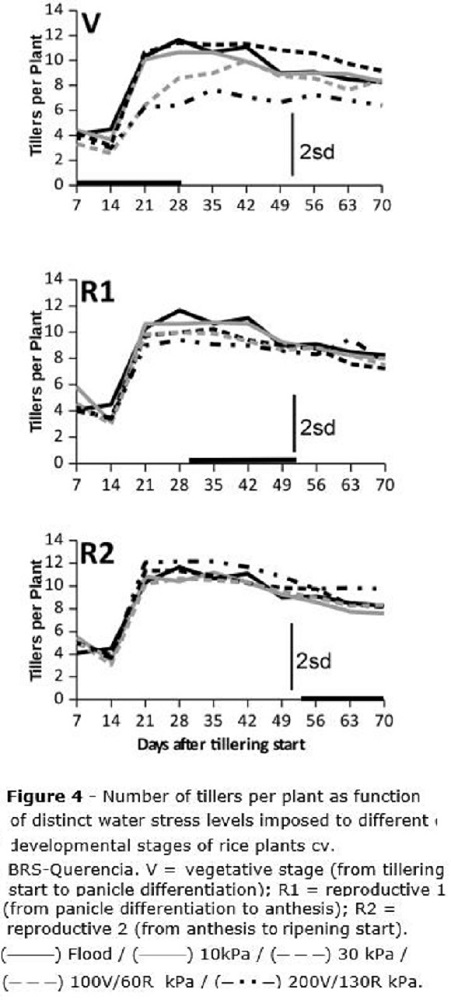
<body><![CDATA[<p>&nbsp;</p>     <p><font face = Verdana size = 2>For “R1”,   only the stress level of 130 kPa caused reduction in plant height compared to   the flooded check (<a href="#f3">Figure 3</a>), and this was maintained to the end of the cycle; no   growth recovery was observed when severe water stress was imposed between   panicle differentiation and anthesis (R1). When stress was imposed at “R2”, no   damage to plant height was reported, since plants had already stopped growth at   all.</font></p>     <p><font face = Verdana size = 2>The number of tillers per plant was also affected by the water stress, but only at the “V” stage (<a href="#f4">Figure 4</a>), when water tensions of 100 and 200 kPa reduced tillering, respectively, in about 30 and 48%. Under 100 kPa, tillering was smoothly recovered after stress was removed, while for 200 kPa no recovery was observed in tillering after the stress was stopped (<a href="#f4">Figure 4</a>). At the “V” stage, for the flooded check as well as for treatments until 30 kPa, only the usual tiller mortality by intraspecific competition was reported (<a href="#f4">Figure 4</a>), being the same observed for the “R1” and “R2” stages. Considering the usual tiller mortality by competition, a maximum of 11-12 tillers was reported per plant, being reduced to 8-9 tillers per plant at the end of the cycle (<a href="#f4">Figure 4</a>).</font></p>     <p>&nbsp;</p> <a name ="f4"><img src="/img/revistas/rca/v40n3/v40n3a11f4.jpg"></a>      
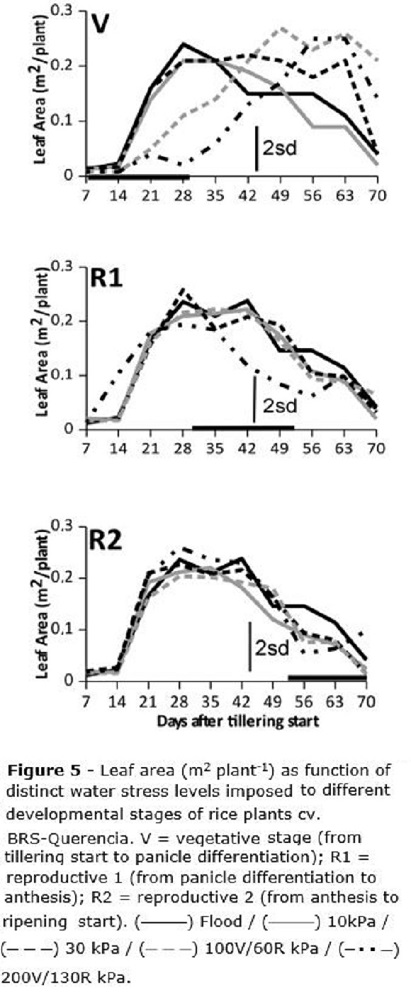
<p>&nbsp;</p>     <p><font face = Verdana size = 2>Leaf area (<a href="#f5">Figure 5</a>)   was about 200-380 cm<sup>2</sup> per plant (0.02-0.038 m<sup>2</sup> per plant)   for all treatments until seven DAT (about 18 days after emergence - DAE), after   this period it started growing fast and the maximum leaf area was observed   about 28 DAT / 39 DAE, reaching about 0.18-0.25 m<sup>2</sup> plant<sup>-1</sup>.   Leaf area increase was halted for stress levels above 100 and 130 kPa, for “V”   stage and above 130 kPa for “R1” stage (<a href="#f5">Figure 5</a>); leaf area was slowly recovered   after the stress was removed. For the “R2” stage no leaf area reduction was   observed for any water stress level (<a href="#f5">Figure 5</a>). For any treatment whose stress   level did not cause leaf area restrictions, the leaf area curve was the usual,   e.g., it slowly decreased after reaching a peak.</font></p>     <p>&nbsp;</p> <a name ="f5"><img src="/img/revistas/rca/v40n3/v40n3a11f5.jpg"></a>      
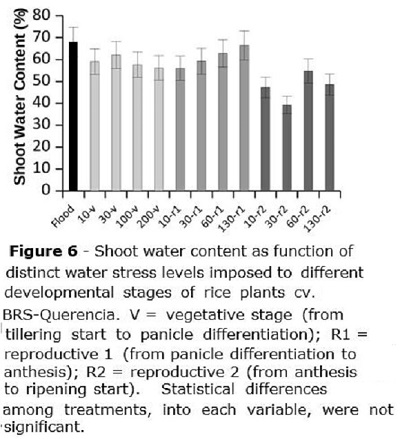
<p>&nbsp;</p>     <p><font face = Verdana size = 2>The shoot   water content (<a href="#f6">Figure 6</a>) was   equivalent for all treatments in flooded, “V” and “R1” stages, being of about   63%; for “R2”, mean water content in rice plants was 47%. Inside each   developmental group (“V”,”R1”,”R2”), there was no association between rice   shoot water content and the stress level to which plants were submitted.</font></p>     <p>&nbsp;</p> <a name ="f6"><img src="/img/revistas/rca/v40n3/v40n3a11f6.jpg"></a>      
]]></body>
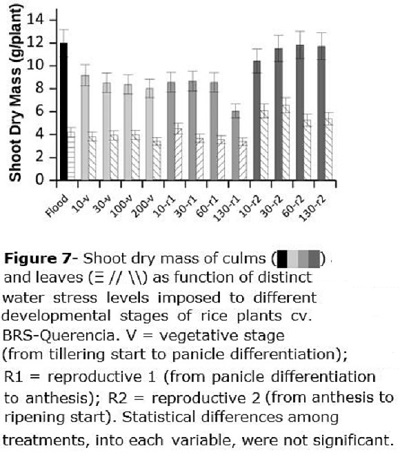
<body><![CDATA[<p>&nbsp;</p>     <p><font face = Verdana size = 2>Shoot dry   mass was divided into leaf and culm dry mass (<a href="#f7">Figure 7</a>).   Culm dry mass was of about 12 g plant<sup>-1</sup> for the flooded check, while   it was about 8.52, 7.96 and 11.3 g plant<sup>-1</sup>, respectively for “V”, “R1” and “R2”. Water stress imposed at “R2” did not affect culm dry mass since   rice plants had already reached its maximum growth. For “R1”, only the higher   water stress (130 kPa) resulted in lower dry mass (8.59 g plant<sup>-1</sup> as   mean of R1-10, R1-30 and R1-60, compared to 6.05 g plant<sup>-1</sup> for R1-130)   (<a href="#f7">Figure 7</a>). Leaves dry mass (<a href="#f7">Figure 7</a>) was about 3.83 g plant<sup>-1</sup> for “F” (flooded), “V”, and “R1”, and raised to about 5.82 g plant<sup>-1</sup> for treatments imposed in “R2”.</font></p>     <p>&nbsp;</p> <a name ="f7"><img src="/img/revistas/rca/v40n3/v40n3a11f7.jpg"></a>      
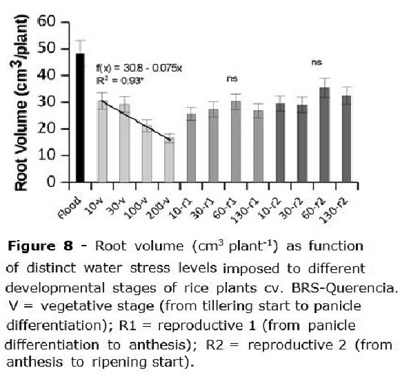
<p>&nbsp;</p>     <p><font face = Verdana size = 2>Root volume   (<a href="#f8">Figure 8</a>) was about 48 cm<sup>3</sup> plant<sup>-1</sup> for the flooded treatment, being superior to any of the irrigated treatments.   For treatments applied at the “V” stage, root volume decreased from 31 to 15 cm<sup>3</sup>   plant<sup>-1</sup> when water stress applied at that stage was increased from   10 to 200 kPa (<a href="#f8">Figure 8</a>), being   the root volume decreased by 0.075 cm<sup>3</sup> plant<sup>-1</sup> for each   additional kPa of water stress. When the stress was applied at “R1” or “R2” there was no clear effect of water tension on root volume, averaging 27.5 and   31.6 cm<sup>3</sup> plant<sup>-1</sup>, respectively (<a href="#f8">Figure 8</a>).</font></p>     <p>&nbsp;</p> <a name ="f8"><img src="/img/revistas/rca/v40n3/v40n3a11f8.jpg"></a>      
<p>&nbsp;</p>     <p><font face = Verdana size = 3><b>DISCUSSION</b></font></p>     <p><font face = Verdana size = 2>Plant height was clearly affected when water stress was imposed at “V” and “R1” stages (from tillering start to anthesis) (<a href="#f3">Figure 3</a>); while plants under stress at “V” were able to resume growth and completely restore the plant height after the stress was removed, those plants which underwent water stress at “R1” did not recover from the stress. These results are according to Gomes and Magalhães Jr. (2004) who reported that rice is able to recover from moderate water stress levels imposed at the vegetative stage, keeping its grain yield potential at harvest. One of the main issues of rice plants with smaller size in production fields, would probably be their reduced ability to compete against weed species (Aldrich, 1984), but on the other side it would also reduce crop lodging risk (Gomes and Magalhães Jr., 2004).</font></p>      <p><font face = Verdana size = 2>Since tillering (<a href="#f4">Figure 4</a>) was affected only when the water stress was imposed at “V”, with no recovery throughout the end of the cycle, it is possible to infer that the small number of tillers per plant under stress at “V” is minimally compensated by increased leaf area (<a href="#f5">Figure 5</a>) which was formed after the stress imposed at “V” was withdrawn. Leaf area is not able to compensate the decrease on the number of grains, consequence of the reduction on the number of tillers. Zain <i>et al</i>. (2014) reported rice tillering mortality and reduced plant height under water stress, but these authors did not assess rice leaf area. Regarding overall plant growth as function of periods of stress, these authors also found that water stress periods lasting for a maximum of five days did not affect rice growth and development.</font></p>      ]]></body>
<body><![CDATA[<p><font face = Verdana size = 2>No water content changes were reported at the present study as function of the distinct water stress levels in soil, at any developmental stage; however, Biswas and Choudhuri (1984) reported water content decrease in rice plants as a function of drought stress. In fact, shoot water stress in rice plants may occur even when there is no drought and water is available, since rice roots have an inherent poor ability to conduct water, causing, in specific conditions, plant water deficit even when roots are into water (Miyamoto <i>et al</i>., 2001). Thus, decreased rice shoot water content may depend mostly on climatic conditions (air humidity and temperature) than on the amount of excessive water present in soil. This represents another evidence that rice may be safely grown under sprinkler irrigation, with no harm to plant development, since irrigation is properly managed.</font></p>      <p><font face = Verdana size = 2>Regarding the developmental stages in which rice is most susceptible to water stresses, Blum (2011) reports that there is a big amount of experimental data which points for a general rule that plants are usually most severely affected by water stress at the reproductive stage, mainly near flowering (anthesis). When stress is imposed to rice between panicle initiation and anthesis, although a naturally slow rice plant growth is reported in this period, the damage in plant height and tillering is not recovered and plant yield potential may be decreased (Biswas and Choudhuri, 1984).</font></p>      <p><font face = Verdana size = 2>At the present study, rice plant development was mostly affected by stresses imposed at the vegetative and reproductive stages until flowering. Our findings, however, are according to the reported by Blum (2011) and Biswas and Choudhuri (1984), since rice damage caused by stresses applied to the reproductive stage were not recovered after the stress was withdrawn.</font></p>      <p><font face = Verdana size = 2>When the water stress was imposed in “R1” and “R2”, plants seemed to direct their reserves of energy to form roots (<a href="#f8">Figure 8</a>) and try to escape severe water stress. In the “V” stage, the plant did not have enough reserves and root volume was decreased as the stress level increased. It is usual in Brazilian rice fields to leave rice go through a moderate water stress by the beginning of tillering, as a way to allow increasing in root volume. In the present study, under controlled environment, this was not observed; however, Biswas and Choudhuri (1984) reported that although some water stress did not increase rice development, it reflected in superior yield components at harvest. Our data supplies evidence that this management may not increase root volume or any other growth parameter for currently available early cycle rice varieties.</font></p>      <p><font face = Verdana size = 2>A relevant result is the much higher root volume at the constantly flooded check compared to the other treatments (<a href="#f8">Figure 8</a>). Klumb <i>et al</i>. (2012) suggested that the demand of nutrients for rice grown under aerated soils may be higher than the required by flooded rice, due to a series of chemical reactions which could turn fertilizers most available for rice under flooding; thus, additional fertilizer could be needed for rice grown under sprinkler irrigation compared to flooding to keep equivalent plant growth ability and grain yield potential. This, however, could be partially managed by a proper fertilizer formulation (Yang <i>et al.</i>, 2012).</font></p>      <p><font face = Verdana size = 2>Considering the plant height, tillering, leaf area and root volume, it is prudent to report that rice plants growth seem to be little affected by the absence of waterlogging, being possible to be grown under sprinkler irrigation in highlands since water is properly managed to avoid water stress in soil above 30 kPa throughout the cropping cycle.</font></p>      <p><font face = Verdana size = 3><b>FINAL CONSIDERATIONS / CONCLUSIONS</b></font></p>      <p><font face = Verdana size = 2>Rice plant height is reduced when the water stress is applied either at the vegetative or at the beginning of the reproductive stage (from panicle initiation to anthesis); in the first case, plants are able to later recover from the stress, but this is not true when stress was imposed at the beginning of the reproductive stage.</font></p>      <p><font face = Verdana size = 2>Tillering was affected only by water stress imposed at the vegetative stage, and plants did not recover after the stress was withdrawn.</font></p>      <p><font face = Verdana size = 2>Plant water content was not affected by the water stress, but shoot dry mass of culms was reduced when stress was applied between tillering start and anthesis.</font></p>      ]]></body>
<body><![CDATA[<p><font face = Verdana size = 2>Root volume did not increase as a function of water stress imposed at the vegetative stage.</font></p>      <p><font face = Verdana size = 2>Rice plants growth seem to be little affected by the absence of waterlogging, but there is the need to avoid water stress levels above 30 kPa throughout the cropping cycle.</font></p>     <p>&nbsp;</p>     <p><font face = Verdana size = 3><b>References</b></font></p>      <!-- ref --><p><font face = Verdana size = 2>Aldrich, R.J. (1984) - <i>Weed-crop ecology: principles in weed management</i>.: Breton, North Scituate. 465 p.    &nbsp;&nbsp;&nbsp;&nbsp;&nbsp;&nbsp;&nbsp;&nbsp;[&#160;<a href="javascript:void(0);" onclick="javascript: window.open('/scielo.php?script=sci_nlinks&ref=665187&pid=S0871-018X201700030001100001&lng=','','width=640,height=500,resizable=yes,scrollbars=1,menubar=yes,');">Links</a>&#160;]<!-- end-ref --></font></p>      <!-- ref --><p><font face = Verdana size = 2>Biswas, A.K. &amp; Choudhuri, M.A. (1984) - Effect of water stress at different developmental stages of field-grown rice. <i>Biologia Plantarum</i>, vol. 26, n. 4, p. 263&#8209;266.  <a href="http://dx.doi.org/10.1007/BF02902907" target="_blank">http://dx.doi.org/10.1007/BF02902907</a></font>&nbsp;&nbsp;&nbsp;&nbsp;&nbsp;&nbsp;&nbsp;&nbsp;[&#160;<a href="javascript:void(0);" onclick="javascript: window.open('/scielo.php?script=sci_nlinks&ref=665189&pid=S0871-018X201700030001100002&lng=','','width=640,height=500,resizable=yes,scrollbars=1,menubar=yes,');">Links</a>&#160;]<!-- end-ref --><!-- ref --><p><font face = Verdana size = 2>Blum, A. (2011) - <i>Plant breeding for water-limited environments</i>. Springer, New York. 255 p.    &nbsp;&nbsp;&nbsp;&nbsp;&nbsp;&nbsp;&nbsp;&nbsp;[&#160;<a href="javascript:void(0);" onclick="javascript: window.open('/scielo.php?script=sci_nlinks&ref=665190&pid=S0871-018X201700030001100003&lng=','','width=640,height=500,resizable=yes,scrollbars=1,menubar=yes,');">Links</a>&#160;]<!-- end-ref --></font></p>      <!-- ref --><p><font face = Verdana size = 2>Carlesso, R.; Hernandez, M.G.R.; Righes, A.A.  &amp; Jadoski, S.O. (1998) - Índice de área foliar e altura de plantas de arroz submetidas a diferentes práticas de manejo. <i >Revista Brasileira de Engenharia Agrícola e Ambiental</i>, vol. 2, n. 3, p. 268&#8209;272. <a href="http://dx.doi.org/10.1590/1807-1929/agriambi.v2n3p268-272" target="_blank">http://dx.doi.org/10.1590/1807-1929/agriambi.v2n3p268-272</a></font>&nbsp;&nbsp;&nbsp;&nbsp;&nbsp;&nbsp;&nbsp;&nbsp;[&#160;<a href="javascript:void(0);" onclick="javascript: window.open('/scielo.php?script=sci_nlinks&ref=665192&pid=S0871-018X201700030001100004&lng=','','width=640,height=500,resizable=yes,scrollbars=1,menubar=yes,');">Links</a>&#160;]<!-- end-ref --><!-- ref --><p><font face = Verdana size = 2>Carli, C.; Steinmetz, S.; Streck, N.A.; Marchesan, E. &amp; Silva, M.R. (2016) - Número de dias e de graus-dia entre a iniciação e a diferenciação da panícula em cultivares de arroz irrigado. <i>Ciência Rural</i>, vol. 46, n. 3, p. 428-433.  <a href="http://dx.doi.org/10.1590/0103-8478cr20141057" target="_blank">http://dx.doi.org/10.1590/0103-8478cr20141057</a></font>&nbsp;&nbsp;&nbsp;&nbsp;&nbsp;&nbsp;&nbsp;&nbsp;[&#160;<a href="javascript:void(0);" onclick="javascript: window.open('/scielo.php?script=sci_nlinks&ref=665193&pid=S0871-018X201700030001100005&lng=','','width=640,height=500,resizable=yes,scrollbars=1,menubar=yes,');">Links</a>&#160;]<!-- end-ref --><!-- ref --><p><font face = Verdana size = 2>Correll, D.S. &amp; Correll, H.B. (1975) - <i >Aquatic and Wetland Plants of Southwestern United States</i>. vol. 1. Stanford University Press, Stanford. 1777 p.    &nbsp;&nbsp;&nbsp;&nbsp;&nbsp;&nbsp;&nbsp;&nbsp;[&#160;<a href="javascript:void(0);" onclick="javascript: window.open('/scielo.php?script=sci_nlinks&ref=665194&pid=S0871-018X201700030001100006&lng=','','width=640,height=500,resizable=yes,scrollbars=1,menubar=yes,');">Links</a>&#160;]<!-- end-ref --></font></p>      <!-- ref --><p><font face = Verdana size = 2>Embrapa (2005) - <i>BRS-Querência: precocidade, produtividade e qualidade a serviço da orizicultura Gaúcha.</i> Empresa Brasileira de Pesquisa Agropecuária: Embrapa Clima Temperado, Pelotas. 2 p. &lt; <a href="http://ainfo.cnptia.embrapa.br/digital/bitstream/item/44142/1/brs-querencia.pdf" target="_blank">http://ainfo.cnptia.embrapa.br/digital/bitstream/item/44142/1/brs-querencia.pdf</a>&gt;    &nbsp;&nbsp;&nbsp;&nbsp;&nbsp;&nbsp;&nbsp;&nbsp;[&#160;<a href="javascript:void(0);" onclick="javascript: window.open('/scielo.php?script=sci_nlinks&ref=665196&pid=S0871-018X201700030001100007&lng=','','width=640,height=500,resizable=yes,scrollbars=1,menubar=yes,');">Links</a>&#160;]<!-- end-ref --></font></p>      <!-- ref --><p><font face = Verdana size = 2>Gomes, A.S. &amp; Magalhães Jr., A.M. (2004) - <i>Arroz irrigado no sul do Brasil</i><b>.</b> Embrapa Informação Tecnológica, Brasília. 899 p.    &nbsp;&nbsp;&nbsp;&nbsp;&nbsp;&nbsp;&nbsp;&nbsp;[&#160;<a href="javascript:void(0);" onclick="javascript: window.open('/scielo.php?script=sci_nlinks&ref=665198&pid=S0871-018X201700030001100008&lng=','','width=640,height=500,resizable=yes,scrollbars=1,menubar=yes,');">Links</a>&#160;]<!-- end-ref --></font></p>      <!-- ref --><p><font face = Verdana size = 2>Gurevitch, J.; Scheiner, S.M. &amp; Fox, G.A. (2009) – <i>Ecologia vegetal</i>. Artmed, Porto Alegre. 574 p.    &nbsp;&nbsp;&nbsp;&nbsp;&nbsp;&nbsp;&nbsp;&nbsp;[&#160;<a href="javascript:void(0);" onclick="javascript: window.open('/scielo.php?script=sci_nlinks&ref=665200&pid=S0871-018X201700030001100009&lng=','','width=640,height=500,resizable=yes,scrollbars=1,menubar=yes,');">Links</a>&#160;]<!-- end-ref --></font></p>      <!-- ref --><p><font face = Verdana size = 2>Klumb, E.K.; Scivittaro, W.B.; Silva, P.S. da; Mello, D.C. &amp; Silveira, A.D. (2012) - Absorção de macronutrientes pelo arroz irrigado por aspersão. <i>In:</i> <i >Congresso de Iniciação Científica</i>, 21; Mostra Científica, 4., 2012, Pelotas, RS. Anais. Pelotas, RS: Universidade Federal de Pelotas, v. 1.    &nbsp;&nbsp;&nbsp;&nbsp;&nbsp;&nbsp;&nbsp;&nbsp;[&#160;<a href="javascript:void(0);" onclick="javascript: window.open('/scielo.php?script=sci_nlinks&ref=665202&pid=S0871-018X201700030001100010&lng=','','width=640,height=500,resizable=yes,scrollbars=1,menubar=yes,');">Links</a>&#160;]<!-- end-ref --></font></p>      <!-- ref --><p><font face = Verdana size = 2>Minshall, W.H. (1960) - Water moisture in plants. <i>Canadian Journal of Botany, </i>vol. 38, p. 201-216.    &nbsp;&nbsp;&nbsp;&nbsp;&nbsp;&nbsp;&nbsp;&nbsp;[&#160;<a href="javascript:void(0);" onclick="javascript: window.open('/scielo.php?script=sci_nlinks&ref=665204&pid=S0871-018X201700030001100011&lng=','','width=640,height=500,resizable=yes,scrollbars=1,menubar=yes,');">Links</a>&#160;]<!-- end-ref --></font></p>      <!-- ref --><p><font face = Verdana size = 2>Miyamoto, M.; Steudle, E.; Hirasawa, T. &amp; Lafitte, R. (2001) - Hydraulic conductivity of rice roots. <i>Journal of Experimental Botany</i>, vol. 52, n. 362, p. 1835&#8209;1846.  <a href="https://doi.org/10.1093/jexbot/52.362.1835" target="_blank">https://doi.org/10.1093/jexbot/52.362.1835</a></font>&nbsp;&nbsp;&nbsp;&nbsp;&nbsp;&nbsp;&nbsp;&nbsp;[&#160;<a href="javascript:void(0);" onclick="javascript: window.open('/scielo.php?script=sci_nlinks&ref=665206&pid=S0871-018X201700030001100012&lng=','','width=640,height=500,resizable=yes,scrollbars=1,menubar=yes,');">Links</a>&#160;]<!-- end-ref --><!-- ref --><p><font face = Verdana size = 2>Parfitt, J.M.B.; Pinto, M.A.B.; Timm, L.C.; Bamberg, A.L.; Silva, D.M. da &amp; Bretanha, G. (2011) - Manejo da irrigação por aspersão e desempenho da cultura do arroz. <i>In: Congresso brasileiro de arroz irrigado</i>, 7, 2011, Balneário Camboriú. Anais... Itajaí: EPAGRI; SOSBAI. p. 461-464.    &nbsp;&nbsp;&nbsp;&nbsp;&nbsp;&nbsp;&nbsp;&nbsp;[&#160;<a href="javascript:void(0);" onclick="javascript: window.open('/scielo.php?script=sci_nlinks&ref=665207&pid=S0871-018X201700030001100013&lng=','','width=640,height=500,resizable=yes,scrollbars=1,menubar=yes,');">Links</a>&#160;]<!-- end-ref --></font></p>      <!-- ref --><p><font face = Verdana size = 2>R Core Team (2016) - <i>R: A language and environment for statistical computing</i>. Vienna: R Foundation. <i>&lt;</i> <a href="https://cran.r-project.org" target="_blank">https://cran.r-project.org</a>&gt;    &nbsp;&nbsp;&nbsp;&nbsp;&nbsp;&nbsp;&nbsp;&nbsp;[&#160;<a href="javascript:void(0);" onclick="javascript: window.open('/scielo.php?script=sci_nlinks&ref=665209&pid=S0871-018X201700030001100014&lng=','','width=640,height=500,resizable=yes,scrollbars=1,menubar=yes,');">Links</a>&#160;]<!-- end-ref --></font></p>      <!-- ref --><p><font face = Verdana size = 2>SOSBAI (2016) – <i>Arroz irrigado: recomendações técnicas da pesquisa para o sul do Brasil.</i> Sociedade Sul-Brasileira do Arroz Irrigado, Pelotas. 197 p.    &nbsp;&nbsp;&nbsp;&nbsp;&nbsp;&nbsp;&nbsp;&nbsp;[&#160;<a href="javascript:void(0);" onclick="javascript: window.open('/scielo.php?script=sci_nlinks&ref=665211&pid=S0871-018X201700030001100015&lng=','','width=640,height=500,resizable=yes,scrollbars=1,menubar=yes,');">Links</a>&#160;]<!-- end-ref --></font></p>      ]]></body>
<body><![CDATA[<!-- ref --><p><font face = Verdana size = 2>Yang, X.; Li, Y.; Ren, B.; Ding, L.; Gao, C.; Shen, Q. &amp; Guo, S. (2012) - Drought-Induced Root Aerenchyma Formation Restricts Water Uptake in Rice Seedlings Supplied with Nitrate. <i >Plant Cell Physiology</i>, vol. 53, n. 3, p. 495&#8209;504. <a href="https://doi.org/10.1093/pcp/pcs003" target="_blank">https://doi.org/10.1093/pcp/pcs003</a></font>&nbsp;&nbsp;&nbsp;&nbsp;&nbsp;&nbsp;&nbsp;&nbsp;[&#160;<a href="javascript:void(0);" onclick="javascript: window.open('/scielo.php?script=sci_nlinks&ref=665213&pid=S0871-018X201700030001100016&lng=','','width=640,height=500,resizable=yes,scrollbars=1,menubar=yes,');">Links</a>&#160;]<!-- end-ref --><!-- ref --><p><font face = Verdana size = 2>Zain, N.A.M.; Ismail, M.R.; Puteh, A.; Mahmood, M. &amp; Islam, M.R. (2014) - Impact of cyclic water stress on growth, physiological responses and yield of rice (<i>Oryza sativa</i> L.) grown in tropical environment. <i>Ciência Rural</i>, vol. 44, n. 12, p. 2136-2141.  <a href="http://dx.doi.org/10.1590/0103-8478cr20131154" target="_blank">http://dx.doi.org/10.1590/0103-8478cr20131154</a></font>&nbsp;&nbsp;&nbsp;&nbsp;&nbsp;&nbsp;&nbsp;&nbsp;[&#160;<a href="javascript:void(0);" onclick="javascript: window.open('/scielo.php?script=sci_nlinks&ref=665214&pid=S0871-018X201700030001100017&lng=','','width=640,height=500,resizable=yes,scrollbars=1,menubar=yes,');">Links</a>&#160;]<!-- end-ref --><p>&nbsp;</p>     <p><font face = Verdana size = 2>Received/recebido: 2016.10.10</font></p>      <p><font face = Verdana size = 2>Received in revised form/recebido em versão revista: 2017.04.17</font></p>      <p><font face = Verdana size = 2>Accepted/aceite: 2017.04.18</font></p>       ]]></body><back>
<ref-list>
<ref id="B1">
<nlm-citation citation-type="book">
<person-group person-group-type="author">
<name>
<surname><![CDATA[Aldrich]]></surname>
<given-names><![CDATA[R.J.]]></given-names>
</name>
</person-group>
<source><![CDATA[Weed-crop ecology: principles in weed management]]></source>
<year>1984</year>
<publisher-loc><![CDATA[North Scituate ]]></publisher-loc>
<publisher-name><![CDATA[Breton]]></publisher-name>
</nlm-citation>
</ref>
<ref id="B2">
<nlm-citation citation-type="journal">
<person-group person-group-type="author">
<name>
<surname><![CDATA[Biswas]]></surname>
<given-names><![CDATA[A.K.]]></given-names>
</name>
<name>
<surname><![CDATA[Choudhuri]]></surname>
<given-names><![CDATA[M.A.]]></given-names>
</name>
</person-group>
<article-title xml:lang="en"><![CDATA[Effect of water stress at different developmental stages of field-grown rice]]></article-title>
<source><![CDATA[Biologia Plantarum]]></source>
<year>1984</year>
<volume>26</volume>
<numero>4</numero>
<issue>4</issue>
<page-range>263-266</page-range></nlm-citation>
</ref>
<ref id="B3">
<nlm-citation citation-type="book">
<person-group person-group-type="author">
<name>
<surname><![CDATA[Blum]]></surname>
<given-names><![CDATA[A.]]></given-names>
</name>
</person-group>
<source><![CDATA[Plant breeding for water-limited environments]]></source>
<year>2011</year>
<publisher-loc><![CDATA[New York ]]></publisher-loc>
<publisher-name><![CDATA[Springer]]></publisher-name>
</nlm-citation>
</ref>
<ref id="B4">
<nlm-citation citation-type="journal">
<person-group person-group-type="author">
<name>
<surname><![CDATA[Carlesso]]></surname>
<given-names><![CDATA[R.]]></given-names>
</name>
<name>
<surname><![CDATA[Hernandez]]></surname>
<given-names><![CDATA[M.G.R.]]></given-names>
</name>
<name>
<surname><![CDATA[Righes]]></surname>
<given-names><![CDATA[A.A.]]></given-names>
</name>
<name>
<surname><![CDATA[Jadoski]]></surname>
<given-names><![CDATA[S.O.]]></given-names>
</name>
</person-group>
<article-title xml:lang="pt"><![CDATA[Índice de área foliar e altura de plantas de arroz submetidas a diferentes práticas de manejo]]></article-title>
<source><![CDATA[Revista Brasileira de Engenharia Agrícola e Ambiental]]></source>
<year>1998</year>
<volume>2</volume>
<numero>3</numero>
<issue>3</issue>
<page-range>268-272</page-range></nlm-citation>
</ref>
<ref id="B5">
<nlm-citation citation-type="journal">
<person-group person-group-type="author">
<name>
<surname><![CDATA[Carli]]></surname>
<given-names><![CDATA[C.]]></given-names>
</name>
<name>
<surname><![CDATA[Steinmetz]]></surname>
<given-names><![CDATA[S.]]></given-names>
</name>
<name>
<surname><![CDATA[Streck]]></surname>
<given-names><![CDATA[N.A.]]></given-names>
</name>
<name>
<surname><![CDATA[Marchesan]]></surname>
<given-names><![CDATA[E.]]></given-names>
</name>
<name>
<surname><![CDATA[Silva]]></surname>
<given-names><![CDATA[M.R.]]></given-names>
</name>
</person-group>
<article-title xml:lang="pt"><![CDATA[Número de dias e de graus-dia entre a iniciação e a diferenciação da panícula em cultivares de arroz irrigado]]></article-title>
<source><![CDATA[Ciência Rural]]></source>
<year>2016</year>
<volume>46</volume>
<numero>3</numero>
<issue>3</issue>
<page-range>428-433</page-range></nlm-citation>
</ref>
<ref id="B6">
<nlm-citation citation-type="book">
<person-group person-group-type="author">
<name>
<surname><![CDATA[Correll]]></surname>
<given-names><![CDATA[D.S.]]></given-names>
</name>
<name>
<surname><![CDATA[Correll]]></surname>
<given-names><![CDATA[H.B.]]></given-names>
</name>
</person-group>
<source><![CDATA[Aquatic and Wetland Plants of Southwestern United States]]></source>
<year>1975</year>
<volume>1</volume>
<publisher-loc><![CDATA[Stanford ]]></publisher-loc>
<publisher-name><![CDATA[Stanford University Press]]></publisher-name>
</nlm-citation>
</ref>
<ref id="B7">
<nlm-citation citation-type="book">
<collab>Embrapa</collab>
<source><![CDATA[BRS-Querência: precocidade, produtividade e qualidade a serviço da orizicultura Gaúcha]]></source>
<year>2005</year>
<publisher-loc><![CDATA[Pelotas ]]></publisher-loc>
<publisher-name><![CDATA[Empresa Brasileira de Pesquisa Agropecuária]]></publisher-name>
</nlm-citation>
</ref>
<ref id="B8">
<nlm-citation citation-type="book">
<person-group person-group-type="author">
<name>
<surname><![CDATA[Gomes]]></surname>
<given-names><![CDATA[A.S.]]></given-names>
</name>
<name>
<surname><![CDATA[Magalhães Jr.]]></surname>
<given-names><![CDATA[A.M.]]></given-names>
</name>
</person-group>
<source><![CDATA[Arroz irrigado no sul do Brasil]]></source>
<year>2004</year>
<publisher-loc><![CDATA[Brasília ]]></publisher-loc>
<publisher-name><![CDATA[Embrapa Informação Tecnológica]]></publisher-name>
</nlm-citation>
</ref>
<ref id="B9">
<nlm-citation citation-type="book">
<person-group person-group-type="author">
<name>
<surname><![CDATA[Gurevitch]]></surname>
<given-names><![CDATA[J.]]></given-names>
</name>
<name>
<surname><![CDATA[Scheiner]]></surname>
<given-names><![CDATA[S.M.]]></given-names>
</name>
<name>
<surname><![CDATA[Fox]]></surname>
<given-names><![CDATA[G.A.]]></given-names>
</name>
</person-group>
<source><![CDATA[Ecologia vegetal]]></source>
<year>2009</year>
<publisher-loc><![CDATA[Porto Alegre ]]></publisher-loc>
<publisher-name><![CDATA[Artmed]]></publisher-name>
</nlm-citation>
</ref>
<ref id="B10">
<nlm-citation citation-type="confpro">
<person-group person-group-type="author">
<name>
<surname><![CDATA[Klumb]]></surname>
<given-names><![CDATA[E.K.]]></given-names>
</name>
<name>
<surname><![CDATA[Scivittaro]]></surname>
<given-names><![CDATA[W.B.]]></given-names>
</name>
<name>
<surname><![CDATA[Silva]]></surname>
<given-names><![CDATA[P.S. da]]></given-names>
</name>
<name>
<surname><![CDATA[Mello]]></surname>
<given-names><![CDATA[D.C.]]></given-names>
</name>
<name>
<surname><![CDATA[Silveira]]></surname>
<given-names><![CDATA[A.D.]]></given-names>
</name>
</person-group>
<article-title xml:lang="pt"><![CDATA[Absorção de macronutrientes pelo arroz irrigado por aspersão]]></article-title>
<source><![CDATA[]]></source>
<year>2012</year>
<conf-name><![CDATA[21 Congresso de Iniciação Científica]]></conf-name>
<conf-date>2012</conf-date>
<conf-loc>Pelotas RS</conf-loc>
</nlm-citation>
</ref>
<ref id="B11">
<nlm-citation citation-type="journal">
<person-group person-group-type="author">
<name>
<surname><![CDATA[Minshall]]></surname>
<given-names><![CDATA[W.H.]]></given-names>
</name>
</person-group>
<article-title xml:lang="en"><![CDATA[Water moisture in plants]]></article-title>
<source><![CDATA[Canadian Journal of Bo]]></source>
<year>1960</year>
<volume>38</volume>
<page-range>201-216</page-range></nlm-citation>
</ref>
<ref id="B12">
<nlm-citation citation-type="journal">
<person-group person-group-type="author">
<name>
<surname><![CDATA[Miyamoto]]></surname>
<given-names><![CDATA[M.]]></given-names>
</name>
<name>
<surname><![CDATA[Steudle]]></surname>
<given-names><![CDATA[E.]]></given-names>
</name>
<name>
<surname><![CDATA[Hirasawa]]></surname>
<given-names><![CDATA[T.]]></given-names>
</name>
<name>
<surname><![CDATA[Lafitte]]></surname>
<given-names><![CDATA[R.]]></given-names>
</name>
</person-group>
<article-title xml:lang="en"><![CDATA[Hydraulic conductivity of rice roots]]></article-title>
<source><![CDATA[Journal of Experimental Botany]]></source>
<year>2001</year>
<volume>52</volume>
<numero>362</numero>
<issue>362</issue>
<page-range>1835-1846</page-range></nlm-citation>
</ref>
<ref id="B13">
<nlm-citation citation-type="confpro">
<person-group person-group-type="author">
<name>
<surname><![CDATA[Parfitt]]></surname>
<given-names><![CDATA[J.M.B.]]></given-names>
</name>
<name>
<surname><![CDATA[Pinto]]></surname>
<given-names><![CDATA[M.A.B.]]></given-names>
</name>
<name>
<surname><![CDATA[Timm]]></surname>
<given-names><![CDATA[L.C.]]></given-names>
</name>
<name>
<surname><![CDATA[Bamberg]]></surname>
<given-names><![CDATA[A.L.]]></given-names>
</name>
<name>
<surname><![CDATA[Silva]]></surname>
<given-names><![CDATA[D.M. da]]></given-names>
</name>
<name>
<surname><![CDATA[Bretanha]]></surname>
<given-names><![CDATA[G.]]></given-names>
</name>
</person-group>
<article-title xml:lang="pt"><![CDATA[Manejo da irrigação por aspersão e desempenho da cultura do arroz]]></article-title>
<source><![CDATA[]]></source>
<year>2011</year>
<conf-name><![CDATA[ Congresso brasileiro de arroz irrigado]]></conf-name>
<conf-date>2011</conf-date>
<conf-loc> </conf-loc>
<page-range>461-464</page-range><publisher-loc><![CDATA[Itajaí ]]></publisher-loc>
<publisher-name><![CDATA[SOSBAI]]></publisher-name>
</nlm-citation>
</ref>
<ref id="B14">
<nlm-citation citation-type="book">
<collab>R Core Team</collab>
<source><![CDATA[R: A language and environment for statistical computing]]></source>
<year>2016</year>
<publisher-loc><![CDATA[Vienna ]]></publisher-loc>
<publisher-name><![CDATA[R Foundation]]></publisher-name>
</nlm-citation>
</ref>
<ref id="B15">
<nlm-citation citation-type="book">
<collab>SOSBAI</collab>
<source><![CDATA[Arroz irrigado: recomendações técnicas da pesquisa para o sul do Brasil]]></source>
<year>2016</year>
<publisher-loc><![CDATA[Pelotas ]]></publisher-loc>
<publisher-name><![CDATA[Sociedade Sul-Brasileira do Arroz Irrigado]]></publisher-name>
</nlm-citation>
</ref>
<ref id="B16">
<nlm-citation citation-type="journal">
<person-group person-group-type="author">
<name>
<surname><![CDATA[Yang]]></surname>
<given-names><![CDATA[X.]]></given-names>
</name>
<name>
<surname><![CDATA[Li]]></surname>
<given-names><![CDATA[Y.]]></given-names>
</name>
<name>
<surname><![CDATA[Ren]]></surname>
<given-names><![CDATA[B.]]></given-names>
</name>
<name>
<surname><![CDATA[Ding]]></surname>
<given-names><![CDATA[L.]]></given-names>
</name>
<name>
<surname><![CDATA[Gao]]></surname>
<given-names><![CDATA[C.]]></given-names>
</name>
<name>
<surname><![CDATA[Shen]]></surname>
<given-names><![CDATA[Q.]]></given-names>
</name>
<name>
<surname><![CDATA[Guo]]></surname>
<given-names><![CDATA[S.]]></given-names>
</name>
</person-group>
<article-title xml:lang="en"><![CDATA[Drought-Induced Root Aerenchyma Formation Restricts Water Uptake in Rice Seedlings Supplied with Nitrate]]></article-title>
<source><![CDATA[Plant Cell Physiology]]></source>
<year>2012</year>
<volume>53</volume>
<numero>3</numero>
<issue>3</issue>
<page-range>495-504</page-range></nlm-citation>
</ref>
<ref id="B17">
<nlm-citation citation-type="journal">
<person-group person-group-type="author">
<name>
<surname><![CDATA[Zain]]></surname>
<given-names><![CDATA[N.A.M.]]></given-names>
</name>
<name>
<surname><![CDATA[Ismail]]></surname>
<given-names><![CDATA[M.R.]]></given-names>
</name>
<name>
<surname><![CDATA[Puteh]]></surname>
<given-names><![CDATA[A.]]></given-names>
</name>
<name>
<surname><![CDATA[Mahmood]]></surname>
<given-names><![CDATA[M.]]></given-names>
</name>
<name>
<surname><![CDATA[Islam]]></surname>
<given-names><![CDATA[M.R.]]></given-names>
</name>
</person-group>
<article-title xml:lang="en"><![CDATA[Impact of cyclic water stress on growth, physiological responses and yield of rice (Oryza sativa L.) grown in tropical environment]]></article-title>
<source><![CDATA[Ciência Rural]]></source>
<year>2014</year>
<volume>44</volume>
<numero>12</numero>
<issue>12</issue>
<page-range>2136-2141</page-range></nlm-citation>
</ref>
</ref-list>
</back>
</article>