<?xml version="1.0" encoding="ISO-8859-1"?><article xmlns:mml="http://www.w3.org/1998/Math/MathML" xmlns:xlink="http://www.w3.org/1999/xlink" xmlns:xsi="http://www.w3.org/2001/XMLSchema-instance">
<front>
<journal-meta>
<journal-id>0871-018X</journal-id>
<journal-title><![CDATA[Revista de Ciências Agrárias]]></journal-title>
<abbrev-journal-title><![CDATA[Rev. de Ciências Agrárias]]></abbrev-journal-title>
<issn>0871-018X</issn>
<publisher>
<publisher-name><![CDATA[Sociedade de Ciências Agrárias de Portugal]]></publisher-name>
</publisher>
</journal-meta>
<article-meta>
<article-id>S0871-018X2017000400006</article-id>
<article-id pub-id-type="doi">10.19084/RCA17090</article-id>
<title-group>
<article-title xml:lang="en"><![CDATA[Development of Eugenia dysenterica (Mart.) DC. seedlings in the Cerrado, Brazil]]></article-title>
<article-title xml:lang="pt"><![CDATA[Desenvolvimento de mudas de Eugenia dysenterica (Mart.) DC. no Cerrado de Goiânia]]></article-title>
</title-group>
<contrib-group>
<contrib contrib-type="author">
<name>
<surname><![CDATA[Silva]]></surname>
<given-names><![CDATA[Sandro Rodrigues da]]></given-names>
</name>
<xref ref-type="aff" rid="A1"/>
</contrib>
<contrib contrib-type="author">
<name>
<surname><![CDATA[Dourado]]></surname>
<given-names><![CDATA[Wilson de Souza]]></given-names>
</name>
<xref ref-type="aff" rid="A1"/>
</contrib>
<contrib contrib-type="author">
<name>
<surname><![CDATA[Naves]]></surname>
<given-names><![CDATA[Ronaldo Veloso]]></given-names>
</name>
<xref ref-type="aff" rid="A1"/>
</contrib>
<contrib contrib-type="author">
<name>
<surname><![CDATA[Vieira]]></surname>
<given-names><![CDATA[Muza do Carmo]]></given-names>
</name>
<xref ref-type="aff" rid="A2"/>
</contrib>
<contrib contrib-type="author">
<name>
<surname><![CDATA[Pereira]]></surname>
<given-names><![CDATA[Caio César de Oliveira]]></given-names>
</name>
<xref ref-type="aff" rid="A2"/>
</contrib>
<contrib contrib-type="author">
<name>
<surname><![CDATA[Souza]]></surname>
<given-names><![CDATA[Eli Regina Barboza de]]></given-names>
</name>
<xref ref-type="aff" rid="A1"/>
</contrib>
</contrib-group>
<aff id="AA1">
<institution><![CDATA[,Universidade Federal de Goiás Escola de Agronomia ]]></institution>
<addr-line><![CDATA[Goiânia ]]></addr-line>
<country>Brazil</country>
</aff>
<aff id="AA2">
<institution><![CDATA[,Instituto Federal Goiano  ]]></institution>
<addr-line><![CDATA[Goiás ]]></addr-line>
<country>Brazil</country>
</aff>
<pub-date pub-type="pub">
<day>00</day>
<month>09</month>
<year>2017</year>
</pub-date>
<pub-date pub-type="epub">
<day>00</day>
<month>09</month>
<year>2017</year>
</pub-date>
<volume>40</volume>
<numero>4</numero>
<fpage>40</fpage>
<lpage>49</lpage>
<copyright-statement/>
<copyright-year/>
<self-uri xlink:href="http://scielo.pt/scielo.php?script=sci_arttext&amp;pid=S0871-018X2017000400006&amp;lng=en&amp;nrm=iso"></self-uri><self-uri xlink:href="http://scielo.pt/scielo.php?script=sci_abstract&amp;pid=S0871-018X2017000400006&amp;lng=en&amp;nrm=iso"></self-uri><self-uri xlink:href="http://scielo.pt/scielo.php?script=sci_pdf&amp;pid=S0871-018X2017000400006&amp;lng=en&amp;nrm=iso"></self-uri><abstract abstract-type="short" xml:lang="en"><p><![CDATA[Eugenia dysenterica (Mart.) DC. is a native tree of the Cerrado, a Brazilian ecosystem similar to the savannas. It has various uses such as food, medicinal, timber, ornamental and reforestation. Its fruits can be eaten raw or processed for the preparation of juices, liquors, cakes and ice cream. However, their exploitation has been made of extraction and often predatory manner. The objective of this study was to evaluate the phenology, plant biometrics and survival of a collection of Cagaiteiras trees in the initial phase of development located in the Cerrado, in Goiânia municipality. We collected fruits of 25 natural subpopulations of 5 states of the Brazilian Cerrado (Bahia, Goiás, Mato Grosso, Minas Gerais, and Tocantins). Within each subpopulation, six trees (mother plant) were sampled (with exceptions the subpopulations 2, 12, and 21 that were sampled five, four and five, respectively), and five fruits of each mother plant were collected. The collection was established in November 2013; the evaluations occurred between March and October 2014. We conducted an initial assessment, and another monthly between April and October 2014. The progenies manifested differently for the traits, being observed high variability among traits.]]></p></abstract>
<abstract abstract-type="short" xml:lang="pt"><p><![CDATA[Eugenia dysenterica (Mart.) DC. é uma árvore nativa do Cerrado brasileiro. Possui vários usos como alimentício, medicinal, madeireiro, ornamental e reflorestamento. Seus frutos podem ser consumidos in natura ou processados para a preparação de sucos, licores, bolos e sorvetes. Porém, sua exploração tem sido feita de forma extrativista e muitas vezes predatória. O objetivo deste trabalho foi avaliar a fenologia, biometria e sobrevivência de uma coleção de cagaiteiras em fase inicial de desenvolvimento implantada no Cerrado, em Goiânia. Foram coletados frutos de 25 subpopulações naturais em 5 estados do Cerrado brasileiro (Bahia, Goiás, Mato Grosso, Minas Gerais e Tocantins). Dentro de cada subpopulação, seis árvores (matrizes) foram amostradas (com exceções as subpopulações 2, 12 e 21 com 5, 4 e 5 matrizes, respectivamente) e cinco frutos de cada matriz foram coletados. A coleção foi implantada em novembro de 2013, as avaliações ocorreram entre os meses de março e outubro de 2014. Realizou-se uma avaliação inicial e as demais mensalmente entre os meses de abril e outubro de 2014. As progênies se manifestaram de maneira diferente para os caracteres avaliados, sendo observada alta variabilidade.]]></p></abstract>
<kwd-group>
<kwd lng="en"><![CDATA[Native fruit tree]]></kwd>
<kwd lng="en"><![CDATA[seedling production]]></kwd>
<kwd lng="en"><![CDATA[plant selection]]></kwd>
<kwd lng="pt"><![CDATA[Frutífera nativa]]></kwd>
<kwd lng="pt"><![CDATA[produção de mudas]]></kwd>
<kwd lng="pt"><![CDATA[seleção de planta]]></kwd>
</kwd-group>
</article-meta>
</front><body><![CDATA[ <p align = "right"><font face = "Verdana" size = "2"><b>ARTIGO</b></font></p>      <p><font face = Verdana size = 4><b>Development of <i>Eugenia dysenterica</i> (Mart.) DC. seedlings in the Cerrado, Brazil</b></font></p>      <p><font face = Verdana size = 3><b>Desenvolvimento de mudas de <i>Eugenia dysenterica </i>(Mart.) DC. no Cerrado de Goiânia</b></font></p>      <p><font face = Verdana size = 2><b>Sandro Rodrigues da Silva</b><sup>1</sup>, <b>Wilson de Souza Dourado</b><sup>1</sup>; <b>Ronaldo Veloso Naves</b><sup>1</sup>,  <b>Muza do Carmo Vieira</b><sup>2,*</sup>, <b>Caio César de Oliveira Pereira</b><sup>2</sup> and <b>Eli Regina Barboza de Souza</b><sup>1</sup> <sup> </sup></font></p>      <p><font face = Verdana size = 2><i><sup>1</sup>Escola de Agronomia da Universidade Federal de Goiás - UFG, Goiânia, Brazil</i></font></p>      <p><font face = Verdana size = 2><i> <sup>2</sup>Instituto Federal Goiano - Câmpus Urutaí, Goiás, Brazil</i></font></p>   <hr noshade size = 1>      <p><font face = Verdana size = 3><b>ABSTRACT:</b></font></p>       <p><font face = Verdana size = 2><i>Eugenia dysenterica</i> (Mart.) DC. is a native tree of the Cerrado, a Brazilian ecosystem similar to the savannas. It has various uses such as food, medicinal, timber, ornamental and reforestation. Its fruits can be eaten raw or processed for the preparation of juices, liquors, cakes and ice cream. However, their exploitation has been made of extraction and often predatory manner. The objective of this study was to evaluate the phenology, plant biometrics and survival of a collection of Cagaiteiras trees in the initial phase of development located in the Cerrado, in Goiânia municipality. We collected fruits of 25 natural subpopulations of 5 states of the Brazilian Cerrado (Bahia, Goiás, Mato Grosso, Minas Gerais, and Tocantins). Within each subpopulation, six trees (mother plant) were sampled (with exceptions the subpopulations 2, 12, and 21 that were sampled five, four and five, respectively), and five fruits of each mother plant were collected. The collection was established in November 2013; the evaluations occurred between March and October 2014. We conducted an initial assessment, and another monthly between April and October 2014. The progenies manifested differently for the traits, being observed high variability among traits.</font></p>      <p><font face = Verdana size = 2><b>Keywords:</b> Native fruit tree, seedling production, plant selection</font></p>  <hr noshade size = 1>      <p><font face = Verdana size = 3><b>RESUMO:</b></font></p>      ]]></body>
<body><![CDATA[<p><font face = Verdana size = 2><i>Eugenia dysenterica </i>(Mart.) DC. é uma árvore nativa do Cerrado brasileiro. Possui vários usos como alimentício, medicinal, madeireiro, ornamental e reflorestamento. Seus frutos podem ser consumidos <i>in natura </i>ou processados para a preparação de sucos, licores, bolos e sorvetes. Porém, sua exploração tem sido feita de forma extrativista e muitas vezes predatória. O objetivo deste trabalho foi avaliar a fenologia, biometria e sobrevivência de uma coleção de cagaiteiras em fase inicial de desenvolvimento implantada no Cerrado, em Goiânia. Foram coletados frutos de 25 subpopulações naturais em 5 estados do Cerrado brasileiro (Bahia, Goiás, Mato Grosso, Minas Gerais e Tocantins). Dentro de cada subpopulação, seis árvores (matrizes) foram amostradas (com exceções as subpopulações 2, 12 e 21 com 5, 4 e 5 matrizes, respectivamente) e cinco frutos de cada matriz foram coletados. A coleção foi implantada em novembro de 2013, as avaliações ocorreram entre os meses de março e outubro de 2014. Realizou-se uma avaliação inicial e as demais mensalmente entre os meses de abril e outubro de 2014. As progênies se manifestaram de maneira diferente para os caracteres avaliados, sendo observada alta variabilidade.</font></p>      <p><font face = Verdana size = 2><b>Palavras-chave:</b> Frutífera nativa, produção de mudas, seleção de planta </font></p>  <hr noshade size = 1>      <p><font face = Verdana size = 3><b>INTRODUCTION</b></font></p>      <p><font face = Verdana size = 2>The Brazilian Cerrado are one of the richest plant formations in species diversity. However, part of this diversity is being lost due to the anthropic actions to exploit areas where the Cerrado predominates. Many native plant species have already been extinct or are in the process of extinction, losing their representativeness without knowing their real potential (Almeida <i>et al</i>., 1987; Souza, 2006).</font></p>      <p><font face = Verdana size = 2>The lack of knowledge of Brazilian native species and the devaluation of biodiversity increase the threat of extinction as Brack <i>et al</i>. (2007)  reported and especially those of the Cerrado Biome  of which little is known.</font></p>      <p><font face = Verdana size = 2>Native species of the Cerrado have the potential for sustainable economic exploitation, among them the Cagaiteira tree, a native fruit tree of the Cerrado that can be found in formations of Cerrado <i>stricto sensu</i>, &quot;Cerradão&quot; and meadow (Mendonça <i>et al</i>., 1998).</font></p>      <p><font face = Verdana size = 2>According to Gomide <i>et al</i>. (1994), the Cagaiteira (<i>E. dysenterica</i>) has fruitful and medicinal potential. Its fruit is widely consumed by the local population, in cooking,<i> in</i> <i>natura</i>, in the production of ice cream and jellies (Almeida <i>et al</i>., 1987), and as a source of antioxidants and bioactive components (Abadio Finco <i>et al</i>., 2012).</font></p>      <p><font face = Verdana size = 2>Studies on the geographical distribution, cultivation and genetic structure of local populations have already been carried out (Chaves &amp; Telles, 2006). However, there is still a need for continuous studies that clarify in more detail the biometry, phenophases, and survival of seedlings in the field, so the selection of promising progenies can be made and then the introduction to cultivation.</font></p>      <p><font face = Verdana size = 2>The objective of this work was to perform the biometric evaluation, to monitor the phenology and the survival of one hundred and twenty-two progenies of Cagaiteira <i>Eugenia dysenterica</i> (Mart.) DC plants, in the early stages of development, from different subpopulations occurring in the Cerrado, Brazil.</font></p>      <p><font face = Verdana size = 3><b>MATERIAL AND METHODS</b></font></p>      ]]></body>
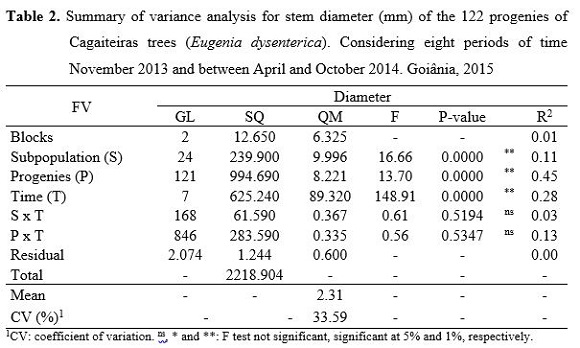
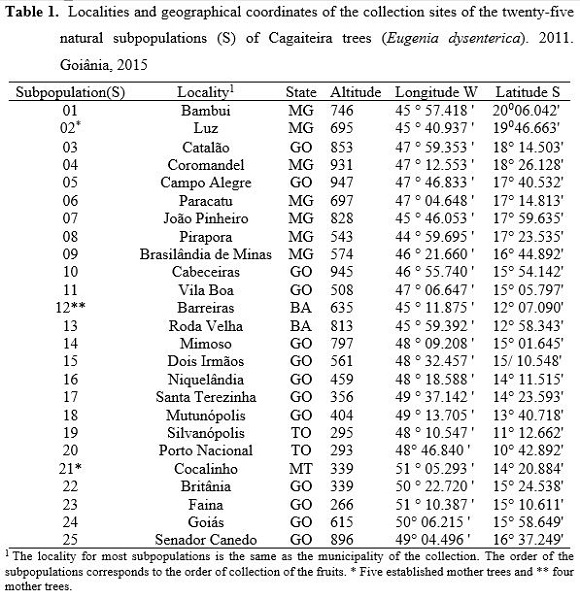
<body><![CDATA[<p><font face = Verdana size = 2>We collected fruits at least 20 mature fruits of Cagaiteira trees (<i>E. dysenterica</i>), in the plant or the crown of each tree, in five states of the Cerrado region (<a href = "#t1">Table 1</a>) between October and November 2011. The fruits had their pericarp intact, green to yellow color, corresponding to the criteria used by Duarte <i>et al</i>. (2006). The population was composed of 122 families, from trees of 25 subpopulations (S), six mother trees were sampled by subpopulation (with exceptions the subpopulations 2, 12 and 21 that were sampled five, four and five respectively) to obtain seeds. Recommending the premises of Silva et al. (2001), a minimum distance of 20&nbsp;km between plants tree characterize the subpopulations.</font></p>      <p>    <br></p>  <a name = "t1"><img src = "/img/revistas/rca/v40n4/v40n4a06t1.jpg"></a>      
<p>    <br></p>      <p><font face = Verdana size = 2>The sowing occurred on November 15, 2011, in plastic bags with 24&nbsp;cm of height and 18&nbsp;cm in diameter containing substrate with a mixture of earth and sand proportion with 1:1. Irrigation was daily performed when there was no precipitation. The material was kept in screened with 50% shading.</font></p>      <p><font face = Verdana size = 2>After 24 months, the seedlings were planted in the experimental area of the School of Agronomy - Federal University of Goiás (EA / UFG) in Goiânia, GO-Brazil, located on the Highway GO-010, at geographical coordinates 16º36 South 49º17 West of Greenwich, and 736&nbsp;m of altitude. The soil of the experimental area was classified as Dark-Red Latosol. The climate of the region is Aw type of Köppen-Geiger (Peel <i>et al</i>., 2007; Alvares <i>et al</i>., 2014), warm and semi-humid with dry season well defined between the months of May and September. </font></p>      <p><font face = Verdana size = 2>For the preparation of the area was performed a plowing, a harrowing, a furrowing, and the opening of pits with dimensions of 40 × 40 × 40&nbsp;cm. in spacing of 3 × 2&nbsp;m. The transplant was carried out in November 2013 (twenty-four months after sowing).</font></p>      <p><font face = Verdana size = 2>The stem diameter at the soil level total height of the plant (from the soil level to the insertion region of the younger leaf), and the survival of plants were evaluated. The diameter measurements were performed with the aid of a digital caliper, in millimeters, and for height, a graduated ruler.</font></p>      <p><font face = Verdana size = 2>Phenological observations were performed every 30 days, between April and October 2014, in 24-month-old plants. In all plants was made the count of young leaves and old leaves.</font></p>      ]]></body>
<body><![CDATA[<p><font face = Verdana size = 2>The progenies were arranged in three randomized complete blocks, 25 treatments, five to six plants per treatment and a total of 146 progenies in three replicates. For the selection of subpopulations, it was evaluated the increase of the stem diameter and total height of plants, through the means of final diameters less the averages of the total diameters and height. The experimental design was a randomized complete block in which the diameter and height were submitted to analysis of variance (F test) and the means were compared by the Scott-Knott test at 5%.</font></p>      <p><font face = Verdana size = 3><b>RESULTS AND DISCUSSION</b></font></p>      <p><font face = Verdana size = 2>Assessing the stem diameter at the soil level a significant difference (p&#8804;0.01) was observed for the subpopulation and progeny effect, with 56% of the total variation of the sums of squares (<a href = "#t2">Table 2</a>). This highlights the genetic variability existing for stem diameter between subpopulations and progenies.  </font></p>      <p><font face = Verdana size = 2>For the time, there was a significant difference (p&#8804;0.01). The progenies tend to increase the diameter of the stem gradually over time. The time effect was responsible for 28% of the total data variation (<a href = "#t2">Table 2</a>). The interaction of subpopulation with time and progeny interaction over time was not significant (p&gt; 0.05) with the mean stem diameter remaining constant over time.</font></p>      <p><font face = Verdana size = 2>As for the progenies, the variability detected in the analysis was confirmed in the Scott-Knott (1974) averages grouping test at 5% probability, where it was possible to define eight groups. The averages for the stem diameter variable were 2.31&nbsp;mm, the means ranged from 1.08 to 4.13&nbsp;mm, with a variation range of 3.05&nbsp;mm. The three largest averages were expressed by the m1p4 progenies (Mother tree (M) 1 from subpopulation (S) 4) - Coromandel-MG; m2p6 (M 2 S 6) - Paracatu-MG and m2p04 (M 2 S 4) - Coromandel-MG, with means of 4.06, 4.13 and 4.13&nbsp;mm, respectively.</font></p>      <p>    <br></p>  <a name = "t2"><img src = "/img/revistas/rca/v40n4/v40n4a06t2.jpg"></a>      
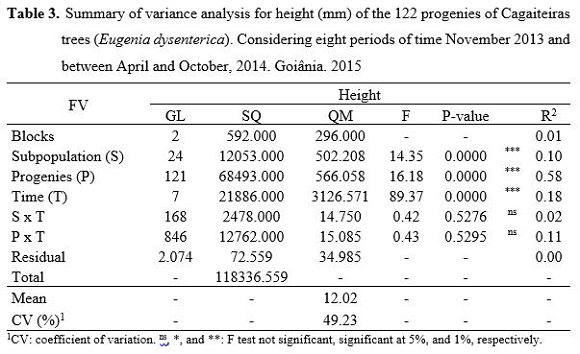
<p>    <br></p>      <p><font face = Verdana size = 2>The larger stem mean diameters of these progenies indicate a greater growth capacity, which suggests that they have an early cycle, a favorable feature to selection for domestication. Less time to reach the appropriate diameter for the grafting and insertion in crop systems to obtain fruits of the Cerrado, to subsidize the municipality demands.</font></p>      ]]></body>
<body><![CDATA[<p><font face = Verdana size = 2>For the characteristic height of plants, significant genetic difference (p&#8804;0.01) was detected for the subpopulation and progeny, both represented together 68% of the total variation of the sums of squares (<a href = "#t3">Table 3</a>). This underscores the existing genetic variability for height between progenies and subpopulations. </font></p>      <p><font face = Verdana size = 2>As expected and not different from the stem diameter, for the total height of plants there was a significant difference (p&#8804;0.01) for the time, that is, the progenies tend to increase plant height gradually over time. The time effect was responsible for 18% of the total data variation (<a href = "#t3">Table 3</a>). The interaction of subpopulation with time and progeny interaction over time was not significant (p&gt;0.05).</font></p>      <p>    <br></p>  <a name = "t3"><img src = "/img/revistas/rca/v40n4/v40n4a06t3.jpg"></a>      
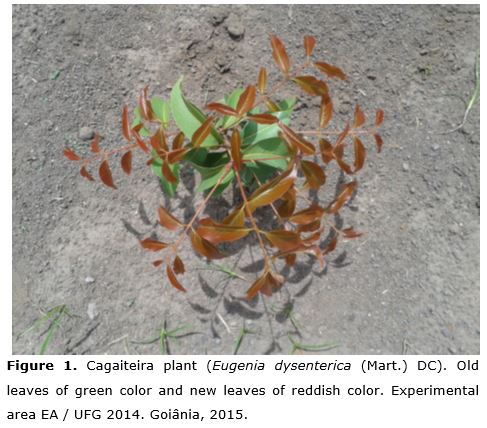
<p>    <br></p>      <p><font face = Verdana size = 2>There were three groups for both IDIA and IALT characters. Their overall averages were 1.64&nbsp;mm and 5.34&nbsp;cm for IDIA and IALT, respectively (<a href = "/img/revistas/rca/v40n4/v40n4a06t4.jpg" target = "_blank">Table 4</a>). For IDIA, the group with the highest averages was represented by a single subpopulation, the 14 (Mimoso-GO), with an average of increase of 2.88&nbsp;mm. For IALT, the group with the highest mean values of increment were represented by three subpopulations, the 8 (Pirapora-MG), 14 (Mimosos-GO), 7 (João Pinheiro-MG) and averages of 9.05, 11.39 and 12.37 cm, respectively (<a href = "/img/revistas/rca/v40n4/v40n4a06t4.jpg" target = "_blank">Table 4</a>). The subpopulation 14 (Mimoso-GO) was highlighted, since it presented better mean values for IDIA and IALT 2.88 mm and 11.39 cm, respectively (<a href = "#f1">Figure 1</a>). This shows that this subpopulation possesses greater capacity of increase in stem diameter and total height of plant, being inferred, therefore, subpopulation with early cycle. This is a very important discovery because it is a very slow growth species (Chaves &amp; Telles, 2006).</font></p>      
<p>    <br></p>  <a name = "f1"><img src = "/img/revistas/rca/v40n4/v40n4a06f1.jpg"></a>      
<p>    ]]></body>
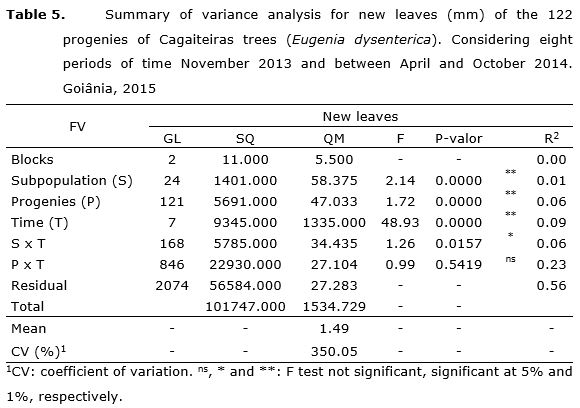
<body><![CDATA[<br></p>      <p><font face = Verdana size = 2>Among the progenies, the variability detected in the analysis of variance was confirmed in the Scott-Knott (1974) clustering test at 5% probability for the variable height of plants there was grouping in eight groups (<a href = "#t5">Table 5</a>).</font></p>     <p>&nbsp;</p>     <p><a name = "t5"><img src = "/img/revistas/rca/v40n4/v40n4a06t5.jpg"></a> </p>     
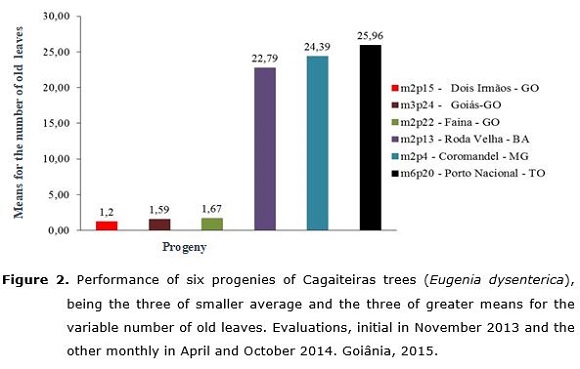
<p>&nbsp;</p>     <p><font face = Verdana size = 2>The overall mean for the total plant height of the progenies was (<a href = "#f2">Figure 2</a>) 12.02&nbsp;cm, the means varied between 3.54 and 32.67&nbsp;cm, with a range of variation of 29.13&nbsp;cm. The three largest averages for the height character were the progenies, m2p13 (M 2 S 13) - Roda Velha-BA, m1p3 (M 1 S 3) - Catalão-GO and m2p4 (M 2 S 4) – Coromandel-MG, averages 26.19, 31.64 and 32.67&nbsp;cm, respectively. As in the diameter variable, progenies with higher averages for height indicate a greater capacity of growth, which makes it possible to affirm that these have favorable characteristics for the selection, considering indicative of precocity (Novaes, 2014).</font></p>     <p>&nbsp;</p>     <p><a name = "f2"><img src = "/img/revistas/rca/v40n4/v40n4a06f2.jpg"></a></p>     
<p>&nbsp;</p>     <p>    ]]></body>
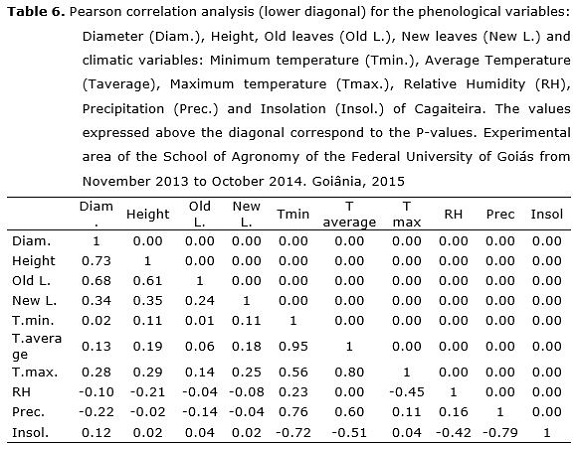
<body><![CDATA[<br>   <font face = Verdana size = 2>In an experiment conducted at the Federal University of Goiás, from May 1998 to November 1999, Souza <i>et al</i>. (2002) evaluated Cagaiteiras trees after 175 days of sowing, was found that the stem diameter with best means were: 0.15; 0.16; 0.17; 0.16; 0.18; 0.25 and 0.64&nbsp;cm, at 30, 60, 90, 120, 150, 180 and 540 days after planting, respectively. For the height variable, the best averages were 10.16; 10.27; 11.38; 12.49; 15.16; 17.48 and 46.26&nbsp;cm, at 30, 60, 90, 120, 150, 180 and 540 days after planting, respectively.</font></p>      <p><font face = Verdana size = 2>According to Silva <i>et al</i>. (2001) evaluating ten subpopulations of Cagaiteiras from the southeast of Goiás, observed the existence of genetic differences among subpopulations. According to these authors, in addition to the genetic differences, the uncontrolled environmental components, such as the anthropogenic condition, the soil. the climate, the age of the plant should greatly influence the phenotypic variation.  </font></p>      <p><font face = Verdana size = 2>Evaluating the same plants, the subpopulation 23 (Faina-GO) was among the three lowest averages for the evaluated trait from February to October 2012 under screened Novaes (2014). This result agrees with what was found in the present study, its performance under field conditions remained low, with a mean of 1.10 mm IDIA and 1.29&nbsp;cm IALT. In their evaluations, subpopulations 1, 2 and 21 (Bambuí-MG; Luz-MG and Cocalinho-MT, respectively) presented higher mean values, in the present study the response of these subpopulations in field conditions did not correspond in the same way, subpopulations 1 and 2 for both diameter and height were in the worst performing group (group C), while subpopulation 21, in the diameter character was in the worst group (C) and for height, was in the intermediate group (B). This factor (change in ranking) can be explained by the genetic difference between the evaluated individuals and attributed to the adaptive process to the environmental conditions of these subpopulations when in field conditions.</font></p>      <p><font face = Verdana size = 2>It was found by Duboc (2005) increase of the stem diameter of Cagaiteiras, in a gallery forest, in the city of Planaltina de Goiás - DF at 4, 8 and 12 months after planting, with different doses of Nitrogen (0, 10, 20 and 40&nbsp;Kg&nbsp;ha<sup>-1</sup>). The means for N 0 Kg&nbsp;ha<sup>-1 </sup>treatment was 1.08&nbsp;mm, indicating a much lower increase, lower than the mean of the worst subpopulation in this study (Faina - GO).</font></p>      <p><font face = Verdana size = 2>The results presented in the present work demonstrate the variability, unevenness and slow growth in relation to the characteristics stem diameter and plant height of Cagaiteira. This result corroborates with the findings of Souza <i>et al</i>. (2002) who noticed in their studies that the Cagaiteira shows growth in height and uneven diameter. This fact, infers in selecting earlier and uniformly growing seedlings for orchard implantation.</font></p>      <p><font face = Verdana size = 2>As for phenology, was observed that for the new leaves there was intermittent emission throughout the evaluation period (November 2013 to October 2014), with intensification in the months of September and October. Observations made in other works with plants of different ages verified that the renewal of leaves of the Cagaiteira occur in the months of September and October (Souza, 2006; Camilo <i>et al</i>., 2013). In this case, it is inferred that the Cagaiteira expresses the phenological pattern of intensive emission of new leaves in the months of September and October, independent of the development stage.</font></p>      <p><font face = Verdana size = 2>Interactions between total plant height, stem diameter, old leaves and new leaves were observed. These with each other and with the climatic variables minimum, medium and maximum temperatures, relative humidity (RH), precipitation and insolation (<a href = "#t6">Table 6</a>). In the present study, interactions of the stem diameter variable with other variables were observed: plant height (0.73) considered strong and positive; old leaves (0.68) moderate and positive; new leaves (0.34) considered a weak and positive correlation; stem diameter was also observed with the climatic variables: Tmax, Taverage and Tmin (0.28, 0.13, and 0.02) positive and weak and very weak interaction. respectively; insolation (0.12) positive and very weak interaction; precipitation and RH (-0.22 and -0.10) negative, weak and very weak interaction, respectively.</font></p>      <p>    <br></p>  <a name = "t6"><img src = "/img/revistas/rca/v40n4/v40n4a06t6.jpg"></a>      
<p>    ]]></body>
<body><![CDATA[<br></p>      <p><font face = Verdana size = 2>The plant height interaction with other characteristics was also observed: old leaves (0.61) moderate and positive interaction; new leaves (0.35) a weak and positive. Consequently, plants with larger diameter also had higher height and a larger number of old leaves. The interaction of the total plant height variable with climatic variables: Tmax., Taverage and Tmin. (0.29, 0.19 and 0.11), had a positive and weak interaction; and positive and very weak interactions respectively; Insolation, precipitation and RU (0.02; 0.02 and 0.21) had a positive, negative, very weak and weak correlation, respectively.   </font></p>      <p><font face = Verdana size = 2>We observed interactions between the old leaves phenological variables and: T max., Taverage, Tmin., (0.14, 0.06, and 0.01) positive and very poor, respectively; Insolation, precipitation and RU (0.04; 0.14 and 0.04), positive, negative and well weak, respectively. As for the new leaves variables: Tmax, (0.25) considered positive and a poor interaction; T.average and T.min. (0.18 and 0.11), positive and very poor, respectively; Insolation, precipitation and RU (0.02; 0.04 and 0.08) positive, negative and well weak interaction, respectively. Results of other studies corroborate those obtained in the present study.</font></p>      <p><font face = Verdana size = 2>In the assessment of Cagaiteiras in the Cerrado region, Souza <i>et al</i>. (2008), observed that there was a significant correlation of the phenophases and the maximum temperature, mean temperature and relative humidity of the air, indicated as possible promoters of the emission of new leaves. In their research, they observed that the renewal of leaves occurs every year and intensifies in the months of September and October. They also observed a significant and positive interaction of emission of new leaves and maximum temperature (0.45) and average temperature (0.32) in population A. In populations B and C they obtained (0.53) and (0.62) for maximum temperature and (0.45) and (0.52) for average temperature, respectively. In relation to relative air humidity, there was a significant and negative interaction (-0.32 and -0.33) in populations B and C, respectively.</font></p>      <p><font face = Verdana size = 2>The assessment of Cagaiteiras trees after fourteen years of planting in the School of Agronomy of the Federal University of Goiás (EA / UFG), from September 2011 to April 2012, Camilo <i>et al</i>. (2013) found significant and negative interaction of the emission of new leaves with minimum temperature (-0.384), relative humidity (-0.404) and precipitation (-0.440). The discrepancy in relation to the indices evaluated in the present study can be justified by the difference in the periods evaluated.</font></p>      <p><font face = Verdana size = 2>The results presented previously, corroborate with those obtained in the present work. The small discrepancies in the indexes of correlations may be possibly explained by the fact that they are plants at different stages of development and / or distinct periods of evaluation.</font></p>      <p><font face = Verdana size = 2>About the survival variable, it was observed high survivals, between 72.22% and 100%. In a study in Planaltina-DF, among many other plants, guanandi (<i>Callophylum brasiliense</i>) and cagaiteira (<i>Eugenia dysenterica</i>) were used in the recovering area. Of 48 individuals of each species planted in December 2006 and evaluated 38 months after planting, the survival was zero percent for both species, a factor attributed to the lack of establishment capacity in local conditions and also the quality and age of the seedlings. On the other hand, in the same study the cagaiteira presented as natural regeneration, high survival from 89.29% to 98.21%. In this case, the root regeneration (regrowth) reminiscent of individuals previously planted in the area (Cortes, 2012).</font></p>      <p><font face = Verdana size = 2>Survival rates may be affected depending on nutrition. The survival of Cagaiteira tress, after one year of planting, was affected with the application of different doses of nitrogen (N). The soil of Cerrado and in Gallery forest (although not significant, there is a trend of increase in survival in the absence of the two nutrients): 0&nbsp;Kg&nbsp;ha<sup>-1</sup> N had survival of 91.75% and 100%, dosage 10&nbsp;kg&nbsp;ha<sup>-1</sup> survival of 58.25% and 75%; dosage of 20&nbsp;kg&nbsp;ha<sup>-1</sup> survival of 66.75% and 50%; and with the application of 40&nbsp;kg&nbsp;ha<sup>-1</sup> survival of 50% and 58.25%, respectively. In relation to the addition of Phosphorus (P) in gallery forest soils at doses of 0, 10, 20 and 40&nbsp;kg&nbsp;ha<sup>-1</sup>, survival of 66.75%. 41.75%. 66.75% and 58.25%, respectively. In the same way that N despite the non-significant influence of the treatments of P it is observed that there is a tendency of greater survival with its absence (Duboc, 2005).</font></p>      <p><font face = Verdana size = 2>The high survival rates may be associated with the adaptability of the species to the edaphoclimatic conditions, as well as the cultural treatments developed in this initial phase of development. Monitoring planting areas, such as pest control, and control of spontaneous plants may contribute positively to plant survival (Cortes, 2012).</font></p>      <p><font face = Verdana size = 2>Survival rates change over the years. Studies in plantations in the recovering area in Planaltina-DF, using several species of the Cerrado biome, indicated that as the years passed, plant survival decreased at 38, 43 and 50 months after planting. The survivals of the individuals were 48.75%, 47.50% and 42.78%, respectively, suggesting the adaptability of the species to the local conditions (Cortes, 2012).</font></p>      ]]></body>
<body><![CDATA[<p>    <br></p>      <p><font face = Verdana size = 3><b>CONCLUSION</b></font></p>      <p><font face = Verdana size = 2>In the assessment period (November 2013. and from April to October 2014) the Cagaiteiras trees showed an average of 2.31&nbsp;mm of stem diameter and 12.02&nbsp;cm of total plant height.</font></p>      <p><font face = Verdana size = 2>The plants of the subpopulation 14 (Mimoso-GO) and 7 (João Pinheiro) showed higher averages for the stem diameter (2.88&nbsp;mm) and total plant height 12.37&nbsp;cm.</font></p>      <p><font face = Verdana size = 2>The progeny m2p4 (Coromandel-MG) obtained higher mean values for stem diameter (4.13&nbsp;mm) and total plant height (32.67&nbsp;cm).</font></p>      <p><font face = Verdana size = 2>In the early stages of development, the greater the total height of the plant, the larger its diameter and the greater the number of old leaves.</font></p>      <p><font face = Verdana size = 2>In September and October is intensified the emergence of new leaves.</font></p>      <p><font face = Verdana size = 2>The subpopulations evaluated have survival between 72.22% and 100%.</font></p>      <p><font face = Verdana size = 2>The lack of knowledge of Brazilian native species and the devaluation of biodiversity increase the threat of extinction according to Brack <i>et al</i>. (2007).</font></p>      ]]></body>
<body><![CDATA[<p><font face = Verdana size = 2>The native fruits of the Cerrado are riches but little is known on them. However, there is still a need for continuous studies that clarify in more detail the biometry, phenophases and survival of seedlings in the field, so that the selection of promising progenies can be made and then introduction to the crop.</font></p>      <p>    <br></p>      <p><font face = Verdana size = 3><b>BIBLIOGRAPHIC REFERENCES</b></font></p>      <!-- ref --><p><font face = Verdana size = 2>Abadio Finco, F.D.B.; Silva, I.G. &amp; Oliveira, R.B. (2012) - Physicochemical characteristics and antioxidant activity of three native fruits from Brazilian savannah (Cerrado). <i>Alimentos e Nutrição</i>, vol. 23, n. 2, p. 179-185.    &nbsp;&nbsp;&nbsp;&nbsp;&nbsp;&nbsp;&nbsp;&nbsp;[&#160;<a href="javascript:void(0);" onclick="javascript: window.open('/scielo.php?script=sci_nlinks&ref=667450&pid=S0871-018X201700040000600001&lng=','','width=640,height=500,resizable=yes,scrollbars=1,menubar=yes,');">Links</a>&#160;]<!-- end-ref --></font></p>      <!-- ref --><p><font face = Verdana size = 2>Almeida, S.P.; Silva, J.A. &amp; Ribeiro, J.F. (1987) - <i>Aproveitamento alimentar de espécies nativas dos Cerrados: araticum, baru, cagaita e jatobá.</i> Planaltina: Embrapa-CPAC, 43 p.    &nbsp;&nbsp;&nbsp;&nbsp;&nbsp;&nbsp;&nbsp;&nbsp;[&#160;<a href="javascript:void(0);" onclick="javascript: window.open('/scielo.php?script=sci_nlinks&ref=667452&pid=S0871-018X201700040000600002&lng=','','width=640,height=500,resizable=yes,scrollbars=1,menubar=yes,');">Links</a>&#160;]<!-- end-ref --></font></p>      <!-- ref --><p><font face = Verdana size = 2>Alvares, C.A.; Stape, J.L.; Sentelhas, P.C.; Gonçalves, J.L.M. &amp; Sparovek, G. (2014) - Köppen’s climate classification map for Brazil. <i>Meteorologische Zeitschrift</i>, vol. 22, n. 6, p. 711-728.  <a href = "http://dx.doi.org/10.1127/0941-2948/2013/0507" target = "_blank">http://dx.doi.org/10.1127/0941-2948/2013/0507</a></font>&nbsp;&nbsp;&nbsp;&nbsp;&nbsp;&nbsp;&nbsp;&nbsp;[&#160;<a href="javascript:void(0);" onclick="javascript: window.open('/scielo.php?script=sci_nlinks&ref=667454&pid=S0871-018X201700040000600003&lng=','','width=640,height=500,resizable=yes,scrollbars=1,menubar=yes,');">Links</a>&#160;]<!-- end-ref --><!-- ref --><p><font face = Verdana size = 2>Brack, P.; Kinupp, V.F. &amp; Sobral, M.E.G. (2007) - Levantamento Preliminar de espécies frutíferas de Árvores e arbustos nativos com uso atual ou potencial no Rio Grande do Sul. <i>Revista Brasileira de Agroecologia</i>, vol.2, n.1, p. 1769-1770.    &nbsp;&nbsp;&nbsp;&nbsp;&nbsp;&nbsp;&nbsp;&nbsp;[&#160;<a href="javascript:void(0);" onclick="javascript: window.open('/scielo.php?script=sci_nlinks&ref=667455&pid=S0871-018X201700040000600004&lng=','','width=640,height=500,resizable=yes,scrollbars=1,menubar=yes,');">Links</a>&#160;]<!-- end-ref --></font></p>      <!-- ref --><p><font face = Verdana size = 2>Camilo, Y.M.V.; Souza, E.R.B.; Vera, R. &amp; Naves, R.V. (2013) - Fenologia, produção e precocidade de plantas de <i>Eugenia dysenterica</i> visando melhoramento genético. <i>Revista de Ciências Agrárias</i>, vol. 36, n. 2, p. 192-198.    &nbsp;&nbsp;&nbsp;&nbsp;&nbsp;&nbsp;&nbsp;&nbsp;[&#160;<a href="javascript:void(0);" onclick="javascript: window.open('/scielo.php?script=sci_nlinks&ref=667457&pid=S0871-018X201700040000600005&lng=','','width=640,height=500,resizable=yes,scrollbars=1,menubar=yes,');">Links</a>&#160;]<!-- end-ref --></font></p>      <!-- ref --><p><font face = Verdana size = 2>Chaves, L.J. &amp; Telles, M.P.C. (2006) - Cagaita. <i>In</i>: Vieira, R.F.; Costa, T.S.A.; Silva, D.B.; Ferreira, F. R. &amp; Sano, S.M. (Eds.) - <i>Frutas Nativas da Região Centro-Oeste do Brasil.</i> Brasília, p. 120-135.    &nbsp;&nbsp;&nbsp;&nbsp;&nbsp;&nbsp;&nbsp;&nbsp;[&#160;<a href="javascript:void(0);" onclick="javascript: window.open('/scielo.php?script=sci_nlinks&ref=667459&pid=S0871-018X201700040000600006&lng=','','width=640,height=500,resizable=yes,scrollbars=1,menubar=yes,');">Links</a>&#160;]<!-- end-ref --></font></p>      <!-- ref --><p><font face = Verdana size = 2>Cortes, J.M. (2012) - <i>Desenvolvimento de espécies nativas do cerrado a partir do plantio de mudas e da regeneração natural em uma área em processo de regeneração</i>. Dissertação de Mestrado. Brasília, Universidade de Brasília, 89 p.    &nbsp;&nbsp;&nbsp;&nbsp;&nbsp;&nbsp;&nbsp;&nbsp;[&#160;<a href="javascript:void(0);" onclick="javascript: window.open('/scielo.php?script=sci_nlinks&ref=667461&pid=S0871-018X201700040000600007&lng=','','width=640,height=500,resizable=yes,scrollbars=1,menubar=yes,');">Links</a>&#160;]<!-- end-ref --></font></p>      <!-- ref --><p><font face = Verdana size = 2>Duarte, E.F.; Naves, R.V.; Borges, J.D. &amp; Guimarães, N.N.R. (2006) - Germinação e vigor de sementes de cagaita (<i>Eugenia dysenterica</i> Mart. DC.) em função de seu tamanho e tipo de coleta. <i>Pesquisa Agropecuária Tropical</i>, vol. 36, n. 3, p. 173-179.    &nbsp;&nbsp;&nbsp;&nbsp;&nbsp;&nbsp;&nbsp;&nbsp;[&#160;<a href="javascript:void(0);" onclick="javascript: window.open('/scielo.php?script=sci_nlinks&ref=667463&pid=S0871-018X201700040000600008&lng=','','width=640,height=500,resizable=yes,scrollbars=1,menubar=yes,');">Links</a>&#160;]<!-- end-ref --></font></p>      <!-- ref --><p><font face = Verdana size = 2>Duboc, E. (2005) - <i>Desenvolvimento Inicial e nutrição de espécies arbóreas nativas sob fertilização, em plantios de recuperação de áreas de cerrado degradado</i>. Tese de Doutoramento. Botucatu, Universidade Estadual Paulista. 151 p.    &nbsp;&nbsp;&nbsp;&nbsp;&nbsp;&nbsp;&nbsp;&nbsp;[&#160;<a href="javascript:void(0);" onclick="javascript: window.open('/scielo.php?script=sci_nlinks&ref=667465&pid=S0871-018X201700040000600009&lng=','','width=640,height=500,resizable=yes,scrollbars=1,menubar=yes,');">Links</a>&#160;]<!-- end-ref --></font></p>      <!-- ref --><p><font face = Verdana size = 2>Gomide, C.C.C.; Fonseca, C.E.L.; Nasser, L.C.B.; Charchar, M.J.D. &amp; Farias Neto, A.L. (1994) - Identificação e controle de fungos associados às sementes armazenadas de cagaita (<i>Eugenia dysenterica</i> DC). <i>Pesquisa Agropecuária Brasileira</i>, vol. 29, n. 6, p. 885-890.    &nbsp;&nbsp;&nbsp;&nbsp;&nbsp;&nbsp;&nbsp;&nbsp;[&#160;<a href="javascript:void(0);" onclick="javascript: window.open('/scielo.php?script=sci_nlinks&ref=667467&pid=S0871-018X201700040000600010&lng=','','width=640,height=500,resizable=yes,scrollbars=1,menubar=yes,');">Links</a>&#160;]<!-- end-ref --></font></p>      <!-- ref --><p><font face = Verdana size = 2>Mendonça, R.C.; Felfili, J.M.; Walter, B.M.T.; Silva Júnior, M.C.; Rezende, A.V.; Filgueira, T.S. &amp; Nogueira, P.E. (1998) - Flora vascular do Cerrado. <i>In</i>: Sano, S.M. &amp; Almeida, S.P. (Eds.) - <i>Cerrado: ambiente e flora</i>. Planaltina, Brasília, p. 289-556.    &nbsp;&nbsp;&nbsp;&nbsp;&nbsp;&nbsp;&nbsp;&nbsp;[&#160;<a href="javascript:void(0);" onclick="javascript: window.open('/scielo.php?script=sci_nlinks&ref=667469&pid=S0871-018X201700040000600011&lng=','','width=640,height=500,resizable=yes,scrollbars=1,menubar=yes,');">Links</a>&#160;]<!-- end-ref --></font></p>      <!-- ref --><p><font face = Verdana size = 2>Novaes, C.R.D.B. (2014) - <i>Variabilidade e divergência genética de caracteres quantitativos e marcadores neutros em populações de Eugenia dysenterica </i>DC. Tese de Doutoramento. Goiânia, Universidade Federal de Goiás, 223 p.    &nbsp;&nbsp;&nbsp;&nbsp;&nbsp;&nbsp;&nbsp;&nbsp;[&#160;<a href="javascript:void(0);" onclick="javascript: window.open('/scielo.php?script=sci_nlinks&ref=667471&pid=S0871-018X201700040000600012&lng=','','width=640,height=500,resizable=yes,scrollbars=1,menubar=yes,');">Links</a>&#160;]<!-- end-ref --></font></p>      <!-- ref --><p><font face = Verdana size = 2>Peel, M.C.; Finlayson, B.L. &amp; Mcmahon, T.A.(2007) - Updated world map of the Köppen-Geiger climate classification. <i>Hydrology and Earth System Sciences Discussions</i>, Germany, p. 439-473.  &lt;<a href = "https://hal.archives-ouvertes.fr/hal-00305098/document" target = "_blank">https://hal.archives-ouvertes.fr/hal-00305098/document</a>&gt;    &nbsp;&nbsp;&nbsp;&nbsp;&nbsp;&nbsp;&nbsp;&nbsp;[&#160;<a href="javascript:void(0);" onclick="javascript: window.open('/scielo.php?script=sci_nlinks&ref=667473&pid=S0871-018X201700040000600013&lng=','','width=640,height=500,resizable=yes,scrollbars=1,menubar=yes,');">Links</a>&#160;]<!-- end-ref --></font></p>      <!-- ref --><p><font face = Verdana size = 2>Scott, A.J. &amp; Knott, M. (1974) - A cluster analysis method for grouping means in the analysis of variance. <i>Biometrics</i>, vol. 30, n. 6, p. 507-512.    &nbsp;&nbsp;&nbsp;&nbsp;&nbsp;&nbsp;&nbsp;&nbsp;[&#160;<a href="javascript:void(0);" onclick="javascript: window.open('/scielo.php?script=sci_nlinks&ref=667475&pid=S0871-018X201700040000600014&lng=','','width=640,height=500,resizable=yes,scrollbars=1,menubar=yes,');">Links</a>&#160;]<!-- end-ref --></font></p>      <!-- ref --><p><font face = Verdana size = 2>Silva, R.S.M.; Chaves, L.J. &amp; Naves, R.V. (2001) - Caracterização de frutos e árvores de cagaita (<i>Eugenia Dysenterica</i> DC.) no sudeste do estado de Goiás, Brasil. <i>Revista Brasileira de Fruticultura</i>, vol. 23, n. 2, p. 330-334.  <a href = "http://dx.doi.org/10.1590/S0100-29452001000200026" target = "_blank">http://dx.doi.org/10.1590/S0100-29452001000200026</a></font>&nbsp;&nbsp;&nbsp;&nbsp;&nbsp;&nbsp;&nbsp;&nbsp;[&#160;<a href="javascript:void(0);" onclick="javascript: window.open('/scielo.php?script=sci_nlinks&ref=667477&pid=S0871-018X201700040000600015&lng=','','width=640,height=500,resizable=yes,scrollbars=1,menubar=yes,');">Links</a>&#160;]<!-- end-ref --><!-- ref --><p><font face = Verdana size = 2>Souza, E.R.B. de; Naves, R.V.; Carneiro, I.F.; Leandro, W.L. &amp; Borges, J.D. (2002) - Crescimento e sobrevivência de mudas de cagaiteira (<i>Eugenia dysenterica</i> DC.) nas condições do Cerrado. <i>Revista Brasileira de Fruticultura</i>, vol. 24, n. 2, p. 491-495.  <a href = "http://dx.doi.org/10.1590/S0100-29452002000200042" target = "_blank">http://dx.doi.org/10.1590/S0100-29452002000200042</a></font>&nbsp;&nbsp;&nbsp;&nbsp;&nbsp;&nbsp;&nbsp;&nbsp;[&#160;<a href="javascript:void(0);" onclick="javascript: window.open('/scielo.php?script=sci_nlinks&ref=667478&pid=S0871-018X201700040000600016&lng=','','width=640,height=500,resizable=yes,scrollbars=1,menubar=yes,');">Links</a>&#160;]<!-- end-ref --><!-- ref --><p><font face = Verdana size = 2>Souza, E.R.B. (2006) - <i>Fenologia, dados biométricos, nutrição de plantas e qualidade de frutos de cagaiteira (Eugenia dysenterica </i>DC<i>.) no estado de Goiás</i>. Tese de Doutoramento. Goiânia, Universidade Federal de Goiás, 114 p.    &nbsp;&nbsp;&nbsp;&nbsp;&nbsp;&nbsp;&nbsp;&nbsp;[&#160;<a href="javascript:void(0);" onclick="javascript: window.open('/scielo.php?script=sci_nlinks&ref=667479&pid=S0871-018X201700040000600017&lng=','','width=640,height=500,resizable=yes,scrollbars=1,menubar=yes,');">Links</a>&#160;]<!-- end-ref --></font></p>      <!-- ref --><p><font face = Verdana size = 2>Souza, E.R.B., Naves, R.V.; Borges, J.D.; Vera, R.; Fernandes, E.P.; Silva, L.B. &amp; Trindade, M.G. (2008) - Fenologia de cagaiteira (<i>Eugenia dysenterica </i>DC.) no Estado de Goiás. <i>Revista Brasileira de Fruticultura</i>, vol. 30, n. 4, p. 1009-1014.  <a href = "http://dx.doi.org/10.1590/S0100-29452008000400028" target = "_blank">http://dx.doi.org/10.1590/S0100-29452008000400028</a></font>&nbsp;&nbsp;&nbsp;&nbsp;&nbsp;&nbsp;&nbsp;&nbsp;[&#160;<a href="javascript:void(0);" onclick="javascript: window.open('/scielo.php?script=sci_nlinks&ref=667481&pid=S0871-018X201700040000600018&lng=','','width=640,height=500,resizable=yes,scrollbars=1,menubar=yes,');">Links</a>&#160;]<!-- end-ref --><p>    <br></p>      <p><font face = Verdana size = 2>Received/recebido: 2017.05.07</font></p>      <p><font face = Verdana size = 2>Received in revised form/recebido em versão revista: 2017.06.19</font></p>      ]]></body>
<body><![CDATA[<p><font face = Verdana size = 2>Accepted/aceite: 2017.07.13</font></p>       ]]></body><back>
<ref-list>
<ref id="B1">
<nlm-citation citation-type="journal">
<person-group person-group-type="author">
<name>
<surname><![CDATA[Abadio Finco]]></surname>
<given-names><![CDATA[F.D.B.]]></given-names>
</name>
<name>
<surname><![CDATA[Silva]]></surname>
<given-names><![CDATA[I.G.]]></given-names>
</name>
<name>
<surname><![CDATA[Oliveira]]></surname>
<given-names><![CDATA[R.B.]]></given-names>
</name>
</person-group>
<article-title xml:lang="en"><![CDATA[Physicochemical characteristics and antioxidant activity of three native fruits from Brazilian savannah (Cerrado)]]></article-title>
<source><![CDATA[Alimentos e Nutrição]]></source>
<year>2012</year>
<volume>23</volume>
<numero>2</numero>
<issue>2</issue>
<page-range>179-185</page-range></nlm-citation>
</ref>
<ref id="B2">
<nlm-citation citation-type="book">
<person-group person-group-type="author">
<name>
<surname><![CDATA[Almeida]]></surname>
<given-names><![CDATA[S.P.]]></given-names>
</name>
<name>
<surname><![CDATA[Silva]]></surname>
<given-names><![CDATA[J.A]]></given-names>
</name>
<name>
<surname><![CDATA[Ribeiro]]></surname>
<given-names><![CDATA[J.F.]]></given-names>
</name>
</person-group>
<source><![CDATA[Aproveitamento alimentar de espécies nativas dos Cerrados: araticum, baru, cagaita e jatobá]]></source>
<year>1987</year>
<publisher-loc><![CDATA[Planaltina ]]></publisher-loc>
<publisher-name><![CDATA[Embrapa-CPAC]]></publisher-name>
</nlm-citation>
</ref>
<ref id="B3">
<nlm-citation citation-type="journal">
<person-group person-group-type="author">
<name>
<surname><![CDATA[Alvares]]></surname>
<given-names><![CDATA[C.A.]]></given-names>
</name>
<name>
<surname><![CDATA[Stape]]></surname>
<given-names><![CDATA[J.L.]]></given-names>
</name>
<name>
<surname><![CDATA[Sentelhas]]></surname>
<given-names><![CDATA[P.C.]]></given-names>
</name>
<name>
<surname><![CDATA[Gonçalves]]></surname>
<given-names><![CDATA[J.L.M.]]></given-names>
</name>
<name>
<surname><![CDATA[Sparovek]]></surname>
<given-names><![CDATA[G.]]></given-names>
</name>
</person-group>
<article-title xml:lang="en"><![CDATA[Köppen’s climate classification map for Brazil]]></article-title>
<source><![CDATA[Meteorologische Zeitschrift]]></source>
<year>2014</year>
<volume>22</volume>
<numero>6</numero>
<issue>6</issue>
<page-range>711-728</page-range></nlm-citation>
</ref>
<ref id="B4">
<nlm-citation citation-type="journal">
<person-group person-group-type="author">
<name>
<surname><![CDATA[Brack]]></surname>
<given-names><![CDATA[P.]]></given-names>
</name>
<name>
<surname><![CDATA[Kinupp]]></surname>
<given-names><![CDATA[V.F.]]></given-names>
</name>
<name>
<surname><![CDATA[Sobral]]></surname>
<given-names><![CDATA[M.E.G.]]></given-names>
</name>
</person-group>
<article-title xml:lang="pt"><![CDATA[Levantamento Preliminar de espécies frutíferas de Árvores e arbustos nativos com uso atual ou potencial no Rio Grande do Sul]]></article-title>
<source><![CDATA[Revista Brasileira de Agroecologia]]></source>
<year>2007</year>
<volume>2</volume>
<numero>1</numero>
<issue>1</issue>
<page-range>1769-1770</page-range></nlm-citation>
</ref>
<ref id="B5">
<nlm-citation citation-type="journal">
<person-group person-group-type="author">
<name>
<surname><![CDATA[Camilo]]></surname>
<given-names><![CDATA[Y.M.V.]]></given-names>
</name>
<name>
<surname><![CDATA[Souza]]></surname>
<given-names><![CDATA[E.R.B.]]></given-names>
</name>
<name>
<surname><![CDATA[Vera]]></surname>
<given-names><![CDATA[R.]]></given-names>
</name>
<name>
<surname><![CDATA[Naves]]></surname>
<given-names><![CDATA[R.V.]]></given-names>
</name>
</person-group>
<article-title xml:lang="pt"><![CDATA[Fenologia, produção e precocidade de plantas de Eugenia dysenterica visando melhoramento genético]]></article-title>
<source><![CDATA[Revista de Ciências Agrárias]]></source>
<year>2013</year>
<volume>36</volume>
<numero>2</numero>
<issue>2</issue>
<page-range>192-198</page-range></nlm-citation>
</ref>
<ref id="B6">
<nlm-citation citation-type="">
<person-group person-group-type="author">
<name>
<surname><![CDATA[Chaves]]></surname>
<given-names><![CDATA[L.J.]]></given-names>
</name>
<name>
<surname><![CDATA[Telles]]></surname>
<given-names><![CDATA[M.P.C.]]></given-names>
</name>
</person-group>
<article-title xml:lang="pt"><![CDATA[Cagaita]]></article-title>
<person-group person-group-type="editor">
<name>
<surname><![CDATA[Vieira]]></surname>
<given-names><![CDATA[R.F.]]></given-names>
</name>
<name>
<surname><![CDATA[Costa]]></surname>
<given-names><![CDATA[T.S.A.]]></given-names>
</name>
<name>
<surname><![CDATA[Silva]]></surname>
<given-names><![CDATA[D.B.]]></given-names>
</name>
<name>
<surname><![CDATA[Ferreira]]></surname>
<given-names><![CDATA[F. R.]]></given-names>
</name>
<name>
<surname><![CDATA[Sano]]></surname>
<given-names><![CDATA[S.M.]]></given-names>
</name>
</person-group>
<source><![CDATA[Frutas Nativas da Região Centro-Oeste do Brasil]]></source>
<year>2006</year>
<page-range>120-135</page-range><publisher-loc><![CDATA[Brasília ]]></publisher-loc>
</nlm-citation>
</ref>
<ref id="B7">
<nlm-citation citation-type="">
<person-group person-group-type="author">
<name>
<surname><![CDATA[Cortes]]></surname>
<given-names><![CDATA[J.M]]></given-names>
</name>
</person-group>
<source><![CDATA[Desenvolvimento de espécies nativas do cerrado a partir do plantio de mudas e da regeneração natural em uma área em processo de regeneração]]></source>
<year>2012</year>
</nlm-citation>
</ref>
<ref id="B8">
<nlm-citation citation-type="journal">
<person-group person-group-type="author">
<name>
<surname><![CDATA[Duarte]]></surname>
<given-names><![CDATA[E.F.]]></given-names>
</name>
<name>
<surname><![CDATA[Naves]]></surname>
<given-names><![CDATA[R.V.]]></given-names>
</name>
<name>
<surname><![CDATA[Borges]]></surname>
<given-names><![CDATA[J.D.]]></given-names>
</name>
<name>
<surname><![CDATA[Guimarães]]></surname>
<given-names><![CDATA[N.N.R.]]></given-names>
</name>
</person-group>
<article-title xml:lang="pt"><![CDATA[Germinação e vigor de sementes de cagaita (Eugenia dysenterica Mart. DC.) em função de seu tamanho e tipo de coleta]]></article-title>
<source><![CDATA[Pesquisa Agropecuária Tropical]]></source>
<year>2006</year>
<volume>36</volume>
<numero>3</numero>
<issue>3</issue>
<page-range>173-179</page-range></nlm-citation>
</ref>
<ref id="B9">
<nlm-citation citation-type="">
<person-group person-group-type="author">
<name>
<surname><![CDATA[Duboc]]></surname>
<given-names><![CDATA[E.]]></given-names>
</name>
</person-group>
<source><![CDATA[Desenvolvimento Inicial e nutrição de espécies arbóreas nativas sob fertilização, em plantios de recuperação de áreas de cerrado degradado]]></source>
<year>2005</year>
</nlm-citation>
</ref>
<ref id="B10">
<nlm-citation citation-type="journal">
<person-group person-group-type="author">
<name>
<surname><![CDATA[Gomide]]></surname>
<given-names><![CDATA[C.C.C.]]></given-names>
</name>
<name>
<surname><![CDATA[Fonseca]]></surname>
<given-names><![CDATA[C.E.L.]]></given-names>
</name>
<name>
<surname><![CDATA[Nasser]]></surname>
<given-names><![CDATA[L.C.B.]]></given-names>
</name>
<name>
<surname><![CDATA[Charchar]]></surname>
<given-names><![CDATA[M.J.D.]]></given-names>
</name>
<name>
<surname><![CDATA[Farias Neto]]></surname>
<given-names><![CDATA[A.L.]]></given-names>
</name>
</person-group>
<article-title xml:lang="pt"><![CDATA[Identificação e controle de fungos associados às sementes armazenadas de cagaita (Eugenia dysenterica DC)]]></article-title>
<source><![CDATA[Pesquisa Agropecuária Brasileira]]></source>
<year>1994</year>
<volume>29</volume>
<numero>6</numero>
<issue>6</issue>
<page-range>885-890</page-range></nlm-citation>
</ref>
<ref id="B11">
<nlm-citation citation-type="">
<person-group person-group-type="author">
<name>
<surname><![CDATA[Mendonça]]></surname>
<given-names><![CDATA[R.C.]]></given-names>
</name>
<name>
<surname><![CDATA[Felfili]]></surname>
<given-names><![CDATA[J.M.]]></given-names>
</name>
<name>
<surname><![CDATA[Walter]]></surname>
<given-names><![CDATA[B.M.T.]]></given-names>
</name>
<name>
<surname><![CDATA[Silva Júnior]]></surname>
<given-names><![CDATA[M.C.]]></given-names>
</name>
<name>
<surname><![CDATA[Rezende]]></surname>
<given-names><![CDATA[A.V.]]></given-names>
</name>
<name>
<surname><![CDATA[Filgueira]]></surname>
<given-names><![CDATA[T.S.]]></given-names>
</name>
<name>
<surname><![CDATA[Nogueira]]></surname>
<given-names><![CDATA[P.E.]]></given-names>
</name>
</person-group>
<article-title xml:lang="pt"><![CDATA[Flora vascular do Cerrado]]></article-title>
<person-group person-group-type="editor">
<name>
<surname><![CDATA[Sano]]></surname>
<given-names><![CDATA[S.M.]]></given-names>
</name>
<name>
<surname><![CDATA[Almeida]]></surname>
<given-names><![CDATA[S.P.]]></given-names>
</name>
</person-group>
<source><![CDATA[Cerrado: ambiente e flora]]></source>
<year>1998</year>
<page-range>289-556</page-range><publisher-loc><![CDATA[Planaltina ]]></publisher-loc>
</nlm-citation>
</ref>
<ref id="B12">
<nlm-citation citation-type="">
<person-group person-group-type="author">
<name>
<surname><![CDATA[Novaes]]></surname>
<given-names><![CDATA[C.R.D.B.]]></given-names>
</name>
</person-group>
<source><![CDATA[Variabilidade e divergência genética de caracteres quantitativos e marcadores neutros em populações de Eugenia dysenterica DC]]></source>
<year>2014</year>
</nlm-citation>
</ref>
<ref id="B13">
<nlm-citation citation-type="">
<person-group person-group-type="author">
<name>
<surname><![CDATA[Peel]]></surname>
<given-names><![CDATA[M.C.]]></given-names>
</name>
<name>
<surname><![CDATA[Finlayson]]></surname>
<given-names><![CDATA[B.L.]]></given-names>
</name>
<name>
<surname><![CDATA[Mcmahon]]></surname>
<given-names><![CDATA[T.A.]]></given-names>
</name>
</person-group>
<source><![CDATA[Updated world map of the Köppen-Geiger climate classification: Hydrology and Earth System Sciences Discussions]]></source>
<year>2007</year>
<page-range>439-473</page-range></nlm-citation>
</ref>
<ref id="B14">
<nlm-citation citation-type="journal">
<person-group person-group-type="author">
<name>
<surname><![CDATA[Scott]]></surname>
<given-names><![CDATA[A.J.]]></given-names>
</name>
<name>
<surname><![CDATA[Knott]]></surname>
<given-names><![CDATA[M.]]></given-names>
</name>
</person-group>
<article-title xml:lang="en"><![CDATA[A cluster analysis method for grouping means in the analysis of variance]]></article-title>
<source><![CDATA[Biometrics]]></source>
<year>1974</year>
<volume>30</volume>
<numero>6</numero>
<issue>6</issue>
<page-range>507-512</page-range></nlm-citation>
</ref>
<ref id="B15">
<nlm-citation citation-type="journal">
<person-group person-group-type="author">
<name>
<surname><![CDATA[Silva]]></surname>
<given-names><![CDATA[R.S.M.]]></given-names>
</name>
<name>
<surname><![CDATA[Chaves]]></surname>
<given-names><![CDATA[L.J.]]></given-names>
</name>
<name>
<surname><![CDATA[Naves]]></surname>
<given-names><![CDATA[R.V.]]></given-names>
</name>
</person-group>
<article-title xml:lang="pt"><![CDATA[Caracterização de frutos e árvores de cagaita (Eugenia Dysenterica DC.) no sudeste do estado de Goiás, Brasil]]></article-title>
<source><![CDATA[Revista Brasileira de Fruticultura]]></source>
<year>2001</year>
<volume>23</volume>
<numero>2</numero>
<issue>2</issue>
<page-range>330-334</page-range></nlm-citation>
</ref>
<ref id="B16">
<nlm-citation citation-type="journal">
<person-group person-group-type="author">
<name>
<surname><![CDATA[Souza]]></surname>
<given-names><![CDATA[E.R.B.]]></given-names>
</name>
<name>
<surname><![CDATA[Naves]]></surname>
<given-names><![CDATA[R.V.]]></given-names>
</name>
<name>
<surname><![CDATA[Carneiro]]></surname>
<given-names><![CDATA[I.F.]]></given-names>
</name>
<name>
<surname><![CDATA[Leandro]]></surname>
<given-names><![CDATA[W.L.]]></given-names>
</name>
<name>
<surname><![CDATA[Borges]]></surname>
<given-names><![CDATA[J.D.]]></given-names>
</name>
</person-group>
<article-title xml:lang="pt"><![CDATA[Crescimento e sobrevivência de mudas de cagaiteira (Eugenia dysenterica DC.) nas condições do Cerrado]]></article-title>
<source><![CDATA[Revista Brasileira de Fruticultura]]></source>
<year>2002</year>
<volume>24</volume>
<numero>2</numero>
<issue>2</issue>
<page-range>491-495</page-range></nlm-citation>
</ref>
<ref id="B17">
<nlm-citation citation-type="">
<person-group person-group-type="author">
<name>
<surname><![CDATA[Souza]]></surname>
<given-names><![CDATA[E.R.B.]]></given-names>
</name>
</person-group>
<source><![CDATA[Fenologia, dados biométricos, nutrição de plantas e qualidade de frutos de cagaiteira (Eugenia dysenterica DC.) no estado de Goiás]]></source>
<year>2006</year>
</nlm-citation>
</ref>
<ref id="B18">
<nlm-citation citation-type="journal">
<person-group person-group-type="author">
<name>
<surname><![CDATA[Souza]]></surname>
<given-names><![CDATA[E.R.B.]]></given-names>
</name>
<name>
<surname><![CDATA[Naves]]></surname>
<given-names><![CDATA[R.V.]]></given-names>
</name>
<name>
<surname><![CDATA[Borges]]></surname>
<given-names><![CDATA[J.D.]]></given-names>
</name>
<name>
<surname><![CDATA[Vera]]></surname>
<given-names><![CDATA[R.]]></given-names>
</name>
<name>
<surname><![CDATA[Fernandes]]></surname>
<given-names><![CDATA[E.P.]]></given-names>
</name>
<name>
<surname><![CDATA[Silva]]></surname>
<given-names><![CDATA[L.B.]]></given-names>
</name>
<name>
<surname><![CDATA[Trindade]]></surname>
<given-names><![CDATA[M.G.]]></given-names>
</name>
</person-group>
<article-title xml:lang="pt"><![CDATA[Fenologia de cagaiteira (Eugenia dysenterica DC.) no Estado de Goiás]]></article-title>
<source><![CDATA[Revista Brasileira de Fruticultura]]></source>
<year>2008</year>
<volume>30</volume>
<numero>4</numero>
<issue>4</issue>
<page-range>1009-1014</page-range></nlm-citation>
</ref>
</ref-list>
</back>
</article>