<?xml version="1.0" encoding="ISO-8859-1"?><article xmlns:mml="http://www.w3.org/1998/Math/MathML" xmlns:xlink="http://www.w3.org/1999/xlink" xmlns:xsi="http://www.w3.org/2001/XMLSchema-instance">
<front>
<journal-meta>
<journal-id>0871-018X</journal-id>
<journal-title><![CDATA[Revista de Ciências Agrárias]]></journal-title>
<abbrev-journal-title><![CDATA[Rev. de Ciências Agrárias]]></abbrev-journal-title>
<issn>0871-018X</issn>
<publisher>
<publisher-name><![CDATA[Sociedade de Ciências Agrárias de Portugal]]></publisher-name>
</publisher>
</journal-meta>
<article-meta>
<article-id>S0871-018X2017000400010</article-id>
<article-id pub-id-type="doi">10.19084/RCA17035</article-id>
<title-group>
<article-title xml:lang="en"><![CDATA[Development of Passiflora cincinnata Mast. submitted to different levels of nitrogen and potassium]]></article-title>
<article-title xml:lang="pt"><![CDATA[Desenvolvimento de plantas de Passiflora cincinnata Mast. submetida a diferentes níveis de nitrogênio e potássio]]></article-title>
</title-group>
<contrib-group>
<contrib contrib-type="author">
<name>
<surname><![CDATA[Santos]]></surname>
<given-names><![CDATA[Jerffson L.]]></given-names>
</name>
<xref ref-type="aff" rid="A1"/>
</contrib>
<contrib contrib-type="author">
<name>
<surname><![CDATA[Matsumoto]]></surname>
<given-names><![CDATA[Sylvana N.]]></given-names>
</name>
<xref ref-type="aff" rid="A1"/>
</contrib>
<contrib contrib-type="author">
<name>
<surname><![CDATA[Oliveira]]></surname>
<given-names><![CDATA[Perla N. de]]></given-names>
</name>
<xref ref-type="aff" rid="A2"/>
</contrib>
<contrib contrib-type="author">
<name>
<surname><![CDATA[D'Arêde]]></surname>
<given-names><![CDATA[Lucialdo O.]]></given-names>
</name>
<xref ref-type="aff" rid="A1"/>
</contrib>
<contrib contrib-type="author">
<name>
<surname><![CDATA[Brito]]></surname>
<given-names><![CDATA[Carmem L. L.]]></given-names>
</name>
<xref ref-type="aff" rid="A1"/>
</contrib>
<contrib contrib-type="author">
<name>
<surname><![CDATA[Viana]]></surname>
<given-names><![CDATA[Anselmo E. S.]]></given-names>
</name>
<xref ref-type="aff" rid="A1"/>
</contrib>
</contrib-group>
<aff id="AA1">
<institution><![CDATA[,UESB Departamento de Fitotecnia e Zootecnia ]]></institution>
<addr-line><![CDATA[Vitória da Conquista BA]]></addr-line>
<country>Brasil</country>
</aff>
<aff id="AA2">
<institution><![CDATA[,ESALQ Departamento de Produção Vegetal ]]></institution>
<addr-line><![CDATA[Piracicaba SP]]></addr-line>
<country>Brasil</country>
</aff>
<pub-date pub-type="pub">
<day>00</day>
<month>09</month>
<year>2017</year>
</pub-date>
<pub-date pub-type="epub">
<day>00</day>
<month>09</month>
<year>2017</year>
</pub-date>
<volume>40</volume>
<numero>4</numero>
<fpage>70</fpage>
<lpage>79</lpage>
<copyright-statement/>
<copyright-year/>
<self-uri xlink:href="http://scielo.pt/scielo.php?script=sci_arttext&amp;pid=S0871-018X2017000400010&amp;lng=en&amp;nrm=iso"></self-uri><self-uri xlink:href="http://scielo.pt/scielo.php?script=sci_abstract&amp;pid=S0871-018X2017000400010&amp;lng=en&amp;nrm=iso"></self-uri><self-uri xlink:href="http://scielo.pt/scielo.php?script=sci_pdf&amp;pid=S0871-018X2017000400010&amp;lng=en&amp;nrm=iso"></self-uri><abstract abstract-type="short" xml:lang="en"><p><![CDATA[The present study aimed to evaluate the morphological characteristics of passion fruit (Passiflora cincinnata Mast.) under different levels of nitrogen and potassium, and interactions between these nutrients. The experimental design was randomized blocks, with a 4 x 4 factorial arrangement of treatments, three replications per treatment and 48 experimental plots and the experimental unit was composed of one plant. Factors were four doses of N (0, 75, 150 and 300 mg of N dm-3 of soil, applied as urea, 45 % N), and four doses of K (0, 150, 300 and 600 mg of K dm-3 of soil, applied as potassium chloride, 60 % K2O). After 60 days of transplanting the seedlings to pots, stem diameter, leaf number, SPAD (Soil Plant Analysis Development) index, leaf area, dry weight of shoot and root were evaluated. The interaction effect between levels of N and K was observed when the dry weight of shoot, stem diameter and SPAD index was assessed. The greatest growth rate of Passiflora cincinnata Mast. was obtained at doses of 180 to 300 mg of N dm-3 of soil. Potassium rates used in this study reduced the potential for accumulation of dry mass of the shoots.]]></p></abstract>
<abstract abstract-type="short" xml:lang="pt"><p><![CDATA[O presente estudo teve como objetivo avaliar as características morfológicas de plantas de maracujá-do-mato (Passiflora cincinnata Mast.) submetidas a diferentes doses de nitrogênio e potássio, verificando as possíveis interações entre estes nutrientes. O delineamento experimental adotado foi em blocos casualizados, em esquema fatorial 4 x 4, com 16 tratamentos e três repetições, perfazendo 48 parcelas experimentais. Foram definidas quatro doses de N (0, 75, 150 e 300 mg de N dm-3 de solo) aplicadas na forma de ureia (45% N), e quatro doses de K (0, 150, 300 e 600 mg de K dm-3 de solo) utilizando o cloreto de potássio (60% K2O). Após 60 dias do transplante das mudas para os vasos, foram avaliados diâmetro do caule, número de folhas, índice SPAD, área foliar, massa seca da parte aérea e raiz. O efeito da interação entre níveis de N e K foi verificado quando foi avaliada a massa seca da parte aérea, diâmetro do caule e índice SPAD. O maior crescimento de Passiflora cincinnata Mast. foi obtido nas doses de 180 a 300 mg N dm-3 de solo. As doses de K utilizadas no presente estudo reduziram o potencial de acumulação de massa seca da parte aérea das plantas.]]></p></abstract>
<kwd-group>
<kwd lng="en"><![CDATA[Passion fruit]]></kwd>
<kwd lng="en"><![CDATA[ferlitization]]></kwd>
<kwd lng="en"><![CDATA[SPAD index]]></kwd>
<kwd lng="en"><![CDATA[dry matter]]></kwd>
<kwd lng="pt"><![CDATA[Maracujá-do-mato]]></kwd>
<kwd lng="pt"><![CDATA[adubação]]></kwd>
<kwd lng="pt"><![CDATA[índice SPAD]]></kwd>
<kwd lng="pt"><![CDATA[massa seca]]></kwd>
</kwd-group>
</article-meta>
</front><body><![CDATA[ 

    <p align = "right"><font face = "Verdana" size = "2"><b>ARTIGO</b></font></p>

    <p><font face = Verdana size = 4><b>Development
of <i>Passiflora cincinnata</i> Mast. submitted to different levels of nitrogen
and potassium</b></font></p>

    <p><font face = Verdana size = 3><b>Desenvolvimento de plantas de <i>Passiflora
cincinnata</i> Mast. submetida a diferentes níveis de nitrogênio e potássio</b></font></p>

    <p><font face = Verdana size = 2><b>Jerffson L. Santos</b><sup>1,*</sup>, <b>Sylvana N. Matsumoto</b><sup>1</sup>,
<b>Perla N. de Oliveira</b><sup>2</sup>, <b>Lucialdo O. D'Arêde</b><sup>1</sup>, <b>Carmem L. L.
Brito</b><sup>1</sup> and <b>Anselmo E. S. Viana</b><sup>1</sup></font></p>

    <p><font face = Verdana size = 2><i><sup>1</sup>Departamento
de Fitotecnia e Zootecnia, UESB, Campus de Vitória da Conquista, Estrada do Bem
Querer, km 04, Caixa Postal 95, 45083-900, Vitória da Conquista-BA, Brasil</i></font></p>

    <p><font face = Verdana size = 2><i><sup>2 </sup>Departamento de Produção Vegetal,
ESALQ, Caixa Postal 09, 13418-900, Piracicaba-SP, Brasil</i></font></p>

    <p><font face = Verdana size = 2><i>(*E-mail: <a href="mailto:je.lucas@hotmail.com">je.lucas@hotmail.com</a>)</i></font></p>

<hr noshade size = 1>

    <p><font face = Verdana size = 3><b>ABSTRACT</b></font></p>

    <p><font face = Verdana size = 2>The present study aimed to evaluate the morphological
characteristics of passion fruit (<i>Passiflora cincinnata</i> Mast.) under different
levels of nitrogen and potassium, and interactions between these nutrients. The
experimental design was randomized blocks, with a 4 x 4 factorial arrangement of
treatments, three replications per treatment and 48 experimental plots and the experimental
unit was composed of one plant. Factors were four doses of N (0, 75, 150 and 300
mg of N dm<sup>-3</sup> of soil, applied as urea, 45 % N), and four doses of K (0,
150, 300 and 600 mg of K dm<sup>-3</sup> of soil, applied as potassium chloride,
60 % K<sub>2</sub>O). After 60 days of transplanting the seedlings to pots, stem
diameter, leaf number, SPAD (Soil Plant Analysis Development) index, leaf area,
dry weight of shoot and root were evaluated. The interaction effect between levels
of N and K was observed when the dry weight of shoot, stem diameter and SPAD index
was assessed. The greatest growth rate of <i>Passiflora cincinnata</i> Mast. was
obtained at doses of 180 to 300 mg of N dm<sup>-3</sup> of soil. Potassium rates
used in this study reduced the potential for accumulation of dry mass of the shoots.</font></p>

    ]]></body>
<body><![CDATA[<p><font face = Verdana size = 2><b>Keywords:</b> Passion fruit, ferlitization,
SPAD index, dry matter.</font></p>

<hr noshade size = 1>

    <p><font face = Verdana size = 3><b>RESUMO</b></font></p>

    <p><font face = Verdana
size = 2>O presente estudo teve como objetivo avaliar as características morfológicas
de plantas de maracujá-do-mato (<i>Passiflora cincinnata</i> Mast.) submetidas a
diferentes doses de nitrogênio e potássio, verificando as possíveis interações entre
estes nutrientes. O delineamento experimental adotado foi em blocos casualizados,
em esquema fatorial 4 x 4, com 16 tratamentos e três repetições, perfazendo 48 parcelas
experimentais. Foram definidas quatro doses de N (0, 75, 150 e 300 mg de N dm<sup>-3</sup>
de solo) aplicadas na forma de ureia (45% N), e quatro doses de K (0, 150, 300 e
600 mg de K dm<sup>-3</sup> de solo) utilizando o cloreto de potássio (60% K<sub>2</sub>O).
Após 60 dias do transplante das mudas para os vasos, foram avaliados diâmetro do
caule, número de folhas, índice SPAD, área foliar, massa seca da parte aérea e raiz.
O efeito da interação entre níveis de N e K foi verificado quando foi avaliada a
massa seca da parte aérea, diâmetro do caule e índice SPAD. O maior crescimento
de <i>Passiflora cincinnata</i> Mast. foi obtido nas doses de 180 a 300 mg N dm<sup>-3</sup>
de solo. As doses de K utilizadas no presente estudo reduziram o potencial de acumulação
de massa seca da parte aérea das plantas.</font></p>

    <p><font face = Verdana
size = 2><b>Palavras-chave: </b>Maracujá-do-mato, adubação, índice SPAD, massa
seca.</font></p>

<hr noshade size = 1>

    <p><font face = Verdana size = 3><b>INTRODUCTION</b></font></p>

    <p><font face = Verdana size = 2>The species <i>P. cincinnata</i> Mast., popularly known
in Brazil as <i>“maracujá-do-mato”, “maracujá-mochila” or “maracujá-tubarão”</i>,
is a widely distributed species in South America, and is registered from Eastern
Brazil to Western Bolivia, in rupestrian field, caatinga, seasonal forest and savannah
(Nunes and Queiroz, 2006). For the fact of being a perennial and resistant species
to drought, it develops in a variety of semiarid region soils under unirrigated
conditions (Kiill <i>et al.,</i> 2010). Its fruits are sold in small cities in Brazil,
without pesticides and with pleasant taste juicy pulp; it is particularly used in
small home factories, since it is a differentiated and tasty product (Kiill <i>et
al</i>., 2010; Santos <i>et al</i>., 2012).   </font></p>

    <p><font face = Verdana
size = 2>In order to expand and diversify passiflora market, the interest of knowing
the potential of other species belonging to this genus has been grown in the country
(Wondracek <i>et al</i>., 2012). Among the wild native species in Brazil, P.<i>
cincinnata,</i> <i>P. setaceae,</i> <i>P. nitida</i> are among the best known ones,
showing the potential for economic use (Oliveira and Ruggiero, 2005), being resistant
and tolerant to pests and diseases, and having good productivity with flowering
during off-season periods (Junqueira <i>et al.,</i> 2005). Several factors, such
as the inadequate practice of liming and fertilizing, condition the low national
average productivity of Passifloraceae. Factors such as the type, the doses, the
seasons and ways to use fertilizers, combined with the ignorance of the physical
and chemical characteristics of the cultivated soil, and especially the plant nutritional
requirement, condition the execution of inappropriate management practices, affecting
the growth and the productivity of passion fruit vine (Lima, 2005).</font></p>


    <p><font face = Verdana size = 2>In order to reach the establishment of a production
chain of this species, many management practices need to be defined. Despite the
efforts made to build the knowledge base on <i>P. cincinnata</i>, up to this day
there is little information on the phenotypic plasticity, genetic improvement, mineral
nutrition and physiological aspects of the plant, thereby limiting the conception
of management strategies for this species.</font></p>

    <p><font face = Verdana
size = 2>Nitrogen is an element present in several compounds which are essential
for the growth and development of the plant and its deficiency causes generalized
chlorosis and induction of leaves and fruits abscission (Freitas <i>et al.,</i>
2011). Potassium, is essential for the maintenance of the hydric status of the plant
and for the process of opening and closing of the stomata, which regulate the assimilation
of CO<sub>2</sub> and the production of photoassimilates (Rosolem and Steiner, 2014).</font></p>


    <p><font face = Verdana size = 2>Although nitrogen (N) and potassium (K) are the
most required nutrients by the cultures, the frequent plant response to fertilization
is more dependent on the interaction between these elements than on the isolated
nutrient (Malavolta <i>et al.,</i> 1997). Even if N has proven a major effect on
mass accumulation, many times its contribution is limited by inadequate K supply
(Megda and Monteiro, 2010). Potassium is absorbed only in the form of monovalent
cations and, although not incorporated into the organic compounds, it plays an important
role for water transport, fruit formation, and as an activator and enzyme cofactor
(Pettigrew, 2008). Apart from N, which through symbiotic relationships between plants
and bacteria can be incorporated from the atmospheric air to the soil, the only
source of K is the soil solution, whose availability is linked to the dynamics of
the nutrient content and total K.</font></p>

    ]]></body>
<body><![CDATA[<p><font face = Verdana size = 2>Thus,
the objective of this study was to evaluate the development of <i>Passiflora cincinnata</i>
Mast. plants under different doses of nitrogen and potassium, as well as the interactions
between these nutrients.</font></p>

    <p><font face = Verdana size = 3><b>MATERIALS AND METHODS</b></font></p>

    <p><font face = Verdana size = 2>The experiment was carried out in the agricultural field
at the State University of Southwest Bahia (UESB), Vitória da Conquista Campus,
located at 14° 53' 23&quot; S and 40° 48' 02&quot; W, at 876 m of altitude. The
annual average temperature varies from 19.5 to 20.5º C and the annual average air
relative humidity varies from 70 to 85%.</font></p>

    <p><font face = Verdana size
= 2>Seedlings from light-green-colored seeds of <i>maracujá-do-mato</i> fruit, collected
in the agricultural field of UESB and native areas in Vitória da Conquista, Bahia,
were used. In order to break dormancy factor, the seeds were heated in a water bath
for 5 minutes at 50°C during the planting, then they were sowed. Plastic bags, size
11x18 cm, were used, with a substrate consisting of agricultural land and aged corral
manure (200L m<sup>-3</sup>). They were conducted under a netting tray with transparent
plastic cover and black lateral webs, sombrite type (50% luminous restriction) and
manually watered every day. After 75 days from the date of sowing, seedlings with
four pairs of leaves were transplanted, keeping one plant per pot. They were irrigated
daily to keep the moisture in the pot capacity.</font></p>

    <p><font face = Verdana
size = 2>The transplanting of seedlings to pots was made, and a moderate typical
horizon A of dystrophic Yellow Latosols (Oxisols) was used as substrate (0 to 0.30
m deep). After drying the ground in open air, it was sifted through a 6 mm-network
for clodding. By means of chemical analysis, mainly for soil fertility purposes,
the following characteristics were observed (<a href = "#t1">Table 1</a>).</font></p>

    <p>    <br></p>

<a name = "t1"><img src = "/img/revistas/rca/v40n4/v40n4a10t1.jpg"></a>

    
<p>    <br></p>

    <p><font face = Verdana
size = 2>In the planting of seedlings, each pot received P (450 mg dm<sup>-3</sup>),
B (0.5 mg dm<sup>-3</sup>) and Zn (5 mg dm<sup>-3</sup>). As P, B and Zn sources,
single superphosphate (18% of P<sub>2</sub>O<sub>5</sub>), boric acid (17% of B)
and zinc sulfate (22% of Zn) were used. The nitrogen (N) and potassium (K) doses
were divided in two applying dates (50% during planting and 50% applied 30 days
after planting).</font></p>

    ]]></body>
<body><![CDATA[<p><font face = Verdana size = 2>The experimental
design was arranged in blocks at random 4 x 4 factorial, with 16 treatments (4 doses
of N and 4 doses of K) and 3 repetitions, totalizing 48 experimental units. Considering
the quantitative factors, the relations between dependent variables and N and K
dose were quantified by regression analysis. Urea (45% N), was used as N source
(zero, 75, 150 and 300 mg of N dm<sup>-3</sup> of soil) and potassium chloride (60%
K<sub>2</sub>O) as K source (zero, 150, 300 and 600 mg of K dm<sup>-3</sup> of soil).
</font></p>

    <p><font face = Verdana size = 2>The gradient of the nutrients in
this study was determined based on the findings of several studies carried out on
other species belonging to the genus <i>Passiflora</i>. This gradient was established
in order to explore effects of higher nutrient doses on the growth maximizing point
(Almeida <i>et al.,</i> 2006). The experimental unit consisted of a plant placed
in a pot containing 15L (14.33 dm<sup>3</sup>) of soil, arranged in a spacing of
2.0 × 2.5 m, and conducted on vertical trellis system with a wire kept at 1.80 m
high from the ground. At the end of 60 days after transplanting the seedlings to
pots, evaluations of the morphological and physiological characteristics such as
stem diameter, number of leaves and the SPAD index (index of relative chlorophyll
content), obtained by portable chlorophylometer SPAD 502, Minolta, Japan. Three
readings were made at a third fully expanded leaf in a basipetal direction. In order
to obtain the leaf area a leaf area integrator was used (LI-3100, LI-COR, USA).
To determine the dry mass of the aerial part (DMAP) and root (MSR) of the plants
they were placed in paper bags, and identified in accordance with the plot and treatment.
Afterwards they were sent to the Plant Physiology Laboratory, drier in a forced
air oven at 65°C for 48 h, until constant weight.</font></p>

    <p><font face =
Verdana size = 2>The data were submitted to homogeneity of variance tests (Bartlett
and Cochran's test) and normality test (Lilliefors). The results obtained were subjected
to analysis of variance using the Statistical and Genetic Analyses System software,
SAEG® version 9.1. When the effects were determined to be significant, regression
equations were calculated; the linear and quadratic models were tested using the
F test. The models that had a probability of error of less than 5% (p &lt; 0.05),
coefficient of determination higher than 50% and biological significance were chosen.</font></p>

    <p><font face = Verdana size
= 3><b>RESULTS AND DISCUSSION</b></font></p>

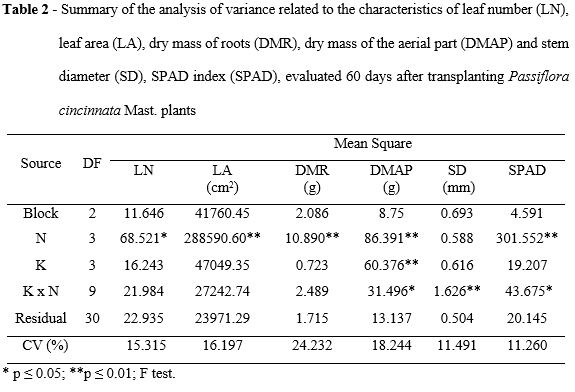
    <p><font face = Verdana size = 2>The
interaction between nitrogen (N) and potassium (K) was found for the stem diameter
characteristics, SPAD index and dry matter accumulation of the aerial part were
determined, and also, the single effect of N to the leaf area, number of leaves
and dry weight of roots (<a href = "#t2">Table 2</a>).</font></p>

    <p>    <br></p>

<a name = "t2"><img src = "/img/revistas/rca/v40n4/v40n4a10t2.jpg"></a>

    
<p>    <br></p>

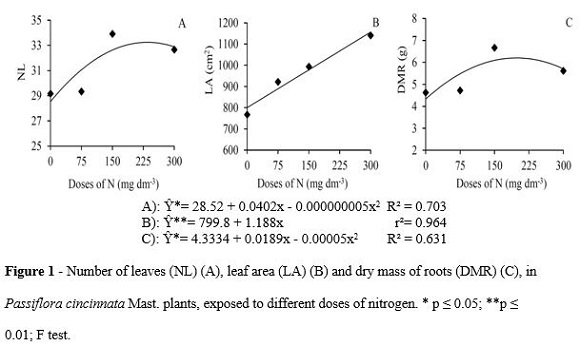
    <p><font face = Verdana size = 2>The
number of leaves and the dry mass of the roots followed a quadratic behavior, in
response to the nitrogen fertilization, reaching up to 32.96 leaves at the dose
of 222.22 mg N dm<sup>-3</sup>, and 5.95 g of dry mass of roots at 180 mg N dm<sup>-3</sup>,
respectively (<a href = "#f1">Figure 1A and 1C</a>). After the raise in the values of the number of
leaves and root dry matter, there was a downward trend in those doses which were
close to the maximum limit of N. The increase in the N availability in the substrate,
usually results in positive effects on the carbon assimilation rate, because this
nutrient is one of the main components of the photosynthetic system (Correia <i>et
al.,</i> 2005). However, positive effects of N up to the limit of its maximization
for number of leaves and biomass accumulation occur within a great range of concentrations
of this nutrient.</font></p>

    ]]></body>
<body><![CDATA[<p>    <br></p>

<a name = "f1"><img src = "/img/revistas/rca/v40n4/v40n4a10f1.jpg"></a>

    
<p>    <br></p>

    <p><font face = Verdana size = 2>Opposite results were
verified by Mendonça <i>et al.</i> (2007) in yellow passion fruit, showing linear
behavior for the number of leaves and dry mass of the root when exposed to much
higher nitrogen doses to the already evaluated results in this study. Plant biomass
accumulation was restricted, either at lower or higher N doses than the defined
nutrient gradient. This effect was characterized in studies done by Menegazzo <i>et
al.</i> (2011) on papaya seedlings, and the quadratic models for the relations between
nitrogen fertilization and root dry mass accumulation, aerial part and total biomass
were defined. Souza <i>et al. </i>(2007) determined the quadratic model for the
relation between N and mass accumulation of the aerial part of sweet passion fruit
tree, however, the reducing effect of N was express at doses higher than 1600 mg
dm<sup>-3</sup> of substrate; in a present study, the when N was up to 300 mg dm<sup>-3</sup>
of substrate. This difference might be associated to a higher susceptibility of
<i>Passiflora cincinnata</i> to N. According to Bredemeier and Mundstock (2000),
the amount of N absorbed varies along the plant development cycle, due to the amount
of roots and the root absorption rate per weight unit of the root. Almeida <i>et
al.</i> (2006) observed the positive effect on the dry mass accumulation of the
root with nitrogen fertilization for yellow passion fruit.</font></p>

    <p><font face = Verdana size = 2>For the ratio between the total leaf-area of the plant (LA)
and the nitrogen dose, a linear model was adjusted (<a href = "#f1">Figure 1B</a>). The largest LA (1140.57
cm<sup>-2</sup>) was measured at a maximum dose of 300 mg N dm<sup>-3</sup>. It
should be noticed that, although there was a reduction in the number of leaves in
the N levels above 222.22 mg N dm<sup>-3</sup>, the increasing co-relation between
the leaf area and the levels of N remained. The larger leaf-area of each individual
leaf in plants at higher N availability was the key factor for this behavior.</font></p>


    <p><font face = Verdana size = 2>Santos <i>et al.</i> (2011) in a trial about different
sources of N in the initial growth of yellow passion fruit tree, observed that the
highest average values per leaf area, occurred in the treatment using urea, when
compared with other sources of nitrogen. According to Kerpel <i>et al.</i> (2006),
considering the <i>P. suberosa</i>, the additions of N until 300 mg dm<sup>-3  </sup>were
associated with increases in leaf area, similarly  to the one observed in the present
study.</font></p>

    <p><font face = Verdana size = 2>The use of indirect measurements
to determine the nutritional status of plants is registered in several studies (Guimarães
<i>et al.,</i> 1999; Pôrto <i>et al.,</i> 2011). Follett <i>et al.</i> (1992) studied
the relation between productivity and nitrogen concentration in wheat leaves, using
the SPAD chlorophyll measurer, and they observed that it is possible to calibrate
the chlorophyll measurer to evaluate or predict the grain production, nitrogen concentration
in leaves and NH<sub>4</sub><sup>+</sup> + NO<sub>3</sub><sup>- </sup>availability
in the soil.</font></p>

    <p><font face = Verdana size = 2>When the K doses were
fixed, because of the N doses, the maximum SPAD value reached 47.82, 45.53, 48.07
and 48.04 respectively (<a href = "/img/revistas/rca/v40n4/v40n4a10f2.jpg" target = "_blank">Figure 2A</a>). Only a small variation of 2.45 among the values
mentioned above was observed, indicating an upper limit of SPAD index, similar to
all K doses which were analyzed as a function of the N gradient.</font></p>

    
<p><font face
= Verdana size = 2>For plants that did not receive potassium fertilization, the
linear model, characterized by raisings on the SPAD index values with increasing
N, was delineated. The relation between SPAD reading and N content is attributed
mainly to the fact that from 50% to 70% of the total N of the leaves is directed
to synthesize compounds which are associated with chloroplasts and chlorophyll content
of the leaves (Prado and Vale, 2008).</font></p>

    ]]></body>
<body><![CDATA[<p><font face = Verdana size
= 2>However, as the potassium fertilization doses were increased, the maximum SPAD
value could be determined by N successively smaller doses, as it can be seen through
the defined second order models (<a href = "/img/revistas/rca/v40n4/v40n4a10f2.jpg" target = "_blank">Figure 2A</a>). According to Medeiros <i>et al.</i>
(2009) the excess of mineral fertilization might increase the soil salinity resulting
in reduced availability of water for the plants, changing their physiological and
metabolic processes. Ashraf and Harris (2013) indicated that the reduction of the
photosynthetic pigment contents in plants under salinity and water restriction are
affected by synthesis restriction factors and acceleration in degradation processes.
</font></p>

    
<p><font face = Verdana size = 2>Another indirect effect of salinity
that is commonly reported is the reduction in the photosynthetic capacity, which
promotes the degradation of chlorophyll pigments and the degradation of the thylakoids’
membranes (Ashraf and Harris, 2013). Shabala and Munns (2012) verified that in salinity
conditions, plants reduce the opening of the stomata. The stomatal closing, induced
by the salinity, causes an imbalance between the photochemical stages and the carbon
reduction (Silva <i>et al.,</i> 2010), increasing the ratio NADPH/NADP<sup>+ </sup>in
the stroma due to a smaller activation of the Calvin Cycle (Silveira <i>et al.,</i>
2010). In conditions of excessive reducing power, the thylakoids can be structurally
unsettled due to the peroxidation processes in the lipid portion of the membranes,
resulting in degradation of the chlorophyll.</font></p>

    <p><font face = Verdana
size = 2>The SPAD index reductions occurred can be related to the chlorosis in leaves,
because of the toxic effect caused by the NH<sub>4</sub><sup>+</sup> excess (Britto
and Kronzucker, 2002). According to Silva <i>et al.</i> (2011) studying the SPAD
index in different times and locations in potato leaflets under nitrogen fertilization,
a quadratic increase on the readings of the SPAD index was observed, determined
in the proximal region of the leaf. When analyzing the increasing linear model of
the plants that received 75 mg N dm<sup>-3</sup> due to the increase of potassium
fertilization, the positive interaction between K and N is confirmed (
<a href = "/img/revistas/rca/v40n4/v40n4a10f2.jpg" target = "_blank">Figure 2B</a>).
For the lowest N dose, the increasing of the SPAD index, due to the K gradient was
related to the favorable nutritional balance for the chlorophyll formation. According
to Porto <i>et al.</i> (2013), the increase in the SPAD readings in rocket leaves
depends on the interaction between N and K. The same authors found maximum values
of chlorophyll content in the 156.45 mg dm<sup>-3</sup>, K dose, and the value of
55.82 as SPAD reading. Marques <i>et al.</i> (2011) noticed that high doses from
different sources of potassium (K<sub>2</sub>SO<sub>4</sub> and KCl) led to reduced
dry matter production of eggplant roots and shoots to 120 DAT (days after transplanting).
This mass production fall was related to raisings in the electrical conductivity
rates of the soil solution.</font></p>

    
<p><font face = Verdana size = 2>Mascarenhas
<i>et al.</i> (2000) said that the application of high doses of potassium fertilizer
can cause nutritional imbalance in plants. This fact demonstrated the antagonistic
effect of K, regarding the Ca and Mg absorption, as they are all cationic nutrients
that fight for the same sites of absorption. Chlorophylls are molecules formed by
complexes of porphyrin derivatives, whose central atom is the Mg that is linked
to 4 atoms of N (Streit <i>et al.,</i> 2005).</font></p>

    <p><font face = Verdana
size = 2>The opposite behavior to the highest dose of N (300 mg dm<sup>-3</sup>)
due to the increase of the K gradient, defined by the decreasing linear model can
be related to a lesser absorption and availability of magnesium (Mg) in plants with
increased K rates, resulting in a nutritional imbalance of the plant, because of
the highest amount of N and the lowest availability of Mg, thereby interfering in
the chlorophyll formation. This reduction in Mg due to the highest doses of K supplied
to yellow passion fruit was noticed before by Natale <i>et al.</i> (2006) and Prado
<i>et al.</i> (2004).</font></p>

    <p><font face = Verdana size = 2>The interaction
between N and K was observed when the stem diameter was quantified, making possible
to establish the square root model for the doses of the evaluated elements (
<a href = "/img/revistas/rca/v40n4/v40n4a10f3.jpg" target = "_blank">Figure
3</a>). For 0 and 300 mg of K dm<sup>-3</sup> doses, the N gradient was characterized
by diameter raises, showing a variation between 5.5 to 6.93 mm, thus defining higher
values for the plants under a 0 mg K dm<sup>-3</sup> dose 
(<a href = "/img/revistas/rca/v40n4/v40n4a10f3.jpg" target = "_blank">Figure 3A</a>).</font></p>

    
<p><font face = Verdana size = 2>The model definition for plants under 0 mg of N dm<sup>-3</sup>
(<a href = "/img/revistas/rca/v40n4/v40n4a10f3.jpg" target = "_blank">Figure 3B</a>) was only possible when the relation 
between stem diameter and K doses
was analyzed. According to Kanai <i>et al.</i> (2011), there was a close and positive
relation between the expansion of the stem diameter, aquaporin activity and conveyors
of K channels in the roots of tomato trees. For the present study, such a behavior
was observed in plants under low N availability until the supplying limit of 139.04
mg of K dm<sup>-3</sup>. Higher doses of K resulted in reduced stem diameter, indicating
greater intensity effect of N gradient for such a feature. Almeida <i>et al.</i>
(2006) observed quadratic behavior because of the fertilizers which were applied
to the stem diameter of yellow passion fruit plants, reaching the maximum development
in approximate doses of 342 mg of N and 207 mg of K dm<sup>-3</sup>.</font></p>

    
<p><font face = Verdana size = 2>Due to the high value of the upper limit of the
potassium fertilization gradient, the possibility of induction of the water availability
restriction by K, through the soil water potential reduction should also be considered.
According to Silva <i>et al.</i> (2001), the application of high doses of fertilizers
may result in a salinity raise, as for example, potassium chloride. The KCl affects
the growth and distribution of the roots as well as the absorption of water and
nutrients, decreasing the osmotic potential near the rhizosphere, making difficult
the absorption of ions by roots.  </font></p>

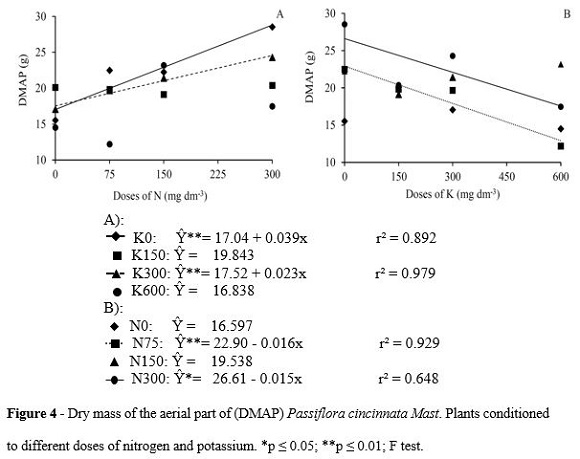
    <p><font face = Verdana size =
2>By analyzing the interaction between N and K, for 0 and 300 mg dm<sup>-3</sup>,
doses of K, dry mass accumulation of the shoot due to the increasing doses of N
supplied to the plant was noticed (<a href = "#f4">Figure 4A</a>). The high magnitude of the effect
of N gradient for plants without potassium fertilization was expressed by the biggest
angle coefficient of the defined model for the dry mass of the aerial parts of these
plants when compared to the dose of 300 mg K dm<sup>-3</sup>.</font></p>

    <p>    ]]></body>
<body><![CDATA[<br></p>

<a name = "f4"><img src = "/img/revistas/rca/v40n4/v40n4a10f4.jpg"></a>

    
<p>    <br></p>

    <p><font face
= Verdana size = 2>The greatest expression of N gradient to the DMAP accumulation
was observed for plants that did not receive potassium fertilization in relation
to those under 300 mg K dm<sup>-3 </sup>doses.<sup> </sup>The addition from 0 to
300 mg N dm<sup>-3</sup> resulted in a differential of 11.7 g of the shoot dry mass
for plants without potassium fertilization and 6.9 g for plants under 300 mg K dm<sup>-3</sup>.
<sup> </sup>Although the mass accumulation is directly related to the availability
of N for the plant, in the presence of K, the effect of nitrogen fertilization has
become less pronounced.</font></p>

    <p><font face = Verdana size = 2>This effect
was related to the decrease of the plant development when using high doses of KCl,
and it may increase the chloride content in the plant and cause toxicity (Silva
<i>et al.,</i> 2001; Prado <i>et al.</i> 2004).<sup> </sup>Another important fact
to be considered was the greater availability of photoassimilates directed to the
aerial part of the plant, resulting from the growth restriction of the root system
at the upper limit of N doses of this study.</font></p>

    <p><font face = Verdana
size = 2>Almeida <i>et al.</i> (2006) evaluated the production of dry matter of
shoots in yellow passion fruit seedlings. Considering the N and K fertilization,
there was a maximum response of 16 g pot<sup>-1</sup> production in a dose of approximately
362 mg N dm<sup>-3</sup> and 14 g pot<sup>-1 </sup>for 300 mg K dm<sup>-3</sup>.  
</font></p>

    <p><font face = Verdana size = 2>For doses of 75 and 300 mg N dm<sup>-3</sup>
of soil a different behavior to the relation between dry mass weight of shoot and
doses of K was verified (<a href = "#f4">Figure 4B</a>). For any K gradient, the highest mass values
to the highest dose of N were maintained. However, the parity between the patterns
of decreases in K values remained, and can be seen by the similarity between the
angular coefficients of the defined models for 75 and 300 mg N dm<sup>-3</sup>.
The reductions which were seen in this study were related to the high K levels supplied,
associated with an actual availability in the soil, thus interfering negatively
with the accumulation of dry mass of the aerial part of the plant. According to
Marschner (1995), over-fertilization of KCl can increase the salinity of the soil,
making difficult the growth of the plant. This effect was shown by Nascimento <i>et
al.</i> (2012) in cowpea (<i>feijão-de-corda</i>), a reduction in the production
of dry biomass of the aerial part, in response to the salinity increase.</font></p>


    <p><font face = Verdana size = 2>According to Prado <i>et al.</i> (2004) from doses
of 225 and 300 mg of K dm<sup>-3</sup> in yellow passion fruit tree, there was a
reduction in the growth and production of dry matter of the plants, which has been
linked to the depressive effects caused by the chloride and its antagonistic effect
concerning the nitrate. However, the application of high doses of K associated with
high levels of nitrogen fertilization increased both the grain production and the
dry matter accumulation of corn plants.</font></p>

    <p><font face = Verdana size
= 2>For the present study, contrasting Viana and Kiehl (2010) even for the highest
dose of N, potassium gradient was related to systematic dry matter decreases of
the aerial part of the passion fruit plants. Supporting this difference, as described
above, the most remarkable effect of N for dry matter accumulation of the aerial
part was observed for plants that did not receive potassium fertilization.</font></p>

    <p>    ]]></body>
<body><![CDATA[<br></p>

    <p><font face = Verdana
size = 3><b>CONCLUSION</b></font></p>

    <p><font face = Verdana size = 2>Nitrogen
was the main factor that influenced the <i>Passiflora cincinnata</i> Mast. plants
morphology, and the largest growth was obtained with 180 to 300 mg N dm<sup>-3</sup>.</font></p>


    <p><font face = Verdana size = 2>The interaction between nitrogen and potassium
doses resulted in the definition of different models associated to morphological
traits.</font></p>

    <p><font face = Verdana size = 2>The potassium gradient induced
salinity effects as noticed in this study, thus reducing the accumulation of dry
mass in the aerial part of passion fruit (<i>P. cincinata</i>).</font></p>

    <p>    <br></p>

    <p><font face = Verdana size
= 3><b>REFERENCES</b></font></p>

    <!-- ref --><p><font face = Verdana size = 2>Almeida, E.V.;
Natale, W.; Prado R. de M. &amp; Barbosa, J.C. (2006) - Adubação nitrogenada e potássica
no desenvolvimento de mudas de maracujazeiro. <i>Ciência Rural</i>, vol. 36, n.
4, p. 1138-1142. 
<a href = "http://dx.doi.org/10.1590/S0103-84782006000400015" target = "_blank">http://dx.doi.org/10.1590/S0103-84782006000400015</a></font>&nbsp;&nbsp;&nbsp;&nbsp;&nbsp;&nbsp;&nbsp;&nbsp;[&#160;<a href="javascript:void(0);" onclick="javascript: window.open('/scielo.php?script=sci_nlinks&ref=668074&pid=S0871-018X201700040001000001&lng=','','width=640,height=500,resizable=yes,scrollbars=1,menubar=yes,');">Links</a>&#160;]<!-- end-ref --><!-- ref --><p><font face = Verdana size = 2>Ashraf, M. &amp; Harris, P.J.C. (2013) - Photosynthesis
under stressful environments: An overview. 
<i>Photosynthetica,</i> vol. 51, n. 2, p. 163-190. 
<a href = "http://dx.doi.org/10.1007/s11099-013-0021-6" target = "_blank">http://dx.doi.org/10.1007/s11099-013-0021-6</a></font>&nbsp;&nbsp;&nbsp;&nbsp;&nbsp;&nbsp;&nbsp;&nbsp;[&#160;<a href="javascript:void(0);" onclick="javascript: window.open('/scielo.php?script=sci_nlinks&ref=668075&pid=S0871-018X201700040001000002&lng=','','width=640,height=500,resizable=yes,scrollbars=1,menubar=yes,');">Links</a>&#160;]<!-- end-ref --><!-- ref --><p><font face = Verdana size = 2>Bredemeier, C. &amp; Mundstock, C.M. (2000) -
Regulação da absorção e assimilação do nitrogênio nas plantas. <i>Ciência Rural</i>,
vol. 30, n. 2, p. 365-372. 
<a href = "http://dx.doi.org/10.1590/S0103-84782000000200029" target = "_blank">http://dx.doi.org/10.1590/S0103-84782000000200029</a></font>&nbsp;&nbsp;&nbsp;&nbsp;&nbsp;&nbsp;&nbsp;&nbsp;[&#160;<a href="javascript:void(0);" onclick="javascript: window.open('/scielo.php?script=sci_nlinks&ref=668076&pid=S0871-018X201700040001000003&lng=','','width=640,height=500,resizable=yes,scrollbars=1,menubar=yes,');">Links</a>&#160;]<!-- end-ref --><!-- ref --><p><font face = Verdana size = 2>Britto, D.T. &amp; Kronzucker, H.J. (2002) - NH<sub>4</sub><sup>+</sup>
toxicity in higher plants: a critical review.<i> Journal of Plant Physiology</i>,
vol. 159, n. 6, p. 567-584. 
<a href = "http://dx.doi.org/10.1078/0176-1617-0774" target = "_blank">http://dx.doi.org/10.1078/0176-1617-0774</a></font>&nbsp;&nbsp;&nbsp;&nbsp;&nbsp;&nbsp;&nbsp;&nbsp;[&#160;<a href="javascript:void(0);" onclick="javascript: window.open('/scielo.php?script=sci_nlinks&ref=668077&pid=S0871-018X201700040001000004&lng=','','width=640,height=500,resizable=yes,scrollbars=1,menubar=yes,');">Links</a>&#160;]<!-- end-ref --><!-- ref --><p><font face = Verdana size = 2>Correia, C.M.; Pereira, J.M.M.; Coutinho, J.F.;
Björn, L.O. &amp; Pereira, J.M.G.T. (2005) - Ultraviolet-B radiation and nitrogen
affect the photosynthesis of maize: a Mediterranean field study. <i>European Journal
of Agronomy</i>, vol. 22, n. 3, p. 337-347. 
<a href = "http://dx.doi.org/10.1016/j.eja.2004.05.002" target = "_blank">http://dx.doi.org/10.1016/j.eja.2004.05.002</a></font>&nbsp;&nbsp;&nbsp;&nbsp;&nbsp;&nbsp;&nbsp;&nbsp;[&#160;<a href="javascript:void(0);" onclick="javascript: window.open('/scielo.php?script=sci_nlinks&ref=668078&pid=S0871-018X201700040001000005&lng=','','width=640,height=500,resizable=yes,scrollbars=1,menubar=yes,');">Links</a>&#160;]<!-- end-ref --><!-- ref --><p><font face = Verdana size = 2>Follet, R.H.; Follet, R.F. &amp; Halvarson, A.D.
(1992) - Use a chlorophyll meter to evaluate the nitrogen status of dryland winter
wheat. <i>Communications in Soil Science and Plant Analysis</i>. vol. 23, n. 7/8,
p. 517-697. 
<a href = "http://dx.doi.org/10.1080/00103629209368619" target = "_blank">http://dx.doi.org/10.1080/00103629209368619</a></font>&nbsp;&nbsp;&nbsp;&nbsp;&nbsp;&nbsp;&nbsp;&nbsp;[&#160;<a href="javascript:void(0);" onclick="javascript: window.open('/scielo.php?script=sci_nlinks&ref=668079&pid=S0871-018X201700040001000006&lng=','','width=640,height=500,resizable=yes,scrollbars=1,menubar=yes,');">Links</a>&#160;]<!-- end-ref --><!-- ref --><p><font face
= Verdana size = 2>Freitas, M.S.M.; Monnerat, P.H.; Carvalho, A.J.C. &amp; Vasconcellos,
M.A.S. (2011) - Sintomas visuais de deficiência de macronutrientes e boro em maracujazeiro-doce.
<i>Revista Brasileira de Fruticultura</i>, vol. 33, n. 4, p. 1329-1341. 
<a href = "http://dx.doi.org/10.1590/S0100-29452011000400034" target = "_blank">http://dx.doi.org/10.1590/S0100-29452011000400034</a></font>&nbsp;&nbsp;&nbsp;&nbsp;&nbsp;&nbsp;&nbsp;&nbsp;[&#160;<a href="javascript:void(0);" onclick="javascript: window.open('/scielo.php?script=sci_nlinks&ref=668080&pid=S0871-018X201700040001000007&lng=','','width=640,height=500,resizable=yes,scrollbars=1,menubar=yes,');">Links</a>&#160;]<!-- end-ref --><!-- ref --><p><font face = Verdana size = 2>Guimarães, T.G.; Fontes, P.C.R.; Pereira, P.R.G.;
Alvarez, V.V.H. &amp; Monnerat, P.H. (1999) - Teores de clorofila determinados por
medidor portátil e sua relação com formas de nitrogênio em folhas de tomateiro cultivados
em dois tipos de solo. <i>Bragantia</i>, vol. 58, n. 1, p. 209-216. 
<a href = "http://dx.doi.org/10.1590/S0006-87051999000100020" target = "_blank">http://dx.doi.org/10.1590/S0006-87051999000100020</a></font>&nbsp;&nbsp;&nbsp;&nbsp;&nbsp;&nbsp;&nbsp;&nbsp;[&#160;<a href="javascript:void(0);" onclick="javascript: window.open('/scielo.php?script=sci_nlinks&ref=668081&pid=S0871-018X201700040001000008&lng=','','width=640,height=500,resizable=yes,scrollbars=1,menubar=yes,');">Links</a>&#160;]<!-- end-ref --><!-- ref --><p><font face = Verdana size = 2>Junqueira, N.T.V.; Braga, M.F.; Faleiro, F.G.;
Peixoto, J.R. &amp; Bernacci, L.C. (2005) - Potencial de espécies silvestres de
maracujazeiro como fonte de resistência a doenças. <i>In</i>: Faleiro, F.G.; Junqueira,
N.T.V. &amp; Braga, M.F. (Eds.) - <i>Maracujá: germoplasma e melhoramento genético</i>,
Planaltina, DF: Embrapa Cerrados. p. 81-107.    &nbsp;&nbsp;&nbsp;&nbsp;&nbsp;&nbsp;&nbsp;&nbsp;[&#160;<a href="javascript:void(0);" onclick="javascript: window.open('/scielo.php?script=sci_nlinks&ref=668082&pid=S0871-018X201700040001000009&lng=','','width=640,height=500,resizable=yes,scrollbars=1,menubar=yes,');">Links</a>&#160;]<!-- end-ref --></font></p>

    <!-- ref --><p><font face = Verdana
size = 2>Kanai, S.; Moghaieb, R.E.; El-Shemy, H.A.; Painigrahi, R.; To, J.; Nguyen
N.T.; Saneoka, H. &amp; Fujita, K. (2011) - Potassium deficiency affects water status
and photosynthetic rate of the vegetative sink in green house tomato prior to its
effects on source activity. <i>Plant Science</i>, vol. 180, n. 2, p. 369-374. 
<a href = "http://dx.doi.org/10.1016/j.plantsci.2010.10.011" target = "_blank">http://dx.doi.org/10.1016/j.plantsci.2010.10.011</a></font>&nbsp;&nbsp;&nbsp;&nbsp;&nbsp;&nbsp;&nbsp;&nbsp;[&#160;<a href="javascript:void(0);" onclick="javascript: window.open('/scielo.php?script=sci_nlinks&ref=668084&pid=S0871-018X201700040001000010&lng=','','width=640,height=500,resizable=yes,scrollbars=1,menubar=yes,');">Links</a>&#160;]<!-- end-ref --><!-- ref --><p><font face = Verdana size = 2>Kerpel, S.M., Soprano, E. &amp; Moreira, G.R.P.
(2006) - Effect of nitrogen on <i>Passiflora suberosa </i>L. (Passifloraceae) and
consequences for larval performance and oviposition in <i>Heliconius eratophyllis
</i>(Fabricius) (Lepidoptera: Nymphalidae). <i>Neotropical Entomology</i>, vol.
35, n. 2, p. 192-200. 
<a href = "http://dx.doi.org/10.1590/S1519-566X2006000200006" target = "_blank">http://dx.doi.org/10.1590/S1519-566X2006000200006</a></font>&nbsp;&nbsp;&nbsp;&nbsp;&nbsp;&nbsp;&nbsp;&nbsp;[&#160;<a href="javascript:void(0);" onclick="javascript: window.open('/scielo.php?script=sci_nlinks&ref=668085&pid=S0871-018X201700040001000011&lng=','','width=640,height=500,resizable=yes,scrollbars=1,menubar=yes,');">Links</a>&#160;]<!-- end-ref --><!-- ref --><p><font face = Verdana size = 2>Kiill, L.H.P.; Siqueira, K.M.M.; Araújo, F.P.;
Trigo, S.P.M.; Feitoza, E.A. &amp; Lemos, I.B. (2010) - Biologia reprodutiva de
<i>Passiflora cincinnata </i>Mast. (Passifloraceae) na região de Petrolina (Pernambuco,
Brazil). <i>Oecologia Australis</i>, vol. 14, n. 1, p. 115-127. 
<a href = "http://dx.doi.org/10.4257/oeco.2010.1401.05" target = "_blank">http://dx.doi.org/10.4257/oeco.2010.1401.05</a></font>&nbsp;&nbsp;&nbsp;&nbsp;&nbsp;&nbsp;&nbsp;&nbsp;[&#160;<a href="javascript:void(0);" onclick="javascript: window.open('/scielo.php?script=sci_nlinks&ref=668086&pid=S0871-018X201700040001000012&lng=','','width=640,height=500,resizable=yes,scrollbars=1,menubar=yes,');">Links</a>&#160;]<!-- end-ref --><!-- ref --><p><font face = Verdana size = 2>Lima, A. de A. (2005) - Aspectos
fitotécnicos: desafios da pesquisa. <i>In</i>: Faleiro, F.G.; Junqueira, N.T.V.
&amp; Braga, M.F. (Eds.) - <i>Maracujá: germoplasma e melhoramento genético</i>,
Planaltina, DF: Embrapa Cerrados. p. 643-677</font>&nbsp;&nbsp;&nbsp;&nbsp;&nbsp;&nbsp;&nbsp;&nbsp;[&#160;<a href="javascript:void(0);" onclick="javascript: window.open('/scielo.php?script=sci_nlinks&ref=668087&pid=S0871-018X201700040001000013&lng=','','width=640,height=500,resizable=yes,scrollbars=1,menubar=yes,');">Links</a>&#160;]<!-- end-ref --><!-- ref --><p><font face = Verdana
size = 2>Malavolta, E.; Vitti, G.C. and Oliveira, S.A. (1997) - <i>Avaliação do
estado nutricional das plantas: princípios e aplicações</i>. Piracicaba: Associação
Brasileira da Potassa e do Fosfato. 319 p.    &nbsp;&nbsp;&nbsp;&nbsp;&nbsp;&nbsp;&nbsp;&nbsp;[&#160;<a href="javascript:void(0);" onclick="javascript: window.open('/scielo.php?script=sci_nlinks&ref=668088&pid=S0871-018X201700040001000014&lng=','','width=640,height=500,resizable=yes,scrollbars=1,menubar=yes,');">Links</a>&#160;]<!-- end-ref --></font></p>

    <!-- ref --><p><font face = Verdana
size = 2>Marques, D.J.; Broetto, F.; Silva, E.C. &amp; Carvalho J.G. (2011) - Dinâmica
de cátions na raiz e folhas de berinjela cultivada sobre doses crescentes de potássio
oriundas de duas fontes. <i>Idesia,</i> vol. 29, n. 2, p. 69-77. 
<a href = "http://dx.doi.org/10.4067/S0718-34292011000200009" target = "_blank">http://dx.doi.org/10.4067/S0718-34292011000200009</a></font>&nbsp;&nbsp;&nbsp;&nbsp;&nbsp;&nbsp;&nbsp;&nbsp;[&#160;<a href="javascript:void(0);" onclick="javascript: window.open('/scielo.php?script=sci_nlinks&ref=668090&pid=S0871-018X201700040001000015&lng=','','width=640,height=500,resizable=yes,scrollbars=1,menubar=yes,');">Links</a>&#160;]<!-- end-ref --><!-- ref --><p><font face = Verdana size = 2>Marschner, H. (1995) - <i>Mineral nutrition of
higher plants</i>. London: Academic Press. 889 p.    &nbsp;&nbsp;&nbsp;&nbsp;&nbsp;&nbsp;&nbsp;&nbsp;[&#160;<a href="javascript:void(0);" onclick="javascript: window.open('/scielo.php?script=sci_nlinks&ref=668091&pid=S0871-018X201700040001000016&lng=','','width=640,height=500,resizable=yes,scrollbars=1,menubar=yes,');">Links</a>&#160;]<!-- end-ref --></font></p>

    <!-- ref --><p><font face =
Verdana size = 2>Mascarenhas, H.A.A.; Tanaka, R.T.; Carmello, Q.A. de C.; Gallo,
P.B. &amp; Ambrosano, G.M.B. (2000) - Calcário e potássio para a cultura da soja.
<i>Scientia Agricola</i>, vol. 57, n. 3, p. 445-449. 
<a href = "http://dx.doi.org/10.1590/S0103-90162000000300012" target = "_blank">http://dx.doi.org/10.1590/S0103-90162000000300012</a></font>&nbsp;&nbsp;&nbsp;&nbsp;&nbsp;&nbsp;&nbsp;&nbsp;[&#160;<a href="javascript:void(0);" onclick="javascript: window.open('/scielo.php?script=sci_nlinks&ref=668093&pid=S0871-018X201700040001000017&lng=','','width=640,height=500,resizable=yes,scrollbars=1,menubar=yes,');">Links</a>&#160;]<!-- end-ref --><!-- ref --><p><font face = Verdana size = 2>Medeiros, P.R.F. de; Duartes, S.N. &amp; Dias,
C.T.S. (2009) - Tolerância da cultura do pepino à salinidade em ambiente protegido.
<i>Revista Brasileira de Engenharia Agrícola e Ambiental</i>, vol. 13, n. 4, p.
406-410. 
<a href = "http://dx.doi.org/10.1590/S1415-43662009000400006" target = "_blank">http://dx.doi.org/10.1590/S1415-43662009000400006</a></font>&nbsp;&nbsp;&nbsp;&nbsp;&nbsp;&nbsp;&nbsp;&nbsp;[&#160;<a href="javascript:void(0);" onclick="javascript: window.open('/scielo.php?script=sci_nlinks&ref=668094&pid=S0871-018X201700040001000018&lng=','','width=640,height=500,resizable=yes,scrollbars=1,menubar=yes,');">Links</a>&#160;]<!-- end-ref --><!-- ref --><p><font face = Verdana size = 2>Megda, M.M. &amp; Monteiro, F.A. (2010) - Nitrogen and potassium
supply and the morphogenic and productive characteristics of marandu palisadegrass.
<i>Revista Brasileira de Zootecnia</i>, vol. 39, n. 8, p. 1666-1675. 
<a href = "http://dx.doi.org/10.1590/S1516-35982010000800007" target = "_blank">http://dx.doi.org/10.1590/S1516-35982010000800007</a></font>&nbsp;&nbsp;&nbsp;&nbsp;&nbsp;&nbsp;&nbsp;&nbsp;[&#160;<a href="javascript:void(0);" onclick="javascript: window.open('/scielo.php?script=sci_nlinks&ref=668095&pid=S0871-018X201700040001000019&lng=','','width=640,height=500,resizable=yes,scrollbars=1,menubar=yes,');">Links</a>&#160;]<!-- end-ref --><!-- ref --><p><font face = Verdana size = 2>Mendonça, V.; Ferreira, E.A.; Paula, Y.C.M.; Batista,
T.M.V. &amp; Ramos, J.D. (2007) - Crescimento de mudas de maracujazeiro-amarelo
influenciado por doses de nitrogênio e de superfosfato simples. <i>Revista Caatinga</i>,
vol. 20, n. 4, p. 137-143.    &nbsp;&nbsp;&nbsp;&nbsp;&nbsp;&nbsp;&nbsp;&nbsp;[&#160;<a href="javascript:void(0);" onclick="javascript: window.open('/scielo.php?script=sci_nlinks&ref=668096&pid=S0871-018X201700040001000020&lng=','','width=640,height=500,resizable=yes,scrollbars=1,menubar=yes,');">Links</a>&#160;]<!-- end-ref --></font></p>

    <!-- ref --><p><font face = Verdana size = 2>Menegazzo,
M.L., Oliveira, A.C. de &amp; Silva, E.A. da (2011) - Adubação nitrogenada na produção
de mudas de mamoeiro. <i>Revista Agrarian</i>, vol.4, n. 13, p. 189-196.    &nbsp;&nbsp;&nbsp;&nbsp;&nbsp;&nbsp;&nbsp;&nbsp;[&#160;<a href="javascript:void(0);" onclick="javascript: window.open('/scielo.php?script=sci_nlinks&ref=668098&pid=S0871-018X201700040001000021&lng=','','width=640,height=500,resizable=yes,scrollbars=1,menubar=yes,');">Links</a>&#160;]<!-- end-ref --></font></p>


    <!-- ref --><p><font face = Verdana size = 2>Nascimento, R.; Nascimento, D.A.M.; Silva, D.A.
&amp; Alves, A.G. (2012) - Índice spad e partição de biomassa em plantas de feijão-caupi
submetidas ao estresse salino. <i>Revista Educação Agrícola Superior</i>, vol. 27,
n. 2, p. 128-132. 
<a href = "http://dx.doi.org/10.12722/0101-756X.v27n02a09" target = "_blank">http://dx.doi.org/10.12722/0101-756X.v27n02a09</a></font>&nbsp;&nbsp;&nbsp;&nbsp;&nbsp;&nbsp;&nbsp;&nbsp;[&#160;<a href="javascript:void(0);" onclick="javascript: window.open('/scielo.php?script=sci_nlinks&ref=668100&pid=S0871-018X201700040001000022&lng=','','width=640,height=500,resizable=yes,scrollbars=1,menubar=yes,');">Links</a>&#160;]<!-- end-ref --><!-- ref --><p><font face = Verdana size = 2>Natale, W.; Prado, R. de M.; Almeida, E.V. &amp; Barbosa,
J.C. (2006) - Adubação nitrogenada e potássica no estado nutricional de mudas de
maracujazeiro-amarelo. <i>Acta Scientiarum. Agronomy</i>. vol. 28, n. 2, p. 187-192.
<a href = "http://dx.doi.org/10.4025/actasciagron.v28i2.1036" target = "_blank">http://dx.doi.org/10.4025/actasciagron.v28i2.1036</a></font>&nbsp;&nbsp;&nbsp;&nbsp;&nbsp;&nbsp;&nbsp;&nbsp;[&#160;<a href="javascript:void(0);" onclick="javascript: window.open('/scielo.php?script=sci_nlinks&ref=668101&pid=S0871-018X201700040001000023&lng=','','width=640,height=500,resizable=yes,scrollbars=1,menubar=yes,');">Links</a>&#160;]<!-- end-ref --><!-- ref --><p><font face =
Verdana size = 2>Nunes, T. S. &amp; Queiroz, L.P. (2006) - Flora da Bahia: Passifloraceae.
<i>Sitientibus série Ciências Biológicas</i>, vol. 6, n. 3, p. 194-226.    &nbsp;&nbsp;&nbsp;&nbsp;&nbsp;&nbsp;&nbsp;&nbsp;[&#160;<a href="javascript:void(0);" onclick="javascript: window.open('/scielo.php?script=sci_nlinks&ref=668102&pid=S0871-018X201700040001000024&lng=','','width=640,height=500,resizable=yes,scrollbars=1,menubar=yes,');">Links</a>&#160;]<!-- end-ref --></font></p>


    <!-- ref --><p><font face = Verdana size = 2>Oliveira, J.C. de &amp; Ruggiero, C. (2005) -
Espécies de maracujá com potencial agronômico. <i>In</i>: Faleiro, F.G.; Junqueira,
N.T.V. &amp; Braga, M.F. (Eds.) - <i>Maracujá: germoplasma e melhoramento genético</i>,
Planaltina, DF: Embrapa Cerrados. p. 143-158.    &nbsp;&nbsp;&nbsp;&nbsp;&nbsp;&nbsp;&nbsp;&nbsp;[&#160;<a href="javascript:void(0);" onclick="javascript: window.open('/scielo.php?script=sci_nlinks&ref=668104&pid=S0871-018X201700040001000025&lng=','','width=640,height=500,resizable=yes,scrollbars=1,menubar=yes,');">Links</a>&#160;]<!-- end-ref --></font></p>

    ]]></body>
<body><![CDATA[<!-- ref --><p><font face = Verdana
size = 2>Pettigrew, W.T. (2008) - Potassium influences on yield and quality production
for maize, wheat, soybean and cotton. <i>Physiologia Plantarum</i>, vol. 133, n.
4, p. 670-681. 
<a href = "http://dx.doi.org/10.1111/j.1399-3054.2008.01073.x" target = "_blank">http://dx.doi.org/10.1111/j.1399-3054.2008.01073.x</a></font>&nbsp;&nbsp;&nbsp;&nbsp;&nbsp;&nbsp;&nbsp;&nbsp;[&#160;<a href="javascript:void(0);" onclick="javascript: window.open('/scielo.php?script=sci_nlinks&ref=668106&pid=S0871-018X201700040001000026&lng=','','width=640,height=500,resizable=yes,scrollbars=1,menubar=yes,');">Links</a>&#160;]<!-- end-ref --><!-- ref --><p><font face = Verdana size = 2>Pôrto, M.L.; Puiatti, M.; Fontes, P.C.R.; Cecon,
P.R.; Alves, J.C. &amp; Arruda, J.A. (2011) - Índice SPAD para o diagnóstico do
estado de nitrogênio na cultura da abobrinha. <i>Horticultura Brasileira</i>,<i>
vol. </i>29, n. 3, p. 311-315. 
<a href = "http://dx.doi.org/10.1590/S0102-05362011000300009" target = "_blank">http://dx.doi.org/10.1590/S0102-05362011000300009</a></font>&nbsp;&nbsp;&nbsp;&nbsp;&nbsp;&nbsp;&nbsp;&nbsp;[&#160;<a href="javascript:void(0);" onclick="javascript: window.open('/scielo.php?script=sci_nlinks&ref=668107&pid=S0871-018X201700040001000027&lng=','','width=640,height=500,resizable=yes,scrollbars=1,menubar=yes,');">Links</a>&#160;]<!-- end-ref --><!-- ref --><p><font face = Verdana size = 2>Porto, R.A.; Bonfim-Silva, E.M.; Souza, D.S.M.;
Cordova, N.R.M.; Polyzel, A.C. &amp; Silva, T.J.A. (2013) - Adubação potássica em
plantas de rúcula: produção e eficiência no uso da água. <i>Revista Agro@mbiente</i>,
vol. 7, n. 1, p. 28-35. 
<a href = "http://dx.doi.org/10.18227/1982-8470ragro.v7i1.760" target = "_blank">http://dx.doi.org/10.18227/1982-8470ragro.v7i1.760</a></font>&nbsp;&nbsp;&nbsp;&nbsp;&nbsp;&nbsp;&nbsp;&nbsp;[&#160;<a href="javascript:void(0);" onclick="javascript: window.open('/scielo.php?script=sci_nlinks&ref=668108&pid=S0871-018X201700040001000028&lng=','','width=640,height=500,resizable=yes,scrollbars=1,menubar=yes,');">Links</a>&#160;]<!-- end-ref --><!-- ref --><p><font face = Verdana size = 2>Prado, R.M.; Braghirolli, L.F.; Natale, W.; Corrêa,
M.C.M. &amp; Almeida, E.V. (2004) - Aplicação de potássio no estado nutricional
e na produção de matéria seca de mudas de maracujazeiro-amarelo. <i>Revista Brasileira
de Fruticultura</i>, vol. 26, n. 2, p. 295-299. 
<a href = "http://dx.doi.org/10.1590/S0100-29452004000200028" target = "_blank">http://dx.doi.org/10.1590/S0100-29452004000200028</a></font>&nbsp;&nbsp;&nbsp;&nbsp;&nbsp;&nbsp;&nbsp;&nbsp;[&#160;<a href="javascript:void(0);" onclick="javascript: window.open('/scielo.php?script=sci_nlinks&ref=668109&pid=S0871-018X201700040001000029&lng=','','width=640,height=500,resizable=yes,scrollbars=1,menubar=yes,');">Links</a>&#160;]<!-- end-ref --><!-- ref --><p><font face = Verdana size = 2>Prado, R. de M. &amp; Vale, D.W. do (2008) - Nitrogênio,
fósforo e potássio na leitura spad em porta-enxerto de limoeiro-cravo. <i>Pesquisa
Agropecuária Tropical</i>, vol. 38, n. 4, p. 227-232.    &nbsp;&nbsp;&nbsp;&nbsp;&nbsp;&nbsp;&nbsp;&nbsp;[&#160;<a href="javascript:void(0);" onclick="javascript: window.open('/scielo.php?script=sci_nlinks&ref=668110&pid=S0871-018X201700040001000030&lng=','','width=640,height=500,resizable=yes,scrollbars=1,menubar=yes,');">Links</a>&#160;]<!-- end-ref --></font></p>

    <!-- ref --><p><font face
= Verdana size = 2>Rosolem, C.A. and Steiner, F. (2014) - Adubação potássica para
o crambe. <i>Bioscience Journal</i>,
vol. 30, n. 3, p. 140-146.    &nbsp;&nbsp;&nbsp;&nbsp;&nbsp;&nbsp;&nbsp;&nbsp;[&#160;<a href="javascript:void(0);" onclick="javascript: window.open('/scielo.php?script=sci_nlinks&ref=668112&pid=S0871-018X201700040001000031&lng=','','width=640,height=500,resizable=yes,scrollbars=1,menubar=yes,');">Links</a>&#160;]<!-- end-ref --></font></p>

    <!-- ref --><p><font face = Verdana size = 2>Santos,
T.C.; Júnior, J.E.N. &amp; Prata, A.P.N. (2012) - Frutos da Caatinga de Sergipe
utilizados na alimentação humana. <i>Scientia Plena</i>, vol. 8, n. 4, p. 1-7.    &nbsp;&nbsp;&nbsp;&nbsp;&nbsp;&nbsp;&nbsp;&nbsp;[&#160;<a href="javascript:void(0);" onclick="javascript: window.open('/scielo.php?script=sci_nlinks&ref=668114&pid=S0871-018X201700040001000032&lng=','','width=640,height=500,resizable=yes,scrollbars=1,menubar=yes,');">Links</a>&#160;]<!-- end-ref --></font></p>


    ]]></body>
<body><![CDATA[<!-- ref --><p><font face = Verdana size = 2>Santos, P.C. dos; Lopes, L.C.; Freitas, S. de
J.; Sousa, L.B. de &amp; Carvalho, A.J.C. de (2011) - Crescimento inicial e teor
nutricional do maracujazeiro amarelo submetido à adubação com diferentes fontes
nitrogenadas. <i>Revista Brasileira de Fruticultura</i>, vol. 33, n. Especial, p.
722-728. 
<a href = "http://dx.doi.org/10.1590/S0100-29452011000500101" target = "_blank">http://dx.doi.org/10.1590/S0100-29452011000500101</a></font>&nbsp;&nbsp;&nbsp;&nbsp;&nbsp;&nbsp;&nbsp;&nbsp;[&#160;<a href="javascript:void(0);" onclick="javascript: window.open('/scielo.php?script=sci_nlinks&ref=668116&pid=S0871-018X201700040001000033&lng=','','width=640,height=500,resizable=yes,scrollbars=1,menubar=yes,');">Links</a>&#160;]<!-- end-ref --><!-- ref --><p><font face = Verdana size = 2>Shabala, S. &amp; Munns, R. (2012) - Salinity stress: physiological
constraints and adaptive mechanisms. <i>In</i>: Shabala, S. (Ed.) - <i>Plant Stress
Physiology</i>. Wallingford, UK: CAB International. p. 59-93.    &nbsp;&nbsp;&nbsp;&nbsp;&nbsp;&nbsp;&nbsp;&nbsp;[&#160;<a href="javascript:void(0);" onclick="javascript: window.open('/scielo.php?script=sci_nlinks&ref=668117&pid=S0871-018X201700040001000034&lng=','','width=640,height=500,resizable=yes,scrollbars=1,menubar=yes,');">Links</a>&#160;]<!-- end-ref --></font></p>

    <!-- ref --><p><font face = Verdana size = 2>Silva, E.N.; Ribeiro, R.V.; Ferreira-Silva, S.L.; Viégas,
R.A. &amp; Silveira, J.A.G. (2010) - Comparative effects of salinity and water stress
on photosynthesis, water relations and growth of <i>Jatropha curcas</i> plants.
<i>Journal of Arid Environments</i>, vol. 74, n. 10, p. 1130-1137. 
<a href = "http://dx.doi.org/10.1016/j.jaridenv.2010.05.036" target = "_blank">http://dx.doi.org/10.1016/j.jaridenv.2010.05.036</a></font>&nbsp;&nbsp;&nbsp;&nbsp;&nbsp;&nbsp;&nbsp;&nbsp;[&#160;<a href="javascript:void(0);" onclick="javascript: window.open('/scielo.php?script=sci_nlinks&ref=668119&pid=S0871-018X201700040001000035&lng=','','width=640,height=500,resizable=yes,scrollbars=1,menubar=yes,');">Links</a>&#160;]<!-- end-ref --><!-- ref --><p><font face = Verdana size = 2>Silva, M.A.G.; Boaretto, A.E.; Fernandes, H.G.
&amp; Scivittaro, W.B. (2001) - Efeito do cloreto de potássio na salinidade de um
solo cultivado com pimentão, <i>Capsicum annuum </i>L., em ambiente protegido. <i>Acta
Scientiarum. Agronomy, </i>vol. 23, n. 5, p. 1085-1089. 
<a href = "http://dx.doi.org/10.4025/actasciagron.v23i0.2563" target = "_blank">http://dx.doi.org/10.4025/actasciagron.v23i0.2563</a></font>&nbsp;&nbsp;&nbsp;&nbsp;&nbsp;&nbsp;&nbsp;&nbsp;[&#160;<a href="javascript:void(0);" onclick="javascript: window.open('/scielo.php?script=sci_nlinks&ref=668120&pid=S0871-018X201700040001000036&lng=','','width=640,height=500,resizable=yes,scrollbars=1,menubar=yes,');">Links</a>&#160;]<!-- end-ref --><!-- ref --><p><font face = Verdana size = 2>Silva, M.C.C.; Coelho, F.S.; Braun, H. &amp; Fontes,
P.C.R. (2011) - Índice SPAD em função de diferentes horários e posições no folíolo
da batata sob fertilização nitrogenada. <i>Revista de Ciência Agronômica</i>, vol.
42, n. 4, p. 971-977. 
<a href = "http://dx.doi.org/10.1590/S1806-66902011000400020" target = "_blank">http://dx.doi.org/10.1590/S1806-66902011000400020</a></font>&nbsp;&nbsp;&nbsp;&nbsp;&nbsp;&nbsp;&nbsp;&nbsp;[&#160;<a href="javascript:void(0);" onclick="javascript: window.open('/scielo.php?script=sci_nlinks&ref=668121&pid=S0871-018X201700040001000037&lng=','','width=640,height=500,resizable=yes,scrollbars=1,menubar=yes,');">Links</a>&#160;]<!-- end-ref --><!-- ref --><p><font face = Verdana size = 2>Silveira, J.A.G.; Silva, S.L.F.; Silva, E.N. &amp;
Viégas, R.A. (2010) - Mecanismos biomoleculares envolvidos com a resistência ao
estresse salino em plantas. <i>In</i>: Gheyi, H.R.; Dias, N.S. &amp; Lacerda, C.F.
(Eds.) - <i>Manejo da salinidade na agricultura irrigada: estudos básicos e aplicados</i>.
Fortaleza: INCTSal, p. 161-180.    &nbsp;&nbsp;&nbsp;&nbsp;&nbsp;&nbsp;&nbsp;&nbsp;[&#160;<a href="javascript:void(0);" onclick="javascript: window.open('/scielo.php?script=sci_nlinks&ref=668122&pid=S0871-018X201700040001000038&lng=','','width=640,height=500,resizable=yes,scrollbars=1,menubar=yes,');">Links</a>&#160;]<!-- end-ref --></font></p>

    <!-- ref --><p><font face = Verdana size = 2>Souza,
H.A.; Mendonça, V.; Abreu, N.A.A.; Teixeira, G.A.; Gurgel, R.L.S. &amp; Ramos, J.D.
(2007) - Adubação nitrogenada e substratos na produção de mudas de maracujazeiro
doce. <i>Ciência e Agrotecnologia</i>, vol. 31, n. 3, p. 599-604. 
<a href = "http://dx.doi.org/10.1590/S1413-70542007000300001" target = "_blank">http://dx.doi.org/10.1590/S1413-70542007000300001</a></font>&nbsp;&nbsp;&nbsp;&nbsp;&nbsp;&nbsp;&nbsp;&nbsp;[&#160;<a href="javascript:void(0);" onclick="javascript: window.open('/scielo.php?script=sci_nlinks&ref=668124&pid=S0871-018X201700040001000039&lng=','','width=640,height=500,resizable=yes,scrollbars=1,menubar=yes,');">Links</a>&#160;]<!-- end-ref --><!-- ref --><p><font face = Verdana size = 2>Streit, N.M.; Canterle, L.P.; Canto, M.W. do &amp;
Hecktheuer, L.H.H. (2005) - As Clorofilas. <i>Ciência Rural</i>, vol. 35, n. 3,
p. 748-755. 
<a href = "http://dx.doi.org/10.1590/S0103-84782005000300043" target = "_blank">http://dx.doi.org/10.1590/S0103-84782005000300043</a></font>&nbsp;&nbsp;&nbsp;&nbsp;&nbsp;&nbsp;&nbsp;&nbsp;[&#160;<a href="javascript:void(0);" onclick="javascript: window.open('/scielo.php?script=sci_nlinks&ref=668125&pid=S0871-018X201700040001000040&lng=','','width=640,height=500,resizable=yes,scrollbars=1,menubar=yes,');">Links</a>&#160;]<!-- end-ref --><!-- ref --><p><font face = Verdana size = 2>Viana, E.M. &amp; Kiehl, J.C. (2010) - Doses de nitrogênio
e potássio no crescimento do trigo. <i>Bragantia</i>, vol. 69, n. 4, p. 975-982.
<a href = "http://dx.doi.org/10.1590/S0006-87052010000400024" target = "_blank">http://dx.doi.org/10.1590/S0006-87052010000400024</a></font>&nbsp;&nbsp;&nbsp;&nbsp;&nbsp;&nbsp;&nbsp;&nbsp;[&#160;<a href="javascript:void(0);" onclick="javascript: window.open('/scielo.php?script=sci_nlinks&ref=668126&pid=S0871-018X201700040001000041&lng=','','width=640,height=500,resizable=yes,scrollbars=1,menubar=yes,');">Links</a>&#160;]<!-- end-ref --><!-- ref --><p><font face =
Verdana size = 2>Wondracek, D.C.; Vieira, R.F.; Silva, D.B.; Agostini-Costa, T.S.;
Sano, S.M. &amp; Faleiro, F.G. (2012) - Influência da saponificação na determinação
de carotenóides em maracujás do cerrado. <i>Química Nova</i>, vol. 35, n. 1, p.
180-184. 
<a href = "http://dx.doi.org/10.1590/S0100-40422012000100031" target = "_blank">http://dx.doi.org/10.1590/S0100-40422012000100031</a></font>&nbsp;&nbsp;&nbsp;&nbsp;&nbsp;&nbsp;&nbsp;&nbsp;[&#160;<a href="javascript:void(0);" onclick="javascript: window.open('/scielo.php?script=sci_nlinks&ref=668127&pid=S0871-018X201700040001000042&lng=','','width=640,height=500,resizable=yes,scrollbars=1,menubar=yes,');">Links</a>&#160;]<!-- end-ref --><p>    <br></p>

    <p><font face = Verdana size = 2>Received/recebido: 2017.02.19</font></p>

    <p><font face = Verdana size = 2>Accepted/aceite: 2017.08.10</font></p>

     ]]></body><back>
<ref-list>
<ref id="B1">
<nlm-citation citation-type="journal">
<person-group person-group-type="author">
<name>
<surname><![CDATA[Almeida]]></surname>
<given-names><![CDATA[E.V.]]></given-names>
</name>
<name>
<surname><![CDATA[Natale]]></surname>
<given-names><![CDATA[W.]]></given-names>
</name>
<name>
<surname><![CDATA[Prado]]></surname>
<given-names><![CDATA[R. de M.]]></given-names>
</name>
<name>
<surname><![CDATA[Barbosa]]></surname>
<given-names><![CDATA[J.C.]]></given-names>
</name>
</person-group>
<article-title xml:lang="pt"><![CDATA[Adubação nitrogenada e potássica no desenvolvimento de mudas de maracujazeiro]]></article-title>
<source><![CDATA[Ciência Rural]]></source>
<year>2006</year>
<volume>36</volume>
<numero>4</numero>
<issue>4</issue>
<page-range>1138-1142</page-range></nlm-citation>
</ref>
<ref id="B2">
<nlm-citation citation-type="journal">
<person-group person-group-type="author">
<name>
<surname><![CDATA[Ashraf]]></surname>
<given-names><![CDATA[M.]]></given-names>
</name>
<name>
<surname><![CDATA[Harris]]></surname>
<given-names><![CDATA[P.J.C.]]></given-names>
</name>
</person-group>
<article-title xml:lang="en"><![CDATA[Photosynthesis under stressful environments: An overview]]></article-title>
<source><![CDATA[Photosynthetica]]></source>
<year>2013</year>
<volume>51</volume>
<numero>2</numero>
<issue>2</issue>
<page-range>163-190</page-range></nlm-citation>
</ref>
<ref id="B3">
<nlm-citation citation-type="journal">
<person-group person-group-type="author">
<name>
<surname><![CDATA[Bredemeier]]></surname>
<given-names><![CDATA[C.]]></given-names>
</name>
<name>
<surname><![CDATA[Mundstock]]></surname>
<given-names><![CDATA[C.M.]]></given-names>
</name>
</person-group>
<article-title xml:lang="pt"><![CDATA[Regulação da absorção e assimilação do nitrogênio nas plantas]]></article-title>
<source><![CDATA[Ciência Rural]]></source>
<year>2000</year>
<volume>30</volume>
<numero>2</numero>
<issue>2</issue>
<page-range>365-372</page-range></nlm-citation>
</ref>
<ref id="B4">
<nlm-citation citation-type="journal">
<person-group person-group-type="author">
<name>
<surname><![CDATA[Britto]]></surname>
<given-names><![CDATA[D.T.]]></given-names>
</name>
<name>
<surname><![CDATA[Kronzucker]]></surname>
<given-names><![CDATA[H.J.]]></given-names>
</name>
</person-group>
<article-title xml:lang="en"><![CDATA[NH4+ toxicity in higher plants: a critical review]]></article-title>
<source><![CDATA[Journal of Plant Physiology]]></source>
<year>2002</year>
<volume>159</volume>
<numero>6</numero>
<issue>6</issue>
<page-range>567-584</page-range></nlm-citation>
</ref>
<ref id="B5">
<nlm-citation citation-type="journal">
<person-group person-group-type="author">
<name>
<surname><![CDATA[Correia]]></surname>
<given-names><![CDATA[C.M.]]></given-names>
</name>
<name>
<surname><![CDATA[Pereira]]></surname>
<given-names><![CDATA[J.M.M.]]></given-names>
</name>
<name>
<surname><![CDATA[Coutinho]]></surname>
<given-names><![CDATA[J.F.]]></given-names>
</name>
<name>
<surname><![CDATA[Björn]]></surname>
<given-names><![CDATA[L.O.]]></given-names>
</name>
<name>
<surname><![CDATA[Pereira]]></surname>
<given-names><![CDATA[J.M.G.T.]]></given-names>
</name>
</person-group>
<article-title xml:lang="en"><![CDATA[Ultraviolet-B radiation and nitrogen affect the photosynthesis of maize: a Mediterranean field study]]></article-title>
<source><![CDATA[European Journal of Agronomy]]></source>
<year>2005</year>
<volume>22</volume>
<numero>3</numero>
<issue>3</issue>
<page-range>337-347</page-range></nlm-citation>
</ref>
<ref id="B6">
<nlm-citation citation-type="journal">
<person-group person-group-type="author">
<name>
<surname><![CDATA[Follet]]></surname>
<given-names><![CDATA[R.H.]]></given-names>
</name>
<name>
<surname><![CDATA[Follet]]></surname>
<given-names><![CDATA[R.F.]]></given-names>
</name>
<name>
<surname><![CDATA[Halvarson]]></surname>
<given-names><![CDATA[A.D.]]></given-names>
</name>
</person-group>
<article-title xml:lang="en"><![CDATA[Use a chlorophyll meter to evaluate the nitrogen status of dryland winter wheat]]></article-title>
<source><![CDATA[Communications in Soil Science and Plant Analysis]]></source>
<year>1992</year>
<volume>23</volume>
<numero>7/8</numero>
<issue>7/8</issue>
<page-range>517-697</page-range></nlm-citation>
</ref>
<ref id="B7">
<nlm-citation citation-type="journal">
<person-group person-group-type="author">
<name>
<surname><![CDATA[Freitas]]></surname>
<given-names><![CDATA[M.S.M.]]></given-names>
</name>
<name>
<surname><![CDATA[Monnerat]]></surname>
<given-names><![CDATA[P.H.]]></given-names>
</name>
<name>
<surname><![CDATA[Carvalho]]></surname>
<given-names><![CDATA[A.J.C.]]></given-names>
</name>
<name>
<surname><![CDATA[Vasconcellos]]></surname>
<given-names><![CDATA[M.A.S.]]></given-names>
</name>
</person-group>
<article-title xml:lang="pt"><![CDATA[Sintomas visuais de deficiência de macronutrientes e boro em maracujazeiro-doce]]></article-title>
<source><![CDATA[Revista Brasileira de Fruticultura]]></source>
<year>2011</year>
<volume>33</volume>
<numero>4</numero>
<issue>4</issue>
<page-range>1329-1341</page-range></nlm-citation>
</ref>
<ref id="B8">
<nlm-citation citation-type="journal">
<person-group person-group-type="author">
<name>
<surname><![CDATA[Guimarães]]></surname>
<given-names><![CDATA[T.G.]]></given-names>
</name>
<name>
<surname><![CDATA[Fontes]]></surname>
<given-names><![CDATA[P.C.R.]]></given-names>
</name>
<name>
<surname><![CDATA[Pereira]]></surname>
<given-names><![CDATA[P.R.G.]]></given-names>
</name>
<name>
<surname><![CDATA[Alvarez]]></surname>
<given-names><![CDATA[V.V.H.]]></given-names>
</name>
<name>
<surname><![CDATA[Monnerat]]></surname>
<given-names><![CDATA[P.H.]]></given-names>
</name>
</person-group>
<article-title xml:lang="pt"><![CDATA[Teores de clorofila determinados por medidor portátil e sua relação com formas de nitrogênio em folhas de tomateiro cultivados em dois tipos de solo]]></article-title>
<source><![CDATA[Bragantia]]></source>
<year>1999</year>
<volume>58</volume>
<numero>1</numero>
<issue>1</issue>
<page-range>209-216</page-range></nlm-citation>
</ref>
<ref id="B9">
<nlm-citation citation-type="book">
<person-group person-group-type="author">
<name>
<surname><![CDATA[Junqueira]]></surname>
<given-names><![CDATA[N.T.V.]]></given-names>
</name>
<name>
<surname><![CDATA[Braga]]></surname>
<given-names><![CDATA[M.F.]]></given-names>
</name>
<name>
<surname><![CDATA[Faleiro]]></surname>
<given-names><![CDATA[F.G.]]></given-names>
</name>
<name>
<surname><![CDATA[Peixoto]]></surname>
<given-names><![CDATA[J.R.]]></given-names>
</name>
<name>
<surname><![CDATA[Bernacci]]></surname>
<given-names><![CDATA[L.C.]]></given-names>
</name>
</person-group>
<article-title xml:lang="pt"><![CDATA[Potencial de espécies silvestres de maracujazeiro como fonte de resistência a doenças]]></article-title>
<person-group person-group-type="editor">
<name>
<surname><![CDATA[Faleiro]]></surname>
<given-names><![CDATA[F.G.]]></given-names>
</name>
<name>
<surname><![CDATA[Junqueira]]></surname>
<given-names><![CDATA[N.T.V.]]></given-names>
</name>
<name>
<surname><![CDATA[Braga]]></surname>
<given-names><![CDATA[M.F.]]></given-names>
</name>
</person-group>
<source><![CDATA[Maracujá: germoplasma e melhoramento genético]]></source>
<year>2005</year>
<page-range>81-107</page-range><publisher-loc><![CDATA[Planaltina^eDF DF]]></publisher-loc>
<publisher-name><![CDATA[Embrapa Cerrados]]></publisher-name>
</nlm-citation>
</ref>
<ref id="B10">
<nlm-citation citation-type="journal">
<person-group person-group-type="author">
<name>
<surname><![CDATA[Kanai]]></surname>
<given-names><![CDATA[S.]]></given-names>
</name>
<name>
<surname><![CDATA[Moghaieb]]></surname>
<given-names><![CDATA[R.E.]]></given-names>
</name>
<name>
<surname><![CDATA[El-Shemy]]></surname>
<given-names><![CDATA[H.A.]]></given-names>
</name>
<name>
<surname><![CDATA[Painigrahi]]></surname>
<given-names><![CDATA[R.]]></given-names>
</name>
<name>
<surname><![CDATA[To]]></surname>
<given-names><![CDATA[J.]]></given-names>
</name>
<name>
<surname><![CDATA[Nguyen]]></surname>
<given-names><![CDATA[N.T.]]></given-names>
</name>
<name>
<surname><![CDATA[Saneoka]]></surname>
<given-names><![CDATA[H.]]></given-names>
</name>
<name>
<surname><![CDATA[Fujita]]></surname>
<given-names><![CDATA[K.]]></given-names>
</name>
</person-group>
<article-title xml:lang="en"><![CDATA[Potassium deficiency affects water status and photosynthetic rate of the vegetative sink in green house tomato prior to its effects on source activity]]></article-title>
<source><![CDATA[Plant Science]]></source>
<year>2011</year>
<volume>180</volume>
<numero>2</numero>
<issue>2</issue>
<page-range>369-374</page-range></nlm-citation>
</ref>
<ref id="B11">
<nlm-citation citation-type="journal">
<person-group person-group-type="author">
<name>
<surname><![CDATA[Kerpel]]></surname>
<given-names><![CDATA[S.M.]]></given-names>
</name>
<name>
<surname><![CDATA[Soprano]]></surname>
<given-names><![CDATA[E.]]></given-names>
</name>
<name>
<surname><![CDATA[Moreira]]></surname>
<given-names><![CDATA[G.R.P.]]></given-names>
</name>
</person-group>
<article-title xml:lang="en"><![CDATA[Effect of nitrogen on Passiflora suberosa L. (Passifloraceae) and consequences for larval performance and oviposition in Heliconius eratophyllis (Fabricius) (Lepidoptera: Nymphalidae)]]></article-title>
<source><![CDATA[Neotropical Entomology]]></source>
<year>2006</year>
<volume>35</volume>
<numero>2</numero>
<issue>2</issue>
<page-range>192-200</page-range></nlm-citation>
</ref>
<ref id="B12">
<nlm-citation citation-type="journal">
<person-group person-group-type="author">
<name>
<surname><![CDATA[Kiill]]></surname>
<given-names><![CDATA[L.H.P.]]></given-names>
</name>
<name>
<surname><![CDATA[Siqueira]]></surname>
<given-names><![CDATA[K.M.M.]]></given-names>
</name>
<name>
<surname><![CDATA[Araújo]]></surname>
<given-names><![CDATA[F.P.]]></given-names>
</name>
<name>
<surname><![CDATA[Trigo]]></surname>
<given-names><![CDATA[S.P.M.]]></given-names>
</name>
<name>
<surname><![CDATA[Feitoza]]></surname>
<given-names><![CDATA[E.A.]]></given-names>
</name>
<name>
<surname><![CDATA[Lemos]]></surname>
<given-names><![CDATA[I.B.]]></given-names>
</name>
</person-group>
<article-title xml:lang="pt"><![CDATA[Biologia reprodutiva de Passiflora cincinnata Mast. (Passifloraceae) na região de Petrolina (Pernambuco, Brazil)]]></article-title>
<source><![CDATA[Oecologia Australis]]></source>
<year>2010</year>
<volume>14</volume>
<numero>1</numero>
<issue>1</issue>
<page-range>115-127</page-range></nlm-citation>
</ref>
<ref id="B13">
<nlm-citation citation-type="book">
<person-group person-group-type="author">
<name>
<surname><![CDATA[Lima]]></surname>
<given-names><![CDATA[A. de A.]]></given-names>
</name>
</person-group>
<article-title xml:lang="pt"><![CDATA[Aspectos fitotécnicos: desafios da pesquisa]]></article-title>
<person-group person-group-type="editor">
<name>
<surname><![CDATA[Faleiro]]></surname>
<given-names><![CDATA[F.G.]]></given-names>
</name>
<name>
<surname><![CDATA[Junqueira]]></surname>
<given-names><![CDATA[N.T.V.]]></given-names>
</name>
<name>
<surname><![CDATA[Braga]]></surname>
<given-names><![CDATA[M.F.]]></given-names>
</name>
</person-group>
<source><![CDATA[Maracujá: germoplasma e melhoramento genético]]></source>
<year>2005</year>
<page-range>643-677</page-range><publisher-loc><![CDATA[Planaltina^eDF DF]]></publisher-loc>
<publisher-name><![CDATA[Embrapa Cerrados]]></publisher-name>
</nlm-citation>
</ref>
<ref id="B14">
<nlm-citation citation-type="book">
<person-group person-group-type="author">
<name>
<surname><![CDATA[Malavolta]]></surname>
<given-names><![CDATA[E.]]></given-names>
</name>
<name>
<surname><![CDATA[Vitti]]></surname>
<given-names><![CDATA[G.C.]]></given-names>
</name>
<name>
<surname><![CDATA[Oliveira]]></surname>
<given-names><![CDATA[S.A.]]></given-names>
</name>
</person-group>
<source><![CDATA[Avaliação do estado nutricional das plantas: princípios e aplicações]]></source>
<year>1997</year>
<publisher-loc><![CDATA[Piracicaba ]]></publisher-loc>
<publisher-name><![CDATA[Associação Brasileira da Potassa e do Fosfato]]></publisher-name>
</nlm-citation>
</ref>
<ref id="B15">
<nlm-citation citation-type="journal">
<person-group person-group-type="author">
<name>
<surname><![CDATA[Marques]]></surname>
<given-names><![CDATA[D.J.]]></given-names>
</name>
<name>
<surname><![CDATA[Broetto]]></surname>
<given-names><![CDATA[F.]]></given-names>
</name>
<name>
<surname><![CDATA[Silva]]></surname>
<given-names><![CDATA[E.C.]]></given-names>
</name>
<name>
<surname><![CDATA[Carvalho]]></surname>
<given-names><![CDATA[J.G.]]></given-names>
</name>
</person-group>
<article-title xml:lang="pt"><![CDATA[Dinâmica de cátions na raiz e folhas de berinjela cultivada sobre doses crescentes de potássio oriundas de duas fontes]]></article-title>
<source><![CDATA[Idesia]]></source>
<year>2011</year>
<volume>29</volume>
<numero>2</numero>
<issue>2</issue>
<page-range>69-77</page-range></nlm-citation>
</ref>
<ref id="B16">
<nlm-citation citation-type="book">
<person-group person-group-type="author">
<name>
<surname><![CDATA[Marschner]]></surname>
<given-names><![CDATA[H.]]></given-names>
</name>
</person-group>
<source><![CDATA[Mineral nutrition of higher plants]]></source>
<year>1995</year>
<publisher-loc><![CDATA[London ]]></publisher-loc>
<publisher-name><![CDATA[Academic Press]]></publisher-name>
</nlm-citation>
</ref>
<ref id="B17">
<nlm-citation citation-type="journal">
<person-group person-group-type="author">
<name>
<surname><![CDATA[Mascarenhas]]></surname>
<given-names><![CDATA[H.A.A.]]></given-names>
</name>
<name>
<surname><![CDATA[Tanaka]]></surname>
<given-names><![CDATA[R.T.]]></given-names>
</name>
<name>
<surname><![CDATA[Carmello]]></surname>
<given-names><![CDATA[Q.A. de C.]]></given-names>
</name>
<name>
<surname><![CDATA[Gallo]]></surname>
<given-names><![CDATA[P.B.]]></given-names>
</name>
<name>
<surname><![CDATA[Ambrosano]]></surname>
<given-names><![CDATA[G.M.B.]]></given-names>
</name>
</person-group>
<article-title xml:lang="pt"><![CDATA[Calcário e potássio para a cultura da soja]]></article-title>
<source><![CDATA[Scientia Agricola]]></source>
<year>2000</year>
<volume>57</volume>
<numero>3</numero>
<issue>3</issue>
<page-range>445-449</page-range></nlm-citation>
</ref>
<ref id="B18">
<nlm-citation citation-type="journal">
<person-group person-group-type="author">
<name>
<surname><![CDATA[Medeiros]]></surname>
<given-names><![CDATA[P.R.F. de]]></given-names>
</name>
<name>
<surname><![CDATA[Duartes]]></surname>
<given-names><![CDATA[S.N.]]></given-names>
</name>
<name>
<surname><![CDATA[Dias]]></surname>
<given-names><![CDATA[C.T.S.]]></given-names>
</name>
</person-group>
<article-title xml:lang="pt"><![CDATA[Tolerância da cultura do pepino à salinidade em ambiente protegido]]></article-title>
<source><![CDATA[Revista Brasileira de Engenharia Agrícola e Ambienta]]></source>
<year>2009</year>
<volume>13</volume>
<numero>4</numero>
<issue>4</issue>
<page-range>406-410</page-range></nlm-citation>
</ref>
<ref id="B19">
<nlm-citation citation-type="journal">
<person-group person-group-type="author">
<name>
<surname><![CDATA[Megda]]></surname>
<given-names><![CDATA[M.M.]]></given-names>
</name>
<name>
<surname><![CDATA[Monteiro]]></surname>
<given-names><![CDATA[F.A.]]></given-names>
</name>
</person-group>
<article-title xml:lang="en"><![CDATA[Nitrogen and potassium supply and the morphogenic and productive characteristics of marandu palisadegrass]]></article-title>
<source><![CDATA[Revista Brasileira de Zootecnia]]></source>
<year>2010</year>
<volume>39</volume>
<numero>8</numero>
<issue>8</issue>
<page-range>1666-1675</page-range></nlm-citation>
</ref>
<ref id="B20">
<nlm-citation citation-type="journal">
<person-group person-group-type="author">
<name>
<surname><![CDATA[Mendonça]]></surname>
<given-names><![CDATA[V.]]></given-names>
</name>
<name>
<surname><![CDATA[Ferreira]]></surname>
<given-names><![CDATA[E.A.]]></given-names>
</name>
<name>
<surname><![CDATA[Paula]]></surname>
<given-names><![CDATA[Y.C.M.]]></given-names>
</name>
<name>
<surname><![CDATA[Batista]]></surname>
<given-names><![CDATA[T.M.V.]]></given-names>
</name>
<name>
<surname><![CDATA[Ramos]]></surname>
<given-names><![CDATA[J.D.]]></given-names>
</name>
</person-group>
<article-title xml:lang="pt"><![CDATA[Crescimento de mudas de maracujazeiro-amarelo influenciado por doses de nitrogênio e de superfosfato simples]]></article-title>
<source><![CDATA[Revista Caatinga]]></source>
<year>2007</year>
<volume>20</volume>
<numero>4</numero>
<issue>4</issue>
<page-range>137-143</page-range></nlm-citation>
</ref>
<ref id="B21">
<nlm-citation citation-type="journal">
<person-group person-group-type="author">
<name>
<surname><![CDATA[Menegazzo]]></surname>
<given-names><![CDATA[M.L.]]></given-names>
</name>
<name>
<surname><![CDATA[Oliveira]]></surname>
<given-names><![CDATA[A.C. de]]></given-names>
</name>
<name>
<surname><![CDATA[Silva]]></surname>
<given-names><![CDATA[E.A. da]]></given-names>
</name>
</person-group>
<article-title xml:lang="pt"><![CDATA[Adubação nitrogenada na produção de mudas de mamoeiro]]></article-title>
<source><![CDATA[Revista Agrarian]]></source>
<year>2011</year>
<volume>4</volume>
<numero>13</numero>
<issue>13</issue>
<page-range>189-196</page-range></nlm-citation>
</ref>
<ref id="B22">
<nlm-citation citation-type="journal">
<person-group person-group-type="author">
<name>
<surname><![CDATA[Nascimento]]></surname>
<given-names><![CDATA[R.]]></given-names>
</name>
<name>
<surname><![CDATA[Nascimento]]></surname>
<given-names><![CDATA[D.A.M.]]></given-names>
</name>
<name>
<surname><![CDATA[Silva]]></surname>
<given-names><![CDATA[D.A.]]></given-names>
</name>
<name>
<surname><![CDATA[Alves]]></surname>
<given-names><![CDATA[A.G.]]></given-names>
</name>
</person-group>
<article-title xml:lang="pt"><![CDATA[Índice spad e partição de biomassa em plantas de feijão-caupi submetidas ao estresse salino]]></article-title>
<source><![CDATA[Revista Educação Agrícola Superior]]></source>
<year>2012</year>
<volume>27</volume>
<numero>2</numero>
<issue>2</issue>
<page-range>128-132</page-range></nlm-citation>
</ref>
<ref id="B23">
<nlm-citation citation-type="journal">
<person-group person-group-type="author">
<name>
<surname><![CDATA[Natale]]></surname>
<given-names><![CDATA[W.]]></given-names>
</name>
<name>
<surname><![CDATA[Prado]]></surname>
<given-names><![CDATA[R. de M.]]></given-names>
</name>
<name>
<surname><![CDATA[Almeida]]></surname>
<given-names><![CDATA[E.V.]]></given-names>
</name>
<name>
<surname><![CDATA[Barbosa]]></surname>
<given-names><![CDATA[J.C.]]></given-names>
</name>
</person-group>
<article-title xml:lang="pt"><![CDATA[Adubação nitrogenada e potássica no estado nutricional de mudas de maracujazeiro-amarelo]]></article-title>
<source><![CDATA[Acta Scientiarum. Agronomy]]></source>
<year>2006</year>
<volume>28</volume>
<numero>2</numero>
<issue>2</issue>
<page-range>187-192</page-range></nlm-citation>
</ref>
<ref id="B24">
<nlm-citation citation-type="journal">
<person-group person-group-type="author">
<name>
<surname><![CDATA[Nunes]]></surname>
<given-names><![CDATA[T. S.]]></given-names>
</name>
<name>
<surname><![CDATA[Queiroz]]></surname>
<given-names><![CDATA[L.P.]]></given-names>
</name>
</person-group>
<article-title xml:lang="pt"><![CDATA[Flora da Bahia: Passifloraceae]]></article-title>
<source><![CDATA[Sitientibus série Ciências Biológicas]]></source>
<year>2006</year>
<volume>6</volume>
<numero>3</numero>
<issue>3</issue>
<page-range>194-226</page-range></nlm-citation>
</ref>
<ref id="B25">
<nlm-citation citation-type="book">
<person-group person-group-type="author">
<name>
<surname><![CDATA[Oliveira]]></surname>
<given-names><![CDATA[J.C. de]]></given-names>
</name>
<name>
<surname><![CDATA[Ruggiero]]></surname>
<given-names><![CDATA[C.]]></given-names>
</name>
</person-group>
<article-title xml:lang="pt"><![CDATA[Espécies de maracujá com potencial agronômico]]></article-title>
<person-group person-group-type="editor">
<name>
<surname><![CDATA[Faleiro]]></surname>
<given-names><![CDATA[F.G.]]></given-names>
</name>
<name>
<surname><![CDATA[Junqueira]]></surname>
<given-names><![CDATA[N.T.V.]]></given-names>
</name>
<name>
<surname><![CDATA[Braga]]></surname>
<given-names><![CDATA[M.F.]]></given-names>
</name>
</person-group>
<source><![CDATA[Maracujá: germoplasma e melhoramento genético]]></source>
<year>2005</year>
<page-range>143-158</page-range><publisher-loc><![CDATA[Planaltina^eDF DF]]></publisher-loc>
<publisher-name><![CDATA[Embrapa Cerrados]]></publisher-name>
</nlm-citation>
</ref>
<ref id="B26">
<nlm-citation citation-type="journal">
<person-group person-group-type="author">
<name>
<surname><![CDATA[Pettigrew]]></surname>
<given-names><![CDATA[W.T.]]></given-names>
</name>
</person-group>
<article-title xml:lang="en"><![CDATA[Potassium influences on yield and quality production for maize, wheat, soybean and cotton]]></article-title>
<source><![CDATA[Physiologia Plantarum]]></source>
<year>2008</year>
<volume>133</volume>
<numero>4</numero>
<issue>4</issue>
<page-range>670-681</page-range></nlm-citation>
</ref>
<ref id="B27">
<nlm-citation citation-type="journal">
<person-group person-group-type="author">
<name>
<surname><![CDATA[Pôrto]]></surname>
<given-names><![CDATA[M.L.]]></given-names>
</name>
<name>
<surname><![CDATA[Puiatti]]></surname>
<given-names><![CDATA[M.]]></given-names>
</name>
<name>
<surname><![CDATA[Fontes]]></surname>
<given-names><![CDATA[P.C.R.]]></given-names>
</name>
<name>
<surname><![CDATA[Cecon]]></surname>
<given-names><![CDATA[P.R.]]></given-names>
</name>
<name>
<surname><![CDATA[Alves]]></surname>
<given-names><![CDATA[J.C.]]></given-names>
</name>
<name>
<surname><![CDATA[Arruda]]></surname>
<given-names><![CDATA[J.A.]]></given-names>
</name>
</person-group>
<article-title xml:lang="pt"><![CDATA[Índice SPAD para o diagnóstico do estado de nitrogênio na cultura da abobrinha]]></article-title>
<source><![CDATA[Horticultura Brasileira]]></source>
<year>2011</year>
<volume>29</volume>
<numero>3</numero>
<issue>3</issue>
<page-range>311-315</page-range></nlm-citation>
</ref>
<ref id="B28">
<nlm-citation citation-type="journal">
<person-group person-group-type="author">
<name>
<surname><![CDATA[Porto]]></surname>
<given-names><![CDATA[R.A.]]></given-names>
</name>
<name>
<surname><![CDATA[Bonfim-Silva]]></surname>
<given-names><![CDATA[E.M.]]></given-names>
</name>
<name>
<surname><![CDATA[Souza]]></surname>
<given-names><![CDATA[D.S.M.]]></given-names>
</name>
<name>
<surname><![CDATA[Cordova]]></surname>
<given-names><![CDATA[N.R.M.]]></given-names>
</name>
<name>
<surname><![CDATA[Polyzel]]></surname>
<given-names><![CDATA[A.C.]]></given-names>
</name>
<name>
<surname><![CDATA[Silva]]></surname>
<given-names><![CDATA[T.J.A.]]></given-names>
</name>
</person-group>
<article-title xml:lang="pt"><![CDATA[Adubação potássica em plantas de rúcula: produção e eficiência no uso da água]]></article-title>
<source><![CDATA[Revista Agro@mbiente]]></source>
<year>2013</year>
<volume>7</volume>
<numero>1</numero>
<issue>1</issue>
<page-range>28-35</page-range></nlm-citation>
</ref>
<ref id="B29">
<nlm-citation citation-type="journal">
<person-group person-group-type="author">
<name>
<surname><![CDATA[Prado]]></surname>
<given-names><![CDATA[R.M.]]></given-names>
</name>
<name>
<surname><![CDATA[Braghirolli]]></surname>
<given-names><![CDATA[L.F.]]></given-names>
</name>
<name>
<surname><![CDATA[Natale]]></surname>
<given-names><![CDATA[W.]]></given-names>
</name>
<name>
<surname><![CDATA[Corrêa]]></surname>
<given-names><![CDATA[M.C.M.]]></given-names>
</name>
<name>
<surname><![CDATA[Almeida]]></surname>
<given-names><![CDATA[E.V.]]></given-names>
</name>
</person-group>
<article-title xml:lang="pt"><![CDATA[Aplicação de potássio no estado nutricional e na produção de matéria seca de mudas de maracujazeiro-amarelo]]></article-title>
<source><![CDATA[Revista Brasileira de Fruticultura]]></source>
<year>2004</year>
<volume>26</volume>
<numero>2</numero>
<issue>2</issue>
<page-range>295-299</page-range></nlm-citation>
</ref>
<ref id="B30">
<nlm-citation citation-type="journal">
<person-group person-group-type="author">
<name>
<surname><![CDATA[Prado]]></surname>
<given-names><![CDATA[R. de M.]]></given-names>
</name>
<name>
<surname><![CDATA[Vale]]></surname>
<given-names><![CDATA[D.W. do]]></given-names>
</name>
</person-group>
<article-title xml:lang="pt"><![CDATA[Nitrogênio, fósforo e potássio na leitura spad em porta-enxerto de limoeiro-cravo]]></article-title>
<source><![CDATA[Pesquisa Agropecuária Tropical]]></source>
<year>2008</year>
<volume>38</volume>
<numero>4</numero>
<issue>4</issue>
<page-range>227-232</page-range></nlm-citation>
</ref>
<ref id="B31">
<nlm-citation citation-type="journal">
<person-group person-group-type="author">
<name>
<surname><![CDATA[Rosolem]]></surname>
<given-names><![CDATA[C.A.]]></given-names>
</name>
<name>
<surname><![CDATA[Steiner]]></surname>
<given-names><![CDATA[F.]]></given-names>
</name>
</person-group>
<article-title xml:lang="pt"><![CDATA[Adubação potássica para o crambe]]></article-title>
<source><![CDATA[Bioscience Journal]]></source>
<year>2014</year>
<volume>30</volume>
<numero>3</numero>
<issue>3</issue>
<page-range>140-146</page-range></nlm-citation>
</ref>
<ref id="B32">
<nlm-citation citation-type="journal">
<person-group person-group-type="author">
<name>
<surname><![CDATA[Santos]]></surname>
<given-names><![CDATA[T.C.]]></given-names>
</name>
<name>
<surname><![CDATA[Júnior]]></surname>
<given-names><![CDATA[J.E.N.]]></given-names>
</name>
<name>
<surname><![CDATA[Prata]]></surname>
<given-names><![CDATA[A.P.N.]]></given-names>
</name>
</person-group>
<article-title xml:lang="pt"><![CDATA[Frutos da Caatinga de Sergipe utilizados na alimentação humana]]></article-title>
<source><![CDATA[Scientia Plena]]></source>
<year>2012</year>
<volume>8</volume>
<numero>4</numero>
<issue>4</issue>
<page-range>1-7</page-range></nlm-citation>
</ref>
<ref id="B33">
<nlm-citation citation-type="journal">
<person-group person-group-type="author">
<name>
<surname><![CDATA[Santos]]></surname>
<given-names><![CDATA[P.C. dos]]></given-names>
</name>
<name>
<surname><![CDATA[Lopes]]></surname>
<given-names><![CDATA[L.C.]]></given-names>
</name>
<name>
<surname><![CDATA[Freitas]]></surname>
<given-names><![CDATA[S. de J.]]></given-names>
</name>
<name>
<surname><![CDATA[Sousa]]></surname>
<given-names><![CDATA[L.B. de]]></given-names>
</name>
<name>
<surname><![CDATA[Carvalho]]></surname>
<given-names><![CDATA[A.J.C.]]></given-names>
</name>
</person-group>
<article-title xml:lang="pt"><![CDATA[Crescimento inicial e teor nutricional do maracujazeiro amarelo submetido à adubação com diferentes fontes nitrogenadas]]></article-title>
<source><![CDATA[Revista Brasileira de Fruticultura]]></source>
<year>2011</year>
<volume>33</volume>
<numero>Especial</numero>
<issue>Especial</issue>
<page-range>722-728</page-range></nlm-citation>
</ref>
<ref id="B34">
<nlm-citation citation-type="book">
<person-group person-group-type="author">
<name>
<surname><![CDATA[Shabala]]></surname>
<given-names><![CDATA[S.]]></given-names>
</name>
<name>
<surname><![CDATA[Munns]]></surname>
<given-names><![CDATA[R.]]></given-names>
</name>
</person-group>
<article-title xml:lang="en"><![CDATA[Salinity stress: physiological constraints and adaptive mechanisms]]></article-title>
<person-group person-group-type="editor">
<name>
<surname><![CDATA[Shabala]]></surname>
<given-names><![CDATA[S.]]></given-names>
</name>
</person-group>
<source><![CDATA[Plant Stress Physiology]]></source>
<year>2012</year>
<page-range>59-93</page-range><publisher-loc><![CDATA[Wallingford ]]></publisher-loc>
<publisher-name><![CDATA[CAB International]]></publisher-name>
</nlm-citation>
</ref>
<ref id="B35">
<nlm-citation citation-type="journal">
<person-group person-group-type="author">
<name>
<surname><![CDATA[Silva]]></surname>
<given-names><![CDATA[E.N.]]></given-names>
</name>
<name>
<surname><![CDATA[Ribeiro]]></surname>
<given-names><![CDATA[R.V.]]></given-names>
</name>
<name>
<surname><![CDATA[Ferreira-Silva]]></surname>
<given-names><![CDATA[S.L.]]></given-names>
</name>
<name>
<surname><![CDATA[Viégas]]></surname>
<given-names><![CDATA[R.A.]]></given-names>
</name>
<name>
<surname><![CDATA[Silveira]]></surname>
<given-names><![CDATA[J.A.G.]]></given-names>
</name>
</person-group>
<article-title xml:lang="en"><![CDATA[Comparative effects of salinity and water stress on photosynthesis, water relations and growth of Jatropha curcas plants]]></article-title>
<source><![CDATA[Journal of Arid Environments]]></source>
<year>2010</year>
<volume>74</volume>
<numero>10</numero>
<issue>10</issue>
<page-range>1130-1137</page-range></nlm-citation>
</ref>
<ref id="B36">
<nlm-citation citation-type="journal">
<person-group person-group-type="author">
<name>
<surname><![CDATA[Silva]]></surname>
<given-names><![CDATA[M.A.G.]]></given-names>
</name>
<name>
<surname><![CDATA[Boaretto]]></surname>
<given-names><![CDATA[A.E.]]></given-names>
</name>
<name>
<surname><![CDATA[Fernandes]]></surname>
<given-names><![CDATA[H.G.]]></given-names>
</name>
<name>
<surname><![CDATA[Scivittaro]]></surname>
<given-names><![CDATA[W.B.]]></given-names>
</name>
</person-group>
<article-title xml:lang="pt"><![CDATA[Efeito do cloreto de potássio na salinidade de um solo cultivado com pimentão, Capsicum annuum L., em ambiente protegido: Acta Scientiarum]]></article-title>
<source><![CDATA[Agronomy]]></source>
<year>2001</year>
<volume>23</volume>
<numero>5</numero>
<issue>5</issue>
<page-range>1085-1089</page-range></nlm-citation>
</ref>
<ref id="B37">
<nlm-citation citation-type="journal">
<person-group person-group-type="author">
<name>
<surname><![CDATA[Silva]]></surname>
<given-names><![CDATA[M.C.C.]]></given-names>
</name>
<name>
<surname><![CDATA[Coelho]]></surname>
<given-names><![CDATA[F.S.]]></given-names>
</name>
<name>
<surname><![CDATA[Braun]]></surname>
<given-names><![CDATA[H.]]></given-names>
</name>
<name>
<surname><![CDATA[Fontes]]></surname>
<given-names><![CDATA[P.C.R.]]></given-names>
</name>
</person-group>
<article-title xml:lang="pt"><![CDATA[Índice SPAD em função de diferentes horários e posições no folíolo da batata sob fertilização nitrogenada]]></article-title>
<source><![CDATA[Revista de Ciência Agronômica]]></source>
<year>2011</year>
<volume>42</volume>
<numero>4</numero>
<issue>4</issue>
<page-range>971-977</page-range></nlm-citation>
</ref>
<ref id="B38">
<nlm-citation citation-type="book">
<person-group person-group-type="author">
<name>
<surname><![CDATA[Silveira]]></surname>
<given-names><![CDATA[J.A.G.]]></given-names>
</name>
<name>
<surname><![CDATA[Silva]]></surname>
<given-names><![CDATA[S.L.F.]]></given-names>
</name>
<name>
<surname><![CDATA[Silva]]></surname>
<given-names><![CDATA[E.N.]]></given-names>
</name>
<name>
<surname><![CDATA[Viégas]]></surname>
<given-names><![CDATA[R.A.]]></given-names>
</name>
</person-group>
<article-title xml:lang="pt"><![CDATA[Mecanismos biomoleculares envolvidos com a resistência ao estresse salino em plantas]]></article-title>
<person-group person-group-type="editor">
<name>
<surname><![CDATA[Gheyi]]></surname>
<given-names><![CDATA[H.R.]]></given-names>
</name>
<name>
<surname><![CDATA[Dias]]></surname>
<given-names><![CDATA[N.S.]]></given-names>
</name>
<name>
<surname><![CDATA[Lacerda]]></surname>
<given-names><![CDATA[C.F.]]></given-names>
</name>
</person-group>
<source><![CDATA[Manejo da salinidade na agricultura irrigada: estudos básicos e aplicados]]></source>
<year>2010</year>
<page-range>161-180</page-range><publisher-loc><![CDATA[Fortaleza ]]></publisher-loc>
<publisher-name><![CDATA[INCTSal]]></publisher-name>
</nlm-citation>
</ref>
<ref id="B39">
<nlm-citation citation-type="journal">
<person-group person-group-type="author">
<name>
<surname><![CDATA[Souza]]></surname>
<given-names><![CDATA[H.A.]]></given-names>
</name>
<name>
<surname><![CDATA[Mendonça]]></surname>
<given-names><![CDATA[V.]]></given-names>
</name>
<name>
<surname><![CDATA[Abreu]]></surname>
<given-names><![CDATA[N.A.A.]]></given-names>
</name>
<name>
<surname><![CDATA[Teixeira]]></surname>
<given-names><![CDATA[G.A.]]></given-names>
</name>
<name>
<surname><![CDATA[Gurgel]]></surname>
<given-names><![CDATA[R.L.S.]]></given-names>
</name>
<name>
<surname><![CDATA[Ramos]]></surname>
<given-names><![CDATA[J.D.]]></given-names>
</name>
</person-group>
<article-title xml:lang="pt"><![CDATA[Adubação nitrogenada e substratos na produção de mudas de maracujazeiro doce]]></article-title>
<source><![CDATA[Ciência e Agrotecnologia]]></source>
<year>2007</year>
<volume>31</volume>
<numero>3</numero>
<issue>3</issue>
<page-range>599-604</page-range></nlm-citation>
</ref>
<ref id="B40">
<nlm-citation citation-type="journal">
<person-group person-group-type="author">
<name>
<surname><![CDATA[Streit]]></surname>
<given-names><![CDATA[N.M.]]></given-names>
</name>
<name>
<surname><![CDATA[Canterle]]></surname>
<given-names><![CDATA[L.P.]]></given-names>
</name>
<name>
<surname><![CDATA[Canto]]></surname>
<given-names><![CDATA[M.W. do]]></given-names>
</name>
<name>
<surname><![CDATA[Hecktheuer]]></surname>
<given-names><![CDATA[L.H.H.]]></given-names>
</name>
</person-group>
<article-title xml:lang="pt"><![CDATA[As Clorofilas]]></article-title>
<source><![CDATA[Ciência Rural]]></source>
<year>2005</year>
<volume>35</volume>
<numero>3</numero>
<issue>3</issue>
<page-range>748-755</page-range></nlm-citation>
</ref>
<ref id="B41">
<nlm-citation citation-type="journal">
<person-group person-group-type="author">
<name>
<surname><![CDATA[Viana]]></surname>
<given-names><![CDATA[E.M.]]></given-names>
</name>
<name>
<surname><![CDATA[Kiehl]]></surname>
<given-names><![CDATA[J.C.]]></given-names>
</name>
</person-group>
<article-title xml:lang="pt"><![CDATA[Doses de nitrogênio e potássio no crescimento do trigo]]></article-title>
<source><![CDATA[Bragantia]]></source>
<year>2010</year>
<volume>69</volume>
<numero>4</numero>
<issue>4</issue>
<page-range>975-982</page-range></nlm-citation>
</ref>
<ref id="B42">
<nlm-citation citation-type="journal">
<person-group person-group-type="author">
<name>
<surname><![CDATA[Wondracek]]></surname>
<given-names><![CDATA[D.C.]]></given-names>
</name>
<name>
<surname><![CDATA[Vieira]]></surname>
<given-names><![CDATA[R.F.]]></given-names>
</name>
<name>
<surname><![CDATA[Silva]]></surname>
<given-names><![CDATA[D.B]]></given-names>
</name>
<name>
<surname><![CDATA[Agostini-Costa]]></surname>
<given-names><![CDATA[T.S.]]></given-names>
</name>
<name>
<surname><![CDATA[Sano]]></surname>
<given-names><![CDATA[S.M.]]></given-names>
</name>
<name>
<surname><![CDATA[Faleiro]]></surname>
<given-names><![CDATA[F.G.]]></given-names>
</name>
</person-group>
<article-title xml:lang="pt"><![CDATA[Influência da saponificação na determinação de carotenóides em maracujás do cerrado]]></article-title>
<source><![CDATA[Química Nova]]></source>
<year>2012</year>
<volume>35</volume>
<numero>1</numero>
<issue>1</issue>
<page-range>180-184</page-range></nlm-citation>
</ref>
</ref-list>
</back>
</article>