<?xml version="1.0" encoding="ISO-8859-1"?><article xmlns:mml="http://www.w3.org/1998/Math/MathML" xmlns:xlink="http://www.w3.org/1999/xlink" xmlns:xsi="http://www.w3.org/2001/XMLSchema-instance">
<front>
<journal-meta>
<journal-id>0871-018X</journal-id>
<journal-title><![CDATA[Revista de Ciências Agrárias]]></journal-title>
<abbrev-journal-title><![CDATA[Rev. de Ciências Agrárias]]></abbrev-journal-title>
<issn>0871-018X</issn>
<publisher>
<publisher-name><![CDATA[Sociedade de Ciências Agrárias de Portugal]]></publisher-name>
</publisher>
</journal-meta>
<article-meta>
<article-id>S0871-018X2017000400016</article-id>
<article-id pub-id-type="doi">10.19084/RCA17094</article-id>
<title-group>
<article-title xml:lang="en"><![CDATA[Growing of tropical black sage and chemical composition of the essential oil]]></article-title>
<article-title xml:lang="pt"><![CDATA[Crescimento de erva-baleeira e composição química do óleo essencial]]></article-title>
</title-group>
<contrib-group>
<contrib contrib-type="author">
<name>
<surname><![CDATA[Brandão]]></surname>
<given-names><![CDATA[Débora S.]]></given-names>
</name>
<xref ref-type="aff" rid="A1"/>
</contrib>
<contrib contrib-type="author">
<name>
<surname><![CDATA[Costa]]></surname>
<given-names><![CDATA[Karoline P.]]></given-names>
</name>
<xref ref-type="aff" rid="A2"/>
</contrib>
<contrib contrib-type="author">
<name>
<surname><![CDATA[Vieira]]></surname>
<given-names><![CDATA[Iago T. R.]]></given-names>
</name>
<xref ref-type="aff" rid="A2"/>
</contrib>
<contrib contrib-type="author">
<name>
<surname><![CDATA[Fonseca]]></surname>
<given-names><![CDATA[Francine S. A.]]></given-names>
</name>
<xref ref-type="aff" rid="A2"/>
</contrib>
<contrib contrib-type="author">
<name>
<surname><![CDATA[Figueiredo]]></surname>
<given-names><![CDATA[Lourdes S.]]></given-names>
</name>
<xref ref-type="aff" rid="A2"/>
</contrib>
<contrib contrib-type="author">
<name>
<surname><![CDATA[Martins]]></surname>
<given-names><![CDATA[Ernane R.]]></given-names>
</name>
<xref ref-type="aff" rid="A2"/>
</contrib>
</contrib-group>
<aff id="AA1">
<institution><![CDATA[,Universidade Federal de Minas Gerais Instituto de Ciências Biológicas ]]></institution>
<addr-line><![CDATA[ MG]]></addr-line>
<country>Brasil</country>
</aff>
<aff id="AA2">
<institution><![CDATA[,Universidade Federal de Minas Gerais Instituto de Ciências Agrárias ]]></institution>
<addr-line><![CDATA[ MG]]></addr-line>
<country>Brasil</country>
</aff>
<pub-date pub-type="pub">
<day>00</day>
<month>09</month>
<year>2017</year>
</pub-date>
<pub-date pub-type="epub">
<day>00</day>
<month>09</month>
<year>2017</year>
</pub-date>
<volume>40</volume>
<numero>4</numero>
<fpage>150</fpage>
<lpage>159</lpage>
<copyright-statement/>
<copyright-year/>
<self-uri xlink:href="http://scielo.pt/scielo.php?script=sci_arttext&amp;pid=S0871-018X2017000400016&amp;lng=en&amp;nrm=iso"></self-uri><self-uri xlink:href="http://scielo.pt/scielo.php?script=sci_abstract&amp;pid=S0871-018X2017000400016&amp;lng=en&amp;nrm=iso"></self-uri><self-uri xlink:href="http://scielo.pt/scielo.php?script=sci_pdf&amp;pid=S0871-018X2017000400016&amp;lng=en&amp;nrm=iso"></self-uri><abstract abstract-type="short" xml:lang="en"><p><![CDATA[The objective of this study was to evaluate the influence of spacing and mulch on biomass production, chemical composition and production of essential oil of tropical black sage. A randomized block design was used in a 2×2 factorial scheme: two spacings (1.6 × 0.5 m and 1.0 × 0.5 m), with and without mulch, using five replications. In the end, the combination of spacing and presence and absence of mulch did not influence the height and diameter of the stem. However, it has influenced fresh matter: 8765.00 kg ha-1 (1.0 × 0.5 m, with mulch) and 6112.50 kg ha-1 (1.6 × 0.5 m, without mulch). The spacing 1.0 x 0.5 m was what provided higher dry matter (3052.14 kg ha-1). For the production of essential oil, the combination of spacing of 1.0 × 0.5 m, with mulch provided greater production (484.50 kg ha-1). Twenty-seven compounds were detected, of which 23 were identified, most of which were sesquiterpenes and monoterpenes. The &#945;-pinene and the &#946;-caryophyllene showed higher abundances in all samples, regardless of the treatment. The contents of &#945;-humulene was sufficient to meet the requirements of the pharmaceutical industry. Thus, the alteration in soil spacing and mulch influences the production of essential oil and biomass, but it does not influence the relatives amount of the &#945;-humulene and of the &#946;-caryophyllene.]]></p></abstract>
<abstract abstract-type="short" xml:lang="pt"><p><![CDATA[O objetivo deste estudo foi avaliar a influência do espaçamento e da cobertura morta sobre a produção da biomassa, composição química e produção do óleo essencial de erva-baleeira. Utilizou-se o delineamento de blocos casualizados, em esquema fatorial 2×2: dois espaçamentos (1.6 × 0.5 m e 1.0 × 0.5 m), com e sem cobertura morta, sendo utilizadas cinco repetições. Ao final, a combinação entre espaçamento e presença e ausência de cobertura não influenciaram na altura e diâmetro do caule. No entanto, influenciou na matéria fresca: 8765.00 kg ha-1 (1.0 × 0.5 m, com cobertura) e 6112.50 kg ha-1 (1.6 × 0.5 m, sem cobertura). O espaçamento 1.0 × 0.5 m foi o que proporcionou maior matéria seca (3052.14 kg ha-1). Para a produção de óleo essencial, a combinação do espaçamento de 1.0 × 0.5 m, com cobertura proporcionou maior produção (484.50 kg ha-1). Foram detectados 27 compostos dos quais 23 foram identificados, sendo a maior parte sesquiterpenos e monoterpenos. O &#945;-pineno e o &#946;-cariofileno apresentaram maiores abundâncias em todas as amostras, independente do tratamento. Os teores de &#945;-humuleno e &#946;-cariofileno, que são os dois marcadores químicos da espécie, não diferiram estatisticamente. Em todos os tratamentos, o teor de &#945;-humuleno foi suficiente para atender às exigências da indústria farmacêutica. Assim a alteração no espaçamento e na cobertura do solo influencia na produção do óleo essencial, e da biomassa, porém não influencia nos teores do &#945;-humuleno e do &#946;-cariofileno.]]></p></abstract>
<kwd-group>
<kwd lng="en"><![CDATA[Varronia curassavica Jacq.]]></kwd>
<kwd lng="en"><![CDATA[&#945;-humulene]]></kwd>
<kwd lng="en"><![CDATA[&#946;-caryophyllene]]></kwd>
<kwd lng="en"><![CDATA[mulch]]></kwd>
<kwd lng="en"><![CDATA[spacing]]></kwd>
<kwd lng="pt"><![CDATA[Varronia curassavica Jacq.]]></kwd>
<kwd lng="pt"><![CDATA[&#945;-humuleno]]></kwd>
<kwd lng="pt"><![CDATA[&#946;-cariofileno]]></kwd>
<kwd lng="pt"><![CDATA[cobertura vegetal]]></kwd>
<kwd lng="pt"><![CDATA[espaçamento]]></kwd>
</kwd-group>
</article-meta>
</front><body><![CDATA[ 

    <p align = "right"><font face = "Verdana" size = "2"><b>ARTIGO</b></font></p>

    <p><font face = Verdana size = 4><b>Growing
of tropical black sage and chemical composition of the essential oil</b></font></p>

    <p><font face = Verdana
size = 3><b>Crescimento de erva-baleeira e composição química do óleo essencial</b></font></p>

    <p><font face = Verdana size
= 2><b>Débora S. Brandão</b>¹,*, <b>Karoline P. Costa</b> ², <b>Iago T. R. Vieira</b>², <b>Francine S. A.
Fonseca</b><sup>2</sup>, <b>Lourdes S. Figueiredo</b><sup>2</sup> and <b>Ernane R. Martins</b><sup>2</sup></font></p>

    <p><font face = Verdana size
= 2><i>¹ Instituto de Ciências Biológicas, Universidade Federal de Minas Gerais,
Belo Horizonte, CEP 31270-901, MG, Brasil</i></font></p>

    <p><font face = Verdana
size = 2><i>² Instituto de Ciências Agrárias, Universidade Federal de Minas Gerais,
Montes Claros, CEP 39404 – 547, MG, Brasil</i></font></p>

    <p><font face = Verdana
size = 2><i>(*E-mail: <a href="mailto:deborasb25@gmail.com">deborasb25@gmail.com</a>)</i></font></p>

<hr noshade size = 1>

    <p><font face = Verdana size = 3><b>ABSTRACT</b></font></p>

    <p><font face = Verdana size
= 2>The objective of this study was to evaluate the influence of spacing and mulch
on biomass production, chemical composition and production of essential oil of tropical
black sage. A randomized block design was used in a 2×2 factorial scheme: two spacings
(1.6 × 0.5&nbsp;m and 1.0 × 0.5&nbsp;m), with and without mulch, using five replications.
In the end, the combination of spacing and presence and absence of mulch did not
influence the height and diameter of the stem. However, it has influenced fresh
matter: 8765.00&nbsp;kg&nbsp;ha<sup>-1</sup> (1.0 × 0.5&nbsp;m, with mulch) and
6112.50&nbsp;kg&nbsp;ha<sup>-1</sup> (1.6 × 0.5&nbsp;m, without mulch). The spacing
1.0 x 0.5&nbsp;m was what provided higher dry matter (3052.14&nbsp;kg&nbsp;ha<sup>-1</sup>).
For the production of essential oil, the combination of spacing of 1.0 × 0.5&nbsp;m,
with mulch provided greater production (484.50&nbsp;kg&nbsp;ha<sup>-1</sup>). Twenty-seven
compounds were detected, of which 23 were identified, most of which were sesquiterpenes
and monoterpenes. The &#945;-pinene and the &#946;-caryophyllene showed higher abundances
in all samples, regardless of the treatment. The contents of &#945;-humulene was
sufficient to meet the requirements of the pharmaceutical industry. Thus, the alteration
in soil spacing and mulch influences the production of essential oil and biomass,
but it does not influence the relatives amount of the &#945;-humulene and of the
&#946;-caryophyllene.</font></p>

    ]]></body>
<body><![CDATA[<p><font face = Verdana size = 2><b>Keywords: </b><i>Varronia curassavica </i>Jacq.,
&#945;-humulene, &#946;-caryophyllene, mulch, spacing.</font></p>

<hr noshade size = 1>

    <p><font face = Verdana size = 3><b>RESUMO</b></font></p>

    <p><font face = Verdana size = 2>O objetivo deste estudo foi avaliar a influência
do espaçamento e da cobertura morta sobre a produção da biomassa, composição química
e produção do óleo essencial de erva-baleeira. Utilizou-se o delineamento de blocos
casualizados, em esquema fatorial 2×2: dois espaçamentos (1.6 × 0.5&nbsp;m e 1.0
× 0.5&nbsp;m), com e sem cobertura morta, sendo utilizadas cinco repetições. Ao
final, a combinação entre espaçamento e presença e ausência de cobertura não influenciaram
na altura e diâmetro do caule. No entanto, influenciou na matéria fresca: 8765.00&nbsp;kg&nbsp;ha<sup>-1</sup>
(1.0 × 0.5&nbsp;m, com cobertura) e 6112.50&nbsp;kg&nbsp;ha<sup>-1</sup> (1.6 ×
0.5&nbsp;m, sem cobertura). O espaçamento 1.0 × 0.5&nbsp;m foi o que proporcionou
maior matéria seca (3052.14&nbsp;kg&nbsp;ha<sup>-1</sup>). Para a produção de óleo
essencial, a combinação do espaçamento de 1.0 × 0.5&nbsp;m, com cobertura proporcionou
maior produção (484.50&nbsp;kg&nbsp;ha<sup>-1</sup>). Foram detectados 27 compostos
dos quais 23 foram identificados, sendo a maior parte sesquiterpenos e monoterpenos.
O &#945;-pineno e o &#946;-cariofileno apresentaram maiores abundâncias em todas
as amostras, independente do tratamento. Os teores de &#945;-humuleno e &#946;-cariofileno,
que são os dois marcadores químicos da espécie, não diferiram estatisticamente.
Em todos os tratamentos, o teor de &#945;-humuleno foi suficiente para atender às
exigências da indústria farmacêutica. Assim a alteração no espaçamento e na cobertura
do solo influencia na produção do óleo essencial, e da biomassa, porém não influencia
nos teores do &#945;-humuleno e do &#946;-cariofileno.</font></p>

    <p><font face = Verdana size = 2><b>Palavras-chave:</b>
<i>Varronia curassavica </i>Jacq., &#945;-humuleno, &#946;-cariofileno, cobertura
vegetal, espaçamento.</font></p>

<hr noshade size = 1>

    <p><font face = Verdana size = 3><b>INTRODUCTION</b></font></p>

    <p><font face
= Verdana size = 2>The production of medicinal plants presents technical aspects
that can define their economic viability (Marchese and Figueira, 2005). With a growing
consumer market, these species need research that potentiates production for producers.</font></p>


    <p><font face = Verdana size = 2>The tropical black sage (<i>Varronia curassavica
</i>Jacq. - Boraginaceae) is a native species, occurring along the Brazilian coast,
being considered a weed (Gilbert and Favoreto, 2013). It is a shrub erect, branched,
up to 2.5 meters high, simple leaves, leathery and aromatic, with small white flowers,
arranged in terminal inflorescences racemes. It has anti-inflammatory, antiarthritic
and analgesic action, and leaf tea is indicated for the healing of external wounds
and ulcers (Lorenzi and Matos, 2008). The anti-inflammatory activity is mainly attributed
to the compounds present in the essential oil: the &#945;-humulene and the &#946;-caryophyllene
(Fernandes <i>et al.,</i> 2007; Oliveira <i>et al.,</i> 2011). The essential oil
of the species, containing a standardized mixture of these two compounds, is used
in the production of herbal medicine in Brazil (Magalhães, 2010). The species has
efficacy recognized by the National Sanitary Surveillance Agency (ANVISA), is included
in the Phytotherapic Form of the Brazilian Pharmacopoeia, in the list of the National
List of Medicinal Plants of Interest to SUS (RENISUS) and in the Green Component
Program of the Pharmacy of Mines Network (Brasil, 2011, 2014; Souza <i>et al</i>.,
2012).</font></p>

    <p><font face = Verdana size = 2>The agronomic management
in the production of phytopharmaceuticals, besides being important in the production
of biomass and the active principles in medicinal plants, is also an efficient alternative
to reach the quality, quantity and safety of these products for the consumers (Maia-Almeida
<i>et al</i>., 2011; Santos <i>et al,.</i> 2012). Agricultural practices such as
changes in plant densities and the use of mulch may alter the biomass production
and active compounds of these species (Araújo <i>et al.,</i> 2009; Maia-Almeida
<i>et al., </i>2011). Thus, the objective of this study was to evaluate the influence
of spacing and plant cover on biomass production, chemical composition and production
of essential oil of tropical black sage.</font></p>

    <p><font face = Verdana size = 3><b>MATERIAL AND METHODS</b></font></p>


    <p><font face = Verdana size = 2>The experiment was conducted between March and
September 2013 in Montes Claros, Northern Minas Gerais. The climate of the region
is Aw – tropical savanna climate with dry winter and rainy, semi-arid summer according
to Köppen classification (Leite <i>et al.,</i> 2004).</font></p>

    ]]></body>
<body><![CDATA[<p><font face
= Verdana size = 2>The soil analysis of the experimental area of the layer of 0-20
cm indicated: pH in water 6.9; PMehlich (mg&nbsp;dm<sup>-3</sup>) – 2.82; Premaining
(mg&nbsp;L<sup>-1</sup>) – 22.28; Ca (cmolc&nbsp;dm<sup>-3</sup>) – 6.90; Mg (cmolc&nbsp;dm<sup>-3</sup>)
– 1.90; Al (cmolc&nbsp;dm<sup>-3</sup>) – 0.00; H + Al (cmolc&nbsp;dm<sup>-3</sup>)
– 1.66; SB (cmolc&nbsp;dm<sup>-3</sup>) – 8.80; t (cmolc&nbsp;dm<sup>-3</sup>) –
8.80; m (%) - 0; T (cmolc&nbsp;dm<sup>-3</sup>) – 10.46; V (%) - 84; organic matter
(dag&nbsp;kg<sup>-1</sup>) – 3.39; organic carbon (dag&nbsp;kg<sup>-1</sup>) – 1.97;
coarse sand (dag&nbsp;kg<sup> -1</sup>) – 9.00; thin sand (dag&nbsp;kg<sup>-1</sup>)
– 25.00; silte (dag&nbsp;kg<sup>-1</sup>) – 34.00; and, clay (dag&nbsp;kg<sup>-1</sup>)
– 32.00. Clayey soil of medium texture.</font></p>

    <p><font face = Verdana size
= 2>A randomized block design was used in a 2 × 2 factorial scheme (two planting
spacings, with and without mulch), with five replications. The treatments were:
spacing 1.6 × 0.5&nbsp;m, without mulch; spacing of 1.6 × 0.5&nbsp;m with mulch;
spacing of 1.0 × 0.5&nbsp;m, without mulch; and spacing 1.0 × 0.5&nbsp;m, with mulch.
The blocks were spaced 0.6&nbsp;m apart.</font></p>

    <p><font face = Verdana size
= 2>The mulch was obtained from the remains of the weeding and pruning of the trees
and shrubs, being constituted mainly by batatais grass (<i>Paspalum notatum</i>)
and acacia (<i>Acacia mangiun</i>).</font></p>

    <p><font face = Verdana size =
2>The tropical black sage seedlings were produced from seeds. Initially, polystyrene
trays containing sand were used and, after 40 days, the seedlings were placed to
plastic bags containing substrate composed of tanned bovine manure, soil and sand,
in a ratio of 1:1:1.</font></p>

    <p><font face = Verdana size = 2>The transplanting
of the seedlings was carried out in pits with dimensions of 20 × 20 × 20&nbsp;cm.
Each well was fertilized with 0.6&nbsp;g of natural reactive phosphate Biovar and
160&nbsp;g of tanned bovine manure. The experimental plot consisted of 12 plants
arranged in single rows. The useful area was composed of the two central plants
of the plot, and the others formed the border. The irrigation of the area was done
daily by means of micro sprinkler, and weed control was carried out with manual
weeding whenever necessary.</font></p>

    <p><font face = Verdana size = 2>At 168
days after transplanting, the aerial part of the plants was harvested with the aid
of a pruning shear (10&nbsp;cm above the ground) and the height of the plants and
the diameter of the stem measured using a metric scale and digital caliper, respectively.
The fresh mass was determined on a scale with an accuracy of 0.1&nbsp;g. The dry
matter determination was performed by placing the plant material in paper bags and
kept in an oven with forced air circulation at 60°C until constant weight, followed
by weighing in a semi-analytical balance.</font></p>

    <p><font face = Verdana
size = 2>To extract the essential oil, 100&nbsp;g fresh leaves (per plot) were transferred
to a round bottom flask (1000&nbsp;mL) containing distilled water (500&nbsp;mL)
and submitted to the hydrodistillation process for 2 hours in a Clevenger apparatus.
After extraction, the oil was stored in an amber flask at -4°C and the oil content
(%) calculated based on the mass value of the oil divided by the mass of the sample
dry matter. The production of the essential oil (kg&nbsp;ha<sup>-1</sup>) was calculated
on the basis of the content values multiplied by the dry matter of the sample.</font></p>


    <p><font face = Verdana size = 2>The chemical characterization of the essential
oil and the quantification (the external standard) of &#945;-humulene and &#946;-caryophyllene
were performed by gas chromatography. The essential oil samples were diluted in
dichloromethane (2&nbsp;mg&nbsp;mL<sup>-1</sup>) and transferred (1&nbsp;mL) to
2&nbsp;mL vials. The chromatographic analyzes were performed on gas chromatograph,
Agilent Technologies (GC 7890A), coupled to a mass spectrometer detector (MS 5975C)
fitted with HP-5ms capillary column (Agilent Technologies, stationary phase of 5%
phenyl and 95% methylpolysiloxane, 30&nbsp;m × 250&nbsp;&#956;m d.i. × 0.25&nbsp;&#956;m
film thickness). Helium (99.99% purity) was used as a carrier gas with a flow of
1&nbsp;mL&nbsp;min<sup>-1</sup>. The sample (1&nbsp;&#956;L) was injected in split
mode (1:5), with injector at 220°C, interface temperature at 240°C and source of
ions at 230°C. The temperature programming of the column was 60°C to 240°C with
an increase of 3°C&nbsp;min<sup>-1</sup>. The mass spectrometer was operated (70&nbsp;eV)
in the fullscan mode with a mass range of 29 to 550 (<i>m/z</i>) with a quadrupole
type analyzer. The retention index of all compounds was calculated from the retention
time of a mixture of n-alkanes (C7-C40, Sigma USA) 20&nbsp;ppm, split 1:100.</font></p>


    <p><font face = Verdana size = 2>The identification of the chemical compounds was
performed by comparing the mass spectra obtained with the spectra of the library
of NIST (National Institute of Standards and Techonology, 2.0), by means of the
retention index calculated according to Dool and Kratz (1963) and compared with
the literature (Adams, 2007) and synthetic standard co-injection (Sigma Aldrich).
</font></p>

    <p><font face = Verdana size = 2>The values obtained from the production
were submitted to the Cochran and Barttlet tests and the Lilliefors test, to evaluate
the homogeneity of variances and the normality, respectively. As both presented
normal values, the data were not transformed. The data of all the variables were
interpreted through analysis of variance and the means were submitted to the comparison
using the Tukey test, at p &lt;0.05 of probability. The data of the chemical characterization
of the oil were expressed by the mean and the standard deviation. For statistical
analysis, the SAEG9 program was used (Ribeiro Júnior, 2001).</font></p>

    ]]></body>
<body><![CDATA[<p><font face = Verdana size = 3><b>RESULTS
AND DISCUSSION</b></font></p>

    <p><font face = Verdana size = 2>It was observed
that there was a significant interaction between the spacing and mulch factors for
the production of fresh matter and for the production of essential oil. The variable
dry matter production was influenced only by the factor spacing. The height (115.78±12.11&nbsp;cm)
and the diameter (26.79±5.00&nbsp;mm) were not influenced.</font></p>

    <p><font face = Verdana size = 2>Paulus <i>et al. </i>(2013) observed significant differences
in height of the plants of the <i>Aloysia triphylla</i> specie, when cultivated
at larger spacings (1.0 × 1.0&nbsp;m). According to the authors, with a lower density,
there was a uniform distribution of plants per area, facilitating the efficient
use of light, water, and soil nutrients. The tropical black sage has size similar
to <i>A</i>. <i>triphylla</i>, shrub and branched, however, the treatments did not
influence the height and diameter of the stem of plants.</font></p>

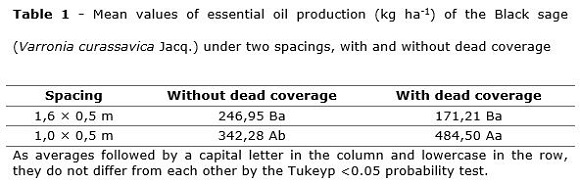
    <p><font face = Verdana size = 2>The spacing 1.0 × 0.5 m with mulch, was significantly higher
than the other treatments for essential oil production (<a href="#t1">Table 1</a>).</font></p>

    <p>    <br></p>

<a name = "t1"><img src = "/img/revistas/rca/v40n4/v40n4a16t1.jpg"></a>

    
<p>    <br></p>

    <p><font face = Verdana size = 2>Melo <i>et al.</i> (2011) observed the highest
average value for pepper-rosmarin oil yield in the lowest spacing used (1.0 × 0.5&nbsp;m).
Marco <i>et al.</i> (2006), working with lemon grass (<i>Cymbopogon winterianus
</i>J.), under different spacing and cutting times, observed that the values of
the essential oil production of the species were higher when grown in the lowest
spacing (0.5 × 0.5&nbsp;m). According to the authors, the smaller spacing promoted
smaller area per plant, resulting in higher plant height, with a consequent increase
in biomass, thus reflecting higher production of essential oil. According to Lemos
<i>et al.</i> (2013), the presence of mulch in the growing area increases the thermal
and water stability of the soil, favoring also the growth in height of the plants,
resulting in an increase of the leaf area.</font></p>

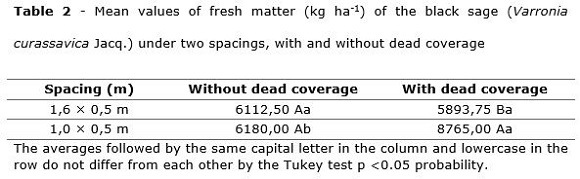
    <p><font face = Verdana
size = 2>The higher values of fresh matter production were observed in the spacing
of 1.0 × 0.5&nbsp;m, with mulch, and in the spacing of 1.6 × 0.5&nbsp;m, without
mulch (<a href="#t2">Table 2</a>).</font></p>

    ]]></body>
<body><![CDATA[<p>    <br></p>

<a name = "t2"><img src = "/img/revistas/rca/v40n4/v40n4a16t2.jpg"></a>

    
<p>    <br></p>

    <p><font face = Verdana size = 2>The higher productivity
observed in the smaller spacing used may be related to the possible competition
that occurred among the plants by the luminosity. This provides higher plants per
unit area in the smaller spacing, with better interception of solar radiation, higher
photosynthesis rate and among other factors, which consequently increase the efficiency
of water and soil nutrient uptake (Taiz and Zeiger, 2004). Munarin <i>et al. </i>(2010)
did not observe significant interaction between spacings and soil cover with chicken
litter, working with the medicinal burdock species (<i>Arctium lappa</i> L.). However,
they affirm that the smaller spacing (0.40&nbsp;m) influenced the increase of the
fresh matter production of the plants, because in smaller spacings, the metabolic
processes of the plants became more efficient, favoring the best use of the resources
in the environment.</font></p>

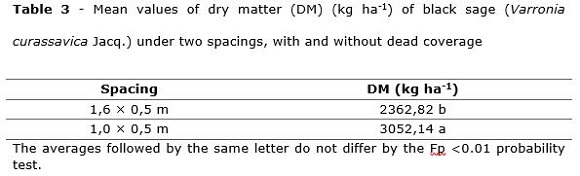
    <p><font face = Verdana size = 2>The spacing
factor was what influenced the dry matter production, and the smaller spacing was
significantly higher than the larger spacing (<a href="#t3">Table 3</a>).</font></p>

    <p>    <br></p>

<a name = "t3"><img src = "/img/revistas/rca/v40n4/v40n4a16t3.jpg"></a>

    
<p>    <br></p>

    ]]></body>
<body><![CDATA[<p><font face = Verdana size = 2>Munarin <i>et al.</i> (2010) observed that the smaller spacing
for burdock plants (0.40&nbsp;cm) resulted in higher leaf dry mass production. The
authors suggest that probably the plants did not reach population pressure that
would reduce their total productive capacity, due to competition for growth factors
such as photosynthetically active solar radiation, water and nutrients, which would
promote a decrease in the productivity of cultivated plants.</font></p>

    <p><font face = Verdana size = 2><i>Varronia curassavica</i> Jacq. is a wild species, still
in the process of domestication. In addition to the factors evaluated in the treatments,
other environmental factors such as rainfall, relative humidity, irradiance, temperature
influence the secondary metabolites (Azevedo <i>et al.</i>, 2016), correlating with
the physiological response of the plant in the production of essential oil as their
chemical characterization.</font></p>

    <p><font face = Verdana size = 2>In the
analysis of the chemical composition of the oil of the tropical black sage, 27 were
detected, of which 23 were identified (<a href="/img/revistas/rca/v40n4/v40n4a16t4.jpg" target = "_blank">Table 4</a>).</font></p>

    
<p><font face = Verdana size
= 2>Consisting mainly of monoterpenes and sesquiterpenes, essential oils are volatile
compounds with wide applications in the pharmaceutical, food and cosmetic industries
(Taiz and Zeiger, 2013). In this study were found the sesquiterpenes (32.1 to 52.1%)
predominated in relation to the monoterpenes (29,8 to 39.3), oxygenated monoterpenes
(1.8 to 2.4) and to the oxygenated sesquiterpenes (7.6 to 10.0%). The &#945;-humulene
and &#946;-caryophyllene, which are sesquiterpenes, are the two chemical markers
of the species and were detected in all samples. Rodrigues <i>et al.</i> (2012),
evaluating the chemical composition of the essential oil of the leaves of the species
also found &#945;-pinene and &#946;-caryophyllene among the major compounds. In
contrast to this work, Paulus <i>et al.</i> (2013) observed significant differences
in the chemical composition of <i>A. triphylla</i> essential oil, grown at different
spacings.</font></p>

    <p><font face = Verdana size = 2>The &#945;-humulene compound
is considered to be the main chemical marker of the essential oil of the species
and, for application in the industry, the oil must be standardized and contain a
minimum content of 2.3% to 2.9% v/v of this compound (Quispe-Condori, 2008; Magalhães,
2010; Gilbert and Favoreto, 2013). The values observed in all treatments in this
experiment were higher than the minimum required for use in industry. This indicates
that in relation to &#945;-humulene, this essential oil can be considered viable
for the production of the phytomedication.</font></p>

    <p>    <br></p>

    <p><font face = Verdana size = 3><b>CONCLUSIONS</b></font></p>

    <p><font face = Verdana size = 2>The change in soil spacing and mulch influences
the production of biomass and oil. However, the spacing of 1.0 × 0.5&nbsp;m with
mulch is the most suitable for the production of the tropical black sage (<i>Varronia
curassavica </i>Jacq.).</font></p>

    <p>    ]]></body>
<body><![CDATA[<br></p>

    <p><font face = Verdana size = 3><b>REFERENCES</b></font></p>

    <!-- ref --><p><font face
= Verdana size = 2>Adams, R.P. (2007) - <i>Identification of essential oil components
by gas chromatography/mass spectrometry.</i> Illinois: Allured Publishing Corporation,
803 p.    &nbsp;&nbsp;&nbsp;&nbsp;&nbsp;&nbsp;&nbsp;&nbsp;[&#160;<a href="javascript:void(0);" onclick="javascript: window.open('/scielo.php?script=sci_nlinks&ref=668974&pid=S0871-018X201700040001600001&lng=','','width=640,height=500,resizable=yes,scrollbars=1,menubar=yes,');">Links</a>&#160;]<!-- end-ref --></font></p>

    <!-- ref --><p><font face = Verdana size = 2>Araújo, C.B.O.; Santos, A.M.;
Fernandes, L.A.; Martins, E.R.; Sampaio, R.A.; Costa, C.A. &amp; Leite, G.L.D. (2009)
- Uso da adubação orgânica e cobertura morta na cultura da calêndula (<i>Calendula
officinalis</i> L.). <i>Revista Brasileira de Plantas Medicinais</i>, vol. 11, n.
2, p. 117-123. 
<a href = "http://dx.doi.org/10.1590/S1516-05722009000200001" target = "_blank">http://dx.doi.org/10.1590/S1516-05722009000200001</a></font>&nbsp;&nbsp;&nbsp;&nbsp;&nbsp;&nbsp;&nbsp;&nbsp;[&#160;<a href="javascript:void(0);" onclick="javascript: window.open('/scielo.php?script=sci_nlinks&ref=668976&pid=S0871-018X201700040001600002&lng=','','width=640,height=500,resizable=yes,scrollbars=1,menubar=yes,');">Links</a>&#160;]<!-- end-ref --><!-- ref --><p><font face = Verdana size = 2>Azevedo, B.O.de; Oliveira, L.M.de; Lucchese, A.M.; Silva,
D. de J. da; Ledo, C.A. da S. &amp; Nascimento, M.N. (2016) - Growth and essential
oil production by <i>Martianthus leucocephalus</i> grown under the edaphoclimatic
conditions of Feira de Santana, Bahia, Brazil. <i>Ciência Rural</i>, vol. 46, p.
593-598. 
<a href = "http://dx.doi.org/10.1590/0103-8478cr20150149" target = "_blank">http://dx.doi.org/10.1590/0103-8478cr20150149</a></font>&nbsp;&nbsp;&nbsp;&nbsp;&nbsp;&nbsp;&nbsp;&nbsp;[&#160;<a href="javascript:void(0);" onclick="javascript: window.open('/scielo.php?script=sci_nlinks&ref=668977&pid=S0871-018X201700040001600003&lng=','','width=640,height=500,resizable=yes,scrollbars=1,menubar=yes,');">Links</a>&#160;]<!-- end-ref --><p><font face
= Verdana size = 2>Brasil. (2011) - <i>Formulário de Fitoterápicos da Farmacopéia
Brasileira</i>.  ANVISA.</font></p>

    <p><font face = Verdana size = 2>Brasil.
(2014) - Plantas de interesse ao SUS: Ministério da Saúde - Portal da saúde. &lt;
<a href = "http://portalsaude.saude.gov.br/index.php/o-ministerio/principal/leia-mais-o-ministerio/465-sctie-raiz/daf-raiz/cgafb-sctie/fitoterapicos-cgafb/l1-%20fitoterapicos/12552-plantas-de-interesse-ao-sus" target = "_blank">http://portalsaude.saude.gov.br/index.php/o-ministerio/principal/leia-mais-o-ministerio/465-sctie-raiz/daf-raiz/cgafb-sctie/fitoterapicos-cgafb/l1-%20fitoterapicos/12552-plantas-de-interesse-ao-sus</a> &gt;</font></p>

    <!-- ref --><p><font face = Verdana
size = 2>Dool, H. van den &amp; Kratz, P.D. (1963) - A generalization of the retention
index system including linear temperature programmed gas—liquid partition chromatography.
<i>Journal of Chromatography</i>, vol. 11, p. 463-471. 
<a href = "https://doi.org/10.1016/S0021-9673(01)80947-X" target = "_blank">https://doi.org/10.1016/S0021-9673(01)80947-X</a></font>&nbsp;&nbsp;&nbsp;&nbsp;&nbsp;&nbsp;&nbsp;&nbsp;[&#160;<a href="javascript:void(0);" onclick="javascript: window.open('/scielo.php?script=sci_nlinks&ref=668980&pid=S0871-018X201700040001600004&lng=','','width=640,height=500,resizable=yes,scrollbars=1,menubar=yes,');">Links</a>&#160;]<!-- end-ref --><!-- ref --><p><font face = Verdana size = 2>Fernandes, E.S.; Passos, G.F.; Medeiros, R.; Da
Cunha, F.M.; Ferreira, J.; Campos, M. M. &amp; Calixto, J.B. (2007) - Anti-inflammatory
effects of compounds alpha-humulene and (&#8722;)-trans-caryophyllene isolated from
the essential oil of <i>Cordia verbenacea. European Journal of Pharmacology</i>,
vol. 569, n. 3, p. 228-236. 
<a href = "https://doi.org/10.1016/j.ejphar.2007.04.059" target = "_blank">https://doi.org/10.1016/j.ejphar.2007.04.059</a></font>&nbsp;&nbsp;&nbsp;&nbsp;&nbsp;&nbsp;&nbsp;&nbsp;[&#160;<a href="javascript:void(0);" onclick="javascript: window.open('/scielo.php?script=sci_nlinks&ref=668981&pid=S0871-018X201700040001600005&lng=','','width=640,height=500,resizable=yes,scrollbars=1,menubar=yes,');">Links</a>&#160;]<!-- end-ref --><!-- ref --><p><font face = Verdana size = 2>Gilbert, B. &amp; Favoreto, R. (2013) - <i>Cordia
verbenacea</i> DC Boraginaceae. <i>Revista Fitos</i>, vol. 7, p. 17-25.    &nbsp;&nbsp;&nbsp;&nbsp;&nbsp;&nbsp;&nbsp;&nbsp;[&#160;<a href="javascript:void(0);" onclick="javascript: window.open('/scielo.php?script=sci_nlinks&ref=668982&pid=S0871-018X201700040001600006&lng=','','width=640,height=500,resizable=yes,scrollbars=1,menubar=yes,');">Links</a>&#160;]<!-- end-ref --></font></p>


    <!-- ref --><p><font face = Verdana size = 2>Leite, G.L.D.; Santos, M.C.; Rocha, S.L.; Costa,
C.A. &amp; Almeida, C.I.M. (2004) - Intensidade de ataque de tripés, de alternaria
e da queima-das-pontas em cultivares de cebola. <i>Horticultura Brasileira, </i>vol.
22, n. 1, p. 151-153. 
<a href = "http://dx.doi.org/10.1590/S0102-05362004000100032" target = "_blank">http://dx.doi.org/10.1590/S0102-05362004000100032</a></font>&nbsp;&nbsp;&nbsp;&nbsp;&nbsp;&nbsp;&nbsp;&nbsp;[&#160;<a href="javascript:void(0);" onclick="javascript: window.open('/scielo.php?script=sci_nlinks&ref=668984&pid=S0871-018X201700040001600007&lng=','','width=640,height=500,resizable=yes,scrollbars=1,menubar=yes,');">Links</a>&#160;]<!-- end-ref --><!-- ref --><p><font face = Verdana size = 2>Lemos, G.C.S.; Santos, A.D.; Freitas, S.P. &amp;
Gravina, G.A. (2013) - Controle de plantas invasoras em cultivo orgânico e convencional
de capim-limão (<i>Cymbopogon citratus </i>(DC) Stapf.). <i>Revista Brasileira de
Plantas Medicinais</i>, vol. 15, n. 3, p. 405-414. 
<a href = "http://dx.doi.org/10.1590/S1516-05722013000300014" target = "_blank">http://dx.doi.org/10.1590/S1516-05722013000300014</a></font>&nbsp;&nbsp;&nbsp;&nbsp;&nbsp;&nbsp;&nbsp;&nbsp;[&#160;<a href="javascript:void(0);" onclick="javascript: window.open('/scielo.php?script=sci_nlinks&ref=668985&pid=S0871-018X201700040001600008&lng=','','width=640,height=500,resizable=yes,scrollbars=1,menubar=yes,');">Links</a>&#160;]<!-- end-ref --><!-- ref --><p><font face = Verdana size = 2>Lorenzi, H. &amp; Matos, F.A. (2008) - <i>Plantas
medicinais no Brasil: nativas e exóticas cultivadas.</i> Nova Odessa, Instituto
Plantarum, 544 p.    &nbsp;&nbsp;&nbsp;&nbsp;&nbsp;&nbsp;&nbsp;&nbsp;[&#160;<a href="javascript:void(0);" onclick="javascript: window.open('/scielo.php?script=sci_nlinks&ref=668986&pid=S0871-018X201700040001600009&lng=','','width=640,height=500,resizable=yes,scrollbars=1,menubar=yes,');">Links</a>&#160;]<!-- end-ref --></font></p>

    <!-- ref --><p><font face = Verdana size = 2>Magalhães, P.M.
(2010) - Estratégias para o mercado de plantas medicinais e aromáticas no Brasil:
o exemplo da erva-baleeira. <i>Informe Agropecuário</i>, vol. 31, n. 255, p. 94-100.    &nbsp;&nbsp;&nbsp;&nbsp;&nbsp;&nbsp;&nbsp;&nbsp;[&#160;<a href="javascript:void(0);" onclick="javascript: window.open('/scielo.php?script=sci_nlinks&ref=668988&pid=S0871-018X201700040001600010&lng=','','width=640,height=500,resizable=yes,scrollbars=1,menubar=yes,');">Links</a>&#160;]<!-- end-ref --></font></p>


    <!-- ref --><p><font face = Verdana size = 2>Maia-Almeida, C.I.; Ming, L.C.; Marques, M.O.M.;
Magalhães, P.M.; Queiroz, S.C.N.; Scramim, S.; Mischan, M.M.; Montanari Júnior,
I.; Perreira, B. &amp; Ferreira, M.I. (2011) - Densidade de plantio e idade de colheita
de quebra-pedra [<i>Phyllanthus amarus</i> (Schumach. &amp; Thonning) genótipo Unicamp-CPQBA
14] na produtividade de filantina. <i>Revista Brasileira de Plantas Medicinais</i>,
vol. 13, p. 633-641. 
<a href = "http://dx.doi.org/10.1590/S1516-05722011000500021" target = "_blank">http://dx.doi.org/10.1590/S1516-05722011000500021</a></font>&nbsp;&nbsp;&nbsp;&nbsp;&nbsp;&nbsp;&nbsp;&nbsp;[&#160;<a href="javascript:void(0);" onclick="javascript: window.open('/scielo.php?script=sci_nlinks&ref=668990&pid=S0871-018X201700040001600011&lng=','','width=640,height=500,resizable=yes,scrollbars=1,menubar=yes,');">Links</a>&#160;]<!-- end-ref --><!-- ref --><p><font face = Verdana size = 2>Marchese, J.A. &amp; Figueira, G.M. (2005) - O
uso de tecnologias pré e pós-colheita e boas práticas agrícolas na produção de plantas
medicinais e aromáticas. <i>Revista Brasileira de Plantas Medicinais</i>, vol. 7,
n. 3, p. 86-96.    &nbsp;&nbsp;&nbsp;&nbsp;&nbsp;&nbsp;&nbsp;&nbsp;[&#160;<a href="javascript:void(0);" onclick="javascript: window.open('/scielo.php?script=sci_nlinks&ref=668991&pid=S0871-018X201700040001600012&lng=','','width=640,height=500,resizable=yes,scrollbars=1,menubar=yes,');">Links</a>&#160;]<!-- end-ref --></font></p>

    <!-- ref --><p><font face = Verdana size = 2>Marco, C.A.; Innecco,
R.; Mattos, S.H.; Borges, N.S.S. &amp; Medeiros Filho, S. (2006) - Influência de
espaçamento, altura e época de corte no rendimento da biomassa e óleo essencial
na cultura de capim citronela (<i>Cymbopogon winterianus </i>Jowitt.). <i>Revista
Ciência Agronômica,</i> vol. 37, n. 1, p. 32-36.    &nbsp;&nbsp;&nbsp;&nbsp;&nbsp;&nbsp;&nbsp;&nbsp;[&#160;<a href="javascript:void(0);" onclick="javascript: window.open('/scielo.php?script=sci_nlinks&ref=668993&pid=S0871-018X201700040001600013&lng=','','width=640,height=500,resizable=yes,scrollbars=1,menubar=yes,');">Links</a>&#160;]<!-- end-ref --></font></p>

    <!-- ref --><p><font face = Verdana
size = 2>Melo, M.T.P.; Carvalho Júnior, W.G.O.; Souza, M.F.; Figueiredo, L.S. &amp;
Martins, E.R. (2011) - Produção de fitomassa e teor de óleo essencial de folhas
de alecrim-pimenta (<i>Lippia sidoides </i>Cham.) em diferentes espaçamentos de
plantio. <i>Revista Brasileira de Plantas Medicinais,</i> vol. 13, n. 2, p. 230-234.
<a href = "http://dx.doi.org/10.1590/S1516-05722011000200016" target = "_blank">http://dx.doi.org/10.1590/S1516-05722011000200016</a></font>&nbsp;&nbsp;&nbsp;&nbsp;&nbsp;&nbsp;&nbsp;&nbsp;[&#160;<a href="javascript:void(0);" onclick="javascript: window.open('/scielo.php?script=sci_nlinks&ref=668995&pid=S0871-018X201700040001600014&lng=','','width=640,height=500,resizable=yes,scrollbars=1,menubar=yes,');">Links</a>&#160;]<!-- end-ref --><!-- ref --><p><font face =
Verdana size = 2>Munarin, E.E.O.; Heredia-Zárate, N.A.; Vieira, M.C.; Rosa, Y.B.C.J.
&amp; Rodrigues, E.T. (2010) - Espaçamentos entre plantas e cobertura do solo com
cama-de-frango na produção da bardana (<i>Arctium lappa</i> L.). <i>Revista Brasileira
de Plantas Medicinais</i>, vol. 12, n. 2, p. 141-148. 
<a href = "http://dx.doi.org/10.1590/S1516-05722010000200003" target = "_blank">http://dx.doi.org/10.1590/S1516-05722010000200003</a></font>&nbsp;&nbsp;&nbsp;&nbsp;&nbsp;&nbsp;&nbsp;&nbsp;[&#160;<a href="javascript:void(0);" onclick="javascript: window.open('/scielo.php?script=sci_nlinks&ref=668996&pid=S0871-018X201700040001600015&lng=','','width=640,height=500,resizable=yes,scrollbars=1,menubar=yes,');">Links</a>&#160;]<!-- end-ref --><!-- ref --><p><font face = Verdana size = 2>Oliveira, D.M.C.; Luchini, A.C.; Seito, L.N.;
Gomes, J.C.; Crespo-López, M.E. &amp; Di Stasi, L.C. (2011) - <i>Cordia verbenacea</i>
and secretion of mast cells in different animal species. <i>Journal of Ethnopharmacology</i>,
vol. 135, n. 2, p. 463-468. 
<a href = "https://doi.org/10.1016/j.jep.2011.03.046" target = "_blank">https://doi.org/10.1016/j.jep.2011.03.046</a></font>&nbsp;&nbsp;&nbsp;&nbsp;&nbsp;&nbsp;&nbsp;&nbsp;[&#160;<a href="javascript:void(0);" onclick="javascript: window.open('/scielo.php?script=sci_nlinks&ref=668997&pid=S0871-018X201700040001600016&lng=','','width=640,height=500,resizable=yes,scrollbars=1,menubar=yes,');">Links</a>&#160;]<!-- end-ref --><!-- ref --><p><font face = Verdana size = 2>Paulus, D.; Valmorbida, R.; Toffoli, E.; Nava,
G.A. &amp; Paulus, E. (2013) - Teor e composição química do óleo essencial e crescimento
vegetativo de <i>Aloysia triphylla </i>em diferentes espaçamentos e épocas de colheita.
<i>Revista Ceres</i>, vol. 60, n. 3, p. 372-379. 
<a href = "http://dx.doi.org/10.1590/S0034-737X2013000300010" target = "_blank">http://dx.doi.org/10.1590/S0034-737X2013000300010</a></font>&nbsp;&nbsp;&nbsp;&nbsp;&nbsp;&nbsp;&nbsp;&nbsp;[&#160;<a href="javascript:void(0);" onclick="javascript: window.open('/scielo.php?script=sci_nlinks&ref=668998&pid=S0871-018X201700040001600017&lng=','','width=640,height=500,resizable=yes,scrollbars=1,menubar=yes,');">Links</a>&#160;]<!-- end-ref --><!-- ref --><p><font face = Verdana size = 2>Quispe-Condori, S.; Foglio, M.A.; Rosa, P.T.V.
&amp; Meireles, M.A.A. (2008) - Obtaining &#946;-caryophyllene from <i>Cordia verbenacea</i>
of Candolle by supercritical fluid extraction. <i>Journal of Supercritical Fluids</i>,
vol. 46, n. 1, p. 27-32. 
<a href = "https://doi.org/10.1016/j.supflu.2008.02.015" target = "_blank">https://doi.org/10.1016/j.supflu.2008.02.015</a></font>&nbsp;&nbsp;&nbsp;&nbsp;&nbsp;&nbsp;&nbsp;&nbsp;[&#160;<a href="javascript:void(0);" onclick="javascript: window.open('/scielo.php?script=sci_nlinks&ref=668999&pid=S0871-018X201700040001600018&lng=','','width=640,height=500,resizable=yes,scrollbars=1,menubar=yes,');">Links</a>&#160;]<!-- end-ref --><!-- ref --><p><font face = Verdana size = 2>Ribeiro Júnior, J.I. (2001) - <i>Análises estatísticas
no SAEG</i>. Viçosa, UFV, 301 p.    &nbsp;&nbsp;&nbsp;&nbsp;&nbsp;&nbsp;&nbsp;&nbsp;[&#160;<a href="javascript:void(0);" onclick="javascript: window.open('/scielo.php?script=sci_nlinks&ref=669000&pid=S0871-018X201700040001600019&lng=','','width=640,height=500,resizable=yes,scrollbars=1,menubar=yes,');">Links</a>&#160;]<!-- end-ref --></font></p>

    ]]></body>
<body><![CDATA[<!-- ref --><p><font face = Verdana size = 2>Rodrigues,
F.F.G.; Oliveira, L.G.S.; Rodrigues, F.F.G.; Saraiva, M.E.; Almeida, S.C.X.; Cabral,
M.E.S.; Campos, A.R. &amp; Costa, J.G.M. (2012) – Chemical composition, antibacterial
and antifungal activities of essential oil from <i>Cordia verbenacea</i> DC. leaves.
<i>Pharmacognosy Research</i>, vol. 4, n. 3, p. 161-165. 
<a href = "http://dx.doi.org/10.4103/0974-8490.99080" target = "_blank">http://dx.doi.org/10.4103/0974-8490.99080</a></font>&nbsp;&nbsp;&nbsp;&nbsp;&nbsp;&nbsp;&nbsp;&nbsp;[&#160;<a href="javascript:void(0);" onclick="javascript: window.open('/scielo.php?script=sci_nlinks&ref=669002&pid=S0871-018X201700040001600020&lng=','','width=640,height=500,resizable=yes,scrollbars=1,menubar=yes,');">Links</a>&#160;]<!-- end-ref --><!-- ref --><p><font face = Verdana size = 2>Santos, R,F.; Isobe, M.T.C.; Lalla, J.G.; Haber,
L.L.; Marques, M.O.M. &amp; Ming, L.C. (2012) - Composição química e produtividade
dos principais componentes do óleo essencial de <i>Baccharis dracunculifolia </i>DC.
em função da adubação orgânica. <i>Revista Brasileira de Plantas Medicinais</i>,
vol. 14, p. 224-234. 
<a href = "http://dx.doi.org/10.1590/S1516-05722012000500017" target = "_blank">http://dx.doi.org/10.1590/S1516-05722012000500017</a></font>&nbsp;&nbsp;&nbsp;&nbsp;&nbsp;&nbsp;&nbsp;&nbsp;[&#160;<a href="javascript:void(0);" onclick="javascript: window.open('/scielo.php?script=sci_nlinks&ref=669003&pid=S0871-018X201700040001600021&lng=','','width=640,height=500,resizable=yes,scrollbars=1,menubar=yes,');">Links</a>&#160;]<!-- end-ref --><!-- ref --><p><font face = Verdana size = 2>Souza, M.R.M., Pereira, R.G.F. &amp; Fonseca,
M.C.M. (2012) - Comercialização de plantas medicinais no contexto da cadeia produtiva
em Minas Gerais. <i>Revista Brasileira de Plantas Medicinais</i>, vol. 14, p. 242-245.
<a href = "http://dx.doi.org/10.1590/S1516-05722012000500019" target = "_blank">http://dx.doi.org/10.1590/S1516-05722012000500019</a></font>&nbsp;&nbsp;&nbsp;&nbsp;&nbsp;&nbsp;&nbsp;&nbsp;[&#160;<a href="javascript:void(0);" onclick="javascript: window.open('/scielo.php?script=sci_nlinks&ref=669004&pid=S0871-018X201700040001600022&lng=','','width=640,height=500,resizable=yes,scrollbars=1,menubar=yes,');">Links</a>&#160;]<!-- end-ref --><!-- ref --><p><font face =
Verdana size = 2>Taiz, L. &amp; Zeiger, E. (2004) - <i>Fisiologia Vegetal</i>. Porto
Alegre, Artmed, 719 p.    &nbsp;&nbsp;&nbsp;&nbsp;&nbsp;&nbsp;&nbsp;&nbsp;[&#160;<a href="javascript:void(0);" onclick="javascript: window.open('/scielo.php?script=sci_nlinks&ref=669005&pid=S0871-018X201700040001600023&lng=','','width=640,height=500,resizable=yes,scrollbars=1,menubar=yes,');">Links</a>&#160;]<!-- end-ref --></font></p>

    <!-- ref --><p><font face = Verdana size = 2>Taiz, L. &amp;
Zeiger, E. (2013) - <i>Fisiologia Vegetal</i>. Porto Alegre, Artmed, 954 p.    &nbsp;&nbsp;&nbsp;&nbsp;&nbsp;&nbsp;&nbsp;&nbsp;[&#160;<a href="javascript:void(0);" onclick="javascript: window.open('/scielo.php?script=sci_nlinks&ref=669007&pid=S0871-018X201700040001600024&lng=','','width=640,height=500,resizable=yes,scrollbars=1,menubar=yes,');">Links</a>&#160;]<!-- end-ref --></font></p>

    <p>    <br></p>

    <p><font face = Verdana size = 3><b>ACKNOWLEDGMENTS</b></font></p>

    ]]></body>
<body><![CDATA[<p><font face = Verdana size = 2>To the National Council of Scientific and Technological
Development (CNPq), for the financial aid. To the Coordination of Improvement of
Higher Education Personnel, to the Program to Support Restructuring and Expansion
Plans of Federal Universities (CAPES/REUNI) and the Ministry of Education and Culture,
the Secretariat of Higher Education (MEC/SESu) by granting research grants and tutorial
education. And to the Pluridisciplinary Center for Chemical, Biological and Agricultural
Research of the State University of Campinas (CPQBA-UNICAMP) by the donation of
the seeds used in this research.</font></p>

    <p>    <br></p>

    <p><font face = Verdana size = 2>Received/recebido: 2017.04.14</font></p>

    <p><font face = Verdana size = 2>Received in revised form/recebido em versão revista: 2017.07.17</font></p>

    <p><font face = Verdana size = 2>Accepted/aceite: 2017.07.18</font></p>

     ]]></body><back>
<ref-list>
<ref id="B1">
<nlm-citation citation-type="book">
<person-group person-group-type="author">
<name>
<surname><![CDATA[Adams]]></surname>
<given-names><![CDATA[R.P.]]></given-names>
</name>
</person-group>
<source><![CDATA[Identification of essential oil components by gas chromatography/mass spectrometry]]></source>
<year>2007</year>
<publisher-loc><![CDATA[Illinois ]]></publisher-loc>
<publisher-name><![CDATA[Allured Publishing Corporation]]></publisher-name>
</nlm-citation>
</ref>
<ref id="B2">
<nlm-citation citation-type="journal">
<person-group person-group-type="author">
<name>
<surname><![CDATA[Araújo]]></surname>
<given-names><![CDATA[C.B.O.]]></given-names>
</name>
<name>
<surname><![CDATA[Santos]]></surname>
<given-names><![CDATA[A.M.]]></given-names>
</name>
<name>
<surname><![CDATA[Fernandes]]></surname>
<given-names><![CDATA[L.A.]]></given-names>
</name>
<name>
<surname><![CDATA[Martins]]></surname>
<given-names><![CDATA[E.R.]]></given-names>
</name>
<name>
<surname><![CDATA[Sampaio]]></surname>
<given-names><![CDATA[R.A.]]></given-names>
</name>
<name>
<surname><![CDATA[Costa]]></surname>
<given-names><![CDATA[C.A.]]></given-names>
</name>
<name>
<surname><![CDATA[Leite]]></surname>
<given-names><![CDATA[G.L.D.]]></given-names>
</name>
</person-group>
<article-title xml:lang="pt"><![CDATA[Uso da adubação orgânica e cobertura morta na cultura da calêndula (Calendula officinalis L.)]]></article-title>
<source><![CDATA[Revista Brasileira de Plantas Medicinais]]></source>
<year>2009</year>
<volume>11</volume>
<numero>2</numero>
<issue>2</issue>
<page-range>117-123</page-range></nlm-citation>
</ref>
<ref id="B3">
<nlm-citation citation-type="journal">
<person-group person-group-type="author">
<name>
<surname><![CDATA[Azevedo]]></surname>
<given-names><![CDATA[B.O.de]]></given-names>
</name>
<name>
<surname><![CDATA[Oliveira]]></surname>
<given-names><![CDATA[L.M.de]]></given-names>
</name>
<name>
<surname><![CDATA[Lucchese]]></surname>
<given-names><![CDATA[A.M.]]></given-names>
</name>
<name>
<surname><![CDATA[Silva]]></surname>
<given-names><![CDATA[D. de J. da]]></given-names>
</name>
<name>
<surname><![CDATA[Ledo]]></surname>
<given-names><![CDATA[C.A. da S.]]></given-names>
</name>
<name>
<surname><![CDATA[Nascimento]]></surname>
<given-names><![CDATA[M.N.]]></given-names>
</name>
</person-group>
<article-title xml:lang="en"><![CDATA[Growth and essential oil production by Martianthus leucocephalus grown under the edaphoclimatic conditions of Feira de Santana, Bahia, Brazil]]></article-title>
<source><![CDATA[Ciência Rural]]></source>
<year>2016</year>
<volume>46</volume>
<page-range>593-598</page-range></nlm-citation>
</ref>
<ref id="B4">
<nlm-citation citation-type="journal">
<person-group person-group-type="author">
<name>
<surname><![CDATA[Dool]]></surname>
<given-names><![CDATA[H. van den]]></given-names>
</name>
<name>
<surname><![CDATA[Kratz]]></surname>
<given-names><![CDATA[P.D.]]></given-names>
</name>
</person-group>
<article-title xml:lang="en"><![CDATA[A generalization of the retention index system including linear temperature programmed gas-liquid partition chromatography]]></article-title>
<source><![CDATA[Journal of Chromatography]]></source>
<year>1963</year>
<volume>11</volume>
<page-range>463-471</page-range></nlm-citation>
</ref>
<ref id="B5">
<nlm-citation citation-type="journal">
<person-group person-group-type="author">
<name>
<surname><![CDATA[Fernandes]]></surname>
<given-names><![CDATA[E.S.]]></given-names>
</name>
<name>
<surname><![CDATA[Passos]]></surname>
<given-names><![CDATA[G.F.]]></given-names>
</name>
<name>
<surname><![CDATA[Medeiros]]></surname>
<given-names><![CDATA[R.]]></given-names>
</name>
<name>
<surname><![CDATA[Da Cunha]]></surname>
<given-names><![CDATA[F.M.]]></given-names>
</name>
<name>
<surname><![CDATA[Ferreira]]></surname>
<given-names><![CDATA[J.]]></given-names>
</name>
<name>
<surname><![CDATA[Campos]]></surname>
<given-names><![CDATA[M. M.]]></given-names>
</name>
<name>
<surname><![CDATA[Calixto]]></surname>
<given-names><![CDATA[J.B.]]></given-names>
</name>
</person-group>
<article-title xml:lang="en"><![CDATA[Anti-inflammatory effects of compounds alpha-humulene and (&#8722;)-trans-caryophyllene isolated from the essential oil of Cordia verbenacea]]></article-title>
<source><![CDATA[European Journal of Pharmacology]]></source>
<year>2007</year>
<volume>569</volume>
<numero>3</numero>
<issue>3</issue>
<page-range>228-236</page-range></nlm-citation>
</ref>
<ref id="B6">
<nlm-citation citation-type="journal">
<person-group person-group-type="author">
<name>
<surname><![CDATA[Gilbert]]></surname>
<given-names><![CDATA[B.]]></given-names>
</name>
<name>
<surname><![CDATA[Favoreto]]></surname>
<given-names><![CDATA[R.]]></given-names>
</name>
</person-group>
<article-title xml:lang="en"><![CDATA[Cordia verbenacea DC Boraginaceae]]></article-title>
<source><![CDATA[Revista Fitos]]></source>
<year>2013</year>
<volume>7</volume>
<page-range>17-25</page-range></nlm-citation>
</ref>
<ref id="B7">
<nlm-citation citation-type="journal">
<person-group person-group-type="author">
<name>
<surname><![CDATA[Leite]]></surname>
<given-names><![CDATA[G.L.D.]]></given-names>
</name>
<name>
<surname><![CDATA[Santos]]></surname>
<given-names><![CDATA[M.C.]]></given-names>
</name>
<name>
<surname><![CDATA[Rocha]]></surname>
<given-names><![CDATA[S.L.]]></given-names>
</name>
<name>
<surname><![CDATA[Costa]]></surname>
<given-names><![CDATA[C.A.]]></given-names>
</name>
<name>
<surname><![CDATA[Almeida]]></surname>
<given-names><![CDATA[C.I.M.]]></given-names>
</name>
</person-group>
<article-title xml:lang="pt"><![CDATA[Intensidade de ataque de tripés, de alternaria e da queima-das-pontas em cultivares de cebola]]></article-title>
<source><![CDATA[Horticultura Brasileira]]></source>
<year>2004</year>
<volume>22</volume>
<numero>1</numero>
<issue>1</issue>
<page-range>151-153</page-range></nlm-citation>
</ref>
<ref id="B8">
<nlm-citation citation-type="journal">
<person-group person-group-type="author">
<name>
<surname><![CDATA[Lemos]]></surname>
<given-names><![CDATA[G.C.S.]]></given-names>
</name>
<name>
<surname><![CDATA[Santos]]></surname>
<given-names><![CDATA[A.D.]]></given-names>
</name>
<name>
<surname><![CDATA[Freitas]]></surname>
<given-names><![CDATA[S.P.]]></given-names>
</name>
<name>
<surname><![CDATA[Gravina]]></surname>
<given-names><![CDATA[G.A.]]></given-names>
</name>
</person-group>
<article-title xml:lang="pt"><![CDATA[Controle de plantas invasoras em cultivo orgânico e convencional de capim-limão (Cymbopogon citratus (DC) Stapf.)]]></article-title>
<source><![CDATA[Revista Brasileira de Plantas Medicinais]]></source>
<year>2013</year>
<volume>15</volume>
<numero>3</numero>
<issue>3</issue>
<page-range>405-414</page-range></nlm-citation>
</ref>
<ref id="B9">
<nlm-citation citation-type="book">
<person-group person-group-type="author">
<name>
<surname><![CDATA[Lorenzi]]></surname>
<given-names><![CDATA[H.]]></given-names>
</name>
<name>
<surname><![CDATA[Matos]]></surname>
<given-names><![CDATA[F.A.]]></given-names>
</name>
</person-group>
<source><![CDATA[Plantas medicinais no Brasil: nativas e exóticas cultivadas]]></source>
<year>2008</year>
<publisher-loc><![CDATA[Nova Odessa ]]></publisher-loc>
<publisher-name><![CDATA[Instituto Plantarum]]></publisher-name>
</nlm-citation>
</ref>
<ref id="B10">
<nlm-citation citation-type="journal">
<person-group person-group-type="author">
<name>
<surname><![CDATA[Magalhães]]></surname>
<given-names><![CDATA[P.M.]]></given-names>
</name>
</person-group>
<article-title xml:lang="pt"><![CDATA[Estratégias para o mercado de plantas medicinais e aromáticas no Brasil: o exemplo da erva-baleeira]]></article-title>
<source><![CDATA[Informe Agropecuário]]></source>
<year>2010</year>
<volume>31</volume>
<numero>255</numero>
<issue>255</issue>
<page-range>94-100</page-range></nlm-citation>
</ref>
<ref id="B11">
<nlm-citation citation-type="journal">
<person-group person-group-type="author">
<name>
<surname><![CDATA[Maia-Almeida]]></surname>
<given-names><![CDATA[C.I.]]></given-names>
</name>
<name>
<surname><![CDATA[Ming]]></surname>
<given-names><![CDATA[L.C.]]></given-names>
</name>
<name>
<surname><![CDATA[Marques]]></surname>
<given-names><![CDATA[M.O.M.]]></given-names>
</name>
<name>
<surname><![CDATA[Magalhães]]></surname>
<given-names><![CDATA[P.M.]]></given-names>
</name>
<name>
<surname><![CDATA[Queiroz]]></surname>
<given-names><![CDATA[S.C.N.]]></given-names>
</name>
<name>
<surname><![CDATA[Scramim]]></surname>
<given-names><![CDATA[S.]]></given-names>
</name>
<name>
<surname><![CDATA[Mischan]]></surname>
<given-names><![CDATA[M.M.]]></given-names>
</name>
<name>
<surname><![CDATA[Montanari Júnior]]></surname>
<given-names><![CDATA[I.]]></given-names>
</name>
<name>
<surname><![CDATA[Perreira]]></surname>
<given-names><![CDATA[B.]]></given-names>
</name>
<name>
<surname><![CDATA[Ferreira]]></surname>
<given-names><![CDATA[M.I.]]></given-names>
</name>
</person-group>
<article-title xml:lang="pt"><![CDATA[Densidade de plantio e idade de colheita de quebra-pedra [Phyllanthus amarus (Schumach. & Thonning) genótipo Unicamp-CPQBA 14] na produtividade de filantina]]></article-title>
<source><![CDATA[Revista Brasileira de Plantas Medicinais]]></source>
<year>2011</year>
<volume>13</volume>
<page-range>633-641</page-range></nlm-citation>
</ref>
<ref id="B12">
<nlm-citation citation-type="journal">
<person-group person-group-type="author">
<name>
<surname><![CDATA[Marchese]]></surname>
<given-names><![CDATA[J.A.]]></given-names>
</name>
<name>
<surname><![CDATA[Figueira]]></surname>
<given-names><![CDATA[G.M.]]></given-names>
</name>
</person-group>
<article-title xml:lang="pt"><![CDATA[O uso de tecnologias pré e pós-colheita e boas práticas agrícolas na produção de plantas medicinais e aromáticas]]></article-title>
<source><![CDATA[Revista Brasileira de Plantas Medicinais]]></source>
<year>2005</year>
<volume>7</volume>
<numero>3</numero>
<issue>3</issue>
<page-range>86-96</page-range></nlm-citation>
</ref>
<ref id="B13">
<nlm-citation citation-type="journal">
<person-group person-group-type="author">
<name>
<surname><![CDATA[Marco]]></surname>
<given-names><![CDATA[C.A.]]></given-names>
</name>
<name>
<surname><![CDATA[Innecco]]></surname>
<given-names><![CDATA[R.]]></given-names>
</name>
<name>
<surname><![CDATA[Mattos]]></surname>
<given-names><![CDATA[S.H.]]></given-names>
</name>
<name>
<surname><![CDATA[Borges]]></surname>
<given-names><![CDATA[N.S.S.]]></given-names>
</name>
<name>
<surname><![CDATA[Medeiros Filho]]></surname>
<given-names><![CDATA[S.]]></given-names>
</name>
</person-group>
<article-title xml:lang="pt"><![CDATA[Influência de espaçamento, altura e época de corte no rendimento da biomassa e óleo essencial na cultura de capim citronela (Cymbopogon winterianus Jowitt.)]]></article-title>
<source><![CDATA[Revista Ciência Agronômica]]></source>
<year>2006</year>
<volume>37</volume>
<numero>1</numero>
<issue>1</issue>
<page-range>32-36</page-range></nlm-citation>
</ref>
<ref id="B14">
<nlm-citation citation-type="journal">
<person-group person-group-type="author">
<name>
<surname><![CDATA[Melo]]></surname>
<given-names><![CDATA[M.T.P.]]></given-names>
</name>
<name>
<surname><![CDATA[Carvalho Júnior]]></surname>
<given-names><![CDATA[W.G.O.]]></given-names>
</name>
<name>
<surname><![CDATA[Souza]]></surname>
<given-names><![CDATA[M.F.]]></given-names>
</name>
<name>
<surname><![CDATA[Figueiredo]]></surname>
<given-names><![CDATA[L.S.]]></given-names>
</name>
<name>
<surname><![CDATA[Martins]]></surname>
<given-names><![CDATA[E.R.]]></given-names>
</name>
</person-group>
<article-title xml:lang="pt"><![CDATA[Produção de fitomassa e teor de óleo essencial de folhas de alecrim-pimenta (Lippia sidoides Cham.) em diferentes espaçamentos de plantio]]></article-title>
<source><![CDATA[Revista Brasileira de Plantas Medicinais]]></source>
<year>2011</year>
<volume>13</volume>
<numero>2</numero>
<issue>2</issue>
<page-range>230-234</page-range></nlm-citation>
</ref>
<ref id="B15">
<nlm-citation citation-type="journal">
<person-group person-group-type="author">
<name>
<surname><![CDATA[Munarin]]></surname>
<given-names><![CDATA[E.E.O.]]></given-names>
</name>
<name>
<surname><![CDATA[Heredia-Zárate]]></surname>
<given-names><![CDATA[N.A.]]></given-names>
</name>
<name>
<surname><![CDATA[Vieira]]></surname>
<given-names><![CDATA[M.C.]]></given-names>
</name>
<name>
<surname><![CDATA[Rosa]]></surname>
<given-names><![CDATA[Y.B.C.J.]]></given-names>
</name>
<name>
<surname><![CDATA[Rodrigues]]></surname>
<given-names><![CDATA[E.T.]]></given-names>
</name>
</person-group>
<article-title xml:lang="pt"><![CDATA[Espaçamentos entre plantas e cobertura do solo com cama-de-frango na produção da bardana (Arctium lappa L.)]]></article-title>
<source><![CDATA[Revista Brasileira de Plantas Medicinais]]></source>
<year>2010</year>
<volume>12</volume>
<numero>2</numero>
<issue>2</issue>
<page-range>141-148</page-range></nlm-citation>
</ref>
<ref id="B16">
<nlm-citation citation-type="journal">
<person-group person-group-type="author">
<name>
<surname><![CDATA[Oliveira]]></surname>
<given-names><![CDATA[D.M.C.]]></given-names>
</name>
<name>
<surname><![CDATA[Luchini]]></surname>
<given-names><![CDATA[A.C.]]></given-names>
</name>
<name>
<surname><![CDATA[Seito]]></surname>
<given-names><![CDATA[L.N.]]></given-names>
</name>
<name>
<surname><![CDATA[Gomes]]></surname>
<given-names><![CDATA[J.C.]]></given-names>
</name>
<name>
<surname><![CDATA[Crespo-López]]></surname>
<given-names><![CDATA[M.E.]]></given-names>
</name>
<name>
<surname><![CDATA[Di Stasi]]></surname>
<given-names><![CDATA[L.C.]]></given-names>
</name>
</person-group>
<article-title xml:lang="en"><![CDATA[Cordia verbenacea and secretion of mast cells in different animal species]]></article-title>
<source><![CDATA[Journal of Ethnopharmacology]]></source>
<year>2011</year>
<volume>135</volume>
<numero>2</numero>
<issue>2</issue>
<page-range>463-468</page-range></nlm-citation>
</ref>
<ref id="B17">
<nlm-citation citation-type="journal">
<person-group person-group-type="author">
<name>
<surname><![CDATA[Paulus]]></surname>
<given-names><![CDATA[D.]]></given-names>
</name>
<name>
<surname><![CDATA[Valmorbida]]></surname>
<given-names><![CDATA[R.]]></given-names>
</name>
<name>
<surname><![CDATA[Toffoli]]></surname>
<given-names><![CDATA[E.]]></given-names>
</name>
<name>
<surname><![CDATA[Nava]]></surname>
<given-names><![CDATA[G.A.]]></given-names>
</name>
<name>
<surname><![CDATA[Paulus]]></surname>
<given-names><![CDATA[E.]]></given-names>
</name>
</person-group>
<article-title xml:lang="pt"><![CDATA[Teor e composição química do óleo essencial e crescimento vegetativo de Aloysia triphylla em diferentes espaçamentos e épocas de colheita]]></article-title>
<source><![CDATA[Revista Ceres]]></source>
<year>2013</year>
<volume>60</volume>
<numero>3</numero>
<issue>3</issue>
<page-range>372-379</page-range></nlm-citation>
</ref>
<ref id="B18">
<nlm-citation citation-type="journal">
<person-group person-group-type="author">
<name>
<surname><![CDATA[Quispe-Condori]]></surname>
<given-names><![CDATA[S.]]></given-names>
</name>
<name>
<surname><![CDATA[Foglio]]></surname>
<given-names><![CDATA[M.A.]]></given-names>
</name>
<name>
<surname><![CDATA[Rosa]]></surname>
<given-names><![CDATA[P.T.V.]]></given-names>
</name>
<name>
<surname><![CDATA[Meireles]]></surname>
<given-names><![CDATA[M.A.A.]]></given-names>
</name>
</person-group>
<article-title xml:lang="en"><![CDATA[Obtaining &#946;-caryophyllene from Cordia verbenacea of Candolle by supercritical fluid extraction]]></article-title>
<source><![CDATA[Journal of Supercritical Fluids]]></source>
<year>2008</year>
<volume>46</volume>
<numero>1</numero>
<issue>1</issue>
<page-range>27-32</page-range></nlm-citation>
</ref>
<ref id="B19">
<nlm-citation citation-type="book">
<person-group person-group-type="author">
<name>
<surname><![CDATA[Ribeiro Júnior]]></surname>
<given-names><![CDATA[J.I.]]></given-names>
</name>
</person-group>
<source><![CDATA[Análises estatísticas no SAEG]]></source>
<year>2001</year>
<publisher-loc><![CDATA[Viçosa ]]></publisher-loc>
<publisher-name><![CDATA[UFV]]></publisher-name>
</nlm-citation>
</ref>
<ref id="B20">
<nlm-citation citation-type="journal">
<person-group person-group-type="author">
<name>
<surname><![CDATA[Rodrigues]]></surname>
<given-names><![CDATA[F.F.G.]]></given-names>
</name>
<name>
<surname><![CDATA[Oliveira]]></surname>
<given-names><![CDATA[L.G.S.]]></given-names>
</name>
<name>
<surname><![CDATA[Rodrigues]]></surname>
<given-names><![CDATA[F.F.G.]]></given-names>
</name>
<name>
<surname><![CDATA[Saraiva]]></surname>
<given-names><![CDATA[M.E.]]></given-names>
</name>
<name>
<surname><![CDATA[Almeida]]></surname>
<given-names><![CDATA[S.C.X.]]></given-names>
</name>
<name>
<surname><![CDATA[Cabral]]></surname>
<given-names><![CDATA[M.E.S.]]></given-names>
</name>
<name>
<surname><![CDATA[Campos]]></surname>
<given-names><![CDATA[A.R.]]></given-names>
</name>
<name>
<surname><![CDATA[Costa]]></surname>
<given-names><![CDATA[J.G.M.]]></given-names>
</name>
</person-group>
<article-title xml:lang="en"><![CDATA[Chemical composition, antibacterial and antifungal activities of essential oil from Cordia verbenacea DC. leaves]]></article-title>
<source><![CDATA[Pharmacognosy Research]]></source>
<year>2012</year>
<volume>4</volume>
<numero>3</numero>
<issue>3</issue>
<page-range>161-165</page-range></nlm-citation>
</ref>
<ref id="B21">
<nlm-citation citation-type="journal">
<person-group person-group-type="author">
<name>
<surname><![CDATA[Santos]]></surname>
<given-names><![CDATA[R,F.]]></given-names>
</name>
<name>
<surname><![CDATA[Isobe]]></surname>
<given-names><![CDATA[M.T.C.]]></given-names>
</name>
<name>
<surname><![CDATA[Lalla]]></surname>
<given-names><![CDATA[J.G.]]></given-names>
</name>
<name>
<surname><![CDATA[Haber]]></surname>
<given-names><![CDATA[L.L.]]></given-names>
</name>
<name>
<surname><![CDATA[Marques]]></surname>
<given-names><![CDATA[M.O.M.]]></given-names>
</name>
<name>
<surname><![CDATA[Ming]]></surname>
<given-names><![CDATA[L.C.]]></given-names>
</name>
</person-group>
<article-title xml:lang="pt"><![CDATA[Composição química e produtividade dos principais componentes do óleo essencial de Baccharis dracunculifolia DC. em função da adubação orgânica]]></article-title>
<source><![CDATA[Revista Brasileira de Plantas Medicinais]]></source>
<year>2012</year>
<volume>14</volume>
<page-range>224-234</page-range></nlm-citation>
</ref>
<ref id="B22">
<nlm-citation citation-type="journal">
<person-group person-group-type="author">
<name>
<surname><![CDATA[Souza]]></surname>
<given-names><![CDATA[M.R.M.]]></given-names>
</name>
<name>
<surname><![CDATA[Pereira]]></surname>
<given-names><![CDATA[R.G.F.]]></given-names>
</name>
<name>
<surname><![CDATA[Fonseca]]></surname>
<given-names><![CDATA[M.C.M.]]></given-names>
</name>
</person-group>
<article-title xml:lang="pt"><![CDATA[Comercialização de plantas medicinais no contexto da cadeia produtiva em Minas Gerais]]></article-title>
<source><![CDATA[Revista Brasileira de Plantas Medicinais]]></source>
<year>2012</year>
<volume>14</volume>
<page-range>242-245</page-range></nlm-citation>
</ref>
<ref id="B23">
<nlm-citation citation-type="book">
<person-group person-group-type="author">
<name>
<surname><![CDATA[Taiz]]></surname>
<given-names><![CDATA[L.]]></given-names>
</name>
<name>
<surname><![CDATA[Zeiger]]></surname>
<given-names><![CDATA[E.]]></given-names>
</name>
</person-group>
<source><![CDATA[Fisiologia Vegetal]]></source>
<year>2004</year>
<publisher-loc><![CDATA[Porto Alegre ]]></publisher-loc>
<publisher-name><![CDATA[Artmed]]></publisher-name>
</nlm-citation>
</ref>
<ref id="B24">
<nlm-citation citation-type="book">
<person-group person-group-type="author">
<name>
<surname><![CDATA[Taiz]]></surname>
<given-names><![CDATA[L.]]></given-names>
</name>
<name>
<surname><![CDATA[Zeiger]]></surname>
<given-names><![CDATA[E.]]></given-names>
</name>
</person-group>
<source><![CDATA[Fisiologia Vegetal]]></source>
<year>2013</year>
<publisher-loc><![CDATA[Porto Alegre ]]></publisher-loc>
<publisher-name><![CDATA[Artmed]]></publisher-name>
</nlm-citation>
</ref>
</ref-list>
</back>
</article>