<?xml version="1.0" encoding="ISO-8859-1"?><article xmlns:mml="http://www.w3.org/1998/Math/MathML" xmlns:xlink="http://www.w3.org/1999/xlink" xmlns:xsi="http://www.w3.org/2001/XMLSchema-instance">
<front>
<journal-meta>
<journal-id>0871-018X</journal-id>
<journal-title><![CDATA[Revista de Ciências Agrárias]]></journal-title>
<abbrev-journal-title><![CDATA[Rev. de Ciências Agrárias]]></abbrev-journal-title>
<issn>0871-018X</issn>
<publisher>
<publisher-name><![CDATA[Sociedade de Ciências Agrárias de Portugal]]></publisher-name>
</publisher>
</journal-meta>
<article-meta>
<article-id>S0871-018X2018000100002</article-id>
<article-id pub-id-type="doi">10.19084/RCA17152</article-id>
<title-group>
<article-title xml:lang="en"><![CDATA[Agronomic characteristics of sunflower genotypes according to plant population]]></article-title>
<article-title xml:lang="pt"><![CDATA[Características agronômicas de genótipos de girassol segundo a população de plantas]]></article-title>
</title-group>
<contrib-group>
<contrib contrib-type="author">
<name>
<surname><![CDATA[Stasiak]]></surname>
<given-names><![CDATA[Diogo]]></given-names>
</name>
<xref ref-type="aff" rid="A1"/>
</contrib>
<contrib contrib-type="author">
<name>
<surname><![CDATA[Dalchiavon]]></surname>
<given-names><![CDATA[Flávio Carlos]]></given-names>
</name>
<xref ref-type="aff" rid="A1"/>
</contrib>
<contrib contrib-type="author">
<name>
<surname><![CDATA[Birck]]></surname>
<given-names><![CDATA[Marcos]]></given-names>
</name>
<xref ref-type="aff" rid="A1"/>
</contrib>
<contrib contrib-type="author">
<name>
<surname><![CDATA[Hiolanda]]></surname>
<given-names><![CDATA[Rosivaldo]]></given-names>
</name>
<xref ref-type="aff" rid="A1"/>
</contrib>
<contrib contrib-type="author">
<name>
<surname><![CDATA[Iocca]]></surname>
<given-names><![CDATA[Andréia Fernanda Silva]]></given-names>
</name>
<xref ref-type="aff" rid="A1"/>
</contrib>
<contrib contrib-type="author">
<name>
<surname><![CDATA[Coletti]]></surname>
<given-names><![CDATA[Admar Junior]]></given-names>
</name>
<xref ref-type="aff" rid="A2"/>
</contrib>
<contrib contrib-type="author">
<name>
<surname><![CDATA[Carvalho]]></surname>
<given-names><![CDATA[Claudio Guilherme Portela]]></given-names>
</name>
<xref ref-type="aff" rid="A3"/>
</contrib>
</contrib-group>
<aff id="AA1">
<institution><![CDATA[,Instituto Federal de Educação, Ciência e Tecnologia de Mato Grosso Departamento de Agronomia ]]></institution>
<addr-line><![CDATA[Campo Novo do Parecis MT]]></addr-line>
<country>Brasil</country>
</aff>
<aff id="AA2">
<institution><![CDATA[,Universidade Federal de Mato Grosso  ]]></institution>
<addr-line><![CDATA[Sinop MT]]></addr-line>
<country>Brasil</country>
</aff>
<aff id="AA3">
<institution><![CDATA[,Embrapa Soja  ]]></institution>
<addr-line><![CDATA[Londrina PR]]></addr-line>
<country>Brasil</country>
</aff>
<pub-date pub-type="pub">
<day>00</day>
<month>03</month>
<year>2018</year>
</pub-date>
<pub-date pub-type="epub">
<day>00</day>
<month>03</month>
<year>2018</year>
</pub-date>
<volume>41</volume>
<numero>1</numero>
<fpage>1</fpage>
<lpage>10</lpage>
<copyright-statement/>
<copyright-year/>
<self-uri xlink:href="http://scielo.pt/scielo.php?script=sci_arttext&amp;pid=S0871-018X2018000100002&amp;lng=en&amp;nrm=iso"></self-uri><self-uri xlink:href="http://scielo.pt/scielo.php?script=sci_abstract&amp;pid=S0871-018X2018000100002&amp;lng=en&amp;nrm=iso"></self-uri><self-uri xlink:href="http://scielo.pt/scielo.php?script=sci_pdf&amp;pid=S0871-018X2018000100002&amp;lng=en&amp;nrm=iso"></self-uri><abstract abstract-type="short" xml:lang="en"><p><![CDATA[The agronomic characteristics of sunflower genotypes were evaluated under different plant populations. The experiment was performed at the IFMT experimental field, campus Campo Novo do Parecis, Brazil, between February and June 2015. The experimental design comprised randomized blocks, in a factorial 5 x 5 arrangement, with five sunflower genotypes (AGUARÁ 04, GNZ NEON, HÉLIO 251, SYN 045 and SYN 3950HO) and five plant populations (30,000; 37,500; 45,000; 52,500; 60,000 plants ha-1), with 3 replications. Plant height, stem diameter, capitulum height, capitulum size, achene mass per capitulum, mass of one thousand achenes and achene productivity were assessed. Increase in plant and capitulum height, reduction of stem diameter, capitulum size, achene mass per capitulum and mass of one thousand achenes occurred with increase of plant population. Productivity is correlated with the mass of achene per capitulum and with mass of one thousand achenes. The population of 47,150 plants ha-1 provided the highest achene productivity.]]></p></abstract>
<abstract abstract-type="short" xml:lang="pt"><p><![CDATA[Objetivou-se avaliar características agronômicas de genótipos de girassol sob diferentes populações de plantas. O experimento foi realizado no campo experimental do IFMT, Campus Campo Novo do Parecis - MT, entre os meses de fevereiro e junho de 2015. O delineamento experimental foi o de blocos casualizados, em esquema fatorial 5 x 5, sendo cinco genótipos de girassol (AGUARÁ 04, GNZ NEON, HÉLIO 251, SYN 045 e SYN 3950HO) e cinco populações de plantas (30.000, 37.500, 45.000, 52.500 e 60.000 plantas ha-1), com 3 repetições. Avaliaram-se as características altura de planta, diâmetro da haste, altura do capítulo, tamanho do capítulo, massa de aquênios por capítulo, massa de mil aquênios e produtividade de aquênios. Há aumento da altura de planta e da altura de capítulo, redução do diâmetro da haste, do tamanho do capítulo, da massa de aquênios por capítulo e da massa de mil aquênios com o aumento da população de plantas. A produtividade está correlacionada com a massa de aquênios por capítulo e com a massa de mil aquênios. A população de 47.150 plantas ha-1 proporciona a maior produtividade de aquênios.]]></p></abstract>
<kwd-group>
<kwd lng="en"><![CDATA[performance of cultivars]]></kwd>
<kwd lng="en"><![CDATA[Helianthus annuus L.]]></kwd>
<kwd lng="en"><![CDATA[seeding density]]></kwd>
<kwd lng="en"><![CDATA[agronomic performance]]></kwd>
<kwd lng="en"><![CDATA[productivity]]></kwd>
<kwd lng="pt"><![CDATA[desempenho de cultivares]]></kwd>
<kwd lng="pt"><![CDATA[Helianthus annuus]]></kwd>
<kwd lng="pt"><![CDATA[densidade de semeadura]]></kwd>
<kwd lng="pt"><![CDATA[desempenho agronômico]]></kwd>
<kwd lng="pt"><![CDATA[produtividade]]></kwd>
</kwd-group>
</article-meta>
</front><body><![CDATA[ 

    <p align = "right"><font face = "Verdana" size = "2"><b>ARTIGO</b></font></p>    

    <p><font face = "Verdana" size = "4"><b>Agronomic characteristics
of sunflower genotypes according to plant population</b></font></p>

    <p><font face = "Verdana" size = "3"><b>Características agronômicas de genótipos de girassol
segundo a população de plantas</b></font></p>

    <p><font face = "Verdana" size = "2"><b>Diogo Stasiak</b><sup>1</sup>, <b>Flávio Carlos Dalchiavon</b><sup>1*</sup>, <b>Marcos
Birck</b><sup>1</sup>, <b>Rosivaldo Hiolanda</b><sup>1</sup>, <b>Andréia Fernanda Silva Iocca</b><sup>1</sup>,
<b>Admar Junior Coletti</b><sup>2</sup> and <b>Claudio Guilherme Portela Carvalho</b><sup>3</sup></font></p>


    <p><font face = "Verdana" size = "2"><i><sup>1</sup>Instituto Federal de Educação,
Ciência e Tecnologia de Mato Grosso, Departamento de Agronomia, Rodovia MT 235,
km 12, Zona Rural, Caixa Postal 100, CEP 78360-000, Campo Novo do Parecis, MT, Brasil</i></font></p>

    <p><font face = "Verdana" size = "2"><i><sup>2</sup>Universidade Federal de Mato
Grosso, Sinop,MT, Brasil</i></font></p>

    <p><font face = "Verdana" size = "2"><i><sup>3</sup>Embrapa
Soja, Caixa Postal 231, CEP 86001-970, Londrina, PR, Brasil</i></font></p>

    <p><font face = "Verdana" size = "2"><i>*(E-mail: <a href="mailto:flavio.dalchiavon@cnp.ifmt.edu.br">flavio.dalchiavon@cnp.ifmt.edu.br</a>)</i></font></p>

<hr noshade size = 1>

    <p><font face = "Verdana" size = "3"><b>ABSTRACT</b></font></p>

    ]]></body>
<body><![CDATA[<p><font face = "Verdana" size = "2">The agronomic characteristics
of sunflower genotypes were evaluated under different plant populations. The experiment
was performed at the IFMT experimental field, campus Campo Novo do Parecis, Brazil,
between February and June 2015. The experimental design comprised randomized blocks,
in a factorial 5 x 5 arrangement, with five sunflower genotypes (AGUARÁ 04, GNZ
NEON, HÉLIO 251, SYN 045 and SYN 3950HO) and five plant populations (30,000; 37,500;
45,000; 52,500; 60,000 plants ha<sup>-1</sup>), with 3 replications. Plant height,
stem diameter, capitulum height, capitulum size, achene mass per capitulum, mass
of one thousand achenes and achene productivity were assessed. Increase in plant
and capitulum height, reduction of stem diameter, capitulum size, achene mass per
capitulum and mass of one thousand achenes occurred with increase of plant population.
Productivity is correlated with the mass of achene per capitulum and with mass of
one thousand achenes. The population of 47,150 plants ha<sup>-1</sup> provided the
highest achene productivity.</font></p>

    <p><font face = "Verdana" size = "2"><b>Keywords:</b> performance of cultivars, <i>Helianthus annuus </i>L., seeding density, agronomic
performance, productivity.</font></p>

<hr noshade size = 1>

    <p><font face = "Verdana" size = "3"><b>RESUMO</b> </font></p>

    <p><font face = "Verdana" size = "2">Objetivou-se avaliar características agronômicas de genótipos
de girassol sob diferentes populações de plantas. O experimento foi realizado no
campo experimental do IFMT, Campus Campo Novo do Parecis - MT, entre os meses de
fevereiro e junho de 2015. O delineamento experimental foi o de blocos casualizados,
em esquema fatorial 5 x 5, sendo cinco genótipos de girassol (AGUARÁ 04, GNZ NEON,
HÉLIO 251, SYN 045 e SYN 3950HO) e cinco populações de plantas (30.000, 37.500,
45.000, 52.500 e 60.000 plantas ha<sup>-1</sup>), com 3 repetições. Avaliaram-se
as características altura de planta, diâmetro da haste, altura do capítulo, tamanho
do capítulo, massa de aquênios por capítulo, massa de mil aquênios e produtividade
de aquênios. Há aumento da altura de planta e da altura de capítulo, redução do
diâmetro da haste, do tamanho do capítulo, da massa de aquênios por capítulo e da
massa de mil aquênios com o aumento da população de plantas. A produtividade está
correlacionada com a massa de aquênios por capítulo e com a massa de mil aquênios.
A população de 47.150 plantas ha<sup>-1</sup> proporciona a maior produtividade
de aquênios.</font></p>

    <p><font face = "Verdana" size = "2"><b>Palavras-chave:</b> desempenho de cultivares, <i>Helianthus annuus</i>, densidade de semeadura, desempenho
agronômico, produtividade.</font></p>

<hr noshade size = 1>

    <p><font face = Verdana size = 3><b>INTRODUCTION</b></font></p>

    <p><font face = "Verdana" size = "2">The production of sunflower (<i>Helianthus annuus</i>
L.) in the state of Mato Grosso, Brazil, is 77.4% of total Brazilian production
The region has the best soil-climate conditions for the development of the sunflower
crop (Pérez <i>et al</i>., 1989). Cultivated area in Mato Grosso for the 2013-14
harvest was 126,200 hectares, with a production of 203,300 tons, whereas the cultivated
area for the 2014-15 harvest was 86,400 hectares, with a production of 116,500 tons,
or rather, a 31.5% decrease in cultivated area and 42.7% and 16.3% respectively
for production and productivity when compared to the previous harvest. Low technology
and cultivation treatments different from traditional ones may have been the main
reduction cause (CONAB, 2015). </font></p>

    <p><font face = "Verdana" size = "2">Since vegetative and reproductive characteristics of sunflower crops vary according
to genotype, it is important to select, prior to implantation, the genotype with
the due agronomic features. In Papanduva SC Brazil, Vogt <i>et al</i>. (2012) assessed
17 sunflower genotypes and reported a difference of 2,081.0 kg ha<sup>-1</sup> between
the genotype with the highest (Dow M734; 2,632.0 kg ha<sup>-1</sup>) and lowest
(Hélio 358; 551.0 kg ha<sup>-1</sup>) productivity rate. In an assay in Campo Novo
do Parecis MT Brazil, there was a difference of 1,069.0 kg ha<sup>-1</sup> between
genotypes with the highest (SYN 045; 2,674.0 kg ha<sup>-1</sup>) and lowest (BRS
323; 1,605.0 kg ha<sup>-1</sup>) productivity rates during the 2013 interim harvest
(Carvalho <i>et al</i>., 2014).</font></p>

    <p><font face = "Verdana" size = "2">In studies undertaken in Eldorado do Sul RS Brazil, with four plant populations
(30,000; 50,000; 70,000 and 90,000 plants ha<sup>-1</sup>) in the 1989-90 and 1990-91
harvests, Rizzardi and Silva (1993) reported that sunflower genotypes in different
plant populations enhanced productivity. There was no difference in productivity
in the short cycle and low size genotype for the 1989-1990 harvest (Contisol 711)
in different plant populations, although long cycle and medium and high size genotypes
(DK 180 and GR 10, respectively) had the greatest productivity rates with a population
of 30,000 plants ha<sup>-1</sup>. In the 1990-91 harvest, short cycle and low size
genotype (GR 16) revealed highest productivity in the population of 56,279 plants
ha<sup>-1</sup>. In their studies on different sunflower plant populations, Castro
<i>et al</i>. (2011) reported that productivities around 2,500.0 kg ha<sup>-1</sup>
were obtained with populations between 31,000 and 45,000 plants ha<sup>-1</sup>.
On the other hand, Castro <i>et al</i>. (1997) insisted that seeding density, which
causes highest productivity rates, lay between 40,000 and 45,000 plants ha<sup>-1</sup>.
No population size is established since it varies according to the region.</font></p>

    <p><font face = "Verdana" size = "2">Since scanty information is available on
sunflower cultivation and its importance in Brazilian economy, studies are highly
relevant to increase productivity and provide agronomic information to producers.
Cultivation practices will be underscored and future research work may be monitored.
Current assay evaluates the agronomic characteristics of sunflower genotypes under
different plant populations.</font></p>

    ]]></body>
<body><![CDATA[<p><font face = "Verdana" size = "3"><b>MATERIALS AND METHODS</b></font></p>

    <p><font face = "Verdana" size = "2">Current assay
was conducted in the experimental field of the Federal Institute of Education, Science
and Technology of Mato Grosso, campus Campo Novo do Parecis, during the second harvest
of the 2014/2015 agricultural year, at 13º40’37’’ S and 57º47’30’’ W, altitude 574
m. </font></p>

    <p><font face = "Verdana" size = "2">Soil is Dystrophic Red Latosol
(Dalchiavon <i>et al</i>., 2015). Prior to the preparation of the area with soil
disking, soil samples at 0 – 0.2 m depth was removed to analyze their chemical properties.
Mean data were pH (H<sub>2</sub>O) = 5.7; P = 6.1 mg dm<sup>-3</sup>; K = 0.24 cmol<sub>c</sub>
dm<sup>-3</sup>; Ca = 2.5 cmol<sub>c</sub> dm<sup>-3</sup>; Mg = 1.0 cmol<sub>c</sub>
dm<sup>-3</sup>; Al = 0; H = 4.6 cmol<sub>c</sub> dm<sup>-3</sup>; B = 0.36 mg dm<sup>-3</sup>;
organic matter = 35.8 g dm<sup>-3</sup> and V% = 44.8%.</font></p>

    <p><font face = "Verdana" size = "2">Following Köppen´s classification, the local climate
is Aw, tropical climate with a well-defined dry season between May and September.
<a href = "/img/revistas/rca/v41n1/v41n1a01f1.jpg" target = "_blank">Figure 1</a> shows the meteorological data on air temperature and accumulated rainfall
on the experimental area during the experiment</font></p>

    
<p><font face = "Verdana" size = "2">Seed was sowed on the 2<sup>nd</sup> February 2015, by hand, at a depth of
0.04 m, with three seeds per hole; thinning occurred after 16 days of seeding (DAS),
with one plant per hole. Fertilization occurred in the hole with 40 kg ha<sup>-1</sup>
N, 83 kg ha<sup>-1</sup> P<sub>2</sub>­O<sub>5</sub>; 32 kg ha<sup>-1</sup> K<sub>2</sub>O
and 0.4 kg ha<sup>-1</sup> B, source MAP (8% N, 51% P<sub>2</sub>O<sub>5</sub>),
formulated N-P<sub>2</sub>O<sub>5</sub>-K<sub>2</sub>O (16-16-16) and ESPHERIC (2%
N, 4.82% S, 10% B, 5% Zn), plus one application of 1 L ha<sup>-1 </sup>Vitalsolo
Boro (10% de B; D=1.3 g L<sup>-1</sup>). Cover fertilization occurred on the 27<sup>th</sup>
DAS with 19 kg ha<sup>-1</sup> N, 7 kg ha<sup>-1</sup> S, 1.52 kg ha<sup>-1</sup>
B, source N-P<sub>2</sub>O<sub>5</sub>-K<sub>2</sub>O (33-00-00 + 11% S) and ESPHERIC,
plus application on leaf with 1 L ha<sup>-1 </sup>Vitalboro Polyol (10% B; D=1.3
g L<sup>-1</sup>).</font></p>

    <p><font face = "Verdana" size = "2">Experimental
design comprised randomized blocks, with a 5 x 5 factorial scheme of five genotypes
(AGUARÁ 04, GNZ NEON, HÉLIO 251, SYN 045, SYN 3950HO) and five plant populations
(30,000; 37,500; 45,000; 52,500; 60,000 plants ha<sup>-1</sup>), with 3 replications,
totaling 75 experimental plots. Each plot had an area of 15.75 m<sup>2</sup>, with 7 sowing
rows, distant 0.45 m apart, and 5.0 m long. The plot´s usable area and the third
and fourth row were taken into account, with the removal of one plant at each extremity.</font></p>


    <p><font face = "Verdana" size = "2">When full florescence (stage R<sub>5.5</sub>)
occurred in five plants of the plot´s usable area, plant height (PH; cm) was evaluated
by measuring tape, from the ground level till the insertion of the capitulum; similarly,
stem diameter (SD; mm), measured by digital caliper at 0.05 m from ground level.
Capitulum height (CH; cm) was determined by evaluating five plants of the usable
area, measuring (tape) the distance between ground level to the base of the capitulum
at the start of maturation (R<sub>9</sub>). Capitulum size (CS; cm) was measured
(tape) from one bract to another; mass of achenes per capitulum (MAC; g) was measured
by randomly collecting five capitula from the usable area of the plot (R<sub>9</sub>).
Mean rate of the above five characteristics was thus provided. </font></p>

    <p><font face = "Verdana" size = "2">Mass of one thousand achenes (MTA; g) was calculated
by randomly collecting and weighing of a sample of one thousand achenes. Their productivity
(PR; kg ha<sup>-1</sup>) was determined after a manual harvest of the capitula of
the usable area (R<sub>9</sub>; 103 DAS); humidity was corrected for 11% (bu) and
calculated by Equation 1, as suggested by Dalchiavon <i>et al</i>. (2011):</font></p>


    <p><font face = "Verdana" size = "2">PR = P.[(100-Uob) / (100 – Ud)] .............................................................................Eq. (1)</font></p>

    <p><font face = "Verdana" size = "2">where: PR is the corrected
mass of achene (kg ha<sup>-1</sup>); P is the field mass (not corrected) of the
achenes (kg ha<sup>-1</sup>); Uob is the humidity of each plot (%) and Ud is the
standard humidity (11%).</font></p>

    ]]></body>
<body><![CDATA[<p><font face = "Verdana" size = "2">Data
underwent analysis of variance. When F was significant (p&lt;0.05), Tukey´s test
was applied for qualitative factors (genotypes) and regression analysis was applied
for quantitative factors (plant populations) with SISVAR (Ferreira, 2011). Co-relation
matrix was prepared for simple linear co-relationships with regard to two-by-two
combinations among the attributes under analysis. </font></p>

    <p><font face = "Verdana" size = "3"><b>RESULTS AND DISCUSSION</b></font></p>

    <p><font face = "Verdana" size = "2"><a href = "/img/revistas/rca/v41n1/v41n1a01t1.jpg" target = "_blank">Table 1</a> summarizes
the analyses of variance for plant height (PH), stem diameter (SD), capitulum height
(CH), capitulum size (CS), mass of achenes per capitulum (MAC), mass of one thousand
achenes (MTA) and productivity of achenes (PR). There was a significant effect for
all isolated factors (p&lt;0.05) for all the characteristics studied for genotypes
and for plant populations. There was no interaction effect among these factors for
any of the characteristics under analysis.  </font></p>

    
<p><font face = "Verdana" size = "2">Genotype GNZ NEON showed the highest PH (205.0 cm), whilst AGUARÁ 04 had the
lowest, with 170.3 cm (<a href = "/img/revistas/rca/v41n1/v41n1a01t2.jpg" target = "_blank">Table 2</a>). There was no difference among the other genotypes
(HÉLIO 251, SYN 045 and SYN 3950HO). Similar PH rates were presented in an assay
in Campo Novo do Parecis MT Brazil, in the 2013 interim harvest, featuring GNZ NEON
AP with 214.0 cm and AGUARÁ 04 with 179.0 cm (Carvalho <i>et al</i>., 2014). Lowest
growth rate of the genotypes may be positive, or rather, the capitulum of the plants
would be well-sustained and plants would not fall because of bad weather.</font></p>

    
<p><font face = "Verdana" size = "2">Genotypes with the highest and lowest PH also had the
greatest and smallest SD (GNZ NEON = 27.6 mm; AGUARÁ 04 = 23.4 mm), as <a href = "/img/revistas/rca/v41n1/v41n1a01t2.jpg" target = "_blank">Table 2</a> shows.
In their 2007 assay on sunflowers in Papanduva SC Brazil, Backes <i>et al</i>. (2008)
reported PH = 211.0 cm and SD = 25.3 mm in genotype AGUARÁ, whereas PH and SD were
201.0 cm and 28.2 mm respectively for genotype HÉLIO 251, or rather, higher than
those in current assay. In studies in Campinas SP Brazil, with 14 sunflower genotypes
to estimate correlation rates between agronomic characteristics, Amorim <i>et al</i>.
(2008) reported a positive co-relationship between PH and SD (r = 0.84**), corroborated
by current assay (r = 0.57**) (<a href = "/img/revistas/rca/v41n1/v41n1a01t3.jpg" target = "_blank">Table 3</a>). The above co-relationship is important.
In fact, the greatest the PH, the greatest should be its support base (SD) to decrease
the possibility of breaking or falling down of the plants.</font></p>

    
<p><font face = "Verdana" size = "2">AGUARÁ 04 (156.4 cm) had the greatest CH whilst HELIO 251 (130.8
cm) had the smallest (<a href = "/img/revistas/rca/v41n1/v41n1a01t2.jpg" target = "_blank">Table 2</a>). Since there was a negative co-relationship between
CH and SD (r = - 0.46**), MAC (r = - 0.50**) and MTA (r = - 0.38**), CH was affected
by its mass (<a href = "/img/revistas/rca/v41n1/v41n1a01t3.jpg" target = "_blank">Table 3</a>). On the other hand, Amorim <i>et al</i>. (2008) reported a
positive co-relationship between CH and PH (r = 0.99**) and between CH and SD (r
= 0.82**), different from rates in current assay.</font></p>

    
<p><font face = "Verdana" size = "2"><a href = "/img/revistas/rca/v41n1/v41n1a01t3.jpg" target = "_blank">Table 3</a> shows a positive co-relationship between CS and MAC
(r = 0.57**). However, SYN 045 (15.9 cm) and AGUARÁ 04 (17.8 cm) had the smallest
and the largest CS respectively. Genotype SYN 45 had the greatest MAC (42.7 g) and
AGUARÁ 04 had the smallest MAC (32.9 g) (<a href = "/img/revistas/rca/v41n1/v41n1a01t2.jpg" target = "_blank">Table 2</a>). Co-relationship was positive
due to the fact that the genotype AGUARÁ 04 did not differ from GNZ NEON, HÉLIO
251 and SYN 3950HO with regard to CS, and SYN 045 did not differ from GNZ NEON and
HÉLIO 251 with regard to MAC.</font></p>

    
<p><font face = "Verdana" size = "2">Genotype
SYN 45 had the greatest MAC and MTA (44.0 g), whereas AGUARÁ 04 had the lowest MAC
and MTA (31.4 g) (<a href = "/img/revistas/rca/v41n1/v41n1a01t2.jpg" target = "_blank">Table 2</a>), confirming co-relation (r = 0.67**).</font></p>


<p><font face = "Verdana" size = "2">Lowest CS and greatest MAC and MTA of the genotype
SYN 045 may compensate this characteristic by producing achenes with a greater mass,
confirmed in current analysis by a greater PR in SYN 045 (1,625.5 kg ha<sup>-1</sup>)
and a lower one in AGUARÁ 04 (1,299.0 kg ha<sup>-1</sup>). The above suggests that
PR is more related to MAC and MTA than to CS, and thus corroborates co-relationships
for MAC and MTA with regard to PR (r = 0.34** and r = 0.33**, respectively) (<a href = "/img/revistas/rca/v41n1/v41n1a01t3.jpg" target = "_blank">Table
3</a>). An assay conducted in Campo Novo do Parecis MT Brazil, in the 2013 interim harvest,
showed that genotype AGUARÁ 04 produced 2,271.0 kg ha<sup>-1</sup>, with 17.0 cm
for CS, whereas genotype SYN 45 had a 15.1% more production, even with CS smaller
by 1 cm than in AGUARÁ 04 (Carvalho <i>et al</i>., 2014). Amorim <i>et al</i>. (2008)
also reported positive co-relationship between PR and MTA (r = 0.55*). </font></p>


<p><font face = "Verdana" size = "2">There was a direct and linear increase in
PH with increase in plant populations (<a href = "/img/revistas/rca/v41n1/v41n1a01f2.jpg" target = "_blank">Figure 2A</a>), corroborating reports by Castro
<i>et al</i>. (2011). Similarly, there was a 0.29 cm increase in PH for each increase
of 1,000 plants ha<sup>-1</sup>. Consequently, PH increased from 181.0 to 189.8
cm when plant population rose from 30,000 to 60,000 plants ha<sup>-1</sup>. The
above fact may be related to inter-species competition for light, causing plant
blanching. Competition of light has been reported by Silva and Almeida (1994) in
Eldorado do Sul RS Brazil, when they reported PH quadratic increase in four populations
(30,000; 45,000; 60,000; 75,000 plants ha<sup>-1</sup>) due to increase in plant
population when measurement occurred in R<sub>1</sub> and in R<sub>6</sub>. On the
other hand, in his studies on four populations (27,000; 35,000; 43,000; 51,000 plants
ha<sup>-1</sup>) and four spacings (0.90; 0.75; 0.60; 0.45 m), Orlando (2008) reported
that there was a decrease of PH with plant population increase in 0.45 m spacing.
The author concluded that other factors, such as water and nutrients, may have had
more limiting effects than solar radiation in greater populations.</font></p>

    
]]></body>
<body><![CDATA[<p><font face = "Verdana" size = "2">There was a linear decrease in SD as plant population
increased (<a href = "/img/revistas/rca/v41n1/v41n1a01f2.jpg" target = "_blank">Figure 2B</a>) from 26.4 to 23.4 mm when plant population rose from 30,000
to 60,000 plants ha<sup>-1</sup>, with a reduction of 0.1 mm for every increase
of 1,000 plants ha<sup>-1</sup>. Bezerra <i>et al</i>. (2014) reported that the
highest inter-species competition, caused by the highest plant population, decreased
SD at 42 DAS at the rate of 0.04 and 0.05 mm for each increase of 1,000 plants ha<sup>-1</sup>,
in assays in Fortaleza CE Brazil, and Pentecoste CE Brazil, respectively, with a
0.06 mm decrease at 70 DAS, regardless of place. </font></p>

    
<p><font face = "Verdana" size = "2">Although highest plant population rates were generally related
to lodging through PH increase and SD reduction, Silva and Almeida (1994) reported
an increase in PH and a decrease in SD when plant population rose, with no lodging
or break of plants in the populations studied (30,000; 45,000; 60,000; 75,000 plants
ha<sup>-1</sup>) for genotype Contisol 711. However, Rezende <i>et al</i>. (2003)
evaluated two plant populations (40,000 and 60,000 plants ha<sup>-1</sup>) and six
sunflower genotypes and reported differences in the number of lodged plants when
there was an increase in plant populations in two genotypes (V 2000 and DK 180),
probably attributed to their low tolerance for diseases, enhancing increase in lodged
plants. The two studies showed that lodging and plant breaking actually depended
on genotypes.</font></p>

    <p><font face = "Verdana" size = "2">CH increased linearly
from 132.7 to 153.3 cm (<a href = "/img/revistas/rca/v41n1/v41n1a01f2.jpg" target = "_blank">Figure 2C</a>) when plant population increased. Seeding density
increased from 30,000 to 60,000 plants ha<sup>-1</sup>, with a 0.7 cm increase in
CH for every increase of 1,000 plants ha<sup>-1</sup>. </font></p>

    
<p><font face = "Verdana" size = "2">CS, MAC and MTA (<a href = "/img/revistas/rca/v41n1/v41n1a01f2.jpg" target = "_blank">Figures 2D-F</a>) decreased linearly when
plant population increased. CS decreased from 18.4 to 15.6 cm when plant population
rose from 30,000 to 60,000 plants ha<sup>-1</sup>, with a 0.1 cm reduction for every
increase of 1,000 plants ha<sup>-1</sup> (<a href = "/img/revistas/rca/v41n1/v41n1a01f2.jpg" target = "_blank">Figure 2D</a>). A similar decrease was reported
by Orlando (2008): diameter of the capitulum decreased 0.1 cm for every increase
of 1,000 plants ha<sup>-1</sup>, from 17.9 to 14.5 cm when density oscillated from
27,000 to 51,000 plants ha<sup>-1</sup>. Silva and Almeida (1994) reported CS decrease
according to increase in plant population and concluded that “since the capitulum
had the smallest size in the highest densities, correlated to stem diameter (r =
0.89), it counterbalanced possible effects of the plant´s greater size and the stem´s
smaller diameter”. <a href = "/img/revistas/rca/v41n1/v41n1a01t3.jpg" target = "_blank">Table 3</a> also shows that there was a positive co-relationship
between CS and SD (r=0.43**).</font></p>

    
<p><font face = "Verdana" size = "2">MAC
reached 45.4 g for a population of 30,000 plants ha<sup>-1</sup>, or rather, 48.3%
higher than MAC with 60,000 plants ha<sup>-1</sup>, and a decrease of 0.49 g for
every increase of 1,000 plants ha<sup>-1</sup> (<a href = "/img/revistas/rca/v41n1/v41n1a01f2.jpg" target = "_blank">Figure 2E</a>). Orlando (2008) also
reported a linear reduction in MAC, oscillating between 69.3 and 28.5 g, when plant
population rose from 27,000 to 51,000 plants ha<sup>-1</sup>. In other words, increase
in plant population caused a greater inter-species competition and formed achenes
with smaller mass. The author verified high co-relationship between MAC and MTA
(r = 0.99**), corroborated by current study (r = 0.66**; <a href = "/img/revistas/rca/v41n1/v41n1a01t3.jpg" target = "_blank">Table 3</a>).</font></p>


<p><font face = "Verdana" size = "2">MMA decreased from 39.7 to 34.3 g when plant
population increased from 30,000 to 60,000 plants ha<sup>-1</sup>, or rather, a
reduction of 0.2 g for every increase of 1.000 plants ha<sup>-1</sup> (<a href = "/img/revistas/rca/v41n1/v41n1a01f2.jpg" target = "_blank">Figure 2F</a>).
Castro <i>et al</i>. (2011) also reported a reduction ranging between 58.3 and 43.3
g for densities oscillating between 30,000 and 60,000 plants ha<sup>-1</sup>. Further,
Rizzardi and Silva (1993) in their studies in Eldorado do Sul RS Brazil during the
1989-90 harvest, with four plant populations (30,000; 50,000; 70,000; 90,000 plants
ha<sup>-1</sup>) reported that MMA decreased quadratically as plant population increased,
with a 31% reduction when plant population increased from 30,000 to 90,000 plants
ha<sup>-1</sup>, with a minimum point of 94,000 plants ha<sup>-1</sup>, when MMA
reached 42.0 g. </font></p>

    
<p><font face = "Verdana" size = "2">Corroborating
data in current study and those by Rizzardi and Silva (1993), Orlando (2008) also
registered that MMA responded linearly and inversely to increase in plant population.
In the latter´s study, MMA decreased from 59.6 to 49.1 g in populations with 27,000
and 51,000 plants ha<sup>-1</sup>, respectively. The above revealed a negative effect
in the intra-species competition for production and partition of photo-assimilates.
</font></p>

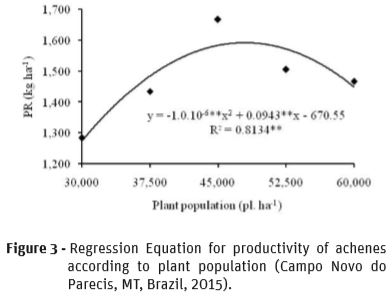
    <p><font face = "Verdana" size = "2"><a href = "#f3">Figure 3</a> shows PR regression
due to plant population by which plant populations was calculated (47,150 plants
ha<sup>-1</sup>), with maximum PR (1,552.6 kg ha<sup>-1</sup>). Population with
47,150 plants ha<sup>-1</sup> is close to that given by Castro <i>et al</i>. (1997),
with 45,000 plants ha<sup>-1</sup>. Quadratic regressions for PR were also obtained
in other studies: in their studies on genotype AGUARÁ 04 and 0.45 m spacing, Castro
<i>et al</i>. (2011) registered that a population of 38,731 plants ha<sup>-1</sup>
provided the highest PR (2,312.1 kg ha<sup>-1</sup>); in their studies in Eldorado
do Sul RS Brazil, for the agricultural year 1990-91, on genotype GR 16, short cycle
and small size, Rizzardi and Silva (1993) underscored that maximum PR (1,609.5 kg
ha<sup>-1</sup>) was obtained with a population of 56,279 plants ha<sup>-1</sup>;
in Passo Fundo RS Brazil, Rizzardi and Küffel (1993) assessed four plant populations
(30,000; 50,000; 70,000; 90,000 plants ha<sup>-1</sup>) for genotype G18 (short
cycle and low stature) and obtained maximum PR (2,370.01 kg ha<sup>-1</sup>) with
a population of 60,838 plants ha<sup>-1</sup>. It may be perceived that, in every
agricultural year and for each genotype cultivated in a different place, a different
response was provided. In fact, a standard population that would result in a higher
productivity is impossible. A population proper to place and circumstances is more
feasible.  </font></p>

    <p>&nbsp;</p>

<a name = "f3"><img src = "/img/revistas/rca/v41n1/v41n1a01f3.jpg"></a>

    
<p>&nbsp;</p>

    ]]></body>
<body><![CDATA[<p><font face = "Verdana" size = "2">However, linear reduction
in PR due to increase in plant population was reported by Rizzardi and Silva (1993).
PR was 23 and 17% lower for genotypes DK 180 and GR 10, respectively, when population
decreased from 90,000 to 30,000 plants ha<sup>-1</sup>, and by Orlando (2008) with
decrease from 1,835.8 to 1,511.8 kg ha<sup>-1</sup> when population increased from
27,000 to 51,000 plants ha<sup>-1</sup>. </font></p>

    <p><font face = "Verdana" size = "2">When compared to PR rates described by Rizzardi and Küffel (1993) and
by Castro <i>et al</i>. (2011), the low PR in current analysis may be due to accumulated
rainfall (752 mm) and mean temperature (between 21.1 and 25.7 °C) during the experimental
period (<a href = "/img/revistas/rca/v41n1/v41n1a01f1.jpg" target = "_blank">Figure 1</a>) since total evapotranspiration of crops (ETc) lies between 442
and 522 mm (Silva <i>et al</i>., 2007; Cavalcante Júnior <i>et al</i>., 2013). Rainfall
excess and temperature rates enhanced the development of the Alternaria spot. In
fact, Leite and Amorim (2002) had underscored that temperature around 25 °C and
non-continuous leaf wetness between 12 and 24 h triggered the development of the
disease. <i>Alternaria</i> species may actually spread spores and cause infections
during several short wet periods instead of a single long one. </font></p>

    
<p><font face = "Verdana" size = "2">According to Bauer <i>et al</i>. (2013), great <i>Alternaria</i>
severity is proportional to increase in plant population due to low aeration and
solar irradiation in the seedling rows. In their study with 0.5m in-between rows,
leaf area affected rose from 15.0 to 29.0% when plant population increased from
74,000 to 132,000 plants ha<sup>-1</sup>, whereas with 1.0 m in-between spacing,
leaf area affected increased from 10.1 to 26.4% when population rose from 37,000
to 66,000 plants ha<sup>-1</sup>. There is actually a strict relationship between
disease severity and plant population due to the interference of solar radiation
on the canopy and the establishment of a favorable microclimate.</font></p>

  
    <p><font face = "Verdana" size = "2">As a rule and regardless of the genotype and
density tested in current analysis, the productivity of achenes was higher than
Brazilian (1,376.0 kg ha<sup>-1</sup>) and Mato Grosso (1,348.0 kg ha<sup>-1</sup>)
averages for the 2014-15 (CONAB, 2015) and revealed the viability of the genotypes
studied.</font></p>


    <p><font face = "Verdana" size = "3"><b>CONCLUSIONS</b></font></p>

    <p><font face = "Verdana" size = "2">Increase in plant and capitulum height and decrease
of stem diameter, capitulum size, mass of achenes per capitulum and mass of one
thousand achenes occurred when plant population increased.</font></p>

    <p><font face = "Verdana" size = "2">Productivity is co-related to mass of achenes per capitulum
and to mass of one thousand achenes.</font></p>

    <p><font face = "Verdana" size = "2">The population of 47,150 plants ha<sup>-1</sup> provides greater productivity
in achenes.</font></p>

    <p>&nbsp;</p>

    <p><font face = "Verdana" size = "3"><b>References</b></font></p>

    ]]></body>
<body><![CDATA[<!-- ref --><p><font face = "Verdana" size = "2">Amorim,
A.P.; Ramos, N.P.; Ungaro, M.R.G. and Kiihl, T.A.M. (2008) - Correlações e análise
de trilha em girassol. <i>Bragantia</i>, vol. 67, n. 2, p. 307-316. <a href = "http://dx.doi.org/10.1590/S0006-87052008000200006" target = "_blank">http://dx.doi.org/10.1590/S0006-87052008000200006</a></font>&nbsp;&nbsp;&nbsp;&nbsp;&nbsp;&nbsp;&nbsp;&nbsp;[&#160;<a href="javascript:void(0);" onclick="javascript: window.open('/scielo.php?script=sci_nlinks&ref=675915&pid=S0871-018X201800010000200001&lng=','','width=640,height=500,resizable=yes,scrollbars=1,menubar=yes,');">Links</a>&#160;]<!-- end-ref --><!-- ref --><p><font face = "Verdana" size = "2">Backes, R.L.; Souza, A.M. de; Balbinot Junior,
A.A.; Gallotti, G.J.M. and Bavaresco, A. (2008) - Desempenho de cultivares de girassol
em duas épocas de plantio de safrinha no planalto norte catarinense. <i>Scientia
Agraria</i>, vol. 9, n. 1, p. 41-48. <a href = "http://dx.doi.org/10.5380/rsa.v9i1.10131" target = "_blank">http://dx.doi.org/10.5380/rsa.v9i1.10131</a></font>&nbsp;&nbsp;&nbsp;&nbsp;&nbsp;&nbsp;&nbsp;&nbsp;[&#160;<a href="javascript:void(0);" onclick="javascript: window.open('/scielo.php?script=sci_nlinks&ref=675916&pid=S0871-018X201800010000200002&lng=','','width=640,height=500,resizable=yes,scrollbars=1,menubar=yes,');">Links</a>&#160;]<!-- end-ref --><!-- ref --><p><font face = "Verdana" size = "2">Bauer, F.C.; Gonçalves, A.E. and Nagaoka,
A.K. (2013) - Severidade de <i>Alternaria helianthi </i>na cultura do girassol em
diferentes espaçamentos e população de plantas. <i>Revista de Ciências Agroveterinárias</i>,
vol. 12, n. 1, p. 149-154.    &nbsp;&nbsp;&nbsp;&nbsp;&nbsp;&nbsp;&nbsp;&nbsp;[&#160;<a href="javascript:void(0);" onclick="javascript: window.open('/scielo.php?script=sci_nlinks&ref=675917&pid=S0871-018X201800010000200003&lng=','','width=640,height=500,resizable=yes,scrollbars=1,menubar=yes,');">Links</a>&#160;]<!-- end-ref --></font></p>

    <!-- ref --><p><font face = "Verdana" size = "2">Bezerra,
F.T.C.; Dutra, A.S.; Bezerra, M.A.F.; Oliveira Filho, A.F. de and Barros, G. de
L. (2014) - Comportamento vegetativo e produtividade de girassol em função do arranjo
espacial das plantas. <i>Revista Ciência Agronômica</i>, vol. 45, n. 2, p. 335-343.    &nbsp;&nbsp;&nbsp;&nbsp;&nbsp;&nbsp;&nbsp;&nbsp;[&#160;<a href="javascript:void(0);" onclick="javascript: window.open('/scielo.php?script=sci_nlinks&ref=675919&pid=S0871-018X201800010000200004&lng=','','width=640,height=500,resizable=yes,scrollbars=1,menubar=yes,');">Links</a>&#160;]<!-- end-ref --></font></p>


    <!-- ref --><p><font face = "Verdana" size = "2">Castro, C. de; Castiglioni, V.B.R.; Balla,
A.; Leite, R.M.V.B. de C.; Karam, D.; Mello, H.C.; Guedes, L. C.A. and Farias J.R.B.
(1997) - <i>A cultura do girassol</i>. Londrina: EMBRAPA-CNPSo. 36 p. (EMBRAPA-CNPSo.
Circular técnica, 13).    &nbsp;&nbsp;&nbsp;&nbsp;&nbsp;&nbsp;&nbsp;&nbsp;[&#160;<a href="javascript:void(0);" onclick="javascript: window.open('/scielo.php?script=sci_nlinks&ref=675921&pid=S0871-018X201800010000200005&lng=','','width=640,height=500,resizable=yes,scrollbars=1,menubar=yes,');">Links</a>&#160;]<!-- end-ref --></font></p>

    <!-- ref --><p><font face = "Verdana" size = "2">Castro,
C. de; Júnior, A. de O.; Oliveira, F.A. de; Leite, R.M.V.B.C. and Rodak B.W. (2011)
- Avaliação do arranjo de plantas de girassol. <i>In: Reunião Nacional de Pesquisa
De Girassol, 19., Simpósio Nacional Sobre a Cultura do Girassol, 7., 2011, Aracaju.
Anais.</i> Aracaju. p. 241-245.    &nbsp;&nbsp;&nbsp;&nbsp;&nbsp;&nbsp;&nbsp;&nbsp;[&#160;<a href="javascript:void(0);" onclick="javascript: window.open('/scielo.php?script=sci_nlinks&ref=675923&pid=S0871-018X201800010000200006&lng=','','width=640,height=500,resizable=yes,scrollbars=1,menubar=yes,');">Links</a>&#160;]<!-- end-ref --></font></p>

    ]]></body>
<body><![CDATA[<!-- ref --><p><font face = "Verdana" size = "2">Carvalho, C.G.P. de; Silva, M.F. da; Amabile, R F.; Godinho, V. de P.C.; Oliveira,
A.C.B. de; Carvalho, H.W.L. de; Ramos N.P. and Ribeiro J.L. (2014) - <i>Informes
da avaliação de genótipos de girassol 2012/2013 e 2013</i>. Londrina: Embrapa Soja.
105 p. (Embrapa Soja. Documentos, 355).    &nbsp;&nbsp;&nbsp;&nbsp;&nbsp;&nbsp;&nbsp;&nbsp;[&#160;<a href="javascript:void(0);" onclick="javascript: window.open('/scielo.php?script=sci_nlinks&ref=675925&pid=S0871-018X201800010000200007&lng=','','width=640,height=500,resizable=yes,scrollbars=1,menubar=yes,');">Links</a>&#160;]<!-- end-ref --></font></p>

    <!-- ref --><p><font face = "Verdana" size = "2">Cavalcante Júnior, E.G.; Medeiros, J.F. de; Mel, T.K. de; Sobrinho, J.E.;
Bristot, G. and Almeida B.M. de (2013) - Necessidade hídrica da cultura do girassol
irrigado na chapada do Apodi. <i>Revista Brasileira de Engenharia Agrícola e Ambiental</i>,
vol. 17, n. 3, p. 261-267.    &nbsp;&nbsp;&nbsp;&nbsp;&nbsp;&nbsp;&nbsp;&nbsp;[&#160;<a href="javascript:void(0);" onclick="javascript: window.open('/scielo.php?script=sci_nlinks&ref=675927&pid=S0871-018X201800010000200008&lng=','','width=640,height=500,resizable=yes,scrollbars=1,menubar=yes,');">Links</a>&#160;]<!-- end-ref --></font></p>

    <!-- ref --><p><font face = "Verdana" size = "2">CONAB
(2015) - <i>Acompanhamento da safra brasileira de grãos</i> – safra 2014/2015 -
Décimo Segundo Levantamento Setembro/2015. Brasília: Conab - Companhia Nacional
de Abastecimento. 139 p. [cit. 2015.09.17]. &lt;<a href = "http://www.conab.gov.br/OlalaCMS/uploads/arquivos/15_09_11_10_42_03_boletim_graos_setembro_2015.pdf" target = "_blank">http://www.conab.gov.br/OlalaCMS/uploads/arquivos/15_09_11_10_42_03_boletim_graos_setembro_2015.pdf</a>&gt;    &nbsp;&nbsp;&nbsp;&nbsp;&nbsp;&nbsp;&nbsp;&nbsp;[&#160;<a href="javascript:void(0);" onclick="javascript: window.open('/scielo.php?script=sci_nlinks&ref=675929&pid=S0871-018X201800010000200009&lng=','','width=640,height=500,resizable=yes,scrollbars=1,menubar=yes,');">Links</a>&#160;]<!-- end-ref --></font></p>


    <!-- ref --><p><font face = "Verdana" size = "2">Dalchiavon, F.C.; Carvalho, M.P.; Freddi,
O.S.; Andreotti, M. and Montanari, R. (2011) - Variabilidade espacial da produtividade
do feijoeiro correlacionada com atributos químicos de um Latossolo Vermelho Distroférrico
sob sistema de semeadura direta. <i>Bragantia</i>, vol. 70, n. 4, p. 908-916. <a href = "http://dx.doi.org/10.1590/S0006-87052011000400025" target = "_blank">http://dx.doi.org/10.1590/S0006-87052011000400025</a></font>&nbsp;&nbsp;&nbsp;&nbsp;&nbsp;&nbsp;&nbsp;&nbsp;[&#160;<a href="javascript:void(0);" onclick="javascript: window.open('/scielo.php?script=sci_nlinks&ref=675931&pid=S0871-018X201800010000200010&lng=','','width=640,height=500,resizable=yes,scrollbars=1,menubar=yes,');">Links</a>&#160;]<!-- end-ref --><!-- ref --><p><font face = "Verdana" size = "2">Dalchiavon, F.C.; Montanari, R.; Andreotti,
M.; Dallacort, R. and Souza, M.F.P. (2015) - Relationship between sunflower productivity
and soil´s chemical properties by geo-statistical techniques. <i>African Journal
of Agricultural Research</i>, vol. 10, n. 35, p. 3525-3532. <a href = "http://dx.doi.org/10.5897/AJAR2014.9472" target = "_blank">http://dx.doi.org/10.5897/AJAR2014.9472</a></font>&nbsp;&nbsp;&nbsp;&nbsp;&nbsp;&nbsp;&nbsp;&nbsp;[&#160;<a href="javascript:void(0);" onclick="javascript: window.open('/scielo.php?script=sci_nlinks&ref=675932&pid=S0871-018X201800010000200011&lng=','','width=640,height=500,resizable=yes,scrollbars=1,menubar=yes,');">Links</a>&#160;]<!-- end-ref --><!-- ref --><p><font face = "Verdana" size = "2">Ferreira, D.F. (2011) - Sisvar: a computer
statistical analysis system. <i>Ciência e Agrotecnologia</i>, vol. 35, n. 6, p.
1039-1042. <a href = "http://dx.doi.org/10.1590/S1413-70542011000600001" target = "_blank">http://dx.doi.org/10.1590/S1413-70542011000600001</a></font>&nbsp;&nbsp;&nbsp;&nbsp;&nbsp;&nbsp;&nbsp;&nbsp;[&#160;<a href="javascript:void(0);" onclick="javascript: window.open('/scielo.php?script=sci_nlinks&ref=675933&pid=S0871-018X201800010000200012&lng=','','width=640,height=500,resizable=yes,scrollbars=1,menubar=yes,');">Links</a>&#160;]<!-- end-ref --><!-- ref --><p><font face = "Verdana" size = "2">Leite, R.M.V.B.C. and Amorim, L. (2002) - Influência
da temperatura e do molhamento foliar no monociclo da mancha de alternaria em girassol.
<i>Fitopatologia Brasileira</i>, vol. 27, n. 2, p. 193-200. <a href = "http://dx.doi.org/10.1590/S0100-41582002000200012" target = "_blank">http://dx.doi.org/10.1590/S0100-41582002000200012</a></font>&nbsp;&nbsp;&nbsp;&nbsp;&nbsp;&nbsp;&nbsp;&nbsp;[&#160;<a href="javascript:void(0);" onclick="javascript: window.open('/scielo.php?script=sci_nlinks&ref=675934&pid=S0871-018X201800010000200013&lng=','','width=640,height=500,resizable=yes,scrollbars=1,menubar=yes,');">Links</a>&#160;]<!-- end-ref --><!-- ref --><p><font face = "Verdana" size = "2">Orlando, A.F. (2008) - <i>Cultivo de girassol
na “safrinha” no oeste do Paraná:</i> efeitos do espaçamento entre linhas e populações
de plantas. Master´s Dissertation in Agronomy - Universidade Estadual do Oeste do
Paraná, Marechal Cândido Rondon. 52 p.    &nbsp;&nbsp;&nbsp;&nbsp;&nbsp;&nbsp;&nbsp;&nbsp;[&#160;<a href="javascript:void(0);" onclick="javascript: window.open('/scielo.php?script=sci_nlinks&ref=675935&pid=S0871-018X201800010000200014&lng=','','width=640,height=500,resizable=yes,scrollbars=1,menubar=yes,');">Links</a>&#160;]<!-- end-ref --></font></p>

    <!-- ref --><p><font face = "Verdana" size = "2">Pérez, D.F.; Agudclo, O. and Peña, J. (1989) - Respuesta del girasol
a diferentes profundidades de incorporacion del fertilizante. <i>Acta Agronômica</i>,
vol. 39, n. 3/4, p. 82-92.    &nbsp;&nbsp;&nbsp;&nbsp;&nbsp;&nbsp;&nbsp;&nbsp;[&#160;<a href="javascript:void(0);" onclick="javascript: window.open('/scielo.php?script=sci_nlinks&ref=675937&pid=S0871-018X201800010000200015&lng=','','width=640,height=500,resizable=yes,scrollbars=1,menubar=yes,');">Links</a>&#160;]<!-- end-ref --> </font></p>

    <!-- ref --><p><font face = "Verdana" size = "2">Rezende,
A.V.; Evangelista, A.R.; Siqueira, G.R.; Barcelos, A.F.; Rocha, G.P. and Santos
R.V. (2003) - Efeito da densidade de semeadura sobre a produtividade e composição
bromatológica de silagens de girassol (<i>Helianthus annuus</i> L.). <i>Ciência
e Agrotecnologia</i>, vol. 27, n. sp., p. 1672-1678.    &nbsp;&nbsp;&nbsp;&nbsp;&nbsp;&nbsp;&nbsp;&nbsp;[&#160;<a href="javascript:void(0);" onclick="javascript: window.open('/scielo.php?script=sci_nlinks&ref=675939&pid=S0871-018X201800010000200016&lng=','','width=640,height=500,resizable=yes,scrollbars=1,menubar=yes,');">Links</a>&#160;]<!-- end-ref --></font></p>

    <!-- ref --><p><font face = "Verdana" size = "2">Rizzardi, M.A. and Küffel A. (1993) - Influência do arranjo
de plantas no rendimento de grãos e óleo e componentes do rendimento de girassol.
<i>Ciência Rural</i>, vol. 23, n. 3, p. 287-290. <a href = "https://doi.org/10.1590/S0103-84781993000300006" target = "_blank">https://doi.org/10.1590/S0103-84781993000300006</a></font>&nbsp;&nbsp;&nbsp;&nbsp;&nbsp;&nbsp;&nbsp;&nbsp;[&#160;<a href="javascript:void(0);" onclick="javascript: window.open('/scielo.php?script=sci_nlinks&ref=675941&pid=S0871-018X201800010000200017&lng=','','width=640,height=500,resizable=yes,scrollbars=1,menubar=yes,');">Links</a>&#160;]<!-- end-ref --><!-- ref --><p><font face = "Verdana" size = "2">Rizzardi, M.A. and Silva P.R.F. da (1993)
- Resposta de cultivares de girassol à densidade de plantas em duas épocas de semeadura.
<i>Pesquisa Agropecuária Brasileira</i>, vol. 28, n. 6, p. 675-687.    &nbsp;&nbsp;&nbsp;&nbsp;&nbsp;&nbsp;&nbsp;&nbsp;[&#160;<a href="javascript:void(0);" onclick="javascript: window.open('/scielo.php?script=sci_nlinks&ref=675942&pid=S0871-018X201800010000200018&lng=','','width=640,height=500,resizable=yes,scrollbars=1,menubar=yes,');">Links</a>&#160;]<!-- end-ref --></font></p>


    <!-- ref --><p><font face = "Verdana" size = "2">Silva, M. de L.O.; Faria, M.A. de; Morais,
A.R. de; Andrade, G.P. and Lima E.M. de C. (2007) - Crescimento e produtividade
do girassol cultivado na entressafra com diferentes lâminas de água. <i>Revista
Brasileira de Engenharia Agrícola e Ambiental</i>, vol. 11, n. 5, p. 482-488. <a href = "http://dx.doi.org/10.1590/S1415-43662007000500006" target = "_blank">http://dx.doi.org/10.1590/S1415-43662007000500006</a></font>&nbsp;&nbsp;&nbsp;&nbsp;&nbsp;&nbsp;&nbsp;&nbsp;[&#160;<a href="javascript:void(0);" onclick="javascript: window.open('/scielo.php?script=sci_nlinks&ref=675944&pid=S0871-018X201800010000200019&lng=','','width=640,height=500,resizable=yes,scrollbars=1,menubar=yes,');">Links</a>&#160;]<!-- end-ref --><!-- ref --><p><font face = "Verdana" size = "2">Silva, P.R.F. da and Almeida, M.L. de (1994)
- Resposta de girassol à densidade em duas épocas de semeadura e dois níveis de
adubação. <i>Pesquisa Agropecuária Brasileira</i>, vol. 29, n. 9, p. 1365-1371.    &nbsp;&nbsp;&nbsp;&nbsp;&nbsp;&nbsp;&nbsp;&nbsp;[&#160;<a href="javascript:void(0);" onclick="javascript: window.open('/scielo.php?script=sci_nlinks&ref=675945&pid=S0871-018X201800010000200020&lng=','','width=640,height=500,resizable=yes,scrollbars=1,menubar=yes,');">Links</a>&#160;]<!-- end-ref --></font></p>


    <!-- ref --><p><font face = "Verdana" size = "2">Vogt, G.A.; Balbinot Júnior, A.A. and Souza
A.M. de (2012) - Divergência fenotípica em genótipos de girassol. <i>Revista de
Ciências Agroveterinárias</i>, vol. 11, n. 1, p. 26-34.    &nbsp;&nbsp;&nbsp;&nbsp;&nbsp;&nbsp;&nbsp;&nbsp;[&#160;<a href="javascript:void(0);" onclick="javascript: window.open('/scielo.php?script=sci_nlinks&ref=675947&pid=S0871-018X201800010000200021&lng=','','width=640,height=500,resizable=yes,scrollbars=1,menubar=yes,');">Links</a>&#160;]<!-- end-ref --></font></p>
   
    <p>&nbsp;</p>

    <p><font face = "Verdana" size = "3"><b>Acknowledgements</b></font></p>

    <p><font face = "Verdana" size = "2">The authors would like to thank the Research Group in
Phytothecny (GPF) of the Federal Institute of Education, Science and Technology
of Mato Grosso (IFMT), campus Campo Novo do Parecis, for its collaboration in current
assay. The authors are also grateful to the Brazilian Center for Scientific and
Technological Development (CNPq - Process 402022 / 2014-9) for funding Initiation
Scientific Research. To the Foundation for Research Support of the State of Mato
Grosso (FAPEMAT - Process 460160/2014) by granting scientific training scholarship.
Thanks are also due to Embrapa Soja for providing seeds and the required information
for the development of current research.</font></p>

    <p>&nbsp;</p>

    <p><font face = "Verdana" size = "2">Received/recebido: 2017.06.23</font></p>

    <p><font face = "Verdana" size = "2">Received in revised form/recebido em versão revista: 2017.11.08</font></p>

    ]]></body>
<body><![CDATA[<p><font face = "Verdana" size = "2">Accepted/aceite: 2017.11.08</font></p>

     ]]></body><back>
<ref-list>
<ref id="B1">
<nlm-citation citation-type="journal">
<person-group person-group-type="author">
<name>
<surname><![CDATA[Amorim]]></surname>
<given-names><![CDATA[A.P.]]></given-names>
</name>
<name>
<surname><![CDATA[Ramos]]></surname>
<given-names><![CDATA[N.P.]]></given-names>
</name>
<name>
<surname><![CDATA[Ungaro]]></surname>
<given-names><![CDATA[M.R.G.]]></given-names>
</name>
<name>
<surname><![CDATA[Kiihl]]></surname>
<given-names><![CDATA[T.A.M.]]></given-names>
</name>
</person-group>
<article-title xml:lang="pt"><![CDATA[Correlações e análise de trilha em girassol]]></article-title>
<source><![CDATA[Bragantia]]></source>
<year>2008</year>
<volume>67</volume>
<numero>2</numero>
<issue>2</issue>
<page-range>307-316</page-range></nlm-citation>
</ref>
<ref id="B2">
<nlm-citation citation-type="journal">
<person-group person-group-type="author">
<name>
<surname><![CDATA[Backes]]></surname>
<given-names><![CDATA[R.L.]]></given-names>
</name>
<name>
<surname><![CDATA[Souza]]></surname>
<given-names><![CDATA[A.M. de]]></given-names>
</name>
<name>
<surname><![CDATA[Balbinot Junior]]></surname>
<given-names><![CDATA[A.A.]]></given-names>
</name>
<name>
<surname><![CDATA[Gallotti]]></surname>
<given-names><![CDATA[G.J.M.]]></given-names>
</name>
<name>
<surname><![CDATA[Bavaresco]]></surname>
<given-names><![CDATA[A.]]></given-names>
</name>
</person-group>
<article-title xml:lang="pt"><![CDATA[Desempenho de cultivares de girassol em duas épocas de plantio de safrinha no planalto norte catarinense]]></article-title>
<source><![CDATA[Scientia Agraria]]></source>
<year>2008</year>
<volume>9</volume>
<numero>1</numero>
<issue>1</issue>
<page-range>41-48</page-range></nlm-citation>
</ref>
<ref id="B3">
<nlm-citation citation-type="journal">
<person-group person-group-type="author">
<name>
<surname><![CDATA[Bauer]]></surname>
<given-names><![CDATA[F.C.]]></given-names>
</name>
<name>
<surname><![CDATA[Gonçalves]]></surname>
<given-names><![CDATA[A.E.]]></given-names>
</name>
<name>
<surname><![CDATA[Nagaoka]]></surname>
<given-names><![CDATA[A.K.]]></given-names>
</name>
</person-group>
<article-title xml:lang="pt"><![CDATA[Severidade de Alternaria helianthi na cultura do girassol em diferentes espaçamentos e população de plantas]]></article-title>
<source><![CDATA[Revista de Ciências Agroveterinárias]]></source>
<year>2013</year>
<volume>12</volume>
<numero>1</numero>
<issue>1</issue>
<page-range>149-154</page-range></nlm-citation>
</ref>
<ref id="B4">
<nlm-citation citation-type="journal">
<person-group person-group-type="author">
<name>
<surname><![CDATA[Bezerra]]></surname>
<given-names><![CDATA[F.T.C.]]></given-names>
</name>
<name>
<surname><![CDATA[Dutra]]></surname>
<given-names><![CDATA[A.S.]]></given-names>
</name>
<name>
<surname><![CDATA[Bezerra]]></surname>
<given-names><![CDATA[M.A.F.]]></given-names>
</name>
<name>
<surname><![CDATA[Oliveira Filho]]></surname>
<given-names><![CDATA[A.F. de]]></given-names>
</name>
<name>
<surname><![CDATA[Barros]]></surname>
<given-names><![CDATA[G. de L.]]></given-names>
</name>
</person-group>
<article-title xml:lang="pt"><![CDATA[Comportamento vegetativo e produtividade de girassol em função do arranjo espacial das plantas]]></article-title>
<source><![CDATA[Revista Ciência Agronômica]]></source>
<year>2014</year>
<volume>45</volume>
<numero>2</numero>
<issue>2</issue>
<page-range>335-343</page-range></nlm-citation>
</ref>
<ref id="B5">
<nlm-citation citation-type="book">
<person-group person-group-type="author">
<name>
<surname><![CDATA[Castro]]></surname>
<given-names><![CDATA[C. de]]></given-names>
</name>
<name>
<surname><![CDATA[Castiglioni]]></surname>
<given-names><![CDATA[V.B.R.]]></given-names>
</name>
<name>
<surname><![CDATA[Balla]]></surname>
<given-names><![CDATA[A.]]></given-names>
</name>
<name>
<surname><![CDATA[Leite]]></surname>
<given-names><![CDATA[R.M.V.B. de C.]]></given-names>
</name>
<name>
<surname><![CDATA[Karam]]></surname>
<given-names><![CDATA[D.]]></given-names>
</name>
<name>
<surname><![CDATA[Mello]]></surname>
<given-names><![CDATA[H.C.]]></given-names>
</name>
<name>
<surname><![CDATA[Guedes]]></surname>
<given-names><![CDATA[L. C.A.]]></given-names>
</name>
<name>
<surname><![CDATA[Farias]]></surname>
<given-names><![CDATA[J.R.B.]]></given-names>
</name>
</person-group>
<source><![CDATA[A cultura do girassol]]></source>
<year>1997</year>
<publisher-loc><![CDATA[Londrina ]]></publisher-loc>
<publisher-name><![CDATA[EMBRAPA-CNPSo]]></publisher-name>
</nlm-citation>
</ref>
<ref id="B6">
<nlm-citation citation-type="confpro">
<person-group person-group-type="author">
<name>
<surname><![CDATA[Castro]]></surname>
<given-names><![CDATA[C. de]]></given-names>
</name>
<name>
<surname><![CDATA[Júnior]]></surname>
<given-names><![CDATA[A. de O.]]></given-names>
</name>
<name>
<surname><![CDATA[Oliveira]]></surname>
<given-names><![CDATA[F.A. de]]></given-names>
</name>
<name>
<surname><![CDATA[Leite]]></surname>
<given-names><![CDATA[R.M.V.B.C.]]></given-names>
</name>
<name>
<surname><![CDATA[Rodak]]></surname>
<given-names><![CDATA[B.W.]]></given-names>
</name>
</person-group>
<article-title xml:lang="pt"><![CDATA[Avaliação do arranjo de plantas de girassol]]></article-title>
<source><![CDATA[Reunião Nacional de Pesquisa De Girassol, 19]]></source>
<year>2011</year>
<conf-name><![CDATA[7 Simpósio Nacional Sobre a Cultura do Girassol]]></conf-name>
<conf-date>2011</conf-date>
<conf-loc>Aracaju </conf-loc>
<publisher-name><![CDATA[241-245]]></publisher-name>
</nlm-citation>
</ref>
<ref id="B7">
<nlm-citation citation-type="book">
<person-group person-group-type="author">
<name>
<surname><![CDATA[Carvalho]]></surname>
<given-names><![CDATA[C.G.P. de]]></given-names>
</name>
<name>
<surname><![CDATA[Silva]]></surname>
<given-names><![CDATA[M.F. da]]></given-names>
</name>
<name>
<surname><![CDATA[Amabile]]></surname>
<given-names><![CDATA[R F.]]></given-names>
</name>
<name>
<surname><![CDATA[Godinho]]></surname>
<given-names><![CDATA[V. de P.C.]]></given-names>
</name>
<name>
<surname><![CDATA[Oliveira]]></surname>
<given-names><![CDATA[A.C.B. de]]></given-names>
</name>
<name>
<surname><![CDATA[Carvalho]]></surname>
<given-names><![CDATA[H.W.L. de]]></given-names>
</name>
<name>
<surname><![CDATA[Ramos]]></surname>
<given-names><![CDATA[N.P.]]></given-names>
</name>
<name>
<surname><![CDATA[Ribeiro]]></surname>
<given-names><![CDATA[J.L.]]></given-names>
</name>
</person-group>
<source><![CDATA[Informes da avaliação de genótipos de girassol 2012/2013 e 2013]]></source>
<year>2014</year>
<publisher-loc><![CDATA[Londrina ]]></publisher-loc>
<publisher-name><![CDATA[Embrapa Soja]]></publisher-name>
</nlm-citation>
</ref>
<ref id="B8">
<nlm-citation citation-type="journal">
<person-group person-group-type="author">
<name>
<surname><![CDATA[Cavalcante Júnior]]></surname>
<given-names><![CDATA[E.G.]]></given-names>
</name>
<name>
<surname><![CDATA[Medeiros]]></surname>
<given-names><![CDATA[J.F. de]]></given-names>
</name>
<name>
<surname><![CDATA[Mel]]></surname>
<given-names><![CDATA[T.K. de]]></given-names>
</name>
<name>
<surname><![CDATA[Sobrinho]]></surname>
<given-names><![CDATA[J.E.]]></given-names>
</name>
<name>
<surname><![CDATA[Bristot]]></surname>
<given-names><![CDATA[G.]]></given-names>
</name>
<name>
<surname><![CDATA[Almeida]]></surname>
<given-names><![CDATA[B.M. de]]></given-names>
</name>
</person-group>
<article-title xml:lang="pt"><![CDATA[Necessidade hídrica da cultura do girassol irrigado na chapada do Apodi]]></article-title>
<source><![CDATA[Revista Brasileira de Engenharia Agrícola e Ambiental]]></source>
<year>2013</year>
<volume>17</volume>
<numero>3</numero>
<issue>3</issue>
<page-range>261-267</page-range></nlm-citation>
</ref>
<ref id="B9">
<nlm-citation citation-type="book">
<collab>CONAB</collab>
<source><![CDATA[Acompanhamento da safra brasileira de grãos - safra 2014/2015 - Décimo Segundo Levantamento Setembro/2015]]></source>
<year>2015</year>
<publisher-loc><![CDATA[Brasília ]]></publisher-loc>
<publisher-name><![CDATA[Companhia Nacional de Abastecimento]]></publisher-name>
</nlm-citation>
</ref>
<ref id="B10">
<nlm-citation citation-type="journal">
<person-group person-group-type="author">
<name>
<surname><![CDATA[Dalchiavon]]></surname>
<given-names><![CDATA[F.C.]]></given-names>
</name>
<name>
<surname><![CDATA[Carvalho]]></surname>
<given-names><![CDATA[M.P.]]></given-names>
</name>
<name>
<surname><![CDATA[Freddi]]></surname>
<given-names><![CDATA[O.S.]]></given-names>
</name>
<name>
<surname><![CDATA[Andreotti]]></surname>
<given-names><![CDATA[M.]]></given-names>
</name>
<name>
<surname><![CDATA[Montanari]]></surname>
<given-names><![CDATA[R.]]></given-names>
</name>
</person-group>
<article-title xml:lang="pt"><![CDATA[Variabilidade espacial da produtividade do feijoeiro correlacionada com atributos químicos de um Latossolo Vermelho Distroférrico sob sistema de semeadura direta]]></article-title>
<source><![CDATA[Bragantia]]></source>
<year>2011</year>
<volume>70</volume>
<numero>4</numero>
<issue>4</issue>
<page-range>908-916</page-range></nlm-citation>
</ref>
<ref id="B11">
<nlm-citation citation-type="journal">
<person-group person-group-type="author">
<name>
<surname><![CDATA[Dalchiavon]]></surname>
<given-names><![CDATA[F.C.]]></given-names>
</name>
<name>
<surname><![CDATA[Montanari]]></surname>
<given-names><![CDATA[R.]]></given-names>
</name>
<name>
<surname><![CDATA[Andreotti]]></surname>
<given-names><![CDATA[M.]]></given-names>
</name>
<name>
<surname><![CDATA[Dallacort]]></surname>
<given-names><![CDATA[R.]]></given-names>
</name>
<name>
<surname><![CDATA[Souza]]></surname>
<given-names><![CDATA[M.F.P.]]></given-names>
</name>
</person-group>
<article-title xml:lang="en"><![CDATA[Relationship between sunflower productivity and soil´s chemical properties by geo-statistical techniques]]></article-title>
<source><![CDATA[African Journal of Agricultural Research]]></source>
<year>2015</year>
<volume>10</volume>
<numero>35</numero>
<issue>35</issue>
<page-range>3525-3532</page-range></nlm-citation>
</ref>
<ref id="B12">
<nlm-citation citation-type="journal">
<person-group person-group-type="author">
<name>
<surname><![CDATA[Ferreira]]></surname>
<given-names><![CDATA[D.F.]]></given-names>
</name>
</person-group>
<article-title xml:lang="pt"><![CDATA[Sisvar: a computer statistical analysis system]]></article-title>
<source><![CDATA[Ciência e Agrotecnologia]]></source>
<year>2011</year>
<volume>35</volume>
<numero>6</numero>
<issue>6</issue>
<page-range>1039-1042</page-range></nlm-citation>
</ref>
<ref id="B13">
<nlm-citation citation-type="journal">
<person-group person-group-type="author">
<name>
<surname><![CDATA[Leite]]></surname>
<given-names><![CDATA[R.M.V.B.C.]]></given-names>
</name>
<name>
<surname><![CDATA[Amorim]]></surname>
<given-names><![CDATA[L.]]></given-names>
</name>
</person-group>
<article-title xml:lang="pt"><![CDATA[Influência da temperatura e do molhamento foliar no monociclo da mancha de alternaria em girassol]]></article-title>
<source><![CDATA[Fitopatologia Brasileira]]></source>
<year>2002</year>
<volume>27</volume>
<numero>2</numero>
<issue>2</issue>
<page-range>193-200</page-range></nlm-citation>
</ref>
<ref id="B14">
<nlm-citation citation-type="">
<person-group person-group-type="author">
<name>
<surname><![CDATA[Orlando]]></surname>
<given-names><![CDATA[A.F.]]></given-names>
</name>
</person-group>
<source><![CDATA[Cultivo de girassol na “safrinha” no oeste do Paraná: efeitos do espaçamento entre linhas e populações de plantas]]></source>
<year>2008</year>
</nlm-citation>
</ref>
<ref id="B15">
<nlm-citation citation-type="journal">
<person-group person-group-type="author">
<name>
<surname><![CDATA[Pérez]]></surname>
<given-names><![CDATA[D.F.]]></given-names>
</name>
<name>
<surname><![CDATA[Agudclo]]></surname>
<given-names><![CDATA[O.]]></given-names>
</name>
<name>
<surname><![CDATA[Peña]]></surname>
<given-names><![CDATA[J.]]></given-names>
</name>
</person-group>
<article-title xml:lang="es"><![CDATA[Respuesta del girasol a diferentes profundidades de incorporacion del fertilizante]]></article-title>
<source><![CDATA[Acta Agronômica]]></source>
<year>1989</year>
<volume>39</volume>
<numero>3/4</numero>
<issue>3/4</issue>
<page-range>82-92</page-range></nlm-citation>
</ref>
<ref id="B16">
<nlm-citation citation-type="journal">
<person-group person-group-type="author">
<name>
<surname><![CDATA[Rezende]]></surname>
<given-names><![CDATA[A.V.]]></given-names>
</name>
<name>
<surname><![CDATA[Evangelista]]></surname>
<given-names><![CDATA[A.R.]]></given-names>
</name>
<name>
<surname><![CDATA[Siqueira]]></surname>
<given-names><![CDATA[G.R.]]></given-names>
</name>
<name>
<surname><![CDATA[Barcelos]]></surname>
<given-names><![CDATA[A.F.]]></given-names>
</name>
<name>
<surname><![CDATA[Rocha]]></surname>
<given-names><![CDATA[G.P.]]></given-names>
</name>
<name>
<surname><![CDATA[Santos]]></surname>
<given-names><![CDATA[R.V.]]></given-names>
</name>
</person-group>
<article-title xml:lang="pt"><![CDATA[Efeito da densidade de semeadura sobre a produtividade e composição bromatológica de silagens de girassol (Helianthus annuus L.)]]></article-title>
<source><![CDATA[Ciência e Agrotecnologia]]></source>
<year>2003</year>
<volume>27</volume>
<numero>sp</numero>
<issue>sp</issue>
<page-range>1672-1678</page-range></nlm-citation>
</ref>
<ref id="B17">
<nlm-citation citation-type="journal">
<person-group person-group-type="author">
<name>
<surname><![CDATA[Rizzardi]]></surname>
<given-names><![CDATA[M.A.]]></given-names>
</name>
<name>
<surname><![CDATA[Küffel]]></surname>
<given-names><![CDATA[A.]]></given-names>
</name>
</person-group>
<article-title xml:lang="pt"><![CDATA[Influência do arranjo de plantas no rendimento de grãos e óleo e componentes do rendimento de girassol]]></article-title>
<source><![CDATA[Ciência Rural]]></source>
<year>1993</year>
<volume>23</volume>
<numero>3</numero>
<issue>3</issue>
<page-range>287-290</page-range></nlm-citation>
</ref>
<ref id="B18">
<nlm-citation citation-type="journal">
<person-group person-group-type="author">
<name>
<surname><![CDATA[Rizzardi]]></surname>
<given-names><![CDATA[M.A.]]></given-names>
</name>
<name>
<surname><![CDATA[Silva]]></surname>
<given-names><![CDATA[P.R.F. da]]></given-names>
</name>
</person-group>
<article-title xml:lang="pt"><![CDATA[Resposta de cultivares de girassol à densidade de plantas em duas épocas de semeadura]]></article-title>
<source><![CDATA[Pesquisa Agropecuária Brasileira]]></source>
<year>1993</year>
<volume>28</volume>
<numero>6</numero>
<issue>6</issue>
<page-range>675-687</page-range></nlm-citation>
</ref>
<ref id="B19">
<nlm-citation citation-type="journal">
<person-group person-group-type="author">
<name>
<surname><![CDATA[Silva]]></surname>
<given-names><![CDATA[M. de L.O.]]></given-names>
</name>
<name>
<surname><![CDATA[Faria]]></surname>
<given-names><![CDATA[M.A. de]]></given-names>
</name>
<name>
<surname><![CDATA[Morais]]></surname>
<given-names><![CDATA[A.R. de]]></given-names>
</name>
<name>
<surname><![CDATA[Andrade]]></surname>
<given-names><![CDATA[G.P.]]></given-names>
</name>
<name>
<surname><![CDATA[Lima]]></surname>
<given-names><![CDATA[E.M. de C.]]></given-names>
</name>
</person-group>
<article-title xml:lang="pt"><![CDATA[Crescimento e produtividade do girassol cultivado na entressafra com diferentes lâminas de água]]></article-title>
<source><![CDATA[Revista Brasileira de Engenharia Agrícola e Ambiental]]></source>
<year>2007</year>
<volume>11</volume>
<numero>5</numero>
<issue>5</issue>
<page-range>482-488</page-range></nlm-citation>
</ref>
<ref id="B20">
<nlm-citation citation-type="journal">
<person-group person-group-type="author">
<name>
<surname><![CDATA[Silva]]></surname>
<given-names><![CDATA[P.R.F. da]]></given-names>
</name>
<name>
<surname><![CDATA[Almeida]]></surname>
<given-names><![CDATA[M.L. de]]></given-names>
</name>
</person-group>
<article-title xml:lang="pt"><![CDATA[Resposta de girassol à densidade em duas épocas de semeadura e dois níveis de adubação]]></article-title>
<source><![CDATA[Pesquisa Agropecuária Brasileira]]></source>
<year>1994</year>
<volume>29</volume>
<numero>9</numero>
<issue>9</issue>
<page-range>1365-1371</page-range></nlm-citation>
</ref>
<ref id="B21">
<nlm-citation citation-type="journal">
<person-group person-group-type="author">
<name>
<surname><![CDATA[Vogt]]></surname>
<given-names><![CDATA[G.A.]]></given-names>
</name>
<name>
<surname><![CDATA[Balbinot Júnior]]></surname>
<given-names><![CDATA[A.A.]]></given-names>
</name>
<name>
<surname><![CDATA[Souza]]></surname>
<given-names><![CDATA[A.M. de]]></given-names>
</name>
</person-group>
<article-title xml:lang="pt"><![CDATA[Divergência fenotípica em genótipos de girassol]]></article-title>
<source><![CDATA[Revista de Ciências Agroveterinárias]]></source>
<year>2012</year>
<volume>11</volume>
<numero>1</numero>
<issue>1</issue>
<page-range>26-34</page-range></nlm-citation>
</ref>
</ref-list>
</back>
</article>
