<?xml version="1.0" encoding="ISO-8859-1"?><article xmlns:mml="http://www.w3.org/1998/Math/MathML" xmlns:xlink="http://www.w3.org/1999/xlink" xmlns:xsi="http://www.w3.org/2001/XMLSchema-instance">
<front>
<journal-meta>
<journal-id>0871-018X</journal-id>
<journal-title><![CDATA[Revista de Ciências Agrárias]]></journal-title>
<abbrev-journal-title><![CDATA[Rev. de Ciências Agrárias]]></abbrev-journal-title>
<issn>0871-018X</issn>
<publisher>
<publisher-name><![CDATA[Sociedade de Ciências Agrárias de Portugal]]></publisher-name>
</publisher>
</journal-meta>
<article-meta>
<article-id>S0871-018X2018000100006</article-id>
<article-id pub-id-type="doi">10.19084/RCA17154</article-id>
<title-group>
<article-title xml:lang="en"><![CDATA[Onion yield as a function of nitrogen dose]]></article-title>
<article-title xml:lang="pt"><![CDATA[Produtividade de cebola em função de doses de nitrogênio]]></article-title>
</title-group>
<contrib-group>
<contrib contrib-type="author">
<name>
<surname><![CDATA[Rodrigues]]></surname>
<given-names><![CDATA[Gardênia S. de O.]]></given-names>
</name>
<xref ref-type="aff" rid="A1"/>
</contrib>
<contrib contrib-type="author">
<name>
<surname><![CDATA[Grangeiro]]></surname>
<given-names><![CDATA[Leilson C.]]></given-names>
</name>
<xref ref-type="aff" rid="A1"/>
</contrib>
<contrib contrib-type="author">
<name>
<surname><![CDATA[Lima]]></surname>
<given-names><![CDATA[Jailma S.S. de]]></given-names>
</name>
<xref ref-type="aff" rid="A1"/>
</contrib>
<contrib contrib-type="author">
<name>
<surname><![CDATA[Chaves]]></surname>
<given-names><![CDATA[Aridênia P.]]></given-names>
</name>
<xref ref-type="aff" rid="A1"/>
</contrib>
<contrib contrib-type="author">
<name>
<surname><![CDATA[Bezerra Neto]]></surname>
<given-names><![CDATA[Francisco]]></given-names>
</name>
<xref ref-type="aff" rid="A1"/>
</contrib>
<contrib contrib-type="author">
<name>
<surname><![CDATA[Medeiros]]></surname>
<given-names><![CDATA[José F.]]></given-names>
</name>
<xref ref-type="aff" rid="A1"/>
</contrib>
<contrib contrib-type="author">
<name>
<surname><![CDATA[Novo Júnior]]></surname>
<given-names><![CDATA[José]]></given-names>
</name>
<xref ref-type="aff" rid="A1"/>
</contrib>
</contrib-group>
<aff id="AA1">
<institution><![CDATA[,Universidade Federal Rural do Semi-Árido Centro de Ciências Agrárias ]]></institution>
<addr-line><![CDATA[Mossoró Rio Grande do Norte]]></addr-line>
<country>Brasil</country>
</aff>
<pub-date pub-type="pub">
<day>00</day>
<month>03</month>
<year>2018</year>
</pub-date>
<pub-date pub-type="epub">
<day>00</day>
<month>03</month>
<year>2018</year>
</pub-date>
<volume>41</volume>
<numero>1</numero>
<fpage>41</fpage>
<lpage>50</lpage>
<copyright-statement/>
<copyright-year/>
<self-uri xlink:href="http://scielo.pt/scielo.php?script=sci_arttext&amp;pid=S0871-018X2018000100006&amp;lng=en&amp;nrm=iso"></self-uri><self-uri xlink:href="http://scielo.pt/scielo.php?script=sci_abstract&amp;pid=S0871-018X2018000100006&amp;lng=en&amp;nrm=iso"></self-uri><self-uri xlink:href="http://scielo.pt/scielo.php?script=sci_pdf&amp;pid=S0871-018X2018000100006&amp;lng=en&amp;nrm=iso"></self-uri><abstract abstract-type="short" xml:lang="en"><p><![CDATA[Nitrogen (N) is the second most required nutrient by onion (Allium cepa L.); however, crop response to N fertilization depends on the applied dose. This study aimed to evaluate the effects of different N doses on onion bulb yield. The experiments were conducted during the period December 2011 to April 2012, with a second from August to December 2012, in a randomized block design with four replications. The treatments were six N doses: 0, 34, 67, 101, 134 and 168 kg ha-1. It may be concluded that the productive components of the onion were affected by N fertilization. The application of 67 kg ha-1 N, regardless of planting time, provided the maximum economic return for the onion crop.]]></p></abstract>
<abstract abstract-type="short" xml:lang="pt"><p><![CDATA[O nitrogênio é o segundo nutriente mais requerido pela cebola (Allium cepa L.). Todavia, a resposta da cultura a adubação nitrogenada depende da dose aplicada. Este trabalho teve como objetivo avaliar os efeitos de diferentes doses de nitrogênio na produtividade de bulbos de cebola. Os experimentos foram realizados durante o período de dezembro de 2011 a abril de 2012 e o segundo de agosto a dezembro de 2012, no delineamento de blocos casualizados, com quatro repetições. Os tratamentos foram constituídos de seis doses de nitrogênio: 0, 34, 67, 101, 134 e 168 kg ha-1. Pode-se concluir que as produtividades de cebola foram afetadas pela adubação nitrogenada. A dose de 67 kg ha-1 de N, independentemente da época de plantio proporcionou o retorno econômico máximo para a cultura de cebola.]]></p></abstract>
<kwd-group>
<kwd lng="en"><![CDATA[Allium cepa]]></kwd>
<kwd lng="en"><![CDATA[plant nutrition]]></kwd>
<kwd lng="en"><![CDATA[nitrogen]]></kwd>
<kwd lng="en"><![CDATA[production cost]]></kwd>
<kwd lng="pt"><![CDATA[Allium cepa]]></kwd>
<kwd lng="pt"><![CDATA[nutrição de planta]]></kwd>
<kwd lng="pt"><![CDATA[custo de produção]]></kwd>
</kwd-group>
</article-meta>
</front><body><![CDATA[ 

    <p align = "right"><font face = "Verdana" size = "2"><b>ARTIGO</b></font></p>    

    <p><font face = "Verdana" size = "4"><b>Onion yield as a function
of nitrogen dose</b></font></p>

    <p><font face = "Verdana" size = "3"><b>Produtividade
de cebola em função de doses de nitrogênio</b></font></p>

    <p><font face = "Verdana" size = "2"><b>Gardênia S. de O. Rodrigues</b>, <b>Leilson C. Grangeiro</b><sup>*</sup>, <b>Jailma
S.S. de Lima</b>, <b>Aridênia P. Chaves</b>, <b>Francisco Bezerra Neto</b>, <b>José F. Medeiros</b> and <b>José
Novo Júnior</b></font></p>

    <p><font face = "Verdana" size = "2"><i>Universidade
Federal Rural do Semi-Árido, Centro de Ciências Agrárias, CEP 59625-900, Mossoró,
Rio Grande do Norte, Brasil</i></font></p>

    <p><font face = "Verdana" size = "2"><i> (*E-mail: <a href="mailto:leilson@ufersa.edu.br">leilson@ufersa.edu.br</a>)</i></font></p>

<hr noshade size = 1>

    <p><font face = "Verdana" size = "3"><b>ABSTRACT</b></font></p>

    <p><font face = "Verdana" size = "2">Nitrogen
(N) is the second most required nutrient by onion (<i>Allium cepa</i> L.); however,
crop response to N fertilization depends on the applied dose. This study aimed to
evaluate the effects of different N doses on onion bulb yield. The experiments were
conducted during the period December 2011 to April 2012, with a second from August
to December 2012, in a randomized block design with four replications. The treatments
were six N doses: 0, 34, 67, 101, 134 and 168 kg ha<sup>-1</sup>. It may be concluded
that the productive components of the onion were affected by N fertilization. The
application of 67 kg ha<sup>-1</sup> N, regardless of planting time, provided the
maximum economic return for the onion crop. </font></p>

    <p><font face = "Verdana" size = "2"><b>Keywords</b>: <i>Allium cepa</i>, plant nutrition, nitrogen,
production cost.</font></p>

<hr noshade size = 1>

    ]]></body>
<body><![CDATA[<p><font face = "Verdana" size = "3"><b>RESUMO</b></font></p>


    <p><font face = "Verdana" size = "2">O nitrogênio é o segundo nutriente mais requerido
pela cebola (<i>Allium cepa</i> L.). Todavia, a resposta da cultura a adubação nitrogenada
depende da dose aplicada. Este trabalho teve como objetivo avaliar os efeitos de
diferentes doses de nitrogênio na produtividade de bulbos de cebola. Os experimentos
foram realizados durante o período de dezembro de 2011 a abril de 2012 e o segundo
de agosto a dezembro de 2012, no delineamento de blocos casualizados, com quatro
repetições. Os tratamentos foram constituídos de seis doses de nitrogênio: 0, 34,
67, 101, 134 e 168 kg ha<sup>-1</sup>. Pode-se concluir que as produtividades de
cebola foram afetadas pela adubação nitrogenada. A dose de 67 kg ha<sup>-1</sup>
de N, independentemente da época de plantio proporcionou o retorno econômico máximo
para a cultura de cebola.</font></p>

    <p><font face = "Verdana" size = "2"><b>Palavras-chave</b>: <i>Allium cepa, </i>nutrição de planta, custo de produção</font></p>

<hr noshade size = 1>

    <p><font face = "Verdana" size = "3"><b>INTRODUCTION </b></font></p>

    <p><font face = "Verdana" size = "2">Onion is one of the most cultivated vegetables in the
world, being consumed fresh, as a condiment, or in the processed form. Brazil is
the eighth largest world producer, with a planted area in 2014 of 59,200 ha, production
of 1.65 million t and productivity of 27.8 t ha<sup>-1</sup> (IBGE, 2015). The southern
region accounted for 59.1% of the area, followed by the northeast (21.0%), southeast
(15.6%) and midwest (4.3%).</font></p>

    <p><font face = "Verdana" size = "2">Nitrogen
(N) is the second most important nutrient for onions after potassium (Pôrto <i>et
al.</i>, 2007). N excess induces exuberant vegetative growth by increased protein
synthesis and plant water content, and decreases plant resistance to diseases and
bulb quality (Robles and Garcia, 2013).</font></p>

    <p><font face = "Verdana" size = "2">N fertilization significantly increases bulb yield, as reported by Cecílio
Filho <i>et al</i>. (2010), who showed that the application of 150 kg ha<sup>-1</sup>
N plus 150 kg ha<sup>-1</sup> K<sub>2</sub>O favored the maximum productivity of
bulbs (89.5 t ha<sup>-1</sup>). Kurtz <i>et al</i>. (2012) found that the maximum
economic returns in two cycles were obtained with doses of 131 and 102 kg ha<sup>-1</sup>
N. Resende and Costa (2014) obtained the highest commercial yields with doses of
161.4 kg ha<sup>-1</sup> N (cultivar Alpha Tropical) and 215.9 kg ha<sup>-1</sup>
N (cultivar Alfa San Francisco), associated with the most economical doses of 159.6
and 213.8 kg ha<sup>-1</sup> N, respectively. Batal <i>et al</i>. (1994), however,
found no positive response when the N dose ranged from 84 to 224 kg ha<sup>-1</sup>.</font></p>


    <p><font face = "Verdana" size = "2">Considering the differential response of
onion cultivation as a function of the quantity of N fertilization, it is necessary
to carry out research on plantings in different geographical regions, in order to
improve fertilization efficiency, and to avoid excesses that cause damage to the
environment. In this context, the aim of this study was to evaluate the effects
of the N dose, applied by fertirrigation, on the yield of onion bulbs.</font></p>


    <p><font face = "Verdana" size = "3"><b>MATERIAL AND METHODS</b></font></p>


    <p><font face = "Verdana" size = "2"><i>Site location and characterization</i></font></p>


    ]]></body>
<body><![CDATA[<p><font face = "Verdana" size = "2">The experiments were conducted in the experimental
area of the Department of Plant Sciences at the Federal Rural University of Semi-Arid,
Mossoro-RN, Brazil (5°12'26''S, 37°19’04''W, average altitude 18 m) during the period
of December 2011 to April 2012 (first experiment) and August to December 2012 (second
experiment). The soil of the area was classified as a Eutrophic Red-Yellow Ultisol,
hyperxerophilic caatinga phase with plan relief (EMBRAPA, 2006). </font></p>

 
    <p><font face = "Verdana" size = "2">The soil chemical attributes in the 0-20 cm
layer for the experiments conducted from December 2011 to April 2012 and August
to December 2012 are, respectively: 7.4 and 7.6 pH(H<sub>2</sub>O); 5.7 and 5.7
g dm<sup>-3</sup> organic matter; 24.5 and 38.4 mg dm<sup>-3</sup> P<sub>(Mehlich)</sub>;
0.2 and 0.3 cmol<sub>c</sub> dm<sup>-3</sup> K; 2.4 and 2.6 cmol<sub>c</sub> dm<sup>-3</sup>
Ca; 0.4 and 0.3 cmol<sub>c</sub> dm<sup>-3</sup> Mg; and 0.02 and 0.03 cmol<sub>c</sub>
dm<sup>-3</sup> Na.</font></p>


    <p><font face = "Verdana" size = "2"><i>Treatments and experiment design</i></font></p>


    <p><font face = "Verdana" size = "2">The experiments were designed as complete
randomized blocks, with six treatments and four replications. The treatments consisted
of N doses of 0, 34, 67, 101, 134 and 168 kg N ha<sup>-1</sup>, provided through
irrigation water. Each experimental unit consisted of a 3 x 0.8 m bed, containing
eight rows of plants, spaced 0.10 x 0.10 m apart. Only the six central rows of plants
in this bed were harvested, with the plants outside of this being discarded. </font></p>


    <p><font face = "Verdana" size = "2"><i>Field establishment</i></font></p>

    <p><font face = "Verdana" size = "2">Soil preparation consisted of plowing and harrowing, followed by lifting of
the beds and adding fertilizer, based on soil analysis and the recommendation of
Cavalcanti (2008), comprising phosphorus at a dose 90 kg P<sub>2</sub>O<sub>5 </sub>ha<sup>-1</sup>
in the form of triple superphosphate. N (in the respective treatment doses) and
potassium (K) (135 kg K<sub>2</sub>O ha<sup>-1</sup>)<sup> </sup>were applied through
fertirrigation. </font></p>

    <p><font face = "Verdana" size = "2">Fertirrigation
was initiated at 10 days after transplanting (DAT), extending up to 70 DAT, being
its distribution throughout the cycle, established from the march of nutrient uptake
by the onion crop according to Marrocos <i>et al</i>. (2009). The sources of N and
K used were ammonium sulfate, urea, calcium nitrate and potassium chloride. As a
source of micronutrients, 1 kg ha<sup>-1</sup> of the commercial product Rexolin®
was applied (11.6% K<sub>2</sub>O, 1.28% S, 0.86% Mg, 2.1% of B, 0.36% Cu, 2.66%
Fe, 2.48% Mn, 0.036% Mo and 3.38% Zn), divided into four biweekly applications via
fertirrigation, from 30 DAT.</font></p>

    <p><font face = "Verdana" size = "2">A
drip irrigation system was used, with two hoses per bed spaced at 0.4 m apart, the
drippers being the self-compensating type, with an average flow rate of 1.4 L h<sup>-1</sup>,
spaced 0.2 m apart. Irrigation was performed daily, based on the crop evapotranspiration
(CE<sub>c</sub>), estimated by multiplying the reference evapotranspiration (RE<sub>o</sub>)
by the crop coefficient (K<sub>c</sub>) at various stages of development of the
culture.</font></p>

    <p><font face = "Verdana" size = "2">Onion seedlings of
cultivar IPA 11 were produced in a seedbed with dimensions of 0.8 m long by 0.2
m wide, with 10 g m<sup>-1</sup> of seeds per seedbed, planted in furrows parallel
to the length of the bed, at a depth of 1 cm, and with a distance between the furrows
of 0.1 m. NPK formulation 6-24-12 was applied as a fertilizer to the seedbed, with
50 g m<sup>-1</sup> incorporated into the soil before sowing, in order to avoid
contact with the seeds. A complementary application of 10 gm<sup>-1</sup> ammonium
sulfate was performed at 20 days after sowing (DAS) (Costa <i>et al</i>., 2007).
Transplanting was done 40 DAS, when the seedlings had reached 15 to 20 cm in height.</font></p>


    <p><font face = "Verdana" size = "2">Aiming at the prevention and control of diseases,
such as purple stain, spraying was performed with products based on Mancozeb (2.5
g L<sup>-1</sup>) at intervals of seven days. The control of pests, such as thrips
and/or mites, was effected through alternating spraying, at fortnightly intervals,
with products based on Clorfernapir (0.5 mL L<sup>-1</sup>) or deltamethrin (0.3
mL L<sup>-1</sup>). Weed control was achieved through hand hoeing whenever necessary.</font></p>


    ]]></body>
<body><![CDATA[<p><font face = "Verdana" size = "2"><i>Harvesting and evaluated parameters</i></font></p>

    <p><font face = "Verdana" size = "2">Harvesting was performed when 70% of the onion plants had
toppled over, at 90 and 95 DAT, respectively (first and second experiments). After
harvesting, the bulbs remained in the field for five days to cure in the sun. After
that, they were taken to the laboratory at the Department of Plant Sciences of UFERSA,
where they remained for five days to complete the process of curing in the shade.
After the cure period, it was made the separation of onion shoots of the roots.</font></p>


    <p><font face = "Verdana" size = "2">The total productivity (TP) of bulbs (t ha<sup>-1</sup>)
is the total mass of harvested bulbs in the harvest area of the plot. The productivity
of commercial bulbs (CP) (t ha<sup>-1</sup>) is the total weight of bulbs with a
diameter of &gt;35 mm (considered as commercial grade). The productivity of non-commercial
bulbs (NCP) (t ha<sup>-1</sup>) is the total weight of bulbs with a diameter of
&lt;35 mm (considered as non-commercial grade). Leaf N content (g kg<sup>-1</sup>)
was determined by taking the tallest leaf of 15 plants from the harvest area of
the plot at 45 DAT. These samples were washed in distilled water and dried in an
oven with forced ventilation at 65°C until constant mass was reached. </font></p>


    <p><font face = "Verdana" size = "2">An economic analysis of the data from the
experiments was conducted, based on an equation adjusted for CP. We calculated spending
on fertilizer, increased productivity, the cost/benefit ratio and economic return.
Increased productivity was determined by calculating the difference between the
yield obtained by the dose used, and productivity without N. The cost/benefit ratio
resulted from the division of the increase in production by the cost of N fertilizer.
The economic return was obtained by multiplying the value of the cost/benefit ratio
by the price of 1 t of commercial onion at harvest (US $721.0 and US $448.0, respectively,
for the first and second experiments).</font></p>

    <p><font face = "Verdana" size = "2">We used the cost of a unit of N (US $ kg<sup>-1</sup>) to calculate the
cost of the fertilizer, with a bag of 50 kg of urea (45% N) being purchased at a
cost of US $65.4 to US $83.1, respectively (first and second experiments). The fixed
cost, which corresponds to the summation of production and management costs, was
not considered, as it is the same for all treatments.</font></p>

    <p><font face = "Verdana" size = "2"><i>Statistical analysis</i></font></p>

    <p><font face = "Verdana" size = "2">Analysis of the variance of the evaluated characteristics
was performed separately for each experiment. Following this, a joint analysis of
the data from both experiments was performed with the help of SAS software. Fitting
of a response curve to each characteristic was carried out as a function of the
N dose, using the software Table Curve Package (Jandel Scientific, 1991).</font></p>


    <p><font face = "Verdana" size = "3"><b>RESULTS AND DISCUSSION </b></font></p>

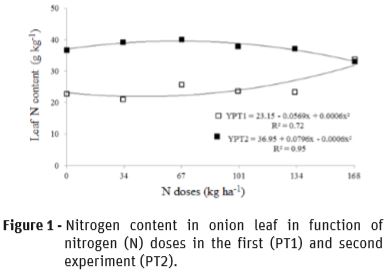
    <p><font face = "Verdana" size = "2">There was a significant effect (P &lt; 0.05) of the interaction
of N dose and planting time for leaf N content. The means of the leaf content were
adjusted to a quadratic regression model, for two cropping seasons. The estimated
maximum values are 32.7 g kg<sup>-1</sup> obtained from a dose of 168 kg N ha<sup>-1</sup>
in the first experiment, and 41.2 g kg<sup>-1</sup> from a dose of 67 kg N ha<sup>-1</sup>
in the second experiment (<a href = "#f1">Figure 1</a>).</font></p>

    <p>&nbsp;</p>

<a name = "f1"><img src = "/img/revistas/rca/v41n1/v41n1a05f1.jpg"></a>

    
]]></body>
<body><![CDATA[<p>&nbsp;</p>

    <p><font face = "Verdana" size = "2">N application also increased leaf N content of onion in studies performed
by Kurtz <i>et al</i>. (2012), wherein they found maximum levels of 40, 35 and 32
g kg<sup>-1</sup> with the addition of 237, 136 and 150 kg N ha<sup>-1</sup>, respectively,
in three consecutive croppings of onion.</font></p>

    <p><font face = "Verdana" size = "2">In both experiments, the leaf N levels were
in the usual range for onion, at around 40 g kg<sup>-1</sup>, according to Caldwell
<i>et al</i>. (1994), even in the treatment without N; however, in the first planting,
without the application of N, the plants showed lower growth and characteristic
symptoms of N deficiency (older leaves yellowed). There was also an unevenness of
damping-off, where some plants remained green and upright until harvest. </font></p>


    <p><font face = "Verdana" size = "2">There was a significant interaction between
N dose and planting time for CP and TP, whereas for NCP, only N dose was significant.</font></p>


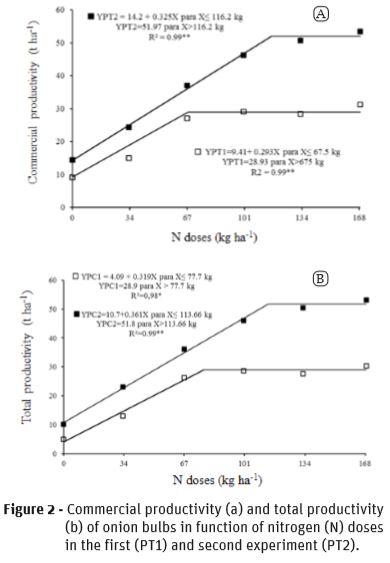
    <p><font face = "Verdana" size = "2">A plateau linear regression model was adjusted
for TP and CP (<a href = "#f2">Figures 2A, B</a>). This type of model provides a simplified interpretation
of the response curve, assuming that the use of a limiting nutrient is constant
until its requirement is supplied, and that no further response and/or significance
in performance occurs above this point.</font></p>

    <p>&nbsp;</p>

<a name = "f2"><img src = "/img/revistas/rca/v41n1/v41n1a05f2.jpg"></a>

    
<p>&nbsp;</p>

    <p><font face = "Verdana" size = "2">In the first experiment, the maximum values of TP (28.93 t ha<sup>-1</sup>)
and CP (28.90 t ha<sup>-1</sup>) were obtained with 67.5 and 77.7 kg N ha<sup>-1</sup>,
respectively. These doses provided increases of 207.4 and 606.6%, respectively,
in the TP and CP of the culture that did not receive N fertilizer. In the second
experiment, the estimated doses that provided the largest TP and CP were 113.66
(51.8 t ha<sup>-1</sup>) and 116.2 kg N ha<sup>-1</sup> (51.97 t ha<sup>-1</sup>),
respectively, with increments of 266 and 207.4% in the TP and CP, respectively,
in the absence of N application. These productivities are higher than the national
average productivity (27.8 t ha<sup>-1</sup>), according to the Brazilian Institute
of Geography and Statistics (IBGE, 2015).</font></p>

    <p><font face = "Verdana" size = "2">These significant increases show the responsiveness of onion to N application,
and confirm the conclusions of various authors who have reported that N contributed
markedly to increase the plant metabolic rate, wherein more carbohydrate is synthesized,
increasing the mass of the bulbs, and consequently the productivity (Cecílio Filho<i>
et al</i>., 2010; Kurtz <i>et al</i>., 2012; Resende and Costa, 2014).</font></p>


    <p><font face = "Verdana" size = "2">Vilas Boas <i>et al</i>. (2014) found that
the addition of a unit (kg ha<sup>-1</sup>) of N dose increased the TP and CP of
bulbs, producing 182.67 and 187.71 kg ha<sup>-1</sup>, respectively. The maximum
estimated values for TP, and CP, occurred with a dose of 180 kg N ha<sup>-1</sup>,
resulting in 80.6 and 80 t ha<sup>-1</sup>, respectively.  </font></p>

    ]]></body>
<body><![CDATA[<p><font face = "Verdana" size = "2">The highest productivities obtained in the second experiment
(August to December 2012) are probably due to the more favorable climatic factors,
mainly the lack of rain. In the first experiment (December 2011 to April 2012),
the amount of rainfall (178.7 mm), together with high temperatures, favored the
appearance of purple blotch disease, or burning of the tips (<i>Alternaria porri</i>),
and also higher nitrate leaching, thus decreasing the efficiency of N fertilization.</font></p>


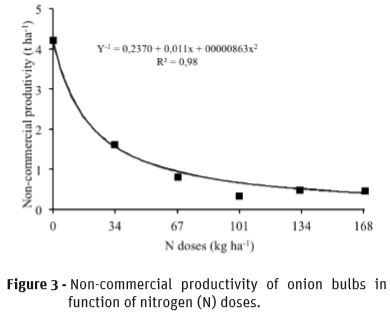
    <p><font face = "Verdana" size = "2">The doses resulting in higher productivities,
considering the adjustments obtained in <a href = "#f3">Figure 3</a>, were below the reference value
used in this work (135 kg N ha<sup>-1</sup>), which is the official recommendation
of nitrogen for the State of Pernambuco, on irrigated onion (cultivar IPA 11) cultivation,
according to Cavalcanti <i>et al</i>. (2008).</font></p>

    <p>&nbsp;</p>

<a name = "f3"><img src = "/img/revistas/rca/v41n1/v41n1a05f3.jpg"></a>

    
<p>&nbsp;</p>

    <p><font face = "Verdana" size = "2">The NCP (scrap) decreased quadratically with
doses of N. Regarding treatment without N, the reduction was approximately 90.3%
at a dose of 168.0 kg N ha<sup>-1</sup> (<a href = "#f3">Figure 3</a>). According Gessesew <i>et al</i>.
(2015), the reduction in production of non-commercial bulbs with a higher N dose
can be attributed to reduced competition for nutrients, which results in larger
bulbs that can be marketed. These results agree with those obtained by May <i>et
al</i>. (2007) and Resende and Costa (2008), who also reported reductions in the
quantity of scrap bulbs with the application of N.</font></p>

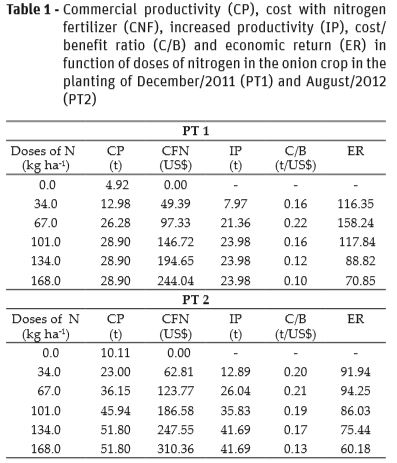
    <p><font face = "Verdana" size = "2">The CP as a function of N doses was adjusted to a linear plateau regression
model (<a href = "#f2">Figure 2</a>), and the calculation of the economic return showed that maximum
economic efficiency was achieved with an application of 67 kg N ha<sup>-1</sup>,
for the two cultivations. For every dollar invested in a N unit, the return would
be US $158.24 and US $94, respectively (first and second experiments: <a href = "#t1">Table 1</a>);
however, above this dose, there was a significant decrease, reaching 55 and 36%,
respectively, (first and second experiments) of the maximum return at the highest
dose of N applied (168 kg N ha<sup>-1</sup>).  </font></p>

    <p>&nbsp;</p>

<a name = "t1"><img src = "/img/revistas/rca/v41n1/v41n1a05t1.jpg"></a>

    
<p>&nbsp;</p>

    <p><font face = "Verdana" size = "2">Although the CP from the first experiment (26.28 t ha<sup>-1</sup>) was
27% lower, compared to that from the second experiment (36.15 t ha<sup>-1</sup>),
the more favorable price for this (US $721 per t) provided a profitability of 67%
higher, using the same dose of N (67 kg N ha<sup>-1</sup>).</font></p>

    <p><font face = "Verdana" size = "3"><b>CONCLUSIONS</b></font></p>


    ]]></body>
<body><![CDATA[<p><font face = "Verdana" size = "2">The production components of the onion were
affected by N fertilization. The application of 67 kg ha<sup>-1</sup> N, regardless
of planting time, provided the maximum economic return for the onion crop.</font></p>

    <p>&nbsp;</p>

    <p><font face = "Verdana" size = "3"><b>REFERENCES</b></font></p>

    <!-- ref --><p><font face = "Verdana" size = "2">Batal, K.M.; Bondari, K.; Granberry, D.M. and Mullinix,
B.G. (1994) - Effects of source, rate, and frequency of N application on yield,
marketable grades and rot incidence of sweet onion (<i>Allium cepa</i> L. cv. Granex-33).
<i>Journal of Horticultural Science</i>, vol. 69, n. 6, p. 1043-1051. <a href = "http://dx.doi.org/10.1080/00221589.1994.11516543" target = "_blank">http://dx.doi.org/10.1080/00221589.1994.11516543</a></font>&nbsp;&nbsp;&nbsp;&nbsp;&nbsp;&nbsp;&nbsp;&nbsp;[&#160;<a href="javascript:void(0);" onclick="javascript: window.open('/scielo.php?script=sci_nlinks&ref=676515&pid=S0871-018X201800010000600001&lng=','','width=640,height=500,resizable=yes,scrollbars=1,menubar=yes,');">Links</a>&#160;]<!-- end-ref --><!-- ref --><p><font face = "Verdana" size = "2">Caldwell, J.O.N.; Sumner, M.E. and Vavrina,
C.S. (1994) - Development and testing of preliminary foliar DRIS norms for onions.
<i>HortScience</i>, vol. 29, p. 1501-1504.    &nbsp;&nbsp;&nbsp;&nbsp;&nbsp;&nbsp;&nbsp;&nbsp;[&#160;<a href="javascript:void(0);" onclick="javascript: window.open('/scielo.php?script=sci_nlinks&ref=676516&pid=S0871-018X201800010000600002&lng=','','width=640,height=500,resizable=yes,scrollbars=1,menubar=yes,');">Links</a>&#160;]<!-- end-ref --></font></p>

    <!-- ref --><p><font face = "Verdana" size = "2">Cavalcanti, F.J.A. (2008) - <i>Recomendações de adubação para
o estado de Pernambuco</i>. 2º ed. Recife, IPA, 212 p.    &nbsp;&nbsp;&nbsp;&nbsp;&nbsp;&nbsp;&nbsp;&nbsp;[&#160;<a href="javascript:void(0);" onclick="javascript: window.open('/scielo.php?script=sci_nlinks&ref=676518&pid=S0871-018X201800010000600003&lng=','','width=640,height=500,resizable=yes,scrollbars=1,menubar=yes,');">Links</a>&#160;]<!-- end-ref --></font></p>

    <!-- ref --><p><font face = "Verdana" size = "2">Cecílio Filho, A.B.; Marcolini, M.W.; May, A. and Barbosa,
J.C. (2010) - Produtividade e classificação de bulbos de cebola em função da fertilização
nitrogenada e potássica, em semeadura direta. <i>Científica</i>, vol. 38, n. 1-2,
p. 14-22.    &nbsp;&nbsp;&nbsp;&nbsp;&nbsp;&nbsp;&nbsp;&nbsp;[&#160;<a href="javascript:void(0);" onclick="javascript: window.open('/scielo.php?script=sci_nlinks&ref=676520&pid=S0871-018X201800010000600004&lng=','','width=640,height=500,resizable=yes,scrollbars=1,menubar=yes,');">Links</a>&#160;]<!-- end-ref --> </font></p>

    ]]></body>
<body><![CDATA[<!-- ref --><p><font face = "Verdana" size = "2">Costa, N.D.; Resende,
G.M.D.; Santos, C.A.; Leite, W.D.M. and Pinto, J.M. (2007) -Características produtivas
de genótipos de cebola no Vale do São Francisco. Horticultura Brasileira, vol. 25,
n. 2, p. 261-264. <a href = "http://dx.doi.org/10.1590/S0102-05362007000200026" target = "_blank">http://dx.doi.org/10.1590/S0102-05362007000200026</a>&nbsp;    &nbsp;&nbsp;&nbsp;&nbsp;&nbsp;&nbsp;&nbsp;&nbsp;[&#160;<a href="javascript:void(0);" onclick="javascript: window.open('/scielo.php?script=sci_nlinks&ref=676522&pid=S0871-018X201800010000600005&lng=','','width=640,height=500,resizable=yes,scrollbars=1,menubar=yes,');">Links</a>&#160;]<!-- end-ref --></font></p>


    <!-- ref --><p><font face = "Verdana" size = "2">EMBRAPA (2006) - <i>Sistema brasileiro de
classificação de solos.</i> 2º ed. Brasília: Embrapa Produtividade de Informações
(SPI). 412 p.    &nbsp;&nbsp;&nbsp;&nbsp;&nbsp;&nbsp;&nbsp;&nbsp;[&#160;<a href="javascript:void(0);" onclick="javascript: window.open('/scielo.php?script=sci_nlinks&ref=676524&pid=S0871-018X201800010000600006&lng=','','width=640,height=500,resizable=yes,scrollbars=1,menubar=yes,');">Links</a>&#160;]<!-- end-ref --></font></p>

    <!-- ref --><p><font face = "Verdana" size = "2">Gessesew, W.S.;
Kebede Woldetsadik, K. and Mohammed, W. (2015) - Effect of nitrogen fertilizer rates
and intra-row spacing on yield and yield components of onion (<i>Allium cepa </i>L.
Var. cepa) under irrigation in Gode, South-Eastern Ethiopia. <i>International Journal
of Plant Breeding and Crop Science</i>, vol. 4, p. 239-245.    &nbsp;&nbsp;&nbsp;&nbsp;&nbsp;&nbsp;&nbsp;&nbsp;[&#160;<a href="javascript:void(0);" onclick="javascript: window.open('/scielo.php?script=sci_nlinks&ref=676526&pid=S0871-018X201800010000600007&lng=','','width=640,height=500,resizable=yes,scrollbars=1,menubar=yes,');">Links</a>&#160;]<!-- end-ref --></font></p>

    <!-- ref --><p><font face = "Verdana" size = "2">IBGE (2015) - <i>Produção agrícola municipal</i>. Instituto
Brasileiro de Geografia e Estatística &lt;<a href = "http://www.sidra.ibge.gov.br/" target = "_blank">http://www.sidra.ibge.gov.br/</a>&gt;    &nbsp;&nbsp;&nbsp;&nbsp;&nbsp;&nbsp;&nbsp;&nbsp;[&#160;<a href="javascript:void(0);" onclick="javascript: window.open('/scielo.php?script=sci_nlinks&ref=676528&pid=S0871-018X201800010000600008&lng=','','width=640,height=500,resizable=yes,scrollbars=1,menubar=yes,');">Links</a>&#160;]<!-- end-ref --></font></p>


    <!-- ref --><p><font face = "Verdana" size = "2">Jandel Scientific (1991) - <i>Table curve:
Curve fitting software</i>. Corte Madera: Jandel Scientific, 280 p.    &nbsp;&nbsp;&nbsp;&nbsp;&nbsp;&nbsp;&nbsp;&nbsp;[&#160;<a href="javascript:void(0);" onclick="javascript: window.open('/scielo.php?script=sci_nlinks&ref=676530&pid=S0871-018X201800010000600009&lng=','','width=640,height=500,resizable=yes,scrollbars=1,menubar=yes,');">Links</a>&#160;]<!-- end-ref --></font></p>


    ]]></body>
<body><![CDATA[<!-- ref --><p><font face = "Verdana" size = "2">Kurtz, C.; Ernani, P.R.; Coimbra, J.L.M. and
Petry, E. (2012) - Rendimento e conservação de cebola alterados pela dose e parcelamento
de nitrogênio em cobertura. Revista Brasileira de Ciências do Solo, vol. 36, n.
3, p. 865-875. <a href = "http://dx.doi.org/10.1590/S0100-06832012000300017" target = "_blank">http://dx.doi.org/10.1590/S0100-06832012000300017</a>&nbsp;    &nbsp;&nbsp;&nbsp;&nbsp;&nbsp;&nbsp;&nbsp;&nbsp;[&#160;<a href="javascript:void(0);" onclick="javascript: window.open('/scielo.php?script=sci_nlinks&ref=676532&pid=S0871-018X201800010000600010&lng=','','width=640,height=500,resizable=yes,scrollbars=1,menubar=yes,');">Links</a>&#160;]<!-- end-ref --> </font></p>


    <!-- ref --><p><font face = "Verdana" size = "2">Marrocos, S.T.P.; Grangeiro, L.C.; Oliveira,
F.H.T.; Cunha, A.P.A.; Masrua, C.P. and Cruz, C.A. (2009) - Crescimento e acúmulo
de nutrientes em cebola IPA 11. In: <i>Anais do 49 Congresso Brasileiro de Olericultura</i>.
Águas de Lindóia, São Paulo, ABH, p. 627-631.    &nbsp;&nbsp;&nbsp;&nbsp;&nbsp;&nbsp;&nbsp;&nbsp;[&#160;<a href="javascript:void(0);" onclick="javascript: window.open('/scielo.php?script=sci_nlinks&ref=676534&pid=S0871-018X201800010000600011&lng=','','width=640,height=500,resizable=yes,scrollbars=1,menubar=yes,');">Links</a>&#160;]<!-- end-ref --></font></p>

    <!-- ref --><p><font face = "Verdana" size = "2">May, A.; Cecílio Filho, A.B.; Porto, D.R.Q.; Vargas, P.F. and Barbosa,
J.C. (2007) -Produtividade de híbridos de cebola em função da população de plantas
e da fertilização nitrogenada e potássica. Horticultura Brasileira, vol. 25, n.
1, p. 53-59. <a href = "http://dx.doi.org/10.1590/S0102-05362007000100011" target = "_blank">http://dx.doi.org/10.1590/S0102-05362007000100011</a>&nbsp;    &nbsp;&nbsp;&nbsp;&nbsp;&nbsp;&nbsp;&nbsp;&nbsp;[&#160;<a href="javascript:void(0);" onclick="javascript: window.open('/scielo.php?script=sci_nlinks&ref=676536&pid=S0871-018X201800010000600012&lng=','','width=640,height=500,resizable=yes,scrollbars=1,menubar=yes,');">Links</a>&#160;]<!-- end-ref --></font></p>


    <!-- ref --><p><font face = "Verdana" size = "2">Porto D.R.Q.; Cecilio Filho, A.B.; May,
A. and Vargas, P.F. (2007) - Acúmulo de macronutrientes pela cultivar de cebola
&quot;Superex&quot; estabelecida por semeadura direta. <i>Ciência Rural</i>, vol.
37, n. 4, p. 949-955. <a href = "http://dx.doi.org/10.1590/S0103-84782007000400005" target = "_blank">http://dx.doi.org/10.1590/S0103-84782007000400005</a></font>&nbsp;&nbsp;&nbsp;&nbsp;&nbsp;&nbsp;&nbsp;&nbsp;[&#160;<a href="javascript:void(0);" onclick="javascript: window.open('/scielo.php?script=sci_nlinks&ref=676538&pid=S0871-018X201800010000600013&lng=','','width=640,height=500,resizable=yes,scrollbars=1,menubar=yes,');">Links</a>&#160;]<!-- end-ref --><!-- ref --><p><font face = "Verdana" size = "2">Resende, G.M. and Costa, N.D. (2008) - Épocas
de plantio e doses de nitrogênio e potássio na produtividade e armazenamento da
cebola. <i>Pesquisa Agropecuária Brasileira</i>, vol. 43, n. 2, p. 221-226. <a href = "http://dx.doi.org/10.1590/S0100-204X2008000200010" target = "_blank">http://dx.doi.org/10.1590/S0100-204X2008000200010</a></font>&nbsp;&nbsp;&nbsp;&nbsp;&nbsp;&nbsp;&nbsp;&nbsp;[&#160;<a href="javascript:void(0);" onclick="javascript: window.open('/scielo.php?script=sci_nlinks&ref=676539&pid=S0871-018X201800010000600014&lng=','','width=640,height=500,resizable=yes,scrollbars=1,menubar=yes,');">Links</a>&#160;]<!-- end-ref --><!-- ref --><p><font face = "Verdana" size = "2">Resende, G.M. and Costa, N.D. (2014) - Effects
of levels of potassium and nitrogen on yields and postharvest conservation of onions
in winter. Revista Ceres, vol. 61, n. 4, p. 572-577. <a href = "http://dx.doi.org/10.1590/0034-737X201461040018" target = "_blank">http://dx.doi.org/10.1590/0034-737X201461040018</a>&nbsp;    &nbsp;&nbsp;&nbsp;&nbsp;&nbsp;&nbsp;&nbsp;&nbsp;[&#160;<a href="javascript:void(0);" onclick="javascript: window.open('/scielo.php?script=sci_nlinks&ref=676540&pid=S0871-018X201800010000600015&lng=','','width=640,height=500,resizable=yes,scrollbars=1,menubar=yes,');">Links</a>&#160;]<!-- end-ref --></font></p>


    ]]></body>
<body><![CDATA[<!-- ref --><p><font face = "Verdana" size = "2">Robles, J.E.A. and García, E.F.M. (2013)
- Respuesta de niveles crecientes de NK enlaproducción de cebolla (<i>Allium cepa
</i>L.) var. “Roja Arequipeña”. <i>Scientia Agropecuaria</i>, vol. 4, p. 15–25.    &nbsp;&nbsp;&nbsp;&nbsp;&nbsp;&nbsp;&nbsp;&nbsp;[&#160;<a href="javascript:void(0);" onclick="javascript: window.open('/scielo.php?script=sci_nlinks&ref=676542&pid=S0871-018X201800010000600016&lng=','','width=640,height=500,resizable=yes,scrollbars=1,menubar=yes,');">Links</a>&#160;]<!-- end-ref --></font></p>


    <!-- ref --><p><font face = "Verdana" size = "2">Vilas Boas, R.C.; Carvalho, J.C.; Pereira,
G.M.; Souza, R.J.; Gama, G.B.N.; Garcia, H.H. and Araujo, R. S.A. (2014) - Rendimento
da cultura da cebola submetida a níveis de água e nitrogênio por gotejamento. <i>Ciências
Agrárias</i>, vol. 35, n. 2, p. 633-646. <a href = "http://dx.doi.org/10.5433/1679-0359.2014v35n2p633" target = "_blank">http://dx.doi.org/10.5433/1679-0359.2014v35n2p633</a></font>&nbsp;&nbsp;&nbsp;&nbsp;&nbsp;&nbsp;&nbsp;&nbsp;[&#160;<a href="javascript:void(0);" onclick="javascript: window.open('/scielo.php?script=sci_nlinks&ref=676544&pid=S0871-018X201800010000600017&lng=','','width=640,height=500,resizable=yes,scrollbars=1,menubar=yes,');">Links</a>&#160;]<!-- end-ref --><p>&nbsp;</p>

    <p><font face = "Verdana" size = "2">Received/recebido: 2017.06.24</font></p>

    <p><font face = "Verdana" size = "2">Received in revised form/recebido em versão revista: 2017.10.13</font></p>

    <p><font face = "Verdana" size = "2">Accepted/aceite: 2017.12.02</font></p>

     ]]></body><back>
<ref-list>
<ref id="B1">
<nlm-citation citation-type="journal">
<person-group person-group-type="author">
<name>
<surname><![CDATA[Batal]]></surname>
<given-names><![CDATA[K.M.]]></given-names>
</name>
<name>
<surname><![CDATA[Bondari]]></surname>
<given-names><![CDATA[K.]]></given-names>
</name>
<name>
<surname><![CDATA[Granberry]]></surname>
<given-names><![CDATA[D.M.]]></given-names>
</name>
<name>
<surname><![CDATA[Mullinix]]></surname>
<given-names><![CDATA[B.G.]]></given-names>
</name>
</person-group>
<article-title xml:lang="en"><![CDATA[Effects of source, rate, and frequency of N application on yield, marketable grades and rot incidence of sweet onion (Allium cepa L. cv. Granex-33)]]></article-title>
<source><![CDATA[Journal of Horticultural Science]]></source>
<year>1994</year>
<volume>69</volume>
<numero>6</numero>
<issue>6</issue>
<page-range>1043-1051</page-range></nlm-citation>
</ref>
<ref id="B2">
<nlm-citation citation-type="journal">
<person-group person-group-type="author">
<name>
<surname><![CDATA[Caldwell]]></surname>
<given-names><![CDATA[J.O.N.]]></given-names>
</name>
<name>
<surname><![CDATA[Sumner]]></surname>
<given-names><![CDATA[M.E.]]></given-names>
</name>
<name>
<surname><![CDATA[Vavrina]]></surname>
<given-names><![CDATA[C.S.]]></given-names>
</name>
</person-group>
<article-title xml:lang="en"><![CDATA[Development and testing of preliminary foliar DRIS norms for onions]]></article-title>
<source><![CDATA[HortScience]]></source>
<year>1994</year>
<volume>29</volume>
<page-range>1501-1504</page-range></nlm-citation>
</ref>
<ref id="B3">
<nlm-citation citation-type="book">
<person-group person-group-type="author">
<name>
<surname><![CDATA[Cavalcanti]]></surname>
<given-names><![CDATA[F.J.A.]]></given-names>
</name>
</person-group>
<source><![CDATA[Recomendações de adubação para o estado de Pernambuco]]></source>
<year>2008</year>
<edition>2º</edition>
<publisher-loc><![CDATA[Recife ]]></publisher-loc>
<publisher-name><![CDATA[IPA]]></publisher-name>
</nlm-citation>
</ref>
<ref id="B4">
<nlm-citation citation-type="journal">
<person-group person-group-type="author">
<name>
<surname><![CDATA[Cecílio Filho]]></surname>
<given-names><![CDATA[A.B.]]></given-names>
</name>
<name>
<surname><![CDATA[Marcolini]]></surname>
<given-names><![CDATA[M.W.]]></given-names>
</name>
<name>
<surname><![CDATA[May]]></surname>
<given-names><![CDATA[A.]]></given-names>
</name>
<name>
<surname><![CDATA[Barbosa]]></surname>
<given-names><![CDATA[J.C.]]></given-names>
</name>
</person-group>
<article-title xml:lang="pt"><![CDATA[Produtividade e classificação de bulbos de cebola em função da fertilização nitrogenada e potássica, em semeadura direta]]></article-title>
<source><![CDATA[Científica]]></source>
<year>2010</year>
<volume>38</volume>
<numero>1-2</numero>
<issue>1-2</issue>
<page-range>14-22</page-range></nlm-citation>
</ref>
<ref id="B5">
<nlm-citation citation-type="journal">
<person-group person-group-type="author">
<name>
<surname><![CDATA[Costa]]></surname>
<given-names><![CDATA[N.D.]]></given-names>
</name>
<name>
<surname><![CDATA[Resende]]></surname>
<given-names><![CDATA[G.M.D.]]></given-names>
</name>
<name>
<surname><![CDATA[Santos]]></surname>
<given-names><![CDATA[C.A.]]></given-names>
</name>
<name>
<surname><![CDATA[Leite]]></surname>
<given-names><![CDATA[W.D.M.]]></given-names>
</name>
<name>
<surname><![CDATA[Pinto]]></surname>
<given-names><![CDATA[J.M.]]></given-names>
</name>
</person-group>
<article-title xml:lang="pt"><![CDATA[Características produtivas de genótipos de cebola no Vale do São Francisco]]></article-title>
<source><![CDATA[Horticultura Brasileira]]></source>
<year>2007</year>
<volume>25</volume>
<numero>2</numero>
<issue>2</issue>
<page-range>261-264</page-range></nlm-citation>
</ref>
<ref id="B6">
<nlm-citation citation-type="book">
<collab>EMBRAPA</collab>
<source><![CDATA[Sistema brasileiro de classificação de solos]]></source>
<year>2006</year>
<edition>2º</edition>
<publisher-loc><![CDATA[Brasília ]]></publisher-loc>
<publisher-name><![CDATA[Embrapa Produtividade de Informações (SPI)]]></publisher-name>
</nlm-citation>
</ref>
<ref id="B7">
<nlm-citation citation-type="journal">
<person-group person-group-type="author">
<name>
<surname><![CDATA[Gessesew]]></surname>
<given-names><![CDATA[W.S.]]></given-names>
</name>
<name>
<surname><![CDATA[Kebede Woldetsadik]]></surname>
<given-names><![CDATA[K.]]></given-names>
</name>
<name>
<surname><![CDATA[Mohammed]]></surname>
<given-names><![CDATA[W.]]></given-names>
</name>
</person-group>
<article-title xml:lang="en"><![CDATA[Effect of nitrogen fertilizer rates and intra-row spacing on yield and yield components of onion (Allium cepa L. Var. cepa) under irrigation in Gode, South-Eastern Ethiopia]]></article-title>
<source><![CDATA[International Journal of Plant Breeding and Crop Science]]></source>
<year>2015</year>
<volume>4</volume>
<page-range>239-245</page-range></nlm-citation>
</ref>
<ref id="B8">
<nlm-citation citation-type="book">
<collab>IBGE</collab>
<source><![CDATA[Produção agrícola municipal]]></source>
<year>2015</year>
<publisher-name><![CDATA[Instituto Brasileiro de Geografia e Estatística]]></publisher-name>
</nlm-citation>
</ref>
<ref id="B9">
<nlm-citation citation-type="book">
<collab>Jandel Scientific</collab>
<source><![CDATA[Table curve: Curve fitting software]]></source>
<year>1991</year>
<publisher-loc><![CDATA[Corte Madera ]]></publisher-loc>
<publisher-name><![CDATA[Jandel Scientific]]></publisher-name>
</nlm-citation>
</ref>
<ref id="B10">
<nlm-citation citation-type="journal">
<person-group person-group-type="author">
<name>
<surname><![CDATA[Kurtz]]></surname>
<given-names><![CDATA[C.]]></given-names>
</name>
<name>
<surname><![CDATA[Ernani]]></surname>
<given-names><![CDATA[P.R.]]></given-names>
</name>
<name>
<surname><![CDATA[Coimbra]]></surname>
<given-names><![CDATA[J.L.M.]]></given-names>
</name>
<name>
<surname><![CDATA[Petry]]></surname>
<given-names><![CDATA[E.]]></given-names>
</name>
</person-group>
<article-title xml:lang="pt"><![CDATA[Rendimento e conservação de cebola alterados pela dose e parcelamento de nitrogênio em cobertura]]></article-title>
<source><![CDATA[Revista Brasileira de Ciências do Solo]]></source>
<year>2012</year>
<volume>36</volume>
<numero>3</numero>
<issue>3</issue>
<page-range>865-875</page-range></nlm-citation>
</ref>
<ref id="B11">
<nlm-citation citation-type="confpro">
<person-group person-group-type="author">
<name>
<surname><![CDATA[Marrocos]]></surname>
<given-names><![CDATA[S.T.P.]]></given-names>
</name>
<name>
<surname><![CDATA[Grangeiro]]></surname>
<given-names><![CDATA[L.C.]]></given-names>
</name>
<name>
<surname><![CDATA[Oliveira]]></surname>
<given-names><![CDATA[F.H.T.]]></given-names>
</name>
<name>
<surname><![CDATA[Cunha]]></surname>
<given-names><![CDATA[A.P.A.]]></given-names>
</name>
<name>
<surname><![CDATA[Masrua]]></surname>
<given-names><![CDATA[C.P.]]></given-names>
</name>
<name>
<surname><![CDATA[Cruz]]></surname>
<given-names><![CDATA[C.A.]]></given-names>
</name>
</person-group>
<article-title xml:lang="pt"><![CDATA[Crescimento e acúmulo de nutrientes em cebola IPA 11]]></article-title>
<source><![CDATA[]]></source>
<year>2009</year>
<conf-name><![CDATA[49 Congresso Brasileiro de Olericultura]]></conf-name>
<conf-loc>Águas de Lindóia São Paulo</conf-loc>
<page-range>627-631</page-range></nlm-citation>
</ref>
<ref id="B12">
<nlm-citation citation-type="journal">
<person-group person-group-type="author">
<name>
<surname><![CDATA[May]]></surname>
<given-names><![CDATA[A.]]></given-names>
</name>
<name>
<surname><![CDATA[Cecílio Filho]]></surname>
<given-names><![CDATA[A.B.]]></given-names>
</name>
<name>
<surname><![CDATA[Porto]]></surname>
<given-names><![CDATA[D.R.Q.]]></given-names>
</name>
<name>
<surname><![CDATA[Vargas]]></surname>
<given-names><![CDATA[P.F.]]></given-names>
</name>
<name>
<surname><![CDATA[Barbosa]]></surname>
<given-names><![CDATA[J.C.]]></given-names>
</name>
</person-group>
<article-title xml:lang="pt"><![CDATA[Produtividade de híbridos de cebola em função da população de plantas e da fertilização nitrogenada e potássica]]></article-title>
<source><![CDATA[Horticultura Brasileira]]></source>
<year>2007</year>
<volume>25</volume>
<numero>1</numero>
<issue>1</issue>
<page-range>53-59</page-range></nlm-citation>
</ref>
<ref id="B13">
<nlm-citation citation-type="journal">
<person-group person-group-type="author">
<name>
<surname><![CDATA[Porto]]></surname>
<given-names><![CDATA[D.R.Q.]]></given-names>
</name>
<name>
<surname><![CDATA[Cecilio Filho]]></surname>
<given-names><![CDATA[A.B.]]></given-names>
</name>
<name>
<surname><![CDATA[May]]></surname>
<given-names><![CDATA[A.]]></given-names>
</name>
<name>
<surname><![CDATA[Vargas]]></surname>
<given-names><![CDATA[P.F.]]></given-names>
</name>
</person-group>
<article-title xml:lang="pt"><![CDATA[Acúmulo de macronutrientes pela cultivar de cebola "Superex" estabelecida por semeadura direta]]></article-title>
<source><![CDATA[Ciência Rural]]></source>
<year>2007</year>
<volume>37</volume>
<numero>4</numero>
<issue>4</issue>
<page-range>949-955</page-range></nlm-citation>
</ref>
<ref id="B14">
<nlm-citation citation-type="journal">
<person-group person-group-type="author">
<name>
<surname><![CDATA[Resende]]></surname>
<given-names><![CDATA[G.M.]]></given-names>
</name>
<name>
<surname><![CDATA[Costa]]></surname>
<given-names><![CDATA[N.D.]]></given-names>
</name>
</person-group>
<article-title xml:lang="pt"><![CDATA[Épocas de plantio e doses de nitrogênio e potássio na produtividade e armazenamento da cebola]]></article-title>
<source><![CDATA[Pesquisa Agropecuária Brasileira]]></source>
<year>2008</year>
<volume>43</volume>
<numero>2</numero>
<issue>2</issue>
<page-range>221-226</page-range></nlm-citation>
</ref>
<ref id="B15">
<nlm-citation citation-type="journal">
<person-group person-group-type="author">
<name>
<surname><![CDATA[Resende]]></surname>
<given-names><![CDATA[G.M.]]></given-names>
</name>
<name>
<surname><![CDATA[Costa]]></surname>
<given-names><![CDATA[N.D.]]></given-names>
</name>
</person-group>
<article-title xml:lang="en"><![CDATA[Effects of levels of potassium and nitrogen on yields and postharvest conservation of onions in winter]]></article-title>
<source><![CDATA[Revista Ceres]]></source>
<year>2014</year>
<volume>61</volume>
<numero>4</numero>
<issue>4</issue>
<page-range>572-577</page-range></nlm-citation>
</ref>
<ref id="B16">
<nlm-citation citation-type="journal">
<person-group person-group-type="author">
<name>
<surname><![CDATA[Robles]]></surname>
<given-names><![CDATA[J.E.A.]]></given-names>
</name>
<name>
<surname><![CDATA[García]]></surname>
<given-names><![CDATA[E.F.M.]]></given-names>
</name>
</person-group>
<article-title xml:lang="es"><![CDATA[Respuesta de niveles crecientes de NK enlaproducción de cebolla (Allium cepa L.) var. “Roja Arequipeña”]]></article-title>
<source><![CDATA[Scientia Agropecuaria]]></source>
<year>2013</year>
<volume>4</volume>
<page-range>15-25</page-range></nlm-citation>
</ref>
<ref id="B17">
<nlm-citation citation-type="journal">
<person-group person-group-type="author">
<name>
<surname><![CDATA[Vilas Boas]]></surname>
<given-names><![CDATA[R.C.]]></given-names>
</name>
<name>
<surname><![CDATA[Carvalho]]></surname>
<given-names><![CDATA[J.C.]]></given-names>
</name>
<name>
<surname><![CDATA[Pereira]]></surname>
<given-names><![CDATA[G.M.]]></given-names>
</name>
<name>
<surname><![CDATA[Souza]]></surname>
<given-names><![CDATA[R.J.]]></given-names>
</name>
<name>
<surname><![CDATA[Gama]]></surname>
<given-names><![CDATA[G.B.N.]]></given-names>
</name>
<name>
<surname><![CDATA[Garcia]]></surname>
<given-names><![CDATA[H.H.]]></given-names>
</name>
<name>
<surname><![CDATA[Araujo]]></surname>
<given-names><![CDATA[R. S.A.]]></given-names>
</name>
</person-group>
<article-title xml:lang="pt"><![CDATA[Rendimento da cultura da cebola submetida a níveis de água e nitrogênio por gotejamento]]></article-title>
<source><![CDATA[Ciências Agrárias]]></source>
<year>2014</year>
<volume>35</volume>
<numero>2</numero>
<issue>2</issue>
<page-range>633-646</page-range></nlm-citation>
</ref>
</ref-list>
</back>
</article>