<?xml version="1.0" encoding="ISO-8859-1"?><article xmlns:mml="http://www.w3.org/1998/Math/MathML" xmlns:xlink="http://www.w3.org/1999/xlink" xmlns:xsi="http://www.w3.org/2001/XMLSchema-instance">
<front>
<journal-meta>
<journal-id>0871-018X</journal-id>
<journal-title><![CDATA[Revista de Ciências Agrárias]]></journal-title>
<abbrev-journal-title><![CDATA[Rev. de Ciências Agrárias]]></abbrev-journal-title>
<issn>0871-018X</issn>
<publisher>
<publisher-name><![CDATA[Sociedade de Ciências Agrárias de Portugal]]></publisher-name>
</publisher>
</journal-meta>
<article-meta>
<article-id>S0871-018X2018000100020</article-id>
<article-id pub-id-type="doi">10.19084/RCA17079</article-id>
<title-group>
<article-title xml:lang="en"><![CDATA[Trichoderma efficiency in the maintenance and productivity of soybean plants in producing savanna regions, Tocantins, Brazil]]></article-title>
<article-title xml:lang="pt"><![CDATA[Eficiência de Trichoderma na manutenção e produtividade de plantas de soja em regiões produtoras no cerrado, Tocantins, Brasil]]></article-title>
</title-group>
<contrib-group>
<contrib contrib-type="author">
<name>
<surname><![CDATA[Gonçalves]]></surname>
<given-names><![CDATA[André H.]]></given-names>
</name>
<xref ref-type="aff" rid="A1"/>
</contrib>
<contrib contrib-type="author">
<name>
<surname><![CDATA[Chagas]]></surname>
<given-names><![CDATA[Lillian F. B.]]></given-names>
</name>
<xref ref-type="aff" rid="A1"/>
</contrib>
<contrib contrib-type="author">
<name>
<surname><![CDATA[Santos]]></surname>
<given-names><![CDATA[Gil R. dos]]></given-names>
</name>
<xref ref-type="aff" rid="A1"/>
</contrib>
<contrib contrib-type="author">
<name>
<surname><![CDATA[Fidelis]]></surname>
<given-names><![CDATA[Rodrigo R.]]></given-names>
</name>
<xref ref-type="aff" rid="A1"/>
</contrib>
<contrib contrib-type="author">
<name>
<surname><![CDATA[C. Filho]]></surname>
<given-names><![CDATA[Magno R.]]></given-names>
</name>
<xref ref-type="aff" rid="A2"/>
</contrib>
<contrib contrib-type="author">
<name>
<surname><![CDATA[Miller]]></surname>
<given-names><![CDATA[Luciane O.]]></given-names>
</name>
<xref ref-type="aff" rid="A2"/>
</contrib>
<contrib contrib-type="author">
<name>
<surname><![CDATA[Chagas Junior]]></surname>
<given-names><![CDATA[Aloisio Freitas]]></given-names>
</name>
<xref ref-type="aff" rid="A1"/>
</contrib>
</contrib-group>
<aff id="AA1">
<institution><![CDATA[,Federal University of Tocantins Department of Agronomy ]]></institution>
<addr-line><![CDATA[Gurupi Tocantins]]></addr-line>
<country>Brazil</country>
</aff>
<aff id="AA2">
<institution><![CDATA[,JCO Fertilizer Department of Phytopathology ]]></institution>
<addr-line><![CDATA[Barreiras ]]></addr-line>
<country>Brazil</country>
</aff>
<pub-date pub-type="pub">
<day>00</day>
<month>03</month>
<year>2018</year>
</pub-date>
<pub-date pub-type="epub">
<day>00</day>
<month>03</month>
<year>2018</year>
</pub-date>
<volume>41</volume>
<numero>1</numero>
<fpage>181</fpage>
<lpage>190</lpage>
<copyright-statement/>
<copyright-year/>
<self-uri xlink:href="http://scielo.pt/scielo.php?script=sci_arttext&amp;pid=S0871-018X2018000100020&amp;lng=en&amp;nrm=iso"></self-uri><self-uri xlink:href="http://scielo.pt/scielo.php?script=sci_abstract&amp;pid=S0871-018X2018000100020&amp;lng=en&amp;nrm=iso"></self-uri><self-uri xlink:href="http://scielo.pt/scielo.php?script=sci_pdf&amp;pid=S0871-018X2018000100020&amp;lng=en&amp;nrm=iso"></self-uri><abstract abstract-type="short" xml:lang="en"><p><![CDATA[Trichoderma is a natural soil fungus that has been extensively studied and used in agricultural production as a biofertilizer and soil inoculant. Thus, the objective of this work was to evaluate the efficiency of Trichoderma in maintenance and productivity of soybean plants in producing savanna regions, Tocantins, Brazil. Experiments were carried out in three regions in the state of Tocantins, Gurupi, Alvorada and Crixas. The experimental design was performed in a randomized block with four replicates. The treatments were composed by the control without inoculation and inoculation of Trichoderma (Trichoderma asperellum) at the dose of 2 kg ha-1. The inoculation of Trichoderma asperellum, strain UFT 201, promoted the initial and final maintenance of plants in all the experiments in the different regions and increased also the productivity in the experiments in Gurupi and Crixas regions. For the experiment in Gurupi, the treatment with Trichoderma inoculation was also higher in relation to control, with production of 2514 kg ha-1, which represented an increase above 34.5%. In Crixas the treatments with the inoculation of Trichoderma presented a production of 3840 kg ha-1, 33% higher than the control that was of 2880 kg ha-1.]]></p></abstract>
<abstract abstract-type="short" xml:lang="pt"><p><![CDATA[Trichoderma é um fungo natural do solo que tem sido amplamente estudado e utilizado na produção agrícola como um biofertilizante e inoculante do solo. Assim, o objetivo deste trabalho foi avaliar a eficiência de Trichoderma na manutenção de plantas de soja e produtividade, em regiões produtoras no cerrado em Tocantins. Experimentos foram realizados em três regiões do Estado de Tocantins, designadamente Gurupi, Alvorada e Crixas. O delineamento experimental foi em blocos casualizados com quatro repetições. Os tratamentos foram compostos pela testemunha sem inoculação e inoculação de Trichoderma (Trichoderma asperellum) na dose de 2 kg ha-1. A inoculação de Trichoderma asperellum, estirpe UFT 201, promoveu a manutenção inicial e final de plantas em todas os experimentos nas diferentes regiões e também, o aumento da produtividade nos experimentos nas regiões de Gurupi e Crixas. Para o experimento em Gurupi, o tratamento com inoculação de Trichoderma foi superior ao controle, com produção de 2514 kg ha-1, o que representou um aumento acima de 34,5%. Em Crixas, o tratamento com a inoculação de Trichoderma apresentou uma produção de 3840 kg ha-1, 33% superior ao controle que foi de 2880 kg ha-1.]]></p></abstract>
<kwd-group>
<kwd lng="en"><![CDATA[biofertilizer]]></kwd>
<kwd lng="en"><![CDATA[fungus]]></kwd>
<kwd lng="en"><![CDATA[agricultural production]]></kwd>
<kwd lng="pt"><![CDATA[biofertilizante]]></kwd>
<kwd lng="pt"><![CDATA[fungo]]></kwd>
<kwd lng="pt"><![CDATA[produção agrícola]]></kwd>
</kwd-group>
</article-meta>
</front><body><![CDATA[ 

    <p align = "right"><font face = "Verdana" size = "2"><b>ARTIGO</b></font></p>

    <p><font face = "Verdana" size = "4"><b><i>Trichoderma</i>
efficiency in the maintenance and productivity of soybean plants in producing savanna
regions, Tocantins, Brazil</b></font></p>

    <p><font face = "Verdana" size = "3"><b>Eficiência
de <i>Trichoderma</i> na manutenção e produtividade de plantas de soja em regiões
produtoras no cerrado, Tocantins, Brasil</b></font></p>

    <p><font face = "Verdana" size = "2"><b>André H. Gonçalves</b><sup>1</sup>, <b>Lillian
F. B. Chagas</b><sup>1</sup>, <b>Gil R. dos Santos</b><sup>1</sup>, <b>Rodrigo R. Fidelis</b><sup>1</sup>,
<b>Magno R. C. Filho</b><sup>2</sup>, <b>Luciane O. Miller</b><sup>2</sup> e <b>Aloisio Freitas Chagas
Junior</b><sup>1*</sup></b></font></p>

    <p><font face = "Verdana" size = "2"><i><sup>1 </sup>Department of Agronomy, Federal
University of Tocantins (UFT), Rua Badejós, Chácaras 69 e 72, Lote 07, Zona Rural,
CEP 7740-2970 Gurupi, Tocantins, Brazil</i></font></p>

    <p><font face = "Verdana" size = "2"><i><sup>2 </sup>JCO Fertilizer. Department of Phytopathology. Barreiras,
Brazil</i></font></p>

    <p><font face = "Verdana" size = "2"><i>(*E-mail: <a href = "mailto:chagasjraf@mail.uft.edu.br">chagasjraf@mail.uft.edu.br</a>)</i></font></p>

<hr noshade size = 1>

    <p><font face = "Verdana" size = "3"><b>ABSTRACT</b></font></p>

    <p><font face = "Verdana" size = "2"><i>Trichoderma</i> is a natural soil fungus that has been
extensively studied and used in agricultural production as a biofertilizer and soil
inoculant. Thus, the objective of this work was to evaluate the efficiency of <i>Trichoderma</i>
in maintenance and productivity of soybean plants in producing savanna regions,
Tocantins, Brazil. Experiments were carried out in three regions in the state of
Tocantins, Gurupi, Alvorada and Crixas. The experimental design was performed in
a randomized block with four replicates. The treatments were composed by the control
without inoculation and inoculation of <i>Trichoderma </i>(<i>Trichoderma asperellum</i>)
at the dose of 2 kg ha<sup>-1</sup>. The inoculation of <i>Trichoderma asperellum,
strain </i>UFT 201, promoted the initial and final maintenance of plants in all
the experiments in the different regions and increased also the productivity in
the experiments in Gurupi and Crixas regions. For the experiment in Gurupi, the
treatment with <i>Trichoderma</i> inoculation was also higher in relation to control,
with production of 2514 kg ha<sup>-1</sup>, which represented an increase above
34.5%. In Crixas the treatments with the inoculation of <i>Trichoderma</i> presented
a production of 3840 kg ha<sup>-1</sup>, 33% higher than the control that was of
2880 kg ha<sup>-1</sup>.</font></p>

    ]]></body>
<body><![CDATA[<p><font face = "Verdana" size = "2"><b>Keywords:</b> biofertilizer, fungus, agricultural
production.</font></p>

<hr noshade size = 1>

    <p><font face = "Verdana" size = "3"><b>RESUMO</b></font></p>

    <p><font face = "Verdana" size = "2"><i>Trichoderma</i> é um fungo natural do solo que tem sido amplamente estudado
e utilizado na produção agrícola como um biofertilizante e inoculante do solo. Assim,
o objetivo deste trabalho foi avaliar a eficiência de <i>Trichoderma</i> na manutenção
de plantas de soja e produtividade, em regiões produtoras no cerrado em Tocantins.
Experimentos foram realizados em três regiões do Estado de Tocantins, designadamente
Gurupi, Alvorada e Crixas. O delineamento experimental foi em blocos casualizados
com quatro repetições. Os tratamentos foram compostos pela testemunha sem inoculação
e inoculação de <i>Trichoderma</i> (<i>Trichoderma asperellum</i>) na dose de 2
kg ha<sup>-1</sup>. A inoculação de <i>Trichoderma asperellum, </i>estirpe UFT 201,
promoveu a manutenção inicial e final de plantas em todas os experimentos nas diferentes
regiões e também, o aumento da produtividade nos experimentos nas regiões de Gurupi
e Crixas. Para o experimento em Gurupi, o tratamento com inoculação de <i>Trichoderma</i>
foi superior ao controle, com produção de 2514 kg ha<sup>-1</sup>, o que representou
um aumento acima de 34,5%. Em Crixas, o tratamento com a inoculação de <i>Trichoderma</i>
apresentou uma produção de 3840 kg ha<sup>-1</sup>, 33% superior ao controle que
foi de 2880 kg ha<sup>-1</sup>.</font></p>

    <p><font face = "Verdana" size = "2"><b>Palavras-chave: </b>biofertilizante, fungo, produção agrícola.</font></p>

<hr noshade size = 1>

    <p><font face = "Verdana" size = "3"><b>INTRODUCTION</b></font></p>

    <p><font face = "Verdana" size = "2">Since the 1970s, soybean agribusiness has been responsible for innumerable
productive specializations in the Brazilian agrarian space (Santos e Silveira, 2012).
It is still the main agricultural product of the Brazilian exports and the main
responsible for the increase of the national grain harvest. The soybean has advanced
in territorial expansion by the North and Northeast, due to the new technologies
involved in its cultivation. The use of management techniques such as no-tillage
and irrigation, although it is largely used, it also brings new challenges to cultivation,
especially regarding diseases caused by soil pathogens. The use of chemicals as
fungicides to control soil diseases has a very high cost. So the integration between
biological control techniques and cultural practices that inhibit the pathogen are
the best alternatives (Woo <i>et al.</i>, 2014). </font></p>

    <p><font face = "Verdana" size = "2">In the literature, it is possible to find a large number
of works mentioning the properties of <i>Trichoderma </i>inoculation and its use
in some cultures (Guareschi <i>et al</i>., 2012; Rahman <i>et al</i>., 2014; Chagas
<i>et al</i>., 2015). <i>Trichoderma</i> is a naturally occurring soil fungus that
is widely studied and frequently used in agricultural production that can be formulated
as a biofertilizer and soil inoculant. The mechanisms for promoting plant growth
by soil microorganisms can be direct and indirect. The direct ones can be the production
of phytohormones, or another substance analogous to these, that influence the growth
or development of the plant, or that even supply its nutritional needs by the solubilization
of phosphates (Gravel <i>et al.</i>, 2007; Machado <i>et al</i>., 2011). The indirect
benefits may occur due to the action of microorganisms through the control of pathogens
(Harman <i>et al.</i>, 2004; Silva <i>et al.</i>, 2011; Gava e Menezes, 2012). </font></p>


    <p><font face = "Verdana" size = "2">Thus, the objective of this work was to evaluate
the efficiency of <i>Trichoderma</i> in maintenance and productivity of soybean
plants in the producing savanna regions, Tocantins, Brazil.</font></p>

    <p><font face = "Verdana" size = "3"><b>MATERIAL AND METHODS</b></font></p>

    <p><font face = "Verdana" size = "2">Experiments were carried out in three regions in the
state of Tocantins, called Gurupi, Alvorada and Crixas.</font></p>

    ]]></body>
<body><![CDATA[<p><font face = "Verdana" size = "2">The experiment in Gurupi, was conducted during the crop
year of 2013/2014, (i.e. from December 2013 to April 2014) at the experimental station
of the Federal University of Tocantins, Campus of Gurupi. The geographic coordinates
of the experimental station correspond to 11º43'45'' S and 49º04'07''O, with an
average altitude of 287 meters. The local climatic characterization is of tropical
humid climate with classification of type Aw according to Köppen and Geiger. </font></p>


    <p><font face = "Verdana" size = "2">Before sowing, a composite soil sample was
collected and the chemical and granulometric characterization was performed where
the following values were found: 0.5cmol<sub>c</sub> dm<sup>-3</sup> of Ca; 0.2cmol<sub>c</sub>dm<sup>-3</sup>
of Mg; 27.6 mg dm<sup>-3</sup> of K; 1.5 mg dm<sup>-3</sup> of P; 0.0 cmol<sub>c</sub>
dm<sup>-3</sup> of Al; 0.8cmol<sub>c</sub> dm<sup>-3</sup> of SB; 19.6% of V; pH
5.6 in water; 1.0% of organic matter; texture of 72.3, 8.2 and 19.5% of sand, silt
and clay respectively. The chemical attributes of the 0-20 cm depth were determined
as follows: pH in water – Ratio 1:2,5; P and K –  Mehlich Extractor 1; Al<sup>3+</sup>,
Ca<sup>2+</sup> and Mg<sup>2+</sup> – KCl Extractor(1 mol L<sup>-1</sup>); H + Al
–SMP Extractor; SB = Sum of Exchangeable Bases; (T) = Cation-exchange capacity at
pH 7.0; V – Base Saturation Index; and OM = Organic Matter (oxidation: Na<sub>2</sub>Cr<sub>2</sub>O<sub>7</sub>
4N + H<sub>2</sub>SO<sub>4</sub> 10N) (Embrapa, 2009).</font></p>

    <p><font face = "Verdana" size = "2">Based on the results of soil samples, the application of
dolomite limestone filler with 100% of PRNT, 90 days before sowing, for soil correction
was performed in the amount of 1.2 Ton ha<sup>-1</sup>. </font></p>

    <p><font face = "Verdana" size = "2">In this area, the sowing fertilization was carried out,
based on the soil analysis, being applied 400 kg ha<sup>-1</sup> of the formulation
5-25. At 30 days after germination, the application of KCl was performed in coverage
at the dose of 65 kg ha<sup>-1</sup>. This fertilization was performed manually
in the sowing lines one day before sowing.</font></p>

    <p><font face = "Verdana" size = "2">The preparation of the area was done by the conventional method,
using a harrow, two leveling operations in order to standardize the area using leveling
grid and the furrow, adopting furrow depth of 10 cm and spaced 50 cm between rows.</font></p>


    <p><font face = "Verdana" size = "2">The experimental design was performed in
a randomized block with four replicates. The treatments were composed by the control
without inoculation and by the inoculation of <i>Trichoderma (Trichoderma asperellum</i>)
at the dose of 2 kg ha<sup>-1</sup>.</font></p>

    <p><font face = "Verdana" size = "2">For the treatment with <i>Trichoderma</i>, the granulated inoculant with
active microorganism <i>Trichoderma asperelum </i>(strain UFT 201) was used. This
strain was selected due their potential for <i>Rizoctonia solani</i> biocontrol
(Tipping) and also as plant growth promoter. This inoculant was formulated with
a minimum conidial concentration of 2 x 10<sup>8</sup> g<sup>-1</sup>, with the
sterile millet being the vehicle of application.</font></p>

    <p><font face = "Verdana" size = "2">The inoculant was mixed directly into the fertilizer
box and applied directly to the fertilization line at the dosage used. </font></p>


    <p><font face = "Verdana" size = "2">The cultivar used was the Monsoy 7739 iPro.
The sowing was performed on December 6, 2014. Fifteen seeds per linear meter were
sown, aiming at a final stand of 13 plants per linear meter. Each experimental plot
consisted of 8 lines of 6 linear meters, with spacing between lines of 0,5 meters,
with a total of 24 m<sup>2</sup>. The spacing between blocks was 1 meter. The seeds
were treated one day before sowing with product based on Piraclostrobin + Thiophanatomethyl
+ Fipronil, using 100 grams for each 50 kg of seeds. On the day of sowing, the seeds
were inoculated with the bacteria belonging to the genus <i>Bradyrhizobium japonicum</i>
(SEMIA 5079 and SEMIA 5080), with a dosage of 80 grams (one dose) / 50 kg seeds.
During the development of the crop, all phytotechnical and phytosanitary managements
were performed according to recommendations of Henning (2009). The control of invasive
plants was carried out 20 days after sowing, when the soybean was in the V3 stage,
using the Roundup WG herbicide at the dose of 1.5 kg ha<sup>-1</sup>. In the same
application, the control of caterpillars that attacked the soybean in the initial
stage was performed using the insecticides based on Gacianthothrin (150 g L<sup>-1</sup>)
and Diflubenzuron (240 g L<sup>-1</sup>) at doses of 50 mL ha<sup>-1</sup> and 120
mL ha<sup>-1</sup>, respectively. The control of anthracnose (<i>Colletotrichum
truncatum)</i> and Asian rust (<i>Phakopsora pachyrhizi</i>) was performed in R1
with the application of the fungicide based on Azoxystrobin + Ciproconazole at the
dose of 500 mL ha<sup>-1</sup>.</font></p>

    <p><font face = "Verdana" size = "2">For the evaluation of the initial and final maintenance of plant and
productivity it was used the useful central area of 10 m<sup>2</sup>. The efficiency
(E%) of the use of <i>Trichoderma</i> in the stand maintenance, was calculated using
the equation: E% = {1 . [Ti / Tc]} x 100. (Gava e Menezes, 2012). The productivity
in the same useful area of the experimental plots was determined, being estimated
for kg ha<sup>-1</sup>. </font></p>

    ]]></body>
<body><![CDATA[<p><font face = "Verdana" size = "2">At Alvorada, two experimental areas were
used in Fazenda Santa Rita lot. 57, glebe 04, Field (12º28`39``S - 49º7`39``): one
in the first year and another in second year of soybean planting. The experiments
were conducted in the crop year 2014/2015, from December 2014 to April 2015. The
local climatic characterization is an humid tropical climate with classification
of type Aw according to Köppen and Geiger, the average temperature was 25.2 °C and
1586 mm the average annual rainfall value.</font></p>

    <p><font face = "Verdana" size = "2">Before sowing, a soil sample from each area was collected and
the physical and chemical characterization was performed. The following values were
found: First year area: 1.2 cmol<sub>c</sub> dm<sup>-3</sup> of Ca; 0.4 cmol<sub>c</sub>
dm<sup>-3</sup> of Mg; 0.1 cmol<sub>c</sub> dm<sup>-3</sup> of K; 2.8 mg dm<sup>-3</sup>
of P; 0.08 cmol<sub>c</sub> dm<sup>-3</sup> of Al; 7.1 cmol<sub>c</sub> dm<sup>-3</sup>
of CTC; 1.7 cmol<sub>c</sub> dm<sup>-3</sup> of SB; 30% of V; pH 4.9 in water; 1.0%
of organic matter; texture of 73.1, 9.0 and 17.99% of sand, silt and clay, respectively.
Second year area: 1.4 cmol<sub>c</sub> dm<sup>-3</sup> of Ca; 0.6 cmol<sub>c</sub>
dm<sup>-3</sup> of Mg; 0.3 cmol<sub>c</sub> dm<sup>-3</sup> of K; 5.8 mg dm<sup>-3</sup>
of P; 0.07 cmol<sub>c</sub> dm<sup>-3</sup> of Al; 7.1 cmol<sub>c</sub> dm<sup>-3</sup>
of CTC; 2.3 cmol<sub>c</sub> dm<sup>-3</sup> of SB; 31% of V; pH 5.3 in water; 1.0
% of organic matter; texture of 74.4, 8.2 and 17.4% of sand, silt and clay, respectively
(EMBRAPA, 2009). </font></p>

    <p><font face = "Verdana" size = "2">Liming with
dolomite limestone filler with 100% of PRNT, 70 days before sowing for soil correction,
at the amount of 1.5 Ton ha<sup>-1</sup> was performed. The preparation of the area
was also done by the conventional method, using a harrow, two leveling operations
to standardize the area with the use of leveling grid and grooving, adopting furrow
depth of 10 cm and spacing 50 cm between rows. The fertilization (NPK) was done
at the time of sowing, following the recommendation of the soil analysis, using
400 kg of 00-05-25. Coverage fertilization with potassium chloride (KCl) was performed
at the amount of 65 kg ha<sup>-1</sup>, at 30 days after sowing.</font></p>


    <p><font face = "Verdana" size = "2">The treatments were composed by the control
without inoculation and inoculation of <i>Trichoderma asperellum</i> UFT 201 at
a dose of 2 kg ha<sup>-1</sup>. For the treatment with <i>Trichoderma</i>, the granulated
inoculant was formulated with a minimum viable conidial concentration of 2 x 10<sup>8</sup>
g<sup>-1 .</sup></font></p>

    <p><font face = "Verdana" size = "2">The
soybean varieties, Soytec 820 RR, were used in these experiments. The sowing was
performed on December 10, 2014. Fifteen seeds were sown per linear meter, aiming
at a final stand of 11 plants per linear meter. </font></p>

    <p><font face = "Verdana" size = "2">The treatments, design and experimental plots, seed treatment,
phytotechnical and phytosanitary management and evaluations were similar to the
experiment in Gurupi. </font></p>

    <p><font face = "Verdana" size = "2">In the
experiment performed in Crixas, an experimental area was used at the Fazenda California,
Crixas Allotment, Glebe 2 to 5 km from the center of the city of Crixas do Tocantins
(11º6`3`` S e 48º54`59`` O). The experiment was conducted in the crop 2014/2015,
from December 2014 to April 2015. The local climatic characterization is an humid
tropical climate with classification of type Aw according to Köppen and Geiger,
the average temperature was 26.6 °C and 1665 mm the average annual rainfall value.
Before sowing a soil sample was collected and the physical and chemical characterization
was performed. The following values were found: 1.7 cmol<sub>c</sub> dm<sup>-3</sup>
of Ca; 0.9 cmol<sub>c</sub> dm<sup>-3</sup> of Mg; 0.2 cmol<sub>c</sub> dm<sup>-3</sup>
of K; 7.8 mg dm<sup>-3</sup> of P; 0.05 cmol<sub>c</sub> dm<sup>-3</sup> of Al;
7.6 cmol<sub>c</sub> dm<sup>-3</sup> of CTC; 2.8 cmol<sub>c</sub> dm<sup>-3</sup>
of SB; 32% of V; pH 5.7 in water; 1.5% of organic matter; texture of 68.1, 7.2 and
247% of sand, silt and clay, respectively (EMBRAPA, 2009). </font></p>


    <p><font face = "Verdana" size = "2">The preparation of the area was also done
by the conventional method according to the previous experiments. The liming was,
performed four months before sowing in order to reduce the soil acidity level, using
2.8 kg of limestone ha<sup>-1</sup>.</font></p>

    <p><font face = "Verdana" size = "2">The area used was the second year area of cultivation. Soybean varieties,
Soytec 820 RR, were used in these experiments. The sowing was performed on December
2, 2014. Fifteen seeds were sown per linear meter, aiming at a final stand of 12
plants per linear meter. </font></p>

    <p><font face = "Verdana" size = "2">The
treatments, fertilization, the design and experimental plots, seed treatment, phytotechnical
and phytosanitary management and the evaluations were similar to the experiment
in Gurupi.</font></p>

    ]]></body>
<body><![CDATA[<p><font face = "Verdana" size = "2">In all experiments
the data were submitted to analysis of variance and Duncan's average test at 1 and
5% of probability using the statistical program ASSISTAT version 7.6 beta (Silva,
2008).</font></p>

    <p><font face = "Verdana" size = "3"><b>RESULTS AND DISCUSSION</b></font></p>

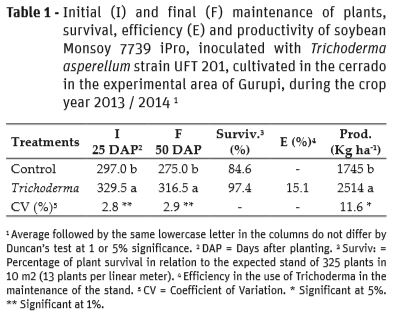
    <p><font face = "Verdana" size = "2">For the experiment in Gurupi, the treatment with <i>Trichoderma
</i>inoculation was superior (p&lt;0.01) for the initial and final maintenance of
plants in relation to the control treatment without inoculation (<a href = "#t1">Table 1</a>). Regarding
the plant survival in the stands, the treatment with inoculation of <i>Trichoderma</i>
presented a survival percentage of 97.4, with an inoculation efficiency of 15.1%
(<a href = "#t1">Table 1</a>). </font></p>

    <p>&nbsp;</p>

<a name = "t1"><img src = "/img/revistas/rca/v41n1/v41n1a19t1.jpg"></a>

    
<p>&nbsp;</p>

    <p><font face = "Verdana" size = "2">Regarding productivity, estimated in kg ha<sup>-1</sup>, the treatment with
<i>Trichoderma</i> inoculation was also significantly higher (p&lt;0.05) in relation
to control with production of 2514 kg ha<sup>-1</sup>, which represented an increase
above 34.5% (<a href = "#t1">Table 1</a>). </font></p>

    <p><font face = "Verdana" size = "2">For
the experiments in Alvorada, the results of the initial and final maintenance of
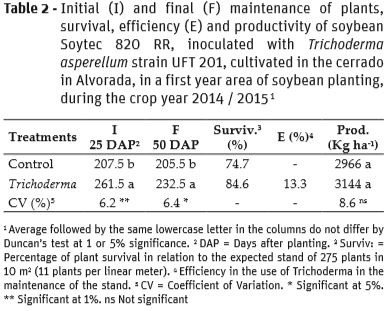
plants, for the treatment with <i>Trichoderma</i> inoculation, were higher (p&lt;0.01)
than the control without inoculation. Even though it was an area of first year of
planting, the survival rate of 84.6% was higher for the treatment with <i>Trichoderma</i>
inoculation in relation to the witness that was 74.7% and 13.3% of efficiency, indicating
the potentiality in the maintenance of this stand for the areas that received the
inoculation with <i>Trichoderma </i>(<a href = "#t2">Table 2</a>). There was no significant difference
between the treatments, but for the treatment with <i>Trichoderma</i> inoculation
there was a 6% increase in productivity compared to the control without inoculation
(<a href = "#t2">Table 2</a>). </font></p>

    <p>&nbsp;</p>

<a name = "t2"><img src = "/img/revistas/rca/v41n1/v41n1a19t2.jpg"></a>

    
<p>&nbsp;</p>

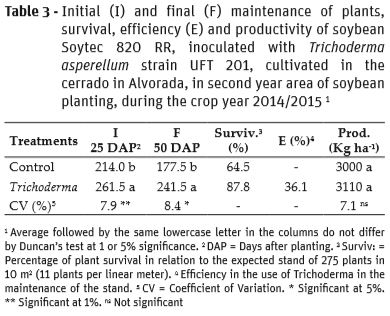
    <p><font face = "Verdana" size = "2">In the second year area of planting, the results of the initial and final
stands were similar to those found in the first year planting area (<a href = "#t3">Table 3</a>). Even
with a higher percentage of plant survival for the treatment with <i>Trichoderma</i>
and with an efficiency of 36.1 in relation to the control treatment, there was no
significant difference in productivity, but there was a 3.7% increase in productivity
compared to the control without inoculation (<a href = "#t3">Table 3</a>). </font></p>

    ]]></body>
<body><![CDATA[<p>&nbsp;</p>

<a name = "t3"><img src = "/img/revistas/rca/v41n1/v41n1a19t3.jpg"></a>

    
<p>&nbsp;</p>

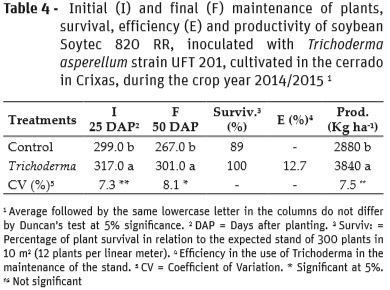
    <p><font face = "Verdana" size = "2">For the experiment in Crixas, the treatment with inoculation
of <i>Trichoderma</i> was superior to the initial (p&lt;0.01) and final (p&lt;0.05)
maintenance of plants in relation to the control treatment without inoculation.
The survival percentage, considering the expected final stand was 100% with the
efficiency of the treatment with inoculation of 12.7% (<a href = "#t4">Table 4</a>). </font></p>

    <p>&nbsp;</p>

<a name = "t4"><img src = "/img/revistas/rca/v41n1/v41n1a19t4.jpg"></a>

    
<p>&nbsp;</p>
 
    <p><font face = "Verdana" size = "2">For productivity, there was a significant difference between the treatments,
with higher productivity (p&lt;0.01) for the treatments with <i>Trichoderma</i>
inoculation with the production of 3840 kg ha<sup>-1</sup>, 33% higher than the
control with 2880 kg ha<sup>-1</sup>, referring to an increase of 960 kg ha<sup>-1</sup> (<a href = "#t4">Table 4</a>). </font></p>

    <p><font face = "Verdana" size = "2">The positive
results observed in different soybean experiments can be explained by the action
of the inoculant used, considering that fungi of the genus <i>Trichoderma</i> are
used in the biological control of phytopathogens and in the promotion of plant growth
due to its versatility of action, such as parasitism, antibiosis and competition,
besides acting as inducers of resistance to plants against diseases and to produce
growth hormones (Guareschi <i>et al.</i>, 2012; Kumar <i>et al.</i>, 2012; Milanesi
<i>et al.</i>, 2013; Chagas Junior <i>et al</i>., 2015; Chagas, 2015). These fungi
are found in the rhizosphere, are growth promoters in plant species (Machado <i>et
al.</i>, 2012), and are also a rich source of secondary metabolites, presenting
a vast repertoire of genes supposedly involved in the biosynthesis of non-ribosomal
peptides, polypeptides, terpenoids and pironas (Mukherjee <i>et al.</i>, 2012).
So, the inoculation with a high concentration of these microorganisms can provide
positive results on the biocontrol of phytopathogens and, consequently, the promotion
of plant growth.</font></p>

    <p><font face = "Verdana" size = "2">This
positive effect on the initial and final maintenance of plants in the present study
can be directly associated to the biocontrol of this pathogen, as observed in the
different experiments and in the different regions studied. Possibly, treatments
with the inoculation of <i>Trichoderma</i> may have provided an initial control
of this pathogen, as observed in other studies evaluating the biocontrol of <i>Trichoderma</i>
against <i>Rhizoctonia solani </i>(Verma <i>et al.</i>, 2007; Lucon <i>et al.</i>,
2009; Kotasthane <i>et al.</i>, 2014; Pereira <i>et al.</i>, 2014; Rahman <i>et
al.</i>, 2014).</font></p>

    <p><font face = "Verdana" size = "2">Different <i>Trichoderma</i>
isolates obtained from different places have different responses regarding the biocontrol
of phytopathogens (Martínez <i>et al.</i>, 2013), and have also an antagonistic
capacity against <i>R. solani</i>, as was observed in isolation studies and selection
of <i>Trichoderma</i> for biological control of phytopathogens (Garcia <i>et al.</i>,
2008; Reyes <i>et al.</i>, 2008; Kotasthane <i>et al.</i>, 2014; Chagas, 2015).
This ability depends on the strain specificity and its mode of action, as well as
on the sporulation capacity and establishment of the fungus in the field, which
will also depend on the selection, as a biocontrol agent, for one or more target
phytopathogens and the elaboration of the final product for commercial use. </font></p>


    <p><font face = "Verdana" size = "2">The application of <i>Trichoderma</i> in
field conditions is a promising practice, since the biological control offers greater
durability, safety and better cost-effectiveness than the chemical fungicides applied
in the soil (Yaqub e Shahzad, 2011; Kumar <i>et al.</i>, 2012). </font></p>

    ]]></body>
<body><![CDATA[<p><font face = "Verdana" size = "3"><b>CONCLUSION</b></font></p>

    <p><font face = "Verdana" size = "2">The inoculation of <i>Trichoderma asperellum </i>UFT 201 promoted the
initial and final maintenance of plants in all the experiments in the different
regions and also, the increase of productivity in the experiments in the Gurupi
and Crixas regions. However, these results are preliminary and were only based on
one year of field trials.</font></p>

    <p>&nbsp;</p>

    <p><font face = "Verdana" size = "3"><b>REFERENCES</b></font></p>

    <!-- ref --><p><font face = "Verdana" size = "2">Chagas, L.F.B. (2015) - <i>Seleção de isolados
de Trichoderma como biocontrolador e promotor de crescimento em plantas no estado
de Tocantins</i>. Tese de Doutoramento. Universidade Federal do Tocantins, Brasil.
138 p.    &nbsp;&nbsp;&nbsp;&nbsp;&nbsp;&nbsp;&nbsp;&nbsp;[&#160;<a href="javascript:void(0);" onclick="javascript: window.open('/scielo.php?script=sci_nlinks&ref=678396&pid=S0871-018X201800010002000001&lng=','','width=640,height=500,resizable=yes,scrollbars=1,menubar=yes,');">Links</a>&#160;]<!-- end-ref --></font></p>

    <!-- ref --><p><font face = "Verdana" size = "2">Chagas Junior, A.F.;
Oliveira, A.G.; Santos, G.R.; Reis, H.B.; Chagas, L.F.B. &amp; Miller, L.O. (2015)
- Combined inoculation of rhizobia and <i>Trichoderma </i>spp. on cowpea in the
savanna, Gurupi-TO, Brazil. <i>Revista Brasileira de Ciências Agrárias</i>, vol.
10, n. 1, p. 27-33. <a href = "http://dx.doi.org/10.5039/agraria.v10i1a4334" target = "_blank">http://dx.doi.org/10.5039/agraria.v10i1a4334</a></font>&nbsp;&nbsp;&nbsp;&nbsp;&nbsp;&nbsp;&nbsp;&nbsp;[&#160;<a href="javascript:void(0);" onclick="javascript: window.open('/scielo.php?script=sci_nlinks&ref=678398&pid=S0871-018X201800010002000002&lng=','','width=640,height=500,resizable=yes,scrollbars=1,menubar=yes,');">Links</a>&#160;]<!-- end-ref --><!-- ref --><p><font face = "Verdana" size = "2">EMBRAPA (2009) - <i>Manual de análises químicas
de solos, plantas e fertilizantes</i>. 2° ed., Brasília-DF, Revista e Ampliada,
627p.    &nbsp;&nbsp;&nbsp;&nbsp;&nbsp;&nbsp;&nbsp;&nbsp;[&#160;<a href="javascript:void(0);" onclick="javascript: window.open('/scielo.php?script=sci_nlinks&ref=678399&pid=S0871-018X201800010002000003&lng=','','width=640,height=500,resizable=yes,scrollbars=1,menubar=yes,');">Links</a>&#160;]<!-- end-ref --></font></p>

    <!-- ref --><p><font face = "Verdana" size = "2">Garcia, P.J.; Cabrera,
S.R.; Sánchez, J.J. &amp; Pérez, A.A.C. (2008) - Evaluación de un biofungicida para
el control de la mancha bandeada del maíz causada por <i>Rhizoctonia solani </i>Kühn
en siembras comerciales en Portuguese, Venezuela. <i>Agronomía Tropical</i>, vol.
58, n. 4, p. 383-390.    &nbsp;&nbsp;&nbsp;&nbsp;&nbsp;&nbsp;&nbsp;&nbsp;[&#160;<a href="javascript:void(0);" onclick="javascript: window.open('/scielo.php?script=sci_nlinks&ref=678401&pid=S0871-018X201800010002000004&lng=','','width=640,height=500,resizable=yes,scrollbars=1,menubar=yes,');">Links</a>&#160;]<!-- end-ref --></font></p>

    <!-- ref --><p><font face = "Verdana" size = "2">Gava,
C.A.T. &amp; Menezes, M.E.L. (2012) - Eficiência de isolados de <i>Trichoderma</i>
spp. no controle de patógenos de solo em meloeiro amarelo. <i>Revista Ciência Agronômica</i>,
vol. 43, n. 4, p. 633-640. <a href = "http://dx.doi.org/10.1590/S1806-66902012000400003" target = "_blank">http://dx.doi.org/10.1590/S1806-66902012000400003</a></font>&nbsp;&nbsp;&nbsp;&nbsp;&nbsp;&nbsp;&nbsp;&nbsp;[&#160;<a href="javascript:void(0);" onclick="javascript: window.open('/scielo.php?script=sci_nlinks&ref=678403&pid=S0871-018X201800010002000005&lng=','','width=640,height=500,resizable=yes,scrollbars=1,menubar=yes,');">Links</a>&#160;]<!-- end-ref --><!-- ref --><p><font face = "Verdana" size = "2">Gravel, V.; Antoun, H. &amp; Tweddell, R.J.
(2007) - Growth stimulation and fruit yield improvement of greenhouse tomato plants
by inoculation with <i>Pseudomonas putida</i> or <i>Trichoderma atroviride</i>:
Possible role of índole acetic acid (IAA). <i>Soil Biology &amp; Biochemistry</i>,
vol. 39, n. 8, p. 1968-1977. <a href = "http://dx.doi.org/10.1016/j.soilbio.2007.02.015" target = "_blank">http://dx.doi.org/10.1016/j.soilbio.2007.02.015</a></font>&nbsp;&nbsp;&nbsp;&nbsp;&nbsp;&nbsp;&nbsp;&nbsp;[&#160;<a href="javascript:void(0);" onclick="javascript: window.open('/scielo.php?script=sci_nlinks&ref=678404&pid=S0871-018X201800010002000006&lng=','','width=640,height=500,resizable=yes,scrollbars=1,menubar=yes,');">Links</a>&#160;]<!-- end-ref --><!-- ref --><p><font face = "Verdana" size = "2">Guareschi, R.F.; Perin, A.; Macagnan, D.;
Tramontini, A. &amp; Gazolla, P. R. (2012) - Emprego de <i>Trichoderma </i>spp.
no controle de <i>Sclerotinia sclerotiorum </i>e na promoção de crescimento vegetativo
nas culturas de girassol e soja. <i>Global Science and Technology</i>, vol. 5, n.
2, p. 1-8.    &nbsp;&nbsp;&nbsp;&nbsp;&nbsp;&nbsp;&nbsp;&nbsp;[&#160;<a href="javascript:void(0);" onclick="javascript: window.open('/scielo.php?script=sci_nlinks&ref=678405&pid=S0871-018X201800010002000007&lng=','','width=640,height=500,resizable=yes,scrollbars=1,menubar=yes,');">Links</a>&#160;]<!-- end-ref --></font></p>

    <!-- ref --><p><font face = "Verdana" size = "2">Harman, G.E.; Howell,
C.R.; Viterbo, A.; Chet, I. &amp; Lorito, M. (2004) - <i>Trichoderma</i> species
- opportunistic, avirulent plant symbionts. <i>Nature Reviews Microbiology</i>,
vol. 2, n. 1, p. 43-56. <a href = "http://dx.doi.org/10.1038/nrmicro797" target = "_blank">http://dx.doi.org/10.1038/nrmicro797</a></font>&nbsp;&nbsp;&nbsp;&nbsp;&nbsp;&nbsp;&nbsp;&nbsp;[&#160;<a href="javascript:void(0);" onclick="javascript: window.open('/scielo.php?script=sci_nlinks&ref=678407&pid=S0871-018X201800010002000008&lng=','','width=640,height=500,resizable=yes,scrollbars=1,menubar=yes,');">Links</a>&#160;]<!-- end-ref --><!-- ref --><p><font face = "Verdana" size = "2">Henning, A.A. (2009) - Manejo de doenças da soja (<i>Glycine
max </i>L. Merrill). <i>Informativo ABRATES</i>, vol. 19, n. 3, p. 9-12.    &nbsp;&nbsp;&nbsp;&nbsp;&nbsp;&nbsp;&nbsp;&nbsp;[&#160;<a href="javascript:void(0);" onclick="javascript: window.open('/scielo.php?script=sci_nlinks&ref=678408&pid=S0871-018X201800010002000009&lng=','','width=640,height=500,resizable=yes,scrollbars=1,menubar=yes,');">Links</a>&#160;]<!-- end-ref --></font></p>


    <!-- ref --><p><font face = "Verdana" size = "2">Kotasthane, A.; Agawal, T.; Kushwah, R. &amp;
Rahatkar, O.V. (2014) - In-vitro antagonism of <i>Trichoderma </i>spp. against <i>Sclerotium</i>
<i>rolfsii</i> and <i>Rhizoctonia solani </i>and their response towards growth of
cucumber, bottle gourd and bitter gourd. <i>European Journal of Plant Pathology</i>,
vol. 141, n. 3, p. 523-543. <a href = "http://dx.doi.org/10.1007/s10658-014-0560-0" target = "_blank">http://dx.doi.org/10.1007/s10658-014-0560-0</a></font>&nbsp;&nbsp;&nbsp;&nbsp;&nbsp;&nbsp;&nbsp;&nbsp;[&#160;<a href="javascript:void(0);" onclick="javascript: window.open('/scielo.php?script=sci_nlinks&ref=678410&pid=S0871-018X201800010002000010&lng=','','width=640,height=500,resizable=yes,scrollbars=1,menubar=yes,');">Links</a>&#160;]<!-- end-ref --><!-- ref --><p><font face = "Verdana" size = "2">Kumar, K.; Amaresan, N.; Bhagat, S.; Madhuri,
K. &amp; Srivastava, R.C. (2012) - Isolation and characterization of <i>Trichoderma</i>
spp. for antagonistic activity against root rot and foliar pathogens. <i>Indian
Journal of Microbiology</i>, vol. 52, n. 2, p. 137-144. <a href = "http://dx.doi.org/10.1007/s12088-011-0205-3" target = "_blank">http://dx.doi.org/10.1007/s12088-011-0205-3</a></font>&nbsp;&nbsp;&nbsp;&nbsp;&nbsp;&nbsp;&nbsp;&nbsp;[&#160;<a href="javascript:void(0);" onclick="javascript: window.open('/scielo.php?script=sci_nlinks&ref=678411&pid=S0871-018X201800010002000011&lng=','','width=640,height=500,resizable=yes,scrollbars=1,menubar=yes,');">Links</a>&#160;]<!-- end-ref --><!-- ref --><p><font face = "Verdana" size = "2">Lucon, C.M.M. (2009) - Promoção de crescimento
de plantas com o uso de <i>Trichoderma</i> spp. Infobibos, Informações Tecnológicas.
[Cit. 2014/07/21]. &lt;<a href = "http://www.infobibos.com/Artigos/2009_1/trichoderma/index.htm" target = "_blank">http://www.infobibos.com/Artigos/2009_1/trichoderma/index.htm</a>&gt;    &nbsp;&nbsp;&nbsp;&nbsp;&nbsp;&nbsp;&nbsp;&nbsp;[&#160;<a href="javascript:void(0);" onclick="javascript: window.open('/scielo.php?script=sci_nlinks&ref=678412&pid=S0871-018X201800010002000012&lng=','','width=640,height=500,resizable=yes,scrollbars=1,menubar=yes,');">Links</a>&#160;]<!-- end-ref -->.
</font></p>

    <!-- ref --><p><font face = "Verdana" size = "2">Machado, R.G.; Sá, E.L.S.;
Damasceno, R.G.; Hahn, L.; Almeida, D.; Morais, T.; Camargo, F.A.O. &amp; Reartes,
D.S. (2011) - Promoção de crescimento de <i>Lotus corniculatus L</i>. e <i>Avena
strigosa Schreb</i> pela inoculação conjunta de <i>Trichoderma harzianum</i> e rizóbio.
<i>Ciência e Natura</i>, vol. 33, n. 2, p. 111-126. <a href = "http://dx.doi.org/10.5902/2179460X9365" target = "_blank">http://dx.doi.org/10.5902/2179460X9365</a></font>&nbsp;&nbsp;&nbsp;&nbsp;&nbsp;&nbsp;&nbsp;&nbsp;[&#160;<a href="javascript:void(0);" onclick="javascript: window.open('/scielo.php?script=sci_nlinks&ref=678414&pid=S0871-018X201800010002000013&lng=','','width=640,height=500,resizable=yes,scrollbars=1,menubar=yes,');">Links</a>&#160;]<!-- end-ref --><!-- ref --><p><font face = "Verdana" size = "2">Machado, D.F.M.; Parzianello, R.F.; Silva,
A.C.F. &amp; Antoniolli, Z.I. (2012) - <i>Trichoderma</i> no Brasil: O Fungo e Bioagente.
<i>Revista de Ciências Agrárias</i>, vol. 35, n. 1, p. 274-288.    &nbsp;&nbsp;&nbsp;&nbsp;&nbsp;&nbsp;&nbsp;&nbsp;[&#160;<a href="javascript:void(0);" onclick="javascript: window.open('/scielo.php?script=sci_nlinks&ref=678415&pid=S0871-018X201800010002000014&lng=','','width=640,height=500,resizable=yes,scrollbars=1,menubar=yes,');">Links</a>&#160;]<!-- end-ref --> </font></p>

  
    <!-- ref --><p><font face = "Verdana" size = "2">Martínez, B.; Infante, D. &amp; Reyes, Y. (2013)
- <i>Trichoderma</i> spp. y su función em el control de plagas em los cultivos.
<i>Revista de Protección Vegetal</i>, vol. 28, n. 1, p. 1-11.    &nbsp;&nbsp;&nbsp;&nbsp;&nbsp;&nbsp;&nbsp;&nbsp;[&#160;<a href="javascript:void(0);" onclick="javascript: window.open('/scielo.php?script=sci_nlinks&ref=678417&pid=S0871-018X201800010002000015&lng=','','width=640,height=500,resizable=yes,scrollbars=1,menubar=yes,');">Links</a>&#160;]<!-- end-ref --></font></p>

    <!-- ref --><p><font face = "Verdana" size = "2">Milanesi, P.M.; Blume, E.; Muniz, M.F.B.; Reiniger,
L.R.S.; Antoniolli, Z.I.; Junges, E. &amp; Lupatini, M. (2013) - Detecção de <i>Fusarium</i>
spp. e <i>Trichoderma </i>spp. e antagonismo de <i>Trichoderma</i> sp. em soja sob
plantio direto. <i>Semina: Ciências Agrárias</i>, vol. 34, n. 6, p. 3219-3234. <a href = "http://dx.doi.org/10.5433/1679-0359.2013v34n6Supl1p3219" target = "_blank">http://dx.doi.org/10.5433/1679-0359.2013v34n6Supl1p3219</a></font>&nbsp;&nbsp;&nbsp;&nbsp;&nbsp;&nbsp;&nbsp;&nbsp;[&#160;<a href="javascript:void(0);" onclick="javascript: window.open('/scielo.php?script=sci_nlinks&ref=678419&pid=S0871-018X201800010002000016&lng=','','width=640,height=500,resizable=yes,scrollbars=1,menubar=yes,');">Links</a>&#160;]<!-- end-ref --><!-- ref --><p><font face = "Verdana" size = "2">Mukherjee, P.K.; Horwitz, B.A. &amp; Kenerley,
C.M. (2012) - Secondary metabolism in <i>Trichoderma</i> – a genomic perspective.
<i>Microbiology</i>, vol. 158, n. 1, p. 35–45. <a href = "http://dx.doi.org/10.1099/mic.0.053629-0" target = "_blank">http://dx.doi.org/10.1099/mic.0.053629-0</a></font>&nbsp;&nbsp;&nbsp;&nbsp;&nbsp;&nbsp;&nbsp;&nbsp;[&#160;<a href="javascript:void(0);" onclick="javascript: window.open('/scielo.php?script=sci_nlinks&ref=678420&pid=S0871-018X201800010002000017&lng=','','width=640,height=500,resizable=yes,scrollbars=1,menubar=yes,');">Links</a>&#160;]<!-- end-ref --><!-- ref --><p><font face = "Verdana" size = "2">Pereira, J.L.; Queiroz, R.M.L.; Charneau,
S.O.; Felix, C.R.; Ricart, C.A.O.; Silva, F.L.; Stindorff, A.S.; Ulhoa, C.J. &amp;
Noronha, E.F. (2014) - Analysis of <i>Phaseolus vulgaris </i>response to its association
with <i>Trichoderma harzianum </i>(All-42) in the presence or absence of the phytopathogenic
fungi <i>Rhizoctonia solani </i>and <i>Fusarium solani</i>.<i> Plos One</i>, vol.
9, n. 5, p. 1-23. <a href = "https://doi.org/10.1371/journal.pone.0098234" target = "_blank">https://doi.org/10.1371/journal.pone.0098234</a></font>&nbsp;&nbsp;&nbsp;&nbsp;&nbsp;&nbsp;&nbsp;&nbsp;[&#160;<a href="javascript:void(0);" onclick="javascript: window.open('/scielo.php?script=sci_nlinks&ref=678421&pid=S0871-018X201800010002000018&lng=','','width=640,height=500,resizable=yes,scrollbars=1,menubar=yes,');">Links</a>&#160;]<!-- end-ref --><!-- ref --><p><font face = "Verdana" size = "2">Rahman, M.; Ali, M.A.; Dey, T.K.; Islam, M.M.; Naher,
L. &amp; Ismail, A. (2014) - Evoluation of disease and potential biocontrol activity
of <i>Trichoderma </i>sp. against <i>Rhizoctonia solani </i>on potato. <i>Bioscience
Journal</i>, vol. 30, n. 4, p. 1108-1117.    &nbsp;&nbsp;&nbsp;&nbsp;&nbsp;&nbsp;&nbsp;&nbsp;[&#160;<a href="javascript:void(0);" onclick="javascript: window.open('/scielo.php?script=sci_nlinks&ref=678422&pid=S0871-018X201800010002000019&lng=','','width=640,height=500,resizable=yes,scrollbars=1,menubar=yes,');">Links</a>&#160;]<!-- end-ref --></font></p>

    <!-- ref --><p><font face = "Verdana" size = "2">Reyes, Y.; Martínez, B. &amp; Infante, D. (2008) - Evaluación de la actividad
antagónica de trece aislamientos de <i>Trichoderma </i>spp. sobre <i>Rhizoctonia
</i>sp. <i>Revista de Protección Vegetal</i>, vol. 23, n. 2, p. 112-117.    &nbsp;&nbsp;&nbsp;&nbsp;&nbsp;&nbsp;&nbsp;&nbsp;[&#160;<a href="javascript:void(0);" onclick="javascript: window.open('/scielo.php?script=sci_nlinks&ref=678424&pid=S0871-018X201800010002000020&lng=','','width=640,height=500,resizable=yes,scrollbars=1,menubar=yes,');">Links</a>&#160;]<!-- end-ref --></font></p>


    <!-- ref --><p><font face = "Verdana" size = "2">Santos, M.; Silveira, M. L. (2012) - <i>O
Brasil: território e sociedade no início do século XXI</i>. 10ª ed., São Paulo,
Record, 500 p.    &nbsp;&nbsp;&nbsp;&nbsp;&nbsp;&nbsp;&nbsp;&nbsp;[&#160;<a href="javascript:void(0);" onclick="javascript: window.open('/scielo.php?script=sci_nlinks&ref=678426&pid=S0871-018X201800010002000021&lng=','','width=640,height=500,resizable=yes,scrollbars=1,menubar=yes,');">Links</a>&#160;]<!-- end-ref --></font></p>

    <!-- ref --><p><font face = "Verdana" size = "2">Silva, F. de
A.S. (2008) - ASSISTAT. Versão 7.6 beta. Campina Grande. [cit. 2016/03/15]. &lt;<a href = "http://www.assistat.com/indexp.html" target = "_blank">http://www.assistat.com/indexp.html</a>&gt;    &nbsp;&nbsp;&nbsp;&nbsp;&nbsp;&nbsp;&nbsp;&nbsp;[&#160;<a href="javascript:void(0);" onclick="javascript: window.open('/scielo.php?script=sci_nlinks&ref=678428&pid=S0871-018X201800010002000022&lng=','','width=640,height=500,resizable=yes,scrollbars=1,menubar=yes,');">Links</a>&#160;]<!-- end-ref -->.</font></p>


    <!-- ref --><p><font face = "Verdana" size = "2">Silva, A. N. (2011) - <i>Efeito de produtos
químicos e de Trichoderma spp. No controle de Fusarium solani do maracujazeiro.</i>
Dissertação de Mestrado. Universidade Estadual do Sudoeste da Bahia, Vitória da
Conquista, Brasil. 53 p.    &nbsp;&nbsp;&nbsp;&nbsp;&nbsp;&nbsp;&nbsp;&nbsp;[&#160;<a href="javascript:void(0);" onclick="javascript: window.open('/scielo.php?script=sci_nlinks&ref=678430&pid=S0871-018X201800010002000023&lng=','','width=640,height=500,resizable=yes,scrollbars=1,menubar=yes,');">Links</a>&#160;]<!-- end-ref --> </font></p>

    ]]></body>
<body><![CDATA[<!-- ref --><p><font face = "Verdana" size = "2">Verma,
M.; Brar, S.K.; Tyagi, R.D.; Surampalli, R.Y. &amp; Valéro, J.R. (2007) - Antagonistic
fungi, <i>Trichoderma </i>spp.: Panoply of biologicol control. <i>Biochemical Engineering
Journal</i>, vol. 37, n. 1, p. 1-20. <a href = "http://dx.doi.org/10.1016/j.bej.2007.05.012" target = "_blank">http://dx.doi.org/10.1016/j.bej.2007.05.012</a></font>&nbsp;&nbsp;&nbsp;&nbsp;&nbsp;&nbsp;&nbsp;&nbsp;[&#160;<a href="javascript:void(0);" onclick="javascript: window.open('/scielo.php?script=sci_nlinks&ref=678432&pid=S0871-018X201800010002000024&lng=','','width=640,height=500,resizable=yes,scrollbars=1,menubar=yes,');">Links</a>&#160;]<!-- end-ref --><!-- ref --><p><font face = "Verdana" size = "2">Woo, S.L.; Ruocco, M.; Vinale, F.; Nigro,
M.; Marra, R.; Lombardi, N.; Pascale, A.; Lanzuise, S.; Manganiello, G. &amp; Lorito,
M. (2014) - <i>Trichoderma</i>-based products and their widespread use in agriculture.
<i>The Open Mycology Journal, </i>vol. 8, p. 71-126. <a href = "http://dx.doi.org/10.2174/1874437001408010071" target = "_blank">http://dx.doi.org/10.2174/1874437001408010071</a></font>&nbsp;&nbsp;&nbsp;&nbsp;&nbsp;&nbsp;&nbsp;&nbsp;[&#160;<a href="javascript:void(0);" onclick="javascript: window.open('/scielo.php?script=sci_nlinks&ref=678433&pid=S0871-018X201800010002000025&lng=','','width=640,height=500,resizable=yes,scrollbars=1,menubar=yes,');">Links</a>&#160;]<!-- end-ref --><!-- ref --><p><font face = "Verdana" size = "2">Yaqub, F. &amp; Shahzad, S. (2011) - Efficacy
and persistence of microbial antagonists against <i>Sclerotium rolfsii</i>
under field conditions. <i>Pakistan Journal of Botany</i>, vol. 43, n. 5, p. 2627-2634.    &nbsp;&nbsp;&nbsp;&nbsp;&nbsp;&nbsp;&nbsp;&nbsp;[&#160;<a href="javascript:void(0);" onclick="javascript: window.open('/scielo.php?script=sci_nlinks&ref=678434&pid=S0871-018X201800010002000026&lng=','','width=640,height=500,resizable=yes,scrollbars=1,menubar=yes,');">Links</a>&#160;]<!-- end-ref --></font></p>

    <p>&nbsp;</p>

    <p><font face = "Verdana" size = "2">Received/recebido: 2017.03.30</font></p>

    <p><font face = "Verdana" size = "2">Received in revised form/recebido em versão revista: 2017.09.19</font></p>

    <p><font face = "Verdana" size = "2">Accepted/aceite: 2017.10.11</font></p>

     ]]></body><back>
<ref-list>
<ref id="B1">
<nlm-citation citation-type="">
<person-group person-group-type="author">
<name>
<surname><![CDATA[Chagas]]></surname>
<given-names><![CDATA[L.F.B.]]></given-names>
</name>
</person-group>
<source><![CDATA[Seleção de isolados de Trichoderma como biocontrolador e promotor de crescimento em plantas no estado de Tocantins]]></source>
<year>2015</year>
</nlm-citation>
</ref>
<ref id="B2">
<nlm-citation citation-type="journal">
<person-group person-group-type="author">
<name>
<surname><![CDATA[Chagas Junior]]></surname>
<given-names><![CDATA[A.F.]]></given-names>
</name>
<name>
<surname><![CDATA[Oliveira]]></surname>
<given-names><![CDATA[A.G.]]></given-names>
</name>
<name>
<surname><![CDATA[Santos]]></surname>
<given-names><![CDATA[G.R.]]></given-names>
</name>
<name>
<surname><![CDATA[Reis]]></surname>
<given-names><![CDATA[H.B.]]></given-names>
</name>
<name>
<surname><![CDATA[Chagas]]></surname>
<given-names><![CDATA[L.F.B.]]></given-names>
</name>
<name>
<surname><![CDATA[Miller]]></surname>
<given-names><![CDATA[L.O.]]></given-names>
</name>
</person-group>
<article-title xml:lang="en"><![CDATA[Combined inoculation of rhizobia and Trichoderma spp. on cowpea in the savanna, Gurupi-TO, Brazil]]></article-title>
<source><![CDATA[Revista Brasileira de Ciências Agrárias]]></source>
<year>2015</year>
<volume>10</volume>
<numero>1</numero>
<issue>1</issue>
<page-range>27-33</page-range></nlm-citation>
</ref>
<ref id="B3">
<nlm-citation citation-type="book">
<collab>EMBRAPA</collab>
<source><![CDATA[Manual de análises químicas de solos, plantas e fertilizantes]]></source>
<year>2009</year>
<edition>2°</edition>
<publisher-loc><![CDATA[Brasília^eDF DF]]></publisher-loc>
<publisher-name><![CDATA[Revista e Ampliada]]></publisher-name>
</nlm-citation>
</ref>
<ref id="B4">
<nlm-citation citation-type="journal">
<person-group person-group-type="author">
<name>
<surname><![CDATA[Garcia]]></surname>
<given-names><![CDATA[P.J.]]></given-names>
</name>
<name>
<surname><![CDATA[Cabrera]]></surname>
<given-names><![CDATA[S.R.]]></given-names>
</name>
<name>
<surname><![CDATA[Sánchez]]></surname>
<given-names><![CDATA[J.J.]]></given-names>
</name>
<name>
<surname><![CDATA[Pérez]]></surname>
<given-names><![CDATA[A.A.C.]]></given-names>
</name>
</person-group>
<article-title xml:lang="es"><![CDATA[Evaluación de un biofungicida para el control de la mancha bandeada del maíz causada por Rhizoctonia solani Kühn en siembras comerciales en Portuguese, Venezuela]]></article-title>
<source><![CDATA[Agronomía Tropical]]></source>
<year>2008</year>
<volume>58</volume>
<numero>4</numero>
<issue>4</issue>
<page-range>383-390</page-range></nlm-citation>
</ref>
<ref id="B5">
<nlm-citation citation-type="journal">
<person-group person-group-type="author">
<name>
<surname><![CDATA[Gava]]></surname>
<given-names><![CDATA[C.A.T.]]></given-names>
</name>
<name>
<surname><![CDATA[Menezes]]></surname>
<given-names><![CDATA[M.E.L.]]></given-names>
</name>
</person-group>
<article-title xml:lang="pt"><![CDATA[Eficiência de isolados de Trichoderma spp. no controle de patógenos de solo em meloeiro amarelo]]></article-title>
<source><![CDATA[Revista Ciência Agronômica]]></source>
<year>2012</year>
<volume>43</volume>
<numero>4</numero>
<issue>4</issue>
<page-range>633-640</page-range></nlm-citation>
</ref>
<ref id="B6">
<nlm-citation citation-type="journal">
<person-group person-group-type="author">
<name>
<surname><![CDATA[Gravel]]></surname>
<given-names><![CDATA[V.]]></given-names>
</name>
<name>
<surname><![CDATA[Antoun]]></surname>
<given-names><![CDATA[H.]]></given-names>
</name>
<name>
<surname><![CDATA[Tweddell]]></surname>
<given-names><![CDATA[R.J.]]></given-names>
</name>
</person-group>
<article-title xml:lang="en"><![CDATA[Growth stimulation and fruit yield improvement of greenhouse tomato plants by inoculation with Pseudomonas putida or Trichoderma atroviride: Possible role of índole acetic acid (IAA)]]></article-title>
<source><![CDATA[Soil Biology & Biochemistry]]></source>
<year>2007</year>
<volume>39</volume>
<numero>8</numero>
<issue>8</issue>
<page-range>1968-1977</page-range></nlm-citation>
</ref>
<ref id="B7">
<nlm-citation citation-type="journal">
<person-group person-group-type="author">
<name>
<surname><![CDATA[Guareschi]]></surname>
<given-names><![CDATA[R.F.]]></given-names>
</name>
<name>
<surname><![CDATA[Perin]]></surname>
<given-names><![CDATA[A.]]></given-names>
</name>
<name>
<surname><![CDATA[Macagnan]]></surname>
<given-names><![CDATA[D.]]></given-names>
</name>
<name>
<surname><![CDATA[Tramontini]]></surname>
<given-names><![CDATA[A.]]></given-names>
</name>
<name>
<surname><![CDATA[Gazolla]]></surname>
<given-names><![CDATA[P. R.]]></given-names>
</name>
</person-group>
<article-title xml:lang="pt"><![CDATA[Emprego de Trichoderma spp. no controle de Sclerotinia sclerotiorum e na promoção de crescimento vegetativo nas culturas de girassol e soja]]></article-title>
<source><![CDATA[Global Science and Technology]]></source>
<year>2012</year>
<volume>5</volume>
<numero>2</numero>
<issue>2</issue>
<page-range>1-8</page-range></nlm-citation>
</ref>
<ref id="B8">
<nlm-citation citation-type="journal">
<person-group person-group-type="author">
<name>
<surname><![CDATA[Harman]]></surname>
<given-names><![CDATA[G.E.]]></given-names>
</name>
<name>
<surname><![CDATA[Howell]]></surname>
<given-names><![CDATA[C.R.]]></given-names>
</name>
<name>
<surname><![CDATA[Viterbo]]></surname>
<given-names><![CDATA[A.]]></given-names>
</name>
<name>
<surname><![CDATA[Chet]]></surname>
<given-names><![CDATA[I.]]></given-names>
</name>
<name>
<surname><![CDATA[Lorito]]></surname>
<given-names><![CDATA[M.]]></given-names>
</name>
</person-group>
<article-title xml:lang="en"><![CDATA[Trichoderma species - opportunistic, avirulent plant symbionts]]></article-title>
<source><![CDATA[Nature Reviews Microbiology]]></source>
<year>2004</year>
<volume>2</volume>
<numero>1</numero>
<issue>1</issue>
<page-range>43-56</page-range></nlm-citation>
</ref>
<ref id="B9">
<nlm-citation citation-type="journal">
<person-group person-group-type="author">
<name>
<surname><![CDATA[Henning]]></surname>
<given-names><![CDATA[A.A.]]></given-names>
</name>
</person-group>
<article-title xml:lang="pt"><![CDATA[Manejo de doenças da soja (Glycine max L. Merrill)]]></article-title>
<source><![CDATA[Informativo ABRATES]]></source>
<year>2009</year>
<volume>19</volume>
<numero>3</numero>
<issue>3</issue>
<page-range>9-12</page-range></nlm-citation>
</ref>
<ref id="B10">
<nlm-citation citation-type="journal">
<person-group person-group-type="author">
<name>
<surname><![CDATA[Kotasthane]]></surname>
<given-names><![CDATA[A.]]></given-names>
</name>
<name>
<surname><![CDATA[Agawal]]></surname>
<given-names><![CDATA[T.]]></given-names>
</name>
<name>
<surname><![CDATA[Kushwah]]></surname>
<given-names><![CDATA[R.]]></given-names>
</name>
<name>
<surname><![CDATA[Rahatkar]]></surname>
<given-names><![CDATA[O.V.]]></given-names>
</name>
</person-group>
<article-title xml:lang="en"><![CDATA[In-vitro antagonism of Trichoderma spp. against Sclerotium rolfsii and Rhizoctonia solani and their response towards growth of cucumber, bottle gourd and bitter gourd]]></article-title>
<source><![CDATA[European Journal of Plant Pathology]]></source>
<year>2014</year>
<volume>141</volume>
<numero>3</numero>
<issue>3</issue>
<page-range>523-543</page-range></nlm-citation>
</ref>
<ref id="B11">
<nlm-citation citation-type="journal">
<person-group person-group-type="author">
<name>
<surname><![CDATA[Kumar]]></surname>
<given-names><![CDATA[K.]]></given-names>
</name>
<name>
<surname><![CDATA[Amaresan]]></surname>
<given-names><![CDATA[N.]]></given-names>
</name>
<name>
<surname><![CDATA[Bhagat]]></surname>
<given-names><![CDATA[S.]]></given-names>
</name>
<name>
<surname><![CDATA[Madhuri]]></surname>
<given-names><![CDATA[K.]]></given-names>
</name>
<name>
<surname><![CDATA[Srivastava]]></surname>
<given-names><![CDATA[R.C.]]></given-names>
</name>
</person-group>
<article-title xml:lang="en"><![CDATA[Isolation and characterization of Trichoderma spp. for antagonistic activity against root rot and foliar pathogens]]></article-title>
<source><![CDATA[Indian Journal of Microbiology]]></source>
<year>2012</year>
<volume>52</volume>
<numero>2</numero>
<issue>2</issue>
<page-range>137-144</page-range></nlm-citation>
</ref>
<ref id="B12">
<nlm-citation citation-type="">
<person-group person-group-type="author">
<name>
<surname><![CDATA[Lucon]]></surname>
<given-names><![CDATA[C.M.M.]]></given-names>
</name>
</person-group>
<source><![CDATA[Promoção de crescimento de plantas com o uso de Trichoderma spp. Infobibos, Informações Tecnológicas]]></source>
<year>2009</year>
</nlm-citation>
</ref>
<ref id="B13">
<nlm-citation citation-type="journal">
<person-group person-group-type="author">
<name>
<surname><![CDATA[Machado]]></surname>
<given-names><![CDATA[R.G.]]></given-names>
</name>
<name>
<surname><![CDATA[Sá]]></surname>
<given-names><![CDATA[E.L.S.]]></given-names>
</name>
<name>
<surname><![CDATA[Damasceno]]></surname>
<given-names><![CDATA[R.G.]]></given-names>
</name>
<name>
<surname><![CDATA[Hahn]]></surname>
<given-names><![CDATA[L.]]></given-names>
</name>
<name>
<surname><![CDATA[Almeida]]></surname>
<given-names><![CDATA[D.]]></given-names>
</name>
<name>
<surname><![CDATA[Morais]]></surname>
<given-names><![CDATA[T.]]></given-names>
</name>
<name>
<surname><![CDATA[Camargo]]></surname>
<given-names><![CDATA[F.A.O.]]></given-names>
</name>
<name>
<surname><![CDATA[Reartes]]></surname>
<given-names><![CDATA[D.S.]]></given-names>
</name>
</person-group>
<article-title xml:lang="pt"><![CDATA[Promoção de crescimento de Lotus corniculatus L. e Avena strigosa Schreb pela inoculação conjunta de Trichoderma harzianum e rizóbio]]></article-title>
<source><![CDATA[Ciência e Natura]]></source>
<year>2011</year>
<volume>33</volume>
<numero>2</numero>
<issue>2</issue>
<page-range>111-126</page-range></nlm-citation>
</ref>
<ref id="B14">
<nlm-citation citation-type="journal">
<person-group person-group-type="author">
<name>
<surname><![CDATA[Machado]]></surname>
<given-names><![CDATA[D.F.M.]]></given-names>
</name>
<name>
<surname><![CDATA[Parzianello]]></surname>
<given-names><![CDATA[R.F.]]></given-names>
</name>
<name>
<surname><![CDATA[Silva]]></surname>
<given-names><![CDATA[A.C.F.]]></given-names>
</name>
<name>
<surname><![CDATA[Antoniolli]]></surname>
<given-names><![CDATA[Z.I.]]></given-names>
</name>
</person-group>
<article-title xml:lang="pt"><![CDATA[Trichoderma no Brasil: O Fungo e Bioagente]]></article-title>
<source><![CDATA[Revista de Ciências Agrárias]]></source>
<year>2012</year>
<volume>35</volume>
<numero>1</numero>
<issue>1</issue>
<page-range>274-288</page-range></nlm-citation>
</ref>
<ref id="B15">
<nlm-citation citation-type="journal">
<person-group person-group-type="author">
<name>
<surname><![CDATA[Martínez]]></surname>
<given-names><![CDATA[B.]]></given-names>
</name>
<name>
<surname><![CDATA[Infante]]></surname>
<given-names><![CDATA[D.]]></given-names>
</name>
<name>
<surname><![CDATA[Reyes]]></surname>
<given-names><![CDATA[Y.]]></given-names>
</name>
</person-group>
<article-title xml:lang="pt"><![CDATA[Trichoderma spp. y su función em el control de plagas em los cultivos]]></article-title>
<source><![CDATA[Revista de Protección Vegetal]]></source>
<year>2013</year>
<volume>28</volume>
<numero>1</numero>
<issue>1</issue>
<page-range>1-11</page-range></nlm-citation>
</ref>
<ref id="B16">
<nlm-citation citation-type="journal">
<person-group person-group-type="author">
<name>
<surname><![CDATA[Milanesi]]></surname>
<given-names><![CDATA[P.M.]]></given-names>
</name>
<name>
<surname><![CDATA[Blume]]></surname>
<given-names><![CDATA[E.]]></given-names>
</name>
<name>
<surname><![CDATA[Muniz]]></surname>
<given-names><![CDATA[M.F.B.]]></given-names>
</name>
<name>
<surname><![CDATA[Reiniger]]></surname>
<given-names><![CDATA[L.R.S.]]></given-names>
</name>
<name>
<surname><![CDATA[Antoniolli]]></surname>
<given-names><![CDATA[Z.I.]]></given-names>
</name>
<name>
<surname><![CDATA[Junges]]></surname>
<given-names><![CDATA[E.]]></given-names>
</name>
<name>
<surname><![CDATA[Lupatini]]></surname>
<given-names><![CDATA[M.]]></given-names>
</name>
</person-group>
<article-title xml:lang="pt"><![CDATA[Detecção de Fusarium spp. e Trichoderma spp. e antagonismo de Trichoderma sp. em soja sob plantio direto]]></article-title>
<source><![CDATA[Semina]]></source>
<year>2013</year>
<volume>34</volume>
<numero>6</numero>
<issue>6</issue>
<page-range>3219-3234</page-range></nlm-citation>
</ref>
<ref id="B17">
<nlm-citation citation-type="journal">
<person-group person-group-type="author">
<name>
<surname><![CDATA[Mukherjee]]></surname>
<given-names><![CDATA[P.K.]]></given-names>
</name>
<name>
<surname><![CDATA[Horwitz]]></surname>
<given-names><![CDATA[B.A.]]></given-names>
</name>
<name>
<surname><![CDATA[Kenerley]]></surname>
<given-names><![CDATA[C.M.]]></given-names>
</name>
</person-group>
<article-title xml:lang="en"><![CDATA[Secondary metabolism in Trichoderma - a genomic perspective]]></article-title>
<source><![CDATA[Microbiology]]></source>
<year>2012</year>
<volume>158</volume>
<numero>1</numero>
<issue>1</issue>
<page-range>35-45</page-range></nlm-citation>
</ref>
<ref id="B18">
<nlm-citation citation-type="journal">
<person-group person-group-type="author">
<name>
<surname><![CDATA[Pereira]]></surname>
<given-names><![CDATA[J.L.]]></given-names>
</name>
<name>
<surname><![CDATA[Queiroz]]></surname>
<given-names><![CDATA[R.M.L.]]></given-names>
</name>
<name>
<surname><![CDATA[Charneau]]></surname>
<given-names><![CDATA[S.O.]]></given-names>
</name>
<name>
<surname><![CDATA[Felix]]></surname>
<given-names><![CDATA[C.R.]]></given-names>
</name>
<name>
<surname><![CDATA[Ricart]]></surname>
<given-names><![CDATA[C.A.O.]]></given-names>
</name>
<name>
<surname><![CDATA[Silva]]></surname>
<given-names><![CDATA[F.L.]]></given-names>
</name>
<name>
<surname><![CDATA[Stindorff]]></surname>
<given-names><![CDATA[A.S.]]></given-names>
</name>
<name>
<surname><![CDATA[Ulhoa]]></surname>
<given-names><![CDATA[C.J.]]></given-names>
</name>
<name>
<surname><![CDATA[Noronha]]></surname>
<given-names><![CDATA[E.F.]]></given-names>
</name>
</person-group>
<article-title xml:lang="en"><![CDATA[Analysis of Phaseolus vulgaris response to its association with Trichoderma harzianum (All-42) in the presence or absence of the phytopathogenic fungi Rhizoctonia solani and Fusarium solani]]></article-title>
<source><![CDATA[Plos One]]></source>
<year>2014</year>
<volume>9</volume>
<numero>5</numero>
<issue>5</issue>
<page-range>1-23</page-range></nlm-citation>
</ref>
<ref id="B19">
<nlm-citation citation-type="journal">
<person-group person-group-type="author">
<name>
<surname><![CDATA[Rahman]]></surname>
<given-names><![CDATA[M.]]></given-names>
</name>
<name>
<surname><![CDATA[Ali]]></surname>
<given-names><![CDATA[M.A.]]></given-names>
</name>
<name>
<surname><![CDATA[Dey]]></surname>
<given-names><![CDATA[T.K.]]></given-names>
</name>
<name>
<surname><![CDATA[Islam]]></surname>
<given-names><![CDATA[M.M.]]></given-names>
</name>
<name>
<surname><![CDATA[Naher]]></surname>
<given-names><![CDATA[L.]]></given-names>
</name>
<name>
<surname><![CDATA[Ismail]]></surname>
<given-names><![CDATA[A.]]></given-names>
</name>
</person-group>
<article-title xml:lang="en"><![CDATA[Evoluation of disease and potential biocontrol activity of Trichoderma sp. against Rhizoctonia solani on potato]]></article-title>
<source><![CDATA[Bioscience Journal]]></source>
<year>2014</year>
<volume>30</volume>
<numero>4</numero>
<issue>4</issue>
<page-range>1108-1117</page-range></nlm-citation>
</ref>
<ref id="B20">
<nlm-citation citation-type="journal">
<person-group person-group-type="author">
<name>
<surname><![CDATA[Reyes]]></surname>
<given-names><![CDATA[Y.]]></given-names>
</name>
<name>
<surname><![CDATA[Martínez]]></surname>
<given-names><![CDATA[B.]]></given-names>
</name>
<name>
<surname><![CDATA[Infante]]></surname>
<given-names><![CDATA[D.]]></given-names>
</name>
</person-group>
<article-title xml:lang="es"><![CDATA[Evaluación de la actividad antagónica de trece aislamientos de Trichoderma spp. sobre Rhizoctonia sp]]></article-title>
<source><![CDATA[Revista de Protección Vegetal]]></source>
<year>2008</year>
<volume>23</volume>
<numero>2</numero>
<issue>2</issue>
<page-range>112-117</page-range></nlm-citation>
</ref>
<ref id="B21">
<nlm-citation citation-type="book">
<person-group person-group-type="author">
<name>
<surname><![CDATA[Santos]]></surname>
<given-names><![CDATA[M.]]></given-names>
</name>
<name>
<surname><![CDATA[Silveira]]></surname>
<given-names><![CDATA[M. L.]]></given-names>
</name>
</person-group>
<source><![CDATA[O Brasil: território e sociedade no início do século XXI]]></source>
<year>2012</year>
<edition>10ª</edition>
<publisher-loc><![CDATA[São Paulo ]]></publisher-loc>
<publisher-name><![CDATA[Record]]></publisher-name>
</nlm-citation>
</ref>
<ref id="B22">
<nlm-citation citation-type="book">
<person-group person-group-type="author">
<name>
<surname><![CDATA[Silva]]></surname>
<given-names><![CDATA[F. de A.S.]]></given-names>
</name>
</person-group>
<source><![CDATA[ASSISTAT: Versão 7.6 beta]]></source>
<year>2008</year>
<publisher-name><![CDATA[Campina Grande]]></publisher-name>
</nlm-citation>
</ref>
<ref id="B23">
<nlm-citation citation-type="">
<person-group person-group-type="author">
<name>
<surname><![CDATA[Silva]]></surname>
<given-names><![CDATA[A. N.]]></given-names>
</name>
</person-group>
<source><![CDATA[Efeito de produtos químicos e de Trichoderma spp. No controle de Fusarium solani do maracujazeiro]]></source>
<year>2011</year>
</nlm-citation>
</ref>
<ref id="B24">
<nlm-citation citation-type="journal">
<person-group person-group-type="author">
<name>
<surname><![CDATA[Verma]]></surname>
<given-names><![CDATA[M.]]></given-names>
</name>
<name>
<surname><![CDATA[Brar]]></surname>
<given-names><![CDATA[S.K.]]></given-names>
</name>
<name>
<surname><![CDATA[Tyagi]]></surname>
<given-names><![CDATA[R.D.]]></given-names>
</name>
<name>
<surname><![CDATA[Surampalli]]></surname>
<given-names><![CDATA[R.Y.]]></given-names>
</name>
<name>
<surname><![CDATA[Valéro]]></surname>
<given-names><![CDATA[J.R.]]></given-names>
</name>
</person-group>
<article-title xml:lang="en"><![CDATA[Antagonistic fungi, Trichoderma spp.: Panoply of biologicol control]]></article-title>
<source><![CDATA[Biochemical Engineering Journal]]></source>
<year>2007</year>
<volume>37</volume>
<numero>1</numero>
<issue>1</issue>
<page-range>1-20</page-range></nlm-citation>
</ref>
<ref id="B25">
<nlm-citation citation-type="journal">
<person-group person-group-type="author">
<name>
<surname><![CDATA[Woo]]></surname>
<given-names><![CDATA[S.L.]]></given-names>
</name>
<name>
<surname><![CDATA[Ruocco]]></surname>
<given-names><![CDATA[M.]]></given-names>
</name>
<name>
<surname><![CDATA[Vinale]]></surname>
<given-names><![CDATA[F.]]></given-names>
</name>
<name>
<surname><![CDATA[Nigro]]></surname>
<given-names><![CDATA[M.]]></given-names>
</name>
<name>
<surname><![CDATA[Marra]]></surname>
<given-names><![CDATA[R.]]></given-names>
</name>
<name>
<surname><![CDATA[Lombardi]]></surname>
<given-names><![CDATA[N.]]></given-names>
</name>
<name>
<surname><![CDATA[Pascale]]></surname>
<given-names><![CDATA[A.]]></given-names>
</name>
<name>
<surname><![CDATA[Lanzuise]]></surname>
<given-names><![CDATA[S.]]></given-names>
</name>
<name>
<surname><![CDATA[Manganiello]]></surname>
<given-names><![CDATA[G.]]></given-names>
</name>
<name>
<surname><![CDATA[Lorito]]></surname>
<given-names><![CDATA[M.]]></given-names>
</name>
</person-group>
<article-title xml:lang="en"><![CDATA[Trichoderma-based products and their widespread use in agriculture]]></article-title>
<source><![CDATA[The Open Mycology Journal]]></source>
<year>2014</year>
<volume>8</volume>
<page-range>71-126</page-range></nlm-citation>
</ref>
<ref id="B26">
<nlm-citation citation-type="journal">
<person-group person-group-type="author">
<name>
<surname><![CDATA[Yaqub]]></surname>
<given-names><![CDATA[F.]]></given-names>
</name>
<name>
<surname><![CDATA[Shahzad]]></surname>
<given-names><![CDATA[S.]]></given-names>
</name>
</person-group>
<article-title xml:lang="en"><![CDATA[Efficacy and persistence of microbial antagonists against Sclerotium rolfsii under field conditions]]></article-title>
<source><![CDATA[Pakistan Journal of Botany]]></source>
<year>2011</year>
<volume>43</volume>
<numero>5</numero>
<issue>5</issue>
<page-range>2627-2634</page-range></nlm-citation>
</ref>
</ref-list>
</back>
</article>