<?xml version="1.0" encoding="ISO-8859-1"?><article xmlns:mml="http://www.w3.org/1998/Math/MathML" xmlns:xlink="http://www.w3.org/1999/xlink" xmlns:xsi="http://www.w3.org/2001/XMLSchema-instance">
<front>
<journal-meta>
<journal-id>0871-018X</journal-id>
<journal-title><![CDATA[Revista de Ciências Agrárias]]></journal-title>
<abbrev-journal-title><![CDATA[Rev. de Ciências Agrárias]]></abbrev-journal-title>
<issn>0871-018X</issn>
<publisher>
<publisher-name><![CDATA[Sociedade de Ciências Agrárias de Portugal]]></publisher-name>
</publisher>
</journal-meta>
<article-meta>
<article-id>S0871-018X2018000100022</article-id>
<article-id pub-id-type="doi">10.19084/RCA17078</article-id>
<title-group>
<article-title xml:lang="en"><![CDATA[Morphological, biochemical and molecular characterisation of Meloidogyne javanica, from North Portugal, in tomato]]></article-title>
<article-title xml:lang="pt"><![CDATA[Caracterização morfológica, bioquímica e molecular de Meloidogyne javanica, do Norte de Portugal, em tomateiro]]></article-title>
</title-group>
<contrib-group>
<contrib contrib-type="author">
<name>
<surname><![CDATA[Rusinque]]></surname>
<given-names><![CDATA[Leidy]]></given-names>
</name>
<xref ref-type="aff" rid="A1 "/>
</contrib>
<contrib contrib-type="author">
<name>
<surname><![CDATA[Inácio]]></surname>
<given-names><![CDATA[M. Lurdes]]></given-names>
</name>
<xref ref-type="aff" rid="A1"/>
</contrib>
<contrib contrib-type="author">
<name>
<surname><![CDATA[Mota]]></surname>
<given-names><![CDATA[Mariana]]></given-names>
</name>
<xref ref-type="aff" rid="A2"/>
</contrib>
<contrib contrib-type="author">
<name>
<surname><![CDATA[Nóbrega]]></surname>
<given-names><![CDATA[Filomena]]></given-names>
</name>
<xref ref-type="aff" rid="A1"/>
</contrib>
</contrib-group>
<aff id="AA1">
<institution><![CDATA[,Instituto Nacional de Investigação Agrária e Veterinária Unidade Estratégica de Sistemas Agrários e Florestais e Sanidade Vegetal ]]></institution>
<addr-line><![CDATA[Oeiras ]]></addr-line>
<country>Portugal</country>
</aff>
<aff id="AA2">
<institution><![CDATA[,Universidade de Lisboa Instituto Superior de Agronomia LEAF]]></institution>
<addr-line><![CDATA[Lisboa ]]></addr-line>
<country>Portugal</country>
</aff>
<pub-date pub-type="pub">
<day>00</day>
<month>03</month>
<year>2018</year>
</pub-date>
<pub-date pub-type="epub">
<day>00</day>
<month>03</month>
<year>2018</year>
</pub-date>
<volume>41</volume>
<numero>1</numero>
<fpage>201</fpage>
<lpage>210</lpage>
<copyright-statement/>
<copyright-year/>
<self-uri xlink:href="http://scielo.pt/scielo.php?script=sci_arttext&amp;pid=S0871-018X2018000100022&amp;lng=en&amp;nrm=iso"></self-uri><self-uri xlink:href="http://scielo.pt/scielo.php?script=sci_abstract&amp;pid=S0871-018X2018000100022&amp;lng=en&amp;nrm=iso"></self-uri><self-uri xlink:href="http://scielo.pt/scielo.php?script=sci_pdf&amp;pid=S0871-018X2018000100022&amp;lng=en&amp;nrm=iso"></self-uri><abstract abstract-type="short" xml:lang="en"><p><![CDATA[Plant-parasitic nematodes are highly damaging pests in many crops of great economic importance. A substantial part of this damage is caused by root-knot nematodes (RKN), Meloidogyne spp. represents losses of millions of euros, due to their wide geographical distribution and range of host plants. Therefore, an accurate and reliable identification is needed to establish effective, sustainable and environmentally safe control measures. The main goal of this study was to characterise morphological, biochemical and molecularly one Portuguese isolate of Meloidogyne found associated with tomato crop. Morphometric studies were based on second-stage juveniles (body length, stylet length, tail length, hyaline terminus length and DGO) and female perineal patterns. Biochemical assays using esterases (EST isozymes) were performed on females and the PAGE enzymatic patterns compared to previous descriptions. Molecular analysis was based on PCR using the species-specific SCAR primers Fjav/Rjav. Results indicated the presence of M. javanica. This study confirms the need of using the three approaches for an accurate and effective RKN diagnosis.]]></p></abstract>
<abstract abstract-type="short" xml:lang="pt"><p><![CDATA[Os nemátodes fitoparasitas podem causar grandes estragos em culturas economicamente importantes. Em particular, os nemátodes-das-galhas-radiculares, Meloidogyne spp., causam anualmente, prejuízos de milhões de euros, pela redução da quantidade e também da qualidade dos produtos agrícolas numa ampla gama de hospedeiros e distribuição geográfica. Por isso, a identificação correta e exacta destas espécies é essencial para a implementação de estratégias de controlo, efetivas, sustentáveis e amigas do ambiente. Assim, o principal objetivo deste trabalho consistiu na caracterização morfológica, bioquímica e molecular de um isolado proveniente de tomateiros do Norte de Portugal. Para tal, foram realizadas observações e respetivas medições das estruturas morfológicas dos jovens de segundo estádio (comprimento do corpo, estilete, cauda, parte terminal hialina e DGO) e morfologia do padrão perineal das fêmeas. Foram realizados estudos bioquímicos em fêmeas adultas utilizando o padrão enzimático das esterases (EST) e comparados com descrições anteriores. A análise molecular baseou-se em PCR usando primers específicos para M. javanica (Fjav/Rjav). Os resultados obtidos sugeriram a presença de M. javanica. Este estudo permitiu determinar que a identificação precisa destes nemátodes só é possível mediante a conjugação dos três métodos de diagnóstico: morfológico, bioquímico e molecular.]]></p></abstract>
<kwd-group>
<kwd lng="en"><![CDATA[esterase phenotype]]></kwd>
<kwd lng="en"><![CDATA[Meloidogyne spp.]]></kwd>
<kwd lng="en"><![CDATA[molecular identification]]></kwd>
<kwd lng="en"><![CDATA[perineal patterns]]></kwd>
<kwd lng="en"><![CDATA[tomato]]></kwd>
<kwd lng="pt"><![CDATA[fenótipo de esterase]]></kwd>
<kwd lng="pt"><![CDATA[identificação molecular]]></kwd>
<kwd lng="pt"><![CDATA[Meloidogyne spp.]]></kwd>
<kwd lng="pt"><![CDATA[padrões perineais]]></kwd>
<kwd lng="pt"><![CDATA[tomateiro]]></kwd>
</kwd-group>
</article-meta>
</front><body><![CDATA[ 

    <p align = "right"><font face = "Verdana" size = "2"><b>ARTIGO</b></font></p>

    <p><font face = "Verdana" size = "4"><b>Morphological, biochemical
and molecular characterisation of <i>Meloidogyne javanica</i>, from North Portugal,
in tomato</b></font></p>

    <p><font face = "Verdana" size = "3"><b>Caracterização morfológica, bioquímica
e molecular de <i>Meloidogyne javanica,</i> do Norte de Portugal, em tomateiro</b></font></p>

    <p><font face = "Verdana" size = "2"><b>Leidy Rusinque</b><sup>1,2*</sup>, <b>M. Lurdes
Inácio</b><sup>1</sup>, <b>Mariana Mota</b><sup>2</sup> and <b>Filomena Nóbrega</b><sup>1</sup></font></p>


    <p><font face = "Verdana" size = "2"><i><sup>1</sup> Instituto Nacional de Investigação
Agrária e Veterinária, I.P., Unidade Estratégica de Sistemas Agrários e Florestais
e Sanidade Vegetal, Quinta do Marquês, 2780-159 Oeiras, Portugal</i></font></p>


    <p><font face = "Verdana" size = "2"><i><sup>2</sup> LEAF, Linking Landscape, Environment,
Agriculture and Food, Instituto Superior de Agronomia Universidade de Lisboa, Tapada
da Ajuda1349-017 Lisboa, Portugal</i></font></p>

    <p><font face = "Verdana" size = "2"><i>(*E-mail: <a href = "mailto:Leidycrmora@gmail.com">Leidycrmora@gmail.com</a>)</i></font></p>

<hr noshade size = 1>

    <p><font face = "Verdana" size = "3"><b>ABSTRACT</b></font></p>

    <p><font face = "Verdana" size = "2">Plant-parasitic nematodes are highly damaging
pests in many crops of great economic importance. A substantial part of this damage
is caused by root-knot nematodes (RKN), <i>Meloidogyne</i> spp. represents losses
of millions of euros, due to their wide geographical distribution and range of host
plants. Therefore, an accurate and reliable identification is needed to establish
effective, sustainable and environmentally safe control measures. The main goal
of this study was to characterise morphological, biochemical and molecularly one
Portuguese isolate of <i>Meloidogyne</i> found associated with tomato crop. Morphometric
studies were based on second-stage juveniles (body length, stylet length, tail length,
hyaline terminus length and DGO) and female perineal patterns. Biochemical assays
using esterases (EST isozymes) were performed on females and the PAGE enzymatic
patterns compared to previous descriptions. Molecular analysis was based on PCR
using the species-specific SCAR primers Fjav/Rjav. Results indicated the presence
of <i>M. javanica</i>. This study confirms the need of using the three approaches
for an accurate and effective RKN diagnosis.</font></p>

    ]]></body>
<body><![CDATA[<p><font face = "Verdana" size = "2"><b>Keywords: </b>esterase phenotype, <i>Meloidogyne </i>spp., molecular
identification, perineal patterns, tomato.</font></p>

<hr noshade size = 1>

    <p><font face = "Verdana" size = "3"><b>RESUMO</b></font></p>

    <p><font face = "Verdana" size = "2">Os
nemátodes fitoparasitas podem causar grandes estragos em culturas economicamente
importantes. Em particular, os nemátodes-das-galhas-radiculares, <i>Meloidogyne
</i>spp., causam anualmente, prejuízos de milhões de euros, pela redução da quantidade
e também da qualidade dos produtos agrícolas numa ampla gama de hospedeiros e distribuição
geográfica. Por isso, a identificação correta e exacta destas espécies é essencial
para a implementação de estratégias de controlo, efetivas, sustentáveis e amigas
do ambiente. Assim, o principal objetivo deste trabalho consistiu na caracterização
morfológica, bioquímica e molecular de um isolado proveniente de tomateiros do Norte
de Portugal. Para tal, foram realizadas observações e respetivas medições das estruturas
morfológicas dos jovens de segundo estádio (comprimento do corpo, estilete, cauda,
parte terminal hialina e DGO) e morfologia do padrão perineal das fêmeas. Foram
realizados estudos bioquímicos em fêmeas adultas utilizando o padrão enzimático
das esterases (EST) e comparados com descrições anteriores. A análise molecular
baseou-se em PCR usando <i>primers </i>específicos para <i>M. javanica </i>(Fjav/Rjav).
Os resultados obtidos sugeriram a presença de <i>M. javanica</i>. Este estudo permitiu
determinar que a identificação precisa destes nemátodes só é possível mediante a
conjugação dos três métodos de diagnóstico: morfológico, bioquímico e molecular.</font></p>

    <p><font face = "Verdana" size = "2"><b>Palavras-chave: </b>fenótipo de esterase,
identificação molecular,<i> Meloidogyne</i> spp., padrões perineais, tomateiro.</font></p>

<hr noshade size = 1>

    <p><font face = "Verdana" size = "3"><b>INTRODUCTION</b></font></p>

    <p><font face = "Verdana" size = "2">The
genus <i>Meloidogyne</i>, root-knot nematodes (RKN), comprises more than 90 species
(Hunt &amp; Handoo, 2009) and on a worldwide basis includes the most economically
damaging plant-parasitic nematodes. <i>Meloidogyne incognita, M. javanica, M. arenaria,
M. chitwoodi, M. fallax</i> and <i>M. hapla</i> account for more than 95% of the
occurrences of this genus and are the most widely distributed species. Their wide
host range enhances the impact of these species; the most common species are estimated
to be able to infect more than 5500 plant species affecting quality and quantity.
The direct and indirect damage results in toppling, reduced yields, high costs of
production, hence loss of income. (Trudgill &amp; Blok, 2001; Wesemael <i>et al.,</i>
2011). </font></p>

    <p><font face = "Verdana" size = "2"><i>Meloidogyne incognita,
M. javanica </i>and<i> M. arenaria</i> are highly frequent in tropical climates
but also in greenhouses of temperate regions, while <i>M. chitwoodi</i>, <i>M. fallax</i>
and <i>M. hapla</i> are major species in temperate climate. Furthermore, in respect
to changing global trade pattern and crop production system, <i>M. minor</i> and
<i>M. enterolobii</i> species are becoming emerging threats for the temperate and
tropical regions, respectively (Wesemael <i>et al</i>., 2011). As a result, the
European and Mediterranean Plant Protection Organization (EPPO) has reported <i>M.
chitwoodi</i>, <i>M. fallax</i> and <i>M. enterolobii</i> as quarantine pests (EPPO,
2016).</font></p>

    <p><font face = "Verdana" size = "2">In Portugal, species
of this genus have been found alone or in mixed populations in different regions
of the centre and south, associated with several and important cultivated plants:
<i>M. arenaria</i>, <i>M. chitwoodi</i>, <i>M. hapla</i>, <i>M. hispanica</i>, <i>M.
incognita</i>, <i>M. javanica</i> and <i>M. lusitanica</i> (Abrantes &amp; Santos,
1991; Abrantes <i>et al.</i>, 2008; Conceição <i>et al</i>., 2009).</font></p>


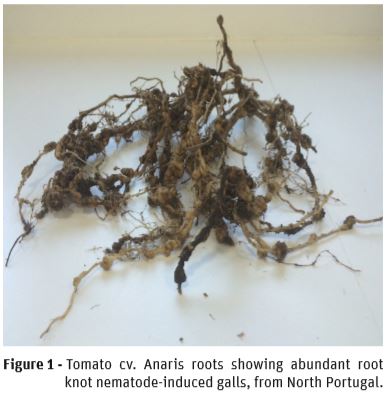
    <p><font face = "Verdana" size = "2">During parasitism, RKN establish and maintain
an intimate relationship with their host. The sign of RKN infection is the presence
of typical galls on susceptible host plant roots (<a href = "#f1">Figure 1</a>). The degree of root
galling generally depends on three factors: nematode population density, <i>Meloidogyne</i>
species and host plant species/cultivars. Nutrient and water uptake are substantially
reduced, because of the damaged root system, resulting in weak and poor-yield (Abad
<i>et al</i>., 2003). </font></p>

    <p>&nbsp;</p>

<a name = "f1"><img src = "/img/revistas/rca/v41n1/v41n1a21f1.jpg"></a>

    
]]></body>
<body><![CDATA[<p>&nbsp;</p>

    <p><font face = "Verdana" size = "2">The soil nematode management
is a very challenging task. Over the past century, to minimise crop losses caused
by RKN, nematicides were widely used, but due to the adverse impacts on the environment
and human health, their use has been reduced resulting on the elimination of several
chemicals from the marketplace (Maleita <i>et al</i>., 2011).</font></p>

    <p><font face = "Verdana" size = "2">Nowadays, the most successful approach for nematode
management relies on the development of integrated pest management (IPM) programmes
that combine control measures to maintain nematode densities below economic threshold
levels. These programmes can still be difficult to implement against aggressive
and resilient pathogens such as RKN. Nevertheless, a combination of cultural practices
(rotations with non-host crops and cover crops that favour the build-up of nematode
antagonists), resistant cultivars, and chemical soil treatments if necessary, generally
provide an acceptable control of RKN. The extent of success, however, is dependent
upon having an accurate identification of the species, definition of damage threshold
densities and resistant cultivars.</font></p>

    <p><font face = "Verdana" size = "2">The present research was undertaken to characterise morphological, biochemical
and molecularly one Portuguese isolate of<i> Meloidogyne</i> found associated with
tomato crops.  </font></p>

    <p><font face = "Verdana" size = "3"><b>MATERIAL AND METHODS</b></font></p>

    <p><font face = "Verdana" size = "2"><i>Nematode isolate</i></font></p>

    <p><font face = "Verdana" size = "2">Soil and tomato,
<i>Solanum lycopersicum</i> cv. “Anaris”, root samples were collected from a field
located in Estela – Póvoa de Varzim, Porto, North Portugal. Second-stage juveniles
(J2) obtained from soil extraction and mature females extracted from infected roots
were used to carry out the morphological, morphometrical, biochemical and molecular
characterisation.</font></p>

    <p><font face = "Verdana" size = "2"><i>Morphological and morphometrical characterisation</i></font></p>

    <p><font face = "Verdana" size = "2">Morphological and morphometric studies were conducted on J2 extracted
from soil samples by floating, sieving and centrifugal flotation method (Gooris
&amp; D’herde, 1972) and females handpicked from infected roots. The J2 were transferred
individually to a glass slide, with a drop of water, gently heat killed and observed
under an Olympus BX-41 bright field light microscope. The measurements (body length,
stylet length, tail length, hyaline terminus length and the distance between the
stylet base and dorsal oesophageal gland orifice - DGO) were made using a ProgResSpeed
XT core 5 – Jenoptik image software through drawing lines crossing approximately
the middle of the specimen’s body.</font></p>

    <p><font face = "Verdana" size = "2">Females extracted from roots were placed in glass blocks with 45%lactic acid
for two days, and the perineal patterns were prepared as described by Taylor &amp;
Netscher (1974) and observed under a light microscope. </font></p>

    ]]></body>
<body><![CDATA[<p><font face = "Verdana" size = "2"><i>Biochemical characterisation</i></font></p>

    <p><font face = "Verdana" size = "2">Young egg-laying females were hand-picked from infected
tomato roots under a stereomicroscope, transferred to an isotonic 0.9% sodium chloride
solution to prevent osmotic disruption, and then to micro-haematocrit capillary
tubes containing 5 µL of extraction buffer (20% sucrose and 1% Triton X-100). The
specimens were macerated with a pestle, frozen and stored at -20°C until electrophoresis
(no longer than 3 months). Shortly before electrophoresis, the samples were centrifuged
at 10000 g for 15 minutes at -5°C. </font></p>

    <p><font face = "Verdana" size = "2">Native polyacrylamide gel electrophoresis (PAGE) was carried out in vertical
polyacrylamide gels, 1 mm thick, in a Mini-Protean II (Bio-Rad Laboratories, Hercules,
California, USA) according to Pais <i>et al</i>. (1986). </font></p>

    <p><font face = "Verdana" size = "2">Following electrophoresis, the gels were stained for
esterase activity with the substrate &#945;-naphthyl acetate. Protein extracts of
females from a reference isolate of <i>M. javanica</i> were not possible to include
in the gel and so the esterase phenotype was compared with other <i>Meloidogyne</i>
spp. phenotypes.</font></p>

    <p><font face = "Verdana" size = "2"><i>Molecular characterisation</i></font></p>

    <p><font face = "Verdana" size = "2">For molecular analysis, total genomic DNA
was extracted from females using DNeasy Blood &amp; Tissue kit (Qiagen, Hilden,
Germany) following the manufacturer’s instructions. Before extraction, females were
transferred to Eppendorf tubes with 10 µL of sterile water, frozen in liquid nitrogen
and then crushed with a micro pestle. </font></p>

    <p><font face = "Verdana" size = "2">PCR amplification was performed using the SCAR species-specific primers
Fjav/Rjav (Zijlstra <i>et al</i>., 2000). Primers were synthesised by STAB VIDA
Facilities (Lisbon, Portugal). All PCR reactions were performed in a 25 µL final
volume using the Promega Go Taq Flexi DNA Polymerase Kit (Promega, Madison), containing
1X buffer, 2.5 mM MgCl<sub>2</sub>, 0.2 mM dNTPs, 0.5 &#956;M each primer, 1.25
U of Taq DNA Polymerase. Amplifications were carried out in a Biometra TGradient
thermo cycler (Biometra, Göttingen, Germany) using the following thermal cycling
conditions: initial denaturation at 94°C for 3 min, followed by 35 cycles of denaturation
at 94°C for 1 min, annealing at 55 ºC for 1 min and extension at 72°C for 1 min,
and a final extension at 72°C for 10 min. The products were resolved by electrophoresis
at 5 V.cm<sup>-1</sup> in agarose gel (1.5%) containing 0.5 µg/mL ethidium bromide
and 0.5X TBE running buffer. Data analysis was visualised by VersaDoc Imaging System
(BioRad, USA). </font></p>

    <p><font face = "Verdana" size = "3"><b>RESULTS AND DISCUSSION</b></font></p>

    <p><font face = "Verdana" size = "2"><i>Morphological and morphometrical characterisation</i></font></p>

    <p><font face = "Verdana" size = "2">The J2 were vermiform and slender; head not offset from body.
The stylet was slender with a sharp pointed stylet cone, cylindrical stylet shaft
and prominent stylet knobs. Stylet knobs transversely elongate and offset from stylet
shaft, hyaline tail terminus distinctive, long narrow tapering tail, finely rounded
tail tip matching the description given for <i>M. javanica</i> species</a> by Eisenback
(1985), Karssen &amp; Moens (2006) and Williams (1972). Morphometrics performed
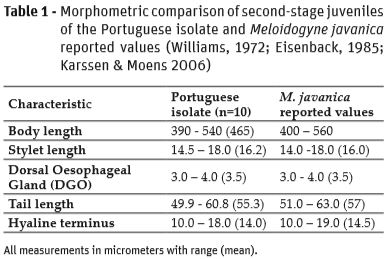
on J2 are reported in <a href = "#t1">Table 1</a>.</font></p>

    ]]></body>
<body><![CDATA[<p>&nbsp;</p>

<a name = "t1"><img src = "/img/revistas/rca/v41n1/v41n1a21t1.jpg"></a>

    
<p>&nbsp;</p>

    <p><font face = "Verdana" size = "2">Second-stage juveniles’ body length averaged 465 µm. The stylet
length was 16.2 (14.5 – 18.0) µm and the mean length of the hyaline tail terminus
was 14 µm, which is in accordance with previous descriptions of <i>M. javanica </i>(Eisenback,
1985; Karssen &amp; Moens, 2006; Williams, 1972). However, the values obtained overlap
with other <i>Meloidogyne </i>species, such as <i>M. incognita </i>and <i>M. arenaria.</i></font></p>


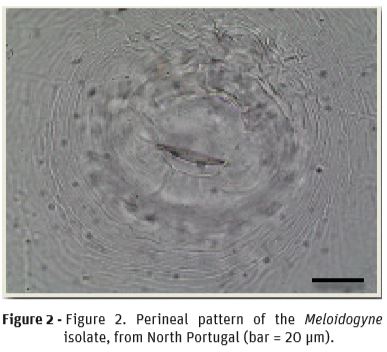
    <p><font face = "Verdana" size = "2">The perineal pattern was typical of <i>M.
javanica </i>when compared to previous reports (Eisenback, 1985). It had a rounded
pattern, striae interrupted laterally by a pair of conspicuous incisures extending
on both sides of the tail terminus, low dorsal arch is low and rounded with a whorl
in the tail terminal area (<a href = "#f2">Figure 2</a>).</font></p>

    <p>&nbsp;</p>

<a name = "f2"><img src = "/img/revistas/rca/v41n1/v41n1a21f2.jpg"></a>

    
<p>&nbsp;</p>

    <p><font face = "Verdana" size = "2">As noticed,
morphological and morphometric studies require great effort and are not always easy
even for taxonomists due to the presence of inter and intra-specific variability.
The values obtained from morphometrics overlap just as has been previously reported
and the morphology of the perineal pattern, although more useful, is still inconclusive
due to the variability among individuals, the varied expertise of the people describing
the patterns and the increase on the number of species. However, the conjunction
of morphology and morphometrics may give a small indication towards the species
identification.</font></p>

    <p><font face = "Verdana" size = "2"><i>Biochemical characterisation</i></font></p>

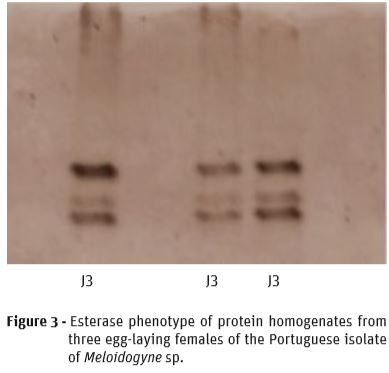
    <p><font face = "Verdana" size = "2">Esterase
phenotype was compared to esterase phenotype diagrams previously published, due
to the difficulty to include a <i>M. javanica</i> reference phenotype in the gel.
Three bands of esterase activity were detected (Rm: 54, 50 and 41) and the esterase
phenotype, apparently, was similar with earlier described phenotypes for <i>M. javanica
</i>(Dickson <i>et al</i>., 1971; Pais &amp; Abrantes, 1989) (<a href = "#f3">Figure 3</a>).</font></p>

    <p>&nbsp;</p>

<a name = "f3"><img src = "/img/revistas/rca/v41n1/v41n1a21f3.jpg"></a>

    
]]></body>
<body><![CDATA[<p>&nbsp;</p>

    <p><font face = "Verdana" size = "2">Despite having a positive result, this technique is very
restrictive as it can only be applied to a specific developmental stage (mature
females) limiting its use since agricultural soils do not contain <i>Meloidogyne</i>
adult females.</font></p>

    <p><font face = "Verdana" size = "2"><i>Molecular characterisation</i></font></p>

    <p><font face = "Verdana" size = "2">Morphological
and biochemical studies indicated that the North Portuguese isolate found associated
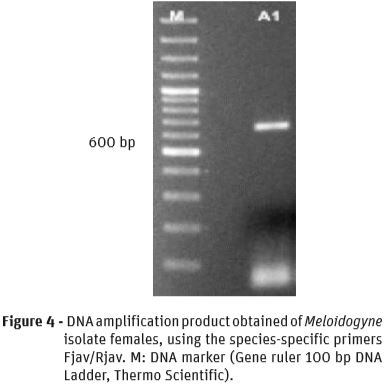
with tomato belongs to the <i>M. javanica </i>species. In order to confirm these
results, DNA amplification was carried out using <i>M. javanica</i> species-specific
primers (Fjav/Rjav). As shown in <a href = "#f4">Figure 4</a>, the fragment size obtained with species-specific
primers was 600 bp, which is consistent with previous reports (Zijlstra <i>et al.</i>,
2000) indicating the identity of the nematode as <i>M. javanica.</i></font></p>

    <p>&nbsp;</p>

<a name = "f4"><img src = "/img/revistas/rca/v41n1/v41n1a21f4.jpg"></a>

    
<p>&nbsp;</p>

    <p><font face = "Verdana" size = "2">It is important to highlight that although PCR is fast, straightforward
and able to determine the species identity irrespective of the developmental stage
and from small amounts of tissue, as reported in this study, its reliability is
uncertain due to the intraspecific variability and closeness between species. So,
morphology, morphometrics, isozyme analysis and molecular analysis complement each
other and provide a more accurate and reliable identification.</font></p>

    <p><font face = "Verdana" size = "3"><b>CONCLUSIONS</b></font></p>

    <p><font face = "Verdana" size = "2">Morphological
and morphometric identification is arduous and time consuming. Measurements overlapped
within the species and perineal patterns, although useful in the past, showed great
inter and intra-specific variability. These difficulties led the investigators to
search for other methodologies to confirm and complement RKN species identification.
Isozyme analysis has proven to be very useful despite being a very restrictive technique,
since it only works with a specific developmental stage (mature females) and requires
the inclusion of a reference isolate. Species-specific primers suggested the identity
of the North Portuguese population as <i>M. javanica.</i></font></p>

    <p><font face = "Verdana" size = "2">In conclusion, the diagnosis of species of <i>Meloidogyne</i>
is challenging because of the poorly defined boundaries among species, intraspecific
variability, potential hybrid origin, and polyploidy. Therefore, one single technique
cannot be relied upon, since <i>Meloidogyne</i> complexity requires all available
methodologies in order to get more accurate diagnoses that will lead to better management
decisions and control measures.</font></p>

    ]]></body>
<body><![CDATA[<p>&nbsp;</p>

    <p><font face = "Verdana" size = "3"><b>References</b></font></p>

    <!-- ref --><p><font face = "Verdana" size = "2">Abad, P.; Favery, B.; Rosso, M.N. &amp; Castagnone-Sereno, P. (2003)
- Root-knot nematode parasitism and host response: molecular basis of a sophisticated
interaction. <i>Molecular Plant Pathology</i>, vol. 4, n. 4, p. 217 – 224. <a href = "http://dx.doi.org/10.1046/j.1364-3703.2003.00170.x" target = "_blank">http://dx.doi.org/10.1046/j.1364-3703.2003.00170.x</a></font>&nbsp;&nbsp;&nbsp;&nbsp;&nbsp;&nbsp;&nbsp;&nbsp;[&#160;<a href="javascript:void(0);" onclick="javascript: window.open('/scielo.php?script=sci_nlinks&ref=678693&pid=S0871-018X201800010002200001&lng=','','width=640,height=500,resizable=yes,scrollbars=1,menubar=yes,');">Links</a>&#160;]<!-- end-ref --><!-- ref --><p><font face = "Verdana" size = "2">Abrantes, I.M. &amp; Santos, M.S.N. de A.
(1991) - <i>Meloidogyne lusitanica</i> n. sp. (Nematoda: Meloidogynidae), a root-knot
nematode parasitising olive tree (<i>Olea europaea</i> L.). <i>Journal of Nematology,</i>
vol. 23, n. 2, p. 210-224.    &nbsp;&nbsp;&nbsp;&nbsp;&nbsp;&nbsp;&nbsp;&nbsp;[&#160;<a href="javascript:void(0);" onclick="javascript: window.open('/scielo.php?script=sci_nlinks&ref=678694&pid=S0871-018X201800010002200002&lng=','','width=640,height=500,resizable=yes,scrollbars=1,menubar=yes,');">Links</a>&#160;]<!-- end-ref --></font></p>

    <!-- ref --><p><font face = "Verdana" size = "2">Abrantes,
I.M.; Santos, M.C.; da Conceição, I.L.P.M.; Santos, M.S.N. &amp; Volvas, N. (2008)
- Root knot and other plant parasitic nematodes associated with fig trees in Portugal.
<i>Nematologia Mediterranea, </i>vol. 36, n. 2, p. 131-136.    &nbsp;&nbsp;&nbsp;&nbsp;&nbsp;&nbsp;&nbsp;&nbsp;[&#160;<a href="javascript:void(0);" onclick="javascript: window.open('/scielo.php?script=sci_nlinks&ref=678696&pid=S0871-018X201800010002200003&lng=','','width=640,height=500,resizable=yes,scrollbars=1,menubar=yes,');">Links</a>&#160;]<!-- end-ref --></font></p>

    <!-- ref --><p><font face = "Verdana" size = "2">Conceição, I.L.P.M.; Cunha, M.J.M.; Feio, G.; Correia,
M.; Vieira dos Santos, M.C.; Abrantes, I.M.; &amp; Santos, M.S.N.; (2009) - Root-knot
nematodes, <i>Meloidogyne </i>spp., on potato in Portugal. <i>Nematology</i>, vol.
11, n. 2, p. 311-313. <a href = "http://dx.doi.org/10.1163/156854109X415515" target = "_blank">http://dx.doi.org/10.1163/156854109X415515</a></font>&nbsp;&nbsp;&nbsp;&nbsp;&nbsp;&nbsp;&nbsp;&nbsp;[&#160;<a href="javascript:void(0);" onclick="javascript: window.open('/scielo.php?script=sci_nlinks&ref=678698&pid=S0871-018X201800010002200004&lng=','','width=640,height=500,resizable=yes,scrollbars=1,menubar=yes,');">Links</a>&#160;]<!-- end-ref --><!-- ref --><p><font face = "Verdana" size = "2">Dickson, D.; Huising, D. &amp; Sasser, J.
(1971) - Dehydrogenases, acid and alkaline phosphatases and esterases for chemotaxonomy
of selected <i>Meloidogyne, Ditylenchus, Heterodera </i>and <i>Aphelenchus </i>spp.
<i>Journal of Nematology</i>, vol. 3, n. 1, p. 1-16.    &nbsp;&nbsp;&nbsp;&nbsp;&nbsp;&nbsp;&nbsp;&nbsp;[&#160;<a href="javascript:void(0);" onclick="javascript: window.open('/scielo.php?script=sci_nlinks&ref=678699&pid=S0871-018X201800010002200005&lng=','','width=640,height=500,resizable=yes,scrollbars=1,menubar=yes,');">Links</a>&#160;]<!-- end-ref --></font></p>

    ]]></body>
<body><![CDATA[<!-- ref --><p><font face = "Verdana" size = "2">Eisenback, J.D. (1985) - Detailed morphology and anatomy
of second-stage juveniles, males, and females of the genus <i>Meloidogyne</i> (root-knot
nematodes). <i>In</i>: Sasser, J.N. &amp; Carter, C.C. (Eds.) - An advanced treatise
on <i>Meloidogyne</i> Volume I (pp. 47-77) Raleigh, USA, North Carolina State University
Graphics.    &nbsp;&nbsp;&nbsp;&nbsp;&nbsp;&nbsp;&nbsp;&nbsp;[&#160;<a href="javascript:void(0);" onclick="javascript: window.open('/scielo.php?script=sci_nlinks&ref=678701&pid=S0871-018X201800010002200006&lng=','','width=640,height=500,resizable=yes,scrollbars=1,menubar=yes,');">Links</a>&#160;]<!-- end-ref --></font></p>

    <!-- ref --><p><font face = "Verdana" size = "2">EPPO (2016) - Diagnostic
protocols for regulated pests <i>Meloidogyne chitwoodi</i>, <i>Meloidogyne fallax</i>
and <i>Meloidogyne enterelobii</i>. Bulletin OEPP/EPPO</i> vol. 46, p. 171–201.    &nbsp;&nbsp;&nbsp;&nbsp;&nbsp;&nbsp;&nbsp;&nbsp;[&#160;<a href="javascript:void(0);" onclick="javascript: window.open('/scielo.php?script=sci_nlinks&ref=678703&pid=S0871-018X201800010002200007&lng=','','width=640,height=500,resizable=yes,scrollbars=1,menubar=yes,');">Links</a>&#160;]<!-- end-ref --></font></p>


    <!-- ref --><p><font face = "Verdana" size = "2">Gooris, J. &amp; D’herde, C.J. (1972) - <i>A
method for the quantitative extraction of eggs and second stage juveniles of Meloidogyne
spp. from soil</i>. Ghent, Belgium: Agricultural Research Centre, 36 p.    &nbsp;&nbsp;&nbsp;&nbsp;&nbsp;&nbsp;&nbsp;&nbsp;[&#160;<a href="javascript:void(0);" onclick="javascript: window.open('/scielo.php?script=sci_nlinks&ref=678705&pid=S0871-018X201800010002200008&lng=','','width=640,height=500,resizable=yes,scrollbars=1,menubar=yes,');">Links</a>&#160;]<!-- end-ref --></font></p>


    <!-- ref --><p><font face = "Verdana" size = "2">Hunt, D.J. &amp; Handoo, Z.A. (2009) - Taxonomy,
identification and principal species. <i>In</i>: Perry, R.N.; Moens, M. &amp; Starr,
J.L. (Eds) - <i>Root-knot nematodes</i>. Wallingford, UK, CABI Publishing, pp. 55-97.    &nbsp;&nbsp;&nbsp;&nbsp;&nbsp;&nbsp;&nbsp;&nbsp;[&#160;<a href="javascript:void(0);" onclick="javascript: window.open('/scielo.php?script=sci_nlinks&ref=678707&pid=S0871-018X201800010002200009&lng=','','width=640,height=500,resizable=yes,scrollbars=1,menubar=yes,');">Links</a>&#160;]<!-- end-ref --></font></p>


    <!-- ref --><p><font face = "Verdana" size = "2">Karssen, G. &amp; Moens, M. (2006) - Root
knot nematodes. <i>In</i>: Perry, R.N. &amp; Moens, M. (Eds) - <i>Plant Nematology</i>.
Wallingford, UK, CABI Publishing, pp. 59-90.    &nbsp;&nbsp;&nbsp;&nbsp;&nbsp;&nbsp;&nbsp;&nbsp;[&#160;<a href="javascript:void(0);" onclick="javascript: window.open('/scielo.php?script=sci_nlinks&ref=678709&pid=S0871-018X201800010002200010&lng=','','width=640,height=500,resizable=yes,scrollbars=1,menubar=yes,');">Links</a>&#160;]<!-- end-ref --></font></p>

    ]]></body>
<body><![CDATA[<!-- ref --><p><font face = "Verdana" size = "2">Maleita, C.; Santos, M.C.; Curtis, R., Powers, S., &amp; Abrantes, I.M.
(2011) - Effect of the <i>Mi</i>gene on reproduction of <i>Meloidogyne hispanica
</i>on tomato genotypes. <i>Nematology</i>, vol. 13, n. 8, p. 939–949. <a href = "http://dx.doi.org/10.1163/138855411X566449" target = "_blank">http://dx.doi.org/10.1163/138855411X566449</a></font>&nbsp;&nbsp;&nbsp;&nbsp;&nbsp;&nbsp;&nbsp;&nbsp;[&#160;<a href="javascript:void(0);" onclick="javascript: window.open('/scielo.php?script=sci_nlinks&ref=678711&pid=S0871-018X201800010002200011&lng=','','width=640,height=500,resizable=yes,scrollbars=1,menubar=yes,');">Links</a>&#160;]<!-- end-ref --><!-- ref --><p><font face = "Verdana" size = "2">Pais, C.S. &amp; Abrantes, I.M. (1989) -
Esterase and Malate dehydrogenase phenotypes in Portuguese populations of <i>Meloidogyne</i>
species. <i>Journal of Nematology</i>, vol. 21, n. 3, p. 332-346.    &nbsp;&nbsp;&nbsp;&nbsp;&nbsp;&nbsp;&nbsp;&nbsp;[&#160;<a href="javascript:void(0);" onclick="javascript: window.open('/scielo.php?script=sci_nlinks&ref=678712&pid=S0871-018X201800010002200012&lng=','','width=640,height=500,resizable=yes,scrollbars=1,menubar=yes,');">Links</a>&#160;]<!-- end-ref --> </font></p>


    <!-- ref --><p><font face = "Verdana" size = "2">Pais, C.S.; Abrantes, I.M.; Fernandes, M.F.M.
&amp; Santos, M.S.N. de A. (1986) - Técnica de electroforese aplicada ao estudo
das enzimas dos nemátodes-das-galhas-radiculares, <i>Meloidogyne </i>spp. <i>Ciência
Biológica Ecology and Systematics</i>, vol. 6, p. 19-34.    &nbsp;&nbsp;&nbsp;&nbsp;&nbsp;&nbsp;&nbsp;&nbsp;[&#160;<a href="javascript:void(0);" onclick="javascript: window.open('/scielo.php?script=sci_nlinks&ref=678714&pid=S0871-018X201800010002200013&lng=','','width=640,height=500,resizable=yes,scrollbars=1,menubar=yes,');">Links</a>&#160;]<!-- end-ref --></font></p>

    <!-- ref --><p><font face = "Verdana" size = "2">Taylor, D.P. &amp; Netscher, C. (1974) - An improved
technique for preparing perineal patterns of <i>Meloidogyne </i>spp. <i>Nematologica</i>,
vol. 20, p. 268-269. <a href = "http://dx.doi.org/10.1163/187529274X00285" target = "_blank">http://dx.doi.org/10.1163/187529274X00285</a></font>&nbsp;&nbsp;&nbsp;&nbsp;&nbsp;&nbsp;&nbsp;&nbsp;[&#160;<a href="javascript:void(0);" onclick="javascript: window.open('/scielo.php?script=sci_nlinks&ref=678716&pid=S0871-018X201800010002200014&lng=','','width=640,height=500,resizable=yes,scrollbars=1,menubar=yes,');">Links</a>&#160;]<!-- end-ref --><!-- ref --><p><font face = "Verdana" size = "2">Trudgill, D.L. &amp; Blok, V.C. (2001) -
Apomictic, polyphagous root-knot nematodes: exceptionally successful and damaging
biotrophic root pathogens. <i>Annual Review of Phytopathology, </i>vol. 39, p. 53–77.
<a href = "http://dx.doi.org/10.1146/annurev.phyto.39.1.53" target = "_blank">http://dx.doi.org/10.1146/annurev.phyto.39.1.53</a></font>&nbsp;&nbsp;&nbsp;&nbsp;&nbsp;&nbsp;&nbsp;&nbsp;[&#160;<a href="javascript:void(0);" onclick="javascript: window.open('/scielo.php?script=sci_nlinks&ref=678717&pid=S0871-018X201800010002200015&lng=','','width=640,height=500,resizable=yes,scrollbars=1,menubar=yes,');">Links</a>&#160;]<!-- end-ref --><!-- ref --><p><font face = "Verdana" size = "2">Wesemael, W.M.L.; Viaene, N. &amp; Moens, M. (2011) - Root-knot nematodes
(<i>Meloidogyne</i> spp.) in Europe. <i>European Journal of Plant Pathology</i>,
vol. 13, n. 1, p. 3–16. <a href = "http://dx.doi.org/10.1163/138855410X526831" target = "_blank">http://dx.doi.org/10.1163/138855410X526831</a></font>&nbsp;&nbsp;&nbsp;&nbsp;&nbsp;&nbsp;&nbsp;&nbsp;[&#160;<a href="javascript:void(0);" onclick="javascript: window.open('/scielo.php?script=sci_nlinks&ref=678718&pid=S0871-018X201800010002200016&lng=','','width=640,height=500,resizable=yes,scrollbars=1,menubar=yes,');">Links</a>&#160;]<!-- end-ref --><!-- ref --><p><font face = "Verdana" size = "2">Williams, K.J.O. (1972) -<i> Meloidogyne
javanica</i>. <i>In</i>: <i>CIH Descriptions of Plant-Parasitic Nematodes</i>, Set
1, No 3. Commonwealth Agricultural Bureaux, Farnham Royal, UK.    &nbsp;&nbsp;&nbsp;&nbsp;&nbsp;&nbsp;&nbsp;&nbsp;[&#160;<a href="javascript:void(0);" onclick="javascript: window.open('/scielo.php?script=sci_nlinks&ref=678719&pid=S0871-018X201800010002200017&lng=','','width=640,height=500,resizable=yes,scrollbars=1,menubar=yes,');">Links</a>&#160;]<!-- end-ref --></font></p>

    ]]></body>
<body><![CDATA[<!-- ref --><p><font face = "Verdana" size = "2">Zijlstra, C.; Donkers-Venne, D.T.H.M. &amp; Fargette,
M. (2000) - Identification of <i>Meloidogyne incognita</i>, <i>M. javanica</i> and
<i>M. arenaria</i> using sequence characterized amplified region (SCAR) based PCR
assays. <i>Nematology</i>, vol. 2, n. 8, p. 847–853. <a href = "http://dx.doi.org/10.1163/156854100750112798" target = "_blank">http://dx.doi.org/10.1163/156854100750112798</a></font>&nbsp;&nbsp;&nbsp;&nbsp;&nbsp;&nbsp;&nbsp;&nbsp;[&#160;<a href="javascript:void(0);" onclick="javascript: window.open('/scielo.php?script=sci_nlinks&ref=678721&pid=S0871-018X201800010002200018&lng=','','width=640,height=500,resizable=yes,scrollbars=1,menubar=yes,');">Links</a>&#160;]<!-- end-ref --><p>&nbsp;</p>

    <p><font face = "Verdana" size = "3"><b>Acknowledgements </b></font></p>

    <p><font face = "Verdana" size = "2">We
are extremely grateful to Maria João Camacho for her assistance, co-operation and
constant support throughout this work. Also, we would like to express our appreciation
to Ana Margarida Fontes (Laboratory of Nematology, INIAV, Portugal) for her encouragement
and willingness to help us in the identification.</font></p>

    <p>&nbsp;</p>

    <p><font face = "Verdana" size = "2">Received/recebido: 2017.03.29</font></p>

    <p><font face = "Verdana" size = "2">Received in revised form/recebido em versão revista: 2017.09.09</font></p>

    <p><font face = "Verdana" size = "2">Accepted/aceite: 2017.09.18</font></p>

     ]]></body><back>
<ref-list>
<ref id="B1">
<nlm-citation citation-type="journal">
<person-group person-group-type="author">
<name>
<surname><![CDATA[Abad]]></surname>
<given-names><![CDATA[P.]]></given-names>
</name>
<name>
<surname><![CDATA[Favery]]></surname>
<given-names><![CDATA[B.]]></given-names>
</name>
<name>
<surname><![CDATA[Rosso]]></surname>
<given-names><![CDATA[M.N.]]></given-names>
</name>
<name>
<surname><![CDATA[Castagnone-Sereno]]></surname>
<given-names><![CDATA[P.]]></given-names>
</name>
</person-group>
<article-title xml:lang="en"><![CDATA[Root-knot nematode parasitism and host response: molecular basis of a sophisticated interaction]]></article-title>
<source><![CDATA[Molecular Plant Pathology]]></source>
<year>2003</year>
<volume>4</volume>
<numero>4</numero>
<issue>4</issue>
<page-range>217 - 224</page-range></nlm-citation>
</ref>
<ref id="B2">
<nlm-citation citation-type="journal">
<person-group person-group-type="author">
<name>
<surname><![CDATA[Abrantes]]></surname>
<given-names><![CDATA[I.M.]]></given-names>
</name>
<name>
<surname><![CDATA[Santos]]></surname>
<given-names><![CDATA[M.S.N. de A.]]></given-names>
</name>
</person-group>
<article-title xml:lang="en"><![CDATA[Meloidogyne lusitanica n. sp. (Nematoda: Meloidogynidae), a root-knot nematode parasitising olive tree (Olea europaea L.)]]></article-title>
<source><![CDATA[Journal of Nematology]]></source>
<year>1991</year>
<volume>23</volume>
<numero>2</numero>
<issue>2</issue>
<page-range>210-224</page-range></nlm-citation>
</ref>
<ref id="B3">
<nlm-citation citation-type="journal">
<person-group person-group-type="author">
<name>
<surname><![CDATA[Abrantes]]></surname>
<given-names><![CDATA[I.M.]]></given-names>
</name>
<name>
<surname><![CDATA[Santos]]></surname>
<given-names><![CDATA[M.C.]]></given-names>
</name>
<name>
<surname><![CDATA[da Conceição]]></surname>
<given-names><![CDATA[I.L.P.M.]]></given-names>
</name>
<name>
<surname><![CDATA[Santos]]></surname>
<given-names><![CDATA[M.S.N.]]></given-names>
</name>
<name>
<surname><![CDATA[Volvas]]></surname>
<given-names><![CDATA[N.]]></given-names>
</name>
</person-group>
<article-title xml:lang="en"><![CDATA[Root knot and other plant parasitic nematodes associated with fig trees in Portugal]]></article-title>
<source><![CDATA[Nematologia Mediterranea]]></source>
<year>2008</year>
<volume>36</volume>
<numero>2</numero>
<issue>2</issue>
<page-range>131-136</page-range></nlm-citation>
</ref>
<ref id="B4">
<nlm-citation citation-type="journal">
<person-group person-group-type="author">
<name>
<surname><![CDATA[Conceição]]></surname>
<given-names><![CDATA[I.L.P.M.]]></given-names>
</name>
<name>
<surname><![CDATA[Cunha]]></surname>
<given-names><![CDATA[M.J.M.]]></given-names>
</name>
<name>
<surname><![CDATA[Feio]]></surname>
<given-names><![CDATA[G.]]></given-names>
</name>
<name>
<surname><![CDATA[Correia]]></surname>
<given-names><![CDATA[M.]]></given-names>
</name>
<name>
<surname><![CDATA[Vieira dosSantos]]></surname>
<given-names><![CDATA[M.C.]]></given-names>
</name>
<name>
<surname><![CDATA[Abrantes]]></surname>
<given-names><![CDATA[I.M.]]></given-names>
</name>
<name>
<surname><![CDATA[Santos]]></surname>
<given-names><![CDATA[M.S.N.]]></given-names>
</name>
</person-group>
<article-title xml:lang="en"><![CDATA[Root-knot nematodes, Meloidogyne spp., on potato in Portugal]]></article-title>
<source><![CDATA[Nematology]]></source>
<year>2009</year>
<volume>11</volume>
<numero>2</numero>
<issue>2</issue>
<page-range>311-313</page-range></nlm-citation>
</ref>
<ref id="B5">
<nlm-citation citation-type="journal">
<person-group person-group-type="author">
<name>
<surname><![CDATA[Dickson]]></surname>
<given-names><![CDATA[D.]]></given-names>
</name>
<name>
<surname><![CDATA[Huising]]></surname>
<given-names><![CDATA[D.]]></given-names>
</name>
<name>
<surname><![CDATA[Sasser]]></surname>
<given-names><![CDATA[J.]]></given-names>
</name>
</person-group>
<article-title xml:lang="en"><![CDATA[Dehydrogenases, acid and alkaline phosphatases and esterases for chemotaxonomy of selected Meloidogyne, Ditylenchus, Heterodera and Aphelenchus spp]]></article-title>
<source><![CDATA[Journal of Nematology]]></source>
<year>1971</year>
<volume>3</volume>
<numero>1</numero>
<issue>1</issue>
<page-range>1-16</page-range></nlm-citation>
</ref>
<ref id="B6">
<nlm-citation citation-type="book">
<person-group person-group-type="author">
<name>
<surname><![CDATA[Eisenback]]></surname>
<given-names><![CDATA[J.D.]]></given-names>
</name>
</person-group>
<article-title xml:lang="en"><![CDATA[Detailed morphology and anatomy of second-stage juveniles, males, and females of the genus Meloidogyne (root-knot nematodes)]]></article-title>
<person-group person-group-type="editor">
<name>
<surname><![CDATA[Sasser]]></surname>
<given-names><![CDATA[J.N.]]></given-names>
</name>
<name>
<surname><![CDATA[Carter]]></surname>
<given-names><![CDATA[C.C.]]></given-names>
</name>
</person-group>
<source><![CDATA[An advanced treatise on Meloidogyne Volume I]]></source>
<year>1985</year>
<page-range>47-77</page-range><publisher-loc><![CDATA[Raleigh ]]></publisher-loc>
<publisher-name><![CDATA[North Carolina State University Graphics]]></publisher-name>
</nlm-citation>
</ref>
<ref id="B7">
<nlm-citation citation-type="journal">
<collab>EPPO</collab>
<article-title xml:lang="en"><![CDATA[Diagnostic protocols for regulated pests Meloidogyne chitwoodi, Meloidogyne fallax and Meloidogyne enterelobii]]></article-title>
<source><![CDATA[Bulletin OEPP/EPPO]]></source>
<year>2016</year>
<volume>46</volume>
<page-range>171-201</page-range></nlm-citation>
</ref>
<ref id="B8">
<nlm-citation citation-type="book">
<person-group person-group-type="author">
<name>
<surname><![CDATA[Gooris]]></surname>
<given-names><![CDATA[J.]]></given-names>
</name>
<name>
<surname><![CDATA[D’herde]]></surname>
<given-names><![CDATA[C.J.]]></given-names>
</name>
</person-group>
<source><![CDATA[A method for the quantitative extraction of eggs and second stage juveniles of Meloidogyne spp. from soil]]></source>
<year>1972</year>
<publisher-loc><![CDATA[Ghent ]]></publisher-loc>
<publisher-name><![CDATA[Agricultural Research Centre]]></publisher-name>
</nlm-citation>
</ref>
<ref id="B9">
<nlm-citation citation-type="book">
<person-group person-group-type="author">
<name>
<surname><![CDATA[Hunt]]></surname>
<given-names><![CDATA[D.J.]]></given-names>
</name>
<name>
<surname><![CDATA[Handoo]]></surname>
<given-names><![CDATA[Z.A.]]></given-names>
</name>
</person-group>
<article-title xml:lang="en"><![CDATA[Taxonomy, identification and principal species]]></article-title>
<person-group person-group-type="editor">
<name>
<surname><![CDATA[Perry]]></surname>
<given-names><![CDATA[R.N.]]></given-names>
</name>
<name>
<surname><![CDATA[Moens]]></surname>
<given-names><![CDATA[M.]]></given-names>
</name>
<name>
<surname><![CDATA[Starr]]></surname>
<given-names><![CDATA[J.L.]]></given-names>
</name>
</person-group>
<source><![CDATA[Root-knot nematodes]]></source>
<year>2009</year>
<page-range>55-97</page-range><publisher-loc><![CDATA[Wallingford ]]></publisher-loc>
<publisher-name><![CDATA[CABI Publishing]]></publisher-name>
</nlm-citation>
</ref>
<ref id="B10">
<nlm-citation citation-type="book">
<person-group person-group-type="author">
<name>
<surname><![CDATA[Karssen]]></surname>
<given-names><![CDATA[G.]]></given-names>
</name>
<name>
<surname><![CDATA[Moens]]></surname>
<given-names><![CDATA[M.]]></given-names>
</name>
</person-group>
<article-title xml:lang="en"><![CDATA[Root knot nematodes]]></article-title>
<person-group person-group-type="editor">
<name>
<surname><![CDATA[Perry]]></surname>
<given-names><![CDATA[R.N.]]></given-names>
</name>
<name>
<surname><![CDATA[Moens]]></surname>
<given-names><![CDATA[M.]]></given-names>
</name>
</person-group>
<source><![CDATA[Plant Nematology]]></source>
<year>2006</year>
<page-range>59-90</page-range><publisher-loc><![CDATA[Wallingford ]]></publisher-loc>
<publisher-name><![CDATA[CABI Publishing]]></publisher-name>
</nlm-citation>
</ref>
<ref id="B11">
<nlm-citation citation-type="journal">
<person-group person-group-type="author">
<name>
<surname><![CDATA[Maleita]]></surname>
<given-names><![CDATA[C.]]></given-names>
</name>
<name>
<surname><![CDATA[Santos]]></surname>
<given-names><![CDATA[M.C.]]></given-names>
</name>
<name>
<surname><![CDATA[Curtis]]></surname>
<given-names><![CDATA[R.]]></given-names>
</name>
<name>
<surname><![CDATA[Powers]]></surname>
<given-names><![CDATA[S.]]></given-names>
</name>
<name>
<surname><![CDATA[Abrantes]]></surname>
<given-names><![CDATA[I.M.]]></given-names>
</name>
</person-group>
<article-title xml:lang="en"><![CDATA[Effect of the Migene on reproduction of Meloidogyne hispanica on tomato genotypes]]></article-title>
<source><![CDATA[Nematology]]></source>
<year>2011</year>
<volume>13</volume>
<numero>8</numero>
<issue>8</issue>
<page-range>939-949</page-range></nlm-citation>
</ref>
<ref id="B12">
<nlm-citation citation-type="journal">
<person-group person-group-type="author">
<name>
<surname><![CDATA[Pais]]></surname>
<given-names><![CDATA[C.S.]]></given-names>
</name>
<name>
<surname><![CDATA[Abrantes]]></surname>
<given-names><![CDATA[I.M.]]></given-names>
</name>
</person-group>
<article-title xml:lang="en"><![CDATA[Esterase and Malate dehydrogenase phenotypes in Portuguese populations of Meloidogyne species]]></article-title>
<source><![CDATA[Journal of Nematology]]></source>
<year>1989</year>
<volume>21</volume>
<numero>3</numero>
<issue>3</issue>
<page-range>332-346</page-range></nlm-citation>
</ref>
<ref id="B13">
<nlm-citation citation-type="journal">
<person-group person-group-type="author">
<name>
<surname><![CDATA[Pais]]></surname>
<given-names><![CDATA[C.S.]]></given-names>
</name>
<name>
<surname><![CDATA[Abrantes]]></surname>
<given-names><![CDATA[I.M.]]></given-names>
</name>
<name>
<surname><![CDATA[Fernandes]]></surname>
<given-names><![CDATA[M.F.M.]]></given-names>
</name>
<name>
<surname><![CDATA[Santos]]></surname>
<given-names><![CDATA[M.S.N. de A.]]></given-names>
</name>
</person-group>
<article-title xml:lang="pt"><![CDATA[Técnica de electroforese aplicada ao estudo das enzimas dos nemátodes-das-galhas-radiculares, Meloidogyne spp]]></article-title>
<source><![CDATA[Ciência Biológica Ecology and Systematics]]></source>
<year>1986</year>
<volume>6</volume>
<page-range>19-34</page-range></nlm-citation>
</ref>
<ref id="B14">
<nlm-citation citation-type="journal">
<person-group person-group-type="author">
<name>
<surname><![CDATA[Taylor]]></surname>
<given-names><![CDATA[D.P.]]></given-names>
</name>
<name>
<surname><![CDATA[Netscher]]></surname>
<given-names><![CDATA[C.]]></given-names>
</name>
</person-group>
<article-title xml:lang="en"><![CDATA[An improved technique for preparing perineal patterns of Meloidogyne spp]]></article-title>
<source><![CDATA[Nematologica]]></source>
<year>1974</year>
<volume>20</volume>
<page-range>268-269</page-range></nlm-citation>
</ref>
<ref id="B15">
<nlm-citation citation-type="journal">
<person-group person-group-type="author">
<name>
<surname><![CDATA[Trudgill]]></surname>
<given-names><![CDATA[D.L.]]></given-names>
</name>
<name>
<surname><![CDATA[Blok]]></surname>
<given-names><![CDATA[V.C.]]></given-names>
</name>
</person-group>
<article-title xml:lang="en"><![CDATA[Apomictic, polyphagous root-knot nematodes: exceptionally successful and damaging biotrophic root pathogens]]></article-title>
<source><![CDATA[Annual Review of Phytopathology]]></source>
<year>2001</year>
<volume>39</volume>
<page-range>53-77</page-range></nlm-citation>
</ref>
<ref id="B16">
<nlm-citation citation-type="journal">
<person-group person-group-type="author">
<name>
<surname><![CDATA[Wesemael]]></surname>
<given-names><![CDATA[W.M.L.]]></given-names>
</name>
<name>
<surname><![CDATA[Viaene]]></surname>
<given-names><![CDATA[N.]]></given-names>
</name>
<name>
<surname><![CDATA[Moens]]></surname>
<given-names><![CDATA[M.]]></given-names>
</name>
</person-group>
<article-title xml:lang="en"><![CDATA[Root-knot nematodes (Meloidogyne spp.) in Europe]]></article-title>
<source><![CDATA[European Journal of Plant Pathology]]></source>
<year>2011</year>
<volume>13</volume>
<numero>1</numero>
<issue>1</issue>
<page-range>3-16</page-range></nlm-citation>
</ref>
<ref id="B17">
<nlm-citation citation-type="book">
<person-group person-group-type="author">
<name>
<surname><![CDATA[Williams]]></surname>
<given-names><![CDATA[K.J.O.]]></given-names>
</name>
</person-group>
<article-title xml:lang="en"><![CDATA[Meloidogyne javanica]]></article-title>
<source><![CDATA[CIH Descriptions of Plant-Parasitic Nematodes]]></source>
<year>1972</year>
<volume>1</volume>
<publisher-loc><![CDATA[Farnham Royal ]]></publisher-loc>
<publisher-name><![CDATA[Commonwealth Agricultural Bureaux]]></publisher-name>
</nlm-citation>
</ref>
<ref id="B18">
<nlm-citation citation-type="journal">
<person-group person-group-type="author">
<name>
<surname><![CDATA[Zijlstra]]></surname>
<given-names><![CDATA[C.]]></given-names>
</name>
<name>
<surname><![CDATA[Donkers-Venne]]></surname>
<given-names><![CDATA[D.T.H.M.]]></given-names>
</name>
<name>
<surname><![CDATA[Fargette]]></surname>
<given-names><![CDATA[M.]]></given-names>
</name>
</person-group>
<article-title xml:lang="en"><![CDATA[Identification of Meloidogyne incognita, M. javanica and M. arenaria using sequence characterized amplified region (SCAR) based PCR assays]]></article-title>
<source><![CDATA[Nematology]]></source>
<year>2000</year>
<volume>2</volume>
<numero>8</numero>
<issue>8</issue>
<page-range>847-853</page-range></nlm-citation>
</ref>
</ref-list>
</back>
</article>