<?xml version="1.0" encoding="ISO-8859-1"?><article xmlns:mml="http://www.w3.org/1998/Math/MathML" xmlns:xlink="http://www.w3.org/1999/xlink" xmlns:xsi="http://www.w3.org/2001/XMLSchema-instance">
<front>
<journal-meta>
<journal-id>0871-018X</journal-id>
<journal-title><![CDATA[Revista de Ciências Agrárias]]></journal-title>
<abbrev-journal-title><![CDATA[Rev. de Ciências Agrárias]]></abbrev-journal-title>
<issn>0871-018X</issn>
<publisher>
<publisher-name><![CDATA[Sociedade de Ciências Agrárias de Portugal]]></publisher-name>
</publisher>
</journal-meta>
<article-meta>
<article-id>S0871-018X2018000100027</article-id>
<article-id pub-id-type="doi">10.19084/RCA17233</article-id>
<title-group>
<article-title xml:lang="en"><![CDATA[Study on yield values of two irrigation systems in adult chestnut trees and comparison with non-irrigated chestnut orchard]]></article-title>
<article-title xml:lang="pt"><![CDATA[Estudo de rentabilidade entre dois sistemas de rega em castanheiros adultos e comparação com soutos não regados]]></article-title>
</title-group>
<contrib-group>
<contrib contrib-type="author">
<name>
<surname><![CDATA[Mota]]></surname>
<given-names><![CDATA[Margarida]]></given-names>
</name>
<xref ref-type="aff" rid="A1"/>
</contrib>
<contrib contrib-type="author">
<name>
<surname><![CDATA[Pinto]]></surname>
<given-names><![CDATA[Teresa]]></given-names>
</name>
<xref ref-type="aff" rid="A1 "/>
</contrib>
<contrib contrib-type="author">
<name>
<surname><![CDATA[Marques]]></surname>
<given-names><![CDATA[Tiago]]></given-names>
</name>
<xref ref-type="aff" rid="A2"/>
</contrib>
<contrib contrib-type="author">
<name>
<surname><![CDATA[Borges]]></surname>
<given-names><![CDATA[António]]></given-names>
</name>
<xref ref-type="aff" rid="A3"/>
</contrib>
<contrib contrib-type="author">
<name>
<surname><![CDATA[Caço]]></surname>
<given-names><![CDATA[João]]></given-names>
</name>
<xref ref-type="aff" rid="A4"/>
</contrib>
<contrib contrib-type="author">
<name>
<surname><![CDATA[Raimundo]]></surname>
<given-names><![CDATA[Fernando]]></given-names>
</name>
<xref ref-type="aff" rid="A1 "/>
</contrib>
<contrib contrib-type="author">
<name>
<surname><![CDATA[Gomes-Laranjo]]></surname>
<given-names><![CDATA[José]]></given-names>
</name>
<xref ref-type="aff" rid="A1 "/>
</contrib>
</contrib-group>
<aff id="AA1">
<institution><![CDATA[,Universidade de Trás os Montes e Alto Douro CITAB ]]></institution>
<addr-line><![CDATA[Vila Real ]]></addr-line>
<country>Portugal</country>
</aff>
<aff id="AA2">
<institution><![CDATA[,Universidade de Trás os Montes e Alto Douro ECVA ]]></institution>
<addr-line><![CDATA[Vila Real ]]></addr-line>
<country>Portugal</country>
</aff>
<aff id="AA3">
<institution><![CDATA[,Geosil Empreendimentos Agro-silvícolas ]]></institution>
<addr-line><![CDATA[Sortes Bragança]]></addr-line>
<country>Portugal</country>
</aff>
<aff id="AA4">
<institution><![CDATA[,Hubel Verde, SA.  ]]></institution>
<addr-line><![CDATA[Olhão ]]></addr-line>
<country>Portugal</country>
</aff>
<pub-date pub-type="pub">
<day>00</day>
<month>03</month>
<year>2018</year>
</pub-date>
<pub-date pub-type="epub">
<day>00</day>
<month>03</month>
<year>2018</year>
</pub-date>
<volume>41</volume>
<numero>1</numero>
<fpage>251</fpage>
<lpage>260</lpage>
<copyright-statement/>
<copyright-year/>
<self-uri xlink:href="http://scielo.pt/scielo.php?script=sci_arttext&amp;pid=S0871-018X2018000100027&amp;lng=en&amp;nrm=iso"></self-uri><self-uri xlink:href="http://scielo.pt/scielo.php?script=sci_abstract&amp;pid=S0871-018X2018000100027&amp;lng=en&amp;nrm=iso"></self-uri><self-uri xlink:href="http://scielo.pt/scielo.php?script=sci_pdf&amp;pid=S0871-018X2018000100027&amp;lng=en&amp;nrm=iso"></self-uri><abstract abstract-type="short" xml:lang="en"><p><![CDATA[Different types of irrigation systems can be used in chestnut orchards. To understand which one grants higher yield values treatments were applied in adult trees: drip system - TI; micro-sprinkler system - SI; non-irrigated system - NI. The study covers two years in the northeast of Portugal. Irrigation was triggered every time stem water potential was lower than -1.2 MPa. The study considers costs with the equipment, water and labour, and the income from the chestnuts’ sale. Due to the hotter conditions of 2016 more water was supplied (93 mm) than in 2015 (47 mm). Little more water was furnished in SI (73 mm) than in TI (67 mm). Production was 27% higher in irrigated (48 kg/tree) than in NI trees (38 kg/tree) and in relation to the canopy’s area (kg/m²) the TI produced 18% and SI 29% more than NI. Annual costs were higher with irrigation (4654, 4549 and 1530 €/ha for SI, TI and NI, respectively) but the higher income (22126, 21984 and 16174 €/ha for TI, SI and NI respectively) made up for the investment. The profits from irrigated trees can be 22% or 37% higher than in non irrigated ones, for 1 ha or 5 ha, respectively.]]></p></abstract>
<abstract abstract-type="short" xml:lang="pt"><p><![CDATA[Para avaliar qual dos dois sistemas de rega se revela mais eficiente em castanheiro, foram estudados três tratamentos: sistema de gota-a-gota - TI; sistema de micro-aspersão - SI; sistema não irrigado - NI. O estudo abrange dois anos no nordeste de Portugal. A rega foi ativada sempre que o potencial hídrico de ramo era inferior a -1,2 MPa. O estudo considera os custos com equipamentos, água e mão-de-obra e os proveitos da venda das castanhas. O ano 2016 foi mais quente tendo sido fornecida mais água (93 mm) do que em 2015 (47 mm). Foi fornecida um pouco mais em SI (73 mm) do que em TI (67 mm). A produção foi 27% superior nas árvores regadas (48 kg/árvore) do que em NI (38 kg/árvore) e em relação à área da copa (kg/m²), TI produziu 18% mais do que o controlo NI, assim como o SI produziu mais 29%. Os custos anuais foram maiores em SI (4654 €/ha) e TI (4549 €/ha) do que em NI (1530 €/ha), tendo a maior receita compensado o investimento (22126 €/há TI, 21984 €/ha SI e 16174 €/ha NI). Os lucros das árvores regadas pode ser 22% ou 37% maior do que as não irrigadas, para 1 ha ou 5 ha, respetivamente.]]></p></abstract>
<kwd-group>
<kwd lng="en"><![CDATA[Castanea sativa Mill.]]></kwd>
<kwd lng="en"><![CDATA[water management]]></kwd>
<kwd lng="en"><![CDATA[water potential]]></kwd>
<kwd lng="en"><![CDATA[production]]></kwd>
<kwd lng="en"><![CDATA[economic]]></kwd>
<kwd lng="pt"><![CDATA[Castanea sativa Mill.]]></kwd>
<kwd lng="pt"><![CDATA[gestão da água]]></kwd>
<kwd lng="pt"><![CDATA[potencial de ramo]]></kwd>
<kwd lng="pt"><![CDATA[produção]]></kwd>
<kwd lng="pt"><![CDATA[balanço económico]]></kwd>
</kwd-group>
</article-meta>
</front><body><![CDATA[ 

    <p align = "right"><font face = "Verdana" size = "2"><b>ARTIGO</b></font></p>

    <p><font face = "Verdana" size = "4"><b>Study on yield values
of two irrigation systems in adult chestnut trees and comparison with non-irrigated
chestnut orchard</b></font></p>

    <p><font face = "Verdana" size = "3"><b>Estudo de rentabilidade entre dois sistemas
de rega em castanheiros adultos e comparação com soutos não regados</b></font></p>

    <p><font face = "Verdana" size = "2"><b>Margarida Mota</b><sup>1*</sup>,
<b>Teresa Pinto</b><sup>1,2</sup>, <b>Tiago Marques</b><sup>2</sup>, <b>António Borges</b><sup>3</sup>,
<b>João Caço</b><sup>4</sup>, <b>Fernando Raimundo</b><sup>1,2 </sup>and <b>José Gomes-Laranjo</b><sup>1,2</sup></font></p>


    <p><font face = "Verdana" size = "2"><i><sup>1</sup>CITAB, Universidade de Trás
os Montes e Alto Douro, Vila Real, Portugal</i></font></p>

    <p><font face = "Verdana" size = "2"><i><sup>2</sup>ECVA, Universidade de Trás os Montes e Alto Douro, Vila
Real, Portugal</i></font></p>

    <p><font face = "Verdana" size = "2"><i><sup>3</sup>Geosil
– Empreendimentos Agro-silvícolas, Sortes, Bragança, Portugal</i></font></p>

 
    <p><font face = "Verdana" size = "2"><i><sup>4</sup>Hubel Verde, SA.- Engenharia
Agronómica, Pechão, 8700-179 Olhão, Portugal</i></font></p>

    <p><font face = "Verdana" size = "2"><i>(*E-mail: <a href = "mailto:mmota@hubel.pt">mmota@hubel.pt</a>)</i></font></p>

<hr noshade size = 1>

    ]]></body>
<body><![CDATA[<p><font face = "Verdana" size = "3"><b>ABSTRACT</b></font></p>

    <p><font face = "Verdana" size = "2">Different types of irrigation systems can be used in chestnut
orchards. To understand which one grants higher yield values treatments were applied
in adult trees: drip system - TI; micro-sprinkler system - SI; non-irrigated system
- NI. The study covers two years in the northeast of Portugal. Irrigation was triggered
every time stem water potential was lower than -1.2 MPa. The study considers costs
with the equipment, water and labour, and the income from the chestnuts’ sale. Due
to the hotter conditions of 2016 more water was supplied (93 mm) than in 2015 (47
mm). Little more water was furnished in SI (73 mm) than in TI (67 mm). Production
was 27% higher in irrigated (48 kg/tree) than in NI trees (38 kg/tree) and in relation
to the canopy’s area (kg/m<sup>2</sup>) the TI produced 18% and SI 29% more than
NI. Annual costs were higher with irrigation (4654, 4549 and 1530 €/ha for SI, TI
and NI, respectively) but the higher income (22126, 21984 and 16174 €/ha for TI,
SI and NI respectively) made up for the investment. The profits from irrigated trees
can be 22% or 37% higher than in non irrigated ones, for 1 ha or 5 ha, respectively.
</font></p>

    <p><font face = "Verdana" size = "2"><b>Keywords: </b><i>Castanea
sativa </i>Mill., water management, water potential, production, economic.</font></p>

<hr noshade size = 1>

    <p><font face = "Verdana" size = "3"><b>RESUMO</b></font></p>

    <p><font face = "Verdana" size = "2">Para avaliar qual dos dois sistemas de rega se revela mais eficiente em castanheiro,
foram estudados três tratamentos: sistema de gota-a-gota - TI; sistema de micro-aspersão
- SI; sistema não irrigado - NI. O estudo abrange dois anos no nordeste de Portugal.
A rega foi ativada sempre que o potencial hídrico de ramo era inferior a -1,2 MPa.
O estudo considera os custos com equipamentos, água e mão-de-obra e os proveitos
da venda das castanhas. O ano 2016 foi mais quente tendo sido fornecida mais água
(93 mm) do que em 2015 (47 mm). Foi fornecida um pouco mais em SI (73 mm) do que
em TI (67 mm). A produção foi 27% superior nas árvores regadas (48 kg/árvore) do
que em NI (38 kg/árvore) e em relação à área da copa (kg/m<sup>2</sup>), TI produziu
18% mais do que o controlo NI, assim como o SI produziu mais 29%. Os custos anuais
foram maiores em SI (4654 €/ha) e TI (4549 €/ha) do que em NI (1530 €/ha), tendo
a maior receita compensado o investimento (22126 €/há TI, 21984 €/ha SI e 16174
€/ha NI). Os lucros das árvores regadas pode ser 22% ou 37% maior do que as não
irrigadas, para 1 ha ou 5 ha, respetivamente.</font></p>

    <p><font face = "Verdana" size = "2"><b>Palavras-chave: </b><i>Castanea sativa </i>Mill., gestão da água,
potencial de ramo, produção, balanço económico</font></p>

<hr noshade size = 1>

    <p><font face = "Verdana" size = "3"><b>INTRODUCTION</b></font></p>

    <p><font face = "Verdana" size = "2">Over the past decades global chestnut production has
slowly integrated new techniques of agricultural production transitioning from a
forestry crop to a fruit crop. This is especially true in China, the world’s largest
chestnut producer (1.650.000 tons; FAO, 2012), in some orchards in France (Vernol, 2013) and Chile
(Valderrama, 2016). However, this is not as common as it seems in Portugal, the
third largest European chestnut producer with 27.337 tons in 35.436 hectares (INE,
2015). Nevertheless, Portuguese producers have been implementing some new techniques
on chestnut orchards such as ink disease resistant rootstocks, hybrid varieties,
irrigation, adequate fertilizations and high tree densities (Gomes-Laranjo <i>et
al</i>., 2016). The definition of the better suited irrigation is a common discussion
topic within the Portuguese chestnut sector. According to Pereira and Trout (1999)
there are three main categories of irrigation systems: 1) surface/gravity irrigation
systems - those that depend on gravity to spread the water across the surface of
the land; 2) sprinkler systems – in which water is pressurized with a pump, distributed
to areas of the fields through pipes or hoses, and sprayed across the soil surface
with rotating nozzles or sprayers; and 3) micro irrigation/drip or trickle systems
- these systems use regularly spaced emitters on or in the tubing to drip or spray
water onto or into the soil. As far as we know there was only one trial conducted
by Jayne (2005) that compares different types of irrigation system (drip, sprinkler
and micro sprinkler) in a chestnut orchard.  However, the choice of the type of
irrigation system is not merely dependent on a singular crop but it must consider
several factors such as water availability and its purity, soil permeability and
its water storage capacity, topography, product value, labour costs, energy costs,
capital and technology requirement (Pereira, 2004). According to INE (2015) in Portugal only 447 ha are actually
irrigated and on the newest 835 ha planted within the year 2007-2013, 23% are irrigated
(PRODER, 2014). In France it is frequent to irrigate chestnut orchards below 50
years of age (Vernol, 2013) and in Chile, the irrigation became common in the new
chestnut plantations (Valderrama, 2016). The irrigation systems found in the different
orchards of these countries vary from the drip system (with one or two pipes per
tree row) to the micro-sprinkler system (with the pipe suspended above the tree
trunk and the emitters facing downward). Both these irrigation systems operate
at low pressure therefore they require less energy for water pumpage resulting in
fewer costs when compared to other high pressure irrigation systems (Talens, 2009;
MSU, 2017). According to some authors (Pereira, 2004; MSU, 2017) the drip system
has the advantage that can be used in conditions unsuitable for other irrigation
methods on steep and undulating slopes, in very sandy soils and in fields with widely
varying soils. Drip irrigation places water precisely where it is needed and apply
it with a high degree of uniformity, so it lessens water running off the lower end
of the field and deep percolation water flowing down through the soil past the root
zone where cannot be used by the crop. These features make drip irrigation potentially
much more efficient than other irrigation methods which can translate to significant
water savings. Drip irrigation can only achieve this level of high efficiency if
the system is carefully designed and managed in order to prevent issues such as
emitter clogging and differences in emitter flow rates stemming from pressure variations
in the irrigation system or from differences in emitters and flow passages originating
in the manufacturing process (Talens, 2009; MSU, 2017). The hanging micro-sprinkler
system meets two of the chestnut growers’ expectations: the weeds are better controlled
with proper equipment rather than using herbicides and the largest wet area increases
the probability to enhance mushroom production which represents a supplementary
income to the producer (Marques, 2007; Martins <i>et al.,</i> 2011). </font></p>


    <p><font face = "Verdana" size = "2">The main intention of this work is to evaluate
the costs and benefits of two different irrigation systems installed on an adult
chestnut orchard and in the end to assess their usefulness to chestnut production
based on a study of profitability. This study relies on data obtained from experimental
research of two years about water management in an orchard of adult chestnuts trees
that can be consulted for more details in Mota <i>et al.</i> (2017).  </font></p>

    <p><font face = "Verdana" size = "3"><b>MATERIAL AND METHODOS</b></font></p>

 
    ]]></body>
<body><![CDATA[<p><font face = "Verdana" size = "2"><i>Site description </i></a></font></p>

   
    <p><font face = Verdana size = 2>The trial was conducted during 2015 and 2016, in
Sortes, a small town belonging to the Bragança Council, located in the northeast
of Portugal (41°39'28.16&quot;N; 6°50'37.09&quot;W) at 862 m above sea level. It
was carried in a commercial chestnut orchard planted in 1993. The total study area
is1.5 ha surrounded by border trees and guard trees within sample trees. The rootstocks
are seedlings from <i>Castanea sativa</i> Mill. and they are grafted at 2 m height
with ‘Judia’ variety scions. Trees are spaced 5 meters by 10 meters, with a plant
density of 200 plants per hectare. Since the first years of plantation the soil
is kept with seeded legumes (annual reseeding and perennial) and grass-plot (annual
and perennial) that are cut for straw-bale in June. The soil, to the depth of 30
cm, has a medium texture, pH of 5.5, 3.1% of organic matter, low values of phosphorous
(39 mg P<sub>2</sub>O<sub>5</sub>.kg<sup>-1</sup>) and a medium level of potassium
(101 mg K<sub>2</sub>O.kg<sup>-1</sup>) measured by Égner-Riehm method (Egnér <i>et
al.,</i> 1960). </font></p>

    <p><font face = "Verdana" size = "2"><i>Treatments </i></font></p>

    <p><font face = "Verdana" size = "2">Two types of irrigation
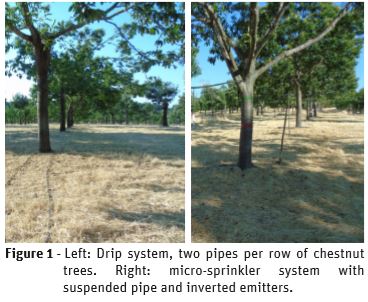
systems were used on the chestnut orchard: a drip system (TI) (<a href = "#f1">Figure 1</a>, left) and
a micro sprinkler system (SI) (<a href = "#f1">Figure 1</a>, right) and a control treatment with no
irrigation (NI). The irrigation was triggered when the midday stem water potential
(&#936;w<sub>md</sub>) was bellow -1.2 MPa. The irrigation system features are shown
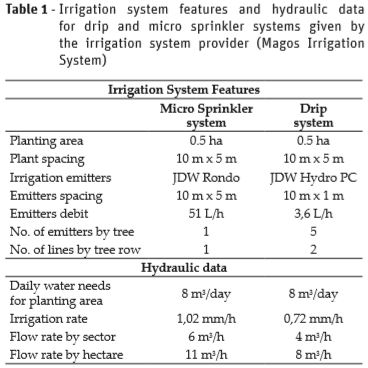
in <a href = "#t1">Table 1</a>. Each one of these treatments corresponds to 0.5 ha (about 100 trees).</font></p>

    <p>&nbsp;</p>

<a name = "f1"><img src = "/img/revistas/rca/v41n1/v41n1a26f1.jpg"></a>

    
<p>&nbsp;</p>

<a name = "t1"><img src = "/img/revistas/rca/v41n1/v41n1a26t1.jpg"></a>

    
<p>&nbsp;</p>

    <p><font face = "Verdana" size = "2">Both irrigation systems
shared the main intake structure which includes a submersible water pump and a compression
system equipped with a threaded wedge valve, a disc filter (John Deere Water 7000),
a water counter (Arad Multijet) and a 500-litre hydro pneumatic flask and accessories.
The main intake structure also includes an irrigation controller (Progrés Agronic
2500) and the fertigation system. The fertigation system is composed by two 500-litre
deposits for fertilizer and one injection pump (Doseuro A175N-47-19, 226 L/h 8 kg).
Water comes from borehole. This water bore was made 30 years ago and its cost is
not considered on this study.</font></p>

    <p><font face = "Verdana" size = "2"><i>Data collection.</i></font></p>

    <p><font face = "Verdana" size = "2"><u>Plant,
soil and climatic data:</u> For the purpose of water management, from June to October
of 2015 and 2016, the &#936;w<sub>md </sub>was monitored<sub> </sub>every 7-10 days
in ten trees per treatment (n = 30). &#936;w<sub>md</sub> was measured using a pressure
chamber (Model &quot;pump-up&quot; PMS Instrument® Corvallis, Oregon, USA) according
to the methodology recommended by the manufacturer and adapted by Fulton <i>et al.
</i>(2014). One leaf per tree was covered by an aluminium foil and plastic bag for
at least 40 minutes before excision. The &#936;w<sub>md</sub> readings were made
between 12:00-h and 13:30-h. The soil water content (&#952;) was monitored every
7-10 days with a capacitive probe (Diviner 2000, Sentek Technologies) from July
to October. Access tubes were installed about one meter from the tree’s trunk, one
tube per tree, in six trees per treatment (n = 18). The probe registers the soil
water values every 10 cm until 80 cm depth. To give an overview of the climatic
conditions of 2015 and 2016, general meteorological data were gathered from the
agro-meteorological bulletins given by the Portuguese Institute of the Sea and Atmosphere
on its website (<a href = "http://www.ipma.pt" target = "_blank">www.ipma.pt</a>) which uses data from
a meteorological station located 20 km away from the study site. Growing degree-days
(GDD, ºD) was calculated according to Cesaraccio <i>et al.</i> (2001): &#931;Temperature
(ºD) = (T<sub>med</sub> – T<sub>0</sub>) * n: where “T<sub>med</sub>&#8223; is the
average temperature of each month, “T<sub>0</sub>” the base temperature, which was
considered 6 ºC for chestnuts (Gomes-Laranjo <i>et al.</i>, 2008) and “n” the total
days of each month. </font></p>

    ]]></body>
<body><![CDATA[<p><font face = "Verdana" size = "2"><i>Chestnut production and price</i></font></p>


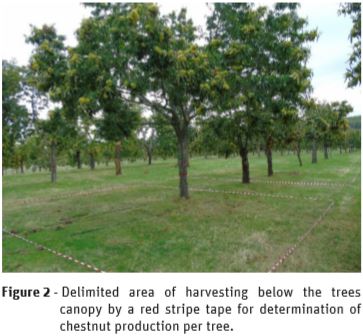
    <p><font face = "Verdana" size = "2"><u>Chestnut’s orchard yield.</u> An area
of harvest beneath the canopy of each tree (n=30) was delimited using stripe tape
(<a href = "#f2">Figure 2</a>). The chestnuts that dropped within the delimited area were caught and
weighted on the field with a manual scale. Chestnut production per tree is given
in kilograms of fresh weight (FW). The chestnut orchard yield is given in ton FW/hectare.
The production per meters squared of the tree's canopy (kg FW/m<sup>2</sup>) was
also calculated.</font></p>

    <p>&nbsp;</p>

<a name = "f2"><img src = "/img/revistas/rca/v41n1/v41n1a26f2.jpg"></a>

    
<p>&nbsp;</p>

    <p><font face = "Verdana" size = "2"><u>Chestnuts’
calibre</u>. Thirty urchins were collected from each treatment in 2015 and 2016.
The healthy chestnuts (n = 185 in 2015; n = 211 in 2016) were used to determine
the calibre (fruits per kilogram). The chestnuts were weighted (fresh weight) in
a digital scale.</font></p>

    <p><font face = "Verdana" size = "2"><u>Chestnuts’
market price</u>. The average value of the chestnut market price was consulted in
the website of the governmental database - GPP-SIMA (System of Agricultural Market
Information), <a href = "http://www.gpp.pt/sima.html" target = "_blank">http://www.gpp.pt/sima.html</a>.
In Portugal, the chestnut is marketed in bags of 50 kg. The price is dependent on
the calibre and on the period of harvesting; being higher in the early and late
seasons. The harvest of ‘Judia’ in the Trás-os-Montes region occurs during the mid-season.</font></p>

    <p><font face = "Verdana" size = "2"><i>Economic, natural and labour resources</i></font></p>

    <p><font face = "Verdana" size = "2"><u>Economic
resources.</u> The economic resource refers to the investment made in the acquisition
and installation of the irrigation system as well as the equipment for monitoring
trees (pressure chamber) and soil (capacitance probe). It also includes the maintenance
and the electric costs for the pump of the irrigation system. The maintenance cost
equates to 3% of the total investment.</font></p>

    <p><font face = "Verdana" size = "2"><u>Water resources.</u> The water resource refers to the water volume
(W, in m<sup>3</sup>) used during the year for irrigation and its cost. The average
water cost was calculated taking as reference the price of 0.06 €/m<sup>3</sup>,
given after an informal survey on different entities’ data.</font></p>

    <p><font face = "Verdana" size = "2"><u>Labour resources.</u> The labour resource considers
the time spent on monitoring the soil and tree parameters needed for irrigation
decision as well as the time spent on chestnut harvesting. This last parameter depends
on chestnut’s production, variety and weather conditions. According to the chestnut
orchards owners’ registries, in general, a person can harvest about 25 kg/h (200
kg/day) originating harvest’s cost of 0.20 €/kg. Two minutes per tree are needed
to monitor the &#936;w<sub>md</sub>, including covering the leaf with aluminium
foil and plastic bag but excluding the forty minutes needed before the readings.
Ten trees were monitored per treatment, once a week, so this cost was of 1.7 € per
week per treatment. The other types of labour such as pruning, fertilization, hay
cut or phytosanitary interventions were not accounted for.  </font></p>

    ]]></body>
<body><![CDATA[<p><font face = "Verdana" size = "2"><i>Study on yield values</i></font></p>

    <p><font face = "Verdana" size = "2">The data gathered from chestnut production and from
the economic, water and labour resources found in the experimental trial was used
to evaluate the yield values achieved on the chestnut orchard. The data is extrapolated
for one and for five hectares in orchards with similar conditions to the studied
one such as plant’s density and chestnut’s production per tree. The main intake
structure, pressure chamber and capacitance probe are investments considered separately
for each irrigation system type. </font></p>

    <p><font face = "Verdana" size = "2"><i>Statistical analysis</i></font></p>

    <p><font face = "Verdana" size = "2">Results of soil water content, &#936;w<sub>md</sub>, tree production and chestnut
calibre were analysed using the StatView 4.0 (Abacus Concept) software and comparisons
were made with Fisher test (p &lt; 0.05).</font></p>

    <p><font face = "Verdana" size = "3"><b>RESULTS</b></font></p>

    <p><font face = "Verdana" size = "2"><i>Plant and climatic data and irrigation events</i></font></p>

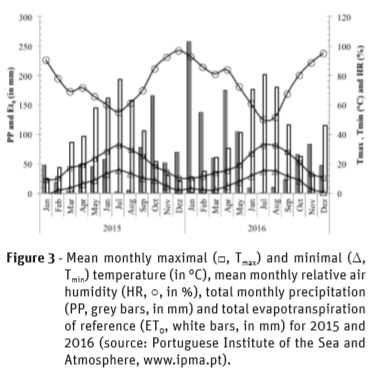
    <p><font face = "Verdana" size = "2">The average
values of monthly maximal (T<sub>max</sub>) and minimal (T<sub>min</sub>) air temperature,
and monthly relative air humidity (HR) as well as the monthly cumulative precipitation
(PP) along the months of 2015 and 2016 are shown in <a href = "#f3">Figure 3</a>. The rainy period typically
goes from September to May. In 2016 the period between June and October was drier
(total PP of 211 mm) when compared to 2015 (total PP of 310 mm) and it had higher
T<sub>max</sub> in August, September and October (32°C, 28°C and 21°C respectively).
The total degree-day from May to October was of 2,348 °C in 2015 and 2,504 °C in
2016. </font></p>
    <p>&nbsp;</p>

<a name = "f3"><img src = "/img/revistas/rca/v41n1/v41n1a26f3.jpg"></a>

    
<p>&nbsp;</p>

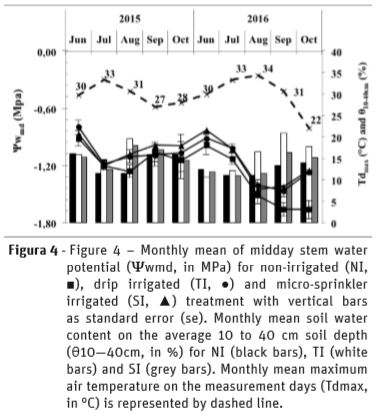
    <p><font face = "Verdana" size = "2">The monthly mean of &#936;w<sub>md </sub>(±
se) in 2015 was -1.08 ± 0.06 MPa for TI and FI and -1.15 ± 0.09 MPa for NI. The
monthly mean &#936;w<sub>md </sub>in 2016 was -1.14 ± 0.09 MPa (TI), -1.15 ± 0.06
MPa (SI) and -1.34 ± 0.08 MPa (NI) (<a href = "#f4">Figure 4</a>). Concerning the annual mean soil water
content for the 10-40 cm depth it was higher in 2015 (14% in NI; 17% in TI; 15%
in SI) than in 2016 (12% in NI; 16% in TI; 13% in SI). </font></p>

    ]]></body>
<body><![CDATA[<p>&nbsp;</p>

<a name = "f4"><img src = "/img/revistas/rca/v41n1/v41n1a26f4.jpg"></a>

    
<p>&nbsp;</p>

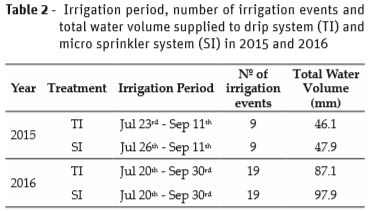
    <p><font face = "Verdana" size = "2">In 2016, because of the drier and hotter conditions, the &#936;w<sub>md </sub>was
generally lower than in 2015 which led to different irrigation events and total
water volume allocated in each year (<a href = "#t2">Table 2</a>). For both years, the irrigation period
started in the third week of July (end of flowering) but it finished later in 2016
(in the end of September). The water supplied in 2015 was 53% and 49% lower than
in 2016 for TI and SI, respectively. </font></p>
    <p>&nbsp;</p>

<a name = "t2"><img src = "/img/revistas/rca/v41n1/v41n1a26t2.jpg"></a>

    
<p>&nbsp;</p>

    <p><font face = "Verdana" size = "2"><i>Chestnut production and market price</i></font></p>

    <p><font face = "Verdana" size = "2">In 2015 the harvest occurred from October 22<sup>th</sup> until November
11<sup>th</sup> while in 2016 it started one week later (October 28<sup>th</sup>
until November 25<sup>th</sup>). The chestnut production per tree was about 27%,
16% and 33% higher in 2015 than in 2016 for TI, SI and NI respectively (<a href = "/img/revistas/rca/v41n1/v41n1a26t3.jpg" target = "_blank">Table 3</a>).
The chestnut orchard yield on TI was 9.7 ton FW/ha, 9.6 ton FW/ha in SI and 7.7
ton FW/ha in NI. The production per canopy’s area reduced from 2015 to 2016 about
21%, 10% and 31% for TI, SI and NI respectively. In both years, the NI trees had
the lowest chestnut production (0.87 kg/m<sup>2</sup>) while TI and SI had 1.0 and
1.1 kg/m<sup>2</sup>, respectively, which represents 18% and 29% more production
than NI. In spite of variation in nut production within treatments there was not
a statistical difference.</font></p>

    
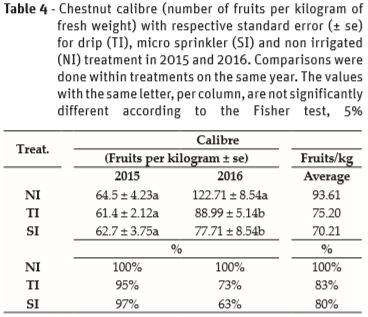
<p><font face = "Verdana" size = "2">The calibre (fruits per kilogram) was higher
in 2016 for all treatments which mean that fruits were smaller in this year (<a href = "#t4">Table
4</a>). The calibre was always higher in NI (93 fruits/kg) than in TI (75 fruits/kg)
or SI (70 fruits/kg). Statistical analysis revealed no difference on the calibre
in 2015 but irrigated trees had significantly bigger fruits in 2016 than non irrigated
ones. </font></p>
    <p>&nbsp;</p>

<a name = "t4"><img src = "/img/revistas/rca/v41n1/v41n1a26t4.jpg"></a>

    
<p>&nbsp;</p>

    ]]></body>
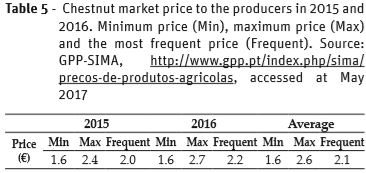
<body><![CDATA[<p><font face = "Verdana" size = "2">Market prices of 50 kg bags of the ‘Judia’ variety sold during
the harvest period of both years are given in <a href = "#t5">Table 5</a>. The chestnut harvest occurred
during the mid-season of Trás-os-Montes region then the called ‘frequent price’
is the one considered for ‘Judia’. The frequent price slightly increased in 2016
(2.2 €/kg) compared with 2015 (2.0 €/kg). </font></p>
    <p>&nbsp;</p>

<a name = "t5"><img src = "/img/revistas/rca/v41n1/v41n1a26t5.jpg"></a>

    
<p>&nbsp;</p>

    <p><font face = "Verdana" size = "2"><i>Economic, natural and labour resources</i></a></font></p>

    <p><font face = "Verdana" size = "2"><a href = "/img/revistas/rca/v41n1/v41n1a26t6.jpg" target = "_blank">Table 6</a> shows the economic resources used in the trial of
2015 and 2016, in 0.5 ha. The costs of the investment in irrigation systems in 2015
includes the material and installation of the main intake structure (5,429.92 €),
the fertigation equipment (1,813.72 €) and the distribution system for TI (2,282.90
€) and SI (2,659.47 €). The main intake structure and fertigation system were, in
practice, common costs for both TI and SI systems but they are considered separately.
The SI is slightly more expensive not only due to the materials but because installing
the emitters on the pipe and extending the pipe over the trees requires more time
and labour. In 2016, the economic resources were the annual maintenance costs which
are considered to be 3% of the investment. Regarding water resources, more water
was used in 2016 than in 2015 for both treatments and costs varied from 14 € to
29 € in half a hectare. The cost to harvesting in these two years was 967 €, 959
€ and 765 € per 0.5 ha for TI, SI and NI respectively (<a href = "/img/revistas/rca/v41n1/v41n1a26t6.jpg" target = "_blank">Table 6</a>).</font></p>

    
<p><font face = "Verdana" size = "2"><i>Study on yield potential </i></font></p>

    <p><font face = "Verdana" size = "2">From
the data gathered over these two years is now possible to show the yield potential
of the investment on irrigation system in 1 ha of an adult and healthy chestnut
orchard with 200 trees of the ‘Judia’ variety (<a href = "/img/revistas/rca/v41n1/v41n1a26t7.jpg" target = "_blank">Table 7</a>). The total investment in
the drip system is of 16,521 €/ha and 17,274 €/ha for the micro-sprinkler system,
including pumping system, water hole, compression system, fertigation system, irrigation
controller, distribution system and monitoring equipment. The amortization of these
investments is calculated over eight years and the annual maintenance cost is considered
to be 3% of it (<a href = "/img/revistas/rca/v41n1/v41n1a26t7.jpg" target = "_blank">Table 7</a>). The total annual volume of water furnished varies depending
on the year’s weather conditions (defined as hotter or mild year when GDD &gt; 2400°D
or below GDD &lt; 2400°D, respectively) and stem water potential. So, considering
2015 and 2016, it can range from 460 – 870 m<sup>3</sup>/ha in TI and from 480 to
979 m<sup>3</sup>/ha in SI system with annual costs varying from 28 to 52 €/ha and
29 to 59 €/ha for TI and SI, respectively. The chestnut production can range from
6.6 to 8.7 ton FW/ha in NI, 8.5 to 10.8 ton FW/ha in TI and 8.9 to 10.3 ton FW/ha
in SI. According to Martins <i>et al.</i> (2011) calibres above 90 could depreciate
0.20 € per kilogram within the same period of harvest. For 2015, all calibres of
the different treatments were below 90 (<a href = "#t4">Table 4</a>) so the market price considered
was 2.2 €/kg. However, in 2016, the market price for NI was of 2.0 €/kg while for
TI and SI it was 2.4 €/kg. In general, the profits generated due to the benefits
of the irrigation system can increase up to 42% in the hotter years, in comparison
to non-irrigated systems during the amortization period and certainly they increase
after it.</font></p>

    
<p><font face = "Verdana" size = "2"><a href = "/img/revistas/rca/v41n1/v41n1a26t8.jpg" target = "_blank">Table 8</a> shows the cost of the investment in detail for each
irrigation system on five hectares. The investment on irrigation can be up to 23,756
€ in 5 ha (SI) and 19,990 € in 5 ha for TI. </font></p>

    
<p><font face = "Verdana" size = "2">The investment is naturally
higher than for one hectare but some components have similar costs such as the fertigation
system, water hole and the irrigation controller. As a consequence the profits will
be up to 59% higher than in NI, in the hotter years (<a href = "/img/revistas/rca/v41n1/v41n1a26t9.jpg" target = "_blank">Table 9</a>). </font></p>

    
<p><font face = "Verdana" size = "3"><b>DISCUSSION</b></font></p>


    ]]></body>
<body><![CDATA[<p><font face = "Verdana" size = "2">Water management based on the &#936;w<sub>md</sub>
of the chestnut tree is very dynamic because it implies frequent readings of the
tree water status which in turn reveals a particular response to specific weather
and soil conditions (Shackel <i>et al</i>., 2000) resulting in not-fixed irrigation
events. In this case, irrigation events occurred every time the &#936;w<sub>md </sub>was
lower than -1.2 MPa which, according to Mota <i>et al.</i> (2014) in a previous
study on the same orchard, the &#936;w<sub>md </sub>at -1.2 MPa reflects a higher
photosynthetic rate and good soil moisture. Under the hotter temperatures and long
dry period in 2016 chestnut trees revealed a great need of water and more irrigation
events were programmed. Independently of the irrigation system, the &#936;w<sub>md</sub>
was identical between irrigated trees and consequently the same number of irrigation
events occurred although water consumption was higher in SI. Based on this fact
alone, the drip system looks like a better option because with less water than the
micro sprinkler system, the production was identical. Still, the mean annual water
amount used in this study (666 m<sup>3</sup>/ha in drip and 729 m<sup>3</sup>/ha
in micro-sprinkler) was much lower than the water used in chestnut trees on a study
carried out by Jayne (2005). In Jayne (2005) the micro sprinkler system on the full
(100% ET<sub>0</sub>) and deficit (50% ET<sub>0</sub>) modality used 2,570 and 2,020
m<sup>3</sup>/ha, respectively, while the drip system used 940 and 1,420 m<sup>3</sup>/ha
on the deficit and full modality, respectively. Naturally these differences are
related with the irrigation strategy followed by the author together with the different
ages and density of trees, tree variety, regional climatic conditions and soil type.
For instance, in Martins <i>et al.</i> (2011) the irrigation schedule followed on
chestnut trees from 2006 to 2008 was based on the predawn leaf water potential and
irrigation was triggered when it was lower than -0.6 MPa. As a result, the water
volume was lower (mean of 767 m<sup>3</sup>/ha) than those used in Jayne (2005)
and it was within the values found in our study. Therefore, the irrigation strategy
based on &#936;w<sub>md </sub>rather than in ET<sub>0 </sub>suggests a better use
and savings of water. Actually, Lampinen <i>et al.</i> (2001) and Shackel <i>et
al.</i> (2000) also refer water savings in prune trees when irrigation scheduling
is based on &#936;w<sub>md</sub>. The use of &#936;w<sub>md </sub>for irrigation
scheduling has the inconvenient of the time required for bagged leaves to reach
equilibrium with the stem as well as the interval of readings (1300 to 1500HR) which
restricts the hectares that can be monitored by one person with a pressure chamber
(Fulton <i>et al.</i>, 2001). However, the same author found out that in prune,
almond and walnut trees the shaded leaves in the interior of the canopy rapidly
align with stem water potential (minimum of 10 minutes) once transpiration is stopped
with a reflective impermeable bag. Thus, it is relevant to test the same procedure
on chestnut trees to save time and reduce costs with the monitoring.</font></p>


    <p><font face = "Verdana" size = "2">According to INE (2016) the total national
chestnut production decreased from 2015 to 2016 and fruit size was smaller. The
chestnut production decreasing was noticeable in this study in all treatments but
irrigated trees had less variation than the control, and the micro-sprinkler trees
revealed more stability from 2015 to 2016. The high temperatures in 2016 may explain
the decrease of the production. For instance, in July (T<sub>max</sub> = 32°C) when
flowering occurred, there were several days with temperatures above 30°C which may
have constrained pollination and the photosynthesis rate which is maximal when temperatures
are between 24 to 27°C (Gomes-Laranjo <i>et al.,</i> 2008). It remains unknown if
there was a possible effect of the micro-sprinkler on the decreasing of the air
temperature below the tree canopy that may have helped the chestnut production.
The productivity calculated in our study was in terms of fresh weight and above
7 ton FW/ha. Considering an average dry matter (DM) of the Portuguese varieties
is of around 45 to 50% (Ferreira-Cardoso, 2007; Portela <i>et al</i>., 2007) our
results are in accordance with Martins <i>et al.</i> (2010, 2011) who reported production
values between 19 to 27 kg of DM per tree, equivalent to a fresh-weight 2 to 3 ton
FW/ha. This yield and ours are clearly far away from the national yield reported
by INE (2015) which is around 0.8 ton/ha. However it must be keep in mind that the
statistics for national chestnut productivity includes also areas with low productivity
(new plantations or very old trees), areas with high tree’s mortality without replacement,
areas with high incidence of diseases (ink and blight) which lowers production (Marcelino
<i>et al.</i>, 2000) and areas where bad soil preparation or maintenance constraints
chestnut trees’ production (Raimundo, 2003). On the other hand, national statistics
exclude the chestnuts that are traded in the parallel market which is underestimated
as well as the ones for auto consume by the producers (Gomes-Laranjo <i>et al</i>.,
2016). For these reasons, we consider that the yield found in this study is close
to the realistic situation of the Portuguese ‘Judia’ variety production in healthy
and adult chestnut orchards although the trees’ density is uncommonly high.  Dinis
<i>et al</i>. (2011) found different calibres in ‘Judia’ variety depending on the
temperature sum and bigger fruits (46 to 66 chestnuts/kg) were found when degree-days
(from May to October) ranged from 2000 to 2200 °D. In our study, with higher degree
days (&gt; 2400 °D) , chestnuts were bigger in irrigated treatments (73 chestnuts/kg)
and the calibres were within the values found by Pimentel-Pereira <i>et al.</i>
(2007) for ‘Judia’ variety (71 to 79 chestnuts/kg). In the portuguese market, which
is mainly for fresh consumption, the differences in price due to the calibre are
not very clear but the industrial market privileges big chestnuts with calibres
between 50 to 90 chestnuts/kg (Breisch, 1993; Ferreira-Cardoso, 2007). The calibre
is influenced by edapho-climatic conditions (Ferreira-Cardoso, 2007; Dinis <i>et
al.,</i> 2011) and the watering, whatever the irrigation system, helps to achieve
bigger chestnuts as shown in Martins <i>et al.</i> (2011) and in our results. Curiously,
Jayne (2005) found bigger chestnuts in the non irrigated trees and in trees irrigated
with the drip system at 50%ET<sub>0. </sub>This may be explained by the reduced
number of fruits per tree which allow them to increase their size due to more assimilation
but this was not verified in our study. </font></p>

    <p><font face = "Verdana" size = "2">Finally, the most important is to evaluate either if the investment on
the irrigation system is profitable or not on an adult orchard already in production.
In SUMMARY, irrigated trees produce 27% more chestnuts than none irrigated trees
increasing the annual income from 16,174 €/ha to 22,055 €/ha. This additional income
pays the costs with amortization, water, maintenance and labour and still generates
a profit of more than 17,000 €/ha which easily increases after the amortization
period. Non-irrigated trees are also a viable solution but with lower profits (14,644
€/ha). In Martins <i>et al</i>. (2011) a brief income estimate is presented for
irrigated and non-irrigated chestnut trees both with seeded pastures which are more
like to our irrigated treatments and NI modality, respectively. According to the
author, the chestnut production generates 2,775 €/ha and 4,198 €/ha (70 trees/ha),
for none irrigated and irrigated trees respectively. These outputs can even increase
up to 3,851 to 5,835 €/ha if the forage and commercial mushrooms are marketed (Martins
<i>et al.,</i> 2011). In the expected increase in productivity due to fertigation
and tree maturity,  which will naturally increase the income in all treatments together
with  the forage and mushrooms production, were not taken into account. Still, the
income estimated by our study is higher than in Martins <i>et al.</i> (2011) either
due to tree’s density or due to the higher market price in 2015 and 2016. The price
considered by Martins <i>et al. </i>(2011) was of 1 to 1.2 €/kg and becomes clear
the high valorisation that the chestnuts’ have been over the last decade. </font></p>


    <p><font face = "Verdana" size = "2">The gain obtained with irrigation in one
hectare can relatively be higher if the irrigation system is expanded to more area
because the investment in the main intake structure is virtually the same for one
or more hectares due to common equipment. This was clear when comparing the profits
from one with five irrigated hectares. The profits can increase 22% up to 37% more
in one and in five hectares, respectively, when comparing to the non-irrigation
system. There is an evident economy of scale when more hectares are irrigated because
costs per unit go down (Duffy, 2009; Rasmussen, 2013). The drip system appears to
be a better option because, for similar income, it uses less water which is important
when the water is scarce. However, specific crop practices can constrain the decisions
of which irrigation system is preferable. For instance, the drip system with pipes
resting on the soil constraints the use of a brush cutter to control weeds or can
be dragged by cattle feet. The weed controls on drip systems could be overcome by
the use of herbicides but these are harmful for the soil biotic life and prejudicial
to the chestnut production as previous studies have shown (Raimundo, 2003). In alternative,
the suspended irrigation system overcomes these constraints. Also, the size of the
wetted area can be a key point if mushroom production is to be considered. The mushrooms
appear naturally in chestnut orchards (Marques, 2007) and their production and diversity
is enhanced by irrigation (Martins <i>et al</i>., 2011). In drip systems the wetted
area is smaller than with the sprinkler system (Pereira, 2004) and this last one
may be interesting if the intention is to irrigate chestnuts trees and at same time
to improve mushrooms production.  However, micro-sprinkler system can easily wet
the chestnut trunk which is not desirable if there is a presence of <i>Cyphonectria
parasitica </i>since it developed well in humid conditions (Magalhães <i>et al</i>.,
2016). Future studies about mushroom production and its additional income for chestnut
orchards under two different irrigation systems should be conducted. Also, studies
about irrigation on young trees should be conducted aiming the reduction of plant
mortality on the first few years as well as to anticipate the beginning of nut production.
Additionally, the subsurface irrigated system can be an interesting option for new
plantations because of water savings (Payero <i>et al</i>., 2005) and the restrictions
on the crop practices would be overcome. However, it must be highlighted, that whatever
the irrigation system, its performance is dependent of the project design, proper
installation and maintenance, and proper water management (Pereira, 2004; Payero
<i>et al</i>., 2005).</font></p>

    <p><font face = "Verdana" size = "3"><b>CONCLUSION</b></font></p>

    <p><font face = "Verdana" size = "2">Bellow
the current market prices, the investment on irrigation in adult chestnut trees
is safe in rainfed adult and healthy chestnut orchards with similar features as
the ones studied. However, more than the costs with the investment, the mushroom's
production and crop practices may be decisive in the moment of choose the type of
irrigation, as soon as there is water availability guaranteed.</font></p>

    <p>&nbsp;</p>

    <p><font face = "Verdana" size = "3"><b>References</b></font></p>

    <!-- ref --><p><font face = "Verdana" size = "2"><i>Breisch</i>,
H. (<i>1993) - Harvesting, storage and processing of chestnuts in France
and Italy. In: Antognozzi, E. (Ed.) – Proceedings of the International
Congress on Chestnut</i>. Spoleto, Italy. p. 429-436.    &nbsp;&nbsp;&nbsp;&nbsp;&nbsp;&nbsp;&nbsp;&nbsp;[&#160;<a href="javascript:void(0);" onclick="javascript: window.open('/scielo.php?script=sci_nlinks&ref=679414&pid=S0871-018X201800010002700001&lng=','','width=640,height=500,resizable=yes,scrollbars=1,menubar=yes,');">Links</a>&#160;]<!-- end-ref --></font></p>


    ]]></body>
<body><![CDATA[<!-- ref --><p><font face = "Verdana" size = "2">Cesaraccio, C.D.; Duce, P. &amp; Snyder,
R.L. (2001) - An improved model for determining degree-day values from daily temperature
data. <i>International Journal of Biometeorology</i>, vol. 45, n. 4, p. 161-169.
<a href = "http://dx.doi.org/10.1007/s004840100104" target = "_blank">http://dx.doi.org/10.1007/s004840100104</a></font>&nbsp;&nbsp;&nbsp;&nbsp;&nbsp;&nbsp;&nbsp;&nbsp;[&#160;<a href="javascript:void(0);" onclick="javascript: window.open('/scielo.php?script=sci_nlinks&ref=679416&pid=S0871-018X201800010002700002&lng=','','width=640,height=500,resizable=yes,scrollbars=1,menubar=yes,');">Links</a>&#160;]<!-- end-ref --><!-- ref --><p><font face = "Verdana" size = "2">Dinis, L.T.; Ferreira-Cardoso, J.; Peixoto, F.; Costa, R. &amp; Gomes-Laranjo,
J. (2011) - Study of morphological and chemical diversity in chestnut trees (var.
‘Judia’) as a function of temperature sum. <i>CyTA - Journal of Food</i>, vol. 9,
n. 3, p. 192-199. <a href = "http://dx.doi.org/10.1080/19476337.2010.512394" target = "_blank">http://dx.doi.org/10.1080/19476337.2010.512394</a></font>&nbsp;&nbsp;&nbsp;&nbsp;&nbsp;&nbsp;&nbsp;&nbsp;[&#160;<a href="javascript:void(0);" onclick="javascript: window.open('/scielo.php?script=sci_nlinks&ref=679417&pid=S0871-018X201800010002700003&lng=','','width=640,height=500,resizable=yes,scrollbars=1,menubar=yes,');">Links</a>&#160;]<!-- end-ref --><!-- ref --><p><font face = "Verdana" size = "2">Duffy, M. (2009) - Economies of Size in Production
Agriculture. <i>Journal of Hunger &amp; Environmental Nutrition</i>, vol. 4, n.
3-4, p. 375–392. <a href = "http://dx.doi.org/10.1080/19320240903321292" target = "_blank">http://dx.doi.org/10.1080/19320240903321292</a></font>&nbsp;&nbsp;&nbsp;&nbsp;&nbsp;&nbsp;&nbsp;&nbsp;[&#160;<a href="javascript:void(0);" onclick="javascript: window.open('/scielo.php?script=sci_nlinks&ref=679418&pid=S0871-018X201800010002700004&lng=','','width=640,height=500,resizable=yes,scrollbars=1,menubar=yes,');">Links</a>&#160;]<!-- end-ref --><!-- ref --><p><font face = "Verdana" size = "2">Egnér, H.; Riehm, H. &amp; Domingo, W.R. (1960) - Untersuchhungen
uber die chemische boden: Analyse als grundlage fur die beurteilung der nahrstoffzustandes
der boden II. Chemique extractions, methoden zur phosphor, und kalium&#8208;bestimmung.
<i>Kungliga Lantbrukshoegsk Annales, </i>vol. 26, p. 199–215.    &nbsp;&nbsp;&nbsp;&nbsp;&nbsp;&nbsp;&nbsp;&nbsp;[&#160;<a href="javascript:void(0);" onclick="javascript: window.open('/scielo.php?script=sci_nlinks&ref=679419&pid=S0871-018X201800010002700005&lng=','','width=640,height=500,resizable=yes,scrollbars=1,menubar=yes,');">Links</a>&#160;]<!-- end-ref --> </font></p>

    <!-- ref --><p><font face = "Verdana" size = "2">FAO (2012)<b> – </b>[cit. 2014-10-05]. &lt;<a href = "http://www.fao.org/faostat/en/#data/QV" target = "_blank">http://www.fao.org/faostat/en/#data/QV</a>&gt;    &nbsp;&nbsp;&nbsp;&nbsp;&nbsp;&nbsp;&nbsp;&nbsp;[&#160;<a href="javascript:void(0);" onclick="javascript: window.open('/scielo.php?script=sci_nlinks&ref=679421&pid=S0871-018X201800010002700006&lng=','','width=640,height=500,resizable=yes,scrollbars=1,menubar=yes,');">Links</a>&#160;]<!-- end-ref -->.</font></p>


    <!-- ref --><p><font face = "Verdana" size = "2">Ferreira-Cardoso, J. (2007) - Valorização
da castanha portuguesa, características tecnológicas e nutricionais. <i>In:</i>
Gomes-Laranjo, J. <i>et al</i>. (Eds). <i>Castanheiros</i>. Vila Real, p. 281-348,
ISBN: 978-972-669-844-9.    &nbsp;&nbsp;&nbsp;&nbsp;&nbsp;&nbsp;&nbsp;&nbsp;[&#160;<a href="javascript:void(0);" onclick="javascript: window.open('/scielo.php?script=sci_nlinks&ref=679423&pid=S0871-018X201800010002700007&lng=','','width=640,height=500,resizable=yes,scrollbars=1,menubar=yes,');">Links</a>&#160;]<!-- end-ref --></font></p>

    <!-- ref --><p><font face = "Verdana" size = "2">Fulton,
A.; Buchner, R.; Olson, B.; Schwankl, L.; Gilles, C.; Bertagna, N.; Walton, J. &amp;
Shackel, K. (2001) - Rapid Equilibration of Leaf and Stem Water Potential under
Field Conditions in Almonds, Walnuts, and Prunes. <i>Hortechnology, </i>vol. 11,
n. 4, p. 609-615.    &nbsp;&nbsp;&nbsp;&nbsp;&nbsp;&nbsp;&nbsp;&nbsp;[&#160;<a href="javascript:void(0);" onclick="javascript: window.open('/scielo.php?script=sci_nlinks&ref=679425&pid=S0871-018X201800010002700008&lng=','','width=640,height=500,resizable=yes,scrollbars=1,menubar=yes,');">Links</a>&#160;]<!-- end-ref --> </font></p>

    <!-- ref --><p><font face = "Verdana" size = "2">Fulton, A.;
Grant, J.; Buchner, R. &amp; Connel, J. (2014) - Using pressure chamber for irrigation
management in Walnut, Almond and Prune. <i>ANR Publication</i> 8503. [cit. 2014-10-05].
&lt;<a href = "http://arncatalog.ucanr.edu" target = "_blank">http://arncatalog.ucanr.edu</a>&gt;    &nbsp;&nbsp;&nbsp;&nbsp;&nbsp;&nbsp;&nbsp;&nbsp;[&#160;<a href="javascript:void(0);" onclick="javascript: window.open('/scielo.php?script=sci_nlinks&ref=679427&pid=S0871-018X201800010002700009&lng=','','width=640,height=500,resizable=yes,scrollbars=1,menubar=yes,');">Links</a>&#160;]<!-- end-ref -->.</font></p>


    <!-- ref --><p><font face = "Verdana" size = "2">Gomes-Laranjo, J.; Coutinho, J.P. &amp; Peixoto,
F. (2008) - Ecophysiological characterization of <i>C. sativa </i>Mill. <i>Acta
Horticulturae</i>, vol. 784, p. 99-105. <a href = "https://doi.org/10.17660/ActaHortic.2008.784.14" target = "_blank">https://doi.org/10.17660/ActaHortic.2008.784.14</a></font>&nbsp;&nbsp;&nbsp;&nbsp;&nbsp;&nbsp;&nbsp;&nbsp;[&#160;<a href="javascript:void(0);" onclick="javascript: window.open('/scielo.php?script=sci_nlinks&ref=679429&pid=S0871-018X201800010002700010&lng=','','width=640,height=500,resizable=yes,scrollbars=1,menubar=yes,');">Links</a>&#160;]<!-- end-ref --><!-- ref --><p><font face = "Verdana" size = "2">Gomes-Laranjo, J.; Peixoto, F. &amp; Ferreira-Cardoso,
J. (2016) – <i>Castanheiros, técnicas e práticas.</i> 2<sup>nd</sup> Ed., Pulido
Consulting (Ed.),Vila Real. ISBN: 978-989-96241-0-8.    &nbsp;&nbsp;&nbsp;&nbsp;&nbsp;&nbsp;&nbsp;&nbsp;[&#160;<a href="javascript:void(0);" onclick="javascript: window.open('/scielo.php?script=sci_nlinks&ref=679430&pid=S0871-018X201800010002700011&lng=','','width=640,height=500,resizable=yes,scrollbars=1,menubar=yes,');">Links</a>&#160;]<!-- end-ref --></font></p>

    <!-- ref --><p><font face = "Verdana" size = "2">INE (2015) - <i>Estatísticas Agrícolas 2015</i>. Instituto
Nacional de Estatística, ISBN: 978-989-25-0360-8.    &nbsp;&nbsp;&nbsp;&nbsp;&nbsp;&nbsp;&nbsp;&nbsp;[&#160;<a href="javascript:void(0);" onclick="javascript: window.open('/scielo.php?script=sci_nlinks&ref=679432&pid=S0871-018X201800010002700012&lng=','','width=640,height=500,resizable=yes,scrollbars=1,menubar=yes,');">Links</a>&#160;]<!-- end-ref --></font></p>

    <!-- ref --><p><font face = "Verdana" size = "2">INE (2016) - <i>Boletim Mensal da Agricultura e Pescas – Dezembro
2016</i>. Instituto Nacional de Estatística, I.P. ISSN 1647-1040</font>&nbsp;&nbsp;&nbsp;&nbsp;&nbsp;&nbsp;&nbsp;&nbsp;[&#160;<a href="javascript:void(0);" onclick="javascript: window.open('/scielo.php?script=sci_nlinks&ref=679434&pid=S0871-018X201800010002700013&lng=','','width=640,height=500,resizable=yes,scrollbars=1,menubar=yes,');">Links</a>&#160;]<!-- end-ref --><!-- ref --><p><font face = "Verdana" size = "2">Jayne, E. (2005) - <i>Châtaignier Optimisation
des techniques d’irrigation.</i> SEFRA/Chambre d'Agriculture de l'Ardèche. [cit.
2017-01-29]. &lt;<a href = "http://rhone-alpes.synagri.com/synagri/pj.nsf/TECHPJPARCLEF/03131/$File/irriga.pdf?OpenElement" target = "_blank">http://rhone-alpes.synagri.com/synagri/pj.nsf/TECHPJPARCLEF/03131/$File/irriga.pdf?OpenElement</a>&gt;    &nbsp;&nbsp;&nbsp;&nbsp;&nbsp;&nbsp;&nbsp;&nbsp;[&#160;<a href="javascript:void(0);" onclick="javascript: window.open('/scielo.php?script=sci_nlinks&ref=679435&pid=S0871-018X201800010002700014&lng=','','width=640,height=500,resizable=yes,scrollbars=1,menubar=yes,');">Links</a>&#160;]<!-- end-ref --></font></p>


    <!-- ref --><p><font face = "Verdana" size = "2">Lampinen, B.; Shackel, K.; Southwick, S.
&amp; Olson, W. (2001) - Deficit irrigation strategies using midday stem water potential
in prune. <i>Irrigation Science</i>, vol. 20, n. 2, p.47–54. <a href = "http://dx.doi.org/10.1007/s002710000028" target = "_blank">http://dx.doi.org/10.1007/s002710000028</a></font>&nbsp;&nbsp;&nbsp;&nbsp;&nbsp;&nbsp;&nbsp;&nbsp;[&#160;<a href="javascript:void(0);" onclick="javascript: window.open('/scielo.php?script=sci_nlinks&ref=679437&pid=S0871-018X201800010002700015&lng=','','width=640,height=500,resizable=yes,scrollbars=1,menubar=yes,');">Links</a>&#160;]<!-- end-ref --><!-- ref --><p><font face = "Verdana" size = "2">Magalhães, B.; Matos, F. &amp; Martins, L.
(2016) - Cancro do castanheiro. <i>In:</i> Gomes-Laranjo, J.; Peixoto, F. &amp;
Ferreira-Cardoso, J. (Eds.) – <i>Castanheiros, técnicas e práticas. </i>2<sup>nd</sup>
Ed., Pulido Consulting (Ed.), Vila Real, p. 143-147. ISBN: 978-989-96241-0-8</font>&nbsp;&nbsp;&nbsp;&nbsp;&nbsp;&nbsp;&nbsp;&nbsp;[&#160;<a href="javascript:void(0);" onclick="javascript: window.open('/scielo.php?script=sci_nlinks&ref=679438&pid=S0871-018X201800010002700016&lng=','','width=640,height=500,resizable=yes,scrollbars=1,menubar=yes,');">Links</a>&#160;]<!-- end-ref --><!-- ref --><p><font face = "Verdana" size = "2">Marcelino, V.; Torres, N.; Portela, E. &amp;
Martins, A. (2000) - Soil physical properties and the occurrence of chestnut ink
disease: a micromorphological study. <i>Ecologia Mediterranea</i>, vol. 26, p. 129–135.    &nbsp;&nbsp;&nbsp;&nbsp;&nbsp;&nbsp;&nbsp;&nbsp;[&#160;<a href="javascript:void(0);" onclick="javascript: window.open('/scielo.php?script=sci_nlinks&ref=679439&pid=S0871-018X201800010002700017&lng=','','width=640,height=500,resizable=yes,scrollbars=1,menubar=yes,');">Links</a>&#160;]<!-- end-ref --></font></p>


    <!-- ref --><p><font face = "Verdana" size = "2">Marques, G. (2007) - Micorrizas e cogumelos.
<i>In:</i> Gomes-Laranjo, J. <i>et al</i>. (Eds). <i>Castanheiros.</i> Vila Real,
p. 260-280, ISBN: 978-972-669-844-9.    &nbsp;&nbsp;&nbsp;&nbsp;&nbsp;&nbsp;&nbsp;&nbsp;[&#160;<a href="javascript:void(0);" onclick="javascript: window.open('/scielo.php?script=sci_nlinks&ref=679441&pid=S0871-018X201800010002700018&lng=','','width=640,height=500,resizable=yes,scrollbars=1,menubar=yes,');">Links</a>&#160;]<!-- end-ref --></font></p>

    <!-- ref --><p><font face = "Verdana" size = "2">Martins, A.; Raimundo, F.; Borges, O.; Linhares, I.; Sousa, V.; Coutinho,
J.P.; Gomes-Laranjo, J. &amp; Madeira, M. (2010) - Effects of soil management practices
and irrigation on plant water relations and productivity of chestnut stands under
Mediterranean conditions. <i>Plant and Soil</i>, vol. 327, n. 1-2, p. 57-70. <a href = "http://dx.doi.org/10.1007/s11104-009-0031-0" target = "_blank">http://dx.doi.org/10.1007/s11104-009-0031-0</a></font>&nbsp;&nbsp;&nbsp;&nbsp;&nbsp;&nbsp;&nbsp;&nbsp;[&#160;<a href="javascript:void(0);" onclick="javascript: window.open('/scielo.php?script=sci_nlinks&ref=679443&pid=S0871-018X201800010002700019&lng=','','width=640,height=500,resizable=yes,scrollbars=1,menubar=yes,');">Links</a>&#160;]<!-- end-ref --><!-- ref --><p><font face = "Verdana" size = "2">Martins, A.; Marques, G.; Borges, O.; Portela,
E.; Lousada, J.; Raimundo, F. &amp; Madeira, M. (2011) - Management of chestnut
plantations for a multifunctional land use under Mediterranean conditions: effects
on productivity and sustainability. <i>Agroforestry Systems, </i>vol. 81, n. 2,
p. 175–189. <a href = "http://dx.doi.org/10.1007/s10457-010-9355-2" target = "_blank">http://dx.doi.org/10.1007/s10457-010-9355-2</a></font>&nbsp;&nbsp;&nbsp;&nbsp;&nbsp;&nbsp;&nbsp;&nbsp;[&#160;<a href="javascript:void(0);" onclick="javascript: window.open('/scielo.php?script=sci_nlinks&ref=679444&pid=S0871-018X201800010002700020&lng=','','width=640,height=500,resizable=yes,scrollbars=1,menubar=yes,');">Links</a>&#160;]<!-- end-ref --><!-- ref --><p><font face = "Verdana" size = "2">Mota, M.; Pinto, T.; Marques, T.; Borges, A.; Raimundo,
F.; Veiga, V. &amp; Gomes-Laranjo, J. (2014) - Efeito da rega na produtividade fotossintética
dos castanheiros. <i>Actas Portuguesas de Horticultura</i>, vol. 23, p. 166–173.    &nbsp;&nbsp;&nbsp;&nbsp;&nbsp;&nbsp;&nbsp;&nbsp;[&#160;<a href="javascript:void(0);" onclick="javascript: window.open('/scielo.php?script=sci_nlinks&ref=679445&pid=S0871-018X201800010002700021&lng=','','width=640,height=500,resizable=yes,scrollbars=1,menubar=yes,');">Links</a>&#160;]<!-- end-ref --></font></p>


    <!-- ref --><p><font face = "Verdana" size = "2">Mota, M.; Pinto,<sup> </sup>T.; Marques,
T.; Borges, A.; Caço, J.; Raimundo,<sup> </sup>F. &amp; Gomes-Laranjo, J. (2017)
- Monitorizar para regar: o caso do castanheiro. <i>Revista de Ciências Agrárias,</i>
vol. 40, n. 1, p. 133-143. <a href = "http://dx.doi.org/10.19084/RCA16015" target = "_blank">http://dx.doi.org/10.19084/RCA16015</a></font>&nbsp;&nbsp;&nbsp;&nbsp;&nbsp;&nbsp;&nbsp;&nbsp;[&#160;<a href="javascript:void(0);" onclick="javascript: window.open('/scielo.php?script=sci_nlinks&ref=679447&pid=S0871-018X201800010002700022&lng=','','width=640,height=500,resizable=yes,scrollbars=1,menubar=yes,');">Links</a>&#160;]<!-- end-ref --><!-- ref --><p><font face = "Verdana" size = "2">MSU (2017) - <i>Chestnuts. </i>Michigan State University
– Extension [cit. 2017-01-05]. &lt;<a href = "http://msue.anr.msu.edu/topic/chestnuts/horticultural_care/irrigating" target = "_blank">http://msue.anr.msu.edu/topic/chestnuts/horticultural_care/irrigating</a>&gt;    &nbsp;&nbsp;&nbsp;&nbsp;&nbsp;&nbsp;&nbsp;&nbsp;[&#160;<a href="javascript:void(0);" onclick="javascript: window.open('/scielo.php?script=sci_nlinks&ref=679448&pid=S0871-018X201800010002700023&lng=','','width=640,height=500,resizable=yes,scrollbars=1,menubar=yes,');">Links</a>&#160;]<!-- end-ref --></font></p>


    <!-- ref --><p><font face = "Verdana" size = "2">Payero, J.; Yonts, C.; Irmak, S. &amp; Tarkalson,
D. (2005) - <i>Advantages and disadvantages of subsurface drip irrigation</i>. University
of Nebraska Lincoln Extension EC776. [cit. 2017-03-05] &lt;<a href = "http://extensionpublications.unl.edu/assets/pdf/ec776.pdf" target = "_blank">http://extensionpublications.unl.edu/assets/pdf/ec776.pdf</a>&gt;    &nbsp;&nbsp;&nbsp;&nbsp;&nbsp;&nbsp;&nbsp;&nbsp;[&#160;<a href="javascript:void(0);" onclick="javascript: window.open('/scielo.php?script=sci_nlinks&ref=679450&pid=S0871-018X201800010002700024&lng=','','width=640,height=500,resizable=yes,scrollbars=1,menubar=yes,');">Links</a>&#160;]<!-- end-ref --></font></p>


    <!-- ref --><p><font face = "Verdana" size = "2">Pereira, L. and Trout, J. (1999) - Irrigation
methods. <i>In:</i> H.N. van Lier, L.S. Pereira, and F.R. Steiner (Eds.) CIGR <i>Handbook
of Agricultural Engineering</i>, vol. I: Land and Water Engineering, p. 297-379.
[cit. 2016-11-02]. &lt;<a href = "http://www.cigr.org/documents/CIGRHandbookVol1.pdf" target = "_blank">http://www.cigr.org/documents/CIGRHandbookVol1.pdf</a>&gt;    &nbsp;&nbsp;&nbsp;&nbsp;&nbsp;&nbsp;&nbsp;&nbsp;[&#160;<a href="javascript:void(0);" onclick="javascript: window.open('/scielo.php?script=sci_nlinks&ref=679452&pid=S0871-018X201800010002700025&lng=','','width=640,height=500,resizable=yes,scrollbars=1,menubar=yes,');">Links</a>&#160;]<!-- end-ref --></font></p>


    <!-- ref --><p><font face = "Verdana" size = "2">Pereira L.S. (2004) - <i>Necessidades de
Água e Métodos de Rega.</i>1<sup>st</sup> Ed. Publicações Europa-América, Lisboa,
313 p. ISBN: 972-1-05427-5.    &nbsp;&nbsp;&nbsp;&nbsp;&nbsp;&nbsp;&nbsp;&nbsp;[&#160;<a href="javascript:void(0);" onclick="javascript: window.open('/scielo.php?script=sci_nlinks&ref=679454&pid=S0871-018X201800010002700026&lng=','','width=640,height=500,resizable=yes,scrollbars=1,menubar=yes,');">Links</a>&#160;]<!-- end-ref --></font></p>

    ]]></body>
<body><![CDATA[<!-- ref --><p><font face = "Verdana" size = "2">Pimentel-Pereira,
M.; Gomes-Laranjo, J. &amp; Lourenzo, S.P. (2007) - Análise dos caracteres morfométricos
de variedades portuguesas <i>In: </i>Gomes-Laranjo, J. <i>et al</i>. (Eds). <i>Castanheiros</i>.
Vila Real, p. 95-108. ISBN: 978-972-669-844-9.    &nbsp;&nbsp;&nbsp;&nbsp;&nbsp;&nbsp;&nbsp;&nbsp;[&#160;<a href="javascript:void(0);" onclick="javascript: window.open('/scielo.php?script=sci_nlinks&ref=679456&pid=S0871-018X201800010002700027&lng=','','width=640,height=500,resizable=yes,scrollbars=1,menubar=yes,');">Links</a>&#160;]<!-- end-ref -->  </font></p>

    <!-- ref --><p><font face = "Verdana" size = "2">Portela, E.; Martins, A.; Pires, A.; Raimundo, F &amp; Marques,
G. (2007) - Práticas culturais do souto: o manejo do solo.<i> In</i>: Gomes-Laranjo,
J. <i>et al</i>. (Eds). <i>Castanheiros.</i> Vila Real, p. 234. ISBN: 978-972-669-844-9.    &nbsp;&nbsp;&nbsp;&nbsp;&nbsp;&nbsp;&nbsp;&nbsp;[&#160;<a href="javascript:void(0);" onclick="javascript: window.open('/scielo.php?script=sci_nlinks&ref=679458&pid=S0871-018X201800010002700028&lng=','','width=640,height=500,resizable=yes,scrollbars=1,menubar=yes,');">Links</a>&#160;]<!-- end-ref --></font></p>


    <!-- ref --><p><font face = "Verdana" size = "2">PRODER (2014) - <i>The fruit crops in ProDer
– some indicators</i>. Autoridade de Gestão do ProDeR. Lisbon.    &nbsp;&nbsp;&nbsp;&nbsp;&nbsp;&nbsp;&nbsp;&nbsp;[&#160;<a href="javascript:void(0);" onclick="javascript: window.open('/scielo.php?script=sci_nlinks&ref=679460&pid=S0871-018X201800010002700029&lng=','','width=640,height=500,resizable=yes,scrollbars=1,menubar=yes,');">Links</a>&#160;]<!-- end-ref --> </font></p>

    <!-- ref --><p><font face = "Verdana" size = "2">Raimundo, F. (2003) - <i>Sistemas de mobilização do
solo em soutos: Influência na produtividade de castanha e nas características físicas
e químicas do solo</i>. PhD Thesis. Vila Real, Universidade de Trás-os-Montes e
Alto Douro.    &nbsp;&nbsp;&nbsp;&nbsp;&nbsp;&nbsp;&nbsp;&nbsp;[&#160;<a href="javascript:void(0);" onclick="javascript: window.open('/scielo.php?script=sci_nlinks&ref=679462&pid=S0871-018X201800010002700030&lng=','','width=640,height=500,resizable=yes,scrollbars=1,menubar=yes,');">Links</a>&#160;]<!-- end-ref --></font></p>

    <!-- ref --><p><font face = "Verdana" size = "2">Rasmussen, S. (2013)
- Economies of scale and size. <i>In:</i> Rasmussen, S. (Ed) - <i>Production Economics</i>,
p. 111-120. <a href = "http://dx.doi.org/10.1007/978-3-642-30200-8_11" target = "_blank">http://dx.doi.org/10.1007/978-3-642-30200-8_11</a></font>&nbsp;&nbsp;&nbsp;&nbsp;&nbsp;&nbsp;&nbsp;&nbsp;[&#160;<a href="javascript:void(0);" onclick="javascript: window.open('/scielo.php?script=sci_nlinks&ref=679464&pid=S0871-018X201800010002700031&lng=','','width=640,height=500,resizable=yes,scrollbars=1,menubar=yes,');">Links</a>&#160;]<!-- end-ref --><!-- ref --><p><font face = "Verdana" size = "2">Shackel, K.; Lampinen, B.; Southwick, S.; Olson, W.;
Sibbett, S.; Krueger, W. &amp; Yeager, J. (2000) - Deficit Irrigation in Prunes:
Maintaining Productivity with Less Water. <i>Hortscience</i>, vol. 35, n. 6, p.
1063-1066.    &nbsp;&nbsp;&nbsp;&nbsp;&nbsp;&nbsp;&nbsp;&nbsp;[&#160;<a href="javascript:void(0);" onclick="javascript: window.open('/scielo.php?script=sci_nlinks&ref=679465&pid=S0871-018X201800010002700032&lng=','','width=640,height=500,resizable=yes,scrollbars=1,menubar=yes,');">Links</a>&#160;]<!-- end-ref --> </font></p>

    <!-- ref --><p><font face = "Verdana" size = "2">Talens, J.A. (2009)
- <i>Riego localizado y fertirrigación.</i> 4<sup>th</sup> Ed. Mundi-Prensa (Ed).
Madrid. ISBN: 978-84-8476-289-8.    &nbsp;&nbsp;&nbsp;&nbsp;&nbsp;&nbsp;&nbsp;&nbsp;[&#160;<a href="javascript:void(0);" onclick="javascript: window.open('/scielo.php?script=sci_nlinks&ref=679467&pid=S0871-018X201800010002700033&lng=','','width=640,height=500,resizable=yes,scrollbars=1,menubar=yes,');">Links</a>&#160;]<!-- end-ref --> </font></p>

    <!-- ref --><p><font face = "Verdana" size = "2">Valderrama E. (2016) - Situación del Castaño en Chile. In: <i>VII Encuentro
Europeo de la Castaña</i>, AREFHL, Alès, France. [cit. 2016-12-06]. &lt;<a href = "http://www.chestnut-meetings.org/uploads/1/7/0/4/17040934/chili_ok_2016.pdf" target = "_blank">http://www.chestnut-meetings.org/uploads/1/7/0/4/17040934/chili_ok_2016.pdf</a>&gt;    &nbsp;&nbsp;&nbsp;&nbsp;&nbsp;&nbsp;&nbsp;&nbsp;[&#160;<a href="javascript:void(0);" onclick="javascript: window.open('/scielo.php?script=sci_nlinks&ref=679469&pid=S0871-018X201800010002700034&lng=','','width=640,height=500,resizable=yes,scrollbars=1,menubar=yes,');">Links</a>&#160;]<!-- end-ref --></font></p>


    <!-- ref --><p><font face = "Verdana" size = "2">Vernol D. (2013) - Développer la production
de châtaignes - Syndicat National des Producteurs de châtaignes. <i>In&nbsp;: IV
European Chestnut Meeting</i>. AREFHL, Bologne, Italy.
[cit 2013-12-01]. &lt;<a href = "http://www.chestnut-meetings.org/uploads/1/7/0/4/17040934/vernol_presentation_chataigne_france_09_2013.pdf" target = "_blank">http://www.chestnut-meetings.org/uploads/1/7/0/4/17040934/vernol_presentation_chataigne_france_09_2013.pdf</a>&gt;    &nbsp;&nbsp;&nbsp;&nbsp;&nbsp;&nbsp;&nbsp;&nbsp;[&#160;<a href="javascript:void(0);" onclick="javascript: window.open('/scielo.php?script=sci_nlinks&ref=679471&pid=S0871-018X201800010002700035&lng=','','width=640,height=500,resizable=yes,scrollbars=1,menubar=yes,');">Links</a>&#160;]<!-- end-ref --></font></p>

    <p>&nbsp;</p>

    <p><font face = "Verdana" size = "3"><b>Acknowledgement</b></font></p>

    <p><font face = "Verdana" size = "2">This work was supported by Hubel Verde SA, Geosil, CITAB-Universidade
de Trás-os-Montes e Alto Douro and by Fundação para a Ciência e Tecnologia, through
the PhD scholarship Ref: SFRH/BDE/52061/2012.</font></p>

    ]]></body>
<body><![CDATA[<p>&nbsp;</p>
 
    <p><font face = "Verdana" size = "2">Received/recebido: 2017.09.09</font></p>

    <p><font face = "Verdana" size = "2">Received in revised form/recebido em versão revista: 2017.09.22</font></p>

    <p><font face = "Verdana" size = "2">Accepted/aceite: 2017.09.29</font></p>

     ]]></body><back>
<ref-list>
<ref id="B1">
<nlm-citation citation-type="">
<person-group person-group-type="author">
<name>
<surname><![CDATA[Breisch]]></surname>
<given-names><![CDATA[H.]]></given-names>
</name>
</person-group>
<article-title xml:lang="en"><![CDATA[Harvesting, storage and processing of chestnuts in France and Italy]]></article-title>
<person-group person-group-type="editor">
<name>
<surname><![CDATA[Antognozzi]]></surname>
<given-names><![CDATA[E.]]></given-names>
</name>
</person-group>
<source><![CDATA[Proceedings of the International Congress on Chestnut]]></source>
<year>1993</year>
<page-range>429-436</page-range><publisher-loc><![CDATA[Spoleto ]]></publisher-loc>
</nlm-citation>
</ref>
<ref id="B2">
<nlm-citation citation-type="journal">
<person-group person-group-type="author">
<name>
<surname><![CDATA[Cesaraccio]]></surname>
<given-names><![CDATA[C.D.]]></given-names>
</name>
<name>
<surname><![CDATA[Duce]]></surname>
<given-names><![CDATA[P.]]></given-names>
</name>
<name>
<surname><![CDATA[Snyder]]></surname>
<given-names><![CDATA[R.L.]]></given-names>
</name>
</person-group>
<article-title xml:lang="en"><![CDATA[An improved model for determining degree-day values from daily temperature data]]></article-title>
<source><![CDATA[International Journal of Biometeorology]]></source>
<year>2001</year>
<volume>45</volume>
<numero>4</numero>
<issue>4</issue>
<page-range>161-169</page-range></nlm-citation>
</ref>
<ref id="B3">
<nlm-citation citation-type="journal">
<person-group person-group-type="author">
<name>
<surname><![CDATA[Dinis]]></surname>
<given-names><![CDATA[L.T.]]></given-names>
</name>
<name>
<surname><![CDATA[Ferreira-Cardoso]]></surname>
<given-names><![CDATA[J.]]></given-names>
</name>
<name>
<surname><![CDATA[Peixoto]]></surname>
<given-names><![CDATA[F.]]></given-names>
</name>
<name>
<surname><![CDATA[Costa]]></surname>
<given-names><![CDATA[R.]]></given-names>
</name>
<name>
<surname><![CDATA[Gomes-Laranjo]]></surname>
<given-names><![CDATA[J.]]></given-names>
</name>
</person-group>
<article-title xml:lang="en"><![CDATA[Study of morphological and chemical diversity in chestnut trees (var. ‘Judia’) as a function of temperature sum]]></article-title>
<source><![CDATA[CyTA]]></source>
<year>2011</year>
<volume>9</volume>
<numero>3</numero>
<issue>3</issue>
<page-range>192-199</page-range></nlm-citation>
</ref>
<ref id="B4">
<nlm-citation citation-type="journal">
<person-group person-group-type="author">
<name>
<surname><![CDATA[Duffy]]></surname>
<given-names><![CDATA[M.]]></given-names>
</name>
</person-group>
<article-title xml:lang="en"><![CDATA[Economies of Size in Production Agriculture]]></article-title>
<source><![CDATA[Journal of Hunger & Environmental Nutrition]]></source>
<year>2009</year>
<volume>4</volume>
<numero>3-4</numero>
<issue>3-4</issue>
<page-range>375-392</page-range></nlm-citation>
</ref>
<ref id="B5">
<nlm-citation citation-type="journal">
<person-group person-group-type="author">
<name>
<surname><![CDATA[Egnér]]></surname>
<given-names><![CDATA[H.]]></given-names>
</name>
<name>
<surname><![CDATA[Riehm]]></surname>
<given-names><![CDATA[H.]]></given-names>
</name>
<name>
<surname><![CDATA[Domingo]]></surname>
<given-names><![CDATA[W.R.]]></given-names>
</name>
</person-group>
<article-title xml:lang="de"><![CDATA[Untersuchhungen uber die chemische boden: Analyse als grundlage fur die beurteilung der nahrstoffzustandes der boden II. Chemique extractions, methoden zur phosphor, und kalium&#8208;bestimmung]]></article-title>
<source><![CDATA[Kungliga Lantbrukshoegsk Annales]]></source>
<year>1960</year>
<volume>26</volume>
<page-range>199-215</page-range></nlm-citation>
</ref>
<ref id="B6">
<nlm-citation citation-type="">
<collab>FAO</collab>
<source><![CDATA[]]></source>
<year>2012</year>
</nlm-citation>
</ref>
<ref id="B7">
<nlm-citation citation-type="">
<person-group person-group-type="author">
<name>
<surname><![CDATA[Ferreira-Cardoso]]></surname>
<given-names><![CDATA[J.]]></given-names>
</name>
</person-group>
<article-title xml:lang="pt"><![CDATA[Valorização da castanha portuguesa, características tecnológicas e nutricionais]]></article-title>
<person-group person-group-type="editor">
<name>
<surname><![CDATA[Gomes-Laranjo]]></surname>
<given-names><![CDATA[J.]]></given-names>
</name>
</person-group>
<source><![CDATA[Castanheiros]]></source>
<year>2007</year>
<page-range>281-348</page-range><publisher-loc><![CDATA[Vila Real ]]></publisher-loc>
</nlm-citation>
</ref>
<ref id="B8">
<nlm-citation citation-type="journal">
<person-group person-group-type="author">
<name>
<surname><![CDATA[Fulton]]></surname>
<given-names><![CDATA[A.]]></given-names>
</name>
<name>
<surname><![CDATA[Buchner]]></surname>
<given-names><![CDATA[R.]]></given-names>
</name>
<name>
<surname><![CDATA[Olson]]></surname>
<given-names><![CDATA[B.]]></given-names>
</name>
<name>
<surname><![CDATA[Schwankl]]></surname>
<given-names><![CDATA[L.]]></given-names>
</name>
<name>
<surname><![CDATA[Gilles]]></surname>
<given-names><![CDATA[C.]]></given-names>
</name>
<name>
<surname><![CDATA[Bertagna]]></surname>
<given-names><![CDATA[N.]]></given-names>
</name>
<name>
<surname><![CDATA[Walton]]></surname>
<given-names><![CDATA[J.]]></given-names>
</name>
<name>
<surname><![CDATA[Shackel]]></surname>
<given-names><![CDATA[K.]]></given-names>
</name>
</person-group>
<article-title xml:lang="en"><![CDATA[Rapid Equilibration of Leaf and Stem Water Potential under Field Conditions in Almonds, Walnuts, and Prunes]]></article-title>
<source><![CDATA[Hortechnology]]></source>
<year>2001</year>
<volume>11</volume>
<numero>4</numero>
<issue>4</issue>
<page-range>609-615</page-range></nlm-citation>
</ref>
<ref id="B9">
<nlm-citation citation-type="book">
<person-group person-group-type="author">
<name>
<surname><![CDATA[Fulton]]></surname>
<given-names><![CDATA[A.]]></given-names>
</name>
<name>
<surname><![CDATA[Grant]]></surname>
<given-names><![CDATA[J.]]></given-names>
</name>
<name>
<surname><![CDATA[Buchner]]></surname>
<given-names><![CDATA[R.]]></given-names>
</name>
<name>
<surname><![CDATA[Connel]]></surname>
<given-names><![CDATA[J.]]></given-names>
</name>
</person-group>
<source><![CDATA[Using pressure chamber for irrigation management in Walnut, Almond and Prune]]></source>
<year>2014</year>
<publisher-name><![CDATA[ANR Publication 8503]]></publisher-name>
</nlm-citation>
</ref>
<ref id="B10">
<nlm-citation citation-type="journal">
<person-group person-group-type="author">
<name>
<surname><![CDATA[Gomes-Laranjo]]></surname>
<given-names><![CDATA[J.]]></given-names>
</name>
<name>
<surname><![CDATA[Coutinho]]></surname>
<given-names><![CDATA[J.P.]]></given-names>
</name>
<name>
<surname><![CDATA[Peixoto]]></surname>
<given-names><![CDATA[F.]]></given-names>
</name>
</person-group>
<article-title xml:lang="en"><![CDATA[Ecophysiological characterization of C. sativa Mill]]></article-title>
<source><![CDATA[Acta Horticulturae]]></source>
<year>2008</year>
<volume>784</volume>
<page-range>99-105</page-range></nlm-citation>
</ref>
<ref id="B11">
<nlm-citation citation-type="book">
<person-group person-group-type="author">
<name>
<surname><![CDATA[Gomes-Laranjo]]></surname>
<given-names><![CDATA[J.]]></given-names>
</name>
<name>
<surname><![CDATA[Peixoto]]></surname>
<given-names><![CDATA[F.]]></given-names>
</name>
<name>
<surname><![CDATA[Ferreira-Cardoso]]></surname>
<given-names><![CDATA[J.]]></given-names>
</name>
</person-group>
<source><![CDATA[Castanheiros, técnicas e práticas]]></source>
<year>2016</year>
<edition>2nd</edition>
<publisher-loc><![CDATA[Vila Real ]]></publisher-loc>
<publisher-name><![CDATA[Pulido Consulting]]></publisher-name>
</nlm-citation>
</ref>
<ref id="B12">
<nlm-citation citation-type="book">
<collab>INE</collab>
<source><![CDATA[Estatísticas Agrícolas 2015]]></source>
<year>2015</year>
<publisher-name><![CDATA[Instituto Nacional de Estatística]]></publisher-name>
</nlm-citation>
</ref>
<ref id="B13">
<nlm-citation citation-type="book">
<collab>INE</collab>
<source><![CDATA[Boletim Mensal da Agricultura e Pescas - Dezembro 2016]]></source>
<year>2016</year>
<publisher-name><![CDATA[Instituto Nacional de Estatística]]></publisher-name>
</nlm-citation>
</ref>
<ref id="B14">
<nlm-citation citation-type="book">
<person-group person-group-type="author">
<name>
<surname><![CDATA[Jayne]]></surname>
<given-names><![CDATA[E.]]></given-names>
</name>
</person-group>
<source><![CDATA[Châtaignier Optimisation des techniques d’irrigation]]></source>
<year>2005</year>
<publisher-name><![CDATA[SEFRA/Chambre d'Agriculture de l'Ardèche2017-01-29]]></publisher-name>
</nlm-citation>
</ref>
<ref id="B15">
<nlm-citation citation-type="journal">
<person-group person-group-type="author">
<name>
<surname><![CDATA[Lampinen]]></surname>
<given-names><![CDATA[B.]]></given-names>
</name>
<name>
<surname><![CDATA[Shackel]]></surname>
<given-names><![CDATA[K.]]></given-names>
</name>
<name>
<surname><![CDATA[Southwick]]></surname>
<given-names><![CDATA[S.]]></given-names>
</name>
<name>
<surname><![CDATA[Olson]]></surname>
<given-names><![CDATA[W.]]></given-names>
</name>
</person-group>
<article-title xml:lang="en"><![CDATA[Deficit irrigation strategies using midday stem water potential in prune]]></article-title>
<source><![CDATA[Irrigation Science]]></source>
<year>2001</year>
<volume>20</volume>
<numero>2</numero>
<issue>2</issue>
<page-range>47-54</page-range></nlm-citation>
</ref>
<ref id="B16">
<nlm-citation citation-type="book">
<person-group person-group-type="author">
<name>
<surname><![CDATA[Magalhães]]></surname>
<given-names><![CDATA[B.]]></given-names>
</name>
<name>
<surname><![CDATA[Matos]]></surname>
<given-names><![CDATA[F.]]></given-names>
</name>
<name>
<surname><![CDATA[Martins]]></surname>
<given-names><![CDATA[L.]]></given-names>
</name>
</person-group>
<article-title xml:lang="pt"><![CDATA[Cancro do castanheiro]]></article-title>
<person-group person-group-type="editor">
<name>
<surname><![CDATA[Gomes-Laranjo]]></surname>
<given-names><![CDATA[J.]]></given-names>
</name>
<name>
<surname><![CDATA[Peixoto]]></surname>
<given-names><![CDATA[F.]]></given-names>
</name>
<name>
<surname><![CDATA[Ferreira-Cardoso]]></surname>
<given-names><![CDATA[J.]]></given-names>
</name>
</person-group>
<source><![CDATA[Castanheiros, técnicas e práticas]]></source>
<year>2016</year>
<edition>2nd</edition>
<page-range>143-147</page-range><publisher-loc><![CDATA[Vila Real ]]></publisher-loc>
<publisher-name><![CDATA[Pulido Consulting]]></publisher-name>
</nlm-citation>
</ref>
<ref id="B17">
<nlm-citation citation-type="journal">
<person-group person-group-type="author">
<name>
<surname><![CDATA[Marcelino]]></surname>
<given-names><![CDATA[V.]]></given-names>
</name>
<name>
<surname><![CDATA[Torres]]></surname>
<given-names><![CDATA[N.]]></given-names>
</name>
<name>
<surname><![CDATA[Portela]]></surname>
<given-names><![CDATA[E.]]></given-names>
</name>
<name>
<surname><![CDATA[Martins]]></surname>
<given-names><![CDATA[A.]]></given-names>
</name>
</person-group>
<article-title xml:lang="en"><![CDATA[Soil physical properties and the occurrence of chestnut ink disease: a micromorphological study]]></article-title>
<source><![CDATA[Ecologia Mediterranea]]></source>
<year>2000</year>
<volume>26</volume>
<page-range>129-135</page-range></nlm-citation>
</ref>
<ref id="B18">
<nlm-citation citation-type="">
<person-group person-group-type="author">
<name>
<surname><![CDATA[Marques]]></surname>
<given-names><![CDATA[G.]]></given-names>
</name>
</person-group>
<article-title xml:lang="pt"><![CDATA[Micorrizas e cogumelos]]></article-title>
<person-group person-group-type="editor">
<name>
<surname><![CDATA[Gomes-Laranjo]]></surname>
<given-names><![CDATA[J.]]></given-names>
</name>
</person-group>
<source><![CDATA[Castanheiros]]></source>
<year>2007</year>
<page-range>260-280</page-range><publisher-loc><![CDATA[Vila Real ]]></publisher-loc>
</nlm-citation>
</ref>
<ref id="B19">
<nlm-citation citation-type="journal">
<person-group person-group-type="author">
<name>
<surname><![CDATA[Martins]]></surname>
<given-names><![CDATA[A.]]></given-names>
</name>
<name>
<surname><![CDATA[Raimundo]]></surname>
<given-names><![CDATA[F.]]></given-names>
</name>
<name>
<surname><![CDATA[Borges]]></surname>
<given-names><![CDATA[O.]]></given-names>
</name>
<name>
<surname><![CDATA[Linhares]]></surname>
<given-names><![CDATA[I.]]></given-names>
</name>
<name>
<surname><![CDATA[Sousa]]></surname>
<given-names><![CDATA[V.]]></given-names>
</name>
<name>
<surname><![CDATA[Coutinho]]></surname>
<given-names><![CDATA[J.P.]]></given-names>
</name>
<name>
<surname><![CDATA[Gomes-Laranjo]]></surname>
<given-names><![CDATA[J.]]></given-names>
</name>
<name>
<surname><![CDATA[Madeira]]></surname>
<given-names><![CDATA[M.]]></given-names>
</name>
</person-group>
<article-title xml:lang="en"><![CDATA[Effects of soil management practices and irrigation on plant water relations and productivity of chestnut stands under Mediterranean conditions]]></article-title>
<source><![CDATA[Plant and Soil]]></source>
<year>2010</year>
<volume>327</volume>
<numero>1-2</numero>
<issue>1-2</issue>
<page-range>57-70</page-range></nlm-citation>
</ref>
<ref id="B20">
<nlm-citation citation-type="journal">
<person-group person-group-type="author">
<name>
<surname><![CDATA[Martins]]></surname>
<given-names><![CDATA[A.]]></given-names>
</name>
<name>
<surname><![CDATA[Marques]]></surname>
<given-names><![CDATA[G.]]></given-names>
</name>
<name>
<surname><![CDATA[Borges]]></surname>
<given-names><![CDATA[O.]]></given-names>
</name>
<name>
<surname><![CDATA[Portela]]></surname>
<given-names><![CDATA[E.]]></given-names>
</name>
<name>
<surname><![CDATA[Lousada]]></surname>
<given-names><![CDATA[J.]]></given-names>
</name>
<name>
<surname><![CDATA[Raimundo]]></surname>
<given-names><![CDATA[F.]]></given-names>
</name>
<name>
<surname><![CDATA[Madeira]]></surname>
<given-names><![CDATA[M.]]></given-names>
</name>
</person-group>
<article-title xml:lang="en"><![CDATA[Management of chestnut plantations for a multifunctional land use under Mediterranean conditions: effects on productivity and sustainability]]></article-title>
<source><![CDATA[Agroforestry Systems]]></source>
<year>2011</year>
<volume>81</volume>
<numero>2</numero>
<issue>2</issue>
<page-range>175-189</page-range></nlm-citation>
</ref>
<ref id="B21">
<nlm-citation citation-type="journal">
<person-group person-group-type="author">
<name>
<surname><![CDATA[Mota]]></surname>
<given-names><![CDATA[M.]]></given-names>
</name>
<name>
<surname><![CDATA[Pinto]]></surname>
<given-names><![CDATA[T.]]></given-names>
</name>
<name>
<surname><![CDATA[Marques]]></surname>
<given-names><![CDATA[T.]]></given-names>
</name>
<name>
<surname><![CDATA[Borges]]></surname>
<given-names><![CDATA[A.]]></given-names>
</name>
<name>
<surname><![CDATA[Raimundo]]></surname>
<given-names><![CDATA[F.]]></given-names>
</name>
<name>
<surname><![CDATA[Veiga]]></surname>
<given-names><![CDATA[V.]]></given-names>
</name>
<name>
<surname><![CDATA[Gomes-Laranjo]]></surname>
<given-names><![CDATA[J.]]></given-names>
</name>
</person-group>
<article-title xml:lang="pt"><![CDATA[Efeito da rega na produtividade fotossintética dos castanheiros]]></article-title>
<source><![CDATA[Actas Portuguesas de Horticultura]]></source>
<year>2014</year>
<volume>23</volume>
<page-range>166-173</page-range></nlm-citation>
</ref>
<ref id="B22">
<nlm-citation citation-type="journal">
<person-group person-group-type="author">
<name>
<surname><![CDATA[Mota]]></surname>
<given-names><![CDATA[M.]]></given-names>
</name>
<name>
<surname><![CDATA[Pinto]]></surname>
<given-names><![CDATA[T.]]></given-names>
</name>
<name>
<surname><![CDATA[Marques]]></surname>
<given-names><![CDATA[T.]]></given-names>
</name>
<name>
<surname><![CDATA[Borges]]></surname>
<given-names><![CDATA[A.]]></given-names>
</name>
<name>
<surname><![CDATA[Caço]]></surname>
<given-names><![CDATA[J.]]></given-names>
</name>
<name>
<surname><![CDATA[Raimundo]]></surname>
<given-names><![CDATA[F.]]></given-names>
</name>
<name>
<surname><![CDATA[Gomes-Laranjo]]></surname>
<given-names><![CDATA[J.]]></given-names>
</name>
</person-group>
<article-title xml:lang="pt"><![CDATA[Monitorizar para regar: o caso do castanheiro]]></article-title>
<source><![CDATA[Revista de Ciências Agrárias]]></source>
<year>2017</year>
<volume>40</volume>
<numero>1</numero>
<issue>1</issue>
<page-range>133-143</page-range></nlm-citation>
</ref>
<ref id="B23">
<nlm-citation citation-type="book">
<collab>MSU</collab>
<source><![CDATA[Chestnuts]]></source>
<year>2017</year>
<publisher-name><![CDATA[Michigan State University - Extension]]></publisher-name>
</nlm-citation>
</ref>
<ref id="B24">
<nlm-citation citation-type="book">
<person-group person-group-type="author">
<name>
<surname><![CDATA[Payero]]></surname>
<given-names><![CDATA[J.]]></given-names>
</name>
<name>
<surname><![CDATA[Yonts]]></surname>
<given-names><![CDATA[C.]]></given-names>
</name>
<name>
<surname><![CDATA[Irmak]]></surname>
<given-names><![CDATA[S.]]></given-names>
</name>
<name>
<surname><![CDATA[Tarkalson]]></surname>
<given-names><![CDATA[D.]]></given-names>
</name>
</person-group>
<source><![CDATA[Advantages and disadvantages of subsurface drip irrigation]]></source>
<year>2005</year>
<publisher-name><![CDATA[University of Nebraska Lincoln Extension EC776]]></publisher-name>
</nlm-citation>
</ref>
<ref id="B25">
<nlm-citation citation-type="">
<person-group person-group-type="author">
<name>
<surname><![CDATA[Pereira]]></surname>
<given-names><![CDATA[L.]]></given-names>
</name>
<name>
<surname><![CDATA[Trout]]></surname>
<given-names><![CDATA[J.]]></given-names>
</name>
</person-group>
<article-title xml:lang="en"><![CDATA[Irrigation methods]]></article-title>
<person-group person-group-type="editor">
<name>
<surname><![CDATA[Lier]]></surname>
<given-names><![CDATA[H.N. van]]></given-names>
</name>
<name>
<surname><![CDATA[Pereira]]></surname>
<given-names><![CDATA[L.S.]]></given-names>
</name>
<name>
<surname><![CDATA[Steiner]]></surname>
<given-names><![CDATA[F.R.]]></given-names>
</name>
</person-group>
<source><![CDATA[CIGR Handbook of Agricultural Engineering]]></source>
<year>1999</year>
<volume>I</volume>
<page-range>297-379</page-range></nlm-citation>
</ref>
<ref id="B26">
<nlm-citation citation-type="book">
<person-group person-group-type="author">
<name>
<surname><![CDATA[Pereira]]></surname>
<given-names><![CDATA[L.S.]]></given-names>
</name>
</person-group>
<source><![CDATA[Necessidades de Água e Métodos de Rega]]></source>
<year>2004</year>
<edition>1st</edition>
<publisher-loc><![CDATA[Lisboa ]]></publisher-loc>
<publisher-name><![CDATA[Publicações Europa-América]]></publisher-name>
</nlm-citation>
</ref>
<ref id="B27">
<nlm-citation citation-type="">
<person-group person-group-type="author">
<name>
<surname><![CDATA[Pimentel-Pereira]]></surname>
<given-names><![CDATA[M.]]></given-names>
</name>
<name>
<surname><![CDATA[Gomes-Laranjo]]></surname>
<given-names><![CDATA[J.]]></given-names>
</name>
<name>
<surname><![CDATA[Lourenzo]]></surname>
<given-names><![CDATA[S.P.]]></given-names>
</name>
</person-group>
<article-title xml:lang="pt"><![CDATA[Análise dos caracteres morfométricos de variedades portuguesas]]></article-title>
<person-group person-group-type="editor">
<name>
<surname><![CDATA[Gomes-Laranjo]]></surname>
<given-names><![CDATA[J.]]></given-names>
</name>
</person-group>
<source><![CDATA[Castanheiros]]></source>
<year>2007</year>
<page-range>95-108</page-range><publisher-loc><![CDATA[Vila Real ]]></publisher-loc>
</nlm-citation>
</ref>
<ref id="B28">
<nlm-citation citation-type="">
<person-group person-group-type="author">
<name>
<surname><![CDATA[Portela]]></surname>
<given-names><![CDATA[E.]]></given-names>
</name>
<name>
<surname><![CDATA[Martins]]></surname>
<given-names><![CDATA[A.]]></given-names>
</name>
<name>
<surname><![CDATA[Pires]]></surname>
<given-names><![CDATA[A.]]></given-names>
</name>
<name>
<surname><![CDATA[Raimundo]]></surname>
<given-names><![CDATA[F]]></given-names>
</name>
<name>
<surname><![CDATA[Marques]]></surname>
<given-names><![CDATA[G.]]></given-names>
</name>
</person-group>
<article-title xml:lang="pt"><![CDATA[Práticas culturais do souto: o manejo do solo]]></article-title>
<person-group person-group-type="editor">
<name>
<surname><![CDATA[Gomes-Laranjo]]></surname>
<given-names><![CDATA[J.]]></given-names>
</name>
</person-group>
<source><![CDATA[Castanheiros]]></source>
<year>2007</year>
<publisher-loc><![CDATA[Vila Real ]]></publisher-loc>
</nlm-citation>
</ref>
<ref id="B29">
<nlm-citation citation-type="book">
<collab>PRODER</collab>
<source><![CDATA[The fruit crops in ProDer - some indicators]]></source>
<year>2014</year>
<publisher-loc><![CDATA[Lisbon ]]></publisher-loc>
<publisher-name><![CDATA[Autoridade de Gestão do ProDeR]]></publisher-name>
</nlm-citation>
</ref>
<ref id="B30">
<nlm-citation citation-type="">
<person-group person-group-type="author">
<name>
<surname><![CDATA[Raimundo]]></surname>
<given-names><![CDATA[F.]]></given-names>
</name>
</person-group>
<source><![CDATA[Sistemas de mobilização do solo em soutos: Influência na produtividade de castanha e nas características físicas e químicas do solo]]></source>
<year>2003</year>
</nlm-citation>
</ref>
<ref id="B31">
<nlm-citation citation-type="">
<person-group person-group-type="author">
<name>
<surname><![CDATA[Rasmussen]]></surname>
<given-names><![CDATA[S.]]></given-names>
</name>
</person-group>
<article-title xml:lang="en"><![CDATA[Economies of scale and size]]></article-title>
<person-group person-group-type="editor">
<name>
<surname><![CDATA[Rasmussen]]></surname>
<given-names><![CDATA[S.]]></given-names>
</name>
</person-group>
<source><![CDATA[Production Economics]]></source>
<year>2013</year>
<page-range>111-120</page-range></nlm-citation>
</ref>
<ref id="B32">
<nlm-citation citation-type="journal">
<person-group person-group-type="author">
<name>
<surname><![CDATA[Shackel]]></surname>
<given-names><![CDATA[K.]]></given-names>
</name>
<name>
<surname><![CDATA[Lampinen]]></surname>
<given-names><![CDATA[B.]]></given-names>
</name>
<name>
<surname><![CDATA[Southwick]]></surname>
<given-names><![CDATA[S.]]></given-names>
</name>
<name>
<surname><![CDATA[Olson]]></surname>
<given-names><![CDATA[W.]]></given-names>
</name>
<name>
<surname><![CDATA[Sibbett]]></surname>
<given-names><![CDATA[S.]]></given-names>
</name>
<name>
<surname><![CDATA[Krueger]]></surname>
<given-names><![CDATA[W.]]></given-names>
</name>
<name>
<surname><![CDATA[Yeager]]></surname>
<given-names><![CDATA[J.]]></given-names>
</name>
</person-group>
<article-title xml:lang="en"><![CDATA[Deficit Irrigation in Prunes: Maintaining Productivity with Less Water]]></article-title>
<source><![CDATA[Hortscience]]></source>
<year>2000</year>
<volume>35</volume>
<numero>6</numero>
<issue>6</issue>
<page-range>1063-1066</page-range></nlm-citation>
</ref>
<ref id="B33">
<nlm-citation citation-type="book">
<person-group person-group-type="author">
<name>
<surname><![CDATA[Talens]]></surname>
<given-names><![CDATA[J.A.]]></given-names>
</name>
</person-group>
<source><![CDATA[Riego localizado y fertirrigación]]></source>
<year>2009</year>
<edition>4th</edition>
<publisher-loc><![CDATA[Madrid ]]></publisher-loc>
<publisher-name><![CDATA[Mundi-Prensa]]></publisher-name>
</nlm-citation>
</ref>
<ref id="B34">
<nlm-citation citation-type="confpro">
<person-group person-group-type="author">
<name>
<surname><![CDATA[Valderrama]]></surname>
<given-names><![CDATA[E.]]></given-names>
</name>
</person-group>
<article-title xml:lang="es"><![CDATA[Situación del Castaño en Chile]]></article-title>
<source><![CDATA[]]></source>
<year>2016</year>
<conf-name><![CDATA[VII Encuentro Europeo de la Castaña]]></conf-name>
<conf-loc>Alès </conf-loc>
</nlm-citation>
</ref>
<ref id="B35">
<nlm-citation citation-type="confpro">
<person-group person-group-type="author">
<name>
<surname><![CDATA[Vernol]]></surname>
<given-names><![CDATA[D.]]></given-names>
</name>
</person-group>
<article-title xml:lang="fr"><![CDATA[Développer la production de châtaignes - Syndicat National des Producteurs de châtaignes]]></article-title>
<source><![CDATA[]]></source>
<year>2013</year>
<conf-name><![CDATA[IV European Chestnut Meeting]]></conf-name>
<conf-loc>Bologne </conf-loc>
</nlm-citation>
</ref>
</ref-list>
</back>
</article>