<?xml version="1.0" encoding="ISO-8859-1"?><article xmlns:mml="http://www.w3.org/1998/Math/MathML" xmlns:xlink="http://www.w3.org/1999/xlink" xmlns:xsi="http://www.w3.org/2001/XMLSchema-instance">
<front>
<journal-meta>
<journal-id>0871-018X</journal-id>
<journal-title><![CDATA[Revista de Ciências Agrárias]]></journal-title>
<abbrev-journal-title><![CDATA[Rev. de Ciências Agrárias]]></abbrev-journal-title>
<issn>0871-018X</issn>
<publisher>
<publisher-name><![CDATA[Sociedade de Ciências Agrárias de Portugal]]></publisher-name>
</publisher>
</journal-meta>
<article-meta>
<article-id>S0871-018X2018000100031</article-id>
<article-id pub-id-type="doi">10.19084/RCA17215</article-id>
<title-group>
<article-title xml:lang="en"><![CDATA[Use of thermography on roofing performance for rural constructions]]></article-title>
<article-title xml:lang="pt"><![CDATA[Uso da termografia no desempenho de coberturas para construções rurais]]></article-title>
</title-group>
<contrib-group>
<contrib contrib-type="author">
<name>
<surname><![CDATA[Akamine]]></surname>
<given-names><![CDATA[Luana Alves]]></given-names>
</name>
<xref ref-type="aff" rid="A1"/>
</contrib>
<contrib contrib-type="author">
<name>
<surname><![CDATA[Araujo]]></surname>
<given-names><![CDATA[Kari Katiele Souza]]></given-names>
</name>
<xref ref-type="aff" rid="A2"/>
</contrib>
<contrib contrib-type="author">
<name>
<surname><![CDATA[Sena]]></surname>
<given-names><![CDATA[Carolina Carvalho]]></given-names>
</name>
<xref ref-type="aff" rid="A2"/>
</contrib>
<contrib contrib-type="author">
<name>
<surname><![CDATA[Passini]]></surname>
<given-names><![CDATA[Roberta]]></given-names>
</name>
<xref ref-type="aff" rid="A2"/>
</contrib>
</contrib-group>
<aff id="AA1">
<institution><![CDATA[,Paulista State University FCAV ]]></institution>
<addr-line><![CDATA[Botucatu SP]]></addr-line>
<country>Brazil</country>
</aff>
<aff id="AA2">
<institution><![CDATA[,State University of Goias CCET ]]></institution>
<addr-line><![CDATA[Anápolis GO]]></addr-line>
<country>Brazil</country>
</aff>
<pub-date pub-type="pub">
<day>00</day>
<month>03</month>
<year>2018</year>
</pub-date>
<pub-date pub-type="epub">
<day>00</day>
<month>03</month>
<year>2018</year>
</pub-date>
<volume>41</volume>
<numero>1</numero>
<fpage>291</fpage>
<lpage>300</lpage>
<copyright-statement/>
<copyright-year/>
<self-uri xlink:href="http://scielo.pt/scielo.php?script=sci_arttext&amp;pid=S0871-018X2018000100031&amp;lng=en&amp;nrm=iso"></self-uri><self-uri xlink:href="http://scielo.pt/scielo.php?script=sci_abstract&amp;pid=S0871-018X2018000100031&amp;lng=en&amp;nrm=iso"></self-uri><self-uri xlink:href="http://scielo.pt/scielo.php?script=sci_pdf&amp;pid=S0871-018X2018000100031&amp;lng=en&amp;nrm=iso"></self-uri><abstract abstract-type="short" xml:lang="en"><p><![CDATA[Roof coverings are responsible for promoting a suitable environment for animal production, in addition to be one of the main factors interfering with heat transfer. In this context, this study aimed to assess different roof covers over reduced-scale shed prototypes through thermography. The experimental design was completely randomized with five treatments (TT, thermal; RT, recycled (Tetra Pak); ACT, asbestos-cement; BT, bamboo; and AT, aluminum tile) and 14 repetitions, one for each assessment day. For roofing thermal analysis, thermographic images were taken by a thermographic camera (FLIR® TR420), which measured surface temperature changes (external and internal) at 8:00, 10:00, 12:00, 14:00 and 16:00 h, over 14 days. Environmental temperature was measured inside each prototype. BT roofing showed to be efficient, with values of intermediate surface temperatures, enabling its use in replacing RT, AcT and AT roofing tiles. These other tiles had no difference from each other and showed the worst performances.]]></p></abstract>
<abstract abstract-type="short" xml:lang="pt"><p><![CDATA[As coberturas são responsáveis por promover um ambiente mais adequado à produção animal, sendo os materiais de cobertura uns dos principais fatores que interferem nessa transferência térmica. Nesse contexto, objetivou-se avaliar através da termografia, o desempenho de diferentes coberturas em modelos reduzidos de galpões. O delineamento adotado foi inteiramente casualizado com cinco tratamentos, sendo diferentes tipos de coberturas: TER - Térmica; REC - Reciclada (Tetra-Pak); CIA - Cimento-amianto; BAM - Bambu e ALU - Alumínio, com 14 repetições, referentes aos dias de coleta. Para a análise térmica dos materiais de cobertura foram utilizadas imagens termográficas utilizando-se uma câmera termográfica TR420, da FLIR, que mensurou a variação das temperaturas superficiais (externa e interna) registradas nos horários das 8, 10, 12, 14 e 16 h, no período de 14 dias experimentais. Foi coletada a temperatura ambiente no interior de cada modelo reduzido. A cobertura de bambu mostrou-se eficiente, apresentando valores de temperaturas superficiais intermediários, o que possibilita seu uso em substituição às telhas reciclada, cimento amianto e alumínio, as quais não diferiram entre si e apresentaram os piores desempenhos.]]></p></abstract>
<kwd-group>
<kwd lng="en"><![CDATA[alternative roof coverings]]></kwd>
<kwd lng="en"><![CDATA[construction components]]></kwd>
<kwd lng="en"><![CDATA[infrared thermography]]></kwd>
<kwd lng="pt"><![CDATA[componentes construtivos]]></kwd>
<kwd lng="pt"><![CDATA[coberturas alternativas]]></kwd>
<kwd lng="pt"><![CDATA[termografia infravermelha]]></kwd>
</kwd-group>
</article-meta>
</front><body><![CDATA[ 

    <p align = "right"><font face = "Verdana" size = "2"><b>ARTIGO</b></font></p>

    <p><font face = "Verdana" size = "4"><b>Use of thermography on roofing performance for rural constructions</b></font></p>


    <p><font face = "Verdana" size = "3"><b>Uso da termografia no desempenho de coberturas
para construções rurais</b></font></p>

    <p><font face = "Verdana" size = "2"><b>Luana Alves Akamine</b><sup>1*</sup>, <b>Kari
Katiele Souza Araujo</b><sup>2</sup>, <b>Carolina Carvalho Sena</b><sup>2</sup> and <b>Roberta
Passini</b><sup>2</sup></font></p>

    <p><font face = "Verdana" size = "2"><i><sup>1</sup>Paulista State University, UNESP/FCAV, Botucatu-SP, Brazil</i></font></p> 

    <p><font face = "Verdana" size = "2"><i><sup>2</sup>State University of Goias, CCET, Anápolis-GO, Brazil</i></font></p>  

    <p><font face = "Verdana" size = "2"><i>(*E-mail: <a href="mailto:luana.akamine@gmail.com">luana.a.akamine@gmail.com</a>)</i></font></p>

<hr noshade size = 1>

    <p><font face = "Verdana" size = "3"><b>ABSTRACT</b></font></p>

    <p><font face = "Verdana" size = "2">Roof coverings are responsible for promoting a suitable environment
for animal production, in addition to be one of the main factors interfering with
heat transfer. In this context, this study aimed to assess different roof covers
over reduced-scale shed prototypes through thermography. The experimental design
was completely randomized with five treatments (TT, thermal; RT, recycled (Tetra
Pak); ACT, asbestos-cement; BT, bamboo; and AT, aluminum tile) and 14 repetitions,
one for each assessment day. For roofing thermal analysis, thermographic images
were taken by a thermographic camera (FLIR<sup>®</sup> TR420), which measured surface
temperature changes (external and internal) at 8:00, 10:00, 12:00, 14:00 and 16:00
h, over 14 days. Environmental temperature was measured inside each prototype. BT
roofing showed to be efficient, with values of intermediate surface temperatures,
enabling its use in replacing RT, AcT and AT roofing tiles. These other tiles had
no difference from each other and showed the worst performances.</font></p>

    ]]></body>
<body><![CDATA[<p><font face = "Verdana" size = "2"><b>Keywords:</b> alternative roof coverings, construction
components, infrared thermography.</font></p>

<hr noshade size = 1>

    <p><font face = "Verdana" size = "3"><b>RESUMO</b></font></p>

    <p><font face = "Verdana" size = "2">As coberturas
são responsáveis por promover um ambiente mais adequado à produção animal, sendo
os materiais de cobertura uns dos principais fatores que interferem nessa transferência
térmica. Nesse contexto, objetivou-se avaliar através da termografia, o desempenho
de diferentes coberturas em modelos reduzidos de galpões. O delineamento adotado
foi inteiramente casualizado com cinco tratamentos, sendo diferentes tipos de coberturas:
TER - Térmica; REC – Reciclada (Tetra-Pak); CIA – Cimento-amianto; BAM – Bambu e
ALU – Alumínio, com 14 repetições, referentes aos dias de coleta. Para a análise
térmica dos materiais de cobertura foram utilizadas imagens termográficas utilizando-se
uma câmera termográfica TR420, da FLIR, que mensurou a variação das temperaturas
superficiais (externa e interna) registradas nos horários das 8, 10, 12, 14 e 16
h, no período de 14 dias experimentais. Foi coletada a temperatura ambiente no interior
de cada modelo reduzido. A cobertura de bambu mostrou-se eficiente, apresentando
valores de temperaturas superficiais intermediários, o que possibilita seu uso em
substituição às telhas reciclada, cimento amianto e alumínio, as quais não diferiram
entre si e apresentaram os piores desempenhos.</font></p>

    <p><font face = "Verdana" size = "2"><b>Palavras-chave:</b> componentes construtivos, coberturas
alternativas, termografia infravermelha.</font></p>

<hr noshade size = 1>

    <p><font face = "Verdana" size = "3"><b>INTRODUCTION</b></font></p>

    <p><font face = "Verdana" size = "2">Climatic
suitability in facilities play an important role in animal husbandry since provides
thermal comfort, ensuring animal welfare combined with productivity and economic
viability. Therefore, it is relevant to improve shelters and management to overcome
harmful effects of critical environmental factors, such as high temperatures and
relative humidity (Nascimento <i>et al</i>., 2014). </font></p>

    <p><font face = "Verdana" size = "2">Incident radiation is mostly significant being somewhat related
to ambience and thermal comfort in tropical regions, where often there is a high
incidence of solar radiation. Such high intensity of solar rays may damage environment
quality inside farming facilities, because of thermal inertia of construction materials
and thermal loads released by animals.</font></p>

    <p><font face = "Verdana" size = "2">Absorbed solar energy increases roof temperature to levels above those
in the environment (Abreu <i>et al</i>., 2011). This fact is due to large areas
of interception of solar radiation; therefore, in tropical regions, roof tiles should
be carefully chosen once they becomes the main factor for thermal comfort (Sampaio
<i>et al</i>., 2011).</font></p>

    <p><font face = "Verdana" size = "2">According
to Wray and Akbari (2008), solar-radiation reflective materials reduce transfers
of thermal energy from roof surface to the facility interior. Several types of covering
materials may promote reductions of up to 30% radiant heat load (Baêta and Souza,
2010). In addition, an ideal material must have low absorption coefficient, low
thermal diffusivity and high thermal retardation (Tonoli <i>et al</i>., 2011). Therefore,
it is of utmost importance to assess thermal performance of roof materials and construction
components, concerning heat transfer, enabling thermal control inside rural facilities.</font></p>


    <p><font face = "Verdana" size = "2">To quantify temperature variations in building
materials of zootechnical facilities, some precision tools are indispensable. One
of the possibilities for determining thermal properties of materials is infrared
thermography, which is used to measure surface temperatures of objects (Altoé and
Oliveira Filho, 2012).</font></p>

    ]]></body>
<body><![CDATA[<p><font face = "Verdana" size = "2">Reduced-scale
physical prototypes can be used, based on similitude theory, to assess different
covering materials. It has become quite important in choosing best materials for
intensive rearing of farm animals (Cardoso <i>et al</i>., 2011; Sampaio <i>et al</i>.,
2011; Almeida and Passini, 2013). These prototypes show a few advantages, such as
low cost of materials and reduced labor, in addition to allow testing different
constructive configurations (Jentzsch <i>et al</i>., 2013).</font></p>

    <p><font face = "Verdana" size = "2">Latest technologies, such as infrared thermography,
emerged as alternatives to clarify impacts of environmental factors on animal husbandry,
backing decisions as well as improving animal health and welfare. In this context,
this study aimed to assess the thermal performance of different roof coverings through
thermography, using reduced-scale prototypes.</font></p>


    <p><font face = "Verdana" size = "3"><b>MATERIAL AND METHODS</b></font></p>

    <p><font face = "Verdana" size = "2">The experiment
was conducted at the State University of Goiás, Campus of Exact Sciences and Technology
(CCET), Anápolis - GO, Brazil; during the months of May and June, 2015. The city
is located at the geographical coordinates of 16°22’56.76” S and 48°56’45.46” W
and altitude of 1.017 m. According to Köppen’s classification, regional climate
is Aw (humid tropical) with two distinctive seasons: one is dry and characterized
by a cooler period extending from May to September, and the other rainy with a warmer
period from October to April.</font></p>

    <p><font face = "Verdana" size = "2">Reduced-scale
prototypes were built in masonry, in distorted scale with dimensions of 1.5 × 1.0
× 1.0 m (L × W × H). They remained spaced in four meters between each other. Tile
slope was set at 25° for roof construction.</font></p>

    <p><font face = "Verdana" size = "2">The experiment was developed in a completely randomized design with five
treatments (TT, thermal tile; RT, recycled tile (Tetra Pak); AcT, asbestos-cement
tile; BT, bamboo tile; and AT, aluminum roof tile) and 14 repetitions, one on each
assessment day. <a href = "/img/revistas/rca/v41n1/v41n1a30f1.jpg" target = "_blank">Figure 1</a> shows the roof covers used in this experiment.</font></p>

    
<p><font face = "Verdana" size = "2">The images taken by a thermographic camera (FLIR<sup>®</sup> TR420) were used
for roofing thermographic analysis. Through this, we could determine variations
between external (T<sub>SE</sub>) and internal (T<sub>SI</sub>) surface temperatures
at 8:00, 10:00, 12:00, 14:00 and 16:00 h, over 14 non-consecutive days. The camera
was set at a distance of 1.0 m from the analyzed surfaces.</font></p>

    <p><font face = "Verdana" size = "2">Image analysis was made by FLIR QuickReport software,
fitting emissivity, reflected temperature, environment temperature and relative
humidity to 0.95, 25 °C, 20 °C and 65%, respectively. For TT, RT and AT, temperature
measurements were taken at pre-set points, at which PVC insulating tapes were fixed.
These insulating tapes were used to enable a correct reading of temperatures, as
the assessed materials have high reflectance. Data loggers measured environmental
temperatures inside each prototype.</font></p>

    <p><font face = "Verdana" size = "2">Statistical analyses were performed by SisVar software version 5.3 (Ferreira,
2011). Data underwent analysis of variance, in which we verified normality and homogeneity
of variances. If means were significant, they were compared by the Scott Knott’s
test at 1% significance level.</font></p>


    <p><font face = "Verdana" size = "3"><b>RESULTS AND DISCUSSION</b></font></p>


    ]]></body>
<body><![CDATA[<p><font face = "Verdana" size = "2"><a href = "/img/revistas/rca/v41n1/v41n1a30t1.jpg" target = "_blank">Table 1</a> shows the temperature averages of
internal and external surfaces of coverings at many times of the day. There was
no significant difference for T<sub>SE</sub>. However, it was observed significant
differences (P&lt;0.01) for T<sub>SI</sub> between treatments at the different times
analyzed.</font></p>

    
<p><font face = "Verdana" size = "2">At 10:00 h, TT and BT presented
lower T<sub>SI</sub> compared to the others. However, at 12:00 and 14:00 h, only
TT presented the lower T<sub>SI</sub>, BT showed intermediate values and the other
materials had higher values (P&lt;0.01). A great variation of T<sub>SE</sub> was
observed for both coverings, which may be due to occurrence of days with higher
and milder temperatures. Such distinctive values in temperatures are because of
the material constitution of each tile, besides their varied absorptance property.</font></p>


    <p><font face = "Verdana" size = "2">Among all treatments, the higher T<sub>SI</sub>
averages were registered at 12:00 and at 14:00 h, with the lowest value for TT;
therefore, this material showed to have a better performance compared to the others.
By contrast, RT, AcT and AT showed the worse performance and without differing from
each other, averaging 35.68, 36.77 and 37.72 °C, respectively, at 14:00 h.</font></p>


    <p><font face = "Verdana" size = "2">Given that TT and AT have reflective capacity,
they showed similar results for T<sub>SE</sub>. Notwithstanding, TT was able to
reduce in 9.93 °C T<sub>SI</sub>; whereas AT was less efficient, reducing only 1.23
°C in T<sub>SI</sub> at 12:00 h.</font></p>

    <p><font face = "Verdana" size = "2">The improved thermal responses by TT at 12:00 and at 14:00 h may be justified
by its physical properties (aluminum and polystyrene polymer). Polymers owns a good
thermal resistance, hindering heat flow. Besides that, aluminum is commonly applied
as heat reflective thermal insulator for having low emissivity and high reflectivity;
therefore, it reduces long-wave radiation emission into the facility (Michels <i>et
al.</i>, 2008). In conclusion, summer thermal gain and winter heat loss are both
reduced. Therefore, the best thermal solution for the installations.</font></p>


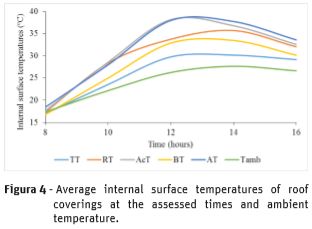
    <p><font face = "Verdana" size = "2">BT was effective to reduce T<sub>SI</sub>
(4.57 °C), reaching 33.45 °C at 14:00 h, which denotes greater thermal inertia if
compared to the other materials, except for TT, which achieved 30.15 °C and 10.18
°C reduction, at the same time. Bamboo makes a good alternative as raw material
for roof manufacturing, given its low cost and high endurance after treatment. Almeida
and Passini (2013), when studying different coverings in reduced-scale prototypes,
observed similar or even superior performance of bamboo coverings in detriment to
asbestos-cement coverings.</font></p>

    <p><font face = "Verdana" size = "2">A
higher T<sub>SI</sub> thermal amplitude was observed for AcT, reaching 20.54 °C
from 8:00 to 12:00 h. Excessive variations in temperature either during the day
or between the day and night, or throughout the year, affect poultry and swine development,
arising the use of equipment that increase production costs.</font></p>

    <p><font face = "Verdana" size = "2">TT and BT reached thermal amplitudes of 13.20 and 16.69
°C at 8:00 and 14:00 h, respectively, showing the greater thermal lag and thermal
inertia of their constituents.</font></p>

    <p><font face = "Verdana" size = "2">At
the last assessed time (16:00 h), RT, AcT and AT presented lower averages for external
temperatures, being similar to the findings of Barnabé <i>et al</i>. (2014), who
studied straw, recycled tiles and fiber cement roofs. Nevertheless, differing from
the results reported by Sampaio <i>et al</i>. (2011), who assessed ceramic, metal
and fiber cement materials under Southern Brazil conditions and found higher temperatures
on the upper surface for all assessed times.</font></p>

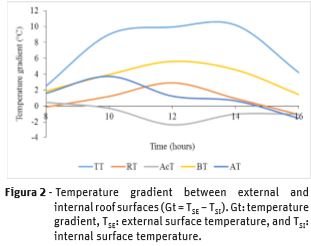
    <p><font face = "Verdana" size = "2">Difference in temperature between media is essential for heat transfers,
what is termed as temperature gradient. This gradient indicates heat flow direction,
regularly flowing from the highest to the lowest value. If both mean temperatures
are equal, there will be no heat transfer, so being in equilibrium from each other
(Abreu <i>et al</i>., 2011).</font></p>

    ]]></body>
<body><![CDATA[<p><font face = "Verdana" size = "2">In
this line, <a href = "#f2">Figure 2</a> demonstrates that heat flow had positive direction, i.e. from
the upper to the lower tile surface, which occurred throughout the entire period
and for all types of roofs. Nonetheless, it was different for AcT from 10:00 to
16:00 h, and for RT at 8:00 and at 16:00 h. Both AcT and RT tiles overheated their
lower surfaces instead of the upper one, i.e. showing a negative heat-flow direction.
The height of the prototypes was 1m, so they operate in a different way from the
sheds in real situations where the roof is further away from the ground and possibly
there are air currents inside the buildings, and can modify the temperature of the
area.</font></p>

    <p>&nbsp;</p>

<a name = "f2"><img src = "/img/revistas/rca/v41n1/v41n1a30f2.jpg"></a>

    
<p>&nbsp;</p>

    <p><font face = "Verdana" size = "2"><a href = "#f2">Figure 2</a> displays peak
differences between the curves. TT reached a higher peak, which might have occurred
because of its low heat conduction, increasing gradient between surfaces. This phenomenon
derives from the use of insulating materials (expanded polystyrene) in its composition.
Conversely, we observed lower gradients for AT at the hottest times of the day,
being related to the high efficiency of heat conduction by its constituent materials.</font></p>

    <p><font face = "Verdana" size = "2"><a href = "/img/revistas/rca/v41n1/v41n1a30f3.jpg" target = "_blank">Figure 3</a> shows internal surface images of all studied
roof materials at 12:00 h. It is possible to observe the temperature variation range
at each thermographic image. Corroborating <a href = "/img/revistas/rca/v41n1/v41n1a30t1.jpg" target = "_blank">Table 1</a>, where we can observe higher
temperatures for RT, AcT and AT, averaging 40.0, 43.2 and 40.8 °C, respectively,
at the hottest points.</font></p>

    
<p><font face = "Verdana" size = "2"><a href = "#f4">Figure 4</a> exhibits the averages of internal
surface temperature of the roof coverings for each assessed time and environment
temperature (T<sub>amb</sub>). Based on it, we may see a simultaneous decrease of
T<sub>SI</sub> with T<sub>amb </sub>from 14:00 h. At all studied times, T<sub>SI</sub>
of all tiles were higher than T<sub>amb</sub>, confirming the results found by Sampaio
<i>et al</i>. (2011) with ceramic, metal and fiber cement materials in Southern
Brazil. These authors observed internal surface temperatures higher than T<sub>amb</sub>
for all assessed times and studied coverages. However, it differs from the studies
conducted by Barnabé <i>et al</i>. (2014), who found average internal surface temperatures
lower than T<sub>amb</sub> for RT, due to the low emissivity of aluminum in its
composition, explains the author.</font></p>

    <p>&nbsp;</p>

<a name = "f4"><img src = "/img/revistas/rca/v41n1/v41n1a30f4.jpg"></a>

    
<p>&nbsp;</p>

    <p><font face = "Verdana" size = "2">Environmental temperature had no significant
differences. It can be explained by a fast heat exchange between internal and external
environments, leading to an equilibrium state inside sheds. In real situations there
is a different dynamic in which this heat exchange influences the exchange of heat
between the animals and the environment and also the use of ventilators, exhaust
fans and other equipment.</font></p>

    <p><font face = "Verdana" size = "2">Another
factor directly influencing the thermal equilibrium of facilities is ventilation,
which is responsible for a large part of heat mass exchange with the external environment.
In case of completely open buildings, this exchange is maximized, speeding up thermal
equilibrium with the surroundings (Almeida and Passini, 2013).</font></p>

    
    ]]></body>
<body><![CDATA[<p><font face = "Verdana" size = "3"><b>CONCLUSIONS</b></font></p>

    <p><font face = "Verdana" size = "2">Thermal tile had better performance whether compared
to the other materials, reaching the lowest internal surface temperatures in the
hottest hours of the day. Also bamboo showed to be efficient, being able to replace
recycled, asbestos-cement and aluminum roof tiles, thus encouraging the use of new
alternative materials. However, it is necessary to carry out a cost and lifespan
of the bamboo cover so that it is not only a sustainable alternative, but also,
economically feasible.</font></p>

    <p><font face = "Verdana" size = "2">Thermographic
images seem to be an innovative technique but still little known in Brazil. Conversely,
it has a high potential for thermal analysis of constructive elements. Thermal technology
can be extremely useful to improve animal comfort and reduce energy consumption,
inasmuch as contributes to choose the best roof materials.</font></p>

    <p>&nbsp;</p>

    <p><font face = "Verdana" size = "3"><b>REFERENCES</b></font></p>

    <!-- ref --><p><font face = "Verdana" size = "2">Abreu, P.G.; Abreu, V.M.N.; Coldebella, A.; Lopes, L.S.; Conceição, V.
&amp; Tomazelli. I.L. (2011) - Análise termográfica da temperatura superficial de
telhas. <i>Revista Brasileira de Engenharia Agrícola e Ambiental,</i> vol. 15, n.
11, p. 1193–1198. <a href = "http://dx.doi.org/10.1590/S1415-43662011001100013" target = "_blank">http://dx.doi.org/10.1590/S1415-43662011001100013</a></font>&nbsp;&nbsp;&nbsp;&nbsp;&nbsp;&nbsp;&nbsp;&nbsp;[&#160;<a href="javascript:void(0);" onclick="javascript: window.open('/scielo.php?script=sci_nlinks&ref=679945&pid=S0871-018X201800010003100001&lng=','','width=640,height=500,resizable=yes,scrollbars=1,menubar=yes,');">Links</a>&#160;]<!-- end-ref --><!-- ref --><p><font face = "Verdana" size = "2">Almeida, E.A. de &amp; Passini, R. (2013)
- Thermal comfort in reduced models of broilers' houses, under different types of
roofing materials. <i>Engenharia Agrícola,</i> vol. 33, n. 1, p. 19-27. <a href = "http://dx.doi.org/10.1590/S0100-69162013000100003" target = "_blank">http://dx.doi.org/10.1590/S0100-69162013000100003</a></font>&nbsp;&nbsp;&nbsp;&nbsp;&nbsp;&nbsp;&nbsp;&nbsp;[&#160;<a href="javascript:void(0);" onclick="javascript: window.open('/scielo.php?script=sci_nlinks&ref=679946&pid=S0871-018X201800010003100002&lng=','','width=640,height=500,resizable=yes,scrollbars=1,menubar=yes,');">Links</a>&#160;]<!-- end-ref --><!-- ref --><p><font face = "Verdana" size = "2">Altoé, L. &amp; Oliveira Filho, D. (2012)
- Termografia infravermelha aplicada à inspeção de edifícios. <i>Acta Tecnológica,</i>
vol. 7, n. 1, p. 55-59.    &nbsp;&nbsp;&nbsp;&nbsp;&nbsp;&nbsp;&nbsp;&nbsp;[&#160;<a href="javascript:void(0);" onclick="javascript: window.open('/scielo.php?script=sci_nlinks&ref=679947&pid=S0871-018X201800010003100003&lng=','','width=640,height=500,resizable=yes,scrollbars=1,menubar=yes,');">Links</a>&#160;]<!-- end-ref --></font></p>

    <!-- ref --><p><font face = "Verdana" size = "2">Baêta,
F.C. &amp; Souza, C.F. (2010) - <i>Ambiência em edificações rurais: conforto
animal</i>. Ed. UFV, Viçosa, Brasil. 246 p.    &nbsp;&nbsp;&nbsp;&nbsp;&nbsp;&nbsp;&nbsp;&nbsp;[&#160;<a href="javascript:void(0);" onclick="javascript: window.open('/scielo.php?script=sci_nlinks&ref=679949&pid=S0871-018X201800010003100004&lng=','','width=640,height=500,resizable=yes,scrollbars=1,menubar=yes,');">Links</a>&#160;]<!-- end-ref --></font></p>

    <!-- ref --><p><font face = "Verdana" size = "2">Barnabé, J.M.C.; Almeida, G.L.P.; Jacob, A.L.; Morril, W.B.B. &amp; Pandorfi,
H. (2014) - Temperatura superficial de materiais utilizados para cobertura individual
de bezerreiros. <i>Revista Brasileira de Engenharia Agrícola e Ambiental,</i> vol.
18, n. 5, p. 545-550. <a href = "http://dx.doi.org/10.1590/S1415-43662014000500012" target = "_blank">http://dx.doi.org/10.1590/S1415-43662014000500012</a></font>&nbsp;&nbsp;&nbsp;&nbsp;&nbsp;&nbsp;&nbsp;&nbsp;[&#160;<a href="javascript:void(0);" onclick="javascript: window.open('/scielo.php?script=sci_nlinks&ref=679951&pid=S0871-018X201800010003100005&lng=','','width=640,height=500,resizable=yes,scrollbars=1,menubar=yes,');">Links</a>&#160;]<!-- end-ref --><!-- ref --><p><font face = "Verdana" size = "2">Cardoso, A.S.; Baêta, F.C.; Tinoco, I.F.F.
&amp; Cardoso Silva, V.A. (2011) - Coberturas com materiais alternativos de instalações
de produção animal com vistas ao conforto animal. <i>Engenharia na Agricultura,
</i>vol. 19, n. 5, p. 404-421.    &nbsp;&nbsp;&nbsp;&nbsp;&nbsp;&nbsp;&nbsp;&nbsp;[&#160;<a href="javascript:void(0);" onclick="javascript: window.open('/scielo.php?script=sci_nlinks&ref=679952&pid=S0871-018X201800010003100006&lng=','','width=640,height=500,resizable=yes,scrollbars=1,menubar=yes,');">Links</a>&#160;]<!-- end-ref --></font></p>

    <!-- ref --><p><font face = "Verdana" size = "2">Ferreira,
D.F. 2011 - Sisvar: a computer statistical analysis system. <i>Ciência e Agrotecnologia,
</i>vol. 35, n. 6, p. 1039-1042. <a href = "http://dx.doi.org/10.1590/S1413-70542011000600001" target = "_blank">http://dx.doi.org/10.1590/S1413-70542011000600001</a></font>&nbsp;&nbsp;&nbsp;&nbsp;&nbsp;&nbsp;&nbsp;&nbsp;[&#160;<a href="javascript:void(0);" onclick="javascript: window.open('/scielo.php?script=sci_nlinks&ref=679954&pid=S0871-018X201800010003100007&lng=','','width=640,height=500,resizable=yes,scrollbars=1,menubar=yes,');">Links</a>&#160;]<!-- end-ref --><!-- ref --><p><font face = "Verdana" size = "2">Jentzsch, R.; Baeta, F.C.; Tinoco, I.F.F.;
Damasceno, F.A. &amp; Saraz, J.A.O. (2013) - Parâmetros arquitetônico-ambientais
para construção e testes em modelos reduzidos, representativos de galpões avícolas,
com base em similitude. <i>Engenharia na Agricultura</i>, vol. 21, n. 1, p. 19-30.    &nbsp;&nbsp;&nbsp;&nbsp;&nbsp;&nbsp;&nbsp;&nbsp;[&#160;<a href="javascript:void(0);" onclick="javascript: window.open('/scielo.php?script=sci_nlinks&ref=679955&pid=S0871-018X201800010003100008&lng=','','width=640,height=500,resizable=yes,scrollbars=1,menubar=yes,');">Links</a>&#160;]<!-- end-ref -->
</font></p>

    <!-- ref --><p><font face = "Verdana" size = "2">Michels, C.; Lamberts, R. &amp;
Güths, S. (2008) - Evaluation of heat flux reduction provided by the use of radiant
barriers in clay tile roofs. <i>Energy and Buildings,</i> vol. 40, n. 4, p. 445-451.
<a href = "https://doi.org/10.1016/j.enbuild.2007.03.013" target = "_blank">https://doi.org/10.1016/j.enbuild.2007.03.013</a></font>&nbsp;&nbsp;&nbsp;&nbsp;&nbsp;&nbsp;&nbsp;&nbsp;[&#160;<a href="javascript:void(0);" onclick="javascript: window.open('/scielo.php?script=sci_nlinks&ref=679957&pid=S0871-018X201800010003100009&lng=','','width=640,height=500,resizable=yes,scrollbars=1,menubar=yes,');">Links</a>&#160;]<!-- end-ref --><!-- ref --><p><font face = "Verdana" size = "2">Nascimento, G.R.; Nääs, I.A.; Baracho, M.S.; Pereira, D.F. &amp; Neves,
D.P. (2014) - Termografia infravermelho na estimativa de conforto térmico de frangos
de corte. <i>Revista Brasileira de Engenharia Agrícola e Ambiental, </i>vol. 18,
n. 6, p. 658–663. <a href = "http://dx.doi.org/10.1590/S1415-43662014000600014" target = "_blank">http://dx.doi.org/10.1590/S1415-43662014000600014</a></font>&nbsp;&nbsp;&nbsp;&nbsp;&nbsp;&nbsp;&nbsp;&nbsp;[&#160;<a href="javascript:void(0);" onclick="javascript: window.open('/scielo.php?script=sci_nlinks&ref=679958&pid=S0871-018X201800010003100010&lng=','','width=640,height=500,resizable=yes,scrollbars=1,menubar=yes,');">Links</a>&#160;]<!-- end-ref --><!-- ref --><p><font face = "Verdana" size = "2">Sampaio, C.A.P.; Cardoso, C.O. &amp; Souza,
G.P. (2011) - Temperaturas superficiais de telhas e sua relação com o ambiente térmico<i>.
Engenharia Agrícola,</i> vol. 31, n. 2, p. 230-236. <a href = "http://dx.doi.org/10.1590/S0100-69162011000200003" target = "_blank">http://dx.doi.org/10.1590/S0100-69162011000200003</a></font>&nbsp;&nbsp;&nbsp;&nbsp;&nbsp;&nbsp;&nbsp;&nbsp;[&#160;<a href="javascript:void(0);" onclick="javascript: window.open('/scielo.php?script=sci_nlinks&ref=679959&pid=S0871-018X201800010003100011&lng=','','width=640,height=500,resizable=yes,scrollbars=1,menubar=yes,');">Links</a>&#160;]<!-- end-ref --><!-- ref --><p><font face = "Verdana" size = "2">Tonoli, G.H.D.; Santos, S.F.; Rabi, J.A.;
Santos, W.N. &amp; Savastano, H.J. (2011) - Thermal performance of sisal fiber-cement
roofing tiles for rural constructions. <i>Scientia Agrícola, </i>vol. 68, n. 1,
p. 1-7. <a href = "http://dx.doi.org/10.1590/S0103-90162011000100001" target = "_blank">http://dx.doi.org/10.1590/S0103-90162011000100001</a></font>&nbsp;&nbsp;&nbsp;&nbsp;&nbsp;&nbsp;&nbsp;&nbsp;[&#160;<a href="javascript:void(0);" onclick="javascript: window.open('/scielo.php?script=sci_nlinks&ref=679960&pid=S0871-018X201800010003100012&lng=','','width=640,height=500,resizable=yes,scrollbars=1,menubar=yes,');">Links</a>&#160;]<!-- end-ref --><!-- ref --><p><font face = "Verdana" size = "2">Wray, C. &amp; Akbari, H. (2008) - The effects of roof
reflectance on air temperatures surrounding a rooftop condensing unit. <i>Energy
and Buildings,</i> vol. 40, n. 1, p. 11-28. <a href = "https://doi.org/10.1016/j.enbuild.2007.01.005" target = "_blank">https://doi.org/10.1016/j.enbuild.2007.01.005</a></font>&nbsp;&nbsp;&nbsp;&nbsp;&nbsp;&nbsp;&nbsp;&nbsp;[&#160;<a href="javascript:void(0);" onclick="javascript: window.open('/scielo.php?script=sci_nlinks&ref=679961&pid=S0871-018X201800010003100013&lng=','','width=640,height=500,resizable=yes,scrollbars=1,menubar=yes,');">Links</a>&#160;]<!-- end-ref --><p>&nbsp;</p>

    <p><font face = "Verdana" size = "2">Received/recebido: 2017.08.28</font></p>

    <p><font face = "Verdana" size = "2">Received in revised form/recebido em versão revista: 2017.10.02</font></p>

    <p><font face = "Verdana" size = "2">Accepted/aceite: 2017.10.09</font></p>

     ]]></body><back>
<ref-list>
<ref id="B1">
<nlm-citation citation-type="journal">
<person-group person-group-type="author">
<name>
<surname><![CDATA[Abreu]]></surname>
<given-names><![CDATA[P.G.]]></given-names>
</name>
<name>
<surname><![CDATA[Abreu]]></surname>
<given-names><![CDATA[V.M.N.]]></given-names>
</name>
<name>
<surname><![CDATA[Coldebella]]></surname>
<given-names><![CDATA[A.]]></given-names>
</name>
<name>
<surname><![CDATA[Lopes]]></surname>
<given-names><![CDATA[L.S.]]></given-names>
</name>
<name>
<surname><![CDATA[Conceição]]></surname>
<given-names><![CDATA[V.]]></given-names>
</name>
<name>
<surname><![CDATA[Tomazelli]]></surname>
<given-names><![CDATA[I.L.]]></given-names>
</name>
</person-group>
<article-title xml:lang="pt"><![CDATA[Análise termográfica da temperatura superficial de telhas]]></article-title>
<source><![CDATA[Revista Brasileira de Engenharia Agrícola e Ambiental]]></source>
<year>2011</year>
<volume>15</volume>
<numero>11</numero>
<issue>11</issue>
<page-range>1193-1198</page-range></nlm-citation>
</ref>
<ref id="B2">
<nlm-citation citation-type="journal">
<person-group person-group-type="author">
<name>
<surname><![CDATA[Almeida]]></surname>
<given-names><![CDATA[E.A. de]]></given-names>
</name>
<name>
<surname><![CDATA[Passini]]></surname>
<given-names><![CDATA[R.]]></given-names>
</name>
</person-group>
<article-title xml:lang="en"><![CDATA[Thermal comfort in reduced models of broilers' houses, under different types of roofing materials]]></article-title>
<source><![CDATA[Engenharia Agrícola]]></source>
<year>2013</year>
<volume>33</volume>
<numero>1</numero>
<issue>1</issue>
<page-range>19-27</page-range></nlm-citation>
</ref>
<ref id="B3">
<nlm-citation citation-type="journal">
<person-group person-group-type="author">
<name>
<surname><![CDATA[Altoé]]></surname>
<given-names><![CDATA[L.]]></given-names>
</name>
<name>
<surname><![CDATA[Oliveira Filho]]></surname>
<given-names><![CDATA[D.]]></given-names>
</name>
</person-group>
<article-title xml:lang="pt"><![CDATA[Termografia infravermelha aplicada à inspeção de edifícios]]></article-title>
<source><![CDATA[Acta Tecnológica]]></source>
<year>2012</year>
<volume>7</volume>
<numero>1</numero>
<issue>1</issue>
<page-range>55-59</page-range></nlm-citation>
</ref>
<ref id="B4">
<nlm-citation citation-type="book">
<person-group person-group-type="author">
<name>
<surname><![CDATA[Baêta]]></surname>
<given-names><![CDATA[F.C.]]></given-names>
</name>
<name>
<surname><![CDATA[Souza]]></surname>
<given-names><![CDATA[C.F.]]></given-names>
</name>
</person-group>
<source><![CDATA[Ambiência em edificações rurais: conforto animal]]></source>
<year>2010</year>
<publisher-loc><![CDATA[Viçosa ]]></publisher-loc>
<publisher-name><![CDATA[UFV]]></publisher-name>
</nlm-citation>
</ref>
<ref id="B5">
<nlm-citation citation-type="journal">
<person-group person-group-type="author">
<name>
<surname><![CDATA[Barnabé]]></surname>
<given-names><![CDATA[J.M.C.]]></given-names>
</name>
<name>
<surname><![CDATA[Almeida]]></surname>
<given-names><![CDATA[G.L.P.]]></given-names>
</name>
<name>
<surname><![CDATA[Jacob]]></surname>
<given-names><![CDATA[A.L.]]></given-names>
</name>
<name>
<surname><![CDATA[Morril]]></surname>
<given-names><![CDATA[W.B.B.]]></given-names>
</name>
<name>
<surname><![CDATA[Pandorfi]]></surname>
<given-names><![CDATA[H.]]></given-names>
</name>
</person-group>
<article-title xml:lang="pt"><![CDATA[Temperatura superficial de materiais utilizados para cobertura individual de bezerreiros]]></article-title>
<source><![CDATA[Revista Brasileira de Engenharia Agrícola e Ambiental]]></source>
<year>2014</year>
<volume>18</volume>
<numero>5</numero>
<issue>5</issue>
<page-range>545-550</page-range></nlm-citation>
</ref>
<ref id="B6">
<nlm-citation citation-type="journal">
<person-group person-group-type="author">
<name>
<surname><![CDATA[Cardoso]]></surname>
<given-names><![CDATA[A.S.]]></given-names>
</name>
<name>
<surname><![CDATA[Baêta]]></surname>
<given-names><![CDATA[F.C.]]></given-names>
</name>
<name>
<surname><![CDATA[Tinoco]]></surname>
<given-names><![CDATA[I.F.F.]]></given-names>
</name>
<name>
<surname><![CDATA[Cardoso Silva]]></surname>
<given-names><![CDATA[V.A.]]></given-names>
</name>
</person-group>
<article-title xml:lang="pt"><![CDATA[Coberturas com materiais alternativos de instalações de produção animal com vistas ao conforto animal]]></article-title>
<source><![CDATA[Engenharia na Agricultura]]></source>
<year>2011</year>
<volume>19</volume>
<numero>5</numero>
<issue>5</issue>
<page-range>404-421</page-range></nlm-citation>
</ref>
<ref id="B7">
<nlm-citation citation-type="journal">
<person-group person-group-type="author">
<name>
<surname><![CDATA[Ferreira]]></surname>
<given-names><![CDATA[D.F.]]></given-names>
</name>
</person-group>
<article-title xml:lang="en"><![CDATA[Sisvar: a computer statistical analysis system]]></article-title>
<source><![CDATA[Ciência e Agrotecnologia]]></source>
<year>2011</year>
<volume>35</volume>
<numero>6</numero>
<issue>6</issue>
<page-range>1039-1042</page-range></nlm-citation>
</ref>
<ref id="B8">
<nlm-citation citation-type="journal">
<person-group person-group-type="author">
<name>
<surname><![CDATA[Jentzsch]]></surname>
<given-names><![CDATA[R.]]></given-names>
</name>
<name>
<surname><![CDATA[Baeta]]></surname>
<given-names><![CDATA[F.C.]]></given-names>
</name>
<name>
<surname><![CDATA[Tinoco]]></surname>
<given-names><![CDATA[I.F.F.]]></given-names>
</name>
<name>
<surname><![CDATA[Damasceno]]></surname>
<given-names><![CDATA[F.A.]]></given-names>
</name>
<name>
<surname><![CDATA[Saraz]]></surname>
<given-names><![CDATA[J.A.O.]]></given-names>
</name>
</person-group>
<article-title xml:lang="pt"><![CDATA[Parâmetros arquitetônico-ambientais para construção e testes em modelos reduzidos, representativos de galpões avícolas, com base em similitude]]></article-title>
<source><![CDATA[Engenharia na Agricultura]]></source>
<year>2013</year>
<volume>21</volume>
<numero>1</numero>
<issue>1</issue>
<page-range>19-30</page-range></nlm-citation>
</ref>
<ref id="B9">
<nlm-citation citation-type="journal">
<person-group person-group-type="author">
<name>
<surname><![CDATA[Michels]]></surname>
<given-names><![CDATA[C.]]></given-names>
</name>
<name>
<surname><![CDATA[Lamberts]]></surname>
<given-names><![CDATA[R.]]></given-names>
</name>
<name>
<surname><![CDATA[Güths]]></surname>
<given-names><![CDATA[S.]]></given-names>
</name>
</person-group>
<article-title xml:lang="en"><![CDATA[Evaluation of heat flux reduction provided by the use of radiant barriers in clay tile roofs]]></article-title>
<source><![CDATA[Energy and Buildings]]></source>
<year>2008</year>
<volume>40</volume>
<numero>4</numero>
<issue>4</issue>
<page-range>445-451</page-range></nlm-citation>
</ref>
<ref id="B10">
<nlm-citation citation-type="journal">
<person-group person-group-type="author">
<name>
<surname><![CDATA[Nascimento]]></surname>
<given-names><![CDATA[G.R.]]></given-names>
</name>
<name>
<surname><![CDATA[Nääs]]></surname>
<given-names><![CDATA[I.A.]]></given-names>
</name>
<name>
<surname><![CDATA[Baracho]]></surname>
<given-names><![CDATA[M.S.]]></given-names>
</name>
<name>
<surname><![CDATA[Pereira]]></surname>
<given-names><![CDATA[D.F.]]></given-names>
</name>
<name>
<surname><![CDATA[Neves]]></surname>
<given-names><![CDATA[D.P.]]></given-names>
</name>
</person-group>
<article-title xml:lang="pt"><![CDATA[Termografia infravermelho na estimativa de conforto térmico de frangos de corte]]></article-title>
<source><![CDATA[Revista Brasileira de Engenharia Agrícola e Ambiental]]></source>
<year>2014</year>
<volume>18</volume>
<numero>6</numero>
<issue>6</issue>
<page-range>658-663</page-range></nlm-citation>
</ref>
<ref id="B11">
<nlm-citation citation-type="journal">
<person-group person-group-type="author">
<name>
<surname><![CDATA[Sampaio]]></surname>
<given-names><![CDATA[C.A.P.]]></given-names>
</name>
<name>
<surname><![CDATA[Cardoso]]></surname>
<given-names><![CDATA[C.O.]]></given-names>
</name>
<name>
<surname><![CDATA[Souza]]></surname>
<given-names><![CDATA[G.P.]]></given-names>
</name>
</person-group>
<article-title xml:lang="pt"><![CDATA[Temperaturas superficiais de telhas e sua relação com o ambiente térmico]]></article-title>
<source><![CDATA[Engenharia Agrícola]]></source>
<year>2011</year>
<volume>31</volume>
<numero>2</numero>
<issue>2</issue>
<page-range>230-236</page-range></nlm-citation>
</ref>
<ref id="B12">
<nlm-citation citation-type="journal">
<person-group person-group-type="author">
<name>
<surname><![CDATA[Tonoli]]></surname>
<given-names><![CDATA[G.H.D.]]></given-names>
</name>
<name>
<surname><![CDATA[Santos]]></surname>
<given-names><![CDATA[S.F.]]></given-names>
</name>
<name>
<surname><![CDATA[Rabi]]></surname>
<given-names><![CDATA[J.A.]]></given-names>
</name>
<name>
<surname><![CDATA[Santos]]></surname>
<given-names><![CDATA[W.N.]]></given-names>
</name>
<name>
<surname><![CDATA[Savastano]]></surname>
<given-names><![CDATA[H.J.]]></given-names>
</name>
</person-group>
<article-title xml:lang="en"><![CDATA[Thermal performance of sisal fiber-cement roofing tiles for rural constructions]]></article-title>
<source><![CDATA[Scientia Agrícola]]></source>
<year>2011</year>
<volume>68</volume>
<numero>1</numero>
<issue>1</issue>
<page-range>1-7</page-range></nlm-citation>
</ref>
<ref id="B13">
<nlm-citation citation-type="journal">
<person-group person-group-type="author">
<name>
<surname><![CDATA[Wray]]></surname>
<given-names><![CDATA[C.]]></given-names>
</name>
<name>
<surname><![CDATA[Akbari]]></surname>
<given-names><![CDATA[H.]]></given-names>
</name>
</person-group>
<article-title xml:lang="en"><![CDATA[The effects of roof reflectance on air temperatures surrounding a rooftop condensing unit]]></article-title>
<source><![CDATA[Energy and Buildings]]></source>
<year>2008</year>
<volume>40</volume>
<numero>1</numero>
<issue>1</issue>
<page-range>11-28</page-range></nlm-citation>
</ref>
</ref-list>
</back>
</article>