<?xml version="1.0" encoding="ISO-8859-1"?><article xmlns:mml="http://www.w3.org/1998/Math/MathML" xmlns:xlink="http://www.w3.org/1999/xlink" xmlns:xsi="http://www.w3.org/2001/XMLSchema-instance">
<front>
<journal-meta>
<journal-id>0871-018X</journal-id>
<journal-title><![CDATA[Revista de Ciências Agrárias]]></journal-title>
<abbrev-journal-title><![CDATA[Rev. de Ciências Agrárias]]></abbrev-journal-title>
<issn>0871-018X</issn>
<publisher>
<publisher-name><![CDATA[Sociedade de Ciências Agrárias de Portugal]]></publisher-name>
</publisher>
</journal-meta>
<article-meta>
<article-id>S0871-018X2018000200008</article-id>
<article-id pub-id-type="doi">10.19084/RCA17297</article-id>
<title-group>
<article-title xml:lang="en"><![CDATA[Agronomic characteristics, nutritional status and yield of corn intercropped with dwarf pigeon pea in different spatial arrangements of plants]]></article-title>
<article-title xml:lang="pt"><![CDATA[Características agronómicas, estado nutricional e produtividade do milho em consociação com guandu-anão, em diferentes arranjos espaciais de plantas]]></article-title>
</title-group>
<contrib-group>
<contrib contrib-type="author">
<name>
<surname><![CDATA[Gallo]]></surname>
<given-names><![CDATA[Anderson de S.]]></given-names>
</name>
<xref ref-type="aff" rid="A1"/>
</contrib>
<contrib contrib-type="author">
<name>
<surname><![CDATA[Fontanetti]]></surname>
<given-names><![CDATA[Anastacia]]></given-names>
</name>
<xref ref-type="aff" rid="A2"/>
</contrib>
<contrib contrib-type="author">
<name>
<surname><![CDATA[Guimarães]]></surname>
<given-names><![CDATA[Nathalia de F.]]></given-names>
</name>
<xref ref-type="aff" rid="A1"/>
</contrib>
<contrib contrib-type="author">
<name>
<surname><![CDATA[Morinigo]]></surname>
<given-names><![CDATA[Kátia P. G.]]></given-names>
</name>
<xref ref-type="aff" rid="A2"/>
</contrib>
<contrib contrib-type="author">
<name>
<surname><![CDATA[Souza]]></surname>
<given-names><![CDATA[Maicon D. B. de]]></given-names>
</name>
<xref ref-type="aff" rid="A2"/>
</contrib>
<contrib contrib-type="author">
<name>
<surname><![CDATA[Silva]]></surname>
<given-names><![CDATA[Rogério F. da]]></given-names>
</name>
<xref ref-type="aff" rid="A3"/>
</contrib>
</contrib-group>
<aff id="AA1">
<institution><![CDATA[,Federal Rural University of Rio de Janeiro Agronomy Institute Department of Soils]]></institution>
<addr-line><![CDATA[Seropédica Rio de Janeiro]]></addr-line>
<country>Brazil</country>
</aff>
<aff id="AA2">
<institution><![CDATA[,Federal University of São Carlos Department of Rural Development ]]></institution>
<addr-line><![CDATA[Araras São Paulo]]></addr-line>
<country>Brazil</country>
</aff>
<aff id="AA3">
<institution><![CDATA[,State University of Mato Grosso do Sul  ]]></institution>
<addr-line><![CDATA[Glória de Dourados Mato Grosso do Sul]]></addr-line>
<country>Brazil</country>
</aff>
<pub-date pub-type="pub">
<day>00</day>
<month>06</month>
<year>2018</year>
</pub-date>
<pub-date pub-type="epub">
<day>00</day>
<month>06</month>
<year>2018</year>
</pub-date>
<volume>41</volume>
<numero>2</numero>
<fpage>71</fpage>
<lpage>80</lpage>
<copyright-statement/>
<copyright-year/>
<self-uri xlink:href="http://scielo.pt/scielo.php?script=sci_arttext&amp;pid=S0871-018X2018000200008&amp;lng=en&amp;nrm=iso"></self-uri><self-uri xlink:href="http://scielo.pt/scielo.php?script=sci_abstract&amp;pid=S0871-018X2018000200008&amp;lng=en&amp;nrm=iso"></self-uri><self-uri xlink:href="http://scielo.pt/scielo.php?script=sci_pdf&amp;pid=S0871-018X2018000200008&amp;lng=en&amp;nrm=iso"></self-uri><abstract abstract-type="short" xml:lang="en"><p><![CDATA[Corn (Zea mays L.) is among the most produced crops in intercropping systems, mainly due to its architecture and ecophysiology. In intercropping systems, crop management should be planned to avoid interspecific competition for production factors such as water, light and nutrients. The aim of this study was to evaluate the agronomic characteristics, nutritional status and grain yield of corn intercropped with dwarf pigeon pea (Cajanus cajan L.) in different arrangements of plants. The treatments consisted of different arrangements of dwarf pigeon pea intercropped with corn. In general, the arrangements did not negatively influence the agronomic characteristics and the growth of Poaceae legume. Sowing dwarf pigeon pea in the same rows as corn and in two rows between them increased nitrogen content in corn plants, as well as provided a higher grain yield than other arrangements including the corn monoculture. The evaluated intercropping system is a promising alternative system for a more sustainable agricultural production, with less dependence on synthetic fertilizers.]]></p></abstract>
<abstract abstract-type="short" xml:lang="pt"><p><![CDATA[O milho (Zea mays L.) está entre as culturas mais produzidas em sistemas consociados, devido principalmente a sua arquitetura e ecofisiologia. Em consociação, a gestão das culturas deve ser planeada de modo a evitar competição interespecífica por fatores de produção, tais como a água, luz e nutrientes. No presente trabalho avaliaram-se algumas características agronómicas, o estado nutricional e a produtividade do milho em modo de produção em consociação com guandu-anão (Cajanus cajan L.) em diferentes arranjos de plantas. Os tratamentos consistiram de diferentes arranjos de guandu-anão em consociação com a cultura do milho. Em geral, os arranjos não influenciaram negativamente as características agronómicas e o crescimento da planta Poaceae. O tratamento com guandu-anão semeado na linha e em duas linhas na entrelinha do milho aumentou o teor de foliar azoto nas plantas de milho, e proporcionou uma maior produtividade relativamente aos outros tratamentos, incluindo o milho em monocultura. A consociação revelou-se um sistema de produção promissor numa agricultura mais sustentável, com menor dependência de fertilizantes minerais.]]></p></abstract>
<kwd-group>
<kwd lng="en"><![CDATA[Zea mays L.]]></kwd>
<kwd lng="en"><![CDATA[Cajanus cajan L.]]></kwd>
<kwd lng="en"><![CDATA[Interspecific competition]]></kwd>
<kwd lng="en"><![CDATA[macronutrients]]></kwd>
<kwd lng="pt"><![CDATA[Zea mays L.]]></kwd>
<kwd lng="pt"><![CDATA[Cajanus cajan]]></kwd>
<kwd lng="pt"><![CDATA[competição interespecífica]]></kwd>
<kwd lng="pt"><![CDATA[macronutrientes]]></kwd>
</kwd-group>
</article-meta>
</front><body><![CDATA[ 

    <p align = "right"><font face = "Verdana" size = "2"><b>ARTIGO</b></font></p>

    <p><font face = "Verdana" size = "4"><b>Agronomic characteristics, nutritional status and yield of corn intercropped with dwarf pigeon pea in different spatial arrangements of plants</b></font></p>

    <p><font face = "Verdana" size = "3"><b>Características agronómicas, estado nutricional e produtividade do milho em consociação com guandu-anão, em diferentes arranjos espaciais de plantas</b></font></p>

    <p><font face = "Verdana" size = "2"><b>Anderson de S. Gallo</b>*<sup>1</sup>,
<b>Anastacia Fontanetti</b><sup>2</sup>, <b>Nathalia de F. Guimarães</b><sup>1</sup>, <b>Kátia P.
G. Morinigo</b><sup>2</sup>, <b>Maicon D. B. de Souza</b><sup>2 </sup>e <b>Rogério F. da Silva</b><sup>3</sup></font></p>

    <p><font face = "Verdana" size = "2"><i><sup>1</sup>Department
of Soils, Agronomy Institute, Federal Rural University of Rio de Janeiro, Seropédica,
Rio de Janeiro, Brazil</i></font></p>

    <p><font face = "Verdana" size = "2"><i><sup>2</sup>
Department of Rural Development, Federal University of São Carlos, Araras, São Paulo,
Brazil</i></font></p>

    <p><font face = "Verdana" size = "2"><i><sup>3</sup>State University
of Mato Grosso do Sul, Glória de Dourados, Mato Grosso do Sul, Brazil</i></font></p>

    <p><font face = "Verdana" size = "2"><i>(*E-mail: <a href="mailto:andersondsgallo@hotmail.com">andersondsgallo@hotmail.com</a>)</i></font></p>

<hr noshade size = 1>

    <p><font face = "Verdana" size = "3"><b>ABSTRACT</b></font></p>

    ]]></body>
<body><![CDATA[<p><font face = "Verdana" size = "2">Corn (<i>Zea mays</i> L.) is among the most produced
crops in intercropping systems, mainly due to its architecture and ecophysiology.
In intercropping systems, crop management should be planned to avoid interspecific
competition for production factors such as water, light and nutrients. The aim of
this study was to evaluate the agronomic characteristics, nutritional status and
grain yield of corn intercropped with dwarf pigeon pea (<i>Cajanus cajan</i> L.)
in different arrangements of plants. The treatments consisted of different arrangements
of dwarf pigeon pea intercropped with corn. In general, the arrangements did not
negatively influence the agronomic characteristics and the growth of Poaceae legume.
Sowing dwarf pigeon pea in the same rows as corn and in two rows between them increased
nitrogen content in corn plants, as well as provided a higher grain yield than other
arrangements including the corn monoculture. The evaluated intercropping system
is a promising alternative system for a more sustainable agricultural production,
with less dependence on synthetic fertilizers.</font></p>

    <p><font face = "Verdana" size = "2"><b>Keywords</b>: <i>Zea mays</i> L., <i>Cajanus cajan</i> L., Interspecific competition, macronutrients.</font></p>

<hr noshade size = 1>

    <p><font face = "Verdana" size = "3"><b>RESUMO</b></font></p>

    <p><font face = "Verdana" size = "2">O milho (<i>Zea
mays</i> L.) está entre as culturas mais produzidas em sistemas consociados, devido
principalmente a sua arquitetura e ecofisiologia. Em consociação, a gestão das culturas
deve ser planeada de modo a evitar competição interespecífica por fatores de produção,
tais como a água, luz e nutrientes. No presente trabalho avaliaram-se algumas características
agronómicas, o estado nutricional e a produtividade do milho em modo de produção
em consociação com guandu-anão (<i>Cajanus cajan</i> L.) em diferentes arranjos
de plantas. Os tratamentos consistiram de diferentes arranjos de guandu-anão em
consociação com a cultura do milho. Em geral, os arranjos não influenciaram negativamente
as características agronómicas e o crescimento da planta Poaceae. O tratamento com
guandu-anão semeado na linha e em duas linhas na entrelinha do milho aumentou o
teor de foliar azoto nas plantas de milho, e proporcionou uma maior produtividade
relativamente aos outros tratamentos, incluindo o milho em monocultura. A consociação
revelou-se um sistema de produção promissor numa agricultura mais sustentável, com
menor dependência de fertilizantes minerais.</font></p>

    <p><font face = "Verdana" size = "2"><b>Palavras-chave:</b> <i>Zea mays</i> L., <i>Cajanus cajan, </i>competição interespecífica, macronutrientes.</font></p>

<hr noshade size = 1>

    <p><font face = "Verdana" size = "3"><b>INTRODUCTION</b></font></p>

    <p><font face = "Verdana" size = "2">Intercropping
consists of cultivating two or more species in the same area for a certain period
of time, even if the crops are not necessarily sown or harvested simultaneously
(Zhang <i>et al</i>., 2015). It is recommended to be used in many parts of the world
for food or fiber production, due to its high global productivity, effective pest
and disease control, ecological services and economic profitability (Wu and Wu,
2014).</font></p>

    <p><font face = "Verdana" size = "2">Despite the advantages, in
these systems, interspecific interference may impair the establishment and productivity
of the species (Li <i>et al</i>., 2011), especially when the agricultural area is
inadequately managed (Zhang <i>et al</i>., 2007). Therefore, the knowledge of the
behavior of the species regarding competition and water, light and nutrient needs
is of great importance for the success of the system (Pariz <i>et al</i>., 2011).
The competition depends on the characteristics of the species involved, their root
systems and the availability of resources in the system (Casper <i>et al</i>., 1998;
Mushagalusa <i>et al</i>., 2008). Moreover, allelopathy, which consists of the plant's
ability to release substances to inhibit the growth or development of another nearby
plant, should also be considered in the choice of species to be grown in an intercropping
system (Cheng and Xu, 2013).</font></p>

    <p><font face = "Verdana" size = "2">Corn
is among the most cultivated crops in intercropping systems, especially the traditional
intercropping of corn and bean, practiced by family farmers throughout Brazil. The
favorable characteristics of this cereal, such as higher dry matter accumulation
rate in the early stages of development and high plant height and ear insertion
height, allow harvesting to occur without interference from intercropped bean (Alvarenga
<i>et al</i>., 2006).</font></p>

    <p><font face = "Verdana" size = "2">Recently, the
interest on the intercropping of grain-producing plants with green manures has increased
significantly. This system aims to produce grains and/or straw for soil cover. The
production of straw is fundamental, especially in regions with high temperature
and high rainfall, as these factors increase the decomposition rate, making soil
cover not feasible (Gitti <i>et al</i>., 2012).</font></p>

    ]]></body>
<body><![CDATA[<p><font face = "Verdana" size = "2">Green manure promotes soil protection, and chemical, physical and biological
characteristics of the soil, which make it an excellent management option; especially
in organic farming systems, since mineral fertilizers have high prices and are not
always allowed (Benicasa <i>et al</i>., 2010).</font></p>

    <p><font face = "Verdana" size = "2">The intercropping of corn with cover crops, in particular of the Fabaceae
family, is among the most indicated ones (Peng <i>et al</i>., 2009) due to their
ability to fix atmospheric nitrogen (N<sub>2</sub>) by means of symbiosis with bacteria
of the genus <i>Rhizobium</i>, providing the largest amount of this nutrient for
crops of economic interest (Wu and Wu, 2014; Zhang <i>et al</i>., 2015). Furthermore,
corn and Fabaceae plants present complementarity in the use of production factors
(Mushagalusa <i>et al</i>., 2008).</font></p>

    <p><font face = "Verdana" size = "2">The dwarf pigeon pea is another plant species cultivated in intercropping with
corn, because the lower production of dry matter of this Fabaceae avoids competition
with the cereal for water and nutrients and does not impair harvest (Cortez <i>et
al</i>., 2009). In addition, it is a shrub, erect, annual or semi-perennial species
that exerts multiple functions in the production systems, such as nitrogen supply
(Yusuf <i>et al</i>., 2009), nutrient recycling and disruption of compacted soil
layers due to its pivotal and deep root system (Godoy <i>et al</i>., 2009).</font></p>

    <p><font face = "Verdana" size = "2">Intercropping is an important practice for the
sustainability of agricultural systems. Notwithstanding, the management of intercropping
systems is complex and needs to be planned in order to minimize interspecific competition,
which can lead to significant productivity losses, influenced by factors such as
climatic conditions, soil fertility, density and spatial arrangement of plants in
the system (Lithourgidis <i>et al</i>., 2011). Therefore, it is fundamental to carry
out studies that evaluate the behavior of the intercropped species, as well as the
nutritional dynamics in intercropping systems and the grain yield, in order to find
out techniques able to improve this cropping (Oliveira <i>et al</i>., 2011).</font></p>

    <p><font face = "Verdana" size = "2">In view of the above, the present study aimed
to evaluate the agronomic characteristics, nutritional status and grain yield of
corn intercropped with dwarf pigeon pea (<i>Cajanus cajan</i> L.) in different arrangements
of plants.</font></p>

    <p><font face = "Verdana" size = "3"><b>MATERIALS AND METHODS</b></font></p>

    <p><font face = "Verdana" size = "2">The study was conducted from December 2014 to
July 2015, in an experimental area in the municipality of Araras - SP, Brazil, at
the geographical coordinates 22°17’56.9’’ S and 47°22’53.80’’ W, and at an altitude
of 701 m. The location’s soil is classified as Dystrophic Red Latosol (Oxisol),
of a clayey texture, with the following chemical features in the 0.0 – 0.20 m layer:
pH (in CaCl<sub>2</sub>) = 5.5; extractable P = 16.5 mg kg<sup>-1</sup>; exchangeable
K = 4.1 mmol<sub>c </sub>kg<sup>-1</sup>, Ca = 28.5 mmol<sub>c </sub>kg<sup>-1</sup>,
Mg = 10.0 mmol<sub>c </sub>kg<sup>-1</sup>; exchangeable acidity (H + Al) = 22.0
mmol<sub>c </sub>kg<sup>-1</sup>; soil organic matter = 23.5 g kg<sup>-1</sup>,
and base saturation (V) = 65.5%. The climate of the region is of the Cwa mesothermic
type, according to the Köppen classification, characterized by hot and humid summers
and dry winters. In <a href = "/img/revistas/rca/v41n2/v41n2a08t1.jpg" target = "_blank">Table 1</a>, the climatic conditions observed during the course
of the experiment are summarized.</font></p>

    
<p><font face = "Verdana" size = "2">The soil was prepared with
a disk plough followed by a leveler. The experimental design adopted was of randomized
blocks with four repetitions. The treatments consisted of dwarf pigeon pea (<i>Cajanus
cajan</i> L.) in different arrangements, intercropped with corn (<i>Zea mays</i>
L.) (Al-Avaré cultivar): CM – corn monoculture; PR – dwarf pigeon pea in the same
row as the corn (10 pigeon pea plants m<sup>-2</sup>); P1B – one row of dwarf pigeon
pea sown between the rows of corn (10 pigeon pea plants m<sup>-2</sup>); P2B – two
rows of dwarf pigeon peas sown between the rows of corn (20 pigeon pea plants m<sup>-2</sup>);
PR1B – dwarf pigeon pea sown in the same rows as the corn and in a row between them
(20 pigeon pea plants m<sup>-2</sup>); and PR2B - dwarf pigeon pea sown in the same
rows as the corn and in two rows between them (30 pigeon pea plants m<sup>-2</sup>).</font></p>

    <p><font face = "Verdana" size = "2">The experimental plot was formed of five rows
of corn, with 0.90 m spaces between them, and six seeds were sown per meter, aiming
for a population of 50,000 corn plants per hectare, after thinning. The dwarf pigeon
pea was sown in a density of 10 seeds per meter, in the same rows as the corn and
between them, according to the treatments above. The corn and dwarf pigeon pea were
sown on 17/12/2014. The three central rows of corn in each plot were considered
for the evaluation.</font></p>

    <p><font face = "Verdana" size = "2">Weed control
was carried out manually in two periods, the first 20 days after the emergence of
corn (DAE) (V4-V5 stage) and the second 48 days after the emergence of corn (V9-V10
stage). For fertilizing, 800 kg of dry organic compost was used, equivalent to 13
t ha<sup>-1</sup>, and distributed homogeneously over the soil, in the planting
row. The organic compost used in the study presented: pH (in H<sub>2</sub>O) = 8.0;
organic C = 131.0 g kg<sup>-1</sup>; organic N = 13.0 g kg<sup>-1</sup>; P = 13,
65 mg kg<sup>-1</sup>; K = 13.44 mg kg<sup>-1</sup>; Ca = 0.19 cmol<sub>c </sub>kg<sup>-1</sup>;
Mg = 0.35 cmol<sub>c </sub>kg<sup>-1</sup>; S = 0.49 cmol<sub>c </sub>kg<sup>-1</sup>;
Cu = 69.2 mg kg<sup>-1</sup>; Fe = 561.4 mg kg<sup>-1</sup>; Mn = 511.2 mg kg<sup>-1</sup>;
Zn = 766 mg kg<sup>-1</sup>; organic matter = 22.58 % and humidity = 37.40 %.</font></p>

    ]]></body>
<body><![CDATA[<p><font face = "Verdana" size = "2">During the experimental period, the following
variables were evaluated: dry matter of shoots of corn and dwarf pigeon pea (kg
ha<sup>-1</sup>); percentage of soil cover by dwarf pigeon pea and leaf area index
(LAI) of corn. These were carried out in three periods (before weed control),  the
first being at 20 days after corn emergence (DAE) (V4-V5 stage); the second at 48
days after corn emergence (V9-V10 stage) and the third at 85 days after emergence
(R3-R4 stage), except for the variable percentage of soil cover by dwarf pigeon
pea, which was evaluated in two periods, the first being at 20 days after corn emergence
(DAE) (V4-V5 stage) and the second at 48 days after corn emergence (V9-V10 stage).
At 85 DAE, the corn stem diameter (expressed in mm) was evaluated using a digital
caliper and the height of corn plants was determined (m) using a graded ruler, considering
the height between the ground level and the last fully expanded leaf.</font></p>

    <p><font face = "Verdana" size = "2">At corn harvest, the following variables were
measured: first ear insertion height (FEIH); final plant stand (FPS); number of
ears per plant (NEP); number of rows of grains per ear (NRE); number of grains per
row in the ear (NGR), number of grains per ear (NGE); thousand grain weight (TGW)
and grain yield (GY).</font></p>

    <p><font face = "Verdana" size = "2">To determine
the dry matter of shoots of corn plants and the LAI, three plants per plot were
randomly collected. For the dwarf pigeon pea, a template measuring 0.25 x 0.25 m
was used. The material collected was dried in an oven with forced air circulation
at 65 ºC until reaching a constant mass, being subsequenlty weighed.</font></p>

    <p><font face = "Verdana" size = "2">The percentage of soil cover by dwarf pigeon pea
plants was determined by the method of number of intersections, according to the
methodology described by Fávero <i>et al</i>. (2001). The soil cover percentage
data were transformed in arcsin &#8730;x/100 to fit normal distribution.</font></p>

    <p><font face = "Verdana" size = "2">The leaf area index (LAI cm<sup>2</sup> leaf cm<sup>-2</sup>
soil) was obtained by collecting three corn plants in the border of each plot. The
plants were immediately taken to the laboratory for evaluation. A leaf area integrator
LI-COR, model LI-3000C was used. LAI was estimated by the ratio between the total
leaf area and the soil space occupied by the plants. The first ear insertion height,
expressed in centimeters (cm), was determined with the help of a graduated ruler
in ten representative plants of the plot. The final plant stand (plants ha<sup>-1</sup>)
was obtained by counting the number of total corn plants in the useful area of each
plot, with the exception of broken and bedded plants.</font></p>

    <p><font face = "Verdana" size = "2">The corn harvest was done manually, removing all the ears contained
in the useful area of each plot. The moisture content of the grains was standardized
to 13%, the yield being obtained as a function of the weight of grains harvested
in each plot (kg ha<sup>-1</sup>). Thousand grain weight was determined by estimating
the average weight of three samples of 1000 grains per plot. The number of rows
of grains and number of grains per row in the ear were obtained by counting, in
ten spikes chosen at random. The number of ears per plant was obtained by the ratio
between the number of ears harvested and the number of plants in the useful area
of the plots.</font></p>

    <p><font face = "Verdana" size = "2">In addition, the levels
of N, phosphorus (P), potassium (K), calcium (Ca), magnesium (Mg) and sulfur (S)
in the corn leaves were determined by collecting the leaf located opposite and below
the upper ear in female flowering in all treatments. Ten leaves per plot were collected
at 85 DAE and, after exclusion of the central vein, plant material was dried in
a oven with forced air ventilation, at 65 °C for 48 h. Then, plant samples were
ground in a Wiley mill and submitted to content analysis, according to the methodology
described by Malavolta <i>et al</i>. (1989).</font></p>

    <p><font face = "Verdana" size = "2">To interpret the corn leaf macronutrient contents, the deviation from optimal
percentage (DOP) method was used, as proposed by Montañés <i>et al</i>. (1993).
This method is defined as the standard deviation in the concentration of an element
in relation to the optimal level taken as a reference value. It is obtained using
the following formula:</font></p>

    <p><font face = "Verdana" size = "2">DOP= [(C x 100/Cref) - 100]</font></p>

    <p><font face = "Verdana" size = "2">In which C is
the concentration of the nutrient in the dry matter from the sample and Cref is
the optimal concentration of the nutrient in dry matter.</font></p>

    ]]></body>
<body><![CDATA[<p><font face = "Verdana" size = "2">The values that are considered optimal for corn cultivation
were proposed by Cantarella <i>et al</i>. (1996). As the adequate macronutrient
levels for the crop are mentioned in adequate value ranges, the lowest value in
the range for each macronutrient was considered.</font></p>

    <p><font face = "Verdana" size = "2">The DOP indices were interpreted as follows: the absolute values (without
sign) indicate the importance or severity of the deficiency or excess of the nutrient.
The negative values indicate a situation of macronutrient deficiency; the positive
values reflect situations of excess: and the indices equal to zero indicate optimal
macronutrient values (Damián-Nava <i>et al</i>., 2006).</font></p>

    <p><font face = "Verdana" size = "2">The results were submitted to analysis of variance (ANOVA)
and the means were compared by the Tukey test, at 5% probability.</font></p>

    <p><font face = "Verdana" size = "3"><b>RESULTS AND DISCUSSION</b></font></p>

    <p><font face = "Verdana" size = "2">For
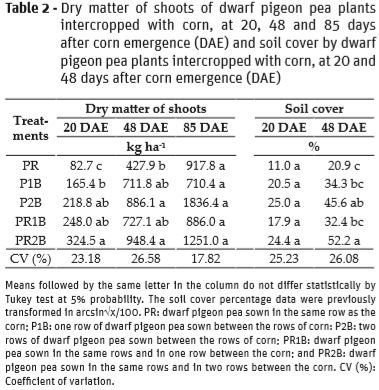
dry matter of shoots (DMS) of dwarf pigeon pea, a significant difference was observed
between treatments in the first two periods of evaluation. In the third evaluation,
there was no significant difference between treatments (<a href = "#t2">Table 2</a>). In the first evaluation
(20 DAE), treatments PR2B, P2B and PR1B were superior in relation to PR and P1B.
In these evaluation (48 DAE), P2B and PR2B were superior to the other treatments,
which did not differ from each other (<a href = "#t2">Table 2</a>).</font></p>

    <p>&nbsp;</p>

<a name = "t2"><img src = "/img/revistas/rca/v41n2/v41n2a08t2.jpg"></a>

    
<p>&nbsp;</p>

    <p><font face = "Verdana" size = "2">The dwarf pigeon
pea showed low DMS production, a result associated with its slow initial growth,
characteristic of the species. Furthermore, the low production of the dwarf pigeon
pea can be attributed to the intrinsic characteristics of the plant physiology,
since it presents C3-type metabolism, and is less efficient in the fixation of atmospheric
carbon (C) in relation to corn, which has a C4 photosynthetic metabolism, due to
the higher photorespiration and for spending more energy in the fixation of C in
environments of higher temperatures due to O<sub>2</sub> fixation (Santos <i>et
al</i>., 2011).</font></p>

    <p><font face = "Verdana" size = "2">Concerning the percentage
of soil cover by dwarf pigeon pea plants, there was no significant difference in
the first sampling period (<a href = "#t2">Table 2</a>). In the evaluation performed in the second period,
there was a difference between treatments. PR2B presented higher averages compared
to PR, not differing statistically from the P2B system (<a href = "#t2">Table 2</a>). This result is
attributed to a larger population of dwarf pigeon pea plants in these two systems.
In addition, these two treatments accounted for the highest dry matter of shoots,
with 948.4 kg ha<sup>-1</sup> (PR2B) and 886.1 kg ha<sup>-1</sup> (P2B). Boer <i>et
al</i>. (2008), when evaluating the green and dry matter production and the percentage
of soil cover of three cover crop species, also verified a relationship between
the amount of dry matter accumulated and the percentage of soil cover.</font></p>

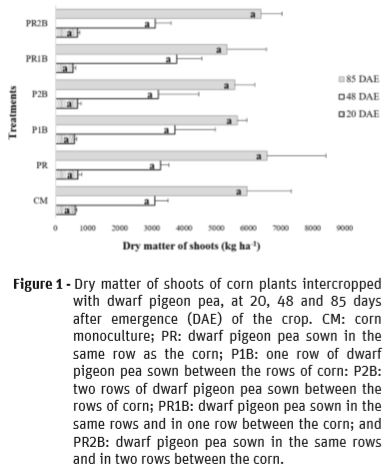
    <p><font face = "Verdana" size = "2">There was no significant differences between treatments
with regard to the DMS of the corn plants in the three sampling periods (<a href = "#f1">Figure
1</a>). It can be inferred that the dwarf pigeon pea did not compete for production
factors with corn plants, as well as there was no allelopathic effect of the dwarf
pigeon pea on the Poaceae. Corn is considered a good competitor in relation to smaller
plants, mainly due to its higher rate of dry matter accumulation in the early stages
of development. It shows high capacity of interception of the photosynthetically
active radiation along its canopy, which reduces the amount of this resource for
the other species (Liu and Song, 2012).</font></p>

    ]]></body>
<body><![CDATA[<p>&nbsp;</p>

<a name = "f1"><img src = "/img/revistas/rca/v41n2/v41n2a08f1.jpg"></a>

    
<p>&nbsp;</p>

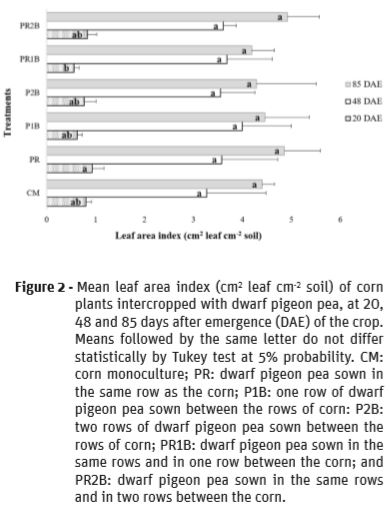
    <p><font face = "Verdana" size = "2">For the leaf area
index (LAI) of corn, there was a significant difference between the treatments studied
in the first evaluation period (<a href = "#f2">Figure 2</a>). The treatments CM, PR, P1B, P2B and PR2B
were statistically similar, and superior to PR1B. This result is related to the
stage of corn development, which in the initial phase shows growth from seed reserves.
This growth may vary according to the size of the seed (Sangoi <i>et al</i>., 2004).
However, Ritchie <i>et al</i>. (2003) mention that in the second week after emergence,
photosynthesis already exerts its function in the plant and the seed reserves are
depleting. Therefore, corn may have been affected by competition with dwarf pigeon
pea plants for resources such as water, light and nutrients. Although corn is a
great competitor, intercropping can reduce maximum LAI values (Oliveira <i>et al</i>.,
2011).</font></p>

    <p>&nbsp;</p>

<a name = "f2"><img src = "/img/revistas/rca/v41n2/v41n2a08f2.jpg"></a>

    
<p>&nbsp;</p>

    <p><font face = "Verdana" size = "2">For the second and third evaluation
periods, there was no significant difference between treatments for the LAI (<a href = "#f2">Figure
2</a>). The LAI data can be considered satisfactory, since values were higher than 3
in the two evaluation periods Lauer <i>et al</i>. (2004) referred that LAI values
for corn must be between 4 and 5, at flowering, in order to optimize its agronomic
performance.</font></p>

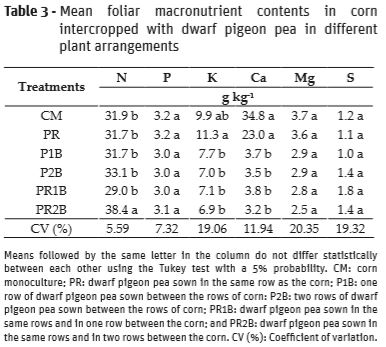
    <p><font face = "Verdana" size = "2">For P, Mg, and S contents, no significant differences
were found among treatments (<a href = "#t3">Table 3</a>). Regarding corn leaf N content, there was
a significant difference between the treatments (<a href = "#t3">Table 3</a>). The PR2B arrangement
was higher than the others, which did not differ between each other. The higher
number of dwarf pigeon pea plants in the PR2B treatment probably caused a higher
amount of N which could have been taken up by the corn plants. An increase in N
availability in soil is accompanied by a positive response in N content in the leaves
(Nascimento <i>et al</i>., 2012).</font></p>

    <p>&nbsp;</p>

<a name = "t3"><img src = "/img/revistas/rca/v41n2/v41n2a08t3.jpg"></a>

    
<p>&nbsp;</p>

    <p><font face = "Verdana" size = "2">The N values obtained in all
of the treatments were considered sufficient for corn, since they varied between
29.0 g kg<sup>-1</sup> and 38.4 g kg<sup>-1</sup>. Then, monocrop or intercropping
corn with dwarf pigeon pea in different plant arrangements produced foliar N content
within the adequate (or slightly higher) range for corn (27.5 to 32.5 gkg<sup>-1</sup>),
according to Malavolta <i>et al</i>. (1989). Corn behaves well in intercropping
systems, and because it is an extremely demanding crop in terms of nutrients, especially
N, the Fabaceae plant favored cereal growth in intercropping system.</font></p>

    ]]></body>
<body><![CDATA[<p><font face = "Verdana" size = "2">For corn foliar K content, a significantly higher
value was found under PR treatment compared to P1B, P2B, PR1B and PR2B, and did
not differ statistically from MC (<a href = "#t3">Table 3</a>). The presence of dwarf pigeon pea in
the different arrangements hampered the absorption of K by the corn plants, except
when the Fabaceae plant was sown in the same row as the cereal. Probably, fabaceae
can absorb K at depths greater than the area exploited by corn roots, and thus in
the same row the species did not compete for the P available in the soil. Moreover,
dwarf pigeon pea dry matter production in the rows of corn was lower than in the
other arrangements, which may have reduced competition for the nutrient.</font></p>

    <p><font face = "Verdana" size = "2">A significantly higherfoliar Ca contents were
observed for CM and PR treatments (<a href = "#t3">Table 3</a>). The reduction in nutrient content in
plant tissue in intercropping may have been linked to the interspecies competitive
interaction exercised by one species over the other (Viera <i>et al</i>., 2013).
The low ability to compete for Ca on the part of corn in intercropping systems was
already observed by other authors (Cury <i>et al</i>., 2012). Higher populations
of the intercropped plant make greater soil exploitation possible, intensifying
the competitive effects over the main crop (Belel <i>et al</i>., 2014).</font></p>

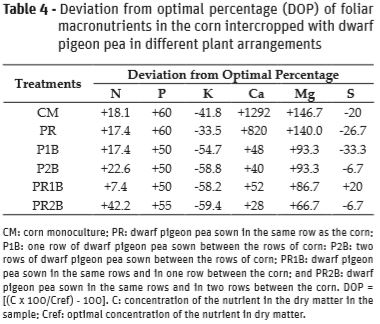
    <p><font face = "Verdana" size = "2">In relation to the rates of deviation from the
optimal percentage (DOP), excessive N and P in corn leaves was verified in all of
the treatments. The treatment PR2B presented the highest DOP index for N, and the
CM and PR presented the highest DOP indices for P (<a href = "#t4">Table 4</a>).</font></p>

    <p>&nbsp;</p>

<a name = "t4"><img src = "/img/revistas/rca/v41n2/v41n2a08t4.jpg"></a>

    
<p>&nbsp;</p>

    <p><font face = "Verdana" size = "2">For K, all of the treatments presented negative indices, which indicates a deficiency
in the macronutrient in the corn (<a href = "#t4">Table 4</a>). The K deficiency in all of the treatments
may be related with the excessive Ca verified in the corn leaves (<a href = "#t4">Table 4</a>). Calcium
had positive indices in all treatments, showing good availability of the nutrient
in the soil, especially in the CM and PR treatments, which presented very high indices.
The higher availability of Ca in present soil may cause its diffusion to roots in
greater quantity, and as Ca and K are absorbed by the same mechanisms in the cellular
membrane, its absorption was probably preferential in relation to K (Medeiros <i>et
al</i>., 2008).</font></p>

    <p><font face = "Verdana" size = "2">For Mg, positive
indices were observed in all of the treatments (<a href = "#t4">Table 4</a>), showing an excess of the
nutrient in the corn leaves. The highest foliar Mg indices were obtained by the
CM and PR control treatments. Similar results were verified for foliar P. This similarity
may be related to the synergism between these two macronutrients. According to Malavolta
<i>et al</i>. (1989), absorption of P is influenced by the Mg concentration in the
medium, with Mg able to carry P into the plant.</font></p>

    <p><font face = "Verdana" size = "2">In relation to foliar S in the corn plants, a deficiency was verified in
the CM, PR, P1B, P2B, and PR2B treatments. In the PR1B, there was an excess, even
though it was low (<a href = "#t4">Table 4</a>). It is worth noting that the S deficiency occurred to
a greater degree in the treatments with lower dwarf pigeon pea plant numbers and
in the corn monocrop. However, greater competition for S was expected in plots with
higher dwarf pigeon pea populations, since sulfur is required in the fixing nodules
for symbiotic fixation of N<sub>2</sub>, given that this nutrient is an element
which constitutes nitrogenase (Paiva and Nicodemo, 1994).</font></p>

    <p><font face = "Verdana" size = "2">In the PR1B treatment, which was the only one that presented
excessive S in the corn leaves, the lowest foliar content and lowest DOP index for
N was verified (<a href = "#t3">Tables 3</a> and <a href = "#t4">4</a>). From this result it can be inferred that in the
treatment less fixation of N occurred via biological means. Thus, there was less
absorption of S by the dwarf pigeon pea, allowing for greater use of the macronutrient
on the part of the corn plants.</font></p>

    <p><font face = "Verdana" size = "2">No
significant differences were observed for the variables stem diameter (SD), plant
height (PH), first ear insertion height (FEIH), final plant stand (FPS) of corn,
number of ears per plant (NEP), number of rows of grains in the ear (NRE), number
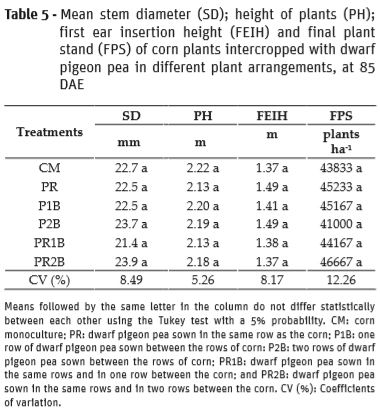
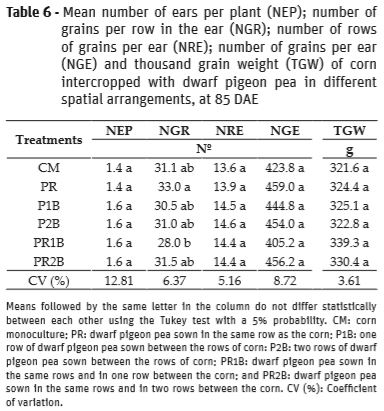
of grains per ear (NGE) and thousand grain weight (TGW) (<a href = "#t5">Tables 5</a> and <a href = "#t6">6</a>).</font></p>

    ]]></body>
<body><![CDATA[<p>&nbsp;</p>

<a name = "t5"><img src = "/img/revistas/rca/v41n2/v41n2a08t5.jpg"></a>

    
<p>&nbsp;</p>

<a name = "t6"><img src = "/img/revistas/rca/v41n2/v41n2a08t6.jpg"></a>

    
<p>&nbsp;</p>

    <p><font face = "Verdana" size = "2">As for the number of grains per row in the ear, there was a significant
difference between the arrangements of dwarf pigeon pea (<a href = "#t6">Table 6</a>).</font></p>

    <p><font face = "Verdana" size = "2">The PR arrangement was superior to the other treatments. According to Balbinot
<i>et al</i>. (2005), the number of grains per row directly interferes with ear
length and is the yield component that presents the best correlation with productivity,
overcoming the other components. Sangoi (2001) points out that the competition of
plants for incident solar radiation, nutrients and water determines the ear formation,
since it may imply a deficiency of carbon and nitrogen supply to the plants.</font></p>

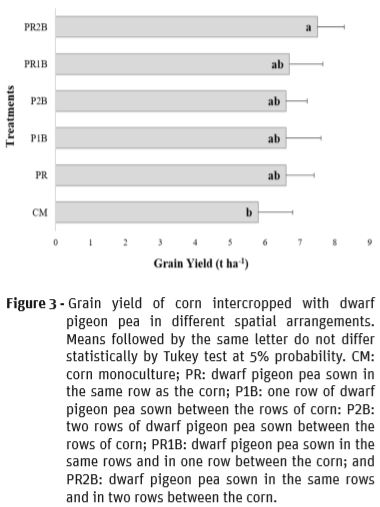
    <p><font face = "Verdana" size = "2">For grain yield, it was found that there was a
significant difference between the evaluated treatments (<a href = "#f3">Figure 3</a>). The corn intercropped
with dwarf pigeon pea sown in the same row as corn and in two rows between them
(PR2B) was superior to crop monoculture and to the other plant arrangements, which
did not differ from each other. However, all values  were lower than those obtained
by Arantes <i>et al</i>. (2016), with yield of 9.0 t ha<sup>-1</sup>, using the
same corn variety and intercropping with green manure (<i>Calopogonium mucunoides</i>
Desv. (with a density of 21 seeds m<sup>-1</sup>), <i>Pueraria phaseoloides</i>
(Roxb.) Benth (60 seeds m<sup>-1</sup>) and <i>Neonotonia wightii</i> (Wight &amp;
Arn) Lackey) (30 seeds m<sup>-1</sup>), cultivated under the same environmental
conditions.</font></p>

    <p>&nbsp;</p>

<a name = "f3"><img src = "/img/revistas/rca/v41n2/v41n2a08f3.jpg"></a>

    
<p>&nbsp;</p>

    <p><font face = "Verdana" size = "2">The superiority of PR2B in relation
to the other treatments can be attributed to the higher population of dwarf pigeon
pea plants in the system, increasing the N uptake through biological fixation, benefiting
the nutrient absorption by corn plants. This occurrence can be confirmed by the
higher N content observed in corn leaves in the PR2B system (<a href = "#t3">Tables 3</a> and <a href = "#t4">4</a>). Spagnollo
<i>et al</i>. (2002) also verified a higher corn yield under intercropping compared
to corn monoculture, attributing the response to the N supply by green manures (<i>Canavalia
ensiformi </i>L., <i>Cajanus cajan </i>L., <i>Stizolobium niveum</i> Kuntze and
<i>Glycine</i> sp.).</font></p>

    <p><font face = "Verdana" size = "2">Corn can be
benefited by the N<sub>2 </sub>fixed by the legume in intercropping, either by the
direct excretion of nitrogenous compounds, by the fast decomposition of nodules
and roots rich in N (Fustec <i>et al</i>., 2010) or by the direct linking through
mycorrhizae in the corn roots and legume roots (Van der Heijden and Horton, 2009).
In addition to the N supply, the higher number of legume plants may have improved
the soil organic matter content and, consequently, the cycling of other nutrients
(Zaccheo <i>et al</i>., 2016), also influencing moisture and weed control (Malik
<i>et al</i>., 2006), thus increasing corn grain yield.</font></p>

    ]]></body>
<body><![CDATA[<p><font face = "Verdana" size = "3"><b>CONCLUSIONS</b></font></p>

    <p><font face = "Verdana" size = "2">The arrangements of dwarf pigeon pea plants intercropped
with corn are viable for the production of higher corn yield. In general, they did
not negatively influence the agronomic characteristics and growth of the Poaceae,
which shows that regardless of the arrangement of plants the dwarf pigeon pea did
not compete with the corn for production factors, such as light, water and nutrients.</font></p>

    <p><font face = "Verdana" size = "2">The arrangements of dwarf pigeon
pea in intercropping did not significantly affect the absorption and accumulation
of the macronutrients P, Mg and S by corn, but the arrangement with the greatest
population of pigeon pea favored the accumulation of N in corn.</font></p>

    <p>&nbsp;</p>

    <p><font face = "Verdana" size = "3"><b>References</b></font></p>

    <!-- ref --><p><font face = "Verdana" size = "2">Alvarenga,
R.C.; Cobucci, T.; Kluthcouski, J.;Wruck, F.J.; Cruz, J.C. &amp; Gontijo Neto M.M.
(2006) – A cultura do milho na integração lavoura-pecuária. <i>Informe Agropecuário</i>,
vol. 27, p. 106-126.    &nbsp;&nbsp;&nbsp;&nbsp;&nbsp;&nbsp;&nbsp;&nbsp;[&#160;<a href="javascript:void(0);" onclick="javascript: window.open('/scielo.php?script=sci_nlinks&ref=681137&pid=S0871-018X201800020000800001&lng=','','width=640,height=500,resizable=yes,scrollbars=1,menubar=yes,');">Links</a>&#160;]<!-- end-ref --></font></p>

    <!-- ref --><p><font face = "Verdana" size = "2">Arantes, A.C.C.;
Fontanetti, A.; Soares, M.R.; Silva Neto, F.J. &amp; Próspero, A.G. (2016) - Agronomic
characteristics and yield of organic maize straw intercropped with perennial green
manures. <i>Pesquisa Agropecuaria Tropical</i>, vol. 46, n. 3, p. 222-229. <a href = "http://dx.doi.org/10.1590/1983-40632016v4641054" target = "_blank">http://dx.doi.org/10.1590/1983-40632016v4641054</a></font>&nbsp;&nbsp;&nbsp;&nbsp;&nbsp;&nbsp;&nbsp;&nbsp;[&#160;<a href="javascript:void(0);" onclick="javascript: window.open('/scielo.php?script=sci_nlinks&ref=681139&pid=S0871-018X201800020000800002&lng=','','width=640,height=500,resizable=yes,scrollbars=1,menubar=yes,');">Links</a>&#160;]<!-- end-ref --><!-- ref --><p><font face = "Verdana" size = "2">Balbinot, A.A.J.; Backes, R.L.; Alves, A.C.; Ogliari,
J.B. &amp; Fonseca, J.A. (2005) - Contribuição de componentes de rendimento na produtividade
de grãos em variedades de polinização aberta de milho. <i>Revista Brasileira de
Agrociência</i>, vol. 11, n. 2, p. 161-166.    &nbsp;&nbsp;&nbsp;&nbsp;&nbsp;&nbsp;&nbsp;&nbsp;[&#160;<a href="javascript:void(0);" onclick="javascript: window.open('/scielo.php?script=sci_nlinks&ref=681140&pid=S0871-018X201800020000800003&lng=','','width=640,height=500,resizable=yes,scrollbars=1,menubar=yes,');">Links</a>&#160;]<!-- end-ref --></font></p>

    ]]></body>
<body><![CDATA[<!-- ref --><p><font face = "Verdana" size = "2">Belel, M.D.; Halim, R.A.; Rafii, M.Y. &amp;Saud, H.M. (2014) - Intercropping
of corn with some selected legumes for improved forage production: a review. <i>Journal
of Agricultural Science</i>, vol. 6, n. 3, p. 48-62. <a href = "http://dx.doi.org/10.5539/jas.v6n3p48" target = "_blank">http://dx.doi.org/10.5539/jas.v6n3p48</a></font>&nbsp;&nbsp;&nbsp;&nbsp;&nbsp;&nbsp;&nbsp;&nbsp;[&#160;<a href="javascript:void(0);" onclick="javascript: window.open('/scielo.php?script=sci_nlinks&ref=681142&pid=S0871-018X201800020000800004&lng=','','width=640,height=500,resizable=yes,scrollbars=1,menubar=yes,');">Links</a>&#160;]<!-- end-ref --><!-- ref --><p><font face = "Verdana" size = "2">Benicasa, P.;Tosti, G.;Tei, F. &amp;Guiducci,
M. (2010) - Actual N availability from winter catch crops used for green manuring
in maize cultivation. <i>Journal of Sustainable Agriculture</i>, vol. 34, n. 7,
p. 705-723. <a href = "https://doi.org/10.1080/10440046.2010.507452" target = "_blank">https://doi.org/10.1080/10440046.2010.507452</a></font>&nbsp;&nbsp;&nbsp;&nbsp;&nbsp;&nbsp;&nbsp;&nbsp;[&#160;<a href="javascript:void(0);" onclick="javascript: window.open('/scielo.php?script=sci_nlinks&ref=681143&pid=S0871-018X201800020000800005&lng=','','width=640,height=500,resizable=yes,scrollbars=1,menubar=yes,');">Links</a>&#160;]<!-- end-ref --><!-- ref --><p><font face = "Verdana" size = "2">Boer, C.A.; Assis, R.L.; Silva, G.P.; Braz, A.J.B.P.; Barroso,
A.L.L.; Filho, A.C. &amp; Pires, F.R. (2008) - Biomassa, decomposição e cobertura
do solo ocasionada por resíduos culturais de três espécies vegetais na região Centro
Oeste do Brasil. <i>Revista Brasileira de Ciência do Solo</i>, vol. 32, n. 2, p.
843-851. <a href = "http://dx.doi.org/10.1590/S0100-06832008000200038" target = "_blank">http://dx.doi.org/10.1590/S0100-06832008000200038</a></font>&nbsp;&nbsp;&nbsp;&nbsp;&nbsp;&nbsp;&nbsp;&nbsp;[&#160;<a href="javascript:void(0);" onclick="javascript: window.open('/scielo.php?script=sci_nlinks&ref=681144&pid=S0871-018X201800020000800006&lng=','','width=640,height=500,resizable=yes,scrollbars=1,menubar=yes,');">Links</a>&#160;]<!-- end-ref --><!-- ref --><p><font face = "Verdana" size = "2">Cantarella, H.; Raij, B.V. &amp; Camargo, C.E.O. (1996)
- Cereais. <i>In</i>: Raij, B.V.; Cantarella, H.; Quaggio, J.A. &amp; Furlani, M.C.
(Eds.) - <i>Recomendações de adubação e calagem para o Estado de São Paulo</i>.
Campinas, Instituto Agronômico, p. 45-47.    &nbsp;&nbsp;&nbsp;&nbsp;&nbsp;&nbsp;&nbsp;&nbsp;[&#160;<a href="javascript:void(0);" onclick="javascript: window.open('/scielo.php?script=sci_nlinks&ref=681145&pid=S0871-018X201800020000800007&lng=','','width=640,height=500,resizable=yes,scrollbars=1,menubar=yes,');">Links</a>&#160;]<!-- end-ref --></font></p>

    <!-- ref --><p><font face = "Verdana" size = "2">Casper, B.B.; Cahill Jr., J.F. &amp; Hyatt, L.A. (1998) - Aboveground competition
does not alter biomass allocated to roots in <i>Abutilon theophrasti</i>. <i>New
Phytologist</i>, vol. 140, n. 2, p. 231-238. <a href = "http://dx.doi.org/10.1046/j.1469-8137.1998.00271.x" target = "_blank">http://dx.doi.org/10.1046/j.1469-8137.1998.00271.x</a></font>&nbsp;&nbsp;&nbsp;&nbsp;&nbsp;&nbsp;&nbsp;&nbsp;[&#160;<a href="javascript:void(0);" onclick="javascript: window.open('/scielo.php?script=sci_nlinks&ref=681147&pid=S0871-018X201800020000800008&lng=','','width=640,height=500,resizable=yes,scrollbars=1,menubar=yes,');">Links</a>&#160;]<!-- end-ref --><!-- ref --><p><font face = "Verdana" size = "2">Cheng, Z.H. &amp; Xu, P. (2013) - Lily (<i>Lilium</i>
spp.) root exudates exhibit different allelopathies on four vegetable crops. <i>Acta
Agriculturae Scandinavica B</i>, vol. 63, n. 2, p. 169-175. <a href = "https://doi.org/10.1080/09064710.2012.734323" target = "_blank">https://doi.org/10.1080/09064710.2012.734323</a></font>&nbsp;&nbsp;&nbsp;&nbsp;&nbsp;&nbsp;&nbsp;&nbsp;[&#160;<a href="javascript:void(0);" onclick="javascript: window.open('/scielo.php?script=sci_nlinks&ref=681148&pid=S0871-018X201800020000800009&lng=','','width=640,height=500,resizable=yes,scrollbars=1,menubar=yes,');">Links</a>&#160;]<!-- end-ref --><!-- ref --><p><font face = "Verdana" size = "2">Cortez, J.W.; Furlani, C.E.O. &amp; Silva, R.P.
(2009) - Sistemas de adubação e consórcio de culturas intercalares e seus efeitos
nas variáveis de colheita da cultura do milho. <i>Engenharia Agrícola</i>, vol.
29, n. 2, p. 277-287. <a href = "http://dx.doi.org/10.1590/S0100-69162009000200011" target = "_blank">http://dx.doi.org/10.1590/S0100-69162009000200011</a></font>&nbsp;&nbsp;&nbsp;&nbsp;&nbsp;&nbsp;&nbsp;&nbsp;[&#160;<a href="javascript:void(0);" onclick="javascript: window.open('/scielo.php?script=sci_nlinks&ref=681149&pid=S0871-018X201800020000800010&lng=','','width=640,height=500,resizable=yes,scrollbars=1,menubar=yes,');">Links</a>&#160;]<!-- end-ref --><!-- ref --><p><font face = "Verdana" size = "2">Cury, J.P.; Santos, J.B.; Silva, E.B.; Byrro,
E.C.M.; Braga, R.R.; Carvalho, F.P. &amp; Silva, D.V. (2012) - Acúmulo e partição
de nutrientes de cultivares de milho em competição com plantas daninhas. <i>Planta
Daninha</i>, vol. 30, n. 2, p. 287-296. <a href = "http://dx.doi.org/10.1590/S0100-83582012000200007" target = "_blank">http://dx.doi.org/10.1590/S0100-83582012000200007</a></font>&nbsp;&nbsp;&nbsp;&nbsp;&nbsp;&nbsp;&nbsp;&nbsp;[&#160;<a href="javascript:void(0);" onclick="javascript: window.open('/scielo.php?script=sci_nlinks&ref=681150&pid=S0871-018X201800020000800011&lng=','','width=640,height=500,resizable=yes,scrollbars=1,menubar=yes,');">Links</a>&#160;]<!-- end-ref --><!-- ref --><p><font face = "Verdana" size = "2">Damián-Nava, A.; González-Hernández, V.A.; García,
P.S.; Valdívia, C.B.P. &amp;Munõz, M.L. (2006) - Dinámica y diagnóstico nutrimental
del guayabo em Iguala, Guerrero, México. <i>Terra Latinoamericana</i>, vol. 24,
n. 1, p. 125-132.    &nbsp;&nbsp;&nbsp;&nbsp;&nbsp;&nbsp;&nbsp;&nbsp;[&#160;<a href="javascript:void(0);" onclick="javascript: window.open('/scielo.php?script=sci_nlinks&ref=681151&pid=S0871-018X201800020000800012&lng=','','width=640,height=500,resizable=yes,scrollbars=1,menubar=yes,');">Links</a>&#160;]<!-- end-ref --></font></p>

    <!-- ref --><p><font face = "Verdana" size = "2">Fávero, C.; Jucksch,
I.; Alvarenga, R.C. &amp; Costa, L.M. (2001) - Modificações na população de plantas
espontâneas na presença de adubos verdes. <i>Pesquisa Agroecuária Brasileira</i>,
vol. 36, n. 11, p. 1355-1362. <a href = "http://dx.doi.org/10.1590/S0100-204X2001001100005" target = "_blank">http://dx.doi.org/10.1590/S0100-204X2001001100005</a></font>&nbsp;&nbsp;&nbsp;&nbsp;&nbsp;&nbsp;&nbsp;&nbsp;[&#160;<a href="javascript:void(0);" onclick="javascript: window.open('/scielo.php?script=sci_nlinks&ref=681153&pid=S0871-018X201800020000800013&lng=','','width=640,height=500,resizable=yes,scrollbars=1,menubar=yes,');">Links</a>&#160;]<!-- end-ref --><!-- ref --><p><font face = "Verdana" size = "2">Fustec, J.; Lesuffleur, F.; Mahieu, S. &amp; Cliquet,
J.B. (2010) - Nitrogen rhizodeposition of legumes: a review. <i>Agronomy for Sustainable
Development</i>, vol. 30, n. 1, p. 57-66. <a href = "https://doi.org/10.1051/agro/2009003" target = "_blank">https://doi.org/10.1051/agro/2009003</a></font>&nbsp;&nbsp;&nbsp;&nbsp;&nbsp;&nbsp;&nbsp;&nbsp;[&#160;<a href="javascript:void(0);" onclick="javascript: window.open('/scielo.php?script=sci_nlinks&ref=681154&pid=S0871-018X201800020000800014&lng=','','width=640,height=500,resizable=yes,scrollbars=1,menubar=yes,');">Links</a>&#160;]<!-- end-ref --><!-- ref --><p><font face = "Verdana" size = "2">Gitti, D.C.; Arf, O.; Vilela, R.G.; Portugal,
J.R.; Kaneko, F.H. &amp; Rodrigues, R.A.F. (2012) - Épocas de semeadura de crotalária
em consórcio com milho. <i>Revista Brasileira de Milho e Sorgo</i>, vol. 11, n.
2, p. 156-158. <a href = "http://dx.doi.org/10.18512/1980-6477/rbms.v11n2p156-168" target = "_blank">http://dx.doi.org/10.18512/1980-6477/rbms.v11n2p156-168</a></font>&nbsp;&nbsp;&nbsp;&nbsp;&nbsp;&nbsp;&nbsp;&nbsp;[&#160;<a href="javascript:void(0);" onclick="javascript: window.open('/scielo.php?script=sci_nlinks&ref=681155&pid=S0871-018X201800020000800015&lng=','','width=640,height=500,resizable=yes,scrollbars=1,menubar=yes,');">Links</a>&#160;]<!-- end-ref --><!-- ref --><p><font face = "Verdana" size = "2">Godoy, R.; Bacchi, O.O.S.; Moreira, F.A. &amp;
Reichardt, K. (2009) - Evaluation of pigeon pea lines for biological soil decompaction.
<i>International Journal of Agronomy</i>, vol. 2009, art. 609717. <a href = "http://dx.doi.org/10.1155/2009/609717" target = "_blank">http://dx.doi.org/10.1155/2009/609717</a></font>&nbsp;&nbsp;&nbsp;&nbsp;&nbsp;&nbsp;&nbsp;&nbsp;[&#160;<a href="javascript:void(0);" onclick="javascript: window.open('/scielo.php?script=sci_nlinks&ref=681156&pid=S0871-018X201800020000800016&lng=','','width=640,height=500,resizable=yes,scrollbars=1,menubar=yes,');">Links</a>&#160;]<!-- end-ref --><!-- ref --><p><font face = "Verdana" size = "2">Lauer, J.G.; Roth, G.W. &amp; Bertran, M.G. (2004)
- Impact of defoliation on corn forage yield. <i>Agronomy Journal</i>, vol. 96,
n. 5, p. 459-1463.    &nbsp;&nbsp;&nbsp;&nbsp;&nbsp;&nbsp;&nbsp;&nbsp;[&#160;<a href="javascript:void(0);" onclick="javascript: window.open('/scielo.php?script=sci_nlinks&ref=681157&pid=S0871-018X201800020000800017&lng=','','width=640,height=500,resizable=yes,scrollbars=1,menubar=yes,');">Links</a>&#160;]<!-- end-ref --></font></p>

    <!-- ref --><p><font face = "Verdana" size = "2">Li, Q.Z.; Sun,
J.H.; Wei, X.J.; Christie, P.; Zhang, F.S. &amp; Li, L. (2011) - Overyielding and
interspecific interactions mediated by nitrogen fertilization in strip intercropping
of maize with faba bean, wheat and barley. <i>Plant and Soil</i>, vol. 339, n. 1-2,
p. 147–161. <a href = "https://doi.org/10.1007/s11104-010-0561-5" target = "_blank">https://doi.org/10.1007/s11104-010-0561-5</a></font>&nbsp;&nbsp;&nbsp;&nbsp;&nbsp;&nbsp;&nbsp;&nbsp;[&#160;<a href="javascript:void(0);" onclick="javascript: window.open('/scielo.php?script=sci_nlinks&ref=681159&pid=S0871-018X201800020000800018&lng=','','width=640,height=500,resizable=yes,scrollbars=1,menubar=yes,');">Links</a>&#160;]<!-- end-ref --><!-- ref --><p><font face = "Verdana" size = "2">Lithourgidis, A.S.; Dordas, C.A.; Damalas, C.A. &amp; Vlachostergios,
D.N. (2011) - Annual intercrops: an alternative pathway for sustainable agriculture.
<i>Australian Journal of Crop Science</i>, vol. 5, n. 4, p 396-410.    &nbsp;&nbsp;&nbsp;&nbsp;&nbsp;&nbsp;&nbsp;&nbsp;[&#160;<a href="javascript:void(0);" onclick="javascript: window.open('/scielo.php?script=sci_nlinks&ref=681160&pid=S0871-018X201800020000800019&lng=','','width=640,height=500,resizable=yes,scrollbars=1,menubar=yes,');">Links</a>&#160;]<!-- end-ref --></font></p>

    ]]></body>
<body><![CDATA[<!-- ref --><p><font face = "Verdana" size = "2">Liu, T.D. &amp; Song, F.B. (2012) - Maize photosynthesis
and microclimate within the canopies at grain-filling stage in response to narrow-wide
row planting patterns. <i>Photosynthetica</i>, vol. 50, n. 2, p. 215-222. <a href = "https://doi.org/10.1007/s11099-012-0011-0" target = "_blank">https://doi.org/10.1007/s11099-012-0011-0</a></font>&nbsp;&nbsp;&nbsp;&nbsp;&nbsp;&nbsp;&nbsp;&nbsp;[&#160;<a href="javascript:void(0);" onclick="javascript: window.open('/scielo.php?script=sci_nlinks&ref=681162&pid=S0871-018X201800020000800020&lng=','','width=640,height=500,resizable=yes,scrollbars=1,menubar=yes,');">Links</a>&#160;]<!-- end-ref --><!-- ref --><p><font face = "Verdana" size = "2">Malavolta, E.; Vitti, G.C. &amp; Oliveira, A.S.
(1989) - <i>Avaliação do estado nutricional de plantas: princípios e aplicações</i>.
Piracicaba, Potafos, 201 p.    &nbsp;&nbsp;&nbsp;&nbsp;&nbsp;&nbsp;&nbsp;&nbsp;[&#160;<a href="javascript:void(0);" onclick="javascript: window.open('/scielo.php?script=sci_nlinks&ref=681163&pid=S0871-018X201800020000800021&lng=','','width=640,height=500,resizable=yes,scrollbars=1,menubar=yes,');">Links</a>&#160;]<!-- end-ref --></font></p>

    <!-- ref --><p><font face = "Verdana" size = "2">Malik,
M.A.; Zahoor, F.; Abbas, S.H. &amp; Ansar, M. (2006) - <i>Comparative study of different
herbicides for control of weeds in rainfed maize</i> (<i>Zea mays</i> L.). Islamabad,
Weed Science Society of Pakistan, 62 p.    &nbsp;&nbsp;&nbsp;&nbsp;&nbsp;&nbsp;&nbsp;&nbsp;[&#160;<a href="javascript:void(0);" onclick="javascript: window.open('/scielo.php?script=sci_nlinks&ref=681165&pid=S0871-018X201800020000800022&lng=','','width=640,height=500,resizable=yes,scrollbars=1,menubar=yes,');">Links</a>&#160;]<!-- end-ref --></font></p>

    <!-- ref --><p><font face = "Verdana" size = "2">Medeiros, J.C.; Albuquerque, J.A.; Mafra, J.L.; Rosa, J.B. &amp; Gatiboni, L.C.
(2008) - Relação cálcio: magnésio do corretivo da acidez do solo na nutrição e no
desenvolvimento inicial de plantas de milho em um Cambissolo Húmico Álico. <i>Semina:
Ciências Agrárias</i>, vol. 29, n. 4, p. 799-806.    &nbsp;&nbsp;&nbsp;&nbsp;&nbsp;&nbsp;&nbsp;&nbsp;[&#160;<a href="javascript:void(0);" onclick="javascript: window.open('/scielo.php?script=sci_nlinks&ref=681167&pid=S0871-018X201800020000800023&lng=','','width=640,height=500,resizable=yes,scrollbars=1,menubar=yes,');">Links</a>&#160;]<!-- end-ref --></font></p>

    <!-- ref --><p><font face = "Verdana" size = "2">Montañés, L.; Heras, L.; Abadía, J. &amp; Sanz, M. (1993) - Plant
analysis interpretation based on a new index: Deviation from optimum percentage
(DOP). <i>Journal of Plant Nutrition</i>, vol. 16, n. 7, p. 1289-1308. <a href = "https://doi.org/10.1080/01904169309364613" target = "_blank">https://doi.org/10.1080/01904169309364613</a></font>&nbsp;&nbsp;&nbsp;&nbsp;&nbsp;&nbsp;&nbsp;&nbsp;[&#160;<a href="javascript:void(0);" onclick="javascript: window.open('/scielo.php?script=sci_nlinks&ref=681169&pid=S0871-018X201800020000800024&lng=','','width=640,height=500,resizable=yes,scrollbars=1,menubar=yes,');">Links</a>&#160;]<!-- end-ref --><!-- ref --><p><font face = "Verdana" size = "2">Mushagalusa, G.N.; Ledent, J.F. &amp; Draye, X.
(2008) - Shoot and root competition in potato/maize intercropping: Effects on growth
and yield. <i>Environmental and Experimental Botany</i>, vol. 64, n. 2, p. 180-188.
<a href = "https://doi.org/10.1016/j.envexpbot.2008.05.008" target = "_blank">https://doi.org/10.1016/j.envexpbot.2008.05.008</a></font>&nbsp;&nbsp;&nbsp;&nbsp;&nbsp;&nbsp;&nbsp;&nbsp;[&#160;<a href="javascript:void(0);" onclick="javascript: window.open('/scielo.php?script=sci_nlinks&ref=681170&pid=S0871-018X201800020000800025&lng=','','width=640,height=500,resizable=yes,scrollbars=1,menubar=yes,');">Links</a>&#160;]<!-- end-ref --><!-- ref --><p><font face = "Verdana" size = "2">Nascimento, F.M.; Bicudo, S.J.; Fernandes, D.M.; Rodrigues, J.G.L. &amp;
Fernandes, J.C. (2012) - Diagnose foliar em plantas de milho em sistema de semeadura
direta em função de doses e épocas de aplicação de nitrogênio. <i>Applied Research
&amp; Agrotechnology</i>, vol. 5, n. 1, p. 67-86. <a href = "https://doi.org/10.5777/paet.v5i1.1642" target = "_blank">https://doi.org/10.5777/paet.v5i1.1642</a></font>&nbsp;&nbsp;&nbsp;&nbsp;&nbsp;&nbsp;&nbsp;&nbsp;[&#160;<a href="javascript:void(0);" onclick="javascript: window.open('/scielo.php?script=sci_nlinks&ref=681171&pid=S0871-018X201800020000800026&lng=','','width=640,height=500,resizable=yes,scrollbars=1,menubar=yes,');">Links</a>&#160;]<!-- end-ref --><!-- ref --><p><font face = "Verdana" size = "2">Oliveira, P.; Kluthcouski, J.; Favarinm, J.L.
&amp; Santos, D.C. (2011) - Consórcio de milho com braquiária e guandu-anão em sistema
de dessecação parcial. <i>Pesquisa Agropecuária Brasileira</i>, vol. 46, n. 10,
p. 1184-1192.    &nbsp;&nbsp;&nbsp;&nbsp;&nbsp;&nbsp;&nbsp;&nbsp;[&#160;<a href="javascript:void(0);" onclick="javascript: window.open('/scielo.php?script=sci_nlinks&ref=681172&pid=S0871-018X201800020000800027&lng=','','width=640,height=500,resizable=yes,scrollbars=1,menubar=yes,');">Links</a>&#160;]<!-- end-ref --></font></p>

    <!-- ref --><p><font face = "Verdana" size = "2">Paiva, P.J.R. &amp;
Nicodemo, M.L.F. (1993) - <i>Enxofre no sistema solo-planta-animal</i>. Campo Grande,
Embrapa, 45 p.    &nbsp;&nbsp;&nbsp;&nbsp;&nbsp;&nbsp;&nbsp;&nbsp;[&#160;<a href="javascript:void(0);" onclick="javascript: window.open('/scielo.php?script=sci_nlinks&ref=681174&pid=S0871-018X201800020000800028&lng=','','width=640,height=500,resizable=yes,scrollbars=1,menubar=yes,');">Links</a>&#160;]<!-- end-ref --></font></p>

    <!-- ref --><p><font face = "Verdana" size = "2">Pariz, C.M.; Andreotti,
M.; Azenha, M.V.; Bergamaschine, A.F.; Mello, L.M.M. &amp; Lima, R.C. (2011) - Produtividade
de grãos de milho e massa seca de braquiárias em consórcio no sistema de integração
lavoura-pecuária. <i>Ciência Rural</i>, vol. 41, n. 5, p. 875-882.    &nbsp;&nbsp;&nbsp;&nbsp;&nbsp;&nbsp;&nbsp;&nbsp;[&#160;<a href="javascript:void(0);" onclick="javascript: window.open('/scielo.php?script=sci_nlinks&ref=681176&pid=S0871-018X201800020000800029&lng=','','width=640,height=500,resizable=yes,scrollbars=1,menubar=yes,');">Links</a>&#160;]<!-- end-ref --></font></p>

    <!-- ref --><p><font face = "Verdana" size = "2">Peng, X.; Zhang, Y.; Cai, J. &amp; Zhang, S. (2009)
- Photosynthesis, growth and yield of soybean and maize in a tree-based agroforestry
intercropping system on the Loess Plateau. <i>Agroforestry Systems</i>, vol. 76,
n. 3, p. 569-577. <a href = "https://doi.org/10.1007/s10457-009-9227-9" target = "_blank">https://doi.org/10.1007/s10457-009-9227-9</a></font>&nbsp;&nbsp;&nbsp;&nbsp;&nbsp;&nbsp;&nbsp;&nbsp;[&#160;<a href="javascript:void(0);" onclick="javascript: window.open('/scielo.php?script=sci_nlinks&ref=681178&pid=S0871-018X201800020000800030&lng=','','width=640,height=500,resizable=yes,scrollbars=1,menubar=yes,');">Links</a>&#160;]<!-- end-ref --><!-- ref --><p><font face = "Verdana" size = "2">Ritchie, S.W.; Hanway, J.J. &amp; Benson, G.O. (2003) -
<i>Como a planta de milho se desenvolve</i>. Piracicaba, Potafos, 20 p.    &nbsp;&nbsp;&nbsp;&nbsp;&nbsp;&nbsp;&nbsp;&nbsp;[&#160;<a href="javascript:void(0);" onclick="javascript: window.open('/scielo.php?script=sci_nlinks&ref=681179&pid=S0871-018X201800020000800031&lng=','','width=640,height=500,resizable=yes,scrollbars=1,menubar=yes,');">Links</a>&#160;]<!-- end-ref --></font></p>

    <!-- ref --><p><font face = "Verdana" size = "2">Sangoi, L. (2001) - Understanding plant density
effects on maize growth and development: an important issue to maximize grain yield.
<i>Ciência Rural</i>, vol. 31, n. 1, p. 159-168. <a href = "http://dx.doi.org/10.1590/S0103-84782001000100027" target = "_blank">http://dx.doi.org/10.1590/S0103-84782001000100027</a></font>&nbsp;&nbsp;&nbsp;&nbsp;&nbsp;&nbsp;&nbsp;&nbsp;[&#160;<a href="javascript:void(0);" onclick="javascript: window.open('/scielo.php?script=sci_nlinks&ref=681181&pid=S0871-018X201800020000800032&lng=','','width=640,height=500,resizable=yes,scrollbars=1,menubar=yes,');">Links</a>&#160;]<!-- end-ref --><!-- ref --><p><font face = "Verdana" size = "2">Sangoi, L.; Almeida, M.L.; Horn,D.; Bianchet,
P.;Gracietti, M.A.; Schmitt, A. &amp; Schweitzer, C. (2004) - Tamanho de semente,
profundidade de semeadura e crescimento inicial do milho em duas épocas de semeadura.
<i>Revista Brasileira de Milho e Sorgo</i>,vol. 3, n. 3, p. 370-380. <a href = "http://dx.doi.org/10.18512/1980-6477/rbms.v3n03p%25p" target = "_blank">http://dx.doi.org/10.18512/1980-6477/rbms.v3n03p%25p</a></font>&nbsp;&nbsp;&nbsp;&nbsp;&nbsp;&nbsp;&nbsp;&nbsp;[&#160;<a href="javascript:void(0);" onclick="javascript: window.open('/scielo.php?script=sci_nlinks&ref=681182&pid=S0871-018X201800020000800033&lng=','','width=640,height=500,resizable=yes,scrollbars=1,menubar=yes,');">Links</a>&#160;]<!-- end-ref --><!-- ref --><p><font face = "Verdana" size = "2">Santos, P.M.; Santos, A.C.; Negreiros
Neto, J.V.; Araújo, A.S. &amp; Silva, J.E.C. (2011) - Caracterização de pastagens
de capim tanzânia e mombaça consorciados com estilosantes em ecótono de transição
Cerrado:Floresta Amazônica. <i>Revista Brasileira de Ciências Agrárias</i>, vol.
6, n. 1, p. 163-173. <a href = "http://dx.doi.org/10.5039/agraria.v6i1a817" target = "_blank">http://dx.doi.org/10.5039/agraria.v6i1a817</a></font>&nbsp;&nbsp;&nbsp;&nbsp;&nbsp;&nbsp;&nbsp;&nbsp;[&#160;<a href="javascript:void(0);" onclick="javascript: window.open('/scielo.php?script=sci_nlinks&ref=681183&pid=S0871-018X201800020000800034&lng=','','width=640,height=500,resizable=yes,scrollbars=1,menubar=yes,');">Links</a>&#160;]<!-- end-ref --><!-- ref --><p><font face = "Verdana" size = "2">Spagnollo, E.; Bayer, C.;Wildner, L.P.; Ernani, P.R.; Albuquerque,
J.A. &amp; Proença, M.M. (2002) - Leguminosas estivais intercalares como fonte de
nitrogênio para o milho, no Sul do Brasil. <i>Revista Brasileira de Ciência do Solo</i>,
vol. 26, n. 2, p. 417-423. <a href = "http://dx.doi.org/10.1590/S0100-06832002000200015" target = "_blank">http://dx.doi.org/10.1590/S0100-06832002000200015</a></font>&nbsp;&nbsp;&nbsp;&nbsp;&nbsp;&nbsp;&nbsp;&nbsp;[&#160;<a href="javascript:void(0);" onclick="javascript: window.open('/scielo.php?script=sci_nlinks&ref=681184&pid=S0871-018X201800020000800035&lng=','','width=640,height=500,resizable=yes,scrollbars=1,menubar=yes,');">Links</a>&#160;]<!-- end-ref --><!-- ref --><p><font face = "Verdana" size = "2">Van Der Heijden, M.G.A. &amp; Horton, T.R. (2009)
- Socialism in soil? The importance of mycorrhizal fungal networks for facilitation
in natural ecosystems. <i>Journal of Ecology</i>, vol. 97, n. 6, p. 1139-1150. <a href = "http://dx.doi.org/10.1111/j.1365-2745.2009.01570.x" target = "_blank">http://dx.doi.org/10.1111/j.1365-2745.2009.01570.x</a></font>&nbsp;&nbsp;&nbsp;&nbsp;&nbsp;&nbsp;&nbsp;&nbsp;[&#160;<a href="javascript:void(0);" onclick="javascript: window.open('/scielo.php?script=sci_nlinks&ref=681185&pid=S0871-018X201800020000800036&lng=','','width=640,height=500,resizable=yes,scrollbars=1,menubar=yes,');">Links</a>&#160;]<!-- end-ref --><!-- ref --><p><font face = "Verdana" size = "2">Viera, M.; Schumacher, M.V.; Caldeira, M.V.W.
&amp; Watzlawick, L.F. (2013) - Teores de nutrientes em povoamentos monoespecíficos
e mistos de <i>Eucalyptus urograndis</i> e <i>Acacia mearnsii</i> em sistema agrossilvicultural.
<i>Ciência Florestal</i>, vol. 23, n. 1, p. 67-76. <a href = "http://dx.doi.org/10.5902/198050988440" target = "_blank">http://dx.doi.org/10.5902/198050988440</a></font>&nbsp;&nbsp;&nbsp;&nbsp;&nbsp;&nbsp;&nbsp;&nbsp;[&#160;<a href="javascript:void(0);" onclick="javascript: window.open('/scielo.php?script=sci_nlinks&ref=681186&pid=S0871-018X201800020000800037&lng=','','width=640,height=500,resizable=yes,scrollbars=1,menubar=yes,');">Links</a>&#160;]<!-- end-ref --><!-- ref --><p><font face = "Verdana" size = "2">Wu, K.X. &amp; Wu, B.Z. (2014) - Potential environmental
benefits of intercropping annual with leguminous perennial crops in Chinese agriculture.
<i>Agriculture, Ecosystems and Environment</i>, vol. 188, p. 147-149. <a href = "https://doi.org/10.1016/j.agee.2014.02.026" target = "_blank">https://doi.org/10.1016/j.agee.2014.02.026</a></font>&nbsp;&nbsp;&nbsp;&nbsp;&nbsp;&nbsp;&nbsp;&nbsp;[&#160;<a href="javascript:void(0);" onclick="javascript: window.open('/scielo.php?script=sci_nlinks&ref=681187&pid=S0871-018X201800020000800038&lng=','','width=640,height=500,resizable=yes,scrollbars=1,menubar=yes,');">Links</a>&#160;]<!-- end-ref --><!-- ref --><p><font face = "Verdana" size = "2">Yusuf, A.A.; Abaidoo, R.C.; Iwuafor, E.N.O.; Olufajo,
O.O. &amp; Sanginga, N. (2009) - Rotation effects of grain legumes and fallow on
maize yield, microbial biomass and chemical properties of an Alfisol in the Nigerian
savanna. <i>Agriculture, Ecosystems &amp; Environment</i>, vol. 129, n. 1-3, p.
325–331. <a href = "https://doi.org/10.1016/j.agee.2008.10.007" target = "_blank">https://doi.org/10.1016/j.agee.2008.10.007</a></font>&nbsp;&nbsp;&nbsp;&nbsp;&nbsp;&nbsp;&nbsp;&nbsp;[&#160;<a href="javascript:void(0);" onclick="javascript: window.open('/scielo.php?script=sci_nlinks&ref=681188&pid=S0871-018X201800020000800039&lng=','','width=640,height=500,resizable=yes,scrollbars=1,menubar=yes,');">Links</a>&#160;]<!-- end-ref --><!-- ref --><p><font face = "Verdana" size = "2">Zaccheo, P.V.C.; Neves, C.S.V.J.; Mariano, D.C.; Zornenone, T.O.;
Higashibara, L.R.; Piccinin, G.G. &amp; Okumura, R.S. (2016) - Green manure in fruticulture:
Aspects on soil quality and use in agriculture. <i>African Journal of Agricultural
Research</i>, vol. 11, n. 17, p. 1469-1474. <a href = "https://doi.org/10.5897/AJAR2015.10416" target = "_blank">https://doi.org/10.5897/AJAR2015.10416</a></font>&nbsp;&nbsp;&nbsp;&nbsp;&nbsp;&nbsp;&nbsp;&nbsp;[&#160;<a href="javascript:void(0);" onclick="javascript: window.open('/scielo.php?script=sci_nlinks&ref=681189&pid=S0871-018X201800020000800040&lng=','','width=640,height=500,resizable=yes,scrollbars=1,menubar=yes,');">Links</a>&#160;]<!-- end-ref --><!-- ref --><p><font face = "Verdana" size = "2">Zhang, L.; Spiertz, J.H.J.; Zhang, S.; Li, B.
&amp; Werf, W. (2007) - Nitrogen economy in relay intercropping systems of wheat
and cotton. <i>Plant and Soil</i>, vol. 303, n. 1-2, p. 55-68. <a href = "https://doi.org/10.1007/s11104-007-9442-y" target = "_blank">https://doi.org/10.1007/s11104-007-9442-y</a></font>&nbsp;&nbsp;&nbsp;&nbsp;&nbsp;&nbsp;&nbsp;&nbsp;[&#160;<a href="javascript:void(0);" onclick="javascript: window.open('/scielo.php?script=sci_nlinks&ref=681190&pid=S0871-018X201800020000800041&lng=','','width=640,height=500,resizable=yes,scrollbars=1,menubar=yes,');">Links</a>&#160;]<!-- end-ref --><!-- ref --><p><font face = "Verdana" size = "2">Zhang, Y.; Liu, J.; Zhang, J.; Liu, H.; Liu, S.;
Zhai, L.; Wang, H.; Lei, Q.; Ren, T. &amp; Yin, C. (2015) - Row ratios of intercropping
maize and soybean can affect agronomic efficiency of the system and subsequent wheat.
<i>PLoS One</i>, vol. 10, n. 6, art. e0129245. <a href = "https://doi.org/10.1371/journal.pone.0129245" target = "_blank">https://doi.org/10.1371/journal.pone.0129245</a></font>&nbsp;&nbsp;&nbsp;&nbsp;&nbsp;&nbsp;&nbsp;&nbsp;[&#160;<a href="javascript:void(0);" onclick="javascript: window.open('/scielo.php?script=sci_nlinks&ref=681191&pid=S0871-018X201800020000800042&lng=','','width=640,height=500,resizable=yes,scrollbars=1,menubar=yes,');">Links</a>&#160;]<!-- end-ref --><p>&nbsp;</p>

    <p><font face = "Verdana" size = "2">Received/recebido: 2017.11.20</font></p>

    <p><font face = "Verdana" size = "2">Received in revised form/recebido em versão revista: 2018.01.30</font></p>

    <p><font face = "Verdana" size = "2">Aceite/accepted: 2018.02.03</font></p>

     ]]></body><back>
<ref-list>
<ref id="B1">
<nlm-citation citation-type="journal">
<person-group person-group-type="author">
<name>
<surname><![CDATA[Alvarenga]]></surname>
<given-names><![CDATA[R.C.]]></given-names>
</name>
<name>
<surname><![CDATA[Cobucci]]></surname>
<given-names><![CDATA[T.]]></given-names>
</name>
<name>
<surname><![CDATA[Kluthcouski]]></surname>
<given-names><![CDATA[J.]]></given-names>
</name>
<name>
<surname><![CDATA[Wruck]]></surname>
<given-names><![CDATA[F.J.]]></given-names>
</name>
<name>
<surname><![CDATA[Cruz]]></surname>
<given-names><![CDATA[J.C.]]></given-names>
</name>
<name>
<surname><![CDATA[Gontijo Neto]]></surname>
<given-names><![CDATA[M.M.]]></given-names>
</name>
</person-group>
<article-title xml:lang="pt"><![CDATA[A cultura do milho na integração lavoura-pecuária]]></article-title>
<source><![CDATA[Informe Agropecuário]]></source>
<year>2006</year>
<volume>27</volume>
<page-range>106-126</page-range></nlm-citation>
</ref>
<ref id="B2">
<nlm-citation citation-type="journal">
<person-group person-group-type="author">
<name>
<surname><![CDATA[Arantes]]></surname>
<given-names><![CDATA[A.C.C.]]></given-names>
</name>
<name>
<surname><![CDATA[Fontanetti]]></surname>
<given-names><![CDATA[A.]]></given-names>
</name>
<name>
<surname><![CDATA[Soares]]></surname>
<given-names><![CDATA[M.R.]]></given-names>
</name>
<name>
<surname><![CDATA[Silva Neto]]></surname>
<given-names><![CDATA[F.J.]]></given-names>
</name>
<name>
<surname><![CDATA[Próspero]]></surname>
<given-names><![CDATA[A.G.]]></given-names>
</name>
</person-group>
<article-title xml:lang="en"><![CDATA[Agronomic characteristics and yield of organic maize straw intercropped with perennial green manures]]></article-title>
<source><![CDATA[Pesquisa Agropecuaria Tropical]]></source>
<year>2016</year>
<volume>46</volume>
<numero>3</numero>
<issue>3</issue>
<page-range>222-229</page-range></nlm-citation>
</ref>
<ref id="B3">
<nlm-citation citation-type="journal">
<person-group person-group-type="author">
<name>
<surname><![CDATA[Balbinot]]></surname>
<given-names><![CDATA[A.A.J.]]></given-names>
</name>
<name>
<surname><![CDATA[Backes]]></surname>
<given-names><![CDATA[R.L.]]></given-names>
</name>
<name>
<surname><![CDATA[Alves]]></surname>
<given-names><![CDATA[A.C.]]></given-names>
</name>
<name>
<surname><![CDATA[Ogliari]]></surname>
<given-names><![CDATA[J.B.]]></given-names>
</name>
<name>
<surname><![CDATA[Fonseca]]></surname>
<given-names><![CDATA[J.A.]]></given-names>
</name>
</person-group>
<article-title xml:lang="pt"><![CDATA[Contribuição de componentes de rendimento na produtividade de grãos em variedades de polinização aberta de milho]]></article-title>
<source><![CDATA[Revista Brasileira de Agrociência]]></source>
<year>2005</year>
<volume>11</volume>
<numero>2</numero>
<issue>2</issue>
<page-range>161-166</page-range></nlm-citation>
</ref>
<ref id="B4">
<nlm-citation citation-type="journal">
<person-group person-group-type="author">
<name>
<surname><![CDATA[Belel]]></surname>
<given-names><![CDATA[M.D.]]></given-names>
</name>
<name>
<surname><![CDATA[Halim]]></surname>
<given-names><![CDATA[R.A.]]></given-names>
</name>
<name>
<surname><![CDATA[Rafii]]></surname>
<given-names><![CDATA[M.Y.]]></given-names>
</name>
<name>
<surname><![CDATA[Saud]]></surname>
<given-names><![CDATA[H.M.]]></given-names>
</name>
</person-group>
<article-title xml:lang="en"><![CDATA[Intercropping of corn with some selected legumes for improved forage production: a review]]></article-title>
<source><![CDATA[Journal of Agricultural Science]]></source>
<year>2014</year>
<volume>6</volume>
<numero>3</numero>
<issue>3</issue>
<page-range>48-62</page-range></nlm-citation>
</ref>
<ref id="B5">
<nlm-citation citation-type="journal">
<person-group person-group-type="author">
<name>
<surname><![CDATA[Benicasa]]></surname>
<given-names><![CDATA[P.]]></given-names>
</name>
<name>
<surname><![CDATA[Tosti]]></surname>
<given-names><![CDATA[G.]]></given-names>
</name>
<name>
<surname><![CDATA[Tei]]></surname>
<given-names><![CDATA[F.]]></given-names>
</name>
<name>
<surname><![CDATA[Guiducci]]></surname>
<given-names><![CDATA[M.]]></given-names>
</name>
</person-group>
<article-title xml:lang="en"><![CDATA[Actual N availability from winter catch crops used for green manuring in maize cultivation]]></article-title>
<source><![CDATA[Journal of Sustainable Agriculture]]></source>
<year>2010</year>
<volume>34</volume>
<numero>7</numero>
<issue>7</issue>
<page-range>705-723</page-range></nlm-citation>
</ref>
<ref id="B6">
<nlm-citation citation-type="journal">
<person-group person-group-type="author">
<name>
<surname><![CDATA[Boer]]></surname>
<given-names><![CDATA[C.A.]]></given-names>
</name>
<name>
<surname><![CDATA[Assis]]></surname>
<given-names><![CDATA[R.L.]]></given-names>
</name>
<name>
<surname><![CDATA[Silva]]></surname>
<given-names><![CDATA[G.P.]]></given-names>
</name>
<name>
<surname><![CDATA[Braz]]></surname>
<given-names><![CDATA[A.J.B.P.]]></given-names>
</name>
<name>
<surname><![CDATA[Barroso]]></surname>
<given-names><![CDATA[A.L.L.]]></given-names>
</name>
<name>
<surname><![CDATA[Filho]]></surname>
<given-names><![CDATA[A.C.]]></given-names>
</name>
<name>
<surname><![CDATA[Pires]]></surname>
<given-names><![CDATA[F.R.]]></given-names>
</name>
</person-group>
<article-title xml:lang="pt"><![CDATA[Biomassa, decomposição e cobertura do solo ocasionada por resíduos culturais de três espécies vegetais na região Centro Oeste do Brasil]]></article-title>
<source><![CDATA[Revista Brasileira de Ciência do Solo]]></source>
<year>2008</year>
<volume>32</volume>
<numero>2</numero>
<issue>2</issue>
<page-range>843-851</page-range></nlm-citation>
</ref>
<ref id="B7">
<nlm-citation citation-type="book">
<person-group person-group-type="author">
<name>
<surname><![CDATA[Cantarella]]></surname>
<given-names><![CDATA[H.]]></given-names>
</name>
<name>
<surname><![CDATA[Raij]]></surname>
<given-names><![CDATA[B.V.]]></given-names>
</name>
<name>
<surname><![CDATA[Camargo]]></surname>
<given-names><![CDATA[C.E.O.]]></given-names>
</name>
</person-group>
<article-title xml:lang="pt"><![CDATA[Cereais]]></article-title>
<person-group person-group-type="editor">
<name>
<surname><![CDATA[Raij]]></surname>
<given-names><![CDATA[B.V.]]></given-names>
</name>
<name>
<surname><![CDATA[Cantarella]]></surname>
<given-names><![CDATA[H.]]></given-names>
</name>
<name>
<surname><![CDATA[Quaggio]]></surname>
<given-names><![CDATA[J.A.]]></given-names>
</name>
<name>
<surname><![CDATA[Furlani]]></surname>
<given-names><![CDATA[M.C.]]></given-names>
</name>
</person-group>
<source><![CDATA[Recomendações de adubação e calagem para o Estado de São Paulo]]></source>
<year>1996</year>
<page-range>45-47</page-range><publisher-loc><![CDATA[Campinas ]]></publisher-loc>
<publisher-name><![CDATA[Instituto Agronômico]]></publisher-name>
</nlm-citation>
</ref>
<ref id="B8">
<nlm-citation citation-type="journal">
<person-group person-group-type="author">
<name>
<surname><![CDATA[Casper]]></surname>
<given-names><![CDATA[B.B.]]></given-names>
</name>
<name>
<surname><![CDATA[Cahill Jr.]]></surname>
<given-names><![CDATA[J.F.]]></given-names>
</name>
<name>
<surname><![CDATA[Hyatt]]></surname>
<given-names><![CDATA[L.A.]]></given-names>
</name>
</person-group>
<article-title xml:lang="en"><![CDATA[Aboveground competition does not alter biomass allocated to roots in Abutilon theophrasti]]></article-title>
<source><![CDATA[New Phytologist]]></source>
<year>1998</year>
<volume>140</volume>
<numero>2</numero>
<issue>2</issue>
<page-range>231-238</page-range></nlm-citation>
</ref>
<ref id="B9">
<nlm-citation citation-type="journal">
<person-group person-group-type="author">
<name>
<surname><![CDATA[Cheng]]></surname>
<given-names><![CDATA[Z.H.]]></given-names>
</name>
<name>
<surname><![CDATA[Xu]]></surname>
<given-names><![CDATA[P.]]></given-names>
</name>
</person-group>
<article-title xml:lang="en"><![CDATA[Lily (Lilium spp.) root exudates exhibit different allelopathies on four vegetable crops]]></article-title>
<source><![CDATA[Acta Agriculturae Scandinavica B]]></source>
<year>2013</year>
<volume>63</volume>
<numero>2</numero>
<issue>2</issue>
<page-range>169-175</page-range></nlm-citation>
</ref>
<ref id="B10">
<nlm-citation citation-type="journal">
<person-group person-group-type="author">
<name>
<surname><![CDATA[Cortez]]></surname>
<given-names><![CDATA[J.W.]]></given-names>
</name>
<name>
<surname><![CDATA[Furlani]]></surname>
<given-names><![CDATA[C.E.O.]]></given-names>
</name>
<name>
<surname><![CDATA[Silva]]></surname>
<given-names><![CDATA[R.P.]]></given-names>
</name>
</person-group>
<article-title xml:lang="pt"><![CDATA[Sistemas de adubação e consórcio de culturas intercalares e seus efeitos nas variáveis de colheita da cultura do milho]]></article-title>
<source><![CDATA[Engenharia Agrícola]]></source>
<year>2009</year>
<volume>29</volume>
<numero>2</numero>
<issue>2</issue>
<page-range>277-287</page-range></nlm-citation>
</ref>
<ref id="B11">
<nlm-citation citation-type="journal">
<person-group person-group-type="author">
<name>
<surname><![CDATA[Cury]]></surname>
<given-names><![CDATA[J.P.]]></given-names>
</name>
<name>
<surname><![CDATA[Santos]]></surname>
<given-names><![CDATA[J.B.]]></given-names>
</name>
<name>
<surname><![CDATA[Silva]]></surname>
<given-names><![CDATA[E.B.]]></given-names>
</name>
<name>
<surname><![CDATA[Byrro]]></surname>
<given-names><![CDATA[E.C.M.]]></given-names>
</name>
<name>
<surname><![CDATA[Braga]]></surname>
<given-names><![CDATA[R.R.]]></given-names>
</name>
<name>
<surname><![CDATA[Carvalho]]></surname>
<given-names><![CDATA[F.P.]]></given-names>
</name>
<name>
<surname><![CDATA[Silva]]></surname>
<given-names><![CDATA[D.V.]]></given-names>
</name>
</person-group>
<article-title xml:lang="pt"><![CDATA[Acúmulo e partição de nutrientes de cultivares de milho em competição com plantas daninhas]]></article-title>
<source><![CDATA[Planta Daninha]]></source>
<year>2012</year>
<volume>30</volume>
<numero>2</numero>
<issue>2</issue>
<page-range>287-296</page-range></nlm-citation>
</ref>
<ref id="B12">
<nlm-citation citation-type="journal">
<person-group person-group-type="author">
<name>
<surname><![CDATA[Damián-Nava]]></surname>
<given-names><![CDATA[A.]]></given-names>
</name>
<name>
<surname><![CDATA[González-Hernández]]></surname>
<given-names><![CDATA[V.A.]]></given-names>
</name>
<name>
<surname><![CDATA[García]]></surname>
<given-names><![CDATA[P.S.]]></given-names>
</name>
<name>
<surname><![CDATA[Valdívia]]></surname>
<given-names><![CDATA[C.B.P.]]></given-names>
</name>
<name>
<surname><![CDATA[Munõz]]></surname>
<given-names><![CDATA[M.L.]]></given-names>
</name>
</person-group>
<article-title xml:lang="es"><![CDATA[Dinámica y diagnóstico nutrimental del guayabo em Iguala, Guerrero, México]]></article-title>
<source><![CDATA[Terra Latinoamericana]]></source>
<year>2006</year>
<volume>24</volume>
<numero>1</numero>
<issue>1</issue>
<page-range>125-132</page-range></nlm-citation>
</ref>
<ref id="B13">
<nlm-citation citation-type="journal">
<person-group person-group-type="author">
<name>
<surname><![CDATA[Fávero]]></surname>
<given-names><![CDATA[C.]]></given-names>
</name>
<name>
<surname><![CDATA[Jucksch]]></surname>
<given-names><![CDATA[I.]]></given-names>
</name>
<name>
<surname><![CDATA[Alvarenga]]></surname>
<given-names><![CDATA[R.C.]]></given-names>
</name>
<name>
<surname><![CDATA[Costa]]></surname>
<given-names><![CDATA[L.M.]]></given-names>
</name>
</person-group>
<article-title xml:lang="pt"><![CDATA[Modificações na população de plantas espontâneas na presença de adubos verdes]]></article-title>
<source><![CDATA[Pesquisa Agroecuária Brasileira]]></source>
<year>2001</year>
<volume>36</volume>
<numero>11</numero>
<issue>11</issue>
<page-range>1355-1362</page-range></nlm-citation>
</ref>
<ref id="B14">
<nlm-citation citation-type="journal">
<person-group person-group-type="author">
<name>
<surname><![CDATA[Fustec]]></surname>
<given-names><![CDATA[J.]]></given-names>
</name>
<name>
<surname><![CDATA[Lesuffleur]]></surname>
<given-names><![CDATA[F.]]></given-names>
</name>
<name>
<surname><![CDATA[Mahieu]]></surname>
<given-names><![CDATA[S.]]></given-names>
</name>
<name>
<surname><![CDATA[Cliquet]]></surname>
<given-names><![CDATA[J.B.]]></given-names>
</name>
</person-group>
<article-title xml:lang="en"><![CDATA[Nitrogen rhizodeposition of legumes: a review]]></article-title>
<source><![CDATA[Agronomy for Sustainable Development]]></source>
<year>2010</year>
<volume>30</volume>
<numero>1</numero>
<issue>1</issue>
<page-range>57-66</page-range></nlm-citation>
</ref>
<ref id="B15">
<nlm-citation citation-type="journal">
<person-group person-group-type="author">
<name>
<surname><![CDATA[Gitti]]></surname>
<given-names><![CDATA[D.C.]]></given-names>
</name>
<name>
<surname><![CDATA[Arf]]></surname>
<given-names><![CDATA[O.]]></given-names>
</name>
<name>
<surname><![CDATA[Vilela]]></surname>
<given-names><![CDATA[R.G.]]></given-names>
</name>
<name>
<surname><![CDATA[Portugal]]></surname>
<given-names><![CDATA[J.R.]]></given-names>
</name>
<name>
<surname><![CDATA[Kaneko]]></surname>
<given-names><![CDATA[F.H.]]></given-names>
</name>
<name>
<surname><![CDATA[Rodrigues]]></surname>
<given-names><![CDATA[R.A.F.]]></given-names>
</name>
</person-group>
<article-title xml:lang="pt"><![CDATA[Épocas de semeadura de crotalária em consórcio com milho]]></article-title>
<source><![CDATA[Revista Brasileira de Milho e Sorgo]]></source>
<year>2012</year>
<volume>11</volume>
<numero>2</numero>
<issue>2</issue>
<page-range>156-158</page-range></nlm-citation>
</ref>
<ref id="B16">
<nlm-citation citation-type="journal">
<person-group person-group-type="author">
<name>
<surname><![CDATA[Godoy]]></surname>
<given-names><![CDATA[R.]]></given-names>
</name>
<name>
<surname><![CDATA[Bacchi]]></surname>
<given-names><![CDATA[O.O.S.]]></given-names>
</name>
<name>
<surname><![CDATA[Moreira]]></surname>
<given-names><![CDATA[F.A.]]></given-names>
</name>
<name>
<surname><![CDATA[Reichardt]]></surname>
<given-names><![CDATA[K.]]></given-names>
</name>
</person-group>
<article-title xml:lang="en"><![CDATA[Evaluation of pigeon pea lines for biological soil decompaction]]></article-title>
<source><![CDATA[International Journal of Agronomy]]></source>
<year>2009</year>
<volume>2009</volume>
<numero>^s609717</numero>
<issue>^s609717</issue>
<supplement>609717</supplement>
</nlm-citation>
</ref>
<ref id="B17">
<nlm-citation citation-type="journal">
<person-group person-group-type="author">
<name>
<surname><![CDATA[Lauer]]></surname>
<given-names><![CDATA[J.G.]]></given-names>
</name>
<name>
<surname><![CDATA[Roth]]></surname>
<given-names><![CDATA[G.W.]]></given-names>
</name>
<name>
<surname><![CDATA[Bertran]]></surname>
<given-names><![CDATA[M.G.]]></given-names>
</name>
</person-group>
<article-title xml:lang="en"><![CDATA[Impact of defoliation on corn forage yield]]></article-title>
<source><![CDATA[Agronomy Journal]]></source>
<year>2004</year>
<volume>96</volume>
<numero>5</numero>
<issue>5</issue>
<page-range>459-1463</page-range></nlm-citation>
</ref>
<ref id="B18">
<nlm-citation citation-type="journal">
<person-group person-group-type="author">
<name>
<surname><![CDATA[Li]]></surname>
<given-names><![CDATA[Q.Z.]]></given-names>
</name>
<name>
<surname><![CDATA[Sun]]></surname>
<given-names><![CDATA[J.H.]]></given-names>
</name>
<name>
<surname><![CDATA[Wei]]></surname>
<given-names><![CDATA[X.J.]]></given-names>
</name>
<name>
<surname><![CDATA[Christie]]></surname>
<given-names><![CDATA[P.]]></given-names>
</name>
<name>
<surname><![CDATA[Zhang]]></surname>
<given-names><![CDATA[F.S.]]></given-names>
</name>
<name>
<surname><![CDATA[Li]]></surname>
<given-names><![CDATA[L.]]></given-names>
</name>
</person-group>
<article-title xml:lang="en"><![CDATA[Overyielding and interspecific interactions mediated by nitrogen fertilization in strip intercropping of maize with faba bean, wheat and barley]]></article-title>
<source><![CDATA[Plant and Soil]]></source>
<year>2011</year>
<volume>339</volume>
<numero>1-2</numero>
<issue>1-2</issue>
<page-range>147-161</page-range></nlm-citation>
</ref>
<ref id="B19">
<nlm-citation citation-type="journal">
<person-group person-group-type="author">
<name>
<surname><![CDATA[Lithourgidis]]></surname>
<given-names><![CDATA[A.S.]]></given-names>
</name>
<name>
<surname><![CDATA[Dordas]]></surname>
<given-names><![CDATA[C.A.]]></given-names>
</name>
<name>
<surname><![CDATA[Damalas]]></surname>
<given-names><![CDATA[C.A.]]></given-names>
</name>
<name>
<surname><![CDATA[Vlachostergios]]></surname>
<given-names><![CDATA[D.N.]]></given-names>
</name>
</person-group>
<article-title xml:lang="en"><![CDATA[Annual intercrops: an alternative pathway for sustainable agriculture]]></article-title>
<source><![CDATA[Australian Journal of Crop Science]]></source>
<year>2011</year>
<volume>5</volume>
<numero>4</numero>
<issue>4</issue>
<page-range>396-410</page-range></nlm-citation>
</ref>
<ref id="B20">
<nlm-citation citation-type="journal">
<person-group person-group-type="author">
<name>
<surname><![CDATA[Liu]]></surname>
<given-names><![CDATA[T.D.]]></given-names>
</name>
<name>
<surname><![CDATA[Song]]></surname>
<given-names><![CDATA[F.B.]]></given-names>
</name>
</person-group>
<article-title xml:lang="en"><![CDATA[Maize photosynthesis and microclimate within the canopies at grain-filling stage in response to narrow-wide row planting patterns]]></article-title>
<source><![CDATA[Photosynthetica]]></source>
<year>2012</year>
<volume>50</volume>
<numero>2</numero>
<issue>2</issue>
<page-range>215-222</page-range></nlm-citation>
</ref>
<ref id="B21">
<nlm-citation citation-type="book">
<person-group person-group-type="author">
<name>
<surname><![CDATA[Malavolta]]></surname>
<given-names><![CDATA[E.]]></given-names>
</name>
<name>
<surname><![CDATA[Vitti]]></surname>
<given-names><![CDATA[G.C.]]></given-names>
</name>
<name>
<surname><![CDATA[Oliveira]]></surname>
<given-names><![CDATA[A.S.]]></given-names>
</name>
</person-group>
<source><![CDATA[Avaliação do estado nutricional de plantas: princípios e aplicações]]></source>
<year>1989</year>
<publisher-loc><![CDATA[Piracicaba ]]></publisher-loc>
<publisher-name><![CDATA[Potafos]]></publisher-name>
</nlm-citation>
</ref>
<ref id="B22">
<nlm-citation citation-type="book">
<person-group person-group-type="author">
<name>
<surname><![CDATA[Malik]]></surname>
<given-names><![CDATA[M.A.]]></given-names>
</name>
<name>
<surname><![CDATA[Zahoor]]></surname>
<given-names><![CDATA[F.]]></given-names>
</name>
<name>
<surname><![CDATA[Abbas]]></surname>
<given-names><![CDATA[S.H.]]></given-names>
</name>
<name>
<surname><![CDATA[Ansar]]></surname>
<given-names><![CDATA[M.]]></given-names>
</name>
</person-group>
<source><![CDATA[Comparative study of different herbicides for control of weeds in rainfed maize (Zea mays L.)]]></source>
<year>2006</year>
<publisher-loc><![CDATA[Islamabad ]]></publisher-loc>
<publisher-name><![CDATA[Weed Science Society of Pakistan]]></publisher-name>
</nlm-citation>
</ref>
<ref id="B23">
<nlm-citation citation-type="journal">
<person-group person-group-type="author">
<name>
<surname><![CDATA[Medeiros]]></surname>
<given-names><![CDATA[J.C.]]></given-names>
</name>
<name>
<surname><![CDATA[Albuquerque]]></surname>
<given-names><![CDATA[J.A.]]></given-names>
</name>
<name>
<surname><![CDATA[Mafra]]></surname>
<given-names><![CDATA[J.L.]]></given-names>
</name>
<name>
<surname><![CDATA[Rosa]]></surname>
<given-names><![CDATA[J.B.]]></given-names>
</name>
<name>
<surname><![CDATA[Gatiboni]]></surname>
<given-names><![CDATA[L.C.]]></given-names>
</name>
</person-group>
<article-title xml:lang="pt"><![CDATA[Relação cálcio: magnésio do corretivo da acidez do solo na nutrição e no desenvolvimento inicial de plantas de milho em um Cambissolo Húmico Álico]]></article-title>
<source><![CDATA[Semina]]></source>
<year>2008</year>
<volume>29</volume>
<numero>4</numero>
<issue>4</issue>
<page-range>799-806</page-range></nlm-citation>
</ref>
<ref id="B24">
<nlm-citation citation-type="journal">
<person-group person-group-type="author">
<name>
<surname><![CDATA[Montañés]]></surname>
<given-names><![CDATA[L.]]></given-names>
</name>
<name>
<surname><![CDATA[Heras]]></surname>
<given-names><![CDATA[L.]]></given-names>
</name>
<name>
<surname><![CDATA[Abadía]]></surname>
<given-names><![CDATA[J.]]></given-names>
</name>
<name>
<surname><![CDATA[Sanz]]></surname>
<given-names><![CDATA[M.]]></given-names>
</name>
</person-group>
<article-title xml:lang="en"><![CDATA[Plant analysis interpretation based on a new index: Deviation from optimum percentage (DOP)]]></article-title>
<source><![CDATA[Journal of Plant Nutrition]]></source>
<year>1993</year>
<volume>16</volume>
<numero>7</numero>
<issue>7</issue>
<page-range>1289-1308</page-range></nlm-citation>
</ref>
<ref id="B25">
<nlm-citation citation-type="journal">
<person-group person-group-type="author">
<name>
<surname><![CDATA[Mushagalusa]]></surname>
<given-names><![CDATA[G.N.]]></given-names>
</name>
<name>
<surname><![CDATA[Ledent]]></surname>
<given-names><![CDATA[J.F.]]></given-names>
</name>
<name>
<surname><![CDATA[Draye]]></surname>
<given-names><![CDATA[X.]]></given-names>
</name>
</person-group>
<article-title xml:lang="en"><![CDATA[Shoot and root competition in potato/maize intercropping: Effects on growth and yield]]></article-title>
<source><![CDATA[Environmental and Experimental Botany]]></source>
<year>2008</year>
<volume>64</volume>
<numero>2</numero>
<issue>2</issue>
<page-range>180-188</page-range></nlm-citation>
</ref>
<ref id="B26">
<nlm-citation citation-type="journal">
<person-group person-group-type="author">
<name>
<surname><![CDATA[Nascimento]]></surname>
<given-names><![CDATA[F.M.]]></given-names>
</name>
<name>
<surname><![CDATA[Bicudo]]></surname>
<given-names><![CDATA[S.J.]]></given-names>
</name>
<name>
<surname><![CDATA[Fernandes]]></surname>
<given-names><![CDATA[D.M.]]></given-names>
</name>
<name>
<surname><![CDATA[Rodrigues]]></surname>
<given-names><![CDATA[J.G.L.]]></given-names>
</name>
<name>
<surname><![CDATA[Fernandes]]></surname>
<given-names><![CDATA[J.C.]]></given-names>
</name>
</person-group>
<article-title xml:lang="pt"><![CDATA[Diagnose foliar em plantas de milho em sistema de semeadura direta em função de doses e épocas de aplicação de nitrogênio]]></article-title>
<source><![CDATA[Applied Research & Agrotechnology]]></source>
<year>2012</year>
<volume>5</volume>
<numero>1</numero>
<issue>1</issue>
<page-range>67-86</page-range></nlm-citation>
</ref>
<ref id="B27">
<nlm-citation citation-type="journal">
<person-group person-group-type="author">
<name>
<surname><![CDATA[Oliveira]]></surname>
<given-names><![CDATA[P.]]></given-names>
</name>
<name>
<surname><![CDATA[Kluthcouski]]></surname>
<given-names><![CDATA[J.]]></given-names>
</name>
<name>
<surname><![CDATA[Favarinm]]></surname>
<given-names><![CDATA[J.L.]]></given-names>
</name>
<name>
<surname><![CDATA[Santos]]></surname>
<given-names><![CDATA[D.C.]]></given-names>
</name>
</person-group>
<article-title xml:lang="pt"><![CDATA[Consórcio de milho com braquiária e guandu-anão em sistema de dessecação parcial]]></article-title>
<source><![CDATA[Pesquisa Agropecuária Brasileira]]></source>
<year>2011</year>
<volume>46</volume>
<numero>10</numero>
<issue>10</issue>
<page-range>1184-1192</page-range></nlm-citation>
</ref>
<ref id="B28">
<nlm-citation citation-type="book">
<person-group person-group-type="author">
<name>
<surname><![CDATA[Paiva]]></surname>
<given-names><![CDATA[P.J.R.]]></given-names>
</name>
<name>
<surname><![CDATA[Nicodemo]]></surname>
<given-names><![CDATA[M.L.F.]]></given-names>
</name>
</person-group>
<source><![CDATA[Enxofre no sistema solo-planta-animal]]></source>
<year>1993</year>
<publisher-loc><![CDATA[Campo Grande ]]></publisher-loc>
<publisher-name><![CDATA[Embrapa]]></publisher-name>
</nlm-citation>
</ref>
<ref id="B29">
<nlm-citation citation-type="journal">
<person-group person-group-type="author">
<name>
<surname><![CDATA[Pariz]]></surname>
<given-names><![CDATA[C.M.]]></given-names>
</name>
<name>
<surname><![CDATA[Andreotti]]></surname>
<given-names><![CDATA[M.]]></given-names>
</name>
<name>
<surname><![CDATA[Azenha]]></surname>
<given-names><![CDATA[M.V.]]></given-names>
</name>
<name>
<surname><![CDATA[Bergamaschine]]></surname>
<given-names><![CDATA[A.F.]]></given-names>
</name>
<name>
<surname><![CDATA[Mello]]></surname>
<given-names><![CDATA[L.M.M.]]></given-names>
</name>
<name>
<surname><![CDATA[Lima]]></surname>
<given-names><![CDATA[R.C.]]></given-names>
</name>
</person-group>
<article-title xml:lang="pt"><![CDATA[Produtividade de grãos de milho e massa seca de braquiárias em consórcio no sistema de integração lavoura-pecuária]]></article-title>
<source><![CDATA[Ciência Rural]]></source>
<year>2011</year>
<volume>41</volume>
<numero>5</numero>
<issue>5</issue>
<page-range>875-882</page-range></nlm-citation>
</ref>
<ref id="B30">
<nlm-citation citation-type="journal">
<person-group person-group-type="author">
<name>
<surname><![CDATA[Peng]]></surname>
<given-names><![CDATA[X.]]></given-names>
</name>
<name>
<surname><![CDATA[Zhang]]></surname>
<given-names><![CDATA[Y.]]></given-names>
</name>
<name>
<surname><![CDATA[Cai]]></surname>
<given-names><![CDATA[J.]]></given-names>
</name>
<name>
<surname><![CDATA[Zhang]]></surname>
<given-names><![CDATA[S.]]></given-names>
</name>
</person-group>
<article-title xml:lang="en"><![CDATA[Photosynthesis, growth and yield of soybean and maize in a tree-based agroforestry intercropping system on the Loess Plateau]]></article-title>
<source><![CDATA[Agroforestry Systems]]></source>
<year>2009</year>
<volume>76</volume>
<numero>3</numero>
<issue>3</issue>
<page-range>569-577</page-range></nlm-citation>
</ref>
<ref id="B31">
<nlm-citation citation-type="book">
<person-group person-group-type="author">
<name>
<surname><![CDATA[Ritchie]]></surname>
<given-names><![CDATA[S.W.]]></given-names>
</name>
<name>
<surname><![CDATA[Hanway]]></surname>
<given-names><![CDATA[J.J.]]></given-names>
</name>
<name>
<surname><![CDATA[Benson]]></surname>
<given-names><![CDATA[G.O.]]></given-names>
</name>
</person-group>
<source><![CDATA[Como a planta de milho se desenvolve]]></source>
<year>2003</year>
<publisher-loc><![CDATA[Piracicaba ]]></publisher-loc>
<publisher-name><![CDATA[Potafos]]></publisher-name>
</nlm-citation>
</ref>
<ref id="B32">
<nlm-citation citation-type="journal">
<person-group person-group-type="author">
<name>
<surname><![CDATA[Sangoi]]></surname>
<given-names><![CDATA[L.]]></given-names>
</name>
</person-group>
<article-title xml:lang="en"><![CDATA[Understanding plant density effects on maize growth and development: an important issue to maximize grain yield]]></article-title>
<source><![CDATA[Ciência Rural]]></source>
<year>2001</year>
<volume>31</volume>
<numero>1</numero>
<issue>1</issue>
<page-range>159-168</page-range></nlm-citation>
</ref>
<ref id="B33">
<nlm-citation citation-type="journal">
<person-group person-group-type="author">
<name>
<surname><![CDATA[Sangoi]]></surname>
<given-names><![CDATA[L.]]></given-names>
</name>
<name>
<surname><![CDATA[Almeida]]></surname>
<given-names><![CDATA[M.L.]]></given-names>
</name>
<name>
<surname><![CDATA[Horn]]></surname>
<given-names><![CDATA[D.]]></given-names>
</name>
<name>
<surname><![CDATA[Bianchet]]></surname>
<given-names><![CDATA[P.]]></given-names>
</name>
<name>
<surname><![CDATA[Gracietti]]></surname>
<given-names><![CDATA[M.A.]]></given-names>
</name>
<name>
<surname><![CDATA[Schmitt]]></surname>
<given-names><![CDATA[A.]]></given-names>
</name>
<name>
<surname><![CDATA[Schweitzer]]></surname>
<given-names><![CDATA[C.]]></given-names>
</name>
</person-group>
<article-title xml:lang="pt"><![CDATA[Tamanho de semente, profundidade de semeadura e crescimento inicial do milho em duas épocas de semeadura]]></article-title>
<source><![CDATA[Revista Brasileira de Milho e Sorgo]]></source>
<year>2004</year>
<volume>3</volume>
<numero>3</numero>
<issue>3</issue>
<page-range>370-380</page-range></nlm-citation>
</ref>
<ref id="B34">
<nlm-citation citation-type="journal">
<person-group person-group-type="author">
<name>
<surname><![CDATA[Santos]]></surname>
<given-names><![CDATA[P.M.]]></given-names>
</name>
<name>
<surname><![CDATA[Santos]]></surname>
<given-names><![CDATA[A.C.]]></given-names>
</name>
<name>
<surname><![CDATA[Negreiros Neto]]></surname>
<given-names><![CDATA[J.V.]]></given-names>
</name>
<name>
<surname><![CDATA[Araújo]]></surname>
<given-names><![CDATA[A.S.]]></given-names>
</name>
<name>
<surname><![CDATA[Silva]]></surname>
<given-names><![CDATA[J.E.C.]]></given-names>
</name>
</person-group>
<article-title xml:lang="pt"><![CDATA[Caracterização de pastagens de capim tanzânia e mombaça consorciados com estilosantes em ecótono de transição Cerrado: Floresta Amazônica]]></article-title>
<source><![CDATA[Revista Brasileira de Ciências Agrárias]]></source>
<year>2011</year>
<volume>6</volume>
<numero>1</numero>
<issue>1</issue>
<page-range>163-173</page-range></nlm-citation>
</ref>
<ref id="B35">
<nlm-citation citation-type="journal">
<person-group person-group-type="author">
<name>
<surname><![CDATA[Spagnollo]]></surname>
<given-names><![CDATA[E.]]></given-names>
</name>
<name>
<surname><![CDATA[Bayer]]></surname>
<given-names><![CDATA[C.]]></given-names>
</name>
<name>
<surname><![CDATA[Wildner]]></surname>
<given-names><![CDATA[L.P.]]></given-names>
</name>
<name>
<surname><![CDATA[Ernani]]></surname>
<given-names><![CDATA[P.R.]]></given-names>
</name>
<name>
<surname><![CDATA[Albuquerque]]></surname>
<given-names><![CDATA[J.A.]]></given-names>
</name>
<name>
<surname><![CDATA[Proença]]></surname>
<given-names><![CDATA[M.M.]]></given-names>
</name>
</person-group>
<article-title xml:lang="pt"><![CDATA[Leguminosas estivais intercalares como fonte de nitrogênio para o milho, no Sul do Brasil]]></article-title>
<source><![CDATA[Revista Brasileira de Ciência do Solo]]></source>
<year>2002</year>
<volume>26</volume>
<numero>2</numero>
<issue>2</issue>
<page-range>417-423</page-range></nlm-citation>
</ref>
<ref id="B36">
<nlm-citation citation-type="journal">
<person-group person-group-type="author">
<name>
<surname><![CDATA[Van Der Heijden]]></surname>
<given-names><![CDATA[M.G.A.]]></given-names>
</name>
<name>
<surname><![CDATA[Horton]]></surname>
<given-names><![CDATA[T.R.]]></given-names>
</name>
</person-group>
<article-title xml:lang="en"><![CDATA[Socialism in soil?: The importance of mycorrhizal fungal networks for facilitation in natural ecosystems]]></article-title>
<source><![CDATA[Journal of Ecology]]></source>
<year>2009</year>
<volume>97</volume>
<numero>6</numero>
<issue>6</issue>
<page-range>1139-1150</page-range></nlm-citation>
</ref>
<ref id="B37">
<nlm-citation citation-type="journal">
<person-group person-group-type="author">
<name>
<surname><![CDATA[Viera]]></surname>
<given-names><![CDATA[M.]]></given-names>
</name>
<name>
<surname><![CDATA[Schumacher]]></surname>
<given-names><![CDATA[M.V.]]></given-names>
</name>
<name>
<surname><![CDATA[Caldeira]]></surname>
<given-names><![CDATA[M.V.W.]]></given-names>
</name>
<name>
<surname><![CDATA[Watzlawick]]></surname>
<given-names><![CDATA[L.F.]]></given-names>
</name>
</person-group>
<article-title xml:lang="pt"><![CDATA[Teores de nutrientes em povoamentos monoespecíficos e mistos de Eucalyptus urograndis e Acacia mearnsii em sistema agrossilvicultural]]></article-title>
<source><![CDATA[Ciência Florestal]]></source>
<year>2013</year>
<volume>23</volume>
<numero>1</numero>
<issue>1</issue>
<page-range>67-76</page-range></nlm-citation>
</ref>
<ref id="B38">
<nlm-citation citation-type="journal">
<person-group person-group-type="author">
<name>
<surname><![CDATA[Wu]]></surname>
<given-names><![CDATA[K.X.]]></given-names>
</name>
<name>
<surname><![CDATA[Wu]]></surname>
<given-names><![CDATA[B.Z.]]></given-names>
</name>
</person-group>
<article-title xml:lang="en"><![CDATA[Potential environmental benefits of intercropping annual with leguminous perennial crops in Chinese agriculture]]></article-title>
<source><![CDATA[Agriculture, Ecosystems and Environment]]></source>
<year>2014</year>
<volume>188</volume>
<page-range>147-149</page-range></nlm-citation>
</ref>
<ref id="B39">
<nlm-citation citation-type="journal">
<person-group person-group-type="author">
<name>
<surname><![CDATA[Yusuf]]></surname>
<given-names><![CDATA[A.A.]]></given-names>
</name>
<name>
<surname><![CDATA[Abaidoo]]></surname>
<given-names><![CDATA[R.C.]]></given-names>
</name>
<name>
<surname><![CDATA[Iwuafor]]></surname>
<given-names><![CDATA[E.N.O.]]></given-names>
</name>
<name>
<surname><![CDATA[Olufajo]]></surname>
<given-names><![CDATA[O.O.]]></given-names>
</name>
<name>
<surname><![CDATA[Sanginga]]></surname>
<given-names><![CDATA[N.]]></given-names>
</name>
</person-group>
<article-title xml:lang="en"><![CDATA[Rotation effects of grain legumes and fallow on maize yield, microbial biomass and chemical properties of an Alfisol in the Nigerian savanna]]></article-title>
<source><![CDATA[Agriculture, Ecosystems & Environment]]></source>
<year>2009</year>
<volume>129</volume>
<numero>1-3</numero>
<issue>1-3</issue>
<page-range>325-331</page-range></nlm-citation>
</ref>
<ref id="B40">
<nlm-citation citation-type="journal">
<person-group person-group-type="author">
<name>
<surname><![CDATA[Zaccheo]]></surname>
<given-names><![CDATA[P.V.C.]]></given-names>
</name>
<name>
<surname><![CDATA[Neves]]></surname>
<given-names><![CDATA[C.S.V.J.]]></given-names>
</name>
<name>
<surname><![CDATA[Mariano]]></surname>
<given-names><![CDATA[D.C.]]></given-names>
</name>
<name>
<surname><![CDATA[Zornenone]]></surname>
<given-names><![CDATA[T.O.]]></given-names>
</name>
<name>
<surname><![CDATA[Higashibara]]></surname>
<given-names><![CDATA[L.R.]]></given-names>
</name>
<name>
<surname><![CDATA[Piccinin]]></surname>
<given-names><![CDATA[G.G.]]></given-names>
</name>
<name>
<surname><![CDATA[Okumura]]></surname>
<given-names><![CDATA[R.S.]]></given-names>
</name>
</person-group>
<article-title xml:lang="en"><![CDATA[Green manure in fruticulture: Aspects on soil quality and use in agriculture]]></article-title>
<source><![CDATA[African Journal of Agricultural Research]]></source>
<year>2016</year>
<volume>11</volume>
<numero>17</numero>
<issue>17</issue>
<page-range>1469-1474</page-range></nlm-citation>
</ref>
<ref id="B41">
<nlm-citation citation-type="journal">
<person-group person-group-type="author">
<name>
<surname><![CDATA[Zhang]]></surname>
<given-names><![CDATA[L.]]></given-names>
</name>
<name>
<surname><![CDATA[Spiertz]]></surname>
<given-names><![CDATA[J.H.J.]]></given-names>
</name>
<name>
<surname><![CDATA[Zhang]]></surname>
<given-names><![CDATA[S.]]></given-names>
</name>
<name>
<surname><![CDATA[Li]]></surname>
<given-names><![CDATA[B.]]></given-names>
</name>
<name>
<surname><![CDATA[Werf]]></surname>
<given-names><![CDATA[W.]]></given-names>
</name>
</person-group>
<article-title xml:lang="en"><![CDATA[Nitrogen economy in relay intercropping systems of wheat and cotton]]></article-title>
<source><![CDATA[Plant and Soil]]></source>
<year>2007</year>
<volume>303</volume>
<numero>1-2</numero>
<issue>1-2</issue>
<page-range>55-68</page-range></nlm-citation>
</ref>
<ref id="B42">
<nlm-citation citation-type="journal">
<person-group person-group-type="author">
<name>
<surname><![CDATA[Zhang]]></surname>
<given-names><![CDATA[Y.]]></given-names>
</name>
<name>
<surname><![CDATA[Liu]]></surname>
<given-names><![CDATA[J.]]></given-names>
</name>
<name>
<surname><![CDATA[Zhang]]></surname>
<given-names><![CDATA[J.]]></given-names>
</name>
<name>
<surname><![CDATA[Liu]]></surname>
<given-names><![CDATA[H.]]></given-names>
</name>
<name>
<surname><![CDATA[Liu]]></surname>
<given-names><![CDATA[S.]]></given-names>
</name>
<name>
<surname><![CDATA[Zhai]]></surname>
<given-names><![CDATA[L.]]></given-names>
</name>
<name>
<surname><![CDATA[Wang]]></surname>
<given-names><![CDATA[H.]]></given-names>
</name>
<name>
<surname><![CDATA[Lei]]></surname>
<given-names><![CDATA[Q.]]></given-names>
</name>
<name>
<surname><![CDATA[Ren]]></surname>
<given-names><![CDATA[T.]]></given-names>
</name>
<name>
<surname><![CDATA[Yin]]></surname>
<given-names><![CDATA[C.]]></given-names>
</name>
</person-group>
<article-title xml:lang="en"><![CDATA[Row ratios of intercropping maize and soybean can affect agronomic efficiency of the system and subsequent wheat]]></article-title>
<source><![CDATA[PLoS One]]></source>
<year>2015</year>
<volume>10</volume>
<numero>6^se0129245</numero>
<issue>6^se0129245</issue>
<supplement>e0129245</supplement>
</nlm-citation>
</ref>
</ref-list>
</back>
</article>