<?xml version="1.0" encoding="ISO-8859-1"?><article xmlns:mml="http://www.w3.org/1998/Math/MathML" xmlns:xlink="http://www.w3.org/1999/xlink" xmlns:xsi="http://www.w3.org/2001/XMLSchema-instance">
<front>
<journal-meta>
<journal-id>0871-018X</journal-id>
<journal-title><![CDATA[Revista de Ciências Agrárias]]></journal-title>
<abbrev-journal-title><![CDATA[Rev. de Ciências Agrárias]]></abbrev-journal-title>
<issn>0871-018X</issn>
<publisher>
<publisher-name><![CDATA[Sociedade de Ciências Agrárias de Portugal]]></publisher-name>
</publisher>
</journal-meta>
<article-meta>
<article-id>S0871-018X2018000200014</article-id>
<article-id pub-id-type="doi">10.19084/RCA17207</article-id>
<title-group>
<article-title xml:lang="en"><![CDATA[Humic substances, amino acids and marine algae extract increase sugarcane productivity]]></article-title>
<article-title xml:lang="pt"><![CDATA[Substâncias húmicas, aminoácidos e extratos de algas marinhas aumentam a produtividade de cana-de-açúcar]]></article-title>
</title-group>
<contrib-group>
<contrib contrib-type="author">
<name>
<surname><![CDATA[Oliveira]]></surname>
<given-names><![CDATA[Mauro Wagner de]]></given-names>
</name>
<xref ref-type="aff" rid="A1"/>
</contrib>
<contrib contrib-type="author">
<name>
<surname><![CDATA[Silva]]></surname>
<given-names><![CDATA[Vinicius Santos Gomes da]]></given-names>
</name>
<xref ref-type="aff" rid="A1"/>
</contrib>
<contrib contrib-type="author">
<name>
<surname><![CDATA[Oliveira]]></surname>
<given-names><![CDATA[Terezinha Bezerra Albino]]></given-names>
</name>
<xref ref-type="aff" rid="A1"/>
</contrib>
<contrib contrib-type="author">
<name>
<surname><![CDATA[Nogueira]]></surname>
<given-names><![CDATA[Carlos Henrique de Castro]]></given-names>
</name>
<xref ref-type="aff" rid="A1"/>
</contrib>
<contrib contrib-type="author">
<name>
<surname><![CDATA[Franco Júnior]]></surname>
<given-names><![CDATA[Cícero Luiz]]></given-names>
</name>
<xref ref-type="aff" rid="A1"/>
</contrib>
<contrib contrib-type="author">
<name>
<surname><![CDATA[Brito]]></surname>
<given-names><![CDATA[Fabiano da Silva]]></given-names>
</name>
<xref ref-type="aff" rid="A1"/>
</contrib>
<contrib contrib-type="author">
<name>
<surname><![CDATA[Santos]]></surname>
<given-names><![CDATA[Gabriela Camila Silva]]></given-names>
</name>
<xref ref-type="aff" rid="A1"/>
</contrib>
</contrib-group>
<aff id="AA1">
<institution><![CDATA[,Centro de Ciências Agrárias  ]]></institution>
<addr-line><![CDATA[Rio Largo Alagoas]]></addr-line>
<country>Brasil</country>
</aff>
<pub-date pub-type="pub">
<day>00</day>
<month>06</month>
<year>2018</year>
</pub-date>
<pub-date pub-type="epub">
<day>00</day>
<month>06</month>
<year>2018</year>
</pub-date>
<volume>41</volume>
<numero>2</numero>
<fpage>131</fpage>
<lpage>140</lpage>
<copyright-statement/>
<copyright-year/>
<self-uri xlink:href="http://scielo.pt/scielo.php?script=sci_arttext&amp;pid=S0871-018X2018000200014&amp;lng=en&amp;nrm=iso"></self-uri><self-uri xlink:href="http://scielo.pt/scielo.php?script=sci_abstract&amp;pid=S0871-018X2018000200014&amp;lng=en&amp;nrm=iso"></self-uri><self-uri xlink:href="http://scielo.pt/scielo.php?script=sci_pdf&amp;pid=S0871-018X2018000200014&amp;lng=en&amp;nrm=iso"></self-uri><abstract abstract-type="short" xml:lang="en"><p><![CDATA[The use of humic substances, amino acids and marine algae extract can help in increasing sugarcane photosynthetic and metabolic efficiency, with effects on productivity and industrial quality. In this study it was evaluated the effect of the foliar feeding of two commercial products containing humic substances, amino acids and marine algae extract, on the nutritional efficiency, industrial quality, and yield of RB867515 variety sugarcane. It was conducted in two 10.0 ha fields, with the products applied in one field and not in the other (control). The commercial products were applied in 4.0 l and 5.0 kg doses per hectare to re-growth foliage sixty days after cutting the cane-plant when the plants presented an average height of 80 cm. Ten months after applying the products, ten samples were collected from each field to assess the juice quality and sugar production. Applying the products did not influence nutritional efficiency and industrial quality, but did increase stem productivity, since the average for the control field was 126.8 kg ha-1, whereas for the field where the products were applied it was 166.3 kg ha-1.]]></p></abstract>
<abstract abstract-type="short" xml:lang="pt"><p><![CDATA[O uso de substâncias húmicas, aminoácidos e extrato de algas marinhas pode contribuir para o aumento da eficiência fotossintética e metabólica da cana, com reflexos na produtividade e qualidade industrial. Neste trabalho estudou-se o efeito da aplicação foliar de dois produtos comerciais contendo substâncias húmicas, aminoácidos e extrato de algas marinhas, sobre a eficiência nutricional, qualidade industrial e a produtividade de colmos da variedade de cana RB867515. O estudo foi conduzido em dois talhões de 10,0 hectares cada, sendo que um talhão recebeu a aplicação dos produtos e o outro não (testemunha). Os produtos comerciais nas doses de 4,0 litros e 5,0 Kg por hectare foram aplicados sobre a folhagem da rebrota sessenta dias após o corte da cana-planta, ocasião em que as plantas apresentavam altura média de cerca de 80 cm. Dez meses após a aplicação dos produtos foram colhidas dez amostras em cada talhão para avaliar a qualidade industrial e a produção de açúcares. A aplicação dos produtos não influenciou a eficiência nutricional e a qualidade industrial, mas aumentou substancialmente a produtividade de colmos, uma vez que a produtividade média do talhão testemunha foi de 126,8 kg ha-1, enquanto que a do talhão que recebeu a aplicação dos produtos foi de 166,3 kg ha-1.]]></p></abstract>
<kwd-group>
<kwd lng="en"><![CDATA[Nutritional state]]></kwd>
<kwd lng="en"><![CDATA[industrial quality]]></kwd>
<kwd lng="en"><![CDATA[sugar production]]></kwd>
<kwd lng="en"><![CDATA[Saccharum spp.]]></kwd>
<kwd lng="pt"><![CDATA[Estado nutricional]]></kwd>
<kwd lng="pt"><![CDATA[qualidade industrial]]></kwd>
<kwd lng="pt"><![CDATA[produção de açúcares]]></kwd>
<kwd lng="pt"><![CDATA[Saccharum spp.]]></kwd>
</kwd-group>
</article-meta>
</front><body><![CDATA[ 

    <p align = "right"><font face = "Verdana" size = "2"><b>ARTIGO</b></font></p>

    <p><font face = "Verdana" size = "4"><b>Humic substances, amino acids and marine algae extract increase sugarcane productivity</b></font></p>

    <p><font face = "Verdana" size = "3"><b>Substâncias húmicas, aminoácidos e extratos de algas marinhas aumentam a produtividade de cana-de-açúcar</b></font></p>

    <p><font face = "Verdana" size = "2"><b>Mauro Wagner de Oliveira</b>, <b>Vinicius Santos Gomes
da Silva</b><sup>*</sup>, <b>Terezinha Bezerra Albino Oliveira</b>, <b>Carlos Henrique de Castro
Nogueira</b>, <b>Cícero Luiz Franco Júnior</b>, <b>Fabiano da Silva Brito</b> and <b>Gabriela Camila
Silva Santos</b></font></p>

    <p><font face = "Verdana" size = "2"><i>Centro de Ciências Agrárias, BR 104, Km 85, w/n, 57100-000. Rio Largo, Alagoas, Brasil </i></font></p>

    <p><font face = "Verdana" size = "2"><i>(*E-mail: <a href="mailto:vinicius.agro2008.1@gmail.com">vinicius.agro2008.1@gmail.com</a>)</i></font></p>

<hr noshade size = 1>

    <p><font face = "Verdana" size = "3"><b>ABSTRACT</b></font></p>

    <p><font face = "Verdana" size = "2">The use of humic substances, amino acids and marine algae extract
can help in increasing sugarcane photosynthetic and metabolic efficiency, with effects
on productivity and industrial quality. In this study it was evaluated the effect
of the foliar feeding of two commercial products containing humic substances, amino
acids and marine algae extract, on the nutritional efficiency, industrial quality,
and yield of RB867515 variety sugarcane. It was conducted in two 10.0 ha fields,
with the products applied in one field and not in the other (control). The commercial
products were applied in 4.0 l and 5.0 kg doses per hectare to re-growth foliage
sixty days after cutting the cane-plant when the plants presented an average height
of 80 cm. Ten months after applying the products, ten samples were collected from
each field to assess the juice quality and sugar production. Applying the products
did not influence nutritional efficiency and industrial quality, but did increase
stem productivity, since the average for the control field was 126.8 kg ha<sup>-1</sup>,
whereas for the field where the products were applied it was 166.3 kg ha<sup>-1</sup>.</font></p>

    <p><font face = "Verdana" size = "2"><b>Keywords</b>: Nutritional state, industrial
quality, sugar production, <i>Saccharum </i>spp.</font></p>

<hr noshade size = 1>

    ]]></body>
<body><![CDATA[<p><font face = "Verdana" size = "3"><b>RESUMO</b></font></p>

    <p><font face = "Verdana" size = "2">O uso de substâncias húmicas, aminoácidos e extrato
de algas marinhas pode contribuir para o aumento da eficiência fotossintética e
metabólica da cana, com reflexos na produtividade e qualidade industrial. Neste
trabalho estudou-se o efeito da aplicação foliar de dois produtos comerciais contendo
substâncias húmicas, aminoácidos e extrato de algas marinhas, sobre a eficiência
nutricional, qualidade industrial e a produtividade de colmos da variedade de cana
RB867515. O estudo foi conduzido em dois talhões de 10,0 hectares cada, sendo que
um talhão recebeu a aplicação dos produtos e o outro não (testemunha). Os produtos
comerciais nas doses de 4,0 litros e 5,0 Kg por hectare foram aplicados sobre a
folhagem da rebrota sessenta dias após o corte da cana-planta, ocasião em que as
plantas apresentavam altura média de cerca de 80 cm. Dez meses após a aplicação
dos produtos foram colhidas dez amostras em cada talhão para avaliar a qualidade
industrial e a produção de açúcares. A aplicação dos produtos não influenciou a
eficiência nutricional e a qualidade industrial, mas aumentou substancialmente a
produtividade de colmos, uma vez que a produtividade média do talhão testemunha
foi de 126,8 kg ha<sup>-1</sup>, enquanto que a do talhão que recebeu a aplicação
dos produtos foi de 166,3 kg ha<sup>-1</sup>.</font></p>

    <p><font face = "Verdana" size = "2"><b>Palavras-chave</b>: Estado nutricional, qualidade industrial, produção de açúcares<i>, Saccharum</i>
spp.</font></p>

<hr noshade size = 1>

    <p><font face = "Verdana" size = "3"><b>INTRODUCTION</b></font></p>

    <p><font face = "Verdana" size = "2">In recent years there has been a search for cultivation practices
that can help in increasing the yield and sustainability of production systems.
In different sugarcane producing areas various technologies have been employed to
increase input efficiency, reduce production costs, and raise soil and labor force
productivity, with the aim of making the activity lucrative and sustainable. New
technologies are being created that are quickly assimilated by the productive sector,
such as new cane varieties, cultivation practices, crop management, irrigation and
drainage, the use of more efficient equipment for extracting sugarcane juice, and
industrial processes that enable more sugar and alcohol to be obtained per ton of
crushed cane (Clemente <i>et al</i>., 2017; Oliveira <i>et al</i>., 2017; Silva
<i>et al</i>., 2017a).</font></p>

    <p><font face = "Verdana" size = "2">One of the
most recent alternatives is the use of humic substances and marine algae extracts.
Humic substances are the final products of the decomposition of organic residuals
and take part in important reactions that occur in soils, influencing fertility
by freeing nutrients, through the detoxication of chemical elements, by improving
physical and biological conditions and by producing physiologically active substances
(Canellas <i>et al</i>., 2008; Canellas and Olivares, 2014). Reports from various
researchers have proven that humic substances can influence nutrient absorption,
metabolism, and plant growth (Kirn <i>et al</i>., 2010; Trevisan <i>et al</i>.,
2011).</font></p>

    <p><font face = "Verdana" size = "2">These substances’ main mechanisms
of action in plant metabolism include their positive influence on the transporting
of ions facilitating absorption, increased respiration and speed of enzymatic reactions
in the Krebs cycle, resulting in greater ATP production, increased chlorophyll content,
and synthesis of nucleic acids (Façanha <i>et al</i>., 2002).</font></p>

    <p><font face = "Verdana" size = "2">In this study it was evaluated´´ the effects of foliar feeding
two commercial products containing humic substances and marine algae extract on
the leaf area, nutritional state, dry material accumulation and nutrients in the
aerial part biomass, stem quality, sugar production and nutritional efficiency of
sugarcane RB867515 variety.</font></p>

    <p><font face = "Verdana" size = "3"><b>MATERIAL AND METHODS</b></font></p>

    <p><font face = "Verdana" size = "2">The experiment was conducted at the Triunfo Mill located
in Boca da Mata municipality in Alagoas, Brazil, where the winters are rainy and
the summers are dry. When the cane fields were restored, soil samples were collected
from two 10 hectare plots in which the study would later be installed. With the
results from these analyses, we calculated the amount of dolomitic limestone needed
to raise the soil base saturation to 60%, also adding ¼ gypsum to the lime. The
soil was plowed, graded, and furrowed, with 1.00 m spacing, and then the RB867515
variety was planted. During the cane-plant cycle the two plots received the same
fertilization and crop treatments.</font></p>

    ]]></body>
<body><![CDATA[<p><font face = "Verdana" size = "2">In order to confirm that the soil fertility of the two plots was very close, soil
was again collected from the 0 to 20 cm layer. Ten soil samples were collected from
each field. The georeferenced samples were collected every 30 m from the field diagonal.
The results from the analyses are presented in <a href = "/img/revistas/rca/v41n2/v41n2a14t1.jpg" target = "_blank">Table 1</a>.</font></p>

    
<p><font face = "Verdana" size = "2">When the plants from the first regrowth presented
an average height of around 80 cm, the humic substances, amino acids  and marine
algae extracts were applied in one of the plots, the other plot remained as a control.
In the lot where the plants were sprinkled, we applied the products containing humic
substances, amino acids and marine algae extracts (Fertiactyl GZ + KSC Mix) in doses
of 4.0 liters and 5.0 kg per hectare, respectively, of the commercial products.
The sprinkling was directed so that around 70% reached the leaf area and the rest
reached the base of the plants.</font></p>

    <p><font face = "Verdana" size = "2">During
the maximum cane growth phase, we evaluated the leaf area and collected leaves,
in triplicate  to assess the plants’ nutritional state. As the soil samples had
been georeferenced, ten leaf area and ten leaf in triplicate  collections were carried
out in the same soil sample locations, each sample area measuring 2.0 linear meters.
The method adopted for the leaf area evaluations was that of Hermann and Câmara
(1999), which is based on linear measures of the length and width of the leaf, in
triplicate, and on the number of totally open leaves and those with at least 20%
green area. To evaluate the plants’ nutritional state, we followed the method described
by Malavolta <i>et al</i>. (1997). The foliar limb was analyzed with regards to
N, P, K, Ca, Mg, S, boron, copper, iron, manganese, and zinc levels.</font></p>

    <p><font face = "Verdana" size = "2">When the cane matured around twelve months after
cutting the cane-plant, we evaluated the accumulations of dry material, industrialized
stem production, and juice quality, with two linear meter plants being collected
from the same points as the soil and leaf in triplicate. Again ten samples were
taken from each plot.</font></p>

    <p><font face = "Verdana" size = "2">After determining
the fresh material of the entire aerial part of each sample, the vegetal material
was passed through a forage shredder and dried at 65°C in a forced ventilation oven
until constant mass to determine the dry material in the entire biomass of the aerial
part. Another sample comprised of industrialized stems was also passed through a
forage shredder, homogenized, pressed, and the juice obtained was evaluated with
regards to quality, determining the apparent sucrose (“Pol”), soluble solids (“Brix”),
phenol, organic and inorganic phosphor contents according to the methods described
by Malavolta <i>et al</i>. (1997), and Qudsieh <i>et al</i>. (2002). Nutritional
efficiency was calculated as described by Mendes (2006) and consisted of the ratio
between mass of dry material and the accumulation of nutrients in the biomass of
the aerial part.</font></p>

    <p><font face = "Verdana" size = "2">The nutrients levels
in the soil were determined in the chemical analysis of the 0 to 20 cm layer and
the values for leaf area, nutritional state, accumulation of dry material in the
entire biomass of the aerial part, apparent sucrose, soluble solids, inorganic phosphor,
and phenols in the juice of the plants from the field where the humic substances
and marine algae extracts were sprinkled and from the control field, were submitted
for analysis of variance and the averages compared using the F test at 5% probability.</font></p>

    <p><font face = "Verdana" size = "3"><b>RESULTS AND DISCUSSION</b></font></p>

    <p><font face = "Verdana" size = "2">Sprinkling with humic substances and marine algae extract positively influenced
the length of the leaf and the number of green leaves per plant. On the other hand,
sprinkling with humic substances and marine algae extract had no influence on the
number of plants and the width of the leaf, which resulted in a tendency for the
leaf area index (LAI) to increase (P&lt; 0.07) for the plants sprinkled or not.
For leaf nutrient levels, sprinkling with humic substances and marine algae extract
had an effect on magnesium, sulfur, zinc, iron, copper and boron concentrations
(<a href = "/img/revistas/rca/v41n2/v41n2a14t2.jpg" target = "_blank">Table 2</a>).</font></p>

    
<p><font face = "Verdana" size = "2">The average number of
plants (NP) per square meter was 10.85 (<a href = "/img/revistas/rca/v41n2/v41n2a14t2.jpg" target = "_blank">Table 2</a>) while for leaf width an average
value of 4.72 cm was obtained. Sprinkling with humic substances and marine algae
extract caused increases of 7.7% in leaf length (LL) and 6.4% in the number of leaves
(NL). In studies involving biometrical analyses of the aerial part of irrigated
RB92579 variety sugarcane in Juazeiro – BA, Silva <i>et al</i>. (2012) observed
that the greatest number of leaves per plant occurred in the period from 130 days
to 300 days after cutting, obtaining an average value of approximately 8 leaves
per stem. The  leaf area index (LAI) values of around 4.3 obtained in this study
(<a href = "/img/revistas/rca/v41n2/v41n2a14t2.jpg" target = "_blank">Table 2</a>) are a little higher than those reported by Silva <i>et al</i>. (2017b)
in studies conducted in Yellow Oxisol. This author verified that the leaf area indices
for RB867515 and for RB92579 were 3.19 and 4.16, respectively.</font></p>

    
<p><font face = "Verdana" size = "2">Relatively to leaf nutrient levels, applying humic substances
and marine algae extract did not alter nitrogen, phosphor, potassium, calcium and
manganese concentrations (<a href = "/img/revistas/rca/v41n2/v41n2a14t2.jpg" target = "_blank">Table 2</a>), but did cause alterations in magnesium, sulfur,
boron, copper, iron, and zinc levels. For magnesium, sulfur, and zinc, the reductions
were 20, 30, and 28%, respectively. On the other hand, there was a significant rise
in copper, boron, and iron levels, of 35, 17, and 60%. Due to the different effect
between the nutrients, these variations cannot be attributed to the dilution, but
rhizosphere acidification could partly explain some results. Canellas <i>et al</i>.
(2008) verified that maize plantlets treated with humic acids modify their profile
of root exudation of organic acids, significantly increasing extrusion of citric
and oxalic acid. This may be an explanation for the higher levels of iron and copper
in the leaves, since rhizosphere acidification increases the solubility of these
elements, resulting in greater absorption by the plant.</font></p>

    
]]></body>
<body><![CDATA[<p><font face = "Verdana" size = "2">The levels of foliar phosphor, calcium, magnesium, sulfur,
zinc, and iron were close to or higher than those considered adequate by Malavolta
<i>et al</i>. (1997). On the other hand, a nutritional deficiency of nitrogen and
potassium was found, but for copper, boron, and manganese the deficiency was even
greater, thus characterizing a severe nutritional deficiency of these three microelements.
The results obtained in this study are in accord with other recent studies involving
different sugarcane harvests in Alagoas State (Silva <i>et al</i>., 2017b) and in
the valley of Mucuri in the northeast of Minas Gerais (Oliveira <i>et al</i>., 2014),
in which foliar levels of the micronutrients boron, copper, and manganese were found
in lower concentrations than the minimum value cited by Malavolta <i>et al</i>.
(1997) and Oliveira <i>et al</i>. (2007).</font></p>

    <p><font face = "Verdana" size = "2">The concentrations of total soluble solids, apparent
sucrose in the juice, purity, and recoverable sugars were close to those cited by
Fernandes (2000) and Oliveira <i>et al</i>. (2014), observed in well worked plantations
with a high industrial performance, and so it can be concluded that the RB867515
in the two plots was mature and the juice had good sugar levels. The inorganic phosphor
level was greater than 150 mg L<sup>-1</sup> (<a href = "/img/revistas/rca/v41n2/v41n2a14t3.jpg" target = "_blank">Table 3</a>), which can be considered
high, given that, according to César <i>et al</i>. (1987), in order for there to
be good clarification the inorganic phosphorus level must be greater than 100 mg
L<sup>-1</sup> of juice.</font></p>

    
<p><font face = "Verdana" size = "2">With regards
to phenol levels in the sugarcane juice, values of around 850 mg L<sup>-1</sup>
were obtained, similar to those observed in studies previously carried out in various
sugarcane harvests in Alagoas State and in the valley of Mucuri in the northeast
of Minas Gerais (Oliveira <i>et al</i>., 2014); however, these values were around
double of those reported for cane cultivated in the south central region of Brazil
(Simioni <i>et al</i>., 2006) and in Malaysia (Qudsieh <i>et al</i>., 2002). Based
on the papers from Robson <i>et al</i>. (1981), it is believed that copper deficiency
is one of the causes of high phenol levels in sugarcane, since copper is a constituent
of the polyphenol oxidase metalloenzyme (Robson <i>et al</i>., 1981) and so when
there is a deficiency of this enzyme there is an accumulation of phenolic compounds.
As cited in <a href = "/img/revistas/rca/v41n2/v41n2a14t2.jpg" target = "_blank">Table 2</a>, the plants had a severe nutritional deficiency of copper, boron,
and manganese.</font></p>

    
<p><font face = "Verdana" size = "2">Applying humic substances
increased industrialized stem production and recoverable sugars by around 30% (<a href = "/img/revistas/rca/v41n2/v41n2a14t3.jpg" target = "_blank">Table
3</a>), even with average control plot (non-sprinkled plot) production being greater
than 125 and 17.5 tons of stems and of recoverable sugars per hectare, respectively.
This control production can be considered high for Alagoas State, where the maximum
sugarcane growth phase coincides with short days with low luminosity, unlike what
occurs in the south central region of Brazil, where an increase in luminosity occurs
in the period of greatest hydric availability. The non-coincidence of maximum hydric
availability and luminosity negatively influences photosynthetic rates, resulting
in lower sugarcane productivity in Alagoas compared to the south central region
(Oliveira <i>et al</i>., 2007).</font></p>

    
<p><font face = "Verdana" size = "2">Applying humic substances
did not result in an increase of nutrient concentration in the biomass of the aerial
part of the sugarcane, although there was a difference in the accumulation of nutrients
in the dry material, given that sprinkling greatly increased the dry mass production
of the aerial part of the RB867515. When studying nutrient exportation and extraction
for different sugarcane varieties, Oliveira <i>et al</i>. (2010) obtained extraction
of 237, 19, 264, 238, 90 kg of N, P, K, Ca, and Mg, respectively, adhering to the
following decreasing order of extraction: K&gt;Ca&gt;N&gt;P&gt;Mg, unlike that obtained
in this paper, for which the order of extraction was the following: K&gt;N&gt;Ca&gt;P&gt;Mg.</font></p>

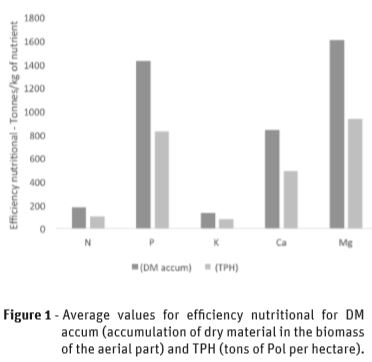
    <p><font face = "Verdana" size = "2">The efficiency of N, P, K, Ca, and Mg for the
accumulation of dry material and production of sucrose were not influenced by sprinkling
with humic substances. When evaluating the nutritional efficiency of sugarcane cultivars,
Mendes (2006) observed that the nutritional efficiency for N, P, K, Ca, and Mg of
high-end RB867515 variety sugarcane was 109, 523, 51, 213, and 439 kg of TPH kg
of nutrient<sup>-1</sup>, respectively, (<a href = "#f1">Figure 1</a>). These results are thus similar
to those of this paper in terms of the efficiency of N utilization and they differ
with regards to the other macronutrients.</font></p>

    <p>&nbsp;</p>

<a name = "f1"><img src = "/img/revistas/rca/v41n2/v41n2a14f1.jpg"></a>

    
<p>&nbsp;</p>

    <p><font face = "Verdana" size = "2">This study reinforces the results obtained by
other researchers (Façanha <i>et al</i>., 2002; Baldotto <i>et al</i>., 2009) that
the nutrient absorption kinetic is altered by applying humic substances. The higher
productivity of the RB867515 in the plot that received the application of humic
substances and marine algae extract was possibly the result of alterations in nutrient
absorption, carbon metabolism, and nitrogen, since there was no difference between
the leaf area indices for the two plots. Even without this biochemical and physiological
information, this study allows to conclude that applying humic substances and marine
algae extract is another technology for increasing sugarcane harvest productivity.</font></p>

    <p><font face = "Verdana" size = "3"><b>CONCLUSION</b></font></p>

    ]]></body>
<body><![CDATA[<p><font face = "Verdana" size = "2">Applying humic substances and marine algae extracts does not alter leaf
area, nutritional efficiency and industrial quality, but does increase RB867515
stem productivity, thus constituting another technology for optimizing the productive
management of sugarcane.</font></p>

    <p>&nbsp;</p>

    <p><font face = "Verdana" size = "3"><b>References </b></font></p>

    <!-- ref --><p><font face = "Verdana" size = "2">Baldotto L.E.B.; Baldotto, M.A.; Giro, V.B.; Canellas,
L.P.; Olivares, F.L. &amp; Smith, R. (2009) - Performance of ‘Vitória’ pineapple
in response to humic acid application during acclimatization. <i>Revista Brasileira
de Ciências do Solo</i>, vol. 33, n. 4, p. 979-990. <a href = "http://dx.doi.org/10.1590/S0100-06832009000400022" target = "_blank">http://dx.doi.org/10.1590/S0100-06832009000400022</a></font>&nbsp;&nbsp;&nbsp;&nbsp;&nbsp;&nbsp;&nbsp;&nbsp;[&#160;<a href="javascript:void(0);" onclick="javascript: window.open('/scielo.php?script=sci_nlinks&ref=681920&pid=S0871-018X201800020001400001&lng=','','width=640,height=500,resizable=yes,scrollbars=1,menubar=yes,');">Links</a>&#160;]<!-- end-ref --><!-- ref --><p><font face = "Verdana" size = "2">Canellas, L.P. &amp; Olivares, F.L. (2014) - Physiological
responses to humic substances as plant growth promoter. <i>Chemical and Biological
Technologies in Agriculture</i>, vol. 1, n. 3, p. 1-11. <a href = "https://doi.org/10.1186/2196-5641-1-3" target = "_blank">https://doi.org/10.1186/2196-5641-1-3</a></font>&nbsp;&nbsp;&nbsp;&nbsp;&nbsp;&nbsp;&nbsp;&nbsp;[&#160;<a href="javascript:void(0);" onclick="javascript: window.open('/scielo.php?script=sci_nlinks&ref=681921&pid=S0871-018X201800020001400002&lng=','','width=640,height=500,resizable=yes,scrollbars=1,menubar=yes,');">Links</a>&#160;]<!-- end-ref --><!-- ref --><p><font face = "Verdana" size = "2">Canellas, L.P.; Teixeira Junior, L.R.L.; Dobbss,
L.B.; Silva, C.A.; Medici, L.O.; Zandonadi, D.B. &amp; Façanha, A.R. (2008) - Humic
acids cross interactions with root and organic acids. <i>Annals of Applied Biology</i>,
vol. 153, n. 2, p. 157-166. <a href = "http://dx.doi.org/10.1111/j.1744-7348.2008.00249.x" target = "_blank">http://dx.doi.org/10.1111/j.1744-7348.2008.00249.x</a></font>&nbsp;&nbsp;&nbsp;&nbsp;&nbsp;&nbsp;&nbsp;&nbsp;[&#160;<a href="javascript:void(0);" onclick="javascript: window.open('/scielo.php?script=sci_nlinks&ref=681922&pid=S0871-018X201800020001400003&lng=','','width=640,height=500,resizable=yes,scrollbars=1,menubar=yes,');">Links</a>&#160;]<!-- end-ref --><!-- ref --><p><font face = "Verdana" size = "2">Cesar, M.A.A.; Delgado, A.A.; Camargo, A.P.; Bissoli,
B.M.A.; &amp; Silva, F.C. (1987) - Capacidade de fosfatos naturais e artificiais
em elevar o teor de fósforo no caldo de cana-de-açúcar (cana-planta), visando o
processo industrial. <i>STAB - Açúcar, Álcool e Subprodutos</i>, vol. 5, p. 32-38.    &nbsp;&nbsp;&nbsp;&nbsp;&nbsp;&nbsp;&nbsp;&nbsp;[&#160;<a href="javascript:void(0);" onclick="javascript: window.open('/scielo.php?script=sci_nlinks&ref=681923&pid=S0871-018X201800020001400004&lng=','','width=640,height=500,resizable=yes,scrollbars=1,menubar=yes,');">Links</a>&#160;]<!-- end-ref --></font></p>


    <!-- ref --><p><font face = "Verdana" size = "2">Clemente, P.R.A.; Bezerra, B.K.L.; Silva, V.S.G.;
Santos, J.C.M. &amp; Endres, L. (2017) - Root growth and yield of sugarcane as a
function of increasing gypsum doses. <i>Pesquisa Agropecuária Tropical</i>, vol.
47, n. 1, p. 110-117. <a href = "http://dx.doi.org/10.1590/1983-40632016v4742563" target = "_blank">http://dx.doi.org/10.1590/1983-40632016v4742563</a></font>&nbsp;&nbsp;&nbsp;&nbsp;&nbsp;&nbsp;&nbsp;&nbsp;[&#160;<a href="javascript:void(0);" onclick="javascript: window.open('/scielo.php?script=sci_nlinks&ref=681925&pid=S0871-018X201800020001400005&lng=','','width=640,height=500,resizable=yes,scrollbars=1,menubar=yes,');">Links</a>&#160;]<!-- end-ref --><!-- ref --><p><font face = "Verdana" size = "2">Façanha, A.R.; Façanha, A.; Olivares, F.L.; Guridi,
F.; Santos, G.A.; Velloso, A.C.X.; Rumjanek, V.M.; Brasil, F.; Schrispema, J.; Braz-Filho,
R.; Oliveira, M.A. &amp; Canellas, L.P. (2002) - Humic acids bioactivity: effects
on root development and on the plasma membrane proton pump. <i>Pesquisa Agropecuária
Brasileira</i>, vol. 37, n. 9, p. 1301-1310. <a href = "http://dx.doi.org/10.1590/S0100-204X2002000900014" target = "_blank">http://dx.doi.org/10.1590/S0100-204X2002000900014</a></font>&nbsp;&nbsp;&nbsp;&nbsp;&nbsp;&nbsp;&nbsp;&nbsp;[&#160;<a href="javascript:void(0);" onclick="javascript: window.open('/scielo.php?script=sci_nlinks&ref=681926&pid=S0871-018X201800020001400006&lng=','','width=640,height=500,resizable=yes,scrollbars=1,menubar=yes,');">Links</a>&#160;]<!-- end-ref --><!-- ref --><p><font face = "Verdana" size = "2">Fernandes, A.C. (2000) - <i>Cálculos na agroindústria
da cana-de-açúcar</i>. Piracicaba: Sociedade das Técnicos Açúcareiro e Alcooleiros
do Brasil. 193 p.    &nbsp;&nbsp;&nbsp;&nbsp;&nbsp;&nbsp;&nbsp;&nbsp;[&#160;<a href="javascript:void(0);" onclick="javascript: window.open('/scielo.php?script=sci_nlinks&ref=681927&pid=S0871-018X201800020001400007&lng=','','width=640,height=500,resizable=yes,scrollbars=1,menubar=yes,');">Links</a>&#160;]<!-- end-ref --></font></p>

    <!-- ref --><p><font face = "Verdana" size = "2">Hermann, E.R. &amp;
Câmara, G.M.S. (1999) - Um método simples para estimar a área foliar de cana-de-açúcar.
<i>STAB - Açúcar, Álcool e Subprodutos</i>, vol. 17, n. 5, p. 32-34.    &nbsp;&nbsp;&nbsp;&nbsp;&nbsp;&nbsp;&nbsp;&nbsp;[&#160;<a href="javascript:void(0);" onclick="javascript: window.open('/scielo.php?script=sci_nlinks&ref=681929&pid=S0871-018X201800020001400008&lng=','','width=640,height=500,resizable=yes,scrollbars=1,menubar=yes,');">Links</a>&#160;]<!-- end-ref --></font></p>


    <!-- ref --><p><font face = "Verdana" size = "2">Kirn, A.; Kashif, S.R. &amp; Yaseen, M. (2010)
- Using indigenous humic acid from lignite to increase growth and yield of okra
(<i>Abelmoschus esculentus</i> L.). <i>Soil and Environment</i>, vol. 29, n. 2,
p. 187-191.    &nbsp;&nbsp;&nbsp;&nbsp;&nbsp;&nbsp;&nbsp;&nbsp;[&#160;<a href="javascript:void(0);" onclick="javascript: window.open('/scielo.php?script=sci_nlinks&ref=681931&pid=S0871-018X201800020001400009&lng=','','width=640,height=500,resizable=yes,scrollbars=1,menubar=yes,');">Links</a>&#160;]<!-- end-ref --></font></p>

    <!-- ref --><p><font face = "Verdana" size = "2">Malavolta, E.; Vitti,
G.C. &amp; Oliveira, S.A. (1997) - <i>Avaliação do estado nutricional das plantas:
princípios e aplicações.</i> 2ª ed. Piracicaba, Associação Brasileira para Pesquisa
da Potassa e do Fosfato. 319 p.    &nbsp;&nbsp;&nbsp;&nbsp;&nbsp;&nbsp;&nbsp;&nbsp;[&#160;<a href="javascript:void(0);" onclick="javascript: window.open('/scielo.php?script=sci_nlinks&ref=681933&pid=S0871-018X201800020001400010&lng=','','width=640,height=500,resizable=yes,scrollbars=1,menubar=yes,');">Links</a>&#160;]<!-- end-ref --></font></p>

    <!-- ref --><p><font face = "Verdana" size = "2">Mendes,
L.C. (2006) - <i>Eficiência nutricional de cultivares de cana-de-açúcar</i>. Dissertação
de Mestrado. Viçosa, Universidade Federal de Viçosa. 46 p.    &nbsp;&nbsp;&nbsp;&nbsp;&nbsp;&nbsp;&nbsp;&nbsp;[&#160;<a href="javascript:void(0);" onclick="javascript: window.open('/scielo.php?script=sci_nlinks&ref=681935&pid=S0871-018X201800020001400011&lng=','','width=640,height=500,resizable=yes,scrollbars=1,menubar=yes,');">Links</a>&#160;]<!-- end-ref --></font></p>

    ]]></body>
<body><![CDATA[<!-- ref --><p><font face = "Verdana" size = "2">Oliveira, M.W.; Freire, F.M.; Macêdo, G.A.R. &amp; Ferreira,
J.J. (2007) - Nutrição mineral e adubação da cana-de-açúcar. <i>Informe Agropecuário</i>,
vol. 28, n. 239, p. 30-43.    &nbsp;&nbsp;&nbsp;&nbsp;&nbsp;&nbsp;&nbsp;&nbsp;[&#160;<a href="javascript:void(0);" onclick="javascript: window.open('/scielo.php?script=sci_nlinks&ref=681937&pid=S0871-018X201800020001400012&lng=','','width=640,height=500,resizable=yes,scrollbars=1,menubar=yes,');">Links</a>&#160;]<!-- end-ref --></font></p>

    <!-- ref --><p><font face = "Verdana" size = "2">Oliveira,
E.C.A.; Freire, F.J.; Oliveira, R.I.D.; Freire, M.B.G.S.; Simões Neto, D.E. &amp;
Silva, S.A.M. (2010) - Extração e exportação de nutrientes por variedades de cana-de-açúcar
cultivadas sob irrigação plena. <i>Revista Brasileira de Ciências do Solo</i>, vol.
34, n. 4, p. 1343-1352. <a href = "http://dx.doi.org/10.1590/S0100-06832010000400031" target = "_blank">http://dx.doi.org/10.1590/S0100-06832010000400031</a></font>&nbsp;&nbsp;&nbsp;&nbsp;&nbsp;&nbsp;&nbsp;&nbsp;[&#160;<a href="javascript:void(0);" onclick="javascript: window.open('/scielo.php?script=sci_nlinks&ref=681939&pid=S0871-018X201800020001400013&lng=','','width=640,height=500,resizable=yes,scrollbars=1,menubar=yes,');">Links</a>&#160;]<!-- end-ref --><!-- ref --><p><font face = "Verdana" size = "2">Oliveira, M.W.; Silva, V.S.G.; Reis, L.S.; Oliveira,
D.C. &amp; Silva, J.C.T. (2014) - Produção e qualidade de três variedades de cana-de-açúcar
cultivadas no nordeste de Minas Gerais. <i>Revista Ciência Agrícola</i>, vol. 12,
n. 1, p. 17-20.    &nbsp;&nbsp;&nbsp;&nbsp;&nbsp;&nbsp;&nbsp;&nbsp;[&#160;<a href="javascript:void(0);" onclick="javascript: window.open('/scielo.php?script=sci_nlinks&ref=681940&pid=S0871-018X201800020001400014&lng=','','width=640,height=500,resizable=yes,scrollbars=1,menubar=yes,');">Links</a>&#160;]<!-- end-ref --></font></p>

    <!-- ref --><p><font face = "Verdana" size = "2">Oliveira, D.C.; Oliveira,
M.W.; Pereira, M.G.; Gomes, T.C.A.; Silva, V.S.G. &amp; Oliveira, T.B.A. (2017)
- Stalk productivity and quality of three sugarcane varieties at the beginning,
in the middle, and at the end of the harvest. <i>African Journal of Agricultural
Research</i>, vol. 12, n. 4, p. 260-269. <a href = "http://dx.doi.org/10.5897/AJAR2016.11789" target = "_blank">http://dx.doi.org/10.5897/AJAR2016.11789</a></font>&nbsp;&nbsp;&nbsp;&nbsp;&nbsp;&nbsp;&nbsp;&nbsp;[&#160;<a href="javascript:void(0);" onclick="javascript: window.open('/scielo.php?script=sci_nlinks&ref=681942&pid=S0871-018X201800020001400015&lng=','','width=640,height=500,resizable=yes,scrollbars=1,menubar=yes,');">Links</a>&#160;]<!-- end-ref --><!-- ref --><p><font face = "Verdana" size = "2">Qudsieh, H.Y.M.; Yosof, S.; Osman, A. &amp; Rahman,
R.A. (2002) - Effect of maturity on chorophyll, tannin, color, and polyphenol oxidase
(PPO) activity of sugarcane juice (<i>Saccharum officinarum</i> Var. Yellow Cane).
<i>Journal of Agricultural and Food Chemistry</i>, vol. 50, n. 6, p. 1615-1618.
<a href = "http://dx.doi.org/10.1021/jf010959l" target = "_blank">http://dx.doi.org/10.1021/jf010959l</a></font>&nbsp;&nbsp;&nbsp;&nbsp;&nbsp;&nbsp;&nbsp;&nbsp;[&#160;<a href="javascript:void(0);" onclick="javascript: window.open('/scielo.php?script=sci_nlinks&ref=681943&pid=S0871-018X201800020001400016&lng=','','width=640,height=500,resizable=yes,scrollbars=1,menubar=yes,');">Links</a>&#160;]<!-- end-ref --><!-- ref --><p><font face = "Verdana" size = "2">Robson, A.D.; Hartley, R.D. &amp; Jarvis, S.C. (1981) - Effect of copper deficiency
on phenolic and other constituents of wheat cell walls. <i>New Phytologist</i>,
vol. 89, n. 3, p. 361-371. <a href = "http://dx.doi.org/10.1111/j.1469-8137.1981.tb02317.x" target = "_blank">http://dx.doi.org/10.1111/j.1469-8137.1981.tb02317.x</a></font>&nbsp;&nbsp;&nbsp;&nbsp;&nbsp;&nbsp;&nbsp;&nbsp;[&#160;<a href="javascript:void(0);" onclick="javascript: window.open('/scielo.php?script=sci_nlinks&ref=681944&pid=S0871-018X201800020001400017&lng=','','width=640,height=500,resizable=yes,scrollbars=1,menubar=yes,');">Links</a>&#160;]<!-- end-ref --><!-- ref --><p><font face = "Verdana" size = "2">Silva, T.G.F.; Moura, M.S.B.; Zolnier, S.; Carmo,
J.F.A. &amp; Souza, L.S.B. (2012) - Biometrics of the sugarcane shoot during irrigated
ratoon cycle in the Submedio of the Vale do São Francisco. <i>Revista Ciência Agronômica</i>,
vol. 43, n. 3, p. 500-509. <a href = "http://dx.doi.org/10.1590/S1806-66902012000300012" target = "_blank">http://dx.doi.org/10.1590/S1806-66902012000300012</a></font>&nbsp;&nbsp;&nbsp;&nbsp;&nbsp;&nbsp;&nbsp;&nbsp;[&#160;<a href="javascript:void(0);" onclick="javascript: window.open('/scielo.php?script=sci_nlinks&ref=681945&pid=S0871-018X201800020001400018&lng=','','width=640,height=500,resizable=yes,scrollbars=1,menubar=yes,');">Links</a>&#160;]<!-- end-ref --><!-- ref --><p><font face = "Verdana" size = "2">Silva, V.S.G.; Oliveira, M.W.; Oliveira, T.B.A.;
Mantovanelli, B.C.; Silva, A.C.; Soares, A.N.R. &amp; Clemente, P.R.A. (2017a) -
Leaf area of sugarcane varieties and their correlation with biomass productivity
in three cycles. <i>African Journal of Agricultural Research</i>, vol. 12, n. 7,
p. 459-466. <a href = "http://dx.doi.org/10.5897/AJAR2016.11817" target = "_blank">http://dx.doi.org/10.5897/AJAR2016.11817</a></font>&nbsp;&nbsp;&nbsp;&nbsp;&nbsp;&nbsp;&nbsp;&nbsp;[&#160;<a href="javascript:void(0);" onclick="javascript: window.open('/scielo.php?script=sci_nlinks&ref=681946&pid=S0871-018X201800020001400019&lng=','','width=640,height=500,resizable=yes,scrollbars=1,menubar=yes,');">Links</a>&#160;]<!-- end-ref --><!-- ref --><p><font face = "Verdana" size = "2">Silva, V.S.G.; Oliveira, M.W.; Oliveira, D.C.; Oliveira, T.B.A.;
Pereira, M.G. &amp; Nogueira, C.H.C. (2017b) - Nutritional diagnosis of sugarcane
varieties in a Yellow Oxisol during three agricultural seasons. <i>African Journal
of Agricultural Research</i>, vol. 12, n. 1, p. 50-57. <a href = "http://dx.doi.org/10.5897/AJAR2016.11865" target = "_blank">http://dx.doi.org/10.5897/AJAR2016.11865</a></font>&nbsp;&nbsp;&nbsp;&nbsp;&nbsp;&nbsp;&nbsp;&nbsp;[&#160;<a href="javascript:void(0);" onclick="javascript: window.open('/scielo.php?script=sci_nlinks&ref=681947&pid=S0871-018X201800020001400020&lng=','','width=640,height=500,resizable=yes,scrollbars=1,menubar=yes,');">Links</a>&#160;]<!-- end-ref --><!-- ref --><p><font face = "Verdana" size = "2">Simioni, K.R.; Silva, L.F.L.F.; Barbosa, V.; Ré,
F.E.; Bernadino, C.D.; Lopes, M.L. &amp; Amorim, H.V. (2006) - Efeito da variedade
e época de colheita no teor de fenóis totais em cana-de-açúcar. <i>STAB - Açúcar,
Álcool e Subprodutos</i>, vol. 24, n. 3, p. 36-39.    &nbsp;&nbsp;&nbsp;&nbsp;&nbsp;&nbsp;&nbsp;&nbsp;[&#160;<a href="javascript:void(0);" onclick="javascript: window.open('/scielo.php?script=sci_nlinks&ref=681948&pid=S0871-018X201800020001400021&lng=','','width=640,height=500,resizable=yes,scrollbars=1,menubar=yes,');">Links</a>&#160;]<!-- end-ref --></font></p>

    <!-- ref --><p><font face = "Verdana" size = "2">Trevisan, S.; Botton, A.; Vaccaro, S.; Vezzaro, A.; Quaggiotti,
S. &amp; Nardi, S. (2011) - Humic substances affect <i>Arabidopsis</i> physiology
by altering the expression of genes involved in primary metabolism, growth and development.
<i>Environmental and Experimental Botany</i>, vol. 74, p. 45-55. <a href = "https://doi.org/10.1016/j.envexpbot.2011.04.017" target = "_blank">https://doi.org/10.1016/j.envexpbot.2011.04.017</a></font>&nbsp;&nbsp;&nbsp;&nbsp;&nbsp;&nbsp;&nbsp;&nbsp;[&#160;<a href="javascript:void(0);" onclick="javascript: window.open('/scielo.php?script=sci_nlinks&ref=681950&pid=S0871-018X201800020001400022&lng=','','width=640,height=500,resizable=yes,scrollbars=1,menubar=yes,');">Links</a>&#160;]<!-- end-ref --><p>&nbsp;</p>

    <p><font face = "Verdana" size = "3"><b>Acknowledgments</b></font></p>

    <p><font face = "Verdana" size = "2">To the Triunfo Mill for the logistical support during study.
To Conselho Superior de Desenvolvimento Científico e Tecnológico (CNPq) for financial
support and the fellowships conceded.</font></p>

    <p>&nbsp;</p>

    <p><font face = "Verdana" size = "2">Received/recebido: 2017.08.20</font></p>

    <p><font face = "Verdana" size = "2">Accepted/aceite: 2018.01.16</font></p>

    ]]></body>
<body><![CDATA[ ]]></body><back>
<ref-list>
<ref id="B1">
<nlm-citation citation-type="journal">
<person-group person-group-type="author">
<name>
<surname><![CDATA[Baldotto]]></surname>
<given-names><![CDATA[L.E.B.]]></given-names>
</name>
<name>
<surname><![CDATA[Baldotto]]></surname>
<given-names><![CDATA[M.A.]]></given-names>
</name>
<name>
<surname><![CDATA[Giro]]></surname>
<given-names><![CDATA[V.B.]]></given-names>
</name>
<name>
<surname><![CDATA[Canellas]]></surname>
<given-names><![CDATA[L.P.]]></given-names>
</name>
<name>
<surname><![CDATA[Olivares]]></surname>
<given-names><![CDATA[F.L.]]></given-names>
</name>
<name>
<surname><![CDATA[Smith]]></surname>
<given-names><![CDATA[R.]]></given-names>
</name>
</person-group>
<article-title xml:lang="en"><![CDATA[Performance of ‘Vitória’ pineapple in response to humic acid application during acclimatization]]></article-title>
<source><![CDATA[Revista Brasileira de Ciências do Solo]]></source>
<year>2009</year>
<volume>33</volume>
<numero>4</numero>
<issue>4</issue>
<page-range>979-990</page-range></nlm-citation>
</ref>
<ref id="B2">
<nlm-citation citation-type="journal">
<person-group person-group-type="author">
<name>
<surname><![CDATA[Canellas]]></surname>
<given-names><![CDATA[L.P.]]></given-names>
</name>
<name>
<surname><![CDATA[Olivares]]></surname>
<given-names><![CDATA[F.L.]]></given-names>
</name>
</person-group>
<article-title xml:lang="en"><![CDATA[Physiological responses to humic substances as plant growth promoter]]></article-title>
<source><![CDATA[Chemical and Biological Technologies in Agriculture]]></source>
<year>2014</year>
<volume>1</volume>
<numero>3</numero>
<issue>3</issue>
<page-range>1-11</page-range></nlm-citation>
</ref>
<ref id="B3">
<nlm-citation citation-type="journal">
<person-group person-group-type="author">
<name>
<surname><![CDATA[Canellas]]></surname>
<given-names><![CDATA[L.P.]]></given-names>
</name>
<name>
<surname><![CDATA[Teixeira Junior]]></surname>
<given-names><![CDATA[L.R.L.]]></given-names>
</name>
<name>
<surname><![CDATA[Dobbss]]></surname>
<given-names><![CDATA[L.B.]]></given-names>
</name>
<name>
<surname><![CDATA[Silva]]></surname>
<given-names><![CDATA[C.A.]]></given-names>
</name>
<name>
<surname><![CDATA[Medici]]></surname>
<given-names><![CDATA[L.O.]]></given-names>
</name>
<name>
<surname><![CDATA[Zandonadi]]></surname>
<given-names><![CDATA[D.B.]]></given-names>
</name>
<name>
<surname><![CDATA[Façanha]]></surname>
<given-names><![CDATA[A.R.]]></given-names>
</name>
</person-group>
<article-title xml:lang="en"><![CDATA[Humic acids cross interactions with root and organic acids]]></article-title>
<source><![CDATA[Annals of Applied Biology]]></source>
<year>2008</year>
<volume>153</volume>
<numero>2</numero>
<issue>2</issue>
<page-range>157-166</page-range></nlm-citation>
</ref>
<ref id="B4">
<nlm-citation citation-type="journal">
<person-group person-group-type="author">
<name>
<surname><![CDATA[Cesar]]></surname>
<given-names><![CDATA[M.A.A.]]></given-names>
</name>
<name>
<surname><![CDATA[Delgado]]></surname>
<given-names><![CDATA[A.A.]]></given-names>
</name>
<name>
<surname><![CDATA[Camargo]]></surname>
<given-names><![CDATA[A.P.]]></given-names>
</name>
<name>
<surname><![CDATA[Bissoli]]></surname>
<given-names><![CDATA[B.M.A.]]></given-names>
</name>
<name>
<surname><![CDATA[Silva]]></surname>
<given-names><![CDATA[F.C.]]></given-names>
</name>
</person-group>
<article-title xml:lang="pt"><![CDATA[apacidade de fosfatos naturais e artificiais em elevar o teor de fósforo no caldo de cana-de-açúcar (cana-planta), visando o processo industrial]]></article-title>
<source><![CDATA[STAB]]></source>
<year>1987</year>
<volume>5</volume>
<page-range>32-38</page-range></nlm-citation>
</ref>
<ref id="B5">
<nlm-citation citation-type="journal">
<person-group person-group-type="author">
<name>
<surname><![CDATA[Clemente]]></surname>
<given-names><![CDATA[P.R.A.]]></given-names>
</name>
<name>
<surname><![CDATA[Bezerra]]></surname>
<given-names><![CDATA[B.K.L.]]></given-names>
</name>
<name>
<surname><![CDATA[Silva]]></surname>
<given-names><![CDATA[V.S.G.]]></given-names>
</name>
<name>
<surname><![CDATA[Santos]]></surname>
<given-names><![CDATA[J.C.M.]]></given-names>
</name>
<name>
<surname><![CDATA[Endres]]></surname>
<given-names><![CDATA[L.]]></given-names>
</name>
</person-group>
<article-title xml:lang="en"><![CDATA[Root growth and yield of sugarcane as a function of increasing gypsum doses]]></article-title>
<source><![CDATA[Pesquisa Agropecuária Tropical]]></source>
<year>2017</year>
<volume>47</volume>
<numero>1</numero>
<issue>1</issue>
<page-range>110-117</page-range></nlm-citation>
</ref>
<ref id="B6">
<nlm-citation citation-type="journal">
<person-group person-group-type="author">
<name>
<surname><![CDATA[Façanha]]></surname>
<given-names><![CDATA[A.R.]]></given-names>
</name>
<name>
<surname><![CDATA[Façanha]]></surname>
<given-names><![CDATA[A.]]></given-names>
</name>
<name>
<surname><![CDATA[Olivares]]></surname>
<given-names><![CDATA[F.L.]]></given-names>
</name>
<name>
<surname><![CDATA[Guridi]]></surname>
<given-names><![CDATA[F.]]></given-names>
</name>
<name>
<surname><![CDATA[Santos]]></surname>
<given-names><![CDATA[G.A.]]></given-names>
</name>
<name>
<surname><![CDATA[Velloso]]></surname>
<given-names><![CDATA[A.C.X.]]></given-names>
</name>
<name>
<surname><![CDATA[Rumjanek]]></surname>
<given-names><![CDATA[V.M.]]></given-names>
</name>
<name>
<surname><![CDATA[Brasil]]></surname>
<given-names><![CDATA[F.]]></given-names>
</name>
<name>
<surname><![CDATA[Schrispema]]></surname>
<given-names><![CDATA[J.]]></given-names>
</name>
<name>
<surname><![CDATA[Braz-Filho]]></surname>
<given-names><![CDATA[R.]]></given-names>
</name>
<name>
<surname><![CDATA[Oliveira]]></surname>
<given-names><![CDATA[M.A.]]></given-names>
</name>
<name>
<surname><![CDATA[Canellas]]></surname>
<given-names><![CDATA[L.P.]]></given-names>
</name>
</person-group>
<article-title xml:lang="en"><![CDATA[Humic acids bioactivity: effects on root development and on the plasma membrane proton pump]]></article-title>
<source><![CDATA[Pesquisa Agropecuária Brasileira]]></source>
<year>2002</year>
<volume>37</volume>
<numero>9</numero>
<issue>9</issue>
<page-range>1301-1310</page-range></nlm-citation>
</ref>
<ref id="B7">
<nlm-citation citation-type="book">
<person-group person-group-type="author">
<name>
<surname><![CDATA[Fernandes]]></surname>
<given-names><![CDATA[A.C.]]></given-names>
</name>
</person-group>
<source><![CDATA[Cálculos na agroindústria da cana-de-açúcar]]></source>
<year>2000</year>
<publisher-loc><![CDATA[Piracicaba ]]></publisher-loc>
<publisher-name><![CDATA[Sociedade das Técnicos Açúcareiro e Alcooleiros do Brasil]]></publisher-name>
</nlm-citation>
</ref>
<ref id="B8">
<nlm-citation citation-type="journal">
<person-group person-group-type="author">
<name>
<surname><![CDATA[Hermann]]></surname>
<given-names><![CDATA[E.R.]]></given-names>
</name>
<name>
<surname><![CDATA[Câmara]]></surname>
<given-names><![CDATA[G.M.S.]]></given-names>
</name>
</person-group>
<article-title xml:lang="pt"><![CDATA[Um método simples para estimar a área foliar de cana-de-açúcar]]></article-title>
<source><![CDATA[STAB]]></source>
<year>1999</year>
<volume>17</volume>
<numero>5</numero>
<issue>5</issue>
<page-range>32-34</page-range></nlm-citation>
</ref>
<ref id="B9">
<nlm-citation citation-type="journal">
<person-group person-group-type="author">
<name>
<surname><![CDATA[Kirn]]></surname>
<given-names><![CDATA[A.]]></given-names>
</name>
<name>
<surname><![CDATA[Kashif]]></surname>
<given-names><![CDATA[S.R.]]></given-names>
</name>
<name>
<surname><![CDATA[Yaseen]]></surname>
<given-names><![CDATA[M.]]></given-names>
</name>
</person-group>
<article-title xml:lang="en"><![CDATA[Using indigenous humic acid from lignite to increase growth and yield of okra (Abelmoschus esculentus L.)]]></article-title>
<source><![CDATA[Soil and Environment]]></source>
<year>2010</year>
<volume>29</volume>
<numero>2</numero>
<issue>2</issue>
<page-range>187-191</page-range></nlm-citation>
</ref>
<ref id="B10">
<nlm-citation citation-type="book">
<person-group person-group-type="author">
<name>
<surname><![CDATA[Malavolta]]></surname>
<given-names><![CDATA[E.]]></given-names>
</name>
<name>
<surname><![CDATA[Vitti]]></surname>
<given-names><![CDATA[G.C.]]></given-names>
</name>
<name>
<surname><![CDATA[Oliveira]]></surname>
<given-names><![CDATA[S.A.]]></given-names>
</name>
</person-group>
<source><![CDATA[Avaliação do estado nutricional das plantas: princípios e aplicações]]></source>
<year>1997</year>
<edition>2ª</edition>
<publisher-loc><![CDATA[Piracicaba ]]></publisher-loc>
<publisher-name><![CDATA[Associação Brasileira para Pesquisa da Potassa e do Fosfato]]></publisher-name>
</nlm-citation>
</ref>
<ref id="B11">
<nlm-citation citation-type="">
<person-group person-group-type="author">
<name>
<surname><![CDATA[Mendes]]></surname>
<given-names><![CDATA[L.C.]]></given-names>
</name>
</person-group>
<source><![CDATA[Eficiência nutricional de cultivares de cana-de-açúcar]]></source>
<year>2006</year>
</nlm-citation>
</ref>
<ref id="B12">
<nlm-citation citation-type="journal">
<person-group person-group-type="author">
<name>
<surname><![CDATA[Oliveira]]></surname>
<given-names><![CDATA[M.W.]]></given-names>
</name>
<name>
<surname><![CDATA[Freire]]></surname>
<given-names><![CDATA[F.M.]]></given-names>
</name>
<name>
<surname><![CDATA[Macêdo]]></surname>
<given-names><![CDATA[G.A.R.]]></given-names>
</name>
<name>
<surname><![CDATA[Ferreira]]></surname>
<given-names><![CDATA[J.J.]]></given-names>
</name>
</person-group>
<article-title xml:lang="pt"><![CDATA[Nutrição mineral e adubação da cana-de-açúcar]]></article-title>
<source><![CDATA[Informe Agropecuário]]></source>
<year>2007</year>
<volume>28</volume>
<numero>239</numero>
<issue>239</issue>
<page-range>30-43</page-range></nlm-citation>
</ref>
<ref id="B13">
<nlm-citation citation-type="journal">
<person-group person-group-type="author">
<name>
<surname><![CDATA[Oliveira]]></surname>
<given-names><![CDATA[E.C.A.]]></given-names>
</name>
<name>
<surname><![CDATA[Freire]]></surname>
<given-names><![CDATA[F.J.]]></given-names>
</name>
<name>
<surname><![CDATA[Oliveira]]></surname>
<given-names><![CDATA[R.I.D.]]></given-names>
</name>
<name>
<surname><![CDATA[Freire]]></surname>
<given-names><![CDATA[M.B.G.S.]]></given-names>
</name>
<name>
<surname><![CDATA[Simões Neto]]></surname>
<given-names><![CDATA[D.E.]]></given-names>
</name>
<name>
<surname><![CDATA[Silva]]></surname>
<given-names><![CDATA[S.A.M.]]></given-names>
</name>
</person-group>
<article-title xml:lang="pt"><![CDATA[Extração e exportação de nutrientes por variedades de cana-de-açúcar cultivadas sob irrigação plena]]></article-title>
<source><![CDATA[Revista Brasileira de Ciências do Solo]]></source>
<year>2010</year>
<volume>34</volume>
<numero>4</numero>
<issue>4</issue>
<page-range>1343-1352</page-range></nlm-citation>
</ref>
<ref id="B14">
<nlm-citation citation-type="journal">
<person-group person-group-type="author">
<name>
<surname><![CDATA[Oliveira]]></surname>
<given-names><![CDATA[M.W.]]></given-names>
</name>
<name>
<surname><![CDATA[Silva]]></surname>
<given-names><![CDATA[V.S.G.]]></given-names>
</name>
<name>
<surname><![CDATA[Reis]]></surname>
<given-names><![CDATA[L.S.]]></given-names>
</name>
<name>
<surname><![CDATA[Oliveira]]></surname>
<given-names><![CDATA[D.C.]]></given-names>
</name>
<name>
<surname><![CDATA[Silva]]></surname>
<given-names><![CDATA[J.C.T.]]></given-names>
</name>
</person-group>
<article-title xml:lang="pt"><![CDATA[Produção e qualidade de três variedades de cana-de-açúcar cultivadas no nordeste de Minas Gerais]]></article-title>
<source><![CDATA[Revista Ciência Agrícola]]></source>
<year>2014</year>
<volume>12</volume>
<numero>1</numero>
<issue>1</issue>
<page-range>17-20</page-range></nlm-citation>
</ref>
<ref id="B15">
<nlm-citation citation-type="journal">
<person-group person-group-type="author">
<name>
<surname><![CDATA[Oliveira]]></surname>
<given-names><![CDATA[D.C.]]></given-names>
</name>
<name>
<surname><![CDATA[Oliveira]]></surname>
<given-names><![CDATA[M.W.]]></given-names>
</name>
<name>
<surname><![CDATA[Pereira]]></surname>
<given-names><![CDATA[M.G.]]></given-names>
</name>
<name>
<surname><![CDATA[Gomes]]></surname>
<given-names><![CDATA[T.C.A.]]></given-names>
</name>
<name>
<surname><![CDATA[Silva]]></surname>
<given-names><![CDATA[V.S.G.]]></given-names>
</name>
<name>
<surname><![CDATA[Oliveira]]></surname>
<given-names><![CDATA[T.B.A.]]></given-names>
</name>
</person-group>
<article-title xml:lang="en"><![CDATA[Stalk productivity and quality of three sugarcane varieties at the beginning, in the middle, and at the end of the harvest]]></article-title>
<source><![CDATA[African Journal of Agricultural Research]]></source>
<year>2017</year>
<volume>12</volume>
<numero>4</numero>
<issue>4</issue>
<page-range>260-269</page-range></nlm-citation>
</ref>
<ref id="B16">
<nlm-citation citation-type="journal">
<person-group person-group-type="author">
<name>
<surname><![CDATA[Qudsieh]]></surname>
<given-names><![CDATA[H.Y.M.]]></given-names>
</name>
<name>
<surname><![CDATA[Yosof]]></surname>
<given-names><![CDATA[S.]]></given-names>
</name>
<name>
<surname><![CDATA[Osman]]></surname>
<given-names><![CDATA[A.]]></given-names>
</name>
<name>
<surname><![CDATA[Rahman]]></surname>
<given-names><![CDATA[R.A.]]></given-names>
</name>
</person-group>
<article-title xml:lang="en"><![CDATA[Effect of maturity on chorophyll, tannin, color, and polyphenol oxidase (PPO) activity of sugarcane juice (Saccharum officinarum Var. Yellow Cane)]]></article-title>
<source><![CDATA[Journal of Agricultural and Food Chemistry]]></source>
<year>2002</year>
<volume>50</volume>
<numero>6</numero>
<issue>6</issue>
<page-range>1615-1618</page-range></nlm-citation>
</ref>
<ref id="B17">
<nlm-citation citation-type="journal">
<person-group person-group-type="author">
<name>
<surname><![CDATA[Robson]]></surname>
<given-names><![CDATA[A.D.]]></given-names>
</name>
<name>
<surname><![CDATA[Hartley]]></surname>
<given-names><![CDATA[R.D.]]></given-names>
</name>
<name>
<surname><![CDATA[Jarvis]]></surname>
<given-names><![CDATA[S.C.]]></given-names>
</name>
</person-group>
<article-title xml:lang="en"><![CDATA[Effect of copper deficiency on phenolic and other constituents of wheat cell walls]]></article-title>
<source><![CDATA[New Phytologist]]></source>
<year>1981</year>
<volume>89</volume>
<numero>3</numero>
<issue>3</issue>
<page-range>361-371</page-range></nlm-citation>
</ref>
<ref id="B18">
<nlm-citation citation-type="journal">
<person-group person-group-type="author">
<name>
<surname><![CDATA[Silva]]></surname>
<given-names><![CDATA[T.G.F.]]></given-names>
</name>
<name>
<surname><![CDATA[Moura]]></surname>
<given-names><![CDATA[M.S.B.]]></given-names>
</name>
<name>
<surname><![CDATA[Zolnier]]></surname>
<given-names><![CDATA[S.]]></given-names>
</name>
<name>
<surname><![CDATA[Carmo]]></surname>
<given-names><![CDATA[J.F.A.]]></given-names>
</name>
<name>
<surname><![CDATA[Souza]]></surname>
<given-names><![CDATA[L.S.B.]]></given-names>
</name>
</person-group>
<article-title xml:lang="en"><![CDATA[Biometrics of the sugarcane shoot during irrigated ratoon cycle in the Submedio of the Vale do São Francisco]]></article-title>
<source><![CDATA[Revista Ciência Agronômica]]></source>
<year>2012</year>
<volume>43</volume>
<numero>3</numero>
<issue>3</issue>
<page-range>500-509</page-range></nlm-citation>
</ref>
<ref id="B19">
<nlm-citation citation-type="journal">
<person-group person-group-type="author">
<name>
<surname><![CDATA[Silva]]></surname>
<given-names><![CDATA[V.S.G.]]></given-names>
</name>
<name>
<surname><![CDATA[Oliveira]]></surname>
<given-names><![CDATA[M.W.]]></given-names>
</name>
<name>
<surname><![CDATA[Oliveira]]></surname>
<given-names><![CDATA[T.B.A.]]></given-names>
</name>
<name>
<surname><![CDATA[Mantovanelli]]></surname>
<given-names><![CDATA[B.C.]]></given-names>
</name>
<name>
<surname><![CDATA[Silva]]></surname>
<given-names><![CDATA[A.C.]]></given-names>
</name>
<name>
<surname><![CDATA[Soares]]></surname>
<given-names><![CDATA[A.N.R.]]></given-names>
</name>
<name>
<surname><![CDATA[Clemente]]></surname>
<given-names><![CDATA[P.R.A.]]></given-names>
</name>
</person-group>
<article-title xml:lang="en"><![CDATA[Leaf area of sugarcane varieties and their correlation with biomass productivity in three cycles]]></article-title>
<source><![CDATA[African Journal of Agricultural Research]]></source>
<year>2017</year>
<month>a</month>
<volume>12</volume>
<numero>7</numero>
<issue>7</issue>
<page-range>459-466</page-range></nlm-citation>
</ref>
<ref id="B20">
<nlm-citation citation-type="journal">
<person-group person-group-type="author">
<name>
<surname><![CDATA[Silva]]></surname>
<given-names><![CDATA[V.S.G.]]></given-names>
</name>
<name>
<surname><![CDATA[Oliveira]]></surname>
<given-names><![CDATA[M.W.]]></given-names>
</name>
<name>
<surname><![CDATA[Oliveira]]></surname>
<given-names><![CDATA[D.C.]]></given-names>
</name>
<name>
<surname><![CDATA[Oliveira]]></surname>
<given-names><![CDATA[T.B.A.]]></given-names>
</name>
<name>
<surname><![CDATA[Pereira]]></surname>
<given-names><![CDATA[M.G.]]></given-names>
</name>
<name>
<surname><![CDATA[Nogueira]]></surname>
<given-names><![CDATA[C.H.C.]]></given-names>
</name>
</person-group>
<article-title xml:lang="en"><![CDATA[Nutritional diagnosis of sugarcane varieties in a Yellow Oxisol during three agricultural seasons]]></article-title>
<source><![CDATA[African Journal of Agricultural Research]]></source>
<year>2017</year>
<month>b</month>
<volume>12</volume>
<numero>1</numero>
<issue>1</issue>
<page-range>50-57</page-range></nlm-citation>
</ref>
<ref id="B21">
<nlm-citation citation-type="journal">
<person-group person-group-type="author">
<name>
<surname><![CDATA[Simioni]]></surname>
<given-names><![CDATA[K.R.]]></given-names>
</name>
<name>
<surname><![CDATA[Silva]]></surname>
<given-names><![CDATA[L.F.L.F.]]></given-names>
</name>
<name>
<surname><![CDATA[Barbosa]]></surname>
<given-names><![CDATA[V.]]></given-names>
</name>
<name>
<surname><![CDATA[Ré]]></surname>
<given-names><![CDATA[F.E.]]></given-names>
</name>
<name>
<surname><![CDATA[Bernadino]]></surname>
<given-names><![CDATA[C.D.]]></given-names>
</name>
<name>
<surname><![CDATA[Lopes]]></surname>
<given-names><![CDATA[M.L.]]></given-names>
</name>
<name>
<surname><![CDATA[Amorim]]></surname>
<given-names><![CDATA[H.V.]]></given-names>
</name>
</person-group>
<article-title xml:lang="pt"><![CDATA[Efeito da variedade e época de colheita no teor de fenóis totais em cana-de-açúcar]]></article-title>
<source><![CDATA[STAB]]></source>
<year>2006</year>
<volume>24</volume>
<numero>3</numero>
<issue>3</issue>
<page-range>36-39</page-range></nlm-citation>
</ref>
<ref id="B22">
<nlm-citation citation-type="journal">
<person-group person-group-type="author">
<name>
<surname><![CDATA[Trevisan]]></surname>
<given-names><![CDATA[S.]]></given-names>
</name>
<name>
<surname><![CDATA[Botton]]></surname>
<given-names><![CDATA[A.]]></given-names>
</name>
<name>
<surname><![CDATA[Vaccaro]]></surname>
<given-names><![CDATA[S.]]></given-names>
</name>
<name>
<surname><![CDATA[Vezzaro]]></surname>
<given-names><![CDATA[A.]]></given-names>
</name>
<name>
<surname><![CDATA[Quaggiotti]]></surname>
<given-names><![CDATA[S.]]></given-names>
</name>
<name>
<surname><![CDATA[Nardi]]></surname>
<given-names><![CDATA[S.]]></given-names>
</name>
</person-group>
<article-title xml:lang="en"><![CDATA[Humic substances affect Arabidopsis physiology by altering the expression of genes involved in primary metabolism, growth and development]]></article-title>
<source><![CDATA[Environmental and Experimental Botany]]></source>
<year>2011</year>
<volume>74</volume>
<page-range>45-55</page-range></nlm-citation>
</ref>
</ref-list>
</back>
</article>
