<?xml version="1.0" encoding="ISO-8859-1"?><article xmlns:mml="http://www.w3.org/1998/Math/MathML" xmlns:xlink="http://www.w3.org/1999/xlink" xmlns:xsi="http://www.w3.org/2001/XMLSchema-instance">
<front>
<journal-meta>
<journal-id>0871-018X</journal-id>
<journal-title><![CDATA[Revista de Ciências Agrárias]]></journal-title>
<abbrev-journal-title><![CDATA[Rev. de Ciências Agrárias]]></abbrev-journal-title>
<issn>0871-018X</issn>
<publisher>
<publisher-name><![CDATA[Sociedade de Ciências Agrárias de Portugal]]></publisher-name>
</publisher>
</journal-meta>
<article-meta>
<article-id>S0871-018X2018000200015</article-id>
<article-id pub-id-type="doi">10.19084/RCA17051</article-id>
<title-group>
<article-title xml:lang="en"><![CDATA[Stalk yield and nutrients accumulation of sugarcane varieties in three crop cycles]]></article-title>
<article-title xml:lang="pt"><![CDATA[Produção de colmos e acumulação de nutrientes por variedades de cana-de-açúcar em três ciclos de colheita]]></article-title>
</title-group>
<contrib-group>
<contrib contrib-type="author">
<name>
<surname><![CDATA[Silva]]></surname>
<given-names><![CDATA[Vinicius Santos Gomes da]]></given-names>
</name>
<xref ref-type="aff" rid="A1"/>
</contrib>
<contrib contrib-type="author">
<name>
<surname><![CDATA[Oliveira]]></surname>
<given-names><![CDATA[Mauro Wagner de]]></given-names>
</name>
<xref ref-type="aff" rid="A2"/>
</contrib>
<contrib contrib-type="author">
<name>
<surname><![CDATA[Ferreira]]></surname>
<given-names><![CDATA[Vilma Marques]]></given-names>
</name>
<xref ref-type="aff" rid="A2"/>
</contrib>
<contrib contrib-type="author">
<name>
<surname><![CDATA[Oliveira]]></surname>
<given-names><![CDATA[Terezinha Bezerra Albino]]></given-names>
</name>
<xref ref-type="aff" rid="A2"/>
</contrib>
<contrib contrib-type="author">
<name>
<surname><![CDATA[Santana]]></surname>
<given-names><![CDATA[Mayame de Brito]]></given-names>
</name>
<xref ref-type="aff" rid="A1"/>
</contrib>
<contrib contrib-type="author">
<name>
<surname><![CDATA[Galvão]]></surname>
<given-names><![CDATA[Elaine Rocha]]></given-names>
</name>
<xref ref-type="aff" rid="A3"/>
</contrib>
</contrib-group>
<aff id="AA1">
<institution><![CDATA[,Universidade Federal Rural de Pernambuco Departamento de Agronomia ]]></institution>
<addr-line><![CDATA[Recife Pernambuco]]></addr-line>
<country>Brasil</country>
</aff>
<aff id="AA2">
<institution><![CDATA[,Universidade Federal de Alagoas Centro de Ciências Agrárias ]]></institution>
<addr-line><![CDATA[Rio Largo Alagoas]]></addr-line>
<country>Brasil</country>
</aff>
<aff id="AA3">
<institution><![CDATA[,Universidade do Estado da Bahia Departamento de Agronomia ]]></institution>
<addr-line><![CDATA[Juazeiro Bahia]]></addr-line>
<country>Brasil</country>
</aff>
<pub-date pub-type="pub">
<day>00</day>
<month>06</month>
<year>2018</year>
</pub-date>
<pub-date pub-type="epub">
<day>00</day>
<month>06</month>
<year>2018</year>
</pub-date>
<volume>41</volume>
<numero>2</numero>
<fpage>141</fpage>
<lpage>150</lpage>
<copyright-statement/>
<copyright-year/>
<self-uri xlink:href="http://scielo.pt/scielo.php?script=sci_arttext&amp;pid=S0871-018X2018000200015&amp;lng=en&amp;nrm=iso"></self-uri><self-uri xlink:href="http://scielo.pt/scielo.php?script=sci_abstract&amp;pid=S0871-018X2018000200015&amp;lng=en&amp;nrm=iso"></self-uri><self-uri xlink:href="http://scielo.pt/scielo.php?script=sci_pdf&amp;pid=S0871-018X2018000200015&amp;lng=en&amp;nrm=iso"></self-uri><abstract abstract-type="short" xml:lang="en"><p><![CDATA[Sugarcane nutritional requirement knowledge has great importance for an adequate crop management, since allows the selection of efficient varieties in the use of nutrients, contributing to a better use of fertilizers and reduction of production costs. The aim of this study was to evaluate the stalks yield and the accumulation of nitrogen (N), phosphorus (P), potassium (K), calcium (Ca), magnesium (Mg), sulfur (S), zinc (Zn), copper (Cu) and manganese (Mn) of aerial biomass of four sugarcane varieties, RB867515, RB92579, SP813250 and VAT90212 during the plant-cane, first and second regrowth cycles. The experimental design was a randomized block with four treatments and five replicates. The cane was harvested due to maturity in the three crop cycles. The stalks yield and the nutrient accumulation of the aerial part of the varieties were evaluated. The stems yield presented were 126, 102 and 86 t ha-1 for plant-cane, first and second regrowth, respectively. Plant-cane macronutrients accumulation average presented the following decreasing order: K > N > Ca > Mg > S > P, for regrowth the observed sequence was K > N > Ca > S > Mg > P. The varieties presented high productive potential, and similar nutrients accumulation in the three cycles.]]></p></abstract>
<abstract abstract-type="short" xml:lang="pt"><p><![CDATA[O conhecimento da exigência nutricional de variedades de cana-de-açúcar é de grande importância para um manuseamento adequado da cultura, pois possibilita a escolha de variedades eficientes no que se refere à utilização de nutrientes, contribuindo para uma melhor utilização de fertilizantes e redução dos custos de produção. O objetivo do trabalho foi avaliar a produtividade de colmos e a acumulação de azoto (N), fósforo (P), potássio (K), cálcio (Ca), magnésio (Mg), enxofre (S), ferro (Fe), zinco (Zn), cobre (Cu) e manganês (Mn) da biomassa da parte aérea de quatro variedades de cana-de-açúcar, RB867515, RB92579, SP813250 e VAT90212, nos ciclos de cana-planta, primeira e segunda rebrota. O delineamento experimental foi de blocos ao acaso com quatro tratamentos e cinco repetições. Na maturação e nos três ciclos de cultivo, a cana foi colhida e foram avaliadas a produtividade de colmos e a acumulação de nutrientes. A produtividade obtida foi de 126, 102 e 86 t ha-1 nos ciclos de cana-planta, primeira e segunda rebrota, respectivamente. Na cana-planta a acumulação média de macronutrientes foi a seguinte, por ordem decrescente: K > N > Ca >Mg > S > P, enquanto que nas rebrotas a sequência observada foi K > N > Ca > S > Mg > P. As variedades apresentaram alto potencial produtivo e foram semelhantes na acumulação de nutrientes nos três ciclos.]]></p></abstract>
<kwd-group>
<kwd lng="en"><![CDATA[nutritional requirement]]></kwd>
<kwd lng="en"><![CDATA[nutrient content]]></kwd>
<kwd lng="en"><![CDATA[uptake]]></kwd>
<kwd lng="en"><![CDATA[nutritional efficiency]]></kwd>
<kwd lng="en"><![CDATA[Saccharum spp.]]></kwd>
<kwd lng="pt"><![CDATA[Exigência nutricional]]></kwd>
<kwd lng="pt"><![CDATA[teor de nutrientes]]></kwd>
<kwd lng="pt"><![CDATA[absorção]]></kwd>
<kwd lng="pt"><![CDATA[eficiência nutricional]]></kwd>
<kwd lng="pt"><![CDATA[Saccharum spp.]]></kwd>
</kwd-group>
</article-meta>
</front><body><![CDATA[ 

    <p align = "right"><font face = "Verdana" size = "2"><b>ARTIGO</b></font></p>

    <p><font face = "Verdana" size = "4"><b>Stalk yield and nutrients accumulation of sugarcane varieties in three crop cycles</b></font></p>

    <p><font face = "Verdana" size = "3"><b>Produção de colmos e acumulação de nutrientes por variedades de cana-de-açúcar em três ciclos de colheita</b></font></p>

    <p><font face = "Verdana" size = "2"><b>Vinicius
Santos Gomes da Silva</b><sup>1*</sup>, <b>Mauro Wagner de Oliveira</b><sup>2</sup>, <b>Vilma
Marques Ferreira</b><sup>2</sup>, <b>Terezinha Bezerra Albino Oliveira</b><sup>2</sup>, <b>Mayame
de Brito Santana</b><sup>1</sup> and <b>Elaine Rocha Galvão</b><sup>3</sup></font></p>

    <p><font face = "Verdana" size = "2"><sup>1</sup>Departamento
de Agronomia, Universidade Federal Rural de Pernambuco, Av. Dom Manoel de Medeiros,
w/n, 52171-900, Recife, Pernambuco, Brasil</font></p>

    <p><font face = "Verdana" size = "2"><sup>2</sup>Centro de Ciências Agrárias, Universidade Federal de Alagoas,
BR 104, Km 85, w/n, 57100-000. Rio Largo, Alagoas, Brasil<u></u></font></p>

    <p><font face = "Verdana" size = "2"><sup>3</sup>Departamento de Agronomia, Universidade do Estado
da Bahia.  Rua Edgar Chastinet, 48905-680, Cajueiro, Juazeiro - Bahia, Brasil</font></p>

    <p><font face = "Verdana" size = "2"><i>(*E-mail: <a href="mailto:vinicius.agro2008.1@gmail.com">vinicius.agro2008.1@gmail.com</a>)</i></font></p>

<hr noshade size = 1>

    <p><font face = "Verdana" size = "3"><b>ABSTRACT</b></font></p>

    ]]></body>
<body><![CDATA[<p><font face = "Verdana" size = "2">Sugarcane nutritional requirement knowledge has
great importance for an adequate crop management, since allows the selection of
efficient varieties in the use of nutrients, contributing to a better use of fertilizers
and reduction of production costs. The aim of this study was to evaluate the stalks
yield and the accumulation of nitrogen (N), phosphorus (P), potassium (K), calcium
(Ca), magnesium (Mg), sulfur (S), zinc (Zn), copper (Cu) and manganese (Mn) of aerial
biomass of four sugarcane varieties, RB867515, RB92579, SP813250 and VAT90212 during
the plant-cane, first and second regrowth cycles. The experimental design was a
randomized block with four treatments and five replicates. The cane was harvested
due to maturity in the three crop cycles. The stalks yield and the nutrient accumulation
of the aerial part of the varieties were evaluated. The stems yield presented were
126, 102 and 86 t ha<sup>-1</sup> for plant-cane, first and second regrowth, respectively.
Plant-cane macronutrients accumulation average presented the following decreasing
order: K &gt; N &gt; Ca &gt; Mg &gt; S &gt; P, for regrowth the observed sequence
was K &gt; N &gt; Ca &gt; S &gt; Mg &gt; P. The varieties presented high productive
potential, and similar nutrients accumulation in the three cycles.</font></p>

    <p><font face = "Verdana" size = "2"><b>Keywords</b>: nutritional requirement, nutrient content, uptake, nutritional
efficiency, <i>Saccharum </i>spp.</font></p>

<hr noshade size = 1>

    <p><font face = "Verdana" size = "3"><b>RESUMO</b></font></p>

    <p><font face = "Verdana" size = "2">O conhecimento da exigência nutricional de variedades de cana-de-açúcar
é de grande importância para um manuseamento adequado da cultura, pois possibilita
a escolha de variedades eficientes no que se refere à utilização de nutrientes,
contribuindo para uma melhor utilização de fertilizantes e redução dos custos de
produção. O objetivo do trabalho foi avaliar a produtividade de colmos e a acumulação
de azoto (N), fósforo (P), potássio (K), cálcio (Ca), magnésio (Mg), enxofre (S),
ferro (Fe), zinco (Zn), cobre (Cu) e manganês (Mn) da biomassa da parte aérea de
quatro variedades de cana-de-açúcar, RB867515, RB92579, SP813250 e VAT90212, nos
ciclos de cana-planta, primeira e segunda rebrota. O delineamento experimental foi
de blocos ao acaso com quatro tratamentos e cinco repetições. Na maturação e nos
três ciclos de cultivo, a cana foi colhida e foram avaliadas a produtividade de
colmos e a acumulação de nutrientes. A produtividade obtida foi de 126, 102 e 86
t ha<sup>-1 </sup>nos ciclos de cana-planta, primeira e segunda rebrota, respectivamente.
Na cana-planta a acumulação média de macronutrientes foi a seguinte, por ordem decrescente:
K &gt; N &gt; Ca &gt;Mg &gt; S &gt; P, enquanto que nas rebrotas a sequência observada
foi K &gt; N &gt; Ca &gt; S &gt; Mg &gt; P. As variedades apresentaram alto potencial
produtivo e foram semelhantes na acumulação de nutrientes nos três ciclos.</font></p>

    <p><font face = "Verdana" size = "2"><b>Palavras-chave</b>: Exigência nutricional, teor de nutrientes, absorção,
eficiência nutricional, <i>Saccharum </i>spp.</font></p>

<hr noshade size = 1>

    <p><font face = "Verdana" size = "3"><b>INTRODUCTION</b></font></p>

    <p><font face = "Verdana" size = "2">Sugarcane (<i>Saccharum</i> spp.) has a great
socioeconomic importance for Brazil, currently the largest producer in the world.
Most common uses are for sugar and alcohol production, human and animal feed (Oliveira
<i>et al</i>., 2014). Brazil sugarcane area is about 9.0 million hectares, with
average yield of 72 t ha<sup>-1</sup> (Conab, 2016).</font></p>

    <p><font face = "Verdana" size = "2">Currently, the Brazilian sugar and ethanol sector faces an agricultural
(reduction in productivity) and industrial (factory closure) crisis. Thus, research
is necessary to raise the yield and turn Brazilian cane more competitive. Some studies
have recommended the use of liming, chemical or organic compost and green manure
to increase sugarcane productivity (Oliveira <i>et al</i>., 2011; Calheiros <i>et
al</i>., 2012). Another great practice for sugarcane cultivation success, when possible,
is the choice of sugarcane varieties with greater nutritional and productive efficiency
adapted to different soil and climatic environments.</font></p>

    <p><font face = "Verdana" size = "2">Studies conducted in the Center-South of Brazil demonstrated
that the varieties could differ in absorption and accumulation of nutrients (Franco
<i>et al</i>., 2007; Tasso Júnior <i>et al</i>., 2007). However, there is a lack
of nutrient accumulation research in the Northeast of Brazil that evaluates nutrient
accumulation by cane varieties, and mostly available information refers to varieties
that are no longer cultivated (Oliveira <i>et al</i>., 2010).</font></p>

    <p><font face = "Verdana" size = "2">The differences in plant nutrient uptake, transport and
accumulation are related to the morphological and physiological characteristics
of the varieties associated with the absorption kinetics, including the nutrient
influx rate, the Michaelis-Menten constant and the minimum concentration for liquid
inflow activity occurrence (Marshner, 2012). A good variety is considered efficient
when it has the capacity to absorb the nutrients and use them in the biomass production
(Mendes, 2006).</font></p>

    ]]></body>
<body><![CDATA[<p><font face = "Verdana" size = "2">The climatic factors,
especially rainfall measure and distribution have great impact on nutrient availability,
crop growth rate, nutritional efficiency, yield, and sugar quality. For this reason,
it is recommended to carry out evaluations of sugarcane production for more than
one year, aiming to contemplate both the climatic variations and crop age (Mendes,
2006; Silva <i>et al</i>., 2017a).</font></p>

    <p><font face = "Verdana" size = "2">According to these considerations, the aim of this study was to evaluate, during
plant-cane, first and second regrowth cycles, nutrient utilization efficiency of
four varieties that represent more than 50% of sugarcane cultivation in Northeast
Brazil.</font></p>

    <p><font face = "Verdana" size = "3"><b>MATERIAL AND METHODS</b></font></p>

    <p><font face = "Verdana" size = "2">The study was conducted in an open field located in the
Jequiá Farm, in the county of Anadia, Alagoas (Latitude 09°41'04'' S and Longitude
36°18'15&quot; W). The experimental area belongs to Triunfo Mill, which is located
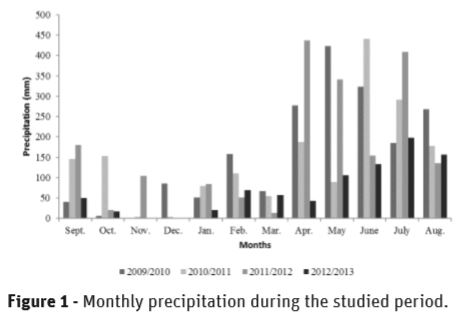
in the county of Boca da Mata – AL. The region has a rainy tropical climate, with
dry summers, according to Koppen classification, with rainfall and temperatures
annual averages of 1,500 mm (<a href = "#f1">Figure 1</a>) and 29ºC (Silva <i>et al</i>., 2017b).</font></p>

    <p>&nbsp;</p>

<a name = "f1"><img src = "/img/revistas/rca/v41n2/v41n2a15f1.jpg"></a>

    
<p>&nbsp;</p>

    <p><font face = "Verdana" size = "2">The soil was classified as a dystrophic Yellow
Oxisol (Embrapa, 2013), with medium texture, and chemicals characterization were
defined from soil samples collected in the layers 0.0 - 0.2 m; 0.2 - 0.4 m (<a href = "/img/revistas/rca/v41n2/v41n2a15t1.jpg" target = "_blank">Table
1</a>). Soil acidity was corrected using dolomitic limestone at a dose of 150 kg ha<sup>-1</sup>,
calculated considering the method to increase the saturation to 60% (Oliveira <i>et
al</i>., 2007). After the limestone application, the soil was ploughed and harrowed,
and then the grooves were opened for manual planting using sugarcane stalks with
three buds per billets, and planting density between 15 and 18 buds per meter.</font></p>

    
<p><font face = "Verdana" size = "2">The experimental design was a randomized block
with five replicates, consisting of four sugarcane varieties: SP813250, RB867515,
RB92579 and VAT90212 grown in plots of six grooves of 10.0 meters in length, spaced
from 1.0 meter, in a total of 60 m<sup>2</sup> of area. The four central lines with
six meters of length were considered for analysis, making up to 24 m<sup>2</sup>.
These varieties were chosen based on their importance of being cultivated in up
to 50% of the planted area of sugarcane in the Northeast of Brazil in the year before
the implementation of the experiment.</font></p>

    <p><font face = "Verdana" size = "2">Soil fertilization was based on Usina Triunfo recommendation according to the
results of soil analysis (<a href = "/img/revistas/rca/v41n2/v41n2a15t1.jpg" target = "_blank">Table 1</a>), applying 60, 100 and 150 kg ha<sup>-1</sup>
of N, P<sub>2</sub>O<sub>5</sub> and K<sub>2</sub>O into the bottom of the groove.
The cane was harvested after 14 months, and then the research was realized to the
first and second regrowth, each one lasting 12 months. In these cycles all treatments
received 500 kg ha<sup>-1 </sup>of the formula 20-05-25 (NPK).</font></p>

    
<p><font face = "Verdana" size = "2">When cane reached maturity during the three analyzed cycles,
the aerial part of 10 plants of each plot was randomly sampled. After sampling for
nutrient accumulation estimative, the production of fresh biomass was determined
by weighting the aerial part (stems, leaves and pointers) in an area of 2 m<sup>2</sup>
and then calculated the production of fresh biomass by hectare (t ha<sup>-1</sup>).</font></p>

    ]]></body>
<body><![CDATA[<p><font face = "Verdana" size = "2">The aerial part sampled was weighed and the total
fresh matter mass was determined. Samples of fresh plant material were chopped,
and then subsamples were collected. In the laboratory, the subsamples were dried
in a forced air ventilation oven, at 65 ºC, until constant weight. The material
was weighed for dry subsample determination. The estimation of dry aerial biomass
productivity (t ha<sup>-1</sup>) was determined by multiplying the percentage of
dry vegetable matter by the production of fresh biomass per hectare. After obtaining
the dry mass, the subsamples were passed in a Wiley type mill. The aerial biomass
was analyzed to obtain nitrogen (N), phosphorus (P), potassium (K), calcium (Ca),
magnesium (Mg), sulfur (S), zinc (Zn), copper (Cu), manganese (Mn) and boron (B)
quantity according to the methods described by Malavolta <i>et al</i>. (1997). The
N was extracted by sulfuric digestion and determined using the Kjeldahl method.
Boron was extracted by dry digestion and determined by muffle method, the other
nutrients were extracted by nitric - perchloric digestion. P was determined by the
development of the blue color using reduction of the phospho-molybdic complex. K,
Ca, Mg, Mn, Zn, Cu and Fe were quantified by the atomic absorption spectrophotometry
method and S by the barium sulfate turbidimetric method.</font></p>

    <p><font face = "Verdana" size = "2">The data were analyzed using the Sisvar computer program
(Ferreira, 2011), the variables were submitted to the analysis of variance by the
Test F and, for those in which the F was significant, the means were compared with
the Scott Knott test at a 5% probability.</font></p>

    <p><font face = "Verdana" size = "3"><b>RESULTS AND DISCUSSION</b></font></p>

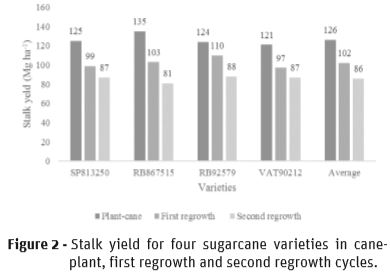
    <p><font face = "Verdana" size = "2">Sugarcane varieties
did not differ statistically for shoot yield, with 126, 102 and 86 tons per hectare
for plant-cane, first and second regrowth, respectively (<a href = "#f2">Figure 2</a>). There was a
20% reduction in the stalks yield average, comparing the first regrowth to plant-cane,
and less 16% from the first to the second regrowth. This productivity reduction
between successive cycles has been reported in the literature (Mendes, 2006; Franco
<i>et al</i>., 2011; Silva <i>et al</i>., 2017b). The decrease is attributed to
the genetic characteristics of the varieties, the cultivars interactions and with
the inserted environment (Silveira <i>et al</i>., 2012). Environmental factors related
to plant growth such as luminosity, water availability (Oliveira <i>et al</i>.,
2011) and mineral nutrients (Caione <i>et al</i>., 2013), as well as the inherent
characteristics of varieties such as sprouting, age, and root activity may contribute
to the decrease of productivity over the cycles (Manhães <i>et al</i>., 2015).</font></p>

    <p>&nbsp;</p>

<a name = "f2"><img src = "/img/revistas/rca/v41n2/v41n2a15f2.jpg"></a>

    
<p>&nbsp;</p>

    <p><font face = "Verdana" size = "2">The results obtained in the present study are
similar to both studies obtained by other authors in the Northeast region and the
Brazilian productivity average (Oliveira <i>et al</i>., 2011; Calheiros <i>et al</i>.,
2012; Conab, 2016). The varieties used presented high productive potential as long
as the accumulated biomass productivity can be considered from average to high for
the State of Alagoas. Considering the phase of maximum sugarcane growth during short
days with low luminosity and the non-coincidence of the maximum water availability,
brings a negative impact to the photosynthetic rates, resulting in lower productivity
in Alagoas, when compared to the Center-South (Oliveira <i>et al</i>., 2014).</font></p>

    <p><font face = "Verdana" size = "2">No varietal effect was observed for nitrogen in
the three cycles (<a href = "/img/revistas/rca/v41n2/v41n2a15t2.jpg" target = "_blank">Table 2</a>). The average accumulation from plant-cane was 182 kg
ha<sup>-1</sup>, verified by Oliveira <i>et al</i>. (2011), which obtained 179 kg
ha<sup>-1</sup> and 24% higher than what was reported by Mendes (2006) that found
137 kg ha<sup>-1</sup>. Calheiros <i>et al</i>. (2012) in studies carried out in
Alagoas State rainforest area verified for the plant-cane cycle that the varieties
RB867515 and RB92579 had the same nutrient absorption capacity, and nitrogen accumulation
in the shoot biomass for RB867515 and RB92579 was 220 kg ha<sup>-1</sup>.</font></p>

    
<p><font face = "Verdana" size = "2">The high nitrogen extraction by sugarcane is due
to its participation as constituent of many plant cells components, including amino
acids, proteins and nucleic acids (Taiz and Zeiger, 2013). There are many studies
in the literature that show the importance of N in the sugarcane crop (Franco <i>et
al</i>., 2011). The nutrient is found only in 1% of the total dry mass of the plant,
however its deficiency in the plant can cause a chlorophyll reduction, essential
amino acids and the energy synthesis required to produce carbohydrates and carbon
skeletons, reflecting directly on the development and crop yield (Taiz and Zeiger,
2013). Thus, the correct nitrogen fertilization application is fundamental to the
success of sugarcane cultivation. Studies have shown that once the nitrogen fertilization
is inadequate, it can result in the productivity reduction and crop longevity decrease,
which causes anticipation of sugarcane plant renovation, increasing costs for producers
(Franco <i>et al</i>., 2007).</font></p>

    <p><font face = "Verdana" size = "2">The
phosphorus accumulation was not influenced by the varieties in the three crop cycles
(<a href = "/img/revistas/rca/v41n2/v41n2a15t2.jpg" target = "_blank">Table 2</a>). In the plant-cane accumulation average in the shoot varieties biomass
was 27 kg ha<sup>-1</sup>; in the variety RB92579 was similar to the value observed
in studies conducted by Calheiros <i>et al</i>. (2012), where they recorded a removal
of 25 kg ha<sup>-1</sup> by RB867515 and was higher than the value observed by Oliveira
<i>et al</i>. (2010) who obtained a removal of 19 kg ha<sup>-1</sup>. Tasso Júnior
<i>et al</i>. (2007) obtained an accumulation ranging from 17 to 25 kg ha<sup>-1</sup>.
In the first regrowth the accumulation average was higher than the value obtained
by Benett <i>et al</i>. (2013), who found an average removal of 10 kg ha<sup>-1</sup>
for RB867515. In the second regrowth the average accumulation was 19.15 kg ha<sup>-1</sup>,
this value was higher than that obtained by Gomes (2003) who found 5.07-15.31 kg
ha<sup>-1</sup> for the second regrowth.</font></p>

    
]]></body>
<body><![CDATA[<p><font face = "Verdana" size = "2">In general, the phosphorus content required by sugarcane is low, especially
when compared to nitrogen and potassium. For sugarcane, phosphorus acts on both
growth and production of sucrose, composing approximately 0.2% of the dry biomass
of the plant. It is a structural component of macromolecules, such as nucleic acids
and phospholipids, and also adenosine triphosphate (ATP), being a key element of
several metabolic pathways and biochemical reactions, such as numerous steps in
the Calvin cycle and glycolysis (Taiz and Zeiger, 2013). Thus, despite the low requirement,
there is a need for frequent applications of P to provide and maintain high crop
productivity (Teixeira <i>et al</i>., 2014).</font></p>

    <p><font face = "Verdana" size = "2">For sugarcane, the phosphorus bioavailability in the plant can cause large
changes in nitrogen uptake and metabolism (Magalhães, 1996). With an inadequate
P supply there was a reduction in the nitrate uptake of the nutrient solution and
the nitrate transport from the roots to the shoot also decreased, however, in plants
with adequate P supply the amino acids accumulation was high in leaves and roots
(Alves <i>et al</i>., 1998). Considering the high P availability in the soil, presenting
103 mg dm<sup>-3</sup> of phosphorus, extracted with Mehlich-1 solution (<a href = "/img/revistas/rca/v41n2/v41n2a15t1.jpg" target = "_blank">Table 1</a>)
in the layer of 0 to 20 cm, ensured that the element did not limit the plant growth.</font></p>

    
<p><font face = "Verdana" size = "2">Potassium was the nutrient accumulated in the
highest amount during the three crop cycles, obtaining 219, 191 and 162 kg ha<sup>-1</sup>
for plant-cane, first and second regrowth, respectively (<a href = "/img/revistas/rca/v41n2/v41n2a15t3.jpg" target = "_blank">Table 3</a>). The highest extraction
of this nutrient by sugarcane has been reported in the literature (Oliveira <i>et
al</i>., 2011 e 2014). According to Oliveira <i>et al</i>. (2010) for a ton of stalk
cane produced, a total of 1.72 kg of potassium are absorbed and removed with harvest.
The great sugarcane potassium dependence is explained by the important role that
this nutrient plays in regulating the osmotic potential of plant cells, and also
activates many enzymes involved in respiration and photosynthesis processes (Taiz
and Zeiger, 2013).</font></p>

    
<p><font face = "Verdana" size = "2">In the plant-cane
the average accumulation obtained was similar to that observed by Oliveira <i>et
al</i>. (2014) in a study conducted in the Serra dos Aimorés - MG, that brought
out an average accumulation of 221 kg ha<sup>-1</sup> of K for RB867515 and RB92579.
Oliveira <i>et al</i>. (2010) in a study conducted in a Yellow Argisol observed
for RB867515 and RB92579 the same capacity of removing potassium extracting, 175
kg ha<sup>-1</sup> in average.</font></p>

    <p><font face = "Verdana" size = "2">The
potassium accumulation average during the first regrowth was 191 kg ha<sup>-1</sup>,
similar to Mendes (2006), who observed 198 kg ha<sup>-1</sup>. In the second regrowth
average was 162.17 kg ha<sup>-1</sup>, Gomes (2003) obtained values ranging from
152 to 235 kg ha<sup>-1</sup>.</font></p>

    <p><font face = "Verdana" size = "2">For
calcium accumulation, in the plant-cane cycle, the values obtained are lower than
those obtained by Oliveira <i>et al</i>. (2010) and Mendes (2006), but higher than
what was verified by Tasso Junior <i>et al</i>. (2007). The first regrowth presented
average values higher than those obtained by Mendes (2006) and Prado <i>et al</i>.
(2002) and lower than those observed by Oliveira <i>et al</i>. (2003). In the second
regrowth, the average accumulation was 54.82 kg ha<sup>-1</sup> (<a href = "/img/revistas/rca/v41n2/v41n2a15t3.jpg" target = "_blank">Table 3</a>).</font></p>

    
<p><font face = "Verdana" size = "2">Magnesium accumulation was 60.26 kg ha<sup>-1</sup>,
presenting lower values than those obtained by Oliveira <i>et al</i>. (2010) and
higher than those of Mendes (2006). In the first regrowth the accumulation was lower
to that obtained by Oliveira <i>et al</i>. (2003) and higher than those obtained
by Prado <i>et al</i>. (2002) and Mendes <i>et al</i>. (2011), which were 21.9 and
31.7 kg ha<sup>-1</sup>, respectively. For second regrowth the average accumulation
was 41.03 kg ha<sup>-1</sup> (<a href = "/img/revistas/rca/v41n2/v41n2a15t4.jpg" target = "_blank">Table 4</a>).</font></p>

    
<p><font face = "Verdana" size = "2">For sulfur, there was an accumulation in shoot biomass of 59.4 kg ha<sup>-1</sup>,
higher than the values reported by Tasso Júnior <i>et al</i>. (2007). In the first
regrowth the mean accumulation was 48.6 kg ha<sup>-1</sup> showing a higher accumulation
compared to the results of Coleti <i>et al</i>. (2006) and Prado <i>et al</i>. (2002).
For second regrowth the average was 43 kg ha<sup>-1</sup>.</font></p>

    <p><font face = "Verdana" size = "2">Plant-cane macronutrients accumulation average
in the biomass of aerial part of the varieties presented the following descending
order K &gt; N &gt; Ca &gt; Mg &gt; S &gt; P, but in the first and second regrowth
the sequence observed was K &gt; N &gt; Ca &gt; S &gt; Mg &gt; P. The macronutrients,
with the exception of phosphorus and calcium, showed a tendency to reduce accumulation
in shoot biomass according to the descending order of plant-cane &gt; first regrowth
&gt; second regrowth. Gomes (2003) obtained smaller accumulations of primary macronutrients
in the first regrowth cycle, followed by second regrowth and plant-cane.</font></p>

    <p><font face = "Verdana" size = "2">There was no varietal effect for the zinc and
iron accumulation in the plant-cane and first regrowth cycles (<a href = "/img/revistas/rca/v41n2/v41n2a15t5.jpg" target = "_blank">Table 5</a>). For second
regrowth, a larger accumulation of these micronutrients was observed on RB867515
variety. Tasso Junior <i>et al</i>. (2011) evaluated the micronutrients extraction
and exportation for five sugarcane varieties and obtained a zinc accumulation ranging
from 245 to 535 g ha<sup>-1</sup> and iron ranging from 2,700 to 4,300 g ha<sup>-1</sup>
in Red-Yellow Oxisol. Mendes <i>et al</i>. (2011) evaluating the micronutrients
exportation by RB92579 in a Vertisol from the Submédio São Francisco region obtained
an accumulation of 362 g ha<sup>-1</sup> approving the results of the present study.</font></p>

    
]]></body>
<body><![CDATA[<p><font face = "Verdana" size = "2">The copper and manganese contents available in
the 0 to 20 cm depth layer extracted with Mehlich-1 solution were 0.6 and 4.7 mg
dm<sup>-3</sup>, being lower than the critical levels defined by Marinho and Albuquerque
(1981), conducted in Alagoas State, obtaining 0.80 and 6.0 mg dm<sup>-3</sup> of
copper and manganese, respectively. This fact can explain the low removal (<a href = "/img/revistas/rca/v41n2/v41n2a15t6.jpg" target = "_blank">Table
6</a>) when compared to the compilation performed by Oliveira <i>et al</i>. (2007).</font></p>

    
<p><font face = "Verdana" size = "2">Foliar diagnosis studies may report if soil supply
is adequate or if plants are deficient. In case of inadequately supplied corrective,
efficient soil fertilization management is necessary. Copper and manganese deficiency
can cause productivity potential damages, by reason of these elements participate
in several oxidation-reduction reactions, especially in the photolysis of water,
carbon and nitrogen metabolism (Marshner, 2012).</font></p>

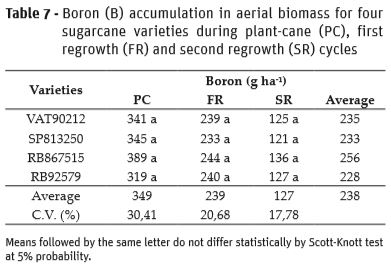
    <p><font face = "Verdana" size = "2">The average values of boron in shoot biomass of four sugarcane varieties
in the plant-cane cycles, first and second regrowth, are shown in <a href = "#t7">Table 7</a>. There
was a varietal effect only in the second regrowth, with RB867515 providing greater
accumulation. According to Oliveira <i>et al</i>. (2007), for a production of 150
tons of natural material, sugarcane extracts and accumulates 8.0, 3.0, 0.6, 0.4
and 0.3 kg of iron, manganese, zinc, copper and boron in shoot biomass, respectively.
During the three cultivation cycles the varieties presented the following decreasing
order of extraction: Iron &gt; Manganese &gt; Zinc &gt; Boron &gt; Copper.</font></p>

    <p>&nbsp;</p>

<a name = "t7"><img src = "/img/revistas/rca/v41n2/v41n2a15t7.jpg"></a>

    
<p>&nbsp;</p>

    <p><font face = "Verdana" size = "3"><b>CONCLUSIONS</b></font></p>

    <p><font face = "Verdana" size = "2">No difference was observed among the sugarcane varieties regarding
stalk yield. In average the results were 126, 102 and 86 t ha<sup>-1</sup>, respectively
for plant-cane, first and second regrowth.</font></p>

    <p><font face = "Verdana" size = "2">For nutrients accumulation, no effect was also verified for the varieties.
The average accumulation of N, P, K, Ca, Mg and S during the three harvesting cycles
were, respectively, 396, 63, 576, 174, 141 and 144 kg per hectare.</font></p>

    <p>&nbsp;</p>

    <p><font face = "Verdana" size = "3"><b>References</b></font></p>

    ]]></body>
<body><![CDATA[<!-- ref --><p><font face = "Verdana" size = "2">Alves, V.M.C.; Magalhães, J.V.; Novais, R.F. Bahia Filho, A.F.C.;
Oliveira, C.A. &amp; França, C.C.M. (1998) - Localização de fósforo e de nitrogênio
afetando os parâmetros cinéticos de absorção de nitrogênio em milho. <i>Revista
Brasileira de Fisiologia Vegetal</i>, v. 10, p. 197-201.    &nbsp;&nbsp;&nbsp;&nbsp;&nbsp;&nbsp;&nbsp;&nbsp;[&#160;<a href="javascript:void(0);" onclick="javascript: window.open('/scielo.php?script=sci_nlinks&ref=682043&pid=S0871-018X201800020001500001&lng=','','width=640,height=500,resizable=yes,scrollbars=1,menubar=yes,');">Links</a>&#160;]<!-- end-ref --></font></p>

    <!-- ref --><p><font face = "Verdana" size = "2">Benett, C.G.S.; Buzetti, S.; Silva, K.S., Teixeira Filho,
M.C.M.; Costa, N.R.; Maeda, A.S. &amp; Andreotti, M. (2013) - Acúmulo de nutrientes
no colmo de cana-de-açúcar em função de fontes e doses de manganês. <i>Semina: Ciências
Agrárias</i>, vol. 34, n. 3, p. 1077-1088. <a href = "http://dx.doi.org/10.5433/1679-0359.2013v34n3p1077" target = "_blank">http://dx.doi.org/10.5433/1679-0359.2013v34n3p1077</a></font>&nbsp;&nbsp;&nbsp;&nbsp;&nbsp;&nbsp;&nbsp;&nbsp;[&#160;<a href="javascript:void(0);" onclick="javascript: window.open('/scielo.php?script=sci_nlinks&ref=682045&pid=S0871-018X201800020001500002&lng=','','width=640,height=500,resizable=yes,scrollbars=1,menubar=yes,');">Links</a>&#160;]<!-- end-ref --><!-- ref --><p><font face = "Verdana" size = "2">Caione, G.; Fernandes, F.M. &amp; Lange, A. (2013)
- Efeito residual de fontes de fósforo nos atributos químicos do solo, nutrição
e produtividade de biomassa da cana-de-açúcar. <i>Revista Brasileira de Ciências
Agrárias</i>, vol. 8, n. 2, p. 189-196. <a href = "http://dx.doi.org/10.5039/agraria.v8i2a2016" target = "_blank">http://dx.doi.org/10.5039/agraria.v8i2a2016</a></font>&nbsp;&nbsp;&nbsp;&nbsp;&nbsp;&nbsp;&nbsp;&nbsp;[&#160;<a href="javascript:void(0);" onclick="javascript: window.open('/scielo.php?script=sci_nlinks&ref=682046&pid=S0871-018X201800020001500003&lng=','','width=640,height=500,resizable=yes,scrollbars=1,menubar=yes,');">Links</a>&#160;]<!-- end-ref --><!-- ref --><p><font face = "Verdana" size = "2">Calheiros, A.S.; Oliveira, M.W.; Ferreira, V.M.;
Barbosa, G.V.S.; Santiago, A.D. &amp; Aristides E.V.S. (2012) - Produção de biomassa,
a partir de açúcar e proteína em função de variedades de cana-de-açúcar e adubação
fosfatada. <i>Semina: Ciências Agrárias</i>, vol. 33, n. 2, p. 809-818. <a href = "http://dx.doi.org/10.5433/1679-0359.2012v33n2p809" target = "_blank">http://dx.doi.org/10.5433/1679-0359.2012v33n2p809</a></font>&nbsp;&nbsp;&nbsp;&nbsp;&nbsp;&nbsp;&nbsp;&nbsp;[&#160;<a href="javascript:void(0);" onclick="javascript: window.open('/scielo.php?script=sci_nlinks&ref=682047&pid=S0871-018X201800020001500004&lng=','','width=640,height=500,resizable=yes,scrollbars=1,menubar=yes,');">Links</a>&#160;]<!-- end-ref --><!-- ref --><p><font face = "Verdana" size = "2">Coleti, J.T.; Casagrande, J.C.; Stupiello, J.J.;
Ribeiro, L.D. &amp; Oliveira, G.R. (2006) -  Remoção de macronutrientes pela cana-planta
e cana-soca, em Argissolos, variedades RB83486 e SP81-3250. <i>STAB - Açúcar, Álcool
e Subprodutos</i>, vol. 24, p. 32-36.    &nbsp;&nbsp;&nbsp;&nbsp;&nbsp;&nbsp;&nbsp;&nbsp;[&#160;<a href="javascript:void(0);" onclick="javascript: window.open('/scielo.php?script=sci_nlinks&ref=682048&pid=S0871-018X201800020001500005&lng=','','width=640,height=500,resizable=yes,scrollbars=1,menubar=yes,');">Links</a>&#160;]<!-- end-ref --></font></p>

    <!-- ref --><p><font face = "Verdana" size = "2">Conab (2016) - <i>Acompanhamento da safra brasileira: cana-de-açúcar</i>. Primeiro
Levantamento, Companhia Nacional de Abastecimento. 66 p.    &nbsp;&nbsp;&nbsp;&nbsp;&nbsp;&nbsp;&nbsp;&nbsp;[&#160;<a href="javascript:void(0);" onclick="javascript: window.open('/scielo.php?script=sci_nlinks&ref=682050&pid=S0871-018X201800020001500006&lng=','','width=640,height=500,resizable=yes,scrollbars=1,menubar=yes,');">Links</a>&#160;]<!-- end-ref --></font></p>

    <!-- ref --><p><font face = "Verdana" size = "2">Embrapa. (2013) - <i>Sistema brasileiro de classificação
de solos</i>. 3ªed. Brasília, Empresa Brasileira De Pesquisa Agropecuária, Embrapa
Solos, 353 p.    &nbsp;&nbsp;&nbsp;&nbsp;&nbsp;&nbsp;&nbsp;&nbsp;[&#160;<a href="javascript:void(0);" onclick="javascript: window.open('/scielo.php?script=sci_nlinks&ref=682052&pid=S0871-018X201800020001500007&lng=','','width=640,height=500,resizable=yes,scrollbars=1,menubar=yes,');">Links</a>&#160;]<!-- end-ref --></font></p>

    <!-- ref --><p><font face = "Verdana" size = "2">Ferreira, D.F. (2011)
- Sisvar: a computer statistical analysis system. <i>Ciência e Agrotecnologia</i>.
vol. 35, n. 6, p. 1039-1042. <a href = "http://dx.doi.org/10.1590/S1413-70542011000600001" target = "_blank">http://dx.doi.org/10.1590/S1413-70542011000600001</a></font>&nbsp;&nbsp;&nbsp;&nbsp;&nbsp;&nbsp;&nbsp;&nbsp;[&#160;<a href="javascript:void(0);" onclick="javascript: window.open('/scielo.php?script=sci_nlinks&ref=682054&pid=S0871-018X201800020001500008&lng=','','width=640,height=500,resizable=yes,scrollbars=1,menubar=yes,');">Links</a>&#160;]<!-- end-ref --><!-- ref --><p><font face = "Verdana" size = "2">Franco, H.C.J.; Bolonga, I.R.; Faroni, C.E.; Vitti,
A.C. &amp; Trivelin, P.C.O. (2007) - Acúmulo de macronutrientes em cana-de-açúcar
em função da adubação nitrogenada e dos resíduos culturais incorporados ao solo
no plantio. <i>Bragantia</i>. vol. 66, n. 4, p. 669-674. <a href = "http://dx.doi.org/10.1590/S0006-87052007000400017" target = "_blank">http://dx.doi.org/10.1590/S0006-87052007000400017</a></font>&nbsp;&nbsp;&nbsp;&nbsp;&nbsp;&nbsp;&nbsp;&nbsp;[&#160;<a href="javascript:void(0);" onclick="javascript: window.open('/scielo.php?script=sci_nlinks&ref=682055&pid=S0871-018X201800020001500009&lng=','','width=640,height=500,resizable=yes,scrollbars=1,menubar=yes,');">Links</a>&#160;]<!-- end-ref --><!-- ref --><p><font face = "Verdana" size = "2">Franco, H.C.J.; Otto, R. Faroni, C.E.; Vitti,
A.C.; Oliveira, E.C.A. &amp; Trivelin, P.C.O. (2011) - Nitrogen in sugarcane derived
from fertilizer in Brazilian field conditions. <i>Field Crop Research</i>, vol.
121, n. 1, p. 29-41. <a href = "http://dx.doi.org/10.1016/j.fcr.2010.11.011" target = "_blank">http://dx.doi.org/10.1016/j.fcr.2010.11.011</a></font>&nbsp;&nbsp;&nbsp;&nbsp;&nbsp;&nbsp;&nbsp;&nbsp;[&#160;<a href="javascript:void(0);" onclick="javascript: window.open('/scielo.php?script=sci_nlinks&ref=682056&pid=S0871-018X201800020001500010&lng=','','width=640,height=500,resizable=yes,scrollbars=1,menubar=yes,');">Links</a>&#160;]<!-- end-ref --><!-- ref --><p><font face = "Verdana" size = "2">Gomes, J.F.F. (2003) - <i>Produção de colmos e exportação
de macronutrientes por primários cultivares de cana-de-açúcar (Saccharum spp.)</i>.
Dissertação de Mestrado. Piracicaba, Escola Superior de Agricultura Luiz de Queiroz.
65 p.    &nbsp;&nbsp;&nbsp;&nbsp;&nbsp;&nbsp;&nbsp;&nbsp;[&#160;<a href="javascript:void(0);" onclick="javascript: window.open('/scielo.php?script=sci_nlinks&ref=682057&pid=S0871-018X201800020001500011&lng=','','width=640,height=500,resizable=yes,scrollbars=1,menubar=yes,');">Links</a>&#160;]<!-- end-ref --></font></p>

    <!-- ref --><p><font face = "Verdana" size = "2">Magalhães, J.V. (1996) - <i>Absorção
e translocação de nitrogênio por plantas de milho (Zea mays L.) submetidas a períodos
crescentes de omissão de fósforo na solução nutritiva</i>. Dissertação de Mestrado.
Viçosa, Universidade Federal de Viçosa, 76 p.    &nbsp;&nbsp;&nbsp;&nbsp;&nbsp;&nbsp;&nbsp;&nbsp;[&#160;<a href="javascript:void(0);" onclick="javascript: window.open('/scielo.php?script=sci_nlinks&ref=682059&pid=S0871-018X201800020001500012&lng=','','width=640,height=500,resizable=yes,scrollbars=1,menubar=yes,');">Links</a>&#160;]<!-- end-ref --></font></p>

    <!-- ref --><p><font face = "Verdana" size = "2">Malavolta, E.; Vitti, G. C.; Oliveira, S.A. (1997) - <i>Avaliação do estado
nutricional das plantas: princípios e aplicações.</i> 2ª ed. Piracicaba, Associação
Brasileira para Pesquisa da Potassa e do Fosfato. 319 p.    &nbsp;&nbsp;&nbsp;&nbsp;&nbsp;&nbsp;&nbsp;&nbsp;[&#160;<a href="javascript:void(0);" onclick="javascript: window.open('/scielo.php?script=sci_nlinks&ref=682061&pid=S0871-018X201800020001500013&lng=','','width=640,height=500,resizable=yes,scrollbars=1,menubar=yes,');">Links</a>&#160;]<!-- end-ref --></font></p>

    ]]></body>
<body><![CDATA[<!-- ref --><p><font face = "Verdana" size = "2">Manhães, C.M.C.; Garcia, R.F.; Francelino, F. M. A., Oliveira,
H. F.; &amp; Coelho, F. C. (2015) - Fatores que afetam a brotação e o perfilhamento
da cana-de-açúcar. <i>Vértices</i>, vol. 17, n. 1, p. 163-181. <a href = "http://dx.doi.org/10.5935/1809-2667.20150011" target = "_blank">http://dx.doi.org/10.5935/1809-2667.20150011</a></font>&nbsp;&nbsp;&nbsp;&nbsp;&nbsp;&nbsp;&nbsp;&nbsp;[&#160;<a href="javascript:void(0);" onclick="javascript: window.open('/scielo.php?script=sci_nlinks&ref=682063&pid=S0871-018X201800020001500014&lng=','','width=640,height=500,resizable=yes,scrollbars=1,menubar=yes,');">Links</a>&#160;]<!-- end-ref --><!-- ref --><p><font face = "Verdana" size = "2">Marinho, M.L. &amp; Albuquerque, G.A.C. (1981)
- Efeito do cobre e do zinco na produção de cana-de-açúcar em solos de tabuleiros
de Alagoas. <i>Brasil Açucareiro</i>, vol. 98, p. 41-50.    &nbsp;&nbsp;&nbsp;&nbsp;&nbsp;&nbsp;&nbsp;&nbsp;[&#160;<a href="javascript:void(0);" onclick="javascript: window.open('/scielo.php?script=sci_nlinks&ref=682064&pid=S0871-018X201800020001500015&lng=','','width=640,height=500,resizable=yes,scrollbars=1,menubar=yes,');">Links</a>&#160;]<!-- end-ref --></font></p>

    <!-- ref --><p><font face = "Verdana" size = "2">Marschner, P. (2012) - <i>Mineral Nutrition of higher plants.
</i>3ª ed. San Diego, Elsevier, 651 p.    &nbsp;&nbsp;&nbsp;&nbsp;&nbsp;&nbsp;&nbsp;&nbsp;[&#160;<a href="javascript:void(0);" onclick="javascript: window.open('/scielo.php?script=sci_nlinks&ref=682066&pid=S0871-018X201800020001500016&lng=','','width=640,height=500,resizable=yes,scrollbars=1,menubar=yes,');">Links</a>&#160;]<!-- end-ref --></font></p>

    <!-- ref --><p><font face = "Verdana" size = "2">Mendes, A.M.S.; Moura, M.S.B; Silva, T.G.F.; Carmo, J.F.A.&amp; Brandão, E.O.
(2011) - Acúmulo e exportação de micronutrientes pela cana de açúcar irrigada no
Semiárido brasileiro. <i>In</i>: <i>Congresso brasileiro de ciência do solo</i>,
<i>33</i>. Uberlândia, Brasil, SBCS, p. 1-4.    &nbsp;&nbsp;&nbsp;&nbsp;&nbsp;&nbsp;&nbsp;&nbsp;[&#160;<a href="javascript:void(0);" onclick="javascript: window.open('/scielo.php?script=sci_nlinks&ref=682068&pid=S0871-018X201800020001500017&lng=','','width=640,height=500,resizable=yes,scrollbars=1,menubar=yes,');">Links</a>&#160;]<!-- end-ref --></font></p>

    <!-- ref --><p><font face = "Verdana" size = "2">Mendes, L.C. (2006) - <i>Eficiência nutricional de cultivares de cana-de-açúcar</i>.
Dissertação de Mestrado. Viçosa, Universidade Federal de Viçosa. 46 p.    &nbsp;&nbsp;&nbsp;&nbsp;&nbsp;&nbsp;&nbsp;&nbsp;[&#160;<a href="javascript:void(0);" onclick="javascript: window.open('/scielo.php?script=sci_nlinks&ref=682070&pid=S0871-018X201800020001500018&lng=','','width=640,height=500,resizable=yes,scrollbars=1,menubar=yes,');">Links</a>&#160;]<!-- end-ref --></font></p>

    <!-- ref --><p><font face = "Verdana" size = "2">Oliveira, E.C.A.; Freire, F.J.; Oliveira, R.I.D.;
Freire, M.B.G.S.; Simões Neto, D.E. &amp; Silva, S.A.M. (2010) - Extração e exportação
de nutrientes por variedades de cana-de-açúcar cultivadas sob irrigação plena. <i>Revista
Brasileira de Ciências do Solo</i>, vol. 34, p. 1343-1352.    &nbsp;&nbsp;&nbsp;&nbsp;&nbsp;&nbsp;&nbsp;&nbsp;[&#160;<a href="javascript:void(0);" onclick="javascript: window.open('/scielo.php?script=sci_nlinks&ref=682072&pid=S0871-018X201800020001500019&lng=','','width=640,height=500,resizable=yes,scrollbars=1,menubar=yes,');">Links</a>&#160;]<!-- end-ref --></font></p>

    <!-- ref --><p><font face = "Verdana" size = "2">Oliveira, M.W.; Barbosa, M.H.P.; Damasceno, L.C. &amp; Mendes,
C.M. (2003) - Matéria Seca e Nutrientes na Palhada de Dez Variedades de Cana-de-Açúcar<i>
STAB - Açúcar, Álcool e Subprodutos</i>, vol. 21, p. 30-31.    &nbsp;&nbsp;&nbsp;&nbsp;&nbsp;&nbsp;&nbsp;&nbsp;[&#160;<a href="javascript:void(0);" onclick="javascript: window.open('/scielo.php?script=sci_nlinks&ref=682074&pid=S0871-018X201800020001500020&lng=','','width=640,height=500,resizable=yes,scrollbars=1,menubar=yes,');">Links</a>&#160;]<!-- end-ref --></font></p>

    <!-- ref --><p><font face = "Verdana" size = "2">Oliveira, M.W.; Freire, F.M.; Macêdo, G.A.R. &amp; Ferreira,
J.J. (2007) - Nutrição mineral e adubação da cana-de-açúcar. <i>Informe Agropecuário</i>,
vol. 28, n. 239, p. 30-43.    &nbsp;&nbsp;&nbsp;&nbsp;&nbsp;&nbsp;&nbsp;&nbsp;[&#160;<a href="javascript:void(0);" onclick="javascript: window.open('/scielo.php?script=sci_nlinks&ref=682076&pid=S0871-018X201800020001500021&lng=','','width=640,height=500,resizable=yes,scrollbars=1,menubar=yes,');">Links</a>&#160;]<!-- end-ref --></font></p>

    <!-- ref --><p><font face = "Verdana" size = "2">Oliveira,
M.W.; Magrini, J.L.; Lyra, F.E.V.; Valduga, G.R.; Pereira, M.G.; Tenorio, C.J.M.
&amp; Aristides, E.V.S. (2011) - Produção da RB867515 influenciada pela aplicação
de substâncias húmicas, aminoácidos e extrato de algas marinhas. <i>STAB - Açúcar,
Álcool e Subprodutos</i>, vol. 30, p. 30-33.    &nbsp;&nbsp;&nbsp;&nbsp;&nbsp;&nbsp;&nbsp;&nbsp;[&#160;<a href="javascript:void(0);" onclick="javascript: window.open('/scielo.php?script=sci_nlinks&ref=682078&pid=S0871-018X201800020001500022&lng=','','width=640,height=500,resizable=yes,scrollbars=1,menubar=yes,');">Links</a>&#160;]<!-- end-ref --></font></p>

    <!-- ref --><p><font face = "Verdana" size = "2">Oliveira, M.W.; Silva, V.S.G.; Reis, L.S.; Oliveira, D.C. &amp; Silva,
J.C.T. (2014) - Produção e qualidade de três variedades de cana-de-açúcar cultivadas
no nordeste de Minas Gerais. <i>Revista Ciência Agrícola</i>, vol. 12, n. 1, p.
17-20.    &nbsp;&nbsp;&nbsp;&nbsp;&nbsp;&nbsp;&nbsp;&nbsp;[&#160;<a href="javascript:void(0);" onclick="javascript: window.open('/scielo.php?script=sci_nlinks&ref=682080&pid=S0871-018X201800020001500023&lng=','','width=640,height=500,resizable=yes,scrollbars=1,menubar=yes,');">Links</a>&#160;]<!-- end-ref --></font></p>

    <!-- ref --><p><font face = "Verdana" size = "2">Prado, R.M.; Fernades, F.M.
&amp; Natale, W. (2002) - Lime and slag evaluated by leaf analysis, macronutrient
accumulation and export of sugarcane. <i>Scientia Agricola</i>. vol. 59, n. 1, p.
129-135. <a href = "http://dx.doi.org/10.1590/S0103-90162002000100019" target = "_blank">http://dx.doi.org/10.1590/S0103-90162002000100019</a></font>&nbsp;&nbsp;&nbsp;&nbsp;&nbsp;&nbsp;&nbsp;&nbsp;[&#160;<a href="javascript:void(0);" onclick="javascript: window.open('/scielo.php?script=sci_nlinks&ref=682082&pid=S0871-018X201800020001500024&lng=','','width=640,height=500,resizable=yes,scrollbars=1,menubar=yes,');">Links</a>&#160;]<!-- end-ref --><!-- ref --><p><font face = "Verdana" size = "2">Silva, V.S.G; Oliveira, M.W; Oliveira, T.B.A.; Mantovanelli,
B.C.; Silva, A.C.; Soares, A.N.R. &amp; Clemente, P.R.A. (2017a) - Leaf area of
sugarcane varieties and their correlation with biomass productivity in three cycles.
<i>African Journal of Agricultural Research</i>, vol. 12, n. 7, p. 459-466. <a href = "http://dx.doi.org/10.5897/AJAR2016.11817" target = "_blank">http://dx.doi.org/10.5897/AJAR2016.11817</a></font>&nbsp;&nbsp;&nbsp;&nbsp;&nbsp;&nbsp;&nbsp;&nbsp;[&#160;<a href="javascript:void(0);" onclick="javascript: window.open('/scielo.php?script=sci_nlinks&ref=682083&pid=S0871-018X201800020001500025&lng=','','width=640,height=500,resizable=yes,scrollbars=1,menubar=yes,');">Links</a>&#160;]<!-- end-ref --><!-- ref --><p><font face = "Verdana" size = "2">Silva, V.S.G.; Oliveira, M. W.; Oliveira, D.C.;
Oliveira, T.B.A.; Pereira, M.G. &amp; Nogueira, C.H.C. (2017b) - Nutritional diagnosis
of sugarcane varieties in a Yellow Oxisol during three agricultural seasons. <i>African
Journal of Agricultural Research</i>, vol. 12, n. 1, p. 50-57. <a href = "http://dx.doi.org/10.5897/AJAR2016.11865" target = "_blank">http://dx.doi.org/10.5897/AJAR2016.11865</a></font>&nbsp;&nbsp;&nbsp;&nbsp;&nbsp;&nbsp;&nbsp;&nbsp;[&#160;<a href="javascript:void(0);" onclick="javascript: window.open('/scielo.php?script=sci_nlinks&ref=682084&pid=S0871-018X201800020001500026&lng=','','width=640,height=500,resizable=yes,scrollbars=1,menubar=yes,');">Links</a>&#160;]<!-- end-ref --><!-- ref --><p><font face = "Verdana" size = "2">Silveira, L.C.I.; Kist, V.; Paula, T.O.M.; Barbosa,
M.H.P.; Oliveira, R.A. de &amp; Daros, E. (2012) - Adaptabilidade e estabilidade
fenotípica de genótipos de cana&#8209;de&#8209;açúcar no estado de Minas Gerais<i>.
Ciência Rural</i>, vol. 42, n. 4, p. 587-593. <a href = "http://dx.doi.org/10.1590/S0103-84782012000400002" target = "_blank">http://dx.doi.org/10.1590/S0103-84782012000400002</a></font>&nbsp;&nbsp;&nbsp;&nbsp;&nbsp;&nbsp;&nbsp;&nbsp;[&#160;<a href="javascript:void(0);" onclick="javascript: window.open('/scielo.php?script=sci_nlinks&ref=682085&pid=S0871-018X201800020001500027&lng=','','width=640,height=500,resizable=yes,scrollbars=1,menubar=yes,');">Links</a>&#160;]<!-- end-ref --><!-- ref --><p><font face = "Verdana" size = "2">Taiz, L. &amp; Zeiger, E. (2013) -<i> Fisiologia
vegetal</i> 5ª. ed. Porto Alegre, Artmed, 2013. 954 p.    &nbsp;&nbsp;&nbsp;&nbsp;&nbsp;&nbsp;&nbsp;&nbsp;[&#160;<a href="javascript:void(0);" onclick="javascript: window.open('/scielo.php?script=sci_nlinks&ref=682086&pid=S0871-018X201800020001500028&lng=','','width=640,height=500,resizable=yes,scrollbars=1,menubar=yes,');">Links</a>&#160;]<!-- end-ref --></font></p>

    <!-- ref --><p><font face = "Verdana" size = "2">Tasso Junior, L.C.; Marques, M.O.; Camilotti, F. &amp; Silva,
T. (2007) - Extração e exportação de macronutrientes em cinco variedades de cana-de-açúcar
cultivadas na região centro-norte do Estado de São Paulo. <i>STAB - Açúcar, Álcool
e Subprodutos</i>, vol. 25, p. 38-42.    &nbsp;&nbsp;&nbsp;&nbsp;&nbsp;&nbsp;&nbsp;&nbsp;[&#160;<a href="javascript:void(0);" onclick="javascript: window.open('/scielo.php?script=sci_nlinks&ref=682088&pid=S0871-018X201800020001500029&lng=','','width=640,height=500,resizable=yes,scrollbars=1,menubar=yes,');">Links</a>&#160;]<!-- end-ref --></font></p>

    <!-- ref --><p><font face = "Verdana" size = "2">Tasso Junior, L.C.; Silva Neto, H. F., Silva, J.D.R., Marques, M.O. &amp; Camilotti,
F. (2011) - Acúmulo de micronutrientes em colmos e palhada de cinco cultivares de
cana-de-açúcar de ciclo precoce. <i>Nucleus</i>, vol. 8, n. 1, p. 375-384. <a href = "http://dx.doi.org/10.3738/nucleus.v8i1.537" target = "_blank">http://dx.doi.org/10.3738/nucleus.v8i1.537</a></font>&nbsp;&nbsp;&nbsp;&nbsp;&nbsp;&nbsp;&nbsp;&nbsp;[&#160;<a href="javascript:void(0);" onclick="javascript: window.open('/scielo.php?script=sci_nlinks&ref=682090&pid=S0871-018X201800020001500030&lng=','','width=640,height=500,resizable=yes,scrollbars=1,menubar=yes,');">Links</a>&#160;]<!-- end-ref --><!-- ref --><p><font face = "Verdana" size = "2">Teixeira, W.G.; Sousa, R.T.X. &amp;
Korndörfer, G.H. (2014) - Resposta da cana-de-açúcar a doses de fósforo fornecidas
por fertilizante organomineral. <i>Bioscience Journal</i>, vol. 30, n. 6, p. 1729-1736.    &nbsp;&nbsp;&nbsp;&nbsp;&nbsp;&nbsp;&nbsp;&nbsp;[&#160;<a href="javascript:void(0);" onclick="javascript: window.open('/scielo.php?script=sci_nlinks&ref=682091&pid=S0871-018X201800020001500031&lng=','','width=640,height=500,resizable=yes,scrollbars=1,menubar=yes,');">Links</a>&#160;]<!-- end-ref --></font></p>

    ]]></body>
<body><![CDATA[<p>&nbsp;</p>

    <p><font face = "Verdana" size = "3"><b>Acknowledgments</b></font></p>

    <p><font face = "Verdana" size = "2">To
the Triunfo Mill for the logistical support during this study. To Conselho Superior
de Desenvolvimento Científico e Tecnológico (CNPq) for financial support and the
fellowships conceded.</font></p>

    <p>&nbsp;</p>

    <p><font face = "Verdana" size = "2">Received/recebido: 2017.03.03</font></p>

    <p><font face = "Verdana" size = "2">Received in revised form/recebido em versão revista: 2017.07.21</font></p>

    <p><font face = "Verdana" size = "2">Accepted/aceite: 2017.08.01</font></p>

     ]]></body><back>
<ref-list>
<ref id="B1">
<nlm-citation citation-type="journal">
<person-group person-group-type="author">
<name>
<surname><![CDATA[Alves]]></surname>
<given-names><![CDATA[V.M.C.]]></given-names>
</name>
<name>
<surname><![CDATA[Magalhães]]></surname>
<given-names><![CDATA[J.V.]]></given-names>
</name>
<name>
<surname><![CDATA[Novais]]></surname>
<given-names><![CDATA[R.F.]]></given-names>
</name>
<name>
<surname><![CDATA[Bahia Filho]]></surname>
<given-names><![CDATA[A.F.C.]]></given-names>
</name>
<name>
<surname><![CDATA[Oliveira]]></surname>
<given-names><![CDATA[C.A.]]></given-names>
</name>
<name>
<surname><![CDATA[França]]></surname>
<given-names><![CDATA[C.C.M.]]></given-names>
</name>
</person-group>
<article-title xml:lang="pt"><![CDATA[Localização de fósforo e de nitrogênio afetando os parâmetros cinéticos de absorção de nitrogênio em milho]]></article-title>
<source><![CDATA[Revista Brasileira de Fisiologia Vegetal]]></source>
<year>1998</year>
<volume>10</volume>
<page-range>197-201</page-range></nlm-citation>
</ref>
<ref id="B2">
<nlm-citation citation-type="journal">
<person-group person-group-type="author">
<name>
<surname><![CDATA[Benett]]></surname>
<given-names><![CDATA[C.G.S.]]></given-names>
</name>
<name>
<surname><![CDATA[Buzetti]]></surname>
<given-names><![CDATA[S.]]></given-names>
</name>
<name>
<surname><![CDATA[Silva]]></surname>
<given-names><![CDATA[K.S.]]></given-names>
</name>
<name>
<surname><![CDATA[Teixeira Filho]]></surname>
<given-names><![CDATA[M.C.M.]]></given-names>
</name>
<name>
<surname><![CDATA[Costa]]></surname>
<given-names><![CDATA[N.R.]]></given-names>
</name>
<name>
<surname><![CDATA[Maeda]]></surname>
<given-names><![CDATA[A.S.]]></given-names>
</name>
<name>
<surname><![CDATA[Andreotti]]></surname>
<given-names><![CDATA[M.]]></given-names>
</name>
</person-group>
<article-title xml:lang="pt"><![CDATA[Acúmulo de nutrientes no colmo de cana-de-açúcar em função de fontes e doses de manganês]]></article-title>
<source><![CDATA[Semina]]></source>
<year>2013</year>
<volume>34</volume>
<numero>3</numero>
<issue>3</issue>
<page-range>1077-1088</page-range></nlm-citation>
</ref>
<ref id="B3">
<nlm-citation citation-type="journal">
<person-group person-group-type="author">
<name>
<surname><![CDATA[Caione]]></surname>
<given-names><![CDATA[G.]]></given-names>
</name>
<name>
<surname><![CDATA[Fernandes]]></surname>
<given-names><![CDATA[F.M.]]></given-names>
</name>
<name>
<surname><![CDATA[Lange]]></surname>
<given-names><![CDATA[A.]]></given-names>
</name>
</person-group>
<article-title xml:lang="pt"><![CDATA[Efeito residual de fontes de fósforo nos atributos químicos do solo, nutrição e produtividade de biomassa da cana-de-açúcar]]></article-title>
<source><![CDATA[Revista Brasileira de Ciências Agrárias]]></source>
<year>2013</year>
<volume>8</volume>
<numero>2</numero>
<issue>2</issue>
<page-range>189-196</page-range></nlm-citation>
</ref>
<ref id="B4">
<nlm-citation citation-type="journal">
<person-group person-group-type="author">
<name>
<surname><![CDATA[Calheiros]]></surname>
<given-names><![CDATA[A.S.]]></given-names>
</name>
<name>
<surname><![CDATA[Oliveira]]></surname>
<given-names><![CDATA[M.W.]]></given-names>
</name>
<name>
<surname><![CDATA[Ferreira]]></surname>
<given-names><![CDATA[V.M.]]></given-names>
</name>
<name>
<surname><![CDATA[Barbosa]]></surname>
<given-names><![CDATA[G.V.S.]]></given-names>
</name>
<name>
<surname><![CDATA[Santiago]]></surname>
<given-names><![CDATA[A.D.]]></given-names>
</name>
<name>
<surname><![CDATA[Aristides]]></surname>
<given-names><![CDATA[E.V.S.]]></given-names>
</name>
</person-group>
<article-title xml:lang="pt"><![CDATA[Produção de biomassa, a partir de açúcar e proteína em função de variedades de cana-de-açúcar e adubação fosfatada]]></article-title>
<source><![CDATA[Semina]]></source>
<year>2012</year>
<volume>33</volume>
<numero>2</numero>
<issue>2</issue>
<page-range>809-818</page-range></nlm-citation>
</ref>
<ref id="B5">
<nlm-citation citation-type="journal">
<person-group person-group-type="author">
<name>
<surname><![CDATA[Coleti]]></surname>
<given-names><![CDATA[J.T.]]></given-names>
</name>
<name>
<surname><![CDATA[Casagrande]]></surname>
<given-names><![CDATA[J.C.]]></given-names>
</name>
<name>
<surname><![CDATA[Stupiello]]></surname>
<given-names><![CDATA[J.J.]]></given-names>
</name>
<name>
<surname><![CDATA[Ribeiro]]></surname>
<given-names><![CDATA[L.D.]]></given-names>
</name>
<name>
<surname><![CDATA[Oliveira]]></surname>
<given-names><![CDATA[G.R.]]></given-names>
</name>
</person-group>
<article-title xml:lang="pt"><![CDATA[Remoção de macronutrientes pela cana-planta e cana-soca, em Argissolos, variedades RB83486 e SP81-3250]]></article-title>
<source><![CDATA[STAB]]></source>
<year>2006</year>
<volume>24</volume>
<page-range>32-36</page-range></nlm-citation>
</ref>
<ref id="B6">
<nlm-citation citation-type="book">
<collab>Conab</collab>
<source><![CDATA[Acompanhamento da safra brasileira: cana-de-açúcar]]></source>
<year>2016</year>
<publisher-name><![CDATA[Companhia Nacional de Abastecimento]]></publisher-name>
</nlm-citation>
</ref>
<ref id="B7">
<nlm-citation citation-type="book">
<collab>Embrapa</collab>
<source><![CDATA[Sistema brasileiro de classificação de solos]]></source>
<year>2013</year>
<edition>3ª</edition>
<publisher-loc><![CDATA[Brasília ]]></publisher-loc>
<publisher-name><![CDATA[Empresa Brasileira De Pesquisa Agropecuária]]></publisher-name>
</nlm-citation>
</ref>
<ref id="B8">
<nlm-citation citation-type="journal">
<person-group person-group-type="author">
<name>
<surname><![CDATA[Ferreira]]></surname>
<given-names><![CDATA[D.F.]]></given-names>
</name>
</person-group>
<article-title xml:lang="en"><![CDATA[Sisvar: a computer statistical analysis system]]></article-title>
<source><![CDATA[Ciência e Agrotecnologia]]></source>
<year>2011</year>
<volume>35</volume>
<numero>6</numero>
<issue>6</issue>
<page-range>1039-1042</page-range></nlm-citation>
</ref>
<ref id="B9">
<nlm-citation citation-type="journal">
<person-group person-group-type="author">
<name>
<surname><![CDATA[Franco]]></surname>
<given-names><![CDATA[H.C.J.]]></given-names>
</name>
<name>
<surname><![CDATA[Bolonga]]></surname>
<given-names><![CDATA[I.R.]]></given-names>
</name>
<name>
<surname><![CDATA[Faroni]]></surname>
<given-names><![CDATA[C.E.]]></given-names>
</name>
<name>
<surname><![CDATA[Vitti]]></surname>
<given-names><![CDATA[A.C.]]></given-names>
</name>
<name>
<surname><![CDATA[Trivelin]]></surname>
<given-names><![CDATA[P.C.O.]]></given-names>
</name>
</person-group>
<article-title xml:lang="pt"><![CDATA[Acúmulo de macronutrientes em cana-de-açúcar em função da adubação nitrogenada e dos resíduos culturais incorporados ao solo no plantio]]></article-title>
<source><![CDATA[Bragantia]]></source>
<year>2007</year>
<volume>66</volume>
<numero>4</numero>
<issue>4</issue>
<page-range>669-674</page-range></nlm-citation>
</ref>
<ref id="B10">
<nlm-citation citation-type="journal">
<person-group person-group-type="author">
<name>
<surname><![CDATA[Franco]]></surname>
<given-names><![CDATA[H.C.J.]]></given-names>
</name>
<name>
<surname><![CDATA[Otto]]></surname>
<given-names><![CDATA[R.]]></given-names>
</name>
<name>
<surname><![CDATA[Faroni]]></surname>
<given-names><![CDATA[C.E.]]></given-names>
</name>
<name>
<surname><![CDATA[Vitti]]></surname>
<given-names><![CDATA[A.C.]]></given-names>
</name>
<name>
<surname><![CDATA[Oliveira]]></surname>
<given-names><![CDATA[E.C.A.]]></given-names>
</name>
<name>
<surname><![CDATA[Trivelin]]></surname>
<given-names><![CDATA[P.C.O.]]></given-names>
</name>
</person-group>
<article-title xml:lang="en"><![CDATA[Nitrogen in sugarcane derived from fertilizer in Brazilian field conditions]]></article-title>
<source><![CDATA[Field Crop Research]]></source>
<year>2011</year>
<volume>121</volume>
<numero>1</numero>
<issue>1</issue>
<page-range>29-41</page-range></nlm-citation>
</ref>
<ref id="B11">
<nlm-citation citation-type="">
<person-group person-group-type="author">
<name>
<surname><![CDATA[Gomes]]></surname>
<given-names><![CDATA[J.F.F.]]></given-names>
</name>
</person-group>
<source><![CDATA[Produção de colmos e exportação de macronutrientes por primários cultivares de cana-de-açúcar (Saccharum spp.)]]></source>
<year>2003</year>
</nlm-citation>
</ref>
<ref id="B12">
<nlm-citation citation-type="">
<person-group person-group-type="author">
<name>
<surname><![CDATA[Magalhães]]></surname>
<given-names><![CDATA[J.V.]]></given-names>
</name>
</person-group>
<source><![CDATA[Absorção e translocação de nitrogênio por plantas de milho (Zea mays L.) submetidas a períodos crescentes de omissão de fósforo na solução nutritiva]]></source>
<year>1996</year>
</nlm-citation>
</ref>
<ref id="B13">
<nlm-citation citation-type="book">
<person-group person-group-type="author">
<name>
<surname><![CDATA[Malavolta]]></surname>
<given-names><![CDATA[E.]]></given-names>
</name>
<name>
<surname><![CDATA[Vitti]]></surname>
<given-names><![CDATA[G. C.]]></given-names>
</name>
<name>
<surname><![CDATA[Oliveira]]></surname>
<given-names><![CDATA[S.A.]]></given-names>
</name>
</person-group>
<source><![CDATA[Avaliação do estado nutricional das plantas: princípios e aplicações]]></source>
<year>1997</year>
<edition>2ª</edition>
<publisher-loc><![CDATA[Piracicaba ]]></publisher-loc>
<publisher-name><![CDATA[Associação Brasileira para Pesquisa da Potassa e do Fosfato]]></publisher-name>
</nlm-citation>
</ref>
<ref id="B14">
<nlm-citation citation-type="journal">
<person-group person-group-type="author">
<name>
<surname><![CDATA[Manhães]]></surname>
<given-names><![CDATA[C.M.C.]]></given-names>
</name>
<name>
<surname><![CDATA[Garcia]]></surname>
<given-names><![CDATA[R.F.]]></given-names>
</name>
<name>
<surname><![CDATA[Francelino]]></surname>
<given-names><![CDATA[F. M. A.]]></given-names>
</name>
<name>
<surname><![CDATA[Oliveira]]></surname>
<given-names><![CDATA[H. F.]]></given-names>
</name>
<name>
<surname><![CDATA[Coelho]]></surname>
<given-names><![CDATA[F. C.]]></given-names>
</name>
</person-group>
<article-title xml:lang="pt"><![CDATA[Fatores que afetam a brotação e o perfilhamento da cana-de-açúcar]]></article-title>
<source><![CDATA[Vértices]]></source>
<year>2015</year>
<volume>17</volume>
<numero>1</numero>
<issue>1</issue>
<page-range>163-181</page-range></nlm-citation>
</ref>
<ref id="B15">
<nlm-citation citation-type="journal">
<person-group person-group-type="author">
<name>
<surname><![CDATA[Marinho]]></surname>
<given-names><![CDATA[M.L.]]></given-names>
</name>
<name>
<surname><![CDATA[Albuquerque]]></surname>
<given-names><![CDATA[G.A.C.]]></given-names>
</name>
</person-group>
<article-title xml:lang="pt"><![CDATA[Efeito do cobre e do zinco na produção de cana-de-açúcar em solos de tabuleiros de Alagoas]]></article-title>
<source><![CDATA[Brasil Açucareiro]]></source>
<year>1981</year>
<volume>98</volume>
<page-range>41-50</page-range></nlm-citation>
</ref>
<ref id="B16">
<nlm-citation citation-type="book">
<person-group person-group-type="author">
<name>
<surname><![CDATA[Marschner]]></surname>
<given-names><![CDATA[P.]]></given-names>
</name>
</person-group>
<source><![CDATA[Mineral Nutrition of higher plants]]></source>
<year>2012</year>
<edition>3ª</edition>
<publisher-loc><![CDATA[San Diego ]]></publisher-loc>
<publisher-name><![CDATA[Elsevier]]></publisher-name>
</nlm-citation>
</ref>
<ref id="B17">
<nlm-citation citation-type="confpro">
<person-group person-group-type="author">
<name>
<surname><![CDATA[Mendes]]></surname>
<given-names><![CDATA[A.M.S.]]></given-names>
</name>
<name>
<surname><![CDATA[Moura]]></surname>
<given-names><![CDATA[M.S.B]]></given-names>
</name>
<name>
<surname><![CDATA[Silva]]></surname>
<given-names><![CDATA[T.G.F.]]></given-names>
</name>
<name>
<surname><![CDATA[Carmo]]></surname>
<given-names><![CDATA[J.F.A.]]></given-names>
</name>
<name>
<surname><![CDATA[Brandão]]></surname>
<given-names><![CDATA[E.O.]]></given-names>
</name>
</person-group>
<article-title xml:lang="pt"><![CDATA[Acúmulo e exportação de micronutrientes pela cana de açúcar irrigada no Semiárido brasileiro]]></article-title>
<source><![CDATA[]]></source>
<year>2011</year>
<conf-name><![CDATA[33 Congresso brasileiro de ciência do solo]]></conf-name>
<conf-loc>Uberlândia </conf-loc>
<page-range>1-4</page-range></nlm-citation>
</ref>
<ref id="B18">
<nlm-citation citation-type="">
<person-group person-group-type="author">
<name>
<surname><![CDATA[Mendes]]></surname>
<given-names><![CDATA[L.C.]]></given-names>
</name>
</person-group>
<source><![CDATA[Eficiência nutricional de cultivares de cana-de-açúcar]]></source>
<year>2006</year>
</nlm-citation>
</ref>
<ref id="B19">
<nlm-citation citation-type="journal">
<person-group person-group-type="author">
<name>
<surname><![CDATA[Oliveira]]></surname>
<given-names><![CDATA[E.C.A.]]></given-names>
</name>
<name>
<surname><![CDATA[Freire]]></surname>
<given-names><![CDATA[F.J.]]></given-names>
</name>
<name>
<surname><![CDATA[Oliveira]]></surname>
<given-names><![CDATA[R.I.D.]]></given-names>
</name>
<name>
<surname><![CDATA[Freire]]></surname>
<given-names><![CDATA[M.B.G.S.]]></given-names>
</name>
<name>
<surname><![CDATA[Simões Neto]]></surname>
<given-names><![CDATA[D.E.]]></given-names>
</name>
<name>
<surname><![CDATA[Silva]]></surname>
<given-names><![CDATA[S.A.M.]]></given-names>
</name>
</person-group>
<article-title xml:lang="pt"><![CDATA[Extração e exportação de nutrientes por variedades de cana-de-açúcar cultivadas sob irrigação plena]]></article-title>
<source><![CDATA[Revista Brasileira de Ciências do Solo]]></source>
<year>2010</year>
<volume>34</volume>
<page-range>1343-1352</page-range></nlm-citation>
</ref>
<ref id="B20">
<nlm-citation citation-type="journal">
<person-group person-group-type="author">
<name>
<surname><![CDATA[Oliveira]]></surname>
<given-names><![CDATA[M.W.]]></given-names>
</name>
<name>
<surname><![CDATA[Barbosa]]></surname>
<given-names><![CDATA[M.H.P.]]></given-names>
</name>
<name>
<surname><![CDATA[Damasceno]]></surname>
<given-names><![CDATA[L.C.]]></given-names>
</name>
<name>
<surname><![CDATA[Mendes]]></surname>
<given-names><![CDATA[C.M.]]></given-names>
</name>
</person-group>
<article-title xml:lang="pt"><![CDATA[Matéria Seca e Nutrientes na Palhada de Dez Variedades de Cana-de-Açúcar]]></article-title>
<source><![CDATA[STAB]]></source>
<year>2003</year>
<volume>21</volume>
<page-range>30-31</page-range></nlm-citation>
</ref>
<ref id="B21">
<nlm-citation citation-type="journal">
<person-group person-group-type="author">
<name>
<surname><![CDATA[Oliveira]]></surname>
<given-names><![CDATA[M.W.]]></given-names>
</name>
<name>
<surname><![CDATA[Freire]]></surname>
<given-names><![CDATA[F.M.]]></given-names>
</name>
<name>
<surname><![CDATA[Macêdo]]></surname>
<given-names><![CDATA[G.A.R.]]></given-names>
</name>
<name>
<surname><![CDATA[Ferreira]]></surname>
<given-names><![CDATA[J.J.]]></given-names>
</name>
</person-group>
<article-title xml:lang="pt"><![CDATA[Nutrição mineral e adubação da cana-de-açúcar]]></article-title>
<source><![CDATA[Informe Agropecuário]]></source>
<year>2007</year>
<volume>28</volume>
<numero>239</numero>
<issue>239</issue>
<page-range>30-43</page-range></nlm-citation>
</ref>
<ref id="B22">
<nlm-citation citation-type="journal">
<person-group person-group-type="author">
<name>
<surname><![CDATA[Oliveira]]></surname>
<given-names><![CDATA[M.W.]]></given-names>
</name>
<name>
<surname><![CDATA[Magrini]]></surname>
<given-names><![CDATA[J.L.]]></given-names>
</name>
<name>
<surname><![CDATA[Lyra]]></surname>
<given-names><![CDATA[F.E.V.]]></given-names>
</name>
<name>
<surname><![CDATA[Valduga]]></surname>
<given-names><![CDATA[G.R.]]></given-names>
</name>
<name>
<surname><![CDATA[Pereira]]></surname>
<given-names><![CDATA[M.G.]]></given-names>
</name>
<name>
<surname><![CDATA[Tenorio]]></surname>
<given-names><![CDATA[C.J.M.]]></given-names>
</name>
<name>
<surname><![CDATA[Aristides]]></surname>
<given-names><![CDATA[E.V.S.]]></given-names>
</name>
</person-group>
<article-title xml:lang="pt"><![CDATA[Produção da RB867515 influenciada pela aplicação de substâncias húmicas, aminoácidos e extrato de algas marinhas]]></article-title>
<source><![CDATA[STAB]]></source>
<year>2011</year>
<volume>30</volume>
<page-range>30-33</page-range></nlm-citation>
</ref>
<ref id="B23">
<nlm-citation citation-type="journal">
<person-group person-group-type="author">
<name>
<surname><![CDATA[Oliveira]]></surname>
<given-names><![CDATA[M.W.]]></given-names>
</name>
<name>
<surname><![CDATA[Silva]]></surname>
<given-names><![CDATA[V.S.G.]]></given-names>
</name>
<name>
<surname><![CDATA[Reis]]></surname>
<given-names><![CDATA[L.S.]]></given-names>
</name>
<name>
<surname><![CDATA[Oliveira]]></surname>
<given-names><![CDATA[D.C.]]></given-names>
</name>
<name>
<surname><![CDATA[Silva]]></surname>
<given-names><![CDATA[J.C.T.]]></given-names>
</name>
</person-group>
<article-title xml:lang="pt"><![CDATA[Produção e qualidade de três variedades de cana-de-açúcar cultivadas no nordeste de Minas Gerais]]></article-title>
<source><![CDATA[Revista Ciência Agrícola]]></source>
<year>2014</year>
<volume>12</volume>
<numero>1</numero>
<issue>1</issue>
<page-range>17-20</page-range></nlm-citation>
</ref>
<ref id="B24">
<nlm-citation citation-type="journal">
<person-group person-group-type="author">
<name>
<surname><![CDATA[Prado]]></surname>
<given-names><![CDATA[R.M.]]></given-names>
</name>
<name>
<surname><![CDATA[Fernades]]></surname>
<given-names><![CDATA[F.M.]]></given-names>
</name>
<name>
<surname><![CDATA[Natale]]></surname>
<given-names><![CDATA[W.]]></given-names>
</name>
</person-group>
<article-title xml:lang="en"><![CDATA[Lime and slag evaluated by leaf analysis, macronutrient accumulation and export of sugarcane]]></article-title>
<source><![CDATA[Scientia Agricola]]></source>
<year>2002</year>
<volume>59</volume>
<numero>1</numero>
<issue>1</issue>
<page-range>129-135</page-range></nlm-citation>
</ref>
<ref id="B25">
<nlm-citation citation-type="journal">
<person-group person-group-type="author">
<name>
<surname><![CDATA[Silva]]></surname>
<given-names><![CDATA[V.S.G]]></given-names>
</name>
<name>
<surname><![CDATA[Oliveira]]></surname>
<given-names><![CDATA[M.W]]></given-names>
</name>
<name>
<surname><![CDATA[Oliveira]]></surname>
<given-names><![CDATA[T.B.A.]]></given-names>
</name>
<name>
<surname><![CDATA[Mantovanelli]]></surname>
<given-names><![CDATA[B.C.]]></given-names>
</name>
<name>
<surname><![CDATA[Silva]]></surname>
<given-names><![CDATA[A.C.]]></given-names>
</name>
<name>
<surname><![CDATA[Soares]]></surname>
<given-names><![CDATA[A.N.R.]]></given-names>
</name>
<name>
<surname><![CDATA[Clemente]]></surname>
<given-names><![CDATA[P.R.A.]]></given-names>
</name>
</person-group>
<article-title xml:lang="en"><![CDATA[Leaf area of sugarcane varieties and their correlation with biomass productivity in three cycles]]></article-title>
<source><![CDATA[African Journal of Agricultural Research]]></source>
<year>2017</year>
<month>a</month>
<volume>12</volume>
<numero>7</numero>
<issue>7</issue>
<page-range>459-466</page-range></nlm-citation>
</ref>
<ref id="B26">
<nlm-citation citation-type="journal">
<person-group person-group-type="author">
<name>
<surname><![CDATA[Silva]]></surname>
<given-names><![CDATA[V.S.G.]]></given-names>
</name>
<name>
<surname><![CDATA[Oliveira]]></surname>
<given-names><![CDATA[M. W.]]></given-names>
</name>
<name>
<surname><![CDATA[Oliveira]]></surname>
<given-names><![CDATA[D.C.]]></given-names>
</name>
<name>
<surname><![CDATA[Oliveira]]></surname>
<given-names><![CDATA[T.B.A.]]></given-names>
</name>
<name>
<surname><![CDATA[Pereira]]></surname>
<given-names><![CDATA[M.G.]]></given-names>
</name>
<name>
<surname><![CDATA[Nogueira]]></surname>
<given-names><![CDATA[C.H.C.]]></given-names>
</name>
</person-group>
<article-title xml:lang="en"><![CDATA[Nutritional diagnosis of sugarcane varieties in a Yellow Oxisol during three agricultural seasons]]></article-title>
<source><![CDATA[African Journal of Agricultural Research]]></source>
<year>2017</year>
<month>b</month>
<volume>12</volume>
<numero>1</numero>
<issue>1</issue>
<page-range>50-57</page-range></nlm-citation>
</ref>
<ref id="B27">
<nlm-citation citation-type="journal">
<person-group person-group-type="author">
<name>
<surname><![CDATA[Silveira]]></surname>
<given-names><![CDATA[L.C.I.]]></given-names>
</name>
<name>
<surname><![CDATA[Kist]]></surname>
<given-names><![CDATA[V.]]></given-names>
</name>
<name>
<surname><![CDATA[Paula]]></surname>
<given-names><![CDATA[T.O.M.]]></given-names>
</name>
<name>
<surname><![CDATA[Barbosa]]></surname>
<given-names><![CDATA[M.H.P.]]></given-names>
</name>
<name>
<surname><![CDATA[Oliveira]]></surname>
<given-names><![CDATA[R.A. de]]></given-names>
</name>
<name>
<surname><![CDATA[Daros]]></surname>
<given-names><![CDATA[E.]]></given-names>
</name>
</person-group>
<article-title xml:lang="pt"><![CDATA[Adaptabilidade e estabilidade fenotípica de genótipos de cana-de-açúcar no estado de Minas Gerais]]></article-title>
<source><![CDATA[Ciência Rural]]></source>
<year>2012</year>
<volume>42</volume>
<numero>4</numero>
<issue>4</issue>
<page-range>587-593</page-range></nlm-citation>
</ref>
<ref id="B28">
<nlm-citation citation-type="book">
<person-group person-group-type="author">
<name>
<surname><![CDATA[Taiz]]></surname>
<given-names><![CDATA[L.]]></given-names>
</name>
<name>
<surname><![CDATA[Zeiger]]></surname>
<given-names><![CDATA[E.]]></given-names>
</name>
</person-group>
<source><![CDATA[Fisiologia vegetal]]></source>
<year>2013</year>
<edition>5ª</edition>
<publisher-loc><![CDATA[Porto Alegre ]]></publisher-loc>
<publisher-name><![CDATA[Artmed]]></publisher-name>
</nlm-citation>
</ref>
<ref id="B29">
<nlm-citation citation-type="journal">
<person-group person-group-type="author">
<name>
<surname><![CDATA[Tasso Junior]]></surname>
<given-names><![CDATA[L.C.]]></given-names>
</name>
<name>
<surname><![CDATA[Marques]]></surname>
<given-names><![CDATA[M.O.]]></given-names>
</name>
<name>
<surname><![CDATA[Camilotti]]></surname>
<given-names><![CDATA[F.]]></given-names>
</name>
<name>
<surname><![CDATA[Silva]]></surname>
<given-names><![CDATA[T.]]></given-names>
</name>
</person-group>
<article-title xml:lang="pt"><![CDATA[Extração e exportação de macronutrientes em cinco variedades de cana-de-açúcar cultivadas na região centro-norte do Estado de São Paulo]]></article-title>
<source><![CDATA[STAB]]></source>
<year>2007</year>
<volume>25</volume>
<page-range>38-42</page-range></nlm-citation>
</ref>
<ref id="B30">
<nlm-citation citation-type="journal">
<person-group person-group-type="author">
<name>
<surname><![CDATA[Tasso Junior]]></surname>
<given-names><![CDATA[L.C.]]></given-names>
</name>
<name>
<surname><![CDATA[Silva Neto]]></surname>
<given-names><![CDATA[H. F.]]></given-names>
</name>
<name>
<surname><![CDATA[Silva]]></surname>
<given-names><![CDATA[J.D.R.]]></given-names>
</name>
<name>
<surname><![CDATA[Marques]]></surname>
<given-names><![CDATA[M.O.]]></given-names>
</name>
<name>
<surname><![CDATA[Camilotti]]></surname>
<given-names><![CDATA[F.]]></given-names>
</name>
</person-group>
<article-title xml:lang="pt"><![CDATA[Acúmulo de micronutrientes em colmos e palhada de cinco cultivares de cana-de-açúcar de ciclo precoce]]></article-title>
<source><![CDATA[Nucleus]]></source>
<year>2011</year>
<volume>8</volume>
<numero>1</numero>
<issue>1</issue>
<page-range>375-384</page-range></nlm-citation>
</ref>
<ref id="B31">
<nlm-citation citation-type="journal">
<person-group person-group-type="author">
<name>
<surname><![CDATA[Teixeira]]></surname>
<given-names><![CDATA[W.G.]]></given-names>
</name>
<name>
<surname><![CDATA[Sousa]]></surname>
<given-names><![CDATA[R.T.X.]]></given-names>
</name>
<name>
<surname><![CDATA[Korndörfer]]></surname>
<given-names><![CDATA[G.H.]]></given-names>
</name>
</person-group>
<article-title xml:lang="pt"><![CDATA[Resposta da cana-de-açúcar a doses de fósforo fornecidas por fertilizante organomineral]]></article-title>
<source><![CDATA[Bioscience Journal]]></source>
<year>2014</year>
<volume>30</volume>
<numero>6</numero>
<issue>6</issue>
<page-range>1729-1736</page-range></nlm-citation>
</ref>
</ref-list>
</back>
</article>