<?xml version="1.0" encoding="ISO-8859-1"?><article xmlns:mml="http://www.w3.org/1998/Math/MathML" xmlns:xlink="http://www.w3.org/1999/xlink" xmlns:xsi="http://www.w3.org/2001/XMLSchema-instance">
<front>
<journal-meta>
<journal-id>0871-018X</journal-id>
<journal-title><![CDATA[Revista de Ciências Agrárias]]></journal-title>
<abbrev-journal-title><![CDATA[Rev. de Ciências Agrárias]]></abbrev-journal-title>
<issn>0871-018X</issn>
<publisher>
<publisher-name><![CDATA[Sociedade de Ciências Agrárias de Portugal]]></publisher-name>
</publisher>
</journal-meta>
<article-meta>
<article-id>S0871-018X2018000200016</article-id>
<article-id pub-id-type="doi">10.19084/RCA16142</article-id>
<title-group>
<article-title xml:lang="en"><![CDATA[Biofertilizer effect of yeast fermented broth on organic tomato seedlings]]></article-title>
<article-title xml:lang="pt"><![CDATA[Efeito biofertilizante de caldo fermentado por levedura em mudas de tomate orgânico]]></article-title>
</title-group>
<contrib-group>
<contrib contrib-type="author">
<name>
<surname><![CDATA[Gemin]]></surname>
<given-names><![CDATA[Luiz Gabriel]]></given-names>
</name>
<xref ref-type="aff" rid="A1"/>
</contrib>
<contrib contrib-type="author">
<name>
<surname><![CDATA[Datsch]]></surname>
<given-names><![CDATA[Roberto]]></given-names>
</name>
<xref ref-type="aff" rid="A1"/>
</contrib>
<contrib contrib-type="author">
<name>
<surname><![CDATA[Mógor]]></surname>
<given-names><![CDATA[Átila Francisco]]></given-names>
</name>
<xref ref-type="aff" rid="A1"/>
</contrib>
<contrib contrib-type="author">
<name>
<surname><![CDATA[Mógor]]></surname>
<given-names><![CDATA[Gilda]]></given-names>
</name>
<xref ref-type="aff" rid="A1"/>
</contrib>
</contrib-group>
<aff id="AA1">
<institution><![CDATA[,Federal University of Paraná  ]]></institution>
<addr-line><![CDATA[Curitiba ]]></addr-line>
<country>Brazil</country>
</aff>
<pub-date pub-type="pub">
<day>00</day>
<month>06</month>
<year>2018</year>
</pub-date>
<pub-date pub-type="epub">
<day>00</day>
<month>06</month>
<year>2018</year>
</pub-date>
<volume>41</volume>
<numero>2</numero>
<fpage>151</fpage>
<lpage>160</lpage>
<copyright-statement/>
<copyright-year/>
<self-uri xlink:href="http://scielo.pt/scielo.php?script=sci_arttext&amp;pid=S0871-018X2018000200016&amp;lng=en&amp;nrm=iso"></self-uri><self-uri xlink:href="http://scielo.pt/scielo.php?script=sci_abstract&amp;pid=S0871-018X2018000200016&amp;lng=en&amp;nrm=iso"></self-uri><self-uri xlink:href="http://scielo.pt/scielo.php?script=sci_pdf&amp;pid=S0871-018X2018000200016&amp;lng=en&amp;nrm=iso"></self-uri><abstract abstract-type="short" xml:lang="en"><p><![CDATA[Looking for the development of products based on natural sources capable of promoting plant growth according to organic production assumptions, the aim of this work was to evaluate the effect of Saccharomyces cerevisiae fermented broth (SFB) as a biofertilizer on organic tomato seedlings growth and chlorophyll content of leaves, taking into account the content of levorotatory configuration amino acids in SFB. For that reason, were performed foliar applications of aqueous solutions with five concentrations (0,25; 0,50; 0,75; 1,0 and 1,25 mL.L-1) of SFB (complex-aid® - Alltech®) and a control with application of distilled water. The SFB showed remarkable efficiency in promoting tomato seedlings growth, increasing leaves chlorophyll content, increasing leaves and stems growth, roots volume and altering its diameter partitioning, improving the rate of thinner roots at 0,75 mL L-1 concentration. These are initial results for further investigations about how SFB acts on plant metabolism, related to L-amino acids or other possible bioactive compounds released by Saccharomyces cerevisiae.]]></p></abstract>
<abstract abstract-type="short" xml:lang="pt"><p><![CDATA[Buscando o desenvolvimento com base em fontes naturais capazes de promover o crescimento de plantas de acordo com os pressupostos da produção orgânica, o objetivo deste estudo foi avaliar o efeito do caldo fermentado de Saccharomyces cerevisiae (SFB) como biofertilizante no crescimento de mudas tomate em sistema orgânico e quantificar o conteúdo de clorofila nas folhas, tendo em conta que o SFB apresenta aminoácidos com configuração levógira. Por esse motivo, as aplicações foliares de soluções aquosas foram realizadas com cinco concentrações (0,25, 0,50, 0,75, 1,0 e 1,25 ml.l-1) de SFB (complex-Aid ® - Alltech®) e uma testemunha com aplicação de água destilada. O SFB mostrou notável eficácia na promoção do crescimento das mudas de tomate, aumentando o teor de clorofila das folhas, no aumento do crescimento de folha e caule, no volume das raízes estratificado por diâmetro, melhorando a taxa de raízes mais finas em 0,75 ml. L-1 de concentração. Estes são os primeiros resultados de nova investigação sobre a utilização de SFB sobre o metabolismo da planta em conjunto com L-aminoácidos e outros compostos bioativos possíveis divulgados pela Saccharomyces cerevisiae.]]></p></abstract>
<kwd-group>
<kwd lng="en"><![CDATA[Saccharomyces cerevisiae]]></kwd>
<kwd lng="en"><![CDATA[plant growth]]></kwd>
<kwd lng="en"><![CDATA[L- amino acids]]></kwd>
<kwd lng="en"><![CDATA[chlorophyll]]></kwd>
<kwd lng="pt"><![CDATA[Saccharomyces cerevisiae]]></kwd>
<kwd lng="pt"><![CDATA[crescimento vegetal]]></kwd>
<kwd lng="pt"><![CDATA[L- aminoácidos]]></kwd>
<kwd lng="pt"><![CDATA[clorofila]]></kwd>
</kwd-group>
</article-meta>
</front><body><![CDATA[ 

    <p align = "right"><font face = "Verdana" size = "2"><b>ARTIGO</b></font></p>

    <p><font face = "Verdana" size = "4"><b>Biofertilizer effect of yeast fermented broth on organic tomato seedlings</b></font></p>

    <p><font face = "Verdana" size = "3"><b>Efeito biofertilizante de caldo fermentado por levedura em mudas de tomate orgânico</b></font></p>

    <p><font face = "Verdana" size = "2"><b>Luiz Gabriel Gemin</b>*, <b>Roberto Datsch</b>, <b>Átila Francisco
Mógor</b> and <b>Gilda Mógor</b></font></p>

    <p><font face = "Verdana" size = "2">Postgraduate Course on Crop Science, Federal University of Paraná - UFPR, Curitiba, Brazil</font></p>

    <p><font face = "Verdana" size = "2"><i>(*E-mail: <a href="mailto:gemin1988@hotmail.com">gemin1988@hotmail.com</a>)</i></font></p>

<hr noshade size = 1>

    <p><font face = "Verdana" size = "3"><b>ABSTRACT</b></font></p>

    <p><font face = "Verdana" size = "2">Looking for the development of products based on natural sources capable
of promoting plant growth according to organic production assumptions, the aim of
this work was to evaluate the effect of <i>Saccharomyces cerevisiae </i>fermented
broth (SFB) as a biofertilizer on organic tomato seedlings growth and chlorophyll
content of leaves, taking into account the content of levorotatory configuration
amino acids in SFB. For that reason, were performed foliar applications of aqueous
solutions with five concentrations (0,25; 0,50; 0,75; 1,0 and 1,25 mL.L<sup>-1</sup>)
of SFB (complex-aid<sup>®</sup> - Alltech<sup>®</sup>) and a control with application
of distilled water. The SFB showed remarkable efficiency in promoting tomato seedlings
growth, increasing leaves chlorophyll content, increasing leaves and stems growth,
roots volume and altering its diameter partitioning, improving the rate of thinner
roots at 0,75 mL L<sup>-1</sup> concentration. These are initial results for further
investigations about how SFB acts on plant metabolism, related to L-amino acids
or other possible bioactive compounds released by <i>Saccharomyces cerevisiae.</i></font></p>

    <p><font face = "Verdana" size = "2"><b>Keywords</b>: <i>Saccharomyces cerevisiae</i>, plant growth, L- amino acids,
chlorophyll.</font></p>

<hr noshade size = 1>

    ]]></body>
<body><![CDATA[<p><font face = "Verdana" size = "3"><b>RESUMO</b></font></p>

    <p><font face = "Verdana" size = "2">Buscando o desenvolvimento com base em fontes naturais capazes de promover o
crescimento de plantas de acordo com os pressupostos da produção orgânica, o objetivo
deste estudo foi avaliar o efeito do caldo fermentado de <i>Saccharomyces cerevisiae</i>
(SFB) como biofertilizante no crescimento de mudas tomate em sistema orgânico e
quantificar o conteúdo de clorofila nas folhas, tendo em conta que o SFB apresenta
aminoácidos com configuração levógira. Por esse motivo, as aplicações foliares de
soluções aquosas foram realizadas com cinco concentrações (0,25, 0,50, 0,75, 1,0
e 1,25 ml.l-1) de SFB (complex-Aid ® - Alltech®) e uma testemunha com aplicação
de água destilada. O SFB mostrou notável eficácia na promoção do crescimento das
mudas de tomate, aumentando o teor de clorofila das folhas, no aumento do crescimento
de folha e caule, no volume das raízes estratificado por diâmetro, melhorando a
taxa de raízes mais finas em 0,75 ml. L-1 de concentração. Estes são os primeiros
resultados de nova investigação sobre a utilização de SFB sobre o metabolismo da
planta em conjunto com L-aminoácidos e outros compostos bioativos possíveis divulgados
pela <i>Saccharomyces cerevisiae</i>.</font></p>

    <p><font face = "Verdana" size = "2"><b>Palavras-chave:</b>
<i>Saccharomyces cerevisiae</i>, crescimento vegetal, L- aminoácidos, clorofila.</font></p>

<hr noshade size = 1>

    <p><font face = "Verdana" size = "3"><b>INTRODUCTION</b></font></p>

    <p><font face = "Verdana" size = "2">From the
central part of the Andean region in South America, and after its domestication
in Mexico, the cultivation of tomato (<i>Solanum lycopersicum</i>) has spread to
the world. In Brazil, the introduction of tomato influenced European immigrants
in the nineteenth century. Nowadays, it is one of the most important vegetable crops
in plantation area, production, and value (Alvarenga, 2013).</font></p>

    <p><font face = "Verdana" size = "2">The productive efficiency of traditional tomato production
should ensure high yields. So, it becomes necessary to use high quantities of synthetic
inputs to increase the production, thereby causing an invariable decrease in the
sustainability of production system that can affect the soil, water, and the health
of growers and consumers (Silva <i>et al</i>., 2007).</font></p>

    <p><font face = "Verdana" size = "2">Despite this, the organic farming system has shown a rapid growth
in Brazil in in recent years, driven by the demand of the population for healthy
food, increasing production without the use of synthetic fertilizers and pesticides
(Kiss, 2004). Additionally, organic production is an excellent business opportunity
and undoubtedly a great challenge to producers, who need information about cultivars,
pests and diseases control (Khatounian, 2001), besides natural sources that can
promote plant growth. Therefore, the great challenge is to develop or to adapt tomato
production technologies that could enable growers to achieve greater economic returns
concomitant with the production system sustainability.</font></p>

    <p><font face = "Verdana" size = "2">The practice of sustainable agriculture, such as organic system
enhances environmental conservation, produces free-chemical contamination food and
upper biological and commercial value. Additionally, it leads to an increase of
hand labor, keeping the men at the field allied to more satisfactory economic returns.
However, despite the increasing expansion involving organic agriculture, competitiveness
and sustainability of production units still rely heavily on knowledge and technology
generation on a scientific basis.</font></p>

    <p><font face = "Verdana" size = "2">The development of new environmentally safer technologies is an international
trend and urgent for growing vegetables, where chemicals are usually used in indiscriminately.
Among these technologies, the use of products from fermentation processes, as biofertilizers,
stand out by showing recent results (Bettoni <i>et al</i>., 2014; Kaseker <i>et
al</i>., 2014; Röder, 2014).</font></p>

    <p><font face = "Verdana" size = "2">As a
result, promoting the development of sustainable systems in tomato production by
exploiting the full potential of growing and contributing to the increase in the
welfare of growers and consumers are the strategies to be followed. In this context,
organic production gains importance (Sediyama, 2014), and biofertilizers could be
an important tool, acting in the improvement of the performance of production systems
by stimulating plant metabolism, as observed on the activity of roots growth (Bezerra,
2007).</font></p>

    ]]></body>
<body><![CDATA[<p><font face = "Verdana" size = "2">The use of biofertilizers
is a technique set by the Brazilian regulation of organic production (Brasil, 2003).
This regulation defines biorfertilizers as products that contain active compounds
or biological agents able to act directly or indirectly on all or part of cultivated
plants, improving the production system performance and making unnecessary the use
of the substance of disallowed chemicals within organic system regulation (Brasil,
2011).</font></p>

    <p><font face = "Verdana" size = "2">Among the products with biofertilizer
effect potential, some can be obtained through a fermentation process using sugar
cane broth, an efficient carbon source for the growth of microorganisms. According
to Santos and Akiba (1996), these fermented broths could be planted metabolic activators
and are composed by proteins, enzymes, vitamins, and amino acids produced and released
by microorganisms during fermentation processes, acting as stimulators of plant
growth.</font></p>

    <p><font face = "Verdana" size = "2">All plants produce their
AA. Studies have demonstrated that the exogenous supply of AA may result in beneficial
effects, such as significant gains in various processes of growth and development
of plants. Such fact has been confirmed by providing a solution containing the L-AA
to plants, which is absorbed and incorporated to the plant metabolism as a precursor
of the aminolevulinic acid on chlorophyll synthesis (Beale <i>et al</i>., 1975),
or improving the nitrate reductase (EC 1.7.99.4) activity and a consequent plant
growth related to nitrogen metabolism (R&#1255;der, 2014).</font></p>

    <p><font face = "Verdana" size = "2">Mógor <i>et al</i>. (2008) demonstrated significant results
of the application of isolated AA or in association with Ascophyllum nodosum extract
on common beans (<i>Phaseolus vulgaris</i> L.), which promoted a greater early growth
of bean plants as well as the increase in grain production. In a recent work, the
foliar application of a sugar cane fermented broth containing L-glutamic acid in
cabbage seedlings showed significant results, increasing chlorophyll levels and
roots volume (R&#1255;der <i>et al</i>., 2015).</font></p>

    <p><font face = "Verdana" size = "2">Consequently, it can be inferred that L-AA derived from fermentation processes
are potential active components of biofertilizers, since they are considered metabolic
activators (Bezerra <i>et al</i>., 2007), and due to their capability of acting
as plant growth stimulators.</font></p>

    <p><font face = "Verdana" size = "2"> For
being a yeast used since ancient times in various kind of fermentations as a leavening
agent (bread, beer, production of ethyl alcohol), <i>Saccharomyces cerevisiae</i>,
whose metabolism is known the best, is the eukaryote organism studied the most (Yamada
<i>et al</i>., 2003). The S. cerevisiae was widely used as a model organism to elucidate
the bionsynthesis pathways of amino acids (Braus, 1991; Cooper <i>et al</i>., 2010),
whose high amino acid content has been reported since Watson (1976).</font></p>

    <p><font face = "Verdana" size = "2">The autolysis of yeast cell wall by the present
enzymes or acids releases the cell content (Dawson, 2002), including the L-AA (Watson,
1976). As a result, their fermented broth could be a source of L-AA composition
for sustainable agricultural use.</font></p>

    <p><font face = "Verdana" size = "2">Regarding
tomato crops, the success of the production is first achieved by the formation of
high quality seedlings, showing homogeneity and adequate growth of roots and stems
for transplanting (de Paiva, 2011). According to Maggioni <i>et al</i>. (2014),
the seedling production practice interferes directly in the final performance of
plants and gives advantages such as economy of seeds, less use of pesticides and
increased fixation field after transplantation.</font></p>

    <p><font face = "Verdana" size = "2">Therefore, the objective of this study was to evaluate the likely biofertilizer
effects of foliar applications of the S. cerevisiae fermented broth on tomato seedlings
growth under organic system.</font></p>

    <p><font face = "Verdana" size = "3"><b>MATERIAL AND METHODS</b></font></p>

    ]]></body>
<body><![CDATA[<p><font face = "Verdana" size = "2">The experiment was conducted in a protected environment (polyethylene film covered
nursery) at the organic garden of the Federal University of Paraná, Brazil, at coordinates
25°23'30'' S and 49°07'30'' W, 920 m altitude. The climate in the region is temperate
humid (Mesothermal) according to Köppen’s classification. The tomato cultivar 'Santa
Cruz' (Topseed®) was used, as it is commonly used among organic farmers, planted
on polystyrene trays with 200 cells, filled with commercial substrate (Bioplant®).
Sowing was held on August 12, 2014. The treatments with four replications were composed
of 100 cells each, distributed in a completely randomized design and consisted of
foliar applications of aqueous solutions with five concentrations (0.25; 0.50; 0.75;
1.0 and 1.25 mL.L<sup>-1</sup>) of a <i>S. cerevisiae</i> fermented broth (complex-aid®
- Alltech®) and a control with application of distilled water. The foliar sprays
were performed using a CO<sub>2</sub> pressurized sprayer at constant pressure (45
lib.pol<sup>-1</sup>) at the amount of 100 mL per tray. Three sprayings were carried
out, one each week, starting at 15 days after seeding when the seedlings showed
the first true leaves. At 36 days after seeding, the seedlings were randomly collected
from each repetition, totaling 28 per treatment.</font></p>

    <p><font face = "Verdana" size = "2">To identify biofertilizer effect on the promoting of seedling growth
the following biometric variables were measured: leaf area, stem volume, root volume
and root diameter averages separated in four classes of means (0.5-0.99 mm; 1.0-1.49
mm; 1.5-1.99 mm; 2.0-2.5mm). After carefully washing over a sieve to avoid losing
parts of the roots, the seedlings were analyzed using the software WinRhizo® (Regent
Instruments Inc. 2013, Canada) coupled to a LA1600 3D Scanner.</font></p>

    <p><font face = "Verdana" size = "2">Regarding determination of the possible effect of <i>S.
cerevisiae</i> fermented broth (SFB), on chlorophyll synthesis, the leaf pigments
(chlorophyll a, chlorophyll b, total chlorophyll and carotenoids) were determined
according to the method described by Lichtenthaler (1987) with the following modifications:
in a microtube, 0.3 g of macerated plant material and 1.8 mL of 80% acetone were
added in distilled H<sub>2</sub>O with 0.1% CaCO<sub>3</sub> (w/v); vortex agitation
was performed at maximum speed for 10 seconds, at four times for each sample in
a three-minute interval between agitations. The solution was centrifuged at 9335
g or 10,000 rpm for two seconds. For the readings at 663 and 647 nm on spectrophotometer,
the supernatant was used as well as to obtain the mean values of the formula described
by Lichtenthaler and Buschmann (2001).</font></p>

    <p><font face = "Verdana" size = "2">The data were tested for homogeneity of variances using the Bartlett's test
and then analyzed by ANOVA at 5% probability. When significant, the growth and foliar
pigments data were submitted to regression analysis. Diameter means of the roots
were compared using the test of Duncan (p&lt;0.05). The software Assistat® beta
7.7 was also used (Silva and Azevedo, 2009).</font></p>

    <p><font face = "Verdana" size = "3"><b>RESULTS  </b></font></p>

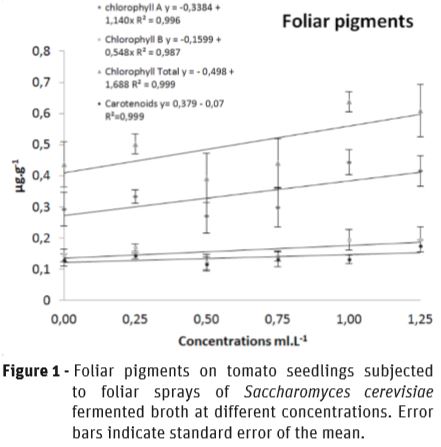
    <p><font face = "Verdana" size = "2">Chlorophyll content in the leaves of the tomato seedlings was affected by SFB
treatments. As the SFB concentration increased, total content of chlorophyll increased
linearly with 46% of increment at 1 mL.L<sup>-1</sup>. These results indicate that
SFB sprayed over leaves of tomato seedlings was taken up and played a role in chlorophyll
synthesis, possible related to their L-AA content. The carotenoids content was not
affected by treatments (<a href = "#f1">Figure 1</a>).</font></p>

    <p>&nbsp;</p>

<a name = "f1"><img src = "/img/revistas/rca/v41n2/v41n2a16f1.jpg"></a>

    
<p>&nbsp;</p>

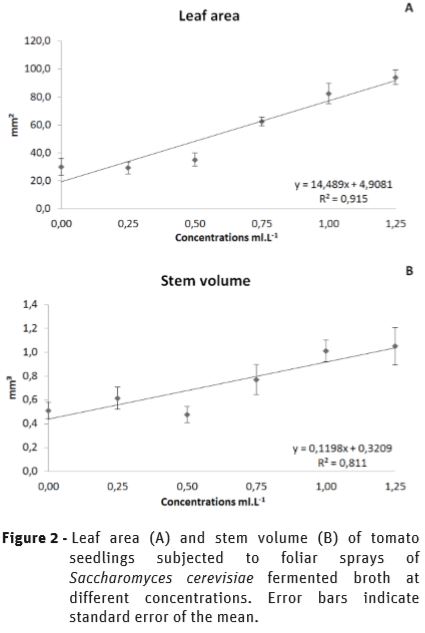
    <p><font face = "Verdana" size = "2">The
SFB treatments showed a remarkable effect on growth promotion on leaves and stems
of tomato seedlings, showing a linear response to the increases in the concentration
of the spray solution, as it was well observed as chlorophyll content was incremented
(<a href = "#f1">Figure 1</a>). The leaf area increased by 213.2% (<a href = "#f2">Figure 2A</a>), and the volume of stems
by 105.87% (<a href = "#f2">Figure 2B</a>), indicating a significant biofertilizer effect by SFB.</font></p>

    <p>&nbsp;</p>

<a name = "f2"><img src = "/img/revistas/rca/v41n2/v41n2a16f2.jpg"></a>

    
]]></body>
<body><![CDATA[<p>&nbsp;</p>

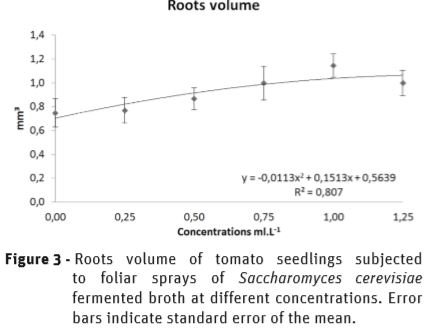
    <p><font face = "Verdana" size = "2">The volume of the roots of tomato seedlings was
also affected by SFB treatments, showing a polynomial response to the increase in
the concentration (<a href = "#f3">Figure 3</a>). At 1 mL.L<sup>-1</sup>, the volumes of the roots were
53% higher than the control, yet showing a reduction as the concentration increased.</font></p>

    <p>&nbsp;</p>

<a name = "f3"><img src = "/img/revistas/rca/v41n2/v41n2a16f3.jpg"></a>

    
<p>&nbsp;</p>

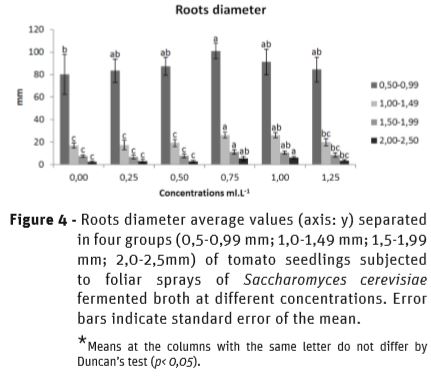
    <p><font face = "Verdana" size = "2"><a href = "#f4">Figure 4</a> shows the effect of SFB on root diameter
partitioning, in which the mean values of the diameter were separated into four
groups: 0.5-0.99 mm; 1.0-1.49 mm; 1.5-1.99 mm and 2.0-2.5mm. At 0.75 mL L<sup>-1</sup>,
all diameter groups showed the highest means in comparison to the control, as the
higher means were already compared to the lower concentrations (0.25; 0.5 mL L<sup>-1</sup>)
in the 2.0- 2.5mm group at 1 mL L<sup>-1</sup>. However, at 1.25 mL L<sup>-1</sup>,
a reduction was found in the diameter of the roots, corroborating to the data on
the volume of the roots, pointing to the change in the translocation of photoassimilates
from the leaves to the roots.</font></p>

    <p>&nbsp;</p>

<a name = "f4"><img src = "/img/revistas/rca/v41n2/v41n2a16f4.jpg"></a>

    
<p>&nbsp;</p>

    <p><font face = "Verdana" size = "3"><b>DISCUSSION</b></font></p>

    <p><font face = "Verdana" size = "2">Beale <i>et al</i>. (1975), when using a labeled carbon, showed that the AA
L-glutamic acid added to the leaves of the plants could be absorbed and metabolically
used for chlorophyll synthesis. The authors show that the sprayed solution overcomes
the wax barrier in the leaf cuticle and penetrates the apoplast and subsequently
cross the plasmalemma so that the destination reached the symplast. Therefore, it
can be inferred that the treatment with SFB and its L -AA content applied to the
leaves of tomato seedlings could be absorbed and metabolized.</font></p>

    <p><font face = "Verdana" size = "2">The growth in chlorophyll (CHL) content in the leaves of
the seedlings shows the absorption and the metabolization of SFB. Chlorophylls are
the most abundant natural pigments in plants, common to all photosynthetic cells.
Chlorophyll a, the most abundant and the most important in this family corresponds
to approximately 75% of green pigments found in plants (Taiz and Zeiger, 2009).
So, the well-known role of CHL on carbon incorporation to the biomas of the plants
could be justified by the linear effect of SFB on the the growth of leaves and stems
of tomato seedlings.</font></p>

    ]]></body>
<body><![CDATA[<p><font face = "Verdana" size = "2">By observing
the complex interactions between CHL and AA on plant growth, it could be considered
that the synthesis of many AA is completed in the chloroplast with some consequences
on transamination, the conversion of one AA to each other according the metabolic
demands (Srivastava, 2002), indicating not just the SFB effect on the enhancement
of CHL to justify the plant growth, but also their possible role on AA metabolism
and related pathways: AA is a structural unit of peptides, proteins, and also precursors
of the numerous plant regulating substances, such as hormones and polyamines.</font></p>

    <p><font face = "Verdana" size = "2">According to Kerbauy (2008), the assimilation
of AA applied to the leaves increased the enzyme activity involved in the metabolism
of nitrogen, which may cause greater growth rates, as found by Röder (2014) with
the improvement of the nitrate reductase (EC 1.7.99.4) activity on potato leaves
(Solanum tuberosum). This improvement is related to the foliar sprays of sugar cane
fermented broth containing L-glutamic acid, with consequent plant growth promotion
related to the nitrogen metabolism.</font></p>

    <p><font face = "Verdana" size = "2">Growth of the roots depends on the capacity of the leaves, as a source, to provide
photoassimilates (mainly non-reducing sugars) to the roots, as a sink. As a result,
the improvement of CHL content and the leaves expansion may justify the changes
in the volume of tomato seedlings roots found in SFB treatments.</font></p>

    <p><font face = "Verdana" size = "2">When working with Origanum vulgare seedlings treated with
L-AA based biofertilizer, Bettoni <i>et al</i>. (2014) found that the excellence
in the growth of the roots was related to the growth of leaves and stems, but the
highest rate of biofertilizer spray reduced the roots volume, corroborating to the
data obtained in this work. Similar results were also obtained by Röder <i>et al</i>.
(2015) when using foliar application of a sugar cane fermented broth containing
L-AA in cabbage seedlings, which showed significant results in the increase of the
levels of chlorophyll and in the volume of roots at intermediate concentrations.
A reduction in the growth at the highest concentrations was also observed.</font></p>

    <p><font face = "Verdana" size = "2">The source and sink relationship between leaves
and roots could explain the polynomial response of roots volume as a function of
the improvement in SFB concentration since the new leaves expansion (<a href = "#f2">Figure 2A</a>)
becomes a sink competing with the roots for non-reducing sugars (Srivastava, 2002).</font></p>

    <p><font face = "Verdana" size = "2">Lea and Forde (2007) reported that application
of small doses of L-AA, specifically L-glutamic acid, elicits a response by the
plant in producing secondary roots. The results on the roots diameter partitioning
of tomato seedlings indicate that SFB not only improved the volume of the roots
but also improved the rate of thinner roots at 0.75 mL L<sup>-1</sup> concentration
in comparison to the control. The 1.0-2.5 mm roots were improved at 0.75 and at
1 mL L<sup>-1</sup>. The reduction in the amount of roots at 1.25 mL L<sup>-1</sup>
corroborates to the volume reduction, which was previously discussed.</font></p>

    <p><font face = "Verdana" size = "2">According to Brandão (2007), the increases in
plant growth resulting from the foliar application of products containing L-AA,
when absorbed and metabolized may take part in the synthesis of several compounds,
with a direct effect on the plant growth. The use of direct fertilization in plants
with L-AA could improve the transformation of nitrate to ammonia, and so to AA with
rapid incorporation into the metabolism, contributing to the development and growth
process (Röder, 2014).</font></p>

    <p><font face = "Verdana" size = "2">Given the
above, it can be inferred that the application and metabolization of L-AA on SFB
may promote plant growth by directly influencing pathways such a CHL synthesis and
AA metabolism. However, the physiological responses of plants to the application
of L-AA are less discussed in the literature and must be better understood.</font></p>

    <p><font face = "Verdana" size = "2">According to the Brazilian regulation, biofertilizer
is defined as a a product that contains one or more active compounds able to act
directly or indirectly all over the plant or in some parts of it (Brasil, 2011).
So, according to the results previously discussed, SFB could be considered as a
biofertilizer and its L-AA content as the active ingredients. It should be considered
that the biochemical changes in plants in response to active ingredients contained
in the biofertilizers could serve as indicators of the performance of these products.
The changes in CHL content of tomato seedlings confirm the SFB bioactivity.</font></p>

    <p><font face = "Verdana" size = "3"><b>CONCLUSION</b></font></p>

    ]]></body>
<body><![CDATA[<p><font face = "Verdana" size = "2">It is concluded
that SFB is efficient in promoting the growth of tomato seedlings under the organic
system, in which synthetic nutrient sources are avoided. The SFB could be a proper
tool to improve the seedlings quality with consequent benefits in the field.</font></p>

    <p><font face = "Verdana" size = "2">However, these are only the first results, which
stimulates further investigations that may lead to a better knowledge on how SFB
acts on plant metabolism, related to L-AA or many among other possible bioactive
compounds released by Saccharomyces cerevisiae during fermentation and autolysis.</font></p>

    <p>&nbsp;</p>

    <p><font face = "Verdana" size = "3"><b>References</b></font></p>

    <!-- ref --><p><font face = "Verdana" size = "2">Alvarenga,
M.A.R. (2013) -  <i>Tomate: produção em campo, casa de vegetação e hidroponia.</i>
2<sup>a</sup> ed. Lavras, Editora Universitária Lavras. 455 p.    &nbsp;&nbsp;&nbsp;&nbsp;&nbsp;&nbsp;&nbsp;&nbsp;[&#160;<a href="javascript:void(0);" onclick="javascript: window.open('/scielo.php?script=sci_nlinks&ref=682199&pid=S0871-018X201800020001600001&lng=','','width=640,height=500,resizable=yes,scrollbars=1,menubar=yes,');">Links</a>&#160;]<!-- end-ref --></font></p>

    <!-- ref --><p><font face = "Verdana" size = "2">Beale, S.; Gough, S.P. &amp; Granick, S. (1975) - Biosynthesis
of delta-aminolevulinic acid from the intact carbon skeleton of glutamic acid in
Greening Barley. <i>Proceedings of the National Academy of Sciences of the United
States of America</i>, vol. 72, n. 7, p. 2719-272.    &nbsp;&nbsp;&nbsp;&nbsp;&nbsp;&nbsp;&nbsp;&nbsp;[&#160;<a href="javascript:void(0);" onclick="javascript: window.open('/scielo.php?script=sci_nlinks&ref=682201&pid=S0871-018X201800020001600002&lng=','','width=640,height=500,resizable=yes,scrollbars=1,menubar=yes,');">Links</a>&#160;]<!-- end-ref --></font></p>

    <!-- ref --><p><font face = "Verdana" size = "2">Bettoni, M.B.; Fabbrin, E.G. dos S.; Procopiuk, M. &amp; Mógor,
A.F. (2014) - Crescimento de mudas de orégano submetidas a doses e frequências de
aplicação de Ácido L-glutâmico em sistema orgânico. <i>Revista Brasileira de Plantas
Medicinais</i>, vol. 16, n. 1, p. 83-88. 2014. <a href = "http://dx.doi.org/10.1590/S1516-05722014000100012" target = "_blank">http://dx.doi.org/10.1590/S1516-05722014000100012</a></font>&nbsp;&nbsp;&nbsp;&nbsp;&nbsp;&nbsp;&nbsp;&nbsp;[&#160;<a href="javascript:void(0);" onclick="javascript: window.open('/scielo.php?script=sci_nlinks&ref=682203&pid=S0871-018X201800020001600003&lng=','','width=640,height=500,resizable=yes,scrollbars=1,menubar=yes,');">Links</a>&#160;]<!-- end-ref --><!-- ref --><p><font face = "Verdana" size = "2">Bezerra, P.S.G.; Grangeiro, L.G.; Negreiros, M.Z.
&amp; Medeiros, J.F. de (2007) - Utilização de bioestimulante na produção de mudas
de alface. <i>Científica</i>, vol. 35, n. 1, p. 46-50. <a href="http://dx.doi.org/10.15361/1984-5529.2007v35n1p46+-+50" target = "_blank">http://dx.doi.org/10.15361/1984-5529.2007v35n1p46+-+50</a></font>&nbsp;&nbsp;&nbsp;&nbsp;&nbsp;&nbsp;&nbsp;&nbsp;[&#160;<a href="javascript:void(0);" onclick="javascript: window.open('/scielo.php?script=sci_nlinks&ref=682204&pid=S0871-018X201800020001600004&lng=','','width=640,height=500,resizable=yes,scrollbars=1,menubar=yes,');">Links</a>&#160;]<!-- end-ref --><!-- ref --><p><font face = "Verdana" size = "2">Brandão, R. P. (2007) - Importância dos Aminoácidos
na agricultura sustentável. <i>Informativo BioSoja</i>, vol. 5, p. 6-8.    &nbsp;&nbsp;&nbsp;&nbsp;&nbsp;&nbsp;&nbsp;&nbsp;[&#160;<a href="javascript:void(0);" onclick="javascript: window.open('/scielo.php?script=sci_nlinks&ref=682205&pid=S0871-018X201800020001600005&lng=','','width=640,height=500,resizable=yes,scrollbars=1,menubar=yes,');">Links</a>&#160;]<!-- end-ref --></font></p>


    <p><font face = "Verdana" size = "2">Brasil (2003) - <i>Lei n° 10.831, de 23 de dezembro
de 2003</i>. <i>Dispõe sobre a agricultura orgânica e dá outras providências</i>.
Brasília, 23 de dezembro de 2003. [cit. 2016-02-26]. &lt;<a href = "http://www.planalto.gov.br/ccivil_03/leis/2003/L10.831.htm" target = "_blank">http://www.planalto.gov.br/ccivil_03/leis/2003/L10.831.htm</a>&gt;.</font></p>


    <p><font face = "Verdana" size = "2">Brasil (2011) - <i>Instrução normativa nº 46,
de 6 de outubro de 2011</i>. Ministério da agricultura, pecuária e abastecimento
[cit. 2016-03-15]. &lt;
<a href = "http://www.agricultura.gov.br/arq_editorfile/Desenvolvimento_Sustentavel/Organicos/Legislacao/Nacional/Instrucao_Normativa_n_0_046_de_06-102011_regulada_pela_IN_17.pdf" target = "_blank">http://www.agricultura.gov.br/arq_editorfile/Desenvolvimento_Sustentavel/Organicos/Legislacao/Nacional/Instrucao_Normativa_n_0_046_de_06-102011_regulada_pela_IN_17.pdf</a>&gt;.</font></p>

    <!-- ref --><p><font face = "Verdana" size = "2">Braus, G.H. (1991)
- Aromatic Amino Acid Biosynthesis in the Yeast Saccharomyces cerevisiae: a Model
System for the Regulation of a Eukaryotic Biosynthetic Pathway. <i>Microbiological
Reviews</i>, vol.55, n. 3, p. 349-370.    &nbsp;&nbsp;&nbsp;&nbsp;&nbsp;&nbsp;&nbsp;&nbsp;[&#160;<a href="javascript:void(0);" onclick="javascript: window.open('/scielo.php?script=sci_nlinks&ref=682209&pid=S0871-018X201800020001600006&lng=','','width=640,height=500,resizable=yes,scrollbars=1,menubar=yes,');">Links</a>&#160;]<!-- end-ref --></font></p>

    <!-- ref --><p><font face = "Verdana" size = "2">Cooper S.J.; Finney G.L.; Brown S.L.; Nelson S.K.; Hesselberth J.; MacCoss,
M.J. &amp; Fields, S. (2010) - High-throughput profiling of amino acids in strains
of the <i>Saccharomyces cerevisiae</i> deletion collection. <i>Genome Research</i>,
vol. 20, p. 1288-1296. <a href = "http://dx.doi.org/10.1101/gr.105825.110" target = "_blank">http://dx.doi.org/10.1101/gr.105825.110</a></font>&nbsp;&nbsp;&nbsp;&nbsp;&nbsp;&nbsp;&nbsp;&nbsp;[&#160;<a href="javascript:void(0);" onclick="javascript: window.open('/scielo.php?script=sci_nlinks&ref=682211&pid=S0871-018X201800020001600007&lng=','','width=640,height=500,resizable=yes,scrollbars=1,menubar=yes,');">Links</a>&#160;]<!-- end-ref --><!-- ref --><p><font face = "Verdana" size = "2">Dawson, K. (2002) - Not just bread and beer: new applications
for yeast and yeast products in human health. <i>In:</i> Lyons, T.P. &amp;
Jacques, K.A. (Eds.) - <i>Proceedings of the 18<sup>th</sup>
Annual Symposium</i>. Alltech Biotechnology: Nottingham University Press,
Nottingham, UK, p. 225-232.    &nbsp;&nbsp;&nbsp;&nbsp;&nbsp;&nbsp;&nbsp;&nbsp;[&#160;<a href="javascript:void(0);" onclick="javascript: window.open('/scielo.php?script=sci_nlinks&ref=682212&pid=S0871-018X201800020001600008&lng=','','width=640,height=500,resizable=yes,scrollbars=1,menubar=yes,');">Links</a>&#160;]<!-- end-ref --></font></p>

    <!-- ref --><p><font face = "Verdana" size = "2">de
Paiva, E.P.; Maia, S.S.S.; Cunha, C.S.M.; Coelho, M.F.B. &amp; Silva, F.N. (2011)
- Composição do substrato para o desenvolvimento de mudas de manjericão (<i>Ocimum
basilicum</i> L.). <i>Revista Caatinga</i>, vol. 24, n. 4, p. 62-67.    &nbsp;&nbsp;&nbsp;&nbsp;&nbsp;&nbsp;&nbsp;&nbsp;[&#160;<a href="javascript:void(0);" onclick="javascript: window.open('/scielo.php?script=sci_nlinks&ref=682214&pid=S0871-018X201800020001600009&lng=','','width=640,height=500,resizable=yes,scrollbars=1,menubar=yes,');">Links</a>&#160;]<!-- end-ref --></font></p>


    <!-- ref --><p><font face = "Verdana" size = "2">Kaseker, J.F.; Bastos, M.C.; Consalter, R. &amp;
Mógor, Á.F. (2014) - Alteração do crescimento e dos teores de nutrientes com utilização
de fertilizante organomineral em cenoura. <i>Revista Ceres</i>, vol. 61, n. 6, p.
964-969. <a href = "http://dx.doi.org/10.1590/0034-737X201461060011" target = "_blank">http://dx.doi.org/10.1590/0034-737X201461060011</a></font>&nbsp;&nbsp;&nbsp;&nbsp;&nbsp;&nbsp;&nbsp;&nbsp;[&#160;<a href="javascript:void(0);" onclick="javascript: window.open('/scielo.php?script=sci_nlinks&ref=682216&pid=S0871-018X201800020001600010&lng=','','width=640,height=500,resizable=yes,scrollbars=1,menubar=yes,');">Links</a>&#160;]<!-- end-ref --><!-- ref --><p><font face = "Verdana" size = "2">Kerbauy, G. (2008) - <i>Fisiologia vegetal</i>.
2ª ed. Rio de Janeiro, Guanabara Koogan, 452 p.    &nbsp;&nbsp;&nbsp;&nbsp;&nbsp;&nbsp;&nbsp;&nbsp;[&#160;<a href="javascript:void(0);" onclick="javascript: window.open('/scielo.php?script=sci_nlinks&ref=682217&pid=S0871-018X201800020001600011&lng=','','width=640,height=500,resizable=yes,scrollbars=1,menubar=yes,');">Links</a>&#160;]<!-- end-ref --></font></p>

    <!-- ref --><p><font face = "Verdana" size = "2">Khatounian, C.A. (2001) - <i>A reconstrução ecológica da
agricultura</i>. Botucatu, Agroecologia. 345 p.    &nbsp;&nbsp;&nbsp;&nbsp;&nbsp;&nbsp;&nbsp;&nbsp;[&#160;<a href="javascript:void(0);" onclick="javascript: window.open('/scielo.php?script=sci_nlinks&ref=682219&pid=S0871-018X201800020001600012&lng=','','width=640,height=500,resizable=yes,scrollbars=1,menubar=yes,');">Links</a>&#160;]<!-- end-ref --></font></p>

    <!-- ref --><p><font face = "Verdana" size = "2">Kiss, J. (2004) - Terra em transe. <i>Globo Rural</i>, n. 223, p. 34-42.    &nbsp;&nbsp;&nbsp;&nbsp;&nbsp;&nbsp;&nbsp;&nbsp;[&#160;<a href="javascript:void(0);" onclick="javascript: window.open('/scielo.php?script=sci_nlinks&ref=682221&pid=S0871-018X201800020001600013&lng=','','width=640,height=500,resizable=yes,scrollbars=1,menubar=yes,');">Links</a>&#160;]<!-- end-ref --></font></p>


    <!-- ref --><p><font face = "Verdana" size = "2">Lea, P.J. &amp; Forde, B.G. (2007) - Glutamate
in plants: metabolism, regulation, and signaling. <i>Journal of Experimental Botany</i>,
vol. 58, n. 9, p. 2339-2358. <a href = "http://dx.doi.org/10.1093/jxb/erm121" target = "_blank">http://dx.doi.org/10.1093/jxb/erm121</a></font>&nbsp;&nbsp;&nbsp;&nbsp;&nbsp;&nbsp;&nbsp;&nbsp;[&#160;<a href="javascript:void(0);" onclick="javascript: window.open('/scielo.php?script=sci_nlinks&ref=682223&pid=S0871-018X201800020001600014&lng=','','width=640,height=500,resizable=yes,scrollbars=1,menubar=yes,');">Links</a>&#160;]<!-- end-ref --><!-- ref --><p><font face = "Verdana" size = "2">Lichtenthaler, H.K. (1987) - Chlorophylls and carotenoids:
pigments of photosynthetic biomembranes. <i>Methods in Enzymology</i>, vol. 148,
p. 350-382. <a href = "http://dx.doi.org/10.1016/0076-6879(87)48036-1" target = "_blank">http://dx.doi.org/10.1016/0076-6879(87)48036-1</a></font>&nbsp;&nbsp;&nbsp;&nbsp;&nbsp;&nbsp;&nbsp;&nbsp;[&#160;<a href="javascript:void(0);" onclick="javascript: window.open('/scielo.php?script=sci_nlinks&ref=682224&pid=S0871-018X201800020001600015&lng=','','width=640,height=500,resizable=yes,scrollbars=1,menubar=yes,');">Links</a>&#160;]<!-- end-ref --><!-- ref --><p><font face = "Verdana" size = "2">Lichtenthaler, H. &amp; Buschmann, C. (2001) - Chlorophylls
and carotenoids: Measurement and characterization by UV–VIS spectroscopy. <i>Current
Protocols in Food Analytical Chemistry,</i> p. F4.3.1-F4.3.8. <a href = "http://dx.doi.org/10.1002/0471142913.faf0403s01" target = "_blank">http://dx.doi.org/10.1002/0471142913.faf0403s01</a></font>&nbsp;&nbsp;&nbsp;&nbsp;&nbsp;&nbsp;&nbsp;&nbsp;[&#160;<a href="javascript:void(0);" onclick="javascript: window.open('/scielo.php?script=sci_nlinks&ref=682225&pid=S0871-018X201800020001600016&lng=','','width=640,height=500,resizable=yes,scrollbars=1,menubar=yes,');">Links</a>&#160;]<!-- end-ref --><!-- ref --><p><font face = "Verdana" size = "2">Maggioni, M.S.; Rosa, C.B.C.J.; Rosa, J.E.J.;
Silva, E.F.; Rosa, Y.B.C.J.; Scalon, S.P.Q. &amp; Vasconcelos, A.A. (2014) - Desenvolvimento
de mudas de manjericão (<i>Ocimum basilicum</i> L.) em função do recipiente e do
tipo e densidade de substratos. <i>Revista Brasileira de Plantas Medicinais</i>,
vol. 16, n. 1, p. 10-17. <a href = "http://dx.doi.org/10.1590/S1516-05722014000100002" target = "_blank">http://dx.doi.org/10.1590/S1516-05722014000100002</a></font>&nbsp;&nbsp;&nbsp;&nbsp;&nbsp;&nbsp;&nbsp;&nbsp;[&#160;<a href="javascript:void(0);" onclick="javascript: window.open('/scielo.php?script=sci_nlinks&ref=682226&pid=S0871-018X201800020001600017&lng=','','width=640,height=500,resizable=yes,scrollbars=1,menubar=yes,');">Links</a>&#160;]<!-- end-ref --><!-- ref --><p><font face = "Verdana" size = "2">Mógor, A.F.; Ono, E.O.; Rodrigues, J.D. &amp;
Mógor, G. (2008) - Aplicação foliar de extrato de alga, ácido L-glutâmico e cálcio
em feijoeiro. <i>Scientia Agraria</i>, vol. 9, n. 4, p. 431-437. <a href = "http://dx.doi.org/10.5380/rsa.v9i4.11710" target = "_blank">http://dx.doi.org/10.5380/rsa.v9i4.11710</a></font>&nbsp;&nbsp;&nbsp;&nbsp;&nbsp;&nbsp;&nbsp;&nbsp;[&#160;<a href="javascript:void(0);" onclick="javascript: window.open('/scielo.php?script=sci_nlinks&ref=682227&pid=S0871-018X201800020001600018&lng=','','width=640,height=500,resizable=yes,scrollbars=1,menubar=yes,');">Links</a>&#160;]<!-- end-ref --><!-- ref --><p><font face = "Verdana" size = "2">Röder, C. (2014) - <i>Efeito da aplicação de um
fermentado bacteriano contendo ácido L- glutâmico no crescimento, produtividade
e alterações bioquímicas em batata cultivada no sistema orgânico</i>. Tese de Doutorado.
Curitiba. Universidade Federal do Paraná. 109 p.    &nbsp;&nbsp;&nbsp;&nbsp;&nbsp;&nbsp;&nbsp;&nbsp;[&#160;<a href="javascript:void(0);" onclick="javascript: window.open('/scielo.php?script=sci_nlinks&ref=682228&pid=S0871-018X201800020001600019&lng=','','width=640,height=500,resizable=yes,scrollbars=1,menubar=yes,');">Links</a>&#160;]<!-- end-ref --></font></p>

    <!-- ref --><p><font face = "Verdana" size = "2">Röder, C.; Mógor, A.F.; Szilagyi-Zecchin, V.J.; Fabbrin, E.G.S. &amp; Gemin,
L.G. (2015) - Uso de biofertilizante na produção de mudas de repolho. <i>Revista
Ceres</i>, vol. 62, n. 5, p. 421-422. <a href = "http://dx.doi.org/10.1590/0034-737X201562050012" target = "_blank">http://dx.doi.org/10.1590/0034-737X201562050012</a></font>&nbsp;&nbsp;&nbsp;&nbsp;&nbsp;&nbsp;&nbsp;&nbsp;[&#160;<a href="javascript:void(0);" onclick="javascript: window.open('/scielo.php?script=sci_nlinks&ref=682230&pid=S0871-018X201800020001600020&lng=','','width=640,height=500,resizable=yes,scrollbars=1,menubar=yes,');">Links</a>&#160;]<!-- end-ref --><!-- ref --><p><font face = "Verdana" size = "2">Santos, A.C. &amp; Akiba, F. (1996) - <i>Biofertilizantes
líquidos: uso correto na agricultura alternativa</i>. Rio de Janeiro, Seropédica:
Imprensa Universitária/UFRJ. 35 p.    &nbsp;&nbsp;&nbsp;&nbsp;&nbsp;&nbsp;&nbsp;&nbsp;[&#160;<a href="javascript:void(0);" onclick="javascript: window.open('/scielo.php?script=sci_nlinks&ref=682231&pid=S0871-018X201800020001600021&lng=','','width=640,height=500,resizable=yes,scrollbars=1,menubar=yes,');">Links</a>&#160;]<!-- end-ref --></font></p>

    <!-- ref --><p><font face = "Verdana" size = "2">Sediyama, M.A.N.; Santos, I.C. &amp; Lima, P.C. (2014) - Cultivo de hortaliças
no sistema orgânico. <i>Revista Ceres</i>, vol. 61, n. sup., p. 829 -837. <a href = "http://dx.doi.org/10.1590/0034-737x201461000008" target = "_blank">http://dx.doi.org/10.1590/0034-737x201461000008</a></font>&nbsp;&nbsp;&nbsp;&nbsp;&nbsp;&nbsp;&nbsp;&nbsp;[&#160;<a href="javascript:void(0);" onclick="javascript: window.open('/scielo.php?script=sci_nlinks&ref=682233&pid=S0871-018X201800020001600022&lng=','','width=640,height=500,resizable=yes,scrollbars=1,menubar=yes,');">Links</a>&#160;]<!-- end-ref --><!-- ref --><p><font face = "Verdana" size = "2">Silva, F. de A.S. &amp; Azevedo, C.A.V. (2009)
- Principal Components Analysis in the Software Assistat-Statistical Attendance.
<i>In</i>: <i>World congress on computers in agriculture</i>, 7, Reno-NV-USA: American
Society of Agricultural and Biological Engineers. [cit. 2016-09-03]. &lt; <a href = "http://www.assistat.com" target = "_blank">http://www.assistat.com</a>&gt;    &nbsp;&nbsp;&nbsp;&nbsp;&nbsp;&nbsp;&nbsp;&nbsp;[&#160;<a href="javascript:void(0);" onclick="javascript: window.open('/scielo.php?script=sci_nlinks&ref=682234&pid=S0871-018X201800020001600023&lng=','','width=640,height=500,resizable=yes,scrollbars=1,menubar=yes,');">Links</a>&#160;]<!-- end-ref -->.</font></p>

    <!-- ref --><p><font face = "Verdana" size = "2">Silva, A.F.; Pinto, J.M.; França, C.R.R.S.; Fernandes,
S.C.; Gomes, T.C. de A.; Silva, M.S.L. da &amp; Matos, A.N.B. (2007) - <i>Preparo
e Uso de Biofertilizantes Líquidos</i>. Comunicado Técnico da Embrapa Semi-Árido.
[cit. 2016-08-21]. &lt;<a href = "http://www.infoteca.cnptia.embrapa.br/bitstream/doc/339493/1/COT130.pdf" target = "_blank">http://www.infoteca.cnptia.embrapa.br/bitstream/doc/339493/1/COT130.pdf</a>&gt;    &nbsp;&nbsp;&nbsp;&nbsp;&nbsp;&nbsp;&nbsp;&nbsp;[&#160;<a href="javascript:void(0);" onclick="javascript: window.open('/scielo.php?script=sci_nlinks&ref=682236&pid=S0871-018X201800020001600024&lng=','','width=640,height=500,resizable=yes,scrollbars=1,menubar=yes,');">Links</a>&#160;]<!-- end-ref --></font></p>

    <!-- ref --><p><font face = "Verdana" size = "2">Srivastava, L.M. (2002) - <i>Plant growth and
development: hormones and environment</i>. San Diego, Academic Press. p. 722.    &nbsp;&nbsp;&nbsp;&nbsp;&nbsp;&nbsp;&nbsp;&nbsp;[&#160;<a href="javascript:void(0);" onclick="javascript: window.open('/scielo.php?script=sci_nlinks&ref=682238&pid=S0871-018X201800020001600025&lng=','','width=640,height=500,resizable=yes,scrollbars=1,menubar=yes,');">Links</a>&#160;]<!-- end-ref --></font></p>

    <!-- ref --><p><font face = "Verdana" size = "2">Taiz, L. &amp; Zeiger, E. (2009) - <i>Fisiologia
vegetal</i>. 4ª ed. São Paulo, Artmed, 820 p.    &nbsp;&nbsp;&nbsp;&nbsp;&nbsp;&nbsp;&nbsp;&nbsp;[&#160;<a href="javascript:void(0);" onclick="javascript: window.open('/scielo.php?script=sci_nlinks&ref=682240&pid=S0871-018X201800020001600026&lng=','','width=640,height=500,resizable=yes,scrollbars=1,menubar=yes,');">Links</a>&#160;]<!-- end-ref --></font></p>

    <!-- ref --><p><font face = "Verdana" size = "2">Yamada, E.A., Alvim, I.D., Santucci, M.C.C. &amp; Sgarbieri, V.C. (2003)
- Composição centesimal e valor protéico de levedura residual da fermentação etanólica
e de seus derivados. <i>Revista de Nutrição</i>, vol. 16, n. 4, p. 423-432. <a href = "http://dx.doi.org/10.1590/S1415-52732003000400006" target = "_blank">http://dx.doi.org/10.1590/S1415-52732003000400006</a></font>&nbsp;&nbsp;&nbsp;&nbsp;&nbsp;&nbsp;&nbsp;&nbsp;[&#160;<a href="javascript:void(0);" onclick="javascript: window.open('/scielo.php?script=sci_nlinks&ref=682242&pid=S0871-018X201800020001600027&lng=','','width=640,height=500,resizable=yes,scrollbars=1,menubar=yes,');">Links</a>&#160;]<!-- end-ref --><!-- ref --><p><font face = "Verdana" size = "2">Watson, T.G. (1976) - Amino-acid Pool Composition
of <i>Saccharomyces cerevisiae </i>as a Function of Growth Rate and Amino-acid Nitrogen
Source. <i>Journal of General Microbiology</i>, vol. 96, p. 263-268. <a href = "http://dx.doi.org/10.1099/00221287-96-2-263" target = "_blank">http://dx.doi.org/10.1099/00221287-96-2-263</a></font>&nbsp;&nbsp;&nbsp;&nbsp;&nbsp;&nbsp;&nbsp;&nbsp;[&#160;<a href="javascript:void(0);" onclick="javascript: window.open('/scielo.php?script=sci_nlinks&ref=682243&pid=S0871-018X201800020001600028&lng=','','width=640,height=500,resizable=yes,scrollbars=1,menubar=yes,');">Links</a>&#160;]<!-- end-ref --><p>&nbsp;</p>

    ]]></body>
<body><![CDATA[<p><font face = "Verdana" size = "2">Received/recebido: 2016.11.01</font></p>

    <p><font face = "Verdana" size = "2">Accepted/aceite: 2018.02.19</font></p>

     ]]></body><back>
<ref-list>
<ref id="B1">
<nlm-citation citation-type="book">
<person-group person-group-type="author">
<name>
<surname><![CDATA[Alvarenga]]></surname>
<given-names><![CDATA[M.A.R.]]></given-names>
</name>
</person-group>
<source><![CDATA[Tomate: produção em campo, casa de vegetação e hidroponia]]></source>
<year>2013</year>
<edition>2ª</edition>
<publisher-loc><![CDATA[Lavras ]]></publisher-loc>
<publisher-name><![CDATA[Editora Universitária Lavras]]></publisher-name>
</nlm-citation>
</ref>
<ref id="B2">
<nlm-citation citation-type="journal">
<person-group person-group-type="author">
<name>
<surname><![CDATA[Beale]]></surname>
<given-names><![CDATA[S.]]></given-names>
</name>
<name>
<surname><![CDATA[Gough]]></surname>
<given-names><![CDATA[S.P.]]></given-names>
</name>
<name>
<surname><![CDATA[Granick]]></surname>
<given-names><![CDATA[S.]]></given-names>
</name>
</person-group>
<article-title xml:lang="en"><![CDATA[Biosynthesis of delta-aminolevulinic acid from the intact carbon skeleton of glutamic acid in Greening Barley]]></article-title>
<source><![CDATA[Proceedings of the National Academy of Sciences of the United States of America]]></source>
<year>1975</year>
<volume>72</volume>
<numero>7</numero>
<issue>7</issue>
<page-range>2719-272</page-range></nlm-citation>
</ref>
<ref id="B3">
<nlm-citation citation-type="journal">
<person-group person-group-type="author">
<name>
<surname><![CDATA[Bettoni]]></surname>
<given-names><![CDATA[M.B.]]></given-names>
</name>
<name>
<surname><![CDATA[Fabbrin]]></surname>
<given-names><![CDATA[E.G. dos S.]]></given-names>
</name>
<name>
<surname><![CDATA[Procopiuk]]></surname>
<given-names><![CDATA[M.]]></given-names>
</name>
<name>
<surname><![CDATA[Mógor]]></surname>
<given-names><![CDATA[A.F.]]></given-names>
</name>
</person-group>
<article-title xml:lang="pt"><![CDATA[Crescimento de mudas de orégano submetidas a doses e frequências de aplicação de Ácido L-glutâmico em sistema orgânico]]></article-title>
<source><![CDATA[Revista Brasileira de Plantas Medicinais]]></source>
<year>2014</year>
<month>20</month>
<day>14</day>
<volume>16</volume>
<numero>1</numero>
<issue>1</issue>
<page-range>83-88</page-range></nlm-citation>
</ref>
<ref id="B4">
<nlm-citation citation-type="journal">
<person-group person-group-type="author">
<name>
<surname><![CDATA[Bezerra]]></surname>
<given-names><![CDATA[P.S.G.]]></given-names>
</name>
<name>
<surname><![CDATA[Grangeiro]]></surname>
<given-names><![CDATA[L.G.]]></given-names>
</name>
<name>
<surname><![CDATA[Negreiros]]></surname>
<given-names><![CDATA[M.Z.]]></given-names>
</name>
<name>
<surname><![CDATA[Medeiros]]></surname>
<given-names><![CDATA[J.F. de]]></given-names>
</name>
</person-group>
<article-title xml:lang="pt"><![CDATA[Utilização de bioestimulante na produção de mudas de alface]]></article-title>
<source><![CDATA[Científica]]></source>
<year>2007</year>
<volume>35</volume>
<numero>1</numero>
<issue>1</issue>
<page-range>46-50</page-range></nlm-citation>
</ref>
<ref id="B5">
<nlm-citation citation-type="journal">
<person-group person-group-type="author">
<name>
<surname><![CDATA[Brandão]]></surname>
<given-names><![CDATA[R. P.]]></given-names>
</name>
</person-group>
<article-title xml:lang="pt"><![CDATA[Importância dos Aminoácidos na agricultura sustentável]]></article-title>
<source><![CDATA[Informativo BioSoja]]></source>
<year>2007</year>
<volume>5</volume>
<page-range>6-8</page-range></nlm-citation>
</ref>
<ref id="B6">
<nlm-citation citation-type="journal">
<person-group person-group-type="author">
<name>
<surname><![CDATA[Braus]]></surname>
<given-names><![CDATA[G.H.]]></given-names>
</name>
</person-group>
<article-title xml:lang="en"><![CDATA[Aromatic Amino Acid Biosynthesis in the Yeast Saccharomyces cerevisiae: a Model System for the Regulation of a Eukaryotic Biosynthetic Pathway]]></article-title>
<source><![CDATA[Microbiological Reviews]]></source>
<year>1991</year>
<volume>55</volume>
<numero>3</numero>
<issue>3</issue>
<page-range>349-370</page-range></nlm-citation>
</ref>
<ref id="B7">
<nlm-citation citation-type="journal">
<person-group person-group-type="author">
<name>
<surname><![CDATA[Cooper]]></surname>
<given-names><![CDATA[S.J.]]></given-names>
</name>
<name>
<surname><![CDATA[Finney]]></surname>
<given-names><![CDATA[G.L.]]></given-names>
</name>
<name>
<surname><![CDATA[Brown]]></surname>
<given-names><![CDATA[S.L.]]></given-names>
</name>
<name>
<surname><![CDATA[Nelson]]></surname>
<given-names><![CDATA[S.K.]]></given-names>
</name>
<name>
<surname><![CDATA[Hesselberth]]></surname>
<given-names><![CDATA[J.]]></given-names>
</name>
<name>
<surname><![CDATA[MacCoss]]></surname>
<given-names><![CDATA[M.J.]]></given-names>
</name>
<name>
<surname><![CDATA[Fields]]></surname>
<given-names><![CDATA[S.]]></given-names>
</name>
</person-group>
<article-title xml:lang="en"><![CDATA[High-throughput profiling of amino acids in strains of the Saccharomyces cerevisiae deletion collection]]></article-title>
<source><![CDATA[Genome Research]]></source>
<year>2010</year>
<volume>20</volume>
<page-range>1288-1296</page-range></nlm-citation>
</ref>
<ref id="B8">
<nlm-citation citation-type="book">
<person-group person-group-type="author">
<name>
<surname><![CDATA[Dawson]]></surname>
<given-names><![CDATA[K.]]></given-names>
</name>
</person-group>
<article-title xml:lang="en"><![CDATA[Not just bread and beer: new applications for yeast and yeast products in human health]]></article-title>
<person-group person-group-type="editor">
<name>
<surname><![CDATA[Lyons]]></surname>
<given-names><![CDATA[T.P.]]></given-names>
</name>
<name>
<surname><![CDATA[Jacques]]></surname>
<given-names><![CDATA[K.A.]]></given-names>
</name>
</person-group>
<source><![CDATA[Proceedings of the 18th Annual Symposium]]></source>
<year>2002</year>
<page-range>225-232</page-range><publisher-loc><![CDATA[Nottingham ]]></publisher-loc>
<publisher-name><![CDATA[Alltech Biotechnology: Nottingham University Press]]></publisher-name>
</nlm-citation>
</ref>
<ref id="B9">
<nlm-citation citation-type="journal">
<person-group person-group-type="author">
<name>
<surname><![CDATA[de Paiva]]></surname>
<given-names><![CDATA[E.P.]]></given-names>
</name>
<name>
<surname><![CDATA[Maia]]></surname>
<given-names><![CDATA[S.S.S.]]></given-names>
</name>
<name>
<surname><![CDATA[Cunha]]></surname>
<given-names><![CDATA[C.S.M.]]></given-names>
</name>
<name>
<surname><![CDATA[Coelho]]></surname>
<given-names><![CDATA[M.F.B.]]></given-names>
</name>
<name>
<surname><![CDATA[Silva]]></surname>
<given-names><![CDATA[F.N.]]></given-names>
</name>
</person-group>
<article-title xml:lang="pt"><![CDATA[Composição do substrato para o desenvolvimento de mudas de manjericão (Ocimum basilicum L.)]]></article-title>
<source><![CDATA[Revista Caatinga]]></source>
<year>2011</year>
<volume>24</volume>
<numero>4</numero>
<issue>4</issue>
<page-range>62-67</page-range></nlm-citation>
</ref>
<ref id="B10">
<nlm-citation citation-type="journal">
<person-group person-group-type="author">
<name>
<surname><![CDATA[Kaseker]]></surname>
<given-names><![CDATA[J.F.]]></given-names>
</name>
<name>
<surname><![CDATA[Bastos]]></surname>
<given-names><![CDATA[M.C.]]></given-names>
</name>
<name>
<surname><![CDATA[Consalter]]></surname>
<given-names><![CDATA[R.]]></given-names>
</name>
<name>
<surname><![CDATA[Mógor]]></surname>
<given-names><![CDATA[Á.F.]]></given-names>
</name>
</person-group>
<article-title xml:lang="pt"><![CDATA[Alteração do crescimento e dos teores de nutrientes com utilização de fertilizante organomineral em cenoura]]></article-title>
<source><![CDATA[Revista Ceres]]></source>
<year>2014</year>
<volume>61</volume>
<numero>6</numero>
<issue>6</issue>
<page-range>964-969</page-range></nlm-citation>
</ref>
<ref id="B11">
<nlm-citation citation-type="book">
<person-group person-group-type="author">
<name>
<surname><![CDATA[Kerbauy]]></surname>
<given-names><![CDATA[G.]]></given-names>
</name>
</person-group>
<source><![CDATA[Fisiologia vegetal]]></source>
<year>2008</year>
<edition>2ª</edition>
<publisher-loc><![CDATA[Rio de Janeiro ]]></publisher-loc>
<publisher-name><![CDATA[Guanabara Koogan]]></publisher-name>
</nlm-citation>
</ref>
<ref id="B12">
<nlm-citation citation-type="book">
<person-group person-group-type="author">
<name>
<surname><![CDATA[Khatounian]]></surname>
<given-names><![CDATA[C.A.]]></given-names>
</name>
</person-group>
<source><![CDATA[A reconstrução ecológica da agricultura]]></source>
<year>2001</year>
<publisher-loc><![CDATA[Botucatu ]]></publisher-loc>
<publisher-name><![CDATA[Agroecologia]]></publisher-name>
</nlm-citation>
</ref>
<ref id="B13">
<nlm-citation citation-type="journal">
<person-group person-group-type="author">
<name>
<surname><![CDATA[Kiss]]></surname>
<given-names><![CDATA[J.]]></given-names>
</name>
</person-group>
<article-title xml:lang="pt"><![CDATA[Terra em transe]]></article-title>
<source><![CDATA[Globo Rural]]></source>
<year>2004</year>
<numero>223</numero>
<issue>223</issue>
<page-range>34-42</page-range></nlm-citation>
</ref>
<ref id="B14">
<nlm-citation citation-type="journal">
<person-group person-group-type="author">
<name>
<surname><![CDATA[Lea]]></surname>
<given-names><![CDATA[P.J.]]></given-names>
</name>
<name>
<surname><![CDATA[Forde]]></surname>
<given-names><![CDATA[B.G.]]></given-names>
</name>
</person-group>
<article-title xml:lang="en"><![CDATA[Glutamate in plants: metabolism, regulation, and signaling]]></article-title>
<source><![CDATA[Journal of Experimental Botany]]></source>
<year>2007</year>
<volume>58</volume>
<numero>9</numero>
<issue>9</issue>
<page-range>2339-2358</page-range></nlm-citation>
</ref>
<ref id="B15">
<nlm-citation citation-type="journal">
<person-group person-group-type="author">
<name>
<surname><![CDATA[Lichtenthaler]]></surname>
<given-names><![CDATA[H.K.]]></given-names>
</name>
</person-group>
<article-title xml:lang="en"><![CDATA[Chlorophylls and carotenoids: pigments of photosynthetic biomembranes]]></article-title>
<source><![CDATA[Methods in Enzymology]]></source>
<year>1987</year>
<volume>148</volume>
<page-range>350-382</page-range></nlm-citation>
</ref>
<ref id="B16">
<nlm-citation citation-type="journal">
<person-group person-group-type="author">
<name>
<surname><![CDATA[Lichtenthaler]]></surname>
<given-names><![CDATA[H.]]></given-names>
</name>
<name>
<surname><![CDATA[Buschmann]]></surname>
<given-names><![CDATA[C.]]></given-names>
</name>
</person-group>
<article-title xml:lang="en"><![CDATA[Chlorophylls and carotenoids: Measurement and characterization by UV-VIS spectroscopy]]></article-title>
<source><![CDATA[Current Protocols in Food Analytical Chemistry]]></source>
<year>2001</year>
<page-range>F4.3.1-F4.3.8.</page-range></nlm-citation>
</ref>
<ref id="B17">
<nlm-citation citation-type="journal">
<person-group person-group-type="author">
<name>
<surname><![CDATA[Maggioni]]></surname>
<given-names><![CDATA[M.S.]]></given-names>
</name>
<name>
<surname><![CDATA[Rosa]]></surname>
<given-names><![CDATA[C.B.C.J.]]></given-names>
</name>
<name>
<surname><![CDATA[Rosa]]></surname>
<given-names><![CDATA[J.E.J.]]></given-names>
</name>
<name>
<surname><![CDATA[Silva]]></surname>
<given-names><![CDATA[E.F.]]></given-names>
</name>
<name>
<surname><![CDATA[Rosa]]></surname>
<given-names><![CDATA[Y.B.C.J.]]></given-names>
</name>
<name>
<surname><![CDATA[Scalon]]></surname>
<given-names><![CDATA[S.P.Q.]]></given-names>
</name>
<name>
<surname><![CDATA[Vasconcelos]]></surname>
<given-names><![CDATA[A.A.]]></given-names>
</name>
</person-group>
<article-title xml:lang="pt"><![CDATA[Desenvolvimento de mudas de manjericão (Ocimum basilicum L.) em função do recipiente e do tipo e densidade de substratos]]></article-title>
<source><![CDATA[Revista Brasileira de Plantas Medicinais]]></source>
<year>2014</year>
<volume>16</volume>
<numero>1</numero>
<issue>1</issue>
<page-range>10-17</page-range></nlm-citation>
</ref>
<ref id="B18">
<nlm-citation citation-type="journal">
<person-group person-group-type="author">
<name>
<surname><![CDATA[Mógor]]></surname>
<given-names><![CDATA[A.F.]]></given-names>
</name>
<name>
<surname><![CDATA[Ono]]></surname>
<given-names><![CDATA[E.O.]]></given-names>
</name>
<name>
<surname><![CDATA[Rodrigues]]></surname>
<given-names><![CDATA[J.D.]]></given-names>
</name>
<name>
<surname><![CDATA[Mógor]]></surname>
<given-names><![CDATA[G.]]></given-names>
</name>
</person-group>
<article-title xml:lang="pt"><![CDATA[Aplicação foliar de extrato de alga, ácido L-glutâmico e cálcio em feijoeiro]]></article-title>
<source><![CDATA[Scientia Agraria]]></source>
<year>2008</year>
<volume>9</volume>
<numero>4</numero>
<issue>4</issue>
<page-range>431-437</page-range></nlm-citation>
</ref>
<ref id="B19">
<nlm-citation citation-type="">
<person-group person-group-type="author">
<name>
<surname><![CDATA[Röder]]></surname>
<given-names><![CDATA[C.]]></given-names>
</name>
</person-group>
<source><![CDATA[Efeito da aplicação de um fermentado bacteriano contendo ácido L- glutâmico no crescimento, produtividade e alterações bioquímicas em batata cultivada no sistema orgânico]]></source>
<year>2014</year>
</nlm-citation>
</ref>
<ref id="B20">
<nlm-citation citation-type="journal">
<person-group person-group-type="author">
<name>
<surname><![CDATA[Röder]]></surname>
<given-names><![CDATA[C.]]></given-names>
</name>
<name>
<surname><![CDATA[Mógor]]></surname>
<given-names><![CDATA[A.F.]]></given-names>
</name>
<name>
<surname><![CDATA[Szilagyi-Zecchin]]></surname>
<given-names><![CDATA[V.J.]]></given-names>
</name>
<name>
<surname><![CDATA[Fabbrin]]></surname>
<given-names><![CDATA[E.G.S.]]></given-names>
</name>
<name>
<surname><![CDATA[Gemin]]></surname>
<given-names><![CDATA[L.G.]]></given-names>
</name>
</person-group>
<article-title xml:lang="pt"><![CDATA[Uso de biofertilizante na produção de mudas de repolho]]></article-title>
<source><![CDATA[Revista Ceres]]></source>
<year>2015</year>
<volume>62</volume>
<numero>5</numero>
<issue>5</issue>
<page-range>421-422</page-range></nlm-citation>
</ref>
<ref id="B21">
<nlm-citation citation-type="book">
<person-group person-group-type="author">
<name>
<surname><![CDATA[Santos]]></surname>
<given-names><![CDATA[A.C.]]></given-names>
</name>
<name>
<surname><![CDATA[Akiba]]></surname>
<given-names><![CDATA[F.]]></given-names>
</name>
</person-group>
<source><![CDATA[Biofertilizantes líquidos: uso correto na agricultura alternativa]]></source>
<year>1996</year>
<publisher-loc><![CDATA[Rio de Janeiro ]]></publisher-loc>
<publisher-name><![CDATA[Seropédica: Imprensa Universitária/UFRJ]]></publisher-name>
</nlm-citation>
</ref>
<ref id="B22">
<nlm-citation citation-type="journal">
<person-group person-group-type="author">
<name>
<surname><![CDATA[Sediyama]]></surname>
<given-names><![CDATA[M.A.N.]]></given-names>
</name>
<name>
<surname><![CDATA[Santos]]></surname>
<given-names><![CDATA[I.C.]]></given-names>
</name>
<name>
<surname><![CDATA[Lima]]></surname>
<given-names><![CDATA[P.C.]]></given-names>
</name>
</person-group>
<article-title xml:lang="pt"><![CDATA[Cultivo de hortaliças no sistema orgânico]]></article-title>
<source><![CDATA[Revista Ceres]]></source>
<year>2014</year>
<volume>61</volume>
<numero>sup</numero>
<issue>sup</issue>
<page-range>829 -837</page-range></nlm-citation>
</ref>
<ref id="B23">
<nlm-citation citation-type="confpro">
<person-group person-group-type="author">
<name>
<surname><![CDATA[Silva]]></surname>
<given-names><![CDATA[F. de A.S.]]></given-names>
</name>
<name>
<surname><![CDATA[Azevedo]]></surname>
<given-names><![CDATA[C.A.V.]]></given-names>
</name>
</person-group>
<article-title xml:lang="en"><![CDATA[Principal Components Analysis in the Software Assistat-Statistical Attendance]]></article-title>
<source><![CDATA[]]></source>
<year>2009</year>
<conf-name><![CDATA[7 World congress on computers in agriculture]]></conf-name>
<conf-loc>Reno NV</conf-loc>
</nlm-citation>
</ref>
<ref id="B24">
<nlm-citation citation-type="book">
<person-group person-group-type="author">
<name>
<surname><![CDATA[Silva]]></surname>
<given-names><![CDATA[A.F.]]></given-names>
</name>
<name>
<surname><![CDATA[Pinto]]></surname>
<given-names><![CDATA[J.M.]]></given-names>
</name>
<name>
<surname><![CDATA[França]]></surname>
<given-names><![CDATA[C.R.R.S.]]></given-names>
</name>
<name>
<surname><![CDATA[Fernandes]]></surname>
<given-names><![CDATA[S.C.]]></given-names>
</name>
<name>
<surname><![CDATA[Gomes]]></surname>
<given-names><![CDATA[T.C. de A.]]></given-names>
</name>
<name>
<surname><![CDATA[Silva]]></surname>
<given-names><![CDATA[M.S.L. da]]></given-names>
</name>
<name>
<surname><![CDATA[Matos]]></surname>
<given-names><![CDATA[A.N.B.]]></given-names>
</name>
</person-group>
<source><![CDATA[Preparo e Uso de Biofertilizantes Líquidos]]></source>
<year>2007</year>
<publisher-name><![CDATA[Embrapa Semi-Árido]]></publisher-name>
</nlm-citation>
</ref>
<ref id="B25">
<nlm-citation citation-type="book">
<person-group person-group-type="author">
<name>
<surname><![CDATA[Srivastava]]></surname>
<given-names><![CDATA[L.M.]]></given-names>
</name>
</person-group>
<source><![CDATA[Plant growth and development: hormones and environment]]></source>
<year>2002</year>
<page-range>722</page-range><publisher-loc><![CDATA[San Diego ]]></publisher-loc>
<publisher-name><![CDATA[Academic Press]]></publisher-name>
</nlm-citation>
</ref>
<ref id="B26">
<nlm-citation citation-type="book">
<person-group person-group-type="author">
<name>
<surname><![CDATA[Taiz]]></surname>
<given-names><![CDATA[L.]]></given-names>
</name>
<name>
<surname><![CDATA[Zeiger]]></surname>
<given-names><![CDATA[E.]]></given-names>
</name>
</person-group>
<source><![CDATA[Fisiologia vegetal]]></source>
<year>2009</year>
<edition>4ª</edition>
<publisher-loc><![CDATA[São Paulo ]]></publisher-loc>
<publisher-name><![CDATA[Artmed]]></publisher-name>
</nlm-citation>
</ref>
<ref id="B27">
<nlm-citation citation-type="journal">
<person-group person-group-type="author">
<name>
<surname><![CDATA[Yamada]]></surname>
<given-names><![CDATA[E.A.]]></given-names>
</name>
<name>
<surname><![CDATA[Alvim]]></surname>
<given-names><![CDATA[I.D.]]></given-names>
</name>
<name>
<surname><![CDATA[Santucci]]></surname>
<given-names><![CDATA[M.C.C.]]></given-names>
</name>
<name>
<surname><![CDATA[Sgarbieri]]></surname>
<given-names><![CDATA[V.C.]]></given-names>
</name>
</person-group>
<article-title xml:lang="pt"><![CDATA[Composição centesimal e valor protéico de levedura residual da fermentação etanólica e de seus derivados]]></article-title>
<source><![CDATA[Revista de Nutrição]]></source>
<year>2003</year>
<volume>16</volume>
<numero>4</numero>
<issue>4</issue>
<page-range>423-432</page-range></nlm-citation>
</ref>
<ref id="B28">
<nlm-citation citation-type="journal">
<person-group person-group-type="author">
<name>
<surname><![CDATA[Watson]]></surname>
<given-names><![CDATA[T.G.]]></given-names>
</name>
</person-group>
<article-title xml:lang="en"><![CDATA[Amino-acid Pool Composition of Saccharomyces cerevisiae as a Function of Growth Rate and Amino-acid Nitrogen Source]]></article-title>
<source><![CDATA[Journal of General Microbiology]]></source>
<year>1976</year>
<volume>96</volume>
<page-range>263-268</page-range></nlm-citation>
</ref>
</ref-list>
</back>
</article>