<?xml version="1.0" encoding="ISO-8859-1"?><article xmlns:mml="http://www.w3.org/1998/Math/MathML" xmlns:xlink="http://www.w3.org/1999/xlink" xmlns:xsi="http://www.w3.org/2001/XMLSchema-instance">
<front>
<journal-meta>
<journal-id>0871-018X</journal-id>
<journal-title><![CDATA[Revista de Ciências Agrárias]]></journal-title>
<abbrev-journal-title><![CDATA[Rev. de Ciências Agrárias]]></abbrev-journal-title>
<issn>0871-018X</issn>
<publisher>
<publisher-name><![CDATA[Sociedade de Ciências Agrárias de Portugal]]></publisher-name>
</publisher>
</journal-meta>
<article-meta>
<article-id>S0871-018X2018000200024</article-id>
<article-id pub-id-type="doi">10.19084/RCA17185</article-id>
<title-group>
<article-title xml:lang="en"><![CDATA[Soil water tension and rice grain quality]]></article-title>
<article-title xml:lang="pt"><![CDATA[Tensão de água no solo e qualidade do grão de arroz]]></article-title>
</title-group>
<contrib-group>
<contrib contrib-type="author">
<name>
<surname><![CDATA[Silva]]></surname>
<given-names><![CDATA[Jaqueline Trombetta da]]></given-names>
</name>
<xref ref-type="aff" rid="A1"/>
</contrib>
<contrib contrib-type="author">
<name>
<surname><![CDATA[Campos]]></surname>
<given-names><![CDATA[Alexssandra Dayanne Soares de]]></given-names>
</name>
<xref ref-type="aff" rid="A1"/>
</contrib>
<contrib contrib-type="author">
<name>
<surname><![CDATA[Timm]]></surname>
<given-names><![CDATA[Pâmela Andrades]]></given-names>
</name>
<xref ref-type="aff" rid="A2"/>
</contrib>
<contrib contrib-type="author">
<name>
<surname><![CDATA[Bueno]]></surname>
<given-names><![CDATA[Marcos Valle]]></given-names>
</name>
<xref ref-type="aff" rid="A3"/>
</contrib>
<contrib contrib-type="author">
<name>
<surname><![CDATA[Parfitt]]></surname>
<given-names><![CDATA[José Maria Barbat]]></given-names>
</name>
<xref ref-type="aff" rid="A4"/>
</contrib>
<contrib contrib-type="author">
<name>
<surname><![CDATA[Concenço]]></surname>
<given-names><![CDATA[Germani]]></given-names>
</name>
<xref ref-type="aff" rid="A4"/>
</contrib>
</contrib-group>
<aff id="AA1">
<institution><![CDATA[,Program of Management and Conservation of Soil and Water Department of Soil ]]></institution>
<addr-line><![CDATA[Capão do Leão RS]]></addr-line>
<country>Brazil</country>
</aff>
<aff id="AA2">
<institution><![CDATA[,Federal University of Pelotas Department of Soil ]]></institution>
<addr-line><![CDATA[Capão do Leão RS]]></addr-line>
<country>Brazil</country>
</aff>
<aff id="AA3">
<institution><![CDATA[,Program of the Water Resources  ]]></institution>
<addr-line><![CDATA[Pelotas RS]]></addr-line>
<country>Brazil</country>
</aff>
<aff id="AA4">
<institution><![CDATA[,Brazilian Agricultural Research Corporation  ]]></institution>
<addr-line><![CDATA[Pelotas RS]]></addr-line>
<country>Brazil</country>
</aff>
<pub-date pub-type="pub">
<day>00</day>
<month>06</month>
<year>2018</year>
</pub-date>
<pub-date pub-type="epub">
<day>00</day>
<month>06</month>
<year>2018</year>
</pub-date>
<volume>41</volume>
<numero>2</numero>
<fpage>231</fpage>
<lpage>240</lpage>
<copyright-statement/>
<copyright-year/>
<self-uri xlink:href="http://scielo.pt/scielo.php?script=sci_arttext&amp;pid=S0871-018X2018000200024&amp;lng=en&amp;nrm=iso"></self-uri><self-uri xlink:href="http://scielo.pt/scielo.php?script=sci_abstract&amp;pid=S0871-018X2018000200024&amp;lng=en&amp;nrm=iso"></self-uri><self-uri xlink:href="http://scielo.pt/scielo.php?script=sci_pdf&amp;pid=S0871-018X2018000200024&amp;lng=en&amp;nrm=iso"></self-uri><abstract abstract-type="short" xml:lang="en"><p><![CDATA[Due to the high water use in rice irrigation at the main producing regions of Brazil, it is necessary to test and develop new water-saving cropping systems. The alternate wetting and drying (AWD) system is promising in terms of maintaining productivity levels and water savings. In addition to grain yield, grain quality should be considered, as it is important for commercialization. This study aimed to evaluate the effect of moderate soil water deficiency at different phenological stages of three rice cultivars, on rice grain quality. The experiment was installed in randomized blocks design, with split-plots and four replications. Treatments consisted on the following soil water levels (Factor B): (1) flooding; (2) saturated (0 kPa) but no flooding; (3) water tension up to 10 kPa; and (4) water tension up to 40 kPa. The crop developmental stage in which these water levels were applied was subdivided into three stages (Factor A): vegetative; reproductive initial and reproductive final. The whole, broken and streaked grains, chalky kernels and chalkiness were analyzed. There are no negative effects of water deficits up to 40 kPa applied to soil, at any phenological stage of rice, on grain quality of rice cultivar developed for continuous flood irrigation.]]></p></abstract>
<abstract abstract-type="short" xml:lang="pt"><p><![CDATA[Com o elevado uso de água utilizada na irrigação do arroz, se faz necessário testar e desenvolver sistemas que poupem recursos hídricos. O sistema de inundação intermitente mostra-se promissor em termos de manutenção dos níveis de produtividade e economia de água. Além do rendimento de grãos, a qualidade do grão deve ser considerada, pois é um fator importante na comercialização. O trabalho teve como objetivo avaliar o efeito de moderada deficiência hídrica no solo em diferentes fases fenológicas sobre a qualidade de grãos em três cultivares de arroz. O delineamento experimental foi de blocos casualizados, com parcelas subdivididas com quatro repetições. Os tratamentos de deficiência hídrica foram (fator B): lâmina de água; saturado e as tensões de água no solo até 10 e até 40 kPa. O ciclo da cultura em que estes estresses foram aplicados foi subdividido em três fases (Fator A): vegetativa; reprodutiva inicial e reprodutiva final. As variáveis analisadas foram grãos inteiros, quebrados, gessados, barriga branca e rajados. Não há efeitos negativos dos déficits hídricos de até 40 kPa, em qualquer fase fenológica do arroz, sobre a qualidade de grãos de cultivares desenvolvidas para irrigação por inundação contínua.]]></p></abstract>
<kwd-group>
<kwd lng="en"><![CDATA[water tension]]></kwd>
<kwd lng="en"><![CDATA[phenological stage]]></kwd>
<kwd lng="en"><![CDATA[irrigated rice]]></kwd>
<kwd lng="pt"><![CDATA[Tensão de Água no Solo]]></kwd>
<kwd lng="pt"><![CDATA[Fase Fisiológica]]></kwd>
<kwd lng="pt"><![CDATA[Arroz-Irrigado]]></kwd>
</kwd-group>
</article-meta>
</front><body><![CDATA[ 

    <p align = "right"><font face = "Verdana" size = "2"><b>ARTIGO</b></font></p>

    <p><font face = "Verdana" size = "4"><b>Soil water tension and rice grain quality </b></font></p>

    <p><font face = "Verdana" size = "3"><b>Tensão de água no solo e qualidade do grão de arroz</b></font></p>

    <p><font face = "Verdana" size = "2"><b>Jaqueline Trombetta da Silva</b><sup>1</sup>, <b>Alexssandra
Dayanne Soares de Campos</b><sup>1</sup>*, <b>Pâmela Andrades Timm</b><sup>2</sup>, <b>Marcos
Valle Bueno</b><sup>3</sup>, <b>José Maria Barbat Parfitt</b><sup>4</sup> and <b>Germani Concenço</b><sup>4</sup></font></p>

    <p><font face = "Verdana" size = "2"><i><sup>1</sup> Post-graduate of Program of Management and Conservation of Soil and Water,Department
of Soil, Av. Eliseu Maciel,</i> <i>ZipeCode: 96050-500, Capão do Leão, RS, Brazil</i></font></p>


    <p><font face = "Verdana" size = "2"><i><sup>2</sup> Graduation in agronomy, Federal University
of Pelotas (UFPel), Department of Soil, Av. Eliseu Maciel,</i> <i>ZipeCode: 96050-500,
Capão do Leão, RS, Brazil</i></font></p>

    <p><font face = "Verdana" size = "2"><i><sup>3</sup> Post-graduate of Program of the Water Resources, Campus Porto, ZipeCode: 96010-610,
Pelotas, RS, Brazil</i></font></p>

    <p><font face = "Verdana" size = "2"><i><sup>4</sup> Brazilian Agricultural Research Corporation, ZipeCode: 96001-970, Pelotas, RS, Brazil</i></font></p>

    <p><font face = "Verdana" size = "2"><i>(*E-mail: <a href="mailto:alexssandra1_sc@yahoo.com.br">alexssandra1_sc@yahoo.com.br</a>)</i></font></p>

<hr noshade size = 1>

    ]]></body>
<body><![CDATA[<p><font face = "Verdana" size = "3"><b>ABSTRACT</b></font></p>

    <p><font face = "Verdana" size = "2">Due to the high water use in rice irrigation
at the main producing regions of Brazil, it is necessary to test and develop new
water-saving cropping systems. The alternate wetting and drying (AWD) system is
promising in terms of maintaining productivity levels and water savings. In addition
to grain yield, grain quality should be considered, as it is important for commercialization.
This study aimed to evaluate the effect of moderate soil water deficiency at different
phenological stages of three rice cultivars, on rice grain quality. The experiment
was installed in randomized blocks design, with split&#8209;plots and four replications.
Treatments consisted on the following soil water levels (Factor B): (1) flooding;
(2) saturated (0 kPa) but no flooding; (3) water tension up to 10 kPa; and
(4) water tension up to 40 kPa. The crop developmental stage in which these
water levels were applied was subdivided into three stages (Factor A): vegetative;
reproductive initial and reproductive final. The whole, broken and streaked
grains, chalky kernels and chalkiness were analyzed. There are no negative
effects of water deficits up to 40 kPa applied to soil, at any phenological
stage of rice, on grain quality of rice cultivar developed for continuous flood
irrigation.</font></p>

    <p><font face = "Verdana" size = "2"><b>Keywords:</b> water
tension; phenological stage; irrigated rice.</font></p>

<hr noshade size = 1>

    <p><font face = "Verdana" size = "3"><b>RESUMO</b></font></p>

    <p><font face = "Verdana" size = "2">Com o elevado uso de água utilizada na irrigação
do arroz, se faz necessário testar e desenvolver sistemas que poupem recursos hídricos.
O sistema de inundação intermitente mostra-se promissor em termos de manutenção
dos níveis de produtividade e economia de água. Além do rendimento de grãos, a qualidade
do grão deve ser considerada, pois é um fator importante na comercialização. O trabalho
teve como objetivo avaliar o efeito de moderada deficiência hídrica no solo em diferentes
fases fenológicas sobre a qualidade de grãos em três cultivares de arroz. O delineamento
experimental foi de blocos casualizados, com parcelas subdivididas com quatro repetições.
Os tratamentos de deficiência hídrica foram (fator B): lâmina de água; saturado
e as tensões de água no solo até 10 e até 40 kPa. O ciclo da cultura em que estes
estresses foram aplicados foi subdividido em três fases (Fator A): vegetativa; reprodutiva
inicial e reprodutiva final.  As variáveis analisadas foram grãos inteiros, quebrados,
gessados, barriga branca e rajados. Não há efeitos negativos dos déficits hídricos
de até 40 kPa, em qualquer fase fenológica do arroz, sobre a qualidade de grãos
de cultivares desenvolvidas para irrigação por inundação contínua.</font></p>

    <p><font face = "Verdana" size = "2"><b>Palavras-chave:</b> Tensão de Água no Solo,
Fase Fisiológica, Arroz-Irrigado.</font></p>

<hr noshade size = 1>

    <p><font face = "Verdana" size = "3"><b>INTRODUCTION</b></font></p>

    <p><font face = "Verdana" size = "2">Rice is one of the most important food
crops in the world, being consumed by more than 3 billion people (Fageria, 2007).
Brazil occupies the ninth position among the rice producing countries, with a production
of 10,602.9 tons in the 2015/16 cropping season (CONAB, 2016), and the state of
Rio Grande do Sul (RS) contributes with about 70% of this total (SOSBAI, 2016).</font></p>

    <p><font face = "Verdana" size = "2">The Brazilian state
of Rio Grande do Sul grows more than one million hectares of rice, almost entirely
by continuous flooding irrigation, which demand in many situations more than 1,000 mm/crop
cycle, for an irrigation period of 80 to 100 days (SOSBAI, 2016). This high demand
for water in rice has been a priority issue in discussions in the rice sector, in
search for management alternatives aiming to save water, reduce production costs
and minimize the environmental impacts (SOSBAI, 2014). The current irrigation management
system uses a continuous water layer and connections between neighboring paddies,
which potentiates water losses along the soil profile (Walker, 1999; Watanabe <i>et
al</i>., 2006, 2007) and does not allow the rainfall water to be used, although
during the irrigation period, rainfall in the rice regions represents, on average,
46% of total rice evapotranspiration, which is around 650 mm per crop cycle (Mota
<i>et al</i>., 1990).</font></p>

    <p><font face = "Verdana" size = "2">In
this way, water management methods in rice, alternatives to continuous flooding,
are being developed in Brazil and in several regions of the world, in order to reduce
water demand while keeping productivity levels. Flood irrigation with periods in
which the soil remains aerated, i.e. AWD (alternate wetting and drying) irrigation,
is one of the most promising alternatives, and this assumes that rice tolerates
periods of aerated soil. In this sense, works such as those by Massey <i>et al</i>.
(2014), Yang <i>et al</i>. (2017) and Dasgupta <i>et al</i>. (2015) show that intermittent
flood irrigation in rice allows crop grain yields similar or close to those provided
by continuous flood irrigation, since the water deficits in the aeration cycles
are moderate and adequate for the phenological stage of rice development. In addition
to productivity, grain quality should be considered, since it is important for commercialization
- whole grains which are free of defects present higher market value (Canellas <i>et
al</i>., 1997; Ferreira <i>et al</i>., 2005).</font></p>

    ]]></body>
<body><![CDATA[<p><font face = "Verdana" size = "2">The concept of grain quality of rice varies from
country to country, however it can be stated that, in general terms, the industry
defines that grain quality is mostly represented by the yield of whole and broken
grains at the end of the processing. As for consumers, they are interested in the
appearance, shape and size of grains, cooking behavior, texture and taste (Pandey
<i>et al</i>., 2014). Most studies (Jennings
<i>et al</i>., 1979; Cheng <i>et al</i>., 2003; Cai <i>et al</i>., 2006; Fofana
<i>et al</i>., 2010) indicate that water stress, especially in the reproductive
stage, may be negatively correlated to grain quality; however, there are controversies
in this subject (Pan <i>et al</i>., 2009; Pandey <i>et al</i>., 2014). This study
aimed to evaluate the effect of moderate soil water deficiency at different phenological
stages of BRS Sinuelo CL, Puitá INTA CL and BRS Pampa rice cultivars, on the
yield of whole grains and physical indicators of rice grain quality.</font></p>

    <p><font face = "Verdana" size = "3"><b>MATERIAL AND METHODS</b></font></p>

    <p><font face = "Verdana" size = "2">Three field experiments were carried out at Embrapa Clima
Temperado Experimental Station, located in Capão do Leão, RS, Brazil, Lat. 31° 48' 55&quot; S;
Lon. 52º 28' 09&quot; W. The rice cultivars BRS Sinuelo CL (2014/15),
Puitá INTA CL (2015/16) and BRS Pampa (2016/17) were used, all originally developed
in flood-irrigated rice breeding programs, and recommended for the state of Rio
Grande do Sul. The soil of the experimental area is classified as Typic Albaqualf
(Soil Survey Staff, 2010) (in Brazilian classification, <i>Planossolo Háplico</i>
(Streck <i>et al</i>., 2008) and the climate as subtropical humid with hot summers,
according to Köppen classification (Peel <i>et al</i>., 2007), with average annual
temperature of 17.8 ºC and precipitation of 1366.9 mm (averages for 1971 &#8209; 2000)
(EMBRAPA, 2016). The sowing dates were respectively on 11/Nov./2014, 16/Nov./2015
and 09/Nov./2016.</font></p>

    <p><font face = "Verdana" size = "2">The
experiments were installed in soil under conventional tillage system, after plowing
and harrowing. Rice was sowed with a drill at density of 100 kg ha<sup>&#8209;1</sup>
in the three years, with rows spaced in 17.5 cm. Base fertilization was applied
to the sowing furrow (300 kg ha<sup>&#8209;1</sup> of the formulas 5&#8209;20&#8209;30,
5&#8209;20&#8209;20 and 5&#8209;25&#8209;25, respectively for the years), based
on soil analysis and considering the expectation for high response of the crop to
fertilization (SOSBAI, 2014). Nitrogen topdressing was divided into two applications:
the first in dry soil, preceding the water entry, in the four-leaf stage (V4) and
the second, on a non-circulating water layer at panicle initiation (R0). Urea (45% N)
was used as the source of nitrogen. The other cultural treatments followed the technical
indications for the irrigated rice crop in RS (SOSBAI, 2016).</font></p>

    <p><font face = "Verdana" size = "2">Treatments consisted in subjecting
the plants to distinct soil water levels imposed at different phenological stages
of the crop cycle (<a href = "/img/revistas/rca/v41n2/v41n2a24t1.jpg" target = "_blank">Table 1</a>). The experiment was installed in randomized blocks design,
with split&#8209;plots and four replications, in the three years. The phenological
stage was attributed to main plots (20 m x 4.6 m each plot),
and soil water tension was applied to subplots (4.6 m x 3.5 m
each subplot).</font></p>

    
<p><font face = "Verdana" size = "2">Thus, there were
two periods in which the crop remained with water layer: V4 &#8209; V5
and R0 &#8209; R1, which corresponds to the period between topdressing
with N +4 days after each application, thus avoiding possible influence
of interaction between soil water tension and N uptake by plants.</font></p>

 
    <p><font face = "Verdana" size = "2">Irrigation started at
V4, after the first N topdressing. For the implementation of the water deficit treatments,
drainage was performed at the beginning of each period predicted for the imposition
of the soil water tension (treatment), and the plot was irrigated again when it
reached the threshold water tension for the treatment, by establishing a 10 cm
water layer for 24 hours. In order to monitor soil water tension, two Watermark<sup>®</sup>
sensors were installed per subplot at a depth of 10 cm, connected to a datalogger.
Thus, the water tension was controlled independently for each subplot. During the
periods when the crop was not under the water tension established for the respective
treatment, subplots were kept flooded at approximately 7 cm depth.</font></p>


    <p><font face = "Verdana" size = "2">For the monitoring of
the phenological stages of rice, the scale of Counce <i>et al</i>. (2000) was adopted.
The panicle initiation (R0) was considered to occur four days before panicle differentiation
(Carli <i>et al</i>., 2014). Soon after harvest, threshing
and pre-cleaning were carried out, then the samples were subjected to drying at
a controlled temperature of 30 ºC until 13% humidity.</font></p>

    <p><font face = "Verdana" size = "2">The procedure for obtaining the
milling yield was performed in a Suzuki type test machine with operation time of
one minute to remove the husk and grain polishing, followed by 30 seconds in the
trieur to separate the whole, broken and streaked grains, and the chalky kernels.
Chalkiness was later determined by visual evaluations. For cv. Sinuelo, only
whole and broken grains were determined, since no trieur was available in the 2014/15
cropping season.</font></p>

    <p><font face = "Verdana" size = "2">Data
were submitted to statistical analysis, which consisted in the regression adjustment
between mean water tensions (real observed tensions) which occurred in the period
of soil water deficiency, and rice grain quality indicators, by using the statistical
environment &quot;R&quot; (R CORE TEAM, 2016).</font></p>

    ]]></body>
<body><![CDATA[<p><font face = "Verdana" size = "3"><b>RESULTS AND DISCUSSION</b></font></p>

    <p><font face = "Verdana" size = "2">The mean (real) soil
water tensions for treatments were as follows (means for all development periods):
<i>saturated</i>: 3&#8209;5 kPa; 2&#8209;7 kPa;2&#8209;8 kPa, respectively
to Sinuelo, Puitá and Pampa; <i>up to 10 kPa</i>: 7&#8209;9 kPa; 6&#8209;7 kPa;
5&#8209;8 kPa, respectively to Sinuelo, Puitá and Pampa; and <i>up to 40 kPa</i>:
15 &#8209; 21 kPa; 14 &#8209;15 kPa; 11 &#8209; 17 kPa,
respectively to Sinuelo, Puitá and Pampa. This variation was mainly attributed to
differential rainfall occurrence among years. Obviously, the treatment with flooding
was continuously at zero tension.</font></p>

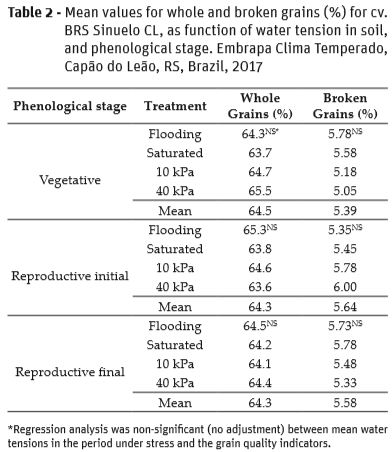
    <p><font face = "Verdana" size = "2">Results from whole and broken grains for cv. Sinuelo
are shown in <a href = "#t2">Table 2</a>. <a href = "/img/revistas/rca/v41n2/v41n2a24t3.jpg"
target = "_blank">Tables 3</a> and <a href = "/img/revistas/rca/v41n2/v41n2a24t4.jpg" target = "_blank">4</a> show the results for whole and broken grains
and other physical grain quality indicators for cv. Puitá and cv. Pampa.
Mean values for whole grains for cv. Sinuelo, were 64.5%, 64.3% and 64.3%,
respectively for Veg, RI and RF; and broken grains were 5.39%, 5.64 % and 5.58%,
also respectively for Veg, RI and RF (<a href = "/img/revistas/rca/v41n2/v41n2a24t1.jpg" target = "_blank">Table 1</a>).</font></p>

    
<p>&nbsp;</p>

<a name = "t2"><img src = "/img/revistas/rca/v41n2/v41n2a24t2.jpg"></a>

    
<p>&nbsp;</p>

    <p><font face = "Verdana" size = "2">For cv. Puitá, the mean values for whole and
broken grains in the phenological stages Veg, RI and RF were, respectively 65.5%,
65.1% 65.0% and 4.82%, 5.66% and 5.93%. For cv. Pampa, the values were 58.0%,
59.2%, 58.2% for whole grains and 8.3%, 8.1% and 8.8% for broken grains, respectively
for the phenological stages.</font></p>

    <p><font face = "Verdana" size = "2">The
cultivars Sinuelo and Puitá presented similar values (<a href = "#t2">Tables 2</a> and <a href = "/img/revistas/rca/v41n2/v41n2a24t3.jpg" target = "_blank">3</a>). However,
although still with good results, cv. Pampa (<a href = "/img/revistas/rca/v41n2/v41n2a24t4.jpg" target = "_blank">Table 4</a>) yielded a lower proportion
of whole grains and a higher proportion of broken grains compared to the other two
cultivars. According to Magalhães <i>et al</i>. (2010), the industrial yield of
whole rice grains under normal conditions of crop and milling management is higher
than 61% of whole grains, with total milling yield of 69%; thus, it is verified
that values obtained in the present study, even under soil water levels below the
ideal, were satisfactory.</font></p>

    
<p><font face = "Verdana" size = "2">It can also be verified that the moderate water deficit
(Parfitt <i>et al</i>., 2017) did not affect the percentage of whole and broken
grains in the distinct phenological stages of each cultivar, that is, there were
no differences in milling yield, independently of the crop stage in which the treatment
was imposed. Xie <i>et al</i>. (2001), on the other hand, verified that water deficit
was most preponderant for rice grain quality when imposed at grain filling stage.</font></p>


    <p><font face = "Verdana" size = "2">Concerning the physical
indicators of grain quality, such as chalkiness, chalky and streaked kernels, for
Puitá and Pampa it can be verified that both presented very low values for these
indicators. Only the values of streaked grains for cv. Puitá exceeded 1% of
the total grains.</font></p>

    <p><font face = "Verdana" size = "2">According
to Fornasieri Filho and Fornasieri (2006), the Brazilian legislation establishes
a minimum of 40% for whole grains and a maximum of 28% for broken grains; thus,
the results of this study fit both parameters. According to MAPA (1988), for chalkiness
and streaked grains, the mean data obtained are within the values considered ideal
for human consumption, since the maximum limit for these variables is 15% and 10%,
respectively.</font></p>

    ]]></body>
<body><![CDATA[<p><font face = "Verdana" size = "2">The
regression analyses between the mean soil water tensions and the grain quality indicators
within each subplot, for both the three cultivars and the three phenological stages,
show that the soil water level did not affect grain quality (<a href = "#t2">Tables 2</a>, 
<a href = "/img/revistas/rca/v41n2/v41n2a24t3.jpg" target = "_blank">3</a> and <a href = "/img/revistas/rca/v41n2/v41n2a24t4.jpg" target = "_blank">4</a>).
It is important to mention that the maximum water tensions in these experiments
were slightly higher than 40 kPa due to the water replenishment schedule, which
was performed daily in the early hours of the morning. Tensions around 40 kPa
can still be considered as moderate, since in practical terms, for rice in the reproductive
stage at this type of soil, this water tension would be reached between 3 and 5
days after saturation, with no rains.</font></p>

    
<p><font face = "Verdana" size = "2">Water stress in rice crop reduces productivity, and this grain yield reduction
is proportional to the level of stress (Arf <i>et al</i>., 2002; Huang <i>et al</i>.,
2008). According to O’Toole (1982), grain productivity response to water stress
varies with the growth stage of the plant, being the most sensitive stages the flowering
followed by booting and grain filling. Parfitt <i>et al</i>. (2017) found rice grain
yield reductions under field conditions when soil water tension was above 10 kPa,
with serious grain yield reductions above 30 kPa. Reduction in productivity
due to water stress at flowering is a result of reduced panicle fertility and percentage
of full grains, by accelerating plant senescence at this stage of the cycle. According
to Xie <i>et al</i>. (2001), the grain filling pattern has a marked influence on
grain quality. However, the effect of water stress in this period may vary with
the genotype of each cultivar (Bhattacharya, 1980; Roshan <i>et al</i>., 2013).
In general, grain quality is influenced by genetic factors and environmental conditions
(Krishnan <i>et al</i>., 2005).</font></p>

    <p><font face = "Verdana" size = "2">Although some studies indicate that reduced soil moisture
has a marked negative influence on grain quality, especially when the stress occurs
at grain filling (Dingkuhn <i>et al</i>., 1996), our study with three years and
three cultivars, do not corroborate this information. It is assumed that the water
deficits which occurred in soil and/or plant in studies that detected effect of
water stress on grain quality, were more severe than those verified in the present
study.</font></p>

    <p><font face = "Verdana" size = "2">To
illustrate how literature data related to the effect of water stress on grain quality
is controversial, Pan <i>et al</i>. (2009), for example, demonstrated that rice
cultivated in the AWD or raised&#8209;bed systems - therefore with periods of stress,
presented higher grain quality compared to the obtained in the traditional (continuous)
flood irrigation system. It is noteworthy that the maximum water deficiency in the
work of Pan <i>et al</i>. (2009) corresponds to soil moisture content of about 70 &#8209; 80%
of the saturation moisture, which is very similar to the conditions in which the
experiments of the present study were performed.</font></p>

    <p><font face = "Verdana" size = "3"><b>CONCLUSIONS</b></font></p>

    <p><font face = "Verdana" size = "2">Soil water deficiency
of up to 40 kPa, in any phenological stage of the crop cycle, does
not affect grain quality of rice cultivars developed in rice breeding programs for
continuous flood irrigation.</font></p>

    <p>&nbsp;</p>

    <p><font face = "Verdana" size = "3"><b>BIBLIOGRAPHY</b></font></p>

    <!-- ref --><p><font face = "Verdana" size = "2">Arf, O.; Rodrigues, R.A.F.; Sá, M.E.D.; Crusciol, C.A.C. &amp;
Pereira, J.C.D.R. (2002) - Preparo do solo, irrigação por aspersão e rendimento
de engenho do arroz de terras altas. <i>Scientia Agricola</i>, vol. 59, n. 2, p.
321-326. <a href = "http://dx.doi.org/10.1590/S0103-90162002000200018" target = "_blank">http://dx.doi.org/10.1590/S0103-90162002000200018</a></font>&nbsp;&nbsp;&nbsp;&nbsp;&nbsp;&nbsp;&nbsp;&nbsp;[&#160;<a href="javascript:void(0);" onclick="javascript: window.open('/scielo.php?script=sci_nlinks&ref=683350&pid=S0871-018X201800020002400001&lng=','','width=640,height=500,resizable=yes,scrollbars=1,menubar=yes,');">Links</a>&#160;]<!-- end-ref --><!-- ref --><p><font face = "Verdana" size = "2">Bhattacharya, K.R. (1980) - Breakage of rice during milling:
a review. <i>Tropical Science</i>, vol. 22, n. 2, p. 225-276.    &nbsp;&nbsp;&nbsp;&nbsp;&nbsp;&nbsp;&nbsp;&nbsp;[&#160;<a href="javascript:void(0);" onclick="javascript: window.open('/scielo.php?script=sci_nlinks&ref=683351&pid=S0871-018X201800020002400002&lng=','','width=640,height=500,resizable=yes,scrollbars=1,menubar=yes,');">Links</a>&#160;]<!-- end-ref --></font></p>

    <!-- ref --><p><font face = "Verdana" size = "2">Cai, Y.; Wang, W.; Zhu, Z.; Zhang, Z.; Lang, Y. &amp; Zhu,
Q. (2006) - Effects of water stress during grain-filling period on rice grain yield
and its quality under different nitrogen levels. <i>Ying Yong Sheng Tai Xue Bao</i>,
vol. 17, n. 7, p. 1201-1206.    &nbsp;&nbsp;&nbsp;&nbsp;&nbsp;&nbsp;&nbsp;&nbsp;[&#160;<a href="javascript:void(0);" onclick="javascript: window.open('/scielo.php?script=sci_nlinks&ref=683353&pid=S0871-018X201800020002400003&lng=','','width=640,height=500,resizable=yes,scrollbars=1,menubar=yes,');">Links</a>&#160;]<!-- end-ref --></font></p>

    <!-- ref --><p><font face = "Verdana" size = "2">Carli,
C.; Steinmetz, S.; Streck, N. A.; Marchezan, E.; da Silva, M. R. (2014) - <i>Determinação
do número de dias e de graus-dia em que a iniciação da panícula (IP) antecede a
diferenciação da panícula (DP) em cultivares de arroz irrigado</i>. Pelotas: Embrapa
Clima Temperado, (Circular técnica, N° 156).    &nbsp;&nbsp;&nbsp;&nbsp;&nbsp;&nbsp;&nbsp;&nbsp;[&#160;<a href="javascript:void(0);" onclick="javascript: window.open('/scielo.php?script=sci_nlinks&ref=683355&pid=S0871-018X201800020002400004&lng=','','width=640,height=500,resizable=yes,scrollbars=1,menubar=yes,');">Links</a>&#160;]<!-- end-ref --></font></p>

    <!-- ref --><p><font face = "Verdana" size = "2">Canellas, L.P.; Santos, G.A. &amp; Marchezan, E. (1997) - Efeito de práticas
de manejo sobre o rendimento de grãos e a qualidade industrial dos grãos em arroz
irrigado. <i>Ciência Rural</i>, vol. 27, n. 3, p. 375-379.    &nbsp;&nbsp;&nbsp;&nbsp;&nbsp;&nbsp;&nbsp;&nbsp;[&#160;<a href="javascript:void(0);" onclick="javascript: window.open('/scielo.php?script=sci_nlinks&ref=683357&pid=S0871-018X201800020002400005&lng=','','width=640,height=500,resizable=yes,scrollbars=1,menubar=yes,');">Links</a>&#160;]<!-- end-ref --></font></p>

    <!-- ref --><p><font face = "Verdana" size = "2">Cheng, W., Zhang, G., Zhao, G., Yao, H. &amp; Xu, H. (2003)
- Variation in rice quality of different cultivars and grain positions as affected
by water management. <i>Field Crops Research</i>, vol. 80, n. 3, p. 245-252. <a href = "https://doi.org/10.1016/S0378-4290(02)00193-4" target = "_blank">https://doi.org/10.1016/S0378-4290(02)00193-4</a></font>&nbsp;&nbsp;&nbsp;&nbsp;&nbsp;&nbsp;&nbsp;&nbsp;[&#160;<a href="javascript:void(0);" onclick="javascript: window.open('/scielo.php?script=sci_nlinks&ref=683359&pid=S0871-018X201800020002400006&lng=','','width=640,height=500,resizable=yes,scrollbars=1,menubar=yes,');">Links</a>&#160;]<!-- end-ref --><!-- ref --><p><font face = "Verdana" size = "2">CONAB. (2016) - Acompanhamento da Safra Brasileira
– Grãos. Safra 2015/16. COMPANHIA NACIONAL DE ABASTECIMENTO. Brasília, <i>CONAB</i>,
vol. 3, n. 12, p. 1-178. [cit. 2017- 10 -20].
&lt;<a href = "http://www.conab.gov.br/OlalaCMS/uploads/arquivos/16_06_09_09_00_00_boletim_graos_junho__2016_-_final.pdf" target = "_blank">http://www.conab.gov.br/OlalaCMS/uploads/arquivos/16_06_09_09_00_00_boletim_graos_junho__2016_-_final.pdf</a>&gt;    &nbsp;&nbsp;&nbsp;&nbsp;&nbsp;&nbsp;&nbsp;&nbsp;[&#160;<a href="javascript:void(0);" onclick="javascript: window.open('/scielo.php?script=sci_nlinks&ref=683360&pid=S0871-018X201800020002400007&lng=','','width=640,height=500,resizable=yes,scrollbars=1,menubar=yes,');">Links</a>&#160;]<!-- end-ref --></font></p>


    ]]></body>
<body><![CDATA[<!-- ref --><p><font face = "Verdana" size = "2">Counce, P.A.; Keisling, T.C. &amp; Mitchell, A.J.
(2000) - A uniform, objective, and adaptive system for expressing rice development.
<i>Crop Science</i>, vol. 40, n. 2, p. 436-443. <a href = "http://doi.org/10.2135/cropsci2000.402436x" target = "_blank">http://doi.org/10.2135/cropsci2000.402436x</a></font>&nbsp;&nbsp;&nbsp;&nbsp;&nbsp;&nbsp;&nbsp;&nbsp;[&#160;<a href="javascript:void(0);" onclick="javascript: window.open('/scielo.php?script=sci_nlinks&ref=683362&pid=S0871-018X201800020002400008&lng=','','width=640,height=500,resizable=yes,scrollbars=1,menubar=yes,');">Links</a>&#160;]<!-- end-ref --><!-- ref --><p><font face = "Verdana" size = "2">Dasgupta, P.; Das, B. S.; Sen, S. K. (2015) -
Soil water potential and recoverable water stress in drought tolerant and susceptible
rice varieties. <i>Agricultural Water Management</i>, vol. 152, p. 110-118.
<a href="https://doi.org/10.1016/j.agwat.2014.12.013" target="_blank">https://doi.org/10.1016/j.agwat.2014.12.013</a></font>&nbsp;&nbsp;&nbsp;&nbsp;&nbsp;&nbsp;&nbsp;&nbsp;[&#160;<a href="javascript:void(0);" onclick="javascript: window.open('/scielo.php?script=sci_nlinks&ref=683363&pid=S0871-018X201800020002400009&lng=','','width=640,height=500,resizable=yes,scrollbars=1,menubar=yes,');">Links</a>&#160;]<!-- end-ref --><!-- ref --><p><font face = "Verdana" size = "2">Dingkuhn, M. &amp; Gal, P.Y.L. (1996) - Effect
of drainage date on yield and dry matter partitioning in irrigated rice. <i>Field
Crops Research</i>, vol. 46, n. 1-3, p. 117–126. <a href = "https://doi.org/10.1016/0378-4290(95)00094-1" target = "_blank">https://doi.org/10.1016/0378-4290(95)00094-1</a></font>&nbsp;&nbsp;&nbsp;&nbsp;&nbsp;&nbsp;&nbsp;&nbsp;[&#160;<a href="javascript:void(0);" onclick="javascript: window.open('/scielo.php?script=sci_nlinks&ref=683364&pid=S0871-018X201800020002400010&lng=','','width=640,height=500,resizable=yes,scrollbars=1,menubar=yes,');">Links</a>&#160;]<!-- end-ref --><!-- ref --><p><font face = "Verdana" size = "2">EMBRAPA (2016) - Boletim Agroclimatológico de
Pelotas. EMPRESA BRASILEIRA DE PESQUISA AGROPECUÁRIA (EMBRAPA), [cit, 2016 - 10
- 15]. K &lt;<a href = "http://agromet.cpact.embrapa.br/estacao/boletins/Outubro2016.pdf" target = "_blank">http://agromet.cpact.embrapa.br/estacao/boletins/Outubro2016.pdf</a>&gt;    &nbsp;&nbsp;&nbsp;&nbsp;&nbsp;&nbsp;&nbsp;&nbsp;[&#160;<a href="javascript:void(0);" onclick="javascript: window.open('/scielo.php?script=sci_nlinks&ref=683365&pid=S0871-018X201800020002400011&lng=','','width=640,height=500,resizable=yes,scrollbars=1,menubar=yes,');">Links</a>&#160;]<!-- end-ref --></font></p>

    <!-- ref --><p><font face = "Verdana" size = "2">Fageria, N.K. (2007) - Yield physiology of rice.
<i>Journal of Plant Nutrition</i>, vol. 30, n. 6, p. 843-879. <a href = "https://doi.org/10.1080/15226510701374831" target = "_blank">https://doi.org/10.1080/15226510701374831</a></font>&nbsp;&nbsp;&nbsp;&nbsp;&nbsp;&nbsp;&nbsp;&nbsp;[&#160;<a href="javascript:void(0);" onclick="javascript: window.open('/scielo.php?script=sci_nlinks&ref=683367&pid=S0871-018X201800020002400012&lng=','','width=640,height=500,resizable=yes,scrollbars=1,menubar=yes,');">Links</a>&#160;]<!-- end-ref --><!-- ref --><p><font face = "Verdana" size = "2">Ferreira, C.M.; Pinheiro, B.D.S.; Sousa, I.D.
&amp; Morais, O.D. (2005) - <i>Qualidade do arroz no Brasil: evolução e padronização</i>.
Santo Antônio de Goiás: Embrapa Arroz e Feijão, 61 p.    &nbsp;&nbsp;&nbsp;&nbsp;&nbsp;&nbsp;&nbsp;&nbsp;[&#160;<a href="javascript:void(0);" onclick="javascript: window.open('/scielo.php?script=sci_nlinks&ref=683368&pid=S0871-018X201800020002400013&lng=','','width=640,height=500,resizable=yes,scrollbars=1,menubar=yes,');">Links</a>&#160;]<!-- end-ref --></font></p>

    <!-- ref --><p><font face = "Verdana" size = "2">Fofana, M.; Cherif, M.; Kone, B.; Futakuchi, K &amp; Audebert,
A. (2010) - Effect of water deficit at grain repining stage on rice grain quality.
<i>Journal of Agricultural Biotechnology and Sustainable Development, </i>vol. 2,
n. 6, p.100-117.    &nbsp;&nbsp;&nbsp;&nbsp;&nbsp;&nbsp;&nbsp;&nbsp;[&#160;<a href="javascript:void(0);" onclick="javascript: window.open('/scielo.php?script=sci_nlinks&ref=683370&pid=S0871-018X201800020002400014&lng=','','width=640,height=500,resizable=yes,scrollbars=1,menubar=yes,');">Links</a>&#160;]<!-- end-ref --></font></p>

    ]]></body>
<body><![CDATA[<!-- ref --><p><font face = "Verdana" size = "2">Fornasieri Filho,
D. &amp; Fornasieri, J. L. (2006) - <i>Manual da cultura do arroz.</i> Jaboticabal:
FUNEP, 589 p.    &nbsp;&nbsp;&nbsp;&nbsp;&nbsp;&nbsp;&nbsp;&nbsp;[&#160;<a href="javascript:void(0);" onclick="javascript: window.open('/scielo.php?script=sci_nlinks&ref=683372&pid=S0871-018X201800020002400015&lng=','','width=640,height=500,resizable=yes,scrollbars=1,menubar=yes,');">Links</a>&#160;]<!-- end-ref --></font></p>

    <!-- ref --><p><font face = "Verdana" size = "2">Huang, D.F.; Xi, L.L.;
Wang, Z.Q.; Liu, L.J. &amp; Yang, J.C. (2008) - Effects of irrigation patterns during
grain filling on grain quality and concentration and distribution of cadmium in
different organs of rice. <i>Acta Agronomia Sinica</i>, vol. 34, n. 3, p. 456-464.
<a href = "http://doi.org/10.1016/S1875-2780(08)60019-X" target = "_blank">http://doi.org/10.1016/S1875-2780(08)60019-X</a></font>&nbsp;&nbsp;&nbsp;&nbsp;&nbsp;&nbsp;&nbsp;&nbsp;[&#160;<a href="javascript:void(0);" onclick="javascript: window.open('/scielo.php?script=sci_nlinks&ref=683374&pid=S0871-018X201800020002400016&lng=','','width=640,height=500,resizable=yes,scrollbars=1,menubar=yes,');">Links</a>&#160;]<!-- end-ref --><!-- ref --><p><font face = "Verdana" size = "2">Jennings, P.R.; Coffman, W.R. &amp; Kauffman, H.E. (1979) - Grain quality.
<i>In</i>: <i>Rice improvement</i>. IRRI, Los Baños, Laguna, Philippines, p. 101-120.    &nbsp;&nbsp;&nbsp;&nbsp;&nbsp;&nbsp;&nbsp;&nbsp;[&#160;<a href="javascript:void(0);" onclick="javascript: window.open('/scielo.php?script=sci_nlinks&ref=683375&pid=S0871-018X201800020002400017&lng=','','width=640,height=500,resizable=yes,scrollbars=1,menubar=yes,');">Links</a>&#160;]<!-- end-ref --></font></p>

    <!-- ref --><p><font face = "Verdana" size = "2">Krishnan, P. &amp; Rao, A.V.S. (2005) - Effect
of genotype and environment on seed yield and quality of rice. <i>The Journal of
Agricultural Science,</i> vol. 143, n. 4, p. 283-292. <a href = "https://doi.org/10.1017/S0021859605005496" target = "_blank">https://doi.org/10.1017/S0021859605005496</a></font>&nbsp;&nbsp;&nbsp;&nbsp;&nbsp;&nbsp;&nbsp;&nbsp;[&#160;<a href="javascript:void(0);" onclick="javascript: window.open('/scielo.php?script=sci_nlinks&ref=683377&pid=S0871-018X201800020002400018&lng=','','width=640,height=500,resizable=yes,scrollbars=1,menubar=yes,');">Links</a>&#160;]<!-- end-ref --><!-- ref --><p><font face = "Verdana" size = "2">Magalhães Jr., A.M.; Fagundes, P.R.R.; Franco,
D.; Fernandes, A.A.; Rangel, P.H.; Morais, O.P. de; Neto, F.M. de &amp; Severo,
A.C.M. (2010) - <i>‘BRS Sinuelo CL’: Cultivar de Arroz Irrigado para o Sistema Clearfield</i>.
Pelotas: Embrapa, (Comunicado Técnico).    &nbsp;&nbsp;&nbsp;&nbsp;&nbsp;&nbsp;&nbsp;&nbsp;[&#160;<a href="javascript:void(0);" onclick="javascript: window.open('/scielo.php?script=sci_nlinks&ref=683378&pid=S0871-018X201800020002400019&lng=','','width=640,height=500,resizable=yes,scrollbars=1,menubar=yes,');">Links</a>&#160;]<!-- end-ref --></font></p>

    <!-- ref --><p><font face = "Verdana" size = "2">MAPA. (1998) - Norma de identidade, qualidade, embalagem e apresentação do arroz.
Portaria N° 269 de 17 de novembro de 1988. MINISTÉRIO DA AGRICULTURA PECUÁRIA E
ABASTECIMENTO, Brasília.    &nbsp;&nbsp;&nbsp;&nbsp;&nbsp;&nbsp;&nbsp;&nbsp;[&#160;<a href="javascript:void(0);" onclick="javascript: window.open('/scielo.php?script=sci_nlinks&ref=683380&pid=S0871-018X201800020002400020&lng=','','width=640,height=500,resizable=yes,scrollbars=1,menubar=yes,');">Links</a>&#160;]<!-- end-ref --></font></p>

    ]]></body>
<body><![CDATA[<!-- ref --><p><font face = "Verdana" size = "2">Massey,
J.H.; Walker, T.W.; Anders, M.M.; Smith, M.C. &amp; Avila, L.A. (2014) - Farmer
adaptation of intermittent flooding using multiple-inlet rice irrigation in Mississippi.
<i>Agricultural Water Management</i>, vol. 146, p. 297-304. <a href = "https://doi.org/10.1016/j.agwat.2014.08.023" target = "_blank">https://doi.org/10.1016/j.agwat.2014.08.023</a></font>&nbsp;&nbsp;&nbsp;&nbsp;&nbsp;&nbsp;&nbsp;&nbsp;[&#160;<a href="javascript:void(0);" onclick="javascript: window.open('/scielo.php?script=sci_nlinks&ref=683382&pid=S0871-018X201800020002400021&lng=','','width=640,height=500,resizable=yes,scrollbars=1,menubar=yes,');">Links</a>&#160;]<!-- end-ref --><!-- ref --><p><font face = "Verdana" size = "2">Mota, F.S. da; Alves, E.G.P. &amp; Becker, C.T.
(1990) - Informação climática para planejamento da necessidade de água para irrigação
do arroz no Rio Grande do Sul. <i>Lavoura Arrozeira</i>, vol. 43, n. 392, p. 3-6.    &nbsp;&nbsp;&nbsp;&nbsp;&nbsp;&nbsp;&nbsp;&nbsp;[&#160;<a href="javascript:void(0);" onclick="javascript: window.open('/scielo.php?script=sci_nlinks&ref=683383&pid=S0871-018X201800020002400022&lng=','','width=640,height=500,resizable=yes,scrollbars=1,menubar=yes,');">Links</a>&#160;]<!-- end-ref --></font></p>

    <!-- ref --><p><font face = "Verdana" size = "2">O'Toole, J.C. (1982) - Adaptation of rice to drought-prone
environments. <i>In</i>: <i>Drought Resistance in Crops, with Emphasis on Rice</i>,
p. 195-213. International Rice Research Institute, Manila, Philippines.    &nbsp;&nbsp;&nbsp;&nbsp;&nbsp;&nbsp;&nbsp;&nbsp;[&#160;<a href="javascript:void(0);" onclick="javascript: window.open('/scielo.php?script=sci_nlinks&ref=683385&pid=S0871-018X201800020002400023&lng=','','width=640,height=500,resizable=yes,scrollbars=1,menubar=yes,');">Links</a>&#160;]<!-- end-ref --></font></p>

    <!-- ref --><p><font face = "Verdana" size = "2">Pan, S.; Cao, C.; Cai, M.; Wang, J.; Wang, R.;
Zhai, J. &amp; Huang, S. (2009) - Effects of irrigation regime and nitrogen management
on grain yield, quality and water productivity in rice. <i>Journal of Food, Agriculture
&amp; Environment</i>, vol. 7, n. 2, p. 559-564.    &nbsp;&nbsp;&nbsp;&nbsp;&nbsp;&nbsp;&nbsp;&nbsp;[&#160;<a href="javascript:void(0);" onclick="javascript: window.open('/scielo.php?script=sci_nlinks&ref=683387&pid=S0871-018X201800020002400024&lng=','','width=640,height=500,resizable=yes,scrollbars=1,menubar=yes,');">Links</a>&#160;]<!-- end-ref --></font></p>

    <!-- ref --><p><font face = "Verdana" size = "2">Pandey, A.; Kumar, A.; Pandey, D.S. &amp; Thongbam, P.D. (2014) - Rice
quality under water stress. <i>Indian Journal of Advances in Plant Research, </i>vol.
1, n. 2, p. 23-26.    &nbsp;&nbsp;&nbsp;&nbsp;&nbsp;&nbsp;&nbsp;&nbsp;[&#160;<a href="javascript:void(0);" onclick="javascript: window.open('/scielo.php?script=sci_nlinks&ref=683389&pid=S0871-018X201800020002400025&lng=','','width=640,height=500,resizable=yes,scrollbars=1,menubar=yes,');">Links</a>&#160;]<!-- end-ref --></font></p>

    <!-- ref --><p><font face = "Verdana" size = "2">Parfitt,
J.M.B.; Concenço, G.; Scivittaro, W.B.; Andres, A.; Silva, J.T. da &amp; Pinto,
M.A.B. (2017) -  Soil and water management for sprinkler irrigated rice in southern
Brazil. <i>In:</i> Li, J. (Ed.) - <i>Advances in international rice research</i>.
Rijeka, Croatia, p. 3–18. <a href = "http://dx.doi.org/10.5772/66024" target = "_blank">http://dx.doi.org/10.5772/66024</a></font>&nbsp;&nbsp;&nbsp;&nbsp;&nbsp;&nbsp;&nbsp;&nbsp;[&#160;<a href="javascript:void(0);" onclick="javascript: window.open('/scielo.php?script=sci_nlinks&ref=683391&pid=S0871-018X201800020002400026&lng=','','width=640,height=500,resizable=yes,scrollbars=1,menubar=yes,');">Links</a>&#160;]<!-- end-ref --><!-- ref --><p><font face = "Verdana" size = "2">Peel, M.C.; Finlayson, B.L. &amp; McMahon, T.A. (2007) -
Updated world map of the Köppen-Geiger climate classification. <i>Hydrology and Earth
System Sciences Discussions</i>, vol. 4, n. 2, p. 1633–1644. <a href = "https://doi.org/10.5194/hess-11-1633-2007" target = "_blank">https://doi.org/10.5194/hess-11-1633-2007</a></font>&nbsp;&nbsp;&nbsp;&nbsp;&nbsp;&nbsp;&nbsp;&nbsp;[&#160;<a href="javascript:void(0);" onclick="javascript: window.open('/scielo.php?script=sci_nlinks&ref=683392&pid=S0871-018X201800020002400027&lng=','','width=640,height=500,resizable=yes,scrollbars=1,menubar=yes,');">Links</a>&#160;]<!-- end-ref --><!-- ref --><p><font face = "Verdana" size = "2">R CORE TEAM. (2016) - <i>R: A language and environment
for statistical computing</i>. Vienna: R Foundation.    &nbsp;&nbsp;&nbsp;&nbsp;&nbsp;&nbsp;&nbsp;&nbsp;[&#160;<a href="javascript:void(0);" onclick="javascript: window.open('/scielo.php?script=sci_nlinks&ref=683393&pid=S0871-018X201800020002400028&lng=','','width=640,height=500,resizable=yes,scrollbars=1,menubar=yes,');">Links</a>&#160;]<!-- end-ref --></font></p>

    <!-- ref --><p><font face = "Verdana" size = "2">Roshan, N.M.; Moradi, M.; Azarpour, E. &amp; Bozorgi, H.R. (2013)
- Irrigation withholding time management in four rice varieties at Guilan paddy
fields (North Iran). <i>African Journal of Agricultural Research</i>, Nigeria, vol.
8, n. 20, p. 2371-2375. <a href = "http://doi.org/10.5897/AJAR11.2187" target = "_blank">http://doi.org/10.5897/AJAR11.2187</a></font>&nbsp;&nbsp;&nbsp;&nbsp;&nbsp;&nbsp;&nbsp;&nbsp;[&#160;<a href="javascript:void(0);" onclick="javascript: window.open('/scielo.php?script=sci_nlinks&ref=683395&pid=S0871-018X201800020002400029&lng=','','width=640,height=500,resizable=yes,scrollbars=1,menubar=yes,');">Links</a>&#160;]<!-- end-ref --><!-- ref --><p><font face = "Verdana" size = "2">Soil Survey Staff (2010) - <i>Keys to Soil Taxonomy</i>,
12th ed, USDA – Natural Resources Conservation Service, Washington, DC.    &nbsp;&nbsp;&nbsp;&nbsp;&nbsp;&nbsp;&nbsp;&nbsp;[&#160;<a href="javascript:void(0);" onclick="javascript: window.open('/scielo.php?script=sci_nlinks&ref=683396&pid=S0871-018X201800020002400030&lng=','','width=640,height=500,resizable=yes,scrollbars=1,menubar=yes,');">Links</a>&#160;]<!-- end-ref --></font></p>

    <!-- ref --><p><font face = "Verdana" size = "2">SOSBAI (2014) - <i>Arroz irrigado: recomendações
técnicas da pesquisa para o Sul do Brasil - XXX Reunião Técnica da Cultura do Arroz
Irrigado</i>. Bento Gonçalves, RS: SOCIEDADE SUL-BRASILEIRA DE ARROZ IRRIGADO, 192
p.    &nbsp;&nbsp;&nbsp;&nbsp;&nbsp;&nbsp;&nbsp;&nbsp;[&#160;<a href="javascript:void(0);" onclick="javascript: window.open('/scielo.php?script=sci_nlinks&ref=683398&pid=S0871-018X201800020002400031&lng=','','width=640,height=500,resizable=yes,scrollbars=1,menubar=yes,');">Links</a>&#160;]<!-- end-ref --></font></p>

    <!-- ref --><p><font face = "Verdana" size = "2">SOSBAI (2016) - <i>Arroz irrigado:
Recomendações Técnicas da Pesquisa Para o Sul do Brasil - XXX Reunião Técnica da
Cultura do Arroz Irrigado</i>. Bento Gonçalves, RS: SOCIEDADE SUL-BRASILEIRA DE
ARROZ IRRIGADO, 200 p.    &nbsp;&nbsp;&nbsp;&nbsp;&nbsp;&nbsp;&nbsp;&nbsp;[&#160;<a href="javascript:void(0);" onclick="javascript: window.open('/scielo.php?script=sci_nlinks&ref=683400&pid=S0871-018X201800020002400032&lng=','','width=640,height=500,resizable=yes,scrollbars=1,menubar=yes,');">Links</a>&#160;]<!-- end-ref --></font></p>

    ]]></body>
<body><![CDATA[<!-- ref --><p><font face = "Verdana" size = "2">Streck, E.V.;
Kampf, N.; Dalmolin, R.S.D.; Klamt, E.; Nascimento, P.C.; Schneider, P.; Giasson,
E. &amp; Pinto, L.F.S. (2008) - As principais classes de solos identificadas no
Rio Grande do Sul. <i>In</i>: <i>Solos do Rio Grande do Sul</i>. 2. ed. Porto Alegre:
EMATER/RS-ASCAR, p. 37-121.    &nbsp;&nbsp;&nbsp;&nbsp;&nbsp;&nbsp;&nbsp;&nbsp;[&#160;<a href="javascript:void(0);" onclick="javascript: window.open('/scielo.php?script=sci_nlinks&ref=683402&pid=S0871-018X201800020002400033&lng=','','width=640,height=500,resizable=yes,scrollbars=1,menubar=yes,');">Links</a>&#160;]<!-- end-ref --></font></p>

    <!-- ref --><p><font face = "Verdana" size = "2">Walker,
S.H. (1999) - Causes of high water losses from irrigated rice fields: field measurements
and results from analogue and digital models. <i>Agricultural water management</i>,
vol. 40, n. 1, p. 123-127. <a href = "https://doi.org/10.1016/S0378-3774(98)00092-4" target = "_blank">https://doi.org/10.1016/S0378-3774(98)00092-4</a></font>&nbsp;&nbsp;&nbsp;&nbsp;&nbsp;&nbsp;&nbsp;&nbsp;[&#160;<a href="javascript:void(0);" onclick="javascript: window.open('/scielo.php?script=sci_nlinks&ref=683404&pid=S0871-018X201800020002400034&lng=','','width=640,height=500,resizable=yes,scrollbars=1,menubar=yes,');">Links</a>&#160;]<!-- end-ref --><!-- ref --><p><font face = "Verdana" size = "2">Watanabe, H.; Kakegawa, Y. &amp; Vu, S.H. (2006)
- Evaluation of the management practice for controlling herbicide runoff. <i>Paddy
and Water Environment</i>, vol. 4, n. 1, p. 21-28. <a href = "http://doi.org/10.1007/s10333-005-0032-4" target = "_blank">http://doi.org/10.1007/s10333-005-0032-4</a></font>&nbsp;&nbsp;&nbsp;&nbsp;&nbsp;&nbsp;&nbsp;&nbsp;[&#160;<a href="javascript:void(0);" onclick="javascript: window.open('/scielo.php?script=sci_nlinks&ref=683405&pid=S0871-018X201800020002400035&lng=','','width=640,height=500,resizable=yes,scrollbars=1,menubar=yes,');">Links</a>&#160;]<!-- end-ref --><!-- ref --><p><font face = "Verdana" size = "2">Watanabe, H.; Nguyen, M.H.T.; Souphasay, K.; Vu,
S.H.; Phong, T.K.; Tournebize, J. &amp; Ishihara, S. (2007) - Effect of water management
practice on pesticide behavior in paddy water. <i>Agriculture Water Management,</i>
vol. 88, n. 1-3, p. 132-140. <a href = "https://doi.org/10.1016/j.agwat.2006.10.009" target = "_blank">https://doi.org/10.1016/j.agwat.2006.10.009</a></font>&nbsp;&nbsp;&nbsp;&nbsp;&nbsp;&nbsp;&nbsp;&nbsp;[&#160;<a href="javascript:void(0);" onclick="javascript: window.open('/scielo.php?script=sci_nlinks&ref=683406&pid=S0871-018X201800020002400036&lng=','','width=640,height=500,resizable=yes,scrollbars=1,menubar=yes,');">Links</a>&#160;]<!-- end-ref --><!-- ref --><p><font face = "Verdana" size = "2">Xie, G.; Yang, J.; Wang, Z. &amp; Zhi, Q. (2001)
- Grain filling characteristics of rice and their relationships to physiological
activities of grains. <i>Acta Agronomica Sinica, </i>vol. 27, n. 5, p. 557-565.    &nbsp;&nbsp;&nbsp;&nbsp;&nbsp;&nbsp;&nbsp;&nbsp;[&#160;<a href="javascript:void(0);" onclick="javascript: window.open('/scielo.php?script=sci_nlinks&ref=683407&pid=S0871-018X201800020002400037&lng=','','width=640,height=500,resizable=yes,scrollbars=1,menubar=yes,');">Links</a>&#160;]<!-- end-ref --></font></p>

    <!-- ref --><p><font face = "Verdana" size = "2">Yang, J.; Zhou, Q. &amp; Zhang, J. (2017) - Moderate
wetting and drying increases rice yield and reduces water use, grain arsenic level,
and methane emission. <i>The Crop Journal</i>, vol. 5, n. 2, p. 151-158.
<a href="https://doi.org/10.1016/j.cj.2016.06.002" target="_blank">https://doi.org/10.1016/j.cj.2016.06.002</a></font>&nbsp;&nbsp;&nbsp;&nbsp;&nbsp;&nbsp;&nbsp;&nbsp;[&#160;<a href="javascript:void(0);" onclick="javascript: window.open('/scielo.php?script=sci_nlinks&ref=683409&pid=S0871-018X201800020002400038&lng=','','width=640,height=500,resizable=yes,scrollbars=1,menubar=yes,');">Links</a>&#160;]<!-- end-ref --><p>&nbsp;</p>

    <p><font face = "Verdana" size = "2">Received/recebido: 2017.07.25</font></p>

    ]]></body>
<body><![CDATA[<p><font face = "Verdana" size = "2">Received in revised form/recebido em versão revista: 2017.12.01</font></p>

    <p><font face = "Verdana" size = "2">Accepted/aceite: 2018.01.12</font></p>

     ]]></body><back>
<ref-list>
<ref id="B1">
<nlm-citation citation-type="journal">
<person-group person-group-type="author">
<name>
<surname><![CDATA[Arf]]></surname>
<given-names><![CDATA[O.]]></given-names>
</name>
<name>
<surname><![CDATA[Rodrigues]]></surname>
<given-names><![CDATA[R.A.F.]]></given-names>
</name>
<name>
<surname><![CDATA[Sá]]></surname>
<given-names><![CDATA[M.E.D.]]></given-names>
</name>
<name>
<surname><![CDATA[Crusciol]]></surname>
<given-names><![CDATA[C.A.C.]]></given-names>
</name>
<name>
<surname><![CDATA[Pereira]]></surname>
<given-names><![CDATA[J.C.D.R.]]></given-names>
</name>
</person-group>
<article-title xml:lang="pt"><![CDATA[Preparo do solo, irrigação por aspersão e rendimento de engenho do arroz de terras altas]]></article-title>
<source><![CDATA[Scientia Agricola]]></source>
<year>2002</year>
<volume>59</volume>
<numero>2</numero>
<issue>2</issue>
<page-range>321-326</page-range></nlm-citation>
</ref>
<ref id="B2">
<nlm-citation citation-type="journal">
<person-group person-group-type="author">
<name>
<surname><![CDATA[Bhattacharya]]></surname>
<given-names><![CDATA[K.R.]]></given-names>
</name>
</person-group>
<article-title xml:lang="en"><![CDATA[Breakage of rice during milling: a review]]></article-title>
<source><![CDATA[Tropical Science]]></source>
<year>1980</year>
<volume>22</volume>
<numero>2</numero>
<issue>2</issue>
<page-range>225-276</page-range></nlm-citation>
</ref>
<ref id="B3">
<nlm-citation citation-type="journal">
<person-group person-group-type="author">
<name>
<surname><![CDATA[Cai]]></surname>
<given-names><![CDATA[Y.]]></given-names>
</name>
<name>
<surname><![CDATA[Wang]]></surname>
<given-names><![CDATA[W.]]></given-names>
</name>
<name>
<surname><![CDATA[Zhu]]></surname>
<given-names><![CDATA[Z.]]></given-names>
</name>
<name>
<surname><![CDATA[Zhang]]></surname>
<given-names><![CDATA[Z.]]></given-names>
</name>
<name>
<surname><![CDATA[Lang]]></surname>
<given-names><![CDATA[Y.]]></given-names>
</name>
<name>
<surname><![CDATA[Zhu]]></surname>
<given-names><![CDATA[Q.]]></given-names>
</name>
</person-group>
<article-title xml:lang="en"><![CDATA[Effects of water stress during grain-filling period on rice grain yield and its quality under different nitrogen levels]]></article-title>
<source><![CDATA[Ying Yong Sheng Tai Xue Bao]]></source>
<year>2006</year>
<volume>17</volume>
<numero>7</numero>
<issue>7</issue>
<page-range>1201-1206</page-range></nlm-citation>
</ref>
<ref id="B4">
<nlm-citation citation-type="book">
<person-group person-group-type="author">
<name>
<surname><![CDATA[Carli]]></surname>
<given-names><![CDATA[C.]]></given-names>
</name>
<name>
<surname><![CDATA[Steinmetz]]></surname>
<given-names><![CDATA[S.]]></given-names>
</name>
<name>
<surname><![CDATA[Streck]]></surname>
<given-names><![CDATA[N. A.]]></given-names>
</name>
<name>
<surname><![CDATA[Marchezan]]></surname>
<given-names><![CDATA[E.]]></given-names>
</name>
<name>
<surname><![CDATA[da Silva]]></surname>
<given-names><![CDATA[M. R.]]></given-names>
</name>
</person-group>
<source><![CDATA[Determinação do número de dias e de graus-dia em que a iniciação da panícula (IP) antecede a diferenciação da panícula (DP) em cultivares de arroz irrigado]]></source>
<year>2014</year>
<publisher-loc><![CDATA[Pelotas ]]></publisher-loc>
<publisher-name><![CDATA[Embrapa Clima Temperado]]></publisher-name>
</nlm-citation>
</ref>
<ref id="B5">
<nlm-citation citation-type="journal">
<person-group person-group-type="author">
<name>
<surname><![CDATA[Canellas]]></surname>
<given-names><![CDATA[L.P.]]></given-names>
</name>
<name>
<surname><![CDATA[Santos]]></surname>
<given-names><![CDATA[G.A.]]></given-names>
</name>
<name>
<surname><![CDATA[Marchezan]]></surname>
<given-names><![CDATA[E.]]></given-names>
</name>
</person-group>
<article-title xml:lang="pt"><![CDATA[Efeito de práticas de manejo sobre o rendimento de grãos e a qualidade industrial dos grãos em arroz irrigado]]></article-title>
<source><![CDATA[Ciência Rural]]></source>
<year>1997</year>
<volume>27</volume>
<numero>3</numero>
<issue>3</issue>
<page-range>375-379</page-range></nlm-citation>
</ref>
<ref id="B6">
<nlm-citation citation-type="journal">
<person-group person-group-type="author">
<name>
<surname><![CDATA[Cheng]]></surname>
<given-names><![CDATA[W.]]></given-names>
</name>
<name>
<surname><![CDATA[Zhang]]></surname>
<given-names><![CDATA[G.]]></given-names>
</name>
<name>
<surname><![CDATA[Zhao]]></surname>
<given-names><![CDATA[G.]]></given-names>
</name>
<name>
<surname><![CDATA[Yao]]></surname>
<given-names><![CDATA[H.]]></given-names>
</name>
<name>
<surname><![CDATA[Xu]]></surname>
<given-names><![CDATA[H.]]></given-names>
</name>
</person-group>
<article-title xml:lang="en"><![CDATA[Variation in rice quality of different cultivars and grain positions as affected by water management]]></article-title>
<source><![CDATA[Field Crops Research]]></source>
<year>2003</year>
<volume>80</volume>
<numero>3</numero>
<issue>3</issue>
<page-range>245-252</page-range></nlm-citation>
</ref>
<ref id="B7">
<nlm-citation citation-type="book">
<collab>CONAB</collab>
<source><![CDATA[Acompanhamento da Safra Brasileira - Grãos: Safra 2015/16]]></source>
<year>2016</year>
<volume>3</volume>
<page-range>1-178</page-range><publisher-loc><![CDATA[Brasília ]]></publisher-loc>
<publisher-name><![CDATA[COMPANHIA NACIONAL DE ABASTECIMENTO]]></publisher-name>
</nlm-citation>
</ref>
<ref id="B8">
<nlm-citation citation-type="journal">
<person-group person-group-type="author">
<name>
<surname><![CDATA[Counce]]></surname>
<given-names><![CDATA[P.A.]]></given-names>
</name>
<name>
<surname><![CDATA[Keisling]]></surname>
<given-names><![CDATA[T.C.]]></given-names>
</name>
<name>
<surname><![CDATA[Mitchell]]></surname>
<given-names><![CDATA[A.J.]]></given-names>
</name>
</person-group>
<article-title xml:lang="en"><![CDATA[A uniform, objective, and adaptive system for expressing rice development]]></article-title>
<source><![CDATA[Crop Science]]></source>
<year>2000</year>
<volume>40</volume>
<numero>2</numero>
<issue>2</issue>
<page-range>436-443</page-range></nlm-citation>
</ref>
<ref id="B9">
<nlm-citation citation-type="journal">
<person-group person-group-type="author">
<name>
<surname><![CDATA[Dasgupta]]></surname>
<given-names><![CDATA[P.]]></given-names>
</name>
<name>
<surname><![CDATA[Das]]></surname>
<given-names><![CDATA[B. S.]]></given-names>
</name>
<name>
<surname><![CDATA[Sen]]></surname>
<given-names><![CDATA[S. K.]]></given-names>
</name>
</person-group>
<article-title xml:lang="en"><![CDATA[Soil water potential and recoverable water stress in drought tolerant and susceptible rice varieties]]></article-title>
<source><![CDATA[Agricultural Water Management]]></source>
<year>2015</year>
<volume>152</volume>
<page-range>110-118</page-range></nlm-citation>
</ref>
<ref id="B10">
<nlm-citation citation-type="journal">
<person-group person-group-type="author">
<name>
<surname><![CDATA[Dingkuhn]]></surname>
<given-names><![CDATA[M.]]></given-names>
</name>
<name>
<surname><![CDATA[Gal]]></surname>
<given-names><![CDATA[P.Y.L.]]></given-names>
</name>
</person-group>
<article-title xml:lang="en"><![CDATA[Effect of drainage date on yield and dry matter partitioning in irrigated rice]]></article-title>
<source><![CDATA[Field Crops Research]]></source>
<year>1996</year>
<volume>46</volume>
<numero>1-3</numero>
<issue>1-3</issue>
<page-range>117-126</page-range></nlm-citation>
</ref>
<ref id="B11">
<nlm-citation citation-type="book">
<collab>EMBRAPA</collab>
<source><![CDATA[Boletim Agroclimatológico de Pelotas]]></source>
<year>2016</year>
<publisher-name><![CDATA[EMPRESA BRASILEIRA DE PESQUISA AGROPECUÁRIA (EMBRAPA)]]></publisher-name>
</nlm-citation>
</ref>
<ref id="B12">
<nlm-citation citation-type="journal">
<person-group person-group-type="author">
<name>
<surname><![CDATA[Fageria]]></surname>
<given-names><![CDATA[N.K.]]></given-names>
</name>
</person-group>
<article-title xml:lang="en"><![CDATA[Yield physiology of rice]]></article-title>
<source><![CDATA[Journal of Plant Nutrition]]></source>
<year>2007</year>
<volume>30</volume>
<numero>6</numero>
<issue>6</issue>
<page-range>843-879</page-range></nlm-citation>
</ref>
<ref id="B13">
<nlm-citation citation-type="book">
<person-group person-group-type="author">
<name>
<surname><![CDATA[Ferreira]]></surname>
<given-names><![CDATA[C.M.]]></given-names>
</name>
<name>
<surname><![CDATA[Pinheiro]]></surname>
<given-names><![CDATA[B.D.S.]]></given-names>
</name>
<name>
<surname><![CDATA[Sousa]]></surname>
<given-names><![CDATA[I.D.]]></given-names>
</name>
<name>
<surname><![CDATA[Morais]]></surname>
<given-names><![CDATA[O.D.]]></given-names>
</name>
</person-group>
<source><![CDATA[Qualidade do arroz no Brasil: evolução e padronização]]></source>
<year>2005</year>
<publisher-loc><![CDATA[Santo Antônio de Goiás ]]></publisher-loc>
<publisher-name><![CDATA[Embrapa Arroz e Feijão]]></publisher-name>
</nlm-citation>
</ref>
<ref id="B14">
<nlm-citation citation-type="journal">
<person-group person-group-type="author">
<name>
<surname><![CDATA[Fofana]]></surname>
<given-names><![CDATA[M.]]></given-names>
</name>
<name>
<surname><![CDATA[Cherif]]></surname>
<given-names><![CDATA[M.]]></given-names>
</name>
<name>
<surname><![CDATA[Kone]]></surname>
<given-names><![CDATA[B.]]></given-names>
</name>
<name>
<surname><![CDATA[Futakuchi]]></surname>
<given-names><![CDATA[K]]></given-names>
</name>
<name>
<surname><![CDATA[Audebert]]></surname>
<given-names><![CDATA[A.]]></given-names>
</name>
</person-group>
<article-title xml:lang="en"><![CDATA[Effect of water deficit at grain repining stage on rice grain quality]]></article-title>
<source><![CDATA[Journal of Agricultural Biotechnology and Sustainable Development]]></source>
<year>2010</year>
<volume>2</volume>
<numero>6</numero>
<issue>6</issue>
<page-range>100-117</page-range></nlm-citation>
</ref>
<ref id="B15">
<nlm-citation citation-type="book">
<person-group person-group-type="author">
<name>
<surname><![CDATA[Fornasieri Filho]]></surname>
<given-names><![CDATA[D.]]></given-names>
</name>
<name>
<surname><![CDATA[Fornasieri]]></surname>
<given-names><![CDATA[J. L.]]></given-names>
</name>
</person-group>
<source><![CDATA[Manual da cultura do arroz]]></source>
<year>2006</year>
<publisher-loc><![CDATA[Jaboticabal ]]></publisher-loc>
<publisher-name><![CDATA[FUNEP]]></publisher-name>
</nlm-citation>
</ref>
<ref id="B16">
<nlm-citation citation-type="journal">
<person-group person-group-type="author">
<name>
<surname><![CDATA[Huang]]></surname>
<given-names><![CDATA[D.F.]]></given-names>
</name>
<name>
<surname><![CDATA[Xi]]></surname>
<given-names><![CDATA[L.L.]]></given-names>
</name>
<name>
<surname><![CDATA[Wang]]></surname>
<given-names><![CDATA[Z.Q.]]></given-names>
</name>
<name>
<surname><![CDATA[Liu]]></surname>
<given-names><![CDATA[L.J.]]></given-names>
</name>
<name>
<surname><![CDATA[Yang]]></surname>
<given-names><![CDATA[J.C.]]></given-names>
</name>
</person-group>
<article-title xml:lang="en"><![CDATA[Effects of irrigation patterns during grain filling on grain quality and concentration and distribution of cadmium in different organs of rice]]></article-title>
<source><![CDATA[Acta Agronomia Sinica]]></source>
<year>2008</year>
<volume>34</volume>
<numero>3</numero>
<issue>3</issue>
<page-range>456-464</page-range></nlm-citation>
</ref>
<ref id="B17">
<nlm-citation citation-type="book">
<person-group person-group-type="author">
<name>
<surname><![CDATA[Jennings]]></surname>
<given-names><![CDATA[P.R.]]></given-names>
</name>
<name>
<surname><![CDATA[Coffman]]></surname>
<given-names><![CDATA[W.R.]]></given-names>
</name>
<name>
<surname><![CDATA[Kauffman]]></surname>
<given-names><![CDATA[H.E.]]></given-names>
</name>
</person-group>
<article-title xml:lang="en"><![CDATA[Grain quality]]></article-title>
<source><![CDATA[Rice improvement]]></source>
<year>1979</year>
<page-range>101-120</page-range><publisher-loc><![CDATA[Los Baños^eLaguna Laguna]]></publisher-loc>
<publisher-name><![CDATA[IRRI]]></publisher-name>
</nlm-citation>
</ref>
<ref id="B18">
<nlm-citation citation-type="journal">
<person-group person-group-type="author">
<name>
<surname><![CDATA[Krishnan]]></surname>
<given-names><![CDATA[P.]]></given-names>
</name>
<name>
<surname><![CDATA[Rao]]></surname>
<given-names><![CDATA[A.V.S.]]></given-names>
</name>
</person-group>
<article-title xml:lang="en"><![CDATA[Effect of genotype and environment on seed yield and quality of rice]]></article-title>
<source><![CDATA[The Journal of Agricultural Science]]></source>
<year>2005</year>
<volume>143</volume>
<numero>4</numero>
<issue>4</issue>
<page-range>283-292</page-range></nlm-citation>
</ref>
<ref id="B19">
<nlm-citation citation-type="book">
<person-group person-group-type="author">
<name>
<surname><![CDATA[Magalhães Jr.]]></surname>
<given-names><![CDATA[A.M.]]></given-names>
</name>
<name>
<surname><![CDATA[Fagundes]]></surname>
<given-names><![CDATA[P.R.R.]]></given-names>
</name>
<name>
<surname><![CDATA[Franco]]></surname>
<given-names><![CDATA[D.]]></given-names>
</name>
<name>
<surname><![CDATA[Fernandes]]></surname>
<given-names><![CDATA[A.A.]]></given-names>
</name>
<name>
<surname><![CDATA[Rangel]]></surname>
<given-names><![CDATA[P.H.]]></given-names>
</name>
<name>
<surname><![CDATA[Morais]]></surname>
<given-names><![CDATA[O.P. de]]></given-names>
</name>
<name>
<surname><![CDATA[Neto]]></surname>
<given-names><![CDATA[F.M. de]]></given-names>
</name>
<name>
<surname><![CDATA[Severo]]></surname>
<given-names><![CDATA[A.C.M.]]></given-names>
</name>
</person-group>
<source><![CDATA[‘BRS Sinuelo CL’: Cultivar de Arroz Irrigado para o Sistema Clearfield]]></source>
<year>2010</year>
<publisher-loc><![CDATA[Pelotas ]]></publisher-loc>
<publisher-name><![CDATA[Embrapa]]></publisher-name>
</nlm-citation>
</ref>
<ref id="B20">
<nlm-citation citation-type="book">
<collab>MAPA</collab>
<source><![CDATA[Norma de identidade, qualidade, embalagem e apresentação do arroz]]></source>
<year>1998</year>
<publisher-loc><![CDATA[Brasília ]]></publisher-loc>
<publisher-name><![CDATA[MINISTÉRIO DA AGRICULTURA PECUÁRIA E ABASTECIMENTO]]></publisher-name>
</nlm-citation>
</ref>
<ref id="B21">
<nlm-citation citation-type="journal">
<person-group person-group-type="author">
<name>
<surname><![CDATA[Massey]]></surname>
<given-names><![CDATA[J.H.]]></given-names>
</name>
<name>
<surname><![CDATA[Walker]]></surname>
<given-names><![CDATA[T.W.]]></given-names>
</name>
<name>
<surname><![CDATA[Anders]]></surname>
<given-names><![CDATA[M.M.]]></given-names>
</name>
<name>
<surname><![CDATA[Smith]]></surname>
<given-names><![CDATA[M.C.]]></given-names>
</name>
<name>
<surname><![CDATA[Avila]]></surname>
<given-names><![CDATA[L.A.]]></given-names>
</name>
</person-group>
<article-title xml:lang="en"><![CDATA[Farmer adaptation of intermittent flooding using multiple-inlet rice irrigation in Mississippi]]></article-title>
<source><![CDATA[Agricultural Water Management]]></source>
<year>2014</year>
<volume>146</volume>
<page-range>297-304</page-range></nlm-citation>
</ref>
<ref id="B22">
<nlm-citation citation-type="journal">
<person-group person-group-type="author">
<name>
<surname><![CDATA[Mota]]></surname>
<given-names><![CDATA[F.S. da]]></given-names>
</name>
<name>
<surname><![CDATA[Alves]]></surname>
<given-names><![CDATA[E.G.P.]]></given-names>
</name>
<name>
<surname><![CDATA[Becker]]></surname>
<given-names><![CDATA[C.T.]]></given-names>
</name>
</person-group>
<article-title xml:lang="pt"><![CDATA[Informação climática para planejamento da necessidade de água para irrigação do arroz no Rio Grande do Sul]]></article-title>
<source><![CDATA[Lavoura Arrozeira]]></source>
<year>1990</year>
<volume>43</volume>
<numero>392</numero>
<issue>392</issue>
<page-range>3-6</page-range></nlm-citation>
</ref>
<ref id="B23">
<nlm-citation citation-type="book">
<person-group person-group-type="author">
<name>
<surname><![CDATA[O'Toole]]></surname>
<given-names><![CDATA[J.C.]]></given-names>
</name>
</person-group>
<article-title xml:lang="en"><![CDATA[Adaptation of rice to drought-prone environments]]></article-title>
<source><![CDATA[Drought Resistance in Crops, with Emphasis on Rice]]></source>
<year>1982</year>
<page-range>195-213</page-range><publisher-loc><![CDATA[Manila ]]></publisher-loc>
<publisher-name><![CDATA[International Rice Research Institute]]></publisher-name>
</nlm-citation>
</ref>
<ref id="B24">
<nlm-citation citation-type="journal">
<person-group person-group-type="author">
<name>
<surname><![CDATA[Pan]]></surname>
<given-names><![CDATA[S.]]></given-names>
</name>
<name>
<surname><![CDATA[Cao]]></surname>
<given-names><![CDATA[C.]]></given-names>
</name>
<name>
<surname><![CDATA[Cai]]></surname>
<given-names><![CDATA[M.]]></given-names>
</name>
<name>
<surname><![CDATA[Wang]]></surname>
<given-names><![CDATA[J.]]></given-names>
</name>
<name>
<surname><![CDATA[Wang]]></surname>
<given-names><![CDATA[R.]]></given-names>
</name>
<name>
<surname><![CDATA[Zhai]]></surname>
<given-names><![CDATA[J.]]></given-names>
</name>
<name>
<surname><![CDATA[Huang]]></surname>
<given-names><![CDATA[S.]]></given-names>
</name>
</person-group>
<article-title xml:lang="en"><![CDATA[Effects of irrigation regime and nitrogen management on grain yield, quality and water productivity in rice]]></article-title>
<source><![CDATA[Journal of Food, Agriculture & Environment]]></source>
<year>2009</year>
<volume>7</volume>
<numero>2</numero>
<issue>2</issue>
<page-range>559-564</page-range></nlm-citation>
</ref>
<ref id="B25">
<nlm-citation citation-type="journal">
<person-group person-group-type="author">
<name>
<surname><![CDATA[Pandey]]></surname>
<given-names><![CDATA[A.]]></given-names>
</name>
<name>
<surname><![CDATA[Kumar]]></surname>
<given-names><![CDATA[A.]]></given-names>
</name>
<name>
<surname><![CDATA[Pandey]]></surname>
<given-names><![CDATA[D.S.]]></given-names>
</name>
<name>
<surname><![CDATA[Thongbam]]></surname>
<given-names><![CDATA[P.D.]]></given-names>
</name>
</person-group>
<article-title xml:lang="en"><![CDATA[Rice quality under water stress]]></article-title>
<source><![CDATA[Indian Journal of Advances in Plant Research]]></source>
<year>2014</year>
<volume>1</volume>
<numero>2</numero>
<issue>2</issue>
<page-range>23-26</page-range></nlm-citation>
</ref>
<ref id="B26">
<nlm-citation citation-type="">
<person-group person-group-type="author">
<name>
<surname><![CDATA[Parfitt]]></surname>
<given-names><![CDATA[J.M.B.]]></given-names>
</name>
<name>
<surname><![CDATA[Concenço]]></surname>
<given-names><![CDATA[G.]]></given-names>
</name>
<name>
<surname><![CDATA[Scivittaro]]></surname>
<given-names><![CDATA[W.B.]]></given-names>
</name>
<name>
<surname><![CDATA[Andres]]></surname>
<given-names><![CDATA[A.]]></given-names>
</name>
<name>
<surname><![CDATA[Silva]]></surname>
<given-names><![CDATA[J.T. da]]></given-names>
</name>
<name>
<surname><![CDATA[Pinto]]></surname>
<given-names><![CDATA[M.A.B.]]></given-names>
</name>
</person-group>
<article-title xml:lang="en"><![CDATA[Soil and water management for sprinkler irrigated rice in southern Brazil]]></article-title>
<person-group person-group-type="editor">
<name>
<surname><![CDATA[Li]]></surname>
<given-names><![CDATA[J.]]></given-names>
</name>
</person-group>
<source><![CDATA[Advances in international rice research]]></source>
<year>2017</year>
<page-range>3-18</page-range><publisher-loc><![CDATA[Rijeka ]]></publisher-loc>
</nlm-citation>
</ref>
<ref id="B27">
<nlm-citation citation-type="journal">
<person-group person-group-type="author">
<name>
<surname><![CDATA[Peel]]></surname>
<given-names><![CDATA[M.C.]]></given-names>
</name>
<name>
<surname><![CDATA[Finlayson]]></surname>
<given-names><![CDATA[B.L.]]></given-names>
</name>
<name>
<surname><![CDATA[McMahon]]></surname>
<given-names><![CDATA[T.A.]]></given-names>
</name>
</person-group>
<article-title xml:lang="en"><![CDATA[Updated world map of the Köppen-Geiger climate classification]]></article-title>
<source><![CDATA[Hydrology and Earth System Sciences Discussions]]></source>
<year>2007</year>
<volume>4</volume>
<numero>2</numero>
<issue>2</issue>
<page-range>1633-1644</page-range></nlm-citation>
</ref>
<ref id="B28">
<nlm-citation citation-type="book">
<collab>R CORE TEAM</collab>
<source><![CDATA[R: A language and environment for statistical computing]]></source>
<year>2016</year>
<publisher-loc><![CDATA[Vienna ]]></publisher-loc>
<publisher-name><![CDATA[R Foundation]]></publisher-name>
</nlm-citation>
</ref>
<ref id="B29">
<nlm-citation citation-type="journal">
<person-group person-group-type="author">
<name>
<surname><![CDATA[Roshan]]></surname>
<given-names><![CDATA[N.M.]]></given-names>
</name>
<name>
<surname><![CDATA[Moradi]]></surname>
<given-names><![CDATA[M.]]></given-names>
</name>
<name>
<surname><![CDATA[Azarpour]]></surname>
<given-names><![CDATA[E.]]></given-names>
</name>
<name>
<surname><![CDATA[Bozorgi]]></surname>
<given-names><![CDATA[H.R.]]></given-names>
</name>
</person-group>
<article-title xml:lang="en"><![CDATA[Irrigation withholding time management in four rice varieties at Guilan paddy fields (North Iran)]]></article-title>
<source><![CDATA[African Journal of Agricultural Research]]></source>
<year>2013</year>
<volume>8</volume>
<numero>20</numero>
<issue>20</issue>
<page-range>2371-2375</page-range></nlm-citation>
</ref>
<ref id="B30">
<nlm-citation citation-type="book">
<collab>Soil Survey Staff</collab>
<source><![CDATA[Keys to Soil Taxonomy]]></source>
<year>2010</year>
<edition>12th</edition>
<publisher-loc><![CDATA[Washington, DC ]]></publisher-loc>
<publisher-name><![CDATA[USDA - Natural Resources Conservation Service]]></publisher-name>
</nlm-citation>
</ref>
<ref id="B31">
<nlm-citation citation-type="confpro">
<collab>SOSBAI</collab>
<source><![CDATA[Arroz irrigado: recomendações técnicas da pesquisa para o Sul do Brasil]]></source>
<year>2014</year>
<conf-name><![CDATA[XXX Reunião Técnica da Cultura do Arroz Irrigado]]></conf-name>
<conf-loc>Bento Gonçalves RS</conf-loc>
</nlm-citation>
</ref>
<ref id="B32">
<nlm-citation citation-type="confpro">
<collab>SOSBAI</collab>
<source><![CDATA[Arroz irrigado: Recomendações Técnicas da Pesquisa Para o Sul do Brasil]]></source>
<year>2016</year>
<conf-name><![CDATA[XXX Reunião Técnica da Cultura do Arroz Irrigado]]></conf-name>
<conf-loc>Bento Gonçalves RS</conf-loc>
</nlm-citation>
</ref>
<ref id="B33">
<nlm-citation citation-type="book">
<person-group person-group-type="author">
<name>
<surname><![CDATA[Streck]]></surname>
<given-names><![CDATA[E.V.]]></given-names>
</name>
<name>
<surname><![CDATA[Kampf]]></surname>
<given-names><![CDATA[N.]]></given-names>
</name>
<name>
<surname><![CDATA[Dalmolin]]></surname>
<given-names><![CDATA[R.S.D.]]></given-names>
</name>
<name>
<surname><![CDATA[Klamt]]></surname>
<given-names><![CDATA[E.]]></given-names>
</name>
<name>
<surname><![CDATA[Nascimento]]></surname>
<given-names><![CDATA[P.C.]]></given-names>
</name>
<name>
<surname><![CDATA[Schneider]]></surname>
<given-names><![CDATA[P.]]></given-names>
</name>
<name>
<surname><![CDATA[Giasson]]></surname>
<given-names><![CDATA[E.]]></given-names>
</name>
<name>
<surname><![CDATA[Pinto]]></surname>
<given-names><![CDATA[L.F.S.]]></given-names>
</name>
</person-group>
<article-title xml:lang="pt"><![CDATA[As principais classes de solos identificadas no Rio Grande do Sul]]></article-title>
<source><![CDATA[Solos do Rio Grande do Sul]]></source>
<year>2008</year>
<edition>2</edition>
<page-range>37-121</page-range><publisher-loc><![CDATA[Porto Alegre ]]></publisher-loc>
<publisher-name><![CDATA[EMATER/RS-ASCAR]]></publisher-name>
</nlm-citation>
</ref>
<ref id="B34">
<nlm-citation citation-type="journal">
<person-group person-group-type="author">
<name>
<surname><![CDATA[Walker]]></surname>
<given-names><![CDATA[S.H.]]></given-names>
</name>
</person-group>
<article-title xml:lang="en"><![CDATA[Causes of high water losses from irrigated rice fields: field measurements and results from analogue and digital models]]></article-title>
<source><![CDATA[Agricultural water management]]></source>
<year>1999</year>
<volume>40</volume>
<numero>1</numero>
<issue>1</issue>
<page-range>123-127</page-range></nlm-citation>
</ref>
<ref id="B35">
<nlm-citation citation-type="journal">
<person-group person-group-type="author">
<name>
<surname><![CDATA[Watanabe]]></surname>
<given-names><![CDATA[H.]]></given-names>
</name>
<name>
<surname><![CDATA[Kakegawa]]></surname>
<given-names><![CDATA[Y.]]></given-names>
</name>
<name>
<surname><![CDATA[Vu]]></surname>
<given-names><![CDATA[S.H.]]></given-names>
</name>
</person-group>
<article-title xml:lang="en"><![CDATA[Evaluation of the management practice for controlling herbicide runoff]]></article-title>
<source><![CDATA[Paddy and Water Environment]]></source>
<year>2006</year>
<volume>4</volume>
<numero>1</numero>
<issue>1</issue>
<page-range>21-28</page-range></nlm-citation>
</ref>
<ref id="B36">
<nlm-citation citation-type="journal">
<person-group person-group-type="author">
<name>
<surname><![CDATA[Watanabe]]></surname>
<given-names><![CDATA[H.]]></given-names>
</name>
<name>
<surname><![CDATA[Nguyen]]></surname>
<given-names><![CDATA[M.H.T.]]></given-names>
</name>
<name>
<surname><![CDATA[Souphasay]]></surname>
<given-names><![CDATA[K.]]></given-names>
</name>
<name>
<surname><![CDATA[Vu]]></surname>
<given-names><![CDATA[S.H.]]></given-names>
</name>
<name>
<surname><![CDATA[Phong]]></surname>
<given-names><![CDATA[T.K.]]></given-names>
</name>
<name>
<surname><![CDATA[Tournebize]]></surname>
<given-names><![CDATA[J.]]></given-names>
</name>
<name>
<surname><![CDATA[Ishihara]]></surname>
<given-names><![CDATA[S.]]></given-names>
</name>
</person-group>
<article-title xml:lang="en"><![CDATA[Effect of water management practice on pesticide behavior in paddy water]]></article-title>
<source><![CDATA[Agriculture Water Management]]></source>
<year>2007</year>
<volume>88</volume>
<numero>1-3</numero>
<issue>1-3</issue>
<page-range>132-140</page-range></nlm-citation>
</ref>
<ref id="B37">
<nlm-citation citation-type="journal">
<person-group person-group-type="author">
<name>
<surname><![CDATA[Xie]]></surname>
<given-names><![CDATA[G.]]></given-names>
</name>
<name>
<surname><![CDATA[Yang]]></surname>
<given-names><![CDATA[J.]]></given-names>
</name>
<name>
<surname><![CDATA[Wang]]></surname>
<given-names><![CDATA[Z.]]></given-names>
</name>
<name>
<surname><![CDATA[Zhi]]></surname>
<given-names><![CDATA[Q.]]></given-names>
</name>
</person-group>
<article-title xml:lang="en"><![CDATA[Grain filling characteristics of rice and their relationships to physiological activities of grains]]></article-title>
<source><![CDATA[Acta Agronomica Sinica]]></source>
<year>2001</year>
<volume>27</volume>
<numero>5</numero>
<issue>5</issue>
<page-range>557-565</page-range></nlm-citation>
</ref>
<ref id="B38">
<nlm-citation citation-type="journal">
<person-group person-group-type="author">
<name>
<surname><![CDATA[Yang]]></surname>
<given-names><![CDATA[J.]]></given-names>
</name>
<name>
<surname><![CDATA[Zhou]]></surname>
<given-names><![CDATA[Q.]]></given-names>
</name>
<name>
<surname><![CDATA[Zhang]]></surname>
<given-names><![CDATA[J.]]></given-names>
</name>
</person-group>
<article-title xml:lang="en"><![CDATA[Moderate wetting and drying increases rice yield and reduces water use, grain arsenic level, and methane emission]]></article-title>
<source><![CDATA[The Crop Journal]]></source>
<year>2017</year>
<volume>5</volume>
<numero>2</numero>
<issue>2</issue>
<page-range>151-158</page-range></nlm-citation>
</ref>
</ref-list>
</back>
</article>
