<?xml version="1.0" encoding="ISO-8859-1"?><article xmlns:mml="http://www.w3.org/1998/Math/MathML" xmlns:xlink="http://www.w3.org/1999/xlink" xmlns:xsi="http://www.w3.org/2001/XMLSchema-instance">
<front>
<journal-meta>
<journal-id>0871-018X</journal-id>
<journal-title><![CDATA[Revista de Ciências Agrárias]]></journal-title>
<abbrev-journal-title><![CDATA[Rev. de Ciências Agrárias]]></abbrev-journal-title>
<issn>0871-018X</issn>
<publisher>
<publisher-name><![CDATA[Sociedade de Ciências Agrárias de Portugal]]></publisher-name>
</publisher>
</journal-meta>
<article-meta>
<article-id>S0871-018X2018000200028</article-id>
<article-id pub-id-type="doi">10.19084/RCA17276</article-id>
<title-group>
<article-title xml:lang="en"><![CDATA[Characterization of Schizolobium parahyba (Vell.) S.F. Blake and Eucalyptus urophylla S.T. Blake juvenile wood in Brazilian Savanna soil]]></article-title>
<article-title xml:lang="pt"><![CDATA[Caracterização da madeira juvenil de Schizolobium parahyba (Vell.) S.F. Blake e Eucalyptus urophylla S.T. Blake em solo de CerradoBrasileiro]]></article-title>
</title-group>
<contrib-group>
<contrib contrib-type="author">
<name>
<surname><![CDATA[Rodrigues]]></surname>
<given-names><![CDATA[Paloma Maria de Moura]]></given-names>
</name>
<xref ref-type="aff" rid="A1"/>
</contrib>
<contrib contrib-type="author">
<name>
<surname><![CDATA[Coneglian]]></surname>
<given-names><![CDATA[Ademilson]]></given-names>
</name>
<xref ref-type="aff" rid="A1"/>
</contrib>
<contrib contrib-type="author">
<name>
<surname><![CDATA[Silva]]></surname>
<given-names><![CDATA[Macksuel Fernandes da]]></given-names>
</name>
<xref ref-type="aff" rid="A2"/>
</contrib>
<contrib contrib-type="author">
<name>
<surname><![CDATA[Moraes]]></surname>
<given-names><![CDATA[Mariana Dianese Alves de]]></given-names>
</name>
<xref ref-type="aff" rid="A2"/>
</contrib>
<contrib contrib-type="author">
<name>
<surname><![CDATA[Sette Junior]]></surname>
<given-names><![CDATA[Carlos Roberto]]></given-names>
</name>
<xref ref-type="aff" rid="A2"/>
</contrib>
</contrib-group>
<aff id="AA1">
<institution><![CDATA[,Universidade Estadual de Goiás Departamento de Engenharia Florestal ]]></institution>
<addr-line><![CDATA[Ipameri Goiás]]></addr-line>
<country>Brasil</country>
</aff>
<aff id="AA2">
<institution><![CDATA[,Universidade Federal de Goiás Departamento de Engenharia Florestal ]]></institution>
<addr-line><![CDATA[Goiânia Goiás]]></addr-line>
<country>Brasil</country>
</aff>
<pub-date pub-type="pub">
<day>00</day>
<month>06</month>
<year>2018</year>
</pub-date>
<pub-date pub-type="epub">
<day>00</day>
<month>06</month>
<year>2018</year>
</pub-date>
<volume>41</volume>
<numero>2</numero>
<fpage>271</fpage>
<lpage>280</lpage>
<copyright-statement/>
<copyright-year/>
<self-uri xlink:href="http://scielo.pt/scielo.php?script=sci_arttext&amp;pid=S0871-018X2018000200028&amp;lng=en&amp;nrm=iso"></self-uri><self-uri xlink:href="http://scielo.pt/scielo.php?script=sci_abstract&amp;pid=S0871-018X2018000200028&amp;lng=en&amp;nrm=iso"></self-uri><self-uri xlink:href="http://scielo.pt/scielo.php?script=sci_pdf&amp;pid=S0871-018X2018000200028&amp;lng=en&amp;nrm=iso"></self-uri><abstract abstract-type="short" xml:lang="en"><p><![CDATA[The need to understand variations of wood characteristics in alternative species that have fast growth and good quality for the consumer market has been increasinggiven the prominent technological development of wood.This study aimed to evaluate the wood basic density and the anatomical characteristics of Schizolobium parahyba and Eucalyptus urophylla 3-year old juvenile wood planted in savanna soil in a 3x3m spacing.Wood disks were cut in different longitudinal (base-top) and radial (pith-bark) positions from five trees per species to determine the wood’sbasic density and fiber and vessel dimensions. The Schizolobium parahyba wood presented (i) lower basic density, vessel size and vessel frequency, and (ii) higher wood fiber width and diameter than Eucalyptus urophylla. The average wood basic density was 0.27 g/cm³ for S. prahyba and 0.40 g/cm³ for E. urophylla wood.]]></p></abstract>
<abstract abstract-type="short" xml:lang="pt"><p><![CDATA[Face ao desenvolvimento tecnológico da madeira, cresce a necessidade do conhecimento sobre a variação das características da madeira de espécies alternativas, de rápido crescimento e de boa qualidade para o mercado consumidor. O presente trabalho teve como objetivo avaliar a densidade básica e as características anatômicas da madeira de Schizolobium parahyba em comparação com o Eucalyptus urophylla, aos 3 anos de idade, plantados em solo de cerrado com espaçamento de 3x3m. Para as análises foram selecionadas 5 árvores/espécie e cortados discos de madeira em diferentes posições longitudinais e radiais (medula-casca) para a determinação da densidade básica e dimensões das fibras (comprimento, espessura da parede, largura total e diâmetro do lume) e dos vasos (frequência, diâmetro tangencial e percentagem de área ocupada). A análise comparativa das características indicou: (i) menor densidade básica e dimensão e frequência dos vasos e (ii) maior largura e diâmetro do lumem das fibras na madeira do S.parahybaem relação a de E.urophylla. A densidade básica média foi de 0,27 g/cm³ para o S. parahyba e de 0,40 g/cm³ para o E. urophylla aos 3 anos de idade.]]></p></abstract>
<kwd-group>
<kwd lng="en"><![CDATA[Anatomical characteristics]]></kwd>
<kwd lng="en"><![CDATA[wood density]]></kwd>
<kwd lng="en"><![CDATA[fast growing species]]></kwd>
<kwd lng="en"><![CDATA[Guapuruvu]]></kwd>
<kwd lng="en"><![CDATA[Eucalyptus]]></kwd>
<kwd lng="pt"><![CDATA[Características anatómicas]]></kwd>
<kwd lng="pt"><![CDATA[densidade da madeira]]></kwd>
<kwd lng="pt"><![CDATA[espécies de rápido crescimento]]></kwd>
<kwd lng="pt"><![CDATA[Guapuruvu]]></kwd>
<kwd lng="pt"><![CDATA[Eucalyptus]]></kwd>
</kwd-group>
</article-meta>
</front><body><![CDATA[ 

    <p align = "right"><font face = "Verdana" size = "2"><b>ARTIGO</b></font></p>

    <p><font face = "Verdana" size = "4"><b>Characterization
of <i>Schizolobium parahyba</i> (Vell.) S.F. Blake and <i>Eucalyptus urophylla</i>
S.T. Blake juvenile wood in Brazilian <i>Savanna soil</i></b></font></p>


    <p><font face = "Verdana" size = "3"><b>Caracterização da madeira juvenil de <i>Schizolobium parahyba</i> (Vell.) S.F.
Blake e <i>Eucalyptus urophylla</i> S.T. Blake em solo de CerradoBrasileiro</b></font></p>

    <p><font face = "Verdana" size = "2"><b>Paloma Maria de Moura Rodrigues</b><sup>1</sup>, <b>Ademilson Coneglian</b><sup>1</sup>,
<b>Macksuel Fernandes da Silva</b><sup>2</sup>, <b>Mariana Dianese Alves de Moraes</b><sup>2</sup> and
<b>Carlos Roberto Sette Junior</b><sup>2,</sup><sup>*</sup></font></p>

    <p><font face = "Verdana" size = "2"><sup>1</sup>Universidade Estadual de Goiás (UEG),Departamento de Engenharia
Florestal, Campus Ipameri, Ipameri, Goiás, Brasil</font></p>

    <p><font face = "Verdana" size = "2"><sup>2</sup>Universidade Federal de Goiás (UFG),Departamento de
Engenharia Florestal, Rodovia Goiânia-Nova Veneza, Campus Samambaia, Goiânia, Goiás,
Brasil</font></p>

    <p><font face = "Verdana" size = "2">(*E-mail: <a href="mailto:rsettejr@hotmail.com">rsettejr@hotmail.com</a>)</font></p>

<hr noshade size = 1>

    <p><font face = "Verdana" size = "3"><b>ABSTRACT</b></font></p>

    <p><font face = "Verdana" size = "2">The need to understand variations of wood characteristics
in alternative species that have fast growth and good quality for the consumer market
has been increasinggiven the prominent technological development of wood.This study
aimed to evaluate the wood basic density and the anatomical characteristics of <i>Schizolobium
parahyba </i>and <i>Eucalyptus urophylla </i>3-year old juvenile wood planted in
<i>savanna</i> soil in a 3x3m spacing.Wood disks were cut in different longitudinal
(base-top) and radial (pith-bark) positions from five trees per species to determine
the wood’sbasic density and fiber and vessel dimensions. The <i>Schizolobium parahyba
</i>wood presented (i) lower basic density, vessel size and vessel frequency, and
(ii) higher wood fiber width and diameter than <i>Eucalyptus urophylla</i>. The
average wood basic density was 0.27 g/cm³ for <i>S. prahyba </i>and 0.40 g/cm³ for
<i>E. urophylla </i>wood.</font></p>

    ]]></body>
<body><![CDATA[<p><font face = "Verdana" size = "2"><b>Keywords</b>:Anatomical
characteristics, wood density, fast growing species, Guapuruvu, Eucalyptus.</font></p>

<hr noshade size = 1>

    <p><font face = "Verdana" size = "3"><b>RESUMO</b></font></p>

    <p><font face = "Verdana" size = "2">Face ao desenvolvimento
tecnológico da madeira, cresce a necessidade do conhecimento sobre a variação das
características da madeira de espécies alternativas, de rápido crescimento e de
boa qualidade para o mercado consumidor. O presente trabalho teve como objetivo
avaliar a densidade básica e as características anatômicas da madeira de <i>Schizolobium
parahyba</i> em comparação com o <i>Eucalyptus urophylla, </i>aos 3 anos de idade,
plantados em solo de cerrado com espaçamento de 3x3m. Para as análises foram selecionadas
5 árvores/espécie e cortados discos de madeira em diferentes posições longitudinais
e radiais (medula-casca) para a determinação da densidade básica e dimensões das
fibras (comprimento, espessura da parede, largura total e diâmetro do lume) e dos
vasos (frequência, diâmetro tangencial e percentagem de área ocupada). A análise
comparativa das características indicou: (i) menor densidade básica e dimensão e
frequência dos vasos e (ii) maior largura e diâmetro do lumem das fibras na madeira
do <i>S.parahyba</i>em relação a de <i>E.urophylla</i>. A densidade básica média
foi de 0,27 g/cm³ para o <i>S. parahyba </i>e de 0,40 g/cm³ para o <i>E. urophylla</i>
aos 3 anos de idade.</font></p>

    <p><font face = "Verdana" size = "2"><b>Palavras-chave: </b>Características anatómicas; densidade da madeira; espécies de rápido crescimento;
Guapuruvu, Eucalyptus.</font></p>

<hr noshade size = 1>

    <p><font face = "Verdana" size = "3"><b>INTRODUCTION</b></font></p>

    <p><font face = "Verdana" size = "2">Brazil occupies the second position in the world ranking of forest area with
a total of 520 million hectares (12.9% of the forests worldwide) (FAO, 2011) and
planted forests total an area of 7.8 million hectares, of which 5.6 million hectares
are species of the genus Eucalyptus (IBÁ, 2017). <i>Eucalyptus</i> species are the
most productive in the Brazilian forest sector with an average yield of 41.3 m³.ha<sup>-1</sup>.year<sup>-1</sup>,
a result of targeted investments mainly in genetic improvement, soil preparation
and tree fertilization (ABRAF, 2013). Despite the prevalence of eucalyptus species,
the forestry sector has directed investments to research studies carried out with
native species. The use of native species has been gaining ground, as the market
is increasingly seeking alternative species with rapid growth, high productivity
and good adaptation to soil conditions.</font></p>

    <p><font face = "Verdana" size = "2">Paricá (<i>Schizolobium amazonicum</i>) is highlighted among fast-growing native
speciesand has been planted commercially, mainly in the North and Center-West of
Brazil, reaching 87,500 ha of commercial crops (ABRAF, 2013). Guapuruvu (<i>Schizolobium
parahyba</i>) is also considered one of the fastest growing native species. The
wood (0.24g/cm<sup>3</sup> to 0.40g/cm<sup>3</sup>) is of lownatural durability,
indicated for manufacturing furniture (after chemical treatment) and compensated
panels, and presents volumetric growth rate of up to45 m³.ha<sup>-1</sup>.year<sup>-1
</sup>at 10 years of age (Nisgoski<i>et al</i>., 2012).</font></p>

    <p><font face = "Verdana" size = "2">The growing demand for timber in domestic and foreign markets
tends to favor replacing native wood by juvenile reforestation wood, which has become
more evident in recent years. Researchers’ and the industrial sector’sinterest in
juvenile wood rotations is growing and the use of this wood causesproblems associated
with fiber quality and low physical-mechanical properties (Vidaurre<i>et al</i>.,
2011).</font></p>

    <p><font face = "Verdana" size = "2">Evaluating the anatomical
and physical characteristics of the wood is fundamental to define its correct application
in the many industrial uses. Basic density is the main measure for wood quality
assessment, which along with anatomical characteristics are intrinsic properties
that vary among species, individuals and positions in the trunk (pith-bark; base-top)
(Trugilho<i>et al</i>., 2009).</font></p>

    <p><font face = "Verdana" size = "2">This
study aimed to determine the basic density and the anatomical characteristics of
<i>S. parahyba </i>and <i>E. urophylla</i>j uvenile woodboth planted in Cerrado
soil.</font></p>

    ]]></body>
<body><![CDATA[<p><font face = "Verdana" size = "3"><b>MATERIAL AND METHODS</b></font></p>

    <p><font face = "Verdana" size = "2"><i>Study site</i></font></p>

    <p><font face = "Verdana" size = "2">The trees were cut down from a forest stand at the State University of Goiás,
Ipameri Campus, GO (17° 42’ 38” S, 48° 08’ 12” W, 825 m height). The climate of
the region is classified as tropical with dry winter and wet summer (Aw) according
to Köeppen, with an average annual precipitation of 1,447 mm and a mean temperature
of 21.9°C. The soil is classified as Oxisol with a clayeytexture.The anatomical
characteristics and wood density were evaluated in the Bioenergy and Wood Quality
Laboratory (LQMBio )of the Federal University of Goiás, Goiânia, GO.</font></p>

    <p><font face = "Verdana" size = "2"><i>Field experiment</i></font></p>

    <p><font face = "Verdana" size = "2">The forest
stands were implemented in June 2013 and made up of <i>S. parahyba</i>( Vell) S.F.
Blaketrees (seeds from Pederneira-SP) planted in 0.5 hectares spaced 3.0 m x 3.0
m, and <i>E. urophylla </i>S.T. Blake plots (seeds from Anhembi-SP) planted in 0.2
hectares spaced 3.0 m x 3.0 m. Trees of both species received chemical fertilization
with 180 g of NPK formulation 5-30-15 + 0.2 Zn + 0.5 B per pit. The same fertilization
was replicated in the coverage in the amount of 110g per plant at 6, 12 and 18 months
after planting.</font></p>

    <p><font face = "Verdana" size = "2"><i>Collection, cutting and sample preparation</i></font></p>

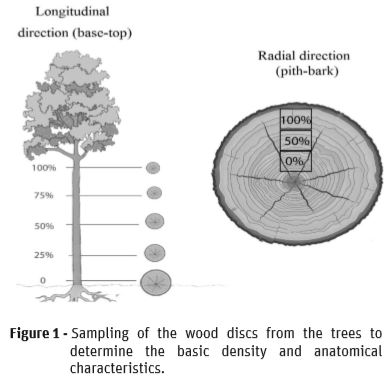
    <p><font face = "Verdana" size = "2">Five Guapuruvu and five Eucalyptus trees, 3 years-old,
were randomly selectedand harvested. Two cross-sectional discs, 5 cm thick, were
cut down from each tree along the stem at different height levels (0, 25, 50, 75
and 100% of the commercial height) as shown in <a href = "#f1">Figure 1</a>, to determine fiber(length,
wall thickness, lumen diameter and overall width) andvessels (tangential diameter,
frequency and occupied area)dimensions and basic density.</font></p>

    <p>&nbsp;</p>

<a name = "f1"><img src = "/img/revistas/rca/v41n2/v41n2a28f1.jpg"></a>

    
<p>&nbsp;</p>

    <p><font face = "Verdana" size = "2"><i>Wood basic density</i></font></p>

    ]]></body>
<body><![CDATA[<p><font face = "Verdana" size = "2">For wood basic density, one disck per position collected was immersed
in water until completely saturated. Then the wet weight (Ww), immersed weight (Pi)
and dry weight (Ps) up to constant weight (103°±2°C) were obtainedfollowing the
method proposed byVital (1984). The wood basic density values per longitudinal position
were used to determine the arithmetic mean by tree and after by species and thebase-top
variation.</font></p>

    <p><font face = "Verdana" size = "2"><i>Anatomical characteristics of wood</i></font></p>

    <p><font face = "Verdana" size = "2">Radial samples
of the wooddiscs were collected fromthree positions (0%; near to pith, 50%; intermediate
region and 100%; near to bark) and were macerated according tothe Franklin method
(Johansen, 1940). Histological slides were prepared from the fiber suspensionby
collecting 15 images/slide under a light microscope to measure its length(magnified
by 100x), and 15 images/slide for width, lumen diameter and wall thickness(magnified
by 400x). Specimens (20 x 10 mm width x thickness) were taken from the same wood
samples used in the maceration process (three radial positions; 0, 50 and 100%),
and were soaked in boiling water for saturation and softening. These specimens were
fixed on microtome slides and cross-sections werecut (15-20 &#956;m thick). Histological
sections of the wood werebleached (Javel water), washed (distilled water, acetic
acid 1%), dehydrated (alcoholic series, 30-100%), washed (xylol) during 30 min.
and then the histological slides were mounted in Canada balsam.</font></p>

    <p><font face = "Verdana" size = "2">Digital imagesof transverse section (3 per radial position)
were collected from slides prepared under fluorescence microscopy (40x) to measure
vessel diameter, % area occupied per vessel and vessel frequency according to theIAWA
(1989). <i>Image Pro Plus </i>software was used to measure the anatomical variables.</font></p>


    <p><font face = "Verdana" size = "2"><i>Statistical analyzes</i></font></p>

    <p><font face = "Verdana" size = "2">A completely randomized
design was used for statistical data analysis. From the data obtained, the outliers
were checked by the Box-Plot method, the distribution normality by the Shapiro-Wilk
method and the variance heterogeneity by the Bartlett and Levene methods. The data
presented normality of distribution and homogeneity of variance, and analysis of
variance (ANOVA) was applied, verifying the effect of the species and the radial
and longitudinal position on the wood basic density and anatomical characteristics.
A regression analysis was carried out to assess the relationshipbetween variables
andlongitudinal positions.</font></p>

    <p><font face = "Verdana" size = "3"><b>RESULTS AND DISCUSSION</b></font></p>

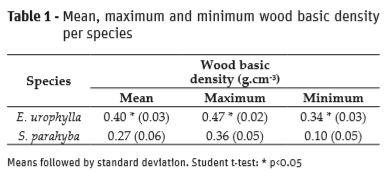
    <p><font face = "Verdana" size = "2">The wood basic density averages of 3-year-old <i>E. urophylla </i>and
<i>S. parahyba </i>were significantly different, as shown in <a href = "#t1">Table 1</a>.</font></p>

    <p>&nbsp;</p>

<a name = "t1"><img src = "/img/revistas/rca/v41n2/v41n2a28t1.jpg"></a>

    
<p>&nbsp;</p>

    ]]></body>
<body><![CDATA[<p><font face = "Verdana" size = "2">The Eucalyptus wood basic density observed in
this study is in agreement withthe values referenced byGouvêa <i>et al</i>. (2011)
of 3-year-old <i>Eucalyptus </i>sp. clones with maximum and minimum densities ranging
from0.41to 0.47g.cm<sup>-3</sup> and by Sette Jr <i>et al</i>. (2012) for <i>E.
grandis</i>at 2, 4 and 6-years old (0.43, 0.44 and 0.46 g.cm<sup>-3</sup>, respectively).</font></p>


    <p><font face = "Verdana" size = "2">In studying 16-year-old <i>E. urophylla</i>, Oliveira
<i>et al</i>. (2005) obtained values of 0.54 g.cm<sup>-3</sup>; 25% higher than
those found in this study. The differences in mean wood basic density values are
associated with juvenile and adult wood and to the age of the trees. The effect
of increasing tree age on wood quality (including basic density) has been reported
in the literature by many authors and for several forest species (Zobel and van
Buijtenen, 1989; Trugilho <i>et al</i>., 1996; Silva <i>et al</i>., 2007; Sette
Jr .<i>et al</i>., 2012), and states that the increase in wood density occurs due
to changes in the cambial meristemand to the mechanical-physiological requirements
consequent of the tree developmentprocess. Such processes arerepresented by increased
wall thickness of the fibers and increased frequency and reduced number of vessels,
as the mature wood is formed in the treetrunks.</font></p>

    <p><font face = "Verdana" size = "2">Scientific studies that have evaluated the characteristics of <i>S. parahyba</i>
wood are scarce :Andrade and Carvalho (1998) evaluated trees from native vegetation
and found basic density values of 0.24 g.cm<sup>-3</sup>, while Athanázio-Heliodoro
(2015) evaluated the characteristics of <i>S. parahyba </i>wood and obtained mean
basic density values of 0.29 g.cm<sup>-3</sup> in 15-year-old trees.</font></p>


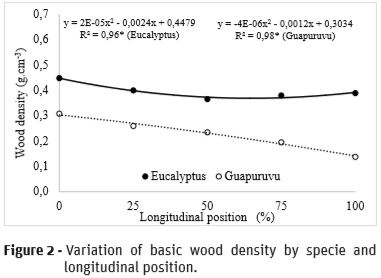
    <p><font face = "Verdana" size = "2">The analysis of variance indicated a significant
sampling position in base-top direction effect in the tree trunks for wood characteristics.
Regarding wood basic density, a quadratic variation models was observed for both
species, with variation patterns different (i) Eucalyptus: decreased from the base
up to approximately 50% of the commercial height, remaining constant or increasing
towards the top of the trunk and (ii) Guapuruvu: characterized by a decrease in
average wood basic density values from the base (0.28-0.39g.cm<sup>-3</sup>) to
the top (0.10-0.20 g.cm<sup>-3</sup>) (<a href = "#f2">Figure 2</a>).</font></p>

    <p>&nbsp;</p>

<a name = "f2"><img src = "/img/revistas/rca/v41n2/v41n2a28f2.jpg"></a>

    
<p>&nbsp;</p>

    <p><font face = "Verdana" size = "2">This longitudinal variation of the wood basic density in the tree trunks is
similar to those recorded byPanshinand De Zeeuw (1980) and Zobel and Van Buijtenen
(1989), who highlight some patterns where the values and behavior of the wood basic
density in the longitudinal position will vary depending on age and species.</font></p>


    <p><font face = "Verdana" size = "2">The higherwood basic density values in the basal
region in both species are related to the highest value of fibre wall thickness
(Guapuruvu) and the lowest values of tangencial diameter and area ocuppiedby vessels
(Eucalyptus).The longitudinal increase of wood density observed in forest speciesisrelated
tothe increase of fibre wall thickness from the base to the topand a possible variation
of vessel dimensions and percentage (Quilhó and Pereira, 2001).</font></p>

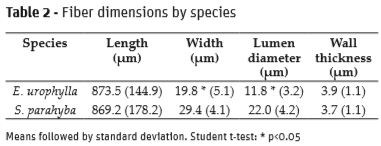
    <p><font face = "Verdana" size = "2">There was no significant effect of species in fiber length
and wall thickness, with an average length of 873.5 and 869.2 µm and wall thickness
of 3.9 and 3.7 µm for Eucalyptus andGuapuruvu, respectively. The Guapuruvu presented
higher fiber width and lumen diameter i.e 29.4 &#956;m and 22.0 &#956;m respectively
<i>versus </i>19.8 &#956;m and 11.8 &#956;m in Eucalyptus (<a href = "#t2">Table 2</a>).</font></p>

    <p>&nbsp;</p>

<a name = "t2"><img src = "/img/revistas/rca/v41n2/v41n2a28t2.jpg"></a>

    
]]></body>
<body><![CDATA[<p>&nbsp;</p>

    <p><font face = "Verdana" size = "2">The values recorded for fiber dimensionsin this
paper are within the range established by the literaturefor trees from 2 to 20 years:
750 to 1400 &#956;m, 12 to 20 &#956;m, 2.5 to 6.0 &#956;m and 6 to 12 &#956;m for
length, width, wall thickness and lumen diameter (Bamber <i>et al</i>., 1982; Silva
<i>et al</i>., 2007; Sette Jr <i>et al</i>., 2009).</font></p>

    <p><font face = "Verdana" size = "2">A shortage of scientific studies evaluating the anatomical characteristics
of Guapuruvu wood, especially juvenile wood in young trees, make it difficult to
discuss the results. In 15-year-old Guapuruvutrees ,the length, width, wall thickness
and lumen diameter of fibers were 1035.0, 37.9, 3.8 and 30.6 &#956;m, respectively(Nisgoski
<i>et al</i>., 2012). The mean values of fiber dimensions were smaller than previous
records in this study and as mentioned earlier this difference is related toalready-formed
mature wood.</font></p>

    <p><font face = "Verdana" size = "2">The fiber dimension
variation in the three radial positions of 3-year-old Eucalyptus and Guapuruvu treesis
shown in <a href = "/img/revistas/rca/v41n2/v41n2a28f3.jpg" target = "_blank">Figure 3</a>.</font></p>

    
<p><font face = "Verdana" size = "2">For both tree species,
the length and wall thickness of the fibers increased significantly (p &lt;0.05)
from the region near the pith to bark and the width and lumen diameter of fibers
decreased, althought only significantely for Guapuruvu.</font></p>

    <p><font face = "Verdana" size = "2">There is vast literature concerning the radial variation of wood
fiber dimensions in the radial direction of wood in various species and different
growth conditions. For eucalyptus species several patterns of radial variation have
been reported, showing an increase of length and wall thickness and a reduce fiber
width and lumen diameter from the pith to the bark (Tomazello Filho, 1985; Jorge
<i>et al</i>., 2000; Quilhó <i>et al</i>., 2006; Silva <i>et al</i>., 2007; Sette
Jr. <i>et al</i>., 2009).</font></p>

    <p><font face = "Verdana" size = "2">Nisgoski
<i>et al</i>. (2012) verified an increase in length, wall thickness, width and lumen
diameter of fibers in the pith-bark direction in 15-year old <i>S. parahyba</i>,
and Lobão<i>et al</i>. (2012) in 21-year old <i>S. parahyba </i>var<i>. amazonicum</i>.</font></p>


    <p><font face = "Verdana" size = "2">The analysis of variance indicated a significant
effect of base-top direction in the tree trunks for anatomical characteristics.
Regarding fiber dimensions, a quadratic variation models was observed for both species
with similar variation patterns, except for length and coefficient of determination,
ranging from 0.61 to 0.92 (<a href = "/img/revistas/rca/v41n2/v41n2a28f4.jpg" target = "_blank">Figure 4</a>).</font></p>

    
<p><font face = "Verdana" size = "2">The fibers of two species had thicker walls at the base (4.12 - 4.13 &#956;m)
than the other longitudinal positions (25, 50, 75 e 100%; 3.26 to 4.06 &#956;m).In
general, an increase in the width and diameter of the cell lumen near the base towards
the top of the tree was observed (<a href = "/img/revistas/rca/v41n2/v41n2a28f4.jpg" target = "_blank">Figure 4</a>).</font></p>

    
<p><font face = "Verdana" size = "2">The literature does not present data on the variation of anatomical characteristics
in <i>S. parahyba</i> wood in the longitudinal direction. However, some studies
show different patterns of variation of the fiber dimensions from the base to the
top (Sette Jr. <i>et al</i>., 2012; Gonçalez <i>et al</i>., 2014) for other forest
species, including Eucalyptus, as also observed in this study.</font></p>

    ]]></body>
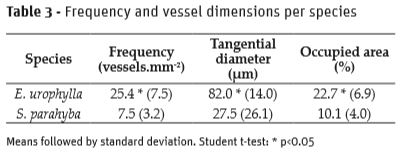
<body><![CDATA[<p><font face = "Verdana" size = "2">The vessel dimensions and frequencies differed significantly
among the species, with higher mean values observed for <i>E. urophylla </i>(<a href = "#t3">Table 3</a>):
the frequency, tangential diameter and occupied area of vessels was higher in Eucalyptus
than in Guapuruvu wood.</font></p>

    <p>&nbsp;</p>

<a name = "t3"><img src = "/img/revistas/rca/v41n2/v41n2a28t3.jpg"></a>

    
<p>&nbsp;</p>

    <p><font face = "Verdana" size = "2">The radial variation
pattern of vessel frequency and dimensions (<a href = "/img/revistas/rca/v41n2/v41n2a28f5.jpg" target = "_blank">Figure 5</a>) were similarto that of previous
studies carried out with several species: increased vessel diameter and reduced
frequency in pith-bark direction (Rocha <i>et al</i>., 2004;
Sette Jr. <i>et al</i>.,2012). In the physiological aspect, changes in diameter,
frequency and arrangement of vessels are interpreted by the need of the plants to
increase their capacity of transporting water and minerals as their growth is increased
and consequently their size increases. Under the technological aspect these changes
reflect the physical-mechanical properties of wood, on drying and on the penetration
of liquor in the chips during the delignification process.</font></p>

    
<p><font face = "Verdana" size = "2">The wood at the base of the trunk presented vessels with
lower frequency, tangential diameter and area occupied than in other parts of the
trunk, with a tendency to increase the values toward the top of the tree for both
species studied (<a href = "/img/revistas/rca/v41n2/v41n2a28f6.jpg" target = "_blank">Figure 6</a>). This result observed for vessels along with that observed
for fiber dimensions (<a href = "/img/revistas/rca/v41n2/v41n2a28f4.jpg" target = "_blank">Figure 4</a>) affects the wood basic density values: smaller sizes
of vessels promote increased in wood density, as previously discussed.</font></p>


<p><font face = "Verdana" size = "2">The higher frequency and area occupied by the
vessels at the top of the tree may be related to the increase in the physiologically
active wood (sapwood; sapflow from roots to leaves) along the trunk in the base-top
direction.</font></p>

    <p><font face = "Verdana" size = "2">The evaluation of <i>Schizolobium
parahyba</i> and <i>Eucalyptus urophylla</i> wood at more advanced ages is recommended
to determine the variation of its anatomical and physical characteristics, as well
as the mechanical properties and chemical characteristics (not contemplated in this
study) to characterize the phase of its stabilization (formation of mature wood),
which are important for its adequate technological use.</font></p>

    <p><font face = "Verdana" size = "3"><b>CONCLUSIONS</b></font></p>

    <p><font face = "Verdana" size = "2">The comparative
analysis of the wood characteristics showed: (i) lower basic density, vessel dimensions
and frequency; and (ii) larger width and lumen diameter of the fibers in the <i>Schizolobium
parahyba </i>than the <i>Eucalyptus urophylla</i>. The average wood basic density
<i>Schizolobium parahyba </i>was 0.27 g.cm<sup>-3 </sup>and 0.40 g.cm<sup>-3 </sup>for
<i>Eucalyptus urophylla</i>, both at 3 years-old.</font></p>

    <p><font face = "Verdana" size = "2">The longitudinal and radial variation patterns of the wood basic
densityand the anatomical characteristics of 3-year old <i>Schizolobium parahyba
</i>and <i>Eucalyptus urophylla</i> trees planted in Brasilian Savanna soilshowed
that the cambium is still formingthe juvenile wood.</font></p>

    ]]></body>
<body><![CDATA[<p>&nbsp;</p>

    <p><font face = "Verdana" size = "3"><b>References</b></font></p>

    <!-- ref --><p><font face = "Verdana" size = "2">ABRAF (2013) - <i>Anuário estatístico da ABRAF
2012.</i>Associação Brasileira de Produtores de Florestas Plantadas. Brasília, Brasil,
110 p.    &nbsp;&nbsp;&nbsp;&nbsp;&nbsp;&nbsp;&nbsp;&nbsp;[&#160;<a href="javascript:void(0);" onclick="javascript: window.open('/scielo.php?script=sci_nlinks&ref=683964&pid=S0871-018X201800020002800001&lng=','','width=640,height=500,resizable=yes,scrollbars=1,menubar=yes,');">Links</a>&#160;]<!-- end-ref --></font></p>

    <!-- ref --><p><font face = "Verdana" size = "2">Andrade, A.M. &amp; Carvalho,
L.M. (1998) - Potencialidades energéticas de oito espécies florestais do Estado
do Rio de Janeiro. <i>Floresta e Ambiente</i>, vol. 5, n. 1, p. 24-42.    &nbsp;&nbsp;&nbsp;&nbsp;&nbsp;&nbsp;&nbsp;&nbsp;[&#160;<a href="javascript:void(0);" onclick="javascript: window.open('/scielo.php?script=sci_nlinks&ref=683966&pid=S0871-018X201800020002800002&lng=','','width=640,height=500,resizable=yes,scrollbars=1,menubar=yes,');">Links</a>&#160;]<!-- end-ref --></font></p>


    <!-- ref --><p><font face = "Verdana" size = "2">Athanázio-Heliodoro, J.C. (2015) - <i>Qualidade
da madeira de árvores de Guapuruvu(Schizolobiumparahyba (Vell.) Blake) com 15 anos
provenientes de área de recuperação florestal</i>. Dissertação apresentada à Faculdade
deCiências Agronômicas da UNESP, para obtenção dotítulo de Mestre em Ciência Florestal.
168 p.    &nbsp;&nbsp;&nbsp;&nbsp;&nbsp;&nbsp;&nbsp;&nbsp;[&#160;<a href="javascript:void(0);" onclick="javascript: window.open('/scielo.php?script=sci_nlinks&ref=683968&pid=S0871-018X201800020002800003&lng=','','width=640,height=500,resizable=yes,scrollbars=1,menubar=yes,');">Links</a>&#160;]<!-- end-ref --></font></p>

    <!-- ref --><p><font face = "Verdana" size = "2">Bamber, R.K.; Horne, R. &amp;
Graham-Higgs, A. (1982) - Effect of fast growth on the wood properties of <i>Eucalyptus
grandis</i>. <i>Australian Forestry Research</i>, vol. 12, n. 2, p. 163-167.    &nbsp;&nbsp;&nbsp;&nbsp;&nbsp;&nbsp;&nbsp;&nbsp;[&#160;<a href="javascript:void(0);" onclick="javascript: window.open('/scielo.php?script=sci_nlinks&ref=683970&pid=S0871-018X201800020002800004&lng=','','width=640,height=500,resizable=yes,scrollbars=1,menubar=yes,');">Links</a>&#160;]<!-- end-ref --></font></p>


    ]]></body>
<body><![CDATA[<!-- ref --><p><font face = "Verdana" size = "2">FAO (2011) - <i>Situación de losbosquesdelmundo
2011</i>. Food and Agriculture Organization of the United Nations. Roma. 176 p.    &nbsp;&nbsp;&nbsp;&nbsp;&nbsp;&nbsp;&nbsp;&nbsp;[&#160;<a href="javascript:void(0);" onclick="javascript: window.open('/scielo.php?script=sci_nlinks&ref=683972&pid=S0871-018X201800020002800005&lng=','','width=640,height=500,resizable=yes,scrollbars=1,menubar=yes,');">Links</a>&#160;]<!-- end-ref --></font></p>


    <!-- ref --><p><font face = "Verdana" size = "2">Gonçalez, J.C.; Dos Santos, G.L.; Silva Junior,
F.G.; Martins, I.S. &amp; Costa, J.A. (2014) - Relações entre dimensões de fibras
e de densidade da madeira ao longo do tronco de <i>Eucalyptusurograndis</i>. <i>ScientiaForestalis</i>,
vol. 42, n. 101, p. 81-89.    &nbsp;&nbsp;&nbsp;&nbsp;&nbsp;&nbsp;&nbsp;&nbsp;[&#160;<a href="javascript:void(0);" onclick="javascript: window.open('/scielo.php?script=sci_nlinks&ref=683974&pid=S0871-018X201800020002800006&lng=','','width=640,height=500,resizable=yes,scrollbars=1,menubar=yes,');">Links</a>&#160;]<!-- end-ref --></font></p>

    <!-- ref --><p><font face = "Verdana" size = "2">Gouvêa,
A.F.G.; Trugilho, P.F.; Gomide, J.L.; Silva, J.R.M.; Andrade, C.R. &amp; Alves,
I.C.N. (2011) - Determinação da densidade básica da madeira de <i>Eucalyptus</i>
por diferentes métodos não destrutivos. <i>Revista Árvore</i>, vol. 35, n. 2, p.
349-358. <a href = "http://dx.doi.org/10.1590/S0100-67622011000200019" target = "_blank">http://dx.doi.org/10.1590/S0100-67622011000200019</a></font>&nbsp;&nbsp;&nbsp;&nbsp;&nbsp;&nbsp;&nbsp;&nbsp;[&#160;<a href="javascript:void(0);" onclick="javascript: window.open('/scielo.php?script=sci_nlinks&ref=683976&pid=S0871-018X201800020002800007&lng=','','width=640,height=500,resizable=yes,scrollbars=1,menubar=yes,');">Links</a>&#160;]<!-- end-ref --><!-- ref --><p><font face = "Verdana" size = "2">IAWA (1989) – List of Microscopic Features for Hardwood
Identification. <i>IAWA Bulletin</i>,vol. 10, n. 3, p. 219-332.    &nbsp;&nbsp;&nbsp;&nbsp;&nbsp;&nbsp;&nbsp;&nbsp;[&#160;<a href="javascript:void(0);" onclick="javascript: window.open('/scielo.php?script=sci_nlinks&ref=683977&pid=S0871-018X201800020002800008&lng=','','width=640,height=500,resizable=yes,scrollbars=1,menubar=yes,');">Links</a>&#160;]<!-- end-ref --></font></p>

    <!-- ref --><p><font face = "Verdana" size = "2">IBÁ (2017) - <i>Anuário Estatístico</i>. <i>Ano base 2013</i>.
Indústria Brasileira de Árvores. 100 p.    &nbsp;&nbsp;&nbsp;&nbsp;&nbsp;&nbsp;&nbsp;&nbsp;[&#160;<a href="javascript:void(0);" onclick="javascript: window.open('/scielo.php?script=sci_nlinks&ref=683979&pid=S0871-018X201800020002800009&lng=','','width=640,height=500,resizable=yes,scrollbars=1,menubar=yes,');">Links</a>&#160;]<!-- end-ref --></font></p>

    <!-- ref --><p><font face = "Verdana" size = "2">Johansen, D.A. (1940) - <i>Plant microtechnique</i>. 1º ed., New York: Mc Graw
Hill, 523 p.    &nbsp;&nbsp;&nbsp;&nbsp;&nbsp;&nbsp;&nbsp;&nbsp;[&#160;<a href="javascript:void(0);" onclick="javascript: window.open('/scielo.php?script=sci_nlinks&ref=683981&pid=S0871-018X201800020002800010&lng=','','width=640,height=500,resizable=yes,scrollbars=1,menubar=yes,');">Links</a>&#160;]<!-- end-ref --></font></p>

    <!-- ref --><p><font face = "Verdana" size = "2">Jorge, F.; Quilhó, T.
&amp; Pereira, H.  (2000) - Variability of fibre length in wood and bark in <i>Eucalyptus
globulus</i>. <i>IAWA Journal</i>, vol. 21, n. 1, p. 41–48. <a href = "https://doi.org/10.1163/22941932-90000235" target = "_blank">https://doi.org/10.1163/22941932-90000235</a></font>&nbsp;&nbsp;&nbsp;&nbsp;&nbsp;&nbsp;&nbsp;&nbsp;[&#160;<a href="javascript:void(0);" onclick="javascript: window.open('/scielo.php?script=sci_nlinks&ref=683983&pid=S0871-018X201800020002800011&lng=','','width=640,height=500,resizable=yes,scrollbars=1,menubar=yes,');">Links</a>&#160;]<!-- end-ref --><!-- ref --><p><font face = "Verdana" size = "2">Lobão, M.S.; Costa, D.P.; Almonacid, M.A.A. &amp;Tomazello
Filho, M. (2012) - Qualidade do lenho de árvores de <i>Schizolobiumparahyba</i>
var. <i>amazonicum</i>. <i>Floresta e Ambiente</i>, vol. 19, n. 3, p. 374-384. <a href = "http://dx.doi.org/10.4322/floram.2012.044" target = "_blank">http://dx.doi.org/10.4322/floram.2012.044</a></font>&nbsp;&nbsp;&nbsp;&nbsp;&nbsp;&nbsp;&nbsp;&nbsp;[&#160;<a href="javascript:void(0);" onclick="javascript: window.open('/scielo.php?script=sci_nlinks&ref=683984&pid=S0871-018X201800020002800012&lng=','','width=640,height=500,resizable=yes,scrollbars=1,menubar=yes,');">Links</a>&#160;]<!-- end-ref --><!-- ref --><p><font face = "Verdana" size = "2">Nisgoski, S.; Muñiz, G.I.B.; Trianoski, R.; Matos,
J.L.M. &amp;Venson, I. (2012) -  Características anatômicas da madeira e índices
de resistência do papel de <i>Schizolobiumparahyba</i> (Vell.) Blake proveniente
de plantio experimental. <i>ScientiaForestalis</i>, vol. 40, n. 94, p. 203-211.    &nbsp;&nbsp;&nbsp;&nbsp;&nbsp;&nbsp;&nbsp;&nbsp;[&#160;<a href="javascript:void(0);" onclick="javascript: window.open('/scielo.php?script=sci_nlinks&ref=683985&pid=S0871-018X201800020002800013&lng=','','width=640,height=500,resizable=yes,scrollbars=1,menubar=yes,');">Links</a>&#160;]<!-- end-ref --></font></p>


    <!-- ref --><p><font face = "Verdana" size = "2">Oliveira, J.T.S.; Hellmeister, J.C. &amp;Tomazello
Filho, M. (2005) - Variação do teor de umidade e da densidade básica na madeira
de sete espécies de Eucalipto. <i>Revista Árvore</i>, vol. 29, n. 1, p. 115-127.
<a href = "http://dx.doi.org/10.1590/S0100-67622005000100013" target = "_blank">http://dx.doi.org/10.1590/S0100-67622005000100013</a></font>&nbsp;&nbsp;&nbsp;&nbsp;&nbsp;&nbsp;&nbsp;&nbsp;[&#160;<a href="javascript:void(0);" onclick="javascript: window.open('/scielo.php?script=sci_nlinks&ref=683987&pid=S0871-018X201800020002800014&lng=','','width=640,height=500,resizable=yes,scrollbars=1,menubar=yes,');">Links</a>&#160;]<!-- end-ref --><!-- ref --><p><font face = "Verdana" size = "2">Panshin, A.J. &amp; De Zeeuw, C. (1980) - <i>Textbook of wood technology.</i>4.
ed., Mc-Graw-Hill, New York, 722 p.    &nbsp;&nbsp;&nbsp;&nbsp;&nbsp;&nbsp;&nbsp;&nbsp;[&#160;<a href="javascript:void(0);" onclick="javascript: window.open('/scielo.php?script=sci_nlinks&ref=683988&pid=S0871-018X201800020002800015&lng=','','width=640,height=500,resizable=yes,scrollbars=1,menubar=yes,');">Links</a>&#160;]<!-- end-ref --></font></p>

    <!-- ref --><p><font face = "Verdana" size = "2">Quilhó, T.; Miranda, I. &amp; Pereira, H. (2006) - Within and between tree variation
of fibre biometry and wood density of <i>Eucalyptus grandis x Eucalyptus urophylla</i>.
<i>IAWAJournal</i>, vol. 27, n. 3, p. 243-250. <a href = "https://doi.org/10.1163/22941932-90000152" target = "_blank">https://doi.org/10.1163/22941932-90000152</a></font>&nbsp;&nbsp;&nbsp;&nbsp;&nbsp;&nbsp;&nbsp;&nbsp;[&#160;<a href="javascript:void(0);" onclick="javascript: window.open('/scielo.php?script=sci_nlinks&ref=683990&pid=S0871-018X201800020002800016&lng=','','width=640,height=500,resizable=yes,scrollbars=1,menubar=yes,');">Links</a>&#160;]<!-- end-ref --><!-- ref --><p><font face = "Verdana" size = "2">Quilhó, T. &amp; Pereira, H. (2001) - Within and
between tree variation of bark content and wood density of <i>Eucalyptus globulus</i>
in commercial plantations. <i>IAWA Journal,</i> vol. 22, n. 3, p.255-265. <a href = "https://doi.org/10.1163/22941932-90000283" target = "_blank">https://doi.org/10.1163/22941932-90000283</a></font>&nbsp;&nbsp;&nbsp;&nbsp;&nbsp;&nbsp;&nbsp;&nbsp;[&#160;<a href="javascript:void(0);" onclick="javascript: window.open('/scielo.php?script=sci_nlinks&ref=683991&pid=S0871-018X201800020002800017&lng=','','width=640,height=500,resizable=yes,scrollbars=1,menubar=yes,');">Links</a>&#160;]<!-- end-ref --><!-- ref --><p><font face = "Verdana" size = "2">Rocha, F.T.; Florsheim, S.M.B. &amp; Couto, H.T.Z.
(2004) - Variação das dimensões dos elementos anatômicos da madeira de árvores de
<i>Eucalyptusgrandis</i>Hill ex. Maiden aos sete anos. <i>Revista do Instituto Florestal</i>,
v. 16, n. 1, p. 43-55.    &nbsp;&nbsp;&nbsp;&nbsp;&nbsp;&nbsp;&nbsp;&nbsp;[&#160;<a href="javascript:void(0);" onclick="javascript: window.open('/scielo.php?script=sci_nlinks&ref=683992&pid=S0871-018X201800020002800018&lng=','','width=640,height=500,resizable=yes,scrollbars=1,menubar=yes,');">Links</a>&#160;]<!-- end-ref --></font></p>

    <!-- ref --><p><font face = "Verdana" size = "2">Sette Jr,
C.R.; Oliveira, I.R.; Tomazello Filho, M.; Yamaji, F.M.; Laclau, J.P. (2012) - Efeito
da idade e posição de amostragem na densidade e características anatômicas da madeira
de <i>Eucalyptusgrandis.Revista Árvore</i>, vol. 36, n. 6, p. 1183-1190. <a href = "http://dx.doi.org/10.1590/S0100-67622012000600019" target = "_blank">http://dx.doi.org/10.1590/S0100-67622012000600019</a></font>&nbsp;&nbsp;&nbsp;&nbsp;&nbsp;&nbsp;&nbsp;&nbsp;[&#160;<a href="javascript:void(0);" onclick="javascript: window.open('/scielo.php?script=sci_nlinks&ref=683994&pid=S0871-018X201800020002800019&lng=','','width=640,height=500,resizable=yes,scrollbars=1,menubar=yes,');">Links</a>&#160;]<!-- end-ref --><!-- ref --><p><font face = "Verdana" size = "2">Sette Jr, C.R.;Tomazello Filho, M.; Lousada, J.L.P.C.&amp;Laclau,
J.P. (2009) - Efeito da aplicação de fertilização nitrogenada e lodo de esgoto nas
características da madeira juvenil em árvores de <i>Eucalyptusgrandis</i>. <i>Cerne</i>,
vol. 15, n. 3, p. 303-312.    &nbsp;&nbsp;&nbsp;&nbsp;&nbsp;&nbsp;&nbsp;&nbsp;[&#160;<a href="javascript:void(0);" onclick="javascript: window.open('/scielo.php?script=sci_nlinks&ref=683995&pid=S0871-018X201800020002800020&lng=','','width=640,height=500,resizable=yes,scrollbars=1,menubar=yes,');">Links</a>&#160;]<!-- end-ref --></font></p>

    <!-- ref --><p><font face = "Verdana" size = "2">Silva,
J.C.; Tomazello Filho, M.; Oliveira, J.T.S. &amp; Castro, V.R. (2007) - Influência
da idade e da posição radial nas dimensões das fibras e dos vasos da madeira de
<i>Eucalyptusgrandis</i> Hill ex. Maiden. <i>Revista Árvore</i>, vol. 31, n. 6,
p. 1081-1090. <a href = "http://dx.doi.org/10.1590/S0100-67622007000600013" target = "_blank">http://dx.doi.org/10.1590/S0100-67622007000600013</a></font>&nbsp;&nbsp;&nbsp;&nbsp;&nbsp;&nbsp;&nbsp;&nbsp;[&#160;<a href="javascript:void(0);" onclick="javascript: window.open('/scielo.php?script=sci_nlinks&ref=683997&pid=S0871-018X201800020002800021&lng=','','width=640,height=500,resizable=yes,scrollbars=1,menubar=yes,');">Links</a>&#160;]<!-- end-ref --><!-- ref --><p><font face = "Verdana" size = "2">Tomazello Filho, M. (1985) - Variação radial da densidade básica
e da estrutura anatômica da madeira do <i>Eucalyptussaligna e Eucalyptusgrandis</i>.
<i>IPEF</i>, vol. 29, p. 37-45.    &nbsp;&nbsp;&nbsp;&nbsp;&nbsp;&nbsp;&nbsp;&nbsp;[&#160;<a href="javascript:void(0);" onclick="javascript: window.open('/scielo.php?script=sci_nlinks&ref=683998&pid=S0871-018X201800020002800022&lng=','','width=640,height=500,resizable=yes,scrollbars=1,menubar=yes,');">Links</a>&#160;]<!-- end-ref --></font></p>

    <!-- ref --><p><font face = "Verdana" size = "2">Trugilho,
P.F.; Lima, J.T. &amp; Mendes, L.M. (1996) - Influência da idade nas características
físico – químicas e anatômicas da madeira de <i>Eucalyptossaligna. Cerne</i>, vol.
2, n. 1, p. 17-27.    &nbsp;&nbsp;&nbsp;&nbsp;&nbsp;&nbsp;&nbsp;&nbsp;[&#160;<a href="javascript:void(0);" onclick="javascript: window.open('/scielo.php?script=sci_nlinks&ref=684000&pid=S0871-018X201800020002800023&lng=','','width=640,height=500,resizable=yes,scrollbars=1,menubar=yes,');">Links</a>&#160;]<!-- end-ref --></font></p>

    ]]></body>
<body><![CDATA[<!-- ref --><p><font face = "Verdana" size = "2">Vidaurre, G.;
Lombardi, L.R.; Oliveira, J.T.S.P. &amp; Arantes, M. D. C. (2011) - Lenho juvenil
e adulto e as propriedades da madeira. <i>Floresta e Ambiente</i>, vol. 18, n. 4,
p 469-480. <a href = "http://dx.doi.org/10.4322/floram.2011.066" target = "_blank">http://dx.doi.org/10.4322/floram.2011.066</a></font>&nbsp;&nbsp;&nbsp;&nbsp;&nbsp;&nbsp;&nbsp;&nbsp;[&#160;<a href="javascript:void(0);" onclick="javascript: window.open('/scielo.php?script=sci_nlinks&ref=684002&pid=S0871-018X201800020002800024&lng=','','width=640,height=500,resizable=yes,scrollbars=1,menubar=yes,');">Links</a>&#160;]<!-- end-ref --><!-- ref --><p><font face = "Verdana" size = "2">Vital, B.R. (1984) - <i>Métodos de determinação da densidade
da madeira</i>. Sociedade de Investigações Florestais, Viçosa, 21 p.    &nbsp;&nbsp;&nbsp;&nbsp;&nbsp;&nbsp;&nbsp;&nbsp;[&#160;<a href="javascript:void(0);" onclick="javascript: window.open('/scielo.php?script=sci_nlinks&ref=684003&pid=S0871-018X201800020002800025&lng=','','width=640,height=500,resizable=yes,scrollbars=1,menubar=yes,');">Links</a>&#160;]<!-- end-ref --></font></p>


    <!-- ref --><p><font face = "Verdana" size = "2">Zobel, B.J. &amp; van Buijtenen, J. P. (1989)
- <i>Wood variation: its causes andcontrol</i>. Berlin: Springer-Verlag,
361 p.    &nbsp;&nbsp;&nbsp;&nbsp;&nbsp;&nbsp;&nbsp;&nbsp;[&#160;<a href="javascript:void(0);" onclick="javascript: window.open('/scielo.php?script=sci_nlinks&ref=684005&pid=S0871-018X201800020002800026&lng=','','width=640,height=500,resizable=yes,scrollbars=1,menubar=yes,');">Links</a>&#160;]<!-- end-ref --></font></p>

    <p>&nbsp;</p>

    <p><font face = "Verdana" size = "2">Received/recebido: 2017.10.30</font></p>

    <p><font face = "Verdana" size = "2">Received in revised form/recebido em versão revista: 2018.02.12</font></p>

    <p><font face = "Verdana" size = "2">Accepted/aceite: 2018.02.03</font></p>

     ]]></body><back>
<ref-list>
<ref id="B1">
<nlm-citation citation-type="book">
<collab>ABRAF</collab>
<source><![CDATA[Anuário estatístico da ABRAF 2012]]></source>
<year>2013</year>
<publisher-loc><![CDATA[Brasília ]]></publisher-loc>
<publisher-name><![CDATA[Associação Brasileira de Produtores de Florestas Plantadas]]></publisher-name>
</nlm-citation>
</ref>
<ref id="B2">
<nlm-citation citation-type="journal">
<person-group person-group-type="author">
<name>
<surname><![CDATA[Andrade]]></surname>
<given-names><![CDATA[A.M.]]></given-names>
</name>
<name>
<surname><![CDATA[Carvalho]]></surname>
<given-names><![CDATA[L.M.]]></given-names>
</name>
</person-group>
<article-title xml:lang="pt"><![CDATA[Potencialidades energéticas de oito espécies florestais do Estado do Rio de Janeiro]]></article-title>
<source><![CDATA[Floresta e Ambiente]]></source>
<year>1998</year>
<volume>5</volume>
<numero>1</numero>
<issue>1</issue>
<page-range>24-42</page-range></nlm-citation>
</ref>
<ref id="B3">
<nlm-citation citation-type="">
<person-group person-group-type="author">
<name>
<surname><![CDATA[Athanázio-Heliodoro]]></surname>
<given-names><![CDATA[J.C.]]></given-names>
</name>
</person-group>
<source><![CDATA[Qualidade da madeira de árvores de Guapuruvu(Schizolobiumparahyba (Vell.) Blake) com 15 anos provenientes de área de recuperação florestal]]></source>
<year>2015</year>
</nlm-citation>
</ref>
<ref id="B4">
<nlm-citation citation-type="journal">
<person-group person-group-type="author">
<name>
<surname><![CDATA[Bamber]]></surname>
<given-names><![CDATA[R.K.]]></given-names>
</name>
<name>
<surname><![CDATA[Horne]]></surname>
<given-names><![CDATA[R.]]></given-names>
</name>
<name>
<surname><![CDATA[Graham-Higgs]]></surname>
<given-names><![CDATA[A.]]></given-names>
</name>
</person-group>
<article-title xml:lang="en"><![CDATA[Effect of fast growth on the wood properties of Eucalyptus grandis]]></article-title>
<source><![CDATA[Australian Forestry Research]]></source>
<year>1982</year>
<volume>12</volume>
<numero>2</numero>
<issue>2</issue>
<page-range>163-167</page-range></nlm-citation>
</ref>
<ref id="B5">
<nlm-citation citation-type="book">
<collab>FAO</collab>
<source><![CDATA[Situación de losbosquesdelmundo 2011]]></source>
<year>2011</year>
<publisher-loc><![CDATA[Roma ]]></publisher-loc>
<publisher-name><![CDATA[Food and Agriculture Organization of the United Nations]]></publisher-name>
</nlm-citation>
</ref>
<ref id="B6">
<nlm-citation citation-type="journal">
<person-group person-group-type="author">
<name>
<surname><![CDATA[Gonçalez]]></surname>
<given-names><![CDATA[J.C.]]></given-names>
</name>
<name>
<surname><![CDATA[Dos Santos]]></surname>
<given-names><![CDATA[G.L.]]></given-names>
</name>
<name>
<surname><![CDATA[Silva Junior]]></surname>
<given-names><![CDATA[F.G.]]></given-names>
</name>
<name>
<surname><![CDATA[Martins]]></surname>
<given-names><![CDATA[I.S.]]></given-names>
</name>
<name>
<surname><![CDATA[Costa]]></surname>
<given-names><![CDATA[J.A.]]></given-names>
</name>
</person-group>
<article-title xml:lang="pt"><![CDATA[Relações entre dimensões de fibras e de densidade da madeira ao longo do tronco de Eucalyptusurograndis]]></article-title>
<source><![CDATA[ScientiaForestalis]]></source>
<year>2014</year>
<volume>42</volume>
<numero>101</numero>
<issue>101</issue>
<page-range>81-89</page-range></nlm-citation>
</ref>
<ref id="B7">
<nlm-citation citation-type="journal">
<person-group person-group-type="author">
<name>
<surname><![CDATA[Gouvêa]]></surname>
<given-names><![CDATA[A.F.G.]]></given-names>
</name>
<name>
<surname><![CDATA[Trugilho]]></surname>
<given-names><![CDATA[P.F.]]></given-names>
</name>
<name>
<surname><![CDATA[Gomide]]></surname>
<given-names><![CDATA[J.L.]]></given-names>
</name>
<name>
<surname><![CDATA[Silva]]></surname>
<given-names><![CDATA[J.R.M.]]></given-names>
</name>
<name>
<surname><![CDATA[Andrade]]></surname>
<given-names><![CDATA[C.R.]]></given-names>
</name>
<name>
<surname><![CDATA[Alves]]></surname>
<given-names><![CDATA[I.C.N.]]></given-names>
</name>
</person-group>
<article-title xml:lang="pt"><![CDATA[Determinação da densidade básica da madeira de Eucalyptus por diferentes métodos não destrutivos]]></article-title>
<source><![CDATA[Revista Árvore]]></source>
<year>2011</year>
<volume>35</volume>
<numero>2</numero>
<issue>2</issue>
<page-range>349-358</page-range></nlm-citation>
</ref>
<ref id="B8">
<nlm-citation citation-type="journal">
<collab>IAWA</collab>
<article-title xml:lang="en"><![CDATA[List of Microscopic Features for Hardwood Identification]]></article-title>
<source><![CDATA[IAWA Bulletin]]></source>
<year>1989</year>
<volume>10</volume>
<numero>3</numero>
<issue>3</issue>
<page-range>219-332</page-range></nlm-citation>
</ref>
<ref id="B9">
<nlm-citation citation-type="book">
<collab>IBÁ</collab>
<source><![CDATA[Anuário Estatístico: Ano base 2013]]></source>
<year>2017</year>
<publisher-name><![CDATA[Indústria Brasileira de Árvores]]></publisher-name>
</nlm-citation>
</ref>
<ref id="B10">
<nlm-citation citation-type="book">
<person-group person-group-type="author">
<name>
<surname><![CDATA[Johansen]]></surname>
<given-names><![CDATA[D.A.]]></given-names>
</name>
</person-group>
<source><![CDATA[Plant microtechnique]]></source>
<year>1940</year>
<edition>1º</edition>
<publisher-loc><![CDATA[New York ]]></publisher-loc>
<publisher-name><![CDATA[Mc Graw Hill]]></publisher-name>
</nlm-citation>
</ref>
<ref id="B11">
<nlm-citation citation-type="journal">
<person-group person-group-type="author">
<name>
<surname><![CDATA[Jorge]]></surname>
<given-names><![CDATA[F.]]></given-names>
</name>
<name>
<surname><![CDATA[Quilhó]]></surname>
<given-names><![CDATA[T.]]></given-names>
</name>
<name>
<surname><![CDATA[Pereira]]></surname>
<given-names><![CDATA[H.]]></given-names>
</name>
</person-group>
<article-title xml:lang="en"><![CDATA[Variability of fibre length in wood and bark in Eucalyptus globulus]]></article-title>
<source><![CDATA[IAWA Journal]]></source>
<year>2000</year>
<volume>21</volume>
<numero>1</numero>
<issue>1</issue>
<page-range>41-48</page-range></nlm-citation>
</ref>
<ref id="B12">
<nlm-citation citation-type="journal">
<person-group person-group-type="author">
<name>
<surname><![CDATA[Lobão]]></surname>
<given-names><![CDATA[M.S.]]></given-names>
</name>
<name>
<surname><![CDATA[Costa]]></surname>
<given-names><![CDATA[D.P.]]></given-names>
</name>
<name>
<surname><![CDATA[Almonacid]]></surname>
<given-names><![CDATA[M.A.A.]]></given-names>
</name>
<name>
<surname><![CDATA[Tomazello Filho]]></surname>
<given-names><![CDATA[M.]]></given-names>
</name>
</person-group>
<article-title xml:lang="pt"><![CDATA[Qualidade do lenho de árvores de Schizolobiumparahyba var. amazonicum]]></article-title>
<source><![CDATA[Floresta e Ambiente]]></source>
<year>2012</year>
<volume>19</volume>
<numero>3</numero>
<issue>3</issue>
<page-range>374-384</page-range></nlm-citation>
</ref>
<ref id="B13">
<nlm-citation citation-type="journal">
<person-group person-group-type="author">
<name>
<surname><![CDATA[Nisgoski]]></surname>
<given-names><![CDATA[S.]]></given-names>
</name>
<name>
<surname><![CDATA[Muñiz]]></surname>
<given-names><![CDATA[G.I.B.]]></given-names>
</name>
<name>
<surname><![CDATA[Trianoski]]></surname>
<given-names><![CDATA[R.]]></given-names>
</name>
<name>
<surname><![CDATA[Matos]]></surname>
<given-names><![CDATA[J.L.M.]]></given-names>
</name>
<name>
<surname><![CDATA[Venson]]></surname>
<given-names><![CDATA[I.]]></given-names>
</name>
</person-group>
<article-title xml:lang="pt"><![CDATA[Características anatômicas da madeira e índices de resistência do papel de Schizolobiumparahyba (Vell.) Blake proveniente de plantio experimental]]></article-title>
<source><![CDATA[ScientiaForestalis]]></source>
<year>2012</year>
<volume>40</volume>
<numero>94</numero>
<issue>94</issue>
<page-range>203-211</page-range></nlm-citation>
</ref>
<ref id="B14">
<nlm-citation citation-type="journal">
<person-group person-group-type="author">
<name>
<surname><![CDATA[Oliveira]]></surname>
<given-names><![CDATA[J.T.S.]]></given-names>
</name>
<name>
<surname><![CDATA[Hellmeister]]></surname>
<given-names><![CDATA[J.C.]]></given-names>
</name>
<name>
<surname><![CDATA[Tomazello Filho]]></surname>
<given-names><![CDATA[M.]]></given-names>
</name>
</person-group>
<article-title xml:lang="pt"><![CDATA[Variação do teor de umidade e da densidade básica na madeira de sete espécies de Eucalipto]]></article-title>
<source><![CDATA[Revista Árvore]]></source>
<year>2005</year>
<volume>29</volume>
<numero>1</numero>
<issue>1</issue>
<page-range>115-127</page-range></nlm-citation>
</ref>
<ref id="B15">
<nlm-citation citation-type="book">
<person-group person-group-type="author">
<name>
<surname><![CDATA[Panshin]]></surname>
<given-names><![CDATA[A.J.]]></given-names>
</name>
<name>
<surname><![CDATA[De Zeeuw]]></surname>
<given-names><![CDATA[C.]]></given-names>
</name>
</person-group>
<source><![CDATA[Textbook of wood technology]]></source>
<year>1980</year>
<edition>4</edition>
<publisher-loc><![CDATA[New York ]]></publisher-loc>
<publisher-name><![CDATA[Mc-Graw-Hill]]></publisher-name>
</nlm-citation>
</ref>
<ref id="B16">
<nlm-citation citation-type="journal">
<person-group person-group-type="author">
<name>
<surname><![CDATA[Quilhó]]></surname>
<given-names><![CDATA[T.]]></given-names>
</name>
<name>
<surname><![CDATA[Miranda]]></surname>
<given-names><![CDATA[I.]]></given-names>
</name>
<name>
<surname><![CDATA[Pereira]]></surname>
<given-names><![CDATA[H.]]></given-names>
</name>
</person-group>
<article-title xml:lang="en"><![CDATA[Within and between tree variation of fibre biometry and wood density of Eucalyptus grandis x Eucalyptus urophylla]]></article-title>
<source><![CDATA[IAWAJournal]]></source>
<year>2006</year>
<volume>27</volume>
<numero>3</numero>
<issue>3</issue>
<page-range>243-250</page-range></nlm-citation>
</ref>
<ref id="B17">
<nlm-citation citation-type="journal">
<person-group person-group-type="author">
<name>
<surname><![CDATA[Quilhó]]></surname>
<given-names><![CDATA[T.]]></given-names>
</name>
<name>
<surname><![CDATA[Pereira]]></surname>
<given-names><![CDATA[H.]]></given-names>
</name>
</person-group>
<article-title xml:lang="en"><![CDATA[Within and between tree variation of bark content and wood density of Eucalyptus globulus in commercial plantations]]></article-title>
<source><![CDATA[IAWA Journal]]></source>
<year>2001</year>
<volume>22</volume>
<numero>3</numero>
<issue>3</issue>
<page-range>255-265</page-range></nlm-citation>
</ref>
<ref id="B18">
<nlm-citation citation-type="journal">
<person-group person-group-type="author">
<name>
<surname><![CDATA[Rocha]]></surname>
<given-names><![CDATA[F.T.]]></given-names>
</name>
<name>
<surname><![CDATA[Florsheim]]></surname>
<given-names><![CDATA[S.M.B.]]></given-names>
</name>
<name>
<surname><![CDATA[Couto]]></surname>
<given-names><![CDATA[H.T.Z.]]></given-names>
</name>
</person-group>
<article-title xml:lang="pt"><![CDATA[Variação das dimensões dos elementos anatômicos da madeira de árvores de EucalyptusgrandisHill ex. Maiden aos sete anos]]></article-title>
<source><![CDATA[Revista do Instituto Florestal]]></source>
<year>2004</year>
<volume>16</volume>
<numero>1</numero>
<issue>1</issue>
<page-range>43-55</page-range></nlm-citation>
</ref>
<ref id="B19">
<nlm-citation citation-type="journal">
<person-group person-group-type="author">
<name>
<surname><![CDATA[Sette Jr]]></surname>
<given-names><![CDATA[C.R.]]></given-names>
</name>
<name>
<surname><![CDATA[Oliveira]]></surname>
<given-names><![CDATA[I.R.]]></given-names>
</name>
<name>
<surname><![CDATA[Tomazello Filho]]></surname>
<given-names><![CDATA[M.]]></given-names>
</name>
<name>
<surname><![CDATA[Yamaji]]></surname>
<given-names><![CDATA[F.M.]]></given-names>
</name>
<name>
<surname><![CDATA[Laclau]]></surname>
<given-names><![CDATA[J.P.]]></given-names>
</name>
</person-group>
<article-title xml:lang="pt"><![CDATA[Efeito da idade e posição de amostragem na densidade e características anatômicas da madeira de Eucalyptusgrandis]]></article-title>
<source><![CDATA[Revista Árvore]]></source>
<year>2012</year>
<volume>36</volume>
<numero>6</numero>
<issue>6</issue>
<page-range>1183-1190</page-range></nlm-citation>
</ref>
<ref id="B20">
<nlm-citation citation-type="journal">
<person-group person-group-type="author">
<name>
<surname><![CDATA[Sette Jr]]></surname>
<given-names><![CDATA[C.R.]]></given-names>
</name>
<name>
<surname><![CDATA[Tomazello Filho]]></surname>
<given-names><![CDATA[M.]]></given-names>
</name>
<name>
<surname><![CDATA[Lousada]]></surname>
<given-names><![CDATA[J.L.P.C.]]></given-names>
</name>
<name>
<surname><![CDATA[Laclau]]></surname>
<given-names><![CDATA[J.P.]]></given-names>
</name>
</person-group>
<article-title xml:lang="pt"><![CDATA[Efeito da aplicação de fertilização nitrogenada e lodo de esgoto nas características da madeira juvenil em árvores de Eucalyptusgrandis]]></article-title>
<source><![CDATA[Cerne]]></source>
<year>2009</year>
<volume>15</volume>
<numero>3</numero>
<issue>3</issue>
<page-range>303-312</page-range></nlm-citation>
</ref>
<ref id="B21">
<nlm-citation citation-type="journal">
<person-group person-group-type="author">
<name>
<surname><![CDATA[Silva]]></surname>
<given-names><![CDATA[J.C.]]></given-names>
</name>
<name>
<surname><![CDATA[Tomazello Filho]]></surname>
<given-names><![CDATA[M.]]></given-names>
</name>
<name>
<surname><![CDATA[Oliveira]]></surname>
<given-names><![CDATA[J.T.S.]]></given-names>
</name>
<name>
<surname><![CDATA[Castro]]></surname>
<given-names><![CDATA[V.R.]]></given-names>
</name>
</person-group>
<article-title xml:lang="pt"><![CDATA[Influência da idade e da posição radial nas dimensões das fibras e dos vasos da madeira de Eucalyptusgrandis Hill ex. Maiden]]></article-title>
<source><![CDATA[Revista Árvore]]></source>
<year>2007</year>
<volume>31</volume>
<numero>6</numero>
<issue>6</issue>
<page-range>1081-1090</page-range></nlm-citation>
</ref>
<ref id="B22">
<nlm-citation citation-type="journal">
<person-group person-group-type="author">
<name>
<surname><![CDATA[Tomazello Filho]]></surname>
<given-names><![CDATA[M.]]></given-names>
</name>
</person-group>
<article-title xml:lang="pt"><![CDATA[Variação radial da densidade básica e da estrutura anatômica da madeira do Eucalyptussaligna e Eucalyptusgrandis]]></article-title>
<source><![CDATA[IPEF]]></source>
<year>1985</year>
<volume>29</volume>
<page-range>37-45</page-range></nlm-citation>
</ref>
<ref id="B23">
<nlm-citation citation-type="journal">
<person-group person-group-type="author">
<name>
<surname><![CDATA[Trugilho]]></surname>
<given-names><![CDATA[P.F.]]></given-names>
</name>
<name>
<surname><![CDATA[Lima]]></surname>
<given-names><![CDATA[J.T.]]></given-names>
</name>
<name>
<surname><![CDATA[Mendes]]></surname>
<given-names><![CDATA[L.M.]]></given-names>
</name>
</person-group>
<article-title xml:lang="pt"><![CDATA[Influência da idade nas características físico - químicas e anatômicas da madeira de Eucalyptossaligna]]></article-title>
<source><![CDATA[Cerne]]></source>
<year>1996</year>
<volume>2</volume>
<numero>1</numero>
<issue>1</issue>
<page-range>17-27</page-range></nlm-citation>
</ref>
<ref id="B24">
<nlm-citation citation-type="journal">
<person-group person-group-type="author">
<name>
<surname><![CDATA[Vidaurre]]></surname>
<given-names><![CDATA[G.]]></given-names>
</name>
<name>
<surname><![CDATA[Lombardi]]></surname>
<given-names><![CDATA[L.R.]]></given-names>
</name>
<name>
<surname><![CDATA[Oliveira]]></surname>
<given-names><![CDATA[J.T.S.]]></given-names>
</name>
<name>
<surname><![CDATA[Arantes]]></surname>
<given-names><![CDATA[M. D. C.]]></given-names>
</name>
</person-group>
<article-title xml:lang="pt"><![CDATA[Lenho juvenil e adulto e as propriedades da madeira]]></article-title>
<source><![CDATA[Floresta e Ambiente]]></source>
<year>2011</year>
<volume>18</volume>
<numero>4</numero>
<issue>4</issue>
<page-range>469-480</page-range></nlm-citation>
</ref>
<ref id="B25">
<nlm-citation citation-type="book">
<person-group person-group-type="author">
<name>
<surname><![CDATA[Vital]]></surname>
<given-names><![CDATA[B.R.]]></given-names>
</name>
</person-group>
<source><![CDATA[Métodos de determinação da densidade da madeira]]></source>
<year>1984</year>
<publisher-loc><![CDATA[Viçosa ]]></publisher-loc>
<publisher-name><![CDATA[Sociedade de Investigações Florestais]]></publisher-name>
</nlm-citation>
</ref>
<ref id="B26">
<nlm-citation citation-type="book">
<person-group person-group-type="author">
<name>
<surname><![CDATA[Zobel]]></surname>
<given-names><![CDATA[B.J.]]></given-names>
</name>
<name>
<surname><![CDATA[van Buijtenen]]></surname>
<given-names><![CDATA[J. P.]]></given-names>
</name>
</person-group>
<source><![CDATA[Wood variation: its causes andcontrol]]></source>
<year>1989</year>
<publisher-loc><![CDATA[Berlin ]]></publisher-loc>
<publisher-name><![CDATA[Springer-Verlag]]></publisher-name>
</nlm-citation>
</ref>
</ref-list>
</back>
</article>