<?xml version="1.0" encoding="ISO-8859-1"?><article xmlns:mml="http://www.w3.org/1998/Math/MathML" xmlns:xlink="http://www.w3.org/1999/xlink" xmlns:xsi="http://www.w3.org/2001/XMLSchema-instance">
<front>
<journal-meta>
<journal-id>0871-018X</journal-id>
<journal-title><![CDATA[Revista de Ciências Agrárias]]></journal-title>
<abbrev-journal-title><![CDATA[Rev. de Ciências Agrárias]]></abbrev-journal-title>
<issn>0871-018X</issn>
<publisher>
<publisher-name><![CDATA[Sociedade de Ciências Agrárias de Portugal]]></publisher-name>
</publisher>
</journal-meta>
<article-meta>
<article-id>S0871-018X2018000300004</article-id>
<article-id pub-id-type="doi">10.19084/RCA17339</article-id>
<title-group>
<article-title xml:lang="en"><![CDATA[Polyphasic characterization of forage legumes root nodule bacteria isolated from semiarid region in Brazil]]></article-title>
<article-title xml:lang="pt"><![CDATA[Caracterização polifásica de bactérias de nódulos de leguminosas forrageiras isoladas da região semiárida do Brasil]]></article-title>
</title-group>
<contrib-group>
<contrib contrib-type="author">
<name>
<surname><![CDATA[Nunes]]></surname>
<given-names><![CDATA[Gérsika Fakirra de Oliveira]]></given-names>
</name>
<xref ref-type="aff" rid="A1"/>
</contrib>
<contrib contrib-type="author">
<name>
<surname><![CDATA[Menezes]]></surname>
<given-names><![CDATA[Kelly Alexsandra Souza]]></given-names>
</name>
<xref ref-type="aff" rid="A1"/>
</contrib>
<contrib contrib-type="author">
<name>
<surname><![CDATA[Sampaio]]></surname>
<given-names><![CDATA[Aline Araújo]]></given-names>
</name>
<xref ref-type="aff" rid="A1"/>
</contrib>
<contrib contrib-type="author">
<name>
<surname><![CDATA[Leite]]></surname>
<given-names><![CDATA[Jakson]]></given-names>
</name>
<xref ref-type="aff" rid="A2"/>
</contrib>
<contrib contrib-type="author">
<name>
<surname><![CDATA[Fernandes-Júnior]]></surname>
<given-names><![CDATA[Paulo Ivan]]></given-names>
</name>
<xref ref-type="aff" rid="A3"/>
</contrib>
<contrib contrib-type="author">
<name>
<surname><![CDATA[Seido]]></surname>
<given-names><![CDATA[Sirando Lima]]></given-names>
</name>
<xref ref-type="aff" rid="A4"/>
</contrib>
<contrib contrib-type="author">
<name>
<surname><![CDATA[Zilli]]></surname>
<given-names><![CDATA[Jerri Édson]]></given-names>
</name>
<xref ref-type="aff" rid="A5"/>
</contrib>
<contrib contrib-type="author">
<name>
<surname><![CDATA[Martins]]></surname>
<given-names><![CDATA[Lindete Míria Vieira]]></given-names>
</name>
<xref ref-type="aff" rid="A1"/>
</contrib>
</contrib-group>
<aff id="AA1">
<institution><![CDATA[,Universidade do Estado da Bahia Departamento de Tecnologia e Ciências Sociais ]]></institution>
<addr-line><![CDATA[Juazeiro BA]]></addr-line>
<country>Brazil</country>
</aff>
<aff id="AA2">
<institution><![CDATA[,Universidade Federal de Alagoas  ]]></institution>
<addr-line><![CDATA[Arapiraca Alagoas]]></addr-line>
<country>Brazil</country>
</aff>
<aff id="AA3">
<institution><![CDATA[,Embrapa Semiárido  ]]></institution>
<addr-line><![CDATA[Petrolina PE]]></addr-line>
<country>Brazil</country>
</aff>
<aff id="AA4">
<institution><![CDATA[,Universidade Federal Rural de Pernambuco  ]]></institution>
<addr-line><![CDATA[Recife PE]]></addr-line>
<country>Brazil</country>
</aff>
<aff id="AA5">
<institution><![CDATA[,Embrapa Agrobiologia  ]]></institution>
<addr-line><![CDATA[Seropédica Rio de Janeiro]]></addr-line>
<country>Brazil</country>
</aff>
<pub-date pub-type="pub">
<day>00</day>
<month>09</month>
<year>2018</year>
</pub-date>
<pub-date pub-type="epub">
<day>00</day>
<month>09</month>
<year>2018</year>
</pub-date>
<volume>41</volume>
<numero>3</numero>
<fpage>31</fpage>
<lpage>40</lpage>
<copyright-statement/>
<copyright-year/>
<self-uri xlink:href="http://scielo.pt/scielo.php?script=sci_arttext&amp;pid=S0871-018X2018000300004&amp;lng=en&amp;nrm=iso"></self-uri><self-uri xlink:href="http://scielo.pt/scielo.php?script=sci_abstract&amp;pid=S0871-018X2018000300004&amp;lng=en&amp;nrm=iso"></self-uri><self-uri xlink:href="http://scielo.pt/scielo.php?script=sci_pdf&amp;pid=S0871-018X2018000300004&amp;lng=en&amp;nrm=iso"></self-uri><abstract abstract-type="short" xml:lang="en"><p><![CDATA[Forage legumes are important resources in semiarid regions due to their abilities to adapt to soils with low fertility and fix nitrogen when associated with diazotrophic bacteria. Here, we applied a polyphasic approach to characterize a set of legume nodule isolates obtained from Clitoria ternatea and Stylosanthes capitata cultivated in the soils of a semiarid region of Brazil. A total of 126 bacterial isolates were obtained: 45 isolates from C. ternatea and 81 isolates from S. capitata. Nodulation tests revealed only ten isolates that nodulated their original host: six isolates from C. ternatea and four isolates from S. capitate. These ten legume nodule isolates were phenotypically and genotypically characterized. All isolates grew in fructose, glucose, sodium glutamate, maltose, xylose, and sucrose. Metabolic tests showed a relationship between tolerance to salt and high temperatures, where isolates that tolerated the highest salt concentration also tolerated the highest temperature. Three isolates showed amylolytic activity, and four isolates showed carboxymethyl cellulolytic activity. Streptomycin was the most limiting and nalidixic acid was the least limiting antibiotic to bacterial growth. Seven out of ten isolates were indol-acetic acid producers. Additionally, 16S rRNA gene partial sequencing enabled the identification of members of the genera Bacillus (1), Bradyrhizobium (4), Leifsonia (3), Microvirga (1), and Rhizobium (1). These data reveal phenotypically and genotypically diverse bacteria inhabiting the nodules of the forage legumes C. ternatea and S. capitata represent an important microbial source to protect new biotechnological products and improve forage legumes in semiarid regions.]]></p></abstract>
<abstract abstract-type="short" xml:lang="pt"><p><![CDATA[Leguminosas forrageiras são importantes recursos na região semi-árida, devido a sua capacidade de adaptação a solos de baixa fertilidade e fixação de nitrogênio quando associados a bactérias diazotróficas. Aqui, aplicamos uma abordagem polifásica com o objetivo de caracterizar bactérias isoladas de nódulos obtidos de Clitoria ternatea e Stylosanthes capitata cultivadas em solos do semiárido brasileiro. O isolamento das bactérias produziu uma coleção de 126 isolados: 45 isolados de C. ternatea e 81 de S. capitata. Os testes de nodulação resultaram em apenas dez isolados que nodularam seu hospedeiro original: seis de C. ternatea e quatro de S. capitata. Esses dez isolados de nódulos de leguminosas tiveram suas características fenotípicas e genotípicos avaliadas. Todos os isolados cresceram em frutose, glicose, glutamato de sódio, maltose, xilose e sacarose. Testes metabólicos mostraram uma relação entre a tolerância ao sal e altas temperaturas; onde o isolado que tolerou a maior concentração de sal também tolerou a temperatura mais alta. Três isolados apresentaram atividade amilolítica e quatro foram capazes de produzir carboximetil celulolítico. A estreptomicina foi o antibiótico mais limitante para o crescimento bacteriano, e o ácido nalidíxico foi o menos limitante. Sete dos dez isolados eram produtores de IAA. O sequenciamento parcial do gene 16S rRNA permitiu identificar isolados como membros dos gêneros Bacillus (1), Bradyrhizobium (4), Leifsonia (3), Microvirga (1) e Rhizobium (1). Esses dados revelam diversidade fenotípicas e genotípicas de bactérias que habitam nódulos das forrageiras C. ternatea e S. capitata, e representam uma importante fonte microbiana para a prospecção de novos produtos biotecnológicos para promover melhor desenvolvimento das leguminosas forrageiras na região semiárida.]]></p></abstract>
<kwd-group>
<kwd lng="en"><![CDATA[Biological nitrogen fixation]]></kwd>
<kwd lng="en"><![CDATA[Bradyrhizobium]]></kwd>
<kwd lng="en"><![CDATA[Clitoria ternatea]]></kwd>
<kwd lng="en"><![CDATA[Stylosanthes capitata]]></kwd>
<kwd lng="pt"><![CDATA[Fixação biológica de nitrogênio]]></kwd>
<kwd lng="pt"><![CDATA[Bradyrhizobium]]></kwd>
<kwd lng="pt"><![CDATA[Clitoria ternatea]]></kwd>
<kwd lng="pt"><![CDATA[Stylosanthes capitata]]></kwd>
</kwd-group>
</article-meta>
</front><body><![CDATA[ 

    <p align = "right"><font face = "Verdana" size = "2"><b>ARTIGO</b></font></p>

    <p><font face = "Verdana" size = "4"><b>Polyphasic
characterization of forage legumes root nodule bacteria isolated from semiarid region
in Brazil</b></font></p>


    <p><font face = "Verdana" size = "3"><b>Caracterização polifásica de bactérias de nódulos
de leguminosas forrageiras isoladas da região semiárida do Brasil</b></font></p>

    <p><font face = "Verdana" size = "2"><b>Gérsika Fakirra
de Oliveira Nunes</b><sup>1*</sup>, <b>Kelly Alexsandra Souza Menezes</b><sup>1</sup>, <b>Aline
Araújo Sampaio</b><sup>1</sup>, <b>Jakson Leite</b><sup>2</sup>, <b>Paulo Ivan Fernandes-Júnior</b><sup>3</sup>,
<b>Sirando Lima Seido</b><sup>4</sup>, <b>Jerri Édson Zilli</b><sup>5</sup> and <b>Lindete Míria
Vieira Martins</b><sup>1*</sup></font></p>

    <p><font face = "Verdana" size = "2"><i><sup>1</sup> Departamento de Tecnologia e Ciências Sociais, Universidade do
Estado da Bahia, Juazeiro, BA, Brazil </i></font></p>

    <p><font face = "Verdana" size = "2"><i><sup>2</sup> Universidade Federal de Alagoas, Campus Arapiraca, Av.
Manoel Severino Barbosa, Bom Sucesso, 57309-005, Arapiraca, Alagoas, Brazil</i></font></p>


    <p><font face = "Verdana" size = "2"><i><sup>3</sup> Embrapa Semiárido, BR 428, km
152, Petrolina, PE, Brazil, CEP: 56302-970, CP 23 </i></font></p>

    <p><font face = "Verdana" size = "2"><i><sup>4</sup> Universidade Federal Rural de Pernambuco,</i>
Recife, PE, Brazil<i></i></font></p>

    <p><font face = "Verdana" size = "2"><i><sup>5</sup> Embrapa Agrobiologia, Rodovia BR-465, km 7. 23891-000, Seropédica, Rio de Janeiro,
Brazil</i></font></p>

    ]]></body>
<body><![CDATA[<p><font face = "Verdana" size = "2"><i>(*E-mail: <a href = "mailto:lindete.martins1@gmail.com">lindete.martins1@gmail.com</a>)</i></font></p>


<hr noshade size = 1>

    <p><font face = "Verdana" size = "3"><b>ABSTRACT</b></font></p>

    <p><font face = "Verdana" size = "2">Forage legumes are important resources in semiarid regions due
to their abilities to adapt to soils with low fertility and fix nitrogen when associated
with diazotrophic bacteria. Here, we applied a polyphasic approach to characterize
a set of legume nodule isolates obtained from <i>Clitoria ternatea</i> and <i>Stylosanthes
capitata</i> cultivated in the soils of a semiarid region of Brazil. A total of
126 bacterial isolates were obtained: 45 isolates from <i>C. ternatea</i> and 81
isolates from <i>S. capitata</i>. Nodulation tests revealed only ten isolates that
nodulated their original host: six isolates from <i>C. ternatea</i> and four isolates
from <i>S. capitate</i>. These ten legume nodule isolates were phenotypically and
genotypically characterized. All isolates grew in fructose, glucose, sodium glutamate,
maltose, xylose, and sucrose. Metabolic tests showed a relationship between tolerance
to salt and high temperatures, where isolates that tolerated the highest salt concentration
also tolerated the highest temperature. Three isolates showed amylolytic activity,
and four isolates showed carboxymethyl cellulolytic activity. Streptomycin was the
most limiting and nalidixic acid was the least limiting antibiotic to bacterial
growth. Seven out of ten isolates were indol-acetic acid producers. Additionally,
16S rRNA gene partial sequencing enabled the identification of members of the genera
<i>Bacillus </i>(1)<i>, Bradyrhizobium </i>(4), <i>Leifsonia </i>(3)<i>, Microvirga
</i>(1), and <i>Rhizobium </i>(1). These data reveal phenotypically and genotypically
diverse bacteria inhabiting the nodules of the forage legumes <i>C. ternatea</i>
and <i>S. capitata</i> represent an important microbial source to protect new biotechnological
products and improve forage legumes in semiarid regions.</font></p>

    <p><font face = "Verdana" size = "2"><b>Keywords: </b>Biological nitrogen fixation, <i>Bradyrhizobium</i>, <i>Clitoria
ternatea, Stylosanthes capitata</i></font></p>

<hr noshade size = 1>

    <p><font face = "Verdana" size = "3"><b>RESUMO</b></font></p>

    <p><font face = "Verdana" size = "2">Leguminosas forrageiras são importantes recursos
na região semi-árida, devido a sua capacidade de adaptação a solos de baixa fertilidade
e fixação de nitrogênio quando associados a bactérias diazotróficas. Aqui, aplicamos
uma abordagem polifásica com o objetivo de caracterizar bactérias isoladas de nódulos
obtidos de <i>Clitoria ternatea</i> e <i>Stylosanthes capitata</i> cultivadas em
solos do semiárido brasileiro. O isolamento das bactérias produziu uma coleção de
126 isolados: 45 isolados de <i>C. ternatea</i> e 81 de <i>S. capitata</i>. Os testes
de nodulação resultaram em apenas dez isolados que nodularam seu hospedeiro original:
seis de <i>C. ternatea</i> e quatro de <i>S. capitata</i>. Esses dez isolados de
nódulos de leguminosas tiveram suas características fenotípicas e genotípicos avaliadas.
Todos os isolados cresceram em frutose, glicose, glutamato de sódio, maltose, xilose
e sacarose. Testes metabólicos mostraram uma relação entre a tolerância ao sal e
altas temperaturas; onde o isolado que tolerou a maior concentração de sal também
tolerou a temperatura mais alta. Três isolados apresentaram atividade amilolítica
e quatro foram capazes de produzir carboximetil celulolítico. A estreptomicina foi
o antibiótico mais limitante para o crescimento bacteriano, e o ácido nalidíxico
foi o menos limitante. Sete dos dez isolados eram produtores de IAA. O sequenciamento
parcial do gene 16S rRNA permitiu identificar isolados como membros dos gêneros
<i>Bacillus</i> (1), <i>Bradyrhizobium</i> (4), <i>Leifsonia</i> (3), <i>Microvirga</i>
(1) e <i>Rhizobium</i> (1). Esses dados revelam diversidade fenotípicas e genotípicas
de bactérias que habitam nódulos das forrageiras <i>C. ternatea</i> e <i>S. capitata</i>,
e representam uma importante fonte microbiana para a prospecção de novos produtos
biotecnológicos para promover melhor desenvolvimento das leguminosas forrageiras
na região semiárida.</font></p>

    <p><font face = "Verdana" size = "2"><b>Palavras-chave: </b>Fixação biológica de nitrogênio, <i>Bradyrhizobium</i>, <i>Clitoria ternatea,
Stylosanthes capitata</i></font></p>

<hr noshade size = 1>

    <p><font face = "Verdana" size = "3"><b>INTRODUCTION</b></font></p>

    <p><font face = "Verdana" size = "2">The semiarid region of Brazil, with 24 million inhabitants (IBGE,
2017), is home to the largest population density among similar regions worldwide.
The hot and dry climate, under an irregular rainfall regime concentrated in a few
months of the year, imposes different risks to the agricultural activity and food
security of farmers and their families.</font></p>

    <p><font face = "Verdana" size = "2">Despite its great natural microbiological and genetic diversity, this ecosystem,
which extends across eight states and occupies an area equivalent to 13% of the
Brazilian territory, is the least studied to anticipate agricultural solutions to
pressures of anthropogenic and temperature rise due to climate change.</font></p>


    ]]></body>
<body><![CDATA[<p><font face = "Verdana" size = "2">Biological nitrogen fixation (BNF) has the potential
for the development of technological resources in semiarid regions based on the
ability of bacteria adapted to soil and climate to transform nitrogen into a product
readily assimilable by plants. These diazotrophic bacteria contribute to the growth
of most cultivable legume species (Moreira and Siqueira, 2006), and this ecological
process is widely recognized for reducing the cost of production and the dependence
of the farmer on industrialized inputs and is particularly important for tropical
regions where the availability of this element in soils is often low and limiting
to agricultural productivity.</font></p>

    <p><font face = "Verdana" size = "2">The
cultivation of forage legumes is an alternative to guarantee the supply of food
during periods of scarcity. <i>Clitoria ternatea</i> L. and <i>Stylosanthes</i>
<i>capitata</i> Vogel are legumes with great potential for cultivation in the semiarid
regions of Brazil, due to their tolerance to drought, grazing, trampling, and water
stresses (Lima <i>et al</i>., 2009; Mistura <i>et al</i>., 2010). In general, these
legumes have been used in animal feeds and as components of green manures. <i>Clitoria
ternatea</i> L. and <i>Stylosanthes</i> <i>capitata</i> Vogel also present good
performance when symbiotically associated with nitrogen-fixing bacteria. However,
no studies have reported the symbiotic bacteria associated with the nodules of these
species in the soils of semiarid regions of Brazil.</font></p>

    <p><font face = "Verdana" size = "2">Polyphasic studies that involve phenotypic and molecular characterization
can increase the current knowledge on the physiology, taxonomy and potential selection
of bacteria that show adaptations to the edaphoclimatic conditions peculiar to this
territory, in addition to the biotechnological application of these microorganisms.
Metabolic and genetic characterization has been one of the most used methods for
initial classification and may play an important role in the identification of these
bacteria.</font></p>

    <p><font face = "Verdana" size = "2">Currently, no studies have
yet been performed to evaluate the genetic and metabolic diversity of nitrogen-fixing
bacteria associated with important legumes in semiarid regions (Leite <i>et al</i>.,
2009; Menezes <i>et al</i>., 2016). Notably, knowledge of the diversity of this
group of bacteria is limited but necessary considering the forage importance of
these species. Therefore, the present study aims to identify the phenotypic and
genotypic characteristics of the symbiotic nodules of <i>Clitoria ternatea</i> and
<i>Stylosanthes capitata </i>bacteria grown on the semi-arid soils of Northeast
Brazil.</font></p>


    <p><font face = "Verdana" size = "3"><b>MATERIAL AND METHODS</b></font></p>

    <p><font face = "Verdana" size = "2"><b><i>Bacterial isolation and nodulation tests</i></b></font></p>


    <p><font face = "Verdana" size = "2">A
survey of the root nodule bacteria associated with the forage legumes <i>Clitoria
ternatea</i> L. and <i>Stylosanthes capitata </i>was performed by using a plant-trap
experiment. To trap the bacteria, a greenhouse experiment was conducted by cultivating
the two legume species in nine different soil samples. Each soil sample comprised
ten subsamples collected from the surface horizon (0 - 20 cm) of a semiarid region
of Brazil. After 60 days of cultivation, the plants were harvested, the nodules
were collected, and subsequent bacterial isolation was performed in yeast mannitol
agar (YMA) medium according to Vincent (1970).</font></p>

    <p><font face = "Verdana" size = "2">Nodulation
tests were performed under gnotobiotic conditions to confirm the capacity of the
obtained isolates to nodulate the original host legume: 45 isolates from <i>C. ternatea</i>
and 81 isolates from <i>S. capitata</i>. Plants of <i>C. ternatea</i> and <i>S.
capitata </i>were cultivated in Leonard jars (Vincent, 1970) containing autoclaved
(120ºC, 1 atm, 1 h) sand and vermiculite (1:1) substrate. The substrate was autoclaved
twice on consecutive days. Five-day-old plants were inoculated with 1 ml (10<sup>9</sup>
cells) of the tested isolate grown in yeast mannitol broth (Vincent, 1970). Each
tested isolate was repeated thrice, and the jars were designed in a randomized block
design in the greenhouse. Two uninoculated controls, without and with nitrogen application
(75 ml plant<sup>-1</sup> of NH<sub>4</sub>NO<sub>3</sub>), were added to assess
contamination and plant growth. The plants were irrigated weekly with a nitrogen-free
solution (Norris and Date, 1976) and distilled water when necessary. Due to the
weak capacity of <i>S. capitata</i> to grow on a sterilized substrate, 7.5 mg of
nitrogen was applied in the jars to promote the initial growth but not inhibit the
nodulation of legumes (Guimarães <i>et al</i>., 2012). Nodulation (presence or absence,
number and dry matter) and plant growth (shoot dry matter) data were recorded from
45-day-old plants.</font></p>

    <p><font face = "Verdana" size = "2">The isolates
that nodulate the original host were subjected to polyphasic characterization based
on growth speed in YMA medium (fast: up to three days; and slow: over six days for
colony formation), colony morphology (<a href = "/img/revistas/rca/v41n3/v41n3a04t1.jpg" target = "_blank">Table 1</a>), growth on different carbon sources,
enzyme activity (amylolytic and cellulolytic), production of indol-acetic acid,
intrinsic antibiotic resistance, tolerance to different NaCl concentrations and
temperature ranges, and genetic identification at the genus level by 16S rRNA gene
partial sequencing.</font></p>

    
<p><font face = "Verdana" size = "2"><b><i>Growth on different carbon sources</i></b></font></p>

    ]]></body>
<body><![CDATA[<p><font face = "Verdana" size = "2">We used YMA medium (Vincent, 1970) to assess the
capacity of the isolates to grow in the presence of different carbon sources (CS)
by replacing mannitol with one of the following fourteen CS: arabinose, sodium acetate,
citric acid, maleic acid, malic acid, succinic acid, casein, potassium citrate,
fructose, glucose, sodium glutamate, maltose, xylose, and sucrose at 1% (w/v). The
original YMA medium with mannitol was used as reference control. The isolates were
incubated at 28ºC for up to ten days, and the growth was subsequently assessed.
Positive capacity was attributed to isolates that grew in a manner similar to the
reference control (mannitol).</font></p>


    <p><font face = "Verdana" size = "2"><b><i>Amylolytic and carboxymethyl cellulolytic activities</i></b></font></p>

    <p><font face = "Verdana" size = "2">Amylolytic and
cellulolytic activities were verified on YMA medium by replacing mannitol with maize
starch (Maizena<sup>®</sup>) and carboxymethyl cellulose (CMC) at 1% (w/v), respectively.
Bacterial growth was achieved after incubating three pure colonies in YM broth (Vincent,
1970) at 28ºC with shaking at 150 rpm for 5 days. Then, we inoculated 10 µL of bacterial
culture broth at three equidistant points on 90 mm diameter-Petri dishes containing
the tested medium (Fernandes Júnior <i>et al.,</i> 2012). Amylolytic activity was
detected by inoculating 5 mL of iodine dye solution (0.2% v/v) on seven-day-old
incubated plates. Positive activity was considered when a smooth yellow halo formed
around the colony, contrasting with the dark blue medium, according to Oliveira
<i>et al.</i> (2006a).</font></p>

    <p><font face = "Verdana" size = "2">Carboxymethyl
cellulase activity was detected at 15 days after incubation by applying 5 mL of
a Congo red solution (0.12% in 0.1 N KOH) and incubating for 5 minutes until the
indicator was absorbed by the medium, and the excess was discarded. Then, 5 mL of
a 10% acetic acid solution was applied, resulting in a change in medium color from
blue to purple, enabling the appearance of a light halo around the colonies to indicate
enzyme activity.</font></p>

    <p><font face = "Verdana" size = "2">Enzyme activity
was estimated as the ratio between the diameter of the halo and the diameter of
the colony, expressed as an enzyme index (EI) (Hankin and Anagnostakis, 1975).</font></p>


    <p><font face = "Verdana" size = "2"><b><i>Indol-acetic acid (IAA) production </i></b></font></p>

    <p><font face = "Verdana" size = "2">To determine the IAA produced by each isolate, the colorimetric
method described by Sarwar and Kremer (1995) was employed with modifications. Twenty
microliters of each isolate was inoculated onto 3 mL of yeast mannitol broth (YM
broth) with 168 µg mL<sup>-1</sup> of L-tryptophan and incubated at 28ºC under constant
agitation of 120 rpm for five days. Subsequently, the optical density (OD) of each
isolate was recorded at 540 nm, and adjusted to an OD540 of 0.5. Then, 2 ml aliquots
of each bacterial isolate were centrifuged at 8000 rpm for 10 minutes, and 1200
µL of the supernatant was mixed with 800 µL of Salkowski’s reagent (2% 0.5 FeCl<sub>3</sub>
in 35% HCLO<sub>4</sub> solution) and incubated in the dark at room temperature.
After 30 minutes, the optical density (OD) was recorded at 520 nm by using the Gold
Spectrumlab 53 spectrophotometer. The concentrations of the indolic compounds produced
by the isolates were estimated according to the standard curve equation generated
with known concentrations of synthetic IAA.</font></p>


    <p><font face = "Verdana" size = "2"><b><i>Intrinsic antibiotic resistance</i></b></font></p>

    <p><font face = "Verdana" size = "2">Intrinsic antibiotic
resistance was analyzed by using discs impregnated with antibiotics (Bauer <i>et
al.,</i> 1966). The isolates were cultivated in YM broth (120 rpm for five days).
Then, 100 &#956;L of bacterial culture (10<sup>9</sup> cells) was spread onto Petri
dishes containing YMA medium and a disc of the tested antibiotic. The antibiotics
evaluated (Sensifarâ) were streptomycin (10 &#956;g), rifampicin (5 &#956;g), neomycin
(30 &#956;g), erythromycin (15 &#956;g), vancomycin (30 &#956;g), nalidixic acid
(30 &#956;g), gentamicin, ampicillin (10 &#956;g) and chloramphenicol (30 &#956;g).
Each antibiotic was tested in triplicate on three different plates incubated at
28°C for seven days. The resistance or sensitivity was recorded based on the absence
or presence of an inhibition zone of the tested antibiotic, respectively.</font></p>


    <p><font face = "Verdana" size = "2"><b><i>Growth in different NaCl concentrations and temperature ranges</i></b></font></p>


    ]]></body>
<body><![CDATA[<p><font face = "Verdana" size = "2">Isolates were inoculated Petri dish containing
YMA medium supplemented with different NaCl concentrations [1, 2 and 3% (w/v)].
The plates were incubated at 30 °C. For the high-temperature tolerance tests, the
isolates were inoculated in YMA medium and incubated at 41, 43, 45, 47, 49, 51,
53, and 55 °C. In both assays, tolerance was recorded after seven days of incubation.
Tolerance was attributed to isolates that grew along the streak, and non-tolerance
was attributed to isolates that did not show visible growth.</font></p>


    <p><font face = "Verdana" size = "2"><b><i>Genetic characterization</i></b></font></p>

    <p><font face = "Verdana" size = "2">Genomic DNA was extracted from cell cultures according to the Wizard® Genomic
DNA extraction kit (#A1125, Promega). The 16S rRNA gene was amplified from the DNA
through PCR in a final 50-µL volume containing: 1X buffer, MgCl<sub>2</sub> 1.5
&#956;mol L<sup>-1</sup>, Taq DNA polymerase 1.75 U (Invitrogen cat. N.11615-010),
dNTP 250 &#956;mol L<sup>-1</sup>, and 0.2 &#956;mol L<sup>-1</sup> of each initiator.
The primers 27F (5&#8242;-AGAGTTTGATCMTGGCTCAG-3&#8242;) and 1492R (5&#8242;-TACGGYTACCTTGTTACGACTT-3&#8242;)
were used for the 16S rRNA amplification (Weisburg <i>et al.,</i> 1991). PCR was
performed on a PTC-200 Peltier Thermal Cycler (MJ Research, Waltham, EUA) with the
following cycle program: initial denaturation at 95ºC for 3 minutes, followed by
30 cycles of denaturation at 95ºC for 1 minute, annealing at 55ºC for 1 minute,
extension at 72ºC for 1 minute, and a final extension at 72ºC for 5 minutes. The
amplification product was sent to Macrogen (South Korea) for purification and sequencing.
The obtained sequences were compared by using the Blast tool (<a href = "http://blast.ncbi.nlm.nih.gov" target = "_blank">http://blast.ncbi.nlm.nih.gov</a>)
for the identification of correlated sequences and deposited at the National Center
for Biotechnology Information GenBank database (<a href = "http://www.ncbi.nlm.nih.gov/" target = "_blank">http://www.ncbi.nlm.nih.gov/</a>) as
MH2O1287 – MH2O1296. Phylogenetic analysis was performed by using MEGA program version
4.0 (Tamura <i>et al.,</i> 2007). Multiple sequence alignment was performed by using
CLUSTALW (Thompson <i>et al</i>., 1994) implemented on the MEGA program with default
parameters. The aligned sequences were used to select the best-fit substitution
model measured by Bayesian information criteria (Schwarz, 1978). A phylogenetic
tree was inferred by using the maximum likelihood method based on the Tamura 3-parameter
model, as implemented in the bootstrap consensus tree inferred from 100 replicates
(Felsenstein, 1985).</font></p>


    <p><font face = "Verdana" size = "2"><b><i>Experimental design and statistical analyses</i></b></font></p>


    <p><font face = "Verdana" size = "2">All assays were conducted with a completely randomized
triplicate design. The treatment means for the enzyme activity (amylolytic and carboxymethyl
cellulolytic), and production of indoleacetic acid (IAA) were compared by the Scott-Knott
test at 5% probability by using Sisvar 5.3 statistical analysis software (Ferreira,
2011).</font></p>


    <p><font face = "Verdana" size = "3"><b>RESULTS AND DISCUSSION</b></font></p>

    <p><font face = "Verdana" size = "2">The bacterial isolation yielded a collection of 45 isolates from
<i>Clitoria ternatea</i> and 81 isolates from <i>Stylosanthes capitata</i> nodules.
The nodulation capacity was identified in only ten isolates: six isolates from <i>C.
ternatea</i> and four isolates from <i>S. capitata </i>(<a href = "/img/revistas/rca/v41n3/v41n3a04t1.jpg" target = "_blank">Table 1</a>). Then, these isolates
were subjected to polyphasic characterization.</font></p>

    
<p><font face = "Verdana" size = "2">The legume nodule isolates showed different profiles regarding the use
of carbon sources. All of the isolates were capable of growing in fructose, glucose,
sodium glutamate, maltose, xylose, and sucrose. However, maleic acid, sodium acetate,
and casein were the most limiting sources, each inhibiting the growth of four bacteria
(<a href = "/img/revistas/rca/v41n3/v41n3a04t2.jpg" target = "_blank">Table 2</a>).</font></p>

    
<p><font face = "Verdana" size = "2">There was a correlation between the growth time of the isolates and capability
to metabolize C sources. Isolates with fast growth (263-2, 271-2, 273-2, 291-4 and
292-6) were capable of using a higher number of C sources; the growth of 263-2,
291-4, and 292-6 was limited only by maleic acid, whereas 271-2 and 273-2 grew in
all sources evaluated. For isolates with slow growth, a higher selectivity in the
use of C sources was observed, and the most limiting sources to these isolates were
sodium acetate and casein.</font></p>

    <p><font face = "Verdana" size = "2">According
to Stowers (1985), fast-growing rhizobia are capable of using a wide range of sugars,
salts, and organic acids, whereas slow-growing rhizobia are ineffective in using
disaccharides, trisaccharides, and organic acids for growth. In addition, the use
of sucrose was restricted to fast-growing rhizobia, and slow rhizobia were incapable
of metabolizing this carbohydrate and other disaccharides, such as maltose. This
finding was not confirmed in the present study, as sucrose and maltose were metabolized
by all the isolates evaluated. However, organic salt sodium acetate limited the
growth of the bacteria identified as slow-growing isolates and was used as a C source
by all fast-growing isolates.</font></p>

    ]]></body>
<body><![CDATA[<p><font face = "Verdana" size = "2">Previous
studies have reported a high diversity in the use of carbohydrates by rhizobia isolates
from different legumes (Küçük <i>et al.,</i> 2006; Kumari <i>et al.,</i> 2009; Razika
<i>et al.,</i> 2012). <i>Rhizobium</i> strains obtained from the nodules of <i>Phaseolus
vulgaris</i> were capable of growing in fructose, galactose, glucose, mannitol,
sucrose, starch, succinate, rhamnose, and malate, but were not able to grow in citrate
and dulcitol (Küçük <i>et al., </i>2006). In the present study, only two isolates
did not use potassium citrate (263-3 and 391-9).</font></p>

    <p><font face = "Verdana" size = "2">Kumari <i>et al.</i> (2009) evaluated the growth of five strains
of <i>Rhizobium</i> isolates from nodules of the genus <i>Indigofera</i> on different
carbon sources and observed maximum isolate growth for strains cultivated in media
containing monosaccharides (glucose, galactose, arabinose, fructose, raffinose,
and xylose), followed by mannitol, disaccharides (lactose, maltose, and sucrose),
and polysaccharides (starch and cellulose).</font></p>

    <p><font face = "Verdana" size = "2">The study of bacterial behavior, e.g., regarding the use of different carbon
sources, is used to characterize and determine the diversity of bacteria. Each strain,
cultivated in culture media containing different carbohydrates, shows better development
with certain sugars than with others (Castellane and Lemos, 2007; Kumari <i>et al.,</i>
2009). In addition, the metabolic diversity in the use of C might indicate the adaptability
of microorganisms to different environmental conditions, influenced by the root
exudates of plants (Shetta <i>et al.,</i> 2011).</font></p>

    <p><font face = "Verdana" size = "2">Regarding intrinsic antibiotic resistance, streptomycin (STR) was the most
limiting antibiotic for bacterial growth, and all isolates were sensitive to this
substance. However, nalidixic acid (NAL) did not limit the growth of any evaluated
isolate (<a href = "/img/revistas/rca/v41n3/v41n3a04t2.jpg" target = "_blank">Table 2</a>).</font></p>

    
<p><font face = "Verdana" size = "2">Antibiotic resistance
analysis of five <i>Rhizobium</i> strains, three isolates from pigeonpea (<i>Cajanus
cajan</i>) nodules and two isolates from cowpea (<i>Vigna unguiculata</i>) nodules,
showed the high tolerance of bacteria to NAL and high sensitivity to STR (Fernandes
&amp; Fernandes <i>et al.,</i> 2003). The authors also observed that their strains
had high resistance to chloramphenicol (CLO), which was also observed by Keneni
<i>et al.</i> (2010) when analyzing <i>Rhizobium</i> isolates of faba beans (<i>Vicia
faba</i> L.) cultivated in soils from Ethiopia. In the present study, this antibiotic
limited the growth of five isolates (263-2, 263-3, 291-4, 292-6, and 391-9).</font></p>


    <p><font face = "Verdana" size = "2">Antibiotic resistance might be correlated with
the production of mucus by R<i>hizobium</i> isolates. In an analysis of three <i>Rhizobium</i>
isolates, two isolates obtained from pigeonpea nodules and one isolate obtained
from cowpea nodules, higher tolerance to antibiotics was observed in isolates that
produced more mucus (Fernandes and Fernandes, 2000). This correlation was not observed
in the present study: the most susceptible isolate produced a large quantity of
mucus (263-2) and the most resistant isolate, 391-13, produced little mucus (<a href = "/img/revistas/rca/v41n3/v41n3a04t1.jpg" target = "_blank">Tables
1</a> and <a href = "/img/revistas/rca/v41n3/v41n3a04t2.jpg" target = "_blank">2</a>).</font></p>

    
<p><font face = "Verdana" size = "2">None of the isolates evaluated
were capable of growing in culture medium supplemented with 3% NaCl (<a href = "/img/revistas/rca/v41n3/v41n3a04t2.jpg" target = "_blank">Table 2</a>). Isolates
263-3, 391-9, 391-11, 391-12, and 391-13 were inhibited by 1% NaCl; isolates 291-4
and 292-6 grew in the medium supplemented with 1% NaCl but were inhibited by 2%
NaCl. The isolates most tolerant to salinity were 263-2, 271-2, and 273-2, which
grew in medium containing 2% NaCl (<a href = "/img/revistas/rca/v41n3/v41n3a04t2.jpg" target = "_blank">Table 2</a>).</font></p>

    
<p><font face = "Verdana" size = "2">As for tolerance to high temperatures, there was variation among isolates
(<a href = "/img/revistas/rca/v41n3/v41n3a04t2.jpg" target = "_blank">Table 2</a>). Isolate 271-2 (<i>Bacillus</i> sp.) was able to grow at a temperature
up to 53 °C, showing the highest thermal tolerance. However, the most sensitive
isolates were 263-3 and 291-4, which did not grow at a temperature of 39°C.</font></p>


<p><font face = "Verdana" size = "2">Salinity and high temperatures are factors limiting
the symbiotic process between rhizobia and legumes, affecting several important
stages of the infection process, nodule formation, bacteroid differentiation, and
nitrogen fixation. However, the adverse effect of these environmental conditions
on the symbiotic process depends on the macro and micro-symbiont, and the selection
of suitable partners is a mitigating factor for these environmental factors (Moreira
and Siqueira, 2006).</font></p>

    <p><font face = "Verdana" size = "2">Although <i>in
vitro</i> responses to growth-limiting factors do not predetermine the bacterial
behavior under field conditions, this type of analysis might be one of the first
steps in selecting isolates tolerant to different environmental stresses, as these
studies enable a larger number of evaluations in a shorter period of time with lower
costs. Tolerance to different NaCl concentrations and maximum temperatures for legume-nodulating
bacteria is well reported and diversified in the literature (Ali <i>et al</i>.,
2009).</font></p>

    ]]></body>
<body><![CDATA[<p><font face = "Verdana" size = "2">All isolates were capable
of growing in the medium supplemented with starch; however, only three isolates
showed extracellular amylolytic activity (271-2, 291-4 and 391-12). According to
Oliveira <i>et al.</i> (2006a), the enzyme index (EI) is one of the most commonly
used semiquantitative parameters to evaluate the ability of microorganisms to produce
enzymes in solid media. The evaluation of enzyme-producing organisms directly correlates
the diameter of the degradation halo with the degrading ability of microorganisms,
and an EI &#8805; 2.0 is recommended to consider a microorganism as a producer of
enzymes in a solid medium.</font></p>

    <p><font face = "Verdana" size = "2">None of
the evaluated isolates increase the enzyme index (EI) to greater than 2 (<a href = "/img/revistas/rca/v41n3/v41n3a04t3.jpg" target = "_blank">Table 3</a>),
and the highest EI was obtained for isolate 291-4 (1.72). Previous studies observed
EI values of 3.1 for cowpea rhizobial isolates (Oliveira <i>et al.,</i> 2006b) and
values of up to 3.5 for fast-growing isolates from pigeonpea (<i>Cajanus cajan</i>)
(Fernandes Júnior <i>et al.,</i> 2012). Kumari <i>et al.</i> (2010) reported the
importance of the enzymes urease, protease, amylase, and gelatinase in the formation
of nodules, stating that rhizobia that produce these enzymes are considered more
effective in nodulation and N fixation.</font></p>

    
<p><font face = "Verdana" size = "2">All ten isolates evaluated grew in the medium supplemented with carboxymethyl
cellulose (CMC) as the only carbon source. However, four isolates (291-4, 292-6,
391-9, and 391-11) were capable of extracellularly producing carboxymethyl cellulase
(CMCase). Considering that an organism is a good producer when its EI is &#8805;
2, isolate 292-6 stood out regarding this characteristic, with an EI equal to 2.70.
Other isolates, 291-4 and 391-11, were intermediaries in the extracellular production
of CMCase, and isolate 391-9 showed lower production of this enzyme (EI equal to
1.23) compared to that of the other isolates (<a href = "/img/revistas/rca/v41n3/v41n3a04t3.jpg" target = "_blank">Table 3</a>).</font></p>

    
<p><font face = "Verdana" size = "2">The enzyme cellulase is essential to the symbiotic process between
rhizobia and legumes, actively participating in the bacterial infection of root
hairs and the subsequent release of bacteria to the infection thread inside host
nodule cells. Thus, rhizobia capable of nodulating their host produce at least one
type of cellulase at some point (Robledo <i>et al.,</i> 2008).</font></p>

    <p><font face = "Verdana" size = "2">Seven of the ten isolates tested produced IAA in medium
supplemented with L-tryptophan. The IAA concentration ranged from 2.26 to 19.36
µM/mL; isolate 271-2, obtained from <i>C. ternatea</i> nodules, had the highest
production, and isolate 391-13, derived from the nodules of <i>Stylosanthes</i>,
had the lowest production. Isolates 291-4 and 391-9 produced the same amount of
IAA, at 3.40 µM/mL (<a href = "/img/revistas/rca/v41n3/v41n3a04t3.jpg" target = "_blank">Table 3</a>). Among the three isolates that did not produce IAA
(263-3, 391-11, and 391-12), only one isolate was obtained from the nodules of <i>C.
ternatea</i> (263-3).</font></p>

    
<p><font face = "Verdana" size = "2">In other studies
(Chagas Júnior <i>et al.,</i> 2009; Coatti <i>et al.,</i> 2010; Sahasrabudhe, 2011),
the production of IAA was associated with fast-growing isolates, mainly those belonging
to the genus <i>Rhizobium</i>. These data corroborate the present findings, as the
highest values of IAA were recorded in fast-growing isolates (<a href = "/img/revistas/rca/v41n3/v41n3a04t1.jpg" target = "_blank">Tables 1</a> and <a href = "/img/revistas/rca/v41n3/v41n3a04t3.jpg" target = "_blank">3</a>).</font></p>


<p><font face = "Verdana" size = "2">The ability to produce plant hormones is widely
distributed among microorganisms in the soil, where approximately 80% of bacteria
isolated from rhizospheres are IAA producers (Sahasrabudhe, 2011). The ability of
rhizobia to process these plant hormones has been widely studied due to the suggestion
that these organisms have a mechanism that provides a positive physiological response
to their hosts (Machado <i>et al.,</i> 2011). The performance of these <i>in vitro</i>
assays for IAA production from L-tryptophan has shown good results in the selection
of effective <i>Rhizobium</i> isolates (Stroschein, 2011).</font></p>

    <p><font face = "Verdana" size = "2">BLAST analysis of the partial 16S rRNA gene sequences of
the ten legume nodules isolates that show positive nodulation on the original host
enabled the identification of <i>Bacillus</i> (271-2), <i>Bradyrhizobium</i> (263-3,
391-11, 391-12, and 391-13), <i>Leifsonia</i> (263-2, 291-4, and 292-6), <i>Microvirga</i>
(391-9), and <i>Rhizobium</i> (273-2) genera represented in the collection (<a href = "/img/revistas/rca/v41n3/v41n3a04t1.jpg" target = "_blank">Table
1</a>). <i>Bradyrhizobium</i>, <i>Microvirga</i>, and <i>Rhizobium</i> genera are well-known
root legume nodule symbionts. <i>Bacillus </i>and <i>Leifsonia </i>isolates have
been reported as nonrhizobial endophytes of the nodule microbiome (Muresu <i>et
al.,</i> 2008; Rajendran <i>et al.,</i> 2008; Selvakumar <i>et al.,</i> 2008, Cardoso
<i>et al.,</i> 2012). These two genera were isolated from <i>C. ternatea</i> nodules.
This forage legume hosts nonrhizobial endophytes inside the root nodules (Aeron
<i>et al</i>., 2015). The positive nodulation results of isolates 271-2 (<i>Bacillus</i>),
and 263-3, 391-11, 391-12, and 391-13 (<i>Leifsonia</i>) must result from contamination
or the mixture of culture with rhizobia under low density.</font></p>

    
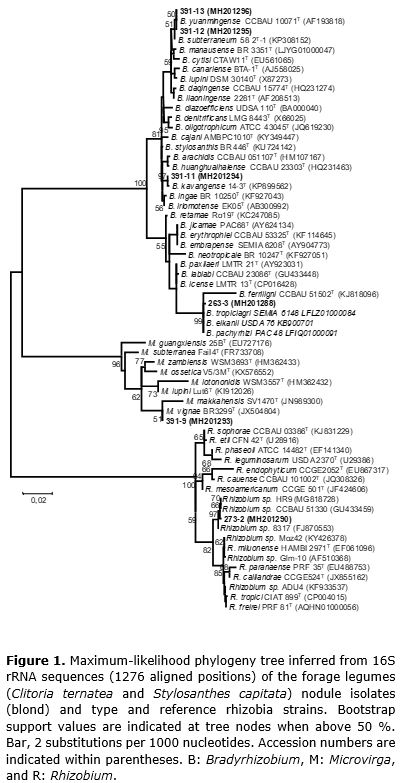
<p><font face = "Verdana" size = "2">A phylogenetic analysis based on the 16S rRNA gene was performed
with the isolates obtained in the present study, which belong to the known legume-nodulating
bacteria genera <i>Bradyrhizobium</i>, <i>Microvirga</i>, and <i>Rhizobium</i> (<a href = "/img/revistas/rca/v41n3/v41n3a04t1.jpg" target = "_blank">Table
1</a>). The maximum likelihood separated the isolates into five different lineages (<a href = "#f1">Figure
1</a>). <i>S. capitata</i> isolates 391-11, 391-12, and 391-13 were placed into the
large subgroup I of the <i>Bradyrhizobium</i> genus (Menna <i>et al</i>., 2009),
with 391-12 and 391-13 isolates correlated with <i>Bradyrhizobium yuanmingense</i>,
and isolate 391-11 strongly affiliated (97% of bootstrap) with <i>Bradyrhizobium
kavangense</i>. The <i>S. capitata</i> isolate 391-9 was phylogenetically close
to <i>Microvirga</i> <i>vignae</i> BR3299<sup>T</sup>, a cowpea symbiont isolated
from semiarid region in Brazil (Radl <i>et al</i>., 2014).</font></p>

    
<p>&nbsp;</p>

<a name = "f1"><img src = "/img/revistas/rca/v41n3/v41n3a04f1.jpg" target = "_blank"></a>

    
]]></body>
<body><![CDATA[<p>&nbsp;</p>

    <p><font face = "Verdana" size = "2"><i>Stylosanthes</i> spp. are typically nodulated
by &#945;-Proteobacteria (Date, 2010), mainly belonging to the genus <i>Bradyrhizobium</i>
(Ramesh <i>et al.,</i> 2004). Recently, &#946;- Proteobacteria members were isolated
from <i>Stylosanthes </i>nodules (Chaves <i>et al</i>., 2016), expanding the knowledge
of the symbiotic capacity of <i>Stylosanthes</i> species. In the present study,
we report the symbiotic capacity of <i>S. capitata</i> to form symbiosis with <i>Microvirga</i>,
an &#945;-Proteobacteria genus with members reported as legume-nodulating symbionts
(Ardley <i>et al.,</i> 2012; Radl <i>et al</i>., 2014; Msaddak <i>et al</i>., 2017a,
b, Safronova <i>et al</i>., 2017).</font></p>

    <p><font face = "Verdana" size = "2">In addition to its genotypic characteristic, isolate 391-9 showed phenotypic similarities
with other representatives of the genus <i>Microvirga</i>, such as growth in YMA
culture medium for a period longer than three days, inability to hydrolyze starch,
susceptibility to the antibiotics streptomycin, rifampicin, erythromycin, and chloramphenicol,
maximum temperature range tolerated (approximately 43°C), and carbon sources used
(<a href = "/img/revistas/rca/v41n3/v41n3a04t1.jpg" target = "_blank">Tables 1</a>, <a href = "/img/revistas/rca/v41n3/v41n3a04t2.jpg" target = "_blank">2</a>, and <a href = "/img/revistas/rca/v41n3/v41n3a04t3.jpg" target = "_blank">3</a>) (Ardley <i>et al.,</i> 2012; Radl <i>et al.,</i> 2014).</font></p>


<p><font face = "Verdana" size = "2">The <i>C. ternatea</i> isolate 263-3 fell into
the cluster of the species <i>B. tropiciagri</i>, <i>B. elkanii</i>, and <i>B. pachyrhizi
</i>(<a href = "#f1">Figure 1</a>), which compose subgroup II of the <i>Bradyrhizobium</i> genus (Menna
<i>et al</i>., 2009). However, <i>C. ternatea</i> isolate 273-2 clustered within
the genus <i>Rhizobium</i> with a group of strains isolated from tropical soils
related to previously described species.</font></p>


    <p><font face = "Verdana" size = "3"><b>CONCLUSION</b></font></p>


    <p><font face = "Verdana" size = "2">On the basis of these data, we conclude that <i>Clitoria
ternatea</i> and <i>Stylosanthes capitata </i>nodules harbor symbiotic rhizobia
and nonrhizobia endophytic bacteria that are phenotypically and genotypically diverse.
<i>Clitoria ternatea </i>is nodulated by <i>Rizobium</i> and <i>Bradyrizobium</i>
members and host nonrhizobia endophytes. <i>Stylosanthes capitata</i> root nodule
symbionts primarily belong to <i>Bradyrizobium</i> within two lineages: <i>B. yuanmingense</i>
and <i>B. kavangense</i>. Moreover, <i>S. capitata</i> is nodulated by <i>Microvirga</i>
in the semiarid soils of Brazil.</font></p>

    <p>&nbsp;</p>

    <p><font face = "Verdana" size = "3"><b>REFERENCES</b></font></p>


    <!-- ref --><p><font face = "Verdana" size = "2">Aeron, A.; Chauhan, P.S.; Dubey, R.C.; Maheshwari,
D.K.; Bajpai, V.K. (2015) - Root nodule bacteria from <i>Clitoria ternatea</i> L.
are putative invasive nonrhizobial endophytes. <i>Canadian Journal of Microbiology</i>,
vol. 61, n. 2, p. 131-142. <a href = "https://doi.org/10.1139/cjm-2014-0483" target = "_blank">https://doi.org/10.1139/cjm-2014-0483</a></font>&nbsp;&nbsp;&nbsp;&nbsp;&nbsp;&nbsp;&nbsp;&nbsp;[&#160;<a href="javascript:void(0);" onclick="javascript: window.open('/scielo.php?script=sci_nlinks&ref=684407&pid=S0871-018X201800030000400001&lng=','','width=640,height=500,resizable=yes,scrollbars=1,menubar=yes,');">Links</a>&#160;]<!-- end-ref --><!-- ref --><p><font face = "Verdana" size = "2">Ali, S.F.; Rawat, L.S.; Meghvansi, M.K. &amp; Mahna, S.K.
(2009) - Selection of stress-tolerant rhizobial isolates of wild legumes growing
in dry regions of Rajasthan, India. <i>ARPN Journal of Agricultural and Biological
Science</i>, vol. 4, n. 1, p. 13-18.    &nbsp;&nbsp;&nbsp;&nbsp;&nbsp;&nbsp;&nbsp;&nbsp;[&#160;<a href="javascript:void(0);" onclick="javascript: window.open('/scielo.php?script=sci_nlinks&ref=684408&pid=S0871-018X201800030000400002&lng=','','width=640,height=500,resizable=yes,scrollbars=1,menubar=yes,');">Links</a>&#160;]<!-- end-ref --></font></p>

    <!-- ref --><p><font face = "Verdana" size = "2">Ardley, J.K.; Parker, M.A.; De Meyer, S.E.; Trengove, R.D.; O'Hara, G.W.; Reeve,
W.G.; Yates, R.J.; Dilworth, M.J.; Willems, A. &amp; Howieson, J.G. (2012) – <i>Microvirga
lupini</i> sp. nov., <i>Microvirga lotononidis</i> sp. nov. and <i>Microvirga zambiensis</i>
sp. nov. are alphaproteobacterial root-nodule bacteria that specifically nodulate
and fix nitrogen with geographically and taxonomically separate legume hosts. <i>International
Journal of Systematic and Evolutionary Microbiology</i>, vol. 62, p. 2579-2588.
<a href = "http://dx.doi.org/10.1099/ijs.0.035097-0" target = "_blank">http://dx.doi.org/10.1099/ijs.0.035097-0</a></font>&nbsp;&nbsp;&nbsp;&nbsp;&nbsp;&nbsp;&nbsp;&nbsp;[&#160;<a href="javascript:void(0);" onclick="javascript: window.open('/scielo.php?script=sci_nlinks&ref=684410&pid=S0871-018X201800030000400003&lng=','','width=640,height=500,resizable=yes,scrollbars=1,menubar=yes,');">Links</a>&#160;]<!-- end-ref --><!-- ref --><p><font face = "Verdana" size = "2">Bauer, A.W.; Kirby, W.M.M.; Sherris, J.C. &amp; Turck, M. (1966) - Antibiotic
susceptibility testing by it standardized disk method. <i>American Journal of Clinical
Pathology</i>, vol. 45, n. 4, p. 493-496.    &nbsp;&nbsp;&nbsp;&nbsp;&nbsp;&nbsp;&nbsp;&nbsp;[&#160;<a href="javascript:void(0);" onclick="javascript: window.open('/scielo.php?script=sci_nlinks&ref=684411&pid=S0871-018X201800030000400004&lng=','','width=640,height=500,resizable=yes,scrollbars=1,menubar=yes,');">Links</a>&#160;]<!-- end-ref --></font></p>

    <!-- ref --><p><font face = "Verdana" size = "2">Cardoso, J.D.; Hungria, M. &amp; Andrade, D.S. (2012) - Polyphasic approach
for the characterization of rhizobial symbionts effective in fixing N<sub>2</sub>
with common bean (<i>Phaseolus vulgaris</i> L.). <i>Applied Microbiology and Biotechnology</i>,
vol. 93, n. 5, p. 2035-2049. <a href = "https://doi.org/10.1007/s00253-011-3708-2" target = "_blank">https://doi.org/10.1007/s00253-011-3708-2</a></font>&nbsp;&nbsp;&nbsp;&nbsp;&nbsp;&nbsp;&nbsp;&nbsp;[&#160;<a href="javascript:void(0);" onclick="javascript: window.open('/scielo.php?script=sci_nlinks&ref=684413&pid=S0871-018X201800030000400005&lng=','','width=640,height=500,resizable=yes,scrollbars=1,menubar=yes,');">Links</a>&#160;]<!-- end-ref --><!-- ref --><p><font face = "Verdana" size = "2">Castellane, T.C.L. &amp; Lemos, E.G.M. (2007)
- Composição de exopolissacarídeos produzidos por estirpes de rizóbios cultivados
em diferentes fontes de carbono. <i>Pesquisa Agropecuária Brasileira</i>, vol. 42,
n. 10, p. 1503-1506. <a href = "http://dx.doi.org/10.1590/S0100-204X2007001000019" target = "_blank">http://dx.doi.org/10.1590/S0100-204X2007001000019</a></font>&nbsp;&nbsp;&nbsp;&nbsp;&nbsp;&nbsp;&nbsp;&nbsp;[&#160;<a href="javascript:void(0);" onclick="javascript: window.open('/scielo.php?script=sci_nlinks&ref=684414&pid=S0871-018X201800030000400006&lng=','','width=640,height=500,resizable=yes,scrollbars=1,menubar=yes,');">Links</a>&#160;]<!-- end-ref --><!-- ref --><p><font face = "Verdana" size = "2">Chagas Júnior, A.F.; Oliveira, L.A. &amp; Oliveira,
A.N. (2009) - Produção de ácido indolacético por rizóbios isolados de caupi. <i>Revista
Ceres</i>, vol. 56, n. 6, p. 812-817.    &nbsp;&nbsp;&nbsp;&nbsp;&nbsp;&nbsp;&nbsp;&nbsp;[&#160;<a href="javascript:void(0);" onclick="javascript: window.open('/scielo.php?script=sci_nlinks&ref=684415&pid=S0871-018X201800030000400007&lng=','','width=640,height=500,resizable=yes,scrollbars=1,menubar=yes,');">Links</a>&#160;]<!-- end-ref --></font></p>

    <!-- ref --><p><font face = "Verdana" size = "2">Chaves,
J. S.; Baraúna, A. C.; Mosqueira, C. A.; Gianluppi, V.; Zilli, J. E. &amp; Silva,
K. (2016) - Stylosanthes spp. from Amazon savanna harbour diverse and potentially
effective rhizobia. <i>Applied Soil Ecology</i>, <i></i>vol. 108, p. 54–61</font>&nbsp;&nbsp;&nbsp;&nbsp;&nbsp;&nbsp;&nbsp;&nbsp;[&#160;<a href="javascript:void(0);" onclick="javascript: window.open('/scielo.php?script=sci_nlinks&ref=684417&pid=S0871-018X201800030000400008&lng=','','width=640,height=500,resizable=yes,scrollbars=1,menubar=yes,');">Links</a>&#160;]<!-- end-ref --><!-- ref --><p><font face = "Verdana" size = "2">Coatti,
G.C.; Andrade, D.S.; Cardoso, J.D. &amp; Matos, M.A. (2010) - Produção de AIA e
Diversidade Fenotípica de Estirpes Elite de Rizóbio Isoladas de Feijoeiro. <i>Científica
Ciências Biológicas e da Saúde</i>, vol. 12, n. 1, p. 49-53.    &nbsp;&nbsp;&nbsp;&nbsp;&nbsp;&nbsp;&nbsp;&nbsp;[&#160;<a href="javascript:void(0);" onclick="javascript: window.open('/scielo.php?script=sci_nlinks&ref=684418&pid=S0871-018X201800030000400009&lng=','','width=640,height=500,resizable=yes,scrollbars=1,menubar=yes,');">Links</a>&#160;]<!-- end-ref --></font></p>

    <!-- ref --><p><font face = "Verdana" size = "2">Date, R.A. (2010) - <i>Bradyrhizobium</i> effectiveness responses
in <i>Stylosanthes hamata</i> and <i>S. seabrana</i>. <i>Tropical Grasslands</i>,
vol. 44, p. 141-157.    &nbsp;&nbsp;&nbsp;&nbsp;&nbsp;&nbsp;&nbsp;&nbsp;[&#160;<a href="javascript:void(0);" onclick="javascript: window.open('/scielo.php?script=sci_nlinks&ref=684420&pid=S0871-018X201800030000400010&lng=','','width=640,height=500,resizable=yes,scrollbars=1,menubar=yes,');">Links</a>&#160;]<!-- end-ref --></font></p>

    <!-- ref --><p><font face = "Verdana" size = "2">Felsenstein,
J. (1985) - Confidence limits on phylogenies: An approach using the bootstrap. <i>Evolution</i>,
vol. 39, n. 4, p. 783-791. <a href = "https://doi.org/10.1111/j.1558-5646.1985.tb00420.x" target = "_blank">https://doi.org/10.1111/j.1558-5646.1985.tb00420.x</a></font>&nbsp;&nbsp;&nbsp;&nbsp;&nbsp;&nbsp;&nbsp;&nbsp;[&#160;<a href="javascript:void(0);" onclick="javascript: window.open('/scielo.php?script=sci_nlinks&ref=684422&pid=S0871-018X201800030000400011&lng=','','width=640,height=500,resizable=yes,scrollbars=1,menubar=yes,');">Links</a>&#160;]<!-- end-ref --><!-- ref --><p><font face = "Verdana" size = "2">Fernandes Júnior, P.I.; Lima, A.A.; Araújo, J.L.S.;
Rumjanek, N.G. &amp; Xavier, G.R. (2012) - Phenotypic diversity and amylolytic activity
of fast growing rhizobia from pigeonpea [<i>Cajanus cajan </i>(L.) Millsp.]. <i>Brazilian
Journal of Microbiology</i>, vol. 43 n. 4, p. 1604-1612. <a href = "http://dx.doi.org/10.1590/S1517-83822012000400045" target = "_blank">http://dx.doi.org/10.1590/S1517-83822012000400045</a></font>&nbsp;&nbsp;&nbsp;&nbsp;&nbsp;&nbsp;&nbsp;&nbsp;[&#160;<a href="javascript:void(0);" onclick="javascript: window.open('/scielo.php?script=sci_nlinks&ref=684423&pid=S0871-018X201800030000400012&lng=','','width=640,height=500,resizable=yes,scrollbars=1,menubar=yes,');">Links</a>&#160;]<!-- end-ref --><!-- ref --><p><font face = "Verdana" size = "2">Fernandes, M.F. &amp; Fernandes, R.P.M. (2000)
- Seleção inicial e caracterização parcial de rizóbios de tabuleiros costeiros quando
associados ao guandu. <i>Revista Brasileira de Ciência do Solo</i>, vol. 24, n.
2, p. 321-327. <a href = "http://dx.doi.org/10.1590/S0100-06832000000200009" target = "_blank">http://dx.doi.org/10.1590/S0100-06832000000200009</a></font>&nbsp;&nbsp;&nbsp;&nbsp;&nbsp;&nbsp;&nbsp;&nbsp;[&#160;<a href="javascript:void(0);" onclick="javascript: window.open('/scielo.php?script=sci_nlinks&ref=684424&pid=S0871-018X201800030000400013&lng=','','width=640,height=500,resizable=yes,scrollbars=1,menubar=yes,');">Links</a>&#160;]<!-- end-ref --><!-- ref --><p><font face = "Verdana" size = "2">Fernandes, M.F.; Fernandes, R.P.M. &amp; Hungria, M. (2003)
- Seleção de rizóbios nativos para guandu, caupi e feijão-de-porco nos tabuleiros
costeiros de Sergipe. <i>Pesquisa Agropecuária Brasileira</i>, vol. 38, n. 7, p.
835-842. <a href = "http://dx.doi.org/10.1590/S0100-204X2003000700007" target = "_blank">http://dx.doi.org/10.1590/S0100-204X2003000700007</a></font>&nbsp;&nbsp;&nbsp;&nbsp;&nbsp;&nbsp;&nbsp;&nbsp;[&#160;<a href="javascript:void(0);" onclick="javascript: window.open('/scielo.php?script=sci_nlinks&ref=684425&pid=S0871-018X201800030000400014&lng=','','width=640,height=500,resizable=yes,scrollbars=1,menubar=yes,');">Links</a>&#160;]<!-- end-ref --><!-- ref --><p><font face = "Verdana" size = "2">Ferreira, D.F. (2011) - SISVAR: a computer statistical analysis
system. <i>Ciência e Agrotecnologia</i>, vol. 35, n. 6, p. 1039–1042. <a href = "http://dx.doi.org/10.1590/S1413-70542011000600001" target = "_blank">http://dx.doi.org/10.1590/S1413-70542011000600001</a></font>&nbsp;&nbsp;&nbsp;&nbsp;&nbsp;&nbsp;&nbsp;&nbsp;[&#160;<a href="javascript:void(0);" onclick="javascript: window.open('/scielo.php?script=sci_nlinks&ref=684426&pid=S0871-018X201800030000400015&lng=','','width=640,height=500,resizable=yes,scrollbars=1,menubar=yes,');">Links</a>&#160;]<!-- end-ref --><!-- ref --><p><font face = "Verdana" size = "2">Guimarães, A. A.; Jaramillo, P. M. D.; Nóbrega,
R. S. A.; Florentino, L. A.; Silva, K. B.; Moreira, F. M. S. (2012) - Genetic and
Symbiotic Diversity of Nitrogen-Fixing Bacteria Isolated from Agricultural Soils
in the Western Amazon by Using Cowpea as the Trap Plant. <i>Applied and Environmental</i>
<i>Microbiology</i>, vol. 78, p.6726-6733.    &nbsp;&nbsp;&nbsp;&nbsp;&nbsp;&nbsp;&nbsp;&nbsp;[&#160;<a href="javascript:void(0);" onclick="javascript: window.open('/scielo.php?script=sci_nlinks&ref=684427&pid=S0871-018X201800030000400016&lng=','','width=640,height=500,resizable=yes,scrollbars=1,menubar=yes,');">Links</a>&#160;]<!-- end-ref --></font></p>

    ]]></body>
<body><![CDATA[<!-- ref --><p><font face = "Verdana" size = "2">Hankin, L. &amp; Anagnostakis, S.L. (1975) - The use of solid media for
detection of enzymes production by fungi. <i>Mycologia</i>, vol. 67, n. 3, p. 597-607.
<a href = "http://dx.doi.org/10.2307/3758395" target = "_blank">http://dx.doi.org/10.2307/3758395</a></font>&nbsp;&nbsp;&nbsp;&nbsp;&nbsp;&nbsp;&nbsp;&nbsp;[&#160;<a href="javascript:void(0);" onclick="javascript: window.open('/scielo.php?script=sci_nlinks&ref=684429&pid=S0871-018X201800030000400017&lng=','','width=640,height=500,resizable=yes,scrollbars=1,menubar=yes,');">Links</a>&#160;]<!-- end-ref --><!-- ref --><p><font face = "Verdana" size = "2">IBGE (2017) - <i>Estimativa da população dos municípios do semiárido brasileiro</i>.
Instituto Brasileiro de Geografia e Estatística. [cit. 2018.03.26]. &lt;<a href = "https://sidra.ibge.gov.br" target = "_blank">https://sidra.ibge.gov.br</a>&gt;    &nbsp;&nbsp;&nbsp;&nbsp;&nbsp;&nbsp;&nbsp;&nbsp;[&#160;<a href="javascript:void(0);" onclick="javascript: window.open('/scielo.php?script=sci_nlinks&ref=684430&pid=S0871-018X201800030000400018&lng=','','width=640,height=500,resizable=yes,scrollbars=1,menubar=yes,');">Links</a>&#160;]<!-- end-ref --></font></p>


    <!-- ref --><p><font face = "Verdana" size = "2">Keneni, A.; Assefa, F. &amp; Prabu, P.C. (2010)
- Characterization of acid and salt tolerant rhizobial strains isolated from faba
bean fields of Wollo, Northern Ethiopia. <i>Journal of Agricultural Science and
Technology</i>, vol. 12, n. 3, p. 365-376.    &nbsp;&nbsp;&nbsp;&nbsp;&nbsp;&nbsp;&nbsp;&nbsp;[&#160;<a href="javascript:void(0);" onclick="javascript: window.open('/scielo.php?script=sci_nlinks&ref=684432&pid=S0871-018X201800030000400019&lng=','','width=640,height=500,resizable=yes,scrollbars=1,menubar=yes,');">Links</a>&#160;]<!-- end-ref --></font></p>

    <!-- ref --><p><font face = "Verdana" size = "2">Küçük, Ç.; Kivanç, E. &amp; Kinaci, E. (2006) - Characterization of <i>Rhizobium</i>
sp. isolated from bean. <i>Turkish Journal of Biology</i>, vol. 30, p. 127-132.    &nbsp;&nbsp;&nbsp;&nbsp;&nbsp;&nbsp;&nbsp;&nbsp;[&#160;<a href="javascript:void(0);" onclick="javascript: window.open('/scielo.php?script=sci_nlinks&ref=684434&pid=S0871-018X201800030000400020&lng=','','width=640,height=500,resizable=yes,scrollbars=1,menubar=yes,');">Links</a>&#160;]<!-- end-ref --></font></p>

    <!-- ref --><p><font face = "Verdana" size = "2">Kumari, B.S.; Ram, M. R. &amp; Mallaiah,
K.V. (2009) - Studies on exopolysaccharide and indole acetic acid production by
<i>Rhizobium</i> strains from <i>Indigofera</i>. <i>African Journal of Microbiology
Research</i>, vol. 3, n. 1, p. 10-14.    &nbsp;&nbsp;&nbsp;&nbsp;&nbsp;&nbsp;&nbsp;&nbsp;[&#160;<a href="javascript:void(0);" onclick="javascript: window.open('/scielo.php?script=sci_nlinks&ref=684436&pid=S0871-018X201800030000400021&lng=','','width=640,height=500,resizable=yes,scrollbars=1,menubar=yes,');">Links</a>&#160;]<!-- end-ref --></font></p>

    <!-- ref --><p><font face = "Verdana" size = "2">Kumari, B.S.; Ram, M.R. &amp; Mallaiah, K.V. (2010) - Studies on nodulation,
biochemical analysis and protein profiles of <i>Rhizobium</i> isolated from <i>Indigofera</i>
species. <i>Malaysian Journal of Microbiology</i>, vol. 6, n. 2, p. 133-139. <a href = "http://dx.doi.org/10.21161/mjm.20109" target = "_blank">http://dx.doi.org/10.21161/mjm.20109</a></font>&nbsp;&nbsp;&nbsp;&nbsp;&nbsp;&nbsp;&nbsp;&nbsp;[&#160;<a href="javascript:void(0);" onclick="javascript: window.open('/scielo.php?script=sci_nlinks&ref=684438&pid=S0871-018X201800030000400022&lng=','','width=640,height=500,resizable=yes,scrollbars=1,menubar=yes,');">Links</a>&#160;]<!-- end-ref --><!-- ref --><p><font face = "Verdana" size = "2">Leite, J.; Seido, S.L.; Passos, S.R.; Xavier,
G.R.; Runjaneck, N.G. &amp; Martins, L.M.V. (2009) - Biodiversity of rhizobia associated
with cowpea cultivars in soils of the lower half of the São Francisco River Valley.
<i>Revista Brasileira de Ciência do Solo</i>, vol. 33, n. 5, 1215-1226. <a href = "http://dx.doi.org/10.1590/S0100-06832009000500015" target = "_blank">http://dx.doi.org/10.1590/S0100-06832009000500015</a></font>&nbsp;&nbsp;&nbsp;&nbsp;&nbsp;&nbsp;&nbsp;&nbsp;[&#160;<a href="javascript:void(0);" onclick="javascript: window.open('/scielo.php?script=sci_nlinks&ref=684439&pid=S0871-018X201800030000400023&lng=','','width=640,height=500,resizable=yes,scrollbars=1,menubar=yes,');">Links</a>&#160;]<!-- end-ref --><!-- ref --><p><font face = "Verdana" size = "2">Lima, G.F.C.; Araújo, G.G.L. &amp; Maciel, F.C.
(2009) - Produção e conservação de forragens para sustentabilidade dos rebanhos
1 caprinos e ovinos na base da agricultura familiar. <i>Revista Tecnologia &amp;
Ciência Agropecuária</i>, vol. 3, n. 4, p. 43-53.    &nbsp;&nbsp;&nbsp;&nbsp;&nbsp;&nbsp;&nbsp;&nbsp;[&#160;<a href="javascript:void(0);" onclick="javascript: window.open('/scielo.php?script=sci_nlinks&ref=684440&pid=S0871-018X201800030000400024&lng=','','width=640,height=500,resizable=yes,scrollbars=1,menubar=yes,');">Links</a>&#160;]<!-- end-ref --></font></p>

    <!-- ref --><p><font face = "Verdana" size = "2">Machado, R.G.; Sá, E.L.S.; Damasceno, R.G.; Hahn, L.; Almeida,
D.; Moraes, T.; Camargo, F.A.O. &amp; Reartes, D.S. (2011) - Promoção de crescimento
de <i>Lotus corniculatus</i> L. e <i>Avena strigosa</i> Schreb pela inoculação conjunta
de <i>Trichoderma harzianum</i> e rizóbio. <i>Ciência e Natura UFMS</i>, vol. 33,
n. 2, p. 111-126. <a href = "http://dx.doi.org/10.5902/2179460X9365" target = "_blank">http://dx.doi.org/10.5902/2179460X9365</a></font>&nbsp;&nbsp;&nbsp;&nbsp;&nbsp;&nbsp;&nbsp;&nbsp;[&#160;<a href="javascript:void(0);" onclick="javascript: window.open('/scielo.php?script=sci_nlinks&ref=684442&pid=S0871-018X201800030000400025&lng=','','width=640,height=500,resizable=yes,scrollbars=1,menubar=yes,');">Links</a>&#160;]<!-- end-ref --><!-- ref --><p><font face = "Verdana" size = "2">Menezes, K.A.S.; Nunes, G.F.O.; Sampaio, A.A.; Silva, A.F.;
Souza, L.S.B.; Gava, C.A.T.; Martins, L.M.V. &amp; Fernandes-Junior, P.I. (2016)
- Diversity of new root nodule bacteria from Erythrina velutina Willd., a native
legume from the dry forest Caatinga (Northeastern, Brazil). Revista de Ciências
Agrárias, vol. 39, n. 2, p. 222-33. <a href = "http://dx.doi.org/10.19084/RCA15050" target = "_blank">http://dx.doi.org/10.19084/RCA15050</a></font>&nbsp;&nbsp;&nbsp;&nbsp;&nbsp;&nbsp;&nbsp;&nbsp;[&#160;<a href="javascript:void(0);" onclick="javascript: window.open('/scielo.php?script=sci_nlinks&ref=684443&pid=S0871-018X201800030000400026&lng=','','width=640,height=500,resizable=yes,scrollbars=1,menubar=yes,');">Links</a>&#160;]<!-- end-ref --><!-- ref --><p><font face = "Verdana" size = "2">Menna, P.; Barcellos, F. G.; Hungria, M. (2009)
- Phylogeny and taxonomy of a diverse collection of <i>Bradyrhizobium</i> strains
based on multilocus sequence analysis of the 16S rRNA gene, ITS region and <i>glnII</i>,
<i>recA</i>, <i>atpD</i> and <i>dnaK</i> genes. <i>International Journal of Systematic
and Evolutionary Microbiology</i>, vol. 59, n. 12, p. 2934-2950. <a href = "http://dx.doi.org/10.1099/ijs.0.009779-0" target = "_blank">http://dx.doi.org/10.1099/ijs.0.009779-0</a></font>&nbsp;&nbsp;&nbsp;&nbsp;&nbsp;&nbsp;&nbsp;&nbsp;[&#160;<a href="javascript:void(0);" onclick="javascript: window.open('/scielo.php?script=sci_nlinks&ref=684444&pid=S0871-018X201800030000400027&lng=','','width=640,height=500,resizable=yes,scrollbars=1,menubar=yes,');">Links</a>&#160;]<!-- end-ref --><!-- ref --><p><font face = "Verdana" size = "2">Mistura, C.; Oliveira, J.M.; Souza,
T.C.; Vieira, P.A.S.; Lima, A.R.S.; Oliveira, F.A.; Dourado, D.L. &amp; Silva, R.M.
(2010) – Adubação orgânica no cultivo da Cunhã na região semiárida do Brasil. <i>Revista
Brasileira de Saúde e Produção Animal</i>, vol. 11, n. 3, p. 581-594.    &nbsp;&nbsp;&nbsp;&nbsp;&nbsp;&nbsp;&nbsp;&nbsp;[&#160;<a href="javascript:void(0);" onclick="javascript: window.open('/scielo.php?script=sci_nlinks&ref=684445&pid=S0871-018X201800030000400028&lng=','','width=640,height=500,resizable=yes,scrollbars=1,menubar=yes,');">Links</a>&#160;]<!-- end-ref --></font></p>

    <!-- ref --><p><font face = "Verdana" size = "2">Moreira, F.M.S. &amp; Siqueira, J.O. (2006) - <i>Microbiologia
e Bioquímica do Solo. </i>2ª ed. UFLA, Lavras, 729 p.    &nbsp;&nbsp;&nbsp;&nbsp;&nbsp;&nbsp;&nbsp;&nbsp;[&#160;<a href="javascript:void(0);" onclick="javascript: window.open('/scielo.php?script=sci_nlinks&ref=684447&pid=S0871-018X201800030000400029&lng=','','width=640,height=500,resizable=yes,scrollbars=1,menubar=yes,');">Links</a>&#160;]<!-- end-ref --></font></p>

    ]]></body>
<body><![CDATA[<!-- ref --><p><font face = "Verdana" size = "2">Msaddak, A.; Durán, D.; Rejili, M.; Mars, M.; Ruiz-Argüeso, T.;
Imperial J.; Palacios, J.M. &amp; Rey, L. (2017a) - Diverse Bacteria Affiliated
with the Genera <i>Microvirga</i>, <i>Phyllobacterium</i>, and <i>Bradyrhizobium</i>
Nodulate <i>Lupinus</i> <i>micranthus</i> Growing in Soils of Northern Tunisia.
<i>Applied and Environmental Microbiology</i>, v. 83, n. 6, art. e02820-16. <a href = "https://doi.org/10.1128/AEM.02820-16" target = "_blank">https://doi.org/10.1128/AEM.02820-16</a></font>&nbsp;&nbsp;&nbsp;&nbsp;&nbsp;&nbsp;&nbsp;&nbsp;[&#160;<a href="javascript:void(0);" onclick="javascript: window.open('/scielo.php?script=sci_nlinks&ref=684449&pid=S0871-018X201800030000400030&lng=','','width=640,height=500,resizable=yes,scrollbars=1,menubar=yes,');">Links</a>&#160;]<!-- end-ref --><!-- ref --><p><font face = "Verdana" size = "2">Msaddak, A.; Rejili, M.; Durán, D.; Rey, L.; Imperial
J.; Palacios, J.M.; Ruiz-Argüeso, T. &amp; Mars, M. (2017b) - Members of <i>Microvirga</i>
and <i>Bradyrhizobium</i> genera are native endosymbiotic bacteria nodulating <i>Lupinus</i>
<i>luteus</i> in Northern Tunisian soils. <i>FEMS Microbiology Ecology</i>, vol.
93, n. 6, fix068. <a href = "https://doi.org/10.1093/femsec/fix068" target = "_blank">https://doi.org/10.1093/femsec/fix068</a></font>&nbsp;&nbsp;&nbsp;&nbsp;&nbsp;&nbsp;&nbsp;&nbsp;[&#160;<a href="javascript:void(0);" onclick="javascript: window.open('/scielo.php?script=sci_nlinks&ref=684450&pid=S0871-018X201800030000400031&lng=','','width=640,height=500,resizable=yes,scrollbars=1,menubar=yes,');">Links</a>&#160;]<!-- end-ref --><!-- ref --><p><font face = "Verdana" size = "2">Muresu, R.; Polone, E.; Sulas, L.; Baldan, B.; Tondello,
A.; Delogu, G.; Cappuccinelli, P.; Alberghini, S.; Benhizia, Y.; Benhizia, H.; Benguedouar,
A.; Mori, B.; Calamassi, R.; Dazzo, F.B. &amp; Squartini, A. (2008) - Coexistence
of predominantly nonculturable rhizobia with diverse, endophytic bacterial taxa
within nodules of wild legumes.<i> FEMS Microbiology Ecology</i>, vol. 63, n. 3,
p. 383-400. <a href = "http://dx.doi.org/10.1111/j.1574-6941.2007.00424.x" target = "_blank">http://dx.doi.org/10.1111/j.1574-6941.2007.00424.x</a></font>&nbsp;&nbsp;&nbsp;&nbsp;&nbsp;&nbsp;&nbsp;&nbsp;[&#160;<a href="javascript:void(0);" onclick="javascript: window.open('/scielo.php?script=sci_nlinks&ref=684451&pid=S0871-018X201800030000400032&lng=','','width=640,height=500,resizable=yes,scrollbars=1,menubar=yes,');">Links</a>&#160;]<!-- end-ref --><!-- ref --><p><font face = "Verdana" size = "2">Norris, D. O.; Date, R.A. (1976) - Legume Bacteriology.
In: SHAM, N. H.; BRYAN, W. W. (ed). <i>Tropical Pasture Research – Principles
and Methods</i>. Hurley: COMMONWEALT BUREAU OF PASTURES AND FIELD CROPS. p. 134-174.
(bulletin, 51).    &nbsp;&nbsp;&nbsp;&nbsp;&nbsp;&nbsp;&nbsp;&nbsp;[&#160;<a href="javascript:void(0);" onclick="javascript: window.open('/scielo.php?script=sci_nlinks&ref=684452&pid=S0871-018X201800030000400033&lng=','','width=640,height=500,resizable=yes,scrollbars=1,menubar=yes,');">Links</a>&#160;]<!-- end-ref --></font></p>

    <!-- ref --><p><font face = "Verdana" size = "2">Oliveira, A.N.; Oliveira,
L.A.; Andrade, J.S. &amp; Chagas Júnior, A.F. (2006a) - Atividade enzimática de
isolados de rizóbia nativos da amazônia central crescendo em diferentes níveis de
acidez. <i>Ciência e Tecnologia de Alimentos</i>, vol. 26, n. 1, p. 204-210. <a href = "http://dx.doi.org/10.1590/S0101-20612006000100032" target = "_blank">http://dx.doi.org/10.1590/S0101-20612006000100032</a></font>&nbsp;&nbsp;&nbsp;&nbsp;&nbsp;&nbsp;&nbsp;&nbsp;[&#160;<a href="javascript:void(0);" onclick="javascript: window.open('/scielo.php?script=sci_nlinks&ref=684454&pid=S0871-018X201800030000400034&lng=','','width=640,height=500,resizable=yes,scrollbars=1,menubar=yes,');">Links</a>&#160;]<!-- end-ref --><!-- ref --><p><font face = "Verdana" size = "2">Oliveira, A.N.; Oliveira, L.A.; Andrade, J.S.
&amp; Chagas Júnior, A.F. (2006b) - Enzimas hidrolíticas extracelulares de isolados
de rizóbia nativos da Amazônia central, Amazonas, Brasil. <i>Ciência e Tecnologia
de Alimentos</i>, vol. 26, n. 4, p. 853-860. <a href = "http://dx.doi.org/10.1590/S0101-20612006000400022" target = "_blank">http://dx.doi.org/10.1590/S0101-20612006000400022</a></font>&nbsp;&nbsp;&nbsp;&nbsp;&nbsp;&nbsp;&nbsp;&nbsp;[&#160;<a href="javascript:void(0);" onclick="javascript: window.open('/scielo.php?script=sci_nlinks&ref=684455&pid=S0871-018X201800030000400035&lng=','','width=640,height=500,resizable=yes,scrollbars=1,menubar=yes,');">Links</a>&#160;]<!-- end-ref --><!-- ref --><p><font face = "Verdana" size = "2">Radl, v.; Simões-Araújo, j.l.; Leite, j.; Passos,
s.r.; Martins, l.m.v.; Xavier, g.r.; Rumjanek, n.g.; Baldan, J.i. &amp; Zilli, J.E.
(2014) - <i>Microvirga</i> <i>vignae</i> sp. nov., a root nodule symbiotic bacterium
isolated from cowpea grown in semi-arid Brazil. <i>International Journal of Systematic
and Evolutionary Microbiology</i>, vol. 64, n. 3, p.725–730. <a href = "http://dx.doi.org/10.1099/ijs.0.053082-0" target = "_blank">http://dx.doi.org/10.1099/ijs.0.053082-0</a></font>&nbsp;&nbsp;&nbsp;&nbsp;&nbsp;&nbsp;&nbsp;&nbsp;[&#160;<a href="javascript:void(0);" onclick="javascript: window.open('/scielo.php?script=sci_nlinks&ref=684456&pid=S0871-018X201800030000400036&lng=','','width=640,height=500,resizable=yes,scrollbars=1,menubar=yes,');">Links</a>&#160;]<!-- end-ref --><!-- ref --><p><font face = "Verdana" size = "2">Rajendran, G.; Sing, F.; Desai,
A.J. &amp; Archana, G. (2008) - Enhanced growth and nodulation of pigeon pea by
co-inoculation of <i>Bacillus</i> strains with <i>Rhizobium</i> spp. <i>Bioresource
Technology</i>, vol. 99, n. 11, p. 4544-4550. <a href = "http://dx.doi.org/10.1016/j.biortech.2007.06.057" target = "_blank">http://dx.doi.org/10.1016/j.biortech.2007.06.057</a></font>&nbsp;&nbsp;&nbsp;&nbsp;&nbsp;&nbsp;&nbsp;&nbsp;[&#160;<a href="javascript:void(0);" onclick="javascript: window.open('/scielo.php?script=sci_nlinks&ref=684457&pid=S0871-018X201800030000400037&lng=','','width=640,height=500,resizable=yes,scrollbars=1,menubar=yes,');">Links</a>&#160;]<!-- end-ref --><!-- ref --><p><font face = "Verdana" size = "2">Ramesh, C.R.; Kulkarni, J.H. &amp; Desale, J.S.
(2004) - Response of <i>Stylosanthes seabrana</i> to <i>Bradyrhizobium</i> inoculation
in India. <i>In</i>: Chakraborty, S. (Ed.) - <i>High-yielding anthracnose-resistant
Stylosanthes for agricultural systems. </i>Camberra: Aciar, Cap. 14, p. 159-162.    &nbsp;&nbsp;&nbsp;&nbsp;&nbsp;&nbsp;&nbsp;&nbsp;[&#160;<a href="javascript:void(0);" onclick="javascript: window.open('/scielo.php?script=sci_nlinks&ref=684458&pid=S0871-018X201800030000400038&lng=','','width=640,height=500,resizable=yes,scrollbars=1,menubar=yes,');">Links</a>&#160;]<!-- end-ref --></font></p>


    <!-- ref --><p><font face = "Verdana" size = "2">Razika, G.; Amira, B.; Yacine, B. &amp; Ammar,
B. (2012) - Influence of carbon source on the production of exopolysaccharides by
<i>Rhizobium sullae</i> and on the nodulation of <i>Hedysarum coronarium</i> L.
legume.<i> African Journal of Microbiology Research</i>, vol. 6, n. 30, p. 5940-5946.
<a href = "http://dx.doi.org/10.5897/AJMR12.393" target = "_blank">http://dx.doi.org/10.5897/AJMR12.393</a></font>&nbsp;&nbsp;&nbsp;&nbsp;&nbsp;&nbsp;&nbsp;&nbsp;[&#160;<a href="javascript:void(0);" onclick="javascript: window.open('/scielo.php?script=sci_nlinks&ref=684460&pid=S0871-018X201800030000400039&lng=','','width=640,height=500,resizable=yes,scrollbars=1,menubar=yes,');">Links</a>&#160;]<!-- end-ref --><!-- ref --><p><font face = "Verdana" size = "2">Robledo, M.; Jiménez-Zurdo, J.I.; Velázquez, E.; Trujillo, M.E.; Zurdo-Piñeiro,
J.L.; Ramírez-Bahena, M.H.; Ramos, B.; Díaz-Mínguez, J.M.; Dazzo, F.; Martínez-Molina,
E. &amp; Mateos, P.F. (2008) - <i>Rhizobium</i> cellulase CelC<sub>2</sub> is essential
for primary symbiotic infection of legume host roots. <i>Proceedings of the National
Academy of Sciences of the United States of America</i>, vol. 105, p. 7064-7069.
<a href = "http://dx.doi.org/10.1073/pnas.0802547105" target = "_blank">http://dx.doi.org/10.1073/pnas.0802547105</a></font>&nbsp;&nbsp;&nbsp;&nbsp;&nbsp;&nbsp;&nbsp;&nbsp;[&#160;<a href="javascript:void(0);" onclick="javascript: window.open('/scielo.php?script=sci_nlinks&ref=684461&pid=S0871-018X201800030000400040&lng=','','width=640,height=500,resizable=yes,scrollbars=1,menubar=yes,');">Links</a>&#160;]<!-- end-ref --><!-- ref --><p><font face = "Verdana" size = "2">Safronova, V.I.; Kuznetsova, I.G.; Sazanova, A.L.; Belimov, A.A.; Andronov,
E.E.; Chirak, E.R.; Osledkin, Y.S.; Onishchuk, O.P.; Kurchak, O.N.; Shaposhnikov,
A.I.; Willems, A. &amp; Tikhonovich, I.A. - (2017) - <i>Microvirga ossetica</i>
sp. nov., a species of rhizobia isolated from root nodules of the legume species
<i>Vicia alpestris </i>Steven. <i>International Journal of Systematic and Evolutionary
Microbiology, </i>vol. 67, p. 94-100. <a href = "http://dx.doi.org/10.1099/ijsem.0.001577" target = "_blank">http://dx.doi.org/10.1099/ijsem.0.001577</a></font>&nbsp;&nbsp;&nbsp;&nbsp;&nbsp;&nbsp;&nbsp;&nbsp;[&#160;<a href="javascript:void(0);" onclick="javascript: window.open('/scielo.php?script=sci_nlinks&ref=684462&pid=S0871-018X201800030000400041&lng=','','width=640,height=500,resizable=yes,scrollbars=1,menubar=yes,');">Links</a>&#160;]<!-- end-ref --><!-- ref --><p><font face = "Verdana" size = "2">Sahasrabudhe, M. (2011) - Screening of rhizobia
for indole acetic acid production. <i>Annals of Biological Research</i>, vol. 2,
n. 4, p. 460-468.    &nbsp;&nbsp;&nbsp;&nbsp;&nbsp;&nbsp;&nbsp;&nbsp;[&#160;<a href="javascript:void(0);" onclick="javascript: window.open('/scielo.php?script=sci_nlinks&ref=684463&pid=S0871-018X201800030000400042&lng=','','width=640,height=500,resizable=yes,scrollbars=1,menubar=yes,');">Links</a>&#160;]<!-- end-ref --></font></p>

    <!-- ref --><p><font face = "Verdana" size = "2">Sarwar, M. &amp;
Kremer, R.J. (1995) - Determination of bacterially derived auxins using a microplate
method. <i>Letters in Applied Microbiology</i>, vol. 20, n. 5, p. 282-285. <a href = "http://dx.doi.org/10.1111/j.1472-765X.1995.tb00446.x" target = "_blank">http://dx.doi.org/10.1111/j.1472-765X.1995.tb00446.x</a></font>&nbsp;&nbsp;&nbsp;&nbsp;&nbsp;&nbsp;&nbsp;&nbsp;[&#160;<a href="javascript:void(0);" onclick="javascript: window.open('/scielo.php?script=sci_nlinks&ref=684465&pid=S0871-018X201800030000400043&lng=','','width=640,height=500,resizable=yes,scrollbars=1,menubar=yes,');">Links</a>&#160;]<!-- end-ref --><!-- ref --><p><font face = "Verdana" size = "2">Schwarz, G. (1978) - Estimating the dimension
of a model. <i>The Annals of Statistics</i>, vol. 6, n. 2, p. 461–464.    &nbsp;&nbsp;&nbsp;&nbsp;&nbsp;&nbsp;&nbsp;&nbsp;[&#160;<a href="javascript:void(0);" onclick="javascript: window.open('/scielo.php?script=sci_nlinks&ref=684466&pid=S0871-018X201800030000400044&lng=','','width=640,height=500,resizable=yes,scrollbars=1,menubar=yes,');">Links</a>&#160;]<!-- end-ref --></font></p>


    <!-- ref --><p><font face = "Verdana" size = "2">Selvakumar, G.; Kundu, S.; Gupta, A.D.; Shouche,
Y.S. &amp; Gupta, H.S. (2008) - Isolation and characterization of nonrhizobial plant
growth promoting bacteria from nodules of kudzu (<i>Pueraria thunbergiana</i>) and
their effect on wheat seedling growth. <i>Current Microbiology</i>, vol. 56, n.
2, p. 134–139. <a href = "http://dx.doi.org/10.1007/s00284-007-9062-z" target = "_blank">http://dx.doi.org/10.1007/s00284-007-9062-z</a></font>&nbsp;&nbsp;&nbsp;&nbsp;&nbsp;&nbsp;&nbsp;&nbsp;[&#160;<a href="javascript:void(0);" onclick="javascript: window.open('/scielo.php?script=sci_nlinks&ref=684468&pid=S0871-018X201800030000400045&lng=','','width=640,height=500,resizable=yes,scrollbars=1,menubar=yes,');">Links</a>&#160;]<!-- end-ref --><!-- ref --><p><font face = "Verdana" size = "2">Shetta, N.D.; Al-Shaharani, T.S. &amp; Abdel-Aal, M. (2011)
- Identification and Characterization of <i>Rhizobium</i> Associated with Woody
Legume Trees Grown under Saudi Arabia Condition. <i>American-Eurasian Journal of
Agricultural &amp; Environmental Sciences</i>, vol. 10, n. 3, p. 410-418.    &nbsp;&nbsp;&nbsp;&nbsp;&nbsp;&nbsp;&nbsp;&nbsp;[&#160;<a href="javascript:void(0);" onclick="javascript: window.open('/scielo.php?script=sci_nlinks&ref=684469&pid=S0871-018X201800030000400046&lng=','','width=640,height=500,resizable=yes,scrollbars=1,menubar=yes,');">Links</a>&#160;]<!-- end-ref --></font></p>


    <!-- ref --><p><font face = "Verdana" size = "2">Stowers, M.D. (1985) - Carbon metabolism in <i>Rhizobium</i>
species.<i> Annual Review of Microbiology</i>, vol. 39, p. 89-108. <a href = "http://dx.doi.org/10.1146/annurev.mi.39.100185.000513" target = "_blank">http://dx.doi.org/10.1146/annurev.mi.39.100185.000513</a></font>&nbsp;&nbsp;&nbsp;&nbsp;&nbsp;&nbsp;&nbsp;&nbsp;[&#160;<a href="javascript:void(0);" onclick="javascript: window.open('/scielo.php?script=sci_nlinks&ref=684471&pid=S0871-018X201800030000400047&lng=','','width=640,height=500,resizable=yes,scrollbars=1,menubar=yes,');">Links</a>&#160;]<!-- end-ref --><!-- ref --><p><font face = "Verdana" size = "2">Stroschein, M.R.D. (2011) - <i>Seleção de rizóbios
e efeito do nitrogênio na simbiose com alfafa e cornichão.</i> Tese de doutoramento.
Porto Alegre, Universidade Federal do Rio Grande do Sul. 140 p.    &nbsp;&nbsp;&nbsp;&nbsp;&nbsp;&nbsp;&nbsp;&nbsp;[&#160;<a href="javascript:void(0);" onclick="javascript: window.open('/scielo.php?script=sci_nlinks&ref=684472&pid=S0871-018X201800030000400048&lng=','','width=640,height=500,resizable=yes,scrollbars=1,menubar=yes,');">Links</a>&#160;]<!-- end-ref --></font></p>

    <!-- ref --><p><font face = "Verdana" size = "2">Tamura, K.; Dudley, J., Nei, M. &amp; Kumar, S. (2007) -
MEGA4: Molecular evolutionary genetics analysis (MEGA) software version 4.0. <i>Molecular
Biology and Evolution</i>, vol. 24, n. 8, p. 1596-1599. <a href = "http://dx.doi.org/10.1093/molbev/msm092" target = "_blank">http://dx.doi.org/10.1093/molbev/msm092</a></font>&nbsp;&nbsp;&nbsp;&nbsp;&nbsp;&nbsp;&nbsp;&nbsp;[&#160;<a href="javascript:void(0);" onclick="javascript: window.open('/scielo.php?script=sci_nlinks&ref=684474&pid=S0871-018X201800030000400049&lng=','','width=640,height=500,resizable=yes,scrollbars=1,menubar=yes,');">Links</a>&#160;]<!-- end-ref --><!-- ref --><p><font face = "Verdana" size = "2">Thompson, J.D.; Higgins, D.G. &amp; Gibson, T.J.
(1994) - CLUSTAL W: improving the sensitivity of progressive multiple sequence alignment
through sequence weighting, position-specific gap penalties and weight matrix choice.
<i>Nucleic Acids Research</i>, vol. 11, n. 22, p. 4673-4680.    &nbsp;&nbsp;&nbsp;&nbsp;&nbsp;&nbsp;&nbsp;&nbsp;[&#160;<a href="javascript:void(0);" onclick="javascript: window.open('/scielo.php?script=sci_nlinks&ref=684475&pid=S0871-018X201800030000400050&lng=','','width=640,height=500,resizable=yes,scrollbars=1,menubar=yes,');">Links</a>&#160;]<!-- end-ref --></font></p>

    <!-- ref --><p><font face = "Verdana" size = "2">Vincent, J.M. (1970) - <i>A manual for the practical study
of root nodule bacteria</i>. IBP Handbook, n. 15, Blackwell, Oxford, 164 p.    &nbsp;&nbsp;&nbsp;&nbsp;&nbsp;&nbsp;&nbsp;&nbsp;[&#160;<a href="javascript:void(0);" onclick="javascript: window.open('/scielo.php?script=sci_nlinks&ref=684477&pid=S0871-018X201800030000400051&lng=','','width=640,height=500,resizable=yes,scrollbars=1,menubar=yes,');">Links</a>&#160;]<!-- end-ref --></font></p>


    ]]></body>
<body><![CDATA[<!-- ref --><p><font face = "Verdana" size = "2">Weisburg, W.G.; Barns, S.M.; Pelletier, D.A. &amp;
Lane, D.J. (1991) - 16S ribosomal DNA amplification for phylogenetic study. <i>Journal
of Bacteriology</i>, vol. 173, n. 2, p. 697&#8209;703. <a href = "https://doi.org/10.1128/jb.173.2.697-703.1991" target = "_blank">https://doi.org/10.1128/jb.173.2.697-703.1991</a></font>&nbsp;&nbsp;&nbsp;&nbsp;&nbsp;&nbsp;&nbsp;&nbsp;[&#160;<a href="javascript:void(0);" onclick="javascript: window.open('/scielo.php?script=sci_nlinks&ref=684479&pid=S0871-018X201800030000400052&lng=','','width=640,height=500,resizable=yes,scrollbars=1,menubar=yes,');">Links</a>&#160;]<!-- end-ref --><p>&nbsp;</p>

    <p><font face = "Verdana" size = "2">Received/recebido: 2017.12.26</font></p>

    <p><font face = "Verdana" size = "2">Received in revised form/recebido em versão revista: 2018.04.24</font></p>

    <p><font face = "Verdana" size = "2">Accepted/aceite: 2018.05.02</font></p>

     ]]></body><back>
<ref-list>
<ref id="B1">
<nlm-citation citation-type="journal">
<person-group person-group-type="author">
<name>
<surname><![CDATA[Aeron]]></surname>
<given-names><![CDATA[A.]]></given-names>
</name>
<name>
<surname><![CDATA[Chauhan]]></surname>
<given-names><![CDATA[P.S.]]></given-names>
</name>
<name>
<surname><![CDATA[Dubey]]></surname>
<given-names><![CDATA[R.C.]]></given-names>
</name>
<name>
<surname><![CDATA[Maheshwari]]></surname>
<given-names><![CDATA[D.K.]]></given-names>
</name>
<name>
<surname><![CDATA[Bajpai]]></surname>
<given-names><![CDATA[V.K.]]></given-names>
</name>
</person-group>
<article-title xml:lang="en"><![CDATA[Root nodule bacteria from Clitoria ternatea L. are putative invasive nonrhizobial endophytes]]></article-title>
<source><![CDATA[Canadian Journal of Microbiology]]></source>
<year>2015</year>
<volume>61</volume>
<numero>2</numero>
<issue>2</issue>
<page-range>131-142</page-range></nlm-citation>
</ref>
<ref id="B2">
<nlm-citation citation-type="journal">
<person-group person-group-type="author">
<name>
<surname><![CDATA[Ali]]></surname>
<given-names><![CDATA[S.F.]]></given-names>
</name>
<name>
<surname><![CDATA[Rawat]]></surname>
<given-names><![CDATA[L.S.]]></given-names>
</name>
<name>
<surname><![CDATA[Meghvansi]]></surname>
<given-names><![CDATA[M.K.]]></given-names>
</name>
<name>
<surname><![CDATA[Mahna]]></surname>
<given-names><![CDATA[S.K.]]></given-names>
</name>
</person-group>
<article-title xml:lang="en"><![CDATA[Selection of stress-tolerant rhizobial isolates of wild legumes growing in dry regions of Rajasthan, India]]></article-title>
<source><![CDATA[ARPN Journal of Agricultural and Biological Science]]></source>
<year>2009</year>
<volume>4</volume>
<numero>1</numero>
<issue>1</issue>
<page-range>13-18</page-range></nlm-citation>
</ref>
<ref id="B3">
<nlm-citation citation-type="journal">
<person-group person-group-type="author">
<name>
<surname><![CDATA[Ardley]]></surname>
<given-names><![CDATA[J.K.]]></given-names>
</name>
<name>
<surname><![CDATA[Parker]]></surname>
<given-names><![CDATA[M.A.]]></given-names>
</name>
<name>
<surname><![CDATA[De Meyer]]></surname>
<given-names><![CDATA[S.E.]]></given-names>
</name>
<name>
<surname><![CDATA[Trengove]]></surname>
<given-names><![CDATA[R.D.]]></given-names>
</name>
<name>
<surname><![CDATA[O'Hara]]></surname>
<given-names><![CDATA[G.W.]]></given-names>
</name>
<name>
<surname><![CDATA[Reeve]]></surname>
<given-names><![CDATA[W.G.]]></given-names>
</name>
<name>
<surname><![CDATA[Yates]]></surname>
<given-names><![CDATA[R.J.]]></given-names>
</name>
<name>
<surname><![CDATA[Dilworth]]></surname>
<given-names><![CDATA[M.J.]]></given-names>
</name>
<name>
<surname><![CDATA[Willems]]></surname>
<given-names><![CDATA[A.]]></given-names>
</name>
<name>
<surname><![CDATA[Howieson]]></surname>
<given-names><![CDATA[J.G.]]></given-names>
</name>
</person-group>
<article-title xml:lang="en"><![CDATA[Microvirga lupini sp. nov., Microvirga lotononidis sp. nov. and Microvirga zambiensis sp. nov. are alphaproteobacterial root-nodule bacteria that specifically nodulate and fix nitrogen with geographically and taxonomically separate legume hosts]]></article-title>
<source><![CDATA[International Journal of Systematic and Evolutionary Microbiology]]></source>
<year>2012</year>
<volume>62</volume>
<page-range>2579-2588</page-range></nlm-citation>
</ref>
<ref id="B4">
<nlm-citation citation-type="journal">
<person-group person-group-type="author">
<name>
<surname><![CDATA[Bauer]]></surname>
<given-names><![CDATA[A.W.]]></given-names>
</name>
<name>
<surname><![CDATA[Kirby]]></surname>
<given-names><![CDATA[W.M.M.]]></given-names>
</name>
<name>
<surname><![CDATA[Sherris]]></surname>
<given-names><![CDATA[J.C.]]></given-names>
</name>
<name>
<surname><![CDATA[Turck]]></surname>
<given-names><![CDATA[M.]]></given-names>
</name>
</person-group>
<article-title xml:lang="en"><![CDATA[Antibiotic susceptibility testing by it standardized disk method]]></article-title>
<source><![CDATA[American Journal of Clinical Pathology]]></source>
<year>1966</year>
<volume>45</volume>
<numero>4</numero>
<issue>4</issue>
<page-range>493-496</page-range></nlm-citation>
</ref>
<ref id="B5">
<nlm-citation citation-type="journal">
<person-group person-group-type="author">
<name>
<surname><![CDATA[Cardoso]]></surname>
<given-names><![CDATA[J.D.]]></given-names>
</name>
<name>
<surname><![CDATA[Hungria]]></surname>
<given-names><![CDATA[M.]]></given-names>
</name>
<name>
<surname><![CDATA[Andrade]]></surname>
<given-names><![CDATA[D.S.]]></given-names>
</name>
</person-group>
<article-title xml:lang="en"><![CDATA[Polyphasic approach for the characterization of rhizobial symbionts effective in fixing N2 with common bean (Phaseolus vulgaris L.)]]></article-title>
<source><![CDATA[Applied Microbiology and Biotechnology]]></source>
<year>2012</year>
<volume>93</volume>
<numero>5</numero>
<issue>5</issue>
<page-range>2035-2049</page-range></nlm-citation>
</ref>
<ref id="B6">
<nlm-citation citation-type="journal">
<person-group person-group-type="author">
<name>
<surname><![CDATA[Castellane]]></surname>
<given-names><![CDATA[T.C.L.]]></given-names>
</name>
<name>
<surname><![CDATA[Lemos]]></surname>
<given-names><![CDATA[E.G.M.]]></given-names>
</name>
</person-group>
<article-title xml:lang="pt"><![CDATA[Composição de exopolissacarídeos produzidos por estirpes de rizóbios cultivados em diferentes fontes de carbono]]></article-title>
<source><![CDATA[Pesquisa Agropecuária Brasileira]]></source>
<year>2007</year>
<volume>42</volume>
<numero>10</numero>
<issue>10</issue>
<page-range>1503-1506</page-range></nlm-citation>
</ref>
<ref id="B7">
<nlm-citation citation-type="journal">
<person-group person-group-type="author">
<name>
<surname><![CDATA[Chagas Júnior]]></surname>
<given-names><![CDATA[A.F.]]></given-names>
</name>
<name>
<surname><![CDATA[Oliveira]]></surname>
<given-names><![CDATA[L.A.]]></given-names>
</name>
<name>
<surname><![CDATA[Oliveira]]></surname>
<given-names><![CDATA[A.N.]]></given-names>
</name>
</person-group>
<article-title xml:lang="pt"><![CDATA[Produção de ácido indolacético por rizóbios isolados de caupi]]></article-title>
<source><![CDATA[Revista Ceres]]></source>
<year>2009</year>
<volume>56</volume>
<numero>6</numero>
<issue>6</issue>
<page-range>812-817</page-range></nlm-citation>
</ref>
<ref id="B8">
<nlm-citation citation-type="journal">
<person-group person-group-type="author">
<name>
<surname><![CDATA[Chaves]]></surname>
<given-names><![CDATA[J. S.]]></given-names>
</name>
<name>
<surname><![CDATA[Baraúna]]></surname>
<given-names><![CDATA[A. C.]]></given-names>
</name>
<name>
<surname><![CDATA[Mosqueira]]></surname>
<given-names><![CDATA[C. A.]]></given-names>
</name>
<name>
<surname><![CDATA[Gianluppi]]></surname>
<given-names><![CDATA[V.]]></given-names>
</name>
<name>
<surname><![CDATA[Zilli]]></surname>
<given-names><![CDATA[J. E.]]></given-names>
</name>
<name>
<surname><![CDATA[Silva]]></surname>
<given-names><![CDATA[K.]]></given-names>
</name>
</person-group>
<article-title xml:lang="en"><![CDATA[Stylosanthes spp. from Amazon savanna harbour diverse and potentially effective rhizobia]]></article-title>
<source><![CDATA[Applied Soil Ecology]]></source>
<year>2016</year>
<volume>108</volume>
<page-range>54-61</page-range></nlm-citation>
</ref>
<ref id="B9">
<nlm-citation citation-type="journal">
<person-group person-group-type="author">
<name>
<surname><![CDATA[Coatti]]></surname>
<given-names><![CDATA[G.C.]]></given-names>
</name>
<name>
<surname><![CDATA[Andrade]]></surname>
<given-names><![CDATA[D.S.]]></given-names>
</name>
<name>
<surname><![CDATA[Cardoso]]></surname>
<given-names><![CDATA[J.D.]]></given-names>
</name>
<name>
<surname><![CDATA[Matos]]></surname>
<given-names><![CDATA[M.A.]]></given-names>
</name>
</person-group>
<article-title xml:lang="pt"><![CDATA[Produção de AIA e Diversidade Fenotípica de Estirpes Elite de Rizóbio Isoladas de Feijoeiro]]></article-title>
<source><![CDATA[Científica Ciências Biológicas e da Saúde]]></source>
<year>2010</year>
<volume>12</volume>
<numero>1</numero>
<issue>1</issue>
<page-range>49-53</page-range></nlm-citation>
</ref>
<ref id="B10">
<nlm-citation citation-type="journal">
<person-group person-group-type="author">
<name>
<surname><![CDATA[Date]]></surname>
<given-names><![CDATA[R.A.]]></given-names>
</name>
</person-group>
<article-title xml:lang="en"><![CDATA[Bradyrhizobium effectiveness responses in Stylosanthes hamata and S. seabrana]]></article-title>
<source><![CDATA[Tropical Grasslands]]></source>
<year>2010</year>
<volume>44</volume>
<page-range>141-157</page-range></nlm-citation>
</ref>
<ref id="B11">
<nlm-citation citation-type="journal">
<person-group person-group-type="author">
<name>
<surname><![CDATA[Felsenstein]]></surname>
<given-names><![CDATA[J.]]></given-names>
</name>
</person-group>
<article-title xml:lang="en"><![CDATA[Confidence limits on phylogenies: An approach using the bootstrap]]></article-title>
<source><![CDATA[Evolution]]></source>
<year>1985</year>
<volume>39</volume>
<numero>4</numero>
<issue>4</issue>
<page-range>783-791</page-range></nlm-citation>
</ref>
<ref id="B12">
<nlm-citation citation-type="journal">
<person-group person-group-type="author">
<name>
<surname><![CDATA[Fernandes Júnior]]></surname>
<given-names><![CDATA[P.I.]]></given-names>
</name>
<name>
<surname><![CDATA[Lima]]></surname>
<given-names><![CDATA[A.A.]]></given-names>
</name>
<name>
<surname><![CDATA[Araújo]]></surname>
<given-names><![CDATA[J.L.S.]]></given-names>
</name>
<name>
<surname><![CDATA[Rumjanek]]></surname>
<given-names><![CDATA[N.G.]]></given-names>
</name>
<name>
<surname><![CDATA[Xavier]]></surname>
<given-names><![CDATA[G.R.]]></given-names>
</name>
</person-group>
<article-title xml:lang="en"><![CDATA[Phenotypic diversity and amylolytic activity of fast growing rhizobia from pigeonpea [Cajanus cajan (L.) Millsp.]]]></article-title>
<source><![CDATA[Brazilian Journal of Microbiology]]></source>
<year>2012</year>
<volume>43</volume>
<numero>4</numero>
<issue>4</issue>
<page-range>1604-1612</page-range></nlm-citation>
</ref>
<ref id="B13">
<nlm-citation citation-type="journal">
<person-group person-group-type="author">
<name>
<surname><![CDATA[Fernandes]]></surname>
<given-names><![CDATA[M.F.]]></given-names>
</name>
<name>
<surname><![CDATA[Fernandes]]></surname>
<given-names><![CDATA[R.P.M.]]></given-names>
</name>
</person-group>
<article-title xml:lang="pt"><![CDATA[Seleção inicial e caracterização parcial de rizóbios de tabuleiros costeiros quando associados ao guandu]]></article-title>
<source><![CDATA[Revista Brasileira de Ciência do Solo]]></source>
<year>2000</year>
<volume>24</volume>
<numero>2</numero>
<issue>2</issue>
<page-range>321-327</page-range></nlm-citation>
</ref>
<ref id="B14">
<nlm-citation citation-type="journal">
<person-group person-group-type="author">
<name>
<surname><![CDATA[Fernandes]]></surname>
<given-names><![CDATA[M.F.]]></given-names>
</name>
<name>
<surname><![CDATA[Fernandes]]></surname>
<given-names><![CDATA[R.P.M.]]></given-names>
</name>
<name>
<surname><![CDATA[Hungria]]></surname>
<given-names><![CDATA[M.]]></given-names>
</name>
</person-group>
<article-title xml:lang="pt"><![CDATA[Seleção de rizóbios nativos para guandu, caupi e feijão-de-porco nos tabuleiros costeiros de Sergipe]]></article-title>
<source><![CDATA[Pesquisa Agropecuária Brasileira]]></source>
<year>2003</year>
<volume>38</volume>
<numero>7</numero>
<issue>7</issue>
<page-range>835-842</page-range></nlm-citation>
</ref>
<ref id="B15">
<nlm-citation citation-type="journal">
<person-group person-group-type="author">
<name>
<surname><![CDATA[Ferreira]]></surname>
<given-names><![CDATA[D.F.]]></given-names>
</name>
</person-group>
<article-title xml:lang="en"><![CDATA[SISVAR: a computer statistical analysis system]]></article-title>
<source><![CDATA[Ciência e Agrotecnologia]]></source>
<year>2011</year>
<volume>35</volume>
<numero>6</numero>
<issue>6</issue>
<page-range>1039-1042</page-range></nlm-citation>
</ref>
<ref id="B16">
<nlm-citation citation-type="journal">
<person-group person-group-type="author">
<name>
<surname><![CDATA[Guimarães]]></surname>
<given-names><![CDATA[A. A.]]></given-names>
</name>
<name>
<surname><![CDATA[Jaramillo]]></surname>
<given-names><![CDATA[P. M. D.]]></given-names>
</name>
<name>
<surname><![CDATA[Nóbrega]]></surname>
<given-names><![CDATA[R. S. A.]]></given-names>
</name>
<name>
<surname><![CDATA[Florentino]]></surname>
<given-names><![CDATA[L. A.]]></given-names>
</name>
<name>
<surname><![CDATA[Silva]]></surname>
<given-names><![CDATA[K.]]></given-names>
</name>
<name>
<surname><![CDATA[Moreira]]></surname>
<given-names><![CDATA[F. M. S.]]></given-names>
</name>
</person-group>
<article-title xml:lang="en"><![CDATA[Genetic and Symbiotic Diversity of Nitrogen-Fixing Bacteria Isolated from Agricultural Soils in the Western Amazon by Using Cowpea as the Trap Plant]]></article-title>
<source><![CDATA[Applied and Environmental Microbiology]]></source>
<year>2012</year>
<volume>78</volume>
<page-range>6726-6733</page-range></nlm-citation>
</ref>
<ref id="B17">
<nlm-citation citation-type="journal">
<person-group person-group-type="author">
<name>
<surname><![CDATA[Hankin]]></surname>
<given-names><![CDATA[L.]]></given-names>
</name>
<name>
<surname><![CDATA[Anagnostakis]]></surname>
<given-names><![CDATA[S.L.]]></given-names>
</name>
</person-group>
<article-title xml:lang="en"><![CDATA[The use of solid media for detection of enzymes production by fungi]]></article-title>
<source><![CDATA[Mycologia]]></source>
<year>1975</year>
<volume>67</volume>
<numero>3</numero>
<issue>3</issue>
<page-range>597-607</page-range></nlm-citation>
</ref>
<ref id="B18">
<nlm-citation citation-type="">
<collab>IBGE</collab>
<source><![CDATA[Estimativa da população dos municípios do semiárido brasileiro: Instituto Brasileiro de Geografia e Estatística]]></source>
<year>2017</year>
</nlm-citation>
</ref>
<ref id="B19">
<nlm-citation citation-type="journal">
<person-group person-group-type="author">
<name>
<surname><![CDATA[Keneni]]></surname>
<given-names><![CDATA[A.]]></given-names>
</name>
<name>
<surname><![CDATA[Assefa]]></surname>
<given-names><![CDATA[F.]]></given-names>
</name>
<name>
<surname><![CDATA[Prabu]]></surname>
<given-names><![CDATA[P.C.]]></given-names>
</name>
</person-group>
<article-title xml:lang="en"><![CDATA[Characterization of acid and salt tolerant rhizobial strains isolated from faba bean fields of Wollo, Northern Ethiopia]]></article-title>
<source><![CDATA[Journal of Agricultural Science and Technology]]></source>
<year>2010</year>
<volume>12</volume>
<numero>3</numero>
<issue>3</issue>
<page-range>365-376</page-range></nlm-citation>
</ref>
<ref id="B20">
<nlm-citation citation-type="journal">
<person-group person-group-type="author">
<name>
<surname><![CDATA[Küçük]]></surname>
<given-names><![CDATA[Ç.]]></given-names>
</name>
<name>
<surname><![CDATA[Kivanç]]></surname>
<given-names><![CDATA[E.]]></given-names>
</name>
<name>
<surname><![CDATA[Kinaci]]></surname>
<given-names><![CDATA[E.]]></given-names>
</name>
</person-group>
<article-title xml:lang="en"><![CDATA[Characterization of Rhizobium sp. isolated from bean]]></article-title>
<source><![CDATA[Turkish Journal of Biology]]></source>
<year>2006</year>
<volume>30</volume>
<page-range>127-132</page-range></nlm-citation>
</ref>
<ref id="B21">
<nlm-citation citation-type="journal">
<person-group person-group-type="author">
<name>
<surname><![CDATA[Kumari]]></surname>
<given-names><![CDATA[B.S.]]></given-names>
</name>
<name>
<surname><![CDATA[Ram]]></surname>
<given-names><![CDATA[M. R.]]></given-names>
</name>
<name>
<surname><![CDATA[Mallaiah]]></surname>
<given-names><![CDATA[K.V.]]></given-names>
</name>
</person-group>
<article-title xml:lang="en"><![CDATA[Studies on exopolysaccharide and indole acetic acid production by Rhizobium strains from Indigofera]]></article-title>
<source><![CDATA[African Journal of Microbiology Research]]></source>
<year>2009</year>
<volume>3</volume>
<numero>1</numero>
<issue>1</issue>
<page-range>10-14</page-range></nlm-citation>
</ref>
<ref id="B22">
<nlm-citation citation-type="journal">
<person-group person-group-type="author">
<name>
<surname><![CDATA[Kumari]]></surname>
<given-names><![CDATA[B.S.]]></given-names>
</name>
<name>
<surname><![CDATA[Ram]]></surname>
<given-names><![CDATA[M.R.]]></given-names>
</name>
<name>
<surname><![CDATA[Mallaiah]]></surname>
<given-names><![CDATA[K.V.]]></given-names>
</name>
</person-group>
<article-title xml:lang="en"><![CDATA[Studies on nodulation, biochemical analysis and protein profiles of Rhizobium isolated from Indigofera species]]></article-title>
<source><![CDATA[Malaysian Journal of Microbiology]]></source>
<year>2010</year>
<volume>6</volume>
<numero>2</numero>
<issue>2</issue>
<page-range>133-139</page-range></nlm-citation>
</ref>
<ref id="B23">
<nlm-citation citation-type="journal">
<person-group person-group-type="author">
<name>
<surname><![CDATA[Leite]]></surname>
<given-names><![CDATA[J.]]></given-names>
</name>
<name>
<surname><![CDATA[Seido]]></surname>
<given-names><![CDATA[S.L.]]></given-names>
</name>
<name>
<surname><![CDATA[Passos]]></surname>
<given-names><![CDATA[S.R.]]></given-names>
</name>
<name>
<surname><![CDATA[Xavier]]></surname>
<given-names><![CDATA[G.R.]]></given-names>
</name>
<name>
<surname><![CDATA[Runjaneck]]></surname>
<given-names><![CDATA[N.G.]]></given-names>
</name>
<name>
<surname><![CDATA[Martins]]></surname>
<given-names><![CDATA[L.M.V.]]></given-names>
</name>
</person-group>
<article-title xml:lang="en"><![CDATA[Biodiversity of rhizobia associated with cowpea cultivars in soils of the lower half of the São Francisco River Valley]]></article-title>
<source><![CDATA[Revista Brasileira de Ciência do Solo]]></source>
<year>2009</year>
<volume>33</volume>
<numero>5</numero>
<issue>5</issue>
<page-range>1215-1226</page-range></nlm-citation>
</ref>
<ref id="B24">
<nlm-citation citation-type="journal">
<person-group person-group-type="author">
<name>
<surname><![CDATA[Lima]]></surname>
<given-names><![CDATA[G.F.C.]]></given-names>
</name>
<name>
<surname><![CDATA[Araújo]]></surname>
<given-names><![CDATA[G.G.L.]]></given-names>
</name>
<name>
<surname><![CDATA[Maciel]]></surname>
<given-names><![CDATA[F.C.]]></given-names>
</name>
</person-group>
<article-title xml:lang="pt"><![CDATA[Produção e conservação de forragens para sustentabilidade dos rebanhos 1 caprinos e ovinos na base da agricultura familiar]]></article-title>
<source><![CDATA[Revista Tecnologia & Ciência Agropecuária]]></source>
<year>2009</year>
<volume>3</volume>
<numero>4</numero>
<issue>4</issue>
<page-range>43-53</page-range></nlm-citation>
</ref>
<ref id="B25">
<nlm-citation citation-type="journal">
<person-group person-group-type="author">
<name>
<surname><![CDATA[Machado]]></surname>
<given-names><![CDATA[R.G.]]></given-names>
</name>
<name>
<surname><![CDATA[Sá]]></surname>
<given-names><![CDATA[E.L.S.]]></given-names>
</name>
<name>
<surname><![CDATA[Damasceno]]></surname>
<given-names><![CDATA[R.G.]]></given-names>
</name>
<name>
<surname><![CDATA[Hahn]]></surname>
<given-names><![CDATA[L.]]></given-names>
</name>
<name>
<surname><![CDATA[Almeida]]></surname>
<given-names><![CDATA[D.]]></given-names>
</name>
<name>
<surname><![CDATA[Moraes]]></surname>
<given-names><![CDATA[T.]]></given-names>
</name>
<name>
<surname><![CDATA[Camargo]]></surname>
<given-names><![CDATA[F.A.O.]]></given-names>
</name>
<name>
<surname><![CDATA[Reartes]]></surname>
<given-names><![CDATA[D.S.]]></given-names>
</name>
</person-group>
<article-title xml:lang="pt"><![CDATA[Promoção de crescimento de Lotus corniculatus L. e Avena strigosa Schreb pela inoculação conjunta de Trichoderma harzianum e rizóbio]]></article-title>
<source><![CDATA[Ciência e Natura UFMS]]></source>
<year>2011</year>
<volume>33</volume>
<numero>2</numero>
<issue>2</issue>
<page-range>111-126</page-range></nlm-citation>
</ref>
<ref id="B26">
<nlm-citation citation-type="journal">
<person-group person-group-type="author">
<name>
<surname><![CDATA[Menezes]]></surname>
<given-names><![CDATA[K.A.S.]]></given-names>
</name>
<name>
<surname><![CDATA[Nunes]]></surname>
<given-names><![CDATA[G.F.O.]]></given-names>
</name>
<name>
<surname><![CDATA[Sampaio]]></surname>
<given-names><![CDATA[A.A.]]></given-names>
</name>
<name>
<surname><![CDATA[Silva]]></surname>
<given-names><![CDATA[A.F.]]></given-names>
</name>
<name>
<surname><![CDATA[Souza]]></surname>
<given-names><![CDATA[L.S.B.]]></given-names>
</name>
<name>
<surname><![CDATA[Gava]]></surname>
<given-names><![CDATA[C.A.T.]]></given-names>
</name>
<name>
<surname><![CDATA[Martins]]></surname>
<given-names><![CDATA[L.M.V.]]></given-names>
</name>
<name>
<surname><![CDATA[Fernandes-Junior]]></surname>
<given-names><![CDATA[P.I.]]></given-names>
</name>
</person-group>
<article-title xml:lang="en"><![CDATA[Diversity of new root nodule bacteria from Erythrina velutina Willd., a native legume from the dry forest Caatinga (Northeastern, Brazil)]]></article-title>
<source><![CDATA[Revista de Ciências Agrárias]]></source>
<year>2016</year>
<volume>39</volume>
<numero>2</numero>
<issue>2</issue>
<page-range>222-33</page-range></nlm-citation>
</ref>
<ref id="B27">
<nlm-citation citation-type="journal">
<person-group person-group-type="author">
<name>
<surname><![CDATA[Menna]]></surname>
<given-names><![CDATA[P.]]></given-names>
</name>
<name>
<surname><![CDATA[Barcellos]]></surname>
<given-names><![CDATA[F. G.]]></given-names>
</name>
<name>
<surname><![CDATA[Hungria]]></surname>
<given-names><![CDATA[M.]]></given-names>
</name>
</person-group>
<article-title xml:lang="en"><![CDATA[Phylogeny and taxonomy of a diverse collection of Bradyrhizobium strains based on multilocus sequence analysis of the 16S rRNA gene, ITS region and glnII, recA, atpD and dnaK genes]]></article-title>
<source><![CDATA[International Journal of Systematic and Evolutionary Microbiology]]></source>
<year>2009</year>
<volume>59</volume>
<numero>12</numero>
<issue>12</issue>
<page-range>2934-2950</page-range></nlm-citation>
</ref>
<ref id="B28">
<nlm-citation citation-type="journal">
<person-group person-group-type="author">
<name>
<surname><![CDATA[Mistura]]></surname>
<given-names><![CDATA[C.]]></given-names>
</name>
<name>
<surname><![CDATA[Oliveira]]></surname>
<given-names><![CDATA[J.M.]]></given-names>
</name>
<name>
<surname><![CDATA[Souza]]></surname>
<given-names><![CDATA[T.C.]]></given-names>
</name>
<name>
<surname><![CDATA[Vieira]]></surname>
<given-names><![CDATA[P.A.S.]]></given-names>
</name>
<name>
<surname><![CDATA[Lima]]></surname>
<given-names><![CDATA[A.R.S.]]></given-names>
</name>
<name>
<surname><![CDATA[Oliveira]]></surname>
<given-names><![CDATA[F.A.]]></given-names>
</name>
<name>
<surname><![CDATA[Dourado]]></surname>
<given-names><![CDATA[D.L.]]></given-names>
</name>
<name>
<surname><![CDATA[Silva]]></surname>
<given-names><![CDATA[R.M.]]></given-names>
</name>
</person-group>
<article-title xml:lang="pt"><![CDATA[Adubação orgânica no cultivo da Cunhã na região semiárida do Brasil]]></article-title>
<source><![CDATA[Revista Brasileira de Saúde e Produção Animal]]></source>
<year>2010</year>
<volume>11</volume>
<numero>3</numero>
<issue>3</issue>
<page-range>581-594</page-range></nlm-citation>
</ref>
<ref id="B29">
<nlm-citation citation-type="book">
<person-group person-group-type="author">
<name>
<surname><![CDATA[Moreira]]></surname>
<given-names><![CDATA[F.M.S.]]></given-names>
</name>
<name>
<surname><![CDATA[Siqueira]]></surname>
<given-names><![CDATA[J.O.]]></given-names>
</name>
</person-group>
<source><![CDATA[Microbiologia e Bioquímica do Solo]]></source>
<year>2006</year>
<edition>2ª</edition>
<publisher-loc><![CDATA[Lavras ]]></publisher-loc>
<publisher-name><![CDATA[UFLA]]></publisher-name>
</nlm-citation>
</ref>
<ref id="B30">
<nlm-citation citation-type="journal">
<person-group person-group-type="author">
<name>
<surname><![CDATA[Msaddak]]></surname>
<given-names><![CDATA[A.]]></given-names>
</name>
<name>
<surname><![CDATA[Durán]]></surname>
<given-names><![CDATA[D.]]></given-names>
</name>
<name>
<surname><![CDATA[Rejili]]></surname>
<given-names><![CDATA[M.]]></given-names>
</name>
<name>
<surname><![CDATA[Mars]]></surname>
<given-names><![CDATA[M.]]></given-names>
</name>
<name>
<surname><![CDATA[Ruiz-Argüeso]]></surname>
<given-names><![CDATA[T.]]></given-names>
</name>
<name>
<surname><![CDATA[Imperial]]></surname>
<given-names><![CDATA[J.]]></given-names>
</name>
<name>
<surname><![CDATA[Palacios]]></surname>
<given-names><![CDATA[J.M.]]></given-names>
</name>
<name>
<surname><![CDATA[Rey]]></surname>
<given-names><![CDATA[L.]]></given-names>
</name>
</person-group>
<article-title xml:lang="en"><![CDATA[Diverse Bacteria Affiliated with the Genera Microvirga, Phyllobacterium, and Bradyrhizobium Nodulate Lupinus micranthus Growing in Soils of Northern Tunisia]]></article-title>
<source><![CDATA[Applied and Environmental Microbiology]]></source>
<year>2017</year>
<month>a</month>
<volume>83</volume>
<numero>6^se02820-16</numero>
<issue>6^se02820-16</issue>
<supplement>e02820-16</supplement>
</nlm-citation>
</ref>
<ref id="B31">
<nlm-citation citation-type="journal">
<person-group person-group-type="author">
<name>
<surname><![CDATA[Msaddak]]></surname>
<given-names><![CDATA[A.]]></given-names>
</name>
<name>
<surname><![CDATA[Rejili]]></surname>
<given-names><![CDATA[M.]]></given-names>
</name>
<name>
<surname><![CDATA[Durán]]></surname>
<given-names><![CDATA[D.]]></given-names>
</name>
<name>
<surname><![CDATA[Rey]]></surname>
<given-names><![CDATA[L.]]></given-names>
</name>
<name>
<surname><![CDATA[Imperial]]></surname>
<given-names><![CDATA[J.]]></given-names>
</name>
<name>
<surname><![CDATA[Palacios]]></surname>
<given-names><![CDATA[J.M.]]></given-names>
</name>
<name>
<surname><![CDATA[Ruiz-Argüeso]]></surname>
<given-names><![CDATA[T.]]></given-names>
</name>
<name>
<surname><![CDATA[Mars]]></surname>
<given-names><![CDATA[M.]]></given-names>
</name>
</person-group>
<article-title xml:lang="en"><![CDATA[Members of Microvirga and Bradyrhizobium genera are native endosymbiotic bacteria nodulating Lupinus luteus in Northern Tunisian soils]]></article-title>
<source><![CDATA[FEMS Microbiology Ecology]]></source>
<year>2017</year>
<month>b</month>
<volume>93</volume>
<numero>6</numero>
<issue>6</issue>
</nlm-citation>
</ref>
<ref id="B32">
<nlm-citation citation-type="journal">
<person-group person-group-type="author">
<name>
<surname><![CDATA[Muresu]]></surname>
<given-names><![CDATA[R.]]></given-names>
</name>
<name>
<surname><![CDATA[Polone]]></surname>
<given-names><![CDATA[E.]]></given-names>
</name>
<name>
<surname><![CDATA[Sulas]]></surname>
<given-names><![CDATA[L.]]></given-names>
</name>
<name>
<surname><![CDATA[Baldan]]></surname>
<given-names><![CDATA[B.]]></given-names>
</name>
<name>
<surname><![CDATA[Tondello]]></surname>
<given-names><![CDATA[A.]]></given-names>
</name>
<name>
<surname><![CDATA[Delogu]]></surname>
<given-names><![CDATA[G.]]></given-names>
</name>
<name>
<surname><![CDATA[Cappuccinelli]]></surname>
<given-names><![CDATA[P.]]></given-names>
</name>
<name>
<surname><![CDATA[Alberghini]]></surname>
<given-names><![CDATA[S.]]></given-names>
</name>
<name>
<surname><![CDATA[Benhizia]]></surname>
<given-names><![CDATA[Y.]]></given-names>
</name>
<name>
<surname><![CDATA[Benhizia]]></surname>
<given-names><![CDATA[H.]]></given-names>
</name>
<name>
<surname><![CDATA[Benguedouar]]></surname>
<given-names><![CDATA[A.]]></given-names>
</name>
<name>
<surname><![CDATA[Mori]]></surname>
<given-names><![CDATA[B.]]></given-names>
</name>
<name>
<surname><![CDATA[Calamassi]]></surname>
<given-names><![CDATA[R.]]></given-names>
</name>
<name>
<surname><![CDATA[Dazzo]]></surname>
<given-names><![CDATA[F.B.]]></given-names>
</name>
<name>
<surname><![CDATA[Squartini]]></surname>
<given-names><![CDATA[A.]]></given-names>
</name>
</person-group>
<article-title xml:lang="en"><![CDATA[Coexistence of predominantly nonculturable rhizobia with diverse, endophytic bacterial taxa within nodules of wild legumes]]></article-title>
<source><![CDATA[FEMS Microbiology Ecology]]></source>
<year>2008</year>
<volume>63</volume>
<numero>3</numero>
<issue>3</issue>
<page-range>383-400</page-range></nlm-citation>
</ref>
<ref id="B33">
<nlm-citation citation-type="book">
<person-group person-group-type="author">
<name>
<surname><![CDATA[Norris]]></surname>
<given-names><![CDATA[D. O.]]></given-names>
</name>
<name>
<surname><![CDATA[Date]]></surname>
<given-names><![CDATA[R.A.]]></given-names>
</name>
</person-group>
<article-title xml:lang="en"><![CDATA[Legume Bacteriology]]></article-title>
<person-group person-group-type="editor">
<name>
<surname><![CDATA[SHAM]]></surname>
<given-names><![CDATA[N. H.]]></given-names>
</name>
<name>
<surname><![CDATA[BRYAN]]></surname>
<given-names><![CDATA[W. W.]]></given-names>
</name>
</person-group>
<source><![CDATA[Tropical Pasture Research - Principles and Method]]></source>
<year>1976</year>
<page-range>134-174</page-range><publisher-loc><![CDATA[Hurley ]]></publisher-loc>
<publisher-name><![CDATA[COMMONWEALT BUREAU OF PASTURES AND FIELD CROPS]]></publisher-name>
</nlm-citation>
</ref>
<ref id="B34">
<nlm-citation citation-type="journal">
<person-group person-group-type="author">
<name>
<surname><![CDATA[Oliveira]]></surname>
<given-names><![CDATA[A.N.]]></given-names>
</name>
<name>
<surname><![CDATA[Oliveira]]></surname>
<given-names><![CDATA[L.A.]]></given-names>
</name>
<name>
<surname><![CDATA[Andrade]]></surname>
<given-names><![CDATA[J.S.]]></given-names>
</name>
<name>
<surname><![CDATA[Chagas Júnior]]></surname>
<given-names><![CDATA[A.F.]]></given-names>
</name>
</person-group>
<article-title xml:lang="pt"><![CDATA[Atividade enzimática de isolados de rizóbia nativos da amazônia central crescendo em diferentes níveis de acidez]]></article-title>
<source><![CDATA[Ciência e Tecnologia de Alimentos]]></source>
<year>2006</year>
<month>a</month>
<volume>26</volume>
<numero>1</numero>
<issue>1</issue>
<page-range>204-210</page-range></nlm-citation>
</ref>
<ref id="B35">
<nlm-citation citation-type="journal">
<person-group person-group-type="author">
<name>
<surname><![CDATA[Oliveira]]></surname>
<given-names><![CDATA[A.N.]]></given-names>
</name>
<name>
<surname><![CDATA[Oliveira]]></surname>
<given-names><![CDATA[L.A.]]></given-names>
</name>
<name>
<surname><![CDATA[Andrade]]></surname>
<given-names><![CDATA[J.S.]]></given-names>
</name>
<name>
<surname><![CDATA[Chagas Júnior]]></surname>
<given-names><![CDATA[A.F.]]></given-names>
</name>
</person-group>
<article-title xml:lang="pt"><![CDATA[Enzimas hidrolíticas extracelulares de isolados de rizóbia nativos da Amazônia central, Amazonas, Brasil]]></article-title>
<source><![CDATA[Ciência e Tecnologia de Alimentos]]></source>
<year>2006</year>
<month>b</month>
<volume>26</volume>
<numero>4</numero>
<issue>4</issue>
<page-range>853-860</page-range></nlm-citation>
</ref>
<ref id="B36">
<nlm-citation citation-type="journal">
<person-group person-group-type="author">
<name>
<surname><![CDATA[Radl]]></surname>
<given-names><![CDATA[v.]]></given-names>
</name>
<name>
<surname><![CDATA[Simões-Araújo]]></surname>
<given-names><![CDATA[j.l.]]></given-names>
</name>
<name>
<surname><![CDATA[Leite]]></surname>
<given-names><![CDATA[j.]]></given-names>
</name>
<name>
<surname><![CDATA[Passos]]></surname>
<given-names><![CDATA[s.r.]]></given-names>
</name>
<name>
<surname><![CDATA[Martins]]></surname>
<given-names><![CDATA[l.m.v.]]></given-names>
</name>
<name>
<surname><![CDATA[Xavier]]></surname>
<given-names><![CDATA[g.r.]]></given-names>
</name>
<name>
<surname><![CDATA[Rumjanek]]></surname>
<given-names><![CDATA[n.g.]]></given-names>
</name>
<name>
<surname><![CDATA[Baldan]]></surname>
<given-names><![CDATA[J.i.]]></given-names>
</name>
<name>
<surname><![CDATA[Zilli]]></surname>
<given-names><![CDATA[J.E.]]></given-names>
</name>
</person-group>
<article-title xml:lang="en"><![CDATA[Microvirga vignae sp. nov., a root nodule symbiotic bacterium isolated from cowpea grown in semi-arid Brazil]]></article-title>
<source><![CDATA[International Journal of Systematic and Evolutionary Microbiology]]></source>
<year>2014</year>
<volume>64</volume>
<numero>3</numero>
<issue>3</issue>
<page-range>725-730</page-range></nlm-citation>
</ref>
<ref id="B37">
<nlm-citation citation-type="journal">
<person-group person-group-type="author">
<name>
<surname><![CDATA[Rajendran]]></surname>
<given-names><![CDATA[G.]]></given-names>
</name>
<name>
<surname><![CDATA[Sing]]></surname>
<given-names><![CDATA[F.]]></given-names>
</name>
<name>
<surname><![CDATA[Desai]]></surname>
<given-names><![CDATA[A.J.]]></given-names>
</name>
<name>
<surname><![CDATA[Archana]]></surname>
<given-names><![CDATA[G.]]></given-names>
</name>
</person-group>
<article-title xml:lang="en"><![CDATA[Enhanced growth and nodulation of pigeon pea by co-inoculation of Bacillus strains with Rhizobium spp]]></article-title>
<source><![CDATA[Bioresource Technology]]></source>
<year>2008</year>
<volume>99</volume>
<numero>11</numero>
<issue>11</issue>
<page-range>4544-4550</page-range></nlm-citation>
</ref>
<ref id="B38">
<nlm-citation citation-type="book">
<person-group person-group-type="author">
<name>
<surname><![CDATA[Ramesh]]></surname>
<given-names><![CDATA[C.R.]]></given-names>
</name>
<name>
<surname><![CDATA[Kulkarni]]></surname>
<given-names><![CDATA[J.H.]]></given-names>
</name>
<name>
<surname><![CDATA[Desale]]></surname>
<given-names><![CDATA[J.S.]]></given-names>
</name>
</person-group>
<article-title xml:lang="en"><![CDATA[Response of Stylosanthes seabrana to Bradyrhizobium inoculation in India]]></article-title>
<person-group person-group-type="editor">
<name>
<surname><![CDATA[Chakraborty]]></surname>
<given-names><![CDATA[S.]]></given-names>
</name>
</person-group>
<source><![CDATA[High-yielding anthracnose-resistant Stylosanthes for agricultural systems]]></source>
<year>2004</year>
<page-range>159-162</page-range><publisher-loc><![CDATA[Camberra ]]></publisher-loc>
<publisher-name><![CDATA[Aciar]]></publisher-name>
</nlm-citation>
</ref>
<ref id="B39">
<nlm-citation citation-type="journal">
<person-group person-group-type="author">
<name>
<surname><![CDATA[Razika]]></surname>
<given-names><![CDATA[G.]]></given-names>
</name>
<name>
<surname><![CDATA[Amira]]></surname>
<given-names><![CDATA[B.]]></given-names>
</name>
<name>
<surname><![CDATA[Yacine]]></surname>
<given-names><![CDATA[B.]]></given-names>
</name>
<name>
<surname><![CDATA[Ammar]]></surname>
<given-names><![CDATA[B.]]></given-names>
</name>
</person-group>
<article-title xml:lang="en"><![CDATA[Influence of carbon source on the production of exopolysaccharides by Rhizobium sullae and on the nodulation of Hedysarum coronarium L. legume]]></article-title>
<source><![CDATA[African Journal of Microbiology Research]]></source>
<year>2012</year>
<volume>6</volume>
<numero>30</numero>
<issue>30</issue>
<page-range>5940-5946</page-range></nlm-citation>
</ref>
<ref id="B40">
<nlm-citation citation-type="journal">
<person-group person-group-type="author">
<name>
<surname><![CDATA[Robledo]]></surname>
<given-names><![CDATA[M.]]></given-names>
</name>
<name>
<surname><![CDATA[Jiménez-Zurdo]]></surname>
<given-names><![CDATA[J.I.]]></given-names>
</name>
<name>
<surname><![CDATA[Velázquez]]></surname>
<given-names><![CDATA[E.]]></given-names>
</name>
<name>
<surname><![CDATA[Trujillo]]></surname>
<given-names><![CDATA[M.E.]]></given-names>
</name>
<name>
<surname><![CDATA[Zurdo-Piñeiro]]></surname>
<given-names><![CDATA[J.L.]]></given-names>
</name>
<name>
<surname><![CDATA[Ramírez-Bahena]]></surname>
<given-names><![CDATA[M.H.]]></given-names>
</name>
<name>
<surname><![CDATA[Ramos]]></surname>
<given-names><![CDATA[B.]]></given-names>
</name>
<name>
<surname><![CDATA[Díaz-Mínguez]]></surname>
<given-names><![CDATA[J.M.]]></given-names>
</name>
<name>
<surname><![CDATA[Dazzo]]></surname>
<given-names><![CDATA[F.]]></given-names>
</name>
<name>
<surname><![CDATA[Martínez-Molina]]></surname>
<given-names><![CDATA[E.]]></given-names>
</name>
<name>
<surname><![CDATA[Mateos]]></surname>
<given-names><![CDATA[P.F.]]></given-names>
</name>
</person-group>
<article-title xml:lang="en"><![CDATA[Rhizobium cellulase CelC2 is essential for primary symbiotic infection of legume host roots]]></article-title>
<source><![CDATA[Proceedings of the National Academy of Sciences of the United States of America]]></source>
<year>2008</year>
<volume>105</volume>
<page-range>7064-7069</page-range></nlm-citation>
</ref>
<ref id="B41">
<nlm-citation citation-type="journal">
<person-group person-group-type="author">
<name>
<surname><![CDATA[Safronova]]></surname>
<given-names><![CDATA[V.I.]]></given-names>
</name>
<name>
<surname><![CDATA[Kuznetsova]]></surname>
<given-names><![CDATA[I.G.]]></given-names>
</name>
<name>
<surname><![CDATA[Sazanova]]></surname>
<given-names><![CDATA[A.L.]]></given-names>
</name>
<name>
<surname><![CDATA[Belimov]]></surname>
<given-names><![CDATA[A.A.]]></given-names>
</name>
<name>
<surname><![CDATA[Andronov]]></surname>
<given-names><![CDATA[E.E.]]></given-names>
</name>
<name>
<surname><![CDATA[Chirak]]></surname>
<given-names><![CDATA[E.R.]]></given-names>
</name>
<name>
<surname><![CDATA[Osledkin]]></surname>
<given-names><![CDATA[Y.S.]]></given-names>
</name>
<name>
<surname><![CDATA[Onishchuk]]></surname>
<given-names><![CDATA[O.P.]]></given-names>
</name>
<name>
<surname><![CDATA[Kurchak]]></surname>
<given-names><![CDATA[O.N.]]></given-names>
</name>
<name>
<surname><![CDATA[Shaposhnikov]]></surname>
<given-names><![CDATA[A.I.]]></given-names>
</name>
<name>
<surname><![CDATA[Willems]]></surname>
<given-names><![CDATA[A.]]></given-names>
</name>
<name>
<surname><![CDATA[Tikhonovich]]></surname>
<given-names><![CDATA[I.A.]]></given-names>
</name>
</person-group>
<article-title xml:lang="en"><![CDATA[Microvirga ossetica sp. nov., a species of rhizobia isolated from root nodules of the legume species Vicia alpestris Steven]]></article-title>
<source><![CDATA[International Journal of Systematic and Evolutionary Microbiology]]></source>
<year>2017</year>
<volume>67</volume>
<page-range>94-100</page-range></nlm-citation>
</ref>
<ref id="B42">
<nlm-citation citation-type="journal">
<person-group person-group-type="author">
<name>
<surname><![CDATA[Sahasrabudhe]]></surname>
<given-names><![CDATA[M.]]></given-names>
</name>
</person-group>
<article-title xml:lang="en"><![CDATA[Screening of rhizobia for indole acetic acid production]]></article-title>
<source><![CDATA[Annals of Biological Research]]></source>
<year>2011</year>
<volume>2</volume>
<numero>4</numero>
<issue>4</issue>
<page-range>460-468</page-range></nlm-citation>
</ref>
<ref id="B43">
<nlm-citation citation-type="journal">
<person-group person-group-type="author">
<name>
<surname><![CDATA[Sarwar]]></surname>
<given-names><![CDATA[M.]]></given-names>
</name>
<name>
<surname><![CDATA[Kremer]]></surname>
<given-names><![CDATA[R.J.]]></given-names>
</name>
</person-group>
<article-title xml:lang="en"><![CDATA[Determination of bacterially derived auxins using a microplate method]]></article-title>
<source><![CDATA[Letters in Applied Microbiology]]></source>
<year>1995</year>
<volume>20</volume>
<numero>5</numero>
<issue>5</issue>
<page-range>282-285</page-range></nlm-citation>
</ref>
<ref id="B44">
<nlm-citation citation-type="journal">
<person-group person-group-type="author">
<name>
<surname><![CDATA[Schwarz]]></surname>
<given-names><![CDATA[G.]]></given-names>
</name>
</person-group>
<article-title xml:lang="en"><![CDATA[Estimating the dimension of a model]]></article-title>
<source><![CDATA[The Annals of Statistics]]></source>
<year>1978</year>
<volume>6</volume>
<numero>2</numero>
<issue>2</issue>
<page-range>461-464</page-range></nlm-citation>
</ref>
<ref id="B45">
<nlm-citation citation-type="journal">
<person-group person-group-type="author">
<name>
<surname><![CDATA[Selvakumar]]></surname>
<given-names><![CDATA[G.]]></given-names>
</name>
<name>
<surname><![CDATA[Kundu]]></surname>
<given-names><![CDATA[S.]]></given-names>
</name>
<name>
<surname><![CDATA[Gupta]]></surname>
<given-names><![CDATA[A.D.]]></given-names>
</name>
<name>
<surname><![CDATA[Shouche]]></surname>
<given-names><![CDATA[Y.S.]]></given-names>
</name>
<name>
<surname><![CDATA[Gupta]]></surname>
<given-names><![CDATA[H.S.]]></given-names>
</name>
</person-group>
<article-title xml:lang="en"><![CDATA[Isolation and characterization of nonrhizobial plant growth promoting bacteria from nodules of kudzu (Pueraria thunbergiana) and their effect on wheat seedling growth]]></article-title>
<source><![CDATA[Current Microbiology]]></source>
<year>2008</year>
<volume>56</volume>
<numero>2</numero>
<issue>2</issue>
<page-range>134-139</page-range></nlm-citation>
</ref>
<ref id="B46">
<nlm-citation citation-type="journal">
<person-group person-group-type="author">
<name>
<surname><![CDATA[Shetta]]></surname>
<given-names><![CDATA[N.D.]]></given-names>
</name>
<name>
<surname><![CDATA[Al-Shaharani]]></surname>
<given-names><![CDATA[T.S.]]></given-names>
</name>
<name>
<surname><![CDATA[Abdel-Aal]]></surname>
<given-names><![CDATA[M.]]></given-names>
</name>
</person-group>
<article-title xml:lang="en"><![CDATA[Identification and Characterization of Rhizobium Associated with Woody Legume Trees Grown under Saudi Arabia Condition]]></article-title>
<source><![CDATA[American-Eurasian Journal of Agricultural & Environmental Sciences]]></source>
<year>2011</year>
<volume>10</volume>
<numero>3</numero>
<issue>3</issue>
<page-range>410-418</page-range></nlm-citation>
</ref>
<ref id="B47">
<nlm-citation citation-type="journal">
<person-group person-group-type="author">
<name>
<surname><![CDATA[Stowers]]></surname>
<given-names><![CDATA[M.D.]]></given-names>
</name>
</person-group>
<article-title xml:lang="en"><![CDATA[Carbon metabolism in Rhizobium species]]></article-title>
<source><![CDATA[Annual Review of Microbiology]]></source>
<year>1985</year>
<volume>39</volume>
<page-range>89-108</page-range></nlm-citation>
</ref>
<ref id="B48">
<nlm-citation citation-type="">
<person-group person-group-type="author">
<name>
<surname><![CDATA[Stroschein]]></surname>
<given-names><![CDATA[M.R.D.]]></given-names>
</name>
</person-group>
<source><![CDATA[Seleção de rizóbios e efeito do nitrogênio na simbiose com alfafa e cornichão]]></source>
<year>2011</year>
</nlm-citation>
</ref>
<ref id="B49">
<nlm-citation citation-type="journal">
<person-group person-group-type="author">
<name>
<surname><![CDATA[Tamura]]></surname>
<given-names><![CDATA[K.]]></given-names>
</name>
<name>
<surname><![CDATA[Dudley]]></surname>
<given-names><![CDATA[J.]]></given-names>
</name>
<name>
<surname><![CDATA[Nei]]></surname>
<given-names><![CDATA[M.]]></given-names>
</name>
<name>
<surname><![CDATA[Kumar]]></surname>
<given-names><![CDATA[S.]]></given-names>
</name>
</person-group>
<article-title xml:lang="en"><![CDATA[MEGA4: Molecular evolutionary genetics analysis (MEGA) software version 4.0]]></article-title>
<source><![CDATA[Molecular Biology and Evolution]]></source>
<year>2007</year>
<volume>24</volume>
<numero>8</numero>
<issue>8</issue>
<page-range>1596-1599</page-range></nlm-citation>
</ref>
<ref id="B50">
<nlm-citation citation-type="journal">
<person-group person-group-type="author">
<name>
<surname><![CDATA[Thompson]]></surname>
<given-names><![CDATA[J.D.]]></given-names>
</name>
<name>
<surname><![CDATA[Higgins]]></surname>
<given-names><![CDATA[D.G.]]></given-names>
</name>
<name>
<surname><![CDATA[Gibson]]></surname>
<given-names><![CDATA[T.J.]]></given-names>
</name>
</person-group>
<article-title xml:lang="en"><![CDATA[CLUSTAL W: improving the sensitivity of progressive multiple sequence alignment through sequence weighting, position-specific gap penalties and weight matrix choice]]></article-title>
<source><![CDATA[Nucleic Acids Research]]></source>
<year>1994</year>
<volume>11</volume>
<numero>22</numero>
<issue>22</issue>
<page-range>4673-4680</page-range></nlm-citation>
</ref>
<ref id="B51">
<nlm-citation citation-type="book">
<person-group person-group-type="author">
<name>
<surname><![CDATA[Vincent]]></surname>
<given-names><![CDATA[J.M.]]></given-names>
</name>
</person-group>
<source><![CDATA[A manual for the practical study of root nodule bacteria]]></source>
<year>1970</year>
<publisher-loc><![CDATA[Oxford ]]></publisher-loc>
<publisher-name><![CDATA[Blackwell]]></publisher-name>
</nlm-citation>
</ref>
<ref id="B52">
<nlm-citation citation-type="journal">
<person-group person-group-type="author">
<name>
<surname><![CDATA[Weisburg]]></surname>
<given-names><![CDATA[W.G.]]></given-names>
</name>
<name>
<surname><![CDATA[Barns]]></surname>
<given-names><![CDATA[S.M.]]></given-names>
</name>
<name>
<surname><![CDATA[Pelletier]]></surname>
<given-names><![CDATA[D.A.]]></given-names>
</name>
<name>
<surname><![CDATA[Lane]]></surname>
<given-names><![CDATA[D.J.]]></given-names>
</name>
</person-group>
<article-title xml:lang="en"><![CDATA[16S ribosomal DNA amplification for phylogenetic study]]></article-title>
<source><![CDATA[Journal of Bacteriology]]></source>
<year>1991</year>
<volume>173</volume>
<numero>2</numero>
<issue>2</issue>
<page-range>697-703</page-range></nlm-citation>
</ref>
</ref-list>
</back>
</article>
