<?xml version="1.0" encoding="ISO-8859-1"?><article xmlns:mml="http://www.w3.org/1998/Math/MathML" xmlns:xlink="http://www.w3.org/1999/xlink" xmlns:xsi="http://www.w3.org/2001/XMLSchema-instance">
<front>
<journal-meta>
<journal-id>0871-018X</journal-id>
<journal-title><![CDATA[Revista de Ciências Agrárias]]></journal-title>
<abbrev-journal-title><![CDATA[Rev. de Ciências Agrárias]]></abbrev-journal-title>
<issn>0871-018X</issn>
<publisher>
<publisher-name><![CDATA[Sociedade de Ciências Agrárias de Portugal]]></publisher-name>
</publisher>
</journal-meta>
<article-meta>
<article-id>S0871-018X2018000300007</article-id>
<article-id pub-id-type="doi">10.19084/RCA17151</article-id>
<title-group>
<article-title xml:lang="en"><![CDATA[Effects on food-type soybean cultivars when biofortified with different rates of zinc]]></article-title>
<article-title xml:lang="pt"><![CDATA[Biofortificação com doses de zinco em cultivares de soja tipo-alimentação]]></article-title>
</title-group>
<contrib-group>
<contrib contrib-type="author">
<name>
<surname><![CDATA[Oliveira]]></surname>
<given-names><![CDATA[Natália Trajano de]]></given-names>
</name>
<xref ref-type="aff" rid="A1"/>
</contrib>
<contrib contrib-type="author">
<name>
<surname><![CDATA[Rezende]]></surname>
<given-names><![CDATA[Pedro Milanez de]]></given-names>
</name>
<xref ref-type="aff" rid="A1"/>
</contrib>
<contrib contrib-type="author">
<name>
<surname><![CDATA[Bruzi]]></surname>
<given-names><![CDATA[Adriano Teodoro]]></given-names>
</name>
<xref ref-type="aff" rid="A1"/>
</contrib>
<contrib contrib-type="author">
<name>
<surname><![CDATA[Melville]]></surname>
<given-names><![CDATA[Cirano Cruz]]></given-names>
</name>
<xref ref-type="aff" rid="A2"/>
</contrib>
</contrib-group>
<aff id="AA1">
<institution><![CDATA[,Universidade Federal de Lavras Dpto. de Agricultura ]]></institution>
<addr-line><![CDATA[Lavras MG]]></addr-line>
<country>Brazil</country>
</aff>
<aff id="AA2">
<institution><![CDATA[,Universidade Estadual Paulista Júlio de Mesquita Filho  ]]></institution>
<addr-line><![CDATA[Jaboticabal SP]]></addr-line>
<country>Brazil</country>
</aff>
<pub-date pub-type="pub">
<day>00</day>
<month>09</month>
<year>2018</year>
</pub-date>
<pub-date pub-type="epub">
<day>00</day>
<month>09</month>
<year>2018</year>
</pub-date>
<volume>41</volume>
<numero>3</numero>
<fpage>61</fpage>
<lpage>70</lpage>
<copyright-statement/>
<copyright-year/>
<self-uri xlink:href="http://scielo.pt/scielo.php?script=sci_arttext&amp;pid=S0871-018X2018000300007&amp;lng=en&amp;nrm=iso"></self-uri><self-uri xlink:href="http://scielo.pt/scielo.php?script=sci_abstract&amp;pid=S0871-018X2018000300007&amp;lng=en&amp;nrm=iso"></self-uri><self-uri xlink:href="http://scielo.pt/scielo.php?script=sci_pdf&amp;pid=S0871-018X2018000300007&amp;lng=en&amp;nrm=iso"></self-uri><abstract abstract-type="short" xml:lang="en"><p><![CDATA[The objective of this research was to verify the effect of biofortifying food-type soybean grains with different foliar applied zinc rates. The experiment was completely randomized with four replicates, in a 5 × 5 factorial scheme, which consisted of five soybean varieties: BRS 010 (black tegument), BRS 213 (yellow), BRSMG 790A (yellow), BRSMG 800A (brown), and Favorita RR® (yellow) combined with five zinc foliar rates applied at the reproductive 4 (R4) stage (0, 0.91, 1.82, 2.73, and 6.37 mg L-1). The analyzed parameters were plant height, first pod insertion height, number of pods per plant, number of grains per plant, pod weight per plant, grains mass per plant, 100-grain dry matter, mineral composition of the grains, lipid and protein content. Foliar fertilization with zinc increased plant height, grain mass, and protein content in soybean grains. It also significantly increased zinc content in the grain and this increase was independent of the studied variety, but was a function of the zinc rate applied.]]></p></abstract>
<abstract abstract-type="short" xml:lang="pt"><p><![CDATA[O objetivo desta pesquisa foi verificar o efeito da biofortificação de cultivares de soja tipo-alimentação pela aplicação de doses de zinco via foliar. O experimento foi instalado em delineamento inteiramente casualizado com quatro repetições, em esquema fatorial 5 × 5, consistindo em cinco cultivares de soja: BRS 010 (tegumento preto), BRS 213 (amarelo), BRSMG 790A (amarelo), BRSMG 800A (marrom) e Favorita RR® (amarelo) combinado com cinco doses de zinco aplicadas no estádio reprodutivo 4 (0, 0,91, 1,82, 2,73 e 6,37 mg L-1). Os parâmetros analisados foram a altura da planta, altura da inserção do primeiro legume, número de legumes por planta, número de grãos por planta, massa de legumes por planta, massa de grãos por planta, massa de cem grãos, composição mineral, lipídios e proteínas dos grãos. A adubação foliar com doses de zinco aumentou a altura da planta, a massa e o teor de proteína nos grãos de soja. O uso de doses de zinco via foliar proporcionam aumento significativo do teor de zinco no grão independente da cultivar estudada, apresentando respostas crescentes no conteúdo de zinco em função da dose de zinco aplicada.]]></p></abstract>
<kwd-group>
<kwd lng="en"><![CDATA[fertilization]]></kwd>
<kwd lng="en"><![CDATA[foliar application]]></kwd>
<kwd lng="en"><![CDATA[micronutrients]]></kwd>
<kwd lng="en"><![CDATA[mineral composition]]></kwd>
<kwd lng="pt"><![CDATA[adubação]]></kwd>
<kwd lng="pt"><![CDATA[aplicação foliar]]></kwd>
<kwd lng="pt"><![CDATA[composição mineral]]></kwd>
<kwd lng="pt"><![CDATA[micronutriente]]></kwd>
</kwd-group>
</article-meta>
</front><body><![CDATA[ 

    <p align = "right"><font face = "Verdana" size = "2"><b>ARTIGO</b></font></p>

    <p><font face = "Verdana" size = "4"><b>Effects on food-type soybean cultivars when biofortified with different rates of zinc</b></font></p>


    <p><font face = "Verdana" size = "3"><b>Biofortificação com doses de zinco em cultivares de soja tipo-alimentação</b></font></p>

    <p><font face = "Verdana" size = "2"><b>Natália Trajano de Oliveira</b><sup>1*</sup>, <b>Pedro Milanez de Rezende</b><sup>1</sup>,
<b>Adriano Teodoro Bruzi</b><sup>1</sup> and <b>Cirano Cruz Melville</b><sup>2</sup></font></p>


    <p><font face = "Verdana" size = "2"><i><sup>1</sup>Universidade Federal de Lavras, Dpto. de Agricultura, Campus
Universitário, CEP: 37200-000, Lavras, MG, Brazil</i></font></p>

    <p><font face = "Verdana" size = "2"><i><sup>2</sup>Universidade Estadual Paulista Júlio de Mesquita
Filho, Campus Jaboticabal, CEP:14884-900, Jaboticabal, SP, Brazil</i></font></p>


    <p><font face = "Verdana" size = "2"><i>(*E-mail: <a href = "mailto:nataliatrajanodeoliveira@gmail.com">nataliatrajanodeoliveira@gmail.com</a>)</i></font></p>


<hr noshade size = 1>

    <p><font face = "Verdana" size = "3"><b>ABSTRACT</b></font></p>


    <p><font face = "Verdana" size = "2">The objective of this research was to verify the
effect of biofortifying food-type soybean grains with different foliar applied zinc
rates. The experiment was completely randomized with four replicates, in a 5 × 5
factorial scheme, which consisted of five soybean varieties: BRS 010 (black tegument),
BRS 213 (yellow), BRSMG 790A (yellow), BRSMG 800A (brown), and Favorita RR<sup>®</sup>
(yellow) combined with five zinc foliar rates applied at the reproductive 4 (R4)
stage (0, 0.91, 1.82, 2.73, and 6.37 mg L<sup>-1</sup>). The analyzed parameters
were plant height, first pod insertion height, number of pods per plant, number
of grains per plant, pod weight per plant, grains mass per plant, 100-grain dry
matter, mineral composition of the grains, lipid and protein content. Foliar fertilization
with zinc increased plant height, grain mass, and protein content in soybean grains.
It also significantly increased zinc content in the grain and this increase was
independent of the studied variety, but was a function of the zinc rate applied.</font></p>


    ]]></body>
<body><![CDATA[<p><font face = "Verdana" size = "2"><b>Keywords:</b> fertilization, foliar application, micronutrients,
mineral composition.</font></p>

<hr noshade size = 1>

    <p><font face = "Verdana" size = "3"><b>RESUMO</b></font></p>

    <p><font face = "Verdana" size = "2">O objetivo desta pesquisa foi verificar o efeito da biofortificação de
cultivares de soja tipo-alimentação pela aplicação de doses de zinco via foliar.
O experimento foi instalado em delineamento inteiramente casualizado com quatro
repetições, em esquema fatorial 5 × 5, consistindo em cinco cultivares de soja:
BRS 010 (tegumento preto), BRS 213 (amarelo), BRSMG 790A (amarelo), BRSMG 800A (marrom)
e Favorita RR<sup>®</sup> (amarelo) combinado com cinco doses de zinco aplicadas
no estádio reprodutivo 4 (0, 0,91, 1,82, 2,73 e 6,37 mg L<sup>-1</sup>). Os parâmetros
analisados foram a altura da planta, altura da inserção do primeiro legume, número
de legumes por planta, número de grãos por planta, massa de legumes por planta,
massa de grãos por planta, massa de cem grãos, composição mineral, lipídios e proteínas
dos grãos. A adubação foliar com doses de zinco aumentou a altura da planta, a massa
e o teor de proteína nos grãos de soja. O uso de doses de zinco via foliar proporcionam
aumento significativo do teor de zinco no grão independente da cultivar estudada,
apresentando respostas crescentes no conteúdo de zinco em função da dose de zinco
aplicada.</font></p>


    <p><font face = "Verdana" size = "2"><b>Palavras-chave:</b> adubação, aplicação foliar, composição
mineral, micronutriente.</font></p>

<hr noshade size = 1>

    <p><font face = "Verdana" size = "3"><b>INTRODUCTION</b></font></p>

    <p><font face = "Verdana" size = "2">Micronutrient deficiencies are common in humans. Approximately
one third of the world's population (2 billion people) suffers from vitamin deficiencies,
particularly A and C, and mineral deficiencies, such as zinc (Zn), iron (Fe), and
iodine (I) (FAO, 2015).</font></p>

    <p><font face = "Verdana" size = "2">Zinc deficiency
in the edible parts of crops, e.g., the grains, is partly due to its unavailability,
which may be caused by a high soil pH, concentrations of other ions, moisture, fertilizer
addition, and other conditions that prevail in most areas (Alloway, 2009). Another
factor that contributes to Zn unavailability is the plant inability to move Zn absorbed
from the roots to the grains (Sharma <i>et al</i>., 2013).</font></p>

    <p><font face = "Verdana" size = "2">Agronomic biofortification through the use of agricultural
practices, such as the application of fertilizers containing Zn, promoting the enrichment
of food crops, should be a public health strategy in countries with high incidences
of nutrient deficiencies (Joy <i>et al</i>., 2015).</font></p>

    <p><font face = "Verdana" size = "2">Another alternative is based on plant breeding and genetic biofortification.
This approach is a sustainable and cost-effective solution because it uses traditional
methods, such as genotype selection for better nutritional value or genetic engineering.
Both strategies can increase the mineral concentration in the edible parts of a
plant and improve crop yields in low fertility soils (White and Broadley, 2009).
Over the long term, agronomic biofortification is a complementary approach to breeding
strategies and it is probably necessary for the success of the breeding program
(Cakmak, 2008).</font></p>

    <p><font face = "Verdana" size = "2">Soybean [<i>Glycine
max</i> (L.) Merrill] is an important source of protein and provides large amounts
of nutrients (Keatinge <i>et al</i>., 2011). It has a high nutritional content compared
to other important crops, provides high quality protein, and contains all the amino
acids necessary for the growth and maintenance of organisms (Gandhi, 2009). Currently,
soybean breeding programs have been searching for productive varieties that have
good agronomic characteristics and are capable of expressing their nutritional quality.
These are food-type cultivars that can be used for human consumption.</font></p>


    ]]></body>
<body><![CDATA[<p><font face = "Verdana" size = "2">Agronomic biofortification studies aimed at increasing
Zn, Se, and I contents through soil fertilization have shown that soybean can accumulate
between 57 and 59 mg kg<sup>-1</sup> Zn in the grains, which is higher than the
content found in wheat (15 to 16 mg kg<sup>-1</sup>), potato (13 to 15 mg kg<sup>-1</sup>),
canola (28 to 36 mg kg<sup>-1</sup>), and cabbage (20 to 61 mg kg<sup>-1</sup>)
under the same experimental conditions (Mao <i>et al</i>., 2014). This highlights
the importance of the crop as a source of nutrients in diets and the use in biofortification
programs.</font></p>

    <p><font face = "Verdana" size = "2">Foliar applications of
Zn are an effective way of improving the Zn concentration in cereals. Applying a
0.5% (w/v) Zn foliar fertilizer at more advanced growing stages of the crop instead
of during the early stages provides a larger Zn increase in the edible parts, such
as grains, which indicates that this technique can maximize Zn accumulation (Cakmak
<i>et al</i>., 2010).</font></p>

    <p><font face = "Verdana" size = "2">There needs
to be a greater understanding of nutrient supply control during the development
of improved cultivar grains that may respond favorably in adverse environments.
This improved knowledge would help avoid excessive nutrient use or even toxic effects
to the plants. Therefore, the objective of this research was to verify the effects
of biofortifying food-type soybean varieties with different rates of foliar applied
Zn.</font></p>


    <p><font face = "Verdana" size = "3"><b>MATERIALS AND METHODS</b></font></p>

    <p><font face = "Verdana" size = "2">The experiment was carried out in a greenhouse between November
2014 and March 2015 at the Crop Science Department of the Federal University of
Lavras, Minas Gerais, Brazil, located at 21°14&#8242;S latitude, 45°00&#8242;W longitude,
and at an altitude of 918 m. Plastic pots, with a capacity of 7 dm<sup>3</sup>,
were filled with 20 cm depth of medium-textured Red Latosol, whose chemical analysis
results were: pH in water: 5.6, K: 14 mg dm<sup>-3</sup>, P (Mehlich-1): 0.56 mg
dm<sup>-3</sup>, S: 9,48 mg dm<sup>-3</sup>, Ca: 0.1 cmolc dm<sup>-3</sup>, Mg:
0.10 cmolc dm<sup>-3</sup>, Al: 0 cmolc dm<sup>-3</sup>, potential acidity (H+Al):
2.08 cmolc dm<sup>-3</sup>, organic matter (O.M): 1.41 dag kg<sup>-1</sup>, Fe:
9.17 mgdm<sup>-3</sup>, Mn: 1.11 mg dm<sup>-3</sup>, Cu: 0.76 mg dm<sup>-3</sup>,
B: 0.15 mg dm<sup>-3</sup>, and Zn: 0.26 mg dm<sup>-3</sup>. The total
Zn content found in this soil is classified in the low content range for soybean.</font></p>

    <p><font face = "Verdana" size = "2">Based on the chemical analysis,
the soil was corrected to increase the base saturation by 70% using dolomitic limestone
(PRNT 80.41%). After a 30-day incubation period at 60% humidity, the plants were
fertilized with 200 mg of P dm<sup>-3</sup> and 50 mg of S dm<sup>-3</sup> ((H<sub>2</sub>PO<sub>4</sub>)
2.H<sub>2</sub>O + CaSO<sub>4</sub>.2H<sub>2</sub>O), and 150 mg of K dm<sup>-3</sup>
divided into two applications (KCl). Micronutrient fertilizers were also applied.
The rates were 7 mg dm<sup>-3</sup> Mn (MnCl<sub>2</sub>.4H<sub>2</sub>O); 3 mg
dm<sup>-3</sup> Cu (CuSO<sub>4</sub>.5H<sub>2</sub>O); 0.5 mg dm<sup>-3</sup> B
(H<sub>3</sub>BO<sub>3</sub>); and 0.2 mg Mo dm<sup>-3</sup> soil (NH<sub>4</sub>6Mo7O<sub>2</sub>.4H<sub>2</sub>O).</font></p>

    <p><font face = "Verdana" size = "2">The experiment was a completely
randomized design with four replicates in a 5 × 5 factorial scheme that included
five soybean cultivars: BRS 010 (black tegument), BRS 213 (yellow), BRSMG 790A (yellow),
BRSMG 800A (brown), and Favorita RR<sup>®</sup> (yellow) combined with five zinc
foliar rates applied at the R4 growth stage (0, 0.91, 1.82, 2.73, and 6.37 mg L<sup>-1</sup>).
Most of the soybean cultivars chosen are grown for human consumption (food-type)
as they have different composition and taste characteristics than the non-food types.
Only the BRS Favorita RR<sup>®</sup> variety, which is an industrial use type, is
not recommended for food consumption.</font></p>

    <p><font face = "Verdana" size = "2">Five soybean seeds were planted per pot. After the first trifoliate leaf appeared,
the plants were thinned to two plants per pot. Irrigation was controlled by microaspersion,
which maintained the field capacity at 60% humidity.</font></p>

    <p><font face = "Verdana" size = "2">The foliar Zn fertilizer used was ZnSO<sub>4</sub>.7H<sub>2</sub>O.
Before application, the amount of solution needed to completely wet the plant without
any liquid draining into the soil was simulated. Fertilizers were applied to individual
pots using a manual pre-pressure sprayer.</font></p>

    <p><font face = "Verdana" size = "2">Pests and diseases were controlled using the insecticide Teflubenzurom
at 0.05 L of commercial product ha<sup>-1</sup>, applied at 35 days after emergence.
A fungicide, Azoxystrobin + Ciproconazole at a rate of 0.3 L of commercial product
ha<sup>-1</sup> plus an additional 0.5% of the Nimbus<sup>®</sup> adjuvant, was
also applied at 50 days after emergence. Weed control was performed manually.</font></p>


    ]]></body>
<body><![CDATA[<p><font face = "Verdana" size = "2">Data collection began when the plants reached
the R6 reproductive development stage (full grain). Plant height and first pod insertion
height were measured with a millimeter ruler. The plants were then allowed to grow
to the R8 reproductive stage (full maturation), and the yield components were measured.
These were the number of pods per plant, number of grains per plant, pod weight
per plant, grains mass per plant and 100-grain dry matter (mean moisture of 13%),
which were all manually counted. The mineral composition, and lipid and protein
contents of the grains were determined after the grain were oven dried with forced
air circulation at 65°C until they reached a constant mass. Then they were milled
in a knife mill. The mineral composition was determined by Inductively Coupled Plasma
Mass Spectrometry (ICP-MS, model iCAP 600, Thermo Scientific, Cambridge, United
Kingdom) using 100 mg of finely ground grains, pre-digested in 4 mL of HNO<sub>3</sub>/HClO4
(60/40%, v/v) according to Lyi <i>et al.</i> (2005). The lipid and protein contents
of the grains were determined according to AOAC (2006).The Zn concentration increment
values and efficiency were measured at the 0 and 6.37 mg L<sup>-1</sup> Zn application
rates. They were estimated using the following formulas: Increment (mg kg<sup>-1</sup>)
= Zn rate variation at 6.37 mg L<sup>-1</sup> – Zn rate variation at 0 mg L<sup>-1</sup>;
Efficiency (%) = {[(Zn uptake at 6.37 mg L<sup>-1</sup> × 100) / (Zn uptake at 0
mg L<sup>-1</sup>)] – 100}.</font></p>

    <p><font face = "Verdana" size = "2">The treatment
effects were determined by analysis of variance (ANOVA) and regression models using
SISVAR software. The model for each parameter was selected using the significance
of the coefficients and the R<sup>2</sup> values. The means for each cultivar were
compared by the Scott-Knott test (P &lt; 0.005).</font></p>


    <p><font face = "Verdana" size = "3"><b>RESULTS AND DISCUSSION</b></font></p>


    <p><font face = "Verdana" size = "2">The analysis of variance showed that variety had
a significant effect on plant height, first pod insertion height, the yield components,
and mineral composition. The plant height, grain mass, and lipid and protein contents
were significantly affected by the Zn fertilization rate. The interaction between
Zn fertilization rates and soybean variety was only significant for the zinc content
in the grain.</font></p>

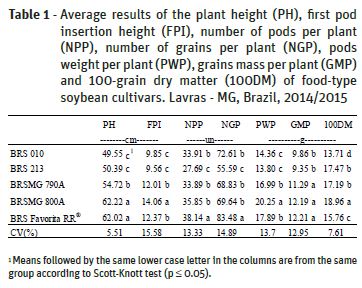
    <p><font face = "Verdana" size = "2">The BRS Favorita RR<sup>®</sup>
and BRSMG 800A varieties had the highest height and first pod insertion means at
approximately 62 cm and insertion above 12 cm, respectively (<a href = "#t1">Table 1</a>). The BRS 010
and BRS 213 varieties had the lowest plant heights (49.55 and 50.39 cm, respectively)
and first pod insertion heights (9.85 and 9.56 cm, respectively). The ideal plant
height is between 60 and 110 cm with a first pod insertion equal to or greater than
10 cm. This facilitates mechanical harvesting in commercial crops and avoids bedding.
The results showed that the BRS 010 and BRS 213 varieties were not in the desirable
range when grown under the experimental conditions used in this study.</font></p>

    <p>&nbsp;</p>

<a name = "t1"><img src = "/img/revistas/rca/v41n3/v41n3a07t1.jpg" target = "_blank"></a>

    
<p>&nbsp;</p>

    <p><font face = "Verdana" size = "2">The BRS Favorita RR<sup>®</sup> variety had approximately
38 pods per plant, which was statistically different from the other varieties. It
also had a larger number of grains per plant (83.48 grains). The BRS 213 variety
had the lowest number of pods and grains, with means of 27.69 and 55.59, respectively.</font></p>


    <p><font face = "Verdana" size = "2">The BRSMG 800A variety had the greatest average
number of pods (20.25 g). It was significantly different from the BRS 010 and BRS
213 varieties, which had the lowest average number of pods (14.36 and 13.80 g, respectively)
(<a href = "#t1">Table 1</a>). However, BRS Favorita RR<sup>®</sup>, BRSMG 800A, and BRSMG 790A were
not significantly different, with averages of 12.21, 12.19, and 11.19 g, respectively.
There were statistical differences between this group and the BRS 010 (9.86 g) and
BRS 213 (9.35 g) varieties.</font></p>

    <p><font face = "Verdana" size = "2">The 100-grain
dry matter is an important characteristic for human consumption varieties (<a href = "#t1">Table
1</a>). The BRSMG 800A variety had the highest average 100-grain dry matter (18.96 g),
followed by varieties BRS 213 and BRSMG 790A (17.47 and 17.19 g, respectively).
Variety BRS 010 had the lowest 100-grain dry matter (13.71 g).</font></p>

    ]]></body>
<body><![CDATA[<p><font face = "Verdana" size = "2">The height of the plants was also significantly affected when the Zn application
rates increased (<a href = "/img/revistas/rca/v41n3/v41n3a07f1.jpg" target = "_blank">Figure 1A</a>). The 2.73 mg L<sup>-1</sup> rate produced the greatest
increases in plant height compared to 0 mg L<sup>-1</sup>. Increasing the Zn rates
also had the same effect on the grain mass per plant (<a href = "/img/revistas/rca/v41n3/v41n3a07f1.jpg" target = "_blank">Figure 1B</a>). Again, the 2.73
mg L<sup>-1</sup> application rate produced the greatest increase in grain mass
per plant. Although foliar Zn application is usually carried out at the R4 stage,
a reproductive development stage, plant heights tend to become stable at the R6
(fully filled vegetable) stage. It is during this stage that the plant reaches its
maximum mass accumulation of pods and achieves its highest dry mass and nutrients
in the plant and grains (Bonato, 2000).</font></p>

    
<p><font face = "Verdana" size = "2">The lipid content
in the dry grains was greatest in variety BRS 010 cultivar (20.10%), which was significantly
different from the other varieties (<a href = "/img/revistas/rca/v41n3/v41n3a07f2.jpg" target = "_blank">Figure 2A</a>). The effect of Zn application rate
on lipid content in the grain was described by a linear model. The lipid content
decreased when the Zn rate increased. The protein content was best described by
a quadratic model (<a href = "/img/revistas/rca/v41n3/v41n3a07f2.jpg" target = "_blank">Figure 2B</a>). The highest Zn content was approximately 45% when
2.73 mg L<sup>-1</sup> Zn was applied.</font></p>

    
<p><font face = "Verdana" size = "2">Previous studies carried out with soybean grains recommended for human consumption
reported that the grains contained 16 to 22% lipids and 23 to 43% protein (Gonçalves
<i>et al</i>., 2014; Ciabotti <i>et al</i>., 2016).</font></p>

    <p><font face = "Verdana" size = "2">Zinc is an essential element and is involved in several plant
growth and metabolism processes, including protein synthesis and lipid metabolism.
The correlation between protein and oil content is negative because an increase
in protein content is correlated with a reduction in oil content and vice versa
(Moraes <i>et al</i>., 2006).</font></p>

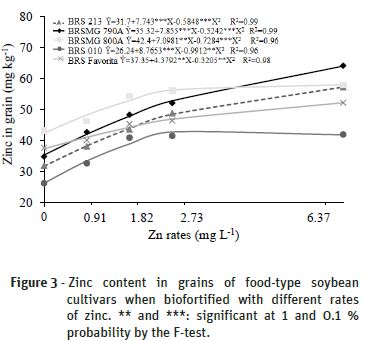
    <p><font face = "Verdana" size = "2">The grain zinc content was
positively affected by the Zn application rate. Foliar Zn applications significantly
increased the Zn content in the soybean grains (<a href = "#f3">Figure 3</a>). Variety BRSMG 790A had
the highest grain Zn content (64 mg g<sup>-1</sup>) when Zn was applied at 6.37
mg L<sup>-1</sup>, which was 80% more than the content found in the control treatment
(0 mg L<sup>-1</sup>).</font></p>

    <p>&nbsp;</p>

<a name = "f3"><img src = "/img/revistas/rca/v41n3/v41n3a07f3.jpg" target = "_blank"></a>

    
<p>&nbsp;</p>

    <p><font face = "Verdana" size = "2">Foliar applications
of Zn produces better results in some crops than in others. Zhao <i>et al</i>. (2011)
found that a Zn foliar application did not increase the Zn grain concentration in
wheat plants if the plant could absorb sufficient Zn through the soil solution.
However, foliar Zn application (0.5% zinc sulfate) increases rice grain Zn concentration,
especially when it was applied after flowering because it produced the best agronomic
and nutritional benefits (Boonchuay <i>et al</i>., 2013).</font></p>

    <p><font face = "Verdana" size = "2">The Zn contents recorded in this study were superior to the reported averages,
indicating that Zn accumulation in the grains was high when Zn was applied foliarly.
Previous studies on the Zn contents in soybean grains suggested that the Zn contents
in the grains were between 22 and 45 mg kg<sup>-1</sup> (Esteves <i>et al</i>.,
2010; Rigo <i>et al</i>., 2015; Brunini <i>et al</i>., 2016).</font></p>

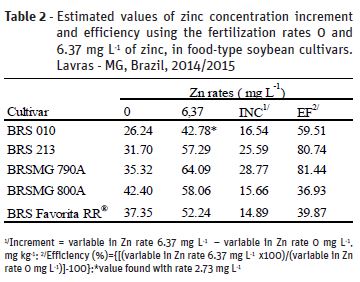
    <p><font face = "Verdana" size = "2">Zinc applications led to 39.87 to 81.44% Zn uptake efficiency
in the grains. The efficiency increased by approximately 29 mg kg<sup>-1</sup> in
the 6.37 mg L<sup>-1</sup> treatment compared to the 0 mg L<sup>-1</sup> treatment
(<a href = "#t2">Table 2</a>). Variety BRSMG 790A produced the highest increase in grain Zn content,
which was 28.77 mg kg<sup>-1</sup> higher when 6.37 mg L<sup>-1</sup> Zn was applied
compared to the control. Furthermore, uptake efficiency was 81.44%. The BRS Favorita
RR<sup>® </sup>variety had the smallest increment (14.89 mg kg<sup>-1</sup>) with
an uptake efficiency of 39.87%. The BRS 010 variety had the lowest Zn content compared
to the other varieties. These results show the difference between genetic material
and the capacity for Zn accumulation in the grain.</font></p>

    ]]></body>
<body><![CDATA[<p>&nbsp;</p>

<a name = "t2"><img src = "/img/revistas/rca/v41n3/v41n3a07t2.jpg" target = "_blank"></a>

    
<p>&nbsp;</p>

    <p><font face = "Verdana" size = "2">The mineral composition results for soybean grains on a dry basis are shown in
<a href = "/img/revistas/rca/v41n3/v41n3a07t3.jpg" target = "_blank">Table 3</a>. The Zn rates did not affect the accumulation of other nutrients in the
soybean grains, indicating that there was no micronutrient transport competition
between the leaves and the grains when there was a foliar Zn application at the
R4 growth stage. However, there were significant differences between the varieties.
The Ca, Mg, and P macronutrient levels were highest in BRSMG 800A (3422.83, 2242.841,
and 4011.47 mg kg<sup>-1</sup>, respectively). The highest K content was found in
BRSMG 790A (13806.49 mg kg<sup>-1</sup>), while cultivars BRS 010 and BRS 213 accumulated
higher levels of S.</font></p>

    
<p><font face = "Verdana" size = "2">Variety BRS 213
had higher levels of the micronutrients B, Cu, Fe, and Mn, whereas the Mo levels
were greatest in BRS 010. Increasing the Zn application rate did not affect Fe content,
which is also an important biofortification nutrient, although it has an antagonistic
absorption and transport relationship with Zn in plants. According to Moosavi and
Ronagh (2001), foliar application of nutrients that have antagonistic relationships,
is an effective and economical option that avoids yield loss and nutritional imbalances
in Fe-efficient soybean plants grown in limestone soils.</font></p>

    <p><font face = "Verdana" size = "2">The success of agronomic biofortification depends on being able to synchronize
the Zn foliar application with other agronomic interventions. Previous research
has shown that there is no antagonistic effect between insecticides and Zn when
they are applied simultaneously, indicating that production and Zn concentration
in the grains can both be improved simultaneously (Wang <i>et al</i>., 2015).</font></p>


    <p><font face = "Verdana" size = "2">To effectively improve the human nutritional status,
it is essential that the nutrients in biofortified staple foods are bioavailable
(Trijatmiko <i>et al</i>., 2016). Foliar Zn applications improve the Zn bioavailability
compared to a soil Zn application. This indicates that it is more economically viable
biofortification method that can efficiently improve global health problems (Cakmak,
2008). However, it is necessary to monitor the use of these techniques, using technical
and legal methods, to ensure that the micronutrient is available and is consumed
by the population; therefore, constant monitoring of intervention programs is required
(Vellozo and Fisberg, 2010).</font></p>


    <p><font face = "Verdana" size = "3"><b>CONCLUSION</b></font></p>

    <p><font face = "Verdana" size = "2">Foliar fertilization with Zn increased plant height, grain mass,
and protein content in soybean grains. The foliar application of 6.37 mg L<sup>-1</sup>
at the R4 stage increased Zn concentrations in soybean grains. The food-type BRSMG
790A variety had the highest Zn grain content after a foliar Zn application. The
composition of other minerals in the grains was not affected when foliar Zn was
applied. These results indicate that Zn foliar applications lead to improvements
in the Zn content of edible plant parts, especially when the soil Zn contents are
low.</font></p>

    <p>&nbsp;</p>

    <p><font face = "Verdana" size = "3"><b>REFERENCES</b></font></p>


    ]]></body>
<body><![CDATA[<!-- ref --><p><font face = "Verdana" size = "2">Alloway, B.J. (2009) - Soil factors associated
with zinc deficiency in crops and humans. <i>Environmental Geochemistry and Health</i>,
vol. 31, n. 5, p. 537–542. <a href = "http://dx.doi.org/10.1007/s10653-009-9255-4" target = "_blank">http://dx.doi.org/10.1007/s10653-009-9255-4</a></font>&nbsp;&nbsp;&nbsp;&nbsp;&nbsp;&nbsp;&nbsp;&nbsp;[&#160;<a href="javascript:void(0);" onclick="javascript: window.open('/scielo.php?script=sci_nlinks&ref=685667&pid=S0871-018X201800030000700001&lng=','','width=640,height=500,resizable=yes,scrollbars=1,menubar=yes,');">Links</a>&#160;]<!-- end-ref --><!-- ref --><p><font face = "Verdana" size = "2">AOAC (2006) - <i>Official methods of analysis</i>.
18th ed. Arlington, Virginia. Association of Official Analytical Chemists.    &nbsp;&nbsp;&nbsp;&nbsp;&nbsp;&nbsp;&nbsp;&nbsp;[&#160;<a href="javascript:void(0);" onclick="javascript: window.open('/scielo.php?script=sci_nlinks&ref=685668&pid=S0871-018X201800030000700002&lng=','','width=640,height=500,resizable=yes,scrollbars=1,menubar=yes,');">Links</a>&#160;]<!-- end-ref --></font></p>


    <!-- ref --><p><font face = "Verdana" size = "2">Bonato, E. R. (2000) - <i>Estresse em soja</i>.
1st ed. Passo Fundo, Embrapa Trigo.    &nbsp;&nbsp;&nbsp;&nbsp;&nbsp;&nbsp;&nbsp;&nbsp;[&#160;<a href="javascript:void(0);" onclick="javascript: window.open('/scielo.php?script=sci_nlinks&ref=685670&pid=S0871-018X201800030000700003&lng=','','width=640,height=500,resizable=yes,scrollbars=1,menubar=yes,');">Links</a>&#160;]<!-- end-ref --></font></p>

    <!-- ref --><p><font face = "Verdana" size = "2">Boonchuay, P.; Cakmak, I.; Rerkasem, B. &amp; Prom-U-Thai, C. (2013) - Effect
of different foliar zinc application at different growth stages on seed zinc concentration
and its impact on seedling vigor in rice. <i>Journal Soil Science and Plant Nutrition</i>,
vol. 59, n. 2, p. 180-188. <a href = "http://dx.doi.org/10.1080/00380768.2013.763382" target = "_blank">http://dx.doi.org/10.1080/00380768.2013.763382</a></font>&nbsp;&nbsp;&nbsp;&nbsp;&nbsp;&nbsp;&nbsp;&nbsp;[&#160;<a href="javascript:void(0);" onclick="javascript: window.open('/scielo.php?script=sci_nlinks&ref=685672&pid=S0871-018X201800030000700004&lng=','','width=640,height=500,resizable=yes,scrollbars=1,menubar=yes,');">Links</a>&#160;]<!-- end-ref --><!-- ref --><p><font face = "Verdana" size = "2">Brunini, M.A.; Barros, M.A.L.; Pereira, M.; Cerqueira,
J.B.; Menezes, P.T.R. &amp; Furtado, I.R. (2016) - Grain quality of eleven soybean
cultivars. <i>Nucleus Animalium</i>, vol. 8, p. 55-62.    &nbsp;&nbsp;&nbsp;&nbsp;&nbsp;&nbsp;&nbsp;&nbsp;[&#160;<a href="javascript:void(0);" onclick="javascript: window.open('/scielo.php?script=sci_nlinks&ref=685673&pid=S0871-018X201800030000700005&lng=','','width=640,height=500,resizable=yes,scrollbars=1,menubar=yes,');">Links</a>&#160;]<!-- end-ref --></font></p>

    <!-- ref --><p><font face = "Verdana" size = "2">Cakmak, I. (2008) - Enrichment of cereals grains with zinc: Agronomic
or genetic biofortification? <i>Plant and Soil</i>, vol. 302, n. 1-2, p. 1–17. <a href = "http://dx.doi.org/10.1007/s11104-007-9466-3" target = "_blank">http://dx.doi.org/10.1007/s11104-007-9466-3</a></font>&nbsp;&nbsp;&nbsp;&nbsp;&nbsp;&nbsp;&nbsp;&nbsp;[&#160;<a href="javascript:void(0);" onclick="javascript: window.open('/scielo.php?script=sci_nlinks&ref=685675&pid=S0871-018X201800030000700006&lng=','','width=640,height=500,resizable=yes,scrollbars=1,menubar=yes,');">Links</a>&#160;]<!-- end-ref --><!-- ref --><p><font face = "Verdana" size = "2">Cakmak, I.; Kalayci, M.; Kaya, Y.; Torun, A.A.;
Aydin, N.; Wang, Y.; Arisoy, Z. &amp; Horst, W.J. (2010) - Biofortification and
localization of zinc in wheat grain<i>. Journal Agriculture and Food Chemistry</i>,
vol. 58, n. 16, p. 9092–9102. <a href = "http://dx.doi.org/10.1021/jf101197h" target = "_blank">http://dx.doi.org/10.1021/jf101197h</a></font>&nbsp;&nbsp;&nbsp;&nbsp;&nbsp;&nbsp;&nbsp;&nbsp;[&#160;<a href="javascript:void(0);" onclick="javascript: window.open('/scielo.php?script=sci_nlinks&ref=685676&pid=S0871-018X201800030000700007&lng=','','width=640,height=500,resizable=yes,scrollbars=1,menubar=yes,');">Links</a>&#160;]<!-- end-ref --><!-- ref --><p><font face = "Verdana" size = "2">Ciabotti, S.; Silva, A.C.B.B.; Juhasz, A.C.P.;
Mendonça, C.D.; Tavano, O.L.; Mandarino, J.M.G. &amp; Gonçalves, C.A.A. (2016) -
Chemical composition, protein profile, and isoflavones content in soybean genotypes
with different seed coat colors. <i>International Food Research Journal</i>, vol.
23, p. 621-629.    &nbsp;&nbsp;&nbsp;&nbsp;&nbsp;&nbsp;&nbsp;&nbsp;[&#160;<a href="javascript:void(0);" onclick="javascript: window.open('/scielo.php?script=sci_nlinks&ref=685677&pid=S0871-018X201800030000700008&lng=','','width=640,height=500,resizable=yes,scrollbars=1,menubar=yes,');">Links</a>&#160;]<!-- end-ref --></font></p>

    <!-- ref --><p><font face = "Verdana" size = "2">Esteves, E.A.; Martino,
H.S.D.; Oliveira, F.C.E.; Bressan, J. &amp; Costa, N.M.B. (2010) - Chemical composition
of a soybean cultivar lacking lipoxygenases (LOX2 and LOX3). <i>Food Chemistry</i>,
vol. 122, n. 1, p. 238-242. <a href = "https://doi.org/10.1016/j.foodchem.2010.02.069" target = "_blank">https://doi.org/10.1016/j.foodchem.2010.02.069</a></font>&nbsp;&nbsp;&nbsp;&nbsp;&nbsp;&nbsp;&nbsp;&nbsp;[&#160;<a href="javascript:void(0);" onclick="javascript: window.open('/scielo.php?script=sci_nlinks&ref=685679&pid=S0871-018X201800030000700009&lng=','','width=640,height=500,resizable=yes,scrollbars=1,menubar=yes,');">Links</a>&#160;]<!-- end-ref --><!-- ref --><p><font face = "Verdana" size = "2">FAO (2015) - <i>The State of Food Insecurity in
the World 2015</i>. Meeting the 2015 international hunger targets: taking stock
of uneven progress. International Food Policy Research Institute. Rome, FAO.    &nbsp;&nbsp;&nbsp;&nbsp;&nbsp;&nbsp;&nbsp;&nbsp;[&#160;<a href="javascript:void(0);" onclick="javascript: window.open('/scielo.php?script=sci_nlinks&ref=685680&pid=S0871-018X201800030000700010&lng=','','width=640,height=500,resizable=yes,scrollbars=1,menubar=yes,');">Links</a>&#160;]<!-- end-ref --></font></p>


    <!-- ref --><p><font face = "Verdana" size = "2">Gandhi, A.P. (2009) - Quality of soybean and its
food products. <i>International Food Research Journal</i>, vol. 16, p. 11-19.    &nbsp;&nbsp;&nbsp;&nbsp;&nbsp;&nbsp;&nbsp;&nbsp;[&#160;<a href="javascript:void(0);" onclick="javascript: window.open('/scielo.php?script=sci_nlinks&ref=685682&pid=S0871-018X201800030000700011&lng=','','width=640,height=500,resizable=yes,scrollbars=1,menubar=yes,');">Links</a>&#160;]<!-- end-ref --></font></p>


    <!-- ref --><p><font face = "Verdana" size = "2">Gonçalves, L.C.; Andrade, A.P.C.; Ribeiro, G.P.
&amp; Seibel, N.F. (2014) - Chemical composition and technological properties of
two soybean cultivars. <i>Biochemistry and Biotechnology Reports</i>, vol. 3, n.
1, p. 33-40. <a href = "https://doi.org/10.5433/2316-5200.2014v3n1p33" target = "_blank">https://doi.org/10.5433/2316-5200.2014v3n1p33</a></font>&nbsp;&nbsp;&nbsp;&nbsp;&nbsp;&nbsp;&nbsp;&nbsp;[&#160;<a href="javascript:void(0);" onclick="javascript: window.open('/scielo.php?script=sci_nlinks&ref=685684&pid=S0871-018X201800030000700012&lng=','','width=640,height=500,resizable=yes,scrollbars=1,menubar=yes,');">Links</a>&#160;]<!-- end-ref --><!-- ref --><p><font face = "Verdana" size = "2">Joy, E.J.M.; Alexander, J.S.; Young, S.D.;
Ander, E.L.; Watts, M.J. &amp; Broadley, M.R. (2015) - Zinc-enriched fertilisers as a potential public
health intervention in Africa. <i>Plant and Soil</i>, vol. 389, n. 1-2, p. 1–24.
<a href = "https://doi.org/10.1007/s11104-015-2430-8" target = "_blank">https://doi.org/10.1007/s11104-015-2430-8</a></font>&nbsp;&nbsp;&nbsp;&nbsp;&nbsp;&nbsp;&nbsp;&nbsp;[&#160;<a href="javascript:void(0);" onclick="javascript: window.open('/scielo.php?script=sci_nlinks&ref=685685&pid=S0871-018X201800030000700013&lng=','','width=640,height=500,resizable=yes,scrollbars=1,menubar=yes,');">Links</a>&#160;]<!-- end-ref --><!-- ref --><p><font face = "Verdana" size = "2">Keatinge, J.D.H.; Easdown, W.J.; Yang, R.Y.; Chadha, M.L. &amp; Shanmugasundaram,
S. (2011) - Overcoming chronic malnutrition in a future warming world: the key importance
of mung bean and vegetable soybean. <i>Euphytica</i>, vol.180, n. 1, p. 129–141.
<a href = "https://doi.org/10.1007/s10681-011-0401-6" target = "_blank">https://doi.org/10.1007/s10681-011-0401-6</a></font>&nbsp;&nbsp;&nbsp;&nbsp;&nbsp;&nbsp;&nbsp;&nbsp;[&#160;<a href="javascript:void(0);" onclick="javascript: window.open('/scielo.php?script=sci_nlinks&ref=685686&pid=S0871-018X201800030000700014&lng=','','width=640,height=500,resizable=yes,scrollbars=1,menubar=yes,');">Links</a>&#160;]<!-- end-ref --><!-- ref --><p><font face = "Verdana" size = "2">Lyi, S.M.; Heller, L.I.; Rutzke, M.; Welch, R.M.; Kochian, L.V. &amp; Li,
L. (2005) - Molecular and biochemical characterization of the selenocysteine Se-methyltransferase
gene and Semethylselenocysteine synthesis in broccoli. <i>Plant Physiology</i>,
vol. 138, p. 409-420. <a href = "https://doi.org/10.1104/pp.104.056549" target = "_blank">https://doi.org/10.1104/pp.104.056549</a></font>&nbsp;&nbsp;&nbsp;&nbsp;&nbsp;&nbsp;&nbsp;&nbsp;[&#160;<a href="javascript:void(0);" onclick="javascript: window.open('/scielo.php?script=sci_nlinks&ref=685687&pid=S0871-018X201800030000700015&lng=','','width=640,height=500,resizable=yes,scrollbars=1,menubar=yes,');">Links</a>&#160;]<!-- end-ref --><!-- ref --><p><font face = "Verdana" size = "2">Mao, H.; Wang, J.; Wang, Z.; Zan, Y.; Lyons, G. &amp; Zou,
C. (2014) - Using agronomic biofortification to boost zinc, selenium, and iodine
concentrations of food crops grown on the loess plateau in China. <i>Journal of
Soil Science and Plant Nutrition</i>. vol. 14, n. 2, p. 459-470.    &nbsp;&nbsp;&nbsp;&nbsp;&nbsp;&nbsp;&nbsp;&nbsp;[&#160;<a href="javascript:void(0);" onclick="javascript: window.open('/scielo.php?script=sci_nlinks&ref=685688&pid=S0871-018X201800030000700016&lng=','','width=640,height=500,resizable=yes,scrollbars=1,menubar=yes,');">Links</a>&#160;]<!-- end-ref --></font></p>

    <!-- ref --><p><font face = "Verdana" size = "2">Moosavi, A.A. &amp; Ronaghi, A. (2011) - Influence of foliar
and soil applications of iron and manganese on soybean dry matter yield and iron-manganese
relationship in a Calcareous soil. <i>Australian Journal of Crop Science</i>, vol.
5, p. 1550-1556.    &nbsp;&nbsp;&nbsp;&nbsp;&nbsp;&nbsp;&nbsp;&nbsp;[&#160;<a href="javascript:void(0);" onclick="javascript: window.open('/scielo.php?script=sci_nlinks&ref=685690&pid=S0871-018X201800030000700017&lng=','','width=640,height=500,resizable=yes,scrollbars=1,menubar=yes,');">Links</a>&#160;]<!-- end-ref --></font></p>

    <!-- ref --><p><font face = "Verdana" size = "2">Moraes, R.M.A.;
José, I.C.; Ramos, F.G.; Barros, E.G. &amp; Moreira, M.A. (2006) - Biochemical characterization
of soybean lines with high protein content. <i>Pesquisa Agropecuária Brasileira</i>,
vol. 41, n. 5, p. 725-729. <a href = "http://dx.doi.org/10.1590/S0100-204X2006000500002" target = "_blank">http://dx.doi.org/10.1590/S0100-204X2006000500002</a></font>&nbsp;&nbsp;&nbsp;&nbsp;&nbsp;&nbsp;&nbsp;&nbsp;[&#160;<a href="javascript:void(0);" onclick="javascript: window.open('/scielo.php?script=sci_nlinks&ref=685692&pid=S0871-018X201800030000700018&lng=','','width=640,height=500,resizable=yes,scrollbars=1,menubar=yes,');">Links</a>&#160;]<!-- end-ref --><!-- ref --><p><font face = "Verdana" size = "2">Rigo, A.A.; Dahmer, A.M.; Steffens, C. &amp; Steffens,
J. (2015) - Characterization of Soybean Cultivars Genetically Improved for Human
Consumption. <i>International Journal of Food Engineering</i>, vol. 1, n. 1, p.
1-7. <a href = "http://dx.doi.org/10.18178/ijfe.1.1.1-7" target = "_blank">http://dx.doi.org/10.18178/ijfe.1.1.1-7</a></font>&nbsp;&nbsp;&nbsp;&nbsp;&nbsp;&nbsp;&nbsp;&nbsp;[&#160;<a href="javascript:void(0);" onclick="javascript: window.open('/scielo.php?script=sci_nlinks&ref=685693&pid=S0871-018X201800030000700019&lng=','','width=640,height=500,resizable=yes,scrollbars=1,menubar=yes,');">Links</a>&#160;]<!-- end-ref --><!-- ref --><p><font face = "Verdana" size = "2">Sharma, A.; Patni, B.; Shankhdhar, D. &amp; Shankhdhar, S.C. (2013) - Zinc–An
Indispensable Micronutrient. <i>Physiology and Molecular Biology of Plants</i>,
vol. 19, n. 1, p. 11–20. 
<a href="https://dx.doi.org/10.1007%2Fs12298-012-0139-1" target="_blank">http://dx.doi.org/10.1007/s12298-012-0139-1</a></font>&nbsp;&nbsp;&nbsp;&nbsp;&nbsp;&nbsp;&nbsp;&nbsp;[&#160;<a href="javascript:void(0);" onclick="javascript: window.open('/scielo.php?script=sci_nlinks&ref=685694&pid=S0871-018X201800030000700020&lng=','','width=640,height=500,resizable=yes,scrollbars=1,menubar=yes,');">Links</a>&#160;]<!-- end-ref --><!-- ref --><p><font face = "Verdana" size = "2">Trijatmiko, K.R.; Dueñas, C.; Tsakirpaloglou, N.; Torrizo, L.; Arines,
F.M.; Adeva, C. &amp; Slamet-Loedin, I.H. (2016) - Biofortified indica rice attains
iron and zinc nutrition dietary targets in the field. <i>Scientific Reports</i>,
vol. 6, art. 19792. <a href = "http://dx.doi.org/10.1038/srep19792" target = "_blank">http://dx.doi.org/10.1038/srep19792</a></font>&nbsp;&nbsp;&nbsp;&nbsp;&nbsp;&nbsp;&nbsp;&nbsp;[&#160;<a href="javascript:void(0);" onclick="javascript: window.open('/scielo.php?script=sci_nlinks&ref=685695&pid=S0871-018X201800030000700021&lng=','','width=640,height=500,resizable=yes,scrollbars=1,menubar=yes,');">Links</a>&#160;]<!-- end-ref --><!-- ref --><p><font face = "Verdana" size = "2">Vellozo, E.P. &amp; Fisberg, M. (2010) - O impacto da fortificação
de alimentos na prevenção da deficiência de ferro. <i>Revista  Brasileira de Hematologia</i>,
vol. 32, sup. 2, p. 134-139. <a href = "http://dx.doi.org/10.1590/S1516-84842010005000069" target = "_blank">http://dx.doi.org/10.1590/S1516-84842010005000069</a></font>&nbsp;&nbsp;&nbsp;&nbsp;&nbsp;&nbsp;&nbsp;&nbsp;[&#160;<a href="javascript:void(0);" onclick="javascript: window.open('/scielo.php?script=sci_nlinks&ref=685696&pid=S0871-018X201800030000700022&lng=','','width=640,height=500,resizable=yes,scrollbars=1,menubar=yes,');">Links</a>&#160;]<!-- end-ref --><!-- ref --><p><font face = "Verdana" size = "2">Wang, X.Z.; Liu, D.Y.; Zhang, W.; Wang, C.J.;
Cakmak, I. &amp; Zou, C.Q. (2015) - An effective strategy to improve grain
zinc concentration of winter wheat, Aphids prevention and farmers’ income. <i>Field
Crops Research</i>, vol. 184, p. 74–79. <a href = "https://doi.org/10.1016/j.fcr.2015.08.015" target = "_blank">https://doi.org/10.1016/j.fcr.2015.08.015</a></font>&nbsp;&nbsp;&nbsp;&nbsp;&nbsp;&nbsp;&nbsp;&nbsp;[&#160;<a href="javascript:void(0);" onclick="javascript: window.open('/scielo.php?script=sci_nlinks&ref=685697&pid=S0871-018X201800030000700023&lng=','','width=640,height=500,resizable=yes,scrollbars=1,menubar=yes,');">Links</a>&#160;]<!-- end-ref --><!-- ref --><p><font face = "Verdana" size = "2">White, P.J. &amp; Broadley M.R. (2009) - Biofortification
of crops with seven mineral elements often lacking in human diets – iron, zinc,
copper, calcium, magnesium, selenium and iodine. <i>New Phytologist</i>. vol. 182,
n. 1, p. 49–84. <a href = "https://doi.org/10.1111/j.1469-8137.2008.02738.x" target = "_blank">https://doi.org/10.1111/j.1469-8137.2008.02738.x</a></font>&nbsp;&nbsp;&nbsp;&nbsp;&nbsp;&nbsp;&nbsp;&nbsp;[&#160;<a href="javascript:void(0);" onclick="javascript: window.open('/scielo.php?script=sci_nlinks&ref=685698&pid=S0871-018X201800030000700024&lng=','','width=640,height=500,resizable=yes,scrollbars=1,menubar=yes,');">Links</a>&#160;]<!-- end-ref --><!-- ref --><p><font face = "Verdana" size = "2">Zhao, A.; Lu, X.; Chen, Z.; Tian, X. &amp; Yang, X. (2011)
- Zinc Fertilization Methods on Zinc Absorption and Translocation in Wheat. <i>Journal
of Agricultural Science</i>, vol. 3, n. 1, p. 28-35. <a href = "http://dx.doi.org/10.5539/jas.v3n1p28" target = "_blank">http://dx.doi.org/10.5539/jas.v3n1p28</a></font>&nbsp;&nbsp;&nbsp;&nbsp;&nbsp;&nbsp;&nbsp;&nbsp;[&#160;<a href="javascript:void(0);" onclick="javascript: window.open('/scielo.php?script=sci_nlinks&ref=685699&pid=S0871-018X201800030000700025&lng=','','width=640,height=500,resizable=yes,scrollbars=1,menubar=yes,');">Links</a>&#160;]<!-- end-ref --><p>&nbsp;</p>

    <p><font face = "Verdana" size = "3"><b>ACKNOWLEDGEMENTS</b></font></p>

    <p><font face = "Verdana" size = "2">To CNPq (Conselho Nacional de Desenvolvimento Científico e Tecnológico)
and CAPES (Coordenação de Aperfeiçoamento de Pessoal de Nível Superior) for the
scholarship and financial support.</font></p>

    <p>&nbsp;</p>

    <p><font face = "Verdana" size = "2">Received/recebido: 2017.06.23</font></p>

    <p><font face = "Verdana" size = "2">Received in revised form/recebido em versão revista: 2018.02.27</font></p>

    <p><font face = "Verdana" size = "2">Accepted/aceite: 2018.03.14</font></p>

    ]]></body>
<body><![CDATA[ ]]></body><back>
<ref-list>
<ref id="B1">
<nlm-citation citation-type="journal">
<person-group person-group-type="author">
<name>
<surname><![CDATA[Alloway]]></surname>
<given-names><![CDATA[B.J.]]></given-names>
</name>
</person-group>
<article-title xml:lang="en"><![CDATA[Soil factors associated with zinc deficiency in crops and humans]]></article-title>
<source><![CDATA[Environmental Geochemistry and Health]]></source>
<year>2009</year>
<volume>31</volume>
<numero>5</numero>
<issue>5</issue>
<page-range>537-542</page-range></nlm-citation>
</ref>
<ref id="B2">
<nlm-citation citation-type="book">
<collab>AOAC</collab>
<source><![CDATA[Official methods of analysis]]></source>
<year>2006</year>
<edition>18th</edition>
<publisher-loc><![CDATA[Arlington^eVirginia Virginia]]></publisher-loc>
<publisher-name><![CDATA[Association of Official Analytical Chemists]]></publisher-name>
</nlm-citation>
</ref>
<ref id="B3">
<nlm-citation citation-type="book">
<person-group person-group-type="author">
<name>
<surname><![CDATA[Bonato]]></surname>
<given-names><![CDATA[E. R.]]></given-names>
</name>
</person-group>
<source><![CDATA[Estresse em soja]]></source>
<year>2000</year>
<edition>1st</edition>
<publisher-loc><![CDATA[Passo Fundo ]]></publisher-loc>
<publisher-name><![CDATA[Embrapa Trigo]]></publisher-name>
</nlm-citation>
</ref>
<ref id="B4">
<nlm-citation citation-type="journal">
<person-group person-group-type="author">
<name>
<surname><![CDATA[Boonchuay]]></surname>
<given-names><![CDATA[P.]]></given-names>
</name>
<name>
<surname><![CDATA[Cakmak]]></surname>
<given-names><![CDATA[I.]]></given-names>
</name>
<name>
<surname><![CDATA[Rerkasem]]></surname>
<given-names><![CDATA[B.]]></given-names>
</name>
<name>
<surname><![CDATA[Prom-U-Thai]]></surname>
<given-names><![CDATA[C.]]></given-names>
</name>
</person-group>
<article-title xml:lang="en"><![CDATA[Effect of different foliar zinc application at different growth stages on seed zinc concentration and its impact on seedling vigor in rice]]></article-title>
<source><![CDATA[Journal Soil Science and Plant Nutrition]]></source>
<year>2013</year>
<volume>59</volume>
<numero>2</numero>
<issue>2</issue>
<page-range>180-188</page-range></nlm-citation>
</ref>
<ref id="B5">
<nlm-citation citation-type="journal">
<person-group person-group-type="author">
<name>
<surname><![CDATA[Brunini]]></surname>
<given-names><![CDATA[M.A.]]></given-names>
</name>
<name>
<surname><![CDATA[Barros]]></surname>
<given-names><![CDATA[M.A.L.]]></given-names>
</name>
<name>
<surname><![CDATA[Pereira]]></surname>
<given-names><![CDATA[M.]]></given-names>
</name>
<name>
<surname><![CDATA[Cerqueira]]></surname>
<given-names><![CDATA[J.B.]]></given-names>
</name>
<name>
<surname><![CDATA[Menezes]]></surname>
<given-names><![CDATA[P.T.R.]]></given-names>
</name>
<name>
<surname><![CDATA[Furtado]]></surname>
<given-names><![CDATA[I.R.]]></given-names>
</name>
</person-group>
<article-title xml:lang="en"><![CDATA[Grain quality of eleven soybean cultivars]]></article-title>
<source><![CDATA[Nucleus Animalium]]></source>
<year>2016</year>
<volume>8</volume>
<page-range>55-62</page-range></nlm-citation>
</ref>
<ref id="B6">
<nlm-citation citation-type="journal">
<person-group person-group-type="author">
<name>
<surname><![CDATA[Cakmak]]></surname>
<given-names><![CDATA[I.]]></given-names>
</name>
</person-group>
<article-title xml:lang="en"><![CDATA[Enrichment of cereals grains with zinc: Agronomic or genetic biofortification?]]></article-title>
<source><![CDATA[Plant and Soil]]></source>
<year>2008</year>
<volume>302</volume>
<numero>1-2</numero>
<issue>1-2</issue>
<page-range>1-17</page-range></nlm-citation>
</ref>
<ref id="B7">
<nlm-citation citation-type="journal">
<person-group person-group-type="author">
<name>
<surname><![CDATA[Cakmak]]></surname>
<given-names><![CDATA[I.]]></given-names>
</name>
<name>
<surname><![CDATA[Kalayci]]></surname>
<given-names><![CDATA[M.]]></given-names>
</name>
<name>
<surname><![CDATA[Kaya]]></surname>
<given-names><![CDATA[Y.]]></given-names>
</name>
<name>
<surname><![CDATA[Torun]]></surname>
<given-names><![CDATA[A.A.]]></given-names>
</name>
<name>
<surname><![CDATA[Aydin]]></surname>
<given-names><![CDATA[N.]]></given-names>
</name>
<name>
<surname><![CDATA[Wang]]></surname>
<given-names><![CDATA[Y.]]></given-names>
</name>
<name>
<surname><![CDATA[Arisoy]]></surname>
<given-names><![CDATA[Z.]]></given-names>
</name>
<name>
<surname><![CDATA[Horst]]></surname>
<given-names><![CDATA[W.J.]]></given-names>
</name>
</person-group>
<article-title xml:lang="en"><![CDATA[Biofortification and localization of zinc in wheat grain]]></article-title>
<source><![CDATA[Journal Agriculture and Food Chemistry]]></source>
<year>2010</year>
<volume>58</volume>
<numero>16</numero>
<issue>16</issue>
<page-range>9092-9102</page-range></nlm-citation>
</ref>
<ref id="B8">
<nlm-citation citation-type="journal">
<person-group person-group-type="author">
<name>
<surname><![CDATA[Ciabotti]]></surname>
<given-names><![CDATA[S.]]></given-names>
</name>
<name>
<surname><![CDATA[Silva]]></surname>
<given-names><![CDATA[A.C.B.B.]]></given-names>
</name>
<name>
<surname><![CDATA[Juhasz]]></surname>
<given-names><![CDATA[A.C.P.]]></given-names>
</name>
<name>
<surname><![CDATA[Mendonça]]></surname>
<given-names><![CDATA[C.D.]]></given-names>
</name>
<name>
<surname><![CDATA[Tavano]]></surname>
<given-names><![CDATA[O.L.]]></given-names>
</name>
<name>
<surname><![CDATA[Mandarino]]></surname>
<given-names><![CDATA[J.M.G.]]></given-names>
</name>
<name>
<surname><![CDATA[Gonçalves]]></surname>
<given-names><![CDATA[C.A.A.]]></given-names>
</name>
</person-group>
<article-title xml:lang="en"><![CDATA[Chemical composition, protein profile, and isoflavones content in soybean genotypes with different seed coat colors]]></article-title>
<source><![CDATA[International Food Research Journal]]></source>
<year>2016</year>
<volume>23</volume>
<page-range>621-629</page-range></nlm-citation>
</ref>
<ref id="B9">
<nlm-citation citation-type="journal">
<person-group person-group-type="author">
<name>
<surname><![CDATA[Esteves]]></surname>
<given-names><![CDATA[E.A.]]></given-names>
</name>
<name>
<surname><![CDATA[Martino]]></surname>
<given-names><![CDATA[H.S.D.]]></given-names>
</name>
<name>
<surname><![CDATA[Oliveira]]></surname>
<given-names><![CDATA[F.C.E.]]></given-names>
</name>
<name>
<surname><![CDATA[Bressan]]></surname>
<given-names><![CDATA[J.]]></given-names>
</name>
<name>
<surname><![CDATA[Costa]]></surname>
<given-names><![CDATA[N.M.B.]]></given-names>
</name>
</person-group>
<article-title xml:lang="en"><![CDATA[Chemical composition of a soybean cultivar lacking lipoxygenases (LOX2 and LOX3)]]></article-title>
<source><![CDATA[Food Chemistry]]></source>
<year>2010</year>
<volume>122</volume>
<numero>1</numero>
<issue>1</issue>
<page-range>238-242</page-range></nlm-citation>
</ref>
<ref id="B10">
<nlm-citation citation-type="book">
<collab>FAO</collab>
<source><![CDATA[The State of Food Insecurity in the World 2015: Meeting the 2015 international hunger targets: taking stock of uneven progress]]></source>
<year>2015</year>
<publisher-loc><![CDATA[Rome ]]></publisher-loc>
<publisher-name><![CDATA[International Food Policy Research Institute]]></publisher-name>
</nlm-citation>
</ref>
<ref id="B11">
<nlm-citation citation-type="journal">
<person-group person-group-type="author">
<name>
<surname><![CDATA[Gandhi]]></surname>
<given-names><![CDATA[A.P.]]></given-names>
</name>
</person-group>
<article-title xml:lang="en"><![CDATA[Quality of soybean and its food products]]></article-title>
<source><![CDATA[International Food Research Journal]]></source>
<year>2009</year>
<volume>16</volume>
<page-range>11-19</page-range></nlm-citation>
</ref>
<ref id="B12">
<nlm-citation citation-type="journal">
<person-group person-group-type="author">
<name>
<surname><![CDATA[Gonçalves]]></surname>
<given-names><![CDATA[L.C.]]></given-names>
</name>
<name>
<surname><![CDATA[Andrade]]></surname>
<given-names><![CDATA[A.P.C.]]></given-names>
</name>
<name>
<surname><![CDATA[Ribeiro]]></surname>
<given-names><![CDATA[G.P.]]></given-names>
</name>
<name>
<surname><![CDATA[Seibel]]></surname>
<given-names><![CDATA[N.F.]]></given-names>
</name>
</person-group>
<article-title xml:lang="en"><![CDATA[Chemical composition and technological properties of two soybean cultivars]]></article-title>
<source><![CDATA[Biochemistry and Biotechnology Reports]]></source>
<year>2014</year>
<volume>3</volume>
<numero>1</numero>
<issue>1</issue>
<page-range>33-40</page-range></nlm-citation>
</ref>
<ref id="B13">
<nlm-citation citation-type="journal">
<person-group person-group-type="author">
<name>
<surname><![CDATA[Joy]]></surname>
<given-names><![CDATA[E.J.M.]]></given-names>
</name>
<name>
<surname><![CDATA[Alexander]]></surname>
<given-names><![CDATA[J.S.]]></given-names>
</name>
<name>
<surname><![CDATA[Young]]></surname>
<given-names><![CDATA[S.D.]]></given-names>
</name>
<name>
<surname><![CDATA[Ander]]></surname>
<given-names><![CDATA[E.L.]]></given-names>
</name>
<name>
<surname><![CDATA[Watts]]></surname>
<given-names><![CDATA[M.J.]]></given-names>
</name>
<name>
<surname><![CDATA[Broadley]]></surname>
<given-names><![CDATA[M.R.]]></given-names>
</name>
</person-group>
<article-title xml:lang="en"><![CDATA[Zinc-enriched fertilisers as a potential public health intervention in Africa]]></article-title>
<source><![CDATA[Plant and Soil]]></source>
<year>2015</year>
<volume>389</volume>
<numero>1-2</numero>
<issue>1-2</issue>
<page-range>1-24</page-range></nlm-citation>
</ref>
<ref id="B14">
<nlm-citation citation-type="journal">
<person-group person-group-type="author">
<name>
<surname><![CDATA[Keatinge]]></surname>
<given-names><![CDATA[J.D.H.]]></given-names>
</name>
<name>
<surname><![CDATA[Easdown]]></surname>
<given-names><![CDATA[W.J.]]></given-names>
</name>
<name>
<surname><![CDATA[Yang]]></surname>
<given-names><![CDATA[R.Y.]]></given-names>
</name>
<name>
<surname><![CDATA[Chadha]]></surname>
<given-names><![CDATA[M.L.]]></given-names>
</name>
<name>
<surname><![CDATA[Shanmugasundaram]]></surname>
<given-names><![CDATA[S.]]></given-names>
</name>
</person-group>
<article-title xml:lang="en"><![CDATA[Overcoming chronic malnutrition in a future warming world: the key importance of mung bean and vegetable soybean]]></article-title>
<source><![CDATA[Euphytica]]></source>
<year>2011</year>
<volume>180</volume>
<numero>1</numero>
<issue>1</issue>
<page-range>129-141</page-range></nlm-citation>
</ref>
<ref id="B15">
<nlm-citation citation-type="journal">
<person-group person-group-type="author">
<name>
<surname><![CDATA[Lyi]]></surname>
<given-names><![CDATA[S.M.]]></given-names>
</name>
<name>
<surname><![CDATA[Heller]]></surname>
<given-names><![CDATA[L.I.]]></given-names>
</name>
<name>
<surname><![CDATA[Rutzke]]></surname>
<given-names><![CDATA[M.]]></given-names>
</name>
<name>
<surname><![CDATA[Welch]]></surname>
<given-names><![CDATA[R.M.]]></given-names>
</name>
<name>
<surname><![CDATA[Kochian]]></surname>
<given-names><![CDATA[L.V.]]></given-names>
</name>
<name>
<surname><![CDATA[Li]]></surname>
<given-names><![CDATA[L.]]></given-names>
</name>
</person-group>
<article-title xml:lang="en"><![CDATA[Molecular and biochemical characterization of the selenocysteine Se-methyltransferase gene and Semethylselenocysteine synthesis in broccoli]]></article-title>
<source><![CDATA[Plant Physiology]]></source>
<year>2005</year>
<volume>138</volume>
<page-range>409-420</page-range></nlm-citation>
</ref>
<ref id="B16">
<nlm-citation citation-type="journal">
<person-group person-group-type="author">
<name>
<surname><![CDATA[Mao]]></surname>
<given-names><![CDATA[H.]]></given-names>
</name>
<name>
<surname><![CDATA[Wang]]></surname>
<given-names><![CDATA[J.]]></given-names>
</name>
<name>
<surname><![CDATA[Wang]]></surname>
<given-names><![CDATA[Z.]]></given-names>
</name>
<name>
<surname><![CDATA[Zan]]></surname>
<given-names><![CDATA[Y.]]></given-names>
</name>
<name>
<surname><![CDATA[Lyons]]></surname>
<given-names><![CDATA[G.]]></given-names>
</name>
<name>
<surname><![CDATA[Zou]]></surname>
<given-names><![CDATA[C.]]></given-names>
</name>
</person-group>
<article-title xml:lang="en"><![CDATA[Using agronomic biofortification to boost zinc, selenium, and iodine concentrations of food crops grown on the loess plateau in China]]></article-title>
<source><![CDATA[Journal of Soil Science and Plant Nutrition]]></source>
<year>2014</year>
<volume>14</volume>
<numero>2</numero>
<issue>2</issue>
<page-range>459-470</page-range></nlm-citation>
</ref>
<ref id="B17">
<nlm-citation citation-type="journal">
<person-group person-group-type="author">
<name>
<surname><![CDATA[Moosavi]]></surname>
<given-names><![CDATA[A.A.]]></given-names>
</name>
<name>
<surname><![CDATA[Ronaghi]]></surname>
<given-names><![CDATA[A.]]></given-names>
</name>
</person-group>
<article-title xml:lang="en"><![CDATA[Influence of foliar and soil applications of iron and manganese on soybean dry matter yield and iron-manganese relationship in a Calcareous soil]]></article-title>
<source><![CDATA[Australian Journal of Crop Science]]></source>
<year>2011</year>
<volume>5</volume>
<page-range>1550-1556</page-range></nlm-citation>
</ref>
<ref id="B18">
<nlm-citation citation-type="journal">
<person-group person-group-type="author">
<name>
<surname><![CDATA[Moraes]]></surname>
<given-names><![CDATA[R.M.A.]]></given-names>
</name>
<name>
<surname><![CDATA[José]]></surname>
<given-names><![CDATA[I.C.]]></given-names>
</name>
<name>
<surname><![CDATA[Ramos]]></surname>
<given-names><![CDATA[F.G.]]></given-names>
</name>
<name>
<surname><![CDATA[Barros]]></surname>
<given-names><![CDATA[E.G.]]></given-names>
</name>
<name>
<surname><![CDATA[Moreira]]></surname>
<given-names><![CDATA[M.A.]]></given-names>
</name>
</person-group>
<article-title xml:lang="en"><![CDATA[Biochemical characterization of soybean lines with high protein content]]></article-title>
<source><![CDATA[Pesquisa Agropecuária Brasileira]]></source>
<year>2006</year>
<volume>41</volume>
<numero>5</numero>
<issue>5</issue>
<page-range>725-729</page-range></nlm-citation>
</ref>
<ref id="B19">
<nlm-citation citation-type="journal">
<person-group person-group-type="author">
<name>
<surname><![CDATA[Rigo]]></surname>
<given-names><![CDATA[A.A.]]></given-names>
</name>
<name>
<surname><![CDATA[Dahmer]]></surname>
<given-names><![CDATA[A.M.]]></given-names>
</name>
<name>
<surname><![CDATA[Steffens]]></surname>
<given-names><![CDATA[C.]]></given-names>
</name>
<name>
<surname><![CDATA[Steffens]]></surname>
<given-names><![CDATA[J.]]></given-names>
</name>
</person-group>
<article-title xml:lang="en"><![CDATA[Characterization of Soybean Cultivars Genetically Improved for Human Consumption]]></article-title>
<source><![CDATA[International Journal of Food Engineering]]></source>
<year>2015</year>
<volume>1</volume>
<numero>1</numero>
<issue>1</issue>
<page-range>1-7</page-range></nlm-citation>
</ref>
<ref id="B20">
<nlm-citation citation-type="journal">
<person-group person-group-type="author">
<name>
<surname><![CDATA[Sharma]]></surname>
<given-names><![CDATA[A.]]></given-names>
</name>
<name>
<surname><![CDATA[Patni]]></surname>
<given-names><![CDATA[B.]]></given-names>
</name>
<name>
<surname><![CDATA[Shankhdhar]]></surname>
<given-names><![CDATA[D.]]></given-names>
</name>
<name>
<surname><![CDATA[Shankhdhar]]></surname>
<given-names><![CDATA[S.C.]]></given-names>
</name>
</person-group>
<article-title xml:lang="en"><![CDATA[Zinc-An Indispensable Micronutrient]]></article-title>
<source><![CDATA[Physiology and Molecular Biology of Plants]]></source>
<year>2013</year>
<volume>19</volume>
<numero>1</numero>
<issue>1</issue>
<page-range>11-20</page-range></nlm-citation>
</ref>
<ref id="B21">
<nlm-citation citation-type="journal">
<person-group person-group-type="author">
<name>
<surname><![CDATA[Trijatmiko]]></surname>
<given-names><![CDATA[K.R.]]></given-names>
</name>
<name>
<surname><![CDATA[Dueñas]]></surname>
<given-names><![CDATA[C.]]></given-names>
</name>
<name>
<surname><![CDATA[Tsakirpaloglou]]></surname>
<given-names><![CDATA[N.]]></given-names>
</name>
<name>
<surname><![CDATA[Torrizo]]></surname>
<given-names><![CDATA[L.]]></given-names>
</name>
<name>
<surname><![CDATA[Arines]]></surname>
<given-names><![CDATA[F.M.]]></given-names>
</name>
<name>
<surname><![CDATA[Adeva]]></surname>
<given-names><![CDATA[C.]]></given-names>
</name>
<name>
<surname><![CDATA[Slamet-Loedin]]></surname>
<given-names><![CDATA[I.H.]]></given-names>
</name>
</person-group>
<article-title xml:lang="en"><![CDATA[Biofortified indica rice attains iron and zinc nutrition dietary targets in the field]]></article-title>
<source><![CDATA[Scientific Reports]]></source>
<year>2016</year>
<volume>6</volume>
<numero>^s19792</numero>
<issue>^s19792</issue>
<supplement>19792</supplement>
</nlm-citation>
</ref>
<ref id="B22">
<nlm-citation citation-type="journal">
<person-group person-group-type="author">
<name>
<surname><![CDATA[Vellozo]]></surname>
<given-names><![CDATA[E.P.]]></given-names>
</name>
<name>
<surname><![CDATA[Fisberg]]></surname>
<given-names><![CDATA[M.]]></given-names>
</name>
</person-group>
<article-title xml:lang="pt"><![CDATA[O impacto da fortificação de alimentos na prevenção da deficiência de ferro]]></article-title>
<source><![CDATA[Revista Brasileira de Hematologia]]></source>
<year>2010</year>
<volume>32</volume>
<numero>^s2</numero>
<issue>^s2</issue>
<supplement>2</supplement>
<page-range>134-139</page-range></nlm-citation>
</ref>
<ref id="B23">
<nlm-citation citation-type="journal">
<person-group person-group-type="author">
<name>
<surname><![CDATA[Wang]]></surname>
<given-names><![CDATA[X.Z.]]></given-names>
</name>
<name>
<surname><![CDATA[Liu]]></surname>
<given-names><![CDATA[D.Y.]]></given-names>
</name>
<name>
<surname><![CDATA[Zhang]]></surname>
<given-names><![CDATA[W.]]></given-names>
</name>
<name>
<surname><![CDATA[Wang]]></surname>
<given-names><![CDATA[C.J.]]></given-names>
</name>
<name>
<surname><![CDATA[Cakmak]]></surname>
<given-names><![CDATA[I.]]></given-names>
</name>
<name>
<surname><![CDATA[Zou]]></surname>
<given-names><![CDATA[C.]]></given-names>
</name>
</person-group>
<article-title xml:lang="en"><![CDATA[An effective strategy to improve grain zinc concentration of winter wheat, Aphids prevention and farmers’ income]]></article-title>
<source><![CDATA[Field Crops Research]]></source>
<year>2015</year>
<volume>184</volume>
<page-range>74-79</page-range></nlm-citation>
</ref>
<ref id="B24">
<nlm-citation citation-type="journal">
<person-group person-group-type="author">
<name>
<surname><![CDATA[White]]></surname>
<given-names><![CDATA[P.J.]]></given-names>
</name>
<name>
<surname><![CDATA[Broadley]]></surname>
<given-names><![CDATA[M.R.]]></given-names>
</name>
</person-group>
<article-title xml:lang="en"><![CDATA[Biofortification of crops with seven mineral elements often lacking in human diets - iron, zinc, copper, calcium, magnesium, selenium and iodine]]></article-title>
<source><![CDATA[New Phytologist]]></source>
<year>2009</year>
<volume>182</volume>
<numero>1</numero>
<issue>1</issue>
<page-range>49-84</page-range></nlm-citation>
</ref>
<ref id="B25">
<nlm-citation citation-type="journal">
<person-group person-group-type="author">
<name>
<surname><![CDATA[Zhao]]></surname>
<given-names><![CDATA[A.]]></given-names>
</name>
<name>
<surname><![CDATA[Lu]]></surname>
<given-names><![CDATA[X.]]></given-names>
</name>
<name>
<surname><![CDATA[Chen]]></surname>
<given-names><![CDATA[Z.]]></given-names>
</name>
<name>
<surname><![CDATA[Tian]]></surname>
<given-names><![CDATA[X.]]></given-names>
</name>
<name>
<surname><![CDATA[Yang]]></surname>
<given-names><![CDATA[X.]]></given-names>
</name>
</person-group>
<article-title xml:lang="en"><![CDATA[Zinc Fertilization Methods on Zinc Absorption and Translocation in Wheat]]></article-title>
<source><![CDATA[Journal of Agricultural Science]]></source>
<year>2011</year>
<volume>3</volume>
<numero>1</numero>
<issue>1</issue>
<page-range>28-35</page-range></nlm-citation>
</ref>
</ref-list>
</back>
</article>