<?xml version="1.0" encoding="ISO-8859-1"?><article xmlns:mml="http://www.w3.org/1998/Math/MathML" xmlns:xlink="http://www.w3.org/1999/xlink" xmlns:xsi="http://www.w3.org/2001/XMLSchema-instance">
<front>
<journal-meta>
<journal-id>0871-018X</journal-id>
<journal-title><![CDATA[Revista de Ciências Agrárias]]></journal-title>
<abbrev-journal-title><![CDATA[Rev. de Ciências Agrárias]]></abbrev-journal-title>
<issn>0871-018X</issn>
<publisher>
<publisher-name><![CDATA[Sociedade de Ciências Agrárias de Portugal]]></publisher-name>
</publisher>
</journal-meta>
<article-meta>
<article-id>S0871-018X2018000300011</article-id>
<article-id pub-id-type="doi">10.19084/RCA18015</article-id>
<title-group>
<article-title xml:lang="en"><![CDATA[Influence of irrigation, planting density and vegetative propagation on yield of rhizomes of starch the arrowroot]]></article-title>
<article-title xml:lang="pt"><![CDATA[Influência da irrigação, densidade de plantio e propagação vegetativa na produtividade de rizomas e fécula da araruta]]></article-title>
</title-group>
<contrib-group>
<contrib contrib-type="author">
<name>
<surname><![CDATA[Souza]]></surname>
<given-names><![CDATA[Douglas C. de]]></given-names>
</name>
<xref ref-type="aff" rid="A1"/>
</contrib>
<contrib contrib-type="author">
<name>
<surname><![CDATA[Silva]]></surname>
<given-names><![CDATA[Luis F. L.]]></given-names>
</name>
<xref ref-type="aff" rid="A1"/>
</contrib>
<contrib contrib-type="author">
<name>
<surname><![CDATA[Resende]]></surname>
<given-names><![CDATA[Luciane V.]]></given-names>
</name>
<xref ref-type="aff" rid="A1"/>
</contrib>
<contrib contrib-type="author">
<name>
<surname><![CDATA[Costa]]></surname>
<given-names><![CDATA[Paula A.]]></given-names>
</name>
<xref ref-type="aff" rid="A1"/>
</contrib>
<contrib contrib-type="author">
<name>
<surname><![CDATA[Guerra]]></surname>
<given-names><![CDATA[Thiago S.]]></given-names>
</name>
<xref ref-type="aff" rid="A1"/>
</contrib>
<contrib contrib-type="author">
<name>
<surname><![CDATA[Gonçalves]]></surname>
<given-names><![CDATA[Wilson M.]]></given-names>
</name>
<xref ref-type="aff" rid="A1"/>
</contrib>
</contrib-group>
<aff id="AA1">
<institution><![CDATA[,Universidade Federal de Lavras Departamento de Agricultura ]]></institution>
<addr-line><![CDATA[Lavras MG]]></addr-line>
<country>Brasil</country>
</aff>
<pub-date pub-type="pub">
<day>00</day>
<month>09</month>
<year>2018</year>
</pub-date>
<pub-date pub-type="epub">
<day>00</day>
<month>09</month>
<year>2018</year>
</pub-date>
<volume>41</volume>
<numero>3</numero>
<fpage>101</fpage>
<lpage>110</lpage>
<copyright-statement/>
<copyright-year/>
<self-uri xlink:href="http://scielo.pt/scielo.php?script=sci_arttext&amp;pid=S0871-018X2018000300011&amp;lng=en&amp;nrm=iso"></self-uri><self-uri xlink:href="http://scielo.pt/scielo.php?script=sci_abstract&amp;pid=S0871-018X2018000300011&amp;lng=en&amp;nrm=iso"></self-uri><self-uri xlink:href="http://scielo.pt/scielo.php?script=sci_pdf&amp;pid=S0871-018X2018000300011&amp;lng=en&amp;nrm=iso"></self-uri><abstract abstract-type="short" xml:lang="en"><p><![CDATA[The arrowroot is considered a non-conventional vegetable which has aroused interest in the food industry because of its starch content with differentiated characteristics and high commercial value. However, agronomic management information is scarce, making it difficult to compete with other species of similar purpose, and more studies are needed regarding the crop. The aim of this study was to define adequate agronomic practices in crop aiming the productivity the rhizome, yield the starch of arrowroot. The factors evaluated were the different levels of irrigation, the planting and the plant densities. The randomized block design was used in the field trial while the totally randomized block design was used in the laboratory tests. Through the treatments, crop yield ranged from 0.68 (seedlings; without irrigation; 31250 plants ha-1) to 60.09 t ha-1 (seedlings; irrigated; 31250 plants ha-1), while starch production ranged from 50 to 6350 kg ha-1. The highest yield of rhizomes was obtained in plants produced by seedlings along with the highest density of plants, and the highest production of arrowroot starch was extracted from rhizomes from plants produced by seedlings without irrigation and a density of 50000 plants ha-1.]]></p></abstract>
<abstract abstract-type="short" xml:lang="pt"><p><![CDATA[A araruta é considerada uma hortaliça não convencional que vem despertando interesse da indústria alimentícia em virtude de seu amido, com características diferenciadas e elevado valor comercial. Contudo, são escassas as informações quanto ao manejo, dificultando sua competição comercial com outras espécies de finalidade semelhante, sendo necessários mais estudos com a cultura. Diante disso, objetivou-se definir práticas adequadas de manejo da cultura visando produtividade de rizomas, rendimento de fécula e amido de araruta. Os fatores avaliados foram diferentes níveis de manejo de água, sistema de plantio e de densidades de plantas. O delineamento experimental foi de blocos casualizados no ensaio de campo e inteiramente casualizados para as análises laboratoriais. Mediante os tratamentos, a produtividade da cultura variou de 0,68 (mudas; sem irrigação; 31250 plantas ha-1) a 60,09 t ha-1(mudas; irrigado; 31250 plantas ha-1), enquanto que a produção de amido foi de 50 a 6.350 kg ha-1. A maior produtividade de rizomas foi obtida em plantas produzidas por mudas juntamente com a maior densidade de plantas, e a maior produção de fécula e amido de araruta foi extraída de rizomas oriundos de plantas produzidas por mudas, sem uso de irrigação e densidade de 50.000 plantas ha-1.]]></p></abstract>
<kwd-group>
<kwd lng="en"><![CDATA[Maranta arundinacea L.]]></kwd>
<kwd lng="en"><![CDATA[non-conventional vegetables]]></kwd>
<kwd lng="en"><![CDATA[starch]]></kwd>
<kwd lng="en"><![CDATA[rescue]]></kwd>
<kwd lng="pt"><![CDATA[Maranta arundinacea L.]]></kwd>
<kwd lng="pt"><![CDATA[hortaliças não convencionais]]></kwd>
<kwd lng="pt"><![CDATA[amido]]></kwd>
<kwd lng="pt"><![CDATA[resgate]]></kwd>
</kwd-group>
</article-meta>
</front><body><![CDATA[ 

    <p align = "right"><font face = "Verdana" size = "2"><b>ARTIGO</b></font></p>

    <p><font face = "Verdana" size = "4"><b>Influence
of irrigation, planting density and vegetative propagation on yield of rhizomes
of starch the arrowroot</b></font></p>

    <p><font face = "Verdana" size = "3"><b>Influência
da irrigação, densidade de plantio e propagação vegetativa na produtividade de rizomas
e fécula da araruta</b></font></p>

    <p><font face = "Verdana" size = "2"><b>Douglas C. de Souza</b>*,
<b>Luis F. L. Silva</b>, <b>Luciane V. Resende</b>, <b>Paula A. Costa</b>, <b>Thiago S. Guerra</b> and <b>Wilson
M. Gonçalves</b></font></p>


    <p><font face = "Verdana" size = "2"><i>Departamento de Agricultura/Universidade Federal
de Lavras (UFLA), Campus universitário, 37200-000, Lavras, MG, Brasil</i></font></p>


    <p><font face = "Verdana" size = "2"><i>(*E-mail: <a href = "mailto:douglascorrea@ymail.com">douglascorrea@ymail.com</a>)</i></font></p>

<hr noshade size = 1>

    <p><font face = "Verdana" size = "3"><b>ABSTRACT</b></font></p>

    <p><font face = "Verdana" size = "2">The arrowroot is considered a non-conventional vegetable which
has aroused interest in the food industry because of its starch content with differentiated
characteristics and high commercial value. However, agronomic management information
is scarce, making it difficult to compete with other species of similar purpose,
and more studies are needed regarding the crop. The aim of this study was to define
adequate agronomic practices in crop aiming the productivity the rhizome, yield
the starch of arrowroot. The factors evaluated were the different levels of irrigation,
the planting and the plant densities. The randomized block design was used in the
field trial while the totally randomized block design was used in the laboratory
tests. Through the treatments, crop yield ranged from 0.68 (seedlings; without irrigation;
31250 plants ha<sup>-1</sup>) to 60.09 t ha<sup>-1 </sup>(seedlings; irrigated;
31250 plants ha<sup>-1</sup>), while starch production ranged from 50 to 6350 kg
ha<sup>-1</sup>. The highest yield of rhizomes was obtained in plants produced by
seedlings along with the highest density of plants, and the highest production of
arrowroot starch was extracted from rhizomes from plants produced by seedlings without
irrigation and a density of 50000 plants ha<sup>-1</sup>.</font></p>


    <p><font face = "Verdana" size = "2"><b>Keywords</b>:
<i>Maranta arundinacea</i> L., non-conventional vegetables, starch, rescue.</font></p>

<hr noshade size = 1>

    ]]></body>
<body><![CDATA[<p><font face = "Verdana" size = "3"><b>RESUMO</b></font></p>

    <p><font face = "Verdana" size = "2">A araruta é considerada uma hortaliça não convencional que vem
despertando interesse da indústria alimentícia em virtude de seu amido, com características
diferenciadas e elevado valor comercial. Contudo, são escassas as informações quanto
ao manejo, dificultando sua competição comercial com outras espécies de finalidade
semelhante, sendo necessários mais estudos com a cultura. Diante disso, objetivou-se
definir práticas adequadas de manejo da cultura visando produtividade de rizomas,
rendimento de fécula e amido de araruta. Os fatores avaliados foram diferentes níveis
de manejo de água, sistema de plantio e de densidades de plantas. O delineamento
experimental foi de blocos casualizados no ensaio de campo e inteiramente casualizados
para as análises laboratoriais. Mediante os tratamentos, a produtividade da cultura
variou de 0,68 (mudas; sem irrigação; 31250 plantas ha<sup>-1</sup>) a 60,09 t ha<sup>-1</sup>(mudas;
irrigado; 31250 plantas ha<sup>-1</sup>), enquanto que a produção de amido foi de
50 a 6.350 kg ha<sup>-1</sup>. A maior produtividade de rizomas foi obtida em plantas
produzidas por mudas juntamente com a maior densidade de plantas, e a maior produção
de fécula e amido de araruta foi extraída de rizomas oriundos de plantas produzidas
por mudas, sem uso de irrigação e densidade de 50.000 plantas ha<sup>-1</sup>.</font></p>


    <p><font face = "Verdana" size = "2"><b>Palavras-chave:</b> <i>Maranta arundinacea</i> L., hortaliças não convencionais,
amido, resgate.</font></p>

<hr noshade size = 1>

    <p><font face = "Verdana" size = "3"><b>INTRODUCTION</b></font></p>

    <p><font face = "Verdana" size = "2">The arrowroot (<i>Maranta arundinacea</i> L.) is an herbaceous,
perennial and rhizomatous plant belonging to the order Zingiberales, family Marantaceae,
also known as maranta. The species is considered rustic with a rich and mycorrhizal
root system. Its center of origin is probably Latin America and found natively in
the Venezuelan forests (Ferrari <i>et al</i>., 2005; Valdes Restrepo <i>et al.,
</i>2010). The starch extracted from the rhizomes of the plant is an alternative
source of carbohydrate for consumption or raw material used in the food and non-food
industry. Some research indicates that it is possible to make a layer of arrowroot
starch in order to coat fruits and vegetables to increase post-harvest. It is a
product appreciated for its medicinal properties in the treatment of gastrointestinal
disorders, as well as being an easily digested starch in the human body due to the
absence of gluten (Maulani &amp; Hidayat, 2016).</font></p>

    <p><font face = "Verdana" size = "2">Because of its differentiated properties, the arrowroot starch reaches
a higher price on the international market than similar products such as starch
from maize, oats, barley, manioc and potatoes. This is an excellent opportunity,
given that the food industry is facing the difficulties of commercialization of
modified starches for use in food. This fact has led the food, textile, chemical
and pharmaceutical industries to search for natural starches with properties that
meet market requirements such as the starch from arrowroot (Monteiro &amp; Peressin,
2002; Ferrari <i>et al.</i>, 2005) increasing demand for this product.</font></p>


    <p><font face = "Verdana" size = "2">Preliminary studies have shown that the yield
of the arrowroot starch as well as its physicochemical properties are related to
crop management, as well as the post-harvest handling of rhizomes (Leonel, 2007).
Although Brazil, due to the climatic conditions, presents great potential to produce
arrowroot starch, this crop is underutilized, since the cultivation is restricted
to certain localities without the use technologies. As it is considered a rustic
crop without great impact, the study on basic technologies such as fertilizer use,
planting density, irrigation, among others, has been neglected, disregarding the
potential impact of arrowroot starch in the national and international market.</font></p>


    <p><font face = "Verdana" size = "2">Considering the potential relevance of arrowroot
starch to the agribusiness, especially for family agriculture (Vieira <i>et al.</i>,
2015) it is of fundamental importance the rescue of the species and consequently
studies aimed at encouraging production, since there are no available technical
information regarding the recommendations of crop management such as fertilization,
spacing, irrigation, pest control, diseases and weeds and their effects in the production
of starch (Souza <i>et al</i>., 2016).</font></p>

    <p><font face = "Verdana" size = "2">In view of the above, due to the lack of national and international scientific
results to support the cultivation of arrowroot, the objective was to define adequate
practices of crop management aiming increase the productivity the rhizome for the
yield the starch of arrowroot.</font></p>


    <p><font face = "Verdana" size = "3"><b>MATERIAL AND METHODS</b></font></p>

    ]]></body>
<body><![CDATA[<p><font face = "Verdana" size = "2">The experiment was conducted between October 2014 and August
2015, in the experimental area of the Olericulture Sector of the Department of Agriculture
of the Federal University of Lavras (UFLA) in Lavras, south of the State of Minas
Gerais, Brazil, which is located at the latitude 21º 14’ S, longitude 45º 00’ W
and altitude 918,8 m. The climate of the region, according to the climatic classification
of Köppen, is Cwa (mesothermal) with dry winters and rainy summers (Brasil, 1992).
During the experiment, in the region, the average air temperature was 21.2ºC, and
the minimum and maximum averages were 16.6ºC and 27.7ºC, respectively. The total
rainfall was 1105.6 mm, with the wettest month being November with a level of 249.4
mm and the driest month being July with a level of 1.7 mm. The climatic data of
the experimental area during the field stay are shown in <a href = "/img/revistas/rca/v41n3/v41n3a11f1.jpg" target = "_blank">Figure 1</a>.</font></p>

    
<p><font face = "Verdana" size = "2">Three factors were studied: plant material (PM),
ways of irrigation (I) and planting density (PD). Each factor contained two specific
categories (PM: rhizomes planted directly in the field and seedlings formed in polythene
bags, in a screened and later taken to field; I: irrigated and without irrigation;
PD: 31250 and 50000 plants ha<sup>-1</sup>). Therefore, eight treatments in the
2 x 2 x 2 factorial scheme, in a randomized block design (DBC) with four replicates,
each replicate being one block. Each plot had 18 plants and, to avoid the influence
on the portion of the treatments applied in the neighboring plots, the bordering
effect was considered, thus containing four useful plants per plot.</font></p>


    <p><font face = "Verdana" size = "2">The soil preparation was done in a conventional
way with a plowing and two harrows and the beds were raised with a bedtiller in
the dimensions of 1.25 meters wide by 0.25 meters high. The soil of the experimental
area is classified as Dystroferric Red Latosol and characteristics of the topsoil
layer of 0 to 20 cm are presented in <a href = "/img/revistas/rca/v41n3/v41n3a11t1.jpg" target = "_blank">Table 1</a>. Based on the soil chemical analysis,
liming was performed using 0.24 t ha<sup>-1</sup> of limestone (PRNT 100%). The
fertilization of plantation incorporated to the pit was carried out. Hereafter,
75 days after planting, the top dressing was applied near the plant with superficial
incorporation, according to recommendations adapted for tuberous (Ribeiro <i>et
al</i>., 1999), with ammonium sulfate, single super-phosphate and potassium chloride,
the amounts of fertilizers varied according to plant density ha<sup>-1</sup>. The
cultural treatments were carried out according to the need of the culture, like
the weeding, the combat to the leaf-cutting ants and heaping realized in the beginning
of January.</font></p>

    
<p><font face = "Verdana" size = "2">In the planting, arrowroot
rhizomes of the &quot;Seta&quot; cultivar were used, originated from UFLA’s Non-Conventional
Vegetables Germplasm collection, since there is no propagation of the species by
seeds in tropic regions (Souza <i>et al</i>., 2016). The rhizomes were cut containing
about 30 to 60 g, with at least three meristems, to generate each plant. The plants
were irrigated on a daily basis.</font></p>

    <p><font face = "Verdana" size = "2">Both
the seedlings and the rhizomes in the field were planted at the beginning of October.
The seedlings were produced in polyethylene bags (5.292 cm³) filled in the proportion
of 60% commercial substrate Rohrbacher (organic compounds, pine bark and vermiculite),
30% sifted earth and 10% sand. The polyethylene bags were kept in a greenhouse until
the transplanting occurred approximately 70 days after planting, when the seedlings
presented four definitive leaves. In this initial period, all the materials were
irrigated by spraying, daily, to keep the soil always moist during the budding phase
until the plants reached around 20 cm (Zárate &amp; Vieira, 2005).</font></p>


    <p><font face = "Verdana" size = "2">Two levels of planting density were used, corresponding
to the spacing of 40 cm between rows and 80 cm between plants, about 3 plants m<sup>-2</sup>
and the spacing of 40 cm between rows and 50 cm between plants, resulting in 5 plants
m<sup>-2</sup>, with part of the experiment being irrigated by drip and part without
irrigation. An irrigation system with lateral lines composed of NAAN PC dripping
tubes 16 mm in diameter, with emitters spaced between 30 cm and flow of 1.6 L h<sup>-1</sup>,
was used, allowing the wet surface to form a continuous band along the planting
line. The irrigation was carried out at intervals of two days with a mean leaf of
7 mm, depending on the rainfall, being suspended 60 days before harvest, aiming
at the best quality of the rhizomes. There were variations in the irrigation frequency
with months of constant precipitations and months with days of intense precipitation
and long periods of drought. Therefore, the irrigation was adapted according to
the precipitation frequency (<a href = "/img/revistas/rca/v41n3/v41n3a11f1.jpg" target = "_blank">Figure 1</a>).</font></p>

    
<p><font face = "Verdana" size = "2">The harvest was performed at 309 days after planting, when the aerial part of
the plants had more than 60% of leaf senescence. The following variables were evaluated:
stem diameter (mm) with pachymeter, plant stand (%) and height (cm) throughout the
crop cycle; total productivity (t ha<sup>-1</sup>) and rhizomes weight (g) measured
in precision scales; amount of rhizomes (unity plant<sup>-1</sup>); and rhizome
size according to Zárater &amp; Vieira (2005) in three classes: large (&gt; 20 cm),
medium (12 to 20 cm) and small (&lt;12 cm).</font></p>

    <p><font face = "Verdana" size = "2">After the harvest, the rhizomes of each treatment were taken to the Laboratory
of Grains, Roots and Tubers of the Department of Food Science of the Federal University
of Lavras for starch extraction. Arrowroot rhizomes were washed to remove adhered
soil and unnecessary parts and then selected for lack of injuries and deformation.
Afterwards, they were cut into 0.5 cm thick slices and weighed. In the laboratory
analyzes, the completely randomized design was adopted, with three replicates for
each treatment.</font></p>

    <p><font face = "Verdana" size = "2">For the starch extraction,
the rhizomes of each treatment were triturated with distilled water, in the proportion
of 1: 1, in an industrial blender (Lucre, model C4, Brazil), and then filtered into
organza fabric. The rhizome residue was stored, while the suspension was rested
(± 16 hours) in a refrigerated environment (± 5 ° C). The supernatant was discarded
and the precipitated starch was re-suspended with distilled water to be discarded
again. This starch suspension and settling procedure was repeated until the product
had starch characteristic white color and fine texture. The material was then dried
in a forced air circulation oven at 45° C until reaching a constant mass and cooled
to room temperature. Afterwards, it was reduced to powder, using gral and pistil,
sieved in a sieve of 0.350 mm and, finally, packed in a bottle until its later use
(Daiuto &amp; Cereda, 2003).</font></p>

    <p><font face = "Verdana" size = "2">The
starch was identified by washing for the removal of sugars, autoclaving, neutralization,
deproteinization and determination by reading in a spectrophotometer at 510 nm,
according to the norms of the Adolfo Lutz Institute (2008).</font></p>

    ]]></body>
<body><![CDATA[<p><font face = "Verdana" size = "2">The results were analyzed with observations of means and
standard deviation, and the evaluations submitted to analysis of variance. For the
quantitative effects the data were adjusted to a regression model. The experimental
precision was analyzed using the coefficient of variation (CV) and the statistical
analysis performed with the aid of SISVAR® software (Ferreira, 2011).</font></p>


    <p><font face = "Verdana" size = "3"><b>RESULTS AND DISCUSSION</b></font></p>

    <p><font face = "Verdana" size = "2">According
to the analysis of variance (<a href = "/img/revistas/rca/v41n3/v41n3a11t2.jpg" target = "_blank">Table 2</a>), the interaction between all the agronomic
managements adopted in the experiment (PM x I x PD) was not significant for the
evaluated characteristics. However, significant double interactions were observed
for the characteristics of plant stand, productivity, weight and rhizome size.</font></p>


<p><font face = "Verdana" size = "2">The estimation of the coefficient of variation
of greater magnitude was observed for the rhizome size character, 44.83%, and the
lowest for the plant stand with 5.37%. Good experimental accuracy is critical to
the success of field experiments. Pimentel-Gomes (2009), when studying the CVs of
agricultural trials, classified them as it follows: low when less than 10%; average,
between 10 and 20%; high, when they are between 20 and 30%; and very high, when
they are higher than 30%.</font></p>

    <p><font face = "Verdana" size = "2">The stem diameter,
regardless of agronomic management adopted and the interactions between the factors,
did not present differences between the treatments, with an average value of 7.62
mm (± 0.56). However, for the plant stand, it was observed that the arrowroot produced
by seedlings showed a constant stand during the crop development cycle and treatments
with plants derived from rhizomes planted directly in the field varied throughout
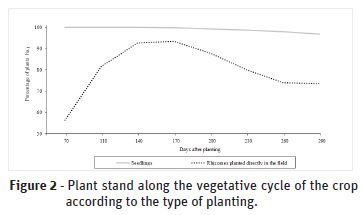
the evaluated months (<a href = "#f2">Figure 2</a>).</font></p>

    <p>&nbsp;</p>

<a name = "f2"><img src = "/img/revistas/rca/v41n3/v41n3a11f2.jpg" target = "_blank"></a>

    
<p>&nbsp;</p>

    <p><font face = "Verdana" size = "2">In the plant stand
there was interaction between PM x PD, the treatments produced by seedlings in any
plant density (31250 or 50000 plants ha<sup>-1</sup>) presented a stand with a mean
of 97.23% (± 0.98) of live plants in the experimental area, whereas in the treatments
produced by direct rhizome in the field in a larger spacing, the losses in the stand
were of 33.33%. Possibly the irregularity may be due to phytopathogens, because
at the planting, the rhizomes used were cut, and in contact with the soil occurs
the development of diseases caused by fungus and/or bacteria.</font></p>

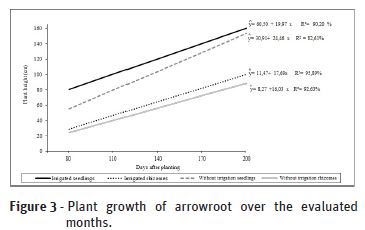
    <p><font face = "Verdana" size = "2">The plant height was influenced by two factors: plant material
and irrigation. The treatments with higher height were those produced by seedlings
(142.99 cm) with an increase of 38.81%, when compared to the plants derived from
direct rhizomes in the field. In the irrigated treatments, the increase was 11.46%
higher than those conducted without irrigation (<a href = "#f3">Figure 3</a>). The higher the height
of the plant, the greater the leaf area tends to be and consequently the greater
the conversion of photoassimilates, as well as the increased ability of the crop
to compete with weeds (greater plant height has a greater capacity to suppress the
growth of competing plants).</font></p>

    <p>&nbsp;</p>

<a name = "f3"><img src = "/img/revistas/rca/v41n3/v41n3a11f3.jpg" target = "_blank"></a>

    
]]></body>
<body><![CDATA[<p>&nbsp;</p>

    <p><font face = "Verdana" size = "2">In the plant material
in which the rhizomes are planted directly in the field, despite the precocity of
the production, the non-injury of the roots and with no stress occurring in the
adaptation phase of the seedlings after the transplant, there may be problems related
to the uniformity of germination and the growth of the plants, compromising the
final stand and perhaps the productivity (Filgueira, 2013). So, the production of
seedlings has been a viable alternative to minimize possible problems, besides the
advantage of hindering the development of weeds due to the closure of the stand.</font></p>


    <p><font face = "Verdana" size = "2">Throughout the experiment, during the hours with
higher air temperature, the plants conducted in without irrigation presented leafroll.
Leaf movement is a mechanism to deal with stress caused by environmental factors,
and is generally associated with reduced transpiration so that the plant does not
suffer permanent wilt. However, climate change, especially those related to water
and thermal stress can limit plant growth, reducing carbon and energy consumption,
altering the allocation of photoassimilates by plant organs (Kadioglu <i>et al</i>.,
2012; Taiz &amp; Zeiger, 2013).</font></p>

    <p><font face = "Verdana" size = "2">Arrowroot
productivity was influenced by all the factors studied, in which, irrigation per
se promotes an increase in rhizome production of 23.53% in comparison to the without
irrigation system. Plants grown by seedlings showed a 94.04% increase in relation
to no-till in the field, while in the density of 50000 plants ha<sup>-1</sup> the
productivity gains were 29.30% higher than those in the density of 31250 plants
ha<sup>-1</sup>.</font></p>

    <p><font face = "Verdana" size = "2">The double interactions
were also significant for this characteristic, being necessary to perform the splitting
between the factors. For I x PD, it was observed that without irrigation treatments
and density of 31250 plants ha<sup>-1</sup> had the lowest productivity (15.32 t
ha<sup>-1</sup>), but irrigated treatments showed no difference between planting
densities, with average 28.31T ha<sup>-1</sup> (± 3.17). In the PM x PD interaction,
planting of seedlings in the density of 50000 plants ha<sup>-1</sup> was the most
productive (57.70 t ha<sup>-1</sup>) while the rhizomes planted directly in the
field, regardless of the density of plants per area, showed lower productivity mean
of 2.81 t ha<sup>-1</sup> (± 2.78). In the PM x I interaction, planting of seedlings
with irrigation presented the highest productivity 52.54 t ha<sup>-1</sup> and the
lowest 1.55 t ha<sup>-1</sup> for treatments planted by rhizomes directly in the
field without irrigation.</font></p>

    <p><font face = "Verdana" size = "2">It is noteworthy
that, to increase production, the use of seedlings and of spacing of 40 cm between
rows and 50 cm between plants gives better results, without considering the adopted
of irrigation. The treatments with these characteristics obtained an average yield
of 57.70 t ha<sup>-1</sup> (± 3.38), a production gain of extreme relevance, as
Zárate &amp; Vieira (2005) obtained an average yield of 18.53 t ha<sup>-1</sup>
working with &quot;Common&quot; arrowroot rhizomes planted directly in the field,
with density of 99000 plants ha<sup>-1</sup> with irrigation, Vieira <i>et al</i>.
(2015) had a similar result, 17.82 t ha<sup>-1</sup>, planting ‘Viçosa’ arrowroot
rhizomes planted directly in the field spaced 0.80 cm between plants and 0.40 cm
in the rows, with a density of 31250 plants ha<sup>-1 </sup>and dry farming.</font></p>


    <p><font face = "Verdana" size = "2">The production of rhizomes is directly correlated
with agronomic characteristics such as plants height and stand. For these characters,
a strong and positive correlation was observed, 0.83 and 0.84, respectively. The
number and mass of rhizomes were significantly influenced by the plant material,
promoting an increase of approximately 80 and 40%, respectively, when the plants
were obtained by seedlings.</font></p>

    <p><font face = "Verdana" size = "2">Planting
density affected the number of rhizomes, with denser spacing ensuring a higher number
of rhizomes per plant. Data with the potato crop corroborate, partially, with the
present study, that plants conducted in smaller spacing provide a greater number
of tubers, due to the greater competition among the plants, but without effect on
productivity, being the increase in the number of tubers not sufficient to increase
production, due to the increase in the number of small tubers (Queiroz <i>et al</i>.,
2013). However, arrowroot did not present this expected behavior, planting density
did not affect the rhizome mass with a mean value of 74.75g rhizomes<sup>-1</sup>
(± 5.30), which allowed to reach higher production in planting with higher populational
density.</font></p>

    <p><font face = "Verdana" size = "2">The results for length of
rhizomes, when evaluated together, presented a very high coefficient of variation
and without any interference of the factors under study. However, it was necessary
to separate the rhizomes by size classes to verify the performance of each factor.
Rhizomes of large size (&gt; 20 cm) and small size (&lt;12 cm) were significantly
influenced by the plant material, being larger in plants originated through seedlings.
In relation to the rhizomes with size between 12.01 and 20 cm there was WH x PD
interaction, with a mean length of 16.21 cm (± 1.25). The handling with lower population
density and submitted to irrigation obtained smaller size compared to the nursery
rhizomes, and in condition of greater density the behavior was opposite.</font></p>


    <p><font face = "Verdana" size = "2">Under similar cultivation conditions Zárate &amp;
Vieira (2005) obtained a mean mass of 77.69 g rhizome<sup>-1</sup> and a length
of 22.18 cm, 15.55 cm and 7.51 cm for medium and small-sized rhizomes, respectively,
similar characteristics to that found in this study, mean mass of 74.75 g rhizome<sup>-1</sup>
and length of 25.71 cm, 16.20 cm and 8.90 cm for the large, medium and small classes.
These results allow to observe that these characters are intrinsic to the used rhizomes
and the way of conducting the crop (Zárate <i>et al</i>., 1999).</font></p>

    ]]></body>
<body><![CDATA[<p><font face = "Verdana" size = "2">After the harvest, the rhizomes were processed, as the commercial
product for the cultivation of arrowroot is the starch. In view of this, it is essential
to evaluate the yield and the industrial and nutritional properties of the obtained
product. The extraction of the starch is a way to conserve the nutritional characteristics
of the rhizome, because it is a product powder, therefore it presents / displays
low water activity and thus long storage period. For industry, these results are
of fundamental importance as they are associated with the final cost of the product
(Streck <i>et al</i>., 2014).</font></p>

    <p><font face = "Verdana" size = "2"><a href = "/img/revistas/rca/v41n3/v41n3a11t3.jpg" target = "_blank">Table
3</a> shows the combined effect of irrigation and plant material, as well as the plant
material and plant density in the starch yield. For starch, there was a combined
effect of the three analyzed factors (I x PM x PD).</font></p>

    
<p><font face = "Verdana" size = "2">In the unfolding of the interactions it is correct to state that for the extraction
of starch from the rhizomes, in the interaction of I x PM, the products from seedlings
and irrigation system have a reduction in yield of 29.53% compared the other crop
managements, while in the interaction of PD x PM there was a decreased yield by
25.50% when coming from seedlings and density of 31250 plants ha<sup>-1</sup>. Thus,
the treatment that presents these factors in common (produced by seedlings, irrigation
and greater spacing) has the lowest extraction yield, from 6.61 g of starch to 100
g of rhizome, and the most efficient treatments have an average extraction of 11.80
g 100 g <sup>-1</sup> (± 1.23).</font></p>

    <p><font face = "Verdana" size = "2">The
starch content did not differ between treatments, with an average value of 86.09
g of starch to 100 g (± 5.09), close to the results found by Ferrari <i>et al</i>.
(2005) with 84.95 g 100 g<sup>-1</sup>. However, there was a triple interaction
that affected the amount of arrowroot starch, where the starch obtained from rhizomes
produced under conditions of greater spacing under irrigation and from rhizomes
directly in the field presented higher starch content. This is probably due to less
competition between the plants for light and consequently to the greater production
of photoassimilates, among them the starch.</font></p>

    <p><font face = "Verdana" size = "2">For there to be significant decreases in the average starch percentages
of the roots, factors that have a strong impact on the normal development of the
plants are necessary. One of the factors is competition with weeds or with the crop
itself (Filho <i>et al</i>., 2003).</font></p>

    <p><font face = "Verdana" size = "2">With the association of rhizome productivity data, yield on the extraction and
amount of starch it is possible to estimate the production by area. The treatment
2 (conducted without irrigation, by seedlings and density of 50000 plants ha<sup>-1</sup>)
presented a higher yield in the extraction (13.54 g 100 g<sup>-1</sup>), which reached
a yield of 55.31 t ha<sup>-1</sup> rhizomes, with 7.49 t ha<sup>-1</sup> starch,
and 6.35 t ha<sup>-1</sup> starch. In addition, the irrigated treatment, produced
by seedlings and in the density of 50000 plants ha<sup>-1</sup>, which despite the
lower yield (8.94 g 100 g<sup>-1</sup>) had a good productivity in the field (60.09
t ha<sup>-1</sup>) that compensated the final starch production with 5.37 t ha<sup>-1</sup>
and 4.40 t ha<sup>-1</sup> of starch (<a href = "/img/revistas/rca/v41n3/v41n3a11f4.jpg" target = "_blank">Figure 4</a>) also deserves to be mentioned.</font></p>

    
<p><font face = "Verdana" size = "2">It should be noted that at the end of the month
of December until mid-January there was a great period of drought, atypical for
the region, in fact inferring the productivity of the crop. In these climatological
conditions, to associate the planting of seedlings in denser spacing, aiming at
higher planting density, confers better results for the components of crop production.
The use of irrigation allowed to achieve higher productivity in the field, however,
the extraction of starch yield was lower, if the cost of production of irrigation
is considered, the without irrigation system is the most indicated.</font></p>


    <p><font face = "Verdana" size = "3"><b>CONCLUSIONS</b></font></p>

    <p><font face = "Verdana" size = "2">The production
of ‘Seta’ arrowroot rhizomes is influenced by the plant material, irrigation and
plant density. The highest rhizomes yield was obtained in plants produced by seedlings
with the highest density of 50000 plants ha<sup>-1</sup>.</font></p>

    <p><font face = "Verdana" size = "2">The highest starch yield was obtained from rhizomes originating
from plants produced by seedlings, without irrigation use and density of 50000 plants
ha<sup>-1</sup>.</font></p>


    ]]></body>
<body><![CDATA[<p>&nbsp;</p>

    <p><font face = "Verdana" size = "3"><b>References</b></font></p>

    <!-- ref --><p><font face = "Verdana" size = "2">Instituto Adolfo
Lutz (2008) - <i>Métodos físico-químicos para análise de alimentos</i>. Instituto
Adolfo Lutz, São Paulo. 1020 p.    &nbsp;&nbsp;&nbsp;&nbsp;&nbsp;&nbsp;&nbsp;&nbsp;[&#160;<a href="javascript:void(0);" onclick="javascript: window.open('/scielo.php?script=sci_nlinks&ref=686195&pid=S0871-018X201800030001100001&lng=','','width=640,height=500,resizable=yes,scrollbars=1,menubar=yes,');">Links</a>&#160;]<!-- end-ref --></font></p>

    <p><font face = "Verdana" size = "2">Brasil
(1992) - <i>Normais climatológicas: 1961-1990</i>. Ministério da Agricultura e da
Reforma Agrária. Departamento Nacional de Meteorologia. Brasília, DF, 84 p.</font></p>


    <!-- ref --><p><font face = "Verdana" size = "2">Daiuto, E.R. &amp; Cereda, M.P. (2003) - Amido
como suporte na desidratação por atomização e em microencapsulamento. <i>In</i>:
Cereda, M.P. &amp; Vilpoux, O.F. (Eds.) - <i>Tecnologia, usos e potencialidades
de tuberosas amiláceas sul americanas</i>. São Paulo: Fundação Cargill, p. 449-475.    &nbsp;&nbsp;&nbsp;&nbsp;&nbsp;&nbsp;&nbsp;&nbsp;[&#160;<a href="javascript:void(0);" onclick="javascript: window.open('/scielo.php?script=sci_nlinks&ref=686198&pid=S0871-018X201800030001100002&lng=','','width=640,height=500,resizable=yes,scrollbars=1,menubar=yes,');">Links</a>&#160;]<!-- end-ref --></font></p>


    <!-- ref --><p><font face = "Verdana" size = "2">Ferrari, T.B.; Leonel, M. &amp; Sarmento, S.B.S.
(2005) - Características dos rizomas e do amido de araruta (<i>Maranta arundinacea</i>)
em diferentes estádios de desenvolvimento da planta. Brazilian <i>Journal of Food
Technology</i>, vol. 8, n. 2, p. 93-98.    &nbsp;&nbsp;&nbsp;&nbsp;&nbsp;&nbsp;&nbsp;&nbsp;[&#160;<a href="javascript:void(0);" onclick="javascript: window.open('/scielo.php?script=sci_nlinks&ref=686200&pid=S0871-018X201800030001100003&lng=','','width=640,height=500,resizable=yes,scrollbars=1,menubar=yes,');">Links</a>&#160;]<!-- end-ref --></font></p>

    <!-- ref --><p><font face = "Verdana" size = "2">Ferreira, D.F. (2011) - Sisvar: a computer statistical analysis system. <i>Ciência
e Agrotecnologia</i>, vol. 35, n. 6, p. 1039-1042.
<a href = "http://dx.doi.org/10.1590/S1413-70542011000600001" target = "_blank">http://dx.doi.org/10.1590/S1413-70542011000600001</a></font>&nbsp;&nbsp;&nbsp;&nbsp;&nbsp;&nbsp;&nbsp;&nbsp;[&#160;<a href="javascript:void(0);" onclick="javascript: window.open('/scielo.php?script=sci_nlinks&ref=686202&pid=S0871-018X201800030001100004&lng=','','width=640,height=500,resizable=yes,scrollbars=1,menubar=yes,');">Links</a>&#160;]<!-- end-ref --><!-- ref --><p><font face = "Verdana" size = "2">Filgueira, F.A.R. (2013) - <i>Novo manual de olericultura:
agrotecnologia moderna na produção e comercialização de hortaliças</i>. Universidade
Federal de Viçosa: Empresa Júnior de Agronomia, 421 p.    &nbsp;&nbsp;&nbsp;&nbsp;&nbsp;&nbsp;&nbsp;&nbsp;[&#160;<a href="javascript:void(0);" onclick="javascript: window.open('/scielo.php?script=sci_nlinks&ref=686203&pid=S0871-018X201800030001100005&lng=','','width=640,height=500,resizable=yes,scrollbars=1,menubar=yes,');">Links</a>&#160;]<!-- end-ref --></font></p>

    <!-- ref --><p><font face = "Verdana" size = "2">Filho, A.G.; Strohhaecker, L. &amp; Fey, E. (2003) - Profundidade
e espaçamento da mandioca no plantio direto na palha. <i>Ciência Rural</i>, vol.
33 n. 3, p. 461-467. <a href = "http://dx.doi.org/10.1590/S0103-84782003000300011" target = "_blank">http://dx.doi.org/10.1590/S0103-84782003000300011</a></font>&nbsp;&nbsp;&nbsp;&nbsp;&nbsp;&nbsp;&nbsp;&nbsp;[&#160;<a href="javascript:void(0);" onclick="javascript: window.open('/scielo.php?script=sci_nlinks&ref=686205&pid=S0871-018X201800030001100006&lng=','','width=640,height=500,resizable=yes,scrollbars=1,menubar=yes,');">Links</a>&#160;]<!-- end-ref --><!-- ref --><p><font face = "Verdana" size = "2">Kadioglu, A.; Terzi, R.; Saruhan N. &amp; Saglam,
A. (2012) - Current advances in the investigation of leaf rolling caused by biotic
and abiotic stress factors. <i>Plant Science,</i> vol. 182, p. 42-48. <a href = "https://doi.org/10.1016/j.plantsci.2011.01.013" target = "_blank">https://doi.org/10.1016/j.plantsci.2011.01.013</a></font>&nbsp;&nbsp;&nbsp;&nbsp;&nbsp;&nbsp;&nbsp;&nbsp;[&#160;<a href="javascript:void(0);" onclick="javascript: window.open('/scielo.php?script=sci_nlinks&ref=686206&pid=S0871-018X201800030001100007&lng=','','width=640,height=500,resizable=yes,scrollbars=1,menubar=yes,');">Links</a>&#160;]<!-- end-ref --><!-- ref --><p><font face = "Verdana" size = "2">Leonel, M. (2007) - Análise da forma e tamanho
de grânulos de amidos de diferentes fontes botânicas. <i>Ciência e Tecnologia de
Alimentos</i>, vol. 27, n. 3, p. 579-588. <a href = "http://dx.doi.org/10.1590/S0101-20612007000300024" target = "_blank">http://dx.doi.org/10.1590/S0101-20612007000300024</a></font>&nbsp;&nbsp;&nbsp;&nbsp;&nbsp;&nbsp;&nbsp;&nbsp;[&#160;<a href="javascript:void(0);" onclick="javascript: window.open('/scielo.php?script=sci_nlinks&ref=686207&pid=S0871-018X201800030001100008&lng=','','width=640,height=500,resizable=yes,scrollbars=1,menubar=yes,');">Links</a>&#160;]<!-- end-ref --><!-- ref --><p><font face = "Verdana" size = "2">Maulani, R.R. &amp; Hidayat, A. (2016) - Characterization
of the functional properties of hydroxypropylated and cross-linked arrowroot starch
in various acidic pH mediums. <i>International Journal of Technology, </i>vol.
7, n. 1, p. 176-184. <a href = "https://doi.org/10.14716/ijtech.v7i1.1226" target = "_blank">https://doi.org/10.14716/ijtech.v7i1.1226</a></font>&nbsp;&nbsp;&nbsp;&nbsp;&nbsp;&nbsp;&nbsp;&nbsp;[&#160;<a href="javascript:void(0);" onclick="javascript: window.open('/scielo.php?script=sci_nlinks&ref=686208&pid=S0871-018X201800030001100009&lng=','','width=640,height=500,resizable=yes,scrollbars=1,menubar=yes,');">Links</a>&#160;]<!-- end-ref --><!-- ref --><p><font face = "Verdana" size = "2">Monteiro, D.A. &amp; Peressin, V.A. (2002) - Cultura
da araruta. <i>In</i>: Cereda, M.P. (Ed.) - <i>Agricultura: tuberosas amiláceas
Latino Americanas</i>. São Paulo: Fundação Cargill, vol. 2, p. 440-447.    &nbsp;&nbsp;&nbsp;&nbsp;&nbsp;&nbsp;&nbsp;&nbsp;[&#160;<a href="javascript:void(0);" onclick="javascript: window.open('/scielo.php?script=sci_nlinks&ref=686209&pid=S0871-018X201800030001100010&lng=','','width=640,height=500,resizable=yes,scrollbars=1,menubar=yes,');">Links</a>&#160;]<!-- end-ref --></font></p>


    <!-- ref --><p><font face = "Verdana" size = "2">Pimentel-Gomes, F. (2009) - <i>Curso de estatística
experimental</i>. Piracicaba: FEALQ, 451 p.    &nbsp;&nbsp;&nbsp;&nbsp;&nbsp;&nbsp;&nbsp;&nbsp;[&#160;<a href="javascript:void(0);" onclick="javascript: window.open('/scielo.php?script=sci_nlinks&ref=686211&pid=S0871-018X201800030001100011&lng=','','width=640,height=500,resizable=yes,scrollbars=1,menubar=yes,');">Links</a>&#160;]<!-- end-ref --></font></p>

    ]]></body>
<body><![CDATA[<!-- ref --><p><font face = "Verdana" size = "2">Queiroz, L.R.M.; Kawakami, J.; Muller, M.M.L.; Umburanas, R.C. &amp; Eschemback,
V. (2013) - Tamanho de tubérculo-semente e espaçamento na produtividade de batata
em condições de campo. <i>Comunicata Scientiae</i>, vol. 4, n. 3, p. 308-315.    &nbsp;&nbsp;&nbsp;&nbsp;&nbsp;&nbsp;&nbsp;&nbsp;[&#160;<a href="javascript:void(0);" onclick="javascript: window.open('/scielo.php?script=sci_nlinks&ref=686213&pid=S0871-018X201800030001100012&lng=','','width=640,height=500,resizable=yes,scrollbars=1,menubar=yes,');">Links</a>&#160;]<!-- end-ref --></font></p>


    <!-- ref --><p><font face = "Verdana" size = "2">Ribeiro, A.C.; Guimarães, P.T.G. &amp; Alvarez,
V.H. (1999) - <i>Recomendações para o uso de corretivos e fertilizantes em Minas
Gerais: 5º Aproximação</i>. Comissão de fertilidade do solo do estado de Minas Gerais,
322 p.    &nbsp;&nbsp;&nbsp;&nbsp;&nbsp;&nbsp;&nbsp;&nbsp;[&#160;<a href="javascript:void(0);" onclick="javascript: window.open('/scielo.php?script=sci_nlinks&ref=686215&pid=S0871-018X201800030001100013&lng=','','width=640,height=500,resizable=yes,scrollbars=1,menubar=yes,');">Links</a>&#160;]<!-- end-ref --></font></p>

    <!-- ref --><p><font face = "Verdana" size = "2">Souza, D.C.; Silva, L.F.L.;
Resende, L.V.; Costa, P.A.; Guerra, T.S.; Gonçalves, W.M. &amp; Pereira, T.A.R.
(2016) - Conservação pós-colheita de araruta em função da temperatura de armazenamento.
<i>Magistra,</i> vol. 28, n. 3/4, p. 403-410.    &nbsp;&nbsp;&nbsp;&nbsp;&nbsp;&nbsp;&nbsp;&nbsp;[&#160;<a href="javascript:void(0);" onclick="javascript: window.open('/scielo.php?script=sci_nlinks&ref=686217&pid=S0871-018X201800030001100014&lng=','','width=640,height=500,resizable=yes,scrollbars=1,menubar=yes,');">Links</a>&#160;]<!-- end-ref --><i></i></font></p>

    <!-- ref --><p><font face = "Verdana" size = "2">Streck, N.A.; Pinheiro, D.G.; Zanon, A.J.; Gabriel, L.F.; Rocha,
T.S.M.; Souza, A.T. &amp; Silva, M.R. (2014) - Efeito do espaçamento de plantio
no crescimento, desenvolvimento e produtividade da mandioca em ambiente subtropical.
<i>Bragantia, </i>vol. 73, n. 4, p. 407-415. <a href = "http://dx.doi.org/10.1590/1678-4499.0159" target = "_blank">http://dx.doi.org/10.1590/1678-4499.0159</a></font>&nbsp;&nbsp;&nbsp;&nbsp;&nbsp;&nbsp;&nbsp;&nbsp;[&#160;<a href="javascript:void(0);" onclick="javascript: window.open('/scielo.php?script=sci_nlinks&ref=686219&pid=S0871-018X201800030001100015&lng=','','width=640,height=500,resizable=yes,scrollbars=1,menubar=yes,');">Links</a>&#160;]<!-- end-ref --><!-- ref --><p><font face = "Verdana" size = "2">Taiz, L. &amp; Zeiger, E. (2013) - <i>Fisiologia
Vegetal</i>. Artmed. 954 p.    &nbsp;&nbsp;&nbsp;&nbsp;&nbsp;&nbsp;&nbsp;&nbsp;[&#160;<a href="javascript:void(0);" onclick="javascript: window.open('/scielo.php?script=sci_nlinks&ref=686220&pid=S0871-018X201800030001100016&lng=','','width=640,height=500,resizable=yes,scrollbars=1,menubar=yes,');">Links</a>&#160;]<!-- end-ref --></font></p>

    <!-- ref --><p><font face = "Verdana" size = "2">Valdes
Restrepo, M.P.; Ortiz Grisales, S. &amp; Sanchez, T. (2010) - Morfología de la planta
y características de rendimiento y calidad de almidón de sagú. <i>Acta Agronomica,</i>
vol. 59, n. 3, p. 372-380.    &nbsp;&nbsp;&nbsp;&nbsp;&nbsp;&nbsp;&nbsp;&nbsp;[&#160;<a href="javascript:void(0);" onclick="javascript: window.open('/scielo.php?script=sci_nlinks&ref=686222&pid=S0871-018X201800030001100017&lng=','','width=640,height=500,resizable=yes,scrollbars=1,menubar=yes,');">Links</a>&#160;]<!-- end-ref --></font></p>

    <!-- ref --><p><font face = "Verdana" size = "2">Vieira,
J.C.B.; Colombo, J.N.; Puiatti, M.; Cecon, P.R. &amp; Silvestre, H.C. (2015) - Desempenho
da araruta ‘Viçosa’ consorciada com crotalária. <i>Revista Brasileira de Ciências
Agrárias</i>, vol. 10, n. 4, p. 518-524. <a href = "http://dx.doi.org/10.5039/agraria.v10i4a5271" target = "_blank">http://dx.doi.org/10.5039/agraria.v10i4a5271</a></font>&nbsp;&nbsp;&nbsp;&nbsp;&nbsp;&nbsp;&nbsp;&nbsp;[&#160;<a href="javascript:void(0);" onclick="javascript: window.open('/scielo.php?script=sci_nlinks&ref=686224&pid=S0871-018X201800030001100018&lng=','','width=640,height=500,resizable=yes,scrollbars=1,menubar=yes,');">Links</a>&#160;]<!-- end-ref --><!-- ref --><p><font face = "Verdana" size = "2">Zárate, N.A.H.; Vieira, M.C. &amp; Griep, R. (1999)
- Produção dos clones de cará Liso e Caramujo conduzidos em forma rasteira e tutorada.
<i>Horticultura Brasileira</i>, vol. 17, n. 1, p. 45-48. <a href = "http://dx.doi.org/10.1590/S0102-05361999000100012" target = "_blank">http://dx.doi.org/10.1590/S0102-05361999000100012</a></font>&nbsp;&nbsp;&nbsp;&nbsp;&nbsp;&nbsp;&nbsp;&nbsp;[&#160;<a href="javascript:void(0);" onclick="javascript: window.open('/scielo.php?script=sci_nlinks&ref=686225&pid=S0871-018X201800030001100019&lng=','','width=640,height=500,resizable=yes,scrollbars=1,menubar=yes,');">Links</a>&#160;]<!-- end-ref --><!-- ref --><p><font face = "Verdana" size = "2">Zárate, N.A.H. &amp; Vieira, M.C. (2005) - Produção
da araruta “comum” proveniente de três tipos de propágulos. <i>Ciência e Agrotecnologia</i>,
vol. 29, n. 5, p. 995-1000. <a href = "http://dx.doi.org/10.1590/S1413-70542005000500012" target = "_blank">http://dx.doi.org/10.1590/S1413-70542005000500012</a></font>&nbsp;&nbsp;&nbsp;&nbsp;&nbsp;&nbsp;&nbsp;&nbsp;[&#160;<a href="javascript:void(0);" onclick="javascript: window.open('/scielo.php?script=sci_nlinks&ref=686226&pid=S0871-018X201800030001100020&lng=','','width=640,height=500,resizable=yes,scrollbars=1,menubar=yes,');">Links</a>&#160;]<!-- end-ref --><p>&nbsp;</p>

    <p><font face = "Verdana" size = "3"><b>Acknowledgments</b></font></p>

    <p><font face = "Verdana" size = "2">The authors are grateful to the Minas Gerais Research Support
Foundation (FAPEMIG), the National Council for Scientific and Technological Development
(CNPq), the Coordination of Personal Improvement of Higher Education (Capes / MEC),
the Federal University of Lavras (UFLA), the Teaching, Research and Extension Support
Foundation (FAEPE) and the Foundation for Scientific and Cultural Development (Fundecc).</font></p>

    <p>&nbsp;</p>

    <p><font face = "Verdana" size = "2">Received/recebido: 2018.01.18</font></p>

    <p><font face = "Verdana" size = "2">Received in revised form/recebido em versão revista:2018.04.02</font></p>

    ]]></body>
<body><![CDATA[<p><font face = "Verdana" size = "2">Accepted/aceite: 2018.05.11</font></p>

     ]]></body><back>
<ref-list>
<ref id="B1">
<nlm-citation citation-type="book">
<collab>Instituto Adolfo Lutz</collab>
<source><![CDATA[Métodos físico-químicos para análise de alimentos]]></source>
<year>2008</year>
<publisher-loc><![CDATA[São Paulo ]]></publisher-loc>
<publisher-name><![CDATA[Instituto Adolfo Lutz]]></publisher-name>
</nlm-citation>
</ref>
<ref id="B2">
<nlm-citation citation-type="book">
<person-group person-group-type="author">
<name>
<surname><![CDATA[Daiuto]]></surname>
<given-names><![CDATA[E.R.]]></given-names>
</name>
<name>
<surname><![CDATA[Cereda]]></surname>
<given-names><![CDATA[M.P.]]></given-names>
</name>
</person-group>
<article-title xml:lang="pt"><![CDATA[Amido como suporte na desidratação por atomização e em microencapsulamento]]></article-title>
<person-group person-group-type="editor">
<name>
<surname><![CDATA[Cereda]]></surname>
<given-names><![CDATA[M.P.]]></given-names>
</name>
<name>
<surname><![CDATA[Vilpoux]]></surname>
<given-names><![CDATA[O.F.]]></given-names>
</name>
</person-group>
<source><![CDATA[Tecnologia, usos e potencialidades de tuberosas amiláceas sul americanas]]></source>
<year>2003</year>
<page-range>449-475</page-range><publisher-loc><![CDATA[São Paulo ]]></publisher-loc>
<publisher-name><![CDATA[Fundação Cargill]]></publisher-name>
</nlm-citation>
</ref>
<ref id="B3">
<nlm-citation citation-type="journal">
<person-group person-group-type="author">
<name>
<surname><![CDATA[Ferrari]]></surname>
<given-names><![CDATA[T.B.]]></given-names>
</name>
<name>
<surname><![CDATA[Leonel]]></surname>
<given-names><![CDATA[M.]]></given-names>
</name>
<name>
<surname><![CDATA[Sarmento]]></surname>
<given-names><![CDATA[S.B.S.]]></given-names>
</name>
</person-group>
<article-title xml:lang="pt"><![CDATA[Características dos rizomas e do amido de araruta (Maranta arundinacea) em diferentes estádios de desenvolvimento da planta]]></article-title>
<source><![CDATA[Brazilian Journal of Food Technology]]></source>
<year>2005</year>
<volume>8</volume>
<numero>2</numero>
<issue>2</issue>
<page-range>93-98</page-range></nlm-citation>
</ref>
<ref id="B4">
<nlm-citation citation-type="journal">
<person-group person-group-type="author">
<name>
<surname><![CDATA[Ferreira]]></surname>
<given-names><![CDATA[D.F.]]></given-names>
</name>
</person-group>
<article-title xml:lang="en"><![CDATA[Sisvar: a computer statistical analysis system]]></article-title>
<source><![CDATA[Ciência e Agrotecnologia]]></source>
<year>2011</year>
<volume>35</volume>
<numero>6</numero>
<issue>6</issue>
<page-range>1039-1042</page-range></nlm-citation>
</ref>
<ref id="B5">
<nlm-citation citation-type="book">
<person-group person-group-type="author">
<name>
<surname><![CDATA[Filgueira]]></surname>
<given-names><![CDATA[F.A.R.]]></given-names>
</name>
</person-group>
<source><![CDATA[Novo manual de olericultura: agrotecnologia moderna na produção e comercialização de hortaliças]]></source>
<year>2013</year>
<publisher-name><![CDATA[Universidade Federal de Viçosa: Empresa Júnior de Agronomia]]></publisher-name>
</nlm-citation>
</ref>
<ref id="B6">
<nlm-citation citation-type="journal">
<person-group person-group-type="author">
<name>
<surname><![CDATA[Filho]]></surname>
<given-names><![CDATA[A.G.]]></given-names>
</name>
<name>
<surname><![CDATA[Strohhaecker]]></surname>
<given-names><![CDATA[L.]]></given-names>
</name>
<name>
<surname><![CDATA[Fey]]></surname>
<given-names><![CDATA[E.]]></given-names>
</name>
</person-group>
<article-title xml:lang="pt"><![CDATA[Profundidade e espaçamento da mandioca no plantio direto na palha]]></article-title>
<source><![CDATA[Ciência Rural]]></source>
<year>2003</year>
<volume>33</volume>
<numero>3</numero>
<issue>3</issue>
<page-range>461-467</page-range></nlm-citation>
</ref>
<ref id="B7">
<nlm-citation citation-type="journal">
<person-group person-group-type="author">
<name>
<surname><![CDATA[Kadioglu]]></surname>
<given-names><![CDATA[A.]]></given-names>
</name>
<name>
<surname><![CDATA[Terzi]]></surname>
<given-names><![CDATA[R.]]></given-names>
</name>
<name>
<surname><![CDATA[Saruhan]]></surname>
<given-names><![CDATA[N.]]></given-names>
</name>
<name>
<surname><![CDATA[Saglam]]></surname>
<given-names><![CDATA[A.]]></given-names>
</name>
</person-group>
<article-title xml:lang="en"><![CDATA[Current advances in the investigation of leaf rolling caused by biotic and abiotic stress factors]]></article-title>
<source><![CDATA[Plant Science]]></source>
<year>2012</year>
<volume>182</volume>
<page-range>42-48</page-range></nlm-citation>
</ref>
<ref id="B8">
<nlm-citation citation-type="journal">
<person-group person-group-type="author">
<name>
<surname><![CDATA[Leonel]]></surname>
<given-names><![CDATA[M.]]></given-names>
</name>
</person-group>
<article-title xml:lang="pt"><![CDATA[Análise da forma e tamanho de grânulos de amidos de diferentes fontes botânicas]]></article-title>
<source><![CDATA[Ciência e Tecnologia de Alimentos]]></source>
<year>2007</year>
<volume>27</volume>
<numero>3</numero>
<issue>3</issue>
<page-range>579-588</page-range></nlm-citation>
</ref>
<ref id="B9">
<nlm-citation citation-type="journal">
<person-group person-group-type="author">
<name>
<surname><![CDATA[Maulani]]></surname>
<given-names><![CDATA[R.R.]]></given-names>
</name>
<name>
<surname><![CDATA[Hidayat]]></surname>
<given-names><![CDATA[A.]]></given-names>
</name>
</person-group>
<article-title xml:lang="en"><![CDATA[Characterization of the functional properties of hydroxypropylated and cross-linked arrowroot starch in various acidic pH mediums]]></article-title>
<source><![CDATA[International Journal of Technology]]></source>
<year>2016</year>
<volume>7</volume>
<numero>1</numero>
<issue>1</issue>
<page-range>176-184</page-range></nlm-citation>
</ref>
<ref id="B10">
<nlm-citation citation-type="book">
<person-group person-group-type="author">
<name>
<surname><![CDATA[Monteiro]]></surname>
<given-names><![CDATA[D.A.]]></given-names>
</name>
<name>
<surname><![CDATA[Peressin]]></surname>
<given-names><![CDATA[V.A.]]></given-names>
</name>
</person-group>
<article-title xml:lang="pt"><![CDATA[Cultura da araruta]]></article-title>
<person-group person-group-type="editor">
<name>
<surname><![CDATA[Cereda]]></surname>
<given-names><![CDATA[M.P.]]></given-names>
</name>
</person-group>
<source><![CDATA[Agricultura: tuberosas amiláceas Latino Americanas]]></source>
<year>2002</year>
<volume>2</volume>
<page-range>440-447</page-range><publisher-loc><![CDATA[São Paulo ]]></publisher-loc>
<publisher-name><![CDATA[Fundação Cargill]]></publisher-name>
</nlm-citation>
</ref>
<ref id="B11">
<nlm-citation citation-type="book">
<person-group person-group-type="author">
<name>
<surname><![CDATA[Pimentel-Gomes]]></surname>
<given-names><![CDATA[F.]]></given-names>
</name>
</person-group>
<source><![CDATA[Curso de estatística experimental]]></source>
<year>2009</year>
<publisher-loc><![CDATA[Piracicaba ]]></publisher-loc>
<publisher-name><![CDATA[FEALQ]]></publisher-name>
</nlm-citation>
</ref>
<ref id="B12">
<nlm-citation citation-type="journal">
<person-group person-group-type="author">
<name>
<surname><![CDATA[Queiroz]]></surname>
<given-names><![CDATA[L.R.M.]]></given-names>
</name>
<name>
<surname><![CDATA[Kawakami]]></surname>
<given-names><![CDATA[J.]]></given-names>
</name>
<name>
<surname><![CDATA[Muller]]></surname>
<given-names><![CDATA[M.M.L.]]></given-names>
</name>
<name>
<surname><![CDATA[Umburanas]]></surname>
<given-names><![CDATA[R.C.]]></given-names>
</name>
<name>
<surname><![CDATA[Eschemback]]></surname>
<given-names><![CDATA[V.]]></given-names>
</name>
</person-group>
<article-title xml:lang="pt"><![CDATA[Tamanho de tubérculo-semente e espaçamento na produtividade de batata em condições de campo]]></article-title>
<source><![CDATA[Comunicata Scientiae]]></source>
<year>2013</year>
<volume>4</volume>
<numero>3</numero>
<issue>3</issue>
<page-range>308-315</page-range></nlm-citation>
</ref>
<ref id="B13">
<nlm-citation citation-type="book">
<person-group person-group-type="author">
<name>
<surname><![CDATA[Ribeiro]]></surname>
<given-names><![CDATA[A.C.]]></given-names>
</name>
<name>
<surname><![CDATA[Guimarães]]></surname>
<given-names><![CDATA[P.T.G.]]></given-names>
</name>
<name>
<surname><![CDATA[Alvarez]]></surname>
<given-names><![CDATA[V.H.]]></given-names>
</name>
</person-group>
<source><![CDATA[Recomendações para o uso de corretivos e fertilizantes em Minas Gerais: 5º Aproximação]]></source>
<year>1999</year>
<publisher-name><![CDATA[Comissão de fertilidade do solo do estado de Minas Gerais]]></publisher-name>
</nlm-citation>
</ref>
<ref id="B14">
<nlm-citation citation-type="journal">
<person-group person-group-type="author">
<name>
<surname><![CDATA[Souza]]></surname>
<given-names><![CDATA[D.C.]]></given-names>
</name>
<name>
<surname><![CDATA[Silva]]></surname>
<given-names><![CDATA[L.F.L.]]></given-names>
</name>
<name>
<surname><![CDATA[Resende]]></surname>
<given-names><![CDATA[L.V.]]></given-names>
</name>
<name>
<surname><![CDATA[Costa]]></surname>
<given-names><![CDATA[P.A.]]></given-names>
</name>
<name>
<surname><![CDATA[Guerra]]></surname>
<given-names><![CDATA[T.S.]]></given-names>
</name>
<name>
<surname><![CDATA[Gonçalves]]></surname>
<given-names><![CDATA[W.M.]]></given-names>
</name>
<name>
<surname><![CDATA[Pereira]]></surname>
<given-names><![CDATA[T.A.R.]]></given-names>
</name>
</person-group>
<article-title xml:lang="pt"><![CDATA[Conservação pós-colheita de araruta em função da temperatura de armazenamento]]></article-title>
<source><![CDATA[Magistra]]></source>
<year>2016</year>
<volume>28</volume>
<numero>3/4</numero>
<issue>3/4</issue>
<page-range>403-410</page-range></nlm-citation>
</ref>
<ref id="B15">
<nlm-citation citation-type="journal">
<person-group person-group-type="author">
<name>
<surname><![CDATA[Streck]]></surname>
<given-names><![CDATA[N.A.]]></given-names>
</name>
<name>
<surname><![CDATA[Pinheiro]]></surname>
<given-names><![CDATA[D.G.]]></given-names>
</name>
<name>
<surname><![CDATA[Zanon]]></surname>
<given-names><![CDATA[A.J.]]></given-names>
</name>
<name>
<surname><![CDATA[Gabriel]]></surname>
<given-names><![CDATA[L.F.]]></given-names>
</name>
<name>
<surname><![CDATA[Rocha]]></surname>
<given-names><![CDATA[T.S.M.]]></given-names>
</name>
<name>
<surname><![CDATA[Souza]]></surname>
<given-names><![CDATA[A.T.]]></given-names>
</name>
<name>
<surname><![CDATA[Silva]]></surname>
<given-names><![CDATA[M.R.]]></given-names>
</name>
</person-group>
<article-title xml:lang="pt"><![CDATA[Efeito do espaçamento de plantio no crescimento, desenvolvimento e produtividade da mandioca em ambiente subtropical]]></article-title>
<source><![CDATA[Bragantia]]></source>
<year>2014</year>
<volume>73</volume>
<numero>4</numero>
<issue>4</issue>
<page-range>407-415</page-range></nlm-citation>
</ref>
<ref id="B16">
<nlm-citation citation-type="book">
<person-group person-group-type="author">
<name>
<surname><![CDATA[Taiz]]></surname>
<given-names><![CDATA[L.]]></given-names>
</name>
<name>
<surname><![CDATA[Zeiger]]></surname>
<given-names><![CDATA[E.]]></given-names>
</name>
</person-group>
<source><![CDATA[Fisiologia Vegetal]]></source>
<year>2013</year>
<publisher-name><![CDATA[Artmed]]></publisher-name>
</nlm-citation>
</ref>
<ref id="B17">
<nlm-citation citation-type="journal">
<person-group person-group-type="author">
<name>
<surname><![CDATA[Valdes Restrepo]]></surname>
<given-names><![CDATA[M.P.]]></given-names>
</name>
<name>
<surname><![CDATA[Ortiz Grisales]]></surname>
<given-names><![CDATA[S.]]></given-names>
</name>
<name>
<surname><![CDATA[Sanchez]]></surname>
<given-names><![CDATA[T.]]></given-names>
</name>
</person-group>
<article-title xml:lang="es"><![CDATA[Morfología de la planta y características de rendimiento y calidad de almidón de sagú]]></article-title>
<source><![CDATA[Acta Agronomica]]></source>
<year>2010</year>
<volume>59</volume>
<numero>3</numero>
<issue>3</issue>
<page-range>372-380</page-range></nlm-citation>
</ref>
<ref id="B18">
<nlm-citation citation-type="journal">
<person-group person-group-type="author">
<name>
<surname><![CDATA[Vieira]]></surname>
<given-names><![CDATA[J.C.B.]]></given-names>
</name>
<name>
<surname><![CDATA[Colombo]]></surname>
<given-names><![CDATA[J.N.]]></given-names>
</name>
<name>
<surname><![CDATA[Puiatti]]></surname>
<given-names><![CDATA[M.]]></given-names>
</name>
<name>
<surname><![CDATA[Cecon]]></surname>
<given-names><![CDATA[P.R.]]></given-names>
</name>
<name>
<surname><![CDATA[Silvestre]]></surname>
<given-names><![CDATA[H.C.]]></given-names>
</name>
</person-group>
<article-title xml:lang="pt"><![CDATA[Desempenho da araruta ‘Viçosa’ consorciada com crotalária]]></article-title>
<source><![CDATA[Revista Brasileira de Ciências Agrárias]]></source>
<year>2015</year>
<volume>10</volume>
<numero>4</numero>
<issue>4</issue>
<page-range>518-524</page-range></nlm-citation>
</ref>
<ref id="B19">
<nlm-citation citation-type="journal">
<person-group person-group-type="author">
<name>
<surname><![CDATA[Zárate]]></surname>
<given-names><![CDATA[N.A.H.]]></given-names>
</name>
<name>
<surname><![CDATA[Vieira]]></surname>
<given-names><![CDATA[M.C.]]></given-names>
</name>
<name>
<surname><![CDATA[Griep]]></surname>
<given-names><![CDATA[R.]]></given-names>
</name>
</person-group>
<article-title xml:lang="pt"><![CDATA[Produção dos clones de cará Liso e Caramujo conduzidos em forma rasteira e tutorada]]></article-title>
<source><![CDATA[Horticultura Brasileira]]></source>
<year>1999</year>
<volume>17</volume>
<numero>1</numero>
<issue>1</issue>
<page-range>45-48</page-range></nlm-citation>
</ref>
<ref id="B20">
<nlm-citation citation-type="journal">
<person-group person-group-type="author">
<name>
<surname><![CDATA[Zárate]]></surname>
<given-names><![CDATA[N.A.H.]]></given-names>
</name>
<name>
<surname><![CDATA[Vieira]]></surname>
<given-names><![CDATA[M.C.]]></given-names>
</name>
</person-group>
<article-title xml:lang="pt"><![CDATA[Produção da araruta “comum” proveniente de três tipos de propágulos]]></article-title>
<source><![CDATA[Ciência e Agrotecnologia]]></source>
<year>2005</year>
<volume>29</volume>
<numero>5</numero>
<issue>5</issue>
<page-range>995-1000</page-range></nlm-citation>
</ref>
</ref-list>
</back>
</article>