<?xml version="1.0" encoding="ISO-8859-1"?><article xmlns:mml="http://www.w3.org/1998/Math/MathML" xmlns:xlink="http://www.w3.org/1999/xlink" xmlns:xsi="http://www.w3.org/2001/XMLSchema-instance">
<front>
<journal-meta>
<journal-id>0871-018X</journal-id>
<journal-title><![CDATA[Revista de Ciências Agrárias]]></journal-title>
<abbrev-journal-title><![CDATA[Rev. de Ciências Agrárias]]></abbrev-journal-title>
<issn>0871-018X</issn>
<publisher>
<publisher-name><![CDATA[Sociedade de Ciências Agrárias de Portugal]]></publisher-name>
</publisher>
</journal-meta>
<article-meta>
<article-id>S0871-018X2018000300012</article-id>
<article-id pub-id-type="doi">10.19084/RCA17310</article-id>
<title-group>
<article-title xml:lang="en"><![CDATA[Agroindustrial performance and phenotypic parameters evaluation of sugarcane varieties in different crop seasons]]></article-title>
<article-title xml:lang="pt"><![CDATA[Desempenho agroindustrial e avaliação de parâmetros fenotípicos em variedades de cana-de-açúcar em diferentes colheitas]]></article-title>
</title-group>
<contrib-group>
<contrib contrib-type="author">
<name>
<surname><![CDATA[Lopes]]></surname>
<given-names><![CDATA[Maurício F.]]></given-names>
</name>
<xref ref-type="aff" rid="A1"/>
</contrib>
<contrib contrib-type="author">
<name>
<surname><![CDATA[Castro]]></surname>
<given-names><![CDATA[Fernanda M. R.]]></given-names>
</name>
<xref ref-type="aff" rid="A1"/>
</contrib>
<contrib contrib-type="author">
<name>
<surname><![CDATA[Bruzi]]></surname>
<given-names><![CDATA[Adriano T.]]></given-names>
</name>
<xref ref-type="aff" rid="A1"/>
</contrib>
<contrib contrib-type="author">
<name>
<surname><![CDATA[Andrade]]></surname>
<given-names><![CDATA[Luíz Antônio de B.]]></given-names>
</name>
<xref ref-type="aff" rid="A1"/>
</contrib>
<contrib contrib-type="author">
<name>
<surname><![CDATA[Nunes]]></surname>
<given-names><![CDATA[José Airton R.]]></given-names>
</name>
<xref ref-type="aff" rid="A2"/>
</contrib>
<contrib contrib-type="author">
<name>
<surname><![CDATA[Sales]]></surname>
<given-names><![CDATA[Luciane R.]]></given-names>
</name>
<xref ref-type="aff" rid="A3"/>
</contrib>
</contrib-group>
<aff id="AA1">
<institution><![CDATA[,Lavras Federal University Department of Agriculture ]]></institution>
<addr-line><![CDATA[Lavras MG]]></addr-line>
<country>Brazil</country>
</aff>
<aff id="AA2">
<institution><![CDATA[,Lavras Federal University Department of Biology ]]></institution>
<addr-line><![CDATA[Lavras MG]]></addr-line>
<country>Brazil</country>
</aff>
<aff id="AA3">
<institution><![CDATA[,Lavras Federal University Department of Soil Science ]]></institution>
<addr-line><![CDATA[Lavras MG]]></addr-line>
<country>Brazil</country>
</aff>
<pub-date pub-type="pub">
<day>00</day>
<month>09</month>
<year>2018</year>
</pub-date>
<pub-date pub-type="epub">
<day>00</day>
<month>09</month>
<year>2018</year>
</pub-date>
<volume>41</volume>
<numero>3</numero>
<fpage>111</fpage>
<lpage>120</lpage>
<copyright-statement/>
<copyright-year/>
<self-uri xlink:href="http://scielo.pt/scielo.php?script=sci_arttext&amp;pid=S0871-018X2018000300012&amp;lng=en&amp;nrm=iso"></self-uri><self-uri xlink:href="http://scielo.pt/scielo.php?script=sci_abstract&amp;pid=S0871-018X2018000300012&amp;lng=en&amp;nrm=iso"></self-uri><self-uri xlink:href="http://scielo.pt/scielo.php?script=sci_pdf&amp;pid=S0871-018X2018000300012&amp;lng=en&amp;nrm=iso"></self-uri><abstract abstract-type="short" xml:lang="en"><p><![CDATA[Sugarcane can be cultivated as raw material for craft cachaça production and forage for animal feed, but usually a good technological input is not used, because varieties for sugar and ethanol production are planted. The aim of this study was to evaluate the agroindustrial performance and the estimation of phenotypic parameters of sugarcane varieties of the first and second crop seasons. The experimental design was a triple lattice 4 x 4, being assessed sixteen varieties of three different institutions. Agronomic and technological characters with agroindustrial importance were evaluated. There was a significant difference between the varieties and the crop seasons for the traits evaluated in the joint analysis. The phenotypic parameters analysis contributed to the understanding of the traits performance throughout two crop seasons. Varieties do not present a similar behavior, however, they have regularity in the performance, over time, for most agronomic and industrial characters evaluated. Phenotypic characteristics POL and TRS, show good reliability in predicting the genotypic value for these variables. The high number of measurements required for the TSH, Purity and SM characters make it difficult to select potential varieties. Phenotypic correlation evaluated in two harvests is not sufficient to carry out the recommendation of varieties.]]></p></abstract>
<abstract abstract-type="short" xml:lang="pt"><p><![CDATA[A cana-de-açúcar pode ser cultivada como matéria-prima para a produção de cachaça artesanal e forragem para alimentação animal, porém normalmente não se utiliza um bom aporte tecnológico, pois são plantadas variedades usadas para produção de açúcar e álcool. Este trabalho teve como objetivo avaliar o desempenho agroindustrial e a estimativa de parâmetros fenotípicos em variedades de cana-de-açúcar avaliadas em duas safras. O delineamento experimental utilizado foi o látice triplo 4 x 4, sendo avaliadas dezasseis variedades de três diferentes instituições. Foram avaliados caracteres agronómicos e tecnológicos com importância agroindustrial. Houve diferença significativa entre as variedades e as safras para os caracteres avaliados na análise conjunta. A análise dos parâmetros fenotípicos contribuiu para o entendimento do desempenho dos caracteres ao longo das duas safras. As variedades possuem comportamento dessemelhante, porém, apresentam regularidade no desempenho, ao longo do tempo, para a maioria dos caracteres agronómicos e industriais avaliados. As características fenotípicas POL e ATR, denotam boa confiabilidade em prever o valor genotípico para estas variáveis. O alto número de medições necessárias para os caracteres TCH, PUREZA e MMC, dificultam a seleção de variedades potenciais. A correlação fenotípica avaliada em duas safras não é suficiente para realizar a recomendação de variedades.]]></p></abstract>
<kwd-group>
<kwd lng="en"><![CDATA[Saccharum spp.]]></kwd>
<kwd lng="en"><![CDATA[varietal competition]]></kwd>
<kwd lng="en"><![CDATA[interaction varieties]]></kwd>
<kwd lng="en"><![CDATA[crop seasons]]></kwd>
<kwd lng="pt"><![CDATA[Saccharum spp.]]></kwd>
<kwd lng="pt"><![CDATA[competição varietal]]></kwd>
<kwd lng="pt"><![CDATA[interação variedades]]></kwd>
<kwd lng="pt"><![CDATA[colheitas]]></kwd>
</kwd-group>
</article-meta>
</front><body><![CDATA[ 

    <p align = "right"><font face = "Verdana" size = "2"><b>ARTIGO</b></font></p>

    <p><font face = "Verdana" size = "3"><b>Agroindustrial
performance and phenotypic parameters evaluation of sugarcane varieties in different
crop seasons</b></font></p>


    <p><font face = "Verdana" size = "3"><b>Desempenho agroindustrial e avaliação de parâmetros
fenotípicos em variedades de cana-de-açúcar em diferentes colheitas</b></font></p>

    <p><font face = "Verdana" size = "2"><b>Maurício F. Lopes</b><sup>1</sup>, <b>Fernanda M. R.
Castro</b><sup>1*</sup>, <b>Adriano T. Bruzi</b><sup>1 </sup>, <b>Luíz Antônio de B. Andrade</b><sup>1</sup>,
<b>José Airton R. Nunes</b><sup>2</sup> and <b>Luciane R. Sales</b><sup>3</sup></font></p>


    <p><font face = "Verdana" size = "2"><i><sup>1</sup>Department of Agriculture, Lavras Federal University (UFLA),
Lavras/MG, Brazil</i></font></p>

    <p><font face = "Verdana" size = "2"><i><sup>2</sup>Department
of Biology, Lavras Federal University (UFLA), Lavras/MG, Brazil</i></font></p>


    <p><font face = "Verdana" size = "2"><i><sup>3</sup>Department of Soil Science, Lavras
Federal University (UFLA), Lavras/MG, Brazil</i></font></p>

    <p><font face = "Verdana" size = "2"><i>(*E-mail: <a href = "mailto:fefernandacastro@hotmail.com">fefernandacastro@hotmail.com</a>)</i></font></p>


<hr noshade size = 1>

    <p><font face = "Verdana" size = "3"><b>ABSTRACT</b></font></p>

    ]]></body>
<body><![CDATA[<p><font face = "Verdana" size = "2">Sugarcane can be cultivated as raw material
for craft cachaça production and forage for animal feed, but usually a good technological
input is not used, because varieties for sugar and ethanol production are planted.
The aim of this study was to evaluate the agroindustrial performance and the estimation
of phenotypic parameters of sugarcane varieties of the first and second crop seasons.
The experimental design was a triple lattice 4 x 4, being assessed sixteen varieties
of three different institutions. Agronomic and technological characters with agroindustrial
importance were evaluated. There was a significant difference between the varieties
and the crop seasons for the traits evaluated in the joint analysis. The phenotypic
parameters analysis contributed to the understanding of the traits performance throughout
two crop seasons. Varieties do not present a similar behavior, however, they have
regularity in the performance, over time, for most agronomic and industrial characters
evaluated. Phenotypic characteristics POL and TRS, show good reliability in predicting
the genotypic value for these variables. The high number of measurements required
for the TSH, Purity and SM characters make it difficult to select potential varieties.
Phenotypic correlation evaluated in two harvests is not sufficient to carry out
the recommendation of varieties.</font></p>


    <p><font face = "Verdana" size = "2"><b>Keywords</b>: <i>Saccharum</i> spp., varietal
competition, interaction varieties x crop seasons.</font></p>

<hr noshade size = 1>

    <p><font face = "Verdana" size = "3"><b>RESUMO</b></font></p>


    <p><font face = "Verdana" size = "2">A cana-de-açúcar pode ser cultivada como matéria-prima
para a produção de cachaça artesanal e forragem para alimentação animal, porém normalmente
não se utiliza um bom aporte tecnológico, pois são plantadas variedades usadas para
produção de açúcar e álcool. Este trabalho teve como objetivo avaliar o desempenho
agroindustrial e a estimativa de parâmetros fenotípicos em variedades de cana-de-açúcar
avaliadas em duas safras. O delineamento experimental utilizado foi o látice triplo
4 x 4, sendo avaliadas dezasseis variedades de três diferentes instituições. Foram
avaliados caracteres agronómicos e tecnológicos com importância agroindustrial.
Houve diferença significativa entre as variedades e as safras para os caracteres
avaliados na análise conjunta. A análise dos parâmetros fenotípicos contribuiu para
o entendimento do desempenho dos caracteres ao longo das duas safras. As variedades
possuem comportamento dessemelhante, porém, apresentam regularidade no desempenho,
ao longo do tempo, para a maioria dos caracteres agronómicos e industriais avaliados.
As características fenotípicas POL e ATR, denotam boa confiabilidade em prever o
valor genotípico para estas variáveis. O alto número de medições necessárias para
os caracteres TCH, PUREZA e MMC, dificultam a seleção de variedades potenciais.
A correlação fenotípica avaliada em duas safras não é suficiente para realizar a
recomendação de variedades.</font></p>


    <p><font face = "Verdana" size = "2"><b>Palavras-chave</b>: <i>Saccharum</i> spp.,
competição varietal, interação variedades x colheitas.</font></p>

<hr noshade size = 1>

    <p><font face = "Verdana" size = "3"><b>INTRODUCTION</b></font></p>

    <p><font face = "Verdana" size = "2">Sugarcane plays an important role because it is
the raw material for the production of artisanal cachaça and forage, therefore the
adapted varieties knowledge to specific regions, considering local edaphoclimatic
conditions, is very important to the culture productive chain.</font></p>

    <p><font face = "Verdana" size = "2">The definition of the best varieties for a given producing
region should be based on a set of agroindustrial interest traits, as well as on
the estimation of phenotypic parameters of the genotypes under study (Ferreira <i>et
al</i>., 2005; Fernandes Júnior <i>et al</i>., 2017). In this sense, authors such
as Brito <i>et al</i>. (2013), Ferreira <i>et al</i>. (2005), Ftwi <i>et al</i>.
(2017) and Souza <i>et al</i>. (2012) conducted studies whose objective was to identify
the most adapted varieties to specific crop regions in different agricultural crop
seasons.</font></p>

    <p><font face = "Verdana" size = "2">For Souza <i>et al</i>.
(2012) the understanding of the dynamics of the sugarcane agroindustrial traits,
during the different cultivation years, can contribute to the improvement of cultural
practices, as well as in the best exploitation of the varieties that are more productive
and adapted to the different production environments. The analysis of these traits
allowed knowing the functional and structural differences between varieties, making
possible to select them to meet the cultivation objectives in a determined producing
region.</font></p>

    <p><font face = "Verdana" size = "2">In
addition to the agroindustrial performance study, the estimation of sugarcane phenotypic
parameters, contributes to the understanding of crop performance throughout the
different cultivation cycles (Fernandes Júnior <i>et al</i>., 2017). Cavalcante
<i>et al</i>. (2012) consider important the phenotypic parameters study to provide
information for the implementation and conduction of breeding programs, reducing
costs for the proper choice of varieties. Among these parameters deserve to be highlighted
the repeatability coefficient, determination coefficient, phenotypic correlation
of the combination of the different years and minimum number of measurements necessary
to predict the value of the genotype.</font></p>

    ]]></body>
<body><![CDATA[<p><font face = "Verdana" size = "2">The analysis of the agroindustrial performance and the estimation of the
phenotypic parameters in the varieties will provide an understanding of the varieties
performance in the different harvests, subsidizing a later recommendation of the
most indicated to the region of production. So, this study aimed to evaluate the
agroindustrial performance and the phenotypic parameters evaluation of sugarcane
varieties in the first and second crop seasons in Lavras/MG.</font></p>


    <p><font face = "Verdana" size = "3"><b>MATERIAL AND METHODS</b></font></p>

    <p><font face = "Verdana" size = "2">The experiment was carried
out in the city of Lavras/MG, at 21º14' South latitude, 45°00' West longitude and
altitude of 920 m from sea level. Experimental area soil was classified as typical
dystroferric Red Latosol, with very clayey texture (Lvdf).</font></p>

    <p><font face = "Verdana" size = "2">The area where the experiment was installed had been already
cultivated with sugarcane for more than five years. The soil was prepared in the
conventional cultivation system, with plowing followed by harrowing and the grooves
opening was done by mechanized traction. The liming was done in the planting groove
at the dosage of 2 t ha<sup>-1</sup>. Base fertilization in the planting groove
was done with 650 kg ha<sup>-1</sup> of the NPK 8-28-16 formulation, according to
the soil chemical analysis (<a href = "/img/revistas/rca/v41n3/v41n3a12t1.jpg" target = "_blank">Table 1</a>). In the cover fertilization, 500 kg ha<sup>-1</sup>
and 250 kg ha<sup>-1</sup> of urea were applied at 30 and 60 days after planting,
respectively, and in the second crop season was applied 400 kg ha<sup>-1</sup> of
the NPK 20-05-20 formulation soon after harvest.</font></p>

    
<p><font face = "Verdana" size = "2">Sixteen
sugarcane varieties were assessed from three different institutions: RIDESA (RB925211,
RB925345, RB855453 and RB867515); CTC (CTC9, CTC2, CTC7, CTC14, CTC15, CTC16, CTC8
and CTC1) and COOPERSUCAR (SP891115, SP801842, SP813250 and SP842025).</font></p>


    <p><font face = "Verdana" size = "2">Experimental plots consisted of three lines of
5 m, spaced 1.30 m apart, with an effective area of 19.5 m<sup>2</sup>. The planting
was carried out in November 2011, and the cultural treatments were done according
to sugarcane farmers’ recommendation in Lavras region. Sugarcane harvest was in
November 2012 (crop season 2011/2012) and the first ratoon in November 2013 (crop
season 2012/2013). During the experiment conduction, occurred 1.598 and 1.252 mm
of precipitation for the first and second crop seasons, respectively, according
to <a href = "/img/revistas/rca/v41n3/v41n3a12f1.jpg" target = "_blank">Figure 1</a>.</font></p>

    
<p><font face = "Verdana" size = "2">The agronomic traits evaluated
in each experimental plot were: a) stalks average number per linear meter (SN),
obtained by the count of total stalks of the three lines and posterior division
of the result obtained by the number of linear meters; b) stalk average diameter
(SD), obtained in mm, taking the diameter of nine plants at random, three of the
central region of each row; c) stalk average height (SH), measured in centimeters
from the soil level to the insertion of leaf, measuring the same three plants used
to determine the stalk  average diameter; d) stalks average mass (SM), obtained
through the mean value of the weight of ten stalks with no apex and leaves, collected
in sequence on the center line; e) tons of stalks per hectare (TSH), harvesting
and weighing all plants from the three lines, which had the apex and leaves removed,
extrapolating the obtained value for tons of sugarcane per hectare..</font></p>


    <p><font face = "Verdana" size = "2">For the industrial traits analysis the same ten
stalks of the average mass calculation were used. The assessed traits were: a) saccharimetric
reading of sugarcane juice (Pol% cane); b) apparent sugarcane juice purity (Purity%
sugarcane juice); c) total recoverable sugar (TRS); d) total soluble solids content
in the sugarcane juice (TSS - ºBrix); e) cane fiber (Fiber% cane); f) tons of Pol
per hectare (TPH).</font></p>

    <p><font face = "Verdana" size = "2">The experimental
design was the 4 x 4 triple lattice. For the individual analysis of the data, through
analysis of variance, it was used the statistical model adapted from Ramalho <i>et
al</i>. (2012) for each crop season: <i>Y<sub>il(j)</sub> = µ + r<sub>j</sub> +
t<sub>i</sub> + (b/r)<sub>l(j)</sub> + e<sub>il(j)</sub></i>, where <i>Y<sub>il(j)
</sub></i>is the observation of the plot that received the <i>i</i> variety in the
<i>l</i> block of the <i>j</i> repetition, <i>µ</i> is an inherent constant to all
observations,<i> r<sub>j </sub></i>is the fixed effect of the <i>j</i> repetition,
<i>t<sub>i</sub> </i>is the fixed effect of the <i>i</i> variety, <i>(b/r)<sub>l(j)
</sub></i>is the effect of the incomplete block <i>l</i> within the <i>j</i> repetition,
being <i>b/r<sub>l(j) </sub>~ </i>N (0, &#963;<sup>2</sup><i><sub>b/r</sub></i>),
&#963;<sup>2</sup><i><sub>b/</sub><sub>r</sub></i> is the variance associated to
the random effect of the block/repetition, <i>e<sub>il(j)</sub></i> is the error
associated to the observation <i>y<sub>il(j)</sub></i>, being <i>e<sub>il(j) </sub>~
</i>N (0, &#963;<sup>2</sup><i><sub>e</sub></i>) and &#963;<sup>2</sup><i><sub>e</sub></i>
is the variance associated to the random effect of the error.</font></p>

    <p><font face = "Verdana" size = "2">For the joint analysis of the data, using analysis of variance,
it was used the statistical model adapted from Ramalho <i>et al</i>. (2012) for
each crop season: <i>Y<sub>ipl(j)</sub> = µ + a<sub>p</sub> + t<sub>i </sub>+ r<sub>j</sub>
+ (b/r)<sub>l(j)</sub> + (tb/r)<sub>il(j) </sub>+ ab/r<sub>pl(j)</sub>
+ (ta)<sub>ip</sub> + e<sub>ipl(j)</sub></i>, where <i>Y<sub>ipl(j)</sub></i> is
the observation of the plot that received the <i>i</i> variety in the <i>l</i> block
of the <i>j</i> repetition in the <i>p</i> crop season, <i>µ</i> is an inherent
constant to all observations, <i>a<sub>p</sub></i> is the fixed effect of <i>p</i>
crop season, <i>t<sub>i</sub></i> is the fixed effect of the <i>i</i> variety, <i>r<sub>j</sub></i><sub>
</sub>is the fixed effect of the <i>j</i> repetition, <i>(b/r)<sub>l(j)</sub></i>
is the random effect of the incomplete block <i>l </i>within the <i>j</i> repetition,
being <i>b/r<sub>l(j) </sub>~ </i>N (0, &#963;<sup>2</sup><i><sub>b/r</sub></i>),
&#963;<sup>2</sup><i><sub>b/r  </sub></i>is the variance associated to the random
effect of the block/repetition, <i>(tb/r)<sub>il(j)</sub></i> is the effect of the
interaction between the variety <i>i</i> and the block <i>l</i> within the <i>j</i>
repetition, <i>ab/r<sub>pl(j)</sub></i> is the effect of the incomplete block <i>l</i>
within the <i>j</i> repetition of the<i> p </i>crop season, <i>(ta)<sub>ip</sub></i>
= effect of the interaction between variety <i>i</i> within the <i>p</i> crop season,
<i>e<sub>ipl(j)</sub></i> is the random error associated to the <i>y<sub>il(j)(p)</sub></i>
observation, being <i>e<sub>ipl(j) </sub>~ </i>N (0, &#963;<sup>2</sup><i><sub>e</sub></i>)
and &#963;<sup>2</sup><i><sub>e</sub> </i>is the variance associated
to the random effect of the error.</font></p>

    ]]></body>
<body><![CDATA[<p><font face = "Verdana" size = "2">From the performed analysis, the following phenotypic parameters were estimated
according to Cruz <i>et al</i>. (2004):</font></p>

    <p><font face = "Verdana" size = "2">(1) selective accuracy:</font></p>

    <p><font face = "Verdana" size = "2">SA = &radic;(1-1/<i>F<sub>c</sub></i>), being <i>Fc</i>
= F-value test calculated of the genotype;</font></p>

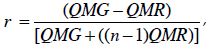
    <p><font face = "Verdana" size = "2">(2) repeatability coefficient:</font></p>

    <p><font face = "Verdana" size = "2"><img src = "/img/revistas/rca/v41n3/v41n3a12eq2.jpg" target = "_blank">,</font></p>

    
<p><font face = "Verdana" size = "2">being MSG =
mean square of genotype, MSE = mean square of error and <i>n</i> = number of crop
seasons;</font></p>

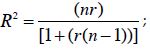
    <p><font face = "Verdana" size = "2">(3) determination coefficient:</font></p>

    <p><font face = "Verdana" size = "2"><img src = "/img/revistas/rca/v41n3/v41n3a12eq3.jpg" target = "_blank">;</font></p>


<p><font face = "Verdana" size = "2">(4) minimum number
of crop seasons needed to predict the true value of the genotype with 95% confidence:</font></p>


    <p><font face = "Verdana" size = "2"><img src = "/img/revistas/rca/v41n3/v41n3a12eq3.jpg" target = "_blank">;</font></p>


]]></body>
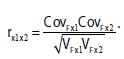
<body><![CDATA[<p><font face = "Verdana" size = "2">(5) mixed phenotypic correlation coefficient of the combination of two harvests:</font></p>


    <p><font face = "Verdana" size = "2"><img src = "/img/revistas/rca/v41n3/v41n3a12eq5.jpg" target = "_blank"></font></p>

    
<p><font face = "Verdana" size = "2"> This parameter
was calculated from the linear relationship between the same trait in the two different
crop seasons, where: <i>Cov<sub>Fx1 = </sub></i>estimation of phenotypic covariance
between trait <i>x</i> crop season 1; <i>Cov<sub>Fx2 = </sub></i>estimation of phenotypic
covariance between trait <i>x</i> crop season 2; <i>V<sub>Fx1</sub></i> = estimation
of phenotypic variance between trait <i>x</i> crop season 1; <i>V<sub>Fx2 = </sub></i>estimation
of phenotypic variance between trait <i>x</i> crop season 2.</font></p>

    <p><font face = "Verdana" size = "2">Variance analysis was carried out by the statistical-computational
system SAS<sup>®</sup> at the 5% probability level through the procedure for the
analysis of linear models PROC MIXED (<i>procedure for mixed linear models</i>),
Type 3; groupings of means and phenotypic correlation were performed by R<sup>®</sup>
Statistical Software.</font></p>

    <p><font face = "Verdana" size = "2">When statistical
significance was verified, at the 5% probability level, the means of the 16 varieties
were grouped in the joint analysis by the procedure proposed by Scott and Knott
(1974), performed by R<sup>®</sup> statistical software.</font></p>


    <p><font face = "Verdana" size = "3"><b>RESULTS AND DISCUSSION</b></font></p>

    <p><font face = "Verdana" size = "2">Significant differences
were identified among the varieties for all eleven traits assessed in the joint
variance analysis (<a href = "/img/revistas/rca/v41n3/v41n3a12t2.jpg" target = "_blank">Table 2</a>).</font></p>

    
<p><font face = "Verdana" size = "2">According to Ferreira <i>et
al</i>. (2005), Ftwi <i>et al</i>. (2017) and Nascimento Filho <i>et al</i>. (2009)
the statistical difference for the varieties denotes the possibility of superior
genotypes identification and the selection of the best ones due to the genetic variation
between them.</font></p>

    <p><font face = "Verdana" size = "2">For the crop season
factor, there was a significant difference in all evaluated traits, except for the
Purity (<a href = "/img/revistas/rca/v41n3/v41n3a12t2.jpg" target = "_blank">Table 2</a>). The highest values of mean squares for crop seasons, except for
stalk average height, in relation to the mean squares of the cultivar and the interaction
cultivars x crop seasons, indicated that there was a great difference between the
agricultural crop seasons for the agroindustrial productive potential.</font></p>


<p><font face = "Verdana" size = "2">Cargnelutti Filho <i>et al</i>. (2012) verified
that there may be an erroneous inference when it is considered only the estimate
of one agricultural year for sugarcane varieties recommendation. According to Ramalho
<i>et al</i>. (2012) this is due to the fact that semi-perennial plants such as
sugarcane are submitted to different environmental conditions during the agricultural
years, such as temperature, precipitation, among others, which leads to a strong
genotypes x environments interaction.</font></p>

    ]]></body>
<body><![CDATA[<p><font face = "Verdana" size = "2">Selective accuracy had high values in the joint analysis, denoting a good experimental
precision according to the classification proposed by Resende and Duarte (2007)
(<a href = "/img/revistas/rca/v41n3/v41n3a12t2.jpg" target = "_blank">Table 2</a>). For Cargnelutti Filho <i>et al</i>. (2012) the parameters selective accuracy
and F test for genotype, of the analysis of variance, are appropriate to evaluate
the experimental precision, when assessing the competition between sugarcane varieties.</font></p>


<p><font face = "Verdana" size = "2">A significant difference was detected by the F
test for the interaction of varieties x crop seasons for the assessed traits, except
for stalk diameter, ºBrix, Fiber and Purity (<a href = "/img/revistas/rca/v41n3/v41n3a12t2.jpg" target = "_blank">Table 2</a>). The authors Cavalcante <i>et
al</i>. (2012), Jackson (2005) and Ftwi <i>et al</i>. (2017) consider that the significant
effect of the genotypes x crop seasons interaction indicates a high heterogeneity
of environmental conditions, resulting in the occurrence of favorable and unfavorable
periods between the years, due to edaphic and climatic variables. Considering the
climatic variable precipitation, there was a difference between the accumulated
in the different crop seasons, once that at the second year the precipitation was
22% lower compared to the first agricultural year (<a href = "/img/revistas/rca/v41n3/v41n3a12f1.jpg" target = "_blank">Figure 1</a>). As a significant difference
was detected in the interaction between varieties and crop seasons for most of the
evaluated traits, the unfolding of varieties and harvests was carried out (<a href = "/img/revistas/rca/v41n3/v41n3a12t3.jpg" target = "_blank">Tables
3</a> and <a href = "/img/revistas/rca/v41n3/v41n3a12t4.jpg" target = "_blank">4</a>).</font></p>

    
<p><font face = "Verdana" size = "2">In the 2011/2012 crop season there was a statistical difference
between the varieties for all assessed traits, except for NC (<a href = "/img/revistas/rca/v41n3/v41n3a12t3.jpg" target = "_blank">Tables 3</a> and <a href = "/img/revistas/rca/v41n3/v41n3a12t4.jpg" target = "_blank">4</a>). For
Brito <i>et al</i>. (2013) the number of stalks varies widely among varieties, but
the low experimental precision, obtained for this trait in the first crop season,
when the value of the selective accuracy was only 0.65, a value considered moderate
according to the classification proposed by Rezende and Duarte (2007), it was impossible
to find significant differences in this experiment.</font></p>

    
<p><font face = "Verdana" size = "2">In relation to the crop season of 2012/2013, there were significant
differences between the varieties for all the assessed traits (<a href = "/img/revistas/rca/v41n3/v41n3a12t3.jpg" target = "_blank">Tables 3</a> and <a href = "/img/revistas/rca/v41n3/v41n3a12t4.jpg" target = "_blank">4</a>).
A similar result was obtained by Ftwi <i>et al</i>. (2017) studying sugarcane industrial
traits, when the authors obtained significant differences for most of the variables
evaluated in the first harvests.</font></p>

    
<p><font face = "Verdana" size = "2">For
the stalk height trait, all varieties were highest in the second crop season (<a href = "/img/revistas/rca/v41n3/v41n3a12t3.jpg" target = "_blank">Table
3</a>). Candido <i>et al</i>. (2009) point out that in order to have a good growth of
the varieties it is necessary some time for the roots to grow in the soil, which
according to the authors does not occur in the first year of cultivation, unless
when the sugarcane is cultivated in one and a half year system, that was not the
case in the present study.</font></p>

    
<p><font face = "Verdana" size = "2">In <a href = "/img/revistas/rca/v41n3/v41n3a12t3.jpg" target = "_blank">Table
3</a>, it was possible to observe that the stalk average mass was 0.69 and 1.01 kg,
respectively, for the first and second crop season. In the first harvest, two large
groups were formed, while in the second harvest three groups of averages were formed,
and the varieties that presented the best performance for this character were CTC9,
CTC2, RB867515 and CTC1.</font></p>

    
<p><font face = "Verdana" size = "2">In relation
to the stalks number per linear meter, for Silva <i>et al</i>. (2008) the sugarcane
development is positively related to a greater tillering, which results in higher
productivity. However, this did not occur in the present study, because not all
cultivars that formed the group with the highest value for stalks average number
per linear meter in the two crop seasons were in the group with the highest value
for tons of stalks per hectare (<a href = "/img/revistas/rca/v41n3/v41n3a12t3.jpg" target = "_blank">Table 3</a>). Silva <i>et al</i>. (2007) consider that
the number of stalks has a high genetic control, however this did not occur in the
present study, once this trait was very influenced by the different cultivation
environments, when in the first crop season the average for this trait was only
8.37 stalks per meter, while in the second it was 14.85 stalks per meter (<a href = "/img/revistas/rca/v41n3/v41n3a12t3.jpg" target = "_blank">Table
3</a>).</font></p>

    
<p><font face = "Verdana" size = "2">Jackson (2005) highlights that
the trait TSH is one of the main traits to be considered and should always be a
focus in sugarcane breeding programs. Only two groups were formed with the means
of the first crop season, while in the second, three groups were identified (<a href = "/img/revistas/rca/v41n3/v41n3a12t3.jpg" target = "_blank">Table
3</a>). For Ftwi <i>et al</i>. (2017), this trait is very influenced by the different
crop seasons, which can be proven in the present work, once there was a better average
performance among the varieties for this trait in the second harvest, except for
variety SP891115, which had phytosanitary problems in the 2012/2013 crop season.
This phenotypic variability provides favorable results for the indication of varieties
with good industrial characteristics in the cultivation region.</font></p>

    
<p><font face = "Verdana" size = "2">For the industrial traits TRS and POL, there was great variation
amplitude, with the formation of three groups of means in the two different assessed
harvests (<a href = "/img/revistas/rca/v41n3/v41n3a12t4.jpg" target = "_blank">Table 4</a>). This phenotypic variability provides favorable results for the
indication of varieties with good industrial characteristics in the cultivation
region.</font></p>

    
<p><font face = "Verdana" size = "2">For the TPH trait, in the
first harvest there was small amplitude of variation, with the formation of only
two groups of means. In the second harvest the amplitude was higher, being the variety
CTC7 the one to present the highest average (<a href = "/img/revistas/rca/v41n3/v41n3a12t4.jpg" target = "_blank">Table 4</a>). Fernandes <i>et al</i>. (2017)
and Ftwi <i>et al</i>. (2017) also obtained great variation among the varieties
in the conduction of different crop seasons for this trait when evaluating the genotypes
x environments interaction in sugarcane.</font></p>

    
]]></body>
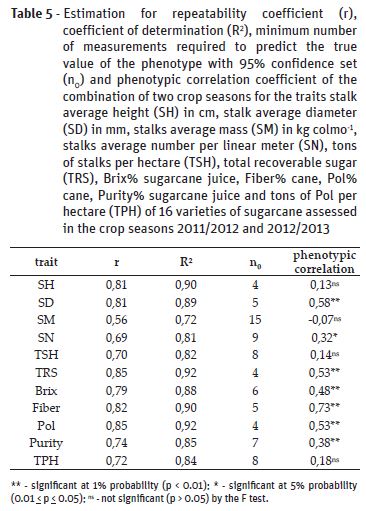
<body><![CDATA[<p><font face = "Verdana" size = "2">The values of the repeatability coefficient were high (<a href = "#t5">Table 5</a>), except for
the stalks average mass trait. According to Silva <i>et al</i>. (2009) the low repeatability
value for the SM trait is due to the fact that it had a lot of environmental influence,
causing low regularity in the repetition of the values of the variable from one
crop season to another, thus, being necessary more evaluations for a better accuracy.
Ferreira <i>et al</i>. (2005) when studying the repeatability and predictability
for industrial variables in sugarcane also obtained high values for this parameter
for most of the assessed traits. According to Fernandes <i>et al</i>. (2017), high
values for the repeatability coefficient is indicative of the performance regularity
of the genotypes in the different crop seasons.</font></p>

    <p>&nbsp;</p>

<a name = "t5"><img src = "/img/revistas/rca/v41n3/v41n3a12t5.jpg" target = "_blank"></a>

    
<p>&nbsp;</p>

    <p><font face = "Verdana" size = "2">Resende
(2002) consider that values above 80%, for the coefficient of determination parameter,
are considered appropriate for the selection of genotypes. Ferreira <i>et al</i>.
(2005) also obtained values higher than 80% for this parameter for the industrial
traits assessed. The traits Pol and TRS were those that presented a higher value
for the coefficient of determination (<a href = "#t5">Table 5</a>), denoting the good reliability of
the phenotype in predicting the genotypic value for these two variables.</font></p>


    <p><font face = "Verdana" size = "2">For the parameter, minimum number of crop seasons
needed to predict the true value (n<sub>0</sub>) of the trait TSH, this value would
be of eight harvests (<a href = "#t5">Table 5</a>). A similar result for this variable was obtained
by Ferreira <i>et al</i>. (2005), but the confidence index established by the authors
was only 90%. The number for the Purity trait would be of seven harvests. The highest
estimate of number obtained for these traits indicates that there is no regularity
in the repetition of this variable from one crop season to another, thus being necessary
more evaluations. It is worth mentioning that in breeding programs and in the mills
and distilleries, it is common to use up to five harvests to select the best varieties
through the evaluation of the industrial traits. For the SM trait, the value of
n<sub>0</sub> would be fifteen, being a not feasible number of evaluations, due
to the difficulty in conducting and harvesting sugarcane experiments.</font></p>


    <p><font face = "Verdana" size = "2">With respect to the phenotypic correlation coefficient
parameter, Jackson (2005) affirms that correlations between the same traits assessed
in two periods, reflect the association of genetic and environmental nature. For
this parameter, there was a significant correlation for the traits stalks average
diameter, stalks number per meter, TRS, Brix, Fiber, Pol and Purity (<a href = "#t5">Table 5</a>). Nascimento
Filho <i>et al</i>. (2009) consider the statistical significance for this parameter
as indicative that the cultivars have different performance in the different harvests.
However, the lack of significant correlation for the other traits probably occurred
because only two harvests were considered in the present study, which tends to change
with the increase of the evaluations during another crop seasons.</font></p>


    <p><font face = "Verdana" size = "3"><b>CONCLUSIONS</b></font></p>

    <p><font face = "Verdana" size = "2">Varieties
do not present a similar behavior; however, they have regularity in the performance,
over time, for most agronomic and industrial characters evaluated. Phenotypic characteristics
POL and TRS, denote good reliability in predicting the genotypic value for these
variables. The high number of measurements required for the TSH, Purity and SM characters
make it difficult to select potential varieties. Phenotypic correlation evaluated
in two harvests is not sufficient to carry out the recommendation of varieties.</font></p>

 
    <p>&nbsp;</p>

    <p><font face = "Verdana" size = "3"><b>References</b></font></p>

    ]]></body>
<body><![CDATA[<!-- ref --><p><font face = "Verdana" size = "2">Brito, T.R.C.; Barbosa, T.F.; Barbosa, J.A.; Oliveira, C.R. &amp; Oliveira,
W.F. (2013) - Desempenho de sete genótipos de cana de açúcar de quinto corte na
região sul do estado do Tocantins. <i>Revista Verde de Agroecologia e Desenvolvimento
Sustentável</i>, vol. 8, p. 78-83.    &nbsp;&nbsp;&nbsp;&nbsp;&nbsp;&nbsp;&nbsp;&nbsp;[&#160;<a href="javascript:void(0);" onclick="javascript: window.open('/scielo.php?script=sci_nlinks&ref=686328&pid=S0871-018X201800030001200001&lng=','','width=640,height=500,resizable=yes,scrollbars=1,menubar=yes,');">Links</a>&#160;]<!-- end-ref --></font></p>

    <!-- ref --><p><font face = "Verdana" size = "2">Cândido, L.S.; Perecin, D.; Landell, M.G. de A. &amp; Pavan, B.E. (2009) - Análise
de vizinhança na avaliação de genótipos de cana-de-açúcar. <i>Pesquisa Agropecuária
Brasileira</i>, vol. 44, n. 10, p. 1304-131. 
<a href = "http://dx.doi.org/10.1590/S0100-204X2009001000014" target = "_blank">http://dx.doi.org/10.1590/S0100-204X2009001000014</a></font>&nbsp;&nbsp;&nbsp;&nbsp;&nbsp;&nbsp;&nbsp;&nbsp;[&#160;<a href="javascript:void(0);" onclick="javascript: window.open('/scielo.php?script=sci_nlinks&ref=686330&pid=S0871-018X201800030001200002&lng=','','width=640,height=500,resizable=yes,scrollbars=1,menubar=yes,');">Links</a>&#160;]<!-- end-ref --><!-- ref --><p><font face = "Verdana" size = "2">Cargnelutti Filho, A.; Braga Júnior,
R.L.C. &amp; Lúcio, A.D. (2012) - Medidas de precisão experimental e número de repetições
em ensaios de genótipos de cana-de-açúcar. <i>Pesquisa Agropecuária Brasileira</i>,
vol. 47, n. 10, p. 1413-1421.    &nbsp;&nbsp;&nbsp;&nbsp;&nbsp;&nbsp;&nbsp;&nbsp;[&#160;<a href="javascript:void(0);" onclick="javascript: window.open('/scielo.php?script=sci_nlinks&ref=686331&pid=S0871-018X201800030001200003&lng=','','width=640,height=500,resizable=yes,scrollbars=1,menubar=yes,');">Links</a>&#160;]<!-- end-ref --></font></p>

    <!-- ref --><p><font face = "Verdana" size = "2">Cavalcante,
M.; Lira, M. de A.; Santos, M.V.F. dos; Pita, E.B.; Ferreira, A.; Ferreira, R.L.C.
&amp; Tabosa, J.N. (2012) - Coeficiente de repetibilidade e parâmetros genéticos
em capim-elefante. <i>Pesquisa Agropecuária Brasileira</i>, vol. 47, n. 4, p. 569-575.    &nbsp;&nbsp;&nbsp;&nbsp;&nbsp;&nbsp;&nbsp;&nbsp;[&#160;<a href="javascript:void(0);" onclick="javascript: window.open('/scielo.php?script=sci_nlinks&ref=686333&pid=S0871-018X201800030001200004&lng=','','width=640,height=500,resizable=yes,scrollbars=1,menubar=yes,');">Links</a>&#160;]<!-- end-ref --></font></p>


    <!-- ref --><p><font face = "Verdana" size = "2">Cruz, C.D.; Regazzi, A.J. &amp; Carneiro, P.C.S.
(2004) - <i>Modelos biométricos aplicados ao melhoramento genético</i>. Viçosa:
UFV, 390p.    &nbsp;&nbsp;&nbsp;&nbsp;&nbsp;&nbsp;&nbsp;&nbsp;[&#160;<a href="javascript:void(0);" onclick="javascript: window.open('/scielo.php?script=sci_nlinks&ref=686335&pid=S0871-018X201800030001200005&lng=','','width=640,height=500,resizable=yes,scrollbars=1,menubar=yes,');">Links</a>&#160;]<!-- end-ref --></font></p>

    <!-- ref --><p><font face = "Verdana" size = "2">Fernandes, O.W.B.; Silva,
D.F.; Sanson, A.L.; Coutrim, M.X.; Afonso, R.J. de C.F.; Eichler, P. &amp; Santos,
F. (2017) -  Influence of Harvest Season and Maturation of Different Sugarcane (Saccharum
Spp.) Cultivars on the Chemical Composition of Alembic Brazilian Sugarcane Spirit.
<i>Open Access Library Journal</i>, vol. 4, art. e3266. <a href = "http://dx.doi.org/10.4236/oalib.1103266" target = "_blank">http://dx.doi.org/10.4236/oalib.1103266</a></font>&nbsp;&nbsp;&nbsp;&nbsp;&nbsp;&nbsp;&nbsp;&nbsp;[&#160;<a href="javascript:void(0);" onclick="javascript: window.open('/scielo.php?script=sci_nlinks&ref=686337&pid=S0871-018X201800030001200006&lng=','','width=640,height=500,resizable=yes,scrollbars=1,menubar=yes,');">Links</a>&#160;]<!-- end-ref --><!-- ref --><p><font face = "Verdana" size = "2">Fernandes Júnior, A.R.; Azeredo,
A.A.C. de; Oliveira, R.A. de; Bespalhok Filho, J.C.; Ido, O.T.; Daros, E. &amp;
Brasileiro, B.P. (2017) - Agricultural performance and genetic parameters for yield-related
traits of sugar- and energy cane families derived from planned crosses. <i>Genetics
and Molecular Research,</i> vol. 16, n. 3, art. gmr16039773. <a href = "http://dx.doi.org/10.4238/gmr16039773" target = "_blank">http://dx.doi.org/10.4238/gmr16039773</a></font>&nbsp;&nbsp;&nbsp;&nbsp;&nbsp;&nbsp;&nbsp;&nbsp;[&#160;<a href="javascript:void(0);" onclick="javascript: window.open('/scielo.php?script=sci_nlinks&ref=686338&pid=S0871-018X201800030001200007&lng=','','width=640,height=500,resizable=yes,scrollbars=1,menubar=yes,');">Links</a>&#160;]<!-- end-ref --><!-- ref --><p><font face = "Verdana" size = "2">Ferreira, A.; Barbosa, M.H.P.; Cruz,
C. D.; Hoffmann, H. P.; Vieira, M.A.S.; Bassinello, A.I. &amp; Silva, M.F. da. (2005)
- Repetibilidade e número de colheitas para seleção de clones de cana-de-açúcar.
<i>Pesquisa Agropecuária Brasileira</i>, vol. 40, n. 8, p. 761-767.
<a href = "http://dx.doi.org/10.1590/S0100-204X2005000800005" target = "_blank">http://dx.doi.org/10.1590/S0100-204X2005000800005</a></font>&nbsp;&nbsp;&nbsp;&nbsp;&nbsp;&nbsp;&nbsp;&nbsp;[&#160;<a href="javascript:void(0);" onclick="javascript: window.open('/scielo.php?script=sci_nlinks&ref=686339&pid=S0871-018X201800030001200008&lng=','','width=640,height=500,resizable=yes,scrollbars=1,menubar=yes,');">Links</a>&#160;]<!-- end-ref --><!-- ref --><p><font face = "Verdana" size = "2">Ftwi, M.; Mekbib, F. &amp; Abraha E. (2017) -
Temporal and Spatial Factors Affecting the Nature of Genotype x Environment Interaction
in Sugarcane (<i>Saccharum officinarum</i> L.) under Ethiopian Agro-Climatic Conditions:
An Integrated Approach. <i>American Journal of Plant Sciences</i>, vol. 8, n. 7,
art. 77316. <a href = "http://dx.doi.org/10.4236/ajps.2017.87119" target = "_blank">http://dx.doi.org/10.4236/ajps.2017.87119</a></font>&nbsp;&nbsp;&nbsp;&nbsp;&nbsp;&nbsp;&nbsp;&nbsp;[&#160;<a href="javascript:void(0);" onclick="javascript: window.open('/scielo.php?script=sci_nlinks&ref=686340&pid=S0871-018X201800030001200009&lng=','','width=640,height=500,resizable=yes,scrollbars=1,menubar=yes,');">Links</a>&#160;]<!-- end-ref --><!-- ref --><p><font face = "Verdana" size = "2">INMET (2014). <i>Estações convencionais: gráficos de precipitação
mensal.</i> Instituto Nacional de Meteorologia. &lt;<a href = "http://www.inmet.gov.br/portal/index.php?r=home/page&amp;page=rede_estacoes_conv_graf" target = "_blank">http://www.inmet.gov.br/portal/index.php?r=home/page&amp;page=rede_estacoes_conv_graf</a>&gt;    &nbsp;&nbsp;&nbsp;&nbsp;&nbsp;&nbsp;&nbsp;&nbsp;[&#160;<a href="javascript:void(0);" onclick="javascript: window.open('/scielo.php?script=sci_nlinks&ref=686341&pid=S0871-018X201800030001200010&lng=','','width=640,height=500,resizable=yes,scrollbars=1,menubar=yes,');">Links</a>&#160;]<!-- end-ref -->.</font></p>


    <!-- ref --><p><font face = "Verdana" size = "2">Jackson, P.A. (2005) - Breeding for improved sugar
content in sugarcane. <i>Field Crops Research</i>, vol. 92, n. 2-3, p. 277-290.
<a href = "https://doi.org/10.1016/j.fcr.2005.01.024" target = "_blank">https://doi.org/10.1016/j.fcr.2005.01.024</a></font>&nbsp;&nbsp;&nbsp;&nbsp;&nbsp;&nbsp;&nbsp;&nbsp;[&#160;<a href="javascript:void(0);" onclick="javascript: window.open('/scielo.php?script=sci_nlinks&ref=686343&pid=S0871-018X201800030001200011&lng=','','width=640,height=500,resizable=yes,scrollbars=1,menubar=yes,');">Links</a>&#160;]<!-- end-ref --><!-- ref --><p><font face = "Verdana" size = "2">Nascimento Filho, F.J.; Atroch, A.L.; Cruz, C.D. &amp; Carneiro, P.C.S.
(2009) - Repetibilidade da produção de sementes em clones de guaraná. <i>Pesquisa
Agropecuária Brasileira</i>, vol. 44, n. 6, p. 605-612. <a href = "http://dx.doi.org/10.1590/S0100-204X2009000600009" target = "_blank">http://dx.doi.org/10.1590/S0100-204X2009000600009</a></font>&nbsp;&nbsp;&nbsp;&nbsp;&nbsp;&nbsp;&nbsp;&nbsp;[&#160;<a href="javascript:void(0);" onclick="javascript: window.open('/scielo.php?script=sci_nlinks&ref=686344&pid=S0871-018X201800030001200012&lng=','','width=640,height=500,resizable=yes,scrollbars=1,menubar=yes,');">Links</a>&#160;]<!-- end-ref --><!-- ref --><p><font face = "Verdana" size = "2">Ramalho, M.A.P.; Ferreira, D.F. &amp; Oliveira,
A.C. (2012) - <i>Experimentação em genética e melhoramento de plantas</i>. 3. ed.
Lavras: UFLA, 328p.    &nbsp;&nbsp;&nbsp;&nbsp;&nbsp;&nbsp;&nbsp;&nbsp;[&#160;<a href="javascript:void(0);" onclick="javascript: window.open('/scielo.php?script=sci_nlinks&ref=686345&pid=S0871-018X201800030001200013&lng=','','width=640,height=500,resizable=yes,scrollbars=1,menubar=yes,');">Links</a>&#160;]<!-- end-ref --></font></p>

    <!-- ref --><p><font face = "Verdana" size = "2">Resende, M.D.V.
(2002) - <i>Genética biométrica e estatística no melhoramento de plantas perenes</i>.
Brasília: Embrapa Informações Tecnológicas, 975p.    &nbsp;&nbsp;&nbsp;&nbsp;&nbsp;&nbsp;&nbsp;&nbsp;[&#160;<a href="javascript:void(0);" onclick="javascript: window.open('/scielo.php?script=sci_nlinks&ref=686347&pid=S0871-018X201800030001200014&lng=','','width=640,height=500,resizable=yes,scrollbars=1,menubar=yes,');">Links</a>&#160;]<!-- end-ref --></font></p>

    <!-- ref --><p><font face = "Verdana" size = "2">Resende, M.D.V. &amp; Duarte, J.B. (2007) - Precisão e controle
de qualidade em experimentos de avaliação de cultivares. <i>Pesquisa Agropecuária
Tropical</i>, vol. 37, n. 3, p. 182-194.    &nbsp;&nbsp;&nbsp;&nbsp;&nbsp;&nbsp;&nbsp;&nbsp;[&#160;<a href="javascript:void(0);" onclick="javascript: window.open('/scielo.php?script=sci_nlinks&ref=686349&pid=S0871-018X201800030001200015&lng=','','width=640,height=500,resizable=yes,scrollbars=1,menubar=yes,');">Links</a>&#160;]<!-- end-ref --></font></p>

    <!-- ref --><p><font face = "Verdana" size = "2">Scott, A.J. &amp; Knott, M. (1974) - A cluster analysis method for grouping
means in the analysis of variance. <i>Biometrics</i>, vol. 30, n. 3, p. 507-512.    &nbsp;&nbsp;&nbsp;&nbsp;&nbsp;&nbsp;&nbsp;&nbsp;[&#160;<a href="javascript:void(0);" onclick="javascript: window.open('/scielo.php?script=sci_nlinks&ref=686351&pid=S0871-018X201800030001200016&lng=','','width=640,height=500,resizable=yes,scrollbars=1,menubar=yes,');">Links</a>&#160;]<!-- end-ref --></font></p>


    <!-- ref --><p><font face = "Verdana" size = "2">Silva, M.A.; Gava, G.J. de C.; Caputo, M.M.; Pincelli,
R.P.; Jerônimo, E.M. &amp; Cruz, J.C.S. (2007) - Uso de reguladores de crescimento
como potencializadores do perfilhamento e da produtividade em cana-soca. <i>Bragantia</i>,
vol. 66, n. 4, p. 545-552. <a href = "http://dx.doi.org/10.1590/S0006-87052007000400003" target = "_blank">http://dx.doi.org/10.1590/S0006-87052007000400003</a></font>&nbsp;&nbsp;&nbsp;&nbsp;&nbsp;&nbsp;&nbsp;&nbsp;[&#160;<a href="javascript:void(0);" onclick="javascript: window.open('/scielo.php?script=sci_nlinks&ref=686353&pid=S0871-018X201800030001200017&lng=','','width=640,height=500,resizable=yes,scrollbars=1,menubar=yes,');">Links</a>&#160;]<!-- end-ref --><!-- ref --><p><font face = "Verdana" size = "2">Silva, M.A.; Jerônimo, E.M. &amp; Lúcio, A.D.
(2008) - Perfilhamento e produtividade de cana-de-açúcar com diferentes alturas
de corte e épocas de colheita. <i>Pesquisa Agropecuária Brasileira</i>, vol. 43,
n. 8,  979-986. <a href = "http://dx.doi.org/10.1590/S0100-204X2008000800005" target = "_blank">http://dx.doi.org/10.1590/S0100-204X2008000800005</a></font>&nbsp;&nbsp;&nbsp;&nbsp;&nbsp;&nbsp;&nbsp;&nbsp;[&#160;<a href="javascript:void(0);" onclick="javascript: window.open('/scielo.php?script=sci_nlinks&ref=686354&pid=S0871-018X201800030001200018&lng=','','width=640,height=500,resizable=yes,scrollbars=1,menubar=yes,');">Links</a>&#160;]<!-- end-ref --><!-- ref --><p><font face = "Verdana" size = "2">Silva, R.G.; Chaves M. da C.L.; Arnhold, E. &amp;
Cruz, C.D. (2009) - Repetibilidade e correlações fenotípicas de caracteres do fruto
de bacuri no Estado do Maranhão. <i>Acta Scientiarum, Agronomy</i>, vol. 31, n.
4, p. 587-591. <a href = "http://dx.doi.org/10.4025/actasciagron.v31i4.723" target = "_blank">http://dx.doi.org/10.4025/actasciagron.v31i4.723</a></font>&nbsp;&nbsp;&nbsp;&nbsp;&nbsp;&nbsp;&nbsp;&nbsp;[&#160;<a href="javascript:void(0);" onclick="javascript: window.open('/scielo.php?script=sci_nlinks&ref=686355&pid=S0871-018X201800030001200019&lng=','','width=640,height=500,resizable=yes,scrollbars=1,menubar=yes,');">Links</a>&#160;]<!-- end-ref --><!-- ref --><p><font face = "Verdana" size = "2">Souza, P.H.; Bastos, G.Q.; Anunciação Filho, C.J. da; Dutra
Filho, J. de A. &amp; Machado, P.R. (2012) - Avaliação de genótipos de cana-de-açúcar
para início de safra na microrregião Centro de Pernambuco. <i>Revista Ceres</i>,
vol. 59, n. 5, p. 677-683. <a href = "http://dx.doi.org/10.1590/S0034-737X2012000500013" target = "_blank">http://dx.doi.org/10.1590/S0034-737X2012000500013</a></font>&nbsp;&nbsp;&nbsp;&nbsp;&nbsp;&nbsp;&nbsp;&nbsp;[&#160;<a href="javascript:void(0);" onclick="javascript: window.open('/scielo.php?script=sci_nlinks&ref=686356&pid=S0871-018X201800030001200020&lng=','','width=640,height=500,resizable=yes,scrollbars=1,menubar=yes,');">Links</a>&#160;]<!-- end-ref --><p>&nbsp;</p>

    ]]></body>
<body><![CDATA[<p><font face = "Verdana" size = "3"><b>Acknowledgment</b></font></p>

    <p><font face = "Verdana" size = "2">The authors
thank the Coordination of Improvement of Higher Level Personnel (CAPES), by the
research funding, to the Agronomic Institute of Campinas (IAC), for having carried
out the technological analysis of this work and the Cachaça Bocaina Company, for
the assignment of the experimental area and support in the accomplishment of the
experiments.</font></p>

    <p>&nbsp;</p>

    <p><font face = "Verdana" size = "2">Received/recebido: 2017.11.30</font></p>

    <p><font face = "Verdana" size = "2">Accepted/aceite: 2018.03.20</font></p>

     ]]></body><back>
<ref-list>
<ref id="B1">
<nlm-citation citation-type="journal">
<person-group person-group-type="author">
<name>
<surname><![CDATA[Brito]]></surname>
<given-names><![CDATA[T.R.C.]]></given-names>
</name>
<name>
<surname><![CDATA[Barbosa]]></surname>
<given-names><![CDATA[T.F.]]></given-names>
</name>
<name>
<surname><![CDATA[Barbosa]]></surname>
<given-names><![CDATA[J.A.]]></given-names>
</name>
<name>
<surname><![CDATA[Oliveira]]></surname>
<given-names><![CDATA[C.R.]]></given-names>
</name>
<name>
<surname><![CDATA[Oliveira]]></surname>
<given-names><![CDATA[W.F.]]></given-names>
</name>
</person-group>
<article-title xml:lang="pt"><![CDATA[Desempenho de sete genótipos de cana de açúcar de quinto corte na região sul do estado do Tocantins]]></article-title>
<source><![CDATA[Revista Verde de Agroecologia e Desenvolvimento Sustentável]]></source>
<year>2013</year>
<volume>8</volume>
<page-range>78-83</page-range></nlm-citation>
</ref>
<ref id="B2">
<nlm-citation citation-type="journal">
<person-group person-group-type="author">
<name>
<surname><![CDATA[Cândido]]></surname>
<given-names><![CDATA[L.S.]]></given-names>
</name>
<name>
<surname><![CDATA[Perecin]]></surname>
<given-names><![CDATA[D.]]></given-names>
</name>
<name>
<surname><![CDATA[Landell]]></surname>
<given-names><![CDATA[M.G. de A.]]></given-names>
</name>
<name>
<surname><![CDATA[Pavan]]></surname>
<given-names><![CDATA[B.E.]]></given-names>
</name>
</person-group>
<article-title xml:lang="pt"><![CDATA[Análise de vizinhança na avaliação de genótipos de cana-de-açúcar]]></article-title>
<source><![CDATA[Pesquisa Agropecuária Brasileira]]></source>
<year>2009</year>
<volume>44</volume>
<numero>10</numero>
<issue>10</issue>
<page-range>1304-131</page-range></nlm-citation>
</ref>
<ref id="B3">
<nlm-citation citation-type="journal">
<person-group person-group-type="author">
<name>
<surname><![CDATA[Cargnelutti Filho]]></surname>
<given-names><![CDATA[A.]]></given-names>
</name>
<name>
<surname><![CDATA[Braga Júnior]]></surname>
<given-names><![CDATA[R.L.C.]]></given-names>
</name>
<name>
<surname><![CDATA[Lúcio]]></surname>
<given-names><![CDATA[A.D.]]></given-names>
</name>
</person-group>
<article-title xml:lang="pt"><![CDATA[Medidas de precisão experimental e número de repetições em ensaios de genótipos de cana-de-açúcar]]></article-title>
<source><![CDATA[Pesquisa Agropecuária Brasileira]]></source>
<year>2012</year>
<volume>47</volume>
<numero>10</numero>
<issue>10</issue>
<page-range>1413-1421</page-range></nlm-citation>
</ref>
<ref id="B4">
<nlm-citation citation-type="journal">
<person-group person-group-type="author">
<name>
<surname><![CDATA[Cavalcante]]></surname>
<given-names><![CDATA[M.]]></given-names>
</name>
<name>
<surname><![CDATA[Lira]]></surname>
<given-names><![CDATA[M. de A.]]></given-names>
</name>
<name>
<surname><![CDATA[Santos]]></surname>
<given-names><![CDATA[M.V.F. dos]]></given-names>
</name>
<name>
<surname><![CDATA[Pita]]></surname>
<given-names><![CDATA[E.B.]]></given-names>
</name>
<name>
<surname><![CDATA[Ferreira]]></surname>
<given-names><![CDATA[A.]]></given-names>
</name>
<name>
<surname><![CDATA[Ferreira]]></surname>
<given-names><![CDATA[R.L.C.]]></given-names>
</name>
<name>
<surname><![CDATA[Tabosa]]></surname>
<given-names><![CDATA[J.N.]]></given-names>
</name>
</person-group>
<article-title xml:lang="pt"><![CDATA[Coeficiente de repetibilidade e parâmetros genéticos em capim-elefante]]></article-title>
<source><![CDATA[Pesquisa Agropecuária Brasileira]]></source>
<year>2012</year>
<volume>47</volume>
<numero>4</numero>
<issue>4</issue>
<page-range>569-575</page-range></nlm-citation>
</ref>
<ref id="B5">
<nlm-citation citation-type="book">
<person-group person-group-type="author">
<name>
<surname><![CDATA[Cruz]]></surname>
<given-names><![CDATA[C.D.]]></given-names>
</name>
<name>
<surname><![CDATA[Regazzi]]></surname>
<given-names><![CDATA[A.J.]]></given-names>
</name>
<name>
<surname><![CDATA[Carneiro]]></surname>
<given-names><![CDATA[P.C.S.]]></given-names>
</name>
</person-group>
<source><![CDATA[Modelos biométricos aplicados ao melhoramento genético]]></source>
<year>2004</year>
<publisher-loc><![CDATA[Viçosa ]]></publisher-loc>
<publisher-name><![CDATA[UFV]]></publisher-name>
</nlm-citation>
</ref>
<ref id="B6">
<nlm-citation citation-type="journal">
<person-group person-group-type="author">
<name>
<surname><![CDATA[Fernandes]]></surname>
<given-names><![CDATA[O.W.B.]]></given-names>
</name>
<name>
<surname><![CDATA[Silva]]></surname>
<given-names><![CDATA[D.F.]]></given-names>
</name>
<name>
<surname><![CDATA[Sanson]]></surname>
<given-names><![CDATA[A.L.]]></given-names>
</name>
<name>
<surname><![CDATA[Coutrim]]></surname>
<given-names><![CDATA[M.X.]]></given-names>
</name>
<name>
<surname><![CDATA[Afonso]]></surname>
<given-names><![CDATA[R.J. de C.F.]]></given-names>
</name>
<name>
<surname><![CDATA[Eichler]]></surname>
<given-names><![CDATA[P.]]></given-names>
</name>
<name>
<surname><![CDATA[Santos]]></surname>
<given-names><![CDATA[F.]]></given-names>
</name>
</person-group>
<article-title xml:lang="en"><![CDATA[Influence of Harvest Season and Maturation of Different Sugarcane (Saccharum Spp.) Cultivars on the Chemical Composition of Alembic Brazilian Sugarcane Spirit]]></article-title>
<source><![CDATA[Open Access Library Journal]]></source>
<year>2017</year>
<volume>4</volume>
<numero>^se3266</numero>
<issue>^se3266</issue>
<supplement>e3266</supplement>
</nlm-citation>
</ref>
<ref id="B7">
<nlm-citation citation-type="journal">
<person-group person-group-type="author">
<name>
<surname><![CDATA[Fernandes Júnior]]></surname>
<given-names><![CDATA[A.R.]]></given-names>
</name>
<name>
<surname><![CDATA[Azeredo]]></surname>
<given-names><![CDATA[A.A.C. de]]></given-names>
</name>
<name>
<surname><![CDATA[Oliveira]]></surname>
<given-names><![CDATA[R.A. de]]></given-names>
</name>
<name>
<surname><![CDATA[Bespalhok Filho]]></surname>
<given-names><![CDATA[J.C.]]></given-names>
</name>
<name>
<surname><![CDATA[Ido]]></surname>
<given-names><![CDATA[O.T.]]></given-names>
</name>
<name>
<surname><![CDATA[Daros]]></surname>
<given-names><![CDATA[E.]]></given-names>
</name>
<name>
<surname><![CDATA[Brasileiro]]></surname>
<given-names><![CDATA[B.P.]]></given-names>
</name>
</person-group>
<article-title xml:lang="en"><![CDATA[Agricultural performance and genetic parameters for yield-related traits of sugar- and energy cane families derived from planned crosses]]></article-title>
<source><![CDATA[Genetics and Molecular Research]]></source>
<year>2017</year>
<volume>16</volume>
<numero>3^sgmr16039773</numero>
<issue>3^sgmr16039773</issue>
<supplement>gmr16039773</supplement>
</nlm-citation>
</ref>
<ref id="B8">
<nlm-citation citation-type="journal">
<person-group person-group-type="author">
<name>
<surname><![CDATA[Ferreira]]></surname>
<given-names><![CDATA[A.]]></given-names>
</name>
<name>
<surname><![CDATA[Barbosa]]></surname>
<given-names><![CDATA[M.H.P.]]></given-names>
</name>
<name>
<surname><![CDATA[Cruz]]></surname>
<given-names><![CDATA[C. D.]]></given-names>
</name>
<name>
<surname><![CDATA[Hoffmann]]></surname>
<given-names><![CDATA[H. P.]]></given-names>
</name>
<name>
<surname><![CDATA[Vieira]]></surname>
<given-names><![CDATA[M.A.S.]]></given-names>
</name>
<name>
<surname><![CDATA[Bassinello]]></surname>
<given-names><![CDATA[A.I.]]></given-names>
</name>
<name>
<surname><![CDATA[Silva]]></surname>
<given-names><![CDATA[M.F. da.]]></given-names>
</name>
</person-group>
<article-title xml:lang="pt"><![CDATA[Repetibilidade e número de colheitas para seleção de clones de cana-de-açúcar]]></article-title>
<source><![CDATA[Pesquisa Agropecuária Brasileira]]></source>
<year>2005</year>
<volume>40</volume>
<numero>8</numero>
<issue>8</issue>
<page-range>761-767</page-range></nlm-citation>
</ref>
<ref id="B9">
<nlm-citation citation-type="journal">
<person-group person-group-type="author">
<name>
<surname><![CDATA[Ftwi]]></surname>
<given-names><![CDATA[M.]]></given-names>
</name>
<name>
<surname><![CDATA[Mekbib]]></surname>
<given-names><![CDATA[F.]]></given-names>
</name>
<name>
<surname><![CDATA[Abraha]]></surname>
<given-names><![CDATA[E.]]></given-names>
</name>
</person-group>
<article-title xml:lang="en"><![CDATA[Temporal and Spatial Factors Affecting the Nature of Genotype x Environment Interaction in Sugarcane (Saccharum officinarum L.) under Ethiopian Agro-Climatic Conditions: An Integrated Approach]]></article-title>
<source><![CDATA[American Journal of Plant Sciences]]></source>
<year>2017</year>
<volume>8</volume>
<numero>7^s77316</numero>
<issue>7^s77316</issue>
<supplement>77316</supplement>
</nlm-citation>
</ref>
<ref id="B10">
<nlm-citation citation-type="book">
<collab>INMET</collab>
<source><![CDATA[Estações convencionais: gráficos de precipitação mensal]]></source>
<year>2014</year>
<publisher-name><![CDATA[Instituto Nacional de Meteorologia]]></publisher-name>
</nlm-citation>
</ref>
<ref id="B11">
<nlm-citation citation-type="journal">
<person-group person-group-type="author">
<name>
<surname><![CDATA[Jackson]]></surname>
<given-names><![CDATA[P.A.]]></given-names>
</name>
</person-group>
<article-title xml:lang="en"><![CDATA[Breeding for improved sugar content in sugarcane]]></article-title>
<source><![CDATA[Field Crops Research]]></source>
<year>2005</year>
<volume>92</volume>
<numero>2-3</numero>
<issue>2-3</issue>
<page-range>277-290</page-range></nlm-citation>
</ref>
<ref id="B12">
<nlm-citation citation-type="journal">
<person-group person-group-type="author">
<name>
<surname><![CDATA[Nascimento Filho]]></surname>
<given-names><![CDATA[F.J.]]></given-names>
</name>
<name>
<surname><![CDATA[Atroch]]></surname>
<given-names><![CDATA[A.L.]]></given-names>
</name>
<name>
<surname><![CDATA[Cruz]]></surname>
<given-names><![CDATA[C.D.]]></given-names>
</name>
<name>
<surname><![CDATA[Carneiro]]></surname>
<given-names><![CDATA[P.C.S.]]></given-names>
</name>
</person-group>
<article-title xml:lang="pt"><![CDATA[Repetibilidade da produção de sementes em clones de guaraná]]></article-title>
<source><![CDATA[Pesquisa Agropecuária Brasileira]]></source>
<year>2009</year>
<volume>44</volume>
<numero>6</numero>
<issue>6</issue>
<page-range>605-612</page-range></nlm-citation>
</ref>
<ref id="B13">
<nlm-citation citation-type="book">
<person-group person-group-type="author">
<name>
<surname><![CDATA[Ramalho]]></surname>
<given-names><![CDATA[M.A.P.]]></given-names>
</name>
<name>
<surname><![CDATA[Ferreira]]></surname>
<given-names><![CDATA[D.F.]]></given-names>
</name>
<name>
<surname><![CDATA[Oliveira]]></surname>
<given-names><![CDATA[A.C.]]></given-names>
</name>
</person-group>
<source><![CDATA[Experimentação em genética e melhoramento de plantas]]></source>
<year>2012</year>
<edition>3</edition>
<publisher-loc><![CDATA[Lavras ]]></publisher-loc>
<publisher-name><![CDATA[UFLA]]></publisher-name>
</nlm-citation>
</ref>
<ref id="B14">
<nlm-citation citation-type="book">
<person-group person-group-type="author">
<name>
<surname><![CDATA[Resende]]></surname>
<given-names><![CDATA[M.D.V.]]></given-names>
</name>
</person-group>
<source><![CDATA[Genética biométrica e estatística no melhoramento de plantas perenes]]></source>
<year>2002</year>
<publisher-loc><![CDATA[Brasília ]]></publisher-loc>
<publisher-name><![CDATA[Embrapa Informações Tecnológicas]]></publisher-name>
</nlm-citation>
</ref>
<ref id="B15">
<nlm-citation citation-type="journal">
<person-group person-group-type="author">
<name>
<surname><![CDATA[Resende]]></surname>
<given-names><![CDATA[M.D.V.]]></given-names>
</name>
<name>
<surname><![CDATA[Duarte]]></surname>
<given-names><![CDATA[J.B.]]></given-names>
</name>
</person-group>
<article-title xml:lang="pt"><![CDATA[Precisão e controle de qualidade em experimentos de avaliação de cultivares]]></article-title>
<source><![CDATA[Pesquisa Agropecuária Tropical]]></source>
<year>2007</year>
<volume>37</volume>
<numero>3</numero>
<issue>3</issue>
<page-range>182-194</page-range></nlm-citation>
</ref>
<ref id="B16">
<nlm-citation citation-type="journal">
<person-group person-group-type="author">
<name>
<surname><![CDATA[Scott]]></surname>
<given-names><![CDATA[A.J.]]></given-names>
</name>
<name>
<surname><![CDATA[Knott]]></surname>
<given-names><![CDATA[M.]]></given-names>
</name>
</person-group>
<article-title xml:lang="en"><![CDATA[A cluster analysis method for grouping means in the analysis of variance]]></article-title>
<source><![CDATA[Biometrics]]></source>
<year>1974</year>
<volume>30</volume>
<numero>3</numero>
<issue>3</issue>
<page-range>507-512</page-range></nlm-citation>
</ref>
<ref id="B17">
<nlm-citation citation-type="journal">
<person-group person-group-type="author">
<name>
<surname><![CDATA[Silva]]></surname>
<given-names><![CDATA[M.A.]]></given-names>
</name>
<name>
<surname><![CDATA[Gava]]></surname>
<given-names><![CDATA[G.J. de C.]]></given-names>
</name>
<name>
<surname><![CDATA[Caputo]]></surname>
<given-names><![CDATA[M.M.]]></given-names>
</name>
<name>
<surname><![CDATA[Pincelli]]></surname>
<given-names><![CDATA[R.P.]]></given-names>
</name>
<name>
<surname><![CDATA[Jerônimo]]></surname>
<given-names><![CDATA[E.M.]]></given-names>
</name>
<name>
<surname><![CDATA[Cruz]]></surname>
<given-names><![CDATA[J.C.S.]]></given-names>
</name>
</person-group>
<article-title xml:lang="pt"><![CDATA[Uso de reguladores de crescimento como potencializadores do perfilhamento e da produtividade em cana-soca]]></article-title>
<source><![CDATA[Bragantia]]></source>
<year>2007</year>
<volume>66</volume>
<numero>4</numero>
<issue>4</issue>
<page-range>545-552</page-range></nlm-citation>
</ref>
<ref id="B18">
<nlm-citation citation-type="journal">
<person-group person-group-type="author">
<name>
<surname><![CDATA[Silva]]></surname>
<given-names><![CDATA[M.A.]]></given-names>
</name>
<name>
<surname><![CDATA[Jerônimo]]></surname>
<given-names><![CDATA[E.M.]]></given-names>
</name>
<name>
<surname><![CDATA[Lúcio]]></surname>
<given-names><![CDATA[A.D.]]></given-names>
</name>
</person-group>
<source><![CDATA[Pesquisa Agropecuária Brasileira]]></source>
<year></year>
<volume>43</volume>
<numero>8</numero>
<issue>8</issue>
<page-range>979-986</page-range></nlm-citation>
</ref>
<ref id="B19">
<nlm-citation citation-type="journal">
<person-group person-group-type="author">
<name>
<surname><![CDATA[Silva]]></surname>
<given-names><![CDATA[R.G.]]></given-names>
</name>
<name>
<surname><![CDATA[Chaves]]></surname>
<given-names><![CDATA[M. da C.L.]]></given-names>
</name>
<name>
<surname><![CDATA[Arnhold]]></surname>
<given-names><![CDATA[E.]]></given-names>
</name>
<name>
<surname><![CDATA[Cruz]]></surname>
<given-names><![CDATA[C.D.]]></given-names>
</name>
</person-group>
<article-title xml:lang="pt"><![CDATA[Repetibilidade e correlações fenotípicas de caracteres do fruto de bacuri no Estado do Maranhão]]></article-title>
<source><![CDATA[Acta Scientiarum, Agronomy]]></source>
<year>2009</year>
<volume>31</volume>
<numero>4</numero>
<issue>4</issue>
<page-range>587-591</page-range></nlm-citation>
</ref>
<ref id="B20">
<nlm-citation citation-type="journal">
<person-group person-group-type="author">
<name>
<surname><![CDATA[Souza]]></surname>
<given-names><![CDATA[P.H.]]></given-names>
</name>
<name>
<surname><![CDATA[Bastos]]></surname>
<given-names><![CDATA[G.Q.]]></given-names>
</name>
<name>
<surname><![CDATA[Anunciação Filho]]></surname>
<given-names><![CDATA[C.J. da]]></given-names>
</name>
<name>
<surname><![CDATA[Dutra Filho]]></surname>
<given-names><![CDATA[J. de A.]]></given-names>
</name>
<name>
<surname><![CDATA[Machado]]></surname>
<given-names><![CDATA[P.R.]]></given-names>
</name>
</person-group>
<article-title xml:lang="pt"><![CDATA[Avaliação de genótipos de cana-de-açúcar para início de safra na microrregião Centro de Pernambuco]]></article-title>
<source><![CDATA[Revista Ceres]]></source>
<year>2012</year>
<volume>59</volume>
<numero>5</numero>
<issue>5</issue>
<page-range>677-683</page-range></nlm-citation>
</ref>
</ref-list>
</back>
</article>