<?xml version="1.0" encoding="ISO-8859-1"?><article xmlns:mml="http://www.w3.org/1998/Math/MathML" xmlns:xlink="http://www.w3.org/1999/xlink" xmlns:xsi="http://www.w3.org/2001/XMLSchema-instance">
<front>
<journal-meta>
<journal-id>0871-018X</journal-id>
<journal-title><![CDATA[Revista de Ciências Agrárias]]></journal-title>
<abbrev-journal-title><![CDATA[Rev. de Ciências Agrárias]]></abbrev-journal-title>
<issn>0871-018X</issn>
<publisher>
<publisher-name><![CDATA[Sociedade de Ciências Agrárias de Portugal]]></publisher-name>
</publisher>
</journal-meta>
<article-meta>
<article-id>S0871-018X2018000300020</article-id>
<article-id pub-id-type="doi">10.19084/RCA17231</article-id>
<title-group>
<article-title xml:lang="en"><![CDATA[Growth and gas exchange of Tachigali vulgaris submitted to water deficiency]]></article-title>
<article-title xml:lang="pt"><![CDATA[Crescimento e trocas gasosas de Tachigali vulgaris submetida à deficiência hídrica]]></article-title>
</title-group>
<contrib-group>
<contrib contrib-type="author">
<name>
<surname><![CDATA[Ataíde]]></surname>
<given-names><![CDATA[Wander]]></given-names>
</name>
<xref ref-type="aff" rid="A1"/>
</contrib>
<contrib contrib-type="author">
<name>
<surname><![CDATA[Neto]]></surname>
<given-names><![CDATA[Cândido]]></given-names>
</name>
<xref ref-type="aff" rid="A1"/>
</contrib>
<contrib contrib-type="author">
<name>
<surname><![CDATA[Silva]]></surname>
<given-names><![CDATA[Karollyne]]></given-names>
</name>
<xref ref-type="aff" rid="A1"/>
</contrib>
<contrib contrib-type="author">
<name>
<surname><![CDATA[Brito]]></surname>
<given-names><![CDATA[Ana]]></given-names>
</name>
<xref ref-type="aff" rid="A1"/>
</contrib>
<contrib contrib-type="author">
<name>
<surname><![CDATA[Cardoso]]></surname>
<given-names><![CDATA[Kerolém]]></given-names>
</name>
<xref ref-type="aff" rid="A1"/>
</contrib>
<contrib contrib-type="author">
<name>
<surname><![CDATA[Nogueira]]></surname>
<given-names><![CDATA[Glauco]]></given-names>
</name>
<xref ref-type="aff" rid="A1"/>
</contrib>
<contrib contrib-type="author">
<name>
<surname><![CDATA[Costa]]></surname>
<given-names><![CDATA[Thays]]></given-names>
</name>
<xref ref-type="aff" rid="A1"/>
</contrib>
<contrib contrib-type="author">
<name>
<surname><![CDATA[Oliveira]]></surname>
<given-names><![CDATA[Tamires]]></given-names>
</name>
<xref ref-type="aff" rid="A1"/>
</contrib>
<contrib contrib-type="author">
<name>
<surname><![CDATA[Martins]]></surname>
<given-names><![CDATA[Jéssica]]></given-names>
</name>
<xref ref-type="aff" rid="A1"/>
</contrib>
<contrib contrib-type="author">
<name>
<surname><![CDATA[Machado]]></surname>
<given-names><![CDATA[Liliane]]></given-names>
</name>
<xref ref-type="aff" rid="A1"/>
</contrib>
</contrib-group>
<aff id="AA1">
<institution><![CDATA[,Universidade Federal Rural da Amazônia Instituto de Ciências Agrárias da Universidade Federal Rural da Amazônia ]]></institution>
<addr-line><![CDATA[Belém PA]]></addr-line>
<country>Brazil</country>
</aff>
<pub-date pub-type="pub">
<day>00</day>
<month>09</month>
<year>2018</year>
</pub-date>
<pub-date pub-type="epub">
<day>00</day>
<month>09</month>
<year>2018</year>
</pub-date>
<volume>41</volume>
<numero>3</numero>
<fpage>191</fpage>
<lpage>200</lpage>
<copyright-statement/>
<copyright-year/>
<self-uri xlink:href="http://scielo.pt/scielo.php?script=sci_arttext&amp;pid=S0871-018X2018000300020&amp;lng=en&amp;nrm=iso"></self-uri><self-uri xlink:href="http://scielo.pt/scielo.php?script=sci_abstract&amp;pid=S0871-018X2018000300020&amp;lng=en&amp;nrm=iso"></self-uri><self-uri xlink:href="http://scielo.pt/scielo.php?script=sci_pdf&amp;pid=S0871-018X2018000300020&amp;lng=en&amp;nrm=iso"></self-uri><abstract abstract-type="short" xml:lang="en"><p><![CDATA[Tachigali vulgaris L.G. Silva & H.C. Lima is a pioneer species, colonizer of marginal lands and road margins, which often initiates secondary succession in open areas by the intense germination of their seeds in the soil. Studies on fast-growing Amazon forest species are very scarce, when it refers to the influence of abiotic factors on an ecophysiology of the species. The experiment was conducted in a greenhouse belong to laboratory of Estudos da Biodiversidade de Plantas Superiores of the Federal Rural University of Amazonia. The experiment was completely randomized in split plot scheme, two times: five and ten days of water suspension, and two water conditions: control and water deficit, with four replications with one plant /pot. The water deficiency condition for ten days negatively affected the growth and indicators of gas exchange (A, gs and E). Adding to the fact that the experiment occurred in a year of extreme climatic anomaly (El Niño), the plants did not resist and perished in the internal conditions of greenhouse. The water deficiency condition altered the growth parameters and the environmental relations of the Tachigali vulgaris species, thus evidencing its low physiological plasticity to this abiotic condition.]]></p></abstract>
<abstract abstract-type="short" xml:lang="pt"><p><![CDATA[Tachigali vulgaris L.G. Silva & H.C. Lima é uma espécie pioneira, colonizador de terrenos marginais e margens de estradas, que frequentemente inicia sucessão secundária em áreas abertas pela intensa germinação de suas sementes no solo. Estudos sobre espécies amazônicas de rápido crescimento são muito escassos, quando se refere à influência de fatores abióticos sobre a ecofisiologia. O experimento foi conduzido em casa de vegetação pertencente ao laboratório de Estudos da Biodiversidade de Plantas Superiores da Universidade Federal Rural da Amazônia. O experimento foi inteiramente casualizado em regime de parcelas divididas, dois tempos: cinco e dez dias de suspensão de água e duas condições de água: controle e déficit de água, com quatro repetições com uma planta/vaso. A condição de deficiência de água por dez dias afetou negativamente o crescimento e os indicadores de troca de gás (A, gs e E). Adicionando ao fato de que o experimento ocorreu em um ano de anomalia climática extrema (El Niño), as plantas não resistiram e morreram nas condições internas de casa de vegetação. A condição de deficiência de água alterou os parâmetros de crescimento e as relações ambientais da espécie Tachigali vulgaris, evidenciando assim sua baixa plasticidade fisiológica a esta condição abiótica.]]></p></abstract>
<kwd-group>
<kwd lng="en"><![CDATA[Photosynthesis]]></kwd>
<kwd lng="en"><![CDATA[conductance]]></kwd>
<kwd lng="en"><![CDATA[dry mass]]></kwd>
<kwd lng="en"><![CDATA[white Tachi]]></kwd>
<kwd lng="pt"><![CDATA[Fotossíntese]]></kwd>
<kwd lng="pt"><![CDATA[condutância]]></kwd>
<kwd lng="pt"><![CDATA[massa seca]]></kwd>
<kwd lng="pt"><![CDATA[Tachi branco]]></kwd>
</kwd-group>
</article-meta>
</front><body><![CDATA[ <p align = "right">

<font face = "Verdana" size = "2"><b>ARTIGO</b></font></p>


    <p><font face = "Verdana" size = "4"><b>Growth and gas exchange of <i>Tachigali vulgaris </i>submitted to water
deficiency</b></font></p>

    <p><font face = "Verdana" size = "3"><b>Crescimento e trocas
gasosas de <i>Tachigali vulgaris</i> submetida à deficiência hídrica</b></font></p>

    <p><font face = "Verdana" size = "2"><b>Wander Ataíde</b>,
<b>Cândido Neto</b>, <b>Karollyne Silva</b>, <b>Ana Brito</b>, <b>Kerolém Cardoso</b>, <b>Glauco Nogueira</b>, <b>Thays
Costa</b>, <b>Tamires Oliveira</b>, <b>Jéssica Martins</b> and <b>Liliane Machado</b></font></p>

    <p><font face = "Verdana" size = "2"><i>Instituto de Ciências Agrárias da Universidade Federal
Rural da Amazônia, Av. Presidente Tancredo Neves, 2501 - Cep: 66.077-830 -  Belém/PA-
Brazil</i></font></p>

    <p><font face = "Verdana" size = "2"><i>(*E-mail: <a href = "mailto:glauand@yahoo.com.br">glauand@yahoo.com.br</a>)</i></font></p>

<hr noshade size = 1>

    <p><font face = "Verdana" size = "3"><b>ABSTRACT</b></font></p>


    <p><font face = "Verdana" size = "2"><i>Tachigali vulgaris </i>L.G. Silva &amp; H.C.
Lima is a pioneer species, colonizer of marginal lands and road margins, which often
initiates secondary succession in open areas by the intense germination of their
seeds in the soil. Studies on fast-growing Amazon forest species are very scarce,
when it refers to the influence of abiotic factors on an ecophysiology of the species.
The experiment was conducted in a greenhouse belong to laboratory of Estudos da
Biodiversidade de Plantas Superiores of the Federal Rural University of Amazonia.
The experiment was completely randomized in split plot scheme, two times: five and
ten days of water suspension, and two water conditions: control and water deficit,
with four replications with one plant /pot. The water deficiency condition for ten
days negatively affected the growth and indicators of gas exchange (A, gs and E).
Adding to the fact that the experiment occurred in a year of extreme climatic anomaly
(El Niño), the plants did not resist and perished in the internal conditions of
greenhouse. The water deficiency condition altered the growth parameters and the
environmental relations of the <i>Tachigali vulgaris</i> species, thus evidencing
its low physiological plasticity to this abiotic condition.</font></p>

    <p><font face = "Verdana" size = "2"><b>Keywords:</b> Photosynthesis, conductance, dry mass,
white Tachi.</font></p>

<hr noshade size = 1>

    <p><font face = "Verdana" size = "3"><b>RESUMO</b></font></p>


    ]]></body>
<body><![CDATA[<p><font face = "Verdana" size = "2"><i>Tachigali vulgaris</i> L.G. Silva &amp; H.C.
Lima é uma espécie pioneira, colonizador de terrenos marginais e margens de estradas,
que frequentemente inicia sucessão secundária em áreas abertas pela intensa germinação
de suas sementes no solo. Estudos sobre espécies amazônicas de rápido crescimento
são muito escassos, quando se refere à influência de fatores abióticos sobre a ecofisiologia.
O experimento foi conduzido em casa de vegetação pertencente ao laboratório de Estudos
da Biodiversidade de Plantas Superiores da Universidade Federal Rural da Amazônia.
O experimento foi inteiramente casualizado em regime de parcelas divididas, dois
tempos: cinco e dez dias de suspensão de água e duas condições de água: controle
e déficit de água, com quatro repetições com uma planta/vaso. A condição de deficiência
de água por dez dias afetou negativamente o crescimento e os indicadores de troca
de gás (<i>A, gs e E</i>). Adicionando ao fato de que o experimento ocorreu em um
ano de anomalia climática extrema (El Niño), as plantas não resistiram e morreram
nas condições internas de casa de vegetação. A condição de deficiência de água alterou
os parâmetros de crescimento e as relações ambientais da espécie <i>Tachigali vulgaris</i>,
evidenciando assim sua baixa plasticidade fisiológica a esta condição abiótica.</font></p>


    <p><font face = "Verdana" size = "2"><b>Palavras-chave: </b>Fotossíntese, condutância,
massa seca, Tachi branco.</font></p>

<hr noshade size = 1>

    <p><font face = "Verdana" size = "3"><b>INTRODUCTION</b></font></p>

    <p><font face = "Verdana" size = "2">Climate change directly correlated with increased CO<sub>2</sub>
concentration in the atmosphere and temperature can have diverse consequences for
the human population and for global biodiversity (IPCC, 2014). These changes are
mainly due to anthropic activity, such as industrialization, deforestation, mining
and agriculture, among others. These activities provide significant warming of the
planet, resulting in migrations of animal and plant species to higher latitudes
and/or altitudes in search of temperatures close to their natural condition. However,
trees will not do so because of their slow migration and adaptability to the rapidity
of climate change (Buckeridge, 2007).</font></p>

    <p><font face = "Verdana" size = "2"><i>Tachigali vulgaris</i> is a pioneer species, colonizer of marginal lands
and road margins, which often initiates secondary succession in open areas by the
intense germination of their seeds in the soil. It has stood out for the rapid growth
and its wood is widely used by rural communities of the Midwest and Northeast, in
the construction of mourões, stands, packaging and rafters, in the civil construction,
as well as a source for the production of firewood and charcoal (Franke, 1999).
It is endemic to Brazil, where it is recorded in the Northeast, Midwest and North
regions, occurring in the phytogeographical domains of the Caatinga, Cerrado and
Amazon (Lima, 2012).</font></p>

    <p><font face = "Verdana" size = "2">Studies on fast-growing
Amazon forest species are very scarce, when it refers to the influence of abiotic
factors on an ecophysiology of the species. These studies are important for a prior
identification of the different strategies and mechanisms of adaptation of the species
in relation to their production for the recommendation of areas of planning and
as a function of change of global and regional climatic conditions (Morais <i>et
al.</i>, 2017).</font></p>

    <p><font face = "Verdana" size = "2">The water deficit
is considered the most limiting factor to the growth and development of the plants,
occurring in a large area, especially in regions characterized by low rainfall and
irregular distribution of rainfall (Melo <i>et al.</i>, 2010). In response to the
reduction of water availability for several woody species, many consequences can
occur, such as low dry mass production, reduction in CO<sub>2</sub> assimilation
rate, stomatal conductance and transpiration.</font></p>

    <p><font face = "Verdana" size = "2">The effects of climate change and its changes in ecosystems need to assess
the impacts that these changes may have on an agricultural production on a regional
scale (Morais <i>et al.</i>, 2017). Considering the assumption, the present research
aims to evaluate the growth and gas exchange in plants of Tachibranco in two periods
of water suspension.</font></p>


    <p><font face = "Verdana" size = "3"><b>MATERIAL AND METHODS</b></font></p>

    <p><font face = "Verdana" size = "2"><b><i>Characterization of the studied area </i></b></font></p>


    ]]></body>
<body><![CDATA[<p><font face = "Verdana" size = "2">The experiment was conducted in a greenhouse belong
to laboratory of Studies on Biodiversity of Upper Plants in the Federal Rural University
of Amazonia EBPS/UFRA, Belém-Pará (01º27’21” S and 48º30’16” W, 11,1 m altitude)
during the months of April to August of the year 2015. The seedlings with four months
old were purchased from Association of the Wood Exporting Industries of the State
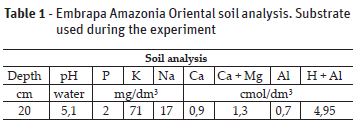
of Pará – AIMEX, and were transplanted to pots with a capacity of 4.5 kg of black
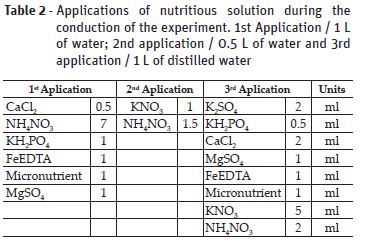
soil substrate (see <a href = "#t1">Table 1</a>) and stayed for two months of acclimatization. In order
to overcome the nutritional deficiency, nutrient solution (Hoagland and Arnon, 1950)
was applied in three different concentrations, in accordance with <a href = "#t2">Table 2</a>.</font></p>

    <p>&nbsp;</p>

<a name = "t1"><img src = "/img/revistas/rca/v41n3/v41n3a20t1.jpg" target = "_blank"></a>

    
<p>&nbsp;</p>

<a name = "t2"><img src = "/img/revistas/rca/v41n3/v41n3a20t2.jpg" target = "_blank"></a>

    
<p>&nbsp;</p>

    <p><font face = "Verdana" size = "2">The climate of the region, according to Köppen classification, is Aw, characterized
by the occurrence of average anal precipitation of 2893 mm and average annual temperature
in the range of 26.5 ° C (Costa, 2001).</font></p>

    <p><font face = "Verdana" size = "2">The air temperature, relative humidity and the vapor pressure deficit (VPD)
were measured by the Incoterm direct reading thermo-hygrometer and infrared gas
analyzer.</font></p>


    <p><font face = "Verdana" size = "2"><b><i>Experimental design and characterization of the experiment</i></b></font></p>


    <p><font face = "Verdana" size = "2">The experimental was completely randomized in
split plot scheme (two times: five and ten days of water suspension, and two water
conditions: control and water deficit, with four replications and one plant /pot.</font></p>


    <p><font face = "Verdana" size = "2">The plant height was performed, from the base
of the collection to the apical bud. The measurement of diameter chest height (DCH)
was realized with help of digital pachometer model ZAAS precision and the number
of leaves per plant realized by manual counting.</font></p>

    <p><font face = "Verdana" size = "2">Shoot and root biomass were measured at each destructive harvest at 5 and
10 days of water deficit, after drying in a forced circulation oven at 70 °C for
72 hours</font></p>

    ]]></body>
<body><![CDATA[<p><font face = "Verdana" size = "2">The relative water content
(RWC) was determined between 05:00 and 06:00h on each collection. The method used
was that described by Slavick (1979), where 30 fresh leaf discs (10 mm diameter)
were removed from each plant randomly, through a stainless-steel pourer, immediately
determining the fresh mass (FM). The disks were then transferred to a petri dish
containing 35 ml of distilled water and left on the bench (25 °C) for 12 hours.
The discs were then placed on filter paper to remove excess water and then weighed
to determine the turgid mass (TM). Afterwards, the disks were placed in paper bags
and placed in an oven (70 °C) for 24 hours and the dry mass of the discs (DM) was
determined. The results were expressed as a percentage, according to the following
formula:</font></p>

    <p><font face = "Verdana" size = "2">RWC = (FM – DM)/ (TM –DM)
x 100.</font></p>

    <p><font face = "Verdana" size = "2">The net photosynthetic
rate (Pn), stomatal conductance (g<sub>s</sub>), transpiration rate (<i>E</i>),
maximum natural photosynthetically active radiation (PAR) and atmospheric vapor
pressure deficit (VPD) were evaluated by portable meter IRGA (Infra-red Gas Analyser/ADC
equipaments - mod. LCi 6400, Hoddesdon, UK) under favorable environmental conditions,
between 9:00 and 10:00h in the morning. The evaluations were done in all plants
of all treatments (n = 12), one leaflet per plant placed inside the chamber, always
in the median region of the fully expanded leaf. Each leaflet remained in equilibrium
within the chamber for 1 to 2 minutes before the values were recorded and ten measurements
were taken for plant mean.</font></p>

    <p><font face = "Verdana" size = "2">          </font></p>

    <p><font face = "Verdana" size = "2">An analysis of variance was applied
to the results through the statistical package (Assistat 7.7 beta, 2015) and when
significant difference occurred, the means were compared by the test <b><i>t</i></b>
adopting the level of 5% of probability.</font></p>


    <p><font face = "Verdana" size = "3"><b>RESULTS AND DISCUSSION</b></font></p>

    <p><font face = "Verdana" size = "2"><b><i>Environmental variables</i></b></font></p>

    <p><font face = "Verdana" size = "2">The mean for the
two evaluation periods for photosynthetically active radiation was 1000 µmol.m<sup>-2</sup>.s<sup>-1</sup>.
The mean temperature throughout the experiment was 30.6 °C and the relative humidity
was 81.5%. The obtained VPD was 2.16 and 1.54 kPa for the first and second points
of data collection, respectively. The description of these environmental variables
may directly or indirectly influence the physiological and biochemical variables
throughout the experiment.</font></p>


    <p><font face = "Verdana" size = "2"><b><i>Biometrical variables</i></b></font></p>


    <p><font face = "Verdana" size = "2"><u>Height</u></font></p>

    ]]></body>
<body><![CDATA[<p><font face = "Verdana" size = "2">There was
statistical difference only for water condition, obtaining the averages of 13.40
and 12.63 cm for the control and deficit treatments, respectively. The stagnation
of height growth was notorious (<a href = "/img/revistas/rca/v41n3/v41n3a20f1.jpg" target = "_blank">Figure 1A</a>) when compared to the mean of the controls
with the last point for plants under water deficit, reducing from 13.4 to 12.06
cm, representing a reduction of 10% in the height.</font></p>

    
<p><font face = "Verdana" size = "2">According
Jaleel <i>et al</i>. (2009), the water limitation is considered one of the most
important stressors that limit the growth of plants. According to Jesus and Azevedo
Neto (2013), the growth evaluation is a parameter used to evidence the tolerance
of plants under stress. Maintaining turgescence is a necessary prerequisite for
cell elongation and growth, and consequently limited water supply can cause large
reductions in plant growth (Warren <i>et al.</i>, 2012).</font></p>

    <p><font face = "Verdana" size = "2">Although there was no statistical difference for the height
variable, probably due to the short time of interval in the experiment, Roza (2010)
points out that the pronounced loss of water reduces the multiplication and the
elongation of the cells, resulting in plants with lower heights.</font></p>

    <p><font face = "Verdana" size = "2">Nascimento <i>et al.</i> (2011) working with seedlings of
<i>Hymenaea courbaril </i>also did not find statistical differences between the
treatments after a period of 49 days of water suspension.</font></p>

    <p><font face = "Verdana" size = "2"><u>DCH</u></font></p>

    <p><font face = "Verdana" size = "2">The DCH (<a href = "/img/revistas/rca/v41n3/v41n3a20f1.jpg" target = "_blank">Figure 1B</a>) showed statistical differences only for treatment suspension
times, with averages of 6.52 and 5.79 mm at 5 and 10 days of water suspension and
for water regime, the averages of 6.72 and 5.98 mm in the control and water deficit,
respectively. As the height, the DCH also showed an absolute reduction, from 6.71
mm in the control plants to 5.58 mm in the plant submitted to the water deficit
on the tenth day of the experiment, representing a reduction of 16,84%.</font></p>


<p><font face = "Verdana" size = "2">According to Lechinoski <i>et al.</i> (2007) the
lack of water in the soil makes the variable as the diameter limiting to the growth
of the vegetal species when submitted to the condition of water deficiency.</font></p>


    <p><font face = "Verdana" size = "2">Almeida <i>et al</i>. (2005) evaluating the diameter
at breast height in <i>Hymenaea courbaril </i>plants,observed statistical differences
for the treatment with only 25% of the field capacity, evidencing in this way the
influence of the water deficit in the biometric reduction of the plants.</font></p>


    <p><font face = "Verdana" size = "2"><u>Number of leaves</u></font></p>

    <p><font face = "Verdana" size = "2">The number of leaves (<a href = "/img/revistas/rca/v41n3/v41n3a20f1.jpg" target = "_blank">Figure 1C</a>) did not present statistical
difference for both treatments, both for the interaction and for the factors analyzed
alone.</font></p>

    
]]></body>
<body><![CDATA[<p><font face = "Verdana" size = "2">Due to the short time that
the plants were submitted to water deficiency, the emission of new leaves was not
influenced. Thus, it was not possible to verify difference. According to Silva and
Nogueira (2003) woody species present reduction in the emission of new leaves after
induction of water deficiency. Differing from this study, the same authors found
significant differences between three woody species (<i>Mimosa caesalpiniifolia,
Prosopis juliflora </i>and <i>Tabebuia aurea</i>), that showed reductions in the
emission of new leaves when the plants were submitted to the water deficit.</font></p>


    <p><font face = "Verdana" size = "2"><u>Relative Water Content</u></font></p>

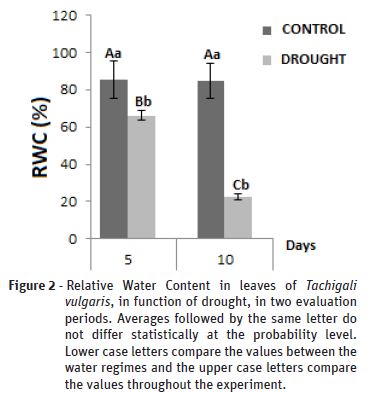
    <p><font face = "Verdana" size = "2">The relative water content (<a href = "#f2">Figure 2</a>) presented a significant
difference when comparing the control treatment with water deficiency, with a noticeable
reduction from the fifth day of experiment, 85.31% to 66.07% of the water content
in the foliar tissues of the control and water deficit plants, respectively. This
decrease reflected directly in the photosynthetic activity (<a href = "#f2">Figure 2</a>) of the plants,
and consequently in all metabolic processes of the plants. In the second data collection
the percentage of water in the leaves was drastically reduced from 84.81 to 22.67%
in the control and water deficit plants respectively, thus demonstrating that all
free water from the leaf tissues had already been dissipated, remaining only hygroscopic
water. This represented a reduction of 73.24% in RWC of plants in water deficit
in relation to the control plant.</font></p>

    <p>&nbsp;</p>

<a name = "f2"><img src = "/img/revistas/rca/v41n3/v41n3a20f2.jpg" target = "_blank"></a>

    
<p>&nbsp;</p>

    <p><font face = "Verdana" size = "2">According to Pincelli (2010), the control of the
physiological functions is directly related to the water status of the plant, where
the changes in the RWC directly affect the photosynthetic apparatus, as it could
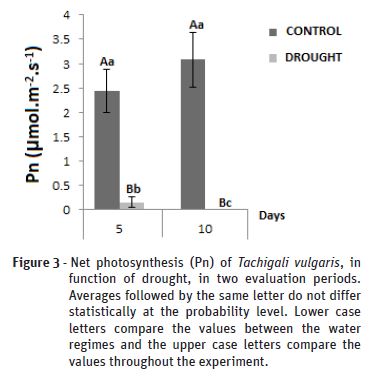
be analyzed according to <a href = "#f3">Figure 3</a>. If the dry period is prolonged, the water deficit
can affect the crop, with reduction in plant height, relative water content and
photosynthetic rate.</font></p>

    <p>&nbsp;</p>

<a name = "f3"><img src = "/img/revistas/rca/v41n3/v41n3a20f3.jpg" target = "_blank"></a>

    
<p>&nbsp;</p>

    <p><font face = "Verdana" size = "2">Rahimia (2010)
evaluating the performance of two species of <i>Plantago</i> (<i>Plantago ovata</i>
and <i>P. psyllium</i>) submitted to the water deficiency observed that both reduced
the RWC from the 7th day after the suspension of the irrigation and finding values
for RWC around 60%.</font></p>

    <p><font face = "Verdana" size = "2">As in this study,
Coscolin (2012) pointed out a direct relationship between the reduction of RWC and
in parallel with the reduction of growth parameters and gas exchange. Such reductions
have seriously compromised plant metabolism, as we can observe through growth and
gas exchange variables. Smit and Singels (2006) state that RWC values below 75%
already promote limitations in the physiological activities of plants. Pacheco (2011),
when assessing the water deficit in <i>Calendula officinalis</i>, also observed
a significant decrease in RWC, reaching an average value of 48.5%.</font></p>


    ]]></body>
<body><![CDATA[<p><font face = "Verdana" size = "2"><u>Photosynthesis</u></font></p>

    <p><font face = "Verdana" size = "2">The net photosynthesis (Pn) in <a href = "#f3">Figure 3</a> showed after 5 days of
water suspension a decrease from 2.44 to 0.15 µmol.m<sup>-2</sup>.s<sup>-1 </sup>from
control to drought. Plants under 10 days water deficiency were already under severe
water stress, with the value of the photosynthesis rate equal to zero, an event
likely to have been accelerated due to the drastic reduction of water availability
in the soil. The photosynthetic activity presented a reduction of 93.85% when comparing
the control with the water deficit.</font></p>

    <p><font face = "Verdana" size = "2">Regardless of the type
of metabolism, water stress causes reduction in photosynthesis and increased respiration,
promoting an increase in the production of reactive oxygen species (Pereira <i>et
al.</i>, 2012). Vítolo <i>et al</i>. (2012) state that when the plant undergoes
some type of stress such as water stress, photosynthesis, respiration, electron
transport by the membrane and enzymatic activity are reduced when the functional
integrity of the chloroplasts and mitochondrial membranes are affected.</font></p>


    <p><font face = "Verdana" size = "2">When the plant is in a state of water stress,
the stomata is closed in order to avoid the complete dehydration of the leaves,
thus limiting the diffusion of CO<sub>2</sub> to the leaf mesophyll, which leads
to a decrease in photosynthesis (Chaves <i>et al</i>., 2009). Studies show that
stomatal closure affects plant growth, since it promotes the reduction of photosynthetic
rates, limiting phytomass production due to the low CO<sub>2</sub> supply (Ashraf,
2010).</font></p>

    <p><font face = "Verdana" size = "2">For Sanda <i>et al</i>. (2011),
non-stomatal mechanisms at the chloroplast level, such as electron transport and
photophosphorylation may be related to inhibition or reduction of photosynthesis.
The photosystem II depends on water for the generation of chemical energy, required
later for the fixation of CO<sub>2</sub>, variations in water availability generate
less efficiency of photosystem II, that is, with limited water resources, less ATP
and NADPH are formed and, as consequently, less CO<sub>2</sub> is fixed at the carboxylation
site (Pinheiro e Chaves, 2011).</font></p>

    <p><font face = "Verdana" size = "2">The
gas exchanges act on the energy balance of the leaves, participating in the regulation
of their temperature, so as to leave it within the range of values appropriate to
the physiological processes of the plants and their adaptation to the environment.
The control of transpiration is performed by the stomatal closure, which is the
only process in the soil-plant-atmosphere continuum that has this instantaneous
response (Pincelli, 2010).</font></p>

    <p><font face = "Verdana" size = "2">For all
the variables of gas exchange it was possible to observe the leaflet folding in
each leaf / plant. According to Oliveira (2014) foliar winding and folding are hydronastic
mechanisms that reduce light interception, transpiration and leaf dehydration. It
is suggested that for this reason all the gas exchange variables presented relatively
low values, related to the environmental conditions at the time of the experiment,
considering that at the end of the ten day period the plants were at a fairly advanced
wilt point.</font></p>

    <p><font face = "Verdana" size = "2">Corroborating this study,
Moraes (2011) evaluated different hybrids of eucalyptus under water deficiency found
a statistical difference for the net photosynthesis (P &lt;0.01) between irrigation
and hybrids at the end of the suspension period.</font></p>

    <p><font face = "Verdana" size = "2"><u>Stomatal conductance</u></font></p>

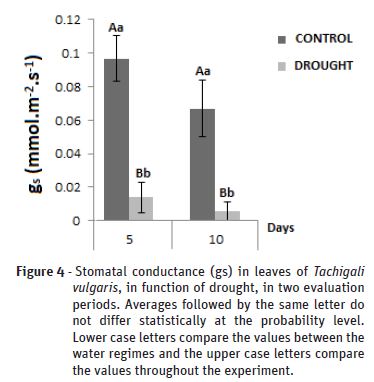
    <p><font face = "Verdana" size = "2">After five days of experiment, a statistical difference was observed for the
stomatal conductance (<a href = "#f4">Figure 4</a>) in the plants under water deficit 0.0138 when compared
to the control plants 0,096 µmol.m<sup>-2</sup>.s<sup>-1</sup>, remaining constant
until the tenth day and falling even further 0.005 under water deficit, being directly
proportional to the reduction of the RWC.</font></p>

    ]]></body>
<body><![CDATA[<p>&nbsp;</p>

<a name = "f4"><img src = "/img/revistas/rca/v41n3/v41n3a20f4.jpg" target = "_blank"></a>

    
<p>&nbsp;</p>

    <p><font face = "Verdana" size = "2">The physiological
variables partially accompanied the rates of VPD and the photosynthetically active
radiation, depending on the RWC. The behavior is not so evident when there is a
greater increase of transpiration and stomatal conductance with the decrease of
the VPD, since the photosynthetically active radiation did not oscillate so much
throughout the experiment. However, this response decreases according to the water
status of each plant, and therefore cannot be generalized to others.</font></p>


    <p><font face = "Verdana" size = "2">In situations of low water availability in the
soil, the plants minimize water losses by reducing the stomatal conductance, consequently
negatively affecting the growth variables in absolute terms. The drop in <i>gs</i>
rates due to the gradual closure of the stomatal opening causes a decrease in <i>E</i>
in the treatment under water deficiency, due to the increase of the VPD during the
day.</font></p>

    <p><font face = "Verdana" size = "2">The physiological and biochemical
responses vary according to the genotype, but in general the modifications related
to water deficiency include the lower water potential in the soil and leaves, reflecting
in the decrease of the stomatal conductance and photosynthetic rate (Polizel, 2007).</font></p>


    <p><font face = "Verdana" size = "2">Due to the strong relation between the stomatal
conductance and other photosynthetic parameters, we are led to point to gs as a
reference character to evaluate the degree of water stress. Pita <i>et al</i>. (2005)
state that stomatal conductance may be a useful tool in genetic improvement for
selection for higher productivity in drought-prone environments, because stomatal
conductance provides a crucial link between transpiration loss and carbon gain and,
therefore, of the growth and between the saving of water by the closure of the stomata
and greater heat stress.</font></p>

    <p><font face = "Verdana" size = "2">According
to Chagas <i>et al</i>. (2013) this reduction in response to the water deficit is
related to a decrease in water content, for example, to the accumulation of abscisic
acid in the leaves, leading to stomatal closure. Oliveira (2014) also observed that
<i>E </i>rates accompanied a reduction of <i>gs</i> for both species <i>Syagrus
coronata</i> and <i>Acrocomia aculeata </i>in drought conditions.</font></p>


    <p><font face = "Verdana" size = "2"><u>Transpiration</u></font></p>


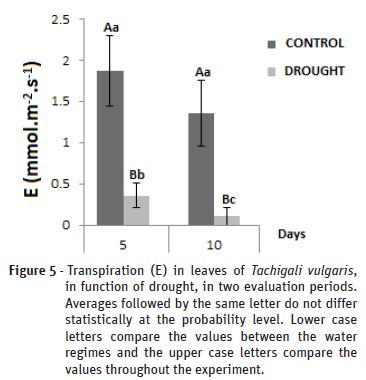
    <p><font face = "Verdana" size = "2">The plants presented significant differences for
the transpiration (<a href = "#f5">Figure 5</a>) from the fifth day, with reductions of 1.8 for 0.3mmol.
m<sup>-2</sup>.s<sup>-1 </sup>for the control and water deficit treatments respectively,
and from 1.3 for 0.1 m<sup>-2</sup>.s<sup>-1</sup>to the tenth day, which represented
a reduction of 76,92%. It was demonstrated that transpiration was considerably reduced
in the plants with lower water availability in the soil, reflecting the liquid assimilation
rate, since the stomatal closure also causes a decrease in the CO<sub>2</sub> input
to the leaf mesophyll and the carboxylation site.</font></p>

    <p>&nbsp;</p>

<a name = "f5"><img src = "/img/revistas/rca/v41n3/v41n3a20f5.jpg" target = "_blank"></a>

    
]]></body>
<body><![CDATA[<p>&nbsp;</p>

    <p><font face = "Verdana" size = "2">Another
variable that correlates with transpiration is VPD, which increases with increasing
transpiration, and responses vary between species and between genotypes of the same
species (Kholová <i>et al</i>., 2010). According to Mota (2011), the gradual closure
of the stomatal opening throughout the day causes a decrease of <i>gs</i> and <i>E</i>,
more pronounced in the treatment under water deficit, due to the increase of the
VPD during the day, contrary to the behaviour of the VPD during the experiment.
During the experiment the VPD was decreasing, however, the minimum level of water
in the substrate had already been reached, which did not help in any way to mitigate
the damage caused in the plants, since transpiration continued to be reduced fifth
to the tenth day, and resulting in their death.</font></p>

    <p><font face = "Verdana" size = "2">As recommended by Silva (2013), the transpiration process is directly associated
to the stomatal conductance, responsible for the exchange of gases and vapours,
with the reduction of the water potential, the stomatal closure causes a greater
reduction of H<sub>2</sub>O flow out of the leaf than in the flow of CO<sub>2</sub>
that reaches the chloroplasts, decreasing the transpiration rate more than the photosynthetic
rate (Rivas <i>et al</i>., 2013). Another important factor in responding to the
low transpiration of <i>T. vulgaris</i> plants is the increase in biosynthesis or
redistribution of ABA, a hormone that promotes the reduction of transpiration, closing
its stomata in plants under stress and is considered a chemical stress signal (Lima,
2015).</font></p>

    <p><font face = "Verdana" size = "2">For Alves (2010), one of the
causes of decreased transpiration can be attributed to the decrease in water supply
due to the decrease in hydraulic conductivity of the roots or the death of roots,
causing a decrease in the water potential of the leaves. This same author working
with plants of <i>Tabebuia serratifolia</i> found reductions of 99% in the transpiration
rates under water deficit in relation to the control plants.</font></p>


    <p><font face = "Verdana" size = "2"><u>Shoot and root dry mass, and root/shoot ratio</u></font></p>


    <p><font face = "Verdana" size = "2">It was not possible
to verify statistical difference for the treatments control and water deficiency
of shoot (<a href = "/img/revistas/rca/v41n3/v41n3a20f6.jpg" target = "_blank">Figure 6A</a>) and root (<a href = "/img/revistas/rca/v41n3/v41n3a20f6.jpg" target = "_blank">Figure 6B</a>) dry mass, both for isolated factors and
for the interaction between them. Although there was no statistically significant
difference between the treatments, a higher biomass increment was observed in the
root when compared to the shoot for the plants submitted to water deficit, with
4.67g for the shoot and 7.44g for the root.</font></p>

    
<p><font face = "Verdana" size = "2">Also for the root / shoot ratio (<a href = "/img/revistas/rca/v41n3/v41n3a20f6.jpg" target = "_blank">Figure 6C</a>), there were no significant
differences (p&gt; 0.05) between the control and water deficit treatments, this
behavior may be explained by the small time interval used in this experiment, presenting
the averages of 1.22 and 1.25g for the control and water deficit treatments at day
5 and 1.42 and 1.44g at the 10th day.</font></p>

    
<p><font face = "Verdana" size = "2">For Pereira <i>et al</i>. (2003) it is very important
to evaluate root and shoot growth, based on dry matter accumulation and leaf area
increase. For the indices determined in the growth analysis indicate the capacity
of the assimilatory system of the plants to synthesize (source) and to allocate
the organic matter in the various organs (drains) that depend on the photosynthesis,
respiration and translocation of photoassimilates of the sites of fixation of carbon,
to the places of use or storage, where there is growth and differentiation of organs
(Fontes <i>et al.</i>, 2005).</font></p>

    <p><font face = "Verdana" size = "2">Moraes
(2011) working with eucalyptus plants found similar results, with the biomass of
the lower aerial part to the root when the plants were submitted to the water deficit.
In relation to root growth, some forest species tend to increase root growth after
submission of the water deficit (Nascimento, 2013). According to Larcher (2006)
in adverse situations, the root growth may be higher than the aerial part, especially
in drought situations, as they expand their roots to deeper soil regions in search
of water.</font></p>

    <p><font face = "Verdana" size = "2">The same explanation can
be attributed to the root / shoot ratio, even if there was no statistical difference
a greater increase of the root in relation to the aerial part could be observed,
in the attempt to expand its volume in the soil to fetch water and nutrients.</font></p>


    ]]></body>
<body><![CDATA[<p><font face = "Verdana" size = "2">Suassuna <i>et al</i>. (2012) found increases
in the root/shoot ratio in some citrus genotypes also submitted to water deficiency,
differing in this way with the research developed here.</font></p>


    <p><font face = "Verdana" size = "3"><b>CONCLUSION</b></font></p>


    <p><font face = "Verdana" size = "2">The water deficiency condition for ten days negatively
affected the growth and indicators of gas exchange (A, gs and E). Adding to the
fact that the experiment occurred in a year of extreme climatic anomaly (El Niño),
the plants did not resist and perished in the internal conditions of greenhouse.</font></p>


    <p><font face = "Verdana" size = "2">The water deficiency condition altered the growth
parameters and the environmental relations of the <i>Tachigali vulgaris</i> species,
thus evidencing its low physiological plasticity to this abiotic condition.</font></p>


    <p>&nbsp;</p>

    <p><font face = "Verdana" size = "3"><b>REFERENCES</b></font></p>

    <!-- ref --><p><font face = "Verdana" size = "2">Almeida, Z.;
Silvia, M.; Soares, A.M.C., Evaristo, M.; Vieira, C.V. and Bordignon, G.E. (2005)
- Alterações morfológicas e alocação de biomassa em plantas jovens de espécies florestais
sob diferentes condições de sombreamento. <i>Ciência Rural</i>, vol. 35, n. 1, p.
62-68. <a href = "http://dx.doi.org/10.1590/S0103-84782005000100010" target = "_blank">http://dx.doi.org/10.1590/S0103-84782005000100010</a></font>&nbsp;&nbsp;&nbsp;&nbsp;&nbsp;&nbsp;&nbsp;&nbsp;[&#160;<a href="javascript:void(0);" onclick="javascript: window.open('/scielo.php?script=sci_nlinks&ref=687555&pid=S0871-018X201800030002000001&lng=','','width=640,height=500,resizable=yes,scrollbars=1,menubar=yes,');">Links</a>&#160;]<!-- end-ref --><!-- ref --><p><font face = "Verdana" size = "2">Alves, G.A.R. (2010) - <i>Aspectos ecofisiológicos, bioquímicos
e crescimento de plantas jovens de Ipê amarelo (Tabebuia serratifolia (Vahl) Nicholson)
em condições de déficit hídrico e alagamento</i>. Tese de Doutorado. Belém/PA, Universidade
Federal Rural da Amazônia, 73 p.    &nbsp;&nbsp;&nbsp;&nbsp;&nbsp;&nbsp;&nbsp;&nbsp;[&#160;<a href="javascript:void(0);" onclick="javascript: window.open('/scielo.php?script=sci_nlinks&ref=687556&pid=S0871-018X201800030002000002&lng=','','width=640,height=500,resizable=yes,scrollbars=1,menubar=yes,');">Links</a>&#160;]<!-- end-ref --></font></p>

    <!-- ref --><p><font face = "Verdana" size = "2">Ashraf,
M. (2010) - Inducing drought tolerance in plants: some recent advances. <i>Biotechnology
Advances</i>, vol. 28, n. 1, p. 169-183. <a href = "https://doi.org/10.1016/j.biotechadv.2009.11.005" target = "_blank">https://doi.org/10.1016/j.biotechadv.2009.11.005</a></font>&nbsp;&nbsp;&nbsp;&nbsp;&nbsp;&nbsp;&nbsp;&nbsp;[&#160;<a href="javascript:void(0);" onclick="javascript: window.open('/scielo.php?script=sci_nlinks&ref=687558&pid=S0871-018X201800030002000003&lng=','','width=640,height=500,resizable=yes,scrollbars=1,menubar=yes,');">Links</a>&#160;]<!-- end-ref --><!-- ref --><p><font face = "Verdana" size = "2">Buckeridge, M.S. (2007) - Mudanças
climáticas, biodiversidade e sociedade: como a teoria de redes pode ajudar a compreender
o presente e planejar o futuro? <i>Multiciência</i>, vol. 8, p. 88-107.    &nbsp;&nbsp;&nbsp;&nbsp;&nbsp;&nbsp;&nbsp;&nbsp;[&#160;<a href="javascript:void(0);" onclick="javascript: window.open('/scielo.php?script=sci_nlinks&ref=687559&pid=S0871-018X201800030002000004&lng=','','width=640,height=500,resizable=yes,scrollbars=1,menubar=yes,');">Links</a>&#160;]<!-- end-ref --></font></p>


    <!-- ref --><p><font face = "Verdana" size = "2">Chagas, J.R.M.; Kelly, N.N.C.; Barbosa, M.A.M.;
Barbosa, J.R.S.; Pereira, T.S.; Viana, G.D.M. &amp; Lobato, A.K.S. (2013) - Condutância
estomática em plantas jovens de <i>Euterpe oleracea</i> (Arecaceae) sob déficit
hídrico. <i>In: 64º Congresso Nacional de Botânica</i>. Belo Horizonte/MG.    &nbsp;&nbsp;&nbsp;&nbsp;&nbsp;&nbsp;&nbsp;&nbsp;[&#160;<a href="javascript:void(0);" onclick="javascript: window.open('/scielo.php?script=sci_nlinks&ref=687561&pid=S0871-018X201800030002000005&lng=','','width=640,height=500,resizable=yes,scrollbars=1,menubar=yes,');">Links</a>&#160;]<!-- end-ref --></font></p>


    <!-- ref --><p><font face = "Verdana" size = "2">Chaves, M.M.; Flexas. J. &amp; Pinheiro, C. (2009)
- Photosynthesis under drought and salt Stress: Regulation mechanisms from whole
plant to cell. <i>Annals of Botany</i>, vol. 103, n. 4, p. 551-560. <a href = "https://doi.org/10.1093/aob/mcn125" target = "_blank">https://doi.org/10.1093/aob/mcn125</a></font>&nbsp;&nbsp;&nbsp;&nbsp;&nbsp;&nbsp;&nbsp;&nbsp;[&#160;<a href="javascript:void(0);" onclick="javascript: window.open('/scielo.php?script=sci_nlinks&ref=687563&pid=S0871-018X201800030002000006&lng=','','width=640,height=500,resizable=yes,scrollbars=1,menubar=yes,');">Links</a>&#160;]<!-- end-ref --><!-- ref --><p><font face = "Verdana" size = "2">Coscolin, R.B.S. (2012) - <i>Efeitos
fisiológicos e bioquímicos induzidos por deficiência hídrica em plantas de Ocimum
basilicum L</i>. Dissertação Mestrado. Universidade Estadual Paulista, 96 p.    &nbsp;&nbsp;&nbsp;&nbsp;&nbsp;&nbsp;&nbsp;&nbsp;[&#160;<a href="javascript:void(0);" onclick="javascript: window.open('/scielo.php?script=sci_nlinks&ref=687564&pid=S0871-018X201800030002000007&lng=','','width=640,height=500,resizable=yes,scrollbars=1,menubar=yes,');">Links</a>&#160;]<!-- end-ref --></font></p>


    <!-- ref --><p><font face = "Verdana" size = "2">Costa, A.C.L. (2001) - <i>Estudos de variações
termohigrométricas de cidade equatorial devido ao processo de urbanização: O caso
de Belém-PA. 2001</i>. Tese de doutorado. São Carlos/SP, Universidade de São Paulo
- Escola de Engenharia de São Carlos. 236 p.    &nbsp;&nbsp;&nbsp;&nbsp;&nbsp;&nbsp;&nbsp;&nbsp;[&#160;<a href="javascript:void(0);" onclick="javascript: window.open('/scielo.php?script=sci_nlinks&ref=687566&pid=S0871-018X201800030002000008&lng=','','width=640,height=500,resizable=yes,scrollbars=1,menubar=yes,');">Links</a>&#160;]<!-- end-ref --></font></p>

    <!-- ref --><p><font face = "Verdana" size = "2">Fontes, P.C.R.; Dias, E.N. &amp; Silva, D.J.H. (2005) - Dinâmica do crescimento,
distribuição de matéria seca na planta e produção de pimentão em ambiente protegido.
<i>Horticultura Brasileira</i>, vol. 23, p. 94-99.    &nbsp;&nbsp;&nbsp;&nbsp;&nbsp;&nbsp;&nbsp;&nbsp;[&#160;<a href="javascript:void(0);" onclick="javascript: window.open('/scielo.php?script=sci_nlinks&ref=687568&pid=S0871-018X201800030002000009&lng=','','width=640,height=500,resizable=yes,scrollbars=1,menubar=yes,');">Links</a>&#160;]<!-- end-ref --></font></p>

    <!-- ref --><p><font face = "Verdana" size = "2">Franke, I.L. (1999) - <i>Principais usos e serviços de árvores
e arbustos promissores que ocorrem em pastagens no estado do Acre</i>. Comunicado
Técnico: EMBRAPA/AC, n. 106, p. 1-6.    &nbsp;&nbsp;&nbsp;&nbsp;&nbsp;&nbsp;&nbsp;&nbsp;[&#160;<a href="javascript:void(0);" onclick="javascript: window.open('/scielo.php?script=sci_nlinks&ref=687570&pid=S0871-018X201800030002000010&lng=','','width=640,height=500,resizable=yes,scrollbars=1,menubar=yes,');">Links</a>&#160;]<!-- end-ref --></font></p>

    <!-- ref --><p><font face = "Verdana" size = "2">Hoagland, D.R. &amp; Arnon, D.I. (1950) - <i>The water culture method for growing
plants without soil.</i> California Agricultural Experiment Station Publications
p. 137-147.    &nbsp;&nbsp;&nbsp;&nbsp;&nbsp;&nbsp;&nbsp;&nbsp;[&#160;<a href="javascript:void(0);" onclick="javascript: window.open('/scielo.php?script=sci_nlinks&ref=687572&pid=S0871-018X201800030002000011&lng=','','width=640,height=500,resizable=yes,scrollbars=1,menubar=yes,');">Links</a>&#160;]<!-- end-ref --></font></p>

    <!-- ref --><p><font face = "Verdana" size = "2">IPCC (2014) - <i>Synthesis
Report. Contribution of Working Groups I, II and III to the Fifth Assessment Report
of the Intergovernmental Panel on Climate</i>. Geneva, Switzerland, 151 p.    &nbsp;&nbsp;&nbsp;&nbsp;&nbsp;&nbsp;&nbsp;&nbsp;[&#160;<a href="javascript:void(0);" onclick="javascript: window.open('/scielo.php?script=sci_nlinks&ref=687574&pid=S0871-018X201800030002000012&lng=','','width=640,height=500,resizable=yes,scrollbars=1,menubar=yes,');">Links</a>&#160;]<!-- end-ref --></font></p>


    <!-- ref --><p><font face = "Verdana" size = "2">Jaleel, C.A.; Paramasivam, M.; Abdul, W.; Muhammad,
F.; Hameed, J.A.; Ramamurthy, S. &amp; Rajaram, P. V. (2009) - Drought stress in
plants: A review on morphological characteristics and pigments composition. <i>International</i>
<i>Journal of Agriculture and Biology</i>, vol. 11, n. 1, p. 100-105.    &nbsp;&nbsp;&nbsp;&nbsp;&nbsp;&nbsp;&nbsp;&nbsp;[&#160;<a href="javascript:void(0);" onclick="javascript: window.open('/scielo.php?script=sci_nlinks&ref=687576&pid=S0871-018X201800030002000013&lng=','','width=640,height=500,resizable=yes,scrollbars=1,menubar=yes,');">Links</a>&#160;]<!-- end-ref --></font></p>


    <!-- ref --><p><font face = "Verdana" size = "2">Jesus D.S. &amp; Azevedo Neto, A.D. (2013) - Aluminum
Tolerance in Sunflower Plants Is Associated with Phosphorus Content in the Roots.
<i>Communications in Soil Science and Plant Analysis</i>, vol. 44, n. 22, p. 3423-3430.
<a href = "http://dx.doi.org/10.1080/00103624.2013.847453" target = "_blank">http://dx.doi.org/10.1080/00103624.2013.847453</a></font>&nbsp;&nbsp;&nbsp;&nbsp;&nbsp;&nbsp;&nbsp;&nbsp;[&#160;<a href="javascript:void(0);" onclick="javascript: window.open('/scielo.php?script=sci_nlinks&ref=687578&pid=S0871-018X201800030002000014&lng=','','width=640,height=500,resizable=yes,scrollbars=1,menubar=yes,');">Links</a>&#160;]<!-- end-ref --><!-- ref --><p><font face = "Verdana" size = "2">Kholová, J.; Hash C.T.; Kumar, P.L.; Yadav, R.S.; Kocová, M. &amp; Vadez,
V. (2010) - Terminal drought-tolerant pearl millet [<i>Pennisetum glaucum</i> (L.)
R. Br.] have high leaf ABA and limit transpiration at high vapour pressure deficit.
<i>Journal of Experimental Botany</i>, vol. 61, n. 5, p. 1431-1440. <a href = "https://doi.org/10.1093/jxb/erq013" target = "_blank">https://doi.org/10.1093/jxb/erq013</a></font>&nbsp;&nbsp;&nbsp;&nbsp;&nbsp;&nbsp;&nbsp;&nbsp;[&#160;<a href="javascript:void(0);" onclick="javascript: window.open('/scielo.php?script=sci_nlinks&ref=687579&pid=S0871-018X201800030002000015&lng=','','width=640,height=500,resizable=yes,scrollbars=1,menubar=yes,');">Links</a>&#160;]<!-- end-ref --><!-- ref --><p><font face = "Verdana" size = "2">Larcher, W. (2006) - <i>Ecofisiologia
Vegetal</i>. CHBA. Ed Rima, São Carlos. 531 p.    &nbsp;&nbsp;&nbsp;&nbsp;&nbsp;&nbsp;&nbsp;&nbsp;[&#160;<a href="javascript:void(0);" onclick="javascript: window.open('/scielo.php?script=sci_nlinks&ref=687580&pid=S0871-018X201800030002000016&lng=','','width=640,height=500,resizable=yes,scrollbars=1,menubar=yes,');">Links</a>&#160;]<!-- end-ref --></font></p>

    <!-- ref --><p><font face = "Verdana" size = "2">Lechinoski, A.; Freitas J.M.N.; Castro, D.S.; Lobato, A.K.S.; Oliveira
Neto, C.F. e Moraes, R.L. (2007) - Influência do Estresse Hídrico nos Teores de
Proteínas e Aminoácidos Solúveis Totais em Folhas de Teca (<i>Tectona grandis</i>
L. f.). <i>Revista Brasileira de Biociências</i>, vol. 5, sup. 2, p. 927-929.    &nbsp;&nbsp;&nbsp;&nbsp;&nbsp;&nbsp;&nbsp;&nbsp;[&#160;<a href="javascript:void(0);" onclick="javascript: window.open('/scielo.php?script=sci_nlinks&ref=687582&pid=S0871-018X201800030002000017&lng=','','width=640,height=500,resizable=yes,scrollbars=1,menubar=yes,');">Links</a>&#160;]<!-- end-ref --></font></p>


    <!-- ref --><p><font face = "Verdana" size = "2">Lima, E.G.S. (2015) - <i>Respostas ecofisiológicas
e bioquímicas em folhas de Andiroba (Carapa guianensis Aubl) sob três regimes hídricos
e suspensão dos estresses.</i>Dissertação Mestrado. Universidade Federal Rural da
Amazônia. 92 p.    &nbsp;&nbsp;&nbsp;&nbsp;&nbsp;&nbsp;&nbsp;&nbsp;[&#160;<a href="javascript:void(0);" onclick="javascript: window.open('/scielo.php?script=sci_nlinks&ref=687584&pid=S0871-018X201800030002000018&lng=','','width=640,height=500,resizable=yes,scrollbars=1,menubar=yes,');">Links</a>&#160;]<!-- end-ref --></font></p>

    <!-- ref --><p><font face = "Verdana" size = "2">Lima, H.C. (2012)
- <i>Tachigali. Lista de Espécies da Flora do Brasil</i>. Jardim Botânico do Rio
de Janeiro, Rio de Janeiro.    &nbsp;&nbsp;&nbsp;&nbsp;&nbsp;&nbsp;&nbsp;&nbsp;[&#160;<a href="javascript:void(0);" onclick="javascript: window.open('/scielo.php?script=sci_nlinks&ref=687586&pid=S0871-018X201800030002000019&lng=','','width=640,height=500,resizable=yes,scrollbars=1,menubar=yes,');">Links</a>&#160;]<!-- end-ref --></font></p>

    <!-- ref --><p><font face = "Verdana" size = "2">Melo,
A.S.; Suassuna, J.F.; Fernandes, P.D.; Brito, M.E.B.; Suassuna, A.F. &amp; Netto,
A.O.A. (2010) - Crescimento vegetativo, resistência estomática, eficiência fotossintética
e rendimento do fruto da melancieira em diferentes níveis de água. <i>Acta Scientiarum:
Agronomy</i>, vol. 32, n. 1, p. 73-79. <a href = "http://dx.doi.org/10.4025/actasciagron.v32i1.2136" target = "_blank">http://dx.doi.org/10.4025/actasciagron.v32i1.2136</a></font>&nbsp;&nbsp;&nbsp;&nbsp;&nbsp;&nbsp;&nbsp;&nbsp;[&#160;<a href="javascript:void(0);" onclick="javascript: window.open('/scielo.php?script=sci_nlinks&ref=687588&pid=S0871-018X201800030002000020&lng=','','width=640,height=500,resizable=yes,scrollbars=1,menubar=yes,');">Links</a>&#160;]<!-- end-ref --><!-- ref --><p><font face = "Verdana" size = "2">Moraes, J.V. (2011) - <i>Parâmetros biométricos,
fisiológicos e bioquímicos em híbridos de Eucalyptus grandis x Eucalyyptus urophilla
sob diferentes regimes de irrigação em casa de vegetação</i>. Tese de Doutorado.
São Paulo/SP, Faculdade de Ciências Agrárias e Veterinárias – UNESP.    &nbsp;&nbsp;&nbsp;&nbsp;&nbsp;&nbsp;&nbsp;&nbsp;[&#160;<a href="javascript:void(0);" onclick="javascript: window.open('/scielo.php?script=sci_nlinks&ref=687589&pid=S0871-018X201800030002000021&lng=','','width=640,height=500,resizable=yes,scrollbars=1,menubar=yes,');">Links</a>&#160;]<!-- end-ref --></font></p>


    <!-- ref --><p><font face = "Verdana" size = "2">Morais, R.R.; Rossi, L.M.B. &amp; Higa, R.C.V.
(2017) - Trocas gasosas de plantas jovens de taxi-branco submetidas à variação de
temperatura foliar e suspensão da irrigação. <i>Ciência Florestal, </i>vol. 27,
n. 1, p. 97-104. <a href = "http://dx.doi.org/10.5902/1980509826450" target = "_blank">http://dx.doi.org/10.5902/1980509826450</a></font>&nbsp;&nbsp;&nbsp;&nbsp;&nbsp;&nbsp;&nbsp;&nbsp;[&#160;<a href="javascript:void(0);" onclick="javascript: window.open('/scielo.php?script=sci_nlinks&ref=687591&pid=S0871-018X201800030002000022&lng=','','width=640,height=500,resizable=yes,scrollbars=1,menubar=yes,');">Links</a>&#160;]<!-- end-ref --><!-- ref --><p><font face = "Verdana" size = "2">Mota, C.S. (2011) - <i>Características fotossintéticas da
palmeira Macaúba (Acrocomia aculeata (Jacq.) Lodd. ex Mart.) submetida à deficiência
hídrica</i>. Tese Doutorado.Viçosa/MG, Universidade Federal de Viçosa, p. 85.    &nbsp;&nbsp;&nbsp;&nbsp;&nbsp;&nbsp;&nbsp;&nbsp;[&#160;<a href="javascript:void(0);" onclick="javascript: window.open('/scielo.php?script=sci_nlinks&ref=687592&pid=S0871-018X201800030002000023&lng=','','width=640,height=500,resizable=yes,scrollbars=1,menubar=yes,');">Links</a>&#160;]<!-- end-ref --></font></p>


    <!-- ref --><p><font face = "Verdana" size = "2">Nascimento, H.H.C.; Nogueira, R.J.M.C.; Silva, E.C. &amp; Silva,
M.A. (2011) - Análise do crescimento de mudas de jatobá (<i>Hymenaea courbaril</i>
L.) em diferentes níveis de água no solo. <i>Revista Árvore</i>, vol. 35, n. 3,
p. 617- 626. <a href = "http://dx.doi.org/10.1590/S0100-67622011000400005" target = "_blank">http://dx.doi.org/10.1590/S0100-67622011000400005</a></font>&nbsp;&nbsp;&nbsp;&nbsp;&nbsp;&nbsp;&nbsp;&nbsp;[&#160;<a href="javascript:void(0);" onclick="javascript: window.open('/scielo.php?script=sci_nlinks&ref=687594&pid=S0871-018X201800030002000024&lng=','','width=640,height=500,resizable=yes,scrollbars=1,menubar=yes,');">Links</a>&#160;]<!-- end-ref --><!-- ref --><p><font face = "Verdana" size = "2">Nascimento, H.H.C. (2013) - <i>Mecanismos fisiológicos e
bioquímicos em mudas de Jatobá (Hymenaea courbaril </i>L<i>) sob condições adversas.</i>
Tese Doutorado. Universidade Federal Rural de Pernambuco, Recife/PE, 162 p.    &nbsp;&nbsp;&nbsp;&nbsp;&nbsp;&nbsp;&nbsp;&nbsp;[&#160;<a href="javascript:void(0);" onclick="javascript: window.open('/scielo.php?script=sci_nlinks&ref=687595&pid=S0871-018X201800030002000025&lng=','','width=640,height=500,resizable=yes,scrollbars=1,menubar=yes,');">Links</a>&#160;]<!-- end-ref --></font></p>


    <!-- ref --><p><font face = "Verdana" size = "2">Oliveira, D.A.S. (2014) - <i>Respostas ecofisiológicas
e morfoanatômicas de Licuri e Macaúba sob condições de campo</i>. Dissertação (Mestrado).
Universidade Federal de Pernambuco. Recife/PE. 54 p.    &nbsp;&nbsp;&nbsp;&nbsp;&nbsp;&nbsp;&nbsp;&nbsp;[&#160;<a href="javascript:void(0);" onclick="javascript: window.open('/scielo.php?script=sci_nlinks&ref=687597&pid=S0871-018X201800030002000026&lng=','','width=640,height=500,resizable=yes,scrollbars=1,menubar=yes,');">Links</a>&#160;]<!-- end-ref --></font></p>

    ]]></body>
<body><![CDATA[<!-- ref --><p><font face = "Verdana" size = "2">Pacheco, A.C.; Camargo, P.R. &amp; Souza, C.G.M. (2011) - Deficiência
hídrica e aplicação de ABA nas trocas gasosas e no acúmulo de flavonoides em Calêndula
(<i>Calendula officinalis</i> L.). <i>Acta Scientiarum: Agronomy</i>, vol. 33, n.
2, p. 275-281. <a href = "http://dx.doi.org/10.4025/actasciagron.v33i2.6390" target = "_blank">http://dx.doi.org/10.4025/actasciagron.v33i2.6390</a></font>&nbsp;&nbsp;&nbsp;&nbsp;&nbsp;&nbsp;&nbsp;&nbsp;[&#160;<a href="javascript:void(0);" onclick="javascript: window.open('/scielo.php?script=sci_nlinks&ref=687599&pid=S0871-018X201800030002000027&lng=','','width=640,height=500,resizable=yes,scrollbars=1,menubar=yes,');">Links</a>&#160;]<!-- end-ref --><!-- ref --><p><font face = "Verdana" size = "2">Pereira, J.W.; Melo Filho, P.A.; Albuquerque, M.B.; Nogueira,
R.M. &amp; Santos, R.C. (2012) - Mudanças bioquímicas em genótipos de amendoim submetidos
a déficit hídrico moderado. <i>Revista Ciência Agronômica</i>, vol. 43, n. 4, p.
766-773. <a href = "http://dx.doi.org/10.1590/S1806-66902012000400019" target = "_blank">http://dx.doi.org/10.1590/S1806-66902012000400019</a></font>&nbsp;&nbsp;&nbsp;&nbsp;&nbsp;&nbsp;&nbsp;&nbsp;[&#160;<a href="javascript:void(0);" onclick="javascript: window.open('/scielo.php?script=sci_nlinks&ref=687600&pid=S0871-018X201800030002000028&lng=','','width=640,height=500,resizable=yes,scrollbars=1,menubar=yes,');">Links</a>&#160;]<!-- end-ref --><!-- ref --><p><font face = "Verdana" size = "2">Pereira, W.E.; Siqueira, D.L. de &amp; Puiatti, M. (2003)
- Growth of citrus rootstocks under aluminium stress in hydroponics. <i>Scientia
Agricola</i>, vol. 60, n. 1, p. 31-41. <a href = "http://dx.doi.org/10.1590/S0103-90162003000100006" target = "_blank">http://dx.doi.org/10.1590/S0103-90162003000100006</a></font>&nbsp;&nbsp;&nbsp;&nbsp;&nbsp;&nbsp;&nbsp;&nbsp;[&#160;<a href="javascript:void(0);" onclick="javascript: window.open('/scielo.php?script=sci_nlinks&ref=687601&pid=S0871-018X201800030002000029&lng=','','width=640,height=500,resizable=yes,scrollbars=1,menubar=yes,');">Links</a>&#160;]<!-- end-ref --><!-- ref --><p><font face = "Verdana" size = "2">Pincelli, R.P. (2010) - <i>Tolerância à
deficiência hídrica em cultivares de cana-de-açúcar avaliada por meio de variáveis
morfofisiológicas.</i> Dissertação Mestrado. Faculdade de Ciências Agronômicas,
Universidade Estadual Paulista, Botucatu, 78 p.    &nbsp;&nbsp;&nbsp;&nbsp;&nbsp;&nbsp;&nbsp;&nbsp;[&#160;<a href="javascript:void(0);" onclick="javascript: window.open('/scielo.php?script=sci_nlinks&ref=687602&pid=S0871-018X201800030002000030&lng=','','width=640,height=500,resizable=yes,scrollbars=1,menubar=yes,');">Links</a>&#160;]<!-- end-ref --></font></p>

    <!-- ref --><p><font face = "Verdana" size = "2">Pinheiro, C. &amp; Chaves, M.M. (2011) – Photosynthesis and drought: can
we make metabolic connections from available data? <i>Journal of Experimental Botany,</i>
vol. 62, n. 3, p. 869-882. <a href = "https://doi.org/10.1093/jxb/erq340" target = "_blank">https://doi.org/10.1093/jxb/erq340</a></font>&nbsp;&nbsp;&nbsp;&nbsp;&nbsp;&nbsp;&nbsp;&nbsp;[&#160;<a href="javascript:void(0);" onclick="javascript: window.open('/scielo.php?script=sci_nlinks&ref=687604&pid=S0871-018X201800030002000031&lng=','','width=640,height=500,resizable=yes,scrollbars=1,menubar=yes,');">Links</a>&#160;]<!-- end-ref --><!-- ref --><p><font face = "Verdana" size = "2">Pita, P.; Cañas, I.; Soria, F.; Ruiz, F. &amp; Toval, G.
(2005) - Use of physiological traits in tree breeding for improved yield in drought-prone
environments. The case of <i>Eucalyptus globulus</i>. <i>Forest Systems</i>, vol.
14, n. 3, p. 383-393. <a href = "http://dx.doi.org/10.5424/srf/2005143-00931" target = "_blank">http://dx.doi.org/10.5424/srf/2005143-00931</a></font>&nbsp;&nbsp;&nbsp;&nbsp;&nbsp;&nbsp;&nbsp;&nbsp;[&#160;<a href="javascript:void(0);" onclick="javascript: window.open('/scielo.php?script=sci_nlinks&ref=687605&pid=S0871-018X201800030002000032&lng=','','width=640,height=500,resizable=yes,scrollbars=1,menubar=yes,');">Links</a>&#160;]<!-- end-ref --><!-- ref --><p><font face = "Verdana" size = "2">Polizel, A.M. (2007) - <i>Avaliações moleculares,
morfo-anatômicas e fisiológicas de soja geneticamente modificada com a construção
rd29:DREB1A de Arabidopsis thaliana, visando tolerância à seca. </i>Dissertação
Mestrado. Universidade Estadual de Londrina. Londrina, 125 p.    &nbsp;&nbsp;&nbsp;&nbsp;&nbsp;&nbsp;&nbsp;&nbsp;[&#160;<a href="javascript:void(0);" onclick="javascript: window.open('/scielo.php?script=sci_nlinks&ref=687606&pid=S0871-018X201800030002000033&lng=','','width=640,height=500,resizable=yes,scrollbars=1,menubar=yes,');">Links</a>&#160;]<!-- end-ref --></font></p>

    <!-- ref --><p><font face = "Verdana" size = "2">Rahimia, A.; Hosseini, S.M.; Pooryoosef, M. &amp; Fateh,
I. (2010) - Variation of leaf water potential, relative water content and SPAD under
gradual drought stress and stress recovery in two medicinal species of <i>Plantago
ovata</i> and <i>P. psyllium</i>. <i>Plant Ecophysiology</i>, vol. 2, p. 53-60.    &nbsp;&nbsp;&nbsp;&nbsp;&nbsp;&nbsp;&nbsp;&nbsp;[&#160;<a href="javascript:void(0);" onclick="javascript: window.open('/scielo.php?script=sci_nlinks&ref=687608&pid=S0871-018X201800030002000034&lng=','','width=640,height=500,resizable=yes,scrollbars=1,menubar=yes,');">Links</a>&#160;]<!-- end-ref --></font></p>

    <!-- ref --><p><font face = "Verdana" size = "2">Rivas, R.; Oliveira, M.T. &amp;
Santos, M.G. (2013) - Three cycles of water deficit from seed to young plants of
<i>Moringa oleifera</i> woody species improves stress tolerance. <i>Plant Physiology
and Biochemistry</i>, vol. 63, p. 200-208. <a href = "https://doi.org/10.1016/j.plaphy.2012.11.026" target = "_blank">https://doi.org/10.1016/j.plaphy.2012.11.026</a></font>&nbsp;&nbsp;&nbsp;&nbsp;&nbsp;&nbsp;&nbsp;&nbsp;[&#160;<a href="javascript:void(0);" onclick="javascript: window.open('/scielo.php?script=sci_nlinks&ref=687610&pid=S0871-018X201800030002000035&lng=','','width=640,height=500,resizable=yes,scrollbars=1,menubar=yes,');">Links</a>&#160;]<!-- end-ref --><!-- ref --><p><font face = "Verdana" size = "2">Roza, F.A. (2010) - <i>Alterações morfofisiológicas
e eficiência de uso da água em plantas de Jatropha curcas L. submetidas à deficiência
hídrica</i>. Dissertação Mestrado – Universidade Estadual de Santa Cruz. Ilhéus
– Bahia, 67 p.    &nbsp;&nbsp;&nbsp;&nbsp;&nbsp;&nbsp;&nbsp;&nbsp;[&#160;<a href="javascript:void(0);" onclick="javascript: window.open('/scielo.php?script=sci_nlinks&ref=687611&pid=S0871-018X201800030002000036&lng=','','width=640,height=500,resizable=yes,scrollbars=1,menubar=yes,');">Links</a>&#160;]<!-- end-ref --></font></p>

    <!-- ref --><p><font face = "Verdana" size = "2">Sanda, S.; Yoshida, K.; Kuwano, M.; Kawamura,
T.; Munekage, Y.N.; Akashi, K. &amp; Yokota, A.(2011) - Responses of the 
photosynthetic electron transport system to excess light energy caused by 
water deficit in wild watermelon. <i>Physiologia Plantarum</i>, vol. 142, n. 3, p. 247-264.
<a href = "https://doi.org/10.1111/j.1399-3054.2011.01473.x" target = "_blank">https://doi.org/10.1111/j.1399-3054.2011.01473.x</a></font>&nbsp;&nbsp;&nbsp;&nbsp;&nbsp;&nbsp;&nbsp;&nbsp;[&#160;<a href="javascript:void(0);" onclick="javascript: window.open('/scielo.php?script=sci_nlinks&ref=687613&pid=S0871-018X201800030002000037&lng=','','width=640,height=500,resizable=yes,scrollbars=1,menubar=yes,');">Links</a>&#160;]<!-- end-ref --><!-- ref --><p><font face = "Verdana" size = "2">Silva, E.C.A. (2013) - <i>Respostas fisiológicas,
bioquímicas e enzimáticas em mudas de Moringa oleifera Lam submetidas a estresses
abióticos</i>. Dissertação Mestrado. Universidade Federal Rural de Pernambuco, 102
p.    &nbsp;&nbsp;&nbsp;&nbsp;&nbsp;&nbsp;&nbsp;&nbsp;[&#160;<a href="javascript:void(0);" onclick="javascript: window.open('/scielo.php?script=sci_nlinks&ref=687614&pid=S0871-018X201800030002000038&lng=','','width=640,height=500,resizable=yes,scrollbars=1,menubar=yes,');">Links</a>&#160;]<!-- end-ref --></font></p>

    <!-- ref --><p><font face = "Verdana" size = "2">Silva, E.C. &amp; Nogueira, R.J.M.
(2003) - Crescimento de quatro espécies lenhosas cultivadas sob estresse hídrico
em casa-de-vegetação. <i>Revista Ceres</i>, vol. 50, n. 288, p. 203-217.    &nbsp;&nbsp;&nbsp;&nbsp;&nbsp;&nbsp;&nbsp;&nbsp;[&#160;<a href="javascript:void(0);" onclick="javascript: window.open('/scielo.php?script=sci_nlinks&ref=687616&pid=S0871-018X201800030002000039&lng=','','width=640,height=500,resizable=yes,scrollbars=1,menubar=yes,');">Links</a>&#160;]<!-- end-ref --></font></p>


    <!-- ref --><p><font face = "Verdana" size = "2">Slavick, B. (1979) - <i>Methods of studying plant
water relations. </i>New York: Springer Verlag, 449 p.    &nbsp;&nbsp;&nbsp;&nbsp;&nbsp;&nbsp;&nbsp;&nbsp;[&#160;<a href="javascript:void(0);" onclick="javascript: window.open('/scielo.php?script=sci_nlinks&ref=687618&pid=S0871-018X201800030002000040&lng=','','width=640,height=500,resizable=yes,scrollbars=1,menubar=yes,');">Links</a>&#160;]<!-- end-ref --></font></p>

    <!-- ref --><p><font face = "Verdana" size = "2">Smit, M.A. &amp; Singels, S. (2006) - The response of sugarcane
canopy development to water stress. <i>Field Crops Research</i>, vol. 98, n. 2-3,
p. 91-97. <a href = "https://doi.org/10.1016/j.fcr.2005.12.009" target = "_blank">https://doi.org/10.1016/j.fcr.2005.12.009</a></font>&nbsp;&nbsp;&nbsp;&nbsp;&nbsp;&nbsp;&nbsp;&nbsp;[&#160;<a href="javascript:void(0);" onclick="javascript: window.open('/scielo.php?script=sci_nlinks&ref=687620&pid=S0871-018X201800030002000041&lng=','','width=640,height=500,resizable=yes,scrollbars=1,menubar=yes,');">Links</a>&#160;]<!-- end-ref --><!-- ref --><p><font face = "Verdana" size = "2">Suassuna, J.F.; Fernandes, P.D.; Nascimento, R.; Oliveira, A.C.M.;
Brito, K.S.A. &amp; Melo, A.S. (2012) - Produção de fitomassa em genótipos de citros
submetidos a estresse hídrico na formação de porta-enxerto. <i>Revista Brasileira
de Engenharia Agrícola e Ambiental</i>, vol. 16, n. 12, p. 1305-1313. <a href = "http://dx.doi.org/10.1590/S1415-43662012001200007" target = "_blank">http://dx.doi.org/10.1590/S1415-43662012001200007</a></font>&nbsp;&nbsp;&nbsp;&nbsp;&nbsp;&nbsp;&nbsp;&nbsp;[&#160;<a href="javascript:void(0);" onclick="javascript: window.open('/scielo.php?script=sci_nlinks&ref=687621&pid=S0871-018X201800030002000042&lng=','','width=640,height=500,resizable=yes,scrollbars=1,menubar=yes,');">Links</a>&#160;]<!-- end-ref --><!-- ref --><p><font face = "Verdana" size = "2">Vítolo, H.F.; Souza, G.M. &amp; Silveira, J.A.G.
(2012) - Cross-scale multivariate analysis of physiological responses to high temperature
in two tropical crops with C3 and C4 metabolism. <i>Environmental and Experimental
Botany</i>, vol. 80, p. 54–62. <a href = "https://doi.org/10.1016/j.envexpbot.2012.02.002" target = "_blank">https://doi.org/10.1016/j.envexpbot.2012.02.002</a></font>&nbsp;&nbsp;&nbsp;&nbsp;&nbsp;&nbsp;&nbsp;&nbsp;[&#160;<a href="javascript:void(0);" onclick="javascript: window.open('/scielo.php?script=sci_nlinks&ref=687622&pid=S0871-018X201800030002000043&lng=','','width=640,height=500,resizable=yes,scrollbars=1,menubar=yes,');">Links</a>&#160;]<!-- end-ref --><!-- ref --><p><font face = "Verdana" size = "2">Warren, C.R.; Aranda, I. &amp; Cano, F.J. (2012)
- Metabolomics demonstrates divergent responses of two Eucalyptus species to water
stress. <i>Metabolomics</i>, vol. 8, n. 2, p. 186-200. <a href = "https://doi.org/10.1007/s11306-011-0299-y" target = "_blank">https://doi.org/10.1007/s11306-011-0299-y</a></font>&nbsp;&nbsp;&nbsp;&nbsp;&nbsp;&nbsp;&nbsp;&nbsp;[&#160;<a href="javascript:void(0);" onclick="javascript: window.open('/scielo.php?script=sci_nlinks&ref=687623&pid=S0871-018X201800030002000044&lng=','','width=640,height=500,resizable=yes,scrollbars=1,menubar=yes,');">Links</a>&#160;]<!-- end-ref --><p>&nbsp;</p>

    <p><font face = "Verdana" size = "3"><b>ACKNOWLEDGEMENTS</b></font></p>

    <p><font face = "Verdana" size = "2">The authors
are grateful to the Group of Studies on Biodiversity in Upper Plants of the Federal
Rural University of Amazônia for the collaborations of researchers and Coordination
for the Improvement of Higher Education Personnel (CAPES).</font></p>

    <p>&nbsp;</p>

    <p><font face = "Verdana" size = "2">Received/recebido:2017.09.05</font></p>

    ]]></body>
<body><![CDATA[<p><font face = "Verdana" size = "2">Received in revised form/recebido em versão revista: 2018.02.16</font></p>

    <p><font face = "Verdana" size = "2">Accepted/aceite: 2018.03.27</font></p>

     ]]></body><back>
<ref-list>
<ref id="B1">
<nlm-citation citation-type="journal">
<person-group person-group-type="author">
<name>
<surname><![CDATA[Almeida]]></surname>
<given-names><![CDATA[Z.]]></given-names>
</name>
<name>
<surname><![CDATA[Silvia]]></surname>
<given-names><![CDATA[M.]]></given-names>
</name>
<name>
<surname><![CDATA[Soares]]></surname>
<given-names><![CDATA[A.M.C.]]></given-names>
</name>
<name>
<surname><![CDATA[Evaristo]]></surname>
<given-names><![CDATA[M.]]></given-names>
</name>
<name>
<surname><![CDATA[Vieira]]></surname>
<given-names><![CDATA[C.V.]]></given-names>
</name>
<name>
<surname><![CDATA[Bordignon]]></surname>
<given-names><![CDATA[G.E.]]></given-names>
</name>
</person-group>
<article-title xml:lang="pt"><![CDATA[Alterações morfológicas e alocação de biomassa em plantas jovens de espécies florestais sob diferentes condições de sombreamento]]></article-title>
<source><![CDATA[Ciência Rural]]></source>
<year>2005</year>
<volume>35</volume>
<numero>1</numero>
<issue>1</issue>
<page-range>62-68</page-range></nlm-citation>
</ref>
<ref id="B2">
<nlm-citation citation-type="">
<person-group person-group-type="author">
<name>
<surname><![CDATA[Alves]]></surname>
<given-names><![CDATA[G.A.R.]]></given-names>
</name>
</person-group>
<source><![CDATA[Aspectos ecofisiológicos, bioquímicos e crescimento de plantas jovens de Ipê amarelo (Tabebuia serratifolia (Vahl) Nicholson) em condições de déficit hídrico e alagamento.]]></source>
<year>2010</year>
</nlm-citation>
</ref>
<ref id="B3">
<nlm-citation citation-type="journal">
<person-group person-group-type="author">
<name>
<surname><![CDATA[Ashraf]]></surname>
<given-names><![CDATA[M.]]></given-names>
</name>
</person-group>
<article-title xml:lang="en"><![CDATA[Inducing drought tolerance in plants: some recent advances]]></article-title>
<source><![CDATA[Biotechnology Advances]]></source>
<year>2010</year>
<volume>28</volume>
<numero>1</numero>
<issue>1</issue>
<page-range>169-183</page-range></nlm-citation>
</ref>
<ref id="B4">
<nlm-citation citation-type="journal">
<person-group person-group-type="author">
<name>
<surname><![CDATA[Buckeridge]]></surname>
<given-names><![CDATA[M.S.]]></given-names>
</name>
</person-group>
<article-title xml:lang="pt"><![CDATA[Mudanças climáticas, biodiversidade e sociedade: como a teoria de redes pode ajudar a compreender o presente e planejar o futuro?]]></article-title>
<source><![CDATA[Multiciência]]></source>
<year>2007</year>
<volume>8</volume>
<page-range>88-107</page-range></nlm-citation>
</ref>
<ref id="B5">
<nlm-citation citation-type="confpro">
<person-group person-group-type="author">
<name>
<surname><![CDATA[Chagas]]></surname>
<given-names><![CDATA[J.R.M.]]></given-names>
</name>
<name>
<surname><![CDATA[Kelly]]></surname>
<given-names><![CDATA[N.N.C.]]></given-names>
</name>
<name>
<surname><![CDATA[Barbosa]]></surname>
<given-names><![CDATA[M.A.M.]]></given-names>
</name>
<name>
<surname><![CDATA[Barbosa]]></surname>
<given-names><![CDATA[J.R.S.]]></given-names>
</name>
<name>
<surname><![CDATA[Pereira]]></surname>
<given-names><![CDATA[T.S.]]></given-names>
</name>
<name>
<surname><![CDATA[Viana]]></surname>
<given-names><![CDATA[G.D.M.]]></given-names>
</name>
<name>
<surname><![CDATA[Lobato]]></surname>
<given-names><![CDATA[A.K.S.]]></given-names>
</name>
</person-group>
<article-title xml:lang="pt"><![CDATA[Condutância estomática em plantas jovens de Euterpe oleracea (Arecaceae) sob déficit hídrico]]></article-title>
<source><![CDATA[]]></source>
<year>2013</year>
<conf-name><![CDATA[64º Congresso Nacional de Botânica]]></conf-name>
<conf-loc>Belo Horizonte MG</conf-loc>
</nlm-citation>
</ref>
<ref id="B6">
<nlm-citation citation-type="journal">
<person-group person-group-type="author">
<name>
<surname><![CDATA[Chaves]]></surname>
<given-names><![CDATA[M.M.]]></given-names>
</name>
<name>
<surname><![CDATA[Flexas]]></surname>
<given-names><![CDATA[J.]]></given-names>
</name>
<name>
<surname><![CDATA[Pinheiro]]></surname>
<given-names><![CDATA[C.]]></given-names>
</name>
</person-group>
<article-title xml:lang="en"><![CDATA[Photosynthesis under drought and salt Stress: Regulation mechanisms from whole plant to cell]]></article-title>
<source><![CDATA[Annals of Botany]]></source>
<year>2009</year>
<volume>103</volume>
<numero>4</numero>
<issue>4</issue>
<page-range>551-560</page-range></nlm-citation>
</ref>
<ref id="B7">
<nlm-citation citation-type="">
<person-group person-group-type="author">
<name>
<surname><![CDATA[Coscolin]]></surname>
<given-names><![CDATA[R.B.S.]]></given-names>
</name>
</person-group>
<source><![CDATA[Efeitos fisiológicos e bioquímicos induzidos por deficiência hídrica em plantas de Ocimum basilicum L]]></source>
<year>2012</year>
</nlm-citation>
</ref>
<ref id="B8">
<nlm-citation citation-type="">
<person-group person-group-type="author">
<name>
<surname><![CDATA[Costa]]></surname>
<given-names><![CDATA[A.C.L.]]></given-names>
</name>
</person-group>
<source><![CDATA[Estudos de variações termohigrométricas de cidade equatorial devido ao processo de urbanização: O caso de Belém-PA. 2001]]></source>
<year>2001</year>
</nlm-citation>
</ref>
<ref id="B9">
<nlm-citation citation-type="journal">
<person-group person-group-type="author">
<name>
<surname><![CDATA[Fontes]]></surname>
<given-names><![CDATA[P.C.R.]]></given-names>
</name>
<name>
<surname><![CDATA[Dias]]></surname>
<given-names><![CDATA[E.N.]]></given-names>
</name>
<name>
<surname><![CDATA[Silva]]></surname>
<given-names><![CDATA[D.J.H.]]></given-names>
</name>
</person-group>
<article-title xml:lang="pt"><![CDATA[Dinâmica do crescimento, distribuição de matéria seca na planta e produção de pimentão em ambiente protegido]]></article-title>
<source><![CDATA[Horticultura Brasileira]]></source>
<year>2005</year>
<volume>23</volume>
<page-range>94-99</page-range></nlm-citation>
</ref>
<ref id="B10">
<nlm-citation citation-type="book">
<person-group person-group-type="author">
<name>
<surname><![CDATA[Franke]]></surname>
<given-names><![CDATA[I.L.]]></given-names>
</name>
</person-group>
<source><![CDATA[Principais usos e serviços de árvores e arbustos promissores que ocorrem em pastagens no estado do Acre]]></source>
<year>1999</year>
<page-range>1-6</page-range><publisher-name><![CDATA[EMBRAPA/AC]]></publisher-name>
</nlm-citation>
</ref>
<ref id="B11">
<nlm-citation citation-type="book">
<person-group person-group-type="author">
<name>
<surname><![CDATA[Hoagland]]></surname>
<given-names><![CDATA[D.R]]></given-names>
</name>
<name>
<surname><![CDATA[Arnon]]></surname>
<given-names><![CDATA[D.I.]]></given-names>
</name>
</person-group>
<source><![CDATA[The water culture method for growing plants without soil]]></source>
<year>1950</year>
<page-range>137-147</page-range><publisher-name><![CDATA[California Agricultural Experiment Station Publications]]></publisher-name>
</nlm-citation>
</ref>
<ref id="B12">
<nlm-citation citation-type="">
<collab>IPCC</collab>
<source><![CDATA[Synthesis Report: Contribution of Working Groups I, II and III to the Fifth Assessment Report of the Intergovernmental Panel on Climate]]></source>
<year>2014</year>
<publisher-loc><![CDATA[Geneva ]]></publisher-loc>
</nlm-citation>
</ref>
<ref id="B13">
<nlm-citation citation-type="journal">
<person-group person-group-type="author">
<name>
<surname><![CDATA[Jaleel]]></surname>
<given-names><![CDATA[C.A.]]></given-names>
</name>
<name>
<surname><![CDATA[Paramasivam]]></surname>
<given-names><![CDATA[M.]]></given-names>
</name>
<name>
<surname><![CDATA[Abdul]]></surname>
<given-names><![CDATA[W.]]></given-names>
</name>
<name>
<surname><![CDATA[Muhammad]]></surname>
<given-names><![CDATA[F.]]></given-names>
</name>
<name>
<surname><![CDATA[Hameed]]></surname>
<given-names><![CDATA[J.A.]]></given-names>
</name>
<name>
<surname><![CDATA[Ramamurthy]]></surname>
<given-names><![CDATA[S.]]></given-names>
</name>
<name>
<surname><![CDATA[Rajaram]]></surname>
<given-names><![CDATA[P. V.]]></given-names>
</name>
</person-group>
<article-title xml:lang="en"><![CDATA[Drought stress in plants: A review on morphological characteristics and pigments composition]]></article-title>
<source><![CDATA[International Journal of Agriculture and Biology]]></source>
<year>2009</year>
<volume>11</volume>
<numero>1</numero>
<issue>1</issue>
<page-range>100-105</page-range></nlm-citation>
</ref>
<ref id="B14">
<nlm-citation citation-type="journal">
<person-group person-group-type="author">
<name>
<surname><![CDATA[Jesus]]></surname>
<given-names><![CDATA[D.S.]]></given-names>
</name>
<name>
<surname><![CDATA[Azevedo Neto]]></surname>
<given-names><![CDATA[A.D.]]></given-names>
</name>
</person-group>
<article-title xml:lang="en"><![CDATA[Aluminum Tolerance in Sunflower Plants Is Associated with Phosphorus Content in the Roots]]></article-title>
<source><![CDATA[Communications in Soil Science and Plant Analysis]]></source>
<year>2013</year>
<volume>44</volume>
<numero>22</numero>
<issue>22</issue>
<page-range>3423-3430</page-range></nlm-citation>
</ref>
<ref id="B15">
<nlm-citation citation-type="journal">
<person-group person-group-type="author">
<name>
<surname><![CDATA[Kholová]]></surname>
<given-names><![CDATA[J.]]></given-names>
</name>
<name>
<surname><![CDATA[Hash]]></surname>
<given-names><![CDATA[C.T.]]></given-names>
</name>
<name>
<surname><![CDATA[Kumar]]></surname>
<given-names><![CDATA[P.L.]]></given-names>
</name>
<name>
<surname><![CDATA[Yadav]]></surname>
<given-names><![CDATA[R.S.]]></given-names>
</name>
<name>
<surname><![CDATA[Kocová]]></surname>
<given-names><![CDATA[M.]]></given-names>
</name>
<name>
<surname><![CDATA[Vadez]]></surname>
<given-names><![CDATA[V.]]></given-names>
</name>
</person-group>
<article-title xml:lang="en"><![CDATA[Terminal drought-tolerant pearl millet [Pennisetum glaucum (L.) R. Br.] have high leaf ABA and limit transpiration at high vapour pressure deficit]]></article-title>
<source><![CDATA[Journal of Experimental Botany]]></source>
<year>2010</year>
<volume>61</volume>
<numero>5</numero>
<issue>5</issue>
<page-range>1431-1440</page-range></nlm-citation>
</ref>
<ref id="B16">
<nlm-citation citation-type="book">
<person-group person-group-type="author">
<name>
<surname><![CDATA[Larcher]]></surname>
<given-names><![CDATA[W.]]></given-names>
</name>
</person-group>
<source><![CDATA[Ecofisiologia Vegetal]]></source>
<year>2006</year>
<publisher-loc><![CDATA[São Carlos ]]></publisher-loc>
<publisher-name><![CDATA[CHBA. Ed Rima]]></publisher-name>
</nlm-citation>
</ref>
<ref id="B17">
<nlm-citation citation-type="journal">
<person-group person-group-type="author">
<name>
<surname><![CDATA[Lechinoski]]></surname>
<given-names><![CDATA[A.]]></given-names>
</name>
<name>
<surname><![CDATA[Freitas]]></surname>
<given-names><![CDATA[J.M.N.]]></given-names>
</name>
<name>
<surname><![CDATA[Castro]]></surname>
<given-names><![CDATA[D.S.]]></given-names>
</name>
<name>
<surname><![CDATA[Lobato]]></surname>
<given-names><![CDATA[A.K.S.]]></given-names>
</name>
<name>
<surname><![CDATA[Oliveira Neto]]></surname>
<given-names><![CDATA[C.F.]]></given-names>
</name>
<name>
<surname><![CDATA[Moraes]]></surname>
<given-names><![CDATA[R.L.]]></given-names>
</name>
</person-group>
<article-title xml:lang="pt"><![CDATA[Influência do Estresse Hídrico nos Teores de Proteínas e Aminoácidos Solúveis Totais em Folhas de Teca (Tectona grandis L. f.)]]></article-title>
<source><![CDATA[Revista Brasileira de Biociências]]></source>
<year>2007</year>
<volume>5</volume>
<numero>^s2</numero>
<issue>^s2</issue>
<supplement>2</supplement>
<page-range>927-929</page-range></nlm-citation>
</ref>
<ref id="B18">
<nlm-citation citation-type="">
<person-group person-group-type="author">
<name>
<surname><![CDATA[Lima]]></surname>
<given-names><![CDATA[E.G.S.]]></given-names>
</name>
</person-group>
<source><![CDATA[Respostas ecofisiológicas e bioquímicas em folhas de Andiroba (Carapa guianensis Aubl) sob três regimes hídricos e suspensão dos estresses]]></source>
<year>2015</year>
</nlm-citation>
</ref>
<ref id="B19">
<nlm-citation citation-type="book">
<person-group person-group-type="author">
<name>
<surname><![CDATA[Lima]]></surname>
<given-names><![CDATA[H.C.]]></given-names>
</name>
</person-group>
<source><![CDATA[Tachigali: Lista de Espécies da Flora do Brasil]]></source>
<year>2012</year>
<publisher-loc><![CDATA[Rio de Janeiro ]]></publisher-loc>
<publisher-name><![CDATA[Jardim Botânico do Rio de Janeiro]]></publisher-name>
</nlm-citation>
</ref>
<ref id="B20">
<nlm-citation citation-type="journal">
<person-group person-group-type="author">
<name>
<surname><![CDATA[Melo]]></surname>
<given-names><![CDATA[A.S.]]></given-names>
</name>
<name>
<surname><![CDATA[Suassuna]]></surname>
<given-names><![CDATA[J.F.]]></given-names>
</name>
<name>
<surname><![CDATA[Fernandes]]></surname>
<given-names><![CDATA[P.D.]]></given-names>
</name>
<name>
<surname><![CDATA[Brito]]></surname>
<given-names><![CDATA[M.E.B.]]></given-names>
</name>
<name>
<surname><![CDATA[Suassuna]]></surname>
<given-names><![CDATA[A.F.]]></given-names>
</name>
<name>
<surname><![CDATA[Netto]]></surname>
<given-names><![CDATA[A.O.A.]]></given-names>
</name>
</person-group>
<article-title xml:lang="pt"><![CDATA[Crescimento vegetativo, resistência estomática, eficiência fotossintética e rendimento do fruto da melancieira em diferentes níveis de água]]></article-title>
<source><![CDATA[Acta Scientiarum]]></source>
<year>2010</year>
<volume>32</volume>
<numero>1</numero>
<issue>1</issue>
<page-range>73-79</page-range></nlm-citation>
</ref>
<ref id="B21">
<nlm-citation citation-type="">
<person-group person-group-type="author">
<name>
<surname><![CDATA[Moraes]]></surname>
<given-names><![CDATA[J.V.]]></given-names>
</name>
</person-group>
<source><![CDATA[Parâmetros biométricos, fisiológicos e bioquímicos em híbridos de Eucalyptus grandis x Eucalyyptus urophilla sob diferentes regimes de irrigação em casa de vegetação]]></source>
<year>2011</year>
</nlm-citation>
</ref>
<ref id="B22">
<nlm-citation citation-type="journal">
<person-group person-group-type="author">
<name>
<surname><![CDATA[Morais]]></surname>
<given-names><![CDATA[R.R.]]></given-names>
</name>
<name>
<surname><![CDATA[Rossi]]></surname>
<given-names><![CDATA[L.M.B.]]></given-names>
</name>
<name>
<surname><![CDATA[Higa]]></surname>
<given-names><![CDATA[R.C.V.]]></given-names>
</name>
</person-group>
<article-title xml:lang="en"><![CDATA[Trocas gasosas de plantas jovens de taxi-branco submetidas à variação de temperatura foliar e suspensão da irrigação]]></article-title>
<source><![CDATA[Ciência Florestal]]></source>
<year>2017</year>
<volume>27</volume>
<numero>1</numero>
<issue>1</issue>
<page-range>97-104</page-range></nlm-citation>
</ref>
<ref id="B23">
<nlm-citation citation-type="">
<person-group person-group-type="author">
<name>
<surname><![CDATA[Mota]]></surname>
<given-names><![CDATA[C.S.]]></given-names>
</name>
</person-group>
<source><![CDATA[Características fotossintéticas da palmeira Macaúba (Acrocomia aculeata (Jacq.) Lodd. ex Mart.) submetida à deficiência hídrica]]></source>
<year>2011</year>
<page-range>85</page-range></nlm-citation>
</ref>
<ref id="B24">
<nlm-citation citation-type="journal">
<person-group person-group-type="author">
<name>
<surname><![CDATA[Nascimento]]></surname>
<given-names><![CDATA[H.H.C.]]></given-names>
</name>
<name>
<surname><![CDATA[Nogueira]]></surname>
<given-names><![CDATA[R.J.M.C.]]></given-names>
</name>
<name>
<surname><![CDATA[Silva]]></surname>
<given-names><![CDATA[E.C.]]></given-names>
</name>
<name>
<surname><![CDATA[Silva]]></surname>
<given-names><![CDATA[M.A.]]></given-names>
</name>
</person-group>
<article-title xml:lang="pt"><![CDATA[Análise do crescimento de mudas de jatobá (Hymenaea courbaril L.) em diferentes níveis de água no solo]]></article-title>
<source><![CDATA[Revista Árvore]]></source>
<year>2011</year>
<volume>35</volume>
<numero>3</numero>
<issue>3</issue>
<page-range>617- 626</page-range></nlm-citation>
</ref>
<ref id="B25">
<nlm-citation citation-type="">
<person-group person-group-type="author">
<name>
<surname><![CDATA[Nascimento]]></surname>
<given-names><![CDATA[H.H.C.]]></given-names>
</name>
</person-group>
<source><![CDATA[Mecanismos fisiológicos e bioquímicos em mudas de Jatobá (Hymenaea courbaril L) sob condições adversas]]></source>
<year>2013</year>
</nlm-citation>
</ref>
<ref id="B26">
<nlm-citation citation-type="">
<person-group person-group-type="author">
<name>
<surname><![CDATA[Oliveira]]></surname>
<given-names><![CDATA[D.A.S.]]></given-names>
</name>
</person-group>
<source><![CDATA[Respostas ecofisiológicas e morfoanatômicas de Licuri e Macaúba sob condições de campo]]></source>
<year>2014</year>
</nlm-citation>
</ref>
<ref id="B27">
<nlm-citation citation-type="journal">
<person-group person-group-type="author">
<name>
<surname><![CDATA[Pacheco]]></surname>
<given-names><![CDATA[A.C.]]></given-names>
</name>
<name>
<surname><![CDATA[Camargo]]></surname>
<given-names><![CDATA[P.R.]]></given-names>
</name>
<name>
<surname><![CDATA[Souza]]></surname>
<given-names><![CDATA[C.G.M.]]></given-names>
</name>
</person-group>
<article-title xml:lang="pt"><![CDATA[Deficiência hídrica e aplicação de ABA nas trocas gasosas e no acúmulo de flavonoides em Calêndula (Calendula officinalis L.)]]></article-title>
<source><![CDATA[Acta Scientiarum]]></source>
<year>2011</year>
<volume>33</volume>
<numero>2</numero>
<issue>2</issue>
<page-range>275-281</page-range></nlm-citation>
</ref>
<ref id="B28">
<nlm-citation citation-type="journal">
<person-group person-group-type="author">
<name>
<surname><![CDATA[Pereira]]></surname>
<given-names><![CDATA[J.W.]]></given-names>
</name>
<name>
<surname><![CDATA[Melo Filho]]></surname>
<given-names><![CDATA[P.A.]]></given-names>
</name>
<name>
<surname><![CDATA[Albuquerque]]></surname>
<given-names><![CDATA[M.B.]]></given-names>
</name>
<name>
<surname><![CDATA[Nogueira]]></surname>
<given-names><![CDATA[R.M.]]></given-names>
</name>
<name>
<surname><![CDATA[Santos]]></surname>
<given-names><![CDATA[R.C.]]></given-names>
</name>
</person-group>
<article-title xml:lang="pt"><![CDATA[Mudanças bioquímicas em genótipos de amendoim submetidos a déficit hídrico moderado]]></article-title>
<source><![CDATA[Revista Ciência Agronômica]]></source>
<year>2012</year>
<volume>43</volume>
<numero>4</numero>
<issue>4</issue>
<page-range>766-773</page-range></nlm-citation>
</ref>
<ref id="B29">
<nlm-citation citation-type="journal">
<person-group person-group-type="author">
<name>
<surname><![CDATA[Pereira]]></surname>
<given-names><![CDATA[W.E.]]></given-names>
</name>
<name>
<surname><![CDATA[Siqueira]]></surname>
<given-names><![CDATA[D.L. de]]></given-names>
</name>
<name>
<surname><![CDATA[Puiatti]]></surname>
<given-names><![CDATA[M.]]></given-names>
</name>
</person-group>
<article-title xml:lang="en"><![CDATA[Growth of citrus rootstocks under aluminium stress in hydroponics]]></article-title>
<source><![CDATA[Scientia Agricola]]></source>
<year>2003</year>
<volume>60</volume>
<numero>1</numero>
<issue>1</issue>
<page-range>31-41</page-range></nlm-citation>
</ref>
<ref id="B30">
<nlm-citation citation-type="">
<person-group person-group-type="author">
<name>
<surname><![CDATA[Pincelli]]></surname>
<given-names><![CDATA[R.P.]]></given-names>
</name>
</person-group>
<source><![CDATA[Tolerância à deficiência hídrica em cultivares de cana-de-açúcar avaliada por meio de variáveis morfofisiológicas]]></source>
<year>2010</year>
</nlm-citation>
</ref>
<ref id="B31">
<nlm-citation citation-type="journal">
<person-group person-group-type="author">
<name>
<surname><![CDATA[Pinheiro]]></surname>
<given-names><![CDATA[C.]]></given-names>
</name>
<name>
<surname><![CDATA[Chaves]]></surname>
<given-names><![CDATA[M.M.]]></given-names>
</name>
</person-group>
<article-title xml:lang="en"><![CDATA[Photosynthesis and drought: can we make metabolic connections from available data?]]></article-title>
<source><![CDATA[Journal of Experimental Botany]]></source>
<year>2011</year>
<volume>62</volume>
<numero>3</numero>
<issue>3</issue>
<page-range>869-882</page-range></nlm-citation>
</ref>
<ref id="B32">
<nlm-citation citation-type="journal">
<person-group person-group-type="author">
<name>
<surname><![CDATA[Pita]]></surname>
<given-names><![CDATA[P.]]></given-names>
</name>
<name>
<surname><![CDATA[Cañas]]></surname>
<given-names><![CDATA[I.]]></given-names>
</name>
<name>
<surname><![CDATA[Soria]]></surname>
<given-names><![CDATA[F.]]></given-names>
</name>
<name>
<surname><![CDATA[Ruiz]]></surname>
<given-names><![CDATA[F.]]></given-names>
</name>
<name>
<surname><![CDATA[Toval]]></surname>
<given-names><![CDATA[G.]]></given-names>
</name>
</person-group>
<article-title xml:lang="en"><![CDATA[Use of physiological traits in tree breeding for improved yield in drought-prone environments: The case of Eucalyptus globulus]]></article-title>
<source><![CDATA[Forest Systems]]></source>
<year>2005</year>
<volume>14</volume>
<numero>3</numero>
<issue>3</issue>
<page-range>383-393</page-range></nlm-citation>
</ref>
<ref id="B33">
<nlm-citation citation-type="">
<person-group person-group-type="author">
<name>
<surname><![CDATA[Polizel]]></surname>
<given-names><![CDATA[A.M.]]></given-names>
</name>
</person-group>
<source><![CDATA[Avaliações moleculares, morfo-anatômicas e fisiológicas de soja geneticamente modificada com a construção rd29:DREB1A de Arabidopsis thaliana, visando tolerância à seca]]></source>
<year>2007</year>
</nlm-citation>
</ref>
<ref id="B34">
<nlm-citation citation-type="journal">
<person-group person-group-type="author">
<name>
<surname><![CDATA[Rahimia]]></surname>
<given-names><![CDATA[A.]]></given-names>
</name>
<name>
<surname><![CDATA[Hosseini]]></surname>
<given-names><![CDATA[S.M.]]></given-names>
</name>
<name>
<surname><![CDATA[Pooryoosef]]></surname>
<given-names><![CDATA[M.]]></given-names>
</name>
<name>
<surname><![CDATA[Fateh]]></surname>
<given-names><![CDATA[I.]]></given-names>
</name>
</person-group>
<article-title xml:lang="en"><![CDATA[Variation of leaf water potential, relative water content and SPAD under gradual drought stress and stress recovery in two medicinal species of Plantago ovata and P. psyllium]]></article-title>
<source><![CDATA[Plant Ecophysiology]]></source>
<year>2010</year>
<volume>2</volume>
<page-range>53-60</page-range></nlm-citation>
</ref>
<ref id="B35">
<nlm-citation citation-type="journal">
<person-group person-group-type="author">
<name>
<surname><![CDATA[Rivas]]></surname>
<given-names><![CDATA[R.]]></given-names>
</name>
<name>
<surname><![CDATA[Oliveira]]></surname>
<given-names><![CDATA[M.T.]]></given-names>
</name>
<name>
<surname><![CDATA[Santos]]></surname>
<given-names><![CDATA[M.G.]]></given-names>
</name>
</person-group>
<article-title xml:lang="en"><![CDATA[Three cycles of water deficit from seed to young plants of Moringa oleifera woody species improves stress tolerance]]></article-title>
<source><![CDATA[Plant Physiology and Biochemistry]]></source>
<year>2013</year>
<volume>63</volume>
<page-range>200-208</page-range></nlm-citation>
</ref>
<ref id="B36">
<nlm-citation citation-type="">
<person-group person-group-type="author">
<name>
<surname><![CDATA[Roza]]></surname>
<given-names><![CDATA[F.A.]]></given-names>
</name>
</person-group>
<source><![CDATA[Alterações morfofisiológicas e eficiência de uso da água em plantas de Jatropha curcas L. submetidas à deficiência hídrica]]></source>
<year>2010</year>
</nlm-citation>
</ref>
<ref id="B37">
<nlm-citation citation-type="journal">
<person-group person-group-type="author">
<name>
<surname><![CDATA[Sanda]]></surname>
<given-names><![CDATA[S.]]></given-names>
</name>
<name>
<surname><![CDATA[Yoshida]]></surname>
<given-names><![CDATA[K.]]></given-names>
</name>
<name>
<surname><![CDATA[Kuwano]]></surname>
<given-names><![CDATA[M.]]></given-names>
</name>
<name>
<surname><![CDATA[Kawamura]]></surname>
<given-names><![CDATA[T.]]></given-names>
</name>
<name>
<surname><![CDATA[Munekage]]></surname>
<given-names><![CDATA[Y.N.]]></given-names>
</name>
<name>
<surname><![CDATA[Akashi]]></surname>
<given-names><![CDATA[K.]]></given-names>
</name>
<name>
<surname><![CDATA[Yokota]]></surname>
<given-names><![CDATA[A.]]></given-names>
</name>
</person-group>
<article-title xml:lang="en"><![CDATA[Responses of the photosynthetic electron transport system to excess light energy caused by water deficit in wild watermelon]]></article-title>
<source><![CDATA[Physiologia Plantarum]]></source>
<year>2011</year>
<volume>142</volume>
<numero>3</numero>
<issue>3</issue>
<page-range>247-264</page-range></nlm-citation>
</ref>
<ref id="B38">
<nlm-citation citation-type="">
<person-group person-group-type="author">
<name>
<surname><![CDATA[Silva]]></surname>
<given-names><![CDATA[E.C.A.]]></given-names>
</name>
</person-group>
<source><![CDATA[Respostas fisiológicas, bioquímicas e enzimáticas em mudas de Moringa oleifera Lam submetidas a estresses abióticos]]></source>
<year>2013</year>
</nlm-citation>
</ref>
<ref id="B39">
<nlm-citation citation-type="journal">
<person-group person-group-type="author">
<name>
<surname><![CDATA[Silva]]></surname>
<given-names><![CDATA[E.C.]]></given-names>
</name>
<name>
<surname><![CDATA[Nogueira]]></surname>
<given-names><![CDATA[R.J.M.]]></given-names>
</name>
</person-group>
<article-title xml:lang="pt"><![CDATA[Crescimento de quatro espécies lenhosas cultivadas sob estresse hídrico em casa-de-vegetação]]></article-title>
<source><![CDATA[Revista Ceres]]></source>
<year>2003</year>
<volume>50</volume>
<numero>288</numero>
<issue>288</issue>
<page-range>203-217</page-range></nlm-citation>
</ref>
<ref id="B40">
<nlm-citation citation-type="book">
<person-group person-group-type="author">
<name>
<surname><![CDATA[Slavick]]></surname>
<given-names><![CDATA[B.]]></given-names>
</name>
</person-group>
<source><![CDATA[Methods of studying plant water relations]]></source>
<year>1979</year>
<publisher-loc><![CDATA[New York ]]></publisher-loc>
<publisher-name><![CDATA[Springer Verlag]]></publisher-name>
</nlm-citation>
</ref>
<ref id="B41">
<nlm-citation citation-type="journal">
<person-group person-group-type="author">
<name>
<surname><![CDATA[Smit]]></surname>
<given-names><![CDATA[M.A.]]></given-names>
</name>
<name>
<surname><![CDATA[Singels]]></surname>
<given-names><![CDATA[S.]]></given-names>
</name>
</person-group>
<article-title xml:lang="en"><![CDATA[The response of sugarcane canopy development to water stress]]></article-title>
<source><![CDATA[Field Crops Research]]></source>
<year>2006</year>
<volume>98</volume>
<numero>2-3</numero>
<issue>2-3</issue>
<page-range>91-97</page-range></nlm-citation>
</ref>
<ref id="B42">
<nlm-citation citation-type="journal">
<person-group person-group-type="author">
<name>
<surname><![CDATA[Suassuna]]></surname>
<given-names><![CDATA[J.F.]]></given-names>
</name>
<name>
<surname><![CDATA[Fernandes]]></surname>
<given-names><![CDATA[P.D.]]></given-names>
</name>
<name>
<surname><![CDATA[Nascimento]]></surname>
<given-names><![CDATA[R.]]></given-names>
</name>
<name>
<surname><![CDATA[Oliveira]]></surname>
<given-names><![CDATA[A.C.M.]]></given-names>
</name>
<name>
<surname><![CDATA[Brito]]></surname>
<given-names><![CDATA[K.S.A.]]></given-names>
</name>
<name>
<surname><![CDATA[Melo]]></surname>
<given-names><![CDATA[A.S.]]></given-names>
</name>
</person-group>
<article-title xml:lang="pt"><![CDATA[Produção de fitomassa em genótipos de citros submetidos a estresse hídrico na formação de porta-enxerto]]></article-title>
<source><![CDATA[Revista Brasileira de Engenharia Agrícola e Ambiental]]></source>
<year>2012</year>
<volume>16</volume>
<numero>12</numero>
<issue>12</issue>
<page-range>1305-1313</page-range></nlm-citation>
</ref>
<ref id="B43">
<nlm-citation citation-type="journal">
<person-group person-group-type="author">
<name>
<surname><![CDATA[Vítolo]]></surname>
<given-names><![CDATA[H.F.]]></given-names>
</name>
<name>
<surname><![CDATA[Souza]]></surname>
<given-names><![CDATA[G.M.]]></given-names>
</name>
<name>
<surname><![CDATA[Silveira]]></surname>
<given-names><![CDATA[J.A.G.]]></given-names>
</name>
</person-group>
<article-title xml:lang="en"><![CDATA[Cross-scale multivariate analysis of physiological responses to high temperature in two tropical crops with C3 and C4 metabolism]]></article-title>
<source><![CDATA[Environmental and Experimental Botany]]></source>
<year>2012</year>
<volume>80</volume>
<page-range>54-62</page-range></nlm-citation>
</ref>
<ref id="B44">
<nlm-citation citation-type="journal">
<person-group person-group-type="author">
<name>
<surname><![CDATA[Warren]]></surname>
<given-names><![CDATA[C.R.]]></given-names>
</name>
<name>
<surname><![CDATA[Aranda]]></surname>
<given-names><![CDATA[I.]]></given-names>
</name>
<name>
<surname><![CDATA[Cano]]></surname>
<given-names><![CDATA[F.J.]]></given-names>
</name>
</person-group>
<article-title xml:lang="en"><![CDATA[Metabolomics demonstrates divergent responses of two Eucalyptus species to water stress]]></article-title>
<source><![CDATA[Metabolomics]]></source>
<year>2012</year>
<volume>8</volume>
<numero>2</numero>
<issue>2</issue>
<page-range>186-200</page-range></nlm-citation>
</ref>
</ref-list>
</back>
</article>