<?xml version="1.0" encoding="ISO-8859-1"?><article xmlns:mml="http://www.w3.org/1998/Math/MathML" xmlns:xlink="http://www.w3.org/1999/xlink" xmlns:xsi="http://www.w3.org/2001/XMLSchema-instance">
<front>
<journal-meta>
<journal-id>0871-018X</journal-id>
<journal-title><![CDATA[Revista de Ciências Agrárias]]></journal-title>
<abbrev-journal-title><![CDATA[Rev. de Ciências Agrárias]]></abbrev-journal-title>
<issn>0871-018X</issn>
<publisher>
<publisher-name><![CDATA[Sociedade de Ciências Agrárias de Portugal]]></publisher-name>
</publisher>
</journal-meta>
<article-meta>
<article-id>S0871-018X2018000300021</article-id>
<article-id pub-id-type="doi">10.19084/RCA17242</article-id>
<title-group>
<article-title xml:lang="en"><![CDATA[Ecophysiology of Brachiaria decumbens in grazing systems]]></article-title>
<article-title xml:lang="pt"><![CDATA[Ecofisiolologia de Brachiaria decumbens em diferentes sistemas de manejo]]></article-title>
</title-group>
<contrib-group>
<contrib contrib-type="author">
<name>
<surname><![CDATA[Ramos]]></surname>
<given-names><![CDATA[Letícia Moura]]></given-names>
</name>
<xref ref-type="aff" rid="A1"/>
</contrib>
<contrib contrib-type="author">
<name>
<surname><![CDATA[Reis]]></surname>
<given-names><![CDATA[Fabrício Oliveira]]></given-names>
</name>
<xref ref-type="aff" rid="A2"/>
</contrib>
<contrib contrib-type="author">
<name>
<surname><![CDATA[Catunda]]></surname>
<given-names><![CDATA[Paulo Henrique Aragão]]></given-names>
</name>
<xref ref-type="aff" rid="A3"/>
</contrib>
<contrib contrib-type="author">
<name>
<surname><![CDATA[Sousa]]></surname>
<given-names><![CDATA[Eduardo Henrique Santana]]></given-names>
</name>
<xref ref-type="aff" rid="A1"/>
</contrib>
<contrib contrib-type="author">
<name>
<surname><![CDATA[Torres Netto]]></surname>
<given-names><![CDATA[Alena]]></given-names>
</name>
<xref ref-type="aff" rid="A4"/>
</contrib>
</contrib-group>
<aff id="AA1">
<institution><![CDATA[,State University of Maranhão  ]]></institution>
<addr-line><![CDATA[São Luís Maranhão]]></addr-line>
<country>Brazil</country>
</aff>
<aff id="AA2">
<institution><![CDATA[,State University of Maranhão Department of Chemistry and Biology ]]></institution>
<addr-line><![CDATA[São Luís Maranhão]]></addr-line>
<country>Brazil</country>
</aff>
<aff id="AA3">
<institution><![CDATA[,State University of Maranhão Department of Rural Economy ]]></institution>
<addr-line><![CDATA[São Luís Maranhão]]></addr-line>
<country>Brazil</country>
</aff>
<aff id="AA4">
<institution><![CDATA[,Estácio de Sá University Department of Environmental Engineering ]]></institution>
<addr-line><![CDATA[Macaé Rio de Janeiro]]></addr-line>
<country>Brazil</country>
</aff>
<pub-date pub-type="pub">
<day>00</day>
<month>09</month>
<year>2018</year>
</pub-date>
<pub-date pub-type="epub">
<day>00</day>
<month>09</month>
<year>2018</year>
</pub-date>
<volume>41</volume>
<numero>3</numero>
<fpage>201</fpage>
<lpage>210</lpage>
<copyright-statement/>
<copyright-year/>
<self-uri xlink:href="http://scielo.pt/scielo.php?script=sci_arttext&amp;pid=S0871-018X2018000300021&amp;lng=en&amp;nrm=iso"></self-uri><self-uri xlink:href="http://scielo.pt/scielo.php?script=sci_abstract&amp;pid=S0871-018X2018000300021&amp;lng=en&amp;nrm=iso"></self-uri><self-uri xlink:href="http://scielo.pt/scielo.php?script=sci_pdf&amp;pid=S0871-018X2018000300021&amp;lng=en&amp;nrm=iso"></self-uri><abstract abstract-type="short" xml:lang="en"><p><![CDATA[Plant Ecophysiology was used as a tool to interpret the responses and adaptation of pastures to environmental conditions. The objective of this study was to evaluate ecophysiological parameters in Brachiaria decumbens grown in different grazing systems in the Cerrado’s biome in the south state of Maranhão, Brazil. The experiment was conducted in a completely randomized design with nine replications, using a 3×2×3 factorial arrangement consisted of three grazing management systems (silvopastoral, a rotation system with regeneration of native vegetation, and extensive) two seasons (dry and rainy), and three evaluation times along the day. The photochemical efficiency, performance index, and estimation of chlorophyll content were evaluated. According to the results, most of the parameters of the variables evaluated for B. decumbens presented stress conditions, thus compromising their photosynthetic apparatus. B. decumbens presented the best photochemical efficiency and estimated chlorophyll content throughout the day in the silvopastoral system, in both evaluated seasons, therefore, it is a promising species of grass for this system.]]></p></abstract>
<abstract abstract-type="short" xml:lang="pt"><p><![CDATA[A Ecofisiologia Vegetal é uma ferramenta usada para ajudar na compreensão e interpretação das respostas e aclimatação das pastagens às variantes ambientais. Nesse contexto, o presente trabalho teve como objetivo avaliar variáveis ecofisiológicas em Brachiaria decumbens, cultivadas em diferentes sistemas de manejo de pastagem em área de Cerrado do sul do Estado do Maranhão, Brasil. No experimento foi utilizado esquema fatorial 3x2x3, sendo constituído no primeiro fator: três sistemas de manejo de pastagem (sistema silvipastoril, rotacionado com regeneração nativa e extensivo), segundo fator: duas épocas do ano (seca e chuvosa) e terceiro fator (três horários do dia), em esquema de delineamento inteiramente casualizado, com nove repetições. Foram avaliadas: variáveis de eficiência fotoquímica, índice de performance e estimativa do teor de clorofila. Como resultado no estudo, observou-se que, o sistema extensivo, apresentou a maior quantidade das variáveis em estresse, apresentando assim comprometimento do aparato fotossintético, já o sistema silvipastoril, apresentou as melhores relações de eficiência fotoquímica e estimativa do teor de clorofila durante o dia e nas duas épocas do ano. A Brachiaria decumbens no sistema silvipastoril se mostrou com melhor eficiência ecofisiológica em todas as variáveis em relação aos outros sistemas, apresentando potencialidade nesse tipo de pastagem.]]></p></abstract>
<kwd-group>
<kwd lng="en"><![CDATA[Brachiaria decumbens]]></kwd>
<kwd lng="en"><![CDATA[photochemical efficiency]]></kwd>
<kwd lng="en"><![CDATA[estimation of chlorophyll content]]></kwd>
<kwd lng="en"><![CDATA[silvopastoral system]]></kwd>
<kwd lng="pt"><![CDATA[Brachiaria decumbens]]></kwd>
<kwd lng="pt"><![CDATA[eficiência fotoquímica]]></kwd>
<kwd lng="pt"><![CDATA[estimativa do teor de clorofila]]></kwd>
<kwd lng="pt"><![CDATA[sistema silvipastoril]]></kwd>
</kwd-group>
</article-meta>
</front><body><![CDATA[ 

    <p align = "right"><font face = "Verdana" size = "2"><b>ARTIGO</b></font></p>


    <p><font face = "Verdana" size = "4"><b>Ecophysiology
of <i>Brachiaria decumbens</i> in grazing systems</b></font></p>

    <p><font face = "Verdana" size = "3"><b>Ecofisiolologia de <i>Brachiaria decumbens</i> em diferentes
sistemas de manejo</b></font></p>

    <p><font face = "Verdana" size = "2"><b>Letícia Moura
Ramos</b><sup>1</sup>, <b>Fabrício Oliveira Reis</b><sup>2</sup>*, <b>Paulo Henrique Aragão Catunda</b><sup>3</sup>,
<b>Eduardo Henrique Santana Sousa</b><sup>4</sup> and <b>Alena Torres Netto</b><sup>5</sup></font></p>


    <p><font face = "Verdana" size = "2"><i><sup>1</sup> State University of Maranhão, Doctoral student, Postgraduate
Program in Agroecology, Paulo VI campus, 65055-970, São Luís, Maranhão, Brazil</i></font></p>


    <p><font face = "Verdana" size = "2"><i><sup>2</sup> State University of Maranhão,
Department of Chemistry and Biology, Postgraduate Program in Agroecology, Paulo
VI campus, 65055-970, São Luís, Maranhão, Brazil</i></font></p>

    <p><font face = "Verdana" size = "2"><i><sup>3</sup> State University of Maranhão, Department of Rural
Economy, Paulo VI campus, 65055-970, São Luís, Maranhão, Brazil </i></font></p>


    <p><font face = "Verdana" size = "2"><i><sup>4</sup> State University of Maranhão, Postgraduate
Program in Agroecology, Paulo VI campus, 65055-970, São Luís, Maranhão, Brazil  </i></font></p>


    <p><font face = "Verdana" size = "2"><i><sup>5</sup> Estácio de Sá University, Department
of Environmental Engineering, Luís Carlos de Almeida St., 113, Granja Cavaleiros,
27930-050, Macaé, Rio de Janeiro, Brazil</i></font></p>


<hr noshade size = 1>

    ]]></body>
<body><![CDATA[<p><font face = "Verdana" size = "3"><b>ABSTRACT</b></font></p>


    <p><font face = "Verdana" size = "2">Plant Ecophysiology was used as a tool to interpret
the responses and adaptation of pastures to environmental conditions. The objective
of this study was to evaluate ecophysiological parameters in <i>Brachiaria decumbens</i>
grown in different grazing systems in the <i>Cerrado</i>’s biome in the south state
of <i>Maranhão</i>, Brazil. The experiment was conducted in a completely randomized
design with nine replications, using a 3×2×3 factorial arrangement consisted of
three grazing management systems (silvopastoral, a rotation system with regeneration
of native vegetation, and extensive) two seasons (dry and rainy), and three evaluation
times along the day. The photochemical efficiency, performance index, and estimation
of chlorophyll content were evaluated. According to the results, most of the parameters
of the variables evaluated for <i>B. decumbens</i> presented stress conditions,
thus compromising their photosynthetic apparatus. <i>B. decumbens</i> presented
the best photochemical efficiency and estimated chlorophyll content throughout the
day in the silvopastoral system, in both evaluated seasons, therefore, it is a promising
species of grass for this system.</font></p>


    <p><font face = "Verdana" size = "2"><b>Keywords</b>: <i>Brachiaria decumbens</i>,
photochemical efficiency, estimation of chlorophyll content, silvopastoral system.</font></p>

<hr noshade size = 1>

    <p><font face = "Verdana" size = "3"><b>RESUMO</b></font></p>

    <p><font face = "Verdana" size = "2">A Ecofisiologia Vegetal é uma ferramenta usada para ajudar na compreensão
e interpretação das respostas e aclimatação das pastagens às variantes ambientais.
Nesse contexto, o presente trabalho teve como objetivo avaliar variáveis ecofisiológicas
em <i>Brachiaria decumbens</i>, cultivadas em diferentes sistemas de manejo de pastagem
em área de Cerrado do sul do Estado do Maranhão, Brasil. No experimento foi utilizado
esquema fatorial 3x2x3, sendo constituído no primeiro fator: três sistemas de manejo
de pastagem (sistema silvipastoril, rotacionado com regeneração nativa e extensivo),
segundo fator: duas épocas do ano (seca e chuvosa) e terceiro fator (três horários
do dia), em esquema de delineamento inteiramente casualizado, com nove repetições.
Foram avaliadas: variáveis de eficiência fotoquímica, índice de performance e estimativa
do teor de clorofila. Como resultado no estudo, observou-se que, o sistema extensivo,
apresentou a maior quantidade das variáveis em estresse, apresentando assim comprometimento
do aparato fotossintético, já o sistema silvipastoril, apresentou as melhores relações
de eficiência fotoquímica e estimativa do teor de clorofila durante o dia e nas
duas épocas do ano. A <i>Brachiaria decumbens</i> no sistema silvipastoril se mostrou
com melhor eficiência ecofisiológica em todas as variáveis em relação aos outros
sistemas, apresentando potencialidade nesse tipo de pastagem.</font></p>


    <p><font face = "Verdana" size = "2"><b>Palavras-chave:</b>
<i>Brachiaria decumbens, </i>eficiência fotoquímica, estimativa do teor de clorofila,
sistema silvipastoril.</font></p>

<hr noshade size = 1>

    <p><font face = "Verdana" size = "3"><b>INTRODUCTION </b></font></p>

    <p><font face = "Verdana" size = "2">The meat and milk production indexes are very low in Brazil.
Several factors contribute to this situation, including low natural soil fertility,
pasture degradation, and reduced availability of nutrients, such as phosphorus;
as well as the water deficit due to the poor rainfall distribution throughout the
year (Fagundes <i>et al</i>., 2005).</font></p>

    <p><font face = "Verdana" size = "2">Animal production systems in Brazil must become more productive and sustainable.
The challenges of the globalized market, requires investments in new technologies
and environmentally viable production processes. The use of silvopastoral systems
is a promising alternative to reduce problems from deforestation and ecosystem degradation
(Martuscello <i>et al.,</i> 2009).</font></p>

    <p><font face = "Verdana" size = "2">The inappropriate use of pastures has led to extensive degraded areas. Moreover,
the increasing demand of society for environmentally sustainable production models
has forced producers and the scientific community to look for new alternatives.
Crop-livestock-forestry systems are viable alternatives for the improvement and
sustainability of the agricultural sector due to its effects on ecological and social
processes (Carvalho <i>et al.,</i> 1995).</font></p>

    ]]></body>
<body><![CDATA[<p><font face = "Verdana" size = "2">Although, in system, arboreal and herbaceous species can compete for environmental
resources such as water, light and nutrients. Thus, information on plant ecophysiology
is important for agriculture and livestock in order to understand the development
and adaptation responses of the plants in different environments. In addition, it
is necessary to develop management practices adapted to the productive capacity
of forage plants in a given environment (Dias Filho, 2006).</font></p>

    <p><font face = "Verdana" size = "2">Studies evaluating ecophysiological variables in silvopastoral
systems are scarce. The objective of this study was to evaluate ecophysiological
variables in <i>Brachiaria decumbens</i> grown in different grazing management systems
in the <i>Cerrado</i> biome in the south state of Maranhão, Brazil.</font></p>


    <p><font face = "Verdana" size = "3"><b>MATERIAL AND METHODS</b></font></p>

    <p><font face = "Verdana" size = "2">The study was carried out from April to October 2013 in the municipality of
São Francisco do Brejão, Maranhão, Brazil (5º7'24&quot;S; 47º25'6''W).</font></p>


    <p><font face = "Verdana" size = "2">The experiment was conducted in a completely randomized
design with nine replications, using a 3×2×3 factorial arrangement consisted of
three grazing management systems, two seasons (dry and rainy), and three evaluation
times of the day (08:00 a.m., 12:00 p.m., and 04:00 p.m.). The three grazing management
systems (treatments) consisted of a silvopastoral system (SS), a rotation with regeneration
of native vegetation (RS), and an extensive system (ES).</font></p>

    <p><font face = "Verdana" size = "2">The treatment SS had <i>Brachiaria decumbens</i>, <i>Samanea
saman</i>, and <i>Leucaena leucocephala</i>. This treatment had padlocks, and the
system was rotated every three months. <i>Leucaena leucocephala </i>was used as
temporary feed for the cattle, and no supplementation was used during the dry season
for the animals.</font></p>

    <p><font face = "Verdana" size = "2">In the treatment
RS, the <i>Brachiaria decumbens </i>was rotated every five months with native species
of the Cerrado biome—<i>Cecropia concolor</i>, <i>Clitoria fairchildiana</i>, <i>Dimorphandra
mollis</i>, <i>Ormosia sp</i>, <i>Samanea saman</i>, <i>Senna reticulata</i>, <i>Solanum
paniculatum</i>, <i>Tabebuia Serratifolia</i>, <i>Vernonia polyanthus</i>, and <i>Bauhinia
</i>sp.</font></p>

    <p><font face = "Verdana" size = "2">The treatment ES consisted
of conventional grazing management, with permanent pasture of <i>B. decumbens</i>,
and cattle raised extensively. The soil was prepared with harrowing.</font></p>


    <p><font face = "Verdana" size = "2">The climate of the experimental area is Aw', tropical
hot and humid, according to the Koeppen (1948) classification, with two well defined
seasons—rainy and dry (LABGEO/LABMET, 2002). Climatological data of São Francisco
do Brejão was collected by a mini-weather station (WatchDog 2,900ET; Spectrum Technologies
Inc., Illinois, USA) during the experiment period. The results showed monthly averages
of the evaluated period: rainy season, temperature from 17.6ºC to 33.8ºC; relative
humidity of 83.1%, and precipitation of 93.1 mm; and dry season, temperature from
16.6ºC to 37.2°C, relative humidity of 65.9%, and precipitation of 2.7 mm.</font></p>


    <p><font face = "Verdana" size = "2">Samples of <i>B. decumbens</i> plants of each
evaluated system were collected to analyze their photochemical efficiency; three
leaves per plant were collected and evaluated at three times along the day. The
analyses of fluorescence emission (initial photochemical efficiency (F<sub>0)</sub>,
maximum quantum efficiency of photosystem II (PSII) (F<sub>v</sub>/<sub>Fm</sub>),
and performance index (PI)) were carried out using the non-modulated Fluorometer
Pocket-PEA (Hansatech Instruments Ltd, King's Lynn, Norfolk, UK). Clips provide
by the manufacturer were used to adapt the leaf tissue to the dark for thirty minutes
for the reaction centers to reach the opened condition (oxidized Qa). Then, fluorescence
was induced using a single strong one-second light pulse (3,500 &#956;mol m<sup>-2</sup>
s<sup>-1</sup>), applied with three light emitting diodes (650 nm).</font></p>


    ]]></body>
<body><![CDATA[<p><font face = "Verdana" size = "2">Plant vitality can be characterized by the photosynthetic
index or performance index (PI). This variable was assessed by integrating three
other independent variables: density of active reaction centers (RC) per unit of
chlorophyll molecules in the antenna system of the PSII (RC/ABS); efficiency of
the electron that reduced Quinone A (Qa) and entered into the electron transport
chain (ET/TR-ET); and ratio between the reduction capacity of Qa by the absorbed
photon and the energy dissipated as heat (F<sub>v</sub>:F<sub>0</sub>). The variable
PI indicates the activity of photosystems I and II, and provides quantitative information
about the current state of leaf photochemical activity, and stress conditions (Strasser
<i>et al.</i>, 2000).</font></p>

    <p><font face = "Verdana" size = "2">Estimation
of chlorophyll content was performed using the chlorophyllometer SPAD-502 (Minolta,
1989) on the same samples, simultaneously to the fluorescence emission analyses.
Five point of each leaf were read, according to the method described by Swiader
and Moore (2002).</font></p>

    <p><font face = "Verdana" size = "2">The Assistat 7.6-beta
software was used for the statistical analysis. The data were subjected to the Lilliefors
normality test, then, the variables that presented normality (F<sub>0</sub>, F<sub>v</sub>/<sub>Fm</sub>
and SPAD) were subjected to ANOVA and compared by the Tukey's test at 5% probability.</font></p>


    <p><font face = "Verdana" size = "2">The performance index (PI) was subjected to the
non-parametric analysis; Kruskal-Wallis and Man-Whitney tests at 5% probability
were used to compare the means of the grazing management systems, and the means
of the dry and rainy seasons, respectively.</font></p>


    <p><font face = "Verdana" size = "3"><b>RESULTS AND DISCUSSION</b></font></p>


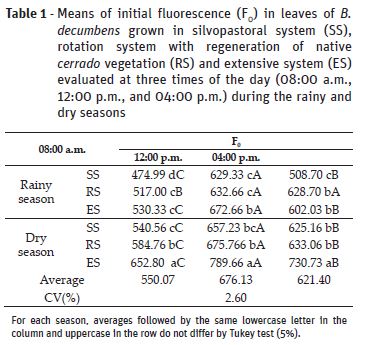
    <p><font face = "Verdana" size = "2">The photochemical efficiency data revealed lower
initial fluorescence (F<sub>0</sub>) for the <i>B. decumbens</i> in the silvopastoral
system (SS) in the rainy season, at the three evaluation times, compared to the
other two evaluated systems (<a href = "#t1">Table 1</a>). The plants of the SS treatment indicated
stress only at the evaluation time of 12:00 p.m. F<sub>0</sub> values around 500
indicate healthy plants, and above 550 indicate plants under stress, according to
Gonçalves <i>et al</i>. (2005a).</font></p>

    <p>&nbsp;</p>

<a name = "t1"><img src = "/img/revistas/rca/v41n3/v41n3a21t1.jpg" target = "_blank"></a>

    
<p>&nbsp;</p>

    <p><font face = "Verdana" size = "2">The F0 increased
from 8.00 am to 12:00 pm and after decreased until 4:00 pm (<a href = "#t1">Table 1</a>). These data
are similar to the results reported by Vieira <i>et al</i>. (2010), which found
lower F0 values at 07:00 a.m., rising 8:00 am and keeping high until 4:00 am when
it began to decline.</font></p>

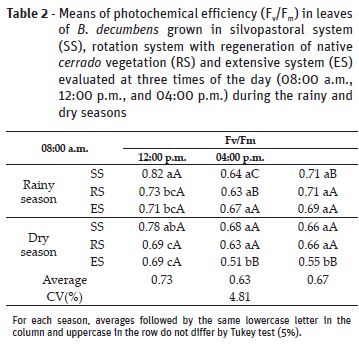
    <p><font face = "Verdana" size = "2">The<i> B. decumbens</i>
in the SS treatment had higher maximum quantum efficiency of PSII (F<sub>v</sub>/F<sub>m</sub>)
in the rainy season than in the other systems, with maximum of 0.82 at 08:00 a.m.
(<a href = "#t2">Table 2</a>). The F<sub>v</sub>/F<sub>m,</sub> of all evaluated treatments, was below
the optimal range for the photosynthetic process at 12:00 p.m.</font></p>

    ]]></body>
<body><![CDATA[<p>&nbsp;</p>

<a name = "t2"><img src = "/img/revistas/rca/v41n3/v41n3a21t2.jpg" target = "_blank"></a>

    
<p>&nbsp;</p>

    <p><font face = "Verdana" size = "2">According to Bolhar-Nordenkampf <i>et al</i>. (1989), when the
plant has its photosynthetic apparatus intact, the F<sub>v</sub>/F<sub>m</sub> must
be between 0.75 and 0.85; and a decrease in this variable may represent a photoinhibitory
damage in the PSII reaction centers.</font></p>

    <p><font face = "Verdana" size = "2">The F<sub>v</sub>/F<sub>m</sub> of the <i>B. decumbens</i> in the rotation system
with regeneration of native cerrado vegetation (RS) and extensive system (ES) in
the rainy season had similar results at 08:00 a.m. (0.73 and 0.71, respectively)
(<a href = "#t2">Table 2</a>). These results indicate a possible starting of damage to the photosynthetic
apparatus.</font></p>

    <p><font face = "Verdana" size = "2">The results of this study
confirm those found by Naumann <i>et al</i>. (2008), who reported a decreased F<sub>v</sub>/F<sub>m</sub>
at 12:00 p.m., with a subsequent increase and stability of the photochemical efficiency
from this time.</font></p>

    <p><font face = "Verdana" size = "2">The F<sub>v</sub>/F<sub>m</sub>
of the <i>B. decumbens</i> in the SS treatment had the best results at 08:00 a.m.,
both in the rainy (0.82) and dry (0.78) seasons, denoting a healthy photosynthetic
apparatus. In the dry season, the F<sub>v</sub>/F<sub>m</sub> of the <i>B. decumbens</i>
in the ES showed a greater decrease at 12:00 p.m. (0.51) and 04:00 p.m. (0.55).</font></p>


    <p><font face = "Verdana" size = "2">Photosynthesis is affected by environmental conditions,
such as temperature, humidity and wind speed. The soil water content is reduced
and there are high temperatures in the dry season, which can be determining factors
of stresses and, thus, decrease the quantum efficiency and reduce the crop productivity.</font></p>


    <p><font face = "Verdana" size = "2">Ogaya (2011) performed an experiment simulating
climate changes for two shrub species and reported that temperature and relative
humidity are the most important factors affecting the F<sub>v</sub>/F<sub>m, </sub>more
than the water availability. The author found the lowest F<sub>v</sub>/F<sub>m</sub>
in the winter, due to the cold and low relative humidity; however, the F<sub>v</sub>/F<sub>m</sub>
was 0.80 in ideal conditions of temperature and water availability.</font></p>


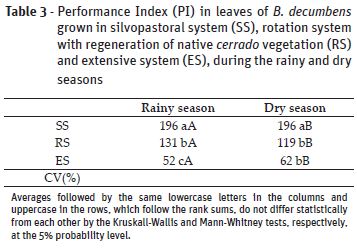
    <p><font face = "Verdana" size = "2">In the rainy season, the <i>B. decumbens</i> in
the SS presented the highest performance indexes (PI), followed by those of the
RS and ES treatments (<a href = "#t3">Table 3</a>).</font></p>

    <p>&nbsp;</p>

<a name = "t3"><img src = "/img/revistas/rca/v41n3/v41n3a21t3.jpg" target = "_blank"></a>

    
]]></body>
<body><![CDATA[<p>&nbsp;</p>

    <p><font face = "Verdana" size = "2">The best PI of the <i>B.
decumbens </i>in the SS and RS may be explained by the trees presents in both systems
that protected the grass from the high radiance conditions of the tropics; and the
ES had only <i>B. decumbens</i>, making it more exposed to high temperature and
light.</font></p>

    <p><font face = "Verdana" size = "2">Gonçalves <i>et al</i>. (2005)
stated that the reduction in the PI of plants subjected to high radiance indicates
loss of efficiency by photoinhibition. PI is considered a more sensitive parameter
for the detection and quantification of stress in plants than the response of the
maximum efficiency of PSII (Christen <i>et al.</i>, 2007; Oukarroum <i>et al.</i>,
2007).</font></p>

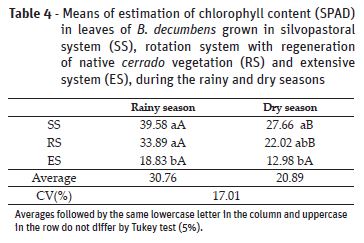
    <p><font face = "Verdana" size = "2">The estimations of chlorophyll
content (SPAD) of the <i>B. decumbens</i> in the SS and RS were similar throughout
the day in the rainy season (<a href = "#t4">Table 4</a>); these results probably occurred due to the
presence of trees of these systems that provided partial shade.</font></p>

    <p>&nbsp;</p>

<a name = "t4"><img src = "/img/revistas/rca/v41n3/v41n3a21t4.jpg" target = "_blank"></a>

    
<p>&nbsp;</p>

    <p><font face = "Verdana" size = "2">The plant adapt, degrading the chlorophyll to absorb less energy
when subjected to a high light radiation. Contrastingly, the plants maintain high
concentrations of chlorophyll to maximize the interception of light energy when
subjected to a low light radiation (Nogueira <i>et al.,</i> 2005).</font></p>


    <p><font face = "Verdana" size = "2">Martuscello (2009) evaluated <i>Brachiaria</i>
spp. under shading levels and the SPAD of all <i>Brachiaria</i> spp. responded linearly
and positively to shading level.</font></p>

    <p><font face = "Verdana" size = "2">The
SPADs of the <i>B. decumbens </i>in the SS and RS were similar in the dry season,
which presents adverse conditions for plants. The <i>B. decumbens </i>in the ES
had the worst SPAD, probably due the absence of trees in this area; the trees in
the SS and RS shaded the plants, which may have contributed to the reduction of
the <i>B. decumbens</i> transpiration, the interception of solar radiation can affect
the microclimate pasture grows.</font></p>

    <p><font face = "Verdana" size = "2">The
water deficit is characterized as one of the environmental stresses responsible
for changes in leaf pigments, by altering the chlorophyll and chlorophyll b ratio,
and the chlorophyll and carotenoid ratio. This is used, to a lesser extent, to diagnose
senescence under water stress conditions (Hendry and Grime, 1993).</font></p>


    ]]></body>
<body><![CDATA[<p><font face = "Verdana" size = "3"><b>CONCLUSIONS</b></font></p>

    <p><font face = "Verdana" size = "2">The<i> Brachiaria
decumbens</i> grown in silvopastoral management system had better ecophysiological
efficiency for all evaluated variables, both in rainy and dry seasons, when compared
to the other evaluated grazing management systems; consequently, this is a potential
species for livestock production in this system.</font></p>

    <p><font face = "Verdana" size = "2">The rotation system with regeneration of native <i>cerrado</i> vegetation
proved to be a viable alternative in the livestock management, which provides good
ecophysiological results for the <i>B. decumbens</i>.</font></p>

    <p><font face = "Verdana" size = "2">The extensive system is not recommended as a grazing management
system for <i>B. decumbens</i>, since it presented the worst results for the evaluated
ecophysiological variables, and resulted in damage to the photosynthetic apparatus
of the plants.</font></p>


    <p>&nbsp;</p>

    <p><font face = "Verdana" size = "3"><b>References</b></font></p>

    <!-- ref --><p><font face = "Verdana" size = "2">Bolhar-Nordenkampf, H.R.; Long, S.P.; Baker, N.R.; Oquist, G.;
Schreiber, U. &amp; Lechner, E.G. (1989) - Chlorophyll fluorescence as probe of
the photosynthetic competence of leaves in the field: A review of current instrument.
<i>Functional Ecology</i>, vol. 3, n. 4, p. 497-514. <a href="http://dx.doi.org/10.2307/2389624" target = "_blank">http://dx.doi.org/10.2307/2389624</a></font>&nbsp;&nbsp;&nbsp;&nbsp;&nbsp;&nbsp;&nbsp;&nbsp;[&#160;<a href="javascript:void(0);" onclick="javascript: window.open('/scielo.php?script=sci_nlinks&ref=687745&pid=S0871-018X201800030002100001&lng=','','width=640,height=500,resizable=yes,scrollbars=1,menubar=yes,');">Links</a>&#160;]<!-- end-ref --><!-- ref --><p><font face = "Verdana" size = "2">Carvalho, M.M.; Freitas, V.P. &amp; Andrade, A.C.
(1995) - Crescimento inicial de cinco gramíneas tropicais em um sub-bosque de angico-vermelho
(<i>Anadenanthera macrocarpa</i> Benth.). <i>Pasturas Tropicales</i>, vol. 17, n.
1, p. 24-30.    &nbsp;&nbsp;&nbsp;&nbsp;&nbsp;&nbsp;&nbsp;&nbsp;[&#160;<a href="javascript:void(0);" onclick="javascript: window.open('/scielo.php?script=sci_nlinks&ref=687746&pid=S0871-018X201800030002100002&lng=','','width=640,height=500,resizable=yes,scrollbars=1,menubar=yes,');">Links</a>&#160;]<!-- end-ref --></font></p>

    <!-- ref --><p><font face = "Verdana" size = "2">Christen, D.; Schönmann,
S.; Jermini, M.; Strasser, R.J. &amp; Défago, G. (2007) - Characterization and early
detection of grapevine (<i>Vitis vinifera</i>) stress responses to esca disease
by in situ chlorophyll fluorescence and comparison with drought stress. <i>Environmental
and Experimental Botany</i>, vol. 60, n. 3, p. 504-514. <a href = "https://doi.org/10.1016/j.envexpbot.2007.02.003" target = "_blank">https://doi.org/10.1016/j.envexpbot.2007.02.003</a></font>&nbsp;&nbsp;&nbsp;&nbsp;&nbsp;&nbsp;&nbsp;&nbsp;[&#160;<a href="javascript:void(0);" onclick="javascript: window.open('/scielo.php?script=sci_nlinks&ref=687748&pid=S0871-018X201800030002100003&lng=','','width=640,height=500,resizable=yes,scrollbars=1,menubar=yes,');">Links</a>&#160;]<!-- end-ref --><!-- ref --><p><font face = "Verdana" size = "2">Dias-Filho, M.B. (2006) - <i>Competição e sucessão
vegetal em pastagens</i>. Belém: Embrapa Amazônia oriental.    &nbsp;&nbsp;&nbsp;&nbsp;&nbsp;&nbsp;&nbsp;&nbsp;[&#160;<a href="javascript:void(0);" onclick="javascript: window.open('/scielo.php?script=sci_nlinks&ref=687749&pid=S0871-018X201800030002100004&lng=','','width=640,height=500,resizable=yes,scrollbars=1,menubar=yes,');">Links</a>&#160;]<!-- end-ref --></font></p>

    <!-- ref --><p><font face = "Verdana" size = "2">Fagundes, J.L.; Fonseca, D.M.; Gomide, J.A.; Nascimento
Junior, D.; Vitor, C.M.T.; Morais, R.V.; Mistura, C.; Reis, G.C. &amp; Martuscello,
J.A. (2005) - Acúmulo de forragem em pastos de <i>Brachiaria decumbens </i>adubados
com nitrogênio. <i>Pesquisa Agropecuária Brasileira</i>, vol. 40, n. 4, p. 397-403.
<a href="http://dx.doi.org/10.1590/S0100-204X2005000400012" target = "_blank">http://dx.doi.org/10.1590/S0100-204X2005000400012</a></font>&nbsp;&nbsp;&nbsp;&nbsp;&nbsp;&nbsp;&nbsp;&nbsp;[&#160;<a href="javascript:void(0);" onclick="javascript: window.open('/scielo.php?script=sci_nlinks&ref=687751&pid=S0871-018X201800030002100005&lng=','','width=640,height=500,resizable=yes,scrollbars=1,menubar=yes,');">Links</a>&#160;]<!-- end-ref --><!-- ref --><p><font face = "Verdana" size = "2">Gonçalves, J.F.C.; Barreto, D.C.S.; Santos Junior,
U.; Fernandes, A.V.; Sampaio, P.T.B. &amp; Buckeride, M.S. (2005a) - Growth, photosynthesis
and stress indicators in Young rosewood plants (Aniba rosaeodora Ducke) under different
light intensities. <i>Brazilian Journal of Plant Physiology</i>, vol. 17, n. 3,
p. 325-334. <a href = "http://dx.doi.org/10.1590/S1677-04202005000300007" target = "_blank">http://dx.doi.org/10.1590/S1677-04202005000300007</a></font>&nbsp;&nbsp;&nbsp;&nbsp;&nbsp;&nbsp;&nbsp;&nbsp;[&#160;<a href="javascript:void(0);" onclick="javascript: window.open('/scielo.php?script=sci_nlinks&ref=687752&pid=S0871-018X201800030002100006&lng=','','width=640,height=500,resizable=yes,scrollbars=1,menubar=yes,');">Links</a>&#160;]<!-- end-ref --><!-- ref --><p><font face = "Verdana" size = "2">Gonçalves, M.C.; Vega, J.; Oliveira, J.G. &amp; Gomes, M.M.A.
(2005b) - Sugarcane yellow leaf virus infection leads to alterations in photosynthetic
efficiency and carbohydrate accumulation in sugarcane leaves. <i>Revista de Fitopatologia
Brasileira</i>, vol. 30, n. 1, p. 10-16. <a href="http://dx.doi.org/10.1590/S0100-41582005000100002" target = "_blank">http://dx.doi.org/10.1590/S0100-41582005000100002</a></font>&nbsp;&nbsp;&nbsp;&nbsp;&nbsp;&nbsp;&nbsp;&nbsp;[&#160;<a href="javascript:void(0);" onclick="javascript: window.open('/scielo.php?script=sci_nlinks&ref=687753&pid=S0871-018X201800030002100007&lng=','','width=640,height=500,resizable=yes,scrollbars=1,menubar=yes,');">Links</a>&#160;]<!-- end-ref --><!-- ref --><p><font face = "Verdana" size = "2">Hendry, G.A.F. &amp; Grime, J.P. (1993) - <i>Methods
in comparative plant ecology - a laboratory manual</i>. London, Chapman &amp; Hall,
252 p.    &nbsp;&nbsp;&nbsp;&nbsp;&nbsp;&nbsp;&nbsp;&nbsp;[&#160;<a href="javascript:void(0);" onclick="javascript: window.open('/scielo.php?script=sci_nlinks&ref=687754&pid=S0871-018X201800030002100008&lng=','','width=640,height=500,resizable=yes,scrollbars=1,menubar=yes,');">Links</a>&#160;]<!-- end-ref --></font></p>

    <!-- ref --><p><font face = "Verdana" size = "2">Koeppen, W. (1948) - <i>Climatologia:
estúdio de los climas de la Tierra</i>. México, Fondo de cultura económica, 496
p.    &nbsp;&nbsp;&nbsp;&nbsp;&nbsp;&nbsp;&nbsp;&nbsp;[&#160;<a href="javascript:void(0);" onclick="javascript: window.open('/scielo.php?script=sci_nlinks&ref=687756&pid=S0871-018X201800030002100009&lng=','','width=640,height=500,resizable=yes,scrollbars=1,menubar=yes,');">Links</a>&#160;]<!-- end-ref --></font></p>

    <!-- ref --><p><font face = "Verdana" size = "2">LABGEO/LABMET (2002) - <i>Atlas
do maranhão</i>. 2ª ed. São Luís, GEPLAN/LABGEO/UEMA, 39 p.    &nbsp;&nbsp;&nbsp;&nbsp;&nbsp;&nbsp;&nbsp;&nbsp;[&#160;<a href="javascript:void(0);" onclick="javascript: window.open('/scielo.php?script=sci_nlinks&ref=687758&pid=S0871-018X201800030002100010&lng=','','width=640,height=500,resizable=yes,scrollbars=1,menubar=yes,');">Links</a>&#160;]<!-- end-ref --></font></p>

    <!-- ref --><p><font face = "Verdana" size = "2">Martuscello, J.A.; Jank, L.; Gontijo, M.M.; Laura, V.A.
&amp; Figueiredo, D.D.N.V. (2009) - Produção de gramíneas do gênero <i>Brachiaria
</i>sob níveis de sombreamento. <i>Revista Brasileira de Zootecnia</i>, vol. 38,
n. 7, p. 1183-1190. <a href="http://dx.doi.org/10.1590/S1516-35982009000700004" target = "_blank">http://dx.doi.org/10.1590/S1516-35982009000700004</a></font>&nbsp;&nbsp;&nbsp;&nbsp;&nbsp;&nbsp;&nbsp;&nbsp;[&#160;<a href="javascript:void(0);" onclick="javascript: window.open('/scielo.php?script=sci_nlinks&ref=687760&pid=S0871-018X201800030002100011&lng=','','width=640,height=500,resizable=yes,scrollbars=1,menubar=yes,');">Links</a>&#160;]<!-- end-ref --><!-- ref --><p><font face = "Verdana" size = "2">Minolta (1989) - <i>Manual for chlorophyll meter
SPAD 502</i>. Osaka: Minolta, Radiometric Instruments divisions.    &nbsp;&nbsp;&nbsp;&nbsp;&nbsp;&nbsp;&nbsp;&nbsp;[&#160;<a href="javascript:void(0);" onclick="javascript: window.open('/scielo.php?script=sci_nlinks&ref=687761&pid=S0871-018X201800030002100012&lng=','','width=640,height=500,resizable=yes,scrollbars=1,menubar=yes,');">Links</a>&#160;]<!-- end-ref --></font></p>

 
    <!-- ref --><p><font face = "Verdana" size = "2">Naumann, J.C.; Young, D.R. &amp; Anderson, J.E.
(2008) - Leaf chlorophyll fluorescence, reflectance, and physiological response
to freshwater and saltwater flooding in the evergreen shrub, <i>Myrica cerifera</i>.
<i>Environmental and Experimental Botany</i>, vol. 63, n. 1-3, p. 402-409. <a href="http://dx.doi.org/10.1016/j.envexpbot.2007.12.008" target = "_blank">http://dx.doi.org/10.1016/j.envexpbot.2007.12.008</a></font>&nbsp;&nbsp;&nbsp;&nbsp;&nbsp;&nbsp;&nbsp;&nbsp;[&#160;<a href="javascript:void(0);" onclick="javascript: window.open('/scielo.php?script=sci_nlinks&ref=687763&pid=S0871-018X201800030002100013&lng=','','width=640,height=500,resizable=yes,scrollbars=1,menubar=yes,');">Links</a>&#160;]<!-- end-ref --><!-- ref --><p><font face = "Verdana" size = "2">Nogueira, R.J.; Araújo, E.L.; Willadino, L.G.
&amp; Cavalcante, U.M.T. (2005) - <i>Estresses ambientais: danos e benefícios em
plantas</i>. Recife, Imprensa Universitária, 500 p.    &nbsp;&nbsp;&nbsp;&nbsp;&nbsp;&nbsp;&nbsp;&nbsp;[&#160;<a href="javascript:void(0);" onclick="javascript: window.open('/scielo.php?script=sci_nlinks&ref=687764&pid=S0871-018X201800030002100014&lng=','','width=640,height=500,resizable=yes,scrollbars=1,menubar=yes,');">Links</a>&#160;]<!-- end-ref --></font></p>

    <!-- ref --><p><font face = "Verdana" size = "2">Ogaya, R.; Penuelas, J.; Asensio, D. &amp; Llusià, J. (2011)
- Chlorophyll fluorescence responses to temperature and water availability in two
co-dominant Mediterranean shrub and tree species in a long-term field experiment
simulating climate change. <i>Environmental and Experimental Botany</i>, vol. 73,
p. 89–93. <a href="http://dx.doi.org/10.1016/j.envexpbot.2011.08.004" target = "_blank">http://dx.doi.org/10.1016/j.envexpbot.2011.08.004</a></font>&nbsp;&nbsp;&nbsp;&nbsp;&nbsp;&nbsp;&nbsp;&nbsp;[&#160;<a href="javascript:void(0);" onclick="javascript: window.open('/scielo.php?script=sci_nlinks&ref=687766&pid=S0871-018X201800030002100015&lng=','','width=640,height=500,resizable=yes,scrollbars=1,menubar=yes,');">Links</a>&#160;]<!-- end-ref --><!-- ref --><p><font face = "Verdana" size = "2">Oukarroum, A.; El Madidi, S.; Schansker, G. &amp;
Strasser, R.J. (2007) - Probing the responses of barley cultivars (<i>Hordeum vulgare</i>
L.) by chlorophyll a fluorescence OLKJIP under drought stress and re-watering. <i>Environmental
and Experimental Botany</i>, vol. 60, n. 3, p. 438-446. <a href = "https://doi.org/10.1016/j.envexpbot.2007.01.002" target = "_blank">https://doi.org/10.1016/j.envexpbot.2007.01.002</a></font>&nbsp;&nbsp;&nbsp;&nbsp;&nbsp;&nbsp;&nbsp;&nbsp;[&#160;<a href="javascript:void(0);" onclick="javascript: window.open('/scielo.php?script=sci_nlinks&ref=687767&pid=S0871-018X201800030002100016&lng=','','width=640,height=500,resizable=yes,scrollbars=1,menubar=yes,');">Links</a>&#160;]<!-- end-ref --><!-- ref --><p><font face = "Verdana" size = "2">Strasser, R.J.; Srivastava, A. &amp; Tsimilli-Michael,
M. (2000) - The fluorescence transient as a tool to characterize and screen photosynthetic
samples. <i>In</i>: Mohanty, P. &amp; Yunus, P. (Eds.) - <i>Probing photosynthesis:
mechanism, regulation and adaptation</i>. London, Taylor and Francis, p. 443–480.    &nbsp;&nbsp;&nbsp;&nbsp;&nbsp;&nbsp;&nbsp;&nbsp;[&#160;<a href="javascript:void(0);" onclick="javascript: window.open('/scielo.php?script=sci_nlinks&ref=687768&pid=S0871-018X201800030002100017&lng=','','width=640,height=500,resizable=yes,scrollbars=1,menubar=yes,');">Links</a>&#160;]<!-- end-ref --></font></p>


    <!-- ref --><p><font face = "Verdana" size = "2">Swiader, J.M. &amp; Moore, A. (2002) - SPAD-chlorophyll
response to nitrogen fertilization and evaluation of nitrogen status in dryland
and irrigated pumpkin. <i>Journal of Plant Nutrition</i>, vol. 25, n. 5, p. 1089-1100.
<a href="http://dx.doi.org/10.1081/PLN-120003941" target = "_blank">http://dx.doi.org/10.1081/PLN-120003941</a></font>&nbsp;&nbsp;&nbsp;&nbsp;&nbsp;&nbsp;&nbsp;&nbsp;[&#160;<a href="javascript:void(0);" onclick="javascript: window.open('/scielo.php?script=sci_nlinks&ref=687770&pid=S0871-018X201800030002100018&lng=','','width=640,height=500,resizable=yes,scrollbars=1,menubar=yes,');">Links</a>&#160;]<!-- end-ref --><!-- ref --><p><font face = "Verdana" size = "2">Vieira, D.A.; Portes, T.A.; Stacciarini,
E. &amp; Teixeira, J.B. (2010). Fluorescência e teores de clorofila em abacaxizeiro
cv. Pérola submetida a diferentes concentrações de sulfato de amônio, <i>Revista
Brasileira de Fruticultura</i>, vol. 32, n. 2, p. 360-368. <a href = "http://dx.doi.org/10.1590/S0100-29452010005000061" target = "_blank">http://dx.doi.org/10.1590/S0100-29452010005000061</a></font>&nbsp;&nbsp;&nbsp;&nbsp;&nbsp;&nbsp;&nbsp;&nbsp;[&#160;<a href="javascript:void(0);" onclick="javascript: window.open('/scielo.php?script=sci_nlinks&ref=687771&pid=S0871-018X201800030002100019&lng=','','width=640,height=500,resizable=yes,scrollbars=1,menubar=yes,');">Links</a>&#160;]<!-- end-ref --><p>&nbsp;</p>

    <p><font face = "Verdana" size = "2">Received/recebido: 2017.09.21</font></p>

    <p><font face = "Verdana" size = "2">Received in revised form/recebido em versão revista: 2018.02.16</font></p>

    <p><font face = "Verdana" size = "2">Accepted/aceite: 2018.03.27</font></p>

     ]]></body><back>
<ref-list>
<ref id="B1">
<nlm-citation citation-type="journal">
<person-group person-group-type="author">
<name>
<surname><![CDATA[Bolhar-Nordenkampf]]></surname>
<given-names><![CDATA[H.R.]]></given-names>
</name>
<name>
<surname><![CDATA[Long]]></surname>
<given-names><![CDATA[S.P.]]></given-names>
</name>
<name>
<surname><![CDATA[Baker]]></surname>
<given-names><![CDATA[N.R.]]></given-names>
</name>
<name>
<surname><![CDATA[Oquist]]></surname>
<given-names><![CDATA[G.]]></given-names>
</name>
<name>
<surname><![CDATA[Schreiber]]></surname>
<given-names><![CDATA[U.]]></given-names>
</name>
<name>
<surname><![CDATA[Lechner]]></surname>
<given-names><![CDATA[E.G.]]></given-names>
</name>
</person-group>
<article-title xml:lang="en"><![CDATA[Chlorophyll fluorescence as probe of the photosynthetic competence of leaves in the field: A review of current instrument]]></article-title>
<source><![CDATA[Functional Ecology]]></source>
<year>1989</year>
<volume>3</volume>
<numero>4</numero>
<issue>4</issue>
<page-range>497-514</page-range></nlm-citation>
</ref>
<ref id="B2">
<nlm-citation citation-type="journal">
<person-group person-group-type="author">
<name>
<surname><![CDATA[Carvalho]]></surname>
<given-names><![CDATA[M.M.]]></given-names>
</name>
<name>
<surname><![CDATA[Freitas]]></surname>
<given-names><![CDATA[V.P.]]></given-names>
</name>
<name>
<surname><![CDATA[Andrade]]></surname>
<given-names><![CDATA[A.C.]]></given-names>
</name>
</person-group>
<article-title xml:lang="pt"><![CDATA[Crescimento inicial de cinco gramíneas tropicais em um sub-bosque de angico-vermelho (Anadenanthera macrocarpa Benth.)]]></article-title>
<source><![CDATA[Pasturas Tropicales]]></source>
<year>1995</year>
<volume>17</volume>
<numero>1</numero>
<issue>1</issue>
<page-range>24-30</page-range></nlm-citation>
</ref>
<ref id="B3">
<nlm-citation citation-type="journal">
<person-group person-group-type="author">
<name>
<surname><![CDATA[Christen]]></surname>
<given-names><![CDATA[D.]]></given-names>
</name>
<name>
<surname><![CDATA[Schönmann]]></surname>
<given-names><![CDATA[S.]]></given-names>
</name>
<name>
<surname><![CDATA[Jermini]]></surname>
<given-names><![CDATA[M.]]></given-names>
</name>
<name>
<surname><![CDATA[Strasser]]></surname>
<given-names><![CDATA[R.J.]]></given-names>
</name>
<name>
<surname><![CDATA[Défago]]></surname>
<given-names><![CDATA[G.]]></given-names>
</name>
</person-group>
<article-title xml:lang="en"><![CDATA[Characterization and early detection of grapevine (Vitis vinifera) stress responses to esca disease by in situ chlorophyll fluorescence and comparison with drought stress]]></article-title>
<source><![CDATA[Environmental and Experimental Botany]]></source>
<year>2007</year>
<volume>60</volume>
<numero>3</numero>
<issue>3</issue>
<page-range>504-514</page-range></nlm-citation>
</ref>
<ref id="B4">
<nlm-citation citation-type="book">
<person-group person-group-type="author">
<name>
<surname><![CDATA[Dias-Filho]]></surname>
<given-names><![CDATA[M.B.]]></given-names>
</name>
</person-group>
<source><![CDATA[Competição e sucessão vegetal em pastagens]]></source>
<year>2006</year>
<publisher-loc><![CDATA[Belém ]]></publisher-loc>
<publisher-name><![CDATA[Embrapa Amazônia oriental]]></publisher-name>
</nlm-citation>
</ref>
<ref id="B5">
<nlm-citation citation-type="journal">
<person-group person-group-type="author">
<name>
<surname><![CDATA[Fagundes]]></surname>
<given-names><![CDATA[J.L.]]></given-names>
</name>
<name>
<surname><![CDATA[Fonseca]]></surname>
<given-names><![CDATA[D.M.]]></given-names>
</name>
<name>
<surname><![CDATA[Gomide]]></surname>
<given-names><![CDATA[J.A.]]></given-names>
</name>
<name>
<surname><![CDATA[Nascimento Junior]]></surname>
<given-names><![CDATA[D.]]></given-names>
</name>
<name>
<surname><![CDATA[Vitor]]></surname>
<given-names><![CDATA[C.M.T.]]></given-names>
</name>
<name>
<surname><![CDATA[Morais]]></surname>
<given-names><![CDATA[R.V.]]></given-names>
</name>
<name>
<surname><![CDATA[Mistura]]></surname>
<given-names><![CDATA[C.]]></given-names>
</name>
<name>
<surname><![CDATA[Reis]]></surname>
<given-names><![CDATA[G.C.]]></given-names>
</name>
<name>
<surname><![CDATA[Martuscello]]></surname>
<given-names><![CDATA[J.A.]]></given-names>
</name>
</person-group>
<article-title xml:lang="pt"><![CDATA[Acúmulo de forragem em pastos de Brachiaria decumbens adubados com nitrogênio]]></article-title>
<source><![CDATA[Pesquisa Agropecuária Brasileira]]></source>
<year>2005</year>
<volume>40</volume>
<numero>4</numero>
<issue>4</issue>
<page-range>397-403</page-range></nlm-citation>
</ref>
<ref id="B6">
<nlm-citation citation-type="journal">
<person-group person-group-type="author">
<name>
<surname><![CDATA[Gonçalves]]></surname>
<given-names><![CDATA[J.F.C.]]></given-names>
</name>
<name>
<surname><![CDATA[Barreto]]></surname>
<given-names><![CDATA[D.C.S.]]></given-names>
</name>
<name>
<surname><![CDATA[Santos Junior]]></surname>
<given-names><![CDATA[U.]]></given-names>
</name>
<name>
<surname><![CDATA[Fernandes]]></surname>
<given-names><![CDATA[A.V.]]></given-names>
</name>
<name>
<surname><![CDATA[Sampaio]]></surname>
<given-names><![CDATA[P.T.B.]]></given-names>
</name>
<name>
<surname><![CDATA[Buckeride]]></surname>
<given-names><![CDATA[M.S.]]></given-names>
</name>
</person-group>
<article-title xml:lang="en"><![CDATA[Growth, photosynthesis and stress indicators in Young rosewood plants (Aniba rosaeodora Ducke) under different light intensities]]></article-title>
<source><![CDATA[Brazilian Journal of Plant Physiology]]></source>
<year>2005</year>
<month>a</month>
<volume>17</volume>
<numero>3</numero>
<issue>3</issue>
<page-range>325-334</page-range></nlm-citation>
</ref>
<ref id="B7">
<nlm-citation citation-type="journal">
<person-group person-group-type="author">
<name>
<surname><![CDATA[Gonçalves]]></surname>
<given-names><![CDATA[M.C.]]></given-names>
</name>
<name>
<surname><![CDATA[Vega]]></surname>
<given-names><![CDATA[J.]]></given-names>
</name>
<name>
<surname><![CDATA[Oliveira]]></surname>
<given-names><![CDATA[J.G.]]></given-names>
</name>
<name>
<surname><![CDATA[Gomes]]></surname>
<given-names><![CDATA[M.M.A.]]></given-names>
</name>
</person-group>
<article-title xml:lang="en"><![CDATA[Sugarcane yellow leaf virus infection leads to alterations in photosynthetic efficiency and carbohydrate accumulation in sugarcane leaves]]></article-title>
<source><![CDATA[Revista de Fitopatologia Brasileira]]></source>
<year>2005</year>
<month>b</month>
<volume>30</volume>
<numero>1</numero>
<issue>1</issue>
<page-range>10-16</page-range></nlm-citation>
</ref>
<ref id="B8">
<nlm-citation citation-type="book">
<person-group person-group-type="author">
<name>
<surname><![CDATA[Hendry]]></surname>
<given-names><![CDATA[G.A.F.]]></given-names>
</name>
<name>
<surname><![CDATA[Grime]]></surname>
<given-names><![CDATA[J.P.]]></given-names>
</name>
</person-group>
<source><![CDATA[Methods in comparative plant ecology - a laboratory manual]]></source>
<year>1993</year>
<publisher-loc><![CDATA[London ]]></publisher-loc>
<publisher-name><![CDATA[Chapman & Hall]]></publisher-name>
</nlm-citation>
</ref>
<ref id="B9">
<nlm-citation citation-type="book">
<person-group person-group-type="author">
<name>
<surname><![CDATA[Koeppen]]></surname>
<given-names><![CDATA[W.]]></given-names>
</name>
</person-group>
<source><![CDATA[Climatologia: estúdio de los climas de la Tierra]]></source>
<year>1948</year>
<publisher-loc><![CDATA[México ]]></publisher-loc>
<publisher-name><![CDATA[Fondo de cultura económica]]></publisher-name>
</nlm-citation>
</ref>
<ref id="B10">
<nlm-citation citation-type="book">
<collab>LABGEO^dLABMET</collab>
<source><![CDATA[Atlas do maranhão]]></source>
<year>2002</year>
<edition>2ª</edition>
<publisher-loc><![CDATA[São Luís ]]></publisher-loc>
<publisher-name><![CDATA[GEPLAN/LABGEO/UEMA]]></publisher-name>
</nlm-citation>
</ref>
<ref id="B11">
<nlm-citation citation-type="journal">
<person-group person-group-type="author">
<name>
<surname><![CDATA[Martuscello]]></surname>
<given-names><![CDATA[J.A.]]></given-names>
</name>
<name>
<surname><![CDATA[Jank]]></surname>
<given-names><![CDATA[L.]]></given-names>
</name>
<name>
<surname><![CDATA[Gontijo]]></surname>
<given-names><![CDATA[M.M.]]></given-names>
</name>
<name>
<surname><![CDATA[Laura]]></surname>
<given-names><![CDATA[V.A.]]></given-names>
</name>
<name>
<surname><![CDATA[Figueiredo]]></surname>
<given-names><![CDATA[D.D.N.V.]]></given-names>
</name>
</person-group>
<article-title xml:lang="pt"><![CDATA[Produção de gramíneas do gênero Brachiaria sob níveis de sombreamento]]></article-title>
<source><![CDATA[Revista Brasileira de Zootecnia]]></source>
<year>2009</year>
<volume>38</volume>
<numero>7</numero>
<issue>7</issue>
<page-range>1183-1190</page-range></nlm-citation>
</ref>
<ref id="B12">
<nlm-citation citation-type="book">
<collab>Minolta</collab>
<source><![CDATA[Manual for chlorophyll meter SPAD 502]]></source>
<year>1989</year>
<publisher-loc><![CDATA[Osaka ]]></publisher-loc>
<publisher-name><![CDATA[Minolta, Radiometric Instruments divisions]]></publisher-name>
</nlm-citation>
</ref>
<ref id="B13">
<nlm-citation citation-type="journal">
<person-group person-group-type="author">
<name>
<surname><![CDATA[Naumann]]></surname>
<given-names><![CDATA[J.C.]]></given-names>
</name>
<name>
<surname><![CDATA[Young]]></surname>
<given-names><![CDATA[D.R.]]></given-names>
</name>
<name>
<surname><![CDATA[Anderson]]></surname>
<given-names><![CDATA[J.E.]]></given-names>
</name>
</person-group>
<article-title xml:lang="en"><![CDATA[Leaf chlorophyll fluorescence, reflectance, and physiological response to freshwater and saltwater flooding in the evergreen shrub, Myrica cerifera]]></article-title>
<source><![CDATA[Environmental and Experimental Botany]]></source>
<year>2008</year>
<volume>63</volume>
<numero>1-3</numero>
<issue>1-3</issue>
<page-range>402-409</page-range></nlm-citation>
</ref>
<ref id="B14">
<nlm-citation citation-type="book">
<person-group person-group-type="author">
<name>
<surname><![CDATA[Nogueira]]></surname>
<given-names><![CDATA[R.J.]]></given-names>
</name>
<name>
<surname><![CDATA[Araújo]]></surname>
<given-names><![CDATA[E.L.]]></given-names>
</name>
<name>
<surname><![CDATA[Willadino]]></surname>
<given-names><![CDATA[L.G.]]></given-names>
</name>
<name>
<surname><![CDATA[Cavalcante]]></surname>
<given-names><![CDATA[U.M.T.]]></given-names>
</name>
</person-group>
<source><![CDATA[Estresses ambientais: danos e benefícios em plantas]]></source>
<year>2005</year>
<publisher-loc><![CDATA[Recife ]]></publisher-loc>
<publisher-name><![CDATA[Imprensa Universitária]]></publisher-name>
</nlm-citation>
</ref>
<ref id="B15">
<nlm-citation citation-type="journal">
<person-group person-group-type="author">
<name>
<surname><![CDATA[Ogaya]]></surname>
<given-names><![CDATA[R.]]></given-names>
</name>
<name>
<surname><![CDATA[Penuelas]]></surname>
<given-names><![CDATA[J.]]></given-names>
</name>
<name>
<surname><![CDATA[Asensio]]></surname>
<given-names><![CDATA[D.]]></given-names>
</name>
<name>
<surname><![CDATA[Llusià]]></surname>
<given-names><![CDATA[J.]]></given-names>
</name>
</person-group>
<article-title xml:lang="en"><![CDATA[Chlorophyll fluorescence responses to temperature and water availability in two co-dominant Mediterranean shrub and tree species in a long-term field experiment simulating climate change]]></article-title>
<source><![CDATA[Environmental and Experimental Botany]]></source>
<year>2011</year>
<volume>73</volume>
<page-range>89-93</page-range></nlm-citation>
</ref>
<ref id="B16">
<nlm-citation citation-type="journal">
<person-group person-group-type="author">
<name>
<surname><![CDATA[Oukarroum]]></surname>
<given-names><![CDATA[A.]]></given-names>
</name>
<name>
<surname><![CDATA[El Madidi]]></surname>
<given-names><![CDATA[S.]]></given-names>
</name>
<name>
<surname><![CDATA[Schansker]]></surname>
<given-names><![CDATA[G.]]></given-names>
</name>
<name>
<surname><![CDATA[Strasser]]></surname>
<given-names><![CDATA[R.J.]]></given-names>
</name>
</person-group>
<article-title xml:lang="en"><![CDATA[Probing the responses of barley cultivars (Hordeum vulgare L.) by chlorophyll a fluorescence OLKJIP under drought stress and re-watering]]></article-title>
<source><![CDATA[Environmental and Experimental Botany]]></source>
<year>2007</year>
<volume>60</volume>
<numero>3</numero>
<issue>3</issue>
<page-range>438-446</page-range></nlm-citation>
</ref>
<ref id="B17">
<nlm-citation citation-type="">
<person-group person-group-type="author">
<name>
<surname><![CDATA[Strasser]]></surname>
<given-names><![CDATA[R.J.]]></given-names>
</name>
<name>
<surname><![CDATA[Srivastava]]></surname>
<given-names><![CDATA[A.]]></given-names>
</name>
<name>
<surname><![CDATA[Tsimilli-Michael]]></surname>
<given-names><![CDATA[M.]]></given-names>
</name>
</person-group>
<article-title xml:lang="en"><![CDATA[The fluorescence transient as a tool to characterize and screen photosynthetic samples]]></article-title>
<person-group person-group-type="editor">
<name>
<surname><![CDATA[Mohanty]]></surname>
<given-names><![CDATA[P.]]></given-names>
</name>
<name>
<surname><![CDATA[Yunus]]></surname>
<given-names><![CDATA[P.]]></given-names>
</name>
</person-group>
<source><![CDATA[Probing photosynthesis: mechanism, regulation and adaptation]]></source>
<year>2000</year>
<page-range>Taylor and Francis</page-range><page-range>443-480</page-range><publisher-loc><![CDATA[London ]]></publisher-loc>
</nlm-citation>
</ref>
<ref id="B18">
<nlm-citation citation-type="journal">
<person-group person-group-type="author">
<name>
<surname><![CDATA[Swiader]]></surname>
<given-names><![CDATA[J.M.]]></given-names>
</name>
<name>
<surname><![CDATA[Moore]]></surname>
<given-names><![CDATA[A.]]></given-names>
</name>
</person-group>
<article-title xml:lang="en"><![CDATA[SPAD-chlorophyll response to nitrogen fertilization and evaluation of nitrogen status in dryland and irrigated pumpkin]]></article-title>
<source><![CDATA[Journal of Plant Nutrition]]></source>
<year>2002</year>
<volume>25</volume>
<numero>5</numero>
<issue>5</issue>
<page-range>1089-1100</page-range></nlm-citation>
</ref>
<ref id="B19">
<nlm-citation citation-type="journal">
<person-group person-group-type="author">
<name>
<surname><![CDATA[Vieira]]></surname>
<given-names><![CDATA[D.A.]]></given-names>
</name>
<name>
<surname><![CDATA[Portes]]></surname>
<given-names><![CDATA[T.A.]]></given-names>
</name>
<name>
<surname><![CDATA[Stacciarini]]></surname>
<given-names><![CDATA[E.]]></given-names>
</name>
<name>
<surname><![CDATA[Teixeira]]></surname>
<given-names><![CDATA[J.B.]]></given-names>
</name>
</person-group>
<article-title xml:lang="pt"><![CDATA[Fluorescência e teores de clorofila em abacaxizeiro cv. Pérola submetida a diferentes concentrações de sulfato de amônio]]></article-title>
<source><![CDATA[Revista Brasileira de Fruticultura]]></source>
<year>2010</year>
<volume>32</volume>
<numero>2</numero>
<issue>2</issue>
<page-range>360-368</page-range></nlm-citation>
</ref>
</ref-list>
</back>
</article>