<?xml version="1.0" encoding="ISO-8859-1"?><article xmlns:mml="http://www.w3.org/1998/Math/MathML" xmlns:xlink="http://www.w3.org/1999/xlink" xmlns:xsi="http://www.w3.org/2001/XMLSchema-instance">
<front>
<journal-meta>
<journal-id>0871-018X</journal-id>
<journal-title><![CDATA[Revista de Ciências Agrárias]]></journal-title>
<abbrev-journal-title><![CDATA[Rev. de Ciências Agrárias]]></abbrev-journal-title>
<issn>0871-018X</issn>
<publisher>
<publisher-name><![CDATA[Sociedade de Ciências Agrárias de Portugal]]></publisher-name>
</publisher>
</journal-meta>
<article-meta>
<article-id>S0871-018X2018000300022</article-id>
<article-id pub-id-type="doi">10.19084/RCA18002</article-id>
<title-group>
<article-title xml:lang="en"><![CDATA[Morphology of Panicum genotypes submitted to periods of cessation of irrigation]]></article-title>
<article-title xml:lang="pt"><![CDATA[Morfologia de genótipos de Panicum submetidos à suspensão hídrica]]></article-title>
</title-group>
<contrib-group>
<contrib contrib-type="author">
<name>
<surname><![CDATA[Lima]]></surname>
<given-names><![CDATA[Amanda Ferreira de]]></given-names>
</name>
<xref ref-type="aff" rid="A1"/>
</contrib>
<contrib contrib-type="author">
<name>
<surname><![CDATA[Santos]]></surname>
<given-names><![CDATA[Mércia Virgínia Ferreira dos]]></given-names>
</name>
<xref ref-type="aff" rid="A1"/>
</contrib>
<contrib contrib-type="author">
<name>
<surname><![CDATA[Lira]]></surname>
<given-names><![CDATA[Mário de Andrade]]></given-names>
</name>
<xref ref-type="aff" rid="A2"/>
</contrib>
<contrib contrib-type="author">
<name>
<surname><![CDATA[Cunha]]></surname>
<given-names><![CDATA[Márcio Vieira da]]></given-names>
</name>
<xref ref-type="aff" rid="A1"/>
</contrib>
<contrib contrib-type="author">
<name>
<surname><![CDATA[Mello]]></surname>
<given-names><![CDATA[Alexandre Carneiro Leão de]]></given-names>
</name>
<xref ref-type="aff" rid="A1"/>
</contrib>
<contrib contrib-type="author">
<name>
<surname><![CDATA[Ferreira]]></surname>
<given-names><![CDATA[Rinaldo Luiz Caraciolo]]></given-names>
</name>
<xref ref-type="aff" rid="A3"/>
</contrib>
<contrib contrib-type="author">
<name>
<surname><![CDATA[Ferraz]]></surname>
<given-names><![CDATA[André Pereira Freire]]></given-names>
</name>
<xref ref-type="aff" rid="A1"/>
</contrib>
<contrib contrib-type="author">
<name>
<surname><![CDATA[Dubeux Júnior]]></surname>
<given-names><![CDATA[José Carlos Batista]]></given-names>
</name>
<xref ref-type="aff" rid="A4"/>
</contrib>
<contrib contrib-type="author">
<name>
<surname><![CDATA[Moura]]></surname>
<given-names><![CDATA[Janete Gomes de]]></given-names>
</name>
<xref ref-type="aff" rid="A1"/>
</contrib>
</contrib-group>
<aff id="AA1">
<institution><![CDATA[,Universidade Federal Rural de Pernambuco Animal Science Department ]]></institution>
<addr-line><![CDATA[Recife Pernambuco]]></addr-line>
<country>Brazil</country>
</aff>
<aff id="AA2">
<institution><![CDATA[,Instituto Agronômico de Pernambuco  ]]></institution>
<addr-line><![CDATA[Recife Pernambuco]]></addr-line>
<country>Brazil</country>
</aff>
<aff id="AA3">
<institution><![CDATA[,UFRPE Department of Forest Sciences ]]></institution>
<addr-line><![CDATA[ ]]></addr-line>
</aff>
<aff id="AA4">
<institution><![CDATA[,University of Florida North Florida Research & Education Center ]]></institution>
<addr-line><![CDATA[Marianna Florida]]></addr-line>
<country>United States of America</country>
</aff>
<pub-date pub-type="pub">
<day>00</day>
<month>09</month>
<year>2018</year>
</pub-date>
<pub-date pub-type="epub">
<day>00</day>
<month>09</month>
<year>2018</year>
</pub-date>
<volume>41</volume>
<numero>3</numero>
<fpage>211</fpage>
<lpage>220</lpage>
<copyright-statement/>
<copyright-year/>
<self-uri xlink:href="http://scielo.pt/scielo.php?script=sci_arttext&amp;pid=S0871-018X2018000300022&amp;lng=en&amp;nrm=iso"></self-uri><self-uri xlink:href="http://scielo.pt/scielo.php?script=sci_abstract&amp;pid=S0871-018X2018000300022&amp;lng=en&amp;nrm=iso"></self-uri><self-uri xlink:href="http://scielo.pt/scielo.php?script=sci_pdf&amp;pid=S0871-018X2018000300022&amp;lng=en&amp;nrm=iso"></self-uri><abstract abstract-type="short" xml:lang="en"><p><![CDATA[This study aimed to evaluate the morphological characteristics of Panicum maximum clones during the regrowth period following cessation of irrigation. Panicum clones were collected in Sergipe and in three Pernambuco locations (‘São Bento do Una’, ‘Itambé’ and ‘São João da Coroa Grande’), in addition to ‘Mombaça’, ‘Tanzânia’ and ‘Massai’ cultivars. The treatments consisted of seven clones, which were subjected to either 7, 14, 21 or 28 days of water suspension. The experimental design was completely randomized in a factorial 7 × 4 design, with four replicates. The morphological characteristics evaluated included the number of tillers, plant height, leaf blade length, number of green leaves per tiller and number of dead leaves per tiller. The clone factor significantly affected the number of tillers per pot and the number of dead leaves per tiller (P &#8804; 0.05). The clone from Sergipe produced a greater number of tillers (8.39) than the other clones following 28 days of water suspension, while the ‘Mombaça’ cultivar had a greater number of dead leaves (5.39) after 7 days of water suspension. In general, the 28-day cessation of irrigation period resulted in taller plants with larger leaf blades and a greater number of green leaves per tiller.]]></p></abstract>
<abstract abstract-type="short" xml:lang="pt"><p><![CDATA[Objetivou-se avaliar características morfológicas de clones de Panicum maximum durante o período de rebrota após a interrupção da irrigação. Os clones de Panicum foram coletados em Sergipe e em três locais de Pernambuco ("São Bento do Una", "Itambé" e "São João da Coroa Grande"), além das cultivares 'Mombaça', 'Tanzânia' e 'Massai'. Os tratamentos consistiram de sete clones submetidos a 7, 14, 21 ou 28 dias de suspensão da irrigação. O delineamento utilizado foi o inteiramente casualizado em arranjo fatorial 7 × 4 com quatro repetições. Foram avaliados o número de perfilhos, altura da planta, comprimento da lâmina foliar, número de folhas verdes por perfilho e número de folhas mortas por perfilho. O fator clone afetou significativamente o número de perfilhos por vaso e o número de folhas mortas por perfilho (P&#8804;0,05). O clone de Sergipe produziu mais perfilhos (8.39) que os demais após 28 dias de interrupção da irrigação, enquanto a cultivar 'Mombaça' apresentou mais folhas mortas (5.39) após 7 dias sem irrigação. Em geral, a interrupção da irrigação por 28 dias resultou em plantas mais altas com lâminas foliares maiores e com número superior de folhas verdes por perfilho.]]></p></abstract>
<kwd-group>
<kwd lng="en"><![CDATA[ecotype]]></kwd>
<kwd lng="en"><![CDATA[forage grass]]></kwd>
<kwd lng="en"><![CDATA[semiarid region]]></kwd>
<kwd lng="en"><![CDATA[water stress]]></kwd>
<kwd lng="pt"><![CDATA[ecótipo]]></kwd>
<kwd lng="pt"><![CDATA[gramínea forrageira]]></kwd>
<kwd lng="pt"><![CDATA[região semiárida]]></kwd>
<kwd lng="pt"><![CDATA[estresse hídrico]]></kwd>
</kwd-group>
</article-meta>
</front><body><![CDATA[ 

    <p align = "right"><font face = "Verdana" size = "2"><b>ARTIGO</b></font></p>

    <p><font face = "Verdana" size = "4"><b>Morphology
of <i>Panicum</i> genotypes submitted to periods of cessation of irrigation</b></font></p>


    <p><font face = "Verdana" size = "3"><b>Morfologia de genótipos de <i>Panicum</i> submetidos à suspensão
hídrica</b></font></p>

    <p><font face = "Verdana" size = "2"><b>Amanda Ferreira de Lima</b><sup>1</sup>, <b>Mércia Virgínia
Ferreira dos Santos</b><sup>1,#</sup>, <b>Mário de Andrade Lira</b><sup>2,#</sup>, <b>Márcio Vieira
da Cunha</b><sup>1</sup>, <b>Alexandre Carneiro Leão de Mello</b><sup>1,#</sup>, <b>Rinaldo Luiz
Caraciolo Ferreira</b><sup>3,#</sup>, <b>André Pereira Freire Ferraz</b><sup>1,*</sup>, <b>José
Carlos Batista Dubeux Júnior</b><sup>4</sup> and <b>Janete Gomes de Moura</b><sup>1</sup></font></p>


    <p><font face = "Verdana" size = "2"><i><sup>1</sup> Animal Science Department, Universidade Federal Rural de Pernambuco
(UFRPE). Zip code 52171-900, Dom Manoel de Medeiros street, Recife, Pernambuco,
Brazil</i></font></p>

    <p><font face = "Verdana" size = "2"><i><sup>2</sup> Instituto
Agronômico de Pernambuco (IPA). Zip code 50761-000, General San Martin avenue, 1371,
Recife, Pernambuco, Brazil</i></font></p>

    <p><font face = "Verdana" size = "2"><i><sup>3</sup> Department
of Forest Sciences, UFRPE</i></font></p>

    <p><font face = "Verdana" size = "2"><i><sup>4</sup> University
of Florida, North Florida Research &amp; Education Center, Marianna, Florida, United
States of America</i></font></p>

    <p><font face = "Verdana" size = "2"><i><sup>#</sup> CNPq
research productivity scholarship</i></font></p>

    ]]></body>
<body><![CDATA[<p><font face = "Verdana" size = "2"><i>(*E-mail: <a href = "mailto:andrepfferraz@gmail.com">andrepfferraz@gmail.com</a>)</i></font></p>

<hr noshade size = 1>

    <p><font face = "Verdana" size = "3"><b>ABSTRACT</b></font></p>

    <p><font face = "Verdana" size = "2">This study aimed
to evaluate the morphological characteristics of <i>Panicum maximum</i> clones during
the regrowth period following cessation of irrigation. <i>Panicum</i> clones were
collected in Sergipe and in three Pernambuco locations (‘São Bento do Una’, ‘Itambé’
and ‘São João da Coroa Grande’), in addition to ‘Mombaça’, ‘Tanzânia’ and ‘Massai’
cultivars. The treatments consisted of seven clones, which were subjected to either
7, 14, 21 or 28 days of water suspension. The experimental design was completely
randomized in a factorial 7 × 4 design, with four replicates. The morphological
characteristics evaluated included the number of tillers, plant height, leaf blade
length, number of green leaves per tiller and number of dead leaves per tiller.
The clone factor significantly affected the number of tillers per pot and the number
of dead leaves per tiller (P &#8804; 0.05). The clone from Sergipe produced a greater
number of tillers (8.39) than the other clones following 28 days of water suspension,
while the ‘Mombaça’ cultivar had a greater number of dead leaves (5.39) after 7
days of water suspension. In general, the 28-day cessation of irrigation period
resulted in taller plants with larger leaf blades and a greater number of green
leaves per tiller.</font></p>


    <p><font face = "Verdana" size = "2"><b>Keywords:</b> ecotype, forage grass, semiarid
region, water stress</font></p>

<hr noshade size = 1>

    <p><font face = "Verdana" size = "3"><b>RESUMO</b></font></p>

    <p><font face = "Verdana" size = "2">Objetivou-se avaliar características morfológicas de clones de <i>Panicum
maximum</i> durante o período de rebrota após a interrupção da irrigação. Os clones
de <i>Panicum</i> foram coletados em Sergipe e em três locais de Pernambuco (&quot;São
Bento do Una&quot;, &quot;Itambé&quot; e &quot;São João da Coroa Grande&quot;),
além das cultivares 'Mombaça', 'Tanzânia' e 'Massai'. Os tratamentos consistiram
de sete clones submetidos a 7, 14, 21 ou 28 dias de suspensão da irrigação. O delineamento
utilizado foi o inteiramente casualizado em arranjo fatorial 7 × 4 com quatro repetições.
Foram avaliados o número de perfilhos, altura da planta, comprimento da lâmina foliar,
número de folhas verdes por perfilho e número de folhas mortas por perfilho. O fator
clone afetou significativamente o número de perfilhos por vaso e o número de folhas
mortas por perfilho (P&#8804;0,05). O clone de Sergipe produziu mais perfilhos (8.39)
que os demais após 28 dias de interrupção da irrigação, enquanto a cultivar 'Mombaça'
apresentou mais folhas mortas (5.39) após 7 dias sem irrigação. Em geral, a interrupção
da irrigação por 28 dias resultou em plantas mais altas com lâminas foliares maiores
e com número superior de folhas verdes por perfilho.</font></p>


    <p><font face = "Verdana" size = "2"><b>Palavras-chave</b>:
ecótipo, gramínea forrageira, região semiárida, estresse hídrico</font></p>

<hr noshade size = 1>

    <p><font face = "Verdana" size = "3"><b>INTRODUCTION</b></font></p>


    <p><font face = "Verdana" size = "2"><i>Pancium maximum</i> Jacq. is the most productive
tropical forage propagated from seed, and is used worldwide due to its high productivity,
forage quality and adaptability to different soil and climatic conditions (Jank
<i>et al</i>., 2010). Brazil has a large germplasm bank, which has allowed for improvement
of this species (Victor <i>et al</i>., 2015). <i>Panicum maximum</i> is a C<sub>4</sub>
forage plant with high yield potential. It has a high photosynthetic response with
increasing light intensity (Pedreira <i>et al</i>., 2015), which is common in plants
native to the Brazilian semi-arid region, where evapotranspiration exceeds rainfall,
especially during dry seasons.</font></p>

    <p><font face = "Verdana" size = "2">Drought
affects many countries worldwide, and is one of the major outcomes of climate change,
thought to have intensified this century (IPCC, 2012). Water scarcity is an important
factor that limits crop production, and therefore, there has been a continued search
for plants that are adapted to drought conditions. In Pentecoste, a city located
in the semi-arid region of Ceará, Cutrim Junior <i>et al</i>. (2011) reported high
production of green forage mass by <i>Panicum</i> (cv. ‘Tanzânia’). A study by Aimar
<i>et al</i>. (2014) evaluated two cultivars of <i>P. virgatum</i> (cv. ‘Kanlow’,
tolerant to water stress, and cv. ‘Greenville’, sensitive to water stress) that
had been subjected to water suspension. They observed that the height of the ‘Kanlow’
cultivar showed no significant difference compared to the irrigated control, indicating
superior performance. In contrast, the height of the ‘Greenville’ cultivar, more
sensitive to water stress, was lower.</font></p>

    ]]></body>
<body><![CDATA[<p><font face = "Verdana" size = "2">Tolerance to low rainfall is one of the key selection criteria for semi-arid
environments (Njarui <i>et al</i>., 2015). Moreover, another important feature for
the persistence of species in a pastoral ecosystem is a high regrowth capacity (Euclides
<i>et al</i>., 2014). Cecato <i>et al</i>. (2000) found that the ‘Centenário,’ ‘KK8,’
‘Mombaça,’ ‘Tanzânia’ and ‘Tobiatã’ cultivars had the highest total dry matter and
leaf production, both in the drought periods and in years with high-rainfall.</font></p>


    <p><font face = "Verdana" size = "2">Another important factor is related to the recovery
of plants after a period of limited water availability, and the duration of the
deficit is crucial for the resumption of plant growth. Under field conditions, plants
naturally experience alternating wet and drought periods. Therefore, they need to
be able to recover growth after prolonged periods of drought. In addition, the degree
of recovery under different levels of water stress can vary between plants (Loewenstein
and Pallardy, 2002; Xu <i>et al</i>., 2010), and the drought tolerance of grasses
is closely related to its morphological characteristics (Bahrani <i>et al</i>.,
2010).</font></p>

    <p><font face = "Verdana" size = "2">The Agreste region and the
semi-arid region of Pernambuco, are characterized by areas with irregular rainfall
distribution. Within these areas, plants of the <i>Panicum</i> genus spontaneously
occur, demonstrating their adaptation to these conditions. Thus, the objective of
this study was to evaluate the morphological characteristics of <i>P. maximum</i>
clones subjected to different periods of irrigation cessation.</font></p>


    <p><font face = "Verdana" size = "3"><b>MATERIAL AND METHODS</b></font></p>


    <p><font face = "Verdana" size = "2">The experiment was carried out in a greenhouse
at the Animal Science Department of the Universidade Federal Rural de Pernambuco
(UFRPE) in Recife, Brazil. During the period in which the morphological evaluations
were conducted (June to August 2008), the monthly temperature (°C) and relative
humidity (%) was recorded using a digital thermo-hygrometer. Temperatures and relative
humidity values of 28.2°C and 73%, 25.7°C and 84% and 28.4°C and 73% were recorded
in June, July and August, respectively.</font></p>

    <p><font face = "Verdana" size = "2">The plants were grown in translucent pots (30 cm deep) with a capacity for 7.5
kg of substrate. Drains made from silicone hose (0.25 inches × 10 cm) were attached
to the underside (lateral) of each pot. Gravel was added to a height slightly above
the drain, and 6 kg of soil was added to each pot. This soil (ultisol) (EMBRAPA,
2013) was collected from 0-20 cm depth, which was sieved and air dried prior to
use. A chemical analysis was performed to characterize the soil: pH (H<sub>2</sub>O)
= 5; P (Mehlich-1) = 5.0 mg/dm<sup>3</sup>; K<sup>+</sup> = 0.17 cmolc/dm<sup>3</sup>;
Na<sup>+</sup> = 0.05 cmolc/dm<sup>3</sup>; Ca<sup>+2 </sup>+ Mg<sup>+2</sup> =
3.65 cmolc/dm<sup>3</sup>; Al<sup>+3</sup> = 0.75 cmolc/dm<sup>3</sup>; cation exchange
capacity = 15.8 cmolc/dm<sup>3</sup>; S = 3.9 cmolc/dm<sup>3</sup>; and base saturation
= 25%.</font></p>

    <p><font face = "Verdana" size = "2">Soil liming was performed
in February 2008, using the equivalent of 2 t/ha of dolomitic limestone (0.0384
kg/pot). In March, the plants were established in the pots by transplanting seedlings,
and in April of the same year, nitrogen fertilization (50 kg N/ha urea, equivalent
to 0.00232 kg/pot) was carried out. The first standardization cutting was performed
5 days after the seedlings were transplanted, and the second standardization cutting
and thinning occurred 37 days later, leaving three tillers per pot. At both points,
cuts were made 20 cm from the surface of the substrate. The irrigation cessation
period began 28 days after the second cutting. This period consisted of subjecting
the plants to either 7, 14, 21 or 28 days without irrigation, depending on the treatment
group. The plants were harvested (at 20 cm) after each period, and evaluation of
the morphological characteristics of the regrowth was performed. These morphological
evaluations were performed on alternating days for a total of seven evaluations
(14 days).</font></p>

    <p><font face = "Verdana" size = "2">Seven clones of <i>P.
maximum</i> were evaluated in this study, including three cultivars (‘Tanzânia,’
‘Massai’ and ‘Mombaça’) and four clones collected from the state of ‘Sergipe’ -
Brazil, ‘São Bento do Una,’ ‘São José da Coroa Grande’ and ‘Itambé’, which had been
grown in pots in a greenhouse (<a href = "/img/revistas/rca/v41n3/v41n3a22t1.jpg" target = "_blank">Table 1</a>). The last three places are cities belonging
to the state of ‘Pernambuco,’ Brazil. The cultivars were derived from plants belonging
to the Collection of Forage Plants of the Animal Science Department at UFRPE.</font></p>

    
<p><font face = "Verdana" size = "2">Irrigation was carried out on alternate days (one
day with and one day without irrigation) from when the seedlings were transplanted
until the beginning of the irrigation cessation period, according to pot capacity.
Irrigation was resumed during the regrowth period, when the morphological evaluations
were performed, according to pot capacity (Casaroli and Van Lier, 2008).  </font></p>


    <p><font face = "Verdana" size = "2">Two tillers per pot were selected for the morphological
evaluations and marked with colored ribbons, with the exception of the number of
tillers, which was determined per pot. A graduated tape measure was used for the
measurements of marked tillers. The response variables measured were: plant height
(distance from the soil surface to the apex of the highest extended leaf); length
of the leaf (leaf blade expanded in the marked tillers); number of green leaves
(the number of green leaves that were growing or had completely expanded in the
marked tillers); number of dead leaves; and total number of tillers per pot. The
leaves were considered to be green in the absence of any signs of deterioration.
The total number of tillers and the number of dead leaves per tiller were recorded
at the end of each cessation of irrigation period, as well as during the regrowth
period.</font></p>

    ]]></body>
<body><![CDATA[<p><font face = "Verdana" size = "2">The treatments groups were
determined by a completely randomized 7 × 4 factorial design (seven clones × four
cessation of irrigation periods), with four replicates, totaling 112 plots. The
qualitative factor (the clones) was subjected to analysis of variance (ANOVA), followed
by a mean comparison test (Tukey’s test; P&#8804;0.05 considered statistically significant)
for the different water suspension periods. The quantitative factor (period of irrigation
cessation) was analyzed by regression analysis (P&#8804;0.05). All statistical analyses
were performed using GraphPad Prism software (version 5.1; GraphPad Software Inc.,
CA, USA).</font></p>


    <p><font face = "Verdana" size = "3"><b>RESULTS AND DISCUSSION</b></font></p>


    <p><font face = "Verdana" size = "2">The
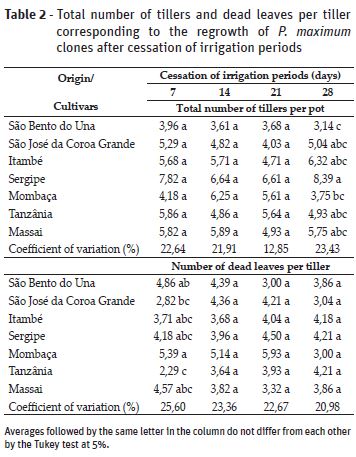
total number of tillers per pot differed between clones (P&#8804;0.05; <a href = "#t2">Table 2</a>).
However, differences between the clones were only evident after 28 days of water
suspension.</font></p>

    <p>&nbsp;</p>

<a name = "t2"><img src = "/img/revistas/rca/v41n3/v41n3a22t2.jpg" target = "_blank"></a>

    
<p>&nbsp;</p>

    <p><font face = "Verdana" size = "2">The clone from ‘São
Bento do Una’ had the lowest number of tillers. This plant originates from an environment
of low rainfall (<a href = "/img/revistas/rca/v41n3/v41n3a22t1.jpg" target = "_blank">Table 1</a>), therefore, this result may be related to adaptations
for limited water availability in the soil in order to increase their persistence
in the pasture. Frank and Karn (1988) reported that genotypes with high growth rates
are less tolerant to drought. It is noteworthy that the municipality of São Bento
do Una has the highest intensity and frequency of droughts among the evaluated sites.
Njarui <i>et al</i>. (2015) evaluated the persistence of 19 ecotypes of <i>P. maximum</i>
in three locations with different rainfall (1010, 710 and 510 mm per year), and
found that the number of tillers and dry mass per tiller were positively correlated
with the amount of rainfall. Thus, programs that aim to determine clones that are
more adapted to conditions of limited water availability should consider the number
of tillers as a response variable.</font></p>

    
<p><font face = "Verdana" size = "2">While there were differences observed between the clones for the number of tillers
after 28 days of irrigation cessation (<a href = "#t2">Table 2</a>), the number of tillers was not affected
during the periods of water suspension. On average, the clones from ‘São Bento do
Una,’ ‘São José da Cora Grande,’ ‘Itambé’ and ‘Sergipe’ had 3.6 ± 0.3, 4.8 ± 0.5,
5.6 ± 0.7 and 7.4 ± 0.9 tillers per pot, respectively, and the ‘Mombaça,’ ‘Tanzânia’
and ‘Massai’ cultivars had 4.9 ± 1.2, 5.3 ± 0.5 and 5.6 ± 0.4 tillers per pot, respectively.
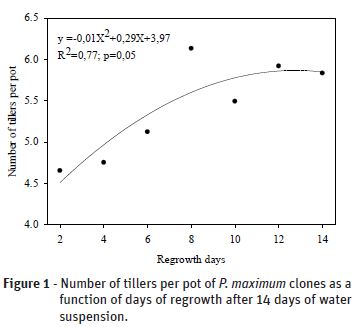
However, the number of tillers per pot tended to increase with longer regrowth time.
This effect was significantly greater when plants were exposed to 14 days of water
cessation, and reached a maximum after 12.82 regrowth days, with an average of 5.92
tillers per pot (<a href = "#f1">Figure 1</a>).</font></p>

    <p>&nbsp;</p>

<a name = "f1"><img src = "/img/revistas/rca/v41n3/v41n3a22f1.jpg" target = "_blank"></a>

    
<p>&nbsp;</p>

    <p><font face = "Verdana" size = "2">There were no significant
differences in the number of tillers for any of the other periods of water cessation
during the regrowth time. Santos <i>et al</i>. (2011) previously evaluated the behavior
of <i>Pennisetum</i> sp. clones under controlled water restriction periods. They
found that when subjected to 14 days without irrigation, the growth of basal tillers
was little affected in the Cameroon clone, but the Australian and HV-241 clones
presented more severe dehydration symptoms.</font></p>

    ]]></body>
<body><![CDATA[<p><font face = "Verdana" size = "2">The height of the clones during the regrowth period were not influenced
by the period of water suspension (P&gt;0.05). In contrast, there was a significant
effect of the number of regrowth days (<a href = "/img/revistas/rca/v41n3/v41n3a22f2.jpg" target = "_blank">Figure 2A</a>). After 2 days of regrowth, plants
that had been subjected to 28 days of water suspension were taller (around 30 cm),
while plants exposed to the other periods had an average height of 25 cm. The plants
that were subjected to longer irrigation suspension periods were highest (54.69
cm) at the end of 14-day morphological evaluation.</font></p>

    
<p><font face = "Verdana" size = "2">Similar behavior was observed for the length of the leaf blade.
There were no significant effects between clones (P&gt;0.05), however, significant
differences were observed for the number of regrowth days (<a href = "/img/revistas/rca/v41n3/v41n3a22f2.jpg" target = "_blank">Figure 2B</a>).</font></p>

    
<p><font face = "Verdana" size = "2">The length of the leaf blades ranged from 4 to
6 cm after two days of regrowth in plants subjected to between 7 and 21 days of
irrigation cessation. The plants that had been subjected to 28 days of water suspension
showed higher rates of leaf growth after 2 days of regrowth (mean of 6.09 cm day<sup>-1</sup>)
compared to the other treatments, with larger leaf blades (36.32 cm) observed at
the 14-day evaluation. In contrast, Barreto <i>et al</i>. (2001) evaluated the morphological
variables of <i>Pennisetum </i>clones and a pearl millet hybrid, observing a reduction
in the leaf blade length from 69.9 cm in the irrigated plants to 50.0 cm in plants
under water stress. Some authors have suggested that drought conditions may cause
inhibition of cell wall synthesis and cell expansion (Farooq <i>et al</i>., 2009;
Taiz and Zeiger, 2013), and consequently, reduced leaf growth (Van Volkenburgh,
1999), which contradicts the results observed in this study. However, Ludlow and
Ng (1977) evaluated the leaf elongation rate in the <i>P. maximum</i> Trichoglume
variety, and found that the magnitude at which drought affects the growth, through
a reduction in leaf area, depends on the relationship between the expansion rate
and the leaf water potential during the period of water stress. Therefore, Ludlow
and Ng (1977) suggested that the stimulus for leaf expansion during stress is because
cell division is less sensitive to water deficit than cell expansion.</font></p>


    <p><font face = "Verdana" size = "2">There was no effect of the clone type on the number
of green leaves per tiller for any of the cessation of irrigation periods, however,
this variable was influenced by the number of regrowth days (P&#8804;0.05) (<a href = "/img/revistas/rca/v41n3/v41n3a22f3.jpg" target = "_blank">Figure
3A</a>). Plants that were subjected to 7–21 days of cessation of irrigation produced
1–2 leaves after two days of regrowth. In contrast, plants subjected to 28 days
of water suspension produced almost three (2.84) green leaves per tiller on average
during the first 2 days of regrowth, and an average of 4.37 green leaves per tiller
after 14 days of regrowth (<a href = "/img/revistas/rca/v41n3/v41n3a22f3.jpg" target = "_blank">Figure 3A</a>). This result is similar to that reported by
Gomide <i>et al</i>. (2003), in which 5.3 green leaves per tiller were observed
in ‘Mombaça’ grass (<i>P. maximum</i>) after 16 days of regrowth. It should be noted
that, due to the longer cessation of irrigation period (28 days), the plants were
cut after a longer growth period. Although the shoot was standardized in terms of
height, these observations may result from further development of the root system
and accumulation of organic reserves, with potential reallocation of resources during
the regrowth phase.</font></p>

    
<p><font face = "Verdana" size = "2">In <i>Brachiaria</i>
species (<i>B. decumbens, B. brizantha, B. humidicola</i> and <i>B. mutica</i>),
Mattos <i>et al</i>. (2005) found that the <i>B. brizantha</i> species showed greater
tolerance to drought as a result of several factors, including the significant production
of roots. In another study, Doss <i>et al</i>. (1960) analyzed three water regimes
(70, 35 and 15% soil moisture) in five warm-season forage plants (<i>Paspalum dilatatum,
P. notatum, Lespedeza cuneala</i>, and coastal and common varieties of <i>Cynodon
dactylon</i>), and found that the depth of the roots decreased with increasing water
availability. Therefore, the root density increased with decreasing water availability.</font></p>

    <p><font face = "Verdana" size = "2">For the number of dead leaves per
tiller, we only observed an effect of the clone factor in plants that had been subjected
to 7 days of water suspension (<a href = "#t2">Table 2</a>). In the ‘Mombaça’ cultivar, the highest
number of green leaves grew above 20 cm, which were removed during the uniformization
process. Thus, the cutting process may have left less residual leaf area index,
thereby hindering the restoration of plants, and consequently, increasing the number
of dead leaves observed (5.89 dead leaves per tiller). There was also an effect
of the number of regrowth days (<a href = "/img/revistas/rca/v41n3/v41n3a22f3.jpg" target = "_blank">Figure 3B</a>), however, the correlation was low (average
of 46.25%) for all periods of water suspension, as shown by the R<sup>2</sup> value
(determination coefficient), in addition to the divergent results between the different
cessation of irrigation periods. After 7 and 21 days of water suspension, there
was a tendency toward a reduced number of dead leaves, however, this tended to increase
in plants subjected to 14 and 28 days of water suspension. According to Lemaire
and Chapman (1996), during the early stages of regrowth there is little or no dead
leaf material, and this number increases with longer regrowth periods.</font></p>


<p><font face = "Verdana" size = "3"><b>CONCLUSION</b></font></p>


    <p><font face = "Verdana" size = "2">In conclusion, 28 days without irrigation resulted
in <i>Panicum</i> clones that were taller, had larger leaf blades and an increased
number of green leaves per tiller. These results suggest that cessation of irrigation
for up to 28 days does not compromise plant growth. We emphasize that this research
was conducted in greenhouse conditions, and that the evaluation of ecotypes under
field conditions will provide greater understanding of the adaptation of these materials
to different soil and climate conditions.</font></p>

 
    <p>&nbsp;</p>

    <p><font face = "Verdana" size = "3"><b>References</b></font></p>

    ]]></body>
<body><![CDATA[<!-- ref --><p><font face = "Verdana" size = "2">Aimar, D.; Calafat, M.; Andrade, A.M.;
Carassay, L.; Bouteau, F.; Abdala, G. &amp; Molas, M.L. (2014) - Drought effects
on the early development stages of <i>Panicum virgatum</i> L.: Cultivar differences.
<i>Biomass and Bioenergy</i>, vol. 66, p. 49-59. <a href = "http://dx.doi.org/10.1016/j.biombioe.2014.03.004" target = "_blank">http://dx.doi.org/10.1016/j.biombioe.2014.03.004</a></font>&nbsp;&nbsp;&nbsp;&nbsp;&nbsp;&nbsp;&nbsp;&nbsp;[&#160;<a href="javascript:void(0);" onclick="javascript: window.open('/scielo.php?script=sci_nlinks&ref=687849&pid=S0871-018X201800030002200001&lng=','','width=640,height=500,resizable=yes,scrollbars=1,menubar=yes,');">Links</a>&#160;]<!-- end-ref --><!-- ref --><p><font face = "Verdana" size = "2">Bahrani, M.J.; Bahrami, H. &amp; Haghighi, A.A.K.
(2010) - Effect of water stress on ten forage grasses native or introduced to Iran.
<i>Grassland Science</i>, vol. 56, n. 1, p. 1-5. <a href = "http://dx.doi.org/10.1111/j.1744-697X.2009.00165.x" target = "_blank">http://dx.doi.org/10.1111/j.1744-697X.2009.00165.x</a></font>&nbsp;&nbsp;&nbsp;&nbsp;&nbsp;&nbsp;&nbsp;&nbsp;[&#160;<a href="javascript:void(0);" onclick="javascript: window.open('/scielo.php?script=sci_nlinks&ref=687850&pid=S0871-018X201800030002200002&lng=','','width=640,height=500,resizable=yes,scrollbars=1,menubar=yes,');">Links</a>&#160;]<!-- end-ref --><!-- ref --><p><font face = "Verdana" size = "2">Barreto, G.P.; Lira, M.A.; Santos,
M.V.F. &amp; Dubeux Jr, J.C.B. (2001) - Avaliação de clones de capim-elefante (<i>Pennisetum
purpureum</i> Schum.) e de um híbrido com o milheto (<i>Pennisetum glaucum</i> (L.)
R. Br.) submetidos a estresse hídrico. 1. Parâmetros morfológicos. <i>Revista Brasileira
de Zootecnia</i>, vol. 30, n. 1, p. 1-6. <a href = "http://dx.doi.org/10.1590/S1516-35982001000100001" target = "_blank">http://dx.doi.org/10.1590/S1516-35982001000100001</a></font>&nbsp;&nbsp;&nbsp;&nbsp;&nbsp;&nbsp;&nbsp;&nbsp;[&#160;<a href="javascript:void(0);" onclick="javascript: window.open('/scielo.php?script=sci_nlinks&ref=687851&pid=S0871-018X201800030002200003&lng=','','width=640,height=500,resizable=yes,scrollbars=1,menubar=yes,');">Links</a>&#160;]<!-- end-ref --><!-- ref --><p><font face = "Verdana" size = "2">Casaroli, D. &amp; van Lier, Q. de J. (2008) -
Critérios para determinação da capacidade de vaso. <i>Revista Brasileira de Ciência
do Solo</i>, vol. 32, n. 1, p. 59-66. <a href = "http://dx.doi.org/10.1590/S0100-06832008000100007" target = "_blank">http://dx.doi.org/10.1590/S0100-06832008000100007</a></font>&nbsp;&nbsp;&nbsp;&nbsp;&nbsp;&nbsp;&nbsp;&nbsp;[&#160;<a href="javascript:void(0);" onclick="javascript: window.open('/scielo.php?script=sci_nlinks&ref=687852&pid=S0871-018X201800030002200004&lng=','','width=640,height=500,resizable=yes,scrollbars=1,menubar=yes,');">Links</a>&#160;]<!-- end-ref --><!-- ref --><p><font face = "Verdana" size = "2">Cecato, U.; Machado, A.O.; Martins,
E.N.; Pereira, L.A.F.; Barbosa, M.A.A.F. &amp; Santos, G.T. (2000) - Avaliação da
produção e de algumas características da rebrota de cultivares e acessos de <i>Panicum
maximum</i> Jacq. sob duas alturas de corte. <i>Revista Brasileira de Zootecnia</i>,
vol. 29, n. 3, p. 660-668. <a href = "http://dx.doi.org/10.1590/S1516-35982000000300004" target = "_blank">http://dx.doi.org/10.1590/S1516-35982000000300004</a></font>&nbsp;&nbsp;&nbsp;&nbsp;&nbsp;&nbsp;&nbsp;&nbsp;[&#160;<a href="javascript:void(0);" onclick="javascript: window.open('/scielo.php?script=sci_nlinks&ref=687853&pid=S0871-018X201800030002200005&lng=','','width=640,height=500,resizable=yes,scrollbars=1,menubar=yes,');">Links</a>&#160;]<!-- end-ref --><!-- ref --><p><font face = "Verdana" size = "2">Cutrim Junior, J.A.A.; Cândido, M.J.D.; Valente,
B.S.M.; Carneiro, M.S.S. &amp; Carneiro, H.A.V. (2011) - Características estruturais
do dossel de capim-tanzânia submetido a três frequências de desfolhação e dois resíduos
pós-pastejo. <i>Revista Brasileira de Zootecnia</i>, vol. 40, n. 3, p. 489-497.
<a href = "http://dx.doi.org/10.1590/S1516-35982011000300005" target = "_blank">http://dx.doi.org/10.1590/S1516-35982011000300005</a></font>&nbsp;&nbsp;&nbsp;&nbsp;&nbsp;&nbsp;&nbsp;&nbsp;[&#160;<a href="javascript:void(0);" onclick="javascript: window.open('/scielo.php?script=sci_nlinks&ref=687854&pid=S0871-018X201800030002200006&lng=','','width=640,height=500,resizable=yes,scrollbars=1,menubar=yes,');">Links</a>&#160;]<!-- end-ref --><!-- ref --><p><font face = "Verdana" size = "2">Doss, B.D.; Ashley, D.A. &amp; Bennett, O.L. (1960) - Effect of
soil moisture regime on root distribution of warm season forage species. <i>Agronomy
Journal</i>, vol. 52, n. 10, p. 569-572. <a href = "http://dx.doi.org/10.2134/agronj1960.00021962005200100005x" target = "_blank">http://dx.doi.org/10.2134/agronj1960.00021962005200100005x</a></font>&nbsp;&nbsp;&nbsp;&nbsp;&nbsp;&nbsp;&nbsp;&nbsp;[&#160;<a href="javascript:void(0);" onclick="javascript: window.open('/scielo.php?script=sci_nlinks&ref=687855&pid=S0871-018X201800030002200007&lng=','','width=640,height=500,resizable=yes,scrollbars=1,menubar=yes,');">Links</a>&#160;]<!-- end-ref --><!-- ref --><p><font face = "Verdana" size = "2">EMBRAPA (2013) - <i>Sistema Brasileiro
de Classificação de Solos</i>. 3.ed. rev. ampl. – Brasília, DF: Embrapa. 353 p.    &nbsp;&nbsp;&nbsp;&nbsp;&nbsp;&nbsp;&nbsp;&nbsp;[&#160;<a href="javascript:void(0);" onclick="javascript: window.open('/scielo.php?script=sci_nlinks&ref=687856&pid=S0871-018X201800030002200008&lng=','','width=640,height=500,resizable=yes,scrollbars=1,menubar=yes,');">Links</a>&#160;]<!-- end-ref --></font></p>

    <!-- ref --><p><font face = "Verdana" size = "2">Euclides, V.P.B.; Montagner, D.B.;
Barbosa, R.A. &amp; Nantes, N.N. (2014) - Manejo do pastejo de cultivares de <i>Brachiaria
brizantha</i> (Hochst) Stapf e de <i>Panicum maximum</i> Jacq. <i>Revista Ceres</i>,
vol. 61, p. 808-818. <a href = "http://dx.doi.org/10.1590/0034-737x201461000006" target = "_blank">http://dx.doi.org/10.1590/0034-737x201461000006</a></font>&nbsp;&nbsp;&nbsp;&nbsp;&nbsp;&nbsp;&nbsp;&nbsp;[&#160;<a href="javascript:void(0);" onclick="javascript: window.open('/scielo.php?script=sci_nlinks&ref=687858&pid=S0871-018X201800030002200009&lng=','','width=640,height=500,resizable=yes,scrollbars=1,menubar=yes,');">Links</a>&#160;]<!-- end-ref --><!-- ref --><p><font face = "Verdana" size = "2">Farooq, M.; Wahid, A.; Kobayashiw. N.; Fujita,
D. &amp; Basra, S.M.A. (2009) - Plant drought stress: effects, mechanisms and management.
<i>Agronomy for Sustainable Development</i>, vol. 29, n. 1, p.185-212. <a href = "http://dx.doi.org/10.1051/agro:2008021" target = "_blank">http://dx.doi.org/10.1051/agro:2008021</a></font>&nbsp;&nbsp;&nbsp;&nbsp;&nbsp;&nbsp;&nbsp;&nbsp;[&#160;<a href="javascript:void(0);" onclick="javascript: window.open('/scielo.php?script=sci_nlinks&ref=687859&pid=S0871-018X201800030002200010&lng=','','width=640,height=500,resizable=yes,scrollbars=1,menubar=yes,');">Links</a>&#160;]<!-- end-ref --><!-- ref --><p><font face = "Verdana" size = "2">Frank, A.B. &amp; Karn, J.F. (1988) - Growth,
water-use efficiency, and digestibility of crested, intermediate, and western wheatgrass.
<i>Agronomy Journal</i>, vol. 80, n. 4, p. 677-680. <a href = "http://dx.doi.org/10.2134/agronj1988.00021962008000040024x" target = "_blank">http://dx.doi.org/10.2134/agronj1988.00021962008000040024x</a></font>&nbsp;&nbsp;&nbsp;&nbsp;&nbsp;&nbsp;&nbsp;&nbsp;[&#160;<a href="javascript:void(0);" onclick="javascript: window.open('/scielo.php?script=sci_nlinks&ref=687860&pid=S0871-018X201800030002200011&lng=','','width=640,height=500,resizable=yes,scrollbars=1,menubar=yes,');">Links</a>&#160;]<!-- end-ref --><!-- ref --><p><font face = "Verdana" size = "2">Gomide, C.M.A.; Gomide, J.A. &amp; Alexandrino,
E. (2003) - Índices morfogênicos e de crescimento durante o estabelecimento e a
rebrotação do capim-Mombaça (<i>Panicum maximum</i> Jacq.). <i>Revista Brasileira
de Zootecnia</i>, vol. 32, n. 4, p. 795-803. <a href = "http://dx.doi.org/10.1590/S1516-35982003000400003" target = "_blank">http://dx.doi.org/10.1590/S1516-35982003000400003</a></font>&nbsp;&nbsp;&nbsp;&nbsp;&nbsp;&nbsp;&nbsp;&nbsp;[&#160;<a href="javascript:void(0);" onclick="javascript: window.open('/scielo.php?script=sci_nlinks&ref=687861&pid=S0871-018X201800030002200012&lng=','','width=640,height=500,resizable=yes,scrollbars=1,menubar=yes,');">Links</a>&#160;]<!-- end-ref --><!-- ref --><p><font face = "Verdana" size = "2">IPCC (2012) - <i>Managing the risks of extreme
events and disasters to advance climate change adaptation</i>. A Special Report
of Working Groups I and II of the Intergovernmental Panel on Climate Change. Cambridge
University Press, Cambridge, UK, and New York, NY, USA.    &nbsp;&nbsp;&nbsp;&nbsp;&nbsp;&nbsp;&nbsp;&nbsp;[&#160;<a href="javascript:void(0);" onclick="javascript: window.open('/scielo.php?script=sci_nlinks&ref=687862&pid=S0871-018X201800030002200013&lng=','','width=640,height=500,resizable=yes,scrollbars=1,menubar=yes,');">Links</a>&#160;]<!-- end-ref --></font></p>

    <!-- ref --><p><font face = "Verdana" size = "2">Jank, L.; Martuscello, J.A.; Euclides, V.P.B.; Valle, C.B.
&amp; Resende, R.M.S. (2010) - <i>Panicum maximum</i>. <i>In</i>: Fonseca, D.M.
&amp; Martuscello, J.A. (Eds.) - <i>Plantas forrageiras</i>. – Viçosa, MG: Ed. UFV.
p. 166-196.    &nbsp;&nbsp;&nbsp;&nbsp;&nbsp;&nbsp;&nbsp;&nbsp;[&#160;<a href="javascript:void(0);" onclick="javascript: window.open('/scielo.php?script=sci_nlinks&ref=687864&pid=S0871-018X201800030002200014&lng=','','width=640,height=500,resizable=yes,scrollbars=1,menubar=yes,');">Links</a>&#160;]<!-- end-ref --></font></p>

    <!-- ref --><p><font face = "Verdana" size = "2">Lemaire, G. &amp; Chapman,
D. (1996) - Tissue flows in grazed plant communities. <i>In</i>: Hodgson, J. &amp;
Illius, A.W. (Eds.) - <i>The ecology and management of grazing systems</i>. Wallingford:
CAB International, 3-36.    &nbsp;&nbsp;&nbsp;&nbsp;&nbsp;&nbsp;&nbsp;&nbsp;[&#160;<a href="javascript:void(0);" onclick="javascript: window.open('/scielo.php?script=sci_nlinks&ref=687866&pid=S0871-018X201800030002200015&lng=','','width=640,height=500,resizable=yes,scrollbars=1,menubar=yes,');">Links</a>&#160;]<!-- end-ref --></font></p>

    <!-- ref --><p><font face = "Verdana" size = "2">Loewenstein,
N.J. &amp; Pallardy, S.G. (2002) - Influence of a drying cycle on post-drought xylem
sap abscisic acid and stomatal responses in young temperate deciduous angiosperms.
<i>New Phytologist</i>, vol. 156, n. 3, p. 351-361. <a href = "http://dx.doi.org/10.1046/j.1469-8137.2002.00528.x" target = "_blank">http://dx.doi.org/10.1046/j.1469-8137.2002.00528.x</a></font>&nbsp;&nbsp;&nbsp;&nbsp;&nbsp;&nbsp;&nbsp;&nbsp;[&#160;<a href="javascript:void(0);" onclick="javascript: window.open('/scielo.php?script=sci_nlinks&ref=687868&pid=S0871-018X201800030002200016&lng=','','width=640,height=500,resizable=yes,scrollbars=1,menubar=yes,');">Links</a>&#160;]<!-- end-ref --><p><font face = "Verdana" size = "2">Ludlow, M.M. &amp; Ng, T.T. (1977) - Leaf elongation
rate in <i>Panicum maximum</i> var. trichoglume following removal of water stress.
<i>Australian Journal of Plant Physiology</i>, vol. 4, n. 2, 263-272. <a href = "http://dx.doi.org/10.1071/PP9770263" target = "_blank">http://dx.doi.org/10.1071/PP9770263</a></font></p>


    <!-- ref --><p><font face = "Verdana" size = "2">Mattos, J.L.S.; Gomide, J.A. &amp; Huaman, C.A.M.
(2005) - Crescimento de espécies do gênero <i>Brachiaria</i>, sob déficit hídrico,
em casa de vegetação. <i>Revista Brasileira de Zootecnia</i>, vol. 34, n. 3, p.
746-754. <a href = "http://dx.doi.org/10.1590/S1516-35982005000300005" target = "_blank">http://dx.doi.org/10.1590/S1516-35982005000300005</a></font>&nbsp;&nbsp;&nbsp;&nbsp;&nbsp;&nbsp;&nbsp;&nbsp;[&#160;<a href="javascript:void(0);" onclick="javascript: window.open('/scielo.php?script=sci_nlinks&ref=687870&pid=S0871-018X201800030002200018&lng=','','width=640,height=500,resizable=yes,scrollbars=1,menubar=yes,');">Links</a>&#160;]<!-- end-ref --><!-- ref --><p><font face = "Verdana" size = "2">Njarui, D.M.G.; Gatheru, M.; Mwangi, D.M. &amp; Keya, G.A.
(2015) - Persistence and productivity of selected Guinea grass ecotypes in semiarid
tropical Kenya. <i>Grassland Science</i>, vol. 61, n. 3, p. 142-152. <a href = "http://dx.doi.org/10.1111/grs.12092" target = "_blank">http://dx.doi.org/10.1111/grs.12092</a></font>&nbsp;&nbsp;&nbsp;&nbsp;&nbsp;&nbsp;&nbsp;&nbsp;[&#160;<a href="javascript:void(0);" onclick="javascript: window.open('/scielo.php?script=sci_nlinks&ref=687871&pid=S0871-018X201800030002200019&lng=','','width=640,height=500,resizable=yes,scrollbars=1,menubar=yes,');">Links</a>&#160;]<!-- end-ref --><!-- ref --><p><font face = "Verdana" size = "2">Pedreira, B.C.; Pedreira, C.G.S. &amp; Lara, M.A.S.
(2015) - Leaf age, leaf blade portion and light intensity as determinants of leaf
photosynthesis in <i>Panicum maximum</i> Jacq. <i>Grassland Science</i>, vol. 61,
n. 1, p. 45-49. <a href = "https://doi.org/10.1111/grs.12080" target = "_blank">https://doi.org/10.1111/grs.12080</a></font>&nbsp;&nbsp;&nbsp;&nbsp;&nbsp;&nbsp;&nbsp;&nbsp;[&#160;<a href="javascript:void(0);" onclick="javascript: window.open('/scielo.php?script=sci_nlinks&ref=687872&pid=S0871-018X201800030002200020&lng=','','width=640,height=500,resizable=yes,scrollbars=1,menubar=yes,');">Links</a>&#160;]<!-- end-ref --><!-- ref --><p><font face = "Verdana" size = "2">Santos, M.C.S.; Lira, M.A.; Tabosa, J.N.; Mello, A.C.L. de &amp;
Santos, M.V.F. (2011) -  Comportamento de clones de <i>Pennisetum</i> submetidos
a períodos de restrição hídrica controlada. <i>Archivos de Zootecnia</i>, vol. 60,
n. 229, p. 31-39. <a href = "http://dx.doi.org/10.4321/S0004-05922011000100004" target = "_blank">http://dx.doi.org/10.4321/S0004-05922011000100004</a></font>&nbsp;&nbsp;&nbsp;&nbsp;&nbsp;&nbsp;&nbsp;&nbsp;[&#160;<a href="javascript:void(0);" onclick="javascript: window.open('/scielo.php?script=sci_nlinks&ref=687873&pid=S0871-018X201800030002200021&lng=','','width=640,height=500,resizable=yes,scrollbars=1,menubar=yes,');">Links</a>&#160;]<!-- end-ref --><!-- ref --><p><font face = "Verdana" size = "2">Taiz, L. &amp; Zeiger, E. (2013) - <i>Fisiologia
vegetal</i>. – 5.ed. Porto Alegre: Artmed. 918 p.    &nbsp;&nbsp;&nbsp;&nbsp;&nbsp;&nbsp;&nbsp;&nbsp;[&#160;<a href="javascript:void(0);" onclick="javascript: window.open('/scielo.php?script=sci_nlinks&ref=687874&pid=S0871-018X201800030002200022&lng=','','width=640,height=500,resizable=yes,scrollbars=1,menubar=yes,');">Links</a>&#160;]<!-- end-ref --></font></p>

    <!-- ref --><p><font face = "Verdana" size = "2">van Volkenburgh, E. (1999) - Leaf expansion - an integrating plant
behavior. <i>Plant, Cell and Environment</i>, vol. 22, n. 12, p. 1463–1473. <a href = "http://dx.doi.org/10.1046/j.1365-3040.1999.00514.x" target = "_blank">http://dx.doi.org/10.1046/j.1365-3040.1999.00514.x</a></font>&nbsp;&nbsp;&nbsp;&nbsp;&nbsp;&nbsp;&nbsp;&nbsp;[&#160;<a href="javascript:void(0);" onclick="javascript: window.open('/scielo.php?script=sci_nlinks&ref=687876&pid=S0871-018X201800030002200023&lng=','','width=640,height=500,resizable=yes,scrollbars=1,menubar=yes,');">Links</a>&#160;]<!-- end-ref --><!-- ref --><p><font face = "Verdana" size = "2">Victor, D.M.; Jank, L.; Lempp, B.; Simeão, R.M.;
Resende, M.D.V. &amp; Gonçalves, M.C. (2015) - Selection of full-sib families of
<i>Panicum maximum</i> Jacq under low light conditions. <i>Revista Ceres</i>, vol.
62, n. 2, p. 199-207. <a href = "http://dx.doi.org/10.1590/0034-737X201562020010" target = "_blank">http://dx.doi.org/10.1590/0034-737X201562020010</a></font>&nbsp;&nbsp;&nbsp;&nbsp;&nbsp;&nbsp;&nbsp;&nbsp;[&#160;<a href="javascript:void(0);" onclick="javascript: window.open('/scielo.php?script=sci_nlinks&ref=687877&pid=S0871-018X201800030002200024&lng=','','width=640,height=500,resizable=yes,scrollbars=1,menubar=yes,');">Links</a>&#160;]<!-- end-ref --><!-- ref --><p><font face = "Verdana" size = "2">Xu, Z.; Zhou, G. &amp; Shimizu, H. (2010) - Plant
responses to drought and rewatering. <i>Plant Signaling &amp; Behavior</i>, vol.
5, n. 6, p. 649-654. <a href = "https://doi.org/10.4161/psb.5.6.11398" target = "_blank">https://doi.org/10.4161/psb.5.6.11398</a></font>&nbsp;&nbsp;&nbsp;&nbsp;&nbsp;&nbsp;&nbsp;&nbsp;[&#160;<a href="javascript:void(0);" onclick="javascript: window.open('/scielo.php?script=sci_nlinks&ref=687878&pid=S0871-018X201800030002200025&lng=','','width=640,height=500,resizable=yes,scrollbars=1,menubar=yes,');">Links</a>&#160;]<!-- end-ref --><p>&nbsp;</p>

    <p><font face = "Verdana" size = "3"><b>Acknowledgements</b></font></p>

    <p><font face = "Verdana" size = "2">‘Conselho Nacional de Desenvolvimento Científico
e Tecnológico’ (CNPq), ‘Fundação de Amparo à Ciência e Tecnologia de Pernambuco’
(FACEPE) and to ‘Coordenação de Aperfeiçoamento de Pessoal de Nível Superior’ (CAPES)
are acknowledged.</font></p>

    <p>&nbsp;</p>

    <p><font face = "Verdana" size = "2">Received/recebido: 2018.01.03</font></p>

    <p><font face = "Verdana" size = "2">Accepted/aceite: 2018.06.15</font></p>

     ]]></body><back>
<ref-list>
<ref id="B1">
<nlm-citation citation-type="journal">
<person-group person-group-type="author">
<name>
<surname><![CDATA[Aimar]]></surname>
<given-names><![CDATA[D.]]></given-names>
</name>
<name>
<surname><![CDATA[Calafat]]></surname>
<given-names><![CDATA[M.]]></given-names>
</name>
<name>
<surname><![CDATA[Andrade]]></surname>
<given-names><![CDATA[A.M.]]></given-names>
</name>
<name>
<surname><![CDATA[Carassay]]></surname>
<given-names><![CDATA[L.]]></given-names>
</name>
<name>
<surname><![CDATA[Bouteau]]></surname>
<given-names><![CDATA[F.]]></given-names>
</name>
<name>
<surname><![CDATA[Abdala]]></surname>
<given-names><![CDATA[G.]]></given-names>
</name>
<name>
<surname><![CDATA[Molas]]></surname>
<given-names><![CDATA[M.L.]]></given-names>
</name>
</person-group>
<article-title xml:lang="en"><![CDATA[Drought effects on the early development stages of Panicum virgatum L.: Cultivar differences]]></article-title>
<source><![CDATA[Biomass and Bioenergy]]></source>
<year>2014</year>
<volume>66</volume>
<page-range>49-59</page-range></nlm-citation>
</ref>
<ref id="B2">
<nlm-citation citation-type="journal">
<person-group person-group-type="author">
<name>
<surname><![CDATA[Bahrani]]></surname>
<given-names><![CDATA[M.J.]]></given-names>
</name>
<name>
<surname><![CDATA[Bahrami]]></surname>
<given-names><![CDATA[H.]]></given-names>
</name>
<name>
<surname><![CDATA[Haghighi]]></surname>
<given-names><![CDATA[A.A.K.]]></given-names>
</name>
</person-group>
<article-title xml:lang="en"><![CDATA[Effect of water stress on ten forage grasses native or introduced to Iran]]></article-title>
<source><![CDATA[Grassland Science]]></source>
<year>2010</year>
<volume>56</volume>
<numero>1</numero>
<issue>1</issue>
<page-range>1-5</page-range></nlm-citation>
</ref>
<ref id="B3">
<nlm-citation citation-type="journal">
<person-group person-group-type="author">
<name>
<surname><![CDATA[Barreto]]></surname>
<given-names><![CDATA[G.P.]]></given-names>
</name>
<name>
<surname><![CDATA[Lira]]></surname>
<given-names><![CDATA[M.A.]]></given-names>
</name>
<name>
<surname><![CDATA[Santos]]></surname>
<given-names><![CDATA[M.V.F.]]></given-names>
</name>
<name>
<surname><![CDATA[Dubeux Jr]]></surname>
<given-names><![CDATA[J.C.B.]]></given-names>
</name>
</person-group>
<article-title xml:lang="pt"><![CDATA[Avaliação de clones de capim-elefante (Pennisetum purpureum Schum.) e de um híbrido com o milheto (Pennisetum glaucum (L.) R. Br.) submetidos a estresse hídrico: 1. Parâmetros morfológicos]]></article-title>
<source><![CDATA[Revista Brasileira de Zootecnia]]></source>
<year>2001</year>
<volume>30</volume>
<numero>1</numero>
<issue>1</issue>
<page-range>1-6</page-range></nlm-citation>
</ref>
<ref id="B4">
<nlm-citation citation-type="journal">
<person-group person-group-type="author">
<name>
<surname><![CDATA[Casaroli]]></surname>
<given-names><![CDATA[D.]]></given-names>
</name>
<name>
<surname><![CDATA[van Lier]]></surname>
<given-names><![CDATA[Q. de J.]]></given-names>
</name>
</person-group>
<article-title xml:lang="pt"><![CDATA[Critérios para determinação da capacidade de vaso]]></article-title>
<source><![CDATA[Revista Brasileira de Ciência do Solo]]></source>
<year>2008</year>
<volume>32</volume>
<numero>1</numero>
<issue>1</issue>
<page-range>59-66</page-range></nlm-citation>
</ref>
<ref id="B5">
<nlm-citation citation-type="journal">
<person-group person-group-type="author">
<name>
<surname><![CDATA[Cecato]]></surname>
<given-names><![CDATA[U.]]></given-names>
</name>
<name>
<surname><![CDATA[Machado]]></surname>
<given-names><![CDATA[A.O.]]></given-names>
</name>
<name>
<surname><![CDATA[Martins]]></surname>
<given-names><![CDATA[E.N.]]></given-names>
</name>
<name>
<surname><![CDATA[Pereira]]></surname>
<given-names><![CDATA[L.A.F.]]></given-names>
</name>
<name>
<surname><![CDATA[Barbosa]]></surname>
<given-names><![CDATA[M.A.A.F.]]></given-names>
</name>
<name>
<surname><![CDATA[Santos]]></surname>
<given-names><![CDATA[G.T.]]></given-names>
</name>
</person-group>
<article-title xml:lang="pt"><![CDATA[Avaliação da produção e de algumas características da rebrota de cultivares e acessos de Panicum maximum Jacq. sob duas alturas de corte]]></article-title>
<source><![CDATA[Revista Brasileira de Zootecnia]]></source>
<year>2000</year>
<volume>29</volume>
<numero>3</numero>
<issue>3</issue>
<page-range>660-668</page-range></nlm-citation>
</ref>
<ref id="B6">
<nlm-citation citation-type="journal">
<person-group person-group-type="author">
<name>
<surname><![CDATA[Cutrim Junior]]></surname>
<given-names><![CDATA[J.A.A.]]></given-names>
</name>
<name>
<surname><![CDATA[Cândido]]></surname>
<given-names><![CDATA[M.J.D.]]></given-names>
</name>
<name>
<surname><![CDATA[Valente]]></surname>
<given-names><![CDATA[B.S.M.]]></given-names>
</name>
<name>
<surname><![CDATA[Carneiro]]></surname>
<given-names><![CDATA[M.S.S.]]></given-names>
</name>
<name>
<surname><![CDATA[Carneiro]]></surname>
<given-names><![CDATA[H.A.V.]]></given-names>
</name>
</person-group>
<article-title xml:lang="pt"><![CDATA[Características estruturais do dossel de capim-tanzânia submetido a três frequências de desfolhação e dois resíduos pós-pastejo]]></article-title>
<source><![CDATA[Revista Brasileira de Zootecnia]]></source>
<year>2011</year>
<volume>40</volume>
<numero>3</numero>
<issue>3</issue>
<page-range>489-497</page-range></nlm-citation>
</ref>
<ref id="B7">
<nlm-citation citation-type="journal">
<person-group person-group-type="author">
<name>
<surname><![CDATA[Doss]]></surname>
<given-names><![CDATA[B.D.]]></given-names>
</name>
<name>
<surname><![CDATA[Ashley]]></surname>
<given-names><![CDATA[D.A.]]></given-names>
</name>
<name>
<surname><![CDATA[Bennett]]></surname>
<given-names><![CDATA[O.L.]]></given-names>
</name>
</person-group>
<article-title xml:lang="en"><![CDATA[Effect of soil moisture regime on root distribution of warm season forage species]]></article-title>
<source><![CDATA[Agronomy Journal]]></source>
<year>1960</year>
<volume>52</volume>
<numero>10</numero>
<issue>10</issue>
<page-range>569-572</page-range></nlm-citation>
</ref>
<ref id="B8">
<nlm-citation citation-type="book">
<collab>EMBRAPA</collab>
<source><![CDATA[Sistema Brasileiro de Classificação de Solos]]></source>
<year>2013</year>
<edition>3</edition>
<publisher-loc><![CDATA[Brasília^eDF DF]]></publisher-loc>
<publisher-name><![CDATA[Embrapa]]></publisher-name>
</nlm-citation>
</ref>
<ref id="B9">
<nlm-citation citation-type="journal">
<person-group person-group-type="author">
<name>
<surname><![CDATA[Euclides]]></surname>
<given-names><![CDATA[V.P.B.]]></given-names>
</name>
<name>
<surname><![CDATA[Montagner]]></surname>
<given-names><![CDATA[D.B.]]></given-names>
</name>
<name>
<surname><![CDATA[Barbosa]]></surname>
<given-names><![CDATA[R.A.]]></given-names>
</name>
<name>
<surname><![CDATA[Nantes]]></surname>
<given-names><![CDATA[N.N.]]></given-names>
</name>
</person-group>
<article-title xml:lang="pt"><![CDATA[Manejo do pastejo de cultivares de Brachiaria brizantha (Hochst) Stapf e de Panicum maximum Jacq]]></article-title>
<source><![CDATA[Revista Ceres]]></source>
<year>2014</year>
<volume>61</volume>
<page-range>808-818</page-range></nlm-citation>
</ref>
<ref id="B10">
<nlm-citation citation-type="journal">
<person-group person-group-type="author">
<name>
<surname><![CDATA[Farooq]]></surname>
<given-names><![CDATA[M.]]></given-names>
</name>
<name>
<surname><![CDATA[Wahid]]></surname>
<given-names><![CDATA[A.]]></given-names>
</name>
<name>
<surname><![CDATA[Kobayashiw]]></surname>
<given-names><![CDATA[N.]]></given-names>
</name>
<name>
<surname><![CDATA[Fujita]]></surname>
<given-names><![CDATA[D.]]></given-names>
</name>
<name>
<surname><![CDATA[Basra]]></surname>
<given-names><![CDATA[S.M.A.]]></given-names>
</name>
</person-group>
<article-title xml:lang="en"><![CDATA[Plant drought stress: effects, mechanisms and management]]></article-title>
<source><![CDATA[Agronomy for Sustainable Development]]></source>
<year>2009</year>
<volume>29</volume>
<numero>1</numero>
<issue>1</issue>
<page-range>185-212</page-range></nlm-citation>
</ref>
<ref id="B11">
<nlm-citation citation-type="journal">
<person-group person-group-type="author">
<name>
<surname><![CDATA[Frank]]></surname>
<given-names><![CDATA[A.B.]]></given-names>
</name>
<name>
<surname><![CDATA[Karn]]></surname>
<given-names><![CDATA[J.F.]]></given-names>
</name>
</person-group>
<article-title xml:lang="en"><![CDATA[Growth, water-use efficiency, and digestibility of crested, intermediate, and western wheatgrass]]></article-title>
<source><![CDATA[Agronomy Journal]]></source>
<year>1988</year>
<volume>80</volume>
<numero>4</numero>
<issue>4</issue>
<page-range>677-680</page-range></nlm-citation>
</ref>
<ref id="B12">
<nlm-citation citation-type="journal">
<person-group person-group-type="author">
<name>
<surname><![CDATA[Gomide]]></surname>
<given-names><![CDATA[C.M.A.]]></given-names>
</name>
<name>
<surname><![CDATA[Gomide]]></surname>
<given-names><![CDATA[J.A.]]></given-names>
</name>
<name>
<surname><![CDATA[Alexandrino]]></surname>
<given-names><![CDATA[E.]]></given-names>
</name>
</person-group>
<article-title xml:lang="pt"><![CDATA[Índices morfogênicos e de crescimento durante o estabelecimento e a rebrotação do capim-Mombaça (Panicum maximum Jacq.)]]></article-title>
<source><![CDATA[Revista Brasileira de Zootecnia]]></source>
<year>2003</year>
<volume>32</volume>
<numero>4</numero>
<issue>4</issue>
<page-range>795-803</page-range></nlm-citation>
</ref>
<ref id="B13">
<nlm-citation citation-type="book">
<collab>IPCC</collab>
<source><![CDATA[Managing the risks of extreme events and disasters to advance climate change adaptation: A Special Report of Working Groups I and II of the Intergovernmental Panel on Climate Change]]></source>
<year>2012</year>
<publisher-loc><![CDATA[Cambridge^eNYNew York NY]]></publisher-loc>
<publisher-name><![CDATA[Cambridge University Press]]></publisher-name>
</nlm-citation>
</ref>
<ref id="B14">
<nlm-citation citation-type="book">
<person-group person-group-type="author">
<name>
<surname><![CDATA[Jank]]></surname>
<given-names><![CDATA[L.]]></given-names>
</name>
<name>
<surname><![CDATA[Martuscello]]></surname>
<given-names><![CDATA[J.A.]]></given-names>
</name>
<name>
<surname><![CDATA[Euclides]]></surname>
<given-names><![CDATA[V.P.B.]]></given-names>
</name>
<name>
<surname><![CDATA[Valle]]></surname>
<given-names><![CDATA[C.B.]]></given-names>
</name>
<name>
<surname><![CDATA[Resende]]></surname>
<given-names><![CDATA[R.M.S.]]></given-names>
</name>
</person-group>
<article-title xml:lang="en"><![CDATA[Panicum maximum]]></article-title>
<person-group person-group-type="editor">
<name>
<surname><![CDATA[Fonseca]]></surname>
<given-names><![CDATA[D.M.]]></given-names>
</name>
<name>
<surname><![CDATA[Martuscello]]></surname>
<given-names><![CDATA[J.A.]]></given-names>
</name>
</person-group>
<source><![CDATA[Plantas forrageiras]]></source>
<year>2010</year>
<page-range>166-196</page-range><publisher-loc><![CDATA[Viçosa^eMG MG]]></publisher-loc>
<publisher-name><![CDATA[Ed. UFV]]></publisher-name>
</nlm-citation>
</ref>
<ref id="B15">
<nlm-citation citation-type="book">
<person-group person-group-type="author">
<name>
<surname><![CDATA[Lemaire]]></surname>
<given-names><![CDATA[G.]]></given-names>
</name>
<name>
<surname><![CDATA[Chapman]]></surname>
<given-names><![CDATA[D.]]></given-names>
</name>
</person-group>
<article-title xml:lang="en"><![CDATA[Tissue flows in grazed plant communities]]></article-title>
<person-group person-group-type="editor">
<name>
<surname><![CDATA[Hodgson]]></surname>
<given-names><![CDATA[J.]]></given-names>
</name>
<name>
<surname><![CDATA[Illius]]></surname>
<given-names><![CDATA[A.W.]]></given-names>
</name>
</person-group>
<source><![CDATA[The ecology and management of grazing systems]]></source>
<year>1996</year>
<page-range>3-36</page-range><publisher-loc><![CDATA[Wallingford ]]></publisher-loc>
<publisher-name><![CDATA[CAB International]]></publisher-name>
</nlm-citation>
</ref>
<ref id="B16">
<nlm-citation citation-type="journal">
<person-group person-group-type="author">
<name>
<surname><![CDATA[Loewenstein]]></surname>
<given-names><![CDATA[N.J.]]></given-names>
</name>
<name>
<surname><![CDATA[Pallardy]]></surname>
<given-names><![CDATA[S.G.]]></given-names>
</name>
</person-group>
<article-title xml:lang="en"><![CDATA[Influence of a drying cycle on post-drought xylem sap abscisic acid and stomatal responses in young temperate deciduous angiosperms]]></article-title>
<source><![CDATA[New Phytologist]]></source>
<year>2002</year>
<volume>156</volume>
<numero>3</numero>
<issue>3</issue>
<page-range>351-361</page-range></nlm-citation>
</ref>
<ref id="B17">
<nlm-citation citation-type="journal">
<person-group person-group-type="author">
<name>
<surname><![CDATA[Ludlow]]></surname>
<given-names><![CDATA[M.M.]]></given-names>
</name>
<name>
<surname><![CDATA[Ng]]></surname>
<given-names><![CDATA[T.T.]]></given-names>
</name>
</person-group>
<article-title xml:lang="en"><![CDATA[Leaf elongation rate in Panicum maximum var. trichoglume following removal of water stress]]></article-title>
<source><![CDATA[Journal of Plant Physiology]]></source>
<year>1977</year>
<volume>4</volume>
<numero>2</numero>
<issue>2</issue>
<page-range>263-272</page-range></nlm-citation>
</ref>
<ref id="B18">
<nlm-citation citation-type="journal">
<person-group person-group-type="author">
<name>
<surname><![CDATA[Mattos]]></surname>
<given-names><![CDATA[J.L.S.]]></given-names>
</name>
<name>
<surname><![CDATA[Gomide]]></surname>
<given-names><![CDATA[J.A.]]></given-names>
</name>
<name>
<surname><![CDATA[Huaman]]></surname>
<given-names><![CDATA[C.A.M.]]></given-names>
</name>
</person-group>
<article-title xml:lang="pt"><![CDATA[Crescimento de espécies do gênero Brachiaria, sob déficit hídrico, em casa de vegetação]]></article-title>
<source><![CDATA[Revista Brasileira de Zootecnia]]></source>
<year>2005</year>
<volume>34</volume>
<numero>3</numero>
<issue>3</issue>
<page-range>746-754</page-range></nlm-citation>
</ref>
<ref id="B19">
<nlm-citation citation-type="journal">
<person-group person-group-type="author">
<name>
<surname><![CDATA[Njarui]]></surname>
<given-names><![CDATA[D.M.G.]]></given-names>
</name>
<name>
<surname><![CDATA[Gatheru]]></surname>
<given-names><![CDATA[M.]]></given-names>
</name>
<name>
<surname><![CDATA[Mwangi]]></surname>
<given-names><![CDATA[D.M.]]></given-names>
</name>
<name>
<surname><![CDATA[Keya]]></surname>
<given-names><![CDATA[G.A.]]></given-names>
</name>
</person-group>
<article-title xml:lang="en"><![CDATA[Persistence and productivity of selected Guinea grass ecotypes in semiarid tropical Kenya]]></article-title>
<source><![CDATA[Grassland Science]]></source>
<year>2015</year>
<volume>61</volume>
<numero>3</numero>
<issue>3</issue>
<page-range>142-152</page-range></nlm-citation>
</ref>
<ref id="B20">
<nlm-citation citation-type="journal">
<person-group person-group-type="author">
<name>
<surname><![CDATA[Pedreira]]></surname>
<given-names><![CDATA[B.C.]]></given-names>
</name>
<name>
<surname><![CDATA[Pedreira]]></surname>
<given-names><![CDATA[C.G.S.]]></given-names>
</name>
<name>
<surname><![CDATA[Lara]]></surname>
<given-names><![CDATA[M.A.S.]]></given-names>
</name>
</person-group>
<article-title xml:lang="en"><![CDATA[Leaf age, leaf blade portion and light intensity as determinants of leaf photosynthesis in Panicum maximum Jacq]]></article-title>
<source><![CDATA[Grassland Science]]></source>
<year>2015</year>
<volume>61</volume>
<numero>1</numero>
<issue>1</issue>
<page-range>45-49</page-range></nlm-citation>
</ref>
<ref id="B21">
<nlm-citation citation-type="journal">
<person-group person-group-type="author">
<name>
<surname><![CDATA[Santos]]></surname>
<given-names><![CDATA[M.C.S.]]></given-names>
</name>
<name>
<surname><![CDATA[Lira]]></surname>
<given-names><![CDATA[M.A.]]></given-names>
</name>
<name>
<surname><![CDATA[Tabosa]]></surname>
<given-names><![CDATA[J.N.]]></given-names>
</name>
<name>
<surname><![CDATA[Mello]]></surname>
<given-names><![CDATA[A.C.L. de]]></given-names>
</name>
<name>
<surname><![CDATA[Santos]]></surname>
<given-names><![CDATA[M.V.F.]]></given-names>
</name>
</person-group>
<article-title xml:lang="pt"><![CDATA[Comportamento de clones de Pennisetum submetidos a períodos de restrição hídrica controlada]]></article-title>
<source><![CDATA[Archivos de Zootecnia]]></source>
<year>2011</year>
<volume>60</volume>
<numero>229</numero>
<issue>229</issue>
<page-range>31-39</page-range></nlm-citation>
</ref>
<ref id="B22">
<nlm-citation citation-type="book">
<person-group person-group-type="author">
<name>
<surname><![CDATA[Taiz]]></surname>
<given-names><![CDATA[L.]]></given-names>
</name>
<name>
<surname><![CDATA[Zeiger]]></surname>
<given-names><![CDATA[E.]]></given-names>
</name>
</person-group>
<source><![CDATA[Fisiologia vegetal]]></source>
<year>2013</year>
<edition>5</edition>
<publisher-loc><![CDATA[Porto Alegre ]]></publisher-loc>
<publisher-name><![CDATA[Artmed]]></publisher-name>
</nlm-citation>
</ref>
<ref id="B23">
<nlm-citation citation-type="journal">
<person-group person-group-type="author">
<name>
<surname><![CDATA[van Volkenburgh]]></surname>
<given-names><![CDATA[E.]]></given-names>
</name>
</person-group>
<article-title xml:lang="en"><![CDATA[Leaf expansion - an integrating plant behavior]]></article-title>
<source><![CDATA[Plant, Cell and Environment]]></source>
<year>1999</year>
<volume>22</volume>
<numero>12</numero>
<issue>12</issue>
<page-range>1463-1473</page-range></nlm-citation>
</ref>
<ref id="B24">
<nlm-citation citation-type="journal">
<person-group person-group-type="author">
<name>
<surname><![CDATA[Victor]]></surname>
<given-names><![CDATA[D.M.]]></given-names>
</name>
<name>
<surname><![CDATA[Jank]]></surname>
<given-names><![CDATA[L.]]></given-names>
</name>
<name>
<surname><![CDATA[Lempp]]></surname>
<given-names><![CDATA[B.]]></given-names>
</name>
<name>
<surname><![CDATA[Simeão]]></surname>
<given-names><![CDATA[R.M.]]></given-names>
</name>
<name>
<surname><![CDATA[Resende]]></surname>
<given-names><![CDATA[M.D.V.]]></given-names>
</name>
<name>
<surname><![CDATA[Gonçalves]]></surname>
<given-names><![CDATA[M.C.]]></given-names>
</name>
</person-group>
<article-title xml:lang="en"><![CDATA[Selection of full-sib families of Panicum maximum Jacq under low light conditions]]></article-title>
<source><![CDATA[Revista Ceres]]></source>
<year>2015</year>
<volume>62</volume>
<numero>2</numero>
<issue>2</issue>
<page-range>199-207</page-range></nlm-citation>
</ref>
<ref id="B25">
<nlm-citation citation-type="journal">
<person-group person-group-type="author">
<name>
<surname><![CDATA[Xu]]></surname>
<given-names><![CDATA[Z.]]></given-names>
</name>
<name>
<surname><![CDATA[Zhou]]></surname>
<given-names><![CDATA[G.]]></given-names>
</name>
<name>
<surname><![CDATA[Shimizu]]></surname>
<given-names><![CDATA[H.]]></given-names>
</name>
</person-group>
<article-title xml:lang="en"><![CDATA[Plant responses to drought and rewatering]]></article-title>
<source><![CDATA[Plant Signaling & Behavior]]></source>
<year>2010</year>
<volume>5</volume>
<numero>6</numero>
<issue>6</issue>
<page-range>649-654</page-range></nlm-citation>
</ref>
</ref-list>
</back>
</article>