<?xml version="1.0" encoding="ISO-8859-1"?><article xmlns:mml="http://www.w3.org/1998/Math/MathML" xmlns:xlink="http://www.w3.org/1999/xlink" xmlns:xsi="http://www.w3.org/2001/XMLSchema-instance">
<front>
<journal-meta>
<journal-id>0871-018X</journal-id>
<journal-title><![CDATA[Revista de Ciências Agrárias]]></journal-title>
<abbrev-journal-title><![CDATA[Rev. de Ciências Agrárias]]></abbrev-journal-title>
<issn>0871-018X</issn>
<publisher>
<publisher-name><![CDATA[Sociedade de Ciências Agrárias de Portugal]]></publisher-name>
</publisher>
</journal-meta>
<article-meta>
<article-id>S0871-018X2018000300023</article-id>
<article-id pub-id-type="doi">10.19084/RCA18042</article-id>
<title-group>
<article-title xml:lang="en"><![CDATA[Evapotranspiration, water use efficiency and crop coefficient of three lettuce varieties grown in a tropical region]]></article-title>
<article-title xml:lang="pt"><![CDATA[Evapotranspiração, eficiência do uso de água e coeficiente de cultivo de três variedades de alface cultivadas em região tropical]]></article-title>
</title-group>
<contrib-group>
<contrib contrib-type="author">
<name>
<surname><![CDATA[Silva]]></surname>
<given-names><![CDATA[Vicente de Paulo R. da]]></given-names>
</name>
<xref ref-type="aff" rid="A1"/>
</contrib>
<contrib contrib-type="author">
<name>
<surname><![CDATA[Tavares]]></surname>
<given-names><![CDATA[Alexandra L.]]></given-names>
</name>
<xref ref-type="aff" rid="A1"/>
</contrib>
<contrib contrib-type="author">
<name>
<surname><![CDATA[Sousa]]></surname>
<given-names><![CDATA[Inajá F. de]]></given-names>
</name>
<xref ref-type="aff" rid="A2"/>
</contrib>
<contrib contrib-type="author">
<name>
<surname><![CDATA[Silva]]></surname>
<given-names><![CDATA[Thieres G. F. da]]></given-names>
</name>
<xref ref-type="aff" rid="A3"/>
</contrib>
<contrib contrib-type="author">
<name>
<surname><![CDATA[Holanda]]></surname>
<given-names><![CDATA[Romildo M. de]]></given-names>
</name>
<xref ref-type="aff" rid="A3"/>
</contrib>
<contrib contrib-type="author">
<name>
<surname><![CDATA[Souza]]></surname>
<given-names><![CDATA[Enio P. de]]></given-names>
</name>
<xref ref-type="aff" rid="A1"/>
</contrib>
<contrib contrib-type="author">
<name>
<surname><![CDATA[Silva]]></surname>
<given-names><![CDATA[Bernardo B. da]]></given-names>
</name>
<xref ref-type="aff" rid="A1"/>
</contrib>
<contrib contrib-type="author">
<name>
<surname><![CDATA[Braga]]></surname>
<given-names><![CDATA[Célia C.]]></given-names>
</name>
<xref ref-type="aff" rid="A1"/>
</contrib>
<contrib contrib-type="author">
<name>
<surname><![CDATA[Almeida]]></surname>
<given-names><![CDATA[Rafaela S. R.]]></given-names>
</name>
<xref ref-type="aff" rid="A1"/>
</contrib>
</contrib-group>
<aff id="AA1">
<institution><![CDATA[,Federal University of Campina Grande  ]]></institution>
<addr-line><![CDATA[Campina Grande PB]]></addr-line>
<country>Brazil</country>
</aff>
<aff id="AA2">
<institution><![CDATA[,Federal Rural University of Pernambuco  ]]></institution>
<addr-line><![CDATA[Recife PE]]></addr-line>
<country>Brazil</country>
</aff>
<aff id="AA3">
<institution><![CDATA[,Federal University of Sergipe  ]]></institution>
<addr-line><![CDATA[São Cristóvão SE]]></addr-line>
<country>Brazil</country>
</aff>
<pub-date pub-type="pub">
<day>00</day>
<month>09</month>
<year>2018</year>
</pub-date>
<pub-date pub-type="epub">
<day>00</day>
<month>09</month>
<year>2018</year>
</pub-date>
<volume>41</volume>
<numero>3</numero>
<fpage>221</fpage>
<lpage>230</lpage>
<copyright-statement/>
<copyright-year/>
<self-uri xlink:href="http://scielo.pt/scielo.php?script=sci_arttext&amp;pid=S0871-018X2018000300023&amp;lng=en&amp;nrm=iso"></self-uri><self-uri xlink:href="http://scielo.pt/scielo.php?script=sci_abstract&amp;pid=S0871-018X2018000300023&amp;lng=en&amp;nrm=iso"></self-uri><self-uri xlink:href="http://scielo.pt/scielo.php?script=sci_pdf&amp;pid=S0871-018X2018000300023&amp;lng=en&amp;nrm=iso"></self-uri><abstract abstract-type="short" xml:lang="en"><p><![CDATA[Three field experiments were carried out in a tropical environment in Brazil in order to evaluate the effect of planting date on crop evapotranspiration (ETc), crop coefficient (Kc) and water use efficiency (WUE) of three lettuce (Lactuca sativa L.) cultivars grown in different seasons (autumn, winter and summer) under tropical climate. ETc values were obtained through the soil water balance method and reference evapotranspiration (ETo) through the Penman-Monteith method, using data collected in an automatic weather station located close to the experimental area. The results of the research showed that the mean values of ETc and Kc for lettuce were 3.5 mm day-1 and 0.82, respectively. The curly cultivar showed the highest yield (40.8 kg ha-1) during the autumn transplanting date. Results also showed that the three lettuce varieties have different responses to the climatic conditions. The greatest WUE was observed for the three lettuce varieties when they were grown during the autumn growing season, and the lowest values occurred during the winter growing season.]]></p></abstract>
<abstract abstract-type="short" xml:lang="pt"><p><![CDATA[Três experimentos de campo foram conduzidos em ambiente tropical no Brasil com o objetivo de avaliar os efeitos da data de plantio sobre a evapotranspiração (ETc), o coeficiente de cultivo (Kc) e eficiência de uso da água (EUA) de três variedades de alface (Lactuca sativa L.). A cultura foi cultivada em diferentes épocas do ano (outono, inverno e verão) sob clima tropical. Os valores de ETc foram obtidos através do método do balanço hídrico do solo e a evapotranspiração de referência (ETo) pelo método de Penman-Monteith, utilizando dados coletados em uma estação meteorológica automática localizada próxima à área experimental. Os resultados da pesquisa mostraram que os valores médios de ETc e Kc do alface foram 3,5 mm dia-1 e 0,82, respectivamente. A variedade crespa apresentou a maior produtividade (40,8 kg ha-1) durante o plantio de outono. Os resultados também evidenciaram que as três variedades de alface têm respostas diferentes às condições climáticas da região. A maior EUA das três variedades de alface ocorreram quando elas foram cultivadas durante a estação o outono e os valores mais baixos ocorreram durante o cultivo de inverno.]]></p></abstract>
<kwd-group>
<kwd lng="en"><![CDATA[Lactuca sativa L]]></kwd>
<kwd lng="en"><![CDATA[Soil water moisture]]></kwd>
<kwd lng="en"><![CDATA[Water balance]]></kwd>
<kwd lng="pt"><![CDATA[Lactuca sativa L]]></kwd>
<kwd lng="pt"><![CDATA[Humidade do solo]]></kwd>
<kwd lng="pt"><![CDATA[Balanço hídrico]]></kwd>
</kwd-group>
</article-meta>
</front><body><![CDATA[ 

    <p align = "right"><font face = "Verdana" size = "2"><b>ARTIGO</b></font></p>

    <p><font face = "Verdana" size = "4"><b>Evapotranspiration,
water use efficiency and crop coefficient of three lettuce varieties grown in a
tropical region</b></font></p>


    <p><font face = "Verdana" size = "3"><b>Evapotranspiração, eficiência do uso de
água e coeficiente de cultivo de três variedades de alface cultivadas em região
tropical</b></font></p>

    <p><font face = "Verdana" size = "2"><b>Vicente de Paulo R. da
Silva</b><sup>1,*</sup>, <b>Alexandra L. Tavares</b><sup>1</sup>, <b>Inajá F. de Sousa</b><sup>2</sup>,
<b>Thieres G. F. da Silva</b><sup>3</sup>, <b>Romildo M. de Holanda</b><sup>3</sup>, <b>Enio P. de
Souza</b><sup>1</sup>, <b>Bernardo B. da Silva</b><sup>1</sup>, <b>Célia C. Braga</b><sup>1</sup>
and <b>Rafaela S. R. Almeida</b><sup>1</sup></font></p>


    <p><font face = "Verdana" size = "2"><i><sup>1</sup> Federal
University of Campina Grande, Av. Aprígio Veloso, 882, Bodocongó, 58109 970, Campina
Grande, PB, Brazil</i></font></p>

    <p><font face = "Verdana" size = "2"><i><sup>2</sup> Federal Rural University of Pernambuco, R. Manuel de Medeiros,
S/N - Dois Irmãos, Recife - PE, 52171-900, Brazil</i></font></p>

    <p><font face = "Verdana" size = "2"><i><sup>3</sup> Federal
University of Sergipe, Avenida Marechal Rondon, S/n - Jardim Rosa Elze, São Cristóvão
- SE, 49100-000, Brazil</i></font></p>

    <p><font face = "Verdana" size = "2"><i>(*E-mail: <a href = "mailto:vicente@dca.ufcg.edu.br">vicente@dca.ufcg.edu.br</a>)</i></font></p>

<hr noshade size = 1>

    <p><font face = "Verdana" size = "3"><b>ABSTRACT</b></font></p>


    ]]></body>
<body><![CDATA[<p><font face = "Verdana" size = "2">Three field experiments were carried out in a
tropical environment in Brazil in order to evaluate the effect of planting date
on crop evapotranspiration (ET<sub>c</sub>), crop coefficient (K<sub>c</sub>) and
water use efficiency (WUE) of three lettuce (<i>Lactuca sativa</i> L.) cultivars
grown in different seasons (autumn, winter and summer) under tropical climate. ET<sub>c</sub>
values were obtained through the soil water balance method and reference evapotranspiration
(ET<sub>o</sub>) through the Penman-Monteith method, using data collected in an
automatic weather station located close to the experimental area. The results of
the research showed that the mean values of ET<sub>c</sub> and K<sub>c</sub> for
lettuce were 3.5 mm day<sup>-1</sup> and 0.82, respectively. The curly cultivar
showed the highest yield (40.8 kg ha<sup>-1</sup>) during the autumn transplanting
date. Results also showed that the three lettuce varieties have different responses
to the climatic conditions. The greatest WUE was observed for the three lettuce
varieties when they were grown during the autumn growing season, and the lowest
values occurred during the winter growing season.</font></p>


    <p><font face = "Verdana" size = "2"><b>Keywords:</b> <i>Lactuca sativa</i> L; Soil water moisture; Water balance.</font></p>

<hr noshade size = 1>

    <p><font face = "Verdana" size = "3"><b>RESUMO</b></font></p>


    <p><font face = "Verdana" size = "2">Três experimentos de campo foram conduzidos em ambiente tropical no Brasil
com o objetivo de avaliar os efeitos da data de plantio sobre a evapotranspiração
(ET<sub>c</sub>), o coeficiente de cultivo (K<sub>c</sub>) e eficiência de uso da
água (EUA) de três variedades de alface (<i>Lactuca sativa</i> L.). A cultura foi
cultivada em diferentes épocas do ano (outono, inverno e verão) sob clima tropical.
Os valores de ET<sub>c</sub> foram obtidos através do método do balanço hídrico
do solo e a evapotranspiração de referência (ET<sub>o</sub>) pelo método de Penman-Monteith,
utilizando dados coletados em uma estação meteorológica automática localizada próxima
à área experimental. Os resultados da pesquisa mostraram que os valores médios de
ET<sub>c</sub> e K<sub>c</sub> do alface foram 3,5 mm dia<sup>-1</sup> e 0,82, respectivamente.
A variedade crespa apresentou a maior produtividade (40,8 kg ha<sup>-1</sup>) durante
o plantio de outono. Os resultados também evidenciaram que as três variedades de
alface têm respostas diferentes às condições climáticas da região. A maior EUA das
três variedades de alface ocorreram quando elas foram cultivadas durante a estação
o outono e os valores mais baixos ocorreram durante o cultivo de inverno.</font></p>


    <p><font face = "Verdana" size = "2"><b>Palavras-chave:</b> <i>Lactuca sativa</i> L; Humidade do solo; Balanço hídrico.</font></p>

<hr noshade size = 1>

    <p><font face = "Verdana" size = "3"><b>INTRODUCTION</b></font></p>


    <p><font face = "Verdana" size = "2">Climatic variability affects quantity and quality
of water resources, especially in regions with low rainfall. The great challenge
for the next decades will be to increase food production with less water, in order
to guarantee the food supply worldwide. The need for quantifying water consumption
of agricultural crops for the dimensioning of irrigated agriculture has stimulated
various studies in many parts of the world (Azevedo <i>et al</i>., 2003; Allen <i>et
al</i>., 2005; Silva <i>et al</i>., 2009, 2013; Ghiberto <i>et al</i>., 2011; Fernández-Pacheco
<i>et al</i>., 2014; Pereira <i>et al</i>., 2015). The knowledge on the precise
values of the crop coefficient (K<sub>c</sub>) is particularly important for the
determination of the water requirements of the crops, in terms of both irrigation
water management and planning of hydro-agricultural systems. Therefore, it is essential
to determine the water consumption of various types of crops under the edaphoclimatic
conditions of their cultivation areas, with sustainable use of the water resources
(Azevedo <i>et al</i>., 2003; Silva <i>et al</i>., 2009, 2013; Bezerra Neto <i>et
al</i>., 2012).</font></p>


    <p><font face = "Verdana" size = "2">Lettuce is the most cultivated vegetable in Brazil
(Cometti <i>et al</i>., 2011) and the most important crop in the group of leafy
vegetables (K&#345;ístková <i>et al</i>., 2008). This crop also is the leafy vegetable
most consumed in Brazil, making up approximately 40% of the total volume traded
in fresh produce supply companies (Sala and Costa, 2012) with the cultivar iceberg
as the most widely consumed in the country (Oliveira <i>et al</i>., 2010). Diverse
landraces and local varieties are cultivated in different regions with a broad spectrum
of landraces (K&#345;ístková <i>et al.</i>, 2008). However, lettuce cultivation
under high temperatures becomes susceptible to the incidence of diseases and occurrence
of nutritional imbalance in the plants, especially in the Brazilian summer, characterized
by rainy days with high temperatures (Ceuppens <i>et al.</i>, 2014). Curly and looseleaf
lettuce varieties are the most known and consumed in Brazil. They were genetically
improved for summer cultivation or adapted to tropical regions, with high temperatures
and rainfall; however, in the last years, cultivars with a purple color and jagged
leaves also appeared. So, the present study aims to determine evapotranspiration,
crop coefficients and water use efficiency of three lettuce cultivars along their
production cycles in a tropical region.</font></p>


    <p><font face = "Verdana" size = "3"><b>MATERIAL AND METHODS</b></font></p>


    <p><font face = "Verdana" size = "2">Field experiments were carried out over three successive seasons in 2013 and
2014 at the Vegetable Production Unit, belonging to the company Hortaliças Vida
Verde, in partnership with the Federal University of Sergipe (UFS), Brazil (10°41’06”
S; 37°25’31” W; 188 m). The vegetable cultivation area belonging to this enterprise
comprehends approximately 6.5 hectares. The climate is characterized as tropical,
with mean annual temperature of 24.5 ºC, annual evaporation of 1,850 mm, mean relative
humidity of 60% and mean rainfall of 839 mm. The rainy period occurs between May
and July (Silva, 2004).</font></p>


    ]]></body>
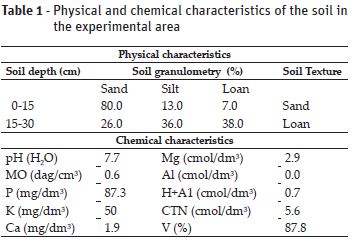
<body><![CDATA[<p><font face = "Verdana" size = "2">The soil in the experimental area is classified
as Red Yellow Argisol, with sandy loam texture, as sand at 0-15 cm depth and as
loam at 15-30 cm. The soil chemical composition indicated mean contents of potassium,
calcium and magnesium of 87.3 mg/dm<sup>3</sup>, 50 mg/dm<sup>3</sup> and 2.9 cmol/dm<sup>3</sup>,
respectively (<a href = "#t1">Table 1</a>). The daily meteorological data for determining ET<sub>o</sub>
were obtained from the automatic weather station located 600 m from the experimental
area.</font></p>

    <p>&nbsp;</p>

<a name = "t1"><img src = "/img/revistas/rca/v41n3/v41n3a23t1.jpg" target = "_blank"></a>

    
<p>&nbsp;</p>

    <p><font face = "Verdana" size = "2">The studied crop was lettuce (<i>Lactuca sativa
</i>L.), planted at spacing of 0.40 m between rows and 0.40 m between plants, totaling
80 plants per experimental plot for each cultivar. The lettuce crop was initially
sown on polyethylene trays, maintained in protected cultivation and irrigated through
micro-sprinklers. The plots were subdivided into three rows (beds) corresponding
to each lettuce cultivar: Looseleaf (Saia Véia), Curly (Isabela) and Red (Rouge).
The planting density in the experimental area was 125,000 plants/ha. The study was
conducted with three replicates in different periods of the year: winter, summer
and autumn. A micro-sprinkler irrigation system was used and the flow rate of the
irrigation pipe was equal to 60 L h<sup>-1</sup>. Irrigations were performed twice
a day, according to the ET<sub>o</sub>. For each experimental plot of 15.0 m x 0.7
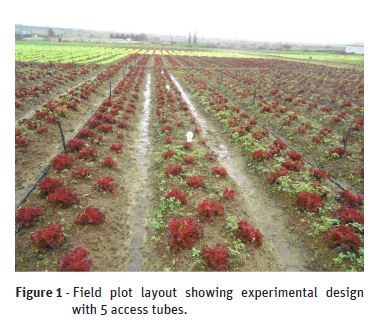
m, 5 access tubes were installed to measure soil water content in three replicates
for each lettuce cultivar (<a href = "#f1">Figure 1</a>). The field experiments were performed in different
periods; the first, second and third campaigns were conducted in the winter, summer
and autumn seasons, respectively.</font></p>

    <p>&nbsp;</p>

<a name = "f1"><img src = "/img/revistas/rca/v41n3/v41n3a23f1.jpg" target = "_blank"></a>

    
<p>&nbsp;</p>

    <p><font face = "Verdana" size = "2">Soil water content
was measured using a portable soil moisture monitoring system (Diviner 2000, Sentek
Pty. Ltd., Australia) previously calibrated for the soil of the experimental area
with the gravimetric sampling technique, according to Groves and Rose (2004). The
Diviner 2000 is a portable soil moisture monitoring instrument that consists of
a probe and hand-held data logger (Zhou <i>et al</i>., 2008). Five access tubes
were installed in the plot (<a href = "#f1">Figure 1</a>). The measurements of mean volumetric soil
water content were performed at daily intervals after each irrigation or rainfall
at every 10 cm of depth from the surface down to 50 cm depth. Irrigation management
was performed using the crop coefficient established in the FAO-56 Bulletin (Allen
<i>et al</i>., 1998).</font></p>

    <p><font face = "Verdana" size = "2">Crop evapotranspiration
(ET<sub>c</sub>) was determined through the soil water balance method, as follows:</font></p>

    <p><font face = "Verdana" size = "2"><img src = "/img/revistas/rca/v41n3/v41n3a23eq1.jpg" target = "_blank">                                                                                 (1)</font></p>


<p><font face = "Verdana" size = "2">where P - rainfall; I - irrigation depth; A -
capillary rise; D - deep drainage; DW – variation of water depth available in the
soil and R - surface runoff. All the components of Eq. (1) are expressed in mm.
Rainfall was monitored using a pluviometer, installed in the experimental area,
and DW was determined based on the soil moisture profile. The control volume considered
for the water balance corresponds to the soil layer between the surface and the
effective root system depth (0.4 m). Since the water table in the studied area is
more than 1 m deep, the term capillary rise was considered as null. Soil water drainage
was obtained based on the procedures established by Azevedo <i>et al</i>. (2006).</font></p>


    ]]></body>
<body><![CDATA[<p><font face = "Verdana" size = "2">Surface runoff (R) was not considered because the topography of the terrain
is flat. The values in ET<sub>o</sub> were determined using the air temperature,
net radiation, wind speed and relative humidity data and the FAO Penman-Monteith
equation (Allen <i>et al</i>., 1998). The crop coefficient was determined through
the ratio between ET<sub>c</sub> and ET<sub>o</sub> defined by meteorological data.
On other hand, WUE was obtained as the ratio between grain weight or biomass yield
and crop evapotranspiration expressed in units of kilograms per hectare per millimeter
of water (Zhang <i>et al.</i>, 2004).</font></p>


    <p><font face = "Verdana" size = "3"><b>RESULTS AND DISCUSSION</b></font></p>


    <p><font face = "Verdana" size = "2">The total rainfall during the first experimental period was higher compared
with the others, 197.2 mm; however, the summer showed the lowest total rainfall,
representing only 24% of the total in the winter. The highest values of insolation
and evaporation occurred in the summer, but the total insolation in the winter represented
74% of that in the summer and 90% of that in the autumn. Temperatures did not vary
much between the seasons and the mean values in the summer and autumn were virtually
equal, around 27 ºC, representing only 10% of the mean temperature of the first
experiment, during the winter.</font></p>


    <p><font face = "Verdana" size = "2">Relative humidity
also varied substantially between the summer and autumn seasons in the studied area.
Summer transplanting date was the warmest, followed by the autumn and winter seasons
and insolation was quite high during all seasons. The highest insolation and Class
A pan evaporation values were recorded during the summer season. Temperatures did
not vary much between the seasons and the mean values of summer and autumn were
virtually equal, around 27 ºC, representing only 10% of the mean temperature of
the first experimental campaign, during the winter. Mean annual relative humidity
varied significantly between the seasons, from 39±5.4% in the spring growing season
to 56±12.5% in the autumn season.</font></p>


    <p><font face = "Verdana" size = "2">The highest values
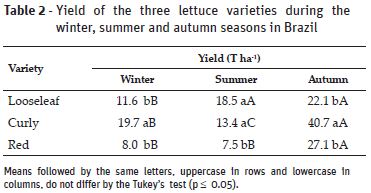
of lettuce yield occurs during autumn growing season, ranged from 22.1 to 40.7 T
ha<sup>-1</sup> (<a href = "#t2">Table 2</a>). A similar result was obtained by Candido <i>et al</i>.
(2011) when analyzing lettuce yield response under field and greenhouse conditions
in Southern Italy. They found lettuce yield ranging from 33.6 T ha<sup>-1</sup>
to 43.2 T ha<sup>-1</sup>, according to treatment type. Earlier, Hanson <i>et al</i>.
(1997) also reported lettuce yield ranging from 30.6 T ha<sup>-1</sup> to 40.9 T
ha<sup>-1</sup> on a farm in the Salinas Valley of California.</font></p>

    <p>&nbsp;</p>

<a name = "t2"><img src = "/img/revistas/rca/v41n3/v41n3a23t2.jpg" target = "_blank"></a>

    
<p>&nbsp;</p>

    <p><font face = "Verdana" size = "2">The curly cultivar showed the highest yield during the growing
season for the autumn transplanting date with highest maximum temperature and insolation
quite high. When analyzing the dynamic relationships between field temperatures
and Romaine lettuce yield in South Carolina, USA, Dufault <i>et al</i>. (2009) observed
a linear increase in <i>some varieties</i> of <i>lettuce</i> when temperature
increased. On the other hand, the lowest value of lettuce yield was found in the
summer growing season with the red cultivar, followed by the looseleaf cultivar.
Some studies have indicated high temperatures as limiting factor for lettuce production
with accelerated inflorescence formation and shortened vegetative period in the
plants (Ryder, 1986; Sala and Costa, 2012).</font></p>


    <p><font face = "Verdana" size = "2">There were significant differences between varieties
and growing seasons, ranging from minimum value of 7.5 T ha<sup>-1</sup> for red/summer
to 40.7 T ha<sup>-1</sup> for curly/autumn. A reduction in the yield of the curly
cultivar grown during autumn was found to be 32.9% compared with that in the summer
growing season, in part due to high values of both air temperature and insolation.
The three lettuce varieties showed similar yield during the winter and autumn growing
seasons; however, the yield values of the three lettuce varieties during summer
growing season are statistically different by Tukey’s test (p &#8804; 0.05). On
the other hand, the looseleaf cultivar showed higher yield in the summer, also statistically
different from the others. The red cultivar reached the lowest values of leaf fresh
weight production and, during the autumn season, its yield was not statistically
different from that of the looseleaf cultivar. The results of the current study
also indicate that the autumn cultivation lead significant increase in lettuce yield.</font></p>


    <p><font face = "Verdana" size = "2">All analyzed growth variables of the lettuce crop showed higher development
in the autumn period, although it was not the rainiest period in the studied area.
The total rainfall in the autumn was 38.5% of that recorded in the winter. This
result is partially contrary to that obtained by Serna <i>et al</i>. (2012), who
observed high yield caused by an increase in lettuce weight (which causes diameter
and length increases) caused by an increment of water absorption. On the other hand,
Galieni <i>et al</i>. (2015) analyzed the effects of nutrient deficiency and abiotic
environmental stresses on lettuce yield and found high values of yield, leaf number
and leaf length in unstressed plants. The results of the present study clearly demonstrate
the decrease in the yield of the red cultivar during the winter growing season.</font></p>

    ]]></body>
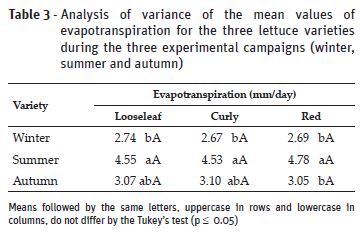
<body><![CDATA[<p><font face = "Verdana" size = "2">There were no significant differences in mean daily ET<sub>c</sub> between
the three lettuce varieties (<a href = "#t3">Table 3</a>). Otherwise, there were significant differences
for ET<sub>c </sub>values between growing seasons. In this aspect, the lettuce crop
shows higher evapotranspiration in the summer, followed by the periods of autumn
and winter. For each growing season, no significant differences in evapotranspiration
values were found between varieties. Therefore, since the ET<sub>c</sub> did not
show significant statistical differences between the varieties, this figure was
made based on the mean values of ET<sub>c</sub> of the three varieties.</font></p>

    <p>&nbsp;</p>

<a name = "t3"><img src = "/img/revistas/rca/v41n3/v41n3a23t3.jpg" target = "_blank"></a>

    
<p>&nbsp;</p>

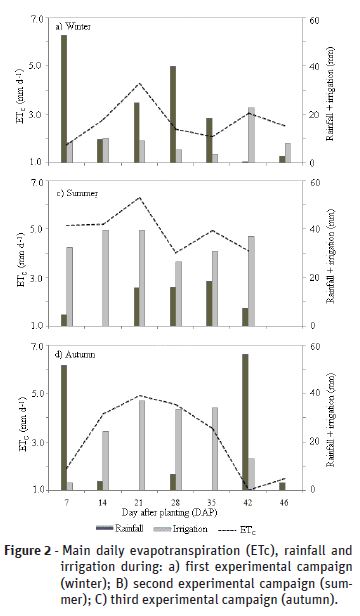
    <p><font face = "Verdana" size = "2">In the first experimental campaign (<a href = "#f2">Figure 2A</a>),
during the winter, when there were higher rainfalls (total of 197.2 mm), the mean
evapotranspiration was 1.75 mm, reaching maximum value of 4.29 mm at 21 DAT.  In
the second experimental campaign (<a href = "#f2">Figure 2B</a>), for being the summer growing season,
with total rainfall of 48.0 mm and irrigation prevailed, with maximum values at
14 and 21 DAT of 39.5 mm. These results confirm that the plant responded to the
increase in soil moisture, because the maximum value of ET<sub>c</sub> of 6.30 mm
occurred at 21 DAT and minimum of 4.02 mm at 28 DAT. In the third experimental campaign,
during autumn, the highest cumulative values of rainfall occurred at the beginning
and end of the lettuce cycle, with 51.7 mm (7 DAT) and 56.2 mm (42 DAT), respectively,
with maximum peak of ET<sub>c</sub> of 4.92 mm at 21 DAT, and minimum of 1.02 mm
at 42 DAT.</font></p>

    <p>&nbsp;</p>

<a name = "f2"><img src = "/img/revistas/rca/v41n3/v41n3a23f2.jpg" target = "_blank"></a>

    
<p>&nbsp;</p>

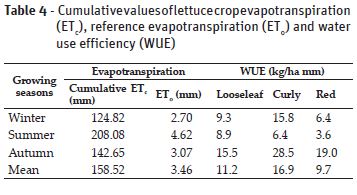
    <p><font face = "Verdana" size = "2">Crop water requirements
are higher in the summer period, reaching 208.08 mm (<a href = "#t4">Table 4</a>). In winter, since
the atmospheric demand was lower, the ET<sub>c</sub> was 66% lower than that in
the summer growing season. As a result, the values of crop coefficients for winter,
summer and autumn growing seasons were 0.71, 1.04 and 0.72, respectively. </font></p>
    <p>&nbsp;</p>

<a name = "t4"><img src = "/img/revistas/rca/v41n3/v41n3a23t4.jpg" target = "_blank"></a>

    
<p>&nbsp;</p>

    <p><font face = "Verdana" size = "2">Crop evapotranspiration was reduced by 59.9% from
summer to winter growing season and by 68.5% from summer to autumn growing season.
Similar reduction was observed in ET<sub>o</sub>. These changes resulted in lowest
WUE during the summer growing season, which ranged from 3.6 kg/ha mm for the red
cultivar to 8.9 kg/ha mm for the loose leaf cultivar. The lowest WUE occurred in
the summer growing season for the three varieties because of the inherent highest
values of crop evapotranspiration. The highest WUE was found during the autumn growing
season for the curly cultivar (285.9 kg ha<sup>-1</sup> mm<sup>-1</sup>), while
the lowest WUE rates were obtained during the winter and summer growing seasons
for the red cultivar. A decrease in the yield and WUE of the three lettuce varieties
was observed during the summer growing season as a result of both high air temperature
and insolation and low rainfall. Abreu <i>et al</i>. (2014) also found a decrease
in the yield of different lettuce varieties when grown in the summer season.</font></p>


    ]]></body>
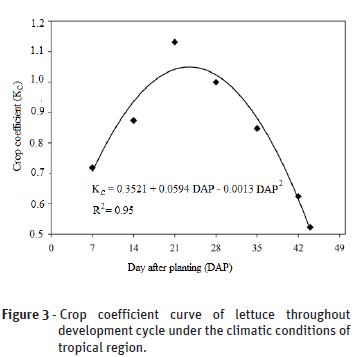
<body><![CDATA[<p><font face = "Verdana" size = "2">Lettuce crop coefficient can be determined with good precision (r<sup>2</sup>
= 0.95) as a function of the number of days after transplanting (DAT), through the
relationship: K<sub>c</sub> = 0.3521 + 0.0594 DAT – 0.0013 DAT<sup>2</sup>&nbsp;(<a href = "#f3">Figure
3</a>).  Therefore, the observed temporal variation in K<sub>c</sub> is assumed to be
a function of the DAP, with highly significant correlation coefficient. These results
suggest that the equation reasonably describes the relationship between the crop
coefficient and DAP.</font></p>

    <p>&nbsp;</p>

<a name = "f3"><img src = "/img/revistas/rca/v41n3/v41n3a23f3.jpg" target = "_blank"></a>

    
<p>&nbsp;</p>

    <p><font face = "Verdana" size = "2">The mean crop coefficient
for lettuce growth in tropical region was 0.82, while for the initial, middle and
final stages are 0.80, 1.07 and 0.70, respectively. These K<sub>c</sub> values were
in a good agreement with the K<sub>c </sub>values given by Allen <i>et al</i>. (1998)
during the initial, development and late growth stages of lettuce. On the other
hand, studies conducted by Fernández-Pacheco <i>et al. </i>(2014) in Southeast Spain
obtained K<sub>c</sub> values of 0.61, 1.03 and 0.98 in the initial, middle and
final stages, respectively. The three lettuce varieties have different responses
to the climatic conditions. The lowest yields were observed in the summer season,
with values of 8.8, 7.3 and 27.1 kg ha<sup>-1</sup>, respectively for the looseleaf,
curly and red lettuce varieties.</font></p>


    <p><font face = "Verdana" size = "3"><b>CONCLUSIONS</b></font></p>


    <p><font face = "Verdana" size = "2">The
mean crop coefficient of lettuce is 0.82 along the entire lettuce cycle, while in
the initial, middle and final stages, the values were 0.80, 1.07 and 0.70, respectively.
ET<sub>c</sub> values ranged from minimum of 2.74 mm/day with loose leaf cultivar
to maximum value of 4.78 mm/day with red cultivar. The lettuce crop shows higher
water demand in the summer period and the highest WUE was obtained during the autumn
growing season with the curly cultivar (285.9 kg ha<sup>-1</sup> mm<sup>-1</sup>),
while the lowest values were obtained during the winter and summer growing seasons
with the red cultivar. The curly cultivar shows the highest yield, cultivated in
the autumn growing season. The highest values in yield and WUE of lettuce during
the autumn growing season were due to the favorable climatic conditions for crop
development in tropical climate.</font></p>


    <p>&nbsp;</p>

    <p><font face = "Verdana" size = "3"><b>REFERENCES</b></font></p>

    <!-- ref --><p><font face = "Verdana" size = "2">Abreu, M.M.; Neves, O. &amp; Marcelino, M. (2014) - Yield and
uranium concentration in two lettuce (<i>Lactuca sativa</i> L.) varieties influenced
by soil and irrigation water composition, and season growth. <i>Journal of Geochemical
Exploration, </i>v<i>ol. </i>142, p. 43-48. <a href = "https://doi.org/10.1016/j.gexplo.2014.01.018" target = "_blank">https://doi.org/10.1016/j.gexplo.2014.01.018</a></font>&nbsp;&nbsp;&nbsp;&nbsp;&nbsp;&nbsp;&nbsp;&nbsp;[&#160;<a href="javascript:void(0);" onclick="javascript: window.open('/scielo.php?script=sci_nlinks&ref=687972&pid=S0871-018X201800030002300001&lng=','','width=640,height=500,resizable=yes,scrollbars=1,menubar=yes,');">Links</a>&#160;]<!-- end-ref --><!-- ref --><p><font face = "Verdana" size = "2">Allen, R.G.; Pereira, L.S.; Raes, D. &amp; Smith,
M. (1998) - <i>Crop Evapotranspiration: Guidelines for computing crop water requirements</i>.
FAO Irrigation and drainage paper 56. Rome, 300 p.    &nbsp;&nbsp;&nbsp;&nbsp;&nbsp;&nbsp;&nbsp;&nbsp;[&#160;<a href="javascript:void(0);" onclick="javascript: window.open('/scielo.php?script=sci_nlinks&ref=687973&pid=S0871-018X201800030002300002&lng=','','width=640,height=500,resizable=yes,scrollbars=1,menubar=yes,');">Links</a>&#160;]<!-- end-ref --></font></p>

    <!-- ref --><p><font face = "Verdana" size = "2">Allen, R.G.; Clemmens, A.J.; Burt, C.M.; Solomon, K. &amp; O’Halloran,
T. (2005) - Prediction accuracy for project-wide evapo-transpiration using crop
coefficients and reference evapotranspiration. <i>Journal of Irrigation Drainage
Engineering,</i> vol. 131, n. 1, p. 1-24. <a href = "https://doi.org/10.1061/(ASCE)0733-9437(2005)131:1(24)" target = "_blank">https://doi.org/10.1061/(ASCE)0733-9437(2005)131:1(24)</a></font>&nbsp;&nbsp;&nbsp;&nbsp;&nbsp;&nbsp;&nbsp;&nbsp;[&#160;<a href="javascript:void(0);" onclick="javascript: window.open('/scielo.php?script=sci_nlinks&ref=687975&pid=S0871-018X201800030002300003&lng=','','width=640,height=500,resizable=yes,scrollbars=1,menubar=yes,');">Links</a>&#160;]<!-- end-ref --><!-- ref --><p><font face = "Verdana" size = "2">Azevedo, P.V.; Silva, B.B. &amp; Silva, V.P.R.
(2003) - Water requirements of irrigated mango orchards in northeast Brazil. <i>Agricultural
Water Management</i>, vol. 58, n. 3, p. 241-254. <a href = "http://dx.doi.org/10.1016/S0378-3774(02)00083-5" target = "_blank">http://dx.doi.org/10.1016/S0378-3774(02)00083-5</a></font>&nbsp;&nbsp;&nbsp;&nbsp;&nbsp;&nbsp;&nbsp;&nbsp;[&#160;<a href="javascript:void(0);" onclick="javascript: window.open('/scielo.php?script=sci_nlinks&ref=687976&pid=S0871-018X201800030002300004&lng=','','width=640,height=500,resizable=yes,scrollbars=1,menubar=yes,');">Links</a>&#160;]<!-- end-ref --><!-- ref --><p><font face = "Verdana" size = "2">Azevedo, P.V.; Sousa, I.F.; Silva, B.B. &amp;
Silva, V.P.R. (2006). Water-use efficiency of dwarf-green coconut (<i>Cocos nucifera</i>
L.) orchards in northeast Brazil. <i>Agricultural Water Management</i>, vol. 84,
n. 3, p. 259-264. <a href = "http://dx.doi.org/10.1016/j.agwat.2006.03.001" target = "_blank">http://dx.doi.org/10.1016/j.agwat.2006.03.001</a></font>&nbsp;&nbsp;&nbsp;&nbsp;&nbsp;&nbsp;&nbsp;&nbsp;[&#160;<a href="javascript:void(0);" onclick="javascript: window.open('/scielo.php?script=sci_nlinks&ref=687977&pid=S0871-018X201800030002300005&lng=','','width=640,height=500,resizable=yes,scrollbars=1,menubar=yes,');">Links</a>&#160;]<!-- end-ref --><!-- ref --><p><font face = "Verdana" size = "2">Bezerra Neto, B.; Porto, V.C.N.; Gomes, E.G.; Cecílio Filho,
A.B. &amp; Moreira, J.N. (2012) - Assessment of agroeconomic indices in polycultures
of lettuce, rocket and carrot through uni- and multivariate approaches in semi-arid
Brazil. <i>Ecological Indicators</i>, vol. 14, n. 1, p. 11–17. <a href = "https://doi.org/10.1016/j.ecolind.2011.07.006" target = "_blank">https://doi.org/10.1016/j.ecolind.2011.07.006</a></font>&nbsp;&nbsp;&nbsp;&nbsp;&nbsp;&nbsp;&nbsp;&nbsp;[&#160;<a href="javascript:void(0);" onclick="javascript: window.open('/scielo.php?script=sci_nlinks&ref=687978&pid=S0871-018X201800030002300006&lng=','','width=640,height=500,resizable=yes,scrollbars=1,menubar=yes,');">Links</a>&#160;]<!-- end-ref --><!-- ref --><p><font face = "Verdana" size = "2">Candido, V.; D’Addabbo, T.; Miccolis, V. &amp;
Castronuovo, D. (2011) - Weed control and yield response of soil solarization with
different plastic films in lettuce. <i>Scientia Horticulturae</i>, vol. 130, n.
3, p. 491-497. <a href = "https://doi.org/10.1016/j.scienta.2011.08.002" target = "_blank">https://doi.org/10.1016/j.scienta.2011.08.002</a></font>&nbsp;&nbsp;&nbsp;&nbsp;&nbsp;&nbsp;&nbsp;&nbsp;[&#160;<a href="javascript:void(0);" onclick="javascript: window.open('/scielo.php?script=sci_nlinks&ref=687979&pid=S0871-018X201800030002300007&lng=','','width=640,height=500,resizable=yes,scrollbars=1,menubar=yes,');">Links</a>&#160;]<!-- end-ref --><!-- ref --><p><font face = "Verdana" size = "2">Cometti, N.N.; Martins, M.Q.; Bremenkamp, C.A. &amp; Nunes,
J.A. (2011) - Nitrate concentration in lettuce leaves depending on photosynthetic
photon flux and nitrate concentration in the nutrient solution. <i>Horticultura
Brasileira</i>, vol. 29, n. 4, p. 548-553. <a href = "http://dx.doi.org/10.1590/S0102-05362011000400018" target = "_blank">http://dx.doi.org/10.1590/S0102-05362011000400018</a></font>&nbsp;&nbsp;&nbsp;&nbsp;&nbsp;&nbsp;&nbsp;&nbsp;[&#160;<a href="javascript:void(0);" onclick="javascript: window.open('/scielo.php?script=sci_nlinks&ref=687980&pid=S0871-018X201800030002300008&lng=','','width=640,height=500,resizable=yes,scrollbars=1,menubar=yes,');">Links</a>&#160;]<!-- end-ref --><!-- ref --><p><font face = "Verdana" size = "2">Dufault, R. J.; Ward, B. &amp; Hassell, R. L.
(2009) - Dynamic relationships between field temperatures and romaine lettuce yield
and head quality. <i>Scientia Horticulturae</i>, vol. 120, n. 4, p. 452-459. <a href = "https://doi.org/10.1016/j.scienta.2009.01.002" target = "_blank">https://doi.org/10.1016/j.scienta.2009.01.002</a></font>&nbsp;&nbsp;&nbsp;&nbsp;&nbsp;&nbsp;&nbsp;&nbsp;[&#160;<a href="javascript:void(0);" onclick="javascript: window.open('/scielo.php?script=sci_nlinks&ref=687981&pid=S0871-018X201800030002300009&lng=','','width=640,height=500,resizable=yes,scrollbars=1,menubar=yes,');">Links</a>&#160;]<!-- end-ref --><!-- ref --><p><font face = "Verdana" size = "2">Ceuppens, S.; Hessel, C.T.; Rodrigues, R.Q.; Bartz,
S.; Tondo, E.C. &amp; Uyttendaele, M. (2014) - Microbiological quality and safety
assessment of lettuce production in Brazil. <i>International Journal of Food Microbiology,</i>
vol. 181, p. 67-76. <a href = "https://doi.org/10.1016/j.ijfoodmicro.2014.04.025" target = "_blank">https://doi.org/10.1016/j.ijfoodmicro.2014.04.025</a></font>&nbsp;&nbsp;&nbsp;&nbsp;&nbsp;&nbsp;&nbsp;&nbsp;[&#160;<a href="javascript:void(0);" onclick="javascript: window.open('/scielo.php?script=sci_nlinks&ref=687982&pid=S0871-018X201800030002300010&lng=','','width=640,height=500,resizable=yes,scrollbars=1,menubar=yes,');">Links</a>&#160;]<!-- end-ref --><!-- ref --><p><font face = "Verdana" size = "2">Fernández-Pacheco, D.G.; Escarabajal-Henarejos,
D.; Ruiz-Canales, A.; Conesa, J. &amp; Molina-Martínez, J.M. (2014) - A digital
image-processing-based method for determining the crop coefficient of lettuce crops
in the southeast of Spain. <i>Biosystems Engineering,</i> vol. 117, p. 23-34. <a href = "http://dx.doi.org/10.1016/j.biosystemseng.2013.07.014" target = "_blank">http://dx.doi.org/10.1016/j.biosystemseng.2013.07.014</a></font>&nbsp;&nbsp;&nbsp;&nbsp;&nbsp;&nbsp;&nbsp;&nbsp;[&#160;<a href="javascript:void(0);" onclick="javascript: window.open('/scielo.php?script=sci_nlinks&ref=687983&pid=S0871-018X201800030002300011&lng=','','width=640,height=500,resizable=yes,scrollbars=1,menubar=yes,');">Links</a>&#160;]<!-- end-ref --><!-- ref --><p><font face = "Verdana" size = "2">Galieni, A.; Mattia, C.D.; Gregorio, M.D.; Speca,
S.; Mastrocola, D.; Pisante, M. &amp; Stagnari, F. (2015) - Effects of nutrient
deficiency and abiotic environmental stresses on yield, phenolic compounds and antiradical
activity in lettuce (<i>Lactuca sativa</i> L.). <i>Scientia Horticulturae, </i>vol.
187, p. 93-101. <a href = "https://doi.org/10.1016/j.scienta.2015.02.036" target = "_blank">https://doi.org/10.1016/j.scienta.2015.02.036</a></font>&nbsp;&nbsp;&nbsp;&nbsp;&nbsp;&nbsp;&nbsp;&nbsp;[&#160;<a href="javascript:void(0);" onclick="javascript: window.open('/scielo.php?script=sci_nlinks&ref=687984&pid=S0871-018X201800030002300012&lng=','','width=640,height=500,resizable=yes,scrollbars=1,menubar=yes,');">Links</a>&#160;]<!-- end-ref --><!-- ref --><p><font face = "Verdana" size = "2">Ghiberto, P.J., Libardi, P.L.; Brito, A.S. &amp; Trivelin,
P.C.O. (2011) - Components of the water balance in soil with sugarcane crops. <i>Agricultural
Water Management, </i>vol. 102, n. 1, p. 1-7. <a href = "https://doi.org/10.1016/j.agwat.2011.09.010" target = "_blank">https://doi.org/10.1016/j.agwat.2011.09.010</a></font>&nbsp;&nbsp;&nbsp;&nbsp;&nbsp;&nbsp;&nbsp;&nbsp;[&#160;<a href="javascript:void(0);" onclick="javascript: window.open('/scielo.php?script=sci_nlinks&ref=687985&pid=S0871-018X201800030002300013&lng=','','width=640,height=500,resizable=yes,scrollbars=1,menubar=yes,');">Links</a>&#160;]<!-- end-ref --><!-- ref --><p><font face = "Verdana" size = "2">Groves, S.J.L. &amp; Rose, S.C.L. (2004) - Calibration
equations for Diviner 2000 capacitance measurements of volumetric soil water content
of six soils. <i>Soil Use and Management</i>, vol. 20, n. 1, p. 96-97. <a href = "https://doi.org/10.1111/j.1475-2743.2004.tb00343.x" target = "_blank">https://doi.org/10.1111/j.1475-2743.2004.tb00343.x</a></font>&nbsp;&nbsp;&nbsp;&nbsp;&nbsp;&nbsp;&nbsp;&nbsp;[&#160;<a href="javascript:void(0);" onclick="javascript: window.open('/scielo.php?script=sci_nlinks&ref=687986&pid=S0871-018X201800030002300014&lng=','','width=640,height=500,resizable=yes,scrollbars=1,menubar=yes,');">Links</a>&#160;]<!-- end-ref --><!-- ref --><p><font face = "Verdana" size = "2">Hanson, B.R.; Schwankl, L.J.; Schulbach, K.F.
&amp; Pettygrove, G.S. (1997) - A comparison of furrow, surface drip, and subsurface
drip irrigation on lettuce yield and applied water. <i>Agricultural Water Management,
</i>vol. 33, n. 2-3, p. 139-157. <a href = "https://doi.org/10.1016/S0378-3774(96)01289-9" target = "_blank">https://doi.org/10.1016/S0378-3774(96)01289-9</a></font>&nbsp;&nbsp;&nbsp;&nbsp;&nbsp;&nbsp;&nbsp;&nbsp;[&#160;<a href="javascript:void(0);" onclick="javascript: window.open('/scielo.php?script=sci_nlinks&ref=687987&pid=S0871-018X201800030002300015&lng=','','width=640,height=500,resizable=yes,scrollbars=1,menubar=yes,');">Links</a>&#160;]<!-- end-ref --><!-- ref --><p><font face = "Verdana" size = "2">K&#345;ístková, E.; Doležalová, I.; Lebeda, A.;
Vinter, V. &amp; Novotná, A. (2008) - Description of morphological characters of
lettuce (<i>Lactuca sativa</i> L.) genetic resources. <i>Horticultural Science,</i>
vol. 35, p. 113-129. <a href = "https://doi.org/10.17221/4/2008-HORTSCI" target = "_blank">https://doi.org/10.17221/4/2008-HORTSCI</a></font>&nbsp;&nbsp;&nbsp;&nbsp;&nbsp;&nbsp;&nbsp;&nbsp;[&#160;<a href="javascript:void(0);" onclick="javascript: window.open('/scielo.php?script=sci_nlinks&ref=687988&pid=S0871-018X201800030002300016&lng=','','width=640,height=500,resizable=yes,scrollbars=1,menubar=yes,');">Links</a>&#160;]<!-- end-ref --><!-- ref --><p><font face = "Verdana" size = "2">Oliveira, M.; Usall, J.; Viñas, I.; Anguerra, M.; Gatius,
F. &amp; Abadias, M. (2010) -Microbiological quality of fresh lettuce from organic
and conventional production. <i>Food Microbiology</i>, vol. 27, n. 5, p. 679-684.
<a href = "https://doi.org/10.1016/j.fm.2010.03.008" target = "_blank">https://doi.org/10.1016/j.fm.2010.03.008</a></font>&nbsp;&nbsp;&nbsp;&nbsp;&nbsp;&nbsp;&nbsp;&nbsp;[&#160;<a href="javascript:void(0);" onclick="javascript: window.open('/scielo.php?script=sci_nlinks&ref=687989&pid=S0871-018X201800030002300017&lng=','','width=640,height=500,resizable=yes,scrollbars=1,menubar=yes,');">Links</a>&#160;]<!-- end-ref --><!-- ref --><p><font face = "Verdana" size = "2">Pereira, L.S.; Allen, R.G.; Smith, M. &amp; Raes, D. (2015) - Crop evapotranspiration
estimation with FAO56: Past and future. <i>Agricultural Water Management</i>, vol.
147, p. 4-20. <a href = "https://doi.org/10.1016/j.agwat.2014.07.031" target = "_blank">https://doi.org/10.1016/j.agwat.2014.07.031</a></font>&nbsp;&nbsp;&nbsp;&nbsp;&nbsp;&nbsp;&nbsp;&nbsp;[&#160;<a href="javascript:void(0);" onclick="javascript: window.open('/scielo.php?script=sci_nlinks&ref=687990&pid=S0871-018X201800030002300018&lng=','','width=640,height=500,resizable=yes,scrollbars=1,menubar=yes,');">Links</a>&#160;]<!-- end-ref --><!-- ref --><p><font face = "Verdana" size = "2">Ryder, E.J. (1986) - Lettuce breeding. <i>In</i>: Bassett,
M. (Ed.) - <i>Breeding Vegetable Crops</i>. AVI Publishing Co., Westport, p. 433-474.    &nbsp;&nbsp;&nbsp;&nbsp;&nbsp;&nbsp;&nbsp;&nbsp;[&#160;<a href="javascript:void(0);" onclick="javascript: window.open('/scielo.php?script=sci_nlinks&ref=687991&pid=S0871-018X201800030002300019&lng=','','width=640,height=500,resizable=yes,scrollbars=1,menubar=yes,');">Links</a>&#160;]<!-- end-ref --></font></p>


    <!-- ref --><p><font face = "Verdana" size = "2">Sala, F.C. &amp; Costa, C.P. (2012) - Retrospectiva
e tendência da alfacicultura brasileira. <i>Horticultura Brasileira</i>, vol. 30,
n. 2, p. 187-194. <a href = "http://dx.doi.org/10.1590/S0102-05362012000200002" target = "_blank">http://dx.doi.org/10.1590/S0102-05362012000200002</a></font>&nbsp;&nbsp;&nbsp;&nbsp;&nbsp;&nbsp;&nbsp;&nbsp;[&#160;<a href="javascript:void(0);" onclick="javascript: window.open('/scielo.php?script=sci_nlinks&ref=687993&pid=S0871-018X201800030002300020&lng=','','width=640,height=500,resizable=yes,scrollbars=1,menubar=yes,');">Links</a>&#160;]<!-- end-ref --><!-- ref --><p><font face = "Verdana" size = "2">Serna, M.; Hernandez, F.; Coll, F. &amp; Amorosa,
A. (2012) - Brassinosteroid analogues effect on yield and quality parameters of
field-grown lettuce (<i>Lactuca sativa </i>L.). <i>Scientia Horticulturae, </i>vol.
143, p. 29-37. <a href = "https://doi.org/10.1016/j.scienta.2012.05.019" target = "_blank">https://doi.org/10.1016/j.scienta.2012.05.019</a></font>&nbsp;&nbsp;&nbsp;&nbsp;&nbsp;&nbsp;&nbsp;&nbsp;[&#160;<a href="javascript:void(0);" onclick="javascript: window.open('/scielo.php?script=sci_nlinks&ref=687994&pid=S0871-018X201800030002300021&lng=','','width=640,height=500,resizable=yes,scrollbars=1,menubar=yes,');">Links</a>&#160;]<!-- end-ref --><!-- ref --><p><font face = "Verdana" size = "2">Silva, V.P.R. (2004) - On climate variability in Northeast
of Brazil. <i>Journal of Arid Environments, </i>vol. 58, n. 4, p. 575-596. <a href = "http://dx.doi.org/10.1016/j.jaridenv.2003.12.002" target = "_blank">http://dx.doi.org/10.1016/j.jaridenv.2003.12.002</a></font>&nbsp;&nbsp;&nbsp;&nbsp;&nbsp;&nbsp;&nbsp;&nbsp;[&#160;<a href="javascript:void(0);" onclick="javascript: window.open('/scielo.php?script=sci_nlinks&ref=687995&pid=S0871-018X201800030002300022&lng=','','width=640,height=500,resizable=yes,scrollbars=1,menubar=yes,');">Links</a>&#160;]<!-- end-ref --><!-- ref --><p><font face = "Verdana" size = "2">Silva, V.P.R.; Campos, J.H.B.C. &amp; Azevedo,
P.V. (2009) - Water-use efficiency and evapotranspiration of mango orchard grown
in northeastern region of Brazil. <i>Scientia Horticulturae, </i>vol. 102, n. 4,
p. 467-472.<u> </u><a href = "https://doi.org/10.1016/j.scienta.2008.12.005" target = "_blank">https://doi.org/10.1016/j.scienta.2008.12.005</a></font>&nbsp;&nbsp;&nbsp;&nbsp;&nbsp;&nbsp;&nbsp;&nbsp;[&#160;<a href="javascript:void(0);" onclick="javascript: window.open('/scielo.php?script=sci_nlinks&ref=687996&pid=S0871-018X201800030002300023&lng=','','width=640,height=500,resizable=yes,scrollbars=1,menubar=yes,');">Links</a>&#160;]<!-- end-ref --><!-- ref --><p><font face = "Verdana" size = "2">Silva, V.P.R.; Silva, B.B.; Albuquerque, W.G.; Borges, C.J.R.;
Sousa, I.F. &amp; Dantas Neto, J. (2013) - Crop coefficient, water requirements,
yield and water use efficiency of sugarcane growth in Brazil. <i>Agricultural Water
Management</i>, vol.128, p. 102-109. <a href = "http://dx.doi.org/10.1016/j.agwat.2013.06.007" target = "_blank">http://dx.doi.org/10.1016/j.agwat.2013.06.007</a></font>&nbsp;&nbsp;&nbsp;&nbsp;&nbsp;&nbsp;&nbsp;&nbsp;[&#160;<a href="javascript:void(0);" onclick="javascript: window.open('/scielo.php?script=sci_nlinks&ref=687997&pid=S0871-018X201800030002300024&lng=','','width=640,height=500,resizable=yes,scrollbars=1,menubar=yes,');">Links</a>&#160;]<!-- end-ref --><!-- ref --><p><font face = "Verdana" size = "2">Zhang, Y.; Kendy, E.; Qiang, Y.; Changming, L.;
Yanjun, J. &amp; Hongyong, S. (2004) - Effect of soil water deficit on evapotranspiration,
crop yield, and water use efficiency in the North China Plain. <i>Agricultural Water
Management, </i>vol. 64, n. 2, p. 107-122. <a href = "https://doi.org/10.1016/S0378-3774(03)00201-4" target = "_blank">https://doi.org/10.1016/S0378-3774(03)00201-4</a></font>&nbsp;&nbsp;&nbsp;&nbsp;&nbsp;&nbsp;&nbsp;&nbsp;[&#160;<a href="javascript:void(0);" onclick="javascript: window.open('/scielo.php?script=sci_nlinks&ref=687998&pid=S0871-018X201800030002300025&lng=','','width=640,height=500,resizable=yes,scrollbars=1,menubar=yes,');">Links</a>&#160;]<!-- end-ref --><!-- ref --><p><font face = "Verdana" size = "2">Zhou, Q.; Kang, S. Li, F. &amp; Zhang, L. (2008)
- Comparison of dynamic and static APRI-models to simulate soil water dynamics in
a vineyard over the growing season under alternate partial root-zone drip irrigation.
<i>Agricultural Water Management, </i>vol. 95, n. 7, p. 767-775. <a href = "https://doi.org/10.1016/j.agwat.2008.01.018" target = "_blank">https://doi.org/10.1016/j.agwat.2008.01.018</a></font>&nbsp;&nbsp;&nbsp;&nbsp;&nbsp;&nbsp;&nbsp;&nbsp;[&#160;<a href="javascript:void(0);" onclick="javascript: window.open('/scielo.php?script=sci_nlinks&ref=687999&pid=S0871-018X201800030002300026&lng=','','width=640,height=500,resizable=yes,scrollbars=1,menubar=yes,');">Links</a>&#160;]<!-- end-ref --><p>&nbsp;</p>

    <p><font face = "Verdana" size = "2">Received/recebido: 2018.02.16</font></p>

    <p><font face = "Verdana" size = "2">Received in revised form/recebido em versão revista: 2018.05.10</font></p>

    <p><font face = "Verdana" size = "2">Accepted/aceite: 2018.06.02</font></p>

    ]]></body>
<body><![CDATA[ ]]></body><back>
<ref-list>
<ref id="B1">
<nlm-citation citation-type="journal">
<person-group person-group-type="author">
<name>
<surname><![CDATA[Abreu]]></surname>
<given-names><![CDATA[M.M.]]></given-names>
</name>
<name>
<surname><![CDATA[Neves]]></surname>
<given-names><![CDATA[O.]]></given-names>
</name>
<name>
<surname><![CDATA[Marcelino]]></surname>
<given-names><![CDATA[M.]]></given-names>
</name>
</person-group>
<article-title xml:lang="en"><![CDATA[Yield and uranium concentration in two lettuce (Lactuca sativa L.) varieties influenced by soil and irrigation water composition, and season growth]]></article-title>
<source><![CDATA[Journal of Geochemical Exploration]]></source>
<year>2014</year>
<volume>142</volume>
<page-range>43-48</page-range></nlm-citation>
</ref>
<ref id="B2">
<nlm-citation citation-type="">
<person-group person-group-type="author">
<name>
<surname><![CDATA[Allen]]></surname>
<given-names><![CDATA[R.G.]]></given-names>
</name>
<name>
<surname><![CDATA[Pereira]]></surname>
<given-names><![CDATA[L.S.]]></given-names>
</name>
<name>
<surname><![CDATA[Raes]]></surname>
<given-names><![CDATA[D.]]></given-names>
</name>
<name>
<surname><![CDATA[Smith]]></surname>
<given-names><![CDATA[M.]]></given-names>
</name>
</person-group>
<source><![CDATA[Crop Evapotranspiration: Guidelines for computing crop water requirements]]></source>
<year>1998</year>
</nlm-citation>
</ref>
<ref id="B3">
<nlm-citation citation-type="journal">
<person-group person-group-type="author">
<name>
<surname><![CDATA[Allen]]></surname>
<given-names><![CDATA[R.G.]]></given-names>
</name>
<name>
<surname><![CDATA[Clemmens]]></surname>
<given-names><![CDATA[A.J.]]></given-names>
</name>
<name>
<surname><![CDATA[Burt]]></surname>
<given-names><![CDATA[C.M.]]></given-names>
</name>
<name>
<surname><![CDATA[Solomon]]></surname>
<given-names><![CDATA[K.]]></given-names>
</name>
<name>
<surname><![CDATA[O’Halloran]]></surname>
<given-names><![CDATA[T.]]></given-names>
</name>
</person-group>
<article-title xml:lang="en"><![CDATA[Prediction accuracy for project-wide evapo-transpiration using crop coefficients and reference evapotranspiration]]></article-title>
<source><![CDATA[Journal of Irrigation Drainage Engineering]]></source>
<year>2005</year>
<volume>131</volume>
<numero>1</numero>
<issue>1</issue>
<page-range>1-24</page-range></nlm-citation>
</ref>
<ref id="B4">
<nlm-citation citation-type="journal">
<person-group person-group-type="author">
<name>
<surname><![CDATA[Azevedo]]></surname>
<given-names><![CDATA[P.V.]]></given-names>
</name>
<name>
<surname><![CDATA[Silva]]></surname>
<given-names><![CDATA[B.B.]]></given-names>
</name>
<name>
<surname><![CDATA[Silva]]></surname>
<given-names><![CDATA[V.P.R.]]></given-names>
</name>
</person-group>
<article-title xml:lang="en"><![CDATA[Water requirements of irrigated mango orchards in northeast Brazil]]></article-title>
<source><![CDATA[Agricultural Water Management]]></source>
<year>2003</year>
<volume>58</volume>
<numero>3</numero>
<issue>3</issue>
<page-range>241-254</page-range></nlm-citation>
</ref>
<ref id="B5">
<nlm-citation citation-type="journal">
<person-group person-group-type="author">
<name>
<surname><![CDATA[Azevedo]]></surname>
<given-names><![CDATA[P.V.]]></given-names>
</name>
<name>
<surname><![CDATA[Sousa]]></surname>
<given-names><![CDATA[I.F.]]></given-names>
</name>
<name>
<surname><![CDATA[Silva]]></surname>
<given-names><![CDATA[B.B.]]></given-names>
</name>
<name>
<surname><![CDATA[Silva]]></surname>
<given-names><![CDATA[V.P.R.]]></given-names>
</name>
</person-group>
<article-title xml:lang="en"><![CDATA[Water-use efficiency of dwarf-green coconut (Cocos nucifera L.) orchards in northeast Brazil]]></article-title>
<source><![CDATA[Agricultural Water Management]]></source>
<year>2006</year>
<volume>84</volume>
<numero>3</numero>
<issue>3</issue>
<page-range>259-264</page-range></nlm-citation>
</ref>
<ref id="B6">
<nlm-citation citation-type="journal">
<person-group person-group-type="author">
<name>
<surname><![CDATA[Bezerra Neto]]></surname>
<given-names><![CDATA[B.]]></given-names>
</name>
<name>
<surname><![CDATA[Porto]]></surname>
<given-names><![CDATA[V.C.N.]]></given-names>
</name>
<name>
<surname><![CDATA[Gomes]]></surname>
<given-names><![CDATA[E.G.]]></given-names>
</name>
<name>
<surname><![CDATA[Cecílio Filho]]></surname>
<given-names><![CDATA[A.B.]]></given-names>
</name>
<name>
<surname><![CDATA[Moreira]]></surname>
<given-names><![CDATA[J.N.]]></given-names>
</name>
</person-group>
<article-title xml:lang="en"><![CDATA[Assessment of agroeconomic indices in polycultures of lettuce, rocket and carrot through uni- and multivariate approaches in semi-arid Brazil]]></article-title>
<source><![CDATA[Ecological Indicators]]></source>
<year>2012</year>
<volume>14</volume>
<numero>1</numero>
<issue>1</issue>
<page-range>11-17</page-range></nlm-citation>
</ref>
<ref id="B7">
<nlm-citation citation-type="journal">
<person-group person-group-type="author">
<name>
<surname><![CDATA[Candido]]></surname>
<given-names><![CDATA[V.]]></given-names>
</name>
<name>
<surname><![CDATA[D’Addabbo]]></surname>
<given-names><![CDATA[T.]]></given-names>
</name>
<name>
<surname><![CDATA[Miccolis]]></surname>
<given-names><![CDATA[V.]]></given-names>
</name>
<name>
<surname><![CDATA[Castronuovo]]></surname>
<given-names><![CDATA[D.]]></given-names>
</name>
</person-group>
<article-title xml:lang="en"><![CDATA[Weed control and yield response of soil solarization with different plastic films in lettuce]]></article-title>
<source><![CDATA[Scientia Horticulturae]]></source>
<year>2011</year>
<volume>130</volume>
<numero>3</numero>
<issue>3</issue>
<page-range>491-497</page-range></nlm-citation>
</ref>
<ref id="B8">
<nlm-citation citation-type="journal">
<person-group person-group-type="author">
<name>
<surname><![CDATA[Cometti]]></surname>
<given-names><![CDATA[N.N.]]></given-names>
</name>
<name>
<surname><![CDATA[Martins]]></surname>
<given-names><![CDATA[M.Q.]]></given-names>
</name>
<name>
<surname><![CDATA[Bremenkamp]]></surname>
<given-names><![CDATA[C.A.]]></given-names>
</name>
<name>
<surname><![CDATA[Nunes]]></surname>
<given-names><![CDATA[J.A.]]></given-names>
</name>
</person-group>
<article-title xml:lang="en"><![CDATA[Nitrate concentration in lettuce leaves depending on photosynthetic photon flux and nitrate concentration in the nutrient solution]]></article-title>
<source><![CDATA[Horticultura Brasileira]]></source>
<year>2011</year>
<volume>29</volume>
<numero>4</numero>
<issue>4</issue>
<page-range>548-553</page-range></nlm-citation>
</ref>
<ref id="B9">
<nlm-citation citation-type="journal">
<person-group person-group-type="author">
<name>
<surname><![CDATA[Dufault]]></surname>
<given-names><![CDATA[R. J.]]></given-names>
</name>
<name>
<surname><![CDATA[Ward]]></surname>
<given-names><![CDATA[B.]]></given-names>
</name>
<name>
<surname><![CDATA[Hassell]]></surname>
<given-names><![CDATA[R. L.]]></given-names>
</name>
</person-group>
<article-title xml:lang="en"><![CDATA[Dynamic relationships between field temperatures and romaine lettuce yield and head quality]]></article-title>
<source><![CDATA[Scientia Horticulturae]]></source>
<year>2009</year>
<volume>120</volume>
<numero>4</numero>
<issue>4</issue>
<page-range>452-459</page-range></nlm-citation>
</ref>
<ref id="B10">
<nlm-citation citation-type="journal">
<person-group person-group-type="author">
<name>
<surname><![CDATA[Ceuppens]]></surname>
<given-names><![CDATA[S.]]></given-names>
</name>
<name>
<surname><![CDATA[Hessel]]></surname>
<given-names><![CDATA[C.T.]]></given-names>
</name>
<name>
<surname><![CDATA[Rodrigues]]></surname>
<given-names><![CDATA[R.Q.]]></given-names>
</name>
<name>
<surname><![CDATA[Bartz]]></surname>
<given-names><![CDATA[S.]]></given-names>
</name>
<name>
<surname><![CDATA[Tondo]]></surname>
<given-names><![CDATA[E.C.]]></given-names>
</name>
<name>
<surname><![CDATA[Uyttendaele]]></surname>
<given-names><![CDATA[M.]]></given-names>
</name>
</person-group>
<article-title xml:lang="en"><![CDATA[Microbiological quality and safety assessment of lettuce production in Brazil]]></article-title>
<source><![CDATA[International Journal of Food Microbiology]]></source>
<year>2014</year>
<volume>181</volume>
<page-range>67-76</page-range></nlm-citation>
</ref>
<ref id="B11">
<nlm-citation citation-type="journal">
<person-group person-group-type="author">
<name>
<surname><![CDATA[Fernández-Pacheco]]></surname>
<given-names><![CDATA[D.G.]]></given-names>
</name>
<name>
<surname><![CDATA[Escarabajal-Henarejos]]></surname>
<given-names><![CDATA[D.]]></given-names>
</name>
<name>
<surname><![CDATA[Ruiz-Canales]]></surname>
<given-names><![CDATA[A.]]></given-names>
</name>
<name>
<surname><![CDATA[Conesa]]></surname>
<given-names><![CDATA[J.]]></given-names>
</name>
<name>
<surname><![CDATA[Molina-Martínez]]></surname>
<given-names><![CDATA[J.M.]]></given-names>
</name>
</person-group>
<article-title xml:lang="en"><![CDATA[A digital image-processing-based method for determining the crop coefficient of lettuce crops in the southeast of Spain]]></article-title>
<source><![CDATA[Biosystems Engineering]]></source>
<year>2014</year>
<volume>117</volume>
<page-range>23-34</page-range></nlm-citation>
</ref>
<ref id="B12">
<nlm-citation citation-type="journal">
<person-group person-group-type="author">
<name>
<surname><![CDATA[Galieni]]></surname>
<given-names><![CDATA[A.]]></given-names>
</name>
<name>
<surname><![CDATA[Mattia]]></surname>
<given-names><![CDATA[C.D.]]></given-names>
</name>
<name>
<surname><![CDATA[Gregorio]]></surname>
<given-names><![CDATA[M.D.]]></given-names>
</name>
<name>
<surname><![CDATA[Speca]]></surname>
<given-names><![CDATA[S.]]></given-names>
</name>
<name>
<surname><![CDATA[Mastrocola]]></surname>
<given-names><![CDATA[D.]]></given-names>
</name>
<name>
<surname><![CDATA[Pisante]]></surname>
<given-names><![CDATA[M.]]></given-names>
</name>
<name>
<surname><![CDATA[Stagnari]]></surname>
<given-names><![CDATA[F.]]></given-names>
</name>
</person-group>
<article-title xml:lang="en"><![CDATA[Effects of nutrient deficiency and abiotic environmental stresses on yield, phenolic compounds and antiradical activity in lettuce (Lactuca sativa L.)]]></article-title>
<source><![CDATA[Scientia Horticulturae]]></source>
<year>2015</year>
<volume>187</volume>
<page-range>93-101</page-range></nlm-citation>
</ref>
<ref id="B13">
<nlm-citation citation-type="journal">
<person-group person-group-type="author">
<name>
<surname><![CDATA[Ghiberto]]></surname>
<given-names><![CDATA[P.J.]]></given-names>
</name>
<name>
<surname><![CDATA[Libardi]]></surname>
<given-names><![CDATA[P.L.]]></given-names>
</name>
<name>
<surname><![CDATA[Brito]]></surname>
<given-names><![CDATA[A.S.]]></given-names>
</name>
<name>
<surname><![CDATA[Trivelin]]></surname>
<given-names><![CDATA[P.C.O.]]></given-names>
</name>
</person-group>
<article-title xml:lang="en"><![CDATA[Components of the water balance in soil with sugarcane crops]]></article-title>
<source><![CDATA[Agricultural Water Management]]></source>
<year>2011</year>
<volume>102</volume>
<numero>1</numero>
<issue>1</issue>
<page-range>1-7</page-range></nlm-citation>
</ref>
<ref id="B14">
<nlm-citation citation-type="journal">
<person-group person-group-type="author">
<name>
<surname><![CDATA[Groves]]></surname>
<given-names><![CDATA[S.J.L.]]></given-names>
</name>
<name>
<surname><![CDATA[Rose]]></surname>
<given-names><![CDATA[S.C.L.]]></given-names>
</name>
</person-group>
<article-title xml:lang="en"><![CDATA[Calibration equations for Diviner 2000 capacitance measurements of volumetric soil water content of six soils]]></article-title>
<source><![CDATA[Soil Use and Management]]></source>
<year>2004</year>
<volume>20</volume>
<numero>1</numero>
<issue>1</issue>
<page-range>96-97</page-range></nlm-citation>
</ref>
<ref id="B15">
<nlm-citation citation-type="journal">
<person-group person-group-type="author">
<name>
<surname><![CDATA[Hanson]]></surname>
<given-names><![CDATA[B.R.]]></given-names>
</name>
<name>
<surname><![CDATA[Schwankl]]></surname>
<given-names><![CDATA[L.J.]]></given-names>
</name>
<name>
<surname><![CDATA[Schulbach]]></surname>
<given-names><![CDATA[K.F.]]></given-names>
</name>
<name>
<surname><![CDATA[Pettygrove]]></surname>
<given-names><![CDATA[G.S.]]></given-names>
</name>
</person-group>
<article-title xml:lang="en"><![CDATA[A comparison of furrow, surface drip, and subsurface drip irrigation on lettuce yield and applied water]]></article-title>
<source><![CDATA[Agricultural Water Management]]></source>
<year>1997</year>
<volume>33</volume>
<numero>2-3</numero>
<issue>2-3</issue>
<page-range>139-157</page-range></nlm-citation>
</ref>
<ref id="B16">
<nlm-citation citation-type="journal">
<person-group person-group-type="author">
<name>
<surname><![CDATA[K&#345;ístková]]></surname>
<given-names><![CDATA[E.]]></given-names>
</name>
<name>
<surname><![CDATA[Doležalová]]></surname>
<given-names><![CDATA[I.]]></given-names>
</name>
<name>
<surname><![CDATA[Lebeda]]></surname>
<given-names><![CDATA[A.]]></given-names>
</name>
<name>
<surname><![CDATA[Vinter]]></surname>
<given-names><![CDATA[V.]]></given-names>
</name>
<name>
<surname><![CDATA[Novotná]]></surname>
<given-names><![CDATA[A.]]></given-names>
</name>
</person-group>
<article-title xml:lang="en"><![CDATA[Description of morphological characters of lettuce (Lactuca sativa L.) genetic resources]]></article-title>
<source><![CDATA[Horticultural Science]]></source>
<year>2008</year>
<volume>35</volume>
<page-range>113-129</page-range></nlm-citation>
</ref>
<ref id="B17">
<nlm-citation citation-type="journal">
<person-group person-group-type="author">
<name>
<surname><![CDATA[Oliveira]]></surname>
<given-names><![CDATA[M.]]></given-names>
</name>
<name>
<surname><![CDATA[Usall]]></surname>
<given-names><![CDATA[J.]]></given-names>
</name>
<name>
<surname><![CDATA[Viñas]]></surname>
<given-names><![CDATA[I.]]></given-names>
</name>
<name>
<surname><![CDATA[Anguerra]]></surname>
<given-names><![CDATA[M.]]></given-names>
</name>
<name>
<surname><![CDATA[Gatius]]></surname>
<given-names><![CDATA[F.]]></given-names>
</name>
<name>
<surname><![CDATA[Abadias]]></surname>
<given-names><![CDATA[M.]]></given-names>
</name>
</person-group>
<article-title xml:lang="en"><![CDATA[Microbiological quality of fresh lettuce from organic and conventional production]]></article-title>
<source><![CDATA[Food Microbiology]]></source>
<year>2010</year>
<volume>27</volume>
<numero>5</numero>
<issue>5</issue>
<page-range>679-684</page-range></nlm-citation>
</ref>
<ref id="B18">
<nlm-citation citation-type="journal">
<person-group person-group-type="author">
<name>
<surname><![CDATA[Pereira]]></surname>
<given-names><![CDATA[L.S.]]></given-names>
</name>
<name>
<surname><![CDATA[Allen]]></surname>
<given-names><![CDATA[R.G.]]></given-names>
</name>
<name>
<surname><![CDATA[Smith]]></surname>
<given-names><![CDATA[M.]]></given-names>
</name>
<name>
<surname><![CDATA[Raes]]></surname>
<given-names><![CDATA[D.]]></given-names>
</name>
</person-group>
<article-title xml:lang="en"><![CDATA[Crop evapotranspiration estimation with FAO56: Past and future]]></article-title>
<source><![CDATA[Agricultural Water Management]]></source>
<year>2015</year>
<volume>147</volume>
<page-range>4-20</page-range></nlm-citation>
</ref>
<ref id="B19">
<nlm-citation citation-type="book">
<person-group person-group-type="author">
<name>
<surname><![CDATA[Ryder]]></surname>
<given-names><![CDATA[E.J.]]></given-names>
</name>
</person-group>
<article-title xml:lang="en"><![CDATA[Lettuce breeding]]></article-title>
<person-group person-group-type="editor">
<name>
<surname><![CDATA[Bassett]]></surname>
<given-names><![CDATA[M.]]></given-names>
</name>
</person-group>
<source><![CDATA[Breeding Vegetable Crops]]></source>
<year>1986</year>
<page-range>433-474</page-range><publisher-loc><![CDATA[Westport ]]></publisher-loc>
<publisher-name><![CDATA[AVI Publishing Co.]]></publisher-name>
</nlm-citation>
</ref>
<ref id="B20">
<nlm-citation citation-type="journal">
<person-group person-group-type="author">
<name>
<surname><![CDATA[Sala]]></surname>
<given-names><![CDATA[F.C.]]></given-names>
</name>
<name>
<surname><![CDATA[Costa]]></surname>
<given-names><![CDATA[C.P.]]></given-names>
</name>
</person-group>
<article-title xml:lang="pt"><![CDATA[Retrospectiva e tendência da alfacicultura brasileira]]></article-title>
<source><![CDATA[Horticultura Brasileira]]></source>
<year>2012</year>
<volume>30</volume>
<numero>2</numero>
<issue>2</issue>
<page-range>187-194</page-range></nlm-citation>
</ref>
<ref id="B21">
<nlm-citation citation-type="journal">
<person-group person-group-type="author">
<name>
<surname><![CDATA[Serna]]></surname>
<given-names><![CDATA[M.]]></given-names>
</name>
<name>
<surname><![CDATA[Hernandez]]></surname>
<given-names><![CDATA[F.]]></given-names>
</name>
<name>
<surname><![CDATA[Coll]]></surname>
<given-names><![CDATA[F.]]></given-names>
</name>
<name>
<surname><![CDATA[Amorosa]]></surname>
<given-names><![CDATA[A.]]></given-names>
</name>
</person-group>
<article-title xml:lang="en"><![CDATA[Brassinosteroid analogues effect on yield and quality parameters of field-grown lettuce (Lactuca sativa L.)]]></article-title>
<source><![CDATA[Scientia Horticulturae]]></source>
<year>2012</year>
<volume>143</volume>
<page-range>29-37</page-range></nlm-citation>
</ref>
<ref id="B22">
<nlm-citation citation-type="journal">
<person-group person-group-type="author">
<name>
<surname><![CDATA[Silva]]></surname>
<given-names><![CDATA[V.P.R.]]></given-names>
</name>
</person-group>
<article-title xml:lang="en"><![CDATA[On climate variability in Northeast of Brazil]]></article-title>
<source><![CDATA[Journal of Arid Environments]]></source>
<year>2004</year>
<volume>58</volume>
<numero>4</numero>
<issue>4</issue>
<page-range>575-596</page-range></nlm-citation>
</ref>
<ref id="B23">
<nlm-citation citation-type="journal">
<person-group person-group-type="author">
<name>
<surname><![CDATA[Silva]]></surname>
<given-names><![CDATA[V.P.R.]]></given-names>
</name>
<name>
<surname><![CDATA[Campos]]></surname>
<given-names><![CDATA[J.H.B.C.]]></given-names>
</name>
<name>
<surname><![CDATA[Azevedo]]></surname>
<given-names><![CDATA[P.V.]]></given-names>
</name>
</person-group>
<article-title xml:lang="en"><![CDATA[Water-use efficiency and evapotranspiration of mango orchard grown in northeastern region of Brazil]]></article-title>
<source><![CDATA[Scientia Horticulturae]]></source>
<year>2009</year>
<volume>102</volume>
<numero>4</numero>
<issue>4</issue>
<page-range>467-472</page-range></nlm-citation>
</ref>
<ref id="B24">
<nlm-citation citation-type="journal">
<person-group person-group-type="author">
<name>
<surname><![CDATA[Silva]]></surname>
<given-names><![CDATA[V.P.R.]]></given-names>
</name>
<name>
<surname><![CDATA[Silva]]></surname>
<given-names><![CDATA[B.B.]]></given-names>
</name>
<name>
<surname><![CDATA[Albuquerque]]></surname>
<given-names><![CDATA[W.G.]]></given-names>
</name>
<name>
<surname><![CDATA[Borges]]></surname>
<given-names><![CDATA[C.J.R.]]></given-names>
</name>
<name>
<surname><![CDATA[Sousa]]></surname>
<given-names><![CDATA[I.F.]]></given-names>
</name>
<name>
<surname><![CDATA[Dantas Neto]]></surname>
<given-names><![CDATA[J.]]></given-names>
</name>
</person-group>
<article-title xml:lang="en"><![CDATA[Crop coefficient, water requirements, yield and water use efficiency of sugarcane growth in Brazil]]></article-title>
<source><![CDATA[Agricultural Water Management]]></source>
<year>2013</year>
<volume>128</volume>
<page-range>102-109</page-range></nlm-citation>
</ref>
<ref id="B25">
<nlm-citation citation-type="journal">
<person-group person-group-type="author">
<name>
<surname><![CDATA[Zhang]]></surname>
<given-names><![CDATA[Y.]]></given-names>
</name>
<name>
<surname><![CDATA[Kendy]]></surname>
<given-names><![CDATA[E.]]></given-names>
</name>
<name>
<surname><![CDATA[Qiang]]></surname>
<given-names><![CDATA[Y.]]></given-names>
</name>
<name>
<surname><![CDATA[Changming]]></surname>
<given-names><![CDATA[L.]]></given-names>
</name>
<name>
<surname><![CDATA[Yanjun]]></surname>
<given-names><![CDATA[J.]]></given-names>
</name>
<name>
<surname><![CDATA[Hongyong]]></surname>
<given-names><![CDATA[S.]]></given-names>
</name>
</person-group>
<article-title xml:lang="en"><![CDATA[Effect of soil water deficit on evapotranspiration, crop yield, and water use efficiency in the North China Plain]]></article-title>
<source><![CDATA[Agricultural Water Management]]></source>
<year>2004</year>
<volume>64</volume>
<numero>2</numero>
<issue>2</issue>
<page-range>107-122</page-range></nlm-citation>
</ref>
<ref id="B26">
<nlm-citation citation-type="journal">
<person-group person-group-type="author">
<name>
<surname><![CDATA[Zhou]]></surname>
<given-names><![CDATA[Q.]]></given-names>
</name>
<name>
<surname><![CDATA[Kang]]></surname>
<given-names><![CDATA[S.]]></given-names>
</name>
<name>
<surname><![CDATA[Li]]></surname>
<given-names><![CDATA[F.]]></given-names>
</name>
<name>
<surname><![CDATA[Zhang]]></surname>
<given-names><![CDATA[L.]]></given-names>
</name>
</person-group>
<article-title xml:lang="en"><![CDATA[Comparison of dynamic and static APRI-models to simulate soil water dynamics in a vineyard over the growing season under alternate partial root-zone drip irrigation]]></article-title>
<source><![CDATA[Agricultural Water Management]]></source>
<year>2008</year>
<volume>95</volume>
<numero>7</numero>
<issue>7</issue>
<page-range>767-775</page-range></nlm-citation>
</ref>
</ref-list>
</back>
</article>