<?xml version="1.0" encoding="ISO-8859-1"?><article xmlns:mml="http://www.w3.org/1998/Math/MathML" xmlns:xlink="http://www.w3.org/1999/xlink" xmlns:xsi="http://www.w3.org/2001/XMLSchema-instance">
<front>
<journal-meta>
<journal-id>0871-018X</journal-id>
<journal-title><![CDATA[Revista de Ciências Agrárias]]></journal-title>
<abbrev-journal-title><![CDATA[Rev. de Ciências Agrárias]]></abbrev-journal-title>
<issn>0871-018X</issn>
<publisher>
<publisher-name><![CDATA[Sociedade de Ciências Agrárias de Portugal]]></publisher-name>
</publisher>
</journal-meta>
<article-meta>
<article-id>S0871-018X2018000300026</article-id>
<article-id pub-id-type="doi">10.19084/RCA17336</article-id>
<title-group>
<article-title xml:lang="en"><![CDATA[Establishment of a genomic DNA extraction protocol for bamboo species]]></article-title>
<article-title xml:lang="pt"><![CDATA[Estabelecimento de um protocolo de extração de DNA genómico para espécies de bambu]]></article-title>
</title-group>
<contrib-group>
<contrib contrib-type="author">
<name>
<surname><![CDATA[Silva]]></surname>
<given-names><![CDATA[Rudieli M.]]></given-names>
</name>
<xref ref-type="aff" rid="A1"/>
</contrib>
<contrib contrib-type="author">
<name>
<surname><![CDATA[Ribeiro]]></surname>
<given-names><![CDATA[Nathalia P.]]></given-names>
</name>
<xref ref-type="aff" rid="A2"/>
</contrib>
</contrib-group>
<aff id="AA1">
<institution><![CDATA[,Universidade Estadual Paulista FCA Departamento de Agricultura]]></institution>
<addr-line><![CDATA[Botucatu São Paulo]]></addr-line>
<country>Brasil</country>
</aff>
<aff id="AA2">
<institution><![CDATA[,Universidade Estadual Paulista FCA Departamento de Horticultura]]></institution>
<addr-line><![CDATA[Botucatu São Paulo]]></addr-line>
<country>Brasil</country>
</aff>
<pub-date pub-type="pub">
<day>00</day>
<month>09</month>
<year>2018</year>
</pub-date>
<pub-date pub-type="epub">
<day>00</day>
<month>09</month>
<year>2018</year>
</pub-date>
<volume>41</volume>
<numero>3</numero>
<fpage>251</fpage>
<lpage>260</lpage>
<copyright-statement/>
<copyright-year/>
<self-uri xlink:href="http://scielo.pt/scielo.php?script=sci_arttext&amp;pid=S0871-018X2018000300026&amp;lng=en&amp;nrm=iso"></self-uri><self-uri xlink:href="http://scielo.pt/scielo.php?script=sci_abstract&amp;pid=S0871-018X2018000300026&amp;lng=en&amp;nrm=iso"></self-uri><self-uri xlink:href="http://scielo.pt/scielo.php?script=sci_pdf&amp;pid=S0871-018X2018000300026&amp;lng=en&amp;nrm=iso"></self-uri><abstract abstract-type="short" xml:lang="en"><p><![CDATA[The bamboos Bambusa vulgaris and Guadua angustifolia are considered the most important species in South America. Generally, bamboo taxonomy is conducted by analysis of plants morphology, which sometimes may present morphological similarities, complicating the achievement of precise results. This fact can be changed by application of molecular biology methods; however, the Brazilian research of bamboo in molecular level is still limited. The Brazilian state of Mato Grosso do Sul has fragments of a natural bamboo forest with external characteristics similar to Guadua. In order to provide information about bamboo species, this paper evaluates the application of a modified protocol for DNA extraction from young leaves of two accesses of Guadua cultivated in Campo Grande/MS. It also evaluates the amplification efficiency of the matK and rbcL regions of the DNA isolated. It was possible to extract a mean of 487.5 ng &#956;L-1 of DNA for both species with a purity level of 1.91. The molecular marker rbcL amplified the regions of 300 bp for both species, while the marker matK amplified the regions of 850 bp, also for both accesses. Results show that the modified protocol is useful for bamboo’s DNA extraction, with high concentration, quality, and able to be amplified by PCR.]]></p></abstract>
<abstract abstract-type="short" xml:lang="pt"><p><![CDATA[Os bambus Bambusa vulgaris e Guadua angustifolia são considerados as espécies mais importantes na América do Sul. Geralmente, a taxonômia de bambus é realizada pela análise da morfologia das plantas, que algumas vezes apresentam similaridades morfológicas, dificultando a obtenção de resultados precisos. Isso pode ser mudado pelo uso de métodos de biologia molecular, no entanto as pesquisas brasileiras com bamboo a nível molecular ainda é limitada. O estado do Mato Grosso do Sul possui fragmentos de florestas de bambu com características semelhantes ao Guadua. Com o intuito de fornecer informações sobre espécies de bambu, o presente trabalho avalia a aplicação de um protocolo modificado de extração de DNA de folhas jovens de duas amostras de Guadua cultivados em Campo Grande/MS. Também é avaliado a eficiência na amplificação das regiões matK e rbcL do DNA isolado. Foi possível extrair em média 487,5 ng &#956;L-1 de DNA para ambas as espécies com nível de pureza de 1,91. O marcador molecular rbcL amplificou a região de 300 pb, enquanto que o marcador matK amplificou a região de 850 pb, ambos para os dois acessos. Resultados mostram que o protocolo modificado é útil para a extração de DNA de bambus, com alta quantidade, qualidade, e capaz de ser amplificado por PCR.]]></p></abstract>
<kwd-group>
<kwd lng="en"><![CDATA[DNA extraction]]></kwd>
<kwd lng="en"><![CDATA[Guadua angustifolia]]></kwd>
<kwd lng="en"><![CDATA[molecular markers]]></kwd>
<kwd lng="en"><![CDATA[polymerase chain reaction]]></kwd>
<kwd lng="pt"><![CDATA[Extração de DNA]]></kwd>
<kwd lng="pt"><![CDATA[Guadua angustifolia]]></kwd>
<kwd lng="pt"><![CDATA[Marcadores moleculares]]></kwd>
<kwd lng="pt"><![CDATA[Reação da polimerase em cadeia]]></kwd>
</kwd-group>
</article-meta>
</front><body><![CDATA[ 

    <p align = "right"><font face = "Verdana" size = "2"><b>ARTIGO</b></font></p>

    <p><font face = "Verdana" size = "4"><b>Establishment
of a genomic DNA extraction protocol for bamboo species</b></font></p>


    <p><font face = "Verdana" size = "3"><b>Estabelecimento de um protocolo de extração de DNA genómico para espécies
de bambu</b></font></p>

    <p><font face = "Verdana" size = "2"><b>Rudieli M. Silva</b><sup>1</sup>* and <b>Nathalia P.
Ribeiro</b><sup>2</sup></font></p>


    <p><font face = "Verdana" size = "2"><i><sup>1</sup> Departamento de Agricultura, Universidade Estadual Paulista
– UNESP/FCA. Centro de Raízes e Amidos Tropicais – CERAT, Fazenda Experimental Lageado,
Rua José Barbosa de Barros, 1780, CEP 18610-307, Botucatu, São Paulo, Brasil.</i></font></p>


    <p><font face = "Verdana" size = "2"><i><sup>2</sup> Departamento de Horticultura, Universidade
Estadual Paulista – UNESP/FCA. Centro de Raízes e Amidos Tropicais – CERAT, Fazenda
Experimental Lageado, Rua José Barbosa de Barros, 1780, CEP 18610-307, Botucatu,
São Paulo, Brasil.</i></font></p>


    <p><font face = "Verdana" size = "2"><i>(*E-mail: <a href = "mailto:rudielimds@gmail.com">rudielimds@gmail.com</a>)</i></font></p>


<hr noshade size = 1>

    <p><font face = "Verdana" size = "3"><b>ABSTRACT</b></font></p>

    <p><font face = "Verdana" size = "2">The bamboos <i>Bambusa vulgaris</i> and <i>Guadua angustifolia</i> are considered
the most important species in South America. Generally, bamboo taxonomy is conducted
by analysis of plants morphology, which sometimes may present morphological similarities,
complicating the achievement of precise results. This fact can be changed by application
of molecular biology methods; however, the Brazilian research of bamboo in molecular
level is still limited. The Brazilian state of Mato Grosso do Sul has fragments
of a natural bamboo forest with external characteristics similar to <i>Guadua</i>.
In order to provide information about bamboo species, this paper evaluates the application
of a modified protocol for DNA extraction from young leaves of two accesses of <i>Guadua</i>
cultivated in Campo Grande/MS. It also evaluates the amplification efficiency of
the <i>matK</i> and <i>rbcL</i> regions of the DNA isolated. It was possible to
extract a mean of 487.5 ng &#956;L<sup>-1 </sup>of DNA for both species with a purity
level of 1.91. The molecular marker <i>rbcL </i>amplified the regions of 300 bp
for both species, while the marker <i>matK </i>amplified the regions of 850 bp,
also for both accesses. Results show that the modified protocol is useful for bamboo’s
DNA extraction, with high concentration, quality, and able to be amplified by PCR.</font></p>


    ]]></body>
<body><![CDATA[<p><font face = "Verdana" size = "2"><b>Keywords</b>: DNA extraction, <i>Guadua angustifolia</i>, molecular
markers, polymerase chain reaction.</font></p>

<hr noshade size = 1>

    <p><font face = "Verdana" size = "3"><b>RESUMO</b></font></p> 

    <p><font face = "Verdana" size = "2">Os bambus <i>Bambusa vulgaris </i>e
<i>Guadua angustifolia</i> são considerados as espécies mais importantes na América
do Sul. Geralmente, a taxonômia de bambus é realizada pela análise da morfologia
das plantas, que algumas vezes apresentam similaridades morfológicas, dificultando
a obtenção de resultados precisos. Isso pode ser mudado pelo uso de métodos de biologia
molecular, no entanto as pesquisas brasileiras com bamboo a nível molecular ainda
é limitada. O estado do Mato Grosso do Sul possui fragmentos de florestas de bambu
com características semelhantes ao <i>Guadua</i>. Com o intuito de fornecer informações
sobre espécies de bambu, o presente trabalho avalia a aplicação de um protocolo
modificado de extração de DNA de folhas jovens de duas amostras de <i>Guadua</i>
cultivados em Campo Grande/MS. Também é avaliado a eficiência na amplificação das
regiões <i>matK </i>e <i>rbcL</i> do DNA isolado. Foi possível extrair em média
487,5 ng &#956;L<sup>-1</sup> de DNA para ambas as espécies com nível de pureza
de 1,91. O marcador molecular <i>rbcL</i> amplificou a região de 300 pb, enquanto
que o marcador <i>matK</i> amplificou a região de 850 pb, ambos para os dois acessos.
Resultados mostram que o protocolo modificado é útil para a extração de DNA de bambus,
com alta quantidade, qualidade, e capaz de ser amplificado por PCR.</font></p>


    <p><font face = "Verdana" size = "2"><b>Palavras-chave</b>: Extração de DNA, <i>Guadua angustifolia</i>, Marcadores
moleculares, Reação da polimerase em cadeia.</font></p>

<hr noshade size = 1>

    <p><font face = "Verdana" size = "3"><b>INTRODUCTION</b></font></p>

    <p><font face = "Verdana" size = "2">Bamboos are part of the Poaceae family, with approximately 1400
species already described within 651 genres distributed around the world (Behari,
2006). A great part of the bamboo species are original from Asian countries, however,
they can be found both in tropical and temperate forests (Bystriakova <i>et al.,</i>
2003).</font></p>

    <p><font face = "Verdana" size = "2">Characteristics related to
the facility of reproduction, high longevity, and productive level, make the bamboo
wood commercially important for pulp paper industries, civil construction, and production
of special furniture. In the Brazilian states of Maranhão and Paraíba are located
the greatest productions of <i>Bambusa vulgaris</i> in the world, which is predominantly
used for paper production (Neto <i>et al.,</i> 2010). The authors also state that
the charcoal obtained from species of <i>B. vulgaris</i> has more quality than the
ones obtained from <i>Eucalyptus</i>.</font></p>

    <p><font face = "Verdana" size = "2">Since the Brazilian colonial period, about 20 species of Asian bamboos were
introduced into the Brazilian native forests (Silva <i>et al.,</i> 2011). The Japanese
immigration to Brazil was one of the processes that promoted the increase of <i>Phyllostachys
edulis</i> in the country, species which has its bud largely consumed by people
(Tombolato <i>et al.,</i> 2012). Another important species is the <i>Guadua </i>sp.
which presents a high-quality wood and can be found in the Amazonia and some parts
of the Brazilian cerrado. Hence, Yeasmin (2015) claims that these species have adapted
very well to the Brazilian climate characteristics, and have become economically
important to the country.</font></p>

    <p><font face = "Verdana" size = "2">An important
fact related to bamboo usage in Brazil, is the Law number 12.484, of September
8<sup>th</sup> of 2011, which aims the increase of research with bamboo species
in Brazil, as well as the stimulation of bamboo production by family farmers (Brazilian
Government, 2011). According to the Brazilian Government (2011), bamboos are considered
plants with a high agronomic potential, and then, are important for the internal
economy.</font></p>

    <p><font face = "Verdana" size = "2">According to the Brazilian
Association of Bamboo Producers (2015), the Brazilian State of Mato Grosso do Sul
presents more than 40 thousand hectares of native bamboo. According to the association,
bamboo is a font of a sustainable economy, and it is economically viable for family
farmers, once it is possible to produce bamboo for at least 70 years in the same
area and being not necessary the use of heavy equipment for the harvest.</font></p>


    ]]></body>
<body><![CDATA[<p><font face = "Verdana" size = "2">Brazil has about 1.5 million hectares of cultivated
and native bamboo. The area of cultivated bamboo in Mato Grosso do Sul is still
a small proportion of the total, mainly because of the lack of experiments with
cultivated species. In Mato Grosso do Sul the native species is <i>Guadua chacoensis</i>,
considered one of the best, commercially talking, among more than 1.3 thousand species
(Brazilian Association of Bamboo Producers, 2015).</font></p>

    <p><font face = "Verdana" size = "2">When bamboo species are considered as important commercial products,
as it happens in Colombia and Brazil, it is necessary to establish methods of conservation
for molecular characteristics of species (Kaneko <i>et al.,</i> 2008). The knowledge
of the genetic diversity of bamboo is essential for selection of good varieties
for production (Blaxter <i>et al.,</i> 2006), as it could happen in Mato Grosso
do Sul.</font></p>

    <p><font face = "Verdana" size = "2">According to Das <i>et al.</i>
(2008), some molecular methodologies are already available for identification and
characterization of bamboo species. However, it is difficult to establish the appropriate
molecular method with the morphological taxonomy already used worldwide. The authors
also state that molecular methods for bamboo taxonomy are already well developed,
and highlight the use of RFLP (Restriction Fragment Length Polymorphism), RAPD (Randomly
Amplified Polymorphic DNA), SCARs (Sequence Characterized Amplified Regions), AFLP
(Amplified Fragment Length Polymorphism), SSRs (Simple Sequence Repeats or Microsatellites),
and recently, the DNA barcoding. Although well developed, these molecular methods
do not rely on DNA extraction protocols specific for bamboo species. Hence, it is
important to establish a DNA extraction protocol that may be used as a standard
by the researchers of this field.</font></p>

    <p><font face = "Verdana" size = "2">The
DNA barcoding is a technology already used in several animal and plant species to
verify their molecular variability. This technology uses molecular markers to identify
and amplify specific DNA regions (Little, 2011). In animal DNA barcoding, the researchers
use the Cytochrome oxidase (COI), a protein-coding marker, as the DNA barcode standard,
once it presents high copy number per cells and extensive length variation (Hollingsworth
<i>et al.</i>, 2011). In plants, a standard DNA barcode was not identified yet.
Hence, some of the most studied markers in plant’s molecular biology are the maturase
K (<i>matK</i>) and the ribulose-bisphosphate carboxylase (<i>rbcL</i>) (Biswal
<i>et al.</i>, 2012).</font></p>

    <p><font face = "Verdana" size = "2">Although molecular
methodologies for plants classification are already applied in the world, further
investigation and the improvement of these methodologies used in bamboo taxa is
still necessary. It is important to emphasize that the application of modern molecular
techniques in bamboo species in order to identify and classify new species is necessary
for our diversity conservation. However, the Brazilian research of bamboos in molecular
level is still limited, mainly in relation to genomic DNA extraction protocols specific
for bamboo species. Hence, this paper evaluates the efficiency of a protocol for
DNA extraction of two bamboo accesses of <i>Guadua </i>cultivated in Mato Grosso
do Sul and also evaluates the amplification of the regions <i>rbcL </i>and <i>matK</i>
considered possible universal barcodes for plants.</font></p>


    <p><font face = "Verdana" size = "3"><b>MATERIAL AND METHODS</b></font></p>

    <p><font face = "Verdana" size = "2">The methodology was
conducted at the laboratory S-INOVA of the Universidade Católica Dom Bosco, Campo
Grande, state of Mato Grosso do Sul.</font></p>

    <p><font face = "Verdana" size = "2">Two accesses of cultivated bamboos were used for the experiments. Young leaves
samples were collected at the São Vicente Research Institute (coordinates S20°23’14’’
and W54°36’29’’, at 532 m of altitude) which is responsible for the plant's maintenance.
Both accesses were sold to the institute as being seedlings of <i>Guadua</i>, however,
both of them presenting morphological differences (leaf and culm sizes). For this
reason, the samples are named in this study as <i>Guadua 1 </i>and <i>Guadua 2.</i></font></p>


    <p><font face = "Verdana" size = "2"><i>The protocol for DNA extraction</i></font></p>

    <p><font face = "Verdana" size = "2">The extraction of DNA was conducted following the protocol established
by Bonato <i>et al.</i> (2002) for DNA extraction of <i>Stylosanthes </i>spp. with
modifications necessary for extraction of DNA from bamboo leaves.</font></p>


    ]]></body>
<body><![CDATA[<p><font face = "Verdana" size = "2">Procedure:</font></p>


    <p><font face = "Verdana" size = "2">Firstly, 5 g of leaf tissue was weighted, frozen
in liquid nitrogen and ground to a fine powder. This powder was transferred to a
50 ml polypropylene tube with 10 ml of 1% CTAB buffer, incubated at 65 ºC for 60
minutes in a water bath, and then centrifuged at 4500 g for 10 minutes at 4 ºC.
225 &#956;L of phenol and 225 &#956;L of chloroform were added to the tube, which
was gently shaken for 10 minutes and centrifuged at 4500 g for 10 minutes at 4 ºC.
The supernatant was transferred to another tube and added, again, 225 &#956;L of
phenol e 225 &#956;L of chloroform and repeated the step of centrifugation. The
supernatant was transferred to another tube, and then, added 4.5 ml of a solution
of chloroform and isoamyl alcohol at the proportion 24 to 1 (24 parts of chloroform
and 1 part of isoamyl alcohol). The tube was gently shaken, centrifuged at 4500
g for 10 minutes at 4 ºC, and the supernatant transferred to another tube. The tube
was treated with 600 &#956;L of isopropyl alcohol (-20ºC) for DNA precipitation,
and then, incubated at -20ºC for 30 minutes. The sample was centrifuged at 10000
g for 5 minutes at 4 ºC for the DNA pellet formation, and the supernatant carefully
discarded. The DNA pellet was dissolved in 400 &#956;L of TE buffer and precipitated
by adding 20 &#956;L of NaCl and 800 &#956;L of ethanol absolute. The sample was
centrifuged at 10000 g for 5 minutes at 4 ºC, and then the pellet washed with 70%
ethanol (-20ºC). The ethanol was discarded and the DNA pellet dried at room temperature.
Finally, the DNA pellet was dissolved in 50 or 100 &#956;L of TE buffer, added 6
&#956;L of RNAs end incubated at 37 ºC for 30 minutes and stored at -20ºC until
use.</font></p>

    <p><font face = "Verdana" size = "2">The DNA quantification was conducted
using an Eppendorf Biophotometer. The genetic material’s quality was observed by
electrophoresis in 0.8% agarose gel, transferred into solutions of ethidium bromide
for 15 minutes and distilled water for 10 minutes, and finally observed under UV
light. The 1 kb plus DNA “ladder” was used as a pattern of molecular mass. All procedures,
from DNA extraction to DNA quantification, were conducted in triplicate.</font></p>


    <p><font face = "Verdana" size = "2">The CTAB buffer used for the extraction was prepared
just before the beginning of the process. It was composed of 2% Cetyltrimethylammonium
bromide, 100 mM Tris-HCl, 1% polyvinyl pyrrolidone, 20 mM EDTA and 1.4 M NaCl. The
TE buffer was also prepared before the extraction process to be used fresh. This
buffer is composed of 1 M Tris-HCl pH 8, 0.5 M EDTA pH 8, and distilled water.</font></p>


    <p><font face = "Verdana" size = "2"><i>The Polymerase Chain Reaction (PCR)</i></font></p>

    <p><font face = "Verdana" size = "2">The PCR was conducted following the methodology described by New England
Biolabs (2015). The amplification reactions were carried out using 100 ng &#956;L<sup>-1</sup>
of genomic DNA added to 50 &#956;L of PCR mix containing: 1.6 mM of MgCl, 0.2 mM
of DNPTs, 5 &#956;L of 1X Standard Taq Reaction Buffer, 1.5 U of Taq DNA Polymerase,
0.2 pmol <i>primer</i>. Two specific <i>primers</i> were used: <i>rbcL </i>(Forward:
5’-ATGTCACCACAAACAGAGACTAAAGC-3’; Reverse: 5’-GTAAAATCAAGTCCACCRCG-3’) and <i>matK</i>
(Forward: 5’CCTATCCATCTGGAAATCTTAG-3’; Reverse: 5’GTTCTAGCACAAGAAAGTCG-3’).</font></p>


    <p><font face = "Verdana" size = "2">The samples were transferred into a PCR thermocycler
under the following conditions: initial denaturation at 94 ºC (5 min); 35 cycles
of annealing at 94 ºC (1 min), 50 ºC (1 min) and 72 ºC (1 min); final extension
at 72 ºC (10 min), followed by hold at 4 ºC infinite. The samples were stored into
a fridge at -20 ºC overnight, and the amplified products were submitted to electrophoresis
in 2% agarose gel, at same conditions as the DNA extracted was submitted for quality’s
visualization.</font></p>


    <p><font face = "Verdana" size = "3"><b>RESULTS AND DISCUSSION</b></font></p>

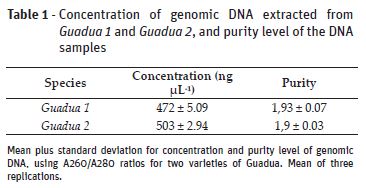
    <p><font face = "Verdana" size = "2">The
mean concentration of DNA extracted from <i>Guadua 1</i> and <i>Guadua 2</i> were,
respectively, 472 ng &#956;L<sup>-1 </sup>and 503 ng &#956;L<sup>-1</sup>. Results
for DNA quantification are presented in <a href = "#t1">Table 1</a>. It is observed that the amount
of DNA obtained from <i>Guadua 2 </i>is higher than that from <i>Guadua 1</i>, indicating
that the concentration of DNA extracted by this protocol may vary according to the
bamboo variety analyzed. <i>Guadua 1 </i>statistically differs from <i>Guadua 2</i>,
however, both quantities of DNA, which must be at least in a range of 50 to 500
ng, are viable to the execution of the PCR reaction (Thermo Scientific, 2015). As
observed, the DNA concentration for <i>Guadua 2</i> is slightly higher than the
specified, however, the Oxford Gene Technology (2016) explains that the amount and
the concentration of DNA for use depends on the application and finality of the
samples. The author also clarifies that all DNA samples can be diluted if necessary.</font></p>

    <p>&nbsp;</p>

<a name = "t1"><img src = "/img/revistas/rca/v41n3/v41n3a26t1.jpg" target = "_blank"></a>

    
]]></body>
<body><![CDATA[<p>&nbsp;</p>

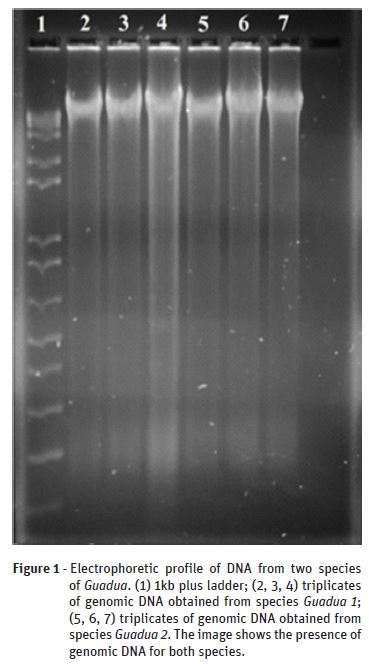
    <p><font face = "Verdana" size = "2">The genetic material’s quality may also be observed
in <a href = "#t1">table 1</a> and <a href = "#f1">figure 1</a>. <a href = "#t1">Table 1</a> represents the purity level of the DNA samples.
Values of 1.93 and 1.90 were obtained for species <i>Guadua 1</i> and <i>Guadua
2 </i>purity, respectively, in a ratio of A260/A280. It is important to say that
these values must be in a range of 1.8 and 2.0. Values below than 1.8 mean that
the samples are degraded by proteins, values over to 2.0 mean that the samples are
degraded by RNA residues (Oxford Gene Technology, 2011). <a href = "#f1">Figure 1</a> shows the electrophoretic
profile of the DNA samples. The presence of a genomic DNA with good quality and
concentration is notable.</font></p>

    <p>&nbsp;</p>

<a name = "f1"><img src = "/img/revistas/rca/v41n3/v41n3a26f1.jpg" target = "_blank"></a>

    
<p>&nbsp;</p>

    <p><font face = "Verdana" size = "2">The quality
of the DNA obtained can also be related to the use of liquid nitrogen at the beginning
of the extraction. According to Danner <i>et al.</i> (2011), the use of liquid nitrogen
to macerate the young leaves can optimize and reduce the presence of undesired compounds
in the final product. It happens mainly because the liquid nitrogen freezes the
plant tissue, stopping the degradation and contamination of the DNA by phenolic
compounds (Monsanto, 2016).</font></p>

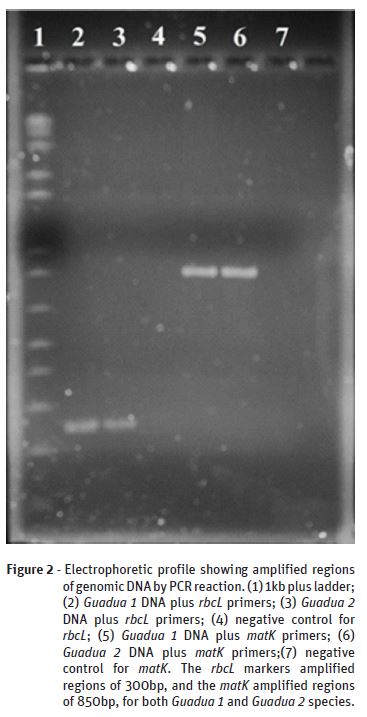
    <p><font face = "Verdana" size = "2"><a href = "#f2">Figure
2</a> presents the electrophoretic profile of the amplified regions using <i>rbcL</i>
and <i>matK primers</i>. It can be noticed that the <i>rbcL primers</i> amplified
a region of 300 bp and the <i>matK primers</i> amplified a region of 850 bp, both
primers for <i>Guadua 1</i> and <i>Guadua 2</i>. The high similarity level presented
by the electrophoresis analysis would suggest that there is low genetic variability
between both <i>Guadua</i> species tested. However, the <i>primers</i> used do not
distinguish different species only by their use, what means that further research
needs to be carried out.</font></p>

    <p>&nbsp;</p>

<a name = "f2"><img src = "/img/revistas/rca/v41n3/v41n3a26f2.jpg" target = "_blank"></a>

    
<p>&nbsp;</p>

    <p><font face = "Verdana" size = "2">According
to Li <i>et al. </i>(2011) <i>matK </i>is considered the most promising coding region
in the genome DNA of plants. However, this primer presents difficulty in PCR amplification
of non-angiosperms plants, a fact that complicates its use. In relation to the <i>rbcL
</i>primer, the authors state that this gene region is of easy amplification, sequencing,
and alignment, despite presenting low discriminatory power. That is why the combination
of these two primers (<i>matK </i>+ <i>rbcL</i>) was approved as universal barcodes
for plants until the development of a single universal marker has been achieved.
Hence, in the present work, it was found out that both primers can be used as molecular
markers for bamboo species, once they proved efficient for bamboo’s DNA amplification.
Also, the amplification efficiency of both regions confirmed that the DNA isolated
by this modified protocol can be used for PCR analysis.</font></p>

    <p><font face = "Verdana" size = "2">The increasing use of bamboo as an agricultural raw material
in Brazil is evident in recent decades. The country is rich in diversity of bamboo
species, and many of them present morphological similarities. Therefore, it would
be important to the agricultural and biological sciences the development of efficient
techniques of bamboo classification and differentiation through molecular biology,
which is a limited research area in the country when it comes this plant species.
Hence, this work becomes important, since it presents an efficient protocol for
the extraction of DNA from bamboo species.</font></p>


    ]]></body>
<body><![CDATA[<p><font face = "Verdana" size = "3"><b>CONCLUSIONS</b></font></p>


    <p><font face = "Verdana" size = "2">The modified protocol is viable for bamboo DNA
extraction, presenting a high quality and concentration of genomic DNA for both
bamboo species analyzed. Both of <i>primers</i>, <i>rbcL</i> and <i>matK</i>, are
useful for DNA amplification of the two species analyzed, confirming that the DNA
obtained by this methodology can be used for PCR analysis. Also, the primers <i>rbcL
</i>and <i>matK</i> can be selected for further molecular analysis in bamboo species.</font></p>


    <p><font face = "Verdana" size = "2">The use of liquid nitrogen is an efficient method
to reduce the DNA degradation and the presence of undesired compounds in the final
product.</font></p>

    <p>&nbsp;</p>

    <p><font face = "Verdana" size = "3"><b>REFERENCES</b></font></p>

    <!-- ref --><p><font face = "Verdana" size = "2">Behari,
B. (2006) - <i>Status of bamboo in India. Compilation of papers for preparation
of national status report on forests and forestry in India</i>. Survey and Utilization
Division, Ministry of Environment and Forest, p. 109-120.    &nbsp;&nbsp;&nbsp;&nbsp;&nbsp;&nbsp;&nbsp;&nbsp;[&#160;<a href="javascript:void(0);" onclick="javascript: window.open('/scielo.php?script=sci_nlinks&ref=688428&pid=S0871-018X201800030002600001&lng=','','width=640,height=500,resizable=yes,scrollbars=1,menubar=yes,');">Links</a>&#160;]<!-- end-ref --></font></p>

    <!-- ref --><p><font face = "Verdana" size = "2">Biswal, D.K.; Debnath, M.; Kumar, S. &amp; Tandon, P. (2012)
- Phylogenetic reconstruction in the Order Nymphaeales: ITS2 secondary structure
analysis and <i>in silico</i> testing of maturase K (<i>matK</i>) as a potential
marker for DNA bar coding. <i>BMC Bioinformatics</i>, vol. 13, n. 17, p. 26. <a href = "https://dx.doi.org/10.1186%2F1471-2105-13-S17-S26" target = "_blank">https://dx.doi.org/10.1186%2F1471-2105-13-S17-S26</a></font>&nbsp;&nbsp;&nbsp;&nbsp;&nbsp;&nbsp;&nbsp;&nbsp;[&#160;<a href="javascript:void(0);" onclick="javascript: window.open('/scielo.php?script=sci_nlinks&ref=688430&pid=S0871-018X201800030002600002&lng=','','width=640,height=500,resizable=yes,scrollbars=1,menubar=yes,');">Links</a>&#160;]<!-- end-ref --><!-- ref --><p><font face = "Verdana" size = "2">Blaxter, M.; Jenna, M.; Tom, C.; Fran, T.; Claire,
W.; Robin, F. &amp; Eyualen, A. (2006) - Defining operational taxonomic units using
DNA barcode data. <i>Philosophical Transactions of the Royal Society B, </i>vol.
360, n. 1462, p. 1935-1943. <a href = "https://dx.doi.org/10.1098%2Frstb.2005.1725" target = "_blank">https://dx.doi.org/10.1098%2Frstb.2005.1725</a></font>&nbsp;&nbsp;&nbsp;&nbsp;&nbsp;&nbsp;&nbsp;&nbsp;[&#160;<a href="javascript:void(0);" onclick="javascript: window.open('/scielo.php?script=sci_nlinks&ref=688431&pid=S0871-018X201800030002600003&lng=','','width=640,height=500,resizable=yes,scrollbars=1,menubar=yes,');">Links</a>&#160;]<!-- end-ref --><!-- ref --><p><font face = "Verdana" size = "2">Bonato, A.L.V.; Verzignassi, J.R.; Resende, R.M.S.;
Fernandes, C.D. &amp; Leguizamon, G.O.C. (2002) - <i>Extração de DNA genômico de
Stylosanthes spp</i>. Campo Grande: Embrapa Gado de Corte, Comunicado Técnico 78,
2002. 4p. [cit. 2015-05-08]. &lt;<a href = "http://old.cnpgc.embrapa.br/publicacoes/cot/pdf/COT78.pdf" target = "_blank">http://old.cnpgc.embrapa.br/publicacoes/cot/pdf/COT78.pdf</a>&gt;    &nbsp;&nbsp;&nbsp;&nbsp;&nbsp;&nbsp;&nbsp;&nbsp;[&#160;<a href="javascript:void(0);" onclick="javascript: window.open('/scielo.php?script=sci_nlinks&ref=688432&pid=S0871-018X201800030002600004&lng=','','width=640,height=500,resizable=yes,scrollbars=1,menubar=yes,');">Links</a>&#160;]<!-- end-ref -->.</font></p>

    <!-- ref --><p><font face = "Verdana" size = "2">Brazilian Association of Bamboo
Producers (2015) - <i>O bambu é uma alternativa paras recuperação as áreas degradadas
nas propriedades rurais de MS</i>. Campo Grande: Senar MS. [cit. 2015-06-15]. &lt;<a href = "http://senarms.org.br/com-40-mil-hectares-ms-possui-a-3a-maior-area-de-bambu-nativo-do-brasil/" target = "_blank">http://senarms.org.br/com-40-mil-hectares-ms-possui-a-3a-maior-area-de-bambu-nativo-do-brasil/</a>&gt;    &nbsp;&nbsp;&nbsp;&nbsp;&nbsp;&nbsp;&nbsp;&nbsp;[&#160;<a href="javascript:void(0);" onclick="javascript: window.open('/scielo.php?script=sci_nlinks&ref=688434&pid=S0871-018X201800030002600005&lng=','','width=640,height=500,resizable=yes,scrollbars=1,menubar=yes,');">Links</a>&#160;]<!-- end-ref -->.</font></p>

    <p><font face = "Verdana" size = "2">Brazilian Government (2011) - <i>Law
number 12.484, of September 8th 2011</i>. Brasília: Presidência da República.
[cit. 2015-06-10]. &lt;<a href = "http://www.planalto.gov.br/ccivil_03/_ato2011-2014/2011/lei/l12484.htm" target = "_blank">http://www.planalto.gov.br/ccivil_03/_ato2011-2014/2011/lei/l12484.htm</a>&gt;.</font></p>


    <!-- ref --><p><font face = "Verdana" size = "2">Bystriakova, N.; Kapos, V.; Lysenko, I. &amp;
Stapleton, C. (2003) - Distribution and conservation status of forest bamboo biodiversity
in the Asia&#8208;Pacific region. <i>Biodiversity and Conservation</i>, vol. 12,
n. 9, p. 1833–1841. <a href = "https://doi.org/10.1023/A:1024139813651" target = "_blank">https://doi.org/10.1023/A:1024139813651</a></font>&nbsp;&nbsp;&nbsp;&nbsp;&nbsp;&nbsp;&nbsp;&nbsp;[&#160;<a href="javascript:void(0);" onclick="javascript: window.open('/scielo.php?script=sci_nlinks&ref=688437&pid=S0871-018X201800030002600006&lng=','','width=640,height=500,resizable=yes,scrollbars=1,menubar=yes,');">Links</a>&#160;]<!-- end-ref --><!-- ref --><p><font face = "Verdana" size = "2">Danner, M.A.; Sasso, S.A.Z.; Bittencourt, J.V.M.; Citadin,
I. &amp; Sachet, M.R. (2011) - Protocol suggested for DNA extraction of jabuticaba
trees. <i>Ciência Florestal</i>, vol. 21, n. 2, p. 363-367. <a href = "http://dx.doi.org/10.5902/198050983241" target = "_blank">http://dx.doi.org/10.5902/198050983241</a></font>&nbsp;&nbsp;&nbsp;&nbsp;&nbsp;&nbsp;&nbsp;&nbsp;[&#160;<a href="javascript:void(0);" onclick="javascript: window.open('/scielo.php?script=sci_nlinks&ref=688438&pid=S0871-018X201800030002600007&lng=','','width=640,height=500,resizable=yes,scrollbars=1,menubar=yes,');">Links</a>&#160;]<!-- end-ref --><!-- ref --><p><font face = "Verdana" size = "2">Das, M.; Bhattacharya, S.; Singh, P.; Filgueiras,
T.S. &amp; Pal, A. (2008) -Bamboo taxonomy and diversity in the era of molecular
<i>markers. Advances in Botanical Research, </i>vol. 47, p. 225-268. <a href = "https://doi.org/10.1016/S0065-2296(08)00005-0" target = "_blank">https://doi.org/10.1016/S0065-2296(08)00005-0</a></font>&nbsp;&nbsp;&nbsp;&nbsp;&nbsp;&nbsp;&nbsp;&nbsp;[&#160;<a href="javascript:void(0);" onclick="javascript: window.open('/scielo.php?script=sci_nlinks&ref=688439&pid=S0871-018X201800030002600008&lng=','','width=640,height=500,resizable=yes,scrollbars=1,menubar=yes,');">Links</a>&#160;]<!-- end-ref --><!-- ref --><p><font face = "Verdana" size = "2">Hollingsworth, P.M.; Graham, S.W. &amp; Little,
D.P. (2011) - Choosing and using a plant DNA barcode. <i>PLoS One</i>, vol. 6, n.
5, art. e19254. <a href = "https://doi.org/10.1371/journal.pone.0019254" target = "_blank">https://doi.org/10.1371/journal.pone.0019254</a></font>&nbsp;&nbsp;&nbsp;&nbsp;&nbsp;&nbsp;&nbsp;&nbsp;[&#160;<a href="javascript:void(0);" onclick="javascript: window.open('/scielo.php?script=sci_nlinks&ref=688440&pid=S0871-018X201800030002600009&lng=','','width=640,height=500,resizable=yes,scrollbars=1,menubar=yes,');">Links</a>&#160;]<!-- end-ref --><!-- ref --><p><font face = "Verdana" size = "2">Kaneko, S.; Franklin, D.C.; Yamasaki, N. &amp; Isagi, Y.
(2008) - Development of microsatellite markers for <i>Bambusa arnhemica</i> (Poaceae:
Bambuseae), a bamboo endemic to northern Australia. <i>Conservation Genetics</i>,
vol. 9, n. 5, p. 1311–1313. <a href = "https://doi.org/10.1007/s10592-007-9467-z" target = "_blank">https://doi.org/10.1007/s10592-007-9467-z</a></font>&nbsp;&nbsp;&nbsp;&nbsp;&nbsp;&nbsp;&nbsp;&nbsp;[&#160;<a href="javascript:void(0);" onclick="javascript: window.open('/scielo.php?script=sci_nlinks&ref=688441&pid=S0871-018X201800030002600010&lng=','','width=640,height=500,resizable=yes,scrollbars=1,menubar=yes,');">Links</a>&#160;]<!-- end-ref --><!-- ref --><p><font face = "Verdana" size = "2">Li, F.W.; Kuo, L.Y.; Rothfels, C.J.; Ebihara,
A.; Chiou, W.L.; Windham, M.D. &amp; Pryer, K.M. (2011) - <i>rbcL</i> and <i>matK</i>
earn two thumbs up as the core DNA barcode for ferns. <i>PLoS One</i>, vol. 6, n.
10, p. e26597. <a href = "https://doi.org/10.1371/journal.pone.0026597" target = "_blank">https://doi.org/10.1371/journal.pone.0026597</a></font>&nbsp;&nbsp;&nbsp;&nbsp;&nbsp;&nbsp;&nbsp;&nbsp;[&#160;<a href="javascript:void(0);" onclick="javascript: window.open('/scielo.php?script=sci_nlinks&ref=688442&pid=S0871-018X201800030002600011&lng=','','width=640,height=500,resizable=yes,scrollbars=1,menubar=yes,');">Links</a>&#160;]<!-- end-ref --><!-- ref --><p><font face = "Verdana" size = "2">Little, D.P. (2011) - DNA barcode sequence identification
incorporating taxonomic hierarchy and within taxon variability. <i>PLoS One</i>,
vol. 6, n. 8, art. e20552. <a href = "https://dx.doi.org/10.1371%2Fjournal.pone.0020552" target = "_blank">https://dx.doi.org/10.1371%2Fjournal.pone.0020552</a></font>&nbsp;&nbsp;&nbsp;&nbsp;&nbsp;&nbsp;&nbsp;&nbsp;[&#160;<a href="javascript:void(0);" onclick="javascript: window.open('/scielo.php?script=sci_nlinks&ref=688443&pid=S0871-018X201800030002600012&lng=','','width=640,height=500,resizable=yes,scrollbars=1,menubar=yes,');">Links</a>&#160;]<!-- end-ref --><!-- ref --><p><font face = "Verdana" size = "2">Monsanto (2016) - <i>A recommended procedure of
DNA extraction from plant tissues</i>. Monsanto. [cit. 2016-05-08]. &lt;<a href = "http://www.monsanto.com/products/documents/dna-detection/dna_im.pdf" target = "_blank">http://www.monsanto.com/products/documents/dna-detection/dna_im.pdf</a>&gt;    &nbsp;&nbsp;&nbsp;&nbsp;&nbsp;&nbsp;&nbsp;&nbsp;[&#160;<a href="javascript:void(0);" onclick="javascript: window.open('/scielo.php?script=sci_nlinks&ref=688444&pid=S0871-018X201800030002600013&lng=','','width=640,height=500,resizable=yes,scrollbars=1,menubar=yes,');">Links</a>&#160;]<!-- end-ref -->.</font></p>

    <!-- ref --><p><font face = "Verdana" size = "2">Neto, M.C.L.; Neto, E.B.; Barreto,
L.P. &amp; Silva, J.A.A. (2010) - Exportation of macronutrients in commercial growth
of bamboos in the state of Paraíba. <i>Revista Árvore</i>, vol. 34, n. 2, p. 251-257.    &nbsp;&nbsp;&nbsp;&nbsp;&nbsp;&nbsp;&nbsp;&nbsp;[&#160;<a href="javascript:void(0);" onclick="javascript: window.open('/scielo.php?script=sci_nlinks&ref=688446&pid=S0871-018X201800030002600014&lng=','','width=640,height=500,resizable=yes,scrollbars=1,menubar=yes,');">Links</a>&#160;]<!-- end-ref --></font></p>


    <!-- ref --><p><font face = "Verdana" size = "2">New England Biolabs (2015) - <i>PCR protocol for
taq polymerase with standard taq buffer</i>. New England Biolabs. [cit. 2015-05-10].
&lt;<a href = "https://www.neb.com/protocols/1/01/01/taqdnapolymerasewithstandardtaq-bufferm0273" target = "_blank">https://www.neb.com/protocols/1/01/01/taqdnapolymerasewithstandardtaq-bufferm0273</a>&gt;    &nbsp;&nbsp;&nbsp;&nbsp;&nbsp;&nbsp;&nbsp;&nbsp;[&#160;<a href="javascript:void(0);" onclick="javascript: window.open('/scielo.php?script=sci_nlinks&ref=688448&pid=S0871-018X201800030002600015&lng=','','width=640,height=500,resizable=yes,scrollbars=1,menubar=yes,');">Links</a>&#160;]<!-- end-ref -->.</font></p>

    <!-- ref --><p><font face = "Verdana" size = "2">Oxford Gene Technology (2011) -
<i>Understanding and measuring variations in DNA sample quality</i>. Oxford Gene
Technology. [cit. 2016-05-08]. &lt;<a href = "http://www.ogt.com/resources/literature/483_understanding_and_measuring_variations_in_dna_sample_quality" target = "_blank">http://www.ogt.com/resources/literature/483_understanding_and_measuring_variations_in_dna_sample_quality</a>&gt;    &nbsp;&nbsp;&nbsp;&nbsp;&nbsp;&nbsp;&nbsp;&nbsp;[&#160;<a href="javascript:void(0);" onclick="javascript: window.open('/scielo.php?script=sci_nlinks&ref=688450&pid=S0871-018X201800030002600016&lng=','','width=640,height=500,resizable=yes,scrollbars=1,menubar=yes,');">Links</a>&#160;]<!-- end-ref -->.</font></p>

    <!-- ref --><p><font face = "Verdana" size = "2">Silva, I.F.; Pereira, D.S. &amp;
Silva, S.R.F. (2011) - Morphological studies of bamboo (<i>Bambusa </i>cf<i>. vulgaris
</i>L.), an invasive species in the Atlantic forest on the Maceió Municipal Park-
Alagoas. <i>Revista Semente</i>, vol. 6, p. 99-109.    &nbsp;&nbsp;&nbsp;&nbsp;&nbsp;&nbsp;&nbsp;&nbsp;[&#160;<a href="javascript:void(0);" onclick="javascript: window.open('/scielo.php?script=sci_nlinks&ref=688452&pid=S0871-018X201800030002600017&lng=','','width=640,height=500,resizable=yes,scrollbars=1,menubar=yes,');">Links</a>&#160;]<!-- end-ref --></font></p>

    <!-- ref --><p><font face = "Verdana" size = "2">Thermo Scientific (2015) - <i>Assessment of nucleic acid purity</i>.
Thermo scientific. [cit. 2015-05-23]. &lt;<a href = "http://www.nanodrop.com/Library/T042-NanoDrop-Spectrophotometers-Nucleic-Acid-Purity-Ratios.pdf" target = "_blank">http://www.nanodrop.com/Library/T042-NanoDrop-Spectrophotometers-Nucleic-Acid-Purity-Ratios.pdf</a>&gt;    &nbsp;&nbsp;&nbsp;&nbsp;&nbsp;&nbsp;&nbsp;&nbsp;[&#160;<a href="javascript:void(0);" onclick="javascript: window.open('/scielo.php?script=sci_nlinks&ref=688454&pid=S0871-018X201800030002600018&lng=','','width=640,height=500,resizable=yes,scrollbars=1,menubar=yes,');">Links</a>&#160;]<!-- end-ref -->.</font></p>

    <!-- ref --><p><font face = "Verdana" size = "2">Tombolato, A.F.C.; Greco, T.M. &amp;
Pinto, M.M. (2012) - Ten exotic species of bamboo more common in Brazilian landscape
projects. <i>Revista Brasileira de Horticultura Ornamental</i>, vol. 18, p. 105-114.    &nbsp;&nbsp;&nbsp;&nbsp;&nbsp;&nbsp;&nbsp;&nbsp;[&#160;<a href="javascript:void(0);" onclick="javascript: window.open('/scielo.php?script=sci_nlinks&ref=688456&pid=S0871-018X201800030002600019&lng=','','width=640,height=500,resizable=yes,scrollbars=1,menubar=yes,');">Links</a>&#160;]<!-- end-ref --></font></p>


    <!-- ref --><p><font face = "Verdana" size = "2">Yeasmin, L.; Ali, M.D.; Gantait, S. &amp; Chakraborty,
S. (2015) - Bamboo: an overview on its genetic diversity and characterization. <i>3
Biotech</i>, vol. 5, n. 1, p. 1-11. <a href = "https://dx.doi.org/10.1007%2Fs13205-014-0201-5" target = "_blank">https://dx.doi.org/10.1007%2Fs13205-014-0201-5</a></font>&nbsp;&nbsp;&nbsp;&nbsp;&nbsp;&nbsp;&nbsp;&nbsp;[&#160;<a href="javascript:void(0);" onclick="javascript: window.open('/scielo.php?script=sci_nlinks&ref=688458&pid=S0871-018X201800030002600020&lng=','','width=640,height=500,resizable=yes,scrollbars=1,menubar=yes,');">Links</a>&#160;]<!-- end-ref --><p>&nbsp;</p>

    <p><font face = "Verdana" size = "3"><b>ACKNOWLEDGEMENTS</b></font></p>

    <p><font face = "Verdana" size = "2">To the S-INOVA laboratories of molecular biology of the Universidade Católica
Dom Bosco where the experiments were conducted, especially to the Professor Carina
Elisei de Oliveira for the help in the analyses.  The authors also thank the CeTeAgro,
Centro de Tecnologia e Análises do Agronegócio, in special the Professor Marney
Pascoli Cereda for granting us all <i>Guadua </i>leaf samples for the DNA extraction
procedure.</font></p>

    <p>&nbsp;</p>

    ]]></body>
<body><![CDATA[<p><font face = "Verdana" size = "2">Received/recebido: 2017.12.21</font></p>

    <p><font face = "Verdana" size = "2">Received in revised form/recebido em versão revista: 2018.02.27</font></p>

    <p><font face = "Verdana" size = "2">Accepted/aceite: 2018.03.01</font></p>

     ]]></body><back>
<ref-list>
<ref id="B1">
<nlm-citation citation-type="book">
<person-group person-group-type="author">
<name>
<surname><![CDATA[Behari]]></surname>
<given-names><![CDATA[B.]]></given-names>
</name>
</person-group>
<source><![CDATA[Status of bamboo in India: Compilation of papers for preparation of national status report on forests and forestry in India]]></source>
<year>2006</year>
<page-range>109-120</page-range><publisher-name><![CDATA[Survey and Utilization Division, Ministry of Environment and Forest]]></publisher-name>
</nlm-citation>
</ref>
<ref id="B2">
<nlm-citation citation-type="journal">
<person-group person-group-type="author">
<name>
<surname><![CDATA[Biswal]]></surname>
<given-names><![CDATA[D.K.]]></given-names>
</name>
<name>
<surname><![CDATA[Debnath]]></surname>
<given-names><![CDATA[M.]]></given-names>
</name>
<name>
<surname><![CDATA[Kumar]]></surname>
<given-names><![CDATA[S.]]></given-names>
</name>
<name>
<surname><![CDATA[Tandon]]></surname>
<given-names><![CDATA[P.]]></given-names>
</name>
</person-group>
<article-title xml:lang="en"><![CDATA[Phylogenetic reconstruction in the Order Nymphaeales: ITS2 secondary structure analysis and in silico testing of maturase K (matK) as a potential marker for DNA bar coding]]></article-title>
<source><![CDATA[BMC Bioinformatics]]></source>
<year>2012</year>
<volume>13</volume>
<numero>17</numero>
<issue>17</issue>
<page-range>26</page-range></nlm-citation>
</ref>
<ref id="B3">
<nlm-citation citation-type="journal">
<person-group person-group-type="author">
<name>
<surname><![CDATA[Blaxter]]></surname>
<given-names><![CDATA[M.]]></given-names>
</name>
<name>
<surname><![CDATA[Jenna]]></surname>
<given-names><![CDATA[M.]]></given-names>
</name>
<name>
<surname><![CDATA[Tom]]></surname>
<given-names><![CDATA[C.]]></given-names>
</name>
<name>
<surname><![CDATA[Fran]]></surname>
<given-names><![CDATA[T.]]></given-names>
</name>
<name>
<surname><![CDATA[Claire]]></surname>
<given-names><![CDATA[W.]]></given-names>
</name>
<name>
<surname><![CDATA[Robin]]></surname>
<given-names><![CDATA[F.]]></given-names>
</name>
<name>
<surname><![CDATA[Eyualen]]></surname>
<given-names><![CDATA[A.]]></given-names>
</name>
</person-group>
<article-title xml:lang="en"><![CDATA[Defining operational taxonomic units using DNA barcode data]]></article-title>
<source><![CDATA[Philosophical Transactions of the Royal Society B]]></source>
<year>2006</year>
<volume>360</volume>
<numero>1462</numero>
<issue>1462</issue>
<page-range>1935-1943</page-range></nlm-citation>
</ref>
<ref id="B4">
<nlm-citation citation-type="book">
<person-group person-group-type="author">
<name>
<surname><![CDATA[Bonato]]></surname>
<given-names><![CDATA[A.L.V.]]></given-names>
</name>
<name>
<surname><![CDATA[Verzignassi]]></surname>
<given-names><![CDATA[J.R.]]></given-names>
</name>
<name>
<surname><![CDATA[Resende]]></surname>
<given-names><![CDATA[R.M.S.]]></given-names>
</name>
<name>
<surname><![CDATA[Fernandes]]></surname>
<given-names><![CDATA[C.D.]]></given-names>
</name>
<name>
<surname><![CDATA[Leguizamon]]></surname>
<given-names><![CDATA[G.O.C.]]></given-names>
</name>
</person-group>
<source><![CDATA[Extração de DNA genômico de Stylosanthes spp.]]></source>
<year>2002</year>
<publisher-loc><![CDATA[Campo Grande ]]></publisher-loc>
<publisher-name><![CDATA[Embrapa Gado de Corte]]></publisher-name>
</nlm-citation>
</ref>
<ref id="B5">
<nlm-citation citation-type="book">
<collab>Brazilian Association of Bamboo Producers</collab>
<source><![CDATA[O bambu é uma alternativa paras recuperação as áreas degradadas nas propriedades rurais de MS]]></source>
<year>2015</year>
<publisher-loc><![CDATA[Campo Grande ]]></publisher-loc>
<publisher-name><![CDATA[Senar MS]]></publisher-name>
</nlm-citation>
</ref>
<ref id="B6">
<nlm-citation citation-type="journal">
<person-group person-group-type="author">
<name>
<surname><![CDATA[Bystriakova]]></surname>
<given-names><![CDATA[N.]]></given-names>
</name>
<name>
<surname><![CDATA[Kapos]]></surname>
<given-names><![CDATA[V.]]></given-names>
</name>
<name>
<surname><![CDATA[Lysenko]]></surname>
<given-names><![CDATA[I.]]></given-names>
</name>
<name>
<surname><![CDATA[Stapleton]]></surname>
<given-names><![CDATA[C.]]></given-names>
</name>
</person-group>
<article-title xml:lang="en"><![CDATA[Distribution and conservation status of forest bamboo biodiversity in the Asia&#8208;Pacific region]]></article-title>
<source><![CDATA[Biodiversity and Conservation]]></source>
<year>2003</year>
<volume>12</volume>
<numero>9</numero>
<issue>9</issue>
<page-range>1833-1841</page-range></nlm-citation>
</ref>
<ref id="B7">
<nlm-citation citation-type="journal">
<person-group person-group-type="author">
<name>
<surname><![CDATA[Danner]]></surname>
<given-names><![CDATA[M.A.]]></given-names>
</name>
<name>
<surname><![CDATA[Sasso]]></surname>
<given-names><![CDATA[S.A.Z.]]></given-names>
</name>
<name>
<surname><![CDATA[Bittencourt]]></surname>
<given-names><![CDATA[J.V.M.]]></given-names>
</name>
<name>
<surname><![CDATA[Citadin]]></surname>
<given-names><![CDATA[I.]]></given-names>
</name>
<name>
<surname><![CDATA[Sachet]]></surname>
<given-names><![CDATA[M.R.]]></given-names>
</name>
</person-group>
<article-title xml:lang="en"><![CDATA[Protocol suggested for DNA extraction of jabuticaba trees]]></article-title>
<source><![CDATA[Ciência Florestal]]></source>
<year>2011</year>
<volume>21</volume>
<numero>2</numero>
<issue>2</issue>
<page-range>363-367</page-range></nlm-citation>
</ref>
<ref id="B8">
<nlm-citation citation-type="journal">
<person-group person-group-type="author">
<name>
<surname><![CDATA[Das]]></surname>
<given-names><![CDATA[M.]]></given-names>
</name>
<name>
<surname><![CDATA[Bhattacharya]]></surname>
<given-names><![CDATA[S.]]></given-names>
</name>
<name>
<surname><![CDATA[Singh]]></surname>
<given-names><![CDATA[P.]]></given-names>
</name>
<name>
<surname><![CDATA[Filgueiras]]></surname>
<given-names><![CDATA[T.S.]]></given-names>
</name>
<name>
<surname><![CDATA[Pal]]></surname>
<given-names><![CDATA[A.]]></given-names>
</name>
</person-group>
<article-title xml:lang="en"><![CDATA[Bamboo taxonomy and diversity in the era of molecular markers]]></article-title>
<source><![CDATA[Advances in Botanical Research]]></source>
<year>2008</year>
<volume>47</volume>
<page-range>225-268</page-range></nlm-citation>
</ref>
<ref id="B9">
<nlm-citation citation-type="journal">
<person-group person-group-type="author">
<name>
<surname><![CDATA[Hollingsworth]]></surname>
<given-names><![CDATA[P.M.]]></given-names>
</name>
<name>
<surname><![CDATA[Graham]]></surname>
<given-names><![CDATA[S.W.]]></given-names>
</name>
<name>
<surname><![CDATA[Little]]></surname>
<given-names><![CDATA[D.P.]]></given-names>
</name>
</person-group>
<article-title xml:lang="en"><![CDATA[Choosing and using a plant DNA barcode]]></article-title>
<source><![CDATA[PLoS One]]></source>
<year>2011</year>
<volume>6</volume>
<numero>5^se19254</numero>
<issue>5^se19254</issue>
<supplement>e19254</supplement>
</nlm-citation>
</ref>
<ref id="B10">
<nlm-citation citation-type="journal">
<person-group person-group-type="author">
<name>
<surname><![CDATA[Kaneko]]></surname>
<given-names><![CDATA[S.]]></given-names>
</name>
<name>
<surname><![CDATA[Franklin]]></surname>
<given-names><![CDATA[D.C.]]></given-names>
</name>
<name>
<surname><![CDATA[Yamasaki]]></surname>
<given-names><![CDATA[N.]]></given-names>
</name>
<name>
<surname><![CDATA[Isagi]]></surname>
<given-names><![CDATA[Y.]]></given-names>
</name>
</person-group>
<article-title xml:lang="en"><![CDATA[Development of microsatellite markers for Bambusa arnhemica (Poaceae: Bambuseae), a bamboo endemic to northern Australia]]></article-title>
<source><![CDATA[Conservation Genetics]]></source>
<year>2008</year>
<volume>9</volume>
<numero>5</numero>
<issue>5</issue>
<page-range>1311-1313</page-range></nlm-citation>
</ref>
<ref id="B11">
<nlm-citation citation-type="journal">
<person-group person-group-type="author">
<name>
<surname><![CDATA[Li]]></surname>
<given-names><![CDATA[F.W.]]></given-names>
</name>
<name>
<surname><![CDATA[Kuo]]></surname>
<given-names><![CDATA[L.Y.]]></given-names>
</name>
<name>
<surname><![CDATA[Rothfels]]></surname>
<given-names><![CDATA[C.J.]]></given-names>
</name>
<name>
<surname><![CDATA[Ebihara]]></surname>
<given-names><![CDATA[A.]]></given-names>
</name>
<name>
<surname><![CDATA[Chiou]]></surname>
<given-names><![CDATA[W.L.]]></given-names>
</name>
<name>
<surname><![CDATA[Windham]]></surname>
<given-names><![CDATA[M.D.]]></given-names>
</name>
<name>
<surname><![CDATA[Pryer]]></surname>
<given-names><![CDATA[K.M.]]></given-names>
</name>
</person-group>
<article-title xml:lang="en"><![CDATA[rbcL and matK earn two thumbs up as the core DNA barcode for ferns]]></article-title>
<source><![CDATA[PLoS One]]></source>
<year>2011</year>
<volume>6</volume>
<numero>10</numero>
<issue>10</issue>
<page-range>e26597</page-range></nlm-citation>
</ref>
<ref id="B12">
<nlm-citation citation-type="journal">
<person-group person-group-type="author">
<name>
<surname><![CDATA[Little]]></surname>
<given-names><![CDATA[D.P.]]></given-names>
</name>
</person-group>
<article-title xml:lang="en"><![CDATA[DNA barcode sequence identification incorporating taxonomic hierarchy and within taxon variability]]></article-title>
<source><![CDATA[PLoS One]]></source>
<year>2011</year>
<volume>6</volume>
<numero>8^se20552</numero>
<issue>8^se20552</issue>
<supplement>e20552</supplement>
</nlm-citation>
</ref>
<ref id="B13">
<nlm-citation citation-type="book">
<collab>Monsanto</collab>
<source><![CDATA[A recommended procedure of DNA extraction from plant tissues]]></source>
<year>2016</year>
<publisher-name><![CDATA[Monsanto]]></publisher-name>
</nlm-citation>
</ref>
<ref id="B14">
<nlm-citation citation-type="journal">
<person-group person-group-type="author">
<name>
<surname><![CDATA[Neto]]></surname>
<given-names><![CDATA[M.C.L.]]></given-names>
</name>
<name>
<surname><![CDATA[Neto]]></surname>
<given-names><![CDATA[E.B.]]></given-names>
</name>
<name>
<surname><![CDATA[Barreto]]></surname>
<given-names><![CDATA[L.P.]]></given-names>
</name>
<name>
<surname><![CDATA[Silva]]></surname>
<given-names><![CDATA[J.A.A.]]></given-names>
</name>
</person-group>
<article-title xml:lang="en"><![CDATA[Exportation of macronutrients in commercial growth of bamboos in the state of Paraíba]]></article-title>
<source><![CDATA[Revista Árvore]]></source>
<year>2010</year>
<volume>34</volume>
<numero>2</numero>
<issue>2</issue>
<page-range>251-257</page-range></nlm-citation>
</ref>
<ref id="B15">
<nlm-citation citation-type="book">
<collab>New England Biolabs</collab>
<source><![CDATA[PCR protocol for taq polymerase with standard taq buffer]]></source>
<year>2015</year>
<publisher-name><![CDATA[New England Biolabs]]></publisher-name>
</nlm-citation>
</ref>
<ref id="B16">
<nlm-citation citation-type="book">
<collab>Oxford Gene Technology</collab>
<source><![CDATA[Understanding and measuring variations in DNA sample quality]]></source>
<year>2011</year>
<publisher-name><![CDATA[Oxford Gene Technology]]></publisher-name>
</nlm-citation>
</ref>
<ref id="B17">
<nlm-citation citation-type="journal">
<person-group person-group-type="author">
<name>
<surname><![CDATA[Silva]]></surname>
<given-names><![CDATA[I.F.]]></given-names>
</name>
<name>
<surname><![CDATA[Pereira]]></surname>
<given-names><![CDATA[D.S.]]></given-names>
</name>
<name>
<surname><![CDATA[Silva]]></surname>
<given-names><![CDATA[S.R.F.]]></given-names>
</name>
</person-group>
<article-title xml:lang="en"><![CDATA[Morphological studies of bamboo (Bambusa cf. vulgaris L.), an invasive species in the Atlantic forest on the Maceió Municipal Park- Alagoas]]></article-title>
<source><![CDATA[Revista Semente]]></source>
<year>2011</year>
<volume>6</volume>
<page-range>99-109</page-range></nlm-citation>
</ref>
<ref id="B18">
<nlm-citation citation-type="book">
<collab>Thermo Scientific</collab>
<source><![CDATA[Assessment of nucleic acid purity]]></source>
<year>2015</year>
<publisher-name><![CDATA[Thermo scientific]]></publisher-name>
</nlm-citation>
</ref>
<ref id="B19">
<nlm-citation citation-type="journal">
<person-group person-group-type="author">
<name>
<surname><![CDATA[Tombolato]]></surname>
<given-names><![CDATA[A.F.C.]]></given-names>
</name>
<name>
<surname><![CDATA[Greco]]></surname>
<given-names><![CDATA[T.M.]]></given-names>
</name>
<name>
<surname><![CDATA[Pinto]]></surname>
<given-names><![CDATA[M.M.]]></given-names>
</name>
</person-group>
<article-title xml:lang="en"><![CDATA[Ten exotic species of bamboo more common in Brazilian landscape projects]]></article-title>
<source><![CDATA[Revista Brasileira de Horticultura Ornamental]]></source>
<year>2012</year>
<volume>18</volume>
<page-range>105-114</page-range></nlm-citation>
</ref>
<ref id="B20">
<nlm-citation citation-type="journal">
<person-group person-group-type="author">
<name>
<surname><![CDATA[Yeasmin]]></surname>
<given-names><![CDATA[L.]]></given-names>
</name>
<name>
<surname><![CDATA[Ali]]></surname>
<given-names><![CDATA[M.D.]]></given-names>
</name>
<name>
<surname><![CDATA[Gantait]]></surname>
<given-names><![CDATA[S.]]></given-names>
</name>
<name>
<surname><![CDATA[Chakraborty]]></surname>
<given-names><![CDATA[S.]]></given-names>
</name>
</person-group>
<article-title xml:lang="en"><![CDATA[Bamboo: an overview on its genetic diversity and characterization]]></article-title>
<source><![CDATA[3 Biotech]]></source>
<year>2015</year>
<volume>5</volume>
<numero>1</numero>
<issue>1</issue>
<page-range>1-11</page-range></nlm-citation>
</ref>
</ref-list>
</back>
</article>