<?xml version="1.0" encoding="ISO-8859-1"?><article xmlns:mml="http://www.w3.org/1998/Math/MathML" xmlns:xlink="http://www.w3.org/1999/xlink" xmlns:xsi="http://www.w3.org/2001/XMLSchema-instance">
<front>
<journal-meta>
<journal-id>0871-018X</journal-id>
<journal-title><![CDATA[Revista de Ciências Agrárias]]></journal-title>
<abbrev-journal-title><![CDATA[Rev. de Ciências Agrárias]]></abbrev-journal-title>
<issn>0871-018X</issn>
<publisher>
<publisher-name><![CDATA[Sociedade de Ciências Agrárias de Portugal]]></publisher-name>
</publisher>
</journal-meta>
<article-meta>
<article-id>S0871-018X2018000300027</article-id>
<article-id pub-id-type="doi">10.19084/RCA17333</article-id>
<title-group>
<article-title xml:lang="en"><![CDATA[Reflectance as a decision-making tool for the application of fungicide to the Asian Soybean Rust]]></article-title>
<article-title xml:lang="pt"><![CDATA[Reflectância como ferramenta de decisão para a aplicação de fungicida na ferrugem asiática da soja]]></article-title>
</title-group>
<contrib-group>
<contrib contrib-type="author">
<name>
<surname><![CDATA[Michels]]></surname>
<given-names><![CDATA[Roger N.]]></given-names>
</name>
<xref ref-type="aff" rid="A1"/>
</contrib>
<contrib contrib-type="author">
<name>
<surname><![CDATA[Canteri]]></surname>
<given-names><![CDATA[Marcelo G.]]></given-names>
</name>
<xref ref-type="aff" rid="A2"/>
</contrib>
<contrib contrib-type="author">
<name>
<surname><![CDATA[Silva]]></surname>
<given-names><![CDATA[Marcelo A. de Aguiar e]]></given-names>
</name>
<xref ref-type="aff" rid="A2"/>
</contrib>
<contrib contrib-type="author">
<name>
<surname><![CDATA[Bertozzi]]></surname>
<given-names><![CDATA[Janksyn]]></given-names>
</name>
<xref ref-type="aff" rid="A3"/>
</contrib>
<contrib contrib-type="author">
<name>
<surname><![CDATA[Bosco]]></surname>
<given-names><![CDATA[Tatiane C. Dal]]></given-names>
</name>
<xref ref-type="aff" rid="A4"/>
</contrib>
</contrib-group>
<aff id="AA1">
<institution><![CDATA[,Universidade Tecnológica Federal do Paraná Departamento Acadêmico de Engenharia Mecânica ]]></institution>
<addr-line><![CDATA[Londrina ]]></addr-line>
<country>Brasil</country>
</aff>
<aff id="AA2">
<institution><![CDATA[,Universidade Estadual de Londrina Centro de Ciências Agrarias ]]></institution>
<addr-line><![CDATA[Londrina ]]></addr-line>
<country>Brasil</country>
</aff>
<aff id="AA3">
<institution><![CDATA[,Universidade Tecnológica Federal do Paraná Departamento Acadêmico de Química ]]></institution>
<addr-line><![CDATA[Londrina ]]></addr-line>
<country>Brasil</country>
</aff>
<aff id="AA4">
<institution><![CDATA[,Universidade Tecnológica Federal do Paraná Departamento Acadêmico de Engenharia Ambiental ]]></institution>
<addr-line><![CDATA[Londrina ]]></addr-line>
<country>Brasil</country>
</aff>
<pub-date pub-type="pub">
<day>00</day>
<month>09</month>
<year>2018</year>
</pub-date>
<pub-date pub-type="epub">
<day>00</day>
<month>09</month>
<year>2018</year>
</pub-date>
<volume>41</volume>
<numero>3</numero>
<fpage>261</fpage>
<lpage>270</lpage>
<copyright-statement/>
<copyright-year/>
<self-uri xlink:href="http://scielo.pt/scielo.php?script=sci_arttext&amp;pid=S0871-018X2018000300027&amp;lng=en&amp;nrm=iso"></self-uri><self-uri xlink:href="http://scielo.pt/scielo.php?script=sci_abstract&amp;pid=S0871-018X2018000300027&amp;lng=en&amp;nrm=iso"></self-uri><self-uri xlink:href="http://scielo.pt/scielo.php?script=sci_pdf&amp;pid=S0871-018X2018000300027&amp;lng=en&amp;nrm=iso"></self-uri><abstract abstract-type="short" xml:lang="en"><p><![CDATA[The objective of this study was to evaluate the application of GreenSeeker® (radiometer) the ideal time of application of fungicide on soybeans and the relationship between NDVI (Normalized Difference Vegetation Index) and productivity. Two experiments were conducted at the Universidade Estadual de Londrina (2012/2013 and 2013/2014 crops), both with experimental design of random blocks (6x4). The treatments aimed at obtaining a disease gradient (Asian soybean rust) by means of different numbers and times of application of fungicide. The quantification of the severity of the disease was made through the diagram scale and the readings of NDVI. Were analyzed the total mass, the 1.000 grains mass, the humidity, and productivity in kg ha-1. A decrease in productivity was observed in connection with the delay in the application of the fungicide and the same happened in the area below the NDVI curve. At the same time when a statistical difference between the treatments of the severity was observed there was also a significant statistical difference (P<0.05) between the values of NDVI. The NDVI contributes to decision making about the best moment for the application of fungicide in the culture of soy for the control of Asian rust and presents regular results for the estimation of productivity.]]></p></abstract>
<abstract abstract-type="short" xml:lang="pt"><p><![CDATA[O objetivo deste estudo foi avaliar a aplicação de GreenSeeker® (radiômetro) na detecção do momento ideal para a aplicação de fungicida na soja e a relação entre NDVI (Normalized Difference Vegetation Index) e produtividade. Dois experimentos foram realizados na Universidade Estadual de Londrina (culturas 2012/2013 e 2013/2014), ambos com delineamento experimental de blocos ao acaso (6x4). Os tratamentos visavam a obtenção de um gradiente de doença (ferrugem asiática da soja) por meio de diferentes números e épocas de aplicação de fungicida. A quantificação da severidade da doença foi feita por meio da escala diagramática e das leituras de NDVI. Foram analisadas a massa total, a massa de 1.000 grãos, a umidade e a produtividade em kg ha-1. Observou-se uma queda na produtividade em relação ao atraso na aplicação do fungicida e o mesmo ocorreu na área abaixo da curva do NDVI. Ao mesmo tempo em que observou-se diferença estatística entre os tratamentos para a severidade da doença, houve diferença estatística significativa (P <0,05) entre os valores de NDVI. O NDVI contribuiu para a tomada de decisão sobre o melhor momento para a aplicação de fungicida na cultura da soja para o controle da ferrugem asiática e apresenta resultados regulares para a estimação da produtividade.]]></p></abstract>
<kwd-group>
<kwd lng="en"><![CDATA[NDVI]]></kwd>
<kwd lng="en"><![CDATA[Phakopsora pachyrhizi]]></kwd>
<kwd lng="en"><![CDATA[radiometer]]></kwd>
<kwd lng="pt"><![CDATA[NDVI]]></kwd>
<kwd lng="pt"><![CDATA[Phakopsora pachyrhizi]]></kwd>
<kwd lng="pt"><![CDATA[radiômetro]]></kwd>
</kwd-group>
</article-meta>
</front><body><![CDATA[ 

    <p align = "right"><font face = "Verdana" size = "2"><b>ARTIGO</b></font></p>


    <p><font face = "Verdana" size = "4"><b>Reflectance as a decision-making tool for the application of fungicide
to the Asian Soybean Rust</b></font></p>


    <p><font face = "Verdana" size = "3"><b>Reflectância como ferramenta de decisão para
a aplicação de fungicida na ferrugem asiática da soja</b></font></p>

    <p><font face = "Verdana" size = "2"><b>Roger N. Michels</b><sup>1</sup>*,
<b>Marcelo G. Canteri</b><sup>2</sup>, <b>Marcelo A. de Aguiar e Silva</b><sup>2</sup>, <b>Janksyn
Bertozzi</b><sup>3</sup> and <b>Tatiane C. Dal Bosco</b><sup>4</sup></font></p>


    <p><font face = "Verdana" size = "2"><i><sup>1</sup> Universidade Tecnológica Federal do Paraná – UTFPR, Departamento
Acadêmico de Engenharia Mecânica, Londrina, Brasil</i></font></p>

    <p><font face = "Verdana" size = "2"><i><sup>2</sup> Universidade Estadual de Londrina – UEL, Centro
de Ciências Agrarias, Londrina, Brasil</i></font></p>

    <p><font face = "Verdana" size = "2"><i><sup>3</sup> Universidade Tecnológica Federal do Paraná – UTFPR, Departamento
Acadêmico de Química, Londrina, Brasil</i></font></p>

    <p><font face = "Verdana" size = "2"><i><sup>4</sup> Universidade Tecnológica Federal do Paraná – UTFPR, Departamento
Acadêmico de Engenharia Ambiental, Londrina, Brasil</i></font></p>


    <p><font face = "Verdana" size = "2"><i>(*E-mail: <a href = "mailto:rogernmichels@utfpr.edu.br">rogernmichels@utfpr.edu.br</a>)</i></font></p>

<hr noshade size = 1>

    ]]></body>
<body><![CDATA[<p><font face = "Verdana" size = "3"><b>ABSTRACT</b></font></p>


    <p><font face = "Verdana" size = "2">The objective of this study was to evaluate the
application of GreenSeeker® (radiometer) the ideal time of application of fungicide
on soybeans and the relationship between NDVI (Normalized Difference Vegetation
Index) and productivity. Two experiments were conducted at the Universidade Estadual
de Londrina (2012/2013 and 2013/2014 crops), both with experimental design of random
blocks (6x4). The treatments aimed at obtaining a disease gradient (Asian soybean
rust) by means of different numbers and times of application of fungicide. The quantification
of the severity of the disease was made through the diagram scale and the readings
of NDVI. Were analyzed the total mass, the 1.000 grains mass, the humidity, and
productivity in kg ha<sup>-1</sup>. A decrease in productivity was observed in connection
with the delay in the application of the fungicide and the same happened in the
area below the NDVI curve. At the same time when a statistical difference between
the treatments of the severity was observed there was also a significant statistical
difference (P&lt;0.05) between the values of NDVI. The NDVI contributes to decision
making about the best moment for the application of fungicide in the culture of
soy for the control of Asian rust and presents regular results for the estimation
of productivity.</font></p>


    <p><font face = "Verdana" size = "2"><b>Keywords</b>: NDVI, <i>Phakopsora pachyrhizi</i>,
radiometer.</font></p>

<hr noshade size = 1>

    <p><font face = "Verdana" size = "3"><b>RESUMO</b></font></p>

    <p><font face = "Verdana" size = "2">O objetivo deste estudo foi avaliar a aplicação de GreenSeeker® (radiômetro)
na detecção do momento ideal para a aplicação de fungicida na soja e a relação entre
NDVI (Normalized Difference Vegetation Index) e produtividade. Dois experimentos
foram realizados na Universidade Estadual de Londrina (culturas 2012/2013 e 2013/2014),
ambos com delineamento experimental de blocos ao acaso (6x4). Os tratamentos visavam
a obtenção de um gradiente de doença (ferrugem asiática da soja) por meio de diferentes
números e épocas de aplicação de fungicida. A quantificação da severidade da doença
foi feita por meio da escala diagramática e das leituras de NDVI. Foram analisadas
a massa total, a massa de 1.000 grãos, a umidade e a produtividade em kg ha<sup>-1</sup>.
Observou-se uma queda na produtividade em relação ao atraso na aplicação do fungicida
e o mesmo ocorreu na área abaixo da curva do NDVI. Ao mesmo tempo em que observou-se
diferença estatística entre os tratamentos para a severidade da doença, houve diferença
estatística significativa (P &lt;0,05) entre os valores de NDVI. O NDVI contribuiu
para a tomada de decisão sobre o melhor momento para a aplicação de fungicida na
cultura da soja para o controle da ferrugem asiática e apresenta resultados regulares
para a estimação da produtividade.</font></p>


    <p><font face = "Verdana" size = "2"><b>Palavras-chave: </b>NDVI, <i>Phakopsora pachyrhizi</i>, radiômetro.</font></p>

<hr noshade size = 1>

    <p><font face = "Verdana" size = "3"><b>INTRODUCTION</b></font></p>


    <p><font face = "Verdana" size = "2">The Asian soybean rust [Glycine max (L.) Merr.]
is caused by the fungus <i>Phakopsora pachyrhizi </i>Syd. &amp; P. Syd., from the
Australasian region. For infection, the <i>P. pachyrhizi</i> urediniospores require
a period of 6 to 24 hours of free water on the leaf and a temperature in the range
between 15 and 25<sup>o</sup>C (Furtado <i>et al</i>., 2009).</font></p>

    <p><font face = "Verdana" size = "2">The occurrence of Asian rust brings on early defoliation,
reducing the photosynthesis of the plant and affecting, consequently, the number
and mass of the seeds (Guan &amp; Nutter Jr, 2002; Gregorutti <i>et al</i>., 2012;
Thompson <i>et al</i>., 2014). An option to reduce losses in productivity is the
application of fungicides (Deb <i>et al</i>., 2010; Dorighello <i>et al</i>., 2015).</font></p>


    <p><font face = "Verdana" size = "2">In average two to three applications of fungicide
are carried out during the soy cycle, starting from the blossoming according to
the calendar (Godoy <i>et al</i>., 2009; Martins &amp; Juliatti, 2014), but the
unnecessary use of fungicide increases production costs and the risk of resistance
beyond the negative environmental impact (Carmona <i>et al</i>., 2015). Excessive
application of fungicide may also cause changes in the physic-chemical in the grains
of soy (Michels <i>et al</i>., 2016).</font></p>

    ]]></body>
<body><![CDATA[<p><font face = "Verdana" size = "2">Soy presents a high capacity to absorb light in comparison with other cultures,
since it has a high index of foliar area. Thus, the monitoring of the area of the
leaves is a strategy for the maintenance of the productive potential of cultures
(Fioreze <i>et al</i>., 2011).</font></p>

    <p><font face = "Verdana" size = "2">The
behavior of the reflectance measurements and the percentage of sunlight reflected
by the plant, in different cultivation situations, constitute relevant information
to be used in the elaboration of models of damage estimation based on reflectance
measurements (Hikishima <i>et al</i>., 2010), for productivity forecast (Ali <i>et
al</i>., 2014), in precision agriculture for the application of fertilizers (Chang
<i>et al</i>., 2014) and for early detection of lesions from herbicides in the culture
of soy (Yao <i>et al</i>., 2012). It may also detect variations in the foliar area
of diseased plants and serves as a parameter for the estimation of damages in production
(Yao <i>et al</i>., 2013; Ali <i>et al</i>., 2014).</font></p>

    <p><font face = "Verdana" size = "2">NDVI (Normalized Difference Vegetation Index) is a normalized
vegetation index defined as: NDVI+RED-NIR/RED+NIR, where RED is the radiation in
the red band (650 nm) falling on the vegetal surface and NIR is the proximate infra-red
radiation (770 nm) reflected by it.</font></p>

    <p><font face = "Verdana" size = "2">NDVI should be adopted as a portable system, able to produce precise and exact
recommendations for data quantification and helpful for the decision making about
the best moment for the application of defensives. For this objective it is necessary
to adopt the control parcel, disease free, in order to obtain the difference in
absorption if compared with the situation of production (Bergamin Filho <i>et al</i>.,
1995). The radiometer would capture variations between diseased parcels and controlled
parcels in a timely manner.</font></p>

    <p><font face = "Verdana" size = "2">Accordingly,
the objective of this paper was to evaluate the application of NDVI in the detection
of the ideal moment for the application of fungicide in soy and the ratio between
reflectance and the productivity of the culture.</font></p>


    <p><font face = "Verdana" size = "3"><b>MATERIAL AND METHODS</b></font></p>

    <p><font face = "Verdana" size = "2">Reflectance readings,
that is, the percentage of light reflected by the plant, were carried out weekly
after the first application of the fungicide using the portable equipment GreenSeeker®
model RT100, from NTech.  Three reading per parcel were carried out with the equipment
over the useful area of each parcel, at a distance of 0.50 m over the plant canopy.
Readings were made in the morning, between 9:00 a.m. and 12:00 noon.</font></p>


    <p><font face = "Verdana" size = "2">The tests were conducted at the Federal University
of Londrina (UEL), located in the municipality of Londrina, Paraná, at 23°19’40,92’’
latitude South and 51°12’19,20’’ longitude West and 560 m altitude, on the occasion
of the 2012/2013 crops (Test 1) and 2023/2014 (Test 2). Sowing was made on December
14 2012 for the 2012/2013 crop and on December 5 2013 for the 2013/2014 crop. The
soy cultivations adopted were BMX Potência RR and M 6410 IPRO, respectively. Sowings
were carried out at the final limit of the recommended period of time with the aim
of ensuring a greater amount of inoculation of the fungus originating from the first
sowings in the region (Godoy <i>et al</i>., 2009).</font></p>

    <p><font face = "Verdana" size = "2">The experimental design of the tests was made in random blocks,
with four repetitions, each one made up of parcels with five lines six meters long
and 0.45 m of space between the lines. The three central lines and 4 linear meters
were considered as the useful area for the application of the treatments and gathering
of data. Two external lines and 1 meter of the extremities of the parcel were used
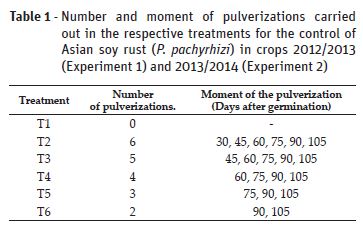
as borders (Michels <i>et al</i>., 2015). The gradient of intensity of the rust
was generated by means of the variation of application of the fungicide along the
calendar (<a href = "#t1">Table 1</a>).</font></p>

    <p>&nbsp;</p>

<a name = "t1"><img src = "/img/revistas/rca/v41n3/v41n3a27t1.jpg" target = "_blank"></a>

    
]]></body>
<body><![CDATA[<p>&nbsp;</p>

    <p><font face = "Verdana" size = "2">The treatments
aimed at obtaining a gradient of disease (Asian soy rust) through different numbers
and times of application of the fungicide. The fungicide used for the gradient of
intensity of Asian soy rust was the commercial mixture of Pyraclostrobin + Epoxyconazol
(66.5 + 25 g i.a. ha<sup>-1</sup>, with a dose of 500 mL.ha<sup>-1</sup> for a volume
of 200 L.ha<sup>-1</sup> with mineral oil as a vehicle, in the dose of 500 mL.ha<sup>-1</sup>.</font></p>

    <p><font face = "Verdana" size = "2">Treatment T2 was established as control parcel
with the intention of being the parcel free of the disease, needed in order to ascertain
the moment in which a difference of NDVI with the other treatments occurs and serving
as the parameter to estimate the best moment for the application of the fungicide.</font></p>


    <p><font face = "Verdana" size = "2">The quantification of severity, defined as the percentage of the foliar area
covered with symptoms of the disease was made through the diagram scale (Godoy <i>et
al</i>., 2006). Evaluations started since the development of the first pustules
and were made weekly until total defoliation. Two areas of 10 m x 10 m, with identical
treatments, named Dest1 (witness) and Dest2 (control), respectively, conducted in
parallel to the experiment, were devoted to destructive tests, unlike Hikishima
<i>et al</i>. (2010), who quantified the severity of the disease in the parcels
where the reflectance data were collected. Using the methodology of Hikishima <i>et
al</i>. (2010), evaluations were carried out in 12 trefoils (4 of the lower third,
4 of the medium third and 4 of the upper third) per parcel.</font></p>

    <p><font face = "Verdana" size = "2">The area under the NDVI progress curve was calculated by
adapting the methodology proposed by Campbell &amp; Madden (1990). This adjustment
was made due to the decision not to carry out the destructive disease severity test
in the areas with the treatments.</font></p>

    <p><font face = "Verdana" size = "2">After
the harvest and threshing of the soy contained in the useful area of the parcels
the total mass (g), the 1.000 grains mass (g) and the humidity (5) of the seeds
were analyzed. Ten plants per parcel were also harvested for separate analysis of
the height of the plant (cm), the number of pods per plant and the number of grains
per pod.</font></p>


    <p><font face = "Verdana" size = "3"><b>RESULTS AND DISCUSSION</b></font></p>

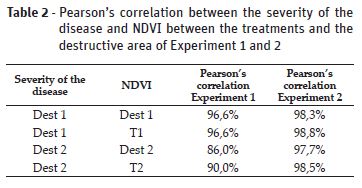
    <p><font face = "Verdana" size = "2">Upon carrying out Pearson’s correlation between the severity
of the disease in the destructive are and the witness treatment (Dest1) and the
average of NDVI obtained in the same area, the values of 96.9% in Experiment 1 and
98.3% in Experiment 2 were observed, and between the average of NDVI in the repetitions
of the witness treatment (T1) the values of 96.9% in Experiment 1 and of 98.8% in
Experiment 2 were observed. By carrying out the correlation between the severity
of the disease in the destructive area with the control treatment (Dest2) and the
average NDVI obtained in the same area, the values of 86% in Experiment 1 and of
97.7% in Experiment 2 were obtained, that is, there is a strong correlation between
the severity of the disease Asian soy rust and NDVI, both in the readings made at
the destructive area itself and in comparison with the treatments (<a href = "#t2">Table 2</a>). Upon
performing linear regression, Hikishima <i>et al</i>. (2010) found R2 between 89%
and 95% between the two parameters, values close to the ones presented in this paper.</font></p>

    <p>&nbsp;</p>

<a name = "t2"><img src = "/img/revistas/rca/v41n3/v41n3a27t2.jpg" target = "_blank"></a>

    
<p>&nbsp;</p>

    ]]></body>
<body><![CDATA[<p><font face = "Verdana" size = "2">Thus, the results of <a href = "#t2">Table 2</a> express strong correlation
between the severity of the disease and NDVI, as well as a correlation between evaluations
in the destructive area and the parcels of the test.</font></p>

    <p><font face = "Verdana" size = "2">The disease showed symptoms in the culture at the end of
the cycle in both experiments, but in the 2012/2013 crop the severity was numerically
greater and occurred earlier. In the 2013/2014 crop there was less progress of the
Asian rust because there was no precipitation in sufficient amounts. The same occurrence
was reported by Koga <i>et al</i>. (2007). The behavior of the evolution of the
severity of the disease between the two destructive areas in Experiment 1 and 2
may be seen in <a href = "/img/revistas/rca/v41n3/v41n3a27f1.jpg" target = "_blank">Figure 1</a>.</font></p>

    
<p><font face = "Verdana" size = "2">Upon making the comparison of the average using the Scott-Knott
test at 5% significance over time with the readings of the radiometer, a statistical
difference was found in the data from 2 March 2013, 78 days after sowing (<a href = "/img/revistas/rca/v41n3/v41n3a27t3.jpg" target = "_blank">Table
3</a>). Treatments T2, T3 and T4 were superior to Treatments T1, T5 and T6 in Experiment
1. Upon performing the T test for the data of severity of the Asian soy rust over
time for the witness treatments (Dest1) and control (Dest2) a statistical difference
is observed (P&lt;0.05) from 2 March 2013 (<a href = "/img/revistas/rca/v41n3/v41n3a27t4.jpg" target = "_blank">Table 4</a>), i.e., on the same date in which
a statistical difference in NDVI was observed.</font></p>

    
<p><font face = "Verdana" size = "2">In Experiment 2,
upon making the average comparison utilizing the Scott-Knott significance test over
time with the readings of the radiometer, differences were observed from 5 February
2014, but these occurred due to spots on the soil. From 20 March 2014, 105 days
after sowing,  there was a statistical difference in NDVI due to the effects of
the disease, treatments T2, T3, T4 and T5 being superior to Treatments T1 and T6
(<a href = "/img/revistas/rca/v41n3/v41n3a27t5.jpg" target = "_blank">Table 5</a>), Upon performing Test T for the severity data of the Asian soy rust over
time for the witness treatments (Dest1) and control (Dest2), a statistical difference
(P&lt;0.05) was observed  from March 17 2013 (<a href = "/img/revistas/rca/v41n3/v41n3a27t4.jpg" target = "_blank">Table 4</a>), that is, three days before
the detection of the statistical difference in NDVI.</font></p>

    
<p><font face = "Verdana" size = "2">Isolating treatments T1 and T2 (witness and control respectively) and applying
Test T with5% significance, statistical difference was found on the same date of
the Scott-Knott test for Experiment 1. In Experiment 2 the difference occurred on
17 March 2014, that is, 102 days after sowing, the same date of the statistical
difference found in Test T of the severity of Asian soy rust. In this way, it is
noted that the disease diminishes the healthy foliar coverage of the culture, influencing
the value of NDVI. Hikishima <i>et al</i>. (2010) observed the same effect in their
study. The behavior of NDVI between the treatments of the experiment can be seen
in <a href = "/img/revistas/rca/v41n3/v41n3a27f2.jpg" target = "_blank">Figure 2</a>.</font></p>

    
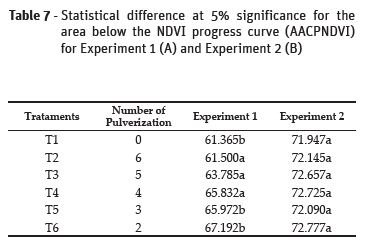
<p><font face = "Verdana" size = "2">By calculating the area below the NDVI progress curve (AACPNDVI)
it is possible to verify that the number of sprays influences NDVI maintenance,
that is, the higher incidence of Asian rust decreases the leaf cover and, consequently,
decreases the NDVI. It can be observed in <a href = "/img/revistas/rca/v41n3/v41n3a27f3.jpg" target = "_blank">Figure 3</a> where the linear progression
points to the tendency of increase of AACPNDVI with the number of sprays in both
Experiment 1 and Experiment 2. In Experiment 2 the progression is less intense due
to the lower incidence of the disease compared to Experiment 1. It can be verified
in <a href = "#t7">Table 7</a> the AACPNDVI mean comparison for treatments, at 5% of significance, and
it is noted that there is no statistical difference in Experiment 2, but in Experiment
1, there is difference between the treatments with the highest number of fungicide
application (T2, T3 and T4) and lower number of fungicide application (T1, T5 and
T6).</font></p>

    
<p>&nbsp;</p>

<a name = "t7"><img src = "/img/revistas/rca/v41n3/v41n3a27t7.jpg" target = "_blank"></a>

    
<p>&nbsp;</p>

    <p><font face = "Verdana" size = "2">Even with numerical variations, there were no statistical differences,
using the Scott-Knott test at 5% of significance, between the treatments, in the
variable height of the plant, number of pods per plant and number of grains per
pod in Experiments 1 and 2 (<a href = "/img/revistas/rca/v41n3/v41n3a27t8.jpg" target = "_blank">Table 8</a>).</font></p>

    
<p><font face = "Verdana" size = "2">For the total mass in kg.ha<sup>-1</sup>, in Experiment 1 there was a statistical
difference between Treatments T1 and T2 when compared to treatments T1, T5 and T6.
The control treatment presented a productivity 45.58% superior to the witness treatment.
In Experiment 2 the control treatment presented practically the same productivity,
that is, a difference of 0.9%. Hikishima <i>et al</i>. (2010) obtained differences
of productivity between the control and witness treatments of 26.2%, 28,5%, 45,2%
e 69,8%.</font></p>

    ]]></body>
<body><![CDATA[<p><font face = "Verdana" size = "2">When analyzing the mass
of 1.000 grains in Experiment 1, utilizing the Scott-Knott test at 5% of significance,
a better yield in treatments T2, T3 and T4 is observed in comparison with treatments
T1, T5 and T6, coinciding with the first difference found in NDVI. The witness treatment
presented a result 21.83% lower when compared with the control treatment.</font></p>


    <p><font face = "Verdana" size = "2">In Experiment 2, however, the best result was
found in treatment T2. Treatments T3, T4, Tt and T6 presented results lower than
T2 and higher than T1, which, since it was the witness treatment, presented the
worst result, that is, 11.72% lower than the result of the control treatment. The
results of statistical differences of the mass of 1.000 grains are not identical
to the statistical differences of NDVI, but present a strong representativeness
trend. The behavior of the data of Experiments 1 and 2, regarding productivity,
may be seen in <a href = "/img/revistas/rca/v41n3/v41n3a27f4.jpg" target = "_blank">Figure 4</a>.</font></p>

    
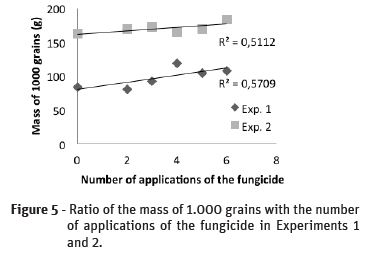
<p><font face = "Verdana" size = "2">The analysis of the mass of 1.000grains by the
number of applications of the fungicide shows a trend to mass in accordance with
the number of applications of the defensive (<a href = "#f5">Figure 5</a>) both for Experiment 1 (R2
= 57.09) and for Experiment 2 (R2 = 51.12).</font></p>

    <p>&nbsp;</p>

<a name = "f5"><img src = "/img/revistas/rca/v41n3/v41n3a27f5.jpg" target = "_blank"></a>

    
<p>&nbsp;</p>

    <p><font face = "Verdana" size = "3"><b>CONCLUSIONS</b></font></p>

    <p><font face = "Verdana" size = "2">One concludes that NDVI is an item to be taken into consideration
for the decision making about the best moment of application of fungicide in the
culture of soy for the control of Asian rust. For a more trustworthy result there
is the need to increase the frequency of NDVI readings or even to develop a static
system with the taking of constant data between the control and witness parcels.</font></p>


    <p><font face = "Verdana" size = "2">The greatest number of fungicide application is
a preventive action for the control of Asian soybean rust and the NDVI presents
regular results for the estimation of productivity for the culture of soy.</font></p>


    <p>&nbsp;</p>


    <p><font face = "Verdana" size = "3"><b>REFERENCES</b></font></p>

    ]]></body>
<body><![CDATA[<!-- ref --><p><font face = "Verdana" size = "2">Ali, A.M.; Thind, H.S.; Sharma, S. &amp; Singh, V. (2014) - Prediction
of dry direct-seeded rice yields using chlorophyll meter, leaf color chart and GreenSeeker
optical sensor in northwestern India. <i>Field Crops Research</i>, vol. 161, p.
11-15. <a href = "https://doi.org/10.1016/j.fcr.2014.03.001" target = "_blank">https://doi.org/10.1016/j.fcr.2014.03.001</a></font>&nbsp;&nbsp;&nbsp;&nbsp;&nbsp;&nbsp;&nbsp;&nbsp;[&#160;<a href="javascript:void(0);" onclick="javascript: window.open('/scielo.php?script=sci_nlinks&ref=688550&pid=S0871-018X201800030002700001&lng=','','width=640,height=500,resizable=yes,scrollbars=1,menubar=yes,');">Links</a>&#160;]<!-- end-ref --><!-- ref --><p><font face = "Verdana" size = "2">Bergamin Filho, A.; Lopes, D.B.; Amorin, L.; Godoy, C.V. &amp; Berger,
R.D. (1995) - Avaliação de danos causados por doenças de plantas. <i>Revisão Anual
de Patologia de Plantas</i>, vol. 3, p. 133-184.    &nbsp;&nbsp;&nbsp;&nbsp;&nbsp;&nbsp;&nbsp;&nbsp;[&#160;<a href="javascript:void(0);" onclick="javascript: window.open('/scielo.php?script=sci_nlinks&ref=688551&pid=S0871-018X201800030002700002&lng=','','width=640,height=500,resizable=yes,scrollbars=1,menubar=yes,');">Links</a>&#160;]<!-- end-ref --></font></p>

    <!-- ref --><p><font face = "Verdana" size = "2">Campbell, C.L. &amp; Madden, L.V. (1990) - <i>Introduction to plant disease
epidemiology</i>. New York NY. John Wiley &amp; Sons.    &nbsp;&nbsp;&nbsp;&nbsp;&nbsp;&nbsp;&nbsp;&nbsp;[&#160;<a href="javascript:void(0);" onclick="javascript: window.open('/scielo.php?script=sci_nlinks&ref=688553&pid=S0871-018X201800030002700003&lng=','','width=640,height=500,resizable=yes,scrollbars=1,menubar=yes,');">Links</a>&#160;]<!-- end-ref --></font></p>

    <!-- ref --><p><font face = "Verdana" size = "2">Carmona, M.; Sautua, F.; Perelman, S.; Gally, M. &amp; Reis,
E.M. (2015) - Development and validation of a fungicide scoring system for management
of late season soybean diseases in Argentina. <i>Crop Protection</i>, vol. 70, p.
83-91. <a href = "https://doi.org/10.1016/j.cropro.2015.01.019" target = "_blank">https://doi.org/10.1016/j.cropro.2015.01.019</a></font>&nbsp;&nbsp;&nbsp;&nbsp;&nbsp;&nbsp;&nbsp;&nbsp;[&#160;<a href="javascript:void(0);" onclick="javascript: window.open('/scielo.php?script=sci_nlinks&ref=688555&pid=S0871-018X201800030002700004&lng=','','width=640,height=500,resizable=yes,scrollbars=1,menubar=yes,');">Links</a>&#160;]<!-- end-ref --><!-- ref --><p><font face = "Verdana" size = "2">Chang, D.; Zhang, J.; Zhu, L.; Ge, S.-H.; Li, P.-Y. &amp; Liu,
G.- S.(2014) - Delineation of management zones using an active canopy sensor for
tobacco field. <i>Computers and Electronics in Agriculture</i>, vol. 109, p. 172-178.
<a href = "https://doi.org/10.1016/j.compag.2014.09.019" target = "_blank">https://doi.org/10.1016/j.compag.2014.09.019</a></font>&nbsp;&nbsp;&nbsp;&nbsp;&nbsp;&nbsp;&nbsp;&nbsp;[&#160;<a href="javascript:void(0);" onclick="javascript: window.open('/scielo.php?script=sci_nlinks&ref=688556&pid=S0871-018X201800030002700005&lng=','','width=640,height=500,resizable=yes,scrollbars=1,menubar=yes,');">Links</a>&#160;]<!-- end-ref --><!-- ref --><p><font face = "Verdana" size = "2">Deb, D.; Engel, B.A.; Harbor, J.; Hahn, L.; Lim, K.J. &amp; Zhai, T. (2010)
- Investigating potential water quality impacts of fungicides used to combat soybean
rust in Indiana. <i>Water, Air, and Soil Pollution</i>, vol. 207, n. 1-4, p. 273-288.
<a href = "https://doi.org/10.1007/s11270-009-0135-4" target = "_blank">https://doi.org/10.1007/s11270-009-0135-4</a></font>&nbsp;&nbsp;&nbsp;&nbsp;&nbsp;&nbsp;&nbsp;&nbsp;[&#160;<a href="javascript:void(0);" onclick="javascript: window.open('/scielo.php?script=sci_nlinks&ref=688557&pid=S0871-018X201800030002700006&lng=','','width=640,height=500,resizable=yes,scrollbars=1,menubar=yes,');">Links</a>&#160;]<!-- end-ref --><!-- ref --><p><font face = "Verdana" size = "2">Dorighello, D.V.; Bettiol, W.; Maia, N.B. &amp; Leite, R.V.B.C. (2015)
- Controlling Asian soybean rust (<i>Phakopsora pachyrhizi</i>) with Bacillus spp.
and coffee oil. <i>Crop Protection</i>, vol. 67, p. 59-65. <a href = "https://doi.org/10.1016/j.cropro.2014.09.017" target = "_blank">https://doi.org/10.1016/j.cropro.2014.09.017</a></font>&nbsp;&nbsp;&nbsp;&nbsp;&nbsp;&nbsp;&nbsp;&nbsp;[&#160;<a href="javascript:void(0);" onclick="javascript: window.open('/scielo.php?script=sci_nlinks&ref=688558&pid=S0871-018X201800030002700007&lng=','','width=640,height=500,resizable=yes,scrollbars=1,menubar=yes,');">Links</a>&#160;]<!-- end-ref --><!-- ref --><p><font face = "Verdana" size = "2">Fioreze, S.L.; Pivetta, L.G.; Fano, A.; Machado,
F.R. &amp; Guimarães, V.F. (2011) - Comportamento de genótipos de soja submetido
a déficit hídrico intenso em casa de vegetação. <i>Revista Ceres</i>, vol. 58, n.
3, p. 342-349. <a href = "http://dx.doi.org/10.1590/S0034-737X2011000300015" target = "_blank">http://dx.doi.org/10.1590/S0034-737X2011000300015</a></font>&nbsp;&nbsp;&nbsp;&nbsp;&nbsp;&nbsp;&nbsp;&nbsp;[&#160;<a href="javascript:void(0);" onclick="javascript: window.open('/scielo.php?script=sci_nlinks&ref=688559&pid=S0871-018X201800030002700008&lng=','','width=640,height=500,resizable=yes,scrollbars=1,menubar=yes,');">Links</a>&#160;]<!-- end-ref --><!-- ref --><p><font face = "Verdana" size = "2">Furtado, G.Q.; Alves, S.A.M.; Carneiro, L.C.; Godoy, C.V.
&amp; Massola Júnior, N.S. (2009) - Influência do estádio fenológico e da idade
dos trifólios de soja na infecção de <i>Phakopsora pachyrhizi</i>. <i>Tropical Plant
Pathology</i>, vol. 34, n. 2, p. 118-122. <a href = "http://dx.doi.org/10.1590/S1982-56762009000200007" target = "_blank">http://dx.doi.org/10.1590/S1982-56762009000200007</a></font>&nbsp;&nbsp;&nbsp;&nbsp;&nbsp;&nbsp;&nbsp;&nbsp;[&#160;<a href="javascript:void(0);" onclick="javascript: window.open('/scielo.php?script=sci_nlinks&ref=688560&pid=S0871-018X201800030002700009&lng=','','width=640,height=500,resizable=yes,scrollbars=1,menubar=yes,');">Links</a>&#160;]<!-- end-ref --><!-- ref --><p><font face = "Verdana" size = "2">Godoy, C.V.; Flausino, A.M.; Santos, L.C.M. &amp;
Del Ponte, E.M. (2009) - Eficiência do controle da ferrugem asiática da soja em
função do momento de aplicação sob condições de epidemia em Londrina, PR. <i>Tropical
Plant Pathology</i>, vol. 34, n. 1, p. 56-61.    &nbsp;&nbsp;&nbsp;&nbsp;&nbsp;&nbsp;&nbsp;&nbsp;[&#160;<a href="javascript:void(0);" onclick="javascript: window.open('/scielo.php?script=sci_nlinks&ref=688561&pid=S0871-018X201800030002700010&lng=','','width=640,height=500,resizable=yes,scrollbars=1,menubar=yes,');">Links</a>&#160;]<!-- end-ref --></font></p>

    <!-- ref --><p><font face = "Verdana" size = "2">Godoy, C.V.; Koga, L.J. &amp; Canteri, M.G. (2006) - Diagrammatic scale
for assessment of soybean rust severity. <i>Fitopatologia Brasileira</i>, vol. 31,
n. 1, p. 63-68. <a href = "http://dx.doi.org/10.1590/S0100-41582006000100011" target = "_blank">http://dx.doi.org/10.1590/S0100-41582006000100011</a></font>&nbsp;&nbsp;&nbsp;&nbsp;&nbsp;&nbsp;&nbsp;&nbsp;[&#160;<a href="javascript:void(0);" onclick="javascript: window.open('/scielo.php?script=sci_nlinks&ref=688563&pid=S0871-018X201800030002700011&lng=','','width=640,height=500,resizable=yes,scrollbars=1,menubar=yes,');">Links</a>&#160;]<!-- end-ref --><!-- ref --><p><font face = "Verdana" size = "2">Gregorutti, V.C.; Caviglia, O.P. &amp; Saluso,
A. (2012) - Defoliation affects soybean yield depending on time and level of light
interception reduction. <i>Australian Journal of Crop Science</i>, vol. 6, n. 7,
p. 1166-1171.    &nbsp;&nbsp;&nbsp;&nbsp;&nbsp;&nbsp;&nbsp;&nbsp;[&#160;<a href="javascript:void(0);" onclick="javascript: window.open('/scielo.php?script=sci_nlinks&ref=688564&pid=S0871-018X201800030002700012&lng=','','width=640,height=500,resizable=yes,scrollbars=1,menubar=yes,');">Links</a>&#160;]<!-- end-ref --></font></p>

    <!-- ref --><p><font face = "Verdana" size = "2">Guan, J. &amp; Nutter
Jr., F.W. (2002) - Relationships between defoliation, dry weight, percentage reflectance,
leaf-to-stem ratio, and green leaf area index in the Alfalfa Leaf Spot Pathosystem.
<i>Crop Science</i>, vol. 42, n. 4, p. 1264-1273. <a href = "https://doi.org/10.2135/cropsci2002.1264" target = "_blank">https://doi.org/10.2135/cropsci2002.1264</a></font>&nbsp;&nbsp;&nbsp;&nbsp;&nbsp;&nbsp;&nbsp;&nbsp;[&#160;<a href="javascript:void(0);" onclick="javascript: window.open('/scielo.php?script=sci_nlinks&ref=688566&pid=S0871-018X201800030002700013&lng=','','width=640,height=500,resizable=yes,scrollbars=1,menubar=yes,');">Links</a>&#160;]<!-- end-ref --><!-- ref --><p><font face = "Verdana" size = "2">Hikishima, M.; Canteri, M.G.; Godoy, C.V.; Koga,
L.J. &amp; Silva, A.J. (2010) - Quantificação de danos e relações entre severidade,
medidas de refletância e produtividade no patossistema ferrugem asiática da soja.
<i>Tropical Plant Pathology</i>, vol. 35, n. 2, p. 96-103. <a href = "http://dx.doi.org/10.1590/S1982-56762010000200004" target = "_blank">http://dx.doi.org/10.1590/S1982-56762010000200004</a></font>&nbsp;&nbsp;&nbsp;&nbsp;&nbsp;&nbsp;&nbsp;&nbsp;[&#160;<a href="javascript:void(0);" onclick="javascript: window.open('/scielo.php?script=sci_nlinks&ref=688567&pid=S0871-018X201800030002700014&lng=','','width=640,height=500,resizable=yes,scrollbars=1,menubar=yes,');">Links</a>&#160;]<!-- end-ref --><!-- ref --><p><font face = "Verdana" size = "2">Koga, L.J.; Canteri, M.G. &amp; Godoy, C.V. (2007)
- Relação entre medidas de refletância e área foliar sadia, severidade da ferrugem
asiática e produtividade da cultura da soja. <i>Semina: Ciências Agrárias</i>, vol.
28, n. 4, p. 571-580.    &nbsp;&nbsp;&nbsp;&nbsp;&nbsp;&nbsp;&nbsp;&nbsp;[&#160;<a href="javascript:void(0);" onclick="javascript: window.open('/scielo.php?script=sci_nlinks&ref=688568&pid=S0871-018X201800030002700015&lng=','','width=640,height=500,resizable=yes,scrollbars=1,menubar=yes,');">Links</a>&#160;]<!-- end-ref --></font></p>

    ]]></body>
<body><![CDATA[<!-- ref --><p><font face = "Verdana" size = "2">Martins, J.A.S.
&amp; Juliatti, F.C. (2014) - Genetic control of partial resistance to Asian soybean
rust. <i>Acta Scientiarum. Agronomy</i>, vol. 36, n. 1, p. 11-17. <a href = "http://dx.doi.org/10.4025/actasciagron.v36i1.16919" target = "_blank">http://dx.doi.org/10.4025/actasciagron.v36i1.16919</a></font>&nbsp;&nbsp;&nbsp;&nbsp;&nbsp;&nbsp;&nbsp;&nbsp;[&#160;<a href="javascript:void(0);" onclick="javascript: window.open('/scielo.php?script=sci_nlinks&ref=688570&pid=S0871-018X201800030002700016&lng=','','width=640,height=500,resizable=yes,scrollbars=1,menubar=yes,');">Links</a>&#160;]<!-- end-ref --><!-- ref --><p><font face = "Verdana" size = "2">Michels, R.N.; Canteri, M.G.; Fonseca, I.C. de
B.; Silva, M.A. de A. &amp; França, J.A. de (2015) - Estimation of optimal size
of plots for experiments with radiometer in beans. <i>African Journal of Biotechnology</i>,
vol. 14, n. 30, p. 2361-2366. <a href = "http://dx.doi.org/10.5897/AJB2014.13984" target = "_blank">http://dx.doi.org/10.5897/AJB2014.13984</a></font>&nbsp;&nbsp;&nbsp;&nbsp;&nbsp;&nbsp;&nbsp;&nbsp;[&#160;<a href="javascript:void(0);" onclick="javascript: window.open('/scielo.php?script=sci_nlinks&ref=688571&pid=S0871-018X201800030002700017&lng=','','width=640,height=500,resizable=yes,scrollbars=1,menubar=yes,');">Links</a>&#160;]<!-- end-ref --><!-- ref --><p><font face = "Verdana" size = "2">Michels, R.N.; Bonafé, E.G.; Figueiredo, L.; Suzuki,
R.M.; Tonin, L.D.; Montanher, P.F. &amp; Aguiar e Silva, M.A. (2016) - Effects of
different numbers of fungicide application on the proximate composition of soybean.
<i>Journal of the Brazilian Chemical Society</i>, vol. 27, n. 10, p. 1727-1735.
<a href = "http://dx.doi.org/10.5935/0103-5053.20160053" target = "_blank">http://dx.doi.org/10.5935/0103-5053.20160053</a></font>&nbsp;&nbsp;&nbsp;&nbsp;&nbsp;&nbsp;&nbsp;&nbsp;[&#160;<a href="javascript:void(0);" onclick="javascript: window.open('/scielo.php?script=sci_nlinks&ref=688572&pid=S0871-018X201800030002700018&lng=','','width=640,height=500,resizable=yes,scrollbars=1,menubar=yes,');">Links</a>&#160;]<!-- end-ref --><!-- ref --><p><font face = "Verdana" size = "2">Thompson, N.M.; Epplin, F.M.; Edwards, J.T. &amp; Hunger, R.M. (2014) -
Economics of foliar fungicides for hard red winter wheat in the USA southern Great
Plains. <i>Crop Protection</i>, vol. 59, p. 1-6. <a href = "https://doi.org/10.1016/j.cropro.2014.01.009" target = "_blank">https://doi.org/10.1016/j.cropro.2014.01.009</a></font>&nbsp;&nbsp;&nbsp;&nbsp;&nbsp;&nbsp;&nbsp;&nbsp;[&#160;<a href="javascript:void(0);" onclick="javascript: window.open('/scielo.php?script=sci_nlinks&ref=688573&pid=S0871-018X201800030002700019&lng=','','width=640,height=500,resizable=yes,scrollbars=1,menubar=yes,');">Links</a>&#160;]<!-- end-ref --><!-- ref --><p><font face = "Verdana" size = "2">Yao, H.; Huang, Y.; Hruska, Z.; Thomson, S.J.
&amp; Reddy, K.N. (2012) - Using vegetation index and modified derivative for early
detection of soybean plant injury from glyphosate. <i>Computers and Electronics
in Agriculture</i>, vol. 89, p. 145-157. <a href = "https://doi.org/10.1016/j.compag.2012.09.001" target = "_blank">https://doi.org/10.1016/j.compag.2012.09.001</a></font>&nbsp;&nbsp;&nbsp;&nbsp;&nbsp;&nbsp;&nbsp;&nbsp;[&#160;<a href="javascript:void(0);" onclick="javascript: window.open('/scielo.php?script=sci_nlinks&ref=688574&pid=S0871-018X201800030002700020&lng=','','width=640,height=500,resizable=yes,scrollbars=1,menubar=yes,');">Links</a>&#160;]<!-- end-ref --><!-- ref --><p><font face = "Verdana" size = "2">Yao, X.; Yao, X.; Jia, W.; Tian, Y.; Ni, J.; Cao,
W. &amp; Zhu, Y. (2013) - Comparison and intercalibration of vegetation indices
from different sensors for monitoring above-ground plant nitrogen uptake in Winter
wheat. <i>Sensor</i>, vol. 1, n. 3, p. 3109-3130. <a href = "https://doi.org/10.3390/s130303109" target = "_blank">https://doi.org/10.3390/s130303109</a></font>&nbsp;&nbsp;&nbsp;&nbsp;&nbsp;&nbsp;&nbsp;&nbsp;[&#160;<a href="javascript:void(0);" onclick="javascript: window.open('/scielo.php?script=sci_nlinks&ref=688575&pid=S0871-018X201800030002700021&lng=','','width=640,height=500,resizable=yes,scrollbars=1,menubar=yes,');">Links</a>&#160;]<!-- end-ref --><p>&nbsp;</p>

    <p><font face = "Verdana" size = "2">Received/recebido: 2017.12.20</font></p>

    <p><font face = "Verdana" size = "2">Received in revised form/recebido em versão revista: 2018.04.17</font></p>

    <p><font face = "Verdana" size = "2">Accepted/aceite: 2018.04.17</font></p>

    ]]></body>
<body><![CDATA[ ]]></body><back>
<ref-list>
<ref id="B1">
<nlm-citation citation-type="journal">
<person-group person-group-type="author">
<name>
<surname><![CDATA[Ali]]></surname>
<given-names><![CDATA[A.M.]]></given-names>
</name>
<name>
<surname><![CDATA[Thind]]></surname>
<given-names><![CDATA[H.S.]]></given-names>
</name>
<name>
<surname><![CDATA[Sharma]]></surname>
<given-names><![CDATA[S.]]></given-names>
</name>
<name>
<surname><![CDATA[Singh]]></surname>
<given-names><![CDATA[V.]]></given-names>
</name>
</person-group>
<article-title xml:lang="en"><![CDATA[Prediction of dry direct-seeded rice yields using chlorophyll meter, leaf color chart and GreenSeeker optical sensor in northwestern India]]></article-title>
<source><![CDATA[Field Crops Research]]></source>
<year>2014</year>
<volume>161</volume>
<page-range>11-15</page-range></nlm-citation>
</ref>
<ref id="B2">
<nlm-citation citation-type="journal">
<person-group person-group-type="author">
<name>
<surname><![CDATA[Bergamin Filho]]></surname>
<given-names><![CDATA[A.]]></given-names>
</name>
<name>
<surname><![CDATA[Lopes]]></surname>
<given-names><![CDATA[D.B.]]></given-names>
</name>
<name>
<surname><![CDATA[Amorin]]></surname>
<given-names><![CDATA[L.]]></given-names>
</name>
<name>
<surname><![CDATA[Godoy]]></surname>
<given-names><![CDATA[C.V.]]></given-names>
</name>
<name>
<surname><![CDATA[Berger]]></surname>
<given-names><![CDATA[R.D.]]></given-names>
</name>
</person-group>
<article-title xml:lang="pt"><![CDATA[Avaliação de danos causados por doenças de plantas]]></article-title>
<source><![CDATA[Revisão Anual de Patologia de Plantas]]></source>
<year>1995</year>
<volume>3</volume>
<page-range>133-184</page-range></nlm-citation>
</ref>
<ref id="B3">
<nlm-citation citation-type="book">
<person-group person-group-type="author">
<name>
<surname><![CDATA[Campbell]]></surname>
<given-names><![CDATA[C.L.]]></given-names>
</name>
<name>
<surname><![CDATA[Madden]]></surname>
<given-names><![CDATA[L.V.]]></given-names>
</name>
</person-group>
<source><![CDATA[Introduction to plant disease epidemiology]]></source>
<year>1990</year>
<publisher-loc><![CDATA[New York^eNY NY]]></publisher-loc>
<publisher-name><![CDATA[John Wiley & Sons]]></publisher-name>
</nlm-citation>
</ref>
<ref id="B4">
<nlm-citation citation-type="journal">
<person-group person-group-type="author">
<name>
<surname><![CDATA[Carmona]]></surname>
<given-names><![CDATA[M.]]></given-names>
</name>
<name>
<surname><![CDATA[Sautua]]></surname>
<given-names><![CDATA[F.]]></given-names>
</name>
<name>
<surname><![CDATA[Perelman]]></surname>
<given-names><![CDATA[S.]]></given-names>
</name>
<name>
<surname><![CDATA[Gally]]></surname>
<given-names><![CDATA[M.]]></given-names>
</name>
<name>
<surname><![CDATA[Reis]]></surname>
<given-names><![CDATA[E.M.]]></given-names>
</name>
</person-group>
<article-title xml:lang="en"><![CDATA[Development and validation of a fungicide scoring system for management of late season soybean diseases in Argentina]]></article-title>
<source><![CDATA[Crop Protection]]></source>
<year>2015</year>
<volume>70</volume>
<page-range>83-91</page-range></nlm-citation>
</ref>
<ref id="B5">
<nlm-citation citation-type="journal">
<person-group person-group-type="author">
<name>
<surname><![CDATA[Chang]]></surname>
<given-names><![CDATA[D.]]></given-names>
</name>
<name>
<surname><![CDATA[Zhang]]></surname>
<given-names><![CDATA[J.]]></given-names>
</name>
<name>
<surname><![CDATA[Zhu]]></surname>
<given-names><![CDATA[L.]]></given-names>
</name>
<name>
<surname><![CDATA[Ge]]></surname>
<given-names><![CDATA[S.-H.]]></given-names>
</name>
<name>
<surname><![CDATA[Li]]></surname>
<given-names><![CDATA[P.-Y.]]></given-names>
</name>
<name>
<surname><![CDATA[Liu]]></surname>
<given-names><![CDATA[G.- S.]]></given-names>
</name>
</person-group>
<article-title xml:lang="en"><![CDATA[Delineation of management zones using an active canopy sensor for tobacco field]]></article-title>
<source><![CDATA[Computers and Electronics in Agriculture]]></source>
<year>2014</year>
<volume>109</volume>
<page-range>172-178</page-range></nlm-citation>
</ref>
<ref id="B6">
<nlm-citation citation-type="journal">
<person-group person-group-type="author">
<name>
<surname><![CDATA[Deb]]></surname>
<given-names><![CDATA[D.]]></given-names>
</name>
<name>
<surname><![CDATA[Engel]]></surname>
<given-names><![CDATA[B.A.]]></given-names>
</name>
<name>
<surname><![CDATA[Harbor]]></surname>
<given-names><![CDATA[J.]]></given-names>
</name>
<name>
<surname><![CDATA[Hahn]]></surname>
<given-names><![CDATA[L.]]></given-names>
</name>
<name>
<surname><![CDATA[Lim]]></surname>
<given-names><![CDATA[K.J.]]></given-names>
</name>
<name>
<surname><![CDATA[Zhai]]></surname>
<given-names><![CDATA[T.]]></given-names>
</name>
</person-group>
<article-title xml:lang="en"><![CDATA[Investigating potential water quality impacts of fungicides used to combat soybean rust in Indiana]]></article-title>
<source><![CDATA[Water, Air, and Soil Pollution]]></source>
<year>2010</year>
<volume>207</volume>
<numero>1-4</numero>
<issue>1-4</issue>
<page-range>273-288</page-range></nlm-citation>
</ref>
<ref id="B7">
<nlm-citation citation-type="journal">
<person-group person-group-type="author">
<name>
<surname><![CDATA[Dorighello]]></surname>
<given-names><![CDATA[D.V.]]></given-names>
</name>
<name>
<surname><![CDATA[Bettiol]]></surname>
<given-names><![CDATA[W.]]></given-names>
</name>
<name>
<surname><![CDATA[Maia]]></surname>
<given-names><![CDATA[N.B.]]></given-names>
</name>
<name>
<surname><![CDATA[Leite]]></surname>
<given-names><![CDATA[R.V.B.C.]]></given-names>
</name>
</person-group>
<article-title xml:lang="en"><![CDATA[Controlling Asian soybean rust (Phakopsora pachyrhizi) with Bacillus spp. and coffee oil]]></article-title>
<source><![CDATA[Crop Protection]]></source>
<year>2015</year>
<volume>67</volume>
<page-range>59-65</page-range></nlm-citation>
</ref>
<ref id="B8">
<nlm-citation citation-type="journal">
<person-group person-group-type="author">
<name>
<surname><![CDATA[Fioreze]]></surname>
<given-names><![CDATA[S.L.]]></given-names>
</name>
<name>
<surname><![CDATA[Pivetta]]></surname>
<given-names><![CDATA[L.G.]]></given-names>
</name>
<name>
<surname><![CDATA[Fano]]></surname>
<given-names><![CDATA[A.]]></given-names>
</name>
<name>
<surname><![CDATA[Machado]]></surname>
<given-names><![CDATA[F.R.]]></given-names>
</name>
<name>
<surname><![CDATA[Guimarães]]></surname>
<given-names><![CDATA[V.F.]]></given-names>
</name>
</person-group>
<article-title xml:lang="pt"><![CDATA[Comportamento de genótipos de soja submetido a déficit hídrico intenso em casa de vegetação]]></article-title>
<source><![CDATA[Revista Ceres]]></source>
<year>2011</year>
<volume>58</volume>
<numero>3</numero>
<issue>3</issue>
<page-range>342-349</page-range></nlm-citation>
</ref>
<ref id="B9">
<nlm-citation citation-type="journal">
<person-group person-group-type="author">
<name>
<surname><![CDATA[Furtado]]></surname>
<given-names><![CDATA[G.Q.]]></given-names>
</name>
<name>
<surname><![CDATA[Alves]]></surname>
<given-names><![CDATA[S.A.M.]]></given-names>
</name>
<name>
<surname><![CDATA[Carneiro]]></surname>
<given-names><![CDATA[L.C.]]></given-names>
</name>
<name>
<surname><![CDATA[Godoy]]></surname>
<given-names><![CDATA[C.V.]]></given-names>
</name>
<name>
<surname><![CDATA[Massola Júnior]]></surname>
<given-names><![CDATA[N.S.]]></given-names>
</name>
</person-group>
<article-title xml:lang="pt"><![CDATA[Influência do estádio fenológico e da idade dos trifólios de soja na infecção de Phakopsora pachyrhizi]]></article-title>
<source><![CDATA[Tropical Plant Pathology]]></source>
<year>2009</year>
<volume>34</volume>
<numero>2</numero>
<issue>2</issue>
<page-range>118-122</page-range></nlm-citation>
</ref>
<ref id="B10">
<nlm-citation citation-type="journal">
<person-group person-group-type="author">
<name>
<surname><![CDATA[Godoy]]></surname>
<given-names><![CDATA[C.V.]]></given-names>
</name>
<name>
<surname><![CDATA[Flausino]]></surname>
<given-names><![CDATA[A.M.]]></given-names>
</name>
<name>
<surname><![CDATA[Santos]]></surname>
<given-names><![CDATA[L.C.M.]]></given-names>
</name>
<name>
<surname><![CDATA[Del Ponte]]></surname>
<given-names><![CDATA[E.M.]]></given-names>
</name>
</person-group>
<article-title xml:lang="pt"><![CDATA[Eficiência do controle da ferrugem asiática da soja em função do momento de aplicação sob condições de epidemia em Londrina, PR]]></article-title>
<source><![CDATA[Tropical Plant Pathology]]></source>
<year>2009</year>
<volume>34</volume>
<numero>1</numero>
<issue>1</issue>
<page-range>56-61</page-range></nlm-citation>
</ref>
<ref id="B11">
<nlm-citation citation-type="journal">
<person-group person-group-type="author">
<name>
<surname><![CDATA[Godoy]]></surname>
<given-names><![CDATA[C.V.]]></given-names>
</name>
<name>
<surname><![CDATA[Koga]]></surname>
<given-names><![CDATA[L.J.]]></given-names>
</name>
<name>
<surname><![CDATA[Canteri]]></surname>
<given-names><![CDATA[M.G.]]></given-names>
</name>
</person-group>
<article-title xml:lang="en"><![CDATA[Diagrammatic scale for assessment of soybean rust severity]]></article-title>
<source><![CDATA[Fitopatologia Brasileira]]></source>
<year>2006</year>
<volume>31</volume>
<numero>1</numero>
<issue>1</issue>
<page-range>63-68</page-range></nlm-citation>
</ref>
<ref id="B12">
<nlm-citation citation-type="journal">
<person-group person-group-type="author">
<name>
<surname><![CDATA[Gregorutti]]></surname>
<given-names><![CDATA[V.C.]]></given-names>
</name>
<name>
<surname><![CDATA[Caviglia]]></surname>
<given-names><![CDATA[O.P.]]></given-names>
</name>
<name>
<surname><![CDATA[Saluso]]></surname>
<given-names><![CDATA[A.]]></given-names>
</name>
</person-group>
<article-title xml:lang="en"><![CDATA[Defoliation affects soybean yield depending on time and level of light interception reduction]]></article-title>
<source><![CDATA[Australian Journal of Crop Science]]></source>
<year>2012</year>
<volume>6</volume>
<numero>7</numero>
<issue>7</issue>
<page-range>1166-1171</page-range></nlm-citation>
</ref>
<ref id="B13">
<nlm-citation citation-type="journal">
<person-group person-group-type="author">
<name>
<surname><![CDATA[Guan]]></surname>
<given-names><![CDATA[J.]]></given-names>
</name>
<name>
<surname><![CDATA[Nutter Jr.]]></surname>
<given-names><![CDATA[F.W.]]></given-names>
</name>
</person-group>
<article-title xml:lang="en"><![CDATA[Relationships between defoliation, dry weight, percentage reflectance, leaf-to-stem ratio, and green leaf area index in the Alfalfa Leaf Spot Pathosystem]]></article-title>
<source><![CDATA[Crop Science]]></source>
<year>2002</year>
<volume>42</volume>
<numero>4</numero>
<issue>4</issue>
<page-range>1264-1273</page-range></nlm-citation>
</ref>
<ref id="B14">
<nlm-citation citation-type="journal">
<person-group person-group-type="author">
<name>
<surname><![CDATA[Hikishima]]></surname>
<given-names><![CDATA[M.]]></given-names>
</name>
<name>
<surname><![CDATA[Canteri]]></surname>
<given-names><![CDATA[M.G.]]></given-names>
</name>
<name>
<surname><![CDATA[Godoy]]></surname>
<given-names><![CDATA[C.V.]]></given-names>
</name>
<name>
<surname><![CDATA[Koga]]></surname>
<given-names><![CDATA[L.J.]]></given-names>
</name>
<name>
<surname><![CDATA[Silva]]></surname>
<given-names><![CDATA[A.J.]]></given-names>
</name>
</person-group>
<article-title xml:lang="pt"><![CDATA[Quantificação de danos e relações entre severidade, medidas de refletância e produtividade no patossistema ferrugem asiática da soja]]></article-title>
<source><![CDATA[Tropical Plant Pathology]]></source>
<year>2010</year>
<volume>35</volume>
<numero>2</numero>
<issue>2</issue>
<page-range>96-103</page-range></nlm-citation>
</ref>
<ref id="B15">
<nlm-citation citation-type="journal">
<person-group person-group-type="author">
<name>
<surname><![CDATA[Koga]]></surname>
<given-names><![CDATA[L.J.]]></given-names>
</name>
<name>
<surname><![CDATA[Canteri]]></surname>
<given-names><![CDATA[M.G.]]></given-names>
</name>
<name>
<surname><![CDATA[Godoy]]></surname>
<given-names><![CDATA[C.V.]]></given-names>
</name>
</person-group>
<article-title xml:lang="pt"><![CDATA[Relação entre medidas de refletância e área foliar sadia, severidade da ferrugem asiática e produtividade da cultura da soja]]></article-title>
<source><![CDATA[Semina]]></source>
<year>2007</year>
<volume>28</volume>
<numero>4</numero>
<issue>4</issue>
<page-range>571-580</page-range></nlm-citation>
</ref>
<ref id="B16">
<nlm-citation citation-type="journal">
<person-group person-group-type="author">
<name>
<surname><![CDATA[Martins]]></surname>
<given-names><![CDATA[J.A.S.]]></given-names>
</name>
<name>
<surname><![CDATA[Juliatti]]></surname>
<given-names><![CDATA[F.C.]]></given-names>
</name>
</person-group>
<article-title xml:lang="en"><![CDATA[Genetic control of partial resistance to Asian soybean rust]]></article-title>
<source><![CDATA[Acta Scientiarum]]></source>
<year>2014</year>
<volume>36</volume>
<numero>1</numero>
<issue>1</issue>
<page-range>11-17</page-range></nlm-citation>
</ref>
<ref id="B17">
<nlm-citation citation-type="journal">
<person-group person-group-type="author">
<name>
<surname><![CDATA[Michels]]></surname>
<given-names><![CDATA[R.N.]]></given-names>
</name>
<name>
<surname><![CDATA[Canteri]]></surname>
<given-names><![CDATA[M.G.]]></given-names>
</name>
<name>
<surname><![CDATA[Fonseca]]></surname>
<given-names><![CDATA[I.C. de B.]]></given-names>
</name>
<name>
<surname><![CDATA[Silva]]></surname>
<given-names><![CDATA[M.A. de A.]]></given-names>
</name>
<name>
<surname><![CDATA[França]]></surname>
<given-names><![CDATA[J.A. de]]></given-names>
</name>
</person-group>
<article-title xml:lang="en"><![CDATA[Estimation of optimal size of plots for experiments with radiometer in beans]]></article-title>
<source><![CDATA[African Journal of Biotechnology]]></source>
<year>2015</year>
<volume>14</volume>
<numero>30</numero>
<issue>30</issue>
<page-range>2361-2366</page-range></nlm-citation>
</ref>
<ref id="B18">
<nlm-citation citation-type="journal">
<person-group person-group-type="author">
<name>
<surname><![CDATA[Michels]]></surname>
<given-names><![CDATA[R.N.]]></given-names>
</name>
<name>
<surname><![CDATA[Bonafé]]></surname>
<given-names><![CDATA[E.G.]]></given-names>
</name>
<name>
<surname><![CDATA[Figueiredo]]></surname>
<given-names><![CDATA[L.]]></given-names>
</name>
<name>
<surname><![CDATA[Suzuki]]></surname>
<given-names><![CDATA[R.M.]]></given-names>
</name>
<name>
<surname><![CDATA[Tonin]]></surname>
<given-names><![CDATA[L.D.]]></given-names>
</name>
<name>
<surname><![CDATA[Montanher]]></surname>
<given-names><![CDATA[P.F.]]></given-names>
</name>
<name>
<surname><![CDATA[Aguiar e Silva]]></surname>
<given-names><![CDATA[M.A.]]></given-names>
</name>
</person-group>
<article-title xml:lang="en"><![CDATA[Effects of different numbers of fungicide application on the proximate composition of soybean]]></article-title>
<source><![CDATA[Journal of the Brazilian Chemical Society]]></source>
<year>2016</year>
<volume>27</volume>
<numero>10</numero>
<issue>10</issue>
<page-range>1727-1735</page-range></nlm-citation>
</ref>
<ref id="B19">
<nlm-citation citation-type="journal">
<person-group person-group-type="author">
<name>
<surname><![CDATA[Thompson]]></surname>
<given-names><![CDATA[N.M.]]></given-names>
</name>
<name>
<surname><![CDATA[Epplin]]></surname>
<given-names><![CDATA[F.M.]]></given-names>
</name>
<name>
<surname><![CDATA[Edwards]]></surname>
<given-names><![CDATA[J.T.]]></given-names>
</name>
<name>
<surname><![CDATA[Hunger]]></surname>
<given-names><![CDATA[R.M.]]></given-names>
</name>
</person-group>
<article-title xml:lang="en"><![CDATA[Economics of foliar fungicides for hard red winter wheat in the USA southern Great Plains]]></article-title>
<source><![CDATA[Crop Protection]]></source>
<year>2014</year>
<volume>59</volume>
<page-range>1-6</page-range></nlm-citation>
</ref>
<ref id="B20">
<nlm-citation citation-type="journal">
<person-group person-group-type="author">
<name>
<surname><![CDATA[Yao]]></surname>
<given-names><![CDATA[H.]]></given-names>
</name>
<name>
<surname><![CDATA[Huang]]></surname>
<given-names><![CDATA[Y.]]></given-names>
</name>
<name>
<surname><![CDATA[Hruska]]></surname>
<given-names><![CDATA[Z.]]></given-names>
</name>
<name>
<surname><![CDATA[Thomson]]></surname>
<given-names><![CDATA[S.J.]]></given-names>
</name>
<name>
<surname><![CDATA[Reddy]]></surname>
<given-names><![CDATA[K.N.]]></given-names>
</name>
</person-group>
<article-title xml:lang="en"><![CDATA[Using vegetation index and modified derivative for early detection of soybean plant injury from glyphosate]]></article-title>
<source><![CDATA[Computers and Electronics in Agriculture]]></source>
<year>2012</year>
<volume>89</volume>
<page-range>145-157</page-range></nlm-citation>
</ref>
<ref id="B21">
<nlm-citation citation-type="journal">
<person-group person-group-type="author">
<name>
<surname><![CDATA[Yao]]></surname>
<given-names><![CDATA[X.]]></given-names>
</name>
<name>
<surname><![CDATA[Yao]]></surname>
<given-names><![CDATA[X.]]></given-names>
</name>
<name>
<surname><![CDATA[Jia]]></surname>
<given-names><![CDATA[W.]]></given-names>
</name>
<name>
<surname><![CDATA[Tian]]></surname>
<given-names><![CDATA[Y.]]></given-names>
</name>
<name>
<surname><![CDATA[Ni]]></surname>
<given-names><![CDATA[J.]]></given-names>
</name>
<name>
<surname><![CDATA[Cao]]></surname>
<given-names><![CDATA[W.]]></given-names>
</name>
<name>
<surname><![CDATA[Zhu]]></surname>
<given-names><![CDATA[Y.]]></given-names>
</name>
</person-group>
<article-title xml:lang="en"><![CDATA[Comparison and intercalibration of vegetation indices from different sensors for monitoring above-ground plant nitrogen uptake in Winter wheat]]></article-title>
<source><![CDATA[Sensor]]></source>
<year>2013</year>
<volume>1</volume>
<numero>3</numero>
<issue>3</issue>
<page-range>3109-3130</page-range></nlm-citation>
</ref>
</ref-list>
</back>
</article>