<?xml version="1.0" encoding="ISO-8859-1"?><article xmlns:mml="http://www.w3.org/1998/Math/MathML" xmlns:xlink="http://www.w3.org/1999/xlink" xmlns:xsi="http://www.w3.org/2001/XMLSchema-instance">
<front>
<journal-meta>
<journal-id>0871-018X</journal-id>
<journal-title><![CDATA[Revista de Ciências Agrárias]]></journal-title>
<abbrev-journal-title><![CDATA[Rev. de Ciências Agrárias]]></abbrev-journal-title>
<issn>0871-018X</issn>
<publisher>
<publisher-name><![CDATA[Sociedade de Ciências Agrárias de Portugal]]></publisher-name>
</publisher>
</journal-meta>
<article-meta>
<article-id>S0871-018X2018000400013</article-id>
<article-id pub-id-type="doi">10.19084/RCA16135</article-id>
<title-group>
<article-title xml:lang="en"><![CDATA[Potassium nitrate priming mitigates salt stress on wheat seedlings]]></article-title>
<article-title xml:lang="pt"><![CDATA[Nitrato de potássio ameniza o estresse salino em plântulas de trigo]]></article-title>
</title-group>
<contrib-group>
<contrib contrib-type="author">
<name>
<surname><![CDATA[Steiner]]></surname>
<given-names><![CDATA[Fábio]]></given-names>
</name>
<xref ref-type="aff" rid="A1"/>
</contrib>
<contrib contrib-type="author">
<name>
<surname><![CDATA[Zuffo]]></surname>
<given-names><![CDATA[Alan M.]]></given-names>
</name>
<xref ref-type="aff" rid="A1"/>
</contrib>
<contrib contrib-type="author">
<name>
<surname><![CDATA[Oliveira]]></surname>
<given-names><![CDATA[Carlos E. da Silva]]></given-names>
</name>
<xref ref-type="aff" rid="A1"/>
</contrib>
<contrib contrib-type="author">
<name>
<surname><![CDATA[Honda]]></surname>
<given-names><![CDATA[Guilherme B.]]></given-names>
</name>
<xref ref-type="aff" rid="A2"/>
</contrib>
<contrib contrib-type="author">
<name>
<surname><![CDATA[Machado]]></surname>
<given-names><![CDATA[Juan S.]]></given-names>
</name>
<xref ref-type="aff" rid="A2"/>
</contrib>
</contrib-group>
<aff id="AA1">
<institution><![CDATA[,Universidade Estadual de Mato Grosso do Sul Dpto. de Produção Vegetal Unidade Universitário de Cassilândia]]></institution>
<addr-line><![CDATA[Cassilândia MS]]></addr-line>
<country>Brasil</country>
</aff>
<aff id="AA2">
<institution><![CDATA[,Faculdades Integradas de Ourinhos Dpto. de Agronomia ]]></institution>
<addr-line><![CDATA[Ourinhos SP]]></addr-line>
<country>Brasil</country>
</aff>
<pub-date pub-type="pub">
<day>00</day>
<month>12</month>
<year>2018</year>
</pub-date>
<pub-date pub-type="epub">
<day>00</day>
<month>12</month>
<year>2018</year>
</pub-date>
<volume>41</volume>
<numero>4</numero>
<fpage>121</fpage>
<lpage>130</lpage>
<copyright-statement/>
<copyright-year/>
<self-uri xlink:href="http://scielo.pt/scielo.php?script=sci_arttext&amp;pid=S0871-018X2018000400013&amp;lng=en&amp;nrm=iso"></self-uri><self-uri xlink:href="http://scielo.pt/scielo.php?script=sci_abstract&amp;pid=S0871-018X2018000400013&amp;lng=en&amp;nrm=iso"></self-uri><self-uri xlink:href="http://scielo.pt/scielo.php?script=sci_pdf&amp;pid=S0871-018X2018000400013&amp;lng=en&amp;nrm=iso"></self-uri><abstract abstract-type="short" xml:lang="en"><p><![CDATA[Seeds of wheat (Triticum aestivum L., cv. Jadeíde 11) were used to investigate the effects of potassium nitrate priming on germination and early seedling growth under salt stress. It was hypothesized that priming with potassium nitrate may improve seed germination and plant establishment by mitigating the negative effects of saline stress through its role in cell osmotic balance. The seeds were soaked in distilled water or in a 10 g L-1 KNO3 solution at 25 °C for 2 hours, and after drying, were distributed in plastic boxes with blotter paper containing different salt solutions prepared with concentrations of 0 (control), 25, 50, 75 and 100 mmol L-1 NaCl. The plastic boxes were kept in a seed germinator, at 22 °C for 12 days. A completely randomized design in a 2 × 5 factorial scheme with four replications of 50 seeds each was used. The primed seeds with KNO3 showed improved germination performance, early growth and vigor index of wheat seedlings in salt stress conditions. Low salt concentrations may induce osmotic adjustment activity in the wheat plants and lead to increases in shoot and root length of wheat seedlings, whereas higher concentrations cause severe inhibition of plant growth. The &#8246;Jadeíde 11&#8243; wheat cultivar is a moderately tolerant genotype to salt stress during the seedling establishment stage by presenting yield stability index greater than 0.74 until the level of 100 mmol L-1 of NaCl, and therefore can be recommended for cropping in soils with high salinity levels.]]></p></abstract>
<abstract abstract-type="short" xml:lang="pt"><p><![CDATA[Sementes de trigo (Triticum aestivum L., cv. Jadeíde 11) foram utilizados para investigar os efeitos do condicionamento osmótico com nitrato de potássio na germinação e no crescimento inicial das plântulas sob estresse salino. Supõe-se que o condicionamento com nitrato de potássio pode melhorar a germinação das sementes e o estabelecimento das plantas por amenizar os efeitos negativos do estresse salino através do seu papel no equilíbrio osmótico das células. As sementes foram embebidas em água destilada ou em solução contendo 10 g L-1 de KNO3 à 25 °C durante 2 horas e, após secagem, foram distribuídas em caixas plásticas com papel mata-borrão contendo diferentes soluções salinas preparadas com concentrações de 0 (controle), 25, 50, 75 e 100 mmol L-1 de NaCl. As caixas plásticas com as sementes foram mantidas em germinador, à 22 °C durante 12 dias. Foi utilizado o delineamento experimental inteiramente casualizado, em esquema fatorial 2 x 5, com quatro repetições de 50 sementes. Sementes de trigo condicionadas com nitrato de potássio possuem maior taxa de germinação, crescimento inicial e índice de vigor de plântulas quando submetidas em condições de estresse salino. Níveis baixos de salinidade podem induzir o ajustamento osmótico nas plântulas de trigo e resultar em maior comprimento da parte aérea e das raízes, enquanto que altos níveis de salinidade causam severa inibição do crescimento das plantas. O cultivar de trigo "Jadeíde 11" é um genótipo moderadamente tolerante ao estresse salino durante a fase de estabelecimento das plântulas, apresentando índice de estabilidade de rendimento superior a 0,74 até o nível de 100 mmol L-1 de NaCl e, portanto, pode ser recomendado para o cultivo em áreas com altos níveis de salinidade do solo.]]></p></abstract>
<kwd-group>
<kwd lng="en"><![CDATA[Triticum aestivum]]></kwd>
<kwd lng="en"><![CDATA[salinity]]></kwd>
<kwd lng="en"><![CDATA[osmotic potential]]></kwd>
<kwd lng="en"><![CDATA[NaCl]]></kwd>
<kwd lng="en"><![CDATA[KNO3]]></kwd>
<kwd lng="en"><![CDATA[seed treatment]]></kwd>
<kwd lng="pt"><![CDATA[Triticum aestivum]]></kwd>
<kwd lng="pt"><![CDATA[salinidade]]></kwd>
<kwd lng="pt"><![CDATA[potencial osmótico]]></kwd>
<kwd lng="pt"><![CDATA[NaCl]]></kwd>
<kwd lng="pt"><![CDATA[KNO3]]></kwd>
<kwd lng="pt"><![CDATA[tratamento de semente]]></kwd>
</kwd-group>
</article-meta>
</front><body><![CDATA[ 

    <p align = "right"><font face = "Verdana" size = "2"><b>ARTIGO</b></font></p>

    <p><font face = "Verdana" size = "4"><b>Potassium
nitrate priming mitigates salt stress on wheat seedlings</b></font></p>


    <p><font face = "Verdana" size = "3"><b>Nitrato de potássio ameniza o estresse salino em plântulas de trigo</b></font></p>

    <p><font face = "Verdana" size = "2"><b>Fábio Steiner</b><sup>1*</sup>, <b>Alan M. Zuffo</b><sup>1</sup>, <b>Carlos E. da Silva Oliveira</b><sup>1</sup>,
<b>Guilherme B. Honda</b><sup>2</sup> and <b>Juan S. Machado</b><sup>2</sup></font></p>


    <p><font face = "Verdana" size = "2"><i><sup>1</sup> Universidade Estadual de Mato Grosso do Sul, Dpto. de Produção Vegetal,
Unidade Universitário de Cassilândia, MS 306, km 6,4, CEP: 79540-000, Cassilândia,
MS, Brasil</i></font></p>

    <p><font face = "Verdana" size = "2"><i><sup>2</sup> Faculdades
Integradas de Ourinhos, Dpto. de Agronomia, Rodovia BR 153, km 338,42 – CEP 19.909-100,
Ourinhos, SP, Brasil</i></font></p>

    <p><font face = "Verdana" size = "2"><i>(* E-mail: <a href = "mailto:steiner@uems.br">steiner@uems.br</a>)</i></font></p>


<hr noshade size = 1>

    <p><font face = "Verdana" size = "3"><b>ABSTRACT</b></font></p>

    <p><font face = "Verdana" size = "2">Seeds of wheat (<i>Triticum aestivum</i> L., cv. Jadeíde 11) were
used to investigate the effects of potassium nitrate priming on germination and
early seedling growth under salt stress. It was hypothesized that priming with potassium
nitrate may improve seed germination and plant establishment by mitigating the negative
effects of saline stress through its role in cell osmotic balance. The seeds were
soaked in distilled water or in a 10 g L<sup>–1</sup> KNO<sub>3</sub> solution at
25 °C for 2 hours, and after drying, were distributed in plastic boxes with blotter
paper containing different salt solutions prepared with concentrations of 0 (control),
25, 50, 75 and 100 mmol L<sup>–1</sup> NaCl. The plastic boxes were kept in a seed
germinator, at 22 °C for 12 days. A completely randomized design in a 2 × 5 factorial
scheme with four replications of 50 seeds each was used. The primed seeds with KNO<sub>3</sub>
showed improved germination performance, early growth and vigor index of wheat seedlings
in salt stress conditions. Low salt concentrations may induce osmotic adjustment
activity in the wheat plants and lead to increases in shoot and root length of wheat
seedlings, whereas higher concentrations cause severe inhibition of plant growth.
The &#8246;Jadeíde 11&#8243; wheat cultivar is a moderately tolerant genotype to
salt stress during the seedling establishment stage by presenting yield stability
index greater than 0.74 until the level of 100 mmol L<sup>–1</sup> of NaCl, and
therefore can be recommended for cropping in soils with high salinity levels.</font></p>


    ]]></body>
<body><![CDATA[<p><font face = "Verdana" size = "2"><b>Keywords:</b> <i>Triticum aestivum</i>, salinity, osmotic potential, NaCl,
KNO<sub>3</sub>, seed treatment.</font></p>

<hr noshade size = 1>

    <p><font face = "Verdana" size = "3"><b>RESUMO</b></font></p>

    <p><font face = "Verdana" size = "2">Sementes de trigo (<i>Triticum aestivum</i> L., cv. Jadeíde 11) foram utilizados
para investigar os efeitos do condicionamento osmótico com nitrato de potássio na
germinação e no crescimento inicial das plântulas sob estresse salino. Supõe-se
que o condicionamento com nitrato de potássio pode melhorar a germinação das sementes
e o estabelecimento das plantas por amenizar os efeitos negativos do estresse salino
através do seu papel no equilíbrio osmótico das células. As sementes foram embebidas
em água destilada ou em solução contendo 10 g L<sup>–1</sup> de KNO<sub>3</sub>
à 25 °C durante 2 horas e, após secagem, foram distribuídas em caixas plásticas
com papel mata-borrão contendo diferentes soluções salinas preparadas com concentrações
de 0 (controle), 25, 50, 75 e 100 mmol L<sup>–1</sup> de NaCl. As caixas plásticas
com as sementes foram mantidas em germinador, à 22 °C durante 12 dias. Foi utilizado
o delineamento experimental inteiramente casualizado, em esquema fatorial 2 x 5,
com quatro repetições de 50 sementes. Sementes de trigo condicionadas com nitrato
de potássio possuem maior taxa de germinação, crescimento inicial e índice de vigor
de plântulas quando submetidas em condições de estresse salino. Níveis baixos de
salinidade podem induzir o ajustamento osmótico nas plântulas de trigo e resultar
em maior comprimento da parte aérea e das raízes, enquanto que altos níveis de salinidade
causam severa inibição do crescimento das plantas. O cultivar de trigo &quot;Jadeíde
11&quot; é um genótipo moderadamente tolerante ao estresse salino durante a fase
de estabelecimento das plântulas, apresentando índice de estabilidade de rendimento
superior a 0,74 até o nível de 100 mmol L<sup>-1</sup> de NaCl e, portanto, pode
ser recomendado para o cultivo em áreas com altos níveis de salinidade do solo.</font></p>


    <p><font face = "Verdana" size = "2"><b>Palavras-chave: </b><i>Triticum aestivum</i>, salinidade, potencial osmótico,
NaCl, KNO<sub>3</sub>, tratamento de semente.</font></p>

<hr noshade size = 1>

    <p><font face = "Verdana" size = "3"><b>INTRODUCTION</b></font></p>


    <p><font face = "Verdana" size = "2">The sustainability of agriculture production in
many areas of the world including North and South America, Asia, Europe and Australia
is at risk due to soil salinization (Chaves <i>et al</i>., 2006). Salinity caused
by excessive salts in the soil solution or in irrigation water is one of the major
environmental stresses that limit plant growth and crop yield in arid, semiarid
and other areas of the world. One-third of the world’s cultivated land, 7% of the
total world land and 50% of the irrigated land is affected by salinity (Zhu, 2001).
Salt-affected soil may be grouped into four categories based on the electrical conductivity
of the extract (ECe) from the water saturated soil, i.e., slightly saline (ECe 2
to 4 dS m<sup>–1</sup>), moderately saline (ECe 4 to 8 dS m<sup>–1</sup>), highly
saline (ECe 8 to 16 dS m<sup>–1</sup>) and extremely saline (ECe &gt; 16 dS m<sup>–1</sup>)
(Richards <i>et al</i>., 1954). Conventionally, however, saline soils are defined
as those having an ECe value &#8805; 4 dS m<sup>–1</sup> or <i>40 </i>mmol L<sup>–1</sup>
NaCl (Richards <i>et al</i>., 1954)<i>.</i></font></p>

    <p><font face = "Verdana" size = "2">Excessive salt concentrations in the soil solution may adversely affect
plant growth either through osmotic inhibition of water uptake by plant roots or
specific ion effects (Parida and Das, 2005). Salinity reduces cell turgor and depresses
rates of root and leaf elongation (Memon <i>et al</i>., 2010), suggesting that environmental
impact of excess salt acts primarily on water uptake. Specific ion effects may cause
mineral nutrition disorders due to competitive absorption of ions or direct toxicity
(Feijão <i>et al</i>., 2011). Nutritional imbalance caused by salinity is mainly
due to the reduction in the uptake and assimilation of essential elements to the
plants (Parida and Das, 2005; Munns and Tester, 2008; Feijão <i>et al</i>., 2011).</font></p>


    <p><font face = "Verdana" size = "2">Salinity affects plant growth at all developmental
stages; however, sensitivity varies from one growth stage to another. Seed germination
is one of the most fundamental and vital phases in the growth cycle of plants that
determine plant establishment and grain yield of crops. Delayed and reduced seedling
emergence cause non-uniform stand establishment, which result in yield reductions
(Lawles <i>et al</i>., 2012). Therefore, a greater salt stress tolerance could improve
the plant establishment and grain yield stability of wheat in saline soils.</font></p>


    <p><font face = "Verdana" size = "2">Among the strategies used to mitigate the salt
stress-induced adverse effects the pretreatment of seeds with salts or plant growth
regulators are cited as the most appropriate, efficient and economic techniques
to improve seed germination in saline soils (Mohammadi, 2009; Kaya <i>et al</i>.,
2013; Oliveira and Steiner, 2017). Indeed, seed-priming treatments using salts such
as potassium nitrate (KNO<sub>3</sub>) have been shown to have beneficial effects
on germination, growth and yield of a wide range of plant species under improper
conditions (Anosheh <i>et al</i>., 2010; Ahmadvand <i>et al</i>., 2012; Fuller <i>et
al</i>., 2012; Zanotti <i>et al</i>., 2013). Kaya <i>et al</i>. (2006) indicated
that priming of sunflower seeds with KNO<sub>3</sub> led to increasing of germination
percentage in drought and salinity stresses. Mohammadi (2009) found that among the
priming treatments, primed soybean seeds with KNO<sub>3</sub> showed the highest
values for all traits when compared to unprimed seeds. This author reported increase
on the germination percentage, germination rate and seedling dry matter from 28.3%,
129.4% and 58.1%, respectively.</font></p>

    <p><font face = "Verdana" size = "2">The
exogenous application of KNO<sub>3</sub> can stimulate seed germination at abiotic
stress conditions due to the production of substances that release nitric oxide
(NO) (Kaiser <i>et al</i>., 2016; Parankusam <i>et al.</i>, 2017). These substances
act in membrane permeability, preventing or reversing the damage caused by environmental
stresses (Pereira <i>et al</i>., 2010). Therefore, as the process of saline and
water stress involves changes in osmotic potential and tension on the cell membrane,
it is possible that substances NO-liberating improves the germination process under
salt stress (Kaiser <i>et al</i>., 2016). Nitric oxide is a molecule that acts as
a signaler in higher plants and studies on their functions in the physiological
processes of plants indicate that NO is involved in the regulation of plant growth
and development, defense against pathogen and responses to abiotic stress (Sanz
<i>et al</i>., 2015). However, the effectiveness of pretreatment of wheat seeds
with KNO<sub>3</sub> in improving germination rate and initial growth of the plants
under salinity conditions are still incipient and inconclusive (Fuller <i>et al</i>.,
2012).</font></p>

    ]]></body>
<body><![CDATA[<p><font face = "Verdana" size = "2">This research was carried
out to investigate the possibility of reducing the negative effects of salt stress
on seed germination and early growth of wheat (<i>Triticum aestivum</i> L.) by seed
priming with potassium nitrate.</font></p>


    <p><font face = "Verdana" size = "3"><b>MATERIAL AND METHODS</b></font></p>

    <p><font face = "Verdana" size = "2"><i>Plant material and treatments</i></font></p>

    <p><font face = "Verdana" size = "2">Seeds of wheat (<i>Triticum aestivum</i> L., cv. Jadeíde
11) were sterilized with sodium hypochlorite solution (1%, v/v) for 5 minutes and
washed immediately with distilled water many times. The sterilized seeds were then
subjected to priming by direct immersion in distilled water (control) or in a 10
g L<sup>–1</sup> KNO<sub>3</sub> solution for 2 hours at 25 °C. After priming period,
seeds were put to dry in plastic boxes (11.0 × 11.0 × 3.5 cm, type Gerbox) with
blotter paper at room temperature (24–28 °C) for 48 hours, and then subjected to
five levels of salinity [0 (control), 25, 50, 75 and 100 mmol L<sup>–1</sup> of
NaCl]. Treatments were arranged in a completely randomized design in a 2 × 5 factorial:
two priming techniques (0 or 10 g L<sup>–1</sup> of KNO<sub>3</sub>) and five salinity
levels, with four replications.</font></p>


    <p><font face = "Verdana" size = "2"><i>Germination and growth conditions</i></font></p>


    <p><font face = "Verdana" size = "2">Four replicates of 50 seeds were evenly distributed
in plastic boxes with blotter paper, properly moistened with the salt solution of
each treatment, in a volume equivalent to 2.5 times the weight of dry paper. The
boxes were then closed with lids to prevent evaporation and maintain the relative
humidity close to 100%. Germination was carried out in a germination chamber under
12/12 h photoperiod (light/darkness), light fluence of 80 &#956;mol m<sup>&#8722;2</sup>
s<sup>&#8722;1</sup> photosynthetic photon flux density (PPFD) and temperature of
22 °C for 12 days. Seeds were considered germinated when radicle were longer than
5.0 mm. Germinated seeds were recorded every 24 h for 12 days.</font></p>


    <p><font face = "Verdana" size = "2"><i>Measurements of germination and seedling growth</i></font></p>

    <p><font face = "Verdana" size = "2">The germination (G), germination rate index (GRI), mean germination time (MGT)
of wheat seeds were measured. The equations 1–3 and the parameters therein were
employed to calculate the parameters of seed germination.</font></p>

    <p><font face = "Verdana" size = "2">G (%) = <i>S</i><sub>NG</sub> / <i>S</i><sub>N0</sub> × 100                                             [Eq. 1]</font></p>

    <p><font face = "Verdana" size = "2">where G is germination, <i>S</i><sub>NG</sub> is the number of
germinated seeds, and <i>S</i><sub>N0</sub> is the number of experimental seeds
with viability (50 seeds).</font></p>

    ]]></body>
<body><![CDATA[<p><font face = "Verdana" size = "2">GRI = &#931; (<i>n</i><sub>i</sub> / <i>t</i><sub>i</sub>)                                              [Eq. 2]</font></p>

    <p><font face = "Verdana" size = "2">where GRI is the germination
rate index (seed day<sup>–1</sup>), <i>n</i><sub>i</sub> is the number of germinated
seeds on a given day, and <i>t</i><sub>i</sub> is the time in days from the starting/sowing
day (0) (Maguire, 1962).</font></p>

    <p><font face = "Verdana" size = "2">MGT = (&#931;<i>n</i><sub>i</sub><i>t</i><sub>i</sub>) / &#931;<i>n</i><sub>i</sub>                                        [Eq. 3]</font></p>

    <p><font face = "Verdana" size = "2">where MGT is the mean germination
time (day), <i>n</i><sub>i</sub> is the number of germinated seeds on a given day,
and <i>t</i><sub>i</sub> is the time in days from the starting/sowing day (0) (Labouriau,
1983).</font></p>

    <p><font face = "Verdana" size = "2">The shoot and radicle length
was measured in 20 normal seedlings randomly obtained after count of the total germination
(12<sup>th</sup> day) using meter scale. The results were expressed in centimeter
(cm). For the determination of dry matter production of shoot and roots, all seedlings
obtained at the end of the germination test (12 days) were separated into shoots
and roots, dried in a forced air circulation oven for three days at 65 ºC, and then
weighed. The results were expressed in mg seedling<sup>–1</sup>. To determine the
root: shoot ratio (RSR), root dry matter obtained was divided by the shoot dry matter.</font></p>


    <p><font face = "Verdana" size = "2">After measuring of seedling, length and dry matter
traits, the seedling vigor index and salt tolerance index, were calculated using
the by following equations:</font></p>

    <p><font face = "Verdana" size = "2">SVI = <i>S</i><sub>L</sub> × &#931; (<i>n</i><sub>i</sub> / <i>t</i><sub>i</sub>)                                       [Eq. 4]</font></p>

    <p><font face = "Verdana" size = "2">where SVI is seedling vigor
index, <i>S</i><sub>L</sub> is the shoot length in the twelfth day (cm), <i>n</i><sub>i</sub>
is the number of germinated seeds on a given day, and <i>t</i><sub>i</sub> is the
time in days from the starting/sowing day (0) (Zhang <i>et al</i>., 2007).</font></p>


    <p><font face = "Verdana" size = "2">YSI = <i>Y</i><sub>S</sub> / <i>Y</i><sub>C</sub>                                                          [Eq. 5]</font></p>

    <p><font face = "Verdana" size = "2">where YSI is the yield stability
index, <i>Y</i><sub>S</sub> and <i>Y</i><sub>C</sub> are the total dry matter yield
(mg per seedling) under saline stress and non-stress conditions (NaCl-free treatment),
respectively (Bouslama and Schapaugh, 1984).</font></p>


    ]]></body>
<body><![CDATA[<p><font face = "Verdana" size = "2"><i>Statistical analyses</i></font></p>


    <p><font face = "Verdana" size = "2">The normality of data was previously tested by
the Kolmogorov-Smirnov test and then submitted to analysis of variance (ANOVA),
and means of priming treatments were compared by Fisher's Least Significant Difference
(LSD) test at the 0.05 level of confidence. For the salinity levels were used polynomial
regression analysis and significant equations with the higher coefficient of determination
(F test; <i>P</i> &#8804; 0.05) were adjusted. For statistical analysis, the data
expressed in percentage were previously transformed into arc sin. All analyses were performed
using Sisvar version 5.6 software for Windows (Statistical Analysis Software, UFLA,
Lavras, MG, BRA) (Ferreira, 2011).</font></p>


    <p><font face = "Verdana" size = "3"><b>RESULTS AND DISCUSSION</b></font></p>


    <p><font face = "Verdana" size = "2">A summary of the analysis of variance for the
measurements of germination, vigor index and seedling growth inhibition of wheat
is shown in <a href = "/img/revistas/rca/v41n4/v41n4a13t1.jpg" target = "_blank">Table 1</a>. The results of the analysis of variance showed significant
effects (P&lt;0.05) for the main effects of seed priming with potassium nitrate
and salinity levels, as well as for interaction, for many of the traits measured
(<a href = "/img/revistas/rca/v41n4/v41n4a13t1.jpg" target = "_blank">Table 1</a>). The significant interaction between the main effects of potassium nitrate
priming and salt stress for most of the evaluated characteristics indicates germination
and growth of wheat seedlings from seeds subjected to priming of potassium nitrate
have different response with regard to the salinity level compared primed seeds
with water (control).</font></p>

    
<p><font face = "Verdana" size = "2"><i>Effect of potassium nitrate priming and salt
stress on seed germination </i></font></p>

    <p><font face = "Verdana" size = "2">The
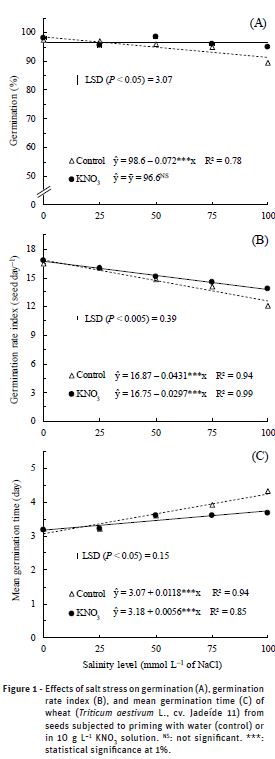
germination percentage of wheat seeds (<a href = "#f1">Figure 1A</a>) was higher than the standard values
(i.e., 80%) for the commercialization of wheat seeds in Brazil (MAPA, 2013), indicating
that the seeds used in this study were of high physiological quality.</font></p>

    <p>&nbsp;</p>

<a name = "f1"><img src = "/img/revistas/rca/v41n4/v41n4a13f1.jpg" target = "_blank"></a>

    
<p>&nbsp;</p>

    <p><font face = "Verdana" size = "2">The germination response
of seeds submitted to water priming (control) was significantly affected by salt
stress induced by NaCl solutions (<a href = "#f1">Figure 1A</a>). The inhibiting action of saline stress
on wheat germination was increased with the rise of salinity levels, and the exposure
of seeds to 100 mmol L<sup>–1</sup> NaCl reduced the mean germination by 7.30 percentage
points (from 98.6% to 91.4%) compared to the NaCl-free treatment. However, when
the seeds were submitted to KNO<sub>3</sub> priming, the germination percentage
was not significantly affected by saline stress induced by NaCl solutions (<a href = "#f1">Figure
1A</a>). Additionally, when the seeds were exposed to high levels of salinity, KNO<sub>3</sub>
priming also resulted in higher germination rate index (<a href = "#f1">Figure 1B</a>) and lower mean
germination time (<a href = "#f1">Figure 1C</a>) compared to water priming. These results show that
priming of wheat seeds with KNO<sub>3</sub> can have significant improvements in
the process of germination under saline conditions. Similarly, Fuller <i>et al</i>.
(2012) concluded that the use of priming techniques can enhance the germination
of wheat seed under saline conditions and under conditions of mild salt stress priming
can entirely overcome the effect salt. These findings agree with Kubala <i>et al</i>.
(2015) who found that seeds primed with an osmotic solution may improve germination
performance through metabolic activation involving the synthesis of proteins, nucleic
acids, and enzymes, and increasing water uptake, respiratory activity and reserve
mobilization. Therefore, in field conditions where the soil is affected by high
salinity levels, the use of seeds primed with KNO<sub>3</sub> could make the difference
between successful field germination and establishment or substantial crop failure.</font></p>

    <p><font face = "Verdana" size = "2">Under salt stress conditions the
KNO<sub>3</sub> priming can improve seed germination due to the production of substances
that release nitric oxide (NO) (Kaiser <i>et al</i>., 2016). According to Pereira
<i>et al</i>. (2010), these substances NO-liberating act in membrane permeability,
preventing or reversing the damage caused by osmotic stresses. Nitric oxide is a
molecule that acts as a signaler in higher plants and it is involved in the regulation
of plant growth and development, defense against pathogen and responses to abiotic
stress (Sanz <i>et al</i>., 2015).</font></p>

    ]]></body>
<body><![CDATA[<p><font face = "Verdana" size = "2">The high germination percentage values of wheat seeds (&gt;91%) under conditions
of high salt levels indicate that this crop is a moderately tolerant species to
saline stress during the phase of seed germination, confirming the results reported
by Maas and Hoffman (1977). In oat seeds, Brunes <i>et al</i>. (2013) found that
salinity levels above 50 mmol L<sup>–1</sup> NaCl completely inhibited the germination
of seeds, indicating that the two oat cultivars used are susceptible to salt stress.
Germination represents a fundamental stage of plant's life highly responsive to
environmental conditions. Therefore, greater tolerance of crops to high salt levels
could improve the stability of crop yield under saline conditions. According to
Brunes <i>et al</i>. (2013), the salt stress can completely inhibit seed germination
at higher levels or induces a state of dormancy at low levels, as well as reduce
imbibition of water because of lowered osmotic potentials of the medium and causes
changes in metabolic activity. Salt stress affects seed germination through osmotic
effects, ion toxicity or a combination of the two effects (Parida and Das, 2005;
Munns and Tester, 2008; Feijão <i>et al</i>., 2011).</font></p>

    <p><font face = "Verdana" size = "2">The germination rate index (GRI) was reduced linearly with increasing
salt levels up to 100 mmol L<sup>–1</sup> NaCl in both priming treatments (water
or KNO<sub>3</sub>), however, this reduction was more pronounced in seeds subjected
to water priming (<a href = "#f1">Figure 1B</a>). At 100 mmol L<sup>–1</sup> NaCl the germination rate
index was 12.56 seed day<sup>–1</sup> in seeds primed with water (control), and
was significantly greater (13.78 seed day<sup>–1</sup>) when seeds were primed with
KNO<sub>3</sub>. The decrease in GRI was due to lower capacity of water uptake by
the seeds with highly negative osmotic potential. The lower germination rate and
growth inhibition due to salinity are caused by low external water potential, ion
imbalance and specific ion toxicity (Munns and Tester, 2008; Feijão <i>et al</i>.,
2011). Under these conditions, there is a decrease in water uptake and an excessive
uptake of ions (Akram <i>et al</i>., 2010). Osmotic stress affects the starch synthesis
reactions and energy production process (adenosine triphosphate – ATP) through respiration,
resulting in reduced of germination percentage (<a href = "#f1">Figure 1A</a>), germination rate index
(<a href = "#f1">Figure 1B</a>) and thus in delay of germination (<a href = "#f1">Figure 1C</a>).</font></p>

    <p><font face = "Verdana" size = "2">The mean germination time (MGT) was delayed with the rise
of salinity levels (<a href = "#f1">Figure 1C</a>). At 100 mmol L<sup>–1</sup> the MGT was delayed 1.18
days in the primed seeds with water (control), against 0.56 days in the KNO<sub>3</sub>
priming compared to the NaCl-free treatment. A delay in the mean time to germination
may be disadvantageous for successful establishment, since the delayed germination
leaving the seeds more vulnerable to attack from predators (pests and pathogens)
and, therefore, compromise the establishment of a uniform stand.</font></p>

    <p><font face = "Verdana" size = "2">The delay of germination was due to salinity affect the
water uptake of the seeds, which is the first step to occur germination process
(i.e., imbibition). According to Marcos-Filho (2005), it is necessary that the seeds
reach an adequate level of hydration during the imbibition phase, to occur reactivation
of seed metabolic processes and growth of embryonic axis. Seeds subjected to osmotic
stress require more time to adjust the internal osmotic potential in accordance
with the external environment (Parida and Das, 2005; Munns and Tester, 2008). Meneses
<i>et al</i>. (2011) reported that highly negative osmotic potential may affect
the seeds water uptake, making germination not possible. Additionally, the osmotic
potential of the external medium can affect the enzymatic reactions in the seed,
therefore, the delay in germination is due to delay of enzymatic reactions (Marcos-Filho,
2005), caused by the break of the imbibition period. This inference agrees with
other observations in wheat, where salinity has been shown to negatively affect
the rate of starch remobilization by causing a decrease in &#945;-amylase activity
(Almansouri <i>et al</i>., 2001). The most common responses of plants to reduction
of osmotic potential are a delay in initial germination and a reduction in the rate
and total germination (Oliveira and Gomes-Filho 2009; Gordin <i>et al</i>., 2015).
The result of these changes is an unevenness in the germination process and stand
establishment.</font></p>


    <p><font face = "Verdana" size = "2"><i>Effect of potassium nitrate priming and salt stress on seedling growth</i></font></p>

    <p><font face = "Verdana" size = "2">The
early growth of wheat was greater in low salinity conditions; however, with increasing
salt stress level the growth of shoots and roots of wheat were severely inhibited
(<a href = "/img/revistas/rca/v41n4/v41n4a13f2.jpg" target = "_blank">Figure 2</a>). When the seeds were primed with KNO<sub>3</sub>, the shoot length increased
from 14.7 cm in the NaCl-free treatment to maximum of 15.8 cm with the level of
30.8 mmol L<sup>–1</sup> NaCl (<a href = "/img/revistas/rca/v41n4/v41n4a13f2.jpg" target = "_blank">Figure 2A</a>). In turn, the largest values of the radicle
length were obtained at the 11.8 mmol L<sup>–1</sup> NaCl level (<a href = "/img/revistas/rca/v41n4/v41n4a13f2.jpg" target = "_blank">Figure 2B</a>). When
the seeds were primed with water, the largest values of the shoot and radicle length
were obtained at the levels of 7.8 and 11.8 mmol L<sup>–1</sup> of NaCl, respectively
(<a href = "/img/revistas/rca/v41n4/v41n4a13f2.jpg" target = "_blank">Figure 2A and 2B</a>).</font></p>

    
<p><font face = "Verdana" size = "2">These results confirm the findings of Dantas <i>et
al</i>. (2005) with their study on cowpea, [<i>Vigna unguiculata</i> L.], Memon
<i>et al</i>. (2010) with their study on pak choi seedlings [<i>Brassica campestris</i>
L.], and finally by Qados (2011) in their study on fava bean [<i>Vicia faba</i>
L.] where they indicated that the use of low sodium chloride concentrations led
to increases in plants lengths, whereas higher concentrations caused inhibition.
In general, may be inferred that, the elongation of the stem when treated with low
concentrations of salts may induce osmotic adjustment activity in the plants which
may improve growth. On the other hand, excessive salt concentrations reduce the
solution water potential, causing toxic effects and injuries and disorders in the
metabolism of plants (Munns and Tester, 2008). Under high salinity an irreversible
impairment of the photosynthetic apparatus, associated with a reduction of ribulose-1,5-bisphosphate
carboxylase/oxygenase (Rubisco) activity, occurs when the stress is prolonged, and
salt continues to accumulate in the leaves (Zhu, 2001). On the other hand, the noticed
decrease in the length of the stem, also due to treatment with NaCl solution, could
be due to the negative effect of this salt on the changes in enzyme activity (that
subsequently affects protein synthesis), and also the decrease in the level of carbohydrates
and growth hormones, both of which can lead to inhibition of the growth (Mazher
<i>et al</i>., 2007).</font></p>

    <p><font face = "Verdana" size = "2">The accumulation
of shoot dry matter of wheat was reduced linearly with increasing salinity levels
up to 100 mmol L<sup>–1</sup> NaCl in both priming treatments (water or KNO<sub>3</sub>),
however, this reduction was more pronounced in seeds subjected to water priming
(control) (<a href = "/img/revistas/rca/v41n4/v41n4a13f2.jpg" target = "_blank">Figure 2C</a>). At 100 mmol L<sup>–1</sup> NaCl the shoot dry matter was
5.94 mg seedling<sup>–1</sup> in seeds primed with water (control), and was significantly
greater (8.41 mg seedling<sup>–1</sup>) when seeds were submitted to KNO<sub>3</sub>
priming. These results indicate that the KNO<sub>3</sub> priming improved the initial
growth of wheat shoots, and confirm the findings of Mohammadi (2009) with their
study soybean [<i>Glycine max </i>(L.) Merrill.], who verified that the KNO<sub>3</sub>
priming led to increase of 58.1% in dry matter of seedlings. The exogenous application
of KNO<sub>3</sub> can produce substances that release NO, and this molecule acts
as a signaler in higher plants that this involved in the regulation of plant growth
and development, defense against pathogen and responses to abiotic stress (Sanz
<i>et al</i>., 2015).</font></p>

    
<p><font face = "Verdana" size = "2">The lower
accumulation of shoot dry matter due to salinity was caused by low external water
potential, ion imbalance and specific ion toxicity (Feijão <i>et al</i>., 2011).
One of the initial effects of salt stress on plant is the reduction of growth rate
and dry matter accumulation. Oliveira <i>et al</i>. (2016) reported that salinity
decreases the growth and dry matter accumulation of potato plants, and the salt
level of 100 mmol L<sup>–1</sup> decreased the shoot dry matter at around of 75%.
In soybean plants, Dolatabadian <i>et al</i>. (2011) reported that salinity stress
significantly decreased shoot and root dry matter, plant height and leaf number
per plant.</font></p>

    <p><font face = "Verdana" size = "2">Radicle length of wheat
seedlings from the seeds subjected to KNO<sub>3</sub> priming decreased progressively
with rise of salinity levels (<a href = "/img/revistas/rca/v41n4/v41n4a13f2.jpg" target = "_blank">Figure 2B</a>). The exposure of wheat seedlings to 100
mmol L<sup>–1</sup> NaCl reduced the radicle length in 68% (from 17.9 to 5.7 cm)
compared to the NaCl-free treatment, whereas accumulation of root dry matter was
not significantly affected by salinity (<a href = "/img/revistas/rca/v41n4/v41n4a13f2.jpg" target = "_blank">Figure 2D</a>). These results indicate that
increasing the salt concentrations in the solution resulted in thicker roots. An
early plant response to excess salts is the inhibition of expansion growth in leaves
and roots. Furthermore, the salt stress is known to induce changes in root diameter.
Increased root diameters under salinity have been found in a range of plant types,
such as barley (<i>Hordeum</i> spp.), cotton (<i>Gossypium hirsutum</i>), ‘Volkameriano’
lemmon (<i>Citrus volkameriana</i>), and lozina green (<i>Tessaria absinthioides</i>)
(Huang and Redmann, 1995, Reinhardt and Rost, 1995; Degano, 1999; Rewald <i>et al</i>.,
2012). The increased root diameter might be caused by succulence of the cortex.
Succulence is an anatomical adaptation, which, by increasing the volume of vacuoles,
permits the accumulation of larger amounts of water and dissolved ions in leaves,
shoots and roots (Munns and Tester, 2008). Under the same NaCl level, the root succulence
of two species of oleaster (<i>Elaeagnus moorcroftii</i> and <i>E. oxycarpa</i>)
was found to be even slightly higher than leaf succulence (Wang <i>et al</i>., 2010).
Indeed, increased root succulence has been shown to be a mechanism of adaptation
and tolerance of plants to saline conditions (Degano, 1999). Besides increasing
storage capacities, thicker roots are favorable to overcome increased soil strength,
as prevails in some saline soils, and might have reduced maintenance respiration
and turnover rates, resulting in reduced carbon costs below ground (Rewald <i>et
al</i>., 2012).</font></p>

    
]]></body>
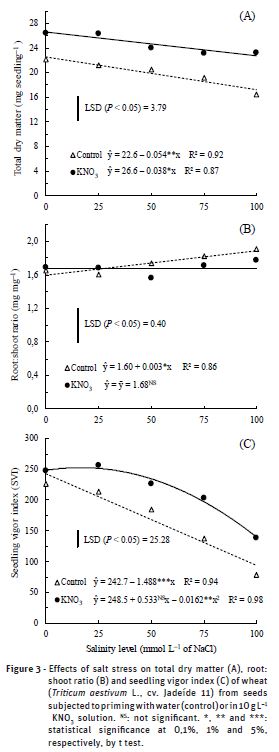
<body><![CDATA[<p><font face = "Verdana" size = "2">The total dry matter
of wheat seedlings was significantly affected by salt stress induced by NaCl solutions
(<a href = "#f3">Figure 3A</a>). The inhibiting action of salt stress on plant growth was increased
with the rise of salinity levels, and the exposure of seeds to 100 mmol L<sup>–1</sup>
NaCl reduced the accumulation of total dry matter in 24% and 14% compared to the
NaCl-free treatment, respectively, for the seeds primed with water or KNO<sub>3</sub>.</font></p>

    <p>&nbsp;</p>

<a name = "f3"><img src = "/img/revistas/rca/v41n4/v41n4a13f3.jpg" target = "_blank"></a>

    
<p>&nbsp;</p>

    <p><font face = "Verdana" size = "2">Root: shoot ratio is one of several ratios, which give estimates
of dry matter partitioning into root and shoot of plants, and it is a good indicator
for abiotic stress effects on root and shoot dry matter (Boutraa <i>et al</i>.,
2010). The results showed that the root:shoot ratio of wheat seedlings from the
seeds primed with water was increased with the rise of salinity levels (<a href = "#f3">Figure 3B</a>).
The exposure of seedlings to 100 mmol L<sup>–1</sup> NaCl increased the root:shoot
ratio in 1.9% (from 1.60 to 1.63 mg mg<sup>–1</sup>) compared to the NaCl-free treatment.
This suggests that shoot growth was affected more than the root system under salt
stress. Such increase in root:shoot ratio indicates that the proportion of dry matter
allocated to shoots was decreased compared to the roots. Studies have shown that
shoot is more likely to be affected by saline stress than other traits, as reported
by Wang <i>et al</i>. (2015) for cucumber plants. Assimilate partitioning is a complicated
process that can be controlled simultaneously by sources and sinks. In general,
plants exposed to high salt levels often partition photosynthate occurs preferentially
to the roots, thereby maintaining a balance between processes required in roots
(e.g.; water and nutrient uptake) and those required in shoots (e.g., photosynthesis).
In turn, when the seeds were submitted to KNO<sub>3</sub> priming, the root:shoot
ratio was not significantly affected by saline stress induced by NaCl solutions
(<a href = "#f3">Figure 3B</a>). These results indicate that the KNO<sub>3 </sub>priming improves the
dry matter partitioning into root and shoot of wheat seedlings.</font></p>

    <p><font face = "Verdana" size = "2">The vigor index of wheat seedlings was drastically reduced
with the rise of salinity levels (<a href = "#f3">Figure 3C</a>). When the seeds were primed with KNO<sub>3</sub>,
the largest values of the seedling vigor index were obtained at the 16 mmol L<sup>–1</sup>
NaCl level, whereas higher concentrations caused reduction in the seedling vigor
index. In turn, when the seeds were primed with water, the vigor index decreased
linearly with increasing salinity levels up to 100 mmol L<sup>–1</sup> NaCl (<a href = "#f3">Figure
3C</a>). The seedling vigor index has been used as a tolerance index to evaluate the
effect of salt stress on seedling growth (Ashkan and Jalal, 2013). Seedling vigor
is a measure of the extent of damage that accumulates as viability declines, and
the damage accumulates in seeds until the seeds are unable to germinate and eventually
die (Marcos-Filho, 2005). The lower seedling vigor index obtained with increased
salinity level was due to the salt stress inhibit the initial growth of plants,
especially of the shoots. The reduction in vigor index of seedlings under water
restriction conditions is commonly reported by other research (Zhang <i>et al</i>.,
2007; Ashkan and Jalal, 2013; Singh <i>et al</i>., 2015; Liu <i>et al</i>., 2015).</font></p>

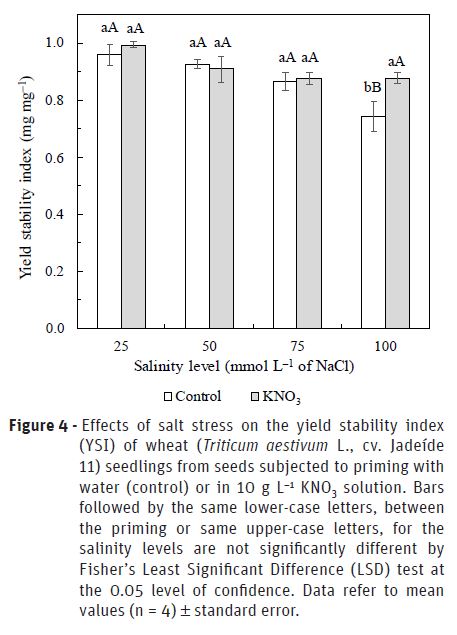
    <p><font face = "Verdana" size = "2">The yield stability index of wheat
seedlings ranged from 0.96 to 0.74 and 0.99 to 0.88 for the seeds submitted to priming
with water or KNO<sub>3</sub>, respectively (<a href = "#f4">Figure 4</a>). The yield stability index
was suggested by Bouslama and Schapaugh (1984) to evaluation the stability of crops
or genotypes in the both stress and non-stress conditions and has been considered
a good salt tolerance index. When the yield stability index in response to addition
of 25, 50, 75 and 100 mmol L<sup>–1</sup> NaCl is greater than 0.95; 0.85; 0.65
and 0.50, respectively, the plant species is classified as moderately tolerant to
salt stress (Mass, 1986). Therefore, results presented here suggest that wheat cultivar
used in this study is a moderately tolerant genotype to the negative effects of
high salt levels during the stage of seed germination and seedling establishment,
confirming the results reported by Maas and Hoffman (1977). These authors pointed
out that, in the field, where the salinity rises to 100 mmol L<sup>&#8722;1</sup>
NaCl (about 10 dS m<sup>&#8722;1</sup>), rice (<i>Oryza sativa</i>) will die before
maturity, while wheat will produce a reduced yield. Singh <i>et al</i>. (2015) found
that the salinity significantly reduced the yield of some wheat genotypes while
some were found tolerant to stress indicating sufficient genetic variability for
salinity tolerance. Therefore, the growing of a wheat cultivar with greater tolerance
to high salt levels could improve the stability of crop grain yield under saline
conditions.</font></p>

    <p>&nbsp;</p>

<a name = "f4"><img src = "/img/revistas/rca/v41n4/v41n4a13f4.jpg" target = "_blank"></a>

    
<p>&nbsp;</p>

    <p><font face = "Verdana" size = "3"><b>CONCLUSIONS</b></font></p>

    <p><font face = "Verdana" size = "2">Wheat seeds
primed with potassium nitrate showed improved germination performance, early growth
and vigor index of wheat seedlings in salt stress conditions, indicating that the
deleterious effects of salinity can be reversed with the potassium nitrate priming.</font></p>


    ]]></body>
<body><![CDATA[<p><font face = "Verdana" size = "2">Low salt concentrations may induce osmotic adjustment
activity in the wheat plants and lead to increases in shoot and root length of wheat
seedlings, whereas higher concentrations cause severe inhibition of plant growth.</font></p>


    <p><font face = "Verdana" size = "2">The &#8246;Jadeíde 11&#8243; wheat cultivar is
a moderately tolerant genotype to salt stress during the seedling establishment
stage by presenting yield stability index greater than 0.74 until the level of 100
mmol L<sup>–1</sup> of NaCl.</font></p>

    <p>&nbsp;</p>

    <p><font face = "Verdana" size = "3"><b>References</b></font></p>

    <!-- ref --><p><font face = "Verdana" size = "2">Ahmadvand, G.; Soleimani, F.; Saadatian, B. and Pouya, M. (2012)
- Effect of seed priming with potassium nitrate on germination and emergence traits
of two soybean cultivars under salinity stress conditions.<i>American-Eurasian
Journal of Agricultural &amp; Environmental Science</i>, vol. 12, n. 6, p. 769-774.    &nbsp;&nbsp;&nbsp;&nbsp;&nbsp;&nbsp;&nbsp;&nbsp;[&#160;<a href="javascript:void(0);" onclick="javascript: window.open('/scielo.php?script=sci_nlinks&ref=690891&pid=S0871-018X201800040001300001&lng=','','width=640,height=500,resizable=yes,scrollbars=1,menubar=yes,');">Links</a>&#160;]<!-- end-ref --></font></p>


    <!-- ref --><p><font face = "Verdana" size = "2">Akram, M.; Ashraf, M.Y.; Ahmad, R.; Waraich, E.A.;
Iqbal, J. and Mohsan, M. (2010) - Screening for salt tolerance in maize (<i>Zea
mays</i> L.) hybrids at an early seedling stage.<i>Pakistan Journal of Botany,</i>
vol. 42, n. 1, p. 141-154.    &nbsp;&nbsp;&nbsp;&nbsp;&nbsp;&nbsp;&nbsp;&nbsp;[&#160;<a href="javascript:void(0);" onclick="javascript: window.open('/scielo.php?script=sci_nlinks&ref=690893&pid=S0871-018X201800040001300002&lng=','','width=640,height=500,resizable=yes,scrollbars=1,menubar=yes,');">Links</a>&#160;]<!-- end-ref --></font></p>

    <!-- ref --><p><font face = "Verdana" size = "2">Almansouri,
M.; Kinet, J.M. and Lutts, S. (2001) - Effect of salt and osmotic stresses on germination
in durum wheat (<i>Triticum durum</i> Desf.).<i>Plant and Soil</i>, vol. 231, n.
2, p. 243-254. <a href = "https://doi.org/10.1023/A:1010378409663" target = "_blank">https://doi.org/10.1023/A:1010378409663</a></font>&nbsp;&nbsp;&nbsp;&nbsp;&nbsp;&nbsp;&nbsp;&nbsp;[&#160;<a href="javascript:void(0);" onclick="javascript: window.open('/scielo.php?script=sci_nlinks&ref=690895&pid=S0871-018X201800040001300003&lng=','','width=640,height=500,resizable=yes,scrollbars=1,menubar=yes,');">Links</a>&#160;]<!-- end-ref --><!-- ref --><p><font face = "Verdana" size = "2">Anosheh, H.P.; Sadeghi, H. and Emam, Y (2011) - Chemical priming
with urea and KNO<sub>3</sub> enhances maize hybrids (<i>Zea mays</i> L.) seed
viability under abiotic stress.<i>Journal of Crop Science and Biotechnology</i>,
vol. 14, n. 4, p. 289-295. <a href = "https://doi.org/10.1007/s12892-011-0039-x" target = "_blank">https://doi.org/10.1007/s12892-011-0039-x</a></font>&nbsp;&nbsp;&nbsp;&nbsp;&nbsp;&nbsp;&nbsp;&nbsp;[&#160;<a href="javascript:void(0);" onclick="javascript: window.open('/scielo.php?script=sci_nlinks&ref=690896&pid=S0871-018X201800040001300004&lng=','','width=640,height=500,resizable=yes,scrollbars=1,menubar=yes,');">Links</a>&#160;]<!-- end-ref --><!-- ref --><p><font face = "Verdana" size = "2">Ashkan, A. and Jalal, M. (2013) - Effects of salinity
stress on seed germination and seedling vigor indices of two Halophytic Plant Species
(<i>Agropyron elongatum</i> and <i>A. pectiniforme</i>).<i>International Journal
of Agriculture and Crop Sciences</i>, vol. 5, n. 22, p. 2669-2676.    &nbsp;&nbsp;&nbsp;&nbsp;&nbsp;&nbsp;&nbsp;&nbsp;[&#160;<a href="javascript:void(0);" onclick="javascript: window.open('/scielo.php?script=sci_nlinks&ref=690897&pid=S0871-018X201800040001300005&lng=','','width=640,height=500,resizable=yes,scrollbars=1,menubar=yes,');">Links</a>&#160;]<!-- end-ref --></font></p>


    <!-- ref --><p><font face = "Verdana" size = "2">Bouslama, M. and Schapaugh, W.T. (1984) - Stress
tolerance in soybean. Part 1: evaluation of three screening techniques for heat
and drought tolerance.<i>Crop Science</i>, vol. 24, n. 5, p. 933-937. <a href = "https://doi.org/10.2135/cropsci1984.0011183X002400050026x" target = "_blank">https://doi.org/10.2135/cropsci1984.0011183X002400050026x</a></font>&nbsp;&nbsp;&nbsp;&nbsp;&nbsp;&nbsp;&nbsp;&nbsp;[&#160;<a href="javascript:void(0);" onclick="javascript: window.open('/scielo.php?script=sci_nlinks&ref=690899&pid=S0871-018X201800040001300006&lng=','','width=640,height=500,resizable=yes,scrollbars=1,menubar=yes,');">Links</a>&#160;]<!-- end-ref --><!-- ref --><p><font face = "Verdana" size = "2">Boutraa, T.; Akhkha, A.; Al-Shoaibi, A.A. and
Alhejeli, A.M. (2010) - Effect of water stress on growth and water use efficiency
(WUE) of some wheat cultivars (<i>Triticum durum</i>) grown in Saudi Arabia.<i>Journal
of Taibah University for Science</i>, vol. 3, p. 39-48. <a href = "https://doi.org/10.1016/S1658-3655(12)60019-3" target = "_blank">https://doi.org/10.1016/S1658-3655(12)60019-3</a></font>&nbsp;&nbsp;&nbsp;&nbsp;&nbsp;&nbsp;&nbsp;&nbsp;[&#160;<a href="javascript:void(0);" onclick="javascript: window.open('/scielo.php?script=sci_nlinks&ref=690900&pid=S0871-018X201800040001300007&lng=','','width=640,height=500,resizable=yes,scrollbars=1,menubar=yes,');">Links</a>&#160;]<!-- end-ref --><!-- ref --><p><font face = "Verdana" size = "2">Brunes, A.P.; Fonseca, D.A.R.; Rufino, C.A.; Tavares,
L.C.; Tunes, L.M. and Villela, F.A. (2013) - Crescimento de plântulas de aveia branca
submetidas ao estresse salino.<i>Semina: Ciências Agrárias</i>, vol. 34, n. 6,
p. 3455-3462. <a href = "http://dx.doi.org/10.5433/1679-0359.2013v34n6Supl1p3455" target = "_blank">http://dx.doi.org/10.5433/1679-0359.2013v34n6Supl1p3455</a></font>&nbsp;&nbsp;&nbsp;&nbsp;&nbsp;&nbsp;&nbsp;&nbsp;[&#160;<a href="javascript:void(0);" onclick="javascript: window.open('/scielo.php?script=sci_nlinks&ref=690901&pid=S0871-018X201800040001300008&lng=','','width=640,height=500,resizable=yes,scrollbars=1,menubar=yes,');">Links</a>&#160;]<!-- end-ref --><!-- ref --><p><font face = "Verdana" size = "2">Chaves, L.C.G.; Andrade, E.M.; Crisostomo, L.A.;
Ness, R.L.L. and Lopes, J.F.B. (2006) - Risk of degradation in irrigated soil at
the distrito de irrigação do perímetro Araras Norte, Ceará, Brazil.<i>Revista de
Ciência Agronômica</i>, vol. 37, n. 3, p. 293-299.    &nbsp;&nbsp;&nbsp;&nbsp;&nbsp;&nbsp;&nbsp;&nbsp;[&#160;<a href="javascript:void(0);" onclick="javascript: window.open('/scielo.php?script=sci_nlinks&ref=690902&pid=S0871-018X201800040001300009&lng=','','width=640,height=500,resizable=yes,scrollbars=1,menubar=yes,');">Links</a>&#160;]<!-- end-ref --></font></p>

    <!-- ref --><p><font face = "Verdana" size = "2">Dantas, B.F.; Ribeiro, L. and Aragão, C.A. (2005) - Physiological
response of cowpea seeds to salinity stress.<i>Revista Brasileira de Sementes</i>,
vol. 27, n. 1, p. 144–148. <a href = "http://dx.doi.org/10.1590/S0101-31222005000100018" target = "_blank">http://dx.doi.org/10.1590/S0101-31222005000100018</a></font>&nbsp;&nbsp;&nbsp;&nbsp;&nbsp;&nbsp;&nbsp;&nbsp;[&#160;<a href="javascript:void(0);" onclick="javascript: window.open('/scielo.php?script=sci_nlinks&ref=690904&pid=S0871-018X201800040001300010&lng=','','width=640,height=500,resizable=yes,scrollbars=1,menubar=yes,');">Links</a>&#160;]<!-- end-ref --><!-- ref --><p><font face = "Verdana" size = "2">Degano, C.A.M. (1999) - Respuestas morfológicas
y anatómicas de <i>Tessaria absinthioides</i> (Hook. et Arn.) DC. a la salinidad.<i>
Revista Brasileira de Botânica, </i>vol. 22, n. 3, p. 357-363. <a href = "http://dx.doi.org/10.1590/S0100-84041999000300002" target = "_blank">http://dx.doi.org/10.1590/S0100-84041999000300002</a></font>&nbsp;&nbsp;&nbsp;&nbsp;&nbsp;&nbsp;&nbsp;&nbsp;[&#160;<a href="javascript:void(0);" onclick="javascript: window.open('/scielo.php?script=sci_nlinks&ref=690905&pid=S0871-018X201800040001300011&lng=','','width=640,height=500,resizable=yes,scrollbars=1,menubar=yes,');">Links</a>&#160;]<!-- end-ref --><!-- ref --><p><font face = "Verdana" size = "2">Dolatabadian, A.; Modarressanavy, S.A.M. and Ghanati,
F. (2011) - Effect of salinity on growth, xylem structure and anatomical characteristics
of soybean.<i>Notulae Scientia Biologicae</i>, vol. 3, n. 1, p. 41–45. <a href = "http://dx.doi.org/10.15835/nsb315627" target = "_blank">http://dx.doi.org/10.15835/nsb315627</a></font>&nbsp;&nbsp;&nbsp;&nbsp;&nbsp;&nbsp;&nbsp;&nbsp;[&#160;<a href="javascript:void(0);" onclick="javascript: window.open('/scielo.php?script=sci_nlinks&ref=690906&pid=S0871-018X201800040001300012&lng=','','width=640,height=500,resizable=yes,scrollbars=1,menubar=yes,');">Links</a>&#160;]<!-- end-ref --><!-- ref --><p><font face = "Verdana" size = "2">Feijão, A.R.; Silva, J.C.B.; Marques, E.C.; Prisco,
J.T. and Gomes-Filho, E. (2011) - Efeito da nutrição de nitrato na tolerância de
plantas de sorgo sudão à salinidade.<i>Revista Ciência Agronômica</i>, vol. 42,
n. 3, p. 675-683.    &nbsp;&nbsp;&nbsp;&nbsp;&nbsp;&nbsp;&nbsp;&nbsp;[&#160;<a href="javascript:void(0);" onclick="javascript: window.open('/scielo.php?script=sci_nlinks&ref=690907&pid=S0871-018X201800040001300013&lng=','','width=640,height=500,resizable=yes,scrollbars=1,menubar=yes,');">Links</a>&#160;]<!-- end-ref --></font></p>

    <!-- ref --><p><font face = "Verdana" size = "2">Ferreira, D.F.
(2011) - Sisvar: um sistema computacional de análise estatística.<i> Ciência e Agrotecnologia</i>,
vol. 35, n. 6, p. 1039-1042. <a href = "http://dx.doi.org/10.1590/S1413-70542011000600001" target = "_blank">http://dx.doi.org/10.1590/S1413-70542011000600001</a></font>&nbsp;&nbsp;&nbsp;&nbsp;&nbsp;&nbsp;&nbsp;&nbsp;[&#160;<a href="javascript:void(0);" onclick="javascript: window.open('/scielo.php?script=sci_nlinks&ref=690909&pid=S0871-018X201800040001300014&lng=','','width=640,height=500,resizable=yes,scrollbars=1,menubar=yes,');">Links</a>&#160;]<!-- end-ref --><!-- ref --><p><font face = "Verdana" size = "2">Fuller, M.P.; Hamza, J.H.; Rihan, H.Z. and Al-Issawi,
M. (2012) - Germination of primed seed under NaCl stress in wheat.<i>International
Scholarly Research Network Botany</i>, vol. 2012, art 167804. <a href = "http://dx.doi.org/10.5402/2012/167804" target = "_blank">http://dx.doi.org/10.5402/2012/167804</a></font>&nbsp;&nbsp;&nbsp;&nbsp;&nbsp;&nbsp;&nbsp;&nbsp;[&#160;<a href="javascript:void(0);" onclick="javascript: window.open('/scielo.php?script=sci_nlinks&ref=690910&pid=S0871-018X201800040001300015&lng=','','width=640,height=500,resizable=yes,scrollbars=1,menubar=yes,');">Links</a>&#160;]<!-- end-ref --><!-- ref --><p><font face = "Verdana" size = "2">Gordin, C.R.B.; Scalon, S.P.Q. and Masetto, T.E.
(2015) - Disponibilidade hídrica do substrato e teor de água da semente na germinação
de niger.<i>Pesquisa Agropecuária Tropical</i>, vol. 45, n. 3, p. 312-318.    &nbsp;&nbsp;&nbsp;&nbsp;&nbsp;&nbsp;&nbsp;&nbsp;[&#160;<a href="javascript:void(0);" onclick="javascript: window.open('/scielo.php?script=sci_nlinks&ref=690911&pid=S0871-018X201800040001300016&lng=','','width=640,height=500,resizable=yes,scrollbars=1,menubar=yes,');">Links</a>&#160;]<!-- end-ref --></font></p>


    <!-- ref --><p><font face = "Verdana" size = "2">Huang, J. and Redmann, R.E. (1995) - Salt tolerance
of <i>Hordeum</i> and <i>Brassica</i> species during germination and early seedling
growth.<i>Canadian Journal of Plant Science</i>, vol. 75, n. 4, p. 815-819. <a href = "https://doi.org/10.4141/cjps95-137" target = "_blank">https://doi.org/10.4141/cjps95-137</a></font>&nbsp;&nbsp;&nbsp;&nbsp;&nbsp;&nbsp;&nbsp;&nbsp;[&#160;<a href="javascript:void(0);" onclick="javascript: window.open('/scielo.php?script=sci_nlinks&ref=690913&pid=S0871-018X201800040001300017&lng=','','width=640,height=500,resizable=yes,scrollbars=1,menubar=yes,');">Links</a>&#160;]<!-- end-ref --><!-- ref --><p><font face = "Verdana" size = "2">Kaiser, I.S.; Machado, L.C.; Lopes, J.C. and Mengarda,
L.H.G. (2016) - Efeito de liberadores de óxido nítrico na qualidade fisiológica
de sementes de repolho sob salinidade.<i>Revista Ceres</i>, vol. 63, n. 1, p. 39-45.
<a href = "http://dx.doi.org/10.1590/0034-737X201663010006" target = "_blank">http://dx.doi.org/10.1590/0034-737X201663010006</a></font>&nbsp;&nbsp;&nbsp;&nbsp;&nbsp;&nbsp;&nbsp;&nbsp;[&#160;<a href="javascript:void(0);" onclick="javascript: window.open('/scielo.php?script=sci_nlinks&ref=690914&pid=S0871-018X201800040001300018&lng=','','width=640,height=500,resizable=yes,scrollbars=1,menubar=yes,');">Links</a>&#160;]<!-- end-ref --><!-- ref --><p><font face = "Verdana" size = "2">Kaya, C.; Ashraf, M.; Dikilitas, M. and Tuna, A.L. (2013) - Alleviation
of salt stress-induced adverse effects on maize plants by exogenous application
of indoleacetic acid (IAA) and inorganic nutrients – A field trial.<i>Australian
Journal of Crop Science</i>, vol. 7, n. 2, p. 249-254.    &nbsp;&nbsp;&nbsp;&nbsp;&nbsp;&nbsp;&nbsp;&nbsp;[&#160;<a href="javascript:void(0);" onclick="javascript: window.open('/scielo.php?script=sci_nlinks&ref=690915&pid=S0871-018X201800040001300019&lng=','','width=640,height=500,resizable=yes,scrollbars=1,menubar=yes,');">Links</a>&#160;]<!-- end-ref --></font></p>

    ]]></body>
<body><![CDATA[<!-- ref --><p><font face = "Verdana" size = "2">Kaya, M.D.; Okçu G.; Atak M.; Cikili Y. and Kolsarici Ö. (2006)
- Seed treatments to overcome salt and drought stress during germination in sunflower
(<i>Helianthus annuus </i>L.).<i>European Journal of Agronomy</i>, vol. 24, n.
4, p. 291-295. <a href = "https://doi.org/10.1016/j.eja.2005.08.001" target = "_blank">https://doi.org/10.1016/j.eja.2005.08.001</a></font>&nbsp;&nbsp;&nbsp;&nbsp;&nbsp;&nbsp;&nbsp;&nbsp;[&#160;<a href="javascript:void(0);" onclick="javascript: window.open('/scielo.php?script=sci_nlinks&ref=690917&pid=S0871-018X201800040001300020&lng=','','width=640,height=500,resizable=yes,scrollbars=1,menubar=yes,');">Links</a>&#160;]<!-- end-ref --><!-- ref --><p><font face = "Verdana" size = "2">Kubala, S.; Garnczarska, M.; Wojtyla, L.; Clippe, A.; Kosmala,
A.; &#379;mie&#324;ko, A.; Stanley Lutts, S. and Quinet, M. (2015) - Deciphering
priming-induced improvement of rapeseed (<i>Brassica napus</i> L.) germination
through an integrated transcriptomic and proteomic approach.<i>Plant Science</i>,
vol. 231, p. 94-113. <a href = "https://doi.org/10.1016/j.plantsci.2014.11.008" target = "_blank">https://doi.org/10.1016/j.plantsci.2014.11.008</a></font>&nbsp;&nbsp;&nbsp;&nbsp;&nbsp;&nbsp;&nbsp;&nbsp;[&#160;<a href="javascript:void(0);" onclick="javascript: window.open('/scielo.php?script=sci_nlinks&ref=690918&pid=S0871-018X201800040001300021&lng=','','width=640,height=500,resizable=yes,scrollbars=1,menubar=yes,');">Links</a>&#160;]<!-- end-ref --><!-- ref --><p><font face = "Verdana" size = "2">Labouriau, L.G. (1983) - <i>A germinação de sementes.</i>
Washington: Organização dos Estados Americanos, 174 p.    &nbsp;&nbsp;&nbsp;&nbsp;&nbsp;&nbsp;&nbsp;&nbsp;[&#160;<a href="javascript:void(0);" onclick="javascript: window.open('/scielo.php?script=sci_nlinks&ref=690919&pid=S0871-018X201800040001300022&lng=','','width=640,height=500,resizable=yes,scrollbars=1,menubar=yes,');">Links</a>&#160;]<!-- end-ref --></font></p>

    <!-- ref --><p><font face = "Verdana" size = "2">Lawles, K.; Raun, W.; Desta, K. and Freeman K. (2012) - Effect
of delayed emergence on corn grain yields.<i>Journal of Plant Nutrition</i>, vol.
35, n. 3, p. 480-496. <a href = "https://doi.org/10.1080/01904167.2012.639926" target = "_blank">https://doi.org/10.1080/01904167.2012.639926</a></font>&nbsp;&nbsp;&nbsp;&nbsp;&nbsp;&nbsp;&nbsp;&nbsp;[&#160;<a href="javascript:void(0);" onclick="javascript: window.open('/scielo.php?script=sci_nlinks&ref=690921&pid=S0871-018X201800040001300023&lng=','','width=640,height=500,resizable=yes,scrollbars=1,menubar=yes,');">Links</a>&#160;]<!-- end-ref --><!-- ref --><p><font face = "Verdana" size = "2">Liu, M.; Li, M.; Liu, K. and Sui, N. (2015) -
Effects of drought stress on seed germination and seedling growth of different maize
varieties.<i>Journal of Agricultural Science</i>, vol. 7, n. 5, p. 231-240. <a href = "http://dx.doi.org/10.5539/jas.v7n5p231" target = "_blank">http://dx.doi.org/10.5539/jas.v7n5p231</a></font>&nbsp;&nbsp;&nbsp;&nbsp;&nbsp;&nbsp;&nbsp;&nbsp;[&#160;<a href="javascript:void(0);" onclick="javascript: window.open('/scielo.php?script=sci_nlinks&ref=690922&pid=S0871-018X201800040001300024&lng=','','width=640,height=500,resizable=yes,scrollbars=1,menubar=yes,');">Links</a>&#160;]<!-- end-ref --><!-- ref --><p><font face = "Verdana" size = "2">Maas, E.V. and Hoffman, G.J. (1977) - Crop salt
tolerance - current assessment.<i>Journal of Irrigation and Drainage Engineering
ASCE</i>, vol. 103, n. 2, p. 115-134.    &nbsp;&nbsp;&nbsp;&nbsp;&nbsp;&nbsp;&nbsp;&nbsp;[&#160;<a href="javascript:void(0);" onclick="javascript: window.open('/scielo.php?script=sci_nlinks&ref=690923&pid=S0871-018X201800040001300025&lng=','','width=640,height=500,resizable=yes,scrollbars=1,menubar=yes,');">Links</a>&#160;]<!-- end-ref --></font></p>

    <!-- ref --><p><font face = "Verdana" size = "2">Maguire, J.D. (1962) - Speed of germination - aid in selection and evaluation
for seedling emergence and vigor.<i>Crop Science,</i> vol. 2, n. 1, p. 176-177.    &nbsp;&nbsp;&nbsp;&nbsp;&nbsp;&nbsp;&nbsp;&nbsp;[&#160;<a href="javascript:void(0);" onclick="javascript: window.open('/scielo.php?script=sci_nlinks&ref=690925&pid=S0871-018X201800040001300026&lng=','','width=640,height=500,resizable=yes,scrollbars=1,menubar=yes,');">Links</a>&#160;]<!-- end-ref --></font></p>

    ]]></body>
<body><![CDATA[<p><font face = "Verdana" size = "2">MAPA (2013) - <i>Padrões para produção
e comercialização de sementes de aveia (Avena sativa L.) e trigo (Triticum aestivum
L.).</i> Instrução Normativa n<sup>o</sup> 45, de 17 de setembro de 2013. Diário
Oficial da União, sec.1, de 20/09/2013. Ministério da Agricultura, Pecuária e Abastecimento.</font></p>


    <!-- ref --><p><font face = "Verdana" size = "2">Marcos-Filho, J. (2005) - <i>Fisiologia de sementes
de plantas cultivadas</i>. Piracicaba: FEALQ, 2005. 495 p.    &nbsp;&nbsp;&nbsp;&nbsp;&nbsp;&nbsp;&nbsp;&nbsp;[&#160;<a href="javascript:void(0);" onclick="javascript: window.open('/scielo.php?script=sci_nlinks&ref=690928&pid=S0871-018X201800040001300027&lng=','','width=640,height=500,resizable=yes,scrollbars=1,menubar=yes,');">Links</a>&#160;]<!-- end-ref --></font></p>

    <!-- ref --><p><font face = "Verdana" size = "2">Mass, E.V. (1986) - Salt tolerance of plants.<i>Applied
Agricultural Research</i>, vol. 1, n. 1, p. 12-26.    &nbsp;&nbsp;&nbsp;&nbsp;&nbsp;&nbsp;&nbsp;&nbsp;[&#160;<a href="javascript:void(0);" onclick="javascript: window.open('/scielo.php?script=sci_nlinks&ref=690930&pid=S0871-018X201800040001300028&lng=','','width=640,height=500,resizable=yes,scrollbars=1,menubar=yes,');">Links</a>&#160;]<!-- end-ref --></font></p>

    <!-- ref --><p><font face = "Verdana" size = "2">Mazher, A.M.A.; El-Quesni, E.M.F. and Farahat, M.M. (2007) - Responses
of ornamental and woody trees to salinity.<i>World Journal of Agricultural Sciences</i>,
vol. 3, n. 3, p. 386–395.    &nbsp;&nbsp;&nbsp;&nbsp;&nbsp;&nbsp;&nbsp;&nbsp;[&#160;<a href="javascript:void(0);" onclick="javascript: window.open('/scielo.php?script=sci_nlinks&ref=690932&pid=S0871-018X201800040001300029&lng=','','width=640,height=500,resizable=yes,scrollbars=1,menubar=yes,');">Links</a>&#160;]<!-- end-ref --></font></p>

    <!-- ref --><p><font face = "Verdana" size = "2">Memon,
S.A.; Hou, X. and Wang, L.J. (2010) - Morphological analysis of salt stress response
of pak Choi.<i>Electronic Journal of Environmental, Agricultural and Food Chemistry</i>,
vol. 9, n. 1, p. 248–254.    &nbsp;&nbsp;&nbsp;&nbsp;&nbsp;&nbsp;&nbsp;&nbsp;[&#160;<a href="javascript:void(0);" onclick="javascript: window.open('/scielo.php?script=sci_nlinks&ref=690934&pid=S0871-018X201800040001300030&lng=','','width=640,height=500,resizable=yes,scrollbars=1,menubar=yes,');">Links</a>&#160;]<!-- end-ref --></font></p>

    <!-- ref --><p><font face = "Verdana" size = "2">Meneses,
C.H.S.G.; Bruno, R.L.A.; Fernandes, P.D.; Pereira, W.E.; Lima, L.H.G.M.; Lima, M.M.A.
and Vidal, M.S. (2011) - Germination of cotton cultivar seeds under water stress
induced by polyethyleneglycol-6000.<i>Scientia Agricola</i>, vol. 68, n. 2, p.
131-138. <a href = "http://dx.doi.org/10.1590/S0103-90162011000200001" target = "_blank">http://dx.doi.org/10.1590/S0103-90162011000200001</a></font>&nbsp;&nbsp;&nbsp;&nbsp;&nbsp;&nbsp;&nbsp;&nbsp;[&#160;<a href="javascript:void(0);" onclick="javascript: window.open('/scielo.php?script=sci_nlinks&ref=690936&pid=S0871-018X201800040001300031&lng=','','width=640,height=500,resizable=yes,scrollbars=1,menubar=yes,');">Links</a>&#160;]<!-- end-ref --><!-- ref --><p><font face = "Verdana" size = "2">Mohammadi, G.R. (2009) - The effect of seed priming on plant
traits of late-spring seeded soybean (<i>Glycine max </i>L.).<i>American-Eurasian
Journal of Agriculture &amp; Environmental Science</i>, vol. 5, n. 3, p. 322-326.    &nbsp;&nbsp;&nbsp;&nbsp;&nbsp;&nbsp;&nbsp;&nbsp;[&#160;<a href="javascript:void(0);" onclick="javascript: window.open('/scielo.php?script=sci_nlinks&ref=690937&pid=S0871-018X201800040001300032&lng=','','width=640,height=500,resizable=yes,scrollbars=1,menubar=yes,');">Links</a>&#160;]<!-- end-ref --></font></p>


    <!-- ref --><p><font face = "Verdana" size = "2">Munns, R. and Tester, M. (2008) - Mechanisms of
salinity tolerance.<i>Annual Review of Plant Biology</i>, vol. 59, p. 651-681.
<a href = "https://doi.org/10.1146/annurev.arplant.59.032607.092911" target = "_blank">https://doi.org/10.1146/annurev.arplant.59.032607.092911</a></font>&nbsp;&nbsp;&nbsp;&nbsp;&nbsp;&nbsp;&nbsp;&nbsp;[&#160;<a href="javascript:void(0);" onclick="javascript: window.open('/scielo.php?script=sci_nlinks&ref=690939&pid=S0871-018X201800040001300033&lng=','','width=640,height=500,resizable=yes,scrollbars=1,menubar=yes,');">Links</a>&#160;]<!-- end-ref --><!-- ref --><p><font face = "Verdana" size = "2">Oliveira, A.B and Gomes-Filho, E. (2009) - Germinação e
vigor de sementes de sorgo forrageiro sob estresse hídrico e salino.<i> Revista
Brasileira de Sementes</i>, vol. 31, n. 3, p. 48-56. <a href = "http://dx.doi.org/10.1590/S0101-31222009000300005" target = "_blank">http://dx.doi.org/10.1590/S0101-31222009000300005</a></font>&nbsp;&nbsp;&nbsp;&nbsp;&nbsp;&nbsp;&nbsp;&nbsp;[&#160;<a href="javascript:void(0);" onclick="javascript: window.open('/scielo.php?script=sci_nlinks&ref=690940&pid=S0871-018X201800040001300034&lng=','','width=640,height=500,resizable=yes,scrollbars=1,menubar=yes,');">Links</a>&#160;]<!-- end-ref --><!-- ref --><p><font face = "Verdana" size = "2">Oliveira, C.P.; Douradinho, G.Z.; Botolazzo, G.
and Steiner, F. (2016) - Initial sprout growth of potato seed minitubers under salt
stress.<i>Revista de Agricultura Neotropical</i>, vol. 3, n. 1, p. 7-11.    &nbsp;&nbsp;&nbsp;&nbsp;&nbsp;&nbsp;&nbsp;&nbsp;[&#160;<a href="javascript:void(0);" onclick="javascript: window.open('/scielo.php?script=sci_nlinks&ref=690941&pid=S0871-018X201800040001300035&lng=','','width=640,height=500,resizable=yes,scrollbars=1,menubar=yes,');">Links</a>&#160;]<!-- end-ref --></font></p>


    <!-- ref --><p><font face = "Verdana" size = "2">Oliveira, C.E.S. and Steiner, F. (2017) - Potassium
nitrate priming to mitigate the salt stress on cucumber seedlings.<i>Scientia Agraria
Paranaensis</i>, vol. 16, n. 4, p. 454-462.    &nbsp;&nbsp;&nbsp;&nbsp;&nbsp;&nbsp;&nbsp;&nbsp;[&#160;<a href="javascript:void(0);" onclick="javascript: window.open('/scielo.php?script=sci_nlinks&ref=690943&pid=S0871-018X201800040001300036&lng=','','width=640,height=500,resizable=yes,scrollbars=1,menubar=yes,');">Links</a>&#160;]<!-- end-ref --></font></p>

    <!-- ref --><p><font face = "Verdana" size = "2">Parankusam, S.; Adimulam, S.S.; Bhatnagar-Mathur, P. and Sharma, K.K. (2017)
- Nitric oxide (NO) in plant heat stress tolerance: current knowledge and perspectives.
<i>Frontiers in Plant Science</i>, vol. 8, art. 1582. <a href = "http://doi.org/10.3389/fpls.2017.01582" target = "_blank">http://doi.org/10.3389/fpls.2017.01582</a></font>&nbsp;&nbsp;&nbsp;&nbsp;&nbsp;&nbsp;&nbsp;&nbsp;[&#160;<a href="javascript:void(0);" onclick="javascript: window.open('/scielo.php?script=sci_nlinks&ref=690945&pid=S0871-018X201800040001300037&lng=','','width=640,height=500,resizable=yes,scrollbars=1,menubar=yes,');">Links</a>&#160;]<!-- end-ref --><!-- ref --><p><font face = "Verdana" size = "2">Parida, A.K. and Das, A.B. (2005) - Salt tolerance
and salinity effects on plants: a review.<i>Ecotoxicology and Environment Safety</i>,
vol. 60, n. 3, p. 324-349. <a href = "https://doi.org/10.1016/j.ecoenv.2004.06.010" target = "_blank">https://doi.org/10.1016/j.ecoenv.2004.06.010</a></font>&nbsp;&nbsp;&nbsp;&nbsp;&nbsp;&nbsp;&nbsp;&nbsp;[&#160;<a href="javascript:void(0);" onclick="javascript: window.open('/scielo.php?script=sci_nlinks&ref=690946&pid=S0871-018X201800040001300038&lng=','','width=640,height=500,resizable=yes,scrollbars=1,menubar=yes,');">Links</a>&#160;]<!-- end-ref --><!-- ref --><p><font face = "Verdana" size = "2">Pereira, B.L.C.; Borges, E.E.L.; Oliveira, A.C.;
Leite, H.G. and Gonçalves, J.F.C. (2010) - Influência do óxido nítrico na germinação
de sementes de <i>Plathymenia reticulata</i> Benth com baixo vigor.<i>Scientia
Forestalis</i>, vol. 38, n. 88, p. 629-636.    &nbsp;&nbsp;&nbsp;&nbsp;&nbsp;&nbsp;&nbsp;&nbsp;[&#160;<a href="javascript:void(0);" onclick="javascript: window.open('/scielo.php?script=sci_nlinks&ref=690947&pid=S0871-018X201800040001300039&lng=','','width=640,height=500,resizable=yes,scrollbars=1,menubar=yes,');">Links</a>&#160;]<!-- end-ref --></font></p>

    <!-- ref --><p><font face = "Verdana" size = "2">Qados, A.M.S.A. (2011) - Effect of salt stress on plant growth and metabolism
of bean plant <i>Vicia faba</i> (L.).<i>Journal of the Saudi Society of Agricultural
Sciences</i>, vol. 10, n. 1, p. 7–15. <a href = "https://doi.org/10.1016/j.jssas.2010.06.002" target = "_blank">https://doi.org/10.1016/j.jssas.2010.06.002</a></font>&nbsp;&nbsp;&nbsp;&nbsp;&nbsp;&nbsp;&nbsp;&nbsp;[&#160;<a href="javascript:void(0);" onclick="javascript: window.open('/scielo.php?script=sci_nlinks&ref=690949&pid=S0871-018X201800040001300040&lng=','','width=640,height=500,resizable=yes,scrollbars=1,menubar=yes,');">Links</a>&#160;]<!-- end-ref --><!-- ref --><p><font face = "Verdana" size = "2">Reinhardt, D.H. and Rost, T.L. (1995) - Primary
and lateral root development of dark- and light- grown cotton seedlings under salinity
stress.<i>Botanica Acta</i>, vol. 108, n. 5, p. 457-465. <a href = "https://doi.org/10.1111/j.1438-8677.1995.tb00521.x" target = "_blank">https://doi.org/10.1111/j.1438-8677.1995.tb00521.x</a></font>&nbsp;&nbsp;&nbsp;&nbsp;&nbsp;&nbsp;&nbsp;&nbsp;[&#160;<a href="javascript:void(0);" onclick="javascript: window.open('/scielo.php?script=sci_nlinks&ref=690950&pid=S0871-018X201800040001300041&lng=','','width=640,height=500,resizable=yes,scrollbars=1,menubar=yes,');">Links</a>&#160;]<!-- end-ref --><!-- ref --><p><font face = "Verdana" size = "2">Rewald, B.; Raveh, E.; Gendler, T.; Ephrath, J.E.
and Rachmilevitch, S. (2012) -Phenotypic plasticity and water flux rates of <i>Citrus</i>
root orders under salinity.<i>Journal of Experimental Botany</i>, vol. 63, n. 7,
p. 2717-2727. <a href = "https://dx.doi.org/10.1093%2Fjxb%2Ferr457" target = "_blank">https://dx.doi.org/10.1093%2Fjxb%2Ferr457</a></font>&nbsp;&nbsp;&nbsp;&nbsp;&nbsp;&nbsp;&nbsp;&nbsp;[&#160;<a href="javascript:void(0);" onclick="javascript: window.open('/scielo.php?script=sci_nlinks&ref=690951&pid=S0871-018X201800040001300042&lng=','','width=640,height=500,resizable=yes,scrollbars=1,menubar=yes,');">Links</a>&#160;]<!-- end-ref --><!-- ref --><p><font face = "Verdana" size = "2">Richards, L.A. (1954) - <i>Diagnosis and improvement of saline
and alkali soils</i>. Washington DC: United States Department of Agriculture. 160
p.    &nbsp;&nbsp;&nbsp;&nbsp;&nbsp;&nbsp;&nbsp;&nbsp;[&#160;<a href="javascript:void(0);" onclick="javascript: window.open('/scielo.php?script=sci_nlinks&ref=690952&pid=S0871-018X201800040001300043&lng=','','width=640,height=500,resizable=yes,scrollbars=1,menubar=yes,');">Links</a>&#160;]<!-- end-ref --></font></p>

    <!-- ref --><p><font face = "Verdana" size = "2">Sanz, L.; Albertos, P.; Mateos,
I.; Sánchez-Vicente, I.; Lechón, T.; Fernández-Marcos M. and Lorenzo, O. (2015)
- Nitric oxide (NO) and phytohormones crosstalk during early plant development.
<i>Journal of Experimental Botany</i>, vol. 66, n. 10, p. 2857-2868. <a href = "https://doi.org/10.1093/jxb/erv213" target = "_blank">https://doi.org/10.1093/jxb/erv213</a></font>&nbsp;&nbsp;&nbsp;&nbsp;&nbsp;&nbsp;&nbsp;&nbsp;[&#160;<a href="javascript:void(0);" onclick="javascript: window.open('/scielo.php?script=sci_nlinks&ref=690954&pid=S0871-018X201800040001300044&lng=','','width=640,height=500,resizable=yes,scrollbars=1,menubar=yes,');">Links</a>&#160;]<!-- end-ref --><!-- ref --><p><font face = "Verdana" size = "2">Singh, S.; Sengar, R.S.; Kulshreshtha, N.; Datta,
D.; Tomar, R.S.; Rao, V.P.; Garg, D. and Ojha, A. (2015) - Assessment of multiple
tolerance indices for salinity stress in bread wheat (<i>Triticum aestivum</i> L.).
<i>Journal of Agricultural Science</i>, vol. 7, n. 3, p. 49-57. <a href = "http://dx.doi.org/10.5539/jas.v7n3p49" target = "_blank">http://dx.doi.org/10.5539/jas.v7n3p49</a></font>&nbsp;&nbsp;&nbsp;&nbsp;&nbsp;&nbsp;&nbsp;&nbsp;[&#160;<a href="javascript:void(0);" onclick="javascript: window.open('/scielo.php?script=sci_nlinks&ref=690955&pid=S0871-018X201800040001300045&lng=','','width=640,height=500,resizable=yes,scrollbars=1,menubar=yes,');">Links</a>&#160;]<!-- end-ref --><!-- ref --><p><font face = "Verdana" size = "2">Wang, S.; Liu, P.; Chen, D.; Yin, L.; Li, H. and
Deng, X. (2015) - Silicon enhanced salt tolerance by improving the root water uptake
and decreasing the ion toxicity in cucumber.<i>Frontiers in Plant Science</i>,
vol. 6, art. 759. <a href = "https://dx.doi.org/10.3389%2Ffpls.2015.00759" target = "_blank">https://dx.doi.org/10.3389%2Ffpls.2015.00759</a></font>&nbsp;&nbsp;&nbsp;&nbsp;&nbsp;&nbsp;&nbsp;&nbsp;[&#160;<a href="javascript:void(0);" onclick="javascript: window.open('/scielo.php?script=sci_nlinks&ref=690956&pid=S0871-018X201800040001300046&lng=','','width=640,height=500,resizable=yes,scrollbars=1,menubar=yes,');">Links</a>&#160;]<!-- end-ref --><!-- ref --><p><font face = "Verdana" size = "2">Wang, Y.; Zhang, X.M.; Cao, Z.H.; Liu, W. and Wang, Q. (2010)
- Effect of salt stress on seedlings biomass of two varieties of <i>Elaeagnus</i>
spp.<i>China Forestry Science and Technology</i>, vol. 24, p. 25-28.    &nbsp;&nbsp;&nbsp;&nbsp;&nbsp;&nbsp;&nbsp;&nbsp;[&#160;<a href="javascript:void(0);" onclick="javascript: window.open('/scielo.php?script=sci_nlinks&ref=690957&pid=S0871-018X201800040001300047&lng=','','width=640,height=500,resizable=yes,scrollbars=1,menubar=yes,');">Links</a>&#160;]<!-- end-ref --></font></p>


    <!-- ref --><p><font face = "Verdana" size = "2">Zanotti, R.F.; Lopes, J.C.; Motta, L.B.; Freitas,
A.R. and Mengarda, L.H.G. (2013) - Tolerance induction to saline stress in papaya
seeds treated with potassium nitrate and sildenafil citrate.<i>Semina: Ciências
Agrárias</i>, vol. 34, n. 6, p. 3669-3674.    &nbsp;&nbsp;&nbsp;&nbsp;&nbsp;&nbsp;&nbsp;&nbsp;[&#160;<a href="javascript:void(0);" onclick="javascript: window.open('/scielo.php?script=sci_nlinks&ref=690959&pid=S0871-018X201800040001300048&lng=','','width=640,height=500,resizable=yes,scrollbars=1,menubar=yes,');">Links</a>&#160;]<!-- end-ref --></font></p>

    <!-- ref --><p><font face = "Verdana" size = "2">Zhang, S.; Hu, J.; Zhang, Y.; Xie, X.J. and Allen, K. (2007) - Seed priming
with brassinolide improves lucerne (<i>Medicago sativa</i> L.) seed germination
and seedling growth in relation to physiological changes under salinity stress.
<i>Australian Journal of Agricultural Research</i>, vol. 58, n. 8, p. 811–815. <a href = "https://doi.org/10.1071/AR06253" target = "_blank">https://doi.org/10.1071/AR06253</a></font>&nbsp;&nbsp;&nbsp;&nbsp;&nbsp;&nbsp;&nbsp;&nbsp;[&#160;<a href="javascript:void(0);" onclick="javascript: window.open('/scielo.php?script=sci_nlinks&ref=690961&pid=S0871-018X201800040001300049&lng=','','width=640,height=500,resizable=yes,scrollbars=1,menubar=yes,');">Links</a>&#160;]<!-- end-ref --><!-- ref --><p><font face = "Verdana" size = "2">Zhu, J.K. (2001) - Plant salt tolerance.<i>Trends
in Plant Science</i>, vol. 6, n. 2, p. 66-71. <a href = "https://doi.org/10.1016/S1360-1385(00)01838-0" target = "_blank">https://doi.org/10.1016/S1360-1385(00)01838-0</a></font>&nbsp;&nbsp;&nbsp;&nbsp;&nbsp;&nbsp;&nbsp;&nbsp;[&#160;<a href="javascript:void(0);" onclick="javascript: window.open('/scielo.php?script=sci_nlinks&ref=690962&pid=S0871-018X201800040001300050&lng=','','width=640,height=500,resizable=yes,scrollbars=1,menubar=yes,');">Links</a>&#160;]<!-- end-ref --><p>&nbsp;</p>

    <p><font face = "Verdana" size = "2"><i>Received/recebido: 2016.10.15</i></font></p>

    <p><font face = "Verdana" size = "2"><i>Received in revised form/recebido em versão revista: 2017.</i><i>12.22</i></font></p>

    <p><font face = "Verdana" size = "2"><i>Accepted/aceite: 2018.06.22</i></font></p>

    ]]></body>
<body><![CDATA[ ]]></body><back>
<ref-list>
<ref id="B1">
<nlm-citation citation-type="journal">
<person-group person-group-type="author">
<name>
<surname><![CDATA[Ahmadvand]]></surname>
<given-names><![CDATA[G.]]></given-names>
</name>
<name>
<surname><![CDATA[Soleimani]]></surname>
<given-names><![CDATA[F.]]></given-names>
</name>
<name>
<surname><![CDATA[Saadatian]]></surname>
<given-names><![CDATA[B.]]></given-names>
</name>
<name>
<surname><![CDATA[Pouya]]></surname>
<given-names><![CDATA[M.]]></given-names>
</name>
</person-group>
<article-title xml:lang="en"><![CDATA[Effect of seed priming with potassium nitrate on germination and emergence traits of two soybean cultivars under salinity stress conditions]]></article-title>
<source><![CDATA[American-Eurasian Journal of Agricultural & Environmental Science]]></source>
<year>2012</year>
<volume>12</volume>
<numero>6</numero>
<issue>6</issue>
<page-range>769-774</page-range></nlm-citation>
</ref>
<ref id="B2">
<nlm-citation citation-type="journal">
<person-group person-group-type="author">
<name>
<surname><![CDATA[Akram]]></surname>
<given-names><![CDATA[M.]]></given-names>
</name>
<name>
<surname><![CDATA[Ashraf]]></surname>
<given-names><![CDATA[M.Y.]]></given-names>
</name>
<name>
<surname><![CDATA[Ahmad]]></surname>
<given-names><![CDATA[R.]]></given-names>
</name>
<name>
<surname><![CDATA[Waraich]]></surname>
<given-names><![CDATA[E.A.]]></given-names>
</name>
<name>
<surname><![CDATA[Iqbal]]></surname>
<given-names><![CDATA[J.]]></given-names>
</name>
<name>
<surname><![CDATA[Mohsan]]></surname>
<given-names><![CDATA[M.]]></given-names>
</name>
</person-group>
<article-title xml:lang="en"><![CDATA[Screening for salt tolerance in maize (Zea mays L.) hybrids at an early seedling stage]]></article-title>
<source><![CDATA[Pakistan Journal of Botany]]></source>
<year>2010</year>
<volume>42</volume>
<numero>1</numero>
<issue>1</issue>
<page-range>141-154</page-range></nlm-citation>
</ref>
<ref id="B3">
<nlm-citation citation-type="journal">
<person-group person-group-type="author">
<name>
<surname><![CDATA[Almansouri]]></surname>
<given-names><![CDATA[M.]]></given-names>
</name>
<name>
<surname><![CDATA[Kinet]]></surname>
<given-names><![CDATA[J.M.]]></given-names>
</name>
<name>
<surname><![CDATA[Lutts]]></surname>
<given-names><![CDATA[S.]]></given-names>
</name>
</person-group>
<article-title xml:lang="en"><![CDATA[Effect of salt and osmotic stresses on germination in durum wheat (Triticum durum Desf.)]]></article-title>
<source><![CDATA[Plant and Soil]]></source>
<year>2001</year>
<volume>231</volume>
<numero>2</numero>
<issue>2</issue>
<page-range>243-254</page-range></nlm-citation>
</ref>
<ref id="B4">
<nlm-citation citation-type="journal">
<person-group person-group-type="author">
<name>
<surname><![CDATA[Anosheh]]></surname>
<given-names><![CDATA[H.P.]]></given-names>
</name>
<name>
<surname><![CDATA[Sadeghi]]></surname>
<given-names><![CDATA[H.]]></given-names>
</name>
<name>
<surname><![CDATA[Emam]]></surname>
<given-names><![CDATA[Y]]></given-names>
</name>
</person-group>
<article-title xml:lang="en"><![CDATA[Chemical priming with urea and KNO3 enhances maize hybrids (Zea mays L.) seed viability under abiotic stress]]></article-title>
<source><![CDATA[Journal of Crop Science and Biotechnology]]></source>
<year>2011</year>
<volume>14</volume>
<numero>4</numero>
<issue>4</issue>
<page-range>289-295</page-range></nlm-citation>
</ref>
<ref id="B5">
<nlm-citation citation-type="journal">
<person-group person-group-type="author">
<name>
<surname><![CDATA[Ashkan]]></surname>
<given-names><![CDATA[A.]]></given-names>
</name>
<name>
<surname><![CDATA[Jalal]]></surname>
<given-names><![CDATA[M.]]></given-names>
</name>
</person-group>
<article-title xml:lang="en"><![CDATA[Effects of salinity stress on seed germination and seedling vigor indices of two Halophytic Plant Species (Agropyron elongatum and A. pectiniforme)]]></article-title>
<source><![CDATA[International Journal of Agriculture and Crop Sciences]]></source>
<year>2013</year>
<volume>5</volume>
<numero>22</numero>
<issue>22</issue>
<page-range>2669-2676</page-range></nlm-citation>
</ref>
<ref id="B6">
<nlm-citation citation-type="journal">
<person-group person-group-type="author">
<name>
<surname><![CDATA[Bouslama]]></surname>
<given-names><![CDATA[M.]]></given-names>
</name>
<name>
<surname><![CDATA[Schapaugh]]></surname>
<given-names><![CDATA[W.T.]]></given-names>
</name>
</person-group>
<article-title xml:lang="en"><![CDATA[Stress tolerance in soybean: Part 1: evaluation of three screening techniques for heat and drought tolerance]]></article-title>
<source><![CDATA[Crop Science]]></source>
<year>1984</year>
<volume>24</volume>
<numero>5</numero>
<issue>5</issue>
<page-range>933-937</page-range></nlm-citation>
</ref>
<ref id="B7">
<nlm-citation citation-type="journal">
<person-group person-group-type="author">
<name>
<surname><![CDATA[Boutraa]]></surname>
<given-names><![CDATA[T.]]></given-names>
</name>
<name>
<surname><![CDATA[Akhkha]]></surname>
<given-names><![CDATA[A.]]></given-names>
</name>
<name>
<surname><![CDATA[Al-Shoaibi]]></surname>
<given-names><![CDATA[A.A.]]></given-names>
</name>
<name>
<surname><![CDATA[Alhejeli]]></surname>
<given-names><![CDATA[A.M.]]></given-names>
</name>
</person-group>
<article-title xml:lang="en"><![CDATA[Effect of water stress on growth and water use efficiency (WUE) of some wheat cultivars (Triticum durum) grown in Saudi Arabia]]></article-title>
<source><![CDATA[Journal of Taibah University for Science]]></source>
<year>2010</year>
<volume>3</volume>
<page-range>39-48</page-range></nlm-citation>
</ref>
<ref id="B8">
<nlm-citation citation-type="journal">
<person-group person-group-type="author">
<name>
<surname><![CDATA[Brunes]]></surname>
<given-names><![CDATA[A.P.]]></given-names>
</name>
<name>
<surname><![CDATA[Fonseca]]></surname>
<given-names><![CDATA[D.A.R.]]></given-names>
</name>
<name>
<surname><![CDATA[Rufino]]></surname>
<given-names><![CDATA[C.A.]]></given-names>
</name>
<name>
<surname><![CDATA[Tavares]]></surname>
<given-names><![CDATA[L.C.]]></given-names>
</name>
<name>
<surname><![CDATA[Tunes]]></surname>
<given-names><![CDATA[L.M.]]></given-names>
</name>
<name>
<surname><![CDATA[Villela]]></surname>
<given-names><![CDATA[F.A.]]></given-names>
</name>
</person-group>
<article-title xml:lang="pt"><![CDATA[Crescimento de plântulas de aveia branca submetidas ao estresse salino]]></article-title>
<source><![CDATA[Semina]]></source>
<year>2013</year>
<volume>34</volume>
<numero>6</numero>
<issue>6</issue>
<page-range>3455-3462</page-range></nlm-citation>
</ref>
<ref id="B9">
<nlm-citation citation-type="journal">
<person-group person-group-type="author">
<name>
<surname><![CDATA[Chaves]]></surname>
<given-names><![CDATA[L.C.G.]]></given-names>
</name>
<name>
<surname><![CDATA[Andrade]]></surname>
<given-names><![CDATA[E.M.]]></given-names>
</name>
<name>
<surname><![CDATA[Crisostomo]]></surname>
<given-names><![CDATA[L.A.]]></given-names>
</name>
<name>
<surname><![CDATA[Ness]]></surname>
<given-names><![CDATA[R.L.L.]]></given-names>
</name>
<name>
<surname><![CDATA[Lopes]]></surname>
<given-names><![CDATA[J.F.B.]]></given-names>
</name>
</person-group>
<article-title xml:lang="en"><![CDATA[Risk of degradation in irrigated soil at the distrito de irrigação do perímetro Araras Norte, Ceará, Brazil]]></article-title>
<source><![CDATA[Revista de Ciência Agronômica]]></source>
<year>2006</year>
<volume>37</volume>
<numero>3</numero>
<issue>3</issue>
<page-range>293-299</page-range></nlm-citation>
</ref>
<ref id="B10">
<nlm-citation citation-type="journal">
<person-group person-group-type="author">
<name>
<surname><![CDATA[Dantas]]></surname>
<given-names><![CDATA[B.F.]]></given-names>
</name>
<name>
<surname><![CDATA[Ribeiro]]></surname>
<given-names><![CDATA[L.]]></given-names>
</name>
<name>
<surname><![CDATA[Aragão]]></surname>
<given-names><![CDATA[C.A.]]></given-names>
</name>
</person-group>
<article-title xml:lang="en"><![CDATA[Physiological response of cowpea seeds to salinity stress]]></article-title>
<source><![CDATA[Revista Brasileira de Sementes]]></source>
<year>2005</year>
<volume>27</volume>
<numero>1</numero>
<issue>1</issue>
<page-range>144-148</page-range></nlm-citation>
</ref>
<ref id="B11">
<nlm-citation citation-type="journal">
<person-group person-group-type="author">
<name>
<surname><![CDATA[Degano]]></surname>
<given-names><![CDATA[C.A.M.]]></given-names>
</name>
</person-group>
<article-title xml:lang="es"><![CDATA[Respuestas morfológicas y anatómicas de Tessaria absinthioides (Hook. et Arn.) DC. a la salinidad]]></article-title>
<source><![CDATA[Revista Brasileira de Botânica]]></source>
<year>1999</year>
<volume>22</volume>
<numero>3</numero>
<issue>3</issue>
<page-range>357-363</page-range></nlm-citation>
</ref>
<ref id="B12">
<nlm-citation citation-type="journal">
<person-group person-group-type="author">
<name>
<surname><![CDATA[Dolatabadian]]></surname>
<given-names><![CDATA[A.]]></given-names>
</name>
<name>
<surname><![CDATA[Modarressanavy]]></surname>
<given-names><![CDATA[S.A.M.]]></given-names>
</name>
<name>
<surname><![CDATA[Ghanati]]></surname>
<given-names><![CDATA[F.]]></given-names>
</name>
</person-group>
<article-title xml:lang="en"><![CDATA[Effect of salinity on growth, xylem structure and anatomical characteristics of soybean]]></article-title>
<source><![CDATA[Notulae Scientia Biologicae]]></source>
<year>2011</year>
<volume>3</volume>
<numero>1</numero>
<issue>1</issue>
<page-range>41-45</page-range></nlm-citation>
</ref>
<ref id="B13">
<nlm-citation citation-type="journal">
<person-group person-group-type="author">
<name>
<surname><![CDATA[Feijão]]></surname>
<given-names><![CDATA[A.R.]]></given-names>
</name>
<name>
<surname><![CDATA[Silva]]></surname>
<given-names><![CDATA[J.C.B.]]></given-names>
</name>
<name>
<surname><![CDATA[Marques]]></surname>
<given-names><![CDATA[E.C.]]></given-names>
</name>
<name>
<surname><![CDATA[Prisco]]></surname>
<given-names><![CDATA[J.T.]]></given-names>
</name>
<name>
<surname><![CDATA[Gomes-Filho]]></surname>
<given-names><![CDATA[E.]]></given-names>
</name>
</person-group>
<article-title xml:lang="pt"><![CDATA[Efeito da nutrição de nitrato na tolerância de plantas de sorgo sudão à salinidade]]></article-title>
<source><![CDATA[Revista Ciência Agronômica]]></source>
<year>2011</year>
<volume>42</volume>
<numero>3</numero>
<issue>3</issue>
<page-range>675-683</page-range></nlm-citation>
</ref>
<ref id="B14">
<nlm-citation citation-type="journal">
<person-group person-group-type="author">
<name>
<surname><![CDATA[Ferreira]]></surname>
<given-names><![CDATA[D.F.]]></given-names>
</name>
</person-group>
<article-title xml:lang="pt"><![CDATA[Sisvar: um sistema computacional de análise estatística]]></article-title>
<source><![CDATA[Ciência e Agrotecnologia]]></source>
<year>2011</year>
<volume>35</volume>
<numero>6</numero>
<issue>6</issue>
<page-range>1039-1042</page-range></nlm-citation>
</ref>
<ref id="B15">
<nlm-citation citation-type="journal">
<person-group person-group-type="author">
<name>
<surname><![CDATA[Fuller]]></surname>
<given-names><![CDATA[M.P.]]></given-names>
</name>
<name>
<surname><![CDATA[Hamza]]></surname>
<given-names><![CDATA[J.H.]]></given-names>
</name>
<name>
<surname><![CDATA[Rihan]]></surname>
<given-names><![CDATA[H.Z.]]></given-names>
</name>
<name>
<surname><![CDATA[Al-Issawi]]></surname>
<given-names><![CDATA[M.]]></given-names>
</name>
</person-group>
<article-title xml:lang="en"><![CDATA[Germination of primed seed under NaCl stress in wheat]]></article-title>
<source><![CDATA[International Scholarly Research Network Botany]]></source>
<year>2012</year>
<volume>2012</volume>
<numero>^s167804</numero>
<issue>^s167804</issue>
<supplement>167804</supplement>
</nlm-citation>
</ref>
<ref id="B16">
<nlm-citation citation-type="journal">
<person-group person-group-type="author">
<name>
<surname><![CDATA[Gordin]]></surname>
<given-names><![CDATA[C.R.B.]]></given-names>
</name>
<name>
<surname><![CDATA[Scalon]]></surname>
<given-names><![CDATA[S.P.Q.]]></given-names>
</name>
<name>
<surname><![CDATA[Masetto]]></surname>
<given-names><![CDATA[T.E.]]></given-names>
</name>
</person-group>
<article-title xml:lang="pt"><![CDATA[Disponibilidade hídrica do substrato e teor de água da semente na germinação de niger]]></article-title>
<source><![CDATA[Pesquisa Agropecuária Tropical]]></source>
<year>2015</year>
<volume>45</volume>
<numero>3</numero>
<issue>3</issue>
<page-range>312-318</page-range></nlm-citation>
</ref>
<ref id="B17">
<nlm-citation citation-type="journal">
<person-group person-group-type="author">
<name>
<surname><![CDATA[Huang]]></surname>
<given-names><![CDATA[J.]]></given-names>
</name>
<name>
<surname><![CDATA[Redmann]]></surname>
<given-names><![CDATA[R.E.]]></given-names>
</name>
</person-group>
<article-title xml:lang="en"><![CDATA[Salt tolerance of Hordeum and Brassica species during germination and early seedling growth]]></article-title>
<source><![CDATA[Canadian Journal of Plant Science]]></source>
<year>1995</year>
<volume>75</volume>
<numero>4</numero>
<issue>4</issue>
<page-range>815-819</page-range></nlm-citation>
</ref>
<ref id="B18">
<nlm-citation citation-type="journal">
<person-group person-group-type="author">
<name>
<surname><![CDATA[Kaiser]]></surname>
<given-names><![CDATA[I.S.]]></given-names>
</name>
<name>
<surname><![CDATA[Machado]]></surname>
<given-names><![CDATA[L.C.]]></given-names>
</name>
<name>
<surname><![CDATA[Lopes]]></surname>
<given-names><![CDATA[J.C.]]></given-names>
</name>
<name>
<surname><![CDATA[Mengarda]]></surname>
<given-names><![CDATA[L.H.G.]]></given-names>
</name>
</person-group>
<article-title xml:lang="pt"><![CDATA[Efeito de liberadores de óxido nítrico na qualidade fisiológica de sementes de repolho sob salinidade]]></article-title>
<source><![CDATA[Revista Ceres]]></source>
<year>2016</year>
<volume>63</volume>
<numero>1</numero>
<issue>1</issue>
<page-range>39-45</page-range></nlm-citation>
</ref>
<ref id="B19">
<nlm-citation citation-type="journal">
<person-group person-group-type="author">
<name>
<surname><![CDATA[Kaya]]></surname>
<given-names><![CDATA[C.]]></given-names>
</name>
<name>
<surname><![CDATA[Ashraf]]></surname>
<given-names><![CDATA[M.]]></given-names>
</name>
<name>
<surname><![CDATA[Dikilitas]]></surname>
<given-names><![CDATA[M.]]></given-names>
</name>
<name>
<surname><![CDATA[Tuna]]></surname>
<given-names><![CDATA[A.L.]]></given-names>
</name>
</person-group>
<article-title xml:lang="en"><![CDATA[Alleviation of salt stress-induced adverse effects on maize plants by exogenous application of indoleacetic acid (IAA) and inorganic nutrients - A field trial]]></article-title>
<source><![CDATA[Australian Journal of Crop Science]]></source>
<year>2013</year>
<volume>7</volume>
<numero>2</numero>
<issue>2</issue>
<page-range>249-254</page-range></nlm-citation>
</ref>
<ref id="B20">
<nlm-citation citation-type="journal">
<person-group person-group-type="author">
<name>
<surname><![CDATA[Kaya]]></surname>
<given-names><![CDATA[M.D.]]></given-names>
</name>
<name>
<surname><![CDATA[Okçu]]></surname>
<given-names><![CDATA[G.]]></given-names>
</name>
<name>
<surname><![CDATA[Atak]]></surname>
<given-names><![CDATA[M.]]></given-names>
</name>
<name>
<surname><![CDATA[Cikili]]></surname>
<given-names><![CDATA[Y.]]></given-names>
</name>
<name>
<surname><![CDATA[Kolsarici]]></surname>
<given-names><![CDATA[Ö.]]></given-names>
</name>
</person-group>
<article-title xml:lang="en"><![CDATA[Seed treatments to overcome salt and drought stress during germination in sunflower (Helianthus annuus L.)]]></article-title>
<source><![CDATA[European Journal of Agronomy]]></source>
<year>2006</year>
<volume>24</volume>
<numero>4</numero>
<issue>4</issue>
<page-range>291-295</page-range></nlm-citation>
</ref>
<ref id="B21">
<nlm-citation citation-type="journal">
<person-group person-group-type="author">
<name>
<surname><![CDATA[Kubala]]></surname>
<given-names><![CDATA[S.]]></given-names>
</name>
<name>
<surname><![CDATA[Garnczarska]]></surname>
<given-names><![CDATA[M.]]></given-names>
</name>
<name>
<surname><![CDATA[Wojtyla]]></surname>
<given-names><![CDATA[L.]]></given-names>
</name>
<name>
<surname><![CDATA[Clippe]]></surname>
<given-names><![CDATA[A.]]></given-names>
</name>
<name>
<surname><![CDATA[Kosmala]]></surname>
<given-names><![CDATA[A.]]></given-names>
</name>
<name>
<surname><![CDATA[&#379;mie&#324;ko]]></surname>
<given-names><![CDATA[A.]]></given-names>
</name>
<name>
<surname><![CDATA[Stanley Lutts]]></surname>
<given-names><![CDATA[S.]]></given-names>
</name>
<name>
<surname><![CDATA[Quinet]]></surname>
<given-names><![CDATA[M.]]></given-names>
</name>
</person-group>
<article-title xml:lang="en"><![CDATA[Deciphering priming-induced improvement of rapeseed (Brassica napus L.) germination through an integrated transcriptomic and proteomic approach]]></article-title>
<source><![CDATA[Plant Science]]></source>
<year>2015</year>
<volume>231</volume>
<page-range>94-113</page-range></nlm-citation>
</ref>
<ref id="B22">
<nlm-citation citation-type="book">
<person-group person-group-type="author">
<name>
<surname><![CDATA[Labouriau]]></surname>
<given-names><![CDATA[L.G.]]></given-names>
</name>
</person-group>
<source><![CDATA[A germinação de sementes]]></source>
<year>1983</year>
<publisher-loc><![CDATA[Washington ]]></publisher-loc>
<publisher-name><![CDATA[Organização dos Estados Americanos]]></publisher-name>
</nlm-citation>
</ref>
<ref id="B23">
<nlm-citation citation-type="journal">
<person-group person-group-type="author">
<name>
<surname><![CDATA[Lawles]]></surname>
<given-names><![CDATA[K.]]></given-names>
</name>
<name>
<surname><![CDATA[Raun]]></surname>
<given-names><![CDATA[W.]]></given-names>
</name>
<name>
<surname><![CDATA[Desta]]></surname>
<given-names><![CDATA[K.]]></given-names>
</name>
<name>
<surname><![CDATA[Freeman]]></surname>
<given-names><![CDATA[K.]]></given-names>
</name>
</person-group>
<article-title xml:lang="en"><![CDATA[Effect of delayed emergence on corn grain yields]]></article-title>
<source><![CDATA[Journal of Plant Nutrition]]></source>
<year>2012</year>
<volume>35</volume>
<numero>3</numero>
<issue>3</issue>
<page-range>480-496</page-range></nlm-citation>
</ref>
<ref id="B24">
<nlm-citation citation-type="journal">
<person-group person-group-type="author">
<name>
<surname><![CDATA[Liu]]></surname>
<given-names><![CDATA[M.]]></given-names>
</name>
<name>
<surname><![CDATA[Li]]></surname>
<given-names><![CDATA[M.]]></given-names>
</name>
<name>
<surname><![CDATA[Liu]]></surname>
<given-names><![CDATA[K.]]></given-names>
</name>
<name>
<surname><![CDATA[Sui]]></surname>
<given-names><![CDATA[N.]]></given-names>
</name>
</person-group>
<article-title xml:lang="en"><![CDATA[Effects of drought stress on seed germination and seedling growth of different maize varieties]]></article-title>
<source><![CDATA[Journal of Agricultural Science]]></source>
<year>2015</year>
<volume>7</volume>
<numero>5</numero>
<issue>5</issue>
<page-range>231-240</page-range></nlm-citation>
</ref>
<ref id="B25">
<nlm-citation citation-type="journal">
<person-group person-group-type="author">
<name>
<surname><![CDATA[Maas]]></surname>
<given-names><![CDATA[E.V.]]></given-names>
</name>
<name>
<surname><![CDATA[Hoffman]]></surname>
<given-names><![CDATA[G.J.]]></given-names>
</name>
</person-group>
<article-title xml:lang="en"><![CDATA[Crop salt tolerance - current assessment]]></article-title>
<source><![CDATA[Journal of Irrigation and Drainage Engineering ASCE]]></source>
<year>1977</year>
<volume>103</volume>
<numero>2</numero>
<issue>2</issue>
<page-range>115-134</page-range></nlm-citation>
</ref>
<ref id="B26">
<nlm-citation citation-type="journal">
<person-group person-group-type="author">
<name>
<surname><![CDATA[Maguire]]></surname>
<given-names><![CDATA[J.D.]]></given-names>
</name>
</person-group>
<article-title xml:lang="en"><![CDATA[Speed of germination - aid in selection and evaluation for seedling emergence and vigor]]></article-title>
<source><![CDATA[Crop Science]]></source>
<year>1962</year>
<volume>2</volume>
<numero>1</numero>
<issue>1</issue>
<page-range>176-177</page-range></nlm-citation>
</ref>
<ref id="B27">
<nlm-citation citation-type="book">
<person-group person-group-type="author">
<name>
<surname><![CDATA[Marcos-Filho]]></surname>
<given-names><![CDATA[J.]]></given-names>
</name>
</person-group>
<source><![CDATA[Fisiologia de sementes de plantas cultivadas]]></source>
<year>2005</year>
<publisher-loc><![CDATA[Piracicaba ]]></publisher-loc>
<publisher-name><![CDATA[FEALQ]]></publisher-name>
</nlm-citation>
</ref>
<ref id="B28">
<nlm-citation citation-type="journal">
<person-group person-group-type="author">
<name>
<surname><![CDATA[Mass]]></surname>
<given-names><![CDATA[E.V.]]></given-names>
</name>
</person-group>
<article-title xml:lang="en"><![CDATA[Salt tolerance of plants]]></article-title>
<source><![CDATA[Applied Agricultural Research]]></source>
<year>1986</year>
<volume>1</volume>
<numero>1</numero>
<issue>1</issue>
<page-range>12-26</page-range></nlm-citation>
</ref>
<ref id="B29">
<nlm-citation citation-type="journal">
<person-group person-group-type="author">
<name>
<surname><![CDATA[Mazher]]></surname>
<given-names><![CDATA[A.M.A.]]></given-names>
</name>
<name>
<surname><![CDATA[El-Quesni]]></surname>
<given-names><![CDATA[E.M.F.]]></given-names>
</name>
<name>
<surname><![CDATA[Farahat]]></surname>
<given-names><![CDATA[M.M.]]></given-names>
</name>
</person-group>
<article-title xml:lang="en"><![CDATA[Responses of ornamental and woody trees to salinity]]></article-title>
<source><![CDATA[World Journal of Agricultural Sciences]]></source>
<year>2007</year>
<volume>3</volume>
<numero>3</numero>
<issue>3</issue>
<page-range>386-395</page-range></nlm-citation>
</ref>
<ref id="B30">
<nlm-citation citation-type="journal">
<person-group person-group-type="author">
<name>
<surname><![CDATA[Memon]]></surname>
<given-names><![CDATA[S.A.]]></given-names>
</name>
<name>
<surname><![CDATA[Hou]]></surname>
<given-names><![CDATA[X.]]></given-names>
</name>
<name>
<surname><![CDATA[Wang]]></surname>
<given-names><![CDATA[L.J.]]></given-names>
</name>
</person-group>
<article-title xml:lang="en"><![CDATA[Morphological analysis of salt stress response of pak Choi]]></article-title>
<source><![CDATA[Electronic Journal of Environmental, Agricultural and Food Chemistry]]></source>
<year>2010</year>
<volume>9</volume>
<numero>1</numero>
<issue>1</issue>
<page-range>248-254</page-range></nlm-citation>
</ref>
<ref id="B31">
<nlm-citation citation-type="journal">
<person-group person-group-type="author">
<name>
<surname><![CDATA[Meneses]]></surname>
<given-names><![CDATA[C.H.S.G.]]></given-names>
</name>
<name>
<surname><![CDATA[Bruno]]></surname>
<given-names><![CDATA[R.L.A.]]></given-names>
</name>
<name>
<surname><![CDATA[Fernandes]]></surname>
<given-names><![CDATA[P.D.]]></given-names>
</name>
<name>
<surname><![CDATA[Pereira]]></surname>
<given-names><![CDATA[W.E.]]></given-names>
</name>
<name>
<surname><![CDATA[Lima]]></surname>
<given-names><![CDATA[L.H.G.M.]]></given-names>
</name>
<name>
<surname><![CDATA[Lima]]></surname>
<given-names><![CDATA[M.M.A.]]></given-names>
</name>
<name>
<surname><![CDATA[Vidal]]></surname>
<given-names><![CDATA[M.S.]]></given-names>
</name>
</person-group>
<article-title xml:lang="en"><![CDATA[Germination of cotton cultivar seeds under water stress induced by polyethyleneglycol-6000]]></article-title>
<source><![CDATA[Scientia Agricola]]></source>
<year>2011</year>
<volume>68</volume>
<numero>2</numero>
<issue>2</issue>
<page-range>131-138</page-range></nlm-citation>
</ref>
<ref id="B32">
<nlm-citation citation-type="journal">
<person-group person-group-type="author">
<name>
<surname><![CDATA[Mohammadi]]></surname>
<given-names><![CDATA[G.R.]]></given-names>
</name>
</person-group>
<article-title xml:lang="en"><![CDATA[The effect of seed priming on plant traits of late-spring seeded soybean (Glycine max L.)]]></article-title>
<source><![CDATA[American-Eurasian Journal of Agriculture & Environmental Science]]></source>
<year>2009</year>
<volume>5</volume>
<numero>3</numero>
<issue>3</issue>
<page-range>322-326</page-range></nlm-citation>
</ref>
<ref id="B33">
<nlm-citation citation-type="journal">
<person-group person-group-type="author">
<name>
<surname><![CDATA[Munns]]></surname>
<given-names><![CDATA[R.]]></given-names>
</name>
<name>
<surname><![CDATA[Tester]]></surname>
<given-names><![CDATA[M.]]></given-names>
</name>
</person-group>
<article-title xml:lang="en"><![CDATA[Mechanisms of salinity tolerance]]></article-title>
<source><![CDATA[Annual Review of Plant Biology]]></source>
<year>2008</year>
<volume>59</volume>
<page-range>651-681</page-range></nlm-citation>
</ref>
<ref id="B34">
<nlm-citation citation-type="journal">
<person-group person-group-type="author">
<name>
<surname><![CDATA[Oliveira]]></surname>
<given-names><![CDATA[A.B]]></given-names>
</name>
<name>
<surname><![CDATA[Gomes-Filho]]></surname>
<given-names><![CDATA[E.]]></given-names>
</name>
</person-group>
<article-title xml:lang="pt"><![CDATA[Germinação e vigor de sementes de sorgo forrageiro sob estresse hídrico e salino]]></article-title>
<source><![CDATA[Revista Brasileira de Sementes]]></source>
<year>2009</year>
<volume>31</volume>
<numero>3</numero>
<issue>3</issue>
<page-range>48-56</page-range></nlm-citation>
</ref>
<ref id="B35">
<nlm-citation citation-type="journal">
<person-group person-group-type="author">
<name>
<surname><![CDATA[Oliveira]]></surname>
<given-names><![CDATA[C.P.]]></given-names>
</name>
<name>
<surname><![CDATA[Douradinho]]></surname>
<given-names><![CDATA[G.Z.]]></given-names>
</name>
<name>
<surname><![CDATA[Botolazzo]]></surname>
<given-names><![CDATA[G]]></given-names>
</name>
<name>
<surname><![CDATA[Steiner]]></surname>
<given-names><![CDATA[F.]]></given-names>
</name>
</person-group>
<article-title xml:lang="en"><![CDATA[Initial sprout growth of potato seed minitubers under salt stress]]></article-title>
<source><![CDATA[Revista de Agricultura Neotropical]]></source>
<year>2016</year>
<volume>3</volume>
<numero>1</numero>
<issue>1</issue>
<page-range>7-11</page-range></nlm-citation>
</ref>
<ref id="B36">
<nlm-citation citation-type="journal">
<person-group person-group-type="author">
<name>
<surname><![CDATA[Oliveira]]></surname>
<given-names><![CDATA[C.E.S.]]></given-names>
</name>
<name>
<surname><![CDATA[Steiner]]></surname>
<given-names><![CDATA[F.]]></given-names>
</name>
</person-group>
<article-title xml:lang="en"><![CDATA[Potassium nitrate priming to mitigate the salt stress on cucumber seedlings]]></article-title>
<source><![CDATA[Scientia Agraria Paranaensis]]></source>
<year>2017</year>
<volume>16</volume>
<numero>4</numero>
<issue>4</issue>
<page-range>454-462</page-range></nlm-citation>
</ref>
<ref id="B37">
<nlm-citation citation-type="journal">
<person-group person-group-type="author">
<name>
<surname><![CDATA[Parankusam]]></surname>
<given-names><![CDATA[S.]]></given-names>
</name>
<name>
<surname><![CDATA[Adimulam]]></surname>
<given-names><![CDATA[S.S.]]></given-names>
</name>
<name>
<surname><![CDATA[Bhatnagar-Mathur]]></surname>
<given-names><![CDATA[P.]]></given-names>
</name>
<name>
<surname><![CDATA[Sharma]]></surname>
<given-names><![CDATA[K.K.]]></given-names>
</name>
</person-group>
<article-title xml:lang="en"><![CDATA[Nitric oxide (NO) in plant heat stress tolerance: current knowledge and perspectives]]></article-title>
<source><![CDATA[Frontiers in Plant Science]]></source>
<year>2017</year>
<volume>8</volume>
<numero>^s1582</numero>
<issue>^s1582</issue>
<supplement>1582</supplement>
</nlm-citation>
</ref>
<ref id="B38">
<nlm-citation citation-type="journal">
<person-group person-group-type="author">
<name>
<surname><![CDATA[Parida]]></surname>
<given-names><![CDATA[A.K.]]></given-names>
</name>
<name>
<surname><![CDATA[Das]]></surname>
<given-names><![CDATA[A.B.]]></given-names>
</name>
</person-group>
<article-title xml:lang="en"><![CDATA[Salt tolerance and salinity effects on plants: a review]]></article-title>
<source><![CDATA[Ecotoxicology and Environment Safety]]></source>
<year>2005</year>
<volume>60</volume>
<numero>3</numero>
<issue>3</issue>
<page-range>324-349</page-range></nlm-citation>
</ref>
<ref id="B39">
<nlm-citation citation-type="journal">
<person-group person-group-type="author">
<name>
<surname><![CDATA[Pereira]]></surname>
<given-names><![CDATA[B.L.C.]]></given-names>
</name>
<name>
<surname><![CDATA[Borges]]></surname>
<given-names><![CDATA[E.E.L.]]></given-names>
</name>
<name>
<surname><![CDATA[Oliveira]]></surname>
<given-names><![CDATA[A.C.]]></given-names>
</name>
<name>
<surname><![CDATA[Leite]]></surname>
<given-names><![CDATA[H.G.]]></given-names>
</name>
<name>
<surname><![CDATA[Gonçalves]]></surname>
<given-names><![CDATA[J.F.C.]]></given-names>
</name>
</person-group>
<article-title xml:lang="pt"><![CDATA[Influência do óxido nítrico na germinação de sementes de Plathymenia reticulata Benth com baixo vigor]]></article-title>
<source><![CDATA[Scientia Forestalis]]></source>
<year>2010</year>
<volume>38</volume>
<numero>88</numero>
<issue>88</issue>
<page-range>629-636</page-range></nlm-citation>
</ref>
<ref id="B40">
<nlm-citation citation-type="journal">
<person-group person-group-type="author">
<name>
<surname><![CDATA[Qados]]></surname>
<given-names><![CDATA[A.M.S.A.]]></given-names>
</name>
</person-group>
<article-title xml:lang="en"><![CDATA[Effect of salt stress on plant growth and metabolism of bean plant Vicia faba (L.)]]></article-title>
<source><![CDATA[ournal of the Saudi Society of Agricultural Sciences]]></source>
<year>2011</year>
<volume>10</volume>
<numero>1</numero>
<issue>1</issue>
<page-range>7-15</page-range></nlm-citation>
</ref>
<ref id="B41">
<nlm-citation citation-type="journal">
<person-group person-group-type="author">
<name>
<surname><![CDATA[Reinhardt]]></surname>
<given-names><![CDATA[D.H.]]></given-names>
</name>
<name>
<surname><![CDATA[Rost]]></surname>
<given-names><![CDATA[T.L.]]></given-names>
</name>
</person-group>
<article-title xml:lang="en"><![CDATA[Primary and lateral root development of dark- and light- grown cotton seedlings under salinity stress]]></article-title>
<source><![CDATA[Botanica Acta]]></source>
<year>1995</year>
<volume>108</volume>
<numero>5</numero>
<issue>5</issue>
<page-range>457-465</page-range></nlm-citation>
</ref>
<ref id="B42">
<nlm-citation citation-type="journal">
<person-group person-group-type="author">
<name>
<surname><![CDATA[Rewald]]></surname>
<given-names><![CDATA[B.]]></given-names>
</name>
<name>
<surname><![CDATA[Raveh]]></surname>
<given-names><![CDATA[E.]]></given-names>
</name>
<name>
<surname><![CDATA[Gendler]]></surname>
<given-names><![CDATA[T.]]></given-names>
</name>
<name>
<surname><![CDATA[Ephrath]]></surname>
<given-names><![CDATA[J.E.]]></given-names>
</name>
<name>
<surname><![CDATA[Rachmilevitch]]></surname>
<given-names><![CDATA[S.]]></given-names>
</name>
</person-group>
<article-title xml:lang="en"><![CDATA[Phenotypic plasticity and water flux rates of Citrus root orders under salinity]]></article-title>
<source><![CDATA[Journal of Experimental Botany]]></source>
<year>2012</year>
<volume>63</volume>
<numero>7</numero>
<issue>7</issue>
<page-range>2717-2727</page-range></nlm-citation>
</ref>
<ref id="B43">
<nlm-citation citation-type="book">
<person-group person-group-type="author">
<name>
<surname><![CDATA[Richards]]></surname>
<given-names><![CDATA[L.A.]]></given-names>
</name>
</person-group>
<source><![CDATA[Diagnosis and improvement of saline and alkali soils]]></source>
<year>1954</year>
<publisher-loc><![CDATA[Washington DC ]]></publisher-loc>
<publisher-name><![CDATA[United States Department of Agriculture]]></publisher-name>
</nlm-citation>
</ref>
<ref id="B44">
<nlm-citation citation-type="journal">
<person-group person-group-type="author">
<name>
<surname><![CDATA[Sanz]]></surname>
<given-names><![CDATA[L.]]></given-names>
</name>
<name>
<surname><![CDATA[Albertos]]></surname>
<given-names><![CDATA[P.]]></given-names>
</name>
<name>
<surname><![CDATA[Mateos]]></surname>
<given-names><![CDATA[I.]]></given-names>
</name>
<name>
<surname><![CDATA[Sánchez-Vicente]]></surname>
<given-names><![CDATA[I.]]></given-names>
</name>
<name>
<surname><![CDATA[Lechón]]></surname>
<given-names><![CDATA[T.]]></given-names>
</name>
<name>
<surname><![CDATA[Fernández-Marcos]]></surname>
<given-names><![CDATA[M.]]></given-names>
</name>
<name>
<surname><![CDATA[Lorenzo]]></surname>
<given-names><![CDATA[O.]]></given-names>
</name>
</person-group>
<article-title xml:lang="en"><![CDATA[Nitric oxide (NO) and phytohormones crosstalk during early plant development]]></article-title>
<source><![CDATA[Journal of Experimental Botany]]></source>
<year>2015</year>
<volume>66</volume>
<numero>10</numero>
<issue>10</issue>
<page-range>2857-2868</page-range></nlm-citation>
</ref>
<ref id="B45">
<nlm-citation citation-type="journal">
<person-group person-group-type="author">
<name>
<surname><![CDATA[Singh]]></surname>
<given-names><![CDATA[S.]]></given-names>
</name>
<name>
<surname><![CDATA[Sengar]]></surname>
<given-names><![CDATA[R.S.]]></given-names>
</name>
<name>
<surname><![CDATA[Kulshreshtha]]></surname>
<given-names><![CDATA[N.]]></given-names>
</name>
<name>
<surname><![CDATA[Datta]]></surname>
<given-names><![CDATA[D.]]></given-names>
</name>
<name>
<surname><![CDATA[Tomar]]></surname>
<given-names><![CDATA[R.S.]]></given-names>
</name>
<name>
<surname><![CDATA[Rao]]></surname>
<given-names><![CDATA[V.P.]]></given-names>
</name>
<name>
<surname><![CDATA[Garg]]></surname>
<given-names><![CDATA[D.]]></given-names>
</name>
<name>
<surname><![CDATA[Ojha]]></surname>
<given-names><![CDATA[A.]]></given-names>
</name>
</person-group>
<article-title xml:lang="en"><![CDATA[Assessment of multiple tolerance indices for salinity stress in bread wheat (Triticum aestivum L.)]]></article-title>
<source><![CDATA[Journal of Agricultural Science]]></source>
<year>2015</year>
<volume>7</volume>
<numero>3</numero>
<issue>3</issue>
<page-range>49-57</page-range></nlm-citation>
</ref>
<ref id="B46">
<nlm-citation citation-type="journal">
<person-group person-group-type="author">
<name>
<surname><![CDATA[Wang]]></surname>
<given-names><![CDATA[S.]]></given-names>
</name>
<name>
<surname><![CDATA[Liu]]></surname>
<given-names><![CDATA[P.]]></given-names>
</name>
<name>
<surname><![CDATA[Chen]]></surname>
<given-names><![CDATA[D.]]></given-names>
</name>
<name>
<surname><![CDATA[Yin]]></surname>
<given-names><![CDATA[L.]]></given-names>
</name>
<name>
<surname><![CDATA[Li]]></surname>
<given-names><![CDATA[H.]]></given-names>
</name>
<name>
<surname><![CDATA[Deng]]></surname>
<given-names><![CDATA[X.]]></given-names>
</name>
</person-group>
<article-title xml:lang="en"><![CDATA[Silicon enhanced salt tolerance by improving the root water uptake and decreasing the ion toxicity in cucumber]]></article-title>
<source><![CDATA[Frontiers in Plant Science]]></source>
<year>2015</year>
<volume>6</volume>
<numero>^s759</numero>
<issue>^s759</issue>
<supplement>759</supplement>
</nlm-citation>
</ref>
<ref id="B47">
<nlm-citation citation-type="journal">
<person-group person-group-type="author">
<name>
<surname><![CDATA[Wang]]></surname>
<given-names><![CDATA[Y.]]></given-names>
</name>
<name>
<surname><![CDATA[Zhang]]></surname>
<given-names><![CDATA[X.M.]]></given-names>
</name>
<name>
<surname><![CDATA[Cao]]></surname>
<given-names><![CDATA[Z.H.]]></given-names>
</name>
<name>
<surname><![CDATA[Liu]]></surname>
<given-names><![CDATA[W.]]></given-names>
</name>
<name>
<surname><![CDATA[Wang]]></surname>
<given-names><![CDATA[Q.]]></given-names>
</name>
</person-group>
<article-title xml:lang="en"><![CDATA[Effect of salt stress on seedlings biomass of two varieties of Elaeagnus spp]]></article-title>
<source><![CDATA[China Forestry Science and Technology]]></source>
<year>2010</year>
<volume>24</volume>
<page-range>25-28</page-range></nlm-citation>
</ref>
<ref id="B48">
<nlm-citation citation-type="journal">
<person-group person-group-type="author">
<name>
<surname><![CDATA[Zanotti]]></surname>
<given-names><![CDATA[R.F.]]></given-names>
</name>
<name>
<surname><![CDATA[Lopes]]></surname>
<given-names><![CDATA[J.C.]]></given-names>
</name>
<name>
<surname><![CDATA[Motta]]></surname>
<given-names><![CDATA[L.B.]]></given-names>
</name>
<name>
<surname><![CDATA[Freitas]]></surname>
<given-names><![CDATA[A.R.]]></given-names>
</name>
<name>
<surname><![CDATA[Mengarda]]></surname>
<given-names><![CDATA[L.H.G.]]></given-names>
</name>
</person-group>
<article-title xml:lang="en"><![CDATA[Tolerance induction to saline stress in papaya seeds treated with potassium nitrate and sildenafil citrate]]></article-title>
<source><![CDATA[Semina]]></source>
<year>2013</year>
<volume>34</volume>
<numero>6</numero>
<issue>6</issue>
<page-range>3669-3674</page-range></nlm-citation>
</ref>
<ref id="B49">
<nlm-citation citation-type="journal">
<person-group person-group-type="author">
<name>
<surname><![CDATA[Zhang]]></surname>
<given-names><![CDATA[S.]]></given-names>
</name>
<name>
<surname><![CDATA[Hu]]></surname>
<given-names><![CDATA[J.]]></given-names>
</name>
<name>
<surname><![CDATA[Zhang]]></surname>
<given-names><![CDATA[Y.]]></given-names>
</name>
<name>
<surname><![CDATA[Xie]]></surname>
<given-names><![CDATA[X.J.]]></given-names>
</name>
<name>
<surname><![CDATA[Allen]]></surname>
<given-names><![CDATA[K.]]></given-names>
</name>
</person-group>
<article-title xml:lang="en"><![CDATA[Seed priming with brassinolide improves lucerne (Medicago sativa L.) seed germination and seedling growth in relation to physiological changes under salinity stress]]></article-title>
<source><![CDATA[Australian Journal of Agricultural Research]]></source>
<year>2007</year>
<volume>58</volume>
<numero>8</numero>
<issue>8</issue>
<page-range>811-815</page-range></nlm-citation>
</ref>
<ref id="B50">
<nlm-citation citation-type="journal">
<person-group person-group-type="author">
<name>
<surname><![CDATA[Zhu]]></surname>
<given-names><![CDATA[J.K.]]></given-names>
</name>
</person-group>
<article-title xml:lang="en"><![CDATA[Plant salt tolerance]]></article-title>
<source><![CDATA[Trends in Plant Science]]></source>
<year>2001</year>
<volume>6</volume>
<numero>2</numero>
<issue>2</issue>
<page-range>66-71</page-range></nlm-citation>
</ref>
</ref-list>
</back>
</article>