<?xml version="1.0" encoding="ISO-8859-1"?><article xmlns:mml="http://www.w3.org/1998/Math/MathML" xmlns:xlink="http://www.w3.org/1999/xlink" xmlns:xsi="http://www.w3.org/2001/XMLSchema-instance">
<front>
<journal-meta>
<journal-id>0871-018X</journal-id>
<journal-title><![CDATA[Revista de Ciências Agrárias]]></journal-title>
<abbrev-journal-title><![CDATA[Rev. de Ciências Agrárias]]></abbrev-journal-title>
<issn>0871-018X</issn>
<publisher>
<publisher-name><![CDATA[Sociedade de Ciências Agrárias de Portugal]]></publisher-name>
</publisher>
</journal-meta>
<article-meta>
<article-id>S0871-018X2018000500002</article-id>
<article-id pub-id-type="doi">10.19084/RCA.17060</article-id>
<title-group>
<article-title xml:lang="en"><![CDATA[Integrated management of pine wilt disease in Troia]]></article-title>
<article-title xml:lang="pt"><![CDATA[Gestão integrada da doença da murchidão do pinheiro em Troia]]></article-title>
</title-group>
<contrib-group>
<contrib contrib-type="author">
<name>
<surname><![CDATA[Naves]]></surname>
<given-names><![CDATA[Pedro]]></given-names>
</name>
<xref ref-type="aff" rid="A1"/>
</contrib>
<contrib contrib-type="author">
<name>
<surname><![CDATA[Bonifácio]]></surname>
<given-names><![CDATA[Luís]]></given-names>
</name>
<xref ref-type="aff" rid="A1"/>
</contrib>
<contrib contrib-type="author">
<name>
<surname><![CDATA[Inácio]]></surname>
<given-names><![CDATA[Maria Lurdes]]></given-names>
</name>
<xref ref-type="aff" rid="A1"/>
</contrib>
<contrib contrib-type="author">
<name>
<surname><![CDATA[Sousa]]></surname>
<given-names><![CDATA[Edmundo]]></given-names>
</name>
<xref ref-type="aff" rid="A1"/>
</contrib>
</contrib-group>
<aff id="AA1">
<institution><![CDATA[,Instituto Nacional de Investigação Agrária e Veterinária Unidade Estratégica de Sistemas Agrários e Florestais e Sanidade Vegetal ]]></institution>
<addr-line><![CDATA[Oeiras ]]></addr-line>
<country>Portugal</country>
</aff>
<pub-date pub-type="pub">
<day>00</day>
<month>12</month>
<year>2018</year>
</pub-date>
<pub-date pub-type="epub">
<day>00</day>
<month>12</month>
<year>2018</year>
</pub-date>
<volume>41</volume>
<numero>spe</numero>
<fpage>11</fpage>
<lpage>20</lpage>
<copyright-statement/>
<copyright-year/>
<self-uri xlink:href="http://scielo.pt/scielo.php?script=sci_arttext&amp;pid=S0871-018X2018000500002&amp;lng=en&amp;nrm=iso"></self-uri><self-uri xlink:href="http://scielo.pt/scielo.php?script=sci_abstract&amp;pid=S0871-018X2018000500002&amp;lng=en&amp;nrm=iso"></self-uri><self-uri xlink:href="http://scielo.pt/scielo.php?script=sci_pdf&amp;pid=S0871-018X2018000500002&amp;lng=en&amp;nrm=iso"></self-uri><abstract abstract-type="short" xml:lang="en"><p><![CDATA[Troia is a sandy peninsula covered mainly by maritime pine, Pinus pinaster, forest which has suffered since 1999 the impact of pine wilt disease caused by the pinewood nematode Bursaphelenchus xylophilus. The nematode is dispersed by the insect vector Monochamus galloprovincialis. Over the years, intensive management of the forests involved annual sanitary felling of dead and wilted pines, the placement of baited traps to capture flying insects, and the preventive inoculation of pines with a nematicide/insecticide by micro-injection. These measures have been effective in the control of pine wilt disease and in the decrease of the insect pest populations.]]></p></abstract>
<abstract abstract-type="short" xml:lang="pt"><p><![CDATA[O coberto vegetal da península de Troia é dominado pelo pinheiro bravo, Pinus pinaster, que, desde 1999, tem sofrido o impacte da doença da murchidão do pinheiro causada pelo nemátode da madeira do pinheiro Bursaphelenchus xylophilus. O nemátode é transportado e disperso pelo inseto vetor Monochamus galloprovincialis. Desde 2001, a gestão do coberto florestal envolveu o corte sanitário anual de pinheiros sintomáticos ou mortos, a colocação de armadilhas para captura de insetos em voo e a micro-injeção com nematicida/inseticida. Estas medidas revelaram-se efetivas no controlo desta doença e na diminuição das populações do vetor e dos outros agentes de declínio do pinhal tais como os insetos sub-corticais escolitídeos.]]></p></abstract>
<kwd-group>
<kwd lng="en"><![CDATA[bark beetles]]></kwd>
<kwd lng="en"><![CDATA[Bursaphelenchus xylophilus]]></kwd>
<kwd lng="en"><![CDATA[Monochamus galloprovincialis]]></kwd>
<kwd lng="en"><![CDATA[pest control]]></kwd>
<kwd lng="en"><![CDATA[pinewood nematode]]></kwd>
<kwd lng="pt"><![CDATA[Bursaphelenchus xylophilus]]></kwd>
<kwd lng="pt"><![CDATA[controlo de pragas]]></kwd>
<kwd lng="pt"><![CDATA[escolitídeos]]></kwd>
<kwd lng="pt"><![CDATA[Monochamus galloprovincialis]]></kwd>
<kwd lng="pt"><![CDATA[nemátode da madeira do pinheiro]]></kwd>
</kwd-group>
</article-meta>
</front><body><![CDATA[ <p align = "right"><font face = "Verdana" size = "2"><b>Short communication/Comunicação breve</b></font></p>      <p><font face = "Verdana" size = "4"><b>Integrated management of pine wilt disease in Troia</b></font></p>      <p><font face = "Verdana" size = "3"><b>Gestão integrada da doença da murchidão do pinheiro em Troia</b></font></p>      <p><font face = "Verdana" size = "2"><b>Pedro Naves</b><sup>*</sup>, <b>Luís Bonifácio</b>, <b>Maria Lurdes Inácio</b> and <b>Edmundo Sousa</b></font></p>      <p><font face = "Verdana" size = "2"><i>Unidade Estratégica de Sistemas Agrários e Florestais e Sanidade Vegetal; Instituto Nacional de Investigação Agrária e Veterinária, I.P. (INIAV); Av. da República, Quinta do Marquês, 2780-159 Oeiras, Portugal</i></font></p>      <p><font face = "Verdana" size = "2"><i>(*E-mail: <a href = "mailto:pedro.naves@iniav.pt">pedro.naves@iniav.pt</a>)</i></font></p>  <hr noshade size = "1">      <p><font face = "Verdana" size = "3"><b>ABSTRACT</b></font></p>      <p><font face = "Verdana" size = "2">Troia is a sandy peninsula covered mainly by maritime pine, <i>Pinus pinaster</i>, forest which has suffered since 1999 the impact of pine wilt disease caused by the pinewood nematode <i>Bursaphelenchus xylophilus</i>. The nematode is dispersed by the insect vector <i>Monochamus galloprovincialis</i>. Over the years, intensive management of the forests involved annual sanitary felling of dead and wilted pines, the placement of baited traps to capture flying insects, and the preventive inoculation of pines with a nematicide/insecticide by micro-injection. These measures have been effective in the control of pine wilt disease and in the decrease of the insect pest populations.</font></p>      <p><font face = "Verdana" size = "2"><b>Keywords</b>: bark beetles,<i> Bursaphelenchus xylophilus</i>, <i>Monochamus galloprovincialis</i>, pest control, pinewood nematode.</font></p>  <hr noshade size = "1">      <p><font face = "Verdana" size = "2"><b>RESUMO</b></font></p>       ]]></body>
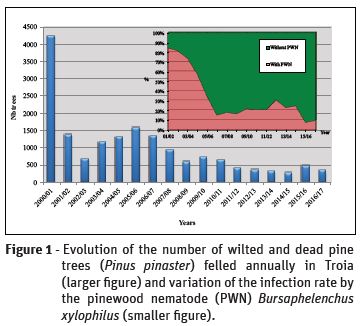
<body><![CDATA[<p><font face = "Verdana" size = "2">O coberto vegetal da península de Troia é dominado pelo pinheiro bravo, <i>Pinus pinaster</i>, que, desde 1999, tem sofrido o impacte da doença da murchidão do pinheiro causada pelo nemátode da madeira do pinheiro <i>Bursaphelenchus xylophilus</i>. O nemátode é transportado e disperso pelo inseto vetor <i>Monochamus galloprovincialis</i>. Desde 2001, a gestão do coberto florestal envolveu o corte sanitário anual de pinheiros sintomáticos ou mortos, a colocação de armadilhas para captura de insetos em voo e a micro-injeção com nematicida/inseticida. Estas medidas revelaram-se efetivas no controlo desta doença e na diminuição das populações do vetor e dos outros agentes de declínio do pinhal tais como os insetos sub-corticais escolitídeos.</font></p>      <p><font face = "Verdana" size = "2"><b>Palavras-chave</b>: <i>Bursaphelenchus xylophilus</i>, controlo de pragas, escolitídeos, <i>Monochamus galloprovincialis</i>, nemátode da madeira do pinheiro.</font></p>  <hr noshade size = "1">      <p><font face = "Verdana" size = "2">Troia is an important touristic resort located in the south bank of the Sado River, near the city of Setúbal. The forest is dominated by maritime pine (<i>Pinus pinaster</i>) and stone pine (<i>Pinus pinea</i>), with a prevailing age of &#8776;40 years, covering an area of around 300 ha in a sandy peninsula with extremely poor soils. The forest is affected by pine wilt disease (PWD), caused by the pinewood nematode (PWN), <i>Bursaphelenchus xylophilus</i>, that was detected in 1999 in nearby Setúbal peninsula (Mota <i>et al</i>., 1999). The pinewood nematode is endemic to North America, but has been accidentally introduced into Japan, China, Korea and Taiwan, through the international trade of infected wood (Futai, 2013). </font></p>      <p><font face = "Verdana" size = "2">In Portugal, <i>B. xylophilus</i> is dispersed from tree to tree by an insect vector, the pine sawyer, <i>Monochamus galloprovincialis</i> (Coleoptera; Cerambycidae), during its flight period from May to October. <i>Monochamus</i> beetles do not breed on healthy trees and are attracted only to stressed, dying or recently killed trees. Therefore, pines affected by the PWN are suitable breeding hosts for the insect (Naves <i>et al</i>., 2016). </font></p>      <p><font face = "Verdana" size = "2">The significant pine mortality in Troia, caused by <i>B. xylophilus, </i>concerned local managers on the long-term sustainability of pine forests. In 2000, INIAV and the SONAE group (responsible for Troia&rsquo;s development), began cooperating on the management of local pine forests. This lead to the development of a locally-adapted strategy to manage and control the PWN, its vector and other agents of forest decline. The key actions involved: </font></p>      <p><font face = "Verdana" size = "2">I - Annual survey of pine mortality and implementation of sanitary cuts, focusing on the elimination of wood material with diameter below 20 cm;</font></p>      <p><font face = "Verdana" size = "2">II - Control the populations of the insect vector <i>M. galloprovincialis</i> and of other agents of forest decline during flight periods;</font></p>      <p><font face = "Verdana" size = "2">III - Preventive inoculation of healthy pine trees with the nematicide/insecticide emamectin benzoate.</font></p>      <p><font face = "Verdana" size = "2">The survey and quantification of wilted and dead trees (Action I) has been conducted yearly, with the geo-referencing and characterisation of pines according to their dimension, symptoms and presence of biotic agents. Sanitary cuts are implemented during the winter and early Spring months, when the pines are dead or show conspicuous wilting symptoms and the insect vector (larvae or pupae) is inside the host.</font></p>       <p><font face = "Verdana" size = "2">Great effort is made to assure the total removal of the cut-waste material - branches and upper trunk, which can support both populations of the nematode and the vector, and therefore has the highest risk of spreading the PWD. In order to kill the immature stages of <i>M. galloprovincialis</i>, this material must be removed from the forest or shredded to sections smaller than 3 cm. There is no need to remove, destroy or fumigate the stumps of infected trees, since the insect vector is not found there. </font></p>      ]]></body>
<body><![CDATA[<p><font face = "Verdana" size = "2">To assess the presence of the PWN, the nematodes are extracted from wood samples collected from fallen trees using the tray method (Whitehead & Hemming, 1965) and identified by morphological and/or molecular techniques (Fonseca <i>et al</i>., 2015). </font></p>      <p><font face = "Verdana" size = "2">In the first year (2000), a total of 4.226 dead pines, that included the accumulated mortality of previous years, were identified and felled. The results of the identification of the nematodes present in the samples collected revealed that the majority of the pines (85%) were infected with <i>B. xylophilus</i>, being the most important mortality agent. In subsequent seasons, the number of dead pines decreased significantly, and in 2003/2004 a total of 644 pines were cut, representing approximately two pines/ha. Following the severe drought of 2005-2007, there was an outbreak of pine processionary moth (<i>Thaumetopoea pityocampa</i>) and bark beetles responsible for the increasing mortality to more than one thousand trees/year. </font></p>      <p><font face = "Verdana" size = "2">Although in successive years tree mortality remained high, the results from the wood samples from 2006 onwards revealed a new reality: the PWN was now responsible for only &#8776;20% of the tree mortality. In the following years, annual mortality stabilised to approximately 300 pines/year, which corresponds to about one dead tree/ha, with a PWN-infection rate consistently below 20% (<a href = "#f1">Figure 1</a>). </font></p>      <p>&nbsp;</p>  <a name = "f1"><img src = "/img/revistas/rca/v41nspe/v41nspea02f1.jpg"></a>      
<p>&nbsp;</p>      <p><font face = "Verdana" size = "2">Along with the elimination of the nematode and destruction of the insect-infected trees, the monitoring and control of the insect vector and other forest decline agents (Action II) are done with the placement of traps baited with attractants. Each year, 20 to 30 Lindgreen multi-funnel traps are placed &#8776;150 m apart in high-mortality areas, to capture the flying insects from May to October. Until 2010, traps were baited with pine volatiles (&#945;-pinene and ethanol) and bark beetle pheromones (ipsdienol, ipsenol and methyl-butenol) (Pajares <i>et al</i>., 2004; Bonifácio <i>et al.</i>, 2012). From 2011, the lure was replaced by &quot;Galloprotect 2D&ldquo;, a commercial product that includes &quot;monochamol&quot;, the sex pheromone (active substance: 2-undecyloxy-1-ethanol), which is highly attractive for <i>Monochamus</i> insects (Ibeas <i>et al</i>., 2008), resulting in significant increase in captures (100-150 insects/year). </font></p>       <p><font face = "Verdana" size = "2">Taking advantage of the generalised sanitary decline of the forest cover, bark beetle outbreaks were noticed from 2006 onwards, with heavy attacks by <i>Orthotomicus erosus</i> and <i>Ips sexdentatus.</i> Both species have multiple annual generations and were ignored by the control measures that were focused on the PWN and its vector. The sanitary strategy developed for Troia had to be adjusted to these new threats, and so an intense trapping effort with bark beetle sex pheromones and sanitary falling of attacked trees throughout the year was implemented. </font></p>      <p><font face = "Verdana" size = "2">Several thousands of <i>O. erosus</i> and <i>I. sexdentatus </i>were captured yearly, contributing to control their populations. Other important local pests, subjected to annual trapping efforts, are the pine processionary moth, which causes extensive defoliation, and the pine shoot beetle <i>Tomicus destruens</i>, an aggressive species causing tree mortality to both maritime and stone pines. Unfortunately, there are no effective methods to control this pest and, although with limited success, the felling and destruction of recently-attacked pines remains the only method of limiting <i>T. destruens</i> populations. All wilted and dead <i>P. pinea</i>, numbering 64 trees, have been felled and sampled for the presence of PWN, but the nematode was never found on the surveyed trees, confirming the status of stone pine as being tolerant/resistant to <i>B. xylophilus</i>, and <i>T. destruens</i> being the primary cause of mortality.</font></p>       <p><font face = "Verdana" size = "2">Over the years it was also observed that the mortality caused by PWN and bark beetles is not homogeneous in Troia, with contrasting areas with good sanitary conditions and others with considerable pine mortality, year after year, which is apparently related to differences in the density and age of the trees. Pinewood nematodes mainly affect the larger and older trees, while the younger and smaller trees (with diameters below 15-20 cm) are mostly killed by bark beetles.</font></p>      <p><font face = "Verdana" size = "2">Another management approach tested is the preventive inoculation of healthy pines with the nematicide/insecticide emamectin benzoate (Action III), using a pressurised micro-injection technique. The substance is introduced directly into the vascular system of the tree through small holes made in the lower trunk, with safety plugs inserted to prevent spillage. Once injected, the product circulates slowly through the vascular system of the tree, granting protection against the PWN and other agents for several years (Sousa <i>et al</i>., 2013). This preventive treatment can only be applied to healthy pines, as declining and symptomatic trees do not effectively translocate the product through the trunk and canopy. This technique was applied in Troia´s golf course, in 2011, with the inoculation of 183 large adult pines. Following treatments, annual mortality decreased significantly, providing evidences of the success of this technique. </font></p>       ]]></body>
<body><![CDATA[<p><font face = "Verdana" size = "2">It can be conclude that currently the PWD has very low incidence in Troia´s maritime pine forests, confirming that management and control measures are effective when applied with accuracy and timely. Nevertheless, in the absence of an active management of the pest populations, the disease will increase and cause high mortality to the pine forests, once again. </font></p>       <p><font face = "Verdana" size = "2">Troia´s success benefits from being a peninsula with a confined and relatively small-forested area, but the strategy developed and implemented can be adapted and replicated to larger-forested areas with a similar expected success. Overall, Troia represents an ongoing case-study which demonstrates that it is possible to preserve a healthy pine forest in an area where the PWN has been present for almost 20 years.</font></p>      <p>&nbsp;</p>      <p><font face = "Verdana" size = "3"><b>References</b></font></p>       <!-- ref --><p><font face = "Verdana" size = "2">Bonifácio, L.; Praias, F. & Sousa, E. (2012) - Trapping <i>Monochamus galloprovincialis</i> (Coleoptera: Cerambycidae), vector of the pine wood nematode, with pine allelochemicals in Portugal. <i>Silva Lusitana</i>, vol. 20, n. 1-2, p. 39-53.    &nbsp;&nbsp;&nbsp;&nbsp;&nbsp;&nbsp;&nbsp;&nbsp;[&#160;<a href="javascript:void(0);" onclick="javascript: window.open('/scielo.php?script=sci_nlinks&ref=693554&pid=S0871-018X201800050000200001&lng=','','width=640,height=500,resizable=yes,scrollbars=1,menubar=yes,');">Links</a>&#160;]<!-- end-ref --></font></p>      <!-- ref --><p><font face = "Verdana" size = "2">Fonseca, K.; Cardoso, J. & Abrantes, I. (2015) – Plant-nematode. <i>In</i>: Sousa, E.; Vale, F. & Abrantes, I. (Eds.) – <i>Pine wilt disease-Biological interactions and integrated management</i>. Lisboa, FNAPF-Federação Nacional das Associações de Proprietários Florestais, p. 35-78.    &nbsp;&nbsp;&nbsp;&nbsp;&nbsp;&nbsp;&nbsp;&nbsp;[&#160;<a href="javascript:void(0);" onclick="javascript: window.open('/scielo.php?script=sci_nlinks&ref=693556&pid=S0871-018X201800050000200002&lng=','','width=640,height=500,resizable=yes,scrollbars=1,menubar=yes,');">Links</a>&#160;]<!-- end-ref --></font></p>      <!-- ref --><p><font face = "Verdana" size = "2">Futai, K. (2013) - Pine wood nematode, <i>Bursaphelenchus xylophilus</i>. <i>Annual Review of Phytopathology</i>, vol. 51, p. 61–83. <a href = "https://doi.org/10.1146/annurev-phyto-081211-172910" target = "_blank">https://doi.org/10.1146/annurev-phyto-081211-172910</a></font>&nbsp;&nbsp;&nbsp;&nbsp;&nbsp;&nbsp;&nbsp;&nbsp;[&#160;<a href="javascript:void(0);" onclick="javascript: window.open('/scielo.php?script=sci_nlinks&ref=693558&pid=S0871-018X201800050000200003&lng=','','width=640,height=500,resizable=yes,scrollbars=1,menubar=yes,');">Links</a>&#160;]<!-- end-ref --><!-- ref --><p><font face = "Verdana" size = "2">Ibeas, F.; Diez, J. & Pajares, J. (2008) - Olfactory sex attraction and mating behaviour in the pine sawyer <i>Monochamus galloprovincialis</i> (Coleoptera: Cerambycidae). <i>Journal of Insect Behavior</i>, vol. 21, p. 101-110. <a href = "https://doi.org/10.1007/s10905-007-9104-1" target = "_blank">https://doi.org/10.1007/s10905-007-9104-1</a></font>&nbsp;&nbsp;&nbsp;&nbsp;&nbsp;&nbsp;&nbsp;&nbsp;[&#160;<a href="javascript:void(0);" onclick="javascript: window.open('/scielo.php?script=sci_nlinks&ref=693559&pid=S0871-018X201800050000200004&lng=','','width=640,height=500,resizable=yes,scrollbars=1,menubar=yes,');">Links</a>&#160;]<!-- end-ref --><!-- ref --><p><font face = "Verdana" size = "2">Mota, M.; Braasch, H.; Bravo, M.; Penas, A.; Burgermeister, W.; Metge, K. & Sousa, E. (1999) - First report of <i>Bursaphelenchus xylophilus</i> in Portugal and in Europe. <i>Nematology</i>, vol. 1, n. 7, p. 727-734. <a href = "https://doi.org/10.1163/156854199508757" target = "_blank">https://doi.org/10.1163/156854199508757</a></font>&nbsp;&nbsp;&nbsp;&nbsp;&nbsp;&nbsp;&nbsp;&nbsp;[&#160;<a href="javascript:void(0);" onclick="javascript: window.open('/scielo.php?script=sci_nlinks&ref=693560&pid=S0871-018X201800050000200005&lng=','','width=640,height=500,resizable=yes,scrollbars=1,menubar=yes,');">Links</a>&#160;]<!-- end-ref --><!-- ref --><p><font face = "Verdana" size = "2">Naves, P.; Bonifácio, L. & Sousa, E. (2016) - The pine wood nematode and its local vectors in the Mediterranean Basin. <i>In</i>: Paine, T.D. & Lieutier, F. (Eds.) - <i>Insects and diseases of Mediterranean forest systems</i>. Switzerland, Springer, p. 329-378.    &nbsp;&nbsp;&nbsp;&nbsp;&nbsp;&nbsp;&nbsp;&nbsp;[&#160;<a href="javascript:void(0);" onclick="javascript: window.open('/scielo.php?script=sci_nlinks&ref=693561&pid=S0871-018X201800050000200006&lng=','','width=640,height=500,resizable=yes,scrollbars=1,menubar=yes,');">Links</a>&#160;]<!-- end-ref --></font></p>      <!-- ref --><p><font face = "Verdana" size = "2">Pajares, J.; Ibeas, F.; Díez, J. & Gallego, D. (2004) - Attractive responses by <i>Monochamus galloprovincialis</i> (Col., Cerambycidae) to host and bark beetle semiochemicals. <i>Journal of Applied Entomology</i>, vol. 128, n. 9-10, p. 633-638. <a href = "https://doi.org/10.1111/j.1439-0418.2004.00899.x" target = "_blank">https://doi.org/10.1111/j.1439-0418.2004.00899.x</a></font>&nbsp;&nbsp;&nbsp;&nbsp;&nbsp;&nbsp;&nbsp;&nbsp;[&#160;<a href="javascript:void(0);" onclick="javascript: window.open('/scielo.php?script=sci_nlinks&ref=693563&pid=S0871-018X201800050000200007&lng=','','width=640,height=500,resizable=yes,scrollbars=1,menubar=yes,');">Links</a>&#160;]<!-- end-ref --><!-- ref --><p><font face = "Verdana" size = "2">Sousa, E.; Naves, P. & Vieira, M. (2013) - Prevention of pine wilt disease induced by <i>Bursaphelenchus xylophilus</i> and <i>Monochamus galloprovincialis</i> by trunk injection of emamectin benzoate. <i>Phytoparasitica</i>, vol. 41, n. 2, p. 143-148. <a href = "https://doi.org/10.1007/s12600-012-0272-y" target = "_blank">https://doi.org/10.1007/s12600-012-0272-y</a></font>&nbsp;&nbsp;&nbsp;&nbsp;&nbsp;&nbsp;&nbsp;&nbsp;[&#160;<a href="javascript:void(0);" onclick="javascript: window.open('/scielo.php?script=sci_nlinks&ref=693564&pid=S0871-018X201800050000200008&lng=','','width=640,height=500,resizable=yes,scrollbars=1,menubar=yes,');">Links</a>&#160;]<!-- end-ref --><!-- ref --><p><font face = "Verdana" size = "2">Whitehead, A. & Hemming, J. (1965) - A comparison of some quantitative methods of extracting small vermiform nematodes from soil. <i>Annals of Applied Biology</i>, vol. 55, n. 1, p. 25–38. <a href = "https://doi.org/10.1111/j.1744-7348.1965.tb07864.x" target = "_blank">https://doi.org/10.1111/j.1744-7348.1965.tb07864.x</a></font>&nbsp;&nbsp;&nbsp;&nbsp;&nbsp;&nbsp;&nbsp;&nbsp;[&#160;<a href="javascript:void(0);" onclick="javascript: window.open('/scielo.php?script=sci_nlinks&ref=693565&pid=S0871-018X201800050000200009&lng=','','width=640,height=500,resizable=yes,scrollbars=1,menubar=yes,');">Links</a>&#160;]<!-- end-ref --><p>&nbsp;</p>      <p><font face = "Verdana" size = "3"><b>Acknowledgments</b></font></p>      <p><font face = "Verdana" size = "2">We would like to thank INIAV´s Adérito Matos, Miguel Pimpão, Francisco Martins, Margarida Fontes and Marina Cardoso for assistance in the field and lab. We would also like to acknowledge the constant support and prolonged cooperation between INIAV and TroiaResort (Sonae group), in the person of Drª Célia Ferreira. Pedro Naves is supported by a postdoctoral grant from the Portuguese Fundação para a Ciência e Tecnologia - FCT IF/00471/2013 /CP1203/CT0001.</font></p>      <p>&nbsp;</p>      ]]></body>
<body><![CDATA[<p><font face = "Verdana" size = "2">Received/recebido: 2017.12.21</font></p>      <p><font face = "Verdana" size = "2">Accepted/aceite: 2018.03.12</font></p>       ]]></body><back>
<ref-list>
<ref id="B1">
<nlm-citation citation-type="journal">
<person-group person-group-type="author">
<name>
<surname><![CDATA[Bonifácio]]></surname>
<given-names><![CDATA[L.]]></given-names>
</name>
<name>
<surname><![CDATA[Praias]]></surname>
<given-names><![CDATA[F.]]></given-names>
</name>
<name>
<surname><![CDATA[Sousa]]></surname>
<given-names><![CDATA[E.]]></given-names>
</name>
</person-group>
<article-title xml:lang="en"><![CDATA[Trapping Monochamus galloprovincialis (Coleoptera: Cerambycidae), vector of the pine wood nematode, with pine allelochemicals in Portugal]]></article-title>
<source><![CDATA[Silva Lusitana]]></source>
<year>2012</year>
<volume>20</volume>
<numero>1-2</numero>
<issue>1-2</issue>
<page-range>39-53</page-range></nlm-citation>
</ref>
<ref id="B2">
<nlm-citation citation-type="book">
<person-group person-group-type="author">
<name>
<surname><![CDATA[Fonseca]]></surname>
<given-names><![CDATA[K.]]></given-names>
</name>
<name>
<surname><![CDATA[Cardoso]]></surname>
<given-names><![CDATA[J.]]></given-names>
</name>
<name>
<surname><![CDATA[Abrantes]]></surname>
<given-names><![CDATA[I.]]></given-names>
</name>
</person-group>
<article-title xml:lang="en"><![CDATA[Plant-nematode]]></article-title>
<person-group person-group-type="editor">
<name>
<surname><![CDATA[Sousa]]></surname>
<given-names><![CDATA[E.]]></given-names>
</name>
<name>
<surname><![CDATA[Vale]]></surname>
<given-names><![CDATA[F.]]></given-names>
</name>
<name>
<surname><![CDATA[Abrantes]]></surname>
<given-names><![CDATA[I.]]></given-names>
</name>
</person-group>
<source><![CDATA[Pine wilt disease-Biological interactions and integrated management]]></source>
<year>2015</year>
<page-range>35-78</page-range><publisher-loc><![CDATA[Lisboa ]]></publisher-loc>
<publisher-name><![CDATA[Federação Nacional das Associações de Proprietários Florestais]]></publisher-name>
</nlm-citation>
</ref>
<ref id="B3">
<nlm-citation citation-type="journal">
<person-group person-group-type="author">
<name>
<surname><![CDATA[Futai]]></surname>
<given-names><![CDATA[K.]]></given-names>
</name>
</person-group>
<article-title xml:lang="en"><![CDATA[Pine wood nematode, Bursaphelenchus xylophilus]]></article-title>
<source><![CDATA[Annual Review of Phytopathology]]></source>
<year>2013</year>
<volume>51</volume>
<page-range>61-83</page-range></nlm-citation>
</ref>
<ref id="B4">
<nlm-citation citation-type="journal">
<person-group person-group-type="author">
<name>
<surname><![CDATA[Ibeas]]></surname>
<given-names><![CDATA[F.]]></given-names>
</name>
<name>
<surname><![CDATA[Diez]]></surname>
<given-names><![CDATA[J.]]></given-names>
</name>
<name>
<surname><![CDATA[Pajares]]></surname>
<given-names><![CDATA[J.]]></given-names>
</name>
</person-group>
<article-title xml:lang="en"><![CDATA[Olfactory sex attraction and mating behaviour in the pine sawyer Monochamus galloprovincialis (Coleoptera: Cerambycidae)]]></article-title>
<source><![CDATA[Journal of Insect Behavior]]></source>
<year>2008</year>
<volume>21</volume>
<page-range>101-110</page-range></nlm-citation>
</ref>
<ref id="B5">
<nlm-citation citation-type="journal">
<person-group person-group-type="author">
<name>
<surname><![CDATA[Mota]]></surname>
<given-names><![CDATA[M.]]></given-names>
</name>
<name>
<surname><![CDATA[Braasch]]></surname>
<given-names><![CDATA[H.]]></given-names>
</name>
<name>
<surname><![CDATA[Bravo]]></surname>
<given-names><![CDATA[M.]]></given-names>
</name>
<name>
<surname><![CDATA[Penas]]></surname>
<given-names><![CDATA[A.]]></given-names>
</name>
<name>
<surname><![CDATA[Burgermeister]]></surname>
<given-names><![CDATA[W.]]></given-names>
</name>
<name>
<surname><![CDATA[Metge]]></surname>
<given-names><![CDATA[K.]]></given-names>
</name>
<name>
<surname><![CDATA[Sousa]]></surname>
<given-names><![CDATA[E.]]></given-names>
</name>
</person-group>
<article-title xml:lang="en"><![CDATA[First report of Bursaphelenchus xylophilus in Portugal and in Europe]]></article-title>
<source><![CDATA[Nematology]]></source>
<year>1999</year>
<volume>1</volume>
<numero>7</numero>
<issue>7</issue>
<page-range>727-734</page-range></nlm-citation>
</ref>
<ref id="B6">
<nlm-citation citation-type="book">
<person-group person-group-type="author">
<name>
<surname><![CDATA[Naves]]></surname>
<given-names><![CDATA[P.]]></given-names>
</name>
<name>
<surname><![CDATA[Bonifácio]]></surname>
<given-names><![CDATA[L.]]></given-names>
</name>
<name>
<surname><![CDATA[Sousa]]></surname>
<given-names><![CDATA[E.]]></given-names>
</name>
</person-group>
<article-title xml:lang="en"><![CDATA[The pine wood nematode and its local vectors in the Mediterranean Basin]]></article-title>
<person-group person-group-type="editor">
<name>
<surname><![CDATA[Paine]]></surname>
<given-names><![CDATA[T.D.]]></given-names>
</name>
<name>
<surname><![CDATA[Lieutier]]></surname>
<given-names><![CDATA[F.]]></given-names>
</name>
</person-group>
<source><![CDATA[Insects and diseases of Mediterranean forest systems]]></source>
<year>2016</year>
<page-range>329-378</page-range><publisher-name><![CDATA[Springer]]></publisher-name>
</nlm-citation>
</ref>
<ref id="B7">
<nlm-citation citation-type="journal">
<person-group person-group-type="author">
<name>
<surname><![CDATA[Pajares]]></surname>
<given-names><![CDATA[J.]]></given-names>
</name>
<name>
<surname><![CDATA[Ibeas]]></surname>
<given-names><![CDATA[F.]]></given-names>
</name>
<name>
<surname><![CDATA[Díez]]></surname>
<given-names><![CDATA[J.]]></given-names>
</name>
<name>
<surname><![CDATA[Gallego]]></surname>
<given-names><![CDATA[D.]]></given-names>
</name>
</person-group>
<article-title xml:lang="en"><![CDATA[Attractive responses by Monochamus galloprovincialis (Col., Cerambycidae) to host and bark beetle semiochemicals]]></article-title>
<source><![CDATA[Journal of Applied Entomology]]></source>
<year>2004</year>
<volume>128</volume>
<numero>9-10</numero>
<issue>9-10</issue>
<page-range>633-638</page-range></nlm-citation>
</ref>
<ref id="B8">
<nlm-citation citation-type="journal">
<person-group person-group-type="author">
<name>
<surname><![CDATA[Sousa]]></surname>
<given-names><![CDATA[E.]]></given-names>
</name>
<name>
<surname><![CDATA[Naves]]></surname>
<given-names><![CDATA[P.]]></given-names>
</name>
<name>
<surname><![CDATA[Vieira]]></surname>
<given-names><![CDATA[M.]]></given-names>
</name>
</person-group>
<article-title xml:lang="en"><![CDATA[Prevention of pine wilt disease induced by Bursaphelenchus xylophilus and Monochamus galloprovincialis by trunk injection of emamectin benzoate]]></article-title>
<source><![CDATA[Phytoparasitica]]></source>
<year>2013</year>
<volume>41</volume>
<numero>2</numero>
<issue>2</issue>
<page-range>143-148</page-range></nlm-citation>
</ref>
<ref id="B9">
<nlm-citation citation-type="journal">
<person-group person-group-type="author">
<name>
<surname><![CDATA[Whitehead]]></surname>
<given-names><![CDATA[A.]]></given-names>
</name>
<name>
<surname><![CDATA[Hemming]]></surname>
<given-names><![CDATA[J.]]></given-names>
</name>
</person-group>
<article-title xml:lang="en"><![CDATA[A comparison of some quantitative methods of extracting small vermiform nematodes from soil]]></article-title>
<source><![CDATA[Annals of Applied Biology]]></source>
<year>1965</year>
<volume>55</volume>
<numero>1</numero>
<issue>1</issue>
<page-range>25-38</page-range></nlm-citation>
</ref>
</ref-list>
</back>
</article>
