<?xml version="1.0" encoding="ISO-8859-1"?><article xmlns:mml="http://www.w3.org/1998/Math/MathML" xmlns:xlink="http://www.w3.org/1999/xlink" xmlns:xsi="http://www.w3.org/2001/XMLSchema-instance">
<front>
<journal-meta>
<journal-id>0871-018X</journal-id>
<journal-title><![CDATA[Revista de Ciências Agrárias]]></journal-title>
<abbrev-journal-title><![CDATA[Rev. de Ciências Agrárias]]></abbrev-journal-title>
<issn>0871-018X</issn>
<publisher>
<publisher-name><![CDATA[Sociedade de Ciências Agrárias de Portugal]]></publisher-name>
</publisher>
</journal-meta>
<article-meta>
<article-id>S0871-018X2018000500004</article-id>
<article-id pub-id-type="doi">10.19084/RCA.17062</article-id>
<title-group>
<article-title xml:lang="en"><![CDATA[Potato cyst nematodes’ routine analyses: morphology and/or PCR?]]></article-title>
<article-title xml:lang="pt"><![CDATA[Análises de rotina para detecção de nemátodes de quisto da batateira: morfologia e/ou PCR?]]></article-title>
</title-group>
<contrib-group>
<contrib contrib-type="author">
<name>
<surname><![CDATA[Inácio]]></surname>
<given-names><![CDATA[Maria L.]]></given-names>
</name>
<xref ref-type="aff" rid="A1"/>
</contrib>
<contrib contrib-type="author">
<name>
<surname><![CDATA[Camacho]]></surname>
<given-names><![CDATA[Maria J.]]></given-names>
</name>
<xref ref-type="aff" rid="A1"/>
</contrib>
<contrib contrib-type="author">
<name>
<surname><![CDATA[Rusinque]]></surname>
<given-names><![CDATA[Leidy]]></given-names>
</name>
<xref ref-type="aff" rid="A1"/>
</contrib>
<contrib contrib-type="author">
<name>
<surname><![CDATA[Nóbrega]]></surname>
<given-names><![CDATA[Filomena]]></given-names>
</name>
<xref ref-type="aff" rid="A1"/>
</contrib>
<contrib contrib-type="author">
<name>
<surname><![CDATA[Andrade]]></surname>
<given-names><![CDATA[Eugénia]]></given-names>
</name>
<xref ref-type="aff" rid="A1"/>
</contrib>
</contrib-group>
<aff id="AA1">
<institution><![CDATA[,Instituto Nacional de Investigação Agrária e Veterinária Unidade de Sistemas Agrários e Florestais e Sanidade Vegetal ]]></institution>
<addr-line><![CDATA[Oeiras ]]></addr-line>
</aff>
<pub-date pub-type="pub">
<day>00</day>
<month>12</month>
<year>2018</year>
</pub-date>
<pub-date pub-type="epub">
<day>00</day>
<month>12</month>
<year>2018</year>
</pub-date>
<volume>41</volume>
<numero>spe</numero>
<fpage>31</fpage>
<lpage>40</lpage>
<copyright-statement/>
<copyright-year/>
<self-uri xlink:href="http://scielo.pt/scielo.php?script=sci_arttext&amp;pid=S0871-018X2018000500004&amp;lng=en&amp;nrm=iso"></self-uri><self-uri xlink:href="http://scielo.pt/scielo.php?script=sci_abstract&amp;pid=S0871-018X2018000500004&amp;lng=en&amp;nrm=iso"></self-uri><self-uri xlink:href="http://scielo.pt/scielo.php?script=sci_pdf&amp;pid=S0871-018X2018000500004&amp;lng=en&amp;nrm=iso"></self-uri><abstract abstract-type="short" xml:lang="en"><p><![CDATA[Potato cyst nematodes (PCN), Globodera rostochiensis and G. pallida, are a serious threat to potato crops worldwide. Due to the risk these two species pose, a national survey was implemented starting in 2010 aiming to know the presence and distribution of these quarantine nematodes in Portugal. This fact has led to an increasing demand to accurately identify the PCN species present in the fields. Usually, the identification is based on morphology followed by molecular analysis. Considering there is at least one laboratory in the EU certified for morphological identification of PCN, the aim of this study was to look into the possibility of using only morphological diagnostic characters for routine purposes. Forty cysts of Globodera were used, for morphological and molecular analyses. Morphological analysis allowed the identification of 23 cysts as G. rostochiensis and 17 cysts as G. pallida and the molecular results revealed that 9 cysts were G. rostochiensis and 31 cysts were G. pallida. Thus, morphological and molecular analyses matched 65%, concluding that in our routine analyses only an initial morphological approach followed by molecular methods enables a reliable identification of PCN species. So, it is recommended to combine both methods. PCR can be ruled out only if the purpose is to detect Globodera nematodes, which is the case of the seed potato fields where the presence of round-cyst nematodes will interdict the seed production.]]></p></abstract>
<abstract abstract-type="short" xml:lang="pt"><p><![CDATA[Os nemátodes de quisto da batateira (NQB), Globodera rostochiensis e G. pallida, são uma ameaça para a cultura da batata a nível mundial. Devido ao risco que estas duas espécies representam, foi implementado um programa de prospeção nacional a partir de 2010 com o objectivo de detetar a presença e conhecer a distribuição destes nemátodes de quarentena em Portugal. Este facto intensificou a necessidade de determinar com precisão as espécies de NQB presentes nos campos de batata. Geralmente, esta identificação é baseada na avaliação das características morfológicas, confirmada de seguida pela análise molecular. Considerando que existe pelo menos um laboratório na União Europeia certificado para a identificação morfológica de NQB, o objetivo deste estudo foi investigar a possibilidade de identificar estas espécies apenas através das características morfológicas, em análises de rotina. Para as análises morfológicas e moleculares foram utilizados 40 quistos de Globodera sp.. A análise morfológica permitiu identificar 23 quistos como G. rostochiensis e 17 quistos como G. pallida, enquanto que os resultados moleculares para os mesmos quistos permitiram a identificação de 9 quistos como G. rostochiensis e 31 quistos como G. pallida. As análises morfológicas e moleculares apenas coincidiram em 65% dos casos. Concluiu-se que nas nossas análises de rotina apenas a utilização das duas abordagens permite a identificação precisa de espécies de NQB, sendo por isso recomendado combinar sempre os dois métodos. A análise molecular pode ser excluída somente se o objetivo visar a deteção de nemátodes do género Globodera, como é o caso dos campos de batata de semente, onde a presença de qualquer espécie destes nemátodes interditará a produção de semente.]]></p></abstract>
<kwd-group>
<kwd lng="en"><![CDATA[cysts]]></kwd>
<kwd lng="en"><![CDATA[Globodera]]></kwd>
<kwd lng="en"><![CDATA[national survey]]></kwd>
<kwd lng="en"><![CDATA[quarantine]]></kwd>
<kwd lng="en"><![CDATA[molecular studies]]></kwd>
<kwd lng="pt"><![CDATA[Globodera]]></kwd>
<kwd lng="pt"><![CDATA[prospeção nacional]]></kwd>
<kwd lng="pt"><![CDATA[quarentena]]></kwd>
<kwd lng="pt"><![CDATA[quistos]]></kwd>
<kwd lng="pt"><![CDATA[estudos moleculares]]></kwd>
</kwd-group>
</article-meta>
</front><body><![CDATA[ <p align = "right"><font face = "Verdana" size = "2"><b>ARTIGO</b></font></p>      <p><font face = "Verdana" size = "4"><b>Potato cyst nematodes&rsquo; routine analyses: morphology and/or PCR?</b></font></p>      <p><font face = "Verdana" size = "3"><b>Análises de rotina para detecção de nemátodes de quisto da batateira: morfologia e/ou PCR?</b></font></p>      <p><font face = "Verdana" size = "2"><b>Maria L. Inácio</b><sup>*</sup>, <b>Maria J. Camacho</b>, <b>Leidy Rusinque</b>, <b>Filomena Nóbrega</b> and <b>Eugénia Andrade</b></font></p>      <p><font face = "Verdana" size = "2"><i>Instituto Nacional de Investigação Agrária e Veterinária (INIAV), Unidade de Sistemas Agrários e Florestais e Sanidade Vegetal, Oeiras</i></font></p>      <p><font face = "Verdana" size = "2"><i>(*E-mail: <a href = "mailto:lurdes.inacio@iniav.pt">lurdes.inacio@iniav.pt</a>)</i></font></p>  <hr noshade size = "1">      <p><font face = "Verdana" size = "3"><b>ABSTRACT</b></font></p>       <p><font face = "Verdana" size = "2">Potato cyst nematodes (PCN), <i>Globodera rostochiensis</i> and <i>G. pallida</i>, are a serious threat to potato crops worldwide. Due to the risk these two species pose, a national survey was implemented starting in 2010 aiming to know the presence and distribution of these quarantine nematodes in Portugal. This fact has led to an increasing demand to accurately identify the PCN species present in the fields. Usually, the identification is based on morphology followed by molecular analysis. Considering there is at least one laboratory in the EU certified for morphological identification of PCN, the aim of this study was to look into the possibility of using only morphological diagnostic characters for routine purposes. Forty cysts of <i>Globodera </i>were used, for morphological and molecular analyses. Morphological analysis allowed the identification of 23 cysts as <i>G. rostochiensis</i> and 17 cysts as <i>G. pallida</i> and the molecular results revealed that 9 cysts were<i> G. rostochiensis</i> and 31 cysts were <i>G. pallida.</i> Thus, morphological and molecular analyses matched 65%, concluding that in our routine analyses only an initial morphological approach followed by molecular methods enables a reliable identification of PCN species. So, it is recommended to combine both methods. PCR can be ruled out only if the purpose is to detect <i>Globodera </i>nematodes, which is the case of the seed potato fields where the presence of round-cyst nematodes will interdict the seed production. </font></p>      <p><font face = "Verdana" size = "2"><b>Keywords: </b>cysts, <i>Globodera</i>, national survey, quarantine, molecular studies</font></p>  <hr noshade size = "1">      <p><font face = "Verdana" size = "3"><b>RESUMO</b></font></p>      ]]></body>
<body><![CDATA[<p><font face = "Verdana" size = "2">Os nemátodes de quisto da batateira (NQB), <i>Globodera rostochiensis</i> e <i>G. pallida</i>, são uma ameaça para a cultura da batata a nível mundial. Devido ao risco que estas duas espécies representam, foi implementado um programa de prospeção nacional a partir de 2010 com o objectivo de detetar a presença e conhecer a distribuição destes nemátodes de quarentena em Portugal. Este facto intensificou a necessidade de determinar com precisão as espécies de NQB presentes nos campos de batata. Geralmente, esta identificação é baseada na avaliação das características morfológicas, confirmada de seguida pela análise molecular. Considerando que existe pelo menos um laboratório na União Europeia certificado para a identificação morfológica de NQB, o objetivo deste estudo foi investigar a possibilidade de identificar estas espécies apenas através das características morfológicas, em análises de rotina. Para as análises morfológicas e moleculares foram utilizados 40 quistos de <i>Globodera </i>sp.. A análise morfológica permitiu identificar 23 quistos como <i>G. rostochiensis</i> e 17 quistos como <i>G. pallida</i>, enquanto que os resultados moleculares para os mesmos quistos permitiram a identificação de 9 quistos como <i>G. rostochiensis</i> e 31 quistos como <i>G. pallida</i>. As análises morfológicas e moleculares apenas coincidiram em 65% dos casos. Concluiu-se que nas nossas análises de rotina apenas a utilização das duas abordagens permite a identificação precisa de espécies de NQB, sendo por isso recomendado combinar sempre os dois métodos. A análise molecular pode ser excluída somente se o objetivo visar a deteção de nemátodes do género <i>Globodera</i>, como é o caso dos campos de batata de semente, onde a presença de qualquer espécie destes nemátodes interditará a produção de semente.</font></p>      <p><font face = "Verdana" size = "2"><b>Palavras-chave: </b><i>Globodera,</i> prospeção nacional, quarentena, quistos, estudos moleculares</font></p>  <hr noshade size = "1">      <p><font face = "Verdana" size = "3"><b>INTRODUCTION</b></font></p>       <p><font face = "Verdana" size = "2">Potato cyst nematodes (PCN), <i>Globodera pallida </i>and<i> G. rostochiensis</i>, are a serious threat to potato crops worldwide, and both species have a quarantine status (EPPO, 2017a). In Portugal, <i>G. rostochiensis</i>, currently present in all potato producing regions of the country, was first identified in 1956 (Macara, 1963) and <i>G. pallida</i> later in 1988 (Santos and Fernandes, 1988), both in Trás-os-Montes region.  </font></p>      <p><font face = "Verdana" size = "2">Before the national survey started, infestations detected in Portugal mainland were almost entirely due to <i>G. rostochiensis</i> (Santos & Fernandes, 1988; Santos <i>et al</i>., 1995; Martins <i>et al</i>., 1996, Conceição <i>et al</i>., 2003, Cunha <i>et al</i>., 2004, 2006; Cunha <i>et al</i>., 2012). The few pure <i>G. pallida</i> populations found in Portugal may suggest that it was introduced after <i>G. rostochiensis</i> or that there were only a few introductions; due to their low natural mobility, those populations could be restricted to the areas where they were introduced (Santos <i>et al</i>., 1995). In 2012, Cunha <i>et al</i>. reported that all Portuguese isolates of <i>G. rostochiensis</i> were ro1/ro4, and <i>G. pallida</i> isolates could have come from two different introductions (one for the isolate from Aveiro and another for the isolate from Vila Real). According to the authors, this lack of differentiation may be caused by PCN introductions that could have been made in different regions from the same origin or to the same region from different origins (Cunha & Conceição, 2012). Recently, the analysis of soils sampled in Portuguese potato fields revealed a spread of <i>G. pallida</i>, which contradicts the expectations because <i>G. rostochiensis</i> used to be the most widespread species in Portugal. The reasons for that reverse situation are still not fully understood (Camacho <i>et al</i>., 2017a,b). </font></p>      <p><font face = "Verdana" size = "2">As PCN pose a risk to potato crops in Portugal, the implementation of a national survey took place in 2010 intending to know the presence and distribution of those nematodes in potato cropping areas. Along with this came an increasing demand to accurately identify the PCN species present in Portuguese potato fields.</font></p>       <p><font face = "Verdana" size = "2">The distinction between the two species is essential in order to know their distribution in the national territory, re-evaluate the control measures so far implemented and to adopt more effective practices. Protocols to address quarantine and regulation requirements, speed, sensitivity, specificity and broad applicability features of the PCN identification are required. </font></p>       <p><font face = "Verdana" size = "2">The extraction of cysts from soil using elutriation principles remains essential especially when working with larger volumes of soil. Moreover, the morphological study of PCN is crucial as a previous step of the PCR tools preventing cross-reactivity with closely related species, namely <i>Heterodera</i> spp.</font></p>      <p><font face = "Verdana" size = "2">As PCN are very similar, robust methodologies are essential for their identification. Currently, the identification is based on the cysts and juveniles morphology, frequently followed by molecular analysis. However, there is no guarantee that the cysts used for the molecular studies are of the same species of the cysts used for morphological analysis when mixed populations are present. According to Camacho <i>et al</i>. (2017a), the species identification should be based on morphology/morphometry characterization followed by molecular analysis of the same cyst. However, there are accredited laboratories for morphological identification of both PCN species, such as the National Phytosanitary Laboratory - Nematology in Romania. Considering the importance of an accurate identification of PCN species, the aim of this research was to study the possibility of using only morphological diagnostic features for routine purposes.</font></p>      <p><font face = "Verdana" size = "3"><b>MATERIAL & METHODS</b></font></p>      ]]></body>
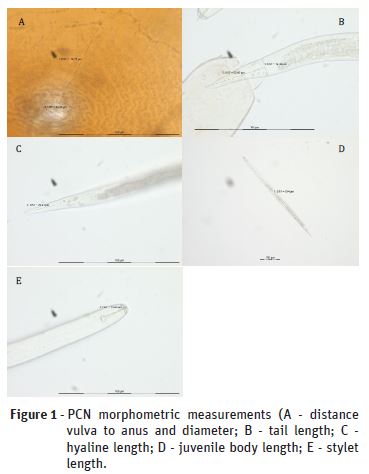
<body><![CDATA[<p><font face = "Verdana" size = "2">Forty cysts were collected from Portuguese infested soils from the main producing potato regions, using Fenwick&rsquo;s can method (Fenwick, 1940) and its modified version described by Oostenbrinck (1950). <i>Globodera </i>cysts from both species from Wageningen, The Netherlands, were used for morphological comparison and as controls for molecular analyses.</font></p>      <p><font face = "Verdana" size = "2">These 40 cysts, as well as second-stage juveniles (J2) recovered from each cyst, were used for morphological and molecular analyses. Morphological study of PCN was based on the observation of cyst colour and a combination of J2 and cyst features: body length, stylet length, tail and hyaline region, fenestra diameter, distance fenestra to anus, Granek&rsquo;s ratio (distance from anus to the nearest edge of vulval basin divided by vulval basin diameter), and the number of cuticular ridges between vulva and anus, using an Olympus BX-41 bright field light microscope; pictures were taken with an Olympus DP10 digital camera. The observed characters of cysts and J2 were compared with those from the reference materials and descriptions in the literature (Marks & Brodie, 1998; EPPO, 2017b). Measurements were made using a ProgResSpeedXT – Jenoptik image software and dimensions are expressed in &#956;m.</font></p>      <p><font face = "Verdana" size = "2">Half of each cyst was used in the morphological characterisation and the other half was used for DNA extraction, to assure one cyst went through both analyses. The internal transcribed spacer region (ITS) of the ribosomal DNA repeat unit was amplified by multiplex PCR. Multiplex PCR reactions were performed in a 25 &#956;l final volume using the Promega GoTaq Flexi DNA Polymerase Kit (Promega, Madison, USA), containing 1 &#956;l template DNA, 5 &#956;l GoTaq Flexi PCR buffer, 1.5 mM MgCl2, 0.20 mM each dNTPs, 1.25 U GoTaq Flexi DNA Polymerase (Promega, Madison) and 0.4 &#956;M of each primer in a Biometra TGradient thermocycler (Biometra, Gottingen, Germany). The set of primers for <i>G. rostochiensis</i> were: ITS5 (5&rsquo;-GGA AGT AAA AGT CGT AAC AAG G-3&rsquo;) and PITSr3 (5&rsquo;-AGC GCA GAC ATG CCG CAA-3&rsquo;) and for <i>G. pallida</i> were: ITS5 (5&rsquo;-GGA AGT AAA AGT CGT AAC AAG G-3&rsquo;) and PITSp4 (5´-ACA ACA GCA ATC GTC GAG-3&rsquo;) (Bulman & Marshall, 1997). The amplification profile for ITS-rRNA consisted of an initial denaturation step of 94 °C for 2 min followed by 35 cycles of 94 °C for 30 s, 55 °C for 30 s and 72 °C for 30s and a final extension of 72 °C for 7 min (EPPO, 2017b). The amplified products were loaded onto a 1.5% agarose gel containing 0.5 &#956;g.ml-1 ethidium bromide and 0.5×Tris-borate-EDTA (TBE) buffer and electrophoresed at 5 V/cm. Amplifications were visualized using the VersaDoc Gel Imaging System (Bio-Rad, USA). The expected length of the PCR products was 265 bp for <i>G. pallida</i> and 434 bp for <i>G. rostochiensis</i>. Possible contamination was checked by including negative controls (no DNA) in all amplifications.</font></p>      <p><font face = "Verdana" size = "3"><b>RESULTS & DISCUSSION</b></font></p>        <p><font face = "Verdana" size = "2">Portuguese PCN populations present in potato fields are morphologically variable. The identification of <i>Globodera</i> species based on morphology is difficult, when cysts and J2 are individually analysed, due to the variability of the main morphological characters, with some features outside the expected ranges for <i>G. pallida</i> and/or <i>G. rostochiensis</i> described in the literature (Marks & Brodie, 1998; EPPO, 2017b), and the overlapping of the standard measures in the two species. </font></p>      <p><font face = "Verdana" size = "2">An initial approach to discriminate PCN species is the cyst colour. Females of <i>G. rostochiensis</i> change from white to yellow, and then to brown cysts (chromogenesis), while cysts of <i>G. pallida</i> go directly from white to brown. In the present study, all cysts presented only brown colour so that this character was not taken into account.</font></p>      <p><font face = "Verdana" size = "2">Using morphometric and morphologic parameters (<a href = "#f1">Figure 1</a>) 23 cysts were identified as <i>G. rostochiensis</i> and 17 cysts as <i>G. pallida</i>. In some cases, the characterisation of the knobs shape was ambiguous and the cyst wall pattern did not always allow species identification. </font></p>      <p>&nbsp;</p>  <a name = "f1"><img src = "/img/revistas/rca/v41nspe/v41nspea04f1.jpg"></a>      
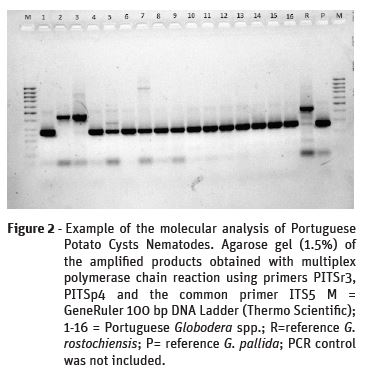
<p>&nbsp;</p>      <p><font face = "Verdana" size = "2">PCR amplified a product of the same size as <i>G. rostochiensis </i>in 9 samples and of the same size as <i>G. pallida </i>in 31 samples, meaning this molecular analysis only confirmed the morphological results for 26 cysts out of the 40 analysed (65% match) (<a href = "#f2">Figure 2</a>). </font></p>      ]]></body>
<body><![CDATA[<p>&nbsp;</p>  <a name = "f2"><img src = "/img/revistas/rca/v41nspe/v41nspea04f2.jpg"></a>      
<p>&nbsp;</p>      <p><font face = "Verdana" size = "2">According to the obtained morphometric data, the morphological characterisation does not always match the molecular identification, due to the overlapping of the standard measures between the two PCN species (<a href = "/img/revistas/rca/v41nspe/v41nspea04f3.jpg" target = "_blank">Figure 3</a>; <a href = "/img/revistas/rca/v41nspe/v41nspea04t1.jpg" target = "_blank">Table 1</a>). The same result was observed in measurements performed in other studies around the world (Canada, United States, Serbia and Slovakia). In these studies the nematodes&rsquo; measurements were in agreement with the published standard values, but the amplitude between the individuals was outside the expected intervals (Yu <i>et al</i>., 2010; Skantar <i>et al</i>., 2011; Ba&#269;i&#263;<i> et al</i>., 2013; Douda <i>et al</i>., 2014).</font></p>      
<p><font face = "Verdana" size = "2">PCN identification through morphometric studies is time consuming and requires a high level of expertise for species differentiation. It did not detect consistently low frequency mixtures on both species. An initial morphological approach followed by molecular methods enables the reliable identification of PCN species. This study concluded that it is highly recommended to combine both methods described and others if available. These results are supported by other researches (Ba&#269;i&#263;<i> et al.</i>, 2013; Tirchi <i>et al.,</i> 2016; Seesao <i>et al.</i>, 2017).</font></p>      <p><font face = "Verdana" size = "3"><b>Conclusion</b></font></p>      <p><font face = "Verdana" size = "2">The morphological study of PCN is crucial as a previous step of the PCR preventing cross-reactivity with closely related species, namely other <i>Globodera </i>species and some <i>Heterodera </i>spp.. In the present work, the limit of detection in PCR was just a half cyst with eggs and juveniles, since it worked with only half of each cyst used for DNA extraction (the other half being used in the morphological characterisation). </font></p>       <p><font face = "Verdana" size = "2">The morphological identification based on second stage-juveniles characteristics and cyst&rsquo;s terminal zone has been successful, but always with some uncertainty, since the values of nematodes&rsquo; measurements overlap in many cases. Although this is useful, only highly specialised and trained technicians in morphological identification equipped with high resolution optical equipment can overcome this difficulty, becoming necessary to complement the morphological identification with molecular methods.</font></p>      <p><font face = "Verdana" size = "2">The multiplex PCR test with <i>primers</i> ITS5/PITSp4+PITSr3, allows the distinction between both species of PCN, and can be used in routine analysis.</font></p>      <p><font face = "Verdana" size = "2">It should be emphasized that to morphologically characterise a PCN population a minimum of 20 cysts and 20 juveniles from each cyst should be used. However, frequently not enough cysts are recovered from the soil samples and the detection of cyst nematodes must be mainly achieved through PCR analysis. Despite the development of molecular identification methods, the use of the morphological approach remains useful, hence being two complementary approaches.</font></p>      <p>&nbsp;</p>        ]]></body>
<body><![CDATA[<p><font face = "Verdana" size = "3"><b>References </b></font></p>      <!-- ref --><p><font face = "Verdana" size = "2">Ba&#269;i&#263;, J.; Geri&#269; Stare, B.; Širca, S. & Urek, G. (2013) - Morphometric and molecular analysis of potato cyst nematodes from Serbia. <i>Zbornik Predavanj in Referatov</i>, n. 11, p. 369-372.    &nbsp;&nbsp;&nbsp;&nbsp;&nbsp;&nbsp;&nbsp;&nbsp;[&#160;<a href="javascript:void(0);" onclick="javascript: window.open('/scielo.php?script=sci_nlinks&ref=693750&pid=S0871-018X201800050000400001&lng=','','width=640,height=500,resizable=yes,scrollbars=1,menubar=yes,');">Links</a>&#160;]<!-- end-ref --> </font></p>      <!-- ref --><p><font face = "Verdana" size = "2">Bulman, S. & Marshall, J. (1997) - Differentiation of Australasian potato cyst nematode (PCN) populations using the polymerase chain reaction (PCR). <i>New Zealand Journal of Crop and Horticultural Science,</i> vol. 25, n. 2, p. 123-129. <a href = "http://dx.doi.org/10.1080/01140671.1997.9513998" target = "_blank">http://dx.doi.org/10.1080/01140671.1997.9513998</a></font>&nbsp;&nbsp;&nbsp;&nbsp;&nbsp;&nbsp;&nbsp;&nbsp;[&#160;<a href="javascript:void(0);" onclick="javascript: window.open('/scielo.php?script=sci_nlinks&ref=693752&pid=S0871-018X201800050000400002&lng=','','width=640,height=500,resizable=yes,scrollbars=1,menubar=yes,');">Links</a>&#160;]<!-- end-ref --><!-- ref --><p><font face = "Verdana" size = "2">Camacho, M.J.; Nóbrega, F.; Lima, A.; Mota, M. & Inácio, M.L. (2017a) - Morphological and molecular identi&#64257;cation of the potato cyst <i>nematodes </i>(<i>Globodera rostochiensis</i> and <i>G. pallida</i>) in Portuguese potato &#64257;elds. <i>Nematology</i>, vol. 19, n. 8, p. 883-889. <a href = "http://dx.doi.org/10.1163/15685411-00003094" target = "_blank">http://dx.doi.org/10.1163/15685411-00003094</a></font>&nbsp;&nbsp;&nbsp;&nbsp;&nbsp;&nbsp;&nbsp;&nbsp;[&#160;<a href="javascript:void(0);" onclick="javascript: window.open('/scielo.php?script=sci_nlinks&ref=693753&pid=S0871-018X201800050000400003&lng=','','width=640,height=500,resizable=yes,scrollbars=1,menubar=yes,');">Links</a>&#160;]<!-- end-ref --><!-- ref --><p><font face = "Verdana" size = "2">Camacho, M.J.; Nóbrega, F.; Andrade, E.; Serra C. & Inácio M.L. (2017b) - Os nemátodes de quisto da batateira: ameaça crescente para os campos de batata em Portugal. <i>V Jornadas Técnicas da Batata</i>, COTHN, Escola Superior Agrária de Santarém. Abstracts: p. 19.    &nbsp;&nbsp;&nbsp;&nbsp;&nbsp;&nbsp;&nbsp;&nbsp;[&#160;<a href="javascript:void(0);" onclick="javascript: window.open('/scielo.php?script=sci_nlinks&ref=693754&pid=S0871-018X201800050000400004&lng=','','width=640,height=500,resizable=yes,scrollbars=1,menubar=yes,');">Links</a>&#160;]<!-- end-ref --></font></p>      <!-- ref --><p><font face = "Verdana" size = "2">Conceição, I.; Santos, M.; Abrantes, I. & Santos, S. (2003) - Using RAPD markers to analyse genetic diversity in Portuguese potato cyst nematode populations. <i>Nematology,</i> vol. 5, n. 1, p. 137-143. <a href = "https://doi.org/10.1163/156854102765216759" target = "_blank">https://doi.org/10.1163/156854102765216759</a></font>&nbsp;&nbsp;&nbsp;&nbsp;&nbsp;&nbsp;&nbsp;&nbsp;[&#160;<a href="javascript:void(0);" onclick="javascript: window.open('/scielo.php?script=sci_nlinks&ref=693756&pid=S0871-018X201800050000400005&lng=','','width=640,height=500,resizable=yes,scrollbars=1,menubar=yes,');">Links</a>&#160;]<!-- end-ref --><!-- ref --><p><font face = "Verdana" size = "2">Cunha, M.; Conceição, I.; Abrantes, I.; Evans, K. & Santos, S. (2004) - Characterisation of potato cyst nematode populations from Portugal. <i>Nematology,</i> vol. 6, n. 1, p. 55-58. <a href = "https://doi.org/10.1163/156854104323072928" target = "_blank">https://doi.org/10.1163/156854104323072928</a></font>&nbsp;&nbsp;&nbsp;&nbsp;&nbsp;&nbsp;&nbsp;&nbsp;[&#160;<a href="javascript:void(0);" onclick="javascript: window.open('/scielo.php?script=sci_nlinks&ref=693757&pid=S0871-018X201800050000400006&lng=','','width=640,height=500,resizable=yes,scrollbars=1,menubar=yes,');">Links</a>&#160;]<!-- end-ref --><!-- ref --><p><font face = "Verdana" size = "2">Cunha, M.; Conceição, I.; Abrantes, I. & Santos, S. (2006) - Assessment of the use of high-performance capillary gel electrophoresis to differentiate isolates of <i>Globodera</i> spp. <i>Nematology,</i> vol. 8, n. 1, p. 139-146. <a href = "https://doi.org/10.1163/156854106776179980" target = "_blank">https://doi.org/10.1163/156854106776179980</a></font>&nbsp;&nbsp;&nbsp;&nbsp;&nbsp;&nbsp;&nbsp;&nbsp;[&#160;<a href="javascript:void(0);" onclick="javascript: window.open('/scielo.php?script=sci_nlinks&ref=693758&pid=S0871-018X201800050000400007&lng=','','width=640,height=500,resizable=yes,scrollbars=1,menubar=yes,');">Links</a>&#160;]<!-- end-ref --><!-- ref --><p><font face = "Verdana" size = "2">Cunha, M.; Cunha, M.; Conceição, I.; Abrantes, I. & Santos, S. (2012) - Virulence assessment of Portuguese isolates of potato cyst nematodes (<i>Globodera</i> spp.). <i>Phytopathologia Mediterranea,</i> vol. 51, p. 51-68. <a href = "http://dx.doi.org/10.14601/Phytopathol_Mediterr-9517" target = "_blank">http://dx.doi.org/10.14601/Phytopathol_Mediterr-9517</a></font>&nbsp;&nbsp;&nbsp;&nbsp;&nbsp;&nbsp;&nbsp;&nbsp;[&#160;<a href="javascript:void(0);" onclick="javascript: window.open('/scielo.php?script=sci_nlinks&ref=693759&pid=S0871-018X201800050000400008&lng=','','width=640,height=500,resizable=yes,scrollbars=1,menubar=yes,');">Links</a>&#160;]<!-- end-ref --><!-- ref --><p><font face = "Verdana" size = "2">Douda, O.; Zouhar, M.; Renco, M. & Marek, M. (2014) - Molecular and morphological exploration of a mixed population of two potato-parasiting nematode species, <i>Globodera rostochiensis</i> and <i>G. pallida</i>. <i>Helminthologia</i>, vol. 51, n. 1, p. 3–6. <a href = "http://dx.doi.org/10.2478/s11687-014-0201-3" target = "_blank">http://dx.doi.org/10.2478/s11687-014-0201-3</a></font>&nbsp;&nbsp;&nbsp;&nbsp;&nbsp;&nbsp;&nbsp;&nbsp;[&#160;<a href="javascript:void(0);" onclick="javascript: window.open('/scielo.php?script=sci_nlinks&ref=693760&pid=S0871-018X201800050000400009&lng=','','width=640,height=500,resizable=yes,scrollbars=1,menubar=yes,');">Links</a>&#160;]<!-- end-ref --><!-- ref --><p><font face = "Verdana" size = "2">EPPO (2017a) - <i>EPPO Alert List</i>. [cit. 2016-09-13]. &lt;<a href = "https://www.eppo.int/QUARANTINE/Alert_List/alert_list.htm" target = "_blank">https://www.eppo.int/QUARANTINE/Alert_List/alert_list.    &nbsp;&nbsp;&nbsp;&nbsp;&nbsp;&nbsp;&nbsp;&nbsp;[&#160;<a href="javascript:void(0);" onclick="javascript: window.open('/scielo.php?script=sci_nlinks&ref=693761&pid=S0871-018X201800050000400010&lng=','','width=640,height=500,resizable=yes,scrollbars=1,menubar=yes,');">Links</a>&#160;]<!-- end-ref -->htm</a>&gt;. </font></p>       <!-- ref --><p><font face = "Verdana" size = "2">EPPO (2017b) - <i>Globodera rostochiensis</i> and <i>Globodera pallida</i> PM 7/40 (4). European and Mediterranean Plant Protection Organization. <i>EPPO Bulletin</i>, vol. 47, n. 2, p. 174–197. <a href = "http://dx.doi.org/10.1111/epp.12391" target = "_blank">http://dx.doi.org/10.1111/epp.12391</a></font>&nbsp;&nbsp;&nbsp;&nbsp;&nbsp;&nbsp;&nbsp;&nbsp;[&#160;<a href="javascript:void(0);" onclick="javascript: window.open('/scielo.php?script=sci_nlinks&ref=693763&pid=S0871-018X201800050000400011&lng=','','width=640,height=500,resizable=yes,scrollbars=1,menubar=yes,');">Links</a>&#160;]<!-- end-ref --><!-- ref --><p><font face = "Verdana" size = "2">Fenwick, D. (1940) - Methods for the recovery and counting of cysts of <i>Heterodera schachtii</i> from soil. <i>Journal of Helminthology</i>, vol. 18, n. 4, p. 155-172. <a href = "https://doi.org/10.1017/S0022149X00031485" target = "_blank">https://doi.org/10.1017/S0022149X00031485</a></font>&nbsp;&nbsp;&nbsp;&nbsp;&nbsp;&nbsp;&nbsp;&nbsp;[&#160;<a href="javascript:void(0);" onclick="javascript: window.open('/scielo.php?script=sci_nlinks&ref=693764&pid=S0871-018X201800050000400012&lng=','','width=640,height=500,resizable=yes,scrollbars=1,menubar=yes,');">Links</a>&#160;]<!-- end-ref --><!-- ref --><p><font face = "Verdana" size = "2">Macara, A. (1963) – Aspectos sobre a importância dos nemátodos de interesse agrícola em Portugal e no ultramar português. <i>Agros,</i> n. 46, p. 367-384.    &nbsp;&nbsp;&nbsp;&nbsp;&nbsp;&nbsp;&nbsp;&nbsp;[&#160;<a href="javascript:void(0);" onclick="javascript: window.open('/scielo.php?script=sci_nlinks&ref=693765&pid=S0871-018X201800050000400013&lng=','','width=640,height=500,resizable=yes,scrollbars=1,menubar=yes,');">Links</a>&#160;]<!-- end-ref --> </font></p>      <!-- ref --><p><font face = "Verdana" size = "2">Marks, B. & Brodie, B. (1998) - <i>Potato cyst nematodes: biology, distribution and control</i>. Wallingford, UK, CAB International., 408 p.    &nbsp;&nbsp;&nbsp;&nbsp;&nbsp;&nbsp;&nbsp;&nbsp;[&#160;<a href="javascript:void(0);" onclick="javascript: window.open('/scielo.php?script=sci_nlinks&ref=693767&pid=S0871-018X201800050000400014&lng=','','width=640,height=500,resizable=yes,scrollbars=1,menubar=yes,');">Links</a>&#160;]<!-- end-ref --> </font></p>      ]]></body>
<body><![CDATA[<!-- ref --><p><font face = "Verdana" size = "2">Martins, F.; Santos, S.; Abreu, C.; Abrantes, I. & Evans, K. (1996) - <i>Potato Cyst nematodes – The situation in the North East Part of Portugal</i>. 13th Triennial Conference of EAPR, Veldhoven, 14-19 Julho, Abstracts, pp. 369-370.    &nbsp;&nbsp;&nbsp;&nbsp;&nbsp;&nbsp;&nbsp;&nbsp;[&#160;<a href="javascript:void(0);" onclick="javascript: window.open('/scielo.php?script=sci_nlinks&ref=693769&pid=S0871-018X201800050000400015&lng=','','width=640,height=500,resizable=yes,scrollbars=1,menubar=yes,');">Links</a>&#160;]<!-- end-ref --></font></p>       <!-- ref --><p><font face = "Verdana" size = "2">Oostenbrink, M. (1950) - <i>Het aardappelaaltje (H. rostochiensis Wollenweber) een gevarlijke parasiet voor de eenzijdige aardappelcultuur</i>. Versl. PlZiekt. Diensf. Wageningen, 115: 230.    &nbsp;&nbsp;&nbsp;&nbsp;&nbsp;&nbsp;&nbsp;&nbsp;[&#160;<a href="javascript:void(0);" onclick="javascript: window.open('/scielo.php?script=sci_nlinks&ref=693771&pid=S0871-018X201800050000400016&lng=','','width=640,height=500,resizable=yes,scrollbars=1,menubar=yes,');">Links</a>&#160;]<!-- end-ref --></font></p>      <!-- ref --><p><font face = "Verdana" size = "2">Santos, S. & Fernandes, M. (1988) - The occurrence of <i>Globodera rostochiensis</i> and <i>G. pallida</i> in Portugal. <i>Nematologia Mediterranea</i>, vol. 16, n. 1, p. 145.    &nbsp;&nbsp;&nbsp;&nbsp;&nbsp;&nbsp;&nbsp;&nbsp;[&#160;<a href="javascript:void(0);" onclick="javascript: window.open('/scielo.php?script=sci_nlinks&ref=693773&pid=S0871-018X201800050000400017&lng=','','width=640,height=500,resizable=yes,scrollbars=1,menubar=yes,');">Links</a>&#160;]<!-- end-ref --> </font></p>      <!-- ref --><p><font face = "Verdana" size = "2">Santos, S.; Evans, K.; Abreu, C.; Martins, F. & Abrantes, I. (1995) - A review of potato cyst nematodes in Portugal. <i>Nematologia Mediterranea,</i> vol. 23, p. 35-42.    &nbsp;&nbsp;&nbsp;&nbsp;&nbsp;&nbsp;&nbsp;&nbsp;[&#160;<a href="javascript:void(0);" onclick="javascript: window.open('/scielo.php?script=sci_nlinks&ref=693775&pid=S0871-018X201800050000400018&lng=','','width=640,height=500,resizable=yes,scrollbars=1,menubar=yes,');">Links</a>&#160;]<!-- end-ref --></font></p>       <!-- ref --><p><font face = "Verdana" size = "2">Seesao, Y.; Gay, M.; Merlin, S.; Viscogliosi, E.; Aliouat-Denis, C. & Audebet, C. (2017) - A review of methods for nematode identi&#64257;cation. <i>Journal of Microbiological Methods</i>, 138, p. 37-49. <a href = "http://dx.doi.org/10.1016/j.mimet.2016.05.030" target = "_blank">http://dx.doi.org/10.1016/j.mimet.2016.05.030</a></font>&nbsp;&nbsp;&nbsp;&nbsp;&nbsp;&nbsp;&nbsp;&nbsp;[&#160;<a href="javascript:void(0);" onclick="javascript: window.open('/scielo.php?script=sci_nlinks&ref=693777&pid=S0871-018X201800050000400019&lng=','','width=640,height=500,resizable=yes,scrollbars=1,menubar=yes,');">Links</a>&#160;]<!-- end-ref --><!-- ref --><p><font face = "Verdana" size = "2">Skantar, A.; Handoo, Z.; Zasada, I.; Inghram, R.; Carta, L. & Chitwood, D. (2011) - Morphological and molecular characterization of <i>Globodera</i> populations from Oregon and Idaho. <i>Phytopathology</i>, vol. 101, n. 4, p. 480-491. <a href = "http://dx.doi.org/10.1094/PHYTO-01-10-0010" target = "_blank">http://dx.doi.org/10.1094/PHYTO-01-10-0010</a></font>&nbsp;&nbsp;&nbsp;&nbsp;&nbsp;&nbsp;&nbsp;&nbsp;[&#160;<a href="javascript:void(0);" onclick="javascript: window.open('/scielo.php?script=sci_nlinks&ref=693778&pid=S0871-018X201800050000400020&lng=','','width=640,height=500,resizable=yes,scrollbars=1,menubar=yes,');">Links</a>&#160;]<!-- end-ref --><!-- ref --><p><font face = "Verdana" size = "2">Tirchi, N.; Troccoli, A.; Fanelli, E.; Mokabli, A.; Mouhouche, F. & De Luca, F. (2016) - Morphological and molecular identi&#64257;cation of potato and cereal cyst nematode isolates from Algeria and their phylogenetic relationships with other populations from distant their geographical areas. <i>European Journal of Plant Pathology</i>, vol. 146, n. 4, p. 861-880. <a href = "https://doi.org/10.1007/s10658-016-0965-z" target = "_blank">https://doi.org/10.1007/s10658-016-0965-z</a></font>&nbsp;&nbsp;&nbsp;&nbsp;&nbsp;&nbsp;&nbsp;&nbsp;[&#160;<a href="javascript:void(0);" onclick="javascript: window.open('/scielo.php?script=sci_nlinks&ref=693779&pid=S0871-018X201800050000400021&lng=','','width=640,height=500,resizable=yes,scrollbars=1,menubar=yes,');">Links</a>&#160;]<!-- end-ref --><!-- ref --><p><font face = "Verdana" size = "2">Yu, Q.; Ye, W.; Sum, F. & Miller, S. (2010) - Characterization of <i>Globodera</i> <i>rostochiensis</i> (Tylenchida: Heteroderidae) associated with potato in Quebec, Canada. <i>Canadian Journal of Plant Pathology</i>, vol. 32, n. 2, p. 264–271. <a href = "http://dx.doi.org/10.1080/07060661003740322" target = "_blank">http://dx.doi.org/10.1080/07060661003740322</a></font>&nbsp;&nbsp;&nbsp;&nbsp;&nbsp;&nbsp;&nbsp;&nbsp;[&#160;<a href="javascript:void(0);" onclick="javascript: window.open('/scielo.php?script=sci_nlinks&ref=693780&pid=S0871-018X201800050000400022&lng=','','width=640,height=500,resizable=yes,scrollbars=1,menubar=yes,');">Links</a>&#160;]<!-- end-ref --><p>&nbsp;</p>      <p><font face = "Verdana" size = "2">Received/recebido: 2017.12.28</font></p>      <p><font face = "Verdana" size = "2">Accepted/aceite: 2018.06.19</font></p>       ]]></body><back>
<ref-list>
<ref id="B1">
<nlm-citation citation-type="journal">
<person-group person-group-type="author">
<name>
<surname><![CDATA[Ba&#269;i&#263;]]></surname>
<given-names><![CDATA[J.]]></given-names>
</name>
<name>
<surname><![CDATA[Geri&#269; Stare]]></surname>
<given-names><![CDATA[B.]]></given-names>
</name>
<name>
<surname><![CDATA[Širca]]></surname>
<given-names><![CDATA[S.]]></given-names>
</name>
<name>
<surname><![CDATA[Urek]]></surname>
<given-names><![CDATA[G.]]></given-names>
</name>
</person-group>
<article-title xml:lang="en"><![CDATA[Morphometric and molecular analysis of potato cyst nematodes from Serbia]]></article-title>
<source><![CDATA[Zbornik Predavanj in Referatov]]></source>
<year>2013</year>
<numero>11</numero>
<issue>11</issue>
<page-range>369-372</page-range></nlm-citation>
</ref>
<ref id="B2">
<nlm-citation citation-type="journal">
<person-group person-group-type="author">
<name>
<surname><![CDATA[Bulman]]></surname>
<given-names><![CDATA[S.]]></given-names>
</name>
<name>
<surname><![CDATA[Marshall]]></surname>
<given-names><![CDATA[J.]]></given-names>
</name>
</person-group>
<article-title xml:lang="en"><![CDATA[Differentiation of Australasian potato cyst nematode (PCN) populations using the polymerase chain reaction (PCR)]]></article-title>
<source><![CDATA[New Zealand Journal of Crop and Horticultural Science]]></source>
<year>1997</year>
<volume>25</volume>
<numero>2</numero>
<issue>2</issue>
<page-range>123-129</page-range></nlm-citation>
</ref>
<ref id="B3">
<nlm-citation citation-type="journal">
<person-group person-group-type="author">
<name>
<surname><![CDATA[Camacho]]></surname>
<given-names><![CDATA[M.J.]]></given-names>
</name>
<name>
<surname><![CDATA[Nóbrega]]></surname>
<given-names><![CDATA[F.]]></given-names>
</name>
<name>
<surname><![CDATA[Lima]]></surname>
<given-names><![CDATA[A.]]></given-names>
</name>
<name>
<surname><![CDATA[Mota]]></surname>
<given-names><![CDATA[M.]]></given-names>
</name>
<name>
<surname><![CDATA[Inácio]]></surname>
<given-names><![CDATA[M.L.]]></given-names>
</name>
</person-group>
<article-title xml:lang="en"><![CDATA[Morphological and molecular identi&#64257;cation of the potato cyst nematodes (Globodera rostochiensis and G. pallida) in Portuguese potato &#64257;elds]]></article-title>
<source><![CDATA[Nematology]]></source>
<year>2017</year>
<month>a</month>
<volume>19</volume>
<numero>8</numero>
<issue>8</issue>
<page-range>883-889</page-range></nlm-citation>
</ref>
<ref id="B4">
<nlm-citation citation-type="confpro">
<person-group person-group-type="author">
<name>
<surname><![CDATA[Camacho]]></surname>
<given-names><![CDATA[M.J.]]></given-names>
</name>
<name>
<surname><![CDATA[Nóbrega]]></surname>
<given-names><![CDATA[F.]]></given-names>
</name>
<name>
<surname><![CDATA[Andrade]]></surname>
<given-names><![CDATA[E.]]></given-names>
</name>
<name>
<surname><![CDATA[Serra]]></surname>
<given-names><![CDATA[C.]]></given-names>
</name>
<name>
<surname><![CDATA[Inácio]]></surname>
<given-names><![CDATA[M.L.]]></given-names>
</name>
</person-group>
<source><![CDATA[Os nemátodes de quisto da batateira: ameaça crescente para os campos de batata em Portugal]]></source>
<year>2017</year>
<month>b</month>
<conf-name><![CDATA[V Jornadas Técnicas da Batata]]></conf-name>
<conf-loc> </conf-loc>
<page-range>19</page-range></nlm-citation>
</ref>
<ref id="B5">
<nlm-citation citation-type="journal">
<person-group person-group-type="author">
<name>
<surname><![CDATA[Conceição]]></surname>
<given-names><![CDATA[I.]]></given-names>
</name>
<name>
<surname><![CDATA[Santos]]></surname>
<given-names><![CDATA[M.]]></given-names>
</name>
<name>
<surname><![CDATA[Abrantes]]></surname>
<given-names><![CDATA[I.]]></given-names>
</name>
<name>
<surname><![CDATA[Santos]]></surname>
<given-names><![CDATA[S.]]></given-names>
</name>
</person-group>
<article-title xml:lang="en"><![CDATA[Using RAPD markers to analyse genetic diversity in Portuguese potato cyst nematode populations]]></article-title>
<source><![CDATA[Nematology]]></source>
<year>2003</year>
<volume>5</volume>
<numero>1</numero>
<issue>1</issue>
<page-range>137-143</page-range></nlm-citation>
</ref>
<ref id="B6">
<nlm-citation citation-type="journal">
<person-group person-group-type="author">
<name>
<surname><![CDATA[Cunha]]></surname>
<given-names><![CDATA[M.]]></given-names>
</name>
<name>
<surname><![CDATA[Conceição]]></surname>
<given-names><![CDATA[I.]]></given-names>
</name>
<name>
<surname><![CDATA[Abrantes]]></surname>
<given-names><![CDATA[I.]]></given-names>
</name>
<name>
<surname><![CDATA[Evans]]></surname>
<given-names><![CDATA[K.]]></given-names>
</name>
<name>
<surname><![CDATA[Santos]]></surname>
<given-names><![CDATA[S.]]></given-names>
</name>
</person-group>
<article-title xml:lang="en"><![CDATA[Characterisation of potato cyst nematode populations from Portugal]]></article-title>
<source><![CDATA[Nematology]]></source>
<year>2004</year>
<volume>6</volume>
<numero>1</numero>
<issue>1</issue>
<page-range>55-58</page-range></nlm-citation>
</ref>
<ref id="B7">
<nlm-citation citation-type="journal">
<person-group person-group-type="author">
<name>
<surname><![CDATA[Cunha]]></surname>
<given-names><![CDATA[M.]]></given-names>
</name>
<name>
<surname><![CDATA[Conceição]]></surname>
<given-names><![CDATA[I.]]></given-names>
</name>
<name>
<surname><![CDATA[Abrantes]]></surname>
<given-names><![CDATA[I.]]></given-names>
</name>
<name>
<surname><![CDATA[Santos]]></surname>
<given-names><![CDATA[S.]]></given-names>
</name>
</person-group>
<article-title xml:lang="en"><![CDATA[Assessment of the use of high-performance capillary gel electrophoresis to differentiate isolates of Globodera spp]]></article-title>
<source><![CDATA[Nematology]]></source>
<year>2006</year>
<volume>8</volume>
<numero>1</numero>
<issue>1</issue>
<page-range>139-146</page-range></nlm-citation>
</ref>
<ref id="B8">
<nlm-citation citation-type="journal">
<person-group person-group-type="author">
<name>
<surname><![CDATA[Cunha]]></surname>
<given-names><![CDATA[M.]]></given-names>
</name>
<name>
<surname><![CDATA[Cunha]]></surname>
<given-names><![CDATA[M.]]></given-names>
</name>
<name>
<surname><![CDATA[Conceição]]></surname>
<given-names><![CDATA[I.]]></given-names>
</name>
<name>
<surname><![CDATA[Abrantes]]></surname>
<given-names><![CDATA[I.]]></given-names>
</name>
<name>
<surname><![CDATA[Santos]]></surname>
<given-names><![CDATA[S.]]></given-names>
</name>
</person-group>
<article-title xml:lang="en"><![CDATA[Virulence assessment of Portuguese isolates of potato cyst nematodes (Globodera spp.)]]></article-title>
<source><![CDATA[Phytopathologia Mediterranea]]></source>
<year>2012</year>
<volume>51</volume>
<page-range>51-68</page-range></nlm-citation>
</ref>
<ref id="B9">
<nlm-citation citation-type="journal">
<person-group person-group-type="author">
<name>
<surname><![CDATA[Douda]]></surname>
<given-names><![CDATA[O.]]></given-names>
</name>
<name>
<surname><![CDATA[Zouhar]]></surname>
<given-names><![CDATA[M.]]></given-names>
</name>
<name>
<surname><![CDATA[Renco]]></surname>
<given-names><![CDATA[M.]]></given-names>
</name>
<name>
<surname><![CDATA[Marek]]></surname>
<given-names><![CDATA[M.]]></given-names>
</name>
</person-group>
<article-title xml:lang="en"><![CDATA[Molecular and morphological exploration of a mixed population of two potato-parasiting nematode species, Globodera rostochiensis and G. pallida]]></article-title>
<source><![CDATA[Helminthologia]]></source>
<year>2014</year>
<volume>51</volume>
<numero>1</numero>
<issue>1</issue>
<page-range>3-6</page-range></nlm-citation>
</ref>
<ref id="B10">
<nlm-citation citation-type="">
<collab>EPPO</collab>
<source><![CDATA[EPPO Alert List]]></source>
<year>2017</year>
<month>a</month>
</nlm-citation>
</ref>
<ref id="B11">
<nlm-citation citation-type="journal">
<collab>EPPO</collab>
<article-title xml:lang="en"><![CDATA[Globodera rostochiensis and Globodera pallida PM 7/40 (4): European and Mediterranean Plant Protection Organization]]></article-title>
<source><![CDATA[EPPO Bulletin]]></source>
<year>2017</year>
<month>b</month>
<volume>47</volume>
<numero>2</numero>
<issue>2</issue>
<page-range>174-197</page-range></nlm-citation>
</ref>
<ref id="B12">
<nlm-citation citation-type="journal">
<person-group person-group-type="author">
<name>
<surname><![CDATA[Fenwick]]></surname>
<given-names><![CDATA[D.]]></given-names>
</name>
</person-group>
<article-title xml:lang="en"><![CDATA[Methods for the recovery and counting of cysts of Heterodera schachtii from soil]]></article-title>
<source><![CDATA[Journal of Helminthology]]></source>
<year>1940</year>
<volume>18</volume>
<numero>4</numero>
<issue>4</issue>
<page-range>155-172</page-range></nlm-citation>
</ref>
<ref id="B13">
<nlm-citation citation-type="journal">
<person-group person-group-type="author">
<name>
<surname><![CDATA[Macara]]></surname>
<given-names><![CDATA[A.]]></given-names>
</name>
</person-group>
<article-title xml:lang="pt"><![CDATA[Aspectos sobre a importância dos nemátodos de interesse agrícola em Portugal e no ultramar português]]></article-title>
<source><![CDATA[Agros]]></source>
<year>1963</year>
<numero>46</numero>
<issue>46</issue>
<page-range>367-384</page-range></nlm-citation>
</ref>
<ref id="B14">
<nlm-citation citation-type="book">
<person-group person-group-type="author">
<name>
<surname><![CDATA[Marks]]></surname>
<given-names><![CDATA[B.]]></given-names>
</name>
<name>
<surname><![CDATA[Brodie]]></surname>
<given-names><![CDATA[B.]]></given-names>
</name>
</person-group>
<source><![CDATA[Potato cyst nematodes: biology, distribution and control]]></source>
<year>1998</year>
<publisher-loc><![CDATA[Wallingford ]]></publisher-loc>
<publisher-name><![CDATA[CAB International]]></publisher-name>
</nlm-citation>
</ref>
<ref id="B15">
<nlm-citation citation-type="confpro">
<person-group person-group-type="author">
<name>
<surname><![CDATA[Martins]]></surname>
<given-names><![CDATA[F.]]></given-names>
</name>
<name>
<surname><![CDATA[Santos]]></surname>
<given-names><![CDATA[S.]]></given-names>
</name>
<name>
<surname><![CDATA[Abreu]]></surname>
<given-names><![CDATA[C.]]></given-names>
</name>
<name>
<surname><![CDATA[Abrantes]]></surname>
<given-names><![CDATA[I.]]></given-names>
</name>
<name>
<surname><![CDATA[Evans]]></surname>
<given-names><![CDATA[K.]]></given-names>
</name>
</person-group>
<source><![CDATA[Potato Cyst nematodes - The situation in the North East Part of Portugal]]></source>
<year>1996</year>
<conf-name><![CDATA[13th Triennial Conference of EAPR]]></conf-name>
<conf-date>14-19 Julho</conf-date>
<conf-loc>Veldhoven </conf-loc>
<page-range>369-370</page-range></nlm-citation>
</ref>
<ref id="B16">
<nlm-citation citation-type="book">
<person-group person-group-type="author">
<name>
<surname><![CDATA[Oostenbrink]]></surname>
<given-names><![CDATA[M.]]></given-names>
</name>
</person-group>
<source><![CDATA[Het aardappelaaltje (H. rostochiensis Wollenweber) een gevarlijke parasiet voor de eenzijdige aardappelcultuur]]></source>
<year>1950</year>
<page-range>115: 230</page-range><publisher-loc><![CDATA[Wageningen ]]></publisher-loc>
<publisher-name><![CDATA[Versl. PlZiekt. Diensf]]></publisher-name>
</nlm-citation>
</ref>
<ref id="B17">
<nlm-citation citation-type="journal">
<person-group person-group-type="author">
<name>
<surname><![CDATA[Santos]]></surname>
<given-names><![CDATA[S.]]></given-names>
</name>
<name>
<surname><![CDATA[Fernandes]]></surname>
<given-names><![CDATA[M.]]></given-names>
</name>
</person-group>
<article-title xml:lang="en"><![CDATA[The occurrence of Globodera rostochiensis and G. pallida in Portugal]]></article-title>
<source><![CDATA[Nematologia Mediterranea]]></source>
<year>1988</year>
<volume>16</volume>
<numero>1</numero>
<issue>1</issue>
<page-range>145</page-range></nlm-citation>
</ref>
<ref id="B18">
<nlm-citation citation-type="journal">
<person-group person-group-type="author">
<name>
<surname><![CDATA[Santos]]></surname>
<given-names><![CDATA[S.]]></given-names>
</name>
<name>
<surname><![CDATA[Evans]]></surname>
<given-names><![CDATA[K.]]></given-names>
</name>
<name>
<surname><![CDATA[Abreu]]></surname>
<given-names><![CDATA[C.]]></given-names>
</name>
<name>
<surname><![CDATA[Martins]]></surname>
<given-names><![CDATA[F.]]></given-names>
</name>
<name>
<surname><![CDATA[Abrantes]]></surname>
<given-names><![CDATA[I.]]></given-names>
</name>
</person-group>
<article-title xml:lang="en"><![CDATA[A review of potato cyst nematodes in Portugal]]></article-title>
<source><![CDATA[Nematologia Mediterranea]]></source>
<year>1995</year>
<volume>23</volume>
<page-range>35-42</page-range></nlm-citation>
</ref>
<ref id="B19">
<nlm-citation citation-type="journal">
<person-group person-group-type="author">
<name>
<surname><![CDATA[Seesao]]></surname>
<given-names><![CDATA[Y.]]></given-names>
</name>
<name>
<surname><![CDATA[Gay]]></surname>
<given-names><![CDATA[M.]]></given-names>
</name>
<name>
<surname><![CDATA[Merlin]]></surname>
<given-names><![CDATA[S.]]></given-names>
</name>
<name>
<surname><![CDATA[Viscogliosi]]></surname>
<given-names><![CDATA[E.]]></given-names>
</name>
<name>
<surname><![CDATA[Aliouat-Denis]]></surname>
<given-names><![CDATA[C.]]></given-names>
</name>
<name>
<surname><![CDATA[Audebet]]></surname>
<given-names><![CDATA[C.]]></given-names>
</name>
</person-group>
<article-title xml:lang="en"><![CDATA[A review of methods for nematode identi&#64257;cation]]></article-title>
<source><![CDATA[Journal of Microbiological Methods]]></source>
<year>2017</year>
<volume>138</volume>
<page-range>37-49</page-range></nlm-citation>
</ref>
<ref id="B20">
<nlm-citation citation-type="journal">
<person-group person-group-type="author">
<name>
<surname><![CDATA[Skantar]]></surname>
<given-names><![CDATA[A.]]></given-names>
</name>
<name>
<surname><![CDATA[Handoo]]></surname>
<given-names><![CDATA[Z.]]></given-names>
</name>
<name>
<surname><![CDATA[Zasada]]></surname>
<given-names><![CDATA[I.]]></given-names>
</name>
<name>
<surname><![CDATA[Inghram]]></surname>
<given-names><![CDATA[R.]]></given-names>
</name>
<name>
<surname><![CDATA[Carta]]></surname>
<given-names><![CDATA[L.]]></given-names>
</name>
<name>
<surname><![CDATA[Chitwood]]></surname>
<given-names><![CDATA[D.]]></given-names>
</name>
</person-group>
<article-title xml:lang="en"><![CDATA[Morphological and molecular characterization of Globodera populations from Oregon and Idaho]]></article-title>
<source><![CDATA[Phytopathology]]></source>
<year>2011</year>
<volume>101</volume>
<numero>4</numero>
<issue>4</issue>
<page-range>480-491</page-range></nlm-citation>
</ref>
<ref id="B21">
<nlm-citation citation-type="journal">
<person-group person-group-type="author">
<name>
<surname><![CDATA[Tirchi]]></surname>
<given-names><![CDATA[N.]]></given-names>
</name>
<name>
<surname><![CDATA[Troccoli]]></surname>
<given-names><![CDATA[A.]]></given-names>
</name>
<name>
<surname><![CDATA[Fanelli]]></surname>
<given-names><![CDATA[E.]]></given-names>
</name>
<name>
<surname><![CDATA[Mokabli]]></surname>
<given-names><![CDATA[A.]]></given-names>
</name>
<name>
<surname><![CDATA[Mouhouche]]></surname>
<given-names><![CDATA[F.]]></given-names>
</name>
<name>
<surname><![CDATA[De Luca]]></surname>
<given-names><![CDATA[F.]]></given-names>
</name>
</person-group>
<article-title xml:lang="en"><![CDATA[Morphological and molecular identi&#64257;cation of potato and cereal cyst nematode isolates from Algeria and their phylogenetic relationships with other populations from distant their geographical areas]]></article-title>
<source><![CDATA[European Journal of Plant Pathology]]></source>
<year>2016</year>
<volume>146</volume>
<numero>4</numero>
<issue>4</issue>
<page-range>861-880</page-range></nlm-citation>
</ref>
<ref id="B22">
<nlm-citation citation-type="journal">
<person-group person-group-type="author">
<name>
<surname><![CDATA[Yu]]></surname>
<given-names><![CDATA[Q.]]></given-names>
</name>
<name>
<surname><![CDATA[Ye]]></surname>
<given-names><![CDATA[W.]]></given-names>
</name>
<name>
<surname><![CDATA[Sum]]></surname>
<given-names><![CDATA[F.]]></given-names>
</name>
<name>
<surname><![CDATA[Miller]]></surname>
<given-names><![CDATA[S.]]></given-names>
</name>
</person-group>
<article-title xml:lang="en"><![CDATA[Characterization of Globodera rostochiensis (Tylenchida: Heteroderidae) associated with potato in Quebec, Canada]]></article-title>
<source><![CDATA[Canadian Journal of Plant Pathology]]></source>
<year>2010</year>
<volume>32</volume>
<numero>2</numero>
<issue>2</issue>
<page-range>264-271</page-range></nlm-citation>
</ref>
</ref-list>
</back>
</article>