<?xml version="1.0" encoding="ISO-8859-1"?><article xmlns:mml="http://www.w3.org/1998/Math/MathML" xmlns:xlink="http://www.w3.org/1999/xlink" xmlns:xsi="http://www.w3.org/2001/XMLSchema-instance">
<front>
<journal-meta>
<journal-id>0871-018X</journal-id>
<journal-title><![CDATA[Revista de Ciências Agrárias]]></journal-title>
<abbrev-journal-title><![CDATA[Rev. de Ciências Agrárias]]></abbrev-journal-title>
<issn>0871-018X</issn>
<publisher>
<publisher-name><![CDATA[Sociedade de Ciências Agrárias de Portugal]]></publisher-name>
</publisher>
</journal-meta>
<article-meta>
<article-id>S0871-018X2018000500007</article-id>
<article-id pub-id-type="doi">10.19084/RCA.17065</article-id>
<title-group>
<article-title xml:lang="en"><![CDATA[Anti-Phytophthora activity of root extracts from herbaceous species]]></article-title>
<article-title xml:lang="pt"><![CDATA[Efeito inibitório de extratos radiculares de plantas herbáceas na atividade de Phytophthora cinnamomi]]></article-title>
</title-group>
<contrib-group>
<contrib contrib-type="author">
<name>
<surname><![CDATA[Moreira]]></surname>
<given-names><![CDATA[Ana]]></given-names>
</name>
<xref ref-type="aff" rid="A1"/>
</contrib>
<contrib contrib-type="author">
<name>
<surname><![CDATA[Calha]]></surname>
<given-names><![CDATA[Isabel]]></given-names>
</name>
<xref ref-type="aff" rid="A1"/>
</contrib>
<contrib contrib-type="author">
<name>
<surname><![CDATA[Passarinho]]></surname>
<given-names><![CDATA[José]]></given-names>
</name>
<xref ref-type="aff" rid="A1"/>
</contrib>
<contrib contrib-type="author">
<name>
<surname><![CDATA[Sampaio]]></surname>
<given-names><![CDATA[Ana]]></given-names>
</name>
<xref ref-type="aff" rid="A1"/>
</contrib>
</contrib-group>
<aff id="AA1">
<institution><![CDATA[,Instituto Nacional de Investigação Agrária e Veterinária  ]]></institution>
<addr-line><![CDATA[Oeiras ]]></addr-line>
<country>Portugal</country>
</aff>
<pub-date pub-type="pub">
<day>00</day>
<month>12</month>
<year>2018</year>
</pub-date>
<pub-date pub-type="epub">
<day>00</day>
<month>12</month>
<year>2018</year>
</pub-date>
<volume>41</volume>
<numero>spe</numero>
<fpage>61</fpage>
<lpage>70</lpage>
<copyright-statement/>
<copyright-year/>
<self-uri xlink:href="http://scielo.pt/scielo.php?script=sci_arttext&amp;pid=S0871-018X2018000500007&amp;lng=en&amp;nrm=iso"></self-uri><self-uri xlink:href="http://scielo.pt/scielo.php?script=sci_abstract&amp;pid=S0871-018X2018000500007&amp;lng=en&amp;nrm=iso"></self-uri><self-uri xlink:href="http://scielo.pt/scielo.php?script=sci_pdf&amp;pid=S0871-018X2018000500007&amp;lng=en&amp;nrm=iso"></self-uri><abstract abstract-type="short" xml:lang="en"><p><![CDATA[The decline in Quercus suber (cork oak) and Q. rotundifolia (holm oak) “Montado” has been ascribed to the presence of the soil-borne pathogen Phytophthora cinnamomi. This oomycete has been considered a relevant agent related to the weakening and death of these oak species, both in Portugal and Spain (Extremadura and Andalucía). The control of this pathogen is rather difficult in the “Montado” ecosystem and the chemical control is not yet efficient. Integrated management strategies are needed to control the pathogen. The inhibitory effect of 15 aqueous root extracts from herbaceous species (Brassicaceae, Fabaceae, Lamiaceae and Poaceae) was tested in vitro on P. cinnamomi mycelial growth, sporangia and chlamydospore production and zoospore release and viability. The susceptibility of the selected herbaceous species to the pathogen was also evaluated in vivo (pot bioassay). Root extracts of some Brassicaceae species can suppress 80-100% P. cinnamomi activity in vitro showing no susceptibility to the pathogen in vivo conditions. The introduction in the “Montado” of a mix of non-hosts herbaceous species with allelopathic effect against the pathogen, incorporated in pastures might be a strategic measure to reduce its population, contributing also to improve soil suppressiveness and quality.]]></p></abstract>
<abstract abstract-type="short" xml:lang="pt"><p><![CDATA[O declínio dos montados de Quercus suber (sobreiro) e de Quercus rotundifolia (azinheira) tem sido associado à presença do patogénio Phytophthora cinnamomi. Este oomiceta é um dos principais agentes bióticos associados ao enfraquecimento e morte dos sobreiros e azinheiras, em Portugal e em Espanha (Extremadura and Andalucía). O seu controlo é difícil e o recurso a substâncias químicas não é ainda eficaz, pelo que é necessário encontrar estratégias integradas de gestão. O efeito inibitório de 15 extractos aquosos radiculares obtidos de plantas herbáceas (Brassicaceae, Fabaceae, Lamiaceae e Poaceae) foi testado in vitro na actividade de P. cinnamomi (crescimento micelial, produção de esporângios e clamidósporos e ainda na libertação e viabilidade de zoósporos). A susceptibilidade à infecção causada por P. cinnamomi nas plantas herbáceas seleccionadas foi também avaliada in vivo. Os extractos radiculares de algumas espécies de Brassicaceae não hospedeiras de P. cinnamomi inibiram em 80 - 100% a sua actividade in vitro. A introdução nas pastagens do montado, de misturas de plantas não hospedeiras do patogénio, com efeito alelopático, pode ser uma medida estratégica importante para reduzir a população do patogénio no solo, contribuindo ainda para melhorar a qualidade e supressividade do solo.]]></p></abstract>
<kwd-group>
<kwd lng="en"><![CDATA[Allelopathy]]></kwd>
<kwd lng="en"><![CDATA[“Montado” ecosystem]]></kwd>
<kwd lng="en"><![CDATA[oak decline]]></kwd>
<kwd lng="en"><![CDATA[Quercus suber]]></kwd>
<kwd lng="en"><![CDATA[suppressiveness]]></kwd>
<kwd lng="pt"><![CDATA[alelopatia]]></kwd>
<kwd lng="pt"><![CDATA[ecossistema de montado]]></kwd>
<kwd lng="pt"><![CDATA[declínio do sobreiro]]></kwd>
<kwd lng="pt"><![CDATA[Quercus suber]]></kwd>
<kwd lng="pt"><![CDATA[supressividade]]></kwd>
</kwd-group>
</article-meta>
</front><body><![CDATA[ <p align = "right"><font face = "Verdana" size = "2"><b>ARTIGO</b></font></p>      <p><font face = "Verdana" size = "4"><b>Anti-<i>Phytophthora</i> activity of root extracts from herbaceous species</b></font></p>      <p><font face = "Verdana" size = "3"><b>Efeito inibitório de extratos radiculares de plantas herbáceas na atividade de <i>Phytophthora cinnamomi</i> </b></font></p>       <p><font face = "Verdana" size = "2"><b>Ana Moreira</b>*, <b>Isabel Calha</b>, <b>José Passarinho</b> and <b>Ana Sampaio</b></font></p>      <p><font face = "Verdana" size = "2"><i>Instituto Nacional de Investigação Agrária e Veterinária I.P., Quinta do Marquês, 2780-159 Oeiras, Portugal</i></font></p>      <p><font face = "Verdana" size = "2"><i>(*E-mail: <a href = "mailto:cristina.moreira@iniav.pt">cristina.moreira@iniav.pt</a>)</i></font></p>   <hr noshade size = "1">      <p><font face = "Verdana" size = "3"><b>ABSTRACT</b></font></p>      <p><font face = "Verdana" size = "2">The decline in <i>Quercus suber</i> (cork oak) and <i>Q. rotundifolia</i> (holm oak) &ldquo;Montado&rdquo; has been ascribed to the presence of the soil-borne pathogen <i>Phytophthora cinnamomi</i>. This oomycete has been considered a relevant agent related to the weakening and death of these oak species, both in Portugal and Spain (Extremadura and Andalucía). The control of this pathogen is rather difficult in the &ldquo;Montado&rdquo; ecosystem and the chemical control is not yet efficient. Integrated management strategies are needed to control the pathogen. The inhibitory effect of 15 aqueous root extracts from herbaceous species (Brassicaceae, Fabaceae, Lamiaceae and Poaceae) was tested <i>in vitro </i>on <i>P. cinnamomi</i> mycelial growth, sporangia and chlamydospore production and zoospore release and viability. The susceptibility of the selected herbaceous species to the pathogen was also evaluated <i>in vivo</i> (pot bioassay). Root extracts of some Brassicaceae species can suppress 80-100%<i> P. cinnamomi</i> activity <i>in vitro</i> showing no susceptibility to the pathogen <i>in vivo</i> conditions. The introduction in the &ldquo;Montado&rdquo; of a mix of non-hosts herbaceous species with allelopathic effect against the pathogen, incorporated in pastures might be a strategic measure to reduce its population, contributing also to improve soil suppressiveness and quality.</font></p>       <p><font face = "Verdana" size = "2"><b>Keywords</b>: Allelopathy, &ldquo;Montado&rdquo; ecosystem, oak decline, <i>Quercus suber,  </i>suppressiveness</font></p>  <hr noshade size = "1">      <p><font face = "Verdana" size = "3"><b>RESUMO</b></font></p>      ]]></body>
<body><![CDATA[<p><font face = "Verdana" size = "2">O declínio dos montados de <i>Quercus suber </i>(sobreiro) e de <i>Quercus rotundifolia </i>(azinheira) tem sido associado à presença do patogénio <i>Phytophthora cinnamomi</i>. Este oomiceta é um dos principais agentes bióticos associados ao enfraquecimento e morte dos sobreiros e azinheiras, em Portugal e em Espanha (Extremadura and Andalucía). O seu controlo é difícil e o recurso a substâncias químicas não é ainda eficaz, pelo que é necessário encontrar estratégias integradas de gestão. O efeito inibitório de 15 extractos aquosos radiculares obtidos de plantas herbáceas (Brassicaceae, Fabaceae, Lamiaceae e Poaceae) foi testado <i>in vitro </i>na actividade de <i>P. cinnamomi </i>(crescimento micelial, produção de esporângios e clamidósporos e ainda na libertação e viabilidade de zoósporos). A susceptibilidade à infecção causada por <i>P. cinnamomi </i>nas plantas herbáceas seleccionadas foi também avaliada <i>in vivo. </i>Os extractos radiculares de algumas espécies de Brassicaceae não hospedeiras de <i>P. cinnamomi </i>inibiram em 80 - 100% a sua actividade<i> in vitro. </i>A introdução nas pastagens do montado, de misturas de plantas não hospedeiras do patogénio, com efeito alelopático, pode ser uma medida estratégica importante para reduzir a população do patogénio no solo, contribuindo ainda para melhorar a qualidade e supressividade do solo.</font></p>      <p><font face = "Verdana" size = "2"><b>Palavras-chave:</b> alelopatia; ecossistema de montado, declínio do sobreiro, Quercus suber, supressividade</font></p>  <hr noshade size = "1">      <p><font face = "Verdana" size = "3"><b>INTRODUCTION</b></font></p>      <p><font face = "Verdana" size = "2">The decline in <i>Quercus suber</i> L. (cork oak) and <i>Quercus rotundifolia </i>Lam. (holm oak) &ldquo;Montados&rdquo;, is a serious problem that has been ascribed to land abandonment, intensification (overexploitation) and inadequate management practices. However, several studies associate the presence of the plant pathogen <i>Phytophthora cinnamomi</i> (oomycete) to the weakening and death of these oak species, both in Portugal and in southern Spain (Extremadura and Andalucía), where a similar situation is observed. The control of this soil-borne pathogen is difficult and its chemical control did not show efficient results till the present. Integrated management strategies are needed to control this pathogen in &ldquo;Montado&rdquo; ecosystem. To be applied in extensive areas, these strategies need to consider the tree component and the understory. Research on biological control of forest tree diseases is scarce compared to that developed on herbaceous annual plants. </font></p>      <p><font face = "Verdana" size = "2">Considering the need to reduce the use of pesticides as well as the small number of affordable and effective synthetic pesticides, allelochemicals become an alternative to be used in agriculture and forestry. A number of authors point to the clear activity of the allelochemicals as growth regulators, herbicides, insecticides, fungicides and other antimicrobial products, so that in the future they can be used in plant protection (Cheng and Cheng, 2015). The production of secondary metabolites with allelopathic effects is often the result of plant response to stress, acting as plant defense mechanisms against adverse biotic or abiotic factors.</font></p>       <p><font face = "Verdana" size = "2">In the Mediterranean flora there are several species with allelopathic effects, such as, those belonging to the families Brassicaceae, Lamiaceae and Poaceae (Araniti <i>et al</i>., 2012). Studies on the allelopathic effect of plant species on <i>P. cinnamomi</i> are scarce. Castillo-Reyes <i>et al.</i> (2015) demonstrated the inhibitory effect, about 70%, of foliar extracts of <i>Larrea tridentata</i> (D.C.) Coville (Zygophyllaceae) and <i>Flourensia cernua</i> DC (Asteraceae) in the mycelial growth of <i>P. cinnamomi</i>.</font></p>      <p><font face = "Verdana" size = "2">Biofumigation is a biological control technique widely used in the fight against a wide range of pathogens. The application of this method to control <i>P. cinnamomi</i> was studied with 14 species of Brassicaceae, namely <i>Brassica carinata</i> A. Braun (abyssinian mustard), <i>B. juncea </i>L. (brown mustard) and <i>B. napus</i> L. (rape). The most effective in reducing the infection caused by <i>P. cinnamomi</i> in roots of <i>Lupinus</i> spp. was <i>B. juncea</i> (Dunne, 2004; Rios <i>et al.,</i> 2016). The biofumigation with <i>Brassica</i> spp. must be applied in an integrated pest management strategy using a high amount of biomass (<i>ca</i>. 7000 kg ha<sup>-1</sup> ) fresh weight (Rios <i>et al</i>., 2016).</font></p>      <p><font face = "Verdana" size = "2">This study aims to achieve a novel approach to control <i>P. cinnamomi </i>enriching pastures with allelopathic species for a sustainable management of &ldquo;Montado&rdquo;. Our main goal is to obtain efficient plant mixtures to use as pastures in order to reduce <i>P. cinnamomi </i>population and improve soil quality and supressiveness in the &ldquo;Montado&rdquo;.</font></p>      <p><font face = "Verdana" size = "3"><b>MATERIAL AND METHODS</b></font></p>      <p><font face = "Verdana" size = "2"><i>Biological material</i></font></p>      ]]></body>
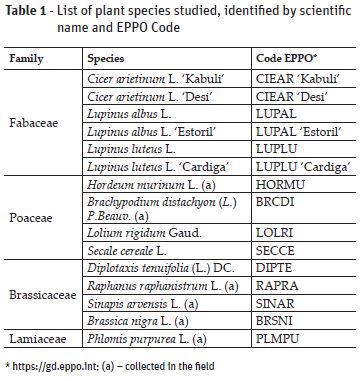
<body><![CDATA[<p><font face = "Verdana" size = "2">Fifteen herbaceous plant species (<a href = "#t1">Table 1</a>) with potential allelopathic effect were used for <i>in vitro </i>and <i>in vivo </i>bioassays. Seeds of each plant species were purchased in commercial houses or collected in the field and sown in pots filled with a soil of volcanic origin (<a href = "/img/revistas/rca/v41nspe/v41nspea07t2.jpg" target = "_blank">Table 2</a>), under greenhouse conditions at Oeiras.</font></p>      
<p>&nbsp;</p>  <a name = "t1"><img src = "/img/revistas/rca/v41nspe/v41nspea07t1.jpg"></a>      
<p>&nbsp;</p>      <p><font face = "Verdana" size = "2">Root extracts were prepared from 40 days old plants. The inhibitory effect of aqueous root extracts was tested <i>in vitro</i> on <i>P. cinnamomi </i>structures. The plants were also tested for their susceptibility to <i>P. cinnamomi</i> root infection in <i>in vivo </i>bioassays.</font></p>      <p><font face = "Verdana" size = "2">The <i>P. cinnamomi </i>isolates used to prepare the inoculum were Pc 1538, Pc 1539 and Pc 5833, mating type A2. The first two were isolated from <i>Q. suber </i>collected in 2015 at Miranda do Corvo<i>,</i> Coimbra, and the latter was isolated in 2015 from <i>Castanea sativa</i> roots collected at Viseu (both regions localised in the centre of Portugal). The culture maintenance was performed as described by Moreira-Marcelino (2001).</font></p>      <p><font face = "Verdana" size = "2"><i>In vitro bioassays - Inhibitory effect</i></font></p>      <p><font face = "Verdana" size = "2">Aqueous root extracts (ARE) of fifteen plant species grown under greenhouse conditions were prepared from roots (10 g fresh weight) in 100 ml of distilled water using a modified method described by Alkhail (2005). A culture of <i>P. cinnamomi</i> (isolate Pc 5833) was used in these bioassays. </font></p>       <p><font face = "Verdana" size = "2">The <i>Phytophthora cinnamomi </i>mycelial growth inhibition test was performed in V8 broth incorporated with ARE at two concentrations (50% and 75% v/v) and the mycelium dry weight (48 hours at 82 °C) was assessed 12 days after incubation at 25 ºC in the dark. </font></p>      <p><font face = "Verdana" size = "2">The inhibitory action of ARE on the production of <i>P. cinnamomi </i>reproductive structures (sporangia and chlamydospores) was analysed using non-sterile soil extract as described by Moreira-Marcelino (2001) and incorporated with root extracts at 75% (v/v). </font></p>      <p><font face = "Verdana" size = "2">The sporangia production and the zoospores release/germination were assessed after six days and the chlamydospores after 12 days of incubation at room temperature (20 °C) without direct light. The quantification of sporangia and chlamydospores was evaluated as the mean number of these structures per mm<sup>2</sup> in the mycelium. Zoospores germination was assessed on Petri dishes filled with V8 agar medium incorporated with ARE at 75% (v/v) and incubated at 25 ºC in the dark.</font></p>      ]]></body>
<body><![CDATA[<p><font face = "Verdana" size = "2"><i>In vivo bioassays - Susceptibility to P. cinnamomi infection</i></font></p>      <p><font face = "Verdana" size = "2">The susceptibility of plants to <i>P. cinnamomi</i> infection was studied in a greenhouse bioassay. These trials were performed during two months between January and March 2017. The plant species, except <i>Phlomis purpurea, </i>were tested in pots filled with an artificially infested soil. Inoculum was prepared as described by Moreira-Marcelino (2001) using millet seeds (<i>Panicum milliaceum</i> L.) colonized during two weeks with an equal mixture of the three isolates, Pc 1538, Pc 1539 and Pc 5833. To inoculate the pots, 25 g of inoculum was mixed with soil before seeding. The control experiment was prepared in the same way, but using sterilized seeds of <i>P. milliaceum</i>.</font></p>      <p><font face = "Verdana" size = "2">Ten plants of each species per pot were cultivated in each treatment with five replicates. At the end of the experiment, plant roots were washed with tap water. Confirmation of infection of root tissue by <i>P. cinnamomi</i> was assessed by its re-isolation from root fragments in <i>Phytophthora </i>selective agar medium P<sub>5</sub>ARPH (Jeffers and Martin, 1986) using the procedure described in Moreira-Marcelino (2001). For each plant species, the shoot and the roots were separated and the severity was evaluated by assessing the dry weight of each part (48 hours at 82 °C).</font></p>       <p><font face = "Verdana" size = "2">Soil samples from pots were also analysed for <i>P. cinnamomi</i> inoculum density.  From each pot, in each species, 100 g of soil were collected and pooled to form a homogenous sample that was left to dry for 48h at room temperature. Ten grams of soil per flask, containing 100 mL of 0.2% agar in sterile water, were shaken and homogenized with a magnetic stirrer during 2 h. A volume of 1 mL of each soil suspension was plated on each of six Petri dishes containing P<sub>5</sub>ARPH agar medium. Plates were incubated at 25 °C in the dark. After 24 hours, the plates were washed in running water to remove the soil water agar solution and incubated at 25 °C in the dark for more two days. The plates were then observed under a light microscope. The colonies identified as <i>P. cinnamomi</i> based on hyphal morphology (presence of hyphal swellings in cluster together with chlamydospores) were expressed as colony forming units per gram of dry soil (cfu g-1). </font></p>      <p><font face = "Verdana" size = "2"><i>Statistical analysis</i></font></p>      <p><font face = "Verdana" size = "2">The percentage inhibition of <i>P. cinnamomi</i> was calculated according to the equation: INIB (%) = 100x(C-T)/C. For mycelium growth: C is the mean weight of mycelium produced in the control and T is the mean weight of mycelium produced in the V8 broth amended with ARE. For sporangial and chlamydospore production: C is the mean number of sporangia/chlamydospore observed per mm<sup>2</sup> on mycelium for the control and T is the mean number of sporangia/chlamydospore observed per mm<sup>2</sup> on mycelium in the same substrate incorporated with ARE. For zoospore germination: C is the mean number of colonies for the control and T is the mean number of colonies for the medium incorporated with root extract (ARE) for each species.  Data were transformed according to the equation: INIBt = (100 - %INIB)/ 100, where %INIB – percentage of inhibition; INIBt – % inhibition transformed, to satisfy tests of normality. Transformed data were subjected to one way analysis of variance (ANOVA) using the Tukey&rsquo;s test (p&lt;0.01) for separation of means.</font></p>      <p><font face = "Verdana" size = "2">Statistical analysis was performed using software R 3.3.</font></p>       <p><font face = "Verdana" size = "3"><b>RESULTS</b></font></p>      <p><font face = "Verdana" size = "2"><i>In vitro bioassays - Inhibitory effect </i></font></p>      <p><font face = "Verdana" size = "2">Results showed that root extracts obtained from some tested species have a strong anti-<i>P. cinnamomi</i> activity with significant inhibition on the mycelial growth and on the production of reproductive structures. The pH of the ARE ranged from 5.6 to 7.2 in all the experiments.</font></p>      ]]></body>
<body><![CDATA[<p><font face = "Verdana" size = "2">The aqueous root extract of two Brassicaceae species, <i>Diplotaxis tenuifolia </i>and <i>Raphanus raphanistrum,</i> inhibited significantly the mycelial growth of <i>P. cinnamomi</i> on both concentrations tested (p&lt;0.01). The mycelial growth inhibition by <i>D. tenuifolia</i> ARE ranged from 69 to 83% for concentrations of 50% and 75%, respectively</a>. For <i>R. raphanistrum</i> the inhibition ranged from 20 to 56% for the same concentrations (<a href = "#f1">Figure 1A</a>). </font></p>      <p>&nbsp;</p>  <a name = "f1"><img src = "/img/revistas/rca/v41nspe/v41nspea07f1.jpg"></a>      
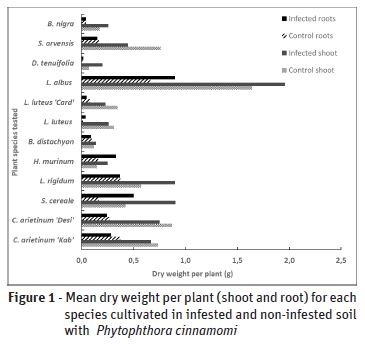
<p>&nbsp;</p>      <p><font face = "Verdana" size = "2">Significant inhibition (81-100%) of sporangia production was observed for the majority of ARE tested (<a href = "#f1">Figure 1B</a>). Three Poaceae species showed different behaviour. For <i>S. cereale</i> and <i>B. distachyon</i> the inhibition achieved was 36% and 53% respectively, while <i>Lolium rigidum</i> ARE showed a significant increase on sporangia and chlamydospores production, which resulted in a high release of zoospores (mean of 4.25x10<sup>5 </sup>mL<sup>-1</sup>) in compared to the control.</font></p>       <p><font face = "Verdana" size = "2">Zoospore differentiation and release were observed on ARE obtained from the same seven species (<i>B. distachyon, B. nigra, H. murinum, L. luteus, L. rigidum, S. arvensis </i>and <i>S. cereale</i>) which induced sporangia production in a quite different amount (<a href = "#f1">Figure 1D</a>). The zoospore viability was tested in the presence of all ARE and only four of them showed inhibition in the germination (Poaceae: <i>B. distachyon </i>- 59.2% and <i>S. cereale </i>- 64.2%; Brassicaceae: <i>D. tenuifolia </i>- 100 % and <i>R. raphanistrum - </i>99.4%). (<a href = "#f1">Figure 1D</a>). </font></p>       <p><font face = "Verdana" size = "2">Chlamydospore production was also influenced by ARE from <i>D. tenuifolia, R. raphanistrum, C. arietinum</i> ‘Kabuli’, and <i>C. arietinum</i> ‘Desi’. The other root extracts showed no inhibitory effect; on the contrary, they improved the chlamydospore production (<a href = "#f1">Figure 1C</a>), but their viability was not tested. </font></p>       <p><font face = "Verdana" size = "2"><i>In vivo bioassays - Susceptibility to P. cinnamomi infection</i></font></p>      <p><font face = "Verdana" size = "2"><a href = "/img/revistas/rca/v41nspe/v41nspea07f2.jpg" target = "_blank">Figure 2</a> summarizes the evaluation of plants in the susceptibility tests. Dry weight of shoots and roots were evaluated. The biomass dry weights of seven plant species, namely <i>L. albus, D. tenuifolia, H. murinum, L. rigidum, S. cereale, B. nigra</i> and <i>B. distachyon</i>, cultivated in the soil infested with <i>P. cinnamomi</i> was higher than those of the control (<a href = "/img/revistas/rca/v41nspe/v41nspea07f2.jpg" target = "_blank">Figure 2</a>). </font></p>      
<p><font face = "Verdana" size = "2">In infested soil, the Fabaceae species, <i>C. arietinum</i> &rsquo;Kabuli&rsquo;, <i>C. arietinum</i> ‘Desi’ and <i>L. albus</i>, did not present any disease symptoms in the aerial part. The leaflets showed a dark green color without discolorations. Also, no lesions or necrosis were observed on roots and <i>P. cinnamomi</i> was not isolated from them. On the contrary, plants of <i>L. luteus</i></a> showed symptoms of foliar chlorosis and necrosis and <i>P. cinnamomi</i> was isolated from their roots. The roots of <i>L. luteus</i> and <i>L. luteus </i>&rsquo;Cardiga&rsquo; presented necrosis and a lower number of nodules than the other Fabaceae. The total biomass of the infected plants (root and shoot) was lower than the control plants (<a href = "/img/revistas/rca/v41nspe/v41nspea07f2.jpg" target = "_blank">Figure 2</a>). Additionally, some infected plants died (<i>L. luteus</i> - 68% and <i>L. luteus </i>&rsquo;Cardiga&rsquo; - 44%). </font></p>      
<p><font face = "Verdana" size = "2">For Brassicaceae, plants grown on infested soil showed no chlorosis or discoloration in shoot; however, flowering occurred earlier than in the control. The root system was short, thin and brittle, showing no lesions or necrosis, and no <i>P. cinnamomi</i> was detected. In infested soil, plants of <i>D. tenuifolia</i> showed higher development than control plants (<a href = "/img/revistas/rca/v41nspe/v41nspea07f2.jpg" target = "_blank">Figure 2</a>), as already mentioned. On the contrary, other species, namely <i>S. arvensis</i> and <i>B. nigra</i>, were also infected with <i>P. cinnamomi, </i>showing that they are hosts of the pathogen. </font></p>      
]]></body>
<body><![CDATA[<p><font face = "Verdana" size = "2">With regard to the Poaceae plants, a higher tillering was observed in the plants sown in the infested soil, which may indicate a strategy of survival, but no symptoms on roots were observed.</font></p>      <p><font face = "Verdana" size = "2">The cultivation of Fabaceae and <i>S. cereale</i> increased the potential inoculum of <i>P. cinnamomi</i> in the soil. The higher number of propagules was observed in the soil where plants of <i>L. luteus </i>‘Cardiga’ and <i>L. luteus </i>were cultivated, 250 and 500 cfu/g, respectively. This species increases the <i>P. cinnamomi</i> inoculum density in the soil. </font></p>      <p><font face = "Verdana" size = "2">On the other hand, the number of propagules observed in some Poaceae species (<i>L. rigidum, B. dystachion and H. murinum</i>) and in Brassicaceae was low (<a href = "/img/revistas/rca/v41nspe/v41nspea07t3.jpg" target = "_blank">Table 3</a>), which could be a good indicator of soil inoculum reduction (chlamydospores and zoospores). </font></p>      
<p><font face = "Verdana" size = "2">The low density of <i>P. cinnamomi </i>detected in the soil (20 cfu/g) cultivated with <i>L. rigidum </i>seems to be in oposition with the results obtained in the bioassays <i>in vitro</i> (increase of sporangia and zoospores), which could be attributed to the presence of bacteria. The plates inoculated with that soil were fully colonized by bacteria which could have a detrimental effect on the development of the <i>P. cinnamomi</i> colonies (this assay was repeated three times).</font></p>      <p><font face = "Verdana" size = "2"> Our results indicate that<i> C. arietinum,</i> <i>S. cereale</i>, <i>L. luteus </i>and<i> L. rigidum </i>could increase the inoculum density. In soils already infested with <i>P. cinnamomi </i>the cultivation of these species must be avoided. </font></p>      <p><font face = "Verdana" size = "3"><b>DISCUSSION</b></font></p>      <p><font face = "Verdana" size = "2">Aqueous root extracts (ARE) of some species of herbaceous plants from the Mediterranean flora showed inhibitory effect on <i>P. cinnamomi</i> growth and in the production of reproductive structures. The present study intends to simulate the root exudates activity in conditions as close as possible to those occurring in nature.  </font></p>      <p><font face = "Verdana" size = "2">It is known that, under natural conditions, sporulation of <i>P. cinnamomi</i> (sporangia production) is stimulated by soil microorganisms such as <i>Pseudomonas</i> spp. and <i>Chromobacterium violaceum</i> Schröter (Zentmyer and Marshall, 1959; Zentmyer, 1965; Zentmyer and Chen, 1969; Ayers, 1971) enhancing the production and release of zoospores and consequently increasing the infection. For the above reason a suspension of non-sterile soil (Tuset <i>et al</i>., 2001) was used in our bioassays to measure the inhibitory activity of extracts in the <i>P. cinnamomi </i>growth and in the production of the reproductive structures. The results showed that root extracts of different plant species from different families substantially varied in their inhibitory effects.</font></p>       <p><font face = "Verdana" size = "2">The <i>P. purpurea</i> aqueous root extract, inhibited completely the sporangia production but increased mycelial growth and the production of chlamydospores. These results are not in accordance with Neves <i>et al</i>. (2014) observations. They registered 100% of inhibition of both sporangia and chlamydospores with the <i>P. purpurea</i> ethanolic root extract. This may be due to the different methods used to obtain the root extracts.</font></p>      <p><font face = "Verdana" size = "2">The activity of <i>L. luteus </i>ARE showed a slight reduction of sporangia production, but potentiate the mycelial growth, an increase on chlamydospore production and the germination of zoospores. This confirms the high number of propagules detected in the soil. These results were in accordance with Serrano <i>et al</i>. (2010, 2011) confirming the possibility of this species contribute to increase inoculum potential in the soil. <i>Lupinus albus</i> was not infected by <i>P. cinnamomi</i> but its ARE increased the number of chlamydospores produced. However, the sporangia production was 100% inhibited.</font></p>      ]]></body>
<body><![CDATA[<p><font face = "Verdana" size = "2">Plants of the Poaceae family has been reported as showing an allelopathic effect due to their benzoxazinone content (Schulz <i>et al</i>., 2013; Tabaglio <i>et al</i>., 2013). In our study, it was observed an increase on the <i>P. cinnamomi</i> activity potentiated by the four Poaceae ARE (<i>B. distachyon, H. murinum, L. rigidum </i>and <i>S. cereale</i>).  No allelopathic effect was observed, although the plants were not infected by <i>P. cinnamomi</i>. The dry weights obtained with these plants developed in the soil infested with <i>P. cinnamomi</i> was higher than those of the control (<a href = "/img/revistas/rca/v41nspe/v41nspea07f2.jpg" target = "_blank">Figure 2</a>). These data may indicate that the plants, in the presence of the pathogen, invested more in biomass production being a possible strategy of adaptation and survival (Moreira <i>et al</i>., 1999; Moreira-Marcelino, 2001). Regarding the production of sporangia, it was with the <i>L. rigidum </i>root extract (ARE) that a larger number of these structures (&gt;100%) were produced and, therefore, a large number of viable zoospores were obtained too. The results highlighted also the possibility of pastures mix species, such as <i>L. luteus, L. rigidum, H. murinum, </i>among others, commonly used for grazing, to increase <i>P. cinnamomi</i> inoculum potential, thus contributing to increase the oak decline disease in woodlands. </font></p>       
<p><font face = "Verdana" size = "2"><i>In vitro</i>, the root exudates of <i>D. tenuifolia</i> and <i>R. raphanistrum</i> showed the greatest inhibition activity on the mycelial growth of <i>P. cinnamomi </i>at both concentrations tested. At the highest concentration both ARE showed a high inhibition activity against <i>P. cinnamomi </i>by reducing the structures formed during its life cycle and preventing the germination of zoospores. These results are in agreement with those reported by Morales-Rodríguez <i>et al.</i> (2012) and Rios <i>et al.</i> (2016) that observed an inhibitory effect of different <i>Brassica</i> spp. on the mycelial growth of <i>Phytophthora</i> <i>nicotianae </i>and <i>P. cinnamomi</i>, respectively.</font></p>      <p><font face = "Verdana" size = "2">The inhibitory effect of <i>B. nigra </i>against <i>P. cinnamomi </i>was not so effective as that achieved by <i>D. tenuifolia </i>and <i>R. raphanistrum</i>. The <i>Brassica nigra</i> ARE produced a slight inhibition on mycelial growth (18%) and a stronger inhibition on sporangia production (86%), however they did not decrease the production of chlamydospores. On the contrary, Rios <i>et al.</i> (2016) demonstrated the biofumigation effectiveness of <i>B. nigra </i>against <i>P. cinnamomi</i>. So, it is probable that <i>B. nigra </i>presents different activity according to the method applied in allelopathic control.</font></p>      <p><font face = "Verdana" size = "2">Brassicaceae crops were considered, in general, non-host of <i>P. cinnamomi,</i> but Krasnow and Hausbeck (2015) reported that <i>B. juncea </i>and <i>B. napus </i>were infected by <i>Phytophthora capsici</i>. Our results showed that<i> S. arvensis</i> and <i>B. nigra</i> could be infected by the <i>P. cinnamomi</i>.</font></p>       <p><font face = "Verdana" size = "2">The non-susceptibility of <i>D. tenuifolia</i> to <i>P. cinnamomi</i> together with the inhibitory action of its root extract, are important features demonstrated in this study. The use of <i>D. tenuifolia </i>or other plant species to control soil borne plant pathogens will be preferred as safe alternative to chemical control. </font></p>       <p><font face = "Verdana" size = "3"><b>CONCLUSIONS</b></font></p>      <p><font face = "Verdana" size = "2">From the fifteen plant species of the Mediterranean flora studied, only two Brassicaceae species (<i>D. tenuifolia </i>and<i> R. raphanistrum</i>) showed a greatest inhibitory effect against <i>P. cinnamomi. </i>These species could be introduced to enrich pastures reducing the pathogen population in the soil and preventing its spread, aiming to preserve the &ldquo;Montado&rdquo; ecosystem. </font></p>       <p><font face = "Verdana" size = "2">Four other species, namely<i> B. nigra, L. rigidum, L. luteus </i>and<i> S. arvensis,</i> were colonized by <i>P. cinammomi. </i>The presence of these host plants in the &rdquo;Montado&rdquo; could contribute to the build up of inoculum in the soil and must therefore be avoided.</font></p>      <p><font face = "Verdana" size = "2">Since in general, in Portugal, oak woodlands soils infested with <i>P. cinnamomi </i>present low pH, low mineral nutrient levels and low organic matter content (Moreira and Martins, 2005) these approaches (enriched pastures with Brassicaeae and the use of non-host plants) could be applied in an integrated disease management strategy, contributing also to improve soil quality and supressiveness.</font></p>      <p>&nbsp;</p>      ]]></body>
<body><![CDATA[<p><font face = "Verdana" size = "3"><b>References</b></font></p>      <!-- ref --><p><font face = "Verdana" size = "2">Alkhail, A. (2005) - Antifungal activity of some extracts against some plant pathogenic fungi. <i>Pakistan Journal of Biological Sciences</i>, vol. 8, n. 3, p. 413-417. <a href = "https://doi.org/10.3923/pjbs.2005.413.417" target = "_blank">https://doi.org/10.3923/pjbs.2005.413.417</a></font>&nbsp;&nbsp;&nbsp;&nbsp;&nbsp;&nbsp;&nbsp;&nbsp;[&#160;<a href="javascript:void(0);" onclick="javascript: window.open('/scielo.php?script=sci_nlinks&ref=693363&pid=S0871-018X201800050000700001&lng=','','width=640,height=500,resizable=yes,scrollbars=1,menubar=yes,');">Links</a>&#160;]<!-- end-ref --><!-- ref --><p><font face = "Verdana" size = "2">Ayers, W. (1971) - Induction of sporangia in <i>Phytophthora cinnamomi </i>by a substance from bacteria and soil. <i>Canadian Journal of Microbiology</i>, vol. 17, n. 12, p. 1517-1523. <a href = "https://doi.org/10.1139/m71-242" target = "_blank">https://doi.org/10.1139/m71-242</a></font>&nbsp;&nbsp;&nbsp;&nbsp;&nbsp;&nbsp;&nbsp;&nbsp;[&#160;<a href="javascript:void(0);" onclick="javascript: window.open('/scielo.php?script=sci_nlinks&ref=693364&pid=S0871-018X201800050000700002&lng=','','width=640,height=500,resizable=yes,scrollbars=1,menubar=yes,');">Links</a>&#160;]<!-- end-ref --><!-- ref --><p><font face = "Verdana" size = "2">Araniti, F.; Sorgonà, A.; Lupini, A. & Abenavoli, M. (2012) - Screening of Mediterranean wild plant species for allelopathic activity and their use as bio-herbicides. <i>Allelopathy Journal,</i> vol. 29, n. 1, p. 107-124.    &nbsp;&nbsp;&nbsp;&nbsp;&nbsp;&nbsp;&nbsp;&nbsp;[&#160;<a href="javascript:void(0);" onclick="javascript: window.open('/scielo.php?script=sci_nlinks&ref=693365&pid=S0871-018X201800050000700003&lng=','','width=640,height=500,resizable=yes,scrollbars=1,menubar=yes,');">Links</a>&#160;]<!-- end-ref --></font></p>       <!-- ref --><p><font face = "Verdana" size = "2">Castillo-Reyes, F.; Hernández-Castillo, D.; Clemente-Constantino, J.; Gallego-Morales, G.; Rodríguez-Herrera, R. & Aguilar, C. (2015) - In vitro antifungal activity of polyphenols-rich plant extracts against <i>Phytophthora cinnamomi </i>Rands. <i>African Journal of Agricultural Research,</i> vol. 10, n. 50, p.4554-4560. <a href = "https://doi.org/10.5897/AJAR2013.8072" target = "_blank">https://doi.org/10.5897/AJAR2013.8072</a></font>&nbsp;&nbsp;&nbsp;&nbsp;&nbsp;&nbsp;&nbsp;&nbsp;[&#160;<a href="javascript:void(0);" onclick="javascript: window.open('/scielo.php?script=sci_nlinks&ref=693367&pid=S0871-018X201800050000700004&lng=','','width=640,height=500,resizable=yes,scrollbars=1,menubar=yes,');">Links</a>&#160;]<!-- end-ref --><!-- ref --><p><font face = "Verdana" size = "2">Cheng, F. & Cheng, Z. (2015) - Research progess on the use of plant allelopathy in agriculture and the physiological and ecological mechanisms of allelopathy. <i>Frontiers in Plant Science, </i>vol. 6, art. 1020. <a href = "https://doi.org/10.3389/fpls.2015.01020" target = "_blank">https://doi.org/10.3389/fpls.2015.01020</a></font>&nbsp;&nbsp;&nbsp;&nbsp;&nbsp;&nbsp;&nbsp;&nbsp;[&#160;<a href="javascript:void(0);" onclick="javascript: window.open('/scielo.php?script=sci_nlinks&ref=693368&pid=S0871-018X201800050000700005&lng=','','width=640,height=500,resizable=yes,scrollbars=1,menubar=yes,');">Links</a>&#160;]<!-- end-ref --><!-- ref --><p><font face = "Verdana" size = "2">Dunne, C. (2004) - <i>Control of sudden death in cultivated proteas from the South west of Western Australia</i>. PhD Thesis. Murdock University, Australia.    &nbsp;&nbsp;&nbsp;&nbsp;&nbsp;&nbsp;&nbsp;&nbsp;[&#160;<a href="javascript:void(0);" onclick="javascript: window.open('/scielo.php?script=sci_nlinks&ref=693369&pid=S0871-018X201800050000700006&lng=','','width=640,height=500,resizable=yes,scrollbars=1,menubar=yes,');">Links</a>&#160;]<!-- end-ref --></font></p>      <!-- ref --><p><font face = "Verdana" size = "2">Jeffers, S. & Martin, S. (1986) - Comparison of two media selective for <i>Phytophthora </i>and <i>Pythium</i> species. <i>Plant Disease</i>, vol. 70, n. 11, p. 1038-1043. <a href = "https://doi.org/10.1094/PD-70-1038" target = "_blank">https://doi.org/10.1094/PD-70-1038</a></font>&nbsp;&nbsp;&nbsp;&nbsp;&nbsp;&nbsp;&nbsp;&nbsp;[&#160;<a href="javascript:void(0);" onclick="javascript: window.open('/scielo.php?script=sci_nlinks&ref=693371&pid=S0871-018X201800050000700007&lng=','','width=640,height=500,resizable=yes,scrollbars=1,menubar=yes,');">Links</a>&#160;]<!-- end-ref --><!-- ref --><p><font face = "Verdana" size = "2">Krasnow, C.S. & Hausbeck, M.K. (2015) - Pathogenicity of <i>Phytophthora capsici </i>to <i>Brassica </i>vegetable crops and biofumigation cover crops (<i>Brassica </i>spp.). <i>Plant Disease</i>, vol. 99, n. 12, p. 1721-1726. <a href = "https://doi.org/10.1094/PDIS-03-15-0271-RE" target = "_blank">https://doi.org/10.1094/PDIS-03-15-0271-RE</a></font>&nbsp;&nbsp;&nbsp;&nbsp;&nbsp;&nbsp;&nbsp;&nbsp;[&#160;<a href="javascript:void(0);" onclick="javascript: window.open('/scielo.php?script=sci_nlinks&ref=693372&pid=S0871-018X201800050000700008&lng=','','width=640,height=500,resizable=yes,scrollbars=1,menubar=yes,');">Links</a>&#160;]<!-- end-ref --><!-- ref --><p><font face = "Verdana" size = "2">Morales-Rodríguez, C.; Picón-Toro, J.; Palo, C.; Palo, EJ.; García, Á. & Rodríguez-Molina, C. (2012) - In vitro inhibition of mycelial growth of <i>Phytophthora nicotianae</i> Breda de Haan from different hosts by Brassicaceae species. Effect of the developmental stage of the biofumigant plants. <i>Pest Management Science</i>, vol. 68, n. 9, p. 1317-1322. <a href = "https://doi.org/10.1002/ps.3310" target = "_blank">https://doi.org/10.1002/ps.3310</a></font>&nbsp;&nbsp;&nbsp;&nbsp;&nbsp;&nbsp;&nbsp;&nbsp;[&#160;<a href="javascript:void(0);" onclick="javascript: window.open('/scielo.php?script=sci_nlinks&ref=693373&pid=S0871-018X201800050000700009&lng=','','width=640,height=500,resizable=yes,scrollbars=1,menubar=yes,');">Links</a>&#160;]<!-- end-ref --><!-- ref --><p><font face = "Verdana" size = "2">Moreira Marcelino, A.C.; Ferraz, JP. & Clegg, J. (1999) -The involvement of <i>P. cinnamomi </i>in cork and holm oak decline in Portugal. <i>In</i>: Hansen, E.M. & Sutton, W. (Eds.) - <i>First International Meeting on Phytophthoras in Forest and Wildland Ecosystems</i>. p. 132-135. Grant Pass, Oregon, 30 Agosto-3 Setembro, 1999, E.U.A.    &nbsp;&nbsp;&nbsp;&nbsp;&nbsp;&nbsp;&nbsp;&nbsp;[&#160;<a href="javascript:void(0);" onclick="javascript: window.open('/scielo.php?script=sci_nlinks&ref=693374&pid=S0871-018X201800050000700010&lng=','','width=640,height=500,resizable=yes,scrollbars=1,menubar=yes,');">Links</a>&#160;]<!-- end-ref --></font></p>      <!-- ref --><p><font face = "Verdana" size = "2">Moreira A.C. & Martins J.M. (2005) - Influence of site factors on the impact of <i>Phytophthora cinnamomi</i> in cork oak stands in Portugal. <i>Forest Pathology</i>, vol. 35, n. 3, p. 145-162, <a href = "https://doi.org/10.1111/j.1439-0329.2005.00397.x" target = "_blank">https://doi.org/10.1111/j.1439-0329.2005.00397.x</a></font>&nbsp;&nbsp;&nbsp;&nbsp;&nbsp;&nbsp;&nbsp;&nbsp;[&#160;<a href="javascript:void(0);" onclick="javascript: window.open('/scielo.php?script=sci_nlinks&ref=693376&pid=S0871-018X201800050000700011&lng=','','width=640,height=500,resizable=yes,scrollbars=1,menubar=yes,');">Links</a>&#160;]<!-- end-ref --><!-- ref --><p><font face = "Verdana" size = "2">Moreira-Marcelino, A.C. (2001) - Aspectos da interacção entre <i>Phytophthora cinnamomi</i> e a doença do declínio em <i>Q. suber</i> e <i>Q. rotundifolia</i>. Dissertação para Prestação de Provas de Doutoramento, Faculdade de Engenharia de Recursos Naturais, Universidade do Algarve, Faro, p. 279.    &nbsp;&nbsp;&nbsp;&nbsp;&nbsp;&nbsp;&nbsp;&nbsp;[&#160;<a href="javascript:void(0);" onclick="javascript: window.open('/scielo.php?script=sci_nlinks&ref=693377&pid=S0871-018X201800050000700012&lng=','','width=640,height=500,resizable=yes,scrollbars=1,menubar=yes,');">Links</a>&#160;]<!-- end-ref --></font></p>       <!-- ref --><p><font face = "Verdana" size = "2">Neves, D.; Caetano, P.; Oliveira, J.; Maia, C.; Horta, M.; Sousa, N.; Salgado, M.; Dionísio, L.; Magan, N. & Cravador, A. (2014) - Anti-<i>Phytophthora cinnamomi </i>activity of <i>Phlomis purpurea </i>plant and root extracts. <i>European Jornaul of Plant Pathology</i>, vol. 138, n. 4, p. 835-846. <a href = "https://doi.org/10.1007/s10658-013-0357" target = "_blank">https://doi.org/10.1007/s10658-013-0357</a></font>&nbsp;&nbsp;&nbsp;&nbsp;&nbsp;&nbsp;&nbsp;&nbsp;[&#160;<a href="javascript:void(0);" onclick="javascript: window.open('/scielo.php?script=sci_nlinks&ref=693379&pid=S0871-018X201800050000700013&lng=','','width=640,height=500,resizable=yes,scrollbars=1,menubar=yes,');">Links</a>&#160;]<!-- end-ref --><!-- ref --><p><font face = "Verdana" size = "2">Ríos, P.; Obregón, S.; Haro, A.; Fernández-Rebollo, P.; Serrano, M. & Sánchez, M. E. (2016) - Effect of <i>Brassica </i>biofumigant amendments on different stages of the life cycle of <i>Phytophthora cinnamomi</i>. <i>Journal of Phytopathology,</i> vol. 164, n. 9, p. 582-594, <a href = "https://doi.org/10.1111/jph.12482" target = "_blank">https://doi.org/10.1111/jph.12482</a></font>&nbsp;&nbsp;&nbsp;&nbsp;&nbsp;&nbsp;&nbsp;&nbsp;[&#160;<a href="javascript:void(0);" onclick="javascript: window.open('/scielo.php?script=sci_nlinks&ref=693380&pid=S0871-018X201800050000700014&lng=','','width=640,height=500,resizable=yes,scrollbars=1,menubar=yes,');">Links</a>&#160;]<!-- end-ref --><!-- ref --><p><font face = "Verdana" size = "2">Schulz, M.; Marocco, A.; Tabaglio, V.; Macias, F. & Molinillo J. (2013) - Benzoxazinoids in rye allelopathy – from discovery to application in sustainable weed control and organic farming. <i>Journal of Chemical Ecology</i>, vol. 39, n. 2, p. 154-174. <a href = "https://doi.org/10.1007/s10886-013-0235-x" target = "_blank">https://doi.org/10.1007/s10886-013-0235-x</a></font>&nbsp;&nbsp;&nbsp;&nbsp;&nbsp;&nbsp;&nbsp;&nbsp;[&#160;<a href="javascript:void(0);" onclick="javascript: window.open('/scielo.php?script=sci_nlinks&ref=693381&pid=S0871-018X201800050000700015&lng=','','width=640,height=500,resizable=yes,scrollbars=1,menubar=yes,');">Links</a>&#160;]<!-- end-ref --><!-- ref --><p><font face = "Verdana" size = "2">Serrano, M.; Fernández-Rebollo, P.; De Vita, P.; Trapero-Casas, A. & Sánchez, E. (2010) - <i>Lupinus luteus</i>, a new host of <i>Phytophthora cinnamomi </i>in Spanish oakrangeland ecosystems. <i>European Journal of Plant Pathology</i>, vol. 128, p. 149-152. <a href = "https://doi.org/10.1007/s10658-010-9652" target = "_blank">https://doi.org/10.1007/s10658-010-9652</a></font>&nbsp;&nbsp;&nbsp;&nbsp;&nbsp;&nbsp;&nbsp;&nbsp;[&#160;<a href="javascript:void(0);" onclick="javascript: window.open('/scielo.php?script=sci_nlinks&ref=693382&pid=S0871-018X201800050000700016&lng=','','width=640,height=500,resizable=yes,scrollbars=1,menubar=yes,');">Links</a>&#160;]<!-- end-ref --><!-- ref --><p><font face = "Verdana" size = "2">Serrano, M.; Fernández-Rebollo, P.; De Vita, P.; Carbonero, M. & Sánchez, E. (2011) - The role of yellow lupin (<i>Lupinus luteus</i>) in the decline affecting oak agroforestry ecosystems. <i>Forest Pathology</i>, vol. 41, n. 5, p. 382-386. <a href = "https://doi.org/10.1111/j.1439-0329.2010.00694.x" target = "_blank">https://doi.org/10.1111/j.1439-0329.2010.00694.x</a></font>&nbsp;&nbsp;&nbsp;&nbsp;&nbsp;&nbsp;&nbsp;&nbsp;[&#160;<a href="javascript:void(0);" onclick="javascript: window.open('/scielo.php?script=sci_nlinks&ref=693383&pid=S0871-018X201800050000700017&lng=','','width=640,height=500,resizable=yes,scrollbars=1,menubar=yes,');">Links</a>&#160;]<!-- end-ref --><p><font face = "Verdana" size = "2">Tuset, J.J.; Cots F.; Hinarejos, C. & Mira J.L. (2001) - Suspensiones de zoosporas de <i>Phytophthora cinnamomi</i> que causan la &ldquo;seca&rdquo; en cinco especies <i>de</i> <i>Quercus </i>mediterráneos. <i>Boletín Sanidad Vegetal - Plagas</i>, vol. 27, n. 1, p. 103-115.</font></p>      <!-- ref --><p><font face = "Verdana" size = "2">Tabaglio, V.; Marocco, A. & Schulz, M. (2013) - Allelopathic cover crop of rye for integrated weed control in sustainable agroecosystems. <i>Italian Journal of Agronomy</i>, vol. 8, n. 5, p. 35-40. <a href = "https://doi.org/10.4081/ija.2013.e5" target = "_blank">https://doi.org/10.4081/ija.2013.e5</a></font>&nbsp;&nbsp;&nbsp;&nbsp;&nbsp;&nbsp;&nbsp;&nbsp;[&#160;<a href="javascript:void(0);" onclick="javascript: window.open('/scielo.php?script=sci_nlinks&ref=693385&pid=S0871-018X201800050000700019&lng=','','width=640,height=500,resizable=yes,scrollbars=1,menubar=yes,');">Links</a>&#160;]<!-- end-ref --><!-- ref --><p><font face = "Verdana" size = "2">Zentmyer, G.A. (1965) - Bacterial stimulation of <i>Phytophthora cinnamomi </i>sporangium. <i>Science,</i> vol. 150, n. 3700, p. 1178-1179. <a href = "https://doi.org/10.1126/science.150.3700.1178" target = "_blank">https://doi.org/10.1126/science.150.3700.1178</a></font>&nbsp;&nbsp;&nbsp;&nbsp;&nbsp;&nbsp;&nbsp;&nbsp;[&#160;<a href="javascript:void(0);" onclick="javascript: window.open('/scielo.php?script=sci_nlinks&ref=693386&pid=S0871-018X201800050000700020&lng=','','width=640,height=500,resizable=yes,scrollbars=1,menubar=yes,');">Links</a>&#160;]<!-- end-ref --><!-- ref --><p><font face = "Verdana" size = "2">Zentmyer, G.A. & Chen, D. (1969) - Production of sporangia by <i>Phytophthora cinnamomi </i>in pure culture. <i>California Avocado Society Yearbook</i>, vol. 53, p. 103-107.    &nbsp;&nbsp;&nbsp;&nbsp;&nbsp;&nbsp;&nbsp;&nbsp;[&#160;<a href="javascript:void(0);" onclick="javascript: window.open('/scielo.php?script=sci_nlinks&ref=693387&pid=S0871-018X201800050000700021&lng=','','width=640,height=500,resizable=yes,scrollbars=1,menubar=yes,');">Links</a>&#160;]<!-- end-ref --></font></p>      <!-- ref --><p><font face = "Verdana" size = "2">Zentmyer, G.A. & Marshall L.A. (1959) - Factors affecting sporangial production by <i>Phytophthora cinnamomi</i>. <i>Phytopathology, </i>vol. <i> </i>49, p. 556.    &nbsp;&nbsp;&nbsp;&nbsp;&nbsp;&nbsp;&nbsp;&nbsp;[&#160;<a href="javascript:void(0);" onclick="javascript: window.open('/scielo.php?script=sci_nlinks&ref=693389&pid=S0871-018X201800050000700022&lng=','','width=640,height=500,resizable=yes,scrollbars=1,menubar=yes,');">Links</a>&#160;]<!-- end-ref --></font></p>      <p>&nbsp;</p>      ]]></body>
<body><![CDATA[<p><font face = "Verdana" size = "2">Received/recebido: 2018.01.31</font></p>      <p><font face = "Verdana" size = "2">Accepted/aceite: 2018.02.01</font></p>       ]]></body><back>
<ref-list>
<ref id="B1">
<nlm-citation citation-type="journal">
<person-group person-group-type="author">
<name>
<surname><![CDATA[Alkhail]]></surname>
<given-names><![CDATA[A.]]></given-names>
</name>
</person-group>
<article-title xml:lang="en"><![CDATA[Antifungal activity of some extracts against some plant pathogenic fungi]]></article-title>
<source><![CDATA[Pakistan Journal of Biological Sciences]]></source>
<year>2005</year>
<volume>8</volume>
<numero>3</numero>
<issue>3</issue>
<page-range>413-417</page-range></nlm-citation>
</ref>
<ref id="B2">
<nlm-citation citation-type="journal">
<person-group person-group-type="author">
<name>
<surname><![CDATA[Ayers]]></surname>
<given-names><![CDATA[W.]]></given-names>
</name>
</person-group>
<article-title xml:lang="en"><![CDATA[Induction of sporangia in Phytophthora cinnamomi by a substance from bacteria and soil]]></article-title>
<source><![CDATA[Canadian Journal of Microbiology]]></source>
<year>1971</year>
<volume>17</volume>
<numero>12</numero>
<issue>12</issue>
<page-range>1517-1523</page-range></nlm-citation>
</ref>
<ref id="B3">
<nlm-citation citation-type="journal">
<person-group person-group-type="author">
<name>
<surname><![CDATA[Araniti]]></surname>
<given-names><![CDATA[F.]]></given-names>
</name>
<name>
<surname><![CDATA[Sorgonà]]></surname>
<given-names><![CDATA[A.]]></given-names>
</name>
<name>
<surname><![CDATA[Lupini]]></surname>
<given-names><![CDATA[A.]]></given-names>
</name>
<name>
<surname><![CDATA[Abenavoli]]></surname>
<given-names><![CDATA[M.]]></given-names>
</name>
</person-group>
<article-title xml:lang="en"><![CDATA[Screening of Mediterranean wild plant species for allelopathic activity and their use as bio-herbicides]]></article-title>
<source><![CDATA[Allelopathy Journal]]></source>
<year>2012</year>
<volume>29</volume>
<numero>1</numero>
<issue>1</issue>
<page-range>107-124</page-range></nlm-citation>
</ref>
<ref id="B4">
<nlm-citation citation-type="journal">
<person-group person-group-type="author">
<name>
<surname><![CDATA[Castillo-Reyes]]></surname>
<given-names><![CDATA[F.]]></given-names>
</name>
<name>
<surname><![CDATA[Hernández-Castillo]]></surname>
<given-names><![CDATA[D.]]></given-names>
</name>
<name>
<surname><![CDATA[Clemente-Constantino]]></surname>
<given-names><![CDATA[J.]]></given-names>
</name>
<name>
<surname><![CDATA[Gallego-Morales]]></surname>
<given-names><![CDATA[G.]]></given-names>
</name>
<name>
<surname><![CDATA[Rodríguez-Herrera]]></surname>
<given-names><![CDATA[R.]]></given-names>
</name>
<name>
<surname><![CDATA[Aguilar]]></surname>
<given-names><![CDATA[C.]]></given-names>
</name>
</person-group>
<article-title xml:lang="en"><![CDATA[In vitro antifungal activity of polyphenols-rich plant extracts against Phytophthora cinnamomi Rands]]></article-title>
<source><![CDATA[African Journal of Agricultural Research]]></source>
<year>2015</year>
<volume>10</volume>
<numero>50</numero>
<issue>50</issue>
<page-range>4554-4560</page-range></nlm-citation>
</ref>
<ref id="B5">
<nlm-citation citation-type="journal">
<person-group person-group-type="author">
<name>
<surname><![CDATA[Cheng]]></surname>
<given-names><![CDATA[F.]]></given-names>
</name>
<name>
<surname><![CDATA[Cheng]]></surname>
<given-names><![CDATA[Z.]]></given-names>
</name>
</person-group>
<article-title xml:lang="en"><![CDATA[Research progess on the use of plant allelopathy in agriculture and the physiological and ecological mechanisms of allelopathy]]></article-title>
<source><![CDATA[Frontiers in Plant Science]]></source>
<year>2015</year>
<volume>6</volume>
<page-range>1020</page-range></nlm-citation>
</ref>
<ref id="B6">
<nlm-citation citation-type="">
<person-group person-group-type="author">
<name>
<surname><![CDATA[Dunne]]></surname>
<given-names><![CDATA[C.]]></given-names>
</name>
</person-group>
<source><![CDATA[Control of sudden death in cultivated proteas from the South west of Western Australia]]></source>
<year>2004</year>
</nlm-citation>
</ref>
<ref id="B7">
<nlm-citation citation-type="journal">
<person-group person-group-type="author">
<name>
<surname><![CDATA[Jeffers]]></surname>
<given-names><![CDATA[S.]]></given-names>
</name>
<name>
<surname><![CDATA[Martin]]></surname>
<given-names><![CDATA[S.]]></given-names>
</name>
</person-group>
<article-title xml:lang="en"><![CDATA[Comparison of two media selective for Phytophthora and Pythium species]]></article-title>
<source><![CDATA[Plant Disease]]></source>
<year>1986</year>
<volume>70</volume>
<numero>11</numero>
<issue>11</issue>
<page-range>1038-1043</page-range></nlm-citation>
</ref>
<ref id="B8">
<nlm-citation citation-type="journal">
<person-group person-group-type="author">
<name>
<surname><![CDATA[Krasnow]]></surname>
<given-names><![CDATA[C.S.]]></given-names>
</name>
<name>
<surname><![CDATA[Hausbeck]]></surname>
<given-names><![CDATA[M.K.]]></given-names>
</name>
</person-group>
<article-title xml:lang="en"><![CDATA[Pathogenicity of Phytophthora capsici to Brassica vegetable crops and biofumigation cover crops (Brassica spp.)]]></article-title>
<source><![CDATA[Plant Disease]]></source>
<year>2015</year>
<volume>99</volume>
<numero>12</numero>
<issue>12</issue>
<page-range>1721-1726</page-range></nlm-citation>
</ref>
<ref id="B9">
<nlm-citation citation-type="journal">
<person-group person-group-type="author">
<name>
<surname><![CDATA[Morales-Rodríguez]]></surname>
<given-names><![CDATA[C.]]></given-names>
</name>
<name>
<surname><![CDATA[Picón-Toro]]></surname>
<given-names><![CDATA[J.]]></given-names>
</name>
<name>
<surname><![CDATA[Palo]]></surname>
<given-names><![CDATA[C.]]></given-names>
</name>
<name>
<surname><![CDATA[Palo]]></surname>
<given-names><![CDATA[EJ.]]></given-names>
</name>
<name>
<surname><![CDATA[García]]></surname>
<given-names><![CDATA[Á.]]></given-names>
</name>
<name>
<surname><![CDATA[Rodríguez-Molina]]></surname>
<given-names><![CDATA[C.]]></given-names>
</name>
</person-group>
<article-title xml:lang="en"><![CDATA[In vitro inhibition of mycelial growth of Phytophthora nicotianae Breda de Haan from different hosts by Brassicaceae species: Effect of the developmental stage of the biofumigant plants]]></article-title>
<source><![CDATA[Pest Management Science]]></source>
<year>2012</year>
<volume>68</volume>
<numero>9</numero>
<issue>9</issue>
<page-range>1317-1322</page-range></nlm-citation>
</ref>
<ref id="B10">
<nlm-citation citation-type="">
<person-group person-group-type="author">
<name>
<surname><![CDATA[Moreira Marcelino]]></surname>
<given-names><![CDATA[A.C.]]></given-names>
</name>
<name>
<surname><![CDATA[Ferraz]]></surname>
<given-names><![CDATA[JP.]]></given-names>
</name>
<name>
<surname><![CDATA[Clegg]]></surname>
<given-names><![CDATA[J.]]></given-names>
</name>
</person-group>
<article-title xml:lang="en"><![CDATA[The involvement of P. cinnamomi in cork and holm oak decline in Portugal]]></article-title>
<person-group person-group-type="editor">
<name>
<surname><![CDATA[Hansen]]></surname>
<given-names><![CDATA[E.M.]]></given-names>
</name>
<name>
<surname><![CDATA[Sutton]]></surname>
<given-names><![CDATA[W.]]></given-names>
</name>
</person-group>
<source><![CDATA[First International Meeting on Phytophthoras in Forest and Wildland Ecosystems]]></source>
<year>1999</year>
<month>19</month>
<day>99</day>
<page-range>132-135</page-range><publisher-loc><![CDATA[Grant Pass^eOregon Oregon]]></publisher-loc>
</nlm-citation>
</ref>
<ref id="B11">
<nlm-citation citation-type="journal">
<person-group person-group-type="author">
<name>
<surname><![CDATA[Moreira]]></surname>
<given-names><![CDATA[A.C.]]></given-names>
</name>
<name>
<surname><![CDATA[Martins]]></surname>
<given-names><![CDATA[J.M.]]></given-names>
</name>
</person-group>
<article-title xml:lang="en"><![CDATA[Influence of site factors on the impact of Phytophthora cinnamomi in cork oak stands in Portugal]]></article-title>
<source><![CDATA[Forest Pathology]]></source>
<year>2005</year>
<volume>35</volume>
<numero>3</numero>
<issue>3</issue>
<page-range>145-162</page-range></nlm-citation>
</ref>
<ref id="B12">
<nlm-citation citation-type="">
<person-group person-group-type="author">
<name>
<surname><![CDATA[Moreira-Marcelino]]></surname>
<given-names><![CDATA[A.C.]]></given-names>
</name>
</person-group>
<source><![CDATA[Aspectos da interacção entre Phytophthora cinnamomi e a doença do declínio em Q. suber e Q. rotundifolia]]></source>
<year>2001</year>
</nlm-citation>
</ref>
<ref id="B13">
<nlm-citation citation-type="journal">
<person-group person-group-type="author">
<name>
<surname><![CDATA[Neves]]></surname>
<given-names><![CDATA[D.]]></given-names>
</name>
<name>
<surname><![CDATA[Caetano]]></surname>
<given-names><![CDATA[P.]]></given-names>
</name>
<name>
<surname><![CDATA[Oliveira]]></surname>
<given-names><![CDATA[J.]]></given-names>
</name>
<name>
<surname><![CDATA[Maia]]></surname>
<given-names><![CDATA[C.]]></given-names>
</name>
<name>
<surname><![CDATA[Horta]]></surname>
<given-names><![CDATA[M.]]></given-names>
</name>
<name>
<surname><![CDATA[Sousa]]></surname>
<given-names><![CDATA[N.]]></given-names>
</name>
<name>
<surname><![CDATA[Salgado]]></surname>
<given-names><![CDATA[M.]]></given-names>
</name>
<name>
<surname><![CDATA[Dionísio]]></surname>
<given-names><![CDATA[L.]]></given-names>
</name>
<name>
<surname><![CDATA[Magan]]></surname>
<given-names><![CDATA[N.]]></given-names>
</name>
<name>
<surname><![CDATA[Cravador]]></surname>
<given-names><![CDATA[A.]]></given-names>
</name>
</person-group>
<article-title xml:lang="en"><![CDATA[Anti-Phytophthora cinnamomi activity of Phlomis purpurea plant and root extracts]]></article-title>
<source><![CDATA[European Jornaul of Plant Pathology]]></source>
<year>2014</year>
<volume>138</volume>
<numero>4</numero>
<issue>4</issue>
<page-range>835-846</page-range></nlm-citation>
</ref>
<ref id="B14">
<nlm-citation citation-type="journal">
<person-group person-group-type="author">
<name>
<surname><![CDATA[Ríos]]></surname>
<given-names><![CDATA[P.]]></given-names>
</name>
<name>
<surname><![CDATA[Obregón]]></surname>
<given-names><![CDATA[S.]]></given-names>
</name>
<name>
<surname><![CDATA[Haro]]></surname>
<given-names><![CDATA[A.]]></given-names>
</name>
<name>
<surname><![CDATA[Fernández-Rebollo]]></surname>
<given-names><![CDATA[P.]]></given-names>
</name>
<name>
<surname><![CDATA[Serrano]]></surname>
<given-names><![CDATA[M.]]></given-names>
</name>
<name>
<surname><![CDATA[Sánchez]]></surname>
<given-names><![CDATA[M. E.]]></given-names>
</name>
</person-group>
<article-title xml:lang="en"><![CDATA[Effect of Brassica biofumigant amendments on different stages of the life cycle of Phytophthora cinnamomi]]></article-title>
<source><![CDATA[Journal of Phytopathology]]></source>
<year>2016</year>
<volume>164</volume>
<numero>9</numero>
<issue>9</issue>
<page-range>582-594</page-range></nlm-citation>
</ref>
<ref id="B15">
<nlm-citation citation-type="journal">
<person-group person-group-type="author">
<name>
<surname><![CDATA[Schulz]]></surname>
<given-names><![CDATA[M.]]></given-names>
</name>
<name>
<surname><![CDATA[Marocco]]></surname>
<given-names><![CDATA[A.]]></given-names>
</name>
<name>
<surname><![CDATA[Tabaglio]]></surname>
<given-names><![CDATA[V.]]></given-names>
</name>
<name>
<surname><![CDATA[Macias]]></surname>
<given-names><![CDATA[F.]]></given-names>
</name>
<name>
<surname><![CDATA[Molinillo]]></surname>
<given-names><![CDATA[J.]]></given-names>
</name>
</person-group>
<article-title xml:lang="en"><![CDATA[Benzoxazinoids in rye allelopathy - from discovery to application in sustainable weed control and organic farming]]></article-title>
<source><![CDATA[Journal of Chemical Ecology]]></source>
<year>2013</year>
<volume>39</volume>
<numero>2</numero>
<issue>2</issue>
<page-range>154-174</page-range></nlm-citation>
</ref>
<ref id="B16">
<nlm-citation citation-type="journal">
<person-group person-group-type="author">
<name>
<surname><![CDATA[Serrano]]></surname>
<given-names><![CDATA[M.]]></given-names>
</name>
<name>
<surname><![CDATA[Fernández-Rebollo]]></surname>
<given-names><![CDATA[P.]]></given-names>
</name>
<name>
<surname><![CDATA[De Vita]]></surname>
<given-names><![CDATA[P.]]></given-names>
</name>
<name>
<surname><![CDATA[Trapero-Casas]]></surname>
<given-names><![CDATA[A.]]></given-names>
</name>
<name>
<surname><![CDATA[Sánchez]]></surname>
<given-names><![CDATA[E.]]></given-names>
</name>
</person-group>
<article-title xml:lang="en"><![CDATA[Lupinus luteus, a new host of Phytophthora cinnamomi in Spanish oakrangeland ecosystems]]></article-title>
<source><![CDATA[European Journal of Plant Pathology]]></source>
<year>2010</year>
<volume>128</volume>
<page-range>149-152</page-range></nlm-citation>
</ref>
<ref id="B17">
<nlm-citation citation-type="journal">
<person-group person-group-type="author">
<name>
<surname><![CDATA[Serrano]]></surname>
<given-names><![CDATA[M.]]></given-names>
</name>
<name>
<surname><![CDATA[Fernández-Rebollo]]></surname>
<given-names><![CDATA[P.]]></given-names>
</name>
<name>
<surname><![CDATA[De Vita]]></surname>
<given-names><![CDATA[P.]]></given-names>
</name>
<name>
<surname><![CDATA[Carbonero]]></surname>
<given-names><![CDATA[M.]]></given-names>
</name>
<name>
<surname><![CDATA[Sánchez]]></surname>
<given-names><![CDATA[E.]]></given-names>
</name>
</person-group>
<article-title xml:lang="en"><![CDATA[The role of yellow lupin (Lupinus luteus) in the decline affecting oak agroforestry ecosystems]]></article-title>
<source><![CDATA[Forest Pathology]]></source>
<year>2011</year>
<volume>41</volume>
<numero>5</numero>
<issue>5</issue>
<page-range>382-386</page-range></nlm-citation>
</ref>
<ref id="B18">
<nlm-citation citation-type="journal">
<person-group person-group-type="author">
<name>
<surname><![CDATA[Tuset]]></surname>
<given-names><![CDATA[J.J.]]></given-names>
</name>
<name>
<surname><![CDATA[Cots]]></surname>
<given-names><![CDATA[F.]]></given-names>
</name>
<name>
<surname><![CDATA[Hinarejos]]></surname>
<given-names><![CDATA[C.]]></given-names>
</name>
<name>
<surname><![CDATA[Mira]]></surname>
<given-names><![CDATA[J.L.]]></given-names>
</name>
</person-group>
<article-title xml:lang="es"><![CDATA[Suspensiones de zoosporas de Phytophthora cinnamomi que causan la “seca” en cinco especies de Quercus mediterráneos]]></article-title>
<source><![CDATA[Boletín Sanidad Vegetal - Plagas]]></source>
<year>2001</year>
<volume>27</volume>
<numero>1</numero>
<issue>1</issue>
<page-range>103-115</page-range></nlm-citation>
</ref>
<ref id="B19">
<nlm-citation citation-type="journal">
<person-group person-group-type="author">
<name>
<surname><![CDATA[Tabaglio]]></surname>
<given-names><![CDATA[V.]]></given-names>
</name>
<name>
<surname><![CDATA[Marocco]]></surname>
<given-names><![CDATA[A.]]></given-names>
</name>
<name>
<surname><![CDATA[Schulz]]></surname>
<given-names><![CDATA[M.]]></given-names>
</name>
</person-group>
<article-title xml:lang="en"><![CDATA[Allelopathic cover crop of rye for integrated weed control in sustainable agroecosystems]]></article-title>
<source><![CDATA[Italian Journal of Agronomy]]></source>
<year>2013</year>
<volume>8</volume>
<numero>5</numero>
<issue>5</issue>
<page-range>35-40</page-range></nlm-citation>
</ref>
<ref id="B20">
<nlm-citation citation-type="journal">
<person-group person-group-type="author">
<name>
<surname><![CDATA[Zentmyer]]></surname>
<given-names><![CDATA[G.A.]]></given-names>
</name>
</person-group>
<article-title xml:lang="en"><![CDATA[Bacterial stimulation of Phytophthora cinnamomi sporangium]]></article-title>
<source><![CDATA[Science]]></source>
<year>1965</year>
<volume>150</volume>
<numero>3700</numero>
<issue>3700</issue>
<page-range>1178-1179</page-range></nlm-citation>
</ref>
<ref id="B21">
<nlm-citation citation-type="journal">
<person-group person-group-type="author">
<name>
<surname><![CDATA[Zentmyer]]></surname>
<given-names><![CDATA[G.A.]]></given-names>
</name>
<name>
<surname><![CDATA[Chen]]></surname>
<given-names><![CDATA[D.]]></given-names>
</name>
</person-group>
<article-title xml:lang="en"><![CDATA[Production of sporangia by Phytophthora cinnamomi in pure culture]]></article-title>
<source><![CDATA[California Avocado Society Yearbook]]></source>
<year>1969</year>
<volume>53</volume>
<page-range>103-107</page-range></nlm-citation>
</ref>
<ref id="B22">
<nlm-citation citation-type="journal">
<person-group person-group-type="author">
<name>
<surname><![CDATA[Zentmyer]]></surname>
<given-names><![CDATA[G.A.]]></given-names>
</name>
<name>
<surname><![CDATA[Marshall]]></surname>
<given-names><![CDATA[L.A.]]></given-names>
</name>
</person-group>
<article-title xml:lang="en"><![CDATA[Factors affecting sporangial production by Phytophthora cinnamomi]]></article-title>
<source><![CDATA[Phytopathology]]></source>
<year>1959</year>
<volume>49</volume>
<page-range>556</page-range></nlm-citation>
</ref>
</ref-list>
</back>
</article>