<?xml version="1.0" encoding="ISO-8859-1"?><article xmlns:mml="http://www.w3.org/1998/Math/MathML" xmlns:xlink="http://www.w3.org/1999/xlink" xmlns:xsi="http://www.w3.org/2001/XMLSchema-instance">
<front>
<journal-meta>
<journal-id>0871-018X</journal-id>
<journal-title><![CDATA[Revista de Ciências Agrárias]]></journal-title>
<abbrev-journal-title><![CDATA[Rev. de Ciências Agrárias]]></abbrev-journal-title>
<issn>0871-018X</issn>
<publisher>
<publisher-name><![CDATA[Sociedade de Ciências Agrárias de Portugal]]></publisher-name>
</publisher>
</journal-meta>
<article-meta>
<article-id>S0871-018X2018000500013</article-id>
<article-id pub-id-type="doi">10.19084/RCA.17071</article-id>
<title-group>
<article-title xml:lang="en"><![CDATA[Studies on differential susceptibility of ‘Rocha’ pear clones and Portuguese varieties of pear and apple to fire blight - tools for the sustainability of fruit chain production]]></article-title>
<article-title xml:lang="pt"><![CDATA[Suscetibilidade diferencial de clones de pereira ‘Rocha’ e de variedades autóctones de pereira e macieira à doença do Fogo Bacteriano em Portugal demonstram potencial como alternativas para a sustentabilidade da fileira]]></article-title>
</title-group>
<contrib-group>
<contrib contrib-type="author">
<name>
<surname><![CDATA[Cruz]]></surname>
<given-names><![CDATA[Leonor]]></given-names>
</name>
<xref ref-type="aff" rid="A1 "/>
</contrib>
<contrib contrib-type="author">
<name>
<surname><![CDATA[Cruz]]></surname>
<given-names><![CDATA[Joana]]></given-names>
</name>
<xref ref-type="aff" rid="A1 "/>
</contrib>
<contrib contrib-type="author">
<name>
<surname><![CDATA[Sousa]]></surname>
<given-names><![CDATA[Rui]]></given-names>
</name>
<xref ref-type="aff" rid="A3"/>
</contrib>
</contrib-group>
<aff id="AA1">
<institution><![CDATA[,Instituto Nacional de Investigação Agrária e Veterinária Unidade de Investigação e Serviços de Sistemas Agrários e Florestais e Sanidade Vegetal Laboratório de Fitobacteriologia]]></institution>
<addr-line><![CDATA[Oeiras ]]></addr-line>
<country>Portugal</country>
</aff>
<aff id="AA2">
<institution><![CDATA[,Universidade de Lisboa Faculdade de Ciências Instituto de Biossistemas e Ciências Integrativas]]></institution>
<addr-line><![CDATA[Lisboa ]]></addr-line>
<country>Portugal</country>
</aff>
<aff id="AA3">
<institution><![CDATA[,Instituto Nacional de Investigação Agrária e Veterinária Polo de Alcobaça ]]></institution>
<addr-line><![CDATA[Alcobaça ]]></addr-line>
<country>Portugal</country>
</aff>
<pub-date pub-type="pub">
<day>00</day>
<month>12</month>
<year>2018</year>
</pub-date>
<pub-date pub-type="epub">
<day>00</day>
<month>12</month>
<year>2018</year>
</pub-date>
<volume>41</volume>
<numero>spe</numero>
<fpage>121</fpage>
<lpage>130</lpage>
<copyright-statement/>
<copyright-year/>
<self-uri xlink:href="http://scielo.pt/scielo.php?script=sci_arttext&amp;pid=S0871-018X2018000500013&amp;lng=en&amp;nrm=iso"></self-uri><self-uri xlink:href="http://scielo.pt/scielo.php?script=sci_abstract&amp;pid=S0871-018X2018000500013&amp;lng=en&amp;nrm=iso"></self-uri><self-uri xlink:href="http://scielo.pt/scielo.php?script=sci_pdf&amp;pid=S0871-018X2018000500013&amp;lng=en&amp;nrm=iso"></self-uri><abstract abstract-type="short" xml:lang="en"><p><![CDATA[Fire blight was officially identified for the first time in Portugal, in 2011, affecting pear cultivar ‘Rocha’, the most important Portuguese variety of pear, with high economic impact in the production chain and trade. Since then the bacterium has destroyed new orchards in several areas of pear and apple production in the country. Nurseries and phytogenetic resources of several important in vivo collections have also been affected and are considered endangered. Severe disease symptoms on branches, flowers and fruits are also present in several other autochthones pear and apple varieties, leading to the death of trees under the climatic and cultural conditions prevalent in Portugal. Coordinated efforts from all fruit production chain actors, including farmers, phytosanitary authorities and research institutions, produced tools to overcome disease impact and build economic and social sustainability of this activity. Within the frame of the national research project Proder InovPomo (2014-2017), the phytogenetic resources of two official collections of pear and apple trees were assessed towards susceptibility to fire blight disease, to select and preserve the individuals combining the best agronomic features as well as higher tolerance to fire blight. The results achieved are essential for selection and preservation of Portuguese phytogenetic resources and biodiversity, as well as for delivering high quality planting materials to farmers for the establishment of new orchards, especially in fruit production areas where fire blight disease is present.]]></p></abstract>
<abstract abstract-type="short" xml:lang="pt"><p><![CDATA[A doença do Fogo Bacteriano das Rosáceas foi oficialmente identificada pela primeira vez em Portugal em 2011, afetando com grande impacto económico devido a quebras provocadas na produção e no volume de exportações, os pomares de pereira da cultivar ‘Rocha’, a mais importante variedade portuguesa. Desde então a bactéria tem vindo a destruir novos pomares em várias áreas de produção de peras e maçãs em Portugal. Os viveiros e importantes coleções in vivo de recursos fitogenéticos autóctones também foram afetados, encontrando-se em risco. Na generalidade observam-se sintomas muito característicos da doença nos ramos, flores e frutos de distintas variedades autóctones, que conduzem à morte das árvores afetadas, nas condições climáticas prevalentes nas regiões mais importantes de produção de pomóideas em Portugal. Os vários intervenientes da cadeia de produção, incluindo fruticultores, autoridade fitossanitária e instituições de investigação implementaram ferramentas para mitigar o impacto económico e social causado pela doença e conduzir à sustentabilidade desta atividade económica. O trabalho desenvolvido no âmbito do projeto de investigação nacional Proder InovPomo (2014-2017), permitiu identificar e avaliar a suscetibilidade de duas coleções vivas de recursos fitogenéticos autóctones de macieira e pereira, em risco, avaliando a sua suscetibilidade a Erwinia amylovora, com o objetivo de selecionar e preservar os indivíduos com as melhores características agronómicas, evidenciando maior tolerância à doença do Fogo Bacteriano das Rosáceas.]]></p></abstract>
<kwd-group>
<kwd lng="en"><![CDATA[Disease management and control]]></kwd>
<kwd lng="en"><![CDATA[Erwinia amylovora]]></kwd>
<kwd lng="en"><![CDATA[pathogenicity]]></kwd>
<kwd lng="pt"><![CDATA[Controlo fitossanitário]]></kwd>
<kwd lng="pt"><![CDATA[Fogo bacteriano]]></kwd>
<kwd lng="pt"><![CDATA[Erwinia amylovora]]></kwd>
<kwd lng="pt"><![CDATA[patogenicidade]]></kwd>
</kwd-group>
</article-meta>
</front><body><![CDATA[ <p align = "right"><font face = "Verdana" size = "2"><b>ARTIGO</b></font></p>      <p><font face = "Verdana" size = "4"><b>Studies on differential susceptibility of &lsquo;Rocha&rsquo; pear clones and Portuguese varieties of pear and apple to fire blight - tools for the sustainability of fruit chain production</b></font></p>       <p><font face = "Verdana" size = "3"><b>Suscetibilidade diferencial de clones de pereira &lsquo;Rocha&rsquo; e de variedades autóctones de pereira e macieira à doença do Fogo Bacteriano em Portugal demonstram potencial como alternativas para a sustentabilidade da fileira</b></font></p>      <p><font face = "Verdana" size = "2"><b>Leonor Cruz</b><sup>1,2*</sup>, <b>Joana Cruz</b><sup>1,2</sup> and <b>Rui Sousa</b><sup>3</sup></font></p>      <p><font face = "Verdana" size = "2"><i><sup>1 </sup>Instituto Nacional de Investigação Agrária e Veterinária, Unidade de Investigação e Serviços de Sistemas Agrários e Florestais e Sanidade Vegetal, Laboratório de Fitobacteriologia, Oeiras, Portugal</i></font></p>       <p><font face = "Verdana" size = "2"><i><sup>2 </sup>Universidade de Lisboa, Faculdade de Ciências, Instituto de Biossistemas e Ciências Integrativas (BioISI), Lisboa, Portugal</i></font></p>      <p><font face = "Verdana" size = "2"><i> <sup>3 </sup>Instituto Nacional de Investigação Agrária e Veterinária, Polo de Alcobaça, Alcobaça, Portugal</i></font></p>       <p><font face = "Verdana" size = "2"><i>(*E-mail: <a href = "mailto:leonor.cruz@iniav.pt">leonor.cruz@iniav.pt</a>)</i></b></font></p>   <hr noshade size = "1">      <p><font face = "Verdana" size = "3"><b>ABSTRACT</b></font></p>       <p><font face = "Verdana" size = "2">Fire blight was officially identified for the first time in Portugal, in 2011, affecting pear cultivar &lsquo;Rocha&rsquo;, the most important Portuguese variety of pear, with high economic impact in the production chain and trade. Since then the bacterium has destroyed new orchards in several areas of pear and apple production in the country. Nurseries and phytogenetic resources of several important <i>in vivo</i> collections have also been affected and are considered endangered. Severe disease symptoms on branches, flowers and fruits are also present in several other autochthones pear and apple varieties, leading to the death of trees under the climatic and cultural conditions prevalent in Portugal. Coordinated efforts from all fruit production chain actors, including farmers, phytosanitary authorities and research institutions, produced tools to overcome disease impact and build economic and social sustainability of this activity. Within the frame of the national research project Proder InovPomo (2014-2017), the phytogenetic resources of two official collections of pear and apple trees were assessed towards susceptibility to fire blight disease, to select and preserve the individuals combining the best agronomic features as well as higher tolerance to fire blight. The results achieved are essential for selection and preservation of Portuguese phytogenetic resources and biodiversity, as well as for delivering high quality planting materials to farmers for the establishment of new orchards, especially in fruit production areas where fire blight disease is present. </font></p>      ]]></body>
<body><![CDATA[<p><font face = "Verdana" size = "2"><b>Keywords: </b>Disease management and control, <i>Erwinia</i> <i>amylovora</i>, pathogenicity.</font></p>  <hr noshade size = "1">      <p><font face = "Verdana" size = "3"><b>RESUMO</b></font></p>       <p><font face = "Verdana" size = "2">A doença do Fogo Bacteriano das Rosáceas foi oficialmente identificada pela primeira vez em Portugal em 2011, afetando com grande impacto económico devido a quebras provocadas na produção e no volume de exportações, os pomares de pereira da cultivar &lsquo;Rocha&rsquo;, a mais importante variedade portuguesa. Desde então a bactéria tem vindo a destruir novos pomares em várias áreas de produção de peras e maçãs em Portugal. Os viveiros e importantes coleções <i>in vivo</i> de recursos fitogenéticos autóctones também foram afetados, encontrando-se em risco. Na generalidade observam-se sintomas muito característicos da doença nos ramos, flores e frutos de distintas variedades autóctones, que conduzem à morte das árvores afetadas, nas condições climáticas prevalentes nas regiões mais importantes de produção de pomóideas em Portugal. Os vários intervenientes da cadeia de produção, incluindo fruticultores, autoridade fitossanitária e instituições de investigação implementaram ferramentas para mitigar o impacto económico e social causado pela doença e conduzir à sustentabilidade desta atividade económica. O trabalho desenvolvido no âmbito do projeto de investigação nacional Proder InovPomo (2014-2017), permitiu identificar e avaliar a suscetibilidade de duas coleções vivas de recursos fitogenéticos autóctones de macieira e pereira, em risco, avaliando a sua suscetibilidade a <i>Erwinia</i> <i>amylovora</i>, com o objetivo de selecionar e preservar os indivíduos com as melhores características agronómicas, evidenciando maior tolerância à doença do Fogo Bacteriano das Rosáceas. </font></p>      <p><font face = "Verdana" size = "2"><b>Palavras-chave:</b> Controlo fitossanitário, Fogo bacteriano, <i>Erwinia</i> <i>amylovora</i>, patogenicidade</font></p>  <hr noshade size = "1">      <p><font face = "Verdana" size = "3"><b>INTRODUCTION</b></font></p>       <p><font face = "Verdana" size = "2">Fire blight disease has a severe impact in the production and trade of Portuguese apple and pear, namely in what concerns pear from cultivar &lsquo;Rocha&rsquo;. </font></p>      <p><font face = "Verdana" size = "2">Since 2011, <i>Erwinia amylovora</i> has destructed nurseries and orchards from distinct production areas of the country (Cruz, 2011). Nurseries and phytogenetic resources are endangered as most of them are settled in these affected areas (Cruz, 2012).</font></p>        <p><font face = "Verdana" size = "2">Similar problems aroused in the main European pomme production areas where apple and pear genetic resources were also assessed (Thibault <i>et al</i>., 1987; Szobiczewski <i>et al</i>., 2011; Gassmann <i>et al</i>., 2014) with very promising results, identifying accessions to be included in new breeding programs as tolerant parents, or displaying good qualities for industry purposes, contributing moreover to maintain biodiversity.</font></p>      <p><font face = "Verdana" size = "2">Within the framework of Proder InovPomo Project (PA49448) (2014-2017), the phytogenetic resources from two official <i>in vivo</i> collections of autochthones varieties of pear and apple were assessed towards the presence of <i>E.</i> <i>amylovora</i> and further studied to identify the existence of differential susceptibility to fire blight disease, with the objective of selecting and preserving individuals displaying higher levels of tolerance to the disease.</font></p>      <p><font face = "Verdana" size = "2">The results gathered during the time lapse of this project allowed identifying distinct levels of susceptibility to <i>E. amylovora</i> within the 80 pear &lsquo;Rocha&rsquo; clones tested under confinement conditions as well as several national varieties of pear and apple able to serve as alternatives for sustainability of the fruit chain in the main production areas, adapted to Portuguese climatic conditions. This work also allowed the preservation of the important endangered phytogenetic resources and perspective the study molecular mechanisms associated to specific plant immunity.</font></p>      ]]></body>
<body><![CDATA[<p><font face = "Verdana" size = "3"><b>MATERIALS AND METHODS</b></font></p>      <p><font face = "Verdana" size = "2"><b><i>Bacterial strains</i></b></font></p>       <p><font face = "Verdana" size = "2"><i>Erwinia</i> <i>amylovora</i> strain CPBF 1307, isolated in Portugal and collected from <i>Pyrus</i> <i>communis</i> cv. &lsquo;Rocha&rsquo;, in 2010, in the Alcobaça area, previously characterized and conserved at -80ºC, was used as positive control for diagnostic analysis as well as for susceptibility trials implemented under environmental controlled and appropriate confinement conditions. </font></p>      <p><font face = "Verdana" size = "2">The detection and identification of the bacterium was performed according to EPPO standard PM 7/21(2) (EPPO, 2013). Susceptibility tests were performed according to Parprstein <i>et al.</i> (2014) and EPPO standard PM 7/21(1) (EPPO, 2004).</font></p>      <p><font face = "Verdana" size = "2">The bacterial strain selected was grown in KMB agar (King <i>et al</i>., 1954), for 48hours at 24ºC, streaked to check for purity and further tested using conventional PCR, following Obradovic <i>et al.</i> (2007) modified by Gottsberg (PM 7/21(2)) (EPPO, 2013). The bacterial inoculum was prepared in phosphate buffer saline 10mM at a concentration of approximately 10<sup>8</sup> cells/ml (OD=0.1 at 600nm).</font></p>      <p><font face = "Verdana" size = "2"><b><i>Biological tests</i></b></font></p>       <p><font face = "Verdana" size = "2">Biological tests were performed along the three years of the project and repeated for confirmation of preliminary results achieved.</font></p>       <p><font face = "Verdana" size = "2">Young branches of the year from 72 clones of pear cv. &lsquo;Rocha&rsquo; collected at Quinta de S. Gonçalo (Caldas da Rainha) and eight clones collected at Quinta do Olival Fechado (INIAV, Alcobaça) were firstly tested to determine the presence of disease, and used further to evaluate susceptibility to <i>Erwinia</i> <i>amylovora</i>. </font></p>      <p><font face = "Verdana" size = "2">Comparative analysis of susceptibility towards fire blight disease was also tested among 15 Portuguese pear varieties, other than &lsquo;Rocha&rsquo; and 16 autochthones apple varieties.</font></p>       <p><font face = "Verdana" size = "2">Ten branches from each of the selected trees genomically characterized for identity confirmation, with ca. 30cm long were collected at the end of spring, wrapped in paper and transported to the laboratory, refrigerated, in closed polyethylene bags. Four replicate branches from each clone/variety were surface disinfected with 70% ethanol for 30seconds and further washed for three times in sterile distilled water, and dried. All branches were cut aseptically at the bottom and at the tip with a sterile scalpel, immediately introduced in micropropagation tubes containing 0,1% agar for inoculation (EPPO standard PM 7/21(1), 2004).</font></p>       ]]></body>
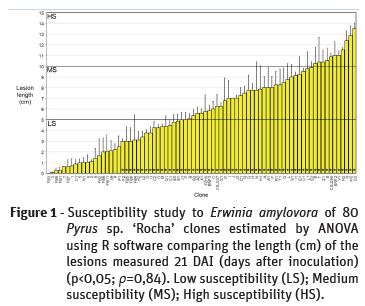
<body><![CDATA[<p><font face = "Verdana" size = "2">All branches replicates with approximately 20cm long were inoculated at the tip in a flow chamber with 10mL of the bacterial suspension, immediately closed and transferred to a confinement chamber with 24ºC/18ºC (day/night) and 16-hour photoperiod for incubation, during  three weeks. Plant susceptibility to fire blight was assessed 21 days after inoculation (DAI), based on the lesion length on shoots. 10% of replicates randomly chosen were used to determine the reproducibility of the inoculation method. One-way ANOVA data analysis was performed using software R.</font></p>      <p><font face = "Verdana" size = "3"><b>RESULTS AND DISCUSSION&nbsp;</b></font></p>       <p><font face = "Verdana" size = "2">The selected plants were confirmed as free of <i>E.</i> <i>amylovora</i> according to the diagnostic procedures used, and by this reason used for branch inoculation.</font></p>      <p><font face = "Verdana" size = "2">Results from branch inoculations revealed significantly distinct susceptibility levels of the 80 pear clones tested to the bacterium (p&lt;0,05) (<a href = "#f1">Figure 1</a>).</font></p>      <p>&nbsp;</p>  <a name = "f1"><img src = "/img/revistas/rca/v41nspe/v41nspea13f1.jpg"></a>      
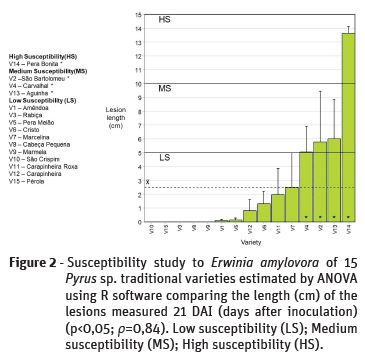
<p>&nbsp;</p>      <p><font face = "Verdana" size = "2">Comparative analysis of susceptibility among 15 Portuguese varieties of pear, other than &lsquo;Rocha&rsquo;, highlighted a differential response to <i>E.</i> <i>amylovora</i>, revealing that four of them, &lsquo;Pera Bonita&rsquo;, &lsquo;São Bartolomeu&rsquo;, &lsquo;Carvalhal&rsquo; and &lsquo;Aguinha&rsquo;, presented medium to high susceptibility to the bacterium. Inversely, the remaining 11 varieties, displayed lower susceptibility levels, showing to be potential alternatives to pear &lsquo;Rocha&rsquo; (<a href = "#f2">Figure 2</a>). This variety displayed levels of disease susceptibility higher than the average of the 15 pear varieties tested, after assessing the average of all clones tested (<a href = "#f4">Figure 4</a>).</font></p>      <p>&nbsp;</p>  <a name = "f2"><img src = "/img/revistas/rca/v41nspe/v41nspea13f2.jpg"></a>      
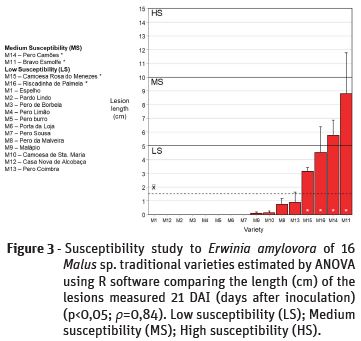
<p>&nbsp;</p>      <p><font face = "Verdana" size = "2">Similarly, 16 apple varieties, also evaluated towards fire blight susceptibility, displayed, in general, lower levels of disease symptoms three weeks after inoculation, when compared to pear varieties, showing low to medium susceptibility under our trial conditions (p&lt;0,05) (<a href = "#f3">Figure 3</a>). Eight of these apple varieties showed no visible symptoms at 21 DAI. In addition, viable cells of the bacterium were not recovered after re-isolation from the inoculated branches. Among the authoctones apple varieties, the most susceptible was &rsquo;Bravo Esmolfe&lsquo;, one of the most popular in the country.</font></p>      ]]></body>
<body><![CDATA[<p>&nbsp;</p>  <a name = "f3"><img src = "/img/revistas/rca/v41nspe/v41nspea13f3.jpg"></a>      
<p>&nbsp;</p>  <a name = "f4"><img src = "/img/revistas/rca/v41nspe/v41nspea13f4.jpg"></a>      
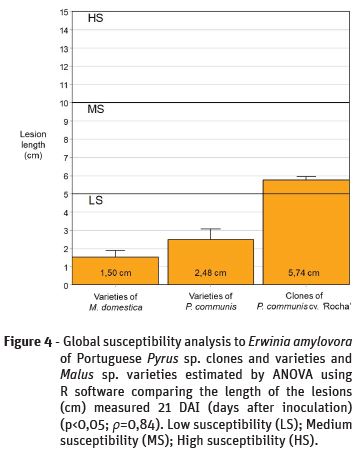
<p>&nbsp;</p>      <p><font face = "Verdana" size = "2">Global comparative analysis allowed to underline distinct levels of susceptibility to fire blight agent – <i>Erwinia</i> <i>amylovora</i> – and to demonstrate the potential of <i>Pyrus</i> sp. and <i>Malus</i> sp. phytogenetic resources as alternatives for the establishment of new orchards, controlling high levels of basal inoculum in areas contiguous to contaminated delimited areas where the disease is known to occur (<a href = "#f4">Figure 4</a>). Parallel studies in other European countries lead to the identification of similar results, with distinct levels of susceptibility for different sets of accessions and autochthones varieties of pear and apple (Paprstein <i>et al</i>., 2014; Sedlak <i>et al</i>., 2014).</font></p>      <p><font face = "Verdana" size = "3"><b>CONCLUSIONS</b></font></p>       <p><font face = "Verdana" size = "2">Recent studies confirm the benefits of this approach as a tool to identify resistance sources, and to identify alternatives to commercial varieties preventing dispersal of the bacterium and sustainability of the fruit production chain in a short time lapse (Szobiczewski <i>et</i> <i>al</i>., 2011; Gassmann <i>et</i> <i>al</i>., 2014).</font></p>      <p><font face = "Verdana" size = "2">Evaluation of the presence of <i>Erwinia</i> <i>amylovora</i> in these <i>in vivo</i> collections allowed the sanitation and preservation of relevant ecological biodiversity and long-term conservation at the national germplasm bank (Banco Português de Germoplasma Vegetal – BPGV), by <i>in vitro</i> propagation.</font></p>      <p><font face = "Verdana" size = "2">Differential susceptibility of this resources towards the causal agent of fire blight disease, also allowed identifying the existence of climate adapted autochthones varieties of pear and apple, as well as pear &lsquo;Rocha&rsquo; clones as solid alternatives for the sustainability of Portuguese fruit chain production.</font></p>      <p>&nbsp;</p>      <p><font face = "Verdana" size = "3"><b>References</b></font></p>       ]]></body>
<body><![CDATA[<!-- ref --><p><font face = "Verdana" size = "2">Cruz, L. (2011) - <i>O Fogo Bacteriano das Rosáceas</i>. Boletim Técnico. INRB/L-INIA/UIPP (BT-05). 2 pp.    &nbsp;&nbsp;&nbsp;&nbsp;&nbsp;&nbsp;&nbsp;&nbsp;[&#160;<a href="javascript:void(0);" onclick="javascript: window.open('/scielo.php?script=sci_nlinks&ref=694869&pid=S0871-018X201800050001300001&lng=','','width=640,height=500,resizable=yes,scrollbars=1,menubar=yes,');">Links</a>&#160;]<!-- end-ref --> </font></p>      <!-- ref --><p><font face = "Verdana" size = "2">Cruz, L. (2012) - <i>Programa de Monitorização do Fogo Bacteriano das Rosáceas</i>. INRB(L-INIA) UIPP-01/12. 15 pp.    &nbsp;&nbsp;&nbsp;&nbsp;&nbsp;&nbsp;&nbsp;&nbsp;[&#160;<a href="javascript:void(0);" onclick="javascript: window.open('/scielo.php?script=sci_nlinks&ref=694871&pid=S0871-018X201800050001300002&lng=','','width=640,height=500,resizable=yes,scrollbars=1,menubar=yes,');">Links</a>&#160;]<!-- end-ref --> </font></p>      <!-- ref --><p><font face = "Verdana" size = "2">EPPO (2004) - PM 7/20 (1) <i>Erwinia amylovora</i>. <i>EPPO Bulletin</i>, vol. 34, p. 155–157.    &nbsp;&nbsp;&nbsp;&nbsp;&nbsp;&nbsp;&nbsp;&nbsp;[&#160;<a href="javascript:void(0);" onclick="javascript: window.open('/scielo.php?script=sci_nlinks&ref=694873&pid=S0871-018X201800050001300003&lng=','','width=640,height=500,resizable=yes,scrollbars=1,menubar=yes,');">Links</a>&#160;]<!-- end-ref --></font></p>      <!-- ref --><p><font face = "Verdana" size = "2">EPPO (2013) - PM 7/20 (2) <i>Erwinia amylovora</i>. <i>EPPO Bulletin, </i>vol. 43, p. 21–45.    &nbsp;&nbsp;&nbsp;&nbsp;&nbsp;&nbsp;&nbsp;&nbsp;[&#160;<a href="javascript:void(0);" onclick="javascript: window.open('/scielo.php?script=sci_nlinks&ref=694875&pid=S0871-018X201800050001300004&lng=','','width=640,height=500,resizable=yes,scrollbars=1,menubar=yes,');">Links</a>&#160;]<!-- end-ref --> </font></p>      <!-- ref --><p><font face = "Verdana" size = "2">Gassmann, J.; Hunziker, K. & Kellerhals, M. (2014) - Evaluation of traditional pome fruit genetic resources in Switzerland. <i>Acta Horticulturae,</i> vol. 1056, p. 243-245. <a href = "https://doi.org/10.17660/ActaHortic.2014.1056.40" target = "_blank">https://doi.org/10.17660/ActaHortic.2014.1056.40</a></font>&nbsp;&nbsp;&nbsp;&nbsp;&nbsp;&nbsp;&nbsp;&nbsp;[&#160;<a href="javascript:void(0);" onclick="javascript: window.open('/scielo.php?script=sci_nlinks&ref=694877&pid=S0871-018X201800050001300005&lng=','','width=640,height=500,resizable=yes,scrollbars=1,menubar=yes,');">Links</a>&#160;]<!-- end-ref --><!-- ref --><p><font face = "Verdana" size = "2">King, E.O.; Ward, M. & Raney, D.E. (1954) - Two simple media for the demonstration of pyocyanin and fluorescein. <i>Journal of Laboratory and Clinical Medicine</i>, vol. 44, p. 301–307.    &nbsp;&nbsp;&nbsp;&nbsp;&nbsp;&nbsp;&nbsp;&nbsp;[&#160;<a href="javascript:void(0);" onclick="javascript: window.open('/scielo.php?script=sci_nlinks&ref=694878&pid=S0871-018X201800050001300006&lng=','','width=640,height=500,resizable=yes,scrollbars=1,menubar=yes,');">Links</a>&#160;]<!-- end-ref --></font></p>      <!-- ref --><p><font face = "Verdana" size = "2">Obradovic, D.; Balaz, J. & Kevresan, S. (2007) - Detection of <i>Erwinia amylovora</i> by novel chromosomal polymerase chain reaction primers. <i><u>Mikrobiologiia</u></i>, vol. 76, n. 6, p. 844–852. <a href = "https://doi.org/10.1134/S002626170706015X" target = "_blank">https://doi.org/10.1134/S002626170706015X</a></font>&nbsp;&nbsp;&nbsp;&nbsp;&nbsp;&nbsp;&nbsp;&nbsp;[&#160;<a href="javascript:void(0);" onclick="javascript: window.open('/scielo.php?script=sci_nlinks&ref=694880&pid=S0871-018X201800050001300007&lng=','','width=640,height=500,resizable=yes,scrollbars=1,menubar=yes,');">Links</a>&#160;]<!-- end-ref --><!-- ref --><p><font face = "Verdana" size = "2">Paprstein, F.; Sedlak, J.; Sillerova, J. & Korba, J. (2014) - In Vitro Evaluation of Cultivar Resistance to Fire Blight. <i>Acta Horticulturae,</i> vol. 1056, p. 259-262. <a href = "https://doi.org/10.17660/ActaHortic.2014.1056.43" target = "_blank">https://doi.org/10.17660/ActaHortic.2014.1056.43</a></font>&nbsp;&nbsp;&nbsp;&nbsp;&nbsp;&nbsp;&nbsp;&nbsp;[&#160;<a href="javascript:void(0);" onclick="javascript: window.open('/scielo.php?script=sci_nlinks&ref=694881&pid=S0871-018X201800050001300008&lng=','','width=640,height=500,resizable=yes,scrollbars=1,menubar=yes,');">Links</a>&#160;]<!-- end-ref --><!-- ref --><p><font face = "Verdana" size = "2">Sedlak, J.; Paprstein, F.; Sillerova, J. & Korba, J. (2014) - Improvement of system for testing of pome fruit resistance to <i>Erwinia amylovora</i> using in vitro artificial inoculation. <i>Acta Horticulturae,</i> vol. 1056, p. 263-266. <a href = "https://doi.org/10.17660/ActaHortic.2014.1056.44" target = "_blank">https://doi.org/10.17660/ActaHortic.2014.1056.44</a></font>&nbsp;&nbsp;&nbsp;&nbsp;&nbsp;&nbsp;&nbsp;&nbsp;[&#160;<a href="javascript:void(0);" onclick="javascript: window.open('/scielo.php?script=sci_nlinks&ref=694882&pid=S0871-018X201800050001300009&lng=','','width=640,height=500,resizable=yes,scrollbars=1,menubar=yes,');">Links</a>&#160;]<!-- end-ref --><!-- ref --><p><font face = "Verdana" size = "2">Szobiczewski, P.; Mikici&#324;ski, A.; Lewandowski, M.; Zurawicz, E.; Peil, A.; Richter, K. & Kellerhals, M. (2011) - Selection for blight resistance of apple genotypes originating from European genetic resources and breeding programs. <i>Acta Horticulturae, </i>vol. 896, p. 399-405. <a href = "https://doi.org/10.17660/ActaHortic.2011.896.57" target = "_blank">https://doi.org/10.17660/ActaHortic.2011.896.57</a></font>&nbsp;&nbsp;&nbsp;&nbsp;&nbsp;&nbsp;&nbsp;&nbsp;[&#160;<a href="javascript:void(0);" onclick="javascript: window.open('/scielo.php?script=sci_nlinks&ref=694883&pid=S0871-018X201800050001300010&lng=','','width=640,height=500,resizable=yes,scrollbars=1,menubar=yes,');">Links</a>&#160;]<!-- end-ref --><!-- ref --><p><font face = "Verdana" size = "2">Thibault, B.; Lecomte, P.; Hermann, L. & Belouin, A. (1987) - Comparison between two methods of selection for resistance to <i>Erwinia</i> <i>amylovora</i> in young seedlings of pear. <i>Acta Horticulturae</i>, vol. 217, p. 265-272. <a href = "https://doi.org/10.17660/ActaHortic.1987.217.46" target = "_blank">https://doi.org/10.17660/ActaHortic.1987.217.46</a></font>&nbsp;&nbsp;&nbsp;&nbsp;&nbsp;&nbsp;&nbsp;&nbsp;[&#160;<a href="javascript:void(0);" onclick="javascript: window.open('/scielo.php?script=sci_nlinks&ref=694884&pid=S0871-018X201800050001300011&lng=','','width=640,height=500,resizable=yes,scrollbars=1,menubar=yes,');">Links</a>&#160;]<!-- end-ref --><p>&nbsp;</p>      <p><font face = "Verdana" size = "3"><b>Acknowledgements</b></font></p>      <p><font face = "Verdana" size = "2">This work was funded by Project Proder InovPomo (PA49448) – &lsquo;Melhoramento de peras e maçãs através da conservação e caracterização do material vegetal&rsquo; (2014 - 2017). Joana Cruz is a INIAV fellowship supported by Project Proder InovPomo (PA49448). Support from Biosystems and Integrative Sciences Institute (BioISI, FCT/UID/Multi/04046/2013) is also acknowledged.</font></p>      <p>&nbsp;</p>      ]]></body>
<body><![CDATA[<p><font face = "Verdana" size = "2">Received/recebido: 2018.01.31</font></p>      <p><font face = "Verdana" size = "2">Accepted/aceite: 2018.10.08</font></p>       ]]></body><back>
<ref-list>
<ref id="B1">
<nlm-citation citation-type="book">
<person-group person-group-type="author">
<name>
<surname><![CDATA[Cruz]]></surname>
<given-names><![CDATA[L.]]></given-names>
</name>
</person-group>
<source><![CDATA[O Fogo Bacteriano das Rosáceas]]></source>
<year>2011</year>
<publisher-name><![CDATA[INRB/L-INIA/UIPP (BT-05)]]></publisher-name>
</nlm-citation>
</ref>
<ref id="B2">
<nlm-citation citation-type="book">
<person-group person-group-type="author">
<name>
<surname><![CDATA[Cruz]]></surname>
<given-names><![CDATA[L.]]></given-names>
</name>
</person-group>
<source><![CDATA[Programa de Monitorização do Fogo Bacteriano das Rosáceas]]></source>
<year>2012</year>
<publisher-name><![CDATA[INRB(L-INIA) UIPP-01/12]]></publisher-name>
</nlm-citation>
</ref>
<ref id="B3">
<nlm-citation citation-type="journal">
<collab>EPPO</collab>
<article-title xml:lang="en"><![CDATA[PM 7/20 (1) Erwinia amylovora]]></article-title>
<source><![CDATA[EPPO Bulletin]]></source>
<year>2004</year>
<volume>34</volume>
<page-range>155-157</page-range></nlm-citation>
</ref>
<ref id="B4">
<nlm-citation citation-type="journal">
<collab>EPPO</collab>
<article-title xml:lang="en"><![CDATA[PM 7/20 (2) Erwinia amylovora]]></article-title>
<source><![CDATA[EPPO Bulletin]]></source>
<year>2013</year>
<volume>43</volume>
<page-range>21-45</page-range></nlm-citation>
</ref>
<ref id="B5">
<nlm-citation citation-type="journal">
<person-group person-group-type="author">
<name>
<surname><![CDATA[Gassmann]]></surname>
<given-names><![CDATA[J.]]></given-names>
</name>
<name>
<surname><![CDATA[Hunziker]]></surname>
<given-names><![CDATA[K.]]></given-names>
</name>
<name>
<surname><![CDATA[Kellerhals]]></surname>
<given-names><![CDATA[M.]]></given-names>
</name>
</person-group>
<article-title xml:lang="en"><![CDATA[Evaluation of traditional pome fruit genetic resources in Switzerland]]></article-title>
<source><![CDATA[Acta Horticulturae]]></source>
<year>2014</year>
<volume>1056</volume>
<page-range>243-245</page-range></nlm-citation>
</ref>
<ref id="B6">
<nlm-citation citation-type="journal">
<person-group person-group-type="author">
<name>
<surname><![CDATA[King]]></surname>
<given-names><![CDATA[E.O.]]></given-names>
</name>
<name>
<surname><![CDATA[Ward]]></surname>
<given-names><![CDATA[M.]]></given-names>
</name>
<name>
<surname><![CDATA[Raney]]></surname>
<given-names><![CDATA[D.E.]]></given-names>
</name>
</person-group>
<article-title xml:lang="en"><![CDATA[Two simple media for the demonstration of pyocyanin and fluorescein]]></article-title>
<source><![CDATA[Journal of Laboratory and Clinical Medicine]]></source>
<year>1954</year>
<volume>44</volume>
<page-range>301–307</page-range></nlm-citation>
</ref>
<ref id="B7">
<nlm-citation citation-type="journal">
<person-group person-group-type="author">
<name>
<surname><![CDATA[Obradovic]]></surname>
<given-names><![CDATA[D.]]></given-names>
</name>
<name>
<surname><![CDATA[Balaz]]></surname>
<given-names><![CDATA[J.]]></given-names>
</name>
<name>
<surname><![CDATA[Kevresan]]></surname>
<given-names><![CDATA[S.]]></given-names>
</name>
</person-group>
<article-title xml:lang="en"><![CDATA[Detection of Erwinia amylovora by novel chromosomal polymerase chain reaction primers]]></article-title>
<source><![CDATA[Mikrobiologiia]]></source>
<year>2007</year>
<volume>76</volume>
<numero>6</numero>
<issue>6</issue>
<page-range>844-852</page-range></nlm-citation>
</ref>
<ref id="B8">
<nlm-citation citation-type="journal">
<person-group person-group-type="author">
<name>
<surname><![CDATA[Paprstein]]></surname>
<given-names><![CDATA[F.]]></given-names>
</name>
<name>
<surname><![CDATA[Sedlak]]></surname>
<given-names><![CDATA[J.]]></given-names>
</name>
<name>
<surname><![CDATA[Sillerova]]></surname>
<given-names><![CDATA[J.]]></given-names>
</name>
<name>
<surname><![CDATA[Korba]]></surname>
<given-names><![CDATA[J.]]></given-names>
</name>
</person-group>
<article-title xml:lang="en"><![CDATA[In Vitro Evaluation of Cultivar Resistance to Fire Blight]]></article-title>
<source><![CDATA[Acta Horticulturae]]></source>
<year>2014</year>
<volume>1056</volume>
<page-range>259-262</page-range></nlm-citation>
</ref>
<ref id="B9">
<nlm-citation citation-type="journal">
<person-group person-group-type="author">
<name>
<surname><![CDATA[Sedlak]]></surname>
<given-names><![CDATA[J.]]></given-names>
</name>
<name>
<surname><![CDATA[Paprstein]]></surname>
<given-names><![CDATA[F.]]></given-names>
</name>
<name>
<surname><![CDATA[Sillerova]]></surname>
<given-names><![CDATA[J.]]></given-names>
</name>
<name>
<surname><![CDATA[Korba]]></surname>
<given-names><![CDATA[J.]]></given-names>
</name>
</person-group>
<article-title xml:lang="en"><![CDATA[Improvement of system for testing of pome fruit resistance to Erwinia amylovora using in vitro artificial inoculation]]></article-title>
<source><![CDATA[Acta Horticulturae]]></source>
<year>2014</year>
<volume>1056</volume>
<page-range>263-266</page-range></nlm-citation>
</ref>
<ref id="B10">
<nlm-citation citation-type="journal">
<person-group person-group-type="author">
<name>
<surname><![CDATA[Szobiczewski]]></surname>
<given-names><![CDATA[P.]]></given-names>
</name>
<name>
<surname><![CDATA[Mikici&#324;ski]]></surname>
<given-names><![CDATA[A.]]></given-names>
</name>
<name>
<surname><![CDATA[Lewandowski]]></surname>
<given-names><![CDATA[M.]]></given-names>
</name>
<name>
<surname><![CDATA[Zurawicz]]></surname>
<given-names><![CDATA[E.]]></given-names>
</name>
<name>
<surname><![CDATA[Peil]]></surname>
<given-names><![CDATA[A.]]></given-names>
</name>
<name>
<surname><![CDATA[Richter]]></surname>
<given-names><![CDATA[K.]]></given-names>
</name>
<name>
<surname><![CDATA[Kellerhals]]></surname>
<given-names><![CDATA[M.]]></given-names>
</name>
</person-group>
<article-title xml:lang="en"><![CDATA[Selection for blight resistance of apple genotypes originating from European genetic resources and breeding programs]]></article-title>
<source><![CDATA[Acta Horticulturae]]></source>
<year>2011</year>
<volume>896</volume>
<page-range>399-405</page-range></nlm-citation>
</ref>
<ref id="B11">
<nlm-citation citation-type="journal">
<person-group person-group-type="author">
<name>
<surname><![CDATA[Thibault]]></surname>
<given-names><![CDATA[B.]]></given-names>
</name>
<name>
<surname><![CDATA[Lecomte]]></surname>
<given-names><![CDATA[P.]]></given-names>
</name>
<name>
<surname><![CDATA[Hermann]]></surname>
<given-names><![CDATA[L.]]></given-names>
</name>
<name>
<surname><![CDATA[Belouin]]></surname>
<given-names><![CDATA[A.]]></given-names>
</name>
</person-group>
<article-title xml:lang="en"><![CDATA[Comparison between two methods of selection for resistance to Erwinia amylovora in young seedlings of pear]]></article-title>
<source><![CDATA[Acta Horticulturae]]></source>
<year>1987</year>
<volume>217</volume>
<page-range>265-272</page-range></nlm-citation>
</ref>
</ref-list>
</back>
</article>