<?xml version="1.0" encoding="ISO-8859-1"?><article xmlns:mml="http://www.w3.org/1998/Math/MathML" xmlns:xlink="http://www.w3.org/1999/xlink" xmlns:xsi="http://www.w3.org/2001/XMLSchema-instance">
<front>
<journal-meta>
<journal-id>0871-018X</journal-id>
<journal-title><![CDATA[Revista de Ciências Agrárias]]></journal-title>
<abbrev-journal-title><![CDATA[Rev. de Ciências Agrárias]]></abbrev-journal-title>
<issn>0871-018X</issn>
<publisher>
<publisher-name><![CDATA[Sociedade de Ciências Agrárias de Portugal]]></publisher-name>
</publisher>
</journal-meta>
<article-meta>
<article-id>S0871-018X2018000500018</article-id>
<article-id pub-id-type="doi">10.19084/RCA.17077</article-id>
<title-group>
<article-title xml:lang="en"><![CDATA[Searching attractants for the detection of potato Epitrix species]]></article-title>
<article-title xml:lang="pt"><![CDATA[Pesquisa de substâncias atractivas para detecção de Epitrix da batateira]]></article-title>
</title-group>
<contrib-group>
<contrib contrib-type="author">
<name>
<surname><![CDATA[Boavida]]></surname>
<given-names><![CDATA[Conceição]]></given-names>
</name>
<xref ref-type="aff" rid="A1"/>
</contrib>
<contrib contrib-type="author">
<name>
<surname><![CDATA[Santos]]></surname>
<given-names><![CDATA[Márcia]]></given-names>
</name>
<xref ref-type="aff" rid="A1"/>
</contrib>
<contrib contrib-type="author">
<name>
<surname><![CDATA[Bruin]]></surname>
<given-names><![CDATA[Antje de]]></given-names>
</name>
<xref ref-type="aff" rid="A2"/>
</contrib>
<contrib contrib-type="author">
<name>
<surname><![CDATA[Mumm]]></surname>
<given-names><![CDATA[Roland]]></given-names>
</name>
<xref ref-type="aff" rid="A2"/>
</contrib>
<contrib contrib-type="author">
<name>
<surname><![CDATA[Costa]]></surname>
<given-names><![CDATA[Gonçalo]]></given-names>
</name>
<xref ref-type="aff" rid="A3"/>
</contrib>
<contrib contrib-type="author">
<name>
<surname><![CDATA[Booij]]></surname>
<given-names><![CDATA[Kees]]></given-names>
</name>
<xref ref-type="aff" rid="A2"/>
</contrib>
</contrib-group>
<aff id="AA1">
<institution><![CDATA[,Instituto Nacional de Investigação Agrária e Veterinária  ]]></institution>
<addr-line><![CDATA[Oeiras ]]></addr-line>
<country>Portugal</country>
</aff>
<aff id="AA2">
<institution><![CDATA[,Wageningen University and Research Wageningen Plant Research ]]></institution>
<addr-line><![CDATA[ ]]></addr-line>
<country>The Netherlands</country>
</aff>
<aff id="AA3">
<institution><![CDATA[,Universidade de Lisboa Faculdade de Ciências ]]></institution>
<addr-line><![CDATA[Lisboa ]]></addr-line>
<country>Portugal</country>
</aff>
<pub-date pub-type="pub">
<day>00</day>
<month>12</month>
<year>2018</year>
</pub-date>
<pub-date pub-type="epub">
<day>00</day>
<month>12</month>
<year>2018</year>
</pub-date>
<volume>41</volume>
<numero>spe</numero>
<fpage>171</fpage>
<lpage>180</lpage>
<copyright-statement/>
<copyright-year/>
<self-uri xlink:href="http://scielo.pt/scielo.php?script=sci_arttext&amp;pid=S0871-018X2018000500018&amp;lng=en&amp;nrm=iso"></self-uri><self-uri xlink:href="http://scielo.pt/scielo.php?script=sci_abstract&amp;pid=S0871-018X2018000500018&amp;lng=en&amp;nrm=iso"></self-uri><self-uri xlink:href="http://scielo.pt/scielo.php?script=sci_pdf&amp;pid=S0871-018X2018000500018&amp;lng=en&amp;nrm=iso"></self-uri><abstract abstract-type="short" xml:lang="en"><p><![CDATA[In order to identify volatile organic compounds (VOCs) attractive to Epitrix spp. adults, field and laboratory experiments were carried out in sequence. In the field, black nightshade potted plants attracted significantly more Epitrix spp. adults than potato, aubergine, tomato and common lambsquarters. Following this result, headspace samples were collected from non-infested and from E. papa infested plants of potato, aubergine and black nightshade. VOC profiling by GC-MS analysis identified potential attractants which were tested as single compounds or as a mixture in a field experiment (1,3-butanediol, Z3-6:Ac/Linalool (1:1), (E)-&#946;-farnesene and a blank control). Traps baited with Z3-6:Ac/Linalool (1:1) attracted significantly more E. papa and E. cucumeris adults than the control. To find synergist substances to improve the attractiveness of this mixture, the choice of individual E. papa adults between this mixture alone or combined with several other plant VOCs, was sequentially tested in a Y-tube olfactometer. Adding (E)-&#946;-ocimene to Z3-6:Ac/Linalool (1:3) increased the attractiveness of the mixture. This result was verified in two field experiments. The results were promising and encourage more research.]]></p></abstract>
<abstract abstract-type="short" xml:lang="pt"><p><![CDATA[Para identificar compostos voláteis atractivos (VOCs) para adultos de Epitrix spp., realizaram-se ensaios de campo e laboratório em sequência. No campo, plantas envasadas de erva-moira atraíram significativamente mais adultos do que plantas de batateira, beringela, tomateiro e catassol. No seguimento deste resultado, colheram-se amostras do “headspace” de plantas infestadas com E. papa e de plantas não infestadas de batateira, beringela e erva-moira. A análise por GC-MS e a literatura permitiram identificar os atractivos potenciais 1, 3-butanediol, Z3-hexenylacetate+Linalool (1:1) e (E)-&#946;-farnesene que foram testados num ensaio de campo. As armadilhas contendo Z3-6:Ac/Linalool (1:1) atraíram significativamente mais adultos de E. papa e E. cucumeris do que a testemunha. Para identificar novos compostos para aumentar a atractividade desta mistura testou-se em olfactómetro (Y-tube) a resposta de E. papa a diferentes rácios da mesma e seguidamente a misturas do rácio mais atractivo com outros voláteis, apresentadas sequencialmente. A adição de (E)-&#946;-ocimene a Z3-6:Ac/Linalool (1:3) resultou num aumento da atractividade da mistura. Este resultado foi verificado em dois ensaios de campo. Os resultados são prometedores e justificam mais investigação.]]></p></abstract>
<kwd-group>
<kwd lng="en"><![CDATA[headspace sampling]]></kwd>
<kwd lng="en"><![CDATA[olfactometer]]></kwd>
<kwd lng="en"><![CDATA[Epitrix papa]]></kwd>
<kwd lng="en"><![CDATA[Epitrix cucumeris]]></kwd>
<kwd lng="en"><![CDATA[gas chromatography- mass spectrometry (GC-MS)]]></kwd>
<kwd lng="pt"><![CDATA[headspace sampling]]></kwd>
<kwd lng="pt"><![CDATA[olfactómetro]]></kwd>
<kwd lng="pt"><![CDATA[Epitrix papa]]></kwd>
<kwd lng="pt"><![CDATA[Epitrix cucumeris]]></kwd>
<kwd lng="pt"><![CDATA[cromatografia gasosa - espectrometria de massa (GC-MC)]]></kwd>
</kwd-group>
</article-meta>
</front><body><![CDATA[ <p align = "right"><font face = "Verdana" size = "2"><b>ARTIGO</b></font></p>      <p><font face = "Verdana" size = "4"><b>Searching attractants for the detection of potato <i>Epitrix</i> species</b></font></p>       <p><font face = "Verdana" size = "3"><b>Pesquisa de substâncias atractivas para detecção de <i>Epitrix</i> da batateira</b></font></p>      <p><font face = "Verdana" size = "2"><b>Conceição Boavida</b><sup>1,*</sup>, <b>Márcia Santos</b><sup>1</sup>, <b>Antje de Bruin</b><sup>2</sup>, <b>Roland Mumm</b><sup>2</sup>, <b>Gonçalo Costa</b><sup>3</sup> and <b>Kees Booij</b><sup>2 </sup></font></p>       <p><font face = "Verdana" size = "2"><i><sup>1</sup> Instituto Nacional de Investigação Agrária e Veterinária (INIAV), Oeiras, Portugal</i></font></p>      <p><font face = "Verdana" size = "2"><i><sup>2</sup> Wageningen Plant Research (WPR), Wageningen University and Research, The Netherlands</i></font></p>      <p><font face = "Verdana" size = "2"><i><sup>3</sup> Faculdade de Ciências, Universidade de Lisboa, Lisboa, Portugal</i></font></p>      <p><font face = "Verdana" size = "2"><i>(*E-mail: <a href="mailto:conceicao.boavida@iniav.pt">conceicao.boavida@iniav.pt</a>)</i></font></p>  <hr noshade size = "1">      <p><font face = "Verdana" size = "3"><b>ABSTRACT</b></font></p>      <p><font face = "Verdana" size = "2">In order to identify volatile organic compounds (VOCs) attractive to <i>Epitrix</i> spp. adults, field and laboratory experiments were carried out in sequence. In the field, black nightshade potted plants attracted significantly more <i>Epitrix</i> spp. adults than potato, aubergine, tomato and common lambsquarters. Following this result, headspace samples were collected from non-infested and from <i>E. papa</i> infested plants of potato, aubergine and black nightshade. VOC profiling by GC-MS analysis identified potential attractants which were tested as single compounds or as a mixture in a field experiment (1,3-butanediol, Z3-6:Ac/Linalool (1:1), (<i>E</i>)-&#946;-farnesene and a blank control). Traps baited with Z3-6:Ac/Linalool (1:1) attracted significantly more <i>E. papa</i> and <i>E. cucumeris</i> adults than the control. To find synergist substances to improve the attractiveness of this mixture, the choice of individual <i>E. papa</i> adults between this mixture alone or combined with several other plant VOCs, was sequentially tested in a Y-tube olfactometer. Adding (<i>E</i>)-&#946;-ocimene to Z3-6:Ac/Linalool (1:3) increased the attractiveness of the mixture. This result was verified in two field experiments. The results were promising and encourage more research.</font></p>       ]]></body>
<body><![CDATA[<p><font face = "Verdana" size = "2"><b>Keywords: </b>headspace sampling, olfactometer, <i>Epitrix papa</i>, <i>Epitrix cucumeris</i>, gas chromatography- mass spectrometry (GC-MS)</font></p>  <hr noshade size = "1">      <p><font face = "Verdana" size = "3"><b>RESUMO</b></font></p>      <p><font face = "Verdana" size = "2">Para identificar compostos voláteis atractivos (VOCs) para adultos de <i>Epitrix</i> spp., realizaram-se ensaios de campo e laboratório em sequência. No campo, plantas envasadas de erva-moira atraíram significativamente mais adultos do que plantas de batateira, beringela, tomateiro e catassol. No seguimento deste resultado, colheram-se amostras do &ldquo;headspace&rdquo; de plantas infestadas com <i>E. papa</i> e de plantas não infestadas de batateira, beringela e erva-moira. A análise por GC-MS e a literatura permitiram identificar os atractivos potenciais 1, 3-butanediol, Z3-hexenylacetate+Linalool (1:1) e (<i>E</i>)-&#946;-farnesene que foram testados num ensaio de campo. As armadilhas contendo Z3-6:Ac/Linalool (1:1) atraíram significativamente mais adultos de <i>E. papa </i>e <i>E. cucumeris</i> do que a testemunha. Para identificar novos compostos para aumentar a atractividade desta mistura testou-se em olfactómetro (<i>Y-tube</i>) a resposta de <i>E. papa</i> a diferentes rácios da mesma e seguidamente a misturas do rácio mais atractivo com outros voláteis, apresentadas sequencialmente. A adição de (<i>E</i>)-&#946;-ocimene a Z3-6:Ac/Linalool (1:3) resultou num aumento da atractividade da mistura. Este resultado foi verificado em dois ensaios de campo. Os resultados são prometedores e justificam mais investigação.</font></p>      <p><font face = "Verdana" size = "2"><b>Palavras-chave: </b><i>headspace sampling</i>, olfactómetro, <i>Epitrix papa, Epitrix cucumeris</i>, cromatografia gasosa - espectrometria de massa (GC-MC)</font></p>  <hr noshade size = "1">      <p><font face = "Verdana" size = "3"><b>INTRODUCTION</b></font></p>      <p><font face = "Verdana" size = "2">Two exotic potato tuber flea beetle species, <i>Epitrix papa</i> Orlova-Bienkowskaia and <i>Epitrix cucumeris</i> Harris (Coleoptera: Chrysomelidae: Alticinae), were accidentally introduced in the North of Portugal in 2004 and spread to other zones of Portugal and Spain (Boavida and Germain, 2009; Doguet, 2009; Orlova-Bienkowskaia, 2015). The EU established emergency measures to prevent the introduction and spread of these and other exotic species of the genus <i>Epitrix</i> in other EU countries (Official Journal of the European Union, 2012, 2016). Because of their behavior and small size, these tuber flea beetles are difficult to see and their presence often remains undetected until the potatoes are harvested and the tuber damage caused by the larvae is revealed. For the early detection of adults in the field and in exported potato consignments, there is a need to develop traps that specifically attract these beetles. Semiochemicals (odors that are used within and between organisms to find resources and conspecifics) are efficiently used for species specific monitoring in many insects, including flea beetles. Studies carried out in the USA with <i>Epitrix fuscula</i> Crotch led to the identification of the male aggregation pheromone useful for detection and monitoring, but its development requires further work on the stabilization of the substances when exposed to the sunlight (Zilkowski <i>et al.</i>, 2006). No other attempts to identify potential attractants for <i>Epitrix</i> species are known from the literature. </font></p>      <p><font face = "Verdana" size = "2">In Portugal, the overwintered adults of <i>Epitrix</i> spp. begin to emerge at the end of winter when no potato plants are present. They can be observed then feeding on different mostly non-solanaceous weed species, which later, once the potato foliage is available, they stop utilizing. The main host plant species used by <i>E. papa</i> and <i>E. cucumeris</i> adults for feeding and reproduction belong to the Solanaceae family, namely potato (<i>Solanum tuberosum</i> L.), aubergine (<i>Solanum melongena</i> L.) and the blacknightshade<i> (Solanum nigrum</i> L.) (Boavida <i>et al.</i>, 2013).</font></p>       <p><font face = "Verdana" size = "2">The current study was carried out as a collaboration between INIAV and WPR, and aimed at finding plant / insect emitted VOCs that could be used to attract and monitor <i>Epitrix</i> spp. tuber flea beetles. </font></p>       <p><font face = "Verdana" size = "2">The research comprised field and laboratory experiments and was organized stepwise in order that each step developed on the results obtained in the previous one. In the first step, a choice experiment was carried out in the field in order to assess the plant preferences of the overwintered beetles. The second step aimed at collecting VOCs emitted by the selected plant species, with and without <i>E. papa</i> adults, under laboratory conditions. The third step comprised the chemical analysis of the collected VOCs and the selection of potential attractants. The fourth step was to test the efficiency of candidate attractants, in baited traps in the field. The fifth step consisted in identifying, by means of olfactometer choice experiments with <i>E. papa</i>, VOCs that showed a synergistic effect with the most attractive compound identified in the field experiment, in order to increase its attractiveness. Finally, the best combination identified in the laboratory was compared in two field trials with natural <i>Epitrix</i> spp. populations. </font></p>       <p><font face = "Verdana" size = "3"><b>MATERIAL AND METHODS</b></font></p>      ]]></body>
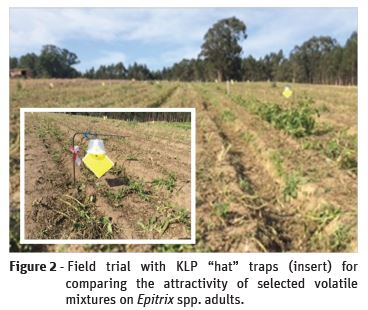
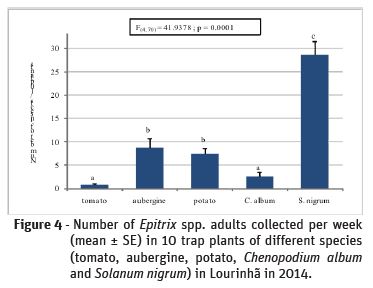
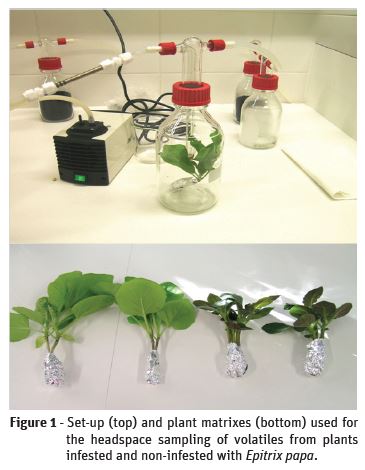
<body><![CDATA[<p><font face = "Verdana" size = "2"><i>Finding the most attractive host plant species for the overwintered Epitrix spp. adults</i></font></p>      <p><font face = "Verdana" size = "2">The attractiveness of five plant species to overwintered <i>Epitrix</i> spp. adults was tested in April 2014 in a field experiment located at Lourinhã, in a randomized block design with five replicates and 10 plants of each species per replicate. The plant species tested were black nightshade (<i>S. nigrum</i>), potato (<i>S. tuberosum</i>), tomato (<i>Solanum lycopersicum</i>), aubergine (<i>S. melongena</i>) and common lambsquarters <i>(Chenopodium album</i>). The plants were grown in a greenhouse and were transferred in their pots to a field planted with cabbages, on which a potato crop had been planted in the previous year and where <i>Epitrix</i> spp. had been observed. </font></p>       <p><font face = "Verdana" size = "2"><i>Collection and analysis of samples of VOCs from host-plants and E. papa</i></font></p>      <p><font face = "Verdana" size = "2">VOCs emitted by non-infested and by <i>E. papa</i> infested plantlets of potato, aubergine and <i>S. nigrum</i>, and by the insects alone, were collected by headspace trapping at INIAV, in 2014 and 2015, and the samples were analyzed by GC-MS at WPR. The chemical analysis of the first samples (2014) did only yield very rough results of the main components, but indicated patterns that were used to improve sampling of an additional headspace collection, carried out in March 2015. Following 2014&rsquo;s analysis, the matrixes retained for headspace sampling in 2015 were potato, <i>S. nigrum</i> and <i>E. papa</i> adults, the VOC extraction period was 3 hours per matrix, and the insects were starved prior to the experiments. The total number of samples collected by matrix was: non-infested potato samples (N=8), non-infested <i>S. nigrum</i> plants (N=8), potato infested with 50 adults (N=8), <i>S. nigrum</i> infested with 50 adults (N=8), and 50 adult insects alone (N=4). </font></p>      <p><font face = "Verdana" size = "2">Each sample was placed inside a 1000 mL glass bottle with Drechsel head. The VOCs released to the headspace of the plants were purged from the bottle onto a cartridge filled with TenaxTA (mesh 20/35, Camsco Inc.) adsorbent, by a continuous air flow generated by a 6 L/min LABOPORT vacuum pump, after passing through a 500 mL bottle filled with activated charcoal and a 500 mL bottle with water to purify and humidify the air, respectively (<a href = "#f1">Figure 1</a>). Whole plantlets with their roots and 7-12 days old insects, starved for 16h, were used.</font></p>      <p>&nbsp;</p>  <a name = "f1"><img src = "/img/revistas/rca/v41nspe/v41nspea18f1.jpg"></a>      
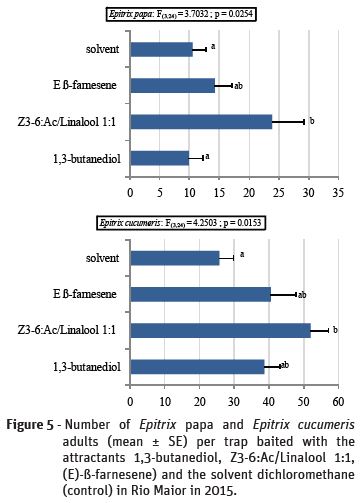
<p>&nbsp;</p>      <p><font face = "Verdana" size = "2">VOCs collected on the Tenax cartridges were thermally desorbed using helium as carrier gas and analyzed by GC-MS similar as described by Snoeren <i>et al</i>. (2010). Before thermodesorption, cartridges were flushed with helium to remove moisture and oxygen. GC-MS raw data were processed by an untargeted metabolomics approach as previously described by Cordovez <i>et al</i>. (2015). VOCs were tentatively annotated by comparing their mass spectra with those of commercial (NIST14) and in-house mass spectral libraries. Linear retention indices of VOCs were calculated using a series of alkanes (C7-C21) and compared with those in the literature. Based on this analysis, candidate compounds were identified from the odour profiles from the attractive plants and the interaction with the beetles and from the beetles alone, for field-testing. </font></p>      <p><font face = "Verdana" size = "2"><i>Testing the attractiveness of selected VOCs in the field to Epitrix spp.</i></font></p>      <p><font face = "Verdana" size = "2">The efficiency of the potential attractant volatiles identified by WPR was tested in 2015 in Rio Maior, in a field experiment with KLP (&ldquo;hat&rdquo;) traps (CSALOMON) loaded with the attractants and containing a sticky insert to prevent the insects from escaping (<a href = "#f2">Figure 2</a>). The layout was a randomized design with four treatments (1,3-butanediol; Z3-hexenylacetate + linalool 1:1; (<i>E</i>)-&#946;-farnesene; control) and seven replicates. The control was the solvent dichloromethane, which was used to dissolve the attractants. The traps were placed during circa one week (4 - 13 June) in a recently dehaulmed potato field where the presence of mixed populations of <i>E. papa </i>and<i> E. cucumeris </i>had been ascertained previously. The number of <i>E. papa </i>and<i> E. cucumeris </i>captured per trap was counted in the laboratory under a stereomicroscope. The data were analyzed by ANOVA using the software STATISTICA (Statistica StatSoft vs 6.0) and the means separated by Fischer LSD tests.</font></p>      ]]></body>
<body><![CDATA[<p>&nbsp;</p>  <a name = "f2"><img src = "/img/revistas/rca/v41nspe/v41nspea18f2.jpg"></a>      
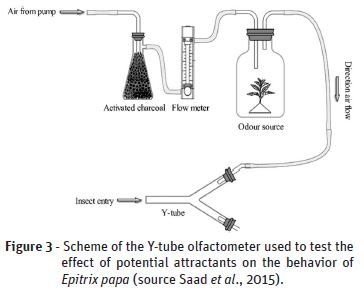
<p>&nbsp;</p>      <p><font face = "Verdana" size = "2"><i>Testing the attractiveness of VOC mixtures in olfactometer bioassays </i></font></p>        <p><font face = "Verdana" size = "2">In order to improve the attractiveness of the best attractant found in the field experiment (Z3-6:Ac/Linalool), the response of individual <i>E. papa</i> adults to three proportions of this mixture (1:1, 1:3 and 3:1) was first tested in choice experiments carried out in a two-arm glass Y-tube olfactometer, with 10-20 insects for each proportion. The most attractive proportion identified was retained for the following round of comparisons as the baseline blend. Next, the combination of this baseline blend with each of eight extra VOCs (&#945;-pinene; &#946;-caryophyllene; (<i>E</i>)-&#946;-ocimene; limonene; 3-carene; &#945;-phellandrene; (<i>E</i>)-&#946;-farnesene; and methyl salicylate) was tested against the baseline blend alone in the olfactometer. For this screening, an initial number of 10 insects per comparison were tested. The three most attractive mixtures identified in these tests (i.e., &#945;-phellandrene, limonene and trans-&#946;-ocimene) were again tested with an additional 10 insects. Finally, the individual responses of 20 insects to the most attractive of these three substances were tested against <i>S. nigrum</i> plantlets as control. The experiments were carried out in December 2016. </font></p>       <p><font face = "Verdana" size = "2">The Y-tube had an internal section of 1-2 cm, 9 cm-length arms, 13 cm-stem length, and was held vertically with a tripod inside a dark box (70 x 70 x 70 cm). The insects were reared in the INIAV insectary and starved for 24 hours before the tests. VOCs were supplied by WPR. Each individual insect was observed up to 5 minutes each, until a choice was made between pairs of odors. The arms were reversed after testing 5 insects, in order to minimize any spatial effects. The Y-tube was cleaned with absolute ethanol between two odor treatments.</font></p>      <p>&nbsp;</p>  <a name = "f3"><img src = "/img/revistas/rca/v41nspe/v41nspea18f3.jpg"></a>      
<p>&nbsp;</p>      <p><font face = "Verdana" size = "2"><i>Testing the selected mixture in field experiments</i></font></p>      <p><font face = "Verdana" size = "2">The attractiveness of the mixture previously identified in the olfactometer assays, was tested in July 2017 in two unsprayed potato crops infested by <i>Epitrix</i> spp., in the sites Lourinhã and Rio Maior (central western zone of Portugal), soon after the foliage was cut for the potato harvest. The layout was a randomized block design with four treatments, namely A = Z3-6:Ac:Linalool (1:3) combined with (<i>E</i>)-&#946;-ocimene; B = Z3-6:Ac:Linalool (3:1) combined with (<i>E</i>)-&#946;-ocimene; C =  solvent dichloromethane (blank control) and D = Z3-6:Ac:Linalool (1:1) (positive control) and 5 replicates. The KLP (&ldquo;hat&rdquo;) traps loaded with the volatiles were installed 17 m apart. The trapping period in Lourinhã was 4-13 July and 6-19 July in Rio Maior. The number of <i>E. papa and E. cucumeris </i>captured per trap was counted in the laboratory under a stereomicroscope. Generalized linear models (GLM) using a Poisson distribution were used to compare the mean number of <i>E. papa</i> and <i>E. cucumeris</i> attracted to the traps, by treatment and site. Least significant pairwise comparisons of estimated marginal means were obtained.</font></p>      <p><font face = "Verdana" size = "3"><b>RESULTS AND DISCUSSION</b></font></p>       ]]></body>
<body><![CDATA[<p><font face = "Verdana" size = "2"><i>Finding the most attractive host plant species for the overwintered Epitrix spp. adults</i></font></p>      <p><font face = "Verdana" size = "2">The <i>S. nigrum </i>plants attracted significantly more adult <i>Epitrix</i> spp. than the remaining plant species (potato, aubergine, tomato and <i>C. album</i> (<a href = "#f4">Figure 4</a>) (F<sub>(4, 70) </sub>= 41.9378 p =0.01). </font></p>      <p>&nbsp;</p>  <a name = "f4"><img src = "/img/revistas/rca/v41nspe/v41nspea18f4.jpg"></a>      
<p>&nbsp;</p>      <p><font face = "Verdana" size = "2"><i>Collection and analysis of samples of VOCs from host-plants and E. papa</i></font></p>      <p><font face = "Verdana" size = "2">The chemical analysis of the samples revealed one beetle associated volatile (1,3-butanediol) that might act as an aggregation pheromone, and the plant-associated compounds Z3-hexenylacetate, linalool and (<i>E</i>)-&#946;-farnesene) that are also frequently found in other solanaceous plants associated with attracting other chrysomelid species (Dickens, 1999; Karlsson <i>et al.</i>, 2009; Karmakar <i>et al.,</i> 2016; Pazouki <i>et al</i>., 2016). From these candidate volatiles, promising low-cost formulations of Z3-6:Ac/Linalool (1:1), (<i>E</i>)-&#946;-farnesene), (1,3-butanediol) were prepared by WPR and sent to Portugal in 2015 to be tested in a field experiment.</font></p>         <p><font face = "Verdana" size = "2"><i>Testing the attractiveness of selected VOCs in the field to Epitrix spp.</i></font></p>      <p><font face = "Verdana" size = "2">In the field experiment carried out in 2015, the mixture Z3-6:Ac/Linalool 1:1 was significantly more attractive than the control (solvent dichloromethane) and the remaining treatments (<i>E</i>)-&#946;-farnesene), (1,3-butanediol) for <i>E. papa</i> (F<sub>(3,24)</sub> = 3.7032, p = 0.0254) and for <i>E. cucumeris</i> adults (F<sub>(3,24)</sub> = 4.2503, p = 0.0153) (<a href = "#f5">Figure 5</a>).</font></p>      <p>&nbsp;</p>  <a name = "f5"><img src = "/img/revistas/rca/v41nspe/v41nspea18f5.jpg"></a>      
<p>&nbsp;</p>      ]]></body>
<body><![CDATA[<p><font face = "Verdana" size = "2"><i>Testing the attractiveness of VOC mixtures in olfactometer bioassays </i></font></p>      <p><font face = "Verdana" size = "2">The response of the beetles to a pair of choices between a blank control (solvent dichloromethane) and different proportions, namely A (1:1), B (1:3) and C (3:1), of the mixture Z3-6:Ac/Linalool, which was the best attractant from the field experiment, are presented in <a href = "#f6">Figure 6</a>, as proportions of the total number of insects that made a choice. </font></p>      <p>&nbsp;</p>  <a name = "f6"><img src = "/img/revistas/rca/v41nspe/v41nspea18f6.jpg"></a>      
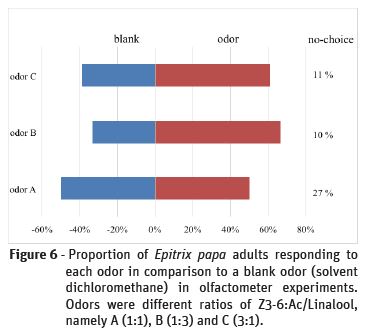
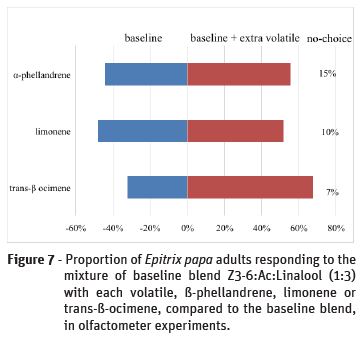
<p>&nbsp;</p>      <p><font face = "Verdana" size = "2">There were no marked differences between the responses of the insects to the three tested ratios of the mixture Z3-6:Ac/Linalool (<a href = "#f6">Figure 6</a>). The ratio B (1:3) of the mixture was found slightly more attractive, and selected to be tested in the following round of experiments as the baseline blend to which one of eight VOCs were then sequentially added and tested (&#945;-pinene; &#946;-caryophyllene; (<i>E</i>)-&#946;-ocimene; limonene; 3-carene; &#945;-phellandrene; (<i>E</i>)-&#946;-farnesene; methyl salicylate). Although there was a high variation in the responses of the insects to the treatments, the combinations of Z3-6:Ac/Linalool (1:3) with &#945;-phellandrene, limonene and (<i>E</i>)-&#946;-ocimene elicited mores responses than the baseline blend alone and were again tested with a new batch of insects against the baseline blend. The combination of (<i>E</i>)-&#946;-ocimene with Z3-6: Ac/Linalool (1:3) was slightly more attractive than the remaining combinations (<a href = "#f7">Figure 7</a>). In the final choice test, this mixture elicited the same number of choices as the <i>S. nigrum</i> plant (N=20 adults tested).</font></p>      <p>&nbsp;</p>  <a name = "f7"><img src = "/img/revistas/rca/v41nspe/v41nspea18f7.jpg"></a>      
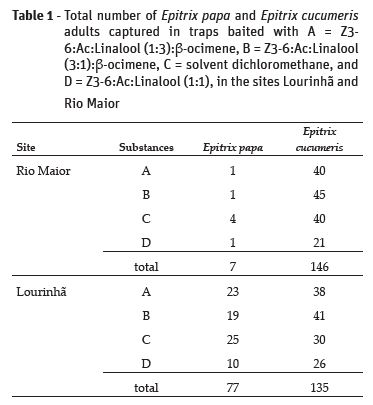
<p>&nbsp;</p>      <p><font face = "Verdana" size = "2"><i>Testing the selected mixture in field experiments</i></font></p>      <p><font face = "Verdana" size = "2">The traps captured the two <i>Epitrix</i> species but in Rio Maior the total catches of <i>E. papa</i> were very low (<a href = "#t1">Table 1</a>) possibly reflecting the species&rsquo; population density in the site. By contrast, there were no significant differences between sites in the mean number (± SE) of <i>E. cucumeris</i> per trap (6.59 ± 0.574 in Lourinhã and 7.12 ± 0.598 in Rio Maior).</font></p>      <p>&nbsp;</p>  <a name = "t1"><img src = "/img/revistas/rca/v41nspe/v41nspea18t1.jpg"></a>      
]]></body>
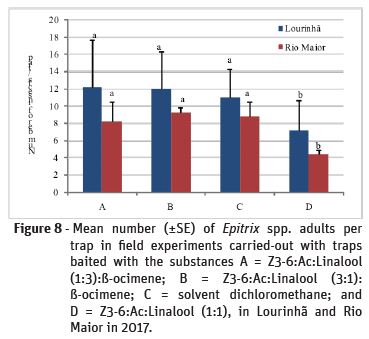
<body><![CDATA[<p>&nbsp;</p>      <p><font face = "Verdana" size = "2">Concerning the substances tested, significant differences were observed between the attractiveness of the substances, for <i>E. papa</i> (Wald Chi-square = 7.858, df = 3, p = 0.049), for <i>E. cucumeris</i> (Wald Chi-square = 11.820, df = 3, p = 0.008) and for the two species combined (Wald Chi-square = 15.990, df = 3, p = 0.001). The pairwise comparison between treatments shows that only the positive control treatment D (6:Ac:Linalool (1:1) is significantly different from A, B and C in each site (<a href = "#f8">Figure 8</a>). This result is inexpected because the blank control C (solvent only) showed the same attractivity as the attractants A and B (6:Ac:Linalool (1:3):&#946;-ocimene and 6:Ac:Linalool (3:1):&#946;-ocimene respectively). This result points out at a possible cross-contamination between A, B and C dispensers, which had been packed together and separately from the D dispensers, before their use and unfortunately invalidates the assessment of the substances. Nevertheless the results seem to indicate that in both fields the addition of trans-&#946;-ocimene (treatments A and B, and by hypothesis also treatment C) significantly increased the attractiveness of the baseline mixture (D) identified in the previous field test (2015) (<a href = "#f8">Figure 8</a>). In this case, it seems worthwhile to repeat the experiment.</font></p>      <p>&nbsp;</p>  <a name = "f8"><img src = "/img/revistas/rca/v41nspe/v41nspea18f8.jpg"></a>      
<p>&nbsp;</p>      <p><font face = "Verdana" size = "2">As the establishment and spread of <i>Epitrix</i> species is of economic importance, in particular for potato growing and importing countries, effective tools for early season monitoring in zones where tuber flea beetles are established, and for detection in potato consignments exported from infested to non-infested countries, would be very helpful. Unfortunately, currently known <i>Epitrix</i> pheromones – such as the pheromone of<i> E. fuscula</i> - are too complex and chemically unstable to be used for species-specific trapping (Zilkowsky <i>et al.</i>, 2008). In the present study, some plant-emitted volatiles were identified that appeared to be attractive to <i>E. papa </i>and<i> E. cucumeris</i> beetles in field traps. The attractive components belong to a class of substances that are, though not exclusively, yet commonly produced by solanaceous plant species that may serve as host for various <i>Epitrix</i> species (Visser <i>et al.</i>, 1979; Weissbecker <i>et al.</i>, 1997; Mumm and Dicke, 2010).</font></p>      <p><font face = "Verdana" size = "2">Since that plant volatile blend is not fully species-specific it may attract other <i>Epitrix</i> species and even other insect species. The attractants found may help to enhance the efficiency of yellow traps for monitoring, but identification of the catches will remain necessary. In addition, it seems likely that traps baited with plant volatiles will be less effective when host plants are present in abundance due to &ldquo;competition for attraction&rdquo; of traps with the host plants. Yet we feel that it may be worth testing and optimizing the attractants for monitoring the overwintered beetles early in the season / at the onset of potato emergence in places where <i>Epitrix</i> species are established, until new species-specific insect pheromones are developed. </font></p>      <p><font face = "Verdana" size = "2">Finally, several bottlenecks were identified during this project which need to be taken into account in future investigations on <i>Epitrix</i> spp. attractants: (i) the unpredictable conditions for volatile emissions by the insects; (ii) the difficulty in finding and selecting attractants from the diversity of volatiles in the headspace samples; (iii) the volatile substances or mixtures being chemically too complex; (iv) the reduced availability and high costs of attractants or analogues; (v) the low response in behavioural laboratory or field tests with traps.</font></p>      <p>&nbsp;</p>      <p><font face = "Verdana" size = "3"><b>References</b></font></p>      <!-- ref --><p><font face = "Verdana" size = "2">Boavida, C. & Germain, J.F. (2009) - Identification and pest status of two exotic flea beetle species newly introduced in Portugal: <i>Epitrix similaris</i> Gentner and <i>Epitrix cucumeris</i> (Harris). <i>Bulletin OEPP/EPPO Bulletin</i>, vol. 39, n. 3, p. 501–508. <a href = "http://dx.doi.org/10.1111/j.1365-2338.2009.02339.x" target = "_blank">http://dx.doi.org/10.1111/j.1365-2338.2009.02339.x</a></font>&nbsp;&nbsp;&nbsp;&nbsp;&nbsp;&nbsp;&nbsp;&nbsp;[&#160;<a href="javascript:void(0);" onclick="javascript: window.open('/scielo.php?script=sci_nlinks&ref=695477&pid=S0871-018X201800050001800001&lng=','','width=640,height=500,resizable=yes,scrollbars=1,menubar=yes,');">Links</a>&#160;]<!-- end-ref --><!-- ref --><p><font face = "Verdana" size = "2">Boavida, C.; Giltrap, N.; Cuthbertson, A.G.S. & Northing, P. (2013) - <i>Epitrix similaris</i> and <i>Epitrix cucumeris</i> in Portugal: damage patterns in potato and suitability of potential host plants for reproduction. <i>Bulletin OEPP/EPPO Bulletin</i>, vol. 43, n. 2, p. 323–333. <a href = "http://dx.doi.org/10.1111/epp.12046" target = "_blank">http://dx.doi.org/10.1111/epp.12046</a></font>&nbsp;&nbsp;&nbsp;&nbsp;&nbsp;&nbsp;&nbsp;&nbsp;[&#160;<a href="javascript:void(0);" onclick="javascript: window.open('/scielo.php?script=sci_nlinks&ref=695478&pid=S0871-018X201800050001800002&lng=','','width=640,height=500,resizable=yes,scrollbars=1,menubar=yes,');">Links</a>&#160;]<!-- end-ref --><!-- ref --><p><font face = "Verdana" size = "2">Cordovez, V.; Carrion, V.J.J.; Etalo, D.W.; Mumm, R.; Zhu, H.; Van Wezel, G.P. & Raaijmakers, J.M. (2015) - Diversity and functions of volatile organic compounds produced by Streptomyces from a disease-suppressive soil. <i>Frontiers in Microbiology</i>, vol. 6, art. 1081. <a href = "http://dx.doi.org/10.3389/fmicb.2015.01081" target = "_blank">http://dx.doi.org/10.3389/fmicb.2015.01081</a></font>&nbsp;&nbsp;&nbsp;&nbsp;&nbsp;&nbsp;&nbsp;&nbsp;[&#160;<a href="javascript:void(0);" onclick="javascript: window.open('/scielo.php?script=sci_nlinks&ref=695479&pid=S0871-018X201800050001800003&lng=','','width=640,height=500,resizable=yes,scrollbars=1,menubar=yes,');">Links</a>&#160;]<!-- end-ref --><!-- ref --><p><font face = "Verdana" size = "2">Dickens, J.C. (1999) - Predator-prey interactions: olfactory adaptations of generalist and specialist herbivores. <i>Agricultural and Forest Entomologist</i>, vol. 1, n. 1, p. 47-54. <a href = "http://dx.doi.org/10.1046/j.1461-9563.1999.00007.x" target = "_blank">http://dx.doi.org/10.1046/j.1461-9563.1999.00007.x</a></font>&nbsp;&nbsp;&nbsp;&nbsp;&nbsp;&nbsp;&nbsp;&nbsp;[&#160;<a href="javascript:void(0);" onclick="javascript: window.open('/scielo.php?script=sci_nlinks&ref=695480&pid=S0871-018X201800050001800004&lng=','','width=640,height=500,resizable=yes,scrollbars=1,menubar=yes,');">Links</a>&#160;]<!-- end-ref --><p><font face = "Verdana" size = "2">Doguet, S. (2009) - Presence en Europe de deux espèces nord-américaines d&rsquo;<i>Epitrix </i>(Coleoptera: Chrysomelidae: Alticinae). <i>L&rsquo;Entomologiste</i>, vol. 65, p. 89-90.</font></p>      <!-- ref --><p><font face = "Verdana" size = "2">Karlsson, M.F.; Birgersson, G.; Cotes Prado, A.M.; Bodsa, F.; Bengtsson, M. & Witzgall, P. (2009) - Plant odor analysis of potato: Response of Guatemalan moth to above- and belowground potato volatiles. <i>Journal Agricultural and Food Chemistry</i>, vol. 57, n. 13, p. 5903-5909. <a href = "http://dx.doi.org/10.1021/jf803730h" target = "_blank">http://dx.doi.org/10.1021/jf803730h</a></font>&nbsp;&nbsp;&nbsp;&nbsp;&nbsp;&nbsp;&nbsp;&nbsp;[&#160;<a href="javascript:void(0);" onclick="javascript: window.open('/scielo.php?script=sci_nlinks&ref=695482&pid=S0871-018X201800050001800006&lng=','','width=640,height=500,resizable=yes,scrollbars=1,menubar=yes,');">Links</a>&#160;]<!-- end-ref --><!-- ref --><p><font face = "Verdana" size = "2">Karmakar, A.; Mukherjee, A. & Barik, A. (2016) - Floral volatiles with colour cues from two curcurbitaceous plants causing attraction of <i>Aulacophora foveicollis</i>. <i>Entomologia Experimentalis et Applicata</i>, vol. 158, n. 2, p. 133-141. <a href = "http://dx.doi.org/10.1111/eea.12395" target = "_blank">http://dx.doi.org/10.1111/eea.12395</a></font>&nbsp;&nbsp;&nbsp;&nbsp;&nbsp;&nbsp;&nbsp;&nbsp;[&#160;<a href="javascript:void(0);" onclick="javascript: window.open('/scielo.php?script=sci_nlinks&ref=695483&pid=S0871-018X201800050001800007&lng=','','width=640,height=500,resizable=yes,scrollbars=1,menubar=yes,');">Links</a>&#160;]<!-- end-ref --><!-- ref --><p><font face = "Verdana" size = "2">Mumm, R. & Dicke, M. (2010) - Variation in natural plant products and the attraction of bodyguards involved in indirect plant defense. <i>Canadian Journal of Zoology,</i> vol. 88, n. 7, p. 628-667. <a href = "https://doi.org/10.1139/Z10-032" target = "_blank">https://doi.org/10.1139/Z10-032</a></font>&nbsp;&nbsp;&nbsp;&nbsp;&nbsp;&nbsp;&nbsp;&nbsp;[&#160;<a href="javascript:void(0);" onclick="javascript: window.open('/scielo.php?script=sci_nlinks&ref=695484&pid=S0871-018X201800050001800008&lng=','','width=640,height=500,resizable=yes,scrollbars=1,menubar=yes,');">Links</a>&#160;]<!-- end-ref --><!-- ref --><p><font face = "Verdana" size = "2">Official Journal of the European Union (2012) - <i>Commission Implementing Decision 2012/270/EU of 16May 2012 as regards emergency measures to prevent the introduction into and the spread within the Union of Epitrix cucumeris (Harris), Epitrix similaris (Gentner), Epitrix subcrinita (Lec.) and Epitrix tuberis (Gentner) (notified under document C(2012) 3137)</i>. &lt;<a href = "http://eur-lex.europa.eu/LexUriServ/LexUriServ.do?uri=OJ:L:2012:132:FULL:EN:PDF" target = "_blank">http://eur-lex.europa.eu/LexUriServ/LexUriServ.do?uri=OJ:L:2012:132:FULL:EN:PDF</a>&gt;    &nbsp;&nbsp;&nbsp;&nbsp;&nbsp;&nbsp;&nbsp;&nbsp;[&#160;<a href="javascript:void(0);" onclick="javascript: window.open('/scielo.php?script=sci_nlinks&ref=695485&pid=S0871-018X201800050001800009&lng=','','width=640,height=500,resizable=yes,scrollbars=1,menubar=yes,');">Links</a>&#160;]<!-- end-ref --></font></p>       <!-- ref --><p><font face = "Verdana" size = "2">Official Journal of the European Union (2016) - <i>Commission Implementing Decision 2016/1359/EU of 8 August 2016 amending Implementing Decision 2012/270/EU as regards emergency measures to prevent the introduction into and the spread within the Union of Epitrix cucumeris (Harris), Epitrix similaris (Gentner), Epitrix subcrinita (Lec.) and Epitrix tuberis (Gentner) (notified under document C(2016) 5038).</i> &lt;<a href = "https://eur-lex.europa.eu/legal-content/EN/TXT/PDF/?uri=CELEX:32016D1359&from=EN" target = "_blank">https://eur-lex.europa.eu/legal-content/EN/TXT/PDF/?uri=CELEX:32016D1359&from=EN</a>&gt;    &nbsp;&nbsp;&nbsp;&nbsp;&nbsp;&nbsp;&nbsp;&nbsp;[&#160;<a href="javascript:void(0);" onclick="javascript: window.open('/scielo.php?script=sci_nlinks&ref=695487&pid=S0871-018X201800050001800010&lng=','','width=640,height=500,resizable=yes,scrollbars=1,menubar=yes,');">Links</a>&#160;]<!-- end-ref --></font></p>       <!-- ref --><p><font face = "Verdana" size = "2">Orlova-Bienkowskaia, M.J. (2015) - <i>Epitrix papa</i> sp. n. (Coleoptera: Chrysomelidae: Galerucinae: Alticini), previously misidentified as <i>Epitrix similaris</i>, is a threat to potato production in Europe. <i>European Journal of Entomology</i>, vol. 112, n. 4, p. 824–830. <a href = "http://dx.doi.org/10.14411/eje.2015.096" target = "_blank">http://dx.doi.org/10.14411/eje.2015.096</a></font>&nbsp;&nbsp;&nbsp;&nbsp;&nbsp;&nbsp;&nbsp;&nbsp;[&#160;<a href="javascript:void(0);" onclick="javascript: window.open('/scielo.php?script=sci_nlinks&ref=695489&pid=S0871-018X201800050001800011&lng=','','width=640,height=500,resizable=yes,scrollbars=1,menubar=yes,');">Links</a>&#160;]<!-- end-ref --><!-- ref --><p><font face = "Verdana" size = "2">Pazouki, L.; Kanagendran, A.; Li, S.; Kannaste, A.; Memari, H.R.; Bichele, R. & Niinemets, Ü. (2016) - Mono and sesquiterpene release from tomato (<i>Solanum lycopersicum</i>) leaves upon mild and severe heat stress and through recovery: From gene expression to emission responses. <i>Environmental and Experimental Botany</i>, vol. 132, p. 1-15. <a href = "http://dx.doi.org/10.1016/j.envexpbot.2016.08.003" target = "_blank">http://dx.doi.org/10.1016/j.envexpbot.2016.08.003</a></font>&nbsp;&nbsp;&nbsp;&nbsp;&nbsp;&nbsp;&nbsp;&nbsp;[&#160;<a href="javascript:void(0);" onclick="javascript: window.open('/scielo.php?script=sci_nlinks&ref=695490&pid=S0871-018X201800050001800012&lng=','','width=640,height=500,resizable=yes,scrollbars=1,menubar=yes,');">Links</a>&#160;]<!-- end-ref --><!-- ref --><p><font face = "Verdana" size = "2">Saad, K.A.; Mohamad, R.M.N.; Hallett, R.H. & Idris, A.B. (2015) - Aphid-induced Defences in Chilli Affect Preferences of the Whitefly, <i>Bemisia tabaci</i> (Hemiptera: Aleyrodidae). <i>Scientific Reports</i>, vol. 5, art. 13697. <a href = "http://dx.doi.org/10.1038/srep.13697" target = "_blank">http://dx.doi.org/10.1038/srep.13697</a></font>&nbsp;&nbsp;&nbsp;&nbsp;&nbsp;&nbsp;&nbsp;&nbsp;[&#160;<a href="javascript:void(0);" onclick="javascript: window.open('/scielo.php?script=sci_nlinks&ref=695491&pid=S0871-018X201800050001800013&lng=','','width=640,height=500,resizable=yes,scrollbars=1,menubar=yes,');">Links</a>&#160;]<!-- end-ref --><!-- ref --><p><font face = "Verdana" size = "2">Snoeren, T.A.L.; Kappers, I.F.; Broekgaarden, C.; Mumm, R.; Dicke, M. & Bowmeester, H.J. (2010) - Natural variation in herbivore-induced volatiles in <i>Arabidopsis thaliana</i>. <i>Journal of Experimental Botany</i>, vol. 61, n. 11, p. 3041-3056. <a href = "http://dx.doi.org/10.1093/jxb/erq127" target = "_blank">http://dx.doi.org/10.1093/jxb/erq127</a></font>&nbsp;&nbsp;&nbsp;&nbsp;&nbsp;&nbsp;&nbsp;&nbsp;[&#160;<a href="javascript:void(0);" onclick="javascript: window.open('/scielo.php?script=sci_nlinks&ref=695492&pid=S0871-018X201800050001800014&lng=','','width=640,height=500,resizable=yes,scrollbars=1,menubar=yes,');">Links</a>&#160;]<!-- end-ref --><!-- ref --><p><font face = "Verdana" size = "2">Visser, J.H.; Straten, S.V.; Maarse, H. & Van Straten, S. (1979) - Isolation and identification of volatiles in the foliage of potato, <i>Solanum tuberosum</i>, a host plant of the Colorado beetle, <i>Leptinotarsa decemlineata. Journal of Chemical Ecology</i>, vol. 5, n. 1, p. 13-25. <a href = "https://doi.org/10.1007/BF00987684" target = "_blank">https://doi.org/10.1007/BF00987684</a></font>&nbsp;&nbsp;&nbsp;&nbsp;&nbsp;&nbsp;&nbsp;&nbsp;[&#160;<a href="javascript:void(0);" onclick="javascript: window.open('/scielo.php?script=sci_nlinks&ref=695493&pid=S0871-018X201800050001800015&lng=','','width=640,height=500,resizable=yes,scrollbars=1,menubar=yes,');">Links</a>&#160;]<!-- end-ref --><!-- ref --><p><font face = "Verdana" size = "2">Weissbecker, B.; Schütz, S.; Klein, A. & Hummel, H.E. (1997) - Analysis of volatiles emitted by potato plants by means of a Colorado beetle electroantennographic detector. <i>Talanta,</i> vol. 44, n. 12, p. 2217-2224. <a href = "https://doi.org/10.1016/S0039-9140(97)00037-4" target = "_blank">https://doi.org/10.1016/S0039-9140(97)00037-4</a></font>&nbsp;&nbsp;&nbsp;&nbsp;&nbsp;&nbsp;&nbsp;&nbsp;[&#160;<a href="javascript:void(0);" onclick="javascript: window.open('/scielo.php?script=sci_nlinks&ref=695494&pid=S0871-018X201800050001800016&lng=','','width=640,height=500,resizable=yes,scrollbars=1,menubar=yes,');">Links</a>&#160;]<!-- end-ref --><!-- ref --><p><font face = "Verdana" size = "2">Zilkowski, B.W.; Bartelt, R.J.; Cossé, A.A. & Petroski, R.J. (2006) - Male-produced aggregation pheromone compounds from the eggplant flea beetle (<i>Epitrix fuscula</i>): identification, synthesis, and field bioassays. <i>Journal of Chemical Ecology</i>, vol. 32, p. 2543-2558. <a href = "http://dx.doi.org/10.1007/s10886-006-9163-3" target = "_blank">http://dx.doi.org/10.1007/s10886-006-9163-3</a></font>&nbsp;&nbsp;&nbsp;&nbsp;&nbsp;&nbsp;&nbsp;&nbsp;[&#160;<a href="javascript:void(0);" onclick="javascript: window.open('/scielo.php?script=sci_nlinks&ref=695495&pid=S0871-018X201800050001800017&lng=','','width=640,height=500,resizable=yes,scrollbars=1,menubar=yes,');">Links</a>&#160;]<!-- end-ref --><!-- ref --><p><font face = "Verdana" size = "2">Zilkowski, B.W.; Bartelt, R.J. & Vermillion, K. (2008) - Analysis of 2,4,6-Nonatrienal Geometrical Isomers from Male Flea Beetles, <i>Epitrix hirtipennis </i>and <i>E</i>. <i>fuscula. Journal of Agricultural and Food Chemistry</i>, vol. 56, n. 13, p. 4982-4986. <a href = "https://doi.org/10.1021/jf8005273" target = "_blank">https://doi.org/10.1021/jf8005273</a></font>&nbsp;&nbsp;&nbsp;&nbsp;&nbsp;&nbsp;&nbsp;&nbsp;[&#160;<a href="javascript:void(0);" onclick="javascript: window.open('/scielo.php?script=sci_nlinks&ref=695496&pid=S0871-018X201800050001800018&lng=','','width=640,height=500,resizable=yes,scrollbars=1,menubar=yes,');">Links</a>&#160;]<!-- end-ref --><p>&nbsp;</p>      ]]></body>
<body><![CDATA[<p><font face = "Verdana" size = "3"><b>Acknowledgements </b></font></p>      <p><font face = "Verdana" size = "2">The collaboration between INIAV and WUR was established in the framework of an EUPHRESCO project (EPITRIX) and was funded by FCT (Fundação para a Ciência e a Tecnologia), INIAV, DLO-WPR and the Dutch Ministry of Economic Affairs. We are grateful to Vítor Gomes (Biofrade) and Reinaldo Costa (Horta Silvestre) for the experimental fields, to Fernanda Vargues, Francisca Loureiro and Alexandra Passos (INIAV) for multiplying the plants used in 2014, to Leo Poleij (WUR) for preparing the VOC dispensers, and to Jacques Davies for help with the chemical analysis. </font></p>      <p>&nbsp;</p>      <p><font face = "Verdana" size = "2">Received/recebido: 2018.01.31</font></p>      <p><font face = "Verdana" size = "2">Accepted/aceite: 2019.02.01</font></p>       ]]></body><back>
<ref-list>
<ref id="B1">
<nlm-citation citation-type="journal">
<person-group person-group-type="author">
<name>
<surname><![CDATA[Boavida]]></surname>
<given-names><![CDATA[C.]]></given-names>
</name>
<name>
<surname><![CDATA[Germain]]></surname>
<given-names><![CDATA[J.F.]]></given-names>
</name>
</person-group>
<article-title xml:lang="en"><![CDATA[Identification and pest status of two exotic flea beetle species newly introduced in Portugal: Epitrix similaris Gentner and Epitrix cucumeris (Harris)]]></article-title>
<source><![CDATA[Bulletin OEPP/EPPO Bulletin]]></source>
<year>2009</year>
<volume>39</volume>
<numero>3</numero>
<issue>3</issue>
<page-range>501-508</page-range></nlm-citation>
</ref>
<ref id="B2">
<nlm-citation citation-type="journal">
<person-group person-group-type="author">
<name>
<surname><![CDATA[Boavida]]></surname>
<given-names><![CDATA[C.]]></given-names>
</name>
<name>
<surname><![CDATA[Giltrap]]></surname>
<given-names><![CDATA[N.]]></given-names>
</name>
<name>
<surname><![CDATA[Cuthbertson]]></surname>
<given-names><![CDATA[A.G.S.]]></given-names>
</name>
<name>
<surname><![CDATA[Northing]]></surname>
<given-names><![CDATA[P.]]></given-names>
</name>
</person-group>
<article-title xml:lang="en"><![CDATA[Epitrix similaris and Epitrix cucumeris in Portugal: damage patterns in potato and suitability of potential host plants for reproduction]]></article-title>
<source><![CDATA[Bulletin OEPP/EPPO Bulletin]]></source>
<year>2013</year>
<volume>43</volume>
<numero>2</numero>
<issue>2</issue>
<page-range>323-333</page-range></nlm-citation>
</ref>
<ref id="B3">
<nlm-citation citation-type="journal">
<person-group person-group-type="author">
<name>
<surname><![CDATA[Cordovez]]></surname>
<given-names><![CDATA[V.]]></given-names>
</name>
<name>
<surname><![CDATA[Carrion]]></surname>
<given-names><![CDATA[V.J.J.]]></given-names>
</name>
<name>
<surname><![CDATA[Etalo]]></surname>
<given-names><![CDATA[D.W.]]></given-names>
</name>
<name>
<surname><![CDATA[Mumm]]></surname>
<given-names><![CDATA[R.]]></given-names>
</name>
<name>
<surname><![CDATA[Zhu]]></surname>
<given-names><![CDATA[H.]]></given-names>
</name>
<name>
<surname><![CDATA[Van Wezel]]></surname>
<given-names><![CDATA[G.P.]]></given-names>
</name>
<name>
<surname><![CDATA[Raaijmakers]]></surname>
<given-names><![CDATA[J.M.]]></given-names>
</name>
</person-group>
<article-title xml:lang="en"><![CDATA[Diversity and functions of volatile organic compounds produced by Streptomyces from a disease-suppressive soil]]></article-title>
<source><![CDATA[Frontiers in Microbiology]]></source>
<year>2015</year>
<volume>6</volume>
<page-range>1081</page-range></nlm-citation>
</ref>
<ref id="B4">
<nlm-citation citation-type="journal">
<person-group person-group-type="author">
<name>
<surname><![CDATA[Dickens]]></surname>
<given-names><![CDATA[J.C.]]></given-names>
</name>
</person-group>
<article-title xml:lang="en"><![CDATA[Predator-prey interactions: olfactory adaptations of generalist and specialist herbivores]]></article-title>
<source><![CDATA[Agricultural and Forest Entomologist]]></source>
<year>1999</year>
<volume>1</volume>
<numero>1</numero>
<issue>1</issue>
<page-range>47-54</page-range></nlm-citation>
</ref>
<ref id="B5">
<nlm-citation citation-type="journal">
<person-group person-group-type="author">
<name>
<surname><![CDATA[Doguet]]></surname>
<given-names><![CDATA[S.]]></given-names>
</name>
</person-group>
<article-title xml:lang="fr"><![CDATA[Presence en Europe de deux espèces nord-américaines d’Epitrix (Coleoptera: Chrysomelidae: Alticinae)]]></article-title>
<source><![CDATA[L’Entomologiste]]></source>
<year>2009</year>
<volume>65</volume>
<page-range>89-90</page-range></nlm-citation>
</ref>
<ref id="B6">
<nlm-citation citation-type="journal">
<person-group person-group-type="author">
<name>
<surname><![CDATA[Karlsson]]></surname>
<given-names><![CDATA[M.F.]]></given-names>
</name>
<name>
<surname><![CDATA[Birgersson]]></surname>
<given-names><![CDATA[G.]]></given-names>
</name>
<name>
<surname><![CDATA[Cotes Prado]]></surname>
<given-names><![CDATA[A.M.]]></given-names>
</name>
<name>
<surname><![CDATA[Bodsa]]></surname>
<given-names><![CDATA[F.]]></given-names>
</name>
<name>
<surname><![CDATA[Bengtsson]]></surname>
<given-names><![CDATA[M.]]></given-names>
</name>
<name>
<surname><![CDATA[Witzgall]]></surname>
<given-names><![CDATA[P.]]></given-names>
</name>
</person-group>
<article-title xml:lang="en"><![CDATA[Plant odor analysis of potato: Response of Guatemalan moth to above- and belowground potato volatiles]]></article-title>
<source><![CDATA[Journal Agricultural and Food Chemistry]]></source>
<year>2009</year>
<volume>57</volume>
<numero>13</numero>
<issue>13</issue>
<page-range>5903-5909</page-range></nlm-citation>
</ref>
<ref id="B7">
<nlm-citation citation-type="journal">
<person-group person-group-type="author">
<name>
<surname><![CDATA[Karmakar]]></surname>
<given-names><![CDATA[A.]]></given-names>
</name>
<name>
<surname><![CDATA[Mukherjee]]></surname>
<given-names><![CDATA[A.]]></given-names>
</name>
<name>
<surname><![CDATA[Barik]]></surname>
<given-names><![CDATA[A.]]></given-names>
</name>
</person-group>
<article-title xml:lang="en"><![CDATA[Floral volatiles with colour cues from two curcurbitaceous plants causing attraction of Aulacophora foveicollis]]></article-title>
<source><![CDATA[ntomologia Experimentalis et Applicata]]></source>
<year>2016</year>
<volume>158</volume>
<numero>2</numero>
<issue>2</issue>
<page-range>133-141</page-range></nlm-citation>
</ref>
<ref id="B8">
<nlm-citation citation-type="journal">
<person-group person-group-type="author">
<name>
<surname><![CDATA[Mumm]]></surname>
<given-names><![CDATA[R.]]></given-names>
</name>
<name>
<surname><![CDATA[Dicke]]></surname>
<given-names><![CDATA[M.]]></given-names>
</name>
</person-group>
<article-title xml:lang="en"><![CDATA[Variation in natural plant products and the attraction of bodyguards involved in indirect plant defense]]></article-title>
<source><![CDATA[Canadian Journal of Zoology]]></source>
<year>2010</year>
<volume>88</volume>
<numero>7</numero>
<issue>7</issue>
<page-range>628-667</page-range></nlm-citation>
</ref>
<ref id="B9">
<nlm-citation citation-type="">
<collab>Official Journal of the European Union</collab>
<source><![CDATA[Commission Implementing Decision 2012/270/EU of 16May 2012 as regards emergency measures to prevent the introduction into and the spread within the Union of Epitrix cucumeris (Harris), Epitrix similaris (Gentner), Epitrix subcrinita (Lec.) and Epitrix tuberis (Gentner) (notified under document C(2012) 3137)]]></source>
<year>2012</year>
</nlm-citation>
</ref>
<ref id="B10">
<nlm-citation citation-type="">
<collab>Official Journal of the European Union</collab>
<source><![CDATA[Commission Implementing Decision 2016/1359/EU of 8 August 2016 amending Implementing Decision 2012/270/EU as regards emergency measures to prevent the introduction into and the spread within the Union of Epitrix cucumeris (Harris), Epitrix similaris (Gentner), Epitrix subcrinita (Lec.) and Epitrix tuberis (Gentner) (notified under document C(2016) 5038)]]></source>
<year>2016</year>
</nlm-citation>
</ref>
<ref id="B11">
<nlm-citation citation-type="journal">
<person-group person-group-type="author">
<name>
<surname><![CDATA[Orlova-Bienkowskaia]]></surname>
<given-names><![CDATA[M.J.]]></given-names>
</name>
</person-group>
<article-title xml:lang="en"><![CDATA[Epitrix papa sp. n. (Coleoptera: Chrysomelidae: Galerucinae: Alticini), previously misidentified as Epitrix similaris, is a threat to potato production in Europe]]></article-title>
<source><![CDATA[European Journal of Entomology]]></source>
<year>2015</year>
<volume>112</volume>
<numero>4</numero>
<issue>4</issue>
<page-range>824-830</page-range></nlm-citation>
</ref>
<ref id="B12">
<nlm-citation citation-type="journal">
<person-group person-group-type="author">
<name>
<surname><![CDATA[Pazouki]]></surname>
<given-names><![CDATA[L.]]></given-names>
</name>
<name>
<surname><![CDATA[Kanagendran]]></surname>
<given-names><![CDATA[A.]]></given-names>
</name>
<name>
<surname><![CDATA[Li]]></surname>
<given-names><![CDATA[S.]]></given-names>
</name>
<name>
<surname><![CDATA[Kannaste]]></surname>
<given-names><![CDATA[A.]]></given-names>
</name>
<name>
<surname><![CDATA[Memari]]></surname>
<given-names><![CDATA[H.R.]]></given-names>
</name>
<name>
<surname><![CDATA[Bichele]]></surname>
<given-names><![CDATA[R.]]></given-names>
</name>
<name>
<surname><![CDATA[Niinemets]]></surname>
<given-names><![CDATA[Ü.]]></given-names>
</name>
</person-group>
<article-title xml:lang="en"><![CDATA[Mono and sesquiterpene release from tomato (Solanum lycopersicum) leaves upon mild and severe heat stress and through recovery: From gene expression to emission responses]]></article-title>
<source><![CDATA[Environmental and Experimental Botany]]></source>
<year>2016</year>
<volume>132</volume>
<page-range>1-15</page-range></nlm-citation>
</ref>
<ref id="B13">
<nlm-citation citation-type="journal">
<person-group person-group-type="author">
<name>
<surname><![CDATA[Saad]]></surname>
<given-names><![CDATA[K.A.]]></given-names>
</name>
<name>
<surname><![CDATA[Mohamad]]></surname>
<given-names><![CDATA[R.M.N.]]></given-names>
</name>
<name>
<surname><![CDATA[Hallett]]></surname>
<given-names><![CDATA[R.H.]]></given-names>
</name>
<name>
<surname><![CDATA[Idris]]></surname>
<given-names><![CDATA[A.B.]]></given-names>
</name>
</person-group>
<article-title xml:lang="en"><![CDATA[Aphid-induced Defences in Chilli Affect Preferences of the Whitefly, Bemisia tabaci (Hemiptera: Aleyrodidae)]]></article-title>
<source><![CDATA[Scientific Reports]]></source>
<year>2015</year>
<volume>5</volume>
<page-range>13697</page-range></nlm-citation>
</ref>
<ref id="B14">
<nlm-citation citation-type="journal">
<person-group person-group-type="author">
<name>
<surname><![CDATA[Snoeren]]></surname>
<given-names><![CDATA[T.A.L.]]></given-names>
</name>
<name>
<surname><![CDATA[Kappers]]></surname>
<given-names><![CDATA[I.F.]]></given-names>
</name>
<name>
<surname><![CDATA[Broekgaarden]]></surname>
<given-names><![CDATA[C.]]></given-names>
</name>
<name>
<surname><![CDATA[Mumm]]></surname>
<given-names><![CDATA[R.]]></given-names>
</name>
<name>
<surname><![CDATA[Dicke]]></surname>
<given-names><![CDATA[M.]]></given-names>
</name>
<name>
<surname><![CDATA[Bowmeester]]></surname>
<given-names><![CDATA[H.J.]]></given-names>
</name>
</person-group>
<article-title xml:lang="en"><![CDATA[Natural variation in herbivore-induced volatiles in Arabidopsis thaliana]]></article-title>
<source><![CDATA[Journal of Experimental Botany]]></source>
<year>2010</year>
<volume>61</volume>
<numero>11</numero>
<issue>11</issue>
<page-range>3041-3056</page-range></nlm-citation>
</ref>
<ref id="B15">
<nlm-citation citation-type="journal">
<person-group person-group-type="author">
<name>
<surname><![CDATA[Visser]]></surname>
<given-names><![CDATA[J.H.]]></given-names>
</name>
<name>
<surname><![CDATA[Straten]]></surname>
<given-names><![CDATA[S.V.]]></given-names>
</name>
<name>
<surname><![CDATA[Maarse]]></surname>
<given-names><![CDATA[H.]]></given-names>
</name>
<name>
<surname><![CDATA[Van Straten]]></surname>
<given-names><![CDATA[S.]]></given-names>
</name>
</person-group>
<article-title xml:lang="en"><![CDATA[Isolation and identification of volatiles in the foliage of potato, Solanum tuberosum, a host plant of the Colorado beetle, Leptinotarsa decemlineata]]></article-title>
<source><![CDATA[Journal of Chemical Ecology]]></source>
<year>1979</year>
<volume>5</volume>
<numero>1</numero>
<issue>1</issue>
<page-range>13-25</page-range></nlm-citation>
</ref>
<ref id="B16">
<nlm-citation citation-type="journal">
<person-group person-group-type="author">
<name>
<surname><![CDATA[Weissbecker]]></surname>
<given-names><![CDATA[B.]]></given-names>
</name>
<name>
<surname><![CDATA[Schütz]]></surname>
<given-names><![CDATA[S.]]></given-names>
</name>
<name>
<surname><![CDATA[Klein]]></surname>
<given-names><![CDATA[A.]]></given-names>
</name>
<name>
<surname><![CDATA[Hummel]]></surname>
<given-names><![CDATA[H.E.]]></given-names>
</name>
</person-group>
<article-title xml:lang="en"><![CDATA[Analysis of volatiles emitted by potato plants by means of a Colorado beetle electroantennographic detector]]></article-title>
<source><![CDATA[Talanta]]></source>
<year>1997</year>
<volume>44</volume>
<numero>12</numero>
<issue>12</issue>
<page-range>2217-2224</page-range></nlm-citation>
</ref>
<ref id="B17">
<nlm-citation citation-type="journal">
<person-group person-group-type="author">
<name>
<surname><![CDATA[Zilkowski]]></surname>
<given-names><![CDATA[B.W.]]></given-names>
</name>
<name>
<surname><![CDATA[Bartelt]]></surname>
<given-names><![CDATA[R.J.]]></given-names>
</name>
<name>
<surname><![CDATA[Cossé]]></surname>
<given-names><![CDATA[A.A.]]></given-names>
</name>
<name>
<surname><![CDATA[Petroski]]></surname>
<given-names><![CDATA[R.J.]]></given-names>
</name>
</person-group>
<article-title xml:lang="en"><![CDATA[Male-produced aggregation pheromone compounds from the eggplant flea beetle (Epitrix fuscula): identification, synthesis, and field bioassays]]></article-title>
<source><![CDATA[Journal of Chemical Ecology]]></source>
<year>2006</year>
<volume>32</volume>
<page-range>2543-2558</page-range></nlm-citation>
</ref>
<ref id="B18">
<nlm-citation citation-type="journal">
<person-group person-group-type="author">
<name>
<surname><![CDATA[Zilkowski]]></surname>
<given-names><![CDATA[B.W.]]></given-names>
</name>
<name>
<surname><![CDATA[Bartelt]]></surname>
<given-names><![CDATA[R.J.]]></given-names>
</name>
<name>
<surname><![CDATA[Vermillion]]></surname>
<given-names><![CDATA[K.]]></given-names>
</name>
</person-group>
<article-title xml:lang="en"><![CDATA[Analysis of 2,4,6-Nonatrienal Geometrical Isomers from Male Flea Beetles, Epitrix hirtipennis and E. fuscula]]></article-title>
<source><![CDATA[Journal of Agricultural and Food Chemistry]]></source>
<year>2008</year>
<volume>56</volume>
<numero>13</numero>
<issue>13</issue>
<page-range>4982-4986</page-range></nlm-citation>
</ref>
</ref-list>
</back>
</article>