<?xml version="1.0" encoding="ISO-8859-1"?><article xmlns:mml="http://www.w3.org/1998/Math/MathML" xmlns:xlink="http://www.w3.org/1999/xlink" xmlns:xsi="http://www.w3.org/2001/XMLSchema-instance">
<front>
<journal-meta>
<journal-id>0871-018X</journal-id>
<journal-title><![CDATA[Revista de Ciências Agrárias]]></journal-title>
<abbrev-journal-title><![CDATA[Rev. de Ciências Agrárias]]></abbrev-journal-title>
<issn>0871-018X</issn>
<publisher>
<publisher-name><![CDATA[Sociedade de Ciências Agrárias de Portugal]]></publisher-name>
</publisher>
</journal-meta>
<article-meta>
<article-id>S0871-018X2018000500019</article-id>
<article-id pub-id-type="doi">10.19084/RCA.17081</article-id>
<title-group>
<article-title xml:lang="en"><![CDATA[Hoverfly (Diptera: Syrphidae) diversity in Tapada da Ajuda, Lisbon - a preliminary study]]></article-title>
<article-title xml:lang="pt"><![CDATA[Diversidade de sirfídeos na Tapada da Ajuda, Lisboa - estudo preliminar]]></article-title>
</title-group>
<contrib-group>
<contrib contrib-type="author">
<name>
<surname><![CDATA[Santo]]></surname>
<given-names><![CDATA[Gonçalo Espírito]]></given-names>
</name>
<xref ref-type="aff" rid="A1"/>
</contrib>
<contrib contrib-type="author">
<name>
<surname><![CDATA[Silva]]></surname>
<given-names><![CDATA[Elsa Borges da]]></given-names>
</name>
<xref ref-type="aff" rid="A1 "/>
</contrib>
<contrib contrib-type="author">
<name>
<surname><![CDATA[Figueiredo]]></surname>
<given-names><![CDATA[Elisabete]]></given-names>
</name>
<xref ref-type="aff" rid="A1 "/>
</contrib>
</contrib-group>
<aff id="AA1">
<institution><![CDATA[,Universidade de Lisboa Instituto Superior de Agronomia Departamento de Ciências e Engenharia de Biossistemas]]></institution>
<addr-line><![CDATA[Lisboa ]]></addr-line>
<country>Portugal</country>
</aff>
<aff id="AA2">
<institution><![CDATA[,Universidade de Lisboa Instituto Superior de Agronomia Forest Research Centre]]></institution>
<addr-line><![CDATA[Lisboa ]]></addr-line>
<country>Portugal</country>
</aff>
<aff id="AA3">
<institution><![CDATA[,Universidade de Lisboa Instituto Superior de Agronomia Linking Environment Agriculture and Food]]></institution>
<addr-line><![CDATA[Lisboa ]]></addr-line>
<country>Portugal</country>
</aff>
<pub-date pub-type="pub">
<day>00</day>
<month>12</month>
<year>2018</year>
</pub-date>
<pub-date pub-type="epub">
<day>00</day>
<month>12</month>
<year>2018</year>
</pub-date>
<volume>41</volume>
<numero>spe</numero>
<fpage>181</fpage>
<lpage>190</lpage>
<copyright-statement/>
<copyright-year/>
<self-uri xlink:href="http://scielo.pt/scielo.php?script=sci_arttext&amp;pid=S0871-018X2018000500019&amp;lng=en&amp;nrm=iso"></self-uri><self-uri xlink:href="http://scielo.pt/scielo.php?script=sci_abstract&amp;pid=S0871-018X2018000500019&amp;lng=en&amp;nrm=iso"></self-uri><self-uri xlink:href="http://scielo.pt/scielo.php?script=sci_pdf&amp;pid=S0871-018X2018000500019&amp;lng=en&amp;nrm=iso"></self-uri><abstract abstract-type="short" xml:lang="en"><p><![CDATA[Hoverflies are holometabolic insects, whose adults are pollinators feeding on nectar and pollen. Frequently, they are confused with wasps, bees and bumblebees. In the larval stage, some of them prey other insects, specially aphids (Hemiptera), and others are saprophagous. For this reason, they are important biological control agents. In this study, we carried out the prospection and specific identification of hoverflies in four habitats in Tapada da Ajuda (olive grove, a field of Apiaceae, herbaceous vegetation near Lagoa Branca and plum orchard), between March and May 2017. Hoverfly adults were mostly captured with an entomologic net, but also with jar and plastic bags. A preliminary evaluation on the importance of ecologic infrastructure fava bean inter-row in the plum orchard was also performed. For this purpose, we observed fava plants and plum trees, collecting eggs, larvae and pupae of hoverflies that we reared in the laboratory until the emergence of the adult of hoverfly or parasitoid. A total of 12 species were identified, being the most frequent and abundant Episyrphus balteatus and Sphaerophoria scripta. Species richness was higher in the Apiaceae field although this habitat was sampled only during the last fortnight of the study. In the hoverfly immature collected in the plum orchard we detected hymenopteran parasitoids belonging to Diplazontinae and Pteromalidae.]]></p></abstract>
<abstract abstract-type="short" xml:lang="pt"><p><![CDATA[Os sirfídeos são insetos holometabólicos cujos adultos são polinizadores, alimentando-se de néctar e pólen. São frequentemente confundidos com vespas, abelhas e abelhões. No estado larvar, algumas espécies predam outros insetos, nomeadamente afídeos (Hemiptera), outros são saprófagos. Os sirfídeos são, por isso, importantes agentes de proteção biológica. Neste trabalho, efetuou-se a prospeção e a identificação específica de sirfídeos na Tapada da Ajuda, em quatro habitats (olival, talhão de apiáceas junto ao olival, vegetação herbácea junto à Lagoa Branca e pomar de ameixeiras). Os adultos de sirfídeo foram capturados principalmente com o auxílio de rede entomológica, mas também recorrendo a frascos e sacos de plástico. Avaliou-se o papel da infraestrutura ecológica faveiras nas entrelinhas do pomar de ameixeiras na população de sirfídeos. Com essa finalidade, foram observadas faveiras nas entrelinhas e ameixeiras, recolhendo ovos, larvas e pupas de sirfídeo que foram criados em laboratório até emergência do adulto de sirfídeo ou de parasitóide. Identificaram-se 12 espécies, sendo as mais abundantes e frequentes Episyrphus balteatus e Sphaerophoria scripta. A riqueza específica foi mais elevada no talhão de Apiaceae, apesar de este habitat ter sido amostrado apenas no decurso da última quinzena do estudo. Nos imaturos de sirfídeo recolhidos no pomar de ameixeiras foram detetados parasitoides himenópteros das famílias Diplazontinae e Pteromalidae.]]></p></abstract>
<kwd-group>
<kwd lng="en"><![CDATA[biodiversity]]></kwd>
<kwd lng="en"><![CDATA[ecological infrastructures]]></kwd>
<kwd lng="en"><![CDATA[predator]]></kwd>
<kwd lng="pt"><![CDATA[biodiversidade]]></kwd>
<kwd lng="pt"><![CDATA[infraestruturas ecológicas]]></kwd>
<kwd lng="pt"><![CDATA[predador]]></kwd>
</kwd-group>
</article-meta>
</front><body><![CDATA[ <p align = "right"><font face = "Verdana" size = "2"><b>ARTIGO</b></font></p>      <p><font face = "Verdana" size = "4"><b>Hoverfly (Diptera: Syrphidae) diversity in Tapada da Ajuda, Lisbon – a preliminary study</b></font></p>      <p><font face = "Verdana" size = "3"><b>Diversidade de sirfídeos na Tapada da Ajuda, Lisboa – estudo preliminar</b></font></p>      <p><font face = "Verdana" size = "2"><b>Gonçalo Espírito Santo</b><sup>1</sup>, <b>Elsa Borges da Silva</b><sup>1,2</sup> and <b>Elisabete Figueiredo</b><sup>1,3,*</sup></font></p>       <p><font face = "Verdana" size = "2"><i><sup>1</sup> Departamento de Ciências e Engenharia de Biossistemas, Instituto Superior de Agronomia, Universidade de Lisboa, Lisboa, Portugal</i></font></p>      <p><font face = "Verdana" size = "2"><i><sup>2</sup> CEF - Forest Research Centre, Instituto Superior de Agronomia, Universidade de Lisboa, Lisboa, Portugal</i></font></p>      <p><font face = "Verdana" size = "2"><i><sup>3</sup> LEAF - Linking Environment Agriculture and Food, Instituto Superior de Agronomia, Universidade de Lisboa, Lisboa, Portugal</i></font></p>      <p><font face = "Verdana" size = "2"><i>(*E-mail: <a href = "mailto:elisalacerda@isa.ulisboa.pt">elisalacerda@isa.ulisboa.pt</a>)</i></font></p>  <hr noshade size = "1">      <p><font face = "Verdana" size = "3"><b>ABSTRACT</b></font></p>       <p><font face = "Verdana" size = "2">Hoverflies are holometabolic insects, whose adults are pollinators feeding on nectar and pollen. Frequently, they are confused with wasps, bees and bumblebees. In the larval stage, some of them prey other insects, specially aphids (Hemiptera), and others are saprophagous. For this reason, they are important biological control agents. In this study, we carried out the prospection and specific identification of hoverflies in four habitats in Tapada da Ajuda (olive grove, a field of Apiaceae, herbaceous vegetation near Lagoa Branca and plum orchard), between March and May 2017. Hoverfly adults were mostly captured with an entomologic net, but also with jar and plastic bags. A preliminary evaluation on the importance of ecologic infrastructure <i>fava bean inter-row</i> in the plum orchard was also performed. For this purpose, we observed fava plants and plum trees, collecting eggs, larvae and pupae of hoverflies that we reared in the laboratory until the emergence of the adult of hoverfly or parasitoid. A total of 12 species were identified, being the most frequent and abundant <i>Episyrphus balteatus </i>and<i> Sphaerophoria scripta. </i>Species richness was higher in the Apiaceae field although this habitat was sampled only during the last fortnight of the study. In the hoverfly immature collected in the plum orchard we detected hymenopteran parasitoids belonging to Diplazontinae and Pteromalidae.</font></p>       ]]></body>
<body><![CDATA[<p><font face = "Verdana" size = "2"><b>Keywords:</b> biodiversity, ecological infrastructures, predator</font></p>  <hr noshade size = "1">      <p><font face = "Verdana" size = "3"><b>RESUMO</b></font></p>      <p><font face = "Verdana" size = "2">Os sirfídeos são insetos holometabólicos cujos adultos são polinizadores, alimentando-se de néctar e pólen. São frequentemente confundidos com vespas, abelhas e abelhões. No estado larvar, algumas espécies predam outros insetos, nomeadamente afídeos (Hemiptera), outros são saprófagos. Os sirfídeos são, por isso, importantes agentes de proteção biológica. Neste trabalho, efetuou-se a prospeção e a identificação específica de sirfídeos na Tapada da Ajuda, em quatro habitats (olival, talhão de apiáceas junto ao olival, vegetação herbácea junto à Lagoa Branca e pomar de ameixeiras). Os adultos de sirfídeo foram capturados principalmente com o auxílio de rede entomológica, mas também recorrendo a frascos e sacos de plástico. Avaliou-se o papel da infraestrutura ecológica <i>faveiras</i> nas entrelinhas do pomar de ameixeiras na população de sirfídeos. Com essa finalidade, foram observadas faveiras nas entrelinhas e ameixeiras, recolhendo ovos, larvas e pupas de sirfídeo que foram criados em laboratório até emergência do adulto de sirfídeo ou de parasitóide. Identificaram-se 12 espécies, sendo as mais abundantes e frequentes <i>Episyrphus balteatus</i> e <i>Sphaerophoria scripta</i>. A riqueza específica foi mais elevada no talhão de Apiaceae, apesar de este habitat ter sido amostrado apenas no decurso da última quinzena do estudo. Nos imaturos de sirfídeo recolhidos no pomar de ameixeiras foram detetados parasitoides himenópteros das famílias Diplazontinae e Pteromalidae.</font></p>      <p><font face = "Verdana" size = "2"><b>Palavras-chave:</b> biodiversidade, infraestruturas ecológicas, predador </font></p>  <hr noshade size = "1">      <p><font face = "Verdana" size = "3"><b>INTRODUCTION</b></font></p>       <p><font face = "Verdana" size = "2">There are more than 6200 species of Syrphidae all over the world in about 300 genera, and 3-4 not yet consensual subfamilies (Young <i>et al.,</i> 2016). Several hoverflies&rsquo; species were reported in Portugal. Alexandre Gomes referred 55 and 65 species, in 1978 and in 1981, respectively (Gomes, 1978, 1981). Dirickx (1994) listed 74 species, and the &ldquo;Iberian Diptera Checklist&rdquo; listed 100 species, 86 in the mainland, 23 in Azores Islands and 23 in Madeira (Marcos-García <i>et al</i>., 2002). GBIF database 63 species (GBIF, undated) in the mainland and Azores and Madeira Archipelagos. van Eck (2011) listed 52 genera and 172 species, belonging to three subfamilies, Microdontinae, Eristalinae and Syrphinae; Eristalinae presented the largest number of species. In 2016, the same author listed more 28 species to the mainland, increasing the total number to 195 species (van Eck, 2016). </font></p>      <p><font face = "Verdana" size = "2">All or almost all adult hoverflies are flower visitors, feeding on nectar and pollen (Schneider, 1969; Rojo <i>et al</i>., 2003) as well as honeydew, and are important pollinators. On the other hand, larval feeding strategies are very diverse. Some species are saprophagous in diverse media, some other are mycophagous, a few are phytophagous, but predation is one of the most common feeding strategy (Rotheray and Gilbert, 1999; Sommaggio, 1999; Rojo <i>et al.,</i> 2003). Therefore, hoverflies are important as biological control agents. Aphids are the more common prey used by hoverfly predatory species but some are able to feed on whiteflies, psyllids, scale insects and other homopterans, and lepidopteran and hymenopteran eggs, and thrips, or live in ant or bee nests (Schneider, 1969; Rojo <i>et al</i>., 2003). They are also important as environmental quality indicators. </font></p>      <p><font face = "Verdana" size = "2">In orchards, they are between the first pollinators to appear in spring and they can be important for the control of aphid populations in the early season (Schneider, 1969; Rossi <i>et al.,</i> 2006). In Portugal, in the Oeste region, Santos (1999) detected <i>Sphaerophoria scripta </i>(L.), <i>Syrphus ribesii </i>(L.), <i>Eristalis arbustorum </i>(L.) and <i>Platycheirus albinamus </i>(Fab.) in pear and apple orchards.</font></p>       <p><font face = "Verdana" size = "2">This preliminary study aimed at identifying the species present in different habitats, in a periurban ecosystem, Tapada da Ajuda, Lisbon (Portugal), and relating their present with flowers and prey availability. </font></p>      <p><font face = "Verdana" size = "3"><b>MATERIAL AND METHODS</b></font></p>      ]]></body>
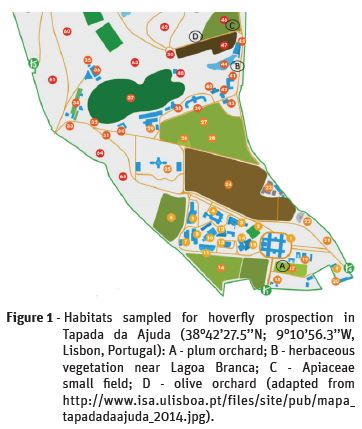
<body><![CDATA[<p><font face = "Verdana" size = "2">Sampling was performed weekly from 16<sup>th</sup> March to 31<sup>th</sup> May 2017. Hoverflies were collected in different habitats in Tapada da Ajuda: olive orchard, plum orchard where <i>Vicia faba</i> L. was sown between lines, adventitious herbaceous vegetation mainly Asteraceae species near Lagoa Branca, and, in the last fortnight of the study period, an Apiaceae small field at the opposite side of the olive orchard road (<a href = "#f1">Figure 1</a>). Adults were collected in all habitats, mainly with entomological net, but also with plastic vials and plastic sacs. In the plum orchard, immatures (eggs, larvae and pupae) were also collected in aphid colonies on fava bean plants and plum trees, from 30<sup>th</sup> March to 18<sup>th </sup>May. Sampling of immature hoverflies was performed observing 8 or 10 fava plants/inter-row, randomly chosen, in 8 inter-rows (total: 48 and 80 plants), and 3 or 5 plum trees/row, in 5 and 4 rows, respectively (total: 35 trees). </font></p>      <p>&nbsp;</p>  <a name = "f1"><img src = "/img/revistas/rca/v41nspe/v41nspea19f1.jpg"></a>      
<p>&nbsp;</p>      <p><font face = "Verdana" size = "2">In laboratory, immatures were reared until adult emergence (hoverfly or parasitoid), feeding them with aphid colonies mainly of <i>Aphis fabae</i> Scopoli, but also <i>Megoura viciae</i> Buckton. </font></p>      <p><font face = "Verdana" size = "2">Hoverfly adults were identified up to species using several identification keys (Coe, 1953; Gilbert, 1986; Speight, 2014; Ball and Morris, 2015). Hoverfly parasitoids were identified up to family/subfamily after Pitkin (2004) and Broad (2011).</font></p>       <p><font face = "Verdana" size = "2">For each habitat, species richness (S), Shannon-Wiener (H&rsquo;), Simpson (D), dominance (1-D) and equitability (E) indexes were calculated:</font></p>  <img src = "/img/revistas/rca/v41nspe/v41nspea19eq1.jpg">      
<p><font face = "Verdana" size = "2">being,</font></p>      <p><font face = "Verdana" size = "2">S – species richness - number of species found in the sample;</font></p>      <p><font face = "Verdana" size = "2">N – number of specimens in the sample;</font></p>      <p><font face = "Verdana" size = "2">pi – proportion of specimens of the species i (ni/N).</font></p>       ]]></body>
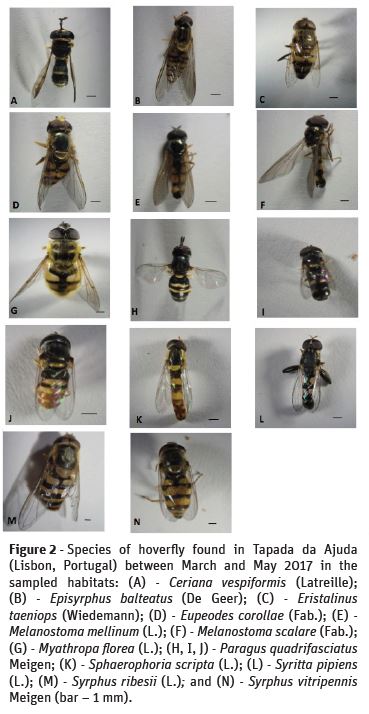
<body><![CDATA[<p><font face = "Verdana" size = "2">Species richness was estimated for all the studied habitats together, using the software SPECRICH developed by Hines (1996), according to Burnham and Overton (1979), taking into account the number of rare species detected (those with &#8804; 6 specimens collected).</font></p>      <p><font face = "Verdana" size = "3"><b>RESULTS</b></font></p>       <p><font face = "Verdana" size = "2">We collected 57 specimens, mainly as adults but, in the plum orchard, also some as immature. From those collected as larvae, two were parasitized, and in one pupa there was no emergence of adult hoverfly or parasitoid. Moreover, we obtained seven adult hoverflies from the hoverfly larvae we took when we collected aphid colonies to feed the immature we were rearing in the laboratory. In total, we obtained 64 adults from 12 species (<a href = "/img/revistas/rca/v41nspe/v41nspea19t1.jpg" target = "_blank">Table 1</a>; <a href = "#f2">Figure 2</a>), the majority belonging to Syrphinae. Eighteen of <i>Sphaerophoria</i> Le Peletier & Serville were only identified up to genus since they were female but they were considered as <i>S. scripta</i> (L.) for further analysis since it was the only species we identified using the males. <i>Episyrphus balteatus </i>(De Geer) was the most abundant (16 in 64 - 25%), although <i>Sphaerophoria</i> sp. was dominant in the olive and the plum orchards and in the Apiaceae field (<a href = "/img/revistas/rca/v41nspe/v41nspea19t1.jpg" target = "_blank">Table 1</a>). Sampling dates with higher number of adults captured were 17<sup>th </sup>March, 20-21<sup>th</sup> April and 18<sup>th</sup> May. The small field of Apiaceae was the habitat with higher specific richness even though it was sampled only in the last fortnight of this study. Simpson&rsquo;s and equitability indexes were similar in olive orchard and Apiaceae field, and higher and lower, respectively, than in the plum orchard; in Lagoa Branca, the habitat with lower hoverfly diversity Simpson&rsquo;s index was the highest (<a href = "/img/revistas/rca/v41nspe/v41nspea19t1.jpg" target = "_blank">Table 1</a>). </font></p>      
<p>&nbsp;</p>  <a name = "f2"><img src = "/img/revistas/rca/v41nspe/v41nspea19f2.jpg"></a>      
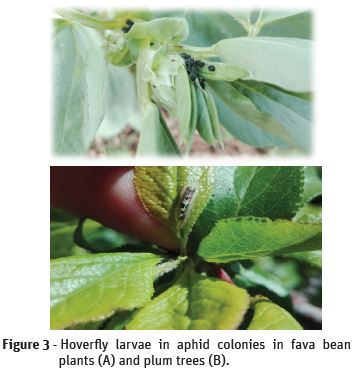
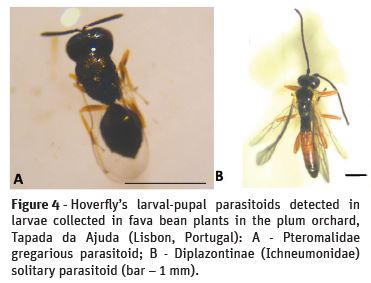
<p>&nbsp;</p>      <p><font face = "Verdana" size = "2">According to Burnham and Overton (1979), hoverfly&rsquo; species richness in Tapada da Ajuda was estimated in 15 species.</font></p>      <p><font face = "Verdana" size = "2">In the plum orchard 15 larvae/pupae were observed in aphid colonies collected in fava (<a href = "#f3">Figure 3</a>) plants to feed the hoverflies immatures in laboratory. Seven hoverfly adults emerged as mentioned before, two pupae died, and six larvae /pupae were parasitized. <i>E. balteatus, S. scripta, Syrphus vitripennis</i> Meigen, <i>S. ribesii</i> and <i>Melanostoma mellinum</i> (L.) were identified from this material. From one of the parasitized pupae gregarious larval-pupal Pteromalidae (Hymenoptera: Chalcidoidea) parasitoids emerged and from the other five pupae we obtained solitary parasitoids of the subfamily Diplazontinae (Hymenoptera: Ichneumonoidea: Ichneumonidae) (<a href = "#f4">Figure 4</a>).</font></p>      <p>&nbsp;</p>  <a name = "f3"><img src = "/img/revistas/rca/v41nspe/v41nspea19f3.jpg"></a>      
<p>&nbsp;</p>  <a name = "f4"><img src = "/img/revistas/rca/v41nspe/v41nspea19f4.jpg"></a>      
<p>&nbsp;</p>      ]]></body>
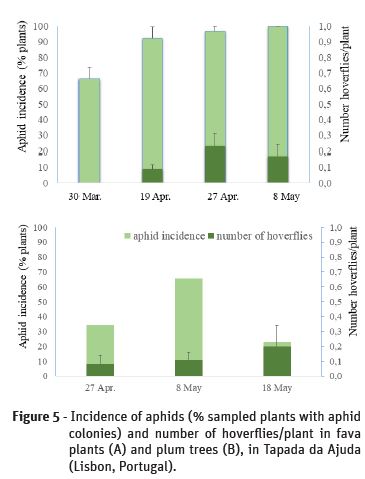
<body><![CDATA[<p><font face = "Verdana" size = "2">Although these observations were performed in a very short period of time, the incidence of aphid on the fava plants increased over time reaching 100% of the sampled plants in 7<sup>th</sup> May; in plum trees it increased from the end of April to the begining of May and decreased the following week (<a href = "#f5">Figure 5</a>). Hoverfly larvae and pupae increased over time on fava plants and on plum trees. </font></p>      <p>&nbsp;</p>  <a name = "f5"><img src = "/img/revistas/rca/v41nspe/v41nspea19f5.jpg"></a>      
<p>&nbsp;</p>      <p><font face = "Verdana" size = "3"><b>DISCUSSION </b></font></p>      <p><font face = "Verdana" size = "2">As referred, we collected only 64 specimens belonging to 12 different species. The low number of specimens and species could be related to the short sampling period. It is important to note that the habitat with the highest species richness, the Apiaceae field, was only sampled in the last fortnight of the study. Besides, in the beginning of the sampling period, the olive orchard was covered with herbaceous plants, many of them were flowering and we were collecting a high number of hoverflies at that time. In the beginning of April these vegetation was cut and since then no hoverflies were collected in this habitat. If this cut was done later, after flowering, probably more adults would be captured in the olive orchard since these plants could have been important pollen sources for hoverfly adults in this ecosystem (Pinheiro <i>et al</i>., 2013). </font></p>      <p><font face = "Verdana" size = "2">Spring of 2017 was very hot, especially April and May (IPMA, 2017a, b, c) but temperature was not a reason for capturing such a low number of Syrphidae. In fact, Santos (1999) found hoverflies until August in apple orchards in the Oeste region, although in small number, Pineda and Marcos-Garcia (2008) found hoverflies in greenhouses in Alicante until the middle of July and Hong and Hung (2010) verified that adult longevity and number of preyed aphids were more dependent on the prey species present than on the temperature, for the temperature range 26.6-29.9°C.</font></p>      <p><font face = "Verdana" size = "2">Sampling was mainly made in the 2<sup>nd</sup> half of the morning and afternoon. This fact could have affected the number of specimens collected since hoverflies fly mostly during the first hours of the morning, in sunny days (Pineda and Marcos-Garcia, 2008).</font></p>      <p><font face = "Verdana" size = "2">Nevertheless, the number of species detected was 80% (and three species inferior) of the estimated species richness for Tapada da Ajuda, based on the rare species found (species with six or less sampled specimens) even with the short sampling period.</font></p>      <p><font face = "Verdana" size = "2">The number and species richness in the different habitats seemed to be related to the floristic composition. Apiaceae field presented the highest diversity which is in accordance with previous studies indicating that hoverflies prefer Apiaceae plants, for example, to Asteraceae, Fabaceae or Ranunculaceae (e.g. Tooker <i>et al.,</i> 2006; Sajjad and Saeed, 2010; Bertolaccini <i>et al.,</i> 2012; Wäckers and van Rijin, 2012).</font></p>       <p><font face = "Verdana" size = "2">In the plum orchard, despite the low floristic diversity and the reduced number of Apiacaeae or Asteraceae plants present, the fava plants allowed a high hoverfly diversity that in meantime moved to plum trees, due to the abundance of prey (Colley and Luna, 2000), mainly <i>A. fabae</i>.</font></p>       ]]></body>
<body><![CDATA[<p><font face = "Verdana" size = "2">All the Eristalinae found in this study are saprophagous and all the Syrphinae are aphidophagous (<a href = "/img/revistas/rca/v41nspe/v41nspea19t1.jpg" target = "_blank">Table 1</a>) (Sommaggio, 1999; Ball and Morris, 2015). All the Syrphinae species are polyphagous in what it refers to the prey and to the host plant. Regarding the aphids reported as prey for the hoverflies present in the plum orchard, <i>E. balteatus</i> is referred as preying on <i>A. fabae</i> and <i>H. pruni</i>, in several crops, and on <i>M. viciae</i> and <i>M. persicae</i>, in laboratory; <i>Melanostoma mellinum</i> is referred as preying on <i>A. fabae</i>; <i>Paragus quadrifasciatus</i> Meigen on <i>A. fabae</i>, <i>H. pruni</i> and <i>M. persicae,</i> in several crops; <i>Sphaerophoria scripta</i> on <i>A. fabae, M. viciae, H. pruni</i> and <i>M. persicae</i>, in several crops; <i>Syrphus vitripennis</i> on <i>A. fabae, H. pruni</i> and <i>M. persicae</i> and on a different species of the genus <i>Megoura</i>, in several crops (Rojo <i>et al.,</i> 2003). These results are in accordance with those of Bertolaccini <i>et al.</i> (2012) who verified that hoverflies feed on one or more than one aphid species present in the orchards. </font></p>       
<p><font face = "Verdana" size = "2">Larval or pupal parasitism is not uncommon in hoverflies. For example, Jankowska (2004) found parasitism varying between 14.4% e 46.4% in aphidophagous larvae collected in field and reared until adult in laboratory. These authors identified parasitoids belonging to three Hymenoptera families, Ichneumonidae, Pteromalidae and Encyrtidae, being the majority Diplazontinae (Ichneumonidae), as in the present study. Yet, in some ecosystems Pteromalidae is dominant (Sommaggio <i>et al</i>., 2014).</font></p>      <p>&nbsp;</p>      <p><font face = "Verdana" size = "3"><b>References</b></font></p>      <p><font face = "Verdana" size = "2">Ball, S. & Morris, R. (2015) – <i>Britain&rsquo;s hoverflies a field guide</i>. 2<sup>nd</sup> ed. Princeton, Princeton University Press, 312 p.</font></p>       <!-- ref --><p><font face = "Verdana" size = "2">Bertolaccini, I.; Núñes-Pérez, E. & Tizado, E.J. (2012) – Diversidad y proporción sexual de Syrphidae en cultivos de leguminosas y plantas espontáneas, en León (España). <i>Revista de Ciências Agrárias</i>, vol. 35, n. 1, p. 99-107.    &nbsp;&nbsp;&nbsp;&nbsp;&nbsp;&nbsp;&nbsp;&nbsp;[&#160;<a href="javascript:void(0);" onclick="javascript: window.open('/scielo.php?script=sci_nlinks&ref=695580&pid=S0871-018X201800050001900002&lng=','','width=640,height=500,resizable=yes,scrollbars=1,menubar=yes,');">Links</a>&#160;]<!-- end-ref --> </font></p>      <!-- ref --><p><font face = "Verdana" size = "2">Broad, G. (2011) – <i>Identification key to the subfamilies of Ichneumonidae (Hymenoptera).</i> London, Natural History Museum., 40 p.    &nbsp;&nbsp;&nbsp;&nbsp;&nbsp;&nbsp;&nbsp;&nbsp;[&#160;<a href="javascript:void(0);" onclick="javascript: window.open('/scielo.php?script=sci_nlinks&ref=695582&pid=S0871-018X201800050001900003&lng=','','width=640,height=500,resizable=yes,scrollbars=1,menubar=yes,');">Links</a>&#160;]<!-- end-ref --> </font></p>      <!-- ref --><p><font face = "Verdana" size = "2">Burnham, K.P. & Overton, W.S. (1979) – Robust estimation of population size when capture probabilities vary among animals. <i>Ecology</i>, vol. 60, n. 5, p. 927-936. <a href = "http://dx.doi.org/10.2307/1936861" target = "_blank">http://dx.doi.org/10.2307/1936861</a></font>&nbsp;&nbsp;&nbsp;&nbsp;&nbsp;&nbsp;&nbsp;&nbsp;[&#160;<a href="javascript:void(0);" onclick="javascript: window.open('/scielo.php?script=sci_nlinks&ref=695584&pid=S0871-018X201800050001900004&lng=','','width=640,height=500,resizable=yes,scrollbars=1,menubar=yes,');">Links</a>&#160;]<!-- end-ref --><!-- ref --><p><font face = "Verdana" size = "2">Coe, R.L. (1953) – Diptera - Syrphidae. <i>In</i>: <i>Handbooks for the identification of British insects</i>. London, Royal International Entomological Society of London, vol. 10, part I, 98 p.    &nbsp;&nbsp;&nbsp;&nbsp;&nbsp;&nbsp;&nbsp;&nbsp;[&#160;<a href="javascript:void(0);" onclick="javascript: window.open('/scielo.php?script=sci_nlinks&ref=695585&pid=S0871-018X201800050001900005&lng=','','width=640,height=500,resizable=yes,scrollbars=1,menubar=yes,');">Links</a>&#160;]<!-- end-ref --></font></p>       <!-- ref --><p><font face = "Verdana" size = "2">Colley, M.R & Luna, J.M. (2000) – Relative attractiveness of potential beneficial insectary plants to aphidophagous hoverflies (Diptera: Syrphidae). <i>Environmental Entomology,</i> vol. 29, n. 5, p. 1054-1059. <a href = "http://dx.doi.org/10.1603/0046-225X-29.5.1054" target = "_blank">http://dx.doi.org/10.1603/0046-225X-29.5.1054</a></font>&nbsp;&nbsp;&nbsp;&nbsp;&nbsp;&nbsp;&nbsp;&nbsp;[&#160;<a href="javascript:void(0);" onclick="javascript: window.open('/scielo.php?script=sci_nlinks&ref=695587&pid=S0871-018X201800050001900006&lng=','','width=640,height=500,resizable=yes,scrollbars=1,menubar=yes,');">Links</a>&#160;]<!-- end-ref --><p><font face = "Verdana" size = "2">Dirickx, H.G. (1994) – <i>Atlas de diptères syrphides de la region méditerranéenne</i>. Documents de travail n. 75. Bruxelles, l&rsquo;Institut Royal des Sciences Naturalles de Belgique, 314 p.</font></p>      <p><font face = "Verdana" size = "2">GBIF (undated) – Data on the occurrence of biodiversity published by: National Museum of Natural History, University of Lisbon; EDP; and unknown (accessed on the &ldquo;Portal de Dados GBIF&rdquo; [cit. 25/02/2018] &lt; <a href = "http://dados.gbif.pt" target = "_blank">http://dados.gbif.pt</a>&gt;</font></p>      <p><font face = "Verdana" size = "2">Gilbert, F.S. (1986) – <i>Hoverflies</i>. Naturalists&rsquo; handbook 5. Cambridge, Press Syndicate of the University of Cambridge, 64 p.</font></p>       <!-- ref --><p><font face = "Verdana" size = "2">Gomes, A. (1978) – Notas sobre sirfídeos de Portugal (Diptera, Syrphidae). <i>Agronomia Lusitana</i>, vol. 39, p. 5-28.    &nbsp;&nbsp;&nbsp;&nbsp;&nbsp;&nbsp;&nbsp;&nbsp;[&#160;<a href="javascript:void(0);" onclick="javascript: window.open('/scielo.php?script=sci_nlinks&ref=695591&pid=S0871-018X201800050001900010&lng=','','width=640,height=500,resizable=yes,scrollbars=1,menubar=yes,');">Links</a>&#160;]<!-- end-ref --></font></p>       <!-- ref --><p><font face = "Verdana" size = "2">Gomes, A. (1981) – Sirfídeos colhidos em Portugal durante 1977 (Diptera, Syrphidae). <i>Agronomia Lusitana</i>, vol. 41, p. 5-24.    &nbsp;&nbsp;&nbsp;&nbsp;&nbsp;&nbsp;&nbsp;&nbsp;[&#160;<a href="javascript:void(0);" onclick="javascript: window.open('/scielo.php?script=sci_nlinks&ref=695593&pid=S0871-018X201800050001900011&lng=','','width=640,height=500,resizable=yes,scrollbars=1,menubar=yes,');">Links</a>&#160;]<!-- end-ref --></font></p>       ]]></body>
<body><![CDATA[<!-- ref --><p><font face = "Verdana" size = "2">Hines, J.E. (1996) – <i>SPECRICH Software to compute species abundance from emperical species abundance distribution data</i>. Reston, USA, USGS-PWRC.    &nbsp;&nbsp;&nbsp;&nbsp;&nbsp;&nbsp;&nbsp;&nbsp;[&#160;<a href="javascript:void(0);" onclick="javascript: window.open('/scielo.php?script=sci_nlinks&ref=695595&pid=S0871-018X201800050001900012&lng=','','width=640,height=500,resizable=yes,scrollbars=1,menubar=yes,');">Links</a>&#160;]<!-- end-ref --> </font></p>      <!-- ref --><p><font face = "Verdana" size = "2">Hong, B.M. & Hung, H.Q. (2010) – Effect of temperature and diet on the life cycle and predatory capacity of <i>Episyrphus balteatus</i> (de Geer) (Syrphidae: Diptera) cultured on <i>Aphis gossypii</i> (Glover). <i>Journal of the IASSAS</i>, vol. 16, n. 2, p. 98-103.    &nbsp;&nbsp;&nbsp;&nbsp;&nbsp;&nbsp;&nbsp;&nbsp;[&#160;<a href="javascript:void(0);" onclick="javascript: window.open('/scielo.php?script=sci_nlinks&ref=695597&pid=S0871-018X201800050001900013&lng=','','width=640,height=500,resizable=yes,scrollbars=1,menubar=yes,');">Links</a>&#160;]<!-- end-ref --></font></p>      <!-- ref --><p><font face = "Verdana" size = "2">IPMA (2017a) – <i>Boletim climatológico mensal - março 2017. Portugal Continental.</i> &lt;<a href = "http://www.ipma.pt/resources.www/docs/im.publicacoes/edicoes.online/20170410/uyIRwUvpiEfzLxlMQbVL/cli_20170301_20170331_pcl_mm_co_pt.pdf" target = "_blank">http://www.ipma.pt/resources.www/docs/im.publicacoes/edicoes.online/20170410/uyIRwUvpiEfzLxlMQbVL/cli_20170301_20170331_pcl_mm_co_pt.    &nbsp;&nbsp;&nbsp;&nbsp;&nbsp;&nbsp;&nbsp;&nbsp;[&#160;<a href="javascript:void(0);" onclick="javascript: window.open('/scielo.php?script=sci_nlinks&ref=695599&pid=S0871-018X201800050001900014&lng=','','width=640,height=500,resizable=yes,scrollbars=1,menubar=yes,');">Links</a>&#160;]<!-- end-ref -->pdf</a>&gt;</font></p>      <!-- ref --><p><font face = "Verdana" size = "2">IPMA (2017b) – <i>Boletim climatológico mensal - abril 2017. Portugal Continental.</i>  &lt;<a href = "http://www.ipma.pt/resources.www/docs/im.publicacoes/edicoes.online/20170510/ajjwQQnkKuLHwETNFDSr/cli_20170401_20170430_pcl_mm_co_pt.pdf" target = "_blank">http://www.ipma.pt/resources.www/docs/im.publicacoes/edicoes.online/20170510/ajjwQQnkKuLHwETNFDSr/cli_20170401_20170430_pcl_mm_co_pt.    &nbsp;&nbsp;&nbsp;&nbsp;&nbsp;&nbsp;&nbsp;&nbsp;[&#160;<a href="javascript:void(0);" onclick="javascript: window.open('/scielo.php?script=sci_nlinks&ref=695601&pid=S0871-018X201800050001900015&lng=','','width=640,height=500,resizable=yes,scrollbars=1,menubar=yes,');">Links</a>&#160;]<!-- end-ref -->pdf</a>&gt;</font></p>      <!-- ref --><p><font face = "Verdana" size = "2">IPMA (2017c) – <i>Boletim climatológico mensal - maio 2017. Portugal Continental</i>.  &lt;<a href = "http://www.ipma.pt/resources.www/docs/im.publicacoes/edicoes.online/20170626/aVLpiPPRcjMelDFtWLhz/cli_20170501_20170531_pcl_mm_co_pt.pdf" target = "_blank">http://www.ipma.pt/resources.www/docs/im.publicacoes/edicoes.online/20170626/aVLpiPPRcjMelDFtWLhz/cli_20170501_20170531_pcl_mm_co_pt.    &nbsp;&nbsp;&nbsp;&nbsp;&nbsp;&nbsp;&nbsp;&nbsp;[&#160;<a href="javascript:void(0);" onclick="javascript: window.open('/scielo.php?script=sci_nlinks&ref=695603&pid=S0871-018X201800050001900016&lng=','','width=640,height=500,resizable=yes,scrollbars=1,menubar=yes,');">Links</a>&#160;]<!-- end-ref -->pdf</a>&gt;</font></p>      ]]></body>
<body><![CDATA[<!-- ref --><p><font face = "Verdana" size = "2">Jankowska, B. (2004) – Parasitoids of aphidophagous Syrphidae occurring in cabbage aphid (<i>Brevicoryne</i> <i>brassicae</i> L.) colonies on cabbage vegetables. <i>Journal of Plant Protection Research</i>, vol. 44, p. 300-305.    &nbsp;&nbsp;&nbsp;&nbsp;&nbsp;&nbsp;&nbsp;&nbsp;[&#160;<a href="javascript:void(0);" onclick="javascript: window.open('/scielo.php?script=sci_nlinks&ref=695605&pid=S0871-018X201800050001900017&lng=','','width=640,height=500,resizable=yes,scrollbars=1,menubar=yes,');">Links</a>&#160;]<!-- end-ref --> </font></p>      <!-- ref --><p><font face = "Verdana" size = "2">Marcos-García, M.A.; Rojo, S. & Pérez-Bañón, C. (2002) – Family Syrphidae. <i>In</i>: Carles-Tolrá, M. (Coord.) – <i>Catálogo de los dípteros de España, Portugal y Andorra (Insecta),</i> <i>Monografías Sociedad Entomológica Aragonesa</i>, vol. 8, p. 132-136.    &nbsp;&nbsp;&nbsp;&nbsp;&nbsp;&nbsp;&nbsp;&nbsp;[&#160;<a href="javascript:void(0);" onclick="javascript: window.open('/scielo.php?script=sci_nlinks&ref=695607&pid=S0871-018X201800050001900018&lng=','','width=640,height=500,resizable=yes,scrollbars=1,menubar=yes,');">Links</a>&#160;]<!-- end-ref --></font></p>       <!-- ref --><p><font face = "Verdana" size = "2">Pineda, A. & Marcos-Garcia, M.A. (2008) – Seasonal abundance of aphidophagous hoverflies (Diptera: Syrphidae) and their population levels in and outside Mediterranean sweet pepper greenhouses. <i>Annals of the Entomological Society of America</i>, vol. 101, n. 2, p. 384-391. <a href = "https://doi.org/10.1603/0013-8746(2008)101[384:SAOAHD]2.0.CO;2" target = "_blank">https://doi.org/10.1603/0013-8746(2008)101[384:SAOAHD]2.0.CO;2</a></font>&nbsp;&nbsp;&nbsp;&nbsp;&nbsp;&nbsp;&nbsp;&nbsp;[&#160;<a href="javascript:void(0);" onclick="javascript: window.open('/scielo.php?script=sci_nlinks&ref=695609&pid=S0871-018X201800050001900019&lng=','','width=640,height=500,resizable=yes,scrollbars=1,menubar=yes,');">Links</a>&#160;]<!-- end-ref --><!-- ref --><p><font face = "Verdana" size = "2">Pinheiro, L.A.; Torres, L.M. & Santos, S.A.P. (2013) – <i>Sirfídeos associados ao olival transmontano - Importância da vegetação herbácea espontânea na sua vitalidade</i>. Bragança, Instituto Politécnico de Bragança, 40 p.    &nbsp;&nbsp;&nbsp;&nbsp;&nbsp;&nbsp;&nbsp;&nbsp;[&#160;<a href="javascript:void(0);" onclick="javascript: window.open('/scielo.php?script=sci_nlinks&ref=695610&pid=S0871-018X201800050001900020&lng=','','width=640,height=500,resizable=yes,scrollbars=1,menubar=yes,');">Links</a>&#160;]<!-- end-ref --></font></p>      <!-- ref --><p><font face = "Verdana" size = "2">Pitkin, B.R. (2004) – <i>Universal Chalcidoidea database - a key to the families of Chalcidoidea and Mymaromatoidea.    &nbsp;&nbsp;&nbsp;&nbsp;&nbsp;&nbsp;&nbsp;&nbsp;[&#160;<a href="javascript:void(0);" onclick="javascript: window.open('/scielo.php?script=sci_nlinks&ref=695612&pid=S0871-018X201800050001900021&lng=','','width=640,height=500,resizable=yes,scrollbars=1,menubar=yes,');">Links</a>&#160;]<!-- end-ref --></i> </font></p>      <!-- ref --><p><font face = "Verdana" size = "2">Rojo, S.; Gilbert, F.S.; Marcos-García, M.A.; Nieto, J.M. & Mier, M.P. (2003) – <i>A world review of predatory hoverflies (Diptera: Syrphidae: Syrphinae) and their prey</i>. Alicante, Centro Iberoamericano de la Biodiversidade (CIBIO), Universidad de Alicante, 319 p.    &nbsp;&nbsp;&nbsp;&nbsp;&nbsp;&nbsp;&nbsp;&nbsp;[&#160;<a href="javascript:void(0);" onclick="javascript: window.open('/scielo.php?script=sci_nlinks&ref=695614&pid=S0871-018X201800050001900022&lng=','','width=640,height=500,resizable=yes,scrollbars=1,menubar=yes,');">Links</a>&#160;]<!-- end-ref --></font></p>      <!-- ref --><p><font face = "Verdana" size = "2">Rossi, J.; Gamba, U.; Pinna, M.; Spagnolo, S.; Visentin, C. & Alma, A. (2006) – Hoverflies in organic apple orchards in north-western Italy. <i>Bulletin of Insectology, </i>vol. 59, n. 2, p. 111-114.    &nbsp;&nbsp;&nbsp;&nbsp;&nbsp;&nbsp;&nbsp;&nbsp;[&#160;<a href="javascript:void(0);" onclick="javascript: window.open('/scielo.php?script=sci_nlinks&ref=695616&pid=S0871-018X201800050001900023&lng=','','width=640,height=500,resizable=yes,scrollbars=1,menubar=yes,');">Links</a>&#160;]<!-- end-ref --> </font></p>      <!-- ref --><p><font face = "Verdana" size = "2">Rotheray, G.E. & Gilbert F. (1999) – Phylogeny of Palaearctic Syrphidae (Diptera): evidence from larval stages. <i>Zoological Journal of the Linnean Society</i>, vol. 127, n. 1, p. 1-112. <a href = "https://doi.org/10.1006/zjls.1998.0156" target = "_blank">https://doi.org/10.1006/zjls.1998.0156</a></font>&nbsp;&nbsp;&nbsp;&nbsp;&nbsp;&nbsp;&nbsp;&nbsp;[&#160;<a href="javascript:void(0);" onclick="javascript: window.open('/scielo.php?script=sci_nlinks&ref=695618&pid=S0871-018X201800050001900024&lng=','','width=640,height=500,resizable=yes,scrollbars=1,menubar=yes,');">Links</a>&#160;]<!-- end-ref --><!-- ref --><p><font face = "Verdana" size = "2">Sajjad, A. & Saeed, S. (2010) – Floral host plant range of syrphid flies (Syrphidae: Diptera) under natural conditions in southern Punjab, Pakistan. <i>Pakistan Journal of Botany</i>, vol. 42, n. 2, p. 1187-1200.    &nbsp;&nbsp;&nbsp;&nbsp;&nbsp;&nbsp;&nbsp;&nbsp;[&#160;<a href="javascript:void(0);" onclick="javascript: window.open('/scielo.php?script=sci_nlinks&ref=695619&pid=S0871-018X201800050001900025&lng=','','width=640,height=500,resizable=yes,scrollbars=1,menubar=yes,');">Links</a>&#160;]<!-- end-ref --> </font></p>      <!-- ref --><p><font face = "Verdana" size = "2">Santos, M.F.C. (1999) – <i>Monitorização de coccinelídeos e sirfídeos em pomares de pomóideas na região Oeste</i>. Relatório do Trabalho de Fim de Curso. Lisboa, Instituto Superior de Agronomia, Universidade Técnica de Lisboa, 72 p.    &nbsp;&nbsp;&nbsp;&nbsp;&nbsp;&nbsp;&nbsp;&nbsp;[&#160;<a href="javascript:void(0);" onclick="javascript: window.open('/scielo.php?script=sci_nlinks&ref=695621&pid=S0871-018X201800050001900026&lng=','','width=640,height=500,resizable=yes,scrollbars=1,menubar=yes,');">Links</a>&#160;]<!-- end-ref --></font></p>      <!-- ref --><p><font face = "Verdana" size = "2">Schneider, F. (1969) – Bionomics and physiology of aphidophagous Syrphidae. <i>Annual</i> <i>Review of Entomology</i>, vol. 14, p. 103-124. <a href = "https://doi.org/10.1146/annurev.en.14.010169.000535" target = "_blank">https://doi.org/10.1146/annurev.en.14.010169.000535</a></font>&nbsp;&nbsp;&nbsp;&nbsp;&nbsp;&nbsp;&nbsp;&nbsp;[&#160;<a href="javascript:void(0);" onclick="javascript: window.open('/scielo.php?script=sci_nlinks&ref=695623&pid=S0871-018X201800050001900027&lng=','','width=640,height=500,resizable=yes,scrollbars=1,menubar=yes,');">Links</a>&#160;]<!-- end-ref --><!-- ref --><p><font face = "Verdana" size = "2">Sommaggio, D. (1999) – Syrphidae: can they be used as environmental bioindicators? <i>Agriculture, Ecosystems and Environment</i>, vol. 74, n. 1-3, p. 343-356. <a href = "https://doi.org/10.1016/S0167-8809(99)00042-0" target = "_blank">https://doi.org/10.1016/S0167-8809(99)00042-0</a></font>&nbsp;&nbsp;&nbsp;&nbsp;&nbsp;&nbsp;&nbsp;&nbsp;[&#160;<a href="javascript:void(0);" onclick="javascript: window.open('/scielo.php?script=sci_nlinks&ref=695624&pid=S0871-018X201800050001900028&lng=','','width=640,height=500,resizable=yes,scrollbars=1,menubar=yes,');">Links</a>&#160;]<!-- end-ref --><!-- ref --><p><font face = "Verdana" size = "2">Sommaggio, D.; Burgio, G. & Guerrieri, E. (2014) – The impact of agricultural management on the parasitization of aphidophagous hoverflies (Diptera: Syrphidae). <i>Journal of Natural History</i>, vol. 48, n. 5-6, p. 301-315. <a href = "https://doi.org/10.1080/00222933.2013.791953" target = "_blank">https://doi.org/10.1080/00222933.2013.791953</a></font>&nbsp;&nbsp;&nbsp;&nbsp;&nbsp;&nbsp;&nbsp;&nbsp;[&#160;<a href="javascript:void(0);" onclick="javascript: window.open('/scielo.php?script=sci_nlinks&ref=695625&pid=S0871-018X201800050001900029&lng=','','width=640,height=500,resizable=yes,scrollbars=1,menubar=yes,');">Links</a>&#160;]<!-- end-ref --><!-- ref --><p><font face = "Verdana" size = "2">Speight, M.C.D. (2014) – StN key for the identification of the genera of European Syrphidae (Diptera) 2014. <i>Syrph the Net, the database of European Syrphidae</i>, vol. 79, 42 p., Dublin, Syrph the Net publications.    &nbsp;&nbsp;&nbsp;&nbsp;&nbsp;&nbsp;&nbsp;&nbsp;[&#160;<a href="javascript:void(0);" onclick="javascript: window.open('/scielo.php?script=sci_nlinks&ref=695626&pid=S0871-018X201800050001900030&lng=','','width=640,height=500,resizable=yes,scrollbars=1,menubar=yes,');">Links</a>&#160;]<!-- end-ref --> </font></p>       <!-- ref --><p><font face = "Verdana" size = "2">Tooker, J.F.; Hauser, M. & Hank, L.M. (2006) – Floral host plants of Syrphidae and Tachinidae (Diptera) of Central Illinois. <i>Annals of the Entomological Society of America</i>, vol. 99, n. 1, p. 96-112. <a href = "https://doi.org/10.1603/0013-8746(2006)099[0096:FHPOSA]2.0.CO;2" target = "_blank">https://doi.org/10.1603/0013-8746(2006)099[0096:FHPOSA]2.0.CO;2</a></font>&nbsp;&nbsp;&nbsp;&nbsp;&nbsp;&nbsp;&nbsp;&nbsp;[&#160;<a href="javascript:void(0);" onclick="javascript: window.open('/scielo.php?script=sci_nlinks&ref=695628&pid=S0871-018X201800050001900031&lng=','','width=640,height=500,resizable=yes,scrollbars=1,menubar=yes,');">Links</a>&#160;]<!-- end-ref --><!-- ref --><p><font face = "Verdana" size = "2">van Eck, A. (2011) – A checklist of the hoverflies of Portugal (Diptera, Syrphidae). <i>Boletin de la Sociedad Entomológica Aragonesa</i>, vol. 49, n. 2, p. 127-144.    &nbsp;&nbsp;&nbsp;&nbsp;&nbsp;&nbsp;&nbsp;&nbsp;[&#160;<a href="javascript:void(0);" onclick="javascript: window.open('/scielo.php?script=sci_nlinks&ref=695629&pid=S0871-018X201800050001900032&lng=','','width=640,height=500,resizable=yes,scrollbars=1,menubar=yes,');">Links</a>&#160;]<!-- end-ref --> </font></p>      <!-- ref --><p><font face = "Verdana" size = "2">van Eck, A. (2016) – Hoverflies (Diptera, Syrphidae) new to the fauna of mainland Portugal with an updated hoverfly checklist. <i>Boletin de la Sociedad Entomologica Aragonesa</i>, vol. 59, n. 2, p. 187-203.    &nbsp;&nbsp;&nbsp;&nbsp;&nbsp;&nbsp;&nbsp;&nbsp;[&#160;<a href="javascript:void(0);" onclick="javascript: window.open('/scielo.php?script=sci_nlinks&ref=695631&pid=S0871-018X201800050001900033&lng=','','width=640,height=500,resizable=yes,scrollbars=1,menubar=yes,');">Links</a>&#160;]<!-- end-ref --></font></p>      <!-- ref --><p><font face = "Verdana" size = "2">Wäckers, F.L. & van Rijin, P.C.J. (2012) – Pick and mix: selecting flowering plants to meet the requirements of target biological control insects. <i>In</i>: Gurr, G.M.; Wratten, S.D.; Snyder, W.E. & Read, D.M.Y (Eds.) – <i>Biodiversity and insect pests. Key issues for sustainable management</i>. Oxford, John Wiley & Sons, p. 139-165. <a href = "http://dx.doi.org/10.1002/9781118231838.ch9" target = "_blank">http://dx.doi.org/10.1002/9781118231838.ch9</a></font>&nbsp;&nbsp;&nbsp;&nbsp;&nbsp;&nbsp;&nbsp;&nbsp;[&#160;<a href="javascript:void(0);" onclick="javascript: window.open('/scielo.php?script=sci_nlinks&ref=695633&pid=S0871-018X201800050001900034&lng=','','width=640,height=500,resizable=yes,scrollbars=1,menubar=yes,');">Links</a>&#160;]<!-- end-ref --><!-- ref --><p><font face = "Verdana" size = "2">Young, A.D.; Lemmon, A.R.; Skevington, J.H.; Mengual, X.; Ståhls, G.; Reemer, M.; Jordaens, K.; Kelso, S.; Lemmon, E.M.; Hauser, M.; De Meyer, M.; Misof, B. & Wiegmann, B.M. (2016) – Anchored enrichment dataset for true flies (order Diptera) reveals insights into the phylogeny of flower flies (family Syrphidae). <i>BMC Evolutionary Biology</i>, vol. 16, art. 143. <a href = "http://dx.doi.org/10.1186/s12862-016-0714-0" target = "_blank">http://dx.doi.org/10.1186/s12862-016-0714-0</a></font>&nbsp;&nbsp;&nbsp;&nbsp;&nbsp;&nbsp;&nbsp;&nbsp;[&#160;<a href="javascript:void(0);" onclick="javascript: window.open('/scielo.php?script=sci_nlinks&ref=695634&pid=S0871-018X201800050001900035&lng=','','width=640,height=500,resizable=yes,scrollbars=1,menubar=yes,');">Links</a>&#160;]<!-- end-ref --><p>&nbsp;</p>      <p><font face = "Verdana" size = "3"><b>Acknowledgements</b></font></p>      <p><font face = "Verdana" size = "2">This study was supported by national funds provided by the Fundação para a Ciência e Tecnologia including R&D Unit&rsquo;s projects UID/AGR/00239/2013 and UID/AGR/04129/2013.</font></p>      <p>&nbsp;</p>      <p><font face = "Verdana" size = "2">Received/recebido: 2018.03.13</font></p>      <p><font face = "Verdana" size = "2">Accepted/aceite: 2019.01.31</font></p>       ]]></body><back>
<ref-list>
<ref id="B1">
<nlm-citation citation-type="book">
<person-group person-group-type="author">
<name>
<surname><![CDATA[Ball]]></surname>
<given-names><![CDATA[S.]]></given-names>
</name>
<name>
<surname><![CDATA[Morris]]></surname>
<given-names><![CDATA[R.]]></given-names>
</name>
</person-group>
<source><![CDATA[Britain’s hoverflies a field guide]]></source>
<year>2015</year>
<edition>2nd</edition>
<publisher-loc><![CDATA[Princeton ]]></publisher-loc>
<publisher-name><![CDATA[Princeton University Press]]></publisher-name>
</nlm-citation>
</ref>
<ref id="B2">
<nlm-citation citation-type="journal">
<person-group person-group-type="author">
<name>
<surname><![CDATA[Bertolaccini]]></surname>
<given-names><![CDATA[I.]]></given-names>
</name>
<name>
<surname><![CDATA[Núñes-Pérez]]></surname>
<given-names><![CDATA[E.]]></given-names>
</name>
<name>
<surname><![CDATA[Tizado]]></surname>
<given-names><![CDATA[E.J.]]></given-names>
</name>
</person-group>
<article-title xml:lang="es"><![CDATA[Diversidad y proporción sexual de Syrphidae en cultivos de leguminosas y plantas espontáneas, en León (España)]]></article-title>
<source><![CDATA[Revista de Ciências Agrárias]]></source>
<year>2012</year>
<volume>35</volume>
<numero>1</numero>
<issue>1</issue>
<page-range>99-107</page-range></nlm-citation>
</ref>
<ref id="B3">
<nlm-citation citation-type="book">
<person-group person-group-type="author">
<name>
<surname><![CDATA[Broad]]></surname>
<given-names><![CDATA[G.]]></given-names>
</name>
</person-group>
<source><![CDATA[Identification key to the subfamilies of Ichneumonidae (Hymenoptera)]]></source>
<year>2011</year>
<publisher-loc><![CDATA[London ]]></publisher-loc>
<publisher-name><![CDATA[Natural History Museum]]></publisher-name>
</nlm-citation>
</ref>
<ref id="B4">
<nlm-citation citation-type="journal">
<person-group person-group-type="author">
<name>
<surname><![CDATA[Burnham]]></surname>
<given-names><![CDATA[K.P.]]></given-names>
</name>
<name>
<surname><![CDATA[Overton]]></surname>
<given-names><![CDATA[W.S.]]></given-names>
</name>
</person-group>
<article-title xml:lang="en"><![CDATA[Robust estimation of population size when capture probabilities vary among animals]]></article-title>
<source><![CDATA[Ecology]]></source>
<year>1979</year>
<volume>60</volume>
<numero>5</numero>
<issue>5</issue>
<page-range>927-936</page-range></nlm-citation>
</ref>
<ref id="B5">
<nlm-citation citation-type="book">
<person-group person-group-type="author">
<name>
<surname><![CDATA[Coe]]></surname>
<given-names><![CDATA[R.L.]]></given-names>
</name>
</person-group>
<article-title xml:lang="en"><![CDATA[Diptera - Syrphidae]]></article-title>
<source><![CDATA[Handbooks for the identification of British insects]]></source>
<year>1953</year>
<volume>10</volume>
<publisher-loc><![CDATA[London ]]></publisher-loc>
<publisher-name><![CDATA[Royal International Entomological Society of London]]></publisher-name>
</nlm-citation>
</ref>
<ref id="B6">
<nlm-citation citation-type="journal">
<person-group person-group-type="author">
<name>
<surname><![CDATA[Colley]]></surname>
<given-names><![CDATA[M.R]]></given-names>
</name>
<name>
<surname><![CDATA[Luna]]></surname>
<given-names><![CDATA[J.M.]]></given-names>
</name>
</person-group>
<article-title xml:lang="en"><![CDATA[Relative attractiveness of potential beneficial insectary plants to aphidophagous hoverflies (Diptera: Syrphidae)]]></article-title>
<source><![CDATA[Environmental Entomology]]></source>
<year>2000</year>
<volume>29</volume>
<numero>5</numero>
<issue>5</issue>
<page-range>1054-1059</page-range></nlm-citation>
</ref>
<ref id="B7">
<nlm-citation citation-type="book">
<person-group person-group-type="author">
<name>
<surname><![CDATA[Dirickx]]></surname>
<given-names><![CDATA[H.G.]]></given-names>
</name>
</person-group>
<source><![CDATA[Atlas de diptères syrphides de la region méditerranéenne]]></source>
<year>1994</year>
<publisher-loc><![CDATA[Bruxelles ]]></publisher-loc>
<publisher-name><![CDATA[l’Institut Royal des Sciences Naturalles de Belgique]]></publisher-name>
</nlm-citation>
</ref>
<ref id="B8">
<nlm-citation citation-type="book">
<collab>GBIF</collab>
<source><![CDATA[Data on the occurrence of biodiversity published by]]></source>
<year></year>
<publisher-name><![CDATA[National Museum of Natural History, University of Lisbon; EDP]]></publisher-name>
</nlm-citation>
</ref>
<ref id="B9">
<nlm-citation citation-type="book">
<person-group person-group-type="author">
<name>
<surname><![CDATA[Gilbert]]></surname>
<given-names><![CDATA[F.S.]]></given-names>
</name>
</person-group>
<source><![CDATA[Hoverflies]]></source>
<year>1986</year>
<publisher-loc><![CDATA[Cambridge ]]></publisher-loc>
<publisher-name><![CDATA[Press Syndicate of the University of Cambridge]]></publisher-name>
</nlm-citation>
</ref>
<ref id="B10">
<nlm-citation citation-type="journal">
<person-group person-group-type="author">
<name>
<surname><![CDATA[Gomes]]></surname>
<given-names><![CDATA[A.]]></given-names>
</name>
</person-group>
<article-title xml:lang="pt"><![CDATA[Notas sobre sirfídeos de Portugal (Diptera, Syrphidae)]]></article-title>
<source><![CDATA[Agronomia Lusitana]]></source>
<year>1978</year>
<volume>39</volume>
<page-range>5-28</page-range></nlm-citation>
</ref>
<ref id="B11">
<nlm-citation citation-type="journal">
<person-group person-group-type="author">
<name>
<surname><![CDATA[Gomes]]></surname>
<given-names><![CDATA[A.]]></given-names>
</name>
</person-group>
<article-title xml:lang="pt"><![CDATA[Sirfídeos colhidos em Portugal durante 1977 (Diptera, Syrphidae)]]></article-title>
<source><![CDATA[Agronomia Lusitana]]></source>
<year>1981</year>
<volume>41</volume>
<page-range>5-24</page-range></nlm-citation>
</ref>
<ref id="B12">
<nlm-citation citation-type="book">
<person-group person-group-type="author">
<name>
<surname><![CDATA[Hines]]></surname>
<given-names><![CDATA[J.E.]]></given-names>
</name>
</person-group>
<source><![CDATA[SPECRICH Software to compute species abundance from emperical species abundance distribution data]]></source>
<year>1996</year>
<publisher-loc><![CDATA[Reston ]]></publisher-loc>
<publisher-name><![CDATA[USGS-PWRC]]></publisher-name>
</nlm-citation>
</ref>
<ref id="B13">
<nlm-citation citation-type="journal">
<person-group person-group-type="author">
<name>
<surname><![CDATA[Hong]]></surname>
<given-names><![CDATA[B.M.]]></given-names>
</name>
<name>
<surname><![CDATA[Hung]]></surname>
<given-names><![CDATA[H.Q.]]></given-names>
</name>
</person-group>
<article-title xml:lang="en"><![CDATA[Effect of temperature and diet on the life cycle and predatory capacity of Episyrphus balteatus (de Geer) (Syrphidae: Diptera) cultured on Aphis gossypii (Glover)]]></article-title>
<source><![CDATA[Journal of the IASSAS]]></source>
<year>2010</year>
<volume>16</volume>
<numero>2</numero>
<issue>2</issue>
<page-range>98-103</page-range></nlm-citation>
</ref>
<ref id="B14">
<nlm-citation citation-type="">
<collab>IPMA</collab>
<source><![CDATA[Boletim climatológico mensal - março 2017]]></source>
<year>2017</year>
<month>a</month>
</nlm-citation>
</ref>
<ref id="B15">
<nlm-citation citation-type="">
<collab>IPMA</collab>
<source><![CDATA[Boletim climatológico mensal - abril 2017]]></source>
<year>2017</year>
<month>b</month>
</nlm-citation>
</ref>
<ref id="B16">
<nlm-citation citation-type="">
<collab>IPMA</collab>
<source><![CDATA[Boletim climatológico mensal - maio 2017]]></source>
<year>2017</year>
<month>c</month>
</nlm-citation>
</ref>
<ref id="B17">
<nlm-citation citation-type="journal">
<article-title xml:lang="en"><![CDATA[Parasitoids of aphidophagous Syrphidae occurring in cabbage aphid (Brevicoryne brassicae L.) colonies on cabbage vegetables]]></article-title>
<source><![CDATA[Journal of Plant Protection Research]]></source>
<year>2004</year>
<volume>44</volume>
<page-range>300-305</page-range></nlm-citation>
</ref>
<ref id="B18">
<nlm-citation citation-type="">
<person-group person-group-type="author">
<name>
<surname><![CDATA[Marcos-García]]></surname>
<given-names><![CDATA[M.A.]]></given-names>
</name>
<name>
<surname><![CDATA[Rojo]]></surname>
<given-names><![CDATA[S.]]></given-names>
</name>
<name>
<surname><![CDATA[Pérez-Bañón]]></surname>
<given-names><![CDATA[C.]]></given-names>
</name>
</person-group>
<article-title xml:lang="en"><![CDATA[Family Syrphidae]]></article-title>
<person-group person-group-type="editor">
<name>
<surname><![CDATA[Carles-Tolrá]]></surname>
<given-names><![CDATA[M.]]></given-names>
</name>
</person-group>
<source><![CDATA[Catálogo de los dípteros de España, Portugal y Andorra (Insecta)]]></source>
<year>2002</year>
<volume>8</volume>
<page-range>132-136</page-range></nlm-citation>
</ref>
<ref id="B19">
<nlm-citation citation-type="journal">
<person-group person-group-type="author">
<name>
<surname><![CDATA[Pineda]]></surname>
<given-names><![CDATA[A.]]></given-names>
</name>
<name>
<surname><![CDATA[Marcos-Garcia]]></surname>
<given-names><![CDATA[M.A.]]></given-names>
</name>
</person-group>
<article-title xml:lang="en"><![CDATA[Seasonal abundance of aphidophagous hoverflies (Diptera: Syrphidae) and their population levels in and outside Mediterranean sweet pepper greenhouses]]></article-title>
<source><![CDATA[Annals of the Entomological Society of America]]></source>
<year>2008</year>
<volume>101</volume>
<numero>2</numero>
<issue>2</issue>
<page-range>384-391</page-range></nlm-citation>
</ref>
<ref id="B20">
<nlm-citation citation-type="book">
<person-group person-group-type="author">
<name>
<surname><![CDATA[Pinheiro]]></surname>
<given-names><![CDATA[L.A.]]></given-names>
</name>
<name>
<surname><![CDATA[Torres]]></surname>
<given-names><![CDATA[L.M.]]></given-names>
</name>
<name>
<surname><![CDATA[Santos]]></surname>
<given-names><![CDATA[S.A.P.]]></given-names>
</name>
</person-group>
<source><![CDATA[Sirfídeos associados ao olival transmontano - Importância da vegetação herbácea espontânea na sua vitalidade]]></source>
<year>2013</year>
<publisher-loc><![CDATA[Bragança ]]></publisher-loc>
<publisher-name><![CDATA[Instituto Politécnico de Bragança]]></publisher-name>
</nlm-citation>
</ref>
<ref id="B21">
<nlm-citation citation-type="">
<person-group person-group-type="author">
<name>
<surname><![CDATA[Pitkin]]></surname>
<given-names><![CDATA[B.R.]]></given-names>
</name>
</person-group>
<source><![CDATA[Universal Chalcidoidea database - a key to the families of Chalcidoidea and Mymaromatoidea]]></source>
<year>2004</year>
</nlm-citation>
</ref>
<ref id="B22">
<nlm-citation citation-type="book">
<person-group person-group-type="author">
<name>
<surname><![CDATA[Rojo]]></surname>
<given-names><![CDATA[S.]]></given-names>
</name>
<name>
<surname><![CDATA[Gilbert]]></surname>
<given-names><![CDATA[F.S.]]></given-names>
</name>
<name>
<surname><![CDATA[Marcos-García]]></surname>
<given-names><![CDATA[M.A.]]></given-names>
</name>
<name>
<surname><![CDATA[Nieto]]></surname>
<given-names><![CDATA[J.M.]]></given-names>
</name>
<name>
<surname><![CDATA[Mier]]></surname>
<given-names><![CDATA[M.P.]]></given-names>
</name>
</person-group>
<source><![CDATA[A world review of predatory hoverflies (Diptera: Syrphidae: Syrphinae) and their prey]]></source>
<year>2003</year>
<publisher-loc><![CDATA[Alicante ]]></publisher-loc>
<publisher-name><![CDATA[Centro Iberoamericano de la Biodiversidade (CIBIO), Universidad de Alicante]]></publisher-name>
</nlm-citation>
</ref>
<ref id="B23">
<nlm-citation citation-type="journal">
<person-group person-group-type="author">
<name>
<surname><![CDATA[Rossi]]></surname>
<given-names><![CDATA[J.]]></given-names>
</name>
<name>
<surname><![CDATA[Gamba]]></surname>
<given-names><![CDATA[U.]]></given-names>
</name>
<name>
<surname><![CDATA[Pinna]]></surname>
<given-names><![CDATA[M.]]></given-names>
</name>
<name>
<surname><![CDATA[Spagnolo]]></surname>
<given-names><![CDATA[S.]]></given-names>
</name>
<name>
<surname><![CDATA[Visentin]]></surname>
<given-names><![CDATA[C.]]></given-names>
</name>
<name>
<surname><![CDATA[Alma]]></surname>
<given-names><![CDATA[A.]]></given-names>
</name>
</person-group>
<article-title xml:lang="en"><![CDATA[Hoverflies in organic apple orchards in north-western Italy]]></article-title>
<source><![CDATA[Bulletin of Insectology]]></source>
<year>2006</year>
<volume>59</volume>
<numero>2</numero>
<issue>2</issue>
<page-range>111-114</page-range></nlm-citation>
</ref>
<ref id="B24">
<nlm-citation citation-type="journal">
<person-group person-group-type="author">
<name>
<surname><![CDATA[Rotheray]]></surname>
<given-names><![CDATA[G.E.]]></given-names>
</name>
<name>
<surname><![CDATA[Gilbert]]></surname>
<given-names><![CDATA[F.]]></given-names>
</name>
</person-group>
<article-title xml:lang="en"><![CDATA[Phylogeny of Palaearctic Syrphidae (Diptera): evidence from larval stages]]></article-title>
<source><![CDATA[Zoological Journal of the Linnean Society]]></source>
<year>1999</year>
<volume>127</volume>
<numero>1</numero>
<issue>1</issue>
<page-range>1-112</page-range></nlm-citation>
</ref>
<ref id="B25">
<nlm-citation citation-type="journal">
<person-group person-group-type="author">
<name>
<surname><![CDATA[Sajjad]]></surname>
<given-names><![CDATA[A.]]></given-names>
</name>
<name>
<surname><![CDATA[Saeed]]></surname>
<given-names><![CDATA[S.]]></given-names>
</name>
</person-group>
<article-title xml:lang="en"><![CDATA[Floral host plant range of syrphid flies (Syrphidae: Diptera) under natural conditions in southern Punjab, Pakistan]]></article-title>
<source><![CDATA[Pakistan Journal of Botany]]></source>
<year>2010</year>
<volume>42</volume>
<numero>2</numero>
<issue>2</issue>
<page-range>1187-1200</page-range></nlm-citation>
</ref>
<ref id="B26">
<nlm-citation citation-type="">
<person-group person-group-type="author">
<name>
<surname><![CDATA[Santos]]></surname>
<given-names><![CDATA[M.F.C.]]></given-names>
</name>
</person-group>
<source><![CDATA[Monitorização de coccinelídeos e sirfídeos em pomares de pomóideas na região Oeste]]></source>
<year>1999</year>
</nlm-citation>
</ref>
<ref id="B27">
<nlm-citation citation-type="journal">
<person-group person-group-type="author">
<name>
<surname><![CDATA[Schneider]]></surname>
<given-names><![CDATA[F.]]></given-names>
</name>
</person-group>
<article-title xml:lang="en"><![CDATA[Bionomics and physiology of aphidophagous Syrphidae]]></article-title>
<source><![CDATA[Annual Review of Entomology]]></source>
<year>1969</year>
<volume>14</volume>
<page-range>103-124</page-range></nlm-citation>
</ref>
<ref id="B28">
<nlm-citation citation-type="journal">
<person-group person-group-type="author">
<name>
<surname><![CDATA[Sommaggio]]></surname>
<given-names><![CDATA[D.]]></given-names>
</name>
</person-group>
<article-title xml:lang="en"><![CDATA[Syrphidae: can they be used as environmental bioindicators?]]></article-title>
<source><![CDATA[Agriculture, Ecosystems and Environment]]></source>
<year>1999</year>
<volume>74</volume>
<numero>1-3</numero>
<issue>1-3</issue>
<page-range>343-356</page-range></nlm-citation>
</ref>
<ref id="B29">
<nlm-citation citation-type="journal">
<person-group person-group-type="author">
<name>
<surname><![CDATA[Sommaggio]]></surname>
<given-names><![CDATA[D.]]></given-names>
</name>
<name>
<surname><![CDATA[Burgio]]></surname>
<given-names><![CDATA[G.]]></given-names>
</name>
<name>
<surname><![CDATA[Guerrieri]]></surname>
<given-names><![CDATA[E.]]></given-names>
</name>
</person-group>
<article-title xml:lang="en"><![CDATA[The impact of agricultural management on the parasitization of aphidophagous hoverflies (Diptera: Syrphidae)]]></article-title>
<source><![CDATA[Journal of Natural History]]></source>
<year>2014</year>
<volume>48</volume>
<numero>5-6</numero>
<issue>5-6</issue>
<page-range>301-315</page-range></nlm-citation>
</ref>
<ref id="B30">
<nlm-citation citation-type="journal">
<person-group person-group-type="author">
<name>
<surname><![CDATA[Speight]]></surname>
<given-names><![CDATA[M.C.D.]]></given-names>
</name>
</person-group>
<article-title xml:lang="en"><![CDATA[StN key for the identification of the genera of European Syrphidae (Diptera) 2014]]></article-title>
<source><![CDATA[Syrph the Net, the database of European Syrphidae]]></source>
<year>2014</year>
<volume>79</volume>
<publisher-loc><![CDATA[Dublin ]]></publisher-loc>
<publisher-name><![CDATA[Syrph the Net publications]]></publisher-name>
</nlm-citation>
</ref>
<ref id="B31">
<nlm-citation citation-type="journal">
<person-group person-group-type="author">
<name>
<surname><![CDATA[Tooker]]></surname>
<given-names><![CDATA[J.F.]]></given-names>
</name>
<name>
<surname><![CDATA[Hauser]]></surname>
<given-names><![CDATA[M.]]></given-names>
</name>
<name>
<surname><![CDATA[Hank]]></surname>
<given-names><![CDATA[L.M.]]></given-names>
</name>
</person-group>
<article-title xml:lang="en"><![CDATA[Floral host plants of Syrphidae and Tachinidae (Diptera) of Central Illinois]]></article-title>
<source><![CDATA[Annals of the Entomological Society of America]]></source>
<year>2006</year>
<volume>99</volume>
<numero>1</numero>
<issue>1</issue>
<page-range>96-112</page-range></nlm-citation>
</ref>
<ref id="B32">
<nlm-citation citation-type="journal">
<person-group person-group-type="author">
<name>
<surname><![CDATA[van Eck]]></surname>
<given-names><![CDATA[A.]]></given-names>
</name>
</person-group>
<article-title xml:lang="en"><![CDATA[A checklist of the hoverflies of Portugal (Diptera, Syrphidae)]]></article-title>
<source><![CDATA[Boletin de la Sociedad Entomológica Aragonesa]]></source>
<year>2011</year>
<volume>49</volume>
<numero>2</numero>
<issue>2</issue>
<page-range>127-144</page-range></nlm-citation>
</ref>
<ref id="B33">
<nlm-citation citation-type="journal">
<person-group person-group-type="author">
<name>
<surname><![CDATA[van Eck]]></surname>
<given-names><![CDATA[A.]]></given-names>
</name>
</person-group>
<article-title xml:lang="en"><![CDATA[Hoverflies (Diptera, Syrphidae) new to the fauna of mainland Portugal with an updated hoverfly checklist]]></article-title>
<source><![CDATA[Boletin de la Sociedad Entomologica Aragonesa]]></source>
<year>2016</year>
<volume>59</volume>
<numero>2</numero>
<issue>2</issue>
<page-range>187-203</page-range></nlm-citation>
</ref>
<ref id="B34">
<nlm-citation citation-type="book">
<person-group person-group-type="author">
<name>
<surname><![CDATA[Wäckers]]></surname>
<given-names><![CDATA[F.L.]]></given-names>
</name>
<name>
<surname><![CDATA[van Rijin]]></surname>
<given-names><![CDATA[P.C.J.]]></given-names>
</name>
</person-group>
<article-title xml:lang="en"><![CDATA[Pick and mix: selecting flowering plants to meet the requirements of target biological control insects]]></article-title>
<person-group person-group-type="editor">
<name>
<surname><![CDATA[Gurr]]></surname>
<given-names><![CDATA[G.M.]]></given-names>
</name>
<name>
<surname><![CDATA[Wratten]]></surname>
<given-names><![CDATA[S.D.]]></given-names>
</name>
<name>
<surname><![CDATA[Snyder]]></surname>
<given-names><![CDATA[W.E.]]></given-names>
</name>
<name>
<surname><![CDATA[Read]]></surname>
<given-names><![CDATA[D.M.Y]]></given-names>
</name>
</person-group>
<source><![CDATA[Biodiversity and insect pests: Key issues for sustainable management]]></source>
<year>2012</year>
<page-range>139-165</page-range><publisher-loc><![CDATA[Oxford ]]></publisher-loc>
<publisher-name><![CDATA[John Wiley & Sons]]></publisher-name>
</nlm-citation>
</ref>
<ref id="B35">
<nlm-citation citation-type="journal">
<person-group person-group-type="author">
<name>
<surname><![CDATA[Young]]></surname>
<given-names><![CDATA[A.D.]]></given-names>
</name>
<name>
<surname><![CDATA[Lemmon]]></surname>
<given-names><![CDATA[A.R.]]></given-names>
</name>
<name>
<surname><![CDATA[Skevington]]></surname>
<given-names><![CDATA[J.H.]]></given-names>
</name>
<name>
<surname><![CDATA[Mengual]]></surname>
<given-names><![CDATA[X.]]></given-names>
</name>
<name>
<surname><![CDATA[Ståhls]]></surname>
<given-names><![CDATA[G.]]></given-names>
</name>
<name>
<surname><![CDATA[Reemer]]></surname>
<given-names><![CDATA[M.]]></given-names>
</name>
<name>
<surname><![CDATA[Jordaens]]></surname>
<given-names><![CDATA[K.]]></given-names>
</name>
<name>
<surname><![CDATA[Kelso]]></surname>
<given-names><![CDATA[S.]]></given-names>
</name>
<name>
<surname><![CDATA[Lemmon]]></surname>
<given-names><![CDATA[E.M.]]></given-names>
</name>
<name>
<surname><![CDATA[Hauser]]></surname>
<given-names><![CDATA[M.]]></given-names>
</name>
<name>
<surname><![CDATA[De Meyer]]></surname>
<given-names><![CDATA[M.]]></given-names>
</name>
<name>
<surname><![CDATA[Misof]]></surname>
<given-names><![CDATA[B.]]></given-names>
</name>
<name>
<surname><![CDATA[Wiegmann]]></surname>
<given-names><![CDATA[B.M.]]></given-names>
</name>
</person-group>
<article-title xml:lang="en"><![CDATA[Anchored enrichment dataset for true flies (order Diptera) reveals insights into the phylogeny of flower flies (family Syrphidae)]]></article-title>
<source><![CDATA[BMC Evolutionary Biology]]></source>
<year>2016</year>
<volume>16</volume>
<page-range>143</page-range></nlm-citation>
</ref>
</ref-list>
</back>
</article>