<?xml version="1.0" encoding="ISO-8859-1"?><article xmlns:mml="http://www.w3.org/1998/Math/MathML" xmlns:xlink="http://www.w3.org/1999/xlink" xmlns:xsi="http://www.w3.org/2001/XMLSchema-instance">
<front>
<journal-meta>
<journal-id>0871-018X</journal-id>
<journal-title><![CDATA[Revista de Ciências Agrárias]]></journal-title>
<abbrev-journal-title><![CDATA[Rev. de Ciências Agrárias]]></abbrev-journal-title>
<issn>0871-018X</issn>
<publisher>
<publisher-name><![CDATA[Sociedade de Ciências Agrárias de Portugal]]></publisher-name>
</publisher>
</journal-meta>
<article-meta>
<article-id>S0871-018X2019000100002</article-id>
<article-id pub-id-type="doi">10.19084/RCA18059</article-id>
<title-group>
<article-title xml:lang="en"><![CDATA[Index selection for multiple traits in upland rice progenies]]></article-title>
<article-title xml:lang="pt"><![CDATA[Índice de seleção para múltiplos caracteres em genótipos de arroz para zonas de altitude]]></article-title>
</title-group>
<contrib-group>
<contrib contrib-type="author">
<name>
<surname><![CDATA[Smiderle]]></surname>
<given-names><![CDATA[Éder C.]]></given-names>
</name>
<xref ref-type="aff" rid="A1"/>
</contrib>
<contrib contrib-type="author">
<name>
<surname><![CDATA[Furtini]]></surname>
<given-names><![CDATA[Isabela V.]]></given-names>
</name>
<xref ref-type="aff" rid="A2"/>
</contrib>
<contrib contrib-type="author">
<name>
<surname><![CDATA[Silva]]></surname>
<given-names><![CDATA[Camila S.C. da]]></given-names>
</name>
<xref ref-type="aff" rid="A3"/>
</contrib>
<contrib contrib-type="author">
<name>
<surname><![CDATA[Botelho]]></surname>
<given-names><![CDATA[Flávia B. S.]]></given-names>
</name>
<xref ref-type="aff" rid="A3"/>
</contrib>
<contrib contrib-type="author">
<name>
<surname><![CDATA[Resende]]></surname>
<given-names><![CDATA[Marcela P. M.]]></given-names>
</name>
<xref ref-type="aff" rid="A4"/>
</contrib>
<contrib contrib-type="author">
<name>
<surname><![CDATA[Botelho]]></surname>
<given-names><![CDATA[Rodrigo T. C.]]></given-names>
</name>
<xref ref-type="aff" rid="A3"/>
</contrib>
<contrib contrib-type="author">
<name>
<surname><![CDATA[Colombari Filho]]></surname>
<given-names><![CDATA[José Manoel]]></given-names>
</name>
<xref ref-type="aff" rid="A2"/>
</contrib>
<contrib contrib-type="author">
<name>
<surname><![CDATA[Castro]]></surname>
<given-names><![CDATA[Adriano Pereira de]]></given-names>
</name>
<xref ref-type="aff" rid="A2"/>
</contrib>
<contrib contrib-type="author">
<name>
<surname><![CDATA[Utumi]]></surname>
<given-names><![CDATA[Marley M.]]></given-names>
</name>
<xref ref-type="aff" rid="A5"/>
</contrib>
</contrib-group>
<aff id="AA1">
<institution><![CDATA[,Universidade Federal de Mato Grosso  ]]></institution>
<addr-line><![CDATA[Sinop MT]]></addr-line>
<country>Brazil</country>
</aff>
<aff id="AA2">
<institution><![CDATA[,Empresa Brasileira de Pesquisa Agropecuária EMBRAPA Arroz e Feijão ]]></institution>
<addr-line><![CDATA[Sinop MT]]></addr-line>
<country>Brazil</country>
</aff>
<aff id="AA3">
<institution><![CDATA[,Universidade Federal de Lavras Departamento de Agricultura ]]></institution>
<addr-line><![CDATA[Lavras MG]]></addr-line>
<country>Brazil</country>
</aff>
<aff id="AA4">
<institution><![CDATA[,Universidade Federal de Goiás Escola de Agronomia Setor de Melhoramento de Plantas]]></institution>
<addr-line><![CDATA[Goiânia GO]]></addr-line>
<country>Brazil</country>
</aff>
<aff id="AA5">
<institution><![CDATA[,Empresa Brasileira de Pesquisa Agropecuária EMBRAPA Rondônia ]]></institution>
<addr-line><![CDATA[Vilhena RO]]></addr-line>
<country>Brazil</country>
</aff>
<pub-date pub-type="pub">
<day>00</day>
<month>03</month>
<year>2019</year>
</pub-date>
<pub-date pub-type="epub">
<day>00</day>
<month>03</month>
<year>2019</year>
</pub-date>
<volume>42</volume>
<numero>1</numero>
<fpage>1</fpage>
<lpage>10</lpage>
<copyright-statement/>
<copyright-year/>
<self-uri xlink:href="http://scielo.pt/scielo.php?script=sci_arttext&amp;pid=S0871-018X2019000100002&amp;lng=en&amp;nrm=iso"></self-uri><self-uri xlink:href="http://scielo.pt/scielo.php?script=sci_abstract&amp;pid=S0871-018X2019000100002&amp;lng=en&amp;nrm=iso"></self-uri><self-uri xlink:href="http://scielo.pt/scielo.php?script=sci_pdf&amp;pid=S0871-018X2019000100002&amp;lng=en&amp;nrm=iso"></self-uri><abstract abstract-type="short" xml:lang="en"><p><![CDATA[The success of any breeding program depends on the ability of the breeder to select genetically superior progenies for multiple traits simultaneously, and an alternative is the use of selection indexes. In this study, the selection indexes of Smith-Hazel, Base Index, Sum of Ranks, and Index Z were used to select superior upland rice progenies for four important agronomic traits. Five commercial cultivars and 191 progenies F2:4 of upland rice were evaluated for days for flowering, plant height, blast resistance, and grain yield in four environments. The genetic correlation between pairs of traits, the response of selection in each trait and the correlated response considering the selection for number of days to flowering and the response in grain yield were obtained, using an intensity of selectionof 20%. The predicted response to selection of each trait was expressive, but the indirect selection response was not effective. The most efficient selection was obtained by Z Index, which showed the highest response considering all traits simultaneously and was also easy to implement and to interpret graphically interpretation. Therefore, the Z Index can greatly increase the efficiency of selection for multiple traits in upland rice breeding programs.]]></p></abstract>
<abstract abstract-type="short" xml:lang="pt"><p><![CDATA[O sucesso de um programa de melhoramento genético depende da seleção de genótipos superiores para características múltiplas em simultâneo, e uma alternativa é utilizar os índices de seleção. Neste trabalho, os índices “Smith-Hazel”, “Base”, “Sum of Ranks” e “Z” foram usados para selecionar genótipos de arroz em zonas de elevada altitude para quatro características. Cinco variedades comerciais e 191 genótipos F2:4 foram avaliados para as características: números de dias à floração, altura, resistência a piricularia e produção de grão, em quatro ambientes. A correlação genética entre os pares de características, a resposta de seleção para cada caracter e o resultado da correlação, considerando a seleção para o número de dias à floração e a produção de grão foi obtida usando uma intensidade de seleção de 20%. A resposta prevista para a seleção de cada caracter foi expressiva, mas a resposta para a seleção indireta não foi efetiva. O índice de seleção mais eficiente foi o índice Z que mostrou melhor resposta quando se consideraram todos os tratamentos em simultâneo, foi fácil de implementar e separou graficamente o desempenho dos genótipos para cada característica. Assim, o índice Z pode aumentar a eficiência da seleção para características múltiplas em programas de melhoramento de arroz para zonas de altitude.]]></p></abstract>
<kwd-group>
<kwd lng="en"><![CDATA[Oryza sativa L.]]></kwd>
<kwd lng="en"><![CDATA[plant breeding]]></kwd>
<kwd lng="en"><![CDATA[quantitative genetics]]></kwd>
<kwd lng="en"><![CDATA[selection gain]]></kwd>
<kwd lng="pt"><![CDATA[Oryza sativa L.]]></kwd>
<kwd lng="pt"><![CDATA[melhoramento de plantas]]></kwd>
<kwd lng="pt"><![CDATA[genética quantitativa]]></kwd>
<kwd lng="pt"><![CDATA[eficiênciana seleção]]></kwd>
</kwd-group>
</article-meta>
</front><body><![CDATA[ 

    <p align = "right"><font face = "Verdana" size = "2"><b>ARTIGO</b></font></p>

    <p><font face = "Verdana" size = "4"><b>Index selection for multiple traits in upland rice progenies</b></font></p>

    <p><font face = "Verdana" size = "3"><b>Índice de seleção para múltiplos caracteres em genótipos de arroz para
zonas de altitude</b></font></p>

    <p><font face = "Verdana" size = "2"><b>Éder C. Smiderle</b><sup>1</sup>, <b>Isabela V. Furtini</b><sup>2</sup>, <b>Camila S.C.
da Silva</b><sup>3</sup>, <b>Flávia B. S. Botelho</b><sup>3,*</sup>, <b>Marcela P. M. Resende</b><sup>4</sup>,
<b>Rodrigo T. C. Botelho</b><sup>3</sup>, <b>José Manoel Colombari Filho</b><sup>5</sup>, <b>Adriano
Pereira de Castro</b><sup>5</sup> and <b>Marley M. Utumi</b><sup>6</sup></font></p>

    <p><font face = "Verdana" size = "2"><i><sup>1</sup>Universidade Federal de Mato Grosso, Sinop, MT, Brazil, CEP 78557-267</i></font></p>


    <p><font face = "Verdana" size = "2"><i><sup>2</sup>Empresa Brasileira de Pesquisa
Agropecuária (EMBRAPA Arroz e Feijão), Sinop, MT, Brazil, CEP 78550-970<sup></sup></i></font></p>


    <p><font face = "Verdana" size = "2"><i><sup>3</sup>Universidade Federal de Lavras,
Departamento de Agricultura, Lavras, MG, Brazil, CEP 37200-200</i></font></p>


    <p><font face = "Verdana" size = "2"><i><sup>4</sup>Universidade Federal de Goiás,
Campus Samambaia, Escola de Agronomia, Setor de Melhoramento de Plantas, Goiânia,
GO, Brazil, CEP 74690-900</i></font></p>

    <p><font face = "Verdana" size = "2"><i><sup>5</sup>Empresa
Brasileira de Pesquisa Agropecuária (EMBRAPA Arroz e Feijão), Santo Antônio de Goiás,
GO, Brazil, CEP 75375-000</i></font></p>

    ]]></body>
<body><![CDATA[<p><font face = "Verdana" size = "2"><i><sup>6</sup>Empresa
Brasileira de Pesquisa Agropecuária (EMBRAPA Rondônia), Vilhena, RO, Brazil, CEP
76980-000</i></font></p>

    <p><font face = "Verdana" size = "2"><i>(*E-mail: <a href="mailto:flaviabotelho@dag.ufla.br">flaviabotelho@dag.ufla.br</a>)</i></font></p>

<hr noshade size = 1>

    <p><font face = "Verdana" size = "3"><b>ABSTRACT</b></font></p>

    <p><font face = "Verdana" size = "2">The success of any breeding program depends on
the ability of the breeder to select genetically superior progenies for multiple
traits simultaneously, and an alternative is the use of selection indexes. In this
study, the selection indexes of Smith-Hazel, Base Index, Sum of Ranks, and Index
Z were used to select superior upland rice progenies for four important agronomic
traits. Five commercial cultivars and 191 progenies F<sub>2:4</sub> of upland rice
were evaluated for days for flowering, plant height, blast resistance, and grain
yield in four environments. The genetic correlation between pairs of traits, the
response of selection in each trait and the correlated response considering the
selection for number of days to flowering and the response in grain yield were obtained,
using an intensity of selectionof 20%. The predicted response to selection of each
trait was expressive, but the indirect selection response was not effective. The
most efficient selection was obtained by Z Index, which showed the highest response
considering all traits simultaneously and was also easy to implement and to interpret
graphically interpretation. Therefore, the Z Index can greatly increase the efficiency
of selection for multiple traits in upland rice breeding programs.</font></p>

    <p><font face = "Verdana" size = "2"><b>Keywords</b>: <i>Oryza sativa </i>L., plant breeding, quantitative
genetics, selection gain</font></p>

<hr noshade size = 1>

    <p><font face = "Verdana" size = "3"><b>RESUMO</b></font></p>

    <p><font face = "Verdana" size = "2">O sucesso de um programa de melhoramento genético depende da seleção de
genótipos superiores para características múltiplas em simultâneo, e uma alternativa
é utilizar os índices de seleção. Neste trabalho, os índices “Smith-Hazel”, “Base”,
“Sum of Ranks” e “Z” foram usados para selecionar genótipos de arroz em zonas de
elevada altitude para quatro características. Cinco variedades comerciais e 191
genótipos F<sub>2:4 </sub>foram avaliados para as características: números de dias
à floração, altura, resistência a piricularia e produção de grão, em quatro ambientes.
A correlação genética entre os pares de características, a resposta de seleção para
cada caracter e o resultado da correlação, considerando a seleção para o número
de dias à floração e a produção de grão foi obtida usando uma intensidade de seleção
de 20%. A resposta prevista para a seleção de cada caracter foi expressiva, mas
a resposta para a seleção indireta não foi efetiva. O índice de seleção mais eficiente
foi o índice Z que mostrou melhor resposta quando se consideraram todos os tratamentos
em simultâneo, foi fácil de implementar e separou graficamente o desempenho dos
genótipos para cada característica. Assim, o índice Z pode aumentar a eficiência
da seleção para características múltiplas em programas de melhoramento de arroz
para zonas de altitude.</font></p>

    <p><font face = "Verdana" size = "2"><b>Palavras-chave: </b><i>Oryza sativa</i> L.,
melhoramento de plantas, genética quantitativa, eficiênciana seleção.</font></p>


<hr noshade size = 1>


    <p><font face = "Verdana" size = "3"><b>INTRODUCTION</b></font></p>

    <p><font face = "Verdana" size = "2">Plant breeding programs aim to obtain cultivars that associate high grain yield
to other interesting agronomic traits (Bernardo, 2010). However, breeding for multiple
traits is generally more difficult than breeding for a single trait alone. The genetic
and phenotypic correlations are either positive or negative and, more importantly,
either favorable or unfavorable, so as the selection for one trait can have a positive
or a negative consequence in another trait. Therefore, the success of any breeding
program depends directly on the ability of the breeder to carry on the segregating
population and to select progenies genetically superior for multiple traits simultaneously
(Borém and Miranda, 2005; Ramalho <i>et al</i>., 2012).</font></p>

    ]]></body>
<body><![CDATA[<p><font face = "Verdana" size = "2">The estimation of genetic and phenotypic parameters as heritability,
predicted response to selection, and genetic and phenotypic correlations is extremely
important since they support the decisions that will guide the breeding program.
However, these parameters are measured for each trait, and do not inform much about
the relation between traits. In this case, the use of a selection index can efficiently
help the selection for multiple traits simultaneously.</font></p>

    <p><font face = "Verdana" size = "2">Selection indexes are linear functions of the different traits
and accounts for the relative superiority or inferiority of genotypes for all traits
simultaneously (Bernardo, 2010). This strategy is expected to be more efficient
than other alternatives of multiple trait selection like the use of independent
culling levels and tandem selection (Missio <i>et al</i>., 2004; Vieira <i>et al</i>.,
2005).</font></p>

    <p><font face = "Verdana" size = "2">There are many selection indexes
described in literature and their mainly difference is how the index weights are
obtained. The first selection index was proposed by Smith (1936) and Hazel (1943)
for animal breeding, also known as Optimal Index. The Smith-Hazel Index considers
the phenotypic and genetic covariance among traits as well as the economic value
for each trait. However, to have an optimal index, it is necessary to obtain these
parameters without error, which does not happen in practice (Cruz and Carneiro,
2003; Mendes <i>et al</i>., 2009; Bernardo, 2010; Ramalho <i>et al</i>., 2012).
</font></p>

    <p><font face = "Verdana" size = "2">Williams (1962) proposed the Base
Index as an alternative to the Smith-Hazel Index, in which the economic weights
are used directly on the linear model. However, the use of economic weights directly
may also be a problem due to its subjectivity, making these methods low effective
(Ramalho <i>et al.</i>, 2012). In order to control these limitations, other indexes
were proposed, as the Sum of Ranks by Mulamba and Mock (1978) and the Z Index by
Mendes <i>et al</i>. (2009).</font></p>

    <p><font face = "Verdana" size = "2">The choice of the most appropriate index varies according to the crop and traits of
interest. Despite the usefulness of selection indexes in plant breeding, there are
very few reports of the use of selection index in upland rice genotypes. Therefore,
the aim of this study was to compare the Smith-Hazel Index, Base Index, Sum of Rank
and Z Index in the selection of superior upland rice progenies for grain yield,
number of days to flowering, blast resistance and plant height simultaneously.</font></p>


    <p><font face = "Verdana" size = "3"><b>MATERIALS AND METHODS</b></font></p>

    <p><font face = "Verdana" size = "2">Progenies from the Upland Rice Breeding Program from the Brazilian
public research institution EMBRAPA (Empresa Brasileira de Pesquisa Agropecuária)
were evaluated for four important traits in rice: (i) plant height (cm), taken from
the ground to the tip of the main panicle(PH); (ii) blast resistance (<i>Pyricularia
grisea</i>) (BR), the evaluation was visual, assigning grades according to the following
scale.</font></p>

    <p><font face = "Verdana" size = "2">Note 1: less than 5% of infected leaves and/or panicles;</font></p>

    <p><font face = "Verdana" size = "2">Note 3: 5% to 10% of infected leaves and/or panicles;</font></p>

    <p><font face = "Verdana" size = "2">Note 5: 11% to 25% of infected leaves and/or panicles;</font></p>

    ]]></body>
<body><![CDATA[<p><font face = "Verdana" size = "2">Note 7: from 26% to 50% of infected leaves and/or panicles;</font></p>


    <p><font face = "Verdana" size = "2">Note 9: more than 50% of infected leaves and/or panicles.</font></p>

    <p><font face = "Verdana" size = "2">(iii) days for flowering,
number of days from sowing to flowering , when the plot presents approximately 50%
of plants with panicles (NF); and (iv) grain yield (kg.ha<sup>-1</sup>)(GY), total
grains weight for each plot, after harvesting and drying to 13%.</font></p>

 
    <p><font face = "Verdana" size = "2">The experiment was performed in four experimental
stations in 2012-2013 growing season, following the experimental design lattice
14×14 with two replications and 196 lines, consisting of 191 F<sub>2:4 </sub>progenies
and five commercial upland rice cultivars, named from 1 to 196. The experimental
stations were located in Sinop, MT (11<sup>o</sup>51’51’’S; 55<sup>o</sup>30’09’’W),
Vilhena, RO (12<sup>o</sup>44’26’’S; 60<sup>o</sup>08’45’’W), and Santo Antônio
de Goiás, GO (16<sup>o</sup>29’01’’S; 49<sup>o</sup>18’40’’W, two stations), named
E1, E2, E3 and E4, respectively. Plots consisted of four rows of 5 m, spaced 30
cm, with 60 seeds per meter. The technical itinerary for the correct development
of the crop was performed according to the technical recommendation for each environment,
except the fungicide application. In case of disease control, fungicides were not
used as the disease tolerance of these plants were part of the experimental assessment.</font></p>

    <p><font face = "Verdana" size = "2">Analyses of variance were performed
for each trait by environment and across environments following the lattice design.
The effects of environment were considered fixed and the effects of the treatments
were considered random.The mean squares of each analysis were matched with their
expected values to obtain the genetic variances between genotypes in each environment
(&sigma;<sup>2</sup><sub>G/E</sub>, variance of the genotypes×environment
interaction (&sigma;<sup>2</sup><sub>GE</sub>) and to obtain broad-sense heritability
(h<sup>2</sup>) considering the genotypes means in
each environment. Confidence intervals were estimated to the genetic variances according
to Ramalho <i>et al</i>. (2012) and to the heritability coefficient according to
Knapp <i>et al</i>. (1985). Two estimates were considered statistically different
(P&#8804;0.05) when their range intervals didn’t overlap.</font></p>

    <p><font face = "Verdana" size = "2">The genetic correlation (r<sub>Y,X</sub>)
between two traits X and Y were estimated as  = COV<sub>Y,X</sub>/&radic;(&sigma;<sup>2</sup><sub>Y</sub>&sigma;<sup>2</sup><sub>X</sub>),
where COV<sub>Y,X</sub> was the genetic covariance between
X and Y; and &sigma;<sup>2</sup><sub>Y</sub> and &sigma;<sup>2</sup><sub>X</sub> were
the genetic variance (&sigma;<sup>2</sup><sub>G</sub>) of the traits X and Y. The response
of selection (RS) for each trait, considering the genotypes means in each environment,
was estimated according to Ramalho <i>et al</i>. (2012): RS = i<sup>&sigma;<sup>2</sup><sub>G</sub>/&sigma;<sub>F</sub></sup>,
where RS was the response of selection in each environment; i was the standardized
selection intensity of 20%; &sigma;<sup>2</sup><sub>G</sub> was the genetic variance, and &sigma;<sub>F</sub> was the phenotypic standard deviation.
The errors associated with the expected gains from selection was estimated by the
expression proposed by Bridges <i>et al.</i> (1991).</font></p>

    <p><font face = "Verdana" size = "2">The correlated response of selection (RC<sub>GY/NF</sub>)
between traits grain yield (GY) and number of days for  flowering (NF) was estimated
according to Falconer and Mackay (1996): RC<sub>GY/NF</sub> = i h<sub>GY</sub>h<sub>NF</sub>r<sub>GY,NF</sub>&sigma;<sub>FGY</sub>,
where h<sub>GY</sub> and h<sub>NF</sub> were
the square root of the heritability for the traits GY and NF; and &sigma;<sub>FGY</sub> was phenotypic standard deviation of
GY.</font></p>

    <p><font face = "Verdana" size = "2">Four selection indexes
were obtained considering the means of the genotypes in all environments for all
traits simultaneously. The intensity of selection was 20%, corresponding to 38 progenies.
The selection indexes used were.</font></p>

    <p><font face = "Verdana" size = "2">a)Smith-Hazel Index, as I<sub>SH</sub> = &Sigma;b<sub>n</sub>X<sub>n</sub>, where 
b<sub>n</sub> was the weight for the trait n and X<sub>n</sub> was the phenotypic value for the trait
n. The b<sub>n</sub> weights were calculated as b = P<sup>-1</sup>Ga, where b was
a n x 1 vector of b<sub>n</sub> values; P<sup>-1</sup> was
a n x n matrix of phenotypic covariances among the traits; G was
a n x n matrix of genetic covariances among the traits; and a is
a n x 1 vector of economic weights for the traits (Smith, 1936; Hazel, 1943; Bernardo,
2010). All traits were considered as having the same economic value, as weight 1
for grain yield, 1 for blast tolerance, -1 for days for flowering, and -1 to plant
height, enabling to place all traits data in the desired direction for selection
(Rangel <i>et al</i>., 1998; Tardin <i>et al</i>., 2007).</font></p>

    <p><font face = "Verdana" size = "2">b) Base
Index, as I<sub>B</sub> = a<sub>1</sub>x<sub>1</sub>+a<sub>2</sub>x<sub>2</sub>+...+a<sub>n</sub>x<sub>n</sub>,
where a<sub>n</sub> was the economic weight for the trait n (Williams, 1962).</font></p>

    ]]></body>
<body><![CDATA[<p><font face = "Verdana" size = "2">c) Sum
of Ranks, as I<sub>MM</sub> = &Sigma;a<sub>n</sub>r<sub>n</sub>, where r<sub>in</sub> was
the rank of the progeny i for the trait n (Mulamba and Mock, 1978).</font></p>


    <p><font face = "Verdana" size = "2">a) Z Index, asI<sub>Z</sub> = &Sigma;Z<sub>ikn</sub>, where <img width=101 height=31 src="/img/revistas/rca/v42n1/v42n1a01eq1.gif">.
Z<sub>ikn</sub> was the standardized value related
to the progeny i at the replicate k for the trait n; Y<sub>ikn</sub> was
the phenotypic value of the progeny i at the replicate k for the trait n; <img width=20 height=19 src="/img/revistas/rca/v42n1/v42n1a01eq2.gif"> was the overall mean of the trait n;
and S<sub>n</sub> was the standard deviation of the trait
n. It was performed an analysis of variance of the Z Index and the same genetic
and phenotypic parameters estimated considering the traits individually were obtained
to the Z Index (Mendes <i>et al</i>., 2009).</font></p>

    
<p><font face = "Verdana" size = "2">In order to assess the proportion of progenies selected in
common between indexes, a Coincidence Index (CI) was obtained following the expression
of Hamblin and Zimmermann (1986): CI<sub>I<sub>1</sub>I<sub>2</sub></sub> = ((A-C)/(M-C)*100), where: A was the number of progenies
selected by both indexes I<sub>1</sub> and I<sub>2</sub>;
C was the number of progenies assumed to be selected by both indexes at random;
and M was the number of progenies selected only by I<sub>1</sub>.</font></p>

    <p><font face = "Verdana" size = "3"><b>RESULTS AND DISCUSSION </b></font></p>

    <p><font face = "Verdana" size = "2">Highly significant differences (p&lt;0.01) between progenies were
detected in the analyses of variance for all traits, in all environments and across
environments (data not shown), indicating the existence of genetic variability,
essential condition to achieve success with selection. The progenies means varied
from 2732 kg.ha<sup>-1</sup> to 5939 kg.ha<sup>-1</sup> for grain yield, from 73.50
to 95.25 days for flowering time, from 2.4 to 6.2 for blast resistance, and from
83.25 to 120.00 cm for plant height.</font></p>

    <p><font face = "Verdana" size = "2">Genotype×environment interaction (GE) was significant in the combined
analysis of variance, indicating that the progenies performance varied across environments.
The presence of GE interaction is frequently reported for upland rice genotypes
(Rangel <i>et al</i>., 1998; Morais <i>et al</i>., 2008; Breseghello <i>et al.</i>,
2011; Regitano Neto <i>et al</i>., 2013). For this reason, the selection of progenies
was performed by environment.</font></p>

    <p><font face = "Verdana" size = "2">The genetic variance between progenies in each environment (&sigma;<sup>2</sup><sub>G/E</sub>),
variance of the genotypes×environment interaction (&sigma;<sup>2</sup><sub>GE</sub>)
and broad-sense heritability (h<sup>2</sup>) considering the genotypes means in
each environment are shown in <a href = "/img/revistas/rca/v42n1/v42n1a01t1.jpg" target = "_blank">Table 1</a>. The confidence interval of 
&sigma;<sup>2</sup><sub>G/E</sub> for days to flowering and plant height
overlapped between environments, meaning that they didn’t differ statistically.
For blast resistance, &sigma;<sup>2</sup><sub>G/E</sub> was significantly lower in environment
3 (E3), and for grain yield, &sigma;<sup>2</sup><sub>G/E</sub> was significantly lower in environments
1 and 2 (E1 and E2). All traits showed significant differences for h<sup>2</sup> estimates across environments (<a href = "/img/revistas/rca/v42n1/v42n1a01t1.jpg" target = "_blank">Table
1</a>).</font></p>

    
<p><font face = "Verdana" size = "2">All traits presented h<sup>2</sup> similar
to other estimates reported in upland rice genotypes (Servellon, 1996; Morais <i>et
al</i>., 1997; Rangel <i>et al</i>., 1998; Breseghello <i>et al</i>., 2011; Cordeiro
and Rangel, 2011). The estimates obtained in this study had considerable values,
especially for grain yield, which is a complex quantitative trait.</font></p>


    <p><font face = "Verdana" size = "2">The predicted response to selection
(RS) considering the selection of 20% of progenies for each trait separately was
expressive, mean of 690.54 kg.ha<sup>-1</sup> for grain yield, 0.48 units in the
grade scale for blast resistance, -5.97 cm for plant height, and -5.54 days to flowering
(<a href = "/img/revistas/rca/v42n1/v42n1a01t2.jpg" target = "_blank">Table 2</a>). The negative value of the RS estimate for the character of plant height
is a desirable fact, once in the breeding programs it seeks for genotypes with reduced
heights until 100 cm, avoiding grain yield losses caused by lodging. Also, small
errors were obtained, certifying that the RS estimates differed from zero. These
are interesting results especially for a complex trait as grain yield, occurring
mainly due to the progenies variability and the precision they were obtained.</font></p>

    
<p><font face = "Verdana" size = "2">Similar results were found by Cordeiro and Medeiros (2010)
for grain yield and plant height in upland rice lines, but a much smaller RS for
number of days for  flowering (RS=-0.1 days). Breseghello <i>et al.</i> (2011),
on the other hand, found a high RS for number of days for flowering (RS=-6.35 days)
in a study of 25 years of the upland rice breeding program from EMBRAPA.</font></p>


    ]]></body>
<body><![CDATA[<p><font face = "Verdana" size = "2">The use of cultivars with earlier maturity allows
the cultivation of rice in periods that it would not be possible due to the risk
of drought. Therefore, there were estimated the genetic correlation between days
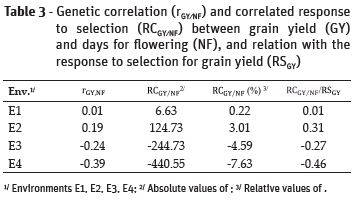
until flowering and grain yield (r<sub>GY,NF</sub>), the correlated response in grain
yield considering the selection for number of days for flowering (RC<sub>GY/NF</sub>), and the relation between 
RC<sub>GY/NF</sub> and the predicted response to selection
for grain yield (RS<sub>GY</sub>) (<a href = "#t3">Table 3</a>).</font></p>

    <p>&nbsp;</p>

<a name = "t3"><img src = "/img/revistas/rca/v42n1/v42n1a01t3.jpg"></a>

    
<p>&nbsp;</p>

    <p><font face = "Verdana" size = "2">These results suggest that the selection of progenies with a few days for flowering
had a positive response in grain yield at the environments E1 and E2. However, at
the environments E3 and E4, the selection of progenies with earlier maturity led
to a reduction in grain yield. Considering the relation RC<sub>GY/NF</sub>/RS<sub>GY</sub>, in all cases the efficiency of indirect
selection compared to direct selection was smaller than 1.0, meaning that the response
of selection considering only grain yield was higher than the selection performed
the number of days for flowering. Expected fact, because of the physiology of the
rice plant, genotypes with greater number of days from sowing to days to flowering
presented higher grain yield (Breseghello <i>et al</i>., 2011). According to Falconer
and Mackay (1996), it is worthy to perform an indirect selection when the heritability
(h<sup>2</sup>) of the trait under selection is high, and the heritability of the
trait of interest is small, but the genetic correlation between these traits must
be large. High estimates of heritability were found for NF, PH and GY characters.
the values obtained for the character of grain yield, in accordance with the literature,
due to the quantitative genetic control of the characteristic associated with the
great influence of the enviroment, tend to obtain values below 40% (Morais <i>et
al</i>., 2008).</font></p>

    <p><font face = "Verdana" size = "2">Nevertheless, it
becomes evident the complexity of selection for multiple traits simultaneously.
In this case, the use of selection indexes turns to be an interesting and easier
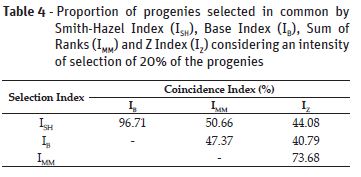
strategy. The proportion of progenies selected in common by Smith-Hazel Index (I<sub>SH</sub>), Base Index (I<sub>B</sub>),
Sum of Ranks (I<sub>MM</sub>) and Z Index (I<sub>Z</sub>)
are showed in <a href = "#t4">Table 4</a>. There are more coincidence in the selection of the best lines
between the ISH and IB indexes, which allows in principle, that the breeder can
choose these two indexes to assist in the selection for multiple traits. Several
studies comparing selection indexes in different species can be found in literature
(Oliveira <i>et al</i>., 2008; Pedrozo <i>et al</i>., 2009; Freitas <i>et al</i>.,
2013). However, comparisons involving the Z Index were found only in common bean
and eucalyptus (Mendes <i>et al.</i>, 2009; Reis <i>et al</i>., 2011; Lima <i>et
al</i>., 2012).</font></p>

    <p>&nbsp;</p>

<a name = "t4"><img src = "/img/revistas/rca/v42n1/v42n1a01t4.jpg"></a>

    
<p>&nbsp;</p>

    <p><font face = "Verdana" size = "2">The high coincidence of progenies selected in
common by I<sub>SH</sub> and I<sub>B</sub> is
somehow expected, since both indexes are greatly influenced by the scale of measurement
of traits. Because grain yield was measured in kg.ha<sup>-1</sup>, it greatly influence
the other traits measured in smaller scales. The indexes I<sub>MM</sub> and
I<sub>Z</sub>, on the other hand, are not influenced
by the scale of the original data, because they are calculated using non-dimensional
scales.</font></p>

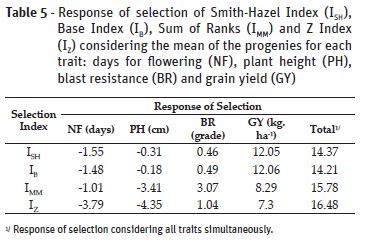
    <p><font face = "Verdana" size = "2">The percentage
of the response of selection (RS) of the progenies selected using each index for
the four traits evaluated are shown in <a href = "#t5">Table 5</a>. I<sub>Z</sub> showed
the highest RS for the traits number of days for flowering and plant height, I<sub>MM</sub> had the best value for blast resistance,
and the best response for grain yield was obtained by I<sub>SH</sub> and I<sub>B</sub>.</font></p>

    <p>&nbsp;</p>

<a name = "t5"><img src = "/img/revistas/rca/v42n1/v42n1a01t5.jpg"></a>

    
]]></body>
<body><![CDATA[<p>&nbsp;</p>

    <p><font face = "Verdana" size = "2">Although showing small response of selection for grain yield, 
I<sub>Z</sub> presented
the higher response considering all traits simultaneously, with a response value
for selection of 16,48. A great advantage of this index is the possibility to perform
an analysis of variance with the standardized values (Z), which are obtained per
plot. This strategy allows to verify the effect of genotype x environment interaction
on the index. In this study, the effect of GE interaction was significant (p &lt;
0.05) in the analysis of variance of the Z values across environments, and the index
heritability was h<sup>2</sup>=0.87, indicating that the selection using this index
had high genetic value.</font></p>

    <p><font face = "Verdana" size = "2">Another advantage of I<sub>Z</sub> is the possibility to display the performance
of progenies for each trait in a graphic, allowing to observe the traits which the
progenies are more deficient (Mendes <i>et al.</i>, 2009). Since the values for
each trait are standardized, the mean of the population is zero. Considering the
traits separately, progenies with higher values of Z show behavior above the average.
In this study, this behavior occurred for lines named as 97 and 103 for all traits.
However, line 65 had the opposite behavior, showing a bad performance for all traits.
Line 48 showed superior performance only for blast resistance (<a href = "/img/revistas/rca/v42n1/v42n1a01f1.jpg" target = "_blank">Figure 1</a>).</font></p>

    
<p><font face = "Verdana" size = "3"><b>CONCLUSION </b></font></p>


    <p><font face = "Verdana" size = "2">The progenies presented high genetic
variability for all traits, enabling the success with selection. The predicted response
to selection considering each trait separately was expressive, but the indirect
selection considering the correlated response between number of days to flowering
and grain yield was not effective.</font></p>

    <p><font face = "Verdana" size = "2">The Index Z showed the higher response of selection considering all
traits simultaneously, in addition to be the easiest to implement and to allow a
graphic display of the performance of the progenies in each trait.</font></p>

    <p>&nbsp;</p>

    <p><font face = "Verdana" size = "3"><b>References </b></font></p>


    <!-- ref --><p><font face = "Verdana" size = "2">Bernardo, R. (2010) - <i>Breeding for quantitative
traits in plants</i>.2ª ed. Woodbury, Stemma Press, 400 p.    &nbsp;&nbsp;&nbsp;&nbsp;&nbsp;&nbsp;&nbsp;&nbsp;[&#160;<a href="javascript:void(0);" onclick="javascript: window.open('/scielo.php?script=sci_nlinks&ref=709182&pid=S0871-018X201900010000200001&lng=','','width=640,height=500,resizable=yes,scrollbars=1,menubar=yes,');">Links</a>&#160;]<!-- end-ref --></font></p>

    ]]></body>
<body><![CDATA[<!-- ref --><p><font face = "Verdana" size = "2">Borém, A. and Miranda, G.V. (2005) - <i>Melhoramento de
plantas</i>. 4ª ed. Viçosa, UFV, 525 p.    &nbsp;&nbsp;&nbsp;&nbsp;&nbsp;&nbsp;&nbsp;&nbsp;[&#160;<a href="javascript:void(0);" onclick="javascript: window.open('/scielo.php?script=sci_nlinks&ref=709184&pid=S0871-018X201900010000200002&lng=','','width=640,height=500,resizable=yes,scrollbars=1,menubar=yes,');">Links</a>&#160;]<!-- end-ref --></font></p>

    <!-- ref --><p><font face = "Verdana" size = "2">Breseghello, F.; Morais, O.P.; Pinheiro, P.V.; Silva, A.C.S.; Castro, E.M.;
Guimarães E.P.; Castro, A.P.; Pereira, J.A.; Lopes, A.M.; Utumi, M.M. &amp; Oliveira,
J.P. (2011) – Results of 25 years of upland rice breeding in Brazil. <i>Crop Science</i>,
vol. 51, n. 3, p. 914-923. <a href = "http://doi.org/10.2135/cropsci2010.06.0325" target = "_blank">http://doi.org/10.2135/cropsci2010.06.0325</a></font>&nbsp;&nbsp;&nbsp;&nbsp;&nbsp;&nbsp;&nbsp;&nbsp;[&#160;<a href="javascript:void(0);" onclick="javascript: window.open('/scielo.php?script=sci_nlinks&ref=709186&pid=S0871-018X201900010000200003&lng=','','width=640,height=500,resizable=yes,scrollbars=1,menubar=yes,');">Links</a>&#160;]<!-- end-ref --><!-- ref --><p><font face = "Verdana" size = "2">Bridges, W.C.; Knapp, S.J. &amp; Cornelius, P.L.
(1991) - Standard errors and confidence interval estimators for expected selection
response. <i>Crop Science</i>, vol. 31, n. 2, p. 253-255.
<a href = "http://doi.org/10.2135/cropsci1991.0011183X003100020002x" target = "_blank">http://doi.org/10.2135/cropsci1991.0011183X003100020002x</a></font>&nbsp;&nbsp;&nbsp;&nbsp;&nbsp;&nbsp;&nbsp;&nbsp;[&#160;<a href="javascript:void(0);" onclick="javascript: window.open('/scielo.php?script=sci_nlinks&ref=709187&pid=S0871-018X201900010000200004&lng=','','width=640,height=500,resizable=yes,scrollbars=1,menubar=yes,');">Links</a>&#160;]<!-- end-ref --><!-- ref --><p><font face = "Verdana" size = "2">Cordeiro, A.C.C. and Medeiros, R.D. (2010) - <i>Arroz
vermelho: orientações técnicas para o manejo em lavouras de arroz irrigado em várzeas
de Roraima</i>. Boa Vista, EMBRAPA Roraima, 12 p.    &nbsp;&nbsp;&nbsp;&nbsp;&nbsp;&nbsp;&nbsp;&nbsp;[&#160;<a href="javascript:void(0);" onclick="javascript: window.open('/scielo.php?script=sci_nlinks&ref=709188&pid=S0871-018X201900010000200005&lng=','','width=640,height=500,resizable=yes,scrollbars=1,menubar=yes,');">Links</a>&#160;]<!-- end-ref --></font></p>

    <!-- ref --><p><font face = "Verdana" size = "2">Cordeiro, A.C.C. &amp; Rangel, P.H.N. (2011) - Avaliação de populações
de arroz irrigado conduzidas por seleção recorrente em várzea de Roraima. <i>Agroambiente</i>,
vol. 5, n. 3, p. 182-187.    &nbsp;&nbsp;&nbsp;&nbsp;&nbsp;&nbsp;&nbsp;&nbsp;[&#160;<a href="javascript:void(0);" onclick="javascript: window.open('/scielo.php?script=sci_nlinks&ref=709190&pid=S0871-018X201900010000200006&lng=','','width=640,height=500,resizable=yes,scrollbars=1,menubar=yes,');">Links</a>&#160;]<!-- end-ref --></font></p>

    <!-- ref --><p><font face = "Verdana" size = "2">Cruz, C.D. and Carneiro, P.C.S. (2003) - <i>Modelos biome&#769;tricos aplicados ao melhoramento
gene&#769;tico.</i>Viçosa, UFV, 585 p.    &nbsp;&nbsp;&nbsp;&nbsp;&nbsp;&nbsp;&nbsp;&nbsp;[&#160;<a href="javascript:void(0);" onclick="javascript: window.open('/scielo.php?script=sci_nlinks&ref=709192&pid=S0871-018X201900010000200007&lng=','','width=640,height=500,resizable=yes,scrollbars=1,menubar=yes,');">Links</a>&#160;]<!-- end-ref --></font></p>

    ]]></body>
<body><![CDATA[<!-- ref --><p><font face = "Verdana" size = "2">Falconer, D.S. and Mackay, T.F.C. (1996) -<i>Introduction to quantitative genetics</i>.
4ª ed. Longman, Pearson Education, 463 p.    &nbsp;&nbsp;&nbsp;&nbsp;&nbsp;&nbsp;&nbsp;&nbsp;[&#160;<a href="javascript:void(0);" onclick="javascript: window.open('/scielo.php?script=sci_nlinks&ref=709194&pid=S0871-018X201900010000200008&lng=','','width=640,height=500,resizable=yes,scrollbars=1,menubar=yes,');">Links</a>&#160;]<!-- end-ref --></font></p>

    <!-- ref --><p><font face = "Verdana" size = "2">Freitas, I.L.J.; Amaral Junior, A.T.; Viana, A.P.; Pena, G.F.; Cabral,
P.S.;Vitorazzi, C. &amp; Silva, T.R.C. (2013) - Ganho genético avaliado com índices
de seleção e com REML/Blup em milho pipoca. <i>Pesquisa Agropecuária Brasileira,
</i>vol. 48, n. 11, p. 1464-1471. <a href = "http://doi.org/10.1590/S0100-204X2013001100007" target = "_blank">http://doi.org/10.1590/S0100-204X2013001100007</a></font>&nbsp;&nbsp;&nbsp;&nbsp;&nbsp;&nbsp;&nbsp;&nbsp;[&#160;<a href="javascript:void(0);" onclick="javascript: window.open('/scielo.php?script=sci_nlinks&ref=709196&pid=S0871-018X201900010000200009&lng=','','width=640,height=500,resizable=yes,scrollbars=1,menubar=yes,');">Links</a>&#160;]<!-- end-ref --><!-- ref --><p><font face = "Verdana" size = "2">Hamblin, J. &amp; Zimmermann, M.J. (1986) - Breeding
common bean for yield in mixtures. <i>Plant Breeding Reviews, </i>vol. 4, p. 245-272.
<a href = "http://doi.org/10.1002/9781118061015.ch8" target = "_blank">http://doi.org/10.1002/9781118061015.ch8</a></font>&nbsp;&nbsp;&nbsp;&nbsp;&nbsp;&nbsp;&nbsp;&nbsp;[&#160;<a href="javascript:void(0);" onclick="javascript: window.open('/scielo.php?script=sci_nlinks&ref=709197&pid=S0871-018X201900010000200010&lng=','','width=640,height=500,resizable=yes,scrollbars=1,menubar=yes,');">Links</a>&#160;]<!-- end-ref --><!-- ref --><p><font face = "Verdana" size = "2">Hazel, L.N. (1943) - The genetic basis for constructing selection indexes. <i>Genetics,
</i>vol. 28, n. 6, p. 476-490.    &nbsp;&nbsp;&nbsp;&nbsp;&nbsp;&nbsp;&nbsp;&nbsp;[&#160;<a href="javascript:void(0);" onclick="javascript: window.open('/scielo.php?script=sci_nlinks&ref=709198&pid=S0871-018X201900010000200011&lng=','','width=640,height=500,resizable=yes,scrollbars=1,menubar=yes,');">Links</a>&#160;]<!-- end-ref --></font></p>

    <!-- ref --><p><font face = "Verdana" size = "2">Knapp,
S.J.; Stroup, W.W. &amp; Ross, W.M. (1985) - Exact confidence intervals for heritability
on progeny mean basis<i>. Crop Science. </i>vol. 25, n. 1, p. 192-194.
<a href = "http://doi.org/10.2135/cropsci1985.0011183X002500010046x" target = "_blank">http://doi.org/10.2135/cropsci1985.0011183X002500010046x</a></font>&nbsp;&nbsp;&nbsp;&nbsp;&nbsp;&nbsp;&nbsp;&nbsp;[&#160;<a href="javascript:void(0);" onclick="javascript: window.open('/scielo.php?script=sci_nlinks&ref=709200&pid=S0871-018X201900010000200012&lng=','','width=640,height=500,resizable=yes,scrollbars=1,menubar=yes,');">Links</a>&#160;]<!-- end-ref --><!-- ref --><p><font face = "Verdana" size = "2">Lima, L.K.; Ramalho, M.A.P. &amp; Abreu, A.F.B.
(2012) - Implications of the progeny x environment interaction in selection index
involving characteristics of the common bean. <i>Genetics and Molecular Research</i>,
vol. 11, n. 4, p. 4093-4099. <a href = "https://doi.org/10.4238/2012.September.19.5" target = "_blank">https://doi.org/10.4238/2012.September.19.5</a></font>&nbsp;&nbsp;&nbsp;&nbsp;&nbsp;&nbsp;&nbsp;&nbsp;[&#160;<a href="javascript:void(0);" onclick="javascript: window.open('/scielo.php?script=sci_nlinks&ref=709201&pid=S0871-018X201900010000200013&lng=','','width=640,height=500,resizable=yes,scrollbars=1,menubar=yes,');">Links</a>&#160;]<!-- end-ref --><!-- ref --><p><font face = "Verdana" size = "2">Mendes, F.F.; Ramalho, M.A.P. &amp; Abreu, A.F.B.
(2009) - Índice de seleção para escolha de populações segregantes de feijoeiro-comum.
<i>Pesquisa Agropecuária Brasileira</i>, vol. 44, n. 10, p. 1312-1318.    &nbsp;&nbsp;&nbsp;&nbsp;&nbsp;&nbsp;&nbsp;&nbsp;[&#160;<a href="javascript:void(0);" onclick="javascript: window.open('/scielo.php?script=sci_nlinks&ref=709202&pid=S0871-018X201900010000200014&lng=','','width=640,height=500,resizable=yes,scrollbars=1,menubar=yes,');">Links</a>&#160;]<!-- end-ref --></font></p>


    ]]></body>
<body><![CDATA[<!-- ref --><p><font face = "Verdana" size = "2">Missio, R.F.; Cambuim, J.; Moraes, M.L.T. &amp;
Paula, R.C. (2004) - Seleção simultânea de caracteres em progênies de <i>Pinus caribaea
</i>Morelet var. <i>bahamensis</i>. <i>Scientia Forestalis, </i>vol. 66, p. 161-168.    &nbsp;&nbsp;&nbsp;&nbsp;&nbsp;&nbsp;&nbsp;&nbsp;[&#160;<a href="javascript:void(0);" onclick="javascript: window.open('/scielo.php?script=sci_nlinks&ref=709204&pid=S0871-018X201900010000200015&lng=','','width=640,height=500,resizable=yes,scrollbars=1,menubar=yes,');">Links</a>&#160;]<!-- end-ref -->
</font></p>

    <!-- ref --><p><font face = "Verdana" size = "2">Morais, L.K.; Silva, R.M.; Chiorato,
A.F.; Azzini, L.E.; Vollela, O.V.; Gallo, P.B.; Sakai, M.; Bastos, C.R. &amp; Malavolta,
V.M.A. (2008) - Adaptabilidade e estabilidade fenotípica de genótipos de arroz irrigado
para o estado de São Paulo. <i>Biociências, </i>vol. 14, n. 1, p. 9-16.    &nbsp;&nbsp;&nbsp;&nbsp;&nbsp;&nbsp;&nbsp;&nbsp;[&#160;<a href="javascript:void(0);" onclick="javascript: window.open('/scielo.php?script=sci_nlinks&ref=709206&pid=S0871-018X201900010000200016&lng=','','width=640,height=500,resizable=yes,scrollbars=1,menubar=yes,');">Links</a>&#160;]<!-- end-ref --></font></p>


    <!-- ref --><p><font face = "Verdana" size = "2">Morais, O.P.; Silva, J.C.; Cruz, C.D.; Regazzi,
A.J. &amp; Neves, P.C.F. (1997) - Estimação dos parâmetros genéticos da população
de arroz irrigado CNA-IRAT 4/0/3. <i>Pesquisa Agropecuária Brasileira, </i>vol.
32, n. 4, p. 421-433.    &nbsp;&nbsp;&nbsp;&nbsp;&nbsp;&nbsp;&nbsp;&nbsp;[&#160;<a href="javascript:void(0);" onclick="javascript: window.open('/scielo.php?script=sci_nlinks&ref=709208&pid=S0871-018X201900010000200017&lng=','','width=640,height=500,resizable=yes,scrollbars=1,menubar=yes,');">Links</a>&#160;]<!-- end-ref --></font></p>

    <!-- ref --><p><font face = "Verdana" size = "2">Mulamba, N.N.
&amp; Mock, J.J. (1978) - Improvement of yield potential of the Eto Blanco maize
(<i>Zea mays</i> L.) population by breeding for plant traits. <i>Egyptian Journal
of Genetics and Citology, </i>vol. 7, p. 40-51.    &nbsp;&nbsp;&nbsp;&nbsp;&nbsp;&nbsp;&nbsp;&nbsp;[&#160;<a href="javascript:void(0);" onclick="javascript: window.open('/scielo.php?script=sci_nlinks&ref=709210&pid=S0871-018X201900010000200018&lng=','','width=640,height=500,resizable=yes,scrollbars=1,menubar=yes,');">Links</a>&#160;]<!-- end-ref --></font></p>

    <!-- ref --><p><font face = "Verdana" size = "2">Oliveira, E.J.; Santos, V.S.; Lima, D.S.; Machado, M.D.; Lucena, R.S.;
Motta, T.B.N. &amp; Castellen, M.S. (2008) - Seleção em progênies de maracujazeiro-amarelo
com base em índices multivariados. <i>Pesquisa Agropecuária Brasileira, </i>vol.
43, n. 11, p. 1543-1549.    &nbsp;&nbsp;&nbsp;&nbsp;&nbsp;&nbsp;&nbsp;&nbsp;[&#160;<a href="javascript:void(0);" onclick="javascript: window.open('/scielo.php?script=sci_nlinks&ref=709212&pid=S0871-018X201900010000200019&lng=','','width=640,height=500,resizable=yes,scrollbars=1,menubar=yes,');">Links</a>&#160;]<!-- end-ref --></font></p>

    ]]></body>
<body><![CDATA[<!-- ref --><p><font face = "Verdana" size = "2">Pedrozo,
C.A.; Benites, F.R.G.; Barbosa, M.H.P.; Resende, M.D.V. &amp; Silva, F.L. (2009)
- Eficiência de índices de seleção utilizando a metodologia REML/BLUP no melhoramento
da cana-de-açúcar. <i>Scientia Agraria, </i>vol. 10, n. 1, p. 31-36.    &nbsp;&nbsp;&nbsp;&nbsp;&nbsp;&nbsp;&nbsp;&nbsp;[&#160;<a href="javascript:void(0);" onclick="javascript: window.open('/scielo.php?script=sci_nlinks&ref=709214&pid=S0871-018X201900010000200020&lng=','','width=640,height=500,resizable=yes,scrollbars=1,menubar=yes,');">Links</a>&#160;]<!-- end-ref --></font></p>


    <!-- ref --><p><font face = "Verdana" size = "2">Ramalho, M.A.P.; Abreu, A.F.B.; Santos, J.B. and
Nunes, J.A.R. (2012) - <i>Aplicações da genética quantitativa no melhoramento de
plantas autógamas.</i>Lavras, UFLA, 522 p.    &nbsp;&nbsp;&nbsp;&nbsp;&nbsp;&nbsp;&nbsp;&nbsp;[&#160;<a href="javascript:void(0);" onclick="javascript: window.open('/scielo.php?script=sci_nlinks&ref=709216&pid=S0871-018X201900010000200021&lng=','','width=640,height=500,resizable=yes,scrollbars=1,menubar=yes,');">Links</a>&#160;]<!-- end-ref --></font></p>

    <!-- ref --><p><font face = "Verdana" size = "2">Rangel, P.H.N.; Zimmermann, F.J.P. &amp; Neves, P.C.F. (1998) - Estimativas
de parâmetros genéticos e resposta à seleção nas populações de arroz irrigado CNA-IRAT
4PR e CNA-IRAT 4ME. <i>Pesquisa Agropecuária Brasileira</i>, vol. 33, n. 6, p. 905-912.    &nbsp;&nbsp;&nbsp;&nbsp;&nbsp;&nbsp;&nbsp;&nbsp;[&#160;<a href="javascript:void(0);" onclick="javascript: window.open('/scielo.php?script=sci_nlinks&ref=709218&pid=S0871-018X201900010000200022&lng=','','width=640,height=500,resizable=yes,scrollbars=1,menubar=yes,');">Links</a>&#160;]<!-- end-ref --></font></p>


    <!-- ref --><p><font face = "Verdana" size = "2">Regitano Neto, A.; Ramos Junior, E.U.; Gallo,
P.B.; Freitas, J.G. &amp;Azzini, L.E. (2013) - Comportamento de genótipos de arroz
de terras altas no estado de São Paulo. <i>Revista Ciência Agronômica</i>, vol.
44, n. 3, p. 512-519. <a href = "http://dx.doi.org/10.1590/S1806-66902013000300013" target = "_blank">http://dx.doi.org/10.1590/S1806-66902013000300013</a></font>&nbsp;&nbsp;&nbsp;&nbsp;&nbsp;&nbsp;&nbsp;&nbsp;[&#160;<a href="javascript:void(0);" onclick="javascript: window.open('/scielo.php?script=sci_nlinks&ref=709220&pid=S0871-018X201900010000200023&lng=','','width=640,height=500,resizable=yes,scrollbars=1,menubar=yes,');">Links</a>&#160;]<!-- end-ref --><!-- ref --><p><font face = "Verdana" size = "2">Reis, C.A.F.; Goncalves, F.M.A.; Ramalho, M.A.P. &amp; Rosado,
A.M. (2011) - Seleção de progênies de eucalipto pelo índice Z por MQM e BLUP. <i>Pesquisa
Agropecuária Brasileira</i>, vol. 46, n. 5, p. 517-523.    &nbsp;&nbsp;&nbsp;&nbsp;&nbsp;&nbsp;&nbsp;&nbsp;[&#160;<a href="javascript:void(0);" onclick="javascript: window.open('/scielo.php?script=sci_nlinks&ref=709221&pid=S0871-018X201900010000200024&lng=','','width=640,height=500,resizable=yes,scrollbars=1,menubar=yes,');">Links</a>&#160;]<!-- end-ref --></font></p>

    <!-- ref --><p><font face = "Verdana" size = "2">Servellon, R.E. (1996) - Estimación de parámetros genéticos y
de respuestas a la selección en la población de arroz irrigado CNA 1. <i>Agronomía
Mesoamericana</i>, vol. 7, n. 2, p. 50-57.    &nbsp;&nbsp;&nbsp;&nbsp;&nbsp;&nbsp;&nbsp;&nbsp;[&#160;<a href="javascript:void(0);" onclick="javascript: window.open('/scielo.php?script=sci_nlinks&ref=709223&pid=S0871-018X201900010000200025&lng=','','width=640,height=500,resizable=yes,scrollbars=1,menubar=yes,');">Links</a>&#160;]<!-- end-ref --></font></p>

    <!-- ref --><p><font face = "Verdana" size = "2">Smith, H.F. (1936) - A discriminant function for plant selection. <i>Annals
of Human Genetics, </i>vol. 7, n. 3, p. 240-250. <a href = "http://doi.org/10.1111/j.1469-1809.1936.tb02143.x" target = "_blank">http://doi.org/10.1111/j.1469-1809.1936.tb02143.x</a></font>&nbsp;&nbsp;&nbsp;&nbsp;&nbsp;&nbsp;&nbsp;&nbsp;[&#160;<a href="javascript:void(0);" onclick="javascript: window.open('/scielo.php?script=sci_nlinks&ref=709225&pid=S0871-018X201900010000200026&lng=','','width=640,height=500,resizable=yes,scrollbars=1,menubar=yes,');">Links</a>&#160;]<!-- end-ref --><!-- ref --><p><font face = "Verdana" size = "2">Tardin, F.D.; Pereira, M.G.; Gabriel, A.P.C.;
Amaral Junior, A.T. &amp; Souza Filho, G.A. (2007) - Selection index and molecular
markers in reciprocal recurrent selection in maize. <i>Crop Breeding Applied Biotechnology</i>,
vol. 7, n. 3, p. 225-233.    &nbsp;&nbsp;&nbsp;&nbsp;&nbsp;&nbsp;&nbsp;&nbsp;[&#160;<a href="javascript:void(0);" onclick="javascript: window.open('/scielo.php?script=sci_nlinks&ref=709226&pid=S0871-018X201900010000200027&lng=','','width=640,height=500,resizable=yes,scrollbars=1,menubar=yes,');">Links</a>&#160;]<!-- end-ref --></font></p>

    <!-- ref --><p><font face = "Verdana" size = "2">Vieira,
C.; Borém, A.; Ramalho, M.A.P. and Carneiro, J.E.S. (2005) - Melhoramento do feijão
<i>.In: </i>Borém, A. (Ed.) - <i>Melhoramento de espécies cultivadas. </i>Viçosa,
UFV, p. 301-392.    &nbsp;&nbsp;&nbsp;&nbsp;&nbsp;&nbsp;&nbsp;&nbsp;[&#160;<a href="javascript:void(0);" onclick="javascript: window.open('/scielo.php?script=sci_nlinks&ref=709228&pid=S0871-018X201900010000200028&lng=','','width=640,height=500,resizable=yes,scrollbars=1,menubar=yes,');">Links</a>&#160;]<!-- end-ref --></font></p>

    <!-- ref --><p><font face = "Verdana" size = "2">Williams, J.S.
(1962) - The evaluation of a selection index. <i>Biometrics,</i> vol. 18, n. 3,
p. 375-393. <a href = "http://doi.org/10.2307/2527479" target = "_blank">http://doi.org/10.2307/2527479</a></font>&nbsp;&nbsp;&nbsp;&nbsp;&nbsp;&nbsp;&nbsp;&nbsp;[&#160;<a href="javascript:void(0);" onclick="javascript: window.open('/scielo.php?script=sci_nlinks&ref=709230&pid=S0871-018X201900010000200029&lng=','','width=640,height=500,resizable=yes,scrollbars=1,menubar=yes,');">Links</a>&#160;]<!-- end-ref --><p>&nbsp;</p>

    <p><font face = "Verdana" size = "3"><b>Acknowledgments </b></font></p>

    <p><font face = "Verdana" size = "2">We sincere
thank EMBRAPA Arroz e Feijão and EMBRAPA Rondônia for providing the phenotypic data
for this research, and Fundação de Amparo à Pesquisa do Estado de MatoGrosso (FAPEMAT)
for founding the scholarship granted.</font></p>

    ]]></body>
<body><![CDATA[<p>&nbsp;</p>

    <p><font face = "Verdana" size = "2">Received/recebido: 2018.03.06</font></p>

    <p><font face = "Verdana" size = "2">Received in revised form/recebido em versão revista: 2018.07.16</font></p>

    <p><font face = "Verdana" size = "2">Accepted/aceite: 2018.09.05</font></p>


     ]]></body><back>
<ref-list>
<ref id="B1">
<nlm-citation citation-type="book">
<person-group person-group-type="author">
<name>
<surname><![CDATA[Bernardo]]></surname>
<given-names><![CDATA[R.]]></given-names>
</name>
</person-group>
<source><![CDATA[Breeding for quantitative traits in plants]]></source>
<year>2010</year>
<edition>2ª</edition>
<publisher-loc><![CDATA[Woodbury ]]></publisher-loc>
<publisher-name><![CDATA[Stemma Press]]></publisher-name>
</nlm-citation>
</ref>
<ref id="B2">
<nlm-citation citation-type="book">
<person-group person-group-type="author">
<name>
<surname><![CDATA[Borém]]></surname>
<given-names><![CDATA[A.]]></given-names>
</name>
<name>
<surname><![CDATA[Miranda]]></surname>
<given-names><![CDATA[G.V.]]></given-names>
</name>
</person-group>
<source><![CDATA[Melhoramento de plantas]]></source>
<year>2005</year>
<edition>4ª</edition>
<publisher-loc><![CDATA[Viçosa ]]></publisher-loc>
<publisher-name><![CDATA[UFV]]></publisher-name>
</nlm-citation>
</ref>
<ref id="B3">
<nlm-citation citation-type="journal">
<person-group person-group-type="author">
<name>
<surname><![CDATA[Breseghello]]></surname>
<given-names><![CDATA[F.]]></given-names>
</name>
<name>
<surname><![CDATA[Morais]]></surname>
<given-names><![CDATA[O.P.]]></given-names>
</name>
<name>
<surname><![CDATA[Pinheiro]]></surname>
<given-names><![CDATA[P.V.]]></given-names>
</name>
<name>
<surname><![CDATA[Silva]]></surname>
<given-names><![CDATA[A.C.S.]]></given-names>
</name>
<name>
<surname><![CDATA[Castro]]></surname>
<given-names><![CDATA[E.M.]]></given-names>
</name>
<name>
<surname><![CDATA[Guimarães]]></surname>
<given-names><![CDATA[E.P.]]></given-names>
</name>
<name>
<surname><![CDATA[Castro]]></surname>
<given-names><![CDATA[A.P.]]></given-names>
</name>
<name>
<surname><![CDATA[Pereira]]></surname>
<given-names><![CDATA[J.A.]]></given-names>
</name>
<name>
<surname><![CDATA[Lopes]]></surname>
<given-names><![CDATA[A.M.]]></given-names>
</name>
<name>
<surname><![CDATA[Utumi]]></surname>
<given-names><![CDATA[M.M.]]></given-names>
</name>
<name>
<surname><![CDATA[Oliveira]]></surname>
<given-names><![CDATA[J.P.]]></given-names>
</name>
</person-group>
<article-title xml:lang="en"><![CDATA[Results of 25 years of upland rice breeding in Brazil]]></article-title>
<source><![CDATA[Crop Science]]></source>
<year>2011</year>
<volume>51</volume>
<numero>3</numero>
<issue>3</issue>
<page-range>914-923</page-range></nlm-citation>
</ref>
<ref id="B4">
<nlm-citation citation-type="journal">
<person-group person-group-type="author">
<name>
<surname><![CDATA[Bridges]]></surname>
<given-names><![CDATA[W.C.]]></given-names>
</name>
<name>
<surname><![CDATA[Knapp]]></surname>
<given-names><![CDATA[S.J.]]></given-names>
</name>
<name>
<surname><![CDATA[Cornelius]]></surname>
<given-names><![CDATA[P.L.]]></given-names>
</name>
</person-group>
<article-title xml:lang="en"><![CDATA[Standard errors and confidence interval estimators for expected selection response]]></article-title>
<source><![CDATA[Crop Science]]></source>
<year>1991</year>
<volume>31</volume>
<numero>2</numero>
<issue>2</issue>
<page-range>253-255</page-range></nlm-citation>
</ref>
<ref id="B5">
<nlm-citation citation-type="book">
<person-group person-group-type="author">
<name>
<surname><![CDATA[Cordeiro]]></surname>
<given-names><![CDATA[A.C.C.]]></given-names>
</name>
<name>
<surname><![CDATA[Medeiros]]></surname>
<given-names><![CDATA[R.D.]]></given-names>
</name>
</person-group>
<source><![CDATA[Arroz vermelho: orientações técnicas para o manejo em lavouras de arroz irrigado em várzeas de Roraima]]></source>
<year>2010</year>
<publisher-loc><![CDATA[Boa Vista ]]></publisher-loc>
<publisher-name><![CDATA[EMBRAPA Roraima]]></publisher-name>
</nlm-citation>
</ref>
<ref id="B6">
<nlm-citation citation-type="journal">
<person-group person-group-type="author">
<name>
<surname><![CDATA[Cordeiro]]></surname>
<given-names><![CDATA[A.C.C.]]></given-names>
</name>
<name>
<surname><![CDATA[Rangel]]></surname>
<given-names><![CDATA[P.H.N.]]></given-names>
</name>
</person-group>
<article-title xml:lang="pt"><![CDATA[Avaliação de populações de arroz irrigado conduzidas por seleção recorrente em várzea de Roraima]]></article-title>
<source><![CDATA[Agroambiente]]></source>
<year>2011</year>
<volume>5</volume>
<numero>3</numero>
<issue>3</issue>
<page-range>182-187</page-range></nlm-citation>
</ref>
<ref id="B7">
<nlm-citation citation-type="book">
<person-group person-group-type="author">
<name>
<surname><![CDATA[Cruz]]></surname>
<given-names><![CDATA[C.D.]]></given-names>
</name>
<name>
<surname><![CDATA[Carneiro]]></surname>
<given-names><![CDATA[P.C.S.]]></given-names>
</name>
</person-group>
<source><![CDATA[Modelos biome&#769;tricos aplicados ao melhoramento gene&#769;tico]]></source>
<year>2003</year>
<publisher-loc><![CDATA[Viçosa ]]></publisher-loc>
<publisher-name><![CDATA[UFV]]></publisher-name>
</nlm-citation>
</ref>
<ref id="B8">
<nlm-citation citation-type="book">
<person-group person-group-type="author">
<name>
<surname><![CDATA[Falconer]]></surname>
<given-names><![CDATA[D.S.]]></given-names>
</name>
<name>
<surname><![CDATA[Mackay]]></surname>
<given-names><![CDATA[T.F.C.]]></given-names>
</name>
</person-group>
<source><![CDATA[Introduction to quantitative genetics]]></source>
<year>1996</year>
<edition>4ª</edition>
<publisher-loc><![CDATA[Longman ]]></publisher-loc>
<publisher-name><![CDATA[Pearson Education]]></publisher-name>
</nlm-citation>
</ref>
<ref id="B9">
<nlm-citation citation-type="journal">
<person-group person-group-type="author">
<name>
<surname><![CDATA[Freitas]]></surname>
<given-names><![CDATA[I.L.J.]]></given-names>
</name>
<name>
<surname><![CDATA[Amaral Junior]]></surname>
<given-names><![CDATA[A.T.]]></given-names>
</name>
<name>
<surname><![CDATA[Viana]]></surname>
<given-names><![CDATA[A.P.]]></given-names>
</name>
<name>
<surname><![CDATA[Pena]]></surname>
<given-names><![CDATA[G.F.]]></given-names>
</name>
<name>
<surname><![CDATA[Cabral]]></surname>
<given-names><![CDATA[P.S.]]></given-names>
</name>
<name>
<surname><![CDATA[Vitorazzi]]></surname>
<given-names><![CDATA[C.]]></given-names>
</name>
<name>
<surname><![CDATA[Silva]]></surname>
<given-names><![CDATA[T.R.C.]]></given-names>
</name>
</person-group>
<article-title xml:lang="pt"><![CDATA[Ganho genético avaliado com índices de seleção e com REML/Blup em milho pipoca]]></article-title>
<source><![CDATA[Pesquisa Agropecuária Brasileira]]></source>
<year>2013</year>
<volume>48</volume>
<numero>11</numero>
<issue>11</issue>
<page-range>1464-1471</page-range></nlm-citation>
</ref>
<ref id="B10">
<nlm-citation citation-type="journal">
<person-group person-group-type="author">
<name>
<surname><![CDATA[Hamblin]]></surname>
<given-names><![CDATA[J.]]></given-names>
</name>
<name>
<surname><![CDATA[Zimmermann]]></surname>
<given-names><![CDATA[M.J.]]></given-names>
</name>
</person-group>
<article-title xml:lang="en"><![CDATA[Breeding common bean for yield in mixtures]]></article-title>
<source><![CDATA[Plant Breeding Reviews]]></source>
<year>1986</year>
<volume>4</volume>
<page-range>245-272</page-range></nlm-citation>
</ref>
<ref id="B11">
<nlm-citation citation-type="journal">
<person-group person-group-type="author">
<name>
<surname><![CDATA[Hazel]]></surname>
<given-names><![CDATA[L.N.]]></given-names>
</name>
</person-group>
<article-title xml:lang="en"><![CDATA[The genetic basis for constructing selection indexes]]></article-title>
<source><![CDATA[Genetics]]></source>
<year>1943</year>
<volume>28</volume>
<numero>6</numero>
<issue>6</issue>
<page-range>476-490</page-range></nlm-citation>
</ref>
<ref id="B12">
<nlm-citation citation-type="journal">
<person-group person-group-type="author">
<name>
<surname><![CDATA[Knapp]]></surname>
<given-names><![CDATA[S.J.]]></given-names>
</name>
<name>
<surname><![CDATA[Stroup]]></surname>
<given-names><![CDATA[W.W.]]></given-names>
</name>
<name>
<surname><![CDATA[Ross]]></surname>
<given-names><![CDATA[W.M.]]></given-names>
</name>
</person-group>
<article-title xml:lang="en"><![CDATA[Exact confidence intervals for heritability on progeny mean basis]]></article-title>
<source><![CDATA[Crop Science]]></source>
<year>1985</year>
<volume>25</volume>
<numero>1</numero>
<issue>1</issue>
<page-range>192-194</page-range></nlm-citation>
</ref>
<ref id="B13">
<nlm-citation citation-type="journal">
<person-group person-group-type="author">
<name>
<surname><![CDATA[Lima]]></surname>
<given-names><![CDATA[L.K.]]></given-names>
</name>
<name>
<surname><![CDATA[Ramalho]]></surname>
<given-names><![CDATA[M.A.P.]]></given-names>
</name>
<name>
<surname><![CDATA[Abreu]]></surname>
<given-names><![CDATA[A.F.B.]]></given-names>
</name>
</person-group>
<article-title xml:lang="en"><![CDATA[Implications of the progeny x environment interaction in selection index involving characteristics of the common bean]]></article-title>
<source><![CDATA[Genetics and Molecular Research]]></source>
<year>2012</year>
<volume>11</volume>
<numero>4</numero>
<issue>4</issue>
<page-range>4093-4099</page-range></nlm-citation>
</ref>
<ref id="B14">
<nlm-citation citation-type="journal">
<person-group person-group-type="author">
<name>
<surname><![CDATA[Mendes]]></surname>
<given-names><![CDATA[F.F.]]></given-names>
</name>
<name>
<surname><![CDATA[Ramalho]]></surname>
<given-names><![CDATA[M.A.P.]]></given-names>
</name>
<name>
<surname><![CDATA[Abreu]]></surname>
<given-names><![CDATA[A.F.B.]]></given-names>
</name>
</person-group>
<article-title xml:lang="pt"><![CDATA[Índice de seleção para escolha de populações segregantes de feijoeiro-comum]]></article-title>
<source><![CDATA[Pesquisa Agropecuária Brasileira]]></source>
<year>2009</year>
<volume>44</volume>
<numero>10</numero>
<issue>10</issue>
<page-range>1312-1318</page-range></nlm-citation>
</ref>
<ref id="B15">
<nlm-citation citation-type="journal">
<person-group person-group-type="author">
<name>
<surname><![CDATA[Missio]]></surname>
<given-names><![CDATA[R.F.]]></given-names>
</name>
<name>
<surname><![CDATA[Cambuim]]></surname>
<given-names><![CDATA[J.]]></given-names>
</name>
<name>
<surname><![CDATA[Moraes]]></surname>
<given-names><![CDATA[M.L.T.]]></given-names>
</name>
<name>
<surname><![CDATA[Paula]]></surname>
<given-names><![CDATA[R.C.]]></given-names>
</name>
</person-group>
<article-title xml:lang="pt"><![CDATA[Seleção simultânea de caracteres em progênies de Pinus caribaea Morelet var. bahamensis]]></article-title>
<source><![CDATA[Scientia Forestalis]]></source>
<year>2004</year>
<volume>66</volume>
<page-range>161-168</page-range></nlm-citation>
</ref>
<ref id="B16">
<nlm-citation citation-type="journal">
<person-group person-group-type="author">
<name>
<surname><![CDATA[Morais]]></surname>
<given-names><![CDATA[L.K.]]></given-names>
</name>
<name>
<surname><![CDATA[Silva]]></surname>
<given-names><![CDATA[R.M.]]></given-names>
</name>
<name>
<surname><![CDATA[Chiorato]]></surname>
<given-names><![CDATA[A.F.]]></given-names>
</name>
<name>
<surname><![CDATA[Azzini]]></surname>
<given-names><![CDATA[L.E.]]></given-names>
</name>
<name>
<surname><![CDATA[Vollela]]></surname>
<given-names><![CDATA[O.V.]]></given-names>
</name>
<name>
<surname><![CDATA[Bastos]]></surname>
<given-names><![CDATA[C.R.]]></given-names>
</name>
<name>
<surname><![CDATA[Malavolta]]></surname>
<given-names><![CDATA[V.M.A.]]></given-names>
</name>
</person-group>
<article-title xml:lang="pt"><![CDATA[Adaptabilidade e estabilidade fenotípica de genótipos de arroz irrigado para o estado de São Paulo]]></article-title>
<source><![CDATA[Biociências]]></source>
<year>2008</year>
<volume>14</volume>
<numero>1</numero>
<issue>1</issue>
<page-range>9-16</page-range></nlm-citation>
</ref>
<ref id="B17">
<nlm-citation citation-type="journal">
<person-group person-group-type="author">
<name>
<surname><![CDATA[Morais]]></surname>
<given-names><![CDATA[O.P.]]></given-names>
</name>
<name>
<surname><![CDATA[Silva]]></surname>
<given-names><![CDATA[J.C.]]></given-names>
</name>
<name>
<surname><![CDATA[Cruz]]></surname>
<given-names><![CDATA[C.D.]]></given-names>
</name>
<name>
<surname><![CDATA[Regazzi]]></surname>
<given-names><![CDATA[A.J.]]></given-names>
</name>
<name>
<surname><![CDATA[Neves]]></surname>
<given-names><![CDATA[P.C.F.]]></given-names>
</name>
</person-group>
<article-title xml:lang="pt"><![CDATA[Estimação dos parâmetros genéticos da população de arroz irrigado CNA-IRAT 4/0/3]]></article-title>
<source><![CDATA[Pesquisa Agropecuária Brasileira]]></source>
<year>1997</year>
<volume>32</volume>
<numero>4</numero>
<issue>4</issue>
<page-range>421-433</page-range></nlm-citation>
</ref>
<ref id="B18">
<nlm-citation citation-type="journal">
<person-group person-group-type="author">
<name>
<surname><![CDATA[Mulamba]]></surname>
<given-names><![CDATA[N.N.]]></given-names>
</name>
<name>
<surname><![CDATA[Mock]]></surname>
<given-names><![CDATA[J.J.]]></given-names>
</name>
</person-group>
<article-title xml:lang="en"><![CDATA[Improvement of yield potential of the Eto Blanco maize (Zea mays L.) population by breeding for plant traits]]></article-title>
<source><![CDATA[Egyptian Journal of Genetics and Citology]]></source>
<year>1978</year>
<volume>7</volume>
<page-range>40-51</page-range></nlm-citation>
</ref>
<ref id="B19">
<nlm-citation citation-type="journal">
<person-group person-group-type="author">
<name>
<surname><![CDATA[Oliveira]]></surname>
<given-names><![CDATA[E.J.]]></given-names>
</name>
<name>
<surname><![CDATA[Santos]]></surname>
<given-names><![CDATA[V.S.]]></given-names>
</name>
<name>
<surname><![CDATA[Lima]]></surname>
<given-names><![CDATA[D.S.]]></given-names>
</name>
<name>
<surname><![CDATA[Machado]]></surname>
<given-names><![CDATA[M.D.]]></given-names>
</name>
<name>
<surname><![CDATA[Lucena]]></surname>
<given-names><![CDATA[R.S.]]></given-names>
</name>
<name>
<surname><![CDATA[Motta]]></surname>
<given-names><![CDATA[T.B.N.]]></given-names>
</name>
<name>
<surname><![CDATA[Castellen]]></surname>
<given-names><![CDATA[M.S.]]></given-names>
</name>
</person-group>
<article-title xml:lang="pt"><![CDATA[Seleção em progênies de maracujazeiro-amarelo com base em índices multivariados]]></article-title>
<source><![CDATA[Pesquisa Agropecuária Brasileira]]></source>
<year>2008</year>
<volume>43</volume>
<numero>11</numero>
<issue>11</issue>
<page-range>1543-1549</page-range></nlm-citation>
</ref>
<ref id="B20">
<nlm-citation citation-type="journal">
<person-group person-group-type="author">
<name>
<surname><![CDATA[Pedrozo]]></surname>
<given-names><![CDATA[C.A.]]></given-names>
</name>
<name>
<surname><![CDATA[Benites]]></surname>
<given-names><![CDATA[F.R.G.]]></given-names>
</name>
<name>
<surname><![CDATA[Barbosa]]></surname>
<given-names><![CDATA[M.H.P.]]></given-names>
</name>
<name>
<surname><![CDATA[Resende]]></surname>
<given-names><![CDATA[M.D.V.]]></given-names>
</name>
<name>
<surname><![CDATA[Silva]]></surname>
<given-names><![CDATA[F.L.]]></given-names>
</name>
</person-group>
<article-title xml:lang="pt"><![CDATA[Eficiência de índices de seleção utilizando a metodologia REML/BLUP no melhoramento da cana-de-açúcar]]></article-title>
<source><![CDATA[Scientia Agraria]]></source>
<year>2009</year>
<volume>10</volume>
<numero>1</numero>
<issue>1</issue>
<page-range>31-36</page-range></nlm-citation>
</ref>
<ref id="B21">
<nlm-citation citation-type="book">
<person-group person-group-type="author">
<name>
<surname><![CDATA[Ramalho]]></surname>
<given-names><![CDATA[M.A.P.]]></given-names>
</name>
<name>
<surname><![CDATA[Abreu]]></surname>
<given-names><![CDATA[A.F.B.]]></given-names>
</name>
<name>
<surname><![CDATA[Santos]]></surname>
<given-names><![CDATA[J.B.]]></given-names>
</name>
<name>
<surname><![CDATA[Nunes]]></surname>
<given-names><![CDATA[J.A.R.]]></given-names>
</name>
</person-group>
<source><![CDATA[Aplicações da genética quantitativa no melhoramento de plantas autógamas]]></source>
<year>2012</year>
<publisher-loc><![CDATA[Lavras ]]></publisher-loc>
<publisher-name><![CDATA[UFLA]]></publisher-name>
</nlm-citation>
</ref>
<ref id="B22">
<nlm-citation citation-type="journal">
<person-group person-group-type="author">
<name>
<surname><![CDATA[Rangel]]></surname>
<given-names><![CDATA[P.H.N.]]></given-names>
</name>
<name>
<surname><![CDATA[Zimmermann]]></surname>
<given-names><![CDATA[F.J.P.]]></given-names>
</name>
<name>
<surname><![CDATA[Neves]]></surname>
<given-names><![CDATA[P.C.F.]]></given-names>
</name>
</person-group>
<article-title xml:lang="pt"><![CDATA[Estimativas de parâmetros genéticos e resposta à seleção nas populações de arroz irrigado CNA-IRAT 4PR e CNA-IRAT 4ME]]></article-title>
<source><![CDATA[Pesquisa Agropecuária Brasileira]]></source>
<year>1998</year>
<volume>33</volume>
<numero>6</numero>
<issue>6</issue>
<page-range>905-912</page-range></nlm-citation>
</ref>
<ref id="B23">
<nlm-citation citation-type="journal">
<person-group person-group-type="author">
<name>
<surname><![CDATA[Regitano Neto]]></surname>
<given-names><![CDATA[A.]]></given-names>
</name>
<name>
<surname><![CDATA[Ramos Junior]]></surname>
<given-names><![CDATA[E.U.]]></given-names>
</name>
<name>
<surname><![CDATA[Gallo]]></surname>
<given-names><![CDATA[P.B.]]></given-names>
</name>
<name>
<surname><![CDATA[Freitas]]></surname>
<given-names><![CDATA[J.G.]]></given-names>
</name>
<name>
<surname><![CDATA[Azzini]]></surname>
<given-names><![CDATA[L.E.]]></given-names>
</name>
</person-group>
<article-title xml:lang="pt"><![CDATA[Comportamento de genótipos de arroz de terras altas no estado de São Paulo]]></article-title>
<source><![CDATA[Revista Ciência Agronômica]]></source>
<year>2013</year>
<volume>44</volume>
<numero>3</numero>
<issue>3</issue>
<page-range>512-519</page-range></nlm-citation>
</ref>
<ref id="B24">
<nlm-citation citation-type="journal">
<person-group person-group-type="author">
<name>
<surname><![CDATA[Reis]]></surname>
<given-names><![CDATA[C.A.F.]]></given-names>
</name>
<name>
<surname><![CDATA[Goncalves]]></surname>
<given-names><![CDATA[F.M.A.]]></given-names>
</name>
<name>
<surname><![CDATA[Ramalho]]></surname>
<given-names><![CDATA[M.A.P.]]></given-names>
</name>
<name>
<surname><![CDATA[Rosado]]></surname>
<given-names><![CDATA[A.M.]]></given-names>
</name>
</person-group>
<article-title xml:lang="pt"><![CDATA[Seleção de progênies de eucalipto pelo índice Z por MQM e BLUP]]></article-title>
<source><![CDATA[Pesquisa Agropecuária Brasileira]]></source>
<year>2011</year>
<volume>46</volume>
<numero>5</numero>
<issue>5</issue>
<page-range>517-523</page-range></nlm-citation>
</ref>
<ref id="B25">
<nlm-citation citation-type="journal">
<person-group person-group-type="author">
<name>
<surname><![CDATA[Servellon]]></surname>
<given-names><![CDATA[R.E.]]></given-names>
</name>
</person-group>
<article-title xml:lang="es"><![CDATA[Estimación de parámetros genéticos y de respuestas a la selección en la población de arroz irrigado CNA 1]]></article-title>
<source><![CDATA[Agronomía Mesoamericana]]></source>
<year>1996</year>
<volume>7</volume>
<numero>2</numero>
<issue>2</issue>
<page-range>50-57</page-range></nlm-citation>
</ref>
<ref id="B26">
<nlm-citation citation-type="journal">
<person-group person-group-type="author">
<name>
<surname><![CDATA[Smith]]></surname>
<given-names><![CDATA[H.F.]]></given-names>
</name>
</person-group>
<article-title xml:lang="en"><![CDATA[A discriminant function for plant selection]]></article-title>
<source><![CDATA[Annals of Human Genetics]]></source>
<year>1936</year>
<volume>7</volume>
<numero>3</numero>
<issue>3</issue>
<page-range>240-250</page-range></nlm-citation>
</ref>
<ref id="B27">
<nlm-citation citation-type="journal">
<person-group person-group-type="author">
<name>
<surname><![CDATA[Tardin]]></surname>
<given-names><![CDATA[F.D.]]></given-names>
</name>
<name>
<surname><![CDATA[Pereira]]></surname>
<given-names><![CDATA[M.G.]]></given-names>
</name>
<name>
<surname><![CDATA[Gabriel]]></surname>
<given-names><![CDATA[A.P.C.]]></given-names>
</name>
<name>
<surname><![CDATA[Amaral Junior]]></surname>
<given-names><![CDATA[A.T.]]></given-names>
</name>
<name>
<surname><![CDATA[Souza Filho]]></surname>
<given-names><![CDATA[G.A.]]></given-names>
</name>
</person-group>
<article-title xml:lang="en"><![CDATA[Selection index and molecular markers in reciprocal recurrent selection in maize]]></article-title>
<source><![CDATA[Crop Breeding Applied Biotechnology]]></source>
<year>2007</year>
<volume>7</volume>
<numero>3</numero>
<issue>3</issue>
<page-range>225-233</page-range></nlm-citation>
</ref>
<ref id="B28">
<nlm-citation citation-type="book">
<person-group person-group-type="author">
<name>
<surname><![CDATA[Vieira]]></surname>
<given-names><![CDATA[C.]]></given-names>
</name>
<name>
<surname><![CDATA[Borém]]></surname>
<given-names><![CDATA[A.]]></given-names>
</name>
<name>
<surname><![CDATA[Ramalho]]></surname>
<given-names><![CDATA[M.A.P.]]></given-names>
</name>
<name>
<surname><![CDATA[Carneiro]]></surname>
<given-names><![CDATA[J.E.S.]]></given-names>
</name>
</person-group>
<article-title xml:lang="pt"><![CDATA[Melhoramento do feijão]]></article-title>
<person-group person-group-type="editor">
<name>
<surname><![CDATA[Borém]]></surname>
<given-names><![CDATA[A.]]></given-names>
</name>
</person-group>
<source><![CDATA[Melhoramento de espécies cultivadas]]></source>
<year>2005</year>
<page-range>301-392</page-range><publisher-loc><![CDATA[Viçosa ]]></publisher-loc>
<publisher-name><![CDATA[UFV]]></publisher-name>
</nlm-citation>
</ref>
<ref id="B29">
<nlm-citation citation-type="journal">
<person-group person-group-type="author">
<name>
<surname><![CDATA[Williams]]></surname>
<given-names><![CDATA[J.S.]]></given-names>
</name>
</person-group>
<article-title xml:lang="en"><![CDATA[The evaluation of a selection index]]></article-title>
<source><![CDATA[Biometrics]]></source>
<year>1962</year>
<volume>18</volume>
<numero>3</numero>
<issue>3</issue>
<page-range>375-393</page-range></nlm-citation>
</ref>
</ref-list>
</back>
</article>