<?xml version="1.0" encoding="ISO-8859-1"?><article xmlns:mml="http://www.w3.org/1998/Math/MathML" xmlns:xlink="http://www.w3.org/1999/xlink" xmlns:xsi="http://www.w3.org/2001/XMLSchema-instance">
<front>
<journal-meta>
<journal-id>0871-018X</journal-id>
<journal-title><![CDATA[Revista de Ciências Agrárias]]></journal-title>
<abbrev-journal-title><![CDATA[Rev. de Ciências Agrárias]]></abbrev-journal-title>
<issn>0871-018X</issn>
<publisher>
<publisher-name><![CDATA[Sociedade de Ciências Agrárias de Portugal]]></publisher-name>
</publisher>
</journal-meta>
<article-meta>
<article-id>S0871-018X2019000100005</article-id>
<article-id pub-id-type="doi">10.19084/RCA18287</article-id>
<title-group>
<article-title xml:lang="en"><![CDATA[Relation of milling process and physiological quality of rice seeds during storage]]></article-title>
<article-title xml:lang="pt"><![CDATA[Relação qualidade de moagem e qualidade fisiológica de sementes de arroz durante o armazenamento]]></article-title>
</title-group>
<contrib-group>
<contrib contrib-type="author">
<name>
<surname><![CDATA[Lima]]></surname>
<given-names><![CDATA[Juliana Maria Espíndola]]></given-names>
</name>
<xref ref-type="aff" rid="A1"/>
</contrib>
<contrib contrib-type="author">
<name>
<surname><![CDATA[Smiderle]]></surname>
<given-names><![CDATA[Oscar José]]></given-names>
</name>
<xref ref-type="aff" rid="A2"/>
</contrib>
<contrib contrib-type="author">
<name>
<surname><![CDATA[Galvão]]></surname>
<given-names><![CDATA[Lindemberg de Matos]]></given-names>
</name>
<xref ref-type="aff" rid="A3"/>
</contrib>
<contrib contrib-type="author">
<name>
<surname><![CDATA[Sá]]></surname>
<given-names><![CDATA[Allex Ricarte de]]></given-names>
</name>
<xref ref-type="aff" rid="A3"/>
</contrib>
<contrib contrib-type="author">
<name>
<surname><![CDATA[Cordeiro]]></surname>
<given-names><![CDATA[Antônio Carlos Centeno]]></given-names>
</name>
<xref ref-type="aff" rid="A2"/>
</contrib>
</contrib-group>
<aff id="AA1">
<institution><![CDATA[,Federal University of Lavras Seed sector Agriculture department]]></institution>
<addr-line><![CDATA[ Lavras]]></addr-line>
<country>Brazil</country>
</aff>
<aff id="AA2">
<institution><![CDATA[,Embrapa Roraima Seed Laboratory ]]></institution>
<addr-line><![CDATA[ Boa Vista]]></addr-line>
<country>Brazil</country>
</aff>
<aff id="AA3">
<institution><![CDATA[,Federal University of Roraima Agriculture department ]]></institution>
<addr-line><![CDATA[ Boa Vista]]></addr-line>
<country>Brazil</country>
</aff>
<pub-date pub-type="pub">
<day>00</day>
<month>03</month>
<year>2019</year>
</pub-date>
<pub-date pub-type="epub">
<day>00</day>
<month>03</month>
<year>2019</year>
</pub-date>
<volume>42</volume>
<numero>1</numero>
<fpage>31</fpage>
<lpage>40</lpage>
<copyright-statement/>
<copyright-year/>
<self-uri xlink:href="http://scielo.pt/scielo.php?script=sci_arttext&amp;pid=S0871-018X2019000100005&amp;lng=en&amp;nrm=iso"></self-uri><self-uri xlink:href="http://scielo.pt/scielo.php?script=sci_abstract&amp;pid=S0871-018X2019000100005&amp;lng=en&amp;nrm=iso"></self-uri><self-uri xlink:href="http://scielo.pt/scielo.php?script=sci_pdf&amp;pid=S0871-018X2019000100005&amp;lng=en&amp;nrm=iso"></self-uri><abstract abstract-type="short" xml:lang="en"><p><![CDATA[Rice (Oryza sativa L.) is one of the most widely grown crops in the world and one of the earliest domesticated crop species. Also, its consumption is around 20% of the world’s caloric intake. It was aimed in this study to evaluate the relation between milled rice yield and physiological quality of rice seeds during storage. Two experiments were carried out with seeds of long-fine common rice and special rice cultivars. The storage evaluations were made at 0, 30, 60, 90 and 120 days. The experimental design was completely randomized with 3 x 5 factorial (cultivars x storage) for each experiment, with four replicates. The performed tests were: Milled rice yield, weight of one thousand seeds, germination, first count of germination and electrical conductivity. The special rice cultivars ‘BRS 358’ and ´Jasmine’, as well as the common rice cultivars ‘Sinuelo’ and ‘Jaçanã’, have greater potential for seed physiological quality and milled rice yield. The physical quality for milling process is linked to the physiological quality of the six cultivars tested.]]></p></abstract>
<abstract abstract-type="short" xml:lang="pt"><p><![CDATA[O arroz (Oryza sativa L.) é uma das culturas mais cultivadas no mundo e uma das primeiras espécies de culturas domesticadas. Além disso, o seu consumo representa cerca de 20% da ingestão calórica do mundo. Objetivou-se neste estudo avaliar a relação entre a qualidade de moagem e a qualidade fisiológica de sementes de arroz durante o armazenamento. Foram realizados dois ensaios com sementes de 3 cultivares de arroz comum tipo longo-fino e 3 cultivares especiais de arroz. As avaliações de armazenamento foram realizadas aos 0, 30, 60, 90 e 120 dias. O delineamento experimental foi inteiramente casualizado com fatorial 3 x 5 (cultivares x armazenamento) para cada ensaio, com quatro repetições. Os testes realizados foram: qualidade de moagem, peso de mil sementes, germinação, primeira contagem de germinação e condutividade elétrica. As cultivares especiais de arroz ‘BRS 358’ e ´Jasmine’, bem como as cultivares comuns de arroz, ‘Sinuelo’ e ‘Jaçanã’, apresentam maior potencial para qualidade fisiológica e qualidade de moagem. A qualidade física do processo de moagem está vinculada à qualidade fisiológica das sementes da seis cultivares de arroz testadas.]]></p></abstract>
<kwd-group>
<kwd lng="en"><![CDATA[Oryza sativa L.]]></kwd>
<kwd lng="en"><![CDATA[dormancy]]></kwd>
<kwd lng="en"><![CDATA[germination]]></kwd>
<kwd lng="en"><![CDATA[grains]]></kwd>
<kwd lng="pt"><![CDATA[Oryza sativa L.]]></kwd>
<kwd lng="pt"><![CDATA[dormência]]></kwd>
<kwd lng="pt"><![CDATA[germinação]]></kwd>
<kwd lng="pt"><![CDATA[grão]]></kwd>
</kwd-group>
</article-meta>
</front><body><![CDATA[ 

    <p align = "right"><font face = "Verdana" size = "2"><b>ARTIGO</b></font></p>

    <p><font face = "Verdana" size = "4"><b>Relation of milling process and physiological quality of rice seeds during storage</b></font></p>


    <p><font face = "Verdana" size = "3"><b>Relação qualidade de moagem e qualidade fisiológica de sementes de arroz
durante o armazenamento</b></font></p>

    <p><font face = "Verdana" size = "2"><b>Juliana Maria Espíndola Lima</b><sup>1,</sup>*, <b>Oscar
José Smiderle</b><sup>2</sup>, <b>Lindemberg de Matos Galvão</b><sup>3</sup>, <b>Allex Ricarte
de Sá</b><sup>3</sup> and <b>Antônio Carlos Centeno Cordeiro</b><sup>2</sup></font></p>

    <p><font face = "Verdana" size = "2"><i><sup>1 </sup>Agriculture department/ Seed sector, Federal University
of Lavras, Lavras, Brazil</i></font></p>

    <p><font face = "Verdana" size = "2"><i><sup>2 </sup>Seed Laboratory, Embrapa Roraima, Boa Vista, Brazil</i></font></p>

    <p><font face = "Verdana" size = "2"><i><sup>3 </sup>Agriculture department, Federal University
of Roraima, Boa Vista, Brazil</i></font></p>

    <p><font face = "Verdana" size = "2"><i>(*E-mail: <a href="mailto:espindolaj5@hotmail.com">espindolaj5@hotmail.com</a>)</i></font></p>

<hr noshade size = 1>

    <p><font face = "Verdana" size = "3"><b>ABSTRACT</b></font></p>


    ]]></body>
<body><![CDATA[<p><font face = "Verdana" size = "2">Rice (<i>Oryza sativa</i> L.) is one of the most
widely grown crops in the world and one of the earliest domesticated crop species.
Also, its consumption is around 20% of the world’s caloric intake. It was aimed
in this study to evaluate the relation between milled rice yield and physiological
quality of rice seeds during storage. Two experiments were carried out with seeds
of long-fine common rice and special rice cultivars. The storage evaluations were
made at 0, 30, 60, 90 and 120 days. The experimental design was completely randomized
with 3 x 5 factorial (cultivars x storage) for each experiment, with four replicates.
The performed tests were: Milled rice yield, weight of one thousand seeds, germination,
first count of germination and electrical conductivity. The special rice cultivars
‘BRS 358’ and <i>´</i>Jasmine’, as well as the common rice cultivars ‘Sinuelo’ and
‘Jaçanã’, have greater potential for seed physiological quality and milled rice
yield. The physical quality for milling process is linked to the physiological quality
of the six cultivars tested..</font></p>


    <p><font face = "Verdana" size = "2"><b>Keywords:</b> <i>Oryza sativa </i>L., dormancy,
germination, grains</font></p>

<hr noshade size = 1>

    <p><font face = "Verdana" size = "2"><b>RESUMO</b></font></p>

    <p><font face = "Verdana" size = "2">O arroz (<i>Oryza sativa</i> L.) é uma das culturas mais cultivadas no
mundo e uma das primeiras espécies de culturas domesticadas. Além disso, o seu consumo
representa cerca de 20% da ingestão calórica do mundo. Objetivou-se neste estudo
avaliar a relação entre a qualidade de moagem e a qualidade fisiológica de sementes
de arroz durante o armazenamento. Foram realizados dois ensaios com sementes de
3 cultivares de arroz comum tipo longo-fino e 3 cultivares especiais de arroz. As
avaliações de armazenamento foram realizadas aos 0, 30, 60, 90 e 120 dias. O delineamento
experimental foi inteiramente casualizado com fatorial 3 x 5 (cultivares x armazenamento)
para cada ensaio, com quatro repetições. Os testes realizados foram: qualidade de
moagem, peso de mil sementes, germinação, primeira contagem de germinação e condutividade
elétrica. As cultivares especiais de arroz ‘BRS 358’ e ´Jasmine’, bem como as cultivares
comuns de arroz, ‘Sinuelo’ e ‘Jaçanã’, apresentam maior potencial para qualidade
fisiológica e qualidade de moagem. A qualidade física do processo de moagem está
vinculada à qualidade fisiológica das sementes da seis cultivares de arroz testadas.</font></p>

    <p><font face = "Verdana" size = "2"><b>Palavras-chave: </b><i>Oryza sativa </i>L.<i>, </i>dormência,
germinação, grão.</font></p>

<hr noshade size = 1>

    <p><font face = "Verdana" size = "3"><b>INTRODUCTION</b></font></p>

    <p><font face = "Verdana" size = "2">Rice (<i>Oryza sativa</i> L.) is one of the most widely grown
crops in the world and one of the earliest domesticated crop species. Also, its
consumption is around 20% of the world’s caloric intake; Asian countries consume
50% of rice, which represents half of the world population (Agrama <i>et al.</i>,
2010; FAO, 2005). Besides Asia, rice is part of developing countries diet and the
staple food of more than half of the world’s population, more than 3.5 billion people
depend on rice for their daily calorie intake (IRRI <i>et al.</i>, 2010).</font></p>


    <p><font face = "Verdana" size = "2">White rice comes from milling rough rice that
is usually done at about 14% of moisture content due to consumer preference. Economically
the price of the rice is strongly related to the kernel size and shape, whiteness
and cleanliness (Conway <i>et al.</i>, 1991).</font></p>

    <p><font face = "Verdana" size = "2">All these factors are closely related to the milling process, where rough
rice is primarily subjected to dehusking or removal of hulls and then removal of
the brownish outer bran layer that is known as whitening. To finalize, a polishing
is made to remove bran particles and give a gloss surface to the kernels. For the
millers, having a high percentage of broken kernels after the milling represents
economically a direct loss to their production. These losses during milling depend
on the variety and content of rough rice, the degree of milling required, the kind
of rice mill used and the operators (Yadav and Jindal, 2001).</font></p>

    <p><font face = "Verdana" size = "2">Rice kernels with three quarters or more of their original
length after complete milling operation are classified as head rice. The price of
head rice is almost double or triple as compared to that of the broken kernels.
Hence, maximizing the proportion of head rice with the desired degree of kernel
whiteness is the priority for the rice milling industry (Yadav and Jindal, 2008).
The typical maximum of milled rice yield is 65% to 75% and the maximum of head yield
rice is 55% to 65% (Thompson <i>et al.,</i> 1990).</font></p>

    ]]></body>
<body><![CDATA[<p><font face = "Verdana" size = "2">Most of the cultivars present a reduction in the milled rice yield
after a certain degree of maturation, in which kernels with low water content are
likely to be harvested and processing (Faroni <i>et al.</i>, 1987). Therefore, the
harvesting season is fundamental for obtaining a quality product with high yield.
When the harvest is anticipated and the kernels have high water content, there is
an increase in the proportion of malformed and plaster kernels. When late harvesting
occurs with low grain moisture content, yield is affected by dehiscence, fissuring,
and reduction of milled rice yield after milling (Smiderle and Pereira, 2008).</font></p>


    <p><font face = "Verdana" size = "2">Many researchers have focused on improving milling
quality through plant breeding programs, improved cultural practices and optimization
of harvesting and drying conditions (Gravois, 1998; Abud-Archila <i>et al.</i>,
2000; Dong <i>et al.</i>, 2003; A-Bond and Bollich, 2007). Otherwise, no research
was found about the correlation between physiological quality of rice seeds and
milled rice yield. Seed harvested for continued rice production may require different
physiological and/or chemical characteristics as compared to seed harvested for
milling, and because of that most available literature is published separated.</font></p>


    <p><font face = "Verdana" size = "2">Seed rice has a dormancy that is broken after
a period of storage. Mikkelsen (1967) and Takahashi (1967) indicated that rice is
not true embryo dormancy, since embryos when excised from dormant seed germinate
freely. Seshu and Sorrells (1986) affirmed that the hull and the pericarp act independently
in imposing dormancy in rice seeds, considering the hull a predominant dormancy
factor.</font></p>

    <p><font face = "Verdana" size = "2">Also a number of physical
or chemical factors can be responsible for arresting germination as the non-availability
of oxygen to the embryo caused by the hull and the pericarp impermeability, or high
peroxidase activity, and the occurrence of growth inhibitors such as abscisic acid,
and phenols in the covering structures as well as in the embryo, or short-chain
saturated fatty acids, could be considered possible reasons for seed dormancy in
rice seed (Roberts, 1961; Mikkelsen, 1967; Takahashi, 1967; Navasero <i>et al.</i>,
1975; Hayashi, 1987; Majumder <i>et al.</i>, 1989).</font></p>

    <p><font face = "Verdana" size = "2">The increase in the yield of head rice following a storage period,
cited by technicians of the “Cooperativa Mista Rural Vale do Javaés – Coperjava
in Castro <i>et al.</i> (1999) would be due to the lower adhesion of the endosperm
of the seeds to the bark as the storage proceeds, which facilitate the removal during
the debarking. The same authors also affirm that the storage of the seeds before
the milling process contributes to decrease the rate of grain break and to increase
the working efficiency with less wear of the used appliances, besides better cooking.</font></p>

    <p><font face = "Verdana" size = "2">The effect of storage time on appraisal
physical and physiological quality in rice seeds is still not clear, and because
of that, it was aimed in this study to evaluate the relation between milled rice
yield and physiological quality of rice seeds during storage.</font></p>

    <p><font face = "Verdana" size = "3"><b>MATERIAL AND METHODS</b></font></p>

    <p><font face = "Verdana" size = "2">The seed used in
the experiment was produced at “Fazenda Santa Cecília<i>”</i>, in a meadow area
of Rio Branco, located in Cantá city of Roraima state (2°48'27'484 &quot;N and 60°39'17'564&quot;
W) during the period of December 2013 to April 2014. The type of soil was Gleysoil
Haplic Tb Distrophic, with the following chemical and physical characteristics:
pH = 5.1; MW = 30.92; P = 12.12 mg dm-3; K = 0.21 cmolc dm<sup>-3</sup>; Mg = 0.38
cmolc dm<sup>-3</sup>; Ca = 1.25 cmolc dm<sup>-3</sup>; Silt = 468.6 g kg<sup>-1</sup>;
Sand = 278.5 g kg<sup>-1</sup>; Clay = 252.9 g kg<sup>-1</sup>.</font></p>

    <p><font face = "Verdana" size = "2">Three special rice <i>Oryza sativa</i> L cultivars – ‘BRS
358’ (japonic), ‘Formosa’ (aromatic) and ‘Jasmine’ (japonic) were produced in a
randomized complete block design with four replicates, and three long-fine common
rice <i>Oryza sativa</i> L cultivars - ‘Jaçanã’, ‘Sinuelo’, and ‘Tropical’  were
produced using the same design in the same field as the special rice cultivars.
The experimental plot consisted of eight rows of five meters in length, with spacing
between rows of 0.25 m; the useful area corresponded to six central lines, being
discarded 0.50 m at the ends. The soil when dry was prepared by performing a plowing
with a harrow, two leveling harrows, followed by the construction of the tails.
Fertilizers as 120 kg ha<sup>-1</sup> of P<sub>2</sub>O<sub>5</sub> (simple superphosphate
with, 20% of P<sub>2</sub>O<sub>5</sub>) and 90 kg ha<sup>-1</sup> of K<sub>2</sub>O
(source: potassium chloride with 60% K<sub>2</sub>O) were used.</font></p>

    <p><font face = "Verdana" size = "2">Weed control was performed in the pre-emergence and after
sowing, with the application of the equivalent of 1.0 kg of a.i. ha<sup>-1</sup>
of oxadiazon (Ronstar® 250 BR) in the form of spraying via soil with humidity close
to saturation, according to Cordeiro <i>et al</i>. (2009).</font></p>

    ]]></body>
<body><![CDATA[<p><font face = "Verdana" size = "2">Harvesting was carried out after physiological maturity
was achieved, with the central 4 m of the center six rows of each plot being harvested.
The seeds of each cultivar were homogenized and dried at 40 °C for 48 to 72 hours
until they reached a moisture content of around 13% and were stored for three days
to balance the moisture content of the seeds. Then the seeds of each cultivar of
special and common rice were placed in paper bags for each evaluation period and
stored at 25 °C ± 1 with a relative humidity of approximately 60%, the storage evaluations
were performed at 0, 30, 60, 90 and 120 days.</font></p>

    <p><font face = "Verdana" size = "2">For the laboratory evaluations, an experimental design was used as completely
randomized with a factorial 3 x 5 (cultivars x storage) for each rice type (special
rice and common rice), with four replications. The evaluations carried out in each
period were.</font></p>

    <p><font face = "Verdana" size = "2">Milled rice yield:
it was determined by dehusking four replicates of 100 g of rough rice per cultivar
in each period, with a &quot;Suzuki&quot; dehusk machine. The rough rice was milled
and separated for 30 seconds to obtain the whole and broken kernels and hull, and
then the whole kernels were polished for 60 seconds and separated again for 30 seconds
in whole and broken kernels, obtaining, in the end, the proportion in grams of polished
kernels (head rice), broken kernels and hull.</font></p>

    <p><font face = "Verdana" size = "2">Weight of one thousand seeds: eight replicates of 100 pure seeds of each
cultivar were used, and then weighed in a 0.001 g precision scale; we calculated
the weight of one thousand seeds according to the Rules for Seed Analysis (Brasil,
2009).</font></p>

    <p><font face = "Verdana" size = "2">Germination (%): Paper substrate
was moistened with distilled water 2.5 times the dry paper weight. For each sample
in question, four replicates were used with 50 seeds each, kept in germinator at
25 °C. Germination was evaluated 14 days after sowing, and the number of hard seeds
(dormant) was also determined (Brazil, 2009).</font></p>

    <p><font face = "Verdana" size = "2">First count of germination (%): This evaluation was conducted in conjunction
with the germination test. The number of normal seedlings was counted on the fifth
day after sowing (Brazil, 2009).</font></p>

    <p><font face = "Verdana" size = "2">Electrical
conductivity (&#956;S cm<sup>-1</sup>g<sup>-1</sup> of seed): four replicates of
50 seeds for each cultivar were used, weighed in a 0.001 g precision scale and placed
in plastic cups containing 75 mL of distilled water for 24 hours, at a temperature
of 25 °C. The electrical conductivity readings were performed 24 hours after seed
imbibition with a digital conductivity meter (Kryzanowski <i>et al.</i>, 1999).</font></p>


    <p><font face = "Verdana" size = "2">The results obtained from the evaluation periods
of each cultivar from both experiments were submitted to the analysis of variance
and the means comparison, with significance level at 5%, by the Tukey test, and
for the regression analysis it was considerate the R<sup>2</sup> (coefficient of
determination) and the significance of 1% probability for t-test, we used the SISVAR
software to do the statistics (Ferreira, 2011).</font></p>

    <p><font face = "Verdana" size = "3"><b>RESULTS AND DISCUSSION</b></font></p>


    <p><font face = "Verdana" size = "2">The analysis of the mean squares shows a significant
interaction between the factors variation studied in the two experiments (<a href = "/img/revistas/rca/v42n1/v42n1a04t1.jpg" target = "_blank">Table
1</a>), which suggests the effect of storage environment on seed quality varied among
the cultivars.</font></p>

    
]]></body>
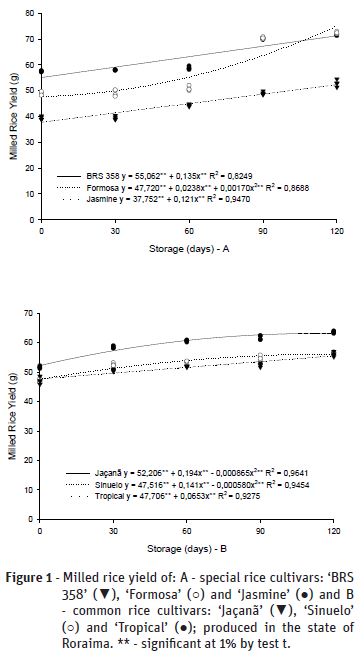
<body><![CDATA[<p><font face = "Verdana" size = "2">The milled rice yield
data for the special rice cultivars (<a href = "#f1">Figure 1A</a>) had initial (zero-day) yields of
57%, 49%, and 40% and final (120 days), 72%, 72%, and 53% yield, for ‘BRS 358’,
‘Formosa’ and ´Jasmine’, respectively. In the common rice cultivars (<a href = "#f1">Figure 1B</a>)
the increase in yield during storage was observed, which the cultivar ‘Jaçanã’ showed
the highest yield compared to the other cultivars, with a total of 64% of milled
rice yield at the end of 120 days, though ‘Tropical’ and ‘Sinuelo’ had 56% and 57%,
respectively.</font></p>

    <p>&nbsp;</p>

<a name = "f1"><img src = "/img/revistas/rca/v42n1/v42n1a04f1.jpg"></a>

    
<p>&nbsp;</p>

    <p><font face = "Verdana" size = "2">The increase in the
yield of milled rice during storage, cited by technicians of the “Cooperativa Mista
Rural Vale do Javaés – Coperjava” in Castro <i>et al.</i> (1999) would be due to
the lower adhesion of the endosperm of the seeds to the hull as the storage proceeds,
which facilitate the removal during the dehusking. The same authors also stated
that the storage of the seeds before the milling process contributes to decrease
the rate of broken kernels and to increase the working efficiency with less wear
of the used appliances, besides better cooking.</font></p>

    <p><font face = "Verdana" size = "2">Thus, the storage period for special rice cultivars ‘BRS 358’ and ‘Formosa’
and the common rice cultivar ‘Jaçanã’ tended to increase a higher yield of head
rice when compared to the other cultivars (<a href = "#f1">Figure 1A, B</a>).</font></p>

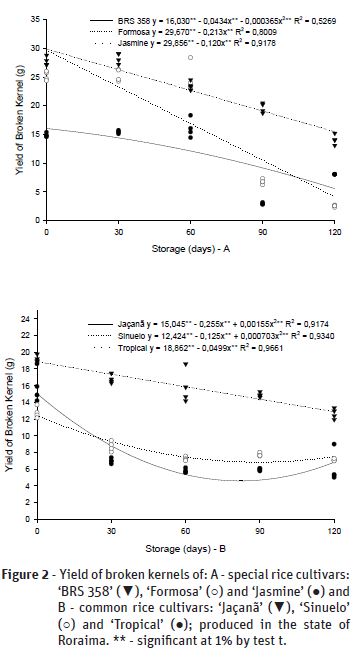
    <p><font face = "Verdana" size = "2">In the percentage of broken kernels of the special rice
cultivars (<a href = "#f2">Figure 2A</a>), there was a lower breakage of the ‘Formosa’ cultivar (3%)
at the end of the storage period, otherwise, in the begging of the storage, it had
25% of broken kernels. The cultivar ‘BRS 358’ had the lowest yield (15%) at the
beginning of storage and fell to 8% yield at 120 days. Considering the yield of
broken kernel of the common rice cultivars, it was observed that the cultivar ‘Tropical’
(<a href = "#f2">Figure 2B</a>) had the smallest reduction in the broken kernel along with the storage,
with an initial mean (zero days) of 19% and final (120 days) of 13%. While the cultivars
‘Jaçanã’ and ‘Sinuelo’ had the largest reduction, with a percentage of broken kernels
at zero days of 16% and 13% and at 120 days of 6% and 8%, respectively.</font></p>

    <p>&nbsp;</p>

<a name = "f2"><img src = "/img/revistas/rca/v42n1/v42n1a04f2.jpg"></a>

    
<p>&nbsp;</p>

    <p><font face = "Verdana" size = "2">The correct harvesting time is fundamental for
better quality seeds and higher yields, early or late harvesting may increase kernel
breakage in crop yield due to the presence of malformed kernel (early harvest) or
low kernel water content causing cracking (late harvest) (Smiderle <i>et al.</i>,
2008). At the Brazilian national level of broken kernel the percentage after polishing
is around 28% (Vieira and Carvalho, 1999), and in the cultivars studied in this
work, yields of broken kernel were obtained below this level.</font></p>

    <p><font face = "Verdana" size = "2">The potential of crop yield observed in common and special
rice cultivars produced in the state of Roraima , presented promising data, especially
for the cultivation of special rice, with head rice (‘BRS 358’ and ‘Formosa’) above
the national mean.</font></p>

    ]]></body>
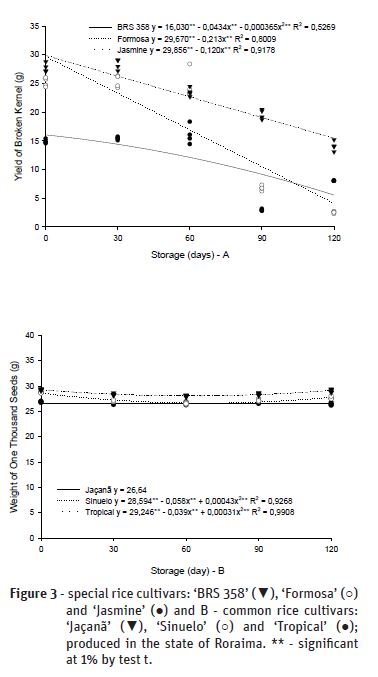
<body><![CDATA[<p><font face = "Verdana" size = "2">The data obtained
for a thousand seed weight had significant variations throughout the storage for
all special and common rice cultivars, being observed weight loss in the periods
of 30, 60 and 90 days and a slight increase at 120 days, but this increase was lower
than the initial weight. This oscillation in weight may have contributed to the
increase of the milled rice yield since the reduction of the size could facilitate
the detachment of the endosperm within the hull.</font></p>

    <p><font face = "Verdana" size = "2">The mean weight of one thousand seeds during storage was 22.3g, 26.8g,
and 31.3g for ‘BRS 358’, ‘Formosa’ and ´Jasmine’ (<a href = "#f3">Figure 3A</a>), and 26.9g, 28.7g and
29.3g for ‘Jaçanã’, ‘Sinuelo’ and ‘Tropical’ (<a href = "#f3">Figure 3B</a>), respectively, in zero
days. At 120 days it was 21.8g, 26.1g and 31.3g for ‘BRS 358’, ‘Formosa’ and ´Jasmine’
and 26.4g, 27.6g and 29.1g for ‘Jaçanã’, ‘Sinuelo’, and ‘Tropical’, respectively.</font></p>

    <p>&nbsp;</p>

<a name = "f3"><img src = "/img/revistas/rca/v42n1/v42n1a04f3.jpg"></a>

    
<p>&nbsp;</p>

    <p><font face = "Verdana" size = "2">Together with the good physical quality of the
kernels for the milled rice yield, comes the physiological quality that will bring
information about the potential of the cultivars to present uniform stand of plants
and vigor. For Souza <i>et al.</i> (2007) seed quality is important for the establishment
of the population in the field, development, and production. However, rice cultivation
is still considered a byproduct in Brazil, in contrast to well established crops
such as soybeans. These same authors also affirmed that the main product of rice
is the head rice, and the obtaining of seeds with physiological quality is of paramount
importance to guarantee a high standard of kernel productivity and quality.</font></p>


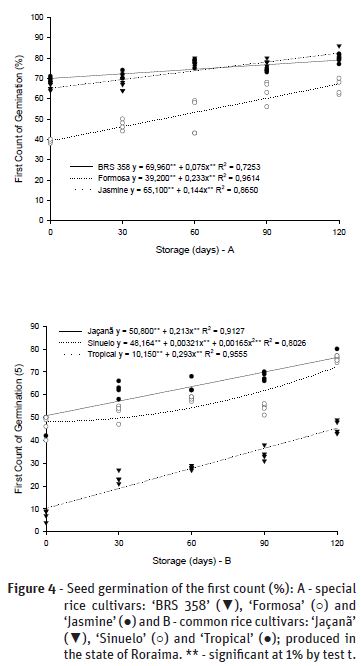
    <p><font face = "Verdana" size = "2">In determining physiological quality, it was observed
in the first count of germination at zero days of storage that for special rice
cultivars (<a href = "#f4">Figure 4A</a>) the lowest result was for seeds of the cultivar ‘Formosa’
(39%), while the others were at 60% germination. The common rice cultivars had percentages
below 50% (<a href = "#f4">Figure 4B</a>), and the cultivar ‘Tropical’ being the lowest percentages
of 7%.</font></p>

    <p>&nbsp;</p>

<a name = "f4"><img src = "/img/revistas/rca/v42n1/v42n1a04f4.jpg"></a>

    
<p>&nbsp;</p>

    <p><font face = "Verdana" size = "2">As the storage period increased, seed germination
increased, characterizing the overcoming of dormancy over time. At 120 days the
cultivars ‘BRS 358’ and ´Jasmine’ (<a href = "#f4">Figure 4A</a>) and the cultivars ‘Sinuelo’ and ‘Jaçanã’
(<a href = "#f4">Figure 4B</a>) exhibited the greatest germination rate (above 75%).</font></p>

    <p><font face = "Verdana" size = "2">This lower initial germination percentage shows the dormancy
present in the cultivars of the two experiments. This is in accordance with Bewley
and Black (1994) which stated that rice seeds may have a temporary germination suspension
even when the seeds are in favorable conditions for germination and are therefore
considered seeds dormant.</font></p>

    ]]></body>
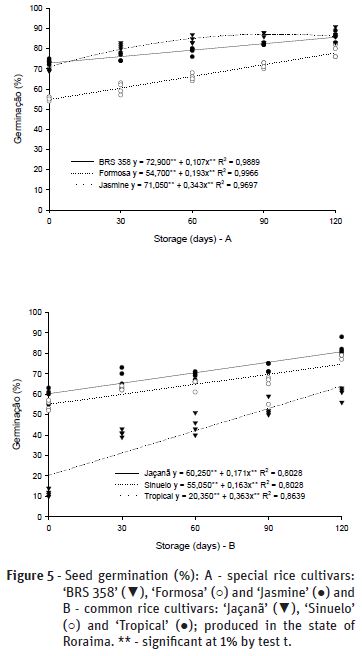
<body><![CDATA[<p><font face = "Verdana" size = "2">The storage
duration also increased the final count of seed germination in both experiments,
with cultivars ‘BRS 358’ (86%) and ´Jasmine’ (87%) (<a href = "#f5">Figure 5A</a>) showing the highest
germination increment storage period (120 days). The same was observed in the cultivars
‘Jaçanã’ and ‘Sinuelo’ (<a href = "#f5">Figure 5B</a>) in which they presented higher germination at
the end of storage (83% and 79%) compared to ‘Tropical’. In both experiments, the
cultivars mentioned above were the ones that had lower dormancy from the beginning
to the end of the storage.</font></p>

    <p>&nbsp;</p>

<a name = "f5"><img src = "/img/revistas/rca/v42n1/v42n1a04f5.jpg"></a>

    
<p>&nbsp;</p>

    <p><font face = "Verdana" size = "2">According to Amaral
(1992), there are several causes of dormancy in rice seed genotypes, among them
temperature and humidity are the ones that most influence the occurrence of dormancy.
Low temperatures at the beginning of maturation and high temperatures at 10 to 15
days after flowering could induce seed dormancy. Additionally, the interaction of
elevated temperatures after flowering with the presence of inhibitors and the restriction
absorption of O<sub>2 </sub>by the hull-pericarp complex, also determine dormancy
in rice.</font></p>

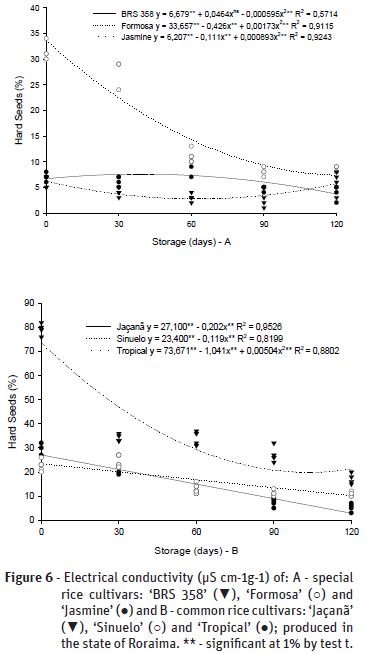
    <p><font face = "Verdana" size = "2">The percentage of hard seeds
(<a href = "#f6">Figure 6</a>) was directly related to the germination, in which due to the dormancy
present in the seeds, the percentage is higher at the beginning of storage and reduced
as dormancy is exceeded. This confirms the presence and level of dormancy of the
seeds in both experiments and among the cultivars studied. The cultivars ‘Formosa’
(<a href = "#f6">Figure 6A</a>) and ‘Tropical’ (<a href = "#f6">Figure 6B</a>) presented a higher percentage of hard dormant
seeds throughout the storage.</font></p>

    <p>&nbsp;</p>

<a name = "f6"><img src = "/img/revistas/rca/v42n1/v42n1a04f6.jpg"></a>

    
<p>&nbsp;</p>

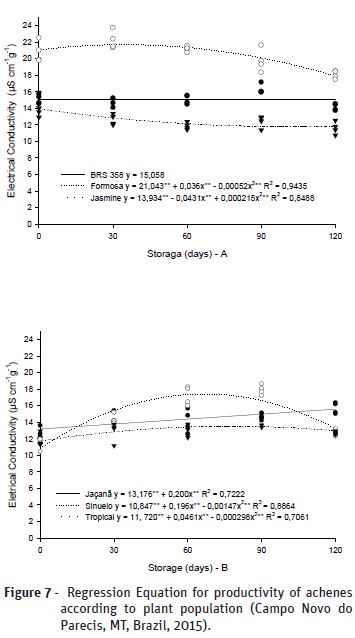
    <p><font face = "Verdana" size = "2">The results obtained
for the electrical conductivity of the special rice seeds cultivars had values significantly
lower at 120 days, in relation to the zero days (<a href = "#f7">Figure 7A</a>). This reduction may
be indicative of seed germination vigor increasing during storage. At zero days
the conductivity was 15.80, 20.79 e 14.09 µS cm<sup>-1</sup>g<sup>-1</sup> and 14.13,
18.07 e 11.60 µS cm<sup>-1</sup>g<sup>-1</sup> for the cultivars ‘BRS 358’, ‘Formosa’,
´Jasmine’, respectively. However, data obtained from seeds of common rice cultivars
(<a href = "#f7">Figure 7B</a>) had significant results, lower at the beginning of storage and higher
at the end with oscillations during the period, and the test was not efficient to
detect the increase of vigor as observed in the first experiment (<a href = "#f7">Figure 7A</a>). At
zero days the conductivity was 12.65, 11.42 and 11.78 &#956;S cm<sup>-1</sup>g<sup>-1</sup>
and in 120 days 15.69, 12.61 and 12.71 &#956;S cm<sup>-1</sup>g<sup>-1</sup> for
the cultivars ‘Jaçanã’, ‘Sinuelo’, and ‘Tropical’, respectively.</font></p>

    <p>&nbsp;</p>

<a name = "f7"><img src = "/img/revistas/rca/v42n1/v42n1a04f7.jpg"></a>

    
<p>&nbsp;</p>

    ]]></body>
<body><![CDATA[<p><font face = "Verdana" size = "2">In rice cultivation, dormancy is understood as a resistance to
germination in pre and post-harvest (Foley and Fennimore, 1998), related to the
levels of seed maturation, by exposure to environmental conditions present between
the maturation and harvest stage. Therefore, it is possible to occur a dormancy
variation between cultivars, lots and harvests, varying from 11 weeks after harvest
to 120 days after the beginning of storage (Amaral and Gonçalo, 1977).</font></p>


    <p><font face = "Verdana" size = "2">Based on the results obtained in both physical
and physiological quality tests, it was possible to verify that the quality of the
seeds of special and common rice are directly related. These results suggest a seed
physiological test (such as a germination test) may be a useful indicator for the
producers about when is the best time to mill rice to maximize yield, because loss
of dormancy that indicates the hull adhesion to the seed is lost, what facilitate
milling process. The better the seed physiological quality the better the kernels
for the milling process.</font></p>

    <p><font face = "Verdana" size = "3"><b>CONCLUSIONS</b></font></p>

    <p><font face = "Verdana" size = "2">The special rice cultivars ‘BRS 358’ and ´Jasmine’, as well as
the common rice cultivars ‘Sinuelo’ and ‘Jaçanã’, have greater potential for seed
physiological quality and milled rice yield.</font></p>

    <p><font face = "Verdana" size = "2">The physical quality for milling process is linked to the physiological
quality of the seeds of special rice (‘BRS 358’, ‘Formosa’ and ´Jasmine’) and common
rice (‘Jaçanã’, ‘Sinuelo’, and ‘Tropical’).</font></p>

    <p><font face = "Verdana" size = "2">Both the special rice and the common rice cultivars need a period of storage
to overcome dormancy, improve milled rice yield, and enhance physiological quality.</font></p>


    <p>&nbsp;</p>

    <p><font face = "Verdana" size = "3"><b>References</b></font></p>

    <!-- ref --><p><font face = "Verdana" size = "2">A-bond,
J. &amp; Bollich, P.K. (2007) - Effect of pre-harvest desiccants on rice yield and
quality. <i>Crop Protection</i>, vol. 26, n. 4, p. 490-494.
<a href = "https://doi.org/10.1016/j.cropro.2006.02.01" target = "_blank">https://doi.org/10.1016/j.cropro.2006.02.01</a>.    &nbsp;&nbsp;&nbsp;&nbsp;&nbsp;&nbsp;&nbsp;&nbsp;[&#160;<a href="javascript:void(0);" onclick="javascript: window.open('/scielo.php?script=sci_nlinks&ref=709610&pid=S0871-018X201900010000500001&lng=','','width=640,height=500,resizable=yes,scrollbars=1,menubar=yes,');">Links</a>&#160;]<!-- end-ref --></font></p>

    ]]></body>
<body><![CDATA[<!-- ref --><p><font face = "Verdana" size = "2">Abud-Archila, M.; Courtois, F.;
Bonazzi, C. &amp; Bimbenet, J.J. (2000) - Processing quality of rough rice during
drying – Modeling of head rice yield versus moisture gradients and kernel temperature.
<i>Journal of Food Engineering</i>, vol. 45, n. 3, p. 161-169.
<a href = "https://doi.org/10.1016/S0260-8774(00)00057" target = "_blank">https://doi.org/10.1016/S0260-8774(00)00057</a>.    &nbsp;&nbsp;&nbsp;&nbsp;&nbsp;&nbsp;&nbsp;&nbsp;[&#160;<a href="javascript:void(0);" onclick="javascript: window.open('/scielo.php?script=sci_nlinks&ref=709612&pid=S0871-018X201900010000500002&lng=','','width=640,height=500,resizable=yes,scrollbars=1,menubar=yes,');">Links</a>&#160;]<!-- end-ref --></font></p>

    <!-- ref --><p><font face = "Verdana" size = "2">Agrama, H.A.; Yan, W.; Jia, M.;
Fjellstrom, R. &amp; Mcclung, A.M. (2010) - Genetic structure associated with diversity
and geographic distribution in the USDA rice world collection. <i>Natural Science</i>,
vol. 2, n. 4, p. 247-291. <a href = "https:/://dx.doi.org/10.4236/ns.2010.24036" target="_blank">https://doi.org/10.4236/ns.2010.24036</a></font>&nbsp;&nbsp;&nbsp;&nbsp;&nbsp;&nbsp;&nbsp;&nbsp;[&#160;<a href="javascript:void(0);" onclick="javascript: window.open('/scielo.php?script=sci_nlinks&ref=709614&pid=S0871-018X201900010000500003&lng=','','width=640,height=500,resizable=yes,scrollbars=1,menubar=yes,');">Links</a>&#160;]<!-- end-ref --><!-- ref --><p><font face = "Verdana" size = "2">Amaral, A.S. (1992) - Aspectos da dormência em sementes de arroz.
<i>Lavoura arrozeira</i>, vol. 45, n. 405, p. 3-6.    &nbsp;&nbsp;&nbsp;&nbsp;&nbsp;&nbsp;&nbsp;&nbsp;[&#160;<a href="javascript:void(0);" onclick="javascript: window.open('/scielo.php?script=sci_nlinks&ref=709615&pid=S0871-018X201900010000500004&lng=','','width=640,height=500,resizable=yes,scrollbars=1,menubar=yes,');">Links</a>&#160;]<!-- end-ref --></font></p>

    <!-- ref --><p><font face = "Verdana" size = "2">Amaral, A.S. &amp; Gonçalo, J.F.P. (1977) - Dormência em sementes
de arroz. <i>Lavoura Arrozeira</i><b>,</b> vol. 30, n. 301, p. 35-37.    &nbsp;&nbsp;&nbsp;&nbsp;&nbsp;&nbsp;&nbsp;&nbsp;[&#160;<a href="javascript:void(0);" onclick="javascript: window.open('/scielo.php?script=sci_nlinks&ref=709617&pid=S0871-018X201900010000500005&lng=','','width=640,height=500,resizable=yes,scrollbars=1,menubar=yes,');">Links</a>&#160;]<!-- end-ref --></font></p>


    <!-- ref --><p><font face = "Verdana" size = "2">Bewley, J.D. &amp; Black, M. (1994) - <i>Seeds:
physiology of development and germination</i>. 2.ed. New York, Plenum Press, 445
p.    &nbsp;&nbsp;&nbsp;&nbsp;&nbsp;&nbsp;&nbsp;&nbsp;[&#160;<a href="javascript:void(0);" onclick="javascript: window.open('/scielo.php?script=sci_nlinks&ref=709619&pid=S0871-018X201900010000500006&lng=','','width=640,height=500,resizable=yes,scrollbars=1,menubar=yes,');">Links</a>&#160;]<!-- end-ref --></font></p>

    <p><font face = "Verdana" size = "2">Brasil (2009) - <i>Regras para
análise de sementes</i>. Brasília, Mapa/ACS. Ministério da Agricultura, Pecuária
e Abastecimento. 399 p.</font></p>

    ]]></body>
<body><![CDATA[<!-- ref --><p><font face = "Verdana" size = "2">Castro, E.M.;
Vieira, N.R.A.; Rabelo, R.R. &amp; Silva, S.A. (1999) - <i>Qualidade de grãos em
arroz</i>. Santo Antônio de Goiás, Embrapa Arroz e Feijão, 30p. (Embrapa Arroz e
Feijão. Circular Técnica, 34).    &nbsp;&nbsp;&nbsp;&nbsp;&nbsp;&nbsp;&nbsp;&nbsp;[&#160;<a href="javascript:void(0);" onclick="javascript: window.open('/scielo.php?script=sci_nlinks&ref=709622&pid=S0871-018X201900010000500007&lng=','','width=640,height=500,resizable=yes,scrollbars=1,menubar=yes,');">Links</a>&#160;]<!-- end-ref --></font></p>

    <!-- ref --><p><font face = "Verdana" size = "2">Conway,
J.A.; Sidik, M. &amp; Halid, H. (1991) - Quality/value relationships in milled rice
stored in conventional warehouses in Indonesia. <i>In:</i> Proceedings of the fourteenth
ASEAN <i>Seminar on Grain Postharvest Technology</i>, Manila, Philippines, p. 55-82.    &nbsp;&nbsp;&nbsp;&nbsp;&nbsp;&nbsp;&nbsp;&nbsp;[&#160;<a href="javascript:void(0);" onclick="javascript: window.open('/scielo.php?script=sci_nlinks&ref=709624&pid=S0871-018X201900010000500008&lng=','','width=640,height=500,resizable=yes,scrollbars=1,menubar=yes,');">Links</a>&#160;]<!-- end-ref --></font></p>


    <!-- ref --><p><font face = "Verdana" size = "2">Cordeiro, A.C.C.; Medeiros, R.D.; Marsaro Júnior,
A.L. &amp; Nechet, K.L. (2009) - <i>Recomendações técnicas para o cultivo do arroz
irrigado em várzeas de Roraima. </i>Boa Vista, Embrapa Roraima, 19 p. (Embrapa Roraima.
Circular Técnica, 06).    &nbsp;&nbsp;&nbsp;&nbsp;&nbsp;&nbsp;&nbsp;&nbsp;[&#160;<a href="javascript:void(0);" onclick="javascript: window.open('/scielo.php?script=sci_nlinks&ref=709626&pid=S0871-018X201900010000500009&lng=','','width=640,height=500,resizable=yes,scrollbars=1,menubar=yes,');">Links</a>&#160;]<!-- end-ref --></font></p>

    <!-- ref --><p><font face = "Verdana" size = "2">Dong, Y.;
Tsuzuki, E.; Lin, D.; Kamiunten, H.; Terao, H. &amp; Matsuo, M. (2003) - Molecular
genetic mapping of quantitative trait loci for milling quality in rice (<i>Oryza
sativa</i> L.). <i>Journal of Cereal Science</i>, vol. 40, n. 2, p.109-114.
<a href = "https://doi.org/10.1016/j.jcs.2004.04.00" target = "_blank">https://doi.org/10.1016/j.jcs.2004.04.00</a>.    &nbsp;&nbsp;&nbsp;&nbsp;&nbsp;&nbsp;&nbsp;&nbsp;[&#160;<a href="javascript:void(0);" onclick="javascript: window.open('/scielo.php?script=sci_nlinks&ref=709628&pid=S0871-018X201900010000500010&lng=','','width=640,height=500,resizable=yes,scrollbars=1,menubar=yes,');">Links</a>&#160;]<!-- end-ref --></font></p>

    <!-- ref --><p><font face = "Verdana" size = "2">FAO (2005) - <i>FAOSTAT data</i>.
&lt;<a href = "http://faostat.fao.org/site/346/DesktopDefault.aspx?PageID=346" target = "_blank">http://faostat.fao.org/site/346/DesktopDefault.aspx?PageID=346</a>&gt;    &nbsp;&nbsp;&nbsp;&nbsp;&nbsp;&nbsp;&nbsp;&nbsp;[&#160;<a href="javascript:void(0);" onclick="javascript: window.open('/scielo.php?script=sci_nlinks&ref=709630&pid=S0871-018X201900010000500011&lng=','','width=640,height=500,resizable=yes,scrollbars=1,menubar=yes,');">Links</a>&#160;]<!-- end-ref -->.</font></p>


    ]]></body>
<body><![CDATA[<!-- ref --><p><font face = "Verdana" size = "2">Faroni, L.R.D.; Hara, T.; Dalpasquale, V.A. &amp;
Condé, A.R. (1987) - Determinação de rendimento do arroz (cultivar IR 841) após
secagem às temperaturas de 50, 60 e 70°C, para períodos de repouso de 30, 60, 120
e 180 minutos. <i>Revista Brasileira de Armazenamento</i>, vol. 11-12, n. 1-2, p.
26-31.    &nbsp;&nbsp;&nbsp;&nbsp;&nbsp;&nbsp;&nbsp;&nbsp;[&#160;<a href="javascript:void(0);" onclick="javascript: window.open('/scielo.php?script=sci_nlinks&ref=709632&pid=S0871-018X201900010000500012&lng=','','width=640,height=500,resizable=yes,scrollbars=1,menubar=yes,');">Links</a>&#160;]<!-- end-ref --></font></p>

    <!-- ref --><p><font face = "Verdana" size = "2">Ferreira, D.F. (2011) - Sisvar:
a computer statistical analysis system. Ciência e Agrotecnologia, vol. 35, n. 6,
p. 1039-1042. <a href = "http://dx.doi.org/10.1590/S1413-70542011000600001" target = "_blank">http://dx.doi.org/10.1590/S1413-70542011000600001</a></font>&nbsp;&nbsp;&nbsp;&nbsp;&nbsp;&nbsp;&nbsp;&nbsp;[&#160;<a href="javascript:void(0);" onclick="javascript: window.open('/scielo.php?script=sci_nlinks&ref=709634&pid=S0871-018X201900010000500013&lng=','','width=640,height=500,resizable=yes,scrollbars=1,menubar=yes,');">Links</a>&#160;]<!-- end-ref --><!-- ref --><p><font face = "Verdana" size = "2">Foley, M.E. &amp; Fennimore, S.A. (1998) - Genetic basis for
seed dormancy. <i>Seed Science Research</i>, vol. 8, n. 2, p.173-182.
<a href = "https://doi.org/10.1017/S0960258500004086" target = "_blank">https://doi.org/10.1017/S0960258500004086</a></font>&nbsp;&nbsp;&nbsp;&nbsp;&nbsp;&nbsp;&nbsp;&nbsp;[&#160;<a href="javascript:void(0);" onclick="javascript: window.open('/scielo.php?script=sci_nlinks&ref=709635&pid=S0871-018X201900010000500014&lng=','','width=640,height=500,resizable=yes,scrollbars=1,menubar=yes,');">Links</a>&#160;]<!-- end-ref --><!-- ref --><p><font face = "Verdana" size = "2">Gravois, K.A. (1998) - Optimizing selection for
rough rice yield, head rice, and total milled rice. <i>Euphytica</i>, vol. 101,
n. 2, p. 151-156.
<a href = "https://doi.org/10.1023/A:1018331809955" target = "_blank">https://doi.org/10.1023/A:1018331809955</a></font>&nbsp;&nbsp;&nbsp;&nbsp;&nbsp;&nbsp;&nbsp;&nbsp;[&#160;<a href="javascript:void(0);" onclick="javascript: window.open('/scielo.php?script=sci_nlinks&ref=709636&pid=S0871-018X201900010000500015&lng=','','width=640,height=500,resizable=yes,scrollbars=1,menubar=yes,');">Links</a>&#160;]<!-- end-ref --><!-- ref --><p><font face = "Verdana" size = "2">Hayashi, M. (1987) - Relationship between endogenous germination
inhibitors and dormancy in rice seeds. <i>Japan Agricultural Research Quarterly</i>
vol. 21, n. 1, p. 153-161.    &nbsp;&nbsp;&nbsp;&nbsp;&nbsp;&nbsp;&nbsp;&nbsp;[&#160;<a href="javascript:void(0);" onclick="javascript: window.open('/scielo.php?script=sci_nlinks&ref=709637&pid=S0871-018X201900010000500016&lng=','','width=640,height=500,resizable=yes,scrollbars=1,menubar=yes,');">Links</a>&#160;]<!-- end-ref --></font></p>

    <!-- ref --><p><font face = "Verdana" size = "2">IRRI,
AfricaRice &amp; CIAT (2010) - <i>Global Rice Science Partnership (GRiSP)</i>. November
2010.    &nbsp;&nbsp;&nbsp;&nbsp;&nbsp;&nbsp;&nbsp;&nbsp;[&#160;<a href="javascript:void(0);" onclick="javascript: window.open('/scielo.php?script=sci_nlinks&ref=709639&pid=S0871-018X201900010000500017&lng=','','width=640,height=500,resizable=yes,scrollbars=1,menubar=yes,');">Links</a>&#160;]<!-- end-ref --></font></p>

    <!-- ref --><p><font face = "Verdana" size = "2">Krzyzanowski, F.C.; Vieira,
R.D. &amp; França Neto, J.B. (1998) - <i>Vigor de sementes: conceitos e teste</i>.
Ed. Abrates, Londrina, 218 p.    &nbsp;&nbsp;&nbsp;&nbsp;&nbsp;&nbsp;&nbsp;&nbsp;[&#160;<a href="javascript:void(0);" onclick="javascript: window.open('/scielo.php?script=sci_nlinks&ref=709641&pid=S0871-018X201900010000500018&lng=','','width=640,height=500,resizable=yes,scrollbars=1,menubar=yes,');">Links</a>&#160;]<!-- end-ref --></font></p>

    <!-- ref --><p><font face = "Verdana" size = "2">Majumder,
M.K.; Seshu, D.V. &amp; Shenoy, V.V. (1989) - A biochemical screening technique
for cold tolerance in rice. <i>Crop Science,</i> vol. 29, n. 5, p. 1298-1304.    &nbsp;&nbsp;&nbsp;&nbsp;&nbsp;&nbsp;&nbsp;&nbsp;[&#160;<a href="javascript:void(0);" onclick="javascript: window.open('/scielo.php?script=sci_nlinks&ref=709643&pid=S0871-018X201900010000500019&lng=','','width=640,height=500,resizable=yes,scrollbars=1,menubar=yes,');">Links</a>&#160;]<!-- end-ref --></font></p>


    <!-- ref --><p><font face = "Verdana" size = "2">Mikkelsen, D.S. (1967) - <i>Germination inhibitors
as a possible factor in rice dormancy</i>. International Rice Commission Newsletter
(Special Issue), p. 132-145.    &nbsp;&nbsp;&nbsp;&nbsp;&nbsp;&nbsp;&nbsp;&nbsp;[&#160;<a href="javascript:void(0);" onclick="javascript: window.open('/scielo.php?script=sci_nlinks&ref=709645&pid=S0871-018X201900010000500020&lng=','','width=640,height=500,resizable=yes,scrollbars=1,menubar=yes,');">Links</a>&#160;]<!-- end-ref --></font></p>

    <!-- ref --><p><font face = "Verdana" size = "2">Navasero,
E.P.; Baun, L.C. &amp; Juliano, B.O. (1975) - Grain dormancy, peroxidase activity
and oxygen uptake in <i>Oryza sativa</i>. <i>Phytochemistry, </i>vol. 14, n. 9,
p. 1899-1902. <a href = "https://doi.org/10.1016/0031-9422(75)83092" target = "_blank">https://doi.org/10.1016/0031-9422(75)83092</a>.    &nbsp;&nbsp;&nbsp;&nbsp;&nbsp;&nbsp;&nbsp;&nbsp;[&#160;<a href="javascript:void(0);" onclick="javascript: window.open('/scielo.php?script=sci_nlinks&ref=709647&pid=S0871-018X201900010000500021&lng=','','width=640,height=500,resizable=yes,scrollbars=1,menubar=yes,');">Links</a>&#160;]<!-- end-ref --></font></p>

    <!-- ref --><p><font face = "Verdana" size = "2">Roberts, E. H. (1961) - Dormancy of rice seed. I. Distribution
of dormancy periods. <i>Journal of Experimental Botany,</i> vol. 12, n. 2, p. 319-329.
<a href = "https://doi.org/10.1093/jxb/12.2.31" target = "_blank">https://doi.org/10.1093/jxb/12.2.31</a>.    &nbsp;&nbsp;&nbsp;&nbsp;&nbsp;&nbsp;&nbsp;&nbsp;[&#160;<a href="javascript:void(0);" onclick="javascript: window.open('/scielo.php?script=sci_nlinks&ref=709649&pid=S0871-018X201900010000500022&lng=','','width=640,height=500,resizable=yes,scrollbars=1,menubar=yes,');">Links</a>&#160;]<!-- end-ref --></font></p>

    <!-- ref --><p><font face = "Verdana" size = "2">Seshu, D.V. &amp; Sorrells, M.E. (1986) - Genetic studies on seed dormancy in
rice, <i>In: Rice genetics</i>. Los Banos, Philippines, International Rice Research
Institute. 369-384 p.    &nbsp;&nbsp;&nbsp;&nbsp;&nbsp;&nbsp;&nbsp;&nbsp;[&#160;<a href="javascript:void(0);" onclick="javascript: window.open('/scielo.php?script=sci_nlinks&ref=709651&pid=S0871-018X201900010000500023&lng=','','width=640,height=500,resizable=yes,scrollbars=1,menubar=yes,');">Links</a>&#160;]<!-- end-ref --></font></p>

    <!-- ref --><p><font face = "Verdana" size = "2">Smiderle,
O.J. &amp; Pereira, P.R.V.S. (2008) - Épocas de colheita e qualidade fisiológica
das sementes de arroz irrigado cultivar BRS 7 TAIM, em Roraima. <i>Revista Brasileira
de Semente</i>s<i>, </i>vol. 30, n. 1, p. 74-80.
<a href = "http://dx.doi.org/10.1590/S0101-31222008000100010" target = "_blank">http://dx.doi.org/10.1590/S0101-31222008000100010</a></font>&nbsp;&nbsp;&nbsp;&nbsp;&nbsp;&nbsp;&nbsp;&nbsp;[&#160;<a href="javascript:void(0);" onclick="javascript: window.open('/scielo.php?script=sci_nlinks&ref=709653&pid=S0871-018X201900010000500024&lng=','','width=640,height=500,resizable=yes,scrollbars=1,menubar=yes,');">Links</a>&#160;]<!-- end-ref --><!-- ref --><p><font face = "Verdana" size = "2">Souza, L.C.D.; Yamashita, O.M. &amp; Carvalho,
M.A.C. (2007) - Qualidade de sementes de arroz utilizadas no norte de Mato Grosso.
Revista Brasileira de Sementes, vol. 29, n. 2, p. 223-228.
<a href = "http://dx.doi.org/10.1590/S0101-31222007000200029" target = "_blank">http://dx.doi.org/10.1590/S0101-31222007000200029</a></font>&nbsp;&nbsp;&nbsp;&nbsp;&nbsp;&nbsp;&nbsp;&nbsp;[&#160;<a href="javascript:void(0);" onclick="javascript: window.open('/scielo.php?script=sci_nlinks&ref=709654&pid=S0871-018X201900010000500025&lng=','','width=640,height=500,resizable=yes,scrollbars=1,menubar=yes,');">Links</a>&#160;]<!-- end-ref --><!-- ref --><p><font face = "Verdana" size = "2">Takahashi, N. (1967) - Dormancy and germination
of rice seeds with respect to germination inhibitors. <i>Bulletin Institute of Agricultural
Research Japan,</i> vol. 18, n. 1, p. 195-213.    &nbsp;&nbsp;&nbsp;&nbsp;&nbsp;&nbsp;&nbsp;&nbsp;[&#160;<a href="javascript:void(0);" onclick="javascript: window.open('/scielo.php?script=sci_nlinks&ref=709655&pid=S0871-018X201900010000500026&lng=','','width=640,height=500,resizable=yes,scrollbars=1,menubar=yes,');">Links</a>&#160;]<!-- end-ref --></font></p>

    <!-- ref --><p><font face = "Verdana" size = "2">Thompson, J.F.; Knutson, J. &amp; Jenkins, B. (1990) - Analysis of variability
in rice milling appraisals. <i>American Society of Agricultural Engineers</i>, vol.
6, n. 2, p. 194-198. <a href = "https://doi.org/10.13031/2013.26370" target = "_blank">https://doi.org/10.13031/2013.26370</a></font>&nbsp;&nbsp;&nbsp;&nbsp;&nbsp;&nbsp;&nbsp;&nbsp;[&#160;<a href="javascript:void(0);" onclick="javascript: window.open('/scielo.php?script=sci_nlinks&ref=709657&pid=S0871-018X201900010000500027&lng=','','width=640,height=500,resizable=yes,scrollbars=1,menubar=yes,');">Links</a>&#160;]<!-- end-ref --><!-- ref --><p><font face = "Verdana" size = "2">Vieira, N.R.A. &amp; Carvalho, J.L.V. (1999) - Qualidade
tecnológica. <i>In:</i> Vieira, N.R.A. <i>et al</i>. (Eds.) - <i>A cultura do arroz
no Brasil. </i>Santo Antônio de Goiás, Embrapa Arroz e Feijão, p. 582-604.    &nbsp;&nbsp;&nbsp;&nbsp;&nbsp;&nbsp;&nbsp;&nbsp;[&#160;<a href="javascript:void(0);" onclick="javascript: window.open('/scielo.php?script=sci_nlinks&ref=709658&pid=S0871-018X201900010000500028&lng=','','width=640,height=500,resizable=yes,scrollbars=1,menubar=yes,');">Links</a>&#160;]<!-- end-ref --></font></p>


    <!-- ref --><p><font face = "Verdana" size = "2">Yadav, B.K. &amp; Jindal, V.K. (2001) - Monitoring
milling quality of rice by image analysis. <i>Computers and Electronics in Agriculture</i>,
vol. 33, n. 1, p. 19-33.
<a href = "https://doi.org/10.1016/S0168-1699(01)00169" target = "_blank">https://doi.org/10.1016/S0168-1699(01)00169</a>.    &nbsp;&nbsp;&nbsp;&nbsp;&nbsp;&nbsp;&nbsp;&nbsp;[&#160;<a href="javascript:void(0);" onclick="javascript: window.open('/scielo.php?script=sci_nlinks&ref=709660&pid=S0871-018X201900010000500029&lng=','','width=640,height=500,resizable=yes,scrollbars=1,menubar=yes,');">Links</a>&#160;]<!-- end-ref --></font></p>


    ]]></body>
<body><![CDATA[<!-- ref --><p><font face = "Verdana" size = "2">Yadav, B.K. &amp; Jindal, V.K. (2008) - Changes
in head rice yield and whiteness during milling of rough rice (<i>Oryza sativa</i>
L.). <i>Journal of Food Engineering,</i> vol. 86, n. 1, p. 113–121.
<a href = "https://doi.org/10.1016/j.jfoodeng.2007.09.025" target = "_blank">https://doi.org/10.1016/j.jfoodeng.2007.09.025</a></font>&nbsp;&nbsp;&nbsp;&nbsp;&nbsp;&nbsp;&nbsp;&nbsp;[&#160;<a href="javascript:void(0);" onclick="javascript: window.open('/scielo.php?script=sci_nlinks&ref=709662&pid=S0871-018X201900010000500030&lng=','','width=640,height=500,resizable=yes,scrollbars=1,menubar=yes,');">Links</a>&#160;]<!-- end-ref --><p>&nbsp;</p>

    <p><font face = "Verdana" size = "2">Received/recebido: 2018.09.26</font></p>

    <p><font face = "Verdana" size = "2">Received in revised form/recebido em versão revista: 2018.10.23</font></p>

    <p><font face = "Verdana" size = "2">Accepted/aceite: 2018.10.23</font></p>

     ]]></body><back>
<ref-list>
<ref id="B1">
<nlm-citation citation-type="journal">
<person-group person-group-type="author">
<name>
<surname><![CDATA[A-bond]]></surname>
<given-names><![CDATA[J.]]></given-names>
</name>
<name>
<surname><![CDATA[Bollich]]></surname>
<given-names><![CDATA[P.K.]]></given-names>
</name>
</person-group>
<article-title xml:lang="en"><![CDATA[Effect of pre-harvest desiccants on rice yield and quality]]></article-title>
<source><![CDATA[Crop Protection]]></source>
<year>2007</year>
<volume>26</volume>
<numero>4</numero>
<issue>4</issue>
<page-range>490-494</page-range></nlm-citation>
</ref>
<ref id="B2">
<nlm-citation citation-type="journal">
<person-group person-group-type="author">
<name>
<surname><![CDATA[Abud-Archila]]></surname>
<given-names><![CDATA[M.]]></given-names>
</name>
<name>
<surname><![CDATA[Courtois]]></surname>
<given-names><![CDATA[F.]]></given-names>
</name>
<name>
<surname><![CDATA[Bonazzi]]></surname>
<given-names><![CDATA[C.]]></given-names>
</name>
<name>
<surname><![CDATA[Bimbenet]]></surname>
<given-names><![CDATA[J.J.]]></given-names>
</name>
</person-group>
<article-title xml:lang="en"><![CDATA[Processing quality of rough rice during drying - Modeling of head rice yield versus moisture gradients and kernel temperature]]></article-title>
<source><![CDATA[Journal of Food Engineering]]></source>
<year>2000</year>
<volume>45</volume>
<numero>3</numero>
<issue>3</issue>
<page-range>161-169</page-range></nlm-citation>
</ref>
<ref id="B3">
<nlm-citation citation-type="journal">
<person-group person-group-type="author">
<name>
<surname><![CDATA[Agrama]]></surname>
<given-names><![CDATA[H.A.]]></given-names>
</name>
<name>
<surname><![CDATA[Yan]]></surname>
<given-names><![CDATA[W.]]></given-names>
</name>
<name>
<surname><![CDATA[Jia]]></surname>
<given-names><![CDATA[M.]]></given-names>
</name>
<name>
<surname><![CDATA[Fjellstrom]]></surname>
<given-names><![CDATA[R.]]></given-names>
</name>
<name>
<surname><![CDATA[Mcclung]]></surname>
<given-names><![CDATA[A.M.]]></given-names>
</name>
</person-group>
<article-title xml:lang="en"><![CDATA[Genetic structure associated with diversity and geographic distribution in the USDA rice world collection]]></article-title>
<source><![CDATA[Natural Science]]></source>
<year>2010</year>
<volume>2</volume>
<numero>4</numero>
<issue>4</issue>
<page-range>247-291</page-range></nlm-citation>
</ref>
<ref id="B4">
<nlm-citation citation-type="journal">
<person-group person-group-type="author">
<name>
<surname><![CDATA[Amaral]]></surname>
<given-names><![CDATA[A.S.]]></given-names>
</name>
</person-group>
<article-title xml:lang="pt"><![CDATA[Aspectos da dormência em sementes de arroz]]></article-title>
<source><![CDATA[Lavoura arrozeira]]></source>
<year>1992</year>
<volume>45</volume>
<numero>405</numero>
<issue>405</issue>
<page-range>3-6</page-range></nlm-citation>
</ref>
<ref id="B5">
<nlm-citation citation-type="journal">
<person-group person-group-type="author">
<name>
<surname><![CDATA[Amaral]]></surname>
<given-names><![CDATA[A.S.]]></given-names>
</name>
<name>
<surname><![CDATA[Gonçalo]]></surname>
<given-names><![CDATA[J.F.P.]]></given-names>
</name>
</person-group>
<article-title xml:lang="pt"><![CDATA[Dormência em sementes de arroz]]></article-title>
<source><![CDATA[Lavoura Arrozeira]]></source>
<year>1977</year>
<volume>30</volume>
<numero>301</numero>
<issue>301</issue>
<page-range>35-37</page-range></nlm-citation>
</ref>
<ref id="B6">
<nlm-citation citation-type="book">
<person-group person-group-type="author">
<name>
<surname><![CDATA[Bewley]]></surname>
<given-names><![CDATA[J.D.]]></given-names>
</name>
<name>
<surname><![CDATA[Black]]></surname>
<given-names><![CDATA[M.]]></given-names>
</name>
</person-group>
<source><![CDATA[Seeds: physiology of development and germination]]></source>
<year>1994</year>
<edition>2</edition>
<publisher-loc><![CDATA[New York ]]></publisher-loc>
<publisher-name><![CDATA[Plenum Press]]></publisher-name>
</nlm-citation>
</ref>
<ref id="B7">
<nlm-citation citation-type="book">
<person-group person-group-type="author">
<name>
<surname><![CDATA[Castro]]></surname>
<given-names><![CDATA[E.M.]]></given-names>
</name>
<name>
<surname><![CDATA[Vieira]]></surname>
<given-names><![CDATA[N.R.A.]]></given-names>
</name>
<name>
<surname><![CDATA[Rabelo]]></surname>
<given-names><![CDATA[R.R.]]></given-names>
</name>
<name>
<surname><![CDATA[Silva]]></surname>
<given-names><![CDATA[S.A.]]></given-names>
</name>
</person-group>
<source><![CDATA[Qualidade de grãos em arroz]]></source>
<year>1999</year>
<publisher-loc><![CDATA[Santo Antônio de Goiás ]]></publisher-loc>
<publisher-name><![CDATA[Embrapa Arroz e Feijão]]></publisher-name>
</nlm-citation>
</ref>
<ref id="B8">
<nlm-citation citation-type="confpro">
<person-group person-group-type="author">
<name>
<surname><![CDATA[Conway]]></surname>
<given-names><![CDATA[J.A.]]></given-names>
</name>
<name>
<surname><![CDATA[Sidik]]></surname>
<given-names><![CDATA[M.]]></given-names>
</name>
<name>
<surname><![CDATA[Halid]]></surname>
<given-names><![CDATA[H.]]></given-names>
</name>
</person-group>
<article-title xml:lang="en"><![CDATA[Quality/value relationships in milled rice stored in conventional warehouses in Indonesia]]></article-title>
<source><![CDATA[]]></source>
<year>1991</year>
<conf-name><![CDATA[fourteenth ASEAN Seminar on Grain Postharvest Technology]]></conf-name>
<conf-loc>Manila </conf-loc>
<page-range>55-82</page-range></nlm-citation>
</ref>
<ref id="B9">
<nlm-citation citation-type="book">
<person-group person-group-type="author">
<name>
<surname><![CDATA[Cordeiro]]></surname>
<given-names><![CDATA[A.C.C.]]></given-names>
</name>
<name>
<surname><![CDATA[Medeiros]]></surname>
<given-names><![CDATA[R.D.]]></given-names>
</name>
<name>
<surname><![CDATA[Marsaro Júnior]]></surname>
<given-names><![CDATA[A.L.]]></given-names>
</name>
<name>
<surname><![CDATA[Nechet]]></surname>
<given-names><![CDATA[K.L.]]></given-names>
</name>
</person-group>
<source><![CDATA[Recomendações técnicas para o cultivo do arroz irrigado em várzeas de Roraima]]></source>
<year>2009</year>
<publisher-loc><![CDATA[Boa Vista ]]></publisher-loc>
<publisher-name><![CDATA[Embrapa Roraima]]></publisher-name>
</nlm-citation>
</ref>
<ref id="B10">
<nlm-citation citation-type="journal">
<person-group person-group-type="author">
<name>
<surname><![CDATA[Dong]]></surname>
<given-names><![CDATA[Y.]]></given-names>
</name>
<name>
<surname><![CDATA[Tsuzuki]]></surname>
<given-names><![CDATA[E.]]></given-names>
</name>
<name>
<surname><![CDATA[Lin]]></surname>
<given-names><![CDATA[D.]]></given-names>
</name>
<name>
<surname><![CDATA[Kamiunten]]></surname>
<given-names><![CDATA[H.]]></given-names>
</name>
<name>
<surname><![CDATA[Terao]]></surname>
<given-names><![CDATA[H.]]></given-names>
</name>
<name>
<surname><![CDATA[Matsuo]]></surname>
<given-names><![CDATA[M.]]></given-names>
</name>
</person-group>
<article-title xml:lang="en"><![CDATA[Molecular genetic mapping of quantitative trait loci for milling quality in rice (Oryza sativa L.)]]></article-title>
<source><![CDATA[Journal of Cereal Science]]></source>
<year>2003</year>
<volume>40</volume>
<numero>2</numero>
<issue>2</issue>
<page-range>109-114</page-range></nlm-citation>
</ref>
<ref id="B11">
<nlm-citation citation-type="">
<collab>FAO</collab>
<source><![CDATA[FAOSTAT data]]></source>
<year>2005</year>
</nlm-citation>
</ref>
<ref id="B12">
<nlm-citation citation-type="journal">
<person-group person-group-type="author">
<name>
<surname><![CDATA[Faroni]]></surname>
<given-names><![CDATA[L.R.D.]]></given-names>
</name>
<name>
<surname><![CDATA[Hara]]></surname>
<given-names><![CDATA[T.]]></given-names>
</name>
<name>
<surname><![CDATA[Dalpasquale]]></surname>
<given-names><![CDATA[V.A.]]></given-names>
</name>
<name>
<surname><![CDATA[Condé]]></surname>
<given-names><![CDATA[A.R.]]></given-names>
</name>
</person-group>
<article-title xml:lang="pt"><![CDATA[Determinação de rendimento do arroz (cultivar IR 841) após secagem às temperaturas de 50, 60 e 70°C, para períodos de repouso de 30, 60, 120 e 180 minutos]]></article-title>
<source><![CDATA[Revista Brasileira de Armazenamento]]></source>
<year>1987</year>
<volume>11-12</volume>
<numero>1-2</numero>
<issue>1-2</issue>
<page-range>26-31</page-range></nlm-citation>
</ref>
<ref id="B13">
<nlm-citation citation-type="journal">
<person-group person-group-type="author">
<name>
<surname><![CDATA[Ferreira]]></surname>
<given-names><![CDATA[D.F.]]></given-names>
</name>
</person-group>
<article-title xml:lang="en"><![CDATA[Sisvar: a computer statistical analysis system]]></article-title>
<source><![CDATA[Ciência e Agrotecnologia]]></source>
<year>2011</year>
<volume>35</volume>
<numero>6</numero>
<issue>6</issue>
<page-range>1039-1042</page-range></nlm-citation>
</ref>
<ref id="B14">
<nlm-citation citation-type="journal">
<person-group person-group-type="author">
<name>
<surname><![CDATA[Foley]]></surname>
<given-names><![CDATA[M.E.]]></given-names>
</name>
<name>
<surname><![CDATA[Fennimore]]></surname>
<given-names><![CDATA[S.A.]]></given-names>
</name>
</person-group>
<article-title xml:lang="en"><![CDATA[Genetic basis for seed dormancy]]></article-title>
<source><![CDATA[Seed Science Research]]></source>
<year>1998</year>
<volume>8</volume>
<numero>2</numero>
<issue>2</issue>
<page-range>173-182</page-range></nlm-citation>
</ref>
<ref id="B15">
<nlm-citation citation-type="journal">
<person-group person-group-type="author">
<name>
<surname><![CDATA[Gravois]]></surname>
<given-names><![CDATA[K.A.]]></given-names>
</name>
</person-group>
<article-title xml:lang="en"><![CDATA[Optimizing selection for rough rice yield, head rice, and total milled rice]]></article-title>
<source><![CDATA[Euphytica]]></source>
<year>1998</year>
<volume>101</volume>
<numero>2</numero>
<issue>2</issue>
<page-range>151-156</page-range></nlm-citation>
</ref>
<ref id="B16">
<nlm-citation citation-type="journal">
<person-group person-group-type="author">
<name>
<surname><![CDATA[Hayashi]]></surname>
<given-names><![CDATA[M.]]></given-names>
</name>
</person-group>
<article-title xml:lang="en"><![CDATA[Relationship between endogenous germination inhibitors and dormancy in rice seeds]]></article-title>
<source><![CDATA[Japan Agricultural Research Quarterly]]></source>
<year>1987</year>
<volume>21</volume>
<numero>1</numero>
<issue>1</issue>
<page-range>153-161</page-range></nlm-citation>
</ref>
<ref id="B17">
<nlm-citation citation-type="">
<collab>IRRI</collab>
<collab>AfricaRice</collab>
<collab>CIAT</collab>
<source><![CDATA[Global Rice Science Partnership (GRiSP)]]></source>
<year>2010</year>
</nlm-citation>
</ref>
<ref id="B18">
<nlm-citation citation-type="book">
<person-group person-group-type="author">
<name>
<surname><![CDATA[Krzyzanowski]]></surname>
<given-names><![CDATA[F.C.]]></given-names>
</name>
<name>
<surname><![CDATA[Vieira]]></surname>
<given-names><![CDATA[R.D.]]></given-names>
</name>
<name>
<surname><![CDATA[França Neto]]></surname>
<given-names><![CDATA[J.B.]]></given-names>
</name>
</person-group>
<source><![CDATA[Vigor de sementes: conceitos e teste]]></source>
<year>1998</year>
<publisher-loc><![CDATA[Londrina ]]></publisher-loc>
<publisher-name><![CDATA[Ed. Abrates]]></publisher-name>
</nlm-citation>
</ref>
<ref id="B19">
<nlm-citation citation-type="journal">
<person-group person-group-type="author">
<name>
<surname><![CDATA[Majumder]]></surname>
<given-names><![CDATA[M.K.]]></given-names>
</name>
<name>
<surname><![CDATA[Seshu]]></surname>
<given-names><![CDATA[D.V.]]></given-names>
</name>
<name>
<surname><![CDATA[Shenoy]]></surname>
<given-names><![CDATA[V.V.]]></given-names>
</name>
</person-group>
<article-title xml:lang="en"><![CDATA[A biochemical screening technique for cold tolerance in rice]]></article-title>
<source><![CDATA[Crop Science]]></source>
<year>1989</year>
<volume>29</volume>
<numero>5</numero>
<issue>5</issue>
<page-range>1298-1304</page-range></nlm-citation>
</ref>
<ref id="B20">
<nlm-citation citation-type="book">
<person-group person-group-type="author">
<name>
<surname><![CDATA[Mikkelsen]]></surname>
<given-names><![CDATA[D.S.]]></given-names>
</name>
</person-group>
<source><![CDATA[Germination inhibitors as a possible factor in rice dormancy]]></source>
<year>1967</year>
<page-range>132-145</page-range><publisher-name><![CDATA[International Rice Commission Newsletter]]></publisher-name>
</nlm-citation>
</ref>
<ref id="B21">
<nlm-citation citation-type="journal">
<person-group person-group-type="author">
<name>
<surname><![CDATA[Navasero]]></surname>
<given-names><![CDATA[E.P.]]></given-names>
</name>
<name>
<surname><![CDATA[Baun]]></surname>
<given-names><![CDATA[L.C.]]></given-names>
</name>
<name>
<surname><![CDATA[Juliano]]></surname>
<given-names><![CDATA[B.O.]]></given-names>
</name>
</person-group>
<article-title xml:lang="en"><![CDATA[Grain dormancy, peroxidase activity and oxygen uptake in Oryza sativa]]></article-title>
<source><![CDATA[Phytochemistry]]></source>
<year>1975</year>
<volume>14</volume>
<numero>9</numero>
<issue>9</issue>
<page-range>1899-1902</page-range></nlm-citation>
</ref>
<ref id="B22">
<nlm-citation citation-type="journal">
<person-group person-group-type="author">
<name>
<surname><![CDATA[Roberts]]></surname>
<given-names><![CDATA[E. H.]]></given-names>
</name>
</person-group>
<article-title xml:lang="en"><![CDATA[Dormancy of rice seed: I. Distribution of dormancy periods]]></article-title>
<source><![CDATA[Journal of Experimental Botany]]></source>
<year>1961</year>
<volume>12</volume>
<numero>2</numero>
<issue>2</issue>
<page-range>319-329</page-range></nlm-citation>
</ref>
<ref id="B23">
<nlm-citation citation-type="confpro">
<person-group person-group-type="author">
<name>
<surname><![CDATA[Seshu]]></surname>
<given-names><![CDATA[D.V.]]></given-names>
</name>
<name>
<surname><![CDATA[Sorrells]]></surname>
<given-names><![CDATA[M.E.]]></given-names>
</name>
</person-group>
<article-title xml:lang="en"><![CDATA[Genetic studies on seed dormancy in rice]]></article-title>
<source><![CDATA[]]></source>
<year>1986</year>
<conf-name><![CDATA[ Rice genetics]]></conf-name>
<conf-loc>Los Banos </conf-loc>
<page-range>369-384</page-range></nlm-citation>
</ref>
<ref id="B24">
<nlm-citation citation-type="journal">
<person-group person-group-type="author">
<name>
<surname><![CDATA[Smiderle]]></surname>
<given-names><![CDATA[O.J.]]></given-names>
</name>
<name>
<surname><![CDATA[Pereira]]></surname>
<given-names><![CDATA[P.R.V.S.]]></given-names>
</name>
</person-group>
<article-title xml:lang="pt"><![CDATA[Épocas de colheita e qualidade fisiológica das sementes de arroz irrigado cultivar BRS 7 TAIM, em Roraima]]></article-title>
<source><![CDATA[Revista Brasileira de Sementes]]></source>
<year>2008</year>
<volume>30</volume>
<numero>1</numero>
<issue>1</issue>
<page-range>74-80</page-range></nlm-citation>
</ref>
<ref id="B25">
<nlm-citation citation-type="journal">
<person-group person-group-type="author">
<name>
<surname><![CDATA[Souza]]></surname>
<given-names><![CDATA[L.C.D.]]></given-names>
</name>
<name>
<surname><![CDATA[Yamashita]]></surname>
<given-names><![CDATA[O.M.]]></given-names>
</name>
<name>
<surname><![CDATA[Carvalho]]></surname>
<given-names><![CDATA[M.A.C.]]></given-names>
</name>
</person-group>
<article-title xml:lang="pt"><![CDATA[Qualidade de sementes de arroz utilizadas no norte de Mato Grosso]]></article-title>
<source><![CDATA[Revista Brasileira de Sementes]]></source>
<year>2007</year>
<volume>29</volume>
<numero>2</numero>
<issue>2</issue>
<page-range>223-228</page-range></nlm-citation>
</ref>
<ref id="B26">
<nlm-citation citation-type="journal">
<person-group person-group-type="author">
<name>
<surname><![CDATA[Takahashi]]></surname>
<given-names><![CDATA[N.]]></given-names>
</name>
</person-group>
<article-title xml:lang="en"><![CDATA[Dormancy and germination of rice seeds with respect to germination inhibitors]]></article-title>
<source><![CDATA[Bulletin Institute of Agricultural Research Japan]]></source>
<year>1967</year>
<volume>18</volume>
<numero>1</numero>
<issue>1</issue>
<page-range>195-213</page-range></nlm-citation>
</ref>
<ref id="B27">
<nlm-citation citation-type="journal">
<person-group person-group-type="author">
<name>
<surname><![CDATA[Thompson]]></surname>
<given-names><![CDATA[J.F.]]></given-names>
</name>
<name>
<surname><![CDATA[Knutson]]></surname>
<given-names><![CDATA[J.]]></given-names>
</name>
<name>
<surname><![CDATA[Jenkins]]></surname>
<given-names><![CDATA[B.]]></given-names>
</name>
</person-group>
<article-title xml:lang="en"><![CDATA[Analysis of variability in rice milling appraisals]]></article-title>
<source><![CDATA[American Society of Agricultural Engineers]]></source>
<year>1990</year>
<volume>6</volume>
<numero>2</numero>
<issue>2</issue>
<page-range>194-198</page-range></nlm-citation>
</ref>
<ref id="B28">
<nlm-citation citation-type="book">
<person-group person-group-type="author">
<name>
<surname><![CDATA[Vieira]]></surname>
<given-names><![CDATA[N.R.A.]]></given-names>
</name>
<name>
<surname><![CDATA[Carvalho]]></surname>
<given-names><![CDATA[J.L.V.]]></given-names>
</name>
</person-group>
<article-title xml:lang="pt"><![CDATA[Qualidade tecnológica]]></article-title>
<person-group person-group-type="editor">
<name>
<surname><![CDATA[Vieira]]></surname>
<given-names><![CDATA[N.R.A.]]></given-names>
</name>
</person-group>
<source><![CDATA[A cultura do arroz no Brasil]]></source>
<year>1999</year>
<page-range>582-604</page-range><publisher-loc><![CDATA[Santo Antônio de Goiás ]]></publisher-loc>
<publisher-name><![CDATA[Embrapa Arroz e Feijão]]></publisher-name>
</nlm-citation>
</ref>
<ref id="B29">
<nlm-citation citation-type="journal">
<person-group person-group-type="author">
<name>
<surname><![CDATA[Yadav]]></surname>
<given-names><![CDATA[B.K.]]></given-names>
</name>
<name>
<surname><![CDATA[Jindal]]></surname>
<given-names><![CDATA[V.K.]]></given-names>
</name>
</person-group>
<article-title xml:lang="en"><![CDATA[Monitoring milling quality of rice by image analysis]]></article-title>
<source><![CDATA[Computers and Electronics in Agriculture]]></source>
<year>2001</year>
<volume>33</volume>
<numero>1</numero>
<issue>1</issue>
<page-range>19-33</page-range></nlm-citation>
</ref>
<ref id="B30">
<nlm-citation citation-type="journal">
<person-group person-group-type="author">
<name>
<surname><![CDATA[Yadav]]></surname>
<given-names><![CDATA[B.K.]]></given-names>
</name>
<name>
<surname><![CDATA[Jindal]]></surname>
<given-names><![CDATA[V.K.]]></given-names>
</name>
</person-group>
<article-title xml:lang="en"><![CDATA[Changes in head rice yield and whiteness during milling of rough rice (Oryza sativa L.)]]></article-title>
<source><![CDATA[Journal of Food Engineering]]></source>
<year>2008</year>
<volume>86</volume>
<numero>1</numero>
<issue>1</issue>
<page-range>113-121</page-range></nlm-citation>
</ref>
</ref-list>
</back>
</article>