<?xml version="1.0" encoding="ISO-8859-1"?><article xmlns:mml="http://www.w3.org/1998/Math/MathML" xmlns:xlink="http://www.w3.org/1999/xlink" xmlns:xsi="http://www.w3.org/2001/XMLSchema-instance">
<front>
<journal-meta>
<journal-id>0871-018X</journal-id>
<journal-title><![CDATA[Revista de Ciências Agrárias]]></journal-title>
<abbrev-journal-title><![CDATA[Rev. de Ciências Agrárias]]></abbrev-journal-title>
<issn>0871-018X</issn>
<publisher>
<publisher-name><![CDATA[Sociedade de Ciências Agrárias de Portugal]]></publisher-name>
</publisher>
</journal-meta>
<article-meta>
<article-id>S0871-018X2019000100006</article-id>
<article-id pub-id-type="doi">10.19084/RCA.15237</article-id>
<title-group>
<article-title xml:lang="en"><![CDATA[Accelerated aging periods and its effects on electric conductivity of popcorn seeds]]></article-title>
<article-title xml:lang="pt"><![CDATA[Períodos de envelhecimento acelerado e seus efeitos na condutividade elétrica em sementes de milho pipoca]]></article-title>
</title-group>
<contrib-group>
<contrib contrib-type="author">
<name>
<surname><![CDATA[Kavan]]></surname>
<given-names><![CDATA[Heloisa Caroline]]></given-names>
</name>
<xref ref-type="aff" rid="A1"/>
</contrib>
<contrib contrib-type="author">
<name>
<surname><![CDATA[Catão]]></surname>
<given-names><![CDATA[Hugo César Rodrigues Moreira]]></given-names>
</name>
<xref ref-type="aff" rid="A1"/>
</contrib>
<contrib contrib-type="author">
<name>
<surname><![CDATA[Caixeta]]></surname>
<given-names><![CDATA[Franciele]]></given-names>
</name>
<xref ref-type="aff" rid="A2"/>
</contrib>
<contrib contrib-type="author">
<name>
<surname><![CDATA[Rocha]]></surname>
<given-names><![CDATA[Cristiane da Silva]]></given-names>
</name>
<xref ref-type="aff" rid="A1"/>
</contrib>
<contrib contrib-type="author">
<name>
<surname><![CDATA[Castilho]]></surname>
<given-names><![CDATA[Ítala Menegon]]></given-names>
</name>
<xref ref-type="aff" rid="A3"/>
</contrib>
</contrib-group>
<aff id="AA1">
<institution><![CDATA[,Faculdade Gammon Department of Plant Sciences ]]></institution>
<addr-line><![CDATA[Paraguaçu Paulista SP]]></addr-line>
<country>Brasil</country>
</aff>
<aff id="AA2">
<institution><![CDATA[,General Mills Brasil Alimentos Ltda  ]]></institution>
<addr-line><![CDATA[Cambará PR]]></addr-line>
<country>Brasil</country>
</aff>
<aff id="AA3">
<institution><![CDATA[,Faculdades Integradas de Ourinhos  ]]></institution>
<addr-line><![CDATA[Ourinhos SP]]></addr-line>
<country>Brasil</country>
</aff>
<pub-date pub-type="pub">
<day>00</day>
<month>03</month>
<year>2019</year>
</pub-date>
<pub-date pub-type="epub">
<day>00</day>
<month>03</month>
<year>2019</year>
</pub-date>
<volume>42</volume>
<numero>1</numero>
<fpage>41</fpage>
<lpage>50</lpage>
<copyright-statement/>
<copyright-year/>
<self-uri xlink:href="http://scielo.pt/scielo.php?script=sci_arttext&amp;pid=S0871-018X2019000100006&amp;lng=en&amp;nrm=iso"></self-uri><self-uri xlink:href="http://scielo.pt/scielo.php?script=sci_abstract&amp;pid=S0871-018X2019000100006&amp;lng=en&amp;nrm=iso"></self-uri><self-uri xlink:href="http://scielo.pt/scielo.php?script=sci_pdf&amp;pid=S0871-018X2019000100006&amp;lng=en&amp;nrm=iso"></self-uri><abstract abstract-type="short" xml:lang="en"><p><![CDATA[The production of popcorn has an increasing demand and requires the use of vigorous seeds. The accelerated aging test is used to evaluate seed’s vigor, promoting the disruption of the membrane system. The disruption of membranes can be evaluated by the electrical conductivity test. The objective of this study was to evaluate the effects caused by different periods of accelerated aging and the ions in the exudate of the electrical conductivity test and its interactions with the physiological quality of popcorn seeds. The experimental design was completely randomized with seeds being submitted to eight accelerated aging periods (zero, 24, 48, 72, 96, 120, 144 and 168 hours). Water content (%), first count of germination (%), final germination (%), germination speed index, electrical conductivity (&#956;S cm-1 g-1) and length of aerial portion and primary roots of seedlings were evaluated. The germination and vigor of popcorn seeds and the amount of leachate in the electrical conductivity test were influenced by the increasing exposure period to accelerated aging. The period of 72 hours of exposure to accelerated aging produces results that reflect on the vigor potential and leachate of the seeds.]]></p></abstract>
<abstract abstract-type="short" xml:lang="pt"><p><![CDATA[A produção de milho pipoca é crescente e necessita do uso de sementes vigorosas. O teste de envelhecimento acelerado é usado para avaliar o vigor de sementes, promovendo a desintegração do sistema de membranas. A desintegração das membranas pode ser avaliada pelo teste de condutividade elétrica. Assim, objetivou-se avaliar os efeitos causados por diferentes períodos de envelhecimento acelerado e iões no exsudato do teste de condutividade elétrica e as suas relações com a qualidade fisiológica de sementes de milho pipoca. O delineamento experimental foi inteiramente casualizado, sendo que as sementes foram submetidas a oito períodos de envelhecimento acelerado (zero, 24, 48, 72, 96, 120, 144 e 168 horas) e avaliadas quanto teor de água (%), primeira contagem de germinação (%), germinação final (%), índice de velocidade de germinação, condutividade elétrica (&#956;S cm-1 g-1) e comprimentos da parte aérea e da raiz primária das plântulas. A germinação e vigor de sementes de milho pipoca e a quantidade de lexiviados no teste da condutividade elétrica foram influenciados pelo aumento do período de exposição ao envelhecimento acelerado. Este, a partir de 72 horas, produz resultados que se refletem no potencial de vigor e lexiviados das sementes.]]></p></abstract>
<kwd-group>
<kwd lng="en"><![CDATA[Zea mays var. everta]]></kwd>
<kwd lng="en"><![CDATA[physiological quality]]></kwd>
<kwd lng="en"><![CDATA[vigor]]></kwd>
<kwd lng="pt"><![CDATA[Zea mays var. everta]]></kwd>
<kwd lng="pt"><![CDATA[qualidade fisiológica]]></kwd>
<kwd lng="pt"><![CDATA[vigor]]></kwd>
</kwd-group>
</article-meta>
</front><body><![CDATA[ 

    <p align = "right"><font face = "Verdana" size = "2"><b>ARTIGO</b></font></p>

    <p><font face = "Verdana" size = "4"><b>Accelerated
aging periods and its effects on electric conductivity of popcorn seeds</b></font></p>

    <p><font face = "Verdana" size = "3"><b>Períodos de envelhecimento acelerado e seus efeitos na condutividade
elétrica em sementes de milho pipoca</b></font></p>

    <p><font face = "Verdana" size = "2"><b>Heloisa Caroline Kavan</b><sup>1</sup>, <b>Hugo César Rodrigues Moreira Catão</b><sup>1,*</sup>,
<b>Franciele Caixeta</b><sup>2</sup>, <b>Cristiane da Silva Rocha</b><sup>1</sup> and <b>Ítala Menegon
Castilho</b><sup>3</sup></font></p>

    <p><font face = "Verdana" size = "2"><i><sup>1</sup>Faculdade Gammon, Department of Plant Sciences, R. Prefeito Jayme Monteiro, 791, CEP 19700-000,
Paraguaçu Paulista, SP, Brasil</i></font></p>

    <p><font face = "Verdana" size = "2"><i><sup>2</sup> General Mills Brasil Alimentos Ltda., R. Benjamin Constant, 17,
CEP 86390-000, Cambará - PR, Brasil</i></font></p>

    <p><font face = "Verdana" size = "2"><i><sup>3</sup> Faculdades Integradas de Ourinhos, Rodovia BR 153, Km 338, CEP
19909-100, Ourinhos, SP, Brasil</i></font></p>

    <p><font face = "Verdana" size = "2"><i>(*E-mail: <a href="mailto:hugocatao@yahoo.com.br">hugocatao@yahoo.com.br</a>)</i></font></p>

<hr noshade size = 1>

    <p><font face = "Verdana" size = "3"><b>ABSTRACT</b></font></p>

    ]]></body>
<body><![CDATA[<p><font face = "Verdana" size = "2">The production of popcorn has an increasing demand
and requires the use of vigorous seeds. The accelerated aging test is used to evaluate
seed’s vigor, promoting the disruption of the membrane system. The disruption of
membranes can be evaluated by the electrical conductivity test. The objective of
this study was to evaluate the effects caused by different periods of accelerated
aging and the ions in the exudate of the electrical conductivity test and its interactions
with the physiological quality of popcorn seeds. The experimental design was completely
randomized with seeds being submitted to eight accelerated aging periods (zero,
24, 48, 72, 96, 120, 144 and 168 hours). Water content (%), first count of germination
(%), final germination (%), germination speed index, electrical conductivity (&#956;S
cm<sup>-1</sup> g<sup>-1</sup>) and length of aerial portion and primary roots of
seedlings were evaluated. The germination and vigor of popcorn seeds and the amount
of leachate in the electrical conductivity test were influenced by the increasing
exposure period to accelerated aging. The period of 72 hours of exposure to accelerated
aging produces results that reflect on the vigor potential and leachate of the seeds.</font></p>


    <p><font face = "Verdana" size = "2"><b>Keywords</b>: Z<i>ea mays </i>var.<i> everta</i>;
physiological quality; vigor.</font></p>

<hr noshade size = 1>

    <p><font face = "Verdana" size = "3"><b>RESUMO</b></font></p>


    <p><font face = "Verdana" size = "2">A produção de milho pipoca é crescente e necessita
do uso de sementes vigorosas. O teste de envelhecimento acelerado é usado para avaliar
o vigor de sementes, promovendo a desintegração do sistema de membranas. A desintegração
das membranas pode ser avaliada pelo teste de condutividade elétrica. Assim, objetivou-se
avaliar os efeitos causados por diferentes períodos de envelhecimento acelerado
e iões no exsudato do teste de condutividade elétrica e as suas relações com a qualidade
fisiológica de sementes de milho pipoca. O delineamento experimental foi inteiramente
casualizado, sendo que as sementes foram submetidas a oito períodos de envelhecimento
acelerado (zero, 24, 48, 72, 96, 120, 144 e 168 horas) e avaliadas quanto teor de
água (%), primeira contagem de germinação (%), germinação final (%), índice de velocidade
de germinação, condutividade elétrica (&#956;S cm<sup>-1</sup> g<sup>-1</sup>) e
comprimentos da parte aérea e da raiz primária das plântulas. A germinação e vigor
de sementes de milho pipoca e a quantidade de lexiviados no teste da condutividade
elétrica foram influenciados pelo aumento do período de exposição ao envelhecimento
acelerado. Este, a partir de 72 horas, produz resultados que se refletem no potencial
de vigor e lexiviados das sementes.</font></p>

    <p><font face = "Verdana" size = "2"><b>Palavras-chave</b>: <i>Zea mays </i>var.<i> everta</i>, qualidade fisiológica,
vigor.</font></p>

 <hr noshade size = 1>


    <p><font face = "Verdana" size = "3"><b>INTRODUCTION</b></font></p>

    <p><font face = "Verdana" size = "2">Popcorn (<i>Zea mays </i>L. var. <i>everta</i>) production is
increasing due to its advantages as an income resource for farmers due to its aggregated
value in the market. Such increase derives, in part, from the selection, development
and adaptation of imported cultivars to the climatic conditions in Brazil (Catão
&amp; Caixeta, 2017). To increase the probabilities of success for this crop, the
use of seeds with high physiological potential come to be preeminent for the establishment
of plantations.</font></p>

    <p><font face = "Verdana" size = "2">Seed quality influences
significantly the establishment of a crop, especially under environmental stress
conditions. Thus, seed technology has sought to improve tests used to evaluate the
physiological potential (germination and vigor) of seeds, aiming the results may
express the performance potential of the lot (Dutra &amp; Vieira, 2004) and minimize
the risk of using low quality seeds.</font></p>

    <p><font face = "Verdana" size = "2">All characteristics from a seed lot may be evaluated trough diverse tests which
follow strict standards. Habitually, seed quality is evaluated by the standard test
of germination, performed under environmental controlled conditions. However, results
from this test overestimate the real values of plant emergence in the field, although
information regarding the vigor of seeds is also an essential information which
must be accessed through seed’s tests (Bertolin <i>et al</i>., 2011). Seed vigor
tests constitute more sensitive quality indices than the standard seed germination
test (Copeland &amp; McDonald, 2001).</font></p>

    <p><font face = "Verdana" size = "2">Among various seed’s vigor tests, accelerated aging is one of the most used
in Brazil and worldwide. This test has been abundantly studied and recommended for
several species and has also been included in quality control programs from various
seed producing companies (Guiscem <i>et al</i>., 2010). This test has as a principle
the considerable increase of deterioration rate in seeds when exposed to high levels
of temperature and relative humidity of the air, considered as the predominant environmental
factors of intensity and velocity of deterioration (Binotti <i>et al</i>., 2008;
Ohlson <i>et al</i>., 2010). Thus, the disruption of the membrane system occurs,
and seeds deteriorate faster.</font></p>

    ]]></body>
<body><![CDATA[<p><font face = "Verdana" size = "2">To
evaluate the integrity of the membrane system the electric conductivity test is
recommended. The electric conductivity test is a fast method to evaluate seed vigor.
This test is widely used by many companies to compare seed vigor and consequently,
the storage potential of corn seed lots (Vazquez <i>et al</i>., 2014). The value
of electric conductivity in the soaking solution of seeds reflects the quantity
of leachates in the exudates of the test, which are directly associated with the
integrity of cell membranes.</font></p>

    <p><font face = "Verdana" size = "2">The
higher the value of the electric conductivity, the lower will be the vigor of the
seed, once the higher quantity of leachates in the exudate test of electric conductivity
occurs as a result of the loss of integrity from cell membranes, damaged cells,
poor structured membranes or loss of cellular components, reducing the cell reparation
ability in seeds, in addition to retarding the re-structuration of membranes during
soaking (Binotti <i>et al</i>., 2008).</font></p>

    <p><font face = "Verdana" size = "2">In such context, the electric conductivity of seeds’ soaking water, is among
the most commonly used tests, due to its advantages, such as the detection of the
first symptoms of deterioration in seeds, that is, the loss of structural integrity
in cell membranes (Silva <i>et al</i>., 2014). Therefore, this test may be used
to identify and to verify the deterioration level of seeds after being submitted
to a test of accelerated aging. Given such perspective, the objective of the present
work was to evaluate the effects caused by different accelerated aging periods and
ions in the exudate of the electric conductivity test and its association with the
physiological quality of popcorn seeds.</font></p>


    <p><font face = "Verdana" size = "3"><b>MATERIALS AND METHODS</b></font></p>

    <p><font face = "Verdana" size = "2">This work
was performed in the Laboratory for Seeds from the Department of Plant Sciences
at Faculdades Gammon, in Paraguaçu Paulista, state of São Paulo, Brazil. To perform
the experiments seeds of <i>Zea mays </i>L. var. <i>everta</i>, hybrid AP8203, produced
by the AG Alumini Seeds in the 2016 harvest in Indiana, U.S.A., were used. Seeds
were donated by the General Mills Brazil Foods Ltda., located in Cambará, state
of Parana, Brazil. The initial quality of seeds was evaluated by means of tests
of water content (%), first germination count (%), final germination (%), germination
speed index and electric conductivity test.</font></p>

    <p><font face = "Verdana" size = "2">For the accelerated aging test, a complete random design was used. Popcorn
seeds were submitted to eight aging periods (zero, 24, 48, 72, 96, 120, 144 and
168 hours) and then were evaluated regarding its water content (%), first germination
count (%), final germination (%), germination speed index, electric conductivity
(&#956;S cm<sup>-1</sup> g<sup>-1</sup>) and length of the aerial portion and length
of primary roots from seedlings.</font></p>

    <p><font face = "Verdana" size = "2">The
test was completed with four sub-samples of 50 seeds for each treatment, by the
gerbox method as described by Marcos Filho (1999). Seeds were set over a metallic
stainless mesh inside plastic ‘gerbox’ boxes containing 40 mL of distilled water.
After boxes were closed with their plastic caps, they were transferred to germination
chamber regulated at a temperature of 42±0.5ºC, where they remained for a period
according to the treatment: zero, 24, 48, 72, 96, 120, 144, 168 hours. After each
period finished, seeds were submitted to the following tests.</font></p>

    <p><font face = "Verdana" size = "2"><b>Water content (WC)</b>: determined by the oven method
at 105 (+ 3ºC) during 24 hours, using two samples for each treatment, according
methodology proposed by the Rules for Seed Analysis (Brasil, 2009) and the results
were expressed as percentage; <b>Test of first count of
germination (FCG) and final germination (GERM)</b>:
performed with 4 sub-samples with 50 seeds in rolls of Germitest paper, in a germination
chamber set at a constant temperature of 25<sup>o</sup>C. The paper was moistened
with distilled water, with a quantity equivalent to 2.5 times the weight of the
dry paper, to standardize the test. The first count was performed 4 days after sowing
the paper and the final germination count 7 days after sowing, according to the
criteria established by the Rules for Seed Analysis (Brasil, 2009); <b>Germination speed index (GSI)</b>: performed
simultaneously to the germination test, calculating every day and in the same schedule,
the number of germinated seeds. Seeds were considered as germinated when exhibiting
protruded radicle. The indexes were calculated according to the formula proposed
by Maguire (1962); <b>Electric conductivity (EC)</b>:
performed with four sub-samples of 50 seeds weighted with a precision of three decimal
units and later set in a plastic pot (200 mL capacity), containing 75 mL of deionized
water and then set in a germination chamber BOD at 25<sup>o</sup>C for 24 hours.
After that, the electric conductivity was measured in the soaking solution using
a conductivity meter (TECNAL Tec-4MP) with electrode constant 1. Data were transformed
in (µS cm<sup>-1</sup> g<sup>-1</sup>); <b>Length of the
aerial portion and the primary root in seedlings</b>: 20 seeds were set in pre-moistened
substrate paper (as performed for the germination test) aligned in two longitudinal
rows (10 seeds over each line) uniformly interspaced, with 4 replicates per treatment.
Rolls were wrapped in plastic bags and set in germination chamber at 25<sup>o</sup>C.
The length of the primary root and the length of the hypocotyl in normal seedlings
were measured 4 days after with the aid or a ruler regulated in centimeters; <b>Test
of potassium, calcium and magnesium leaching</b>: after obtaining the electric conductivity,
an homogeneous sample was produced with the four sub-samples, for each replicate,
removing an aliquot to an amber vial with 75 mL capacity, for readings of quantity
of leached nutrients. Determination of potassium, calcium and magnesium contents
was achieved directly by atomic absorption, using flame spectrophotometer. After
determining the results were expressed in µg. g<sup>-1</sup> seed.</font></p>


    <p><font face = "Verdana" size = "2">The statistical analysis was performed by the
F test and variance analysis at 5% probability, when significant effects were confirmed
means were compared by the Scott- Knott test at 5% probability with the aid of the
software SISVAR 5.0 (Ferreira, 2011). Quantitative means were submitted to a polynomial
regression (p&lt;0.05) and plotted in graphics.</font></p>

    <p><font face = "Verdana" size = "3"><b>RESULTS AND DISCUSSION</b></font></p>


    ]]></body>
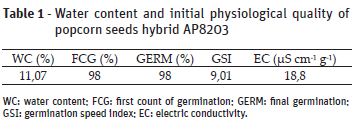
<body><![CDATA[<p><font face = "Verdana" size = "2">Popcorn seeds had high physiological capacity
and adequate water content as shown in <a href = "#t1">Table 1</a>. It was possible to verify that seeds
had an adequate water content when starting the tests, as well as high germination
percentage (98%) and vigor, as showed by first germination count tests (98%), germination
speed index (9.01) and electric conductivity (18.8 &#956;S cm<sup>-1</sup> g<sup>-1</sup>).</font></p>

    <p>&nbsp;</p>

<a name = "t1"><img src = "/img/revistas/rca/v42n1/v42n1a05t1.jpg"></a>

    
<p>&nbsp;</p>

    <p><font face = "Verdana" size = "2">Statistical
analyses for vigor, germination and leaching of the exudate from the electric conductivity
test, showed positive effect for the period of exposition to the accelerated aging,
with data fitting a polynomial regression, once the higher was the exposition period
of seeds to an adverse environment with elevated temperature and humidity, the higher
was the deterioration rate of seeds. According to Delouche (2002), the period for
deterioration process is determined mainly by the interaction between genetic inheritance,
the grade of humidity of the seed and the temperature.</font></p>

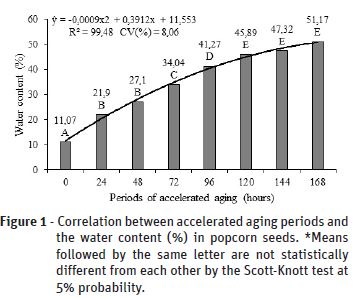
    <p><font face = "Verdana" size = "2">It was possible to verify that seed’s water content is highly
influenced by the relative humidity and high temperature (<a href = "#f1">Figure 1</a>), according to
the aging period. As the aging period increased, seed’s water content increased
until 120 hours of aging period.</font></p>

    <p>&nbsp;</p>

<a name = "f1"><img src = "/img/revistas/rca/v42n1/v42n1a05f1.jpg"></a>

    
<p>&nbsp;</p>

    <p><font face = "Verdana" size = "2">This may have propitiated a higher deterioration of seeds
resulting in lower membrane integrity and/or less selectivity, allowing higher access
of water into the cells. These results agree with observations registered by Santos
<i>et al</i>. (2004) and Sponchiado <i>et al</i>. (2014), which verified that seeds
of beans and white oat, respectively, exhibited higher proportions of swollen seeds
in lots of lower physiological quality at the end of the soaking period.</font></p>


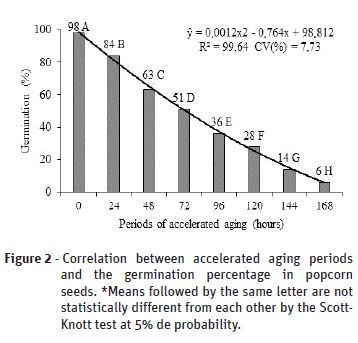
    <p><font face = "Verdana" size = "2">Seeds of popcorn evaluated by the germination
test showed reduction in the number of normal seedlings with higher exposition periods
of accelerated aging (<a href = "#f2">Figure 2</a>). This fact was already expected, once the higher
the exposition period to the accelerated aging, the higher the rate of deterioration
(Binotti <i>et al</i>., 2008). This process is a consequence of seeds’ exposition
to adverse conditions of high temperature and relative humidity, environmental factors
considered as the most associated with the deterioration of seeds.</font></p>

    <p>&nbsp;</p>

<a name = "f2"><img src = "/img/revistas/rca/v42n1/v42n1a05f2.jpg"></a>

    
]]></body>
<body><![CDATA[<p>&nbsp;</p>

    <p><font face = "Verdana" size = "2">Seed aging results in metabolic alterations during
the germination process, including the respiratory metabolism and alterations in
the membrane structure, synthesis of proteins and nucleic acids, and DNA metabolism
(Vázquez <i>et al</i>., 1991), in addition to promote a delay in the whole germination
process, reduce the growth of embryos and increase susceptibility to environmental
stresses, eventually causing loss of viability.</font></p>

    <p><font face = "Verdana" size = "2">It is possible to verify a drastic reduction of seed germination after
72 hours of artificial aging, showing the final effect of deterioration (<a href = "#f2">Figure
2</a>). Artificial aging is based in the fact of deterioration rates of seeds are accelerated
according to the exposition period to high levels of temperature and relative humidity
of the air, thus explaining the higher reduction in the percentage of normal seedlings.
 </font></p>

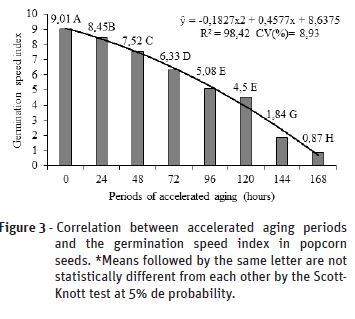
    <p><font face = "Verdana" size = "2">Accelerated aging also influenced
negatively the germination speed index, as showed in <a href = "#f3">Figure 3</a>. This fact arises
from seed degeneration, once the higher the exposition of seeds to aging periods,
the higher will be the loss of vigor and consequently, lower will be the capacity
of seeds to establish a population of seedlings rapidly, uniformly and adequately.</font></p>

    <p>&nbsp;</p>

<a name = "f3"><img src = "/img/revistas/rca/v42n1/v42n1a05f3.jpg"></a>

    
<p>&nbsp;</p>

    <p><font face = "Verdana" size = "2">With deterioration, an increase of leaching of
cellular constituents from seeds’ water soaking occurs, due to the loss of integrity
of the cell membrane systems. Direct immersion in water causes a rapid water entry
into the cells; once it reduces the period needed for membrane reorganization, an
event required to guarantee cellular compartmentalization (Silva &amp; Villela,
2011).</font></p>

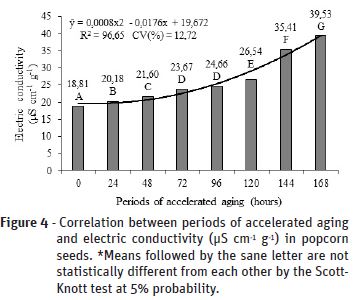
    <p><font face = "Verdana" size = "2">There was an increase in
the release of electrolytes with the increasing exposition period of seeds (<a href = "#f4">Figure
4</a>). Such electrolyte release is directly related to seed vigor, once the higher
the value of electric conductivity, the lower will be the vigor of seeds.</font></p>

    <p>&nbsp;</p>

<a name = "f4"><img src = "/img/revistas/rca/v42n1/v42n1a05f4.jpg"></a>

    
<p>&nbsp;</p>

    ]]></body>
<body><![CDATA[<p><font face = "Verdana" size = "2">There was a significant difference for all aging
periods, being the period of 168 hours the one which most reduced seed vigor. The
increase in leachates shows that adverse conditions of humidity and temperature
to which seeds were exposed results in loss of membrane and cellular constituents’
integrity and in reduced capacity of reparation from damages caused to the seeds
(Binotti <i>et al</i>., 2008). It is to emphasize that until the period of 72 hours
seeds still showed the capacity to regenerate and reorganize its membranes.</font></p>


    <p><font face = "Verdana" size = "2">According Copeland &amp; McDonald (2001), the
deterioration degree of seeds is associated to the concentration of seed’s exudates
in the solution, which are the reflex of membrane degradation. It is important to
emphasize that, according to Delouche (2002), damages in membranes are initial events
of degenerative alterations in seeds. Also, according to Ribeiro <i>et al</i>. (2009),
shorter exposition periods of popcorn seeds, may be used to identify more accentuated
differences between seed lots, and longer exposition periods are more adequate to
differentiate lots of less contrasting physiological quality. However, this ability
diminishes from 72 hours exposition and above, as can be evidenced by the reduction
of germination and vigor (<a href = "#f2">Figures 2</a> and <a href = "#f3">3</a>).</font></p>

    <p><font face = "Verdana" size = "2">Braccini <i>et al</i>. (1999) also referred tendencies of germination reduction
as the exposition period increased (from 24 to 72 hours), while experimenting with
accelerated aging in different cultivars of soybean. Tagliaferri <i>et al</i>. (2001)
also verified that soybean seeds, form different cultivars, submitted to a temperature
of 42 <sup>o</sup>C during 24, 48, 72 and 96 hours, showed higher deterioration
index for periods above 48 hours.</font></p>

    <p><font face = "Verdana" size = "2">With
the disintegration of the membrane systems in cell organelles, evidenced by the
progressive increase in leachate quantities, seeds become more susceptible to the
deleterious effects of O<sub>2</sub>, which promote oxidation of compounds and form
enzymatic activity, which according to Bewley &amp; Black (1994), promote faster
consumption of cell reserves. The gradual reduction of seeds’ viability and vigor
promoted by the stressing conditions during the period of accelerated aging may
be observed by the results of the evaluated characteristics. This is due to a higher
consumption of reserves, resulting from the accelerated metabolic activity under
these conditions.</font></p>

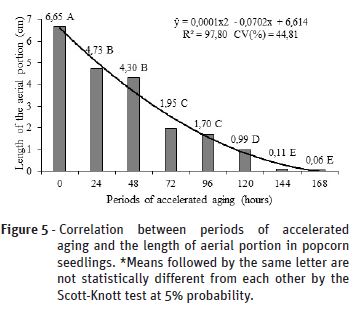
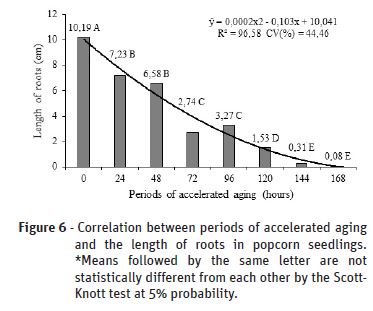
    <p><font face = "Verdana" size = "2">The length of
the aerial portion and roots (<a href = "#f5">Figures 5</a> e <a href = "#f6">6</a>) of seedlings showed a reduction starting
at 24 hours of aging and above. This may be related with the activity of certain
enzymes which may influence metabolic activities and therefore, promote higher growth,
verified by the increase of the hypocotyl and the primary root under a short exposition
period with elevated temperature (Binotti <i>et al</i>., 2008). At 72 hours of aging
it was verified that values for the hypocotyl and the roots’ length decreased, due
to the higher deterioration of seeds and lower reparation capacity from damages
caused to the seed by the increased exposition period of artificial aging.</font></p>

    <p>&nbsp;</p>

<a name = "f5"><img src = "/img/revistas/rca/v42n1/v42n1a05f5.jpg"></a>

    
<p>&nbsp;</p>

<a name = "f6"><img src = "/img/revistas/rca/v42n1/v42n1a05f6.jpg"></a>

    
<p>&nbsp;</p>

    <p><font face = "Verdana" size = "2">For the last
aging period practically, no development of the hypocotyl and roots was observed.
Tests evaluating the length of seedlings or its parts have been considered efficient
to detect differences in physiological potential of seeds from various species (Nakagawa,
1999). Additionally, these results may have a close association with the emergence
percentages of seedlings in the field (Vanzolini <i>et al</i>., 2007).</font></p>


    <p><font face = "Verdana" size = "2">Carneiro &amp; Guedes (2002) stressed that interpretation
of the accelerated aging test to evaluate the physiological potential has been focused
mainly in the calculation of the final percentage of germination (normal seedlings),
which measures may be associated or not with results from other tests performed
after a determined period of seed storage, or with the emergence of seedlings in
the field.</font></p>

    ]]></body>
<body><![CDATA[<p><font face = "Verdana" size = "2">Results from accelerate
aging tests are usually understood by the degree of tolerance to the adverse conditions
of temperature and relative humidity, mainly expressed by the survival of seeds
and not necessarily by the reduction of rates in chemical reactions which determine
germination velocity and the rate of seedling growth events of deterioration which
precede seeds’ death (Guedes <i>et al</i>., 2011). Consequently, those authors suggested
studies focused to determine the possibility to interpret the test of accelerated
aging by the evaluation of the germination velocity and seedling growth, supplementing
the traditional proceeding of determination of the normal seedlings percentage.
Therefore, the present work allowed to verify that seed’s loss of viability results
from important metabolic events, with deterioration being expressed in many ways,
which may prevent germination according to Guedes <i>et al</i>. (2011).</font></p>


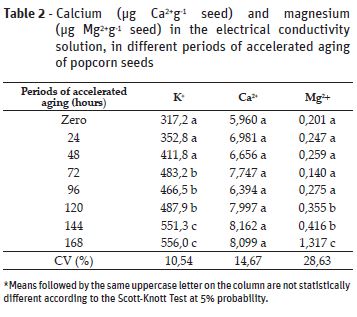
    <p><font face = "Verdana" size = "2">As showed in <a href = "#t2">Table 2</a>, there was significant differences
between aging periods and the levels of imbedding solution leachates during electric
conductivity. Concerning the test of potassium leachates, it was possible to verify
a differentiation of aging periods regarding seed’s vigor. It was observed that
starting at 72 hours of aging an increase of potassium ions occurs, corroborating
with the decreasing in germination and vigor of seeds. However, periods of 144 and
168 hours showed the highest quantities of solution leachates, displaying lower
seed vigor.</font></p>

    <p>&nbsp;</p>

<a name = "t2"><img src = "/img/revistas/rca/v42n1/v42n1a05t2.jpg"></a>

    
<p>&nbsp;</p>

    <p><font face = "Verdana" size = "2">This is elucidated
by the fact that this test has a similar principle than the electric conductivity,
based in the cellular membrane integrity of seeds, with a difference: while in electric
conductivity the total quantity of ions released during soaking is determined, in
potassium leaching only solution leached potassium ions are quantified, once this
is the main inorganic leached ion from seeds during soaking (Kikuti <i>et al</i>.,
2008). Zucareli <i>et al</i>. (2013) verified that potassium was the most leached
ion among the elements evaluated in sweet corn seeds, as observed also in wheat
seeds by Favarato <i>et al</i>. (2011).</font></p>

    <p><font face = "Verdana" size = "2">Regarding calcium contents, there was no difference between aging periods; therefore,
the evaluation is not efficient to evaluate such ion concerning vigor in popcorn
seeds (<a href = "#t2">Table 2</a>). These results agree with Zucareli <i>et al</i>. (2013) and Barbieri
<i>et al</i>. (2012) in sweet wheat and rice, respectively. However, the leachate
test for magnesium showed significant results for quantification of aging periods
regarding vigor, with the period of 168 hours of accelerated aging differing statistically
from the other treatments, showing higher quantities of leachates and consequently,
less seed vigor (<a href = "#t2">Table 2</a>). These results agree with observations registered by Binotti
<i>et al</i>. (2008), demonstrating that increasing aging periods result in a lower
physiological quality and higher levels of leachates in the exudate of the electric
conductivity test.</font></p>


    <p><font face = "Verdana" size = "3"><b>CONCLUSIONS</b></font></p>

    <p><font face = "Verdana" size = "2">Germination and vigor of popcorn seeds and the quantity of leachates
in the electric conductivity test are influenced by the increasing exposition period
to the accelerated aging process.</font></p>

    <p><font face = "Verdana" size = "2">The exposition period of seeds to the accelerated aging process, starting form
72 hours, produces results which are reflected in the potential of seed vigor and
the seed’s leachates.</font></p>

    <p>&nbsp;</p>

    ]]></body>
<body><![CDATA[<p><font face = "Verdana" size = "3"><b>References</b></font></p>

    <!-- ref --><p><font face = "Verdana" size = "2">Barbieri, A.P.P.; Menezes, N.L.;
Conceição, G.M. &amp; Tunes, L.M. (2012) - Teste de lixiviação de potássio para
a avaliação do vigor de sementes de arroz. <i>Revista Brasileira de Sementes</i>,
vol. 34, n. 1, p. 117-124.
<a href = "http://dx.doi.org/10.1590/S0101-31222012000100015" target = "_blank">http://dx.doi.org/10.1590/S0101-31222012000100015</a></font>&nbsp;&nbsp;&nbsp;&nbsp;&nbsp;&nbsp;&nbsp;&nbsp;[&#160;<a href="javascript:void(0);" onclick="javascript: window.open('/scielo.php?script=sci_nlinks&ref=709772&pid=S0871-018X201900010000600001&lng=','','width=640,height=500,resizable=yes,scrollbars=1,menubar=yes,');">Links</a>&#160;]<!-- end-ref --><!-- ref --><p><font face = "Verdana" size = "2">Bertolin, D.C.; Eustáquio de Sá, M. &amp; Moreira,
E.R. (2011) - Parâmetros do teste de envelhecimento acelerado para determinação
do vigor de sementes de feijão. <i>Revista Brasileira de Sementes</i>, vol. 33,
n. 1, p. 104-112.
<a href = "http://dx.doi.org/10.1590/S0101-31222011000100012" target = "_blank">http://dx.doi.org/10.1590/S0101-31222011000100012</a></font>&nbsp;&nbsp;&nbsp;&nbsp;&nbsp;&nbsp;&nbsp;&nbsp;[&#160;<a href="javascript:void(0);" onclick="javascript: window.open('/scielo.php?script=sci_nlinks&ref=709773&pid=S0871-018X201900010000600002&lng=','','width=640,height=500,resizable=yes,scrollbars=1,menubar=yes,');">Links</a>&#160;]<!-- end-ref --><!-- ref --><p><font face = "Verdana" size = "2">Bewley, J.D. &amp; Black, M. (1994) - <i>Seeds:
physiology of development and germination</i>. 2<sup>a</sup> ed. New York: Plenum
Press. 445 p.    &nbsp;&nbsp;&nbsp;&nbsp;&nbsp;&nbsp;&nbsp;&nbsp;[&#160;<a href="javascript:void(0);" onclick="javascript: window.open('/scielo.php?script=sci_nlinks&ref=709774&pid=S0871-018X201900010000600003&lng=','','width=640,height=500,resizable=yes,scrollbars=1,menubar=yes,');">Links</a>&#160;]<!-- end-ref --></font></p>

    <!-- ref --><p><font face = "Verdana" size = "2">Binotti, F.F.S.; Haga,
K.I.; Cardoso, E.D.; Alves, C.Z.; Sá, M.E. &amp; Arf, O. (2008) - Efeito do período
de envelhecimento acelerado no teste de condutividade elétrica e na qualidade fisiológica
de sementes de feijão. <i>Acta Scientiarum Agronomy</i>, vol. 30, n. 2, p. 247-254.
<a href = "http://dx.doi.org/10.1590/S1807-86212008000200014" target = "_blank">http://dx.doi.org/10.1590/S1807-86212008000200014</a></font>&nbsp;&nbsp;&nbsp;&nbsp;&nbsp;&nbsp;&nbsp;&nbsp;[&#160;<a href="javascript:void(0);" onclick="javascript: window.open('/scielo.php?script=sci_nlinks&ref=709776&pid=S0871-018X201900010000600004&lng=','','width=640,height=500,resizable=yes,scrollbars=1,menubar=yes,');">Links</a>&#160;]<!-- end-ref --><p><font face = "Verdana" size = "2">Brasil (2009) - <i>Regras para análise de sementes</i>. Brasília,
Ministério da Agricultura, Pecuária e Abastecimento. Secretaria de Defesa Agropecuária.
399 p.<u> </u></font></p>

    <!-- ref --><p><font face = "Verdana" size = "2">Braccini, A.L.; Reis,
M.S.; Sediyama, C.S.; Scapim, C.A. &amp; Braccini, M.C.L. (1999) - Avaliação da
qualidade fisiológica de sementes de soja, após o processo de hidratação-desidratação
e envelhecimento acelerado. <i>Pesquisa Agropecuária Brasileira</i>, vol. 34, n.
6, p. 1053-1066.
<a href = "http://dx.doi.org/10.1590/S0100-204X1999000600018" target = "_blank">http://dx.doi.org/10.1590/S0100-204X1999000600018</a></font>&nbsp;&nbsp;&nbsp;&nbsp;&nbsp;&nbsp;&nbsp;&nbsp;[&#160;<a href="javascript:void(0);" onclick="javascript: window.open('/scielo.php?script=sci_nlinks&ref=709778&pid=S0871-018X201900010000600005&lng=','','width=640,height=500,resizable=yes,scrollbars=1,menubar=yes,');">Links</a>&#160;]<!-- end-ref --><!-- ref --><p><font face = "Verdana" size = "2">Carneiro, J.W.P. &amp; Guedes, T.A. (2002) - Dinâmica
de ocorrências germinativas em amostras de sementes envelhecidas artificialmente.
<i>Informativo Abrates</i>, vol. 12, n. 1-3, p. 44-51.    &nbsp;&nbsp;&nbsp;&nbsp;&nbsp;&nbsp;&nbsp;&nbsp;[&#160;<a href="javascript:void(0);" onclick="javascript: window.open('/scielo.php?script=sci_nlinks&ref=709779&pid=S0871-018X201900010000600006&lng=','','width=640,height=500,resizable=yes,scrollbars=1,menubar=yes,');">Links</a>&#160;]<!-- end-ref --></font></p>

    ]]></body>
<body><![CDATA[<!-- ref --><p><font face = "Verdana" size = "2">Catão, H.C.R.M. &amp; Caixeta, F. (2017) - Physiological, isozyme
changes and image analysis of popcorn seeds submitted to low temperatures. <i>Journal
of Seed Science</i>, vol. 39, n. 3, p. 234-243.
<a href = "http://dx.doi.org/10.1590/2317-1545v39n3169853" target = "_blank">http://dx.doi.org/10.1590/2317-1545v39n3169853</a></font>&nbsp;&nbsp;&nbsp;&nbsp;&nbsp;&nbsp;&nbsp;&nbsp;[&#160;<a href="javascript:void(0);" onclick="javascript: window.open('/scielo.php?script=sci_nlinks&ref=709781&pid=S0871-018X201900010000600007&lng=','','width=640,height=500,resizable=yes,scrollbars=1,menubar=yes,');">Links</a>&#160;]<!-- end-ref --><!-- ref --><p><font face = "Verdana" size = "2">Copeland, L.O. &amp; McDonald, M.B. (2001) - <i>Principles
of seed science and technology</i>. 4<sup>a</sup> ed. New York: Chapman and Hall,
467 p.    &nbsp;&nbsp;&nbsp;&nbsp;&nbsp;&nbsp;&nbsp;&nbsp;[&#160;<a href="javascript:void(0);" onclick="javascript: window.open('/scielo.php?script=sci_nlinks&ref=709782&pid=S0871-018X201900010000600008&lng=','','width=640,height=500,resizable=yes,scrollbars=1,menubar=yes,');">Links</a>&#160;]<!-- end-ref --></font></p>

    <!-- ref --><p><font face = "Verdana" size = "2">Delouche, J. (2002) - Germinação,
deterioração e vigor da semente. <i>Seed News</i>, n. 6, p. 24-31.    &nbsp;&nbsp;&nbsp;&nbsp;&nbsp;&nbsp;&nbsp;&nbsp;[&#160;<a href="javascript:void(0);" onclick="javascript: window.open('/scielo.php?script=sci_nlinks&ref=709784&pid=S0871-018X201900010000600009&lng=','','width=640,height=500,resizable=yes,scrollbars=1,menubar=yes,');">Links</a>&#160;]<!-- end-ref --></font></p>


    <!-- ref --><p><font face = "Verdana" size = "2">Dutra, S. &amp; Vieira, R.D. (2004) - Envelhecimento
acelerado como teste de vigor para sementes de milho e soja. <i>Ciência Rural</i>,
vol. 34, n. 3, p. 715-721.    &nbsp;&nbsp;&nbsp;&nbsp;&nbsp;&nbsp;&nbsp;&nbsp;[&#160;<a href="javascript:void(0);" onclick="javascript: window.open('/scielo.php?script=sci_nlinks&ref=709786&pid=S0871-018X201900010000600010&lng=','','width=640,height=500,resizable=yes,scrollbars=1,menubar=yes,');">Links</a>&#160;]<!-- end-ref --></font></p>

    <!-- ref --><p><font face = "Verdana" size = "2">Favarato,
L.F.; Rocha, V.S.; Espindula, M.C.; Souza, M.A. &amp; Paula, G.S. (2011) - Teste
de lixiviação de potássio para avaliação da qualidade em sementes de trigo. <i>Revista
Brasileira de Ciências Agrárias</i>, vol. 6, n. 4, p. 670-674.
<a href = "http://dx.doi.org/10.5039/agraria.v6i4a1547" target = "_blank">http://dx.doi.org/10.5039/agraria.v6i4a1547</a></font>&nbsp;&nbsp;&nbsp;&nbsp;&nbsp;&nbsp;&nbsp;&nbsp;[&#160;<a href="javascript:void(0);" onclick="javascript: window.open('/scielo.php?script=sci_nlinks&ref=709788&pid=S0871-018X201900010000600011&lng=','','width=640,height=500,resizable=yes,scrollbars=1,menubar=yes,');">Links</a>&#160;]<!-- end-ref --><!-- ref --><p><font face = "Verdana" size = "2">Ferreira, D.F. (2011) - Sisvar: a computer statistical
analysis system. <i>Ciência e Agrotecnologia</i>, vol. 35, n. 6, p. 1039-1042.
<a href = "http://dx.doi.org/10.1590/S1413-70542011000600001" target = "_blank">http://dx.doi.org/10.1590/S1413-70542011000600001</a></font>&nbsp;&nbsp;&nbsp;&nbsp;&nbsp;&nbsp;&nbsp;&nbsp;[&#160;<a href="javascript:void(0);" onclick="javascript: window.open('/scielo.php?script=sci_nlinks&ref=709789&pid=S0871-018X201900010000600012&lng=','','width=640,height=500,resizable=yes,scrollbars=1,menubar=yes,');">Links</a>&#160;]<!-- end-ref --><!-- ref --><p><font face = "Verdana" size = "2">Guedes, R.S.; Alves, E.U.; Oliveira, L.S.B.; Andrade,
L.A.; Gonçalves, E.P. &amp; Melo, P.A.R.F. (2011) - Envelhecimento acelerado na
avaliação da qualidade fisiológica de sementes de <i>Dalbergia nigra </i>(Vell.)
Fr. All. <i>Semina: Ciências Agrárias</i>, vol. 32, n. 2, p. 443-450.
<a href = "http://dx.doi.org/10.5433/1679-0359.2011v32n2p443" target = "_blank">http://dx.doi.org/10.5433/1679-0359.2011v32n2p443</a></font>&nbsp;&nbsp;&nbsp;&nbsp;&nbsp;&nbsp;&nbsp;&nbsp;[&#160;<a href="javascript:void(0);" onclick="javascript: window.open('/scielo.php?script=sci_nlinks&ref=709790&pid=S0871-018X201900010000600013&lng=','','width=640,height=500,resizable=yes,scrollbars=1,menubar=yes,');">Links</a>&#160;]<!-- end-ref --><!-- ref --><p><font face = "Verdana" size = "2">Guiscem, J.M.; Farias, A.S.; Figueiredo, R.T.;
Chaves, M.A.S.; Figueiredo, B.T.; Pereira, C.F.; Aráujo, J.R.G. &amp; Martins, M.R.
(2010) - Teste de frio e envelhecimento acelerado na avaliação de vigor de sementes
de feijão-frade. <i>Revista de Ciências Agrárias</i>, vol. 33, n. 2, p. 182-191.    &nbsp;&nbsp;&nbsp;&nbsp;&nbsp;&nbsp;&nbsp;&nbsp;[&#160;<a href="javascript:void(0);" onclick="javascript: window.open('/scielo.php?script=sci_nlinks&ref=709791&pid=S0871-018X201900010000600014&lng=','','width=640,height=500,resizable=yes,scrollbars=1,menubar=yes,');">Links</a>&#160;]<!-- end-ref --></font></p>

    <!-- ref --><p><font face = "Verdana" size = "2">Kikuti, H.; Medina, P.F.; Kikuti,
A.L.P. &amp; Ramos, N.P. (2008) - Teste de lixiviação de potássio para avaliação
do vigor de sementes de amendoim. <i>Revista Brasileira de Sementes</i>, vol. 30,
n. 1, p. 10-18.
<a href = "http://dx.doi.org/10.1590/S0101-31222008000100002" target = "_blank">http://dx.doi.org/10.1590/S0101-31222008000100002</a></font>&nbsp;&nbsp;&nbsp;&nbsp;&nbsp;&nbsp;&nbsp;&nbsp;[&#160;<a href="javascript:void(0);" onclick="javascript: window.open('/scielo.php?script=sci_nlinks&ref=709793&pid=S0871-018X201900010000600015&lng=','','width=640,height=500,resizable=yes,scrollbars=1,menubar=yes,');">Links</a>&#160;]<!-- end-ref --><!-- ref --><p><font face = "Verdana" size = "2">Maguire, J.D. (1962) - Speed of germination-aid
in selection and evaluation for seedling emergence and vigour. <i>Crop Science</i>,
vol. 2, n. 1, p. 176-177.    &nbsp;&nbsp;&nbsp;&nbsp;&nbsp;&nbsp;&nbsp;&nbsp;[&#160;<a href="javascript:void(0);" onclick="javascript: window.open('/scielo.php?script=sci_nlinks&ref=709794&pid=S0871-018X201900010000600016&lng=','','width=640,height=500,resizable=yes,scrollbars=1,menubar=yes,');">Links</a>&#160;]<!-- end-ref --></font></p>

    <!-- ref --><p><font face = "Verdana" size = "2">Marcos
Filho, J. (1999) - Teste de envelhecimento acelerado. <i>In</i>: Krzyzanowski, F.C.;
Vieira, R.D. &amp; França Neto, J.B. (Eds.) - <i>Vigor de sementes: conceitos e
testes</i>. Londrina: Abrates, p. 1-24.    &nbsp;&nbsp;&nbsp;&nbsp;&nbsp;&nbsp;&nbsp;&nbsp;[&#160;<a href="javascript:void(0);" onclick="javascript: window.open('/scielo.php?script=sci_nlinks&ref=709796&pid=S0871-018X201900010000600017&lng=','','width=640,height=500,resizable=yes,scrollbars=1,menubar=yes,');">Links</a>&#160;]<!-- end-ref --></font></p>

    <!-- ref --><p><font face = "Verdana" size = "2">Nakagawa, J. (1999) - Testes de vigor baseados no desempenho das plântulas.
<i>In:</i> Krzyzanoski, F.C.; Vieira, R.D. &amp; França Neto, J.B. (Eds.) - <i>Vigor
de sementes: conceitos e testes</i>. Londrina: Abrates, p. 2-24.    &nbsp;&nbsp;&nbsp;&nbsp;&nbsp;&nbsp;&nbsp;&nbsp;[&#160;<a href="javascript:void(0);" onclick="javascript: window.open('/scielo.php?script=sci_nlinks&ref=709798&pid=S0871-018X201900010000600018&lng=','','width=640,height=500,resizable=yes,scrollbars=1,menubar=yes,');">Links</a>&#160;]<!-- end-ref --></font></p>

    <!-- ref --><p><font face = "Verdana" size = "2">Ohlson, O.C.; Krzyzanowski, F.C.; Caieiro, J.T. &amp; Panobianco,
M. (2010) - Teste de envelhecimento acelerado em sementes de trigo. <i>Revista Brasileira
de Sementes, </i>vol. 32, n. 4, p. 118–124.
<a href = "http://dx.doi.org/10.1590/S0101-31222010000400013" target = "_blank">http://dx.doi.org/10.1590/S0101-31222010000400013</a></font>&nbsp;&nbsp;&nbsp;&nbsp;&nbsp;&nbsp;&nbsp;&nbsp;[&#160;<a href="javascript:void(0);" onclick="javascript: window.open('/scielo.php?script=sci_nlinks&ref=709800&pid=S0871-018X201900010000600019&lng=','','width=640,height=500,resizable=yes,scrollbars=1,menubar=yes,');">Links</a>&#160;]<!-- end-ref --><!-- ref --><p><font face = "Verdana" size = "2">Ribeiro, D.M.; Bragança, S.M.; Goneli, A.L.D.;
Dias, D.C.F.S. &amp; Alvarenga, E.M. (2009) - Teste de condutividade elétrica para
avaliar o vigor de sementes em milho-pipoca (<i>Zea mays</i> L.). <i>Revista Ceres</i>,
vol. 56, n. 6, p. 772-776.    &nbsp;&nbsp;&nbsp;&nbsp;&nbsp;&nbsp;&nbsp;&nbsp;[&#160;<a href="javascript:void(0);" onclick="javascript: window.open('/scielo.php?script=sci_nlinks&ref=709801&pid=S0871-018X201900010000600020&lng=','','width=640,height=500,resizable=yes,scrollbars=1,menubar=yes,');">Links</a>&#160;]<!-- end-ref --></font></p>

    <!-- ref --><p><font face = "Verdana" size = "2">Santos,
C.M.R.; Menezes, N.L. &amp; Villela, F.A. (2004) - Alterações fisiológicas e bioquímicas
em sementes de feijão envelhecidas artificialmente. <i>Revista Brasileira de Sementes</i>,
vol. 26, n. 1, p. 110-119.
<a href = "http://dx.doi.org/10.1590/S0101-31222004000100017" target = "_blank">http://dx.doi.org/10.1590/S0101-31222004000100017</a></font>&nbsp;&nbsp;&nbsp;&nbsp;&nbsp;&nbsp;&nbsp;&nbsp;[&#160;<a href="javascript:void(0);" onclick="javascript: window.open('/scielo.php?script=sci_nlinks&ref=709803&pid=S0871-018X201900010000600021&lng=','','width=640,height=500,resizable=yes,scrollbars=1,menubar=yes,');">Links</a>&#160;]<!-- end-ref --><!-- ref --><p><font face = "Verdana" size = "2">Silva, K.R.G. &amp; Villela, F.A. (2011) - Pré-hidratação
e avaliação do potencial fisiológico de sementes de soja. <i>Revista Brasileira
de Sementes</i>, vol. 33, n. 2, p. 331-345.
<a href = "http://dx.doi.org/10.1590/S0101-31222011000200016" target = "_blank">http://dx.doi.org/10.1590/S0101-31222011000200016</a></font>&nbsp;&nbsp;&nbsp;&nbsp;&nbsp;&nbsp;&nbsp;&nbsp;[&#160;<a href="javascript:void(0);" onclick="javascript: window.open('/scielo.php?script=sci_nlinks&ref=709804&pid=S0871-018X201900010000600022&lng=','','width=640,height=500,resizable=yes,scrollbars=1,menubar=yes,');">Links</a>&#160;]<!-- end-ref --><!-- ref --><p><font face = "Verdana" size = "2">Silva, V.N.; Zambiasi, C.A.; Tillmann, M.A.A.;
Menezes, N.L. &amp; Villela, F.A. (2014) - Condução do teste de condutividade elétrica
utilizando partes de sementes de feijão. <i>Revista de Ciências Agrárias</i>, vol.
37, n. 2, p. 206-213.    &nbsp;&nbsp;&nbsp;&nbsp;&nbsp;&nbsp;&nbsp;&nbsp;[&#160;<a href="javascript:void(0);" onclick="javascript: window.open('/scielo.php?script=sci_nlinks&ref=709805&pid=S0871-018X201900010000600023&lng=','','width=640,height=500,resizable=yes,scrollbars=1,menubar=yes,');">Links</a>&#160;]<!-- end-ref --></font></p>

    <!-- ref --><p><font face = "Verdana" size = "2">Sponchiado,
J.C.; Souza, C.A. &amp; Coelho, C.M.M. (2014) - Teste de condutividade elétrica
para determinação do potencial fisiológico de sementes de aveia branca. <i>Semina:
Ciências Agrárias</i>, vol. 35, n. 4 supl., p. 2405-2414.
<a href = "http://dx.doi.org/10.5433/1679-0359.2014v35n4Suplp2405" target = "_blank">http://dx.doi.org/10.5433/1679-0359.2014v35n4Suplp2405</a></font>&nbsp;&nbsp;&nbsp;&nbsp;&nbsp;&nbsp;&nbsp;&nbsp;[&#160;<a href="javascript:void(0);" onclick="javascript: window.open('/scielo.php?script=sci_nlinks&ref=709807&pid=S0871-018X201900010000600024&lng=','','width=640,height=500,resizable=yes,scrollbars=1,menubar=yes,');">Links</a>&#160;]<!-- end-ref --><!-- ref --><p><font face = "Verdana" size = "2">Tagliaferri, C.; Rangel, O.J.P.; Lopes, J.C.;
Martins-Filho, S.; Capucho, M.T. &amp; Lima, J.S.S. (2001) - Avaliação de genótipos
de soja (<i>Glycine max</i> L. Merrill) através do teste de envelhecimento acelerado.
<i>Informativo Abrates</i>, vol. 11, n. 2, p. 228.    &nbsp;&nbsp;&nbsp;&nbsp;&nbsp;&nbsp;&nbsp;&nbsp;[&#160;<a href="javascript:void(0);" onclick="javascript: window.open('/scielo.php?script=sci_nlinks&ref=709808&pid=S0871-018X201900010000600025&lng=','','width=640,height=500,resizable=yes,scrollbars=1,menubar=yes,');">Links</a>&#160;]<!-- end-ref --></font></p>

    <!-- ref --><p><font face = "Verdana" size = "2">Vazquez, G.H.; Cardoso, R.D. &amp; Peres, A.R. (2014) - Tratamento
químico de sementes de milho e o teste de condutividade elétrica. <i>Bioscience
Journal</i>, vol. 30, n. 3, p. 773-781.    &nbsp;&nbsp;&nbsp;&nbsp;&nbsp;&nbsp;&nbsp;&nbsp;[&#160;<a href="javascript:void(0);" onclick="javascript: window.open('/scielo.php?script=sci_nlinks&ref=709810&pid=S0871-018X201900010000600026&lng=','','width=640,height=500,resizable=yes,scrollbars=1,menubar=yes,');">Links</a>&#160;]<!-- end-ref --></font></p>

    <!-- ref --><p><font face = "Verdana" size = "2">Vanzolini, S.; Araki, C.A.S.; Silva, A.C.M.T. &amp; Nakagawa, J. (2007) - Teste
de comprimento de plântula na avaliação da qualidade fisiológica de sementes de
soja. <i>Revista Brasileira de Sementes</i>, vol. 29, n. 2, p. 90-96.
<a href = "http://dx.doi.org/10.1590/S0101-31222007000200012" target = "_blank">http://dx.doi.org/10.1590/S0101-31222007000200012</a></font>&nbsp;&nbsp;&nbsp;&nbsp;&nbsp;&nbsp;&nbsp;&nbsp;[&#160;<a href="javascript:void(0);" onclick="javascript: window.open('/scielo.php?script=sci_nlinks&ref=709812&pid=S0871-018X201900010000600027&lng=','','width=640,height=500,resizable=yes,scrollbars=1,menubar=yes,');">Links</a>&#160;]<!-- end-ref --><!-- ref --><p><font face = "Verdana" size = "2">Vázquez, E.; Montiel, F. &amp; Vázquez-Ramos,
J.M. (1991) - DNA ligase activity in deteriorated maize axes during germination:
a model relating defects in DNA metabolism in seeds to loss of germinability. <i>Seed
Science Research</i>, vol. 1, n. 2, p. 269-273.
<a href = "https://doi.org/10.1017/S0960258500000994" target = "_blank">https://doi.org/10.1017/S0960258500000994</a></font>&nbsp;&nbsp;&nbsp;&nbsp;&nbsp;&nbsp;&nbsp;&nbsp;[&#160;<a href="javascript:void(0);" onclick="javascript: window.open('/scielo.php?script=sci_nlinks&ref=709813&pid=S0871-018X201900010000600028&lng=','','width=640,height=500,resizable=yes,scrollbars=1,menubar=yes,');">Links</a>&#160;]<!-- end-ref --><!-- ref --><p><font face = "Verdana" size = "2">Zucareli, C.; Brzezinski, C.R.; Abati, J.; Henning,
F.A.; Ramos Junior, E.U. &amp; Nakagawa, J. (2013) - Lixiviação de íons potássio,
cálcio e magnésio para determinação do vigor em sementes de milho doce. <i>Informativo
Abrates</i>, vol. 23, n. 3, p. 56-60.    &nbsp;&nbsp;&nbsp;&nbsp;&nbsp;&nbsp;&nbsp;&nbsp;[&#160;<a href="javascript:void(0);" onclick="javascript: window.open('/scielo.php?script=sci_nlinks&ref=709814&pid=S0871-018X201900010000600029&lng=','','width=640,height=500,resizable=yes,scrollbars=1,menubar=yes,');">Links</a>&#160;]<!-- end-ref --></font></p>

    <p>&nbsp;</p>

    <p><font face = "Verdana" size = "2">Received/recebido: 2018.10.16</font></p>

    <p><font face = "Verdana" size = "2">Received in revised form/recebido em versão revista: 2018.10.24</font></p>

    <p><font face = "Verdana" size = "2">Accepted/aceite: 2018.10.24</font></p>

     ]]></body><back>
<ref-list>
<ref id="B1">
<nlm-citation citation-type="journal">
<person-group person-group-type="author">
<name>
<surname><![CDATA[Barbieri]]></surname>
<given-names><![CDATA[A.P.P.]]></given-names>
</name>
<name>
<surname><![CDATA[Menezes]]></surname>
<given-names><![CDATA[N.L.]]></given-names>
</name>
<name>
<surname><![CDATA[Conceição]]></surname>
<given-names><![CDATA[G.M.]]></given-names>
</name>
<name>
<surname><![CDATA[Tunes]]></surname>
<given-names><![CDATA[L.M.]]></given-names>
</name>
</person-group>
<article-title xml:lang="pt"><![CDATA[Teste de lixiviação de potássio para a avaliação do vigor de sementes de arroz]]></article-title>
<source><![CDATA[Revista Brasileira de Sementes]]></source>
<year>2012</year>
<volume>34</volume>
<numero>1</numero>
<issue>1</issue>
<page-range>117-124</page-range></nlm-citation>
</ref>
<ref id="B2">
<nlm-citation citation-type="journal">
<person-group person-group-type="author">
<name>
<surname><![CDATA[Bertolin]]></surname>
<given-names><![CDATA[D.C.]]></given-names>
</name>
<name>
<surname><![CDATA[Eustáquio de Sá]]></surname>
<given-names><![CDATA[M.]]></given-names>
</name>
<name>
<surname><![CDATA[Moreira]]></surname>
<given-names><![CDATA[E.R.]]></given-names>
</name>
</person-group>
<article-title xml:lang="pt"><![CDATA[Parâmetros do teste de envelhecimento acelerado para determinação do vigor de sementes de feijão]]></article-title>
<source><![CDATA[Revista Brasileira de Sementes]]></source>
<year>2011</year>
<volume>33</volume>
<numero>1</numero>
<issue>1</issue>
<page-range>104-112</page-range></nlm-citation>
</ref>
<ref id="B3">
<nlm-citation citation-type="book">
<person-group person-group-type="author">
<name>
<surname><![CDATA[Bewley]]></surname>
<given-names><![CDATA[J.D.]]></given-names>
</name>
<name>
<surname><![CDATA[Black]]></surname>
<given-names><![CDATA[M.]]></given-names>
</name>
</person-group>
<source><![CDATA[Seeds: physiology of development and germination]]></source>
<year>1994</year>
<edition>2ª</edition>
<publisher-loc><![CDATA[New York ]]></publisher-loc>
<publisher-name><![CDATA[Plenum Press]]></publisher-name>
</nlm-citation>
</ref>
<ref id="B4">
<nlm-citation citation-type="journal">
<person-group person-group-type="author">
<name>
<surname><![CDATA[Binotti]]></surname>
<given-names><![CDATA[F.F.S.]]></given-names>
</name>
<name>
<surname><![CDATA[Haga]]></surname>
<given-names><![CDATA[K.I.]]></given-names>
</name>
<name>
<surname><![CDATA[Cardoso]]></surname>
<given-names><![CDATA[E.D.]]></given-names>
</name>
<name>
<surname><![CDATA[Alves]]></surname>
<given-names><![CDATA[C.Z.]]></given-names>
</name>
<name>
<surname><![CDATA[Sá]]></surname>
<given-names><![CDATA[M.E.]]></given-names>
</name>
<name>
<surname><![CDATA[Arf]]></surname>
<given-names><![CDATA[O.]]></given-names>
</name>
</person-group>
<article-title xml:lang="pt"><![CDATA[Efeito do período de envelhecimento acelerado no teste de condutividade elétrica e na qualidade fisiológica de sementes de feijão]]></article-title>
<source><![CDATA[Acta Scientiarum Agronomy]]></source>
<year>2008</year>
<volume>30</volume>
<numero>2</numero>
<issue>2</issue>
<page-range>247-254</page-range></nlm-citation>
</ref>
<ref id="B5">
<nlm-citation citation-type="journal">
<person-group person-group-type="author">
<name>
<surname><![CDATA[Braccini]]></surname>
<given-names><![CDATA[A.L.]]></given-names>
</name>
<name>
<surname><![CDATA[Reis]]></surname>
<given-names><![CDATA[M.S.]]></given-names>
</name>
<name>
<surname><![CDATA[Sediyama]]></surname>
<given-names><![CDATA[C.S.]]></given-names>
</name>
<name>
<surname><![CDATA[Scapim]]></surname>
<given-names><![CDATA[C.A.]]></given-names>
</name>
<name>
<surname><![CDATA[Braccini]]></surname>
<given-names><![CDATA[M.C.L.]]></given-names>
</name>
</person-group>
<article-title xml:lang="pt"><![CDATA[Avaliação da qualidade fisiológica de sementes de soja, após o processo de hidratação-desidratação e envelhecimento acelerado]]></article-title>
<source><![CDATA[Pesquisa Agropecuária Brasileira]]></source>
<year>1999</year>
<volume>34</volume>
<numero>6</numero>
<issue>6</issue>
<page-range>1053-1066</page-range></nlm-citation>
</ref>
<ref id="B6">
<nlm-citation citation-type="journal">
<person-group person-group-type="author">
<name>
<surname><![CDATA[Carneiro]]></surname>
<given-names><![CDATA[J.W.P.]]></given-names>
</name>
<name>
<surname><![CDATA[Guedes]]></surname>
<given-names><![CDATA[T.A.]]></given-names>
</name>
</person-group>
<article-title xml:lang="pt"><![CDATA[Dinâmica de ocorrências germinativas em amostras de sementes envelhecidas artificialmente]]></article-title>
<source><![CDATA[Informativo Abrates]]></source>
<year>2002</year>
<volume>12</volume>
<numero>1-3</numero>
<issue>1-3</issue>
<page-range>44-51</page-range></nlm-citation>
</ref>
<ref id="B7">
<nlm-citation citation-type="journal">
<person-group person-group-type="author">
<name>
<surname><![CDATA[Catão]]></surname>
<given-names><![CDATA[H.C.R.M.]]></given-names>
</name>
<name>
<surname><![CDATA[Caixeta]]></surname>
<given-names><![CDATA[F.]]></given-names>
</name>
</person-group>
<article-title xml:lang="en"><![CDATA[Physiological, isozyme changes and image analysis of popcorn seeds submitted to low temperatures]]></article-title>
<source><![CDATA[Journal of Seed Science]]></source>
<year>2017</year>
<volume>39</volume>
<numero>3</numero>
<issue>3</issue>
<page-range>234-243</page-range></nlm-citation>
</ref>
<ref id="B8">
<nlm-citation citation-type="book">
<person-group person-group-type="author">
<name>
<surname><![CDATA[Copeland]]></surname>
<given-names><![CDATA[L.O.]]></given-names>
</name>
<name>
<surname><![CDATA[McDonald]]></surname>
<given-names><![CDATA[M.B.]]></given-names>
</name>
</person-group>
<source><![CDATA[Principles of seed science and technology]]></source>
<year>2001</year>
<edition>4ª</edition>
<publisher-loc><![CDATA[New York ]]></publisher-loc>
<publisher-name><![CDATA[Chapman and Hall]]></publisher-name>
</nlm-citation>
</ref>
<ref id="B9">
<nlm-citation citation-type="journal">
<person-group person-group-type="author">
<name>
<surname><![CDATA[Delouche]]></surname>
<given-names><![CDATA[J.]]></given-names>
</name>
</person-group>
<article-title xml:lang="pt"><![CDATA[Germinação, deterioração e vigor da semente]]></article-title>
<source><![CDATA[Seed News]]></source>
<year>2002</year>
<numero>6</numero>
<issue>6</issue>
<page-range>24-31</page-range></nlm-citation>
</ref>
<ref id="B10">
<nlm-citation citation-type="journal">
<person-group person-group-type="author">
<name>
<surname><![CDATA[Dutra]]></surname>
<given-names><![CDATA[S.]]></given-names>
</name>
<name>
<surname><![CDATA[Vieira]]></surname>
<given-names><![CDATA[R.D.]]></given-names>
</name>
</person-group>
<article-title xml:lang="pt"><![CDATA[Envelhecimento acelerado como teste de vigor para sementes de milho e soja]]></article-title>
<source><![CDATA[Ciência Rural]]></source>
<year>2004</year>
<volume>34</volume>
<numero>3</numero>
<issue>3</issue>
<page-range>715-721</page-range></nlm-citation>
</ref>
<ref id="B11">
<nlm-citation citation-type="journal">
<person-group person-group-type="author">
<name>
<surname><![CDATA[Favarato]]></surname>
<given-names><![CDATA[L.F.]]></given-names>
</name>
<name>
<surname><![CDATA[Rocha]]></surname>
<given-names><![CDATA[V.S.]]></given-names>
</name>
<name>
<surname><![CDATA[Espindula]]></surname>
<given-names><![CDATA[M.C.]]></given-names>
</name>
<name>
<surname><![CDATA[Souza]]></surname>
<given-names><![CDATA[M.A.]]></given-names>
</name>
<name>
<surname><![CDATA[Paula]]></surname>
<given-names><![CDATA[G.S.]]></given-names>
</name>
</person-group>
<article-title xml:lang="pt"><![CDATA[Teste de lixiviação de potássio para avaliação da qualidade em sementes de trigo]]></article-title>
<source><![CDATA[Revista Brasileira de Ciências Agrárias]]></source>
<year>2011</year>
<volume>6</volume>
<numero>4</numero>
<issue>4</issue>
<page-range>670-674</page-range></nlm-citation>
</ref>
<ref id="B12">
<nlm-citation citation-type="journal">
<person-group person-group-type="author">
<name>
<surname><![CDATA[Ferreira]]></surname>
<given-names><![CDATA[D.F.]]></given-names>
</name>
</person-group>
<article-title xml:lang="en"><![CDATA[Sisvar: a computer statistical analysis system]]></article-title>
<source><![CDATA[Ciência e Agrotecnologia]]></source>
<year>2011</year>
<volume>35</volume>
<numero>6</numero>
<issue>6</issue>
<page-range>1039-1042</page-range></nlm-citation>
</ref>
<ref id="B13">
<nlm-citation citation-type="journal">
<person-group person-group-type="author">
<name>
<surname><![CDATA[Guedes]]></surname>
<given-names><![CDATA[R.S.]]></given-names>
</name>
<name>
<surname><![CDATA[Alves]]></surname>
<given-names><![CDATA[E.U.]]></given-names>
</name>
<name>
<surname><![CDATA[Oliveira]]></surname>
<given-names><![CDATA[L.S.B.]]></given-names>
</name>
<name>
<surname><![CDATA[Andrade]]></surname>
<given-names><![CDATA[L.A.]]></given-names>
</name>
<name>
<surname><![CDATA[Gonçalves]]></surname>
<given-names><![CDATA[E.P.]]></given-names>
</name>
<name>
<surname><![CDATA[Melo]]></surname>
<given-names><![CDATA[P.A.R.F.]]></given-names>
</name>
</person-group>
<article-title xml:lang="pt"><![CDATA[Envelhecimento acelerado na avaliação da qualidade fisiológica de sementes de Dalbergia nigra (Vell.) Fr. All]]></article-title>
<source><![CDATA[Semina]]></source>
<year>2011</year>
<volume>32</volume>
<numero>2</numero>
<issue>2</issue>
<page-range>443-450</page-range></nlm-citation>
</ref>
<ref id="B14">
<nlm-citation citation-type="journal">
<person-group person-group-type="author">
<name>
<surname><![CDATA[Guiscem]]></surname>
<given-names><![CDATA[J.M.]]></given-names>
</name>
<name>
<surname><![CDATA[Farias]]></surname>
<given-names><![CDATA[A.S.]]></given-names>
</name>
<name>
<surname><![CDATA[Figueiredo]]></surname>
<given-names><![CDATA[R.T.]]></given-names>
</name>
<name>
<surname><![CDATA[Chaves]]></surname>
<given-names><![CDATA[M.A.S.]]></given-names>
</name>
<name>
<surname><![CDATA[Figueiredo]]></surname>
<given-names><![CDATA[B.T.]]></given-names>
</name>
<name>
<surname><![CDATA[Pereira]]></surname>
<given-names><![CDATA[C.F.]]></given-names>
</name>
<name>
<surname><![CDATA[Aráujo]]></surname>
<given-names><![CDATA[J.R.G.]]></given-names>
</name>
<name>
<surname><![CDATA[Martins]]></surname>
<given-names><![CDATA[M.R.]]></given-names>
</name>
</person-group>
<article-title xml:lang="pt"><![CDATA[Teste de frio e envelhecimento acelerado na avaliação de vigor de sementes de feijão-frade]]></article-title>
<source><![CDATA[Revista de Ciências Agrárias]]></source>
<year>2010</year>
<volume>33</volume>
<numero>2</numero>
<issue>2</issue>
<page-range>182-191</page-range></nlm-citation>
</ref>
<ref id="B15">
<nlm-citation citation-type="journal">
<person-group person-group-type="author">
<name>
<surname><![CDATA[Kikuti]]></surname>
<given-names><![CDATA[H.]]></given-names>
</name>
<name>
<surname><![CDATA[Medina]]></surname>
<given-names><![CDATA[P.F.]]></given-names>
</name>
<name>
<surname><![CDATA[Kikuti]]></surname>
<given-names><![CDATA[A.L.P.]]></given-names>
</name>
<name>
<surname><![CDATA[Ramos]]></surname>
<given-names><![CDATA[N.P.]]></given-names>
</name>
</person-group>
<article-title xml:lang="pt"><![CDATA[Teste de lixiviação de potássio para avaliação do vigor de sementes de amendoim]]></article-title>
<source><![CDATA[Revista Brasileira de Sementes]]></source>
<year>2008</year>
<volume>30</volume>
<numero>1</numero>
<issue>1</issue>
<page-range>10-18</page-range></nlm-citation>
</ref>
<ref id="B16">
<nlm-citation citation-type="journal">
<person-group person-group-type="author">
<name>
<surname><![CDATA[Maguire]]></surname>
<given-names><![CDATA[J.D.]]></given-names>
</name>
</person-group>
<article-title xml:lang="en"><![CDATA[Speed of germination-aid in selection and evaluation for seedling emergence and vigour]]></article-title>
<source><![CDATA[Crop Science]]></source>
<year>1962</year>
<volume>2</volume>
<numero>1</numero>
<issue>1</issue>
<page-range>176-177</page-range></nlm-citation>
</ref>
<ref id="B17">
<nlm-citation citation-type="book">
<person-group person-group-type="author">
<name>
<surname><![CDATA[Marcos Filho]]></surname>
<given-names><![CDATA[J.]]></given-names>
</name>
</person-group>
<article-title xml:lang="pt"><![CDATA[Teste de envelhecimento acelerado]]></article-title>
<person-group person-group-type="editor">
<name>
<surname><![CDATA[Krzyzanowski]]></surname>
<given-names><![CDATA[F.C.]]></given-names>
</name>
<name>
<surname><![CDATA[Vieira]]></surname>
<given-names><![CDATA[R.D.]]></given-names>
</name>
<name>
<surname><![CDATA[França Neto]]></surname>
<given-names><![CDATA[J.B.]]></given-names>
</name>
</person-group>
<source><![CDATA[Vigor de sementes: conceitos e testes]]></source>
<year>1999</year>
<page-range>1-24</page-range><publisher-loc><![CDATA[Londrina ]]></publisher-loc>
<publisher-name><![CDATA[Abrates]]></publisher-name>
</nlm-citation>
</ref>
<ref id="B18">
<nlm-citation citation-type="book">
<person-group person-group-type="author">
<name>
<surname><![CDATA[Nakagawa]]></surname>
<given-names><![CDATA[J.]]></given-names>
</name>
</person-group>
<article-title xml:lang="pt"><![CDATA[Testes de vigor baseados no desempenho das plântulas]]></article-title>
<person-group person-group-type="editor">
<name>
<surname><![CDATA[Krzyzanoski]]></surname>
<given-names><![CDATA[F.C.]]></given-names>
</name>
<name>
<surname><![CDATA[Vieira]]></surname>
<given-names><![CDATA[R.D.]]></given-names>
</name>
<name>
<surname><![CDATA[França Neto]]></surname>
<given-names><![CDATA[J.B.]]></given-names>
</name>
</person-group>
<source><![CDATA[Vigor de sementes: conceitos e testes]]></source>
<year>1999</year>
<page-range>2-24</page-range><publisher-loc><![CDATA[Londrina ]]></publisher-loc>
<publisher-name><![CDATA[Abrates]]></publisher-name>
</nlm-citation>
</ref>
<ref id="B19">
<nlm-citation citation-type="journal">
<person-group person-group-type="author">
<name>
<surname><![CDATA[Ohlson]]></surname>
<given-names><![CDATA[O.C.]]></given-names>
</name>
<name>
<surname><![CDATA[Krzyzanowski]]></surname>
<given-names><![CDATA[F.C.]]></given-names>
</name>
<name>
<surname><![CDATA[Caieiro]]></surname>
<given-names><![CDATA[J.T.]]></given-names>
</name>
<name>
<surname><![CDATA[Panobianco]]></surname>
<given-names><![CDATA[M.]]></given-names>
</name>
</person-group>
<article-title xml:lang="pt"><![CDATA[Teste de envelhecimento acelerado em sementes de trigo]]></article-title>
<source><![CDATA[Revista Brasileira de Sementes]]></source>
<year>2010</year>
<volume>32</volume>
<numero>4</numero>
<issue>4</issue>
<page-range>118-124</page-range></nlm-citation>
</ref>
<ref id="B20">
<nlm-citation citation-type="journal">
<person-group person-group-type="author">
<name>
<surname><![CDATA[Ribeiro]]></surname>
<given-names><![CDATA[D.M.]]></given-names>
</name>
<name>
<surname><![CDATA[Bragança]]></surname>
<given-names><![CDATA[S.M.]]></given-names>
</name>
<name>
<surname><![CDATA[Goneli]]></surname>
<given-names><![CDATA[A.L.D.]]></given-names>
</name>
<name>
<surname><![CDATA[Dias]]></surname>
<given-names><![CDATA[D.C.F.S.]]></given-names>
</name>
<name>
<surname><![CDATA[Alvarenga]]></surname>
<given-names><![CDATA[E.M.]]></given-names>
</name>
</person-group>
<article-title xml:lang="pt"><![CDATA[Teste de condutividade elétrica para avaliar o vigor de sementes em milho-pipoca (Zea mays L.)]]></article-title>
<source><![CDATA[Revista Ceres]]></source>
<year>2009</year>
<volume>56</volume>
<numero>6</numero>
<issue>6</issue>
<page-range>772-776</page-range></nlm-citation>
</ref>
<ref id="B21">
<nlm-citation citation-type="journal">
<person-group person-group-type="author">
<name>
<surname><![CDATA[Santos]]></surname>
<given-names><![CDATA[C.M.R.]]></given-names>
</name>
<name>
<surname><![CDATA[Menezes]]></surname>
<given-names><![CDATA[N.L.]]></given-names>
</name>
<name>
<surname><![CDATA[Villela]]></surname>
<given-names><![CDATA[F.A.]]></given-names>
</name>
</person-group>
<article-title xml:lang="pt"><![CDATA[Alterações fisiológicas e bioquímicas em sementes de feijão envelhecidas artificialmente]]></article-title>
<source><![CDATA[Revista Brasileira de Sementes]]></source>
<year>2004</year>
<volume>26</volume>
<numero>1</numero>
<issue>1</issue>
<page-range>110-119</page-range></nlm-citation>
</ref>
<ref id="B22">
<nlm-citation citation-type="journal">
<person-group person-group-type="author">
<name>
<surname><![CDATA[Silva]]></surname>
<given-names><![CDATA[K.R.G.]]></given-names>
</name>
<name>
<surname><![CDATA[Villela]]></surname>
<given-names><![CDATA[F.A.]]></given-names>
</name>
</person-group>
<article-title xml:lang="pt"><![CDATA[Pré-hidratação e avaliação do potencial fisiológico de sementes de soja]]></article-title>
<source><![CDATA[Revista Brasileira de Sementes]]></source>
<year>2011</year>
<volume>33</volume>
<numero>2</numero>
<issue>2</issue>
<page-range>331-345</page-range></nlm-citation>
</ref>
<ref id="B23">
<nlm-citation citation-type="journal">
<person-group person-group-type="author">
<name>
<surname><![CDATA[Silva]]></surname>
<given-names><![CDATA[V.N.]]></given-names>
</name>
<name>
<surname><![CDATA[Zambiasi]]></surname>
<given-names><![CDATA[C.A.]]></given-names>
</name>
<name>
<surname><![CDATA[Tillmann]]></surname>
<given-names><![CDATA[M.A.A.]]></given-names>
</name>
<name>
<surname><![CDATA[Menezes]]></surname>
<given-names><![CDATA[N.L.]]></given-names>
</name>
<name>
<surname><![CDATA[Villela]]></surname>
<given-names><![CDATA[F.A.]]></given-names>
</name>
</person-group>
<article-title xml:lang="pt"><![CDATA[Condução do teste de condutividade elétrica utilizando partes de sementes de feijão]]></article-title>
<source><![CDATA[Revista de Ciências Agrárias]]></source>
<year>2014</year>
<volume>37</volume>
<numero>2</numero>
<issue>2</issue>
<page-range>206-213</page-range></nlm-citation>
</ref>
<ref id="B24">
<nlm-citation citation-type="journal">
<person-group person-group-type="author">
<name>
<surname><![CDATA[Sponchiado]]></surname>
<given-names><![CDATA[J.C.]]></given-names>
</name>
<name>
<surname><![CDATA[Souza]]></surname>
<given-names><![CDATA[C.A.]]></given-names>
</name>
<name>
<surname><![CDATA[Coelho]]></surname>
<given-names><![CDATA[C.M.M.]]></given-names>
</name>
</person-group>
<article-title xml:lang="pt"><![CDATA[Teste de condutividade elétrica para determinação do potencial fisiológico de sementes de aveia branca]]></article-title>
<source><![CDATA[Semina]]></source>
<year>2014</year>
<volume>35</volume>
<numero>4</numero>
<issue>4</issue>
<page-range>2405-2414</page-range></nlm-citation>
</ref>
<ref id="B25">
<nlm-citation citation-type="journal">
<person-group person-group-type="author">
<name>
<surname><![CDATA[Tagliaferri]]></surname>
<given-names><![CDATA[C.]]></given-names>
</name>
<name>
<surname><![CDATA[Rangel]]></surname>
<given-names><![CDATA[O.J.P.]]></given-names>
</name>
<name>
<surname><![CDATA[Lopes]]></surname>
<given-names><![CDATA[J.C.]]></given-names>
</name>
<name>
<surname><![CDATA[Martins-Filho]]></surname>
<given-names><![CDATA[S.]]></given-names>
</name>
<name>
<surname><![CDATA[Capucho]]></surname>
<given-names><![CDATA[M.T.]]></given-names>
</name>
<name>
<surname><![CDATA[Lima]]></surname>
<given-names><![CDATA[J.S.S.]]></given-names>
</name>
</person-group>
<article-title xml:lang="pt"><![CDATA[Avaliação de genótipos de soja (Glycine max L. Merrill) através do teste de envelhecimento acelerado]]></article-title>
<source><![CDATA[Informativo Abrates]]></source>
<year>2001</year>
<volume>11</volume>
<numero>2</numero>
<issue>2</issue>
<page-range>228</page-range></nlm-citation>
</ref>
<ref id="B26">
<nlm-citation citation-type="journal">
<person-group person-group-type="author">
<name>
<surname><![CDATA[Vazquez]]></surname>
<given-names><![CDATA[G.H.]]></given-names>
</name>
<name>
<surname><![CDATA[Cardoso]]></surname>
<given-names><![CDATA[R.D.]]></given-names>
</name>
<name>
<surname><![CDATA[Peres]]></surname>
<given-names><![CDATA[A.R.]]></given-names>
</name>
</person-group>
<article-title xml:lang="pt"><![CDATA[Tratamento químico de sementes de milho e o teste de condutividade elétrica]]></article-title>
<source><![CDATA[Bioscience Journal]]></source>
<year>2014</year>
<volume>30</volume>
<numero>3</numero>
<issue>3</issue>
<page-range>773-781</page-range></nlm-citation>
</ref>
<ref id="B27">
<nlm-citation citation-type="journal">
<person-group person-group-type="author">
<name>
<surname><![CDATA[Vanzolini]]></surname>
<given-names><![CDATA[S.]]></given-names>
</name>
<name>
<surname><![CDATA[Araki]]></surname>
<given-names><![CDATA[C.A.S.]]></given-names>
</name>
<name>
<surname><![CDATA[Silva]]></surname>
<given-names><![CDATA[A.C.M.T.]]></given-names>
</name>
<name>
<surname><![CDATA[Nakagawa]]></surname>
<given-names><![CDATA[J.]]></given-names>
</name>
</person-group>
<article-title xml:lang="pt"><![CDATA[Teste de comprimento de plântula na avaliação da qualidade fisiológica de sementes de soja]]></article-title>
<source><![CDATA[Revista Brasileira de Sementes]]></source>
<year>2007</year>
<volume>29</volume>
<numero>2</numero>
<issue>2</issue>
<page-range>90-96</page-range></nlm-citation>
</ref>
<ref id="B28">
<nlm-citation citation-type="journal">
<person-group person-group-type="author">
<name>
<surname><![CDATA[Vázquez]]></surname>
<given-names><![CDATA[E.]]></given-names>
</name>
<name>
<surname><![CDATA[Montiel]]></surname>
<given-names><![CDATA[F.]]></given-names>
</name>
<name>
<surname><![CDATA[Vázquez-Ramos]]></surname>
<given-names><![CDATA[J.M.]]></given-names>
</name>
</person-group>
<article-title xml:lang="en"><![CDATA[DNA ligase activity in deteriorated maize axes during germination: a model relating defects in DNA metabolism in seeds to loss of germinability]]></article-title>
<source><![CDATA[Seed Science Research]]></source>
<year>1991</year>
<volume>1</volume>
<numero>2</numero>
<issue>2</issue>
<page-range>269-273</page-range></nlm-citation>
</ref>
<ref id="B29">
<nlm-citation citation-type="journal">
<person-group person-group-type="author">
<name>
<surname><![CDATA[Zucareli]]></surname>
<given-names><![CDATA[C.]]></given-names>
</name>
<name>
<surname><![CDATA[Brzezinski]]></surname>
<given-names><![CDATA[C.R.]]></given-names>
</name>
<name>
<surname><![CDATA[Abati]]></surname>
<given-names><![CDATA[J.]]></given-names>
</name>
<name>
<surname><![CDATA[Henning]]></surname>
<given-names><![CDATA[F.A.]]></given-names>
</name>
<name>
<surname><![CDATA[Ramos Junior]]></surname>
<given-names><![CDATA[E.U.]]></given-names>
</name>
<name>
<surname><![CDATA[Nakagawa]]></surname>
<given-names><![CDATA[J.]]></given-names>
</name>
</person-group>
<article-title xml:lang="pt"><![CDATA[Lixiviação de íons potássio, cálcio e magnésio para determinação do vigor em sementes de milho doce]]></article-title>
<source><![CDATA[Informativo Abrates]]></source>
<year>2013</year>
<volume>23</volume>
<numero>3</numero>
<issue>3</issue>
<page-range>56-60</page-range></nlm-citation>
</ref>
</ref-list>
</back>
</article>