<?xml version="1.0" encoding="ISO-8859-1"?><article xmlns:mml="http://www.w3.org/1998/Math/MathML" xmlns:xlink="http://www.w3.org/1999/xlink" xmlns:xsi="http://www.w3.org/2001/XMLSchema-instance">
<front>
<journal-meta>
<journal-id>0871-018X</journal-id>
<journal-title><![CDATA[Revista de Ciências Agrárias]]></journal-title>
<abbrev-journal-title><![CDATA[Rev. de Ciências Agrárias]]></abbrev-journal-title>
<issn>0871-018X</issn>
<publisher>
<publisher-name><![CDATA[Sociedade de Ciências Agrárias de Portugal]]></publisher-name>
</publisher>
</journal-meta>
<article-meta>
<article-id>S0871-018X2019000100013</article-id>
<article-id pub-id-type="doi">10.19084/RCA18281</article-id>
<title-group>
<article-title xml:lang="en"><![CDATA[Organic compost effects on Stevia rebaudiana weed control and on soil properties in the Mediterranean region]]></article-title>
<article-title xml:lang="pt"><![CDATA[Efeito da aplicação de compostos orgânicos no controlo de infestantes na cultura de Stevia rebaudiana e nas propriedades do um solo na região do Mediterrâneo]]></article-title>
</title-group>
<contrib-group>
<contrib contrib-type="author">
<name>
<surname><![CDATA[Coelho]]></surname>
<given-names><![CDATA[Luísa]]></given-names>
</name>
<xref ref-type="aff" rid="A1 "/>
<xref ref-type="aff" rid="A A"/>
</contrib>
<contrib contrib-type="author">
<name>
<surname><![CDATA[Osório]]></surname>
<given-names><![CDATA[Júlio]]></given-names>
</name>
<xref ref-type="aff" rid="A1"/>
</contrib>
<contrib contrib-type="author">
<name>
<surname><![CDATA[Beltrão]]></surname>
<given-names><![CDATA[José]]></given-names>
</name>
<xref ref-type="aff" rid="A1 "/>
</contrib>
<contrib contrib-type="author">
<name>
<surname><![CDATA[Reis]]></surname>
<given-names><![CDATA[Mário]]></given-names>
</name>
<xref ref-type="aff" rid="A1 "/>
</contrib>
</contrib-group>
<aff id="AA1">
<institution><![CDATA[,Universidade do Algarve Faculdade de Ciências e Tecnologia Campus de Gambelas]]></institution>
<addr-line><![CDATA[Faro ]]></addr-line>
<country>Portugal</country>
</aff>
<aff id="AA2">
<institution><![CDATA[,University of Algarve MeditBio Centre for Mediterranean Bioresources and Food]]></institution>
<addr-line><![CDATA[Faro ]]></addr-line>
<country>Portugal</country>
</aff>
<aff id="AA3">
<institution><![CDATA[,University of Évora ICAAM ]]></institution>
<addr-line><![CDATA[Évora ]]></addr-line>
<country>Portugal</country>
</aff>
<aff id="AA4">
<institution><![CDATA[,Centro de Investigação Professor Doutor Joaquim Veríssimo Serrão  ]]></institution>
<addr-line><![CDATA[Santarém ]]></addr-line>
<country>Portugal</country>
</aff>
<pub-date pub-type="pub">
<day>00</day>
<month>03</month>
<year>2019</year>
</pub-date>
<pub-date pub-type="epub">
<day>00</day>
<month>03</month>
<year>2019</year>
</pub-date>
<volume>42</volume>
<numero>1</numero>
<fpage>111</fpage>
<lpage>120</lpage>
<copyright-statement/>
<copyright-year/>
<self-uri xlink:href="http://scielo.pt/scielo.php?script=sci_arttext&amp;pid=S0871-018X2019000100013&amp;lng=en&amp;nrm=iso"></self-uri><self-uri xlink:href="http://scielo.pt/scielo.php?script=sci_abstract&amp;pid=S0871-018X2019000100013&amp;lng=en&amp;nrm=iso"></self-uri><self-uri xlink:href="http://scielo.pt/scielo.php?script=sci_pdf&amp;pid=S0871-018X2019000100013&amp;lng=en&amp;nrm=iso"></self-uri><abstract abstract-type="short" xml:lang="pt"><p><![CDATA[A estévia (Stevia rebaudiana Bertoni) é uma cultura promissora para regiões sermiáridas, incluindo o Algarve. Os objetivos deste trabalho foram: avaliar o efeito da aplicação de composto ao solo no controlo das infestantes em estévia; identificar as infestantes que ocorrem em diferentes épocas do ano e avaliar o efeito da aplicação do composto no solo. Utilizou-se um composto comercial, em duas modalidades de aplicação: à superfície (CS) e enterrado a 10 - 15 cm (CI), numa faixa ao longo das linhas da cultura. O controlo foi solo nu (NC). O ensaio foi instalado em seis blocos completos casualizados, com quatro repetições. Cada bloco foi dividido em três parcelas, com uma modalidade por parcela, num total de 24 parcelas por modalidade. O composto afetou de forma significativa as espécies de infestantes identificadas. O composto, sobretudo em cobertura, reduziu significativamente a ocorrência da maioria das espécies. O composto aumentou a retenção de água do solo, em particular na zona onde a taxa de infiltração era menor, e sobretudo quando aplicado em cobertura, mas afetou ainda outras características físicas e químicas do solo. O trabalho evidenciou o efeito positivo do composto no controlo das infestantes e nas características do solo na cultura de estévia.]]></p></abstract>
<abstract abstract-type="short" xml:lang="en"><p><![CDATA[Stevia rebaudiana Bertoni is a promising crop for semiarid climates, including Algarve region. The objectives of this work were: to compare the feasibility of the eco-friendly stevia weed control strategy with a compost of vegetable residues (grass clippings and pruning’s); to identify the emerged weed species, and to evaluate the effect of compost application on soil properties. Treatments consisted on the application of a 5 cm layer of compost on soil surface or incorporated, and no compost application as control. The trial was set up in six randomized field plots, with four replications. Each plot was divided into three subplots, with one treatment per subplot, in a total of 24 subplots per treatment. Compost application had a distinct effect on weed species. Some species were significantly reduced when compost was applied, namely as mulch. Compost increased soil water content, mainly in area of the trial with lower soil drainage, especially when compost was applied as mulch, as well as other physical and chemical soil properties. Results showed the positive effect of compost on weed control and soil properties during stevia cultivation.]]></p></abstract>
<kwd-group>
<kwd lng="pt"><![CDATA[cobertura de solo]]></kwd>
<kwd lng="pt"><![CDATA[produção biológica]]></kwd>
<kwd lng="pt"><![CDATA[taxa de infiltração de água]]></kwd>
<kwd lng="pt"><![CDATA[ambiente]]></kwd>
<kwd lng="pt"><![CDATA[sustantabilidade]]></kwd>
<kwd lng="pt"><![CDATA[economia circular]]></kwd>
<kwd lng="en"><![CDATA[mulch]]></kwd>
<kwd lng="en"><![CDATA[organic farming]]></kwd>
<kwd lng="en"><![CDATA[water infiltration rate]]></kwd>
<kwd lng="en"><![CDATA[environment]]></kwd>
<kwd lng="en"><![CDATA[sustainability]]></kwd>
<kwd lng="en"><![CDATA[circular economy]]></kwd>
</kwd-group>
</article-meta>
</front><body><![CDATA[ 

    <p align = "right"><font face = "Verdana" size = "2"><b>ARTIGO</b></font></p>

    <p><font face = "Verdana" size = "4"><b>Organic
compost effects on <i>Stevia rebaudiana</i> weed control and on soil properties
in the Mediterranean region</b></font></p>


    <p><font face = "Verdana" size = "3"><b>Efeito da aplicação de compostos orgânicos
no controlo de infestantes na cultura de <i>Stevia</i> <i>rebaudiana</i> e nas propriedades
do um solo na região do Mediterrâneo</b></font></p>


    <p><font face = "Verdana" size = "2"><b>Luísa Coelho</b><sup>1,2,3*</sup>,
<b>Júlio Osório</b><sup>1</sup>, <b>José Beltrão</b><sup>1,4</sup> and <b>Mário Reis</b><sup>1,2</sup></font></p>


    <p><font face = "Verdana" size = "2"><i><sup>1</sup>Universidade do Algarve, Faculdade
de Ciências e Tecnologia, Campus de Gambelas, Edifício 8, 8005-139 Faro, Portugal</i></font></p>


    <p><font face = "Verdana" size = "2"><i><sup>2</sup>MeditBio, Centre for Mediterranean
Bioresources and Food, University of Algarve, Faro, Portugal</i></font></p>

    <p><font face = "Verdana" size = "2"><i><sup>3</sup>ICAAM, University of Évora, Núcleo da Mitra
apartado 94 7006-554, Évora, Portugal</i></font></p>

    <p><font face = "Verdana" size = "2"><i><sup>4</sup>Centro de Investigação Professor Doutor Joaquim Veríssimo
Serrão, Casa de Portugal e de Camões, Rua Capitão Romeu Neves, r/Dto, 2005-157 Santarém,
Portugal</i></font></p>

    <p><font face = "Verdana" size = "2"><i>(<sup>*</sup>E-mail: <a href="mailto:lcoelho6@gmail.com">lcoelho6@gmail.com</a>)</i></font></p>

<hr noshade size = 1>

    ]]></body>
<body><![CDATA[<p><font face = "Verdana" size = "3"><b>ABSTRACT</b></font></p>

    <p><font face = "Verdana" size = "2"><i>Stevia rebaudiana</i> Bertoni is a promising crop for semiarid
climates, including Algarve region. The objectives of this work were: to compare
the feasibility of the eco-friendly stevia weed control strategy with a compost
of vegetable residues (grass clippings and pruning’s); to identify the emerged weed
species, and to evaluate the effect of compost application on soil properties. Treatments
consisted on the application of a 5 cm layer of compost on soil surface or incorporated,
and no compost application as control. The trial was set up in six randomized field
plots, with four replications. Each plot was divided into three subplots, with one
treatment per subplot, in a total of 24 subplots per treatment. Compost application
had a distinct effect on weed species. Some species were significantly reduced when
compost was applied, namely as mulch. Compost increased soil water content, mainly
in area of the trial with lower soil drainage, especially when compost was applied
as mulch, as well as other physical and chemical soil properties. Results showed
the positive effect of compost on weed control and soil properties during stevia
cultivation.</font></p>

    <p><font face = "Verdana" size = "2"><b>Keywords:</b> mulch, organic farming, water
infiltration rate, environment, sustainability, circular economy</font></p>

<hr noshade size = 1>

    <p><font face = "Verdana" size = "3"><b>RESUMO</b></font></p>

    <p><font face = "Verdana" size = "2">A estévia (<i>Stevia rebaudiana</i> Bertoni) é uma cultura promissora para
regiões sermiáridas, incluindo o Algarve. Os objetivos deste trabalho foram: avaliar
o efeito da aplicação de composto ao solo no controlo das infestantes em estévia;
identificar as infestantes que ocorrem em diferentes épocas do ano e avaliar o efeito
da aplicação do composto no solo. Utilizou-se um composto comercial, em duas modalidades
de aplicação: à superfície (CS) e enterrado a 10 – 15 cm (CI), numa faixa ao longo
das linhas da cultura. O controlo foi solo nu (NC). O ensaio foi instalado em seis
blocos completos casualizados, com quatro repetições. Cada bloco foi dividido em
três parcelas, com uma modalidade por parcela, num total de 24 parcelas por modalidade.
O composto afetou de forma significativa as espécies de infestantes identificadas.
O composto, sobretudo em cobertura, reduziu significativamente a ocorrência da maioria
das espécies. O composto aumentou a retenção de água do solo, em particular na zona
onde a taxa de infiltração era menor, e sobretudo quando aplicado em cobertura,
mas afetou ainda outras características físicas e químicas do solo. O trabalho evidenciou
o efeito positivo do composto no controlo das infestantes e nas características
do solo na cultura de estévia.</font></p>

    <p><font face = "Verdana" size = "2"><b>Palavras-chave:</b> cobertura de solo, produção biológica, taxa de infiltração de água, ambiente, sustantabilidade,
economia circular</font></p>

<hr noshade size = 1>

    <p><font face = "Verdana" size = "3"><b>INTRODUCTION</b></font></p>

    <p><font face = "Verdana" size = "2">Stevia (<i>Stevia rebaudiana</i> Bertoni) is a South American
<i>Asteraceae</i>, endemic in Paraguay and the adjacent Brazilian territory. Stevia
is cultivated in many regions of the world, including Europe (Ramesh <i>et al</i>.,
2006) namely in the Mediterranean region (Lavini <i>et al.</i>, 2008), were the
crop can be planted in the field during spring, according to local air average temperature.
In this region, stevia behaves as a warm season crop: vegetative growth occurs trough
spring and summer, being plant stems harvested along this period. As a short day
plant, the first flowers are observed in August, and harvest usually ceases. Full
blooming occurs through the end of summer and autumn. Plant canopy is eliminated
during winter, due to weather conditions, but most of the plants usually survive
and plant regrows from underground parts of the stem. The economic importance of
stevia is mainly related to the amount of sweet glycosides, like stevioside, a noncaloric
sweetener present in the leaves (Totté <i>et al.</i>, 2000). Economic and environmental
sustainability of this crop might be improved through the application of compost
mulching for stevia weed control, while promoting crop yield.</font></p>

    <p><font face = "Verdana" size = "2">Weeds significantly reduce crop yield and quality (Vasileiadis
<i>et al</i>., 2012), by competing for water, nutrients, light and space (Navarro
<i>et al.</i>, 2005), and increasing harvest costs (Buhler <i>et al</i>., 1998;
Ozores-Hampton <i>et al</i>., 2001). For these reasons, weed control is of great
importance, being often achieved through specific soil mobilization operations (Kienle,
2004), crop rotation, inter-row cultivation, use of a stale-seedbed to kill emerging
seedlings before planting or by the use of herbicides (Ozores-Hampton <i>et al.</i>,
2001; Harrington <i>et al.</i>, 2011), but none is homologated in the EU, although
they have been tested and evaluated (GO4STEVIA, 2018). However, herbicides are not
allowed in the EU on organic farming (Regulations EU 834/2007 and 889/2008). Anyway,
the use of herbicides can cause environmental problems, affecting man and wildlife
(Schneider <i>et al</i>., 1988), and the continued use of some herbicides has caused
weed shift problems and weed resistance (Zhang, 2003). Public demand for organic
products and the relevance of organic farming has increased in recent years, so
too has the range of weed control options (Bond and Grundy, 2001). Mulching with
organic materials it’s an old agricultural technique that can be effective on weed
control, has a positive effect on soil nutrient supply, decreases evapotranspiration,
reduces erosion, equilibrates soil temperature, improves structure and permeability,
nutrient absorption and facilitates the circulation of machinery (Boyle <i>et al</i>.,
1989; Dick and McCoy, 1993; Labrador, 1996; Lazaroto <i>et al</i>., 2008). Compost
application generally improves soil physical, chemical and biological characteristics,
being one of the few soil conditioners with such a broad effect (Alexander, 1996).
Compost improves soil physical characteristics independently of its texture: in
fine texture soils, compost avoids compression; in soils with coarse texture it
increases the water retention capacity and improves the development of soil aggregates
(Boyle <i>et al.</i>, 1989; Dick and McCoy, 1993; Ozores-Hampton <i>et al.</i>,
2001). Compost mulching can be an effective technique to suppress weeds (Altieri
and Liebman, 1987). Mulching with a layer of 0.10 to 0.15 m of compost is recommended
for weed control (FAO, 1987). This control effect may be caused either by the presence
of toxic compounds produced during composting (Ozores-Hampton <i>et al.</i>, 2001)
or by reducing light penetration and the radiation of fundamental wavelengths to
seedlings development (Ramakrishna <i>et al.</i>, 2006). However, fine layers of
compost, in severe weed infestations, did not provide sufficient weed control (Ozores-Hampton
<i>et al.</i>, 2001). Moreover, detailed information on which weeds species are
controlled by compost is scarce.</font></p>

    <p><font face = "Verdana" size = "2">Knowing
that the effect of composts will vary accordingly to its characteristics, the objectives
of this work were: i) to evaluate the effect of a 5 cm layer of compost  (Nutriverde®,
ALGAR S.A., Portugal), produced in windrows from vegetable residues namely grass
clippings and gardening prunings. Compost was applied, as mulch or incorporated
in the soil, as an eco-friendly weed control in the stevia; ii) to obtain information
on the most affected weed species, which is of crucial importance when deciding
for this technical option, considering the weed species expected in the field; iii)
to evaluate the effect of the type of compost application (as mulch or incorporated)
in the soil and on stevia yield.</font></p>

    ]]></body>
<body><![CDATA[<p><font face = "Verdana" size = "3"><b>MATERIAL AND METHODS</b></font></p>

    <p><font face = "Verdana" size = "2"><i>Field trial, experimental design and measurements</i></font></p>


    <p><font face = "Verdana" size = "2">Experimental field was located in south Portugal
(37°02'34.9&quot;N 7°58'15.6&quot;W) at the <i>Campus</i> of Gambelas from the University
of Algarve, Faro. The trial was installed on a sandy soil, a haplic arenosol (ARh)
according to FAO (2006). A pinewood (<i>Pinus pinea</i> L.) had occupied the soil
for over 30 years, followed by a vegetable cultivation period of two years. During
the five years previous to the trial, the soil was left with spontaneous herbaceous
vegetation.</font></p>

    <p><font face = "Verdana" size = "2">In order to improve crop-growing
conditions, soil was mobilized before stevia plantation with a ripper, at 0.5 m
depth, followed by a rotovator at 0.15 to 0.2 m.</font></p>

    <p><font face = "Verdana" size = "2">The tested compost was prepared from a mix of gardening pruning’s
and grass clippings (Nutriverde®, ALGAR S.A., Portugal). This mix was composted
in windrow for eight weeks, with mechanical weekly turning, followed by a maturation
of a few weeks. Three treatments were tested: application of compost on soil surface
as mulch (CS) or incorporated at 0.1 to 0.15 m depth (CI), and no compost application
(NC). Stevia was planted in lines separated 0.75 m, with a distance of 0.3 m in
the line, corresponding to a density of 44444 plants ha<sup>-1</sup>. A 5 cm thick
layer of compost (34 kg m<sup>-2</sup>), was applied on a 0.50 m wide stripe along
plantation lines of stevia (which were separated 0.75 m) and left on surface or
incorporated in the soil. According to plant density, the width and height of the
compost layer, and compost bulk density, this 5 cm layer of compost represented
approximately an application of 200 t ha<sup>-1</sup>. The trial was set up in six
randomized plots (3 m x 0.5 m) with four replications, in a total of 24 plots. Each
plot included 9 plants performing a total of 216 plants (24 plots x 9 plants) and
was divided into three subplots (0.9 m x 0.5 m), with one sub-plot for each treatment,
and three plants per treatment. To avoid side effects from compost application between
treatments along the plantation lines, the plants used to determine growth variables
were only the middle plants from each treatment in each subplot, performing a total
of 24 plants evaluated per treatment.</font></p>

    <p><font face = "Verdana" size = "2">A drip irrigation system was used for the layout (Netafim, 10 L.h<sup>-1</sup>
drippers). Irrigation water amounts were daily applied, in order to replenish the
soil profile to field capacity up to a depth of 0.5 m. To control soil water along
the soil profile, soil water content was monitored periodically during the experiment
(Reis <i>et al.</i>, 2015), gravimetrically measured for a 0.0–0.6 m depth. Immediately
after plantation, soil was irrigated at field capacity until 0.5 m depth (Lavini
<i>et al.</i>, 2008), according to the root system characteristics. During the trial,
plants were irrigated two to three times a day, according to the environmental conditions,
with a maxim daily irrigation amount of 4.4 mm.day<sup>-1 </sup>corresponding to
a maximum irrigation period of 6 minutes, computed according to Allen <i>et al.</i>
(2005).</font></p>

    <p><font face = "Verdana" size = "2">Stevia was planted in lines
separated 0.75 m, with a distance of 0.3 m in the line, corresponding to a density
of 44444 plants ha<sup>-1</sup>. All plants were fertilized through foliar spraying
with a liquid fertilizer (Ret-Sul, Eibol S.L., Spain).</font></p>


    <p><font face = "Verdana" size = "2"><i>Weed counting and identification</i></font></p>

    <p><font face = "Verdana" size = "2">Weed
emergence on each treatment subplot was weekly identified (until species level whenever
possible), counted and registered. Weeds were identified and counted in the central
zone of each subplot, within an area of 0.45 m<sup>2</sup> per subplot (0.5 m width
x 0.9 m long). Weeds were identified and counted during three consecutive periods,
according to air temperature evolution; 1<sup>st</sup> period (temperature decrease,
autumn), 2<sup>nd</sup> period (cold weather, final autumn to winter and 3<sup>rd</sup>
(temperature increase, final winter and spring).</font></p>

    <p><font face = "Verdana" size = "2"><i>Soil and compost characterization</i></font></p>

    ]]></body>
<body><![CDATA[<p><font face = "Verdana" size = "2">Soil
samples were analysed before and after the trial to evaluate the effect of treatments.
Soil samples were randomly collected in the whole area at the beginning of the trial,
before compost application. At the end of the trial, soil samples were collected
on the area around 0.1 to 0.2 m from the plants, in each treatment. Compost was
analysed for its most relevant characteristics, including phytotoxicity, expressed
by the germination index (Zucconi <i>et al.</i>, 1985).</font></p>

    <p><font face = "Verdana" size = "2">Soil and compost pH were measured on a water extract (1:2.5)
with a potentiometer (Crison micro pH 2001, Spain). Electrical conductivity of soil
(ECs) and compost was read in the previous suspension, after adding 25 mL of distilled
water more, with a bench conductivimeter (Crison 522, Spain). Dry matter content
(DM) was determined using the method described by Martinez (1992). Organic matter
content (Walkley and Black, 1934), potassium (Egner-Riehm method) and phosphorus
(Olsen’s method) were determined. Sodium was determined by flame photometry (Jenway,
PFP7 &amp; PFP7/C, England), after extraction in ammonium acetate.</font></p>


    <p><font face = "Verdana" size = "2">During the trial, differences were observed on
the water infiltration rate during irrigation, according to soil slope, that was
around 10%. For this reason, the soil water infiltration rate (WIR) was measured
with a Double Ring Infiltrometer (IN2-W, Turf-Tec, EUA), considering three areas
on the trial field: higher, medium and lower area, according to the slope. In each
area, eight determinations of the infiltration rate were done per treatment (NC,
CI and CS), in a total of 96 measurements.</font></p>

    <p><font face = "Verdana" size = "2"><i>Statistical analyses</i></font></p>


    <p><font face = "Verdana" size = "2">Statistical analyses used IBM SPSS Statistics
version 20. Soil and weed occurrence data were analysed through one-way Analysis
of Variance (ANOVA) and Duncan’s Multiple Range Test. Differences were considered
significant at p&lt;0.05.</font></p>

    <p><font face = "Verdana" size = "3"><b>RESULTS</b></font></p>

    <p><font face = "Verdana" size = "2"><i>Weed control: global aspects</i></font></p>

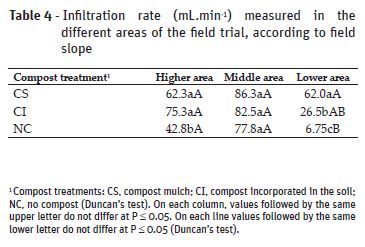
    <p><font face = "Verdana" size = "2">As normal, the occurrence of the different weed species was related to
the climatic conditions during each observation period. These three observation
periods, based on temperatures evolution: decreasing, stabilized (cold) and increasing
temperature, corresponded to the following dates: 1<sup>st</sup> period from 31<sup>s</sup>t
Jul. - 31<sup>st </sup>Oct., 2<sup>nd</sup> period from 1<sup>st</sup> Nov. - 31<sup>st</sup>
Jan., and 3<sup>rd</sup> period from 1<sup>st</sup> Feb. - 6<sup>th</sup> May, identified
on <a href = "#f1">Figure 1</a>.</font></p>

    <p>&nbsp;</p>

<a name = "f1"><img src = "/img/revistas/rca/v42n1/v42n1a12f1.jpg"></a>

    
<p>&nbsp;</p>

    ]]></body>
<body><![CDATA[<p><font face = "Verdana" size = "2">During the trial,
47 weed species belonging to 20 families were identified (<a href = "/img/revistas/rca/v42n1/v42n1a12t1.jpg" target = "_blank">Table 1</a>), distributed
by treatments as follows: 46 species from 19 families on soil with no compost (NC);
44 species from 18 families on soil with compost incorporation (CI), and 43 species
from 17 families on soil with compost mulch (CS) (<a href = "/img/revistas/rca/v42n1/v42n1a12t2.jpg" target = "_blank">Table 2</a> and <a href = "/img/revistas/rca/v42n1/v42n1a12t2b.jpg" target = "_blank">2b</a>). Only nine species
emerged during the three observation periods, and 11 species appeared only during
one period.</font></p>

    
<p><font face = "Verdana" size = "2">Without compost, the number of weeds was higher
than with compost, particularly when it was applied as mulch. Compost significantly
reduced the number of plants from 13 species, at least during one of the observation
periods.</font></p>

    <p><font face = "Verdana" size = "2">Whenever compost was used
as mulch, four weed species did not occur: <i>Cardaria draba </i>L., <i>Spergularia
rubra </i>L., <i>Urtica urens </i>L. and<i> Reseda luteola</i> L., while <i>Silene
gallica</i> L. was observed only in the first observation period (<a href = "/img/revistas/rca/v42n1/v42n1a12t2b.jpg" target = "_blank">Table 2b</a>). During
the three observation periods, similar behaviors were observed for the species <i>Plantago
lanceolata</i> L. and <i>Gallium aparine</i> L., which always appeared with less
abundance on CS (<a href = "/img/revistas/rca/v42n1/v42n1a12t2b.jpg" target = "_blank">Table 2b</a>). <i>Conyza bonariensis</i> L. was not observed in the
first observation period, what can be attributed to soil mobilization previous to
crop plantation (Wu <i>et al</i>., 2007) and the fact of being a positive photoblastic
species (Baskin &amp; Baskin, 1998). Later, during the 2<sup>nd</sup> an 3<sup>rd</sup>
periods, its lightweight seeds would have been wind spread from the surrounding
fields and germinated, on the compost or on the soil. This can explain the high
occurrence on CS treatment that offered good germination conditions, namely a coarser
surface to hold the seeds, and a higher humidity content for seed germination.</font></p>

    
<p><font face = "Verdana" size = "2"><i>First period (summer- autumn)</i></font></p>

    <p><font face = "Verdana" size = "2">In the first period of observation, 23 species were identified. Compost, especially
when applied as mulch (CS), significantly reduced the number of eight plant species,
especially <i>Portulaca oleracea</i> L., <i>Plantago lagopus</i> L. and <i>Poa annua</i>
L. (<a href = "/img/revistas/rca/v42n1/v42n1a12t2.jpg" target = "_blank">Table 2</a> and <a href = "/img/revistas/rca/v42n1/v42n1a12t2b.jpg" target = "_blank">2b</a>). The species <i>Solanum nigrum</i> L., <i>Poa annua</i> L. and
<i>Lactuca virosa</i> L. were not observed on CS. During this first period, <i>Cardaria
dabra</i> L., <i>Sonchus asper</i> L., <i>Reseda luteola</i> L., <i>Lactuca serriola</i>
L. and <i>Cyperus rotundus </i>L. were observed only on NC.</font></p>

    
<p><font face = "Verdana" size = "2"><i>Second period (late autumn - winter)</i></font></p>

    <p><font face = "Verdana" size = "2">During
the 2<sup>nd</sup> period, with lower temperature than in the first period (average
temperature 12 ºC) and more rainfall input, the number of observed weed species
increased to 35. Compost application continued to show a positive effect on weeds
control, by reducing their number, particularly when used as mulch (<a href = "/img/revistas/rca/v42n1/v42n1a12t2.jpg" target = "_blank">Table 2</a> and
<a href = "/img/revistas/rca/v42n1/v42n1a12t2b.jpg" target = "_blank">2b</a>). Five species were significantly reduced with compost mulch:<i> Spergula arvensis
</i>L., <i>Cyperus rotundus </i>L., <i>Lactuca serriola</i> L., <i>Poa annua</i>
L., <i>Anagallis arvensis</i> L.</font></p>

    
<p><font face = "Verdana" size = "2"><i>Third period (late winter - spring)</i></font></p>

    <p><font face = "Verdana" size = "2">A similar situation
to the 2<sup>nd</sup> period occurred, being identified 31 weed species where an
increase in temperature was observed. Compost reduction on weed number was significant
when it was applied as mulch, for the species: <i>Spergula arvensis </i>L., <i>Spergularia
rubra </i>L<i>., Cyperus rotundus </i>L., <i>Euphorbia peplus </i>L., <i>Trifolium
arvense </i>L., <i>Plantago lanceolata</i> L., <i>Polygonum arviculare </i>L., <i>Anagallis
arvensis</i> L., <i>Chenopodium album </i>L. (<a href = "/img/revistas/rca/v42n1/v42n1a12t2.jpg" target = "_blank">Table 2</a> and <a href = "/img/revistas/rca/v42n1/v42n1a12t2b.jpg" target = "_blank">2b</a>).</font></p>

    
<p><font face = "Verdana" size = "2"><i>Anagallis arvensis</i> L. was present in higher number
in the 1<sup>st</sup> period in CS, but in the 2<sup>nd</sup> period, its number
was significantly reduced on CS.</font></p>

    ]]></body>
<body><![CDATA[<p><font face = "Verdana" size = "2"><i>Portulaca
oleracea</i> L. was significantly reduced by the compost during the initial warm
season. <i>P. oleracea</i> L. is one of the world’s most aggressive weeds species,
ranked in the 8<sup>th</sup> place of plants with larger distribution in the world
(Simopoulos, 2004), with greater abundance in the warmer months (Feng <i>et al.,
</i>2015) in sites with enough water availability in the soil (Yazidi <i>et al.</i>,
2007).</font></p>

    <p><font face = "Verdana" size = "2">Compost mulch did not prevent
the perennial summer weed C<sub>4</sub> weed<i> Cyperus rotundus </i>L. emergence
but it was dramatically reduced during the 3<sup>rd</sup> period: 20 times less
plants emerged on compost mulch   than on soil with no compost (<a href = "/img/revistas/rca/v42n1/v42n1a12t2.jpg" target = "_blank">Table 2</a>). According
to the level of <i>Cyperus rotundus </i>L. presence in the soil, control measures
previous to crop installation might be required (GO4STEVIA, 2018). <i>Spergula arvensis</i>
(present in the 2<sup>nd</sup> and 3<sup>rd</sup> periods), <i>Plantago lagopus</i>
L. (present in 1<sup>st</sup> and 2<sup>nd</sup> periods) and <i>Poa annua</i> and
<i>P. lanceolata </i>(present in the three periods) had higher plant densities on
NC treatment.</font></p>

    
<p><font face = "Verdana" size = "2"><i>Compost effect on soil properties</i></font></p>


    <p><font face = "Verdana" size = "2">Before the trial, soil presented an almost neutral
pH, low salinity and low or undetectable concentrations of heavy metals (<a href = "/img/revistas/rca/v42n1/v42n1a12t3.jpg" target = "_blank">Table 3</a>).
Compost presented a pH of 8.5, an electrical conductivity of 1.8 dS.m<sup>-1</sup>,
33% (w/w) of organic matter and a germination index of 67.8 %, above the lower limit
(65%) to be considered adequate for agricultural utilization according to Zucconi
<i>et al.</i> (1985).</font></p>

    
<p><font face = "Verdana" size = "2">After the trial,
soil pH increased from 7.3 to 8.2 or 8.4 when compost was incorporated in the soil
or used as mulch, respectively (<a href = "/img/revistas/rca/v42n1/v42n1a12t3.jpg" target = "_blank">Table 3</a>). ECs slightly increased from 0.06 dS.m<sup>-1</sup>
to 0.07 dS m<sup>-1</sup> in CI, and to 0.08 dS m<sup>-1</sup> in CS. Organic matter,
potassium, phosphorus and sodium contents were higher in both treatments with compost.
At the end of the trial, soil moisture was higher were compost had been applied
(<a href = "/img/revistas/rca/v42n1/v42n1a12t3.jpg" target = "_blank">Table 3</a>).</font></p>

    
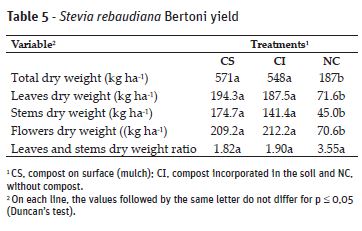
<p><font face = "Verdana" size = "2">Visual
field observations during trial irrigation, regarding the different water infiltration
rate, were confirmed by the determination of WIR <i>in situ</i>. In the highest
and the middle areas of the field no differences on WIR were observed between treatments,
but in the lower area a much lower infiltration rate occurred on NC treatment (<a href = "#t4">Table
4</a>).</font></p>

    <p>&nbsp;</p>

<a name = "t4"><img src = "/img/revistas/rca/v42n1/v42n1a12t4.jpg"></a>

    
<p>&nbsp;</p>

    <p><font face = "Verdana" size = "2">Compost improved soil properties, as indicated
by the water infiltration rate determinations, thus contributing to superficial
water erosion reduction and increasing soil water retention (as indicated by the
previously mentioned higher moisture content of soil with compost). In this study,
the application of only a 5 cm layer of compost, especially as mulch, was enough
to improve water infiltration.</font></p>

    <p><font face = "Verdana" size = "2">The
middle area of the trial exhibited the highest infiltration rate for all the treatments.
Water infiltration rate was somewhat lower on the higher area, and dramatically
reduced on the lower area, except where compost was applied as mulch (<a href = "#t4">Table 4</a>).
In the lower area (with the lowest WIR), compost strongly increased WIR, especially
when applied as mulch. Compost increased the WIR to a similar level to the observed
in the other two areas of the trial field (middle and higher). In the lower area
of the field, where WIR was lower, its value more than doubled with compost mulching
(CS), when compared to compost incorporation in the soil (CI) (<a href = "#t4">Table 4</a>).</font></p>

    ]]></body>
<body><![CDATA[<p><font face = "Verdana" size = "2"><i>Stevia rebaudiana Bertoni yield</i></font></p>

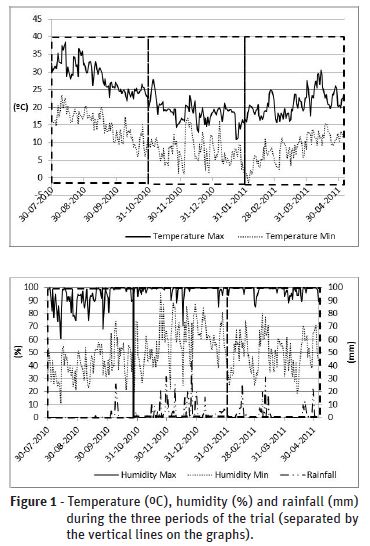
    <p><font face = "Verdana" size = "2">Globally, compost increased plant growth and yield (<a href = "#t5">Table 5</a>). The dry weight
ratios of leaves, stems and flowers were significantly higher on CS and CI and large
yield differences due to the application of compost were determined.</font></p>

    <p>&nbsp;</p>

<a name = "t5"><img src = "/img/revistas/rca/v42n1/v42n1a12t5.jpg"></a>

    
<p>&nbsp;</p>

    <p><font face = "Verdana" size = "3"><b>DISCUSSION</b></font></p>

    <p><font face = "Verdana" size = "2"><i>Weed control</i></font></p>

    <p><font face = "Verdana" size = "2">Globally, the highest number of weeds was observed when no compost was applied
to the soil, and the lowest number with compost mulch, as previously reported (Ozores-Hampton
<i>et al.</i>, 2001; Brown and Tworkoski, 2004; Ramakrishna <i>et al.</i>, 2006).
Moreover, compost reduced weed diversity, both on families and species, as reported
by Ramakrishna <i>et al.</i> (2006), namely on weeds from the Resedaceae family.</font></p>


    <p><font face = "Verdana" size = "2">Considering that the compost was mature, as indicated
by Zucconi’s test and by the fact that it improved stevia early growth, the reduction
on weed emergence can not be attributed to the presence of phytotoxic compounds
(Roe <i>et al.</i>, 1993), unless these compounds were present in such an amount
and quality that they were able to reduce seed germination (on Zucconi’s phytotoxicity
test) but not stevia early growth. Other compost characteristics might have influenced
soil conditions for weed emergence (Ramakrishna <i>et al.</i>, 2006). Compost mulch
is favourable to the biological control of most weeds, since it inhibits plant emergence
by preventing light penetration and/ or excluding certain light wavelengths that
are needed for the growth of weed seedlings (Baskin and Baskin, 1989; Ossom <i>et
al.</i>, 2001). Usually, weed germination inhibition increases with soil depth (Ozores-Hampton,
1998). When compost was applied as mulch, even only at a 5 cm height layer, it could
have inhibited the emergence of some weed seeds. Braga <i>et al.</i> (2010) suggested
that seeds may lose viability or be induced to dormancy due to soil mobilization,
what could have occurred on CI treatments. Ebrahimi and Eslami (2011) found that
compost incorporation in the soil might place some seeds at 10 to 15 cm depth, preventing
germination. Also, in both treatments with compost, the relatively high compost
pH (8.5) and electrical conductivity (1.8 dS.m<sup>-1</sup>) might have inhibited
the germination of some weed species, especially when it was used as mulch.</font></p>


    <p><font face = "Verdana" size = "2">By the end of the trial, a lower number of weed
species had emerged where compost was applied, showing that a degree of weed control
by compost application had been achieved.</font></p>

    <p><font face = "Verdana" size = "2">Mulching with a 5 cm layer of compost may provide an environmentally
friendly option of weed control, decreasing chemical control need, and contributing
to soil fertilization by reducing the need for synthetic fertilizers. The use of
composts from organic residues increases circular economy in agriculture, favours
agriculture sustainability and contributes to a safer environment and public health.</font></p>
    ]]></body>
<body><![CDATA[<p><font face = "Verdana" size = "2"><i>Soil properties</i></font></p>

    <p><font face = "Verdana" size = "2">Compost application increased soil electrical conductivity (ECs) and pH
(<a href = "/img/revistas/rca/v42n1/v42n1a12t3.jpg" target = "_blank">Table 3</a>). It is known that the application of compost to the soil might change
its pH: neutral or alkaline compost applied to a soil with a lower pH will increase
its pH if the quantities are appropriate. The concentration of soluble salts might
also be increased by compost application, thus increasing its ECs (Alexander, 2005).</font></p>


<p><font face = "Verdana" size = "2">The application of compost significantly increased
soil organic matter content (<a href = "/img/revistas/rca/v42n1/v42n1a12t3.jpg" target = "_blank">Table 3</a>) as reported by Labrador (1996). Compost also
improved soil fertility (Dick and McCoy, 1993; Jakobsen, 1995; Alexander, 2005),
by increasing the nutrient concentration available for the plants, namely P and
K (Barker, 2005). In this study, the raise in organic matter content favoured P
and K increase only on CS treatment (<a href = "/img/revistas/rca/v42n1/v42n1a12t3.jpg" target = "_blank">Table 3</a>).</font></p>

    
<p><font face = "Verdana" size = "2">The WIR increase (<a href = "#t4">Table 4</a>) agrees to previous reports stating that, when
applied in sufficient quantity, the addition of compost has both an immediate and
a long-term positive impact on soil structure (Alexander, 1996), preventing soil
compaction, improving the formation of soil aggregates (Boyle <i>et al</i>., 1989),
and increasing soil water retention capacity (Boyle <i>et al.</i>, 1989; Alexander,
1996; Torres <i>et al</i>., 2003). This effect was clearer when compost was used
as mulch: no significant differences on WIR among the three areas of the trial field
under this treatment (<a href = "#t4">Table 4</a>).</font></p>

    <p><font face = "Verdana" size = "2">These
results showed that there were differences in the initial soil physical properties
(indicated by WIR) but - with the application of compost, namely as mulch - it was
possible to overcome the worst soil physical conditions. When compost was incorporated
in the soil, a significant increase of the infiltration rate in the lower area occurred,
and an even stronger reduction with no compost application.</font></p>

    <p><font face = "Verdana" size = "2">From agronomic and economic standpoints, the application
of a 5 cm layer of compost on soil surface (mulching) created more favourable conditions
than its incorporation in the soil, as indicated by the increased water infiltration
rate and the reduced weed emergence.</font></p>

    <p><font face = "Verdana" size = "2"><i>Stevia yield </i></font></p>


    <p><font face = "Verdana" size = "2">The application of compost increased the organic
matter and nutrient content in the soil, with a positive effect in the stevia yield,
which had been observed in other crops (Reis <i>et al.</i>, 2015, 2017). Stevia
has low nutrient requirements, being adapted to poor quality soils (Ramesh <i>et
al.</i>, 2006), however, a nutrient deficiency can be prejudicial (Utumi <i>et al.</i>,
1999). Stevia increased yield with compost mulch, relatively to its incorporation
in the soil, might be attributed to the greater nutrient availability around the
upper roots, at a few cm depth, than in the soil at 15 cm depth. In fact, it is
known that stevia root system is hardly ramified and does not deepen, distributing
itself near the soil surface (Zaidan <i>et al.</i>, 1980). The increase in productivity
due to the compost application contributes to the reduction of chemical fertilizers,
increasing stevia production sustainability.</font></p>

    <p><font face = "Verdana" size = "3"><b>CONCLUSIONS</b></font></p>


    <p><font face = "Verdana" size = "2">Under the trial field conditions, the application
of a 5 cm layer of compost reduced the number of weeds, particularly when it was
used as mulch. Compost prevented the emergence of some weed species and significantly
reduced others. Detailed information is provided on what species are controlled,
and up to what extent. It was shown that some degree of weed control with compost
(Nutriverde<sup>®</sup>) is possible, but it will vary with the local weed species
and environmental conditions. Compost application to the soil may reduce or eliminate
the use of herbicides, safeguarding public health and the environment.</font></p>


    ]]></body>
<body><![CDATA[<p><font face = "Verdana" size = "2">The application of compost increased the water
content in the soil, organic matter, electrical conductivity, pH, P, K, Na and improved
physical properties, especially when applied as mulch, resulting in a stevia yield
increase.</font></p>

    <p><font face = "Verdana" size = "2">From agronomic and economic
standpoints, compost application as mulch was more favourable than its incorporation
in the soil. Compost mulch increased yield and reduced weeds, that associated to
the lower application costs of compost as mulch, suggests that compost mulch is
an interesting cultural option for stevia production.</font></p>

    <p><font face = "Verdana" size = "2">Compost mulching, by reducing weeds and chemical fertilization
needs, contributes to increase of sustainability of agriculture and the objective
of a circular economy in society.</font></p>

    <p>&nbsp;</p>

    <p><font face = "Verdana" size = "3"><b>References</b></font></p>

    <!-- ref --><p><font face = "Verdana" size = "2">Alexander,
R. (1996) - <i>Field Guide to Compost Use</i>. The compost Council, Alexandria,
Virginia.    &nbsp;&nbsp;&nbsp;&nbsp;&nbsp;&nbsp;&nbsp;&nbsp;[&#160;<a href="javascript:void(0);" onclick="javascript: window.open('/scielo.php?script=sci_nlinks&ref=710947&pid=S0871-018X201900010001300001&lng=','','width=640,height=500,resizable=yes,scrollbars=1,menubar=yes,');">Links</a>&#160;]<!-- end-ref --></font></p>

    <!-- ref --><p><font face = "Verdana" size = "2">Allen, R.G.; Pereira, L.S.;
Raes, D. &amp; Smith, M. (2005) - <i>Crop evapotranspiration.</i> FAO Irrigation
and Drainage Paper 56. Rome, Italy.    &nbsp;&nbsp;&nbsp;&nbsp;&nbsp;&nbsp;&nbsp;&nbsp;[&#160;<a href="javascript:void(0);" onclick="javascript: window.open('/scielo.php?script=sci_nlinks&ref=710949&pid=S0871-018X201900010001300002&lng=','','width=640,height=500,resizable=yes,scrollbars=1,menubar=yes,');">Links</a>&#160;]<!-- end-ref --></font></p>

    <!-- ref --><p><font face = "Verdana" size = "2">Altieri, W. &amp; Liebman, M.A. (1988) - The impact, uses and ecological role
of weeds in agroecosystems. <i>In:</i> Liebman, M.A. (Ed) - <i>Weed Management in
Agroecosystems: Ecological Approaches</i>. Boca Raton, Florida, CRC Press, p. 1-6.    &nbsp;&nbsp;&nbsp;&nbsp;&nbsp;&nbsp;&nbsp;&nbsp;[&#160;<a href="javascript:void(0);" onclick="javascript: window.open('/scielo.php?script=sci_nlinks&ref=710951&pid=S0871-018X201900010001300003&lng=','','width=640,height=500,resizable=yes,scrollbars=1,menubar=yes,');">Links</a>&#160;]<!-- end-ref --></font></p>


    <!-- ref --><p><font face = "Verdana" size = "2">Barker, A.V. (2005) - Compost Utilization in Sod
and Turf Management. <i>In:</i> Stoffella, P.J. &amp; Kahn, B.A. (Eds) - <i>Compost
Utilization in Horticultural Cropping Systems</i>. Boca Raton, Lewis Publishers,
p. 201-225.    &nbsp;&nbsp;&nbsp;&nbsp;&nbsp;&nbsp;&nbsp;&nbsp;[&#160;<a href="javascript:void(0);" onclick="javascript: window.open('/scielo.php?script=sci_nlinks&ref=710953&pid=S0871-018X201900010001300004&lng=','','width=640,height=500,resizable=yes,scrollbars=1,menubar=yes,');">Links</a>&#160;]<!-- end-ref --></font></p>

    <!-- ref --><p><font face = "Verdana" size = "2">Baskin, C.C. &amp; Baskin,
J.M. (1998) - <i>Seeds: ecology, biogeography, and evolution of dormancy and germination</i>.
San Diego: Academic Press, 666 p.    &nbsp;&nbsp;&nbsp;&nbsp;&nbsp;&nbsp;&nbsp;&nbsp;[&#160;<a href="javascript:void(0);" onclick="javascript: window.open('/scielo.php?script=sci_nlinks&ref=710955&pid=S0871-018X201900010001300005&lng=','','width=640,height=500,resizable=yes,scrollbars=1,menubar=yes,');">Links</a>&#160;]<!-- end-ref --></font></p>

    <!-- ref --><p><font face = "Verdana" size = "2">Baskin,
J.M. &amp; Baskin, C.C. (1989) - Seasonal changes in the germination responses of
buried seeds of <i>Barbarea vulgaris</i>. <i>Canadian Journal of Botany</i>, vol.
67, n. 7, p. 2131-2134. <a href = "https://doi.org/10.1139/b89-269" target = "_blank">https://doi.org/10.1139/b89-269</a></font>&nbsp;&nbsp;&nbsp;&nbsp;&nbsp;&nbsp;&nbsp;&nbsp;[&#160;<a href="javascript:void(0);" onclick="javascript: window.open('/scielo.php?script=sci_nlinks&ref=710957&pid=S0871-018X201900010001300006&lng=','','width=640,height=500,resizable=yes,scrollbars=1,menubar=yes,');">Links</a>&#160;]<!-- end-ref --><!-- ref --><p><font face = "Verdana" size = "2">Bond, W. &amp; Grundy, A.C. (2001) - Non-Chemical Weed Management
in Organic Farming Systems. <i>Weed Research</i>, vol. 41, n. 5, p. 383-405.
<a href = "https://doi.org/10.1046/j.1365-3180.2001.00246.x" target = "_blank">https://doi.org/10.1046/j.1365-3180.2001.00246.x</a></font>&nbsp;&nbsp;&nbsp;&nbsp;&nbsp;&nbsp;&nbsp;&nbsp;[&#160;<a href="javascript:void(0);" onclick="javascript: window.open('/scielo.php?script=sci_nlinks&ref=710958&pid=S0871-018X201900010001300007&lng=','','width=640,height=500,resizable=yes,scrollbars=1,menubar=yes,');">Links</a>&#160;]<!-- end-ref --><!-- ref --><p><font face = "Verdana" size = "2">Boyle, M.; Frankenberger, Jr.W.T. &amp; Stolzy,
L.H. (1989) - The influence of organic matter on soil aggregation and water infiltration.
<i>Journal of Production Agriculture</i>, vol. 2, n. 4, p. 290-299.
<a href = "https:/://dx.doi.org/10.2134/jpa1989.0290" target="_blank">https://doi.org/10.2134/jpa1989.0290</a></font>&nbsp;&nbsp;&nbsp;&nbsp;&nbsp;&nbsp;&nbsp;&nbsp;[&#160;<a href="javascript:void(0);" onclick="javascript: window.open('/scielo.php?script=sci_nlinks&ref=710959&pid=S0871-018X201900010001300008&lng=','','width=640,height=500,resizable=yes,scrollbars=1,menubar=yes,');">Links</a>&#160;]<!-- end-ref --><!-- ref --><p><font face = "Verdana" size = "2">Braga, R.R.; Santos, J.B.; Cury, J.P.; Byrro,
E.C.M.; Silveira, R.M. &amp; Lima, A.T. (2010) - Banco de sementes de plantas daninhas
em áreas de integração lavoura/pecuária em função do sistema de cultivo e de doses
de calcário. <i>In:</i> <i>Proceedings of XXVII Congresso Brasileiro da Ciência
das Plantas Daninhas</i>. Ribeirão Preto, Brazil, Brazilian Weed Science Society,
p. 2377-2381.    &nbsp;&nbsp;&nbsp;&nbsp;&nbsp;&nbsp;&nbsp;&nbsp;[&#160;<a href="javascript:void(0);" onclick="javascript: window.open('/scielo.php?script=sci_nlinks&ref=710960&pid=S0871-018X201900010001300009&lng=','','width=640,height=500,resizable=yes,scrollbars=1,menubar=yes,');">Links</a>&#160;]<!-- end-ref --></font></p>

    ]]></body>
<body><![CDATA[<!-- ref --><p><font face = "Verdana" size = "2">Brown, M.W. &amp; Tworkoski,
T. (2004) - Pest management benefits of compost mulch in apple orchards. <i>Agriculture,
Ecosystems and Environment</i>, vol. 103, n. 3, p. 465-472.
<a href = "https://doi.org/10.1016/j.agee.2003.11.006" target = "_blank">https://doi.org/10.1016/j.agee.2003.11.006</a></font>&nbsp;&nbsp;&nbsp;&nbsp;&nbsp;&nbsp;&nbsp;&nbsp;[&#160;<a href="javascript:void(0);" onclick="javascript: window.open('/scielo.php?script=sci_nlinks&ref=710962&pid=S0871-018X201900010001300010&lng=','','width=640,height=500,resizable=yes,scrollbars=1,menubar=yes,');">Links</a>&#160;]<!-- end-ref --><!-- ref --><p><font face = "Verdana" size = "2">Buhler, B.D.; Netzer, D.A.; Riemenschneider, D.E.
&amp; Hartzler, R.G. (1998) - Weed management in short rotation poplar and herbaceous
perennial crops grown for biofuel production. <i>Biomass and Bioenergy</i>, vol.
14, n. 4, p. 385-394. <a href = "https://doi.org/10.1016/S0961-9534(97)10075-7" target = "_blank">https://doi.org/10.1016/S0961-9534(97)10075-7</a></font>&nbsp;&nbsp;&nbsp;&nbsp;&nbsp;&nbsp;&nbsp;&nbsp;[&#160;<a href="javascript:void(0);" onclick="javascript: window.open('/scielo.php?script=sci_nlinks&ref=710963&pid=S0871-018X201900010001300011&lng=','','width=640,height=500,resizable=yes,scrollbars=1,menubar=yes,');">Links</a>&#160;]<!-- end-ref --><!-- ref --><p><font face = "Verdana" size = "2">Dick, W.A. &amp; McCoy, E.L. (1993) - Enhancing
Soil Fertility by Addition of Compost <i>In:</i> Hoitink, H.A.J. &amp; Keeners,
H.M. (Eds.) - <i>Science and Engineering of Composting: Design, Environmental, Microbiological
and Utilization Aspects Renaissance Publications</i>, Worthington, EUA. p. 622-644.    &nbsp;&nbsp;&nbsp;&nbsp;&nbsp;&nbsp;&nbsp;&nbsp;[&#160;<a href="javascript:void(0);" onclick="javascript: window.open('/scielo.php?script=sci_nlinks&ref=710964&pid=S0871-018X201900010001300012&lng=','','width=640,height=500,resizable=yes,scrollbars=1,menubar=yes,');">Links</a>&#160;]<!-- end-ref --></font></p>


    <!-- ref --><p><font face = "Verdana" size = "2">Ebrahimi, E. &amp; Eslami, S.V. (2011) - Effect
of environmental factors on seed germination and seedling emergence of invasive
<i>Ceratocarpus arenarius</i>. <i>Weed Research</i>, vol. 52, n. 1, p. 50-59.
<a href = "https://doi.org/10.1111/j.1365-3180.2011.00896.x" target = "_blank">https://doi.org/10.1111/j.1365-3180.2011.00896.x</a></font>&nbsp;&nbsp;&nbsp;&nbsp;&nbsp;&nbsp;&nbsp;&nbsp;[&#160;<a href="javascript:void(0);" onclick="javascript: window.open('/scielo.php?script=sci_nlinks&ref=710966&pid=S0871-018X201900010001300013&lng=','','width=640,height=500,resizable=yes,scrollbars=1,menubar=yes,');">Links</a>&#160;]<!-- end-ref --><!-- ref --><p><font face = "Verdana" size = "2">FAO (1987) - <i>Soil management; compost production
and use in tropical and subtropical environments</i>. Soils Bulletin: 56.    &nbsp;&nbsp;&nbsp;&nbsp;&nbsp;&nbsp;&nbsp;&nbsp;[&#160;<a href="javascript:void(0);" onclick="javascript: window.open('/scielo.php?script=sci_nlinks&ref=710967&pid=S0871-018X201900010001300014&lng=','','width=640,height=500,resizable=yes,scrollbars=1,menubar=yes,');">Links</a>&#160;]<!-- end-ref --></font></p>


    <!-- ref --><p><font face = "Verdana" size = "2">Feng, L.; Chen, G-Q.; Tian, X-S.; Yang, H-M.;
Yue, M-F. &amp; Yang, C-H. (2015) - The hotter the weather, the greater the infestation
of <i>Portulaca oleracea</i>: opportunistic life-history traits in the serious weed.
<i>Weed Research</i>, vol. 55, n. 4, p. 396-405. <a href = "https://doi.org/10.1111/wre.12151" target = "_blank">https://doi.org/10.1111/wre.12151</a></font>&nbsp;&nbsp;&nbsp;&nbsp;&nbsp;&nbsp;&nbsp;&nbsp;[&#160;<a href="javascript:void(0);" onclick="javascript: window.open('/scielo.php?script=sci_nlinks&ref=710969&pid=S0871-018X201900010001300015&lng=','','width=640,height=500,resizable=yes,scrollbars=1,menubar=yes,');">Links</a>&#160;]<!-- end-ref --><!-- ref --><p><font face = "Verdana" size = "2">GO4STEVIA (2018) - <i>Final Report Summary - GO4STEVIA
(Stevia rebaudiana as a diversification alternative for European Tobacco Farmers
to strengthen the European Competitiveness)</i>. [cit. 2018.10.10].
&lt;<a href = "https://cordis.europa.eu/result/rcn/239026_en.html" target = "_blank">https://cordis.europa.eu/result/rcn/239026_en.html</a>&gt;    &nbsp;&nbsp;&nbsp;&nbsp;&nbsp;&nbsp;&nbsp;&nbsp;[&#160;<a href="javascript:void(0);" onclick="javascript: window.open('/scielo.php?script=sci_nlinks&ref=710970&pid=S0871-018X201900010001300016&lng=','','width=640,height=500,resizable=yes,scrollbars=1,menubar=yes,');">Links</a>&#160;]<!-- end-ref -->.</font></p>


    ]]></body>
<body><![CDATA[<!-- ref --><p><font face = "Verdana" size = "2">Harrington, K.C.; Southward, R.C.; Kitchen, K.L.
&amp; He, X.Z. (2011) - Investigation of herbicides tolerated by <i>Stevia rebaudiana</i>
crops. <i>New Zealand Journal of Crop and Horticultural Science</i>, vol. 39, n.
1, p. 21-33. <a href = "https://doi.org/10.1080/01140671.2010.520165" target = "_blank">https://doi.org/10.1080/01140671.2010.520165</a></font>&nbsp;&nbsp;&nbsp;&nbsp;&nbsp;&nbsp;&nbsp;&nbsp;[&#160;<a href="javascript:void(0);" onclick="javascript: window.open('/scielo.php?script=sci_nlinks&ref=710972&pid=S0871-018X201900010001300017&lng=','','width=640,height=500,resizable=yes,scrollbars=1,menubar=yes,');">Links</a>&#160;]<!-- end-ref --><!-- ref --><p><font face = "Verdana" size = "2">Jakobsen, S.T. (1995) - Aerobic decomposition of organic
wastes 2. Value of compost as a fertilizer. <i>Resources, Conservation and Recycling</i>,
vol. 13, n. 1, p. 57-71. <a href = "https://doi.org/10.1016/0921-3449(94)00015-W" target = "_blank">https://doi.org/10.1016/0921-3449(94)00015-W</a></font>&nbsp;&nbsp;&nbsp;&nbsp;&nbsp;&nbsp;&nbsp;&nbsp;[&#160;<a href="javascript:void(0);" onclick="javascript: window.open('/scielo.php?script=sci_nlinks&ref=710973&pid=S0871-018X201900010001300018&lng=','','width=640,height=500,resizable=yes,scrollbars=1,menubar=yes,');">Links</a>&#160;]<!-- end-ref --><!-- ref --><p><font face = "Verdana" size = "2">Kienle, U. (2004) - <i>Recording working-time
requirements of four Stevia rebaudiana cultivation methods.</i> Schriftenreihe der
Eidgenossischen Forschungsanstalt fur Agrarwirtschaft und Landtechnik. Tanikon Switzerland,
Eidgenossische Forschungsanstalt fur Agrarwirtschaft und Landtechnik (FAT), p. 35-41.    &nbsp;&nbsp;&nbsp;&nbsp;&nbsp;&nbsp;&nbsp;&nbsp;[&#160;<a href="javascript:void(0);" onclick="javascript: window.open('/scielo.php?script=sci_nlinks&ref=710974&pid=S0871-018X201900010001300019&lng=','','width=640,height=500,resizable=yes,scrollbars=1,menubar=yes,');">Links</a>&#160;]<!-- end-ref --></font></p>


    <!-- ref --><p><font face = "Verdana" size = "2">Labrador, J.M. (1996) - <i>Materia Orgánica en
los Agrosistemas</i>. Madrid. Ediciones Mundi-Prensa.    &nbsp;&nbsp;&nbsp;&nbsp;&nbsp;&nbsp;&nbsp;&nbsp;[&#160;<a href="javascript:void(0);" onclick="javascript: window.open('/scielo.php?script=sci_nlinks&ref=710976&pid=S0871-018X201900010001300020&lng=','','width=640,height=500,resizable=yes,scrollbars=1,menubar=yes,');">Links</a>&#160;]<!-- end-ref --></font></p>

    <!-- ref --><p><font face = "Verdana" size = "2">Lavini, A.; Riccardi, M.; Pulvento, C.; de Luca, S.; Scamosci,
M. &amp; d’Andria, R. (2008) - Yield, quality and water consumption of <i>Stevia
rebaudiana</i> Bertoni grown under different irrigation regimes in Southern Italy.
<i>Italian Journal of Agronomy</i>, vol. 3, n. 2, p. 135-143. <a href = "https://doi.org/10.4081/ija.2008.135" target = "_blank">https://doi.org/10.4081/ija.2008.135</a></font>&nbsp;&nbsp;&nbsp;&nbsp;&nbsp;&nbsp;&nbsp;&nbsp;[&#160;<a href="javascript:void(0);" onclick="javascript: window.open('/scielo.php?script=sci_nlinks&ref=710978&pid=S0871-018X201900010001300021&lng=','','width=640,height=500,resizable=yes,scrollbars=1,menubar=yes,');">Links</a>&#160;]<!-- end-ref --><!-- ref --><p><font face = "Verdana" size = "2">Lazaroto, C.A.; Fleck, N.G. &amp; Vidal, R.A.
(2008) - Biologia e ecofisiologia de buva (<i>Conyza bonariensis</i> e <i>Conyza
canadensis</i>). <i>Ciência Rural</i>, vol. 38, n. 3, p. 852-860.
<a href = "http://dx.doi.org/10.1590/S0103-84782008000300045" target = "_blank">http://dx.doi.org/10.1590/S0103-84782008000300045</a></font>&nbsp;&nbsp;&nbsp;&nbsp;&nbsp;&nbsp;&nbsp;&nbsp;[&#160;<a href="javascript:void(0);" onclick="javascript: window.open('/scielo.php?script=sci_nlinks&ref=710979&pid=S0871-018X201900010001300022&lng=','','width=640,height=500,resizable=yes,scrollbars=1,menubar=yes,');">Links</a>&#160;]<!-- end-ref --><!-- ref --><p><font face = "Verdana" size = "2">Martinez, F.X. (1992) - Propuesta de metodología
para la determinación de las propriedades fisicas de los substratos. <i>Actas de
Horticultura</i>, vol. 11, p. 55-56.    &nbsp;&nbsp;&nbsp;&nbsp;&nbsp;&nbsp;&nbsp;&nbsp;[&#160;<a href="javascript:void(0);" onclick="javascript: window.open('/scielo.php?script=sci_nlinks&ref=710980&pid=S0871-018X201900010001300023&lng=','','width=640,height=500,resizable=yes,scrollbars=1,menubar=yes,');">Links</a>&#160;]<!-- end-ref --></font></p>

    ]]></body>
<body><![CDATA[<!-- ref --><p><font face = "Verdana" size = "2">Navarro, R.M.C.; Fragueiro, B.; Ceaceros, C.; Campo, A. &amp; Prado, R. (2005)
- Establishment of <i>Quercus ilex </i>L. subsp. <i>ballota </i>[Desf.] Samp. using
different weed control strategies in southern Spain. <i>Ecological Engineering</i>,
vol. 25, n. 4, p. 332-342. <a href = "https://doi.org/10.1016/j.ecoleng.2005.06.002" target = "_blank">https://doi.org/10.1016/j.ecoleng.2005.06.002</a></font>&nbsp;&nbsp;&nbsp;&nbsp;&nbsp;&nbsp;&nbsp;&nbsp;[&#160;<a href="javascript:void(0);" onclick="javascript: window.open('/scielo.php?script=sci_nlinks&ref=710982&pid=S0871-018X201900010001300024&lng=','','width=640,height=500,resizable=yes,scrollbars=1,menubar=yes,');">Links</a>&#160;]<!-- end-ref --><!-- ref --><p><font face = "Verdana" size = "2">Ossom, E.M.; Pace, P.F.; Rhykerd, R.L. &amp; Rhykerd,
C.L. (2001) - Effect of mulch on weed infestation, soil temperature, nutrient concentration,
and tuber yield in <i>Ipomoea batatus</i> (L.) Lam. in Papua New Guinea. <i>Tropical
Agriculture</i>, vol. 78, p. 144-151.    &nbsp;&nbsp;&nbsp;&nbsp;&nbsp;&nbsp;&nbsp;&nbsp;[&#160;<a href="javascript:void(0);" onclick="javascript: window.open('/scielo.php?script=sci_nlinks&ref=710983&pid=S0871-018X201900010001300025&lng=','','width=640,height=500,resizable=yes,scrollbars=1,menubar=yes,');">Links</a>&#160;]<!-- end-ref --></font></p>

    <!-- ref --><p><font face = "Verdana" size = "2">Ozores-Hampton, M. (1998) - Compost as an alternative weed control method. <i>HortScience</i>,
vol. 33, n. 6, p. 938-940.    &nbsp;&nbsp;&nbsp;&nbsp;&nbsp;&nbsp;&nbsp;&nbsp;[&#160;<a href="javascript:void(0);" onclick="javascript: window.open('/scielo.php?script=sci_nlinks&ref=710985&pid=S0871-018X201900010001300026&lng=','','width=640,height=500,resizable=yes,scrollbars=1,menubar=yes,');">Links</a>&#160;]<!-- end-ref --></font></p>

    <!-- ref --><p><font face = "Verdana" size = "2">Ozores-Hampton,
M.; Obreza, T.A. &amp; Stofella, P.J. (2001) - Weed control in Vegetable Crops with
Composted Organic Mulches. <i>In</i>: Stoffella, P.J. &amp; Kahn, B.A. (Eds.) -
<i>Compost Utilization in Horticultural Cropping Systems</i>. Boca Raton, Lewis
Publishers, p. 275-286.    &nbsp;&nbsp;&nbsp;&nbsp;&nbsp;&nbsp;&nbsp;&nbsp;[&#160;<a href="javascript:void(0);" onclick="javascript: window.open('/scielo.php?script=sci_nlinks&ref=710987&pid=S0871-018X201900010001300027&lng=','','width=640,height=500,resizable=yes,scrollbars=1,menubar=yes,');">Links</a>&#160;]<!-- end-ref --></font></p>

    <!-- ref --><p><font face = "Verdana" size = "2">Ramakrishna,
A.; Tam, H.M.; Wani, S.P. &amp; Long, T.D. (2006) - Effect of mulch on soil temperature,
moisture, weed infestation and yield of groundnut in northern Vietnam. <i>Field
Crops Research</i>, vol. 95, n. 2-3, p. 115-125. <a href = "https://doi.org/10.1016/j.fcr.2005.01.030" target = "_blank">https://doi.org/10.1016/j.fcr.2005.01.030</a></font>&nbsp;&nbsp;&nbsp;&nbsp;&nbsp;&nbsp;&nbsp;&nbsp;[&#160;<a href="javascript:void(0);" onclick="javascript: window.open('/scielo.php?script=sci_nlinks&ref=710989&pid=S0871-018X201900010001300028&lng=','','width=640,height=500,resizable=yes,scrollbars=1,menubar=yes,');">Links</a>&#160;]<!-- end-ref --><!-- ref --><p><font face = "Verdana" size = "2">Ramesh, K.; Singh, V. &amp; Megeji, N.W. (2006)
- Cultivation of <i>Stevia</i> [<i>Stevia rebaudiana</i> (Bert.) Bertoni]: A comprehensive
review. <i>Advances in Agronomy</i>, vol. 89, p. 137-177. <a href = "https://doi.org/10.1016/S0065-2113(05)89003-0" target = "_blank">https://doi.org/10.1016/S0065-2113(05)89003-0</a></font>&nbsp;&nbsp;&nbsp;&nbsp;&nbsp;&nbsp;&nbsp;&nbsp;[&#160;<a href="javascript:void(0);" onclick="javascript: window.open('/scielo.php?script=sci_nlinks&ref=710990&pid=S0871-018X201900010001300029&lng=','','width=640,height=500,resizable=yes,scrollbars=1,menubar=yes,');">Links</a>&#160;]<!-- end-ref --><!-- ref --><p><font face = "Verdana" size = "2">Reis, M.; Coelho, L.; Santos, G.; Kienle, U. &amp;
Beltrão, J. (2015) - Yield response of stevia (<i>Stevia rebaudiana</i> Bertoni)
to the salinity of irrigation water. <i>Agricultural Water Management</i>, vol.
152, p. 217–221.
<a href = "https:/://dx.doi.org/10.1016/j.agwat.2015.01.017" target="_blank">https://doi.org/10.1016/j.agwat.2015.01.017</a></font>&nbsp;&nbsp;&nbsp;&nbsp;&nbsp;&nbsp;&nbsp;&nbsp;[&#160;<a href="javascript:void(0);" onclick="javascript: window.open('/scielo.php?script=sci_nlinks&ref=710991&pid=S0871-018X201900010001300030&lng=','','width=640,height=500,resizable=yes,scrollbars=1,menubar=yes,');">Links</a>&#160;]<!-- end-ref --><!-- ref --><p><font face = "Verdana" size = "2">Reis, M.; Coelho, L.; Santos, G.; Kienle, U. &amp; Beltrão, J. (2017) -
Efeito da fertilização com composto no crescimento e produtividade de estévia (<i>Stevia
rebaudiana</i> Bertoni). <i>In</i>: <i>Livro de resumos do VIII Congresso Ibérico
de Ciências Hortícolas</i>. Coimbra, Portugal, p. 190.    &nbsp;&nbsp;&nbsp;&nbsp;&nbsp;&nbsp;&nbsp;&nbsp;[&#160;<a href="javascript:void(0);" onclick="javascript: window.open('/scielo.php?script=sci_nlinks&ref=710992&pid=S0871-018X201900010001300031&lng=','','width=640,height=500,resizable=yes,scrollbars=1,menubar=yes,');">Links</a>&#160;]<!-- end-ref --></font></p>

    <!-- ref --><p><font face = "Verdana" size = "2">Roe, N.E.; Stoffela, P.J. &amp; Bryan, H.H. (1993) - Utilization
of MSW compost and other organic mulches on commercial vegetable crops. <i>Compost
Science and Utilization</i>, vol. 1, n. 3, p. 73-84.
<a href = "https://doi.org/10.1080/1065657X.1993.10757892">https://doi.org/10.1080/1065657X.1993.10757892</a></font>&nbsp;&nbsp;&nbsp;&nbsp;&nbsp;&nbsp;&nbsp;&nbsp;[&#160;<a href="javascript:void(0);" onclick="javascript: window.open('/scielo.php?script=sci_nlinks&ref=710994&pid=S0871-018X201900010001300032&lng=','','width=640,height=500,resizable=yes,scrollbars=1,menubar=yes,');">Links</a>&#160;]<!-- end-ref --><!-- ref --><p><font face = "Verdana" size = "2">Schneider, A.D.; Wise, A.F. &amp; Jones, O.R.
(1988) - Movement of three herbicides in a fine sand aquifer. <i>Weed Science</i>,
vol. 36, n. 3, p. 432-436. <a href = "https://doi.org/10.2134/agronj1977.00021962006900030025x" target = "_blank">https://doi.org/10.2134/agronj1977.00021962006900030025x</a></font>&nbsp;&nbsp;&nbsp;&nbsp;&nbsp;&nbsp;&nbsp;&nbsp;[&#160;<a href="javascript:void(0);" onclick="javascript: window.open('/scielo.php?script=sci_nlinks&ref=710995&pid=S0871-018X201900010001300033&lng=','','width=640,height=500,resizable=yes,scrollbars=1,menubar=yes,');">Links</a>&#160;]<!-- end-ref --><!-- ref --><p><font face = "Verdana" size = "2">Simopoulos, A.P. (2004) - Omega-3 fatty acids
and antioxidants in edible wild plants. <i>Biological Research</i>, vol. 37, n.
2, p. 262-277. <a href = "https://doi.org/10.4067/S0716-97602004000200013" target = "_blank">https://doi.org/10.4067/S0716-97602004000200013</a></font>&nbsp;&nbsp;&nbsp;&nbsp;&nbsp;&nbsp;&nbsp;&nbsp;[&#160;<a href="javascript:void(0);" onclick="javascript: window.open('/scielo.php?script=sci_nlinks&ref=710996&pid=S0871-018X201900010001300034&lng=','','width=640,height=500,resizable=yes,scrollbars=1,menubar=yes,');">Links</a>&#160;]<!-- end-ref --><!-- ref --><p><font face = "Verdana" size = "2">Torres, M.; Fernandez, R. &amp; Fernandez, P. (2003) - <i>Utilización
de compost de lodos de depuradora en oliva</i>. Sevilla, Consejaria de Agricultura
y Pesca. Junta de Andalucia.    &nbsp;&nbsp;&nbsp;&nbsp;&nbsp;&nbsp;&nbsp;&nbsp;[&#160;<a href="javascript:void(0);" onclick="javascript: window.open('/scielo.php?script=sci_nlinks&ref=710997&pid=S0871-018X201900010001300035&lng=','','width=640,height=500,resizable=yes,scrollbars=1,menubar=yes,');">Links</a>&#160;]<!-- end-ref --></font></p>

    <!-- ref --><p><font face = "Verdana" size = "2">Totté,
N.; Charon, L.; Rohmer, M.; Compernolle, F.; Baboeuf, I. &amp; Geuns, J.M.C. (2000)
- Biosynthesis of the diterpenoid steviol, an <i>ent</i>-kaurene derivative from
<i>Stevia rebaudiana</i> Bertoni, via the methylerythritol phosphate pathway. <i>Tetrahedron
Letters</i>, vol. 41, n. 33, p. 6407-6410. 
<a href = "https://doi.org/10.1016/S0040-4039(00)01094-7" target = "_blank">https://doi.org/10.1016/S0040-4039(00)01094-7</a></font>&nbsp;&nbsp;&nbsp;&nbsp;&nbsp;&nbsp;&nbsp;&nbsp;[&#160;<a href="javascript:void(0);" onclick="javascript: window.open('/scielo.php?script=sci_nlinks&ref=710999&pid=S0871-018X201900010001300036&lng=','','width=640,height=500,resizable=yes,scrollbars=1,menubar=yes,');">Links</a>&#160;]<!-- end-ref --><!-- ref --><p><font face = "Verdana" size = "2">Utumi, M.M.; Monnerat, P.H.; Pereira, P.R.G.;
Fontes, P.C.R. &amp; Godinho, V.D. (1999) - Macronutrient deficiencies in <i>Stevia</i>:
Visual symptoms and effects on growth, chemical composition, and stevioside production.
<i>Pesquisa Agropecuária Brasileira</i>, vol. 34, n. 6, p. 1039-1043.
<a href = "https://doi.org/10.1590/S0100-204X1999000600016" target = "_blank">https://doi.org/10.1590/S0100-204X1999000600016</a></font>&nbsp;&nbsp;&nbsp;&nbsp;&nbsp;&nbsp;&nbsp;&nbsp;[&#160;<a href="javascript:void(0);" onclick="javascript: window.open('/scielo.php?script=sci_nlinks&ref=711000&pid=S0871-018X201900010001300037&lng=','','width=640,height=500,resizable=yes,scrollbars=1,menubar=yes,');">Links</a>&#160;]<!-- end-ref --><!-- ref --><p><font face = "Verdana" size = "2">Vasileiadis, V.P.; Froud-Williams, R.J. &amp;
Eleftherohorinos, I.G. (2012) - Tillage and herbicide treatments with inter-row
cultivation influence weed densities and yield of three industrial crops. <i>Weed
biology and Management</i>, vol. 12, n. 2, p. 84-90.
<a href = "https://doi.org/10.1111/j.1445-6664.2012.00440.x" target = "_blank">https://doi.org/10.1111/j.1445-6664.2012.00440.x</a></font>&nbsp;&nbsp;&nbsp;&nbsp;&nbsp;&nbsp;&nbsp;&nbsp;[&#160;<a href="javascript:void(0);" onclick="javascript: window.open('/scielo.php?script=sci_nlinks&ref=711001&pid=S0871-018X201900010001300038&lng=','','width=640,height=500,resizable=yes,scrollbars=1,menubar=yes,');">Links</a>&#160;]<!-- end-ref --><!-- ref --><p><font face = "Verdana" size = "2">Walkley, A. &amp; Black, I.A. (1934) - An examination
of the Degtjareff method for determination soil organic and a proposed modification
of the chromic acid titration method. <i>Soil Science</i>, vol. 37, n. 1, p. 29-38.
<a href = "https://doi.org/10.1097/00010694-193401000-00003">https://doi.org/10.1097/00010694-193401000-00003</a></font>&nbsp;&nbsp;&nbsp;&nbsp;&nbsp;&nbsp;&nbsp;&nbsp;[&#160;<a href="javascript:void(0);" onclick="javascript: window.open('/scielo.php?script=sci_nlinks&ref=711002&pid=S0871-018X201900010001300039&lng=','','width=640,height=500,resizable=yes,scrollbars=1,menubar=yes,');">Links</a>&#160;]<!-- end-ref --><!-- ref --><p><font face = "Verdana" size = "2">Wu, H.; Walker, S.; Rollin, M.J.; Tan, D.K.Y.;
Robinson G. &amp; Werth, J. (2007) - Germination, persistence, and emergence of
flaxleaf fleabane (<i>Conyza bonariensis</i> [L.] Cronquist). <i>Weed Biology and
Management</i>, vol. 7, n. 3, p. 192–199.
<a href = "https://doi.org/10.1111/j.1445-6664.2007.00256.x">https://doi.org/10.1111/j.1445-6664.2007.00256.x</a></font>&nbsp;&nbsp;&nbsp;&nbsp;&nbsp;&nbsp;&nbsp;&nbsp;[&#160;<a href="javascript:void(0);" onclick="javascript: window.open('/scielo.php?script=sci_nlinks&ref=711003&pid=S0871-018X201900010001300040&lng=','','width=640,height=500,resizable=yes,scrollbars=1,menubar=yes,');">Links</a>&#160;]<!-- end-ref --><!-- ref --><p><font face = "Verdana" size = "2">Yazidi, I.; Türkan, I.; Sekmen, A.H. &amp; Demiral,
T. (2007) - Salinity tolerance of purslane (Portulaca oleracea L.) is achieve by
enhanced antioxidative system, lower level of lipid peroxidation and proline accumulation.
<i>Environmental and Experimental Botany</i>, vol. 61, n. 1, p. 49-57.
<a href = "https://doi.org/10.1016/j.envexpbot.2007.02.010" target = "_blank">https://doi.org/10.1016/j.envexpbot.2007.02.010</a></font>&nbsp;&nbsp;&nbsp;&nbsp;&nbsp;&nbsp;&nbsp;&nbsp;[&#160;<a href="javascript:void(0);" onclick="javascript: window.open('/scielo.php?script=sci_nlinks&ref=711004&pid=S0871-018X201900010001300041&lng=','','width=640,height=500,resizable=yes,scrollbars=1,menubar=yes,');">Links</a>&#160;]<!-- end-ref --><!-- ref --><p><font face = "Verdana" size = "2">Zaidan, L.B.P.; Dietrich, S.M.C. &amp; Felippe,
G.M. (1980) - Effect of photoperiod on flowering and stevioside content in plants
of <i>Stevia rebaudiana</i> Bertoni. <i>Japanese Journal of Crop Science</i>, vol.
49, p. 569–574.    &nbsp;&nbsp;&nbsp;&nbsp;&nbsp;&nbsp;&nbsp;&nbsp;[&#160;<a href="javascript:void(0);" onclick="javascript: window.open('/scielo.php?script=sci_nlinks&ref=711005&pid=S0871-018X201900010001300042&lng=','','width=640,height=500,resizable=yes,scrollbars=1,menubar=yes,');">Links</a>&#160;]<!-- end-ref --></font></p>

    <!-- ref --><p><font face = "Verdana" size = "2">Zhang, Z.P. (2003)
- Development of chemical weed control and integrated weed management in China.
<i>Weed Biology and Management</i>, vol. 3, n. 4, p. 197-203.
<a href = "https://doi.org/10.1046/j.1444-6162.2003.00105.x" target = "_blank">https://doi.org/10.1046/j.1444-6162.2003.00105.x</a></font>&nbsp;&nbsp;&nbsp;&nbsp;&nbsp;&nbsp;&nbsp;&nbsp;[&#160;<a href="javascript:void(0);" onclick="javascript: window.open('/scielo.php?script=sci_nlinks&ref=711007&pid=S0871-018X201900010001300043&lng=','','width=640,height=500,resizable=yes,scrollbars=1,menubar=yes,');">Links</a>&#160;]<!-- end-ref --><!-- ref --><p><font face = "Verdana" size = "2">Zucconi, F.; Monaco, A. &amp; Forte, M. (1985)
- Phytotoxins during the stabilization of organic matter. <i>In</i>: Gasser, J.K.R.
(Ed.) - <i>Composting of agricultural and other wastes</i>. London and New York,
Elsevier Applied Science Publishers. pp. 73-85.    &nbsp;&nbsp;&nbsp;&nbsp;&nbsp;&nbsp;&nbsp;&nbsp;[&#160;<a href="javascript:void(0);" onclick="javascript: window.open('/scielo.php?script=sci_nlinks&ref=711008&pid=S0871-018X201900010001300044&lng=','','width=640,height=500,resizable=yes,scrollbars=1,menubar=yes,');">Links</a>&#160;]<!-- end-ref --></font></p>

    <p>&nbsp;</p>

    <p><font face = "Verdana" size = "3"><b>Acknowledgment</b></font></p>

    ]]></body>
<body><![CDATA[<p><font face = "Verdana" size = "2">This work was supported by the project DIVAS - &quot;Diversification
for Tobacco Growing Farms by the alternative crop <i>Stevia rebaudiana</i> Bertoni&quot;,
FP7-SME-2008-01. Authors thank ALGAR, Valorização e Tratamento de Resíduos Sólidos,
S.A., for providing the NutriverdeÒ compost. The authors want to thank to CIEO (Research
Centre for Spatial and Organizational Dynamics) and ICAAM (Instituto de Ciências
Agrárias e Ambientais Mediterrânicas), Universidade de Évora, Portugal.</font></p>

    <p>&nbsp;</p>

    <p><font face = "Verdana" size = "2">Received/recebido: 2018.09.19</font></p>

    <p><font face = "Verdana" size = "2">Received in revised form/recebido em versão revista: 2018.10.25</font></p>

    <p><font face = "Verdana" size = "2">Accepted/aceite: 2018.10.25</font></p>

     ]]></body><back>
<ref-list>
<ref id="B1">
<nlm-citation citation-type="book">
<person-group person-group-type="author">
<name>
<surname><![CDATA[Alexander]]></surname>
<given-names><![CDATA[R.]]></given-names>
</name>
</person-group>
<source><![CDATA[Field Guide to Compost Use]]></source>
<year>1996</year>
<publisher-loc><![CDATA[Alexandria^eVirginia Virginia]]></publisher-loc>
<publisher-name><![CDATA[The compost Council]]></publisher-name>
</nlm-citation>
</ref>
<ref id="B2">
<nlm-citation citation-type="book">
<person-group person-group-type="author">
<name>
<surname><![CDATA[Allen]]></surname>
<given-names><![CDATA[R.G.]]></given-names>
</name>
<name>
<surname><![CDATA[Pereira]]></surname>
<given-names><![CDATA[L.S.]]></given-names>
</name>
<name>
<surname><![CDATA[Raes]]></surname>
<given-names><![CDATA[D.]]></given-names>
</name>
<name>
<surname><![CDATA[Smith]]></surname>
<given-names><![CDATA[M.]]></given-names>
</name>
</person-group>
<source><![CDATA[Crop evapotranspiration]]></source>
<year>2005</year>
<publisher-loc><![CDATA[Rome ]]></publisher-loc>
<publisher-name><![CDATA[FAO Irrigation and Drainage Paper]]></publisher-name>
</nlm-citation>
</ref>
<ref id="B3">
<nlm-citation citation-type="book">
<person-group person-group-type="author">
<name>
<surname><![CDATA[Altieri]]></surname>
<given-names><![CDATA[W.]]></given-names>
</name>
<name>
<surname><![CDATA[Liebman]]></surname>
<given-names><![CDATA[M.A.]]></given-names>
</name>
</person-group>
<article-title xml:lang="en"><![CDATA[The impact, uses and ecological role of weeds in agroecosystems]]></article-title>
<person-group person-group-type="editor">
<name>
<surname><![CDATA[Liebman]]></surname>
<given-names><![CDATA[M.A.]]></given-names>
</name>
</person-group>
<source><![CDATA[Weed Management in Agroecosystems: Ecological Approaches]]></source>
<year>1988</year>
<page-range>1-6</page-range><publisher-loc><![CDATA[Boca Raton^eFlorida Florida]]></publisher-loc>
<publisher-name><![CDATA[CRC Press]]></publisher-name>
</nlm-citation>
</ref>
<ref id="B4">
<nlm-citation citation-type="book">
<person-group person-group-type="author">
<name>
<surname><![CDATA[Barker]]></surname>
<given-names><![CDATA[A.V.]]></given-names>
</name>
</person-group>
<article-title xml:lang="en"><![CDATA[Compost Utilization in Sod and Turf Management]]></article-title>
<person-group person-group-type="editor">
<name>
<surname><![CDATA[Stoffella]]></surname>
<given-names><![CDATA[P.J.]]></given-names>
</name>
<name>
<surname><![CDATA[Kahn]]></surname>
<given-names><![CDATA[B.A.]]></given-names>
</name>
</person-group>
<source><![CDATA[Compost Utilization in Horticultural Cropping Systems]]></source>
<year>2005</year>
<page-range>201-225</page-range><publisher-loc><![CDATA[Boca Raton ]]></publisher-loc>
<publisher-name><![CDATA[Lewis Publishers]]></publisher-name>
</nlm-citation>
</ref>
<ref id="B5">
<nlm-citation citation-type="book">
<person-group person-group-type="author">
<name>
<surname><![CDATA[Baskin]]></surname>
<given-names><![CDATA[C.C.]]></given-names>
</name>
<name>
<surname><![CDATA[Baskin]]></surname>
<given-names><![CDATA[J.M.]]></given-names>
</name>
</person-group>
<source><![CDATA[Seeds: ecology, biogeography, and evolution of dormancy and germination]]></source>
<year>1998</year>
<publisher-loc><![CDATA[San Diego ]]></publisher-loc>
<publisher-name><![CDATA[Academic Press]]></publisher-name>
</nlm-citation>
</ref>
<ref id="B6">
<nlm-citation citation-type="journal">
<person-group person-group-type="author">
<name>
<surname><![CDATA[Baskin]]></surname>
<given-names><![CDATA[J.M.]]></given-names>
</name>
<name>
<surname><![CDATA[Baskin]]></surname>
<given-names><![CDATA[C.C.]]></given-names>
</name>
</person-group>
<article-title xml:lang="en"><![CDATA[Seasonal changes in the germination responses of buried seeds of Barbarea vulgaris]]></article-title>
<source><![CDATA[Canadian Journal of Botany]]></source>
<year>1989</year>
<volume>67</volume>
<numero>7</numero>
<issue>7</issue>
<page-range>2131-2134</page-range></nlm-citation>
</ref>
<ref id="B7">
<nlm-citation citation-type="journal">
<person-group person-group-type="author">
<name>
<surname><![CDATA[Bond]]></surname>
<given-names><![CDATA[W.]]></given-names>
</name>
<name>
<surname><![CDATA[Grundy]]></surname>
<given-names><![CDATA[A.C.]]></given-names>
</name>
</person-group>
<article-title xml:lang="en"><![CDATA[Non-Chemical Weed Management in Organic Farming Systems]]></article-title>
<source><![CDATA[Weed Research]]></source>
<year>2001</year>
<volume>41</volume>
<numero>5</numero>
<issue>5</issue>
<page-range>383-405</page-range></nlm-citation>
</ref>
<ref id="B8">
<nlm-citation citation-type="journal">
<person-group person-group-type="author">
<name>
<surname><![CDATA[Boyle]]></surname>
<given-names><![CDATA[M.]]></given-names>
</name>
<name>
<surname><![CDATA[Frankenberger]]></surname>
<given-names><![CDATA[Jr.W.T.]]></given-names>
</name>
<name>
<surname><![CDATA[Stolzy]]></surname>
<given-names><![CDATA[L.H.]]></given-names>
</name>
</person-group>
<article-title xml:lang="en"><![CDATA[The influence of organic matter on soil aggregation and water infiltration]]></article-title>
<source><![CDATA[Journal of Production Agriculture]]></source>
<year>1989</year>
<volume>2</volume>
<numero>4</numero>
<issue>4</issue>
<page-range>290-299</page-range></nlm-citation>
</ref>
<ref id="B9">
<nlm-citation citation-type="confpro">
<person-group person-group-type="author">
<name>
<surname><![CDATA[Braga]]></surname>
<given-names><![CDATA[R.R.]]></given-names>
</name>
<name>
<surname><![CDATA[Santos]]></surname>
<given-names><![CDATA[J.B.]]></given-names>
</name>
<name>
<surname><![CDATA[Cury]]></surname>
<given-names><![CDATA[J.P.]]></given-names>
</name>
<name>
<surname><![CDATA[Byrro]]></surname>
<given-names><![CDATA[E.C.M.]]></given-names>
</name>
<name>
<surname><![CDATA[Silveira]]></surname>
<given-names><![CDATA[R.M.]]></given-names>
</name>
<name>
<surname><![CDATA[Lima]]></surname>
<given-names><![CDATA[A.T.]]></given-names>
</name>
</person-group>
<article-title xml:lang="pt"><![CDATA[Banco de sementes de plantas daninhas em áreas de integração lavoura/pecuária em função do sistema de cultivo e de doses de calcário]]></article-title>
<source><![CDATA[]]></source>
<year>2010</year>
<conf-name><![CDATA[XXVII Congresso Brasileiro da Ciência das Plantas Daninhas]]></conf-name>
<conf-loc>Ribeirão Preto </conf-loc>
<page-range>2377-2381</page-range></nlm-citation>
</ref>
<ref id="B10">
<nlm-citation citation-type="journal">
<person-group person-group-type="author">
<name>
<surname><![CDATA[Brown]]></surname>
<given-names><![CDATA[M.W.]]></given-names>
</name>
<name>
<surname><![CDATA[Tworkoski]]></surname>
<given-names><![CDATA[T.]]></given-names>
</name>
</person-group>
<article-title xml:lang="en"><![CDATA[Pest management benefits of compost mulch in apple orchards]]></article-title>
<source><![CDATA[Agriculture, Ecosystems and Environment]]></source>
<year>2004</year>
<volume>103</volume>
<numero>3</numero>
<issue>3</issue>
<page-range>465-472</page-range></nlm-citation>
</ref>
<ref id="B11">
<nlm-citation citation-type="journal">
<person-group person-group-type="author">
<name>
<surname><![CDATA[Buhler]]></surname>
<given-names><![CDATA[B.D.]]></given-names>
</name>
<name>
<surname><![CDATA[Netzer]]></surname>
<given-names><![CDATA[D.A.]]></given-names>
</name>
<name>
<surname><![CDATA[Riemenschneider]]></surname>
<given-names><![CDATA[D.E.]]></given-names>
</name>
<name>
<surname><![CDATA[Hartzler]]></surname>
<given-names><![CDATA[R.G.]]></given-names>
</name>
</person-group>
<article-title xml:lang="en"><![CDATA[Weed management in short rotation poplar and herbaceous perennial crops grown for biofuel production]]></article-title>
<source><![CDATA[Biomass and Bioenergy]]></source>
<year>1998</year>
<volume>14</volume>
<numero>4</numero>
<issue>4</issue>
<page-range>385-394</page-range></nlm-citation>
</ref>
<ref id="B12">
<nlm-citation citation-type="">
<person-group person-group-type="author">
<name>
<surname><![CDATA[Dick]]></surname>
<given-names><![CDATA[W.A.]]></given-names>
</name>
<name>
<surname><![CDATA[McCoy]]></surname>
<given-names><![CDATA[E.L.]]></given-names>
</name>
</person-group>
<article-title xml:lang="en"><![CDATA[Enhancing Soil Fertility by Addition of Compost]]></article-title>
<person-group person-group-type="editor">
<name>
<surname><![CDATA[Hoitink]]></surname>
<given-names><![CDATA[H.A.J.]]></given-names>
</name>
<name>
<surname><![CDATA[Keeners]]></surname>
<given-names><![CDATA[H.M.]]></given-names>
</name>
</person-group>
<source><![CDATA[Science and Engineering of Composting: Design, Environmental, Microbiological and Utilization Aspects Renaissance Publications]]></source>
<year>1993</year>
<page-range>622-644</page-range><publisher-loc><![CDATA[Worthington ]]></publisher-loc>
</nlm-citation>
</ref>
<ref id="B13">
<nlm-citation citation-type="journal">
<person-group person-group-type="author">
<name>
<surname><![CDATA[Ebrahimi]]></surname>
<given-names><![CDATA[E.]]></given-names>
</name>
<name>
<surname><![CDATA[Eslami]]></surname>
<given-names><![CDATA[S.V.]]></given-names>
</name>
</person-group>
<article-title xml:lang="en"><![CDATA[Effect of environmental factors on seed germination and seedling emergence of invasive Ceratocarpus arenarius]]></article-title>
<source><![CDATA[Weed Research]]></source>
<year>2011</year>
<volume>52</volume>
<numero>1</numero>
<issue>1</issue>
<page-range>50-59</page-range></nlm-citation>
</ref>
<ref id="B14">
<nlm-citation citation-type="book">
<collab>FAO</collab>
<source><![CDATA[Soil management: compost production and use in tropical and subtropical environments]]></source>
<year>1987</year>
<publisher-name><![CDATA[Soils Bulletin]]></publisher-name>
</nlm-citation>
</ref>
<ref id="B15">
<nlm-citation citation-type="journal">
<person-group person-group-type="author">
<name>
<surname><![CDATA[Feng]]></surname>
<given-names><![CDATA[L.]]></given-names>
</name>
<name>
<surname><![CDATA[Chen]]></surname>
<given-names><![CDATA[G-Q.]]></given-names>
</name>
<name>
<surname><![CDATA[Tian]]></surname>
<given-names><![CDATA[X-S.]]></given-names>
</name>
<name>
<surname><![CDATA[Yang]]></surname>
<given-names><![CDATA[H-M.]]></given-names>
</name>
<name>
<surname><![CDATA[Yue]]></surname>
<given-names><![CDATA[M-F.]]></given-names>
</name>
<name>
<surname><![CDATA[Yang]]></surname>
<given-names><![CDATA[C-H.]]></given-names>
</name>
</person-group>
<article-title xml:lang="en"><![CDATA[The hotter the weather, the greater the infestation of Portulaca oleracea: opportunistic life-history traits in the serious weed]]></article-title>
<source><![CDATA[Weed Research]]></source>
<year>2015</year>
<volume>55</volume>
<numero>4</numero>
<issue>4</issue>
<page-range>396-405</page-range></nlm-citation>
</ref>
<ref id="B16">
<nlm-citation citation-type="">
<collab>GO4STEVIA</collab>
<source><![CDATA[Final Report Summary - GO4STEVIA (Stevia rebaudiana as a diversification alternative for European Tobacco Farmers to strengthen the European Competitiveness)]]></source>
<year>2018</year>
</nlm-citation>
</ref>
<ref id="B17">
<nlm-citation citation-type="journal">
<person-group person-group-type="author">
<name>
<surname><![CDATA[Harrington]]></surname>
<given-names><![CDATA[K.C.]]></given-names>
</name>
<name>
<surname><![CDATA[Southward]]></surname>
<given-names><![CDATA[R.C.]]></given-names>
</name>
<name>
<surname><![CDATA[Kitchen]]></surname>
<given-names><![CDATA[K.L.]]></given-names>
</name>
<name>
<surname><![CDATA[He]]></surname>
<given-names><![CDATA[X.Z.]]></given-names>
</name>
</person-group>
<article-title xml:lang="en"><![CDATA[Investigation of herbicides tolerated by Stevia rebaudiana crops]]></article-title>
<source><![CDATA[New Zealand Journal of Crop and Horticultural Science]]></source>
<year>2011</year>
<volume>39</volume>
<numero>1</numero>
<issue>1</issue>
<page-range>21-33</page-range></nlm-citation>
</ref>
<ref id="B18">
<nlm-citation citation-type="journal">
<person-group person-group-type="author">
<name>
<surname><![CDATA[Jakobsen]]></surname>
<given-names><![CDATA[S.T.]]></given-names>
</name>
</person-group>
<article-title xml:lang="en"><![CDATA[Aerobic decomposition of organic wastes 2: Value of compost as a fertilizer]]></article-title>
<source><![CDATA[Resources, Conservation and Recycling]]></source>
<year>1995</year>
<volume>13</volume>
<numero>1</numero>
<issue>1</issue>
<page-range>57-71</page-range></nlm-citation>
</ref>
<ref id="B19">
<nlm-citation citation-type="book">
<person-group person-group-type="author">
<name>
<surname><![CDATA[Kienle]]></surname>
<given-names><![CDATA[U.]]></given-names>
</name>
</person-group>
<source><![CDATA[Recording working-time requirements of four Stevia rebaudiana cultivation methods]]></source>
<year>2004</year>
<page-range>35-41</page-range><publisher-loc><![CDATA[Tanikon ]]></publisher-loc>
<publisher-name><![CDATA[Eidgenossische Forschungsanstalt fur Agrarwirtschaft und Landtechnik]]></publisher-name>
</nlm-citation>
</ref>
<ref id="B20">
<nlm-citation citation-type="book">
<person-group person-group-type="author">
<name>
<surname><![CDATA[Labrador]]></surname>
<given-names><![CDATA[J.M.]]></given-names>
</name>
</person-group>
<source><![CDATA[Materia Orgánica en los Agrosistemas]]></source>
<year>1996</year>
<publisher-loc><![CDATA[Madrid ]]></publisher-loc>
<publisher-name><![CDATA[Ediciones Mundi-Prensa]]></publisher-name>
</nlm-citation>
</ref>
<ref id="B21">
<nlm-citation citation-type="journal">
<person-group person-group-type="author">
<name>
<surname><![CDATA[Lavini]]></surname>
<given-names><![CDATA[A.]]></given-names>
</name>
<name>
<surname><![CDATA[Riccardi]]></surname>
<given-names><![CDATA[M.]]></given-names>
</name>
<name>
<surname><![CDATA[Pulvento]]></surname>
<given-names><![CDATA[C.]]></given-names>
</name>
<name>
<surname><![CDATA[de Luca]]></surname>
<given-names><![CDATA[S.]]></given-names>
</name>
<name>
<surname><![CDATA[Scamosci]]></surname>
<given-names><![CDATA[M.]]></given-names>
</name>
<name>
<surname><![CDATA[d’Andria]]></surname>
<given-names><![CDATA[R.]]></given-names>
</name>
</person-group>
<article-title xml:lang="en"><![CDATA[Yield, quality and water consumption of Stevia rebaudiana Bertoni grown under different irrigation regimes in Southern Italy]]></article-title>
<source><![CDATA[Italian Journal of Agronomy]]></source>
<year>2008</year>
<volume>3</volume>
<numero>2</numero>
<issue>2</issue>
<page-range>135-143</page-range></nlm-citation>
</ref>
<ref id="B22">
<nlm-citation citation-type="journal">
<person-group person-group-type="author">
<name>
<surname><![CDATA[Lazaroto]]></surname>
<given-names><![CDATA[C.A.]]></given-names>
</name>
<name>
<surname><![CDATA[Fleck]]></surname>
<given-names><![CDATA[N.G.]]></given-names>
</name>
<name>
<surname><![CDATA[Vidal]]></surname>
<given-names><![CDATA[R.A.]]></given-names>
</name>
</person-group>
<article-title xml:lang="pt"><![CDATA[Biologia e ecofisiologia de buva (Conyza bonariensis e Conyza canadensis)]]></article-title>
<source><![CDATA[Ciência Rural]]></source>
<year>2008</year>
<volume>38</volume>
<numero>3</numero>
<issue>3</issue>
<page-range>852-860</page-range></nlm-citation>
</ref>
<ref id="B23">
<nlm-citation citation-type="journal">
<person-group person-group-type="author">
<name>
<surname><![CDATA[Martinez]]></surname>
<given-names><![CDATA[F.X.]]></given-names>
</name>
</person-group>
<article-title xml:lang="es"><![CDATA[Propuesta de metodología para la determinación de las propriedades fisicas de los substratos]]></article-title>
<source><![CDATA[Actas de Horticultura]]></source>
<year>1992</year>
<volume>11</volume>
<page-range>55-56</page-range></nlm-citation>
</ref>
<ref id="B24">
<nlm-citation citation-type="journal">
<person-group person-group-type="author">
<name>
<surname><![CDATA[Navarro]]></surname>
<given-names><![CDATA[R.M.C.]]></given-names>
</name>
<name>
<surname><![CDATA[Fragueiro]]></surname>
<given-names><![CDATA[B.]]></given-names>
</name>
<name>
<surname><![CDATA[Ceaceros]]></surname>
<given-names><![CDATA[C.]]></given-names>
</name>
<name>
<surname><![CDATA[Campo]]></surname>
<given-names><![CDATA[A.]]></given-names>
</name>
<name>
<surname><![CDATA[Prado]]></surname>
<given-names><![CDATA[R.]]></given-names>
</name>
</person-group>
<article-title xml:lang="en"><![CDATA[Establishment of Quercus ilex L. subsp. ballota [Desf.] Samp. using different weed control strategies in southern Spain]]></article-title>
<source><![CDATA[Ecological Engineering]]></source>
<year>2005</year>
<volume>25</volume>
<numero>4</numero>
<issue>4</issue>
<page-range>332-342</page-range></nlm-citation>
</ref>
<ref id="B25">
<nlm-citation citation-type="journal">
<person-group person-group-type="author">
<name>
<surname><![CDATA[Ossom]]></surname>
<given-names><![CDATA[E.M.]]></given-names>
</name>
<name>
<surname><![CDATA[Pace]]></surname>
<given-names><![CDATA[P.F.]]></given-names>
</name>
<name>
<surname><![CDATA[Rhykerd]]></surname>
<given-names><![CDATA[R.L.]]></given-names>
</name>
<name>
<surname><![CDATA[Rhykerd]]></surname>
<given-names><![CDATA[C.L.]]></given-names>
</name>
</person-group>
<article-title xml:lang="en"><![CDATA[Effect of mulch on weed infestation, soil temperature, nutrient concentration, and tuber yield in Ipomoea batatus (L.) Lam. in Papua New Guinea]]></article-title>
<source><![CDATA[Tropical Agriculture]]></source>
<year>2001</year>
<volume>78</volume>
<page-range>144-151</page-range></nlm-citation>
</ref>
<ref id="B26">
<nlm-citation citation-type="journal">
<person-group person-group-type="author">
<name>
<surname><![CDATA[Ozores-Hampton]]></surname>
<given-names><![CDATA[M.]]></given-names>
</name>
</person-group>
<article-title xml:lang="en"><![CDATA[Compost as an alternative weed control method]]></article-title>
<source><![CDATA[HortScience]]></source>
<year>1998</year>
<volume>33</volume>
<numero>6</numero>
<issue>6</issue>
<page-range>938-940</page-range></nlm-citation>
</ref>
<ref id="B27">
<nlm-citation citation-type="book">
<person-group person-group-type="author">
<name>
<surname><![CDATA[Ozores-Hampton]]></surname>
<given-names><![CDATA[M.]]></given-names>
</name>
<name>
<surname><![CDATA[Obreza]]></surname>
<given-names><![CDATA[T.A.]]></given-names>
</name>
<name>
<surname><![CDATA[Stofella]]></surname>
<given-names><![CDATA[P.J.]]></given-names>
</name>
</person-group>
<article-title xml:lang="en"><![CDATA[Weed control in Vegetable Crops with Composted Organic Mulches]]></article-title>
<person-group person-group-type="editor">
<name>
<surname><![CDATA[Stoffella]]></surname>
<given-names><![CDATA[P.J.]]></given-names>
</name>
<name>
<surname><![CDATA[Kahn]]></surname>
<given-names><![CDATA[B.A.]]></given-names>
</name>
</person-group>
<source><![CDATA[Compost Utilization in Horticultural Cropping Systems]]></source>
<year>2001</year>
<page-range>275-286</page-range><publisher-loc><![CDATA[Boca Raton ]]></publisher-loc>
<publisher-name><![CDATA[Lewis Publishers]]></publisher-name>
</nlm-citation>
</ref>
<ref id="B28">
<nlm-citation citation-type="journal">
<person-group person-group-type="author">
<name>
<surname><![CDATA[Ramakrishna]]></surname>
<given-names><![CDATA[A.]]></given-names>
</name>
<name>
<surname><![CDATA[Tam]]></surname>
<given-names><![CDATA[H.M.]]></given-names>
</name>
<name>
<surname><![CDATA[Wani]]></surname>
<given-names><![CDATA[S.P.]]></given-names>
</name>
<name>
<surname><![CDATA[Long]]></surname>
<given-names><![CDATA[T.D.]]></given-names>
</name>
</person-group>
<article-title xml:lang="en"><![CDATA[Effect of mulch on soil temperature, moisture, weed infestation and yield of groundnut in northern Vietnam]]></article-title>
<source><![CDATA[Field Crops Research]]></source>
<year>2006</year>
<volume>95</volume>
<numero>2-3</numero>
<issue>2-3</issue>
<page-range>115-125</page-range></nlm-citation>
</ref>
<ref id="B29">
<nlm-citation citation-type="journal">
<person-group person-group-type="author">
<name>
<surname><![CDATA[Ramesh]]></surname>
<given-names><![CDATA[K.]]></given-names>
</name>
<name>
<surname><![CDATA[Singh]]></surname>
<given-names><![CDATA[V.]]></given-names>
</name>
<name>
<surname><![CDATA[Megeji]]></surname>
<given-names><![CDATA[N.W.]]></given-names>
</name>
</person-group>
<article-title xml:lang="en"><![CDATA[Cultivation of Stevia [Stevia rebaudiana (Bert.) Bertoni]: A comprehensive review]]></article-title>
<source><![CDATA[Advances in Agronomy]]></source>
<year>2006</year>
<volume>89</volume>
<page-range>137-177</page-range></nlm-citation>
</ref>
<ref id="B30">
<nlm-citation citation-type="journal">
<person-group person-group-type="author">
<name>
<surname><![CDATA[Reis]]></surname>
<given-names><![CDATA[M.]]></given-names>
</name>
<name>
<surname><![CDATA[Coelho]]></surname>
<given-names><![CDATA[L.]]></given-names>
</name>
<name>
<surname><![CDATA[Santos]]></surname>
<given-names><![CDATA[G.]]></given-names>
</name>
<name>
<surname><![CDATA[Kienle]]></surname>
<given-names><![CDATA[U.]]></given-names>
</name>
<name>
<surname><![CDATA[Beltrão]]></surname>
<given-names><![CDATA[J.]]></given-names>
</name>
</person-group>
<article-title xml:lang="en"><![CDATA[Yield response of stevia (Stevia rebaudiana Bertoni) to the salinity of irrigation water]]></article-title>
<source><![CDATA[Agricultural Water Management]]></source>
<year>2015</year>
<volume>152</volume>
<page-range>217-221</page-range></nlm-citation>
</ref>
<ref id="B31">
<nlm-citation citation-type="confpro">
<person-group person-group-type="author">
<name>
<surname><![CDATA[Reis]]></surname>
<given-names><![CDATA[M.]]></given-names>
</name>
<name>
<surname><![CDATA[Coelho]]></surname>
<given-names><![CDATA[L.]]></given-names>
</name>
<name>
<surname><![CDATA[Santos]]></surname>
<given-names><![CDATA[G.]]></given-names>
</name>
<name>
<surname><![CDATA[Kienle]]></surname>
<given-names><![CDATA[U.]]></given-names>
</name>
<name>
<surname><![CDATA[Beltrão]]></surname>
<given-names><![CDATA[J.]]></given-names>
</name>
</person-group>
<article-title xml:lang="pt"><![CDATA[Efeito da fertilização com composto no crescimento e produtividade de estévia (Stevia rebaudiana Bertoni)]]></article-title>
<source><![CDATA[]]></source>
<year>2017</year>
<conf-name><![CDATA[VIII Congresso Ibérico de Ciências Hortícolas]]></conf-name>
<conf-loc>Coimbra </conf-loc>
<page-range>190</page-range></nlm-citation>
</ref>
<ref id="B32">
<nlm-citation citation-type="journal">
<person-group person-group-type="author">
<name>
<surname><![CDATA[Roe]]></surname>
<given-names><![CDATA[N.E.]]></given-names>
</name>
<name>
<surname><![CDATA[Stoffela]]></surname>
<given-names><![CDATA[P.J.]]></given-names>
</name>
<name>
<surname><![CDATA[Bryan]]></surname>
<given-names><![CDATA[H.H.]]></given-names>
</name>
</person-group>
<article-title xml:lang="en"><![CDATA[Utilization of MSW compost and other organic mulches on commercial vegetable crops]]></article-title>
<source><![CDATA[Compost Science and Utilization]]></source>
<year>1993</year>
<volume>1</volume>
<numero>3</numero>
<issue>3</issue>
<page-range>73-84</page-range></nlm-citation>
</ref>
<ref id="B33">
<nlm-citation citation-type="journal">
<person-group person-group-type="author">
<name>
<surname><![CDATA[Schneider]]></surname>
<given-names><![CDATA[A.D.]]></given-names>
</name>
<name>
<surname><![CDATA[Wise]]></surname>
<given-names><![CDATA[A.F.]]></given-names>
</name>
<name>
<surname><![CDATA[Jones]]></surname>
<given-names><![CDATA[O.R.]]></given-names>
</name>
</person-group>
<article-title xml:lang="en"><![CDATA[Movement of three herbicides in a fine sand aquifer]]></article-title>
<source><![CDATA[Weed Science]]></source>
<year>1988</year>
<volume>36</volume>
<numero>3</numero>
<issue>3</issue>
<page-range>432-436</page-range></nlm-citation>
</ref>
<ref id="B34">
<nlm-citation citation-type="journal">
<person-group person-group-type="author">
<name>
<surname><![CDATA[Simopoulos]]></surname>
<given-names><![CDATA[A.P.]]></given-names>
</name>
</person-group>
<article-title xml:lang="en"><![CDATA[Omega-3 fatty acids and antioxidants in edible wild plants]]></article-title>
<source><![CDATA[Biological Research]]></source>
<year>2004</year>
<volume>37</volume>
<numero>2</numero>
<issue>2</issue>
<page-range>262-277</page-range></nlm-citation>
</ref>
<ref id="B35">
<nlm-citation citation-type="book">
<person-group person-group-type="author">
<name>
<surname><![CDATA[Torres]]></surname>
<given-names><![CDATA[M.]]></given-names>
</name>
<name>
<surname><![CDATA[Fernandez]]></surname>
<given-names><![CDATA[R.]]></given-names>
</name>
<name>
<surname><![CDATA[Fernandez]]></surname>
<given-names><![CDATA[P.]]></given-names>
</name>
</person-group>
<source><![CDATA[Utilización de compost de lodos de depuradora en oliva]]></source>
<year>2003</year>
<publisher-loc><![CDATA[Sevilla ]]></publisher-loc>
<publisher-name><![CDATA[Consejaria de Agricultura y Pesca]]></publisher-name>
</nlm-citation>
</ref>
<ref id="B36">
<nlm-citation citation-type="journal">
<person-group person-group-type="author">
<name>
<surname><![CDATA[Totté]]></surname>
<given-names><![CDATA[N.]]></given-names>
</name>
<name>
<surname><![CDATA[Charon]]></surname>
<given-names><![CDATA[L.]]></given-names>
</name>
<name>
<surname><![CDATA[Rohmer]]></surname>
<given-names><![CDATA[M.]]></given-names>
</name>
<name>
<surname><![CDATA[Compernolle]]></surname>
<given-names><![CDATA[F.]]></given-names>
</name>
<name>
<surname><![CDATA[Baboeuf]]></surname>
<given-names><![CDATA[I.]]></given-names>
</name>
<name>
<surname><![CDATA[Geuns]]></surname>
<given-names><![CDATA[J.M.C.]]></given-names>
</name>
</person-group>
<article-title xml:lang="en"><![CDATA[Biosynthesis of the diterpenoid steviol, an ent-kaurene derivative from Stevia rebaudiana Bertoni, via the methylerythritol phosphate pathway]]></article-title>
<source><![CDATA[Tetrahedron Letters]]></source>
<year>2000</year>
<volume>41</volume>
<numero>33</numero>
<issue>33</issue>
<page-range>6407-6410</page-range></nlm-citation>
</ref>
<ref id="B37">
<nlm-citation citation-type="journal">
<person-group person-group-type="author">
<name>
<surname><![CDATA[Utumi]]></surname>
<given-names><![CDATA[M.M.]]></given-names>
</name>
<name>
<surname><![CDATA[Monnerat]]></surname>
<given-names><![CDATA[P.H.]]></given-names>
</name>
<name>
<surname><![CDATA[Pereira]]></surname>
<given-names><![CDATA[P.R.G.]]></given-names>
</name>
<name>
<surname><![CDATA[Fontes]]></surname>
<given-names><![CDATA[P.C.R.]]></given-names>
</name>
<name>
<surname><![CDATA[Godinho]]></surname>
<given-names><![CDATA[V.D.]]></given-names>
</name>
</person-group>
<article-title xml:lang="en"><![CDATA[Macronutrient deficiencies in Stevia: Visual symptoms and effects on growth, chemical composition, and stevioside production]]></article-title>
<source><![CDATA[Pesquisa Agropecuária Brasileira]]></source>
<year>1999</year>
<volume>34</volume>
<numero>6</numero>
<issue>6</issue>
<page-range>1039-1043</page-range></nlm-citation>
</ref>
<ref id="B38">
<nlm-citation citation-type="journal">
<person-group person-group-type="author">
<name>
<surname><![CDATA[Vasileiadis]]></surname>
<given-names><![CDATA[V.P.]]></given-names>
</name>
<name>
<surname><![CDATA[Froud-Williams]]></surname>
<given-names><![CDATA[R.J.]]></given-names>
</name>
<name>
<surname><![CDATA[Eleftherohorinos]]></surname>
<given-names><![CDATA[I.G.]]></given-names>
</name>
</person-group>
<article-title xml:lang="en"><![CDATA[Tillage and herbicide treatments with inter-row cultivation influence weed densities and yield of three industrial crops]]></article-title>
<source><![CDATA[Weed biology and Management]]></source>
<year>2012</year>
<volume>12</volume>
<numero>2</numero>
<issue>2</issue>
<page-range>84-90</page-range></nlm-citation>
</ref>
<ref id="B39">
<nlm-citation citation-type="journal">
<person-group person-group-type="author">
<name>
<surname><![CDATA[Walkley]]></surname>
<given-names><![CDATA[A.]]></given-names>
</name>
<name>
<surname><![CDATA[Black]]></surname>
<given-names><![CDATA[I.A.]]></given-names>
</name>
</person-group>
<article-title xml:lang="en"><![CDATA[An examination of the Degtjareff method for determination soil organic and a proposed modification of the chromic acid titration method]]></article-title>
<source><![CDATA[Soil Science]]></source>
<year>1934</year>
<volume>37</volume>
<numero>1</numero>
<issue>1</issue>
<page-range>29-38</page-range></nlm-citation>
</ref>
<ref id="B40">
<nlm-citation citation-type="journal">
<person-group person-group-type="author">
<name>
<surname><![CDATA[Wu]]></surname>
<given-names><![CDATA[H.]]></given-names>
</name>
<name>
<surname><![CDATA[Walker]]></surname>
<given-names><![CDATA[S.]]></given-names>
</name>
<name>
<surname><![CDATA[Rollin]]></surname>
<given-names><![CDATA[M.J.]]></given-names>
</name>
<name>
<surname><![CDATA[Tan]]></surname>
<given-names><![CDATA[D.K.Y.]]></given-names>
</name>
<name>
<surname><![CDATA[Robinson]]></surname>
<given-names><![CDATA[G.]]></given-names>
</name>
<name>
<surname><![CDATA[Werth]]></surname>
<given-names><![CDATA[J.]]></given-names>
</name>
</person-group>
<article-title xml:lang="en"><![CDATA[Germination, persistence, and emergence of flaxleaf fleabane (Conyza bonariensis [L.] Cronquist)]]></article-title>
<source><![CDATA[Weed Biology and Management]]></source>
<year>2007</year>
<volume>7</volume>
<numero>3</numero>
<issue>3</issue>
<page-range>192-199</page-range></nlm-citation>
</ref>
<ref id="B41">
<nlm-citation citation-type="journal">
<person-group person-group-type="author">
<name>
<surname><![CDATA[Yazidi]]></surname>
<given-names><![CDATA[I.]]></given-names>
</name>
<name>
<surname><![CDATA[Türkan]]></surname>
<given-names><![CDATA[I.]]></given-names>
</name>
<name>
<surname><![CDATA[Sekmen]]></surname>
<given-names><![CDATA[A.H.]]></given-names>
</name>
<name>
<surname><![CDATA[Demiral]]></surname>
<given-names><![CDATA[T.]]></given-names>
</name>
</person-group>
<article-title xml:lang="en"><![CDATA[Salinity tolerance of purslane (Portulaca oleracea L.) is achieve by enhanced antioxidative system, lower level of lipid peroxidation and proline accumulation]]></article-title>
<source><![CDATA[Environmental and Experimental Botany]]></source>
<year>2007</year>
<volume>61</volume>
<numero>1</numero>
<issue>1</issue>
<page-range>49-57</page-range></nlm-citation>
</ref>
<ref id="B42">
<nlm-citation citation-type="journal">
<person-group person-group-type="author">
<name>
<surname><![CDATA[Zaidan]]></surname>
<given-names><![CDATA[L.B.P.]]></given-names>
</name>
<name>
<surname><![CDATA[Dietrich]]></surname>
<given-names><![CDATA[S.M.C.]]></given-names>
</name>
<name>
<surname><![CDATA[Felippe]]></surname>
<given-names><![CDATA[G.M.]]></given-names>
</name>
</person-group>
<article-title xml:lang="en"><![CDATA[Effect of photoperiod on flowering and stevioside content in plants of Stevia rebaudiana Bertoni]]></article-title>
<source><![CDATA[Japanese Journal of Crop Science]]></source>
<year>1980</year>
<volume>49</volume>
<page-range>569-574</page-range></nlm-citation>
</ref>
<ref id="B43">
<nlm-citation citation-type="journal">
<person-group person-group-type="author">
<name>
<surname><![CDATA[Zhang]]></surname>
<given-names><![CDATA[Z.P.]]></given-names>
</name>
</person-group>
<article-title xml:lang="en"><![CDATA[Development of chemical weed control and integrated weed management in China]]></article-title>
<source><![CDATA[Weed Biology and Management]]></source>
<year>2003</year>
<volume>3</volume>
<numero>4</numero>
<issue>4</issue>
<page-range>197-203</page-range></nlm-citation>
</ref>
<ref id="B44">
<nlm-citation citation-type="book">
<person-group person-group-type="author">
<name>
<surname><![CDATA[Zucconi]]></surname>
<given-names><![CDATA[F.]]></given-names>
</name>
<name>
<surname><![CDATA[Monaco]]></surname>
<given-names><![CDATA[A.]]></given-names>
</name>
<name>
<surname><![CDATA[Forte]]></surname>
<given-names><![CDATA[M.]]></given-names>
</name>
</person-group>
<article-title xml:lang="en"><![CDATA[Phytotoxins during the stabilization of organic matter]]></article-title>
<person-group person-group-type="editor">
<name>
<surname><![CDATA[Gasser]]></surname>
<given-names><![CDATA[J.K.R.]]></given-names>
</name>
</person-group>
<source><![CDATA[Composting of agricultural and other wastes]]></source>
<year>1985</year>
<page-range>73-85</page-range><publisher-loc><![CDATA[London and New York ]]></publisher-loc>
<publisher-name><![CDATA[Elsevier Applied Science Publishers]]></publisher-name>
</nlm-citation>
</ref>
</ref-list>
</back>
</article>