<?xml version="1.0" encoding="ISO-8859-1"?><article xmlns:mml="http://www.w3.org/1998/Math/MathML" xmlns:xlink="http://www.w3.org/1999/xlink" xmlns:xsi="http://www.w3.org/2001/XMLSchema-instance">
<front>
<journal-meta>
<journal-id>0871-018X</journal-id>
<journal-title><![CDATA[Revista de Ciências Agrárias]]></journal-title>
<abbrev-journal-title><![CDATA[Rev. de Ciências Agrárias]]></abbrev-journal-title>
<issn>0871-018X</issn>
<publisher>
<publisher-name><![CDATA[Sociedade de Ciências Agrárias de Portugal]]></publisher-name>
</publisher>
</journal-meta>
<article-meta>
<article-id>S0871-018X2019000100026</article-id>
<article-id pub-id-type="doi">10.19084/RCA18106</article-id>
<title-group>
<article-title xml:lang="en"><![CDATA[Zinc supply methods and doses for corn]]></article-title>
<article-title xml:lang="pt"><![CDATA[Métodos de fornecimento e doses de Zinco para o milho]]></article-title>
</title-group>
<contrib-group>
<contrib contrib-type="author">
<name>
<surname><![CDATA[Fernandes]]></surname>
<given-names><![CDATA[Carlos Felipe]]></given-names>
</name>
<xref ref-type="aff" rid="A1"/>
</contrib>
<contrib contrib-type="author">
<name>
<surname><![CDATA[Dalchiavon]]></surname>
<given-names><![CDATA[Flávio Carlos]]></given-names>
</name>
<xref ref-type="aff" rid="A1"/>
</contrib>
</contrib-group>
<aff id="AA1">
<institution><![CDATA[,Instituto Federal de Educação, Ciência e Tecnologia de Mato Grosso Campus Campo Novo do Parecis ]]></institution>
<addr-line><![CDATA[Campo Novo do Parecis MT]]></addr-line>
<country>Brazil</country>
</aff>
<pub-date pub-type="pub">
<day>00</day>
<month>03</month>
<year>2019</year>
</pub-date>
<pub-date pub-type="epub">
<day>00</day>
<month>03</month>
<year>2019</year>
</pub-date>
<volume>42</volume>
<numero>1</numero>
<fpage>241</fpage>
<lpage>250</lpage>
<copyright-statement/>
<copyright-year/>
<self-uri xlink:href="http://scielo.pt/scielo.php?script=sci_arttext&amp;pid=S0871-018X2019000100026&amp;lng=en&amp;nrm=iso"></self-uri><self-uri xlink:href="http://scielo.pt/scielo.php?script=sci_abstract&amp;pid=S0871-018X2019000100026&amp;lng=en&amp;nrm=iso"></self-uri><self-uri xlink:href="http://scielo.pt/scielo.php?script=sci_pdf&amp;pid=S0871-018X2019000100026&amp;lng=en&amp;nrm=iso"></self-uri><abstract abstract-type="short" xml:lang="en"><p><![CDATA[Deficiency of the micronutrient Zinc (Zn) is a limiting factor for corn productivity and its lack is a notorious factor in the Brazilian savannah. Current research, analyzing the best method and dose to be supplied to corn in the region, was performed on the experimental field of the Instituto Federal de Mato Grosso, campus Campo Novo do Parecis MT Brazil. Sowing occurred on the 11th March 2017, with corn variety NS90, and harvest on the 24th July 2017. Design consisted of randomized blocks, with a 2 x 5 factorial scheme, with 4 replications, or rather, 2 supply forms (application to soil and to leaves, at vegetative stage 4 - fourth leaf) and 5 doses of Zn (0; 0.25; 0.50; 0.75; 1.0 kg ha-1). Corn´s vegetative and reproductive characteristics were evaluated. Analysis of variance (F-test) and regression test were undertaken (p<0.05). Zn provided via leaf increased stalk diameter, insertion height and spike length. Reduction in the mass of one thousand grains and grain productivity occurred for increasing Zn doses. Zn is highly relevant for the development of corn and its supply provides significant responses to the above-mentioned variables.]]></p></abstract>
<abstract abstract-type="short" xml:lang="pt"><p><![CDATA[A deficiência do micronutriente Zinco (Zn) é considerada um fator limitante à produtividade da cultura do milho, sendo que a ausência deste elemento é encontrada em toda a região do Cerrado. Objetivou-se com esta pesquisa evidenciar o melhor método e dose de Zn a ser fornecida ao milho. O trabalho foi realizado no Campo experimental do IFMT campus Campo Novo do Parecis ­- MT. A semeadura ocorreu no dia 11 de março de 2017, com a variedade de milho NS90, e a colheita realizada em 24 de julho de 2017. Utilizou-se delineamento em blocos casualizados, em esquema fatorial 2 x 5, com 4 repetições, sendo 2 formas de fornecimento (sulco de semeadura e foliar, no estádio vegetativo 4 - quarta folha) e 5 doses de Zn (0; 0,25; 0,50; 0,75 e 1,0 kg ha-1). Foram avaliadas as características vegetativas e reprodutivas do milho. Realizou-se a análise de variância (teste F) e de regressão (p<0,05). O Zinco fornecido via foliar incrementa o diâmetro de colmo, altura de inserção e comprimento de espiga. Há decréscimo da massa de mil grãos e produtividade de grãos para doses crescentes de Zinco. O Zinco é de extrema importância para o desenvolvimento da cultura do milho, pois seu fornecimento proporciona respostas significativas para as variáveis mencionadas.]]></p></abstract>
<kwd-group>
<kwd lng="en"><![CDATA[Savannah]]></kwd>
<kwd lng="en"><![CDATA[micronutrient]]></kwd>
<kwd lng="en"><![CDATA[corn yield]]></kwd>
<kwd lng="en"><![CDATA[grain yield]]></kwd>
<kwd lng="en"><![CDATA[Zea mays L.]]></kwd>
<kwd lng="pt"><![CDATA[Cerrado]]></kwd>
<kwd lng="pt"><![CDATA[micronutriente]]></kwd>
<kwd lng="pt"><![CDATA[milho safrinha]]></kwd>
<kwd lng="pt"><![CDATA[produtividade de grãos]]></kwd>
<kwd lng="pt"><![CDATA[Zea mays L.]]></kwd>
</kwd-group>
</article-meta>
</front><body><![CDATA[ 

    <p align = "right"><font face = "Verdana" size = "2"><b>ARTIGO</b></font></p>

    <p><font face = "Verdana" size = "4"><b>Zinc supply methods and doses for corn<sup>1</sup></b></font></p>


    <p><font face = "Verdana" size = "3"><b>Métodos de fornecimento e doses de Zinco para o milho</b></font></p>


    <p><font face = "Verdana" size = "2"><b>Carlos Felipe Fernandes</b> and <b>Flávio Carlos Dalchiavon</b><sup>*</sup></font></p>
 
    <p><font face = "Verdana" size = "2"><i>Instituto Federal de Educação, Ciência e Tecnologia de Mato Grosso-Campus Campo
Novo do Parecis, curso de Bacharelado em Agronomia, MT 235, km 12, Zona Rural, 78360-000
Campo Novo do Parecis MT Brazil</i></font></p>

    <p><font face = "Verdana" size = "2"><i><sup>1</sup>This paper has been retrieved from a monograph written by the first
author.</i></font></p>

    <p><font face = "Verdana" size = "2"><i>(*E-mail: <a href="mailto:flavio.dalchiavon@cnp.ifmt.edu.br">flavio.dalchiavon@cnp.ifmt.edu.br</a>)</i></font></p>

<hr noshade size = 1>

    <p><font face = "Verdana" size = "3"><b>ABSTRACT</b></font></p>


    <p><font face = "Verdana" size = "2">Deficiency of the micronutrient Zinc (Zn) is a
limiting factor for corn productivity and its lack is a notorious factor in the
Brazilian savannah. Current research, analyzing the best method and dose to be supplied
to corn in the region, was performed on the experimental field of the Instituto
Federal de Mato Grosso, campus Campo Novo do Parecis MT Brazil. Sowing occurred
on the 11<sup>th</sup> March 2017, with corn variety NS90, and harvest on the 24<sup>th</sup>
July 2017. Design consisted of randomized blocks, with a 2 x 5 factorial scheme,
with 4 replications, or rather, 2 supply forms (application to soil and to leaves,
at vegetative stage 4 – fourth leaf) and 5 doses of Zn (0; 0.25; 0.50; 0.75; 1.0
kg ha<sup>-1</sup>). Corn´s vegetative and reproductive characteristics were evaluated.
Analysis of variance (F-test) and regression test were undertaken (p&lt;0.05). Zn
provided via leaf increased stalk diameter, insertion height and spike length. Reduction
in the mass of one thousand grains and grain productivity occurred for increasing
Zn doses. Zn is highly relevant for the development of corn and its supply provides
significant responses to the above-mentioned variables.</font></p>


    ]]></body>
<body><![CDATA[<p><font face = "Verdana" size = "2"><b>Keywords:</b> Savannah, micronutrient, corn yield, grain yield, <i>Zea mays</i> L.</font></p>


<hr noshade size = 1>

    <p><font face = "Verdana" size = "3"><b>RESUMO</b></font></p>

    <p><font face = "Verdana" size = "2">A deficiência
do micronutriente Zinco (Zn) é considerada um fator limitante à produtividade da
cultura do milho, sendo que a ausência deste elemento é encontrada em toda a região
do Cerrado. Objetivou-se com esta pesquisa evidenciar o melhor método e dose de
Zn a ser fornecida ao milho. O trabalho foi realizado no Campo experimental do IFMT
campus Campo Novo do Parecis ­– MT. A semeadura ocorreu no dia 11 de março de 2017,
com a variedade de milho NS90, e a colheita realizada em 24 de julho de 2017. Utilizou-se
delineamento em blocos casualizados, em esquema fatorial 2 x 5, com 4 repetições,
sendo 2 formas de fornecimento (sulco de semeadura e foliar, no estádio vegetativo
4 – quarta folha) e 5 doses de Zn (0; 0,25; 0,50; 0,75 e 1,0 kg ha<sup>-1</sup>).
Foram avaliadas as características vegetativas e reprodutivas do milho. Realizou-se
a análise de variância (teste F) e de regressão (p&lt;0,05). O Zinco fornecido via
foliar incrementa o diâmetro de colmo, altura de inserção e comprimento de espiga.
Há decréscimo da massa de mil grãos e produtividade de grãos para doses crescentes
de Zinco. O Zinco é de extrema importância para o desenvolvimento da cultura do
milho, pois seu fornecimento proporciona respostas significativas para as variáveis
mencionadas.</font></p>

    <p><font face = "Verdana" size = "2"><b>Palavras-chave:</b> Cerrado, micronutriente, milho
safrinha, produtividade de grãos, <i>Zea mays </i>L.</font></p>

<hr noshade size = 1>

    <p><font face = "Verdana" size = "3"><b>INTRODUCTION</b></font></p>


    <p><font face = "Verdana" size = "2">Indian corn or maize (<i>Zea mays </i>L.) is one
of the main crops cultivated by humans. It is greatly important for human and animal
consumption and a relevant energy source worldwide, especially in developing countries
(Osório <i>et al</i>., 2015). Corn is economically significant in Brazil and it
is widely cultivated in several states. According to the Brazilian Supply Company
(CONAB, 2017), corn production in Brazil reached 97.7 million tons for the 2016-2017
harvest.</font></p>

    <p><font face = "Verdana" size = "2">The development and productivity
of crops are affected by several factors among which nutritional imbalance, especially
micronutrients, may be underscored. Araújo and Silva (2012) register that Zn is
a limiting micronutrient, due to its low concentration in the soil. Zn is frequently
hidden in clay, ranging between 30 and 60% of total, while part of it is adsorbed
in organic matter. However, Zn may be supplied by seed treatment, through the leaves,
or indirectly by application to the soil (Gonçalves Júnior <i>et al</i>., 2007).
Since Zn has low or no mobility in the soil, its absorption by plants is difficult,
especially during the vegetative stages when demand is greater. Due to such effects,
other means, such as supply through the leaves, have been employed to avoid the
occurrence of visible or hidden deficiencies that would compromise crop´s development
(Marióstica and Feijó, 2013).</font></p>

    <p><font face = "Verdana" size = "2">When
Ferreira (2012) researched deficiency symptoms of macro- and micro-nutrients in
corn, the author reported low Zn mobility in the phloem and, consequently, distribution
limitations in the plant. Since Prado (2013) registered that Zn has high mobility
in the phloem, it became clear that there was a deep divergence on the mobility
of the nutrient in the plant. Several research works evidenced a rise in productivity
in several cultures (common beans, castor beans and soybeans) when Zn in supplied
at different doses and in different methods (Cardoso <i>et al</i>., 2013; Inocêncio
<i>et al</i>., 2015). When the nutrient is provided in inadequate doses, in excess
or lack, interference in growth, development, productivity and modifications in
cell metabolism may occur (Santos <i>et al</i>., 2012). Further, plants fertilized
with balanced doses resist environmental adversities and produce a greater number
of good-quality seeds (Zucareli <i>et al</i>., 2011; Meneghete <i>et al</i>., 2017).
Consequently, micronutrients cannot be discarded. Plants’ performance depends on
the balanced supply of all elements, including those with very low demand (Salimpour
<i>et al</i>., 2010).</font></p>

    <p><font face = "Verdana" size = "2">In spite of
the importance of Zn for corn, the supply method should be better determined. Corn
requires relatively low amounts of Zn, but there are several difficulties in providing
the nutrient uniformly. Therefore, current study investigates the best Zn dose and
method to be supplied to corn.</font></p>

    <p><font face = "Verdana" size = "3"><b>MATERIALS AND METHODS</b></font></p>

    ]]></body>
<body><![CDATA[<p><font face = "Verdana" size = "2">Current assay was performed at the Instituto Federal de
Educação, Ciência e Tecnologia de Mato Grosso (IFMT), on the campus Campo Novo do
Parecis MT Brazil, at 13°40’31’’S; 57°53’31’’W, and mean altitude 574 m. According
to Köppen, the region´s climate is Aw, or tropical climate, with rainless winters
and rains in summer. The dry and wet seasons are well defined, with the former ranging
between May and September, and the latter between October and April (Dallacort <i>et
al</i>., 2011).</font></p>

    <p><font face = "Verdana" size = "2">According to the
Brazilian System for Soil Classification (Santos <i>et al</i>., 2013), the soil
of the experimental area is Dystrophic Red Latosol, with slightly rolling hills
and good drainage. Prior to sowing, ten soil samples were collected at layers ranging
between 0 and 0.20 m deep. The composed sample determined soil fertility and revealed
the following properties: pH (CaCl<sub>2</sub>) = 5.7; O.M. = 22.7 mg dm<sup>-3</sup>;
P = 12.6 mg dm<sup>-3</sup>; K, Ca, Mg and H+Al = 66.8 mg dm<sup>-3</sup>; 1.75
cmol<sub>c</sub> dm<sup>-3</sup>, 0.66 cmol<sub>c</sub> dm<sup>-3</sup>, 3.40 cmol<sub>c</sub>
dm<sup>-3</sup>, respectively; V = 43.14%.</font></p>

    <p><font face = "Verdana" size = "2">The area was covered with 600 L drift spray with 2 kg ha<sup>-1</sup> of
ammonium glyphosate salt, on the 14<sup>th</sup> October 2016. Liming (1500 kg ha<sup>-1</sup>
lime, PRNT 80%) was applied on the 12<sup>th</sup> December 2016, following soil
analysis and recommendations by Souza and Lobato (2004).</font></p>

    <p><font face = "Verdana" size = "2">Assay design comprised randomized blocks, factorial scheme
2 x 5, with 4 replications. The first factor comprised the method Zn was supplied
(in the soil on seeding or on leaves at stage V4 – fourth leaf). The second factor
comprised Zn doses (0; 0.25; 0.50; 0.75; 1.00 kg ha<sup>-1</sup>). The two supply
types were done by a 5L-shoulder sprayer for better distribution. Zn source was
zinc oxide (40% Zn and 1% N). Each plot measured 3.15 x 7 m, totaling 22.05 m²,
with 7 rows of seeds, spaced 0.45 m and sowing density at 66,666 plants per hectare.</font></p>

    <p><font face = "Verdana" size = "2">Scarification and subsoiling to
improve the soil’s physical characteristics were done on the 11<sup>th</sup> March
2017. Seeds were sown by a seven-drill mechanical sower. Basic fertilization comprised
250 kg ha<sup>-1</sup> of 10-30-20 (N-P<sub>2</sub>O<sub>5</sub>-K<sub>2</sub>O),
with an expected yield of 8,000 kg ha<sup>-1</sup> (Souza and Lobato, 2004). Covering
fertilization was done manually by launching the product at 60 kg ha<sup>-1</sup>
N (urea), in two applications, at V4 and V7 (seventh leaf).</font></p>

    <p><font face = "Verdana" size = "2">Corn hybrid NS 90 VT PRO2 was employed, resistant to ammonium
glyphosate salt and to the fall armyworm <i>Spodoptera frugiperda</i>, <i>Helicoverpa
zea</i> and <i>Elasmopalpus lignosellus</i>. Industrial treatment of the seed comprised
deltametrin 25 g L<sup>-1</sup> (8.0 mL for 100 kg seeds) + pirimiphos-methyl 500
g L<sup>-1</sup> (1.6 mL for 100 kg of seeds) + metalaxyl-M 20 g L<sup>-1</sup>
(150 mL for 100 kg of seeds), tiabendazole 150 g L<sup>-1</sup> (150 mL for 100
kg of seeds) + fludiaxonil 25 g L<sup>-1</sup> (150 mL for 100 kg of seeds). Additionally,
seeds were treated with fipronil 250 g L<sup>-1</sup> (50 mL for 100 kg of seeds).</font></p>

    <p><font face = "Verdana" size = "2">Immediately after sowing, a sample
of each treatment was collected at layers between 0 and 0.20 m deep to quantify
Zn rates in the soil. Rates were 5.3; 6.3; 6.5; 6.0 and 6.2 mg dm<sup>-3</sup> for
plots which received Zn through the soil, and 5.6; 6.6; 6.9; 6.2 and 6.0 mg dm<sup>-3</sup>
for plots which received Zn through the leaves.</font></p>

    <p><font face = "Verdana" size = "2">Control of pests, diseases and invading weeds was undertaken at V4. Thiamethoxam
141 g L<sup>-1</sup> + lambda-cyhalothrin 106 g L<sup>-1</sup> (250 mL ha<sup>-1</sup>)
were used to control the armyworm (<i>Spodoptera frugiperda</i>); pyraclostrobin
26 g L<sup>-1</sup> + epoxyconazol 160 g L<sup>-1</sup> (300 mL ha<sup>-1</sup>)
were used to control the leaf spot (<i>Phaeosphaeria maydis</i>); ammonium glyphosate
salt <i>792 g kg</i> (2000 g ha<sup>-1</sup>) was employed to control invading
weeds.</font></p>

    <p><font face = "Verdana" size = "2">The following evaluations
of corn were undertaken within the useful area (3 central rows with six meters),
with six plants per plot: <b>height of plant</b>: at stage pasty grain (R<sub>3</sub>),
measured from ground level up to the base of the leaf axil; <b>height of spike insertion</b>:
in R<sub>3</sub>, measured from ground level up to spike base; <b>stalk diameter
</b>obtained by digital caliper, at 5 cm from the ground. <b>Green mass</b> in five
plants, continuous in the row, was determined during flowering (R<sub>1</sub>).
They were then dried in a forced air buffer (65°C) till constant mass. Weight of
<b>dry matter</b> was calculated. Ten spikes were harvested manually at physiological
maturity (R<sub>6</sub>) on the 24<sup>th</sup> July 2017. They were retrieved from
the plot´s planted area to determine the <b>diameter of the spike</b> by digital
caliper, measuring the spike´s middle third section; <b>length of spike</b> was
measured by ruler; number of grain rows per spike; <b>mass of one thousand grains</b>
by counting and weighing; <b>grain productivity</b> calculated by weighing the total
mass of grains obtained from the entire useful area of the plot after threshing;
they were measured for kg ha<sup>-1</sup>, with correction of grain humidity at
13% (wet base), following Dalchiavon <i>et al</i>. (2011):</font></p>

    <p><font face = "Verdana" size = "2">PR = P.[(100-Uob) / (100 – Ud)]                                                                      (1)</font></p>

    ]]></body>
<body><![CDATA[<p><font face = "Verdana" size = "2">where PR is the corrected grain mass (kg ha<sup>-1</sup>);
P is the grain mass on the field (not corrected) (kg ha<sup>-1</sup>); Uob is the
humidity of each plot (%); Ud is the desired standard humidity (13%).</font></p>


    <p><font face = "Verdana" size = "2">Data underwent analysis of variance (F-test) for
supply forms and regression analysis was employed for supplied Zn doses, at 5% probability,
with statistical program Sisvar (Ferreira, 2011).</font></p>

    <p><font face = "Verdana" size = "3"><b>RESULTS AND DISCUSSION</b></font></p>

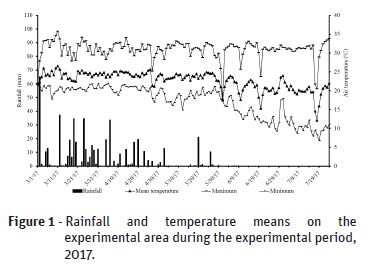
    <p><font face = "Verdana" size = "2">Mean
rates for maximum, medium and minimum temperatures were 30.9; 22.7 and 17.1<sup>°</sup>C
respectively, with rainfall rate at 510.4 mm (<a href = "#f1">Figure 1</a>). These rates attended to
the crop’s hydric demand, since it required an accumulated rainfall between 450
and 800 mm, regularly distributed throughout the cycle (Bergamaschi and Matzenauer,
2014).</font></p>

    <p>&nbsp;</p>

<a name = "f1"><img src = "/img/revistas/rca/v42n1/v42n1a25f1.jpg"></a>

    
<p>&nbsp;</p>

    <p><font face = "Verdana" size = "2">Regardless of form and dose, the application of
Zn failed to provide a significant increase in plant height (PH), diameter of spike
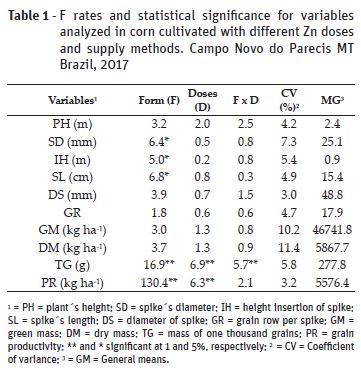
(DS), grain rows per spike (GR), green mass (GM) and dry mass (DM) (<a href = "#t1">Table 1</a>). The
above may be due to the initial Zn rates in the soil, corroborated by Muner <i>et
al</i>. (2011).</font></p>

    <p>&nbsp;</p>

<a name = "t1"><img src = "/img/revistas/rca/v42n1/v42n1a25t1.jpg"></a>

    
<p>&nbsp;</p>

    <p><font face = "Verdana" size = "2">In the case of non-significant variables, general
means (GM) and coefficients of variance (CV) for PH were respectively 2.4 m and
4.2% (<a href = "#t1">Table 1</a>); 48.8 mm and 3.0% for DS; 17.9 and 4.7% for GR; 46741.8 kg ha<sup>-1
</sup>and 10.2% for GM; 5867.7 kg ha<sup>-1</sup> and 11.4% for DM. However, there
was a significant effect for Zn supply method and dose for variables stalk diameter
(SD), spike insertion height (IH), spike length (SL), mass of one thousand grains
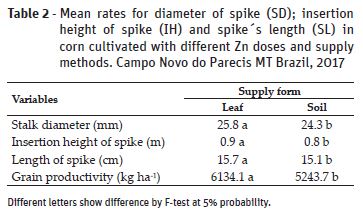
(TG) and grain productivity (GP) (<a href = "#t1">Table 1</a>). Leaf-supplied Zn provided greater development
for SD, IH and SL, with a respective increase of 6.2; 12.5 and 4.0%, when compared
to supply through soil (<a href = "#t2">Table 2</a>).</font></p>

    ]]></body>
<body><![CDATA[<p>&nbsp;</p>

<a name = "t2"><img src = "/img/revistas/rca/v42n1/v42n1a25t2.jpg"></a>

    
<p>&nbsp;</p>

    <p><font face = "Verdana" size = "2">According
to Serra <i>et al. </i>(2011), glyphosate decreases Zn rates in plants and may have
jeopardized performance of the plants´ DC, IH and SL when the nutrient was applied
through the soil during sowing (prior to the application of glyphosate for the control
of invading plants). The above contrasted Zn supply through leaves at V4 (after
the application of glyphosate) and may have been the cause of a greater accumulation
through Zn leaf application (23.1 mg dm<sup>-3</sup> when nutrient was supplied
by leaf application and 19.6 mg dm<sup>-3</sup> by soil application), with direct
influence on the variables under analysis. The best vegetal development by Zn leaf
application may be associated to the nutrient´s important role as the component
of several enzymes and formation of auxins which cause vegetal growth (Taiz <i>et
al</i>., 2017).</font></p>

    <p><font face = "Verdana" size = "2">In his research
on Zn doses (0; 1.0; 2.5; 5.0; 10.0 kg ha<sup>-1</sup>) supplied at corn sowing
during the summer in Manaus AM Brazil, Abreu (2012) did not report any significant
effect for variables PH and IH, respectively with means 2.12 m and 1.08 m, in contrast
to current study with regard to the latter.</font></p>

    <p><font face = "Verdana" size = "2">Further, Abreu <i>et al</i>. (2016) evaluated Zn doses (0; 1.0; 2.5; 5.0;
10.0 kg ha<sup>-1</sup>) supplied through soil immediately at the sowing of summer
corn in Iranduba AM Brazil, and did not report any significant effect for IH and
SL. However, mean rates (1.08 m and 14.8 cm, respectively) were close to those in
current study (<a href = "#t2">Table 2</a>). This fact was corroborated by Steiner <i>et al</i>. (2011)
in their analysis of Zn doses through soil (0; 5.0; 10.0 kg ha<sup>-1</sup>) for
the agronomic performance of inter-harvest corn in Mercedez PR Brazil. The authors
did not register any significant effect for IH (0.8 m) and SD (29.4 mm).</font></p>


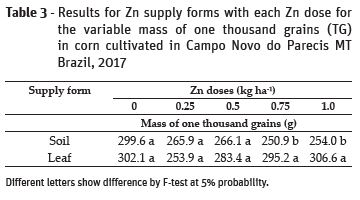
    <p><font face = "Verdana" size = "2">It has been observed that in the interface between
supply forms and Zn doses (<a href = "#t3">Table 3</a>), interaction occurred only for doses above 0.75
kg ha<sup>-1</sup> for TG. Supply through leaf revealed heavier grains and thus
higher grain productivity rates, regardless of the dose. The above proved the importance
of Zn supply by leaf application, especially with hybrid corn RR, due to the effect
of glyphosate in the metabolism of the nutrient (Taiz <i>et al</i>., 2017). Farinelli
and Lemos (2012) corroborated the above when they reported that grain mass is a
characteristic influenced by Zn availability and adequate forms, among other factors.</font></p>

    <p>&nbsp;</p>

<a name = "t3"><img src = "/img/revistas/rca/v42n1/v42n1a25t3.jpg"></a>

    
<p>&nbsp;</p>

    <p><font face = "Verdana" size = "2">In their study on TG and PR in Zn doses applied
to the soil at sowing, Steiner <i>et al</i>. (2011) reported significant results
for these variables, respectively at 266 g and 5465 kg ha<sup>-1</sup>, for dose
10 kg ha<sup>-1</sup>.</font></p>

    <p><font face = "Verdana" size = "2">An inverse
effect was registered between Zn supply applied to soil and thousand grain mass
(<a href = "/img/revistas/rca/v42n1/v42n1a25f2.jpg" target = "_blank">Figure 2a</a>). Or rather, the greater the Zn dose, the less was TG, with rates between
288.54 and 246.06 g, whereas Zn doses ranged between 0 and 1.0 kg ha<sup>-1</sup>.
Since there was a 17.3% decrease in grain mass, the above clearly demonstrated the
negative/toxic effect of Zn excess (Oliveira and Oliveira, 2011). According to Prado
<i>et al</i>. (2007), either a reduction in productivity may occur when Zn is absorbed
in excess or there is no positive effect in corn performance by increasing doses
due to sufficiency of Zn in the soil (Muner <i>et al</i>., 2011).</font></p>

    
]]></body>
<body><![CDATA[<p><font face = "Verdana" size = "2">Besides the occurrence of toxic effect by excess of Zn in the
soil, a nutritional imbalance may occur, which interferes in the absorption of other
nutrients, causes lignification of the plant, restricts growth of the secondary
cell wall and reduces radicular growth, affecting the absorption of nutrients in
general (Cunha <i>et al</i>., 2008; Oliveira and Oliveira, 2011). In the case of
the variable TG, Abreu <i>et al</i>. (2012) reported a greater mass rate (307.55
g) when Zn was not supplied by leaf application. However, increasing Zn doses caused
linear TG decreases, corroborating data from current analysis (<a href = "/img/revistas/rca/v42n1/v42n1a25f2.jpg" target = "_blank">Figure 2a</a>). Soares
<i>et al</i>. (2003) showed that the toxicity of some elements, such as Zn, may
reduce grain mass of corn plants in the field.</font></p>

    
<p><font face = "Verdana" size = "2">In their research on grain mass and corn productivity as a response to
Zn doses (0; 10; 20 kg ha<sup>-1</sup>) in Marechal Cândido Rondon PR Brazil, Gonçalves
Júnior <i>et al</i>. (2007) failed to obtain significant results for TG and PR.
They attributed this result to the adequate amount of Zn in the soil. Abreu <i>et
al</i>. (2016) applied doses 0; 1.0; 2.5; 5.0; 10 kg ha<sup>-1</sup> of Zn in the
soil and did not obtain any significant results for PR, with mean 4378.0 kg ha<sup>-1</sup>.
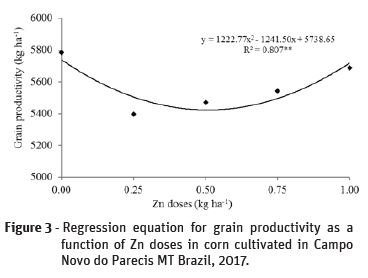
Results were different from those in current study, with greater PR rate (5785.5
kg ha<sup>-1</sup>) at dose 0 kg ha<sup>-1</sup> (<a href = "#f3">Figure 3</a>). However, PR decreased
when increasing doses were supplied.</font></p>

    <p>&nbsp;</p>

<a name = "f3"><img src = "/img/revistas/rca/v42n1/v42n1a25f3.jpg"></a>

    
<p>&nbsp;</p>

    <p><font face = "Verdana" size = "2">High grain
yield responses occurred in soils with great Zn deficiency (Joy <i>et al.</i>, 2015).
Consequently, productivity responses are greatly dependent on Zn rates in the soil
and foregrounds results obtained.</font></p>

    <p><font face = "Verdana" size = "3"><b>CONCLUSIONS</b></font></p>


    <p><font face = "Verdana" size = "2">The application of Zn on leaves increases stalk
diameter, spike´s insertion height and spike´s length.</font></p>

    <p><font face = "Verdana" size = "2">The mass of one thousand grains and grain productivity decrease
with increasing doses of Zn.</font></p>

    <p><font face = "Verdana" size = "2">Zinc
is highly relevant for the development of corn and its supply provide significant
responses to the variables analyzed.</font></p>

    <p>&nbsp;</p>

    ]]></body>
<body><![CDATA[<p><font face = "Verdana" size = "3"><b>References</b></font></p>


    <!-- ref --><p><font face = "Verdana" size = "2">Abreu, D.J.A.A.; Gonçalves, J.R.P.; De Melo, S.A.;
Oka, J.M. and Senra, T.V. (2016) - ZINCO: Necessário para a produção de milho em
solo de várzea (Iranduba) Amazonas. <i>Revista de Educação Ciência e Tecnologia
do IFAM</i>, vol. 10, n. 2, p. 120-134.    &nbsp;&nbsp;&nbsp;&nbsp;&nbsp;&nbsp;&nbsp;&nbsp;[&#160;<a href="javascript:void(0);" onclick="javascript: window.open('/scielo.php?script=sci_nlinks&ref=713084&pid=S0871-018X201900010002600001&lng=','','width=640,height=500,resizable=yes,scrollbars=1,menubar=yes,');">Links</a>&#160;]<!-- end-ref --></font></p>

    <!-- ref --><p><font face = "Verdana" size = "2">Abreu, J.A.A.D. (2012) - <i>Doses de Zinco em dois genótipos de milho em gleissolo
háplico no município de Iranduba-AM</i>. Master´s Dissertation in Tropical Agronomy.
Manaus, Universidade Federal do Amazonas faculdade de ciências Agrárias. 72 p.    &nbsp;&nbsp;&nbsp;&nbsp;&nbsp;&nbsp;&nbsp;&nbsp;[&#160;<a href="javascript:void(0);" onclick="javascript: window.open('/scielo.php?script=sci_nlinks&ref=713086&pid=S0871-018X201900010002600002&lng=','','width=640,height=500,resizable=yes,scrollbars=1,menubar=yes,');">Links</a>&#160;]<!-- end-ref --></font></p>


    <!-- ref --><p><font face = "Verdana" size = "2">Araújo, E.O. and Silva, M.A.C. (2012) - Interação
boro e zinco no crescimento, desenvolvimento e nutrição do algodoeiro. Revista Brasileira
de Ciências Agrárias, vol. 7, n. 1, p. 720-727. <a href = "http://dx.doi.org/10.5039/agraria.v7isa1848" target = "_blank">http://dx.doi.org/10.5039/agraria.v7isa1848</a></font>&nbsp;&nbsp;&nbsp;&nbsp;&nbsp;&nbsp;&nbsp;&nbsp;[&#160;<a href="javascript:void(0);" onclick="javascript: window.open('/scielo.php?script=sci_nlinks&ref=713088&pid=S0871-018X201900010002600003&lng=','','width=640,height=500,resizable=yes,scrollbars=1,menubar=yes,');">Links</a>&#160;]<!-- end-ref --><!-- ref --><p><font face = "Verdana" size = "2">Bergamaschi, H. and Matzenauer, R. (2014) - <i>O
milho e o clima</i>. Porto Alegre: Emater/RS-Ascar. p. 85.    &nbsp;&nbsp;&nbsp;&nbsp;&nbsp;&nbsp;&nbsp;&nbsp;[&#160;<a href="javascript:void(0);" onclick="javascript: window.open('/scielo.php?script=sci_nlinks&ref=713089&pid=S0871-018X201900010002600004&lng=','','width=640,height=500,resizable=yes,scrollbars=1,menubar=yes,');">Links</a>&#160;]<!-- end-ref --></font></p>

    <!-- ref --><p><font face = "Verdana" size = "2">Cardoso, F.R.; Galante, A.H.; Teixeira, I.R.; Da Silva,
A.G. and dos Reis, E.F. (2013) - Fontes e doses de zinco na nutrição e produção
de feijão-comum e mamona em consórcio<i>. Revista Brasileira de Ciências Agrárias</i>,
vol. 8, n. 4, p. 602-609. <a href = "http://dx.doi.org/10.5039/agraria.v8i4a3417" target = "_blank">http://dx.doi.org/10.5039/agraria.v8i4a3417</a></font>&nbsp;&nbsp;&nbsp;&nbsp;&nbsp;&nbsp;&nbsp;&nbsp;[&#160;<a href="javascript:void(0);" onclick="javascript: window.open('/scielo.php?script=sci_nlinks&ref=713091&pid=S0871-018X201900010002600005&lng=','','width=640,height=500,resizable=yes,scrollbars=1,menubar=yes,');">Links</a>&#160;]<!-- end-ref --><!-- ref --><p><font face = "Verdana" size = "2">Cunha, K.P.V.; Araújo, N.C.W.; Magalhães, M.P.R.;
Aguiar, A.A.M.D. and Silva, A.J.D. (2008) - Disponibilidade, acúmulo e toxidez de
cádmio e zinco em milho cultivado em solo contaminado. <i>Revista Brasileira de
Ciência do Solo</i>, vol. 32, n. 3, p. 1319-1328. <a href = "http://dx.doi.org/10.1590/S0100-06832008000300039" target = "_blank">http://dx.doi.org/10.1590/S0100-06832008000300039</a></font>&nbsp;&nbsp;&nbsp;&nbsp;&nbsp;&nbsp;&nbsp;&nbsp;[&#160;<a href="javascript:void(0);" onclick="javascript: window.open('/scielo.php?script=sci_nlinks&ref=713092&pid=S0871-018X201900010002600006&lng=','','width=640,height=500,resizable=yes,scrollbars=1,menubar=yes,');">Links</a>&#160;]<!-- end-ref --><!-- ref --><p><font face = "Verdana" size = "2">CONAB (2017) - <i>Acompanhamento de safra brasileira
de grãos, safra 2016/2017: 12º Levantamento da Safra de Grãos.</i> 154 p. Companhia
Nacional de Abastecimento. [cit. 2017-10-15].
&lt;<a href = "http://www.conab.gov.br/OlalaCMS/uploads/arquivos/17_09_12_10_14_36_boletim_graos_setembro_2017" target = "_blank">http://www.conab.gov.br/OlalaCMS/uploads/arquivos/17_09_12_10_14_36_boletim_graos_setembro_2017</a>&gt;    &nbsp;&nbsp;&nbsp;&nbsp;&nbsp;&nbsp;&nbsp;&nbsp;[&#160;<a href="javascript:void(0);" onclick="javascript: window.open('/scielo.php?script=sci_nlinks&ref=713093&pid=S0871-018X201900010002600007&lng=','','width=640,height=500,resizable=yes,scrollbars=1,menubar=yes,');">Links</a>&#160;]<!-- end-ref --></font></p>


    <!-- ref --><p><font face = "Verdana" size = "2">Dalchiavon, F.C.; Carvalho, M.P.; Freddi, O.S.;
Andreotti, M. and Montanari, R. (2011) - Variabilidade espacial da produtividade
do feijoeiro correlacionada com atributos químicos de um Latossolo Vermelho Distroférrico
sob sistema de semeadura direta. <i>Bragantia</i>. vol. 70, n. 4, p. 908-916.
<a href = "http://dx.doi.org/10.1590/S0006-87052011000400025" target = "_blank">http://dx.doi.org/10.1590/S0006-87052011000400025</a></font>&nbsp;&nbsp;&nbsp;&nbsp;&nbsp;&nbsp;&nbsp;&nbsp;[&#160;<a href="javascript:void(0);" onclick="javascript: window.open('/scielo.php?script=sci_nlinks&ref=713095&pid=S0871-018X201900010002600008&lng=','','width=640,height=500,resizable=yes,scrollbars=1,menubar=yes,');">Links</a>&#160;]<!-- end-ref --><!-- ref --><p><font face = "Verdana" size = "2">Dallacort, R.; Martins. J.A.; Inoue, M.H.; Freitas.
P.S.L. and Coletti, A.J. (2011) - Distribuição das chuvas no município de Tangará
da Serra, médio norte do Estado de Mato Grosso, Brasil. <i>Acta Scientiarum Agronomy</i>,
vol. 33, n. 2, p. 193-200. <a href = "http://dx.doi.org/10.4025/actasciagron.v33i2.5838" target = "_blank">http://dx.doi.org/10.4025/actasciagron.v33i2.5838</a></font>&nbsp;&nbsp;&nbsp;&nbsp;&nbsp;&nbsp;&nbsp;&nbsp;[&#160;<a href="javascript:void(0);" onclick="javascript: window.open('/scielo.php?script=sci_nlinks&ref=713096&pid=S0871-018X201900010002600009&lng=','','width=640,height=500,resizable=yes,scrollbars=1,menubar=yes,');">Links</a>&#160;]<!-- end-ref --><!-- ref --><p><font face = "Verdana" size = "2">Farinelli, R. and Lemos, L.B. (2012) - Nitrogênio
em cobertura na cultura do milho em preparo convencional e plantio direto consolidado.
<i>Pesquisa Agropecuária Tropical</i>. vol. 42, n. 1, p. 63-70.    &nbsp;&nbsp;&nbsp;&nbsp;&nbsp;&nbsp;&nbsp;&nbsp;[&#160;<a href="javascript:void(0);" onclick="javascript: window.open('/scielo.php?script=sci_nlinks&ref=713097&pid=S0871-018X201900010002600010&lng=','','width=640,height=500,resizable=yes,scrollbars=1,menubar=yes,');">Links</a>&#160;]<!-- end-ref --></font></p>

    <!-- ref --><p><font face = "Verdana" size = "2">Ferreira, D.F. (2011) - Sisvar. A Computer Statistical Analysis
System. <i>Ciência e Agrotecnologia</i>. vol. 35, n. 6, p. 1039-1042.
<a href = "http://dx.doi.org/10.1590/S1413-70542011000600001" target = "_blank">http://dx.doi.org/10.1590/S1413-70542011000600001</a></font>&nbsp;&nbsp;&nbsp;&nbsp;&nbsp;&nbsp;&nbsp;&nbsp;[&#160;<a href="javascript:void(0);" onclick="javascript: window.open('/scielo.php?script=sci_nlinks&ref=713099&pid=S0871-018X201900010002600011&lng=','','width=640,height=500,resizable=yes,scrollbars=1,menubar=yes,');">Links</a>&#160;]<!-- end-ref --><!-- ref --><p><font face = "Verdana" size = "2">Ferreira, M.M.M. (2012) - Sintomas de deficiência
de macro e micronutrientes de plantas de milho híbrido BRS 1010. <i>Revista Agro@mbiente
On-line</i>, vol. 6, n. 1, p. 74-83.
<a href = "http://dx.doi.org/10.18227/1982-8470ragro.v6i1.569" target = "_blank">http://dx.doi.org/10.18227/1982-8470ragro.v6i1.569</a></font>&nbsp;&nbsp;&nbsp;&nbsp;&nbsp;&nbsp;&nbsp;&nbsp;[&#160;<a href="javascript:void(0);" onclick="javascript: window.open('/scielo.php?script=sci_nlinks&ref=713100&pid=S0871-018X201900010002600012&lng=','','width=640,height=500,resizable=yes,scrollbars=1,menubar=yes,');">Links</a>&#160;]<!-- end-ref --><!-- ref --><p><font face = "Verdana" size = "2">Gonçalves Júnior, A.C.; Trautmann, R.R.; Marengoni,
N.G.; Ribeiro, O.L. and Santos, A.L. (2007) - Produtividade do milho em resposta
a adubação com NPK e Zn em Argissolo Vermelho-Amarelo Eutrófico e Latossolo Vermelho
Eutroférrico. <i>Ciência e Agrotecnologia</i>, vol. 31, n. 4, p. 1231-1236.
<a href = "http://dx.doi.org/10.1590/S1413-70542007000400043" target = "_blank">http://dx.doi.org/10.1590/S1413-70542007000400043</a></font>&nbsp;&nbsp;&nbsp;&nbsp;&nbsp;&nbsp;&nbsp;&nbsp;[&#160;<a href="javascript:void(0);" onclick="javascript: window.open('/scielo.php?script=sci_nlinks&ref=713101&pid=S0871-018X201900010002600013&lng=','','width=640,height=500,resizable=yes,scrollbars=1,menubar=yes,');">Links</a>&#160;]<!-- end-ref --><!-- ref --><p><font face = "Verdana" size = "2">Inocêncio, M.F.; De Resende, Á.V.; Neto, A.E.F.;
Veloso, M.P.; Ferraz, F.M. and Hickmann, C. (2012) - Resposta da soja à adubação
com zinco em solo com teores acima do nível crítico. <i>Pesquisa Agropecuária Brasileira</i>,
vol. 47, n. 10, p. 1550-1554. <a href = "http://dx.doi.org/10.1590/S0100-204X2012001000020" target = "_blank">http://dx.doi.org/10.1590/S0100-204X2012001000020</a></font>&nbsp;&nbsp;&nbsp;&nbsp;&nbsp;&nbsp;&nbsp;&nbsp;[&#160;<a href="javascript:void(0);" onclick="javascript: window.open('/scielo.php?script=sci_nlinks&ref=713102&pid=S0871-018X201900010002600014&lng=','','width=640,height=500,resizable=yes,scrollbars=1,menubar=yes,');">Links</a>&#160;]<!-- end-ref --><!-- ref --><p><font face = "Verdana" size = "2">Joy, E.J.; Stein, A.J.; Young, S.D.; Ander, E.L.;
Watts, M.J. and Broadley, M.R. (2015) - Zinc-enriched fertilizers as a potential
public health intervention in Africa. <i>Plant and Soil</i>, vol. 389, n. 1-2, p.
1-24. <a href = "https://doi.org/10.1007/s11104-015-2430-8" target="_blank">http://dx.doi.org/10.1007/s11104-015-2430-8</a></font>&nbsp;&nbsp;&nbsp;&nbsp;&nbsp;&nbsp;&nbsp;&nbsp;[&#160;<a href="javascript:void(0);" onclick="javascript: window.open('/scielo.php?script=sci_nlinks&ref=713103&pid=S0871-018X201900010002600015&lng=','','width=640,height=500,resizable=yes,scrollbars=1,menubar=yes,');">Links</a>&#160;]<!-- end-ref --><!-- ref --><p><font face = "Verdana" size = "2">Maróstica, L.H.B. and Feijó, S. (2015) - Efeito
da Adubação Foliar no Período Vegetativo da Cultura do Milho (<i>Zea mays</i>).
<i>Uniciências</i>, vol. 17, n. 1, p. 37-40.    &nbsp;&nbsp;&nbsp;&nbsp;&nbsp;&nbsp;&nbsp;&nbsp;[&#160;<a href="javascript:void(0);" onclick="javascript: window.open('/scielo.php?script=sci_nlinks&ref=713104&pid=S0871-018X201900010002600016&lng=','','width=640,height=500,resizable=yes,scrollbars=1,menubar=yes,');">Links</a>&#160;]<!-- end-ref --></font></p>

    <!-- ref --><p><font face = "Verdana" size = "2">Muner, D.L.H.; Ruiz, H.A.; Venegas, V.H.; Neves, J.C.; Freire, F.J.D.S.F.
and Maria, B.G. (2011) - Disponibilidade de zinco para milho em resposta à localização
de fósforo no solo. <i>Revista Brasileira de Engenharia Agrícola e Ambiental</i>,
vol. 15, n. 1, p. 29-36. <a href = "http://dx.doi.org/10.1590/S1415-43662011000100005" target = "_blank">http://dx.doi.org/10.1590/S1415-43662011000100005</a></font>&nbsp;&nbsp;&nbsp;&nbsp;&nbsp;&nbsp;&nbsp;&nbsp;[&#160;<a href="javascript:void(0);" onclick="javascript: window.open('/scielo.php?script=sci_nlinks&ref=713106&pid=S0871-018X201900010002600017&lng=','','width=640,height=500,resizable=yes,scrollbars=1,menubar=yes,');">Links</a>&#160;]<!-- end-ref --><!-- ref --><p><font face = "Verdana" size = "2">Meneghette, H.H.A.; Lazarini, E.; Bossolani, J.W.;
Parra, L.F. and Hayashi, F.K. (2017) - doses of phosphorus and potassium in peanut
plant in the presence and absence of foliar fertilization<i>. Revista Brasileira
de Engenharia de Biossistemas</i>, vol. 11, n. 2, p. 125-134.
<a href = "http://dx.doi.org/10.18011/bioeng2017v11n2p125-134" target = "_blank">http://dx.doi.org/10.18011/bioeng2017v11n2p125-134</a></font>&nbsp;&nbsp;&nbsp;&nbsp;&nbsp;&nbsp;&nbsp;&nbsp;[&#160;<a href="javascript:void(0);" onclick="javascript: window.open('/scielo.php?script=sci_nlinks&ref=713107&pid=S0871-018X201900010002600018&lng=','','width=640,height=500,resizable=yes,scrollbars=1,menubar=yes,');">Links</a>&#160;]<!-- end-ref --><!-- ref --><p><font face = "Verdana" size = "2">Oliveira, I.P. and Oliveira, L.C. (2011) - Metais
pesados. <i>Revista Eletrônica Faculdade de Iporá</i>, vol. 1, n. 1, p. 59-86.    &nbsp;&nbsp;&nbsp;&nbsp;&nbsp;&nbsp;&nbsp;&nbsp;[&#160;<a href="javascript:void(0);" onclick="javascript: window.open('/scielo.php?script=sci_nlinks&ref=713108&pid=S0871-018X201900010002600019&lng=','','width=640,height=500,resizable=yes,scrollbars=1,menubar=yes,');">Links</a>&#160;]<!-- end-ref --></font></p>


    <!-- ref --><p><font face = "Verdana" size = "2">Osório, C.W.; Bardiviesso, D.M.; De Souza, E.I.S.;
Da Costa Leite, R.; Leal, A.J.F. and de Souza, H.M. (2015) - Milho RR submetido
a diferentes manejos de herbicidas e adubação foliar. <i>Nativa</i>, vol. 3, n.
2, p. 78-82, 2015. <a href = "http://dx.doi.org/10.14583/2318-7670.v03n02a01" target = "_blank">http://dx.doi.org/10.14583/2318-7670.v03n02a01</a></font>&nbsp;&nbsp;&nbsp;&nbsp;&nbsp;&nbsp;&nbsp;&nbsp;[&#160;<a href="javascript:void(0);" onclick="javascript: window.open('/scielo.php?script=sci_nlinks&ref=713110&pid=S0871-018X201900010002600020&lng=','','width=640,height=500,resizable=yes,scrollbars=1,menubar=yes,');">Links</a>&#160;]<!-- end-ref --><!-- ref --><p><font face = "Verdana" size = "2">Prado, R.M.; Romualdo, L.M.; Rozane, D.E.; Vidal,
A.A. and Marcelo, A.V. (2007) - Modos de aplicação de zinco na nutrição e na produção
de matéria seca do milho BRS 1001. <i>Bioscience Journal</i>. vol. 24, n. 1, p.
67-74.    &nbsp;&nbsp;&nbsp;&nbsp;&nbsp;&nbsp;&nbsp;&nbsp;[&#160;<a href="javascript:void(0);" onclick="javascript: window.open('/scielo.php?script=sci_nlinks&ref=713111&pid=S0871-018X201900010002600021&lng=','','width=640,height=500,resizable=yes,scrollbars=1,menubar=yes,');">Links</a>&#160;]<!-- end-ref --></font></p>

    ]]></body>
<body><![CDATA[<!-- ref --><p><font face = "Verdana" size = "2">Prado, C.H.B.A. (2013) - <i>Aquisição
dos nutrientes minerais na solução do solo</i>. Ed. 1. Editora Expressa, p. 188.    &nbsp;&nbsp;&nbsp;&nbsp;&nbsp;&nbsp;&nbsp;&nbsp;[&#160;<a href="javascript:void(0);" onclick="javascript: window.open('/scielo.php?script=sci_nlinks&ref=713113&pid=S0871-018X201900010002600022&lng=','','width=640,height=500,resizable=yes,scrollbars=1,menubar=yes,');">Links</a>&#160;]<!-- end-ref --></font></p>


    <!-- ref --><p><font face = "Verdana" size = "2">Salimpour, S.; Khavazi, K.; Nadian, H.; Besharati,
H. and Miransari, M. (2010) - Enhancing phosphoous availability to canola (Brassica
napus L.) using P solubilizing and sulfur oxidizing bacteria. Australian Journal
of Crop Science, vol. 4, n. 5, p. 330-334.    &nbsp;&nbsp;&nbsp;&nbsp;&nbsp;&nbsp;&nbsp;&nbsp;[&#160;<a href="javascript:void(0);" onclick="javascript: window.open('/scielo.php?script=sci_nlinks&ref=713115&pid=S0871-018X201900010002600023&lng=','','width=640,height=500,resizable=yes,scrollbars=1,menubar=yes,');">Links</a>&#160;]<!-- end-ref --> </font></p>

    <!-- ref --><p><font face = "Verdana" size = "2">Santos, R.F.; Isobe, M.T.C.; Lalla, J.G.; Haber, L.L.; Marques, M.O.M. and Ming,
L.C. (2012) - Composição química e produtividade dos principais componentes do óleo
essencial de Baccharis dracunculifolia DC. em função da adubação orgânica. Revista
Brasileira de Plantas Medicinais, vol. 14, n. especial, p. 224-234.
<a href = "http://dx.doi.org/10.1590/S1516-05722012000500017" target = "_blank">http://dx.doi.org/10.1590/S1516-05722012000500017</a></font>&nbsp;&nbsp;&nbsp;&nbsp;&nbsp;&nbsp;&nbsp;&nbsp;[&#160;<a href="javascript:void(0);" onclick="javascript: window.open('/scielo.php?script=sci_nlinks&ref=713117&pid=S0871-018X201900010002600024&lng=','','width=640,height=500,resizable=yes,scrollbars=1,menubar=yes,');">Links</a>&#160;]<!-- end-ref --><!-- ref --><p><font face = "Verdana" size = "2">Santos, H.G.; Jacomine, P.K.T.; Anjos, L.H.C.
dos; Oliveira, V.A.; Lumbreras, J.F.; Coelho, M.R.; Almeida, J.A.; Cunha, T.J.F.
and Oliveira, J.B. (2013) - <i>Sistema brasileiro de classificação de solos</i>.
3.ed. Brasília: Embrapa, 353 p.    &nbsp;&nbsp;&nbsp;&nbsp;&nbsp;&nbsp;&nbsp;&nbsp;[&#160;<a href="javascript:void(0);" onclick="javascript: window.open('/scielo.php?script=sci_nlinks&ref=713118&pid=S0871-018X201900010002600025&lng=','','width=640,height=500,resizable=yes,scrollbars=1,menubar=yes,');">Links</a>&#160;]<!-- end-ref --></font></p>

    <!-- ref --><p><font face = "Verdana" size = "2">Serra,
A.; Marchetti, M.E.; Candido, A.C.D.S.; Dias, A.C.R. and Christoffoleti, P.J. (2011)
- Glyphosate influence on nitrogen, manganese, iron, copper and zinc nutritional
efficiency in glyphosate resistant soybean. <i>Ciência Rural</i>. vol. 41, n. 1,
p. 77-84. <a href = "http://dx.doi.org/10.1590/S0103-84782011000100013" target = "_blank">http://dx.doi.org/10.1590/S0103-84782011000100013</a></font>&nbsp;&nbsp;&nbsp;&nbsp;&nbsp;&nbsp;&nbsp;&nbsp;[&#160;<a href="javascript:void(0);" onclick="javascript: window.open('/scielo.php?script=sci_nlinks&ref=713120&pid=S0871-018X201900010002600026&lng=','','width=640,height=500,resizable=yes,scrollbars=1,menubar=yes,');">Links</a>&#160;]<!-- end-ref --><!-- ref --><p><font face = "Verdana" size = "2">Souza, D.M.G. and Lobato, E. (2004) <i>- Calagem e adubação
para culturas anuais e semiperenes</i>. 2º ed. Brasilia, Embrapa, Correção do solo
e adubação, 416 p.    &nbsp;&nbsp;&nbsp;&nbsp;&nbsp;&nbsp;&nbsp;&nbsp;[&#160;<a href="javascript:void(0);" onclick="javascript: window.open('/scielo.php?script=sci_nlinks&ref=713121&pid=S0871-018X201900010002600027&lng=','','width=640,height=500,resizable=yes,scrollbars=1,menubar=yes,');">Links</a>&#160;]<!-- end-ref --></font></p>

    ]]></body>
<body><![CDATA[<!-- ref --><p><font face = "Verdana" size = "2">Soares, M.A. (2003)
- <i>Influência de nitrogênio, zinco e boro e de suas respectivas interações no
desempenho da cultura de milho</i>. Dissertação de Mestrado em Agronomia/Fitotecnia.
Piracicaba, Escola Superior de Agricultura Luiz de Queiroz, 92 p.    &nbsp;&nbsp;&nbsp;&nbsp;&nbsp;&nbsp;&nbsp;&nbsp;[&#160;<a href="javascript:void(0);" onclick="javascript: window.open('/scielo.php?script=sci_nlinks&ref=713123&pid=S0871-018X201900010002600028&lng=','','width=640,height=500,resizable=yes,scrollbars=1,menubar=yes,');">Links</a>&#160;]<!-- end-ref --></font></p>

 
    <!-- ref --><p><font face = "Verdana" size = "2">Steiner, F.; Zoz, T.; Junior, A.S.P.; Frandoloso,
J.F.; Ruppenthal, V. and Janegitz, M.C. (2011) - Zinco e nitrogênio no desempenho
agronômico do milho safrinha. <i>Global Science na Technology</i>, vol. 4, n. 2
p. 9-17.    &nbsp;&nbsp;&nbsp;&nbsp;&nbsp;&nbsp;&nbsp;&nbsp;[&#160;<a href="javascript:void(0);" onclick="javascript: window.open('/scielo.php?script=sci_nlinks&ref=713125&pid=S0871-018X201900010002600029&lng=','','width=640,height=500,resizable=yes,scrollbars=1,menubar=yes,');">Links</a>&#160;]<!-- end-ref --></font></p>

    <!-- ref --><p><font face = "Verdana" size = "2">Taiz, L.; Zeiger, E.; Moller,
I.M. and Murphy, A. (2017) - <i>Fisiologia e desenvolvimento vegetal</i>. 6. ed.
Porto Alegre, Artmed, 888 p.    &nbsp;&nbsp;&nbsp;&nbsp;&nbsp;&nbsp;&nbsp;&nbsp;[&#160;<a href="javascript:void(0);" onclick="javascript: window.open('/scielo.php?script=sci_nlinks&ref=713127&pid=S0871-018X201900010002600030&lng=','','width=640,height=500,resizable=yes,scrollbars=1,menubar=yes,');">Links</a>&#160;]<!-- end-ref --></font></p>

    <!-- ref --><p><font face = "Verdana" size = "2">Zucareli,
C.; Prando, A.M.; Ramos Junior, E.U. and Nakagawa, J. (2011) - Fósforo na produtividade
e qualidade de sementes de feijão Carioca Precoce cultivado no período das águas.
<i>Revista Ciência Agronômica</i>, vol. 42, n. 1, p. 32-38.
<a href = "http://dx.doi.org/10.1590/S1806-66902011000100005" target = "_blank">http://dx.doi.org/10.1590/S1806-66902011000100005</a></font>&nbsp;&nbsp;&nbsp;&nbsp;&nbsp;&nbsp;&nbsp;&nbsp;[&#160;<a href="javascript:void(0);" onclick="javascript: window.open('/scielo.php?script=sci_nlinks&ref=713129&pid=S0871-018X201900010002600031&lng=','','width=640,height=500,resizable=yes,scrollbars=1,menubar=yes,');">Links</a>&#160;]<!-- end-ref --><p>&nbsp;</p>

    <p><font face = "Verdana" size = "3"><b>Acknowledgements</b></font></p>

    <p><font face = "Verdana" size = "2">The authors would like to thank the Research Group
in Phytotechny (GPF) of the Federal Institute of Education, Science and Technology
of Mato Grosso (IFMT), campus Campo Novo do Parecis, for its collaboration in current
assay.</font></p>

    ]]></body>
<body><![CDATA[<p>&nbsp;</p>

    <p><font face = "Verdana" size = "2">Received/recebido: 2018.04.15</font></p>

    <p><font face = "Verdana" size = "2">Accepted/aceite: 2018.09.19</font></p>

     ]]></body><back>
<ref-list>
<ref id="B1">
<nlm-citation citation-type="journal">
<person-group person-group-type="author">
<name>
<surname><![CDATA[Abreu]]></surname>
<given-names><![CDATA[D.J.A.A.]]></given-names>
</name>
<name>
<surname><![CDATA[Gonçalves]]></surname>
<given-names><![CDATA[J.R.P.]]></given-names>
</name>
<name>
<surname><![CDATA[De Melo]]></surname>
<given-names><![CDATA[S.A.]]></given-names>
</name>
<name>
<surname><![CDATA[Oka]]></surname>
<given-names><![CDATA[J.M.]]></given-names>
</name>
<name>
<surname><![CDATA[Senra]]></surname>
<given-names><![CDATA[T.V.]]></given-names>
</name>
</person-group>
<article-title xml:lang="pt"><![CDATA[ZINCO: Necessário para a produção de milho em solo de várzea (Iranduba) Amazonas]]></article-title>
<source><![CDATA[Revista de Educação Ciência e Tecnologia do IFAM]]></source>
<year>2016</year>
<volume>10</volume>
<numero>2</numero>
<issue>2</issue>
<page-range>120-134</page-range></nlm-citation>
</ref>
<ref id="B2">
<nlm-citation citation-type="">
<person-group person-group-type="author">
<name>
<surname><![CDATA[Abreu]]></surname>
<given-names><![CDATA[J.A.A.D.]]></given-names>
</name>
</person-group>
<source><![CDATA[Doses de Zinco em dois genótipos de milho em gleissolo háplico no município de Iranduba-AM]]></source>
<year>2012</year>
</nlm-citation>
</ref>
<ref id="B3">
<nlm-citation citation-type="journal">
<person-group person-group-type="author">
<name>
<surname><![CDATA[Araújo]]></surname>
<given-names><![CDATA[E.O.]]></given-names>
</name>
<name>
<surname><![CDATA[Silva]]></surname>
<given-names><![CDATA[M.A.C.]]></given-names>
</name>
</person-group>
<article-title xml:lang="pt"><![CDATA[Interação boro e zinco no crescimento, desenvolvimento e nutrição do algodoeiro]]></article-title>
<source><![CDATA[Revista Brasileira de Ciências Agrárias]]></source>
<year>2012</year>
<volume>7</volume>
<numero>1</numero>
<issue>1</issue>
<page-range>720-727</page-range></nlm-citation>
</ref>
<ref id="B4">
<nlm-citation citation-type="book">
<person-group person-group-type="author">
<name>
<surname><![CDATA[Bergamaschi]]></surname>
<given-names><![CDATA[H.]]></given-names>
</name>
<name>
<surname><![CDATA[Matzenauer]]></surname>
<given-names><![CDATA[R.]]></given-names>
</name>
</person-group>
<source><![CDATA[O milho e o clima]]></source>
<year>2014</year>
<page-range>85</page-range><publisher-loc><![CDATA[Porto Alegre ]]></publisher-loc>
<publisher-name><![CDATA[Emater/RS-Ascar]]></publisher-name>
</nlm-citation>
</ref>
<ref id="B5">
<nlm-citation citation-type="journal">
<person-group person-group-type="author">
<name>
<surname><![CDATA[Cardoso]]></surname>
<given-names><![CDATA[F.R.]]></given-names>
</name>
<name>
<surname><![CDATA[Galante]]></surname>
<given-names><![CDATA[A.H.]]></given-names>
</name>
<name>
<surname><![CDATA[Teixeira]]></surname>
<given-names><![CDATA[I.R.]]></given-names>
</name>
<name>
<surname><![CDATA[Da Silva]]></surname>
<given-names><![CDATA[A.G.]]></given-names>
</name>
<name>
<surname><![CDATA[dos Reis]]></surname>
<given-names><![CDATA[E.F.]]></given-names>
</name>
</person-group>
<article-title xml:lang="pt"><![CDATA[Fontes e doses de zinco na nutrição e produção de feijão-comum e mamona em consórcio]]></article-title>
<source><![CDATA[Revista Brasileira de Ciências Agrárias]]></source>
<year>2013</year>
<volume>8</volume>
<numero>4</numero>
<issue>4</issue>
<page-range>602-609</page-range></nlm-citation>
</ref>
<ref id="B6">
<nlm-citation citation-type="journal">
<person-group person-group-type="author">
<name>
<surname><![CDATA[Cunha]]></surname>
<given-names><![CDATA[K.P.V.]]></given-names>
</name>
<name>
<surname><![CDATA[Araújo]]></surname>
<given-names><![CDATA[N.C.W.]]></given-names>
</name>
<name>
<surname><![CDATA[Magalhães]]></surname>
<given-names><![CDATA[M.P.R.]]></given-names>
</name>
<name>
<surname><![CDATA[Aguiar]]></surname>
<given-names><![CDATA[A.A.M.D.]]></given-names>
</name>
<name>
<surname><![CDATA[Silva]]></surname>
<given-names><![CDATA[A.J.D.]]></given-names>
</name>
</person-group>
<article-title xml:lang="pt"><![CDATA[Disponibilidade, acúmulo e toxidez de cádmio e zinco em milho cultivado em solo contaminado]]></article-title>
<source><![CDATA[Revista Brasileira de Ciência do Solo]]></source>
<year>2008</year>
<volume>32</volume>
<numero>3</numero>
<issue>3</issue>
<page-range>1319-1328</page-range></nlm-citation>
</ref>
<ref id="B7">
<nlm-citation citation-type="book">
<collab>CONAB</collab>
<source><![CDATA[Acompanhamento de safra brasileira de grãos, safra 2016/2017: 12º Levantamento da Safra de Grãos]]></source>
<year>2017</year>
<publisher-name><![CDATA[Companhia Nacional de Abastecimento]]></publisher-name>
</nlm-citation>
</ref>
<ref id="B8">
<nlm-citation citation-type="journal">
<person-group person-group-type="author">
<name>
<surname><![CDATA[Dalchiavon]]></surname>
<given-names><![CDATA[F.C.]]></given-names>
</name>
<name>
<surname><![CDATA[Carvalho]]></surname>
<given-names><![CDATA[M.P.]]></given-names>
</name>
<name>
<surname><![CDATA[Freddi]]></surname>
<given-names><![CDATA[O.S.]]></given-names>
</name>
<name>
<surname><![CDATA[Andreotti]]></surname>
<given-names><![CDATA[M.]]></given-names>
</name>
<name>
<surname><![CDATA[Montanari]]></surname>
<given-names><![CDATA[R.]]></given-names>
</name>
</person-group>
<article-title xml:lang="pt"><![CDATA[Variabilidade espacial da produtividade do feijoeiro correlacionada com atributos químicos de um Latossolo Vermelho Distroférrico sob sistema de semeadura direta]]></article-title>
<source><![CDATA[Bragantia]]></source>
<year>2011</year>
<volume>70</volume>
<numero>4</numero>
<issue>4</issue>
<page-range>908-916</page-range></nlm-citation>
</ref>
<ref id="B9">
<nlm-citation citation-type="journal">
<person-group person-group-type="author">
<name>
<surname><![CDATA[Dallacort]]></surname>
<given-names><![CDATA[R.]]></given-names>
</name>
<name>
<surname><![CDATA[Martins]]></surname>
<given-names><![CDATA[J.A.]]></given-names>
</name>
<name>
<surname><![CDATA[Inoue]]></surname>
<given-names><![CDATA[M.H.]]></given-names>
</name>
<name>
<surname><![CDATA[Freitas]]></surname>
<given-names><![CDATA[P.S.L.]]></given-names>
</name>
<name>
<surname><![CDATA[Coletti]]></surname>
<given-names><![CDATA[A.J.]]></given-names>
</name>
</person-group>
<article-title xml:lang="pt"><![CDATA[Distribuição das chuvas no município de Tangará da Serra, médio norte do Estado de Mato Grosso, Brasil]]></article-title>
<source><![CDATA[Acta Scientiarum Agronomy]]></source>
<year>2011</year>
<volume>33</volume>
<numero>2</numero>
<issue>2</issue>
<page-range>193-200</page-range></nlm-citation>
</ref>
<ref id="B10">
<nlm-citation citation-type="journal">
<person-group person-group-type="author">
<name>
<surname><![CDATA[Farinelli]]></surname>
<given-names><![CDATA[R.]]></given-names>
</name>
<name>
<surname><![CDATA[Lemos]]></surname>
<given-names><![CDATA[L.B.]]></given-names>
</name>
</person-group>
<article-title xml:lang="pt"><![CDATA[Nitrogênio em cobertura na cultura do milho em preparo convencional e plantio direto consolidado]]></article-title>
<source><![CDATA[Pesquisa Agropecuária Tropical]]></source>
<year>2012</year>
<volume>42</volume>
<numero>1</numero>
<issue>1</issue>
<page-range>63-70</page-range></nlm-citation>
</ref>
<ref id="B11">
<nlm-citation citation-type="journal">
<person-group person-group-type="author">
<name>
<surname><![CDATA[Ferreira]]></surname>
<given-names><![CDATA[D.F.]]></given-names>
</name>
</person-group>
<article-title xml:lang="en"><![CDATA[Sisvar: A Computer Statistical Analysis System]]></article-title>
<source><![CDATA[Ciência e Agrotecnologia]]></source>
<year>2011</year>
<volume>35</volume>
<numero>6</numero>
<issue>6</issue>
<page-range>1039-1042</page-range></nlm-citation>
</ref>
<ref id="B12">
<nlm-citation citation-type="journal">
<person-group person-group-type="author">
<name>
<surname><![CDATA[Ferreira]]></surname>
<given-names><![CDATA[M.M.M.]]></given-names>
</name>
</person-group>
<article-title xml:lang="pt"><![CDATA[Sintomas de deficiência de macro e micronutrientes de plantas de milho híbrido BRS 1010]]></article-title>
<source><![CDATA[Revista Agro@mbiente On-line]]></source>
<year>2012</year>
<volume>6</volume>
<numero>1</numero>
<issue>1</issue>
<page-range>74-83</page-range></nlm-citation>
</ref>
<ref id="B13">
<nlm-citation citation-type="journal">
<person-group person-group-type="author">
<name>
<surname><![CDATA[Gonçalves Júnior]]></surname>
<given-names><![CDATA[A.C.]]></given-names>
</name>
<name>
<surname><![CDATA[Trautmann]]></surname>
<given-names><![CDATA[R.R.]]></given-names>
</name>
<name>
<surname><![CDATA[Marengoni]]></surname>
<given-names><![CDATA[N.G.]]></given-names>
</name>
<name>
<surname><![CDATA[Ribeiro]]></surname>
<given-names><![CDATA[O.L.]]></given-names>
</name>
<name>
<surname><![CDATA[Santos]]></surname>
<given-names><![CDATA[A.L.]]></given-names>
</name>
</person-group>
<article-title xml:lang="pt"><![CDATA[Produtividade do milho em resposta a adubação com NPK e Zn em Argissolo Vermelho-Amarelo Eutrófico e Latossolo Vermelho Eutroférrico]]></article-title>
<source><![CDATA[Ciência e Agrotecnologia]]></source>
<year>2007</year>
<volume>31</volume>
<numero>4</numero>
<issue>4</issue>
<page-range>1231-1236</page-range></nlm-citation>
</ref>
<ref id="B14">
<nlm-citation citation-type="journal">
<person-group person-group-type="author">
<name>
<surname><![CDATA[Inocêncio]]></surname>
<given-names><![CDATA[M.F.]]></given-names>
</name>
<name>
<surname><![CDATA[De Resende]]></surname>
<given-names><![CDATA[Á.V.]]></given-names>
</name>
<name>
<surname><![CDATA[Neto]]></surname>
<given-names><![CDATA[A.E.F.]]></given-names>
</name>
<name>
<surname><![CDATA[Veloso]]></surname>
<given-names><![CDATA[M.P.]]></given-names>
</name>
<name>
<surname><![CDATA[Ferraz]]></surname>
<given-names><![CDATA[F.M.]]></given-names>
</name>
<name>
<surname><![CDATA[Hickmann]]></surname>
<given-names><![CDATA[C.]]></given-names>
</name>
</person-group>
<article-title xml:lang="pt"><![CDATA[Resposta da soja à adubação com zinco em solo com teores acima do nível crítico]]></article-title>
<source><![CDATA[Pesquisa Agropecuária Brasileira]]></source>
<year>2012</year>
<volume>47</volume>
<numero>10</numero>
<issue>10</issue>
<page-range>1550-1554</page-range></nlm-citation>
</ref>
<ref id="B15">
<nlm-citation citation-type="journal">
<person-group person-group-type="author">
<name>
<surname><![CDATA[Joy]]></surname>
<given-names><![CDATA[E.J.]]></given-names>
</name>
<name>
<surname><![CDATA[Stein]]></surname>
<given-names><![CDATA[A.J.]]></given-names>
</name>
<name>
<surname><![CDATA[Young]]></surname>
<given-names><![CDATA[S.D.]]></given-names>
</name>
<name>
<surname><![CDATA[Ander]]></surname>
<given-names><![CDATA[E.L.]]></given-names>
</name>
<name>
<surname><![CDATA[Watts]]></surname>
<given-names><![CDATA[M.J.]]></given-names>
</name>
<name>
<surname><![CDATA[Broadley]]></surname>
<given-names><![CDATA[M.R.]]></given-names>
</name>
</person-group>
<article-title xml:lang="en"><![CDATA[Zinc-enriched fertilizers as a potential public health intervention in Africa]]></article-title>
<source><![CDATA[Plant and Soil]]></source>
<year>2015</year>
<volume>389</volume>
<numero>1-2</numero>
<issue>1-2</issue>
<page-range>1-24</page-range></nlm-citation>
</ref>
<ref id="B16">
<nlm-citation citation-type="journal">
<person-group person-group-type="author">
<name>
<surname><![CDATA[Maróstica]]></surname>
<given-names><![CDATA[L.H.B.]]></given-names>
</name>
<name>
<surname><![CDATA[Feijó]]></surname>
<given-names><![CDATA[S.]]></given-names>
</name>
</person-group>
<article-title xml:lang="pt"><![CDATA[Efeito da Adubação Foliar no Período Vegetativo da Cultura do Milho (Zea mays)]]></article-title>
<source><![CDATA[Uniciências]]></source>
<year>2015</year>
<volume>17</volume>
<numero>1</numero>
<issue>1</issue>
<page-range>37-40</page-range></nlm-citation>
</ref>
<ref id="B17">
<nlm-citation citation-type="journal">
<person-group person-group-type="author">
<name>
<surname><![CDATA[Muner]]></surname>
<given-names><![CDATA[D.L.H.]]></given-names>
</name>
<name>
<surname><![CDATA[Ruiz]]></surname>
<given-names><![CDATA[H.A.]]></given-names>
</name>
<name>
<surname><![CDATA[Venegas]]></surname>
<given-names><![CDATA[V.H.]]></given-names>
</name>
<name>
<surname><![CDATA[Neves]]></surname>
<given-names><![CDATA[J.C.]]></given-names>
</name>
<name>
<surname><![CDATA[Freire]]></surname>
<given-names><![CDATA[F.J.D.S.F.]]></given-names>
</name>
<name>
<surname><![CDATA[Maria]]></surname>
<given-names><![CDATA[B.G.]]></given-names>
</name>
</person-group>
<article-title xml:lang="pt"><![CDATA[Disponibilidade de zinco para milho em resposta à localização de fósforo no solo]]></article-title>
<source><![CDATA[Revista Brasileira de Engenharia Agrícola e Ambiental]]></source>
<year>2011</year>
<volume>15</volume>
<numero>1</numero>
<issue>1</issue>
<page-range>29-36</page-range></nlm-citation>
</ref>
<ref id="B18">
<nlm-citation citation-type="journal">
<person-group person-group-type="author">
<name>
<surname><![CDATA[Meneghette]]></surname>
<given-names><![CDATA[H.H.A.]]></given-names>
</name>
<name>
<surname><![CDATA[Lazarini]]></surname>
<given-names><![CDATA[E.]]></given-names>
</name>
<name>
<surname><![CDATA[Bossolani]]></surname>
<given-names><![CDATA[J.W.]]></given-names>
</name>
<name>
<surname><![CDATA[Parra]]></surname>
<given-names><![CDATA[L.F.]]></given-names>
</name>
<name>
<surname><![CDATA[Hayashi]]></surname>
<given-names><![CDATA[F.K.]]></given-names>
</name>
</person-group>
<article-title xml:lang="en"><![CDATA[doses of phosphorus and potassium in peanut plant in the presence and absence of foliar fertilization]]></article-title>
<source><![CDATA[Revista Brasileira de Engenharia de Biossistemas]]></source>
<year>2017</year>
<volume>11</volume>
<numero>2</numero>
<issue>2</issue>
<page-range>125-134</page-range></nlm-citation>
</ref>
<ref id="B19">
<nlm-citation citation-type="journal">
<person-group person-group-type="author">
<name>
<surname><![CDATA[Oliveira]]></surname>
<given-names><![CDATA[I.P.]]></given-names>
</name>
<name>
<surname><![CDATA[Oliveira]]></surname>
<given-names><![CDATA[L.C.]]></given-names>
</name>
</person-group>
<article-title xml:lang="pt"><![CDATA[Metais pesados]]></article-title>
<source><![CDATA[Revista Eletrônica Faculdade de Iporá]]></source>
<year>2011</year>
<volume>1</volume>
<numero>1</numero>
<issue>1</issue>
<page-range>59-86</page-range></nlm-citation>
</ref>
<ref id="B20">
<nlm-citation citation-type="journal">
<person-group person-group-type="author">
<name>
<surname><![CDATA[Osório]]></surname>
<given-names><![CDATA[C.W.]]></given-names>
</name>
<name>
<surname><![CDATA[Bardiviesso]]></surname>
<given-names><![CDATA[D.M.]]></given-names>
</name>
<name>
<surname><![CDATA[De Souza]]></surname>
<given-names><![CDATA[E.I.S.]]></given-names>
</name>
<name>
<surname><![CDATA[Da Costa Leite]]></surname>
<given-names><![CDATA[R.]]></given-names>
</name>
<name>
<surname><![CDATA[Leal]]></surname>
<given-names><![CDATA[A.J.F.]]></given-names>
</name>
<name>
<surname><![CDATA[de Souza]]></surname>
<given-names><![CDATA[H.M.]]></given-names>
</name>
</person-group>
<article-title xml:lang="pt"><![CDATA[Milho RR submetido a diferentes manejos de herbicidas e adubação foliar]]></article-title>
<source><![CDATA[Nativa]]></source>
<year>2015</year>
<month>20</month>
<day>15</day>
<volume>3</volume>
<numero>2</numero>
<issue>2</issue>
<page-range>78-82</page-range></nlm-citation>
</ref>
<ref id="B21">
<nlm-citation citation-type="journal">
<person-group person-group-type="author">
<name>
<surname><![CDATA[Prado]]></surname>
<given-names><![CDATA[R.M.]]></given-names>
</name>
<name>
<surname><![CDATA[Romualdo]]></surname>
<given-names><![CDATA[L.M.]]></given-names>
</name>
<name>
<surname><![CDATA[Rozane]]></surname>
<given-names><![CDATA[D.E.]]></given-names>
</name>
<name>
<surname><![CDATA[Vidal]]></surname>
<given-names><![CDATA[A.A.]]></given-names>
</name>
<name>
<surname><![CDATA[Marcelo]]></surname>
<given-names><![CDATA[A.V.]]></given-names>
</name>
</person-group>
<article-title xml:lang="pt"><![CDATA[Modos de aplicação de zinco na nutrição e na produção de matéria seca do milho BRS 1001]]></article-title>
<source><![CDATA[Bioscience Journal]]></source>
<year>2007</year>
<volume>24</volume>
<numero>1</numero>
<issue>1</issue>
<page-range>67-74</page-range></nlm-citation>
</ref>
<ref id="B22">
<nlm-citation citation-type="book">
<person-group person-group-type="author">
<name>
<surname><![CDATA[Prado]]></surname>
<given-names><![CDATA[C.H.B.A.]]></given-names>
</name>
</person-group>
<source><![CDATA[Aquisição dos nutrientes minerais na solução do solo]]></source>
<year>2013</year>
<edition>1</edition>
<page-range>188</page-range><publisher-name><![CDATA[Editora Expressa]]></publisher-name>
</nlm-citation>
</ref>
<ref id="B23">
<nlm-citation citation-type="journal">
<person-group person-group-type="author">
<name>
<surname><![CDATA[Salimpour]]></surname>
<given-names><![CDATA[S.]]></given-names>
</name>
<name>
<surname><![CDATA[Khavazi]]></surname>
<given-names><![CDATA[K.]]></given-names>
</name>
<name>
<surname><![CDATA[Nadian]]></surname>
<given-names><![CDATA[H.]]></given-names>
</name>
<name>
<surname><![CDATA[Besharati]]></surname>
<given-names><![CDATA[H.]]></given-names>
</name>
<name>
<surname><![CDATA[Miransari]]></surname>
<given-names><![CDATA[M.]]></given-names>
</name>
</person-group>
<article-title xml:lang="en"><![CDATA[Enhancing phosphoous availability to canola (Brassica napus L.) using P solubilizing and sulfur oxidizing bacteria]]></article-title>
<source><![CDATA[Australian Journal of Crop Science]]></source>
<year>2010</year>
<volume>4</volume>
<numero>5</numero>
<issue>5</issue>
<page-range>330-334</page-range></nlm-citation>
</ref>
<ref id="B24">
<nlm-citation citation-type="journal">
<person-group person-group-type="author">
<name>
<surname><![CDATA[Santos]]></surname>
<given-names><![CDATA[R.F.]]></given-names>
</name>
<name>
<surname><![CDATA[Isobe]]></surname>
<given-names><![CDATA[M.T.C.]]></given-names>
</name>
<name>
<surname><![CDATA[Lalla]]></surname>
<given-names><![CDATA[J.G.]]></given-names>
</name>
<name>
<surname><![CDATA[Haber]]></surname>
<given-names><![CDATA[L.L.]]></given-names>
</name>
<name>
<surname><![CDATA[Marques]]></surname>
<given-names><![CDATA[M.O.M.]]></given-names>
</name>
<name>
<surname><![CDATA[Ming]]></surname>
<given-names><![CDATA[L.C.]]></given-names>
</name>
</person-group>
<article-title xml:lang="pt"><![CDATA[Composição química e produtividade dos principais componentes do óleo essencial de Baccharis dracunculifolia DC. em função da adubação orgânica]]></article-title>
<source><![CDATA[Revista Brasileira de Plantas Medicinais]]></source>
<year>2012</year>
<volume>14</volume>
<numero>especial</numero>
<issue>especial</issue>
<page-range>224-234</page-range></nlm-citation>
</ref>
<ref id="B25">
<nlm-citation citation-type="book">
<person-group person-group-type="author">
<name>
<surname><![CDATA[Santos]]></surname>
<given-names><![CDATA[H.G.]]></given-names>
</name>
<name>
<surname><![CDATA[Jacomine]]></surname>
<given-names><![CDATA[P.K.T.]]></given-names>
</name>
<name>
<surname><![CDATA[Anjos]]></surname>
<given-names><![CDATA[L.H.C. dos]]></given-names>
</name>
<name>
<surname><![CDATA[Oliveira]]></surname>
<given-names><![CDATA[V.A.]]></given-names>
</name>
<name>
<surname><![CDATA[Lumbreras]]></surname>
<given-names><![CDATA[J.F.]]></given-names>
</name>
<name>
<surname><![CDATA[Coelho]]></surname>
<given-names><![CDATA[M.R.]]></given-names>
</name>
<name>
<surname><![CDATA[Almeida]]></surname>
<given-names><![CDATA[J.A.]]></given-names>
</name>
<name>
<surname><![CDATA[Cunha]]></surname>
<given-names><![CDATA[T.J.F.]]></given-names>
</name>
<name>
<surname><![CDATA[Oliveira]]></surname>
<given-names><![CDATA[J.B.]]></given-names>
</name>
</person-group>
<source><![CDATA[Sistema brasileiro de classificação de solos]]></source>
<year>2013</year>
<edition>3</edition>
<publisher-loc><![CDATA[Brasília ]]></publisher-loc>
<publisher-name><![CDATA[Embrapa]]></publisher-name>
</nlm-citation>
</ref>
<ref id="B26">
<nlm-citation citation-type="journal">
<person-group person-group-type="author">
<name>
<surname><![CDATA[Serra]]></surname>
<given-names><![CDATA[A.]]></given-names>
</name>
<name>
<surname><![CDATA[Marchetti]]></surname>
<given-names><![CDATA[M.E.]]></given-names>
</name>
<name>
<surname><![CDATA[Candido]]></surname>
<given-names><![CDATA[A.C.D.S.]]></given-names>
</name>
<name>
<surname><![CDATA[Dias]]></surname>
<given-names><![CDATA[A.C.R.]]></given-names>
</name>
<name>
<surname><![CDATA[Christoffoleti]]></surname>
<given-names><![CDATA[P.J.]]></given-names>
</name>
</person-group>
<article-title xml:lang="en"><![CDATA[Glyphosate influence on nitrogen, manganese, iron, copper and zinc nutritional efficiency in glyphosate resistant soybean]]></article-title>
<source><![CDATA[Ciência Rural]]></source>
<year>2011</year>
<volume>41</volume>
<numero>1</numero>
<issue>1</issue>
<page-range>77-84</page-range></nlm-citation>
</ref>
<ref id="B27">
<nlm-citation citation-type="book">
<person-group person-group-type="author">
<name>
<surname><![CDATA[Souza]]></surname>
<given-names><![CDATA[D.M.G.]]></given-names>
</name>
<name>
<surname><![CDATA[Lobato]]></surname>
<given-names><![CDATA[E.]]></given-names>
</name>
</person-group>
<source><![CDATA[Calagem e adubação para culturas anuais e semiperenes]]></source>
<year>2004</year>
<edition>2º</edition>
<publisher-loc><![CDATA[Brasilia ]]></publisher-loc>
<publisher-name><![CDATA[Embrapa, Correção do solo e adubação]]></publisher-name>
</nlm-citation>
</ref>
<ref id="B28">
<nlm-citation citation-type="">
<person-group person-group-type="author">
<name>
<surname><![CDATA[Soares]]></surname>
<given-names><![CDATA[M.A.]]></given-names>
</name>
</person-group>
<source><![CDATA[Influência de nitrogênio, zinco e boro e de suas respectivas interações no desempenho da cultura de milho]]></source>
<year>2003</year>
</nlm-citation>
</ref>
<ref id="B29">
<nlm-citation citation-type="journal">
<person-group person-group-type="author">
<name>
<surname><![CDATA[Steiner]]></surname>
<given-names><![CDATA[F.]]></given-names>
</name>
<name>
<surname><![CDATA[Zoz]]></surname>
<given-names><![CDATA[T.]]></given-names>
</name>
<name>
<surname><![CDATA[Junior]]></surname>
<given-names><![CDATA[A.S.P.]]></given-names>
</name>
<name>
<surname><![CDATA[Frandoloso]]></surname>
<given-names><![CDATA[J.F.]]></given-names>
</name>
<name>
<surname><![CDATA[Ruppenthal]]></surname>
<given-names><![CDATA[V.]]></given-names>
</name>
<name>
<surname><![CDATA[Janegitz]]></surname>
<given-names><![CDATA[M.C.]]></given-names>
</name>
</person-group>
<article-title xml:lang="pt"><![CDATA[Zinco e nitrogênio no desempenho agronômico do milho safrinha]]></article-title>
<source><![CDATA[Global Science na Technology]]></source>
<year>2011</year>
<volume>4</volume>
<numero>2</numero>
<issue>2</issue>
<page-range>9-17</page-range></nlm-citation>
</ref>
<ref id="B30">
<nlm-citation citation-type="book">
<person-group person-group-type="author">
<name>
<surname><![CDATA[Taiz]]></surname>
<given-names><![CDATA[L.]]></given-names>
</name>
<name>
<surname><![CDATA[Zeiger]]></surname>
<given-names><![CDATA[E.]]></given-names>
</name>
<name>
<surname><![CDATA[Moller]]></surname>
<given-names><![CDATA[I.M.]]></given-names>
</name>
<name>
<surname><![CDATA[Murphy]]></surname>
<given-names><![CDATA[A.]]></given-names>
</name>
</person-group>
<source><![CDATA[Fisiologia e desenvolvimento vegetal]]></source>
<year>2017</year>
<edition>6</edition>
<publisher-loc><![CDATA[Porto Alegre ]]></publisher-loc>
<publisher-name><![CDATA[Artmed]]></publisher-name>
</nlm-citation>
</ref>
<ref id="B31">
<nlm-citation citation-type="journal">
<person-group person-group-type="author">
<name>
<surname><![CDATA[Zucareli]]></surname>
<given-names><![CDATA[C.]]></given-names>
</name>
<name>
<surname><![CDATA[Prando]]></surname>
<given-names><![CDATA[A.M.]]></given-names>
</name>
<name>
<surname><![CDATA[Ramos Junior]]></surname>
<given-names><![CDATA[E.U.]]></given-names>
</name>
<name>
<surname><![CDATA[Nakagawa]]></surname>
<given-names><![CDATA[J.]]></given-names>
</name>
</person-group>
<article-title xml:lang="pt"><![CDATA[Fósforo na produtividade e qualidade de sementes de feijão Carioca Precoce cultivado no período das águas]]></article-title>
<source><![CDATA[Revista Ciência Agronômica]]></source>
<year>2011</year>
<volume>42</volume>
<numero>1</numero>
<issue>1</issue>
<page-range>32-38</page-range></nlm-citation>
</ref>
</ref-list>
</back>
</article>