<?xml version="1.0" encoding="ISO-8859-1"?><article xmlns:mml="http://www.w3.org/1998/Math/MathML" xmlns:xlink="http://www.w3.org/1999/xlink" xmlns:xsi="http://www.w3.org/2001/XMLSchema-instance">
<front>
<journal-meta>
<journal-id>0871-018X</journal-id>
<journal-title><![CDATA[Revista de Ciências Agrárias]]></journal-title>
<abbrev-journal-title><![CDATA[Rev. de Ciências Agrárias]]></abbrev-journal-title>
<issn>0871-018X</issn>
<publisher>
<publisher-name><![CDATA[Sociedade de Ciências Agrárias de Portugal]]></publisher-name>
</publisher>
</journal-meta>
<article-meta>
<article-id>S0871-018X2019000100027</article-id>
<article-id pub-id-type="doi">10.19084/RCA18235</article-id>
<title-group>
<article-title xml:lang="en"><![CDATA[Fruit quality of watermelon germplasm grown in agroecological production system in the Submiddle of the San Francisco Valley, Brazil]]></article-title>
<article-title xml:lang="pt"><![CDATA[Qualidade de frutos de germoplasma de melancia produzidos em sistema agroecológico no Vale do Submédio São Francisco, Brasil]]></article-title>
</title-group>
<contrib-group>
<contrib contrib-type="author">
<name>
<surname><![CDATA[Carvalho Júnior]]></surname>
<given-names><![CDATA[Osmar V. de]]></given-names>
</name>
<xref ref-type="aff" rid="A1"/>
</contrib>
<contrib contrib-type="author">
<name>
<surname><![CDATA[Sousa]]></surname>
<given-names><![CDATA[Ícaro F. de]]></given-names>
</name>
<xref ref-type="aff" rid="A1"/>
</contrib>
<contrib contrib-type="author">
<name>
<surname><![CDATA[Souza]]></surname>
<given-names><![CDATA[Adelmo A.]]></given-names>
</name>
<xref ref-type="aff" rid="A1"/>
</contrib>
<contrib contrib-type="author">
<name>
<surname><![CDATA[Santos]]></surname>
<given-names><![CDATA[Geisiane V. dos]]></given-names>
</name>
<xref ref-type="aff" rid="A1"/>
</contrib>
<contrib contrib-type="author">
<name>
<surname><![CDATA[Lima]]></surname>
<given-names><![CDATA[Mariana N. R.]]></given-names>
</name>
<xref ref-type="aff" rid="A1"/>
</contrib>
<contrib contrib-type="author">
<name>
<surname><![CDATA[Lima Neto]]></surname>
<given-names><![CDATA[Izaias da S.]]></given-names>
</name>
<xref ref-type="aff" rid="A1"/>
</contrib>
</contrib-group>
<aff id="AA1">
<institution><![CDATA[,Federal University of the San Francisco Valley Collegiate of Agronomic Engineering ]]></institution>
<addr-line><![CDATA[Petrolina Pernambuco]]></addr-line>
<country>Brazil</country>
</aff>
<pub-date pub-type="pub">
<day>00</day>
<month>03</month>
<year>2019</year>
</pub-date>
<pub-date pub-type="epub">
<day>00</day>
<month>03</month>
<year>2019</year>
</pub-date>
<volume>42</volume>
<numero>1</numero>
<fpage>251</fpage>
<lpage>260</lpage>
<copyright-statement/>
<copyright-year/>
<self-uri xlink:href="http://scielo.pt/scielo.php?script=sci_arttext&amp;pid=S0871-018X2019000100027&amp;lng=en&amp;nrm=iso"></self-uri><self-uri xlink:href="http://scielo.pt/scielo.php?script=sci_abstract&amp;pid=S0871-018X2019000100027&amp;lng=en&amp;nrm=iso"></self-uri><self-uri xlink:href="http://scielo.pt/scielo.php?script=sci_pdf&amp;pid=S0871-018X2019000100027&amp;lng=en&amp;nrm=iso"></self-uri><abstract abstract-type="short" xml:lang="en"><p><![CDATA[We evaluated watermelon germplasm from traditional agriculture on the nutritional quality of fruits in an agroecological system of production for to identify promising genotypes for a pre-breeding program of the species in the Submiddle of the San Francisco Valley. We used 23 watermelon accessions of the Vegetable Germplasm Bank of the Federal University of Valley of the San Francisco (BGH/UNIVASF) and four commercial cultivars were used in a randomized block design, with three replicates. The management was based on agroecological techniques. We harvested the most developed fruit of each plant and from them we took samples of the pulp to form composite samples for quality assessment. We evaluated the content of soluble solids, total titratable acidity, vitamin C, lycopene and total soluble solids/total titratable acidity ratio. Uniformity was observed for vitamin C content. However, there was variability for soluble solids, soluble solids/titratable total acidity ratio and lycopene. The accessions BGH/UNIVASF 67 and 121 are promising because they have good fruit quality and large genetic dissimilarity. In order to maximize the chances of genetic gains we cancross the commercial cultivar “Perola” or Sugar Baby with accessions that presented good means and genetic divergence, such as BGH/UNIVASF 67, 91 and 121.]]></p></abstract>
<abstract abstract-type="short" xml:lang="pt"><p><![CDATA[Avaliou-se germoplasma de melancia oriundo da agricultura tradicional do semiárido de Pernambuco, quanto à qualidade nutricional, em sistema agroecológico de produção para identificar genótipos promissores para programa de pré-melhoramento da espécie no Vale do Submédio São Francisco. Foram utilizados 23 acessos de melancia do Banco de Germoplasma de Hortaliças da Universidade Federal do Vale do São Francisco (BGH/UNIVASF) e quatro cultivares comerciais no delineamento de blocos ao acaso, com três repetições. O manejo adotado foi com base em técnicas agroecológicas. Colheu-se o fruto mais desenvolvido de cada planta e deles foram obtidas subamostras da polpa para compor a amostra composta, empregada na análise de qualidade. Avaliou-se o teor de sólidos solúveis, acidez total titulável, vitamina C, licopeno e a relação teor de sólidos solúveis/acidez total titulável. Observou-se uniformidade para o teor de vitamina C. Contudo, houve variabilidade para sólidos solúveis, relação sólidos solúveis/acidez total titulável e licopeno. Os acessos BGH/UNIVASF 67 e 121 são promissores por apresentarem boa qualidade de fruto e ampla dissimilaridade genética. Para maximizar as chances de ganhos genéticos pode-se cruzar a cultivar comercial Pérola ou “Sugar Baby” com acessos que também apresentaram boas médias e divergência genética, como o BGH/UNIVASF 67, 91 e 121.]]></p></abstract>
<kwd-group>
<kwd lng="en"><![CDATA[Citrullus lanatus]]></kwd>
<kwd lng="en"><![CDATA[agroecology]]></kwd>
<kwd lng="en"><![CDATA[genetic diversity]]></kwd>
<kwd lng="pt"><![CDATA[Citrullus lanatus]]></kwd>
<kwd lng="pt"><![CDATA[agroecologia]]></kwd>
<kwd lng="pt"><![CDATA[diversidade genética]]></kwd>
</kwd-group>
</article-meta>
</front><body><![CDATA[ 

    <p align = "right"><font face = "Verdana" size = "2"><b>ARTIGO</b></font></p>

    <p><font face = "Verdana" size = "4"><b>Fruit quality of watermelon germplasm grown in agroecological production
system in the Submiddle of the San Francisco Valley, Brazil</b></font></p>

    <p><font face = "Verdana" size = "3"><b>Qualidade de frutos de germoplasma de melancia produzidos em sistema agroecológico
no Vale do Submédio São Francisco, Brasil</b></font></p>

    <p><font face = "Verdana" size = "2"><b>Osmar V. de
Carvalho Júnior</b><sup>*</sup>, <b>Ícaro F. de Sousa</b>, <b>Adelmo A. Souza</b>, <b>Geisiane V. dos
Santos</b>, <b>Mariana N. R. Lima</b> and <b>Izaias da S. Lima Neto</b></font></p>

    <p><font face = "Verdana" size = "2"><i>Federal
University of the San Francisco Valley, Collegiate of Agronomic Engineering, Petrolina,
Pernambuco, Brazil</i></font></p>

    <p><font face = "Verdana" size = "2"><i>(*E-mail: <a href="mailto:junior_carvalho_10@hotmail.com">junior_carvalho_10@hotmail.com</a>)</i></font></p>

<hr noshade size = 1>

    <p><font face = "Verdana" size = "3"><b>ABSTRACT</b></font></p>


    <p><font face = "Verdana" size = "2">We evaluated watermelon germplasm from traditional
agriculture on the nutritional quality of fruits in an agroecological system of
production for to identify promising genotypes for a pre-breeding program of the
species in the Submiddle of the San Francisco Valley. We used 23 watermelon accessions
of the Vegetable Germplasm Bank of the Federal University of Valley of the San Francisco
(BGH/UNIVASF) and four commercial cultivars were used in a randomized block design,
with three replicates. The management was based on agroecological techniques. We
harvested the most developed fruit of each plant and from them we took samples of
the pulp to form composite samples for quality assessment. We evaluated the content
of soluble solids, total titratable acidity, vitamin C, lycopene and total soluble
solids/total titratable acidity ratio. Uniformity was observed for vitamin C content.
However, there was variability for soluble solids, soluble solids/titratable total
acidity ratio and lycopene. The accessions BGH/UNIVASF 67 and 121 are promising
because they have good fruit quality and large genetic dissimilarity. In order to
maximize the chances of genetic gains we cancross the commercial cultivar “Perola”
or Sugar Baby with accessions that presented good means and genetic divergence,
such as BGH/UNIVASF 67, 91 and 121.</font></p>

    <p><font face = "Verdana" size = "2"><b>Keywords: </b><i>Citrullus
lanatus</i>, agroecology, genetic diversity.</font></p>

<hr noshade size = 1>

    ]]></body>
<body><![CDATA[<p><font face = "Verdana" size = "3"><b>RESUMO</b></font></p>


    <p><font face = "Verdana" size = "2">Avaliou-se germoplasma de melancia oriundo da
agricultura tradicional do semiárido de Pernambuco, quanto à qualidade nutricional,
em sistema agroecológico de produção para identificar genótipos promissores para
programa de pré-melhoramento da espécie no Vale do Submédio São Francisco. Foram
utilizados 23 acessos de melancia do Banco de Germoplasma de Hortaliças da Universidade
Federal do Vale do São Francisco (BGH/UNIVASF) e quatro cultivares comerciais no
delineamento de blocos ao acaso, com três repetições. O manejo adotado foi com base
em técnicas agroecológicas. Colheu-se o fruto mais desenvolvido de cada planta e
deles foram obtidas subamostras da polpa para compor a amostra composta, empregada
na análise de qualidade. Avaliou-se o teor de sólidos solúveis, acidez total titulável,
vitamina C, licopeno e a relação teor de sólidos solúveis/acidez total titulável.
Observou-se uniformidade para o teor de vitamina C. Contudo, houve variabilidade
para sólidos solúveis, relação sólidos solúveis/acidez total titulável e licopeno.
Os acessos BGH/UNIVASF 67 e 121 são promissores por apresentarem boa qualidade de
fruto e ampla dissimilaridade genética. Para maximizar as chances de ganhos genéticos
pode-se cruzar a cultivar comercial Pérola ou “Sugar Baby” com acessos que também
apresentaram boas médias e divergência genética, como o BGH/UNIVASF 67, 91 e 121.</font></p>

    <p><font face = "Verdana" size = "2"><b>Palavras-chave</b><i>: Citrullus lanatus</i>, agroecologia, diversidade genética.</font></p>


<hr noshade size = 1>

    <p><font face = "Verdana" size = "3"><b>INTRODUCTION</b></font></p>

    <p><font face = "Verdana" size = "2">Watermelon
[<i>Citrullus lanatus</i> (Thunb.) Matsum &amp; Nakai] is an oleraceous belonging
to the family Cucurbitaceae, original from Africa and plays important economic and
social roles in the generation of jobs in Brazil, mainly in Northeast, Southeast,
South and Central West Brazil (Souza <i>et al</i>., 2004).</font></p>

    <p><font face = "Verdana" size = "2">Due to the sweet and refreshing taste, watermelon is highly
appreciated during the hottest hours of the day (Dias <i>et al</i>., 2006). Its
pulp consists of a natural source of carotenoids, especially lycopene that is responsible
for the reddish color, or beta-carotene, which are considered powerful antioxidants
and fight free radicals that alter cells’ DNA and trigger the carcinogenic process
(Leão <i>et al</i>., 2006). It is also a good source of vitamin C, which plays an
important part as an enzymatic cofactor in several physiological processes whose
lack causes a disease known as scurvy. In addition, it contains many other vitamins
and minerals, mainly potassium, magnesium, calcium and iron (Phillips <i>et al</i>.,
2010; Tlili<i>et al</i>., 2011).</font></p>

    <p><font face = "Verdana" size = "2">The
evaluation of watermelon quality is performed by analyzing variables related to
the appearance of the fruit and its acceptance by the consumer. The quality factor
is what most influences consumer behavior and induce recurring shopping habits and
brand loyalty at a reasonable cost. Sweetness is the most critical quality characteristic
of watermelon, along with the color of the pulp, which depends on the accumulation
of carotenoids, which may be red, salmon, yellow, orange or canary yellow (Kyriacou
<i>et al</i>., 2018). The physicochemical and chemical characteristics most commonly
used in fruit and vegetable quality evaluation are: pH, titratable acidity, soluble
solids, soluble solids/titratable acidity ratio, total sugars, reducing and non-reducing
sugars, volatile compounds, pectic substances, vitamin C, pigments (chlorophyll,
carotenoids, flavonoids), phenolic compounds, respiration and ethylene production
(Chitarra &amp; Chitarra, 2005).</font></p>

    <p><font face = "Verdana" size = "2">However,
few studies in literature deal with the nutritional quality of this oleraceous.
The studies comparing nutritional quality of different watermelon cultivars were
generally developed by evaluating commercial cultivars in a conventional production
system (Lima Neto <i>et al</i>., 2010; Leão <i>et al</i>., 2006) and does not include
traditional cultivars with great genetic variability for plant and fruit characteristics
(Queiróz, 1999).</font></p>

    <p><font face = "Verdana" size = "2">In Northeastern
Brazil, specifically in the semiarid region of the Pernambuco state, there are many
watermelon accessions grown by family farmers, and part of that germplasm was rescued
and is stored in the Germplasm Active Bank of <i>Cucurbits</i> of <i>Embrapa
Tropical SemiArid</i> (Queiróz, 2011) and the Vegetable Germplasm Bank
of the Federal University of the San Francisco Valley (BGH/UNIVASF). The characterization
of these approaches to nutritional quality is an important strategy to assess the
potentiality and possibility of inclusion of this material in watermelon breeding
programs.</font></p>

    <p><font face = "Verdana" size = "2">As the phenotypic expression
of the characters can be influenced by the production system in which the genotypes
are evaluated and considering the growing demand for quality food free from agrochemical
residues, an alternative for the cultivation of watermelon is the agroecological
system. An agroecological production system seeks to eliminate the use of industrialized
agrochemicals, valuing the use of organic sources and integrated pest management
(Altieri, 2012). In addition, it reduces the impacts on the environment and also
the costs of production, making it possible to select materials more adapted to
such system, a research exercise that has been little explored.</font></p>

    ]]></body>
<body><![CDATA[<p><font face = "Verdana" size = "2">Due to the lack of studies comparing the nutritional quality
of watermelon accessions in an agroecological system under the edaphoclimatic conditions
of the San Francisco Valley it is necessary to study the potential of traditional
cultivars due to the socioeconomic importance of the species to the region, especially
to family farming.</font></p>

    <p><font face = "Verdana" size = "2">Therefore, the
objective of this study was to evaluate nutritional quality of watermelon accessions
originated from traditional agriculture in an agroecological system in order to
identify promising genotypes for pre-breeding programs of the species in the Submiddle
of the San Francisco Valley.</font></p>

    <p><font face = "Verdana" size = "3"><b>MATERIAL AND METHODS</b></font></p>

    <p><font face = "Verdana" size = "2">The experiment was performed at the Olericulture and Agroecology
sector of the Federal University of San Francisco Valley (UNIVASF), at 9°31' S and
40°54' W, on the Agricultural Sciences campus, in Petrolina-PE, from August 2015
to September 2016. The municipality presents an altitude of 376 m, average annual
temperature of 26°C and annual rainfall of less than 500 mm (Beltrão <i>et al</i>.,
2005). The soil of the area is classified as Ortic Quartzarenic Neosol, whose chemical
analysis showed the following characteristics: pH (water): 6.5; P: 56 mg/dm<sup>3
</sup>(Mehlich: HCl + H<sub>2</sub>SO<sub>4</sub>); K: 0.48 cmol<sub>c</sub>/dm<sup>3</sup>;
Ca: 2.8 cmol<sub>c</sub>/dm<sup>3</sup>; Mg: 1.2 cmol<sub>c</sub>/dm<sup>3</sup>;
Al: 0.00; V: 88%; Cu: 0.1 mg/dm<sup>3</sup>; Fe: 39.0 mg/dm<sup>3</sup>; Mn: 28.4
mg/dm<sup>3</sup>; Zn: 700 mg/dm<sup>3 </sup>and B: 0.45 mg/dm<sup>3</sup>.</font></p>


    <p><font face = "Verdana" size = "2">We used 23 watermelon accessions from the BGH/UNIVASF:
41, 60, 62, 63, 67, 91, 116, 121, 144, 147, 177, 189, 190, 210, 218, 237, 239, 258,
312, 321, 355, 356 and 389. Four commercial cultivars were used as control: Crimson
Sweet, Charleston Gray, “Perola” and Sugar Baby. Genotypes were allocated in a randomized
complete block design, with three replicates, totaling 81 plots. Five plants were
distributed per plot and lateral borders.</font></p>

    <p><font face = "Verdana" size = "2">The seedlings production occurred in a protected environment using plastic
trays filled with commercial substrate (Bio-Kompound), with transplanting at 24
days after sowing, when they presented two definitive leaves. The soil was plowed,
scoured, harrowed, and furrowed. We adopted a drip irrigation system, with lateral
lines of 15 m in length, emitters spaced at 0.30 m and average flow of 1.62 L h<sup>-1</sup>.
In addition, to a cocktail of green manure, aiming to improve physical, chemical
and biological properties of the soil. An organic fertilizer was applied 60 m³/ha
organic compound. The chemical analysis of the organic compound presented the following
characteristics (g/kg): N: 5.8; P: 2.05; K: 9.00; Ca: 0.1; Mg: 2.0; S: 1.1; C: 171;
C/N: 29/1; pH (water): 7.7; B: 0.019; Cu: 0.002; Fe: 7.81; Mn: 0.26; Zn: 0.040 and
Na: 0.66.</font></p>

    <p><font face = "Verdana" size = "2">In May 2016, we set the
crop at a spacing of 3.0 m between rows and 0.90 m between plants and in an agroecological
system of production. Cultural practices and phytosanitary treatments were carried
out using alternative treatments in phytosanitary management and the use of mulch
for the control of spontaneous herbs. Two hours long daily irrigations were performed,
distributed throughout the day according to the weather conditions.</font></p>


    <p><font face = "Verdana" size = "2">Harvest started on 08/01/2016 and lasted until
08/27/2016, cycling from 78 to 104 days, depending on the genotype. The most developed
fruit of each plant was harvested, totaling five fruits per plot. A composite sample
of pulp was made by collecting samples of approximately 35 grams from the central
region of each of the five fruits that composed the plot, 175 grams total. Analyzes
were performed at the university Olericulture laboratory by using the juice obtained
from the composite samples after being ground. The following physico-chemical variables
were evaluated: vitamin C (VC), total titratable acidity (TTA), soluble solids (SS)
and lycopene.</font></p>

    <p><font face = "Verdana" size = "2"><i>Vitamin C </i></font></p>

    <p><font face = "Verdana" size = "2">Determined by titration with potassium iodate solution (0.002
M) and an aliquot of 5 mL of the obtained composite samples juice plus 50 mL of
distilled water, 10 mL of sulfuric acid (20%), 1 mL of iodide potassium (1%) and
1 mL of starch (1%), according to the Adolfo Lutz Institute (Ial, 1985). The final
titration occurred when the natural color of the pulp changed to a brownish color.
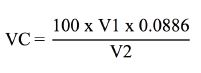
The vitamin C content was found by equation 1, where V1 was the volume of the titration
and V2 was the volume of the sample. The result was expressed as mg of ascorbic
acid/100 mL of juice.</font></p>

    ]]></body>
<body><![CDATA[<p><font face = "Verdana" size = "2">Equation 1:</font></p>


    <p><font face = "Verdana" size = "2"><img src = "/img/revistas/rca/v42n1/v42n1a26eq1.jpg"></font></p>


<p><font face = "Verdana" size = "2"><i>Total titratable acidity</i></font></p>

    <p><font face = "Verdana" size = "2">Determined
by titration using standard sodium hydroxide solution (0.003 M) and an aliquot of
1 mL of the sample plus 100 mL of distilled water. Phenolphthalein (1%) to indicate
the change that occurred when it changed from a light pink color to a more intense
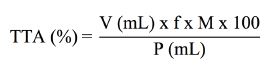
pink color, persisting for at least 30 seconds (IAL, 1985). The value of TTA was
found by equation 2, where V is the titrant volume spent in the titration; f corresponds
to the correction factor of the titrant solution; M represents the molarity of the
titrant solution; and P is the volume of sample used.</font></p>

    <p><font face = "Verdana" size = "2">Equation 2:</font></p>

    <p><font face = "Verdana" size = "2"><img src = "/img/revistas/rca/v42n1/v42n1a26eq2.jpg"></font></p>

    
<p><font face = "Verdana" size = "2">It is worth mentioning that vitamin C and total titratable acidity
were analyzed in duplicate.</font></p>


    <p><font face = "Verdana" size = "2"><i>Lycopene</i></font></p>

    <p><font face = "Verdana" size = "2">Determined by spectrophotometry, according to Rodriguez-Amaya (2001).
Pigment extraction was performed by employing approximately five grams of the sample
plus 30 mL of acetone over a period of 15 minutes. Subsequently, the vacuum filtration
of the extract into a kitassate was carried out so as not to lose the residue of
the pulp. This residue was macerated in a crucible with 15 mL of acetone for three
minutes and again filtered. This process was repeated three times for each sample.
The extract was transferred to a separatory funnel with 25 mL of petroleum ether,
which was washed to remove acetone. Afterwards, it was transferred to a 25 mL volumetric
flask for reading in the spectrophotometer (model IL-592) at the wavelength of 470
nm. The lycopene content was found by equation 3, being expressed in microgram of
lycopene per gram of pulp.</font></p>

    <p><font face = "Verdana" size = "2">Equation 3:</font></p>

    ]]></body>
<body><![CDATA[<p><font face = "Verdana" size = "2"><img src = "/img/revistas/rca/v42n1/v42n1a26eq3.jpg"></font></p>

    
<p><font face = "Verdana" size = "2">For the accessions, a duplicate analysis was performed in cases where the standard
deviation among the blocks was higher than 5.0 &#956;g/g. This criterion was extended
to 8.0 &#956;g/g for commercial cultivars, due to the magnitude of the values presented
by them.</font></p>

    <p><font face = "Verdana" size = "2"><i>Soluble solids</i></font></p>

    <p><font face = "Verdana" size = "2">Determined using a LED analog refractometer (model ZGRB-32ATC)
during collection of pulp samples, expressed in °Brix (AOAC, 1992). The SS/TTA ratio
was determined by the ratio between the two variables.</font></p>

    <p><font face = "Verdana" size = "2"><i>Statistical analysis</i></font></p>

    <p><font face = "Verdana" size = "2">Data was submitted to
analysis of the assumptions of the analysis of variance, with transformation (X
=&#8730;Y) for those who did not attend them. The analysis of variance and comparison
of the means by the Scott-Knott test, at 5% of significance, were performed. The
genetic distance between the genotypes was estimated by the “Standard Euclidean
Mean Distance&quot;, whose generated matrix was used to obtain the similarity matrix,
which was used in the cluster analysis by the Inverted Tocher Optimization Method,
as recommended by Oliveira (2007). All analyzes were performed in the Genes Program
(Cruz, 2013).</font></p>

    <p><font face = "Verdana" size = "2">We estimated the sum
of “Ranks” (Mulamba &amp; Mock, 1978), adapted by Souza (2017), to help select the
most promising genotypes for several characteristics simultaneously. For this, the
means-grouping test (Scott-Knott, at 5% of significance) was used, assigning grades
to the genotypes according to the group of means to which they belonged. The genotypes
of the group of means with the most interesting values for each fruit quality variable
received a grade of &quot;1&quot; and the other genotypes were assigned increasing
grades according to the respective groups of means. The scores obtained by each
genotype were summed in the different variables and those that obtained lower values
for this sum of &quot;Ranks&quot; were considered as of better performance for fruit
quality.</font></p>


    <p><font face = "Verdana" size = "3"><b>RESULTS AND DISCUSSION</b></font></p>

    <p><font face = "Verdana" size = "2">The mean values of soluble solids, titratable total acidity
and the ratio of these variables, as well as the vitamin C and lycopene content
are shown in <a href = "/img/revistas/rca/v42n1/v42n1a26t1.jpg" target = "_blank">Table 1</a>. There was a significant difference for all variables except
for vitamin C. The soluble solids in the pulp ranged from 5.97 to 9.01 °Brix. The
commercial variety “Perola” presented the highest mean value of soluble solids differing
statistically from the evaluated genotypes, except for the cultivars Sugar Baby
(8.65 °Brix) and Crimson Sweet (8.53 °Brix) and the accessions BGH/UNIVASF 60 (7.86
°Brix), 67 (8.08 °Brix), 91 (8.17 °Brix), 121 (8.03 °Brix), 177 (8.15 °Brix), 189
(8.32 °Brix), 190 (7.63 °Brix), 210 (7.67 °Brix), 258 (8.37 °Brix) and 312 (7.59
°Brix). Generally, in the Cucurbitaceae family the main sugars responsible for the
sweetness of the pulp are glucose, fructose and sucrose (Barros <i>et al</i>., 2012).
This is the most critical quality characteristic for watermelon, with the majority
of open field cultivars in full maturity reaching between 10 and 13 °Brix (Kyriacou
<i>et al</i>., 2018). The value recommended in the literature as minimum content
to obtain the acceptable flavor in watermelon is 10 °Brix (Leão <i>et al</i>., 2006;
Lima Neto <i>et al</i>., 2010; Barros <i>et al</i>., 2012). By international standards,
the fruit can be classified according to the refractometric index when measured
at the midpoint of the fruit in the equatorial section. For values &#8805; 8 °Brix
or &#8805; 10 °Brix, the fruit is of &quot;good internal quality&quot; and &quot;very
good internal quality&quot;, respectively (Kyriacou <i>et al</i>., 2018).</font></p>


<p><font face = "Verdana" size = "2">The similarity in soluble solids content between
traditional and commercial cultivars may be related to the &quot;art enhancement&quot;
that the farmer practices by removing seeds from the tastiest fruits to cultivate
later cycles. It is noteworthy that commercial cultivars were developed for conventional
cultivation conditions with the application of highly soluble fertilizers. However,
agroecological farming does not employ chemical fertilizers and the availability
of nutrients does not occur with the same intensity compared to the conventional
system. Thus, the soluble solids content obtained by commercial cultivars in agroecological
systems was satisfactory compared to the results found by Lima Neto <i>et al</i>.
(2010), who evaluated the quality of different varieties of watermelon in a conventional
system, including Crimson Sweet and Sugar Baby varieties, which presented soluble
solids content of 8.7 and 8.3 °Brix, respectively.</font></p>

    ]]></body>
<body><![CDATA[<p><font face = "Verdana" size = "2">The titratable acidity variable did not meet the assumptions of
the analysis of variance, even after data transformation. In quantitative terms,
there was a variation in the acidity of the pulp of the watermelon fruits from 0.74
to 1.59. The acidic characteristic is derived from the presence of organic acids,
such as malate (75%), citrate (&gt; 20%) and other acids present at minimum concentrations
(Kyriacou <i>et al</i>., 2018). This acidity reduces gradually during the maturation
process, equilibrating with the soluble solids of the pulp, giving the sensation
of freshness and improving the flavor and post-harvest performance of the watermelon
(Kyriacou <i>et al</i>., 2018; Chitarra &amp; Chitarra, 2005).</font></p>

    <p><font face = "Verdana" size = "2">The relationship between soluble solids content and total
titratable acidity (SS/TTA) is an important index to evaluate fruit flavor in preference
to the isolated use of these variables (Chitarra &amp; Chitarra, 2005). However,
there are no available values in the literature of the SS/TTA ratio considered acceptable
for watermelon. Chitarra and Chitarra (2005) establish for watermelon the minimum
value of 10 °Brix for soluble solids, but do not define the minimum value oftotal
titratable acidity for a balanced ratio. Thus, the values of this relation are very
variable. For the evaluated genotypes there was a significant difference at 1% for
SS/TTA (<a href = "/img/revistas/rca/v42n1/v42n1a26t1.jpg" target = "_blank">Table 1</a>). The accessions BGH/UNIVASF 41 and 67 presented the highest mean
values, being 10.34 and 10.85, respectively. However, these values did not differ
from each other and were statistically the same as that of access 91 (8.41) and
the commercial varieties Charleston Gray (9.21), “Perola” (9.17) and Sugar Baby
(9.00). This fact stems from the low total titratable acidity obtained by the genotypes,
making the fruits attractive to the consumer's taste. In general, the performance
of commercial varieties in agroecological cultivation was similar to the results
found by Lima Neto <i>et al</i>. (2010) in conventional cultivation, for the variable
at stake.</font></p>

    
<p><font face = "Verdana" size = "2">Regarding the vitamin C
content, there was no significant difference between the evaluated genotypes (<a href = "/img/revistas/rca/v42n1/v42n1a26t1.jpg" target = "_blank">Table
1</a>). Uniformity for this characteristic reduces the chances of genetic gains. In
absolute values, Crimson Sweet showed higher vitamin C content (5.41 mg/100 mL of
juice) than the other evaluated treatments. The mean values found by Lima Neto <i>et
al</i>. (2010) for commercial varieties of watermelon in conventional system of
cultivation were slightly higher than those observed in this study, but also did
not differ statistically. It is worth noting that the amount of vitamin C and other
antioxidant compounds in fruits and vegetables is strongly influenced by genotypic
differences and external factors such as agrotechnical processes, conditions, degree
of maturation at harvest and post-harvest handling (Tlili <i>et al</i>., 2011).</font></p>


<p><font face = "Verdana" size = "2">Another antioxidant compound that plays an important
role in the quality of watermelon is the lycopene content. For the evaluated genotypes
there was a significant difference at 1% for the lycopene variable (<a href = "/img/revistas/rca/v42n1/v42n1a26t1.jpg" target = "_blank">Table 1</a>), which
was expressed as a fresh mass basis. The commercial varieties “Perola” and Sugar
Baby obtained the highest mean values of lycopene, being 58.02 and 58.49 &#956;g/g
of pulp, respectively, not differing from each other. However, these values differed
statistically from Crimson Sweet (38.60 &#956;g/g) and Charleston Gray (38.67 &#956;g/g)
and BGH/UNIVASF 121 (32.34 &#956;g/g). Approximately 70% of the evaluated genotypes
presented average lycopene content ranging from 15.19 to 27.87 &#956;g/g of pulp,
the lowest values being found below 15.19 &#956;g/g of pulp. The performance of
commercial varieties in agroecological cultivation, especially Crimson Sweet and
Charleston Gray cultivars, was satisfactory when compared to the results found by
Leão <i>et al</i>. (2006), when evaluating eight commercial cultivars in a conventional
system with average lycopene contents of 22.64 and 22.28 &#956;g/g of pulp for Crimson
Sweet and Charleston Gray varieties, respectively.</font></p>

    
<p><font face = "Verdana" size = "2">Nevertheless, it is important to highlight the influence of the
genetic factor and also the conditions of cultivation and laboratory analytical
gait in the quantification of lycopene. Thus, there is great variation in lycopene
contents available in the literature for watermelon. In a study with open-pollinated
cultivars and seedless watermelon hybrids, Fish <i>et al</i>. (2002) observed a
variation in lycopene content between 39.1 and 63.0 &#956;g/g of pulp. Setiawan
<i>et al</i>. (2001) studied the quality of 18 fruit species produced in Indonesia
and observed variation in lycopene content from 87.31 to 135.23 &#956;g/g of watermelon
pulp. Carotenoid composition of 50 watermelon cultivars was studied by Perkins-Veazie
<i>et al</i>. (2006) and found a high variability of lycopene content between cultivars
in the range of 35.2 to 112.4 &#956;g/g of pulp.</font></p>

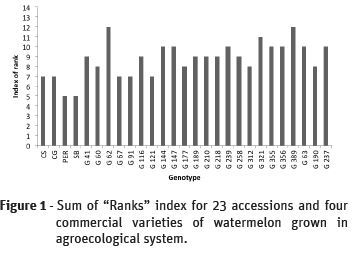
    <p><font face = "Verdana" size = "2">For the sum
of “Ranks” index (<a href = "#f1">Figure 1</a>), the commercial cultivars “Perola” (PER) and Sugar Baby
(SG) obtained index 5, showing a better performance for the variables analyzed.
The BGH/UNIVASF accessions 67, 91 and 121 displayed good performance for the quality
characteristics with index 7 which is the same value obtained by commercial cultivars
Crimson Sweet (CS) and Charleston Gray (CG).</font></p>

    <p>&nbsp;</p>

<a name = "f1"><img src = "/img/revistas/rca/v42n1/v42n1a26f1.jpg"></a>

    
<p>&nbsp;</p>

    <p><font face = "Verdana" size = "2">The study
of genetic diversity using the criterion of similarity for the variables analyzed
allowed to separate the most similar genotypes in different groups, while those
more genetically distant were allocated in the same group. Thus, 18 different genetic
groups were formed (<a href = "/img/revistas/rca/v42n1/v42n1a26t2.jpg" target = "_blank">Table 2</a>). Group I was the most numerous, with seven accessions
and three commercial cultivars, indicating that these are the most genetically divergent
genotypes for fruit quality. The other 17 genotypes were allocated in separate groups,
evidencing similarity and, consequently, narrowing of the genetic base, fact that
reduces the chances of gains for the studied characteristics.</font></p>

    
<p><font face = "Verdana" size = "2">In the field of plant breeding, hybridization between divergent
parents is basic in order to have in their segregating generations a greater possibility
of recovering transgressive genotypes (Falconer, 1987). However, it is important
that genetically divergent parents are selected from a group of promising genotypes.
In this context, accessions BGH/UNIVASF 67, 91 and 121 performed well considering
all quality variables studied (G 67, G 91 and G 121, respectively - <a href = "#f1">Figure 1</a>) and
two of these accessions (BGH/UNIVASF 67 and 121) were allocated in the group of
the greatest dissimilarity (Group I - <a href = "/img/revistas/rca/v42n1/v42n1a26t2.jpg" target = "_blank">Table 2</a>). Thus, the accessions BGH/UNIVASF
67 and 121 have the potential to be inserted in a hybridization program because
they present good means and belong in the group with the greatest genetic divergence.</font></p>

    
]]></body>
<body><![CDATA[<p><font face = "Verdana" size = "2">Although the performance of commercial varieties was satisfactory in terms
of fruit quality, when cultivated in an agroecological system these same varieties
showed high susceptibility to powdery mildew (Santos, 2016) and low productivity
(Souza, 2017), which limits their indication to be interbreeding in breeding programs
geared towards more sustainable systems. However, another possibility to maximize
the chances of genetic gains is to insert the cultivars “Perola” and/or Sugar Baby
in the breeding program, since these presented good performance among the commercial
varieties and crossed them with genotypes that also presented good performance for
the quality variables, especially the accessions BGH/UNIVASF 67, 91 and 121.</font></p>


    <p><font face = "Verdana" size = "3"><b>CONCLUSIONS</b></font></p>

    <p><font face = "Verdana" size = "2">There
was genetic variability for all fruit quality variables evaluated, except for vitamin
C content. Among the genotypes studied, the BGH/UNIVASF 67 and 121 accessions are
promising due to good fruit quality and broad genetic dissimilarity. The cultivars
“Perola” and Sugar Baby stood out as to the quality of fruit among the commercial
varieties, which could be crossed with genotypes that also presented good performance,
especially the accessions BGH/UNIVASF 67, 91 and 121.</font></p>

    <p>&nbsp;</p>

    <p><font face = "Verdana" size = "3"><b>References</b></font></p>


    <!-- ref --><p><font face = "Verdana" size = "2">Altieri, M. (2012) - <i>Agroecologia: bases científicas
para uma agricultura sustentável</i>. 3ª ed. rev. e ampl. Editoras: Expressão Popular,
AS-PTA, 400 p.    &nbsp;&nbsp;&nbsp;&nbsp;&nbsp;&nbsp;&nbsp;&nbsp;[&#160;<a href="javascript:void(0);" onclick="javascript: window.open('/scielo.php?script=sci_nlinks&ref=713236&pid=S0871-018X201900010002700001&lng=','','width=640,height=500,resizable=yes,scrollbars=1,menubar=yes,');">Links</a>&#160;]<!-- end-ref --></font></p>

    <!-- ref --><p><font face = "Verdana" size = "2">AOAC (1992) - <i>Official
methods of analysis of the Association of official analytical chemistry</i>. 11ª
ed. AssociationofOfficialAnalyticalChemistry, Washington, 1115 p.    &nbsp;&nbsp;&nbsp;&nbsp;&nbsp;&nbsp;&nbsp;&nbsp;[&#160;<a href="javascript:void(0);" onclick="javascript: window.open('/scielo.php?script=sci_nlinks&ref=713238&pid=S0871-018X201900010002700002&lng=','','width=640,height=500,resizable=yes,scrollbars=1,menubar=yes,');">Links</a>&#160;]<!-- end-ref --></font></p>

 
    <!-- ref --><p><font face = "Verdana" size = "2">Barros, M.M.; Araújo, W.F.; Neves, L.T.B.C.; Campos,
A.J. &amp; Tosin, J.M. (2012) - Produção e qualidade da melancia submetida à adubação
nitrogenada. <i>Revista Brasileira de Engenharia Agrícola e Ambiental</i>, vol.
16, n. 10, p. 1078–1084. <a href = "http://dx.doi.org/10.1590/S1415-43662012001000007" target = "_blank">http://dx.doi.org/10.1590/S1415-43662012001000007</a></font>&nbsp;&nbsp;&nbsp;&nbsp;&nbsp;&nbsp;&nbsp;&nbsp;[&#160;<a href="javascript:void(0);" onclick="javascript: window.open('/scielo.php?script=sci_nlinks&ref=713240&pid=S0871-018X201900010002700003&lng=','','width=640,height=500,resizable=yes,scrollbars=1,menubar=yes,');">Links</a>&#160;]<!-- end-ref --><!-- ref --><p><font face = "Verdana" size = "2">Beltrão, B.A.; Mascarenhas, J. de C.; Miranda,
J.L.F. de; Souza Junior, L.C. de; Galvão, M.J. da T.G. &amp; Pereira, S.N.(2005)
- Pro<i>jeto cadastro de abastecimento por água subterrânea. Diagnóstico do município
de Petrolina. </i>&lt;<a href = "http://rigeo.cprm.gov.br/jspui/handle/doc/16562" target = "_blank">http://rigeo.cprm.gov.br/jspui/handle/doc/16562</a>&gt;    &nbsp;&nbsp;&nbsp;&nbsp;&nbsp;&nbsp;&nbsp;&nbsp;[&#160;<a href="javascript:void(0);" onclick="javascript: window.open('/scielo.php?script=sci_nlinks&ref=713241&pid=S0871-018X201900010002700004&lng=','','width=640,height=500,resizable=yes,scrollbars=1,menubar=yes,');">Links</a>&#160;]<!-- end-ref -->.</font></p>


    <!-- ref --><p><font face = "Verdana" size = "2">Chitarra, M.F.I. &amp; Chitarra, A.B. (2005) -
<i>Pós-colheita de frutos e hortaliças: fisiologia e manuseio</i>. 2ª ed. rev. e
ampl. Editora UFLA, 783 p.    &nbsp;&nbsp;&nbsp;&nbsp;&nbsp;&nbsp;&nbsp;&nbsp;[&#160;<a href="javascript:void(0);" onclick="javascript: window.open('/scielo.php?script=sci_nlinks&ref=713243&pid=S0871-018X201900010002700005&lng=','','width=640,height=500,resizable=yes,scrollbars=1,menubar=yes,');">Links</a>&#160;]<!-- end-ref --></font></p>

    <!-- ref --><p><font face = "Verdana" size = "2">Cruz,
C.D. (2013) - Genes a software package for analysis in experimental statistics and
quantitative genetics. <i>Acta Scientiarum</i>, vol. 35, n. 3, p. 271-276.
<a href = "http://dx.doi.org/10.4025/actasciagron.v35i3.21251" target = "_blank">http://dx.doi.org/10.4025/actasciagron.v35i3.21251</a></font>&nbsp;&nbsp;&nbsp;&nbsp;&nbsp;&nbsp;&nbsp;&nbsp;[&#160;<a href="javascript:void(0);" onclick="javascript: window.open('/scielo.php?script=sci_nlinks&ref=713245&pid=S0871-018X201900010002700006&lng=','','width=640,height=500,resizable=yes,scrollbars=1,menubar=yes,');">Links</a>&#160;]<!-- end-ref --><!-- ref --><p><font face = "Verdana" size = "2">Dias, R.C.S.; Silva, C.M. de J.; QUEIRÓZ, M.A.
de; Costa, N.D.; Souza, F. de F.; Santos, M.H. dos; Paiva, L.B. de; Barbosa, G.
da S. &amp; Medeiros, K.N. de (2006) - Desempenho agronômico de linhas de melancia
com resistência ao oídio. <i>In: Congresso Brasileiro de Olericultura, 46</i>. Horticultura
Brasileira, vol. 24, p. 1416-1418. Suplemento. (CD ROM).    &nbsp;&nbsp;&nbsp;&nbsp;&nbsp;&nbsp;&nbsp;&nbsp;[&#160;<a href="javascript:void(0);" onclick="javascript: window.open('/scielo.php?script=sci_nlinks&ref=713246&pid=S0871-018X201900010002700007&lng=','','width=640,height=500,resizable=yes,scrollbars=1,menubar=yes,');">Links</a>&#160;]<!-- end-ref --></font></p>

    <!-- ref --><p><font face = "Verdana" size = "2">Falconer, D.S. (1987) - <i>Introdução à genética quantitativa</i>.
Viçosa, UFV. Imprensa Universitária, 279 p.    &nbsp;&nbsp;&nbsp;&nbsp;&nbsp;&nbsp;&nbsp;&nbsp;[&#160;<a href="javascript:void(0);" onclick="javascript: window.open('/scielo.php?script=sci_nlinks&ref=713248&pid=S0871-018X201900010002700008&lng=','','width=640,height=500,resizable=yes,scrollbars=1,menubar=yes,');">Links</a>&#160;]<!-- end-ref --></font></p>

    <!-- ref --><p><font face = "Verdana" size = "2">Fish, W.W.; Perkin-Veazie, P. &amp; Collins, J.K. (2002) - A quantitative
assay for lycopene that utilizes reduced volumes of organic solvents. <i>Journal
of Food Composition and Analysis</i>, vol. 15, n. 3, p. 309-317.
<a href = "https://doi.org/10.1006/jfca.2002.1069" target = "_blank">https://doi.org/10.1006/jfca.2002.1069</a></font>&nbsp;&nbsp;&nbsp;&nbsp;&nbsp;&nbsp;&nbsp;&nbsp;[&#160;<a href="javascript:void(0);" onclick="javascript: window.open('/scielo.php?script=sci_nlinks&ref=713250&pid=S0871-018X201900010002700009&lng=','','width=640,height=500,resizable=yes,scrollbars=1,menubar=yes,');">Links</a>&#160;]<!-- end-ref --><!-- ref --><p><font face = "Verdana" size = "2">IAL (1985) - <i>Normas analíticas, métodos químicos
e físicos para análise de alimentos</i>. 3ª ed. Instituto Adolfo Lutz, São Paulo,
533 p.    &nbsp;&nbsp;&nbsp;&nbsp;&nbsp;&nbsp;&nbsp;&nbsp;[&#160;<a href="javascript:void(0);" onclick="javascript: window.open('/scielo.php?script=sci_nlinks&ref=713251&pid=S0871-018X201900010002700010&lng=','','width=640,height=500,resizable=yes,scrollbars=1,menubar=yes,');">Links</a>&#160;]<!-- end-ref --></font></p>

    <!-- ref --><p><font face = "Verdana" size = "2">Kyriacou, M.C.; Leskovar,
D.I.; Colla, G. &amp;Rouphael, Y. (2018) - Watermelon and melon fruit quality: The
genotypic and agro-environmental factors implicated. <i>Scientia Horticulturae</i>,
vol. 234, p. 393-408. <a href = "https://doi.org/10.1016/j.scienta.2018.01.032" target = "_blank">https://doi.org/10.1016/j.scienta.2018.01.032</a></font>&nbsp;&nbsp;&nbsp;&nbsp;&nbsp;&nbsp;&nbsp;&nbsp;[&#160;<a href="javascript:void(0);" onclick="javascript: window.open('/scielo.php?script=sci_nlinks&ref=713253&pid=S0871-018X201900010002700011&lng=','','width=640,height=500,resizable=yes,scrollbars=1,menubar=yes,');">Links</a>&#160;]<!-- end-ref --><!-- ref --><p><font face = "Verdana" size = "2">Leão, D.S.; Peixoto, J.R. &amp; Vieira, J.V. (2006)
- Teor de licopeno e de sólidos solúveis em oito cultivares de melancia. <i>Bioscience
Journal</i>, vol. 22, n. 3, p. 7–15.    &nbsp;&nbsp;&nbsp;&nbsp;&nbsp;&nbsp;&nbsp;&nbsp;[&#160;<a href="javascript:void(0);" onclick="javascript: window.open('/scielo.php?script=sci_nlinks&ref=713254&pid=S0871-018X201900010002700012&lng=','','width=640,height=500,resizable=yes,scrollbars=1,menubar=yes,');">Links</a>&#160;]<!-- end-ref --></font></p>

    <!-- ref --><p><font face = "Verdana" size = "2">Lima Neto, I.S.; Guimarães, I.P.; Batista, P.F.; Eroucha, É.M.M. &amp; Queiróz,
M.A. (2010) - Qualidade de frutos de diferentes variedades de melancia provenientes
de Mossoró. <i>Revista Caatinga</i>, vol. 23, n. 4, p. 14–20.    &nbsp;&nbsp;&nbsp;&nbsp;&nbsp;&nbsp;&nbsp;&nbsp;[&#160;<a href="javascript:void(0);" onclick="javascript: window.open('/scielo.php?script=sci_nlinks&ref=713256&pid=S0871-018X201900010002700013&lng=','','width=640,height=500,resizable=yes,scrollbars=1,menubar=yes,');">Links</a>&#160;]<!-- end-ref --></font></p>

    <!-- ref --><p><font face = "Verdana" size = "2">Mulamba, N.N. &amp; Mock, J.J. (1978) - Improvement of yield
potential of the Eto Blanco maize (<i>Zea mays</i>) population by breeding for plants
traits. <i>Egyptian Journal of Genetics and Cytology</i>, vol. 7, p. 40-51.    &nbsp;&nbsp;&nbsp;&nbsp;&nbsp;&nbsp;&nbsp;&nbsp;[&#160;<a href="javascript:void(0);" onclick="javascript: window.open('/scielo.php?script=sci_nlinks&ref=713258&pid=S0871-018X201900010002700014&lng=','','width=640,height=500,resizable=yes,scrollbars=1,menubar=yes,');">Links</a>&#160;]<!-- end-ref --></font></p>


    <!-- ref --><p><font face = "Verdana" size = "2">Oliveira, M.F. (2007) - <i>Avaliação de cinco
estratégias de amostragem para a obtenção da coleção nuclear de soja (Glicine max
(L.) Merrill).</i> Tese de Doutorado. São Paulo, Escola Superior de Agricultura
“Luiz de Queiróz”. 143 p.    &nbsp;&nbsp;&nbsp;&nbsp;&nbsp;&nbsp;&nbsp;&nbsp;[&#160;<a href="javascript:void(0);" onclick="javascript: window.open('/scielo.php?script=sci_nlinks&ref=713260&pid=S0871-018X201900010002700015&lng=','','width=640,height=500,resizable=yes,scrollbars=1,menubar=yes,');">Links</a>&#160;]<!-- end-ref --></font></p>

    <!-- ref --><p><font face = "Verdana" size = "2">Perkins-Veazie,
P.; Collins, J.K.; Davis, A.R.&amp; Roberts, W. (2006) - Carotenoid Content of 50
Watermelon Cultivars. <i>Journal of Agricultural and Food Chemistry</i>, vol. 54,
n. 7, p. 2593–2597. <a href = "https://doi.org/10.1021/jf052066p" target = "_blank">https://doi.org/10.1021/jf052066p</a></font>&nbsp;&nbsp;&nbsp;&nbsp;&nbsp;&nbsp;&nbsp;&nbsp;[&#160;<a href="javascript:void(0);" onclick="javascript: window.open('/scielo.php?script=sci_nlinks&ref=713262&pid=S0871-018X201900010002700016&lng=','','width=640,height=500,resizable=yes,scrollbars=1,menubar=yes,');">Links</a>&#160;]<!-- end-ref --><!-- ref --><p><font face = "Verdana" size = "2">Phillips, K.M.; Tarragó-Trani, M.T.; Gebhardt, S.E.; Exler, J.;
Patterson, K.Y.; Haytowitz, D.B.; Pehrsson, P.R. &amp; Holden, J.M. (2010) - Stability
of vitamin C in frozen raw fruit and vegetable homogenates. <i>Journal of Food Composition
and Analysis</i>, vol. 23, n. 3, p. 253-259. <a href = "https://doi.org/10.1016/j.jfca.2009.08.018" target = "_blank">https://doi.org/10.1016/j.jfca.2009.08.018</a></font>&nbsp;&nbsp;&nbsp;&nbsp;&nbsp;&nbsp;&nbsp;&nbsp;[&#160;<a href="javascript:void(0);" onclick="javascript: window.open('/scielo.php?script=sci_nlinks&ref=713263&pid=S0871-018X201900010002700017&lng=','','width=640,height=500,resizable=yes,scrollbars=1,menubar=yes,');">Links</a>&#160;]<!-- end-ref --><!-- ref --><p><font face = "Verdana" size = "2">Queiróz, M.A. (2011) - Germoplasma de Cucurbitáceas
no Brasil. <i>In: Congresso Brasileiro de Olericultura, 51</i>. 2011. Horticultura
Brasileira, vol. 29, p. 1-9. (Suplemento - CD ROM).    &nbsp;&nbsp;&nbsp;&nbsp;&nbsp;&nbsp;&nbsp;&nbsp;[&#160;<a href="javascript:void(0);" onclick="javascript: window.open('/scielo.php?script=sci_nlinks&ref=713264&pid=S0871-018X201900010002700018&lng=','','width=640,height=500,resizable=yes,scrollbars=1,menubar=yes,');">Links</a>&#160;]<!-- end-ref --></font></p>

    <!-- ref --><p><font face = "Verdana" size = "2">Queiróz, M.A.; Dias, R. de C.S.; Souza, F de F.; Ferreira, M.A.J.F.;
Assis, J.G. de A.; Borges, R.M.E.; Romão, R.L.; Ramos, S.R.R.; Costa, M.S.V. &amp;
Moura, M. da C.C.L. (1999) - Recursos genéticos e melhoramento de melancia no Nordeste
brasileiro. <i>In</i>: Queiróz, M.A.; Goedert, C.O. &amp; Ramos, S.R.R. (Eds.) -
<i>Recursos Genéticos e Melhoramento de Plantas para o Nordeste brasileiro</i>.
Petrolina-PE, Embrapa Semiárido, p. 514-528.    &nbsp;&nbsp;&nbsp;&nbsp;&nbsp;&nbsp;&nbsp;&nbsp;[&#160;<a href="javascript:void(0);" onclick="javascript: window.open('/scielo.php?script=sci_nlinks&ref=713266&pid=S0871-018X201900010002700019&lng=','','width=640,height=500,resizable=yes,scrollbars=1,menubar=yes,');">Links</a>&#160;]<!-- end-ref --></font></p>

    <!-- ref --><p><font face = "Verdana" size = "2">Rodriguez-Amaya, D.A. (2001) - <i>Guide to carotenoids analysis in food.
</i>International Life Sciences Institute. 71 p.    &nbsp;&nbsp;&nbsp;&nbsp;&nbsp;&nbsp;&nbsp;&nbsp;[&#160;<a href="javascript:void(0);" onclick="javascript: window.open('/scielo.php?script=sci_nlinks&ref=713268&pid=S0871-018X201900010002700020&lng=','','width=640,height=500,resizable=yes,scrollbars=1,menubar=yes,');">Links</a>&#160;]<!-- end-ref --></font></p>

    <!-- ref --><p><font face = "Verdana" size = "2">Santos, G.V. (2016) <i>- Avaliação de germoplasma de melancia da agricultura
tradicional do Semiárido de Pernambuco quanto à reação ao oídio. </i>Trabalho de
Conclusão de Curso. Petrolina, PE, Universidade Federal do Vale do São Francisco.
52 p.    &nbsp;&nbsp;&nbsp;&nbsp;&nbsp;&nbsp;&nbsp;&nbsp;[&#160;<a href="javascript:void(0);" onclick="javascript: window.open('/scielo.php?script=sci_nlinks&ref=713270&pid=S0871-018X201900010002700021&lng=','','width=640,height=500,resizable=yes,scrollbars=1,menubar=yes,');">Links</a>&#160;]<!-- end-ref --></font></p>

    <!-- ref --><p><font face = "Verdana" size = "2">Setiawan, B.; Sulaeman, A.;
Giraud, D.W. &amp;Driskell, J.A. (2001) - Carotenoid content of selected Indonesian
fruits. <i>Journal of Food Composition and Analysis</i>, vol. 14, n. 2, p. 169-176.
<a href = "https://doi.org/10.1006/jfca.2000.0969" target = "_blank">https://doi.org/10.1006/jfca.2000.0969</a></font>&nbsp;&nbsp;&nbsp;&nbsp;&nbsp;&nbsp;&nbsp;&nbsp;[&#160;<a href="javascript:void(0);" onclick="javascript: window.open('/scielo.php?script=sci_nlinks&ref=713272&pid=S0871-018X201900010002700022&lng=','','width=640,height=500,resizable=yes,scrollbars=1,menubar=yes,');">Links</a>&#160;]<!-- end-ref --><!-- ref --><p><font face = "Verdana" size = "2">Souza, I.F. (2017) - <i>Caracterização morfoagronômica de acessos de melancia
da agricultura tradicional do Semiárido de Pernambuco em sistema agroecológico de
produção.</i> Trabalho de conclusão de curso. Petrolina, PE, Universidade Federal
do Vale do São Francisco. 52 p.    &nbsp;&nbsp;&nbsp;&nbsp;&nbsp;&nbsp;&nbsp;&nbsp;[&#160;<a href="javascript:void(0);" onclick="javascript: window.open('/scielo.php?script=sci_nlinks&ref=713273&pid=S0871-018X201900010002700023&lng=','','width=640,height=500,resizable=yes,scrollbars=1,menubar=yes,');">Links</a>&#160;]<!-- end-ref --></font></p>

    <!-- ref --><p><font face = "Verdana" size = "2">Souza,
F.F.; Queiróz, M.A. &amp; Dias, R.C.S. (2004) - Competição de híbridos experimentais
de melancia em Petrolina-PE. <i>Horticultura Brasileira</i>, vol. 22, n. 2, p. 1-4.    &nbsp;&nbsp;&nbsp;&nbsp;&nbsp;&nbsp;&nbsp;&nbsp;[&#160;<a href="javascript:void(0);" onclick="javascript: window.open('/scielo.php?script=sci_nlinks&ref=713275&pid=S0871-018X201900010002700024&lng=','','width=640,height=500,resizable=yes,scrollbars=1,menubar=yes,');">Links</a>&#160;]<!-- end-ref --></font></p>

    <!-- ref --><p><font face = "Verdana" size = "2">Tlili, I.; Hdider, C.; Lenucci,
M.S.; Riadh, I.; Jebari, H. &amp;Dalessandro, G. (2011) - Bioactive compounds and
antioxidant activities of different watermelon [<i>Citrullus lanatus</i> (Thumb.)
Mansfeld] cultivars as affected by fruit sampling area. <i>Journal of Food Composition
and Analysis</i>, vol. 24, n. 3, p. 307-314. <a href = "https://doi.org/10.1016/j.jfca.2010.06.005" target = "_blank">https://doi.org/10.1016/j.jfca.2010.06.005</a></font>&nbsp;&nbsp;&nbsp;&nbsp;&nbsp;&nbsp;&nbsp;&nbsp;[&#160;<a href="javascript:void(0);" onclick="javascript: window.open('/scielo.php?script=sci_nlinks&ref=713277&pid=S0871-018X201900010002700025&lng=','','width=640,height=500,resizable=yes,scrollbars=1,menubar=yes,');">Links</a>&#160;]<!-- end-ref --><p>&nbsp;</p>

    <p><font face = "Verdana" size = "3"><b>Acknowledgements</b></font></p>

    <p><font face = "Verdana" size = "2">Research developed with financial support received
from the National Council for Scientific and Technological Development - CNPq -
Brazil (Case Nº: 462355 / 2014-4).</font></p>

    ]]></body>
<body><![CDATA[<p>&nbsp;</p>

    <p><font face = "Verdana" size = "2">Received/recebido: 2018.08.01</font></p>

    <p><font face = "Verdana" size = "2">Received in revisedform/recebido em versão revista: 2018.10.03</font></p>

    <p><font face = "Verdana" size = "2">Accepted/aceite: 2018.10.16</font></p>

     ]]></body><back>
<ref-list>
<ref id="B1">
<nlm-citation citation-type="book">
<person-group person-group-type="author">
<name>
<surname><![CDATA[Altieri]]></surname>
<given-names><![CDATA[M.]]></given-names>
</name>
</person-group>
<source><![CDATA[Agroecologia: bases científicas para uma agricultura sustentável]]></source>
<year>2012</year>
<edition>3ª</edition>
<publisher-name><![CDATA[Expressão Popular, AS-PTA]]></publisher-name>
</nlm-citation>
</ref>
<ref id="B2">
<nlm-citation citation-type="book">
<collab>AOAC</collab>
<source><![CDATA[Official methods of analysis of the Association of official analytical chemistry]]></source>
<year>1992</year>
<edition>11ª</edition>
<publisher-loc><![CDATA[Washington ]]></publisher-loc>
<publisher-name><![CDATA[AssociationofOfficialAnalyticalChemistry]]></publisher-name>
</nlm-citation>
</ref>
<ref id="B3">
<nlm-citation citation-type="journal">
<person-group person-group-type="author">
<name>
<surname><![CDATA[Barros]]></surname>
<given-names><![CDATA[M.M.]]></given-names>
</name>
<name>
<surname><![CDATA[Araújo]]></surname>
<given-names><![CDATA[W.F.]]></given-names>
</name>
<name>
<surname><![CDATA[Neves]]></surname>
<given-names><![CDATA[L.T.B.C.]]></given-names>
</name>
<name>
<surname><![CDATA[Campos]]></surname>
<given-names><![CDATA[A.J.]]></given-names>
</name>
<name>
<surname><![CDATA[Tosin]]></surname>
<given-names><![CDATA[J.M.]]></given-names>
</name>
</person-group>
<article-title xml:lang="pt"><![CDATA[Produção e qualidade da melancia submetida à adubação nitrogenada]]></article-title>
<source><![CDATA[Revista Brasileira de Engenharia Agrícola e Ambiental]]></source>
<year>2012</year>
<volume>16</volume>
<numero>10</numero>
<issue>10</issue>
<page-range>1078-1084</page-range></nlm-citation>
</ref>
<ref id="B4">
<nlm-citation citation-type="">
<person-group person-group-type="author">
<name>
<surname><![CDATA[Beltrão]]></surname>
<given-names><![CDATA[B.A.]]></given-names>
</name>
<name>
<surname><![CDATA[Mascarenhas]]></surname>
<given-names><![CDATA[J. de C.]]></given-names>
</name>
<name>
<surname><![CDATA[Miranda]]></surname>
<given-names><![CDATA[J.L.F. de]]></given-names>
</name>
<name>
<surname><![CDATA[Souza Junior]]></surname>
<given-names><![CDATA[L.C. de]]></given-names>
</name>
<name>
<surname><![CDATA[Galvão]]></surname>
<given-names><![CDATA[M.J. da T.G.]]></given-names>
</name>
<name>
<surname><![CDATA[Pereira]]></surname>
<given-names><![CDATA[S.N.]]></given-names>
</name>
</person-group>
<source><![CDATA[Projeto cadastro de abastecimento por água subterrânea: Diagnóstico do município de Petrolina]]></source>
<year>2005</year>
</nlm-citation>
</ref>
<ref id="B5">
<nlm-citation citation-type="book">
<person-group person-group-type="author">
<name>
<surname><![CDATA[Chitarra]]></surname>
<given-names><![CDATA[M.F.I.]]></given-names>
</name>
<name>
<surname><![CDATA[Chitarra]]></surname>
<given-names><![CDATA[A.B.]]></given-names>
</name>
</person-group>
<source><![CDATA[Pós-colheita de frutos e hortaliças: fisiologia e manuseio]]></source>
<year>2005</year>
<edition>2ª</edition>
<publisher-name><![CDATA[Editora UFLA]]></publisher-name>
</nlm-citation>
</ref>
<ref id="B6">
<nlm-citation citation-type="journal">
<person-group person-group-type="author">
<name>
<surname><![CDATA[Cruz]]></surname>
<given-names><![CDATA[C.D.]]></given-names>
</name>
</person-group>
<article-title xml:lang="en"><![CDATA[Genes a software package for analysis in experimental statistics and quantitative genetics]]></article-title>
<source><![CDATA[Acta Scientiarum]]></source>
<year>2013</year>
<volume>35</volume>
<numero>3</numero>
<issue>3</issue>
<page-range>271-276</page-range></nlm-citation>
</ref>
<ref id="B7">
<nlm-citation citation-type="confpro">
<person-group person-group-type="author">
<name>
<surname><![CDATA[Dias]]></surname>
<given-names><![CDATA[R.C.S.]]></given-names>
</name>
<name>
<surname><![CDATA[Silva]]></surname>
<given-names><![CDATA[C.M. de J.]]></given-names>
</name>
<name>
<surname><![CDATA[QUEIRÓZ]]></surname>
<given-names><![CDATA[M.A. de]]></given-names>
</name>
<name>
<surname><![CDATA[Costa]]></surname>
<given-names><![CDATA[N.D.]]></given-names>
</name>
<name>
<surname><![CDATA[Souza]]></surname>
<given-names><![CDATA[F. de F.]]></given-names>
</name>
<name>
<surname><![CDATA[Santos]]></surname>
<given-names><![CDATA[M.H. dos]]></given-names>
</name>
<name>
<surname><![CDATA[Paiva]]></surname>
<given-names><![CDATA[L.B. de]]></given-names>
</name>
<name>
<surname><![CDATA[Barbosa]]></surname>
<given-names><![CDATA[G. da S.]]></given-names>
</name>
<name>
<surname><![CDATA[Medeiros]]></surname>
<given-names><![CDATA[K.N. de]]></given-names>
</name>
</person-group>
<article-title xml:lang="pt"><![CDATA[Desempenho agronômico de linhas de melancia com resistência ao oídio]]></article-title>
<source><![CDATA[]]></source>
<year>2006</year>
<volume>24</volume>
<conf-name><![CDATA[46 Congresso Brasileiro de Olericultura]]></conf-name>
<conf-loc> </conf-loc>
<page-range>1416-1418</page-range></nlm-citation>
</ref>
<ref id="B8">
<nlm-citation citation-type="book">
<person-group person-group-type="author">
<name>
<surname><![CDATA[Falconer]]></surname>
<given-names><![CDATA[D.S.]]></given-names>
</name>
</person-group>
<source><![CDATA[Introdução à genética quantitativa]]></source>
<year>1987</year>
<publisher-loc><![CDATA[Viçosa ]]></publisher-loc>
<publisher-name><![CDATA[UFV. Imprensa Universitária]]></publisher-name>
</nlm-citation>
</ref>
<ref id="B9">
<nlm-citation citation-type="journal">
<person-group person-group-type="author">
<name>
<surname><![CDATA[Fish]]></surname>
<given-names><![CDATA[W.W.]]></given-names>
</name>
<name>
<surname><![CDATA[Perkin-Veazie]]></surname>
<given-names><![CDATA[P.]]></given-names>
</name>
<name>
<surname><![CDATA[Collins]]></surname>
<given-names><![CDATA[J.K.]]></given-names>
</name>
</person-group>
<article-title xml:lang="en"><![CDATA[A quantitative assay for lycopene that utilizes reduced volumes of organic solvents]]></article-title>
<source><![CDATA[Journal of Food Composition and Analysis]]></source>
<year>2002</year>
<volume>15</volume>
<numero>3</numero>
<issue>3</issue>
<page-range>309-317</page-range></nlm-citation>
</ref>
<ref id="B10">
<nlm-citation citation-type="book">
<collab>IAL</collab>
<source><![CDATA[Normas analíticas, métodos químicos e físicos para análise de alimentos]]></source>
<year>1985</year>
<edition>3ª</edition>
<publisher-loc><![CDATA[São Paulo ]]></publisher-loc>
<publisher-name><![CDATA[Instituto Adolfo Lutz]]></publisher-name>
</nlm-citation>
</ref>
<ref id="B11">
<nlm-citation citation-type="journal">
<person-group person-group-type="author">
<name>
<surname><![CDATA[Kyriacou]]></surname>
<given-names><![CDATA[M.C.]]></given-names>
</name>
<name>
<surname><![CDATA[Leskovar]]></surname>
<given-names><![CDATA[D.I.]]></given-names>
</name>
<name>
<surname><![CDATA[Colla]]></surname>
<given-names><![CDATA[G.]]></given-names>
</name>
<name>
<surname><![CDATA[Rouphael]]></surname>
<given-names><![CDATA[Y.]]></given-names>
</name>
</person-group>
<article-title xml:lang="en"><![CDATA[Watermelon and melon fruit quality: The genotypic and agro-environmental factors implicated]]></article-title>
<source><![CDATA[Scientia Horticulturae]]></source>
<year>2018</year>
<volume>234</volume>
<page-range>393-408</page-range></nlm-citation>
</ref>
<ref id="B12">
<nlm-citation citation-type="journal">
<person-group person-group-type="author">
<name>
<surname><![CDATA[Leão]]></surname>
<given-names><![CDATA[D.S.]]></given-names>
</name>
<name>
<surname><![CDATA[Peixoto]]></surname>
<given-names><![CDATA[J.R.]]></given-names>
</name>
<name>
<surname><![CDATA[Vieira]]></surname>
<given-names><![CDATA[J.V.]]></given-names>
</name>
</person-group>
<article-title xml:lang="pt"><![CDATA[Teor de licopeno e de sólidos solúveis em oito cultivares de melancia]]></article-title>
<source><![CDATA[Bioscience Journal]]></source>
<year>2006</year>
<volume>22</volume>
<numero>3</numero>
<issue>3</issue>
<page-range>7-15</page-range></nlm-citation>
</ref>
<ref id="B13">
<nlm-citation citation-type="journal">
<person-group person-group-type="author">
<name>
<surname><![CDATA[Lima Neto]]></surname>
<given-names><![CDATA[I.S.]]></given-names>
</name>
<name>
<surname><![CDATA[Guimarães]]></surname>
<given-names><![CDATA[I.P.]]></given-names>
</name>
<name>
<surname><![CDATA[Batista]]></surname>
<given-names><![CDATA[P.F.]]></given-names>
</name>
<name>
<surname><![CDATA[Eroucha]]></surname>
<given-names><![CDATA[É.M.M.]]></given-names>
</name>
<name>
<surname><![CDATA[Queiróz]]></surname>
<given-names><![CDATA[M.A.]]></given-names>
</name>
</person-group>
<article-title xml:lang="pt"><![CDATA[Qualidade de frutos de diferentes variedades de melancia provenientes de Mossoró]]></article-title>
<source><![CDATA[Revista Caatinga]]></source>
<year>2010</year>
<volume>23</volume>
<numero>4</numero>
<issue>4</issue>
<page-range>14-20</page-range></nlm-citation>
</ref>
<ref id="B14">
<nlm-citation citation-type="journal">
<person-group person-group-type="author">
<name>
<surname><![CDATA[Mulamba]]></surname>
<given-names><![CDATA[N.N.]]></given-names>
</name>
<name>
<surname><![CDATA[Mock]]></surname>
<given-names><![CDATA[J.J.]]></given-names>
</name>
</person-group>
<article-title xml:lang="en"><![CDATA[Improvement of yield potential of the Eto Blanco maize (Zea mays) population by breeding for plants traits]]></article-title>
<source><![CDATA[Egyptian Journal of Genetics and Cytology]]></source>
<year>1978</year>
<volume>7</volume>
<page-range>40-51</page-range></nlm-citation>
</ref>
<ref id="B15">
<nlm-citation citation-type="">
<person-group person-group-type="author">
<name>
<surname><![CDATA[Oliveira]]></surname>
<given-names><![CDATA[M.F.]]></given-names>
</name>
</person-group>
<source><![CDATA[Avaliação de cinco estratégias de amostragem para a obtenção da coleção nuclear de soja (Glicine max (L.) Merrill)]]></source>
<year>2007</year>
</nlm-citation>
</ref>
<ref id="B16">
<nlm-citation citation-type="journal">
<person-group person-group-type="author">
<name>
<surname><![CDATA[Perkins-Veazie]]></surname>
<given-names><![CDATA[P.]]></given-names>
</name>
<name>
<surname><![CDATA[Collins]]></surname>
<given-names><![CDATA[J.K.]]></given-names>
</name>
<name>
<surname><![CDATA[Davis]]></surname>
<given-names><![CDATA[A.R.]]></given-names>
</name>
<name>
<surname><![CDATA[Roberts]]></surname>
<given-names><![CDATA[W.]]></given-names>
</name>
</person-group>
<article-title xml:lang="en"><![CDATA[Carotenoid Content of 50 Watermelon Cultivars]]></article-title>
<source><![CDATA[Journal of Agricultural and Food Chemistry]]></source>
<year>2006</year>
<volume>54</volume>
<numero>7</numero>
<issue>7</issue>
<page-range>2593-2597</page-range></nlm-citation>
</ref>
<ref id="B17">
<nlm-citation citation-type="journal">
<person-group person-group-type="author">
<name>
<surname><![CDATA[Phillips]]></surname>
<given-names><![CDATA[K.M.]]></given-names>
</name>
<name>
<surname><![CDATA[Tarragó-Trani]]></surname>
<given-names><![CDATA[M.T.]]></given-names>
</name>
<name>
<surname><![CDATA[Gebhardt]]></surname>
<given-names><![CDATA[S.E.]]></given-names>
</name>
<name>
<surname><![CDATA[Exler]]></surname>
<given-names><![CDATA[J.]]></given-names>
</name>
<name>
<surname><![CDATA[Patterson]]></surname>
<given-names><![CDATA[K.Y.]]></given-names>
</name>
<name>
<surname><![CDATA[Haytowitz]]></surname>
<given-names><![CDATA[D.B.]]></given-names>
</name>
<name>
<surname><![CDATA[Pehrsson]]></surname>
<given-names><![CDATA[P.R.]]></given-names>
</name>
<name>
<surname><![CDATA[Holden]]></surname>
<given-names><![CDATA[J.M.]]></given-names>
</name>
</person-group>
<article-title xml:lang="en"><![CDATA[Stability of vitamin C in frozen raw fruit and vegetable homogenates]]></article-title>
<source><![CDATA[Journal of Food Composition and Analysis]]></source>
<year>2010</year>
<volume>23</volume>
<numero>3</numero>
<issue>3</issue>
<page-range>253-259</page-range></nlm-citation>
</ref>
<ref id="B18">
<nlm-citation citation-type="confpro">
<person-group person-group-type="author">
<name>
<surname><![CDATA[Queiróz]]></surname>
<given-names><![CDATA[M.A.]]></given-names>
</name>
</person-group>
<article-title xml:lang="en"><![CDATA[Germoplasma de Cucurbitáceas no Brasil]]></article-title>
<source><![CDATA[]]></source>
<year>2011</year>
<month>20</month>
<day>11</day>
<volume>29</volume>
<conf-name><![CDATA[51 Congresso Brasileiro de Olericultura]]></conf-name>
<conf-loc> </conf-loc>
<page-range>1-9</page-range></nlm-citation>
</ref>
<ref id="B19">
<nlm-citation citation-type="book">
<person-group person-group-type="author">
<name>
<surname><![CDATA[Queiróz]]></surname>
<given-names><![CDATA[M.A.]]></given-names>
</name>
<name>
<surname><![CDATA[Dias]]></surname>
<given-names><![CDATA[R. de C.S.]]></given-names>
</name>
<name>
<surname><![CDATA[Souza]]></surname>
<given-names><![CDATA[F de F.]]></given-names>
</name>
<name>
<surname><![CDATA[Ferreira]]></surname>
<given-names><![CDATA[M.A.J.F.]]></given-names>
</name>
<name>
<surname><![CDATA[Assis]]></surname>
<given-names><![CDATA[J.G. de A.]]></given-names>
</name>
<name>
<surname><![CDATA[Borges]]></surname>
<given-names><![CDATA[R.M.E.]]></given-names>
</name>
<name>
<surname><![CDATA[Romão]]></surname>
<given-names><![CDATA[R.L.]]></given-names>
</name>
<name>
<surname><![CDATA[Ramos]]></surname>
<given-names><![CDATA[S.R.R.]]></given-names>
</name>
<name>
<surname><![CDATA[Costa]]></surname>
<given-names><![CDATA[M.S.V.]]></given-names>
</name>
<name>
<surname><![CDATA[Moura]]></surname>
<given-names><![CDATA[M. da C.C.L.]]></given-names>
</name>
</person-group>
<article-title xml:lang="pt"><![CDATA[Recursos genéticos e melhoramento de melancia no Nordeste brasileiro]]></article-title>
<person-group person-group-type="editor">
<name>
<surname><![CDATA[Queiróz]]></surname>
<given-names><![CDATA[M.A.]]></given-names>
</name>
<name>
<surname><![CDATA[Goedert]]></surname>
<given-names><![CDATA[C.O.]]></given-names>
</name>
<name>
<surname><![CDATA[Ramos]]></surname>
<given-names><![CDATA[S.R.R.]]></given-names>
</name>
</person-group>
<source><![CDATA[Recursos Genéticos e Melhoramento de Plantas para o Nordeste brasileiro]]></source>
<year>1999</year>
<page-range>514-528</page-range><publisher-loc><![CDATA[Petrolina^ePE PE]]></publisher-loc>
<publisher-name><![CDATA[Embrapa Semiárido]]></publisher-name>
</nlm-citation>
</ref>
<ref id="B20">
<nlm-citation citation-type="book">
<person-group person-group-type="author">
<name>
<surname><![CDATA[Rodriguez-Amaya]]></surname>
<given-names><![CDATA[D.A.]]></given-names>
</name>
</person-group>
<source><![CDATA[Guide to carotenoids analysis in food]]></source>
<year>2001</year>
<publisher-name><![CDATA[International Life Sciences Institute]]></publisher-name>
</nlm-citation>
</ref>
<ref id="B21">
<nlm-citation citation-type="">
<person-group person-group-type="author">
<name>
<surname><![CDATA[Santos]]></surname>
<given-names><![CDATA[G.V.]]></given-names>
</name>
</person-group>
<source><![CDATA[Avaliação de germoplasma de melancia da agricultura tradicional do Semiárido de Pernambuco quanto à reação ao oídio]]></source>
<year>2016</year>
</nlm-citation>
</ref>
<ref id="B22">
<nlm-citation citation-type="journal">
<person-group person-group-type="author">
<name>
<surname><![CDATA[Setiawan]]></surname>
<given-names><![CDATA[B.]]></given-names>
</name>
<name>
<surname><![CDATA[Sulaeman]]></surname>
<given-names><![CDATA[A.]]></given-names>
</name>
<name>
<surname><![CDATA[Giraud]]></surname>
<given-names><![CDATA[D.W.]]></given-names>
</name>
<name>
<surname><![CDATA[Driskell]]></surname>
<given-names><![CDATA[J.A.]]></given-names>
</name>
</person-group>
<article-title xml:lang="en"><![CDATA[Carotenoid content of selected Indonesian fruits]]></article-title>
<source><![CDATA[Journal of Food Composition and Analysis]]></source>
<year>2001</year>
<volume>14</volume>
<numero>2</numero>
<issue>2</issue>
<page-range>169-176</page-range></nlm-citation>
</ref>
<ref id="B23">
<nlm-citation citation-type="">
<person-group person-group-type="author">
<name>
<surname><![CDATA[Souza]]></surname>
<given-names><![CDATA[I.F.]]></given-names>
</name>
</person-group>
<source><![CDATA[Caracterização morfoagronômica de acessos de melancia da agricultura tradicional do Semiárido de Pernambuco em sistema agroecológico de produção]]></source>
<year>2017</year>
</nlm-citation>
</ref>
<ref id="B24">
<nlm-citation citation-type="journal">
<person-group person-group-type="author">
<name>
<surname><![CDATA[Souza]]></surname>
<given-names><![CDATA[F.F.]]></given-names>
</name>
<name>
<surname><![CDATA[Queiróz]]></surname>
<given-names><![CDATA[M.A.]]></given-names>
</name>
<name>
<surname><![CDATA[Dias]]></surname>
<given-names><![CDATA[R.C.S.]]></given-names>
</name>
</person-group>
<article-title xml:lang="pt"><![CDATA[Competição de híbridos experimentais de melancia em Petrolina-PE]]></article-title>
<source><![CDATA[Horticultura Brasileira]]></source>
<year>2004</year>
<volume>22</volume>
<numero>2</numero>
<issue>2</issue>
<page-range>1-4</page-range></nlm-citation>
</ref>
<ref id="B25">
<nlm-citation citation-type="journal">
<person-group person-group-type="author">
<name>
<surname><![CDATA[Tlili]]></surname>
<given-names><![CDATA[I.]]></given-names>
</name>
<name>
<surname><![CDATA[Hdider]]></surname>
<given-names><![CDATA[C.]]></given-names>
</name>
<name>
<surname><![CDATA[Lenucci]]></surname>
<given-names><![CDATA[M.S.]]></given-names>
</name>
<name>
<surname><![CDATA[Riadh]]></surname>
<given-names><![CDATA[I.]]></given-names>
</name>
<name>
<surname><![CDATA[Jebari]]></surname>
<given-names><![CDATA[H.]]></given-names>
</name>
<name>
<surname><![CDATA[Dalessandro]]></surname>
<given-names><![CDATA[G.]]></given-names>
</name>
</person-group>
<article-title xml:lang="en"><![CDATA[Bioactive compounds and antioxidant activities of different watermelon [Citrullus lanatus (Thumb.) Mansfeld] cultivars as affected by fruit sampling area]]></article-title>
<source><![CDATA[Journal of Food Composition and Analysis]]></source>
<year>2011</year>
<volume>. 24</volume>
<numero>3</numero>
<issue>3</issue>
<page-range>307-314</page-range></nlm-citation>
</ref>
</ref-list>
</back>
</article>