<?xml version="1.0" encoding="ISO-8859-1"?><article xmlns:mml="http://www.w3.org/1998/Math/MathML" xmlns:xlink="http://www.w3.org/1999/xlink" xmlns:xsi="http://www.w3.org/2001/XMLSchema-instance">
<front>
<journal-meta>
<journal-id>0871-018X</journal-id>
<journal-title><![CDATA[Revista de Ciências Agrárias]]></journal-title>
<abbrev-journal-title><![CDATA[Rev. de Ciências Agrárias]]></abbrev-journal-title>
<issn>0871-018X</issn>
<publisher>
<publisher-name><![CDATA[Sociedade de Ciências Agrárias de Portugal]]></publisher-name>
</publisher>
</journal-meta>
<article-meta>
<article-id>S0871-018X2019000200004</article-id>
<article-id pub-id-type="doi">10.19084/rca.17264</article-id>
<title-group>
<article-title xml:lang="en"><![CDATA[Monitoring the bovine activity in grazing by an electronic sensing device based on GPS]]></article-title>
<article-title xml:lang="pt"><![CDATA[Monitoramento da atividade de bovinos em pastoreio por dispositivo eletrônico de sensoriamento baseado em GPS]]></article-title>
</title-group>
<contrib-group>
<contrib contrib-type="author">
<name>
<surname><![CDATA[Batista]]></surname>
<given-names><![CDATA[Pedro Henrique Dias]]></given-names>
</name>
<xref ref-type="aff" rid="A1"/>
</contrib>
<contrib contrib-type="author">
<name>
<surname><![CDATA[Almeida]]></surname>
<given-names><![CDATA[Gledson Luiz Pontes de]]></given-names>
</name>
<xref ref-type="aff" rid="A1"/>
</contrib>
<contrib contrib-type="author">
<name>
<surname><![CDATA[Sarmento]]></surname>
<given-names><![CDATA[Roger Moura]]></given-names>
</name>
<xref ref-type="aff" rid="A2"/>
</contrib>
<contrib contrib-type="author">
<name>
<surname><![CDATA[Pandorfi]]></surname>
<given-names><![CDATA[Héliton]]></given-names>
</name>
<xref ref-type="aff" rid="A1"/>
</contrib>
<contrib contrib-type="author">
<name>
<surname><![CDATA[Melo]]></surname>
<given-names><![CDATA[Airon Aparecido Silva de]]></given-names>
</name>
<xref ref-type="aff" rid="A3"/>
</contrib>
<contrib contrib-type="author">
<name>
<surname><![CDATA[Rolim]]></surname>
<given-names><![CDATA[Mario Monteiro]]></given-names>
</name>
<xref ref-type="aff" rid="A1"/>
</contrib>
<contrib contrib-type="author">
<name>
<surname><![CDATA[Medeiros]]></surname>
<given-names><![CDATA[Victor Wanderley Costa de]]></given-names>
</name>
<xref ref-type="aff" rid="A4"/>
</contrib>
<contrib contrib-type="author">
<name>
<surname><![CDATA[Gonçalves]]></surname>
<given-names><![CDATA[Glauco Estácio]]></given-names>
</name>
<xref ref-type="aff" rid="A4"/>
</contrib>
</contrib-group>
<aff id="AA1">
<institution><![CDATA[,Universidade Federal Rural de Pernambuco Agricultural Engineer Department ]]></institution>
<addr-line><![CDATA[Recife Pernambuco]]></addr-line>
<country>Brazil</country>
</aff>
<aff id="AA2">
<institution><![CDATA[,Instituto Federal de Ciência e Tecnologia do Ceará  ]]></institution>
<addr-line><![CDATA[Iguatu Ceará]]></addr-line>
<country>Brazil</country>
</aff>
<aff id="AA3">
<institution><![CDATA[,Universidade Federal Rural de Pernambuco Animal Science Department ]]></institution>
<addr-line><![CDATA[Garanhuns Pernambuco]]></addr-line>
<country>Brazil</country>
</aff>
<aff id="AA4">
<institution><![CDATA[,Universidade Federal Rural de Pernambuco Departament of Statistics and Informatics ]]></institution>
<addr-line><![CDATA[Recife Pernambuco]]></addr-line>
<country>Brazil</country>
</aff>
<pub-date pub-type="pub">
<day>00</day>
<month>06</month>
<year>2019</year>
</pub-date>
<pub-date pub-type="epub">
<day>00</day>
<month>06</month>
<year>2019</year>
</pub-date>
<volume>42</volume>
<numero>2</numero>
<fpage>31</fpage>
<lpage>40</lpage>
<copyright-statement/>
<copyright-year/>
<self-uri xlink:href="http://scielo.pt/scielo.php?script=sci_arttext&amp;pid=S0871-018X2019000200004&amp;lng=en&amp;nrm=iso"></self-uri><self-uri xlink:href="http://scielo.pt/scielo.php?script=sci_abstract&amp;pid=S0871-018X2019000200004&amp;lng=en&amp;nrm=iso"></self-uri><self-uri xlink:href="http://scielo.pt/scielo.php?script=sci_pdf&amp;pid=S0871-018X2019000200004&amp;lng=en&amp;nrm=iso"></self-uri><abstract abstract-type="short" xml:lang="en"><p><![CDATA[The joint analysis about cattle positioning and activity in pasture associated to soil attributes, become important for making decisions and forage management. In this work, the prototype of an electronic sensing device based on global positioning system (GPS) was developed with the objective of monitoring dairy cattle position in pasture and associating animal preference areas to possible changes for soil penetration resistance and organic matter accumulation. Our study was performed at Roçadinho Farm, Agreste region of Pernambuco, Brazil, in 40 x 40 m area, managed under continuous stocking method. The GPS positioning sensors were fixed by collars on the animal neck and programmed to record the animal location during grazing. The mean error observed was 0.65 m. Before and after grazing, 36 deformed samples were collected in the soil surface layer for determination of organic matter (from 0.00 to 0.05 m) and penetration resistance (from 0.00 to 0.10 m). The developed electronic device had adequate accuracy and autonomy for cattle monitoring, which allowed to determine preference sites of grazing. After grazing, there was increase of 6.5% for organic matter and 79.4% for soil penetration resistance in the sites of greater pasture exploitation.]]></p></abstract>
<abstract abstract-type="short" xml:lang="pt"><p><![CDATA[A análise conjunta do posicionamento e da atividade de bovinos a pasto, associada aos atributos do solo, torna-se importante na tomada de decisões e manejo da forragem. Neste trabalho desenvolveu-se o protótipo de um dispositivo eletrônico de sensoriamento baseado no sistema de posicionamento global (GPS) com o objetivo de monitorar o posicionamento de bovinos de leite a pasto e associar as áreas de preferência dos animais a possíveis alterações da resistência à penetração e ao acúmulo de matéria orgânica no solo sob pastoreio. O estudo foi conduzido na Fazenda Roçadinho, região Agreste de Pernambuco, Brasil, em uma área de 40 x 40 m, manejada em sistema de pastoreio contínuo. Os sensores de posicionamento GPS foram fixados por colares no pescoço dos animais e programados para registrar a localização dos animais durante o período de pastoreio. O erro médio observado foi de 0,65 m. Antes e após o pastoreio coletaram-se 36 amostras deformadas na camada superficial do solo para determinação da matéria orgânica (0,00 a 0,05 m) e da resistência à penetração (0,00 a 0,10 m). O dispositivo eletrônico desenvolvido apresentou precisão e autonomia adequada para o monitoramento de bovinos, o que permitiu determinar locais de preferências de pastoreio. Verificou-se que após o pastoreio, houve um acréscimo de 6,5% na matéria orgânica e 79,4% na resistência a penetração do solo nos locais de maior exploração do pasto.]]></p></abstract>
<kwd-group>
<kwd lng="en"><![CDATA[electronic device]]></kwd>
<kwd lng="en"><![CDATA[global positioning system]]></kwd>
<kwd lng="en"><![CDATA[precision agriculture]]></kwd>
<kwd lng="en"><![CDATA[precision animal husbandry]]></kwd>
<kwd lng="pt"><![CDATA[agricultura de precisão]]></kwd>
<kwd lng="pt"><![CDATA[dispositivo eletrônico]]></kwd>
<kwd lng="pt"><![CDATA[sistema de posicionamento global]]></kwd>
<kwd lng="pt"><![CDATA[zootecnia de precisão]]></kwd>
</kwd-group>
</article-meta>
</front><body><![CDATA[ <p align = "right"><font face = "Verdana" size = "2"><b>ARTIGO</b></font></p>      <p><font face = "Verdana" size = "4"><b>Monitoring the bovine activity in grazing by an electronic sensing device based on GPS</b></font></p>      <p><font face = "Verdana" size = "3"><b>Monitoramento da atividade de bovinos em pastoreio por dispositivo eletrônico de sensoriamento baseado em GPS</b></font></p>      <p><font face = "Verdana" size = "2"><b>Pedro Henrique Dias Batista</b><sup>1,*</sup>, <b>Gledson Luiz Pontes de Almeida</b><sup>1</sup>, <b>Roger Moura Sarmento</b><sup>2</sup>, <b>Héliton Pandorfi</b><sup>1</sup>, <b>Airon Aparecido Silva de Melo</b><sup>3</sup>, <b>Mario Monteiro Rolim</b><sup>1</sup>, <b>Victor Wanderley Costa de Medeiros</b><sup>4</sup> and <b>Glauco Estácio Gonçalves</b><sup>4</sup></font></p>      <p><font face = "Verdana" size = "2"><i><sup>1</sup>Agricultural Engineer Department, Universidade Federal Rural de Pernambuco, Recife, Pernambuco, Brazil</i></font></p>      <p><font face = "Verdana" size = "2"><i><sup>2</sup>Instituto Federal de Ciência e Tecnologia do Ceará, Iguatu, Ceará, Brazil</i></font></p>      <p><font face = "Verdana" size = "2"><i><sup>3</sup>Animal Science Department, Universidade Federal Rural de Pernambuco, Garanhuns, Pernambuco, Brazil</i></font></p>      <p><font face = "Verdana" size = "2"><i><sup>4</sup>Departament of Statistics and Informatics, Universidade Federal Rural de Pernambuco, Recife, Pernambuco, Brazil</i></font></p>      <p><font face = "Verdana" size = "2"><i>(*E-mail: <a href = "mailto:giga_pedro@hotmail.com">giga_pedro@hotmail.com</a>)</i></font></p>  <hr noshade size = 1>      <p><font face = "Verdana" size = "3"><b>ABSTRACT</b></font></p>       ]]></body>
<body><![CDATA[<p><font face = "Verdana" size = "2">The joint analysis about cattle positioning and activity in pasture associated to soil attributes, become important for making decisions and forage management. In this work, the prototype of an electronic sensing device based on global positioning system (GPS) was developed with the objective of monitoring dairy cattle position in pasture and associating animal preference areas to possible changes for soil penetration resistance and organic matter accumulation. Our study was performed at Roçadinho Farm, Agreste region of Pernambuco, Brazil, in 40 x 40 m area, managed under continuous stocking method. The GPS positioning sensors were fixed by collars on the animal neck and programmed to record the animal location during grazing. The mean error observed was 0.65 m. Before and after grazing, 36 deformed samples were collected in the soil surface layer for determination of organic matter (from 0.00 to 0.05 m) and penetration resistance (from 0.00 to 0.10 m). The developed electronic device had adequate accuracy and autonomy for cattle monitoring, which allowed to determine preference sites of grazing. After grazing, there was increase of 6.5% for organic matter and 79.4% for soil penetration resistance in the sites of greater pasture exploitation.</font></p>      <p><font face = "Verdana" size = "2"><b>Keywords:</b> electronic device, global positioning system, precision agriculture, precision animal husbandry</font></p>  <hr noshade size = 1>      <p><font face = "Verdana" size = "3"><b>RESUMO</b></font></p>      <p><font face = "Verdana" size = "2">A análise conjunta do posicionamento e da atividade de bovinos a pasto, associada aos atributos do solo, torna-se importante na tomada de decisões e manejo da forragem. Neste trabalho desenvolveu-se o protótipo de um dispositivo eletrônico de sensoriamento baseado no sistema de posicionamento global (GPS) com o objetivo de monitorar o posicionamento de bovinos de leite a pasto e associar as áreas de preferência dos animais a possíveis alterações da resistência à penetração e ao acúmulo de matéria orgânica no solo sob pastoreio. O estudo foi conduzido na Fazenda Roçadinho, região Agreste de Pernambuco, Brasil, em uma área de 40 x 40 m, manejada em sistema de pastoreio contínuo. Os sensores de posicionamento GPS foram fixados por colares no pescoço dos animais e programados para registrar a localização dos animais durante o período de pastoreio. O erro médio observado foi de 0,65 m. Antes e após o pastoreio coletaram-se 36 amostras deformadas na camada superficial do solo para determinação da matéria orgânica (0,00 a 0,05 m) e da resistência à penetração (0,00 a 0,10 m).  O dispositivo eletrônico desenvolvido apresentou precisão e autonomia adequada para o monitoramento de bovinos, o que permitiu determinar locais de preferências de pastoreio. Verificou-se que após o pastoreio, houve um acréscimo de 6,5% na matéria orgânica e 79,4% na resistência a penetração do solo nos locais de maior exploração do pasto.</font></p>      <p><font face = "Verdana" size = "2"><b>Palavras-chave:</b> agricultura de precisão, dispositivo eletrônico, sistema de posicionamento global, zootecnia de precisão</font></p>  <hr noshade size = 1>       <p><font face = "Verdana" size = "3"><b>INTRODUCTION</b></font></p>      <p><font face = "Verdana" size = "2">Precision farming refers to technological innovations that monitor the animal in its pasture environment. Geo refencing technologies, such as virtual fences, seek to control the animal movement according to the occupation preference of certain site in pasture (Pérez <i>et al</i>., 2017; Knight <i>et al</i>., 2018).</font></p>      <p><font face = "Verdana" size = "2">Monitoring dairy cattle in pasture is expensive and requires skilled labor. However, advances with new geo location tools development, which include the classification of cattle grazing behavior (Williams <i>et al</i>., 2017), spatial distribution of cattle in pasture (Larson <i>et al</i>., 2017; Pérez <i>et al</i>., 2017), development of an alternative monitoring device for cattle activities (Hanson and Mo, 2014), diseases and infections control (Woodroffe <i>et al</i>., 2007), and soil and pasture management (Koch <i>et al</i>., 2018).</font></p>       <p><font face = "Verdana" size = "2">The analysis of cattle positioning and activity in pasture associated to soil attributes are important information that help to make decision about forage management, because from this information, preference areas can be identified and delimited. This allows management adjustment more precise, regarding the stocking rate and sustainable use of pastures. Animal trampling can be a cause of soil degradation (Tuffour <i>et al</i>., 2004; Ortigara <i>et al</i>., 2014). Thus, soil penetration resistance has been employed to characterize the physical modifications caused by compaction. Pressures between 2 and 2.5 MPa have been indicated as the critical limits for soil penetration resistance and most plant species of economic purpose (Silveira <i>et al</i>., 2010).</font></p>      <p><font face = "Verdana" size = "2">The objective was to develop an electronic device prototype able to monitor dairy cattle in pasture and associate animal preference sites to possible changes in penetration resistance and organic matter accumulation of soil.</font></p>       ]]></body>
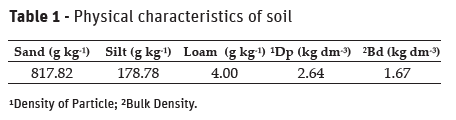
<body><![CDATA[<p><font face = "Verdana" size = "3"><b>MATERIAL AND METHODS</b></font></p>      <p><font face = "Verdana" size = "2">The study was performed during spring season in a dairy cattle private property, called Roçadinho Farm, located at Capoeiras town, Agreste region of Pernambuco, Brazil (8º 36&#8217;S latitude; 36º 37&#8217;W longitude; 700 m altitude). According to Köppen classification, the climate is semi-arid (Bsh). Annual rainfall averages 588 mm (Almeida <i>et al</i>., 2011). Soil is classified as Planosol according to Zoneamento Agroecológico de Pernambuco - ZAPE (2001).</font></p>      <p><font face = "Verdana" size = "2">Soil physical characteristics were analyzed at Soil Mechanical Laboratory and Residue recycle, Universidade Federal Rural do Pernambuco – UFRPE (<a href = "#t1">Table 1</a>), according to methods described by EMBRAPA (2011).</font></p>      <p>&nbsp;</p>  <a name = "t1"><img src = "/img/revistas/rca/v42n2/v42n2a04t1.jpg"></a>      
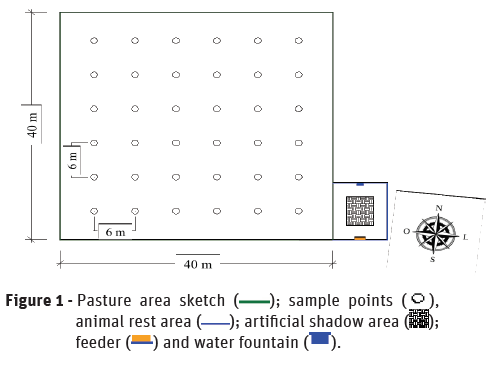
<p>&nbsp;</p>      <p><font face = "Verdana" size = "2">The experimental area consisted in a soil under signal grass-based pasture (<i>Brachiaria decumbens</i>) during 21 days, from October 16 to November 5, 2016. Experimental area had 40 x 40 m, with rest area for animals beside experimental area, water fountain, feeder, shadow net, with free access to animals (<a href = "#f1">Figure 1</a>). During the experimental period, there was no rainfall in the area.</font></p>      <p>&nbsp;</p>  <a name = "f1"><img src = "/img/revistas/rca/v42n2/v42n2a04f1.jpg"></a>      
<p>&nbsp;</p>      <p><font face = "Verdana" size = "2">Three Girolando breed heifers, averaged 300 ± 5 kg live weight, under continuous stocking, which animal were put in paddock with initial forage averaged 0.90 m height and 21 days stocking period when height decreased to 0.20 m according to Martha Júnior <i>et al</i>. (2003).</font></p>      <p><font face = "Verdana" size = "2">Meteorological variable such as dry bulb temperature (Tdb, °C) and air relative humidity (RH, %) were recorded each 10 minutes through a meteorological station using a data logger model Hobo U12-12 (Onset Computer Corporation Bourne, MA, USA). Sensors were set in the meteorological station fixed beside to pasture and up to 1.50 m from soil.</font></p>       ]]></body>
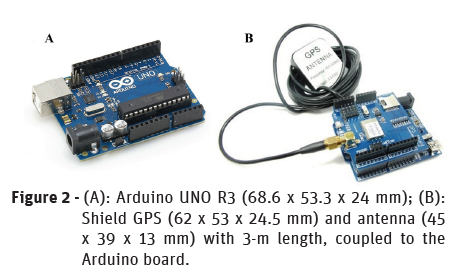
<body><![CDATA[<p><font face = "Verdana" size = "2">Animal activity monitoring was analyzed through an electronic device prototype with GPS sensor developed by researchers affiliated to Agricultural Engineer Department, Rural Federal University of Pernambuco (DEAGRI-UFRPE) and Federal Institute of Science and Technology of Ceará – Iguatu Campus.</font></p>       <p><font face = "Verdana" size = "2">The prototype consisted of the Arduino prototype plate model UNO R3 (<a href = "#f2">Figure 2A</a>) powered by three batteries of 3800 mhA and GPS shield (<a href = "#f2">Figure 2 B</a>). The Arduino UNO R3 is based onATmega328 microcontroller, with SRAM 2KB and 16 MHz clock frequency. The GPS shield has 62x53x24.5 mm dimensions and is composed by Ublox NEO-6M module, receiving up to three satellite systems simultaneous (Galileo, GLONASS and BeiDou) and 1575.42 MHz frequency.</font></p>      <p>&nbsp;</p>  <a name = "f2"><img src = "/img/revistas/rca/v42n2/v42n2a04f2.jpg"></a>      
<p>&nbsp;</p>      <p><font face = "Verdana" size = "2">Information about animal global positioning was recorded in the CSV file type and on 16GB SD card. The system programming was performed in C/C++ language through the Arduino IDE software and set to record the animal position every 1 minute during the stocking period.</font></p>      <p><font face = "Verdana" size = "2">For precision test of equipment, four points was delimited in a flat area, so that the points molded a 10-m perfect square. From the prototype, latitude and longitude were recorded for each point with three consecutive samplings. From the coordinates obtained, the distance among the points was calculated, and then possible to determine the medium error of the known distance (10 m).</font></p>      <p><font face = "Verdana" size = "2">The GPS was protected by an acrylic box (<a href = "/img/revistas/rca/v42n2/v42n2a04f3.jpg" target = "_blank">Figure 3A</a>) in order to avoid animal rain damage, fixed by leather collar (<a href = "/img/revistas/rca/v42n2/v42n2a04f3.jpg" target = "_blank">Figure 3B</a>) on the animal neck (<a href = "/img/revistas/rca/v42n2/v42n2a04f3.jpg" target = "_blank">Figure 3C</a>). Therefore, this position tried to keep the entire device at a lower position, thus protecting the neck protected the equipment, however, the antenna was attached on top of the collar, and wrapped with electrical tape for avoiding damage.</font></p>      
<p><font face = "Verdana" size = "2">The weight of all equipment, including collar, was 0.6 kg. Batteries replacement occurred every 15 hours in the rest area, with appropriated animal containment, in which all procedure took 20 seconds.</font></p>       <p><font face = "Verdana" size = "2">Deformed samples of soil were collected for organic matter (OM)in regular mesh 6 x 6 m, totaling 36 sampling points, with 4-m border, before and after stocking period, from 0.0 to 0.05 m soil depth. Organic carbon was estimated by titration method and the organic matter calculated as organic carbon versus 1.724 (EMBRAPA, 2011).</font></p>      <p><font face = "Verdana" size = "2">The soil penetration resistance (PR) was determined from 0.0 to 0.10 m soil depth, through a low impact penetrometer Stolf model (IAA/Planalsucar). The number of impacts dm<sup>-1</sup>was transformed in dynamic resistance (MPa) by the Eq.1 proposed by Stolf (1991).</font></p>       ]]></body>
<body><![CDATA[<p><font face = "Verdana" size = "2"><img src = "/img/revistas/rca/v42n2/v42n2a01eq1.jpg"></font></p>      
<p><font face = "Verdana" size = "2">In which:</font></p>      <p><font face = "Verdana" size = "2">PR-Penetration resistance, kgf cm<sup>-2</sup> (kgf cm<sup>-2</sup> x 0.098 = MPa);</font></p>       <p><font face = "Verdana" size = "2">M–Weight of piston, 1.6 kg;</font></p>      <p><font face = "Verdana" size = "2">M –Weight of equipment without piston;</font></p>      <p><font face = "Verdana" size = "2">h –Height of piston fall, 54 cm;</font></p>      <p><font face = "Verdana" size = "2">x – Penetration of equipment rod, cm by impact;</font></p>       <p><font face = "Verdana" size = "2">A - Area of cone, 1.35 cm<sup>2</sup>.</font></p>       <p><font face = "Verdana" size = "2">The spatial distribution, during the animal stocking period, was analyzed by the Surfer 9 software (Golden Software, 2010), which allowed the graphic representation of spatial distribution and overlapping mapping of the GPS, OM and PR monitoring. The PR map scale was defined according to the adapted classes of Soil Survey Staff (2017) at low, &lt;0.1 MPa; moderate, 0.1-2.0 MPa; high, 2.0-4.0 MPa; very high, 4.0-8.0 MPa; extremely high, &gt; 8.0 MPa.</font></p>      <p><font face = "Verdana" size = "3"><b>RESULTS AND DISCUSSION</b></font></p>      ]]></body>
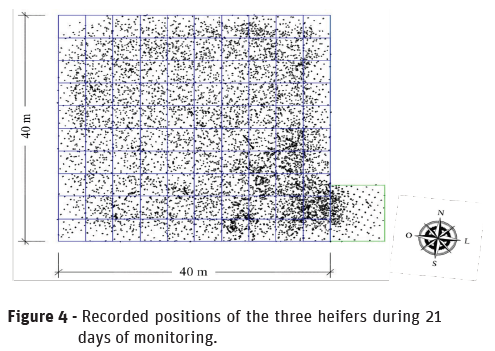
<body><![CDATA[<p><font face = "Verdana" size = "2">The prototype accuracy developed had 6.5% mean error, which represents 0.65 m error for every 10 m. Homburger <i>et al</i>. (2014) experimented GPS sensors in cattle and observed 1.49 and 2.44 m relative error, considering a fixed point and known coordinates. Koch et al. (2018) recorded about 3 m of average spatial accuracy.</font></p>       <p><font face = "Verdana" size = "2">The prototype GPS reached autonomy of 15 hours, considered acceptable for initial studies. The time spent with battery replaces did not affect the coordinate record, since the GPS shield requires only 35 seconds to locate satellites.</font></p>      <p><font face = "Verdana" size = "2">The leather collar and acrylic box that housed the equipment proved to be efficient in protection and accommodation, as well as apparently did not provide any animal discomfort. In general, the prototype achieved its objectives, precisely proving the needs of tracking.</font></p>      <p><font face = "Verdana" size = "2"><a href = "#f4">Figure 4</a> exhibits the animals positions during the monitoring, however, it is noteworthy there are periods with animal remained standing, which generated large number of points with the same geographical coordinates, visually these points appear as unique in the image</font></p>      <p>&nbsp;</p>  <a name = "f4"><img src = "/img/revistas/rca/v42n2/v42n2a04f4.jpg"></a>      
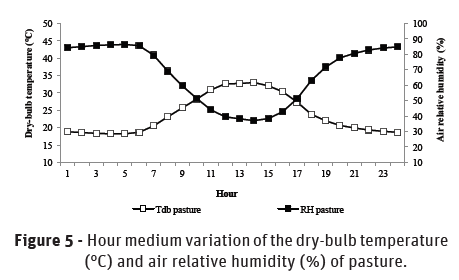
<p>&nbsp;</p>      <p><font face = "Verdana" size = "2">The greater concentration of points in some pasture sites evidences the natural animal selectivity and possible cause of pasture degradation, mainly in most visited sites. Sites chosen to defecation may admit greater organic matter accumulation.</font></p>      <p><font face = "Verdana" size = "2">Animals in grazing select preference areas, thus they search the closest water, feeder and shadow, which deviates the electrical fences and bath sites (Melo <i>et al</i>., 2015; Alencar <i>et al</i>., 2016).</font></p>      <p><font face = "Verdana" size = "2"><a href = "#f5">Figure 5</a> exhibits the average of the environmental variables determined during the study period, in which the maximum temperature reached 32.9 °C and the minimum 18.2 °C. The thermal recommendation for dairy cattle is between 10 and 27 ºC, with relative humidity between 60 and 70% (Baêta and Souza, 2010). This condition facilitates the processes of thermal energy transfer by sensitive ways. However, the recorded meteorological variables exceeded the superior critical limit of comfort between 11h00 and 17h00, which may have modified the animal activities.</font></p>      <p>&nbsp;</p>  <a name = "f5"><img src = "/img/revistas/rca/v42n2/v42n2a04f5.jpg"></a>      
]]></body>
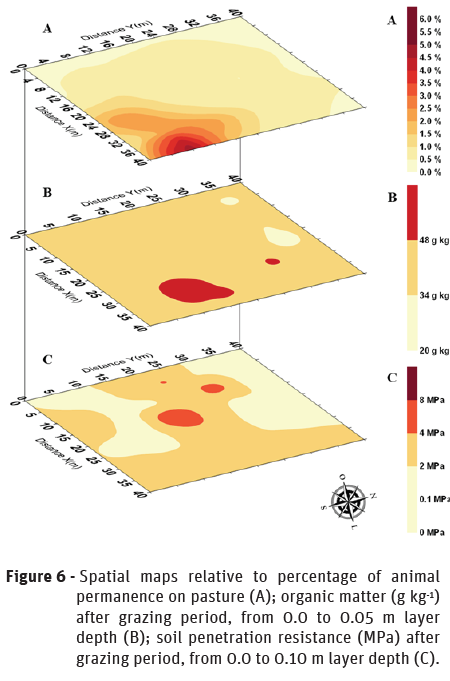
<body><![CDATA[<p>&nbsp;</p>      <p><font face = "Verdana" size = "2"><a href = "#f6">Figure 6</a> exhibits the maps of the animal permanence percentage in the area for grazing, organic matter and soil penetration resistance after grazing period. Cattle remained longer time close to rest area where also was verified great levels of organic matter. The penetration resistance reached values above 2MPa, classified as high according to the Soil Survey Staff (2017). Animal presence next to shadow and water fountain is justified by meteorological variables (<a href = "#f5">Figure 5</a>) that exceeded the limit comfort during 6h00.</font></p>      <p>&nbsp;</p>  <a name = "f6"><img src = "/img/revistas/rca/v42n2/v42n2a04f6.jpg"></a>      
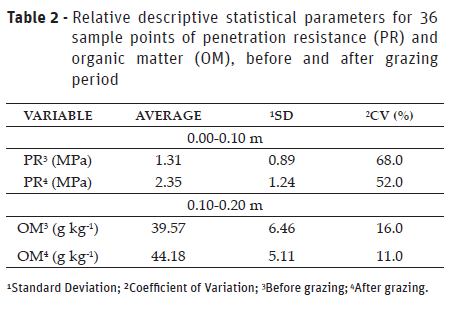
<p>&nbsp;</p>      <p><font face = "Verdana" size = "2">The access frequency and permanence of heifers next to this local influenced greater trampling, which increased soil resistance to root penetration and organic matter content.</font></p>       <p><font face = "Verdana" size = "2">Riaboff <i>et al</i>. (2018) also corroborate these results, when using GPS to monitor the dairy cow position on pasture at different times of day, and observed cattle spent more time resting next to water fountain in the afternoon. Cows kept the grazing habit at time of bland heat intensity, which reduced in the afternoon, when animals were under thermal stress and temperature exceeded 30 °C. Williams <i>et al</i>. (2017) studied cattle behavior by GPS technology, and verified that animals frequently sought rest areas. Likewise, Koch <i>et al</i>. (2018) experimented GPS sensor and reported that animals selected a small rest area, in which they recorded 48.1% of all positions.</font></p>      <p><font face = "Verdana" size = "2">Shadows presence next to grazing areas are essential, mostly in semi-arid regions, then farmers besides natural shadow, also can use artificial shadow shelters in order to avoid cattle in the same area. The use of shadow distributed for several points in the pasture can diminish animal trampling and consequently de accelerate increase of penetration resistance in pastures under intensive grazing. According to Schütz <i>et al</i>. (2010), several shadows types such as trees or artificial facilities can create different microclimates.</font></p>      <p><font face = "Verdana" size = "2">After stocking period, there was increase (11.6%) of organic matter (OM), caused by animal excrement distribution over the area (<a href = "#t2">Table 2</a>). However, this variation was not homogenous for grazing area, due to natural selectivity by animal that tends to concentrate their feces and urine in specific sites, that means, the OM increase was probably greater at bath area.</font></p>      <p>&nbsp;</p>  <a name = "t2"><img src = "/img/revistas/rca/v42n2/v42n2a04t2.jpg"></a>      
<p>&nbsp;</p>      ]]></body>
<body><![CDATA[<p><font face = "Verdana" size = "2">George <i>et al</i>. (2013) reported that after grazing (1.5 and 2.2 AU ha<sup>-1</sup>), OM increased from 1.66 to 2.07% for depth from 0.00 to 0.05 m. Silva Neto <i>et al</i>. (2012) also studied the spatial variation of soil organic matter for intense, medium and light degradation. These authors observed that after 35 days of grazing (6 AU ha<sup>-1</sup>) the organic matter for intense degradation was 17.6% greater than medium degradation.</font></p>      <p><font face = "Verdana" size = "2">Penetration resistance (PR) of roots in soil also boost after grazing (79.4%), mostly for animal preference sites, however, the animal hoof pressure affected the physical structure with compactation increase during the trial. Similar results were reported by Lanzanova <i>et al</i>. (2007), who observed soil physical attributes in integrated crop–livestock system, indicating that the PR increased 57% than no grazed area, after 14 days of grazing and 0.05 – 0.08 m soil depth.</font></p>      <p><font face = "Verdana" size = "3"><b>CONCLUSIONS</b></font></p>       <p><font face = "Verdana" size = "2">The electronic device prototype developed had adequate precision and autonomy for cattle monitoring, which allowed determining sites of grazing preference.</font></p>      <p><font face = "Verdana" size = "2">At sites of greater pasture exploitation by animals, there was increase of soil penetration resistance and organic matter.</font></p>      <p>&nbsp;</p>      <p><font face = "Verdana" size = "3"><b>References</b></font></p>      <!-- ref --><p><font face = "Verdana" size = "2">Alencar, N.M.; Melo, J.C.; Dos Santos, A.C.; Cunha, O.F.R. & Paula Neto, J.J. (2016) - Spatial variability of soil properties, production of marandu-grassland and interrelation with the grazing intensity. <i>Revista Engenharia na Agricultura</i>, vol. 24, n. 4, p.338-349. <a href = "https://doi.org/10.13083/reveng.v24i4.602" target = "_blank">https://doi.org/10.13083/reveng.v24i4.602</a></font>&nbsp;&nbsp;&nbsp;&nbsp;&nbsp;&nbsp;&nbsp;&nbsp;[&#160;<a href="javascript:void(0);" onclick="javascript: window.open('/scielo.php?script=sci_nlinks&ref=696904&pid=S0871-018X201900020000400001&lng=','','width=640,height=500,resizable=yes,scrollbars=1,menubar=yes,');">Links</a>&#160;]<!-- end-ref --><!-- ref --><p><font face = "Verdana" size = "2">Almeida, G.L.; Pandorfi, H.; Guiselini, C.; Henrique, H.M. & Almeida, G.A. (2011) - Use of adiabatic evaporative cooling system in thermal comfort of Girolando cows. <i>Revista Brasileira de Engenharia Agrícola e Ambiental</i>, vol. 15, n. 7, p. 754-761. <a href = "http://dx.doi.org/10.1590/S1415-43662011000700015" target = "_blank">http://dx.doi.org/10.1590/S1415-43662011000700015</a></font>&nbsp;&nbsp;&nbsp;&nbsp;&nbsp;&nbsp;&nbsp;&nbsp;[&#160;<a href="javascript:void(0);" onclick="javascript: window.open('/scielo.php?script=sci_nlinks&ref=696905&pid=S0871-018X201900020000400002&lng=','','width=640,height=500,resizable=yes,scrollbars=1,menubar=yes,');">Links</a>&#160;]<!-- end-ref --><!-- ref --><p><font face = "Verdana" size = "2">Baêta, F.C. & Souza, C.F. (2010) – <i>Ambiência em edificações rurais: conforto animal</i>. Ed. UFV, Viçosa, Brasil. 246 p.    &nbsp;&nbsp;&nbsp;&nbsp;&nbsp;&nbsp;&nbsp;&nbsp;[&#160;<a href="javascript:void(0);" onclick="javascript: window.open('/scielo.php?script=sci_nlinks&ref=696906&pid=S0871-018X201900020000400003&lng=','','width=640,height=500,resizable=yes,scrollbars=1,menubar=yes,');">Links</a>&#160;]<!-- end-ref --></font></p>       <!-- ref --><p><font face = "Verdana" size = "2">EMBRAPA (2011) -<i>Manual de métodos e análise de solo</i>. 2ª ed. Rio de Janeiro. Empresa Brasileira de Pesquisa Agropecuária.    &nbsp;&nbsp;&nbsp;&nbsp;&nbsp;&nbsp;&nbsp;&nbsp;[&#160;<a href="javascript:void(0);" onclick="javascript: window.open('/scielo.php?script=sci_nlinks&ref=696908&pid=S0871-018X201900020000400004&lng=','','width=640,height=500,resizable=yes,scrollbars=1,menubar=yes,');">Links</a>&#160;]<!-- end-ref --></font></p>       <!-- ref --><p><font face = "Verdana" size = "2">George, S.; Wright, D.L. & Marois, J.J. (2013) - Impact of grazing on soil properties and cotton yield in an integrated crop–livestock system. <i>Soil and Tillage Research</i>, vol. 132, p. 47-55. <a href = "http://dx.doi.org/10.1016/j.still.2013.05.004" target = "_blank">http://dx.doi.org/10.1016/j.still.2013.05.004</a></font>&nbsp;&nbsp;&nbsp;&nbsp;&nbsp;&nbsp;&nbsp;&nbsp;[&#160;<a href="javascript:void(0);" onclick="javascript: window.open('/scielo.php?script=sci_nlinks&ref=696910&pid=S0871-018X201900020000400005&lng=','','width=640,height=500,resizable=yes,scrollbars=1,menubar=yes,');">Links</a>&#160;]<!-- end-ref --><!-- ref --><p><font face = "Verdana" size = "2">GOLDEN SOFTWARE (2010) - <i>Surfer for windows version 9.0</i>. Colorado.    &nbsp;&nbsp;&nbsp;&nbsp;&nbsp;&nbsp;&nbsp;&nbsp;[&#160;<a href="javascript:void(0);" onclick="javascript: window.open('/scielo.php?script=sci_nlinks&ref=696911&pid=S0871-018X201900020000400006&lng=','','width=640,height=500,resizable=yes,scrollbars=1,menubar=yes,');">Links</a>&#160;]<!-- end-ref --></font></p>      <!-- ref --><p><font face = "Verdana" size = "2">Hanson, D. & Mo, C. (2014) - Monitoring cattle motion using 3-axis acceleration and GPS data. <i>Journal of Research in Agriculture and Animal Science</i>, vol. 2, p. 1-8.    &nbsp;&nbsp;&nbsp;&nbsp;&nbsp;&nbsp;&nbsp;&nbsp;[&#160;<a href="javascript:void(0);" onclick="javascript: window.open('/scielo.php?script=sci_nlinks&ref=696913&pid=S0871-018X201900020000400007&lng=','','width=640,height=500,resizable=yes,scrollbars=1,menubar=yes,');">Links</a>&#160;]<!-- end-ref --></font></p>      <!-- ref --><p><font face = "Verdana" size = "2">Homburger, H.; Schneider, M.K.; Hilfiker, S. & Lüscher, A. (2014) - Inferring behavioral states of grazing livestock from high-frequency position data alone. <i>PLoS One</i>, vol. 9, n. 12, art. e114522. <a href = "https://doi.org/10.1371/journal.pone.0114522" target = "_blank">https://doi.org/10.1371/journal.pone.0114522</a></font>&nbsp;&nbsp;&nbsp;&nbsp;&nbsp;&nbsp;&nbsp;&nbsp;[&#160;<a href="javascript:void(0);" onclick="javascript: window.open('/scielo.php?script=sci_nlinks&ref=696915&pid=S0871-018X201900020000400008&lng=','','width=640,height=500,resizable=yes,scrollbars=1,menubar=yes,');">Links</a>&#160;]<!-- end-ref --><!-- ref --><p><font face = "Verdana" size = "2">Koch, B.; Homburger, H.; Edwards, P.J. & Schneider, M.K. (2018) - Phosphorus redistribution by dairy cattle on a heterogeneous subalpine pasture, quantified using GPS tracking. <i>Agriculture, Ecosystems & Environment</i>, vol. 257, p. 183-192. <a href = "https://doi.org/10.1016/j.agee.2017.10.002" target = "_blank">https://doi.org/10.1016/j.agee.2017.10.002</a></font>&nbsp;&nbsp;&nbsp;&nbsp;&nbsp;&nbsp;&nbsp;&nbsp;[&#160;<a href="javascript:void(0);" onclick="javascript: window.open('/scielo.php?script=sci_nlinks&ref=696916&pid=S0871-018X201900020000400009&lng=','','width=640,height=500,resizable=yes,scrollbars=1,menubar=yes,');">Links</a>&#160;]<!-- end-ref --><!-- ref --><p><font face = "Verdana" size = "2">Knight, C.W.; Bailey, D.W. & Faulkner, D. (2018) - Low-Cost Global Positioning System Tracking Collars for Use on Cattle. <i>Rangeland Ecology & Management</i>, vol. 71, n. 4, p. 506-508. <a href = "https://doi.org/10.1016/j.rama.2018.04.003" target = "_blank">https://doi.org/10.1016/j.rama.2018.04.003</a></font>&nbsp;&nbsp;&nbsp;&nbsp;&nbsp;&nbsp;&nbsp;&nbsp;[&#160;<a href="javascript:void(0);" onclick="javascript: window.open('/scielo.php?script=sci_nlinks&ref=696917&pid=S0871-018X201900020000400010&lng=','','width=640,height=500,resizable=yes,scrollbars=1,menubar=yes,');">Links</a>&#160;]<!-- end-ref --><!-- ref --><p><font face = "Verdana" size = "2">Larson, L.; Johnson, D.E.; Wilson, M.; Wilson, K.; Louhaichi, M. & Williams, J. (2017) - Spatial occupancy patterns and activity of arid rangeland cattle grazing small riparian pastures. <i>Animal Science Journal</i>, vol. 88, n. 3, p. 553-558. <a href = "https://doi.org/10.1111/asj.12670" target = "_blank">https://doi.org/10.1111/asj.12670</a></font>&nbsp;&nbsp;&nbsp;&nbsp;&nbsp;&nbsp;&nbsp;&nbsp;[&#160;<a href="javascript:void(0);" onclick="javascript: window.open('/scielo.php?script=sci_nlinks&ref=696918&pid=S0871-018X201900020000400011&lng=','','width=640,height=500,resizable=yes,scrollbars=1,menubar=yes,');">Links</a>&#160;]<!-- end-ref --><!-- ref --><p><font face = "Verdana" size = "2">Lanzanova, M.E.; Silveira Nicoloso, R.D.; Lovato, T.; Foletto Eltz, F.L.; Carneiro Amado, T.J. & Reinert, D.J. (2007) - Soil physical attributes in integrated cattle Raising-crop production system under no-tillage. <i>Revista Brasileira de Ciência do Solo</i>, vol. 31, n. 5, p. 1131-1140. <a href = "http://dx.doi.org/10.1590/S0100-06832007000500028" target = "_blank">http://dx.doi.org/10.1590/S0100-06832007000500028</a></font>&nbsp;&nbsp;&nbsp;&nbsp;&nbsp;&nbsp;&nbsp;&nbsp;[&#160;<a href="javascript:void(0);" onclick="javascript: window.open('/scielo.php?script=sci_nlinks&ref=696919&pid=S0871-018X201900020000400012&lng=','','width=640,height=500,resizable=yes,scrollbars=1,menubar=yes,');">Links</a>&#160;]<!-- end-ref --><!-- ref --><p><font face = "Verdana" size = "2">Martha Júnior, G.B.; Barioni, L.G.; Vilela, L. & Barcellos, A.D.O. (2003) - <i>Área do piquete e taxa de lotação no pastejo rotacionado</i>. EMBRAPA Cerrados-Comunicado Técnico (INFOTECA-E).    &nbsp;&nbsp;&nbsp;&nbsp;&nbsp;&nbsp;&nbsp;&nbsp;[&#160;<a href="javascript:void(0);" onclick="javascript: window.open('/scielo.php?script=sci_nlinks&ref=696920&pid=S0871-018X201900020000400013&lng=','','width=640,height=500,resizable=yes,scrollbars=1,menubar=yes,');">Links</a>&#160;]<!-- end-ref --></font></p>       <!-- ref --><p><font face = "Verdana" size = "2">Melo, J.C.; Alexandrino, E.; Paula Neto, J.J.; Silva, A.A.M.; Neiva, J.N.M. & Rezende, J.M. (2015) - Preference of fodder marandu-grass (<i>Urochloa brizantha</i> cv. Marandu) managed under intermittent stocking and submitted to nitrogen levels in the legal Amazon. <i>Semina: Ciências Agrárias</i>, vol. 36, n. 4, p. 1679-0359. <a href = "http://dx.doi.org/10.5433/1679-0359.2015v36n4p2713" target = "_blank">http://dx.doi.org/10.5433/1679-0359.2015v36n4p2713</a></font>&nbsp;&nbsp;&nbsp;&nbsp;&nbsp;&nbsp;&nbsp;&nbsp;[&#160;<a href="javascript:void(0);" onclick="javascript: window.open('/scielo.php?script=sci_nlinks&ref=696922&pid=S0871-018X201900020000400014&lng=','','width=640,height=500,resizable=yes,scrollbars=1,menubar=yes,');">Links</a>&#160;]<!-- end-ref --><!-- ref --><p><font face = "Verdana" size = "2">Ortigara, C.; Koppe, E.; Bonini Da Luz, F.; Kaiser, D.R. & Rodrigues Da Silva, V. (2014) - Soil use and physical-mechanical properties of a Red oxisol. <i>Revista Brasileira de Ciência do Solo</i>, vol. 38, n. 2, p. 619-626. <a href = "http://dx.doi.org/10.1590/S0100-06832014000200026" target = "_blank">http://dx.doi.org/10.1590/S0100-06832014000200026</a></font>&nbsp;&nbsp;&nbsp;&nbsp;&nbsp;&nbsp;&nbsp;&nbsp;[&#160;<a href="javascript:void(0);" onclick="javascript: window.open('/scielo.php?script=sci_nlinks&ref=696923&pid=S0871-018X201900020000400015&lng=','','width=640,height=500,resizable=yes,scrollbars=1,menubar=yes,');">Links</a>&#160;]<!-- end-ref --><!-- ref --><p><font face = "Verdana" size = "2">Pérez, J.M.L.; De La Varga, M.E.A.; García, J.J. & Lacasa, V.R.G. (2017) - Monitoring lidia cattle with GPS-GPRS technology: a study on grazing behaviour and spatial distribution. <i>Veterinaria México OA</i>, vol. 4, n. 4, p. 1-17. <a href = "http://dx.doi.org/10.21753/vmoa.4.4.405" target = "_blank">http://dx.doi.org/10.21753/vmoa.4.4.405</a></font>&nbsp;&nbsp;&nbsp;&nbsp;&nbsp;&nbsp;&nbsp;&nbsp;[&#160;<a href="javascript:void(0);" onclick="javascript: window.open('/scielo.php?script=sci_nlinks&ref=696924&pid=S0871-018X201900020000400016&lng=','','width=640,height=500,resizable=yes,scrollbars=1,menubar=yes,');">Links</a>&#160;]<!-- end-ref --><!-- ref --><p><font face = "Verdana" size = "2">Riaboff, L.; Bedere, N.; Couvreur, S.; Aubin, S.; Goumand, E.; Magnier, J.; Madouasse, A.; Chauvin, A. & Plantier, G. (2018) - Influence of pasture characteristics and time of day on dairy cow behaviour predicted from GPS-data. <i>In: 27. General meeting of the European Grassland Federation</i>, vol. 23, p. 807-809.    &nbsp;&nbsp;&nbsp;&nbsp;&nbsp;&nbsp;&nbsp;&nbsp;[&#160;<a href="javascript:void(0);" onclick="javascript: window.open('/scielo.php?script=sci_nlinks&ref=696925&pid=S0871-018X201900020000400017&lng=','','width=640,height=500,resizable=yes,scrollbars=1,menubar=yes,');">Links</a>&#160;]<!-- end-ref --></font></p>      ]]></body>
<body><![CDATA[<!-- ref --><p><font face = "Verdana" size = "2">Schütz, K.E.; Rogers, A.R.; Poulouin, Y.A.; Cox, N.R. & Tucker, C.B. (2010) - The amount of shade influences the behavior and physiology of dairy cattle. <i>Journal of Dairy Science</i>, vol. 93, n. 1, p. 125–133. <a href = "http://dx.doi.org/10.3168/jds.2009-2416" target = "_blank">http://dx.doi.org/10.3168/jds.2009-2416</a></font>&nbsp;&nbsp;&nbsp;&nbsp;&nbsp;&nbsp;&nbsp;&nbsp;[&#160;<a href="javascript:void(0);" onclick="javascript: window.open('/scielo.php?script=sci_nlinks&ref=696927&pid=S0871-018X201900020000400018&lng=','','width=640,height=500,resizable=yes,scrollbars=1,menubar=yes,');">Links</a>&#160;]<!-- end-ref --><!-- ref --><p><font face = "Verdana" size = "2">Silva Neto, S.P.; Dos Santos, A.C.; Lima Leite, R.L.; Dim, V.P.; Das Neves Neto, D.N. & Da Silva, J E.C. (2012) - Spatial variation of the content of soil organic matter and production of pasture grass marandu. <i>Bioscience Journal</i>, vol. 28, p. 41-53.    &nbsp;&nbsp;&nbsp;&nbsp;&nbsp;&nbsp;&nbsp;&nbsp;[&#160;<a href="javascript:void(0);" onclick="javascript: window.open('/scielo.php?script=sci_nlinks&ref=696928&pid=S0871-018X201900020000400019&lng=','','width=640,height=500,resizable=yes,scrollbars=1,menubar=yes,');">Links</a>&#160;]<!-- end-ref --></font></p>      <!-- ref --><p><font face = "Verdana" size = "2">Silveira, D.C.; Melo Filho, J.F.; Sacramento, J.A.A.S. & Silveira, E.C.P. (2010) - Relationship between the soil water content and Root penetration resistance of a dystrocohesive Yellow argissol. <i>Revista Brasileira de Ciência do Solo</i>, vol. 34, n. 3, p. 659-667. <a href = "http://dx.doi.org/10.1590/S0100-06832010000300007" target = "_blank">http://dx.doi.org/10.1590/S0100-06832010000300007</a></font>&nbsp;&nbsp;&nbsp;&nbsp;&nbsp;&nbsp;&nbsp;&nbsp;[&#160;<a href="javascript:void(0);" onclick="javascript: window.open('/scielo.php?script=sci_nlinks&ref=696930&pid=S0871-018X201900020000400020&lng=','','width=640,height=500,resizable=yes,scrollbars=1,menubar=yes,');">Links</a>&#160;]<!-- end-ref --><!-- ref --><p><font face = "Verdana" size = "2">Soil Survey Staff (2017) - <i>Soil Survey Manual</i> (USDA Handbook 18). Washington, D.C.: Government Printing Office.    &nbsp;&nbsp;&nbsp;&nbsp;&nbsp;&nbsp;&nbsp;&nbsp;[&#160;<a href="javascript:void(0);" onclick="javascript: window.open('/scielo.php?script=sci_nlinks&ref=696931&pid=S0871-018X201900020000400021&lng=','','width=640,height=500,resizable=yes,scrollbars=1,menubar=yes,');">Links</a>&#160;]<!-- end-ref --></font></p>        <!-- ref --><p><font face = "Verdana" size = "2">Stolf, R. (1991) - Theory and test of formulas for transforming impact penetrometer data in soil resistance summary. <i>Revista Brasileira de Ciência do Solo</i>, vol. 15, p. 229-235.    &nbsp;&nbsp;&nbsp;&nbsp;&nbsp;&nbsp;&nbsp;&nbsp;[&#160;<a href="javascript:void(0);" onclick="javascript: window.open('/scielo.php?script=sci_nlinks&ref=696933&pid=S0871-018X201900020000400022&lng=','','width=640,height=500,resizable=yes,scrollbars=1,menubar=yes,');">Links</a>&#160;]<!-- end-ref --></font></p>      <!-- ref --><p><font face = "Verdana" size = "2">Tuffour, H.O.; Bonsu, M. & Khalid, A.A. (2014) - Assessment of soil degradation due to compaction resulting from cattle grazing using infiltration parameters. <i>International Journal of Scientific Research in Environmental Sciences</i>, vol. 2, n. 4, p.139-149. <a href = "http://dx.doi.org/10.12983/ijsres-2014-p0139-0149" target = "_blank">http://dx.doi.org/10.12983/ijsres-2014-p0139-0149</a></font>&nbsp;&nbsp;&nbsp;&nbsp;&nbsp;&nbsp;&nbsp;&nbsp;[&#160;<a href="javascript:void(0);" onclick="javascript: window.open('/scielo.php?script=sci_nlinks&ref=696935&pid=S0871-018X201900020000400023&lng=','','width=640,height=500,resizable=yes,scrollbars=1,menubar=yes,');">Links</a>&#160;]<!-- end-ref --><!-- ref --><p><font face = "Verdana" size = "2">Williams, M.L.; James, W.P. & Rose, M.T. (2017) - Fixed-time data segmentation and behavior classification of pasture-based cattle: Enhancing performance using a hidden Markov model. <i>Computers and Electronics in Agriculture</i>, vol. 142, part B, p. 585-596. <a href = "https://doi.org/10.1016/j.compag.2017.11.010" target = "_blank">https://doi.org/10.1016/j.compag.2017.11.010</a></font>&nbsp;&nbsp;&nbsp;&nbsp;&nbsp;&nbsp;&nbsp;&nbsp;[&#160;<a href="javascript:void(0);" onclick="javascript: window.open('/scielo.php?script=sci_nlinks&ref=696936&pid=S0871-018X201900020000400024&lng=','','width=640,height=500,resizable=yes,scrollbars=1,menubar=yes,');">Links</a>&#160;]<!-- end-ref --><!-- ref --><p><font face = "Verdana" size = "2">Woodroffe, R.; Donnelly, C.A.; Ham, C., Jackson, S.Y.; Moyes, K.; Chapman, K.; Stratton, G.N. & Cartwright, S.J. (2016) - Badgers prefer cattle pasture but avoid cattle: implications for bovine tuberculosis control. <i>Ecology Letters</i>, vol. 19, n. 10, p. 1201-1208. <a href = "https://doi.org/10.1111/ele.12654" target = "_blank">https://doi.org/10.1111/ele.12654</a></font>&nbsp;&nbsp;&nbsp;&nbsp;&nbsp;&nbsp;&nbsp;&nbsp;[&#160;<a href="javascript:void(0);" onclick="javascript: window.open('/scielo.php?script=sci_nlinks&ref=696937&pid=S0871-018X201900020000400025&lng=','','width=640,height=500,resizable=yes,scrollbars=1,menubar=yes,');">Links</a>&#160;]<!-- end-ref --><!-- ref --><p><font face = "Verdana" size = "2">ZAPE (2001) - <i>Zoneamento Agroecológico De Pernambuco</i>. Digital. Recife-PE: EMBRAPA Solos 35. ZAPE Digital, CD-ROM.    &nbsp;&nbsp;&nbsp;&nbsp;&nbsp;&nbsp;&nbsp;&nbsp;[&#160;<a href="javascript:void(0);" onclick="javascript: window.open('/scielo.php?script=sci_nlinks&ref=696938&pid=S0871-018X201900020000400026&lng=','','width=640,height=500,resizable=yes,scrollbars=1,menubar=yes,');">Links</a>&#160;]<!-- end-ref --></font></p>      <p>&nbsp;</p>      <p><font face = "Verdana" size = "3"><b>ACKNOWLEDGMENTS</b></font></p>      <p><font face = "Verdana" size = "2">The authors extend their gratitude to the Fundação de Amparo à Ciência e Tecnologia do Estado de Pernambuco (FACEPE APQ-0465-5.03/14), for supporting this research.</font></p>      <p>&nbsp;</p>      <p><font face = "Verdana" size = "2">Recebido/received: 2018.09.19</font></p>       <p><font face = "Verdana" size = "2">Aceite/accepted: 2019.01.28</font></p>       ]]></body><back>
<ref-list>
<ref id="B1">
<nlm-citation citation-type="journal">
<person-group person-group-type="author">
<name>
<surname><![CDATA[Alencar]]></surname>
<given-names><![CDATA[N.M.]]></given-names>
</name>
<name>
<surname><![CDATA[Melo]]></surname>
<given-names><![CDATA[J.C.]]></given-names>
</name>
<name>
<surname><![CDATA[Dos Santos]]></surname>
<given-names><![CDATA[A.C.]]></given-names>
</name>
<name>
<surname><![CDATA[Cunha]]></surname>
<given-names><![CDATA[O.F.R.]]></given-names>
</name>
<name>
<surname><![CDATA[Paula Neto]]></surname>
<given-names><![CDATA[J.J.]]></given-names>
</name>
</person-group>
<article-title xml:lang="en"><![CDATA[Spatial variability of soil properties, production of marandu-grassland and interrelation with the grazing intensity]]></article-title>
<source><![CDATA[Revista Engenharia na Agricultura]]></source>
<year>2016</year>
<volume>24</volume>
<numero>4</numero>
<issue>4</issue>
<page-range>338-349</page-range></nlm-citation>
</ref>
<ref id="B2">
<nlm-citation citation-type="journal">
<person-group person-group-type="author">
<name>
<surname><![CDATA[Almeida]]></surname>
<given-names><![CDATA[G.L.]]></given-names>
</name>
<name>
<surname><![CDATA[Pandorfi]]></surname>
<given-names><![CDATA[H.]]></given-names>
</name>
<name>
<surname><![CDATA[Guiselini]]></surname>
<given-names><![CDATA[C.]]></given-names>
</name>
<name>
<surname><![CDATA[Henrique]]></surname>
<given-names><![CDATA[H.M.]]></given-names>
</name>
<name>
<surname><![CDATA[Almeida]]></surname>
<given-names><![CDATA[G.A.]]></given-names>
</name>
</person-group>
<article-title xml:lang="en"><![CDATA[Use of adiabatic evaporative cooling system in thermal comfort of Girolando cows]]></article-title>
<source><![CDATA[Revista Brasileira de Engenharia Agrícola e Ambiental]]></source>
<year>2011</year>
<volume>15</volume>
<numero>7</numero>
<issue>7</issue>
<page-range>754-761</page-range></nlm-citation>
</ref>
<ref id="B3">
<nlm-citation citation-type="book">
<person-group person-group-type="author">
<name>
<surname><![CDATA[Baêta]]></surname>
<given-names><![CDATA[F.C.]]></given-names>
</name>
<name>
<surname><![CDATA[Souza]]></surname>
<given-names><![CDATA[C.F.]]></given-names>
</name>
</person-group>
<source><![CDATA[Ambiência em edificações rurais: conforto animal]]></source>
<year>2010</year>
<publisher-loc><![CDATA[Viçosa ]]></publisher-loc>
<publisher-name><![CDATA[Ed. UFV]]></publisher-name>
</nlm-citation>
</ref>
<ref id="B4">
<nlm-citation citation-type="book">
<collab>EMBRAPA</collab>
<source><![CDATA[Manual de métodos e análise de solo]]></source>
<year>2011</year>
<edition>2ª</edition>
<publisher-loc><![CDATA[Rio de Janeiro ]]></publisher-loc>
<publisher-name><![CDATA[Empresa Brasileira de Pesquisa Agropecuária]]></publisher-name>
</nlm-citation>
</ref>
<ref id="B5">
<nlm-citation citation-type="journal">
<person-group person-group-type="author">
<name>
<surname><![CDATA[George]]></surname>
<given-names><![CDATA[S.]]></given-names>
</name>
<name>
<surname><![CDATA[Wright]]></surname>
<given-names><![CDATA[D.L.]]></given-names>
</name>
<name>
<surname><![CDATA[Marois]]></surname>
<given-names><![CDATA[J.J.]]></given-names>
</name>
</person-group>
<article-title xml:lang="en"><![CDATA[Impact of grazing on soil properties and cotton yield in an integrated crop-livestock system]]></article-title>
<source><![CDATA[Soil and Tillage Research]]></source>
<year>2013</year>
<volume>132</volume>
<page-range>47-55</page-range></nlm-citation>
</ref>
<ref id="B6">
<nlm-citation citation-type="">
<collab>GOLDEN SOFTWARE</collab>
<source><![CDATA[Surfer for windows version 9.0]]></source>
<year>2010</year>
<publisher-loc><![CDATA[Colorado ]]></publisher-loc>
</nlm-citation>
</ref>
<ref id="B7">
<nlm-citation citation-type="journal">
<person-group person-group-type="author">
<name>
<surname><![CDATA[Hanson]]></surname>
<given-names><![CDATA[D.]]></given-names>
</name>
<name>
<surname><![CDATA[Mo]]></surname>
<given-names><![CDATA[C.]]></given-names>
</name>
</person-group>
<article-title xml:lang="en"><![CDATA[Monitoring cattle motion using 3-axis acceleration and GPS data]]></article-title>
<source><![CDATA[Journal of Research in Agriculture and Animal Science]]></source>
<year>2014</year>
<volume>2</volume>
<page-range>1-8</page-range></nlm-citation>
</ref>
<ref id="B8">
<nlm-citation citation-type="journal">
<person-group person-group-type="author">
<name>
<surname><![CDATA[Homburger]]></surname>
<given-names><![CDATA[H.]]></given-names>
</name>
<name>
<surname><![CDATA[Schneider]]></surname>
<given-names><![CDATA[M.K.]]></given-names>
</name>
<name>
<surname><![CDATA[Hilfiker]]></surname>
<given-names><![CDATA[S.]]></given-names>
</name>
<name>
<surname><![CDATA[Lüscher]]></surname>
<given-names><![CDATA[A.]]></given-names>
</name>
</person-group>
<article-title xml:lang="en"><![CDATA[Inferring behavioral states of grazing livestock from high-frequency position data alone]]></article-title>
<source><![CDATA[PLoS One]]></source>
<year>2014</year>
<volume>9</volume>
<numero>12</numero>
<issue>12</issue>
<page-range>e114522</page-range></nlm-citation>
</ref>
<ref id="B9">
<nlm-citation citation-type="journal">
<person-group person-group-type="author">
<name>
<surname><![CDATA[Koch]]></surname>
<given-names><![CDATA[B.]]></given-names>
</name>
<name>
<surname><![CDATA[Homburger]]></surname>
<given-names><![CDATA[H.]]></given-names>
</name>
<name>
<surname><![CDATA[Edwards]]></surname>
<given-names><![CDATA[P.J.]]></given-names>
</name>
<name>
<surname><![CDATA[Schneider]]></surname>
<given-names><![CDATA[M.K.]]></given-names>
</name>
</person-group>
<article-title xml:lang="en"><![CDATA[Phosphorus redistribution by dairy cattle on a heterogeneous subalpine pasture, quantified using GPS tracking]]></article-title>
<source><![CDATA[Agriculture, Ecosystems & Environment]]></source>
<year>2018</year>
<volume>257</volume>
<page-range>183-192</page-range></nlm-citation>
</ref>
<ref id="B10">
<nlm-citation citation-type="journal">
<person-group person-group-type="author">
<name>
<surname><![CDATA[Knight]]></surname>
<given-names><![CDATA[C.W.]]></given-names>
</name>
<name>
<surname><![CDATA[Bailey]]></surname>
<given-names><![CDATA[D.W.]]></given-names>
</name>
<name>
<surname><![CDATA[Faulkner]]></surname>
<given-names><![CDATA[D.]]></given-names>
</name>
</person-group>
<article-title xml:lang="en"><![CDATA[Low-Cost Global Positioning System Tracking Collars for Use on Cattle]]></article-title>
<source><![CDATA[Rangeland Ecology & Management]]></source>
<year>2018</year>
<volume>71</volume>
<numero>4</numero>
<issue>4</issue>
<page-range>506-508</page-range></nlm-citation>
</ref>
<ref id="B11">
<nlm-citation citation-type="journal">
<person-group person-group-type="author">
<name>
<surname><![CDATA[Larson]]></surname>
<given-names><![CDATA[L.]]></given-names>
</name>
<name>
<surname><![CDATA[Johnson]]></surname>
<given-names><![CDATA[D.E.]]></given-names>
</name>
<name>
<surname><![CDATA[Wilson]]></surname>
<given-names><![CDATA[M.]]></given-names>
</name>
<name>
<surname><![CDATA[Wilson]]></surname>
<given-names><![CDATA[K.]]></given-names>
</name>
<name>
<surname><![CDATA[Louhaichi]]></surname>
<given-names><![CDATA[M.]]></given-names>
</name>
<name>
<surname><![CDATA[Williams]]></surname>
<given-names><![CDATA[J.]]></given-names>
</name>
</person-group>
<article-title xml:lang="en"><![CDATA[Spatial occupancy patterns and activity of arid rangeland cattle grazing small riparian pastures]]></article-title>
<source><![CDATA[Animal Science Journal]]></source>
<year>2017</year>
<volume>88</volume>
<numero>3</numero>
<issue>3</issue>
<page-range>553-558</page-range></nlm-citation>
</ref>
<ref id="B12">
<nlm-citation citation-type="journal">
<person-group person-group-type="author">
<name>
<surname><![CDATA[Lanzanova]]></surname>
<given-names><![CDATA[M.E.]]></given-names>
</name>
<name>
<surname><![CDATA[Silveira Nicoloso]]></surname>
<given-names><![CDATA[R.D.]]></given-names>
</name>
<name>
<surname><![CDATA[Lovato]]></surname>
<given-names><![CDATA[T.]]></given-names>
</name>
<name>
<surname><![CDATA[Foletto Eltz]]></surname>
<given-names><![CDATA[F.L.]]></given-names>
</name>
<name>
<surname><![CDATA[Carneiro Amado]]></surname>
<given-names><![CDATA[T.J.]]></given-names>
</name>
<name>
<surname><![CDATA[Reinert]]></surname>
<given-names><![CDATA[D.J.]]></given-names>
</name>
</person-group>
<article-title xml:lang="en"><![CDATA[Soil physical attributes in integrated cattle Raising-crop production system under no-tillage]]></article-title>
<source><![CDATA[Revista Brasileira de Ciência do Solo]]></source>
<year>2007</year>
<volume>31</volume>
<numero>5</numero>
<issue>5</issue>
<page-range>1131-1140</page-range></nlm-citation>
</ref>
<ref id="B13">
<nlm-citation citation-type="book">
<person-group person-group-type="author">
<name>
<surname><![CDATA[Martha Júnior]]></surname>
<given-names><![CDATA[G.B.]]></given-names>
</name>
<name>
<surname><![CDATA[Barioni]]></surname>
<given-names><![CDATA[L.G.]]></given-names>
</name>
<name>
<surname><![CDATA[Vilela]]></surname>
<given-names><![CDATA[L.]]></given-names>
</name>
<name>
<surname><![CDATA[Barcellos]]></surname>
<given-names><![CDATA[A.D.O.]]></given-names>
</name>
</person-group>
<source><![CDATA[Área do piquete e taxa de lotação no pastejo rotacionado]]></source>
<year>2003</year>
<publisher-name><![CDATA[EMBRAPA Cerrados-Comunicado Técnico (INFOTECA-E)]]></publisher-name>
</nlm-citation>
</ref>
<ref id="B14">
<nlm-citation citation-type="journal">
<person-group person-group-type="author">
<name>
<surname><![CDATA[Melo]]></surname>
<given-names><![CDATA[J.C.]]></given-names>
</name>
<name>
<surname><![CDATA[Alexandrino]]></surname>
<given-names><![CDATA[E.]]></given-names>
</name>
<name>
<surname><![CDATA[Paula Neto]]></surname>
<given-names><![CDATA[J.J.]]></given-names>
</name>
<name>
<surname><![CDATA[Silva]]></surname>
<given-names><![CDATA[A.A.M.]]></given-names>
</name>
<name>
<surname><![CDATA[Neiva]]></surname>
<given-names><![CDATA[J.N.M.]]></given-names>
</name>
<name>
<surname><![CDATA[Rezende]]></surname>
<given-names><![CDATA[J.M.]]></given-names>
</name>
</person-group>
<article-title xml:lang="en"><![CDATA[Preference of fodder marandu-grass (Urochloa brizantha cv. Marandu) managed under intermittent stocking and submitted to nitrogen levels in the legal Amazon]]></article-title>
<source><![CDATA[Semina]]></source>
<year>2015</year>
<volume>36</volume>
<numero>4</numero>
<issue>4</issue>
<page-range>1679-0359</page-range></nlm-citation>
</ref>
<ref id="B15">
<nlm-citation citation-type="journal">
<person-group person-group-type="author">
<name>
<surname><![CDATA[Ortigara]]></surname>
<given-names><![CDATA[C.]]></given-names>
</name>
<name>
<surname><![CDATA[Koppe]]></surname>
<given-names><![CDATA[E.]]></given-names>
</name>
<name>
<surname><![CDATA[Bonini Da Luz]]></surname>
<given-names><![CDATA[F.]]></given-names>
</name>
<name>
<surname><![CDATA[Kaiser]]></surname>
<given-names><![CDATA[D.R.]]></given-names>
</name>
<name>
<surname><![CDATA[Rodrigues Da Silva]]></surname>
<given-names><![CDATA[V.]]></given-names>
</name>
</person-group>
<article-title xml:lang="en"><![CDATA[Soil use and physical-mechanical properties of a Red oxisol]]></article-title>
<source><![CDATA[Revista Brasileira de Ciência do Solo]]></source>
<year>2014</year>
<volume>38</volume>
<numero>2</numero>
<issue>2</issue>
<page-range>619-626</page-range></nlm-citation>
</ref>
<ref id="B16">
<nlm-citation citation-type="journal">
<person-group person-group-type="author">
<name>
<surname><![CDATA[Pérez]]></surname>
<given-names><![CDATA[J.M.L.]]></given-names>
</name>
<name>
<surname><![CDATA[De La Varga]]></surname>
<given-names><![CDATA[M.E.A.]]></given-names>
</name>
<name>
<surname><![CDATA[García]]></surname>
<given-names><![CDATA[J.J.]]></given-names>
</name>
<name>
<surname><![CDATA[Lacasa]]></surname>
<given-names><![CDATA[V.R.G.]]></given-names>
</name>
</person-group>
<article-title xml:lang="en"><![CDATA[Monitoring lidia cattle with GPS-GPRS technology: a study on grazing behaviour and spatial distribution]]></article-title>
<source><![CDATA[Veterinaria México OA]]></source>
<year>2017</year>
<volume>4</volume>
<numero>4</numero>
<issue>4</issue>
<page-range>1-17</page-range></nlm-citation>
</ref>
<ref id="B17">
<nlm-citation citation-type="">
<person-group person-group-type="author">
<name>
<surname><![CDATA[Riaboff]]></surname>
<given-names><![CDATA[L.]]></given-names>
</name>
<name>
<surname><![CDATA[Bedere]]></surname>
<given-names><![CDATA[N.]]></given-names>
</name>
<name>
<surname><![CDATA[Couvreur]]></surname>
<given-names><![CDATA[S.]]></given-names>
</name>
<name>
<surname><![CDATA[Aubin]]></surname>
<given-names><![CDATA[S.]]></given-names>
</name>
<name>
<surname><![CDATA[Goumand]]></surname>
<given-names><![CDATA[E.]]></given-names>
</name>
<name>
<surname><![CDATA[Magnier]]></surname>
<given-names><![CDATA[J.]]></given-names>
</name>
<name>
<surname><![CDATA[Madouasse]]></surname>
<given-names><![CDATA[A.]]></given-names>
</name>
<name>
<surname><![CDATA[Chauvin]]></surname>
<given-names><![CDATA[A.]]></given-names>
</name>
<name>
<surname><![CDATA[Plantier]]></surname>
<given-names><![CDATA[G.]]></given-names>
</name>
</person-group>
<article-title xml:lang="en"><![CDATA[Influence of pasture characteristics and time of day on dairy cow behaviour predicted from GPS-data]]></article-title>
<source><![CDATA[General meeting of the European Grassland Federation]]></source>
<year>2018</year>
<volume>23</volume>
<page-range>807-809</page-range></nlm-citation>
</ref>
<ref id="B18">
<nlm-citation citation-type="journal">
<person-group person-group-type="author">
<name>
<surname><![CDATA[Schütz]]></surname>
<given-names><![CDATA[K.E.]]></given-names>
</name>
<name>
<surname><![CDATA[Rogers]]></surname>
<given-names><![CDATA[A.R.]]></given-names>
</name>
<name>
<surname><![CDATA[Poulouin]]></surname>
<given-names><![CDATA[Y.A.]]></given-names>
</name>
<name>
<surname><![CDATA[Cox]]></surname>
<given-names><![CDATA[N.R.]]></given-names>
</name>
<name>
<surname><![CDATA[Tucker]]></surname>
<given-names><![CDATA[C.B.]]></given-names>
</name>
</person-group>
<article-title xml:lang="en"><![CDATA[The amount of shade influences the behavior and physiology of dairy cattle]]></article-title>
<source><![CDATA[Journal of Dairy Science]]></source>
<year>2010</year>
<volume>93</volume>
<numero>1</numero>
<issue>1</issue>
<page-range>125-133</page-range></nlm-citation>
</ref>
<ref id="B19">
<nlm-citation citation-type="journal">
<person-group person-group-type="author">
<name>
<surname><![CDATA[Silva Neto]]></surname>
<given-names><![CDATA[S.P.]]></given-names>
</name>
<name>
<surname><![CDATA[Dos Santos]]></surname>
<given-names><![CDATA[A.C.]]></given-names>
</name>
<name>
<surname><![CDATA[Lima Leite]]></surname>
<given-names><![CDATA[R.L.]]></given-names>
</name>
<name>
<surname><![CDATA[Dim]]></surname>
<given-names><![CDATA[V.P.]]></given-names>
</name>
<name>
<surname><![CDATA[Das Neves Neto]]></surname>
<given-names><![CDATA[D.N.]]></given-names>
</name>
<name>
<surname><![CDATA[Da Silva]]></surname>
<given-names><![CDATA[J E.C.]]></given-names>
</name>
</person-group>
<article-title xml:lang="en"><![CDATA[Spatial variation of the content of soil organic matter and production of pasture grass marandu]]></article-title>
<source><![CDATA[Bioscience Journal]]></source>
<year>2012</year>
<volume>28</volume>
<page-range>41-53</page-range></nlm-citation>
</ref>
<ref id="B20">
<nlm-citation citation-type="journal">
<person-group person-group-type="author">
<name>
<surname><![CDATA[Silveira]]></surname>
<given-names><![CDATA[D.C.]]></given-names>
</name>
<name>
<surname><![CDATA[Melo Filho]]></surname>
<given-names><![CDATA[J.F.]]></given-names>
</name>
<name>
<surname><![CDATA[Sacramento]]></surname>
<given-names><![CDATA[J.A.A.S.]]></given-names>
</name>
<name>
<surname><![CDATA[Silveira]]></surname>
<given-names><![CDATA[E.C.P.]]></given-names>
</name>
</person-group>
<article-title xml:lang="en"><![CDATA[Relationship between the soil water content and Root penetration resistance of a dystrocohesive Yellow argissol]]></article-title>
<source><![CDATA[Revista Brasileira de Ciência do Solo]]></source>
<year>2010</year>
<volume>34</volume>
<numero>3</numero>
<issue>3</issue>
<page-range>659-667</page-range></nlm-citation>
</ref>
<ref id="B21">
<nlm-citation citation-type="book">
<collab>Soil Survey Staff</collab>
<source><![CDATA[Soil Survey Manual (USDA Handbook 18)]]></source>
<year>2017</year>
<publisher-loc><![CDATA[Washington, D.C. ]]></publisher-loc>
<publisher-name><![CDATA[Government Printing Office]]></publisher-name>
</nlm-citation>
</ref>
<ref id="B22">
<nlm-citation citation-type="journal">
<person-group person-group-type="author">
<name>
<surname><![CDATA[Stolf]]></surname>
<given-names><![CDATA[R.]]></given-names>
</name>
</person-group>
<article-title xml:lang="en"><![CDATA[Theory and test of formulas for transforming impact penetrometer data in soil resistance summary]]></article-title>
<source><![CDATA[Revista Brasileira de Ciência do Solo]]></source>
<year>1991</year>
<volume>15</volume>
<page-range>229-235</page-range></nlm-citation>
</ref>
<ref id="B23">
<nlm-citation citation-type="journal">
<person-group person-group-type="author">
<name>
<surname><![CDATA[Tuffour]]></surname>
<given-names><![CDATA[H.O.]]></given-names>
</name>
<name>
<surname><![CDATA[Bonsu]]></surname>
<given-names><![CDATA[M.]]></given-names>
</name>
<name>
<surname><![CDATA[Khalid]]></surname>
<given-names><![CDATA[A.A.]]></given-names>
</name>
</person-group>
<article-title xml:lang="en"><![CDATA[Assessment of soil degradation due to compaction resulting from cattle grazing using infiltration parameters]]></article-title>
<source><![CDATA[nternational Journal of Scientific Research in Environmental Sciences]]></source>
<year>2014</year>
<volume>2</volume>
<numero>4</numero>
<issue>4</issue>
<page-range>139-149</page-range></nlm-citation>
</ref>
<ref id="B24">
<nlm-citation citation-type="journal">
<person-group person-group-type="author">
<name>
<surname><![CDATA[Williams]]></surname>
<given-names><![CDATA[M.L.]]></given-names>
</name>
<name>
<surname><![CDATA[James]]></surname>
<given-names><![CDATA[W.P.]]></given-names>
</name>
<name>
<surname><![CDATA[Rose]]></surname>
<given-names><![CDATA[M.T.]]></given-names>
</name>
</person-group>
<article-title xml:lang="en"><![CDATA[Fixed-time data segmentation and behavior classification of pasture-based cattle: Enhancing performance using a hidden Markov model]]></article-title>
<source><![CDATA[Computers and Electronics in Agriculture]]></source>
<year>2017</year>
<volume>142</volume>
<numero>B</numero>
<issue>B</issue>
<page-range>585-596</page-range></nlm-citation>
</ref>
<ref id="B25">
<nlm-citation citation-type="journal">
<person-group person-group-type="author">
<name>
<surname><![CDATA[Woodroffe]]></surname>
<given-names><![CDATA[R.]]></given-names>
</name>
<name>
<surname><![CDATA[Donnelly]]></surname>
<given-names><![CDATA[C.A.]]></given-names>
</name>
<name>
<surname><![CDATA[Ham]]></surname>
<given-names><![CDATA[C.]]></given-names>
</name>
<name>
<surname><![CDATA[Jackson]]></surname>
<given-names><![CDATA[S.Y.]]></given-names>
</name>
<name>
<surname><![CDATA[Moyes]]></surname>
<given-names><![CDATA[K.]]></given-names>
</name>
<name>
<surname><![CDATA[Chapman]]></surname>
<given-names><![CDATA[K.]]></given-names>
</name>
<name>
<surname><![CDATA[Stratton]]></surname>
<given-names><![CDATA[G.N.]]></given-names>
</name>
<name>
<surname><![CDATA[Cartwright]]></surname>
<given-names><![CDATA[S.J.]]></given-names>
</name>
</person-group>
<article-title xml:lang="en"><![CDATA[Badgers prefer cattle pasture but avoid cattle: implications for bovine tuberculosis control]]></article-title>
<source><![CDATA[Ecology Letters]]></source>
<year>2016</year>
<volume>19</volume>
<numero>10</numero>
<issue>10</issue>
<page-range>1201-1208</page-range></nlm-citation>
</ref>
<ref id="B26">
<nlm-citation citation-type="book">
<collab>ZAPE</collab>
<source><![CDATA[Zoneamento Agroecológico De Pernambuco]]></source>
<year>2001</year>
<publisher-loc><![CDATA[Recife^ePE PE]]></publisher-loc>
<publisher-name><![CDATA[EMBRAPA Solos 35. ZAPE Digital]]></publisher-name>
</nlm-citation>
</ref>
</ref-list>
</back>
</article>