<?xml version="1.0" encoding="ISO-8859-1"?><article xmlns:mml="http://www.w3.org/1998/Math/MathML" xmlns:xlink="http://www.w3.org/1999/xlink" xmlns:xsi="http://www.w3.org/2001/XMLSchema-instance">
<front>
<journal-meta>
<journal-id>0871-018X</journal-id>
<journal-title><![CDATA[Revista de Ciências Agrárias]]></journal-title>
<abbrev-journal-title><![CDATA[Rev. de Ciências Agrárias]]></abbrev-journal-title>
<issn>0871-018X</issn>
<publisher>
<publisher-name><![CDATA[Sociedade de Ciências Agrárias de Portugal]]></publisher-name>
</publisher>
</journal-meta>
<article-meta>
<article-id>S0871-018X2019000200005</article-id>
<article-id pub-id-type="doi">10.19084/rca.17172</article-id>
<title-group>
<article-title xml:lang="en"><![CDATA[Microbial activity and population of a red-yellow podzolic soil under organic and conventional cultivation systems of Citrus sinensis (L.) Osbeck]]></article-title>
<article-title xml:lang="pt"><![CDATA[Atividade e população microbiana de um podzólico vermelho amarelo sob sistemas de cultivo orgânico e convencional de Citrus sinensis (L.) Osbeck]]></article-title>
</title-group>
<contrib-group>
<contrib contrib-type="author">
<name>
<surname><![CDATA[Silva]]></surname>
<given-names><![CDATA[João Manoel da]]></given-names>
</name>
<xref ref-type="aff" rid="A1"/>
</contrib>
<contrib contrib-type="author">
<name>
<surname><![CDATA[Cristo]]></surname>
<given-names><![CDATA[Crísea Cristina Nascimento de]]></given-names>
</name>
<xref ref-type="aff" rid="A1"/>
</contrib>
<contrib contrib-type="author">
<name>
<surname><![CDATA[Montaldo]]></surname>
<given-names><![CDATA[Yamina Coentro]]></given-names>
</name>
<xref ref-type="aff" rid="A1"/>
</contrib>
<contrib contrib-type="author">
<name>
<surname><![CDATA[Silva]]></surname>
<given-names><![CDATA[Clayton dos Santos]]></given-names>
</name>
<xref ref-type="aff" rid="A1"/>
</contrib>
<contrib contrib-type="author">
<name>
<surname><![CDATA[Sena]]></surname>
<given-names><![CDATA[Edinaldo de Oliveira Alves]]></given-names>
</name>
<xref ref-type="aff" rid="A2"/>
</contrib>
<contrib contrib-type="author">
<name>
<surname><![CDATA[Vigoderis]]></surname>
<given-names><![CDATA[Ricardo Brauer]]></given-names>
</name>
<xref ref-type="aff" rid="A3"/>
</contrib>
<contrib contrib-type="author">
<name>
<surname><![CDATA[Barroso]]></surname>
<given-names><![CDATA[Geovanny]]></given-names>
</name>
<xref ref-type="aff" rid="A4"/>
</contrib>
<contrib contrib-type="author">
<name>
<surname><![CDATA[Brito Neto]]></surname>
<given-names><![CDATA[José Soares]]></given-names>
</name>
<xref ref-type="aff" rid="A1"/>
</contrib>
<contrib contrib-type="author">
<name>
<surname><![CDATA[Oliveira]]></surname>
<given-names><![CDATA[José Ubaldo Lima de]]></given-names>
</name>
<xref ref-type="aff" rid="A1"/>
</contrib>
<contrib contrib-type="author">
<name>
<surname><![CDATA[Santos]]></surname>
<given-names><![CDATA[Tania Marta Carvalho dos]]></given-names>
</name>
<xref ref-type="aff" rid="A1"/>
</contrib>
</contrib-group>
<aff id="AA1">
<institution><![CDATA[,Universidade Federal de Alagoas Centro de Ciências Agrárias Laboratório de Microbiologia]]></institution>
<addr-line><![CDATA[Rio Largo Alagoas]]></addr-line>
<country>Brasil</country>
</aff>
<aff id="AA2">
<institution><![CDATA[,Universidade Estadual do Norte Fluminense Darcy Ribeiro  ]]></institution>
<addr-line><![CDATA[ ]]></addr-line>
<country>Brasil</country>
</aff>
<aff id="AA3">
<institution><![CDATA[,Universidade Federal Rural de Pernambuco Unidade Acadêmica Garanhuns Departamento de Agronomia]]></institution>
<addr-line><![CDATA[Garanhuns Pernambuco]]></addr-line>
</aff>
<aff id="AA4">
<institution><![CDATA[,Escola Superior de Agricultura Luiz de Queiroz Departamento de Entomologia e Acarologia ]]></institution>
<addr-line><![CDATA[ ]]></addr-line>
<country>Brasil</country>
</aff>
<pub-date pub-type="pub">
<day>00</day>
<month>06</month>
<year>2019</year>
</pub-date>
<pub-date pub-type="epub">
<day>00</day>
<month>06</month>
<year>2019</year>
</pub-date>
<volume>42</volume>
<numero>2</numero>
<fpage>41</fpage>
<lpage>50</lpage>
<copyright-statement/>
<copyright-year/>
<self-uri xlink:href="http://scielo.pt/scielo.php?script=sci_arttext&amp;pid=S0871-018X2019000200005&amp;lng=en&amp;nrm=iso"></self-uri><self-uri xlink:href="http://scielo.pt/scielo.php?script=sci_abstract&amp;pid=S0871-018X2019000200005&amp;lng=en&amp;nrm=iso"></self-uri><self-uri xlink:href="http://scielo.pt/scielo.php?script=sci_pdf&amp;pid=S0871-018X2019000200005&amp;lng=en&amp;nrm=iso"></self-uri><abstract abstract-type="short" xml:lang="en"><p><![CDATA[Fruticulture has relevant expression for worldwide plant production. With the expansion of agricultural areas, more attention is given to the soil preservation. Microbial activity is one of the parameters that together with the evaluation of microbial community provide data about soil biological quality. Therefore, the objective of this study was to evaluate the activity and microbial population of a red-yellow podzolic soil cultivated with Citrus sinensis under conventional and organic systems. Thus, soil samples were collected in two cultivated areas, under these both systems. A fraction of each soil sample was separated and autoclaved to determine the presence of thermoresistant microorganisms. The microbial activity was measured using the method of capturing CO2. The microbial population was estimated by selective culture medium, followed by counting of colony forming units. All data was submitted to analysis of variance and covariance (p&#8804;0.05 and 0.01 respectively). It was observed that, initially, there was a difference in the microbial activity between the cultivation systems, and there was also a high bacterial population. Filamentous fungi and actinomycetes have distinct and peculiar behavior, which were function of the cultivation system and also of the soil samples heating.]]></p></abstract>
<abstract abstract-type="short" xml:lang="pt"><p><![CDATA[A fruticultura tem expressão relevante na produção mundial de plantas. Com a expansão das áreas agrícolas, mais atenção está sendo dada à preservação dos solos. A atividade microbiana é um dos parâmetros que, juntamente com a avaliação da comunidade microbiana, fornece dados sobre a qualidade biológica do solo. Assim, o objetivo deste trabalho foi avaliar a atividade e a população microbiana de um solo podzólico vermelho-amarelo cultivado com Citrus sinensis em sistemas convencional e orgânico. Para isso, as amostras de solo foram colhidas em duas áreas cultivadas, uma sob sistema convencional e outra sob sistema orgânico. Uma fração de cada amostra de solo foi separada e autoclavada para se determinar a presença de microrganismos termorresistentes. A atividade microbiana foi medida usando o método de captura de CO2. A população microbiana foi estimada por meio de cultivo seletivo, seguida pela contagem de unidades formadoras de colónias. Todos os dados foram submetidos a uma análise de variância e covariância (p&#8804;0,05 e 0,01 respectivamente). Observou-se que, inicialmente, houve uma diferença na atividade microbiana entre os sistemas de cultivo, e também a presença de uma alta população bacteriana. Verificou-se ainda que os fungos filamentosos e actinomicetas têm comportamentos distintos e peculiares em função do sistema de cultivo e também do aquecimento das amostras de solo.]]></p></abstract>
<kwd-group>
<kwd lng="en"><![CDATA[microbial diversity]]></kwd>
<kwd lng="en"><![CDATA[soil quality]]></kwd>
<kwd lng="en"><![CDATA[actinomycetes]]></kwd>
<kwd lng="en"><![CDATA[fungus]]></kwd>
<kwd lng="en"><![CDATA[bacteria]]></kwd>
<kwd lng="pt"><![CDATA[diversidade microbiana]]></kwd>
<kwd lng="pt"><![CDATA[qualidade do solo]]></kwd>
<kwd lng="pt"><![CDATA[actinomicetas]]></kwd>
<kwd lng="pt"><![CDATA[fungos]]></kwd>
<kwd lng="pt"><![CDATA[bactérias]]></kwd>
</kwd-group>
</article-meta>
</front><body><![CDATA[ <p align = "right"><font face = "Verdana" size = "2"><b>ARTIGO</b></font></p>      <p><font face = "Verdana" size = "4"><b>Microbial activity and population of a red-yellow podzolic soil under organic and conventional cultivation systems of <i>Citrus sinensis </i>(L.) Osbeck</b></font></p>       <p><font face = "Verdana" size = "3"><b>Atividade e população microbiana de um podzólico vermelho amarelo sob sistemas de cultivo orgânico e convencional de <i>Citrus sinensis </i>(L.) Osbeck</b></font></p>      <p><font face = "Verdana" size = "2"><b>João Manoel da Silva</b><sup>1,*</sup>, <b>Crísea Cristina Nascimento de Cristo</b><sup>1</sup>, <b>Yamina Coentro Montaldo</b><sup>1</sup>, <b>Clayton dos Santos Silva</b><sup>1</sup>, <b>Edinaldo de Oliveira Alves Sena</b><sup>2</sup>, <b>Ricardo Brauer Vigoderis</b><sup>3</sup>, <b>Geovanny Barroso</b><sup>4</sup>, <b>José Soares Brito Neto</b><sup>1</sup>, <b>José Ubaldo Lima de Oliveira</b><sup>1 </sup>and <b>Tania Marta Carvalho dos Santos</b><sup>1</sup></font></p>       <p><font face = "Verdana" size = "2"><i><sup>1</sup>Laboratório de Microbiologia, Centro de Ciências Agrárias Universidade Federal de Alagoas. BR 101, Rio Largo, Alagoas, Brasil. CEP 49100-000</i></font></p>      <p><font face = "Verdana" size = "2"><i><sup>2</sup>Universidade Estadual do Norte Fluminense Darcy Ribeiro, Campos dos Goytacazes, Brasil</i></font></p>       <p><font face = "Verdana" size = "2"><i><sup>3</sup>Departamento de Agronomia, Universidade Federal Rural de Pernambuco, Unidade Acadêmica Garanhuns, Av. Bom Pastor, Garanhuns, Pernambuco</i></font></p>      <p><font face = "Verdana" size = "2"><i><sup>4</sup>Escola Superior de Agricultura &quot;Luiz de Queiroz&quot;, Departamento de Entomologia e Acarologia. Avenida Pádua Dias, 11 - Cx. Postal 9, Brasil</i></font></p>      <p><font face = "Verdana" size = "2"><i>(*E-mail: <a href = "mailto:joao.manoel@iqb.ufal.br">joao.manoel@iqb.ufal.br</a>)</i></font></p>     <hr noshade size = 1>      <p><font face = "Verdana" size = "3"><b>ABSTRACT</b></font></p>       ]]></body>
<body><![CDATA[<p><font face = "Verdana" size = "2">Fruticulture has relevant expression for worldwide plant production. With the expansion of agricultural areas, more attention is given to the soil preservation. Microbial activity is one of the parameters that together with the evaluation of microbial community provide data about soil biological quality. Therefore, the objective of this study was to evaluate the activity and microbial population of a red-yellow podzolic soil cultivated with <i>Citrus sinensis</i> under conventional and organic systems. Thus, soil samples were collected in two cultivated areas, under these both systems. A fraction of each soil sample was separated and autoclaved to determine the presence of thermoresistant microorganisms. The microbial activity was measured using the method of capturing CO<sub>2</sub>. The microbial population was estimated by selective culture medium, followed by counting of colony forming units. All data was submitted to analysis of variance and covariance (p&#8804;0.05 and 0.01 respectively). It was observed that, initially, there was a difference in the microbial activity between the cultivation systems, and there was also a high bacterial population. Filamentous fungi and actinomycetes have distinct and peculiar behavior, which were function of the cultivation system and also of the soil samples heating.</font></p>       <p><font face = "Verdana" size = "2"><b>Keywords</b>: microbial diversity, soil quality, actinomycetes, fungus, bacteria</font></p>  <hr noshade size = 1>       <p><font face = "Verdana" size = "3"><b>RESUMO</b></font></p>      <p><font face = "Verdana" size = "2">A fruticultura tem expressão relevante na produção mundial de plantas. Com a expansão das áreas agrícolas, mais atenção está sendo dada à preservação dos solos. A atividade microbiana é um dos parâmetros que, juntamente com a avaliação da comunidade microbiana, fornece dados sobre a qualidade biológica do solo. Assim, o objetivo deste trabalho foi avaliar a atividade e a população microbiana de um solo podzólico vermelho-amarelo cultivado com <i>Citrus sinensis</i> em sistemas convencional e orgânico. Para isso, as amostras de solo foram colhidas em duas áreas cultivadas, uma sob sistema convencional e outra sob sistema orgânico. Uma fração de cada amostra de solo foi separada e autoclavada para se determinar a presença de microrganismos termorresistentes. A atividade microbiana foi medida usando o método de captura de CO<sub>2</sub>. A população microbiana foi estimada por meio de cultivo seletivo, seguida pela contagem de unidades formadoras de colónias. Todos os dados foram submetidos a uma análise de variância e covariância (p&#8804;0,05 e 0,01 respectivamente). Observou-se que, inicialmente, houve uma diferença na atividade microbiana entre os sistemas de cultivo, e também a presença de uma alta população bacteriana. Verificou-se ainda que os fungos filamentosos e actinomicetas têm comportamentos distintos e peculiares em função do sistema de cultivo e também do aquecimento das amostras de solo.</font></p>       <p><font face = "Verdana" size = "2"><b>Palavras-chave: </b>diversidade microbiana, qualidade do solo, actinomicetas, fungos, bactérias</font></p>   <hr noshade size = 1>      <p><font face = "Verdana" size = "3"><b>INTRODUCTION</b></font></p>      <p><font face = "Verdana" size = "2">Brazilian fruit production is currently diversified when it comes to the cultivated fruit. Citriculture, in turn, had elevated the country to a privileged position, with Brazil being the world&#8216;s largest producer of this modality (IBGE, 2017). However, several challenges are tackled daily to maintain the productive development of citrines.</font></p>       <p><font face = "Verdana" size = "2">For a long time, the world population has been worrying about food quality and safety, thinking about the next generations, which makes it possible to look for better quality foods, also considering the cultivation methods. In this respect, conventional and organic cultivation systems are conceived for citriculture.</font></p>      <p><font face = "Verdana" size = "2">The intensification of agricultural production influences an increase of the machines flow in the orchard, where they cause soil damage (Minatel <i>et al</i>., 2006), affecting their physical qualities, resulting in disturbances in the chemical and biological structure, affecting also the fertility. The soil is understood as a living compartment sheltering an infinity of organisms, which contribute directly and indirectly to the fertility, interacting also with the plants.</font></p>      <p><font face = "Verdana" size = "2">In conventional crops there is an increase in inputs, which affect the microbial structure of the soil (Sapp <i>et al</i>., 2015), for example through the application of fungicides (Balzergue <i>et al</i>., 2013), which are reported as directly affecting the soil microbiota populations (Zhou <i>et al</i>., 2011; Campos <i>et al</i>., 2015; Wang <i>et al</i>., 2016). In organic cultivation systems there are still some deficiencies regarding plant nutrition, which generates low productivity by productive units. However, it is already known that in these systems there are an interaction and diversity of microorganisms that are capable of increasing the production through microorganism/plant interaction, such as the presence of arbuscular mycorrhizal fungi (Wang <i>et al</i>., 2012).</font></p>      ]]></body>
<body><![CDATA[<p><font face = "Verdana" size = "2">There are many mechanisms for inferring about soil quality. Microbial respiration is one of these methods, and is used as a means of inferring microbial activity in crop systems (Barroso <i>et al</i>., 2012), as well as the microbial population (Montaldo <i>et al</i>., 2018). Thus, the objective of this study was to evaluate the respiratory activity and soil microbial population under cultivation of <i>Citrus sinensis</i> in conventional and organic systems.</font></p>      <p><font face = "Verdana" size = "3"><b>MATERIAL AND METHODS</b></font></p>       <p><font face = "Verdana" size = "2"><i>Experimental area description and soil sampling</i></font></p>      <p><font face = "Verdana" size = "2">The experiment was conducted in two areas of commercial cultivation of <i>C. sinensis</i>, one in organic cultivation system (which has organic production certification with the current legislation) and the other in conventional cultivation system (with use of agrochemicals and other inputs). The soil of the region is classified as red-yellow Podzolic (EMBRAPA, 2014). The climate is classified as tropical humid, which is characterized as ideal for the cultivation of fruit plants of tropical and semi-tropical climate.</font></p>      <p><font face = "Verdana" size = "2">Soil samples were collected, in both areas, at 20 cm depth from the soil surface, being 10 sub samples in each area. Finally, these sub samples were homogenized, resulting in two composite samples, which were identified and sent to the laboratory for analyzes.</font></p>       <p><font face = "Verdana" size = "2">From each soil sample (conventional and organic), half was separated and autoclaved for one cycle of 1h in order to estimate the presence of thermotolerant microorganisms.</font></p>       <p><font face = "Verdana" size = "2"><i>Microbiological and chemical analysis</i></font></p>       <p><font face = "Verdana" size = "2">Samples were submitted to microbiological analysis by cultivation on selective and specific culture medium. For this, a serial decimal dilution of the soil samples was performed by diluting 1g of soil in erlenmeyer flasks containing 90mL of saline solution and the dilution was carried out until reaching the fraction 10<sup>-6</sup>. To determine the soil fungus population, the x10<sup>-4</sup> dilution was used. Aliquots of 1mL of the dilution were inoculated into Petri dishes containing Martin medium (Martin, 1950), which is a selective medium for filamentous fungi and yeasts. The plates were incubated at room temperature for 7 days in the dark and then counting colony forming units per gram (CFU g<sup>-1</sup>) of soil was performed.</font></p>       <p><font face = "Verdana" size = "2">For the isolation of total bacteria and actinomycetes, the media Nutrient Agar (Fahy and Hayward, 1983) and Starch Casein (Kuster and Williams, 1964), respectively, were used. Likewise, the x10<sup>-6</sup> dilution was used for both microorganisms. For total bacteria the Petri dishes were incubated for 3 days and 10 days for the actinomycetes. At the end of the incubation period, plates were submitted to the CFU counts. All the tests were performed with 6 replicates.</font></p>       <p><font face = "Verdana" size = "2">The chemical analyzes were carried out at the Soil Physics and Fertility Laboratory of the Federal University of Alagoas.</font></p>       ]]></body>
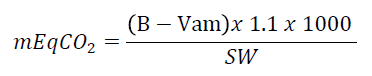
<body><![CDATA[<p><font face = "Verdana" size = "2"><i>Microbial activity essay</i></font></p>      <p><font face = "Verdana" size = "2">In order to measure the soil microbial activity, the soil carbon capture method was calculated using the metabolic coefficient, estimated by the C-CO<sub>2</sub> ratio of the basal microbial respiration and the C of the microbial biomass of the samples, according to Anderson and Domsch (1993).</font></p>      <p><font face = "Verdana" size = "2">Fractions of 150g of soil were weighed, and transferred to hermetically sealed containers of 1000mL, avoiding the passage of atmospheric air, but allowing respiratory flow to the samples. In each container was placed a smaller one with 10 mL of NaOH solution (1N) to capture CO<sub>2</sub>. At seven days intervals, the solutions were removed from the containers and were titrated. Four evaluations were realized. In the end, 2.5 mL BaCl (0.5 M) was added for precipitation and also 3 drops of the acid-base phenolphthalein indicator. The amount of CO<sub>2</sub> released from the soil was considered after titration of excess NaOH with HCl solution (0.5 M). The calculation of respiration was done using the titration method with CO<sub>2</sub> capture by NaOH by the formula:</font></p>       <p><font face = "Verdana" size = "2"><img src = "/img/revistas/rca/v42n2/v42n2a05eq1.jpg"></font></p>      
<p><font face = "Verdana" size = "2">where:</font></p>      <p><font face = "Verdana" size = "2">B = volume of HCl used on titration of white treatment;</font></p>      <p><font face = "Verdana" size = "2">Vam = volume of HCl used on titration of the samples;</font></p>       <p><font face = "Verdana" size = "2">1.1 = conversion factor;</font></p>      <p><font face = "Verdana" size = "2">SW = soil weight.</font></p>      <p><font face = "Verdana" size = "2">The experiment was composed by 4 treatments: conventional, organic, conventional autoclaved and organic autoclaved, with 6 replicates each.</font></p>      ]]></body>
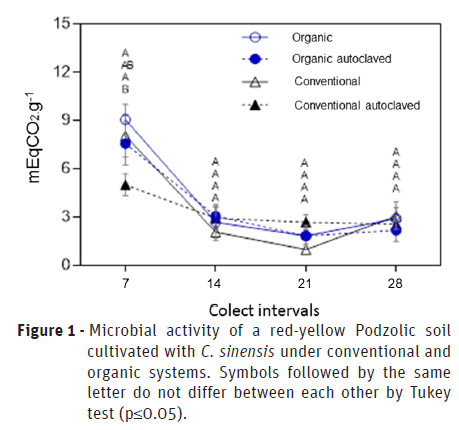
<body><![CDATA[<p><font face = "Verdana" size = "2"><i>Statistical analysis</i></font></p>       <p><font face = "Verdana" size = "2">The microbial activity data was submitted to analysis of variance (ANOVA) (p&#8804;0.05) using the Sisvar software (Ferreira, 2014). The distribution of the microbial population as a function of the microbial activity was subjected to the multivariate analysis by means of the analysis of covariance (ANCOVA) (p&#8804;0.01) using the software Xlstat<sup>®</sup>.</font></p>      <p><font face = "Verdana" size = "3"><b>RESULTS AND DISCUSSION</b></font></p>       <p><font face = "Verdana" size = "2">The analysis of variance results showed that CO<sub>2</sub> soil evolution in two cultivation systems, expressed in mEqCO<sub>2</sub>.g<sup>-1</sup>, had a decrease in both cultivation systems studied, whether or not they have undergone the autoclaving process. However, at the beginning of the evaluations, it was detected that in the organic cultivation system there was higher microbial respiratory activity (<a href = "#f1">Figure 1</a>).</font></p>      <p>&nbsp;</p>  <a name = "f1"><img src = "/img/revistas/rca/v42n2/v42n2a05f1.jpg"></a>      
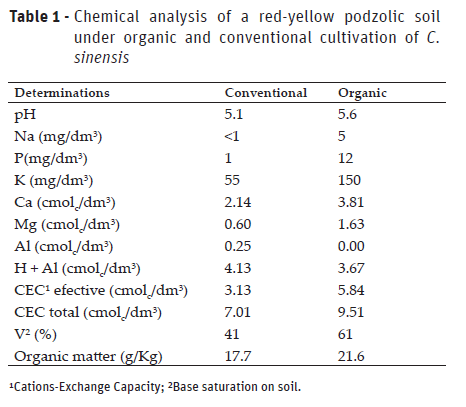
<p>&nbsp;</p>      <p><font face = "Verdana" size = "2">However, the soil microbial activity is a characteristic that has a close relation with the fertility and its management. In this way, it is important to observe the set of factors that converge for this. Thus, soil analyzes (<a href = "#t1">Table 1</a>) show that there are differences in fertility, which are a function of the adopted cultivation system.</font></p>      <p>&nbsp;</p>  <a name = "t1"><img src = "/img/revistas/rca/v42n2/v42n2a05t1.jpg"></a>      
<p>&nbsp;</p>      <p><font face = "Verdana" size = "2">CTC rates are mediated by soil organic matter, as they are charged and consequently increased by CTC through nutrient retention, contributing to plant nutrition. Therefore, Montezano <i>et al</i>. (2004) refer that management of soil organic matter is critical to improve crop productivity. Thus, it is probable that the organic cultivation system presented greater microbial activity due to the greater maintenance of organic matter, a management that is not adopted in the area where the cultivation is done by conventional methods.</font></p>       ]]></body>
<body><![CDATA[<p><font face = "Verdana" size = "2">It is important to take attention to the soil management system, regardless of the cultivation system adopted, ho allows better productivity maintenance and soil quality (Carneiro <i>et al</i>., 2016). Another important aspect is the bases saturation, which is responsible for the increase of the soil pH. In this study it was verified that the organic cultivation system had better balance in its fertility when comparing to the conventional system.</font></p>       <p><font face = "Verdana" size = "2">Microbiological analyzes revealed differences between the microbial communities evaluated as actinomycetes and filamentous fungi. However, regardless the crop system, the soil bacterial population remained constant for all evaluated treatments, even with the autoclaving process, &gt;2x10<sup>8</sup> CFU g<sup>-1</sup> of soil (<a href = "/img/revistas/rca/v42n2/v42n2a05t2.jpg" target = "_blank">Table 2</a>). Thus, the bacterial community in red-yellow podzolic soil can be considered a constant population not being affected by the cultivation system.</font></p>      
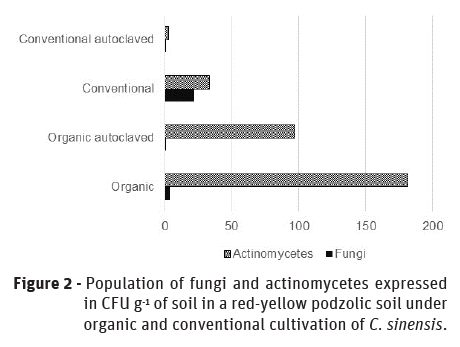
<p><font face = "Verdana" size = "2">On the other hand, a differentiated behavior was observed between filamentous fungi and actinomycetes showing a population of 33.33x10<sup>4</sup> CFU g<sup>-1</sup> in conventional cultivation and 181.66x10<sup>4</sup> CFU g<sup>-1</sup> of soil in organic cultivation, respectively for this second group. Inversely, filamentous fungi population was more representative in conventional cultivation system, showing values of 21.83x10<sup>4</sup> CFU g<sup>-1</sup> than in organic with values of 3.5x10<sup>4</sup> CFU g<sup>&#8209;1</sup> of soil. When the soil was autoclaved, the microbial population for these microorganisms was reduced. However, for actinomycetes the microbial population still remained considerably higher with a population of 96.83x10<sup>6</sup> CFU g<sup>-1</sup> in organic soil, while the fungal population was drastically reduced independently of the cultivation system. These results show that actinomycetes have higher resistance to high temperatures and pressure (<a href = "#f2">Figure 2</a>). Thus, filamentous fungi and actinomycetes are groups of microorganisms that have important expression to determine the biological quality of soils as a function of the cultivation system.</font></p>      <p>&nbsp;</p>  <a name = "f2"><img src = "/img/revistas/rca/v42n2/v42n2a05f2.jpg"></a>      
<p>&nbsp;</p>      <p><font face = "Verdana" size = "2">When studying soil microbial population, it is important to look at the factors together and not individually. In this way, it is known that the cultivation in organic system has its peculiarities, what differentiates it from the conventional one and makes it better from the ecological point of view. In the conventional cultivation system, for example, the application of agrochemicals causes imbalance in the microbial community.</font></p>      <p><font face = "Verdana" size = "2">So, it is essential the correct agricultural management regardless the system adopted and the crop of interest. Numerous factors contribute to the maintenance of soil fertility, like the population and microbial diversity to be observed, since several species of soil bacteria have the ability to fix atmospheric N and make it available to plants. Fungi, in turn, have the ability to survive in symbiosis with the roots and provide water and nutrients. Both these groups contribute significantly to plant nutrition, acting in addition to mineral fertilization. However, the maintenance of organic matter is of paramount importance, not only for the maintenance of the soil microbiota, but also for the improvement of chemical and physical attributes. In this aspect Spohn (2015) stands out the importance of maintaining organic matter, which is likely to improve the C:N ratio.</font></p>      <p><font face = "Verdana" size = "2">Crop rotations, especially those that include cover crops, sustain soil quality and productivity, increasing C, N and microbial biomass, making them a cornerstone for sustainable agroecosystems (McDaniel <i>et al</i>., 2014). On the other hand, in fruit crops of arboreal and perennial species it is difficult to include crop rotations, being necessary the adoption of alternatives that will collaborate with the improvement of the soil quality. Thus, cultivation of legumes can be recommended with subsequent incorporation into the soil.</font></p>      <p><font face = "Verdana" size = "3"><b>CONCLUSIONS</b></font></p>       <p><font face = "Verdana" size = "2">Microbial diversity in soils cultivated with <i>C. sinensis</i> showed a high population of bacteria and actinomycetes. In organic cultivation, it is possible to find higher values related to microbial populations, which suffer less impact when submitted to high temperatures. In addition, the microbial community associated with microbial respiratory activity can be adopted as a strategy for the evaluation of biological quality in conventional and organic systems.</font></p>       ]]></body>
<body><![CDATA[<p><font face = "Verdana" size = "3"><b>CONFLICT OF INTERESTS</b></font></p>      <p><font face = "Verdana" size = "2">The authors have not declared any conflict of interests</font></p>      <p>&nbsp;</p>      <p><font face = "Verdana" size = "3"><b>REFERENCES</b></font></p>       <!-- ref --><p><font face = "Verdana" size = "2">Anderson, T.H. & Domsch, Z.H. (1993) - The metabolic quotient for CO<sub>2</sub> (qCO<sub>2</sub>) as a specific activity parameter to assess the effects of environmental conditions, such as pH, on the microbial biomass of forest soils. <i>Soil Biology and Biochemistry</i>, vol. 25, n. 3, p. 393-395. <a href = "https://doi.org/10.1016/0038-0717(93)90140-7" target = "_blank">https://doi.org/10.1016/0038-0717(93)90140-7</a></font>&nbsp;&nbsp;&nbsp;&nbsp;&nbsp;&nbsp;&nbsp;&nbsp;[&#160;<a href="javascript:void(0);" onclick="javascript: window.open('/scielo.php?script=sci_nlinks&ref=697040&pid=S0871-018X201900020000500001&lng=','','width=640,height=500,resizable=yes,scrollbars=1,menubar=yes,');">Links</a>&#160;]<!-- end-ref --><!-- ref --><p><font face = "Verdana" size = "2">Balzergue, C.; Chabaud, D.; Barker, D.G.; Bécard, G. & Rochange, S.F. (2013) - High phosphate reduces host ability to develop arbuscular mycorrhizal symbiosis without affecting root calcium spiking responses to the fungus. <i>Frontiers in Plant Science</i>, vol. 4, art. 426. <a href = "https://doi.org/10.3389/fpls.2013.00426" target = "_blank">https://doi.org/10.3389/fpls.2013.00426</a></font>&nbsp;&nbsp;&nbsp;&nbsp;&nbsp;&nbsp;&nbsp;&nbsp;[&#160;<a href="javascript:void(0);" onclick="javascript: window.open('/scielo.php?script=sci_nlinks&ref=697041&pid=S0871-018X201900020000500002&lng=','','width=640,height=500,resizable=yes,scrollbars=1,menubar=yes,');">Links</a>&#160;]<!-- end-ref --><!-- ref --><p><font face = "Verdana" size = "2">Barroso, G.S.P.; dos Santos, T.M.C.; Montaldo, Y.C.; da Silva, J.M. & da Silva, P.J. (2012) - Respiração microbiana do solo cultivado com milho sobre dois sistemas de adubação no município de Rio Largo, Alagoas. <i>Revista Verde de Agroecologia e Desenvolvimento Sustentável</i>, vol. 7, n. 2, p. 8-10.    &nbsp;&nbsp;&nbsp;&nbsp;&nbsp;&nbsp;&nbsp;&nbsp;[&#160;<a href="javascript:void(0);" onclick="javascript: window.open('/scielo.php?script=sci_nlinks&ref=697042&pid=S0871-018X201900020000500003&lng=','','width=640,height=500,resizable=yes,scrollbars=1,menubar=yes,');">Links</a>&#160;]<!-- end-ref --></font></p>      <!-- ref --><p><font face = "Verdana" size = "2">Campos, A.A.B.; Scotton, J.C.; Costa, W.L.F.; Giassi, V.; Pinto, D.F.P. & Homma, F.K. (2015) - Seleção de fungicidas visando a preservação de fungos micorrízicos arbusculares nativos no cultivo de feijoeiro. <i>Revista Brasileira de Engenharia Agrícola e Ambiental</i>, vol. 19, n. 9, p. 3936-3942. <a href = "http://dx.doi.org/10.1590/1807-1929/agriambi.v19n9p898-902" target = "_blank">http://dx.doi.org/10.1590/1807-1929/agriambi.v19n9p898-902</a></font>&nbsp;&nbsp;&nbsp;&nbsp;&nbsp;&nbsp;&nbsp;&nbsp;[&#160;<a href="javascript:void(0);" onclick="javascript: window.open('/scielo.php?script=sci_nlinks&ref=697044&pid=S0871-018X201900020000500004&lng=','','width=640,height=500,resizable=yes,scrollbars=1,menubar=yes,');">Links</a>&#160;]<!-- end-ref --><!-- ref --><p><font face = "Verdana" size = "2">Carneiro, J.S.S.; dos Santos, A.C.M.; Fidelis, R.R.; da Silva Neto, S.P.; dos Ramos, A.C. & da Silva, R.R. (2016) - Diagnóstico e manejo da variabilidade espacial da fertilidade do solo no cerrado do Piauí. <i>Revista de Ciências Agroambientais</i>, vol. 14, n. 2, p. 10-21.    &nbsp;&nbsp;&nbsp;&nbsp;&nbsp;&nbsp;&nbsp;&nbsp;[&#160;<a href="javascript:void(0);" onclick="javascript: window.open('/scielo.php?script=sci_nlinks&ref=697045&pid=S0871-018X201900020000500005&lng=','','width=640,height=500,resizable=yes,scrollbars=1,menubar=yes,');">Links</a>&#160;]<!-- end-ref --></font></p>       <!-- ref --><p><font face = "Verdana" size = "2">EMBRAPA (2014) - <i>Sistema brasileiro de classificação de solos</i>. 4ª ed. Brasília: DF, 376 p.    &nbsp;&nbsp;&nbsp;&nbsp;&nbsp;&nbsp;&nbsp;&nbsp;[&#160;<a href="javascript:void(0);" onclick="javascript: window.open('/scielo.php?script=sci_nlinks&ref=697047&pid=S0871-018X201900020000500006&lng=','','width=640,height=500,resizable=yes,scrollbars=1,menubar=yes,');">Links</a>&#160;]<!-- end-ref --></font></p>      <!-- ref --><p><font face = "Verdana" size = "2">Fahy, P.C. & Hayward, A.C. (1983) - Media and methods for isolation and diagnostic test. In: Fahy, P.C. & Persley, G.J. (Eds.) - <i>Plant bacterial diseases: a diagnostic guide</i>. Sydney. Academic Press. pp. 337-338.    &nbsp;&nbsp;&nbsp;&nbsp;&nbsp;&nbsp;&nbsp;&nbsp;[&#160;<a href="javascript:void(0);" onclick="javascript: window.open('/scielo.php?script=sci_nlinks&ref=697049&pid=S0871-018X201900020000500007&lng=','','width=640,height=500,resizable=yes,scrollbars=1,menubar=yes,');">Links</a>&#160;]<!-- end-ref --></font></p>       <!-- ref --><p><font face = "Verdana" size = "2">Ferreira, D.F. (2014) - Sisvar: a Guide for its Bootstrap procedures in multiple comparisons. <i>Ciência e Agrotecnologia</i>, vol. 38, n. 2, p. 09-112. <a href = "http://dx.doi.org/10.1590/S1413-70542014000200001" target = "_blank">http://dx.doi.org/10.1590/S1413-70542014000200001</a></font>&nbsp;&nbsp;&nbsp;&nbsp;&nbsp;&nbsp;&nbsp;&nbsp;[&#160;<a href="javascript:void(0);" onclick="javascript: window.open('/scielo.php?script=sci_nlinks&ref=697051&pid=S0871-018X201900020000500008&lng=','','width=640,height=500,resizable=yes,scrollbars=1,menubar=yes,');">Links</a>&#160;]<!-- end-ref --><!-- ref --><p><font face = "Verdana" size = "2">IBGE (2017) - <i>Levantamento Sistemático da Produção Agrícola</i>. Instituto Brasileiro de Geografia e Estatística. [cit. 2018.05.23] &lt;<a href = "https://sidra.ibge.gov.br/pesquisa/lspa/tablas" target = "_blank">https://sidra.ibge.gov.br/pesquisa/lspa/tablas</a>&gt;    &nbsp;&nbsp;&nbsp;&nbsp;&nbsp;&nbsp;&nbsp;&nbsp;[&#160;<a href="javascript:void(0);" onclick="javascript: window.open('/scielo.php?script=sci_nlinks&ref=697052&pid=S0871-018X201900020000500009&lng=','','width=640,height=500,resizable=yes,scrollbars=1,menubar=yes,');">Links</a>&#160;]<!-- end-ref --> </font></p>      <!-- ref --><p><font face = "Verdana" size = "2">Kuster, E. & Williams, S.T. (1964) - Selective media for the isolation of Streptomycetes. <i>Nature</i>, vol. 202, p. 928-929.    &nbsp;&nbsp;&nbsp;&nbsp;&nbsp;&nbsp;&nbsp;&nbsp;[&#160;<a href="javascript:void(0);" onclick="javascript: window.open('/scielo.php?script=sci_nlinks&ref=697054&pid=S0871-018X201900020000500010&lng=','','width=640,height=500,resizable=yes,scrollbars=1,menubar=yes,');">Links</a>&#160;]<!-- end-ref --></font></p>       ]]></body>
<body><![CDATA[<!-- ref --><p><font face = "Verdana" size = "2">Martin, J.P. (1950) - Use of acid, rose bengal, and streptomycin in the plate method for estimating soil fungi. <i>Soil Science</i>, vol. 69, n. 3, p. 215-232. <a href = "https://doi.org/10.1097/00010694-195003000-00006" target = "_blank">https://doi.org/10.1097/00010694-195003000-00006</a></font>&nbsp;&nbsp;&nbsp;&nbsp;&nbsp;&nbsp;&nbsp;&nbsp;[&#160;<a href="javascript:void(0);" onclick="javascript: window.open('/scielo.php?script=sci_nlinks&ref=697056&pid=S0871-018X201900020000500011&lng=','','width=640,height=500,resizable=yes,scrollbars=1,menubar=yes,');">Links</a>&#160;]<!-- end-ref --><!-- ref --><p><font face = "Verdana" size = "2">McDaniel, M.D.; Tiemann, L.K. & Grandy, A.S. (2014) - Does agricultural crop diversity enhance soil microbial biomass and organic matter dynamics? A meta&#8208;analysis. <i>Ecological Applications</i>, vol. 24, n. 3, p. 560-570. <a href = "https://doi.org/10.1890/13-0616.1" target = "_blank">https://doi.org/10.1890/13-0616.1</a></font>&nbsp;&nbsp;&nbsp;&nbsp;&nbsp;&nbsp;&nbsp;&nbsp;[&#160;<a href="javascript:void(0);" onclick="javascript: window.open('/scielo.php?script=sci_nlinks&ref=697057&pid=S0871-018X201900020000500012&lng=','','width=640,height=500,resizable=yes,scrollbars=1,menubar=yes,');">Links</a>&#160;]<!-- end-ref --><!-- ref --><p><font face = "Verdana" size = "2">Minatel, A.L.G.; Andrioli, I.; Centurion, J.F. & Willian, N. (2006) - Efeitos da subsolagem e da adubação verde nas propriedades físicas do solo em pomar de citros. <i>Engenharia Agrícola</i>, vol. 26, n. 1, p. 86-95. <a href = "http://dx.doi.org/10.1590/S0100-69162006000100010" target = "_blank">http://dx.doi.org/10.1590/S0100-69162006000100010</a></font>&nbsp;&nbsp;&nbsp;&nbsp;&nbsp;&nbsp;&nbsp;&nbsp;[&#160;<a href="javascript:void(0);" onclick="javascript: window.open('/scielo.php?script=sci_nlinks&ref=697058&pid=S0871-018X201900020000500013&lng=','','width=640,height=500,resizable=yes,scrollbars=1,menubar=yes,');">Links</a>&#160;]<!-- end-ref --><!-- ref --><p><font face = "Verdana" size = "2">Montaldo, J.C.; dos Santos, G.B.L.; Montaldo, Y.C.; dos Santos, T.M.C.; Barroso, G.S.P.; de Oliveira, J.U.L. & da Silva, J.M. (2018) - Basal respiration and microbial population of a red-yellow latosol under different harvesting systems of sugarcane. <i>Global Science and Technology</i>, vol. 11, n. 1, p. 8-16.    &nbsp;&nbsp;&nbsp;&nbsp;&nbsp;&nbsp;&nbsp;&nbsp;[&#160;<a href="javascript:void(0);" onclick="javascript: window.open('/scielo.php?script=sci_nlinks&ref=697059&pid=S0871-018X201900020000500014&lng=','','width=640,height=500,resizable=yes,scrollbars=1,menubar=yes,');">Links</a>&#160;]<!-- end-ref --></font></p>      <!-- ref --><p><font face = "Verdana" size = "2">Montezano, Z.F.; Corazza, E.J. & Muraoka, T. (2006) - Variabilidade espacial da fertilidade do solo em área cultivada e manejada homogeneamente. <i>Revista Brasileira de Ciência do Solo</i>, vol. 30, n. 5, p. 839-847. <a href = "http://dx.doi.org/10.1590/S0100-06832006000500010" target = "_blank">http://dx.doi.org/10.1590/S0100-06832006000500010</a></font>&nbsp;&nbsp;&nbsp;&nbsp;&nbsp;&nbsp;&nbsp;&nbsp;[&#160;<a href="javascript:void(0);" onclick="javascript: window.open('/scielo.php?script=sci_nlinks&ref=697061&pid=S0871-018X201900020000500015&lng=','','width=640,height=500,resizable=yes,scrollbars=1,menubar=yes,');">Links</a>&#160;]<!-- end-ref --><!-- ref --><p><font face = "Verdana" size = "2">Sapp, M.; Harrison, M.; Hany, U.; Charlton, A. & Thwaites, R. (2015) - Comparing the effect of digestate and chemical fertilizer on soil bacteria. <i>Applied Soil Ecology</i>, vol. 86, p. 1-9. <a href = "https://doi.org/10.1016/j.apsoil.2014.10.004" target = "_blank">https://doi.org/10.1016/j.apsoil.2014.10.004</a></font>&nbsp;&nbsp;&nbsp;&nbsp;&nbsp;&nbsp;&nbsp;&nbsp;[&#160;<a href="javascript:void(0);" onclick="javascript: window.open('/scielo.php?script=sci_nlinks&ref=697062&pid=S0871-018X201900020000500016&lng=','','width=640,height=500,resizable=yes,scrollbars=1,menubar=yes,');">Links</a>&#160;]<!-- end-ref --><!-- ref --><p><font face = "Verdana" size = "2">Spohn, M. (2015) - Microbial respiration per unit microbial biomass depends on litter layer carbon-to-nitrogen ratio. <i>Biogeosciences</i>, vol. 12, p. 817-823. <a href = "https://doi.org/10.5194/bg-12-817-2015" target = "_blank">https://doi.org/10.5194/bg-12-817-2015</a></font>&nbsp;&nbsp;&nbsp;&nbsp;&nbsp;&nbsp;&nbsp;&nbsp;[&#160;<a href="javascript:void(0);" onclick="javascript: window.open('/scielo.php?script=sci_nlinks&ref=697063&pid=S0871-018X201900020000500017&lng=','','width=640,height=500,resizable=yes,scrollbars=1,menubar=yes,');">Links</a>&#160;]<!-- end-ref --><!-- ref --><p><font face = "Verdana" size = "2">Wang, C.; Wang, F.; Zhang, Q. & Liang, W. (2016) - Individual and combined effects of tebuconazole and carbendazim on soil microbial activity. <i>European Journal of Soil Biology</i>, vol. 72, p. 6-13. <a href = "https://doi.org/10.1016/j.ejsobi.2015.12.005" target = "_blank">https://doi.org/10.1016/j.ejsobi.2015.12.005</a></font>&nbsp;&nbsp;&nbsp;&nbsp;&nbsp;&nbsp;&nbsp;&nbsp;[&#160;<a href="javascript:void(0);" onclick="javascript: window.open('/scielo.php?script=sci_nlinks&ref=697064&pid=S0871-018X201900020000500018&lng=','','width=640,height=500,resizable=yes,scrollbars=1,menubar=yes,');">Links</a>&#160;]<!-- end-ref --><!-- ref --><p><font face = "Verdana" size = "2">Wang, P.; Zhang, J.J.; Shu, B. & Xia, R.X. (2012) - Arbuscular mycorrhizal fungi associated with citrus orchards under different types of soil management, Southern China. <i>Plant Soil and Environment</i>, vol. 58, n. 7, p. 302-308.    &nbsp;&nbsp;&nbsp;&nbsp;&nbsp;&nbsp;&nbsp;&nbsp;[&#160;<a href="javascript:void(0);" onclick="javascript: window.open('/scielo.php?script=sci_nlinks&ref=697065&pid=S0871-018X201900020000500019&lng=','','width=640,height=500,resizable=yes,scrollbars=1,menubar=yes,');">Links</a>&#160;]<!-- end-ref --></font></p>      <!-- ref --><p><font face = "Verdana" size = "2">Zhou, X.; He, Z.; Liang, Z.; Stoffella, P.J.; Fan, J.; Yang, Y. & Powel, C.A. (2011) - Long term use of cooper-containing fungicide affects microbial properties of citrus grove soils. <i>Soil Science Society of America Journal</i>, vol. 75, n. 3, p. 898-906. <a href = "https://doi.org/10.2136/sssaj2010.0321" target = "_blank">https://doi.org/10.2136/sssaj2010.0321</a></font>&nbsp;&nbsp;&nbsp;&nbsp;&nbsp;&nbsp;&nbsp;&nbsp;[&#160;<a href="javascript:void(0);" onclick="javascript: window.open('/scielo.php?script=sci_nlinks&ref=697067&pid=S0871-018X201900020000500020&lng=','','width=640,height=500,resizable=yes,scrollbars=1,menubar=yes,');">Links</a>&#160;]<!-- end-ref --><p>&nbsp;</p>      <p><font face = "Verdana" size = "3"><b>ACKNOWLEDGMENTS</b></font></p>       <p><font face = "Verdana" size = "2">Federal University of Alagoas and Laboratory of Agricultural Microbiology and Soil.</font></p>      <p>&nbsp;</p>      <p><font face = "Verdana" size = "2">Received/recebido: 2018.07.11</font></p>      <p><font face = "Verdana" size = "2">Accepted/aceite: 2018.12.10</font></p>       ]]></body><back>
<ref-list>
<ref id="B1">
<nlm-citation citation-type="journal">
<person-group person-group-type="author">
<name>
<surname><![CDATA[Anderson]]></surname>
<given-names><![CDATA[T.H.]]></given-names>
</name>
<name>
<surname><![CDATA[Domsch]]></surname>
<given-names><![CDATA[Z.H.]]></given-names>
</name>
</person-group>
<article-title xml:lang="en"><![CDATA[The metabolic quotient for CO2 (qCO2) as a specific activity parameter to assess the effects of environmental conditions, such as pH, on the microbial biomass of forest soils]]></article-title>
<source><![CDATA[Soil Biology and Biochemistry]]></source>
<year>1993</year>
<volume>25</volume>
<numero>3</numero>
<issue>3</issue>
<page-range>393-395</page-range></nlm-citation>
</ref>
<ref id="B2">
<nlm-citation citation-type="journal">
<person-group person-group-type="author">
<name>
<surname><![CDATA[Balzergue]]></surname>
<given-names><![CDATA[C.]]></given-names>
</name>
<name>
<surname><![CDATA[Chabaud]]></surname>
<given-names><![CDATA[D.]]></given-names>
</name>
<name>
<surname><![CDATA[Barker]]></surname>
<given-names><![CDATA[D.G.]]></given-names>
</name>
<name>
<surname><![CDATA[Bécard]]></surname>
<given-names><![CDATA[G.]]></given-names>
</name>
<name>
<surname><![CDATA[Rochange]]></surname>
<given-names><![CDATA[S.F.]]></given-names>
</name>
</person-group>
<article-title xml:lang="en"><![CDATA[High phosphate reduces host ability to develop arbuscular mycorrhizal symbiosis without affecting root calcium spiking responses to the fungus]]></article-title>
<source><![CDATA[Frontiers in Plant Science]]></source>
<year>2013</year>
<volume>4</volume>
<page-range>426</page-range></nlm-citation>
</ref>
<ref id="B3">
<nlm-citation citation-type="journal">
<person-group person-group-type="author">
<name>
<surname><![CDATA[Barroso]]></surname>
<given-names><![CDATA[G.S.P.]]></given-names>
</name>
<name>
<surname><![CDATA[dos Santos]]></surname>
<given-names><![CDATA[T.M.C.]]></given-names>
</name>
<name>
<surname><![CDATA[Montaldo]]></surname>
<given-names><![CDATA[Y.C.]]></given-names>
</name>
<name>
<surname><![CDATA[da Silva]]></surname>
<given-names><![CDATA[J.M.]]></given-names>
</name>
<name>
<surname><![CDATA[da Silva]]></surname>
<given-names><![CDATA[P.J.]]></given-names>
</name>
</person-group>
<article-title xml:lang="pt"><![CDATA[Respiração microbiana do solo cultivado com milho sobre dois sistemas de adubação no município de Rio Largo, Alagoas]]></article-title>
<source><![CDATA[Revista Verde de Agroecologia e Desenvolvimento Sustentável]]></source>
<year>2012</year>
<volume>7</volume>
<numero>2</numero>
<issue>2</issue>
<page-range>8-10</page-range></nlm-citation>
</ref>
<ref id="B4">
<nlm-citation citation-type="journal">
<person-group person-group-type="author">
<name>
<surname><![CDATA[Campos]]></surname>
<given-names><![CDATA[A.A.B.]]></given-names>
</name>
<name>
<surname><![CDATA[Scotton]]></surname>
<given-names><![CDATA[J.C.]]></given-names>
</name>
<name>
<surname><![CDATA[Costa]]></surname>
<given-names><![CDATA[W.L.F.]]></given-names>
</name>
<name>
<surname><![CDATA[Giassi]]></surname>
<given-names><![CDATA[V.]]></given-names>
</name>
<name>
<surname><![CDATA[Pinto]]></surname>
<given-names><![CDATA[D.F.P.]]></given-names>
</name>
<name>
<surname><![CDATA[Homma]]></surname>
<given-names><![CDATA[F.K.]]></given-names>
</name>
</person-group>
<article-title xml:lang="en"><![CDATA[Seleção de fungicidas visando a preservação de fungos micorrízicos arbusculares nativos no cultivo de feijoeiro]]></article-title>
<source><![CDATA[Revista Brasileira de Engenharia Agrícola e Ambiental]]></source>
<year>2015</year>
<volume>19</volume>
<numero>9</numero>
<issue>9</issue>
<page-range>3936-3942</page-range></nlm-citation>
</ref>
<ref id="B5">
<nlm-citation citation-type="journal">
<person-group person-group-type="author">
<name>
<surname><![CDATA[Carneiro]]></surname>
<given-names><![CDATA[J.S.S.]]></given-names>
</name>
<name>
<surname><![CDATA[dos Santos]]></surname>
<given-names><![CDATA[A.C.M.]]></given-names>
</name>
<name>
<surname><![CDATA[Fidelis]]></surname>
<given-names><![CDATA[R.R.]]></given-names>
</name>
<name>
<surname><![CDATA[da Silva Neto]]></surname>
<given-names><![CDATA[S.P.]]></given-names>
</name>
<name>
<surname><![CDATA[dos Ramos]]></surname>
<given-names><![CDATA[A.C.]]></given-names>
</name>
<name>
<surname><![CDATA[da Silva]]></surname>
<given-names><![CDATA[R.R.]]></given-names>
</name>
</person-group>
<article-title xml:lang="pt"><![CDATA[Diagnóstico e manejo da variabilidade espacial da fertilidade do solo no cerrado do Piauí]]></article-title>
<source><![CDATA[Revista de Ciências Agroambientais]]></source>
<year>2016</year>
<volume>14</volume>
<numero>2</numero>
<issue>2</issue>
<page-range>10-21</page-range></nlm-citation>
</ref>
<ref id="B6">
<nlm-citation citation-type="">
<collab>EMBRAPA</collab>
<source><![CDATA[Sistema brasileiro de classificação de solos]]></source>
<year>2014</year>
<edition>4ª</edition>
<publisher-loc><![CDATA[Brasília^eDF DF]]></publisher-loc>
</nlm-citation>
</ref>
<ref id="B7">
<nlm-citation citation-type="book">
<person-group person-group-type="author">
<name>
<surname><![CDATA[Fahy]]></surname>
<given-names><![CDATA[P.C.]]></given-names>
</name>
<name>
<surname><![CDATA[Hayward]]></surname>
<given-names><![CDATA[A.C.]]></given-names>
</name>
</person-group>
<article-title xml:lang="en"><![CDATA[Media and methods for isolation and diagnostic test]]></article-title>
<person-group person-group-type="editor">
<name>
<surname><![CDATA[Fahy]]></surname>
<given-names><![CDATA[P.C.]]></given-names>
</name>
<name>
<surname><![CDATA[Persley]]></surname>
<given-names><![CDATA[G.J.]]></given-names>
</name>
</person-group>
<source><![CDATA[Plant bacterial diseases: a diagnostic guide]]></source>
<year>1983</year>
<page-range>337-338</page-range><publisher-loc><![CDATA[Sydney ]]></publisher-loc>
<publisher-name><![CDATA[Academic Press]]></publisher-name>
</nlm-citation>
</ref>
<ref id="B8">
<nlm-citation citation-type="journal">
<person-group person-group-type="author">
<name>
<surname><![CDATA[Ferreira]]></surname>
<given-names><![CDATA[D.F.]]></given-names>
</name>
</person-group>
<article-title xml:lang="en"><![CDATA[Sisvar: a Guide for its Bootstrap procedures in multiple comparisons]]></article-title>
<source><![CDATA[Ciência e Agrotecnologia]]></source>
<year>2014</year>
<volume>38</volume>
<numero>2</numero>
<issue>2</issue>
<page-range>09-112</page-range></nlm-citation>
</ref>
<ref id="B9">
<nlm-citation citation-type="book">
<collab>IBGE</collab>
<source><![CDATA[Levantamento Sistemático da Produção Agrícola]]></source>
<year>2017</year>
<publisher-name><![CDATA[Instituto Brasileiro de Geografia e Estatística]]></publisher-name>
</nlm-citation>
</ref>
<ref id="B10">
<nlm-citation citation-type="journal">
<person-group person-group-type="author">
<name>
<surname><![CDATA[Kuster]]></surname>
<given-names><![CDATA[E.]]></given-names>
</name>
<name>
<surname><![CDATA[Williams]]></surname>
<given-names><![CDATA[S.T.]]></given-names>
</name>
</person-group>
<article-title xml:lang="en"><![CDATA[Selective media for the isolation of Streptomycetes]]></article-title>
<source><![CDATA[Nature]]></source>
<year>1964</year>
<volume>202</volume>
<page-range>928-929</page-range></nlm-citation>
</ref>
<ref id="B11">
<nlm-citation citation-type="journal">
<person-group person-group-type="author">
<name>
<surname><![CDATA[Martin]]></surname>
<given-names><![CDATA[J.P.]]></given-names>
</name>
</person-group>
<article-title xml:lang="en"><![CDATA[Use of acid, rose bengal, and streptomycin in the plate method for estimating soil fungi]]></article-title>
<source><![CDATA[Soil Science]]></source>
<year>1950</year>
<volume>69</volume>
<numero>3</numero>
<issue>3</issue>
<page-range>215-232</page-range></nlm-citation>
</ref>
<ref id="B12">
<nlm-citation citation-type="journal">
<person-group person-group-type="author">
<name>
<surname><![CDATA[McDaniel]]></surname>
<given-names><![CDATA[M.D.]]></given-names>
</name>
<name>
<surname><![CDATA[Tiemann]]></surname>
<given-names><![CDATA[L.K.]]></given-names>
</name>
<name>
<surname><![CDATA[Grandy]]></surname>
<given-names><![CDATA[A.S.]]></given-names>
</name>
</person-group>
<article-title xml:lang="en"><![CDATA[Does agricultural crop diversity enhance soil microbial biomass and organic matter dynamics?: A meta&#8208;analysis]]></article-title>
<source><![CDATA[Ecological Applications]]></source>
<year>2014</year>
<volume>24</volume>
<numero>3</numero>
<issue>3</issue>
<page-range>560-570</page-range></nlm-citation>
</ref>
<ref id="B13">
<nlm-citation citation-type="journal">
<person-group person-group-type="author">
<name>
<surname><![CDATA[Minatel]]></surname>
<given-names><![CDATA[A.L.G.]]></given-names>
</name>
<name>
<surname><![CDATA[Andrioli]]></surname>
<given-names><![CDATA[I.]]></given-names>
</name>
<name>
<surname><![CDATA[Centurion]]></surname>
<given-names><![CDATA[J.F.]]></given-names>
</name>
<name>
<surname><![CDATA[Willian]]></surname>
<given-names><![CDATA[N.]]></given-names>
</name>
</person-group>
<article-title xml:lang="pt"><![CDATA[Efeitos da subsolagem e da adubação verde nas propriedades físicas do solo em pomar de citros]]></article-title>
<source><![CDATA[Engenharia Agrícola]]></source>
<year>2006</year>
<volume>26</volume>
<numero>1</numero>
<issue>1</issue>
<page-range>86-95</page-range></nlm-citation>
</ref>
<ref id="B14">
<nlm-citation citation-type="journal">
<person-group person-group-type="author">
<name>
<surname><![CDATA[Montaldo]]></surname>
<given-names><![CDATA[J.C.]]></given-names>
</name>
<name>
<surname><![CDATA[dos Santos]]></surname>
<given-names><![CDATA[G.B.L.]]></given-names>
</name>
<name>
<surname><![CDATA[Montaldo]]></surname>
<given-names><![CDATA[Y.C.]]></given-names>
</name>
<name>
<surname><![CDATA[dos Santos]]></surname>
<given-names><![CDATA[T.M.C.]]></given-names>
</name>
<name>
<surname><![CDATA[Barroso]]></surname>
<given-names><![CDATA[G.S.P.]]></given-names>
</name>
<name>
<surname><![CDATA[de Oliveira]]></surname>
<given-names><![CDATA[J.U.L.]]></given-names>
</name>
<name>
<surname><![CDATA[da Silva]]></surname>
<given-names><![CDATA[J.M.]]></given-names>
</name>
</person-group>
<article-title xml:lang="en"><![CDATA[Basal respiration and microbial population of a red-yellow latosol under different harvesting systems of sugarcane]]></article-title>
<source><![CDATA[Global Science and Technology]]></source>
<year>2018</year>
<volume>11</volume>
<numero>1</numero>
<issue>1</issue>
<page-range>8-16</page-range></nlm-citation>
</ref>
<ref id="B15">
<nlm-citation citation-type="journal">
<person-group person-group-type="author">
<name>
<surname><![CDATA[Montezano]]></surname>
<given-names><![CDATA[Z.F.]]></given-names>
</name>
<name>
<surname><![CDATA[Corazza]]></surname>
<given-names><![CDATA[E.J.]]></given-names>
</name>
<name>
<surname><![CDATA[Muraoka]]></surname>
<given-names><![CDATA[T.]]></given-names>
</name>
</person-group>
<article-title xml:lang="pt"><![CDATA[Variabilidade espacial da fertilidade do solo em área cultivada e manejada homogeneamente]]></article-title>
<source><![CDATA[Revista Brasileira de Ciência do Solo]]></source>
<year>2006</year>
<volume>30</volume>
<numero>5</numero>
<issue>5</issue>
<page-range>839-847</page-range></nlm-citation>
</ref>
<ref id="B16">
<nlm-citation citation-type="journal">
<person-group person-group-type="author">
<name>
<surname><![CDATA[Sapp]]></surname>
<given-names><![CDATA[M.]]></given-names>
</name>
<name>
<surname><![CDATA[Harrison]]></surname>
<given-names><![CDATA[M.]]></given-names>
</name>
<name>
<surname><![CDATA[Hany]]></surname>
<given-names><![CDATA[U.]]></given-names>
</name>
<name>
<surname><![CDATA[Charlton]]></surname>
<given-names><![CDATA[A.]]></given-names>
</name>
<name>
<surname><![CDATA[Thwaites]]></surname>
<given-names><![CDATA[R.]]></given-names>
</name>
</person-group>
<article-title xml:lang="en"><![CDATA[Comparing the effect of digestate and chemical fertilizer on soil bacteria]]></article-title>
<source><![CDATA[Applied Soil Ecology]]></source>
<year>2015</year>
<volume>86</volume>
<page-range>1-9</page-range></nlm-citation>
</ref>
<ref id="B17">
<nlm-citation citation-type="journal">
<person-group person-group-type="author">
<name>
<surname><![CDATA[Spohn]]></surname>
<given-names><![CDATA[M.]]></given-names>
</name>
</person-group>
<article-title xml:lang="en"><![CDATA[Microbial respiration per unit microbial biomass depends on litter layer carbon-to-nitrogen ratio]]></article-title>
<source><![CDATA[Biogeosciences]]></source>
<year>2015</year>
<volume>12</volume>
<page-range>817-823</page-range></nlm-citation>
</ref>
<ref id="B18">
<nlm-citation citation-type="journal">
<person-group person-group-type="author">
<name>
<surname><![CDATA[Wang]]></surname>
<given-names><![CDATA[C.]]></given-names>
</name>
<name>
<surname><![CDATA[Wang]]></surname>
<given-names><![CDATA[F.]]></given-names>
</name>
<name>
<surname><![CDATA[Zhang]]></surname>
<given-names><![CDATA[Q.]]></given-names>
</name>
<name>
<surname><![CDATA[Liang]]></surname>
<given-names><![CDATA[W.]]></given-names>
</name>
</person-group>
<article-title xml:lang="en"><![CDATA[Individual and combined effects of tebuconazole and carbendazim on soil microbial activity]]></article-title>
<source><![CDATA[European Journal of Soil Biology]]></source>
<year>2016</year>
<volume>72</volume>
<page-range>6-13</page-range></nlm-citation>
</ref>
<ref id="B19">
<nlm-citation citation-type="journal">
<person-group person-group-type="author">
<name>
<surname><![CDATA[Wang]]></surname>
<given-names><![CDATA[P.]]></given-names>
</name>
<name>
<surname><![CDATA[Zhang]]></surname>
<given-names><![CDATA[J.J.]]></given-names>
</name>
<name>
<surname><![CDATA[Shu]]></surname>
<given-names><![CDATA[B.]]></given-names>
</name>
<name>
<surname><![CDATA[Xia]]></surname>
<given-names><![CDATA[R.X.]]></given-names>
</name>
</person-group>
<article-title xml:lang="en"><![CDATA[Arbuscular mycorrhizal fungi associated with citrus orchards under different types of soil management, Southern China]]></article-title>
<source><![CDATA[Plant Soil and Environment]]></source>
<year>2012</year>
<volume>58</volume>
<numero>7</numero>
<issue>7</issue>
<page-range>302-308</page-range></nlm-citation>
</ref>
<ref id="B20">
<nlm-citation citation-type="journal">
<person-group person-group-type="author">
<name>
<surname><![CDATA[Zhou]]></surname>
<given-names><![CDATA[X.]]></given-names>
</name>
<name>
<surname><![CDATA[He]]></surname>
<given-names><![CDATA[Z.]]></given-names>
</name>
<name>
<surname><![CDATA[Liang]]></surname>
<given-names><![CDATA[Z.]]></given-names>
</name>
<name>
<surname><![CDATA[Stoffella]]></surname>
<given-names><![CDATA[P.J.]]></given-names>
</name>
<name>
<surname><![CDATA[Fan]]></surname>
<given-names><![CDATA[J.]]></given-names>
</name>
<name>
<surname><![CDATA[Yang]]></surname>
<given-names><![CDATA[Y.]]></given-names>
</name>
<name>
<surname><![CDATA[Powel]]></surname>
<given-names><![CDATA[C.A.]]></given-names>
</name>
</person-group>
<article-title xml:lang="en"><![CDATA[Long term use of cooper-containing fungicide affects microbial properties of citrus grove soils]]></article-title>
<source><![CDATA[Soil Science Society of America Journal]]></source>
<year>2011</year>
<volume>75</volume>
<numero>3</numero>
<issue>3</issue>
<page-range>898-906</page-range></nlm-citation>
</ref>
</ref-list>
</back>
</article>