<?xml version="1.0" encoding="ISO-8859-1"?><article xmlns:mml="http://www.w3.org/1998/Math/MathML" xmlns:xlink="http://www.w3.org/1999/xlink" xmlns:xsi="http://www.w3.org/2001/XMLSchema-instance">
<front>
<journal-meta>
<journal-id>0871-018X</journal-id>
<journal-title><![CDATA[Revista de Ciências Agrárias]]></journal-title>
<abbrev-journal-title><![CDATA[Rev. de Ciências Agrárias]]></abbrev-journal-title>
<issn>0871-018X</issn>
<publisher>
<publisher-name><![CDATA[Sociedade de Ciências Agrárias de Portugal]]></publisher-name>
</publisher>
</journal-meta>
<article-meta>
<article-id>S0871-018X2019000200010</article-id>
<article-id pub-id-type="doi">10.19084/rca.15833</article-id>
<title-group>
<article-title xml:lang="en"><![CDATA[Electrical conductivity test in soybean seeds with reduced imbibition period]]></article-title>
<article-title xml:lang="pt"><![CDATA[Teste de condutividade elétrica em sementes de soja com período de embebição reduzido]]></article-title>
</title-group>
<contrib-group>
<contrib contrib-type="author">
<name>
<surname><![CDATA[Catão]]></surname>
<given-names><![CDATA[Hugo César Rodrigues Moreira]]></given-names>
</name>
<xref ref-type="aff" rid="A1"/>
</contrib>
<contrib contrib-type="author">
<name>
<surname><![CDATA[Caixeta]]></surname>
<given-names><![CDATA[Franciele]]></given-names>
</name>
<xref ref-type="aff" rid="A2"/>
</contrib>
</contrib-group>
<aff id="AA1">
<institution><![CDATA[,Faculdades Integradas de Ourinhos Department of Plant Sciences ]]></institution>
<addr-line><![CDATA[Ourinhos SP]]></addr-line>
<country>Brasil</country>
</aff>
<aff id="AA2">
<institution><![CDATA[,General Mills Brasil Alimentos Ltda  ]]></institution>
<addr-line><![CDATA[Cambará PR]]></addr-line>
<country>Brasil</country>
</aff>
<pub-date pub-type="pub">
<day>00</day>
<month>06</month>
<year>2019</year>
</pub-date>
<pub-date pub-type="epub">
<day>00</day>
<month>06</month>
<year>2019</year>
</pub-date>
<volume>42</volume>
<numero>2</numero>
<fpage>91</fpage>
<lpage>100</lpage>
<copyright-statement/>
<copyright-year/>
<self-uri xlink:href="http://scielo.pt/scielo.php?script=sci_arttext&amp;pid=S0871-018X2019000200010&amp;lng=en&amp;nrm=iso"></self-uri><self-uri xlink:href="http://scielo.pt/scielo.php?script=sci_abstract&amp;pid=S0871-018X2019000200010&amp;lng=en&amp;nrm=iso"></self-uri><self-uri xlink:href="http://scielo.pt/scielo.php?script=sci_pdf&amp;pid=S0871-018X2019000200010&amp;lng=en&amp;nrm=iso"></self-uri><abstract abstract-type="short" xml:lang="en"><p><![CDATA[The search for vigor tests that offer fast and reliable information about the physiological potential of seeds is fundamental in quality control. The present study aimed to evaluate the effect of different temperatures associated with the reduction of soybean imbibition period in the electrical conductivity test. Seven seed lots of the cultivar TMG 7062 IPRO were used in this assessment. For the initial characterization of the lots, we determined the water content, the first and the final count of the germination test, the emergence, the accelerated aging, and the traditional electrical conductivity. The other method used for the electrical conductivity test consisted of 20 replicates of 10 seeds which were placed in plastic cups with 25ml of deionized water, and soaked in 10 min, 30 min, 60 min, and 120 min at temperatures of 30ºC, 35ºC, 40ºC, and 45ºC. The experimental design was completely randomized. We were able to reduce the imbibition period since its results were similar to those of the traditional methodology. The electrical conductivity test performed using the 30 minutes imbibition period at temperatures of 30ºC or 35ºC provides consistent information that allows the identification of lots of soybean seeds with different levels of vigor.]]></p></abstract>
<abstract abstract-type="short" xml:lang="pt"><p><![CDATA[Testes de vigor que ofereçam rapidez e informações seguras sobre o potencial fisiológico das sementes é de fundamental importância no controle de qualidade. Objetivou-se por isso avaliar o efeito de diferentes temperaturas associados à redução do período de embebição das sementes de soja no teste de condutividade elétrica. Foram utilizados sete lotes de sementes da cultivar TMG 7062 IPRO. Para a caracterização inicial dos lotes determinou-se o teor de água, a primeira e a contagem final do teste de germinação, a emergência, o envelhecimento acelerado e a condutividade elétrica tradicional. A outra metodologia para o teste de condutividade elétrica proposta consistiu em usar 20 repetições de 10 sementes, colocadas em copos plásticos com 25mL de água deionizada, embebidas durante 10, 30, 60 e 120 minutos nas temperaturas de 30ºC, 35ºC, 40ºC e 45ºC. O delineamento experimental utilizado foi o inteiramente casualizado. Os resultados obtidos evidenciaram a possibilidade de reduzir o período de embebição dado terem sido semelhantes aos da metodologia tradicional. O teste de condutividade elétrica realizado com o período de embebição de 30 minutos nas temperaturas de 30 ou 35ºC forneceu informações consistentes que permitiram a identificação de lotes de sementes de soja com diferentes níveis de vigor.]]></p></abstract>
<kwd-group>
<kwd lng="en"><![CDATA[Glycine max (L.) Merrill]]></kwd>
<kwd lng="en"><![CDATA[vigor]]></kwd>
<kwd lng="en"><![CDATA[imbibition period]]></kwd>
<kwd lng="en"><![CDATA[temperature]]></kwd>
<kwd lng="pt"><![CDATA[Glycine max (L.) Merrill]]></kwd>
<kwd lng="pt"><![CDATA[vigor]]></kwd>
<kwd lng="pt"><![CDATA[período de embebição]]></kwd>
<kwd lng="pt"><![CDATA[temperatura]]></kwd>
</kwd-group>
</article-meta>
</front><body><![CDATA[ <p align = "right"><font face = "Verdana" size = "2"><b>ARTIGO</b></font></p>      <p><font face = "Verdana" size = "4"><b>Electrical conductivity test in soybean seeds with reduced imbibition period</b></font></p>       <p><font face = "Verdana" size = "3"><b>Teste de condutividade elétrica em sementes de soja com período de embebição reduzido</b></font></p>      <p><font face = "Verdana" size = "2"><b>Hugo César Rodrigues Moreira Catão</b><sup>1,*</sup> and <b>Franciele Caixeta</b><sup>2</sup></font></p>       <p><font face = "Verdana" size = "2"><i><sup>1</sup> Faculdades Integradas de Ourinhos, Department of Plant Sciences, Rodovia BR 153, Km 338, CEP 19909-100, Ourinhos, SP, Brasil</i></font></p>      <p><font face = "Verdana" size = "2"><i><sup>2</sup> General Mills Brasil Alimentos Ltda., R. Benjamin Constant, 17, CEP 86390-000, Cambará - PR, Brasil</i></font></p>      <p><font face = "Verdana" size = "2"><i>(*E-mail: <a href = "mailto:hugocatao@yahoo.com.br">hugocatao@yahoo.com.br</a>)</i></font></p>   <hr noshade size = 1>      <p><font face = "Verdana" size = "3"><b>ABSTRACT</b></font></p>      <p><font face = "Verdana" size = "2">The search for vigor tests that offer fast and reliable information about the physiological potential of seeds is fundamental in quality control. The present study aimed to evaluate the effect of different temperatures associated with the reduction of soybean imbibition period in the electrical conductivity test. Seven seed lots of the cultivar TMG 7062 IPRO were used in this assessment. For the initial characterization of the lots, we determined the water content, the first and the final count of the germination test, the emergence, the accelerated aging, and the traditional electrical conductivity. The other method used for the electrical conductivity test consisted of 20 replicates of 10 seeds which were placed in plastic cups with 25ml of deionized water, and soaked in 10 min, 30 min, 60 min, and 120 min at temperatures of 30<sup>o</sup>C, 35<sup>o</sup>C, 40<sup>o</sup>C, and 45<sup>o</sup>C. The experimental design was completely randomized. We were able to reduce the imbibition period since its results were similar to those of the traditional methodology. The electrical conductivity test performed using the 30 minutes imbibition period at temperatures of 30<sup>o</sup>C or 35<sup>o</sup>C provides consistent information that allows the identification of lots of soybean seeds with different levels of vigor.</font></p>       <p><font face = "Verdana" size = "2"><b>Keywords</b>: <i>Glycine max</i> (L.) Merrill, vigor, imbibition period, temperature.</font></p>   <hr noshade size = 1>      ]]></body>
<body><![CDATA[<p><font face = "Verdana" size = "3"><b>RESUMO</b></font></p>      <p><font face = "Verdana" size = "2">Testes de vigor que ofereçam rapidez e informações seguras sobre o potencial fisiológico das sementes é de fundamental importância no controle de qualidade. Objetivou-se por isso avaliar o efeito de diferentes temperaturas associados à redução do período de embebição das sementes de soja no teste de condutividade elétrica. Foram utilizados sete lotes de sementes da cultivar TMG 7062 IPRO. Para a caracterização inicial dos lotes determinou-se o teor de água, a primeira e a contagem final do teste de germinação, a emergência, o envelhecimento acelerado e a condutividade elétrica tradicional. A outra metodologia para o teste de condutividade elétrica proposta consistiu em usar 20 repetições de 10 sementes, colocadas em copos plásticos com 25mL de água deionizada, embebidas durante 10, 30, 60 e 120 minutos nas temperaturas de 30<sup>o</sup>C, 35<sup>o</sup>C, 40<sup>o</sup>C e 45<sup>o</sup>C. O delineamento experimental utilizado foi o inteiramente casualizado. Os resultados obtidos evidenciaram a possibilidade de reduzir o período de embebição dado terem sido semelhantes aos da metodologia tradicional. O teste de condutividade elétrica realizado com o período de embebição de 30 minutos nas temperaturas de 30 ou 35<sup>o</sup>C forneceu informações consistentes que permitiram a identificação de lotes de sementes de soja com diferentes níveis de vigor.</font></p>       <p><font face = "Verdana" size = "2"><b>Palavras-chave:</b> <i>Glycine max </i>(L.) Merrill, vigor, período de embebição, temperatura.</font></p>  <hr noshade size = 1>      <p><font face = "Verdana" size = "3"><b>INTRODUCTION</b></font></p>       <p><font face = "Verdana" size = "2">The use of high quality seeds is an important factor in increasing crop yield. The quality of soybean seeds can be affected by a number of factors which may occur at any stage of production. Fast and efficient tests should be used in order to estimate seed viability and therefore guarantee the quality of these seeds (Mattioni <i>et al</i>., 2015).</font></p>      <p><font face = "Verdana" size = "2">The germination test is the official and standardized procedure to evaluate the ability of the seeds to produce normal seedlings under ideal conditions. However, this test has some disadvantages including a delay in the release of the results and the fact that it not always show differences in performance between seed lots (Milani <i>et al</i>., 2012). Quality control should be increasingly efficient due to the competitiveness and market demand (Fessel <i>et al</i>., 2010). Thus, one of the main requirements for assessing seed vigor is to obtain reliable results in a relatively short period of time. This short and fast turnaround time would speed up decision making.</font></p>      <p><font face = "Verdana" size = "2">Electrical conductivity is one of the most studied rapid tests and is related to initial, early stages in the sequence of events in seed deterioration (Delouche & Baskin, 1973). This is a simple, low cost, objective, fast test in which results are released within 24 hours (Vieira & Krzyzanowski, 1999). The results are obtained by the indirect evaluation of the degree of structure of the cell membranes by determining the amount of leached ions in the imbibition solution such as sugars, amino acids, organic acids, proteins and phenolic substances, and inorganic ions including K<sup>+</sup>, Ca<sup>++</sup>, Mg<sup>++</sup>, and Na<sup>++</sup> (Vieira & Krzyzanowski, 1999; Marcos Filho, 2015).</font></p>      <p><font face = "Verdana" size = "2">Many factors may influence the results of the electrical conductivity test such as the genotype, the decontamination of the membranes, the size = and number of the seeds of the sample, the temperature, and the imbibition period. These factors are the targets of research in the search for more consistent results especially the temperature and the imbibition period which are considered to be extremely important factors (Carvalho <i>et al</i>., 2009).</font></p>      <p><font face = "Verdana" size = "2">The majority of the studies about soybean seeds traditionally recommend the temperature of 25<sup>o</sup>C with a period of 24-h of imbibition for the electrical conductivity reading (AOSA, 1983; Krzyzanowski <i>et al</i>., 1991; Vieira, 1994). Research studies have shown that it is possible to reduce the period of imbibition since the shortest time used to discriminate seed lots was 4 h (Loeffler <i>et al</i>., 1988; Marcos Filho <i>et al</i>., 1990; Dias & Marcos Filho, 1996). However, with the large number of samples to be analyzed in laboratories, it is necessary to obtain faster results in short turnaround times without affecting consistency and reliability.</font></p>      <p><font face = "Verdana" size = "2">According to Murphy & Noland (1982), the temperature during imbibition directly influences the rate of imbibition and the leaching of electrolytes from inside the cells to the external environment. The values of the electrical conductivity increased with the elevation of the soaking temperature for soybean seeds (Carvalho <i>et al</i>., 2009), corn popcorn (Ribeiro <i>et al</i>., 2009), and sunflower (Oliveira <i>et al</i>., 2012). However, Gaspar & Nakagawa (2002) observed that there was no difference between the temperatures studied (20<sup>o</sup>C, 25<sup>o</sup>C, 30<sup>o</sup>C, 35<sup>o</sup>C, and 40<sup>o</sup>C) in the assessment of electric conductivity of millet seeds. This finding was previously reported by Hampton & Tekrony (1995). These researchers pointed out that the temperature has an effect on the amount and rate of release of exudates during imbibition. However, it does not necessarily classify batches for vigor.</font></p>      ]]></body>
<body><![CDATA[<p><font face = "Verdana" size = "2">Few publications associate temperature elevation with a possible reduction of the imbibition period in crops of high economic value such as soybean crops. Thus, this explains the fact that the temperature of 25<sup>o</sup>C is virtually standardized and therefore concentrates the research on the variation of seed imbibition period. In view of the above, the present study aimed to examine the effect of different temperatures associated with the reduction of the imbibition period of soybean seeds in the electrical conductivity test.</font></p>      <p><font face = "Verdana" size = "3"><b>MATERIALS AND METHODS</b></font></p>      <p><font face = "Verdana" size = "2">This research study was conducted at the Laboratory of Seed Analysis of the Faculdades Integradas de Ourinhos (FIO) located in the city of Ourinhos, State of São Paulo (SP), southeast Brazil. Soybean seeds from 7 lots of the cultivar TMG 7062 IPRO produced in the 2017 crop were used in the experiments.</font></p>       <p><font face = "Verdana" size = "2">The initial characterization of the batches was performed using the following tests:</font></p>      <p><font face = "Verdana" size = "2"><i>Water content:</i> The greenhouse method at 105 ± 3 ° C was used; 2 sub samples with 25 g of seeds each were used according to the protocol published by Brasil (2009).</font></p>      <p><font face = "Verdana" size = "2"><i>Germination test</i>: This test was performed with 4 replicates of 50 seeds. These samples were seeded in germitest paper substrate which was previously moistened with distilled water in the proportion of 2.5 ml g<sup>-1</sup> of paper. The seeds were kept in germinators at a constant temperature of 25 °C. The evaluation consisted of 2 normal seedling counts at 5 days (first count) and 8 days after the test installation (Brasil, 2009). The results were expressed as percentage of germination at the first count and at the final count.</font></p>      <p><font face = "Verdana" size = "2"><i>Emergence test</i>: Sowing was carried out in the field with 4 sub samples of 50 seeds of each lot distributed in depth of 3.0 cm, spacing of 0.5 cm, and in grooves with 1.0 meter in length. The soil was moistened until approximately 60% of the water retention capacity. On the 13th day after the stabilization of the stand, the number of emerged seedlings was counted and the results were expressed as a percentage.</font></p>      <p><font face = "Verdana" size = "2"><i>Accelerated aging test</i>: Plastic boxes (gearbox) containing 40ml of distilled water were used. These boxes had 40ml of distilled water at the bottom in which 4 replicates of 50 seeds were placed on a steel screen which isolated the seeds from the water. These boxes were kept in an incubator type BOD at 42<sup>o</sup>C for 48h (AOSA, 1983). After that, the germination test was set up. The number of normal seedlings was evaluated 5 days after this test was set up. The results were expressed the in percentage (%).</font></p>      <p><font face = "Verdana" size = "2"><i>Electrical conductivity test</i>: The electrical conductivity test was conducted in two manners. The first one was carried out with the purpose of initial characterization of seed lots. For such purpose, we used the traditional method which consisted of 4 replicates of 50 seeds. These samples were weighed with a precision of 2 decimal places and then placed in 200ml plastic cups containing 75 ml of deionized water. Subsequently, these specimens were kept in a germinator at 25 °C for 24-h. After this step, containers were removed and solutions containing the seeds were slightly stirred with a stick in order to standardize the leachates and were immediately read in a conductivity meter (Tecnal Tec-4MP) with constant electrode 1 (Vieira, 1994).</font></p>        <p><font face = "Verdana" size = "2">In the second mode of conduction, the electric conductivity test was run in order to determine the vigor of the seed lots at elevated temperatures. Each replicate consisted of 20 replicates of 10 seeds. These samples were placed in plastic cups with 25 mL of deionized water and kept for 10 min, 30 min, 60 min, and 120 min in a BOD type incubator at temperatures of 30<sup>o</sup>C, 35<sup>o</sup>C, 40<sup>o</sup>C, and 45<sup>o</sup>C.</font></p>      ]]></body>
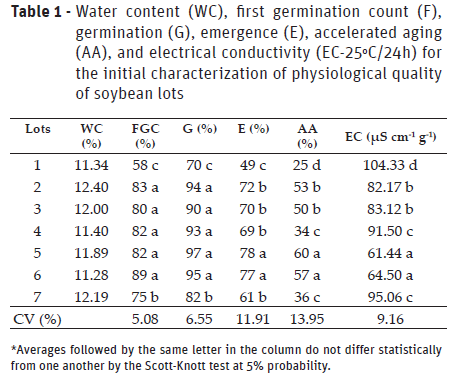
<body><![CDATA[<p><font face = "Verdana" size = "2">The temperatures were separated for the evaluation and therefore were not included as a variable in the assay. After each imbibition period, seeds were gently stirred in order to standardize the leachate, and the electrical conductivity of the solution was measured. In both cases the mass method was used to measure the conductivity with non-selected seeds, as proposed by Loeffler <i>et al</i>. (1988). The results were expressed as &#956;S cm<sup>-1</sup> g<sup>-1</sup> of seeds.</font></p>      <p><font face = "Verdana" size = "2">A completely randomized design was used for the tests described. In the electrical conductivity test with 20 sub samples, the analysis of variance was performed separately for each temperature and for each imbibition period. For the statistical analysis of the data, we used the F test and the analysis of variance at 5% of the probability. The means were compared by the Scott-Knott test at 5% probability using the software SISVAR 5.0 (Ferreira, 2011). Pearson&#8216;s linear correlation analysis was also performed between the electrical conductivity test and the emergency test.</font></p>      <p><font face = "Verdana" size = "3"><b>RESULTS AND DISCUSSION</b></font></p>      <p><font face = "Verdana" size = "2">According to the results presented in <a href = "#t1">Table 1</a>, we noticed significant differences between the lots of soybean seeds. But data on water content of the seeds were similar between the lots studied, this is a significant finding for the execution of the tests as the uniformity of the initial water content of the seeds contributes to obtaining consistent results (Loeffler <i>et al</i>., 1988). Guedes <i>et al</i>. (2011) also pointed out that differences from 1% to 2% in the water content between samples are not a cause for concern and do not compromise test results. Therefore, these tests can still be performed. We found that the water content of the batches varied between 11 and 12%, i.e. within the range that does not influence the results of the electrical conductivity test (Hampton <i>et al</i>., 1992; Hampton, 1995). Marcos Filho (1999) also reported that variations from 4% to 5% between the samples are considered tolerable and acceptable.</font></p>      <p>&nbsp;</p>  <a name = "t1"><img src = "/img/revistas/rca/v42n2/v42n2a10t1.jpg"></a>      
<p>&nbsp;</p>      <p><font face = "Verdana" size = "2">The analysis of the results of the germination tests, first germination count, field emergence, accelerated aging, and electrical conductivity (25<sup>o</sup>C/24-h) indicates that the soybean seed lots differed from each other in their physiological quality (<a href = "#t1">Table 1</a>). In the germination test, it was noticed that lots 2, 3, 4, 5, and 6 have similar germination which values were above 90%. The germination of lot 1 was 70% which performance was inferior in comparison with the other lots. In the evaluation of vigor by the first germination count, no differences were observed between the same lots (2, 3, 4, 5, and 6).</font></p>      <p><font face = "Verdana" size = "2">According to Araujo <i>et al</i>. (2011) lots with similar germination are fundamental in studies that aim to determine methods to evaluate seed vigor since the objective is to identify lots of seeds with similar germination. If the germination potential of the seeds presents significant differences, the germination test itself can detect differences in the physiological potential of the seeds (Marcos Filho & Novembre, 2009).</font></p>      <p><font face = "Verdana" size = "2">In the field emergence test that simulates the actual sowing conditions, we noted that lots 5 and 6 had a superior emergence in comparison with lots 2, 3, and 4. Lots 5 and 6 are classified as high vigor lots, lots 2, 3, 4 and 7 as moderate (intermediate) vigor lots, and lot 1 as a low vigor lot. The seedling emergence test is considered as the best indicator of seed vigor. To carry out this test, it is necessary to apply conditions that simulate those that seeds are subjected to in the field during sowing (Guedes <i>et al</i>., 2011).</font></p>      <p><font face = "Verdana" size = "2">The tests of accelerated aging and electric conductivity stratified the seed lots even further for vigor and were therefore more sensitive to separate the lots (<a href = "#t1">Table 1</a>). Thus, lots 5 and 6 have high vigor, lots 2 and 3 have intermediate vigor, lots 4 and 7 are of low vigor, and lot 1 was the lot with the lowest vigor. The tests used to evaluate the physiological quality should be able to follow the process and changes during seed deterioration especially when these seeds are subjected to adverse conditions (Carvalho <i>et al</i>., 2009).</font></p>      ]]></body>
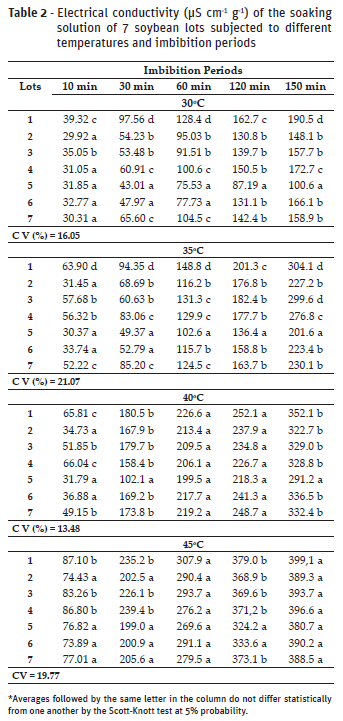
<body><![CDATA[<p><font face = "Verdana" size = "2">The deterioration process of seeds causes degenerative changes in its membrane system which decreases its integrity and/or reducing its selectivity. Control in water and solute exchanges between cells and the external environment is lost which results in a decrease in seed viability (Vieira, 1994; Binotti <i>et al</i>., 2008). Thus, the electrical conductivity test that was carried out to assess seed vigor related to the amount of leachate varied according to the methods used in this study (<a href = "#t2">Table 2</a>).</font></p>      <p>&nbsp;</p>  <a name = "t2"><img src = "/img/revistas/rca/v42n2/v42n2a10t2.jpg"></a>      
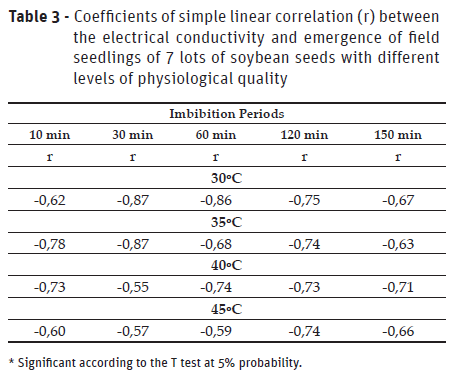
<p>&nbsp;</p>      <p><font face = "Verdana" size = "2">At 30 °C in the periods of 30 min, 60 min, and 150 min there was increased separation of seed lots. It should be emphasize =d that a vigor test has to be conducted quickly. Therefore, the 30 min long test would be the ideal test to evaluate seed lots. At the temperature of 35<sup>o</sup>C with the exception of the imbibition period of 120 min, it was verified that the other periods stratified the lots of soybean seeds, separating the lots in four levels of vigor. We also noticed that the periods of 30 min and 60 min at 30<sup>o</sup>C and 30 min at 35<sup>o</sup>C had similar classification in terms of strength in those cases in which the electrical conductivity test was performed for 24 h at 25<sup>o</sup> C (traditional test).</font></p>      <p><font face = "Verdana" size = "2">In those cases in which the test was conducted at 40<sup>o</sup>C and 10 min of imbibition period, we noticed that the seed lots were separated into only three vigor levels. In the other imbibition periods, seed lots were separated into two levels of vigor at the most despite the increase of leachates. A similar performance was observed when this test was carried out at 45<sup>o</sup>C. Despite the high leaching, it was not possible to stratify seed lots in more than two levels of vigor.</font></p>      <p><font face = "Verdana" size = "2">Based on the results of the electrical conductivity test, we may infer that, in general, in the methods studied there was an increase of leachates in the water during seed conditioning. However, this leaching is more intense at 40 °C and 45 °C. Our findings corroborate with those of Dias & Marcos Filho (1996) and Gaspar & Nakagawa (2002) who evaluated the electrical conductivity in soybean and millet seeds, respectively.</font></p>      <p><font face = "Verdana" size = "2">According to Bewley & Black (1994), high temperatures increase the amount of leachates. This is due to the destruction of the cell membrane system and is related to its integrity. A process of reorganization of these membranes would not occur if there was an increase in leaching in the seed soaking solution.</font></p>      <p><font face = "Verdana" size = "2">Despite the statistical differences between the seed lots, higher imbibition times indicate that high temperatures (40<sup>o</sup>C and 45<sup>o</sup>C) provide mean equity and reduce the difference between seed vigor levels. Carvalho <i>et al</i>. (2009) pointed out that high temperatures with prolonged exposure periods promote the concentration and stabilization of leachate means in the electrical conductivity test.</font></p>      <p><font face = "Verdana" size = "2">With regard to the possibility of reducing the period of seed imbibition, it was observed that the results obtained in the methods of electrical conductivity conducted for 30 min at 30<sup>o</sup>C and at 35<sup>o</sup>C were similar. The traditional method was conducted at 25<sup>o</sup>C for 24&#8209;h. This becomes even more evident when we observe the correlation between the electrical conductivity methods and the seedling emergence test (<a href = "#t3">Table 3</a>).</font></p>      <p>&nbsp;</p>  <a name = "t3"><img src = "/img/revistas/rca/v42n2/v42n2a10t3.jpg"></a>      
]]></body>
<body><![CDATA[<p>&nbsp;</p>      <p><font face = "Verdana" size = "2">The correlation data were negative with a significance of 5%, according to the T-test. Thus, the results are inversely proportional. As the electrical conductivity is increased (&#956;S cm<sup>-1</sup> g<sup>-1</sup>), there is a decrease in the percentage of seedling emergence (<a href = "#t1">Table 1</a>).</font></p>      <p><font face = "Verdana" size = "2">It can be noted that, considering the imbibition period at the temperatures tested, the strongest correlations were observed in 30 minutes at 30<sup>o</sup>C and 35<sup>o</sup>C. However, there was also a high correlation of the data in 60 minutes at 30<sup>o</sup>C. Nevertheless, it is recommended that a shorter imbibition period is used since a vigor test should be fast and consistent in results. This reinforces the finding that the methods used in the imbibition periods were coherent to evaluate seed vigor.</font></p>      <p><font face = "Verdana" size = "2">According to the results obtained in this study, we suggest a reduction of the imbibition period of soybean seeds in the periods used and therefore allow the disposal of lots of inferior vigor. The possibility of reducing the conduction time of the electrical conductivity test is necessary in view of the demand of the analysis to be performed. As a large number of samples are submitted to the laboratories, this will be an additional tool available for the assessment of seed lots in a shorter period of time and fast turnaround time. The reduction of the imbibition period of the electrical conductivity test was previously reported by other authors in the evaluation of the vigor of popcorn seeds (Ribeiro <i>et al</i>., 2009), mung green beans (Araujo <i>et al</i>., 2011) and beans (Silva <i>et al</i>., 2014).</font></p>      <p><font face = "Verdana" size = "3"><b>CONCLUSION</b></font></p>       <p><font face = "Verdana" size = "2">The electrical conductivity test performed with a 30 min imbibition period at temperatures of 30<sup>o</sup>C or 35<sup>o</sup>C provides consistent, reliable information that allows the identification of lots of soybean seeds with different vigor levels.</font></p>      <p>&nbsp;</p>      <p><font face = "Verdana" size = "3"><b>References</b></font></p>       <!-- ref --><p><font face = "Verdana" size = "2">AOSA (1983) - <i>Seed vigor testing handbook</i>. [S.l.]: Association of Official Seed Analysts. 93 p. (Contribution, 32).    &nbsp;&nbsp;&nbsp;&nbsp;&nbsp;&nbsp;&nbsp;&nbsp;[&#160;<a href="javascript:void(0);" onclick="javascript: window.open('/scielo.php?script=sci_nlinks&ref=697739&pid=S0871-018X201900020001000001&lng=','','width=640,height=500,resizable=yes,scrollbars=1,menubar=yes,');">Links</a>&#160;]<!-- end-ref --></font></p>      ]]></body>
<body><![CDATA[<!-- ref --><p><font face = "Verdana" size = "2">Araujo, R.F.; Zonta, J.B.; Araujo, E.F.; Heberle, E. & Zonta, F.M.G. (2011) - Teste de condutividade elétrica para sementes de feijão-mungo-verde. <i>Revista Brasileira de Sementes</i>, vol. 33, n. 1, p.123-130. <a href = "http://dx.doi.org/10.1590/S0101-31222011000100014" target = "_blank">http://dx.doi.org/10.1590/S0101-31222011000100014</a></font>&nbsp;&nbsp;&nbsp;&nbsp;&nbsp;&nbsp;&nbsp;&nbsp;[&#160;<a href="javascript:void(0);" onclick="javascript: window.open('/scielo.php?script=sci_nlinks&ref=697741&pid=S0871-018X201900020001000002&lng=','','width=640,height=500,resizable=yes,scrollbars=1,menubar=yes,');">Links</a>&#160;]<!-- end-ref --><!-- ref --><p><font face = "Verdana" size = "2">Bewley, J.D. & Black, M. (1994) - <i>Seeds: physiology of development and germination</i>. 2<sup>a</sup> ed. New York: Plenum Press. 445p.    &nbsp;&nbsp;&nbsp;&nbsp;&nbsp;&nbsp;&nbsp;&nbsp;[&#160;<a href="javascript:void(0);" onclick="javascript: window.open('/scielo.php?script=sci_nlinks&ref=697742&pid=S0871-018X201900020001000003&lng=','','width=640,height=500,resizable=yes,scrollbars=1,menubar=yes,');">Links</a>&#160;]<!-- end-ref --></font></p>      <!-- ref --><p><font face = "Verdana" size = "2">Binotti, F.F.S.; Haga, K.I.; Cardoso, E.D.; Alves, C.Z.; Sá, M.E. & Arf, O. (2008) - Efeito do período de envelhecimento acelerado no teste de condutividade elétrica e na qualidade fisiológica de sementes de feijão. <i>Acta Scientiarum Agronomy</i>, vol. 30, n. 2, p. 247-254. <a href = "http://dx.doi.org/10.1590/S1807-86212008000200014" target = "_blank">http://dx.doi.org/10.1590/S1807-86212008000200014</a></font>&nbsp;&nbsp;&nbsp;&nbsp;&nbsp;&nbsp;&nbsp;&nbsp;[&#160;<a href="javascript:void(0);" onclick="javascript: window.open('/scielo.php?script=sci_nlinks&ref=697744&pid=S0871-018X201900020001000004&lng=','','width=640,height=500,resizable=yes,scrollbars=1,menubar=yes,');">Links</a>&#160;]<!-- end-ref --><p><font face = "Verdana" size = "2">Brasil (2009) - <i>Regras para análise de sementes</i>. Ministério da Agricultura, Pecuária e Abastecimento. Secretaria de Defesa Agropecuária. Brasília, 399 p.</font></p>      <!-- ref --><p><font face = "Verdana" size = "2">Carvalho, L.F.; Sediyama, C.S.; Reis, M.S.; Dias, D.C.F.S. & Moreira, M.A. (2009) - Influência da temperatura de embebição da semente de soja no teste de condutividade elétrica para avaliação da qualidade fisiológica. <i>Revista Brasileira de Sementes</i>, vol. 31, n. 1, p. 9-17. <a href = "http://dx.doi.org/10.1590/S0101-31222009000100001" target = "_blank">http://dx.doi.org/10.1590/S0101-31222009000100001</a></font>&nbsp;&nbsp;&nbsp;&nbsp;&nbsp;&nbsp;&nbsp;&nbsp;[&#160;<a href="javascript:void(0);" onclick="javascript: window.open('/scielo.php?script=sci_nlinks&ref=697746&pid=S0871-018X201900020001000005&lng=','','width=640,height=500,resizable=yes,scrollbars=1,menubar=yes,');">Links</a>&#160;]<!-- end-ref --><!-- ref --><p><font face = "Verdana" size = "2">Delouche, J.E. & Baskin, E.E. (1973) - Accelerated aging techniques for predicting the relative storability of seed lots. <i>Seed Science & Technology</i>, vol. 1, n. 2, p. 427-452.    &nbsp;&nbsp;&nbsp;&nbsp;&nbsp;&nbsp;&nbsp;&nbsp;[&#160;<a href="javascript:void(0);" onclick="javascript: window.open('/scielo.php?script=sci_nlinks&ref=697747&pid=S0871-018X201900020001000006&lng=','','width=640,height=500,resizable=yes,scrollbars=1,menubar=yes,');">Links</a>&#160;]<!-- end-ref --></font></p>      <!-- ref --><p><font face = "Verdana" size = "2">Dias, D.C.F.S. & Marcos Filho, J. (1996) - Testes de condutividade elétrica para avaliação do vigor de sementes de soja (<i>Glycine max</i> (L.) Merrill). <i>Scientia Agricola</i>, vol. 53, n. 1, p. 31-42. <a href = "http://dx.doi.org/10.1590/S0103-90161996000100005" target = "_blank">http://dx.doi.org/10.1590/S0103-90161996000100005</a></font>&nbsp;&nbsp;&nbsp;&nbsp;&nbsp;&nbsp;&nbsp;&nbsp;[&#160;<a href="javascript:void(0);" onclick="javascript: window.open('/scielo.php?script=sci_nlinks&ref=697749&pid=S0871-018X201900020001000007&lng=','','width=640,height=500,resizable=yes,scrollbars=1,menubar=yes,');">Links</a>&#160;]<!-- end-ref --><!-- ref --><p><font face = "Verdana" size = "2">Ferreira, D.F. (2011) - Sisvar: a computer statistical analysis system. <i>Ciência e Agrotecnologia</i>, vol. 35, n. 6, p. 1039-1042. <a href = "http://dx.doi.org/10.1590/S1413-70542011000600001" target = "_blank">http://dx.doi.org/10.1590/S1413-70542011000600001</a></font>&nbsp;&nbsp;&nbsp;&nbsp;&nbsp;&nbsp;&nbsp;&nbsp;[&#160;<a href="javascript:void(0);" onclick="javascript: window.open('/scielo.php?script=sci_nlinks&ref=697750&pid=S0871-018X201900020001000008&lng=','','width=640,height=500,resizable=yes,scrollbars=1,menubar=yes,');">Links</a>&#160;]<!-- end-ref --><!-- ref --><p><font face = "Verdana" size = "2">Fessel, S.A.; Panobianco, M.; Souza, C.R. & Vieira, R.D. (2010) - Teste de condutividade elétrica em sementes de soja armazenadas sob diferentes temperaturas. <i>Bragantia</i>, vol. 69, n. 1, p. 207-214. <a href = "http://dx.doi.org/10.1590/S0006-87052010000100026" target = "_blank">http://dx.doi.org/10.1590/S0006-87052010000100026</a></font>&nbsp;&nbsp;&nbsp;&nbsp;&nbsp;&nbsp;&nbsp;&nbsp;[&#160;<a href="javascript:void(0);" onclick="javascript: window.open('/scielo.php?script=sci_nlinks&ref=697751&pid=S0871-018X201900020001000009&lng=','','width=640,height=500,resizable=yes,scrollbars=1,menubar=yes,');">Links</a>&#160;]<!-- end-ref --><!-- ref --><p><font face = "Verdana" size = "2">Gaspar, C.M. & Nakagawa, J. (2002) - Teste de condutividade elétrica em função do número de sementes e da quantidade de água para sementes de milheto. <i>Revista Brasileira de Sementes</i>, vol. 24, n. 2, p. 82-89. <a href = "http://dx.doi.org/10.1590/S0101-31222002000100012" target = "_blank">http://dx.doi.org/10.1590/S0101-31222002000100012</a></font>&nbsp;&nbsp;&nbsp;&nbsp;&nbsp;&nbsp;&nbsp;&nbsp;[&#160;<a href="javascript:void(0);" onclick="javascript: window.open('/scielo.php?script=sci_nlinks&ref=697752&pid=S0871-018X201900020001000010&lng=','','width=640,height=500,resizable=yes,scrollbars=1,menubar=yes,');">Links</a>&#160;]<!-- end-ref --><!-- ref --><p><font face = "Verdana" size = "2">Guedes, R.S.; Alves, E.U.; Oliveira, L.S.B.; Andrade, L.A.; Gonçalves, E.P. & Melo, P.A.R.F. (2011) - Envelhecimento acelerado na avaliação da qualidade fisiológica de sementes de <i>Dalbergia nigra </i>(Vell.) Fr. All. <i>Semina: Ciências Agrárias</i>, vol. 32, n. 2, p. 443-450. <a href = "http://dx.doi.org/10.5433/1679-0359.2011v32n2p443" target = "_blank">http://dx.doi.org/10.5433/1679-0359.2011v32n2p443</a></font>&nbsp;&nbsp;&nbsp;&nbsp;&nbsp;&nbsp;&nbsp;&nbsp;[&#160;<a href="javascript:void(0);" onclick="javascript: window.open('/scielo.php?script=sci_nlinks&ref=697753&pid=S0871-018X201900020001000011&lng=','','width=640,height=500,resizable=yes,scrollbars=1,menubar=yes,');">Links</a>&#160;]<!-- end-ref --><!-- ref --><p><font face = "Verdana" size = "2">Hampton, J.G. (1995) - Conductivity test. <i>In</i>: Venter, H.A. van de (Ed.) - <i>Seed vigour testing seminar</i>. Copenhagen: ISTA. p.10-28.    &nbsp;&nbsp;&nbsp;&nbsp;&nbsp;&nbsp;&nbsp;&nbsp;[&#160;<a href="javascript:void(0);" onclick="javascript: window.open('/scielo.php?script=sci_nlinks&ref=697754&pid=S0871-018X201900020001000012&lng=','','width=640,height=500,resizable=yes,scrollbars=1,menubar=yes,');">Links</a>&#160;]<!-- end-ref --></font></p>      <!-- ref --><p><font face = "Verdana" size = "2">Hampton, J.G.; Johnstone, K.A. & Eua-Umpon, V. (1992) - Bulk conductivity test variables for mungbean, soybean and French bean seed lots. <i>Seed Science and Technology</i>, vol. 20, n. 3, p. 677-686.    &nbsp;&nbsp;&nbsp;&nbsp;&nbsp;&nbsp;&nbsp;&nbsp;[&#160;<a href="javascript:void(0);" onclick="javascript: window.open('/scielo.php?script=sci_nlinks&ref=697756&pid=S0871-018X201900020001000013&lng=','','width=640,height=500,resizable=yes,scrollbars=1,menubar=yes,');">Links</a>&#160;]<!-- end-ref --></font></p>      <!-- ref --><p><font face = "Verdana" size = "2">Hampton, J.G. & Tekrony, D.M. (1995) - <i>Handbook of vigour test methods</i>. 3.ed. Zurich: ISTA. 117p.    &nbsp;&nbsp;&nbsp;&nbsp;&nbsp;&nbsp;&nbsp;&nbsp;[&#160;<a href="javascript:void(0);" onclick="javascript: window.open('/scielo.php?script=sci_nlinks&ref=697758&pid=S0871-018X201900020001000014&lng=','','width=640,height=500,resizable=yes,scrollbars=1,menubar=yes,');">Links</a>&#160;]<!-- end-ref --></font></p>      <!-- ref --><p><font face = "Verdana" size = "2">Krzyzanowski, F.C.; França Neto, J.B. & Henning, A.A. (1991) - Relato dos testes de vigor disponíveis para as grandes culturas. <i>Informativo Abrates</i>, vol. 1, n. 2, p. 15-53.    &nbsp;&nbsp;&nbsp;&nbsp;&nbsp;&nbsp;&nbsp;&nbsp;[&#160;<a href="javascript:void(0);" onclick="javascript: window.open('/scielo.php?script=sci_nlinks&ref=697760&pid=S0871-018X201900020001000015&lng=','','width=640,height=500,resizable=yes,scrollbars=1,menubar=yes,');">Links</a>&#160;]<!-- end-ref --></font></p>       <!-- ref --><p><font face = "Verdana" size = "2">Loeffler, T.M.; Tekrony, D.M. & Egli, D.B. (1988) - The bulk conductivity test as an indicator of soybean seed quality. <i>Journal Seed Technology</i>, vol. 12, n. 1, p. 37-53.    &nbsp;&nbsp;&nbsp;&nbsp;&nbsp;&nbsp;&nbsp;&nbsp;[&#160;<a href="javascript:void(0);" onclick="javascript: window.open('/scielo.php?script=sci_nlinks&ref=697762&pid=S0871-018X201900020001000016&lng=','','width=640,height=500,resizable=yes,scrollbars=1,menubar=yes,');">Links</a>&#160;]<!-- end-ref --></font></p>      <!-- ref --><p><font face = "Verdana" size = "2">Marcos Filho, J. (2015) - <i>Fisiologia de sementes de plantas cultivadas</i>. Piracicaba: FEALQ, 495p.    &nbsp;&nbsp;&nbsp;&nbsp;&nbsp;&nbsp;&nbsp;&nbsp;[&#160;<a href="javascript:void(0);" onclick="javascript: window.open('/scielo.php?script=sci_nlinks&ref=697764&pid=S0871-018X201900020001000017&lng=','','width=640,height=500,resizable=yes,scrollbars=1,menubar=yes,');">Links</a>&#160;]<!-- end-ref --></font></p>      <!-- ref --><p><font face = "Verdana" size = "2">Marcos Filho, J. & Novembre, A.D.L.C. (2009) - Avaliação do potencial fisiológico de sementes de hortaliças. <i>In</i>: Nascimento, W.M. (Ed.) - <i>Tecnologia de sementes de hortaliças</i>. Brasília, DF: Embrapa Hortaliças, p.185-246.    &nbsp;&nbsp;&nbsp;&nbsp;&nbsp;&nbsp;&nbsp;&nbsp;[&#160;<a href="javascript:void(0);" onclick="javascript: window.open('/scielo.php?script=sci_nlinks&ref=697766&pid=S0871-018X201900020001000018&lng=','','width=640,height=500,resizable=yes,scrollbars=1,menubar=yes,');">Links</a>&#160;]<!-- end-ref --></font></p>      <!-- ref --><p><font face = "Verdana" size = "2">Marcos Filho, J.; Silva, W.R.; Novembre, A.C. & Chama, H.C.P.C. (1990) - Estudo comparativo de métodos para avaliação da qualidade fisiológica de sementes de soja, com ênfase ao teste de condutividade elétrica. <i>Pesquisa Agropecuária Brasileira</i>, vol. 25, n. 12, p. 1805-1815.    &nbsp;&nbsp;&nbsp;&nbsp;&nbsp;&nbsp;&nbsp;&nbsp;[&#160;<a href="javascript:void(0);" onclick="javascript: window.open('/scielo.php?script=sci_nlinks&ref=697768&pid=S0871-018X201900020001000019&lng=','','width=640,height=500,resizable=yes,scrollbars=1,menubar=yes,');">Links</a>&#160;]<!-- end-ref --></font></p>      <!-- ref --><p><font face = "Verdana" size = "2">Marcos Filho, J. (1999) - Teste de envelhecimento acelerado. <i>In:</i> Krzyzanowski, F.C.; Vieira, R.D. & França Neto, J.B. (Eds.) - <i>Vigor de sementes: conceitos e testes</i>. Londrina: ABRATES. cap.3, p.1-24.    &nbsp;&nbsp;&nbsp;&nbsp;&nbsp;&nbsp;&nbsp;&nbsp;[&#160;<a href="javascript:void(0);" onclick="javascript: window.open('/scielo.php?script=sci_nlinks&ref=697770&pid=S0871-018X201900020001000020&lng=','','width=640,height=500,resizable=yes,scrollbars=1,menubar=yes,');">Links</a>&#160;]<!-- end-ref --></font></p>       <!-- ref --><p><font face = "Verdana" size = "2">Mattioni, N.M.; Mertz, L.M.; Barbieri, A.P.P.; Haesbaert, F.M.; Giordani, W. & Lopes, S.J. (2015) - Individual electrical conductivity test for the assessment of soybean seed germination. <i>Semina: Ciências Agrárias</i>, vol. 36, n. 1, p. 31-38. <a href = "http://dx.doi.org/10.5433/1679-0359.2015v36n1p31" target = "_blank">http://dx.doi.org/10.5433/1679-0359.2015v36n1p31</a></font>&nbsp;&nbsp;&nbsp;&nbsp;&nbsp;&nbsp;&nbsp;&nbsp;[&#160;<a href="javascript:void(0);" onclick="javascript: window.open('/scielo.php?script=sci_nlinks&ref=697772&pid=S0871-018X201900020001000021&lng=','','width=640,height=500,resizable=yes,scrollbars=1,menubar=yes,');">Links</a>&#160;]<!-- end-ref --><!-- ref --><p><font face = "Verdana" size = "2">Milani, M.; Menezes, N.L. & Lopes, S.J. (2012) - Teste de condutividade elétrica para avaliação do potencial fisiológico de sementes de canola. <i>Revista Ceres</i>, vol. 59, n. 3, p. 374-379. <a href = "http://dx.doi.org/10.1590/S0034-737X2012000300012" target = "_blank">http://dx.doi.org/10.1590/S0034-737X2012000300012</a></font>&nbsp;&nbsp;&nbsp;&nbsp;&nbsp;&nbsp;&nbsp;&nbsp;[&#160;<a href="javascript:void(0);" onclick="javascript: window.open('/scielo.php?script=sci_nlinks&ref=697773&pid=S0871-018X201900020001000022&lng=','','width=640,height=500,resizable=yes,scrollbars=1,menubar=yes,');">Links</a>&#160;]<!-- end-ref --><!-- ref --><p><font face = "Verdana" size = "2">Murphy, J.B. & Noland, T.L. (1982) - Temperature effects on seed imbibition and leakage mediated by viscosity and membranes. <i>Plant Physiology</i>, vol. 69, n. 2, p. 428-431.    &nbsp;&nbsp;&nbsp;&nbsp;&nbsp;&nbsp;&nbsp;&nbsp;[&#160;<a href="javascript:void(0);" onclick="javascript: window.open('/scielo.php?script=sci_nlinks&ref=697774&pid=S0871-018X201900020001000023&lng=','','width=640,height=500,resizable=yes,scrollbars=1,menubar=yes,');">Links</a>&#160;]<!-- end-ref --></font></p>       <!-- ref --><p><font face = "Verdana" size = "2">Oliveira, F.N.; Torres, S.B.; Vieira, F.E.R.; Paiva, E.P. & Dutra, A.S. (2012) - Qualidade fisiológica de sementes de girassol avaliadas por condutividade elétrica. <i>Pesquisa Agropecuária Tropical</i>, vol. 42, n. 3, p. 279-287.    &nbsp;&nbsp;&nbsp;&nbsp;&nbsp;&nbsp;&nbsp;&nbsp;[&#160;<a href="javascript:void(0);" onclick="javascript: window.open('/scielo.php?script=sci_nlinks&ref=697776&pid=S0871-018X201900020001000024&lng=','','width=640,height=500,resizable=yes,scrollbars=1,menubar=yes,');">Links</a>&#160;]<!-- end-ref --></font></p>      <!-- ref --><p><font face = "Verdana" size = "2">Ribeiro, D.M.; Bragança, S.M.; Goneli, A.L.D.; Dias, D.C.F.S. & Alvarenga, E.M. (2009) - Teste de condutividade elétrica para avaliar o vigor de sementes em milho-pipoca (<i>Zea mays</i> L.). <i>Revista Ceres</i>, vol. 56, n. 6, p. 772-776.    &nbsp;&nbsp;&nbsp;&nbsp;&nbsp;&nbsp;&nbsp;&nbsp;[&#160;<a href="javascript:void(0);" onclick="javascript: window.open('/scielo.php?script=sci_nlinks&ref=697778&pid=S0871-018X201900020001000025&lng=','','width=640,height=500,resizable=yes,scrollbars=1,menubar=yes,');">Links</a>&#160;]<!-- end-ref --></font></p>      <!-- ref --><p><font face = "Verdana" size = "2">Silva, V.N.; Zambiasi, C.A.; Tillmann, M.A.A.; Menezes, N.L. & Villela, F.A. (2014) - Condução do teste de condutividade elétrica utilizando partes de sementes de feijão. <i>Revista de Ciências Agrárias</i>, vol. 37, n. 2, p. 206-213.    &nbsp;&nbsp;&nbsp;&nbsp;&nbsp;&nbsp;&nbsp;&nbsp;[&#160;<a href="javascript:void(0);" onclick="javascript: window.open('/scielo.php?script=sci_nlinks&ref=697780&pid=S0871-018X201900020001000026&lng=','','width=640,height=500,resizable=yes,scrollbars=1,menubar=yes,');">Links</a>&#160;]<!-- end-ref --></font></p>      <!-- ref --><p><font face = "Verdana" size = "2">Vieira, R.D. (1994) - Teste de condutividade elétrica. <i>In</i>: Vieira, R.D. & Carvalho, N.M. (Eds.) - <i>Testes de vigor em sementes</i>. Jaboticabal: FUNEP. p. 103-132.    &nbsp;&nbsp;&nbsp;&nbsp;&nbsp;&nbsp;&nbsp;&nbsp;[&#160;<a href="javascript:void(0);" onclick="javascript: window.open('/scielo.php?script=sci_nlinks&ref=697782&pid=S0871-018X201900020001000027&lng=','','width=640,height=500,resizable=yes,scrollbars=1,menubar=yes,');">Links</a>&#160;]<!-- end-ref --></font></p>       <!-- ref --><p><font face = "Verdana" size = "2">Vieira, R.D. & Krzyzanowski, F.C. (1999) - Teste de condutividade elétrica. <i>In</i>: Krzyzanowski, F.C.; Vieira, R.D. & França Neto, J.B. (Eds.) - <i>Vigor de sementes: conceitos e testes</i>. Londrina: ABRATES. cap.3, p.1-24.    &nbsp;&nbsp;&nbsp;&nbsp;&nbsp;&nbsp;&nbsp;&nbsp;[&#160;<a href="javascript:void(0);" onclick="javascript: window.open('/scielo.php?script=sci_nlinks&ref=697784&pid=S0871-018X201900020001000028&lng=','','width=640,height=500,resizable=yes,scrollbars=1,menubar=yes,');">Links</a>&#160;]<!-- end-ref --></font></p>      <p>&nbsp;</p>      <p><font face = "Verdana" size = "2">Received/recebido: 2018.12.03</font></p>      <p><font face = "Verdana" size = "2">Accepted/aceite: 2019.01.16</font></p>       ]]></body><back>
<ref-list>
<ref id="B1">
<nlm-citation citation-type="book">
<collab>AOSA</collab>
<source><![CDATA[Seed vigor testing handbook]]></source>
<year>1983</year>
<publisher-name><![CDATA[Association of Official Seed Analysts]]></publisher-name>
</nlm-citation>
</ref>
<ref id="B2">
<nlm-citation citation-type="journal">
<person-group person-group-type="author">
<name>
<surname><![CDATA[Araujo]]></surname>
<given-names><![CDATA[R.F.]]></given-names>
</name>
<name>
<surname><![CDATA[Zonta]]></surname>
<given-names><![CDATA[J.B.]]></given-names>
</name>
<name>
<surname><![CDATA[Araujo]]></surname>
<given-names><![CDATA[E.F.]]></given-names>
</name>
<name>
<surname><![CDATA[Heberle]]></surname>
<given-names><![CDATA[E.]]></given-names>
</name>
<name>
<surname><![CDATA[Zonta]]></surname>
<given-names><![CDATA[F.M.G.]]></given-names>
</name>
</person-group>
<article-title xml:lang="pt"><![CDATA[Teste de condutividade elétrica para sementes de feijão-mungo-verde]]></article-title>
<source><![CDATA[Revista Brasileira de Sementes]]></source>
<year>2011</year>
<volume>33</volume>
<numero>1</numero>
<issue>1</issue>
<page-range>123-130</page-range></nlm-citation>
</ref>
<ref id="B3">
<nlm-citation citation-type="book">
<person-group person-group-type="author">
<name>
<surname><![CDATA[Bewley]]></surname>
<given-names><![CDATA[J.D.]]></given-names>
</name>
<name>
<surname><![CDATA[Black]]></surname>
<given-names><![CDATA[M.]]></given-names>
</name>
</person-group>
<source><![CDATA[Seeds: physiology of development and germination]]></source>
<year>1994</year>
<edition>2ª</edition>
<publisher-loc><![CDATA[New York ]]></publisher-loc>
<publisher-name><![CDATA[Plenum Press]]></publisher-name>
</nlm-citation>
</ref>
<ref id="B4">
<nlm-citation citation-type="journal">
<person-group person-group-type="author">
<name>
<surname><![CDATA[Binotti]]></surname>
<given-names><![CDATA[F.F.S.]]></given-names>
</name>
<name>
<surname><![CDATA[Haga]]></surname>
<given-names><![CDATA[K.I.]]></given-names>
</name>
<name>
<surname><![CDATA[Cardoso]]></surname>
<given-names><![CDATA[E.D.]]></given-names>
</name>
<name>
<surname><![CDATA[Alves]]></surname>
<given-names><![CDATA[C.Z.]]></given-names>
</name>
<name>
<surname><![CDATA[Sá]]></surname>
<given-names><![CDATA[M.E.]]></given-names>
</name>
<name>
<surname><![CDATA[Arf]]></surname>
<given-names><![CDATA[O.]]></given-names>
</name>
</person-group>
<article-title xml:lang="pt"><![CDATA[Efeito do período de envelhecimento acelerado no teste de condutividade elétrica e na qualidade fisiológica de sementes de feijão]]></article-title>
<source><![CDATA[Acta Scientiarum Agronomy]]></source>
<year>2008</year>
<volume>30</volume>
<numero>2</numero>
<issue>2</issue>
<page-range>247-254</page-range></nlm-citation>
</ref>
<ref id="B5">
<nlm-citation citation-type="journal">
<person-group person-group-type="author">
<name>
<surname><![CDATA[Carvalho]]></surname>
<given-names><![CDATA[L.F.]]></given-names>
</name>
<name>
<surname><![CDATA[Sediyama]]></surname>
<given-names><![CDATA[C.S.]]></given-names>
</name>
<name>
<surname><![CDATA[Reis]]></surname>
<given-names><![CDATA[M.S.]]></given-names>
</name>
<name>
<surname><![CDATA[Dias]]></surname>
<given-names><![CDATA[D.C.F.S.]]></given-names>
</name>
<name>
<surname><![CDATA[Moreira]]></surname>
<given-names><![CDATA[M.A.]]></given-names>
</name>
</person-group>
<article-title xml:lang="pt"><![CDATA[Influência da temperatura de embebição da semente de soja no teste de condutividade elétrica para avaliação da qualidade fisiológica]]></article-title>
<source><![CDATA[Revista Brasileira de Sementes]]></source>
<year>2009</year>
<volume>31</volume>
<numero>1</numero>
<issue>1</issue>
<page-range>9-17</page-range></nlm-citation>
</ref>
<ref id="B6">
<nlm-citation citation-type="journal">
<person-group person-group-type="author">
<name>
<surname><![CDATA[Delouche]]></surname>
<given-names><![CDATA[J.E.]]></given-names>
</name>
<name>
<surname><![CDATA[Baskin]]></surname>
<given-names><![CDATA[E.E.]]></given-names>
</name>
</person-group>
<article-title xml:lang="en"><![CDATA[Accelerated aging techniques for predicting the relative storability of seed lots]]></article-title>
<source><![CDATA[Seed Science & Technology]]></source>
<year>1973</year>
<volume>1</volume>
<numero>2</numero>
<issue>2</issue>
<page-range>427-452</page-range></nlm-citation>
</ref>
<ref id="B7">
<nlm-citation citation-type="journal">
<person-group person-group-type="author">
<name>
<surname><![CDATA[Dias]]></surname>
<given-names><![CDATA[D.C.F.S.]]></given-names>
</name>
<name>
<surname><![CDATA[Marcos Filho]]></surname>
<given-names><![CDATA[J.]]></given-names>
</name>
</person-group>
<article-title xml:lang="pt"><![CDATA[Testes de condutividade elétrica para avaliação do vigor de sementes de soja (Glycine max (L.) Merrill)]]></article-title>
<source><![CDATA[Scientia Agricola]]></source>
<year>1996</year>
<volume>53</volume>
<numero>1</numero>
<issue>1</issue>
<page-range>31-42</page-range></nlm-citation>
</ref>
<ref id="B8">
<nlm-citation citation-type="journal">
<person-group person-group-type="author">
<name>
<surname><![CDATA[Ferreira]]></surname>
<given-names><![CDATA[D.F.]]></given-names>
</name>
</person-group>
<article-title xml:lang="en"><![CDATA[Sisvar: a computer statistical analysis system]]></article-title>
<source><![CDATA[Ciência e Agrotecnologia]]></source>
<year>2011</year>
<volume>35</volume>
<numero>6</numero>
<issue>6</issue>
<page-range>1039-1042</page-range></nlm-citation>
</ref>
<ref id="B9">
<nlm-citation citation-type="journal">
<person-group person-group-type="author">
<name>
<surname><![CDATA[Fessel]]></surname>
<given-names><![CDATA[S.A.]]></given-names>
</name>
<name>
<surname><![CDATA[Panobianco]]></surname>
<given-names><![CDATA[M.]]></given-names>
</name>
<name>
<surname><![CDATA[Souza]]></surname>
<given-names><![CDATA[C.R.]]></given-names>
</name>
<name>
<surname><![CDATA[Vieira]]></surname>
<given-names><![CDATA[R.D.]]></given-names>
</name>
</person-group>
<article-title xml:lang="pt"><![CDATA[Teste de condutividade elétrica em sementes de soja armazenadas sob diferentes temperaturas]]></article-title>
<source><![CDATA[Bragantia]]></source>
<year>2010</year>
<volume>69</volume>
<numero>1</numero>
<issue>1</issue>
<page-range>207-214</page-range></nlm-citation>
</ref>
<ref id="B10">
<nlm-citation citation-type="journal">
<person-group person-group-type="author">
<name>
<surname><![CDATA[Gaspar]]></surname>
<given-names><![CDATA[C.M.]]></given-names>
</name>
<name>
<surname><![CDATA[Nakagawa]]></surname>
<given-names><![CDATA[J.]]></given-names>
</name>
</person-group>
<article-title xml:lang="pt"><![CDATA[Teste de condutividade elétrica em função do número de sementes e da quantidade de água para sementes de milheto]]></article-title>
<source><![CDATA[Revista Brasileira de Sementes]]></source>
<year>2002</year>
<volume>24</volume>
<numero>2</numero>
<issue>2</issue>
<page-range>82-89</page-range></nlm-citation>
</ref>
<ref id="B11">
<nlm-citation citation-type="journal">
<person-group person-group-type="author">
<name>
<surname><![CDATA[Guedes]]></surname>
<given-names><![CDATA[R.S.]]></given-names>
</name>
<name>
<surname><![CDATA[Alves]]></surname>
<given-names><![CDATA[E.U.]]></given-names>
</name>
<name>
<surname><![CDATA[Oliveira]]></surname>
<given-names><![CDATA[L.S.B.]]></given-names>
</name>
<name>
<surname><![CDATA[Andrade]]></surname>
<given-names><![CDATA[L.A.]]></given-names>
</name>
<name>
<surname><![CDATA[Gonçalves]]></surname>
<given-names><![CDATA[E.P.]]></given-names>
</name>
<name>
<surname><![CDATA[Melo]]></surname>
<given-names><![CDATA[P.A.R.F.]]></given-names>
</name>
</person-group>
<article-title xml:lang="pt"><![CDATA[Envelhecimento acelerado na avaliação da qualidade fisiológica de sementes de Dalbergia nigra (Vell.) Fr. All]]></article-title>
<source><![CDATA[Semina]]></source>
<year>2011</year>
<volume>32</volume>
<numero>2</numero>
<issue>2</issue>
<page-range>443-450</page-range></nlm-citation>
</ref>
<ref id="B12">
<nlm-citation citation-type="book">
<person-group person-group-type="author">
<name>
<surname><![CDATA[Hampton]]></surname>
<given-names><![CDATA[J.G.]]></given-names>
</name>
</person-group>
<article-title xml:lang="en"><![CDATA[Conductivity test]]></article-title>
<person-group person-group-type="editor">
<name>
<surname><![CDATA[Venter]]></surname>
<given-names><![CDATA[H.A. van de]]></given-names>
</name>
</person-group>
<source><![CDATA[Seed vigour testing seminar]]></source>
<year>1995</year>
<page-range>10-28</page-range><publisher-loc><![CDATA[Copenhagen ]]></publisher-loc>
<publisher-name><![CDATA[ISTA]]></publisher-name>
</nlm-citation>
</ref>
<ref id="B13">
<nlm-citation citation-type="journal">
<person-group person-group-type="author">
<name>
<surname><![CDATA[Hampton]]></surname>
<given-names><![CDATA[J.G.]]></given-names>
</name>
<name>
<surname><![CDATA[Johnstone]]></surname>
<given-names><![CDATA[K.A.]]></given-names>
</name>
<name>
<surname><![CDATA[Eua-Umpon]]></surname>
<given-names><![CDATA[V.]]></given-names>
</name>
</person-group>
<article-title xml:lang="en"><![CDATA[Bulk conductivity test variables for mungbean, soybean and French bean seed lots]]></article-title>
<source><![CDATA[Seed Science and Technology]]></source>
<year>1992</year>
<volume>20</volume>
<numero>3</numero>
<issue>3</issue>
<page-range>677-686</page-range></nlm-citation>
</ref>
<ref id="B14">
<nlm-citation citation-type="book">
<person-group person-group-type="author">
<name>
<surname><![CDATA[Hampton]]></surname>
<given-names><![CDATA[J.G.]]></given-names>
</name>
<name>
<surname><![CDATA[Tekrony]]></surname>
<given-names><![CDATA[D.M.]]></given-names>
</name>
</person-group>
<source><![CDATA[Handbook of vigour test methods]]></source>
<year>1995</year>
<edition>3</edition>
<publisher-loc><![CDATA[Zurich ]]></publisher-loc>
<publisher-name><![CDATA[ISTA]]></publisher-name>
</nlm-citation>
</ref>
<ref id="B15">
<nlm-citation citation-type="journal">
<person-group person-group-type="author">
<name>
<surname><![CDATA[Krzyzanowski]]></surname>
<given-names><![CDATA[F.C.]]></given-names>
</name>
<name>
<surname><![CDATA[França Neto]]></surname>
<given-names><![CDATA[J.B.]]></given-names>
</name>
<name>
<surname><![CDATA[Henning]]></surname>
<given-names><![CDATA[A.A.]]></given-names>
</name>
</person-group>
<article-title xml:lang="pt"><![CDATA[Relato dos testes de vigor disponíveis para as grandes culturas]]></article-title>
<source><![CDATA[Informativo Abrates]]></source>
<year>1991</year>
<volume>1</volume>
<numero>2</numero>
<issue>2</issue>
<page-range>15-53</page-range></nlm-citation>
</ref>
<ref id="B16">
<nlm-citation citation-type="journal">
<person-group person-group-type="author">
<name>
<surname><![CDATA[Loeffler]]></surname>
<given-names><![CDATA[T.M.]]></given-names>
</name>
<name>
<surname><![CDATA[Tekrony]]></surname>
<given-names><![CDATA[D.M.]]></given-names>
</name>
<name>
<surname><![CDATA[Egli]]></surname>
<given-names><![CDATA[D.B.]]></given-names>
</name>
</person-group>
<article-title xml:lang="en"><![CDATA[The bulk conductivity test as an indicator of soybean seed quality]]></article-title>
<source><![CDATA[Journal Seed Technology]]></source>
<year>1988</year>
<volume>12</volume>
<numero>1</numero>
<issue>1</issue>
<page-range>37-53</page-range></nlm-citation>
</ref>
<ref id="B17">
<nlm-citation citation-type="book">
<person-group person-group-type="author">
<name>
<surname><![CDATA[Marcos Filho]]></surname>
<given-names><![CDATA[J.]]></given-names>
</name>
</person-group>
<source><![CDATA[Fisiologia de sementes de plantas cultivadas]]></source>
<year>2015</year>
<publisher-loc><![CDATA[Piracicaba ]]></publisher-loc>
<publisher-name><![CDATA[FEALQ]]></publisher-name>
</nlm-citation>
</ref>
<ref id="B18">
<nlm-citation citation-type="book">
<person-group person-group-type="author">
<name>
<surname><![CDATA[Marcos Filho]]></surname>
<given-names><![CDATA[J.]]></given-names>
</name>
<name>
<surname><![CDATA[Novembre]]></surname>
<given-names><![CDATA[A.D.L.C.]]></given-names>
</name>
</person-group>
<article-title xml:lang="pt"><![CDATA[Avaliação do potencial fisiológico de sementes de hortaliças]]></article-title>
<person-group person-group-type="editor">
<name>
<surname><![CDATA[Nascimento]]></surname>
<given-names><![CDATA[W.M.]]></given-names>
</name>
</person-group>
<source><![CDATA[Tecnologia de sementes de hortaliças]]></source>
<year>2009</year>
<page-range>185-246</page-range><publisher-loc><![CDATA[Brasília^eDF DF]]></publisher-loc>
<publisher-name><![CDATA[Embrapa Hortaliças]]></publisher-name>
</nlm-citation>
</ref>
<ref id="B19">
<nlm-citation citation-type="journal">
<person-group person-group-type="author">
<name>
<surname><![CDATA[Marcos Filho]]></surname>
<given-names><![CDATA[J.]]></given-names>
</name>
<name>
<surname><![CDATA[Silva]]></surname>
<given-names><![CDATA[W.R.]]></given-names>
</name>
<name>
<surname><![CDATA[Novembre]]></surname>
<given-names><![CDATA[A.C.]]></given-names>
</name>
<name>
<surname><![CDATA[Chama]]></surname>
<given-names><![CDATA[H.C.P.C.]]></given-names>
</name>
</person-group>
<article-title xml:lang="pt"><![CDATA[Estudo comparativo de métodos para avaliação da qualidade fisiológica de sementes de soja, com ênfase ao teste de condutividade elétrica]]></article-title>
<source><![CDATA[Pesquisa Agropecuária Brasileira]]></source>
<year>1990</year>
<volume>25</volume>
<numero>12</numero>
<issue>12</issue>
<page-range>1805-1815</page-range></nlm-citation>
</ref>
<ref id="B20">
<nlm-citation citation-type="book">
<person-group person-group-type="author">
<name>
<surname><![CDATA[Marcos Filho]]></surname>
<given-names><![CDATA[J.]]></given-names>
</name>
</person-group>
<article-title xml:lang="pt"><![CDATA[Teste de envelhecimento acelerado]]></article-title>
<person-group person-group-type="editor">
<name>
<surname><![CDATA[Krzyzanowski]]></surname>
<given-names><![CDATA[F.C.]]></given-names>
</name>
<name>
<surname><![CDATA[Vieira]]></surname>
<given-names><![CDATA[R.D.]]></given-names>
</name>
<name>
<surname><![CDATA[França Neto]]></surname>
<given-names><![CDATA[J.B.]]></given-names>
</name>
</person-group>
<source><![CDATA[Vigor de sementes: conceitos e testes]]></source>
<year>1999</year>
<page-range>1-24</page-range><publisher-loc><![CDATA[Londrina ]]></publisher-loc>
<publisher-name><![CDATA[ABRATES]]></publisher-name>
</nlm-citation>
</ref>
<ref id="B21">
<nlm-citation citation-type="journal">
<person-group person-group-type="author">
<name>
<surname><![CDATA[Mattioni]]></surname>
<given-names><![CDATA[N.M.]]></given-names>
</name>
<name>
<surname><![CDATA[Mertz]]></surname>
<given-names><![CDATA[L.M.]]></given-names>
</name>
<name>
<surname><![CDATA[Barbieri]]></surname>
<given-names><![CDATA[A.P.P.]]></given-names>
</name>
<name>
<surname><![CDATA[Haesbaert]]></surname>
<given-names><![CDATA[F.M.]]></given-names>
</name>
<name>
<surname><![CDATA[Giordani]]></surname>
<given-names><![CDATA[W.]]></given-names>
</name>
<name>
<surname><![CDATA[Lopes]]></surname>
<given-names><![CDATA[S.J.]]></given-names>
</name>
</person-group>
<article-title xml:lang="en"><![CDATA[Individual electrical conductivity test for the assessment of soybean seed germination]]></article-title>
<source><![CDATA[Semina]]></source>
<year>2015</year>
<volume>36</volume>
<numero>1</numero>
<issue>1</issue>
<page-range>31-38</page-range></nlm-citation>
</ref>
<ref id="B22">
<nlm-citation citation-type="journal">
<person-group person-group-type="author">
<name>
<surname><![CDATA[Milani]]></surname>
<given-names><![CDATA[M.]]></given-names>
</name>
<name>
<surname><![CDATA[Menezes]]></surname>
<given-names><![CDATA[N.L.]]></given-names>
</name>
<name>
<surname><![CDATA[Lopes]]></surname>
<given-names><![CDATA[S.J.]]></given-names>
</name>
</person-group>
<article-title xml:lang="pt"><![CDATA[Teste de condutividade elétrica para avaliação do potencial fisiológico de sementes de canola]]></article-title>
<source><![CDATA[Revista Ceres]]></source>
<year>2012</year>
<volume>59</volume>
<numero>3</numero>
<issue>3</issue>
<page-range>374-379</page-range></nlm-citation>
</ref>
<ref id="B23">
<nlm-citation citation-type="journal">
<person-group person-group-type="author">
<name>
<surname><![CDATA[Murphy]]></surname>
<given-names><![CDATA[J.B.]]></given-names>
</name>
<name>
<surname><![CDATA[Noland]]></surname>
<given-names><![CDATA[T.L.]]></given-names>
</name>
</person-group>
<article-title xml:lang="en"><![CDATA[Temperature effects on seed imbibition and leakage mediated by viscosity and membranes]]></article-title>
<source><![CDATA[Plant Physiology]]></source>
<year>1982</year>
<volume>69</volume>
<numero>2</numero>
<issue>2</issue>
<page-range>428-431</page-range></nlm-citation>
</ref>
<ref id="B24">
<nlm-citation citation-type="journal">
<person-group person-group-type="author">
<name>
<surname><![CDATA[Oliveira]]></surname>
<given-names><![CDATA[F.N.]]></given-names>
</name>
<name>
<surname><![CDATA[Torres]]></surname>
<given-names><![CDATA[S.B.]]></given-names>
</name>
<name>
<surname><![CDATA[Vieira]]></surname>
<given-names><![CDATA[F.E.R.]]></given-names>
</name>
<name>
<surname><![CDATA[Paiva]]></surname>
<given-names><![CDATA[E.P.]]></given-names>
</name>
<name>
<surname><![CDATA[Dutra]]></surname>
<given-names><![CDATA[A.S.]]></given-names>
</name>
</person-group>
<article-title xml:lang="pt"><![CDATA[Qualidade fisiológica de sementes de girassol avaliadas por condutividade elétrica]]></article-title>
<source><![CDATA[Pesquisa Agropecuária Tropical]]></source>
<year>2012</year>
<volume>42</volume>
<numero>3</numero>
<issue>3</issue>
<page-range>279-287</page-range></nlm-citation>
</ref>
<ref id="B25">
<nlm-citation citation-type="journal">
<person-group person-group-type="author">
<name>
<surname><![CDATA[Ribeiro]]></surname>
<given-names><![CDATA[D.M.]]></given-names>
</name>
<name>
<surname><![CDATA[Bragança]]></surname>
<given-names><![CDATA[S.M.]]></given-names>
</name>
<name>
<surname><![CDATA[Goneli]]></surname>
<given-names><![CDATA[A.L.D.]]></given-names>
</name>
<name>
<surname><![CDATA[Dias]]></surname>
<given-names><![CDATA[D.C.F.S.]]></given-names>
</name>
<name>
<surname><![CDATA[Alvarenga]]></surname>
<given-names><![CDATA[E.M.]]></given-names>
</name>
</person-group>
<article-title xml:lang="pt"><![CDATA[Teste de condutividade elétrica para avaliar o vigor de sementes em milho-pipoca (Zea mays L.)]]></article-title>
<source><![CDATA[Revista Ceres]]></source>
<year>2009</year>
<volume>56</volume>
<numero>6</numero>
<issue>6</issue>
<page-range>772-776</page-range></nlm-citation>
</ref>
<ref id="B26">
<nlm-citation citation-type="journal">
<person-group person-group-type="author">
<name>
<surname><![CDATA[Silva]]></surname>
<given-names><![CDATA[V.N.]]></given-names>
</name>
<name>
<surname><![CDATA[Zambiasi]]></surname>
<given-names><![CDATA[C.A.]]></given-names>
</name>
<name>
<surname><![CDATA[Tillmann]]></surname>
<given-names><![CDATA[M.A.A.]]></given-names>
</name>
<name>
<surname><![CDATA[Menezes]]></surname>
<given-names><![CDATA[N.L.]]></given-names>
</name>
<name>
<surname><![CDATA[Villela]]></surname>
<given-names><![CDATA[F.A.]]></given-names>
</name>
</person-group>
<article-title xml:lang="pt"><![CDATA[Condução do teste de condutividade elétrica utilizando partes de sementes de feijão]]></article-title>
<source><![CDATA[Revista de Ciências Agrárias]]></source>
<year>2014</year>
<volume>37</volume>
<numero>2</numero>
<issue>2</issue>
<page-range>206-213</page-range></nlm-citation>
</ref>
<ref id="B27">
<nlm-citation citation-type="book">
<person-group person-group-type="author">
<name>
<surname><![CDATA[Vieira]]></surname>
<given-names><![CDATA[R.D.]]></given-names>
</name>
</person-group>
<article-title xml:lang="pt"><![CDATA[Teste de condutividade elétrica]]></article-title>
<person-group person-group-type="editor">
<name>
<surname><![CDATA[Vieira]]></surname>
<given-names><![CDATA[R.D.]]></given-names>
</name>
<name>
<surname><![CDATA[Carvalho]]></surname>
<given-names><![CDATA[N.M.]]></given-names>
</name>
</person-group>
<source><![CDATA[Testes de vigor em sementes]]></source>
<year>1994</year>
<page-range>103-132</page-range><publisher-loc><![CDATA[Jaboticabal ]]></publisher-loc>
<publisher-name><![CDATA[FUNEP]]></publisher-name>
</nlm-citation>
</ref>
<ref id="B28">
<nlm-citation citation-type="book">
<person-group person-group-type="author">
<name>
<surname><![CDATA[Vieira]]></surname>
<given-names><![CDATA[R.D.]]></given-names>
</name>
<name>
<surname><![CDATA[Krzyzanowski]]></surname>
<given-names><![CDATA[F.C.]]></given-names>
</name>
</person-group>
<article-title xml:lang="pt"><![CDATA[Teste de condutividade elétrica]]></article-title>
<person-group person-group-type="editor">
<name>
<surname><![CDATA[Krzyzanowski]]></surname>
<given-names><![CDATA[F.C.]]></given-names>
</name>
<name>
<surname><![CDATA[Vieira]]></surname>
<given-names><![CDATA[R.D.]]></given-names>
</name>
<name>
<surname><![CDATA[França Neto]]></surname>
<given-names><![CDATA[J.B.]]></given-names>
</name>
</person-group>
<source><![CDATA[Vigor de sementes: conceitos e testes]]></source>
<year>1999</year>
<page-range>1-24</page-range><publisher-loc><![CDATA[Londrina ]]></publisher-loc>
<publisher-name><![CDATA[ABRATES]]></publisher-name>
</nlm-citation>
</ref>
</ref-list>
</back>
</article>