<?xml version="1.0" encoding="ISO-8859-1"?><article xmlns:mml="http://www.w3.org/1998/Math/MathML" xmlns:xlink="http://www.w3.org/1999/xlink" xmlns:xsi="http://www.w3.org/2001/XMLSchema-instance">
<front>
<journal-meta>
<journal-id>0871-018X</journal-id>
<journal-title><![CDATA[Revista de Ciências Agrárias]]></journal-title>
<abbrev-journal-title><![CDATA[Rev. de Ciências Agrárias]]></abbrev-journal-title>
<issn>0871-018X</issn>
<publisher>
<publisher-name><![CDATA[Sociedade de Ciências Agrárias de Portugal]]></publisher-name>
</publisher>
</journal-meta>
<article-meta>
<article-id>S0871-018X2019000200011</article-id>
<article-id pub-id-type="doi">10.19084/rca.15519</article-id>
<title-group>
<article-title xml:lang="en"><![CDATA[Seed longevity of Colubrina glandulosa Perkins stored]]></article-title>
<article-title xml:lang="pt"><![CDATA[Longevidade de sementes de Colubrina glandulosa Perkins armazenadas]]></article-title>
</title-group>
<contrib-group>
<contrib contrib-type="author">
<name>
<surname><![CDATA[Melo Junior]]></surname>
<given-names><![CDATA[João Luciano de A.]]></given-names>
</name>
<xref ref-type="aff" rid="A1"/>
</contrib>
<contrib contrib-type="author">
<name>
<surname><![CDATA[Melo]]></surname>
<given-names><![CDATA[Luan Danilo F. de A.]]></given-names>
</name>
<xref ref-type="aff" rid="A1"/>
</contrib>
<contrib contrib-type="author">
<name>
<surname><![CDATA[Ferreira]]></surname>
<given-names><![CDATA[Vilma M.]]></given-names>
</name>
<xref ref-type="aff" rid="A1"/>
</contrib>
<contrib contrib-type="author">
<name>
<surname><![CDATA[Araújo Neto]]></surname>
<given-names><![CDATA[João C. de]]></given-names>
</name>
<xref ref-type="aff" rid="A1"/>
</contrib>
</contrib-group>
<aff id="AA1">
<institution><![CDATA[,Federal University of Alagoas Center of Agricultural Sciences Department of plant propagation]]></institution>
<addr-line><![CDATA[Rio Largo AL]]></addr-line>
<country>Brazil</country>
</aff>
<pub-date pub-type="pub">
<day>00</day>
<month>06</month>
<year>2019</year>
</pub-date>
<pub-date pub-type="epub">
<day>00</day>
<month>06</month>
<year>2019</year>
</pub-date>
<volume>42</volume>
<numero>2</numero>
<fpage>101</fpage>
<lpage>110</lpage>
<copyright-statement/>
<copyright-year/>
<self-uri xlink:href="http://scielo.pt/scielo.php?script=sci_arttext&amp;pid=S0871-018X2019000200011&amp;lng=en&amp;nrm=iso"></self-uri><self-uri xlink:href="http://scielo.pt/scielo.php?script=sci_abstract&amp;pid=S0871-018X2019000200011&amp;lng=en&amp;nrm=iso"></self-uri><self-uri xlink:href="http://scielo.pt/scielo.php?script=sci_pdf&amp;pid=S0871-018X2019000200011&amp;lng=en&amp;nrm=iso"></self-uri><abstract abstract-type="short" xml:lang="en"><p><![CDATA[Colubrina glandulosa Perkins is a species of ecological and socioeconomic importance, but in danger of extinction. The present study aimed to evaluate different storage conditions to check the physiological quality of the colubrina seeds. The seeds were stored in a paper bag and glass bottle, in a laboratory environment and in a dry chamber, during 0, 3, 6, 9, 12, and 15 months. For each storage period and condition, the following variables were evaluated: water content, germination, speed of germination, mean time and germination synchrony, total length, and dry mass of seedlings. The experimental design was completely randomized, in a 2 × 6 factorial arrangement (2 packs and 6 storage periods), with 4 replicates of 25 seeds. The water content of the seeds ranged from 8.0% to 17.8%, depending on the packaging and environmental conditions of the storage site, being physiologically classified as orthodox. Under the laboratory conditions, seed physiological potential decreased from 6 months onward in the paper packaging. Seeds conditioned in a porous or impermeable packaging with a water content of 8.0%, in the dry chamber condition, remained viable when stored for 15 months.]]></p></abstract>
<abstract abstract-type="short" xml:lang="pt"><p><![CDATA[Colubrina glandulosa Perkins é uma espécie de importância ecológica e socioeconômica, porém, em risco de extinção. O presente trabalho teve como objetivo avaliar diferentes condições de armazenamento sobre a qualidade fisiológica de sementes de colubrina. As sementes foram acondicionadas em saco de papel e frasco de vidro, em ambiente de laboratório e em câmara seca, durante os períodos de 0, 3, 6, 9, 12 e 15 meses. Para cada período e condição de armazenamento foram avaliadas as seguintes variáveis: teor de água, germinação, velocidade de germinação, tempo médio e sincronia de germinação, comprimento total e massa seca de plântulas. O delineamento experimental foi inteiramente casualizado, em arranjo fatorial 2 x 6 (duas embalagens e seis períodos de armazenamento), com quatro repetições de 25 sementes. O teor de água das sementes variou de 8,0 a 17,8%, dependendo da embalagem e das condições ambientais do local de armazenamento, sendo fisiologicamente classificadas como ortodoxas. Em condições de laboratório, verificou-se diminuição no potencial fisiológico das sementes, a partir dos 6 meses, em embalagem de papel. Sementes acondicionadas em embalagem porosa ou impermeável, com teor de água de 8,0%, na condição de câmara seca, mantiveram a viabilidade quando armazenadas por 15 meses.]]></p></abstract>
<kwd-group>
<kwd lng="en"><![CDATA[colubrina]]></kwd>
<kwd lng="en"><![CDATA[period and storage condition]]></kwd>
<kwd lng="en"><![CDATA[physiological quality]]></kwd>
<kwd lng="en"><![CDATA[water content]]></kwd>
<kwd lng="pt"><![CDATA[colubrina]]></kwd>
<kwd lng="pt"><![CDATA[período e condição de armazenamento]]></kwd>
<kwd lng="pt"><![CDATA[qualidade fisiológica]]></kwd>
<kwd lng="pt"><![CDATA[teor de água]]></kwd>
</kwd-group>
</article-meta>
</front><body><![CDATA[ <p align = "right"><font face = "Verdana" size = "2"><b>ARTIGO</b></font></p>      <p><font face = "Verdana" size = "4"><b>Seed longevity of <i>Colubrina glandulosa</i> Perkins stored</b></font></p>       <p><font face = "Verdana" size = "3"><b>Longevidade de sementes de <i>Colubrina glandulosa</i> Perkins armazenadas</b></font></p>      <p><font face = "Verdana" size = "2"><b>João Luciano de A. Melo Junior</b>*, <b>Luan Danilo F. de A. Melo</b>, <b>Vilma M. Ferreira</b> and <b>João C. de Araújo Neto</b></font></p>        <p><font face = "Verdana" size = "2"><i>Department of plant propagation, Federal University of Alagoas, Center of Agricultural Sciences, 57100-000 – Rio Largo, AL, Brazil</i></font></p>       <p><font face = "Verdana" size = "2"><i>(*E-mail: <a href = "mailto:luciiano.andrade@yahoo.com.br">luciiano.andrade@yahoo.com.br</a>)</i></font></p>   <hr noshade size = 1>      <p><font face = "Verdana" size = "3"><b>ABSTRACT</b></font></p>       <p><font face = "Verdana" size = "2"><i>Colubrina</i> <i>glandulosa</i> Perkins is a species of ecological and socioeconomic importance, but in danger of extinction. The present study aimed to evaluate different storage conditions to check the physiological quality of the colubrina seeds. The seeds were stored in a paper bag and glass bottle, in a laboratory environment and in a dry chamber, during 0, 3, 6, 9, 12, and 15 months. For each storage period and condition, the following variables were evaluated: water content, germination, speed of germination, mean time and germination synchrony, total length, and dry mass of seedlings. The experimental design was completely randomized, in a 2 × 6 factorial arrangement (2 packs and 6 storage periods), with 4 replicates of 25 seeds. The water content of the seeds ranged from 8.0% to 17.8%, depending on the packaging and environmental conditions of the storage site, being physiologically classified as orthodox. Under the laboratory conditions, seed physiological potential decreased from 6 months onward in the paper packaging. Seeds conditioned in a porous or impermeable packaging with a water content of 8.0%, in the dry chamber condition, remained viable when stored for 15 months.</font></p>      <p><font face = "Verdana" size = "2"><b>Keywords: </b>colubrina; period and storage condition; physiological quality; water content.</font></p>   <hr noshade size = 1>      <p><font face = "Verdana" size = "3"><b>RESUMO</b></font></p>      ]]></body>
<body><![CDATA[<p><font face = "Verdana" size = "2"><i>Colubrina</i> <i>glandulosa</i> Perkins é uma espécie de importância ecológica e socioeconômica, porém, em risco de extinção. O presente trabalho teve como objetivo avaliar diferentes condições de armazenamento sobre a qualidade fisiológica de sementes de colubrina. As sementes foram acondicionadas em saco de papel e frasco de vidro, em ambiente de laboratório e em câmara seca, durante os períodos de 0, 3, 6, 9, 12 e 15 meses. Para cada período e condição de armazenamento foram avaliadas as seguintes variáveis: teor de água, germinação, velocidade de germinação, tempo médio e sincronia de germinação, comprimento total e massa seca de plântulas. O delineamento experimental foi inteiramente casualizado, em arranjo fatorial 2 x 6 (duas embalagens e seis períodos de armazenamento), com quatro repetições de 25 sementes. O teor de água das sementes variou de 8,0 a 17,8%, dependendo da embalagem e das condições ambientais do local de armazenamento, sendo fisiologicamente classificadas como ortodoxas. Em condições de laboratório, verificou-se diminuição no potencial fisiológico das sementes, a partir dos 6 meses, em embalagem de papel. Sementes acondicionadas em embalagem porosa ou impermeável, com teor de água de 8,0%, na condição de câmara seca, mantiveram a viabilidade quando armazenadas por 15 meses.</font></p>       <p><font face = "Verdana" size = "2"><b>Palavras-chave:</b> colubrina, período e condição de armazenamento, qualidade fisiológica, teor de água.</font></p>  <hr noshade size = 1>      <p><font face = "Verdana" size = "3"><b>INTRODUCTION</b></font></p>       <p><font face = "Verdana" size = "2"><i>Colubrina glandulosa</i> Perkins, Rhamnaceae family, is commonly known as colubrina, with potential for use for luxury furniture manufacturing, energy production, pulp and paper, afforestation in squares and parks, as well as in restoration of degraded areas for conservation purposes. The tree is deciduous, however, it is presumed that this species presents different ecotypes, adaptations to different climatic regions, as it is possible to find specimens with foliage even during the physiological rest season (Lorenzi, 2016). This species enters the reproductive age at 3 years old, in plantations, in fertile soils, and can survive approximately 40 years (Carvalho, 2005). Recently, it gained immense attention in a broad spectrum of researches in the South of Brazil.</font></p>      <p><font face = "Verdana" size = "2">The irregularity in seed production in most forest species, motivated by a majority of varied factors, makes it impossible to meet the demands of seedling production programs for a variety of purposes (Oliveira <i>et al</i>., 2017). Through storage, it is possible to conserve the germplasm of valuable and endangered plants (Léon-Lobos and Ellis, 2018); however, in order to obtain positive results, the seeds must be stored in optimal conditions.</font></p>      <p><font face = "Verdana" size = "2">It is therefore necessary to use appropriate techniques to maintain the viability of seeds for the longest possible time period, minimizing the deterioration processes, and thus, ensuring the maintenance of the seed regulating stock for subsequent years of low production. According to Wencomo <i>et al</i>. (2017), the purpose of storage is to conserve the seeds and preserve their physical, physiological, and sanitary qualities, for future sowing and cultivating healthy plants after germination.</font></p>       <p><font face = "Verdana" size = "2">Thus, in addition to the seed treatment, appropriate packaging and optimal environmental conditions are required. According to Sahu <i>et al</i>. (2017), storage should be carried out under different conditions, depending on the species and the characteristics of its seeds. The storage conditions may vary with the time period in which the seeds will be stored (Silva <i>et al</i>., 2018). In general, the reduced environmental luminosity, temperature, and humidity, as well as the seed temperature lead to decreased seed metabolism, and thus prevent microbial attack and seed deterioration, thereby increasing the seed shelf life (Schneider <i>et al</i>., 2017). Evaluating the seed behavior against the storage potential is fundamental in inferring about the ecological environment in which the species has evolved and its present state.</font></p>      <p><font face = "Verdana" size = "2">This study aimed to evaluate the different storage conditions on the physiological quality of colubrina seeds.</font></p>       <p><font face = "Verdana" size = "3"><b>MATERIAL AND METHODS</b></font></p>      <p><font face = "Verdana" size = "2">The study was conducted in the Laboratory of Plant Propagation, Center of Agricultural Sciences, Federal University of Alagoas, Rio Largo, AL, Brazil.</font></p>       ]]></body>
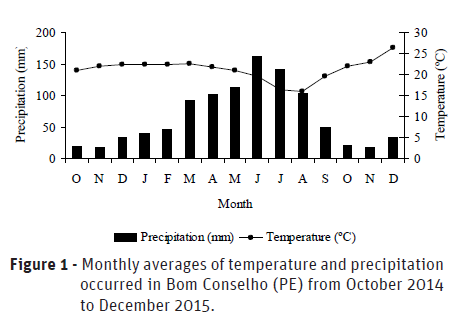
<body><![CDATA[<p><font face = "Verdana" size = "2"><i>Site collection and Plant Material</i></font></p>      <p><font face = "Verdana" size = "2">The seeds were collected from October to December 2015, in forest fragments, in the municipality of Bom Conselho, mesoregion of the state of Pernambuco (Agreste), with 09º 10&#8242; 11&#8242;&#8242; S, 36° 40&#8242; 47&#8242;&#8242; W, and altitude of 654 m. The mean annual temperature was 21 °C (Fig. 1). According to the climatic classification of Köppen, the climate is classified as BSh, semi-arid hot with annual precipitation of 918 mm (<a href = "#f1">Figure 1</a>).</font></p>      <p>&nbsp;</p>  <a name = "f1"><img src = "/img/revistas/rca/v42n2/v42n2a11f1.jpg"></a>      
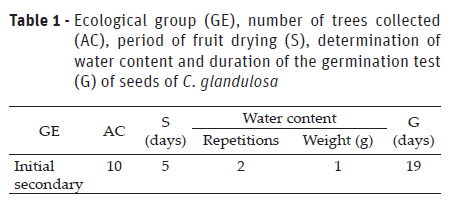
<p>&nbsp;</p>      <p><font face = "Verdana" size = "2">Mature fruits were collected directly from the trees, maturity being indicated by the change in coloration (going from green to dark brown) and the onset of dehiscence. The number of trees collected is listed in <a href = "#t1">Table 1</a>.</font></p>      <p>&nbsp;</p>  <a name = "t1"><img src = "/img/revistas/rca/v42n2/v42n2a11t1.jpg"></a>      
<p>&nbsp;</p>      <p><font face = "Verdana" size = "2">The fruits were kept in the shade and broken for the extraction of the seeds, according to the recommendations of Lorenzi (2016). The seed lots were formed only by mature seeds and without visual damage. It was observed that the smaller fruits, of late maturation, did not present seeds.</font></p>       <p><font face = "Verdana" size = "2">Furthermore, the seeds were counted and preserved in four conditions: in Kraft type paper bag and glass bottle, in laboratory environment (uncontrolled) and in dry chamber (18 °C and 45% RH), storage period: 0 (without storage), 3, 6, 9, 12, and 15 months.</font></p>      <p><font face = "Verdana" size = "2">For each evaluation period, in each storage condition, the water content of the seeds was determined and the germination test was performed.</font></p>      ]]></body>
<body><![CDATA[<p><font face = "Verdana" size = "2">The methodology used to propose seed classification for storage capacity was based on the methodology proposed by Hong and Ellis (1996), with some modifications.</font></p>       <p><font face = "Verdana" size = "2"><i>Assessed parameters of the seeds</i></font></p>       <p><font face = "Verdana" size = "2">The water content was determined with two seed samples of 1 g each. The greenhouse method was used at 105 ± 3 °C for 24 h, in accordance with the Rules for Seed Analysis (Brasil, 2009).</font></p>      <p><font face = "Verdana" size = "2">For the germination test, seed asepsis was performed by immersing them in 70% alcohol for 1 min followed by washing them in running water (Melo Junior <i>et al</i>., 2018). Thereafter, the seeds were sown in the region opposite to the hilum and were placed to germinate on two sheets of paper towels moistened with distilled water equivalent to 2.5 times the weight of the dry paper (Brasil, 2009), kept in plastic boxes (11.0 × 11.0 × 3.5 cm) in a <i>Biochemical Oxygen Demand</i> (BOD) germinating chamber regulated at 30 °C with photoperiod of 8 h. Seeds germinated were considered to have originated seedlings classified as normal (Brasil, 2009), and were counted daily at the same time for 19 days. The substrate was kept sufficiently moist throughout the test. The variables analyzed were: germination, germination speed, mean germination time, and synchrony index, total length, and dry mass of seedlings, according to the following equations:</font></p>      <p><font face = "Verdana" size = "2">(a)&nbsp;&nbsp; Germination: &#119892;&#119894; = (&#931;&#119896;&#119894;=1ni/N) × 100, where ni: the number of seeds germinated in time &#119894;; N: the total number of seeds placed to germinate.</font></p>       <p><font face = "Verdana" size = "2">(b)&nbsp;&nbsp;  Index of speed of germination: IVG = G<sub>1</sub>/N<sub>1</sub> + G<sub>2</sub>/N<sub>2</sub> +&#8230;+ G<sub>n</sub>/N<sub>n</sub>, where G<sub>1</sub>, G<sub>2</sub>, G<sub>n</sub>: the number of seeds germinated in the first, second, and the last count; and N<sub>1</sub>, N<sub>2,</sub> and N<sub>n</sub>: the number of sowing days at the first, second, and last count.</font></p>      <p><font face = "Verdana" size = "2"> (c)&nbsp;&nbsp;  Average germination time: &#119905; = &#931;&#119896;&#119894; = 1 (niti)/&#931;&#119896;&#119894; = 1ni, where ti: time from the onset of the experiment to the &#119894;nth observation (days or hours); ni: number of seeds germinated at time &#119894; (corresponding number or &#119894; nth observation); &#119896;: last day of germination.</font></p>       <p><font face = "Verdana" size = "2"> (d)&nbsp;&nbsp;  Synchronicity Index: Z = &#931;C<sub>n1,2</sub>/N &#8781; C<sub>n1,2</sub> = ni (ni – 1)/2; N = &#931;ni (&#931;ni – 1)/2, where C<sub>n1,2</sub>: the combination of germinated seeds in &#119894;nth time; ni: the number of seeds germinated in time &#119894;.</font></p>       <p><font face = "Verdana" size = "2"> (e)&nbsp;&nbsp;  Total length of the seedling: its length (from the apex of the primary root to the shoot&#8217;s apical aerial part) was measured with the aid of a graduated ruler.</font></p>       <p><font face = "Verdana" size = "2"> (f)&nbsp;&nbsp;&nbsp;  Dry mass of seedlings: the seedlings were packed in paper bags of the Kraft type and were dried in an oven with forced air circulation regulated at 80 °C until they reached a constant weight (24 h), and their dry mass was weighed in a precision analytical balance.</font></p>       ]]></body>
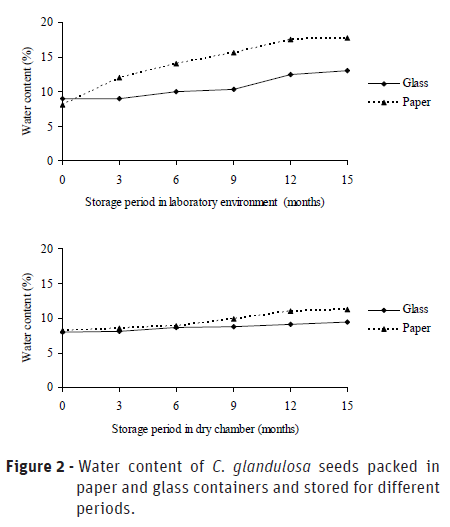
<body><![CDATA[<p><font face = "Verdana" size = "2"><i>Statistical procedures</i></font></p>      <p><font face = "Verdana" size = "2">The experimental design was completely randomized with four replicates of 25 seeds, and the data was subjected to the tests of normality and homogeneity. For the data with abnormal distribution, the sine arc transformation was done &#8730;%, and collectively with the data that met the aforementioned assumptions, the analysis of variance was used in a 2 × 6 factorial arrangement (2 packs × 6 storage periods) and polynomial regression was applied, adopting the equations with higher determination coefficients (R<sup>2</sup>). All analyses were performed with the statistical <i>software</i> Sisvar version 5.6 (Ferreira, 2014).</font></p>       <p><font face = "Verdana" size = "3"><b>RESULTS AND DISCUSSION</b></font></p>      <p><font face = "Verdana" size = "2">There was lower variation in water content for seeds stored in dry chamber, regardless of the type of packaging used, in which there was an increase of one and three percentage points for glass (9.4%) and paper (11.2%), respectively, over the storage period, to the detriment of those preserved in paper packaging in a laboratory environment, which allowed a greater exchange of moisture, passing its water content from 8.1% to 17.8% in the 15 months of storage (<a href = "#f2">Figure 2</a>). This variation in the water content of the seeds evidenced two distinct patterns, being correlated with the storage condition.</font></p>      <p>&nbsp;</p>  <a name = "f2"><img src = "/img/revistas/rca/v42n2/v42n2a11f2.jpg"></a>      
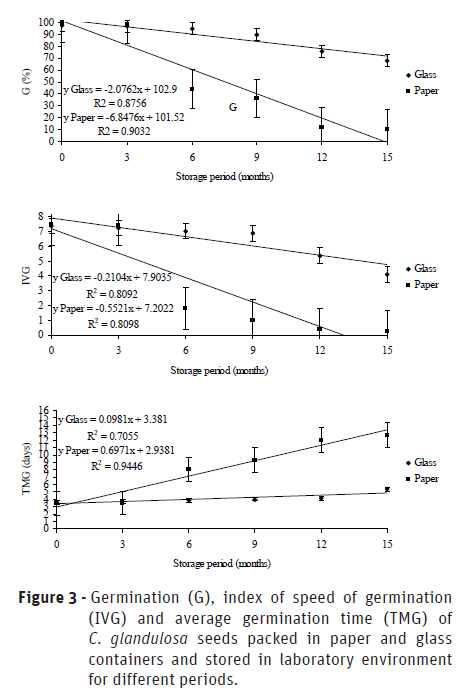
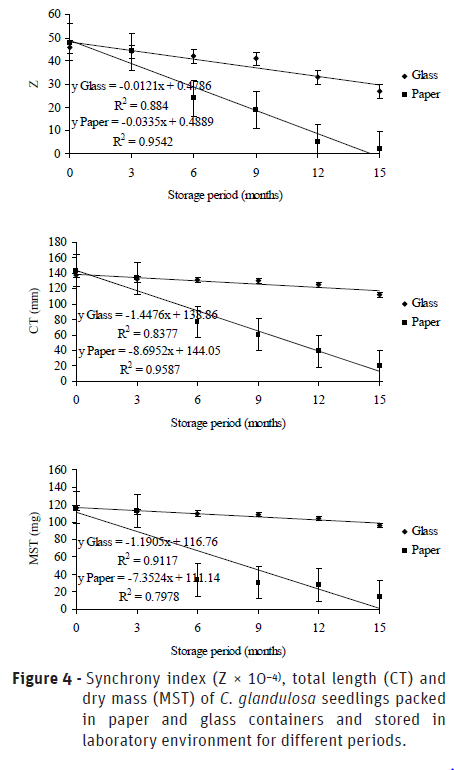
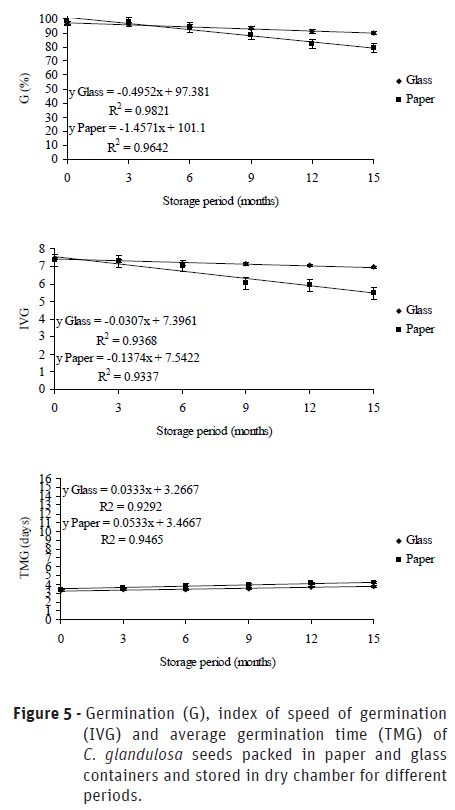
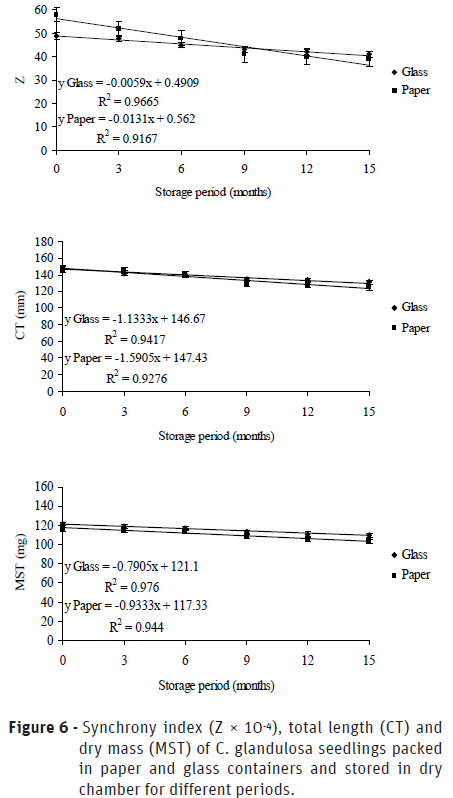
<p>&nbsp;</p>      <p><font face = "Verdana" size = "2">In the present study, the difference in the water content observed during the storage period was due to the fact that glass packaging prevent or hinder the exchange of moisture of the seeds with their surrounding environment, contrary to the paper that facilitates the process of hygroscopy, intrinsic property.</font></p>       <p><font face = "Verdana" size = "2">When the water content of the seeds stored in the glass bottles and paper bags, in a dry chamber and laboratory environment, remained below 13%, it presumably led to a higher viability and vigor during the 15 months storage. In contrast, when the water content was high, approximately 14%, a significant decrease was observed in the physiological potential, from 6-month onward (<a href = "#f2">Figures 2</a>, <a href = "#f3">3</a>, <a href = "#f4">4</a>, <a href = "#f5">5</a>, <a href = "#f6">6</a>). In the porous packaging (paper), water vapors penetrated inside the packages, and this, associated with high temperatures, causing the progressive inactivation of the metabolism and culminating with the death of the seeds. In the waterproof packaging (glass), the ambient vapor did not penetrate inside the package.</font></p>      <p>&nbsp;</p>  <a name = "f3"><img src = "/img/revistas/rca/v42n2/v42n2a11f3.jpg"></a>      
<p>&nbsp;</p>  <a name = "f4"><img src = "/img/revistas/rca/v42n2/v42n2a11f4.jpg"></a>      
]]></body>
<body><![CDATA[<p>&nbsp;</p>  <a name = "f5"><img src = "/img/revistas/rca/v42n2/v42n2a11f5.jpg"></a>      
<p>&nbsp;</p>  <a name = "f6"><img src = "/img/revistas/rca/v42n2/v42n2a11f6.jpg"></a>      
<p>&nbsp;</p>      <p><font face = "Verdana" size = "2">Considering the flowchart of Hong and Ellis (1996) for determination of seed storage behavior, and considering the results verified in <a href = "#f2">Figures 2</a>, <a href = "#f3">3</a>, <a href = "#f4">4</a>, <a href = "#f5">5</a>, <a href = "#f6">6</a>, it is possible to classify the colubrina seeds as having orthodox behavior, because the germinability was maintained, even after the water content being reduced to 8%–9%. A majority of the species, of typical tropical ecological adaptation, presents this behavior, that is, the drier seeds will have a better shelf life. However, notably, in the laboratory environment, change was observed the physiological quality of the seed, compared to that of the initial months, and a negative linear relationship was found between the water content and longevity of the seeds stored in the paper bags.</font></p>      <p><font face = "Verdana" size = "2">According to Felix <i>et al</i>. (2017), the effect of the water content of the seeds is majorly due to intensive respiration. This effect of water content on the seed storage potential was also demonstrated in the research studies with seeds of other plant species (Hennipman <i>et al</i>., 2017; Menegatti <i>et al</i>., 2017; Nery <i>et al</i>., 2017; Ri <i>et al</i>., 2017; Oliveira <i>et al</i>., 2018). The conditions of relative humidity and temperature during storage, where the seeds will reach the specific hygroscopic equilibrium, will determine the maintenance of their physiological quality for a greater or lesser time.</font></p>      <p><font face = "Verdana" size = "2">In laboratory (normal environmental conditions), with the paper packaging in storage time of 15 months, lower physiological potential was observed (<a href = "#f2">Figures 2</a>, <a href = "#f3">3</a>, <a href = "#f4">4</a>, <a href = "#f5">5</a>, <a href = "#f6">6</a>). Under these conditions, the water content of 17.8% accelerated the deterioration, usually determined by the disorganization of the membrane system. According to Jose <i>et al</i>. (2018), this is because the seed releases to the environment water of constitution, increasing the relative humidity of the air inside the package, which can lead to the consumption of reserves of the embryo and the release of toxins. Similar results were found in seeds of several other species (Bandeira <i>et al</i>., 2017; Flores <i>et al</i>., 2018; Smiderle <i>et al</i>., 2018), in which the viability and vigor were reduced with prolonged storage time.</font></p>      <p><font face = "Verdana" size = "2">Observing the <a href = "#f2">Figures 2</a>, <a href = "#f3">3</a>, <a href = "#f4">4</a>, <a href = "#f5">5</a>, <a href = "#f6">6</a>, for dry chamber conditions (characterized by low relative humidity), the values indicate that with a suitable initial water content, the viability of the seeds can be maintained for a long period, both in glass packaging and in paper bag. In contrast, in the laboratory environment, better results were obtained with the glass packaging, making the effect of the high daytime temperatures were not so drastic. Therefore, to store seeds in a typically tropical climate (in the case of Brazil, in the Amazon region) it is recommended to dry the seeds well and then pack them in moisture-proof packaging.</font></p>      <p><font face = "Verdana" size = "2">A study conducted by Pereira <i>et al</i>. (2017) appropriately illustrates the regional climatic effect on the choice of packaging to be used, in the case of seeds of orthodox behavior. Herein, the seed will adjusts to the new relative humidity of the air, and consequently acquire a higher water content than the initial one, which, in turn, results in further modification of the relative humidity of the packaging air and new hygroscopic balance of the seed. Moreover, it would stimulate the growth of fungi, both by water vapor and by the caloric energy added to the internal environment of the packaging.</font></p>      <p><font face = "Verdana" size = "2">According to Pelissari <i>et al</i>. (2018), seeds of several tropical rainforest species, as soon as they are dispersed, have a relatively high water content and intense metabolic activity. These seeds would tend to germinate rapidly and simultaneously after dispersion, otherwise they would lose viability because the soil environment is constantly humid and at high temperatures (Becerra-Vázquez <i>et al</i>., 2018). Thus, the success in establishing this species under natural conditions may be more related to the quantity and periodicity (annual) of the seed produced, than to the maintenance of seeds in the soil.</font></p>      <p><font face = "Verdana" size = "3"><b>CONCLUSIONS</b></font></p>       ]]></body>
<body><![CDATA[<p><font face = "Verdana" size = "2">Seeds of colubrina in the laboratory environment, do not lose their viability for 15 months if they are packed in glass containers.</font></p>       <p><font face = "Verdana" size = "2">The physiological quality of the seeds is maintained, when stored in a dry chamber, in a porous or impermeable package, with initial water content of 8.0%–8.2%.</font></p>      <p>&nbsp;</p>      <p><font face = "Verdana" size = "3"><b>References</b></font></p>       <!-- ref --><p><font face = "Verdana" size = "2">Bandeira, A.S.; Nunes, R.T.C.; Públio Júnior, E. & Morais, O.M. (2017) - Avaliação do potencial fisiológico das unidades de propagação de aroeira (<i>Myracrodruon</i> <i>urundeuva</i>), com e sem exocarpo e mesocarpo, em diferentes substratos. <i>Revista de Ciências Agrárias</i>, vol. 40, n. 1, p. 53-60. <a href = "http://dx.doi.org/10.19084/RCA15040" target = "_blank">http://dx.doi.org/10.19084/RCA15040</a></font>&nbsp;&nbsp;&nbsp;&nbsp;&nbsp;&nbsp;&nbsp;&nbsp;[&#160;<a href="javascript:void(0);" onclick="javascript: window.open('/scielo.php?script=sci_nlinks&ref=697132&pid=S0871-018X201900020001100001&lng=','','width=640,height=500,resizable=yes,scrollbars=1,menubar=yes,');">Links</a>&#160;]<!-- end-ref --><!-- ref --><p><font face = "Verdana" size = "2">Becerra-Vázquez, A.G.; Sánchez-Nieto, S.; Coates, R.; Flores-Ortiz, C.M. & Orozco-Segovia, A. (2018) - Seed longevity of five tropical species from south-eastern Mexico: changes in seed germination during storage. <i>Tropical Conservation Science</i>, vol. 11, n. 1, p. 1-17. <a href = "http://dx.doi.org/10.1177/1940082918779489" target = "_blank">http://dx.doi.org/10.1177/1940082918779489</a></font>&nbsp;&nbsp;&nbsp;&nbsp;&nbsp;&nbsp;&nbsp;&nbsp;[&#160;<a href="javascript:void(0);" onclick="javascript: window.open('/scielo.php?script=sci_nlinks&ref=697133&pid=S0871-018X201900020001100002&lng=','','width=640,height=500,resizable=yes,scrollbars=1,menubar=yes,');">Links</a>&#160;]<!-- end-ref --><p><font face = "Verdana" size = "2">Brasil (2009) - <i>Regras para análise de sementes.</i> Ministério da Agricultura, Pecuária e Abastecimento. Secretaria de Defesa Agropecuária. Brasília, DF: MAPA/ACS, 395 p.</font></p>      <!-- ref --><p><font face = "Verdana" size = "2">Carvalho, P.E.R. (2005) - <i>Sobrasil.</i> Colombo: Embrapa Florestas. 10 p. (Embrapa Florestas. Circular Técnica, 106).    &nbsp;&nbsp;&nbsp;&nbsp;&nbsp;&nbsp;&nbsp;&nbsp;[&#160;<a href="javascript:void(0);" onclick="javascript: window.open('/scielo.php?script=sci_nlinks&ref=697135&pid=S0871-018X201900020001100003&lng=','','width=640,height=500,resizable=yes,scrollbars=1,menubar=yes,');">Links</a>&#160;]<!-- end-ref --></font></p>      <!-- ref --><p><font face = "Verdana" size = "2">Felix, F.C.; Pádua, G.V.G.; Araújo, F.S.; Ferrari, C.S. & Pacheco, M.V. (2017) - Armazenamento de sementes de <i>Pritchardia</i> <i>pacifica</i>. <i>Revista de Ciências Agrárias</i>, vol. 40, n. 1, p. 69-78. <a href = "http://dx.doi.org/10.19084/RCA16043" target = "_blank">http://dx.doi.org/10.19084/RCA16043</a></font>&nbsp;&nbsp;&nbsp;&nbsp;&nbsp;&nbsp;&nbsp;&nbsp;[&#160;<a href="javascript:void(0);" onclick="javascript: window.open('/scielo.php?script=sci_nlinks&ref=697137&pid=S0871-018X201900020001100004&lng=','','width=640,height=500,resizable=yes,scrollbars=1,menubar=yes,');">Links</a>&#160;]<!-- end-ref --><!-- ref --><p><font face = "Verdana" size = "2">Ferreira, D.F. (2014) - Sisvar: a Guide for its Bootstrap procedures in multiple comparisons. <i>Ciência e Agrotecnologia</i>, vol. 38, n. 2, p. 109-112. <a href = "http://dx.doi.org/10.1590/S1413-70542014000200001" target = "_blank">http://dx.doi.org/10.1590/S1413-70542014000200001</a></font>&nbsp;&nbsp;&nbsp;&nbsp;&nbsp;&nbsp;&nbsp;&nbsp;[&#160;<a href="javascript:void(0);" onclick="javascript: window.open('/scielo.php?script=sci_nlinks&ref=697138&pid=S0871-018X201900020001100005&lng=','','width=640,height=500,resizable=yes,scrollbars=1,menubar=yes,');">Links</a>&#160;]<!-- end-ref --><!-- ref --><p><font face = "Verdana" size = "2">Flores, A.V.; Ataíde, G.M.; Castro, V.O.; Borges, E.E.L. & Pereira, R.M.D. (2018) - Physiological and biochemical alterations on the storage of <i>Cedrela</i> <i>fissilis</i> Vellozo seeds. <i>FLORESTA</i>, vol. 48, n. 1, p. 1-8. <a href = "http://dx.doi.org/10.5380/rf.v48i1.46601" target = "_blank">http://dx.doi.org/10.5380/rf.v48i1.46601</a></font>&nbsp;&nbsp;&nbsp;&nbsp;&nbsp;&nbsp;&nbsp;&nbsp;[&#160;<a href="javascript:void(0);" onclick="javascript: window.open('/scielo.php?script=sci_nlinks&ref=697139&pid=S0871-018X201900020001100006&lng=','','width=640,height=500,resizable=yes,scrollbars=1,menubar=yes,');">Links</a>&#160;]<!-- end-ref --><!-- ref --><p><font face = "Verdana" size = "2">Hennipman, H.S.; Santos, A.F.; Vieira, E.S.N. & Auer, C.G. (2017) - Qualidade sanitária e fisiológica de sementes de araucária durante armazenamento. <i>Ciência Florestal,</i> vol. 27, n. 2, p. 643-654. <a href = "http://dx.doi.org/10.5902/1980509827749" target = "_blank">http://dx.doi.org/10.5902/1980509827749</a></font>&nbsp;&nbsp;&nbsp;&nbsp;&nbsp;&nbsp;&nbsp;&nbsp;[&#160;<a href="javascript:void(0);" onclick="javascript: window.open('/scielo.php?script=sci_nlinks&ref=697140&pid=S0871-018X201900020001100007&lng=','','width=640,height=500,resizable=yes,scrollbars=1,menubar=yes,');">Links</a>&#160;]<!-- end-ref --><!-- ref --><p><font face = "Verdana" size = "2">Hong, T.D. & Ellis, R.H. (1996) - <i>A protocol to determine seed storage behaviour.</i> Rome: International Plant Genetic Resources Institute. 55 p. (IPGRI. Technical Bulletin, 1).    &nbsp;&nbsp;&nbsp;&nbsp;&nbsp;&nbsp;&nbsp;&nbsp;[&#160;<a href="javascript:void(0);" onclick="javascript: window.open('/scielo.php?script=sci_nlinks&ref=697141&pid=S0871-018X201900020001100008&lng=','','width=640,height=500,resizable=yes,scrollbars=1,menubar=yes,');">Links</a>&#160;]<!-- end-ref --></font></p>      <!-- ref --><p><font face = "Verdana" size = "2">Jose, S.C.B.R.; Salomão, A.N.; Melo, L.A.M.P.; Santos, I.R.I. & Laviola, B.G. (2018) - Germination and vigor of stored Jatropha (<i>Jatropha</i> <i>curcas</i> L.) seeds. <i>Journal of Seed Science</i>, vol. 40, n. 1, p. 52-59. <a href = "http://dx.doi.org/10.1590/2317-1545v40n1183431" target = "_blank">http://dx.doi.org/10.1590/2317-1545v40n1183431</a></font>&nbsp;&nbsp;&nbsp;&nbsp;&nbsp;&nbsp;&nbsp;&nbsp;[&#160;<a href="javascript:void(0);" onclick="javascript: window.open('/scielo.php?script=sci_nlinks&ref=697143&pid=S0871-018X201900020001100009&lng=','','width=640,height=500,resizable=yes,scrollbars=1,menubar=yes,');">Links</a>&#160;]<!-- end-ref --><!-- ref --><p><font face = "Verdana" size = "2">Léon-Lobos, P. & Ellis, R.H. (2018) - Comparison of seed desiccation sensitivity amongst <i>Castanea</i> <i>sativa</i>, <i>Quercus</i> <i>ilex</i> and <i>Q</i>. <i>cerris</i>. <i>Seed Science and Technology</i>, vol. 46, n. 2, p. 233-237. <a href = "http://dx.doi.org/10.15258/sst.2018.46.2.05" target = "_blank">http://dx.doi.org/10.15258/sst.2018.46.2.05</a></font>&nbsp;&nbsp;&nbsp;&nbsp;&nbsp;&nbsp;&nbsp;&nbsp;[&#160;<a href="javascript:void(0);" onclick="javascript: window.open('/scielo.php?script=sci_nlinks&ref=697144&pid=S0871-018X201900020001100010&lng=','','width=640,height=500,resizable=yes,scrollbars=1,menubar=yes,');">Links</a>&#160;]<!-- end-ref --><!-- ref --><p><font face = "Verdana" size = "2">Lorenzi, H. (2016) - <i>Árvores brasileiras: manual de identificação e cultivo de plantas arbóreas nativas do Brasil.</i> 5. ed. Nova Odessa: Plantarum. 384 p.    &nbsp;&nbsp;&nbsp;&nbsp;&nbsp;&nbsp;&nbsp;&nbsp;[&#160;<a href="javascript:void(0);" onclick="javascript: window.open('/scielo.php?script=sci_nlinks&ref=697145&pid=S0871-018X201900020001100011&lng=','','width=640,height=500,resizable=yes,scrollbars=1,menubar=yes,');">Links</a>&#160;]<!-- end-ref --></font></p>      <!-- ref --><p><font face = "Verdana" size = "2">Melo Junior, J.L.A.; Melo, L.D.F.A.; Ferreira, V.M.; Araújo Neto, J.C.; Silva, C.B. & Neves, M.I.R.S. (2018) - Thermal-biological aspects of seed germination of <i>Colubrina</i> <i>glandulosa</i> Perkins under different temperatures. <i>Journal of Agricultural Science</i>, vol. 10, n. 6, p. 390-400. <a href = "http://dx.doi.org/10.5539/jas.v10n6p390" target = "_blank">http://dx.doi.org/10.5539/jas.v10n6p390</a></font>&nbsp;&nbsp;&nbsp;&nbsp;&nbsp;&nbsp;&nbsp;&nbsp;[&#160;<a href="javascript:void(0);" onclick="javascript: window.open('/scielo.php?script=sci_nlinks&ref=697147&pid=S0871-018X201900020001100012&lng=','','width=640,height=500,resizable=yes,scrollbars=1,menubar=yes,');">Links</a>&#160;]<!-- end-ref --><!-- ref --><p><font face = "Verdana" size = "2">Menegatti, R.; Mantovani, A.; Navroski, M.C.; Guollo, K.; Vargas, O.F. & Souza, A.G. (2017) - Germinação de sementes de <i>Mimosa</i> <i>scabrella</i> Benth. submetidas a diferentes condições de temperatura, armazenamento e tratamentos pré-germinativos. <i>Revista de Ciências Agrárias</i>, vol. 40, n. 2, p. 305-310. <a href = "http://dx.doi.org/10.19084/RCA16153" target = "_blank">http://dx.doi.org/10.19084/RCA16153</a></font>&nbsp;&nbsp;&nbsp;&nbsp;&nbsp;&nbsp;&nbsp;&nbsp;[&#160;<a href="javascript:void(0);" onclick="javascript: window.open('/scielo.php?script=sci_nlinks&ref=697148&pid=S0871-018X201900020001100013&lng=','','width=640,height=500,resizable=yes,scrollbars=1,menubar=yes,');">Links</a>&#160;]<!-- end-ref --><!-- ref --><p><font face = "Verdana" size = "2">Nery, F.C.; Prudente, D.O.; Alvarenga, A.A.; Paiva, R. & Nery, M.C. (2017) - Storage of <i>Calophyllum</i> <i>brasiliense</i> Cambess. seeds. <i>Brazilian Journal of Biology,</i> vol. 77, n. 3, p. 431-436. <a href = "http://dx.doi.org/10.1590/1519-6984.08115" target = "_blank">http://dx.doi.org/10.1590/1519-6984.08115</a></font>&nbsp;&nbsp;&nbsp;&nbsp;&nbsp;&nbsp;&nbsp;&nbsp;[&#160;<a href="javascript:void(0);" onclick="javascript: window.open('/scielo.php?script=sci_nlinks&ref=697149&pid=S0871-018X201900020001100014&lng=','','width=640,height=500,resizable=yes,scrollbars=1,menubar=yes,');">Links</a>&#160;]<!-- end-ref --><!-- ref --><p><font face = "Verdana" size = "2">Oliveira, A.K.M.; Alves, F.F. & Fernandes, V. (2018) - Germinação de sementes de <i>Vochysia</i> <i>divergens</i> após armazenamento em três ambientes. <i>Ciência Florestal,</i> vol. 28, n. 2, p. 525-531. <a href = "http://dx.doi.org/10.5902/1980509832035" target = "_blank">http://dx.doi.org/10.5902/1980509832035</a></font>&nbsp;&nbsp;&nbsp;&nbsp;&nbsp;&nbsp;&nbsp;&nbsp;[&#160;<a href="javascript:void(0);" onclick="javascript: window.open('/scielo.php?script=sci_nlinks&ref=697150&pid=S0871-018X201900020001100015&lng=','','width=640,height=500,resizable=yes,scrollbars=1,menubar=yes,');">Links</a>&#160;]<!-- end-ref --><!-- ref --><p><font face = "Verdana" size = "2">Oliveira, C.D.C.; Gonzaga, L.M.; Carvalho, J.A.; Davide, A.C. & Botelho, S.A. (2017) - Riqueza de mudas de espécies florestais nativas potencialmente produzidas na Bacia do Rio Grande, MG. <i>Pesquisa Florestal Brasileira</i>, vol. 37, n. 90, p. 159-170. <a href = "http://dx.doi.org/10.4336/2017.pfb.37.90.1342" target = "_blank">http://dx.doi.org/10.4336/2017.pfb.37.90.1342</a></font>&nbsp;&nbsp;&nbsp;&nbsp;&nbsp;&nbsp;&nbsp;&nbsp;[&#160;<a href="javascript:void(0);" onclick="javascript: window.open('/scielo.php?script=sci_nlinks&ref=697151&pid=S0871-018X201900020001100016&lng=','','width=640,height=500,resizable=yes,scrollbars=1,menubar=yes,');">Links</a>&#160;]<!-- end-ref --><!-- ref --><p><font face = "Verdana" size = "2">Pelissari, F.; Jose, A.C.; Fontes, M.A.L.; Matos, A.C.B.; Pereira, W.V.S. & Faria, J.M. (2018) - R. A probabilistic model for tropical tree seed desiccation tolerance and storage classification. <i>New Forests,</i> vol. 49, n. 1, p. 143-158. <a href = "http://dx.doi.org/10.1007/s11056-017-9610-8" target = "_blank">http://dx.doi.org/10.1007/s11056-017-9610-8</a></font>&nbsp;&nbsp;&nbsp;&nbsp;&nbsp;&nbsp;&nbsp;&nbsp;[&#160;<a href="javascript:void(0);" onclick="javascript: window.open('/scielo.php?script=sci_nlinks&ref=697152&pid=S0871-018X201900020001100017&lng=','','width=640,height=500,resizable=yes,scrollbars=1,menubar=yes,');">Links</a>&#160;]<!-- end-ref --><!-- ref --><p><font face = "Verdana" size = "2">Pereira, W.V.S.; Faria, J.M.R.; José, A.C.; Tonetti, O.A.O.; Ligterink, W. & Hilhorst, H.W.M. (2017) - Is the loss of desiccation tolerance in orthodox seeds affected by provenance? <i>South African Journal of Botany,</i> vol. 112, p. 296-302. <a href = "http://dx.doi.org/10.1016/j.sajb.2017.06.008" target = "_blank">http://dx.doi.org/10.1016/j.sajb.2017.06.008</a></font>&nbsp;&nbsp;&nbsp;&nbsp;&nbsp;&nbsp;&nbsp;&nbsp;[&#160;<a href="javascript:void(0);" onclick="javascript: window.open('/scielo.php?script=sci_nlinks&ref=697153&pid=S0871-018X201900020001100018&lng=','','width=640,height=500,resizable=yes,scrollbars=1,menubar=yes,');">Links</a>&#160;]<!-- end-ref --><!-- ref --><p><font face = "Verdana" size = "2">Ri, L.D.; Calil, A.C.; Silva, L.C. & Müller, D.R. (2017) - Comportamento da qualidade &#64257;siológica de sementes de Capororoca-do-Banhado (<i>Myrsine</i> <i>parvifolia</i> A. DC. – Primulaceae) em diferentes tempos e condições de armazenamento. <i>Iheringia Série Botânica</i>, vol. 72, n. 3, p. 403-408.    &nbsp;&nbsp;&nbsp;&nbsp;&nbsp;&nbsp;&nbsp;&nbsp;[&#160;<a href="javascript:void(0);" onclick="javascript: window.open('/scielo.php?script=sci_nlinks&ref=697154&pid=S0871-018X201900020001100019&lng=','','width=640,height=500,resizable=yes,scrollbars=1,menubar=yes,');">Links</a>&#160;]<!-- end-ref --></font></p>       <!-- ref --><p><font face = "Verdana" size = "2">Sahu, B.; Sahu, A.K.; Thomas, V. & Naithani, S.C. (2017) - Reactive oxygen species, lipid peroxidation, protein oxidation and antioxidative enzymes in dehydrating Karanj (<i>Pongamia</i> <i>pinnata</i>) seeds during storage. <i>South African Journal of Botany,</i> vol. 112, p. 383-390. <a href = "http://dx.doi.org/10.1016/j.sajb.2017.06.030" target = "_blank">http://dx.doi.org/10.1016/j.sajb.2017.06.030</a></font>&nbsp;&nbsp;&nbsp;&nbsp;&nbsp;&nbsp;&nbsp;&nbsp;[&#160;<a href="javascript:void(0);" onclick="javascript: window.open('/scielo.php?script=sci_nlinks&ref=697156&pid=S0871-018X201900020001100020&lng=','','width=640,height=500,resizable=yes,scrollbars=1,menubar=yes,');">Links</a>&#160;]<!-- end-ref --><!-- ref --><p><font face = "Verdana" size = "2">Schneider, C.F.; Dranski, J.A.L.; Gusatto, F.C.; Malavasi, M.M. & Malavasi, U.C. (2017) - Equações de longevidade para sementes de pau-marfim. <i>Amazonian Journal of Agricultural and Environmental Sciences</i>, vol. 60, n. 1, p. 53-59. <a href = "http://dx.doi.org/10.4322/rca.2259" target = "_blank">http://dx.doi.org/10.4322/rca.2259</a></font>&nbsp;&nbsp;&nbsp;&nbsp;&nbsp;&nbsp;&nbsp;&nbsp;[&#160;<a href="javascript:void(0);" onclick="javascript: window.open('/scielo.php?script=sci_nlinks&ref=697157&pid=S0871-018X201900020001100021&lng=','','width=640,height=500,resizable=yes,scrollbars=1,menubar=yes,');">Links</a>&#160;]<!-- end-ref --><!-- ref --><p><font face = "Verdana" size = "2">Silva, L.J.; Dias, D.C.F.S.; Sekita, M.C. & Finger, F.L. (2018) - Lipid peroxidation and antioxidant enzymes of <i>Jatropha curcas</i> L. seeds stored at different maturity stages. <i>Acta Scientiarum. Agronomy</i>, vol. 40, n. 1, p. 1-10. <a href = "http://dx.doi.org/10.4025/actasciagron.v40i1.34978" target = "_blank">http://dx.doi.org/10.4025/actasciagron.v40i1.34978</a></font>&nbsp;&nbsp;&nbsp;&nbsp;&nbsp;&nbsp;&nbsp;&nbsp;[&#160;<a href="javascript:void(0);" onclick="javascript: window.open('/scielo.php?script=sci_nlinks&ref=697158&pid=S0871-018X201900020001100022&lng=','','width=640,height=500,resizable=yes,scrollbars=1,menubar=yes,');">Links</a>&#160;]<!-- end-ref --><!-- ref --><p><font face = "Verdana" size = "2">Smiderle, O.J.; Souza, A.G.; Pedroso, C.A.; Silva, T.J. & Souza, A.A. (2018) - Correlation between mass and vigor of <i>Pochota</i> <i>fendleri</i> (Malvaceae) seeds stored in different environments. <i>Revista de Ciências Agrárias</i>, vol. 41, n. 1, p. 93-99. <a href = "http://dx.doi.org/10.19084/RCA17221" target = "_blank">http://dx.doi.org/10.19084/RCA17221</a></font>&nbsp;&nbsp;&nbsp;&nbsp;&nbsp;&nbsp;&nbsp;&nbsp;[&#160;<a href="javascript:void(0);" onclick="javascript: window.open('/scielo.php?script=sci_nlinks&ref=697159&pid=S0871-018X201900020001100023&lng=','','width=640,height=500,resizable=yes,scrollbars=1,menubar=yes,');">Links</a>&#160;]<!-- end-ref --><!-- ref --><p><font face = "Verdana" size = "2">Wencomo, H.B.; Ortíz, R. & Cáceres, J. (2017) - Quality of seeds from Leucaena species stored under ambient conditions. <i>African Journal of Agricultural Research</i>, vol. 12, n. 4, p. 279-285. <a href = "http://dx.doi.org/10.5897/AJAR2015.10604" target = "_blank">http://dx.doi.org/10.5897/AJAR2015.10604</a></font>&nbsp;&nbsp;&nbsp;&nbsp;&nbsp;&nbsp;&nbsp;&nbsp;[&#160;<a href="javascript:void(0);" onclick="javascript: window.open('/scielo.php?script=sci_nlinks&ref=697160&pid=S0871-018X201900020001100024&lng=','','width=640,height=500,resizable=yes,scrollbars=1,menubar=yes,');">Links</a>&#160;]<!-- end-ref --><p>&nbsp;</p>      <p><font face = "Verdana" size = "3"><b>Acknowledgment</b></font></p>      <p><font face = "Verdana" size = "2">Corresponding author thanks Coordination for the Improvement of Higher Education Personnel by the granting the scholarship.</font></p>      <p>&nbsp;</p>      <p><font face = "Verdana" size = "2">Received/recebido: 2018.11.13</font></p>       <p><font face = "Verdana" size = "2">Accepted/aceite: 2019.01.11</font></p>       ]]></body><back>
<ref-list>
<ref id="B1">
<nlm-citation citation-type="journal">
<person-group person-group-type="author">
<name>
<surname><![CDATA[Bandeira]]></surname>
<given-names><![CDATA[A.S.]]></given-names>
</name>
<name>
<surname><![CDATA[Nunes]]></surname>
<given-names><![CDATA[R.T.C.]]></given-names>
</name>
<name>
<surname><![CDATA[Públio Júnior]]></surname>
<given-names><![CDATA[E.]]></given-names>
</name>
<name>
<surname><![CDATA[Morais]]></surname>
<given-names><![CDATA[O.M.]]></given-names>
</name>
</person-group>
<article-title xml:lang="pt"><![CDATA[Avaliação do potencial fisiológico das unidades de propagação de aroeira (Myracrodruon urundeuva), com e sem exocarpo e mesocarpo, em diferentes substratos]]></article-title>
<source><![CDATA[Revista de Ciências Agrárias]]></source>
<year>2017</year>
<volume>40</volume>
<numero>1</numero>
<issue>1</issue>
<page-range>53-60</page-range></nlm-citation>
</ref>
<ref id="B2">
<nlm-citation citation-type="journal">
<person-group person-group-type="author">
<name>
<surname><![CDATA[Becerra-Vázquez]]></surname>
<given-names><![CDATA[A.G.]]></given-names>
</name>
<name>
<surname><![CDATA[Sánchez-Nieto]]></surname>
<given-names><![CDATA[S.]]></given-names>
</name>
<name>
<surname><![CDATA[Coates]]></surname>
<given-names><![CDATA[R.]]></given-names>
</name>
<name>
<surname><![CDATA[Flores-Ortiz]]></surname>
<given-names><![CDATA[C.M.]]></given-names>
</name>
<name>
<surname><![CDATA[Orozco-Segovia]]></surname>
<given-names><![CDATA[A.]]></given-names>
</name>
</person-group>
<article-title xml:lang="en"><![CDATA[Seed longevity of five tropical species from south-eastern Mexico: changes in seed germination during storage]]></article-title>
<source><![CDATA[Tropical Conservation Science]]></source>
<year>2018</year>
<volume>11</volume>
<numero>1</numero>
<issue>1</issue>
<page-range>1-17</page-range></nlm-citation>
</ref>
<ref id="B3">
<nlm-citation citation-type="book">
<person-group person-group-type="author">
<name>
<surname><![CDATA[Carvalho]]></surname>
<given-names><![CDATA[P.E.R.]]></given-names>
</name>
</person-group>
<source><![CDATA[Sobrasil]]></source>
<year>2005</year>
<publisher-loc><![CDATA[Colombo ]]></publisher-loc>
<publisher-name><![CDATA[Embrapa Florestas]]></publisher-name>
</nlm-citation>
</ref>
<ref id="B4">
<nlm-citation citation-type="journal">
<person-group person-group-type="author">
<name>
<surname><![CDATA[Felix]]></surname>
<given-names><![CDATA[F.C.]]></given-names>
</name>
<name>
<surname><![CDATA[Pádua]]></surname>
<given-names><![CDATA[G.V.G.]]></given-names>
</name>
<name>
<surname><![CDATA[Araújo]]></surname>
<given-names><![CDATA[F.S.]]></given-names>
</name>
<name>
<surname><![CDATA[Ferrari]]></surname>
<given-names><![CDATA[C.S.]]></given-names>
</name>
<name>
<surname><![CDATA[Pacheco]]></surname>
<given-names><![CDATA[M.V.]]></given-names>
</name>
</person-group>
<article-title xml:lang="pt"><![CDATA[Armazenamento de sementes de Pritchardia pacific]]></article-title>
<source><![CDATA[Revista de Ciências Agrárias]]></source>
<year>2017</year>
<volume>40</volume>
<numero>1</numero>
<issue>1</issue>
<page-range>69-78</page-range></nlm-citation>
</ref>
<ref id="B5">
<nlm-citation citation-type="journal">
<person-group person-group-type="author">
<name>
<surname><![CDATA[Ferreira]]></surname>
<given-names><![CDATA[D.F.]]></given-names>
</name>
</person-group>
<article-title xml:lang="en"><![CDATA[Sisvar: a Guide for its Bootstrap procedures in multiple comparisons]]></article-title>
<source><![CDATA[Ciência e Agrotecnologia]]></source>
<year>2014</year>
<volume>38</volume>
<numero>2</numero>
<issue>2</issue>
<page-range>109-112</page-range></nlm-citation>
</ref>
<ref id="B6">
<nlm-citation citation-type="journal">
<person-group person-group-type="author">
<name>
<surname><![CDATA[Flores]]></surname>
<given-names><![CDATA[A.V.]]></given-names>
</name>
<name>
<surname><![CDATA[Ataíde]]></surname>
<given-names><![CDATA[G.M.]]></given-names>
</name>
<name>
<surname><![CDATA[Castro]]></surname>
<given-names><![CDATA[V.O.]]></given-names>
</name>
<name>
<surname><![CDATA[Borges]]></surname>
<given-names><![CDATA[E.E.L.]]></given-names>
</name>
<name>
<surname><![CDATA[Pereira]]></surname>
<given-names><![CDATA[R.M.D.]]></given-names>
</name>
</person-group>
<article-title xml:lang="en"><![CDATA[Physiological and biochemical alterations on the storage of Cedrela fissilis Vellozo seeds]]></article-title>
<source><![CDATA[FLORESTA]]></source>
<year>2018</year>
<volume>48</volume>
<numero>1</numero>
<issue>1</issue>
<page-range>1-8</page-range></nlm-citation>
</ref>
<ref id="B7">
<nlm-citation citation-type="journal">
<person-group person-group-type="author">
<name>
<surname><![CDATA[Hennipman]]></surname>
<given-names><![CDATA[H.S.]]></given-names>
</name>
<name>
<surname><![CDATA[Santos]]></surname>
<given-names><![CDATA[A.F.]]></given-names>
</name>
<name>
<surname><![CDATA[Vieira]]></surname>
<given-names><![CDATA[E.S.N.]]></given-names>
</name>
<name>
<surname><![CDATA[Auer]]></surname>
<given-names><![CDATA[C.G.]]></given-names>
</name>
</person-group>
<article-title xml:lang="pt"><![CDATA[Qualidade sanitária e fisiológica de sementes de araucária durante armazenamento]]></article-title>
<source><![CDATA[Ciência Florestal]]></source>
<year>2017</year>
<volume>27</volume>
<numero>2</numero>
<issue>2</issue>
<page-range>643-654</page-range></nlm-citation>
</ref>
<ref id="B8">
<nlm-citation citation-type="book">
<person-group person-group-type="author">
<name>
<surname><![CDATA[Hong]]></surname>
<given-names><![CDATA[T.D.]]></given-names>
</name>
<name>
<surname><![CDATA[Ellis]]></surname>
<given-names><![CDATA[R.H.]]></given-names>
</name>
</person-group>
<source><![CDATA[A protocol to determine seed storage behaviour]]></source>
<year>1996</year>
<publisher-loc><![CDATA[Rome ]]></publisher-loc>
<publisher-name><![CDATA[International Plant Genetic Resources Institute]]></publisher-name>
</nlm-citation>
</ref>
<ref id="B9">
<nlm-citation citation-type="journal">
<person-group person-group-type="author">
<name>
<surname><![CDATA[Jose]]></surname>
<given-names><![CDATA[S.C.B.R.]]></given-names>
</name>
<name>
<surname><![CDATA[Salomão]]></surname>
<given-names><![CDATA[A.N.]]></given-names>
</name>
<name>
<surname><![CDATA[Melo]]></surname>
<given-names><![CDATA[L.A.M.P.]]></given-names>
</name>
<name>
<surname><![CDATA[Santos]]></surname>
<given-names><![CDATA[I.R.I.]]></given-names>
</name>
<name>
<surname><![CDATA[Laviola]]></surname>
<given-names><![CDATA[B.G.]]></given-names>
</name>
</person-group>
<article-title xml:lang="en"><![CDATA[Germination and vigor of stored Jatropha (Jatropha curcas L.) seeds]]></article-title>
<source><![CDATA[Journal of Seed Science]]></source>
<year>2018</year>
<volume>40</volume>
<numero>1</numero>
<issue>1</issue>
<page-range>52-59</page-range></nlm-citation>
</ref>
<ref id="B10">
<nlm-citation citation-type="journal">
<person-group person-group-type="author">
<name>
<surname><![CDATA[Léon-Lobos]]></surname>
<given-names><![CDATA[P.]]></given-names>
</name>
<name>
<surname><![CDATA[Ellis]]></surname>
<given-names><![CDATA[R.H.]]></given-names>
</name>
</person-group>
<article-title xml:lang="en"><![CDATA[Comparison of seed desiccation sensitivity amongst Castanea sativa, Quercus ilex and Q. cerris]]></article-title>
<source><![CDATA[Seed Science and Technology]]></source>
<year>2018</year>
<volume>46</volume>
<numero>2</numero>
<issue>2</issue>
<page-range>233-237</page-range></nlm-citation>
</ref>
<ref id="B11">
<nlm-citation citation-type="book">
<person-group person-group-type="author">
<name>
<surname><![CDATA[Lorenzi]]></surname>
<given-names><![CDATA[H.]]></given-names>
</name>
</person-group>
<source><![CDATA[Árvores brasileiras: manual de identificação e cultivo de plantas arbóreas nativas do Brasil]]></source>
<year>2016</year>
<edition>5</edition>
<publisher-loc><![CDATA[Nova Odessa ]]></publisher-loc>
<publisher-name><![CDATA[Plantarum]]></publisher-name>
</nlm-citation>
</ref>
<ref id="B12">
<nlm-citation citation-type="journal">
<person-group person-group-type="author">
<name>
<surname><![CDATA[Melo Junior]]></surname>
<given-names><![CDATA[J.L.A.]]></given-names>
</name>
<name>
<surname><![CDATA[Melo]]></surname>
<given-names><![CDATA[L.D.F.A.]]></given-names>
</name>
<name>
<surname><![CDATA[Ferreira]]></surname>
<given-names><![CDATA[V.M.]]></given-names>
</name>
<name>
<surname><![CDATA[Araújo Neto]]></surname>
<given-names><![CDATA[J.C.]]></given-names>
</name>
<name>
<surname><![CDATA[Silva]]></surname>
<given-names><![CDATA[C.B.]]></given-names>
</name>
<name>
<surname><![CDATA[Neves]]></surname>
<given-names><![CDATA[M.I.R.S.]]></given-names>
</name>
</person-group>
<article-title xml:lang="en"><![CDATA[Thermal-biological aspects of seed germination of Colubrina glandulosa Perkins under different temperatures]]></article-title>
<source><![CDATA[Journal of Agricultural Science]]></source>
<year>2018</year>
<volume>10</volume>
<numero>6</numero>
<issue>6</issue>
<page-range>390-400</page-range></nlm-citation>
</ref>
<ref id="B13">
<nlm-citation citation-type="journal">
<person-group person-group-type="author">
<name>
<surname><![CDATA[Menegatti]]></surname>
<given-names><![CDATA[R.]]></given-names>
</name>
<name>
<surname><![CDATA[Mantovani]]></surname>
<given-names><![CDATA[A.]]></given-names>
</name>
<name>
<surname><![CDATA[Navroski]]></surname>
<given-names><![CDATA[M.C.]]></given-names>
</name>
<name>
<surname><![CDATA[Guollo]]></surname>
<given-names><![CDATA[K.]]></given-names>
</name>
<name>
<surname><![CDATA[Vargas]]></surname>
<given-names><![CDATA[O.F.]]></given-names>
</name>
<name>
<surname><![CDATA[Souza]]></surname>
<given-names><![CDATA[A.G.]]></given-names>
</name>
</person-group>
<article-title xml:lang="pt"><![CDATA[Germinação de sementes de Mimosa scabrella Benth. submetidas a diferentes condições de temperatura, armazenamento e tratamentos pré-germinativos]]></article-title>
<source><![CDATA[Revista de Ciências Agrárias]]></source>
<year>2017</year>
<volume>40</volume>
<numero>2</numero>
<issue>2</issue>
<page-range>305-310</page-range></nlm-citation>
</ref>
<ref id="B14">
<nlm-citation citation-type="journal">
<person-group person-group-type="author">
<name>
<surname><![CDATA[Nery]]></surname>
<given-names><![CDATA[F.C.]]></given-names>
</name>
<name>
<surname><![CDATA[Prudente]]></surname>
<given-names><![CDATA[D.O.]]></given-names>
</name>
<name>
<surname><![CDATA[Alvarenga]]></surname>
<given-names><![CDATA[A.A.]]></given-names>
</name>
<name>
<surname><![CDATA[Paiva]]></surname>
<given-names><![CDATA[R.]]></given-names>
</name>
<name>
<surname><![CDATA[Nery]]></surname>
<given-names><![CDATA[M.C.]]></given-names>
</name>
</person-group>
<article-title xml:lang="en"><![CDATA[Storage of Calophyllum brasiliense Cambess. seeds]]></article-title>
<source><![CDATA[Brazilian Journal of Biology]]></source>
<year>2017</year>
<volume>77</volume>
<numero>3</numero>
<issue>3</issue>
<page-range>431-436</page-range></nlm-citation>
</ref>
<ref id="B15">
<nlm-citation citation-type="journal">
<person-group person-group-type="author">
<name>
<surname><![CDATA[Oliveira]]></surname>
<given-names><![CDATA[A.K.M.]]></given-names>
</name>
<name>
<surname><![CDATA[Alves]]></surname>
<given-names><![CDATA[F.F.]]></given-names>
</name>
<name>
<surname><![CDATA[Fernandes]]></surname>
<given-names><![CDATA[V.]]></given-names>
</name>
</person-group>
<article-title xml:lang="pt"><![CDATA[Germinação de sementes de Vochysia divergens após armazenamento em três ambientes]]></article-title>
<source><![CDATA[Ciência Florestal]]></source>
<year>2018</year>
<volume>28</volume>
<numero>2</numero>
<issue>2</issue>
<page-range>525-531</page-range></nlm-citation>
</ref>
<ref id="B16">
<nlm-citation citation-type="journal">
<person-group person-group-type="author">
<name>
<surname><![CDATA[Oliveira]]></surname>
<given-names><![CDATA[C.D.C.]]></given-names>
</name>
<name>
<surname><![CDATA[Gonzaga]]></surname>
<given-names><![CDATA[L.M.]]></given-names>
</name>
<name>
<surname><![CDATA[Carvalho]]></surname>
<given-names><![CDATA[J.A.]]></given-names>
</name>
<name>
<surname><![CDATA[Davide]]></surname>
<given-names><![CDATA[A.C.]]></given-names>
</name>
<name>
<surname><![CDATA[Botelho]]></surname>
<given-names><![CDATA[S.A.]]></given-names>
</name>
</person-group>
<article-title xml:lang="pt"><![CDATA[Riqueza de mudas de espécies florestais nativas potencialmente produzidas na Bacia do Rio Grande, MG]]></article-title>
<source><![CDATA[Pesquisa Florestal Brasileira]]></source>
<year>2017</year>
<volume>37</volume>
<numero>90</numero>
<issue>90</issue>
<page-range>159-170</page-range></nlm-citation>
</ref>
<ref id="B17">
<nlm-citation citation-type="journal">
<person-group person-group-type="author">
<name>
<surname><![CDATA[Pelissari]]></surname>
<given-names><![CDATA[F.]]></given-names>
</name>
<name>
<surname><![CDATA[Jose]]></surname>
<given-names><![CDATA[A.C.]]></given-names>
</name>
<name>
<surname><![CDATA[Fontes]]></surname>
<given-names><![CDATA[M.A.L.]]></given-names>
</name>
<name>
<surname><![CDATA[Matos]]></surname>
<given-names><![CDATA[A.C.B.]]></given-names>
</name>
<name>
<surname><![CDATA[Pereira]]></surname>
<given-names><![CDATA[W.V.S.]]></given-names>
</name>
<name>
<surname><![CDATA[Faria]]></surname>
<given-names><![CDATA[J.M.]]></given-names>
</name>
</person-group>
<article-title xml:lang="en"><![CDATA[R: A probabilistic model for tropical tree seed desiccation tolerance and storage classification]]></article-title>
<source><![CDATA[New Forests]]></source>
<year>2018</year>
<volume>49</volume>
<numero>1</numero>
<issue>1</issue>
<page-range>143-158</page-range></nlm-citation>
</ref>
<ref id="B18">
<nlm-citation citation-type="journal">
<person-group person-group-type="author">
<name>
<surname><![CDATA[Pereira]]></surname>
<given-names><![CDATA[W.V.S.]]></given-names>
</name>
<name>
<surname><![CDATA[Faria]]></surname>
<given-names><![CDATA[J.M.R.]]></given-names>
</name>
<name>
<surname><![CDATA[José]]></surname>
<given-names><![CDATA[A.C.]]></given-names>
</name>
<name>
<surname><![CDATA[Tonetti]]></surname>
<given-names><![CDATA[O.A.O.]]></given-names>
</name>
<name>
<surname><![CDATA[Ligterink]]></surname>
<given-names><![CDATA[W.]]></given-names>
</name>
<name>
<surname><![CDATA[Hilhorst]]></surname>
<given-names><![CDATA[H.W.M.]]></given-names>
</name>
</person-group>
<article-title xml:lang="en"><![CDATA[Is the loss of desiccation tolerance in orthodox seeds affected by provenance?]]></article-title>
<source><![CDATA[South African Journal of Botany]]></source>
<year>2017</year>
<volume>112</volume>
<page-range>296-302</page-range></nlm-citation>
</ref>
<ref id="B19">
<nlm-citation citation-type="journal">
<person-group person-group-type="author">
<name>
<surname><![CDATA[Ri]]></surname>
<given-names><![CDATA[L.D.]]></given-names>
</name>
<name>
<surname><![CDATA[Calil]]></surname>
<given-names><![CDATA[A.C.]]></given-names>
</name>
<name>
<surname><![CDATA[Silva]]></surname>
<given-names><![CDATA[L.C.]]></given-names>
</name>
<name>
<surname><![CDATA[Müller]]></surname>
<given-names><![CDATA[D.R.]]></given-names>
</name>
</person-group>
<article-title xml:lang="pt"><![CDATA[Comportamento da qualidade &#64257;siológica de sementes de Capororoca-do-Banhado (Myrsine parvifolia A. DC. - Primulaceae) em diferentes tempos e condições de armazenamento]]></article-title>
<source><![CDATA[Iheringia Série Botânica]]></source>
<year>2017</year>
<volume>72</volume>
<numero>3</numero>
<issue>3</issue>
<page-range>403-408</page-range></nlm-citation>
</ref>
<ref id="B20">
<nlm-citation citation-type="journal">
<person-group person-group-type="author">
<name>
<surname><![CDATA[Sahu]]></surname>
<given-names><![CDATA[B.]]></given-names>
</name>
<name>
<surname><![CDATA[Sahu]]></surname>
<given-names><![CDATA[A.K.]]></given-names>
</name>
<name>
<surname><![CDATA[Thomas]]></surname>
<given-names><![CDATA[V.]]></given-names>
</name>
<name>
<surname><![CDATA[Naithani]]></surname>
<given-names><![CDATA[S.C.]]></given-names>
</name>
</person-group>
<article-title xml:lang="en"><![CDATA[Reactive oxygen species, lipid peroxidation, protein oxidation and antioxidative enzymes in dehydrating Karanj (Pongamia pinnata) seeds during storage]]></article-title>
<source><![CDATA[South African Journal of Botany]]></source>
<year>2017</year>
<volume>112</volume>
<page-range>383-390</page-range></nlm-citation>
</ref>
<ref id="B21">
<nlm-citation citation-type="journal">
<person-group person-group-type="author">
<name>
<surname><![CDATA[Schneider]]></surname>
<given-names><![CDATA[C.F.]]></given-names>
</name>
<name>
<surname><![CDATA[Dranski]]></surname>
<given-names><![CDATA[J.A.L.]]></given-names>
</name>
<name>
<surname><![CDATA[Gusatto]]></surname>
<given-names><![CDATA[F.C.]]></given-names>
</name>
<name>
<surname><![CDATA[Malavasi]]></surname>
<given-names><![CDATA[M.M.]]></given-names>
</name>
<name>
<surname><![CDATA[Malavasi]]></surname>
<given-names><![CDATA[U.C.]]></given-names>
</name>
</person-group>
<article-title xml:lang="pt"><![CDATA[Equações de longevidade para sementes de pau-marfim]]></article-title>
<source><![CDATA[Amazonian Journal of Agricultural and Environmental Sciences]]></source>
<year>2017</year>
<volume>60</volume>
<numero>1</numero>
<issue>1</issue>
<page-range>53-59</page-range></nlm-citation>
</ref>
<ref id="B22">
<nlm-citation citation-type="journal">
<person-group person-group-type="author">
<name>
<surname><![CDATA[Silva]]></surname>
<given-names><![CDATA[L.J.]]></given-names>
</name>
<name>
<surname><![CDATA[Dias]]></surname>
<given-names><![CDATA[D.C.F.S.]]></given-names>
</name>
<name>
<surname><![CDATA[Sekita]]></surname>
<given-names><![CDATA[M.C.]]></given-names>
</name>
<name>
<surname><![CDATA[Finger]]></surname>
<given-names><![CDATA[F.L.]]></given-names>
</name>
</person-group>
<article-title xml:lang="en"><![CDATA[Lipid peroxidation and antioxidant enzymes of Jatropha curcas L. seeds stored at different maturity stages]]></article-title>
<source><![CDATA[Acta Scientiarum. Agronomy]]></source>
<year>2018</year>
<volume>40</volume>
<numero>1</numero>
<issue>1</issue>
<page-range>1-10</page-range></nlm-citation>
</ref>
<ref id="B23">
<nlm-citation citation-type="journal">
<person-group person-group-type="author">
<name>
<surname><![CDATA[Smiderle]]></surname>
<given-names><![CDATA[O.J.]]></given-names>
</name>
<name>
<surname><![CDATA[Souza]]></surname>
<given-names><![CDATA[A.G.]]></given-names>
</name>
<name>
<surname><![CDATA[Pedroso]]></surname>
<given-names><![CDATA[C.A.]]></given-names>
</name>
<name>
<surname><![CDATA[Silva]]></surname>
<given-names><![CDATA[T.J.]]></given-names>
</name>
<name>
<surname><![CDATA[Souza]]></surname>
<given-names><![CDATA[A.A.]]></given-names>
</name>
</person-group>
<article-title xml:lang="en"><![CDATA[Correlation between mass and vigor of Pochota fendleri (Malvaceae) seeds stored in different environment]]></article-title>
<source><![CDATA[Revista de Ciências Agrárias]]></source>
<year>2018</year>
<volume>41</volume>
<numero>1</numero>
<issue>1</issue>
<page-range>93-99</page-range></nlm-citation>
</ref>
<ref id="B24">
<nlm-citation citation-type="journal">
<person-group person-group-type="author">
<name>
<surname><![CDATA[Wencomo]]></surname>
<given-names><![CDATA[H.B.]]></given-names>
</name>
<name>
<surname><![CDATA[Ortíz]]></surname>
<given-names><![CDATA[R.]]></given-names>
</name>
<name>
<surname><![CDATA[Cáceres]]></surname>
<given-names><![CDATA[J.]]></given-names>
</name>
</person-group>
<article-title xml:lang="en"><![CDATA[Quality of seeds from Leucaena species stored under ambient conditions]]></article-title>
<source><![CDATA[African Journal of Agricultural Research]]></source>
<year>2017</year>
<volume>12</volume>
<numero>4</numero>
<issue>4</issue>
<page-range>279-285</page-range></nlm-citation>
</ref>
</ref-list>
</back>
</article>